Artificial Intelligence and Building Information Modelling for Sustainable Construction Project Management and Digitalization in Construction

 ,
,  ,
,  ,
,  and
and 
Abstract
1. Introduction
- Quantitative assessment of BIM and AI adoption levels across three Central European construction markets, providing baseline data for regional digital maturity evaluation.
- Empirical validation of statistically significant relationships between digital technology implementation and key sustainability indicators including resource planning, cost optimization, and schedule management.
- Comparative analysis of BIM versus AI effectiveness, revealing that BIM demonstrates stronger correlations with sustainability outcomes while AI provides complementary value in dynamic forecasting and operational decision-making.
- Identification of cross-country variations in technology utilization patterns that reflect different market conditions, regulatory frameworks, and organizational capacities.
- Evidence-based recommendations for policymakers and industry practitioners seeking to accelerate digital transformation in alignment with European Green Deal objectives.
2. Literature Review
2.1. Industry 4.0 and the Digital Transformation of Construction
2.2. Building Information Modelling: Foundations and Evolution
2.3. Building Information Modelling for Sustainable Construction Project Management
2.4. Artificial Intelligence in Construction
2.5. Integration of BIM and Artificial Intelligence
2.6. Resource Optimization and Construction Project Sustainability
2.7. Digital Technology Adoption in Central and Southeastern Europe
2.8. Research Gap and Study Contribution
3. Methodology
3.1. Research Problem, Questions and Goal
- To what extent does the integration of Building Information Modelling (BIM) and Artificial Intelligence (AI) contribute to resource optimization and the enhancement of sustainability in construction projects?
- How widespread is the use of BIM and AI technologies among construction companies of different sizes and across different countries (Slovakia, Slovenia, and Croatia)?
3.2. Data Collection and Processing
- respondents’ awareness and prior experience with AI tools;
- perceived usefulness of AI across key project phases;
- perceived productivity potential of AI across core construction functions;
- organizational readiness, acceptance, and perceived feasibility of implementation.
3.3. Research Sample
3.4. Research Limitations
4. Results
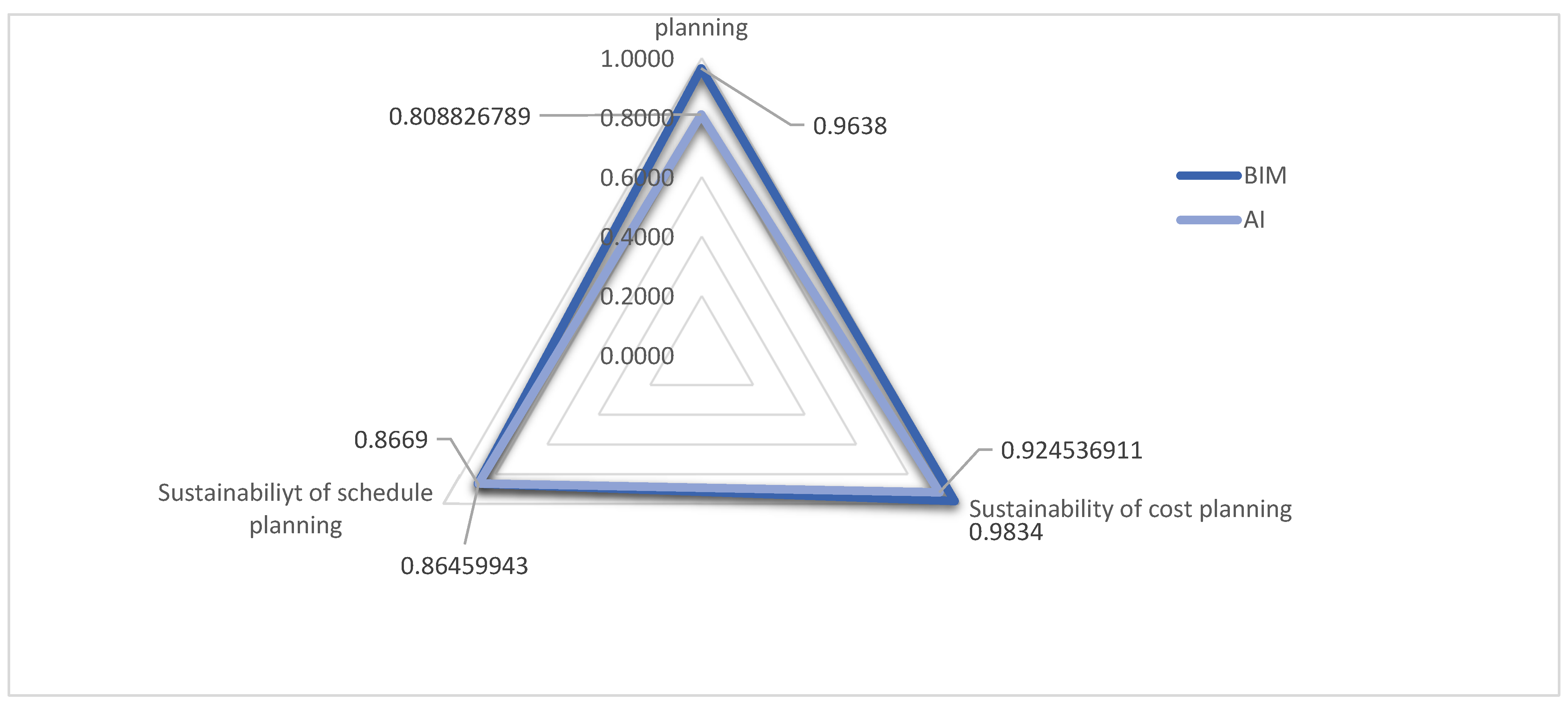
- Artificial Intelligence and Sustainability Indicators
- Cost planning (r = 0.9245; p < 0.00001)
- Schedule planning (r = 0.8646; p < 0.00001)
- Resource planning (r = 0.8088; p < 0.00001)
- Building Information Modelling (BIM) and Sustainability Indicators
- Cost planning (r = 0.9834)
- Resource planning (r = 0.9638)
- Schedule planning (r = 0.8669)
- Comparative View: BIM vs. AI
5. Discussion
5.1. Interpreting the Key Findings in a Quantitative Context
5.2. Geographical Boundary: From Three Countries to EU and Global Relevance
5.3. Managerial and Implementation Implications
5.4. Beyond Cost, Time, and Materials: Broader Sustainability Implications
- Environmental sustainability (planet). Improved cost and schedule performance can indirectly reduce environmental impacts through less rework, fewer delays, and reduced fuel and energy consumption on site. However, direct environmental performance (e.g., embodied carbon, life-cycle impacts, waste streams) requires additional data layers such as LCA databases, digital material passports, and traceable procurement information.
- Social sustainability and safety (people). AI-enabled monitoring and predictive analytics can support worker safety management (e.g., hazard detection, proactive safety planning), which contributes to social sustainability outcomes. Digital workflows also affect job design and skills requirements, underlining the importance of upskilling and fair transition practices.
- In practical terms, improved planning reliability can translate into fewer unplanned deliveries, reduced idle time of machinery, and less rework, which are typical sources of avoidable fuel/energy use and emissions on site. On the social side, respondents’ emphasis on AI use for monitoring and prediction aligns with reducing exposure to hazardous situations and supporting proactive safety planning; however, these outcomes require clear governance to avoid over-reliance and to ensure fair role transitions.
- Governance and transparency (governance). BIM–AI integration supports governance by enabling auditability of decisions, clearer documentation, and improved compliance tracking. This is particularly relevant for public procurement, ESG reporting, and accountability in sustainability claims.
- Circularity and life-cycle performance. The consistently lower material-related sustainability perceptions indicate that circular economy benefits are not yet fully realized in practice. Achieving circular outcomes requires integration across the asset life cycle, including design for disassembly, materials traceability, reuse pathways, and facility management data continuity.
- process standardization and data integration, which supports,
- process innovation and learning (e.g., faster feedback, fewer errors), ultimately improving,
- sustainability-oriented planning performance (cost/schedule/resource outcomes). Testing such mediation pathways requires longitudinal or multi-source data and is proposed as a focused direction for future research.
6. Conclusions
Author Contributions
Funding
Institutional Review Board Statement
Informed Consent Statement
Data Availability Statement
Acknowledgments
Conflicts of Interest
References
- Ding, G.K.C. Life cycle assessment (LCA) of sustainable building materials: An overview. In Eco-Efficient Construction and Building Materials; Pacheco-Torgal, F., Cabeza, L.F., Labrincha, J., de Magalhães, A., Eds.; Woodhead Publishing: Cambridge, UK, 2014; pp. 38–62. [Google Scholar] [CrossRef]
- Zuo, J.; Pullen, S.; Rameezdeen, R.; Bennetts, H.; Wang, Y.; Mao, G.; Zhou, Z.; Du, H.; Duan, H. Green building evaluation from a life-cycle perspective in Australia: A critical review. Renew. Sustain. Energy Rev. 2017, 70, 358–368. [Google Scholar] [CrossRef]
- Sartori, T.; Drogemuller, R.; Omrani, S.; Lamari, F. A schematic framework for life cycle assessment (LCA) and green building rating system (GBRS). J. Build. Eng. 2021, 38, 102180. [Google Scholar] [CrossRef]
- Bruce-Hyrkäs, T.; Pasanen, P.; Castro, R. Overview of whole building life-cycle assessment for green building certification and ecodesign through industry surveys and interviews. Procedia CIRP 2018, 69, 178–183. [Google Scholar] [CrossRef]
- Lee, N.; Tae, S.; Gong, Y.; Roh, S. Integrated building life-cycle assessment model to support South Korea’s green building certification system (G-SEED). Renew. Sustain. Energy Rev. 2017, 76, 43–50. [Google Scholar] [CrossRef]
- Chen, X.; Chang-Richards, A.Y.; Pelosi, A.; Jia, Y.; Shen, X.; Siddiqui, M.K.; Yang, N. Implementation of technologies in the construction industry: A systematic review. Eng. Constr. Archit. Manag. 2022, 29, 3181–3209. [Google Scholar] [CrossRef]
- Begić, H.; Galić, M. A systematic review of Construction 4.0 in the context of the BIM 4.0 premise. Buildings 2021, 11, 337. [Google Scholar] [CrossRef]
- Flyvbjerg, B. What you should know about megaprojects and why: An overview. Proj. Manag. J. 2014, 45, 6–19. [Google Scholar] [CrossRef]
- Love, P.E.D.; Edwards, D.J.; Irani, Z. Moving beyond optimism bias and strategic misrepresentation: An explanation for social infrastructure project cost overruns. IEEE Trans. Eng. Manag. 2012, 59, 560–571. [Google Scholar] [CrossRef]
- Schwab, K. The Fourth Industrial Revolution; Crown Business: New York, NY, USA, 2017. [Google Scholar]
- Kagermann, H.; Wahlster, W.; Helbig, J. Recommendations for Implementing the Strategic Initiative INDUSTRIE 4.0; Acatech: Munich, Germany, 2013. [Google Scholar]
- Oesterreich, T.D.; Teuteberg, F. Understanding the implications of digitisation and automation in the context of Industry 4.0: A triangulation approach and elements of a research agenda for the construction industry. Comput. Ind. 2016, 83, 121–139. [Google Scholar] [CrossRef]
- Dallasega, P.; Rauch, E.; Linder, C. Industry 4.0 as an enabler of proximity for construction supply chains: A systematic literature review. Comput. Ind. 2018, 99, 205–225. [Google Scholar] [CrossRef]
- Eastman, C.; Teicholz, P.; Sacks, R.; Liston, K. BIM Handbook: A Guide to Building Information Modeling for Owners, Managers, Designers, Engineers and Contractors, 2nd ed.; John Wiley & Sons: Hoboken, NJ, USA, 2011. [Google Scholar]
- Sacks, R.; Eastman, C.; Lee, G.; Teicholz, P. BIM Handbook: A Guide to Building Information Modeling for Owners, Designers, Engineers, Contractors, and Facility Managers, 3rd ed.; John Wiley & Sons: Hoboken, NJ, USA, 2018. [Google Scholar]
- Azhar, S. Building information modeling (BIM): Trends, benefits, risks, and challenges for the AEC industry. Leadersh. Manag. Eng. 2011, 11, 241–252. [Google Scholar] [CrossRef]
- Ghaffarianhoseini, A.; Tookey, J.; Ghaffarianhoseini, A.; Naismith, N.; Azhar, S.; Efimova, O.; Raahemifar, K. Building Information Modelling (BIM) uptake: Clear benefits, understanding its implementation, risks and challenges. Renew. Sustain. Energy Rev. 2017, 75, 1046–1053. [Google Scholar] [CrossRef]
- Wong, J.K.W.; Zhou, J. Enhancing environmental sustainability over building life cycles through green BIM: A review. Autom. Constr. 2015, 57, 156–165. [Google Scholar] [CrossRef]
- Lu, Y.; Wu, Z.; Chang, R.; Li, Y. Building Information Modeling (BIM) for green buildings: A critical review and future directions. Autom. Constr. 2017, 83, 134–148. [Google Scholar] [CrossRef]
- Russell, S.J.; Norvig, P. Artificial Intelligence: A Modern Approach, 4th ed.; Pearson: London, UK, 2020. [Google Scholar]
- Baduge, S.K.; Thilakarathna, S.; Perera, J.S.; Arashpour, M.; Sharafi, P.; Teodosio, B.; Shringi, A.; Mendis, P. Artificial intelligence and smart vision for building and construction 4.0: Machine and deep learning methods and applications. Autom. Constr. 2022, 141, 104440. [Google Scholar] [CrossRef]
- Datta, S.D.; Islam, M.; Sobuz, M.H.R.; Ahmed, S.; Kar, M. Artificial intelligence and machine learning applications in the project lifecycle of the construction industry: A comprehensive review. Heliyon 2024, 10, e26888. [Google Scholar] [CrossRef] [PubMed]
- Waqar, A.; Othman, I.; Almujibah, H.; Khan, M.B.; Alotaibi, S.; Elhassan, A.A.M. Factors influencing residential building envelope energy efficiency through building information modelling (BIM). Ain Shams Eng. J. 2024, 15, 102340. [Google Scholar] [CrossRef]
- Pan, Y.; Zhang, L. Integrating BIM and AI for smart construction management: Current status and future directions. Arch. Comput. Methods Eng. 2023, 30, 1081–1110. [Google Scholar] [CrossRef]
- Rahimian, F.P.; Seyedzadeh, S.; Oliver, S.; Rodriguez, S.; Dawood, N. On-demand monitoring of construction projects through a game-like hybrid application of BIM and machine learning. Autom. Constr. 2020, 110, 103012. [Google Scholar] [CrossRef]
- Chong, H.Y.; Lee, C.Y.; Wang, X. A mixed review of the adoption of Building Information Modelling (BIM) for sustainability. J. Clean. Prod. 2017, 142, 4114–4126. [Google Scholar] [CrossRef]
- Datta, S.D.; Tayeh, B.A.; Hakeem, I.Y.; Abu Aisheh, Y.I. Benefits and barriers of implementing building information modeling techniques for sustainable practices in the construction industry—A comprehensive review. Sustainability 2023, 15, 12466. [Google Scholar] [CrossRef]
- Miettinen, R.; Paavola, S. Beyond the BIM utopia: Approaches to the development and implementation of building information modeling. Autom. Constr. 2014, 43, 84–91. [Google Scholar] [CrossRef]
- Ullah, K.; Lill, I.; Witt, E. An overview of BIM adoption in the construction industry: Benefits and barriers. In 10th Nordic Conference on Construction Economics and Organization; Lill, I., Witt, E., Eds.; Emerald Publishing Limited: Bingley, UK, 2019; pp. 297–303. [Google Scholar] [CrossRef]
- Stojanovska-Georgievska, L.; Sandeva, I.; Krleski, A.; Spasevska, H.; Ginovska, M.; Panchevski, I.; Ivanov, R.; Perez Arnal, I.; Cerovsek, T.; Funtik, T. BIM in the center of digital transformation of the construction sector—The status of BIM adoption in North Macedonia. Buildings 2022, 12, 218. [Google Scholar] [CrossRef]
- Brodny, J.; Tutak, M. The level of digitization of small, medium and large enterprises in the central and eastern European countries and its relationship with economic parameters. J. Open Innov. Technol. Mark. Complex. 2022, 8, 113. [Google Scholar] [CrossRef]
- Liu, Z.; Lu, Y.; Peh, L.C. A review and scientometric analysis of global building information modeling (BIM) research in the architecture, engineering and construction (AEC) industry. Buildings 2019, 9, 210. [Google Scholar] [CrossRef]
- Opoku, D.G.J.; Perera, S.; Osei-Kyei, R.; Rashidi, M. Barriers to the adoption of digital twin in the construction industry: A literature review. Informatics 2023, 10, 14. [Google Scholar] [CrossRef]
- Lasi, H.; Fettke, P.; Kemper, H.G.; Feld, T.; Hoffmann, M. Industry 4.0. Bus. Inf. Syst. Eng. 2014, 6, 239–242. [Google Scholar] [CrossRef]
- Craveiro, F.; Duarte, J.P.; Bartolo, H.; Bartolo, P.J. Additive manufacturing as an enabling technology for digital construction: A perspective on Construction 4.0. Autom. Constr. 2019, 103, 251–267. [Google Scholar] [CrossRef]
- Sawhney, A.; Riley, M.; Irizarry, J. (Eds.) Construction 4.0: An Innovation Platform for the Built Environment; Routledge: London, UK, 2020. [Google Scholar]
- Deng, M.; Menassa, C.C.; Kamat, V.R. From BIM to digital twins: A systematic review of the evolution of intelligent building representations in the AEC-FM industry. J. Inf. Technol. Constr. 2021, 26, 58–83. [Google Scholar] [CrossRef]
- Ozturk, G.B. Digital twin research in the AECO-FM industry. J. Build. Eng. 2021, 40, 102730. [Google Scholar] [CrossRef]
- McKinsey Global Institute. Reinventing Construction: A Route to Higher Productivity; McKinsey & Company: Chicago, IL, USA, 2017. [Google Scholar]
- Agarwal, R.; Chandrasekaran, S.; Sridhar, M. Imagining construction’s digital future. McKinsey Q. 2016, 24, 1–15. [Google Scholar]
- Barbosa, F.; Woetzel, J.; Mischke, J.; Ribeirinho, M.J.; Sridhar, M.; Parsons, M.; Bertram, N.; Brown, S. Reinventing Construction through a Productivity Revolution; McKinsey Global Institute: New York, NY, USA, 2017. [Google Scholar]
- Wang, M.; Wang, C.C.; Sepasgozar, S.; Zlatanova, S. A systematic review of digital technology adoption in off-site construction: Current status and future direction towards industry 4.0. Buildings 2020, 10, 204. [Google Scholar] [CrossRef]
- Kor, M.; Yitmen, I.; Alizadehsalehi, S. An investigation for integration of deep learning and digital twins towards Construction 4.0. Smart Sustain. Built Environ. 2023, 12, 461–487. [Google Scholar] [CrossRef]
- Rafsanjani, H.N.; Nabizadeh, A.H. Towards digital architecture, engineering, and construction (AEC) industry through virtual design and construction (VDC) and digital twin. Energy Built Environ. 2023, 4, 169–178. [Google Scholar] [CrossRef]
- Hu, W.; Lim, K.Y.H.; Cai, Y. Digital twin and industry 4.0 enablers in building and construction: A survey. Buildings 2022, 12, 2004. [Google Scholar] [CrossRef]
- Hosamo, H.H.; Imran, A.; Cardenas-Cartagena, J.; Svennevig, P.R.; Svidt, K.; Nielsen, H.K. A review of the digital twin technology in the AEC-FM industry. Adv. Civ. Eng. 2022, 2022, 2185170. [Google Scholar] [CrossRef]
- Sepasgozar, S.M.E.; Khan, A.A.; Smith, K.; Romero, J.G.; Shen, X.; Shirowzhan, S.; Li, H.; Tahmasebinia, F. BIM and digital twin for developing convergence technologies as future of digital construction. Buildings 2023, 13, 441. [Google Scholar] [CrossRef]
- Boje, C.; Guerriero, A.; Kubicki, S.; Rezgui, Y. Towards a semantic Construction Digital Twin: Directions for future research. Autom. Constr. 2020, 114, 103179. [Google Scholar] [CrossRef]
- European Commission. The European Green Deal; COM(2019) 640 Final; European Commission: Brussels, Belgium, 2019. [Google Scholar]
- European Commission. A Renovation Wave for Europe—Greening Our Buildings, Creating Jobs, Improving Lives; COM(2020) 662 Final; European Commission: Brussels, Belgium, 2020. [Google Scholar]
- Turk, Ž. Structured analysis of ICT adoption in the European construction industry. Int. J. Constr. Manag. 2023, 23, 1151–1163. [Google Scholar] [CrossRef]
- Aleksandrova, E.; Vinogradova, V.; Tokunova, G. Integration of digital technologies in the field of construction in the Russian Federation. Eng. Manag. Prod. Serv. 2019, 11, 38–47. [Google Scholar] [CrossRef]
- Hossain, M.A.; Nadeem, A. Towards digitizing the construction industry: State of the art of construction 4.0. In Proceedings of the 10th International Structural Engineering and Construction Conference (ISEC-10), Chicago, IL, USA, 20–25 May 2019. [Google Scholar]
- Succar, B. Building information modelling framework: A research and delivery foundation for industry stakeholders. Autom. Constr. 2009, 18, 357–375. [Google Scholar] [CrossRef]
- Eastman, C.; Teicholz, P.; Sacks, R.; Liston, K. BIM Handbook: A Guide to Building Information Modeling for Owners, Managers, Designers, Engineers and Contractors, 1st ed.; John Wiley & Sons: Hoboken, NJ, USA, 2008. [Google Scholar]
- Sun, C.; Jiang, S.; Skibniewski, M.J.; Man, Q.; Shen, L. A literature review of the factors limiting the application of BIM in the construction industry. Technol. Econ. Dev. Econ. 2017, 23, 764–779. [Google Scholar] [CrossRef]
- Hosseini, M.R.; Maghrebi, M.; Akbarnezhad, A.; Martek, I.; Arashpour, M. Analysis of citation networks in building information modeling research. J. Constr. Eng. Manag. 2018, 144, 04018064. [Google Scholar] [CrossRef]
- Succar, B.; Kassem, M. Macro-BIM adoption: Conceptual structures. Autom. Constr. 2015, 57, 64–79. [Google Scholar] [CrossRef]
- Bew, M.; Richards, M. Bew-Richards BIM Maturity Model. In BuildingSMART Construct IT Autumn Members Meeting; BuildingSMART: Brighton, UK, 2008. [Google Scholar]
- Eadie, R.; Browne, M.; Odeyinka, H.; McKeown, C.; McNiff, S. BIM implementation throughout the UK construction project lifecycle: An analysis. Autom. Constr. 2013, 36, 145–151. [Google Scholar] [CrossRef]
- Smith, P. BIM implementation—Global strategies. Procedia Eng. 2014, 85, 482–492. [Google Scholar] [CrossRef]
- ISO 19650-1:2018; Organization and Digitization of Information about Buildings and Civil Engineering Works, Including Building Information Modelling (BIM)—Information Management Using Building Information Modelling—Part 1: Concepts and Principles. ISO: Geneva, Switzerland, 2018.
- ISO 19650-2:2018; Organization and Digitization of Information about Buildings and Civil Engineering Works, Including Building Information Modelling (BIM)—Information Management Using Building Information Modelling—Part 2: Delivery Phase of the Assets. ISO: Geneva, Switzerland, 2018.
- Bouška, R. Evaluation of maturity of BIM tools across different software platforms. Procedia Eng. 2016, 164, 481–486. [Google Scholar] [CrossRef]
- Ahmed, A.L.; Kassem, M. A unified BIM adoption taxonomy: Conceptual development, empirical validation and application. Autom. Constr. 2018, 96, 103–127. [Google Scholar] [CrossRef]
- Georgiadou, M.C. An overview of benefits and challenges of building information modelling (BIM) adoption in UK residential projects. Constr. Innov. 2019, 19, 298–320. [Google Scholar] [CrossRef]
- Merschbrock, C.; Munkvold, B.E. Effective digital collaboration in the construction industry—A case study of BIM deployment in a hospital construction project. Comput. Ind. 2015, 73, 1–7. [Google Scholar] [CrossRef]
- Winfield, M. Construction 4.0 and ISO 19650: A panacea for the digital revolution? Proc. Inst. Civ. Eng. Manag. Procure. Law 2020, 173, 175–181. [Google Scholar] [CrossRef]
- Dave, B.; Kuber, S.; Koskela, L.; Kagioglou, M. Opportunities for enhanced lean construction management using Internet of Things standards. Autom. Constr. 2016, 61, 86–97. [Google Scholar] [CrossRef]
- Sacks, R.; Koskela, L.; Dave, B.A.; Owen, R. Interaction of lean and building information modeling in construction. J. Constr. Eng. Manag. 2010, 136, 968–980. [Google Scholar] [CrossRef]
- Hamdi, O.; Leite, F. BIM and lean interactions from the BIM capability maturity model perspective: A case study. In Proceedings of the 22nd Annual Conference of the International Group for Lean Construction (IGLC 22), Oslo, Norway, 25–27 June 2014; pp. 299–310. [Google Scholar]
- Azhar, S.; Brown, J. BIM for sustainability analyses. Int. J. Constr. Educ. Res. 2009, 5, 276–292. [Google Scholar] [CrossRef]
- Zhuang, D.; Zhang, X.; Lu, Y.; Wang, C.; Jin, X.; Zhou, X.; Shi, X. A performance data integrated BIM framework for building life-cycle energy efficiency and environmental optimization design. Autom. Constr. 2021, 127, 103712. [Google Scholar] [CrossRef]
- Jalaei, F.; Jrade, A. Integrating building information modeling (BIM) and LEED system at the conceptual design stage of sustainable buildings. Sustain. Cities Soc. 2015, 18, 95–107. [Google Scholar] [CrossRef]
- Wong, J.K.W.; Kuan, K.L. Implementing ‘BEAM Plus’ for BIM-based sustainability analysis. Autom. Constr. 2014, 44, 163–175. [Google Scholar] [CrossRef]
- Kamel, E.; Memari, A.M. Review of BIM’s application in energy simulation: Tools, issues, and solutions. Autom. Constr. 2019, 97, 164–180. [Google Scholar] [CrossRef]
- Gao, H.; Koch, C.; Wu, Y. Building information modelling based building energy modelling: A review. Appl. Energy 2019, 238, 320–343. [Google Scholar] [CrossRef]
- Pezeshki, Z.; Soleimani, A.; Darabi, A. Application of BEM and using BIM database for BEM: A review. J. Build. Eng. 2019, 23, 1–17. [Google Scholar] [CrossRef]
- Ilhan, B.; Yaman, H. Green building assessment tool (GBAT) for integrated BIM-based design decisions. Autom. Constr. 2016, 70, 26–37. [Google Scholar] [CrossRef]
- Wu, W.; Issa, R.R.A. BIM execution planning in green building projects: LEED as a use case. J. Manag. Eng. 2015, 31, A4014007. [Google Scholar] [CrossRef]
- Liu, Z.; Osmani, M.; Demian, P.; Baldwin, A. A BIM-aided construction waste minimisation framework. Autom. Constr. 2015, 59, 1–23. [Google Scholar] [CrossRef]
- Won, J.; Cheng, J.C.P. Identifying potential opportunities of building information modeling for construction and demolition waste management and minimization. Autom. Constr. 2017, 79, 3–18. [Google Scholar] [CrossRef]
- Akinade, O.O.; Oyedele, L.O.; Ajayi, S.O.; Bilal, M.; Alaka, H.A.; Owolabi, H.A.; Bello, S.A.; Jaiyeoba, B.E.; Kadiri, K.O. Design for Deconstruction (DfD): Critical success factors for diverting end-of-life waste from landfills. Waste Manag. 2017, 60, 3–13. [Google Scholar] [CrossRef] [PubMed]
- Honic, M.; Kovacic, I.; Rechberger, H. Improving the recycling potential of buildings through Material Passports (MP): An Austrian case study. J. Clean. Prod. 2019, 217, 787–797. [Google Scholar] [CrossRef]
- Munaro, M.R.; Tavares, S.F.; Bragança, L. Towards circular and more sustainable buildings: A systematic literature review on the circular economy in the built environment. J. Clean. Prod. 2020, 260, 121134. [Google Scholar] [CrossRef]
- Ajayi, S.O.; Oyedele, L.O.; Ceranic, B.; Gallanagh, M.; Kadiri, K.O. Life cycle environmental performance of material specification: A BIM-enhanced comparative assessment. Int. J. Sustain. Build. Technol. Urban Dev. 2015, 6, 14–24. [Google Scholar] [CrossRef]
- Chong, H.Y.; Wang, X. The outlook of building information modeling for sustainable development. Clean Technol. Environ. Policy 2016, 18, 1877–1887. [Google Scholar] [CrossRef]
- Jrade, A.; Jalaei, F. Integrating building information modelling with sustainability to design building projects at the conceptual stage. Build. Simul. 2013, 6, 429–444. [Google Scholar] [CrossRef]
- Ayman, R.; Alwan, Z.; McIntyre, L. BIM for sustainable project delivery: Review paper and future development areas. Archit. Sci. Rev. 2020, 63, 15–33. [Google Scholar] [CrossRef]
- LeCun, Y.; Bengio, Y.; Hinton, G. Deep learning. Nature 2015, 521, 436–444. [Google Scholar] [CrossRef] [PubMed]
- Darko, A.; Chan, A.P.C.; Adabre, M.A.; Edwards, D.J.; Hosseini, M.R.; Ameyaw, E.E. Artificial intelligence in the AEC industry: Scientometric analysis and visualization of research activities. Autom. Constr. 2020, 112, 103081. [Google Scholar] [CrossRef]
- Salehi, H.; Burgueño, R. Emerging artificial intelligence methods in structural engineering. Eng. Struct. 2018, 171, 170–189. [Google Scholar] [CrossRef]
- Abioye, S.O.; Oyedele, L.O.; Akanbi, L.; Ajayi, A.; Delgado, J.M.D.; Bilal, M.; Akinade, O.O.; Ahmed, A. Artificial intelligence in the construction industry: A review of present status, opportunities and future challenges. J. Build. Eng. 2021, 44, 103299. [Google Scholar] [CrossRef]
- Rafiei, M.H.; Adeli, H. Novel machine-learning model for estimating construction costs considering economic variables and indexes. J. Constr. Eng. Manag. 2018, 144, 04018106. [Google Scholar] [CrossRef]
- Kim, G.H.; An, S.H.; Kang, K.I. Comparison of construction cost estimating models based on regression analysis, neural networks, and case-based reasoning. Build. Environ. 2004, 39, 1235–1242. [Google Scholar] [CrossRef]
- Wang, R.; Asghari, V.; Cheung, C.M.; Hsu, S.C.; Lee, C. Assessing effects of economic factors on construction cost estimation using deep neural networks. Autom. Constr. 2022, 134, 104080. [Google Scholar] [CrossRef]
- Hashemi, S.T.; Ebadati, O.M.; Kaur, H. Cost estimation and prediction in construction projects: A systematic review on machine learning techniques. SN Appl. Sci. 2020, 2, 1703. [Google Scholar] [CrossRef]
- Ghoddousi, P.; Eshtehardian, E.; Jooybanpour, S.; Javanmardi, A. Multi-mode resource-constrained discrete time–cost-resource optimization in project scheduling using non-dominated sorting genetic algorithm. Autom. Constr. 2013, 30, 216–227. [Google Scholar] [CrossRef]
- Rogalska, M.; Bożejko, W.; Hejducki, Z. Time/cost optimization using hybrid evolutionary algorithm in construction project scheduling. Autom. Constr. 2008, 18, 24–31. [Google Scholar] [CrossRef]
- Kannimuthu, M.; Raphael, B.; Palaneeswaran, E.; Kuppuswamy, A. Optimizing time, cost and quality in multi-mode resource-constrained project scheduling. Built Environ. Proj. Asset Manag. 2019, 9, 44–63. [Google Scholar] [CrossRef]
- Lin, J.C.W.; Lv, Q.; Yu, D.; Srivastava, G.; Chen, C.H. Optimized scheduling of resource-constraints in projects for smart construction. Inf. Process. Manag. 2022, 59, 103005. [Google Scholar] [CrossRef]
- Fang, W.; Ding, L.; Zhong, B.; Love, P.E.D.; Luo, H. Automated detection of workers and heavy equipment on construction sites: A convolutional neural network approach. Adv. Eng. Inform. 2018, 37, 139–149. [Google Scholar] [CrossRef]
- Guo, H.; Yu, Y.; Skitmore, M. Visualization technology-based construction safety management: A review. Autom. Constr. 2017, 73, 135–144. [Google Scholar] [CrossRef]
- Li, J.; Li, H.; Umer, W.; Wang, H.; Xing, X.; Zhao, S.; Hou, J. Identification and classification of construction equipment operators’ mental fatigue using wearable eye-tracking technology. Autom. Constr. 2020, 109, 103000. [Google Scholar] [CrossRef]
- Regona, M.; Yigitcanlar, T.; Xia, B.; Li, R.Y.M. Artificial intelligence technologies and the construction industry: Current status and future trends. Buildings 2022, 12, 1989. [Google Scholar] [CrossRef]
- Rane, N. Integrating building information modelling (BIM) and artificial intelligence (AI) for smart construction schedule, cost, quality, and safety management: Challenges and opportunities. SSRN Electron. J. 2023, 4616055. [Google Scholar] [CrossRef]
- Blanco, J.L.; Fuchs, S.; Parsons, M.; Ribeirinho, M.J. Artificial intelligence: Construction technology’s next frontier. Build. Econ 2018, 7–13. Available online: https://www.mckinsey.com/capabilities/operations/our-insights/artificial-intelligence-construction-technologys-next-frontier.
- Heidari, A.; Peyvastehgar, Y.; Rashidian, S.; Nasrollahi, N.; Bahram, P. A systematic review of the BIM in construction: From smart building management to interoperability of BIM & AI. Archit. Sci. Rev. 2024, 67, 129–149. [Google Scholar] [CrossRef]
- Bassir, D.; Lodge, H.; Chang, H.; Majak, J.; Chen, W. Application of artificial intelligence and machine learning for BIM. Int. J. Simul. Multidiscip. Des. Optim. 2023, 14, 5. [Google Scholar] [CrossRef]
- Zhao, X.; Yeoh, J.K.W.; Tan, S.T. Artificial intelligence in the construction industry: A review of present status, opportunities, and challenges. J. Build. Eng. 2023, 76, 107363. [Google Scholar] [CrossRef]
- Bilal, M.; Oyedele, L.O.; Qadir, J.; Munir, K.; Ajayi, S.O.; Akinade, O.O.; Owolabi, H.A.; Alaka, H.A.; Pasha, M. Big Data in the construction industry: A review of present status, opportunities, and future trends. Adv. Eng. Inform. 2016, 30, 500–521. [Google Scholar] [CrossRef]
- Ma, Z.; Liu, S. A review of 3D reconstruction techniques in civil engineering and their applications. Adv. Eng. Inform. 2018, 37, 163–174. [Google Scholar] [CrossRef]
- Caetano, I.; Santos, L.; Leitão, A. Computational design in architecture: Defining parametric, generative, and algorithmic design. Front. Archit. Res. 2020, 9, 287–300. [Google Scholar] [CrossRef]
- Nagy, D.; Lau, D.; Locke, J.; Stoddart, J.; Villaggi, L.; Wang, R.; Zhao, D.; Benjamin, D. Project Discover: An application of generative design for architectural space planning. In Proceedings of the Symposium on Simulation for Architecture and Urban Design, Toronto, ON, Canada, 22–24 May 2017; pp. 1–8. [Google Scholar]
- Shi, X.; Yang, W. Performance-driven architectural design and optimization technique from a perspective of architects. Autom. Constr. 2013, 32, 125–135. [Google Scholar] [CrossRef]
- Touloupaki, E.; Theodosiou, T. Performance simulation integrated in parametric 3D modeling as a method for early stage design optimization—A review. Energies 2017, 10, 637. [Google Scholar] [CrossRef]
- Zhang, J.; El-Gohary, N.M. Automated information transformation for automated regulatory compliance checking in construction. J. Comput. Civ. Eng. 2015, 29, B4015001. [Google Scholar] [CrossRef]
- Dimyadi, J.; Pauwels, P.; Amor, R. Modelling and accessing regulatory knowledge for computer-assisted compliance audit. J. Inf. Technol. Constr. 2016, 21, 317–336. [Google Scholar]
- Nawari, N.O. A generalized adaptive framework (GAF) for automating code compliance checking. Buildings 2019, 9, 86. [Google Scholar] [CrossRef]
- Fuller, A.; Fan, Z.; Day, C.; Barlow, C. Digital twin: Enabling technologies, challenges and open research. IEEE Access 2020, 8, 108952–108971. [Google Scholar] [CrossRef]
- Xie, X.; Lu, Q.; Parlikad, A.K.; Schooling, J.M. Digital twin enabled asset anomaly detection for building facility management. IFAC-PapersOnLine 2020, 53, 380–385. [Google Scholar] [CrossRef]
- Matarneh, S.T.; Danso-Amoako, M.; Al-Bizri, S.; Gaterell, M.; Matarneh, R. Building information modeling for facilities management: A literature review and future research directions. J. Build. Eng. 2019, 24, 100755. [Google Scholar] [CrossRef]
- Lu, Q.; Xie, X.; Heaton, J.; Parlikad, A.K.; Schooling, J. From BIM towards digital twin: Strategy and future development for smart asset management. In Service Oriented, Holonic and Multi-Agent Manufacturing Systems for Industry of the Future; Springer: Cham, Switzerland, 2020; pp. 392–404. [Google Scholar]
- Bortolini, R.; Formoso, C.T.; Viana, D.D. Site logistics planning and control for engineer-to-order prefabricated building systems using BIM 4D modeling. Autom. Constr. 2019, 98, 248–264. [Google Scholar] [CrossRef]
- Abanda, F.H.; Balu, B.; Adukpo, S.E.; Akintola, A. Decoding ISO 19650 through process modelling for information management and stakeholder communication in BIM. Buildings 2025, 15, 431. [Google Scholar] [CrossRef]
- Adeli, H.; Karim, A. Scheduling/cost optimization and neural dynamics model for construction. J. Constr. Eng. Manag. 1997, 123, 450–458. [Google Scholar] [CrossRef]
- Koulinas, G.K.; Anagnostopoulos, K.P. A new tabu search-based hyper-heuristic algorithm for solving construction leveling problems with limited resource availabilities. Autom. Constr. 2013, 31, 169–175. [Google Scholar] [CrossRef]
- Haghani, A.; Chen, M.C. Optimizing gate assignments at airport terminals. Transp. Res. Part A Policy Pract. 1998, 32, 437–454. [Google Scholar] [CrossRef]
- Cajzek, R.; Klanšek, U. Cost optimization of project schedules under constrained resources and alternative production processes by mixed-integer nonlinear programming. Eng. Constr. Archit. Manag. 2019, 26, 2474–2508. [Google Scholar] [CrossRef]
- Zou, X.; Zhang, L.; Zhang, Q. Time-cost optimization in repetitive project scheduling with limited resources. Eng. Constr. Archit. Manag. 2022, 29, 669–695. [Google Scholar] [CrossRef]
- Elbeltagi, E.; Hegazy, T.; Grierson, D. Comparison among five evolutionary-based optimization algorithms. Adv. Eng. Inform. 2005, 19, 43–53. [Google Scholar] [CrossRef]
- Zhang, L.; Zou, X.; Qi, J. A trade-off between time and cost in scheduling repetitive construction projects. J. Ind. Manag. Optim. 2015, 11, 1423–1434. [Google Scholar] [CrossRef]
- Marzouk, M.; Abubakr, A. Decision support for tower crane selection with building information models and genetic algorithms. Autom. Constr. 2016, 61, 1–15. [Google Scholar] [CrossRef]
- Marzouk, M.; Azab, S. Environmental and economic impact assessment of construction and demolition waste disposal using system dynamics. Resour. Conserv. Recycl. 2014, 82, 41–49. [Google Scholar] [CrossRef]
- Liu, S.S.; Wang, C.J. Optimizing project selection and scheduling problems with time-dependent resource constraints. Autom. Constr. 2011, 20, 1110–1119. [Google Scholar] [CrossRef]
- Sonmez, R.; Bettemir, Ö.H. A hybrid genetic algorithm for the discrete time–cost trade-off problem. Expert Syst. Appl. 2012, 39, 11428–11434. [Google Scholar] [CrossRef]
- Hegazy, T. Optimization of resource allocation and leveling using genetic algorithms. J. Constr. Eng. Manag. 1999, 125, 167–175. [Google Scholar] [CrossRef]
- El-Rayes, K.; Kandil, A. Time-cost-quality trade-off analysis for highway construction. J. Constr. Eng. Manag. 2005, 131, 477–486. [Google Scholar] [CrossRef]
- Zhong, B.; Wu, H.; Li, H.; Sepasgozar, S.; Luo, H.; He, L. A scientometric analysis and critical review of construction related ontology research. Autom. Constr. 2019, 101, 17–31. [Google Scholar] [CrossRef]
- Han, K.K.; Golparvar-Fard, M. Potential of big visual data and building information modeling for construction performance analytics: An exploratory study. Autom. Constr. 2017, 73, 184–198. [Google Scholar] [CrossRef]
- Deng, Y.; Cheng, J.C.P.; Anumba, C. Mapping between BIM and 3D GIS in different levels of detail using schema mediation and instance comparison. Autom. Constr. 2016, 67, 1–21. [Google Scholar] [CrossRef]
- Xu, X.; Ma, L.; Ding, L. A framework for BIM-enabled life-cycle information management of construction project. Int. J. Adv. Robot. Syst. 2014, 11, 126. [Google Scholar] [CrossRef]
- Akadiri, P.O.; Chinyio, E.A.; Olomolaiye, P.O. Design of a sustainable building: A conceptual framework for implementing sustainability in the building sector. Buildings 2012, 2, 126–152. [Google Scholar] [CrossRef]
- Hwang, B.G.; Tan, J.S. Green building project management: Obstacles and solutions for sustainable development. Sustain. Dev. 2012, 20, 335–349. [Google Scholar] [CrossRef]
- Hossain, M.U.; Ng, S.T. Critical consideration of buildings’ environmental impact assessment towards adoption of circular economy: An analytical review. J. Clean. Prod. 2018, 205, 763–780. [Google Scholar] [CrossRef]
- Ahmad, T.; Thaheem, M.J. Developing a residential building-related social sustainability assessment framework and its implications for BIM. Sustain. Cities Soc. 2017, 28, 1–15. [Google Scholar] [CrossRef]
- Eurostat. Construction Statistics—NACE Rev. 2. Eurostat Statistics Explained. 2023. Available online: https://ec.europa.eu/eurostat/statistics-explained/index.php/Construction_statistics_-_NACE_Rev._2 (accessed on 10 January 2025).
- European Construction Industry Federation. Construction 2050—Building Tomorrow’s Europe Today; FIEC: Brussels, Belgium, 2019. [Google Scholar]
- European Commission. Supporting Digitalisation of the Construction Sector and SMEs; European Commission: Brussels, Belgium, 2021. [Google Scholar]
- Bašková, R.; Struková, Z.; Tažiková, A. Adoption of digital technologies in the learning process to support the platform Construction 4.0. In Proceedings of the ICERI2020 Conference, Seville, Spain, 9–10 November 2020; pp. 2988–2995. [Google Scholar]
- Mandičák, T.; Mesároš, P.; Kozlovská, M. Information and communication technologies for sustainable construction in investment projects. In Proceedings of the International Multidisciplinary Scientific GeoConference SGEM, Sofia, Bulgaria, 28 June–7 July 2019; pp. 481–488. [Google Scholar] [CrossRef]
- Mesároš, P.; Mandičák, T. Impact of digitalization on safety at work in the construction industry. Civ. Eng. Archit. 2022, 10, 2889–2899. [Google Scholar] [CrossRef]
- Smetanková, J.; Mandičák, T.; Spišáková, M. Analysis of the implementation of BIM in the Slovak construction industry. IOP Conf. Ser. Mater. Sci. Eng. 2021, 1203, 022022. [Google Scholar] [CrossRef]
- Mésaroš, P.; Mandičák, T. Exploitation and benefits of BIM in construction project management in Slovakia. IOP Conf. Ser. Mater. Sci. Eng. 2017, 245, 062056. [Google Scholar] [CrossRef]
- Marović, I.; Perić, M.; Hanak, T. A multi-criteria decision support concept for selecting the optimal contractor. Appl. Sci. 2021, 11, 1660. [Google Scholar] [CrossRef]
- Marović, I.; Car-Pušić, D.; Hrvatin, Z. Establishing a model to evaluate public administration projects. E-Gose Stud. Proj. 2014, 12, 56–66. [Google Scholar] [CrossRef]
- Vukomanović, M.; Radujković, M.; Nahod, M.M. EFQM excellence model as the TQM model of the construction industry of southeastern Europe. J. Civ. Eng. Manag. 2014, 20, 70–81. [Google Scholar] [CrossRef]
- Cerić, A. The role of communication and information management in project success. Proc. Inst. Civ. Eng. Manag. Procure. Law 2016, 169, 167–171. [Google Scholar] [CrossRef]
- Olanrewaju, O.I.; Kineber, A.F.; Chileshe, N.; Edwards, D.J. Modelling the relationship between BIM adoption and construction sustainability: Towards sustainability transformation in organizations. Buildings 2021, 11, 413. [Google Scholar] [CrossRef]
- Olawumi, T.O.; Chan, D.W.M. Identifying and prioritizing the benefits of integrating BIM and sustainability practices in construction projects: A Delphi survey of international experts. Sustain. Cities Soc. 2018, 40, 16–27. [Google Scholar] [CrossRef]
- Tan, T.; Chen, K.; Xue, F.; Lu, W. Barriers to Building Information Modeling (BIM) implementation in China’s prefabricated construction: An interpretive structural modeling (ISM) approach. J. Clean. Prod. 2019, 219, 949–959. [Google Scholar] [CrossRef]
- Galić, M.; Venkrbec, V.; Chmelik, F.; Feine, I.; Pučko, Z.; Klanšek, U. Survey of accomplishments in BIM implementation in Croatia, the Czech Republic, Germany, and Slovenia. Adv. Civ. Archit. Eng. 2017, 15, 23–35. [Google Scholar] [CrossRef]
- Kolarić, S.; Vukomanović, M.; Bogdan, A. Analysis of the use of BIM in Croatian construction industry. Građevinar 2020, 72, 205–214. [Google Scholar] [CrossRef]
- Cerić, A.; Završki, I.; Vukomanović, M.; Ivić, I.; Nahod, M.-M. BIM implementation in building maintenance management. Građevinar 2019, 71, 889–900. [Google Scholar] [CrossRef]
- Kolarić, S.; Mandičák, T.; Vukomanović, M.; Mésároš, P. The Influence of BIM Education Improvement on Raising BIM Awareness in Croatia and Slovakia. Period. Polytech. Arch. 2019, 50, 21–29. [Google Scholar] [CrossRef]
- Funtík, T.; Makýš, P.; Ďubek, M.; Erdélyi, J.; Honti, R.; Cerovšek, T. The Status of Building Information Modeling Adoption in Slovakia. Buildings 2023, 13, 2997. [Google Scholar] [CrossRef]
- Mayer, P.; Funtík, T.; Gašparík, J.; Makýš, P. Analysis of the Current State of Automation of Hazard Detection Processes in BIM in Slovakia. Appl. Sci. 2021, 11, 8130. [Google Scholar] [CrossRef]
- Mandičák, T.; Spišáková, M.; Mésároš, P. Sustainable Design and Building Information Modeling of Construction Project Management towards a Circular Economy. Sustainability 2024, 16, 4376. [Google Scholar] [CrossRef]
- Mésároš, P.; Mandičák, T. Exploitation and Benefits of BIM in Construction Project Management. IOP Conf. Ser. Mater. Sci. Eng. 2017, 245, 062056. [Google Scholar] [CrossRef]



| Ref. | Research Focus | Design/Method | Key Results | Limitations/Gaps |
|---|---|---|---|---|
| [69] | Lean–BIM synergies | Conceptual/industry view | Identifies opportunities for integrating lean principles with BIM for process improvement. | Limited empirical quantification; context-specific. |
| [70] | Lean + BIM interaction | Conceptual framework | Explains how BIM supports lean workflows and collaboration. | Lacks cross-country evidence on sustainability/resource outcomes. |
| [71] | BIM maturity & lean interactions | Survey/assessment approach | Links BIM capability maturity to lean implementation benefits. | Needs broader validation and linkage to AI + sustainability metrics. |
| [83] | BIM for waste/resource efficiency | Empirical/case-oriented | Shows BIM can reduce waste via better coordination and planning. | Often project-specific; limited generalizability/quant metrics. |
| [87] | BIM for sustainability | Review/outlook | Summarizes sustainability-related BIM benefits across lifecycle. | Gaps in standardized KPIs and quantitative impact assessment. |
| [94] | AI for cost prediction | Machine-learning model | Demonstrates ML can improve construction cost estimation accuracy. | Data availability/transferability issues; interpretability. |
| [97] | AI in cost estimation | Review | Maps AI/ML techniques for cost prediction and drivers. | Need benchmarking and integration with BIM data structures. |
| [100] | AI optimization of time–cost–quality | Optimization/AI | Optimizes multi-objective project performance. | Often assumes ideal data; limited real-world BIM–AI pipelines. |
| [101] | AI-based scheduling optimization | Optimization/ML | Improves scheduling efficiency via optimized algorithms. | Requires high-quality data; limited adoption barriers analysis. |
| [104] | AI for safety/risk identification | Computer vision/ML | Detects hazards/unsafe behaviors to improve site safety. | Generalization across sites; integration into BIM workflows. |
| [109] | AI applications in construction | Review | Synthesizes AI use-cases (planning, safety, maintenance). | Need maturity/adoption evidence and sustainability linkage. |
| [115] | Performance-driven design optimization | Computational optimization | Uses AI/optimization to enhance design performance. | Limited integration with practical BIM-based project delivery. |
| [142] | BIM-enabled lifecycle information mgmt. | Framework | Proposes BIM-based lifecycle info management for decision support. | Implementation challenges; limited empirical validation. |
| [160] | Benefits of BIM–AI integration | Survey/prioritization study | Identifies and prioritizes benefits of integrating BIM with emerging digital tech/AI. | Context-dependent; limited evidence in C/SE Europe markets. |
| [161] | Barriers to BIM adoption | Survey/review | Highlights organizational, technical, and policy barriers. | Need region-specific analysis and link to BIM–AI uptake. |
| [149] | EU support for construction digitalization | Policy report | Sets policy drivers and support actions for sector digitalization. | Does not quantify project-level sustainability/resource impacts. |
| [153] | BIM implementation analysis (SK context) | Empirical analysis | Discusses BIM implementation status and challenges in Slovakia. | Needs extension toward AI integration and sustainability outcomes. |
| Use of AI | Resource Planning | Cost Planning | Schedule Planning | |
|---|---|---|---|---|
| Use of AI | 1 | |||
| Sustainability of resource planning | 0.808826789 | 1 | ||
| Sustainability of cost planning | 0.924536911 | 0.620994387 | 1 | |
| Sustainability of schedule planning | 0.86459943 | 0.47772585 | 0.776160412 | 1 |
| BIM | AI | |
|---|---|---|
| Sustainability of resource planning | 0.9638 | 0.808826789 |
| Sustainability of cost planning | 0.9834 | 0.924536911 |
| Sustainability of schedule planning | 0.8669 | 0.86459943 |
| Indicator | Design/Engineering Mean ± SD | Other Roles (n = 3) Mean ± SD | Median (IQR) Design/Engineering | Median (IQR) Other Roles | p-Value |
|---|---|---|---|---|---|
| Use of AI (mean across phases) | 3.39 ± 1.08 | 3.33 ± 0.58 | 3.50 (2.75–3.92) | 3.00 (3.00–3.50) | 0.930 |
| AI potential: Cost optimization | 3.63 ± 1.30 | 4.00 ± 1.00 | 4.00 (2.25–5.00) | 4.00 (3.50–4.50) | 0.745 |
| AI potential: Schedule optimization | 3.53 ± 1.22 | 4.33 ± 0.58 | 3.00 (3.00–5.00) | 4.00 (4.00–4.50) | 0.317 |
| AI potential: Materials optimization | 3.20 ± 1.24 | 4.00 ± 1.00 | 3.00 (2.00–4.00) | 4.00 (3.50–4.50) | 0.317 |
Disclaimer/Publisher’s Note: The statements, opinions and data contained in all publications are solely those of the individual author(s) and contributor(s) and not of MDPI and/or the editor(s). MDPI and/or the editor(s) disclaim responsibility for any injury to people or property resulting from any ideas, methods, instructions or products referred to in the content. |
© 2026 by the authors. Licensee MDPI, Basel, Switzerland. This article is an open access article distributed under the terms and conditions of the Creative Commons Attribution (CC BY) license.
Share and Cite
Marović, I.; Mandičák, T.; Krajníková, K.; Behúnová, A.; Mésároš, P. Artificial Intelligence and Building Information Modelling for Sustainable Construction Project Management and Digitalization in Construction. Buildings 2026, 16, 846. https://doi.org/10.3390/buildings16040846
Marović I, Mandičák T, Krajníková K, Behúnová A, Mésároš P. Artificial Intelligence and Building Information Modelling for Sustainable Construction Project Management and Digitalization in Construction. Buildings. 2026; 16(4):846. https://doi.org/10.3390/buildings16040846
Chicago/Turabian StyleMarović, Ivan, Tomáš Mandičák, Katarína Krajníková, Annamária Behúnová, and Peter Mésároš. 2026. "Artificial Intelligence and Building Information Modelling for Sustainable Construction Project Management and Digitalization in Construction" Buildings 16, no. 4: 846. https://doi.org/10.3390/buildings16040846
APA StyleMarović, I., Mandičák, T., Krajníková, K., Behúnová, A., & Mésároš, P. (2026). Artificial Intelligence and Building Information Modelling for Sustainable Construction Project Management and Digitalization in Construction. Buildings, 16(4), 846. https://doi.org/10.3390/buildings16040846