Article

Interaction Effects of Stressors and Coping Strategies on Mental Health Disorders Among Civil Engineers in Emerging Countries


by
Gokhan Kazar
1,
Dündar Can Üstün
2,
Fethi Kadıoğlu
3 and
Onur Behzat Tokdemir
3,4,*
1
Department of Civil Engineering, Istanbul Medeniyet University, 34700 Istanbul, Türkiye
2
Department of Civil Engineering, Middle East Technical University, 06800 Ankara, Türkiye
3
Department of Civil Engineering, Istanbul Technical University, 34467 Istanbul, Türkiye
4
Artificial Intelligence and Data Science Research Center, Istanbul Technical University, 34467 Istanbul, Türkiye
*
Author to whom correspondence should be addressed.
Buildings 2026, 16(4), 776; https://doi.org/10.3390/buildings16040776
Submission received: 31 December 2025 / Revised: 9 February 2026 / Accepted: 11 February 2026 / Published: 13 February 2026
(This article belongs to the Section Construction Management, and Computers & Digitization)

Abstract

Owing to the harsh requirements and characteristics of construction projects, such as limited budgets and tight work schedules, construction professionals suffer from various mental health disorders. The objective of this study is to investigate the effects and interaction of work-related stressors and coping mechanisms on the severity of mental health disorders among construction professionals working in emerging countries. Several studies have focused on the correlations between work-related stressors, coping mechanisms, and mental health outcomes (including depression, anxiety, and stress). However, no study has evaluated the interaction effects of stress factors on the severity of mental health disorders among construction professionals nor examined the effectiveness of coping mechanisms enacted to address workplace stressors. To achieve this objective, a questionnaire was administered to 491 civil engineers with construction site experience across different emerging countries. The survey included background information, stressor categories, coping mechanisms, and the Depression, Anxiety, and Stress Scale (DASS-21). Four hypotheses were developed and tested using multinomial logistic regression analysis. The findings indicate that project-related stressors play a more critical role in triggering mental health disorders than personal-related attributes. Moreover, while certain stressors (managerial, organizational, and mental) do not exhibit significant individual effects, their interaction effects on mental health disorders are statistically significant. The results further reveal that coping strategies can effectively mitigate the impact of work condition-related stressors on depression, anxiety, and stress, although both positive and negative moderating effects are observed. Professional and personalized mental health consulting is therefore recommended to support construction professionals and promote healthier working environments.

1. Introduction

The construction industry has been identified as one of the most stressful working environments because of the requirements to deliver projects to high-quality standards within a limited time and budget [1]. According to a World Health Organization (WHO) report, 87% and 70% of construction professionals experience anxiety and stress, respectively. Indeed, 97% of this occupational group reported depression in their workplace [2]. Construction professionals encounter role conflict and ambiguity, heavy workloads, inflexible working schedules, long work hours, time pressure, and lack of recovery facilities and opportunities [3,4]. Among mental health disorders, depression, anxiety, and stress are the primary and most widely observed among professionals during construction processes [5,6,7,8] and workers [9,10,11]. Employees develop various coping mechanisms to react to and deal with their psychological symptoms [10,12,13].
Understanding the root causes of stressors and their impact is vital for eliminating or reducing mental illnesses and increasing the project performance of construction professionals. Therefore, several studies have attempted to explore underlying stress factors [6,14,15,16,17,18] and the impacts of these on mental health disorders [3,10] and job performance [15,19] in the construction industry. In addition, the relationship between coping mechanisms, stressors, and mental illnesses for construction professionals [12] and construction workers [10] has been evaluated. Apart from identifying the relationship and main stress factors, the role of certain factors, such as work-family conflict [20,21], gender diversity [7], personal characteristics [13], discrimination [22], organizational supports [23], and job demand resources [4] on the mental health well-being of construction professionals have been explored [18]. These studies have made significant contributions to the body of knowledge related to evaluating and understanding the mental well-being of construction professionals from diverse perspectives; however, it is also necessary to explore the interaction effects of stressors and coping strategies on mental health disorders. Since stress factors tend not to occur alone, and two or more factors can be observed together in real sites [24], the impact of such interactions on the mental well-being of construction professionals should also be investigated. In addition, although employees develop diverse coping mechanisms to deal with psychological disorders at work, they may not do this sufficiently and appropriately. Accordingly, the effectiveness of these coping strategies in mitigating mental health diseases among civil engineers is not well known and needs to be explored in detail. To the best of our knowledge, no detailed and empirical study has been conducted that focuses on the causal interaction and main effects of stressors and the effectiveness of construction professionals’ coping strategies on mental well-being. Specifically, this study attempts to answer two main research questions (RQs) that contribute to the body of knowledge:
RQ1: What are the interaction impacts of the combined stress factors on mental health disorders of construction professionals (two-dimensional impact)?
RQ2: What is the effectiveness of coping strategies practiced by construction professionals against such stress factors in mitigating mental health disorders?
In addition, while some studies have considered the influences of demographic background on observed stress factors and mental health disorders and the selection of coping strategies in an emerging country, only limited demographic factors (gender, age, race, and experience) were included [4,20]. Hence, further factors (e.g., marital status, education, and working hours) should also be considered, which leads to the third RQ.
RQ3: Do mental disorders change among construction professionals according to their demographic background in emerging countries?

2. Background

2.1. Mental Health Disorders, Stressors, and Coping Strategies

Depression, anxiety, and stress are the most commonly observed mental health disorders among workplace employees [2]. For instance, it is noted that around one trillion USD is lost each year due to depression, anxiety, and stress, lowering productivity and reducing business performance. According to a recent Health and Safety Executive (HSE) report, 11 million working days are lost yearly due to depression, anxiety, and stress [25]. Depression, anxiety, and stress may emerge as occupational mental illnesses if job demands cannot be met, which are not within the capacity of an employee, or when there is an imbalance between work requirements and coping abilities [26]. Stressors that emerge because of the nature of a job are a primary cause of workplace mental health problems. Various studies have identified a significant correlation between stressors and mental health disorders in employees [3,4] and labor forces [10,27]. A coping mechanism is a person’s reaction or intervention to manage stress factors and prevent or minimize their influence on mental illness [8,28]. Lazarus and Folkman [29] classified coping strategies as problem- and emotion-focused interventions. They defined problem-focused coping as a more behavioral and pragmatic approach, as it includes the steps of problem identification, solution generation, and practice (action); emotional-focused coping is a way of denying stressors and is more related to the individual’s cognitive efforts [29]. It is crucial to understand how and which employees develop coping strategies against stressors to minimize their effects for employees to be adequately supported. Thus, some studies have explored the associations between stressors and coping strategies developed by employees in the workplace [12,16,30]. In addition, the correlation between coping strategies and mental health disorders has been investigated to understand practical application tendencies among employees in diverse industries [31].

2.2. Mental Well-Being in Construction

Mental well-being has gained significant attention in the construction industry because of the dynamic and complex nature of construction projects. All of these physical, social, and psychological burdens are potential stressors that inevitably lead to poor mental health conditions in the construction industry [5,10]. Therefore, extensive research following diverse perspectives has been carried out for construction workers [9,10,11,27] and professionals [13,17] in order to better understand the mental health issues, stressors, and coping behaviors that emerge. Of the poor mental health conditions, it is emphasized that depression, anxiety, and stress are more widely observed among construction stakeholders, especially among professionals [2]. For instance, working conditions in construction tend to be harsh, causing depression, which is a well-observed chronic mental illness among construction professionals [13] and construction workers [9,10,27]. Kamardeen and Sunindijo [13] explored the depression levels of construction professionals using the depression, anxiety, and stress measurement tool DASS 21 and concluded that over 30% of professionals suffer from mild or severe depression. To minimize the impact of stressors on mental well-being, construction professionals have attempted to develop diverse coping strategies [5,12,18]. For instance, substance use (e.g., alcohol consumption and tobacco smoking) is widely preferred as an emotion-focused coping mechanism among construction professionals in South Africa [16,18]. Exploring the coping mechanisms adopted to deal with work-related stressors by construction professionals in Palestine, Enshassi et al. [32] found constructive reviewing plans and seeking organizational support to be implemented as a problem-focused approach, with accepting responsibility and looking for emotional support commonly practiced as an emotion-focused approach. Among emotional coping strategies, cognitive avoidance and social coping are widely adopted by construction managers to mitigate psychological distress. “Problem and emotion” focused coping strategies are also significant predictors of depression, anxiety, and stress since construction professionals prefer these mechanisms when they experience job-related stress factors [6].

2.3. Knowledge Gap and Research Aims

Although there is a wide range of studies examining the mental health disorders of construction professionals in the literature, they have mostly examined developed or industrialized countries, such as Australia [6,7,13], and places, like Hong Kong [19,33]. Some of these studies only considered occupational stress [6,12,15] and mental disorders [19,23,34]; only a few considered a range of mental health disorders together, such as depression, anxiety, and stress [7,13]; and just a small number of these studies focusing on depression, anxiety, and stress in developed countries included the coping mechanisms [7,13] and the relationship between stress factors, coping strategies, and stressors [13]. Among the studies conducted in developed countries, general stress measurement tools have been used, such as a 10-item scale [19,23] and a general survey [11,12,15].
There have also been some studies on the mental health disorders of construction professionals employed in emerging countries, but these were all conducted in the construction industry of South Africa [20,35], along with one on Palestinian construction professionals [32]. The most important limitation of these studies is that they were conducted in only one country and considered substance use as a coping strategy [18,20,35], and they all focused only on occupational stress rather than a wide range of mental health disorders such as depression, stress, and anxiety. As a measurement tool, all these studies used either a general stress survey [32] or a 10-item stress scale [20,21,22], as only stress factors were considered. It should also be noted that all these studies focus on a single country (e.g., South Africa) rather than providing a comprehensive perspective for different emerging countries at the national and international levels. Employees’ working, social, and financial conditions vary according to their level of national development [36]. Diverse conditions significantly differentiate construction professionals’ preferred coping mechanisms, major workplace stress factors, and mental health disorders [18,20]. Studies in emerging countries have focused only on one country. This limits the generalizability of the results to all construction professionals in these countries. In emerging countries, workplace stress is a prevalent issue because employees must also contend with social and income inequalities that have detrimental effects on their mental health [36]. The mental health issues of professionals in emerging nations may be impacted by various conditions, such as socioeconomic status, healthcare access, cultural beliefs, and work environments. Specifically, searching for a new job in a highly competitive work environment can lead to anxiety and stress among professionals. Additionally, job strain, which refers to the disparity between job demands and performance control, is widely prevalent in emerging countries. Consequently, it is inevitable that employees in these countries experience higher levels of stress and anxiety [37].
Apart from this point, the issue of mental health and wellbeing in the construction industry has become even more pronounced in the post-COVID-19 period. The pandemic introduced unprecedented disruptions to construction projects, including workforce shortages, supply chain instability, heightened job insecurity, and increased schedule pressure, many of which persist beyond the acute phase of the crisis [38]. In the post–COVID-19 context, construction professionals are required to adapt to intensified workloads, changing safety protocols, hybrid coordination practices, and ongoing uncertainty, all of which contribute to elevated stress levels. Emerging evidence suggests that these prolonged stressors have had lasting effects on psychological wellbeing, making traditional coping approaches insufficient in isolation [38]. Consequently, understanding how multiple stressors interact and how coping mechanisms function under such compounded pressures is particularly important for the post–pandemic construction industry. This study responds to this need by providing empirical insights into stressor interactions and coping effectiveness, offering timely implications for improving mental health management in construction organizations during the post-COVID-19 recovery phase.
All research in both developed and emerging countries has considered stressors emerging at the workplace as a single (one-dimensional effect) factor rather than thinking about their combined or domino effects. Thus, the interaction effect of project- and personal-related stress factors on the mental health status of construction professionals remains uncertain. Information on this is required to evaluate whether construction professionals deal with stressors appropriately and effectively. Thus, this study attempts to extend the body of knowledge by addressing these gaps. Accordingly, the primary purpose of this study was to explore the interaction effects of stressors (two-dimensional) on mental health disorders (depression, anxiety, and stress) separately and determine the success of coping strategies to diminish the mental health issues of construction professionals in different emerging countries. Rather than focusing on one country, it is therefore possible to compare and generalize the conditions in these countries, and further demographic factors are included to understand mental health issues in more detail.

3. Research Methodology

3.1. Hypothesis Development

We develop four hypotheses based on the RQs addressed in this study. As noted above, studies conducted in emerging countries have only considered the impact of limited demographic factors on mental health disorders, and have focused only on a single country in the construction industry. Sunindijo and Kamardeen [7], for example, explored the importance of gender diversity on stressors and the degree of anxiety and depression, concluding that female professionals experience more anxiety than their male colleagues. Kamardeen and Sunindijo [13] investigated the correlation between demographic background and work stress and found that marital status played a key role in occupational stress among construction professionals. Since only limited background factors have been considered and the impact of demographic background on the selection of coping mechanisms and mental health issues has not been included in previous studies, we propose Hypothesis 1.
H1: 
Demographic background is a significant indicator of mental health disorders (e.g., depression, anxiety, and stress) among construction professionals in emerging countries.
Apart from the background parameters, several studies have indicated that diverse stress factors significantly influence mental health disorders [3,6,17,18,19,20]. However, all these studies considered a one-dimensional impact of stressors on the mental health conditions of construction professionals, and it is well known that more than one stress factor can coincide for individuals [24]. In addition, since none of these studies considered project-or personal-related stress factors separately or holistically, we generated main groups (e.g., project and personal-related factors), subgroups, and individual items. Accordingly, we propose the following two hypotheses.
H2a: 
Project-related and personal stressors have a significant impact on the mental health of construction workers at individual, subgroup, and primary group levels.
H2b: 
There is a significant interaction effect of project- and personal-related factors (between and within group factors) on mental health disorders among construction professionals.
Additionally, some studies have found a correlation between construction professionals’ coping strategies and mental health issues [16,17,18,20,21,22,32]. This means that the selection of coping strategies could change according to the mental disorders experienced. However, it is unclear how and to what degree these coping mechanisms are beneficial in mitigating mental health disorders among construction professionals. Here, we assume that construction professionals practice the right coping efforts to reduce the impact of occupational stressors on mental health issues.
H3: 
Coping strategies (problem-focused, emotion-focused, and internal) have a significant impact on mitigating mental health disorders (depression, anxiety, and stress) when developed against project- and personal-related stressors.

3.2. Survey Design and Data Collection

An online survey approach was adopted to collect the required empirical data from civil engineers working with contractors in Türkiye, Russia, Kazakhstan, Saudi Arabia, Qatar, Kuwait, Macedonia, Albania, and Turkmenistan testing the developed hypotheses. Initially, survey was sent to 916 civil engineers via online survey tool. However, 514 out of 916 civil engineers responded to the survey and the participation rate was 56%. According to the report of World Bank [39], the countries survey collected are emerging since they have middle or upper middle-income level. An emerging country, also referred to as an emerging market or developing country, is a nation that is in the process of rapid industrialization, experiencing significant growth and development in its economy, infrastructure, and other key sectors. These countries typically have lower to middle per capita income levels and are in various stages of transitioning from traditional economies to more modern, industrialized ones. Emerging countries typically experience changes in demographics, including urbanization, a growing middle class, and improvements in education and healthcare. These changes contribute to social transformation and impact consumption patterns, labor markets, and overall quality of life. Thus, we excluded data from 23 civil engineer nations of Qatar, which is listed in emerging country, and the data of 491 civil engineers were considered in the analysis process.
The survey targeted construction professionals working in emerging countries, where the industry is often characterized by rapid urbanization, dynamic project environments, and evolving institutional and regulatory conditions. This focus was intentional, as professionals in emerging economies may experience distinct stressors and rely on different coping mechanisms compared to those in more mature markets. The inclusion of multiple emerging countries allowed the study to capture variability across different socio-economic and organizational contexts while maintaining a coherent analytical focus.
182 Turkish construction professionals participated in this study from among the Turkish contractors listed under the top 250 contractors by Engineering News Records (ENR) in 2021, which is the first stage of the study. For the second phase, in 2023 and 2024, 309 non-Turkish civil engineers working in their home countries, such as the Balkans, the Middle East, Central Asia, and Russia, responded to the questionnaire. In this study, Turkish civil engineers were assumed to be the control group (national level) for comparison with other emerging countries (international level). The survey questions were adapted from those used in the literature on the mental health of construction workers and professionals [20,21,22,23,27]. Before administering the questionnaire, the necessary documents and a copy of the questionnaire were sent to the ethics committee of the university’s human subjects and approved by the committee. In addition, it is crucial to maintain participants’ anonymity; therefore, no personal information was collected from the participants to reveal their identities.
The survey consisted of four parts: (i) the demographic information of the participants, (ii) stressors at work, (iii) coping mechanisms, and (iv) mental health measurement tools. For demographic information, participants’ gender, nationality, education level, marital status, work field, experience in construction, and weekly working hours were obtained. In the second part, 32 different risk factors identified by Chan et al. [1] were listed, and participants were asked to select one or more stressors that they commonly experienced at their workplaces. In the following section, the 14-item list of coping strategies introduced by Carver et al. [40] is presented to ask construction professionals what they use when experiencing a work stressor. The 21-question Depression, Anxiety, and Stress Scale (DASS-21) developed by Lovibond and Lovibond [41] was used as a mental health assessment tool [42]. The DASS-21 is widely used to understand the severity of mental health issues [7,13], with each of the symptoms (depression, anxiety, and stress) scaled separately according to the responses to seven questions using a 4-point Likert scale (from 0 = this statement does not reflect me to 3 = this statement always reflects me).
The theoretical frameworks on stressors and coping mechanisms reviewed in the literature served as the conceptual foundation for the empirical phase of this study. Rather than treating the literature review and the survey as separate components, the identified frameworks were used to inform the structure and content of the online questionnaire. Specifically, commonly reported categories of stressors (e.g., individual, organizational, and task-related factors) and coping mechanisms (e.g., problem-focused and emotion-focused strategies) were translated into measurable constructs. These constructs guided the development of survey items and the grouping of questions, ensuring conceptual alignment between theory and data collection. Consequently, the survey operationalizes the key concepts discussed in the literature, enabling a systematic examination of stressors and coping mechanisms within the proposed theoretical context.

3.3. Data Preparation and Analysis

After data collection, the dataset was prepared to achieve a more structured dataset form and perform related analysis. As mentioned, the stress factor and coping mechanisms were asked in a list form, and the participants selected one or more of them. Accordingly, we used a binary data form (1 = yes, 0 = no) for the second and third parts of the survey. All items (stress factor and coping mechanism) selected from the lists were coded as 1 and the other 0 (one-hat coding). Then, the stress factors were divided into two main groups: project- and personal-related stressors, and six subgroups: physical, mental, managerial, social, work condition, and organizational (Table 1). In addition, coping mechanisms were classified into three group “problem and emotion focused”, and “internal” based on a previous study [29]. Each attribute related to stressors or coping mechanisms was assigned to the relevant main subgroups. In addition, each mental health diagnosis (depression, anxiety, and stress) was ranked from normal to extremely severe using a 5-point Likert scale (1 = normal, 2 = mild, 3 = moderate, 4 = severe, 5 = extremely severe), as proposed by Lovibond and Lovibond [41,42]. For example, if the total score of one participant for depression was 17, it corresponded to moderate depression, which was coded as 3. Thus, each participant had 46 columns for stressors and coping strategies as independent variables and three columns for mental health disorders (depression, anxiety, and stress) as dependent variables. The data was collected in accordance with ethical permission rules, and no personnel information was gathered from the construction professionals. This data will not be shared with any institutions or made public.
After the data preparation, an appropriate analysis approach should be performed according to the prepared dataset. The first hypothesis was initially tested via a t-test since each independent variable in this study (e.g., background information) had only two categories (e.g., married or unmarried, less or more than ten years’ experience). The t-test was employed when the dataset showed a normal distribution, and the Mann–Whitney U test was applied when the data did not show normal distribution.
A multinomial logistic regression model was chosen to test the other hypotheses and determine the interactions between and within the main and subgroups of the independent variables on the dependent variables. Multinomial logistic regression was required, as independent and dependent variables were in a categorical or binary form, similar to that used in previous studies [43,44]. The multinomial logistic regression approach was generated from the binary logistic model (Equation (1)) using a SoftMax function. The main advantage of multinomial logistic regression is that the model does not require any mathematical conditions apart from multicollinearity, which requires independence or non-correlation between independent variables [45]. The multinomial logistic regression model was used to explore the interaction effects of stressors (between and within groups) and the effectiveness of coping mechanisms in mitigating mental health issues with the extraction of main predictors and effect tests (rather than introducing a predictive model or relationship between variables using the following structural equation model). Unlike linear regression, which assumes continuous and normally distributed outcomes, multinomial logistic regression allows for the estimation of the probability of membership in each mental health severity category relative to a reference category. This feature enables a more nuanced assessment of how different stressors and coping mechanisms influence varying levels of mental health disorders rather than assuming a uniform effect across all severity levels [46]. Multinomial logistic regression was used to evaluate both the individual and interaction effects of stressor subgroups (e.g., project-related, organizational, managerial, work condition, and mental stressors) on the severity of depression, anxiety, and stress. In addition, coping mechanisms were incorporated into the models as moderating variables to assess whether and how different coping strategies altered the relationship between stressors and mental health outcomes. This modelling approach allowed the study to capture complex, non-linear relationships and to identify stressor combinations that intensify or mitigate mental health disorders [45,46]. The method is particularly suitable for this study given its cross-sectional design and the heterogeneity of stress exposure among construction professionals across emerging countries. By applying multinomial logistic regression, the analysis accommodates multiple predictors and interaction terms simultaneously, providing a robust framework for testing the proposed hypotheses and comparing mental health outcomes across different severity categories [46].
Using the multinomial logistic regression approach, we can also observe the effectiveness of coping mechanisms against mental health disorders, which is one of the main objectives of this study.
p X = p Y = 1 X = e β 0 + β 1 X + 1 + e β 0 + β 1 X +
where β0 and β1 are the binary logistic regression coefficients determined using a maximum likelihood constraint. By including the SoftMax function, the second equation was used to identify the main predictors and thus develop a predictive model:
P y = j z i = Φ s o f t m a x ( z i = e z i j = 0 k e z k ( i )
where j reflects each input observation class and ranges between 0 and k, k is the total number of possible classes coded for the input, and z is the input vector used to convert a one-dimensional array to an N-dimensional space and feed a model.

4. Results

A total of 491 civil engineers with construction site experience from 43 different construction companies participated in this study. Of the 309 non-Turkish civil engineers, 112 were from Russia and 103 were from Middle Eastern countries. The 94 civil engineers are Central Asia and Balkan countries such as Kazakhstan, Turkmenistan, Macedonia, and Albania. All non-Turkish construction professionals worked in their home country. (Table 2). Before testing the hypotheses, the reliability of the collected data was checked using Cronbach’s alpha value (α). The values of Cronbach’s alpha satisfied the reliability conditions of the dataset (depression = 0.93, anxiety = 0.76, stress = 0.85, DASS-total = 0.88) since each calculated α was greater than the minimum of 0.6 [8,47].
The first hypothesis was tested using the Mann–Whitney U test, as the dataset did not have a normal distribution. All the calculated Shapiro–Wilk values were less than 0.05, which showed a non-normal distribution of the collected data. The Mann–Whitney U test results showed that marital status (p = 0.029), experience (p = 0.017), and working hours (p = 0.043) of Turkish construction professionals, and experience (p = 0.017) and working hours (p = 0.032) of non-Turkish construction professionals play a key role in depression. Single participants with less than ten years of experience in construction and working more than 50 h a week experienced significantly more depression among all construction professionals. In addition, gender was a significant indicator of stress among Turkish engineers (p = 0.051) and non-Turkish engineers (p = 0.036), indicating that female construction professionals are more stressed than their male colleagues. Similarly, the experience (p = 0.039) and working hours (p = 0.041) of non-Turkish engineers are crucial indicators of stress (Table 2). Accordingly, the first hypothesis (H1) partially failed to reject the relevant background parameters
For the second hypothesis, the multicollinearity of the independent variables was initially checked to continue the multinomial logistic regression model approach. Since all the variance inflation factor (VIF) values of risk factors and coping strategies were less than 3 [48], multinomial logistic regression analysis could be reliably performed. The results of the multinomial logistic regression analysis for all civil engineers participating in this study demonstrated that the individual stress factors “Low income/financial insecurity-SOC1” (χ2 = 9.138, p = 0.039), “Poor working condition-WRK3” (χ2 = 9.245, p = 0.017), and “Interpersonal conflict-ORG5” (χ2 = 17.568, p = 0.001) were the significant predictors of depression. In addition, “Working conditions” (χ2 = 23.254, p = 0.024) as a subgroup and “Project-related” (χ2 = 41.798, p = 0.017) as the main group stressor had a significant impact on depression for all construction professionals (Table 3). The individual stress factors “Low income/financial insecurity-SOC1” (χ2 = 12.952, p = 0.027), “Little social support from colleagues/immediate supervisors-MAN4” (χ2 = 11.258, p = 0.028), and “Job insecurity (fear and uncertainty about the work)-WRK4” (χ2 = 11.324, p = 0.031) led to anxiety. Also, the “Working conditions” (χ2 = 15.226, p = 0.039) subgroup and “Project-related” (χ2 = 24.148, p = 0.043) main stress group had a considerable impact on the anxiety of all the construction professionals (Table 4). Only one individual factor, “Hours worked per day (Excess of 60 h per week)-MAN1” (χ2 = 9.554, p = 0.019), significantly stimulated occupational stress. The most significant underlying subgroup stressors for occupational stress were “Managerial” (χ2 = 23.758, p = 0.036) and “Working conditions” (χ2 = 20.417, p = 0.041). In addition, “Project-related” (χ2 = 26.358, p = 0.014) main group stress factors were a significant predictor of stress among construction professionals (Table 5). Thus, the first part of the second hypothesis (H2a) was partially rejected for all construction professionals (i.e., for these individuals, subgroups, and main group stressors).
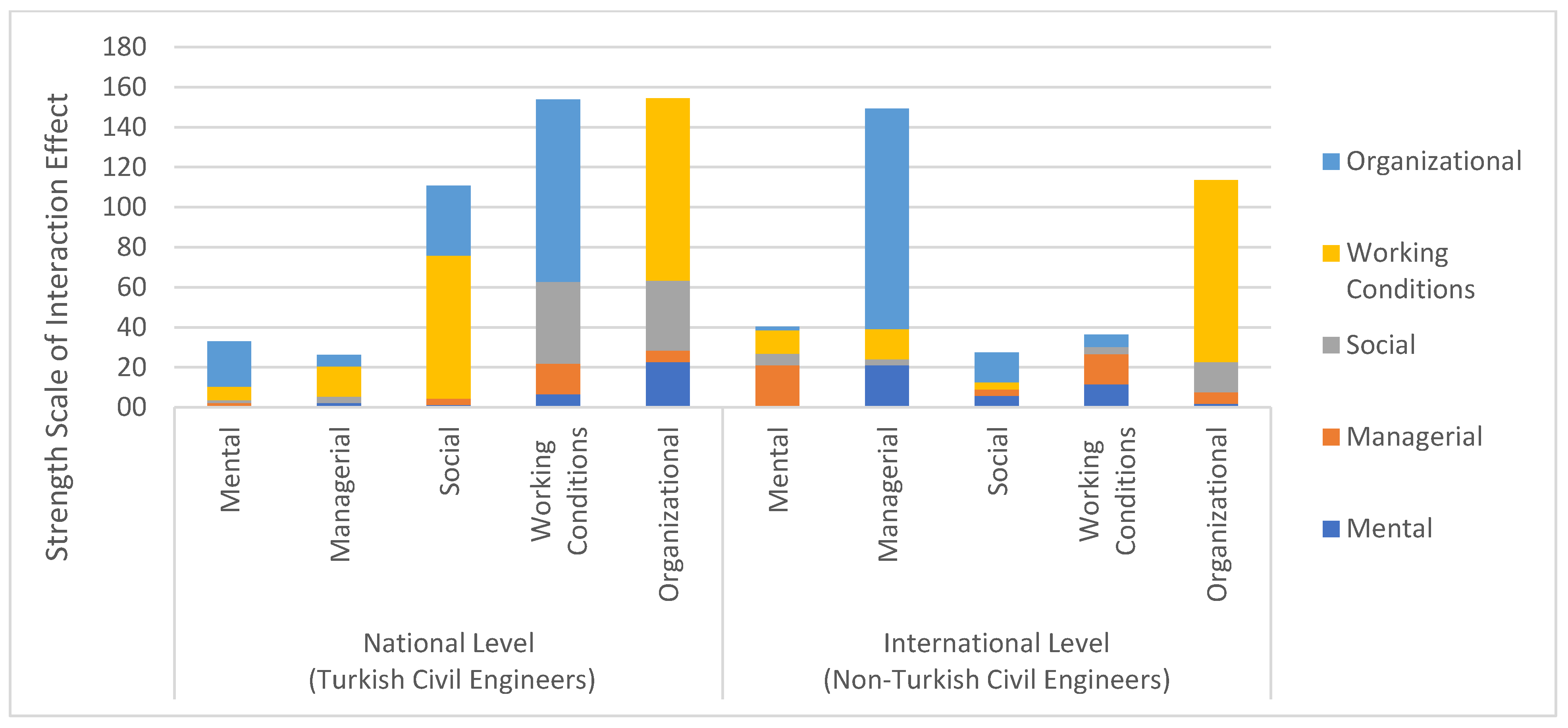
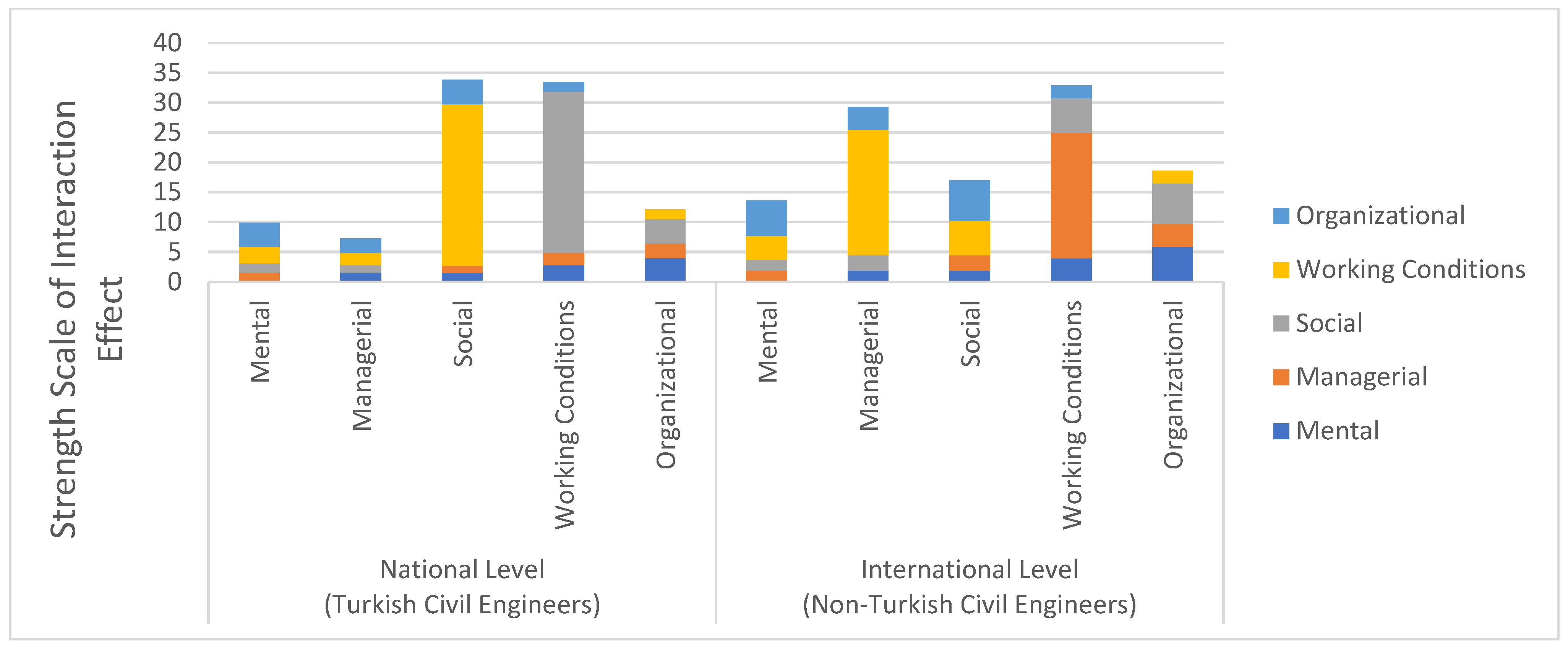
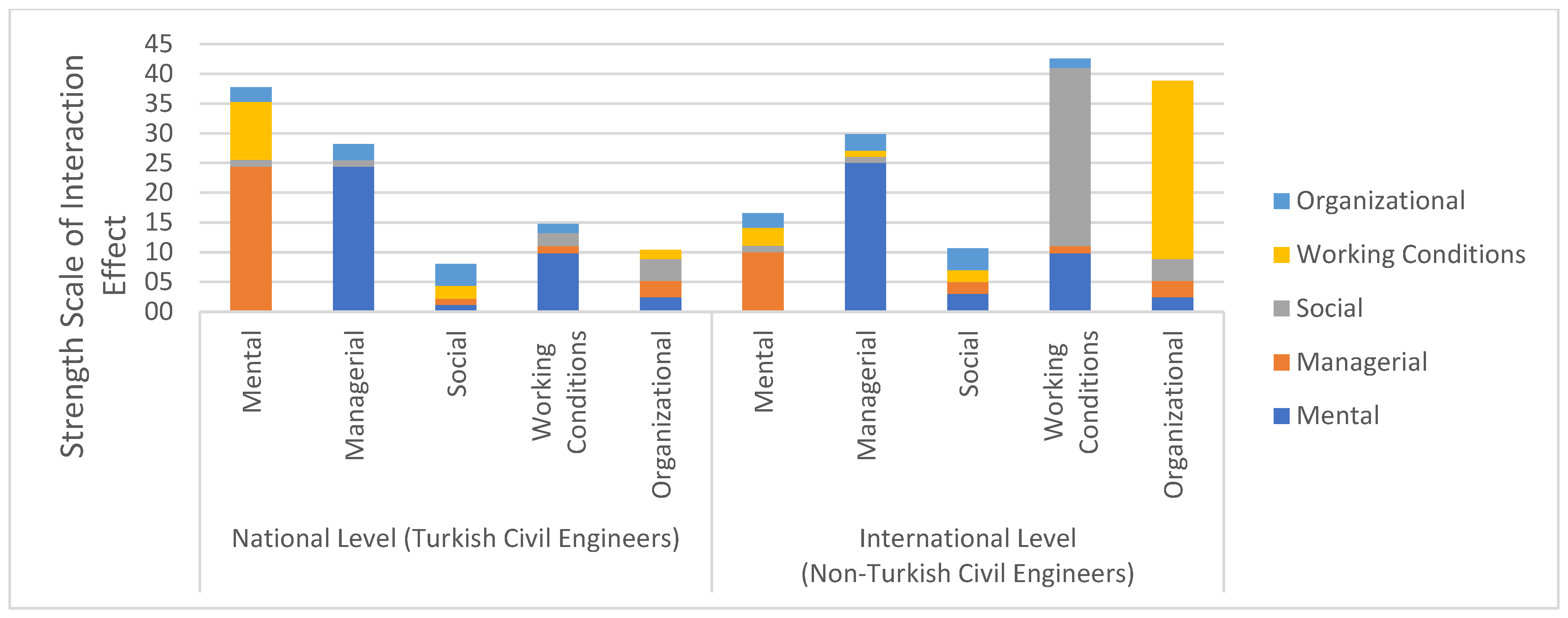
The interaction effects of subgroup stress factors can also be modeled and tested using a multinomial logistic regression model at the national and international levels. The results show that when “Working conditions” and “Managerial” (p = 0.056) or “Working conditions” and “Social” (p = 0.014) stressors were observed together, they had a significant interaction impact on the depression for the Turkish construction professionals. For the same group, a similar conclusion for depression was achieved for “Organizational” when this subgroup interacted with “Mental” (p = 0.044), “Social” (p = 0.005), and “Working conditions” (p = 0.011) subgroup stress factors separately in two dimensions. On the other hand, interactions of “Managerial” and “Organizational” stressors has a significant impact on depression for non-Turkish engineers (p = 0.009) (Figure 1). For anxiety, only one interaction effect was observed for Turkish civil engineers between the “Social” and “Working conditions” (p = 0.037) and for non-Turkish civil engineers between the “Managerial” and “Working conditions” stressor subgroups (p = 0.041) (Figure 2). The “Mental” stressors subgroup interaction with “Managerial” (p = 0.041) and “Working conditions” (p = 0.034) could cause stress for Turkish construction professionals (Figure 3). In the illustrated figures, the strength scale of the interaction effect for each disorder was standardized and interpolated based on the significant, mean, significant, and intercept values, and the results obtained from the achieved logistic regression models. These results lead us to partially fail to reject the second part of Hypothesis 2 (H2b).
The intervention effects of coping strategies developed against subgroup stress factors by construction professionals were also checked to test Hypothesis 3 at two different levels (Table 6). For Turkish civil engineers, there was an initially significant effect of “Working condition” stress factors on depression (p = 0.019), which was worsened with coping mechanisms, such as problem-focused (p = 0.001), emotional-focused (p = 0.001), and internal (p = 0.002). A similar effect was also observed for anxiety combined with emotional-focused strategies against the “Work condition”-related stressor. On the other hand, a positive mediator effect was found for mitigating anxiety when problem-focused (p = 0.069) and internal (p = 0.077) coping strategies were used. Also, even though “Organizational” subgroup stressors did not have a strong negative impact on occupational stress (p = 0.422) initially, this worsened after the implementation of all coping strategies separately (p < 0.05) (Table 6). For non-Turkish engineers at the international level, there was an initially significant effect of “Organizational” stress factors on depression (p = 0.017), which healed with coping mechanisms, such as problem-focused (p = 0.528) and internal (p = 0.873). However, a negative and significant moderating effect was found for “working conditions” on depression and stress when internal (p = 0.024; p = 0.051) and problem-focused (p = 0.024) coping mechanisms were implemented (Table 6). Therefore, Hypothesis 3 was partially rejected because coping mechanisms had both positive and negative impacts on mental health disorders.
The mixed moderating effects of coping strategies observed in this study highlight the need for organizationally guided, rather than purely individual, mental health interventions. The finding that certain coping mechanisms intensified depression and anxiety under adverse working conditions, particularly among Turkish civil engineers, suggests that individual coping efforts may be insufficient or even counterproductive when structural and organizational stressors remain unaddressed. This implies that construction organizations should not rely solely on encouraging personal coping strategies, but instead prioritize improvements in work conditions, such as workload regulation, site safety, role clarity, and realistic scheduling. Moreover, the deterioration of mental health outcomes when organizational stressors were combined with individual coping strategies underscores the importance of managerial and organizational-level interventions, including leadership training, transparent communication channels, and organizational support systems. Conversely, the positive mediating effects observed among non-Turkish engineers indicate that coping mechanisms can be effective when supported by appropriate organizational environments. Therefore, organizations should implement structured mental health programs that integrate professional psychological support, manager involvement, and context-sensitive coping guidance to ensure that coping strategies function as supportive mechanisms rather than additional stress amplifiers.

5. Discussion

We mainly focused on the interaction effects of stressors (two-dimensional) on depression, anxiety, and stress at the subgroup level (between and within a group). We also attempted to include demographic factors to investigate their associations with mental health disorders. In addition, we aimed to evaluate the effectiveness of coping strategies at national and international levels when emerging against stressors by construction professionals, which is another major objective of this study. The Turkish civil engineering group was assumed to be a control variable for emerging countries. To this end, we developed four hypotheses.

5.1. Hypothesis Discussion

The results partially failed to confirm the first hypothesis because some demographic characteristics, but not all, are main indicators for mental health disorders at national and international levels. For example, gender plays a crucial role in experiencing stress, and female construction professionals suffer more from this mental health issue, which is valid for both two groups (Turkish and non-Turkish engineers). A study has reported similar results [7]. An apparent reason for this is that the construction industry has a masculine structure owing to male-dominant stakeholders (e.g., workers and professionals) [17]. There is prejudice and harmful discrimination toward females on-site; for example, female construction professionals sometimes encounter mobbing from their male colleagues or fellow workers [5,23,49]. Marital status is also a significant factor for depression in current research, but only among Turkish civil engineers. Single construction professionals had more depression than their married colleagues. Similarly, a previous study concluded that work-related stress among single employees is significantly higher than that among married ones [50]. Single construction professionals tend to be younger, have less experience in the construction processes, and lack family support. Thus, it can be difficult to deal with the new challenges that they face at the beginning of their business lives from far away from their home country. This could be the main reason for the differences in marital status between the two groups. Working more than 50 h also correlated with significant depression and stress among both Turkish and non-Turkish construction professionals, which was an expected result. This conclusion is consistent with the findings of the present study. One stress factor, “Hours worked per day (Excess of 60 h per week)-MAN1,” was a significant individual stressor. Several studies on the mental well-being of construction professionals have obtained similar results regarding long working hours [4,32,35].
The first part of the second hypothesis (H2a) is partially confirmed. Project-related stress factors were found to have a major effect, significantly affecting each mental disorder separately for both professional groups. “Working conditions” and “Managerial” attributes were the leading project-related stressors. The construction industry is complex and has a dynamic structure. Owing to the harsh requirements of construction projects, such as high-quality standards with limited time and budget, construction professionals are always under pressure, which results in adverse mental health outcomes [23,32]. Therefore, project-related stress factors may lead to more mental health disorders in the construction industry of developing countries than personal factors. Of the work-related factors, little social support in the workplace and job insecurity were found to be linked to anxiety and depression. Because construction professionals and workers are employed in construction projects, which are temporary, anxiety about unemployment inevitably emerges [5].
The second part of Hypothesis 2 (H2b) also partially failed to reject (i.e., for some subgroup workplace stress attributes). These interaction effects on depression among Turkish construction professionals represent striking mental health issues. According to this study, depression is relatively likely to occur in construction workplaces in emerging countries. The proportion of all construction professionals classified as depressed (severe or extremely severe) was 28.2%, which was higher than the rates of anxiety and stress. This is in accordance with various studies confirming that depression is a widely observed mental disorder among construction professionals in emerging countries. The reasons behind high depression levels occur mainly because of project-related factors for all construction professionals. [7,8,13]. Regarding stress, whereas “Mental” and “Managerial” subgroup stressors do not lead to this when observed individually, they were found to have an associated impact for Turkish construction experts. As can be interpreted again from here, project-related factors lead to depression for all construction experts in emerging countries. Among personnel-related factors, only mental health issues are heavily observed among professionals. The primary characteristic of the construction industry is that it has the worst working conditions in terms of safety, work–life balance, and dynamicity, which stimulate depression and stress [1]. Large construction projects are characterized by their complexity, dynamic nature, and extensive scale. These involve large engineering scales, extended construction periods, and numerous uncertainties and risks throughout the construction process [51].
The last hypothesis is again found to partially fail to be rejected. It is important to understand that problem-focused strategies can reduce the impact of stressors on occupational stress. In addition, internal-based and problem-focused coping efforts were found to successfully mitigate the impact of “Working conditions” stressors on anxiety for Turkish civil engineers, but these two strategies worsened the impact of “Work conditions” stressors on anxiety for non-Turkish civil engineers. Thus, the third hypothesis (H3a) for these coping strategies was partially rejected. For this context, there is no consistent results for construction professionals coming from different emerging countries. The main reason is that each person has unique strategies and does not develop common coping mechanisms.
According to the results, since non-Turkish civil engineers work for foreign construction companies in their country, they face more challenges in “Organizational” stress factors and can adopt themselves in time. In addition, although non-Turkish civil engineers are more vulnerable to “Organizational” and “Managerial” issues, they can reduce their depression level by following coping mechanisms against “Organizational” stressors especially by following problem-focused strategies. The differences between the two groups could be attributed to this reason. This result shows that coping mechanisms may sometimes be misapplied and worsen the mental state of Turkish construction professionals or improve their mental health status. Thus, the third hypothesis is partially rejected for this part of this study. These results revealed an interaction between the effects of stressors on the mental well-being of construction professionals. In other words, work-related stressors have a triggering or domino effect on one another [52,53]. Additionally, some coping strategies developed by construction professionals were ineffective in reducing the negative impact of work-related stress factors. Understanding these points is crucial for establishing high-quality working environments for construction professionals [5]. Organizations and construction practitioners need to improve their management of workload processes and provide more appropriate consultations with construction professionals [8]. As the results of this study show, it is not easy for individuals to manage stressors and develop appropriate coping mechanisms. Since the human mind is complex and unique to each individual, professional and personalized consulting is essential to achieve physically and psychologically healthier working conditions. If construction professionals are not supported by appropriate consulting strategies for their mental health conditions, a negative snowball or domino impact will be inevitable, negatively affecting other team members and the success of projects, organizations, and the industry [52]. Thus, construction companies should emphasize regular review of the workloads of construction professionals and routinely check their mental well-being by implementing psychological tests. Professional services from external human resources or psychological consulting companies may be sought for this purpose. For example, Turkish construction professionals often leave their families and friends to work in different locations, including other countries, where they live as ex-pats for two or three years at a time [15,33]. Subsequently, they may end up working on similar projects in the same location. These prolonged, difficult work conditions create major adaption problems not only on-site and for their families, but also when they return home. Construction companies must provide psychological help to employees exposed to harsh working conditions away from home [12,53,54]. The results confirm that civil engineers need better psychological support as a routine healthcare plan designed explicitly for our problems. Stress management workshops and consulting meetings can efficiently achieve these goals during construction. In addition, buddy programs can be introduced. In this program, pairs of construction professionals are matched and become responsible for each other regarding mental and emotional support. The results of this study showed that professionals used alcohol, tobacco, and drugs as coping mechanisms based on their responses. Sadly, most professionals surveyed engaged in substance abuse, both in emerging [22,35] and developed countries [7]. The younger generation entering the profession starts to smoke and drink alcohol extensively very early in their careers; they take their example from experienced colleagues on-site and quickly adopt the same patterns. Construction companies must make policy changes for substance abuse at the job site, especially after work hours, for engineers to stay on the job. Companies must provide better work environments with a place to exercise and relax, as they provide at their headquarters [5]. On-site working conditions must be improved, better facilities must be provided, and concerns about overhead costs should not be emphasized for the workforce’s health and the industry’s future.

5.2. Mental Wellbeing and Construction Professionals

The mental wellbeing of construction professionals in developing countries is greatly influenced by structural, economic and occupational conditions that are more intense than those typically found in developed countries. Construction professionals in these countries often face long working hours, high job insecurity, limited regulatory enforcement, unsafe working environments and strong cost and time pressures, which are driven by rapid urbanisation and infrastructure demands. Combined with limited access to mental health resources, cultural stigma around psychological distress and weak organisational support systems, these factors can significantly increase stress, anxiety, burnout and depression. Consequently, compromised mental well-being affects not only the health and job satisfaction of individual professionals, but also contributes to lower productivity, higher accident rates and poorer project outcomes, thereby reinforcing systemic challenges within the construction industry in developing countries.
Addressing mental wellbeing issues in the construction industry in developing countries requires coordinated action at the policy, organisational and individual levels [54]. Governments and regulatory bodies should strengthen labour laws, enforce occupational health and safety standards, and explicitly integrate mental health into workplace regulations and national construction policies. Construction organisations should introduce manageable work schedules, fair compensation and job security measures, as well as site-level mental health support, such as stress management training, peer support programmes and access to counselling services, including low-cost digital platforms. Industry leaders should also promote a culture that reduces stigma by encouraging open discussions about mental wellbeing, as well as training managers to recognise the early signs of psychological distress. At an individual and professional level, capacity-building initiatives, continuous professional development and leadership training can help construction professionals to develop coping strategies and resilience. Taken together, these measures can improve mental wellbeing, while also enhancing safety, productivity and overall project performance in developing countries [54].

5.3. Contribution to Body of Knowledge

The results of this study can be vital for decision-makers responsible for the mental health conditions of construction professionals. This study contributes to the body of knowledge in three ways.
The main theoretical contribution of this research is to gain information on the interaction effects of stressors on the severity of mental health disorders (depression, anxiety, and stress) at subgroup levels (physical, mental, social, managerial, work conditions, and organizational) and on the effectiveness of coping strategies (problem-focused, emotional-focused, and internal) developed by two different construction professional groups against subgroup stressors. For these purposes, a new multinomial logistic regression model was adopted, which is the first attempt to understand the mental health issues of construction professionals in diverse emerging countries.
Practically, the results can be used by construction decision makers, human resource managers, and mental consulting companies to provide better mental health support for construction professionals. Personalized and professional mental consulting is strongly recommended, as each individual is different and suffers uniquely from different stressors. Based on the findings, several operable organizational intervention measures can be proposed to mitigate mental health disorders among construction professionals. First, organizations should prioritize project-level interventions, such as realistic scheduling, workload balancing, and improved coordination among project stakeholders, given the dominant influence of project-related stressors. Second, strengthening managerial capacity through leadership training programs focused on communication, conflict resolution, and psychological awareness can help reduce managerial and organizational stressors, particularly when their interaction intensifies mental health outcomes. Third, organizations are encouraged to institutionalize mental health support mechanisms, including access to professional and personalized mental health consulting services, confidential counseling programs, and stress management workshops. Finally, improving work conditions through clearer role definitions, safer site environments, and flexible work arrangements where feasible can enhance the effectiveness of individual coping strategies and contribute to a healthier organizational climate [54,55].

6. Conclusions

The development of a new data structure for the mental well-being status of construction professionals and following a new research methodology have enabled a novel evaluation of the interaction effects of stressors and the effectiveness of coping mechanisms in different emerging countries. Project-related stress factors have been found to significantly impact the severity of mental health issues, such as depression, anxiety, and stress. In addition, construction professionals have been shown to sometimes fail to develop appropriate coping mechanisms when experiencing work-related stressors, such as organizational, managerial, and work conditions. Determining these underlying stress factors and the influence of their interactions can be beneficial for treating the mental health issues faced by construction professionals. This study showed that some coping mechanisms are misapplied because they worsen the mental health status of construction professionals. Additionally, construction professionals do not consistently act against project-related stress factors.
As a recommendation, we suggest a regular review of construction professionals concerning their mental well-being status in construction workplaces. Companies need to provide a work environment and conditions for female and young engineers’ specific needs, and we need better healthcare support that covers psychological health issues. Both private and public institutions must adopt new policies to protect construction professionals’ mental and physical status. In addition, the workloads of construction professionals should be equally allocated using advanced empirically based methodologies. Where undesired mental health conditions are observed, emergency preventive measures should be introduced as standard practice, such as providing a (short or long) break from work and support with expert consulting. We believe that supporting construction professionals with effective coping mechanisms will help prevent incorrect strategies from being implemented. This will also increase the success and productivity of organizations and provide a more stable and healthier working environment for construction professionals. At this point, since a human being’s mental structure is complex and unique, and sometimes general advice is not adequate, personalized consulting for each construction professional is essential. Accordingly, the effects of stressors on the severity of mental health disorders can be efficiently mitigated.
Differences in stress perception and coping strategies among construction professionals may also be influenced by cultural and organizational contexts. From a cultural psychology perspective, variations in power distance, collectivism, and uncertainty avoidance may shape how professionals perceive managerial support, organizational stressors, and mental health challenges. Similarly, organizational behavior theories suggest that leadership styles, organizational structures, and informal workplace norms can moderate stress experiences and coping effectiveness. While the present study does not conduct country-level comparisons, these theoretical lenses provide a useful framework for interpreting variations observed across emerging countries. Future research could explicitly compare construction professionals in Turkey with those in other developing economies to examine how cultural and organizational factors shape stressor interactions and mental health outcomes.
With regard to the limitations of this study, more stress factors and coping mechanisms should be included for further analysis. In addition, since we only considered the two-dimensional impacts of subgroup stressors, more than two dimensions and domino effects at the individual level could be evaluated. We used the multinomial logistic regression model because of the structure of the collected data, but other models can also be adapted to examine different parameters for the mental well-being of diverse construction professional groups. Finally, the data were collected from construction professionals from different nations in emerging countries and working for companies located in Türkiye, Russia, Kazakhstan, Saudi Arabia, Kuwait, Macedonia, Albania, and Turkmenistan and ranked as the top 250 contractors by Engineering News Records (ENR). A similar approach can be applied to other developed and emerging countries, and comparisons can be made. This study also relies on self-administered questionnaires, which may be subject to common method bias, social desirability bias, and recall bias. Although anonymity was ensured and the questions were designed to focus on recent and clearly defined experiences, these biases cannot be fully eliminated. The cross-sectional nature of the data also limits the ability to capture changes in stressors and coping mechanisms over time. Future research could enhance the robustness of the findings by adopting longitudinal research designs or mixed-method approaches, such as in-depth interviews or focus groups, to provide deeper contextual understanding and triangulate survey results. The scope of the study can be furthered or narrowed according to the participants. Further studies will bring new perspectives on the results of this study.
This study examines interaction effects among multiple work-related stressors and demonstrates that certain stressors, while not individually significant, jointly intensify mental health disorders among construction professionals. However, the cross-sectional design limits the ability to investigate cumulative or domino effects in a temporal sense, whereby stressors progressively accumulate and lead to the gradual deterioration of mental health. Capturing such dynamic processes would require longitudinal or repeated-measure research designs. Future studies are encouraged to track stressor exposure and mental health outcomes over time to better understand how multiple stressors interact and compound their effects throughout different project phases. Thus, the research methodology could also be differentiated to understand these aspects for the construction professionals, which could provide important results for the construction industry worldwide. Although this study focuses on construction professionals working in emerging countries, the proposed research framework is adaptable to other national and regional contexts. The survey instrument, which integrates stressor categories, coping mechanisms, and standardized mental health assessment (DASS-21), can be readily customized to reflect country-specific regulatory environments, organizational structures, and cultural characteristics. Similarly, the multinomial logistic regression approach used to examine interaction effects between stressors and coping strategies provides a flexible analytical tool that can be applied across different construction markets. By adopting the same framework with locally tailored stressor definitions and expanded samples, future studies can conduct comparative analyses to assess how contextual factors influence the relationship between stress, coping mechanisms, and mental health outcomes in construction professionals worldwide. This research also suggests new directions for future studies; thus, (i) new evaluation models can be introduced for construction workers and professionals’ mental health issues based on the DASS-21 data by applying different methods; (ii) new evaluation models can be used to explore the interaction effects of stressors on the degree of mental health disorders; (iii) such regression models can also be applied for various research purposes, such as understanding the interaction effects of job demand resources on the mental health conditions of construction professionals.

Author Contributions

Conceptualization, D.C.Ü., G.K. and O.B.T.; methodology, D.C.Ü.; software, D.C.Ü.; validation, D.C.Ü., G.K. and O.B.T.; formal analysis, D.C.Ü., G.K. and O.B.T.; investigation, D.C.Ü., G.K. and O.B.T.; resources, F.K. and O.B.T.; data curation, D.C.Ü. and G.K.; writing—original draft preparation, D.C.Ü. and G.K.; writing—review and editing, O.B.T. and F.K.; visualization, G.K.; supervision, O.B.T.; project administration, O.B.T. and F.K.; funding acquisition, F.K. and O.B.T. All authors have read and agreed to the published version of the manuscript.

Funding

This research received no external funding and the APC was funded by F.K.

Institutional Review Board Statement

The study was conducted in accordance with the ethical standards of the institutional and/or national research committee and was approved by the following Ethics Committees: Middle East Technical University (METU), approved by the METU Applied Ethics Research Center (UEAM) Human Research Ethics Committee (IAEK) with the protocol identification code 0025-ODTUIAEK-2022; Istanbul Medeniyet University, approved by the Scientific Research and Publication Ethics Committee for Science and Engineering Sciences with the approval code 2024/2 (Document No: E-37388201-050.04-2400018600).

Informed Consent Statement

Informed consent was obtained from all individual participants included in the study. All subjects were informed about the purpose of the study and participated voluntarily.

Data Availability Statement

Some or all the data, models, and codes supporting this study’s findings are available from the corresponding author upon reasonable request.

Acknowledgments

The authors would like to thank the construction professionals who participated in the survey process for their assistance.

Conflicts of Interest

The authors declare no conflicts of interest.

Abbreviations

The following abbreviations are used in this manuscript:
RQsResearch Questions
DASS 21Depression Anxiety Stress Scale
WHOWorld Health Organization
VIFVariance Inflation Factor
ENREngineering News Record

References

  1. Chan, A.P.C.; Nwaogu, J.M.; Naslund, J.A. Mental Ill-Health Risk Factors in the Construction Industry: Systematic Review. J. Constr. Eng. Manag. 2020, 146, 04020004. [Google Scholar] [CrossRef] [PubMed]
  2. World Health Organization. Mental Health in the Built Environment; World Health Organization: Geneva, Switzerland, 2020; Volume 29. [Google Scholar]
  3. Leung, M.; Chan, Y.-S.; Yu, J. Integrated Model for the Stressors and Stresses of Construction Project Managers in Hong Kong. J. Constr. Eng. Manag. 2009, 135, 126–134. [Google Scholar] [CrossRef]
  4. Bowen, P.; Edwards, P.; Lingard, H.; Cattell, K. Occupational Stress and Job Demand, Control and Support Factors among Construction Project Consultants. Int. J. Proj. Manag. 2014, 32, 1273–1284. [Google Scholar] [CrossRef]
  5. Tijani, B.; Xiaohua, J.; Osei-Kyei, R. Critical Analysis of Mental Health Research among Construction Project Professionals. J. Eng. Des. Technol. 2021, 19, 467–496. [Google Scholar] [CrossRef]
  6. Love, P.E.D.; Edwards, D.J.; Irani, Z. Work Stress, Support, and Mental Health in Construction. J. Constr. Eng. Manag. 2010, 136, 650–658. [Google Scholar] [CrossRef]
  7. Sunindijo, R.Y.; Kamardeen, I. Work Stress Is a Threat to Gender Diversity in the Construction Industry. J. Constr. Eng. Manag. 2017, 143. [Google Scholar] [CrossRef]
  8. Üstün, D.C. Mental Health of Turkish Civil Engineers in the Construction Industry. Master’s Thesis, Middle East Technical University, Ankara, Turkey, 2022. Available online: https://open.metu.edu.tr/handle/11511/98123 (accessed on 10 February 2026).
  9. Leung, M.-Y.; Liang, Q.; Olomolaiye, P. Impact of Job Stressors and Stress on the Safety Behavior and Accidents of Construction Workers. J. Manag. Eng. 2016, 32, 04015019. [Google Scholar] [CrossRef]
  10. Langdon, R.R.; Sawang, S. Construction Workers’ Well-Being: What Leads to Depression, Anxiety, and Stress? J. Constr. Eng. Manag. 2018, 144, 04017100. [Google Scholar] [CrossRef]
  11. Leung, M.Y.; Chan, I.Y.S.; Yu, J. Preventing Construction Worker Injury Incidents through the Management of Personal Stress and Organizational Stressors. Accid. Anal. Prev. 2012, 48, 156–166. [Google Scholar] [CrossRef]
  12. Chan, I.Y.S.; Leung, M.Y.; Liang, Q. The Roles of Motivation and Coping Behaviours in Managing Stress: Qualitative Interview Study of Hong Kong Expatriate Construction Professionals in Mainland China. Int. J. Environ. Res. Public Health 2018, 15, 561. [Google Scholar] [CrossRef]
  13. Kamardeen, I.; Sunindijo, R.Y. Personal Characteristics Moderate Work Stress in Construction Professionals. J. Constr. Eng. Manag. 2017, 143, 04017072. [Google Scholar] [CrossRef]
  14. Haynes, N.S.; Love, P.E.D. Psychological Adjustment and Coping among Construction Project Managers. Constr. Manag. Econ. 2004, 22, 129–140. [Google Scholar] [CrossRef]
  15. Leung, M.; Liang, Q.; Chan, I.Y.S. Development of a Stressors–Stress–Performance–Outcome Model for Expatriate Construction Professionals. J. Constr. Eng. Manag. 2017, 143, 04016121. [Google Scholar] [CrossRef]
  16. Bowen, P.; Peihua Zhang, R.; Edwards, P. An Investigation of Work-Related Strain Effects and Coping Mechanisms among South African Construction Professionals. Constr. Manag. Econ. 2021, 39, 298–322. [Google Scholar] [CrossRef]
  17. Bowen, P.; Edwards, P.; Lingard, H. Workplace Stress Experienced by Construction Professionals in South Africa. J. Constr. Eng. Manag. 2013, 139, 393–403. [Google Scholar] [CrossRef]
  18. Bowen, P.; Govender, R.; Edwards, P. Structural Equation Modeling of Occupational Stress in the Construction Industry. J. Constr. Eng. Manag. 2014, 140, 04014042. [Google Scholar] [CrossRef]
  19. Leung, M.Y.; Chan, Y.S.I.; Dongyu, C. Structural Linear Relationships between Job Stress, Burnout, Physiological Stress, and Performance of Construction Project Managers. Eng. Constr. Archit. Manag. 2011, 18, 312–328. [Google Scholar] [CrossRef]
  20. Bowen, P.; Zhang, R.P. Cross-Boundary Contact, Work-Family Conflict, Antecedents, and Consequences: Testing an Integrated Model for Construction Professionals. J. Constr. Eng. Manag. 2020, 146, 04020005. [Google Scholar] [CrossRef]
  21. Bowen, P.; Govender, R.; Edwards, P.; Cattell, K. Work-Related Contact, Work–Family Conflict, Psychological Distress and Sleep Problems Experienced by Construction Professionals: An Integrated Explanatory Model. Constr. Manag. Econ. 2018, 36, 153–174. [Google Scholar] [CrossRef]
  22. Bowen, P.; Edwards, P.; Lingard, H. Workplace Stress among Construction Professionals in South Africa the Role of Harassment and Discrimination. Eng. Constr. Archit. Manag. 2013, 20, 620–635. [Google Scholar] [CrossRef]
  23. Leung, M.; Zhang, H.; Skitmore, M. Effects of Organizational Supports on the Stress of Construction Estimation Participants. J. Constr. Eng. Manag. 2008, 134, 84–93. [Google Scholar] [CrossRef]
  24. Zurlo, M.C.; Pes, D.; Capasso, R. Personality Characteristics, Job Stressors, and Job Satisfaction: Main and Interaction Effects on Psychological and Physical Health Conditions of Italian Schoolteachers. Psychol. Rep. 2016, 119, 27–38. [Google Scholar] [CrossRef] [PubMed]
  25. Health and Safety Executive. Work-Related Stress, Anxiety or Depression Statistics in Great Britain, 2021; Health and Safety Executive: Bootle, UK, 2021; Available online: https://www.ivyhouse.co.uk/wp-content/uploads/Work-related-stress-anxiety-or-depression-stats-in-GB-HSE.pdf (accessed on 10 February 2026).
  26. Purba, A.; Demou, E. The Relationship between Organisational Stressors and Mental Wellbeing within Police Officers: A Systematic Review. BMC Public Health 2019, 19, 1286. [Google Scholar] [CrossRef]
  27. Pirzadeh, P.; Lingard, H.; Zhang, R.P. Job Quality and Construction Workers’ Mental Health: Life Course Perspective. J. Constr. Eng. Manag. 2022, 148, 04022132. [Google Scholar] [CrossRef]
  28. Aldwin, C.M.; Revenson, T.A. Does Coping Help? A Reexamination of the Relation Between Coping and Mental Health. J. Pers. Soc. Psychol. 1987, 53, 337–348. [Google Scholar] [CrossRef]
  29. Lazarus, R.S.; Folkman, S. Stress, Appraisal, and Coping; Springer: Berlin/Heidelberg, Germany, 1984. [Google Scholar]
  30. Brande, W.; Baillien, E.; De Witte, H.; Vander Elst, T.; Godderis, L. The Role of Work Stressors, Coping Strategies and Coping Resources in the Process of Workplace Bullying: A Systematic Review and Development of a Comprehensive Model. Aggress. Violent Behav. 2016, 29, 61–71. [Google Scholar] [CrossRef]
  31. Bhattacharjee, B.; Acharya, T. “The COVID-19 Pandemic and Its Effect on Mental Health in USA—A Review with Some Coping Strategies”. Psychiatr. Q. 2020, 91, 1135–1145. [Google Scholar] [CrossRef]
  32. Enshassi, A.; Al-Swaity, E.; Abdul Aziz, A.R.; Choudhry, R. Coping Behaviors to Deal with Stress and Stressor Consequences among Construction Professionals: A Case Study at the Gaza Strip, Palestine. J. Financ. Manag. Prop. Constr. 2018, 23, 40–56. [Google Scholar] [CrossRef]
  33. Leung, M.; Chan, Y.-S.; Olomolaiye, P. Impact of Stress on the Performance of Construction Project Managers. J. Constr. Eng. Manag. 2008, 134, 644–652. [Google Scholar] [CrossRef]
  34. Leung, M.; Chan, I.Y.S. Exploring Stressors of Hong Kong Expatriate Construction Professionals in Mainland China: Focus Group Study. J. Constr. Eng. Manag. 2012, 138, 78–88. [Google Scholar] [CrossRef]
  35. Bowen, P.; Edwards, P.; Lingard, H.; Cattell, K. Workplace Stress, Stress Effects, and Coping Mechanisms in the Construction Industry. J. Constr. Eng. Manag. 2014, 140, 04013059. [Google Scholar] [CrossRef]
  36. Chopra, P. Mental Health and the Workplace: Issues for Developing Countries. Int. J. Ment. Health Syst. 2009, 3, 4. [Google Scholar] [CrossRef]
  37. Maqsoom, A.; Ashraf, H.; Alaloul, W.S.; Salman, A.; Ullah, F.; Ghufran, M.; Musarat, M.A. The Relationship between Error Management, Safety Climate, and Job-Stress Perception in the Construction Industry: The Mediating Role of Psychological Capital. Buildings 2023, 13, 1528. [Google Scholar] [CrossRef]
  38. Budimir, S.; Probst, T.; Pieh, C. Coping Strategies and Mental Health during COVID-19 Lockdown. J. Ment. Health 2021, 30, 156–163. [Google Scholar] [CrossRef]
  39. Hamadeh, N.; Van Rompaey, C.; Metreau, E.; Eapen, S. New World Bank Country Classifications by Income Level: 2022–2023; World Bank Group: Washington, DC, USA, 2022; Available online: https://blogs.worldbank.org/en/opendata/new-world-bank-country-classifications-income-level-2022-2023 (accessed on 10 February 2026).
  40. Carver, C.S.; Scheier, M.F.; Weintraub, K.J. Assessing Coping Strategies: A Theoretically Based Approach. J. Pers. Soc. Psychol. 1989, 56, 267–283. [Google Scholar] [CrossRef] [PubMed]
  41. Lovibond, P.F.; Lovibond, S.H. The Structure of Negative Emotional States: Comparison of the Depression Anxiety Stress Scales (DASS) with the Beck Depression and Anxiety Inventories. Behav. Res. Ther. 1995, 33, 335–343. [Google Scholar] [CrossRef]
  42. Lovibond, S.H.; Lovibond, P.F. Manual for the Depression Anxiety Stress Scales; ScienceOpen, Inc.: Berlin, Germany, 1995; Available online: https://crossingborders.global/wp-content/uploads/2020/11/DASS-42-editable.pdf (accessed on 10 February 2026).
  43. Petrucci, C.J. A Primer for Social Worker Researchers on How to Conduct a Multinomial Logistic Regression. J. Soc. Serv. Res. 2009, 35, 193–205. [Google Scholar] [CrossRef]
  44. Kazar, G.; Doğan, N.B.; Ayhan, B.U.; Tokdemir, O.B. Quality Failures–Based Critical Cost Impact Factors: Logistic Regression Analysis. J. Constr. Eng. Manag. 2022, 148, 04022138. [Google Scholar] [CrossRef]
  45. Böhning, D. Multinomial Logistic Regression Algorithm. Ann. Inst. Stat. Math. 1992, 44, 197–200. [Google Scholar] [CrossRef]
  46. El-Habil, A.M. An Application on Multinomial Logistic Regression Model. Pak. J. Stat. Oper. Res. 2012, 8, 271–291. [Google Scholar] [CrossRef]
  47. Altman, D.G.; Bland, J.M. Statistics Notes: Cronbach’s Alpha. BMJ 1996, 314, 572. [Google Scholar]
  48. Senaviratna, N.; Cooray, N. Diagnosing Multicollinearity of Logistic Regression Model. Asian J. Probab. Stat. 2019, 5, 1–9. [Google Scholar] [CrossRef]
  49. Sang, K.J.C.; Dainty, A.R.J.; Ison, S.G. Gender: A Risk Factor for Occupational Stress in the Architectural Profession? Constr. Manag. Econ. 2007, 25, 1305–1317. [Google Scholar] [CrossRef]
  50. Alenezi, A.M.; Aboshaiqah, A.; Baker, O. Work-Related Stress among Nursing Staff Working in Government Hospitals and Primary Health Care Centres. Int. J. Nurs. Pract. 2018, 24, e12676. [Google Scholar] [CrossRef]
  51. Han, H.; Shen, J.; Liu, B.; Han, H. Dynamic Incentive Mechanism for Large-Scale Projects Based on the Reputation Effects. SAGE Open 2022, 12, 21582440221133280. [Google Scholar] [CrossRef]
  52. Yang, Y.; Chen, G.; Chen, P. The Probability Prediction Method of Domino Effect Triggered by Lightning in Chemical Tank Farm. Process Saf. Environ. Prot. 2018, 116, 106–114. [Google Scholar] [CrossRef]
  53. Wang, L.; Huang, R.; Shi, W.; Zhang, C. Domino Effect in Marine Accidents: Evidence from Temporal Association Rules. Transp. Policy 2021, 103, 236–244. [Google Scholar] [CrossRef]
  54. Kazar, G.; Rahmanzadeh, P. The impact of mental health disorders and job demands on the individual job performance of construction workers. J. Occup. Health 2024, 66, uiae060. [Google Scholar] [CrossRef] [PubMed]
  55. Ceyhan, B.; Kazar, G. The role of demographic characteristics on mental health disorders among Turkish construction workers. J. Constr. Eng. Manag. Innov. 2024, 7, 127–143. [Google Scholar] [CrossRef]
Figure 1. Interaction Effects of Subgroup Stress Factors on Depression (H2b).
Buildings 16 00776 g001
Figure 2. Interaction Effects of Subgroup Stress Factors on Anxiety (H2b).
Buildings 16 00776 g002
Figure 3. Interaction Effects of Subgroup Stress Factors on Stress (H2b).
Buildings 16 00776 g003
Table 1. Stress Factors with Main and Subgroups.
Main
Group
SubgroupIndividual Stress FactorsID
Personal-RelatedPhysicalPhysical illnessPHY1
Fatigue and need for recoveryPHY2
Musculoskeletal pain and injuriesPHY3
MentalNature of work/mental demandMEN1
Posttraumatic stressMEN2
CriticismMEN3
Fear of failureMEN4
Substance abuseMEN5
Alcohol consumptionMEN6
SocialLow income/financial insecuritySOC1
Low socioeconomic statusSOC2
Marital statusSOC3
Gender discriminationSOC4
Work—home conflict/life imbalanceSOC5
Age discriminationSOC6
Project-RelatedManagerialHours worked per day (excess of 60 h per week)MAN1
Increased work speed/pressureMAN2
Little opportunity/ability to participate in decision makingMAN3
Little social support from colleagues/immediate supervisorsMAN4
Overpromotion concernsMAN5
Lack of respect from subordinatesMAN6
Working
Conditions
Work overload/quantity of workWRK1
Occupational injury/hazardsWRK2
Poor working conditionsWRK3
Job insecurity (fear and uncertainty about the work)WRK4
Poor physical working environmentWRK5
Workplace harassment/bullyingWRK6
OrganizationalLittle relationship with colleagues/co-workersORG1
Inability to further learningORG2
Lack of feedback mechanism in placeORG3
Poor occupational climate (task autonomy, responsibility)ORG4
Interpersonal conflictORG5
Table 2. Association between Demographic Background and Mental Health Disorders for National and International Levels (H1).
GenderEducationMarital StatusWork AreaExperienceWorking Hour
National Level
(Turkish Civil Engineers)
Mental DisorderMale
(N = 151)
Female
(N = 31)
Undergrad
(N = 133)
Grad
(N = 49)
Single
(N = 96)
Married
(N = 86)
Field
(N = 99)
Office
(N = 83)
<10 years
(N = 105)
>10 years
(N = 77)
<50 h
(N = 67)
>50 h
(N = 115)
Depression
Mean2.4782.4512.4882.4282.6912.2212.3532.6142.6882.1582.3452.796
Sig. (2-tailed)0.9290.8010.029 *0.2190.017 *0.043 *
Anxiety
Mean2.3842.7412.4062.5512.4472.4412.3832.5182.5522.2982.6262.339
Sig. (2-tailed)0.2310.5670.9790.5520.2640.216
Stress
Mean1.9862.4512.062.0812.1451.9761.9592.1922.1711.9222.0532.456
Sig. (2-tailed)0.051 *0.9190.3670.2150.1880.125
GenderEducationMarital StatusWork AreaExperienceWorking Hour
International Level
(Non-Turkish Civil Engineers)
Mental DisorderMale
(N = 190)
Female
(N = 109)
Undergrad
(N = 200)
Grad
(N = 109)
Single
(N = 188)
Married
(N = 121)
Field
(N = 191)
Office
(N = 118)
<10 years
(N = 178)
>10 years
(N = 131)
<50 h
(N = 140)
>50 h
(N = 169)
Depression
Mean2.6812.5862.5162.4422.5472.3172.6282.7212.7832.1272.1232.878
Sig. (2-tailed)0.9110.7860.1170.5220.017 *0.032 *
Anxiety
Mean2.1472.2322.3892.4582.5782.6312.2192.3282.2542.3172.4212.327
Sig. (2-tailed)0.3780.6240.8150.4430.3410.457
Stress
Mean1.7562.3552.1452.1322.2192.0561.8792.1262.4571.8672.1212.685
Sig. (2-tailed)0.036 *0.8760.5840.3560.039 *0.041 *
* p value < 0.05 = Significant.
Table 3. Individual, Subgroup, and Main Group Predictor Stressors for Depression (H2a).
Main GroupGroupStress
Factor
Chi-Square
(Ind. Stressor)
Effect Sig.
(Ind. Stressor)
Chi-Square
(Subgroup)
Effect Sig.
(Subgroup)
Chi-Square
(Main Group)
Effect Sig.
(Main Group)
Personal-relatedPhysicalPHY1nnnn9.7450.876
PHY2nn
PHY3nn
MentalMEN13.2400.5892.3440.578
MEN2nn
MEN3nn
MEN4nn
MEN51.3410.816
MEN6nn
SocialSOC19.1380.039 *4.2850.864
SOC2nn
SOC3nn
SOC46.1150.278
SOC50.8990.876
SOC6nn
Project-relatedManagerialMAN13.2790.59319.2890.87141.7980.017 *
MAN211.5480.442
MAN3nn
MAN43.8750.378
MAN55.7860.318
MAN6nn
Working
Conditions
WRK13.0970.28923.2540.024 *
WRK2nn
WRK39.2650.019 *
WRK47.8790.219
WRK5nn
WRK66.2190.216
OrganizationalORG1nn11.2890.245
ORG22.1390.786
ORG3nn
ORG43.3480.413
ORG517.5680.001 *
* p value < 0.05 = Significant; n: null.
Table 4. Individual, Subgroup, and Main Group Predictor Stressors for Anxiety (H2a).
Main GroupGroupStress FactorChi-Square (Ind. Stressor)Effect Sig. (Ind. Stressor)Chi-Square (Subgroup)Effect Sig. (Subgroup)Chi-Square (Main Group)Effect Sig. (Main Group)
Personal-relatedPhysicalPHY1nnnn6.3180.863
PHY2nn
PHY3nn
MentalMEN11.1560.7895.3100.211
MEN2nn
MEN3nn
MEN42.5360.628
MEN54.9430.384
MEN6nn
SocialSOC112.9520.027 *4.8640.752
SOC2nn
SOC35.5820.528
SOC46.8660.217
SOC52.2780.356
SOC6nn
Project-relatedManagerialMAN11.2470.47610.2230.57424.1480.043 *
MAN23.9630.568
MAN3nn
MAN411.2470.028 *
MAN52.5680.739
MAN6nn
Working
Conditions
WRK11.9820.58915.2260.039 *
WRK2nn
WRK33.9060.547
WRK411.2240.031 *
WRK5nn
WRK65.9670.318
OrganizationalORG1nn9.2100.143
ORG24.2180.576
ORG3nn
ORG44.7890.325
ORG50.5890.911
* p value < 0.05 = Significant; n: null.
Table 5. Individual, Subgroup, and Main Group Predictor Stressors for Stress (H2a).
Main GroupGroupStress FactorChi-Square (Ind. Stressor)Effect Sig. (Ind. Stressor)Chi-Square (Subgroup)Effect Sig. (Subgroup)Chi-Square (Main Group)Effect Sig. (Main Group)
Personal-relatedPhysicalPHY1nnnn7.6470.419
PHY2nn
PHY3nn
MentalMEN12.1920.7632.8970.647
MEN2nn
MEN31.9890.673
MEN4nn
MEN52.8910.675
MEN6nn
SocialSOC12.1440.4783.8760.870
SOC2nn
SOC3nn
SOC47.7890.215
SOC55.3780.378
SOC6nn
Project-relatedManagerialMAN19.5540.019 *23.7580.036 *26.3580.014 *
MAN21.8670.835
MAN3nn
MAN44.9360.378
MAN52.6340.651
MAN6nn
Working
Conditions
WRK11.8230.83720.4170.041 *
WRK2nn
WRK36.2780.211
WRK46.3780.263
WRK5nn
WRK66.7140.152
OrganizationalORG1nn9.3160.513
ORG23.7890.514
ORG3nn
ORG42.8760.489
ORG55.7820.173
* p value < 0.05 = Significant; n: null.
Table 6. Intervention effects of coping mechanisms on mental health disorders (H3).
DepressionAnxietyStress
Stressor SubgroupsCoping StrategyStressor Effect (Sig.)Intervention Effect (Sig.)Subgroup Effect (Sig.)Intervention Effect (Sig.)Subgroup Effect (Sig.)Intervention Effect (Sig.)
National Level (Turkish Civil Engineers)PhysicalProblem-focusedn0.997n0.232n0.163
Emotion-focused0.7480.8550.610
Internal0.2140.1140.156
MentalProblem-focused0.6340.9840.3410.2400.5730.675
Emotion-focused0.8580.1990.593
Internal0.9230.2310.638
ManagerialProblem-focused0.980.9130.6750.2290.045 *0.203 **
Emotion-focused0.9140.8100.209 **
Internal0.7300.9580.121 **
SocialProblem-focused0.7370.8000.6930.5550.9200.854
Emotion-focused0.8290.7290.601
Internal0.7100.8630.538
Work
Conditions
Problem-focused0.019 *0.0010.042 *0.069 **0.048 *0.151 **
Emotion-focused0.0010.038 *0.114 **
Internal0.0020.077 **0.173 **
OrganizationalProblem-focused0.1350.4890.2530.2850.4220.027 ***
Emotion-focused0.6910.3770.049 ***
Internal0.5620.4540.052 ***
International Level (Non-Turkish Civil Engineers)PhysicalProblem-focusedn0.982n0.318n0.218
Emotion-focused0.6450.9710.596
Internal0.3140.1280.211
MentalProblem-focused0.7420.8160.2580.3560.4790.789
Emotion-focused0.7590.2450.574
Internal0.7460.3780.436
ManagerialProblem-focused0.8410.8410.5810.1470.037 *0.174 **
Emotion-focused0.027 ***0.7360.261 **
Internal0.6480.8680.107 **
SocialProblem-focused0.6870.8270.5870.4750.8170.756
Emotion-focused0.7450.8410.548
Internal0.6180.6310.621
Work
Conditions
Problem-focused0.2780.2830.2180.024 ***0.037 *0.142 **
Emotion-focused0.1890.4720.153 **
Internal0.024 ***0.051 ***0.092 **
OrganizationalProblem-focused0.017 *0.528 **0.3560.3480.012 *0.128 **
Emotion-focused0.7130.4780.137 **
Internal0.873 **0.4170.089 **
* Related subgroup stressor has a significant impact on relevant mental health disorders, ** Related coping strategy has a positive influence on diminishing relevant mental disorders, *** Related coping strategy has a negative influence on diminishing relevant mental disorders. n: null.
Disclaimer/Publisher’s Note: The statements, opinions and data contained in all publications are solely those of the individual author(s) and contributor(s) and not of MDPI and/or the editor(s). MDPI and/or the editor(s) disclaim responsibility for any injury to people or property resulting from any ideas, methods, instructions or products referred to in the content.