
Article

Degradation Mechanisms of Mechanical Properties of Cement-Stabilized Bentonite Under Highly Alkaline NaOH Solutions from 1 to 8 mol/L


1
Materials & Structural Engineering Department, Nanjing Hydraulic Research Institute, Nanjing 210029, China
2
Civil and Environmental Engineering, The University of Miyazaki, 1-1 Gakuenkibanadainishi, Miyazaki 889-2192, Japan
*
Authors to whom correspondence should be addressed.
Buildings 2026, 16(4), 761; https://doi.org/10.3390/buildings16040761
Submission received: 18 January 2026 / Revised: 9 February 2026 / Accepted: 10 February 2026 / Published: 12 February 2026
(This article belongs to the Section Building Materials, and Repair & Renovation)

Abstract

Cement stabilization is widely used to improve the mechanical performance of bentonite-rich soils; however, the behavior of cement-stabilized bentonite under highly alkaline conditions remains unclear. This study aims to elucidate the degradation mechanisms of the mechanical properties of cement-stabilized bentonite exposed to NaOH solutions with concentrations ranging from 1 to 8 mol/L. Unconfined compressive strength (UCS) tests were combined with XRD, 29Si NMR, and MIP to characterize mineral phases, silicate structure, and pore structure of the stabilized soils. Increasing alkalinity led to pronounced strength deterioration, with the 90 d UCS decreasing from 2.56 MPa to 0.25 MPa, corresponding to a reduction of approximately 90%. Microstructural analyses indicate that elevated alkali content inhibits cement clinker hydration, promotes the formation of zeolitic crystalline phases, induces depolymerization of the silicate network with the mean chain length decreasing from 6.4 to 3.5, partially transforms montmorillonite from a 2:1 to a 1:1 layer structure, and results in significant pore coarsening, as reflected by an increase in the most probable pore size from 62.53 to 1054.52 nm. These coupled effects weaken the integrity of the gel network and account for the continuous reduction in mechanical strength with increasing alkali concentration, providing a mechanistic basis for understanding the alkali-induced weakening behavior of cement-stabilized bentonite and offering guidance for its engineering application in alkaline environments.

1. Introduction

Bentonite is a type of highly plastic clay primarily composed of montmorillonite, characterized by a large specific surface area, high cation exchange capacity, and pronounced water-absorption swelling and dehydration shrinkage behaviors [1]. In engineering foundations and fill materials, a high bentonite content is generally regarded as a typical unfavorable soil factor, as its swelling–shrinkage sensitivity combined with low inherent strength leads to insufficient mechanical stability under water-exposed conditions. Consequently, research focusing on the reconstruction of the load-bearing skeleton and the enhancement of strength has become one of the key directions in the stabilization and solidification of bentonite-related soils [2,3].
Cement stabilization is a commonly adopted method for improving bentonite-rich problematic soils [4,5,6]. Cement hydration products, such as C–S–H, can form cementitious bridges and filling structures between clay particles, thereby enhancing the strength and overall stability of the material [7,8,9,10,11]. However, owing to the layered structure and strong hydrophilicity of montmorillonite—which result in a high liquid limit and strong water-content sensitivity—as well as the nonlinear evolution of pore structure, cement-stabilized bentonite systems often exhibit complex strength development behaviors under different chemical environments [12,13]. When the stabilized matrix is exposed to pore solutions or external alkaline media with varying alkalinity, changes in system pH regulate the dissolution, migration, and re-polymerization of aluminosilicate minerals, thereby affecting the mineral composition, gel structure, and pore system of the stabilized body, which ultimately manifests as differences in macroscopic mechanical responses. Therefore, systematically evaluating the structural evolution and strength response of cement-stabilized bentonite under controlled alkalinity conditions is of significant research importance.
Regarding the effects of alkaline conditions on cement–clay systems, previous studies have systematically investigated the micro-scale mechanisms within a relatively low alkalinity range (0.1–1.0 mol/L) [14,15]. These studies indicate that a moderate increase in system alkalinity facilitates the dissolution and activation of aluminosilicate minerals, making the Si–O and Al–O bonds at the interlayers and edges of montmorillonite more reactive. The dissolved silicon and aluminum species can subsequently react in the presence of Ca2+ to form products such as C–S–H, C–A–S–H, and sodium-containing aluminosilicate gels. These gel phases enhance the compactness and load-bearing capacity of the stabilized matrix by filling pores, coating clay particles, and forming a continuous cementitious network between particles [16,17,18,19,20]. Meanwhile, localized adjustments of the montmorillonite interlayer structure and ion exchange processes also contribute to weakening its inherent swelling–shrinkage behavior, providing spatial conditions for the stable formation of cementitious products [21]. Based on these micro-scale processes, phenomena such as pore structure refinement, strengthening of the cementitious network, and improvement in macroscopic strength are commonly observed in cement-stabilized bentonite systems under low-alkalinity conditions. However, when the alkali dosage is further increased, cement-stabilized bentonite systems often exhibit a non-monotonic strength development, with strength stagnation or even pronounced deterioration. Such alkali-induced performance decay has also been reported in other cement-based systems exposed to highly alkaline environments, highlighting the potential risk of excessive alkalinity [22]. Existing studies on cement-stabilized bentonite have mainly reported such macroscopic mechanical responses, whereas the underlying microstructural processes under strong alkaline conditions have not been fully clarified.
Overall, prior investigations have established micro-scale mechanisms for cement–clay systems primarily within relatively low alkalinity ranges. In contrast, for cement-stabilized bentonite under strong alkaline environments, a systematic understanding of how mineral composition, silicate framework structure, and pore structure evolve concurrently, and how these coupled changes govern mechanical performance, is still lacking.
To further investigate the structural evolution and strength response of cement-stabilized bentonite over a wider alkalinity range, this study adopts a sodium bentonite–ordinary Portland cement system as the research object. Under the premise of maintaining consistent macroscopic conditions such as water content and porosity, NaOH solutions with concentrations ranging from 1 to 8 mol/L were used to establish environments with different alkalinity levels. It should be noted that clay mineral dissolution can be initiated when the OH concentration exceeds 10−4 mol/L, whereas an OH concentration on the order of 8–10 mol/L is considered more favorable for the formation of alkali–soil activation products [23,24]. Moreover, the pore solution of cement-based systems is inherently alkaline due to OH released during cement dissolution and hydration. Therefore, the upper NaOH concentration of 8 mol/L was selected as a high-alkalinity boundary condition to simulate an extreme alkaline exposure scenario for mechanism exploration, rather than to represent typical field environments. Unconfined compressive strength tests, combined with X-ray diffraction (XRD), 29Si solid-state nuclear magnetic resonance (29Si NMR), and Mercury intrusion porosimetry (MIP) analyses, were employed to systematically examine the evolution of mineral composition, silicate framework structure, and pore structure of the stabilized matrix under varying alkalinity conditions, thereby providing experimental evidence for understanding the strength response mechanisms of cement-stabilized bentonite in different alkaline environments.

2. Materials and Methods

2.1. Materials

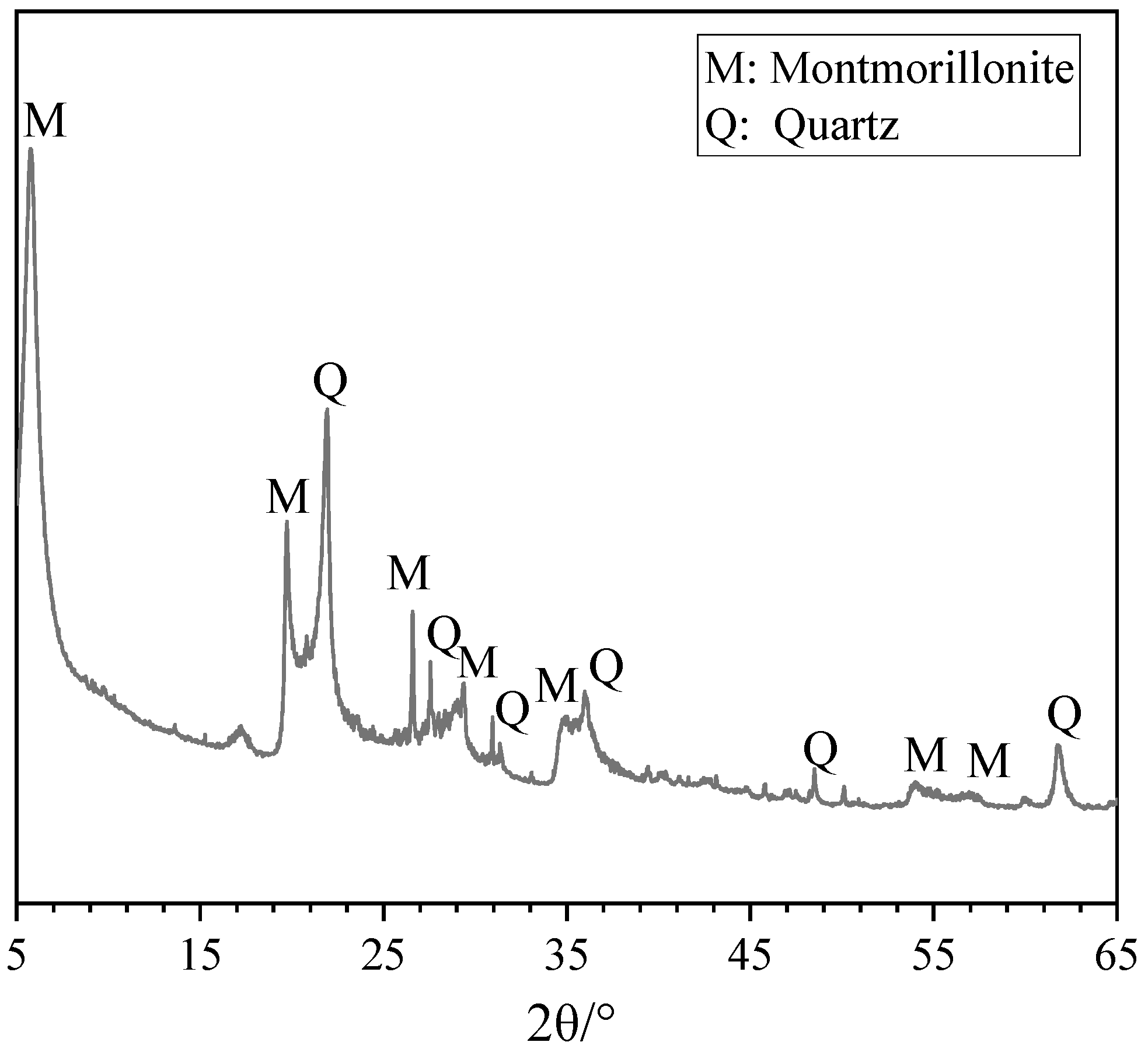
A sodium bentonite sourced from Gaomiaozi, Inner Mongolia, with a particle size of 300 mesh, was used in this study. The mineralogical composition of the raw bentonite was first characterized using XRD. As shown in Figure 1, the bentonite primarily consists of quartz (PDF#96-901-2601) and montmorillonite (PDF#96-900-2780). It is noted that all PDF cards used in this study were obtained from the Crystallography Open Database (COD).
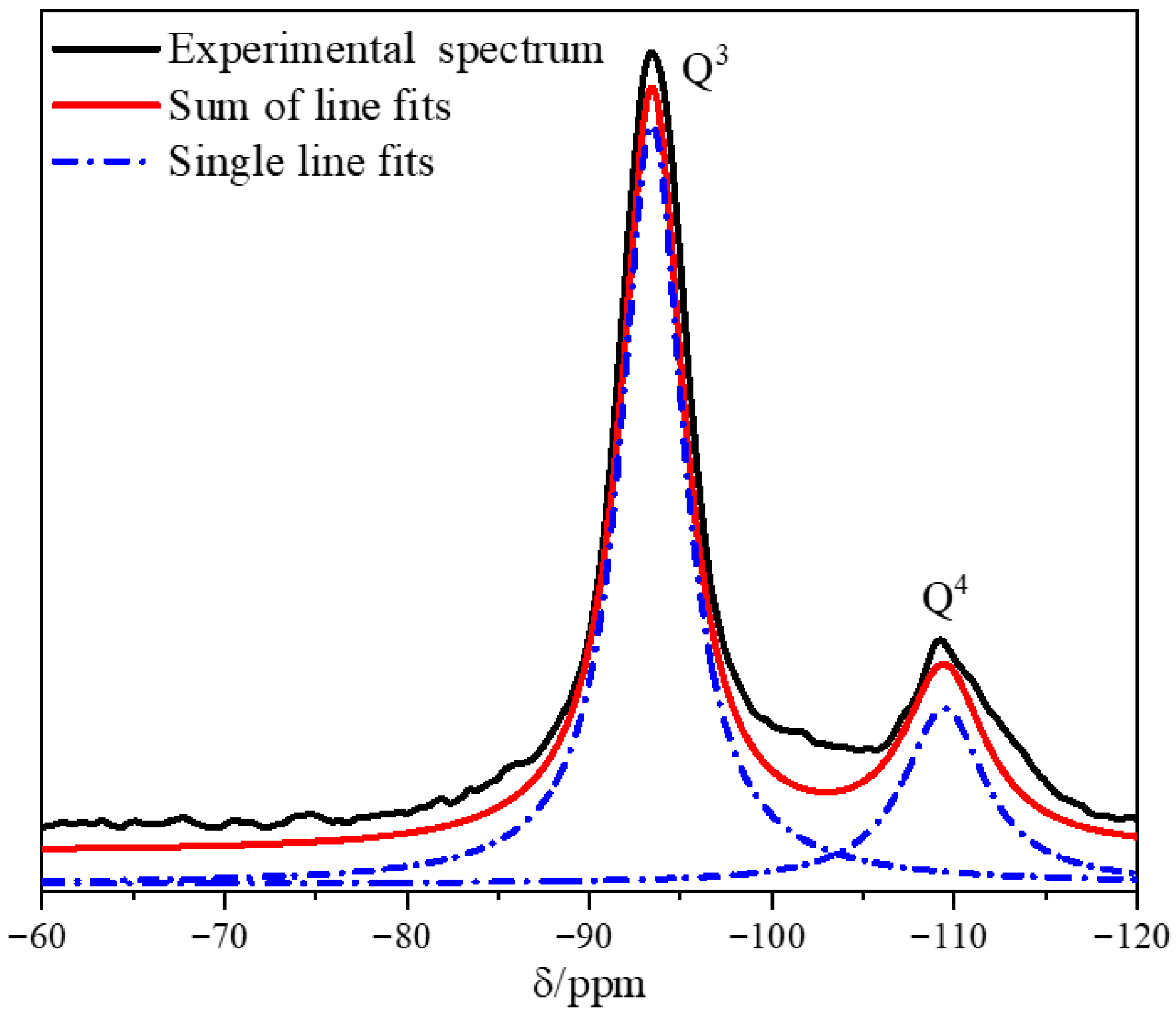
The XRD pattern exhibits a series of weak and continuous diffraction signals, indicating the presence of amorphous components in the natural soil. Since such amorphous phases cannot be accurately quantified using conventional XRD-based methods, relying solely on XRD for mineral quantification may introduce uncertainties in the results [25,26]. Although Rietveld refinement is a common approach for quantitative phase analysis, its reliability is fundamentally dependent on well-defined crystalline diffraction peaks and may be limited when amorphous or poorly crystalline components contribute substantially to the measured pattern. In the present cement–bentonite system, the coexistence of broad backgrounds and weak diffraction features makes it difficult to obtain robust quantitative results from XRD-based refinement alone. Therefore, after completing the qualitative mineral identification, 29Si NMR combined with peak deconvolution was employed to obtain a more reliable estimation of the mineral composition. In particular, 29Si NMR provides direct information on silicate structural units, which enables the assessment of silicate-related components that are not readily resolved by XRD intensity-based quantification. The deconvoluted 29Si NMR spectrum is shown in Figure 2.
To improve the accuracy of quantitative mineral analysis and minimize the errors associated with peak fitting, a “fixed peak position with defined peak shape” deconvolution approach was adopted. The procedure is as follows: first, the primary mineral phases were identified based on the XRD results; then, according to the literature [27,28,29], characteristic chemical shifts in montmorillonite (≈−93 ppm) and quartz (≈−108 ppm) were introduced into the fitting model. The height, width, and exact position of each peak were subsequently adjusted to obtain the best agreement between the fitted and experimental spectra. Finally, the relative mineral content was calculated based on the integrated area of each peak. The bentonite sample was determined to consist of approximately 34% quartz and 66% montmorillonite.
Since the soil sample contains a considerable amount of clay minerals with inherent hydration ability, anhydrous kerosene was used as the dispersant to determine the apparent density of the bentonite, following the Method for Determination of Cement Density (GB/T 208-2014). In addition, the basic physical properties of the soil were tested in accordance with the Standard for Soil Test Methods (GB/T 50123-2019), and the results are summarized in Table 1. As shown in Table 1, the bentonite exhibits a very high liquid limit (121.1%) and plasticity index (94.8), indicating a highly plastic clay with strong water-content sensitivity. These characteristics imply pronounced water-absorption swelling and dehydration shrinkage potential, which is generally associated with poor mechanical stability and large deformation risk under water-exposed conditions. Therefore, the physical indices in Table 1 provide a fundamental basis for selecting bentonite as a representative problematic clay and for interpreting the subsequent strength response and microstructural evolution of the cement-stabilized system under different alkalinity conditions.
Ordinary Portland cement (P·O 42.5, Conch Cement Co., Ltd., Wuhu, China) with a specific surface area of 355 m2/kg was used. The oxide composition of the cement was determined by X-ray fluorescence (XRF) analysis, and the corresponding mass fractions are presented in Table 2.
Deionized water was used for all mixtures. Considering that conventional alkaline additives may release OH and alkali metal ions during hydrolysis, analytical-grade NaOH pellets were selected as the alkali activator in this study.

2.2. Experimental Design and Sample Preparation

Before specimen preparation, the bentonite used in the experiments was oven-dried, ground, and passed through a 2 mm sieve to ensure a consistent initial material condition. According to the experimental program, predetermined amounts of dry soil and cement were then weighed and thoroughly mixed under dry conditions. For the preparation of alkali-modified cement-stabilized soils, a pre-mixing method was adopted: the required amount of NaOH was first dissolved in the mixing water to prepare alkaline solutions with different concentrations, which were then mixed together with the dry materials to ensure a uniform distribution of alkaline components throughout the system.
Considering the high liquid limit and pronounced water-absorption characteristics of bentonite, the water content of all specimens was uniformly controlled at 1.1 times the liquid limit of the bentonite to ensure adequate workability and homogeneity of the mixtures. Under this water content condition, the mixtures exhibited a highly viscous slurry state, in which free water mainly existed in the form of adsorbed water. Owing to the strong adsorption capacity of clay minerals, no evident bleeding or particle segregation was observed. Based on this slurry-casting state, no compaction molding was applied in this study to avoid altering the initial pore structure and reaction environment by external forming energy. After mixing, the slurry was slowly and continuously poured along the inner wall of cylindrical molds (Φ 50 mm × 50 mm), while controlling the free-fall height to within 2–3 cm to minimize air entrapment. After casting, the molds were placed on a vibration table (frequency: 50 Hz) for 10 min solely for deaeration, i.e., to remove entrapped air bubbles and to level the specimen surface, rather than for densification or structural modification. The specimens were then left to stand for approximately 5 min; once no bleeding or stratification was observed, they were immediately covered with plastic film and sealed in plastic bags to reduce moisture loss and alkalinity fluctuation. It should be noted that, although compaction is commonly adopted in geotechnical practice for stabilized soils, the present study intentionally employed a non-compacted casting procedure to maintain consistent initial conditions for comparing the effects of alkalinity on strength development and microstructural evolution.
The molded specimens were cured in a constant-temperature and constant-humidity chamber (20 °C, RH ≥ 95%). After 24 h of curing, the specimens were demolded and further cured for 7, 28, and 90 d for subsequent mechanical property and microstructural analyses. Three parallel specimens were prepared for each mixture proportion to ensure the repeatability of the test results.
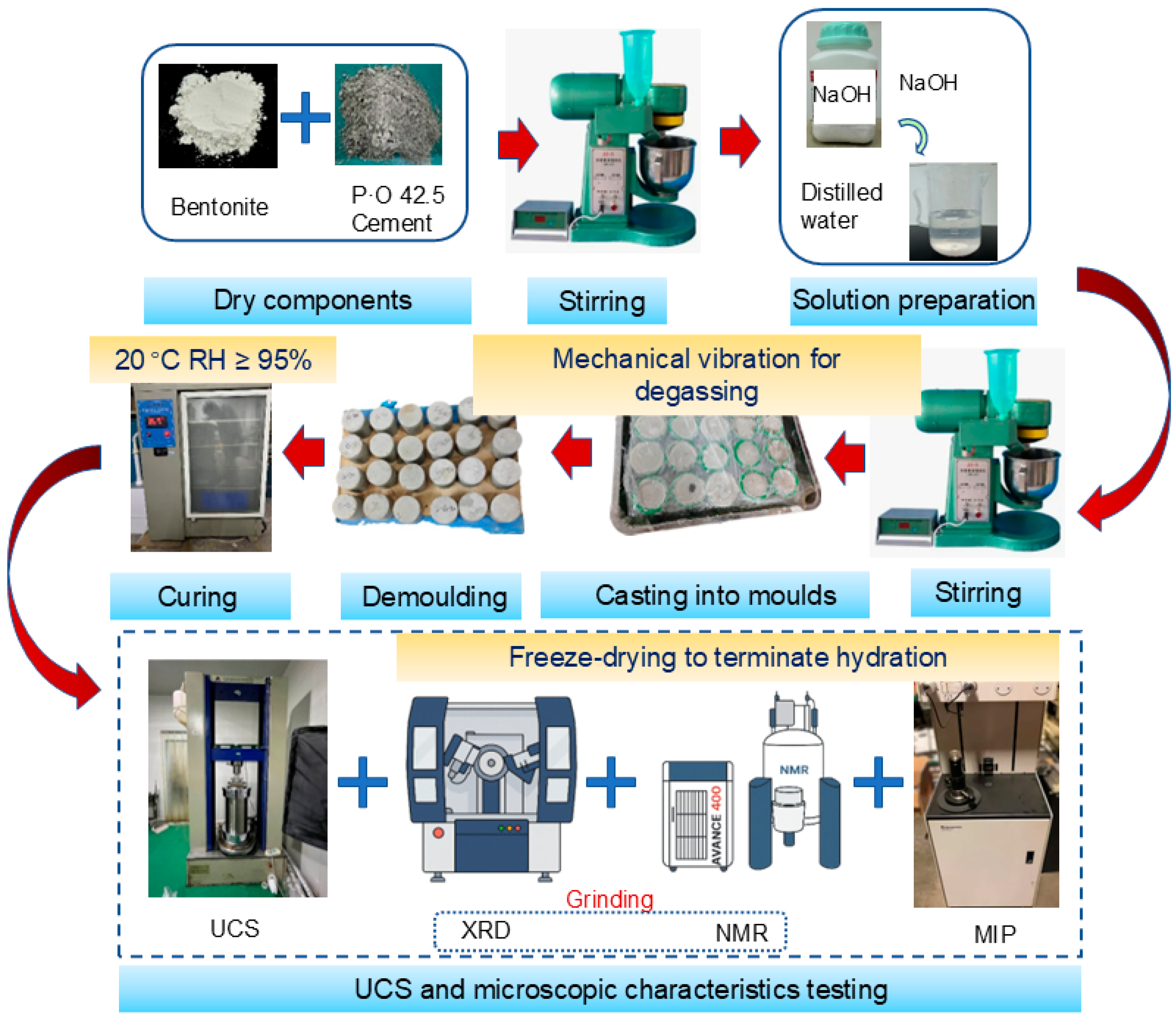
With the cement content fixed at 25%, different alkaline environments were established by varying the NaOH concentration in the mixing water (1, 3, 5, and 8 mol/L) to systematically investigate the effects of alkalinity on the mechanical properties and structural evolution of cement-stabilized bentonite. Specimens were designated using the format “soil type–cement content–NaOH concentration”; for example, a specimen with a cement content of 25% and a NaOH concentration of 1 mol/L was denoted as Bent25-1. The preparation of specimens and the corresponding experimental procedures, including mixing, casting, curing, and subsequent mechanical and microstructural tests, are schematically illustrated in Figure 3.

2.3. Macroscopic Mechanical Testing

At the end of each curing period, the specimens were subjected to UCS testing following the procedures outlined in the Standard for Soil Test Methods (GB/T 50123-2019). The tests were conducted using an electronic universal testing machine (Changchun Chaoyang Testing Instrument Co., Ltd., Changchun, China), with a loading rate of 1 mm/min.
Following UCS testing, freeze-drying [30] was applied to the crushed core fragments to obtain reliable microstructural characterization results by terminating ongoing hydration reactions. The freeze-drying procedure included: (i) immersing the fractured specimens in liquid nitrogen for approximately 10 min; (ii) transferring them to a freeze dryer (Shanghai Yetuo YTLG-12A, Shanghai, China) and drying under vacuum at −70 °C for 48 h.

2.4. Microstructural Characterization

(1)
Phase Identification
XRD was employed to qualitatively characterize the mineralogical compositions of the samples. Prior to testing, the dried specimens were ground and passed through a 75 μm sieve. XRD measurements were performed using a Rigaku SmartLab 9 kW diffractometer (Rigaku, Tokyo, Japan) with Cu Kα radiation, operating at 40 kV and 30 mA. The scanning conditions were set as follows: scan rate of 2°/min, 2θ range of 5–60°, and a step size of 0.02°.
(2)
Silicate Framework Analysis
The silicate framework structure of the cement-stabilized soils was analyzed using solid-state 29Si NMR. The dried specimens were ground to a particle size ≤75 μm prior to testing. The experiments were conducted with a 7 mm rotor at a resonance frequency of 79.49 MHz, using tetramethylsilane (TMS) as an external reference. The 29Si MAS NMR measurements employed a single-pulse sequence with a 90° pulse width of 5.6 μs, a pulse power of 150 W, a relaxation delay (D1) of 10 s, a spinning speed of 5 kHz, and 1024 accumulated scans.
29Si NMR distinguishes different silicon environments represented by Qn units (n = 0–4), corresponding to various silicate tetrahedral connectivity: Q0 for isolated tetrahedra [10,24], Q1 for end-chain units in dimers or higher-order polymers [31,32], Q2 for middle-chain tetrahedra in linear structures [10,24], Q3 for sheet or branching sites [24,31,33], and Q4 for fully polymerized three-dimensional networks [24,34,35].
Spectral deconvolution and peak fitting were performed using the dmfit 1.0 software. The integrated intensities of Qn peaks, I(Qn), were obtained after deconvolution and used to evaluate the relative abundance and structural evolution of each silicate unit. The mean chain length (MCL) of silicate structures was calculated using the well-established expression MCL = 2 × (1 + I(Q2)/I(Q1)) [36], providing a quantitative indicator of the polymerization degree and reaction characteristics of cementitious products.
(3)
Pore Structure Characterization
MIP was conducted on representative samples to determine pore size distribution characteristics. The tests were performed using a Micromeritics AutoPore IV 9510 porosimeter (Micromeritics Instrument Corporation, Norcross, GA, USA), with an applied pressure range of 0.0037–241.1 MPa, corresponding to a measurable pore diameter range of approximately 340–0.005 μm.

3. Results and Discussions

3.1. Unconfined Compressive Strength

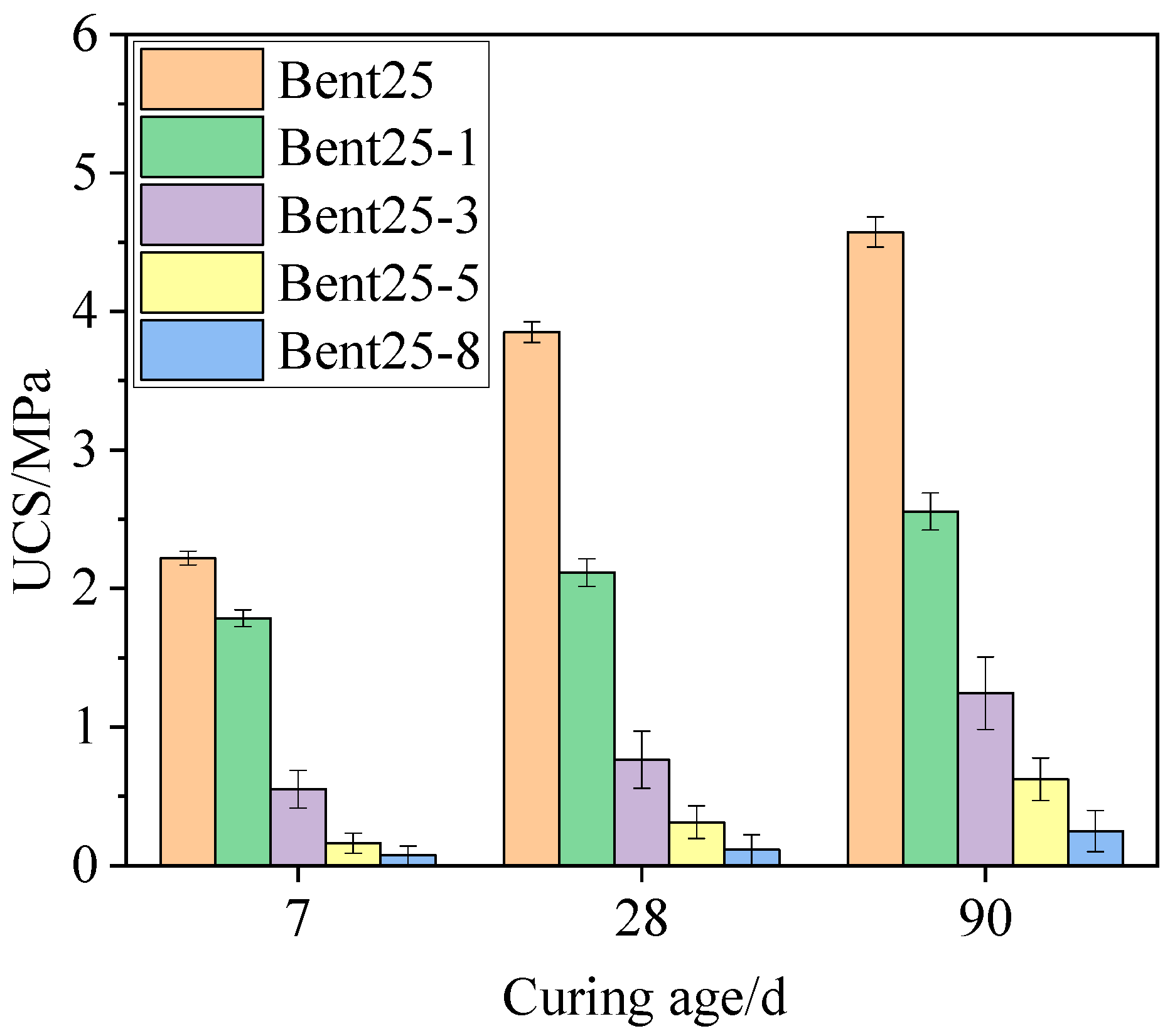
Figure 4 illustrates the evolution of UCS for cement-stabilized bentonite specimens prepared with different NaOH concentrations (0, 1, 3, 5, and 8 mol/L) at curing ages of 7, 28, and 90 d. For each mix group, three parallel specimens were tested; if the strength of any specimen deviated from the average by more than 10%, that specimen was discarded, and the mean of at least two valid results was taken as the UCS for the corresponding group, with the error bars in Figure 4 representing the standard deviation (SD) of the valid results. Overall, the UCS of all specimens increases significantly with curing time, indicating the continuous progression of cement hydration and the gradual densification of the stabilized matrix.
At the same curing age, the alkali-free specimen (Bent25) exhibited the highest compressive strength. After the introduction of NaOH, the strength of the cement-stabilized bentonite showed a continuous decreasing trend with increasing alkali concentration. When the NaOH concentration increased from 1 to 8 mol/L, the 7 d compressive strength decreased from 1.79 MPa to 0.07 MPa, the 28 d strength declined from 2.12 MPa to 0.11 MPa, and the 90 d strength dropped from 2.56 MPa to 0.25 MPa. These results indicate that, within the alkalinity range investigated in this study, increasing alkalinity exerts a pronounced inhibitory effect on the mechanical performance of cement-stabilized bentonite.
The continuous strength deterioration with increasing alkali concentration reflects a systematic alteration in the reaction pathways and structural evolution of the system under highly alkaline conditions. On the one hand, excessively high pH levels may interfere with the normal formation and polymerization of Ca–Si–H gel in the cementitious system, hindering the development of a continuous and dense load-bearing skeleton. On the other hand, strong alkaline conditions markedly intensify the dissolution and reorganization of aluminosilicate components in bentonite; while the original clay structure is disrupted, it is not simultaneously converted into stable and effective cementitious phases. Instead, additional structural defects may be introduced, leading to pore coarsening and, consequently, a reduction in the overall compactness and mechanical stability of the stabilized matrix.
Therefore, under conditions dominated by high alkalinity, the incorporation of NaOH does not exhibit a strengthening effect on cement-stabilized bentonite. Rather, its inhibitory influence progressively intensifies with increasing alkali concentration, indicating that enhanced alkalinity exerts a persistently detrimental impact on the integrity of the cementitious system and its load-bearing capacity.

3.2. XRD Analysis

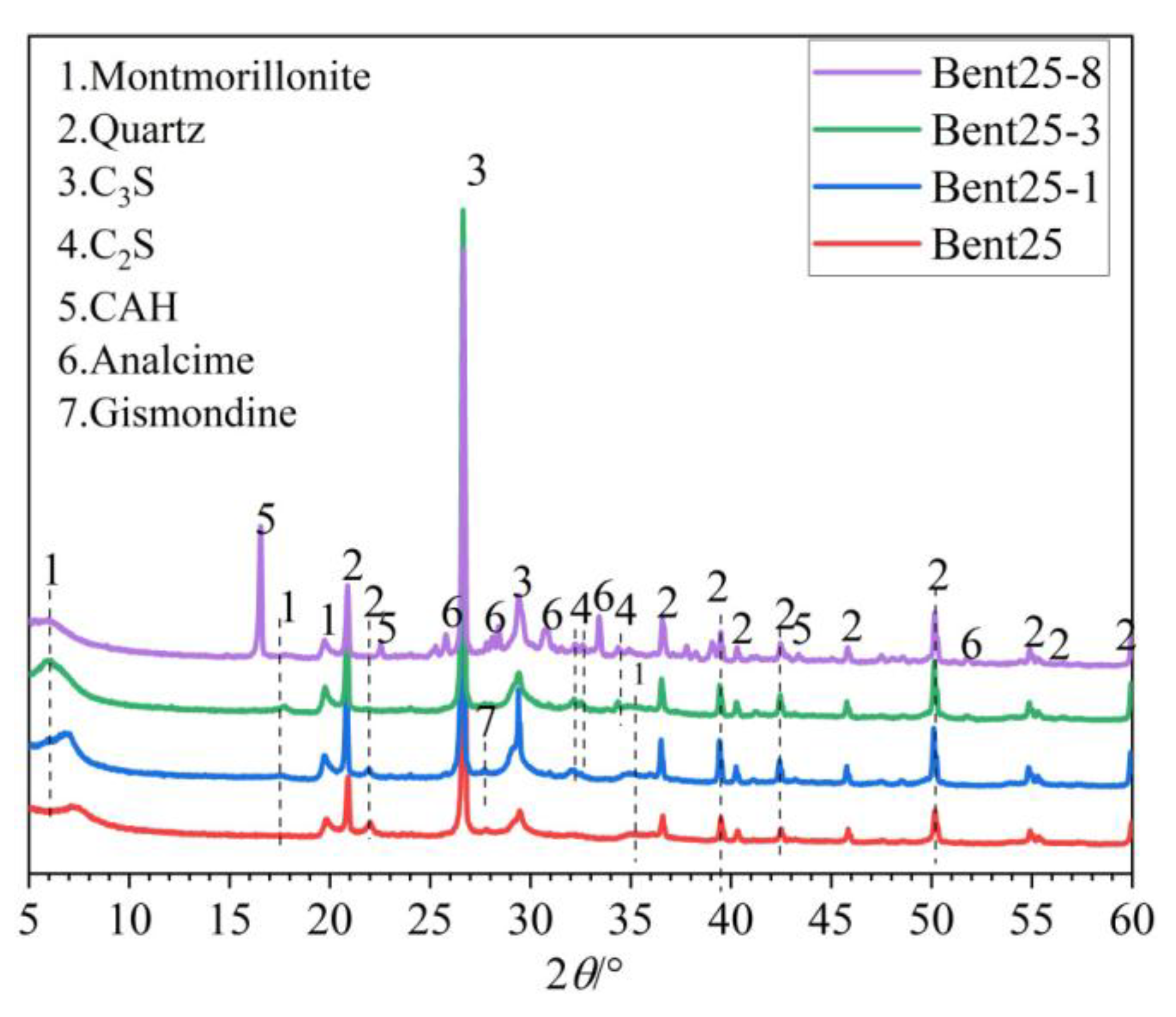
To examine the phase evolution of cement-stabilized bentonite under different alkali concentrations and to relate these changes to the strength development, representative mixtures (Bent25, Bent25-1, Bent25-3, and Bent25-8) were subjected to XRD analysis (Figure 5).
Overall, after the incorporation of NaOH, the cement-stabilized bentonite system generated crystalline phases dominated by analcime and gismondine [17,37], in addition to the hydration-related products of cement. With increasing NaOH dosage, the diffraction peaks of zeolitic phases gradually intensified, whereas those associated with montmorillonite became progressively weaker. In the highly alkaline sample Bent25-8, diffraction peaks corresponding to calcium aluminate hydrate (CAH) were also detected, indicating that the reaction pathways were altered under strong alkaline conditions and that the phase assemblage became more complex. In general, although the types of zeolitic phases formed were broadly similar among different mixtures, their relative contents increased with increasing NaOH dosage. Notably, this evolution of crystalline phases did not correspond to a simultaneous improvement in strength; instead, it contrasts sharply with the continuous decrease in unconfined compressive strength observed with increasing alkalinity, suggesting that an increase in the quantity or diversity of crystalline phases alone is insufficient to guarantee enhanced macroscopic mechanical performance.
Further examination of the low-angle diffraction region reveals that the (001) basal reflection of montmorillonite in the range of 5–8° exhibits an overall shift toward lower angles in alkali-modified samples. According to Bragg’s law, this shift indicates an increase in interlayer spacing compared with the alkali-free specimen, reflecting a pronounced influence of the alkaline environment on the interlayer structural state of montmorillonite. Meanwhile, the progressive broadening and reduced sharpness of this basal reflection imply a weakening of crystallographic ordering within the montmorillonite structure. These changes suggest that under alkaline conditions, montmorillonite crystal layers are activated and undergo structural rearrangement, with their crystallographic features evolving toward a lower degree of order and participating in subsequent reaction processes [38].
By integrating the XRD results with the strength data, it can be concluded that with increasing NaOH dosage, the diffraction characteristics of montmorillonite are continuously weakened, while crystalline reaction products such as zeolitic phases and CAH become increasingly prominent; however, the unconfined compressive strength of the stabilized matrix shows a marked decline. This indicates that under highly alkaline conditions, the reaction process preferentially promotes the formation and transformation of crystalline phases rather than the development of a continuous cementitious bonding structure favorable for load transfer. In other words, the phase evolution pathway under high alkalinity is not consistent with the strength development mechanism, and the increased presence of crystalline phases (e.g., zeolites and CAH) cannot compensate for the reduced contribution of gel phases that dominate strength formation within the cementitious system, ultimately leading to sustained deterioration of macroscopic mechanical performance. Although the increased presence of zeolitic phases does not translate into strength improvement in this study, it should be noted that these relatively stable crystalline products may still have potential implications for long-term performance, particularly durability, under highly alkaline conditions, which warrants further verification.

3.3. 29Si NMR

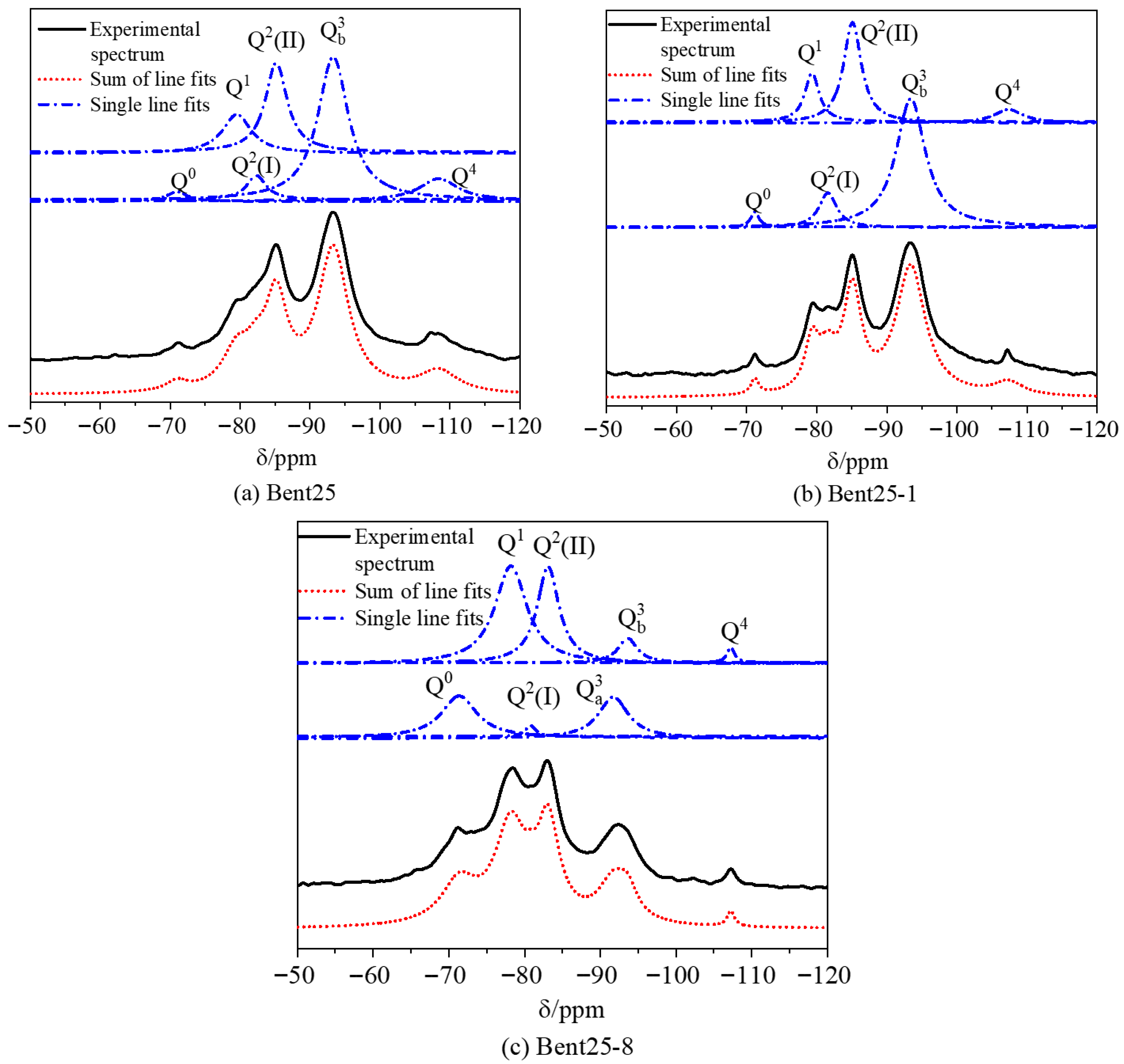
To further elucidate the effect of alkali dosage on the evolution of the silicate framework and its relationship to strength development, representative samples (Bent25, Bent25-1, and Bent25-8) were analyzed using 29Si NMR. The deconvoluted spectra are presented in Figure 6, and the relative proportions of Qn species together with the mean chain length (MCL) are summarized in Table 3.
For Bent25, the resonance at approximately −71 ppm corresponds to Q0 units, primarily associated with unhydrated silicate minerals such as C3S and C2S in the cement clinker [33]. The peak at ~−78 ppm corresponds to Q1 species, while those at −82 and −85 ppm represent the Q2 domain. The Q2 region is structurally complex and consists predominantly of chain units associated with M–(A)–S–H ((alumino)silicate hydrate) gels (where M = Na or K). In particular, M–S–H contains both paired and bridging Q2 environments, whereas the chemical shifts in M–A–S–H are strongly influenced by the amount and spatial distribution of Al–O groups, resulting in a broad distribution across the Q2 region. Consequently, characteristic signals from M–A–S–H and M–S–H may partially overlap within this domain, making precise separation of individual contributions difficult. Therefore, this region was fitted using two components, Q2(I) and Q2(II), representing bridging and paired environments, respectively [36]. It should be noted that, due to the possible peak overlap and structural complexity, the deconvolution results are interpreted primarily as semi-quantitative indicators of the relative evolution of Q2 units rather than absolute phase fractions.
The resonances at approximately −91 ppm and −94 ppm correspond to Q a 3 and Q b 3 units, respectively. Q b 3 reflects 2:1 layered silicate environments, such as montmorillonite and illite, whereas Q a 3 generally represents 1:1 layered silicate environments, such as serpentine or kaolinite. Notably, in the highly alkaline sample Bent25-8, both Q a 3 and Q b 3 peaks are clearly observed within the Q3 region, despite the absence of any intentionally introduced 1:1-type minerals in the system. This observation indicates that under strong alkaline conditions, the original T–O–T layered structure of montmorillonite undergoes pronounced deconstruction, with local silicate tetrahedral environments transforming from a 2:1-type coordination to a 1:1-type coordination. Such a transformation reflects delamination and structural rearrangement processes experienced by single-layer montmorillonite under strong alkaline attack [10,24,31,32,33,39,40,41]. The peak at approximately −108 ppm corresponds to Q4 units, which are mainly associated with unreacted quartz.
Table 3 shows that alkali addition significantly alters the distribution of Qn species. Compared with Bent25, the Q0 fraction increases from 2.3% to 4.7% (Bent25-1) and 15.0% (Bent25-8), indicating that higher OH concentrations inhibit clinker hydration. This phenomenon can be explained by the Ca(OH)2 dissolution equilibrium, K = [Ca2+][OH]2: as OH concentration increases, the equilibrium Ca2+ concentration decreases [40,41,42], reducing the dissolution and hydration rate of C3S and C2S. Consequently, a greater portion of unhydrated silicates remains.
Regarding “unreacted structural units,” the combined fraction of Q b 3 and Q4 species decreases substantially with alkali addition—from 58.3% in Bent25, to 52.9% in Bent25-1, and to only 6.8% in Bent25-8. This indicates that NaOH significantly enhances the dissolution and activation of the aluminosilicate framework in the bentonite, intensifying the alkali–soil reaction as alkalinity increases.
The MCL provides further insight. With increasing NaOH concentration, MCL decreases consistently: from 6.4 (Bent25) to 5.6 (Bent25-1), and further to 3.5 (Bent25-8). This reduction reflects a systematic depolymerization of the silicate framework, transitioning from highly polymerized chains toward short-chain or nearly isolated tetrahedral units. Such depolymerization weakens the continuity and integrity of the gel network.
When viewed alongside UCS data, a clear correspondence emerges: the strength follows the order Bent25 > Bent25-1 > Bent25-8, which aligns with the decreasing MCL and increasing Q0 content. These results demonstrate that although higher alkalinity enhances the dissolution of montmorillonite and activates more silicate/aluminate species, it simultaneously suppresses clinker hydration and promotes depolymerization of the silicate skeleton. As a result, the gel network becomes less cohesive, providing a structural explanation for the observed strength reduction with increasing NaOH concentration.

3.4. MIP

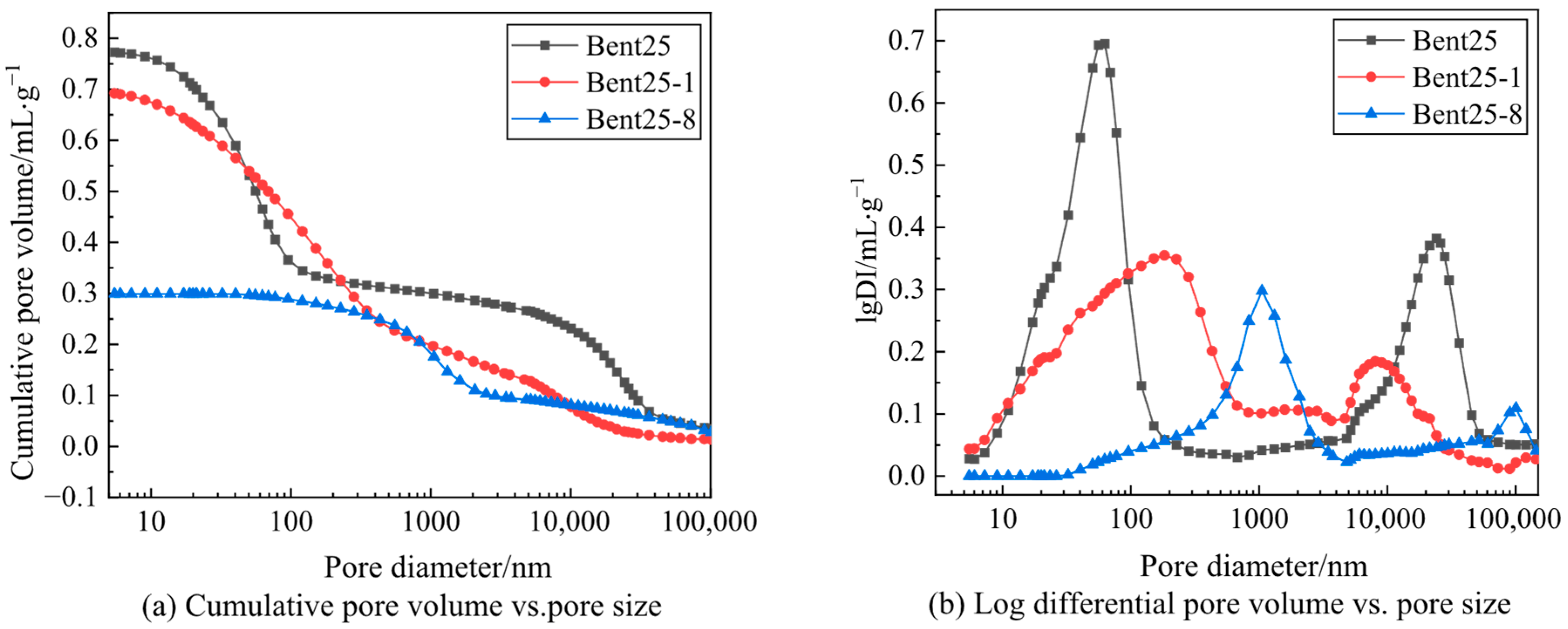
To examine the influence of alkali dosage on the pore characteristics and structural compactness of cement-stabilized bentonite, representative samples (Bent25, Bent25-1, and Bent25-8) were subjected to MIP testing. The cumulative intrusion curves and differential pore-size distributions are shown in Figure 7a and Figure 7b, respectively.
The cumulative intrusion volumes of Bent25, Bent25-1, and Bent25-8 are 0.77 mL/g, 0.69 mL/g, and 0.30 mL/g, respectively. This indicates that the incorporation of NaOH reduces the mercury-intrudable pore volume of the stabilized system to different extents [43,44,45], and the reduction becomes more pronounced with increasing alkali dosage. This suggests that under alkaline conditions, gels and zeolitic products generated by alkali–soil activation occupy part of the pore space, leading to a redistribution of pore volume within the system. This observation is consistent with the XRD results, which show that the diffraction peaks of analcime and gismondine become progressively intensified with increasing NaOH dosage, indicating an increase in the amount of reaction products that exert a certain filling effect on pore volume.
However, the pore-size distribution results (Figure 7b) demonstrate that NaOH incorporation does not promote pore refinement but instead induces pronounced pore coarsening. For Bent25, pores are mainly concentrated below 100 nm. However, in Bent25-1 and Bent25-8, pore volumes shift predominantly to the >100 nm range, with most probable pore sizes of 62.53 nm, 210.84 nm, and 1054.52 nm, respectively. Previous studies have shown that a significant increase in the most probable pore size generally reflects a transition from a fine-pore-dominated structure to a meso–macropore-dominated structure, indicating overall pore coarsening [46,47,48]. It should be noted that mercury intrusion porosimetry has inherent limitations, such as the ink-bottle effect and the measurement of pore-entry throat sizes rather than true pore-body dimensions, which may lead to an underestimation of large cavities connected by narrow throats. Nevertheless, since all specimens were tested under identical procedures, the comparative trends in pore-size distribution and the observed shift toward larger most probable pore sizes can still be regarded as reliable indicators of relative pore coarsening.
This pore coarsening characteristic corresponds well with the silicate structural evolution revealed by 29Si NMR. As NaOH concentration increases, the proportion of highly polymerized chain-like silicate structures decreases, while the fraction of low-polymerization structural units increases, and the mean chain length (MCL) decreases from 6.4 to 3.5. This indicates that the gel structure gradually transforms from continuous long-chain configurations to shorter-chain or even discrete structures. Meanwhile, both XRD and NMR results show that the original 2:1 layered silicate characteristics of montmorillonite ( Q b 3 ) gradually weaken under high-alkalinity conditions, whereas the 1:1-type silicate coordination feature ( Q a 3 ) increases markedly in the highly alkaline sample Bent25-8 (up to 16.2%). These results indicate that the layered silicate framework of montmorillonite undergoes deconstruction under strong alkaline conditions. Under such structural evolution, although alkali–soil activation reactions continuously generate gel and crystalline products that occupy part of the pore space and reduce the overall mercury-intrudable pore volume, the structural basis required to maintain a stable fine-pore system is significantly weakened. On the one hand, deconstruction of the montmorillonite layered structure weakens its constraint on fine pore morphology; on the other hand, depolymerization of the silicate framework and shortening of gel chains limit the formation of a continuous cementitious bonding network. As a result, pore walls and pore throats become more prone to structural rearrangement and interconnection, allowing adjacent fine pores to gradually merge into larger pore units, ultimately driving the pore-size distribution to shift from fine-pore dominance toward meso–macropore dominance.
Therefore, NaOH incorporation exhibits a clear dual effect on the pore structure of the stabilized system. On the one hand, gels and crystalline products generated by alkali–soil activation occupy part of the pore space and reduce the overall mercury-intrudable pore volume; on the other hand, under high-alkalinity conditions, montmorillonite deconstruction and silicate framework depolymerization weaken the conditions required to maintain fine pores, resulting in enlarged pore sizes and a reduced proportion of fine pores. Although Bent25-8 shows the lowest cumulative mercury intrusion volume, it exhibits the coarsest pore-size distribution and the strongest structural heterogeneity, making it difficult to form an effective load-bearing skeleton. Consequently, the unconfined compressive strength is significantly reduced at the macroscopic scale, which is fully consistent with the mechanical test results.

4. Mechanism Analysis

Integration of the mechanical performance with the XRD, 29Si NMR, and MIP results reveals a consistent relationship between alkalinity, microstructural evolution, and strength degradation. With increasing NaOH concentration from 1 to 8 mol/L, the 90 d unconfined compressive strength decreases from 2.56 MPa to 0.25 MPa, corresponding to an approximately 90% reduction in load-bearing capacity. This deterioration is accompanied by suppressed development of C–(A)–S–H gels and preferential formation of zeolitic crystalline phases, progressive depolymerization of the silicate framework as evidenced by a decrease in mean chain length from 6.4 to 3.5, and significant pore coarsening characterized by an increase in the most probable pore size from 62.53 to 1054.52 nm. Collectively, these structural changes reduce the continuity of the cementitious bonding network and account for the observed macroscopic strength loss. The underlying mechanisms are discussed in detail below.
(1)
Reaction pathway modification: zeolitic formation versus gel suppression
XRD confirms the generation of zeolitic phases such as analcime and gismondine with increasing NaOH dosage, accompanied by a reduction in cumulative mercury intrusion volume from 0.77 to 0.30 mL/g, indicating partial pore filling by crystalline products.
Meanwhile, 29Si NMR shows an increased fraction of Q0 species, suggesting incomplete clinker hydration. According to the Ca(OH)2 dissolution equilibrium, elevated OH concentration lowers Ca2+ availability, thereby suppressing the formation and polymerization of C–(A)–S–H gels.
Although zeolitic products locally occupy pore space, they mainly exist as discrete crystalline phases and cannot form a continuous cementitious bonding network. Consequently, the effective cementation capacity of the matrix is reduced.
(2)
Coupled deconstruction of montmorillonite layers and silicate depolymerization
Low-angle XRD peak attenuation and shifts indicate significant disturbance of the montmorillonite interlayer structure under alkaline conditions. Consistently, 29Si NMR reveals a decrease in Q b 3 (2:1 layered environments) and an increase in Q a 3 components, suggesting partial structural deconstruction of the original T–O–T framework.
More importantly, quantitative NMR analysis shows that the mean chain length of silicate tetrahedra decreases from 6.4 to 3.5, demonstrating progressive depolymerization of the gel network from long-chain configurations to shorter or isolated units.
This coupled layered breakdown and framework depolymerization disrupts structural continuity and limits the formation of an interconnected load-bearing skeleton.
(3)
Pore coarsening and its linkage to strength loss
MIP results show that the pore system shifts from fine-pore dominance to meso–macropore dominance with increasing alkalinity, with the most probable pore size increasing by more than one order of magnitude (62.53 → 1054.52 nm).
Such coarsening, together with the reduced gel connectivity described above, facilitates pore merging and structural heterogeneity, hindering stress transfer across the matrix.
Therefore, despite the reduction in total mercury-intrudable volume, the stabilized system develops a coarse and discontinuous pore structure that is unfavorable for effective load bearing, directly leading to the pronounced UCS reduction observed at later ages.
Compared with previous studies [49,50] that mainly focused on relatively low alkalinity conditions (typically ≤1 mol/L), where moderate alkali activation was reported to enhance aluminosilicate dissolution, promote secondary gel formation, and refine pore structures, the present results reveal a fundamentally different response at higher alkalinity levels. Instead of strength enhancement, excessive OH concentrations suppress clinker hydration, reduce silicate polymerization, and induce structural deconstruction of montmorillonite, ultimately leading to pronounced pore coarsening and severe strength deterioration. This contrast indicates that the role of alkalinity in cement–clay systems is not monotonic but exhibits a transition from activation-controlled strengthening to degradation-dominated weakening. By extending the alkalinity range to 1–8 mol/L and quantitatively correlating UCS loss with NMR-identified depolymerization and MIP-observed pore coarsening, this study provides new mechanistic insight into the deterioration behavior of cement-stabilized bentonite under strong alkaline environments.

5. Conclusions

(1)
Increasing alkalinity exerts a consistently detrimental effect on the mechanical performance of cement-stabilized bentonite, indicating that excessive OH concentrations weaken the effective cementation capacity of the stabilized system rather than promoting strengthening.
(2)
Under alkaline conditions, the reaction pathway shifts from the formation of continuous C–(A)–S–H gel phases toward the preferential generation of zeolitic crystalline products. Although these crystalline phases locally occupy pore space, they do not contribute to the development of an interconnected cementitious bonding network and therefore provide limited structural reinforcement.
(3)
Microstructural characterization demonstrates that strong alkalinity induces coupled structural degradation, including depolymerization of the silicate framework, reduced gel connectivity, and partial deconstruction of the montmorillonite layered structure. These processes disrupt the continuity and integrity of the load-bearing skeleton at the microscale.
(4)
The combined effects of gel suppression, layered structural breakdown, and pore coarsening progressively transform the stabilized matrix from a compact and uniformly bonded structure into a heterogeneous and discontinuous one, ultimately accounting for the observed macroscopic strength attenuation.
By systematically correlating mechanical behavior with multi-scale structural evolution over a wide alkalinity range, this study provides new mechanistic insight into the deterioration behavior of cement-stabilized bentonite under highly alkaline environments and clarifies the limits of alkali-induced activation in cement–clay systems.

Author Contributions

Conceptualization, J.G. and C.L.; Methodology, H.W. and J.G.; Formal analysis, H.W., J.L. and J.G.; Resources, J.L.; Data curation, H.W. and J.G.; Writing—original draft, H.W. and J.G.; Writing—review and editing, H.W., J.L., J.G. and C.L.; Supervision, C.L.; Funding acquisition, C.L. All authors have read and agreed to the published version of the manuscript.

Funding

This research was supported by the following funding: National Natural Science Foundation of China (grant No.: 52579130), Key Research and Development Program of Yunnan Province (Grant No.: 202503AC100001), Central Public-interest Scientific Institution Basal Research Fund of China (grant No.: Y424009, Y424001).

Data Availability Statement

The original contributions presented in this study are included in the article. Further inquiries can be directed to the corresponding authors.

Conflicts of Interest

The authors declare no conflicts of interest.

References

  1. Ge, J.; Xu, F.; Wei, H.; Wang, Q.; Peng, H.; Zhou, J.; Li, H. The Influence Mechanism of Interfacial Characteristics between CSH and Montmorillonite on the Strength Properties of Cement-Stabilized Montmorillonite Soil. Materials 2023, 16, 7141. [Google Scholar] [CrossRef] [PubMed]
  2. Tang, J.; Cheng, Z.; Tan, S.; Song, N.; Wei, Z.; Liu, Y. Efficient Recovery and Utilization of Phosphorus from Sewage Sludge via Alkalinous Fenton-like Oxidation with Pyrolysis-Modified Red Mud: Full Resource Utilization Attempt. J. Clean. Prod. 2024, 475, 143588. [Google Scholar] [CrossRef]
  3. Javed, U.; Khushnood, R.A.; Memon, S.A.; Jalal, F.E.; Zafar, M.S. Sustainable Incorporation of Lime-Bentonite Clay Composite for Production of Ecofriendly Bricks. J. Clean. Prod. 2020, 263, 121469. [Google Scholar] [CrossRef]
  4. Cardoso, H.S.; da Silva, T.O.; de Paula Rodrigues, K.H.; Pitanga, H.N.; Lopes, E.C.; Filho, M.J.M.; Nalon, G.H. Optimization of Cement-Improved Tropical Soils by Extreme Vertices Design. Constr. Build. Mater. 2025, 495, 143677. [Google Scholar] [CrossRef]
  5. Costa, W.G.S.; dos Santos Izzo, R.L.; de Souza Almeida, M.S.; Achy, A.R.A.; de Jesus Santos, I.; Ramos, R.S. Investigation of Cement and Polymer Stabilization in Gravel Soil-RAP Mixtures for Full-Depth Reclamation Applications. Constr. Build. Mater. 2025, 482, 141548. [Google Scholar] [CrossRef]
  6. Wu, Y.; Xu, F.; Wu, X.; Sun, T.; Yang, F.; Chen, B.; Zhu, Z.; Li, H.; Zhu, J. Replacing Cement with GGBS to Stabilize Phosphogypsum-Soil Mixture in Road Materials: A Comprehensive Assessment of Mechanical Property, Water Stability and Environmental Performance. Constr. Build. Mater. 2025, 458, 139631. [Google Scholar] [CrossRef]
  7. Bullard, J.W.; Jennings, H.M.; Livingston, R.A.; Nonat, A.; Scherer, G.W.; Schweitzer, J.S.; Scrivener, K.L.; Thomas, J.J. Mechanisms of Cement Hydration. Cem. Concr. Res. 2011, 41, 1208–1223. [Google Scholar] [CrossRef]
  8. Vitale, E.; Russo, G.; Deneele, D. Carbonation of Lime Treated Fine Grained Soils. In Proceedings of the 7th International Conference on Unsaturated Soils (UNSAT2018), Hong Kong, China, 3–5 August 2018; pp. 3–5. [Google Scholar]
  9. Elert, K.; Azañón, J.M.; Nieto, F. Smectite Formation upon Lime Stabilization of Expansive Marls. Appl. Clay Sci. 2018, 158, 29–36. [Google Scholar] [CrossRef]
  10. Ge, J.; Li, Q.; Qian, W.; Han, X.; Zhu, P.; Xu, F. Coupled Effects of Polymer-to-Cement Ratio and Resting Time on Cold-Joint Degradation and Interfacial Mechanism of PAE Cement-Based Coatings. Case Stud. Constr. Mater. 2025, 24, e05731. [Google Scholar] [CrossRef]
  11. Ge, J.; Zhuang, H.; Xu, F.; Han, X.; Zhan, Y.; Meng, X.; Wei, H.; Qian, W. Chloride Enrichment Induced by Magnetic Field of Stray Current and Coupled Deterioration Mechanism in Concrete under Salt Freeze–Thaw Conditions. Results Eng. 2025, 27, 107014. [Google Scholar] [CrossRef]
  12. Calabria-Holley, J.; Papatzani, S.; Naden, B.; Mitchels, J.; Paine, K. Tailored Montmorillonite Nanoparticles and Their Behaviour in the Alkaline Cement Environment. Appl. Clay Sci. 2017, 143, 67–75. [Google Scholar] [CrossRef]
  13. Sukmak, G.; Sukmak, P.; Horpibulsuk, S.; Arulrajah, A.; Horpibulsuk, J. Generalized Strength Prediction Equation for Cement Stabilized Clayey Soils. Appl. Clay Sci. 2023, 231, 106761. [Google Scholar] [CrossRef]
  14. Liu, C.; Lu, K.; Wu, Z.; Liu, X.; Garg, A.; Qin, Y.; Mei, G.; Lv, C. Expansive Soil Improvement Using Industrial Bagasse and Low-Alkali Ecological Cement. Constr. Build. Mater. 2024, 423, 135806. [Google Scholar] [CrossRef]
  15. de Araújo, M.T.; Ferrazzo, S.T.; Chaves, H.M.; da Rocha, C.G.; Consoli, N.C. Mechanical Behavior, Mineralogy, and Microstructure of Alkali-Activated Wastes-Based Binder for a Clayey Soil Stabilization. Constr. Build. Mater. 2023, 362, 129757. [Google Scholar] [CrossRef]
  16. Yu, J.; Chen, Y.; Chen, G.; Wang, L. Experimental Study of the Feasibility of Using Anhydrous Sodium Metasilicate as a Geopolymer Activator for Soil Stabilization. Eng. Geol. 2020, 264, 105316. [Google Scholar] [CrossRef]
  17. Marsh, A.; Heath, A.; Patureau, P.; Evernden, M.; Walker, P. Phase Formation Behaviour in Alkali Activation of Clay Mixtures. Appl. Clay Sci. 2019, 175, 10–21. [Google Scholar] [CrossRef]
  18. Papa, E.; Medri, V.; Amari, S.; Manaud, J.; Benito, P.; Vaccari, A.; Landi, E. Zeolite-Geopolymer Composite Materials: Production and Characterization. J. Clean. Prod. 2018, 171, 76–84. [Google Scholar] [CrossRef]
  19. Khalifa, A.Z.; Cizer, Ö.; Pontikes, Y.; Heath, A.; Patureau, P.; Bernal, S.A.; Marsh, A.T.M. Advances in Alkali-Activation of Clay Minerals. Cem. Concr. Res. 2020, 132, 106050. [Google Scholar] [CrossRef]
  20. Hou, W.; Ye, F.; Yu, Y.; Chen, D.; Wang, J.; Liu, F.; Feng, D.; Liang, S. Experimental Study on the Strength Characteristics and Seawater Degradation Resistance of Sandy Silt Solidified with Alkali-Activated Slag. Constr. Build. Mater. 2025, 458, 139610. [Google Scholar] [CrossRef]
  21. Lambe, T.W.; Moh, Z.-C. Improvement of Strength of Soil-Cement with Additives. In Highway Research Board Bulletin; Highway Research Board: Washington, DC, USA, 1958. [Google Scholar]
  22. Cascardi, A.; Verre, S.; Micelli, F.; Aiello, M.A. Durability-Aimed Performance of Glass FRCM-Confined Concrete Cylinders: Experimental Insights into Alkali Environmental Effects. Mater. Struct. 2025, 58, 329. [Google Scholar] [CrossRef]
  23. Feng, B.; Liu, H.; Li, Y.; Liu, X.; Tian, R.; Li, R.; Li, H. AFM Measurements of Hofmeister Effects on Clay Mineral Particle Interaction Forces. Appl. Clay Sci. 2020, 186, 105443. [Google Scholar] [CrossRef]
  24. Xu, F.; Ge, J.; Wei, H.; Liang, J.; Li, H.; Han, X. Structural characteristics of pozzolanic reaction products of cemented soil. J. Zhejiang Univ. Eng. Sci. 2025, 59, 167–176. (In Chinese) [Google Scholar]
  25. Hoshino, S.; Yamada, K.; Hirao, H. XRD/Rietveld Analysis of the Hydration and Strength Development of Slag and Limestone Blended Cement. J. Adv. Concr. Technol. 2006, 4, 357–367. [Google Scholar] [CrossRef]
  26. Vitale, E.; Deneele, D.; Paris, M.; Russo, G. Multi-Scale Analysis and Time Evolution of Pozzolanic Activity of Lime Treated Clays. Appl. Clay Sci. 2017, 141, 36–45. [Google Scholar] [CrossRef]
  27. Yang, Y.; Jaber, M.; Michot, L.J.; Rigaud, B.; Walter, P.; Laporte, L.; Zhang, K.; Liu, Q. Analysis of the Microstructure and Morphology of Disordered Kaolinite Based on the Particle Size Distribution. Appl. Clay Sci. 2023, 232, 106801. [Google Scholar] [CrossRef]
  28. Ohkubo, T.; Yamazaki, A.; Fukatsu, Y.; Tachi, Y. Pore Distribution of Compacted Ca-Montmorillonite Using NMR Relaxometry and Cryoporometry: Comparison with Na-Montmorillonite. Microporous Mesoporous Mater. 2021, 313, 110841. [Google Scholar] [CrossRef]
  29. Chen, C.; Zhong, C.; Zhang, Y.; Li, A.; Huang, S.; Zeng, H.; Zu, Q. Structural and Dynamic Properties of MgO–Al2O3–SiO2 Glasses from Molecular Dynamics Simulations and NMR. Ceram. Int. 2022, 48, 22444–22450. [Google Scholar] [CrossRef]
  30. Kißling, P.A.; Lübkemann, F.; Mundstock, A.; Lohaus, L.; Haist, M.; Caro, J.; Bigall, N.C. Is Freeze-Drying an Alternative to Solvent Exchange for the Hydration Stop of Cementitious Suspensions? Cem. Concr. Res. 2022, 159, 106841. [Google Scholar] [CrossRef]
  31. Ge, J.; Xu, F.; Han, X.; Qian, W.; Meng, X. Mix Proportion Parameter Optimization and Macro-Microscopic Response Analysis of Stabilized Soil Based on a Thermodynamic Model. J. Build. Mater. 2025. Available online: https://link.cnki.net/urlid/31.1764.TU.20250902.1408.004 (accessed on 9 February 2026). (In Chinese)
  32. Hu, J.; Xu, F.; Qian, W.; Xiao, H.; Ge, J.; Li, J. Coating on Steel Bar Mechanism of Resting Time on Bond Performance of Polymer Cement-based. Mater. Rep. 2024, 38, 127–130. (In Chinese) [Google Scholar]
  33. Ge, J.; Xu, F.; Han, X.; Han, X.; Qian, W.; Li, H. Thermodynamic model for predicting mineral phase distribution in cement-stabilized kaolinite systems. Chin. J. Geotech. Eng. 2025, 47, 2127–2135. (In Chinese) [Google Scholar]
  34. Kim, B.-J.; Yi, C.; Kang, K.-I. Development of Alkali-Activated Binder Using Hwangtoh without Calcination. Constr. Build. Mater. 2014, 58, 206–213. [Google Scholar] [CrossRef]
  35. Greiser, S.; Sturm, P.; Gluth, G.J.G.; Hunger, M.; Jäger, C. Differentiation of the Solid-State NMR Signals of Gel, Zeolite Phases and Water Species in Geopolymer-Zeolite Composites. Ceram. Int. 2017, 43, 2202–2208. [Google Scholar] [CrossRef]
  36. Martini, F.; Tonelli, M.; Geppi, M.; Ridi, F.; Borsacchi, S.; Calucci, L. Hydration of MgO/SiO2 and Portland Cement Mixtures: A Structural Investigation of the Hydrated Phases by Means of X-Ray Diffraction and Solid State NMR Spectroscopy. Cem. Concr. Res. 2017, 102, 60–67. [Google Scholar] [CrossRef]
  37. García-Lodeiro, I.; Cherfa, N.; Zibouche, F.; Fernández-Jimenez, A.; Palomo, A. The Role of Aluminium in Alkali-Activated Bentonites. Mater. Struct. 2015, 48, 585–597. [Google Scholar] [CrossRef]
  38. Kim, T.; Olek, J.; Jeong, H.G. Alkali-Silica Reaction: Kinetics of Chemistry of Pore Solution and Calcium Hydroxide Content in Cementitious System. Cem. Concr. Res. 2015, 71, 36–45. [Google Scholar] [CrossRef]
  39. Chen, B.; Zhang, H.; Chen, P. Erosion effect of hyper-alkaline solution on Gaomiaozi bentonite. Chin. J. Geotech. Eng. 2013, 35, 181–186. (In Chinese) [Google Scholar]
  40. Xu, F.; Wei, H.; Qian, W.; Cai, Y. Composite Alkaline Activator on Cemented Soil: Multiple Tests and Mechanism Analyses. Constr. Build. Mater. 2018, 188, 433–443. [Google Scholar] [CrossRef]
  41. Xu, F.; Cai, Y.; Qian, W.; Wei, H.; Zhuang, H.; He, Y. Characterization and Mechanism Analysis of Polynaphthalene Sulfonate Modified Cemented Soil. Constr. Build. Mater. 2020, 240, 117936. [Google Scholar] [CrossRef]
  42. Xu, F.; Wei, H.; Qian, W.; Hu, S.; Cai, Y. Compositional minerals of cemented soil by combined thermogravimetry and thermodynamic modelling. J. Build. Mater. 2022, 25, 424–433. (In Chinese) [Google Scholar]
  43. Zeng, Q.; Li, K.; Fen-chong, T.; Dangla, P. Pore Structure Characterization of Cement Pastes Blended with High-Volume Fly-Ash. Cem. Concr. Res. 2012, 42, 194–204. [Google Scholar] [CrossRef]
  44. Xu, F.; Cai, Y.; Qian, W.; Wei, H.; Zhuang, H. Mechanism of cemented soil modified by aliphatic ionic soil stabilizer. Chin. J. Geotech. Eng. 2019, 41, 1679–1687. (In Chinese) [Google Scholar]
  45. Zaffar, M.; Lu, S.-G. Pore Size Distribution of Clayey Soils and Its Correlation with Soil Organic Matter. Pedosphere 2015, 25, 240–249. [Google Scholar] [CrossRef]
  46. Horpibulsuk, S.; Rachan, R.; Chinkulkijniwat, A.; Raksachon, Y.; Suddeepong, A. Analysis of Strength Development in Cement-Stabilized Silty Clay from Microstructural Considerations. Constr. Build. Mater. 2010, 24, 2011–2021. [Google Scholar] [CrossRef]
  47. Deng, Y.; Yue, X.; Liu, S.; Chen, Y.; Zhang, D. Hydraulic Conductivity of Cement-Stabilized Marine Clay with Metakaolin and Its Correlation with Pore Size Distribution. Eng. Geol. 2015, 193, 146–152. [Google Scholar] [CrossRef]
  48. Lim, S.; Lee, H.-S.; Kawashima, S. Pore Structure Refinement of Cement Paste Incorporating Nanosilica: Study with Dual Beam Scanning Electron Microscopy/Focused Ion Beam (SEM/FIB). Mater. Charact. 2018, 145, 323–328. [Google Scholar] [CrossRef]
  49. Ahmad, F.; Jamal, A.; Iqbal, M.; Alqurashi, M.; Almoshaogeh, M.; Al-Ahmadi, H.M.; Hussein, E.E. Performance Evaluation of Cementitious Composites Incorporating Nano Graphite Platelets as Additive Carbon Material. Materials 2021, 15, 290. [Google Scholar] [CrossRef]
  50. Ahmad, Z.; Qureshi, M.I.; Ahmad, F.; El Ouni, M.H.; Asghar, M.Z.; Ghazouani, N. Effect of Macro Synthetic Fiber (MSF) on the Behavior of Conventional Concrete and the Concrete Containing e-Waste Aggregates. Mater. Struct. 2025, 58, 234. [Google Scholar] [CrossRef]
Figure 1. XRD pattern of the raw bentonite.
Buildings 16 00761 g001
Figure 2. Deconvoluted 29Si NMR spectrum of the raw bentonite.
Buildings 16 00761 g002
Figure 3. Schematic illustration of specimen preparation and experimental workflow.
Buildings 16 00761 g003
Figure 4. UCS of cement-stabilized bentonite with varying NaOH concentrations.
Buildings 16 00761 g004
Figure 5. Effects of NaOH dosage on the XRD characteristics of cement-stabilized bentonite.
Buildings 16 00761 g005
Figure 6. Spectrum of 29Si NMR peak fitting of cemented soil sample.
Buildings 16 00761 g006
Figure 7. Micro-pore distribution characteristics of representative cement-stabilized bentonite samples.
Buildings 16 00761 g007
Table 1. Basic physical properties of the bentonite.
Specific GravityLiquid Limit WL/%Plastic Limit WP/%Plasticity Index IP
2.4121.126.394.8
Table 2. Mass fraction (%) of the oxides in the cement.
SiO2Al2O3Fe2O3CaOMgOSO3TiO2K2ONa2OP2O5Residue Mass
24.635.934.9757.742.282.220.240.930.010.114.54
Table 3. Relative content of Qn species in cemented soil samples based on 29Si NMR spectral deconvolution.
Simple IDI(Qn)/%MCL
Q0Q1Q2(I)Q2(II) Q a 3 Q b 3 Q4
Bent252.312.45.221.9049.19.26.4
Bent25-14.79.59.024.0048.84.15.6
Bent25-815.036.01.324.816.25.51.33.5
Disclaimer/Publisher’s Note: The statements, opinions and data contained in all publications are solely those of the individual author(s) and contributor(s) and not of MDPI and/or the editor(s). MDPI and/or the editor(s) disclaim responsibility for any injury to people or property resulting from any ideas, methods, instructions or products referred to in the content.