

Influencing Factors and Predictive Methods of Greenhouse Gas Emissions from Immersed Tunnel Construction in China

Abstract
1. Introduction
- (1)
- To what extent do some key factors (such as structural conditions, construction conditions, and concrete materials) determine GHG emissions of immersed tunnel segments?
- (2)
- How can construction-stage GHG emissions of immersed tunnel segments be efficiently predicted during the design phase of cross-sea immersed tunnel projects in China?
2. Methods
2.1. Selection and Definition of Candidate Influencing Factors
2.2. Case Projects and Segment-Level Data Preparation
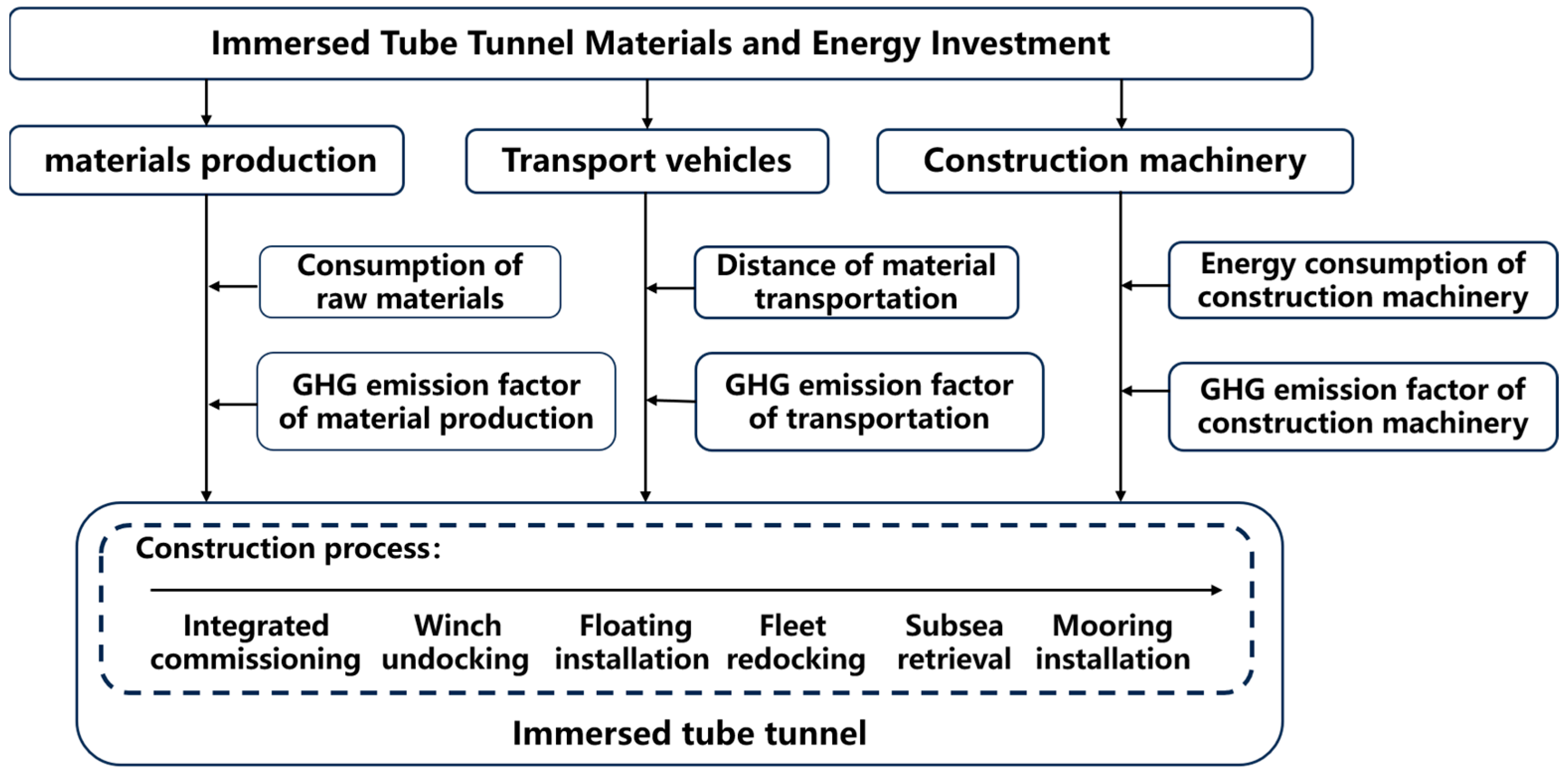
2.3. Calculation Method of GHG Emissions During Tunnel Construction
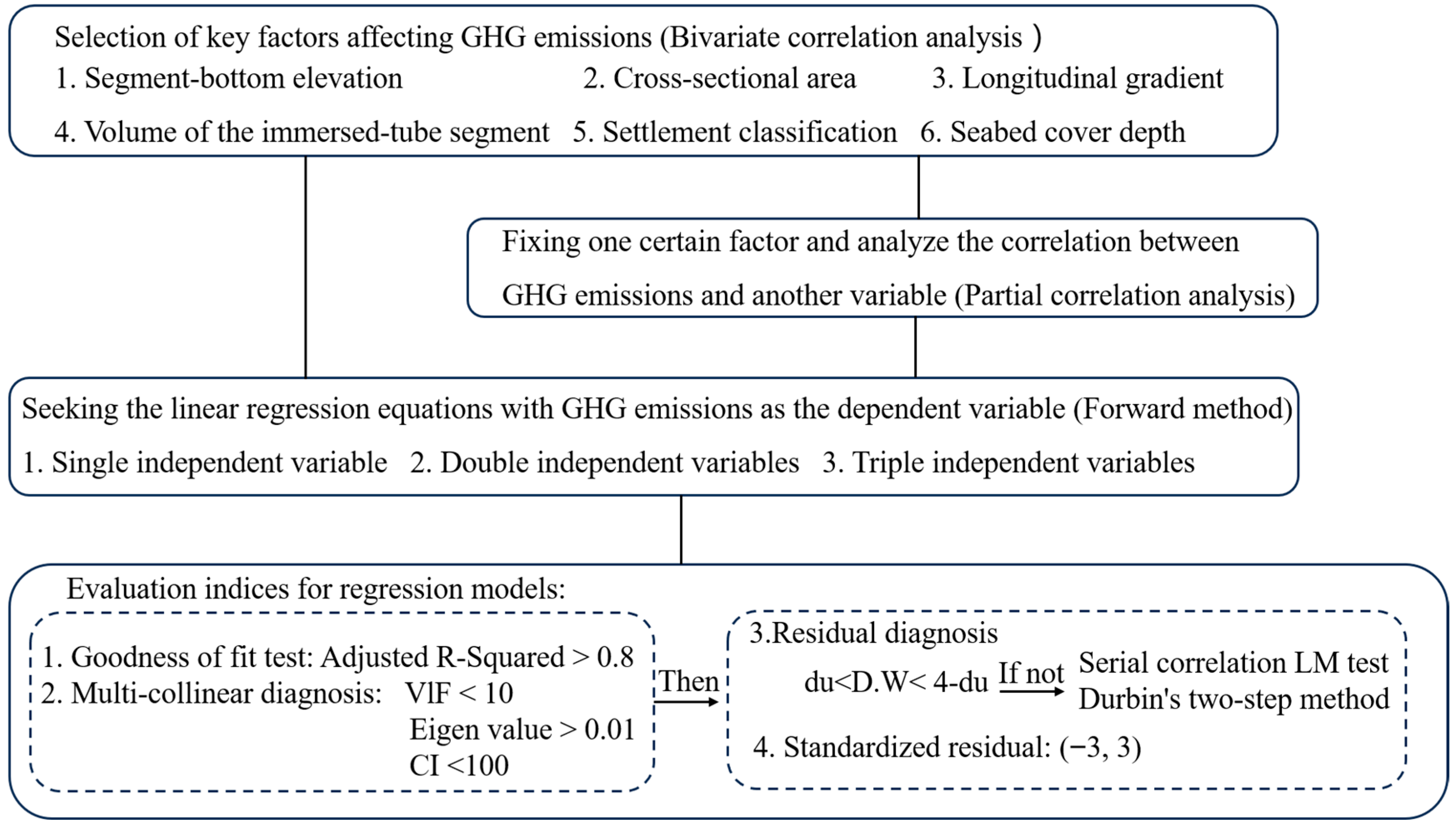
2.4. Methods of Data Analysis
3. Results
3.1. GHG Emissions of Tunnel Construction
3.2. Factors Influencing GHG Emissions from Tunnel Construction
3.3. Regression Analysis of GHG Emissions from Tunnel Construction
4. Discussion
4.1. Carbon Emission Level of Immersed Tunnel During Construction Period and Its Engineering Significance
4.2. Engineering Interpretation of Key Influencing Factors
4.3. More Discussions on Low-Carbon Design and Construction of Immersed Tunnels
4.4. Applicability and Limitations of the Forecasting Models
5. Conclusions
5.1. Main Conclusions
- (1)
- The construction period of a single immersed-tube has a high and discrete carbon emission level. Under the existing engineering conditions, the GHG of the single segment is 1.56 × 10⁴~2.71 × 10⁴ t CO2 eq. The average is about 2.40 × 10⁴ t CO2 eq. The material production stage and energy consumption of construction machinery are the main sources of emissions. Therefore, emission reduction should prioritize material-related mitigation and the energy efficiency of major construction equipment and processes.
- (2)
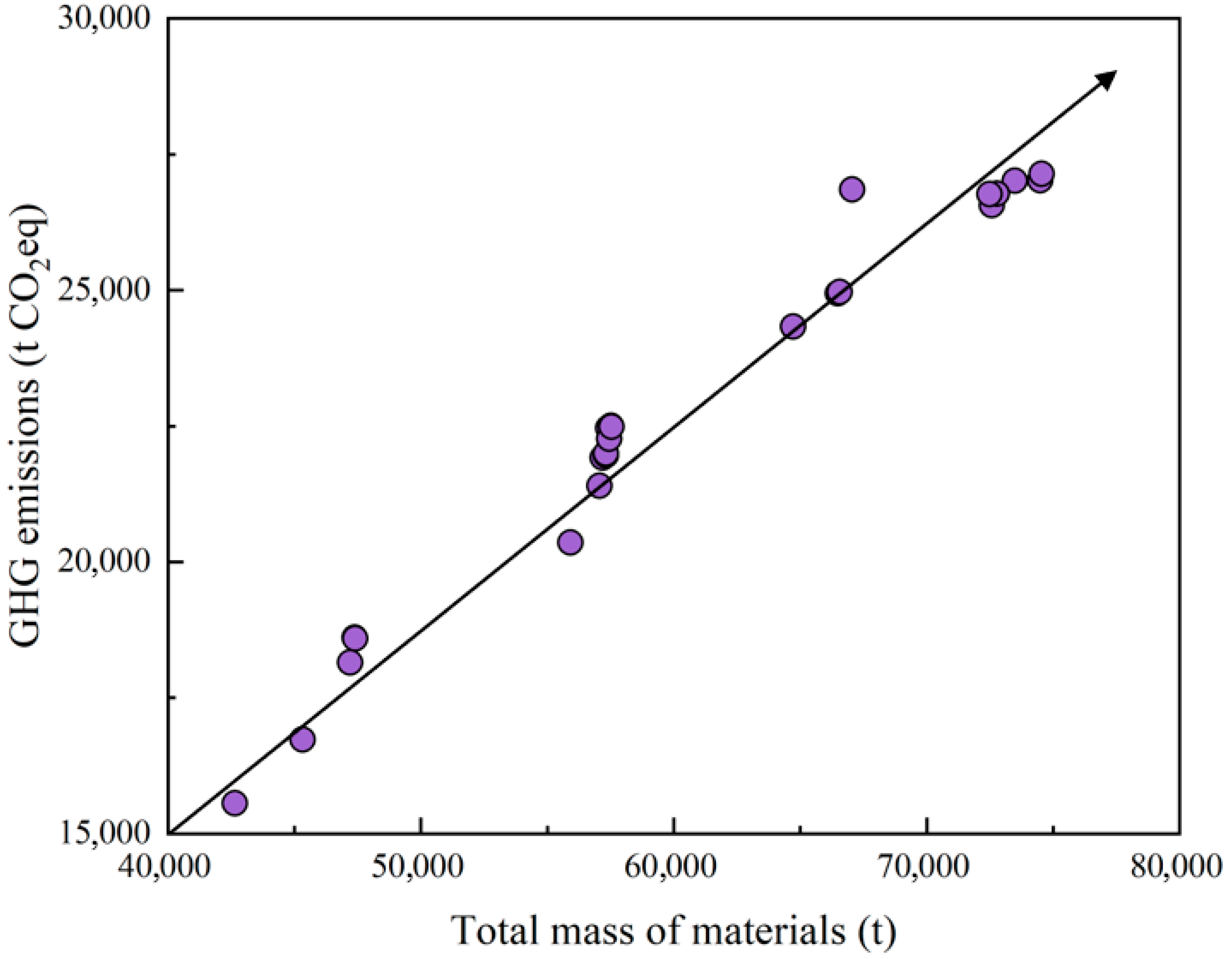
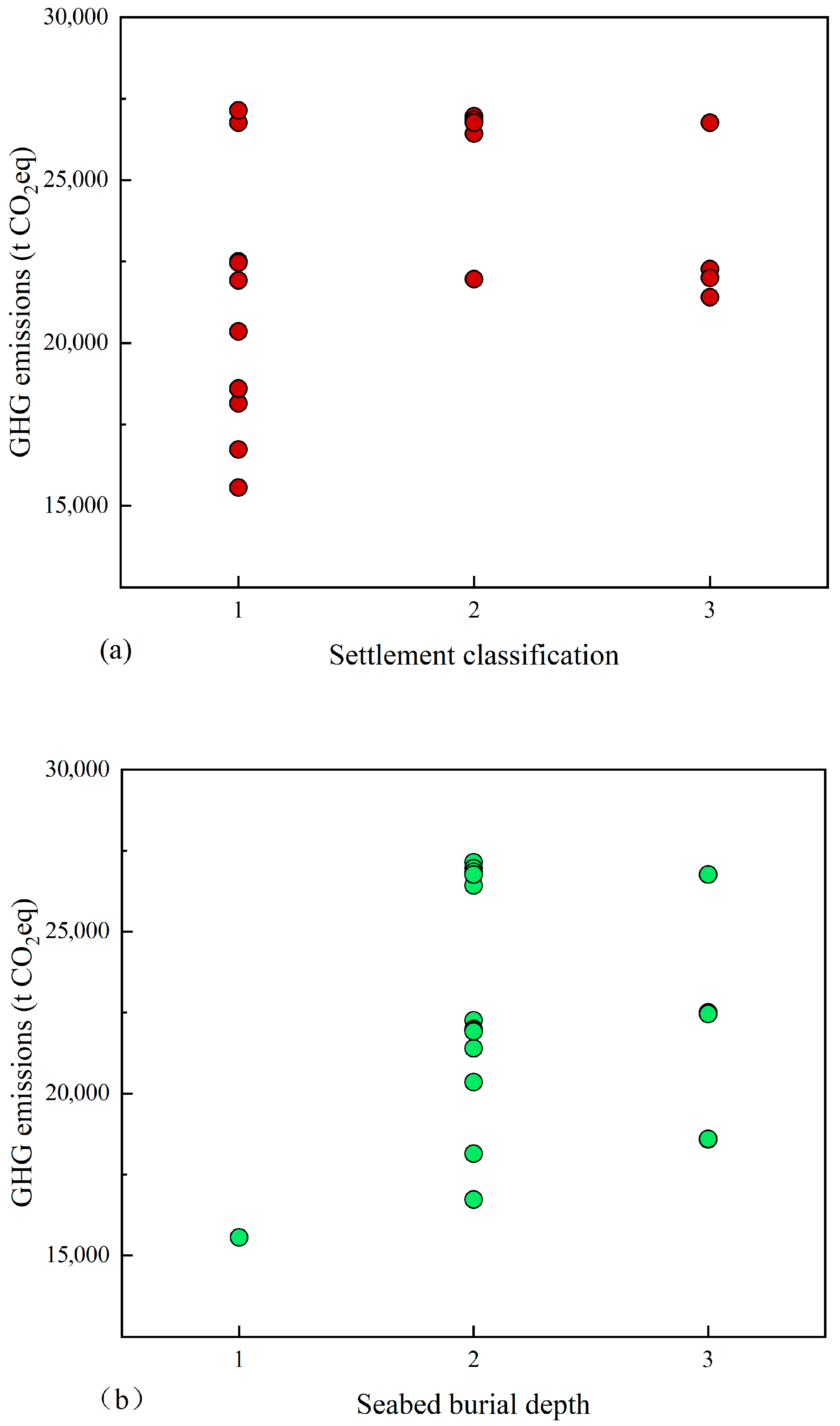
- The total mass of materials is the dominant factor driving the construction emission of a single pipe section. Correlation and partial correlation analysis showed that the correlation coefficient between the total mass of construction materials and GHG was the highest (0.936), followed by the volume and cross-sectional area of the immersed tube, while the longitudinal slope had no significant effect on the emission. Settlement grade and seabed depth indirectly affect the discharge by affecting the structure size and foundation reinforcement, but their independent contributions are limited after controlling for the material scale variable. Therefore, low-carbon design and construction should focus on reducing material input through structural optimization and adopting low-carbon materials and supply chains.
- (3)
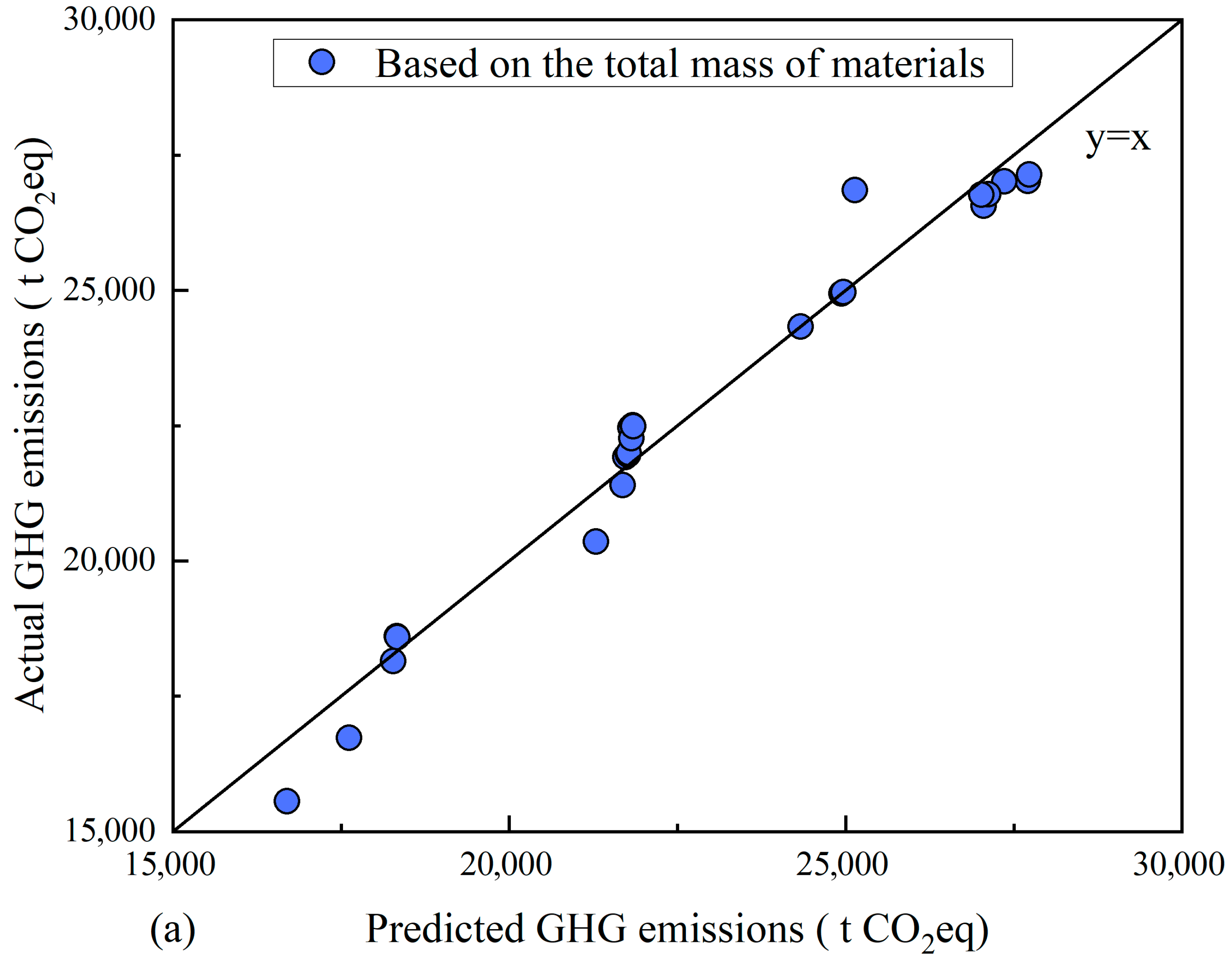
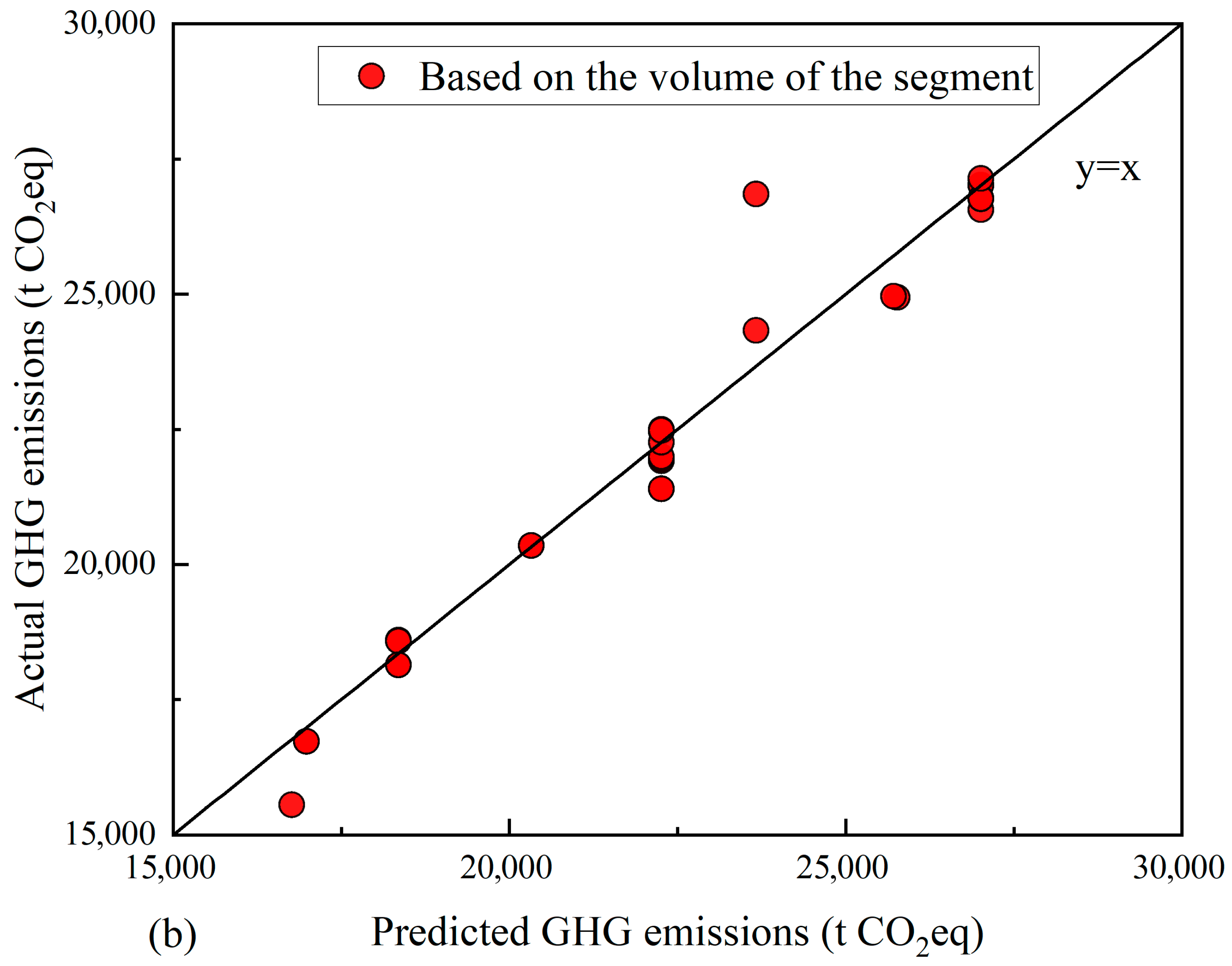
- For design-stage prediction, the linear model based on the total mass of material and the volume of pipe section can predict the emission during construction with high accuracy. The adjusted coefficients of determination of GHG = 0.346M + 1937.143 and GHG = 1.019V + 271.210 of the univariate regression equations reach 0.961 and 0.959, respectively, and there is no significant multicollinearity. In contrast, the multivariate model with variables such as altitude and subsidence level has limited improvement in fitting accuracy and complex parameter interpretation. Therefore, the above univariate equations are recommended for rapid estimation and scheme comparison at the early design stage.
- (4)
- The recommended univariate models have good simplicity and operability, and they can support rapid screening of alternative segment designs and construction schemes, as well as preliminary target-setting and control of construction-stage carbon emissions in immersed-tube projects.
- (5)
- The above prediction equations are calibrated using segment-level data from three Chinese cross-sea immersed-tube tunnel projects under similar process chains and boundary definitions. Therefore, direct transfer to projects with substantially different structural configurations, materials, or construction approaches should be performed with caution, and recalibration with additional local samples is suggested to improve generalizability.
5.2. Limitations
- (1)
- The sample sources are mainly concentrated in the three immersed-tube tunnel projects in China, and the regionality, design specifications and construction organization models are relatively close, and they cannot fully represent the immersed-tube projects in different countries and different standard systems. In the future, it is necessary to expand the sample range and introduce more marine environments and structural types.
- (2)
- The emission factors mainly use the current database and standard recommended values, and the time evolution factors, such as material production technology progress and energy structure changes, are not dynamically corrected. With the promotion of low-carbon cement, new energy ships and electric construction machinery, the existing factors may underestimate the potential of future emission reduction, and dynamic LCA research needs to be carried out in combination with scenario analysis.
- (3)
- This study only conducted detailed accounting and modeling for the construction stage, and did not systematically include emissions in the operation, maintenance and end-of-life stages. Long-term operating infrastructure, such as cross-sea immersed tunnels, traffic organization and energy consumption of electromechanical systems during the operation period, is also a key source of carbon emissions, which needs to be integrated with emissions during the construction period in follow-up work.
- (4)
- The resulting prediction model adopts linear assumptions and does not explicitly consider the nonlinear effects of extreme working conditions and process innovation. In the future, piecewise linear, nonlinear regression or machine learning methods can be tried to improve prediction accuracy under complex processes and unconventional design conditions on the basis of larger samples.
5.3. Prospects
Supplementary Materials
Author Contributions
Funding
Data Availability Statement
Acknowledgments
Conflicts of Interest
References
- Friedlingstein, P.; Jones, M.W.; O’sullivan, M.; Andrew, R.M.; Hauck, J.; Peters, G.P.; Peters, W.; Pongratz, J.; Sitch, S.; Le Quéré, C. Global carbon budget 2019. Earth Syst. Sci. Data 2019, 11, 1783–1838. [Google Scholar] [CrossRef]
- Liu, Q.; Yin, Y. Strategies for emission reduction in construction: The role of China’s carbon trading market. J. Knowl. Econ. 2025, 16, 3000–3029. [Google Scholar] [CrossRef]
- Wang, Y.; Yi, H.; Tang, X.; Wang, Y.; An, H.; Liu, J. Historical trend and decarbonization pathway of China’s cement industry: A literature review. Sci. Total Environ. 2023, 891, 164580. [Google Scholar] [CrossRef] [PubMed]
- Abergel, T.; Dean, B.; Dulac, J. Towards a Zero-Emission, Efficient, and Resilient Buildings and Construction Sector: Global Status Report 2017; UN Environment and International Energy Agency: Paris, France, 2017; Volume 22. [Google Scholar]
- Xi, J. Speech at the general debate of the 75th UN General Assembly. People’s Daily, 23 September 2020; p. 23. [Google Scholar]
- Xu, A.; Zhu, Y.; Wang, Z.; Zhao, Y. Carbon emission calculation of prefabricated concrete composite slabs during the production and construction stages. J. Build. Eng. 2023, 80, 107936. [Google Scholar] [CrossRef]
- Zhang, C.; Luo, H. Research on carbon emission peak prediction and path of China’s public buildings: Scenario analysis based on LEAP model. Energy Build. 2023, 289, 113053. [Google Scholar] [CrossRef]
- He, B.-J.; Prasad, D. Delivering a net zero carbon built environment–Targets and Pathways. In Proceedings of the IOP Conference Series: Earth and Environmental Science; IOP Publishing: Bristol, UK, 2022; p. 012001. [Google Scholar]
- Zhang, D.; Ding, Y.; Wang, Y.; Fan, L. Towards ultra-low energy consumption buildings: Implementation path strategy based on practical effects in China. Energy Sustain. Dev. 2022, 70, 537–548. [Google Scholar] [CrossRef]
- MacLeay, I. Digest of United Kingdom Energy Statistics 2010; The Stationery Office: Norwich, UK, 2010. [Google Scholar]
- Zhu, Y.; Lin, M.; Meng, F.; Liu, X.; Lin, W. The Hong Kong–Zhuhai–Macao Bridge. Engineering 2019, 5, 10–14. [Google Scholar] [CrossRef]
- Deng, B.; Huang, Q.; Liu, J.; Liu, M.; Jin, W.; Ji, H. Mechanical properties of asymmetric composite welds in the steel shell of immersed final joints along Shen-Zhong link. In Advances in Traffic Transportation and Civil Architecture; CRC Press: Boca Raton, FL, USA, 2023; pp. 489–501. [Google Scholar]
- Sun, Y.; Song, S.; Yu, H.; Ma, H.; Xu, Y.; Zu, G.; Ruan, Y. Experimental Study on the Strength and Durability of Manufactured Sand HPC in the Dalian Bay Undersea Immersed Tube Tunnel and Its Engineering Application. Materials 2024, 17, 5003. [Google Scholar] [CrossRef] [PubMed]
- Kul, A.; Ozel, B.F.; Ozcelikci, E.; Gunal, M.F.; Ulugol, H.; Yildirim, G.; Sahmaran, M. Characterization and life cycle assessment of geopolymer mortars with masonry units and recycled concrete aggregates assorted from construction and demolition waste. J. Build. Eng. 2023, 78, 107546. [Google Scholar] [CrossRef]
- Mesa, J.A.; Fúquene-Retamoso, C.; Maury-Ramírez, A. Life cycle assessment on construction and demolition waste: A systematic literature review. Sustainability 2021, 13, 7676. [Google Scholar] [CrossRef]
- Mouton, L.; Allacker, K.; Röck, M. Bio-based building material solutions for environmental benefits over conventional construction products–Life cycle assessment of regenerative design strategies (1/2). Energy Build. 2023, 282, 112767. [Google Scholar] [CrossRef]
- Liu, Y.; Zhang, J.; Xu, J.; Wang, Y.; Li, B.; Zhang, S. Carbon emission-based life cycle assessment of rural residential buildings constructed with engineering bamboo: A case study in China. J. Build. Eng. 2023, 76, 107182. [Google Scholar] [CrossRef]
- Rinne, R.; Ilgın, H.E.; Karjalainen, M. Comparative study on life-cycle assessment and carbon footprint of hybrid, concrete and timber apartment buildings in Finland. Int. J. Environ. Res. Public Health 2022, 19, 774. [Google Scholar] [CrossRef]
- Ansah, M.K.; Chen, X.; Yang, H.; Lu, L.; Lam, P.T. Developing an automated BIM-based life cycle assessment approach for modularly designed high-rise buildings. Environ. Impact Assess. Rev. 2021, 90, 106618. [Google Scholar] [CrossRef]
- Andersen, J.H.; Rasmussen, N.L.; Ryberg, M.W. Comparative life cycle assessment of cross laminated timber building and concrete building with special focus on biogenic carbon. Energy Build. 2022, 254, 111604. [Google Scholar] [CrossRef]
- Miliutenko, S.; Åkerman, J.; Björklund, A. Energy use and greenhouse gas emissions during the Life Cycle stages of a road tunnel-the Swedish case norra länken. Eur. J. Transp. Infrastruct. Res. 2012, 12, 39–62. [Google Scholar] [CrossRef]
- Huang, L.; Bohne, R.A.; Bruland, A.; Jakobsen, P.D.; Lohne, J. Life cycle assessment of Norwegian road tunnel. Int. J. Life Cycle Assess. 2015, 20, 174–184. [Google Scholar] [CrossRef]
- Damián, R.; Zamorano, C.I. Environmental impact assessment of high-speed railway tunnel construction: A case study for five different rock mass rating classes. Transp. Geotech. 2022, 36, 100817. [Google Scholar] [CrossRef]
- Rodríguez, R.; Pérez, F. Carbon foot print evaluation in tunneling construction using conventional methods. Tunn. Undergr. Space Technol. 2021, 108, 103704. [Google Scholar] [CrossRef]
- Guo, C.; Wang, M.; Yang, L.; Sun, Z.; Zhang, Y.; Xu, J. A review of energy consumption and saving in extra-long tunnel operation ventilation in China. Renew. Sustain. Energy Rev. 2016, 53, 1558–1569. [Google Scholar] [CrossRef]
- Guo, C.; Xu, J.; Yang, L.; Guo, X.; Zhang, Y.; Wang, M. Energy-saving network ventilation technology of extra-long tunnel in climate separation zone. Appl. Sci. 2017, 7, 454. [Google Scholar] [CrossRef]
- Moretti, L.; Cantisani, G.; Di Mascio, P. Management of road tunnels: Construction, maintenance and lighting costs. Tunn. Undergr. Space Technol. 2016, 51, 84–89. [Google Scholar] [CrossRef]
- Wu, H.; Zhou, W.; Bao, Z.; Long, W.; Chen, K.; Liu, K. Life cycle assessment of carbon emissions for cross-sea tunnel: A case study of Shenzhen-Zhongshan Bridge and Tunnel in China. Case Stud. Constr. Mater. 2024, 21, e03502. [Google Scholar] [CrossRef]
- Liu, T.; Zhu, H.; Shen, Y.; Li, T.; Liu, A. Embodied carbon assessment on road tunnels using integrated digital model: Methodology and case-study insights. Tunn. Undergr. Space Technol. 2024, 143, 105485. [Google Scholar] [CrossRef]
- Guo, Y.; Dong, C.; Chen, Z.; Zhao, S.; Sun, W.; He, W.; Zhang, L.; Wang, Y.; Hu, N.; Guo, C. Evaluation of greenhouse gas emissions in subway tunnel construction. Undergr. Space 2025, 22, 263–279. [Google Scholar] [CrossRef]
- Xu, J.; Guo, C.; Yu, L. Factors influencing and methods of predicting greenhouse gas emissions from highway tunnel construction in southwestern China. J. Clean. Prod. 2019, 229, 337–349. [Google Scholar] [CrossRef]
- Quanke, S.; Yongling, Z.; Yue, C.; Lei, F.; Yu, Y.; Zongxian, S.; de Wit, H.; Ying, L. Hong Kong Zhuhai Macao Bridge-Tunnel project immersed tunnel and artificial islands–From an Owners’ perspective. Tunn. Undergr. Space Technol. 2022, 121, 104308. [Google Scholar] [CrossRef]
- Lin, W.; Lin, M.; Liu, X.; Yin, H.; Gao, J. Novelties in the islands and tunnel project of the Hong Kong–Zhuhai–Macao Bridge. Tunn. Undergr. Space Technol. 2022, 120, 104287. [Google Scholar] [CrossRef]
- Guo, C.; Xu, J. Carbon Emission Calculation Methods for Highway Tunnel Construction; Springer: Berlin/Heidelberg, Germany, 2022. [Google Scholar]
- Guo, C.; Xu, J.; Yang, L.; Guo, X.; Liao, J.; Zheng, X.; Zhang, Z.; Chen, X.; Yang, K.; Wang, M. Life cycle evaluation of greenhouse gas emissions of a highway tunnel: A case study in China. J. Clean. Prod. 2019, 211, 972–980. [Google Scholar] [CrossRef]
- Barbhuiya, S.; Kanavaris, F.; Das, B.B.; Idrees, M. Decarbonising cement and concrete production: Strategies, challenges and pathways for sustainable development. J. Build. Eng. 2024, 86, 108861. [Google Scholar] [CrossRef]
- Guo, X.; Li, Y.; Shi, H.; She, A.; Guo, Y.; Su, Q.; Ren, B.; Liu, Z.; Tao, C. Carbon reduction in cement industry-An indigenized questionnaire on environmental impacts and key parameters of life cycle assessment (LCA) in China. J. Clean. Prod. 2023, 426, 139022. [Google Scholar] [CrossRef]
- Geng, Y.; Wang, Z.; Shen, L.; Zhao, J. Calculating of CO2 emission factors for Chinese cement production based on inorganic carbon and organic carbon. J. Clean. Prod. 2019, 217, 503–509. [Google Scholar] [CrossRef]
- Hongyang, L.; Zhang, M.; Wei, W.; Baolin, C.; Anmin, W.; Yue, W.V.; Hehua, Z. A Carbon Emission Calculation Model and Evaluation Method for Drill-and-Blast Tunnel Construction Machinery. Clean. Eng. Technol. 2025, 29, 101105. [Google Scholar]
- Song, Y.; Zhu, H.; Shen, Y.; Yan, Z.; Feng, S. Zero-carbon tunnel: Concept, methodology and application in the built environment. J. Clean. Prod. 2024, 479, 144031. [Google Scholar] [CrossRef]
- Li, W.; Kou, L.; He, X.; Wang, Y.; Shi, X.; Liang, H. Investigation of carbon emission in slurry shield tunnel construction based on modified process analysis method. Low-Carbon Mater. Green Constr. 2023, 1, 18. [Google Scholar] [CrossRef]
- Mei, Y.; Zhou, D.; Wang, H.; Ke, X.; Liu, Z.; Tian, X.; Wang, Z. Study on carbon emission calculation during the materialization phase of subway stations and comparative analysis of carbon emissions from various construction methods. Case Stud. Constr. Mater. 2024, 21, e03923. [Google Scholar] [CrossRef]
- Wu, H.; Yang, K.; Chen, K.; Zhou, W.; Yu, T.; Wang, K. GHG emission quantification and reduction pathway of subway shield tunnel engineering: A case study on Guangzhou Metro, China. Environ. Sci. Pollut. Res. 2024, 31, 54768–54784. [Google Scholar] [CrossRef]
- Kaewunruen, S.; Sresakoolchai, J.; Yu, S. Global warming potentials due to railway tunnel construction and maintenance. Appl. Sci. 2020, 10, 6459. [Google Scholar] [CrossRef]
- Zhang, T.; Yang, Y.; Jiang, R.; Wu, Y.; Luo, Z.; Lin, Y. Life Cycle Carbon Emission Estimation for Railway Tunnel Construction. In Proceedings of the International Conference on Environmental Pollution and Governance; Springer: Berlin/Heidelberg, Germany, 2023; pp. 1215–1223. [Google Scholar]
- Guo, Y.; Wen, S.; Guo, Z.; Tan, X.; Wang, Y.; Hu, N.; Jia, P.; Su, K.; Guo, C. Rising carbon emissions from expanding highway tunnels and reduction pathways in China. npj Sustain. Mobil. Transp. 2025, 2, 46. [Google Scholar] [CrossRef]
- Wang, G.; Lu, D.; Ji, G.; Liang, X.; Lin, Q.; Lv, J.; Du, X. A lifecycle carbon emission evaluation model for urban underground highway tunnel facilities. Undergr. Space 2025, 24, 352–370. [Google Scholar] [CrossRef]
- Rodríguez, R.; Bascompta, M.; García, H. Carbon footprint evaluation in tunnels excavated in rock using tunnel boring machine (TBM). Int. J. Civ. Eng. 2024, 22, 995–1009. [Google Scholar] [CrossRef]
- Andrew, R.M. Global CO2 emissions from cement production, 1928–2018. Earth Syst. Sci. Data 2019, 11, 1675–1710. [Google Scholar] [CrossRef]
- Chaudhury, R.; Sharma, U.; Thapliyal, P.; Singh, L. Low-CO2 emission strategies to achieve net zero target in cement sector. J. Clean. Prod. 2023, 417, 137466. [Google Scholar] [CrossRef]
- Antunes, M.; Santos, R.L.; Pereira, J.; Rocha, P.; Horta, R.B.; Colaço, R. Alternative clinker technologies for reducing carbon emissions in cement industry: A critical review. Materials 2021, 15, 209. [Google Scholar] [CrossRef] [PubMed]
- Williams, F.; Yang, A. Potential of reducing CO2 emissions in cement production through altering clinker compositions. Ind. Eng. Chem. Res. 2024, 63, 17158–17167. [Google Scholar] [CrossRef]



| Potential Influencing Factors | Definition of Influencing Factors | Type of Factor |
|---|---|---|
| Altitude of pipe section bottom | The elevation of the lowest point of a single immersed-tube tunnel floor relative to the national elevation datum level reflects the actual buried depth of the tube section and the change in geological conditions. | Continuous variables |
| Cross-sectional area | Cross-sectional area is the net concrete area of a standard cross-section of an immersed tunnel, which reflects the size of the structure and the size of the material used. | Continuous variables |
| Longitudinal slope | The longitudinal slope along the tunnel axis is usually expressed as the ratio of the elevation change to the horizontal distance. | Continuous variables |
| Settlement grade | According to the location and use function of the line, the allowable settlement amount and differential settlement-control requirements of immersed-tube tunnels are classified, which indirectly reflects the complexity of foundation treatment and construction technical requirements. | Ordinal categorical variables: 1 = low 2 = medium 3 = high |
| Buried depth below the seabed | Thickness of covering soil from the seabed surface to the “Top outer surface” of the pipe joint. | Ordinal categorical variables: 1 = deep buried 2 = medium buried 3 = shallow buried |
| Total mass of construction materials | It refers to the sum of the mass of the main construction materials invested in the construction stage of the single-section immersed pipe joint, which is the key index to characterize the carbon emission level of the material in the physical and chemical stage. | Continuous variables |
| Volume of immersed tube | It refers to the geometric volume of a single immersed-tube element enclosed by the outer contour within the design length range, which comprehensively reflects the length and cross-sectional dimensions of the element. | Continuous variables |
| Project Name | Geographical Location | Section Length of Immersed-Tube | Key Parameters and Basis |
|---|---|---|---|
| Hong Kong–Zhuhai–Macao Bridge | The core waters of the Guangdong–Hong Kong–Macao Greater Bay Area | 6.7 km | The immersed-tube section is composed of 33 sections and has no left and right line separation structure |
| Dalian Bay Undersea Tunnel | Sea area of Dalian Bay, Liaoning | 3035 m | The public technical report shows that the immersed pipe section of the left and right lines is 5.1 km, and the structure is symmetrical |
| Shun de Jinsha Tunnel | Inland waterways on the west bank of the Pearl River | 316 m | The immersed-tube section is an integrated structure consisting of multiple segments |
| Parameters | Changes in the Parameters | The Value Assigned to the Parameter |
|---|---|---|
| Settlement grade | Low | 1 |
| Medium | 2 | |
| High | 3 | |
| Buried depth below the seabed | Shallow | 3 |
| Medium | 2 | |
| Deep | 1 |
| Potential Influencing Factors | Relevance Index | Correlation Coefficient | Sig. |
|---|---|---|---|
| Total mass of material | Spearman | 0.936 | <0.001 |
| Altitude of pipe section bottom | Spearman | −0.730 | <0.001 |
| Cross-sectional area | Spearman | 0.704 | <0.001 |
| Volume of pipe section | Spearman | 0.912 | <0.001 |
| Slope | Spearman | −0.013 | 0.926 |
| Settlement grade | Spearman | 0.560 | <0.001 |
| Buried depth below the seabed | Spearman | 0.343 | <0.001 |
| Influencing Factors | Category | Number of Samples | Average Value | Standard Deviation | Average Standard Error |
|---|---|---|---|---|---|
| Settlement grade | Low | 19 | 26,256.3 | 2307.5 | 529.4 |
| Medium | 10 | 24,177.8 | 2280.1 | 721.0 | |
| High | 22 | 21,704.6 | 3501.2 | 746.5 | |
| Buried depth below the seabed | Deep buried | 1 | 26,851.8 | — | — |
| Medium buried | 24 | 25,282.9 | 2652.8 | 541.5 | |
| Shallow buried | 26 | 22,481.1 | 3707.0 | 727.0 |
| Control Factors | Related Factors | Correlation | Sig. |
|---|---|---|---|
| Settlement grade | Altitude of pipe section bottom | −0.556 | <0.001 |
| Cross-sectional area | 0.573 | <0.001 | |
| Volume of immersed tube | 0.966 | <0.001 | |
| Total mass of material | 0.967 | <0.001 | |
| Buried depth below the seabed | 0.208 | 0.148 | |
| Buried depth below the seabed | Altitude of pipe section bottom | −0.714 | <0.001 |
| Cross-sectional area | 0.695 | <0.001 | |
| Volume of immersed tube | 0.976 | <0.001 | |
| Total mass of material | 0.977 | <0.001 | |
| Settlement grade | 0.589 | <0.001 | |
| Altitude of pipe section bottom | Cross-sectional area | 0.429 | 0.002 |
| Volume of immersed tube | 0.950 | <0.001 | |
| Total mass of material | 0.952 | <0.001 | |
| Settlement grade | 0.192 | 0.182 | |
| Buried depth below the seabed | 0.007 | 0.960 |
| NO. | Independent Variable | Unit | Regression Equation (Unit: t CO2 eq) | Adj. R2 | VIF | CI |
|---|---|---|---|---|---|---|
| (1) | M | t | GHG = 0.346M + 1937.143 | 0.961 | 1.000 | 12.863 |
| (2) | V | m3 | GHG = 1.019V + 271.210 | 0.959 | 1.000 | 13.839 |
| (3) | H | m | GHG = 1.012V − 2.661H + 339.634 | 0.958 | 2.552 | 23.844 |
| V | m3 | 2.552 | 7.163 | |||
| (4) | M | t | GHG = 0.349M + 3.938H + 1849.738 | 0.960 | 2.623 | 22.357 |
| H | m | 2.623 | 7.205 | |||
| (5) | V | m3 | GHG = 1.066V − 258.732S − 312.22 | 0.960 | 1.964 | 16.858 |
| S | m2 | 1.964 | 31.879 |
| Independent Variables | Regression Equation (Unit: t CO2 eq) | Adj. R2 | Standard Parameter | T | Sig. |
|---|---|---|---|---|---|
| V | GHG = 0.347V − 207.996S + 0.254M − 12.131A − 9.686H + 1875.135 | 0.963 | 0.333 | 1.068 | 0.291 |
| S | −0.053 | −1.351 | 0.183 | ||
| M | 0.718 | 2.128 | 0.039 | ||
| A | −0.043 | −0.733 | 0.467 | ||
| H | −0.001 | −0.047 | 0.962 |
Disclaimer/Publisher’s Note: The statements, opinions and data contained in all publications are solely those of the individual author(s) and contributor(s) and not of MDPI and/or the editor(s). MDPI and/or the editor(s) disclaim responsibility for any injury to people or property resulting from any ideas, methods, instructions or products referred to in the content. |
© 2026 by the authors. Licensee MDPI, Basel, Switzerland. This article is an open access article distributed under the terms and conditions of the Creative Commons Attribution (CC BY) license.
Share and Cite
Zhang, L.; Liu, X.; Kong, L.; Wang, L.; Liu, Y.; Wang, Z.; Wang, L.; Yang, Y.; Zhang, L. Influencing Factors and Predictive Methods of Greenhouse Gas Emissions from Immersed Tunnel Construction in China. Buildings 2026, 16, 757. https://doi.org/10.3390/buildings16040757
Zhang L, Liu X, Kong L, Wang L, Liu Y, Wang Z, Wang L, Yang Y, Zhang L. Influencing Factors and Predictive Methods of Greenhouse Gas Emissions from Immersed Tunnel Construction in China. Buildings. 2026; 16(4):757. https://doi.org/10.3390/buildings16040757
Chicago/Turabian StyleZhang, Liang, Xiaohui Liu, Lingchen Kong, Liqiang Wang, Yi Liu, Zhennan Wang, Ling Wang, Youhua Yang, and Lei Zhang. 2026. "Influencing Factors and Predictive Methods of Greenhouse Gas Emissions from Immersed Tunnel Construction in China" Buildings 16, no. 4: 757. https://doi.org/10.3390/buildings16040757
APA StyleZhang, L., Liu, X., Kong, L., Wang, L., Liu, Y., Wang, Z., Wang, L., Yang, Y., & Zhang, L. (2026). Influencing Factors and Predictive Methods of Greenhouse Gas Emissions from Immersed Tunnel Construction in China. Buildings, 16(4), 757. https://doi.org/10.3390/buildings16040757