Article

Retrofitting Towards Net-Zero Energy Building Under Climate Change: An Approach Integrating Machine Learning and Multi-Objective Optimization †

by
Mahdi Ibrahim
1,2,*,
Pascal Biwole
2,3,4,
Fatima Harkouss
5,
Farouk Fardoun
5 and
Salah Eddine Ouldboukhitine
1
1
CNRS, SIGMA Clermont, Institut Pascal, Université Clermont Auvergne, 63000 Clermont–Ferrand, France
2
CNRS, LMPS—Laboratoire de Mécanique Paris-Saclay, ENS Paris-Saclay, CentraleSupélec, Université Paris-Saclay, 91190 Gif-sur-Yvette, France
3
MINES Paris, PSL Research University, PERSEE—Center for Processes, Renewable Energies and Energy Systems CS 10207, Sophia Antipolis, 06904 Antibes, France
4
School of Engineering, California State Polytechnic University, Arcata, CA 95521, USA
5
Faculty of Engineering, Al Maaref University, Beirut 1600, Lebanon
*
Author to whom correspondence should be addressed.
This paper is an extended version of our paper published in Ibrahim, M.; Harkouss, F.; Biwole, P.; Fardoun, F.; Oultboukhtine, S. Building retrofitting towards net zero energy under climate change. In Proceedings of the TMREES24Fr International Conference, Metz, France, 8–10 July 2024.
Buildings 2026, 16(3), 537; https://doi.org/10.3390/buildings16030537
Submission received: 3 September 2025 / Revised: 19 December 2025 / Accepted: 26 December 2025 / Published: 28 January 2026
(This article belongs to the Section Building Energy, Physics, Environment, and Systems)

Abstract

Achieving Net-Zero Energy Building (NZEB) performance through retrofitting requires identifying optimal measures that effectively enhance energy efficiency. Determining these optimal retrofit strategies typically involves running thousands of building energy simulations, which imposes a substantial computational burden. To address this challenge, a novel machine learning-based framework is proposed to optimize retrofit strategies for NZEBs under future climate change scenarios. A Non-Dominated Sorting Genetic Algorithm (NSGA-III) is employed to minimize both annual energy consumption and the Predicted Percentage of Dissatisfied (PPD), while simultaneously ensuring net-zero energy balance, thereby generating a Pareto front of optimal solutions. The Technique for Order of Preference by Similarity to Ideal Solution (TOPSIS) is then applied to rank the Pareto-front solutions and identify the most favorable retrofit scenario. The results show that the proposed framework reduces optimization time by at least a factor of two compared with simulation-only optimization. Leveraging these computational savings, the framework evaluates a suite of passive and renewable measures across multiple future timeframes to capture the influence of climate change on retrofit performance. The findings indicate that achieving NZEB under future climate conditions requires higher levels of thermal insulation and greater renewable integration than under present-day conditions. Under the Shared Socioeconomic Pathways (SSP) framework, optimal insulation levels in the fossil fuel-dependent scenario are lower than in the sustainable scenario by up to 18% in C-type (warm temperate), 12% in D-type (snow), and 13% in E-type (polar) climates. The combined retrofit measures can reduce annual energy consumption by up to 80% and lower PPD by as much as 67% compared to the base case.

1. Introduction

High energy consumption remains a pressing global challenge driven by population growth and rising standards of living [1,2]. Net-zero energy buildings (NZEBs) have emerged as a sustainable response to mitigate the escalating energy demand and greenhouse gas emissions from the building sector, which is currently the third-largest energy consumer globally [3]. NZEBs are defined as low-energy buildings in which the annual energy demand is fully offset by on-site renewable energy production [4]. In alignment, the Energy Performance of Buildings Directive targets NZEB adoption across Europe by 2050, through the implementation of comprehensive renovation plans [5,6]. The urgent need for resilient retrofit pathways motivates research that accurately predicts building performance under present and future climatic conditions.
Building energy simulations (BESs) have extensively utilized Typical Meteorological Year (TMY) weather data due to their computational efficiency and ease of implementation in retrofit scenarios [7,8,9,10,11,12]. However, TMY data do not capture interannual variability or long-term climate trends. Several studies report substantial deviations between TMY-based estimates and multi-year or climate-projection-based outcomes, which can lead to biased retrofit decisions [12,13,14,15]. Multi-year and downscaled climate projections (e.g., CMIP5/6 scenarios) have therefore been adopted to quantify the sensitivity of retrofit performance to climate change, with recent works demonstrating notable implications for HVAC sizing, PV capacity, and long-term NZEB viability. Neto et al. [16] demonstrated that focusing only on HVAC retrofits is insufficient to maintain NZEB status under future climates. Luo et al. [17] introduced a life-cycle optimization framework considering climate change in tropical regions, reporting underestimations of energy use and emissions by up to 54.7% when relying on present-day weather. Shen et al. [18] projected energy demand changes across future climate scenarios, emphasizing the need to increase PV capacity by up to 20% to meet NZEB targets. Shen, Braham et al. [19] highlighted that excluding climate change considerations may bias retrofit outcomes by over 30%.
Multi-year weather datasets have been incorporated into multi-objective optimization (MOO) frameworks to quantify the impacts of climate change on building retrofit strategies. For example, Kim et al. [20] developed a MOO scheme for climate-adaptive envelope upgrades in hot, humid regions, targeting the minimization of cooling loads and the maximization of daylighting. Their results demonstrated that enhanced insulation and upgraded glazing, when evaluated over evolving weather profiles, substantially reduce energy use while maintaining comfortable daylight levels, thereby supporting both productivity and occupant well-being. Li et al. [21] extended this approach by formulating a robust retrofit optimization that simultaneously maximizes energy efficiency and minimizes life-cycle costs under diverse future climate scenarios. This study highlighted the critical role of accurate climate projections in guiding architects’ decisions on cost-effective, energy-saving measures. Similarly, Zou et al. [22] applied a MOO framework to Guangzhou’s climate, identifying representative future design years under various Representative Concentration Pathways; their findings indicate a projected mean temperature rise of 2.8 °C by 2100, reinforcing the need for long-term, climate-responsive retrofit planning.
Despite the advantages of MOO, its application to building retrofits is often constrained by the intensive computational demands of repeated building energy simulations (BES). Meta-modeling mitigates this bottleneck by training surrogate models on a limited set of BES outputs, thereby replicating full-scale simulations and permitting rapid performance evaluations across design variables. Common surrogate techniques include Multivariate Adaptive Regression Splines (MARS), polynomial regression, support vector machines (SVM), Gaussian processes (Kriging), and artificial neural networks (ANNs) [23,24,25,26,27]. In a comprehensive review, Starke et al. [24] reported that ANNs consistently outperform these alternatives in high-dimensional optimization problems while scaling efficiently with large datasets. Zhan et al. [25] used an ANN meta-model to optimize building envelope, HVAC, and control upgrades. It was demonstrated that combinations of high-performance insulation and efficient HVAC systems provide the best compromise between annual energy use and life-cycle cost. Aruta et al. [26] embedded an ANN surrogate into a model predictive control scheme for space cooling, reporting 10–15% energy savings through optimized set-points and night-purge ventilation. Zhang et al. [27] implemented an ANN-driven decision-support tool to rank hundreds of retrofit packages. It was shown that top-ranked bundles systematically include improved insulation, high-efficiency heating systems, and advanced control strategies. To best of the authors’ knowledge, these studies do not consider the joint effects of future climate scenarios on NZEB performance when using ANN surrogates. The present work addresses this gap by incorporating downscaled climate projections into an ANN-based MOO for NZEB retrofit design. First, it evaluates retrofit strategies across various cities representing different Köppen–Geiger climate zones, using projected weather data under climate change scenarios. Then, comprehensive optimization is performed considering parameters such as insulation levels, window U-values, infiltration rates, heating setpoints, and renewable system configurations. Finally, a multicriteria decision-making (MCDM) approach is employed to identify the most suitable solution for each scenario.

2. Materials and Methods

This section outlines the methodological framework employed to retrofit the reference case study building to achieve NZEB performance. The approach begins with the design of experiments aimed at generating a representative dataset, which serves as the foundation for training a machine learning model. Subsequently, the dataset is modified through mathematical transformations to reflect projected future climate scenarios. In the third stage, a multi-objective optimization problem is formulated using the ANN model to derive Pareto-front retrofit solutions. A MCDM technique is then applied to select the most suitable solution from the Pareto-front. The final two steps, optimization and decision-making, are iteratively conducted under varying climate scenarios and time horizons to assess the robustness of the retrofit strategies.

2.1. Reference Building

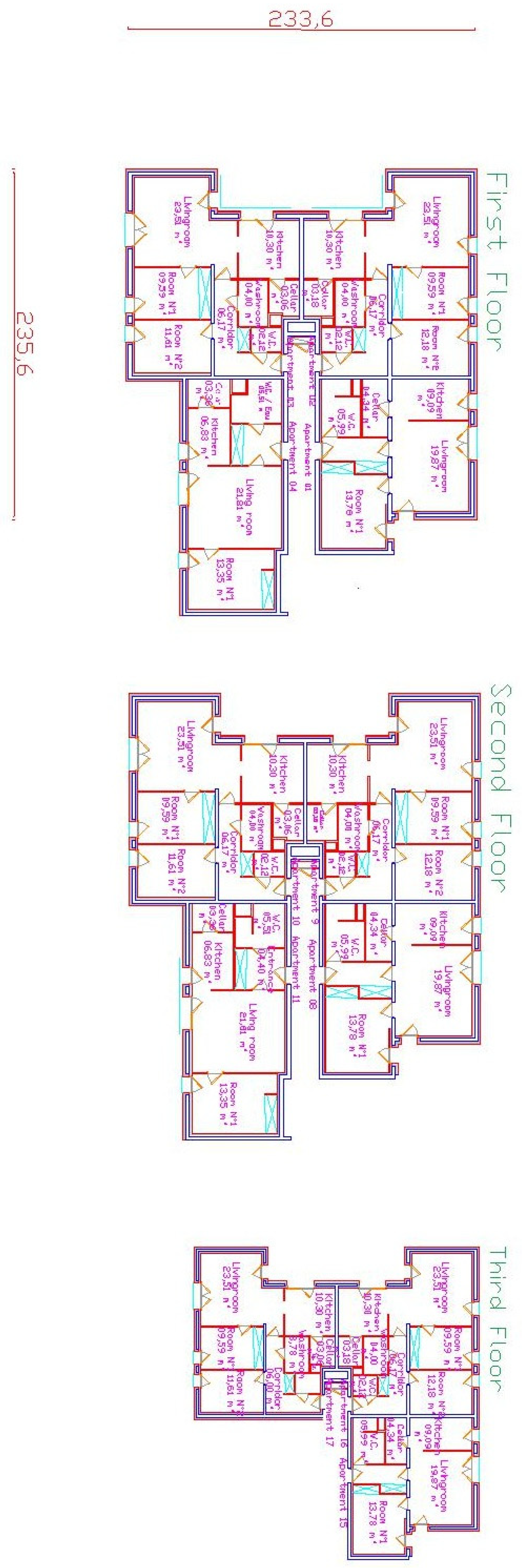
The base case study examines a residential building located in Cébazat, a village near Clermont-Ferrand, France. Constructed in 2010, the building comprises three stories and accommodates 17 apartments, as illustrated in Figure 1, with a total floor area of 1599.2 m2.
The thermo-physical characteristics of the building envelope are presented in Table 1. The external walls incorporate a double-layer insulation system composed of Xtherm Itex 32E expanded polystyrene [28], providing a thermal resistance of R = 3.4 W/m2·°C. The roof assembly includes cellulose fiber insulation (thermal conductivity of 0.125 W/m·°C), overlaid with a wooden framework and Roman tiles. The fenestration consists of argon-filled double-glazed windows (4/16/4), characterized by a U-value of 1.4 W/m2·°C and a solar heat gain coefficient (G-value) of 0.6. These windows are mounted in PVC frames and lack external shading elements such as overhangs, blinds, or louvers.
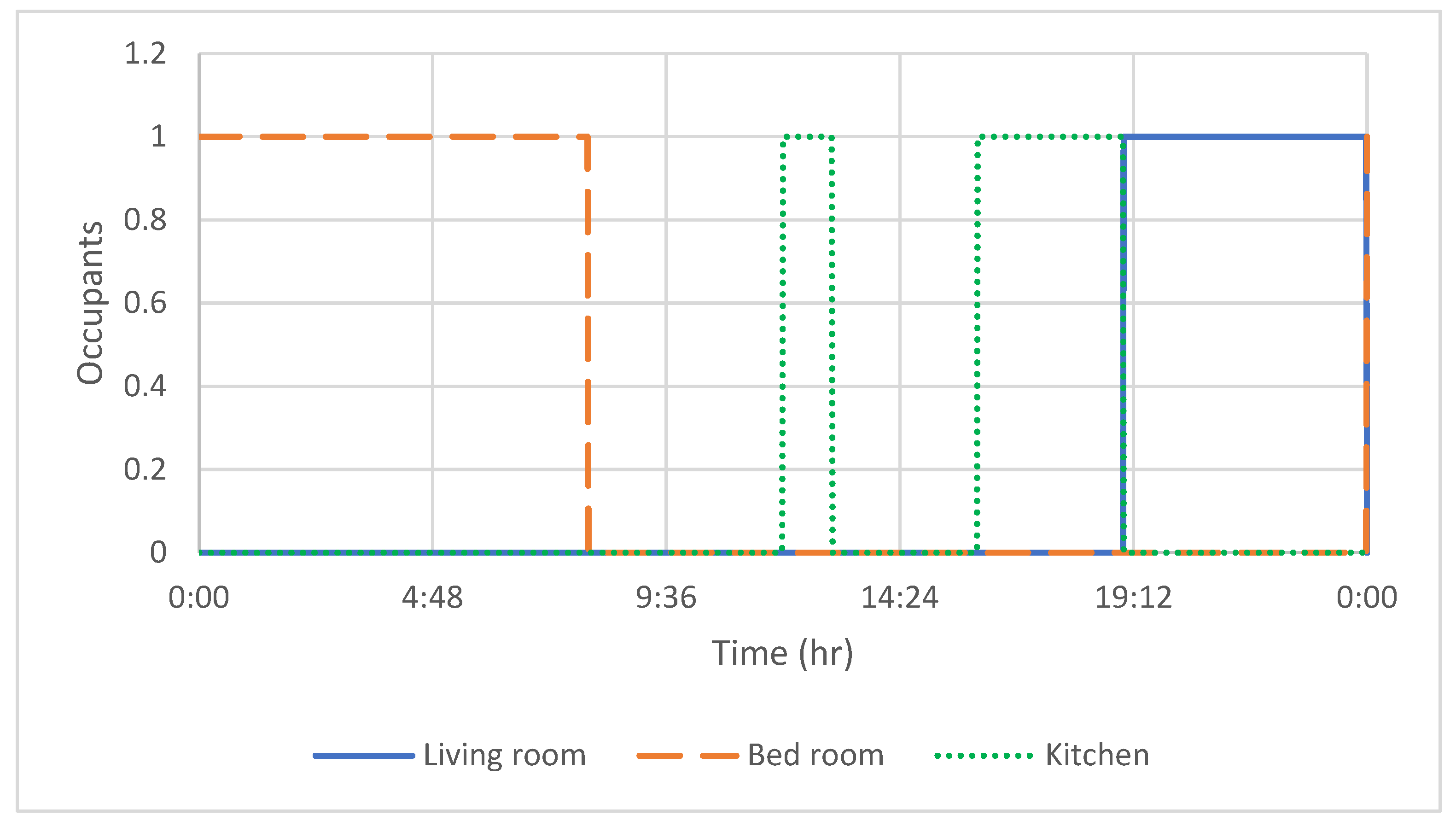
The occupancy schedules for primary spaces, including the living room, bedroom, and kitchen, follow the guidelines specified in EN 18523-2 [29] and are illustrated in Figure 2. Each room is equipped with 60 W LED lighting. Standard household appliances installed in the apartments include a television (in the living room), as well as a refrigerator, microwave, washing machine, dishwasher, and iron (in the kitchen). Kitchen ventilation is provided by single-flow, humidity-sensitive mechanical exhaust fans.
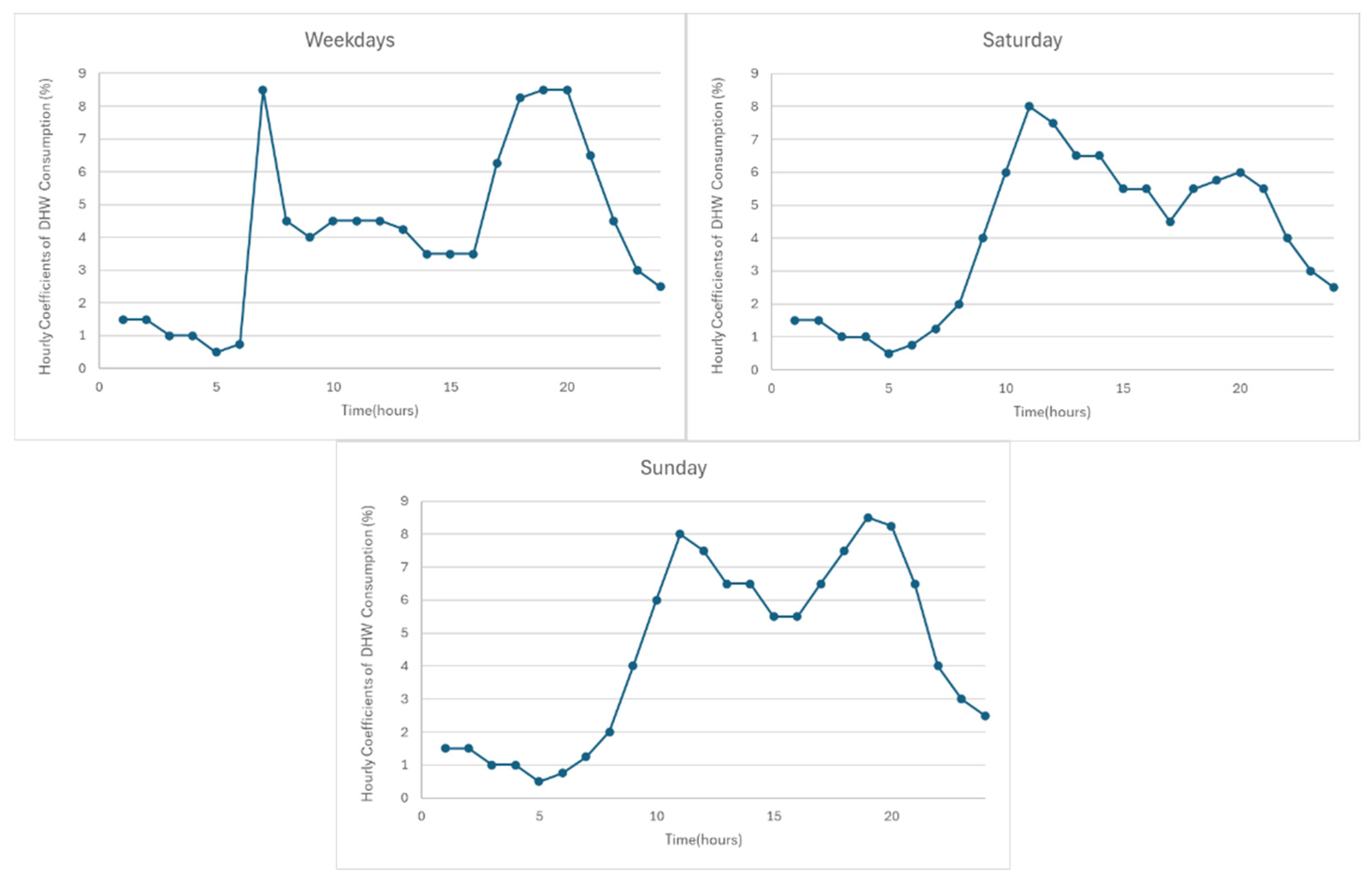
Space heating is delivered through individual condensing gas boilers, one per apartment, each connected to a radiator network. These boilers have a storage capacity of 42 L and a nominal thermal output of 23 kW. In accordance with EN 625 [30], the domestic hot water (DHW) system delivers water at a flow rate of 18.5 L/min, with supply and return temperatures of 45 °C and 40 °C, respectively. The DHW consumption profile, based on hourly data provided by the French Agency for the Environment and Energy Management [31], is shown in Figure 3. Annual DHW demand is computed by scaling this profile with monthly adjustment factors.

2.2. Design of Experiments

The reference building model was developed in TRNSYS (Transient System Simulation Tool), a widely used BES platform. To ensure the reliability of the simulation results, a calibration procedure was performed to validate the TRNSYS outputs [32,33,34,35]. Both passive and renewable retrofit measures were incorporated into the TRNSYS model and served as inputs for training the ANN. Key ANN input variables include climatic parameters, dry-bulb temperature, direct and diffuse solar radiation, relative humidity, wind speed, and wind direction, as well as a time-step index ranging from 1 (first hour of January 1) to 8760 (final hour of December 31) to capture hourly variations over the year [36,37].
Passive envelope upgrades target the building’s thermal barrier, comprising exterior walls, windows, and air leakage controls. Based on an extensive literature review [4,5,31,33,38,39,40,41,42,43,44,45,46], the retrofit measures most applicable to the case study include window glazing U-value, infiltration rate, external wall insulation thickness, and the thickness of radiant ceiling panels, all using expanded polystyrene consistent with the original construction. These enhancements aim to reduce heat losses and meet the building’s heating load more efficiently.
Renewable systems were selected to satisfy the building’s residual energy demands. A solar domestic hot water (SDHW) system, equipped with an auxiliary electric heater within the storage tank, was roof-mounted to provide all domestic hot water needs. Electrical loads are met by a rooftop photovoltaic (PV) array in conjunction with a small-scale domestic wind turbine.
(a)
Solar domestic hot water system characteristics
The SDHW system employs a series of solar collectors totaling 31.35 m2 of aperture area [44]. The number of collectors is treated as an optimization variable and is therefore included among the inputs to the ANN. All collectors face due south and are tilted at 45.78°, corresponding to the site’s latitude. The key system specifications are summarized in Table 2.
A control dead band of 5 °C temperature differential between the tank inlet and outlet triggers the circulation pump when reached; the pump deactivates once this differential falls below 2 °C. To safeguard against thermal runaway, a high-temperature cutoff at 90 °C is monitored at the apex of the tank. If the tank reaches this temperature, the pump is automatically disabled to prevent boiling within the storage vessel.
(b)
PV system characteristics
A photovoltaic (PV) array of monocrystalline silicon modules is deployed to meet the building’s electrical demand. The array is inclined to the south at an angle equal to the site’s latitude and its geometric area (m2) is computed via Equation (1) [48]. Module specifications appear in Table 3. A temperature correction factor (TCF) of 0.80 is applied to account for a 15–20% reduction in conversion efficiency at elevated cell temperatures approaching 60 °C [49]. The DC-AC inverter operates at 97% efficiency [50]. The array’s peak power output is calculated using Equation (2), with the series–parallel configuration of the modules adjustable to achieve the required DC bus voltage and current [51].
P V a r e a = E L G a v × η P V × T C F × η J n v
P V P e a k   p o w e r = P V a r e a × P S I × η P V
where
  • E L represents the daily electrical load (kWh/day).
  • G a v denotes the average irradiation available per day (kWh/m2·day).
  • η P V stands for the PV efficiency.
  • T C F is the temperature correction factor.
  • η J n v represents the inverter efficiency.
  • PSI indicates the Peak Solar Irradiance (W/m2).
Results from these calculations are summarized in Table 3. Surplus PV generation is exported to the utility grid, while deficits are met by grid imports. This grid-tied configuration obviates the need for battery storage, thereby minimizing energy losses, system complexity, and maintenance requirements associated with on-site energy storage [46,52].
(c)
Domestic wind turbine
The results from these calculations are summarized in Table 3. Surplus PV generation is exported to the utility grid, while deficits are met by grid imports. This grid-tied configuration obviates the need for battery storage, thereby minimizing energy losses, system complexity, and maintenance requirements associated with on-site energy storage [46]. Technical specifications for the wind turbines are provided in Table 4. The required turbine quantity to meet the target power output will be determined during the optimization phase. In TRNSYS, the turbines are represented using the Type 90 model.
Table 3. Technical characteristics of PV [53].
CharacteristicsValueCharacteristicsValue
Short circuit current (A)9.32Temperature coefficient of open circuit voltage (V/K)−0.318
Open circuit voltage (V)45.92Module efficiency% 17
Current at maximum power (A)8.85Temperature coefficient of short circuit current (A/K)0.042
Panel area (m2)1.94Nominal output (Wp)295.3
Table 4. Technical characteristics of the domestic wind turbine [54].
SpecificationValue
Nominal (rated) electrical power1.3 kW
Cut-in (start-up) wind speed3 m/s
Nominal wind speed for rating11 m/s
Rotor diameter2.9 m
Hub (tower) height to nacelle14.5 m
Rotor configuration3 blades, horizontal axis
Rotational speed at nominal power800 rpm
Following the definition of weather parameters, as well as passive and renewable retrofit measures, training data were generated using BES. These simulations provided the foundation for constructing the ANN surrogate model. To ensure representative and efficient sampling of the input parameter space, Latin Hypercube Sampling (LHS) is employed, in accordance with the approach reviewed by Westermann et al. [23]. LHS adopts a stratified sampling strategy in which the range of each input variable is divided into equally probable intervals. From each interval, a single sample is randomly selected, ensuring that the entire domain of each parameter is represented without redundancy. This method improves the uniformity of the sampling distribution across the multidimensional input space and avoids clustering or oversampling in specific regions [55]. As a result, the LHS approach generates a well-distributed and comprehensive training dataset that captures the full variability of the defined weather, passive, and renewable retrofit parameters. This diversity in the training data enhances the accuracy, robustness, and generalizability of the ANN surrogate model. In line with the recommendation of Jones, Schonlau, and Welch [50], which recommends that simulation datasets for surrogate models be at least ten times the number of inputs, 200 annual BES runs were generated. These 200 annual simulations produced approximately 1.752 million hourly records (200 × 8760 h), forming the dataset used to train and validate the surrogate models.

2.3. Artificial Neural Network Model Development

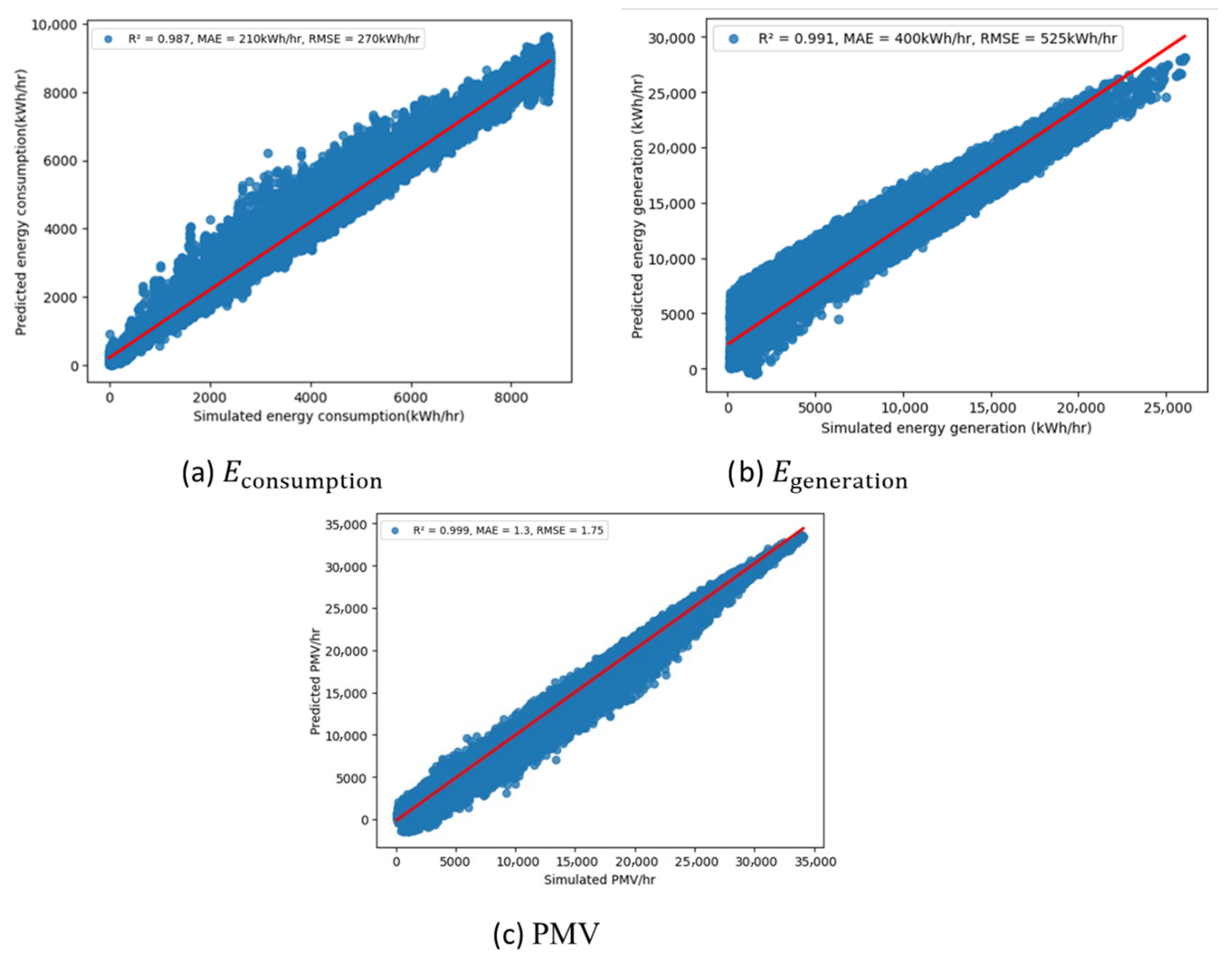
The data generated from the previous steps are employed to train the ANN model. The architecture of the ANN is determined through the Multi-Objective Hyperparameter Optimization of ANN (MOHO-ANN) method, as proposed by Ibrahim et al. [56,57]. This methodology results in a five-layer ANN architecture comprising 321 neurons, with the Gaussian Error Linear Unit (GELU) used as the activation function. The model is trained using the Adam optimizer with a learning rate of 0.00001, a batch size of 70, and zero dropout. The ANN is developed to predict three key performance indicators on an hourly basis: energy consumption, energy generation, and thermal comfort, represented by the Predicted Mean Vote (PMV). These predictions are based on hourly weather data inputs, along with parameters that define passive and renewable retrofit measures. Figure 4 illustrates the comparison between the ANN-predicted outputs and the TRNSYS-simulated results for the baseline case study. The ANN demonstrates high predictive performance, achieving coefficients of determination (R2) of 0.987 for energy demand, 0.994 for energy generation, and 0.999 for PMV. These results indicate a strong agreement between the ANN predictions and the detailed TRNSYS simulations, confirming the accuracy and reliability of the surrogate model.
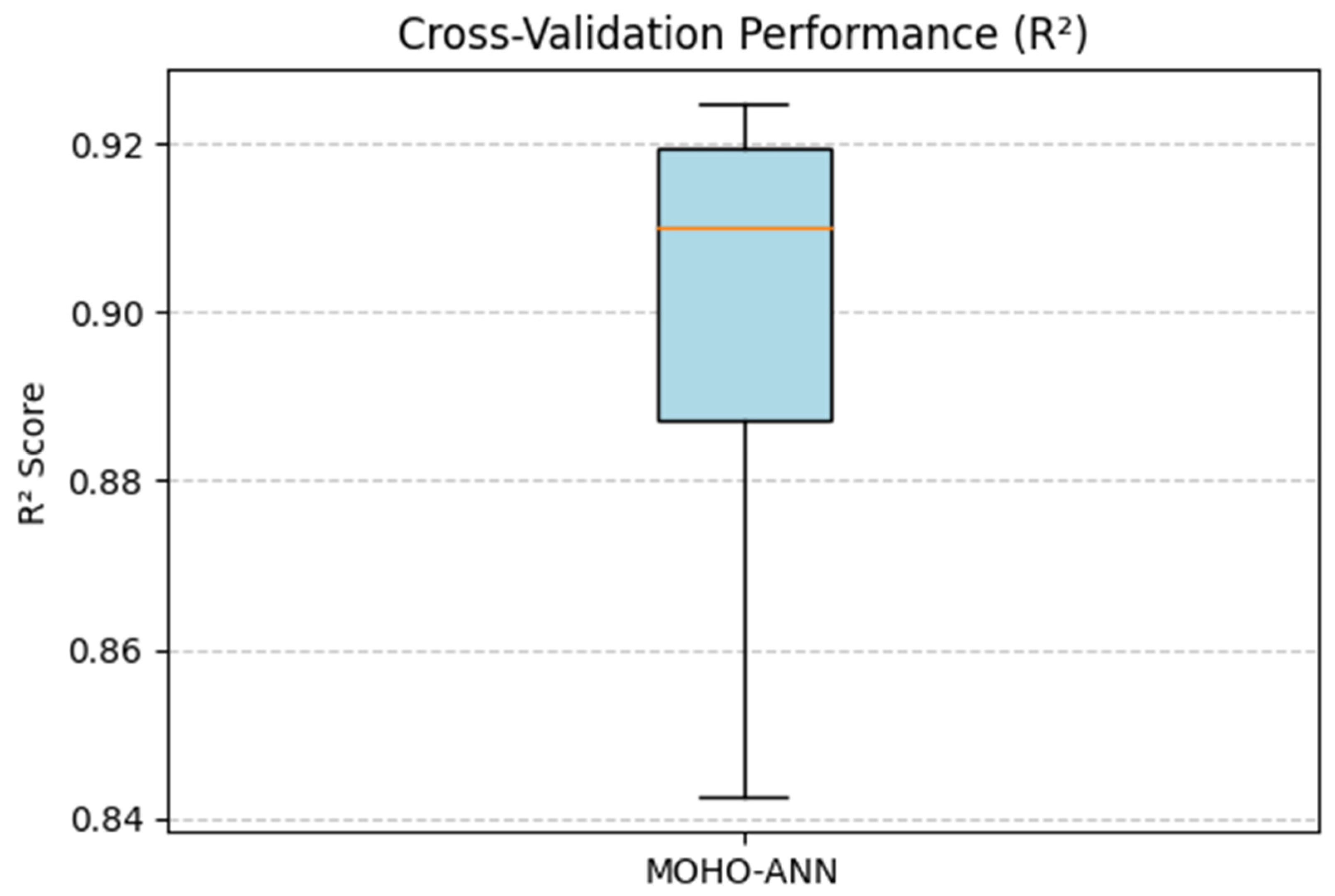
A 5-fold cross-validation protocol was applied to obtain stable performance estimates and mitigate ANN overfitting, following the procedure recommended by Abbass et al. [51]. The dataset was partitioned into five equal folds; in each iteration, the model was trained on four folds and validated on the remaining fold, so that every observation contributed to both training and validation. Model performance was quantified using the R2 computed on the validation sets. Figure 5 presents a box plot of the cross-validation R2 distribution. The median R2 is 0.88, the interquartile range (IQR) spans 0.86–0.90, and the whiskers extend from 0.84 to 0.92, indicating high predictive accuracy and low variability across folds. The narrow IQR and limited whisker length imply stable model behavior with no substantial outliers, supporting the ANN’s capacity to generalize to unseen data and thereby reducing the risk of overfitting. In the plot, the light-blue boxes denote the IQR and the red lines the medians; the compact spread further evidences the model’s reliability across heterogeneous data subsets, which is essential for real-world applications.

2.4. Optimization Problem Formulation

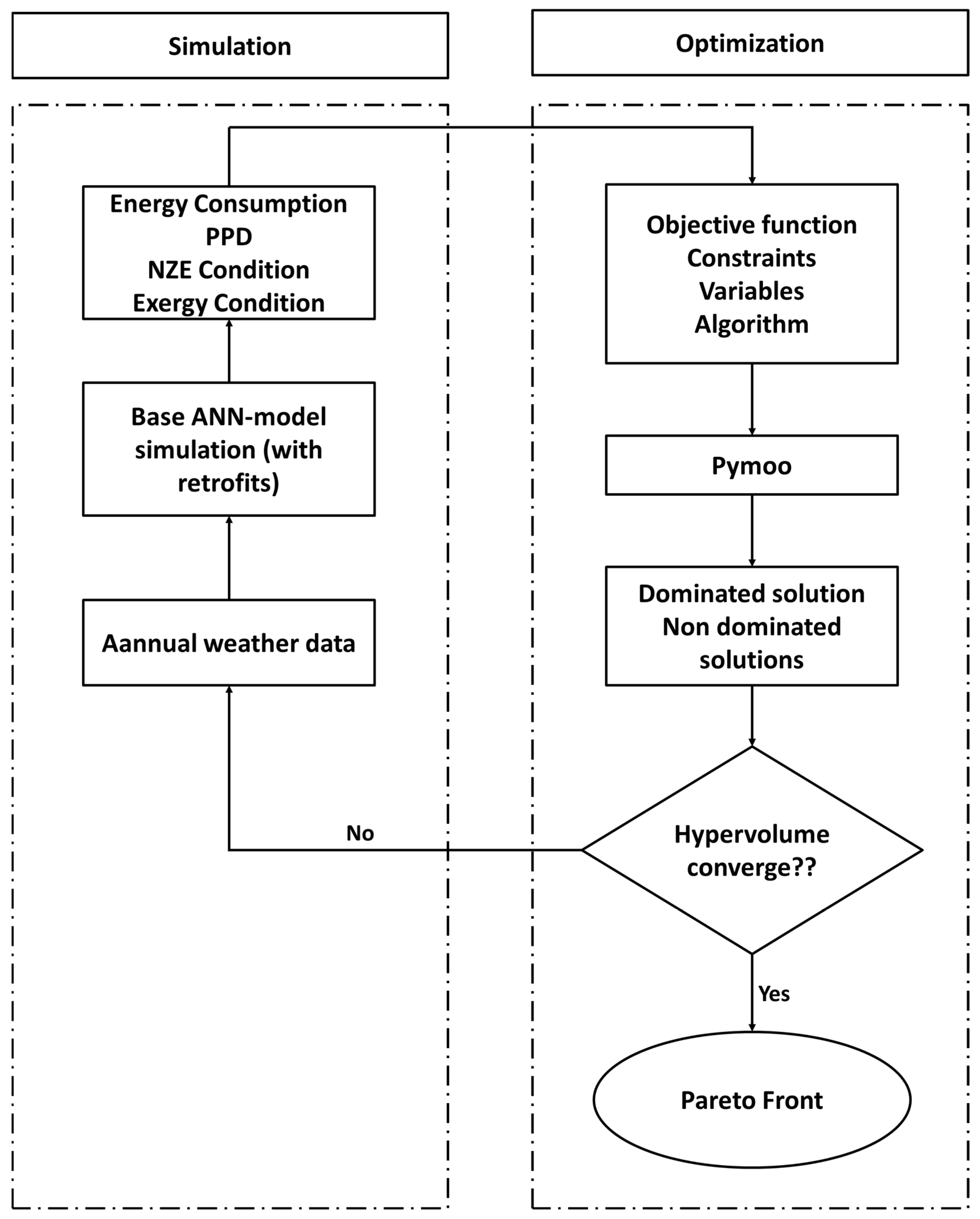
In this study, the optimization process is performed using the ANN model implemented within the PyTorch framework [58], in conjunction with the Pymoo library, an advanced Python 3.10-based platform for MOO developed by Blank et al. [53]. Pymoo has been recognized for its superior computational performance in building energy modeling applications, outperforming alternative MOO tools such as MOBO and Dakota, as reported by El Kounni et al. [54]. The complete workflow of the building optimization process, including its sequential phases, is illustrated in Figure 6.
The multi-objective optimization framework employed is used to minimize both the building’s energy consumption and its annual average Predicted Percentage of Dissatisfied (PPD). Accordingly, the optimization problem can be summarized as follows:
M i n E c o n s u m p t i o n M i n ( P P D )
Annual energy balance constitutes a fundamental element in defining NZEB within the optimization framework. The building’s total annual energy consumption must be counterbalanced by energy produced through renewable retrofit measures to satisfy this criterion. Consequently, constraints are imposed on both annual energy consumption and generation within the optimization problem. In accordance with ASHRAE Standard 228 [55], a permissible difference of 1 kWh·m−2·year−1 between consumption and generation is typically adopted. This relationship is expressed by the following equation [59,60,61,62,63]:
E c o n s u m p t i o n × S F c o n s u m p t i o n E g e n e r a t i o n × S F g e n e r a t i o n = E n e t
where
  • E c o n s u m p t i o n : total annual energy consumption (kWh/year)
  • S F c o n s u m p t i o n : source energy factor for consumed energy [62]
  • E g e n e r a t i o n : total annual energy generation (kWh/year)
  • S F g e n e r a t i o n : source energy factor for generated energy [62]
  • E n e t : net source energy which represents the difference value (1 kWh/year in the case studied)
Table 5 presents the different sets of retrofit measure decision variables employed during the optimization of the ANN model parameters, excluding time-step and weather inputs to enforce the aforementioned constraints. For each decision variable, the table specifies the allowable range of values used during the optimization process. An optimal combination of these variables will be determined for each solution set and region to achieve NZE balance while minimizing the previously defined objective functions. This scenario-based approach facilitates a systematic comparison of retrofit strategies and their relative effectiveness in achieving net-zero energy targets across different building types and climatic conditions.
The non-dominated sorting genetic algorithm-III (NSGA-III), introduced by Deb et al. [64], was employed for this optimization. It extends NSGA II’s strengths, including elitism, feasibility handling, and non-dominated sorting. NSGA III improves accuracy in many objective problems and those with complex constraints [6,31]. Although NSGA-II consistently generates well-distributed Pareto fronts and strong trade-off solutions for bi-objective building-performance problems [65], NSGA-III has demonstrated superior performance in capturing higher-dimensional Pareto sets and delivering more precise optimal fronts.
The NSGA-III workflow is defined by population size and stopping criteria, followed by crossover and mutation operations. The input parameters adopted in this study are listed in Table 6. These settings were selected based on preliminary analyses to balance Pareto-front accuracy with computational efficiency [34,66].

2.5. Multi-Criteria Decision Making

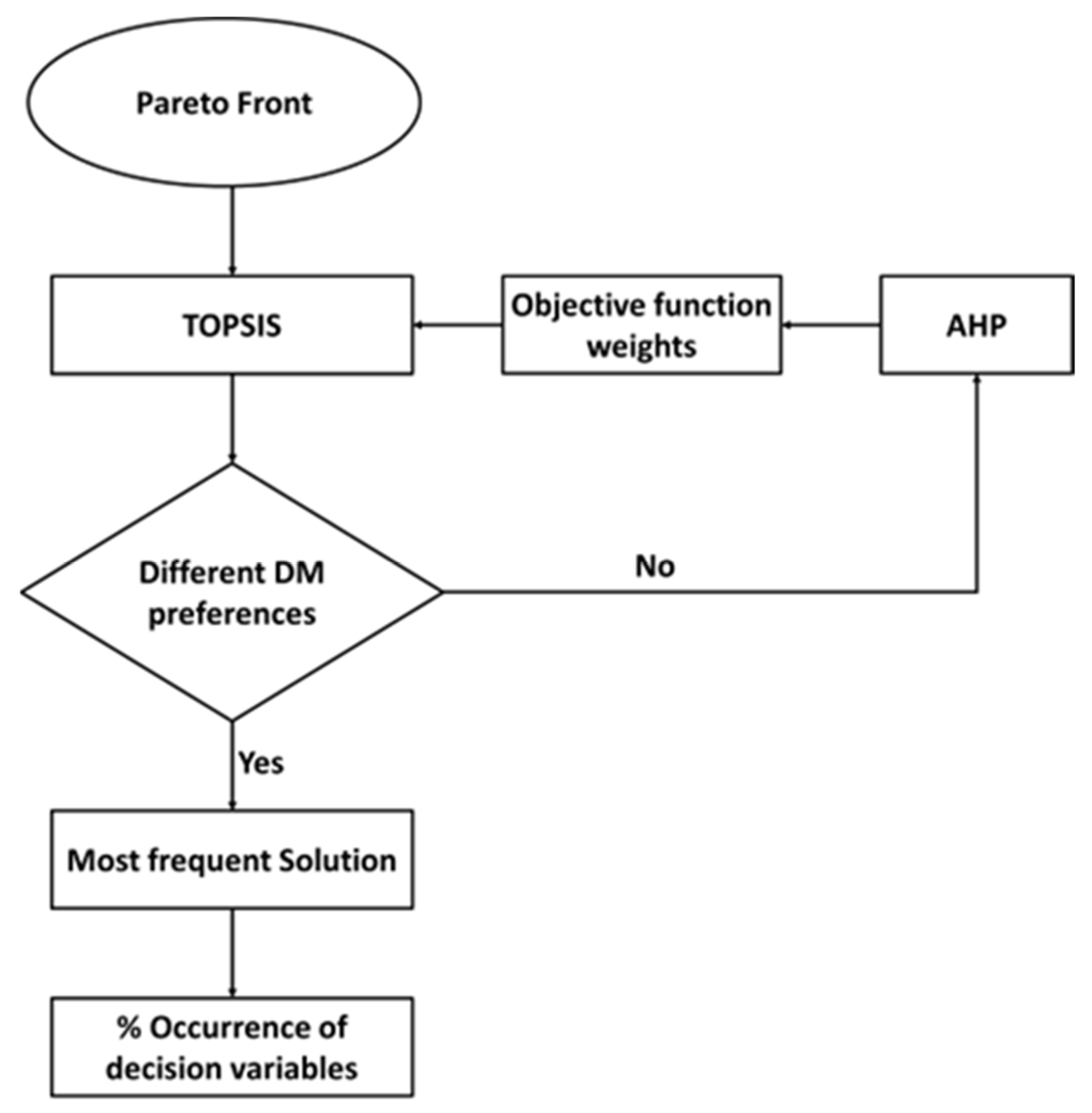
Selecting an optimal solution from the Pareto-front requires integrating decision-maker preferences from regulators, tenants, landlords, architects, and engineers using the TOPSIS outranking method [67,68]. TOPSIS ranks non-dominated solutions by their Euclidean distance to ideal and anti-ideal points and is widely used in MCDM [63,65,67,68,69,70,71,72,73,74,75,76]. Objective-function weights are then determined via Saaty’s Analytic Hierarchy Process (AHP) to reflect the relative importance of each criterion [71,72].
Variations in objective function weights can significantly impact the final outcome. Therefore, a sensitivity analysis is needed to examine their impact on the optimal solution. Seven cases are defined to assess the robustness of ranking from the decision-maker’ss perspective. Table 7 presents the relative weights for each case, representing different levels of importance. Case 1 assumes equal importance. Cases 2 and 3 assign moderate importance to one function over the other. Cases 4 and 5 assign strong importance. Cases 6 and 7 assign extreme importance.
Figure 7 summarizes the methodology for the sensitivity analysis. The ranking of optimal points remains consistent across all decision-maker preference sets, climate zones, and time frames. This consistency indicates that the selected retrofit measure is robust and not highly sensitive to variations in objective-function weights.

2.6. Future Weather Files Generation and Climate Extension

Future weather files are required for the ANN model to identify optimal NZEB retrofit measures under climate change. Present-day weather data are morphed to match projections from a numerical climate model. This procedure transforms historical meteorological records so that they are statistically consistent with future climate scenarios.
Two Shared Socioeconomic Pathways (SSPs) are selected to represent contrasting futures. SSP1-2.6 describes a sustainable development trajectory with aggressive mitigation. Under this scenario, CO2 emissions fall to net zero by the mid-century, and global temperature rises are limited to about 1.7 °C by 2100 [73,74]. It combines the low-forcing RCP2.6 pathway, which peaks near 3 W/m2 before declining to 2.6 W/m2, and sustainability-focused socioeconomic assumptions. In contrast, SSP5-8.5 envisions continued reliance on fossil fuels and high emissions. Radiative forcing under RCP8.5 reaches roughly 8.5 W/m2 by 2100, driving temperature increases of about 4.3 °C [75]. This scenario pairs rapid economic growth with minimal mitigation efforts and a heavy dependence on non-renewable energy. Building-level sustainability assessment should be included when evaluating retrofit and resilience strategies under these SSPs. Such assessment must address both embodied and operational impacts, since structural typology and design choices can strongly influence seismic resilience and environmental outcomes [76].
To cover diverse climates, the Köppen–Geiger classification [77] is adopted. It divides regions into five main zones, including equatorial (A), arid (B), warm-temperate (C), snow (D), and polar (E), based on precipitation and temperature thresholds. Subclasses denote precipitation patterns (W, S, f, s, w, m) and temperature regimes (h, k, a, b, c, d, F). Since the ANN focuses on heating loads, tropical (A) and arid (B) climates were excluded from the analysis. Table 8 lists the three selected cities, including their respective latitudes, longitudes, and altitudes.

3. Results and Discussion

3.1. Optimization Phase

In multi-objective optimization, a single solution that simultaneously optimizes all objectives cannot be obtained. Instead, attention is focused on Pareto-front solutions, which are not dominated by any other solution and cannot be improved in one objective without degrading at least one other objective.
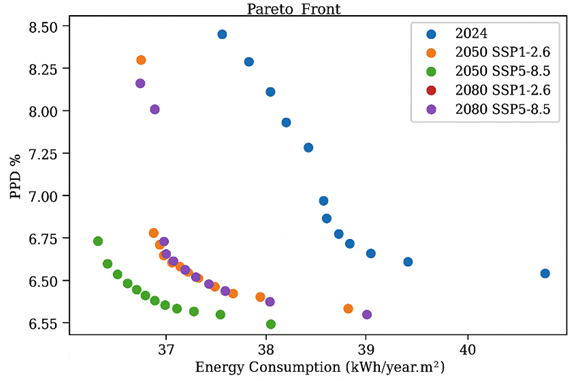
Table 9 lists the Pareto-front solutions for NZEB under different time horizons and climate zones. Each Pareto-front plot displays annual specific energy consumption (kWh/[year.m2]) on the horizontal axis and PPD % on the vertical axis. Five scenarios are shown: present day (2024, blue), mid-century under SSP1-2.6 (2050, orange), mid-century under SSP5-8.5 (2050, green), late-century under SSP1-2.6 (2080, red), and late-century under SSP5-8.5 (2080, purple). Within each climate zone, the Pareto-fronts are nearly parallel, exhibiting only minor shifts. An inverse relationship is apparent between energy consumption and PPD, as lowering occupant discomfort in winter necessitates higher heating loads and, consequently, greater energy use.
Hypervolume measures the volume between a reference point and all Pareto-front solutions. Stabilization of this hypervolume with increasing iterations indicates algorithmic convergence. Table 9 reports the iteration count at which hypervolume stabilization occurs for each climate zone. Cébazat city (classified as C) requires between 1030 and 1592 iterations, whereas zones such as Resolute and Chita require between 1550 and 2088 iterations. This difference arises because the ANN model was trained on a low-energy building in a C-type climate, making NZE balance more rapidly attainable under similar conditions. These findings highlight the need for climate-specific model calibration and raise questions about the model’s generalizability to non-C climates, where additional adaptation may be necessary.
The MOHO-ANN workflow described by Ibrahim et al. [56,57] delivers significant computational speedups relative to traditional methods. For the case study building, dataset generation, hyperparameter tuning, and ANN training required six simulation days. Retrofit optimization on this ANN then took 166 min for 1000 genetic-algorithm iterations [4]. By contrast, a conventional physics-based building energy simulation, coupled with the same genetic algorithm, would take more than 11 days. Thus, the ANN-based approach achieves at least a twofold reduction in optimization time.

3.2. Multi-Criteria Decision-Making Phase

Table 10 summarizes the retrofit measures derived from the decision-making phases for all examined climate zones and time frames, spanning a broad range of future conditions. These results indicate significant potential for achieving NZEB through passive envelope upgrades across diverse climates.
Insulation thickness in the building envelope depends on both climate zone and time frame. Optimal retrofit strategies for exterior walls and roofs require substantially greater insulation levels. A 1 cm layer of insulation on walls or roofs is therefore insufficient to safeguard the building envelope under any of the examined climatic conditions or time horizons. In the C-type climate represented by Cébazat, where heating demand is relatively low, insulation thickness ranges from 3 cm in the 2080 SSP5-8.5 scenario to 5 cm in 2024. In the D-type climate, thickness varies from 10 cm for Chita under present-day conditions to 8 cm in the 2080 SSP5-8.5 scenario. The E-type climate in Resolute requires the highest levels, currently up to 24 cm, and down to 9 cm by 2080 under SSP5-8.5. These trends reflect projected temperature rises, which reduce heating loads and thus lower insulation needs. Comparing SSP1-2.6 and SSP5-8.5, insulation thickness increases by up to 20 percent in C-type, 10 percent in D-type, and 13 percent in E-type climates.
Window U-values also adjust with climate severity and time frame. In C-type climates, values range from 0.58 W/m2·K currently to 0.87 W/m2·K by 2080 SSP5-8.5. In D-type climates, they vary from 0.54 W/m2·K in the current period to 0.85 W/m2·K under the 2080 SSP5-8.5 scenario. In the E-type climate, U-values rise from 0.45 W/m2·K in the current period to 0.80 W/m2·K by 2080 under SSP5-8.5. Higher U-values in warmer scenarios suggest that reduced window insulation can still maintain comfort as outdoor temperatures rise.
Infiltration rates remain relatively constant, with minor increases of approximately 25 percent in Resolute and Chita under SSP5-8.5. These changes suggest a trade-off between airtightness for energy efficiency and natural ventilation for indoor air quality.
Heating setpoints are maintained between 19.2 °C and 22.5 °C across all zones and time frames, exhibiting a slight downward trend as insulation improves and heating loads decline. Occupant comfort is preserved, since the optimization process minimizes PPD.
The number of photovoltaic panels and solar collectors decreases from 2024 through 2050 and 2080, especially under SSP5-8.5, with reductions of 34 percent in C-type climates, 42 percent in D-type climates, and 20 percent in E-type climates. These declines correspond to lower heating demands in warmer futures. The number of wind turbines remains constant in Cébazat but varies in D- and E-type zones. In Chita, the turbine count decreases from four currently to one by 2080 SSP5-8.5. In Resolute, turbines decrease from seven to two over the same interval. These results imply that wind energy potential is relatively stable in C-type climates but varies substantially in colder regions.
Table 11 reports the optimal annual energy consumption and PPD achieved for each climate zone and time frame following the decision-making phase. Energy savings range from 51% to 81% and PPD reductions from 54% to 67% across the examined scenarios, demonstrating substantial improvements in both energy efficiency and occupant comfort.
In climate type C, annual energy consumption decreases by 38.36% in 2024 and by 51.50% in 2080 under SSP5-8.5 relative to the base case. Projected PPD reductions in this zone range from 55.35% in 2024 to 54.95% in 2080 SSP5-8.5. For climate type D, energy consumption is reduced by 69.40% in 2024 and by 65.05% in 2080 under SSP5-8.5. Corresponding PPD savings lie between 61.14% and 55.42%. Climate type E (Resolute) achieves the highest energy savings, reaching 81.65% in 2024 and 75.30% in 2080 under SSP5-8.5. These large gains reflect the zone’s higher baseline heating loads and the effectiveness of passive measures in extreme cold conditions.
When compared with findings in the literature, Ibrahim et al. [32] reviewed recent studies on retrofitting strategies for achieving nearly zero-energy buildings (NZEBs) and reported an average potential energy reduction of approximately 65.14%. They also found that the U-values of windows varied between 0.45 and 0.86 W/m2·K for climate types C, D, and E under current climatic conditions. However, that study did not examine the relative performance of retrofit measures under future climate scenarios, which represents a key contribution of the present work. In addition, Ibrahim et al. [78] reported average airtightness values of 0.15, 0.16, and 0.13 ACH for climate types C, D, and E, respectively, results that are in close agreement with the ranges observed in this study.
The stronger absolute energy-saving effect in colder zones can be explained primarily by higher baseline heating demand and by nonlinear marginal gains from insulation improvements. Where baseline heating consumption is large, envelope upgrades and airtightness measures produce larger absolute reductions because they target the dominant end-use directly. Marginal savings are greatest when initial thermal resistance is low; once a high insulation level is reached, incremental gains diminish. Additionally, the interaction with renewable generation and the temporal match between generation and residual load modifies net savings across zones: identical envelope upgrades yield different net energy benefits depending on local resource availability and load shape. Projected warming reduces heating-degree-days in future horizons, which lowers absolute savings potential and partly explains the smaller gains observed under SSP5-8.5 relative to the present day.
The results indicate clear potential for informing NZEB retrofit policy and adaptation strategies. Building-level sustainability assessment, including both embodied and operational impacts, is essential to ensure environmentally sound interventions. Reductions in renewable system requirements under warmer futures may lower capital costs but interact with policy instruments such as subsidies, feed-in tariffs, or grid integration requirements. Life-cycle cost analysis and payback assessments would further enhance the practical relevance of the results. Consideration of supply chain constraints and phased retrofit strategies can facilitate realistic implementation in the built environment.
Several uncertainties may influence the robustness of these results. Climatic uncertainty arises from the limited SSP selection and the variability of climate model projections; future work should incorporate CMIP6 ensemble projections. Surrogate uncertainty associated with the ANN also requires evaluation through cross-validation, hold-out testing, or ensemble approaches to quantify prediction error. Finally, only a single prototypical building with simplified façade and HVAC representation was analyzed; hence, generalization to other building archetypes is limited. The results should be interpreted as exploratory, illustrating methodological potential rather than serving as universal prescriptions.
The practical application of this work lies in providing a rapid, scenario-aware tool for NZEB retrofit planning, supporting policy design and investment decision-making. The primary scientific contribution is the integration of ANN-based surrogates with NSGA-III multi-objective optimization and TOPSIS ranking under multiple climate scenarios, which enables efficient mapping of energy-comfort trade-offs. Future research should focus on empirical validation, extension to diverse building types and HVAC systems, incorporation of climate model ensembles to account for uncertainty, and integration of life-cycle economic and environmental metrics such as LCC and embodied carbon into the optimization framework.

4. Conclusions

This study demonstrates that an ANN-based surrogate, integrated with NSGA-III multi-objective optimization and TOPSIS ranking, provides an effective and computationally efficient framework for designing NZEB retrofit strategies under multiple future climate scenarios. Quantitative results indicate that integrated passive and renewable retrofits can reduce annual energy consumption by 45–81% and decrease PPD by 54–67% across the examined scenarios and climate zones, with maximum improvements of approximately 81% in energy consumption and 67% in PPD. These gains are achieved while maintaining net-zero energy balance constraints and exploring trade-offs between energy use and thermal comfort.
The study makes several key contributions. First, it demonstrates the development and application of an ANN surrogate to accelerate building energy simulations and enable exhaustive multi-objective optimization across multiple climate futures. Second, it illustrates the coupling of NSGA-III with TOPSIS to map Pareto trade-offs and provide a transparent ranking of preferred retrofit packages. Third, it shows how optimal retrofit portfolios shift under contrasting SSP scenarios (SSP1-2.6 vs. SSP5-8.5) and across seven heating-dominant Köppen–Geiger zones. Rising temperatures are found to reduce heating demand and modify optimal insulation and glazing specifications, with relative decreases in required insulation thickness and increases in optimal window U-values under warmer, fossil-intensive futures, while PV and solar collector sizing reflect changing seasonal loads.
The findings have practical implications. For policymakers and building practitioners, the results highlight the importance of incorporating future climate projections into retrofit planning and building codes, ensuring that insulation and renewable energy systems are neither over- nor undersized. For industry, surrogate-assisted optimization offers a scalable tool for rapid, scenario-aware assessment of retrofit options, supporting product specification, supply chain planning, and phased investment strategies.
This work also has limitations that motivate further research. It focused on a single prototypical building with limited façade and HVAC detail and considered only two SSPs, which restricts generalizability across building types, HVAC systems, and climate model ensembles. Future studies should apply the workflow to diverse building stocks, incorporate CMIP6 ensemble projections to account for climate-model uncertainty, extend the ANN/morphing framework to region-specific design and HVAC configurations, and integrate economic and life-cycle metrics, such as LCC and embodied emissions, for cost-optimal, low-carbon decision-making. Additionally, exploring transfer learning and robustness/uncertainty-aware optimization could improve surrogate generalization and practical applicability. Implementing these extensions will enhance methodological rigor and increase the operational utility of ANN-assisted multi-objective retrofit optimization under climate change.

Author Contributions

Conceptualization, M.I.; Methodology, M.I.; Software, M.I.; Validation, M.I.; Formal analysis, M.I.; Writing—original draft, M.I.; Supervision, P.B. and F.H.; Visualization F.F. and S.E.O. All authors have read and agreed to the published version of the manuscript.

Funding

This research was funded by Le Department de l’Allier” and University of Clermont Auvergne ISITE CAP 20-25 program. And The APC was funded by Ms. Eveline Cheng.

Data Availability Statement

The original contributions presented in this study are included in the article. Further inquiries can be directed to the corresponding author.

Conflicts of Interest

The authors declare no conflict of interest.

Abbreviations

The following abbreviations are used in this manuscript:
NZEBNet-zero energy building
BESBuilding energy simulation
TMYTypical Meteorological Year
NSGA-IIINon-Dominated Sorting Genetic Algorithm
TOPSISTechnique for Order of Preference by Similarity to Ideal Solution
MOOMulti-Objective Optimization
ANNArtificial Neural Networks
SVMSupport Vector Machines
MCDMMulti-Criteria Decision-Making
G-valueSolar Heat Gain Coefficient
DHWDomestic Hot Water
AHPAnalytic Hierarchy Process
PMVPredicted Mean Vote
SDHWSolar Domestic Hot Water
TRNSYSTransient System Simulation Tool
MOHO-ANNMulti-Objective Hyperparameter Optimization of ANN
GELUGaussian Error Linear Unit
R2Coefficient of Determination
SSPShared Socioeconomic Pathways

References

  1. United Nations. Population. Available online: https://www.un.org/en/global-issues/population (accessed on 21 March 2023).
  2. IEA. Buildings–Topics. Available online: https://www.iea.org/topics/buildings (accessed on 26 September 2022).
  3. IEA—International Energy Agency. Available online: https://www.iea.org (accessed on 23 April 2024).
  4. Harkouss, F.; Fardoun, F.; Biwole, P.H. Multi-objective optimization methodology for net zero energy buildings. J. Build. Eng. 2018, 16, 57–71. [Google Scholar] [CrossRef]
  5. Harkouss, F.; Fardoun, F.; Biwole, P.H. Optimization approaches and climates investigations in NZEB—A review. Build. Simul. 2018, 11, 923–952. [Google Scholar] [CrossRef]
  6. Alaifan, B.; Azar, E. Potential for Net-Zero Energy Communities in Kuwait: An Empirical Techno-Economic Modeling and Optimization Approach. Buildings 2023, 13, 2096. [Google Scholar] [CrossRef]
  7. Júnior, S.M.; Frandoloso, M.A.L.; Brião, V.B. Technical and economic feasibility study for a university zero energy building in Southern Brazil. Energy Build. 2023, 281, 112748. [Google Scholar] [CrossRef]
  8. Chacón, L.; Austin, M.C.; Castaño, C. A Multiobjective Optimization Approach for Retrofitting Decision-Making towards Achieving Net-Zero Energy Districts: A Numerical Case Study in a Tropical Climate. Smart Cities 2022, 5, 405–432. [Google Scholar] [CrossRef]
  9. Luo, X.J. Retrofitting existing office buildings towards life-cycle net-zero energy and carbon. Sustain. Cities Soc. 2022, 83, 103956. [Google Scholar] [CrossRef]
  10. Mata, É.; Wanemark, J.; Nik, V.M.; Kalagasidis, A.S. Economic feasibility of building retrofitting mitigation potentials: Climate change uncertainties for Swedish cities. Appl. Energy 2019, 242, 1022–1035. [Google Scholar] [CrossRef]
  11. Thomas, A.; Menassa, C.C.; Kamat, V.R. A systems simulation framework to realize net-zero building energy retrofits. Sustain. Cities Soc. 2018, 41, 405–420. [Google Scholar] [CrossRef]
  12. Cui, Y.; Yan, D.; Hong, T.; Xiao, C.; Luo, X.; Zhang, Q. Comparison of typical year and multiyear building simulations using a 55-year actual weather data set from China. Appl. Energy 2017, 195, 890–904. [Google Scholar] [CrossRef]
  13. Chai, J.; Huang, P.; Sun, Y. Differential evolution-based system design optimization for net zero energy buildings under climate change. Sustain. Cities Soc. 2020, 55, 102037. [Google Scholar] [CrossRef]
  14. Li, H.; Yang, Y.; Lv, K.; Liu, J.; Yang, L. Compare several methods of select typical meteorological year for building energy simulation in China. Energy 2020, 209, 118465. [Google Scholar] [CrossRef]
  15. Guo, J.; Xia, D.; Zhang, L.; Zou, Y.; Yang, X.; Xie, W.; Zhong, Z. Future indoor overheating risk for urban village housing in subtropical region of China under long-term changing climate. Build. Environ. 2023, 246, 110978. [Google Scholar] [CrossRef]
  16. Neto, A.H.; Durante, L.C.; Callejas, I.J.A.; da Guarda, E.L.A.; Moreira, J.V.R. The challenges on operating a zero net energy building facing global warming conditions. Build. Simul. 2022, 15, 435–451. [Google Scholar] [CrossRef]
  17. Luo, X.J.; Oyedele, L.O. Life cycle optimisation of building retrofitting considering climate change effects. Energy Build. 2022, 258, 111830. [Google Scholar] [CrossRef]
  18. Shen, P.; Lior, N. Vulnerability to climate change impacts of present renewable energy systems designed for achieving net-zero energy buildings. Energy 2016, 114, 1288–1305. [Google Scholar] [CrossRef]
  19. Shen, P.; Braham, W.; Yi, Y. The feasibility and importance of considering climate change impacts in building retrofit analysis. Appl. Energy 2019, 233–234, 254–270. [Google Scholar] [CrossRef]
  20. Kim, H.; Clayton, M.J. A multi-objective optimization approach for climate-adaptive building envelope design using parametric behavior maps. Build. Environ. 2020, 185, 107292. [Google Scholar] [CrossRef]
  21. Li, Z.; Zhao, Y.; Xia, H.; Xie, S. A multi-objective optimization framework for building performance under climate change. J. Build. Eng. 2023, 80, 107978. [Google Scholar] [CrossRef]
  22. Zou, Y.; Lou, S.; Xia, D.; Lun, I.Y.F.; Yin, J. Multi-objective building design optimization considering the effects of long-term climate change. J. Build. Eng. 2021, 44, 102904. [Google Scholar] [CrossRef]
  23. Westermann, P.; Evins, R. Surrogate modelling for sustainable building design—A review. Energy Build. 2019, 198, 170–186. [Google Scholar] [CrossRef]
  24. Starke, A.R.; Da Silva, A.K. A review on the applicability of machine learning techniques to the metamodeling of energy systems. Numer. Heat Transf. Part B Fundam. 2025, 86, 214–243. [Google Scholar] [CrossRef]
  25. Zhan, J.; He, W.; Huang, J. Dual-objective building retrofit optimization under competing priorities using Artificial Neural Network. J. Build. Eng. 2023, 70, 106376. [Google Scholar] [CrossRef]
  26. Aruta, G.; Ascione, F.; Bianco, N.; Iovane, T.; Mauro, G.M. ANN-based model predictive control for optimizing space cooling management. Energy 2025, 328, 136469. [Google Scholar] [CrossRef]
  27. Zhang, H.; Feng, H.; Hewage, K.; Arashpour, M. Artificial Neural Network for Predicting Building Energy Performance: A Surrogate Energy Retrofits Decision Support Framework. Buildings 2022, 12, 829. [Google Scholar] [CrossRef]
  28. Knauf XTherm ITEx Sun+. Panneau Isolant Extérieur–Isolation PSE Sous Enduits Minces ou Epais–Knauf. Available online: https://www.knauf.fr/solutions/produit/knauf-xtherm-itex-sun-plus (accessed on 14 November 2023).
  29. ISO 18523-2:2018; Energy Performance of Buildings—Schedule and Condition of Building, Zone and Space Usage for Energy Calculation—Part 2: Residential Buildings. ISO: Geneva, Switzerland, 2018.
  30. NF EN 625; Gas Fired Central Heating Boilers. Specific Requirements for the Domestic Hot Water Operation of Combination Boilers of Nominal Heat Input Not Exceeding 70 kw. AFNOR: La Plaine Saint-Denis, France, 1995.
  31. Home Page–ADEME, The French Agency for Ecological Transition. Available online: https://www.ademe.fr/en/frontpage/ (accessed on 8 April 2024).
  32. Ibrahim, M.; Harkouss, F.; Biwole, P.; Fardoun, F.; Ouldboukhitine, S. Building retrofitting towards net zero energy: A review. Energy Build. 2024, 322, 114707. [Google Scholar] [CrossRef]
  33. Roman, N.D.; Bre, F.; Fachinotti, V.D.; Lamberts, R. Application and characterization of metamodels based on artificial neural networks for building performance simulation: A systematic review. Energy Build. 2020, 217, 109972. [Google Scholar] [CrossRef]
  34. Harkouss, F.; Fardoun, F.; Biwole, P.H. Passive design optimization of low energy buildings in different climates. Energy 2018, 165, 591–613. [Google Scholar] [CrossRef]
  35. Tian, Z.; Zhang, X.; Wei, S.; Du, S.; Shi, X. A review of data-driven building performance analysis and design on big on-site building performance data. J. Build. Eng. 2021, 41, 102706. [Google Scholar] [CrossRef]
  36. Kočí, J.; Kočí, V.; Maděra, J.; Černý, R. Effect of applied weather data sets in simulation of building energy demands: Comparison of design years with recent weather data. Renew. Sustain. Energy Rev. 2019, 100, 22–32. [Google Scholar] [CrossRef]
  37. Liu, Y.; Stouffs, R.; Tablada, A.; Wong, N.H.; Zhang, J. Comparing micro-scale weather data to building energy consumption in Singapore. Energy Build. 2017, 152, 776–791. [Google Scholar] [CrossRef]
  38. Bracht, M.K.; Melo, A.P.; Lamberts, R. A metamodel for building information modeling-building energy modeling integration in early design stage. Autom. Constr. 2021, 121, 103422. [Google Scholar] [CrossRef]
  39. Thrampoulidis, E.; Mavromatidis, G.; Lucchi, A.; Orehounig, K. A machine learning-based surrogate model to approximate optimal building retrofit solutions. Appl. Energy 2021, 281, 116024. [Google Scholar] [CrossRef]
  40. Ibrahim, M.; Harkouss, F.; Biwole, P.; Fardoun, F.; Oultboukhtine, S. Building retrofitting towards net zero energy under climate change. J. Phys. Conf. Ser. 2024, 2857, 012026. [Google Scholar] [CrossRef]
  41. Regulus. Solar Collectors. Available online: https://www.regulus.eu/en/solar-collectors (accessed on 27 March 2024).
  42. Bataineh, K.; Dalalah, D. Optimal Configuration for Design of Stand-Alone PV System. Smart Grid Renew. Energy 2012, 03, 139–147. [Google Scholar] [CrossRef]
  43. Kamali, S. Feasibility analysis of standalone photovoltaic electrification system in a residential building in Cyprus. Renew. Sustain. Energy Rev. 2016, 65, 1279–1284. [Google Scholar] [CrossRef]
  44. SUNNY TRIPOWER 5000TL-12000TL—The Three-Phase Inverter—Not Only for Your Home…; SMA Solar Technology: Niestetal, Germany, 2017; Volume 150.
  45. Nafeh, A.E.-S.A. Design and Economic Analysis of a Stand-Alone PV System to Electrify a Remote Area Household in Egypt. Open Renew. Energy J. 2009, 2, 33–37. [Google Scholar] [CrossRef]
  46. Norton, P.; Christensen, C.; Hancock, E.; Barker, G.; Reeves, P. NREL/Habitat for Humanity Zero Energy Home: A Cold-Climate Case Study for Affordable Zero Energy Homes; NREL/TP-550-43188; National Renewable Energy Lab. (NREL): Golden, CO, USA, 2008. [Google Scholar] [CrossRef][Green Version]
  47. Home-Mitsubishi Electric. Available online: https://www.mitsubishi-pv.de/index-service_en.php (accessed on 27 March 2024).
  48. Raum Energy 3.5—3,50 kW—Wind Turbine. Available online: https://en.wind-turbine-models.com/turbines/1071-raum-energy-3.5 (accessed on 27 March 2024).
  49. Dutta, S.; Gandomi, A.H. Design of experiments for uncertainty quantification based on polynomial chaos expansion metamodels. In Handbook of Probabilistic Models; Elsevier: Amsterdam, The Netherlands, 2020; pp. 369–381. [Google Scholar] [CrossRef]
  50. Jones, D.R.; Schonlau, M.; Welch, W.J. Efficient Global Optimization of Expensive Black-Box Functions. J. Glob. Optim. 1998, 13, 455–492. [Google Scholar] [CrossRef]
  51. Abbass, M.A.B. A comprehensive framework based on Bayesian optimization and skip connections artificial neural networks to predict buildings energy performance. J. Build. Eng. 2023, 77, 107523. [Google Scholar] [CrossRef]
  52. Paszke, A.; Gross, S.; Massa, F.; Lerer, A.; Bradbury, J.; Chanan, G.; Killeen, T.; Lin, Z.; Gimelshein, N.; Antiga, L.; et al. PyTorch: An Imperative Style, High-Performance Deep Learning Library. arXiv 2019, arXiv:1912.01703. [Google Scholar] [CrossRef]
  53. Blank, J.; Deb, K. Pymoo: Multi-Objective Optimization in Python. IEEE Access 2020, 8, 89497–89509. [Google Scholar] [CrossRef]
  54. El Kounni, A.; Outzourhit, A.; Mastouri, H.; Radoine, H. Building energy model automated calibration using Pymoo. Energy Build. 2023, 298, 113524. [Google Scholar] [CrossRef]
  55. ANSI/ASHRAE Standard 228; Standard Method of Evaluating Zero Net Energy and Zero Net Carbon Building Performance. ASHRAE: Peachtree Corners, GA, USA, 2023.
  56. Ibrahim, M.; Harkouss, F.; Biwole, P.; Ouldboukhitine, S.; Fardoun, F. Calibration of a Building Energy Simulation Using a Multi-step Method. In Proceedings of the Sixth International Conference on Efficient Building Design, Beirut, Lebanon, 7–8 November 2024; ASHRAE: Peachtree Corners, GA, USA, 2025. [Google Scholar] [CrossRef]
  57. Ibrahim, M.; Harkouss, F.; Biwole, P.; Fardoun, F.; Ouldboukhitine, S.-E. Multi-objective hyperparameter optimization of artificial neural network in emulating building energy simulation. Energy Build. 2025, 337, 115643. [Google Scholar] [CrossRef]
  58. Seada, H.; Deb, K. A Unified Evolutionary Optimization Procedure for Single, Multiple, and Many Objectives. IEEE Trans. Evol. Comput. 2016, 20, 358–369. [Google Scholar] [CrossRef]
  59. Sartori, I.; Napolitano, A.; Voss, K. Net zero energy buildings: A consistent definition framework. Energy Build. 2012, 48, 220–232. [Google Scholar] [CrossRef]
  60. Lai, Y.-J.; Liu, T.-Y.; Hwang, C.-L. TOPSIS for MODM. Eur. J. Oper. Res. 1994, 76, 486–500. [Google Scholar] [CrossRef]
  61. Kilkis, B. Net-zero buildings, what are they and what they should be? Energy 2022, 256, 124442. [Google Scholar] [CrossRef]
  62. Deng, H.; Yeh, C.-H.; Willis, R.J. Inter-company comparison using modified TOPSIS with objective weights. Comput. Oper. Res. 2000, 27, 963–973. [Google Scholar] [CrossRef]
  63. Wang, E.; Alp, N.; Shi, J.; Wang, C.; Zhang, X.; Chen, H. Multi-criteria building energy performance benchmarking through variable clustering based compromise TOPSIS with objective entropy weighting. Energy 2017, 125, 197–210. [Google Scholar] [CrossRef]
  64. Deb, K.; Jain, H. An Evolutionary Many-Objective Optimization Algorithm Using Reference-Point-Based Nondominated Sorting Approach, Part I: Solving Problems with Box Constraints. IEEE Trans. Evol. Comput. 2014, 18, 577–601. [Google Scholar] [CrossRef]
  65. Si, J.; Marjanovic-Halburd, L.; Nasiri, F.; Bell, S. Assessment of building-integrated green technologies: A review and case study on applications of Multi-Criteria Decision Making (MCDM) method. Sustain. Cities Soc. 2016, 27, 106–115. [Google Scholar] [CrossRef]
  66. Delgarm, N.; Sajadi, B.; Delgarm, S.; Kowsary, F. A novel approach for the simulation-based optimization of the buildings energy consumption using NSGA-II: Case study in Iran. Energy Build. 2016, 127, 552–560. [Google Scholar] [CrossRef]
  67. Andreolli, F.; Bragolusi, P.; D’Alpaos, C.; Faleschini, F.; Zanini, M.A. An AHP model for multiple-criteria prioritization of seismic retrofit solutions in gravity-designed industrial buildings. J. Build. Eng. 2022, 45, 103493. [Google Scholar] [CrossRef]
  68. Liu, Y.; Chen, H.; Wang, X. Research on green renovations of existing public buildings based on a cloud model–TOPSIS method. J. Build. Eng. 2021, 34, 101930. [Google Scholar] [CrossRef]
  69. Marzouk, M.; El-Maraghy, M.; Metawie, M. Assessing retrofit strategies for mosque buildings using TOPSIS. Energy Rep. 2023, 9, 1397–1414. [Google Scholar] [CrossRef]
  70. Stanojević, A.D.; Milošević, M.R.; Milošević, D.M.; Turnšek, B.A.; Jevremović, L.L. Developing multi-criteria model for the protection of built heritage from the aspect of energy retrofitting. Energy Build. 2021, 250, 111285. [Google Scholar] [CrossRef]
  71. Saaty, T.L. A scaling method for priorities in hierarchical structures. J. Math. Psychol. 1977, 15, 234–281. [Google Scholar] [CrossRef]
  72. Saaty, T.L. Decision making—The Analytic Hierarchy and Network Processes (AHP/ANP). J. Syst. Sci. Syst. Eng. 2004, 13, 1–35. [Google Scholar] [CrossRef]
  73. Hausfather, Z. Explainer: How ‘Shared Socioeconomic Pathways’ Explore Future Climate Change. Available online: https://www.carbonbrief.org/explainer-how-shared-socioeconomic-pathways-explore-future-climate-change/ (accessed on 7 May 2024).
  74. Riahi, K.; Van Vuuren, D.P.; Kriegler, E.; Edmonds, J.; O’Neill, B.C.; Fujimori, S.; Bauer, N.; Calvin, K.; Dellink, R.; Fricko, O.; et al. The Shared Socioeconomic Pathways and their energy, land use, and greenhouse gas emissions implications: An overview. Glob. Environ. Change 2017, 42, 153–168. [Google Scholar] [CrossRef]
  75. SSP Database. Available online: https://tntcat.iiasa.ac.at/SspDb/dsd?Action=htmlpage&page=welcome (accessed on 7 May 2024).
  76. Mostafaei, H.; Barmchi, M.A.; Bahmani, H. Seismic Resilience and Sustainability: A Comparative Analysis of Steel and Reinforced Structures. Buildings 2025, 15, 1613. [Google Scholar] [CrossRef]
  77. Kottek, M.; Grieser, J.; Beck, C.; Rudolf, B.; Rubel, F. World Map of the Köppen-Geiger climate classification updated. Meteorol. Z. 2006, 15, 259–263. [Google Scholar] [CrossRef]
  78. Ibrahim, M.; Biwole, P.; Ouldboukhitine, S.E.; Harkouss, F.; Fardoun, F. Hyperparameter optimization of artificial neural network in building energy simulation. In Proceedings of the Conférence IBPSA France 2024 & Ecole Thématique SIMUREX, La Rochelle, France, 13–17 May 2024. [Google Scholar]
Figure 1. Plan view of the base-case building (dimensions in 10 cm).
Buildings 16 00537 g001
Figure 2. Daily Schedule of occupancy for different rooms.
Buildings 16 00537 g002
Figure 3. Hourly profile of DHW consumption over a week.
Buildings 16 00537 g003
Figure 4. Regression plot of ANN model outputs.
Buildings 16 00537 g004
Figure 5. Five-fold cross-validation R2 scores for the ANN.
Buildings 16 00537 g005
Figure 6. Optimization phase of the ANN model.
Buildings 16 00537 g006
Figure 7. Sensitivity analysis methodology.
Buildings 16 00537 g007
Table 1. Thermo-physical properties of the base case building’s envelope.
ComponentsU-Value Coefficient (W/m2.°C)Layers (Out to in)Thickness
(cm)
Thermal Conductivity (W/m.°C)
External Wall0.12Wood cladding10.2
Expanded polystyrene150.0309
Concrete180.46
Expanded
polystyrene
100.0309
Plaster (BA13)130.32074
Internal Wall0.25Concrete180.46
Expanded
polystyrene
150.0309
Ground
Floor Wall
0.3Concrete deck230.46
Extruded
polystyrene
150.029
Roof0.16Insulation
material (U = 0.125 W/m2.°C)
200.0625
Timber
concrete
131.3
Table 2. Technical characteristics of the SDHW system [47].
CharacteristicsValueUnitNote/Comment
Collector area 2.09m2Rounded from original value
Collector flow rate 60kg/hExpressed as mass flow rate
Storage volume 2.271m3Total hot-water storage volume
Hot water set point 60°CController set point
Hot water supply temperature 45°CExpected supply temperature
Intercept efficiency 0.79kg/hCan be reported as 79%
Efficiency slope 3.48W/m2.KRounded (original: 3.48)
Efficiency curvature 0.0056W/m2.K2Rounded (original: 0.0056)
Table 5. Different employed sets of retrofit-measure decision variables.
Retrofit Measure TypeRetrofit MeasureIntervalUnitType
Passive retrofit measuresExternal wall insulation thickness1–40cmInteger
Window U-value0.5–6.4W/m2.KFloat
Roof wall insulation thickness1–40cmInteger
Heating setpoint temperature15–23°CInteger
Infiltration rate0–0.6Air change per hour (ACH)Float
Renewable retrofit measuresNumber of PV in series1–40-Integer
Number of PV in parallel1–40-Integer
Number of SC1–40-Integer
Number of WT1–4-Integer
Table 6. NSGA-III optimization parameters.
ParameterValues
Population size40
Stopping criteriaHypervolume convergence
Crossover probability %70
Mutation probability %2
Table 7. Relative weights for each objective function across several cases.
Cases Weights
F 1 F 2
Case 1 0.50.5
Case 20.60.4
Case 30.40.6
Case 40.750.25
Case 50.250.75
Case 60.90.1
Case 70.10.9
F 1 :   E c o n s u m p t i o n , F 2 :   P P D .
Table 8. Climate characteristics of the selected cities based on the Köppen–Geiger classification [69].
City ClimateAltitude (m)Latitude Longitude
Cébazat (France)Oceanic climate (Csb)32145.46 N 3.04 E
Chita (Russia)Monsoon-influenced subarctic climate (Dwc)671113.33 E52.02 N
Resolute (Canada)Polar climate (ET)255081.54 N75.654 W
Table 9. Pareto-front representation of different climate zones and time frame scenarios.
Climate TypeClimate ZonePareto-FrontHypervolume Convergence Point
Normal2050 SSP1-2.62050 SSP5-8.52080 SSP1-2.62080 SSP5-8.5
Warm Temperate Climate (C)Cébazat (Csb)Buildings 16 00537 i00110301260125015881592
Polar Climate (E)Resolute
(ET)
Buildings 16 00537 i00221002166215522552030
Snow Climate (D)Chita
(Dwc)
Buildings 16 00537 i00315501874192020502088
Table 10. Summary of optimal retrofit measures derived from the decision-making phase in different time frames and climate zones.
Time FrameDecision VariableCébazatChitaResolute
2024EW thickness (cm)51024
W U-value (W/m2.K)0.580.540.45
R thickness (cm)5913
HS (°C)21.122.522
IR (ACH)0.150.120.13
Number of PV155208233
Number of SC152840
Number of WT147
2050 SSP1EW thickness (cm)5917
W U-value (W/m2.K)0.60.560.51
R thickness (cm)588
HS (°C)20.821.521.5
IR (ACH)0.140.150.15
Number of PV143201233
Number of SC132233
Number of WT135
2080 SSP1EW thickness (cm)4910
W U-value (W/m2.K)0.620.570.53
R thickness (cm)777
HS (°C)20.42121.5
IR (ACH)0.110.110.14
Number of PV133198210
Number of SC101728
Number of WT133
2050 SSP5EW thickness (cm)3810
W U-value (W/m2.K)0.770.750.75
R thickness (cm)467
HS (°C)19.320.621.5
IR (ACH)0.140.160.15
Number of PV120183200
Number of SC101623
Number of WT113
2080 SSP5EW thickness (cm)389
W U-value (W/m2.K)0.870.850.8
R thickness (cm)236
HS (°C)19.21921
IR (ACH)0.140.160.14
Number of PV115165190
Number of SC91318
Number of WT112
EW thickness: External Wall insulation thickness, W U-value: Window U-value, R thickness: Roof insulation thickness, HS: Heating Setpoint, IR: Infiltration rate, Number of PV: Number of photovoltaics, Number of SC: Number of solar collectors, Number of WT: Number of Wind Turbines, ACH: Air change per hour, cm: centimeter, and °C: Celsius.
Table 11. Summary of optimal annual energy consumption and PPD savings.
Time FrameClimate Zone Energy ConsumptionPPD
Optimal (kWh/[Year.m2])Saving (%)Optimal (%)Saving (%)
2024Cébazat38.3658.70%5.7355.35%
Chita40.6769.40%6.88961.14%
Resolute44.8381.65%8.04367.07%
2050 SSP1Cébazat38.2155.18%5.3955.28%
Chita39.0666.90%6.6358.36%
Resolute38.4976.20%7.4355.82%
2080 SSP1Cébazat37.9054.50%5.3155.32%
Chita38.9066.30%6.6058.43%
Resolute37.5575.90%7.4754.84%
2050 SSP5Cébazat37.7654.48%5.26854.97%
Chita37.7665.50%6.54657.19%
Resolute37.7675.36%7.56354.36%
2080 SSP5Cébazat37.7551.50%5.00254.95%
Chita37.3165.05%6.52255.42%
Resolute35.3375.50%7.29554.07%
Disclaimer/Publisher’s Note: The statements, opinions and data contained in all publications are solely those of the individual author(s) and contributor(s) and not of MDPI and/or the editor(s). MDPI and/or the editor(s) disclaim responsibility for any injury to people or property resulting from any ideas, methods, instructions or products referred to in the content.