
Article

Developing and Validating a Campus Physical Environment Satisfaction Scale for Chinese Private Universities: Case Study of Guangdong Province


1
School of Architecture, South China University of Technology, Guangzhou 510641, China
2
Department of Architecture and Design, Politecnico di Torino, 10125 Torino, Italy
*
Author to whom correspondence should be addressed.
Buildings 2026, 16(2), 412; https://doi.org/10.3390/buildings16020412
Submission received: 6 December 2025 / Revised: 9 January 2026 / Accepted: 16 January 2026 / Published: 19 January 2026
(This article belongs to the Section Architectural Design, Urban Science, and Real Estate)

Abstract

The rapid expansion of private universities in the past a few decades has created a unique sector in Chinese higher education system. Unlike public research-oriented institutions, Chinese private universities are tuition-dependent, resource-constrained, and primarily vocation-oriented. Lacking the prestige of academics, the campus physical environment in these institutions becomes a key strategic asset for student recruitment, retention, and performance. However, academic research addressing these contexts remains scarce. This study aims to develop a reliable measurement tool—the University Campus Environment Satisfaction Scale (UCESS)—specifically tailored to assess student satisfaction with the physical environment in Chinese private universities. Based on 1050 valid questionnaires from 4 representative universities in Guangdong province, exploratory and confirmatory factor analyses revealed a hierarchical structure comprising 10 first-order factors and 3 second-order dimensions: (1) Safety and accessibility; (2) Core living and learning environment; and (3) Developmental and amenity resources. The findings reveal that students in Chinese private universities prioritize tangible living, teaching and safety conditions over higher-level developmental amenities, reflecting a layered satisfaction logic. Furthermore, this study demonstrates the differentially weighted relationships between campus elements and overall campus satisfaction, providing administrators with a scientific diagnostic tool to optimize resource allocation and implement student-centered planning strategies.

1. Introduction

1.1. Background

The landscape of global higher education has undergone a profound transformation in the 21st century, driven primarily by the forces of “massification” and “privatization” [1]. The proliferation of private institutions is fueled not only by the surging demand for higher education outpacing public capacity, but also by the commercial motivation to operate higher education as a profitable business [2]. This phenomenon is not limited to specific geographies, but is a universal trend spanning from established systems in the United States and Europe to emerging economies in South America and Asia [2]. However, the fast growth of private universities often brings challenges regarding the quality of campus infrastructure, making the evaluation of educational environments a critical priority.
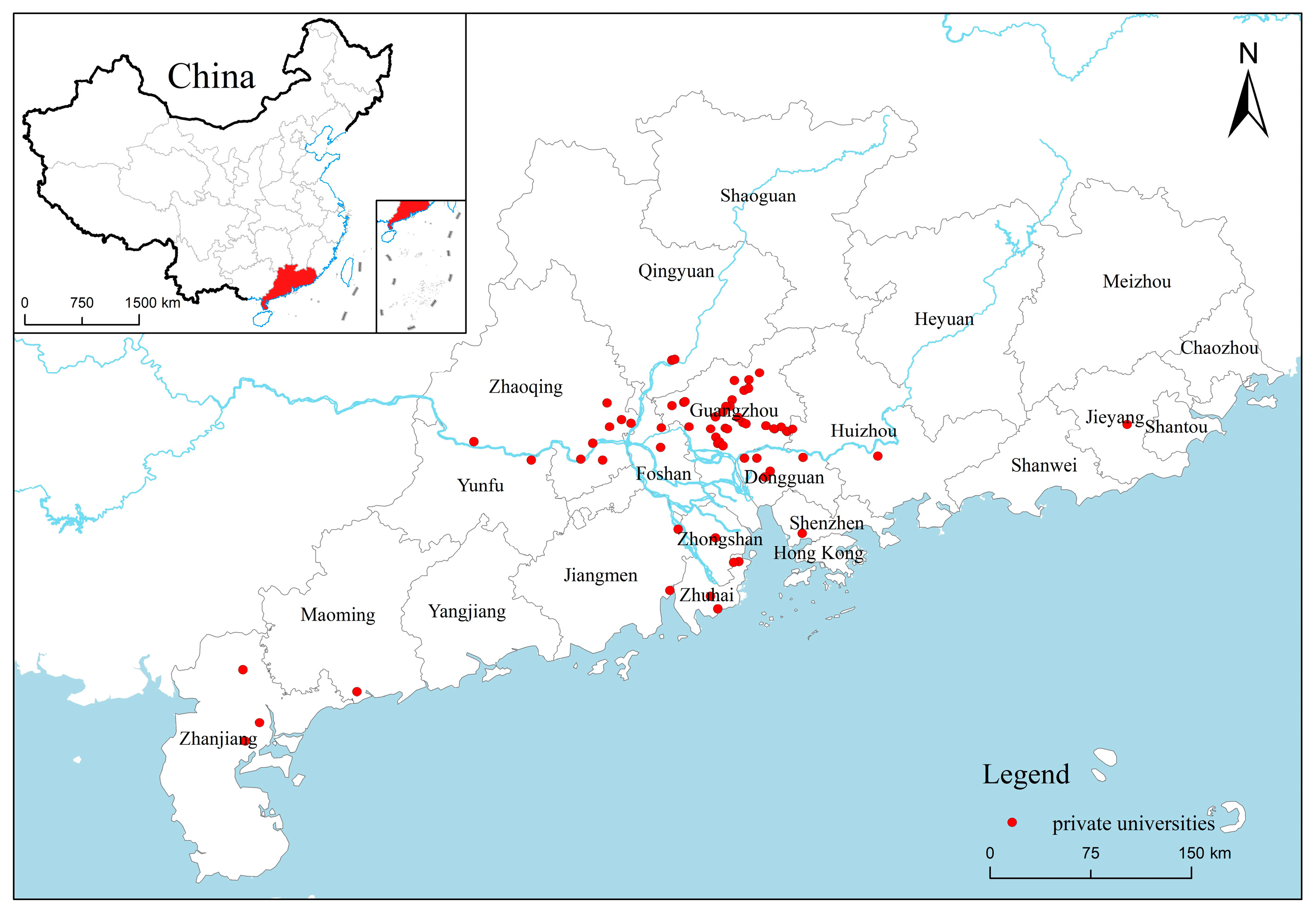
The emergence of contemporary Chinese private universities (locally known as Minban universities) is rooted in the rapid economic expansion of the country in the late 20th century [3]. Unlike their Western counterparts, which often represent elite education, private universities in China serve a supplemental role to meet the growing demand for higher education resources that public institutions could not fully satisfy. Despite a relatively short history, they have become a significant provider of higher education services [4]. As of 2024, there are 803 private universities in China, accounting for 25.75% of all universities, with a total enrollment of 10.52 million students (27.04% of the national total) [5]. Figure 1 shows the distribution of private universities in Guangdong province, one of the most economically developed regions in China. Most of these private institutions are vocation-oriented and rely heavily on students’ tuition fees. A high-quality physical campus environment serves as a key determinant for attracting and retaining students, thus ensuring a university’s financial sustainability. Consequently, many private universities have invested substantially in campus construction or renovation to enhance student satisfaction.
However, academic research specifically addressing the physical environments of Chinese private universities remains critically scarce. The existing literature either focuses on Western private institutions, whose cultural and spatial contexts are difficult to transplant to China, or it concentrates on China’s public universities, which possess vastly different resource structures and student demographics. This knowledge gap forces administrators and planners to rely on subjective experience rather than empirical evidence, leading to resource misallocation that fails to meet student needs.
In the context of this study, the “campus physical environment” is conceptualized as a multidimensional construct. In order to comprehensively evaluate students’ campus satisfaction, a holistic perspective is adopted, including campus planning, landscape, architectural design, spatial layout, and indoor environment quality, which collectively constitute the student’s living and learning environment.

1.2. Literature Review

Research on campus environments originated from practical needs in campus planning and design [6]. Scholars have increasingly recognized that the campus physical environment also exerts a subtle yet important educational influence on students [7,8], and is closely related to student retention and academic performance [7,8,9,10,11]. From a marketing perspective, students are also conceptualized as customers and universities as providers of educational services [12,13]. Within this framework, the physical environment is viewed as a core component of the service package and a key determinant of overall student satisfaction.
Student satisfaction with the campus physical environment could be classified as a type of post-occupancy evaluation (POE) of the built environment. In general, POE encompasses two broad dimensions: (1) assessments of functional performance, such as energy efficiency and green building performance, and (2) users’ subjective evaluations of the environment [14]. While methods for evaluating function and performance are relatively mature, subjective assessments have attracted growing attention in recent years and have attracted extensive scholarly attention globally. Researches has been conducted not only in developed regions (e.g., the USA [15], the UK [16], Italy [17], Australia [18], and New Zealand [19]), but also in developing countries (e.g., Brazil [20]), where studies have emerged alongside rapid campus expansion, highlighting the critical impact of physical environments on students’ university experiences.
University campuses are typically planned with a “student-centered” philosophy, which makes subjective evaluations from the student’s perspective an important feedback tool for testing this approach. Consequently, a growing body of research has conducted subjective evaluations of various aspects of the campus environment and has developed corresponding scales, focusing on elements such as campus landscape [11,15,21], outdoor spaces [22,23], teaching environments [24,25,26], and dormitories [27,28]. Recent studies by Attaianese et al. [17] have also begun to explore integrated methodologies combining subjective assessments of IEQ (thermal, visual, acoustic, and air quality) with architectural aspects like space layout and wayfinding. However, with regard to the overall campus environment, existing work has remained largely at the conceptual or framework level. There is still no comprehensive, integrated measurement tool. Most existing instruments are fragmented and address only isolated dimensions.
Chinese universities have expanded rapidly, especially from the early 2000s onward, accompanied by the construction of a large number of new campuses. This wave of expansion has in turn stimulated scholars’ reflection and evaluation of how campus environments affect students’ satisfaction [29,30]. Existing studies on satisfaction with campus environments in Chinese universities tend to rely on indicators determined by researchers and planners, often drawing heavily on planning practice and expert judgment [31,32,33]. Student perspectives are rarely taken as the primary basis for construct development. As a result, the content of these measurement tools carries a considerable degree of subjectivity and may not accurately reflect students’ lived experiences and perceptions.
Chinese private universities are relatively young and typically operate under resource constraints. Current research on Chinese private universities has largely concentrated on education policy [34], governance [35], and education quality [36]. Studies from the perspective of the campus physical environment are extremely limited.

1.3. Conceptualization of University Campus Environment Satisfaction Scale (UCESS)

This literature review highlights a clear research gap: the lack of a comprehensive instrument to systematically measure student satisfaction with the multidimensional physical environment in Chinese private universities. This study aims to establish a highly reliable and valid scale for assessing student satisfaction with the campus physical environment of these private institutions. Drawing on 1050 valid questionnaire responses from four representative universities in Guangdong province, this research applies rigorous psychometric procedures to develop the University Campus Environment Satisfaction Scale (UCESS). This study offers three primary theoretical and practical contributions:
  • It provides the first validated measurement tool specifically calibrated for Chinese private universities, filling a significant gap in the literature.
  • It moves beyond the traditional expert-centric perspective to a student-centric approach, accurately deconstructing the perceptual structure of contemporary private university students.
  • It provides a scientific diagnostic tool for administrators to optimize campus investments and construction.

2. Materials and Methods

This study employed a rigorous scale development procedure [37,38,39], integrating input from both experts and target student population. Based on the conceptualization of UCESS, a comprehensive review of the seminal literature and existing scales was conducted to aggregate the key dimensions and corresponding items emphasized in the field. Further focus group interviews with experts and students resulted in an initial pool of 70 items.
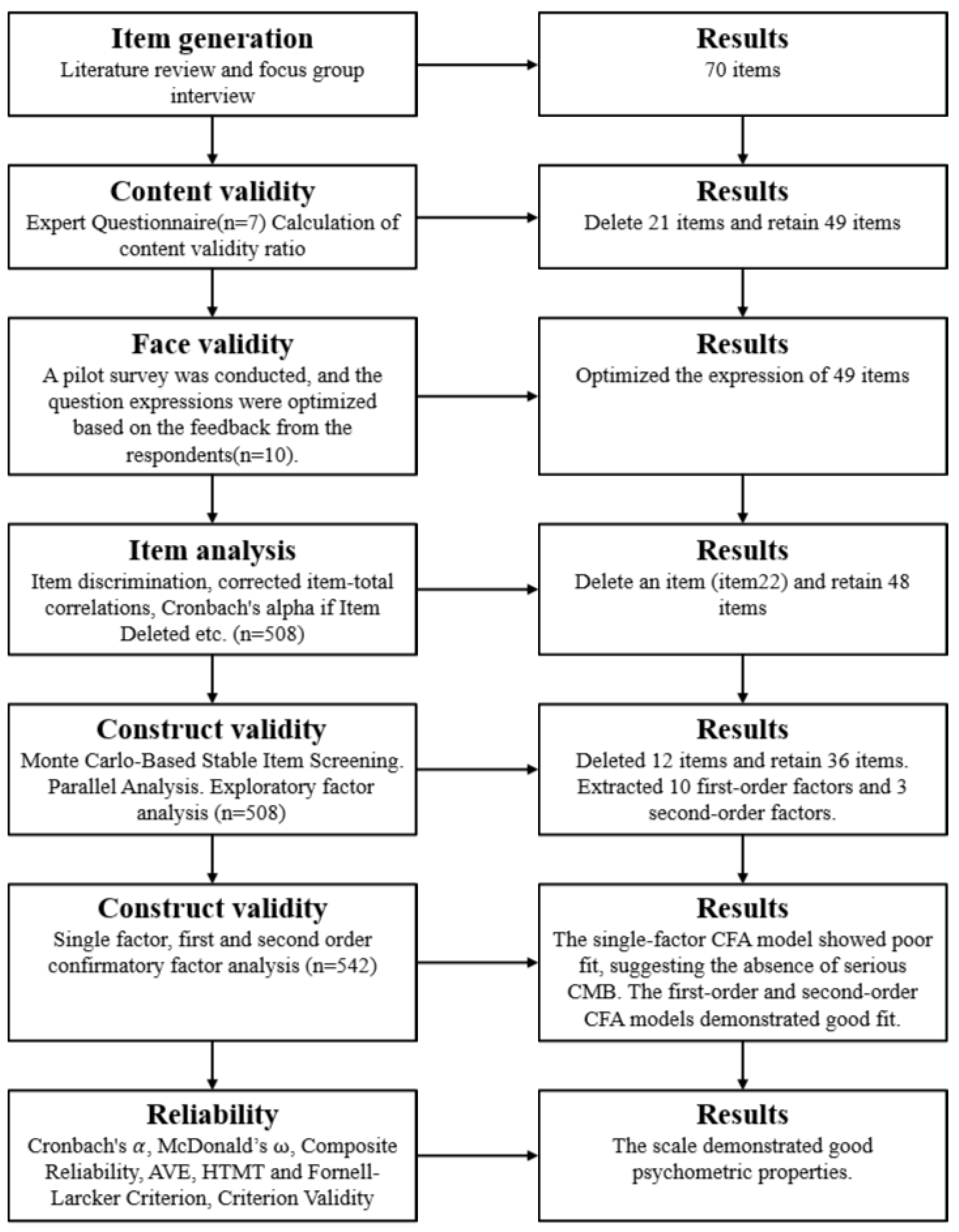
To refine the scale, 7 experts conducted a content validity analysis (CVA) on the scale pool items, and removed 21 items that were irrelevant to the measurement objectives based on the content validity index (CVI). The remaining 49 items underwent a pilot test with 10 students from the target universities to assess and enhance face validity. Data were collected from 4 private universities using a 5-point Likert scale (1 = “Strongly Disagree” to 5 = “Strongly Agree”). A total of 1431 questionnaires were retrieved. Following rigorous data cleaning, 1050 valid responses were retained to serve as the basis for subsequent analysis. The overall scale development process is illustrated in Figure 2.
Statistical analysis was conducted using a suite of software tools. R (version 4.5.0, R Foundation for Statistical Computing, Vienna, Austria) was employed for data preprocessing, random splitting, parallel analysis, and Monte Carlo-based stable item screening. SPSS (version 30.0, IBM Corp., Armonk, NY, USA) was utilized for descriptive statistics, Exploratory Factor Analysis (EFA), item analysis, and the calculation of reliability and validity indices. Finally, Confirmatory Factor Analysis (CFA) was performed using Mplus (version 8.3, Muthén & Muthén, Los Angeles, CA, USA).

2.1. Dimensions and Item Generation

This study explored the constituent dimensions of the physical campus environment through a comprehensive literature review. This review encompassed seminal works in the field of campus planning practice as well as existing scales designed for the measurement of physical campus spaces. Table 1 summarizes the 10 core dimensions elucidated in the primary literature.
An initial pool of 64 items was screened from existing scales. Subsequently, a focus group interview was organized, comprising three experts in campus planning and five undergraduate students from private universities. This process yielded an additional 6 items covering dimensions such as accommodation, library facilities, and instructional spaces, resulting in a preliminary item pool of 70 items.

2.2. Scale Refinement

2.2.1. Content Validity

Content Validity Analysis (CVA) was employed to assess the relevance of the items to the measurement construct. This study utilized the Item-Content Validity Index (I-CVI) based on ratings provided by a panel of seven experts. The panel included administrators from private universities, campus planners, and researchers in related fields. Expert key profiles are presented in Table 2.
Given that the panel consisted of more than six experts, the retention criteria were set such that the I-CVI should be no less than 0.78, and a kappa value greater than 0.74 [42]. Applying these criteria to the item pool resulted in the elimination of 21 items.

2.2.2. Face Validity

The remaining 49 items underwent a pilot test with 10 undergraduate students from private universities to assess face validity. The participants were selected to represent different grade levels and academic majors. They were asked to review the item content and provide feedback. Based on their input, the phrasing of the items was optimized to reduce ambiguity, ensuring that the items were easily comprehensible to the students.

2.3. Questionnaire Administration

2.3.1. Sampling and Data Collection

Data collection was conducted via an online survey hosted on the “Wenjuanxing” platform (www.wjx.cn). The survey was distributed to the student body through the student affairs departments of four private universities from October to November 2025. The formal instrument comprised 49 items (Appendix A, Table A1), 1 overall satisfaction item, and 2 attention check items designed to ensure data quality. The questionnaire used a 5-point Likert scale ranging from 1 (“Strongly Disagree”) to 5 (“Strongly Agree”), and presented items in the following format:
  • Prompt: “Please indicate your level of agreement with the following statements regarding your campus.”
  • Item content (example): “Campus night lighting makes me feel safe.”
  • Scale: [1—Strongly Disagree] [2—Disagree] [3—Neutral] [4—Agree] [5—Strongly Agree]
To capture the diverse environmental characteristics of private universities in Guangdong Province, four representative campuses were selected for this study. Table 3 details the physical attributes of the four surveyed campuses. Satellite imagery and master plans illustrate the overall morphology and functional layout, while photographs of key campus spaces show the relationships between architecture, landscape, and open areas. Key quantitative indicators highlight distinct typological differences among the samples: Campus A (suburban, low GFA per student), Campus B (low-density garden-style in a natural setting, high GFA per student), Campus C (compact suburban, high density, high GFA per student), and Campus D (high-density urban). These attributes provide the necessary physical context for interpreting the variations in student satisfaction reported in the subsequent results.

2.3.2. Data Cleaning

A total of 1431 responses were initially retrieved. Data cleaning procedures involved screening for failed attention checks, insufficient response duration, and invariant responding (i.e., selecting the same response option for more than 90% of items) [43,44]. Following the application of these exclusion criteria, 381 invalid responses were removed, resulting in a final dataset of 1050 valid questionnaires. This yielded an overall effective response rate of 73.38%.

2.3.3. Demographic Information

Using random sampling, the valid dataset was randomly partitioned into two approximately equal subsets. Subset 1 (n = 508) was utilized for item analysis and Exploratory Factor Analysis (EFA), while Subset 2 (n = 542) was reserved for Confirmatory Factor Analysis (CFA), reliability and validity assessments. As illustrated in Table 4, the two subsamples demonstrated a high degree of homogeneity in terms of grade level and gender composition, thereby supporting the stability of the subsequent analyses.

2.3.4. Ethical Considerations

This study was conducted in accordance with ethical standards for survey research. An introductory statement was presented at the beginning of the online questionnaire to inform participants about this study’s purpose, the voluntary nature of their participation, and the anonymity of the data. Specifically, the statement read:
“Hello! We are conducting an academic study on the university campus environment... This questionnaire is anonymous, and all data will be used solely for academic research... Please answer based on your actual experience.”
By proceeding to answer the questionnaire, participants were considered to have provided their implied informed consent. No personally identifiable information was collected, ensuring the privacy and confidentiality of all respondents.

3. Results

3.1. Item Analysis

Item analysis was conducted using the randomly selected Subset 1 from the valid sample (Appendix A, Table A2). This process involved evaluating item discrimination and calculating statistical indices such as the Corrected Item-Total Correlation (CITC) and Cronbach’s α/McDonald’s ω if Item Deleted.
First, the total scores for the 49 items were calculated. The sample was then stratified into high-scoring and low-scoring groups based on the upper and lower 27% of the total score distribution (using the 27th and 73rd percentiles as cut-off points). Independent samples t-tests were performed to examine the differences between these two groups across all items. The results indicated that all t-statistics were statistically significant [45] and exceeded the critical value of 3.0, demonstrating that all items possessed adequate discriminatory power.
Subsequently, the Corrected Item-Total Correlation (CITC) and the “α/ω if Item Deleted” indices were examined. The CITC value for Item 22 fell below the acceptable threshold of 0.30 [37]. Furthermore, the “α/ω if Item Deleted” values for this item exceeded the overall reliability coefficients of the current scale, suggesting that the removal of Item 22 would enhance the internal consistency of the instrument. Consequently, Item 22 was excluded during the item analysis phase.

3.2. Exploratory Factor Analysis

In the exploratory factor analysis (EFA) phase, the retention of items and the resulting factor structure can vary significantly depending on the specific sample used. To ensure the derivation of a stable factor structure, we first employed a Monte Carlo-based Stable Item Screening (MC-SIS) method to identify and retain robust items within the scale. This process led to the exclusion of nine items that exhibited a deletion probability greater than 10%. Subsequently, Parallel Analysis was utilized to determine the optimal number of factors. During the initial EFA, an additional three items were removed. A final EFA was then conducted, yielding a stable 10-factor structure. Furthermore, a second-order EFA performed on the factor scores of this 10-factor structure revealed that three interpretable second-order factors could be extracted.

3.2.1. Monte Carlo-Based Stable Item Screening (MC-SIS)

To enhance the robustness of item selection and mitigate sampling bias associated with single random sampling events, this study adopted the Monte Carlo-Based Stable Item Screening (MC-SIS) method. This approach evaluates the stability of each item within the factor structure through extensive resampling procedures [46,47].
Specifically, we executed 5000 independent Monte Carlo iterations. In each iteration, a subsample comprising 50% of the total sample was randomly drawn and subjected to exploratory factor analysis. Based on the predetermined number of factors and preliminary parallel analysis, 10 factors were extracted using Principal Axis Factoring as the extraction method and Promax with Kaiser Normalization as the rotation method. An item was flagged for deletion if its maximum loading across all factors failed to meet the fixed factor loading criterion ( λ   <   0.40 ). This process established an empirical deletion distribution for each item.
Subsequently, the deletion rate—defined as the frequency with which an item was flagged for deletion across the 5000 simulations—was calculated. According to stability selection principles, items with a deletion rate exceeding a probability threshold of 10% were deemed statistically unstable and were consequently excluded. The results of the item stability calculations are presented in Table 5. As indicated, items 5, 10, 28, 31, 33, 34, 39, 45, and 46 exhibited deletion probabilities greater than 10% and were therefore excluded from subsequent exploratory factor analyses.

3.2.2. Determining the Number of Factors

Conceptually, this study hypothesized a ten-factor structure during the initial construction of the item pool. Statistically, the optimal number of factors was determined using Parallel Analysis [48].
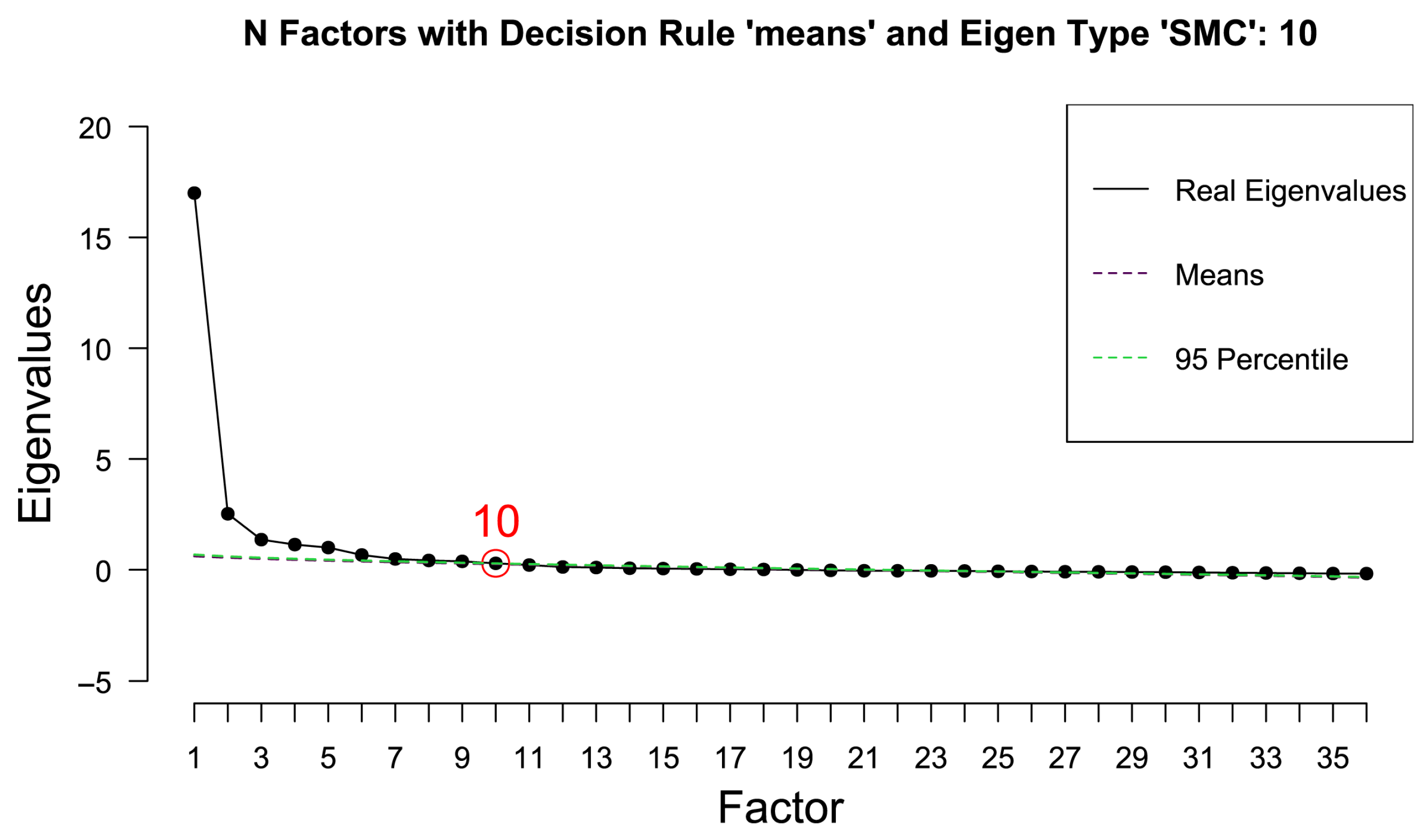
Using Subset 1, an EFA was conducted on the 39 items that remained following item analysis and stability screening. Guided by the preliminary parallel analysis, which supported a ten-factor solution, Principal Axis Factoring was employed as the extraction method, coupled with Promax rotation. Inspection of the resulting factor loading matrix revealed that Item 23 exhibited semantic inconsistency with other items within its respective dimension and was removed. Additionally, Items 17 and 35 were excluded due to multicollinearity issues, indicated by factor loadings exceeding 0.95. A subsequent parallel analysis performed on the remaining 36 items confirmed the extractability of 10 factors (see Figure 3).

3.2.3. Results of Exploratory Factor Analysis

Principal Axis Factoring was re-applied to the 36 retained items to extract 10 factors, utilizing Promax rotation. The Kaiser-Meyer-Olkin (KMO) Measure of Sampling Adequacy was 0.961, and Bartlett’s Test of Sphericity yielded a p-value of less than 0.05, indicating sufficient inter-item correlation to justify factor extraction. Table 6 presents the resulting factor loading matrix, communalities, eigenvalues, and percentage of variance explained. As shown in the factor loading matrix, the factor structure is distinct: each item loaded significantly (>0.40) on only a single factor, with no substantial cross-loadings. All item communalities exceeded 0.20. The ten-factor solution accounted for a cumulative variance of 71.62%, surpassing the recommended 60% threshold. The ten extracted factors were labeled as follows: Living facilities, Social spaces, Teaching facilities, Campus landscape, Climate adaptability, Library, Sports facilities, Surrounding environment, Campus safety, Transportation convenience.
Using the ten calculated factor score variables, a second-order factor extraction was performed using Principal Axis Factoring with Promax rotation (Kaiser Normalization). Both two-factor and three-factor solutions were examined. Based on the factor loading matrices and the theoretical underpinnings of the scale, the three-factor structure was deemed more interpretatively meaningful. Consequently, a three-factor solution was adopted. The KMO statistic for this analysis was 0.927, and Bartlett’s Test of Sphericity was significant (p < 0.05). The resulting factor loading matrix and communalities are detailed in Table 7.
The analysis revealed the following hierarchical structure:
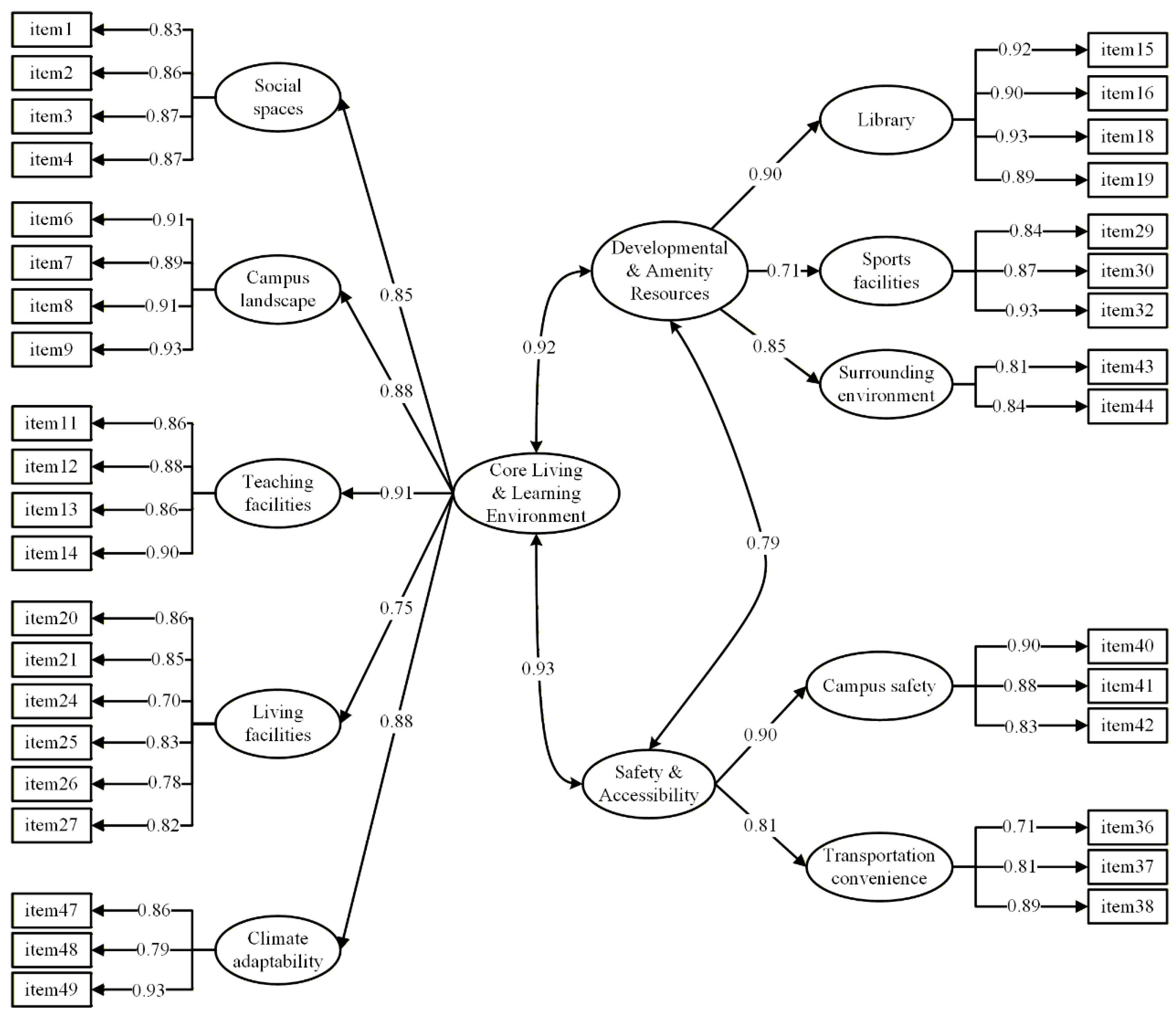
  • Five first-order factors Living facilities, Social spaces, Teaching facilities, Campus landscape, and Climate adaptability loaded onto the first second-order factor, which was labeled Core Living & Learning Environment.
  • Three factors Library, Sports facilities, and Surrounding environment loaded onto the second second-order factor, labeled Developmental & Amenity Resources.
  • Two first-order factors Campus safety and Transportation convenience loaded onto the third second-order factor, labeled Safety & Accessibility.

3.3. Confirmatory Factor Analysis

Based on Data Subset 2, Confirmatory Factor Analysis (CFA) was conducted using Mplus 8.3 software to validate the first-order and second-order factor structures identified during the exploratory phase. Given that the scale utilizes a 5-point Likert format, the Weighted Least Squares Mean and Variance adjusted (WLSMV) estimator was employed for parameter estimation. The fit indices for the three CFA models are presented in Table 8. The results indicate that the fit indices for both the first-order and second-order CFA models satisfy established psychometric criteria [49]. This demonstrates an excellent model fit for both structures, suggesting that the identified factor models accurately reflect the underlying structure of the scale and confirming its construct validity (Appendix A, Table A3).
Figure 4 illustrates the factor loadings for the second-order CFA model, as well as the correlation coefficients between the three second-order factors. First-order factor loadings ranged from 0.70 to 0.93, while second-order factor loadings ranged from 0.71 to 0.91. All factor loadings exceeded the 0.70 threshold, yet none surpassed 0.95, indicating strong but distinct indicators. The correlation coefficients between the three second-order factors ranged from 0.79 to 0.93. As these three factors represent sub-dimensions of UCESS, their strong correlations suggest they collectively reflect a higher-order construct of campus environment quality.

3.4. Common Method Bias Test

To assess the potential presence of severe common method bias, a single-factor CFA model was constructed in which all items were loaded onto a single method factor [50]. As shown in Table 8, the fit indices for the single-factor CFA model failed to meet accepted psychometric standards, indicating a poor model fit. This result demonstrates that a single-factor structure does not adequately represent the underlying structure of the scale. Consequently, the Harman’s single-factor test based on CFA suggests that the data in this study are not subject to serious common method bias.

3.5. Analysis of Reliability and Validity

Based on the data from Subset 2 and the results of CFA, further analyses were conducted on various reliability and validity indices. The results for internal consistency reliability and convergent validity are presented in Table 9, discriminant validity in Table 10, and criterion validity in Table 11.

3.5.1. Internal Consistency Reliability

This study rigorously evaluated the internal consistency reliability of all first-order factors utilizing three primary statistical metrics: Cronbach’s α , McDonald’s ω , and Composite Reliability (CR). The evaluation was conducted in accordance with the standards summarized by Cheung et al. [51]. Overall, the reliability performance of all factors met or exceeded generally accepted thresholds.
The Cronbach’s α values for all factors ranged from 0.767 (Surrounding environment) to 0.929 (Library), with all values exceeding the 0.70 benchmark. Furthermore, McDonald’s ω , serving as a robust alternative to Cronbach’s α , demonstrated high consistency with the α values, ranging from 0.794 (Transportation convenience) to 0.929 (Library). This further corroborates the internal consistency of the scale. Finally, the Composite Reliability (CR) also exhibited excellent performance, with values ranging between 0.811 (Surrounding environment) and 0.951 (Library). Given that the CR values for all factors were well above 0.70, this provides strong evidence that each sub-dimension possesses a high degree of internal consistency.

3.5.2. Convergent Validity

Convergent validity was assessed using standardized factor loadings and Average Variance Extracted (AVE). As presented in Table 9, the standardized factor loadings for all measurement items corresponding to the first-order factors exceeded the threshold of 0.7. This indicates that the measurement indicators effectively converge upon their respective latent constructs. Furthermore, the AVE values for all factors surpassed the 0.50 benchmark [51], ranging from 0.651 (Living facilities) to 0.831 (Library). Given that the standardized loadings and AVE values for all factors met stringent criteria, the measurement model demonstrates robust convergent validity.

3.5.3. Discriminant Validity

Discriminant validity was evaluated using two rigorous statistical approaches: the Fornell-Larcker criterion and the Heterotrait-Monotrait ratio of correlations (HTMT). First, in accordance with the Fornell-Larcker criterion, the square root of the AVE for each construct (located on the diagonal) exceeded the correlations between that construct and all other constructs in the respective rows and columns. This finding provides strong evidence for the discriminant validity among the factors.
Second, the HTMT analysis (values displayed in the upper triangle) revealed that all HTMT ratios between factor pairs were below the generally accepted threshold of 0.90, and indeed satisfied the more stringent threshold of 0.85 [52]. Synthesizing the results from both methods, we confirm that the ten first-order sub-dimensions of the scale possess adequate discriminant validity, demonstrating that the factors are distinct both conceptually and empirically.

3.5.4. Criterion Validity

Criterion validity was assessed by calculating the correlation coefficients between the sub-dimensions and the total score of the UCESS and the external criterion variable, Y7 (Campus environment overall satisfaction). The results indicate significant positive correlations between all UCESS sub-dimensions and the criterion variable. Specifically, the correlation coefficients ranged from 0.415 for Sports facilities (SF) to 0.626 for Teaching facilities (TF). Notably, Teaching facilities (0.626) and Campus landscape (CL, 0.624) exhibited the strongest correlations, suggesting that these two factors have the most prominent influence on overall campus environment satisfaction. Furthermore, the total UCESS score demonstrated a highly significant positive correlation with the criterion variable Y7 (r = 0.700, p < 0.01). According to established standards for interpreting correlation strength [53], this high correlation coefficient provides robust evidence that the UCESS scale developed in this study possesses strong predictive capability or concurrent validity regarding the external criterion variable, thereby confirming the scale’s excellent criterion validity.

4. Discussion

4.1. Core Living & Learning Environment

The “Core Living & Learning Environment” represents the dimension with the highest explained variance and the greatest number of first-order factors, encompassing five aspects: “Living facilities,” “Social spaces,” “Teaching facilities,” “Campus landscape,” and “Climate adaptability.” This finding indicates that for students in private universities, the cornerstone of satisfaction lies in the physical spaces that are used with high frequency and directly impact daily living and fundamental academic activities. If this core environment fails to meet basic standards of comfort and functionality, investments in other areas are unlikely to translate effectively into an increase in overall satisfaction.
Within the “Living facilities” factor, the high factor loadings for dormitory spaciousness (Item 20, loading 0.87) and the furniture design (Item 26, loading 0.87) reflect the significant emphasis students place on the quality of private spaces. Similarly, under “Teaching facilities,” the focus on the classroom environment (Item 11) and the advanced equipment (Item 13) suggests that, despite evolving educational models, physical instructional spaces remain the core of student perception.
Notably, “Social spaces” and “Campus landscape” are categorized here as core environments rather than auxiliary facilities. The high weights assigned to “design of outdoor resting spots” (Item 3, loading 0.90) and “relaxing natural environment” (Item 8, loading 0.86) imply a strong desire among contemporary college students for informal social spaces and natural landscapes that offer psychological restoration. This corroborates the importance of “third spaces” for Gen-Z [54,55] and “healing environments” [56,57] in modern educational philosophy.
Furthermore, as this study focuses on universities in Guangdong province, the emergence of “Climate adaptability” as an independent first-order factor within the core environment is unique. Given the hot and humid climate of this subtropical region, features such as “covered walkways” (Item 47) and “natural ventilation” (Item 49) are directly linked to the daily commuting comfort of students, making them critical elements influencing the basic living experience.

4.2. Developmental & Amenity Resources

The second second-order factor, “Developmental & Amenity resources,” integrates “Library,” “Sports facilities,” and “Surrounding environment.” This dimension transcends basic survival and instructional necessities, addressing higher-level needs related to self-improvement, physical and mental health, and socialization.
Regarding the “Library” factor, beyond basic facility completeness (Item 18, loading 0.87), “sufficiency and diversity of seating” (Item 16, loading 0.86) and “iconic design” (Item 19) also occupy prominent positions. This suggests that the library is not merely a place for study but serves as a spiritual landmark of campus culture. Its environmental quality directly influences students’ sense of academic belonging.
In the “Sports facilities” factor, students placed significant emphasis on “diversified and specialized sports facilities” (Item 32, loading 0.87). This reflects the cognition among private university students that personalized athletic activities (such as rock climbing or skateboarding) are vital manifestations of campus vitality and quality of life.
The “Surrounding Environment” reflects students’ need for interaction with the city. Considering the typical enclosed management style of most Chinese universities, the richness of commercial facilities surrounding the campus (Item 44, loading 0.80) compensates for deficiencies within the campus, providing students with broader choices for socialization and sense of belonging [58].

4.3. Safety and Accessibility

The third second-order factor comprises “Campus safety” and “Transport convenience,” constituting the supporting layer of campus environment satisfaction. According to Herzberg’s two-factor theory [59], these elements function as “hygiene factors”: their inadequacy causes significant dissatisfaction, whereas their optimal performance is often taken for granted.
In terms of “Campus safety,” the high loadings for the sensitivity of the smart card system (Item 42, loading 0.86) and the access control system (Item 41, loading 0.83) indicate that modern university students’ perception of safety is highly dependent on the reliability of intelligent management systems. Regarding “Transportation convenience,” in addition to road accessibility, the clarity of the signage system (Item 38, loading 0.75) is crucial. This demonstrates that in a functionally complex campus, the ability to easily locate destinations and walking convenience (e.g., the distance from dormitory to library, Item 36) directly impacts students’ evaluation of campus efficiency.

4.4. Campus Physical Environment and Student Satisfaction

These three factors form a distinct, interactive hierarchical framework that can be interpreted through two following perspectives.
From the perspective of students’ need hierarchies [60], the three second-order factors exhibit a clear progressive psychological path. “Safety and Accessibility” responds to the most fundamental needs of safety and freedom of movement within the campus. The “Core living & learning environment” bridges physiological and belonging needs. Comfortable accommodation and climate-adaptive design satisfy basic physical comfort, while social spaces and aesthetic landscapes fulfill the desire for social interaction and emotional belonging. Finally, “Developmental & Amenity resources” forms the highest level, satisfying esteem and self-actualization needs through distinctive libraries and diverse sports facilities.
From the perspective of the campus as an educational service provider [61], “Safety and Accessibility” represents the basic elements supporting the entire campus. While their presence may not significantly boost satisfaction, their absence or failure may cause substantial dissatisfaction. The “Core living & Learning environment” serves as the primary criterion by which students evaluate campus quality. As environmental quality improves, student satisfaction increases synchronously. “Developmental & Amenity resources” represents the value-added elements. Providing high-standard specialized sports facilities or a well-designed library can significantly enhance student satisfaction and university brand. This classification reveals a strategic prioritization for campus development: first, ensure the requisite basic attributes; second, optimize core attributes to enhance competitiveness; and finally, cultivate value-added attributes to achieve differentiated development.
Furthermore, our findings also reveal the structure of student campus satisfaction in private universities differs significantly from that in public research universities. In China’s public institutions, which are government-funded and research-oriented, student satisfaction is often driven by academic prestige and overall campus atmosphere, with living conditions viewed as less important [31]. Conversely, our findings indicate that in private universities—where students pay a much higher tuition—the “Living facilities” dimension (Item 20, 21, 24, 25, 26) serves as a primary factor. This suggests that for private institutions, students evaluate the campus more as a comprehensive service product, where the quality of daily life facilities directly determines the perceived value of the high tuition fees.

5. Implications

This study centers on private universities, a sector of growing importance within the higher education system that remains relatively under-explored in the existing literature. By conducting an in-depth investigation into the authentic experiences and needs of students in private universities in Guangdong province, this research fills a critical gap in the evaluation of campus environments for this specific institutional type. This study unveils the unique dimensions of campus environment perception among private university students—a group characterized by higher tuition and more specific service expectations. Consequently, it offers a novel perspective for understanding student needs within a diversified higher education system.
A significant methodological contribution of this work lies in its rigorous data processing workflow and substantial empirical support. Through strict data cleaning of raw data collected from 4 representative private universities, 1050 valid responses were secured. This extensive sample size not only encompasses a broad student demographic, thereby significantly minimizing sampling error, but also enhances the generalizability and robustness of the findings. Furthermore, through a rigorous scale development procedure, this study constructed and validated a measurement scale possessing high reliability and validity, providing a replicable and standardized tool for future research on campus environment satisfaction.
Theoretically, through empirical analysis, this study innovatively deconstructs the determinants of campus environment satisfaction into three distinct hierarchical dimensions: “Safety and Accessibility,” “Core Living & Learning Environment,” and “Developmental & Amenity Resources.” This finding elucidates the cognitive structure of private university students regarding their campus environment and validates the applicability of environmental psychology within educational settings. This research further reveals that campus environmental elements do not exert a singular, linear influence on satisfaction; rather, they operate across three levels—basic guarantee elements, core elements, and value-added elements—each exhibiting distinct associational relationships with overall campus satisfaction. This insight significantly enriches the theoretical framework of educational service quality evaluation.
In terms of practical application, the hierarchical structure revealed by UCESS offers a clear strategy for campus investment. Under strict budget constraints, decision-makers should prioritize the ‘Safety and Accessibility’ and ‘Core Living & Learning Environment’ dimensions, as these constitute the foundational baseline of the student experience. Investment in ‘Developmental & Amenity Resources’ should follow only after these essential needs are met. This tiered approach ensures that limited funds are first directed toward the most fundamental factors before pursuing value-added enhancements.
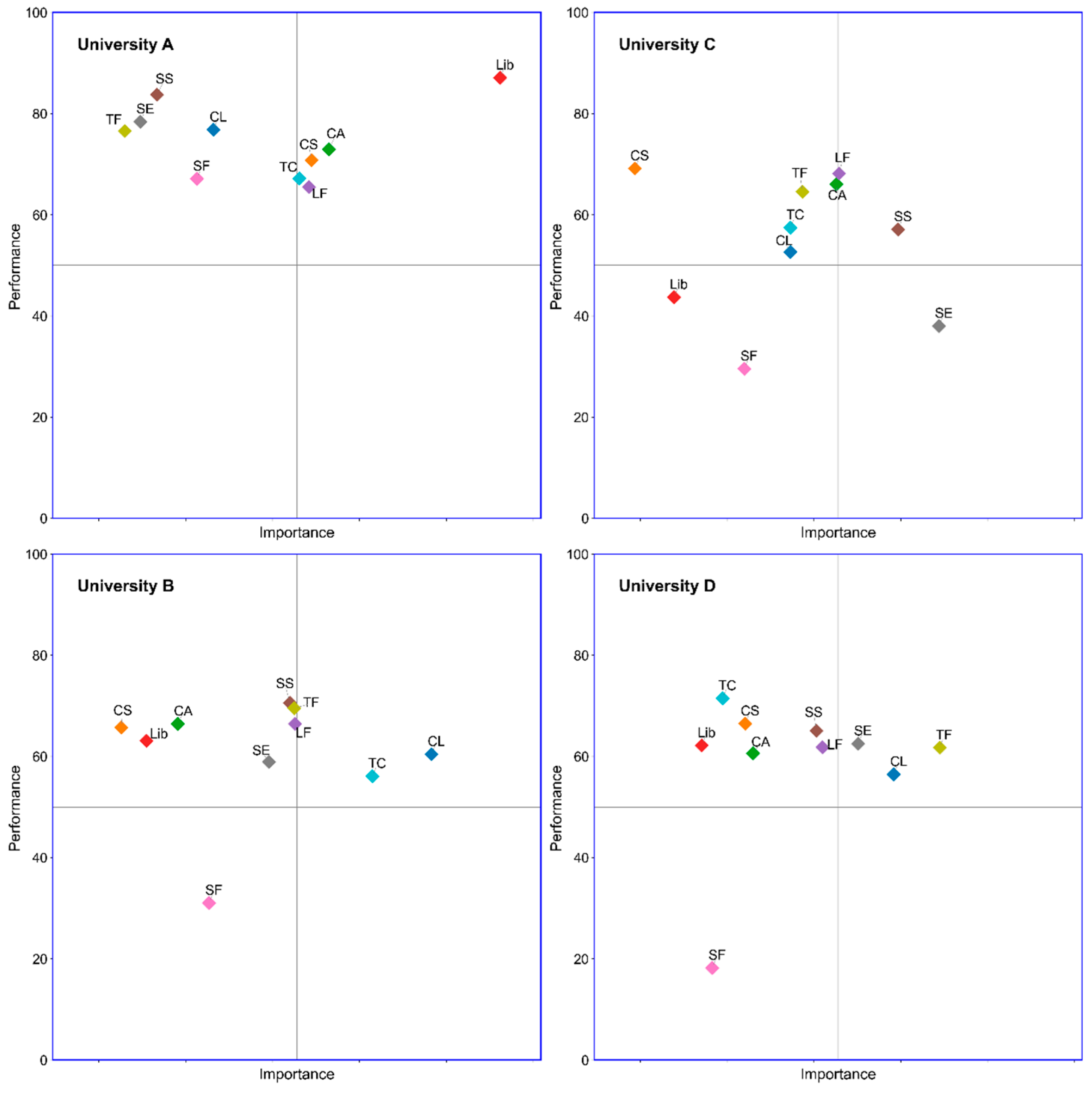
Furthermore, to illustrate the diagnostic utility of the tool for intervention strategies, we conducted an Importance-Performance Map Analysis (IPMA) for the selected four campus. As shown in Figure 5, the IPMA results identify priority areas for resource allocation. For example, in university A, most factors, particularly Library and Social spaces, are situated in the high-performance quadrants, indicating that the current campus environment strategies are well-aligned with student expectations; however, in university C, the factor Surrounding environment is located in the “High-importance but low-performance” quadrant, suggesting that University C should prioritize resources to improve this specific aspect to effectively enhance the student experience.

6. Conclusions

This study aimed to investigate the impact of campus environments on student satisfaction within private universities in Guangdong province and to establish a scientific evaluation tool. Through a rigorous quantitative analysis of 1050 valid questionnaires, this research successfully developed and validated a campus environment satisfaction scale demonstrating robust reliability and validity. The results not only elucidate the core dimensions constituting campus environment perception but also quantify the specific influence weights of various environmental factors on student satisfaction. Consequently, this confirms the critical role of physical campus environments and service facilities in enhancing the student experience, providing an empirical basis for resource optimization and environmental construction in private universities.
Despite these contributions, this study is subject to certain limitations. First, the sample was confined to private universities within Guangdong province; thus, regional cultural and climatic specificities may limit the generalizability of the findings to other geographical areas. Second, the use of cross-sectional data, while reflecting the current state, precludes the capture of dynamic trajectories in student satisfaction over time. Third, this study treated indoor environmental quality (IEQ) factors as proxy indicators embedded within functional dimensions. While this approach aligns with this study’s focus on service satisfaction, it limits the clarity to evaluate specific influences of thermal, visual, acoustic comfort and indoor air quality. Furthermore, this research relied primarily on subjective self-reporting by students, lacking supplementary verification from objective environmental indicators. Future research is recommended to expand the geographical scope of sampling, attempt longitudinal tracking designs, incorporate explicit IEQ factors, and integrate objective environmental data to construct a more comprehensive and dynamic model of satisfaction determinants.

Author Contributions

R.T.: conceptualization, methodology, software, validation, investigation, resources, data collection, formal analysis, supervision, and writing original draft. Y.W.: conceptualization, methodology, review and editing, and project administration. All authors have read and agreed to the published version of the manuscript.

Funding

This research received no external funding.

Institutional Review Board Statement

Ethical review and approval were not required for this study in accordance with local legislation and institutional requirements, as this study involved an anonymous online survey and did not include any intervention or collection of identifiable personal data.

Informed Consent Statement

Informed consent for participation was obtained from all subjects involved in this study. Participation was voluntary, and all responses were collected anonymously via an online questionnaire.

Data Availability Statement

Data will be made available on request.

Acknowledgments

We would like to acknowledge the administrators in the four private universities for helping conduct the survey, Mo Sha for the assistance in GIS drawing, and Chuxin Zhong for image processing.

Conflicts of Interest

The authors declare no conflicts of interest.

Appendix A

Table A1. Scale used in questionnaire (49 items).
DimensionsItem CodeItems
Social spaceitem 1 *The campus offers open or semi-open venues suitable for club activities and events.
item 2 *There are ample spaces (e.g., cafes) for social interaction and discussion.
item 3 *Outdoor resting areas (seats, steps) are well-designed for lingering and socializing.
item 4 *Building density is appropriate, preserving comfortable open spaces between structures.
item 5Campus night lighting makes me feel safe.
Campus landscapeitem 6 *Environmental art is ubiquitous, enhancing the campus’s artistic atmosphere.
item 7 *Architectural design is distinctive and visually impressive.
item 8 *The natural environment (woods, lakes, gardens) is restorative and relaxing.
item 9 *The landscape and greenery are beautifully designed.
item 10The campus main gate is iconic.
Teaching facilitiesitem 11 *Classroom environments (lighting, ventilation, soundproofing) are comfortable.
item 12 *Academic buildings provide ample and convenient discussion and self-study areas.
item 13 *Teaching and laboratory facilities are advanced and comprehensive.
item 14 *Classroom seating layouts facilitate learning and interaction.
Libraryitem 15 *The library’s interior space is inviting for study.
item 16 *Library seating is plentiful and diverse in type.
item 17The library is large with abundant resources (books, databases).
item 18 *Library facilities (Wi-Fi, printing, power outlets) are complete and reliable.
item 19 *The library’s design is iconic.
Living facilitiesitem 20 *Dormitories are spacious with convenient storage.
item 21 *Dormitories have good lighting and ventilation.
item 22Dormitories are equipped with elevators.
item 23Dorm buildings feature comfortable common areas (lounges, gyms, reading corners).
item 24 *Hot water and air conditioning in dorms are stable and reliable.
item 25 *Dormitory restrooms are well-designed.
item 26 *Dorm furniture (beds, desks, chairs) is well-designed.
item 27 *Canteens are spacious, comfortable, and have ample seating.
Sports facilitiesitem 28Ball courts (basketball, volleyball, badminton) are diverse and plentiful.
item 29 *The swimming pool meets high standards.
item 30 *Sports facilities have sufficient changing and showering amenities.
item 31Gym equipment is professional, durable, and well-maintained.
item 32 *Diverse specialty sports facilities are available (diving, skate park, etc.).
item 33The sports field is of high quality.
Transportation convenienceitem 34Pedestrian and vehicle traffic is separated, ensuring walking safety.
item 35Walking from dorms to classrooms is convenient.
item 36 *Walking from dorms to library is convenient.
item 37 *The road network is well-connected with few dead ends.
item 38 *Signage is clear and intuitive, making navigation easy.
Campus safetyitem 39Campus Wi-Fi is extensive, stable, and fast.
item 40 *Surveillance coverage is comprehensive, and security measures are effective.
item 41 *Dorm access control systems operate effectively to ensure safety.
item 42 *The campus card system is responsive and reliable for access and payments.
Surrounding environmentitem 43 *Surrounding public transport (bus, metro) is well-located and convenient.
item 44 *Surrounding commercial facilities (markets, dining) meet daily needs.
item 45The surrounding environment is clean, scenic, and suitable for living and studying.
Climate adaptabilityitem 46Extensive tree-lined paths provide cool comfort during summer walks.
item 47 *Covered walkways provide shelter from wind and rain.
item 48 *Drainage is efficient, preventing water accumulation after rain.
item 49 *Building spaces are designed for natural ventilation and fresh air.
Note. Items marked with an asterisk are kept for the final UCESS.
Table A2. Results of item analysis: Discrimination test, Corrected Item-Total Correlation, and α / ω if Item Deleted.
ItemsLow
(n = 137)
High
(n = 133)
tpCITC α if Item Deleted
(Total = 0.974)
ω if Item Deleted
(Total = 0.973)
item 13.094.6215.249<0.0010.6190.9730.972
item 22.394.4719.693<0.0010.6690.9730.972
item 32.664.5118.134<0.0010.6670.9730.972
item 42.784.5017.164<0.0010.6950.9730.972
item 52.784.3814.787<0.0010.6350.9730.972
item 62.284.2619.898<0.0010.7580.9730.972
item 72.434.3219.423<0.0010.7530.9730.972
item 82.234.3119.841<0.0010.7400.9730.972
item 92.424.3519.923<0.0010.7710.9730.972
item 102.614.3115.834<0.0010.6890.9730.972
item 112.974.4316.090<0.0010.7150.9730.972
item 122.694.5119.235<0.0010.7370.9730.972
item 132.724.4018.169<0.0010.7250.9730.972
item 142.814.4718.054<0.0010.7580.9730.972
item 152.314.4521.483<0.0010.7290.9730.972
item 162.364.5120.168<0.0010.7100.9730.972
item 172.554.5017.653<0.0010.6750.9730.972
item 182.274.4419.920<0.0010.7110.9730.972
item 192.274.4719.976<0.0010.7060.9730.972
item 202.954.5516.239<0.0010.6720.9730.972
item 212.964.5115.633<0.0010.6510.9730.972
item 222.743.987.039<0.0010.2900.9750.974
item 231.723.7414.365<0.0010.5850.9730.973
item 242.344.0713.693<0.0010.5550.9730.973
item 252.614.2715.261<0.0010.6060.9730.972
item 263.004.4112.689<0.0010.5820.9730.973
item 272.804.3515.476<0.0010.6610.9730.972
item 282.214.3119.126<0.0010.6810.9730.972
item 291.222.9312.830<0.0010.5320.9730.973
item 301.733.7015.018<0.0010.5820.9730.973
item 311.884.0119.193<0.0010.7150.9730.972
item 321.323.4517.649<0.0010.6210.9730.972
item 331.984.0318.865<0.0010.7050.9730.972
item 342.324.0515.144<0.0010.6630.9730.972
item 352.803.968.420<0.0010.4170.9740.973
item 362.374.0012.396<0.0010.5030.9740.973
item 372.734.2612.990<0.0010.6050.9730.972
item 382.774.4114.765<0.0010.6560.9730.972
item 391.853.4413.311<0.0010.5400.9730.973
item 402.994.3112.895<0.0010.6770.9730.972
item 413.164.3611.820<0.0010.5980.9730.972
item 422.824.2513.125<0.0010.6230.9730.972
item 432.074.1717.666<0.0010.6610.9730.972
item 442.334.2316.522<0.0010.6680.9730.972
item 452.594.4620.366<0.0010.8080.9730.972
item 462.604.4719.762<0.0010.7700.9730.972
item 472.664.4918.695<0.0010.7460.9730.972
item 482.814.2213.527<0.0010.6620.9730.972
item 492.844.5018.100<0.0010.7620.9730.972
Note. CITC = Corrected Item-Total Correlation, α = Cronbach’s α , ω = McDonald’s ω .
Table A3. University Campus Environment Satisfaction Scale (UCESS) (36 items).
DimensionsItem CodeItems
Social spaceitem 1The campus offers open or semi-open venues suitable for club activities and events.
item 2There are ample spaces (e.g., cafes) for social interaction and discussion.
item 3Outdoor resting areas (seats, steps) are well-designed for lingering and socializing.
item 4Building density is appropriate, preserving comfortable open spaces between structures.
Campus landscapeitem 6Environmental art is ubiquitous, enhancing the campus’s artistic atmosphere.
item 7Architectural design is distinctive and visually impressive.
item 8The natural environment (woods, lakes, gardens) is restorative and relaxing.
item 9The landscape and greenery are beautifully designed.
Teaching facilitiesitem 11Classroom environments (lighting, ventilation, soundproofing) are comfortable.
item 12Academic buildings provide ample and convenient discussion and self-study areas.
item 13Teaching and laboratory facilities are advanced and comprehensive.
item 14Classroom seating layouts facilitate learning and interaction.
Libraryitem 15The library’s interior space is inviting for study.
item 16Library seating is plentiful and diverse in type.
item 18Library facilities (Wi-Fi, printing, power outlets) are complete and reliable.
item 19The library’s design is iconic.
Living facilitiesitem 20Dormitories are spacious with convenient storage.
item 21Dormitories have good lighting and ventilation.
item 24Hot water and air conditioning in dorms are stable and reliable.
item 25Dormitory restrooms are well-designed.
item 26Dorm furniture (beds, desks, chairs) is well-designed.
item 27Canteens are spacious, comfortable, and have ample seating.
Sports facilitiesitem 29The swimming pool meets high standards.
item 30Sports facilities have sufficient changing and showering amenities.
item 32Diverse specialty sports facilities are available (diving, skate park, etc.).
Transportation convenienceitem 36Walking from dorms to library is convenient.
item 37The road network is well-connected with few dead ends.
item 38Signage is clear and intuitive, making navigation easy.
Campus safetyitem 40Surveillance coverage is comprehensive, and security measures are effective.
item 41Dorm access control systems operate effectively to ensure safety.
item 42The campus card system is responsive and reliable for access and payments.
Surrounding environmentitem 43Surrounding public transport (bus, metro) is well-located and convenient.
item 44Surrounding commercial facilities (markets, dining) meet daily needs.
Climate adaptabilityitem 47Covered walkways provide shelter from wind and rain.
item 48Drainage is efficient, preventing water accumulation after rain.
item 49Building spaces are designed for natural ventilation and fresh air.

References

  1. Altbach, P.G.; Reisberg, L.; Rumbley, L.E. Trends in Global Higher Education: Tracking an Academic Revolution; BRILL: Leiden, The Netherlands, 2019; ISBN 978-90-04-40615-5. [Google Scholar]
  2. Altbach, P.G.; Levy, D.C. Private Higher Education: A Global Revolution; BRILL: Leiden, The Netherlands, 2005; ISBN 978-90-8790-103-5. [Google Scholar]
  3. Zhang, J.; Wei, Y. Exploring the Dynamics of Private Higher Education in China: A Human Capital and Institutional Analysis. Preprints 2024. [Google Scholar] [CrossRef]
  4. Mok, K.H. The Growing Importance of the Privateness in Education: Challenges for Higher Education Governance in China. Comp. A J. Comp. Int. Educ. 2009, 39, 35–49. [Google Scholar] [CrossRef]
  5. Statistical Bulletin on the Development of National Education in 2024. Available online: https://hudong.moe.gov.cn/jyb_sjzl/sjzl_fztjgb/202506/t20250611_1193760.html (accessed on 30 November 2025).
  6. Dober, R.P. Campus Planning; Reinhold Publishing Corporation: New York, NY, USA, 1964. [Google Scholar]
  7. Strange, C.C.; Banning, J.H. Educating by Design: Creating Campus Learning Environments That Work; Wiley: Hoboken, NJ, USA, 2001; ISBN 978-0-7879-1046-4. [Google Scholar]
  8. Asim, F.; Chani, P.S.; Shree, V.; Rai, S. Restoring the Mind: A Neuropsychological Investigation of University Campus Built Environment Aspects for Student Well-Being. Build. Environ. 2023, 244, 110810. [Google Scholar] [CrossRef]
  9. Hajrasouliha, A. Connecting the Dots: Campus Form, Student Perceptions, and Academic Performance. Focus 2019, 15, 12. [Google Scholar]
  10. Hajrasouliha, A.H.; Ewing, R. Campus does matter. The Relationship of Student Retention and Degree Attainment to Campus Design. Plan. High. Educ. J. 2010, 44, 30–45. [Google Scholar]
  11. Gulwadi, G.B.; Mishchenko, E.D.; Hallowell, G.; Alves, S.; Kennedy, M. The Restorative Potential of a University Campus: Objective Greenness and Student Perceptions in Turkey and the United States. Landsc. Urban Plan. 2019, 187, 36–46. [Google Scholar] [CrossRef]
  12. Abdullah, F. The Development of HEdPERF: A New Measuring Instrument of Service Quality for the Higher Education Sector. Int. J. Consum. Stud. 2006, 30, 569–581. [Google Scholar] [CrossRef]
  13. Dangaiso, P.; Tsvere, M. The Nexus between Higher Education Service Quality and Student Academic Achievement: A Structural Equation Modelling Approach. Cogent Educ. 2025, 12, 2556893. [Google Scholar] [CrossRef]
  14. Preiser, W.F.E. Building Evaluation; Springer Science & Business Media: Berlin/Heidelberg, Germany, 2013; ISBN 978-1-4899-3722-3. [Google Scholar]
  15. Eckert, E. Assessment and the Outdoor Campus Environment: Using a Survey to Measure Student Satisfaction with the Outdoor Physical Campus. Plan. High. Educ. 2012, 41, 141–158. [Google Scholar]
  16. Worsley, J.D.; Harrison, P.; Corcoran, R. Accommodation Environments and Student Mental Health in the UK: The Role of Relational Spaces. J. Ment. Health 2023, 32, 175–182. [Google Scholar] [CrossRef]
  17. Attaianese, E.; d’Ambrosio Alfano, F.R.; Palella, B.I.; Pepe, D.; Vanacore, R. An Integrated Methodology of Subjective Investigation for a Sustainable Indoor Built Environment. The Case Study of a University Campus in Italy. Atmosphere 2021, 12, 1272. [Google Scholar] [CrossRef]
  18. Xu, X.; Sunindijo, R.Y.; Mussi, E. Comparing User Satisfaction of Older and Newer On-Campus Accommodation Buildings in Australia. Facilities 2020, 39, 389–410. [Google Scholar] [CrossRef]
  19. He, Y.; Bowring, J.; Lawson, G. Promoting Mental Health Through Campus Landscape Design: Insights from New Zealand Universities. Architecture 2025, 5, 16. [Google Scholar] [CrossRef]
  20. Benetti Corrêa da Silva, M.; Matte, J.; Bebber, S.; Dalla Santa de Carvalho, M.; de Atayde Moschen, S.; Fachinelli, A.C. Student Satisfaction from the Influence of the Built Environment, Price Fairness and Teaching Care: A Study at a Community-Supported University. Facilities 2021, 39, 703–721. [Google Scholar] [CrossRef]
  21. Sun, L.; Lian, R.; Gao, W.; Zhao, M.; Wang, H. Evaluating Green Campus Environments in Chinese Universities from Subjective Perceptions: A Textual Semantic and Importance–Performance Analysis Through a Satisfaction Survey. Land 2025, 14, 878. [Google Scholar] [CrossRef]
  22. Göçer, Ö.; Göçer, K.; Başol, A.M.; Kıraç, M.F.; Özbil, A.; Bakovic, M.; Siddiqui, F.P.; Özcan, B. Introduction of a Spatio-Temporal Mapping Based POE Method for Outdoor Spaces: Suburban University Campus as a Case Study. Build. Environ. 2018, 145, 125–139. [Google Scholar] [CrossRef]
  23. Li, H.; Du, J.; Chow, D. Perceived Environmental Factors and Students’ Mental Wellbeing in Outdoor Public Spaces of University Campuses: A Systematic Scoping Review. Build. Environ. 2024, 265, 112023. [Google Scholar] [CrossRef]
  24. Zandvliet, D.B. Development and Validation of the Place-Based Learning and Constructivist Environment Survey (PLACES). Learn. Environ. Res. 2012, 15, 125–140. [Google Scholar] [CrossRef]
  25. Hua, Y.; Göçer, Ö.; Göçer, K. Spatial Mapping of Occupant Satisfaction and Indoor Environment Quality in a LEED Platinum Campus Building. Build. Environ. 2014, 79, 124–137. [Google Scholar] [CrossRef]
  26. Makaremi, N.; Yildirim, S.; Morgan, G.T.; Touchie, M.F.; Jakubiec, J.A.; Robinson, J.B. Impact of Classroom Environment on Student Wellbeing in Higher Education: Review and Future Directions. Build. Environ. 2024, 265, 111958. [Google Scholar] [CrossRef]
  27. He, W.; Zeng, N. The Relationship Between University Dormitory Environmental Factors and Students’ Informal Learning Experiences: A Case Study of Three Universities in Guangdong Province. Buildings 2025, 15, 2518. [Google Scholar] [CrossRef]
  28. Dong, Z.; Zhao, K.; Ren, M.; Ge, J.; Chan, I.Y.S. The Impact of Space Design on Occupants’ Satisfaction with Indoor Environment in University Dormitories. Build. Environ. 2022, 218, 109143. [Google Scholar] [CrossRef]
  29. Gu, Q.; Lu, G. Factors Influencing the Satisfaction Level of College Students in China: Literature Analysis Based on Grounded Theory. Front. Psychol. 2023, 13, 1023420. [Google Scholar] [CrossRef]
  30. Mastoi, A.G.; Lu, X.; Saengkrod, W. Higher Education Service Quality Based on Students’ Satisfaction in People’s Republic of China. J. Educ. Pract. 2019, 10, 109–121. [Google Scholar] [CrossRef]
  31. Zhu, X.; Wu, S. Multi-Level Fuzzy Comprehensive Evaluation of the Subjective Quality of University Campus Environment. City Plan. Rev. 2002, 26, 57–60. [Google Scholar]
  32. Huang, Y. Post-Occupancy Evaluation and Design Elements Research of Campus Planning in Guangzhou Region of China. Ph.D. Thesis, South China University of Technology, Guangzhou, China, 2015. [Google Scholar]
  33. Tu, H.; Lyu, Z. Optimization Strategy of University Campus Planning Based on Multi-agent Post-occupancy Evaluation. Huazhong Archit. 2023, 41, 68–74. [Google Scholar] [CrossRef]
  34. Liu, X. How Government Policy Is Implemented in the Private University: A Case Study from China. Front. Educ. China 2018, 13, 426–447. [Google Scholar] [CrossRef]
  35. Liu, X. Institutional Governance in the Development of Private Universities in China. High. Educ. 2020, 79, 275–290. [Google Scholar] [CrossRef]
  36. Liu, S. Quality Assessment of Undergraduate Education in China: Impact on Different Universities. High. Educ. 2013, 66, 391–407. [Google Scholar] [CrossRef]
  37. Boateng, G.O.; Neilands, T.B.; Frongillo, E.A.; Melgar-Quiñonez, H.R.; Young, S.L. Best Practices for Developing and Validating Scales for Health, Social, and Behavioral Research: A Primer. Front. Public Health 2018, 6, 149. [Google Scholar] [CrossRef]
  38. Kember, D.; Leung, D.Y.P. Development of a Questionnaire for Assessing Students’ Perceptions of the Teaching and Learning Environment and Its Use in Quality Assurance. Learn. Environ. Res. 2009, 12, 15–29. [Google Scholar] [CrossRef]
  39. Schweiker, M.; Andersen, R.K.; Carlucci, S.; Chinazzo, G.; Hodder, S.; Mahdavi, A.; Palella, B.I.; Pisello, A.L.; d’Ambrosio Alfano, F.R.; Vellei, M. Ten Questions Concerning the Usage of Subjective Assessment Scales in Research on Indoor Environmental Quality. Build. Environ. 2025, 283, 113393. [Google Scholar] [CrossRef]
  40. Eckert, E.L. Examining the Environment: The Development of a Survey Instrument to Assess Student Perceptions of the University Outdoor Physical Campus. Ph.D. Thesis, Kent State University, Kent, OH, USA, 2012. [Google Scholar]
  41. Hajrasouliha, A. Campus Score: Measuring University Campus Qualities. Landsc. Urban Plan. 2017, 158, 166–176. [Google Scholar] [CrossRef]
  42. Lynn, M.R. Determination and Quantification of Content Validity. Nurs. Res. 1986, 35, 382. [Google Scholar] [CrossRef]
  43. Leiner, D.J. Too Fast, Too Straight, Too Weird: Non-Reactive Indicators for Meaningless Data in Internet Surveys. Surv. Res. Methods 2019, 13, 229–248. [Google Scholar] [CrossRef]
  44. Ward, M.K.; Meade, A.W. Dealing with Careless Responding in Survey Data: Prevention, Identification, and Recommended Best Practices. Annu. Rev. Psychol. 2023, 74, 577–596. [Google Scholar] [CrossRef] [PubMed]
  45. Irwing, P.; Booth, T.; Hughes, D.J. (Eds.) The Wiley Handbook of Psychometric Testing: A Multidisciplinary Reference on Survey, Scale and Test Development, 1st ed.; Wiley-Blackwell: Hoboken, NJ, USA, 2020; ISBN 978-1-119-12117-6. [Google Scholar]
  46. Goretzko, D.; Bühner, M. Robustness of Factor Solutions in Exploratory Factor Analysis. Behaviormetrika 2022, 49, 131–148. [Google Scholar] [CrossRef]
  47. Ximénez, C. A Monte Carlo Study of Recovery of Weak Factor Loadings in Confirmatory Factor Analysis. Struct. Equ. Model. Multidiscip. J. 2006, 13, 587–614. [Google Scholar] [CrossRef]
  48. Lim, S.; Jahng, S. Determining the Number of Factors Using Parallel Analysis and Its Recent Variants. Psychol. Methods 2019, 24, 452–467. [Google Scholar] [CrossRef] [PubMed]
  49. Wang, J.; Wang, X. Structural Equation Modeling: Applications Using Mplus, 2nd ed.; Wiley: Hoboken, NJ, USA, 2019; ISBN 978-1-119-42270-9. [Google Scholar]
  50. Podsakoff, P.M.; MacKenzie, S.B.; Lee, J.-Y.; Podsakoff, N.P. Common Method Biases in Behavioral Research: A Critical Review of the Literature and Recommended Remedies. J. Appl. Psychol. 2003, 88, 879–903. [Google Scholar] [CrossRef]
  51. Cheung, G.W.; Cooper-Thomas, H.D.; Lau, R.S.; Wang, L.C. Reporting Reliability, Convergent and Discriminant Validity with Structural Equation Modeling: A Review and Best-Practice Recommendations. Asia Pac. J. Manag. 2024, 41, 745–783. [Google Scholar] [CrossRef]
  52. Henseler, J.; Ringle, C.M.; Sarstedt, M. A New Criterion for Assessing Discriminant Validity in Variance-Based Structural Equation Modeling. J. Acad. Mark. Sci. 2015, 43, 115–135. [Google Scholar] [CrossRef]
  53. Piedmont, R.L. Criterion Validity. In Encyclopedia of Quality of Life and Well-Being Research; Springer: Dordrecht, The Netherlands, 2014; p. 1348. ISBN 978-94-007-0753-5. [Google Scholar]
  54. Whitchurch, C.; Healy, G. The concept of third space as an enabler in complex higher education environments. Lond. Rev. Educ. 2024, 22, 42. [Google Scholar] [CrossRef]
  55. Fisu, A.A.; Syabri, I.; Andani, I.G.A. Gen-Z and Individual Third Spaces: Examining Youth Mobility in Urban Areas in the Context of Space and Time. Cities 2025, 161, 105889. [Google Scholar] [CrossRef]
  56. Kaplan, S. The Restorative Benefits of Nature: Toward an Integrative Framework. J. Environ. Psychol. 1995, 15, 169–182. [Google Scholar] [CrossRef]
  57. Luo, Y.; Ma, X.; Li, J.; Wang, C.; De Dear, R.; Lu, S. Outdoor Space Design and Its Effect on Mental Work Performance in a Subtropical Climate. Build. Environ. 2025, 270, 112470. [Google Scholar] [CrossRef]
  58. Prazeres, L. At Home in the City: Everyday Practices and Distinction in International Student Mobility. Soc. Cult. Geogr. 2018, 19, 914–934. [Google Scholar] [CrossRef]
  59. Herzberg, F.; Mausner, B. B, Snyderman, The Motivation to Work; Wiley: New York, NY, USA, 1959. [Google Scholar]
  60. Maslow, A.H. A Theory of Human Motivation. Psychol. Rev. 1943, 50, 370. [Google Scholar] [CrossRef]
  61. Kano, N.; Seraku, N.; Takahashi, F.; Tsuji, S. Attractive Quality and Must-Be Quality. J. Jpn. Soc. Qual. Control. 1984, 41, 39–48. [Google Scholar]
Figure 1. Private universities in Guangdong province, China.
Buildings 16 00412 g001
Figure 2. UCESS development and validation workflow.
Buildings 16 00412 g002
Figure 3. Results of parallel analysis for determining the number of factors in the scale items.
Buildings 16 00412 g003
Figure 4. Second-order factor structure with standardized factor loadings.
Buildings 16 00412 g004
Figure 5. Importance-Performance Map Analysis (IPMA) of campus environment factors on satisfaction across different universities (Note: LF: Living facilities; SS: Social spaces; TF: Teaching facilities; CL: Campus landscape; CA: Climate adaptability; Lib: Library; SF: Sports facilities; SE: Surrounding environment; CS: Campus safety; TC: Transportation convenience).
Buildings 16 00412 g005
Table 1. Campus physical environment factors covered in previous researches.
Factors12345678910
Social spaces
Campus landscape
Teaching facilities
Library
Living facilities
Sports facilities
Transportation convenience
Campus safety
Surrounding environment
Climate adaptability
Note: The symbol “●” indicates that the factor was covered in the corresponding study. 1—Zhu and Wu [31]; 2—Eckert [40]; 3—Huang [32]; 4—Hajrasouliha [41]; 5—Mastoi et al. [30]; 6—Gu and Lu [29]; 7—Tu and Lyu [33]; 8—Li et al. [23]; 9—He and Zeng [27]; 10—Sun et al. [21].
Table 2. Expert profiles.
Expert NumberPositionSeniority (Years)
1Manager in Private University25
2Manager in Private University10
3Campus Planner/Architect30
4Campus Planner/Architect20
5University Professor20
6University Professor10
7University Associate Professor5
Table 3. Profiles and physical environment indicators of surveyed universities.
CampusABCD
Site plan and spatial layout
Satellite imageBuildings 16 00412 i001Buildings 16 00412 i002Buildings 16 00412 i003Buildings 16 00412 i004
Site planBuildings 16 00412 i005Buildings 16 00412 i006Buildings 16 00412 i007Buildings 16 00412 i008
Visual documentation
Campus main open spaceBuildings 16 00412 i009Buildings 16 00412 i010Buildings 16 00412 i011Buildings 16 00412 i012
Campus landscapeBuildings 16 00412 i013Buildings 16 00412 i014Buildings 16 00412 i015Buildings 16 00412 i016
Academic buildingsBuildings 16 00412 i017Buildings 16 00412 i018Buildings 16 00412 i019Buildings 16 00412 i020
Student dormsBuildings 16 00412 i021Buildings 16 00412 i022Buildings 16 00412 i023Buildings 16 00412 i024
Sports facilitiesBuildings 16 00412 i025Buildings 16 00412 i026Buildings 16 00412 i027Buildings 16 00412 i028
Physical indicators
University typeSuburbanRuralSuburbanUrban
Total enrollment (2024)28,004648739508081
Campus size (hectares)37.0023.107.479.06
Gross Floor Area (GFA) (m2)480,000.00260,000.00140,000.00220,000.00
GFA (m2) per student17.1440.0835.4427.22
Plot ratio (FAR)1.301.131.872.43
Green ratio35%45%40%28%
Building density42%35%38%52%
Table 4. Demographic profile of valid questionnaires.
VariableOptionGroup = EFA (n = 508)Group = CFA (n = 542)
CountN %CountN %
GradeFreshmen33465.7%35565.5%
Sophomore13025.6%12723.4%
Junior418.1%5710.5%
Senior30.6%30.6%
GenderMale19638.6%24244.6%
Female31261.4%30055.4%
Table 5. Stability analysis results of scale items based on Monte Carlo simulation (5000 iterations).
ItemCountPercentItemCountPercentItemCountPercent
item 34492898.6%item 381052.1%item 1700.0%
item 39487097.4%item 48951.9%item 1800.0%
item 33467793.5%item 24671.3%item 1900.0%
item 28403980.8%item 49360.7%item 200.0%
item 31188337.7%item 1140.3%item 2000.0%
item 45105921.2%item 40120.2%item 2100.0%
item 4696219.2%item 7110.2%item 2300.0%
item 1064012.8%item 3790.2%item 2500.0%
item 557811.6%item 4270.1%item 2600.0%
item 434859.7%item 660.1%item 2900.0%
item 474128.2%item 2720.0%item 300.0%
item 113056.1%item 420.0%item 3000.0%
item 142474.9%item 4110.0%item 3200.0%
item 122334.7%item 810.0%item 3500.0%
item 442154.3%item 1500.0%item 3600.0%
item 131122.2%item 1600.0%item 900.0%
Table 6. Results of first-order exploratory factor analysis (EFA) and factor loadings.
itemsF1
(LF)
F2
(Lib)
F3
(SS)
F4
(CS)
F5
(SF)
F6
(TF)
F7
(CL)
F8
(TC)
F9
(CA)
F10
(SE)
Communalities
item 10.110.210.580.06−0.13−0.090.01−0.070.09−0.020.534
item 20.010.250.87−0.010.02−0.14−0.03−0.07−0.04−0.010.774
item 3−0.05 −0.100.90−0.060.010.080.010.03−0.050.060.764
item 4−0.06−0.140.620.050.060.200.090.18−0.07−0.060.647
item 60.020.040.08−0.030.000.120.750.01−0.120.050.779
item 70.06−0.100.18−0.040.040.140.660.050.03−0.120.755
item 8−0.030.130.010.000.00−0.080.86−0.090.070.040.801
item 90.020.06−0.060.05−0.010.020.82−0.030.040.030.794
item 110.040.020.00−0.06−0.010.720.070.080.08−0.060.695
item 120.080.200.05−0.030.010.72−0.11−0.05−0.020.060.714
item 130.070.03−0.100.010.060.730.09−0.050.09−0.050.718
item 140.040.040.090.10−0.100.750.040.00−0.060.030.787
item 15−0.040.710.090.020.070.21−0.03−0.03−0.060.050.798
item 16−0.030.86−0.030.03−0.010.090.030.04−0.050.040.862
item 180.010.87−0.010.00−0.02−0.030.040.040.09−0.030.828
item 190.000.810.05−0.030.07−0.020.050.070.01−0.060.810
item 200.870.06−0.09−0.040.05−0.060.010.160.04−0.110.766
item 210.760.000.05−0.060.00−0.060.010.040.18−0.090.676
item 240.53−0.08−0.050.060.110.19−0.08−0.010.000.050.434
item 250.62−0.080.11−0.13−0.040.19−0.03−0.130.100.110.566
item 260.870.01−0.090.07−0.060.080.020.00−0.190.030.656
item 270.690.000.140.13−0.03−0.140.07−0.04−0.070.070.611
item 29−0.060.17−0.04−0.030.82−0.040.01−0.020.04−0.060.705
item 300.06−0.09−0.050.080.820.080.02−0.07−0.040.030.683
item 320.020.020.08−0.040.87−0.07−0.020.040.010.010.797
item 360.070.26−0.09−0.02−0.020.00−0.080.73−0.130.030.572
item 37−0.03−0.030.120.07−0.05−0.020.030.710.09−0.040.666
item 380.02−0.080.020.020.010.01−0.040.750.110.100.759
item 400.02−0.02−0.020.670.020.100.020.190.01−0.070.742
item 41−0.030.06−0.070.83−0.08−0.010.010.010.14−0.020.749
item 420.07−0.030.070.860.08−0.06−0.03−0.09−0.040.040.702
item 430.020.110.020.010.13−0.120.110.16−0.030.520.624
item 440.010.030.02−0.01−0.060.020.000.020.100.800.766
item 470.040.030.230.120.080.13−0.06−0.080.470.000.671
item 48−0.03−0.04−0.100.18−0.010.030.030.060.710.050.732
item 490.070.04−0.040.08−0.010.040.040.010.750.040.848
Eigenvalues17.042.571.411.201.040.710.520.470.450.37
% of Variance47.337.143.923.342.891.981.461.291.261.03
Cumulative %47.3354.4758.3861.7264.6166.5868.0469.3370.5971.62
Note: Extraction method: Principal Axis Factoring. Rotation method: Promax with Kaiser Normalization. Factor loadings < 0.40 are shown in gray.
Table 7. Results of second-order exploratory factor analysis (EFA) based on first-order factor scores.
FactorsDevelopmental &
Amenity Resources
Safety &
Accessibility
Core Living &
Learning Environment
Communalities
LF0.010.360.450.557
SS0.31−0.060.600.639
TF0.050.040.760.676
CL0.270.000.630.691
CA−0.100.380.500.576
Lib0.860.00−0.010.734
SF0.42−0.030.290.386
SE0.460.220.080.440
CS−0.120.670.250.641
TC0.210.76−0.160.589
Note. LF = Living facilities, SS = Social spaces, TF = Teaching facilities, CL = Campus landscape, CA = Climate adaptability, Lib = Library, SF = Sports facilities, SE = Surrounding environment, CS = Campus safety, TC = Transportation convenience. Factor loadings < 0.40 are shown in gray.
Table 8. Comparison of model fit indices for competing single-factor, first-order, and second-order CFA models.
Models χ 2 df χ 2 / d f CFITLIRMSEARMSEA 95%CISRMR
First-order1672.4495493.0460.9740.9700.061[0.058, 0.065]0.034
Second-order2398.695814.1290.9570.9540.076[0.073, 0.079]0.051
Single-factor (CMB)7523.14759412.6650.8370.8270.147[0.144, 0.150]0.090
Table 9. Psychometric properties of sub-dimensions: factor loadings, reliability, and Convergent Validity.
Second-Order FactorsFactorsItemsLoadingαωCRAVE
Core Living & Learning EnvironmentLiving facilities
loading = 0.750
item 200.860.8720.8700.9180.651
item 210.85
item 240.70
item 250.83
item 260.78
item 270.82
Social spaces
loading = 0.847
item 10.830.8760.8800.9180.736
item 20.86
item 30.87
item 40.87
Teaching facilities
loading = 0.914
item 110.860.8960.8970.9290.765
item 120.88
item 130.87
item 140.90
Campus landscape
loading = 0.876
item 60.910.9240.9240.9500.826
item 70.89
item 80.91
item 90.93
Climate adaptability
loading = 0.881
item 470.860.8470.8480.8940.739
item 480.79
item 490.92
Developmental & Amenity ResourcesLibrary
loading = 0.903
item 150.920.9290.9290.9510.831
item 160.90
item 180.93
item 190.90
Sports facilities
loading = 0.710
item 290.840.8660.8670.9110.773
item 300.87
item 320.93
Surrounding environment
loading = 0.854
item 430.810.7670.8110.682
item 440.84
Safety & AccessibilityCampus safety
loading = 0.896
item 400.900.8500.8540.9030.756
item 410.88
item 420.83
Transportation convenience
loading = 0.814
item 360.710.7940.7940.8480.652
item 370.81
item 380.89
Note. α = Cronbach’s α , ω = McDonald’s ω , CR = Composite Reliability, AVE = Average Variance Extracted.
Table 10. Discriminant validity results based on the Heterotrait-Monotrait Ratio (HTMT) and Fornell-Larcker criterion.
Sub-ScalesLFSSTFCLCALIBSFSECSTC
LF0.8070.5830.7200.5870.7220.4730.4270.4540.6760.590
SS0.6080.8580.7330.7610.6200.7690.4920.6970.5480.537
TF0.7430.7660.8750.7930.7480.7060.5100.5540.7070.595
CL0.6040.7800.8130.9090.6880.7190.5950.6490.6270.581
CA0.7370.6670.7800.7190.8600.5900.5250.6130.8330.686
LIB0.5130.7880.7700.7650.6460.9120.5680.7580.5360.581
SF0.4580.5350.5600.6410.5780.6190.8790.5750.4670.399
SE0.4910.7210.6170.6900.6830.7850.6310.8260.5830.649
CS0.6900.5860.7350.6600.8530.5800.5240.6470.8690.688
TC0.6170.5690.6520.6020.7350.5850.4280.6680.7290.807
Note. LF = Living facilities, SS = Social spaces, TF = Teaching facilities, CL = Campus landscape, CA = Climate adaptability, Lib = Library, SF = Sports facilities, SE = Surrounding environment, CS = Campus safety, TC = Transportation convenience. The lower triangle presents the factor correlation coefficients, and the upper triangle shows the HTMT values. Bold values on the diagonal displays the square root of the AVE ( AVE ).
Table 11. Correlation analysis between the UCESS sub-dimensions, overall score, and criterion variables.
VariablesY7: Campus_Env_Satisfaction
LF0.526 **
SS0.571 **
TF0.626 **
CL0.624 **
CA0.550 **
Lib0.541 **
SF0.415 **
SE0.499 **
CS0.514 **
TC0.468 **
UCESS0.700 **
Note. ** p < 0.01; LF = Living facilities, SS = Social spaces, TF = Teaching facilities, CL = Campus landscape, CA = Climate adaptability, Lib = Library, SF = Sports facilities, SE = Surrounding environment, CS = Campus safety, TC = Transportation convenience.
Disclaimer/Publisher’s Note: The statements, opinions and data contained in all publications are solely those of the individual author(s) and contributor(s) and not of MDPI and/or the editor(s). MDPI and/or the editor(s) disclaim responsibility for any injury to people or property resulting from any ideas, methods, instructions or products referred to in the content.