Article

Nonlinear Inelastic Analysis of Semi-Rigid Steel Frames with Top-and-Seat Angle Connections

by
Yusuf Balaban
,
Zeynep Fırat Alemdar
* and
Fatih Alemdar
Department of Civil Engineering, Yıldız Technical University, Istanbul 34220, Turkey
*
Author to whom correspondence should be addressed.
Buildings 2026, 16(2), 408; https://doi.org/10.3390/buildings16020408
Submission received: 13 December 2025 / Revised: 10 January 2026 / Accepted: 15 January 2026 / Published: 19 January 2026
(This article belongs to the Section Building Structures)

Abstract

Top-and-seat angle connections (TSACs) exhibit inherently asymmetric and nonlinear moment–rotation behavior, which can significantly influence the global response of steel frames subjected to combined gravity and lateral loading. In this study, a three-dimensional finite element model of an unstiffened TSAC is developed and validated against experimental moment–rotation data from the literature under monotonic loading conditions. The validated model is then used to investigate the influence of key geometric parameters, including top angle thickness, bolt diameter, and beam depth, on the connection’s moment–rotation response in both positive and negative bending directions. Subsequently, the monotonic connection behavior is incorporated into nonlinear static analyses of steel portal frames to examine the effects of asymmetric connection response and moment reversal on frame-level stiffness degradation and capacity. A practical SAP2000 modeling workflow is proposed in which the finite element-derived monotonic moment–rotation curves are implemented using zero-length rotational link elements, allowing combined consideration of material, geometric, and connection nonlinearities at the structural level. The comparisons between Abaqus and SAP2000 results demonstrate consistent frame-level responses when identical monotonic connection characteristics are employed, highlighting the ability of the proposed workflow to reproduce detailed finite element predictions at the structural analysis level. The results indicate that increasing top angle thickness, bolt diameter, and beam depth enhances the lateral stiffness and base shear resistance of steel frames. Positive and negative bending directions are defined consistently with the applied gravity-plus-lateral loading sequence.

1. Introduction

Steel frames are among the most preferred structural systems. The characterization of the behavior of steel beam-to-column connections is a critical factor in the nonlinear inelastic analysis of structural systems, alongside the modeling of structural members. Traditionally, to simplify the analysis and design of steel frames, connections are idealized as either fully rigid (where no relative rotation occurs, and the entire beam end moment is assumed to be transferred to the column) or perfectly pinned (where the beam end moment is not transferred, and relative rotation is allowed without restriction). Experimental studies reveal that all steel beam-to-column connections fall between the idealized rigid and pinned connections, possessing a certain degree of rotational stiffness. Furthermore, due to factors such as local yielding, stress concentration, bolt slip, and strain hardening, these connections exhibit nonlinear responses [1]. A semi-rigid connection subjected to in-plane bending moments initially responds with its initial stiffness. Subsequently, due to its nonlinear behavior, its stiffness decreases, which deteriorates the moment transfer between the connected members and makes the steel frame more vulnerable to lateral deflection. Also, the sensitivity of the frame to second-order effects caused by vertical forces acting through lateral displacement increases. In a steel frame subjected to vertical forces followed by lateral loads, connections with a change in the direction of the bending moment exhibit unloading responses. This situation, where identical connections exhibit varying instantaneous stiffness, results in an increase in the lateral stiffness of the frame. In the second-order inelastic analysis, which most accurately represents the response of the frame, the behavior of the connections must be appropriately modeled [2]. TSAC transfers a portion of the in-plane bending moment while also allowing a limited amount of rotation, which is the primary deformation of the connection caused by this moment. Due to the bending performance of the angles, they are ductile connections with a large energy dissipation capacity. Experimental [3,4,5,6,7,8,9,10,11,12] and numerical [13,14,15,16,17,18] studies have been conducted for various purposes, such as observing the nonlinear behavior of TSACs, investigating the effects of various parameters, loading conditions, and material properties on their nonlinear behavior and developing analytical models for the nonlinear moment–rotation curve. Researchers conducted experimental studies to observe the effects of connection nonlinearity on laterally loaded steel frames with TSACs. They progressed from linear static analyses of plane semi-rigid frames to presenting analysis methods for three-dimensional (3D) semi-rigid frames, which account for geometric effects, gradual plasticity spread, and the out-of-plane and in-plane nonlinear behavior of connections. Al-Bermani and Kitipornchai [19] proposed a nonlinear analysis procedure for space steel frames. The procedure uses a two-node zero-length semi-rigid connection element with three rotational degrees of freedom per node. Yau and Chan [20] developed an efficient inelastic and large deflection analysis procedure for semi-rigid steel frames. They investigated the impact of nonlinear semi-rigid connections on the load–deformation response of structural steel frames. Kim and Chen [21] presented three practical advanced analyses capable of accurately predicting the combined effects of connection, geometric, and material nonlinearities for the design of two-dimensional steel frames with TSACs. Kim and Choi [22] presented a practical advanced analysis for space steel frames with TSACs, incorporating connection, geometric, and material nonlinearities. This analysis is based on the plastic hinge concept and serves as an alternative to the costly plastic zone analysis. Liu et al. [23] modeled the semi-rigid connection and the plastic hinge as compound elements and performed nonlinear analyses using the compound element to account for the stiffness degradation of semi-rigid connections. Daryan et al. [24] investigated the behavior of TSACs using finite element models validated with experimental data. They performed nonlinear static and dynamic analyses of steel frames with TSACs. Bandyopadhyay et al. [25] used link elements in the SAP2000 v14.0.1 software to evaluate member material nonlinearity and the connection’s nonlinear behavior together using the compound method to analyze steel frames with semi-rigid connections. Chiorean [26] presents an efficient nonlinear inelastic analysis method for 3D semi-rigid steel frameworks, incorporating key behavioral factors. The method uses a newly developed second-order inelastic flexibility-based element to accurately and efficiently model geometric effects, gradual plasticity spread, residual stresses, initial imperfections, and lateral loads. Souza et al. [27] carried out 2D steel frames static analysis using a proposed numerical–computational model that incorporates the nonlinear behavior of the geometry and connections. The model includes a linear connection element with zero length and accounts for rotational, tangential, and axial stiffness. Lemes et al. [28] conducted advanced analyses of steel frames consisting of semi-rigid connections by introducing a displacement-based numerical methodology. Using a nonlinear hybrid finite element numerical formulation, they accounted for nonlinear behavior of connection, geometry, and material. Le-Van et al. [29] analyzed 3D semi-rigid steel frames subjected to static loading by developing a novel hybrid element on the basis of the plastic zone method. The out-of-plane and in-plane behavior of the connections was represented using four zero-length nonlinear rotational springs. These studies have contributed to a deeper understanding of member-level plasticity and global frame response. Recent experimental and numerical studies have investigated the cyclic and hysteretic behavior of different semi-rigid steel moment connections and steel frames, providing valuable insight into stiffness degradation, strength deterioration, plastic rotation capacity, failure mode, and energy dissipation mechanisms [30,31,32,33,34,35]. These cyclic effects, however, are beyond the monotonic scope of the present study and are therefore considered as part of future research.
In structural analysis, the global response of steel frames is often governed not only by member plasticity but also by the connection-level characteristics, particularly when geometrically asymmetric semi-rigid connections are used. For unstiffened top-and-seat angle connections, the inherent asymmetry of the connection geometry leads to direction-dependent monotonic moment–rotation behavior, which may significantly influence stiffness evolution, unloading, and moment reversal under gravity-plus-lateral loading. While Alemdar and Balaban [18] provides a detailed finite element investigation of unstiffened top-and-seat angle connections at the component level under monotonic loading, the present study shifts the focus to the structural-level consequences of asymmetric monotonic connection behavior. The validated monotonic moment–rotation curves obtained from the Abaqus CAE [36] finite element analyses were used to propose a modeling workflow in the SAP2000 structural analysis program [37] that accounts for the combined effects of nonlinear connection, material, and geometric behaviors. Specifically, this study examines how direction-dependent moment–rotation characteristics and moment reversal propagate to the global response of steel frames under gravity-plus-lateral loading, and verifies the workflow for consistently transferring FE-derived connection behavior into SAP2000 frame analyses.

2. Finite Element Model and Analysis of the Steel Frame

2.1. Nonlinear Moment–Rotation (M-θr) Curve of Tsac

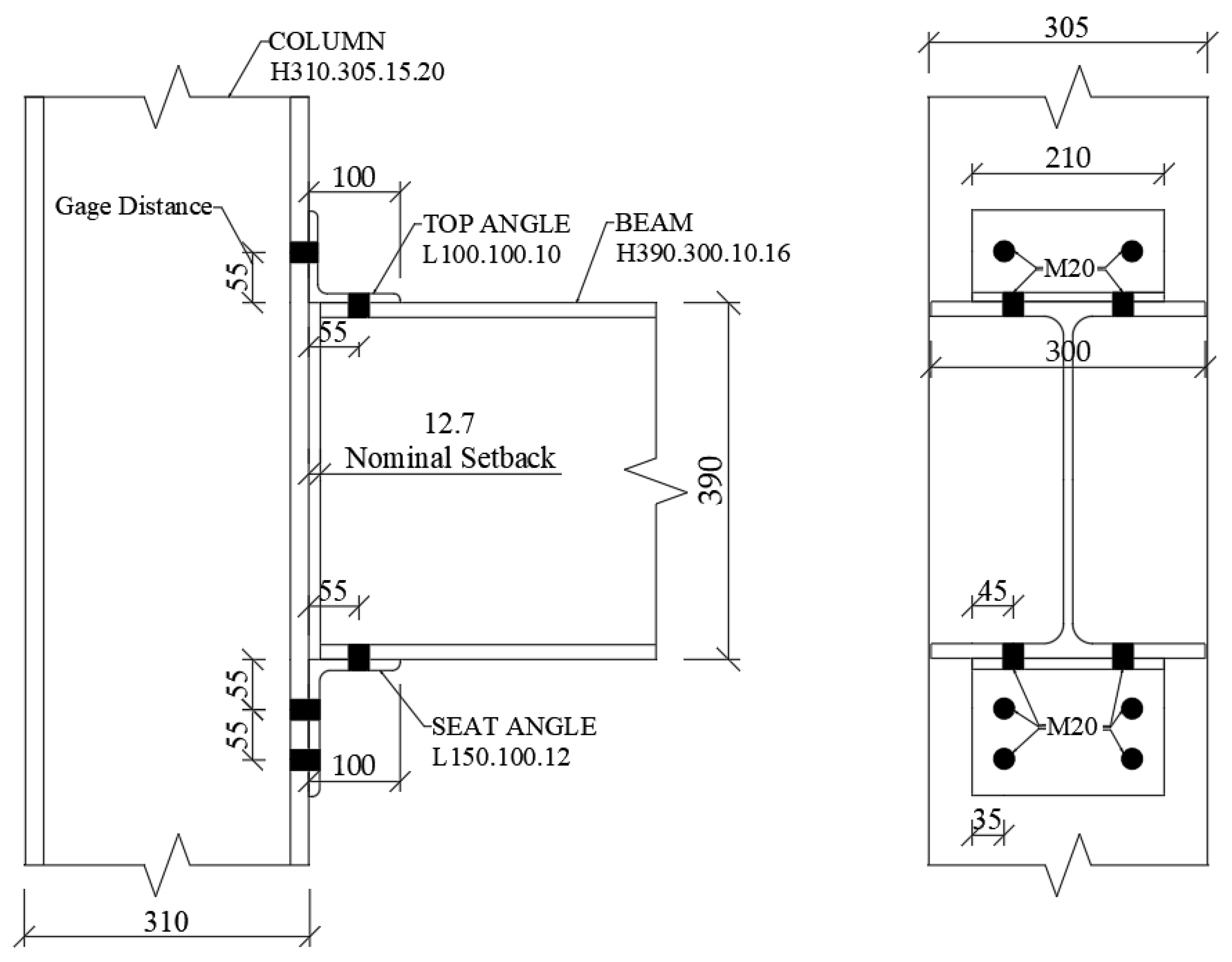
The accuracy of the nonlinear moment–rotation behavior of the TSAC modeled under monotonic loading was validated by comparing it with the experimental investigations carried out by Yang and Jeon [7]. The geometric properties of the T10-S12 specimen, for which the finite element model was created using Abaqus CAE v6.14 [36], are shown in Figure 1. The angles are connected to the column and beam flanges using M20 bolts and the bolt holes are designed with a diameter of 22 mm.
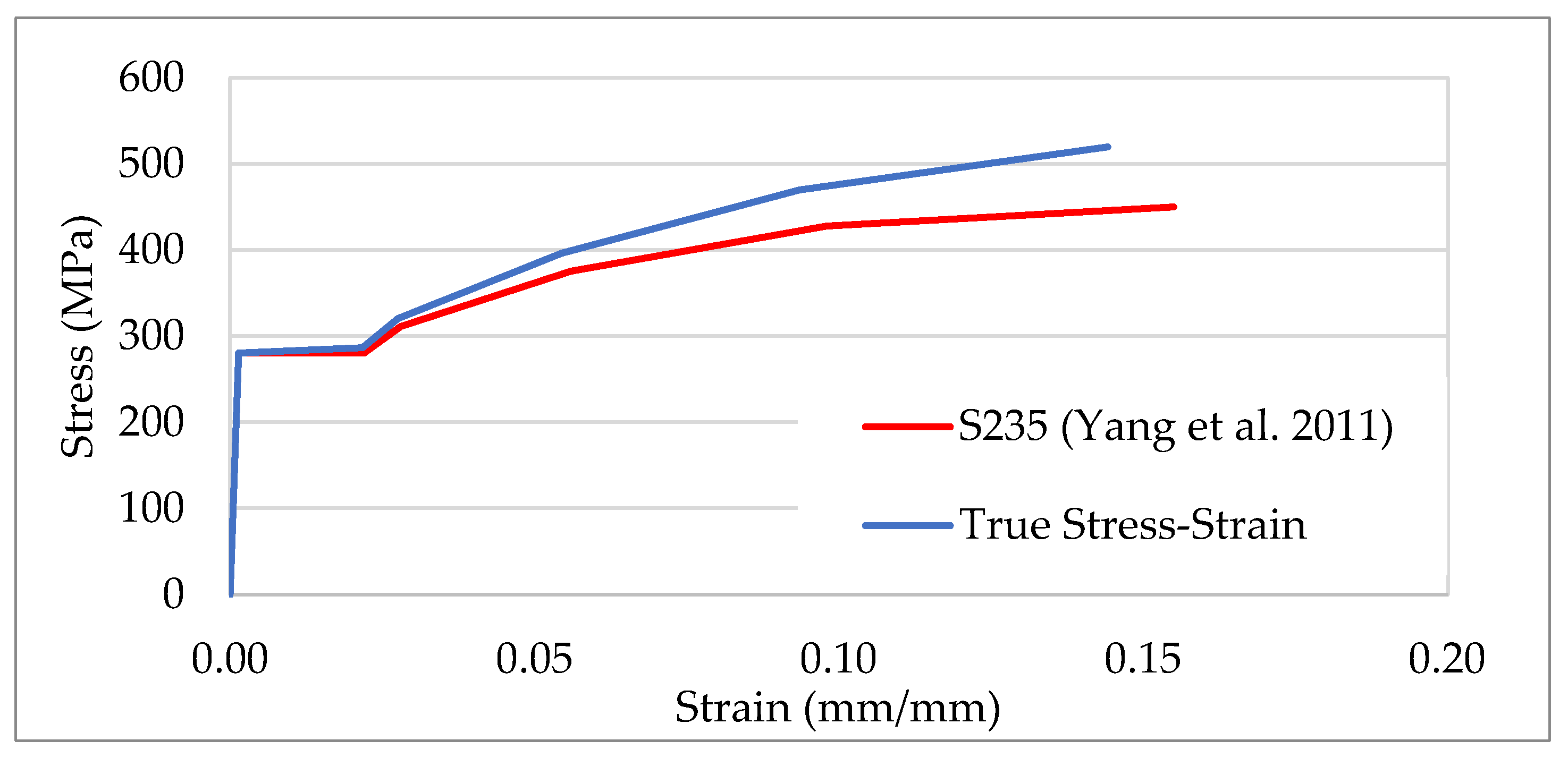
The average values derived from the coupon tests performed by Yang et al. [7] for the angles are 280 MPa for yield strength and 449.8 MPa for tensile strength. The true stress–strain curve was used as the material plastic property for the beam, column, and angle elements in the models as shown in Figure 2 [18]. The other properties of the material behavior were defined as a density of 7.85 × 10 9   t o n / m m 3 , a modulus of elasticity of 195,736   N / m m 2 , and a Poisson’s ratio of 0.3 . The material properties of the High Strength F10T grade bolts were defined based on the values derived from the tensile experiments performed by Yang et al. [14].
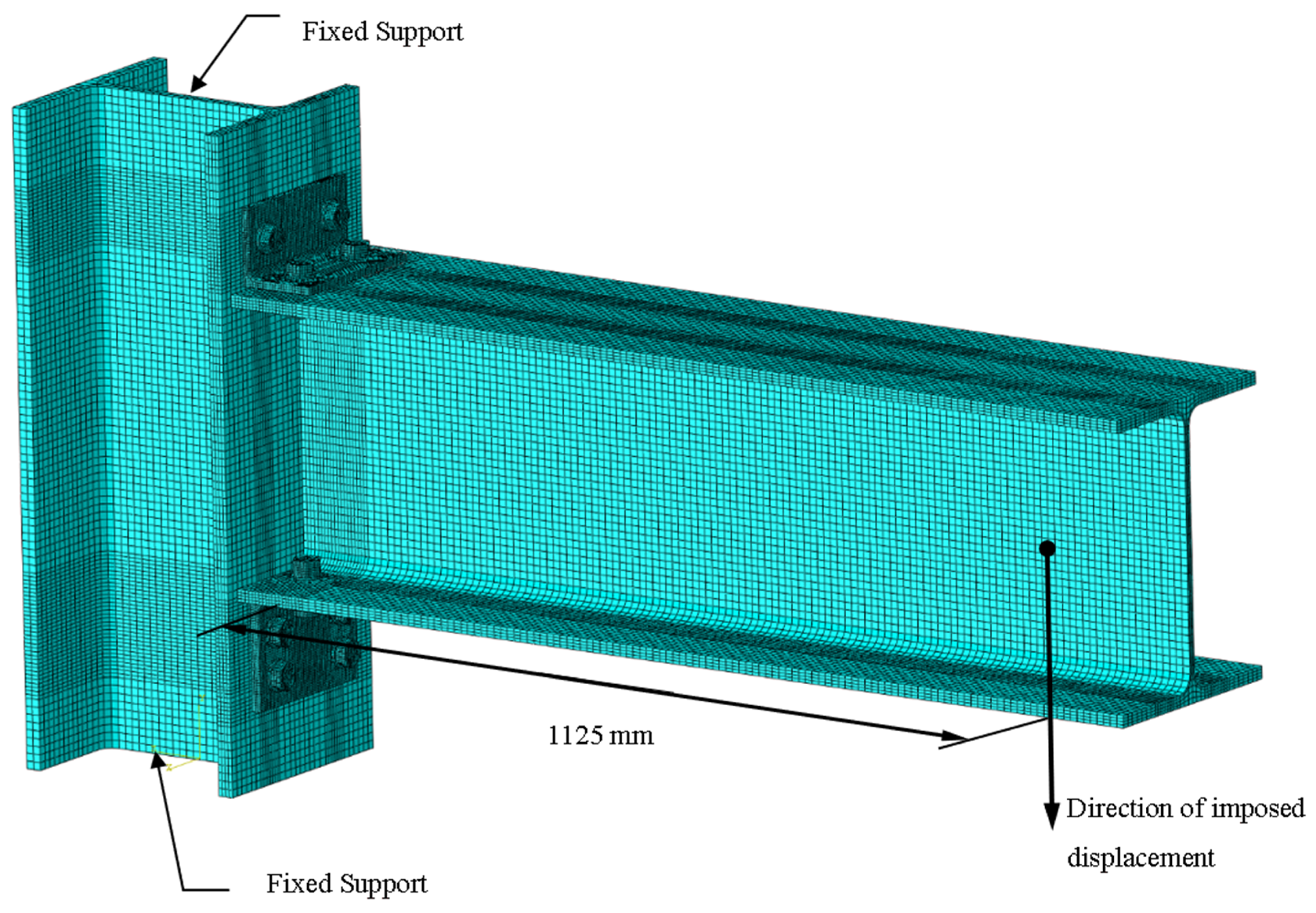
For all surfaces of the connected parts that were in contact with one another, the chosen algorithm was surface-to-surface contact. The surface of the component with coarser finite elements or the stiffer component was designated as the main (master) surface. To evaluate the relative sliding between the master and secondary surfaces in detail, the ‘‘finite sliding’’ formulation was selected. The tangential behavior between contacting components was characterized using a “penalty” friction formulation. Analyses conducted with various friction coefficients (0.2, 0.25, 0.3, and 0.35) showed that a value of 0.3 provided the best agreement [18]. The normal behavior between contacting components was characterized using ‘‘hard contact’’ to ensure full pressure transmission without penetration between the surfaces and it was allowed for the surfaces to separate after contact. The nodes on the top and bottom surfaces of the column cross-section, as shown in Figure 3, were restrained in all degrees of freedom to ensure fixed support conditions. The out-of-plane behavior of the connection was prevented. The longitudinal displacement of the beam was constrained at the displacement application point line in accordance with the experimental setup. In the analyses conducted in two loading steps, a bolt preload of 162 kN was first applied to a predefined section of the bolt shank using the ‘‘bolt load’’ command. In the second loading step, as shown in Figure 3, a displacement of 100 mm was imposed on the beam’s unsupported end in the positive direction, located 1125 mm away from the rotational center of the connection. For all components forming the connection, the reduced integration option was activated, and an 8-node linear brick was specified as the element type (C3D8R). C3D8R elements were subjected to a finite element mesh sensitivity study. A brief mesh convergence check was conducted to assess the sensitivity of the connection response to mesh density. Analyses with progressively refined meshes showed that the difference in the peak moment capacity was less than 2% compared to the adopted mesh. The mesh size was approximately calibrated to the following dimensions after the sensitivity analyses: in the case of the bolts, 3 mm; with the top-and-seat angles, 5 mm; and with beams and columns, 10 mm. The flanges of the beams and columns were meshed to include four elements through their thickness. To achieve more accurate results, the mesh size was refined in the interaction regions between the beams, columns, angles, and bolts.
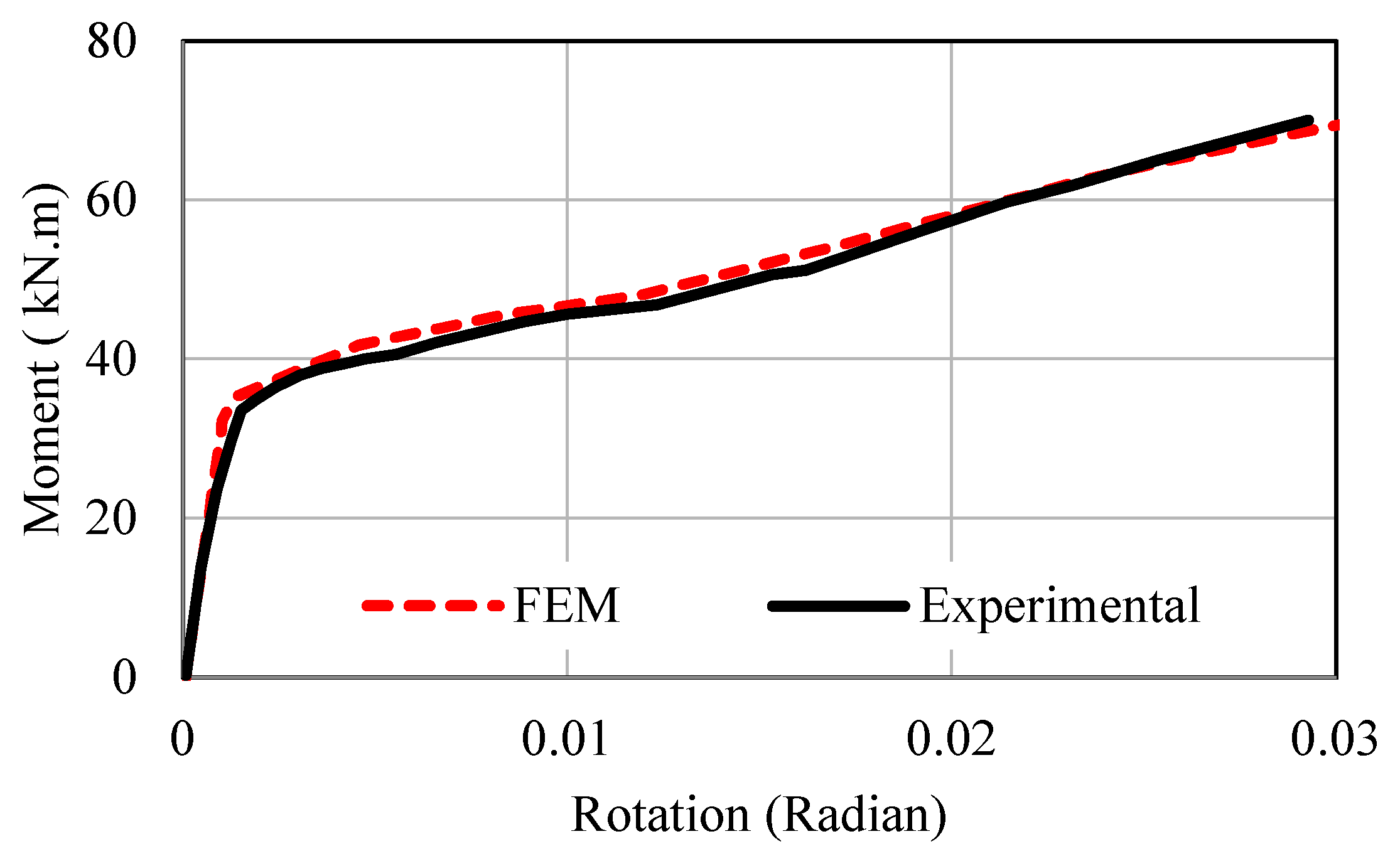
The moment–rotation (M-θr) curve derived from the FE analysis results of the TSAC under monotonic loading is then evaluated against the experimental M-θr curve of Yang and Jeon [7] in Figure 4. A connection rotation of 0.03 rad was adopted as the reference capacity limit in all analyses, consistent with previous experimental and numerical studies on top-and-seat angle connections [7,14,18]. This rotation level corresponds to extensive plastic deformation and significant stiffness degradation of the connection without a complete loss of load-carrying capacity [6,7,10,11]. Accordingly, analyses were terminated when the maximum connection rotation approached 0.03 rad. The comparison shows that the M-θr curve of the T10-S12 specimen derived from the FE analysis closely matches the corresponding experimental curve in the elastic and early plastic ranges, including the late plastic range as well. The ultimate moment from the FEA and the moment capacity of the connection corresponding to a rotation of 0.03 radians yielded the identical result as shown in Figure 4. TSAC modeling and ensuring the accuracy of the model were discussed in detail in the previous study [18].
Parametric studies were performed on TSAC’s validated FE model. The effects of top angle thickness, bolt diameter, and beam depth on the connection’s M-θr curve were investigated. Throughout the presentation of the moment–rotation results, positive bending corresponds to the connection response under gravity loading, which induces tension in the top angle and compression in the seat angle. Negative bending corresponds to the reverse moment direction caused by lateral loading at the frame level, leading to unloading and moment reversal at the beam–column joint. Thus, M-θr curves were obtained by applying displacements at the beam’s unsupported end in positive direction shown in Figure 3 and the opposite (upward) direction.
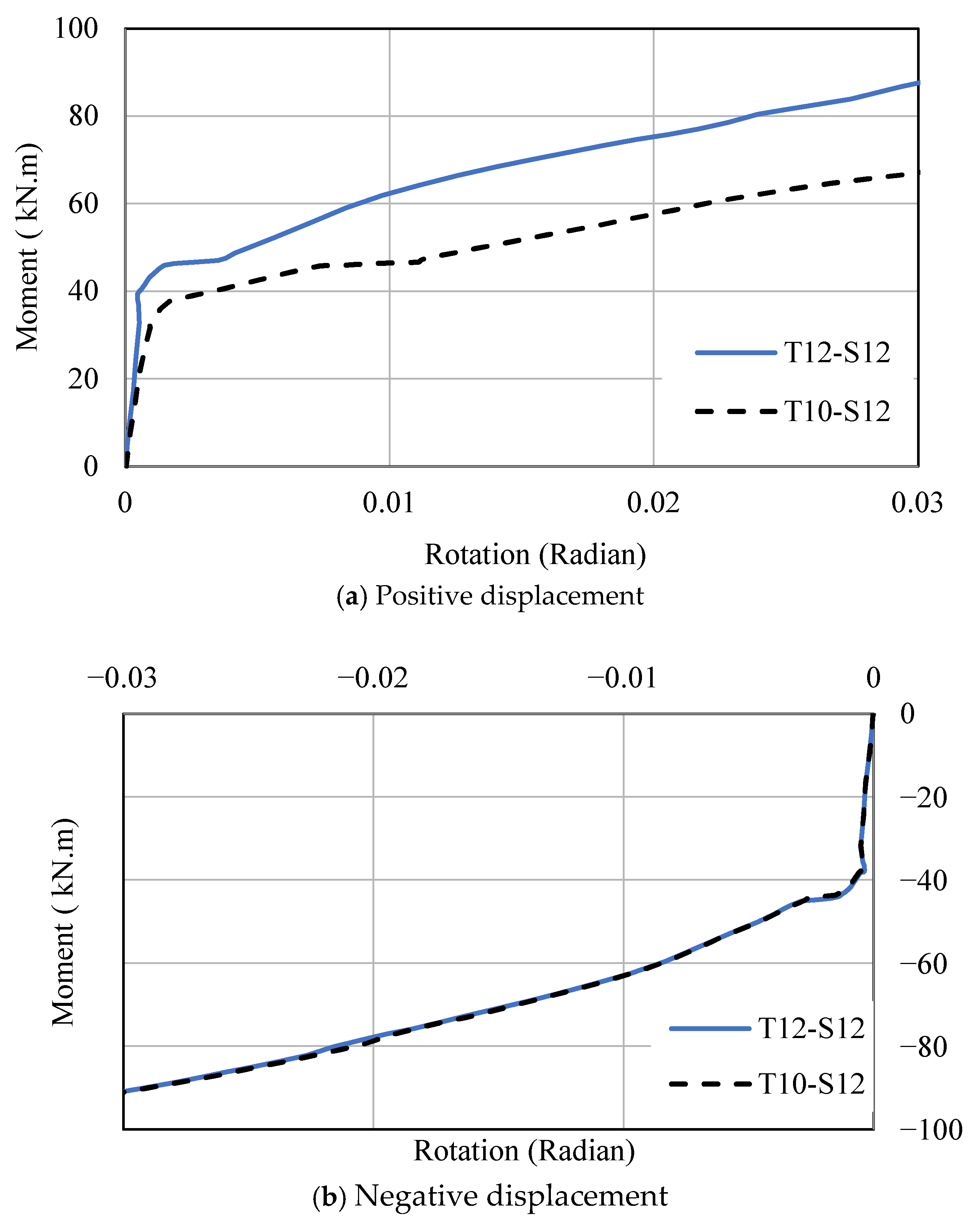
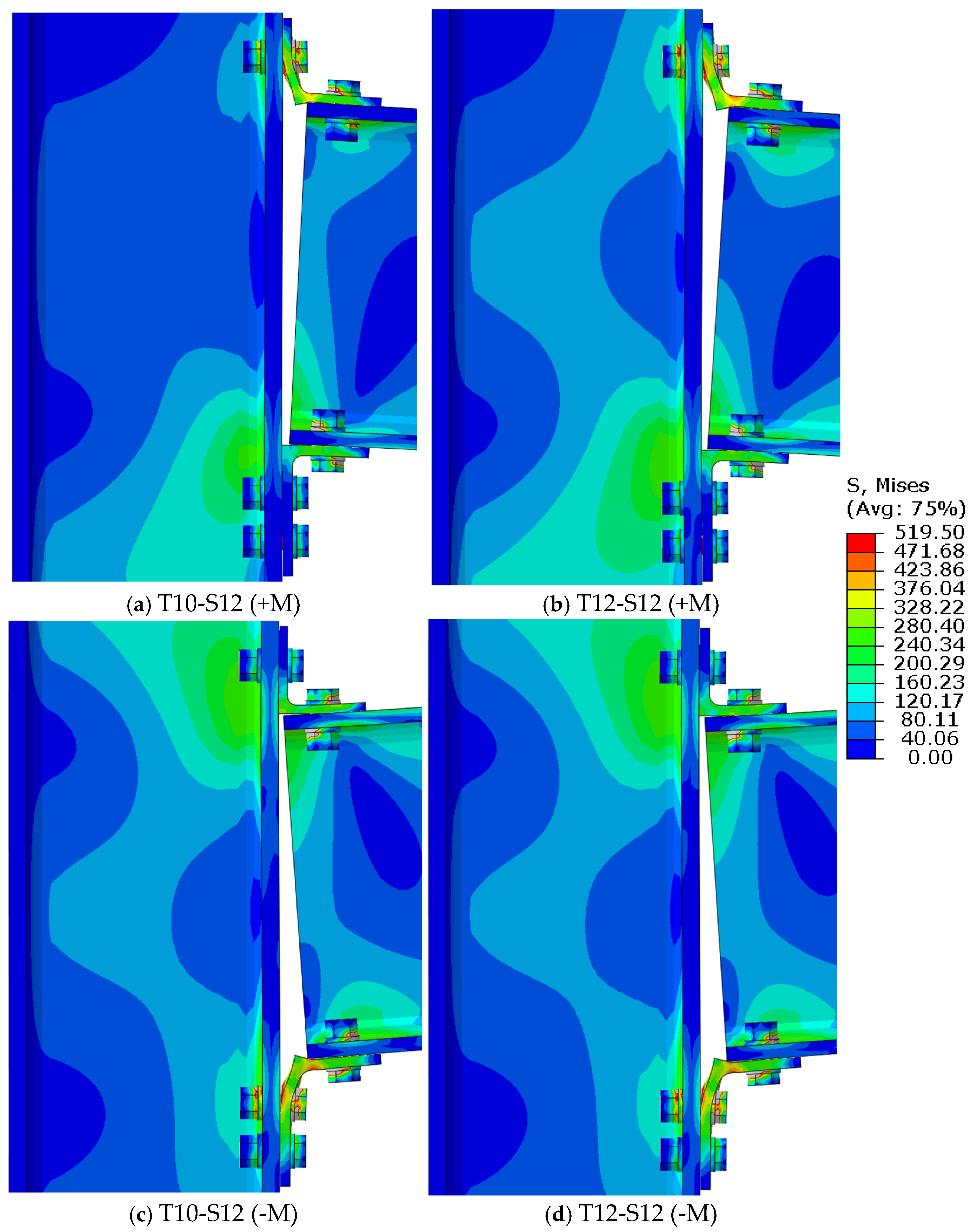
To consider the effect of top angle thickness on the M-θr curve, a connection with a 12 mm thick top angle was modeled. In FE models with top angle thicknesses of 10 mm and 12 mm, displacements were imposed on the beam’s unsupported end in the positive direction. The M-θr curves plotted using FEA are compared in Figure 5a. Increasing the top angle thickness enhances the initial rotational stiffness of the connection in the linear elastic portion of the M-θr curve. When the connections are compared at 0.03 radians of rotation, which is considered the moment capacity, it is observed that increasing the top angle thickness results in a 29% increase in moment capacity. In a steel frame under lateral load, the same connections are subjected to moments in opposite directions. Therefore, negative displacement in the upward direction was also applied to the beam’s unsupported end for the connections. As shown in Figure 5b, the thickness of the angle in the compression region has no significant effect on the connection’s moment–rotation curve. The deformation shapes of the connections under both displacements are shown in Figure 6. The contribution of the angle in the compression region to the connection’s stiffness and strength is seen to be negligible.
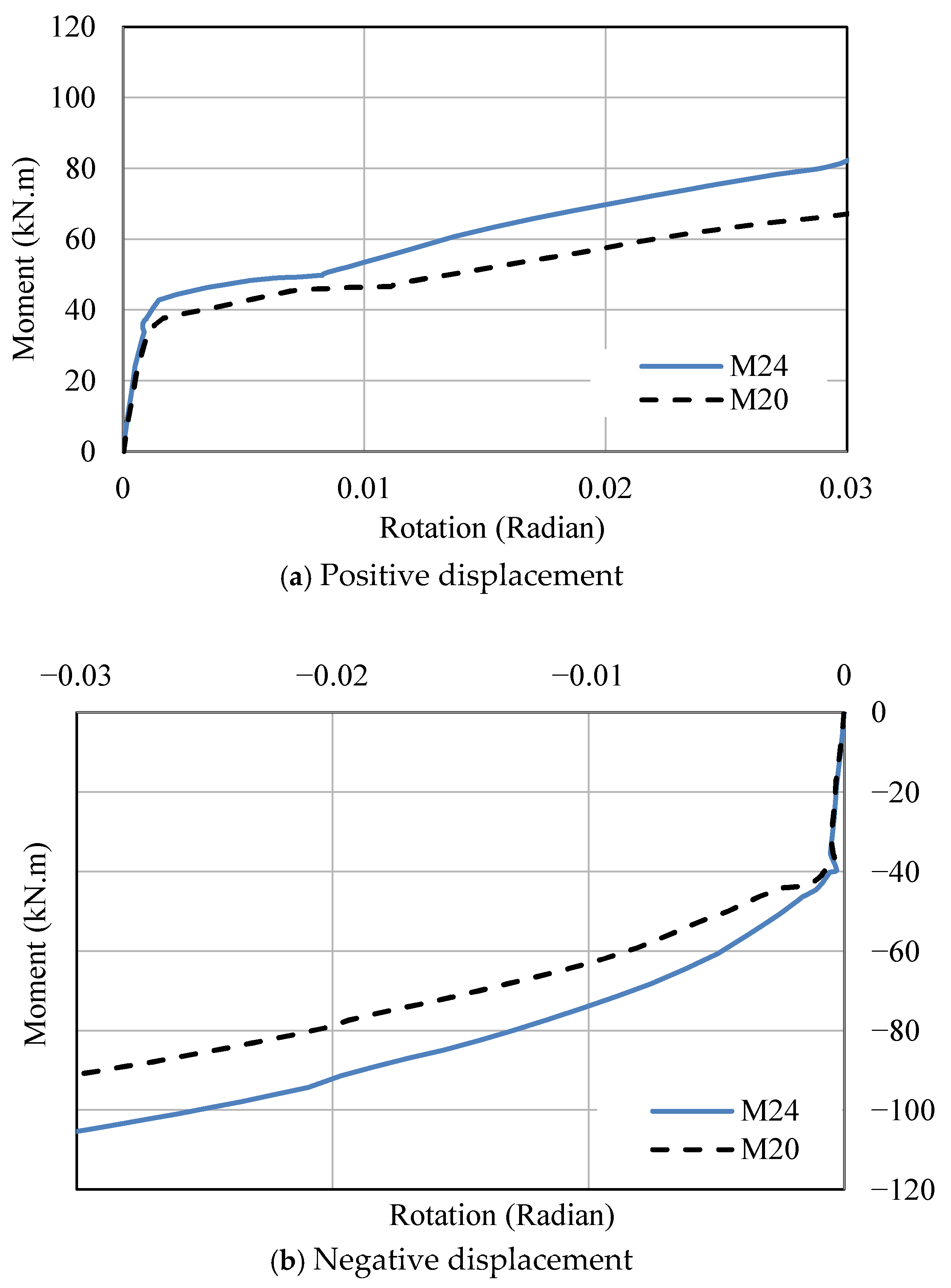
Finite element models were created using M20 and M24 bolts to examine the influence of bolt diameter on the M-θr curve. JIS B 1186 [38] specification was used as the basis for the geometric parameters of the M24 bolts and the diameter of the bolt holes in the connection was set to 26 mm. Positive displacement was applied to the beam’s unsupported end in the finite element models. The resulting moment–rotation curves are compared in Figure 7a. An increase in bolt diameter slightly contributes to the initial rotational stiffness in the elastic range of the M-θr behavior. When the connections are compared at 0.03 radians of rotation, as the bolt diameter is larger, it is observed that the ultimate moment value increases by 23%. In the FE models, negative displacement was imposed on the unsupported end of the beam. The resulting moment–rotation curves are compared in Figure 7b. As expected, the increase in bolt diameter slightly enhances the stiffness of the connection in the elastic range of the M-θr behavior. With the larger bolt diameter, the connection strength corresponding to 0.03 radians of rotation increased by 15%.
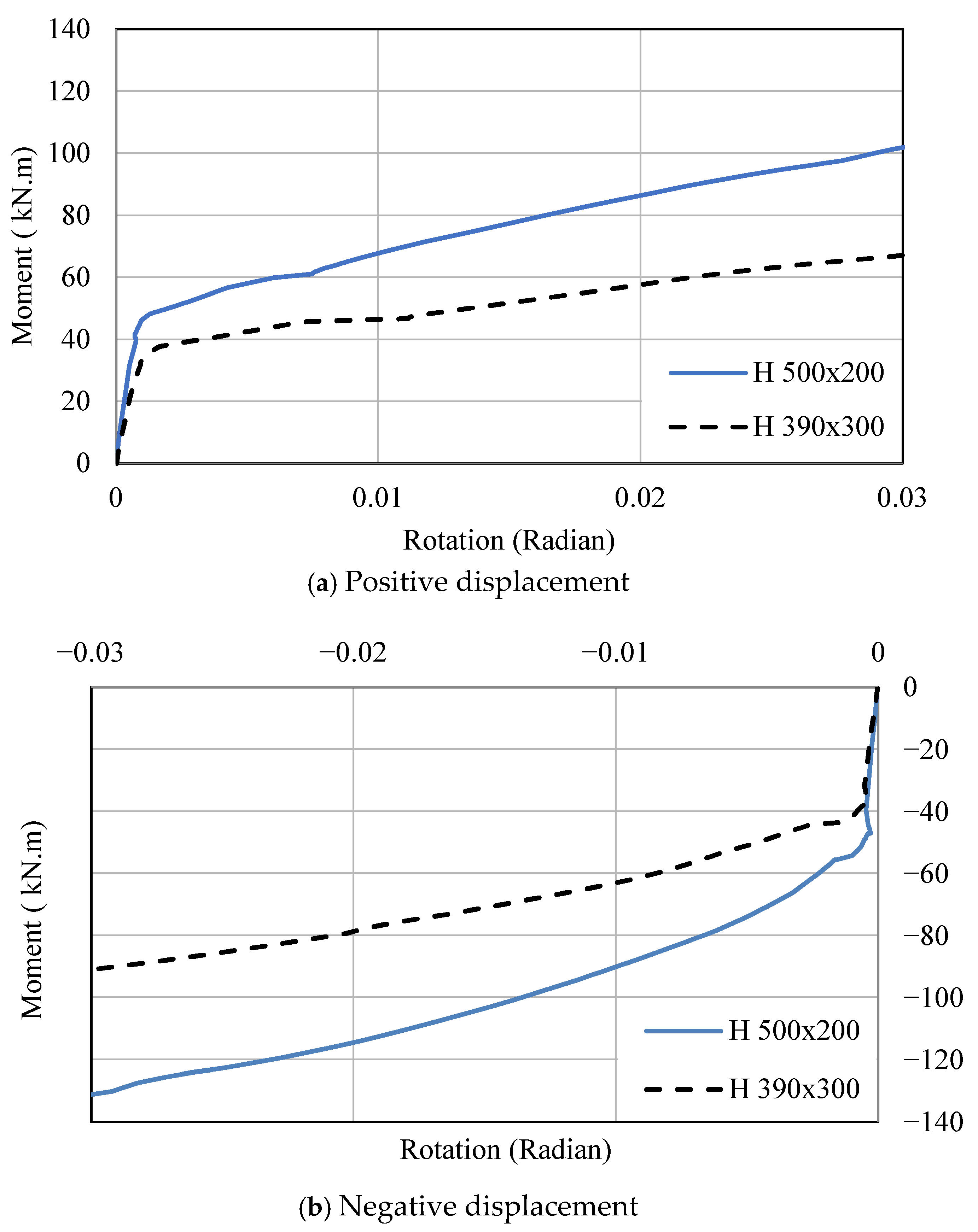
To investigate the effect of beam depth on the connection’s moment–rotation curve, a H 500x200x10x16 profile was defined in the FE models. The web and flange thicknesses of the H 500x200x10x16 profile are identical to those of the H 390x300x10x16 profile used in the main connection, but its cross-sectional area is 16% smaller. The M-θr curves of the models, where positive displacement was applied to the beam’s unsupported end, are shown in Figure 8a. When the H 500x200 profile is used instead of the H 390x300 profile, the initial rotational stiffness of the M-θr curve increases significantly, and the moment capacity corresponding to 0.03 radians increases by 51%. The M-θr curves of the finite element models, where negative displacement was applied, are compared in Figure 8b. Increasing the beam depth enhances the connection’s initial stiffness and simultaneously increases its moment capacity by 44%.

2.2. Base Shear–Displacement Curve of Steel Frame with Tsac

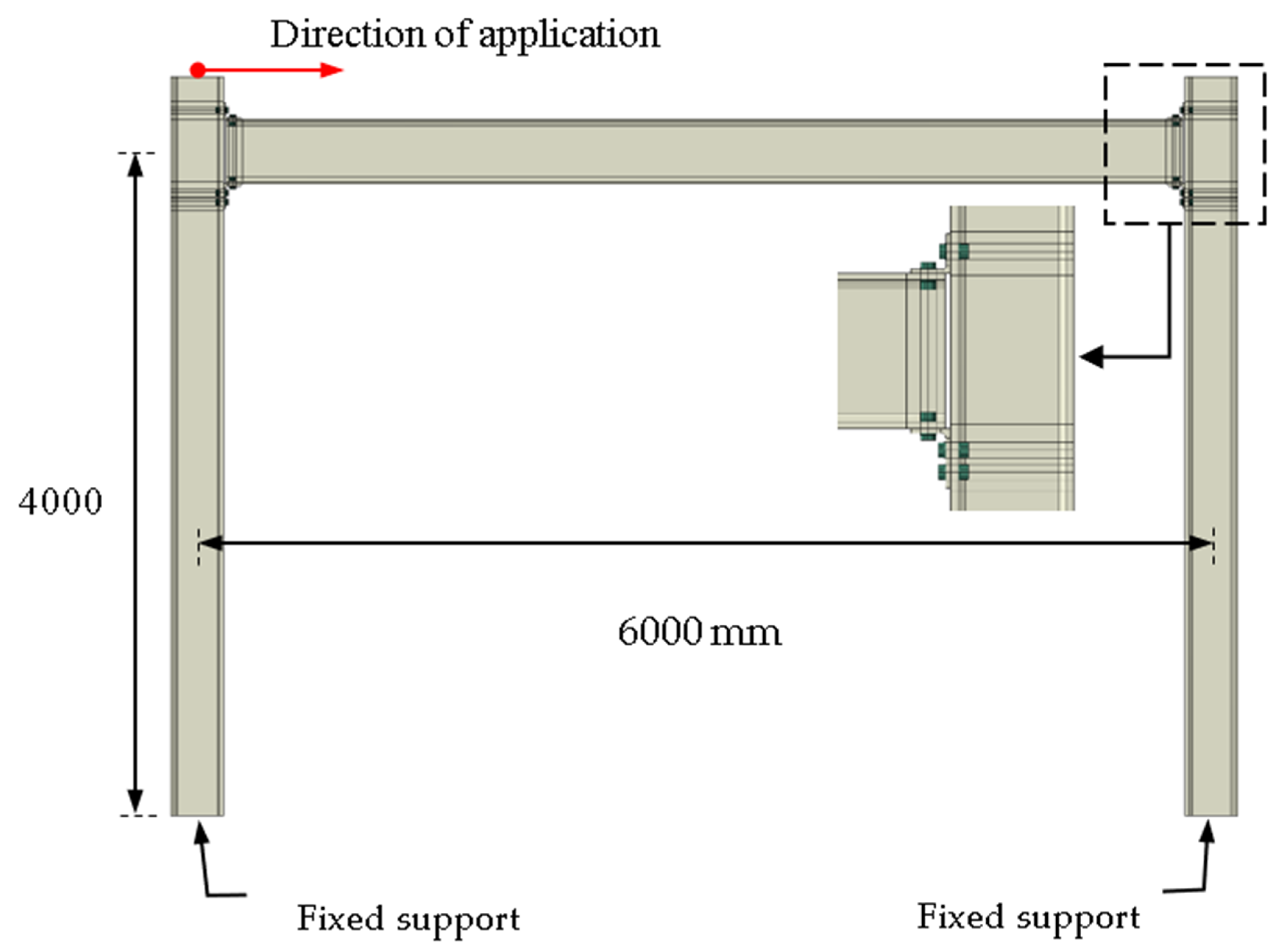
To perform nonlinear static analysis, a steel frame composed of validated T10-S12 connections shown in Figure 9 was modeled in Abaqus/CAE v6.14 software. The geometric properties of the modeled steel frame are shown in Figure 9. The cross-sectional dimensions of the H 390x300x10x16 profile for the beam elements and the H 310x305x15x20 profile for the column elements were defined in the frame model. The nodes on the column’s bottom surface were constrained in all degrees of freedom to ensure fixed support conditions. During the nonlinear static analysis, the out-of-plane behavior of the frame was prevented. The analysis was conducted in three loading steps. A bolt preload of 162 kN was applied to a predefined section of the bolt shank using the ‘‘bolt load’’ command. A vertical load of 0.017337 N/mm2 was applied to the top flange of the beam at a height of 4000 mm from the ground using the ‘‘pressure’’ command. In third loading step, a displacement of 120 mm was applied monotonically in the lateral direction shown in Figure 9. The cross-section nodes located at the top of the column were linked to a reference point assigned to the cross-section center using a “constraint”. The displacement was applied from the reference point, ensuring that no deformation occurred in the column body while the steel frame was displaced. During this loading sequence, connections initially experience positive bending due to gravity effects and subsequently undergo unloading and moment reversal as lateral loading increases. All positive and negative moment–rotation comparisons presented in this study are interpreted within this loading sequence and sign convention. Following the conclusion of the analysis, the reaction forces at the application point of displacement were recorded and the base shear–displacement curve of the frame was generated.
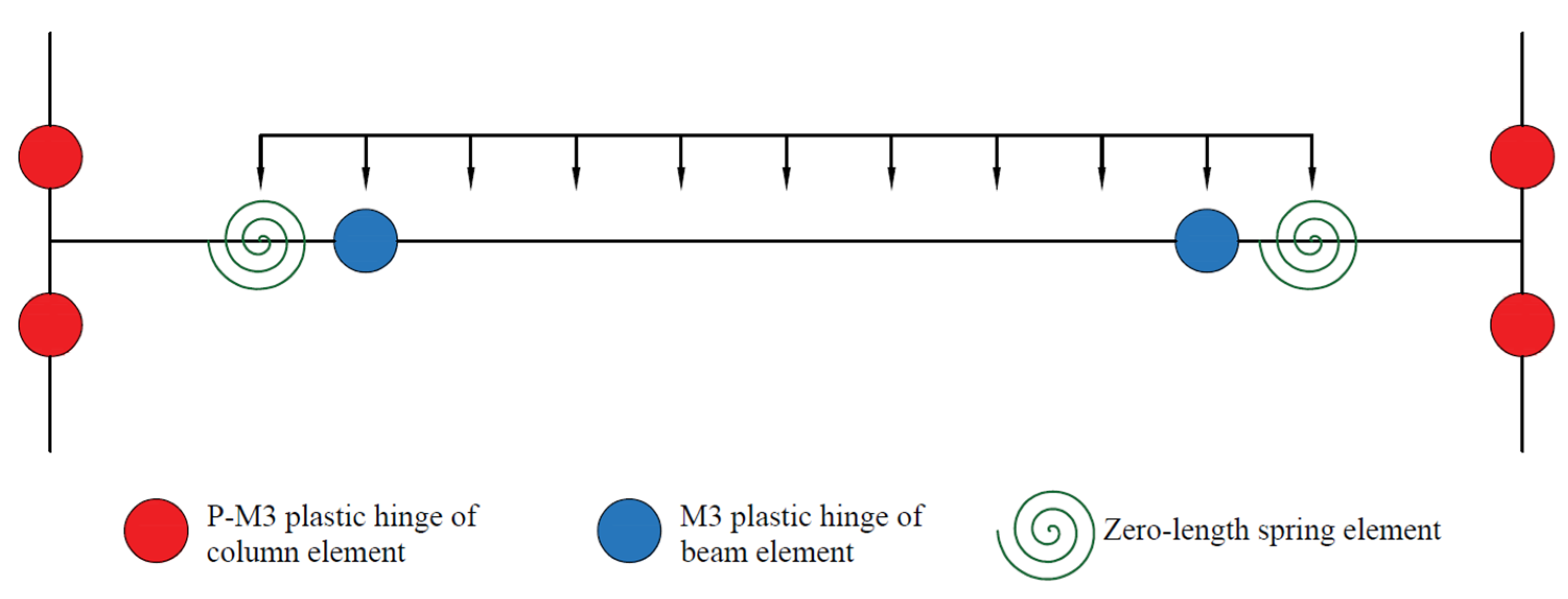
A practical modeling workflow is proposed in which the finite element-derived monotonic moment–rotation curves of the connections are implemented using zero-length rotational link elements in the SAP2000 v21 structural analysis program. The engineering stress–strain curve for SS400 steel was defined as the nonlinear material property for the column and beam elements [14]. The same cross-sectional properties for the beam and the column elements were created by selecting the predefined SS400 steel material in the SAP2000 models. Plastic hinges were used to represent the force–deformation relationship of the elements, accounting for material nonlinearity. The properties of the plastic hinges were automatically calculated based on the material and cross-sectional properties of the elements and assigned to the beam and column ends. Plastic deformations in terms of displacement and rotation occur only at these points. Combined P-M3 hinges were used for column elements, and M3 hinges were assigned to beam elements. In the nonlinear static analysis, nonlinear geometric behavior (P-Δ and P-δ effects) was included by activating the P-Delta option in the software.
A schematic representation of the node-splitting and zero-length link definition procedure adopted in the present study is presented in Figure 10. At the node where the beam and column are connected, a slight overlap occurs between the cross-sections of the elements. The beam element is divided into separate segments at i and j ends by overlapping lengths extending from the nodes to the flange surface of the column cross-section. Thus, two new elastic beam elements are created, one at the beginning and one at the end of the main beam. The line elements formed by the division are assigned “End Offsets” along their lengths, reducing the total span length of the steel frame to the clear distance between the column surfaces.
The common node between the main line element and the divided line element is edited to separate into element end nodes that are located in the same position in space but disconnected from each other. The element end nodes in the same spatial position are selected sequentially, and a two-point link element is drawn between them. This creates a zero-length spring element that more accurately represents the connection behavior. The goal is to neglect translational and rotational deformations caused by weak-axis bending moments, axial forces, shear forces, and torsional moments, while considering rotational deformations caused by strong-axis bending moments.
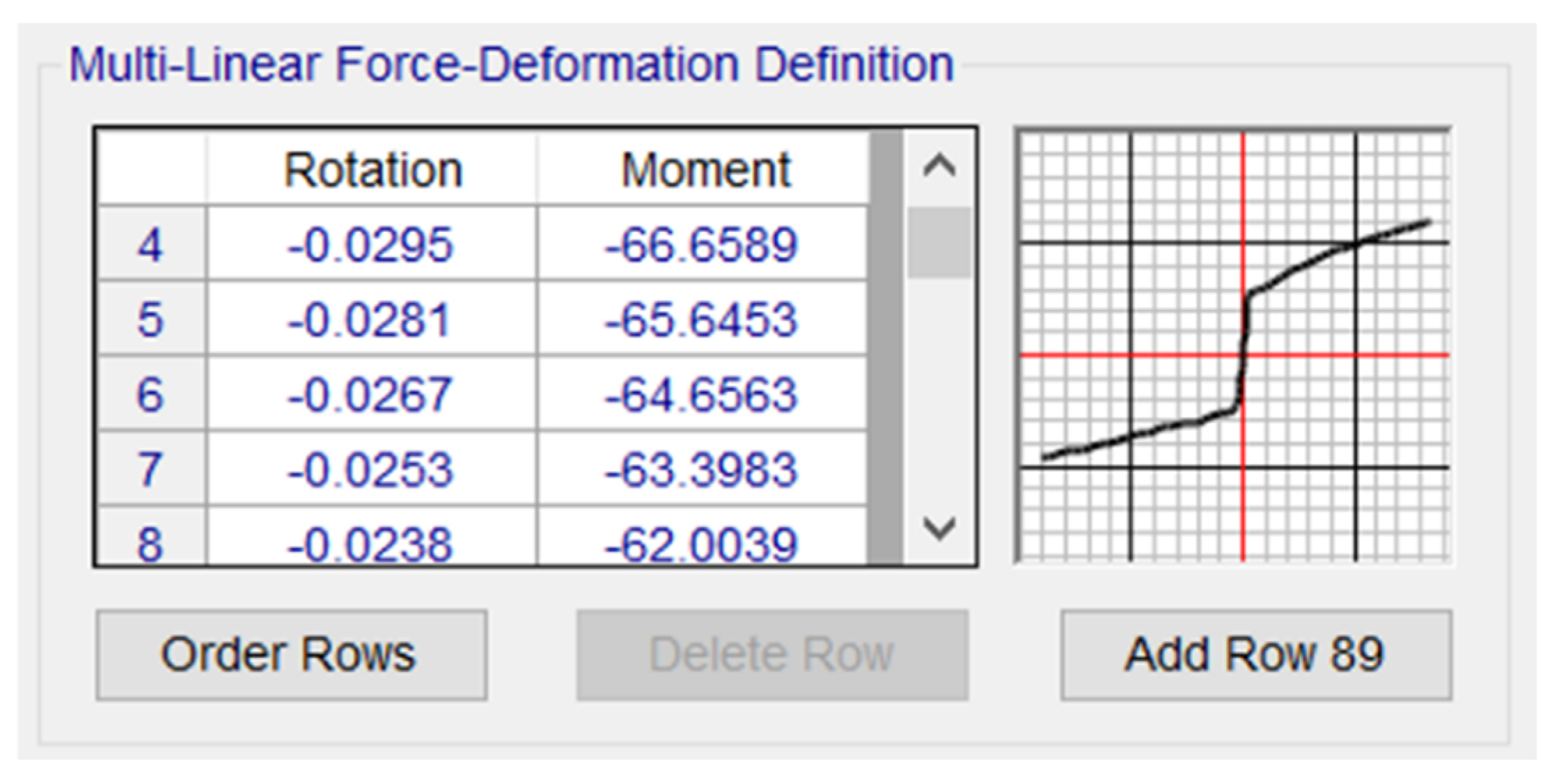
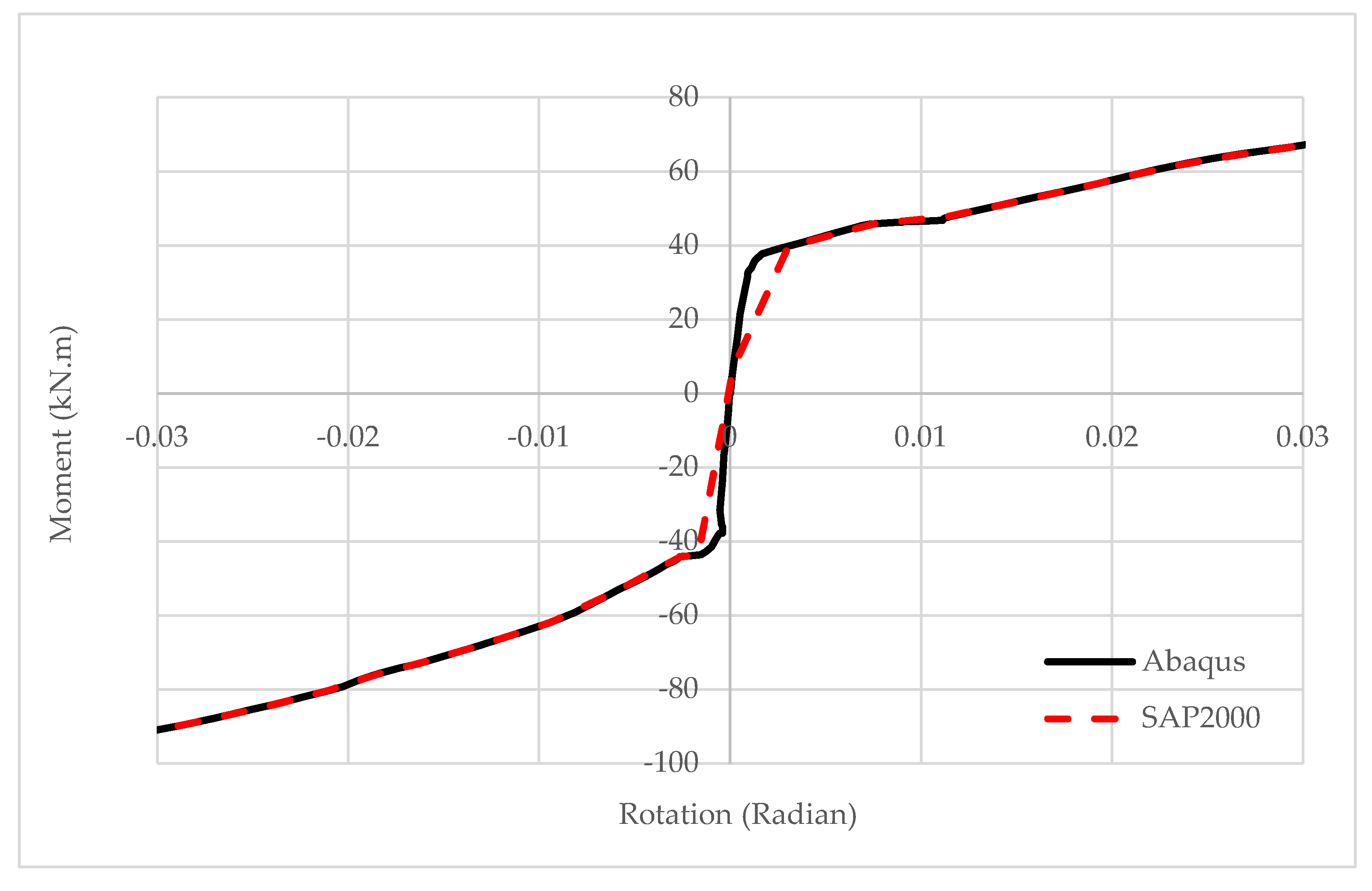
The nonlinear beam–column connection behavior is defined in SAP2000 by selecting the multilinear elastic rotational link element type, as shown in Figure 11. Moment–rotation points were extracted from the Abaqus monotonic M-θr response of T10-S12 connection model (Figure 5) and given in the link definition. This full data set was reduced to a 15-point piecewise–linear representation as given in Table 1. Positive and negative branches were retained to preserve directional asymmetry. No hysteretic degradation, stiffness pinching, or energy dissipation is modeled within this link formulation. Accordingly, the stiffness changes observed in the frame response during the gravity-plus-lateral loading sequence result from moment reversal relative to the monotonic moment–rotation envelope, rather than from cyclic inelastic effects. The moment–rotation points of T10-S12 connections on the top left and right side of the frame were extracted from the gravity-plus-lateral pushover analysis in SAP2000 as given in Table 1. The moment–rotation path of the multilinear elastic rotational link was compared with the predefined monotonic envelope curve in Figure 12. After the gravity-induced positive bending is established, the connections unload and subsequently follow the monotonic envelope during lateral loading.
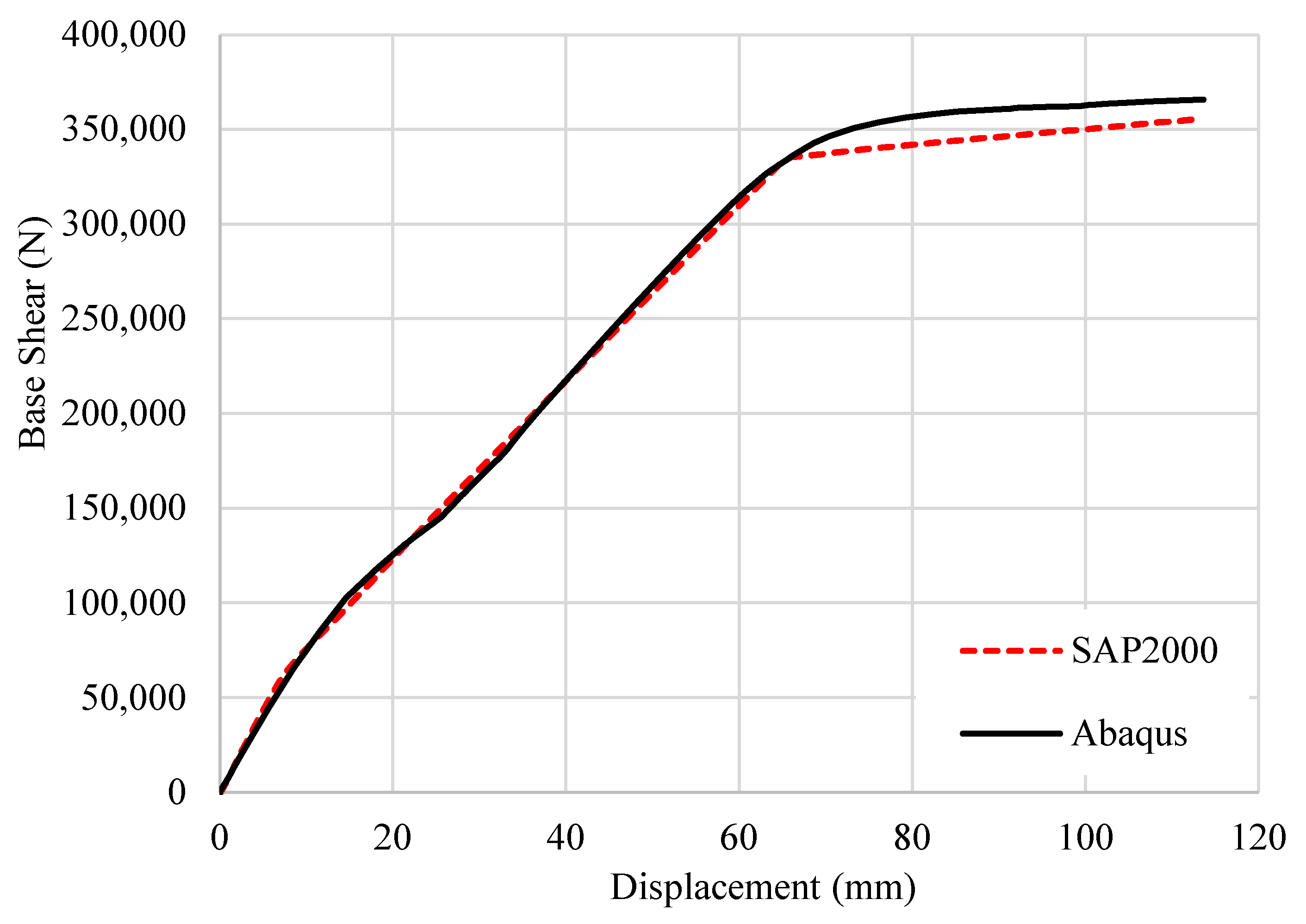
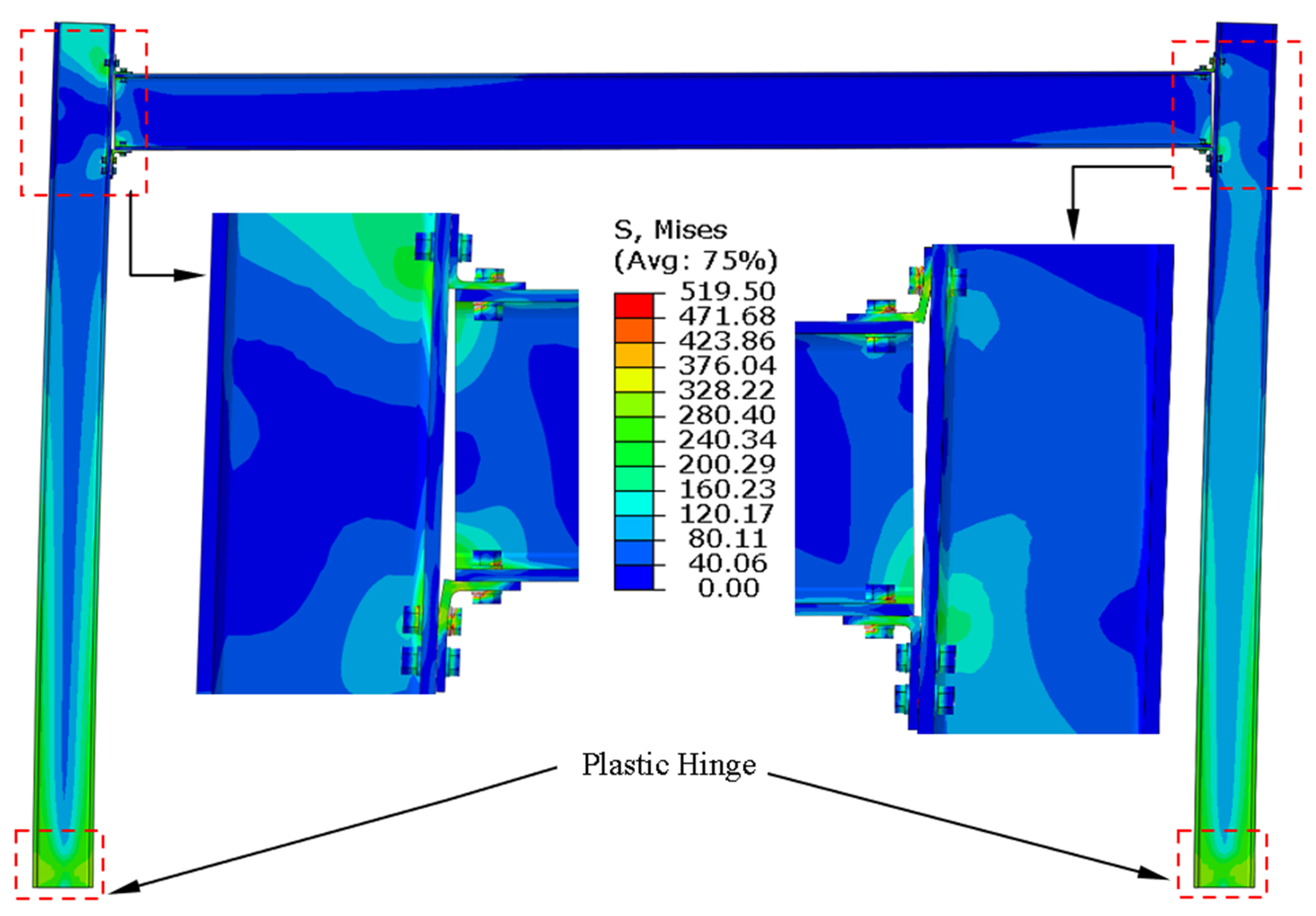
Nonlinear static analyses were performed using displacement control without the use of artificial damping, numerical stabilization, or stiffness regularization techniques. Convergence was achieved using the default SAP2000 nonlinear solver with geometric nonlinearity (P-Δ effects) enabled. This modeling approach ensures a transparent and reproducible implementation of semi-rigid connection behavior at the structural level. The base shear–displacement curves of the steel frame with T10-S12 connections, derived through nonlinear static analysis in SAP2000 and Abaqus, are compared in Figure 13. Under vertical loading, the connections at the beam ends in a steel frame are subjected to equal and same-direction moments. When the lateral displacement is then applied to the steel frame, one connection continues to experience moments in the same direction, while the other connection is subjected to moments in the opposite direction. In the latter connection, the moment is initially unloaded according to the moment–rotation behavior, and then it is loaded in the opposite direction. As a result, the instantaneous stiffness of the connections under lateral loading varies depending on the magnitude of the vertical load and the characteristics of the moment–rotation curve of the connections. Significant rotational deformations occur in semi-rigid connections while transferring moments between elements. The initial stiffness of the capacity curves compared in Figure 13 is determined by the initial stiffness of the connections. When a displacement of approximately 6 mm is applied to the steel frame, plasticity begins to form around the bolt holes and on the surfaces of the angles in the connection that continues to be loaded in the positive direction. As the connection becomes plastic, its stiffness decreases from the values in the elastic region of the moment–rotation curve to those in the plastic region. Consequently, after 6 mm displacement, the stiffness of the capacity curve begins to decline. When the displacement applied to the steel frame reaches 9 mm, plasticity begins to form around the bolt holes and on the surfaces of the angles in the connection that continues to be loaded in the negative direction. As the connection further becomes plastic, its stiffness continues to decrease, leading to a further reduction in the stiffness of the capacity curve. Under lateral loading, connections reaching the plastic region of their moment–rotation behavior cause minor changes in the stiffness of the steel frame as the displacement is incrementally increased. When the top displacement approaches approximately 66 mm, the stress at points on the flanges of the column profiles, which are fixed at their bottom nodes, reaches plastic values. As plasticity begins in the flanges of the column profiles and spreads toward the web with increasing displacement, the lateral stiffness of the frame significantly decreases. The deformation shape of the steel frame, the stress distributions of the connections, and the plastic hinges formed at the end of the analysis are shown in Figure 14. The analyses were terminated when the rotational deformations of the connections reached values around 0.03 radians, which are considered the capacity. The base shear forces obtained from the capacity curves compared in Figure 13 show a difference of less than 3% in the final state.

2.3. Effect of Connection Parameters on Base Shear–Top Displacement Curve

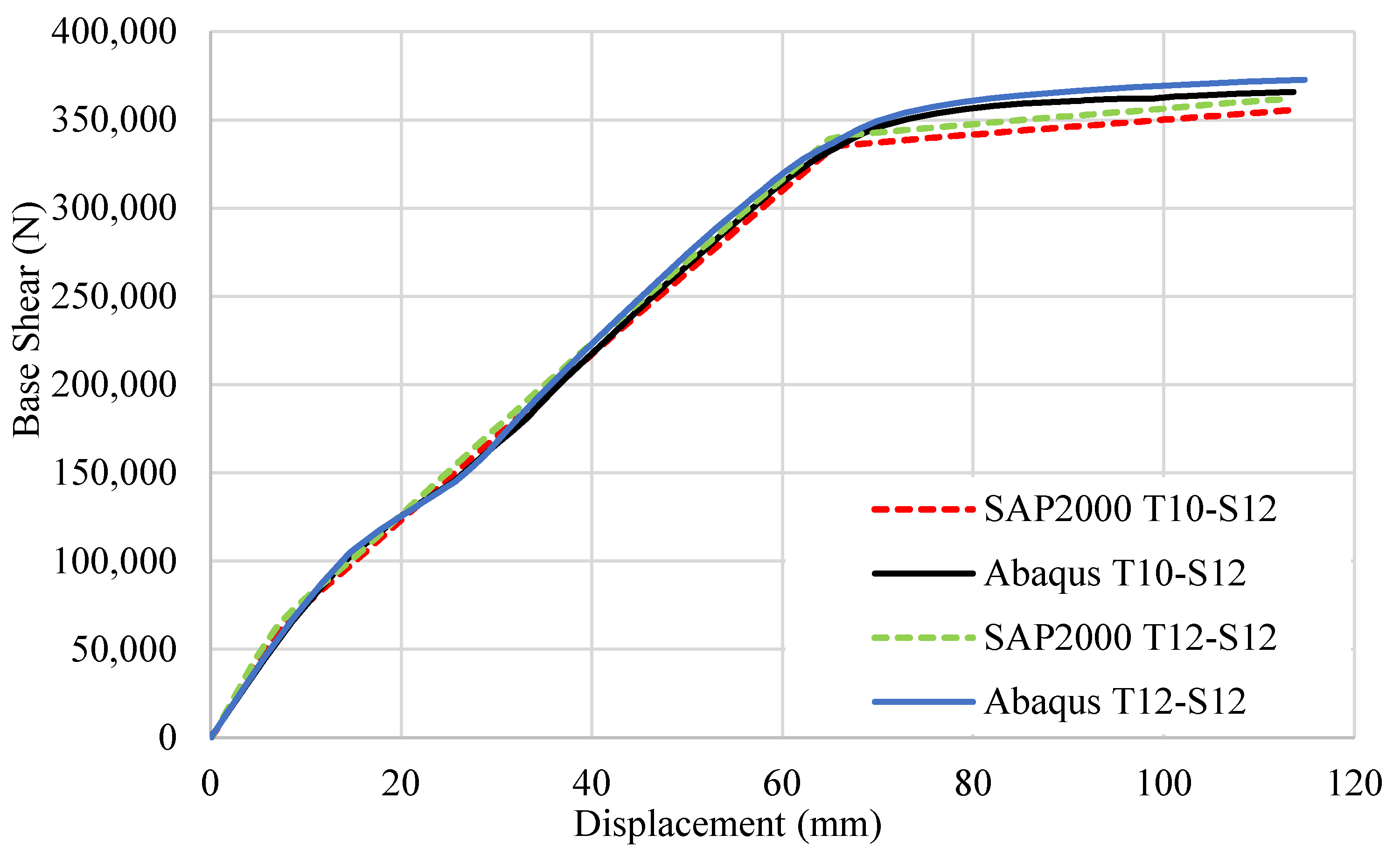
Connections modeled to investigate the effects of top angle thickness, bolt diameter and beam depth on the M-θr curve were utilized in the steel frames to examine the influence of these same parameters on the nonlinear static analysis. To observe the effect of top angle thickness on the base shear–top displacement curve, a steel frame composed of connections with 12 mm thick top angles was modeled. Moment–rotation data extracted from the Abaqus monotonic M-θr response of T12-S12 connection model is given in Table A1 in Appendix A and defined in the link definition. The base shear–top displacement curves of steel frames with T10-S12 and T12-S12 connections, obtained through nonlinear static analysis in SAP2000 and Abaqus, are compared in Figure 15. During the initial loading steps, where the connections remain in the elastic region, an increase in top angle thickness slightly enhances the stiffness of the capacity curve. At a top displacement of 40 mm, where the connections respond according to the plastic regions of their moment–rotation curves and the columns behave elastically, an increase in angle thickness results in 3% more base shear force. In the final state, where the connections reach approximately 0.03 radians of rotation and plastic hinges form in the columns, an increase in top angle thickness leads to 2% more base shear force.
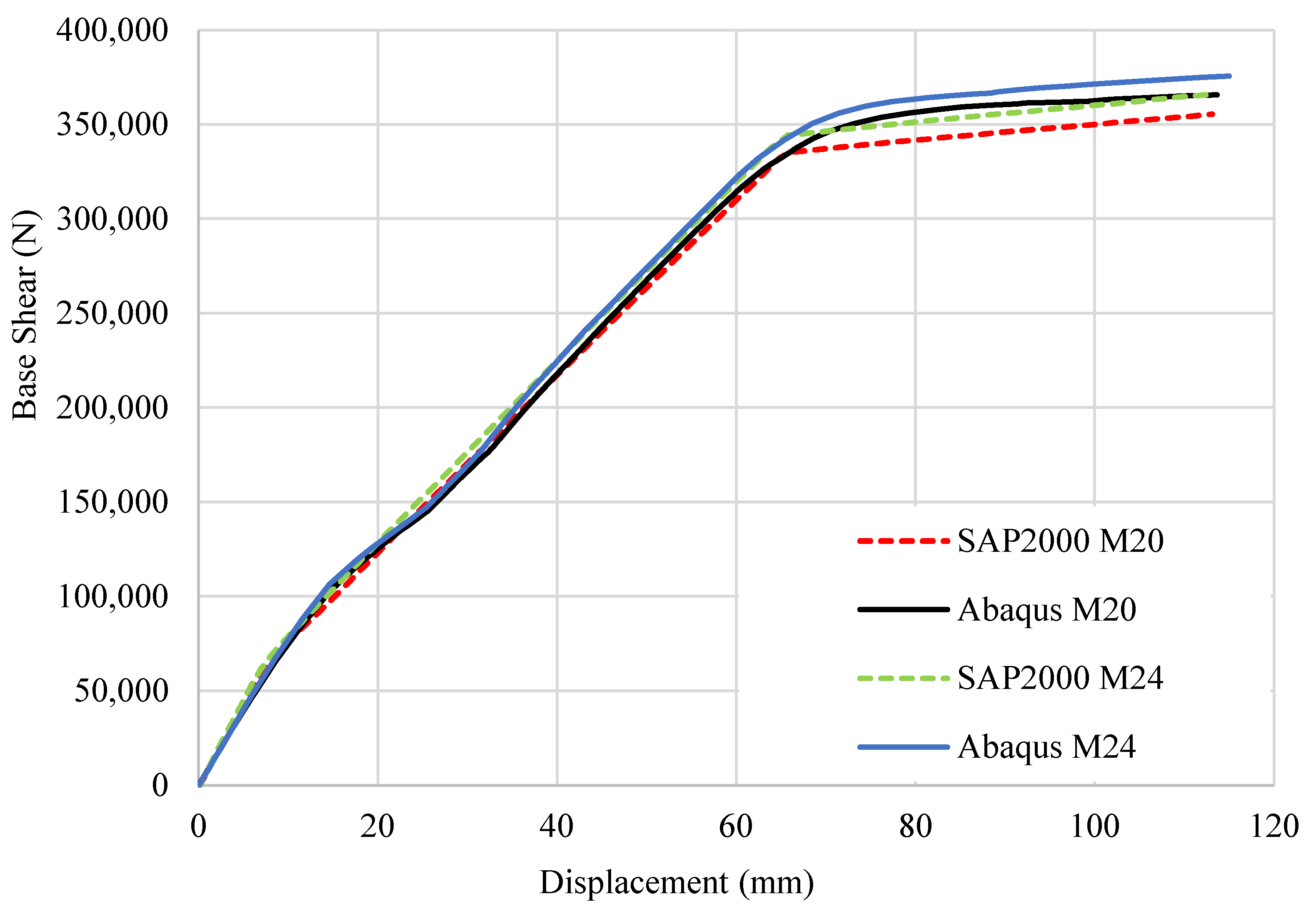
To observe the effect of bolt diameter on the base shear–top displacement curve, a steel frame composed of connections with 24 mm diameter bolts was modeled. Moment–rotation data extracted from the Abaqus monotonic M-θr response of M24 connection model is given in Table A2 in Appendix A. The base shear–top displacement curves of steel frames with M20 and M24 connections, obtained through nonlinear inelastic static analysis in SAP2000 and Abaqus, are compared in Figure 16. During the initial loading steps, where the connections remain in the elastic region, an increase in bolt diameter slightly enhances the stiffness of the capacity curve by negligible amounts. At a top displacement of 40 mm, where the connection behavior occurs in the plastic region of the moment–rotation curve and the column stresses have not reached yield values, an increase in bolt diameter results in 4% more base shear force. At a top displacement of 113 mm, where the connections approach their rotational capacities and plastic hinges form at the column bases, an increase in bolt diameter leads to 3% more base shear force than the model with M20 bolts.
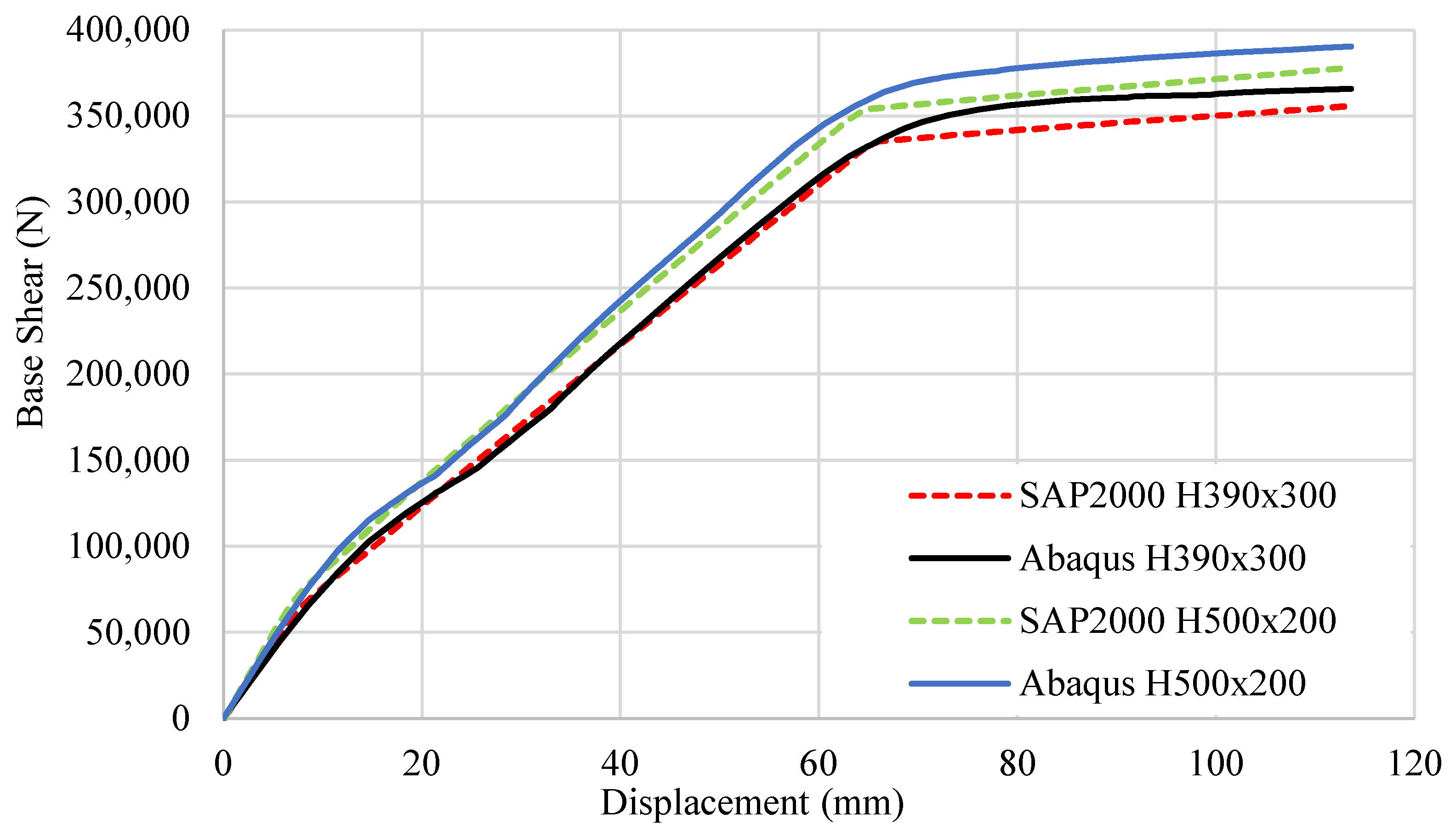
To observe the effect of beam depth on the base shear–top displacement curve, a steel frame with a H 500x200x10x16 profile beam was modeled. Moment–rotation data extracted from the Abaqus monotonic M-θr response of H500x200 connection model is given in Table A3 in Appendix A and defined in the link definition. The base shear–top displacement curves of steel frames with H 390x300 and H 500x200 connections, obtained through nonlinear inelastic static analysis in SAP2000 and Abaqus, are compared in Figure 17. During the initial loading steps, where the connections remain in the elastic region, an increase in beam depth visibly enhances the stiffness of the capacity curve. At a top displacement of 40 mm, where the connections respond according to the plastic regions of their moment–rotation curves and column stresses have not reached yield values, an 11% higher base shear force is achieved with increased beam depth. With increased beam depth, at a top displacement of 113 mm, where the connections approach their rotational capacities and plastic hinges form at the bottom ends of the columns, a 7% higher base shear force is obtained.

3. Conclusions

This study investigated the nonlinear monotonic behavior of unstiffened top-and-seat angle connections and its influence on the global response of steel frames subjected to gravity and lateral loading. A three-dimensional finite element model of the connection was developed and validated against experimental moment–rotation data, providing confidence in its ability to capture elastic, plastic, and late-stage stiffness characteristics. Parametric investigations showed that increasing top angle thickness, bolt diameter, and beam depth enhances both the initial rotational stiffness and the ultimate moment capacity of the connection. Due to the asymmetric geometry of TSACs, the connection response differs under positive and negative bending moments, which leads to direction-dependent stiffness and strength contributions at the frame level. When the validated monotonic moment–rotation curves were incorporated into nonlinear static analyses of steel frames, significant stiffness changes were observed during gravity-plus-lateral loading due to connection unloading and reloading. The proposed SAP2000 modeling workflow, based on zero-length rotational link elements obtained using finite element results, was shown to consistently reproduce Abaqus-derived frame capacity curves for the investigated cases. These directional effects are interpreted consistently with the adopted sign convention, in which gravity loading induces positive bending at the connections, while lateral loading leads to unloading and moment reversal associated with negative bending.
The findings highlight the importance of accounting for asymmetric connection behavior and moment reversal effects when assessing the nonlinear response of steel frames with semi-rigid connections under monotonic loading. It should be noted that the frame-level comparisons presented in this study represent a model-to-model consistency assessment between Abaqus and SAP2000, rather than a direct experimental validation of global structural response. Accordingly, the proposed workflow is intended as a practical structural-level analysis approach for incorporating externally obtained monotonic connection behavior, rather than as a substitute for system-level experimental validation.
These findings and interpretations should be considered within the limitations of the proposed modeling workflow. The scope of the present study is limited to monotonic loading conditions and a single-story frame configuration. Cyclic loading effects, hysteretic degradation, and dynamic response were not considered. Future studies should focus on experimental and numerical investigation of TSAC behavior under cyclic and seismic loading, as well as on extending the proposed framework to multi-story steel frames and broader classes of semi-rigid connections.

Author Contributions

Conceptualization, Z.F.A. and F.A.; Methodology, Y.B., Z.F.A. and F.A.; Software, Y.B. and F.A.; Validation, Z.F.A. and F.A.; Investigation, Z.F.A. and F.A.; Data curation, Y.B. and Z.F.A.; Writing—original draft, Y.B.; Writing—review and editing, Z.F.A.; Visualization, Y.B.; Supervision, Z.F.A. and F.A. All authors have read and agreed to the published version of the manuscript.

Funding

This research received no external funding.

Data Availability Statement

Data generated or analyzed during this study are available from the corresponding author upon reasonable request.

Conflicts of Interest

The authors declare there are no competing interests.

Appendix A. The Moment-Rotation Points for Parametric Cases in FE Analysis

Table A1. Multilinear moment–rotation point set (T12-S12 connection model).
Rotation (Radian)Moment (kN.m)
00
−1.01841 × 10−90
−2.50741 × 10−90
−4.29924 × 10−90
−6.88096 × 10−90
−1.0321 × 10−80
−1.47161 × 10−80
−1.97505 × 10−80
−2.42344 × 10−80
−2.52022 × 10−80
−1.64209 × 10−80
1.34712 × 10−80
8.31475 × 10−80
2.20798 × 10−70
4.66814 × 10−70
8.76742 × 10−70
1.52521 × 10−60
2.51128 × 10−60
3.97458 × 10−60
6.0786 × 10−60
8.1199 × 10−60
1.00895 × 10−50
1.19915 × 10−50
1.38298 × 10−50
1.56212 × 10−50
1.73646 × 10−50
1.9068 × 10−50
1.91435 × 10−50
1.91435 × 10−50
8.32105 × 10−55.186411164
0.00016724310.12692781
0.00030433317.11273105
0.00040549624.89809163
0.00052610432.66956353
0.00050807636.95430753
0.00045516338.19821703
0.00046102539.0811131
0.00046849339.28963278
0.00048556239.5904017
0.00052738539.94777342
0.00055179740.01620845
0.00056536840.06152063
0.00061739240.48244388
0.00072231241.41653082
0.0009084843.13298158
0.00129701545.24324755
0.00146925645.90569483
0.00185995746.30566615
0.00250851346.6112217
0.00350733146.98739202
0.00379930447.50925266
0.0041538348.64585729
0.00472574450.06694223
0.00564630852.20395956
0.00697387155.56302733
0.00834916258.98204897
0.00973452561.86046861
0.01116922264.28938617
0.01260391866.43077619
0.01404413668.403309
0.0154796770.13749712
0.01683673171.74418144
0.01812958973.26655606
0.01936901974.64818551
0.02053958175.74386826
0.0216851977.01786698
0.02282395578.54402862
0.02394739880.40786945
0.02511850381.59643116
0.02633461682.73107623
0.02746113983.91067238
0.02842370185.32337303
0.02940029886.70861336
0.03039004588.04793383
00
1.01925 × 10−90
2.50922 × 10−90
4.30195 × 10−90
6.89842 × 10−90
1.03832 × 10−80
1.48844 × 10−80
2.0151 × 10−80
2.51072 × 10−80
2.69723 × 10−80
1.97742 × 10−80
−7.59926 × 10−90
−7.3655 × 10−80
−2.06689 × 10−70
−4.47466 × 10−70
−8.52382 × 10−70
−1.4975 × 10−60
−2.48297 × 10−60
−3.95156 × 10−60
−6.07488 × 10−60
−8.12991 × 10−60
−1.01179 × 10−50
−1.20444 × 10−50
−1.39051 × 10−50
−1.57177 × 10−50
−1.74851 × 10−50
−1.92077 × 10−50
−1.92839 × 10−50
−1.92839 × 10⁻⁵−6.99869 × 10⁻¹⁶
−9.01159 × 10⁻⁵−5.218629486
−0.000180576−10.21895689
−0.000322978−17.23117572
−0.000404701−24.5472063
−0.000509927−32.04062921
−0.000422524−35.65243676
−0.000397544−36.11209994
−0.000374764−36.61412053
−0.000360728−37.22365737
−0.000359733−37.42959658
−0.00036367−37.6967887
−0.000366708−37.78817926
−0.0003736−37.91391725
−0.000391797−38.0536364
−0.000436209−38.13177238
−0.000454835−38.14874793
−0.000483674−38.17296286
−0.00053149−38.23244555
−0.000595347−38.77421448
−0.00071285−39.83305303
−0.000918839−41.77674281
−0.001016548−42.38857167
−0.001057656−42.58948207
−0.001120152−42.86388274
−0.001221591−43.29780517
−0.001377241−43.94985575
−0.001700503−44.46675803
−0.002274015−44.80226188
−0.002495718−44.89832898
−0.00283625−45.02431796
−0.002946315−45.21215873
−0.003095956−45.58650159
−0.003317547−46.1450215
−0.003617117−46.99608456
−0.00398818−48.28081465
−0.004637594−50.14761904
−0.005715513−52.76827889
−0.007049296−56.28754656
−0.008350193−59.70395251
−0.009731901−62.52425455
−0.011135012−64.96781821
−0.0125025−67.17143871
−0.013837356−69.18159956
−0.015092854−70.98477756
−0.016283−72.70763984
−0.017358473−74.29549913
−0.018396623−75.79763519
−0.019455162−77.08987327
−0.020519511−78.54498859
−0.021603239−80.1987465
−0.022662812−82.24786084
−0.023749619−83.64431252
−0.024821588−84.97082757
−0.025895308−86.25629305
−0.02695969−87.53181538
−0.028017018−88.79319363
−0.029099194−90.01875367
−0.030200242−91.18101759
−0.031300517−92.30485642
−0.032406724−93.38662407
−0.033159611−94.12000318
Table A2. Multilinear moment–rotation point set (M24 connection model).
Rotation (Radian)Moment (kN.m)
00
−9.97666 × 10−100
−2.47043 × 10−90
−4.02306 × 10−90
−6.48145 × 10−90
−9.89809 × 10−90
−1.45133 × 10−80
−2.03873 × 10−80
−2.70971 × 10−80
−3.31362 × 10−80
−3.49124 × 10−80
−2.5294 × 10−80
8.08288 × 10−90
8.44872 × 10−80
2.31609 × 10−70
4.88135 × 10−70
9.06061 × 10−70
1.55585 × 10−60
2.53057 × 10−60
3.9542 × 10−60
5.35892 × 10−60
6.73257 × 10−60
8.07218 × 10−60
9.37451 × 10−60
1.06431 × 10−50
1.18862 × 10−50
1.31113 × 10−50
1.31662 × 10−50
1.31662 × 10−58.2152 × 10−16
9.30638 × 10−54.97592752
0.0001894529.665857709
0.00034224616.34513333
0.00050931624.16687245
0.00080440731.97320257
0.00088428233.69743214
0.00087894233.91428767
0.0008670334.14237657
0.00085146634.41915735
0.00083422434.77612394
0.00081850835.19269431
0.00081522435.75792738
0.00081795535.96170226
0.00082666336.22194784
0.00083129136.3234819
0.00083893136.47750366
0.00085416136.68720568
0.00088377536.97567779
0.00094150137.35401024
0.00096621237.50681663
0.00099227537.76449716
0.00108615338.80967599
0.00123211840.44521656
0.00148547342.82029234
0.00224091244.43621524
0.00346997746.36518847
0.00528419648.36298425
0.00575143348.64009749
0.00592506348.7443287
0.00599068648.77698077
0.00608015548.90935485
0.00622087649.03765128
0.00644353149.12541775
0.00678650749.21958253
0.00730718149.33588818
0.0080624649.71032792
0.00813547649.74087071
0.00824461649.79243147
0.0082721949.94504852
0.00831048350.2031738
0.00838503750.41687641
0.00850507450.6559829
0.00868601951.01725173
0.00895516951.52942904
0.00935100852.23035864
0.00993644653.31700538
0.01079847754.93110082
0.01209971757.51436602
0.01371193760.66831803
0.01536298563.33806827
0.01701909765.8247952
0.01867850668.10437194
0.02034069970.24919229
0.02201441672.3602597
0.02368666974.39395294
0.02410307874.88835325
0.02472577775.62557222
0.0256611176.69591715
0.02706380678.24991781
0.02872403779.83076231
0.02913458380.32386799
0.02974091281.34519298
0.0306160183.907951
0.03198753585.39244658
0.03362978987.01081783
0.03528102188.60162308
0.03695173390.14300327
0.03859816291.63185832
0.04021714893.04831077
0.04180362394.4445687
0.04336744895.82832064
0.04490341697.21881877
0.04578068197.9943043
00
9.97666 × 10−100
2.47043 × 10−90
4.02306 × 10−90
6.48145 × 10−90
9.89809 × 10−90
1.45133 × 10−80
2.03873 × 10−80
2.70971 × 10−80
3.31362 × 10−80
3.49124 × 10−80
2.5294 × 10−80
−8.08288 × 10−90
−8.44872 × 10−80
−2.31609 × 10−70
−4.88135 × 10−70
−9.06061 × 10−70
−1.55585 × 10−60
−2.53057 × 10−60
−3.9542 × 10−60
−5.35892 × 10−60
−6.73257 × 10−60
−8.07218 × 10−60
−9.37451 × 10−60
−1.06431 × 10−50
−1.18862 × 10−50
−1.31113 × 10−50
−1.31662 × 10−50
−1.31662 × 10−50
−7.76926 × 10⁻⁵−5.55481754
−0.000159515−10.7921515
−0.000289752−18.160345
−0.000401298−26.8012581
−0.000540097−35.538749
−0.000483501−36.5466433
−0.000403501−37.6253373
−0.00037956−37.969701
−0.000348992−38.4300797
−0.000314694−39.0131448
−0.000289027−39.6612675
−0.000320983−39.9279664
−0.00034094−39.9609487
−0.000372887−39.988845
−0.000425118−40.0418281
−0.00044577−40.0679718
−0.00047805−40.1063264
−0.000490746−40.1202767
−0.000510276−40.1405813
−0.00054109−40.1686494
−0.000553036−40.1792927
−0.000565879−40.2777773
−0.000594203−40.5289318
−0.000648756−41.0418797
−0.000731137−41.8165374
−0.000860687−43.0507063
−0.001096298−44.630855
−0.001547925−46.1517985
−0.001604339−46.2803856
−0.001674415−46.6364054
−0.001779905−47.1825779
−0.001937661−47.9525282
−0.002172729−49.0639755
−0.002519827−50.7304816
−0.003054826−53.015435
−0.003799019−56.1033123
−0.004931159−60.6462212
−0.006247038−64.6526894
−0.007541787−68.2602916
−0.008872302−71.4189906
−0.010237806−74.417776
−0.011590157−77.2876264
−0.012942062−80.0502776
−0.014296459−82.6073022
−0.015656625−84.9795641
−0.017016888−87.0121125
−0.018357821−89.1559729
−0.019665415−91.450821
−0.020950714−94.3753895
−0.022267915−96.2082736
−0.023567464−97.951141
−0.024818613−99.5324787
−0.02603637−101.001835
−0.027228745−102.356788
−0.028382494−103.642368
−0.029485361−104.866466
−0.030594239−106.018928
Table A3. Multilinear moment–rotation point set (H500x200 connection model).
Rotation (Radian)Moment (kN.m)
00
−5.81199 × 10−120
−5.71464 × 10−120
−5.53598 × 10−120
−4.64669 × 10−120
−2.70503 × 10−120
−4.85366 × 10−120
−1.16113 × 10−110
−1.37798 × 10−110
−4.49791 × 10−120
−2.38197 × 10−120
−3.26918 × 10−120
−4.60113 × 10−120
−6.60066 × 10−120
−9.60245 × 10−120
−1.41099 × 10−110
−2.08811 × 10−110
−3.1057 × 10−110
−4.63419 × 10−110
−6.92889 × 10−110
−1.03704 × 10−100
−1.55288 × 10−100
−2.32528 × 10−100
−3.4796 × 10−100
−5.20105 × 10−100
−7.74882 × 10−100
−1.15118 × 10−90
−1.70431 × 10−90
−2.50886 × 10−90
−3.65827 × 10−90
−5.25917 × 10−90
−7.4006 × 10−90
−1.00638 × 10−80
−1.29324 × 10−80
−1.49999 × 10−80
−1.38848 × 10−80
−4.69604 × 10−90
2.17215 × 10−80
8.05989 × 10−80
1.95546 × 10−70
4.00618 × 10−70
7.44057 × 10−70
1.29266 × 10−60
2.13602 × 10−60
3.39353 × 10−60
5.23064 × 10−60
7.11424 × 10−60
8.93804 × 10−60
1.07029 × 10−50
1.24139 × 10−50
1.40958 × 10−50
1.57425 × 10−50
1.73535 × 10−50
1.76691 × 10−50
1.76691 × 10−50
0.0001046377.030588645
0.00021152213.67492292
0.00036634122.7685757
0.00051262931.51976817
0.00075949539.24008002
0.00076124440.0246632
0.0007411640.43437951
0.00072371740.88584995
0.0007200441.02937813
0.00071748341.21944268
0.00071730641.28273
0.00071778341.37080031
0.0007181441.40238233
0.00071882641.44588466
0.00071912441.46233619
0.00071958141.48605353
0.0007204641.521471
0.00072218441.57617588
0.00072544841.66102722
0.00073181141.78703823
0.00074448241.97498468
0.00074996642.04586807
0.00077378542.42947593
0.00080145542.92901074
0.00086249144.0586358
0.00097212346.12850391
0.0013066248.24329229
0.00197969449.95210295
0.0029651752.64232954
0.00425074756.66542105
0.00588876759.61256195
0.00599594559.8006317
0.00616633259.98061219
0.00642957360.16987089
0.0068281760.45882518
0.00741381260.9739
0.0074691761.01718656
0.00748580361.06770809
0.00750593661.20497008
0.00753398961.44969546
0.00758555161.71689198
0.00767421361.99493876
0.00780822662.395051
0.00800764762.95007011
0.00830593763.72655963
0.00875016864.84533002
0.00941993166.44036705
0.0103988968.60768497
0.01184380771.50675709
0.01336895874.3286488
0.01489022677.14428311
0.01639230579.94795747
0.01783088982.55197644
0.01921249184.9784985
0.02050789487.22265336
0.02171626889.29646262
0.02290073191.20565085
0.02411495793.03360303
0.02535645994.74450096
0.0266606696.32896514
0.02699558996.71562904
0.02749307297.29260408
0.02767027597.54021376
0.02791124598.00169339
0.02826297498.71538879
0.02878680699.75722535
0.029573451101.2207338
0.030693664102.9249648
0.031783848104.7876607
0.032832939107.0140958
0.033820846110.2488391
0.034878758112.0319635
0.035931967113.6969768
0.03697637115.3301527
0.037970909116.8569837
00
5.81185 × 10−120
5.71491 × 10−120
5.53638 × 10−120
4.64826 × 10−120
2.70604 × 10−120
4.8544 × 10−120
1.16115 × 10−110
1.37748 × 10−110
4.52246 × 10−120
2.3706 × 10−120
3.25372 × 10−120
4.58022 × 10−120
6.57201 × 10−120
9.56334 × 10−120
1.40572 × 10−110
2.08092 × 10−110
3.09619 × 10−110
4.62155 × 10−110
6.91252 × 10−110
1.03497 × 10−100
1.55021 × 10−100
2.32186 × 10−100
3.47514 × 10−100
5.19517 × 10−100
7.74105 × 10−100
1.15017 × 10−90
1.70302 × 10−90
2.50735 × 10−90
3.65679 × 10−90
5.25833 × 10−90
7.40154 × 10−90
1.00678 × 10−80
1.29376 × 10−80
1.49943 × 10−80
1.38261 × 10−80
4.48725 × 10−90
−2.22851 × 10−80
−8.17083 × 10−80
−1.97247 × 10−70
−4.02494 × 10−70
−7.45537 × 10−70
−1.29054 × 10−60
−2.12493 × 10−60
−3.36331 × 10−60
−5.16206 × 10−60
−6.99871 × 10−60
−8.76893 × 10−60
−1.04821 × 10−50
−1.21547 × 10−50
−1.3785 × 10−50
−1.53871 × 10−50
−1.69676 × 10−50
−1.72783 × 10−50
−1.72783 × 10⁻⁵−1.64164 × 10⁻¹⁴
−0.000114129−9.893843126
−0.000235114−19.04301213
−0.000344717−29.66257885
−0.000456519−39.49459882
−0.000369086−44.5878503
−0.000332718−45.36955359
−0.000298029−46.21989447
−0.000278603−47.01785554
−0.0002791−47.06195235
−0.000281499−47.09686782
−0.000287948−47.11276451
−0.000299909−47.12084496
−0.000319484−47.12986777
−0.000351355−47.13165119
−0.000363716−47.13395423
−0.000374071−47.20848373
−0.000401163−47.56076498
−0.000413919−47.74281953
−0.00043979−48.14025443
−0.000484199−48.83934336
−0.000501222−49.11255508
−0.000528628−49.55170448
−0.000573664−50.28842586
−0.000639511−51.37117109
−0.000773646−52.67469538
−0.000985925−54.40912569
−0.001499334−55.49601463
−0.001552284−55.56480195
−0.001632072−55.66827576
−0.001716952−56.18359717
−0.001830149−57.06160094
−0.001999768−58.25430636
−0.002256659−60.01083352
−0.002657896−62.60305546
−0.00325229−66.32391167
−0.003496532−67.5010903
−0.003853551−69.07230871
−0.004334739−71.22693569
−0.005019007−74.23657129
−0.006193984−78.61615821
−0.007759137−83.54502205
−0.009188141−87.81674926
−0.01044883−91.53448779
−0.011607069−94.79702609
−0.01271747−97.76694198
−0.013784703−100.5990454
−0.014799545−103.1143512
−0.015782435−105.4431944
−0.01676166−107.7146159
−0.017743732−109.9198965
−0.018733781−112.0692877
−0.019722032−114.1196174
−0.020738356−116.0633733
−0.021784717−117.8587306
−0.022843438−119.6158126
−0.023916997−121.2920813
−0.025002231−122.8709706
−0.026104064−124.1635346
−0.027183122−125.7289139
−0.028229552−127.5832784
−0.02920841−130.268234
−0.030263712−131.6215224

References

  1. Chen, W.F. Semi-Rigid Connections Handbook; J. Ross Publishing: Plantation, FL, USA, 2011. [Google Scholar]
  2. Faella, C.; Piluso, V.; Rizzano, G. Structural Steel Semirigid Connections: Theory, Design, and Software; CRC Press: Boca Raton, FL, USA, 1999; ISBN 978-0849320371. [Google Scholar]
  3. Azizinamini, A.; Bradburn, J.; Radziminski, J. Static and Cyclic Behavior of Semi-Rigid Steel Beam–Column Connections; University of South Carolina: Columbia, SC, USA, 1985. [Google Scholar]
  4. Davison, J.; Kirby, P.; Nethercot, D. Rotational stiffness characteristics of steel beam-to-column connections. J. Constr. Steel Res. 1987, 8, 17–54. [Google Scholar] [CrossRef]
  5. Fleischman, R.B. Experimental and Theoretical Analysis of Component Behavior in Top-and-Seat-Angle Connections. Ph.D. Thesis, Lehigh University, Bethlehem, PA, USA, 1988. [Google Scholar]
  6. Calado, L.; De Matteis, G.; Landolfo, R. Experimental response of top and seat angle semi-rigid steel frame connections. Mater. Struct. 2000, 33, 499–510. [Google Scholar] [CrossRef]
  7. Yang, J.G.; Jeon, S.S. Analytical models for the initial stiffness and plastic moment capacity of an unstiffened top and seat angle connection under a shear load. Int. J. Steel Struct. 2009, 9, 195–205. [Google Scholar] [CrossRef]
  8. Aydın, A.C.; Kılıç, M.; Maali, M.; Sağıroğlu, M. Experimental assessment of the semi-rigid connection behavior with angles and stiffeners. J. Constr. Steel Res. 2015, 114, 338–348. [Google Scholar] [CrossRef]
  9. Movaghati, S.; Abdelnaby, A.E. Experimental study on the nonlinear behavior of bearing-type semi-rigid connections. Eng. Struct. 2019, 199, 109609. [Google Scholar] [CrossRef]
  10. Hasan, M.J.; Ashraf, M.; Al-Deen, S.; Shill, S.K.; Uy, B. Stainless steel top-seat angle beam-to-column connection: Full-scale test and analytical modelling. Structures 2021, 34, 4322–4338. [Google Scholar] [CrossRef]
  11. Yan, S.; Jiang, L.; Rasmussen, K.; Zhang, H. Full-range behavior of top-and-seat angle connections. J. Struct. Eng. 2021, 147, 04020308. [Google Scholar] [CrossRef]
  12. Qin, J.; Wang, A.; Pan, J.; Li, B.; Fan, Y. Moment–rotation curve characteristics and initial rotational stiffness calculation method of angle connections. Struct. Des. Tall Spec. Build. 2022, 31, e1906. [Google Scholar] [CrossRef]
  13. Pirmoz, A.; Khoei, A.S.; Mohammadrezapour, E.; Daryan, A.S. Moment–rotation behavior of bolted top–seat angle connections. J. Constr. Steel Res. 2009, 65, 973–984. [Google Scholar] [CrossRef]
  14. Yang, J.G.; Choi, J.H.; Kim, S. Finite element modeling of unstiffened top-and-seat angle connections with varying bolt gage distances. J. Asian Archit. Build. Eng. 2011, 10, 367–374. [Google Scholar] [CrossRef]
  15. Ahmed, A.; Hasan, R. Effect and evaluation of prying action for top-and-seat angle connections. Int. J. Adv. Struct. Eng. 2015, 7, 159–169. [Google Scholar] [CrossRef]
  16. Kong, Z.; Kim, S.E. Numerical estimation of initial stiffness and ultimate moment of top-seat angle connections without web angle. J. Struct. Eng. 2017, 143, 04017138. [Google Scholar] [CrossRef]
  17. Xu, J.; Wang, Z.; Wang, P.; Pan, J.; Li, B. Numerical investigations on large-size stiffened angle connections with different bolt patterns. J. Constr. Steel Res. 2021, 182, 106670. [Google Scholar] [CrossRef]
  18. Alemdar, Z.F.; Balaban, Y. Numerical investigation of the behavior of unstiffened semi-rigid top and seat angle connections under monotonic loading. Buildings 2023, 13, 2425. [Google Scholar] [CrossRef]
  19. Al-Bermani, F.G.; Kitipornchai, S. Elastoplastic nonlinear analysis of flexibly jointed space frames. J. Struct. Eng. 1992, 118, 108–127. [Google Scholar] [CrossRef]
  20. Yau, C.; Chan, S.L. Inelastic and stability analysis of flexibly connected steel frames by springs-in-series model. J. Struct. Eng. 1994, 120, 2803–2819. [Google Scholar] [CrossRef]
  21. Kim, S.E.; Chen, W.F. Practical advanced analysis for semi-rigid frame design. Eng. J. 1996, 33, 129–141. [Google Scholar] [CrossRef]
  22. Kim, S.E.; Choi, S.H. Practical advanced analysis for semi-rigid space frames. Int. J. Solids Struct. 2001, 38, 9111–9131. [Google Scholar] [CrossRef]
  23. Liu, Y.; Xu, L.; Grierson, D.E. Compound-element modeling accounting for semi-rigid connections and member plasticity. Eng. Struct. 2008, 30, 1292–1307. [Google Scholar] [CrossRef]
  24. Daryan, A.S.; Sadri, M.; Saberi, H.; Saberi, V.; Moghadas, A.B. Behavior of semi-rigid connections and semi-rigid frames. Struct. Des. Tall Spec. Build. 2014, 23, 210–238. [Google Scholar] [CrossRef]
  25. Bandyopadhyay, M.; Banik, A.; Datta, T. Numerical modeling of compound elements for static inelastic analysis of steel frames with semi-rigid connections. In Advances in Structural Engineering: Mechanics; Springer: New Delhi, India, 2015; pp. 543–558. [Google Scholar] [CrossRef]
  26. Chiorean, C.G. Second-order flexibility-based model for nonlinear inelastic analysis of 3D semi-rigid steel frameworks. Eng. Struct. 2017, 136, 547–579. [Google Scholar] [CrossRef]
  27. Souza, L.A.F.; Vanalli, L.; Luz, A.B. Numerical–computational model for nonlinear analysis of frames with semirigid connections. Math. Probl. Eng. 2020, 2020, 3613892. [Google Scholar] [CrossRef]
  28. Lemes, I.J.; Silveira, R.A.; Teles, L.O.; Barros, R.C.; Silva, A.R. Numerical formulation for advanced nonlinear static analysis of semi-rigid planar steel frames. J. Braz. Soc. Mech. Sci. Eng. 2023, 45, 358. [Google Scholar] [CrossRef]
  29. Le-Van, B.; Chiorean, C.G.; Kim, S.E.; Ngo-Huu, C. Nonlinear inelastic analysis of space semi-rigid steel frames subjected to static load using plastic-zone method. Mech. Adv. Mater. Struct. 2024, 31, 9497–9516. [Google Scholar] [CrossRef]
  30. Feng, S.; Yang, Y.; Hao, N.; Chen, X.; Zhou, J. Experimental study on hysteretic performance of steel moment connection with buckling-restrained dog-bone beam sections. Buildings 2024, 14, 760. [Google Scholar] [CrossRef]
  31. Liu, C.; Wu, J.; Xie, L. Seismic performance of buckling-restrained reduced beam section connection for steel frames. J. Constr. Steel Res. 2021, 181, 106622. [Google Scholar] [CrossRef]
  32. Abar, B.M.; Bakhshayesh, Y.; Garcia, R.; Hajirasouliha, I. A new energy-dissipating RBS connection with double-nut bolts: Seismic performance assessment and design methodology. Eng. Struct. 2023, 293, 116596. [Google Scholar] [CrossRef]
  33. Malekzadeh, M.; Shayanfar, M. Numerical study on seismic behavior of flexural frames with semi-rigid welded steel connections considering static and reciprocating loads. Appl. Sci. 2022, 12, 7617. [Google Scholar] [CrossRef]
  34. Lu, S.; Wang, M.; Han, X.; Yin, T. Seismic performance analysis of semi-rigid steel frames based on panel zone mechanical characteristics. KSCE J. Civ. Eng. 2024, 28, 1960–1979. [Google Scholar] [CrossRef]
  35. Lu, S.; Chen, H.; Wang, Z.; Wang, M. Exploration of the seismic behavior of full-scale steel frames with endplate connections based on component models. Structures 2025, 81, 110245. [Google Scholar] [CrossRef]
  36. Dassault Systèmes Simulia Corp. Abaqus, Version 6.14; Dassault Systèmes: Providence, RI, USA, 2014.
  37. Computers and Structures Inc. SAP2000 Advanced, Version 21.0.0; CSI: Berkeley, CA, USA, 2019.
  38. JIS B 1186-1995; Sets of High Strength Hexagon Bolts, Hexagon Nuts and Plain Washers for Friction Grip Joints. Japanese Standards Association: Tokyo, Japan, 1995.
Figure 1. TSAC T10-S12 specimen’s geometric properties [18].
Buildings 16 00408 g001
Figure 2. Engineered and true stress–strain curves of S235 steel material [14,18].
Buildings 16 00408 g002
Figure 3. Mesh pattern and boundary conditions in the FE model of the connection [18].
Buildings 16 00408 g003
Figure 4. Comparison of M-θr curves.
Buildings 16 00408 g004
Figure 5. The effect of top angle thickness.
Buildings 16 00408 g005
Figure 6. Deformation shapes of connections with different top angle thicknesses.
Buildings 16 00408 g006
Figure 7. The effect of bolt diameter.
Buildings 16 00408 g007
Figure 8. The effect of beam depth.
Buildings 16 00408 g008
Figure 9. Geometric properties of steel frame with TSAC.
Buildings 16 00408 g009
Figure 10. Modeling of semi-rigid beam–column connections.
Buildings 16 00408 g010
Figure 11. Definition of nonlinear moment–rotation curve.
Buildings 16 00408 g011
Figure 12. Comparison of moment–rotation path of the zero-length rotational link.
Buildings 16 00408 g012
Figure 13. Capacity curves (T10-S12).
Buildings 16 00408 g013
Figure 14. Deformation shape of the steel frame obtained from finite element analysis.
Buildings 16 00408 g014
Figure 15. Effect of top angle thickness on the base shear–top displacement curve.
Buildings 16 00408 g015
Figure 16. Effect of bolt diameter on the base shear–top displacement curve.
Buildings 16 00408 g016
Figure 17. Effect of beam depth on the base shear–displacement curve.
Buildings 16 00408 g017
Table 1. Multilinear moment–rotation point set (T10-S12 connection model).
Rotation (rad)Moment (kN.m) (Abaqus)Moment (kN.m) (SAP2000)
1−0.03000−91.050−87.488
2−0.02000−78.741−73.176
3−0.01000−63.023−53.500
4−0.00454−49.924−47.339
5−0.00332−46.271−44.139
6−0.00152−43.610−33.761
7−0.00089−40.803−18.929
80.0005321.463−12.057
90.0007828.08415.186
100.0013235.94022.375
110.0025038.94040.068
120.0037640.68041.757
130.0100046.45551.644
140.0200057.62061.651
150.0300067.12769.350
Disclaimer/Publisher’s Note: The statements, opinions and data contained in all publications are solely those of the individual author(s) and contributor(s) and not of MDPI and/or the editor(s). MDPI and/or the editor(s) disclaim responsibility for any injury to people or property resulting from any ideas, methods, instructions or products referred to in the content.