Study on the Impact of Temperature and Humidity Variations in Climate Zones on the Life-Cycle Assessment of Wall Materials


Abstract
1. Introduction
2. Methods and Materials
2.1. Methods
2.2. Materials
2.3. Variations in Economic and Carbon Reduction Performance Across Climate Zones
3. Calculation
3.1. Condition
3.2. Energy Consumption Calculation
3.2.1. Determine the Air Conditioning Operating Period
3.2.2. Determine Temperature Control Strategy
3.2.3. Determine Classroom Vacancy Rate
3.3. Indicator Calculation for the Teaching Building
4. Conclusions
- (1)
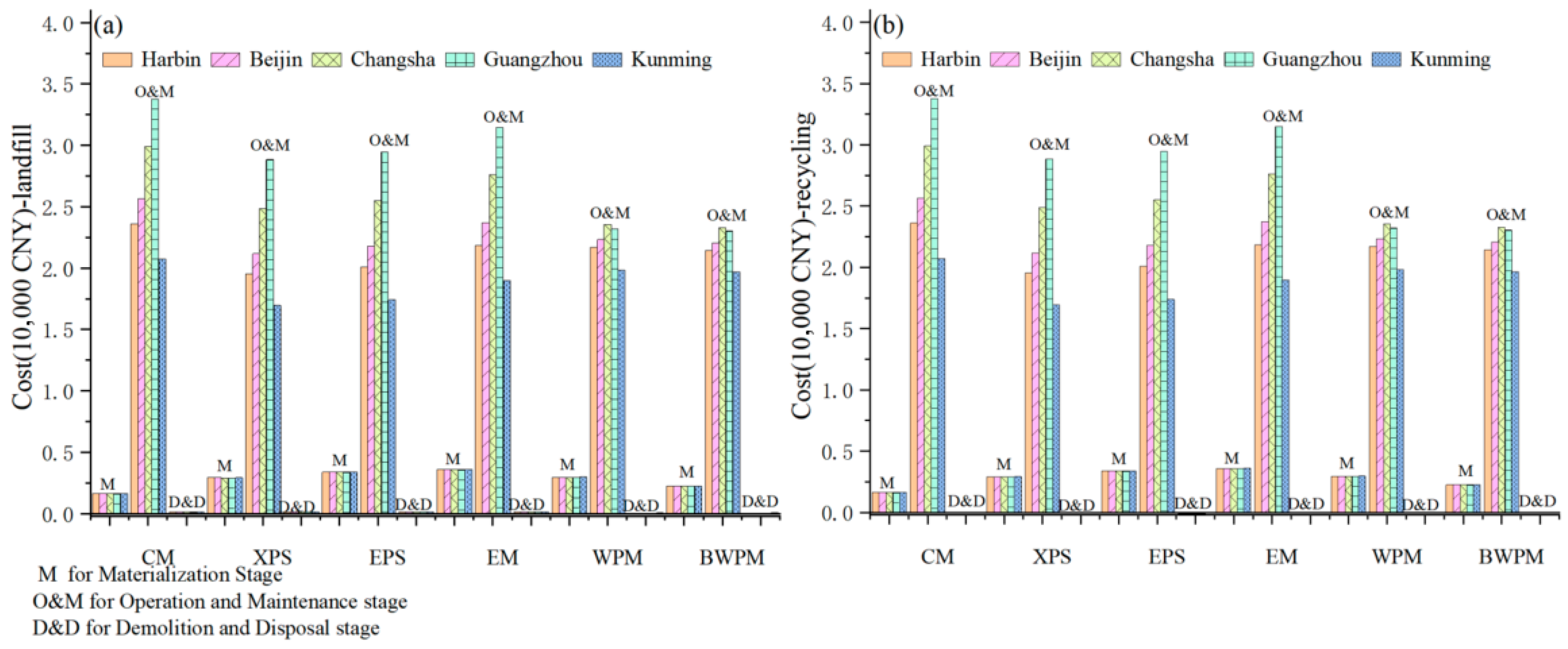
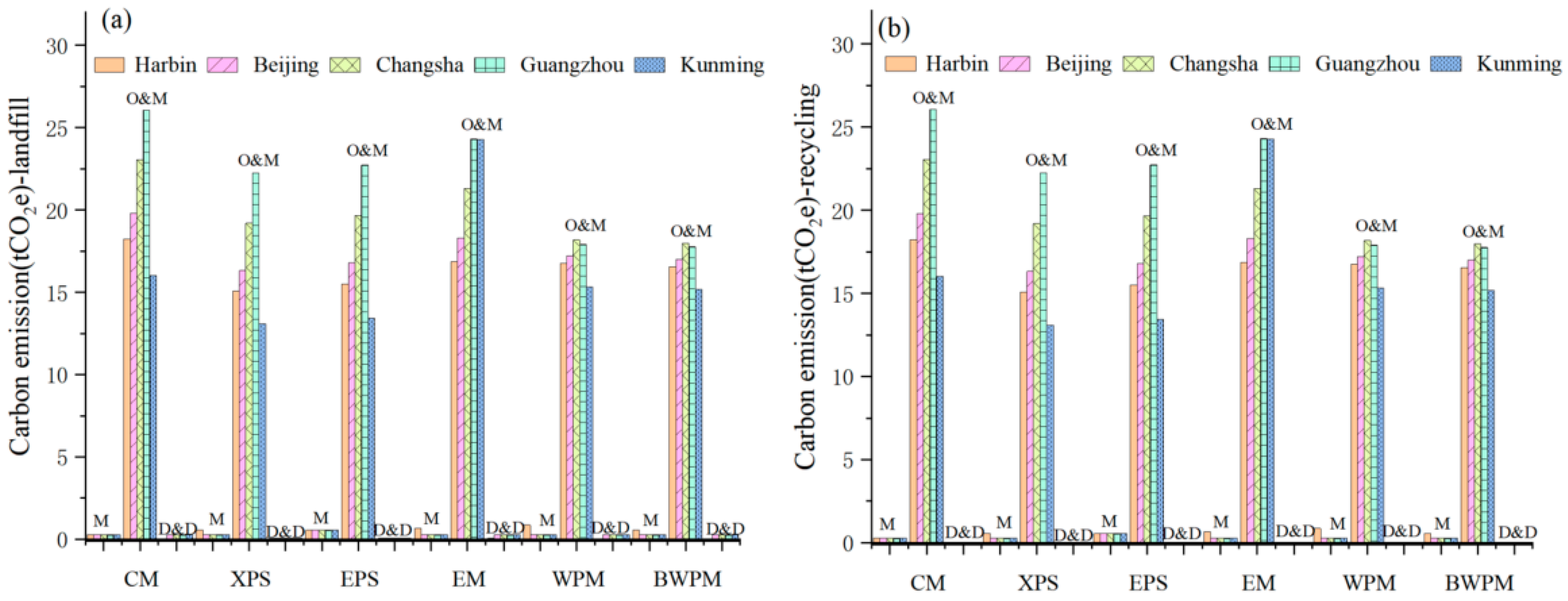
- Within the same climatic zone, different buffering materials exhibit variations in carbon emissions and life-cycle costs across the materialization, operation and maintenance, and demolition and disposal stages. A consistent finding is that the operation and maintenance stage accounts for over 90% of total carbon emissions and life-cycle costs across all materials. Therefore, life-cycle assessments of buffering materials should prioritize the impacts of this stage.
- (2)
- Of the two board-type buffering materials, XPS and EPS exhibit consistent advantages in both carbon emission reduction and cost-effectiveness across all climatic zones. Among the three cement-based buffering materials, EM shows carbon reduction potential but lacks economic competitiveness in certain climate zones. For WPM and BWPM, both their economic viability and carbon reduction potential are highly dependent on climatic conditions. In hot–humid zones (Hot Summer and Cold Winter Zone, Hot Summer and Warm Winter Zone), their economic benefits and carbon reduction potential are superior to those of board-type buffering materials and CM. Conversely, in cold and temperate zones (Severe Cold Zone, Cold Zone, and Temperate Zone), the comprehensive performance of board-type buffering materials outperforms that of cement-based buffering materials.
- (3)
- Superior thermal insulation does not inherently imply economic viability. Taking EM as an example, although it exhibits a low thermal conductivity (0.0974 W/(m·K)) and excellent insulating properties, which contribute to reduced energy consumption during the building operation and maintenance stage, its high production cost (1042 CNY/m3) and the necessity of pre-coating with base mortar during installation lead to increased construction expenses. Therefore, even with its favorable thermal performance, EM does not demonstrate an advantage in full life-cycle cost assessment.
- (4)
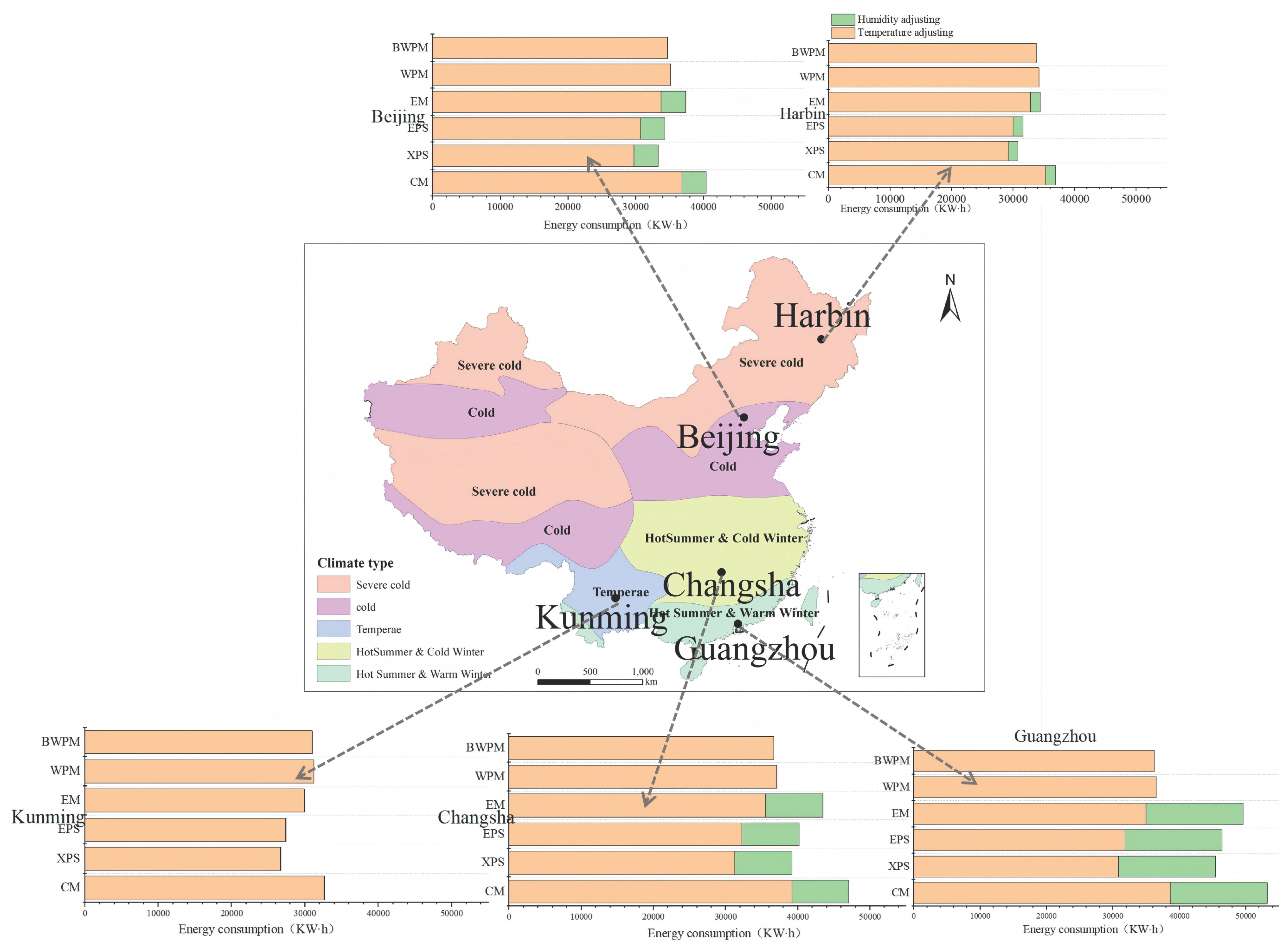
- Compared to the control group (CM), all buffering materials effectively reduce the operational energy consumption of buildings. Notably, the two moisture buffering plastering mortars (WPM and BWPM) achieve an operational energy reduction rate exceeding 18%, which can be attributed to their superior synergistic performance in humidity regulation and thermal insulation.
- (5)
- Among the two board-type buffering materials, XPS and EPS demonstrate net life-cycle cost savings and carbon emission reductions. Although these two materials entail relatively high initial costs, their excellent thermal insulation performance offsets this disadvantage. Under the recycling scenario, XPS and EPS achieve life-cycle cost savings of 52.3 million CNY and 24.0 million CNY, respectively, alongside carbon emission reductions of 789.6 tCO2e and 665.9 tCO2e.
- (6)
- Among the three cement-based buffering materials, EM can reduce the building’s operational energy consumption; however, its high construction costs ultimately result in an increased net life-cycle cost (: −0.27 million CNY). For both WPM and BWPM, both landfilling and recycling scenarios exhibit strong economic viability over the life cycle and significant potential for carbon emission reduction (and greater than 0; and less than the building’s design service life). When recycling is implemented during the demolition and disposal stage, EM, WPM, and BWPM achieve life-cycle cost changes of −0.27 million CNY, 4.024 million CNY, and 4.268 million CNY, respectively, alongside carbon emission reductions of 240.0 tCO2e, 3437.1 tCO2e, and 3564.9 tCO2e.
Author Contributions
Funding
Data Availability Statement
Conflicts of Interest
References
- World Meteorological Organization. WMO Confirms 2024 as Warmest Year on Record at About 1.55 °C Above Pre-Industrial Level; World Meteorological Organization: Geneva, Switzerland, 2025. [Google Scholar]
- da Graça Carvalho, M.; Bonifacio, M.; Dechamps, P. Building a low carbon society. Energy 2011, 36, 1842–1847. [Google Scholar] [CrossRef] [Scilit]
- Mao, X.; Wang, L.; Li, J.; Quan, X.; Wu, T. Comparison of regression models for estimation of carbon emissions during building’s lifecycle using designing factors: A case study of residential buildings in Tianjin, China. Energy Build. 2019, 204, 109519. [Google Scholar] [CrossRef] [Scilit]
- China Association of Building Energy Efficiency. Research Report on Building Energy Consumption and Carbon Emissions in China. In Release of Assessment Results on the Situation of Provincial-Level Building Carbon Peaking; Professional Committee on Building Energy Consumption and Carbon Emission Data, Ed.; China Association of Building Energy Efficiency: Beijing, China, 2021. [Google Scholar]
- Fang, J.Z.; Zhang, H.B.; Ren, P.; He, B.J.; Tang, M.F.; Feng, C. Influence of climates and materials on the moisture buffering in office buildings: A comprehensive numerical study in China. Environ. Sci. Pollut. Res. 2022, 29, 14158–14175. [Google Scholar] [CrossRef] [Scilit]
- Tu, K.K.; Zhang, Z.D.; Dreimol, C.H.; Günther, R.; Zboray, R.; Keplinger, T.; Burgert, I.; Ding, Y. Autonomous humidity regulation by MOF/wood composites. Mater. Horiz. 2024, 11, 5786–5797. [Google Scholar] [CrossRef] [Scilit]
- Li, Z.; Chen, W.; Deng, S.; Lin, Z. The characteristics of space cooling load and indoor humidity control for residences in the subtropics. Build. Environ. 2006, 41, 1137–1147. [Google Scholar] [CrossRef] [Scilit]
- Mendes, N.; Winkelmann, F.C.; Lamberts, R.; Philippi, P.C. Moisture effects on conduction loads. Energy Build. 2003, 35, 631–644. [Google Scholar] [CrossRef] [Scilit]
- Annila, P.J.; Lahdensivu, J.; Suonketo, J.; Pentti, M.; Vinha, J. Need to repair moisture- and mould damage in different structures in finnish public buildings. J. Build. Eng. 2018, 16, 72–78. [Google Scholar] [CrossRef] [Scilit]
- Morakinyo, O.M.; Mokgobu, M.I. Indoor Household Exposures and Associated Morbidity and Mortality Outcomes in Children and Adults in South Africa. Int. J. Environ. Res. Public Health 2022, 19, 9471. [Google Scholar] [CrossRef] [Scilit]
- Datta, A.; Suresh, R.; Gupta, A.; Singh, D.; Kulshrestha, P. Indoor air quality of non-residential urban buildings in Delhi, India. Int. J. Sustain. Built Environ. 2017, 6, 412–420. [Google Scholar] [CrossRef] [Scilit]
- Paynter, S. Humidity and respiratory virus transmission in tropical and temperate settings. Epidemiol. Infect. 2015, 143, 1110–1118. [Google Scholar] [CrossRef] [Scilit]
- Wolkoff, P.; Azuma, K.; Carrer, P. Health, work performance, and risk of infection in office-like environments: The role of indoor temperature, air humidity, and ventilation. Int. J. Hyg. Environ. Health 2021, 233, 113709. [Google Scholar] [CrossRef] [Scilit]
- Zhang, T.S.; Yuan, J.M.; Pang, H.X.; Huang, Z.M.; Guo, Y.Q.; Wei, J.X.; Yu, Q.J. UHPC-XPS insulation composite board reinforced by glass fiber mesh: Effect of structural design on the heat transfer, mechanical properties and impact resistance. J. Build. Eng. 2023, 75, 106935. [Google Scholar] [CrossRef] [Scilit]
- Li, Q.L.; Wei, H.B.; Han, L.L.; Wang, F.Y.; Zhang, Y.P.; Han, S.Y. Feasibility of Using Modified Silty Clay and Extruded Polystyrene (XPS) Board as the Subgrade Thermal Insulation Layer in a Seasonally Frozen Region, Northeast China. Sustainability 2019, 11, 804. [Google Scholar] [CrossRef] [Scilit]
- Li, J.H.; Cao, W.L. The Heat Transfer Coefficient of Recycled Concrete Bricks Combination with EPS Insulation Board Wall. Math. Probl. Eng. 2015, 2015, 695962. [Google Scholar] [CrossRef] [Scilit]
- Niu, F.J.; Jiang, H.Q.; Su, W.J.; Jiang, W.T.; He, J.L. Performance degradation of polymer material under freeze-thaw cycles: A case study of extruded polystyrene board. Polym. Test. 2021, 96, 107067. [Google Scholar] [CrossRef] [Scilit]
- Kowalczyk, L.; Korol, J.; Chmielnicki, B.; Laska, A.; Chuchala, D.; Hejna, A. One More Step towards a Circular Economy for Thermal Insulation Materials-Development of Composites Highly Filled with Waste Polyurethane (PU) Foam for Potential Use in the Building Industry. Materials 2023, 16, 782. [Google Scholar] [CrossRef] [Scilit] [PubMed]
- Hemmati, N.; Mirzaei, R.; Soltani, P.; Berardi, U.; Sheikhmozafari, M.J.; Edalat, H.; Rezaieyan, E.; Taban, E. Acoustic and thermal performance of wood strands-rock wool-cement composite boards as eco-friendly construction materials. Constr. Build. Mater. 2024, 445, 137935. [Google Scholar] [CrossRef] [Scilit]
- Qi, X.J.; Tan, Y.X.; Tan, J.S.; Li, X.H. Methods for improving the thermal performance of thermal bridges of lightweight steel-framed buildings. PLoS ONE 2024, 19, e0314634. [Google Scholar] [CrossRef] [Scilit]
- Yin, C.P.; Zheng, Q.; Zeng, J.C.; Yang, J.S.; Xiao, J.Y. Composite sandwich panel with multifunction of load bearing, heat insulation, and thermal protection. J. Compos. Mater. 2015, 49, 3077–3087. [Google Scholar] [CrossRef] [Scilit]
- Ren, Q.M.; Li, X.Z.; Ji, Y.K.; Ding, X.L.; Sun, Q.; Zhao, P.; Li, F.Q.; Vandeginste, V. Thermal insulation of phenolic resin modified fly ash geopolymer. Constr. Build. Mater. 2023, 409, 133840. [Google Scholar] [CrossRef] [Scilit]
- Saca, N.; Radu, L.; Stoleriu, S.; Dobre, D.; Calotă, R.; Truşcă, R. Investigation of Physical-Mechanical Properties and Microstructure of Mortars with Perlite and Thermal-Treated Materials. Materials 2024, 17, 3412. [Google Scholar] [CrossRef] [Scilit]
- Qi, X.Q.; Bao, Y.F.; Wang, W.R.; Zhang, S.L.; Wu, Y.L.; Jia, Z.Q.; Guo, S.Y. Superior performance foamed concrete fabricated with amphiphilic and hydrophilic particles stabilized ultra-stable foam. Cem. Concr. Compos. 2024, 152, 105613. [Google Scholar] [CrossRef] [Scilit]
- Gong, J.Q.; Duan, Z.R.; Sun, K.Q.; Xiao, M. Waterproof properties of thermal insulation mortar containing vitrified microsphere. Constr. Build. Mater. 2016, 123, 274–280. [Google Scholar] [CrossRef] [Scilit]
- Chen, M.X.; Wang, S.D.; Lu, L.C.; Zhao, P.Q.; Gong, C.C. Effect of matrix components with low thermal conductivity and density on performances of cement-EPS/VM insulation mortar. J. Therm. Anal. Calorim. 2016, 126, 1123–1132. [Google Scholar] [CrossRef] [Scilit]
- Yuan, P.; Zhu, Y.S.; Li, D.H.; Lu, X.F. Effect of Freeze-Thaw Cycle and Moisture Content on Compressive and Energy Properties of Alkali Slag Ceramsite Concrete. Ksce J. Civ. Eng. 2024, 28, 1980–1991. [Google Scholar] [CrossRef] [Scilit]
- Balbuena, J.; Sánchez, M.; Sánchez, L.; Cruz-Yusta, M. Lightweight Mortar Incorporating Expanded Perlite, Vermiculite, and Aerogel: A Study on the Thermal Behavior. Materials 2024, 17, 711. [Google Scholar] [CrossRef] [Scilit] [PubMed]
- Pavlík, Z.; Pokorný, J.; Pavlíková, M.; Zemanová, L.; Záleská, M.; Vyšvařil, M.; Žižlavský, T. Mortars with Crushed Lava Granulate for Repair of Damp Historical Buildings. Materials 2019, 12, 3557. [Google Scholar] [CrossRef] [Scilit] [PubMed]
- Tariku, F.; Kumaran, K.; Fazio, P. Application of a Whole-Building Hygrothermal model in energy, durability, and indoor humidity retrofit design. J. Build. Phys. 2014, 39, 3–34. [Google Scholar] [CrossRef] [Scilit]
- De Rossi, A.; Carvalheiras, J.; Novais, R.M.; Ribeiro, M.J.; Labrincha, J.A.; Hotza, D.; Moreira, R. Waste-based geopolymeric mortars with very high moisture buffering capacity. Constr. Build. Mater. 2018, 191, 39–46. [Google Scholar] [CrossRef] [Scilit]
- Wu, Y.; Gong, G.C.; Yu, C.W.; Huang, Z.Y. Proposing ultimate moisture buffering value (UMBV) for characterization of composite porous mortars. Constr. Build. Mater. 2015, 82, 81–88. [Google Scholar] [CrossRef] [Scilit]
- Dong, Y.H.; Ng, S.T. A modeling framework to evaluate sustainability of building construction based on LCSA. Int. J. Life Cycle Assess. 2016, 21, 555–568. [Google Scholar] [CrossRef] [Scilit]
- Onat, N.C.; Kucukvar, M.; Tatari, O. Integrating triple bottom line input-output analysis into life cycle sustainability assessment framework: The case for US buildings. Int. J. Life Cycle Assess. 2014, 19, 1488–1505. [Google Scholar] [CrossRef] [Scilit]
- Fauzi, R.T.; Lavoie, P.; Sorelli, L.; Heidari, M.D.; Amor, B. Exploring the Current Challenges and Opportunities of Life Cycle Sustainability Assessment. Sustainability 2019, 11, 636. [Google Scholar] [CrossRef] [Scilit]
- Nava, S.; Chalabi, Z.; Bell, S.; Sendra, P.; Burman, E. Identifying the criteria for community-centred Life Cycle Sustainability Assessment of estate regeneration schemes. Heliyon 2024, 10, e31115. [Google Scholar] [CrossRef] [Scilit] [PubMed]
- Larsen, V.G.; Tollin, N.; Sattrup, P.A.; Birkved, M.; Holmboe, T. What are the challenges in assessing circular economy for the built environment? A literature review on integrating LCA, LCC and S-LCA in life cycle sustainability assessment, LCSA. J. Build. Eng. 2022, 50, 104203. [Google Scholar] [CrossRef] [Scilit]
- Zarauz, I.; Sanz-Hernández, A.; Rivera-Lirio, J.M. Social sustainability in a good bioeconomy paradigm: A systematic review of social life cycle assessment (S-LCA). J. Clean. Prod. 2025, 486, 144570. [Google Scholar] [CrossRef] [Scilit]
- Ayassamy, P.; Pellerin, R. Social Life-Cycle Assessment in the Construction Industry: A Review of Characteristics, Limitations, and Challenges of S-LCA through Case Studies. Sustainability 2023, 15, 14569. [Google Scholar] [CrossRef] [Scilit]
- Prakash, V.; Ghosh, S.; Kanjilal, K. Costs of avoided carbon emission from thermal and renewable sources of power in India and policy implications. Energy 2020, 200, 117522. [Google Scholar] [CrossRef] [Scilit]
- Huang, Y.; Niu, J.L.; Chung, T.M. Energy and carbon emission payback analysis for energy-efficient retrofitting in buildings-Overhang shading option. Energy Build. 2012, 44, 94–103. [Google Scholar] [CrossRef] [Scilit]
- Sun, B.D.; Zhong, C.H.; Yu, D.H.; Han, Q.; Tang, J.C. Life cycle carbon emission assessment and carbon payback period analysis for the regeneration of old residential areas in cold regions: Case study in Qingdao, China. Sustain. Cities Soc. 2024, 115, 105860. [Google Scholar] [CrossRef] [Scilit]
- GB 50176-1993; Thermal Design Code for Civil Buildings. Ministry of Housing and Urban-Rural Development: Beijing, China, 2017.
- GB/T 51366-2019; Standard for Building Carbon Emission Calculation. China Architecture & Building Research Institute Co., Ltd. (CABR): Beijing, China, 2019.
- Mushu, F.; Guangcai, G.; Long, L.; Ping, W. Thermodynamic Model for Estimating Energy, Exergy Consumption and CO2 Emissions in Envelope Production Phase Based on Economic Indicators. Sci. Technol. Eng. 2016, 16, 75–81. [Google Scholar]
- Chen, C.; Wang, M.Y.; Shen, C.Z.; Huang, Y.Y.; Zhu, M.H.; Wang, H.F.; He, L.P.; Julien, D.B. Sensitivity Analysis of Factors Influencing Rural Housing Energy Consumption in Different Household Patterns in the Zhejiang Province. Buildings 2023, 13, 463. [Google Scholar] [CrossRef] [Scilit]
- Kavgic, M.; Mumovic, D.; Summerfield, A.; Stevanovic, Z.; Ecim-Djuric, O. Uncertainty and modeling energy consumption: Sensitivity analysis for a city-scale domestic energy model. Energy Build. 2013, 60, 1–11. [Google Scholar] [CrossRef] [Scilit]
- Peng, C.H.; Li, Z.R.; Xu, Q.Y.; Li, X.R.; Li, X.F.; Chen, H.Y. Spatial distribution of energy consumption: Integrating climate and macro-statistics for insights from clustering and sensitivity analysis. Energy Build. 2024, 318, 114446. [Google Scholar] [CrossRef] [Scilit]
- GB 50204; Technical Specification for Plasting Mortar. China Architecture & Building Press: Beijing, China, 2011.
- Cao, B.; Luo, M.H.; Li, M.; Zhu, Y.X. Too cold or too warm? A winter thermal comfort study in different climate zones in China. Energy Build. 2016, 133, 469–477. [Google Scholar] [CrossRef] [Scilit]
- Chen, X.A.; Yang, J.C.; Ren, C.; Jeong, S.; Shi, Y.A. Standardizing thermal contrast among local climate zones at a continental scale: Implications for cool neighborhoods. Build. Environ. 2021, 197, 107878. [Google Scholar] [CrossRef] [Scilit]
- Dong, Y.; Duan, H.Q.; Li, X.S.; Zhang, R.A. Influence of Different Forms on BIPV Gymnasium Carbon-Saving Potential Based on Energy Consumption and Solar Energy in Multi-Climate Zones. Sustainability 2024, 16, 1656. [Google Scholar] [CrossRef] [Scilit]
- Qian, B.; Yu, T.; Zhang, C.; Heiselberg, P.K.; Lei, B.; Yang, L. Suitability of heat wave event definitions for assessing indoor overheating in current and future climate: A case study in China. Build. Environ. 2023, 241, 110487. [Google Scholar] [CrossRef] [Scilit]
- Yang, W.Y.; Zhao, Y.R.; Liso, V.; Brandon, N. Optimal design and operation of a syngas-fuelled SOFC micro-CHP system for residential applications in different climate zones in China. Energy Build. 2014, 80, 613–622. [Google Scholar] [CrossRef] [Scilit]
- GB 50189-2015; Design Standard for Energy Efficiency of Public Buildings. China Architecture & Building Press: Beijing, China, 2015.
- GB 50189; Energy Efficiency Design Standards for Residential Buildings. Tongji University Press: Shanghai, China, 2011.
- Alimohamadi, R.; Jahangir, M.H. Multi-Objective optimization of energy consumption pattern in order to provide thermal comfort and reduce costs in a residential building. Energy Convers. Manag. 2024, 305, 118214. [Google Scholar] [CrossRef] [Scilit]
- El Samanoudy, G.; Mahmoud, N.S.A.; Jung, C.L. Analyzing the effectiveness of building integrated Photovoltaics (BIPV) to reduce the energy consumption in Dubai. Ain Shams Eng. J. 2024, 15, 102682. [Google Scholar] [CrossRef] [Scilit]
- Idrissi, Y.C.; Belarbi, R.; Ferroukhi, M.Y.; Feddaoui, M.; Agliz, D. Development of a numerical approach to assess the effect of coupled heat and moisture transfer on energy consumption of residential buildings in Moroccan context. J. Build. Phys. 2022, 45, 774–808. [Google Scholar] [CrossRef] [Scilit]
- GB 50736-2012; Design Code for Heating Ventilation and Air Conditioning of Civil Buildings. China Architecture & Building Press: Beijing, China, 2012.
- Available online: https://rp5.ru/ (accessed on 6 November 2025).
- Xie, F.; Wu, Y.; Wang, X.; Zhou, X. Optimization Strategies for the Envelope of Student Dormitories in Hot Summer and Cold Winter Regions: Multi-Criteria Assessment Method. Sustainability 2024, 16, 6172. [Google Scholar] [CrossRef] [Scilit]



| Name | Symbol | Meaning | |
|---|---|---|---|
| Economic Dimension | Energy-Saving Economic Equivalent | Used to evaluate the impact of materials on the total life-cycle cost of a building. | |
| Economic Payback Period | The time required for the cumulative energy savings achieved during the operational stage to offset the material costs. | ||
| Carbon Reduction Dimension | Energy-Saving Carbon Emission Reduction Equivalent | Used to assess the impact of materials on carbon emissions throughout the building’s entire life-cycle. | |
| Carbon Emission Payback Period | The time required for carbon emissions saved during the operational stage to offset material-related carbon emissions. |
| Material | Wooden Fiber (g) | Bamboo Fiber (g) | Polypropylene Fiber (g) | 120-Mesh Sepiolite (g) | Diatomite (g) | Sand (g) |
|---|---|---|---|---|---|---|
| CM | 0 | 0 | 0 | 0 | 0 | 300 |
| WPM | 1.462 | 0 | 3 | 9.435 | 0 | |
| BWPM | 2.580 | 0.206 | 3 | 5.55 | 40 | |
| EM | 0 | 0 | 3.2 | 0 | 0 | |
| Material | Fly ash (g) | Expanded perlite (g) | Redispersible polymer powder (g) | Air-Entraining agent (g) | Cement (g) | |
| CM | 0 | 0 | 0 | 0 | 100 | |
| WPM | 0 | 5.168 | 4 | 0 | 100 | |
| BWPM | 0 | 9.120 | 4 | 0 | 100 | |
| EM | 319 | 532 | 3.2 | 1.1 | 1064 |
| Group | Material | Density (kg/m3) | Thermal Conductivity (W/(m·K)) | Specific Heat Capacity (J/(kg·K)) |
|---|---|---|---|---|
| Control | CM | 2000.0 | 1.1130 | 1000.0 |
| Board-type | XPS | 20.0 | 0.0300 | 1380.0 |
| EPS | 35.0 | 0.0390 | 1380.0 | |
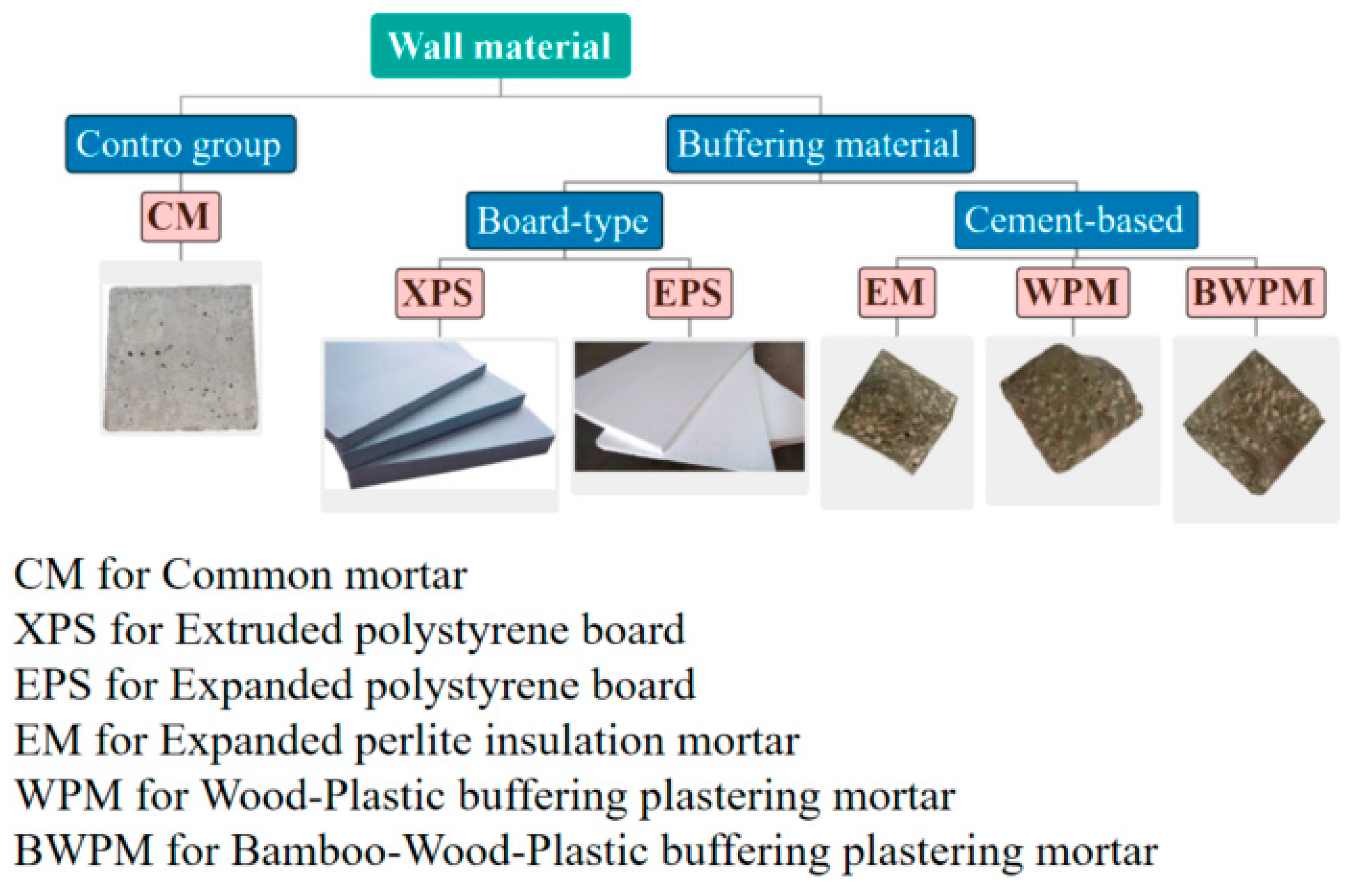
| Cement-based | EM | 508.7 | 0.0974 | 1050.0 |
| WPM | 784.5 | 0.1190 | 5463.8 | |
| BWPM | 754.3 | 0.1020 | 5667.0 |
| Group | Material | Carbon Emission Factor ) | Production Price (CNY/m3) |
|---|---|---|---|
| Control | CM | 265.45 | 605 |
| Board-type | XPS | 296.60 | 283 |
| EPS | 221.20 | 619 | |
| Cement-based | EM | 457.20 | 1042 |
| WPM | 1016.63 | 2317 | |
| BWPM | 612.96 | 1397 |
| Lighting | Equipment | Personnel | ||||
|---|---|---|---|---|---|---|
| Power Density (W/m2) | Start Period | Power Density (W/m2) | Start Period | Density | Heat Output (W/Person) | Air Conditioning Start Period |
| 6 | 18:00–24:00 | 2.25 | 01:00–24:00 | 2.45 (person/household) | 109 | 01:00–24:00 |
| Region | Indicator | Control | Board-Type | Cement-Based | |||
|---|---|---|---|---|---|---|---|
| CM | XPS | EPS | EM | WPM | BWPM | ||
| Harbin | (10,000 CNY) | −0.18 | 0.10 | 0.01 | −0.20 | −0.12 | −0.02 |
| (Year) | −454.65 | 36.67 | 48.90 | 112.02 | 85.18 | 55.88 | |
| −0.40 | 2.48 | 2.11 | 0.55 | 0.49 | 1.01 | ||
| (Year) | −97.50 | 8.62 | 9.15 | 27.57 | 31.80 | 17.34 | |
| Beijing | (10,000 CNY) | −0.18 | 0.15 | 0.04 | −0.18 | 0.02 | 0.12 |
| (Year) | −454.65 | 32.93 | 44.24 | 100.82 | 46.63 | 32.55 | |
| −0.40 | 2.82 | 2.39 | 0.69 | 1.59 | 2.11 | ||
| (Year) | −97.50 | 7.74 | 8.28 | 24.81 | 17.41 | 10.10 | |
| Changsha | (10,000 CNY) | −0.17 | 0.21 | 0.10 | −0.14 | 0.33 | 0.43 |
| (Year) | −909.31 | 28.81 | 37.92 | 80.66 | 23.57 | 17.10 | |
| −0.33 | 3.30 | 2.86 | 1.03 | 3.98 | 4.50 | ||
| (Year) | −195.00 | 6.77 | 7.10 | 19.85 | 8.80 | 5.31 | |
| Guangzhou | (10,000 CNY) | −0.17 | 0.20 | 0.10 | −0.14 | 0.75 | 0.84 |
| (Year) | −909.31 | 29.33 | 38.71 | 80.66 | 14.06 | 10.45 | |
| −0.33 | 3.23 | 2.79 | 1.03 | 7.25 | 7.70 | ||
| (Year) | −195.00 | 6.89 | 7.25 | 19.85 | 5.25 | 3.24 | |
| Kunming | (10,000 CNY) | −0.19 | 0.07 | −0.02 | −0.21 | −0.23 | −0.14 |
| (Year) | −303.10 | 40.33 | 53.09 | 118.61 | 227.98 | 135.49 | |
| −0.47 | 2.21 | 1.91 | 0.48 | −0.35 | 0.10 | ||
| (Year) | −65.00 | 9.48 | 9.94 | 29.19 | 85.11 | 42.04 | |
| Cooling Capacity (W) | Summer Cooling Power (W) | Cooling Energy Consumption Ratio | Heating Capacity (W) | Winter Heating Power (W) | Heating Energy Consumption Ratio |
|---|---|---|---|---|---|
| 3500 | 1080 | 3.28 | 3850 | 1120 | 3.44 |
| Heating Start Time | Heating End Time | Cooling Start Time | Cooling End Time | |
|---|---|---|---|---|
| 2014 | 14 November | 15 March | 1 May | 27 October |
| 2015 | 30 November | 12 March | 26 April | 27 October |
| 2016 | 23 November | 14 March | 28 April | 6 October |
| 2017 | 22 November | 16 March | 14 April | 10 October |
| 2018 | 18 November | 22 March | 18 April | 7 October |
| 2019 | 18 November | 25 March | 6 April | 1 November |
| 2020 | 18 November | 1 April | 15 April | 15 September |
| 2021 | 22 November | 23 March | 29 April | 5 November |
| 2022 | 21 November | 15 March | 6 April | 25 October |
| 2023 | 29 November | 20 March | 12 April | 5 November |
| Heating Period I | Winter Vacation | Heating Period II | Heating Period III | Heating Time |
|---|---|---|---|---|
| 1 January~15 January | 15 January~15 February | 15 February~18 March | 21 November~31 December | 85 days |
| Cooling period I | Summer vacation | Cooling period II | Cooling time | |
| 15 April~1 July | 1 July~1 September | 1 September~26 October | 126 days |
| Operating Period | Operating Mode | Indoor Set Temperature of Heating and Air Conditioning Zone (°C) at the Following Calculation Moments (h) | |||||||||||
|---|---|---|---|---|---|---|---|---|---|---|---|---|---|
| 1 | 2 | 3 | 4 | 5 | 6 | 7 | 8 | 9 | 10 | 11 | 12 | ||
| Workdays | Cooling | 37 | 37 | 37 | 37 | 37 | 37 | 28 | 26 | 26 | 26 | 26 | 26 |
| Heating | 5 | 5 | 5 | 5 | 5 | 12 | 18 | 20 | 20 | 20 | 20 | 20 | |
| Holidays | Cooling | 37 | 37 | 37 | 37 | 37 | 37 | 37 | 37 | 37 | 37 | 37 | 37 |
| Heating | 5 | 5 | 5 | 5 | 5 | 5 | 5 | 5 | 5 | 5 | 5 | 5 | |
| Operating period | 13 | 14 | 15 | 16 | 17 | 18 | 19 | 20 | 21 | 22 | 23 | 24 | |
| Workdays | Cooling | 26 | 26 | 26 | 26 | 26 | 26 | 26 | 37 | 37 | 37 | 37 | 37 |
| Heating | 20 | 20 | 20 | 20 | 20 | 20 | 20 | 18 | 5 | 5 | 5 | 5 | |
| Holidays | Cooling | 37 | 37 | 37 | 37 | 37 | 37 | 37 | 37 | 37 | 37 | 37 | 37 |
| Heating | 5 | 5 | 5 | 5 | 5 | 5 | 5 | 5 | 5 | 5 | 5 | 5 | |
| Classroom Vacancy Rate for the Following Calculation Moments (h) | ||||||||||||
|---|---|---|---|---|---|---|---|---|---|---|---|---|
| Operating period | 1 | 2 | 3 | 4 | 5 | 6 | 7 | 8 | 9 | 10 | 11 | 12 |
| Workdays | 100 | 100 | 100 | 100 | 100 | 100 | 90 | 50 | 50 | 50 | 50 | 100 |
| Holidays | 100 | 100 | 100 | 100 | 100 | 100 | 95 | 75 | 52.5 | 52.5 | 52.5 | 100 |
| Operating period | 13 | 14 | 15 | 16 | 17 | 18 | 19 | 20 | 21 | 22 | 23 | 24 |
| Workdays | 100 | 50 | 50 | 50 | 70 | 70 | 70 | 70 | 100 | 100 | 100 | 100 |
| Holidays | 100 | 52.5 | 52.5 | 52.5 | 85 | 85 | 85 | 85 | 100 | 100 | 100 | 100 |
| Group | Material | Life-Cycle Stage | Cost (10,000 CNY) | Carbon Emission ) |
|---|---|---|---|---|
| Baseline | - | Operation and Maintenance | 2567.294 | 19,810.618 |
| Control | CM | Materialization | 35.977 | 65.002 |
| Operation and Maintenance | 2562.372 | 19,772.640 | ||
| Demolition and Disposal | −0.509 | 0.085 | ||
| Board-type | XPS | Materialization | 68.138 | 135.230 |
| Operation and Maintenance | 2448.381 | 18,893.020 | ||
| Demolition and Disposal | −1.479 | −7.189 | ||
| EPS | Materialization | 79.922 | 131.927 | |
| Operation and Maintenance | 2465.792 | 19,027.372 | ||
| Demolition and Disposal | −2.423 | −14.611 | ||
| Cement-based | EM | Materialization | 80.251 | 165.982 |
| Operation and Maintenance | 2514.673 | 19,404.566 | ||
| Demolition and Disposal | −0.638 | 0.107 | ||
| WPM | Materialization | 69.144 | 210.363 | |
| Operation and Maintenance | 2094.609 | 16,163.126 | ||
| Demolition and Disposal | −0.200 | 0.033 | ||
| BWPM | Materialization | 51.261 | 131.871 | |
| Operation and Maintenance | 2088.223 | 16,113.850 | ||
| Demolition and Disposal | −0.192 | 0.032 |
| Disposal Method | Indicator | Control | Board-Type | Cement-Based | |||
|---|---|---|---|---|---|---|---|
| CM | XPS | EPS | EM | WPM | BWPM | ||
| Landfilling | (10,000 CNY) | −33.9 | 47.6 | 18.3 | −31.1 | 402.4 | 426.8 |
(Year) | 394.0 | 30.0 | 41.0 | 79.6 | 7.4 | 5.5 | |
| Recycling | (10,000 CNY) | −30.5 | 52.3 | 24.0 | −27.0 | 403.7 | 428.0 |
(Year) | 360.3 | 28.0 | 38.2 | 75.6 | 7.3 | 5.3 | |
| Disposal Method | Indicator | Control | Board-Type | Cement-Based | |||
|---|---|---|---|---|---|---|---|
| CM | XPS | EPS | EM | WPM | BWPM | ||
| Landfilling | () | −36.3 | 771.8 | 640.3 | 228.5 | 3433.5 | 3561.4 |
(Year) | 97.8 | 7.9 | 9.1 | 21.9 | 2.9 | 1.8 | |
| Recycling | () | −27.1 | 789.6 | 665.9 | 240.0 | 3437.1 | 3564.9 |
(Year) | 85.7 | 7.0 | 7.5 | 20.5 | 2.9 | 1.8 | |
Disclaimer/Publisher’s Note: The statements, opinions and data contained in all publications are solely those of the individual author(s) and contributor(s) and not of MDPI and/or the editor(s). MDPI and/or the editor(s) disclaim responsibility for any injury to people or property resulting from any ideas, methods, instructions or products referred to in the content. |
© 2026 by the authors. Licensee MDPI, Basel, Switzerland. This article is an open access article distributed under the terms and conditions of the Creative Commons Attribution (CC BY) license.
Share and Cite
Zhou, X.; Wang, X.; Wan, L.; Chen, Y.; Fu, X.; Wu, Y. Study on the Impact of Temperature and Humidity Variations in Climate Zones on the Life-Cycle Assessment of Wall Materials. Buildings 2026, 16, 375. https://doi.org/10.3390/buildings16020375
Zhou X, Wang X, Wan L, Chen Y, Fu X, Wu Y. Study on the Impact of Temperature and Humidity Variations in Climate Zones on the Life-Cycle Assessment of Wall Materials. Buildings. 2026; 16(2):375. https://doi.org/10.3390/buildings16020375
Chicago/Turabian StyleZhou, Xiling, Xinqi Wang, Linhui Wan, Yuyang Chen, Xiaohua Fu, and Yi Wu. 2026. "Study on the Impact of Temperature and Humidity Variations in Climate Zones on the Life-Cycle Assessment of Wall Materials" Buildings 16, no. 2: 375. https://doi.org/10.3390/buildings16020375
APA StyleZhou, X., Wang, X., Wan, L., Chen, Y., Fu, X., & Wu, Y. (2026). Study on the Impact of Temperature and Humidity Variations in Climate Zones on the Life-Cycle Assessment of Wall Materials. Buildings, 16(2), 375. https://doi.org/10.3390/buildings16020375