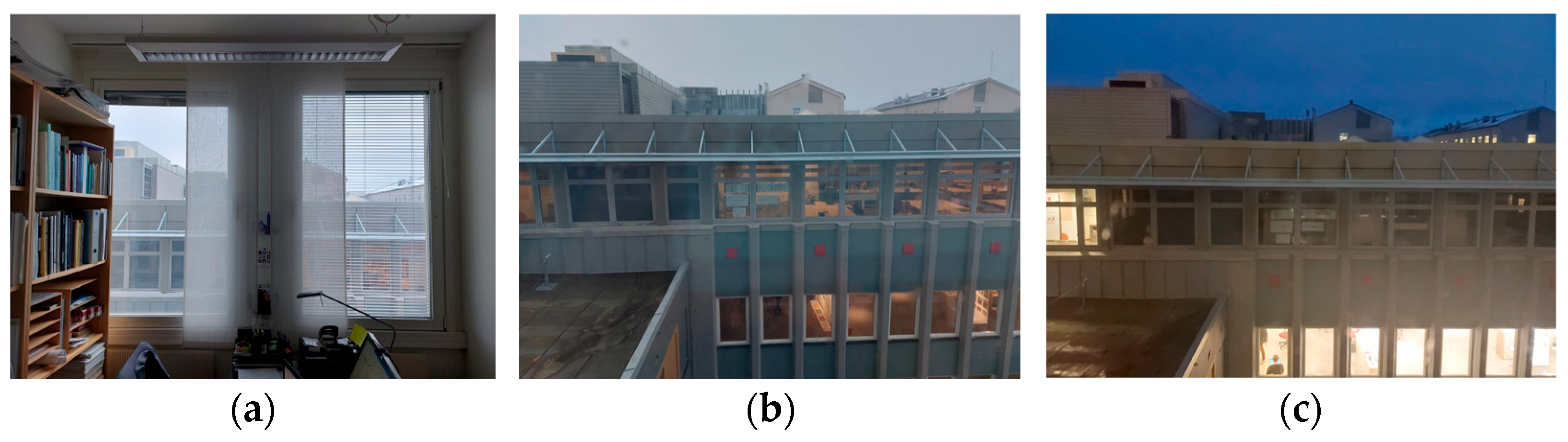
The View from the Window—Assessment by the “View Owner” and the “View Observers”

 ,
,  , , ,
, , ,  ,
,  ,
,  and
and
Abstract
1. Introduction
1.1. Window View in the Literature
1.2. Night Views Studies
1.3. Coping with a View
1.4. Problem Statement
2. Methods
2.1. Pre-Test: Two Distant Expert Workshops
2.2. Participants
2.3. Preparation Phase Procedure
2.4. Procedure for In-Person Workshops
2.5. Analysis Method
- Values closer to 1 indicate strong agreement, while values near 0 suggest no agreement;
- A common cut-off for acceptable agreement is (rωg) > 0.7.
3. Results
3.1. Comparison of Votes Expressed by the “View Owner” and “View Observers”
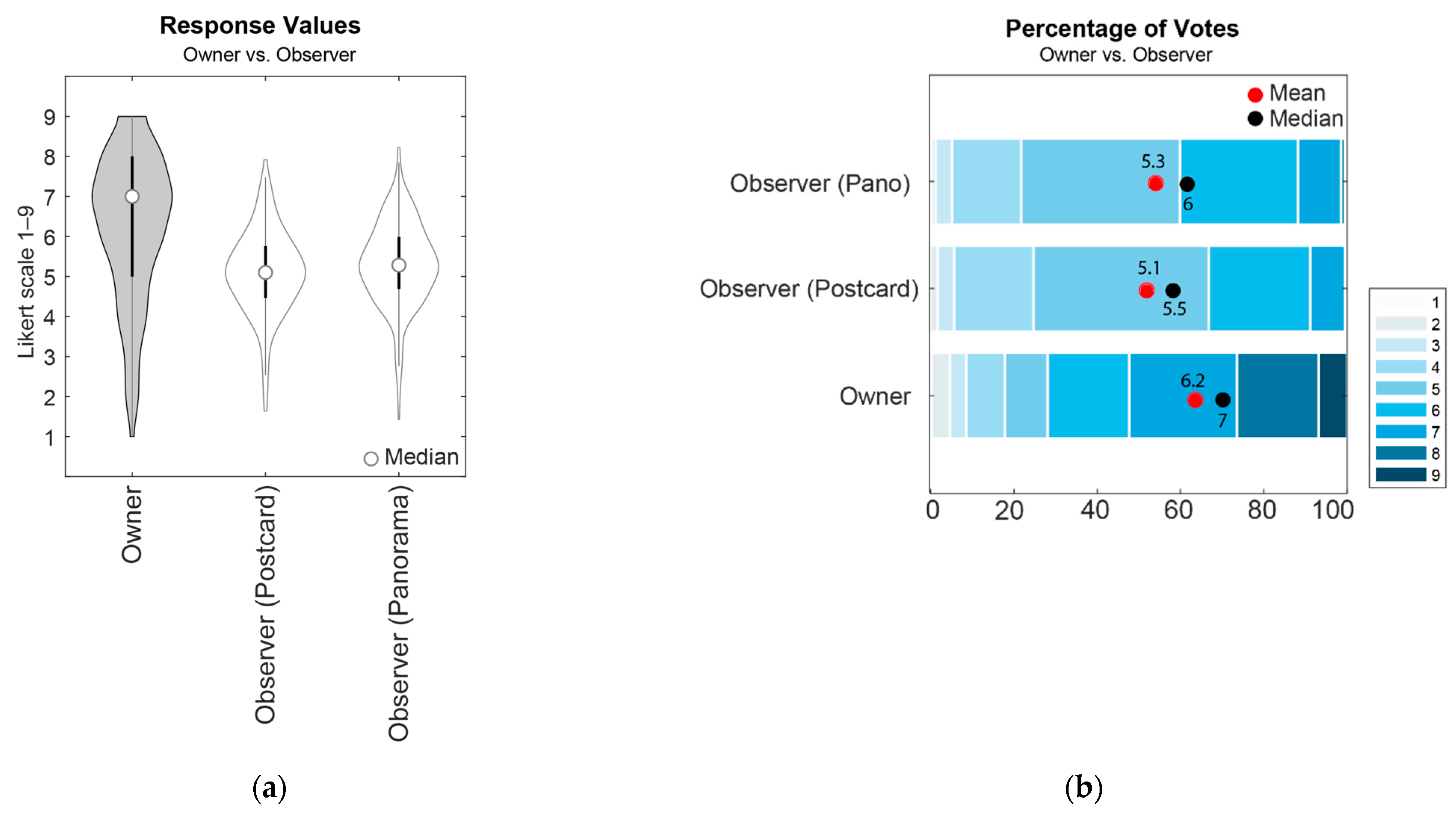
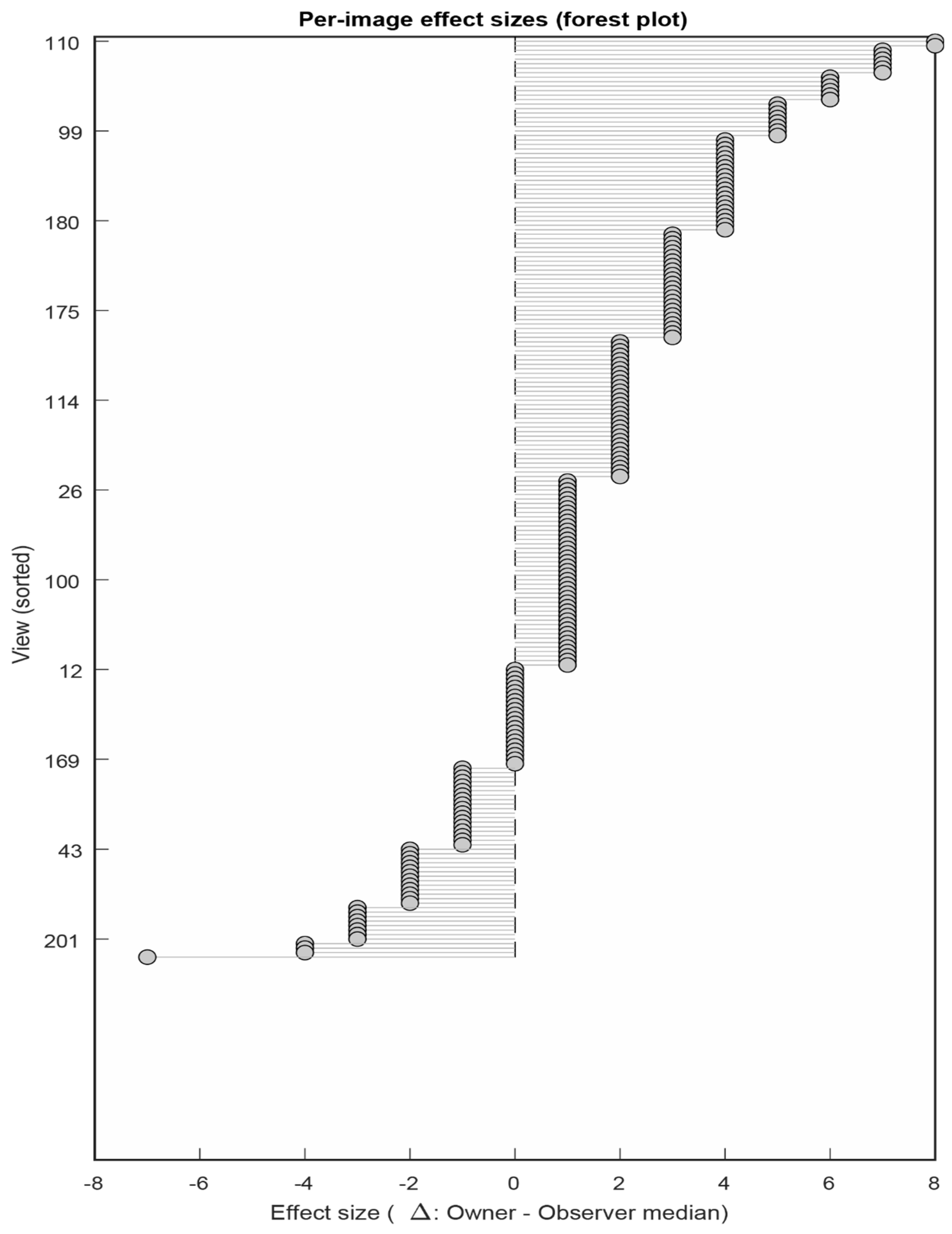
- “View owners” rate their views with significantly higher scores than “view observers”, indicating a potential bias or an emotional connection with the outdoor space.
- “View observers” tend to provide lower but more consistent voting, while “view owners” votes show greater variability.
3.2. Comparison of Scores Expressed by “View Owner” and “View Observers”, High-Rated vs. Low-Rated Views
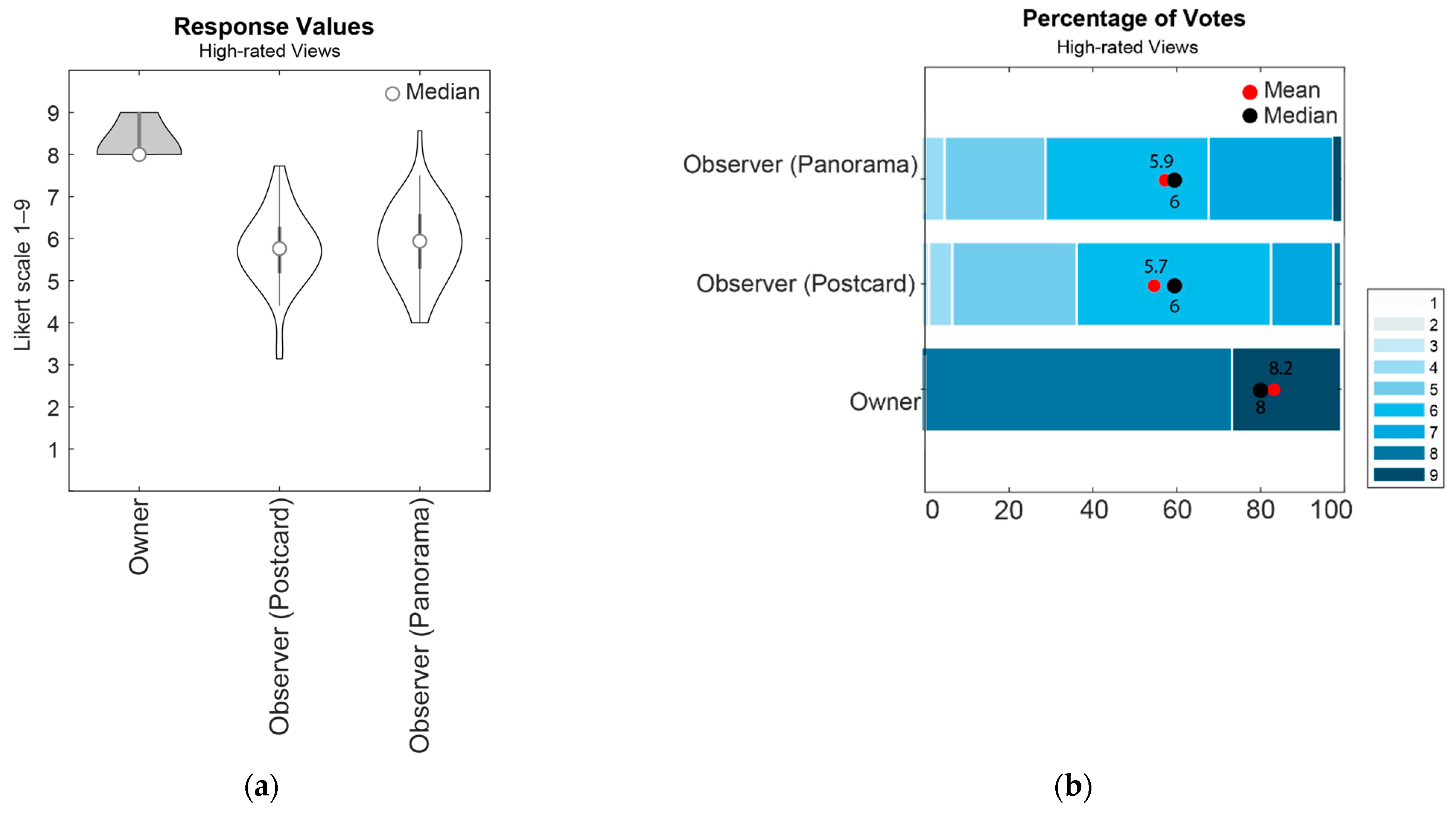
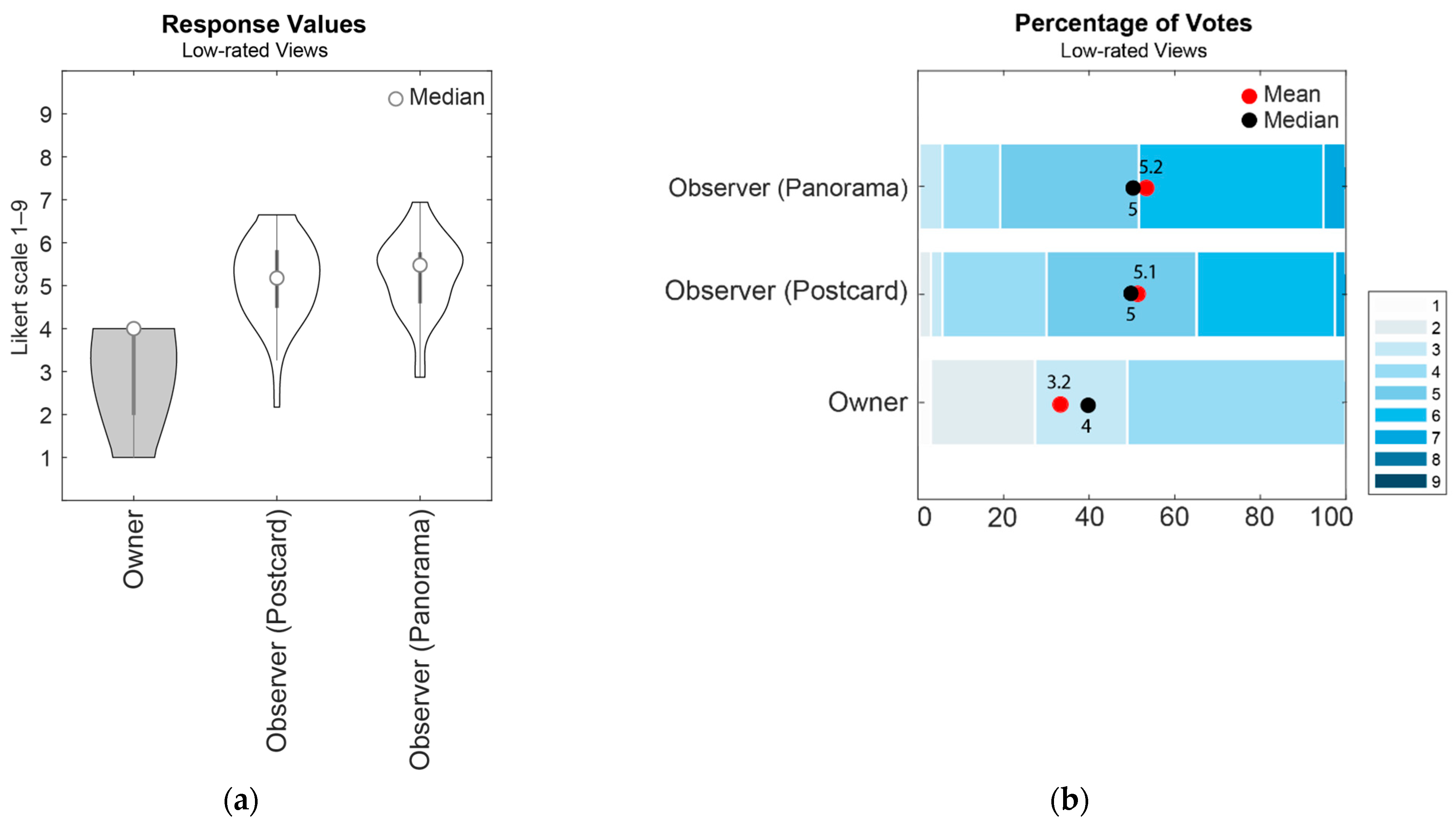
- Both the high-rated views and the low-rated views are evaluated significantly differently by the “view owners” and “view observers”. “View observers” are much closer to the middle of the scale in both high-rated and low-rated categories.
- In both high-related and low-rated views, the “view observers” have rated the panorama images slightly better than the postcard views; however, this effect is not significant.
3.3. Influence of Contextual Visual Information and Verbal Description on View Perception
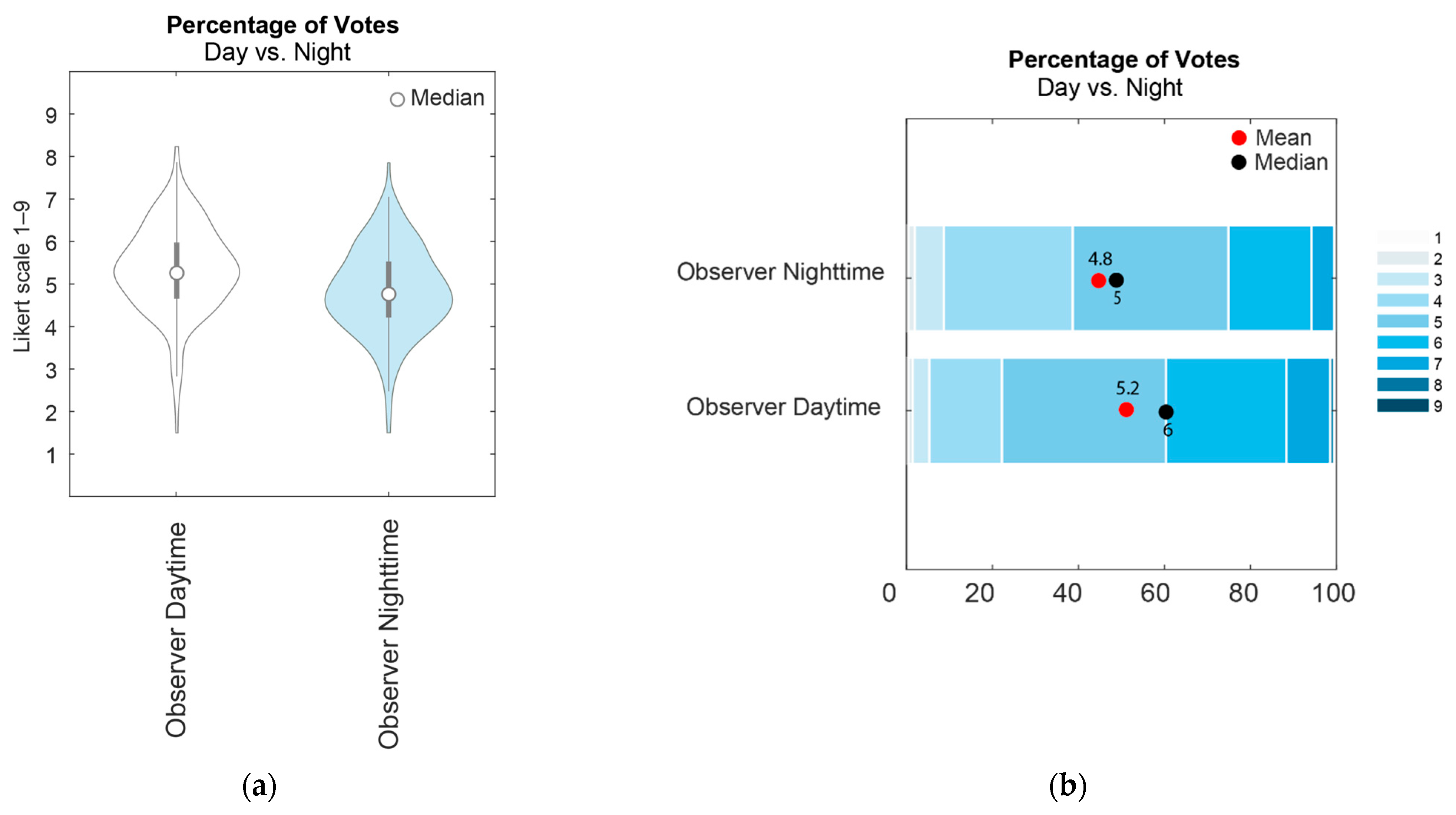
3.4. Perception of Night View vs. Day View
4. Discussion and Future Work
4.1. Differences in View Assessment Between “View Owners” and “View Observers”
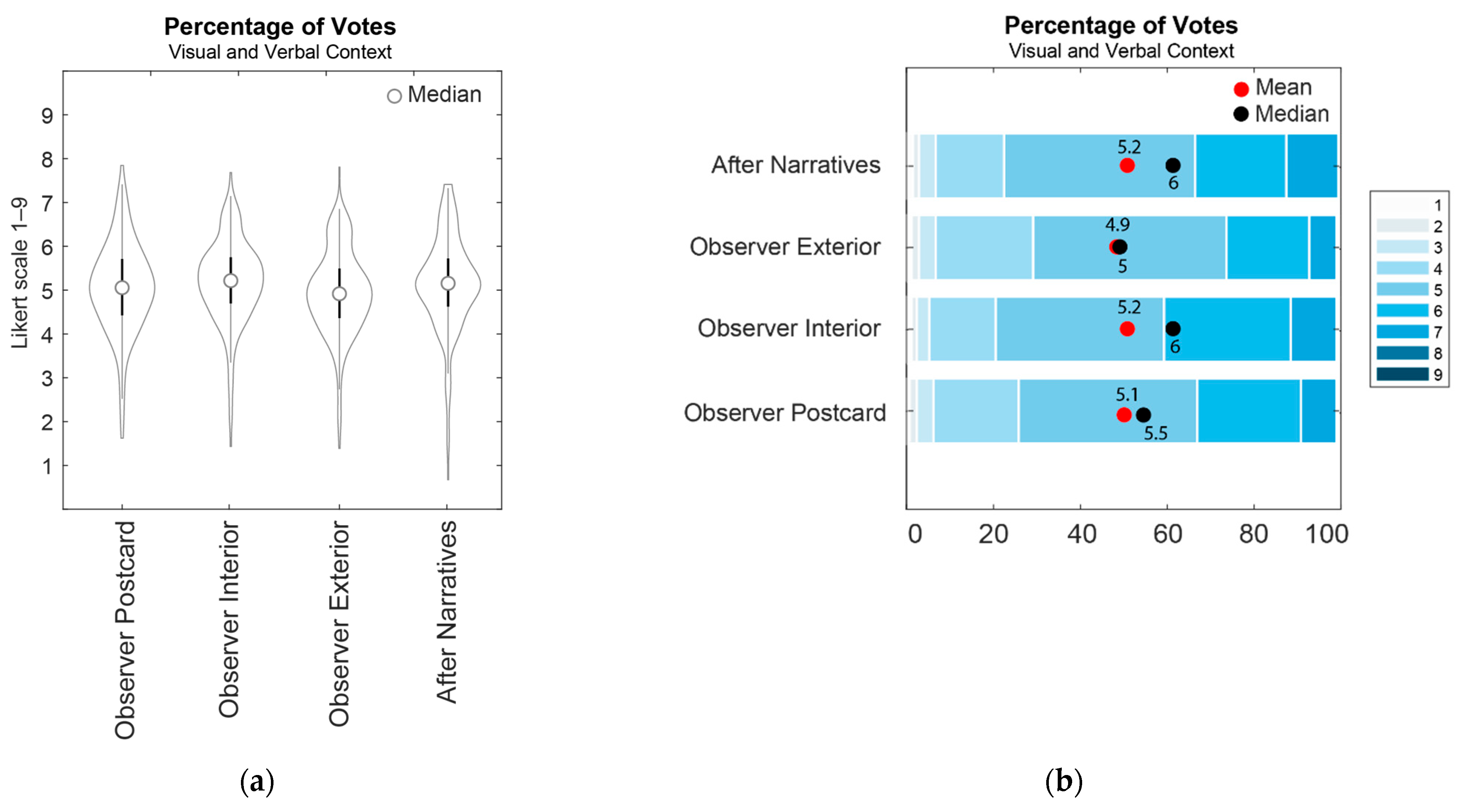
4.2. Low Impact of Contextual and Verbal Information
4.3. Merits and Limitations of the Study
5. Conclusions
Author Contributions
Funding
Data Availability Statement
Acknowledgments
Conflicts of Interest
Appendix A. Assignment: My View
- LEVEL 1 WINDOW VIEW IN GENERAL
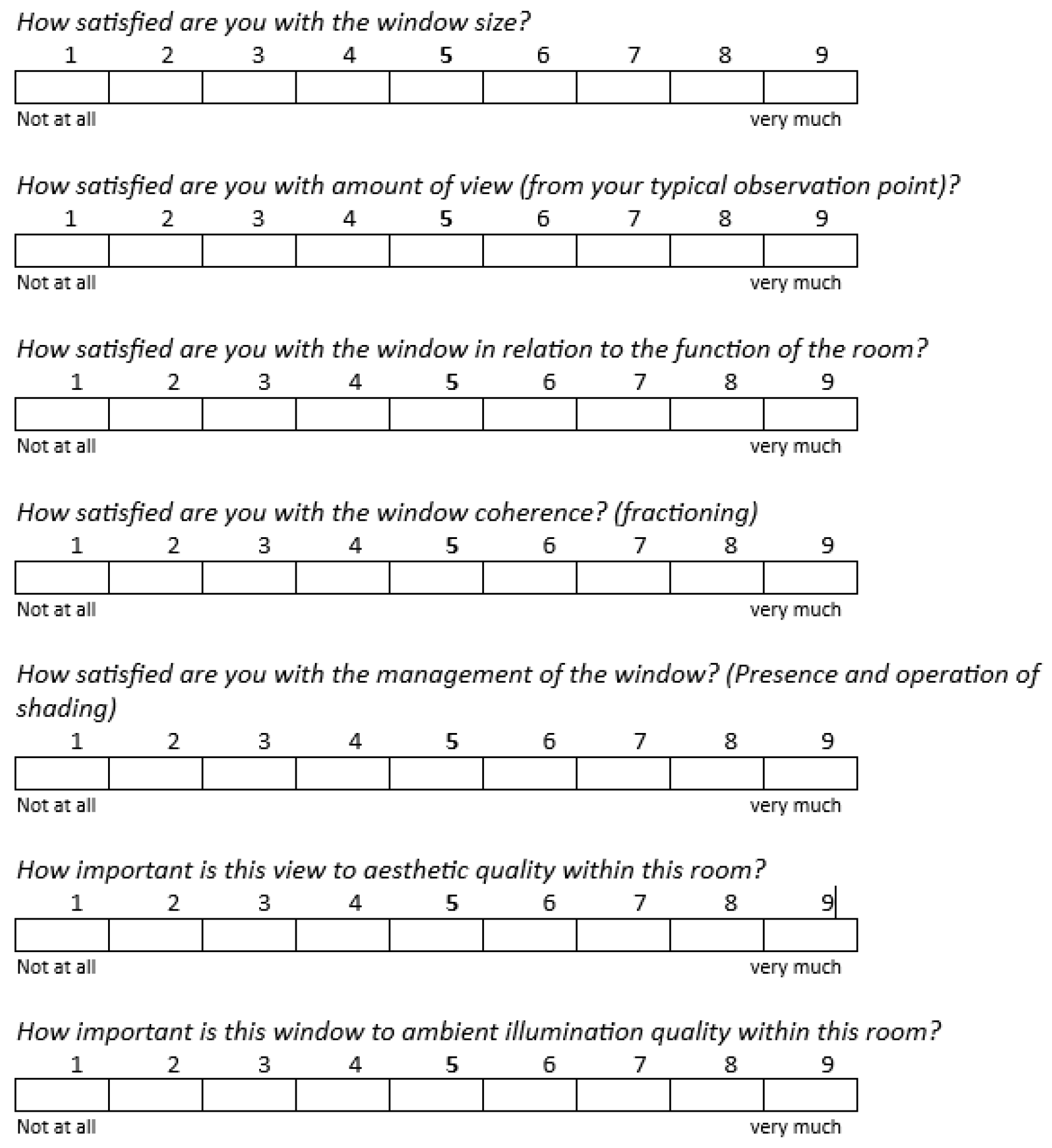
- LEVEL 2 SATISFACTION WITH THE VIEW IN RELATION TO THE INTERIOR

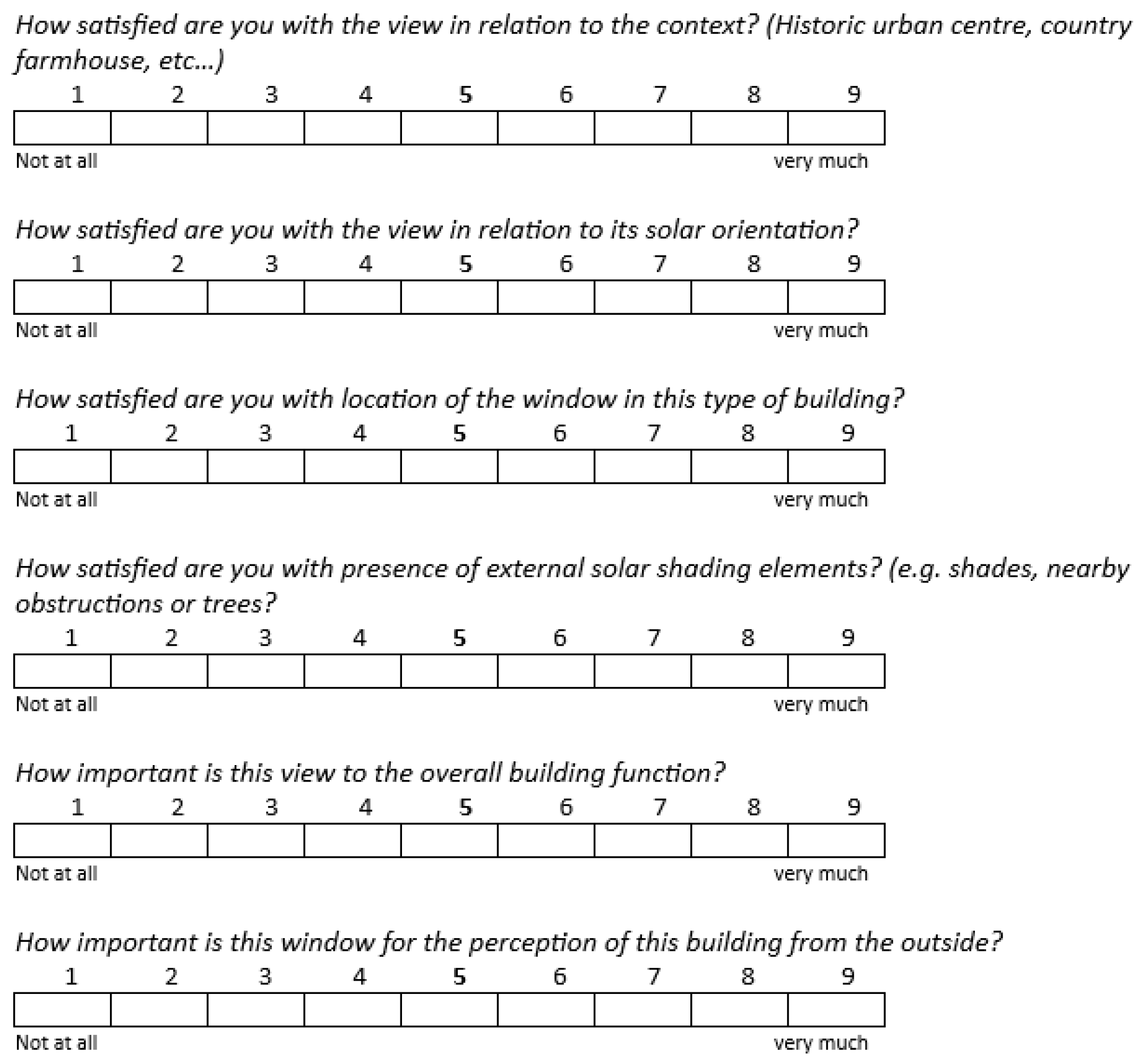
- LEVEL 3 SATISFACTION WITH THE VIEW IN RELATION TO THE INTERIOR

- LEVEL 4 WINDOW VIEW AFTER ALL INFORMATION IS GIVEN BY THE VIEW OWNER
- ○
- When did you go there and why?
- ○
- How does it make you feel?
- ○
- What did you love about it?
- ○
- What annoyed you?
- ○
- What did it make you think about?
- ○
- How did you manage your relationship with the window (e.g., operating blinds, changing viewing direction)?
- ○
- Events of importance (e.g., greeting visitors, watching birds, opening the window for air, viewing a parade, etc…).
- ○
- Sensory experiences (e.g., sounds, thermal comfort, visual comfort (glare?), smells).
- ○
- How does your relationship or ‘use’ of the window change over time (e.g., daily, seasonally, or with more experience/memories)?
- ○
- Are you satisfied with the level of privacy that the window provides you?
- ○
- What else about the window is important to you or is something that you wish you could change?
- ○
- Are there other circumstances that are important for your relationship with the window/view out that have not been mentioned yet?

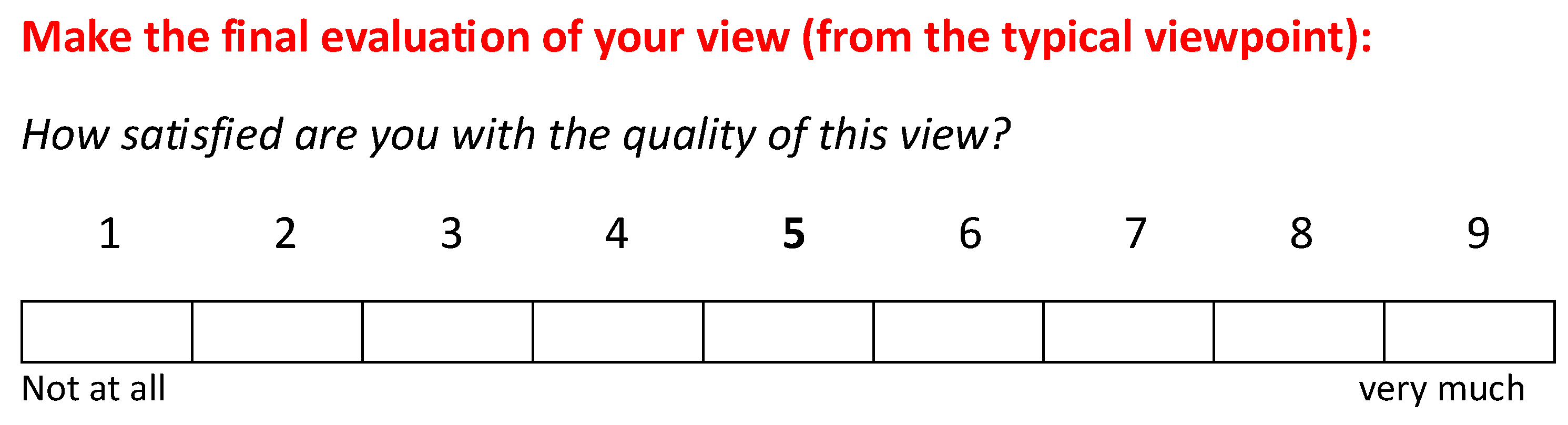
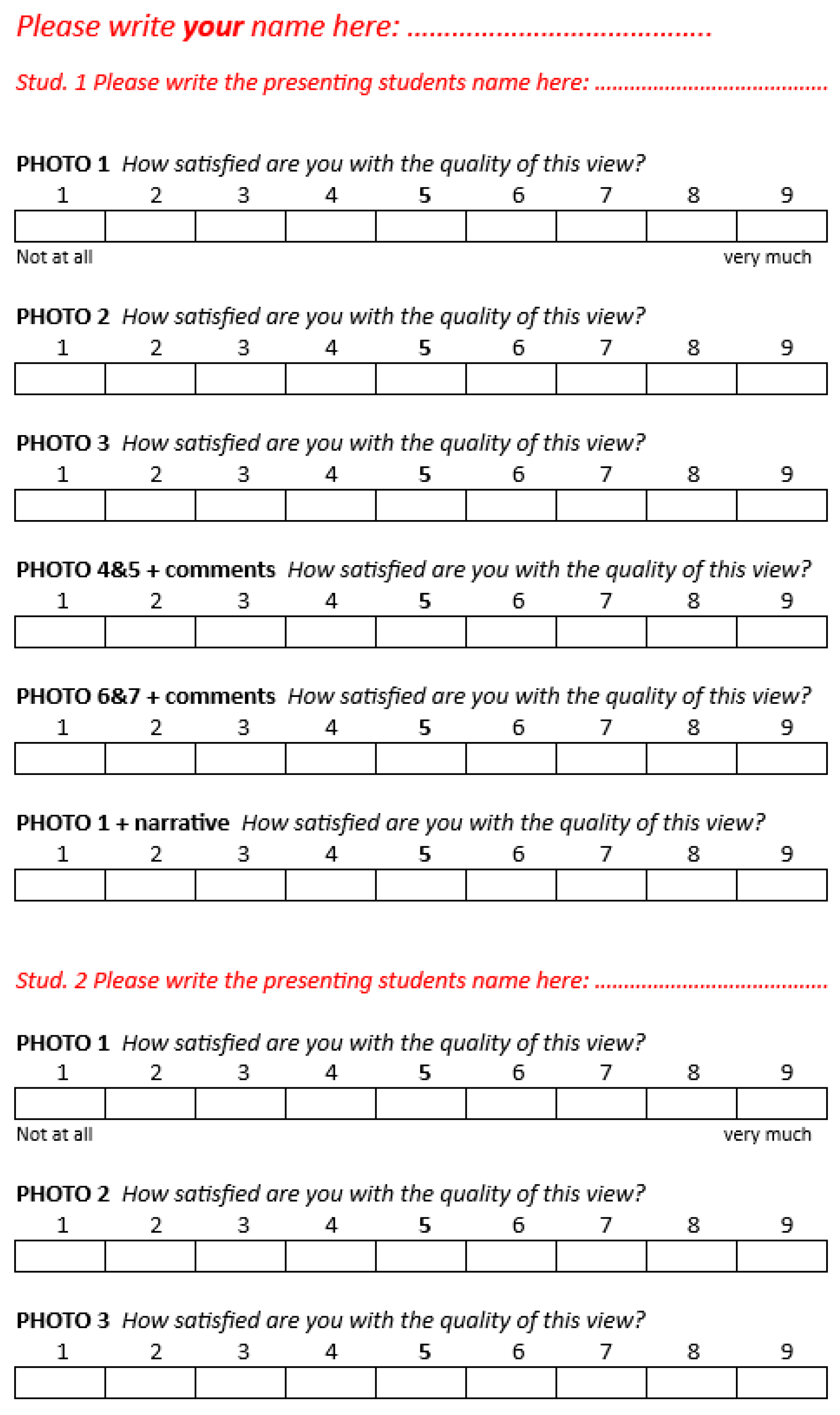
Appendix B. Template for the Evaluation Form

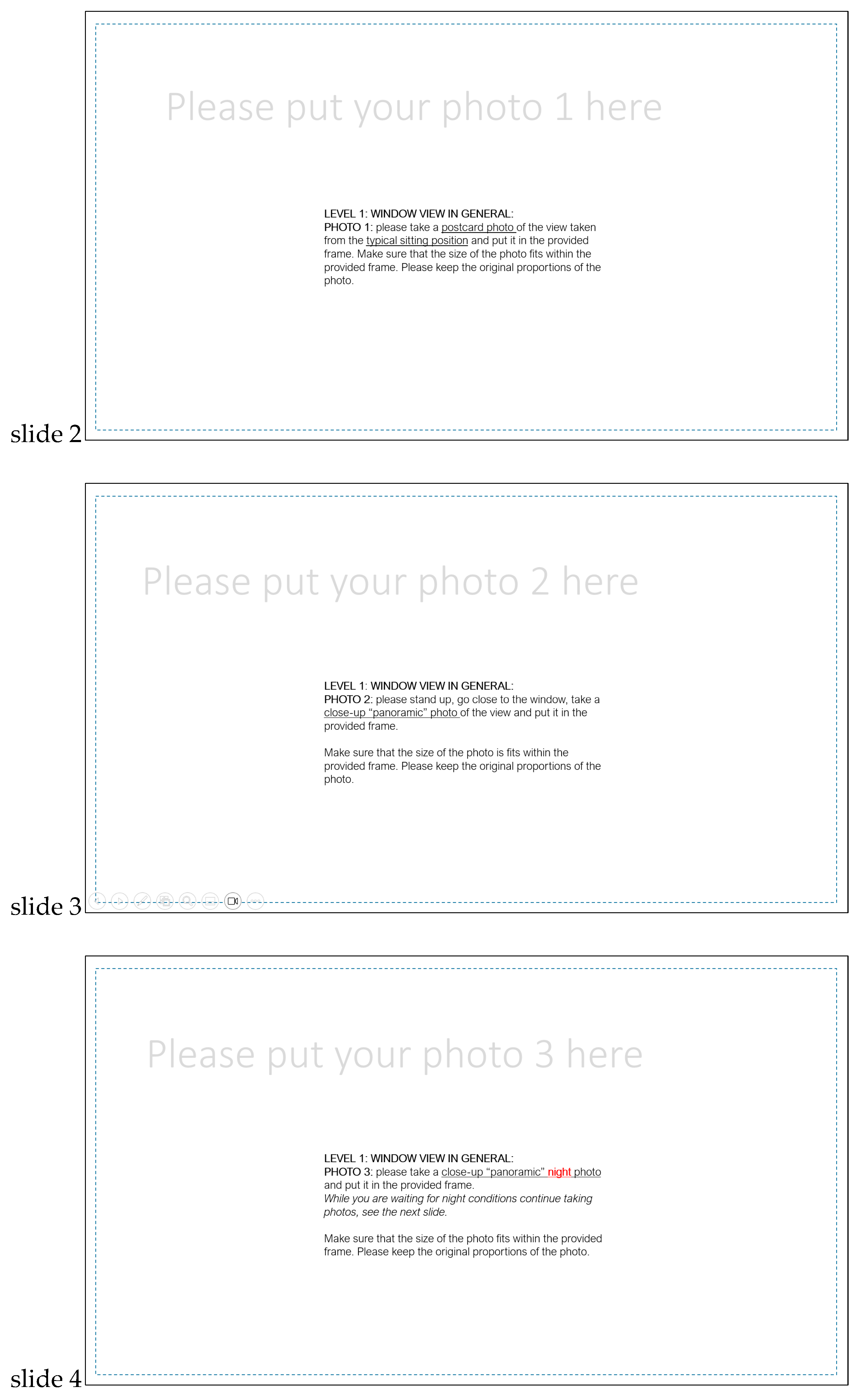
Appendix C. Template for Preparing Photos for the Workshop


References
- The Commission Internationale de l’Éclairage (CIE). CIE Termlist. Available online: https://cie.co.at/eilvterm/17-29-140 (accessed on 24 October 2025).
- Farley, K.M.J.; Veitch, J.A. A Room with a View: A Review of the Effects of Windows on Work and Well-Being; IRC Research Report RR-136; National Research Council Canada: Ottawa, ON, Canada, 2001. [Google Scholar]
- He, S.; Zhang, W.; Guan, Y. The Impact of Building Windows on Occupant Well-Being: A Review Integrating Visual and Non-Visual Pathways with Multi-Objective Optimization. Buildings 2025, 15, 2577. [Google Scholar] [CrossRef]
- Heschong, L. Visual Delight in Architecture: Daylight, Vision, and View, 1st ed.; Routledge: London, UK, 2021. [Google Scholar] [CrossRef]
- Magsamen, S. Your Brain on Art: The Case of Neuroaesthetics. Cerebrum: The Dana Forum on Brain Science. 2019. Available online: https://pmc.ncbi.nlm.nih.gov/articles/PMC7075503/ (accessed on 4 October 2025).
- Magsamen, S.; Golden, T.L.; Towriss, C.A.; Allen, J. The impact thinking framework: A process for advancing research-to-practice initiatives in neuroaesthetics. Front. Psychol. 2023, 14, 1129334. [Google Scholar] [CrossRef]
- Bratman, G.N.; Hamilton, J.P.; Hahn, K.S.; Daily, G.C.; Gross, J.J. Nature experience reduces rumination and subgenual prefrontal cortex activation. Proc. Natl. Acad. Sci. USA 2015, 112, 8567–8572. [Google Scholar] [CrossRef] [PubMed]
- Jo, H.; Song, C.; Miyazaki, Y. Physiological Benefits of Viewing Nature: A Systematic Review of Indoor Experiments. Int. J. Environ. Res. Public Health 2019, 16, 4739. [Google Scholar] [CrossRef]
- Veitch, J.A.; Galasiu, A.D. The Physiological and Psychological Effects of Windows, Daylight, and View at Home: Review and Research Agenda; NRC-IRC Research Report RR-325; National Research Council of Canada: Ottawa, ON, Canada, 2012; Available online: https://nrc-publications.canada.ca/eng/view/ft/?id=06e1364d-71f3-4766-8ac8-f91da5576358 (accessed on 4 October 2025).
- Zhang, P.; Yang, T.; Bo, Y.; Song, W.; Liu, W.; Ni, W.; Gao, W.; Qi, X. A Study on the Effects of Distinct Visual Elements and Their Combinations in Window Views on Stress and Emotional States. Buildings 2025, 15, 2804. [Google Scholar] [CrossRef]
- Sharam, L.A.; Mayer, K.M.; Baumann, O. Design by nature: The influence of windows on cognitive performance and affect. J. Environ. Psychol. 2023, 85, 101923. [Google Scholar] [CrossRef]
- Masoudinejad, S.; Hartig, T. Window View to the Sky as a Restorative Resource for Residents in Densely Populated Cities. Environ. Behav. 2018, 52, 401–436. [Google Scholar] [CrossRef]
- Chung, W.K.; Lin, M.; Chau, C.K.; Masullo, M.; Pascale, A.; Leung, T.-M.; Xu, M. On the study of the psychological effects of blocked views on dwellers in high dense urban environments. Landsc. Urban Plan. 2022, 221, 104379. [Google Scholar] [CrossRef]
- Jing, X.; Liu, C.; Li, J.; Gao, W.; Fukuda, H. Effects ofWindow Green View Index on Stress Recovery of College Students from Psychological and Physiological Aspects. Buildings 2024, 14, 3316. [Google Scholar] [CrossRef]
- Kristl, Ž.; Fošner, A.; Zbašnik-Senegačnik, M. Tolerance to UrbanWindow Views with Various Design Features. Buildings 2025, 15, 914. [Google Scholar] [CrossRef]
- Ko, W.H.; Kent, M.G.; Schiavon, S.; Levitt, B.; Betti, G. A window view quality assessment framework. Leukos 2021, 18, 268–293. [Google Scholar] [CrossRef]
- Woo, M.; MacNaughton, P.; Lee, J.; Tinianov, B.; Satish, U.; Boubekri, M. Access to daylight and views improves physical and emotional wellbeing of office workers: A crossover study. Front. Sustain. Cities 2021, 3, 690055. [Google Scholar] [CrossRef]
- Soga, M.; Gaston, K.J. Health benefits of viewing nature through windows: A meta-analysis. BioScience 2025, 75, 628–636. [Google Scholar] [CrossRef] [PubMed]
- Mirza, L.; Byrd, H. Towards appreciating the importance of windowscapes: Evaluation and suggestion for improvement of New Zealand building code. J. Contemp. Urban Aff. 2018, 2, 55–65. [Google Scholar] [CrossRef]
- U.S. Green Building Council. LEED v5—Building Design and Construction; USGBC: Washington, DC, USA, 2025. [Google Scholar]
- International WELL Building Institute. WELL Building Standard v2, Q3:2025 Addenda; Delos Living LLC & International WELL Building Institute: New York, NY, USA, 2025. [Google Scholar]
- EN 17037:2018; CEN (Comité Européen de Normalisation). Daylight in Buildings. CEN: Brussels, Belgium, 2018.
- MacNaughton, P.; Woo, M.; Tinianov, B.; Boubekri, M.; Satish, U. Economic implications of access to daylight and views in office buildings from improved productivity. J. Appl. Soc. Psychol. 2021, 51, 1176–1183. [Google Scholar] [CrossRef]
- Turan, I.; Chegut, A.; Fink, D.; Reinhart, C. Development of Riew Analysis Metrics and Their Financial Impacts on Office Rents. MIT Center for Real Estate Research Paper No. 21/03. 2013. Available online: https://papers.ssrn.com/sol3/papers.cfm?abstract_id=3784759 (accessed on 4 October 2025).
- Kim, J.-J.; Wineman, J. Are Windows and Views Really Better? A Quantitative Analysis of the Economic and Psychological Value of Views; The University of Michigan: Ann Arbor, MI, USA, 2005. [Google Scholar]
- Lo Verso, V.R.M.; Fregonara, E.; Caffaro, F.; Morisano, C.; Maria Peiretti, G. Daylighting as the driving force of the design process: From the results of a survey to the implementation into an advanced daylighting project. J. Daylighting 2014, 1, 36–55. [Google Scholar] [CrossRef]
- Leech, J.A.; Nelson, W.C.; Burnett, R.T.; Aaron, S.; Raizenne, M.E. It’s about time: A comparison of Canadian and American time-activity patterns. J. Expo. Anal. Environ. Epidemiol. 2002, 12, 427–432. [Google Scholar] [CrossRef]
- Wirz-Justice, A.; Skene, D.J.; Münch, M. The relevance of daylight for humans. Biochem. Pharmacol. 2021, 191, 114304. [Google Scholar] [CrossRef]
- Kaplan, R. The role of nature in the context of the workplace. Landsc. Urban Plan. 1993, 26, 193–201. [Google Scholar] [CrossRef]
- Kaplan, R. The nature of the view from home: Psychological benefits. Environ. Behav. 2001, 33, 507–542. [Google Scholar] [CrossRef]
- Ulrich, R.S. View through a window may influence recovery from surgery. Science 1984, 224, 420–421. [Google Scholar] [CrossRef]
- Ulrich, R.S. Health Benefits of Gardens in Hospitals. Plants for People, International Exhibition Floriade, June 2002. Available online: https://www.researchgate.net/publication/252307449 (accessed on 24 November 2025).
- Batool, A.; Rutherford, P.; McGraw, P.; Ledgeway, T.; Altomonte, S. View preference in urban environments. Light. Res. Technol. 2021, 53, 613–636. [Google Scholar] [CrossRef]
- Matusiak, B.; Klöckner, C.A. How we evaluate the view out through the window. Archit. Sci. Rev. 2016, 59, 203–211. [Google Scholar] [CrossRef]
- Rodriguez Leonard, F. Subjective Responses to Daylight Changes in Outdoor Scenes: Implementing a Dynamic View Assessment Procedure for Urban Contexts. Ph.D. Thesis, Queensland University of Technology, Brisbane, Australia, 2021. [Google Scholar]
- Kaplan, R. The analysis of perception via preference: A strategy for studying how the environment is experienced. Landsc. Plan. 1985, 12, 161–176. [Google Scholar] [CrossRef]
- Ulrich, R.S. Biophilia, Biophobia, and Natural Landscapes. 1993. Available online: https://www.researchgate.net/publication/284655696 (accessed on 24 November 2025).
- Choi, J.H.; Beltran, L.O.; Kim, H.S. Impacts of indoor daylight environments on patient average length of stay (ALOS) in a healthcare facility. Build. Environ. 2012, 50, 65–75. [Google Scholar] [CrossRef]
- Mihandoust, S.; Joseph, A.; Kennedy, S.; MacNaughton, P.; Woo, M. Exploring the Relationship between Window View Quantity, Quality, and Ratings of Care in the Hospital. Int. J. Environ. Res. Public Health 2021, 18, 10677. [Google Scholar] [CrossRef]
- Jiang, Y.; Li, N.; Yongga, A.; Yan, W. Short-term effects of natural view and daylight from windows on thermal perception, health, and energy-saving potential. Build. Environ. 2022, 208, 108575. [Google Scholar] [CrossRef]
- van den Berg, A.E.; Hartig, T.; Staats, H. Preference for nature in urbanized societies: Stress, restoration, and the pursuit of sustainability. J. Soc. Issues 2007, 63, 79–96. [Google Scholar] [CrossRef]
- Menga, X.; Wang, M. Exploring the health impacts of window views: A literature review. J. Asian Archit. Build. Eng. 2025, 24, 5080–5103. [Google Scholar] [CrossRef]
- Rodriguez, F.; Garcia-Hansen, V.; Allan, A.; Isoardi, G. Appraising daylight changes in window views: Systematic procedures for classifying and capturing dynamic outdoor scenes. Archit. Sci. Rev. 2020, 63, 153–168. [Google Scholar] [CrossRef]
- Cho, Y.; Karmann, C.; Andersen, M. Perception of window views in VR: Impact of display and type of motion on subjective and physiological responses. Build. Environ. 2025, 274, 112757. [Google Scholar] [CrossRef]
- Vasquez, N.G.; Rupp, R.F.; Andersen, R.K.; Toftum, J. Lighting conditions in home office and occupant’s perception: Exploring drivers of satisfaction. Energy Build. 2022, 261, 111977. [Google Scholar] [CrossRef]
- Tuaycharoenn, N.; Tregenza, P.R. View and discomfort glare from windows. Light. Res. Technol. 2007, 39, 185–200. [Google Scholar] [CrossRef]
- Shin, J.Y.; Yun, G.Y.; Kim, J.T. View types and luminance effects on discomfort glare assessment from windows. Energy Build. 2012, 46, 139–145. [Google Scholar] [CrossRef]
- Aries, M.B.; Veitch, J.A.; Newsham, G.R. Windows, view, and office characteristics predict physical and psychological discomfort. J. Environ. Psychol. 2010, 30, 533–541. [Google Scholar] [CrossRef]
- Aries, M.B.C.; Aarts, M.P.J.; Van Hoof, J. Daylight and health: A review of the evidence and consequences for the built environment. Light. Res. Technol. 2015, 47, 6–27. [Google Scholar] [CrossRef]
- Rodriguez, F.; Garcia-Hansen, V.; Allan, A.; Isoardi, G. Immersive views outdoors to assess the mediating effect of time in view preference. In Proceedings of the PLEA 2018—Hong Kong: Smart and Healthy within the 2-Degree Limit, Hong Kong, China, 10–12 December 2018. [Google Scholar]
- Rodriguez, F.; Garcia-Hansen, V.; Allan, A.; Isoardi, G. Testing the adequacy of luminous change descriptors to represent dynamic attributes in outdoor views. Build. Environ. 2021, 191, 107591. [Google Scholar] [CrossRef]
- Domjan, S.; Arkar, C.; Medved, S. Study on occupants’ window view quality vote and their physiological response. J. Build. Eng. 2023, 68, 106119. [Google Scholar] [CrossRef]
- Cho, Y.M.; Ryu, S.H.; Lee, B.R.; Kim, K.H.; Lee, E.; Choi, J. Effects of artificial light at night on human health: A literature review of observational and experimental studies applied to exposure assessment. Chronobiol. Int. 2015, 32, 1294–1310. [Google Scholar] [CrossRef]
- Cupertino, M.D.C.; Guimarães, B.T.; Pimenta, J.F.G.; Almeida, L.V.L.D.; Santana, L.N.; Ribeiro, T.A.; Santana, Y.N. LIGHT POLLUTION: A systematic review about the impacts of artificial light on human health. Biol. Rhythm Res. 2023, 54, 263–275. [Google Scholar] [CrossRef]
- Svechkina, A.; Trop, T.; Portnov, B.A. How much lighting is required to feel safe when walking through the streets at night? Sustainability 2020, 12, 3133. [Google Scholar] [CrossRef]
- Gerhardsson, K.M.; Laike, T. Windows: A study of residents’ perceptions and uses in Sweden. Build. Cities 2021, 2, 467–486. [Google Scholar] [CrossRef]
- Gerhardsson, K.M.; Laike, T.; Johansson, M. Leaving lights on—A conscious choice or wasted light? Use of indoor lighting in Swedish homes. Indoor Built Environ. 2021, 30, 745–762. [Google Scholar] [CrossRef]
- Fan, Z.; Biljecki, F. Nighttime Street View Imagery: A new perspective for sensing urban lighting landscape. Sustain. Cities Soc. 2024, 116, 105862. [Google Scholar] [CrossRef]
- Costa, P.; Somerfield, M.R.; McCrae, R.R. Personality and coping: A reconceptualization. In Handbook of Coping: Theory, Research, Applications; Zeidner, M., Endler, N.S., Eds.; Wiley: New York, NY, USA, 1986; Available online: https://www.researchgate.net/publication/232564739 (accessed on 1 November 2025).
- Lazarus, R.; Folkman, S. Stress: Appraisal and Coping. In Encyclopedia of Behavioral Medicine; Gellman, M.D., Turner, J.R., Eds.; Springer: New York, NY, USA, 2013. [Google Scholar] [CrossRef]
- Park, C.L.; Armeli, S.; Tennen, H. Appraisal–coping goodness of fit: A daily internet study. Pers. Soc. Psychol. Bull. 2004, 30, 558–569. [Google Scholar] [CrossRef]
- Carver, C.S. You want to measure coping but your protocol’s too long: Consider the Brief COPE. Int. J. Behav. Med. 1997, 4, 92–100. [Google Scholar] [CrossRef] [PubMed]
- Nielsen, M.B.; Knardahl, S. Coping strategies: A prospective study of patterns, stability, and relationships with psychological distress. Scand. J. Psychol. 2014, 55, 142–150. [Google Scholar] [CrossRef]
- Mukhroni, M.; Sowiyah, S.; Hariri, H. Transition and adjustment of first-year student college in dormitory: A literature review. Int. J. Curr. Sci. Res. Rev. 2021, 4, 895–905. [Google Scholar] [CrossRef]
- Hicks, T.; Heastie, S. High school to college transition: A profile of the stressors, physical and psychological health issues that affect the first-year on-campus college student. J. Cult. Divers. 2008, 15, 143–147. Available online: http://digitalcommons.uncfsu.edu/soe_faculty_wp/14 (accessed on 24 November 2025).
- Shojaei, S.H.; Kalantari, M.; Rezaee, M.; Baghban, A.A. Relationship between work-life balance and quality of life in dormitory and non-dormitory students of Shahid Beheshti University of Medical Sciences. Sci. J. Rehabil. Med. 2022, 11, 40–51. [Google Scholar] [CrossRef]
- Shapiro, S.S.; Francia, R.S. An approximate analysis of variance test for normality. J. Am. Stat. Assoc. 1972, 67, 215–216. [Google Scholar] [CrossRef]
- Royston, J.P. An extension of Shapiro and Wilk’s W test for normality to large samples. J. R. Stat. Soc. C-Appl. Stat. 1982, 31, 115–124. [Google Scholar] [CrossRef]
- James, L.R.; Demaree, R.G.; Wolf, G.; Bracken, D.W.; Jones, A.P.; Schneider, B. Estimating within-group interrater reliability with and without response bias. J. Appl. Psychol. 1984, 69, 85–98. [Google Scholar] [CrossRef]
- Brown, R.D.; Hauenstein, N.M.A. Interrater agreement reconsidered: An alternative to the rwg indices. Organ. Res. Methods 2005, 8, 165–184. [Google Scholar] [CrossRef]
- Burke, M.J.; Finkelstein, L.M.; Dusig, M.S. On average deviation indices for estimating interrater agreement. Organ. Res. Methods 1999, 2, 49–68. [Google Scholar] [CrossRef]
- Lindell, M.K.; Brandt, C.J. Measuring interrater agreement for ratings of a single target. Appl. Psychol. Meas. 1997, 21, 271–278. [Google Scholar] [CrossRef]
- Lindell, M.K.; Brandt, C.J.; Whitney, D.J. A revised index of interrater agreement for multi-item ratings of a single target. Appl. Psychol. Meas. 1999, 23, 127–135. [Google Scholar] [CrossRef]
- Bliese, P.D. Within-group agreement, non-independence, and reliability. In Multilevel Theory, Research, and Methods in Organizations; Klein, K.J., Kozlowski, W.J., Eds.; Jossey-Bass: San Francisco, CA, USA, 2000. [Google Scholar]
- Kozlowski, S.W.J.; Hattrup, K. A disagreement about within-group agreement: Disentangling issues of consistency versus consensus. J. Appl. Psychol. 1992, 77, 161–167. [Google Scholar] [CrossRef]
- Tinsley, H.E.A.; Weiss, D.J. Interrater reliability and agreement of subjective judgments. J. Couns. Psychol. 1975, 22, 358–376. [Google Scholar] [CrossRef]
- Gardner-O’Kearny, W. swft—Shapiro–Wilk/Shapiro–Francia Tests. MATLAB Central File Exchange. 13 March 2021. Available online: https://www.mathworks.com/matlabcentral/fileexchange/ (accessed on 24 November 2025).
- Mohd Razali, N.; Bee Wah, Y. Power comparisons of Shapiro–Wilk, Kolmogorov–Smirnov, Lilliefors and Anderson–Darling tests. J. Stat. Model. Anal. 2011, 2, 21–33. [Google Scholar]
- Stamps, A.E. Use of photographs to simulate environments: A meta-analysis. Percept. Mot. Skills 1990, 71, 907–913. [Google Scholar] [CrossRef]
- Tveit, M.; Ode, Å.; Fry, G. Key concepts in a framework for analysing visual landscape character. Landsc. Res. 2006, 31, 229–255. [Google Scholar] [CrossRef]
- Nasar, J.L. Assessing perceptions of environments for active living. Am. J. Prev. Med. 2008, 34, 357–363. [Google Scholar] [CrossRef]
- Gifford, R. Environmental psychology matters. Annu. Rev. Psychol. 2014, 65, 541–579. [Google Scholar] [CrossRef] [PubMed]
- Loro, S.; Lo Verso, V.R.M.; Fregonara, E.; Barreca, A. Influence of daylight on real estate housing prices: A multiple regression model application in Turin. J. Build. Eng. 2024, 96, 110413. [Google Scholar] [CrossRef]
- Sajnóg, N.; Jaskólska, M. The importance of residential real estate characteristics in the assessment of selected groups of real estate market participants. Real Estate Manag. Valuat. 2025, 33, 1–11. [Google Scholar] [CrossRef]
- Tural, A.; Tural, E. Exploring sense of spaciousness in interior settings: Screen-based assessments with eye tracking, and virtual reality evaluations. Front. Psychol. 2024, 15, 1473520. [Google Scholar] [CrossRef] [PubMed]



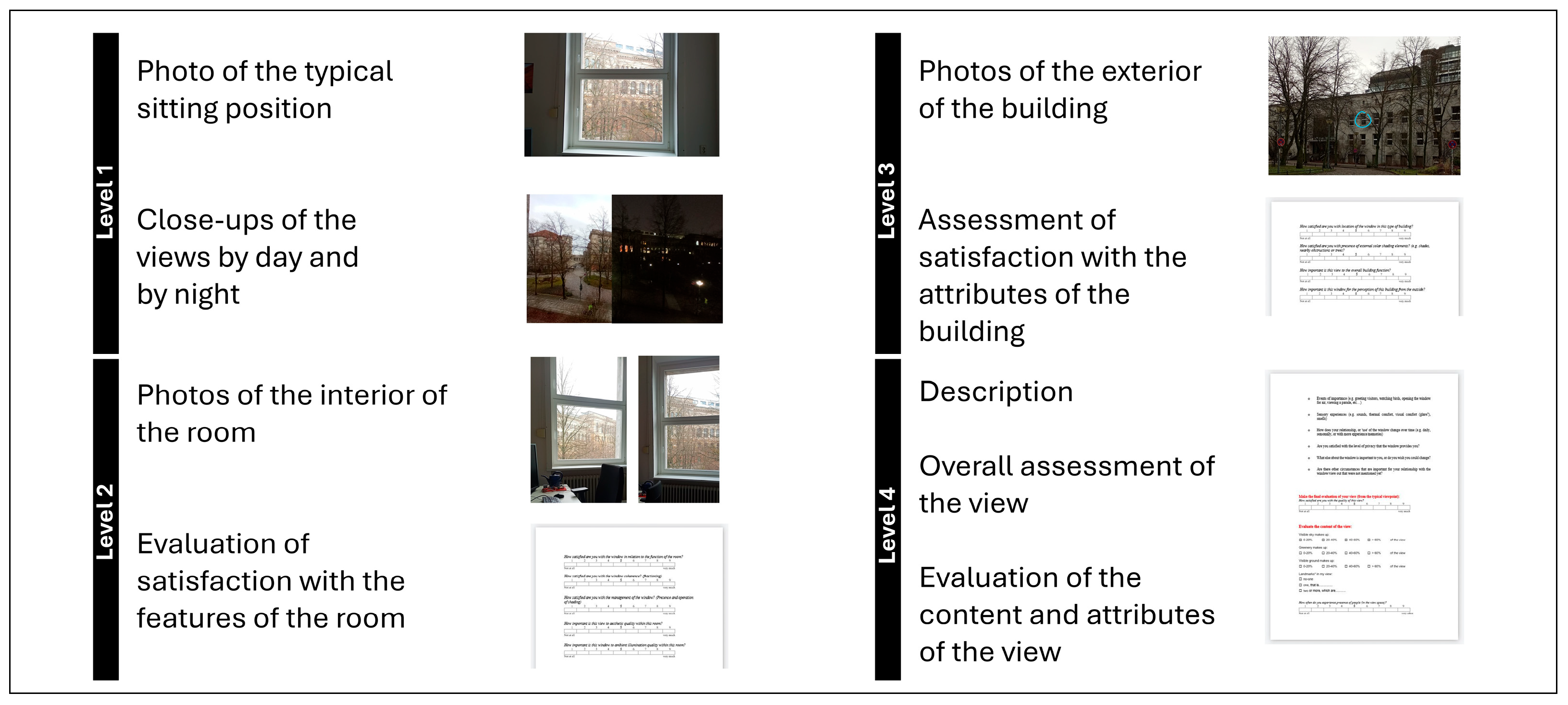
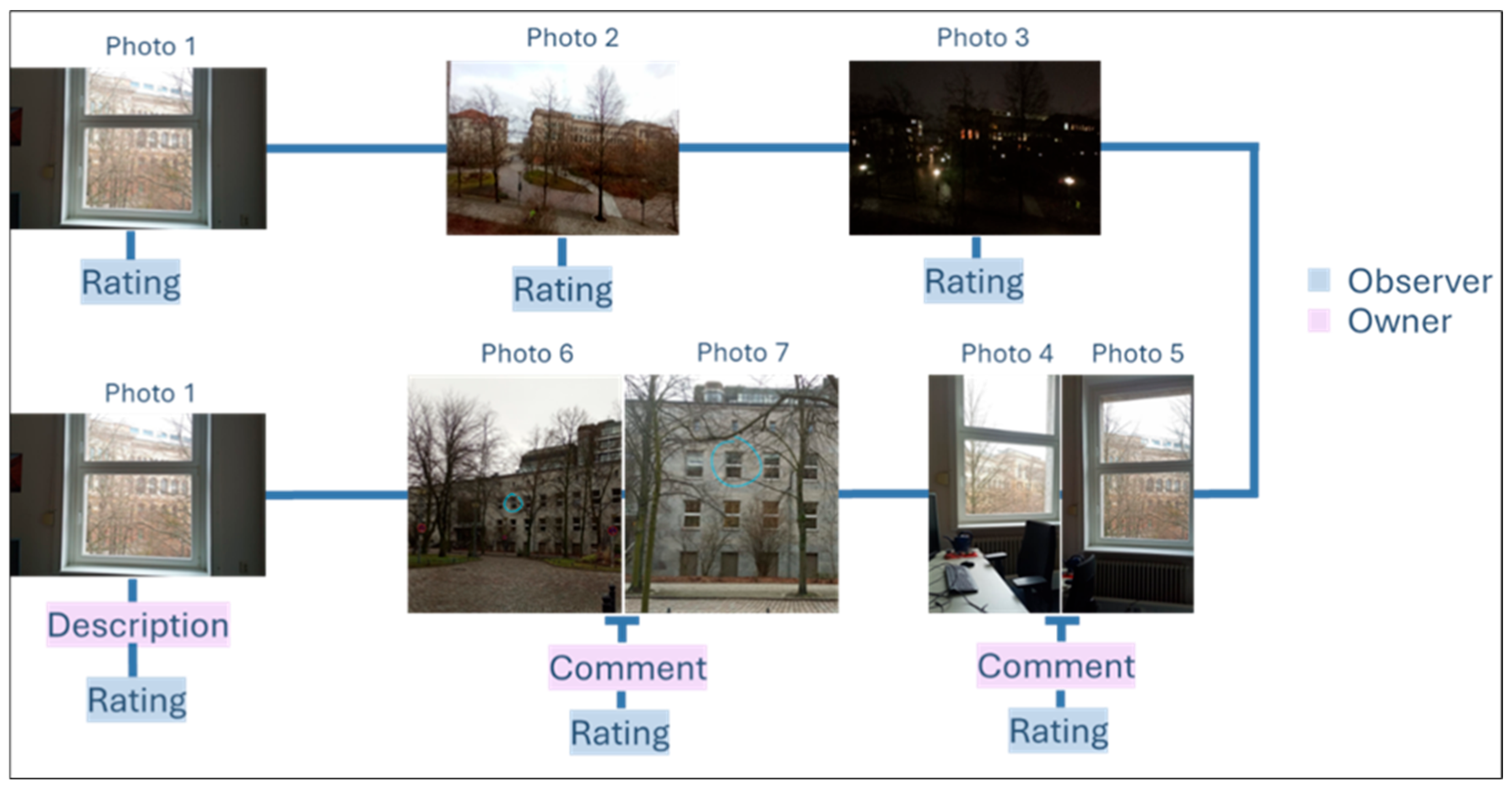
| Evaluation Level/Photo Documentation | Context | Parameters |
|---|---|---|
| 1 [Simple 2D Images] Postcard photo + Panorama Photo | Immediate evaluation of the view out |
|
| 2 [Interior context] Interior photos | Evaluation in relation to the room function |
|
| 3 [Exterior context] Exterior photos | Evaluation in relation to the outside context |
|
| 4 [Lived experience] Narrative of the owner of the view | In-depth/subjective evaluation of the view out |
|
| Full Name/Abbreviation | Type | Application | Comments |
|---|---|---|---|
| Shapiro–Wilk | Normality test | Most reliable for platykurtic distributions (kurtosis < 3) | Kurtosis is a measure of peakedness of a distribution |
| Shapiro–Francia | Normality test | Most reliable for leptokurtic distributions (kurtosis > 3) | |
| Kolmogorov–Smirnov | Normality test | Non-parametric test comparing empirical and reference CDFs | |
| James, Demaree & Wolfâ | Agreement index | Measures within-group agreement for single/multi-item scales | Values close to 1 = strong agreement; cut-off: rωg > 0.7 |
| Brown & Hauenstein | Agreement index | Captures average deviation (AD) from a central measure | Lower AD = stronger agreement |
| Lindell & Brandtâ | Agreement index | Accounts for rater bias and scale limitations | Uses Median Absolute Deviation for robust estimation |
| Median Absolute Deviation (MAD) | Robust variability measure | Used to assess dispersion; robust to outliers | Often used in combination with rωg and AD |
| Intraclass Correlation Coefficient (ICC) | Reliability | Assesses consistency and generalizability of ratings across raters or groups | ICC (1) = reliability of single rater; ICC (2) = reliability of group mean |
| Kruskal–Wallis | Non-parametric test | Tests for differences in distributions across groups | Non-parametric alternative to one-way ANOVA |
| Dunn Test | Post hoc test | Post hoc comparisons following Kruskal–Wallis | Used when Kruskal–Wallis indicates significant difference |
| Wilcoxon signed-rank | Non-parametric test | compares two paired samples | used with corresponding rank-based 739 effect size was rank-biserial r (rb) |
| View Quality Assessment | Shapiro–Wilk | Shapiro–Francia | Kolmogorov–Smirnov | ||
|---|---|---|---|---|---|
| H | Kurtosis | Sig. | Sig. | Sig. | |
| Owner | 1 | 2.9 | <0.0001 | <0.0001 * | <0.0001 *** |
| Observer from Postcard | 1 | 3.8 | 0.0136 | 0.01 | <0.0001 *** |
| Observer from Panorama | 1 | 4 | 0.0128 | 0.008 | <0.0001 *** |
| Vote Category | (James, Demaree & Wolf’s) | AD (Brown & Hauenstein) | MAD (Lindell & Brandt) |
|---|---|---|---|
| Owner | 0.18 (low) | 1.44 (high) | 1 (low) |
| Observer Postcard | 0.72 (moderate) | 0.78 (moderate) | 0.63 (moderate) |
| Observer Panorama | 0.70 (moderate) | 0.81 (moderate) | 0.65 (moderate) |
| Strong: >0.7 | lower values indicate stronger agreement | Strong: ≤0.50 Moderate–Strong: 0.51–0.75 Weak–Moderate: 0.76–1.00 Low: >1.00 |
| Very Good Views | Comment | Very Bad Views | Comment |
|---|---|---|---|
 | Good access, green content, horizon, high transparency |  | Very limited view access, due to the considerable distance from the siting position to the window |
 | Good access, varied and interesting content horizon, high transparency |  | Only one view layer is included, the sky |
 | Good access, beautiful, old and well-kept buildings, high transparency | 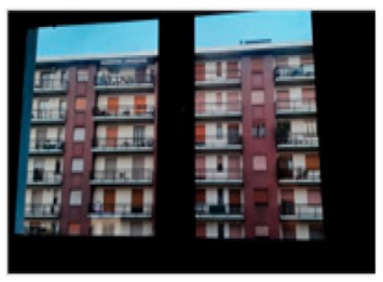 | Rather short view distance, uniform and repetitive content |
 | Good access, greenery, water, buildings in a distance, horizon, mostly high transparency |  | Short view distance, uniform content, partly low transparency |
 | Good access varied and green content, horizon, high transparency, division of the window glass into large pieces |  | Short view distance together with reduced transparency |
 | Very large view distance, to the horizon, the partitioning of the window surface into rather large pieces does not disturb the view |  | Unbalanced view composition, very short view distance on the left side |
| Normality Tests | Shapiro–Wilk | Shapiro–Francia | Kolmogorov–Smirnov | ||||
|---|---|---|---|---|---|---|---|
| High | H | Kurtosis | Sig. | Sig. | H | Sig. | |
| Observer Postcard Vote | 0 | 3.8 | 0.5 | 0.2 | 1 | <0.0001 *** | |
| Observer Panorama Vote | 0 | 3.1 | 0.8 | 0.6 | 1 | <0.0001 *** | |
| Low | H | Kurtosis | Sig. | Sig. | H | Sig. | |
| Observer Postcard Vote | 0 | 3.9 | 0.1 | 0.08 | 1 | <0.0001 *** | |
| Observer Panorama Vote | 0 | 3.4 | 0.2 | 0.1 | 1 | <0.0001 *** | |
| H | Stats | df | sd | Sig. | Mean Vote | ||
|---|---|---|---|---|---|---|---|
| High | Owner Observer Postcard | 1 | 18.66 | 53 | 0.99 | 5.9 × 10⁻²⁵ *** | 5.7 |
| Owner Observer Panorama | 1 | 17.12 | 53 | 1.00 | 2.9 × 10⁻²³ *** | 5.9 | |
| Postcard vs. Panorama | 1 | −1.05 | 53 | 0.9 | 0.007 * | ||
| Low | Observer Postcard Vote | 1 | −8.7 | 72 | 0.9 | 5 × 10⁻¹³ *** | 5.1 |
| Observer Panorama Vote | 1 | −9.6 | 72 | 0.9 | 1.2 × 10⁻¹⁴ *** | 5.2 | |
| Postcard vs. Panorama | 0 | −0.6 | 72 | 0.9 | 0.52 |
| High-Rated Views | Shapiro–Wilk | Shapiro–Francia | Kolmogorov–Smirnov | |||
|---|---|---|---|---|---|---|
| View Quality Assessment | H | Kurtosis | Sig. | Sig. | H | Sig. |
| Observer Postcard | 1 | 3.8 | 0.025 * | 0.02 * | 1 | <0.0001 *** |
| Observer Interior context | 1 | 4.5 | <0.0001 *** | <0.0001 *** | 1 | <0.0001 *** |
| Observer Exterior context | 1 | 3.9 | 0.002 ** | 0.0016 ** | 1 | <0.0001 *** |
| Observer After Narrative Vote | 1 | 5 | <0.0001 *** | <0.0001 *** | 1 | <0.0001 *** |
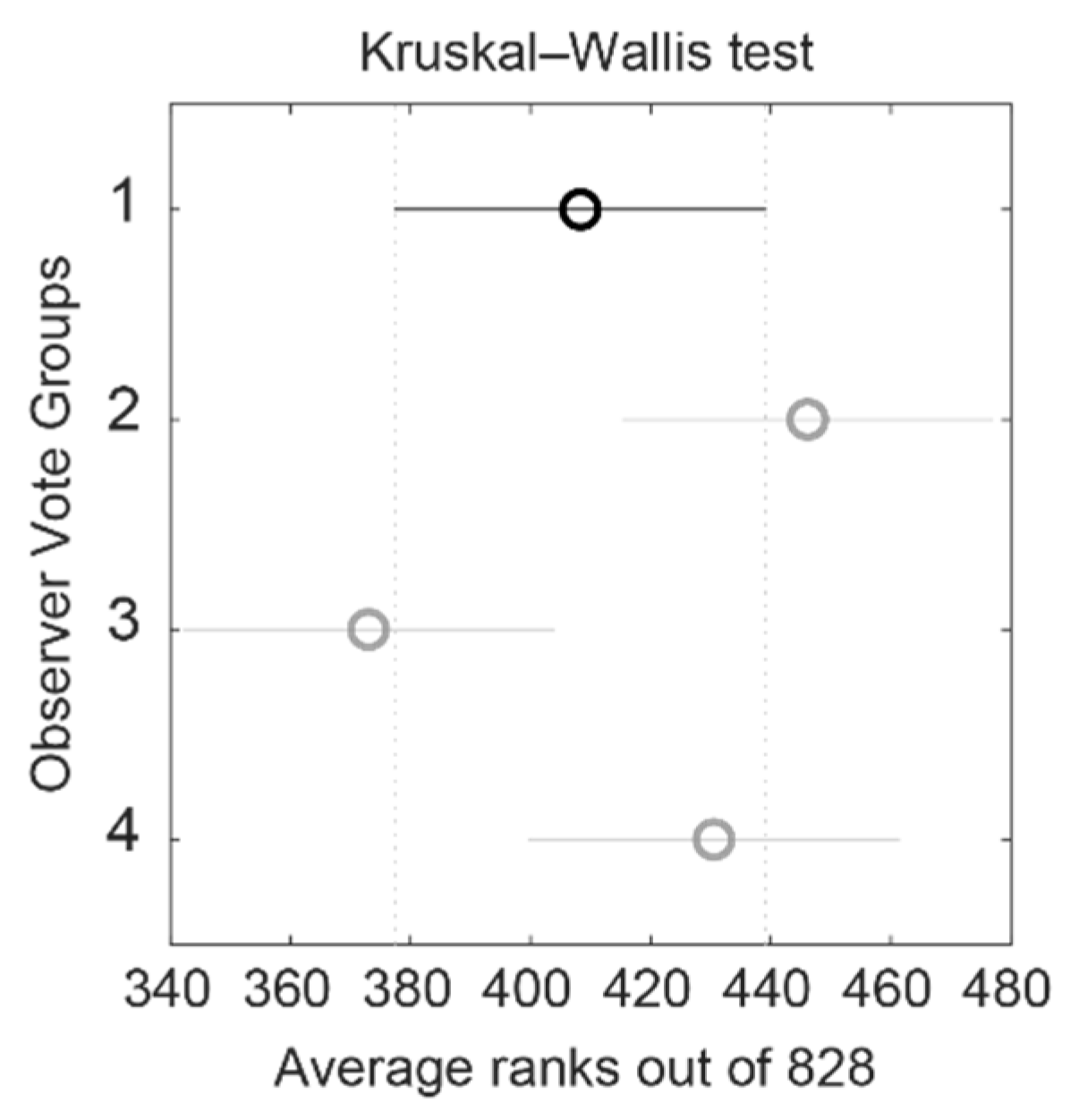
| Group Comparison | Diff in Rank Means | 95% CI | p-Value |
|---|---|---|---|
| 1 vs. 2 | −37.85 | [−99.70, 24.00] | 0.4941 |
| 1 vs. 3 | 35.31 | [−26.55, 97.16] | 0.576 |
| 1 vs. 4 | −22.24 | [−84.09, 39.62] | 0.920 |
| 2 vs. 3 | 73.16 | [11.31, 135.01] | 0.011 * |
| 2 vs. 4 | 15.62 | [−46.24, 77.47] | 0.986 |
| 3 vs. 4 | −57.54 | [−119.40, 4.31] | 0.083 |
| Day View | Night View |
|---|---|
 Observers: 5.6, Owner 7.0 |  Observers: 3.9, Owner:7.0 |
| The night view is less attractive due to the glare from the nearest light pole and very week lighting from distant buildings, which makes the viewing distance shorter. | |
 |  |
| Observers: 6.0, Owner: 8.0 | Observers: 7.5, Owner: 8.0 |
| The construction site with a tall crane dominates the view during the day, but as neither construction site nor crane is illuminated during the night, the night view appears nicer than day view. Thousands of light spots from remote settlements catch the eye instead. | |
| High-Rated Views | Shapiro–Wilk | Shapiro–Francia | Kolmogorov–Smirnov | |||
|---|---|---|---|---|---|---|
| View Quality Assessment | H | Kurtosis | Sig. | Sig. | H | Sig. |
| Observer Daytime Vote | 1 | 4.7 | 0.02 * | 0.01 * | 1 | <0.0001 *** |
| Observer Nighttime Vote | 0 | 3.3 | 0.05 | 0.3 * | 1 | <0.0001 *** |
Disclaimer/Publisher’s Note: The statements, opinions and data contained in all publications are solely those of the individual author(s) and contributor(s) and not of MDPI and/or the editor(s). MDPI and/or the editor(s) disclaim responsibility for any injury to people or property resulting from any ideas, methods, instructions or products referred to in the content. |
© 2026 by the authors. Licensee MDPI, Basel, Switzerland. This article is an open access article distributed under the terms and conditions of the Creative Commons Attribution (CC BY) license.
Share and Cite
Matusiak, B.S.; Khanie, M.S.; Sokol, N.; Diakite-Kortlever, A.; Lo Verso, V.R.M.; Bellia, L.; Fragliasso, F.; Mittelstädt, M. The View from the Window—Assessment by the “View Owner” and the “View Observers”. Buildings 2026, 16, 371. https://doi.org/10.3390/buildings16020371
Matusiak BS, Khanie MS, Sokol N, Diakite-Kortlever A, Lo Verso VRM, Bellia L, Fragliasso F, Mittelstädt M. The View from the Window—Assessment by the “View Owner” and the “View Observers”. Buildings. 2026; 16(2):371. https://doi.org/10.3390/buildings16020371
Chicago/Turabian StyleMatusiak, Barbara Szybinska, Mandana Sarey Khanie, Natalia Sokol, Aicha Diakite-Kortlever, Valerio Roberto Maria Lo Verso, Laura Bellia, Francesca Fragliasso, and Melissa Mittelstädt. 2026. "The View from the Window—Assessment by the “View Owner” and the “View Observers”" Buildings 16, no. 2: 371. https://doi.org/10.3390/buildings16020371
APA StyleMatusiak, B. S., Khanie, M. S., Sokol, N., Diakite-Kortlever, A., Lo Verso, V. R. M., Bellia, L., Fragliasso, F., & Mittelstädt, M. (2026). The View from the Window—Assessment by the “View Owner” and the “View Observers”. Buildings, 16(2), 371. https://doi.org/10.3390/buildings16020371