Investigating the Impact of Wind Tower Geometry on Ventilation Efficiency in Semi-Enclosed Spaces: A Comprehensive Parametric Analysis and Design Implications




Abstract
1. Introduction
1.1. Literature Review
1.1.1. Experimental Studies of Wind Towers and Their Parameters
1.1.2. Numerical Studies of Wind Towers and Their Parameters
1.1.3. Relevance and Gap Identification
2. Materials and Methods
2.1. Wind Towers Physics
2.2. Numerical Modelling Approach
- The flow is incompressible since compressibility effects can be neglected at relatively low airflow speeds.
- The flow is steady due to insignificant changes in airflow inside and outside the wind tower.
- Body forces may be neglected.
- is the rate of dissipation of turbulent kinetic energy, m2/s3.
- is the body force vector, the force acting on a unit volume of a body, N/m3.
- is the turbulent kinetic energy, m2/s2.
- is the static pressure, Pa.
- is the Turbulent Production Term, m2/s3.
- is the density, kg/m3.
- is the dynamic viscosity, Pa∙s.
- is the eddy viscosity, Pa∙s.
- are the constant coefficients, with these values (1, 1.3, 1.44, 1.92, and 0.09), respectively [32].
- is the velocity vector, m/s.
2.3. Numerical Modelling Validation
2.3.1. Geometric Modelling
- 1.
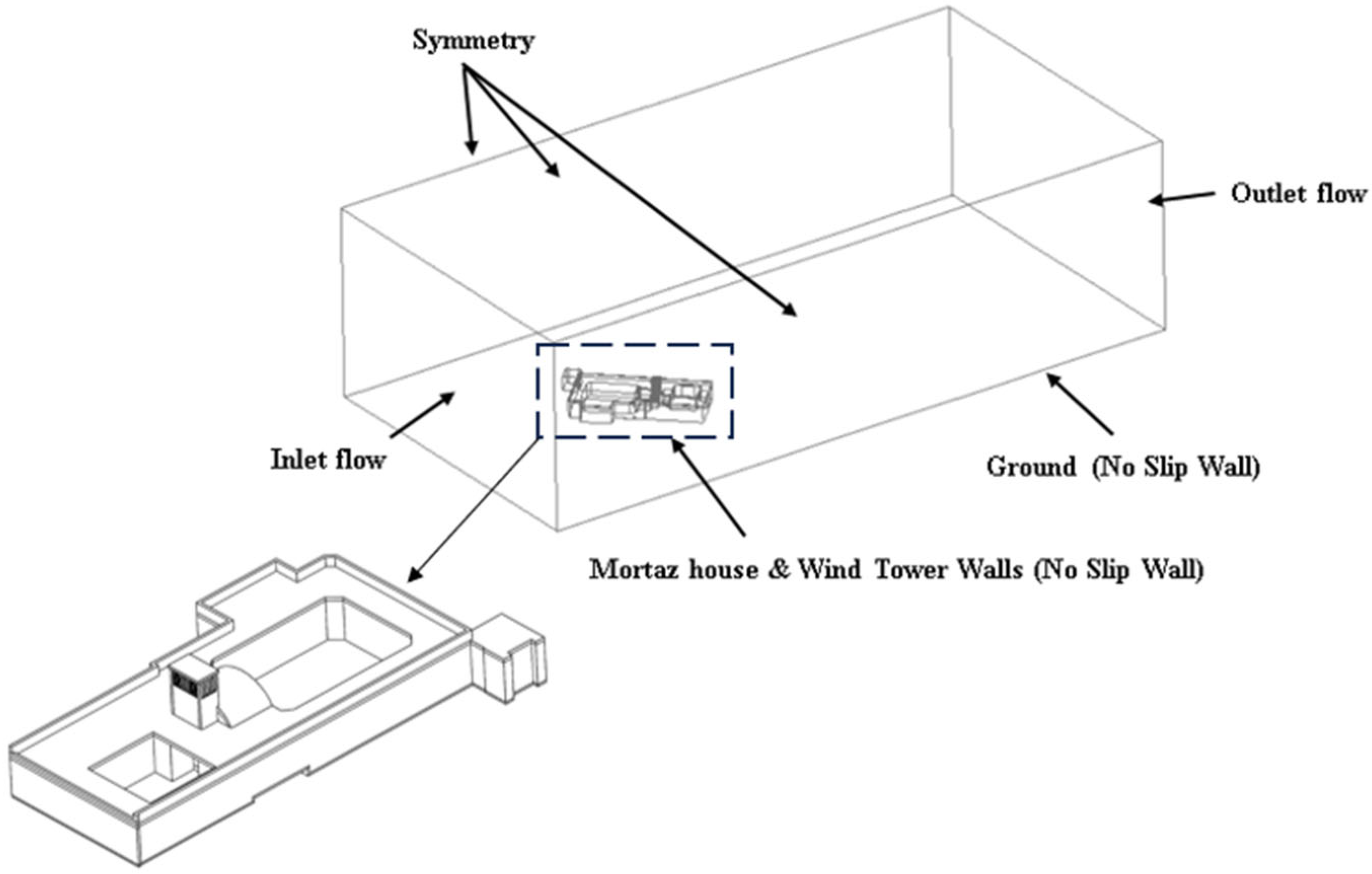
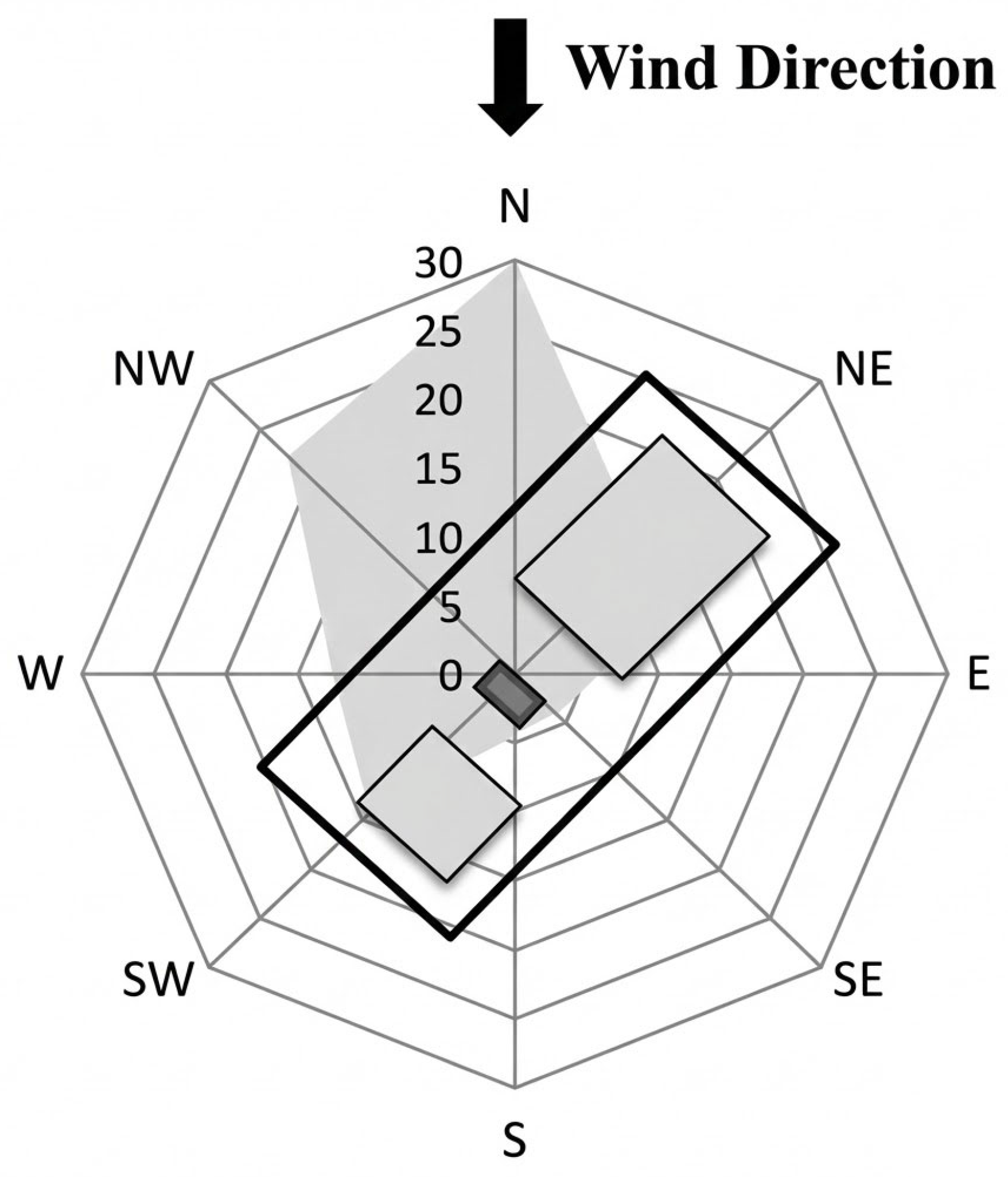
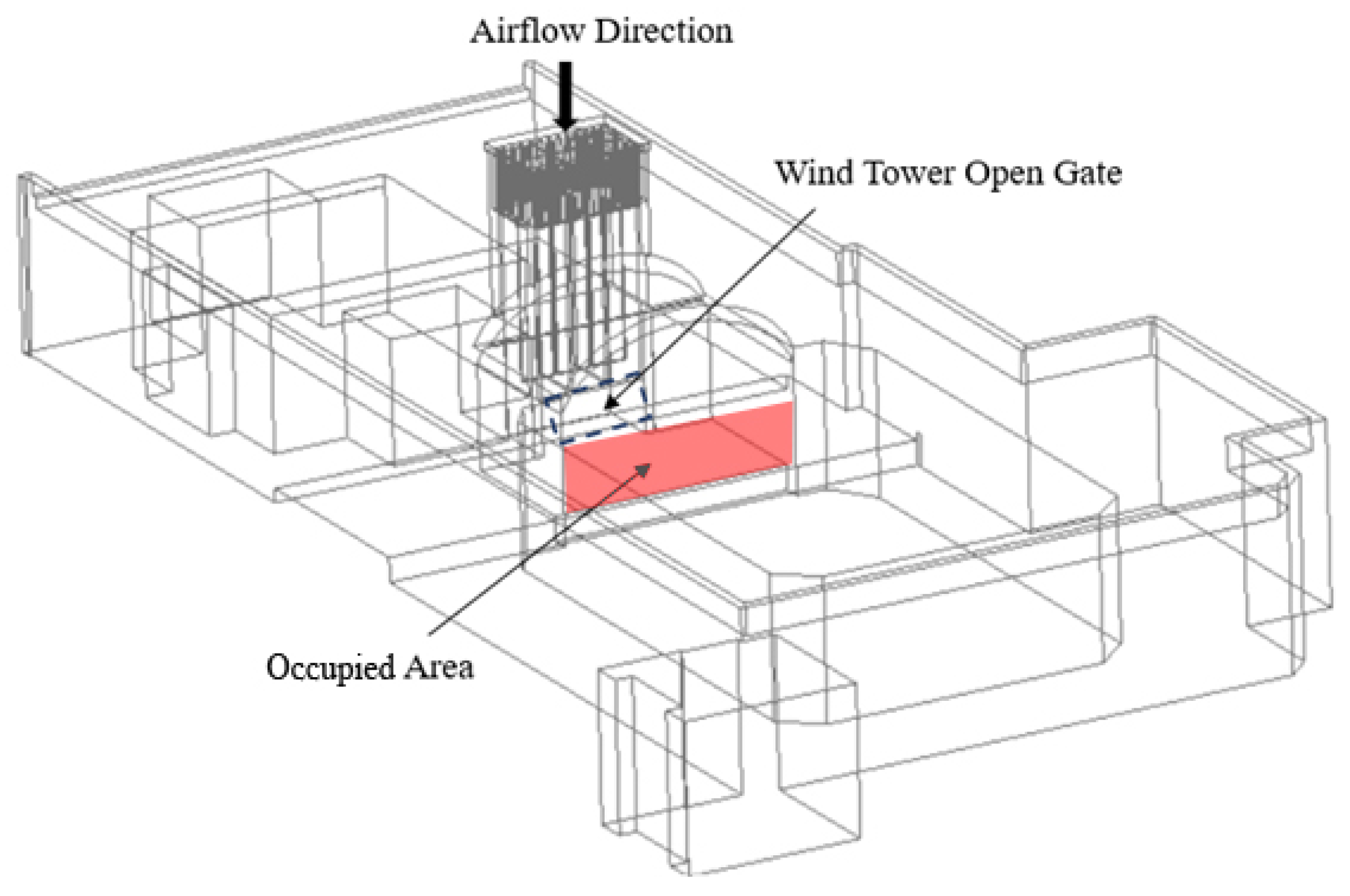
- Inlet Boundary Condition: A logarithmic wind profile was applied to represent ‘town and village’ terrain (Category III), following the standard log-law, with wind blowing from the North direction. The wind velocity was set to 1.5 m/s at a reference height of 11 m above ground level (roughness length (z0) of 0.5 m and friction velocity of 0.2 m/s). In ANSYS Fluent Version 2023 R1 [30], the turbulence parameters were specified using the Intensity (5%) and turbulent viscosity ratio (10), corresponding to Turbulent kinetic energy and the rate of dissipation of turbulent kinetic energy
- 2.
- Outlet Boundary Condition: The pressure outlet was set to atmospheric or zero-gauge pressure to allow air to enter and exit the ambient domain.
- 3.
- No Slip Wall: A no-slip wall with zero velocity components was used for the ground and the building walls
- 4.
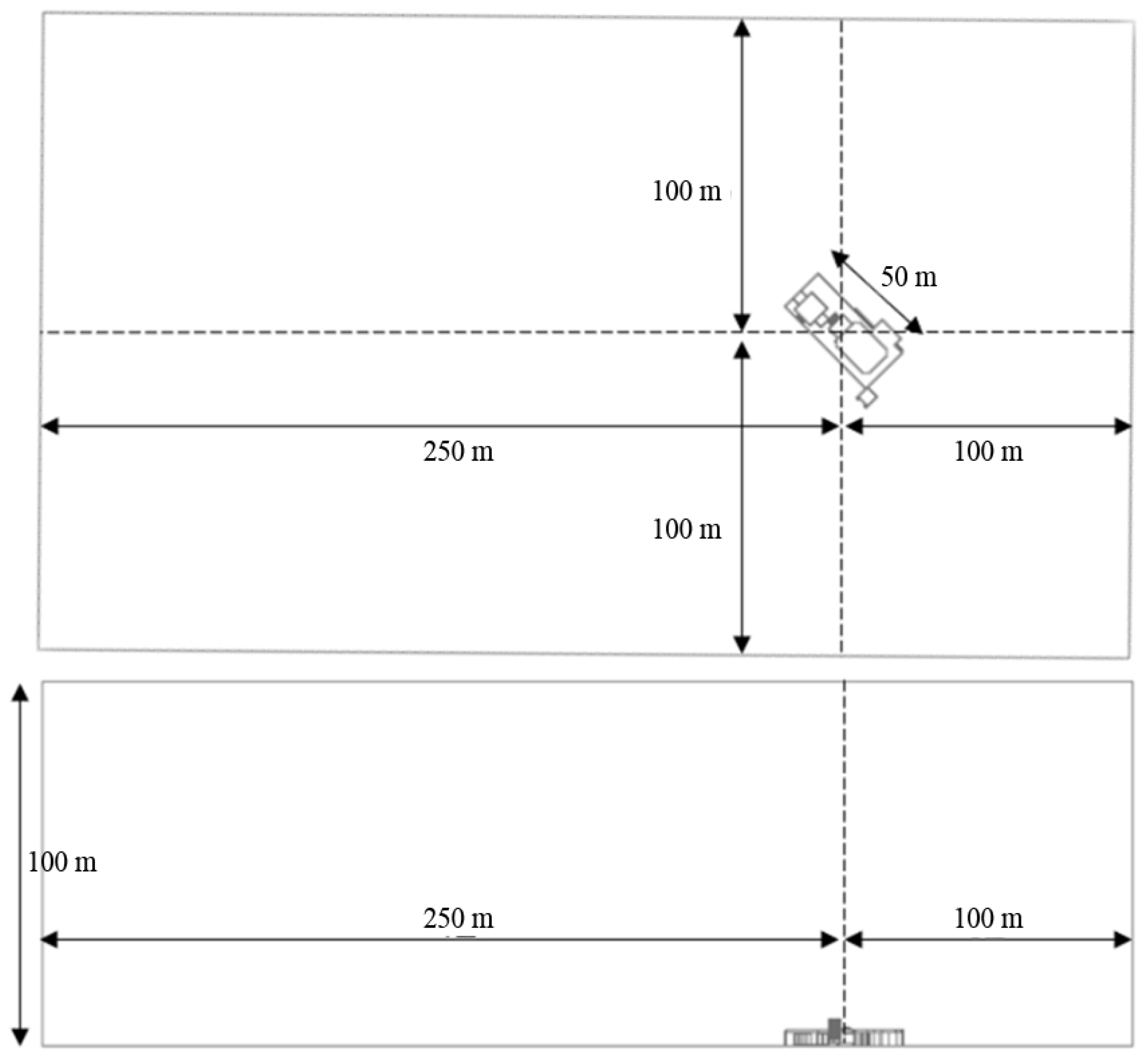
- Symmetry Boundary Conditions: Because the air domain was sufficiently large in all directions from the building (The Mortaz House), symmetry boundary conditions were used for the ceiling and side walls, with zero normal velocity only [36].
2.3.2. Meshing
2.3.3. Model Setup
2.3.4. Mesh Independence Study
- .
- .
- N is the number of shafts.
- r is the mesh elements ratio.
- Fs is the Factor of safety = 1.25.
- .
- p is the order of convergence = .
2.3.5. Model Validation
2.4. Parametric Study and Data Analysis
2.4.1. Simulation Cases
2.4.2. Parametrization Process
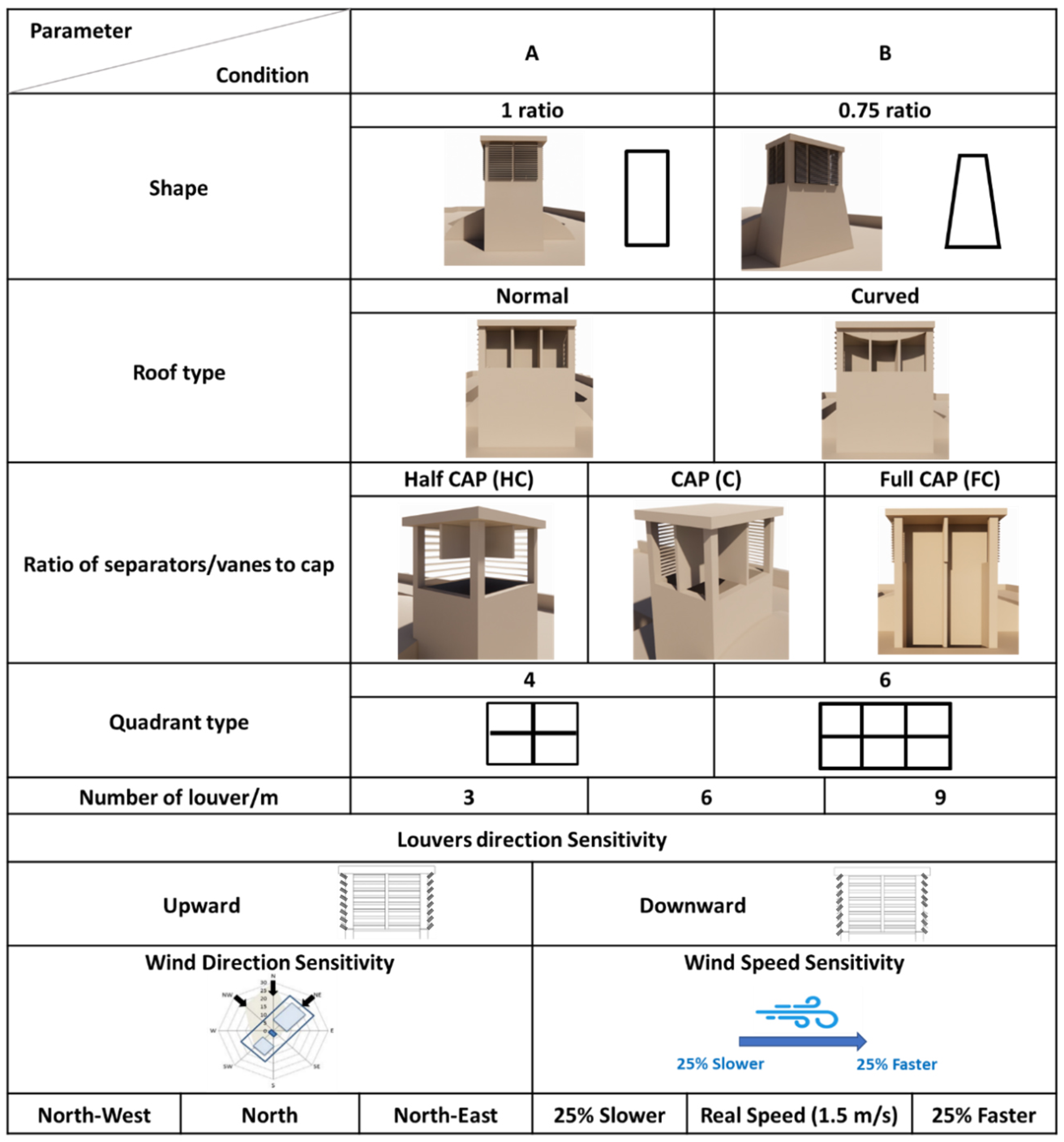
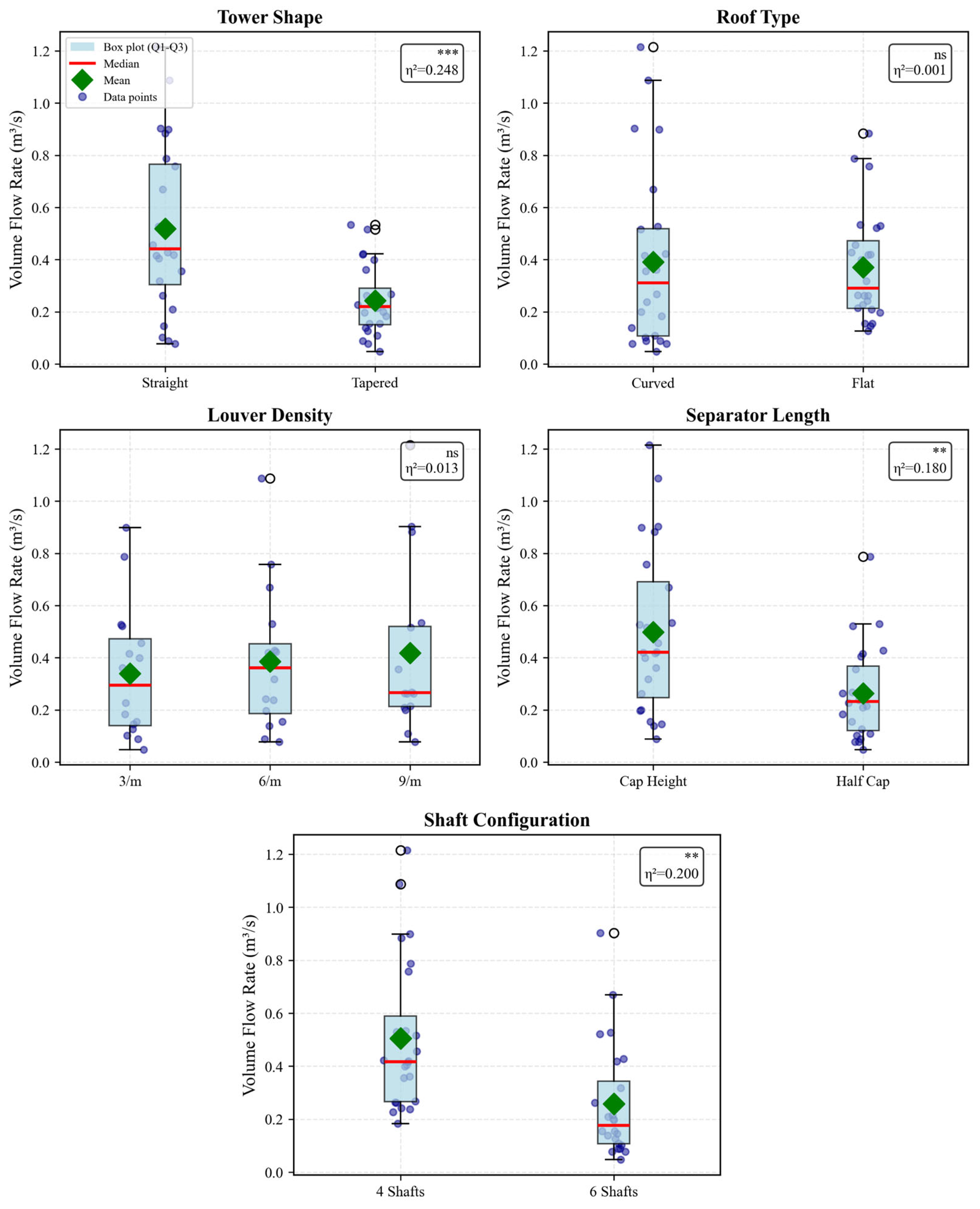
- Number of shaft divisions and tower shaft ratio: Two designs were selected: the original design of The Mortaz House, which included six shafts, and another design with the tower containing only four shafts. The quadrant type is more common in modern towers [40]. The number of shafts also changed the tower-shaft ratio: the 4-shaft tower had a 1:1 ratio, and the 6-shaft tower had a 2:3 ratio, as shown in Figure 9A.
- Wind Tower Separators length: The vanes or separators’ lengths inside the tower shaft were considered in the literature. Sometimes, the vanes are shorter than the cap, stop at the middle of the cap (Half CAP or HC), stop at the tower’s cap (CAP or C), or continue through the shaft (Full CAP or FC) [41]. These three conditions are shown in Figure 9A.
- Wind Tower Louvres Density (Number of Louvres per meter): Horizontal louvres are used for parametric cases. The louvres are modelled with a standard angle of 45° downward [42]. However, the density of the louvres appeared to vary significantly in the towers investigated in the available literature [43]. Thus, three conditions were selected: three louvres/m/m, six louvres/m/m, and nine louvres/m/m, as depicted in Figure 9A.
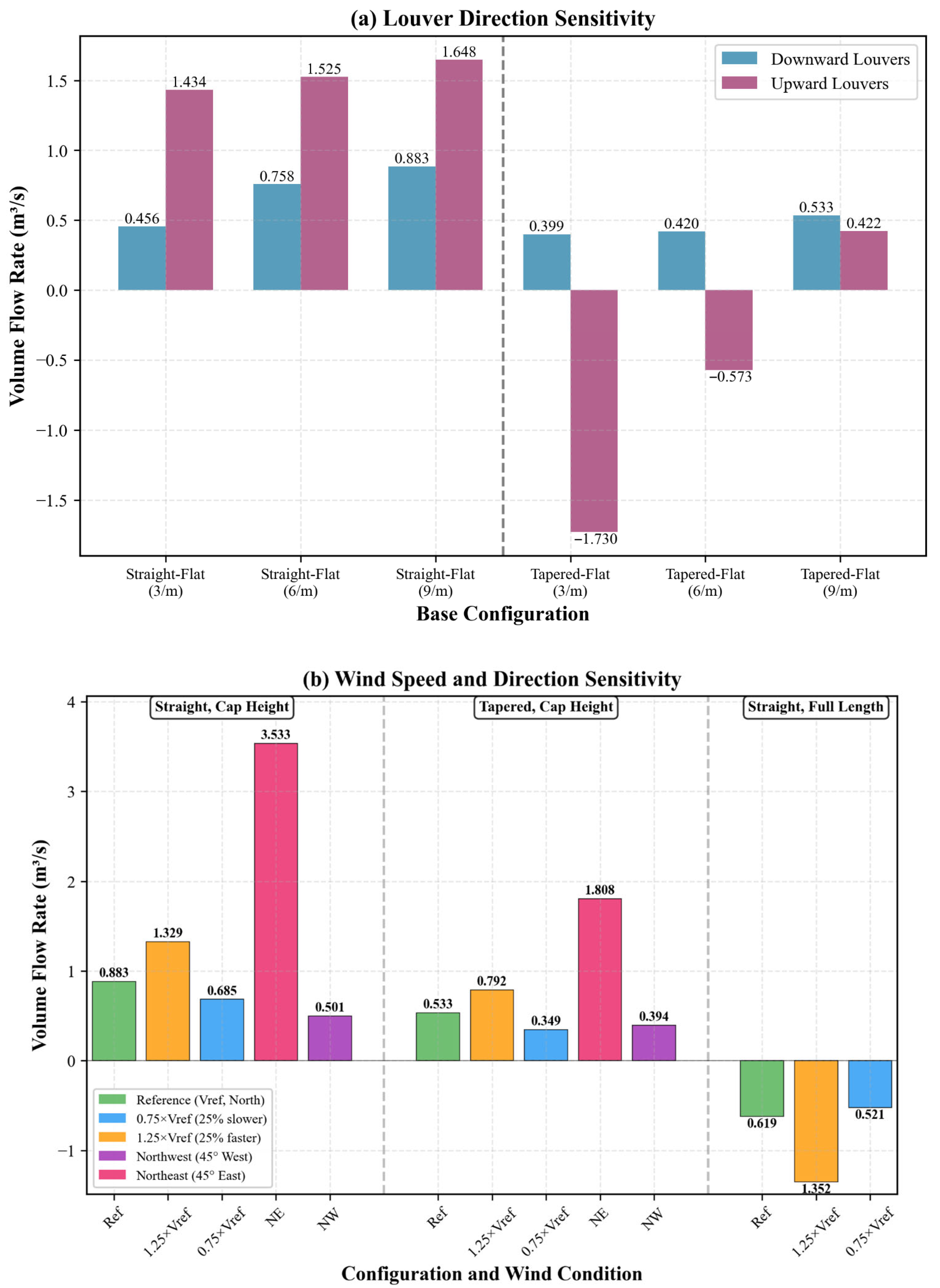
- Louvre directions: The original cases studied the tower with downward-facing louvres. This direction is reversed to an upward-facing angle in the sensitivity study, as illustrated in Figure 9A.
2.4.3. Wind Sensitivity Study
2.4.4. Performance Evaluation Methodology
3. Results
3.1. Effects of Geometric Parameters
3.2. Parameter Interaction Effects
3.3. Performance Optimization Landscape
3.4. Sensitivity Analysis Results
3.5. Top Performing Configurations
4. Discussion
5. Conclusions
Author Contributions
Funding
Data Availability Statement
Acknowledgments
Conflicts of Interest
Abbreviations
| 3D | Three Dimensional |
| ACH | Air Change |
| ANOVA | One-way Analysis of Variance |
| CFD | Computational Fluid Dynamics |
| GCI | Grid Convergence Index |
| HSD | Tukey’s Honestly Significant Difference |
| HVAC | Heating Ventilation and Air Conditioning |
| KPI | Key Performance Indicators |
| MENA | Middle East and North Africa |
| NCE | Normalized Catching Efficiency |
| RANS | Reynolds-Averaged Navier–Stokes |
| RRMSE | Relative Root Mean Square Deviation Error |
Appendix A

| Case Number | Shape | Roof Type | Quadrant Type | Number of Louvres | Ratio of Separators to Cap | Volume Flow Rate (m3/s) and Direction | Avg (m/s) | Max (m/s) | Min (m/s) | |
|---|---|---|---|---|---|---|---|---|---|---|
| Straight & Normal Roof & Quadrant (4) | ||||||||||
| Case 1 | Sa | Ra | Qa | La | RSa | 0.787 | Out | 0.387 | 0.769 | 0.024 |
| Case 2 | Sa | Ra | Qa | La | RSb | 0.456 | Out | 0.417 | 0.745 | 0.008 |
| Case 3 | Sa | Ra | Qa | La | RSc | 0.587 | Back | 0.367 | 0.827 (2.5%) | 0.014 |
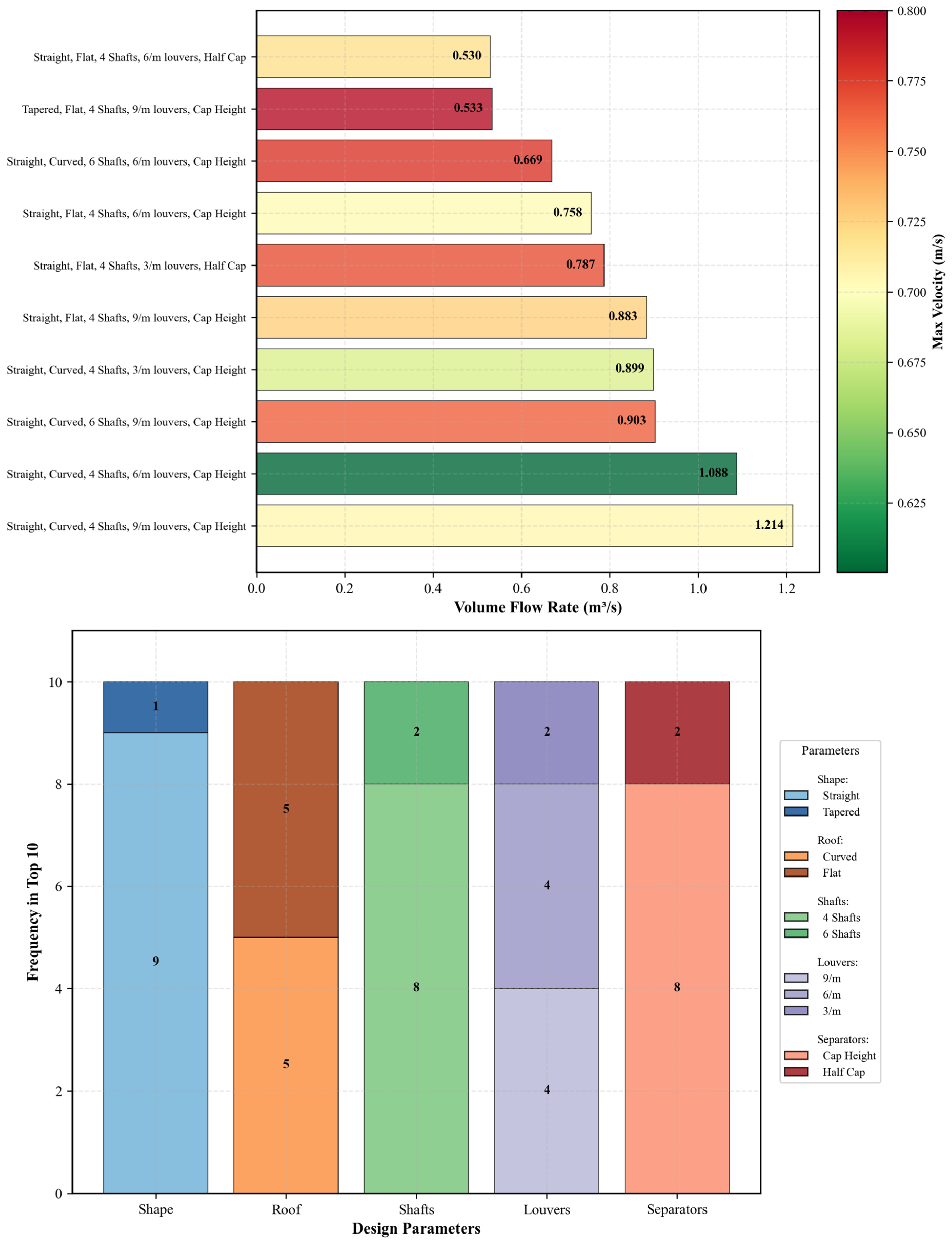
| Case 4 | Sa | Ra | Qa | Lb | RSa | 0.530 | Out | 0.377 | 0.718 | 0.021 |
| Case 5 | Sa | Ra | Qa | Lb | RSb | 0.758 | Out | 0.364 | 0.703 | 0.017 |
| Case 6 | Sa | Ra | Qa | Lb | RSc | 0.578 | Back | 0.357 | 0.788 | 0.022 |
| Case 7 | Sa | Ra | Qa | Lc | RSa | 0.262 | Out | 0.379 | 0.684 | 0.016 |
| Case 8 | Sa | Ra | Qa | Lc | RSb | 0.883 | Out | 0.384 | 0.726 | 0.027 |
| Case 9 | Sa | Ra | Qa | Lc | RSc | 0.619 | Back | 0.368 | 0.790 | 0.019 |
| Straight & Normal Roof & Quadrant (6) | ||||||||||
| Case 10 | Sa | Ra | Qb | La | RSa | 0.522 | Out | 0.370 | 0.707 | 0.010 |
| Case 11 | Sa | Ra | Qb | La | RSb | 0.146 | Out | 0.392 | 0.679 | 0.018 |
| Case 12 | Sa | Ra | Qb | La | RSc | 0.686 | Back | 0.398 | 0.811 (9%) | 0.019 |
| Case 13 | Sa | Ra | Qb | Lb | RSa | 0.428 | Out | 0.421 | 0.742 | 0.029 |
| Case 14 | Sa | Ra | Qb | Lb | RSb | 0.318 | Out | 0.403 | 0.717 | 0.021 |
| Case 15 | Sa | Ra | Qb | Lb | RSc | 0.595 | Back | 0.424 | 0.855 (12.5%) | 0.029 |
| Case 16 | Sa | Ra | Qb | Lc | RSa | 0.210 | Out | 0.395 | 0.703 | 0.018 |
| Case 17 | Sa | Ra | Qb | Lc | RSb | 0.418 | Out | 0.396 | 0.710 | 0.023 |
| Case 18 | Sa | Ra | Qb | Lc | RSc | 1.113 | Back | 0.560 | 0.957 (50%) | 0.028 |
| Straight & Curved Roof & Quadrant (4) | ||||||||||
| Case 19 | Sa | Rb | Qa | La | RSa | 0.415 | Out | 0.401 | 0.738 | 0.016 |
| Case 20 | Sa | Rb | Qa | La | RSb | 0.899 | Out | 0.388 | 0.682 | 0.018 |
| Case 21 | Sa | Rb | Qa | La | RSc | 0.306 | Back | 0.368 | 0.798 | 0.024 |
| Case 22 | Sa | Rb | Qa | Lb | RSa | 0.405 | Out | 0.402 | 0.770 | 0.006 |
| Case 23 | Sa | Rb | Qa | Lb | RSb | 1.088 | Out | 0.365 | 0.600 | 0.003 |
| Case 24 | Sa | Rb | Qa | Lb | RSc | 0.155 | Back | 0.421 | 0.815 (1%) | 0.012 |
| Case 25 | Sa | Rb | Qa | Lc | RSa | 0.355 | Out | 0.420 | 0.734 | 0.022 |
| Case 26 | Sa | Rb | Qa | Lc | RSb | 1.214 | Out | 0.369 | 0.705 | 0.023 |
| Case 27 | Sa | Rb | Qa | Lc | RSc | 0.311 | Back | 0.412 | 0.803 (10%) | 0.030 |
| Straight & Curved Roof & Quadrant (6) | ||||||||||
| Case 28 | Sa | Rb | Qb | La | RSa | 0.102 | Out | 0.393 | 0.650 | 0.009 |
| Case 29 | Sa | Rb | Qb | La | RSb | 0.527 | Out | 0.422 | 0.764 | 0.018 |
| Case 30 | Sa | Rb | Qb | La | RSc | 0.824 | Back | 0.426 | 0.908 (2.5%) | 0.015 |
| Case 31 | Sa | Rb | Qb | Lb | RSa | 0.089 | Out | 0.480 | 0.789 | 0.018 |
| Case 32 | Sa | Rb | Qb | Lb | RSb | 0.669 | Out | 0.425 | 0.778 | 0.023 |
| Case 33 | Sa | Rb | Qb | Lb | RSc | 0.402 | Back | 0.407 | 0.937 (1%) | 0.026 |
| Case 34 | Sa | Rb | Qb | Lc | RSa | 0.077 | Out | 0.434 | 0.782 | 0.015 |
| Case 35 | Sa | Rb | Qb | Lc | RSb | 0.903 | Out | 0.339 | 0.763 | 0.007 |
| Case 36 | Sa | Rb | Qb | Lc | RSc | 0.591 | Back | 0.460 | 0.825 (0.5%) | 0.015 |
| Tapered & Normal Roof & Quadrant (4) | ||||||||||
| Case 37 | Sb | Ra | Qa | La | RSa | 0.227 | Out | 0.391 | 0.726 | 0.025 |
| Case 38 | Sb | Ra | Qa | La | RSb | 0.399 | Out | 0.383 | 0.687 | 0.016 |
| Case 39 | Sb | Ra | Qa | La | RSc | 0.433 | Back | 0.381 | 0.759 | 0.021 |
| Case 40 | Sb | Ra | Qa | Lb | RSa | 0.242 | Out | 0.382 | 0.681 | 0.010 |
| Case 41 | Sb | Ra | Qa | Lb | RSb | 0.420 | Out | 0.382 | 0.704 | 0.012 |
| Case 42 | Sb | Ra | Qa | Lb | RSc | 0.529 | Back | 0.447 | 0.833 (0.5%) | 0.029 |
| Case 43 | Sb | Ra | Qa | Lc | RSa | 0.264 | Out | 0.383 | 0.700 | 0.022 |
| Case 44 | Sb | Ra | Qa | Lc | RSb | 0.533 | Out | 0.343 | 0.793 | 0.017 |
| Case 45 | Sb | Ra | Qa | Lc | RSc | 0.393 | Back | 0.333 | 1.497 (1%) | 0.011 |
| Tapered & Normal Roof & Quadrant (6) | ||||||||||
| Case 46 | Sb | Ra | Qb | La | RSa | 0.126 | Out | 0.395 | 0.706 | 0.017 |
| Case 47 | Sb | Ra | Qb | La | RSb | 0.156 | Out | 0.402 | 0.720 | 0.018 |
| Case 48 | Sb | Ra | Qb | La | RSc | 0.442 | Back | 0.393 | 0.747 | 0.024 |
| Case 49 | Sb | Ra | Qb | Lb | RSa | 0.155 | Out | 0.402 | 0.716 | 0.013 |
| Case 50 | Sb | Ra | Qb | Lb | RSb | 0.197 | Out | 0.397 | 0.687 | 0.020 |
| Case 51 | Sb | Ra | Qb | Lb | RSc | 0.243 | Back | 0.454 | 0.785 | 0.030 |
| Case 52 | Sb | Ra | Qb | Lc | RSa | 0.214 | Out | 0.390 | 0.675 | 0.008 |
| Case 53 | Sb | Ra | Qb | Lc | RSb | 0.263 | Out | 0.405 | 0.715 | 0.020 |
| Case 54 | Sb | Ra | Qb | Lc | RSc | 0.421 | Back | 0.445 | 0.786 | 0.032 |
| Tapered & Curved Roof & Quadrant (4) | ||||||||||
| Case 55 | Sb | Rb | Qa | La | RSa | 0.184 | Out | 0.418 | 0.786 | 0.031 |
| Case 56 | Sb | Rb | Qa | La | RSb | 0.362 | Out | 0.374 | 0.710 | 0.009 |
| Case 57 | Sb | Rb | Qa | La | RSc | 0.265 | Back | 0.435 | 0.775 | 0.016 |
| Case 58 | Sb | Rb | Qa | Lb | RSa | 0.238 | Out | 0.390 | 0.734 | 0.018 |
| Case 59 | Sb | Rb | Qa | Lb | RSb | 0.422 | Out | 0.390 | 0.699 | 0.025 |
| Case 60 | Sb | Rb | Qa | Lb | RSc | 0.119 | Back | 0.421 | 0.780 | 0.020 |
| Case 61 | Sb | Rb | Qa | Lc | RSa | 0.268 | Out | 0.415 | 0.752 | 0.031 |
| Case 62 | Sb | Rb | Qa | Lc | RSb | 0.516 | Out | 0.398 | 0.700 | 0.013 |
| Case 63 | Sb | Rb | Qa | Lc | RSc | 0.267 | Back | 0.397 | 0.801 (1%) | 0.022 |
| Tapered & Curved Roof & Quadrant (6) | ||||||||||
| Case 64 | Sb | Rb | Qb | La | RSa | 0.048 | Out | 0.390 | 0.704 | 0.020 |
| Case 65 | Sb | Rb | Qb | La | RSb | 0.089 | Out | 0.447 | 0.774 | 0.033 |
| Case 66 | Sb | Rb | Qb | La | RSc | 0.137 | Back | 0.433 | 0.781 | 0.022 |
| Case 67 | Sb | Rb | Qb | Lb | RSa | 0.078 | Out | 0.428 | 0.739 | 0.022 |
| Case 68 | Sb | Rb | Qb | Lb | RSb | 0.139 | Out | 0.400 | 0.693 | 0.010 |
| Case 69 | Sb | Rb | Qb | Lb | RSc | 0.117 | Back | 0.396 | 0.750 | 0.021 |
| Case 70 | Sb | Rb | Qb | Lc | RSa | 0.109 | Out | 0.395 | 0.694 | 0.010 |
| Case 71 | Sb | Rb | Qb | Lc | RSb | 0.200 | Out | 0.394 | 0.757 | 0.021 |
| Case 72 | Sb | Rb | Qb | Lc | RSc | 0.142 | Back | 0.484 | 0.850 (2.5%) | 0.025 |
Appendix B
| Case Number | Base Case | Shape | Roof Type | Quadrant Type | Number of Louvres | Ratio of Separators to Cap | Volume Flow Rate (m3/s) and Direction | Avg (m/s) | Max (m/s) | Min (m/s) | |
|---|---|---|---|---|---|---|---|---|---|---|---|
| Louvres Direction Parametric Study Results | |||||||||||
| Straight & Normal Roof & Quadrant (4) & Louvres Upward | |||||||||||
| Case 73 | 2 | Sa | Ra | Qa | La | RSb | 1.434 | Out | 0.369 | 0.692 | 0.016 |
| Case 74 | 5 | Sa | Ra | Qa | Lb | RSb | 1.525 | Out | 0.382 | 0.787 | 0.013 |
| Case 75 | 8 | Sa | Ra | Qa | Lc | RSb | 1.648 | Out | 0.363 | 0.726 | 0.025 |
| Tapered & Normal Roof & Quadrant (4) & Louvres Upward | |||||||||||
| Case 76 | 38 | Sb | Ra | Qa | La | RSb | 1.730 | Back | 0.315 | 0.807 (0.2%) | 0.015 |
| Case 77 | 41 | Sb | Ra | Qa | Lb | RSb | 0.573 | Back | 0.546 | 1.289 (50%) | 0.024 |
| Case 78 | 44 | Sb | Ra | Qa | Lc | RSb | 0.422 | Out | 0.365 | 0.707 | 0.016 |
Appendix C
| Case Number | Base Case | Shape | Ratio of Separators to Cap | Description | Volume Flow Rate (m3/s) and Direction | |
|---|---|---|---|---|---|---|
| Case 79 | Case 8 | Sa | RSb | 25% faster | 1.329 | Out |
| Case 80 | Case 44 | Sb | RSb | 25% faster | 0.792 | Out |
| Case 81 | Case 8 | Sa | RSb | 25% slower | 0.685 | Out |
| Case 82 | Case 44 | Sb | RSb | 25% slower | 0.349 | Out |
| Case 83 | Case 8 | Sa | RSb | 45° West | 0.501 | Out |
| Case 84 | Case 44 | Sb | RSb | 45° West | 0.394 | Out |
| Case 85 | Case 8 | Sa | RSb | 45° East | 3.533 | Out |
| Case 86 | Case 44 | Sb | RSb | 45° East | 1.808 | Out |
| Case 87 | Case 9 | Sa | Rsc | 25% faster | 1.352 | Back |
| Case 88 | Case 9 | Sa | Rsc | 25% slower | 0.521 | Back |
References
- Athmani, W.; Sriti, L.; Dabaieh, M.; Younsi, Z. The Potential of Using Passive Cooling Roof Techniques to Improve Thermal Performance and Energy Efficiency of Residential Buildings in Hot Arid Regions. Buildings 2023, 13, 21. [Google Scholar] [CrossRef]
- Ebrahimi, A.; Shayegani, A.; Mahmoudi Zarandi, M. Thermal Performance of Sustainable Element in Moayedi Icehouse in Iran. Int. J. Archit. Herit. 2021, 15, 740–756. [Google Scholar] [CrossRef]
- Herbert, G.M.J.; Iniyan, S.; Sreevalsan, E.; Rajapandian, S. A Review of Wind Energy Technologies. Renew. Sustain. Energy Rev. 2007, 11, 1117–1145. [Google Scholar] [CrossRef]
- Dehghani-Sanij, A.R.; Soltani, M.; Raahemifar, K. A New Design of Wind Tower for Passive Ventilation in Buildings to Reduce Energy Consumption in Windy Regions. Renew. Sustain. Energy Rev. 2015, 42, 182–195. [Google Scholar] [CrossRef]
- Habeeb, R.; Devadutt, S. Test of Airflow in a Mono-Directional Wind-Catcher for Various Wind Conditions Using Computational Fluid Dynamics. Available online: https://www.researchgate.net/publication/329265222 (accessed on 1 December 2025).
- Bahadori, M.N.; Dehghani-Sanij, A. Wind Towers, 1st ed.; Springer: Cham, Switzerland, 2014. [Google Scholar]
- Chohan, A.H.; Awad, J. Wind towers: An Element of Passive Ventilation in Hot, Arid and Humid Regions—A Comparative Analysis of Their Design and Function. Sustainability 2022, 14, 11088. [Google Scholar] [CrossRef]
- Li, J.; Calautit, J.; Jimenez-Bescos, C. Parametric Analysis of a Novel Rotary Scoop Dual-Channel Windcatcher for Multi-Directional Natural Ventilation of Buildings. Energy Built Environ. 2024, 6, 1169–1186. [Google Scholar] [CrossRef]
- Obeidat, B.; Kamal, H.; Almalkawi, A. CFD Analysis of an Innovative Wind Tower Design with Wind-Inducing Natural Ventilation Technique for Arid Climatic Conditions. J. Ecol. Eng. 2021, 22, 86–97. [Google Scholar] [CrossRef]
- ANSI/ASHRAE 55–2023; Thermal Environmental Conditions for Human Occupancy. American Society of Heating, Refrigerating and Air-Conditioning Engineers: Georgia, GA, USA, 2023.
- Morgan, S.R. Shaker’s Typological Classification of Coptic Orthodox Church Design: An Application on Historic Coptic Churches of Old Cairo and Fustat. Eng. Res. J. 2016, 151, A14–A36. [Google Scholar]
- Crowfoot, J. The Muslim Architecture of Egypt. By K. A. C. Creswell. I. Ikhshids and Fãtimids, A.D. 939–1171. Antiq. J. 2011, 33, 78–81. [Google Scholar] [CrossRef]
- Hassan, A.; Lee, H.; Yoo, U. From Medieval Cairo to Modern Masdar City: Lessons Learned through a Comparative Study. Archit. Sci. Rev. 2015, 59, 1–14. [Google Scholar] [CrossRef]
- Ahmed, T.; Kumar, P.; Mottet, L. Natural Ventilation in Warm Climates: The Challenges of Thermal Comfort, Heatwave Resilience and Indoor Air Quality. Renew. Sustain. Energy Rev. 2021, 138, 110669. [Google Scholar] [CrossRef]
- Soelberg, C.; Rich, J. Sustainable Construction Methods Using Ancient BAD GIR (Wind tower) Technology. In Proceedings of the Construction Research Congress, Atlanta, GA, USA, 19–21 May 2014; pp. 1576–1585. [Google Scholar]
- Nessim, M.A.; Elshabshiri, A.; Bassily, V.; Soliman, N.; Tarabieh, K.; Goubran, S. The Rise and Evolution of Wind Tower Designs in Egypt and the Middle East. Sustainability 2023, 15, 10881. [Google Scholar] [CrossRef]
- Yaghoubi, M.A.; Sabzevari, A.; Golneshan, A.A. Wind Towers: Measurement and Performance. Sol. Energy 1991, 47, 97–106. [Google Scholar] [CrossRef]
- Battle, G.S.; Zanchetta, M.; Heath, P. Wind Towers and Wind Driven Ventilation. In Proceedings of the World Renewable Energy Congress VI—The Energy for the 21st Century, Brighton, UK, 1–7 July 2000; pp. 432–437. [Google Scholar]
- Montazeri, H.; Azizian, R. Experimental Study on Natural Ventilation Performance of One-Sided Wind tower. Build. Environ. 2008, 43, 2193–2202. [Google Scholar] [CrossRef]
- Li, J.; Calautit, J.; Jimenez-Bescos, C.; Riffat, S. Experimental and Numerical Evaluation of a Novel Dual-Channel Windcatcher with a Rotary Scoop for Energy-Saving Technology Integration. Build. Environ. 2023, 230, 110018. [Google Scholar] [CrossRef]
- Calautit, J.K.; Hughes, B.R. Wind Tunnel and CFD Study of the Natural Ventilation Performance of a Commercial Multi-Directional Wind Tower. Build. Environ. 2014, 80, 71–83. [Google Scholar] [CrossRef]
- Ghadiri, M. Study of Wind towers with Square Plan: Influence of Physical Parameters. Int. J. Mod. Eng. Res. 2012, 2, 559–564. [Google Scholar]
- Maneshi, M.M.; Rezaei-Bazkiaei, A.; Weber, A.; Dargush, G. A Numerical Investigation of Impact of Architectural and Climatic Parameters of Windcatcher Systems on Induced Ventilation. In Proceedings of the ASME International Mechanical Engineering Congress and Exposition (IMECE 2012), Houston, TX, USA, 9–15 November 2012; Volume 6. [Google Scholar]
- Calautit, J.K.; Hughes, B.R.; Shahzad, S.S. CFD and Wind Tunnel Study of the Performance of a Uni-Directional Wind tower with Heat Transfer Devices. Renew. Energy 2015, 83, 85–99. [Google Scholar] [CrossRef]
- Allard, F. Natural Ventilation in Buildings: A Design Handbook; Earthscan Publications Ltd.: London, UK, 1998. [Google Scholar]
- Huai, C.; Xie, J.; Liu, F.; Du, J.; Chow, D.H.C.; Liu, J. Experimental and Numerical Analysis of Fire Risk in Historic Chinese Temples: A Case in Beijing. Int. J. Archit. Herit. 2022, 16, 1844–1858. [Google Scholar] [CrossRef]
- Hughes, B.R.; Mak, C.-M. A Study of Wind and Buoyancy Driven Flows through Commercial Wind Towers. Energy Build. 2011, 43, 1784–1791. [Google Scholar] [CrossRef]
- Hedayat, Z.; Samkhaniani, N.; Belmans, B.C.; Ayatollahi, M.H.; Wouters, I.; Descamps, F. Energy Modeling and Air Flow Simulation of an Ancient Wind tower in Yazd. In Proceedings of the 3rd International Congress on Civil Engineering, Architecture and Urban Development, Tehran, Iran, 29–31 December 2015. [Google Scholar]
- Saifi, N.; Baadi, A.; Ghedamsi, R.; Guerrout, A.; Settou, N. An Experimental Study and Numerical Simulation of Natural Ventilation in a Semi-Arid Climate Building Using a Wind tower with Evaporative Cooling System and Solar Chimney. J. Build. Eng. 2024, 85, 108475. [Google Scholar] [CrossRef]
- Ansys, Inc. Ansys Workbench; Release 2023 R1 (23.1); Ansys, Inc.: Canonsburg, PA, USA, 2023. [Google Scholar]
- Masoumi, H.R.; Nejati, N.; Ahadi, A.A. Learning from the Heritage Architecture: Developing Natural Ventilation in Compact Urban Form in Hot-Humid Climate: Case Study of Bushehr, Iran. Int. J. Archit. Herit. 2017, 11, 415–432. [Google Scholar] [CrossRef]
- Hafez, A.H.; Kasem, T.; Elhadidi, B.; Abdelrahman, M.M. Efficient Finite Element Modeling of Complex HVAC Applications. In Proceedings of the 2nd Novel Intelligent and Leading Emerging Sciences Conference (NILES 2020), Giza, Egypt, 24–26 October 2020; pp. 140–145. [Google Scholar]
- Robert McNeel & Associates. Rhinoceros 3D (Rhino 7); Version 7; Robert McNeel & Associates: Seattle, WA, USA, 2020. [Google Scholar]
- Dassault Systèmes SolidWorks Corporation. SOLIDWORKS 2022; Dassault Systèmes SolidWorks Corporation: Waltham, MA, USA, 2022. [Google Scholar]
- Tominaga, Y.; Mochida, A.; Yoshie, R.; Kataoka, H.; Nozu, T.; Yoshikawa, M.; Shirasawa, T. AIJ Guidelines for Practical Applications of CFD to Pedestrian Wind Environment around Buildings. J. Wind Eng. Ind. Aerodyn. 2008, 96, 1749–1761. [Google Scholar] [CrossRef]
- Salim, S.M.; Chan, A.; Buccolieri, R.; Di Sabatino, S. CFD Study on the Roles of Trees on Airflow and Pollutant Dispersion within Urban Street Canyons. In CFD Applications in Energy and Environmental Sectors; Al-Baghdadi, M.A.R.S., Abdol Hamid, H.R., Eds.; International Energy and Environmental Foundation: Najaf, Iraq, 2011; Volume 1, pp. 175–204. [Google Scholar]
- Baker, N.; Kelly, G.; O’Sullivan, P.D. A Grid Convergence Index Study of Mesh Style Effect on the Accuracy of the Numerical Results for an Indoor Airflow Profile. Int. J. Vent. 2020, 19, 300–314. [Google Scholar] [CrossRef]
- Khatami, N. The Wind-Catcher: A Traditional Solution for a Modern Problem. Available online: https://api.semanticscholar.org/CorpusID:140648878 (accessed on 1 December 2025).
- Calautit, J.; Hughes, B. A Passive Cooling Wind tower with Heat Pipe Technology: CFD, Wind Tunnel and Field Test Analysis. Appl. Energy 2016, 162, 460–471. [Google Scholar] [CrossRef]
- Mahdavinejad, M.; Javanroodi, K. Natural Ventilation Performance of Ancient Wind towers: An Experimental and Analytical Study—Case Studies of One-Sided, Two-Sided and Four-Sided Wind towers. Int. J. Energy Technol. Policy 2014, 10, 36–60. [Google Scholar] [CrossRef]
- Sheikhshahrokhdehkordi, M.; Khalesi, J.; Goudarzi, N. High-Performance Building: Sensitivity Analysis for Simulating Different Combinations of Components of a Two-Sided Windcatcher. J. Build. Eng. 2020, 28, 101079. [Google Scholar] [CrossRef]
- Saadatian, O.; Haw, L.C.; Sopian, K.; Sulaiman, M.Y. Review of Windcatcher Technologies. Renew. Sustain. Energy Rev. 2012, 16, 1477–1495. [Google Scholar] [CrossRef]
- Liu, S.; Mak, C.M.; Niu, J. Numerical Evaluation of Louvre Configuration and Ventilation Strategies for the Windcatcher System. Build. Environ. 2011, 46, 1600–1616. [Google Scholar] [CrossRef]
- Hughes, B.R.; Calautit, J.K.; Ghani, S.A. The Development of Commercial Wind Towers for Natural Ventilation: A Review. Appl. Energy 2012, 92, 606–627. [Google Scholar] [CrossRef]
- Yang, Y.K.; Kim, M.Y.; Song, Y.W.; Choi, S.H.; Park, J.C. Windcatcher Louvers to Improve Ventilation Efficiency. Energies 2020, 13, 4459. [Google Scholar] [CrossRef]





| Egypt | Persian Gulf | Iraq | Pakistan | Afghanistan | |
|---|---|---|---|---|---|
| Most Prevailing Wind Tower Shape |  |  |  |  |  |
| Research | Scaled Model/Full-Scale | Parameters Studied & Main Findings | Limitations |
|---|---|---|---|
| [17] | Full-scale (real building) | Air velocity, temperature, and solar radiation: Conducted in-site measurements at Lary House (Yazd, Iran) over a 24 h summer period to evaluate the performance of a simple traditional wind tower. | Limited to a single day of monitoring, narrow temporal coverage, and limited sensor locations, reducing generalizability across climates and seasons. |
| [18] | Scaled Model | Inlet shapes and shaft heights (3.5, 5.5, and 7.5 m): Performed wind tunnel tests on multiple tower variations to quantify how height and inlet geometry specifically evaluate and influence airflow rates. | Scaled experiments cannot fully capture urban wind dynamics; the focus was primarily on mass flow rate, with little attention to thermal comfort or indoor conditions. |
| [19] | Scaled Model (1:40) | Angular orientation and solar effects: Used a moving test stand to study a one-sided traditional Iranian wind tower. Investigated how rotation and sun exposure affect the internal airflow distribution. | Small-scale modelling does not accurately replicate real turbulence, buoyancy, or boundary layer effects; therefore, its accuracy for real buildings is limited. |
| [20] | Scaled Model | Novel dual-channel rotary scoop design: Tested a new aerodynamic configuration in a scaled setup; findings showed improved airflow capture and enhanced potential for thermal comfort. | Innovative design, but findings are limited by scaling; performance under real wind conditions and variable turbulence remains uncertain. |
| Research | Scaled Model/Full-Scale | Parameters & Key Findings | Limitations |
|---|---|---|---|
| [21] | Scaled model (1:10) | Wind speeds and incidence angles : CFD simulations, validated by wind tunnel tests, evaluated velocity and pressure distribution. Findings confirmed how these variables dictate air movement in both the shafts and the occupied area. | Scaled modelling may not fully capture full-scale flow dynamics or urban wind interactions. |
| [9] | Full-scale application | Tower location and spatial positioning: Used CFD at a train station in Aqaba, Jordan, to validate that specific positioning is the primary driver for optimizing fresh air delivery and natural ventilation. | Focused mainly on spatial positioning of towers; limited analysis of geometry parameters such as shaft height, cross-section, or louvers. |
| [19] | Scaled Model | Passive rotary thermal wheels (20 and 32 blades): Investigated crossflow towers via CFD and wind tunnel testing. Found that the rotary device configuration directly alters airflow velocity, volume flow rate, and temperature. | Narrow focus on rotary devices rather than broader geometric or environmental factors; limited exploration of multi-parameter effects. |
| [22] | Scaled Model | Cross-sectional geometry (Plus-blade vs. others): Applied CFD to evaluate temperature reduction. Identified the square wind tower with a plus-blade form as the most effective configuration for indoor cooling. | Focused only on cross-sectional geometry; did not investigate the combined influence of other parameters like height, louvers, or orientation. |
| [23] | Scaled Model | Inlet velocity and prevailing wind direction: Conducted CFD using Normalized Catching Efficiency (NCE) as the metric. Proved that effectiveness depends heavily on the interaction between wind speed and direction. | Relied on a single performance indicator (NCE); did not consider multi-parameter interactions or comfort-related outcomes. |
| [14] | Full-scale application | Airflow rate and Air Change Rate (ACH): Studied the Doha Stadium using CFD. Established that wind towers can achieve specific natural ventilation benchmarks required for large-scale sports venues. | Focused on stadium-specific case; results may not generalize to residential contexts; limited analysis of geometry variations. |
| [8] | Scaled model (conceptual/parametric) | Occupied area and ASHRAE metrics: Proposed a shift to the occupant zone as the critical evaluation area. Emphasized that comfort metrics must align with ASHRAE standards to be architecturally relevant. | Provided a conceptual shift in performance assessment, but did not conduct comprehensive multi-parameter simulations on real building cases. |
| Shaft | A | B | D | E |
|---|---|---|---|---|
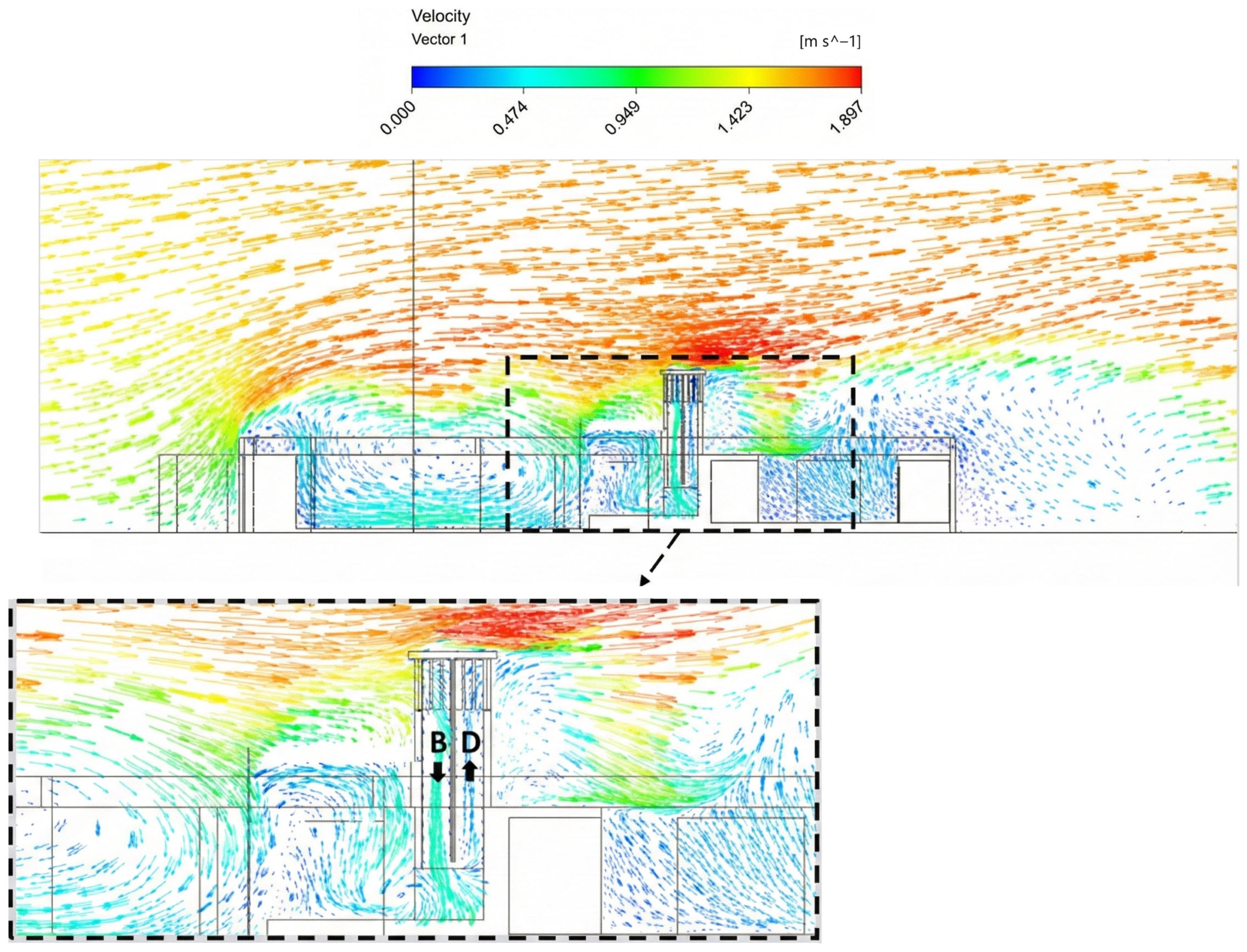
| Velocity (m/s) | 0.58 (down) | 0.37 (down) | 0.75 (up) | 0.51 (up) |
| Case # | Outer Domain Element Size [m] | Inner Domain Element Size [m] | Wind Tower Element Size [m] | Total Number of Elements |
|---|---|---|---|---|
| 1 | 15 | 6 | 1.5 | 162,242 |
| 2 | 12.5 | 5 | 1 | 329,973 |
| 3 | 10.5 | 4.25 | 0.725 | 498,626 |
| 4 | 10 | 4 | 0.7 | 555,687 |
| 5 | 9.5 | 3.5 | 0.65 | 701,935 |
| 6 | 8.5 | 3 | 0.6 | 938,232 |
| 7 | 7.5 | 2.5 | 0.5 | 1,451,691 |
| Velocity, m/s | Case #1 (162,242) | Case #2 (329,973) | Case #3 (498,626) | Case #4 (555,687) | Case #5 (701,935) | Case #6 (938,232) | Case #7 (1,451,691) | Exp Data | |||||||
|---|---|---|---|---|---|---|---|---|---|---|---|---|---|---|---|
| Shaft A | 0.24 | 0.43 | 0.52 | 0.52 | 0.59 | 0.56 | 0.55 | 0.58 | |||||||
| Shaft B | 0.15 | 0.33 | 0.43 | 0.4 | 0.42 | 0.41 | 0.4 | 0.37 | |||||||
| Shaft D | 0.3 | 0.4 | 0.56 | 0.63 | 0.66 | 0.7 | 0.7 | 0.75 | |||||||
| Shaft E | 0.26 | 0.3 | 0.49 | 0.49 | 0.49 | 0.5 | 0.49 | 0.51 | |||||||
| RRMSE | 59.3% | 39.5% | 18.9% | 12.6% | 9.5% | 6.1% | 6.2% | ||||||||
| 63.4% | 43.7% | 1.25% | 3.67% | 0.3% | 0.8% | ||||||||||
| Research Recommendations | Practical Recommendations |
|---|---|
| Expand the research to consider the effectiveness of wind catchers in other building configurations, including multi-story buildings and modern architectural layouts. | Use straight wind towers with curved roofs, four shafts with separators, and dense louvres facing upwards, ensuring the caps are optimized in height. |
| Combine and expand the possible design parameters to investigate how different tower geometric configurations respond to changes in wind speed and direction. | The towers should be positioned directly to face the prevailing wind direction to achieve optimal performance. |
| Expand the effort to include full-scale experimental testing on modern towers, ensuring the availability of experimental data for further validation. | Unless the tower is designed to act as a chimney to remove air from spaces, avoid extending shaft separators to their full length, to prevent exceeding comfortable air speeds in breathable spaces. |
| Include dynamic wind conditions and thermal effects (i.e., buoyancy forces) in transient computational models to simulate the operation of the towers under real-life conditions. | Incorporate features, such as flow control at tower outlets, to enable users to balance volume flow rates with indoor air velocity, ensuring comfort and compliance with standards. |
Disclaimer/Publisher’s Note: The statements, opinions and data contained in all publications are solely those of the individual author(s) and contributor(s) and not of MDPI and/or the editor(s). MDPI and/or the editor(s) disclaim responsibility for any injury to people or property resulting from any ideas, methods, instructions or products referred to in the content. |
© 2026 by the authors. Licensee MDPI, Basel, Switzerland. This article is an open access article distributed under the terms and conditions of the Creative Commons Attribution (CC BY) license.
Share and Cite
Hafez, A.H.; Marey, A.; Goubran, S.; Abdelaziz, O. Investigating the Impact of Wind Tower Geometry on Ventilation Efficiency in Semi-Enclosed Spaces: A Comprehensive Parametric Analysis and Design Implications. Buildings 2026, 16, 322. https://doi.org/10.3390/buildings16020322
Hafez AH, Marey A, Goubran S, Abdelaziz O. Investigating the Impact of Wind Tower Geometry on Ventilation Efficiency in Semi-Enclosed Spaces: A Comprehensive Parametric Analysis and Design Implications. Buildings. 2026; 16(2):322. https://doi.org/10.3390/buildings16020322
Chicago/Turabian StyleHafez, Ahmed H., Ahmed Marey, Sherif Goubran, and Omar Abdelaziz. 2026. "Investigating the Impact of Wind Tower Geometry on Ventilation Efficiency in Semi-Enclosed Spaces: A Comprehensive Parametric Analysis and Design Implications" Buildings 16, no. 2: 322. https://doi.org/10.3390/buildings16020322
APA StyleHafez, A. H., Marey, A., Goubran, S., & Abdelaziz, O. (2026). Investigating the Impact of Wind Tower Geometry on Ventilation Efficiency in Semi-Enclosed Spaces: A Comprehensive Parametric Analysis and Design Implications. Buildings, 16(2), 322. https://doi.org/10.3390/buildings16020322