
Article

Installed-Asset Exposure in Delayed Nuclear Construction Projects: A Pre-Operational Asset Governance Framework


Faculty of Civil Engineering, Czech Technical University in Prague, Thákurova 7, 166 29 Prague, Czech Republic
Buildings 2026, 16(19), 3810; https://doi.org/10.3390/buildings16193810
Submission received: 14 August 2026 / Revised: 20 September 2026 / Accepted: 22 September 2026 / Published: 25 September 2026

Abstract

Nuclear new-build megaprojects frequently experience schedule overruns that prolong the pre-operational phase and leave installed systems exposed prior to commissioning and commercial operation. While existing research has extensively examined the causes of nuclear project delays and their impacts on cost and schedule performance, comparatively limited attention has been devoted to lifecycle risks associated with idle but installed systems. During extended delays, systems require continuous preservation, monitoring, and re-validation, increasing the risk of technological obsolescence, documentation deterioration, and reactivation complexity. This study investigates installed-asset exposure in delayed nuclear construction projects and develops a conceptual governance framework for managing this condition. It adopts a conceptual research approach supported by research question-driven thematic literature synthesis of academic, institutional, regulatory, and technical evidence. Based on this analysis, the study develops a mechanism explaining how extended delays generate secondary lifecycle risks and cost amplification through prolonged exposure of installed systems. Building on this mechanism, the paper introduces the Pre-Operational Asset Governance Framework (Pre-OAGF) as a delay-triggered coordination layer. The framework comprises the Governance Structure, Activation Logic, and Asset Monitoring Framework, which are designed to coordinate preservation across contractual interfaces and support commissioning readiness.

1. Introduction

Nuclear power plant (NPP) new-build projects are frequently affected by schedule delays that extend the period between planned construction completion, commissioning milestones, and commercial operation [1]. These delays represent not only temporal deviations from baseline schedules but also critical conditions influencing the integrity, preservation, and operational readiness of partially completed structures, systems, and components (SSCs). As construction timelines extend, installed SSCs remain in a prolonged non-operational state, requiring sustained protection, monitoring, and verification.
International guidance recognises that delayed or interrupted nuclear projects require enhanced management attention to maintain overall project readiness and to prevent degradation of both physical assets and organisational capabilities. Resources should be provided to preserve equipment and facilities, maintain documentation, and manage contractual arrangements [2]. Regulatory frameworks further emphasise that safety-classified SSCs, together with other components and structures subject to stringent regulatory and quality assurance requirements, require systematic preservation, documented surveillance programmes, periodic verification, and auditable records demonstrating continued integrity and functional readiness in support of regulatory oversight and progressive commissioning and testing activities [3,4].
During the construction phase, multiple organisations are typically involved in the installation, preservation, and maintenance of SSCs. These responsibilities are distributed among subcontractors according to contractual scope and technical interfaces, while the overall responsibility for coordination and plant condition is retained by the principal contractor or the investor, depending on the contractual arrangement. In such complex environments, the fragmentation of responsibilities across multiple contractual entities can lead to discontinuities in preservation and monitoring arrangements [2,5,6]. This fragmentation tends to intensify as project timelines exceed initial contractual assumptions and responsibilities become progressively less clearly defined. Additional maintenance, inspection, and verification requirements that are not explicitly allocated within existing contractual frameworks may arise. Consequently, prolonged delays may result in the accumulation of secondary lifecycle costs associated with extended pre-operational conditions [7].
Under such conditions, installed SSCs may be exposed to environmental effects, ageing processes, and technological or contractual constraints that were not anticipated during initial planning. This condition can be conceptualised as “installed-asset exposure”, defined as the extended period during which completed systems remain installed but not yet operational, requiring continuous preservation, monitoring, and readiness management. In nuclear projects, this condition is particularly critical, as safety-classified SSCs must demonstrate maintained integrity [8].
Existing research on nuclear new-build projects has extensively examined the causes of schedule delays, cost overruns, and governance challenges associated with megaproject delivery [9,10,11]. However, comparatively limited attention has been devoted to the lifecycle implications of prolonged pre-operational exposure of installed systems. In particular, the coordination of preservation activities, monitoring responsibilities, and readiness management across multiple contractual interfaces remains insufficiently conceptualised from an asset lifecycle and operational readiness perspective [12,13].
Against this background, the study addresses two research questions.
RQ1: Through what mechanisms do prolonged construction delays generate lifecycle risks for installed but non-operational SSCs in nuclear new-build projects?
RQ2: How can the identified delay-induced lifecycle risks be translated into a governance framework that maintains lifecycle continuity and commissioning readiness during extended pre-operational periods?
In addressing these research questions, this study makes two primary contributions. First, it conceptualises the installed-asset exposure mechanism that emerges when construction delays extend the pre-operational phase of nuclear power plant projects, linking delay duration to pathways of asset degradation and secondary lifecycle cost amplification. Second, it introduces the Pre-Operational Asset Governance Framework (Pre-OAGF), designed to coordinate preservation strategies, monitoring activities, and lifecycle-oriented oversight of installed assets during extended pre-operational phases. The proposed framework defines the Governance Structure, Activation Logic, and Asset Monitoring Framework. Together, these components are expected to strengthen lifecycle-risk management and support commissioning readiness during prolonged asset exposure; these anticipated benefits have not yet been empirically validated.

2. Literature Review

2.1. Literature Search and Evidence Base

The evidence base for this conceptual study was constructed through a research question-driven literature search combined with purposive source selection to support conceptual framework development. The purpose was to identify and integrate the academic, institutional, and technical knowledge required to explain installed-asset exposure and derive an appropriate governance response. The search and source-selection process was organised around the two research questions. Evidence identification comprised structured academic database searches, supplementary academic evidence identification, targeted searches of IAEA and other authoritative institutional resources, and statement-specific identification of regulatory, technical, and project-contextual evidence. The selected evidence was subsequently organised through a thematic literature synthesis across the literature domains relevant to these research questions, as summarised in Table 1. In this study, thematic literature synthesis refers to the organisation and integration of evidence across the identified literature domains rather than the sequential summary of individual publications.
RQ1 guided the identification of evidence in order to explain how construction delays create lifecycle risks for installed but non-operational structures, systems and components (SSCs). This required examination of four connected literature domains: (1) the occurrence and causes of delays in nuclear power plant construction; (2) the preservation and lifecycle management of SSCs during the delay; (3) the implications of installed asset exposure for commissioning and operational readiness; and (4) the governance complexity across owners, principal contractors, subcontractors, manufacturers and other stakeholders.
RQ2 guided the identification of existing management requirements and governance principles that could be translated into the proposed framework. Particular attention was therefore given to preservation planning, monitoring of asset condition, configuration and documentation control, organisational capability, and supplier and specialist continuity.
Guided by the research questions and the evidence domains summarised in Table 1, the literature review drew on several complementary source types. Peer-reviewed publications were used principally to establish empirical findings and conceptual relationships; IAEA and comparable institutional publications were used to identify recognised nuclear-sector guidance and management principles; regulatory and standards-based sources were used to establish formal requirements or expectations; and project-specific sources were used as supplementary evidence for individual cases and factual context. These source types were combined where appropriate to provide the evidence required across the different literature domains.
The evidence domains and source types summarised in Table 1 subsequently provided the basis for identifying recurring lifecycle problems and relationships during the analytical synthesis described in Section 3.2, through which recurring lifecycle problems and the relationships between them were identified.

2.1.1. Academic Literature Identification and Selection

Peer-reviewed and scholarly literature was identified primarily through the Scopus database. Literature identification was undertaken iteratively throughout the development of the study rather than as a single search event. Searches were developed around the literature domains defined in Table 1 and were guided by terminology occurring in publications already identified as directly relevant to the research questions. The search vocabulary was developed iteratively from these initially relevant publications and refined using terminology associated with the nuclear construction, nuclear construction delay, project management, asset management, preservation and commissioning literature.
Three structured Scopus searches were conducted between May and July 2026 to identify academic evidence concerning (i) construction delays and overruns, (ii) construction duration and lead time, and (iii) construction and project risk. The searches covered the article title, abstract, and keyword fields and were restricted to English-language articles, conference papers, and reviews. No publication-year restriction was applied; all publications indexed in Scopus up to the final search date in July 2026 were eligible for consideration.
The searches returned 78, 19, and 40 records, respectively. All returned records underwent title and abstract screening. Full texts were assessed where the title and abstract indicated potential substantive relevance to either research question. Following relevance assessment, 6, 1, and 2 publications, respectively, were retained. Because some publications were returned by more than one search, these figures represent query-level search and selection counts and do not constitute a deduplicated corpus of 137 unique publications. The complete search expressions, search parameters, and query-level selection procedures are provided in Appendix A.
Selection was purposive and based on substantive conceptual relevance rather than bibliometric thresholds. Publications were retained where they contributed to one or more of the following:
  • Causes, mechanisms, or consequences of nuclear construction delay;
  • Lifecycle consequences associated with prolonged construction or pre-operational inactivity;
  • Preservation, maintenance, ageing, monitoring, or revalidation of installed SSCs;
  • Commissioning or operational-readiness requirements;
  • Configuration, documentation, or information-management continuity;
  • Organisational, contractual, supplier, or governance interfaces relevant to prolonged nuclear project delivery.
Records were excluded where their relationship to nuclear construction or asset management did not substantively contribute to either research question, where references to the relevant concepts were incidental, or where their primary focus concerned unrelated operational, technological, or economic matters. Database restrictions concerning language and document type described above also formed part of the eligibility criteria.
The structured Scopus searches were supplemented where relevant academic evidence was not captured by the three core search expressions. Supplementary publications were identified through reference-list checking, citation and keyword expansion from directly relevant publications, and targeted searches in Scopus and Google Scholar for specific concepts, authors, or titles identified during development of the thematic literature synthesis. Publications previously encountered through related research could also serve as seed sources for this process; however, inclusion in the present evidence base was determined by the same substantive relevance criteria applied to other academic publications. Supplementary academic publications were therefore not included in the query-level screening counts reported above.
The resulting academic evidence set was therefore selected on the basis of relevance to the analytical problem rather than exhaustive coverage of the available literature.

2.1.2. Institutional, Regulatory and Technical Guidance

Institutional and technical sources were identified separately from the academic literature because critical requirements relating to nuclear-project preservation, commissioning, management systems, configuration control, organisational responsibilities, and delayed-project management are documented in authoritative guidance rather than exclusively in peer-reviewed publications.
Relevant International Atomic Energy Agency (IAEA) publications were identified through targeted searches of the IAEA Publications Advanced Search facility, supplemented by targeted web searches used to locate official IAEA publications. The searches were conducted during July 2026 using terms relating to delayed nuclear projects, nuclear construction projects, structures, systems and components, surveillance and inspection, nuclear commissioning, and nuclear management. Because the identification process involved iterative and overlapping searches across the IAEA Publications resource and a web search engine, a single corpus-level count of returned and screened records was not calculated. Ten IAEA publications were retained because they directly informed one or more of the lifecycle or governance issues addressed by the study. The complete search terms, identification procedure, selection criteria, and explanation of the reported counts are provided in Appendix A.
The retained IAEA publications were assessed against the evidence domains according to their substantive content. Individual publications could therefore contribute to more than one domain, for example lifecycle SSC management and commissioning readiness.
Additional regulatory, standards-based, institutional, and technical sources were included where they directly supported a specific element of the conceptual argument. The organisations represented in the final evidence base include the U.S. Nuclear Regulatory Commission (NRC), the Czech State Office for Nuclear Safety (SÚJB), the International Organization for Standardization (ISO), the OECD Nuclear Energy Agency (OECD NEA), the World Nuclear Association (WNA), and Idaho National Laboratory (INL), in addition to the IAEA.
These sources were not treated as equivalent to peer-reviewed academic research. Their evidential function was determined according to the nature and authority of the originating document. Academic publications were principally used to establish research findings, relationships and conceptual understanding; IAEA and comparable institutional publications were used to establish internationally recognised nuclear-sector guidance and management principles; regulatory publications were used to establish jurisdiction-specific requirements or regulatory expectations; standards were used to establish formal management or technical principles; and project-specific sources were used to substantiate individual factual examples.

2.1.3. Project-Specific Contextual Evidence

Additional targeted searches were undertaken where specific technical, regulatory or project-related evidence was required to substantiate individual elements of the conceptual argument. These searches were used, for example, to verify particular nuclear-project cases, technical preservation examples, regulatory developments or contextual statements that could not appropriately be established through the core academic search alone.
Selection was based on direct relevance to the particular factual, regulatory, or technical statement being substantiated. Such sources were used only as supplementary contextual evidence and were not used as the principal basis for deriving generalisable lifecycle relationships, governance principles, or components of the Pre-OAGF. Because these searches were statement-specific rather than a bounded literature search, corpus-level returned and screened counts were not reported.

2.1.4. Organisation and Thematic Literature Synthesis of the Evidence

The selected evidence was organised into the four thematic areas presented in Section 2.2, Section 2.3, Section 2.4 and Section 2.5: nuclear construction delays and associated risks; lifecycle SSC management during prolonged construction; commissioning and operational readiness; and governance and organisational complexity.
In this study, thematic literature synthesis refers specifically to the organisation and integration of evidence across these connected bodies of knowledge in order to establish the current state of knowledge and identify the conceptual gap addressed by the study. It constitutes the evidence-integration stage of the research design and is distinct from the subsequent analytical synthesis of the installed-asset exposure mechanism and Pre-OAGF.
The thematic literature synthesis therefore provides the evidence base from which the research gap presented in Section 2.6 is established. The analytical transformation of this evidence into an explanatory mechanism and subsequently into governance requirements is methodologically separate and is described in Section 3.
Because source selection was purposive and guided by the research questions, the resulting thematic literature synthesis does not claim exhaustive coverage of all literature relating to nuclear construction, asset management, or commissioning. Its purpose is instead to provide a transparent and traceable conceptual evidence base. Transparency and traceability are supported through disclosure of the structured academic search expressions and query-level screening counts. Furthermore, the IAEA search procedure, publication coverage and search periods, inclusion and exclusion criteria, supplementary evidence-identification procedures, and explicit differentiation between academic, institutional, regulatory, technical, and project-specific source categories are provided in Appendix A.

2.2. Nuclear Power Plants as Megaprojects and Sources of Delay

Nuclear power plant (NPP) construction projects are widely recognised as complex megaprojects often characterised by high capital intensity, long delivery timelines, and significant organisational and regulatory complexity [14]. These characteristics inherently increase the likelihood of various risks, most notably schedule delays and cost overruns, as demonstrated by empirical analyses of global nuclear construction programmes [10,15].
Contemporary European projects illustrate that extended construction schedules remain a persistent challenge for the nuclear industry. Hinkley Point C has undergone repeated schedule revisions; Mochovce Unit 4 entered commissioning in 2026following decades of interruption and partially completed Cernavodă Units 3 and 4 are being restarted after more than three decades [16].
The literature identifies several primary drivers of delay. Technical factors include incomplete design maturity at project initiation, ongoing design changes during construction, and challenges associated with first-of-a-kind (FOAK) technologies [17]. These issues can impact the design phase as well as disrupt construction sequencing and introduce rework during construction, significantly affecting project timelines.
A recent documented example of design maturity is the Paks II nuclear power plant project in Hungary, where the design phase was significantly prolonged—reportedly by several years—due to design-related uncertainties and failure to meet regulatory requirements set by the Hungarian Atomic Energy Authority [18,19]. Regulatory complexity further contributes to delays, particularly when licensing requirements evolve during the construction phase, requiring additional verification and documentation [20].
Project management and governance-related factors are equally critical. Nuclear projects are typically delivered through complex networks of contractors and subcontractors, leading to fragmentation of responsibilities and coordination challenges [21]. Despite the formal establishment of governance frameworks, persistent deficiencies in managerial practices, communication effectiveness, and labour productivity continue to drive significant cost overruns and schedule delays [22]. Organisational capability further constitutes a key performance driver, particularly in highly regulated and safety-critical environments.
In addition to technical and organisational factors, external macro-level conditions represent a distinct category of delay drivers that can significantly disrupt nuclear project delivery. Sudden national and international events—such as political transitions, geopolitical crisis, or the imposition of economic sanctions—may introduce systemic shocks that disrupt project delivery. These shocks can affect supply chain continuity, financing structures, and governance stability, thereby propagating inefficiencies across multiple project phases [11,23,24,25]. In extreme cases, such disruptions may lead to a partial or complete breakdown of project execution capacity.
Historical examples illustrate this phenomenon, including the Mochovce Nuclear Power Plant Units 3 and 4 project, where construction commenced in 1987 but was subsequently halted in 1993 following the political and economic transition associated with the dissolution of Czechoslovakia [26]. The interruption led to a prolonged suspension of works, followed by a complex restart under significantly altered regulatory, financial, and supply chain conditions. As a result, the project has experienced multi-decade delays. Unit 3 was connected to the grid in 2023, while Unit 4 entered commissioning in 2026.This case illustrates how large-scale geopolitical and economic disruptions can fundamentally alter project trajectories, leading not only to schedule overruns but also to extended periods of inactivity requiring specialised preservation and maintenance measures [27].

2.3. Lifecycle SSC Management in Delayed Nuclear Projects

When nuclear construction projects experience schedule delays, a critical phase emerges in which installed structures, systems, and components (SSCs) remain in a prolonged non-operational state [2]. This condition, conceptualised in this study as installed-asset exposure, represents a significant source of lifecycle risk.
The scale and complexity of preservation requirements vary considerably depending on the nature of the SSC. While relatively simple components such as individual pumps may require routine preservation measures, complex safety systems—such as safety injection systems—demand more advanced procedures, including system flushing, chemical preservation, instrumentation calibration, and periodic functional testing prior to commissioning [2]. Certain activities require specialised expertise and external contractors, particularly for systems involving pressurised gases (hydrogen, nitrogen, argon, etc.), chemically aggressive environments, or safety-critical functions, whereas others may fall within the scope of standard mechanical and electrical maintenance practices typically performed during plant operation [3,4].
A representative example of specialised preservation requirements is boric acid corrosion management in pressurised water reactors (PWRs), where leakage of borated water can lead to accelerated degradation of carbon steel components. Effective management requires dedicated inspection and mitigation programmes involving leak identification, deposit assessment, material degradation evaluation, cleaning, repair, and follow-up monitoring [28]. This illustrates the extent to which preservation activities in nuclear projects extend beyond conventional maintenance practices and require system-specific expertise.
In addition to physical preservation, lifecycle management during extended delays requires robust configuration and data management. The integrity and traceability of engineering documentation—including design records, inspection reports, and material certification—must be continuously maintained throughout the delay period [8]. Any degradation in documentation quality or traceability can significantly hinder project restart and complicate regulatory approval processes.
Prior to the resumption of construction activities or transition to commissioning, extensive verification and revalidation efforts are required. These typically include condition assessments of SSCs, evaluation of ageing effects, and confirmation of compliance with current regulatory requirements. Given that nuclear projects are subject to multiple regulatory hold points throughout commissioning and operational readiness phases, the adequacy of preservation and documentation directly influences the ability to obtain necessary approvals from the National Nuclear Safety Regulator [12,29]. Consequently, prolonged delays can substantially increase the scope, duration, and complexity of final project delivery stages.

2.4. Operational Readiness and Commissioning in Delayed Projects

The International Atomic Energy Agency (IAEA) recognises commissioning as a critical transition between construction and operation, defining it as a progressive and structured process intended to demonstrate that the plant, as constructed, meets the design intent, safety requirements, and licence conditions prior to routine operation [29]. Commissioning also serves to collect baseline data, validate operating and emergency procedures, and familiarise operating and maintenance personnel with plant systems and operating conditions. It therefore constitutes not merely a final testing stage, but a controlled process of operational readiness formation, in which technical performance, documentation integrity, organisational coordination, and regulatory assurance must converge [30].
In delayed projects, this transition becomes significantly more complex. During periods of inactivity, interactions with ongoing or adjacent construction activities may influence the condition and performance of previously tested systems, particularly for standby components that are not regularly operated [29]. This indicates that inactivity is not a passive condition; rather, it can actively erode the validity of prior verification and expand the scope of retesting, reassessment, and technical revalidation required before commissioning can proceed safely. The challenge is not limited to demonstrating that SSCs remain physically fit for service, but also to demonstrating that their technical and configuration history, preservation status, test results, modifications, and acceptance basis remain fully traceable, consistent, and auditable over time.
This directly affects regulatory confidence and may delay progression through commissioning hold points. Before major commissioning milestones such as fuel loading, initial criticality, and progression to higher power levels, the regulatory body may review aspects such as the as-built configuration, pre-operational test results, configuration control, and the completeness and integrity of documentation and reporting systems [4]. Accordingly, schedule disruption over extended periods can amplify not only internal project readiness challenges but also the regulatory effort required to demonstrate that previously accepted assumptions remain valid at the point of transition to commissioning and operation [12,29].
From this perspective, the effects of delay on commissioning are cumulative and mutually reinforcing. Longer delays increase the likelihood of physical degradation, reduce the reliability of earlier test evidence, intensify documentation and configuration control challenges, complicate handover between project actors, and weaken continuity between construction completion and operational readiness [31]. Consequently, commissioning governance in delayed nuclear projects cannot be treated solely as a technical process of final verification. Rather, it must be conceptualised as an integrated coordination challenge, involving preservation, documentation, organisational continuity, regulatory interface management, and the progressive restoration of readiness under conditions of prolonged installed-asset exposure [30,32]. This perspective establishes a conceptual bridge to the subsequent discussion of governance complexity in multi-actor contractor networks.

2.5. Governance and Subcontractor Network Complexity

Nuclear construction projects are governed through a complex multi-actor network of stakeholders involving owners, principal contractors, subcontractors, regulators, manufacturers and equipment suppliers. Effective management depends on the ability to coordinate activities across organisational boundaries while maintaining clear accountability for safety, quality, and regulatory compliance [2]. From a contractual perspective, governance in nuclear construction projects is structured around defined scopes of work, deliverables, and obligations aligned with planned project schedules and milestones. These contracts are typically developed under the assumption of continuous project progression and do not explicitly address extended delay scenarios. As a result, responsibilities for the preservation, monitoring, and maintenance of installed but non-operational SSCs are often not contractually allocated for prolonged pre-operational periods. In practice, this does not typically lead to an absence of maintenance activities, but rather to the emergence of additional scope, contractual renegotiation, and increased reliance on variation orders or supplementary agreements. Consequently, extended delays can drive cost escalation and inconsistencies in lifecycle management, as such activities are governed through fragmented and reactive contractual arrangements rather than the originally planned project structure [5,6].
In addition, certain nuclear construction and maintenance activities rely heavily on specialised subcontractors who provide integrated capability packages, including proprietary tools, certified procedures, qualified personnel, and vendor-specific methodologies [33]. These capabilities are often closely linked to regulatory requirements, safety classification, and original equipment manufacturer (OEM) specifications, making them difficult to transfer to other actors without significant requalification, licensing, and liability implications. As a result, project delivery becomes dependent on the continued availability of specific external organisations and competencies [32,33].
Under prolonged project durations, this dependency introduces additional risks. The availability of specialised subcontractors may become uncertain due to contract expiration, resource reallocation, or changing market conditions [5,6]. Furthermore, the continuity of specialised knowledge and certified capabilities may be disrupted, particularly where activities require vendor-controlled processes or regulatory-approved procedures. This creates a structural vulnerability in the governance system, as the ability to maintain or restore the condition of installed SSCs becomes contingent on external actors whose long-term availability is not guaranteed [32].
Industry guidance emphasises the importance of integrated management systems, interface management, and the concept of the “Intelligent Customer”, which highlights the responsibility of the asset owner to retain sufficient knowledge and oversight capability to manage external suppliers and ensure compliance with safety, quality and regulatory requirements [34]. However, while this concept strengthens oversight capability, it does not fully resolve the challenges associated with fragmented contractual responsibilities and dependency on specialised subcontractor capabilities during extended pre-operational phases.

2.6. Research Gap: Management of Installed but Non-Operational Systems

The reviewed literature provides substantial insights into individual dimensions of delayed nuclear projects, including delay drivers, lifecycle management of structures, systems, and components (SSCs), commissioning and operational readiness requirements, and governance challenges within multi-actor delivery environments. Collectively, these perspectives establish a well-developed understanding of the causes and consequences of schedule disruption in nuclear megaprojects [4,11,12].
From a technical perspective, preservation and maintenance requirements for SSCs are well established. These include environmental control, inspection, periodic testing, and plant configuration management to ensure that systems remain in a condition suitable for future commissioning [4]. From an operational perspective, commissioning frameworks emphasise the need for complete verification, traceability, and regulatory compliance prior to the transition to operation [29]. From a governance perspective, project delivery is characterised by fragmented responsibilities distributed across multiple contractors and subcontractors, often requiring specialised capabilities and vendor-specific expertise. In addition, asset management principles highlight the importance of maintaining asset condition and lifecycle continuity across project phases, while international guidance recommends enhanced managerial control for delayed projects [5,6].
Despite this breadth of guidance, the literature provides limited conceptual integration of these elements into a dedicated lifecycle governance framework for installed but non-operational SSCs. Existing approaches provide substantial technical and managerial guidance, but are generally organised around distinct primary purposes, including preservation and ageing management, documentation and configuration control, commissioning, project coordination, and risk management. Their interaction under prolonged pre-operational exposure is not explicitly organised around installed-asset exposure as a common lifecycle governance condition. This limitation may reduce the ability of project organisations to systematically control lifecycle risks, protect asset value, and prevent the accumulation of secondary costs associated with prolonged pre-operational exposure.
In practice, preservation and maintenance activities are often managed through a combination of existing contractual arrangements, supplementary coordination mechanisms, and extensions of standard project management practices [2,12]. While such arrangements may support compliance and project continuity, they do not necessarily provide an explicit lifecycle-oriented mechanism for optimising resource utilisation, controlling secondary costs, and preserving operational readiness over time.
From a lifecycle perspective, this reflects an underdeveloped interface between construction-phase execution and operational-phase readiness. This interface provides the basis for an integrated governance framework that systematically connects preservation, monitoring, documentation control, commissioning readiness, and lifecycle management of installed SSCs, while defining clear responsibilities, coordination mechanisms, and exposure-based activation logic for enhanced management under delay conditions.
To clarify this research gap and distinguish the proposed framework from existing approaches, Table 2 positions Pre-OAGF relative to the principal management and governance domains identified in the literature.
The comparison in Table 2 shows that the contribution of Pre-OAGF does not lie in introducing new preservation, monitoring, documentation-control, risk-management, or commissioning activities. Rather, its novelty lies in the organising basis and architecture through which these established processes are connected. Pre-OAGF conceptualises installed-asset exposure as a common lifecycle governance condition and links it to an exposure-triggered coordination layer and graded activation logic based on four trigger categories. The theoretical contribution therefore lies primarily in the combined sequence of installed-asset exposure, exposure-triggered governance, lifecycle coordination, and graded monitoring and governance response.

3. Conceptual Framework Development Methodology

3.1. Research Approach

This study adopts a conceptual research approach to develop a structured governance framework for managing installed-asset exposure during extended construction delays in nuclear new-build projects. A conceptual approach was selected because, although existing literature has extensively examined schedule delays, cost overruns, and governance challenges in nuclear megaprojects, limited attention has been paid to the lifecycle implications of prolonged pre-operational exposure of installed systems.
The literature review presented in Section 2 establishes the evidence base and identifies the research gap. The methodology described in this section is concerned with the analytical use of that evidence and the construction of the conceptual framework. These two activities are therefore deliberately distinguished: thematic literature synthesis establishes what is known, whereas the analytical synthesis described below determines how the relevant relationships can be integrated into an explanatory mechanism—installed-asset exposure—and subsequently translated into governance requirements.
For the purposes of the analytical synthesis, a lifecycle problem or governance requirement was treated as recurring where the same or a conceptually equivalent issue was identified in at least two distinct sources. Cross-category support—for example, where an issue was identified in both academic literature and IAEA or regulatory guidance—was treated as additional corroboration. Recurrence therefore denotes repetition within the evidence base rather than statistical frequency or bibliometric prevalence.
The methodological process comprises two principal analytical stages corresponding to the two research questions.
The first stage addresses RQ1 by identifying conceptually recurrent delay-induced lifecycle problems and determining the relationships through which prolonged construction delay can affect installed but non-operational SSCs. The output of this stage is the installed-asset exposure mechanism.
The second stage addresses RQ2 by translating the lifecycle risks and coordination problems identified under RQ1 into governance requirements. These requirements are then organised into the Pre-Operational Asset Governance Framework (Pre-OAGF).
The overall analytical sequence is therefore:
  • Literature evidence;
  • Lifecycle problems;
  • Relationships between problems;
  • Installed-asset exposure mechanism;
  • Governance requirements;
  • Pre-OAGF.
This sequence establishes traceability between the evidence reviewed in Section 2 and the conceptual framework presented in Section 4.

3.2. Analytical Synthesis and Development of the Installed-Asset Exposure Mechanism

The literature was analysed to identify recurring delay-induced lifecycle problems in nuclear construction projects. Rather than summarising individual studies separately, the analysis focused on common patterns reported across the academic literature, international guidance, and other relevant evidence identified through the thematic literature synthesis. This stage primarily addressed RQ1 by examining how prolonged construction delays can propagate into lifecycle risks affecting installed but non-operational structures, systems, and components (SSCs).
Recurrence was assessed in accordance with the definition established in Section 3.1. The purpose was not to quantify the frequency with which individual issues occurred in the literature, but to identify conceptually consistent lifecycle problems that were supported by more than one source and could therefore contribute to the explanatory mechanism. The analytical process consisted of three sequential steps.
First, recurring delay-related phenomena affecting installed but non-operational SSCs were identified. These included:
  • Physical degradation;
  • Extended preservation requirements;
  • Deterioration or obsolescence of documentation;
  • Configuration-management challenges;
  • Loss of organisational continuity;
  • Dependence on specialist contractors;
  • Contractual or responsibility uncertainty;
  • Increased verification requirements;
  • Effects on commissioning readiness.
These phenomena were supported across several connected bodies of evidence: physical degradation and preservation requirements were addressed in delayed-project, maintenance, surveillance, and inspection guidance [2,3,4,12]; documentation and configuration continuity were addressed in management-system, configuration-management, and commissioning literature [8,13,29,30]; organisational, specialist, and contractual continuity were addressed in project-governance, supplier-management, and ownership literature [2,5,6,32,33,34,36,37,38]; and verification and commissioning-readiness requirements were addressed in maintenance, delayed-project, and commissioning guidance [3,4,12,29,30,31,32].
Second, the identified phenomena were examined from a lifecycle perspective to determine how prolonged construction delays can generate secondary technical, informational, organisational, contractual, and regulatory risks. Particular attention was given to relationships that develop or intensify over time as the period between installation and commissioning is extended. In this way, the analysis considered delay not only as a schedule deviation, but as a condition capable of progressively affecting asset integrity, information continuity, organisational capability, and future commissioning readiness.
Third, the identified relationships were synthesised into the installed-asset exposure mechanism. The mechanism represents the progression from prolonged construction and delay to four interconnected stages: (1) delay-induced exposure, (2) degradation and organisational disruption, (3) lifecycle complexity accumulation, and (4) secondary lifecycle cost amplification.
The installed-asset exposure mechanism therefore represents the outcome of the analytical synthesis of relationships identified across the reviewed evidence, rather than a directly observed empirical model. Its purpose is to explain how prolonged construction delay can progressively develop from a scheduling problem into a broader lifecycle-governance challenge.
The resulting mechanism provides the conceptual answer to RQ1 and forms the analytical basis for the subsequent framework-development process described in Section 3.3.

3.3. Development of the Pre-Operational Asset Governance Framework

The Pre-OAGF was developed by translating the installed-asset exposure mechanism into governance requirements. This stage addresses RQ2 by determining how the delay-induced lifecycle risks identified under RQ1 can be organised into a governance system capable of maintaining lifecycle continuity and commissioning readiness during prolonged pre-operational periods. Framework development consisted of three sequential steps.
First, the lifecycle risks and consequences represented in the installed-asset exposure mechanism were examined to identify the associated governance challenges. These included the need to maintain asset condition, preserve lifecycle information, coordinate responsibilities across organisational and contractual interfaces, retain access to specialist capability, and maintain readiness for subsequent commissioning.
Second, recurring governance requirements were derived from these challenges by identifying common management needs across the reviewed evidence. Recurrence was assessed using the criterion defined in Section 3.1 and was therefore based on qualitative repetition across distinct sources rather than numerical prevalence. The resulting requirements were grouped around three overarching governance principles: lifecycle continuity, information traceability, and organisational coordination.
Third, the governance principles and associated requirements were organised into the three principal components of the proposed Pre-OAGF: the Governance Structure, Activation Logic, and Asset Monitoring Framework. The Governance Structure responds principally to the need for defined accountability and coordination across organisational and contractual interfaces. The Activation Logic responds to variation across four trigger categories: Temporal and Milestone Exposure, Technical and Regulatory Exposure, Organisational and Supply-Chain Exposure, and External Project-Environment Conditions. This allows governance intensity to be scaled proportionately. The Asset Monitoring Framework responds to the need for current and traceable evidence concerning asset condition, preservation status, configuration integrity, and commissioning readiness. These components were organised to provide a coordinated governance response when prolonged construction delays create lifecycle risks extending beyond the assumptions of normal project progression.
The indicative activation ranges were proposed as illustrative governance bands informed by the reviewed evidence and professional practice. These values are not derived from empirical statistical analysis and are not intended to represent universal technical or regulatory thresholds. Rather, they provide preliminary governance ranges and decision conditions for demonstrating graded activation and establishing testable propositions for subsequent empirical validation. Project-specific technical, regulatory, contractual, and SSC-specific requirements take precedence where applicable.
The framework-development logic can therefore be expressed as:
Installed-asset exposure mechanism -> lifecycle risk -> governance requirement -> Pre-OAGF component.
This process provides traceability between the lifecycle risks identified under RQ1 and the governance framework developed in response to RQ2. The methodology therefore concludes with the derivation of the framework; the resulting installed-asset exposure mechanism and Pre-OAGF are presented as the conceptual results in Section 4.

4. Installed-Asset Exposure and Pre-Operational Asset Governance Framework

This section presents the conceptual outcomes of the analysis and the resulting Pre-Operational Asset Governance Framework (Pre-OAGF), developed from the installed-asset exposure mechanism constructed through the analytical synthesis described in Section 3. It first presents the installed-asset exposure mechanism before translating the resulting lifecycle risks into an integrated governance model comprising Governance Structure, Activation Logic, and Asset Monitoring Framework. Together, these elements establish a lifecycle-oriented governance system intended to preserve asset integrity, maintain organisational continuity, and support commissioning readiness under conditions of extended construction delay.

4.1. Installed-Asset Exposure Mechanism

The installed-asset exposure mechanism constitutes the analytical foundation of the proposed Pre-Operational Asset Governance Framework (Pre-OAGF). It explains how construction delays propagate beyond schedule impacts to generate secondary lifecycle risks affecting installed but non-operational SSCs. Rather than viewing delay as a purely temporal deviation from the project baseline, the mechanism conceptualises prolonged pre-operational periods as a distinct lifecycle condition in which asset exposure progressively increases management complexity and lifecycle cost prior to commissioning.
The installed-asset exposure mechanism comprises four sequential and interrelated phases: (i) delay-induced exposure, (ii) degradation and organisational disruption, (iii) lifecycle complexity accumulation, and (iv) secondary lifecycle cost amplification.

4.1.1. Delay-Induced Exposure

The first phase begins when construction delays extend the planned period between system installation and commissioning. As exposure duration increases, installed SSCs remain inactive for longer than originally anticipated while exposed to their surrounding construction environment. Exposure duration is an important driver of subsequent technical, organisational, and contractual risks, but its significance depends on SSC-specific and project conditions.

4.1.2. Degradation and Organisational Disruption

Prolonged exposure initiates multiple degradation processes operating simultaneously across physical, informational, and organisational dimensions. Physical deterioration may result from corrosion, contamination, material ageing, environmental fluctuations, or inadequate preservation. Concurrently, documentation and configuration records may become incomplete, outdated, or inconsistent as modifications accumulate over time. Organisational continuity may also deteriorate through contract expiration, personnel turnover, loss of specialist expertise, and changing responsibilities across contractors and suppliers. These processes are mutually reinforcing rather than independent, progressively reducing confidence in both asset condition and supporting lifecycle information.

4.1.3. Lifecycle Complexity Accumulation

As degradation and organisational disruption accumulate, the complexity of maintaining commissioning readiness increases. Preservation activities become more intensive, monitoring programmes expand, additional inspections and functional verification become necessary, and previously completed work may require partial revalidation. Simultaneously, coordination becomes increasingly demanding because preservation responsibilities, technical interfaces, and contractual obligations extend across multiple organisations. Consequently, the project evolves from routine preservation management towards an integrated lifecycle governance challenge requiring continuous coordination rather than isolated technical interventions.

4.1.4. Secondary Lifecycle Cost Amplification

The cumulative effects of degradation, organisational disruption, and increasing management complexity ultimately manifest as secondary lifecycle costs. These costs arise not only from additional preservation and maintenance activities, but also from expanded inspection programmes, system requalification, contractor re-engagement, documentation updates, regulatory verification, and delayed commissioning milestones. Unlike direct construction costs, these expenditures originate from the prolonged exposure of installed assets and the effort required to restore confidence in their condition and regulatory readiness before operation can commence.
The relationship between these phases is cumulative and self-reinforcing. Longer exposure periods increase degradation and organisational disruption, which in turn intensify lifecycle complexity and the effort required to restore commissioning readiness. Consequently, extended construction delays can progressively transform a scheduling problem into a broader lifecycle governance challenge with increasing secondary lifecycle risks and recovery costs.
The installed-asset exposure mechanism also identifies the principal intervention point for the proposed Pre-OAGF. Rather than responding only after degradation or organisational disruption has occurred, the framework targets the exposure condition itself by coordinating preservation, monitoring, documentation control, organisational interfaces, and commissioning readiness throughout the prolonged pre-operational period. In this way, the mechanism establishes the conceptual foundation from which the governance framework presented in the following sections is derived.

4.2. Pre-Operational Asset Governance Framework Concept

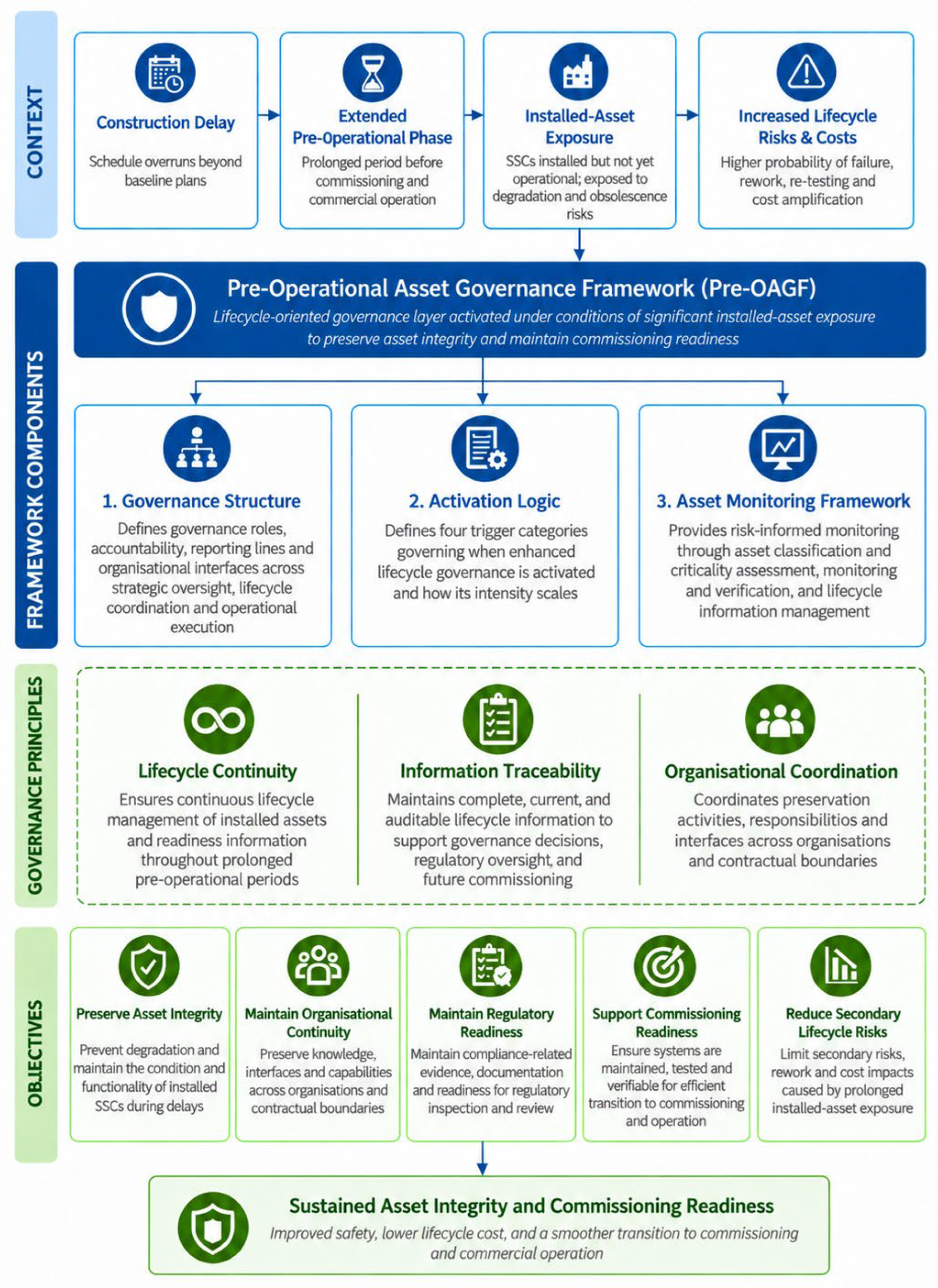
Building upon the installed-asset exposure mechanism, this study proposes the Pre-Operational Asset Governance Framework (Pre-OAGF) as a lifecycle-oriented governance framework for managing installed but non-operational SSCs during prolonged pre-operational phases of nuclear construction projects. Rather than introducing new preservation activities, the framework coordinates existing preservation, monitoring, documentation control, and commissioning readiness processes within a unified governance structure activated under conditions of significant installed-asset exposure. Pre-OAGF therefore complements, rather than replaces, established nuclear preservation, commissioning, risk-management, and asset-management processes by providing an overarching governance layer through which these activities can be coordinated as interdependent responses to a common lifecycle condition.
Figure 1 presents the overall conceptual structure of the proposed framework, illustrating its relationship to construction delay, installed-asset exposure, governance components, governing principles, and intended lifecycle outcomes.
The framework is founded on three governance principles: Lifecycle Continuity, Information Traceability, and Organisational Coordination. Together, these principles provide the conceptual basis for the framework by ensuring continuous lifecycle management of installed assets, maintaining complete and auditable lifecycle information, and coordinating preservation activities across organisational and contractual interfaces. These principles are operationalised through three complementary framework components: governance structure, activation logic, and the asset monitoring framework, which collectively coordinate governance activities during prolonged pre-operational periods.
The conceptual contribution of the Pre-OAGF lies in recognising prolonged installed-asset exposure as a distinct lifecycle governance condition and linking that condition to a dedicated lifecycle coordination layer and graded governance response. Rather than treating preservation, monitoring, information management, organisational continuity, and commissioning readiness as separate project concerns, the framework connects them through an exposure-based governance mechanism. This mechanism is designed to support asset integrity, organisational continuity, and commissioning readiness and is expected to limit secondary lifecycle risks and associated costs.

4.3. Governance Structure

The governance structure of the Pre-Operational Asset Governance Framework (Pre-OAGF) provides the organisational architecture through which lifecycle governance is implemented during prolonged pre-operational phases. Its primary objective is to coordinate preservation, monitoring, documentation control, and commissioning readiness across organisational and contractual interfaces while maintaining clear accountability for asset condition.
The governance structure is organised into three complementary levels: (i) Strategic Oversight, (ii) Lifecycle Coordination, and (iii) Operational Execution. Each level performs distinct governance functions while remaining integrated through formal reporting relationships, information exchange, and clearly defined organisational interfaces.

4.3.1. Strategic Oversight

Strategic oversight remains the responsibility of the asset owner or investor, who retains overall accountability for ensuring that installed SSCs remain suitable for future commissioning and operation. At this level, governance focuses on establishing lifecycle objectives, defining preservation policies, allocating organisational responsibilities, and ensuring alignment between construction delivery, regulatory expectations, and long-term operational requirements. Strategic oversight therefore provides the authority within which the Pre-OAGF operates and determines the governance expectations applied throughout the project.

4.3.2. Lifecycle Coordination

The defining element of the proposed framework is the lifecycle coordination layer. Positioned between strategic oversight and operational execution, this function acts as the central governance mechanism responsible for integrating activities performed by multiple organisations throughout the pre-operational period. Rather than executing technical preservation activities directly, the coordination function maintains oversight of asset condition, preservation status, documentation integrity, interface management, and commissioning readiness across the entire project.
This governance layer consolidates information from contractors, suppliers, inspection programmes, and preservation activities into a unified decision-making process. Within the proposed design, this layer is intended to maintain clear allocation of responsibilities despite contractual changes, coordinate corrective actions where deficiencies are identified, and align preservation activities with lifecycle objectives. It therefore provides a conceptual mechanism for integrating fragmented project activities around asset readiness rather than simply completing contractual deliverables.

4.3.3. Operational Execution

Operational execution remains the responsibility of contractors, subcontractors, vendors, and specialist organisations acting within their contractual scope and technical competence. These organisations continue to perform preservation, maintenance, inspection, testing, and monitoring activities in accordance with regulatory requirements, technical specifications, and approved procedures. The proposed framework therefore does not alter contractual responsibilities for technical execution; instead, it is intended to strengthen governance by coordinating these activities through a common lifecycle management structure.
Where technically appropriate and organisationally beneficial, selected routine preservation and maintenance activities may also be transferred to qualified in-house personnel representing the future operating organisation. Such involvement is expected to reduce dependence on external contractors and may improve organisational knowledge retention, cost efficiency, and operational preparedness before commissioning, provided that competency, regulatory, and contractual requirements remain fully satisfied.

4.3.4. Governance Interfaces

A fundamental characteristic of the Pre-OAGF governance structure is the formal management of organisational interfaces. Delayed nuclear projects frequently involve numerous contractors, specialist suppliers, regulators, and owner organisations operating under independent contractual arrangements. The governance structure is intentionally adaptive rather than static. As project conditions evolve, the intensity of lifecycle governance can be adjusted according to the scale of installed-asset exposure, organisational complexity, and commissioning risk. Longer delays or increasing organisational fragmentation may require greater coordination effort, enhanced reporting, more frequent governance reviews, or stronger oversight by the central coordination function. Conversely, projects progressing according to schedule may require only limited governance intervention. This adaptive characteristic is intended to keep governance effort proportionate to lifecycle risk while avoiding unnecessary organisational complexity.

4.4. Activation Logic

A distinguishing characteristic of the Pre-Operational Asset Governance Framework (Pre-OAGF) is that it is conceived as a conditionally activated governance system rather than a permanent layer of project management. Its implementation is triggered when project conditions create, or are reasonably expected to create, installed-asset exposure that exceeds the capability of conventional project governance to maintain lifecycle continuity and commissioning readiness. Activation therefore represents the transition from routine construction management to enhanced lifecycle governance.
The activation logic is based on the principle that governance intervention should be proportionate to the level of lifecycle risk rather than solely to elapsed project time. Consequently, activation decisions are informed through the combined assessment of four complementary trigger categories: (i) Temporal and Milestone Exposure, (ii) Technical and Regulatory Exposure, (iii) Organisational and Supply-Chain Exposure, and (iv) External Project-Environment Conditions (Table 3). Indicative ranges are introduced to demonstrate how these triggers may be operationalised in practice. These values represent preliminary governance bands based on professional judgement rather than empirically validated technical or regulatory limits. They should therefore be calibrated to project-specific conditions, SSC criticality, preservation requirements, contractual arrangements, regulatory obligations, and commissioning priorities.
The trigger categories and indicative conditions presented in Table 3 inform the graded activation levels and transition rules summarised in Table 4. Pre-OAGF operates as a graded escalation model: Level 0 retains routine project governance, Levels 1 and 2 activate selected enhanced controls, and Level 3 activates the full framework.
As shown in Table 4, the graded activation levels provide a qualitative decision rule for translating individual and combined triggers into governance responses. Transition between levels is not determined by temporal exposure alone. A single high-consequence condition may justify direct escalation to Level 3, while the concurrent presence of multiple lower-level triggers may justify escalation to Level 2 or Level 3 where their combined effect materially threatens lifecycle continuity or commissioning readiness. De-escalation may occur where the triggering condition has been resolved and sufficient evidence demonstrates that asset condition, organisational capability, and commissioning readiness have returned to an acceptable project-specific state.
The indicative temporal ranges provide a measurable baseline for governance escalation but should not be interpreted as deterministic activation limits. A comparatively short delay may create significant lifecycle risk where it coincides with an approaching commissioning milestone, preservation deadline, inspection requirement, documentation validity period, or regulatory obligation. Conversely, a longer delay may remain manageable where SSC condition, preservation arrangements, organisational continuity, and regulatory evidence remain stable. Temporal exposure must therefore be assessed in relation to the consequences of the delay rather than its duration alone.
Particular consideration should be given to the relationship between installed-asset exposure and critical-path milestones. Where the estimated time required to inspect, recondition, revalidate, remobilise specialist contractors or restore specialist capability, renew documentation, or obtain regulatory acceptance approaches or exceeds the remaining schedule float or time available before an affected milestone, enhanced governance may be required regardless of the accumulated project delay. This introduces a forward-looking dimension to activation by recognising risk before the corresponding schedule impact has fully materialised.
Technical and regulatory exposure triggers similarly operate relative to SSC-specific lifecycle requirements. Preservation, inspection, functional verification, documentation, certification, and regulatory reporting requirements may be governed by defined periodic intervals. For operational purposes, approaching the end of an applicable interval may be treated as an early-warning condition where the remaining time becomes insufficient or potentially insufficient to complete the required preservation, verification, documentation, or regulatory activity before its due date. Expiry of the interval, loss of validated condition, identified degradation, or inability to complete the required activity before its due date provides a stronger basis for escalation.
Organisational and supply-chain conditions may require activation before significant schedule delay occurs. Nuclear construction and preservation activities can depend on OEMs, specialist subcontractors, proprietary procedures, qualified personnel, and vendor-specific capabilities that are difficult to replace. Consequently, confirmed or foreseeable loss of a critical organisation or capability can act as an anticipatory trigger. A known loss without an available qualified substitute may justify immediate governance escalation even where the project remains nominally on schedule, because the resulting capability gap can subsequently affect preservation, verification, requalification, or commissioning readiness.
External project-environment conditions provide a further anticipatory trigger. As discussed in Section 2.2, macroeconomic, political, geopolitical, regulatory, and supply-chain disruptions can materially alter nuclear project trajectories [11,23,24,25]. Such conditions may not initially be reflected in accumulated project delay, yet they can provide early evidence that contractual continuity, supplier availability, financing, or future project progression is at risk. External conditions are therefore treated as event-based triggers requiring formal assessment rather than being assigned a universal time threshold.
As activation level increases, governance may expand from enhanced reporting and monitoring to dedicated coordination teams, strengthened interface management, enhanced documentation control, increased inspection frequency, greater involvement of future operating personnel, and formal escalation to strategic project governance. This proportional approach maintains governance effort in accordance with lifecycle risk while avoiding unnecessary organisational burden during routine project delivery.
The proposed thresholds represent an initial operationalisation of the conceptual framework rather than validated activation criteria. Future research should therefore calibrate the indicative ranges and examine the interaction between temporal and event-based triggers using nuclear project case studies, structured expert elicitation, SSC-specific preservation and verification data, commissioning milestone performance, organisational continuity information, and external project-environment indicators. This work could subsequently support the development of a quantitative or multi-criteria Pre-OAGF activation model.
Overall, the activation logic transforms the Pre-OAGF from a static governance concept into an adaptive lifecycle management system. By defining when enhanced governance should be introduced and how its intensity should evolve with increasing or anticipated installed-asset exposure, the framework establishes the operational link between the installed-asset exposure mechanism and the governance structure described in the preceding sections.

4.5. Asset Monitoring Framework

The asset monitoring framework constitutes the operational component of the Pre-Operational Asset Governance Framework (Pre-OAGF), translating its governance principles into a structured process for maintaining the condition, traceability, and commissioning readiness of installed but non-operational SSCs. Whereas the governance structure defines organisational responsibilities and the activation logic determines when enhanced governance is required, the asset monitoring framework provides the mechanisms through which lifecycle information is collected, evaluated, and used to support governance decisions throughout prolonged pre-operational periods.
The framework is founded on the principle that effective lifecycle governance depends not only on performing preservation activities but also on maintaining continuous visibility of asset condition and organisational readiness. Consequently, monitoring extends beyond the physical condition of SSCs to encompass documentation integrity, configuration control, preservation status, and the completeness of information required to support commissioning and regulatory verification.
The asset monitoring framework comprises three interrelated elements: (i) asset classification and criticality assessment, (ii) monitoring and verification, and (iii) lifecycle information management. Together, these components provide a structured basis for risk-informed monitoring while ensuring that governance decisions remain supported by accurate, current, and traceable information.

4.5.1. Asset Classification and Criticality Assessment

The first component establishes the basis for prioritising monitoring activities by classifying installed SSCs according to their safety significance, functional importance, quality classification, and susceptibility to degradation during prolonged inactivity. This risk-informed approach enables monitoring intensity, preservation requirements, and verification activities to remain proportionate to lifecycle exposure rather than applying uniform management measures across all assets. The classification may be periodically reviewed as project conditions evolve, reflecting changes in delay duration, environmental exposure, preservation status, or commissioning priorities.

4.5.2. Monitoring and Verification

The second component defines the systematic processes through which asset condition is maintained and verified throughout the pre-operational period. Monitoring activities include periodic inspections, verification of preservation measures, environmental surveillance, condition assessments, functional checks where appropriate, and confirmation that configuration remains consistent with approved design documentation. Monitoring is intended to provide ongoing evidence for assessing whether installed SSCs remain suitable for future commissioning despite prolonged construction delays.
A distinguishing characteristic of the proposed framework is that monitoring is integrated across organisational boundaries rather than performed independently by individual contractors. Within the proposed design, these processes would be coordinated through the Governance Structure to promote consistency, limit duplication, and maintain a comprehensive understanding of overall asset condition.

4.5.3. Lifecycle Information Management

The third component establishes the information environment supporting governance and decision-making. Monitoring data, preservation records, inspection results, configuration changes, and documentation updates are integrated within a unified lifecycle information structure that provides the lifecycle coordination function with a complete and continuously updated overview of installed asset condition. This integrated information environment is intended to support governance by enabling trend analysis, facilitating timely intervention, strengthening organisational transparency, and maintaining the traceability required for regulatory oversight and commissioning readiness.
An essential characteristic of the asset monitoring framework is the establishment of continuous feedback between monitoring outcomes and governance decisions. Deviations identified through inspections, preservation activities, documentation reviews, or configuration verification are systematically communicated through the governance structure, enabling timely corrective action and adaptive management. Monitoring therefore functions not merely as a compliance activity but as a decision-support mechanism that continuously informs lifecycle governance throughout the pre-operational period.
The framework further supports adaptive monitoring by allowing monitoring intensity to evolve in response to increasing installed-asset exposure and activation level. As delays extend or organisational complexity increases, inspection frequency, verification activities, documentation reviews, and reporting requirements may be progressively expanded to maintain confidence in asset condition and commissioning readiness. Conversely, where project conditions remain stable, monitoring effort may remain proportionate to the level of lifecycle risk.
Finally, the asset monitoring framework supports the progressive involvement of future operating and maintenance organisations by providing structured access to preservation history, asset condition records, configuration information, and monitoring results. These mechanisms are expected to facilitate knowledge transfer and may strengthen organisational preparedness and reduce uncertainty during commissioning and plant handover.
Collectively, the asset monitoring framework completes the Pre-Operational Asset Governance Framework by specifying the operational processes through which lifecycle governance would be implemented. Integrated with the Governance Structure and Activation Logic, it defines a coordinated and adaptive management system intended to support asset integrity, organisational continuity, and commissioning readiness throughout extended pre-operational phases of nuclear construction projects.

5. Discussion

The findings address the two research questions by conceptualising, first, how prolonged construction delays generate lifecycle risks through installed-asset exposure and, second, how these risks can be translated into an integrated governance response. As discussed in this study, prolonged installed-asset exposure creates a distinct lifecycle governance condition that may not be adequately addressed through isolated technical and managerial interventions. Consequently, governance responses should be directed towards the exposure condition itself rather than its individual manifestations. Pre-OAGF translates this proposition by integrating the functions required to preserve asset integrity, organisational continuity, and operational readiness during extended pre-operational periods.
This integration distinguishes Pre-OAGF from, while remaining complementary to, existing international guidance and asset management standards. International guidance recognises that prolonged project interruption requires management approaches extending beyond those applied during projects progressing according to their original schedules [2]. The IAEA identifies preservation, personnel retention, documentation, contractual and warranty management, and preparedness for project resumption as important priorities during extended delays [29,30], while the ISO 55000 series provides broader principles for lifecycle asset management [35]. These sources establish important requirements and practices, but do not integrate them around installed-asset exposure as a distinct governance condition.
The central theoretical contribution of this study is therefore the reconceptualisation of these activities as interdependent responses to a common underlying condition: prolonged exposure of installed but non-operational assets. Rather than treating preservation, configuration control, organisational continuity, contractual management, and commissioning readiness as parallel activities, Pre-OAGF connects them through a common Governance Structure, Activation Logic, and Asset Monitoring Framework. In this way, the framework extends existing principles into an integrated governance model specifically addressing prolonged pre-operational exposure of nuclear SSCs.
The installed-asset exposure mechanism developed in this study explains how prolonged pre-operational periods can generate secondary lifecycle risks. These risks accumulate through physical degradation, loss of configuration clarity, reduced organisational continuity, obsolescence, and increasing revalidation requirements across large populations of safety-relevant assets [4]. The practical scale of this challenge is illustrated by the Czech nuclear sector, where the regulatory classification of Non-Selected Equipment encompasses more than 10,000 safety-related structures, systems, and components (SSCs) across the Dukovany and Temelín nuclear power plants [39] (p. 34). Each of these assets requires appropriate documentation, inspection, testing, maintenance, and preservation arrangements throughout its lifecycle. This example demonstrates that lifecycle governance in delayed nuclear projects is not limited to a relatively small number of critical systems but must instead coordinate the preservation, traceability, monitoring, and regulatory oversight of thousands of interconnected safety-related items.
Additional costs may arise from the preservation, inspection, requalification, repair and lifecycle management of installed assets during prolonged delays. More critically, installed-asset exposure can translate into direct schedule risk as commissioning approaches. If a degraded or failed asset is a long-lead or highly specialised item, its replacement may require procurement, manufacture, qualification, testing, transport, installation and regulatory acceptance. A failure identified late in the pre-operational phase may therefore create a new critical-path constraint, particularly where replacement lead times exceed the remaining time available before commissioning. Consequently, the financial exposure extends beyond the cost of asset management or replacement itself to potentially substantial lost generation revenue, continued project overheads and additional lifecycle management costs resulting from delayed commercial operation [40].
The economic implications of delayed nuclear projects are therefore broader than conventional project control indicators may suggest. A decision to restart a delayed nuclear project may not always be based solely on narrow economic optimisation. Strategic considerations including energy security, policy priorities, public acceptance, and long-term electricity supply may justify continuation despite substantial completion costs [27,38]. Pre-OAGF is relevant in this context because it offers a conceptual mechanism that is expected to help protect the residual value of installed assets and limit additional lifecycle costs.
The framework also has important implications for contractual governance. Its practical application will vary depending on the delivery model adopted for the nuclear project. Under an EPC arrangement, responsibility for preservation, maintenance, and readiness assurance may remain primarily with the principal contractor, while the owner requires sufficient oversight to ensure that lifecycle risks are controlled [36]. In contrast, where the future operator is also closely involved in construction delivery, Pre-OAGF may be more directly integrated into the owner-operator’s internal organisation. In such cases, selected routine preservation and maintenance activities may be transferred to qualified in-house personnel, reducing dependence on subcontractors while simultaneously developing operational knowledge before commissioning. This supports the rationale for the term Pre-Operational Asset Governance Framework: the framework applies asset-management logic before operation begins, using lifecycle-oriented oversight and, where appropriate, future operating or maintenance personnel to maintain asset readiness.
An important implementation implication is the need to align Pre-OAGF with contractual and project governance arrangements from an early stage. Pre-OAGF responsibilities, information rights, preservation standards, reporting obligations, and escalation mechanisms should be incorporated into the contractual and governance architecture of the project, enabling the framework to operate across organisational and contractual interfaces. Therefore, for future nuclear new-build projects, Pre-OAGF should ideally be embedded into contract strategy, project governance documents, preservation plans, configuration management procedures, and commissioning readiness arrangements from the early stages of project development. By establishing responsibilities, information flows, monitoring interfaces, and escalation pathways in advance, Pre-OAGF is intended to function as a preventive governance mechanism, enabling emerging exposure conditions to be identified and addressed before they develop into asset degradation, loss of lifecycle information continuity, organisational or contractual disruption, or commissioning constraints. For projects already under construction or experiencing delay, the framework can instead provide a structured basis for introducing these governance arrangements through existing contractual mechanisms, supplementary agreements, or coordinated management interventions.
Digital information management provides a further enabling mechanism for the practical application of Pre-OAGF. The effectiveness of Pre-OAGF depends on reliable, traceable, and continuously updated asset information. This does not necessarily require a single specialised software platform; it may be implemented through an existing nuclear construction management system, a dedicated asset database, or a structured register using defined flags, responsibilities, and escalation criteria. The essential requirement is not the software itself, but the ability to integrate asset classification, preservation status, inspection records, configuration data, warranty information, non-conformities, and commissioning readiness evidence into a controlled information environment. Such integration enables preservation activities to be translated from individual technical actions into visible, traceable governance information, supporting risk-based prioritisation, escalation, and commissioning-readiness decisions.
Building on this information environment, the activation logic determines when enhanced governance intervention is required and how that intervention should be scaled. This is particularly important because it is intended to prevent Pre-OAGF from becoming a permanent or excessive governance burden. By linking activation to Temporal and Milestone Exposure, Technical and Regulatory Exposure, Organisational and Supply-Chain Exposure, and External Project-Environment Conditions, the framework supports a graded and proportionate response to emerging lifecycle risks. This is consistent with the nuclear safety principle that management effort should be aligned with safety significance, exposure conditions, and regulatory expectations [37]. Lower levels of activation may require enhanced monitoring and reporting, whereas higher levels may require dedicated coordination teams, increased inspection frequency, stronger configuration control, and formalised interface management.
The Asset Monitoring Framework completes this governance cycle by linking activation decisions to asset-level evidence. Rather than treating preservation monitoring as a fragmented contractor-level activity, Pre-OAGF establishes a coordinated lifecycle process through which degradation, configuration status, and commissioning readiness can inform governance decisions. This linkage is important because the value of monitoring lies not only in detecting asset deterioration, but in ensuring that emerging conditions are visible at the level where prioritisation, escalation, and intervention decisions are made.
Nevertheless, the framework remains conceptual and has not yet been empirically validated. Accordingly, the potential benefits attributed to the Pre-OAGF—including improved visibility and coordination, stronger commissioning readiness, reduced secondary lifecycle risk and cost amplification, and a smoother transition to commissioning—should be understood as theoretically expected effects derived from the framework’s design rather than as demonstrated outcomes.
Future research should establish whether, under what conditions, and to what extent these effects occur through delayed nuclear project case studies, structured expert validation, or application to specific SSC categories. Further work should develop measurable activation indicators, with particular attention to relationships between delay duration, proximity to critical-path milestones, preservation and verification intervals, regulatory reporting cycles, vendor and organisational continuity, and external project-environment conditions. Research should also examine how the Pre-OAGF can be integrated with existing project controls, configuration management, digital construction management systems, preservation programmes, and commissioning readiness processes.

6. Conclusions

This study proposes a conceptual Pre-Operational Asset Governance Framework derived from recurring lifecycle risks reported across nuclear project literature and international guidance. Rather than replacing existing project management or commissioning processes, the framework complements them by introducing a dedicated governance layer for installed assets during prolonged pre-operational conditions.
The study argues that extended delays between installation, commissioning, and commercial operation should not be understood only as schedule deviations, but as a distinct lifecycle condition that can affect asset integrity, documentation quality, contractual continuity, regulatory readiness, and future operational performance.
The paper first conceptualised the installed-asset exposure mechanism, through which prolonged pre-operational periods generate secondary lifecycle risks and contribute to cost amplification. This mechanism shows that delays may lead to physical degradation, loss of configuration clarity, documentation obsolescence, reduced organisational continuity, and increasing revalidation requirements. These effects can accumulate over time and increase the effort required to restore confidence in asset condition before commissioning.
Building on this mechanism, the study proposed the Pre-OAGF as a conditionally activated governance layer designed to coordinate preservation, monitoring, documentation control, and readiness assurance across fragmented contractual and organisational interfaces. The framework is structured around Governance Structure, Activation Logic, and Asset Monitoring Framework. The activation logic assesses four trigger categories: Temporal and Milestone Exposure, Technical and Regulatory Exposure, Organisational and Supply-Chain Exposure, and External Project-Environment Conditions.
Its main contribution lies in providing a systematic approach for maintaining continuity, traceability, and coordination during extended pre-operational phases. The novelty therefore lies in the combined installed-asset exposure mechanism, lifecycle coordination architecture, and exposure-based graded activation logic, rather than in the individual preservation, monitoring, or commissioning activities themselves.
Based on its conceptual design, the Pre-OAGF is expected to improve visibility of asset condition, strengthen configuration and documentation control, reduce dependence on reactive contractual arrangements, and support a smoother transition to commissioning. These represent anticipated benefits rather than empirically demonstrated outcomes. The framework may be particularly relevant where delays create uncertainty regarding contractor availability, preservation responsibilities, specialist maintenance requirements, or regulatory evidence required for future commissioning approvals.
The study also proposes that Pre-OAGF should be considered early in contract strategy and project governance arrangements. If preservation responsibilities, information rights, reporting obligations, and escalation mechanisms are not defined in advance, their later introduction may require supplementary agreements or ad hoc management interventions. Early integration of Pre-OAGF principles is expected to improve lifecycle-risk control and help limit secondary cost escalation, although this proposition requires empirical validation. Overall, the conceptual contribution of the Pre-OAGF lies in addressing the underdeveloped interface between construction-delay management and lifecycle asset governance. By recognising installed-asset exposure as a distinct management condition, the framework establishes a conceptual basis for a coordinated governance layer for installed assets throughout the pre-operational period. Its application is expected to help reduce secondary lifecycle risks and limit cost amplification, although these anticipated effects remain to be empirically validated.

Funding

This research was funded by the Czech Technical University in Prague, Czech Republic, Grant SGS25/081/OHK1/2T/11 Technicko-ekonomická metodika efektivního řízení výstavby nových jaderných zdrojů.

Data Availability Statement

No new empirical datasets were generated in this study. Data sharing is not applicable to this article. The literature search procedures and source-selection information supporting the conceptual analysis are provided in Appendix A. All sources used in the study are cited in the manuscript.

Conflicts of Interest

The author declares no conflicts of interest.

Appendix A. Literature Search and Source-Selection Protocol

The searches reported below were undertaken to construct the evidence base for the conceptual study. Structured Scopus searches are reported with query-level returned and retained counts. Because individual publications could appear in more than one Scopus search, counts should not be summed to represent a deduplicated literature set unless duplicate removal is performed. Institutional, regulatory, and project-specific searches were conducted separately because these sources served different evidential functions from the academic literature.
All records returned by the three structured Scopus searches were screened by title and abstract. Accordingly, returned and title/abstract-screened counts are identical for S1a–S1c. Full texts were assessed where potential substantive relevance could not be resolved from the title and abstract alone. Supplementary academic, regulatory, technical, and project-specific searches were targeted rather than bounded corpus searches and are therefore reported separately from the structured Scopus query-level counts.
S1—Nuclear construction delays
S1a—Construction delays and overruns
Evidence domain: Nuclear construction delays and risks
Database: Scopus
Search period: May 2026
Publication coverage: All publication years indexed in Scopus up to the final search date.
Fields searched: Article title, Abstract, Keywords
Document types: Article, Conference Paper, Review
Language: English
Search string:
(“nuclear power plant” OR “nuclear power plants” OR “nuclear power project” OR “nuclear power projects” OR “nuclear power construction” OR “nuclear construction”) AND (“construction delay” OR “construction delays” OR “delays in construction” OR “schedule delay” OR “schedule delays” OR “schedule overrun” OR “schedule overruns” OR “cost overrun” OR “cost overruns”)
Records returned: 78
Records retained: 6
Selection procedure: All returned records were screened by title and abstract. Publications were taken forward for full-text assessment where they addressed nuclear power plant construction delays, schedule or cost overruns, construction duration, or technical, organisational, regulatory, contractual, or external factors contributing to project delay. Records addressing nuclear energy without a substantive connection to construction project delivery or delay mechanisms were excluded. The six publications retained after full-text assessment were included because they provided evidence concerning nuclear-construction delay mechanisms or associated project risks.
Purpose: Identification of academic evidence concerning delay mechanisms, schedule and cost overruns, construction disruption, and associated risks in nuclear new-build projects.
S1b—Construction duration and lead time
Evidence domain: Nuclear construction delays and risks
Database: Scopus
Search period: July 2026
Publication coverage: All publication years indexed in Scopus up to the final search date.
Fields searched: Article title, Abstract, Keywords
Document types: Article, Conference Paper, Review
Language: English
Search string:
(“nuclear power plant” OR “nuclear power plants” OR “nuclear power project” OR “nuclear power projects”) AND (“power plant construction” OR “nuclear construction”) AND (“lead time” OR leadtime OR duration)
Records returned: 19
Records retained: 1
Selection procedure: Publications were considered relevant where construction duration, construction lead time, or the period required to deliver a nuclear power project constituted a substantive subject of the study. Records were excluded where references to duration or lead time concerned operational outages, fuel-cycle processes, equipment procurement unrelated to overall construction delivery, or other time-based phenomena without a substantive connection to nuclear power plant construction.
Purpose: Identification of academic evidence concerning nuclear power plant construction duration and the temporal characteristics of extended project delivery relevant to prolonged pre-operational exposure.
S1c—Construction and project risk
Evidence domain: Nuclear construction delays and risks
Database: Scopus
Search period: July 2026
Publication coverage: All publication years indexed in Scopus up to the final search date.
Fields searched: Article title, Abstract, Keywords
Document types: Article, Conference Paper, Review
Language: English
Search string:
(“nuclear power plant” OR “nuclear power plants” OR “nuclear power project” OR “nuclear power projects” OR “nuclear power construction” OR “nuclear construction”) AND (“construction risk” OR “construction risks” OR “project risk” OR “project risks” OR “project risk management” OR “risk register” OR “risk registers” OR “risk breakdown structure”)
Records returned: 40
Records retained: 2
Selection procedure: Publications were considered relevant where they identified, classified, assessed, or managed risks associated with nuclear power plant construction or nuclear project delivery, particularly where such risks were related to schedule disruption, project interfaces, regulatory conditions, supply chains, design, contracting, or project management. Studies concerned principally with operational nuclear safety, radiological risk, probabilistic safety assessment, or other technical risks without a substantive construction-project dimension were excluded.
Purpose: Identification of academic evidence concerning construction and project risks capable of contributing to delay, disruption, and lifecycle exposure in nuclear new-build projects.
A1—Supplementary Academic Evidence Identification
Source-identification Method: Reference-list checking, citation and keyword expansion from directly relevant publications, and targeted searches in Scopus and Google Scholar for specific concepts, authors, or titles identified during development of the thematic literature synthesis. Publications encountered through related previous research could serve as seed sources where substantively relevant.
Search period: May—July 2026
Publication coverage: All publication years up to the final search date.
Selection procedure: Supplementary academic publications were retained where they provided directly relevant evidence concerning lifecycle SSC management, commissioning, configuration management, subcontractor governance, organisational capability, nuclear project management, or other concepts relevant to RQ1 or RQ2 but were not identified through the three structured Scopus searches reported above. All supplementary publications were assessed using the same substantive inclusion principles described for the academic literature in Section 2.1.1; prior familiarity with a publication did not itself constitute a basis for inclusion.
Purpose: Supplementation of the structured searches in thematic areas where relevant academic literature was sparse, distributed across adjacent fields, or used terminology not captured by the core nuclear-delay search expressions.
No corpus-level returned or screened count is reported for SA1 because these activities consisted of targeted citation, known-item, and concept searches rather than a predefined bounded search result set. Publications identified through SA1 were treated as part of the academic evidence base but were not included in the query-level screening counts reported for S1a–S1c.
I1—Targeted Identification of IAEA Guidance
Sources: IAEA Publications Advanced Search and supplementary targeted web searches used to locate official IAEA publications.
Search period: July 2026
Publication coverage: All publication years available up to the final search date.
Search terms: “nuclear delayed project”; “nuclear construction projects”; “structures, systems and components”; “surveillance and inspection”; “nuclear commissioning”; and “nuclear management”. The terms were used individually and, where appropriate, in combination with “IAEA”.
Search procedure: Relevant guidance was initially sought through the IAEA Publications Advanced Search facility. Because the internal search interface did not consistently retrieve publications known to be relevant to the research questions, the database search was supplemented by targeted web searches for official IAEA publications using the same concepts. Web-search results were used only to identify publications issued or hosted by the IAEA; third-party webpages were not treated as evidence.
Records returned and screened: A single corpus-level figure was not calculated because the identification process involved iterative and overlapping searches across the IAEA Publications resource and a web search engine. Search results could therefore contain duplicates and could vary according to the retrieval route and query formulation.
Records retained: 10
Selection procedure: Identified publications were screened for direct relevance to one or more of the evidence domains defined in Table 1. Publications were retained where they addressed preservation, maintenance, ageing, surveillance, inspection or configuration of SSCs; delayed or interrupted nuclear projects; commissioning, testing, revalidation or operational readiness; nuclear management systems; organisational responsibilities and capabilities; or contractual, supplier and ownership arrangements relevant to nuclear project delivery. Publications without a substantive relationship to either research question were excluded.
Purpose: Identification of authoritative nuclear-sector guidance relevant to lifecycle SSC management, commissioning and operational readiness, delayed-project management, organisational capability and governance requirements.
Domain allocation: The retained IAEA publications were subsequently coded against the evidence domains as follows:
S2—Lifecycle SSC management: preservation, degradation, maintenance, surveillance, inspection, ageing, condition monitoring, configuration and documentation continuity.
S3—Commissioning and operational readiness: commissioning, pre-operational testing, revalidation, regulatory readiness, documentation completeness, configuration integrity and transition to operation.
S4—Governance and organisational complexity: management systems, responsibilities, organisational capability, ownership, contracting, supplier interfaces, specialist continuity and management of delayed projects.
A single publication could contribute to more than one evidence domain where its substantive content addressed multiple aspects of the research questions.
T1—Targeted Regulatory, Standards-Based, Institutional, and Technical Evidence
Sources: U.S. Nuclear Regulatory Commission (NRC), Státní úřad pro jadernou bezpečnost (SÚJB), International Organization for Standardization (ISO), OECD Nuclear Energy Agency (OECD NEA), World Nuclear Association (WNA), and Idaho National Laboratory (INL).
Search period: July 2026
Search basis: Targeted searches undertaken where a specific regulatory requirement, recognised technical principle, organisational requirement, sectoral recommendation, or technical example was required to support an element of the conceptual argument.
Selection procedure: Sources were retained only where they directly established or substantiated the specific regulatory, technical, organisational, or sectoral point for which they were consulted. Regulatory documents were used for regulatory requirements or expectations; standards for recognised management principles; institutional and technical reports for sector-specific technical or organisational guidance; and WNA material for nuclear-sector construction and project context.
Purpose: Verification and substantiation of specific regulatory, technical, organisational, and sectoral propositions that could not appropriately be established through the academic literature alone.
No corpus-level “records returned” figure is reported for this category because these were statement-specific targeted searches rather than a bounded database search.
P1—Project-Specific Contextual Evidence
Sources represented in the manuscript: Nuclear Planet, WNA country-profile material, and project-specific published sources used to substantiate the Paks II or Mochovce example.
Search period: July 2026
Search basis: Targeted searches for factual information concerning the status, chronology, interruption, restart, or regulatory context of individual nuclear construction projects referred to in the literature review.
Selection procedure: Sources were selected where they directly substantiated the project-specific factual statement for which they were cited. Such sources were used only as supplementary contextual evidence and were not used as the primary basis for deriving general lifecycle relationships, governance principles, or components of Pre-OAGF.
Purpose: Substantiation of individual project examples used to illustrate the broader phenomena identified through academic and institutional evidence.
No corpus-level returned or screened count is reported because these sources were identified through statement-specific factual searches rather than through a bounded literature search.
Interpretation of Search Counts and Source Categories
The returned, screened, and retained figures reported for S1a–S1c are query-level counts. Because records could occur in more than one structured Scopus search, the counts were not summed to represent the number of unique publications screened or retained. Similarly, supplementary academic, regulatory, technical, and project-specific evidence-identification procedures were targeted rather than bounded searches and are therefore not assigned corpus-level returned counts.
Source categories were differentiated according to evidential function. Peer-reviewed and scholarly publications were used principally to establish research findings and conceptual relationships; IAEA and comparable institutional guidance was used to establish recognised nuclear-sector requirements and management principles; regulatory and standards-based documents were used to establish formal requirements or recognised principles; technical institutional sources were used to substantiate sector-specific propositions; and project-specific sources were used only to establish factual context for individual examples.

References

  1. Eash-Gates, P.; Klemun, M.M.; Kavlak, G.; McNerney, J.; Buongiorno, J.; Trancik, J.E. Sources of cost overrun in nuclear power plant construction: A call for a new approach to engineering design. Joule 2020, 4, 2348–2373. [Google Scholar] [CrossRef] [Scilit]
  2. International Atomic Energy Agency. Restarting Delayed Nuclear Power Plant Projects; IAEA Nuclear Energy Series No. NP-T-3.4; IAEA: Vienna, Austria, 2008; ISBN 978-92-0-101308-8. [Google Scholar]
  3. International Atomic Energy Agency. Maintenance, Testing, Surveillance and Inspection in Nuclear Power Plants; IAEA Safety Standards Series No. SSG-74; IAEA: Vienna, Austria, 2022. [Google Scholar]
  4. International Atomic Energy Agency. Safety Classification of Structures, Systems and Components in Nuclear Power Plants; IAEA Safety Standards Series No. SSG-30; IAEA: Vienna, Austria, 2014; pp. 1–89. ISBN 978-92-0-112613-9. [Google Scholar]
  5. World Nuclear Association. Lesson-Learning in Nuclear Construction Projects; Report No. 2018/002; World Nuclear Association: London, UK, 2018; Available online: https://world-nuclear.org/our-association/publications/working-group-reports/lesson-learning-in-nuclear-construction-projects (accessed on 5 June 2026).
  6. Oedewald, P.; Gotcheva, N. Safety culture and subcontractor network governance in a complex safety critical project. Reliab. Eng. Syst. Saf. 2015, 141, 106–114. [Google Scholar] [CrossRef] [Scilit]
  7. Brookes, N.J.; Locatelli, G. Power plants as megaprojects: Using empirics to shape policy, planning, and construction management. Util. Policy 2015, 36, 57–66. [Google Scholar] [CrossRef] [Scilit]
  8. International Atomic Energy Agency. The Management System for Nuclear Installations; IAEA Safety Standards Series No. GS-G-3.5; IAEA: Vienna, Austria, 2009; pp. 1–157. ISBN 978-92-0-103409-0. [Google Scholar]
  9. Lovering, J.R.; Yip, A.; Nordhaus, T. Historical construction costs of global nuclear power reactors. Energy Policy 2016, 91, 371–382. [Google Scholar] [CrossRef] [Scilit]
  10. Sherman, R.; Parrish, K.; Lamanna, A. Identifying and categorizing risks incumbent in US nuclear power plant construction. J. Constr. Eng. Manag. 2021, 147, 04021024. [Google Scholar] [CrossRef] [Scilit]
  11. Talášek, P. The impact of macroeconomic and political stability on nuclear power plant construction duration: Development and application of the MAPSS index. Staveb. Obz.-Civ. Eng. J. 2026, 35, 1–16. [Google Scholar] [CrossRef] [Scilit]
  12. International Atomic Energy Agency. Management of Delayed Nuclear Power Plant Projects; IAEA-TECDOC-1110; IAEA: Vienna, Austria, 1999; Available online: https://www.iaea.org/publications/5828/management-of-delayed-nuclear-power-plant-projects (accessed on 5 June 2026).
  13. Kang, M.-Y.; Jeong, Y.; Jung, Y. Assessment methodology of practical configuration management (CM) for sustainable nuclear power plants (NPPs). Sustainability 2019, 11, 2391. [Google Scholar] [CrossRef] [Scilit]
  14. Sovacool, B.K.; Gilbert, A.; Nugent, D. Risk, innovation, electricity infrastructure and construction cost overruns: Testing six hypotheses. Energy 2014, 74, 906–917. [Google Scholar] [CrossRef] [Scilit]
  15. Wright, E.R.; Cho, K.; Hastak, M. Assessment of critical construction engineering and management aspects of nuclear power projects. J. Manag. Eng. 2014, 30, 04014016. [Google Scholar] [CrossRef] [Scilit]
  16. Nuclear Planet. Nuclear Power Plants Worldwide—Construction Status. Available online: https://app.nuclearplanet.ch/nuclearplanet/kkw-world/status/3?lang=en (accessed on 14 July 2026).
  17. Carajilescov, P.; Moreira, J.M.L. Construction time of PWRs. In Proceedings of the International Nuclear Atlantic Conference-INAC 2011; Belo Horizonte, Brazil, 24–28 October 2011; pp. 1–13. ISBN 978-85-99141-04-5. [Google Scholar]
  18. Szabó, A. Sinking Ground on the Paks II Nuclear Power Plant Site Could Further Delay the Project. Direkt36 2022. Available online: https://www.direkt36.hu/en/szijjarto-felporgetne-paks-ii-megepiteset-a-sullyedo-talaj-azonban-megakadalyozhatja-ezt/ (accessed on 10 July 2026).
  19. Fülöp, O. We Are Suing for the Paks II Licensing Documents, Still No Consensus on the Risks of the Tectonic Fault Line. Átlátszó 2024. Available online: https://english.atlatszo.hu/2024/01/18/we-are-suing-for-the-paks-ii-licensing-documents-still-no-consensus-on-the-risks-of-the-tectonic-fault-line/ (accessed on 10 July 2026).
  20. Kessides, I.N. The future of the nuclear industry reconsidered: Risks, uncertainties, and continued promise. Energy Policy 2012, 48, 185–208. [Google Scholar] [CrossRef] [Scilit]
  21. Alsharif, S.; Karatas, A. A framework for identifying causal factors of delay in nuclear power plant projects. Procedia Eng. 2016, 145, 1486–1492. [Google Scholar] [CrossRef] [Scilit]
  22. Ahiaga-Dagbui, D.D.; Smith, S.D.; Love, P.E.D.; Ackermann, F. Toward a systemic view to cost overrun causation in infrastructure projects: A review and implications for research. Proj. Manag. J. 2017, 48, 88–98. [Google Scholar] [CrossRef] [Scilit]
  23. Kim, J.-H.; Lee, S.-W.; Jung, W. International project risk management for nuclear power plant construction: Featuring comparative analysis with fossil and gas power plants. Sustainability 2017, 9, 469. [Google Scholar] [CrossRef] [Scilit]
  24. Benson, A.G. Global divergence in nuclear power plant construction: The role of political decentralization. Nucl. Technol. 2022, 208, 947–989. [Google Scholar] [CrossRef] [Scilit]
  25. Portugal-Pereira, J.; Ferreira, P.; Cunha, J.; Szklo, A.; Schaeffer, R.; Araújo, M. Better late than never, but never late is better: Risk assessment of nuclear power construction projects. Energy Policy 2018, 120, 158–170. [Google Scholar] [CrossRef] [Scilit]
  26. World Nuclear Association. Nuclear Power in Slovakia. Available online: https://world-nuclear.org/information-library/country-profiles/countries-o-s/slovakia (accessed on 7 September 2026).
  27. Spirkova, D. Management of megaproject during the turbulent period of economic and political transformation in Slovakia. J. US-China Public Adm. 2014, 11, 750–762. [Google Scholar]
  28. U.S. Nuclear Regulatory Commission. Boric Acid Corrosion of Carbon Steel Reactor Pressure Boundary Components in PWR Plants; Generic Letter 88-05; U.S. Nuclear Regulatory Commission: Washington, DC, USA, 1988; ADAMS Accession No. ML053070383. Available online: https://www.nrc.gov/reading-rm/doc-collections/gen-comm/gen-letters/1988/index (accessed on 7 September 2026).
  29. International Atomic Energy Agency. Commissioning for Nuclear Power Plants; IAEA Safety Standards Series No. SSG-28; IAEA: Vienna, Austria, 2014; ISBN 978-92-0-140110-6. [Google Scholar]
  30. International Atomic Energy Agency. Management of Nuclear Power Plant Projects; IAEA Nuclear Energy Series No. NG-T-1.6; IAEA: Vienna, Austria, 2020; ISBN 978-92-0-104719-9. [Google Scholar]
  31. Zerger, B.; Noël, M. Nuclear power plant commissioning experience. Prog. Nucl. Energy 2011, 53, 668–672. [Google Scholar] [CrossRef] [Scilit]
  32. Zerger, B.; Noël, M. Nuclear power plant construction: What can be learned from past and on-going projects? Nucl. Eng. Des. 2011, 241, 2916–2926. [Google Scholar] [CrossRef] [Scilit]
  33. Locatelli, G.; Mancini, M. Looking back to see the future: Building nuclear power plants in Europe. Constr. Manag. Econ. 2012, 30, 623–637. [Google Scholar] [CrossRef] [Scilit]
  34. International Atomic Energy Agency. Responsibilities and Capabilities of Owners and Operators in Nuclear Energy Programmes. IAEA Nuclear Energy Series No. NG-T-3.1; IAEA: Vienna, Austria, 2009. Available online: https://www-pub.iaea.org/MTCD/Publications/PDF/Pub1413_web.pdf (accessed on 10 July 2026).
  35. ISO 55000:2024; Asset Management—Vocabulary, Overview and Principles. International Organization for Standardization: Geneva, Switzerland, 2024.
  36. OECD Nuclear Energy Agency. Proceedings of the Workshop on Justifying the Suitability of Nuclear Licensee Organisational Structure, Resources and Competencies—Methods, Approaches & Good Practices; NEA/CSNI/R(2009)11; OECD Nuclear Energy Agency: Paris, France, 2009; Available online: https://www.oecd-nea.org/jcms/pl_18862 (accessed on 7 September 2026).
  37. International Atomic Energy Agency. Leadership and Management for Safety; IAEA Safety Standards Series No. GSR Part 2; IAEA: Vienna, Austria, 2016. [Google Scholar] [CrossRef] [Scilit]
  38. International Atomic Energy Agency. Contracting and Ownership Approaches for New Nuclear Power Plants; IAEA-TECDOC-1750/Rev. 1; IAEA: Vienna, Austria, 2024; ISBN 978-92-0-118424-5. [Google Scholar]
  39. Státní úřad pro jadernou bezpečnost. Zpráva o Výsledcích Činnosti Státního Úřadu pro Jadernou Bezpečnost a o Monitorování Radiační Situace na Území České Republiky za Rok 2025. Část I; Státní Úřad pro Jadernou Bezpečnost: Prague, Czech Republic, 2025. Available online: https://sujb.gov.cz/fileadmin/sujb/docs/zpravy/vyrocni_zpravy/ceske/2025/cast-I..pdf (accessed on 10 July 2026).
  40. Mandelli, D.; Al Rashdan, A.; Germain, S.S.; Lawrence, S.; Mapes, N.; Wang, C.; Cogliati, J. Tools and Methods for Optimization of Nuclear Plant Outages; INL/RPT-23-74439; Idaho National Laboratory: Idaho Falls, ID, USA, 2023. Available online: https://inldigitallibrary.inl.gov/sites/sti/sti/Sort_67485.pdf (accessed on 7 September 2026).
Figure 1. Conceptual role of Pre-Operational Asset Governance Framework in managing installed-asset exposure during extended pre-operational phases.
Buildings 16 03810 g001
Table 1. Evidence domains, research-question alignment, and principal source types.
Evidence Domain and RQ AlignmentPrincipal Evidence SoughtPrincipal Source Types and Evidential Role
Nuclear construction delays and risks—RQ1Delay mechanisms, project disruption, extended construction periodsAcademic literature, principally peer-reviewed journal literature, supplemented by directly relevant scholarly conference publications where appropriate
Lifecycle SSC management—RQ1Preservation, degradation, condition monitoring, configuration controlPeer-reviewed literature and IAEA/institutional guidance; regulatory/standards sources where formal requirements are relevant
Commissioning and operational readiness—RQ1/RQ2Revalidation, testing, documentation, configuration integrity, regulatory readinessIAEA/institutional and regulatory guidance as authoritative/context-specific evidence, supported by peer-reviewed literature
Governance and organisational complexity—RQ1/RQ2Responsibilities, contractual interfaces, specialist capability, organisational continuity, coordinationPeer-reviewed literature as core conceptual evidence; IAEA/institutional guidance for management and organisational principles
Table 2. Positioning of Pre-OAGF relative to existing nuclear management approaches.
Guidance/Conceptual DomainPrimary FocusRelevant ProvisionsDistinction of Pre-OAGF
IAEA delayed-project and SSC preservation/maintenance guidance [2,3,12]Preservation and management of NPPs during delay, suspension and restartPreservation, SSC condition assessment, documentation, personnel, contracts, ageing management and restart preparednessPre-OAGF treats installed-asset exposure as the common lifecycle condition linking technical, informational, organisational and contractual risks rather than addressing these primarily through delay-, restart- or ageing-specific processes
IAEA commissioning guidance and literature [29,31,32]Controlled transition from construction to operationVerification, testing, documentation, organisational interfaces, handover and regulatory readinessPre-OAGF acts proactively before and across the extended pre-operational period, linking asset exposure to the preservation of future commissioning readiness
Lifecycle asset management approaches [13,35]Lifecycle value, condition, information and asset performanceAsset information, lifecycle planning, condition management, organisational capability and risk-based decision-makingPre-OAGF integrates lifecycle asset management with delay preparedness, regulatory requirements, preservation, and commissioning readiness
Nuclear project governance, management systems and lifecycle-risk approaches [30,36,37]Integrated project governance, organisational responsibility and project riskIntegrated management, interface control, supply-chain governance, risk management and graded approachesPre-OAGF introduces an exposure-specific governance layer with four activation-trigger categories: Temporal and Milestone Exposure, Technical and Regulatory Exposure, Organisational and Supply-Chain Exposure, and External Project-Environment Conditions.
Pre-OAGF—this studyLifecycle governance of installed SSCs during prolonged pre-operational exposureIntegrates preservation, monitoring, lifecycle information, organisational interfaces and commissioning readinessInstalled-asset exposure -> exposure-triggered governance -> lifecycle coordination -> graded monitoring and governance response
Table 3. Pre-OAGF activation triggers, indicative ranges, override conditions, and corresponding governance responses.
Trigger CategoryIndicative Threshold/Escalation ConditionExample IndicatorsGovernance Implications
Temporal and Milestone Exposure<3 months: routine monitoring; 3–6 months: early governance escalation; 6–12 months: enhanced lifecycle governance; >12 months: prolonged exposure and consideration of full Pre-OAGF activation. Earlier escalation may be required where the remaining time for inspection, revalidation, recovery, or vendor mobilisation approaches or exceeds the available schedule float or time before a critical-path milestone.Delay between installation completion and planned commissioning exceeds project-specific thresholds; preservation period exceeds originally assumed duration; repeated postponement of commissioning milestones; proximity to critical-path construction or commissioning milestonesEnhanced monitoring; review of preservation requirements; reassessment of commissioning readiness; escalation of delay-related exposure risks; coordination of recovery actions where milestone readiness is threatened
Technical and Regulatory ExposureEscalation where an SSC approaches or exceeds an applicable preservation, inspection, functional verification, documentation-validity, or regulatory reporting interval. Immediate review is required where degradation, loss of validated condition, or inability to meet a mandatory requirement before its due date is identified.Increased vulnerability to humidity, corrosion, contamination, temperature variation, construction interfaces, or loss of validated system condition; need for periodic functional testing or reconditioning; approaching preservation, inspection, documentation, certification, or regulatory reporting deadlinesIncreased inspection frequency; environmental control; system-specific preservation plans; technical reassessment of SSC condition; documentation renewal, revalidation, and regulatory-readiness coordination where required
Organisational and Supply-Chain Exposure3–6 months before anticipated expiry or loss of a critical capability: early warning; <3 months without a confirmed replacement or extension: enhanced escalation; confirmed loss or unavailability of a critical OEM, specialist contractor, qualified personnel, or proprietary capability: immediate activation review irrespective of current project delay.Contract expiration or renegotiation; reduced availability of specialised subcontractors; unclear responsibility for preservation or monitoring; loss of qualified personnel or vendor-specific expertise; known vendor withdrawal, OEM support loss, or specialist capability unavailabilityInterface coordination; clarification of responsibilities; contractor re-engagement planning; escalation mechanisms; stronger owner/principal contractor oversight; replacement planning and knowledge-retention measures
External Project-Environment ConditionsEvent-based trigger; no universal temporal threshold. Activation review is initiated where a material external event creates a credible threat to project continuity, critical supply chains, financing, regulatory progression, or future installed-asset exposure.Macroeconomic disruption; geopolitical crisis; sanctions; major supply-chain interruption; financing instability; significant regulatory changeScenario reassessment; contingency planning; supply-chain and contractual review; preservation strategy reassessment; anticipatory governance escalation
Note: The indicative thresholds are preliminary governance ranges based on professional judgement and are intended to demonstrate how Pre-OAGF may be operationalised in practice. They do not represent universal nuclear-industry technical or regulatory limits. Project-specific SSC requirements, manufacturer specifications, regulatory obligations, contractual conditions, and commissioning schedules take precedence.
Table 4. Indicative graded activation levels and transition rules of the Pre-OAGF.
Activation LevelExposure ConditionIndicative Transition RuleGovernance Response
Level 0—RoutineNo material trigger identified; exposure remains within planned project, preservation and organisational conditionsNo trigger threshold exceeded and no significant event-based condition identifiedConventional project governance and routine SSC preservation
Level 1—Enhanced monitoringEmerging or low exposureOne early-warning trigger identified, e.g., 3–6-month temporal exposure or approaching technical, contractual or regulatory thresholdEnhanced monitoring and reporting; confirmation of responsibilities; review of preservation and milestone risks
Level 2—Enhanced lifecycle governanceModerate or interacting exposureOne significant trigger, or multiple concurrent early-warning triggers, e.g., 6–12-month exposure combined with technical, milestone, organisational or regulatory requirementsFormal lifecycle coordination; strengthened interface management; increased inspection/documentation control; readiness reassessment
Level 3—Full Pre-OAGF activationHigh or potentially high-consequence exposure>12-month prolonged exposure or a high-consequence technical, regulatory, organisational, supply-chain, milestone or external override condition; combinations of moderate triggers may also justify escalationDedicated coordination structure; strategic oversight; formal escalation mechanisms; integrated asset monitoring and recovery planning
Disclaimer/Publisher’s Note: The statements, opinions and data contained in all publications are solely those of the individual author(s) and contributor(s) and not of MDPI and/or the editor(s). MDPI and/or the editor(s) disclaim responsibility for any injury to people or property resulting from any ideas, methods, instructions or products referred to in the content.