Article

Audit-Aware SSDI-MoE Framework for Periodic Health Assessment of Centrifugal Chillers in Existing Buildings


1
School of Intelligent Science and Technology, Beijing University of Civil Engineering and Architecture, Beijing 102616, China
2
Beijing Key Laboratory of Super Intelligent Technology for Urban Architecture, Beijing University of Civil Engineering and Architecture, Beijing 102616, China
3
Anhui Province Key Laboratory of Intelligent Building & Building Energy Saving, Anhui Jianzhu University, Hefei 230601, China
*
Author to whom correspondence should be addressed.
Buildings 2026, 16(18), 3744; https://doi.org/10.3390/buildings16183744 (registering DOI)

Submission received: 30 July 2026 / Revised: 16 September 2026 / Accepted: 17 September 2026 / Published: 20 September 2026
(This article belongs to the Section Building Energy, Physics, Environment, and Systems)

Abstract

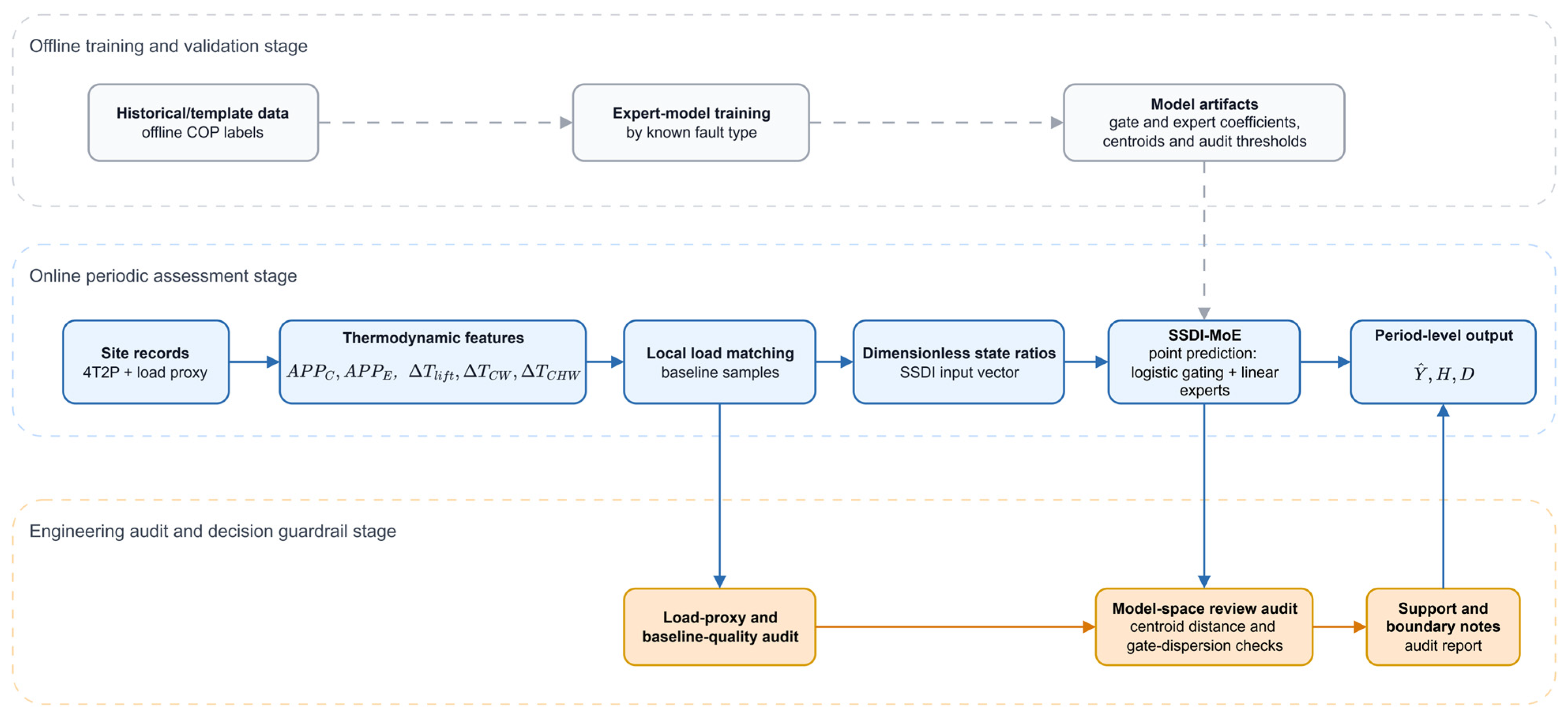
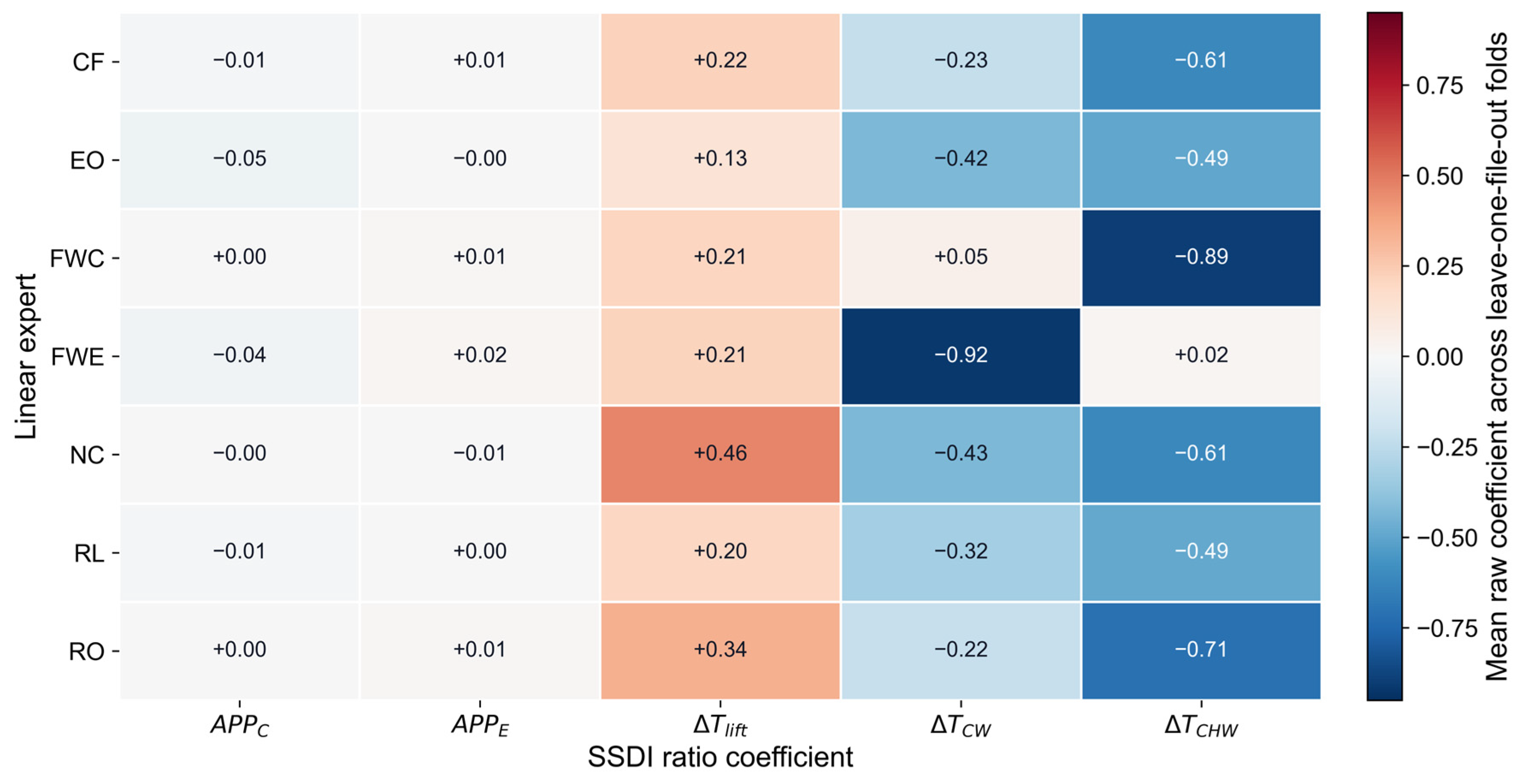
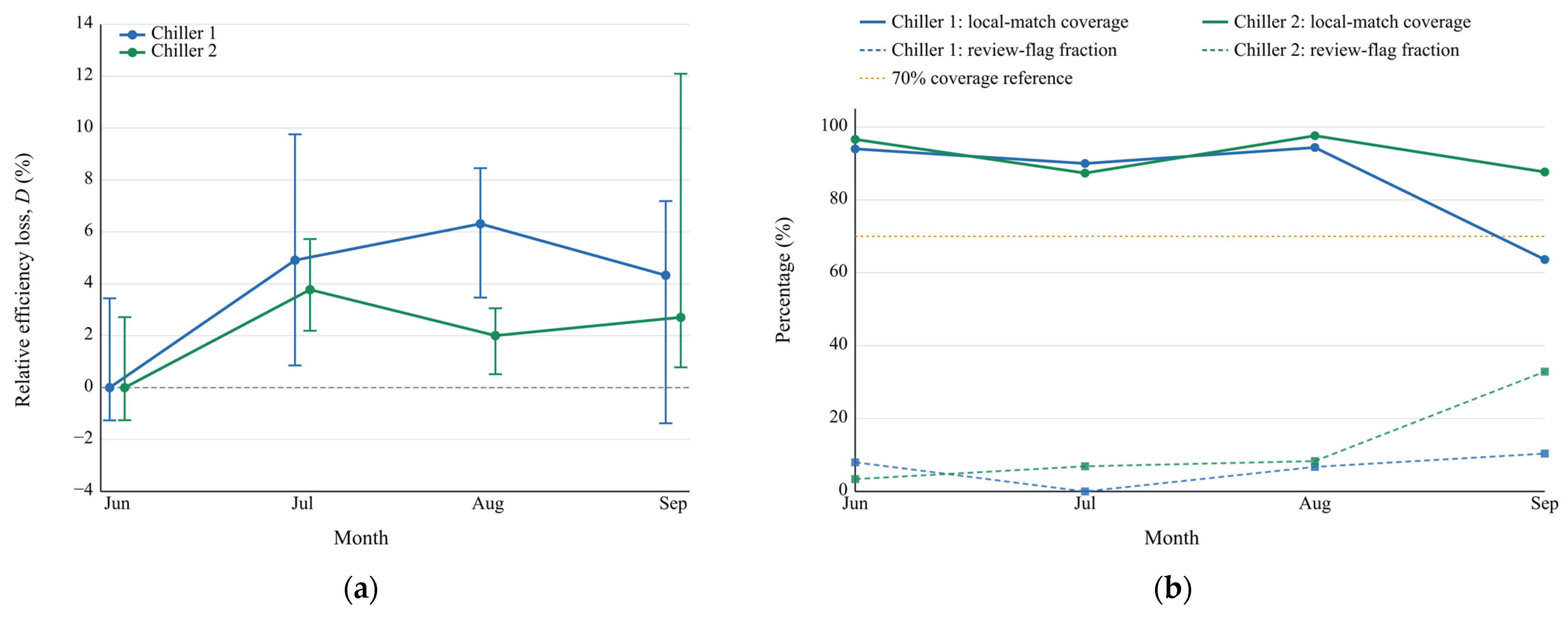
The large stock of existing buildings creates demand for chiller assessment during energy retrofit and operation. However, many methods assume access to water flow, separately metered chiller power, and real-time cooling capacity. These measurements are often unavailable in existing plants, preventing online COP calculation. Four water-side temperatures, two refrigerant pressures (4T2P), and a load-related variable such as compressor current are more commonly obtainable. This study develops an audit-aware sparse-sensor degradation index mixture-of-experts framework (SSDI-MoE) for periodic assessment under this measurement boundary. The framework compares a diagnostic period with a load-matched reference, converts five thermodynamic indicators into dimensionless ratios, and combines seven linear experts through a logistic gate. It estimates baseline-relative COP degradation while reporting load coverage, input validity, and disagreement among expert predictions. In file-separated validation using ASHRAE RP-1043 data, SSDI-MoE achieved an MAE of 0.0444 and an R2 of 0.8984. Although tree ensembles achieve lower point-prediction errors, SSDI-MoE additionally reports the individual expert predictions and their disagreement. This information is useful for engineering reviews because it helps identify cases that warrant further inspection. An anonymized two-chiller field case illustrated monthly trend reporting from routine low-frequency records. The framework provides a preliminary screening approach for maintenance reviews when complete chiller metering is unavailable.
Keywords: centrifugal chiller; existing building; sparse sensing; mixture of experts; building energy management centrifugal chiller; existing building; sparse sensing; mixture of experts; building energy management