Permeability and Internal Erosion Responses of Gravelly Soils Following Slurry-Induced Clogging
Abstract
1. Introduction
2. Field Observation
3. Laboratory Experiments
3.1. Testing Apparatus
3.2. Testing Materials
3.3. Specimen Preparation
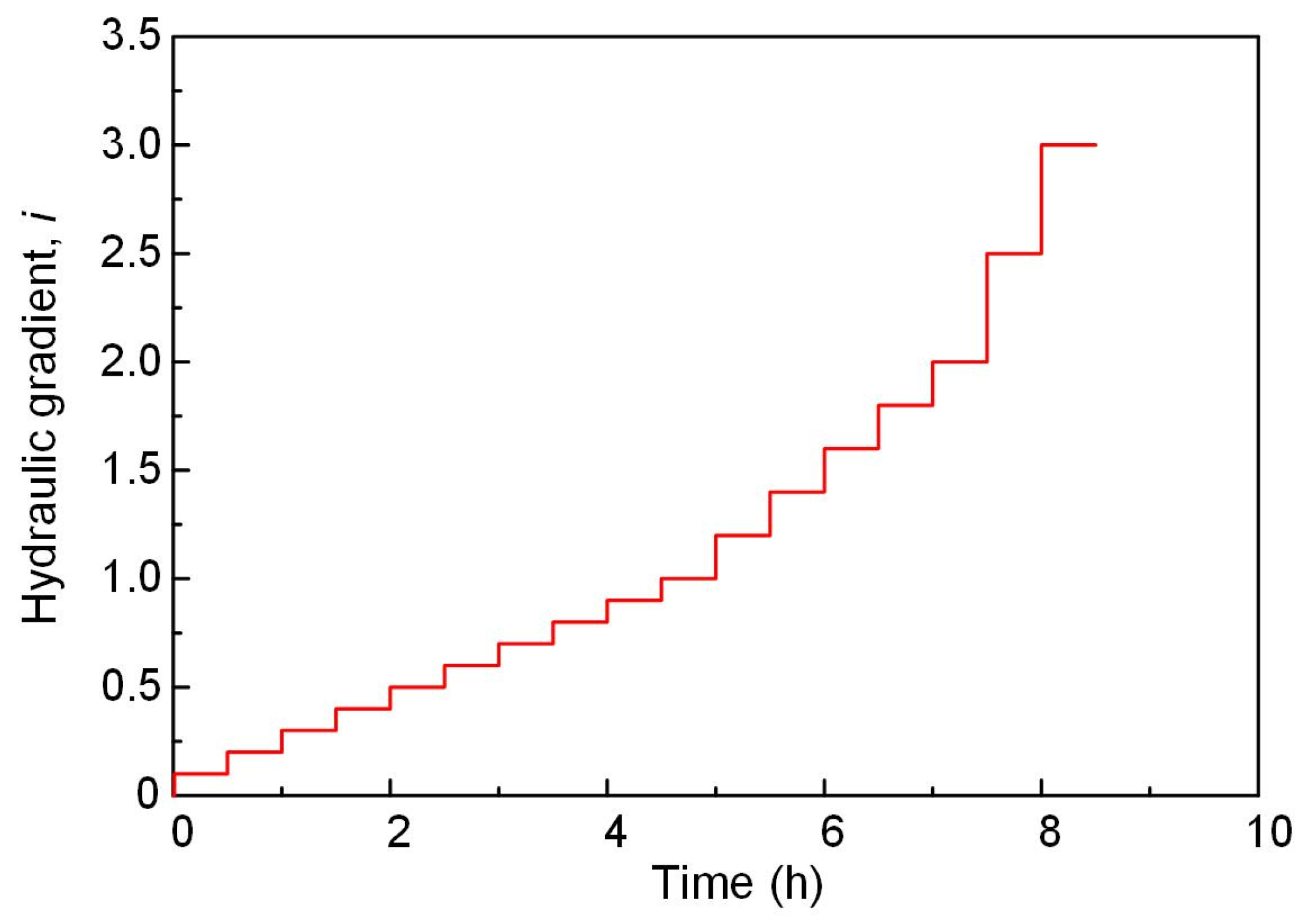
3.4. Testing Scheme
4. Experimental Results
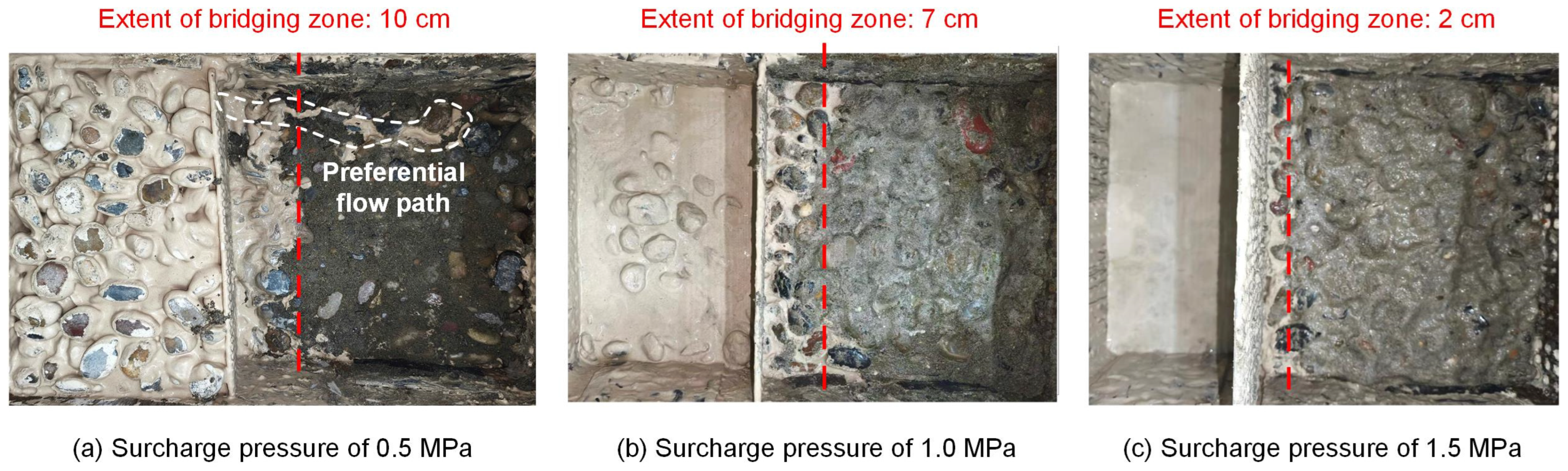
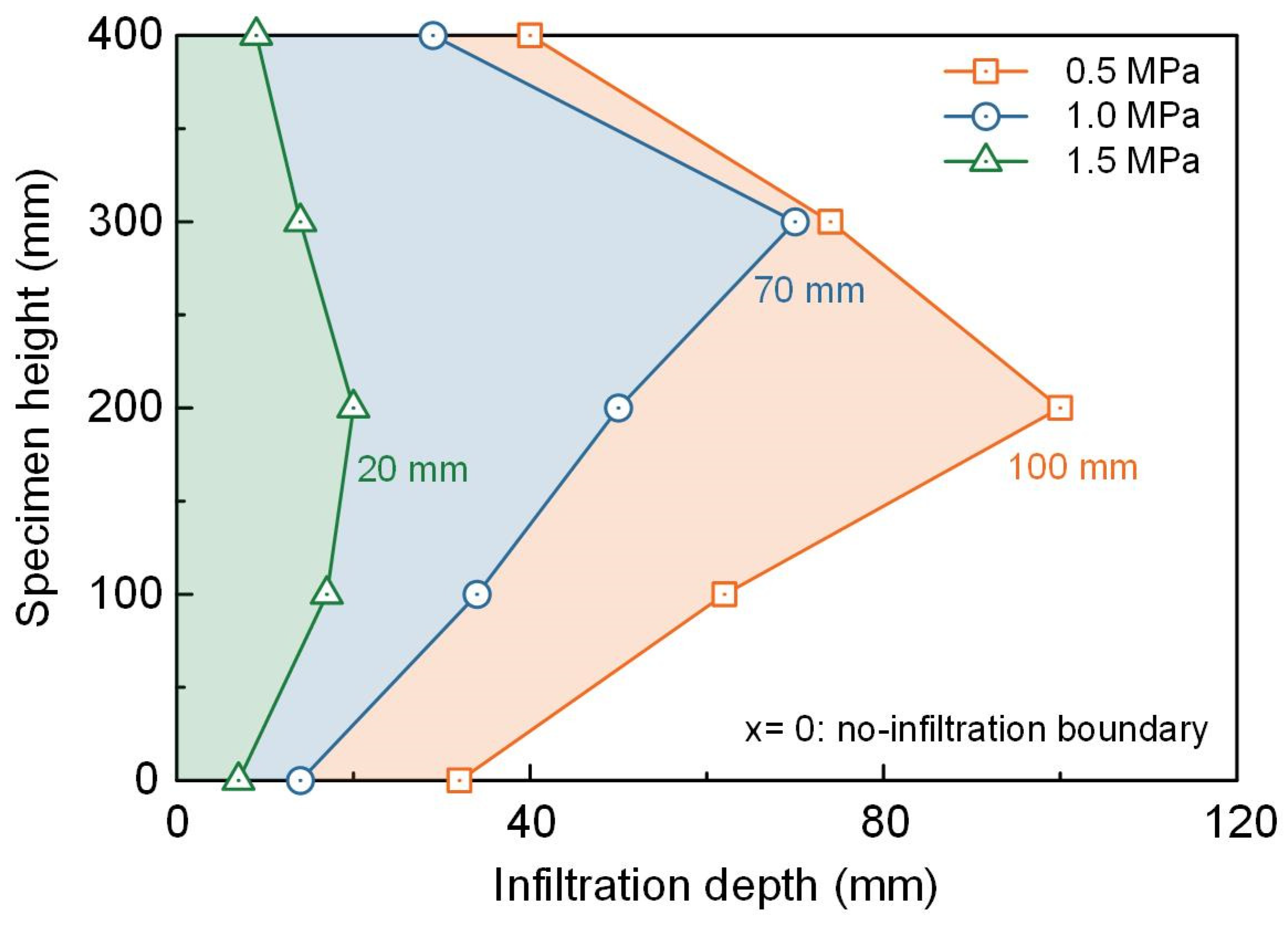
4.1. Slurry Infiltration and Clogging Characteristics
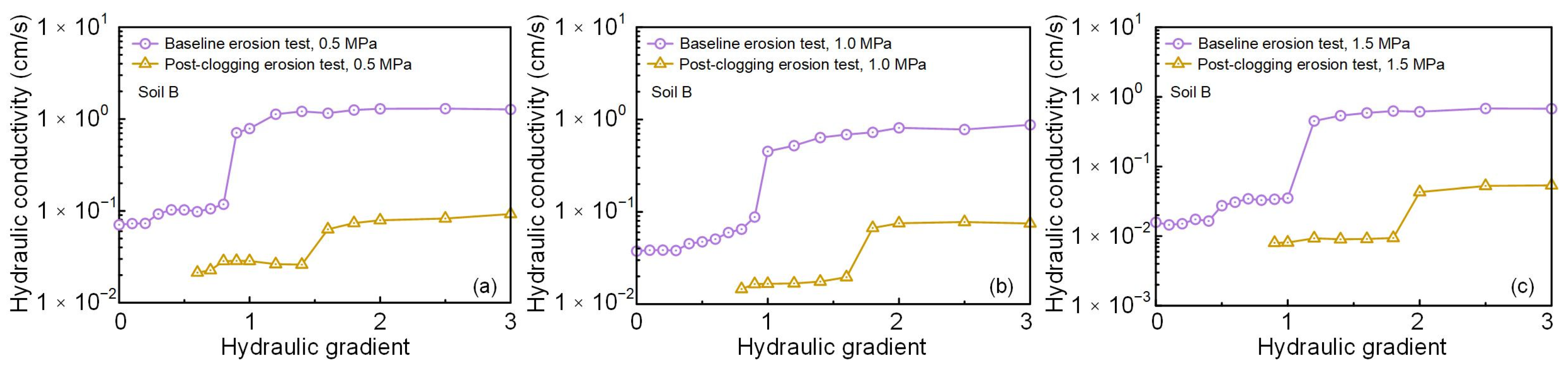
4.2. Hydraulic Conductivity
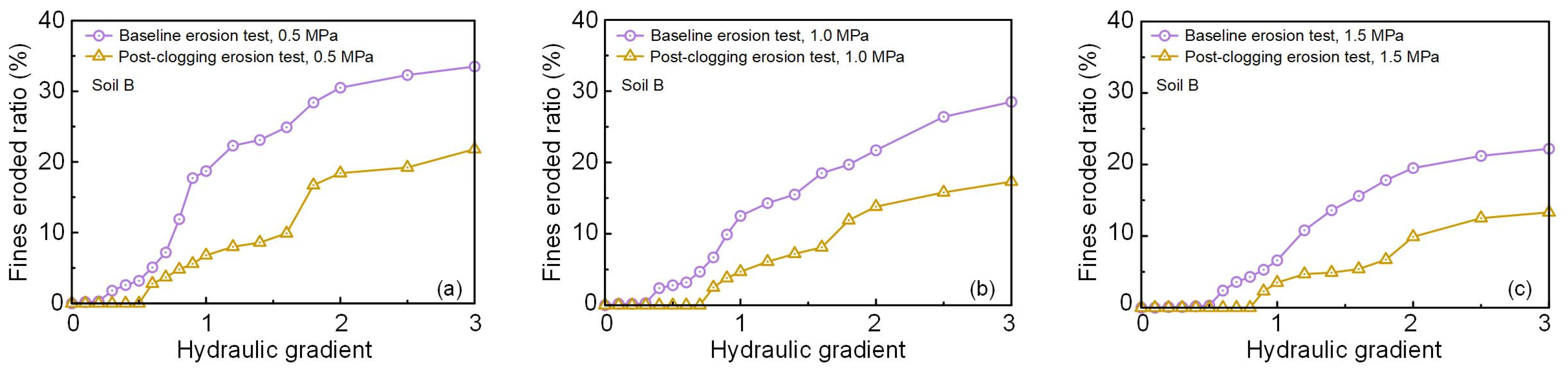
4.3. Fines Eroded Ratio
5. Discussion
5.1. Formation Mechanism of Slurry-Induced Clogging
5.2. Engineering Implications of Slurry-Induced Clogging
6. Conclusions
- (1)
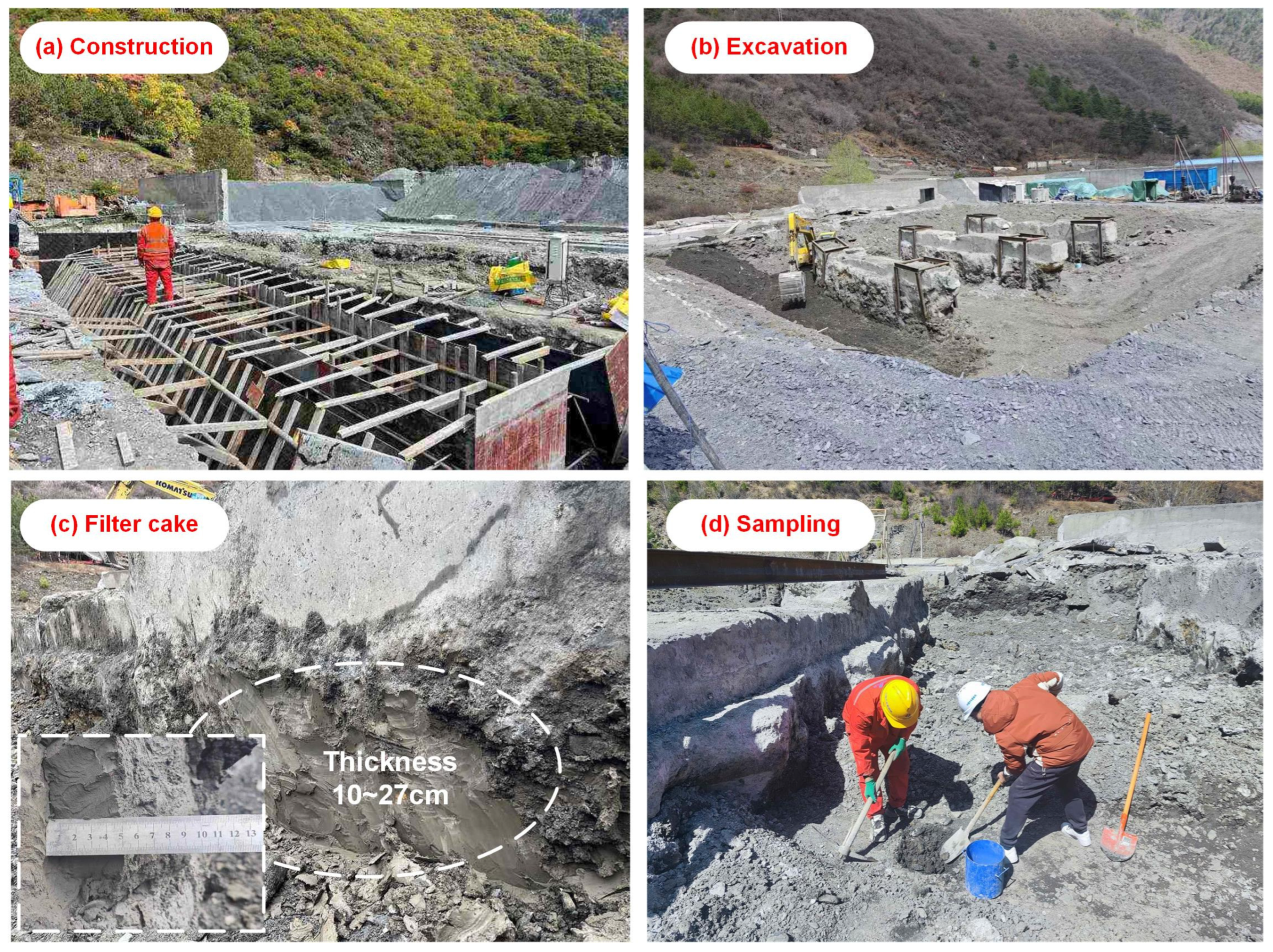
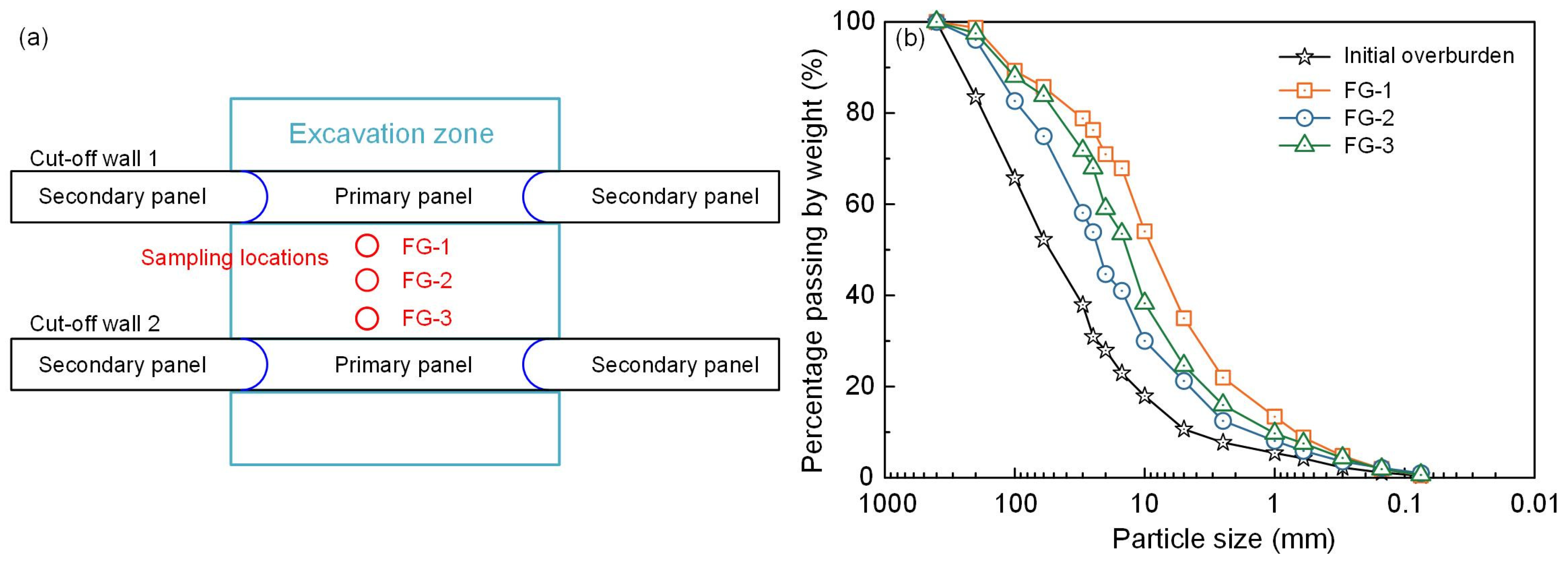
- Field excavation of the experimental cut-off walls identified a spatially heterogeneous clogging structure in the surrounding soil, including a distinct external filter cake at the wall–soil interface with a measured thickness of 10–27 cm. Particle size distribution tests showed higher fine fraction contents in the soil adjacent to the cut-off walls, with the fine fraction content gradually decreasing with distance from the walls. This spatial pattern is compatible with slurry intrusion and particle retention near the cut-off walls.
- (2)
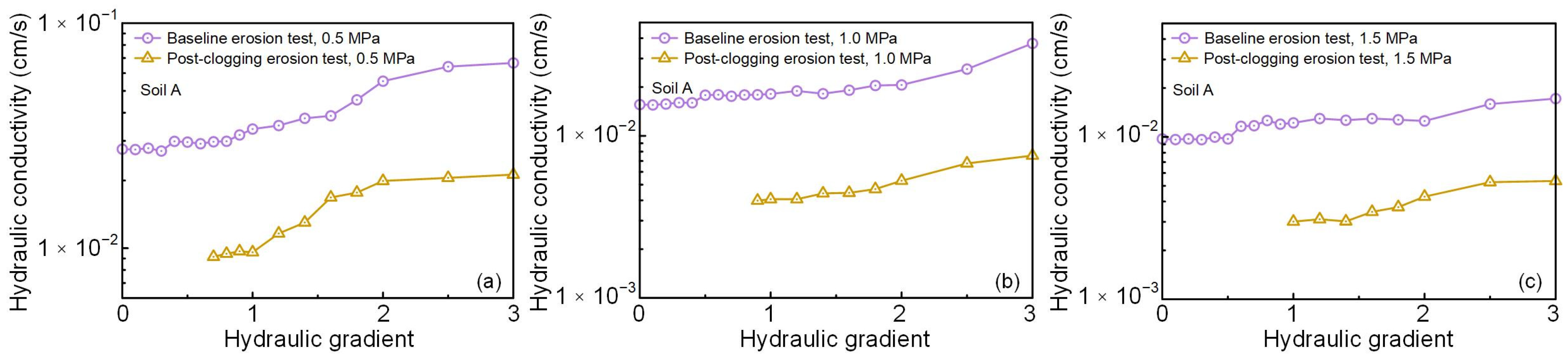
- For both testing soils with different initial fine fraction contents, post-clogging specimens exhibit lower hydraulic conductivity than their corresponding baseline specimens across all applied hydraulic gradients. Under multistage hydraulic loading, hydraulic conductivity increased with hydraulic gradient but remained below the baseline level, which is consistent with slurry-particle bridging and deposition contributing to reductions in the effective flow area and hydraulic connectivity.
- (3)
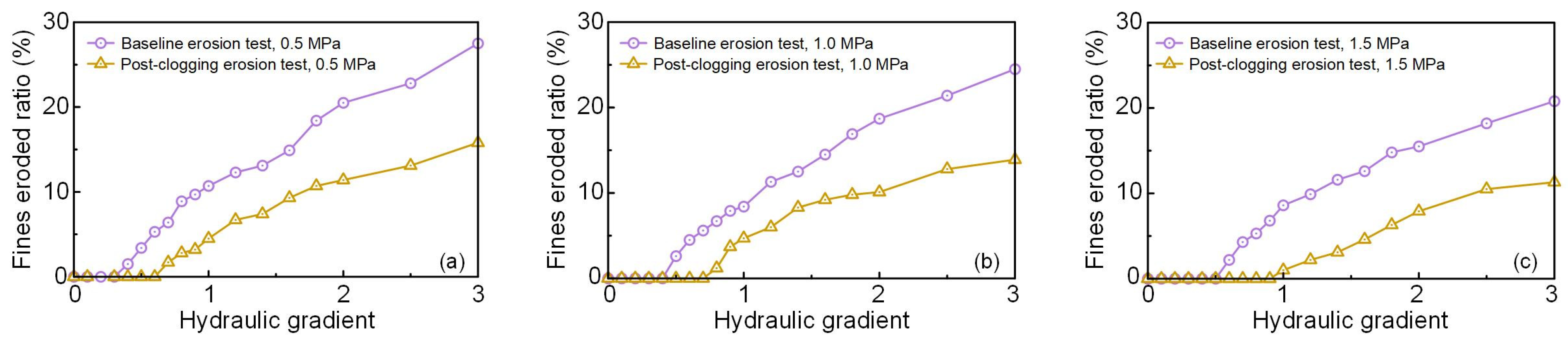
- Compared with the corresponding baseline specimens, the post-clogging specimens exhibited higher progression hydraulic gradients and lower final fines eroded ratios under the tested conditions. Higher surcharge pressures were associated with higher progression hydraulic gradients, indicating a delayed onset of progressive internal erosion in the tested specimens.
- (4)
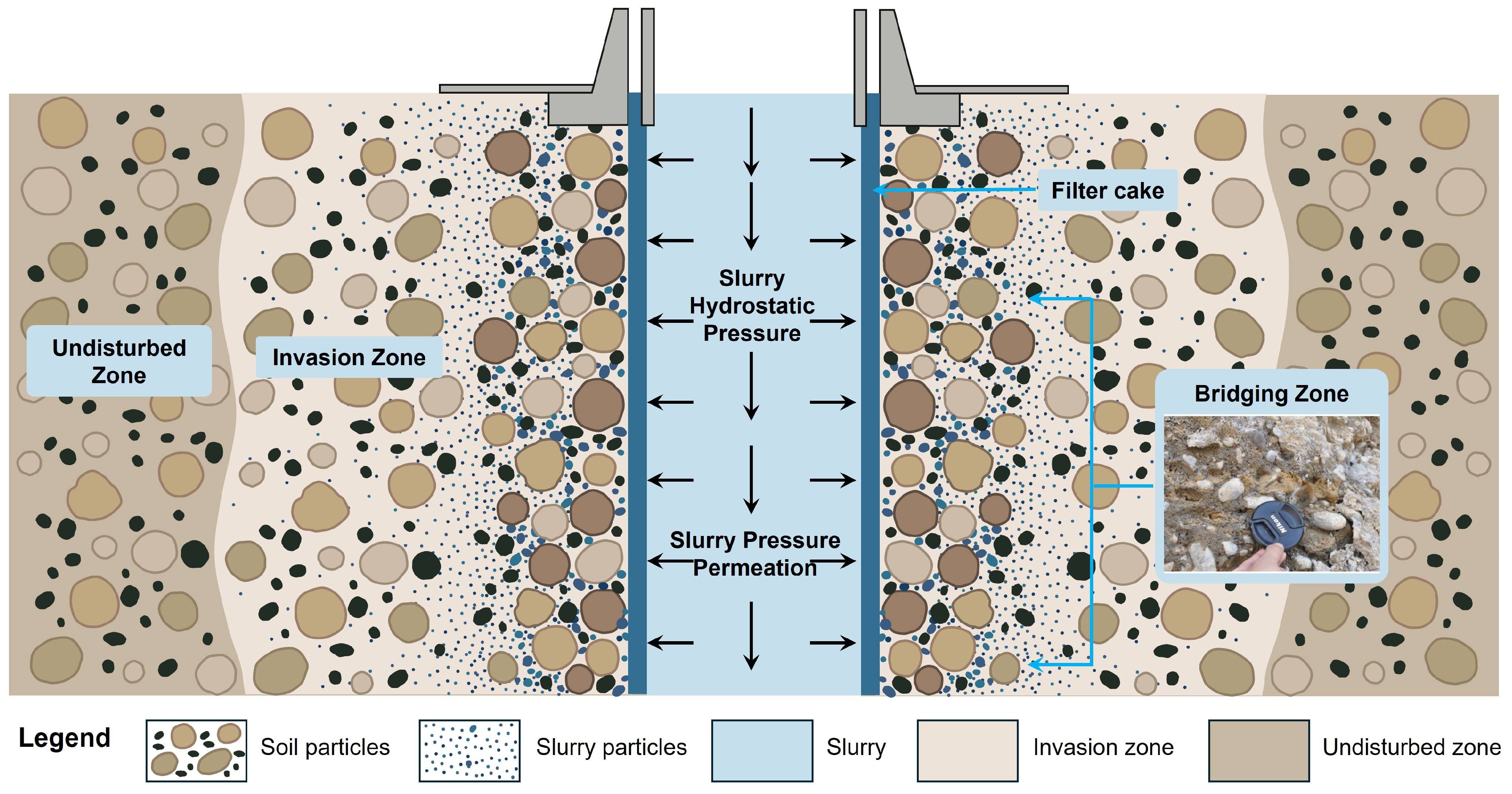
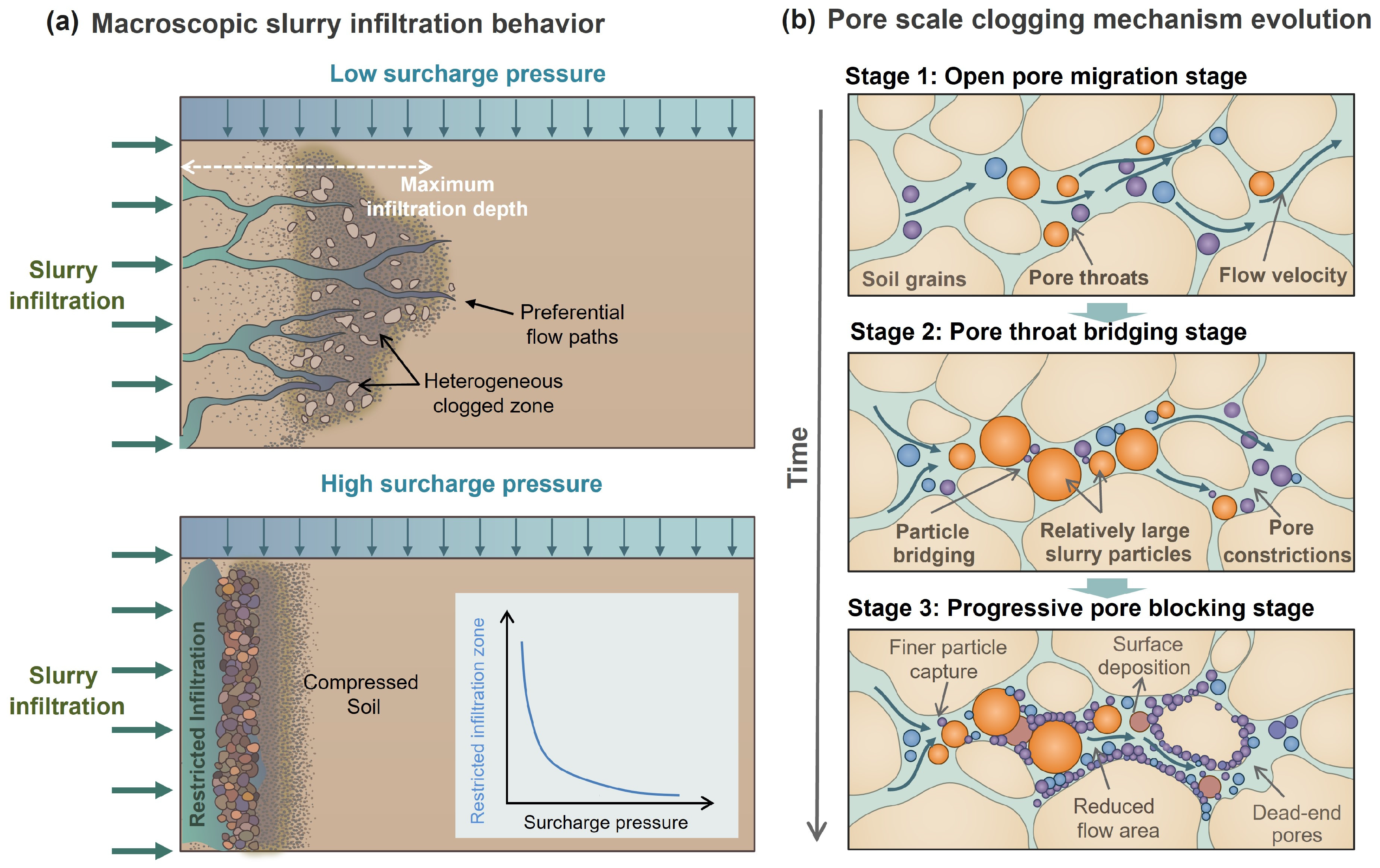
- The observed reductions in hydraulic conductivity and fine-particle loss are interpreted as being associated with interfacial filter-cake formation and deposition and retention of slurry particles within the pore network. Accordingly, the wall-soil contact zone could be conceptualized in seepage analyses as a composite seepage barrier composed of the filter cake, bridging zone, and invasion zone, rather than a single interface. The spatial extent and hydraulic resistance of this composite barrier may depend on slurry pressure, soil gradation, and surcharge pressure. However, the influence of this composite barrier on the seepage-control performance of cut-off walls with explicit defects requires further validation.
Author Contributions
Funding
Institutional Review Board Statement
Informed Consent Statement
Data Availability Statement
Conflicts of Interest
References
- Yu, X.; Wang, Y.; Tulamaiti, Y.; Zhou, C.; Zhou, Y.; Wang, G. Refined numerical simulation of a concrete cut-off wall in the thick overburden of dam foundation. Structures 2021, 33, 4407–4420. [Google Scholar] [CrossRef] [Scilit]
- Malusis, M.A.; Barlow, L.C. Comparison of laboratory and field measurements of backfill hydraulic conductivity for a large-scale soil-bentonite cutoff wall. J. Geotech. Geoenviron. Eng. 2020, 146, 04020070. [Google Scholar] [CrossRef] [Scilit]
- Huang, Z.; Shen, Z.; Liu, D.; Xu, L.; Sun, Y.; Li, H. Seepage characteristics of core rockfill dam foundation with double cutoff walls in deep overburden: A case study. Case Stud. Constr. Mater. 2024, 21, e03576. [Google Scholar] [CrossRef] [Scilit]
- Wen, L.; Cao, W.; Li, Y. Behavior of a concrete-face rockfill dam cutoff wall considering the foundation seepage–creep coupling effect. Int. J. Geomech. 2023, 23, 04023031. [Google Scholar] [CrossRef] [Scilit]
- Morgenstern, N.; Amir-Tahmasseb, I. The stability of a slurry trench in cohesionless soils. Géotechnique 1965, 15, 387–395. [Google Scholar] [CrossRef] [Scilit]
- D’Appolonia, D.J. Soil-bentonite slurry trench cutoffs. J. Geotech. Eng. Div. 1980, 106, 399–417. [Google Scholar] [CrossRef] [Scilit]
- Xu, T.; Bezuijen, A. Bentonite slurry infiltration into sand: Filter cake formation under various conditions. Géotechnique 2019, 69, 1095–1106. [Google Scholar] [CrossRef] [Scilit]
- Min, F.; Zhu, W.; Han, X. Filter cake formation for slurry shield tunneling in highly permeable sand. Tunn. Undergr. Space Technol. 2013, 38, 423–430. [Google Scholar] [CrossRef] [Scilit]
- Qin, S.; Xu, T.; Zhou, W.-H.; Bezuijen, A. Infiltration behaviour and microstructure of filter cake from sand-modified bentonite slurry. Transp. Geotech. 2023, 40, 100963. [Google Scholar] [CrossRef] [Scilit]
- Lam, C.; Jefferis, S.A.; Suckling, T.P.; Troughton, V.M. Effects of polymer and bentonite support fluids on the performance of bored piles. Soils Found. 2015, 55, 1487–1500. [Google Scholar] [CrossRef] [Scilit]
- Filz, G.M.; Henry, L.B.; Heslin, G.M.; Davidson, R.R. Determining hydraulic conductivity of soil-bentonite using the API filter press. Geotech. Test. J. 2001, 24, 61–71. [Google Scholar] [CrossRef] [Scilit]
- Xu, T.; Bezuijen, A. Pressure infiltration characteristics of bentonite slurry. Géotechnique 2019, 69, 364–368. [Google Scholar] [CrossRef] [Scilit]
- Nguyen, T.-B.; Lee, C.; Lim, J.; Choi, H. Hydraulic characteristics of bentonite cake fabricated on cutoff walls. Clays Clay Miner. 2012, 60, 40–51. [Google Scholar] [CrossRef] [Scilit]
- Wang, Z.; Yao, X.; Chen, J.; Yu, L. Permeation behavior and filter cake formation of graded sand modified bentonite slurries in highly permeable strata. Sci. Rep. 2026, 16, 20671. [Google Scholar] [CrossRef] [Scilit] [PubMed]
- Shi, F.-J.; Feng, S.-J.; Zheng, Q.-T.; Peng, C.-H. Hydraulic conductivity and compressibility of polyanionic cellulose-modified sand-calcium bentonite slurry trench cutoff wall materials. Acta Geotech. 2024, 19, 5503–5515. [Google Scholar] [CrossRef] [Scilit]
- Chen, Y.; Liu, H.; Gao, Y.; Ye, X.; Guo, H.; Gao, Y.; Lv, Y. Visualization of the microscopic mechanism of slurry infiltration and filter cake formation for slurry shield tunneling in saturated sand: A microfluidic chip experiment. Transp. Geotech. 2025, 51, 101529. [Google Scholar] [CrossRef] [Scilit]
- Skempton, A.W.; Brogan, J.M. Experiments on piping in sandy gravels. Géotechnique 1994, 44, 449–460. [Google Scholar] [CrossRef] [Scilit]
- Fannin, R.J.; Slangen, P. On the distinct phenomena of suffusion and suffosion. Géotech. Lett. 2014, 4, 289–294. [Google Scholar] [CrossRef] [Scilit]
- Kenney, T.C.; Lau, D. Internal stability of granular filters. Can. Geotech. J. 1985, 22, 215–225. [Google Scholar] [CrossRef] [Scilit]
- Sherard, J.L.; Dunnigan, L.P.; Talbot, J.R. Filters for silts and clays. J. Geotech. Eng. 1984, 110, 701–718. [Google Scholar] [CrossRef] [Scilit]
- Wan, C.F.; Fell, R. Assessing the potential of internal instability and suffusion in embankment dams and their foundations. J. Geotech. Geoenviron. Eng. 2008, 134, 401–407. [Google Scholar] [CrossRef] [Scilit]
- Chang, D.S.; Zhang, L.M. Extended internal stability criteria for soils under seepage. Soils Found. 2013, 53, 569–583. [Google Scholar] [CrossRef] [Scilit]
- Indraratna, B.; Israr, J.; Rujikiatkamjorn, C. Geometrical method for evaluating the internal instability of granular filters based on constriction size distribution. J. Geotech. Geoenviron. Eng. 2015, 141, 04015045. [Google Scholar] [CrossRef] [Scilit]
- Wan, C.F.; Fell, R. Investigation of rate of erosion of soils in embankment dams. J. Geotech. Geoenviron. Eng. 2004, 130, 373–380. [Google Scholar] [CrossRef] [Scilit]
- Israr, J.; Indraratna, B. Study of critical hydraulic gradients for seepage-induced failures in granular soils. J. Geotech. Geoenviron. Eng. 2019, 145, 04019025. [Google Scholar] [CrossRef] [Scilit]
- Indraratna, B.; Israr, J.; Li, M. Inception of geohydraulic failures in granular soils—An experimental and theoretical treatment. Géotechnique 2018, 68, 233–248. [Google Scholar] [CrossRef] [Scilit]
- Prasomsri, J.; Takahashi, A. The role of fines on internal instability and its impact on undrained mechanical response of gap-graded soils. Soils Found. 2020, 60, 1468–1488. [Google Scholar] [CrossRef] [Scilit]
- Prasomsri, J.; Shire, T.; Takahashi, A. Effect of fines content on onset of internal instability and suffusion of sand mixtures. Géotech. Lett. 2021, 11, 209–214. [Google Scholar] [CrossRef] [Scilit]
- Chen, L.; Wan, Y.; He, J.-J.; Luo, C.-M.; Yan, S.-F.; He, X.-F. Experimental study on the suffusion mechanism of gap-graded soils under an exceedance hydraulic gradient. Nat. Hazards 2021, 109, 405–439. [Google Scholar] [CrossRef] [Scilit]
- Chitravel, S.; Otsubo, M.; Kuno, M.; Kuwano, R. Post-erosion mechanical responses of internally unstable gap-graded soil under drained torsional simple shear and triaxial compression. Soils Found. 2022, 62, 101224. [Google Scholar] [CrossRef] [Scilit]
- Li, M.; Fannin, R.J.; Foster, M.; Yan, L. Internal instability of cohesionless soils in upward and downward flow: An experimental verification of theory. Can. Geotech. J. 2024, 61, 2036–2041. [Google Scholar] [CrossRef] [Scilit]
- Douglas, K.J.; Fell, R.; Peirson, W.L.; Studholme, H. Experimental investigation of global backward erosion and suffusion of soils in embankment dams. Can. Geotech. J. 2019, 56, 789–807. [Google Scholar] [CrossRef] [Scilit]
- Reddi, L.N.; Bonala, M.V.S. Analytical solution for fine particle accumulation in soil filters. J. Geotech. Geoenviron. Eng. 1997, 123, 1143–1152. [Google Scholar] [CrossRef] [Scilit]
- Reddi, L.N.; Ming, X.; Hajra, M.G.; Lee, I.M. Permeability reduction of soil filters due to physical clogging. J. Geotech. Geoenviron. Eng. 2000, 126, 236–246. [Google Scholar] [CrossRef] [Scilit]
- Chang, D.S.; Zhang, L.M. Critical hydraulic gradients of internal erosion under complex stress states. J. Geotech. Geoenviron. Eng. 2013, 139, 1454–1467. [Google Scholar] [CrossRef] [Scilit]
- Zhang, L.; Deng, G.; Chen, R.; Luo, Z. Confining stress effects on global and local responses of internal erosion in gap-graded cohesionless soils. Bull. Eng. Geol. Environ. 2023, 82, 326. [Google Scholar] [CrossRef] [Scilit]
- Deng, Z.; Wang, G.; Jin, W.; Tang, N.; Ren, H.; Chen, X. Characteristics and quantification of fine particle loss in internally unstable sandy gravels induced by seepage flow. Eng. Geol. 2023, 321, 107150. [Google Scholar] [CrossRef] [Scilit]
- Deng, Z.; Wang, G.; Jin, W. Coupling of hydraulic loading and surcharge pressure during suffusion in sandy gravels. Géotech. Lett. 2023, 13, 75–81. [Google Scholar] [CrossRef] [Scilit]
- Istomina, V.S. Filtration Stability of Soils; Gostroizdat: Moscow, Russia, 1957. [Google Scholar]
- Kezdi, A. Soil Physics: Selected Topics; Elsevier Scientific Publishing Co.: Amsterdam, The Netherlands, 1979. [Google Scholar]
- Burenkova, V.V. Assessment of suffusion in non-cohesive and graded soils. In Proceedings of the 1st International Conference on Geo-Filters; Taylor & Francis: Karlsruhe, Germany, 1993; pp. 357–360. [Google Scholar]
- Ladd, R.S. Preparing test specimens using undercompaction. Geotech. Test. J. 1978, 1, 16–23. [Google Scholar] [CrossRef] [Scilit]
- Wang, G.; Deng, Z.Z.; Yang, J.; Chen, X.S.; Jin, W. A large-scale high-pressure erosion apparatus for studying internal erosion in gravelly soils under horizontal seepage flow. Geotech. Test. J. 2022, 45, 1037–1053. [Google Scholar] [CrossRef] [Scilit]








| Reference | Applicable to | Internally Unstable If | Calculation | Internal Stability | |
|---|---|---|---|---|---|
| Soil A | Soil B | ||||
| Istomina [39] | Sandy and gravel | Unstable | Unstable | ||
| Kezdi [40] | All soils | Unstable | Unstable | ||
| Kenney and Lau [19] | Granular soils | Unstable | Unstable | ||
| Burenkova [41] | Sand and gravel | Unstable | Unstable | ||
| Bentonite (g) | Barite Powder (g) | Plant Gum (g) | Surfactant (g) | Water (g) | Density (g/mL) | Spread Diameter (mm) | Apparent Viscosity (mPa·s) | YP/PV Ratio [Pa/(mPa·s)] |
|---|---|---|---|---|---|---|---|---|
| 150 | 4000 | 100 | 9 | 1750 | 2.022 | 166 | 30.0 | 0.228 |
| Specimen Identity | Soil | (MPa) | Slurry Pressure (MPa) | (cm/s) | (%) |
|---|---|---|---|---|---|
| A-0.5-0.1 | A | 0.5 | 0.1 | 0.01 | 15.8 |
| A-0.5-0.1-exc | A | 0.5 | 0.1 | -- | -- |
| A-1.0-0.1 | A | 1.0 | 0.1 | 0.008 | 13.9 |
| A-1.0-0.1-exc | A | 1.0 | 0.1 | -- | -- |
| A-1.5-0.1 | A | 1.5 | 0.1 | 0.005 | 11.3 |
| A-1.5-0.1-exc | A | 1.5 | 0.1 | -- | -- |
| A-0.5 | A | 0.5 | -- | 0.07 | 27.5 |
| A-1.0 | A | 1.0 | -- | 0.05 | 24.6 |
| A-1.5 | A | 1.5 | -- | 0.04 | 20.7 |
| B-0.5-0.1 | B | 0.5 | 0.1 | 0.09 | 21.8 |
| B-1.0-0.1 | B | 1.0 | 0.1 | 0.07 | 17.3 |
| B-1.5-0.1 | B | 1.5 | 0.1 | 0.05 | 13.2 |
| B-0.5 | B | 0.5 | -- | 1.27 | 33.5 |
| B-1.0 | B | 1.0 | -- | 0.87 | 28.5 |
| B-1.5 | B | 1.5 | -- | 0.68 | 22.4 |
Disclaimer/Publisher’s Note: The statements, opinions and data contained in all publications are solely those of the individual author(s) and contributor(s) and not of MDPI and/or the editor(s). MDPI and/or the editor(s) disclaim responsibility for any injury to people or property resulting from any ideas, methods, instructions or products referred to in the content. |
© 2026 by the authors. Licensee MDPI, Basel, Switzerland. This article is an open access article distributed under the terms and conditions of the Creative Commons Attribution (CC BY) license.
Share and Cite
Liao, M.; Wang, G.; Zheng, H. Permeability and Internal Erosion Responses of Gravelly Soils Following Slurry-Induced Clogging. Buildings 2026, 16, 3722. https://doi.org/10.3390/buildings16183722
Liao M, Wang G, Zheng H. Permeability and Internal Erosion Responses of Gravelly Soils Following Slurry-Induced Clogging. Buildings. 2026; 16(18):3722. https://doi.org/10.3390/buildings16183722
Chicago/Turabian StyleLiao, Mingke, Gang Wang, and Haowen Zheng. 2026. "Permeability and Internal Erosion Responses of Gravelly Soils Following Slurry-Induced Clogging" Buildings 16, no. 18: 3722. https://doi.org/10.3390/buildings16183722
APA StyleLiao, M., Wang, G., & Zheng, H. (2026). Permeability and Internal Erosion Responses of Gravelly Soils Following Slurry-Induced Clogging. Buildings, 16(18), 3722. https://doi.org/10.3390/buildings16183722