Stage-Conditioned Organization–Data Connections in Collaborative Decision Events: Evidence from a Supertall Building Project


Abstract
1. Introduction
2. Literature Review and Analytical Framework
2.1. Coordination Problems and Event Conditions in Complex Building Projects
2.2. Organizational Responses in Collaborative Decision Events
2.3. Data Responses and Controlled Project Information
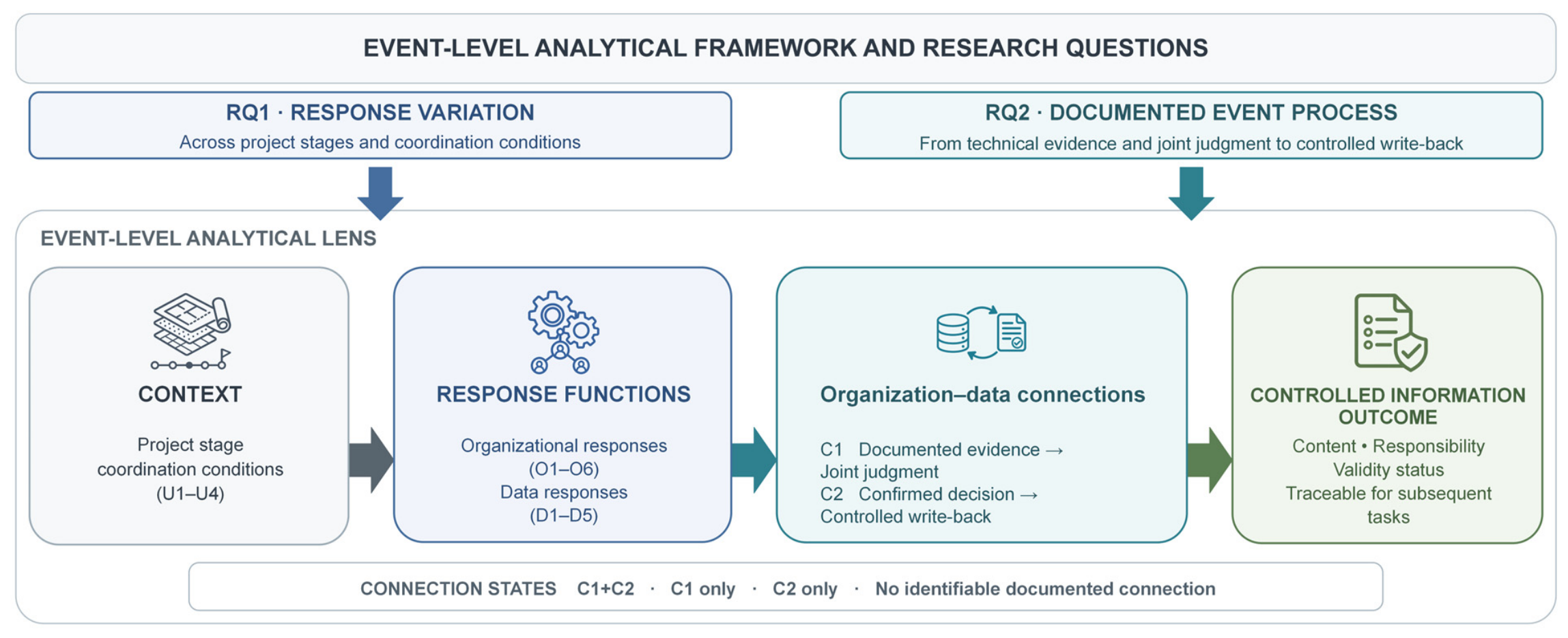
2.4. From Response Co-Occurrence to Documented Organization–Data Connections
3. Materials and Methods
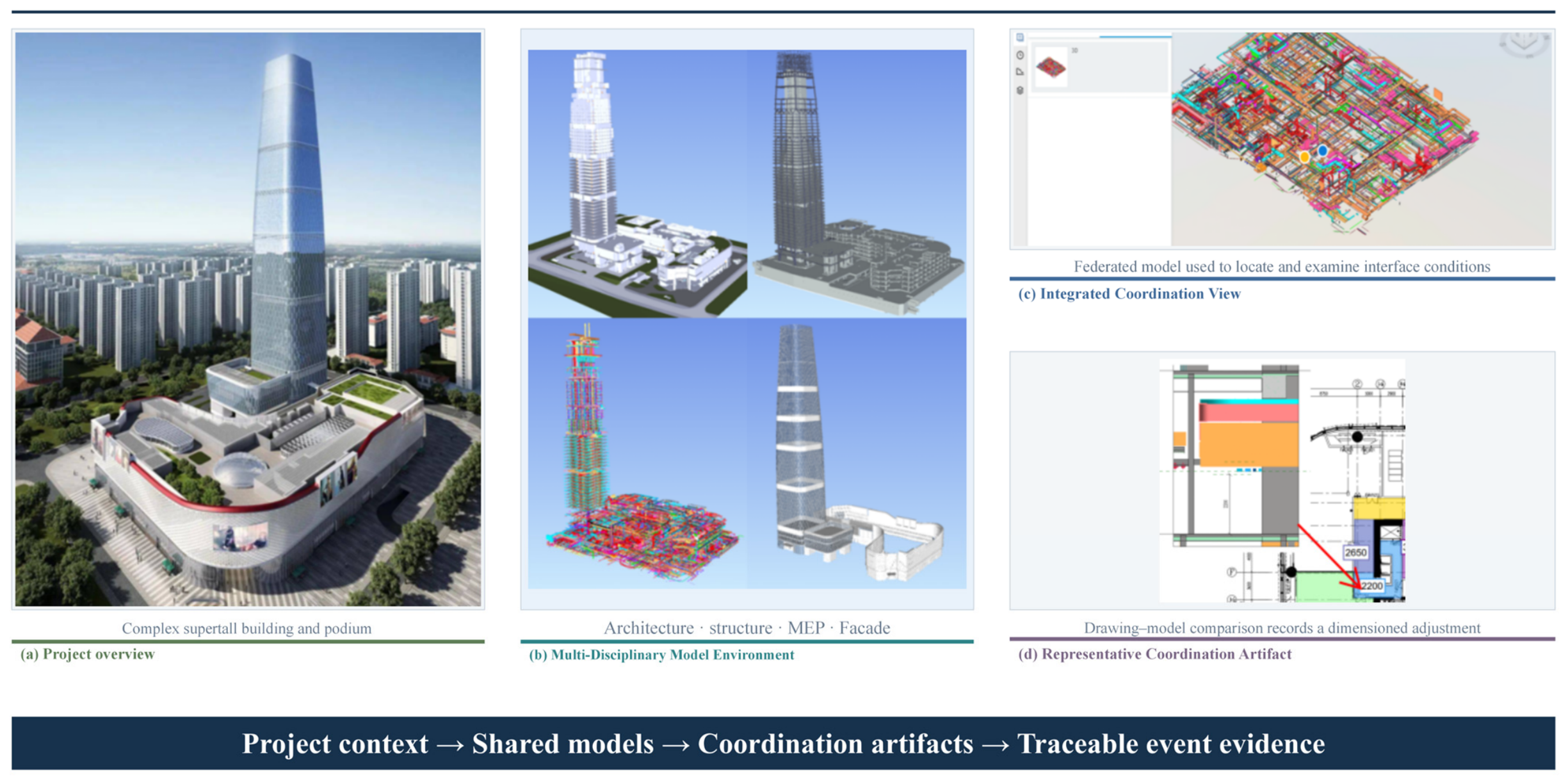
3.1. Research Design, Case, and Data
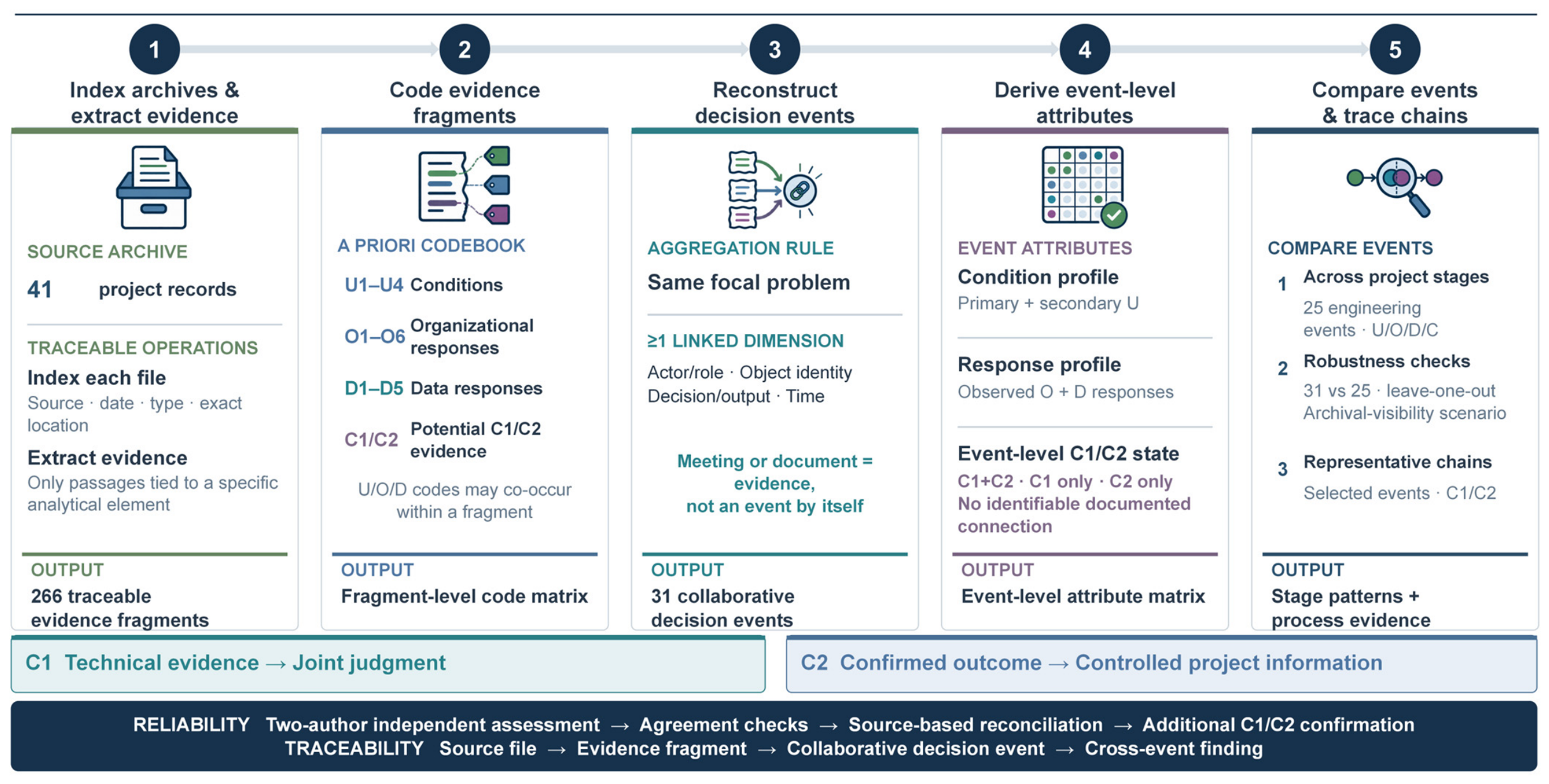
3.2. Event-Based Coding, Aggregation, and Classification
3.3. Independent Coding and Event-Reconstruction Validation
3.4. Stage and Cross-Event Comparisons
4. Results
4.1. Coding Agreement and Event-Reconstruction Consistency
4.2. Event Overview and Stage Groups
4.3. Scheme Decision-Making and Specialist Design: Observed Conditions, Responses, and Connection States
4.4. Design Development: Observed Conditions, Responses, and Connection States
4.5. Construction Detailing and Implementation: Observed Conditions, Responses, and Connection States
4.6. Cross-Stage and Contextual Comparison Events
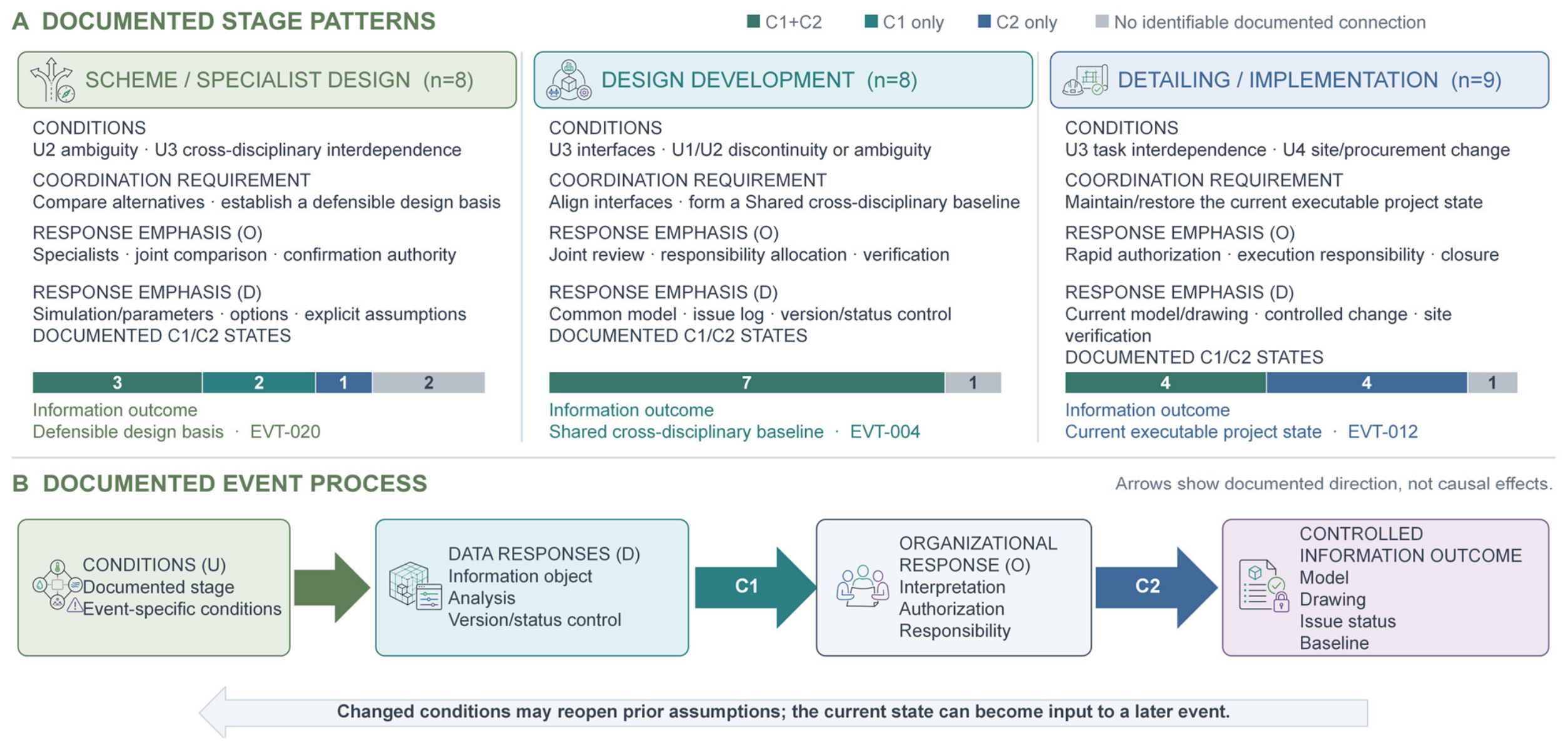
4.7. Cross-Stage Synthesis
4.8. Robustness and Sensitivity Checks
5. Discussion
5.1. Stage-Conditioned Coordination Functions of Organization–Data Connections
5.1.1. Scheme Decision-Making and Specialist Design: Establishing a Defensible Design Basis
5.1.2. Design Development: Establishing a Shared Cross-Disciplinary Baseline
5.1.3. Construction Detailing and Implementation: Maintaining the Current Executable Project State
5.1.4. Cross-Stage Transition: Continuity of the Decision Basis, Responsibility, and Information Status
5.2. Evidence Chains Linking Technical Evidence, Joint Judgment, and Controlled Project Information
5.3. Managerial Implications
5.4. Limitations and Future Research
6. Conclusions
Supplementary Materials
Author Contributions
Funding
Data Availability Statement
Acknowledgments
Conflicts of Interest
Appendix A

| Analytical Dimension | Code | Code Name | Operational Definition | Inclusion Criteria | Exclusion Criteria | Positive Example | Negative Example | Potentially Confusable Code | Decision Note |
|---|---|---|---|---|---|---|---|---|---|
| Coordination condition | U1 | Insufficient or discontinuous information | Information required for judgment or action is missing, incomplete, unsynchronized, unavailable, or unconfirmed | Missing parameters; incomplete records; incomplete drawing, model, or site information; supplier data unavailable; design and construction information not linked | Merely stating that information exists; background description without an information gap | “Missing information is listed by discipline” | “Basement architectural work is 100% complete” | Versus U4: U1 concerns missing information; U4 concerns changed conditions | The location of the gap must be specified |
| Coordination condition | U2 | Interpretive ambiguity or differences in judgment | Different interpretations of the problem, objective priority, option evaluation, applicable standard, or responsibility boundary | Different disciplinary judgments; multi-objective trade-off; option superiority cannot be determined from data alone; disagreement | Merely having several options; parameter calculations without interpretive conflict | “The steel elevation was clarified: the slab is lowered, not the steel beam” | Only “four schemes were proposed” | Versus U3: U2 concerns interpretation or trade-off; U3 concerns task dependence | Interpretation, trade-off, or disagreement must be present |
| Coordination condition | U3 | Task, technical, or disciplinary interdependence | A decision concerning one discipline, component, or system affects another and requires coordination across boundaries | Disciplinary interface; dependency involving clearance or openings; cascading effects of a design adjustment | Multiple disciplines participate, but no specific dependency is identified | “The smoke-exhaust duct requires an interior-finish enclosure, while the façade team addresses the steel beam” | Only a list of attending organizations | Versus U2: U3 is an objective dependency chain; U2 is a subjective difference | This was the most frequent coordination condition |
| Coordination condition | U4 | Changes in schedule, site, or external conditions | Change in site status, construction progress, procurement status, operational requirements, review comments, regulations, or time window | Site measurement differs from design; some work already completed; procurement status changed; new requirement introduced | Routine stage description; time information that did not change the judgment | “Site services have been installed close to the core; available clearance must be reassessed” | For example, only “the model is based on the 0430 version” | Versus U1: U4 is a state change that triggers reassessment | A trigger for change must be present |
| Organizational response | O1 | Relevant-actor involvement or early participation | An actor with relevant knowledge, responsibility, authority, or downstream experience is actively involved in resolving the issue | BIM, construction, suppliers, or operations involved before design completion; consultant, supplier, or contractor provides input | Only a participant list; only stating that an organization belongs to the project | “The client involved the hotel operator and interior designer in the joint work” | Only “attendees: client and ECADI” | Versus O2: O1 is actor involvement; O2 is the joint-review action | An action verb is required |
| Organizational response | O2 | Joint interpretation, cross-disciplinary review, or negotiation | Two or more actors interpret, review, compare, or negotiate the same issue or common evidence | Joint review of models, drawings, or options; multidisciplinary joint judgment; comparison around a common object | One-way transmission; unilateral analysis; meeting notice without joint interpretation | “Both parties reviewed and answered each issue in turn” | Only “a meeting was held” | Versus O6: O2 is the joint-review process; O6 is outcome verification | A common object is essential |
| Organizational response | O3 | Decision, approval, or formal authorization | An authorized actor selects an option, confirms a judgment, approves a change, or formally establishes a baseline | Explicit option selection; formal confirmation by the client or another authorized actor; acceptance of version-specific technical conditions | General recommendation; personal preference; agreement in principle without defined scope; only “continue the study” | “The client requires a 2600 mm ceiling and recommends routing services through the beam” | “The report recommends that the client decide” | Versus O4: O3 is a decision; O4 is responsibility assignment | Flag for review when the authorized actor or degree of formality is unclear |
| Organizational response | O4 | Responsibility assignment and commitment to act | Specifies who will make a modification, provide information, issue confirmation, implement an action, or follow up | Design institute assigned to revise drawings; BIM team required to compile information; supplier confirms parameters; completion date specified | Only mentioning the relevant organization | “ECADI to clarify the acceptance criteria with the quality-supervision authority by 1 November” | Only “the duties of participating organizations are involved” | Versus O3: O4 specifies who does what and when | Responsible actor plus deadline or deliverable |
| Organizational response | O5 | Issue escalation and cross-level resolution | An issue is referred to a higher level or specialist mechanism when routine coordination cannot resolve it, time is constrained, or authority is insufficient | Overdue issue escalated; dispute referred to the client; specialist approval initiated | Routine forwarding or normal transmission | “The client requires the design team to conduct a further internal review, including the B1M corridor” | “WSP asks ECADI to review the issue list” | Versus O4: O5 raises the organizational level; O4 allocates responsibility at the same level | Escalation requires a higher level or specialist judgment |
| Organizational response | O6 | Outcome verification, review, and acceptance | A formal, identifiable review of the resolution, modified output, implementation status, or technical performance | Review of the modified model or drawings; supplier confirmation; consultant verification; formal sign-off | Only “completed,” without verification; automatic system closure without an identified actor | “WSP’s review of the 0529 response identified deficiencies” | “The issue summary is marked resolved” | Versus O2: O6 verifies an outcome; O2 concerns the review process | The verifying actor and basis must be identifiable |
| Data response | D1 | Information collection, extraction, and cross-source integration | Information is collected from and linked across disciplines, documents, models, the site, or suppliers | Disciplinary information compiled; supplier parameters mapped item by item; measured, design, and equipment information integrated | Merely sending or receiving a file; only mentioning a filename | “The air-conditioning contractor provides equipment loads and a discrepancy list” | Only “the report was prepared by …” | Versus D2: D1 is an integration action; D2 forms an object | An integration action is required |
| Data response | D2 | Formation of a common information object | Dispersed information is organized into an object that participants can jointly identify, view, compare, and discuss | BIM model; overlay drawing; coordination drawing; parameter table; issue list; option matrix | General drawing or model description; not used in collaborative resolution | “Elevator identifiers in the construction drawings serve as common reference objects for checking” | Only “the model was displayed” | Versus D3: D2 is the object; D3 is analysis based on that object | The object must carry the collaborative resolution process |
| Data response | D3 | Analysis, simulation, calculation, and option comparison | Models, tests, calculations, simulations, or metrics convert a problem into analyzable and comparable information | Structural calculation; energy simulation; wind-tunnel test; clearance analysis; clash detection; multi-option comparison | Merely displaying a model or stating option names | “Simulation of three options shows differences in COP” | Only “four types of scheme were proposed” | Versus D2: D3 is the analytical action; D2 is the carrier | An actual analysis or comparison process is required |
| Data response | D4 | Version, baseline, and issue-status control | Versions, dates, freezes, revision clouds, status fields, or issue identifiers are used to control currently valid information | Working baseline established; version frozen; modification scope marked; issue status recorded | A file merely has a date; the latest version is mentioned without a control action | “The structural model is frozen at the 0718 version” | Only “the model is based on the 0430 version” | Versus D5: D4 controls information validity; D5 creates a formal record | A control rule or action is required |
| Data response | D5 | Formal documentation, structured recording, and accessibility | Decisions, parameters, rules, responsibilities, or verification findings are retained in a traceable, retrievable record | Formal issue response; controlled report; responsible actor and result retained; accessible history | Informal chat; untraceable information; file known to exist but content unknown | “Common requirements are frozen in a signed requirements-confirmation form” | Only “minutes were prepared” | Versus D4: D5 emphasizes traceable recording and access | The record content or location must be identifiable |
| Organization–data connection | C1 | Evidence-to-judgment connection | A model, drawing, parameter, analysis, or record is used by relevant actors during joint interpretation, option selection, formal confirmation, or responsibility determination | Can answer: what technical evidence was used, who used it, and what joint judgment or responsibility determination it informed | Model only displayed; report only submitted; effect cannot be explained | “The client selects the third scheme on the basis of the simulation results” | “The model was displayed during the meeting” | Versus response co-occurrence: all three evidence requirements must be met for C1 | Flag for review if any of the three elements is missing |
| Organization–data connection | C2 | Decision-to-controlled-information connection | A confirmed decision, assigned responsibility, or verification finding enters controlled project information through an explicit update to a model, drawing, report, parameter table, issue status, or version baseline | Can answer: what outcome was confirmed, what controlled project object was updated, and what evidence demonstrates controlled write-back | Only “follow-up action” after a decision; modification requested without evidence of write-back | “After the option is confirmed, the design institute issues a change” | Only “an organization was asked to modify it” | Versus D5: C2 is the connection established through controlled write-back; D5 is the formal record | Write-back must be traceable to a specific object |
Appendix B. Coding, Event Reconstruction, and Trustworthiness
Appendix B.1. Local Evidence Fragments and Coding
Appendix B.2. From Local Actions to Collaborative Decision Events
Appendix B.3. Event-Level Aggregation and Classification Rationale
Appendix B.4. Traceability, Factual Verification, and Evidential Boundaries
References
- Ahlfeldt, G.M.; Baum-Snow, N.; Jedwab, R. The Skyscraper Revolution: Global Economic Development and Land Savings. SSRN 2023. [Google Scholar] [CrossRef] [Scilit]
- Gong, J.; Fang, T.; Zuo, J. A Review of Key Technologies Development of Super High-Rise Building Construction in China. Adv. Civ. Eng. 2022, 2022, 5438917. [Google Scholar] [CrossRef] [Scilit]
- Omrany, H.; Ghaffarianhoseini, A.; Chang, R.; Ghaffarianhoseini, A.; Rahimian, F.P. Applications of Building information modelling in the early design stage of high-rise buildings. Autom. Constr. 2023, 152, 104934. [Google Scholar] [CrossRef] [Scilit]
- Lafhaj, Z.; Rebai, S.; AlBalkhy, W.; Hamdi, O.; Mossman, A.; Alves Da Costa, A. Complexity in construction projects: A literature review. Buildings 2024, 14, 680. [Google Scholar] [CrossRef] [Scilit]
- Brozovsky, J.; Labonnote, N.; Vigren, O. Digital technologies in architecture, engineering, and construction. Autom. Constr. 2024, 158, 105212. [Google Scholar] [CrossRef] [Scilit]
- Pan, J.; Zhang, Q.; Su, Y.; Lin, H.; Xu, Q.; Yao, M. From capability integration to value co-creation: A case study on the dynamic capability mechanisms of the F+ EPC+ O model in super-high-rise projects. Buildings 2025, 15, 4258. [Google Scholar] [CrossRef] [Scilit]
- Korotkova, N.; Lilliesköld, J.; Hetemi, E. Pursuing openness in the digital age: Insights from client–contractor knowledge collaboration at the project front end. Int. J. Proj. Manag. 2024, 42, 102564. [Google Scholar] [CrossRef] [Scilit]
- Khudhair, A.; Li, H.; Ren, G. Knowledge-based OpenBIM data exchange for building design. Autom. Constr. 2023, 156, 105144. [Google Scholar] [CrossRef] [Scilit]
- Bucher, D.F.; Hunhevicz, J.J.; Soman, R.K.; Pauwels, P.; Hall, D.M. From BIM to Web3: A critical interpretive synthesis of present and emerging data management approaches in construction informatics. Adv. Eng. Inform. 2024, 62, 102884. [Google Scholar] [CrossRef] [Scilit]
- Chen, G.; Chen, J.; Tang, Y.; Li, Q.; Luo, X. Identifying effective collaborative behaviors in building information modeling–enabled construction projects. J. Constr. Eng. Manag. 2022, 148, 04022026. [Google Scholar] [CrossRef] [Scilit]
- Yang, C.; Lin, J.-R.; Yan, K.-X.; Deng, Y.-C.; Hu, Z.-Z.; Liu, C. Data-driven quantitative performance evaluation of construction supervisors. Buildings 2023, 13, 1264. [Google Scholar] [CrossRef] [Scilit]
- Sampaio, A.Z.; Azevedo, G.; Gomes, A. BIM Manager Role in the Integration and Coordination of Construction Projects. Buildings 2023, 13, 2101. [Google Scholar] [CrossRef] [Scilit]
- Doan, D.T.; Ghaffarianhoseini, A.; Naismith, N.; Ghaffarianhoseini, A.; Tookey, J. Developing a framework for building information modelling (BIM) adoption in New Zealand. Built Environ. Proj. Asset Manag. 2024, 14, 490–506. [Google Scholar] [CrossRef] [Scilit]
- Kussl, S.; Wald, A. The role of construction clients in digital innovation: Insights from scenario analysis. Constr. Manag. Econ. 2025, 43, 381–404. [Google Scholar] [CrossRef] [Scilit]
- Wang, T.; Chen, H.-M. Integration of building information modeling and project management in construction project life cycle. Autom. Constr. 2023, 150, 104832. [Google Scholar] [CrossRef] [Scilit]
- Morin, X.; Romero-Torres, A. How does building information modeling influence decision-making process in the project design? An input, process and output analysis. Proj. Leadersh. Soc. 2024, 5, 100160. [Google Scholar] [CrossRef] [Scilit]
- Jaskula, K.; Kifokeris, D.; Papadonikolaki, E.; Rovas, D. Common data environments in construction: State-of-the-art and challenges for practical implementation. Constr. Innov. 2025, 25, 1522–1541. [Google Scholar] [CrossRef] [Scilit]
- Esser, S.; Vilgertshofer, S.; Borrmann, A. Graph-based version control for asynchronous BIM collaboration. Adv. Eng. Inform. 2022, 53, 101664. [Google Scholar] [CrossRef] [Scilit]
- Zahedi, A.; Abualdenien, J.; Petzold, F.; Borrmann, A. BIM-based design decisions documentation using design episodes, explanation tags, and constraints. J. Inf. Technol. Constr. 2022, 27, 756–780. [Google Scholar] [CrossRef] [Scilit]
- Hu, Y.; Dossick, C.S. Decoding the dynamics of BIM use practice in construction projects. Constr. Manag. Econ. 2024, 42, 451–475. [Google Scholar] [CrossRef] [Scilit]
- Chen, X.; Shi, Q.; Xiao, C.; Zhao, D.; Tang, K. Unveiling and evaluating the collaboration in engineering projects through a two-layer information collaboration network model. J. Manag. Eng. 2024, 40, 04024014. [Google Scholar] [CrossRef] [Scilit]
- Abdirad, H. Managing digital integration routines in engineering firms: Cases of disruptive BIM cloud collaboration protocols. J. Manag. Eng. 2022, 38, 05021012. [Google Scholar] [CrossRef] [Scilit]
- Celoza, A.; de Oliveira, D.P.; Leite, F. Qualitative analysis of the impact of contracts on information management in AEC projects. J. Constr. Eng. Manag. 2023, 149, 04022185. [Google Scholar] [CrossRef] [Scilit]
- Shim, J.-H.; Ham, N.-H.; Kim, J.-J. Collaborative BIM-based construction coordination progress modeling using extended collaborative process modeling (exCPM). Buildings 2024, 14, 358. [Google Scholar] [CrossRef] [Scilit]
- Jang, S.; Lee, G.; Shin, S.; Roh, H. Lexicon-based content analysis of BIM logs for diverse BIM log mining use cases. Adv. Eng. Inform. 2023, 57, 102079. [Google Scholar] [CrossRef] [Scilit]
- Moussa, A.; El-Dakhakhni, W. Managing Interdependence-Induced Systemic Risks in Infrastructure Projects. J. Manag. Eng. 2022, 38, 04022048. [Google Scholar] [CrossRef] [Scilit]
- Shen, W.; Xue, J. Managing project-to-project interfaces for large-scale programmes: A network study in world expo 2020. Int. J. Proj. Manag. 2023, 41, 102438. [Google Scholar] [CrossRef] [Scilit]
- Abdulfattah, B.S.; Abdelsalam, H.A.; Abdelsalam, M.; Bolpagni, M.; Thurairajah, N.; Perez, L.F.; Butt, T.E. Predicting implications of design changes in BIM-based construction projects through machine learning. Autom. Constr. 2023, 155, 105057. [Google Scholar] [CrossRef] [Scilit]
- Shen, W.; Wang, Y.; Lee, S. Formation of inter-project ties from the sender–recipient perspective: Roles of task interdependence and functional interdependence. Int. J. Proj. Manag. 2022, 40, 577–586. [Google Scholar] [CrossRef] [Scilit]
- Pan, W.; Parker, D.; Pan, M. Problematic interfaces and prevention strategies in modular construction. J. Manag. Eng. 2023, 39, 05023001. [Google Scholar] [CrossRef] [Scilit]
- Zani, C.M.; Denicol, J.; Broyd, T. Organisation design in megaprojects: A systematic literature review and research agenda. Int. J. Proj. Manag. 2024, 42, 102634. [Google Scholar] [CrossRef] [Scilit]
- Zhang, J.; Luo, H.; Xu, J. Towards fully BIM-enabled building automation and robotics: A perspective of lifecycle information flow. Comput. Ind. 2022, 135, 103570. [Google Scholar] [CrossRef] [Scilit]
- Çıdık, M.S.; Boyd, D. Value implication of digital transformation: The impact of the commodification of information. Constr. Manag. Econ. 2022, 40, 903–917. [Google Scholar] [CrossRef] [Scilit]
- Nyqvist, R.; Peltokorpi, A.; Lavikka, R.; Ainamo, A. Building the digital age: Management of digital transformation in the construction industry. Constr. Manag. Econ. 2025, 43, 262–283. [Google Scholar] [CrossRef] [Scilit]
- Sacks, R.; Wang, Z.; Ouyang, B.; Utkucu, D.; Chen, S. Toward artificially intelligent cloud-based building information modelling for collaborative multidisciplinary design. Adv. Eng. Inform. 2022, 53, 101711. [Google Scholar] [CrossRef] [Scilit]
- Pauwels, P.; van den Bersselaar, E.; Verhelst, L. Validation of technical requirements for a BIM model using semantic web technologies. Adv. Eng. Inform. 2024, 60, 102426. [Google Scholar] [CrossRef] [Scilit]
- Johansson, M.; Roupé, M. Real-world applications of BIM and immersive VR in construction. Autom. Constr. 2024, 158, 105233. [Google Scholar] [CrossRef] [Scilit]
- Aladağ, H.; Demirdöğen, G.; Demirbağ, A.T.; Işık, Z. Understanding the perception differences on BIM adoption factors across the professions of AEC industry. Ain Shams Eng. J. 2023, 14, 102545. [Google Scholar] [CrossRef] [Scilit]
- Baghalzadeh Shishehgarkhaneh, M.; Moehler, R.C.; Fang, Y.; Aboutorab, H.; Hijazi, A.A. Construction supply chain risk management. Autom. Constr. 2024, 162, 105396. [Google Scholar] [CrossRef] [Scilit]
- Bonilla, M.; Castelblanco, G.; Rasdorf, W. The Paradox of Project Performance: The Role of Procurement, Contextual, and Contractor-Related Factors. J. Constr. Eng. Manag. 2026, 152, 04026062. [Google Scholar] [CrossRef] [Scilit]
- Prebanić, K.R.; Vukomanović, M. Exploring stakeholder engagement process as the success factor for infrastructure projects. Buildings 2023, 13, 1785. [Google Scholar] [CrossRef] [Scilit]
- Abdul Nabi, M.; Elsayegh, A.; El-adaway Islam, H. Understanding Collaboration Requirements for Modular Construction and Their Cascading Failure Impact on Project Performance. J. Manag. Eng. 2023, 39, 04023043. [Google Scholar] [CrossRef] [Scilit]
- Al Qasem, D.; El-Sayegh Sameh, M. Design–Construction Interface Problems in Sustainable Construction Projects. J. Archit. Eng. 2025, 31, 04024044. [Google Scholar] [CrossRef] [Scilit]
- Oraee, M.; Hosseini, M.R.; Edwards, D.J. Quantitative insights into collaboration in BIM-enabled projects: A PLS-SEM approach. Eng. Constr. Archit. Manag. 2026, 33, 2538–2563. [Google Scholar] [CrossRef] [Scilit]
- Kaya, U.; Özener, O.Ö. A strategic evaluation of BIM-driven information management in the context of ISO 19650-2 standard. Eng. Constr. Archit. Manag. 2025, 32, 7857–7886. [Google Scholar] [CrossRef] [Scilit]
- Ling Florence Yean, Y.; Yapary, M. Impact of Leaders’ Organizational Behavior on the Satisfaction and Well-Being of Project Managers. J. Manag. Eng. 2024, 40, 04024048. [Google Scholar] [CrossRef] [Scilit]
- Chen, G.; Chen, J.; Yuan, J.; Tang, Y.; Xiahou, X.; Li, Q. Exploring the impact of collaboration on BIM use effectiveness: A perspective through multiple collaborative behaviors. J. Manag. Eng. 2022, 38, 04022065. [Google Scholar] [CrossRef] [Scilit]
- Deng, H.; Xu, Y.; Deng, Y.; Lin, J. Transforming knowledge management in the construction industry through information and communications technology: A 15-year review. Autom. Constr. 2022, 142, 104530. [Google Scholar] [CrossRef] [Scilit]
- Wei, F.; Hwang, B.-G.; Zainal Nur Syafiqah, B.; Zhu, H. Trust, Team Effectiveness, and Strategies: A Comparative Study between Virtual and Face-to-Face Teams. J. Constr. Eng. Manag. 2024, 150, 04024065. [Google Scholar] [CrossRef] [Scilit]
- Vu Thi Kim, D.; Hsieh, S.-H. Impact of Project Managers’ Contingent Reward Leadership Style on Performance of BIM Construction Projects. J. Manag. Eng. 2025, 41, 04025009. [Google Scholar] [CrossRef] [Scilit]
- Zhang, Y.; Ma, G.; Pan, X.; Liu, T.; Jia, J. Resolving the Tension between Vertical and Shared Leadership in Construction Project Teams: A Congruence Perspective. J. Manag. Eng. 2025, 41, 04025013. [Google Scholar] [CrossRef] [Scilit]
- Yan, L.; Pan, Y.; Chen, Y. Understanding the Double-Edged Sword Effect of Contract Flexibility on Contractor’s Opportunistic Behavior in Construction Project: Moderating Role of BIM Application Degree. J. Constr. Eng. Manag. 2024, 150, 04024124. [Google Scholar] [CrossRef] [Scilit]
- Xue, Y.; Le, Y.; Jiang, K.; Gan, X. Collaborative Management Framework for Interorganizational Risk in Megaprojects Based on Metanetwork. J. Manag. Eng. 2024, 40, 04024038. [Google Scholar] [CrossRef] [Scilit]
- Wang, J.; Zhang, S.; Fenn, P.; Luo, X.; Liu, Y.; Zhao, L. Adopting BIM to Facilitate Dispute Management in the Construction Industry: A Conceptual Framework Development. J. Constr. Eng. Manag. 2023, 149, 03122010. [Google Scholar] [CrossRef] [Scilit]
- Chen, G.; Liu, M.; Li, H.; Hsiang Simon, M.; Jarvamard, A. Motivating Reliable Collaboration for Modular Construction: Shapley Value–Based Smart Contract. J. Manag. Eng. 2023, 39, 04023042. [Google Scholar] [CrossRef] [Scilit]
- Abdelkarim Shimaa, B.; Ahmad Ahmad, M.; Naji, K. A BIM-Based Framework for Managing Handover Information Loss. J. Manag. Eng. 2024, 40, 04024030. [Google Scholar] [CrossRef] [Scilit]
- Sompolgrunk, A.; Banihashemi, S.; Golzad, H.; Le Nguyen, K. Strategic alignment of BIM and big data through systematic analysis and model development. Autom. Constr. 2024, 168, 105801. [Google Scholar] [CrossRef] [Scilit]
- Liu, X.; Antwi-Afari, M.F.; Li, J.; Zhang, Y.; Manu, P. BIM, IoT, and GIS integration in construction resource monitoring. Autom. Constr. 2025, 174, 106149. [Google Scholar] [CrossRef] [Scilit]
- Werbrouck, J.; Schulz, O.; Oraskari, J.; Mannens, E.; Pauwels, P.; Beetz, J. A generic framework for federated CDEs applied to Issue Management. Adv. Eng. Inform. 2023, 58, 102136. [Google Scholar] [CrossRef] [Scilit]
- Teclaw, W.; O’Donnel, J.; Kukkonen, V.; Pauwels, P.; Labonnote, N.; Hjelseth, E. Federating cross-domain BIM-based knowledge graph. Adv. Eng. Inform. 2024, 62, 102770. [Google Scholar] [CrossRef] [Scilit]
- Seidenschnur, M.; Kücükavci, A.; Fjerbæk, E.V.; Smith, K.M.; Pauwels, P.; Hviid, C.A. A common data environment for HVAC design and engineering. Autom. Constr. 2022, 142, 104500. [Google Scholar] [CrossRef] [Scilit]
- Singh, M.M.; Deb, C.; Geyer, P. Early-stage design support combining machine learning and building information modelling. Autom. Constr. 2022, 136, 104147. [Google Scholar] [CrossRef] [Scilit]
- Alothaimeen, I.; Arditi, D.; Türkakın, O.H. Multi-objective optimization for LEED—New construction using BIM and genetic algorithms. Autom. Constr. 2023, 149, 104807. [Google Scholar] [CrossRef] [Scilit]
- Akbari, S.; Sheikhkhoshkar, M.; Pour Rahimian, F.; El Haouzi, H.B.; Najafi, M.; Talebi, S. Sustainability and building information modelling: Integration, research gaps, and future directions. Autom. Constr. 2024, 163, 105420. [Google Scholar] [CrossRef] [Scilit]
- Chuang, T.-Y.; Yang, M.-J. Change component identification of BIM models for facility management based on time-variant BIMs or point clouds. Autom. Constr. 2023, 147, 104731. [Google Scholar] [CrossRef] [Scilit]
- Wang, L.; Lee, J.; Nimawat, J.; Han, K.; Gupta, A. Integrated 4D Design Change Management Model for Construction Projects. J. Constr. Eng. Manag. 2024, 150, 04024023. [Google Scholar] [CrossRef] [Scilit]
- Brelih, A.; Klinc, R. Building digital trust in CDE-based BIM workflows: Key strategies. J. Inf. Technol. Constr. 2025, 30, 524. [Google Scholar] [CrossRef] [Scilit]
- Celik, Y.; Petri, I.; Barati, M. Blockchain supported BIM data provenance for construction projects. Comput. Ind. 2023, 144, 103768. [Google Scholar] [CrossRef] [Scilit]
- Brandín, R.; Abrishami, S. IoT-BIM and blockchain integration for enhanced data traceability in offsite manufacturing. Autom. Constr. 2024, 159, 105266. [Google Scholar] [CrossRef] [Scilit]
- Torkanfar, N.; Azar, E.R.; McCabe, B. Decentralized and Collaborative Information Management System in Construction Contract Administration: A change management case study. J. Inf. Technol. Constr. 2025, 30, 1123. [Google Scholar]
- Akbas, E.; Bolpagni, M.; Borrmann, A.; Boeykens, S.; Mellenthin Filardo, M.; Liu, L.; Beetz, J. A holistic approach to information requirements: Integration of level of information need and information delivery specification. J. Inf. Technol. Constr. 2025, 30, 731–744. [Google Scholar] [CrossRef] [Scilit]
- Menezes-Firmino Maria, J.; Alencar Luciana, H.; Olbina, S. Contract Management of BIM-Based Projects in the Brazilian Public Sector: Contractors’ and Owners’ Perspectives. J. Manag. Eng. 2026, 42, 04026011. [Google Scholar] [CrossRef] [Scilit]
- Huang, X.; Liu, Y.; Huang, L.; Onstein, E.; Merschbrock, C. BIM and IoT data fusion: The data process model perspective. Autom. Constr. 2023, 149, 104792. [Google Scholar] [CrossRef] [Scilit]
- Wyke, S.; Lindhard, S.M. Understanding Design Rationale and Intent through Natural Language Processing analysis: A search for Consensus. J. Inf. Technol. Constr. 2025, 30, 631–649. [Google Scholar] [CrossRef] [Scilit]
- Xu, J.; Lu, W.; Papadonikolaki, E. Human-Organization-Technology Fit Model for BIM Adoption in Construction Project Organizations: Impact Factor Analysis Using SNA and Comparative Case Study. J. Manag. Eng. 2022, 38, 04022004. [Google Scholar] [CrossRef] [Scilit]
- Wang, K.; Zhang, C.; Guo, F.; Guo, S. Toward an Efficient Construction Process: What Drives BIM Professionals to Collaborate in BIM-Enabled Projects. J. Manag. Eng. 2022, 38, 04022033. [Google Scholar] [CrossRef] [Scilit]
- Bastidas, V.; Oti-Sarpong, K.; Nochta, T.; Wan, L.; Tang, J.; Schooling, J. Leadership for responsible digital innovation in the built environment: A socio-technical review for re-establishing competencies. J. Urban Manag. 2023, 12, 57–73. [Google Scholar] [CrossRef] [Scilit]
- Pan, Y.; Zhang, L. Modeling and analyzing dynamic social networks for behavioral pattern discovery in collaborative design. Adv. Eng. Inform. 2022, 54, 101758. [Google Scholar] [CrossRef] [Scilit]
- Voordijk, H.; olde Scholtenhuis, L. Technological mediation and 3D visualizations in construction engineering practice. AI Soc. 2024, 39, 207–220. [Google Scholar] [CrossRef] [Scilit]
- Prabhakaran, A.; Mahamadu, A.-M.; Mahdjoubi, L.; Boguslawski, P. BIM-based immersive collaborative environment for furniture, fixture and equipment design. Autom. Constr. 2022, 142, 104489. [Google Scholar] [CrossRef] [Scilit]
- Lozano, F.; Jurado, J.C.; Lozano-Galant, J.A.; de la Fuente, A.; Turmo, J. Integration of BIM and Value Model for Sustainability Assessment for application in bridge projects. Autom. Constr. 2023, 152, 104935. [Google Scholar] [CrossRef] [Scilit]
- Panya, D.S.; Kim, T.; Choo, S. An interactive design change methodology using a BIM-based Virtual Reality and Augmented Reality. J. Build. Eng. 2023, 68, 106030. [Google Scholar] [CrossRef] [Scilit]
- Jiang, Y.; Liu, X.; Wang, Z.; Li, M.; Zhong, R.Y.; Huang, G.Q. Blockchain-enabled digital twin collaboration platform for fit-out operations in modular integrated construction. Autom. Constr. 2023, 148, 104747. [Google Scholar] [CrossRef] [Scilit]
- Martinez Lagunas Araham, J.; Nik-Bakht, M. Process Mining, Modeling, and Management in Construction: A Critical Review of Three Decades of Research Coupled with a Current Industry Perspective. J. Constr. Eng. Manag. 2024, 150, 04024158. [Google Scholar] [CrossRef] [Scilit]
- Gao, W.; Lu, S.; Zhang, X.; He, Q.; Huang, W.; Lin, B. Impact of 3D modeling behavior patterns on the creativity of sustainable building design through process mining. Autom. Constr. 2023, 150, 104804. [Google Scholar] [CrossRef] [Scilit]
- Ni, X.-R.; Pan, P.; Lin, J.-R. What makes a good BIM design? Quantifying the link between design behavior and quality. Autom. Constr. 2025, 171, 105992. [Google Scholar] [CrossRef] [Scilit]
- Martinsuo, M.; Huemann, M. Designing case study research. Int. J. Proj. Manag. 2021, 39, 417–421. [Google Scholar] [CrossRef] [Scilit]
- Muruganandan, K.; Davies, A.; Denicol, J.; Whyte, J. The dynamics of systems integration: Balancing stability and change on London’s Crossrail project. Int. J. Proj. Manag. 2022, 40, 608–623. [Google Scholar] [CrossRef] [Scilit]
- Begić, H.; Galić, M.; Dolaček-Alduk, Z. Digitalization and automation in construction project’s life-cycle: A review. J. Inf. Technol. Constr. 2022, 27, 441–460. [Google Scholar] [CrossRef] [Scilit]
- Whyte, J.; Davies, A. Reframing systems integration: A process perspective on projects. Proj. Manag. J. 2021, 52, 237–249. [Google Scholar] [CrossRef] [Scilit]
- Cao, D.; Shao, S. Colleagues or friends? Comparing communication and advice networks for building information modeling (BIM) implementation in construction projects. Proj. Manag. J. 2024, 55, 232–246. [Google Scholar] [CrossRef] [Scilit]
- Ozkan, S.; Seyis, S. Benefits and challenges of implementing the common data environments in the construction phase of BIM-based projects. J. Constr. Eng. Manag. 2024, 150, 04024091. [Google Scholar] [CrossRef] [Scilit]
- Radzi, A.R.; Azmi, N.F.; Kamaruzzaman, S.N.; Algahtany, M.; Rahman, R.A. Challenges in construction readiness for BIM-based building projects. J. Asian Archit. Build. Eng. 2025, 24, 1689–1704. [Google Scholar] [CrossRef] [Scilit]
- Zhang, X.; Denicol, J.; Chan, P.W.; Le, Y. Designing the transition to operations in large inter-organizational projects: Strategy, structure, process, and people. J. Oper. Manag. 2024, 70, 107–136. [Google Scholar] [CrossRef] [Scilit]
- Liu, T.; Chong, H.-Y.; Zhang, W.; Lee, C.-Y.; Tang, X. Effects of contractual and relational governances on BIM collaboration and implementation for project performance improvement. J. Constr. Eng. Manag. 2022, 148, 04022029. [Google Scholar] [CrossRef] [Scilit]


| Archive Record Category | Number of Records | Principal Analytical Use |
|---|---|---|
| BIM coordination and issue-management records | 15 | Identify issues, joint reviews, responsibility assignments, and changes in versions and issue status |
| Design–construction coordination minutes | 6 | Identify site constraints, design changes, procurement interfaces, and adjustments to implementation responsibilities |
| Option studies, specialist analyses, and technical verification records | 11 | Identify option comparisons, parameter calculations, simulations, and specialist verification |
| Operations, acceptance, and summary records | 5 | Supplement project context, outcome status, operational readiness, and summary information |
| Project technical reports | 4 | Provide stage-specific context and cross-check findings in each section; verify statements that an outcome was finally determined against the latest available document |
| Total | 41 | Composite files and duplicate scans were excluded |
| Code | Raw Agreement (Per Code Unit) | Cohen’s κ |
|---|---|---|
| U1 | 0.974 | 0.815 |
| U2 | 0.936 | 0.809 |
| U3 | 0.925 | 0.843 |
| U4 | 0.932 | 0.775 |
| O1 | 0.902 | 0.333 |
| O2 | 0.966 | 0.798 |
| O3 | 0.921 | 0.727 |
| O4 | 0.955 | 0.878 |
| O5 | 0.989 | 0.567 |
| O6 | 0.981 | 0.879 |
| D1 | 0.974 | 0.707 |
| D2 | 0.985 | 0.887 |
| D3 | 0.925 | 0.85 |
| D4 | 0.936 | 0.855 |
| D5 | 0.929 | 0.857 |
| C1 | 0.903 | 0.795 |
| C2 | 0.935 | 0.859 |
| Stage Group | n | Main Conditions | Main Organizational Responses | Main Data Responses | Connection State |
|---|---|---|---|---|---|
| Scheme decision-making and specialist design | 8 | U2 primary in 5; U2 and U3 each in 6 | O3 in 5; O2 in 3 | D3 in 8; D4 in 7; D5 in 5 | C1 + C2: 3; C1 only: 2; C2 only: 1; no identifiable documented connection: 2 |
| Design development | 8 | U3 primary in 4; U3 in 6; U1 and U2 each in 4 | O3 in 7; O4 in 6; O2 and O6 each in 5 | D3, D4, and D5 each in 7 | C1 + C2: 7; no identifiable documented connection: 1 |
| Construction detailing and implementation | 9 | U3 primary in 5; U4 primary in 4; U3 in 8; U4 in 6 | O4 in 8; O3 in 6; O6 in 4 | D5 in 8; D3 and D4 each in 6 | C1 + C2: 4; C2 only: 4; no identifiable documented connection: 1 |
| Contextual comparison events | 6 | U1–U4 distributed across events | No stable combination | D5 in 5; D3 and D4 each in 4 | C1 + C2: 1; C1 only: 1; no identifiable documented connection: 4 |
| Event and Stage Group | Problem and Common Information Object | Evidence Supporting C1: Technical Evidence Used in Joint Judgment | Evidence Supporting C2: Confirmed Outcome Incorporated into Controlled Project Information | Connection State and Information Outcome |
|---|---|---|---|---|
| EVT-020/Scheme decision-making and specialist design | Banquet-hall structural schemes A/B/C, metric comparison, comfort verification, and integrated MEP-layout records | Comparison of Schemes A, B, and C yielded a recommendation to develop Scheme A; the recommendation continued to inform subsequent verification and layout work | No formal approval by the client or architect, or baseline write-back, was identified in the available archive | C1 only; an interim basis for further development was established, although its authorization status remains uncertain |
| EVT-004/Design development | Issue list, response attachments, WSP review records, and open/resolved status | Relevant actors reviewed the completeness of each response and interpreted and escalated overdue or unresolved issues | Response deadlines, responsibilities, and resolution status were entered in the controlled issue list and updated continually | C1 + C2; an issue state usable in subsequent work was established |
| EVT-005/Design development | Multiple disciplinary-model versions, change marks, and baseline discrepancies | After comparing the scope of modifications and baseline drift, the client confirmed the 0718 version as the common model baseline | Structural and MEP versions were frozen, with local review and limited updates thereafter | C1 + C2; a shared cross-disciplinary model baseline was established |
| EVT-024/Design development | Clash statistics, disciplinary examples, and benefit estimates | The available archive did not show how the statistics entered item-level joint judgment | Item-level responsibilities, disposition dates, closure status, and independent verification were absent | No identifiable documented connection; analytical outputs were documented, but evidence for the evidence chain was insufficient |
| EVT-012/Construction detailing and implementation | Base-build (primary) and fit-out (secondary) MEP drawings, change records, equipment power ratings, installed work, and acceptance criteria | Relevant actors compared the discrepancies and reassigned responsibilities between the base-build and fit-out MEP scopes | Versions and drawings were revised, and the updates were used in construction briefings and acceptance | C1 + C2; a controlled basis for construction and acceptance was established |
| EVT-013/Construction detailing and implementation | Drawing-coordination approach and new site conditions involving installed services and finished-ceiling clearance | New site evidence invalidated the existing basis; the relevant actors reassessed the constraints and selected a change to the interior fit-out | A low-clearance issue list and a revised interior-fit-out scope were produced | C1 + C2; changed site conditions prompted renewed joint judgment and controlled write-back |
| EVT-015/Construction detailing and implementation | Pump-foundation safety hazard, 150 mm rectification parameter, and site issue record | The available archive did not fully retain the process by which hazard evidence entered joint judgment | The 150 mm foundation requirement and the main contractor’s rectification responsibility were entered in the rectification record; completion verification was absent | C2 only; a rectification requirement was established, but closure and verification remained undocumented |
Disclaimer/Publisher’s Note: The statements, opinions and data contained in all publications are solely those of the individual author(s) and contributor(s) and not of MDPI and/or the editor(s). MDPI and/or the editor(s) disclaim responsibility for any injury to people or property resulting from any ideas, methods, instructions or products referred to in the content. |
© 2026 by the authors. Licensee MDPI, Basel, Switzerland. This article is an open access article distributed under the terms and conditions of the Creative Commons Attribution (CC BY) license.
Share and Cite
Su, Y.; Zhang, Q.; Lin, H.; Que, Q.; Zhai, Z.; Yao, M. Stage-Conditioned Organization–Data Connections in Collaborative Decision Events: Evidence from a Supertall Building Project. Buildings 2026, 16, 3676. https://doi.org/10.3390/buildings16183676
Su Y, Zhang Q, Lin H, Que Q, Zhai Z, Yao M. Stage-Conditioned Organization–Data Connections in Collaborative Decision Events: Evidence from a Supertall Building Project. Buildings. 2026; 16(18):3676. https://doi.org/10.3390/buildings16183676
Chicago/Turabian StyleSu, Yu, Qi Zhang, Huiting Lin, Qiaoyun Que, Zhijunjie Zhai, and Minfeng Yao. 2026. "Stage-Conditioned Organization–Data Connections in Collaborative Decision Events: Evidence from a Supertall Building Project" Buildings 16, no. 18: 3676. https://doi.org/10.3390/buildings16183676
APA StyleSu, Y., Zhang, Q., Lin, H., Que, Q., Zhai, Z., & Yao, M. (2026). Stage-Conditioned Organization–Data Connections in Collaborative Decision Events: Evidence from a Supertall Building Project. Buildings, 16(18), 3676. https://doi.org/10.3390/buildings16183676