Towards Eco-Friendly Construction: A Comprehensive Review of Agricultural and Industrial Waste in Sustainable Masonry Production



Abstract
1. Introduction
Significance of Research
2. Methods
2.1. Review Methodology
- 1.
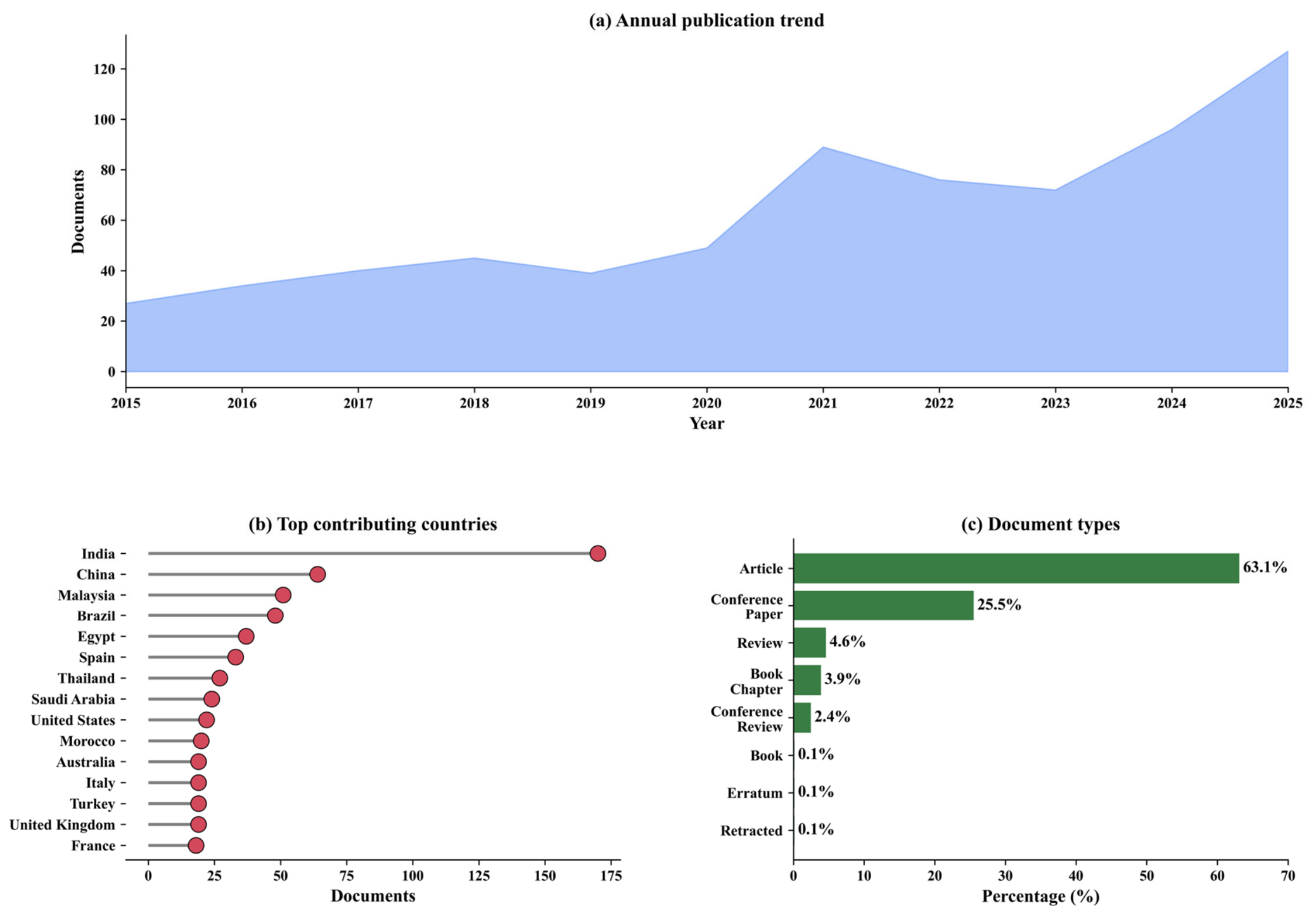
- Definition of database and keywords: The focus was on articles related to the use of agricultural or industrial waste in fired and unfired brick and concrete block production. The Scopus database was selected as the primary source for literature retrieval due to its comprehensive and well-structured nature, broad multidisciplinary coverage, and comprehensive indexing of peer-reviewed publications and citation information, establishing it as a robust resource for intensive scientific inquiry [56,57]. Although databases such as Web of Science may contain additional relevant studies, Scopus was selected as the primary database to ensure a consistent and reproducible search strategy within the scope of this review. The research was conducted from December 2024 to May 2025, and included studies published from 2015 to 2025. The search was performed using the title, abstract, and keyword fields in Scopus. The following search terms were combined using Boolean operators:
- 2.
- Redefining the research: The selection criteria were established before the screening process to ensure consistency and minimise subjective selection. Studies were included when they met the following conditions:
- Published between 2015 and 2025;
- Available in English;
- Published as research articles, conference papers, or books;
- 3.
- Screening: Articles relevant to the defined theme were identified through a stepwise screening process. Titles were first reviewed to remove clearly unrelated studies, followed by abstract screening to exclude those not closely aligned with the research focus. This yielded over 150 articles for full-text assessment.
- 4.
- Subsequently, the full texts were assessed, allowing for the removal of irrelevant studies and resulting in the final set of articles included in the analysis. Each paper was carefully evaluated to ensure its relevance to the topic. Studies were included when they met the following conditions:
- Investigated fired bricks, unfired bricks, or concrete blocks;
- Incorporated agricultural or industrial waste as a constituent material or partial replacement;
- Reported experimental evaluation of one or more relevant performance parameters, including density, water absorption, porosity, compressive strength, thermal conductivity, shrinkage, durability, environmental impact, or economic performance.
Studies were excluded when they:- Investigated waste characterisation without producing masonry units;
- Did not report measurable performance results;
- Lacked sufficient information regarding material composition, waste proportion, or testing conditions.
- Were review articles.
- 5.
- Analysis: The extracted information included waste type, waste content, manufacturing method, curing or firing conditions, and reported physical, mechanical, thermal, durability, environmental, and economic properties. The data collected were organised using Microsoft Excel for Microsoft 365 (Version 2607, Univeristy of Liverpool) and analysed through comparative tables and graphical interpretation. The analysis focused on identifying common trends, material-specific effects, reported optimum incorporation ranges, advantages, limitations, and research gaps associated with the use of agricultural and industrial waste in sustainable masonry production. Due to the variation in waste characteristics, mixture compositions, manufacturing processes, and testing conditions among the reviewed studies, the analysis focused on identifying qualitative performance trends and underlying mechanisms rather than establishing direct quantitative relationships between waste content and material properties.

2.2. Production of Masonry Units
3. Results and Discussions
3.1. Density
3.1.1. Fired Bricks
3.1.2. Unfired Bricks
3.1.3. Concrete Blocks
3.2. Porosity
3.2.1. Fired Bricks
3.2.2. Concrete Blocks
3.3. Water Absorption
3.3.1. Fired Bricks
3.3.2. Unfired Bricks
3.3.3. Concrete Blocks
3.4. Mechanical Performance
3.4.1. Fired Bricks
3.4.2. Unfired Bricks
3.4.3. Concrete Blocks
3.5. Thermal Conductivity
3.5.1. Fired Bricks
3.5.2. Unfired Bricks
3.5.3. Concrete Blocks
3.6. Shrinkage
3.6.1. Fired Bricks
3.6.2. Unfired Bricks
3.7. Efflorescence
3.8. Durability
3.8.1. Fired Bricks
3.8.2. Unfired Bricks
3.8.3. Concrete Blocks
3.9. Environmental and Economic Impacts
3.10. Optimum Content
3.10.1. Fired Bricks
3.10.2. Unfired Bricks
3.10.3. Concrete Blocks
3.11. Practical Applications
4. Integrated Assessment of Agricultural and Industrial Waste in Sustainable Masonry Production
5. Conclusions
6. Limitations, Recommendations, and Future Research
- Future studies should aim to evaluate a wider range of properties for waste-based bricks/blocks, including porosity, flexural strength, efflorescence, and thermal conductivity, which are critical for determining the overall performance and suitability of these materials.
- A more complete dataset will allow for more informed decision-making regarding the potential of waste-based bricks/blocks in various construction applications.
- There is an opportunity for greater exploration of hybrid materials made from a combination of waste products.
- Research should focus on the potential synergistic effects of combining different types of waste, such as industrial by-products and organic materials, to enhance the mechanical and thermal properties of bricks/blocks.
- More comprehensive studies should focus on the environmental impact and life cycle assessment of bricks/blocks, considering not only cost but also carbon emissions, energy consumption, raw material sourcing, and long-term performance.
- Development of AI-based predictive models to determine the optimal performance of waste-containing building units.
- Studying durability performance under harsh environmental conditions (fire, freezing, chemical erosion).
Author Contributions
Funding
Data Availability Statement
Acknowledgments
Conflicts of Interest
References
- Yang, M.; Chen, L.; Wang, J.; Msigwa, G.; Osman, A.I.; Fawzy, S.; Rooney, D.W.; Yap, P.-S. Circular economy strategies for combating climate change and other environmental issues. Environ. Chem. Lett. 2023, 21, 55–80. [Google Scholar] [CrossRef] [Scilit]
- Wang, G.; Luo, T.; Luo, H.; Liu, R.; Liu, Y.; Liu, Z. A comprehensive review of building lifecycle carbon emissions and reduction approaches. City Built Environ. 2024, 2, 12. [Google Scholar] [CrossRef] [Scilit]
- Building Energy Research Center of Tsinghua University. Comparison of Energy Consumption and Carbon Emissions from Building Operation Between China and Other Countries. In Decarbonize Urban Heating System: China Building Energy and Emission Yearbook 2023; Springer Nature: Singapore, 2024; pp. 27–40. [Google Scholar]
- UN Environment Progamme. Global Status Report for Buildings and Construction—Beyond Foundations: Mainstreaming Sustainable Solutions to Cut Emissions from the Buildings Sector; UN Environment Progamme: Nairobi, Kenya, 2024. [Google Scholar]
- Forster, P.; Smith, C.; Walsh, T.; Lamb, W.; Palmer, M.; Schuckmann, K.; Trewin, B.; Allen, M.; Andrew, R.; Birt, A.; et al. Indicators of Global Climate Change 2022: Annual Update of Large-Scale Indicators of the State of the Climate System and the Human Influence; Earth System Science Data: Göttingen, Germany, 2023. [Google Scholar]
- Wu, Z.; Huang, X.; Chen, R.; Mao, X.; Qi, X. The United States and China on the paths and policies to carbon neutrality. J. Environ. Manag. 2022, 320, 115785. [Google Scholar] [CrossRef] [Scilit] [PubMed]
- Chen, L.; Msigwa, G.; Yang, M.; Osman, A.I.; Fawzy, S.; Rooney, D.W.; Yap, P.-S. Strategies to achieve a carbon neutral society: A review. Environ. Chem. Lett. 2022, 20, 2277–2310. [Google Scholar] [CrossRef] [Scilit] [PubMed]
- Rathore, P.K.S.; Gupta, N.K.; Yadav, D.; Shukla, S.K.; Kaul, S. Thermal performance of the building envelope integrated with phase change material for thermal energy storage: An updated review. Sustain. Cities Soc. 2022, 79, 103690. [Google Scholar] [CrossRef] [Scilit]
- Lachheb, M.; Youssef, N.; Younsi, Z. A comprehensive review of the improvement of the thermal and mechanical properties of unfired clay bricks by incorporating waste materials. Buildings 2023, 13, 2314. [Google Scholar] [CrossRef] [Scilit]
- Evola, G.; Lucchi, E. Thermal Performance of the Building Envelope: Original Methods and Advanced Solutions. Buildings 2024, 14, 2507. [Google Scholar] [CrossRef] [Scilit]
- Keshmiry, A.; Hassani, S.; Dackermann, U.; Li, J. Assessment, repair, and retrofitting of masonry structures: A comprehensive review. Constr. Build. Mater. 2024, 442, 137380. [Google Scholar] [CrossRef] [Scilit]
- Vijayan, D.S.; Mohan, A.; Revathy, J.; Parthiban, D.; Varatharajan, R. Evaluation of the impact of thermal performance on various building bricks and blocks: A review. Environ. Technol. Innov. 2021, 23, 101577. [Google Scholar] [CrossRef] [Scilit]
- Krishnan, A.K.; Wong, Y.C.; Zhang, Z.; Arulrajah, A. A transition towards circular economy with the utilisation of recycled fly ash and waste materials in clay, concrete and fly ash bricks: A review. J. Build. Eng. 2024, 98, 111210. [Google Scholar] [CrossRef] [Scilit]
- Olsson, J.A.; Hafez, H.; Miller, S.A.; Scrivener, K.L. Greenhouse Gas Emissions and Decarbonization Potential of Global Fired Clay Brick Production. Environ. Sci. Technol. 2025, 59, 1909–1920. [Google Scholar] [CrossRef] [Scilit] [PubMed]
- Miatto, A.; Schandl, H.; Fishman, T.; Tanikawa, H. Global Patterns and Trends for Non-Metallic Minerals used for Construction. J. Ind. Ecol. 2017, 21, 924–937. [Google Scholar] [CrossRef] [Scilit]
- Ramos Huarachi, D.A.; Gonçalves, G.; de Francisco, A.C.; Canteri, M.H.G.; Piekarski, C.M. Life cycle assessment of traditional and alternative bricks: A review. Environ. Impact Assess. Rev. 2020, 80, 106335. [Google Scholar] [CrossRef] [Scilit]
- Murmu, A.L.; Patel, A. Towards sustainable bricks production: An overview. Constr. Build. Mater. 2018, 165, 112–125. [Google Scholar] [CrossRef] [Scilit]
- Ramakrishnan, K.; Chellappa, V.; Chandrasekarabarathi, S. Manufacturing of Low-Cost Bricks Using Waste Materials. Mater. Proc. 2023, 13, 25. [Google Scholar] [CrossRef] [Scilit]
- Vega, P.; Juan, A.; Ignacio Guerra, M.; Morán, J.M.; Aguado, P.J.; Llamas, B. Mechanical characterisation of traditional adobes from the north of Spain. Constr. Build. Mater. 2011, 25, 3020–3023. [Google Scholar] [CrossRef] [Scilit]
- Azhary, K.E.; Chihab, Y.; Mansour, M.; Laaroussi, N.; Garoum, M. Energy Efficiency and Thermal Properties of the Composite Material Clay-straw. Energy Procedia 2017, 141, 160–164. [Google Scholar] [CrossRef] [Scilit]
- Singh, S.; Maiti, S.; Bisht, R.S.; Panigrahi, S.K.; Yadav, S. Large CO2 reduction and enhanced thermal performance of agro-forestry, construction and demolition waste based fly ash bricks for sustainable construction. Sci. Rep. 2024, 14, 8368. [Google Scholar] [CrossRef] [Scilit] [PubMed]
- Dabaieh, M.; Heinonen, J.; El-Mahdy, D.; Hassan, D.M. A comparative study of life cycle carbon emissions and embodied energy between sun-dried bricks and fired clay bricks. J. Clean. Prod. 2020, 275, 122998. [Google Scholar] [CrossRef] [Scilit]
- Van Damme, H.; Houben, H. Earth concrete. Stabilization revisited. Cem. Concr. Res. 2018, 114, 90–102. [Google Scholar] [CrossRef] [Scilit]
- Costi de Castrillo, M.; Ioannou, I.; Philokyprou, M. Reproduction of traditional adobes using varying percentage contents of straw and sawdust. Constr. Build. Mater. 2021, 294, 123516. [Google Scholar] [CrossRef] [Scilit]
- Teixeira, E.R.; Machado, G.; de P. Junior, A.; Guarnier, C.; Fernandes, J.; Silva, S.M.; Mateus, R. Mechanical and Thermal Performance Characterisation of Compressed Earth Blocks. Energies 2020, 13, 2978. [Google Scholar] [CrossRef] [Scilit]
- Bruno, A.W.; Scott, B.; D’Offay-Mancienne, Y.; Perlot, C. Recyclability, durability and water vapour adsorption of unstabilised and stabilised compressed earth bricks. Mater. Struct. 2020, 53, 149. [Google Scholar] [CrossRef] [Scilit]
- Wang, Y.; Abuel-Naga, H. Unfired Bricks from Wastes: A Review of Stabiliser Technologies, Performance Metrics, and Circular Economy Pathways. Buildings 2025, 15, 1861. [Google Scholar] [CrossRef] [Scilit]
- Marathe, S.; Mithanthaya, I.R.; Shetty, S. Strength Behaviour of Masonry Blocks Produced Using Green Concrete. In Proceedings of the Sustainable Construction and Building Materials; Springer Nature: Singapore, 2019; pp. 33–40. [Google Scholar]
- Ali, Y.A.Y.; Fahmy, E.H.A.; AbouZeid, M.N.; Shaheen, Y.B.I.; Mooty, M.N.A. Use of expanded polystyrene wastes in developing hollow block masonry units. Constr. Build. Mater. 2020, 241, 118149. [Google Scholar] [CrossRef] [Scilit]
- Alex, J.; Dhanalakshmi, J.; Ambedkar, B. Experimental investigation on rice husk ash as cement replacement on concrete production. Constr. Build. Mater. 2016, 127, 353–362. [Google Scholar] [CrossRef] [Scilit]
- Mayooran, S.; Ragavan, S.; Sathiparan, N. Comparative study on open air burnt low- and high-carbon rice husk ash as partial cement replacement in cement block production. J. Build. Eng. 2017, 13, 137–145. [Google Scholar] [CrossRef] [Scilit]
- Farooq, F.; Ahmed, W.; Akbar, A.; Aslam, F.; Alyousef, R. Predictive modeling for sustainable high-performance concrete from industrial wastes: A comparison and optimization of models using ensemble learners. J. Clean. Prod. 2021, 292, 126032. [Google Scholar] [CrossRef] [Scilit]
- Watari, T.; Cao, Z.; Serrenho, A.C.; Cullen, J. Growing role of concrete in sand and climate crises. iScience 2023, 26, 106782. [Google Scholar] [CrossRef] [Scilit] [PubMed]
- Gaur, V.K.; Sharma, P.; Sirohi, R.; Awasthi, M.K.; Dussap, C.-G.; Pandey, A. Assessing the impact of industrial waste on environment and mitigation strategies: A comprehensive review. J. Hazard. Mater. 2020, 398, 123019. [Google Scholar] [CrossRef] [Scilit] [PubMed]
- Peng, X.; Jiang, Y.; Chen, Z.; Osman, A.I.; Farghali, M.; Rooney, D.W.; Yap, P.-S. Recycling municipal, agricultural and industrial waste into energy, fertilizers, food and construction materials, and economic feasibility: A review. Environ. Chem. Lett. 2023, 21, 765–801. [Google Scholar] [CrossRef] [Scilit]
- Sathish Kumar, R.K.; Sasikumar, R.; Dhilipkumar, T. Exploiting agro-waste for cleaner production: A review focusing on biofuel generation, bio-composite production, and environmental considerations. J. Clean. Prod. 2024, 435, 140536. [Google Scholar] [CrossRef] [Scilit]
- Teklehaimanot, M.; Hailay, H.; Tesfaye, T. Manufacturing of Ecofriendly Bricks Using Microdust Cotton Waste. J. Eng. 2021, 2021, 8815965. [Google Scholar] [CrossRef] [Scilit]
- Gaspar, F.; Bakatovich, A.; Davydenko, N.; Joshi, A. 8—Building insulation materials based on agricultural wastes. In Bio-Based Materials and Biotechnologies for Eco-Efficient Construction; Pacheco-Torgal, F., Ivanov, V., Tsang, D.C.W., Eds.; Woodhead Publishing: Cambridge, UK, 2020; pp. 149–170. [Google Scholar]
- Gutberlet, J.; Bramryd, T. Reimagining urban waste management: Addressing social, climate, and resource challenges in modern cities. Cities 2025, 156, 105553. [Google Scholar] [CrossRef] [Scilit]
- Meena, R.V.; Jain, J.K.; Chouhan, H.S.; Beniwal, A.S. Use of waste ceramics to produce sustainable concrete: A review. Clean. Mater. 2022, 4, 100085. [Google Scholar] [CrossRef] [Scilit]
- Dixit, S.; Arora, R.; Kumar, K.; Bansal, S.; Vatin, N.; Araszkiewicz, K.; Epifantsev, K. Replacing E-waste with coarse aggregate in architectural engineering and construction industry. Mater. Today Proc. 2022, 56, 2353–2358. [Google Scholar] [CrossRef] [Scilit]
- Maraveas, C. Production of Sustainable Construction Materials Using Agro-Wastes. Materials 2020, 13, 262. [Google Scholar] [CrossRef] [Scilit] [PubMed]
- Calà, A.; Santoro, E.; Saeli, M.; Ausiello, G. Implementing Circular Economy Strategies for Applications in Construction: Optimizing Cellulose-Based Waste in Building Materials. In Proceedings of the 11th International Conference of Ar.Tec. (Scientific Society of Architectural Engineering), Palermo, Italy, 12–15 June 2024; pp. 69–85. [Google Scholar]
- Rautray, P.; Roy, A.; Mathew, D.; Eisenbart, B. Bio-Brick—Development of Sustainable and Cost Effective Building Material. Proc. Des. Soc. Int. Conf. Eng. Des. 2019, 1, 3171–3180. [Google Scholar] [CrossRef] [Scilit]
- Abdul Wahab, R.A.; Zakri, F.A.A.; Sokri, N.K.N.M.; Norizam, N.A.F.; Karya, A.Q.; Zaid, M.H.M.; Mohamad, M.; Mazlan, M. Physical and mechanical properties of fired clay bricks substituted with agricultural waste. In AIP Conference Proceedings; AIP Publishing LLC: Melville, NY, USA, 2021. [Google Scholar] [CrossRef] [Scilit]
- Ishaq, M.; Ali, A.; Hussain, A.A.; Kamran, K.; Ghuffar, A.; Anwar, A. Industrial waste as clay substitute in brick manufacturing. Constr. Build. Mater. 2025, 477, 141359. [Google Scholar] [CrossRef] [Scilit]
- Gupta, V.; Chai, H.K.; Lu, Y.; Chaudhary, S. A state of the art review to enhance the industrial scale waste utilization in sustainable unfired bricks. Constr. Build. Mater. 2020, 254, 119220. [Google Scholar] [CrossRef] [Scilit]
- Al-Fakih, A.; Mohammed, B.S.; Liew, M.S.; Nikbakht, E. Incorporation of waste materials in the manufacture of masonry bricks: An update review. J. Build. Eng. 2019, 21, 37–54. [Google Scholar] [CrossRef] [Scilit]
- Meng, Y.; Ling, T.-C.; Mo, K.H. Recycling of wastes for value-added applications in concrete blocks: An overview. Resour. Conserv. Recycl. 2018, 138, 298–312. [Google Scholar] [CrossRef] [Scilit]
- Pooja, K.; Shreelaxmi, P. Recent Advances in Construction of Masonry Structure by Waste Materials. In Sustainability Trends and Challenges in Civil Engineering; Nandagiri, L., Narasimhan, M.C., Marathe, S., Dinesh, S., Eds.; Lecture Notes in Civil Engineering; Springer: Singapore, 2022; Volume 162. [Google Scholar] [CrossRef] [Scilit]
- Labaied, I.; Douzane, O.; Lajili, M.; Promis, G. Bricks Using Clay Mixed with Powder and Ashes from Lignocellulosic Biomass: A Review. Appl. Sci. 2022, 12, 10669. [Google Scholar] [CrossRef] [Scilit]
- Sarhat, S.; Hamza Rizwan, S.; Mirza, M.G.; Green, M.; Banting, B. The Use of Recycled Aggregates in the Production of Concrete Masonry Units: A Critical Review and a Statement on the Current Research Needs. In Masonry 2022: Advancing Masonry Technology; ASTM International: West Conshohocken, PA, USA, 2022; pp. 138–183. [Google Scholar]
- Esteban, E.A.; Flores, N.A.; Barriga, M.F.; Rada, L.C. Sustainable construction materials to improve environmental impact: A systematic review. In Proceedings of the International Conference on Energy, Power, Environment, Control and Computing (ICEPECC 2025), Gujrat, Pakistan, 19–20 February 2025; pp. 237–245. [Google Scholar]
- Kamal, M.A.; Alaswad, B.M.; Shehata, I.M.; Viswanath, O.; Koushik, S.S. Systematic Review: A Comprehensive Guide. In How to Successfully Publish a Manuscript: A Step-by-Step Guide; Shehata, I.M., Viswanath, O., Eds.; Springer Nature: Cham, Switzerland, 2025; pp. 191–204. [Google Scholar]
- Mannarath, A.K. Systematic literature review for an effective research: A structured framework for social science researches. Qual. Quant. 2026, 60, 4773–4799. [Google Scholar] [CrossRef] [Scilit]
- Wang, Q.; Su, M. Integrating blockchain technology into the energy sector—From theory of blockchain to research and application of energy blockchain. Comput. Sci. Rev. 2020, 37, 100275. [Google Scholar] [CrossRef] [Scilit]
- Rejeb, A.; Rejeb, K.; Abdollahi, A.; Al-Turjman, F.; Treiblmaier, H. The Interplay between the Internet of Things and agriculture: A bibliometric analysis and research agenda. Internet Things 2022, 19, 100580. [Google Scholar] [CrossRef] [Scilit]
- Holmes, N.; O’Malley, H.; Cribbin, P.; Mullen, H.; Keane, G. Performance of masonry blocks containing different proportions of incinator bottom ash. Sustain. Mater. Technol. 2016, 8, 14–19. [Google Scholar] [CrossRef] [Scilit]
- Terra, I.C.d.C.; Batista, F.G.; Silva, D.W.; Scatolino, M.V.; Alves Júnior, F.T.; Martins, M.A.; Mendes, L.M. Mining waste and coconut fibers as an eco-friendly reinforcement for the production of concrete blocks. Environ. Sci. Pollut. Res. 2023, 30, 62641–62652. [Google Scholar] [CrossRef] [Scilit] [PubMed]
- Eliche-Quesada, D.; Leite-Costa, J. Use of bottom ash from olive pomace combustion in the production of eco-friendly fired clay bricks. Waste Manag. 2016, 48, 323–333. [Google Scholar] [CrossRef] [Scilit] [PubMed]
- Nakkeeran, G.; Krishnaraj, L.; Shakor, P.; Alaneme, G.U.; Otu, O.N. Mechanical properties optimization and cost analysis of agricultural waste as an alternative in brick production. Sci. Rep. 2024, 14, 24075. [Google Scholar] [CrossRef] [Scilit] [PubMed]
- Ahmad, S.; Iqbal, Y.; Muhammad, R. Effects of coal and wheat husk additives on the physical, thermal and mechanical properties of clay bricks. Bol. Soc. Esp. Cerámica Vidr. 2017, 56, 131–138. [Google Scholar] [CrossRef] [Scilit]
- Ahmad, S.; Hassan Shah, M.U.; Ullah, A.; Shah, S.N.; Rehan, M.S.; Khan, I.A.; Ahmad, M.I. Sustainable Use of Marble Waste in Industrial Production of Fired Clay Bricks and Its Employment for Treatment of Flue Gases. ACS Omega 2021, 6, 22559–22569. [Google Scholar] [CrossRef] [Scilit] [PubMed]
- Elsevier. Scopus Database. Available online: https://www.scopus.com/pages/search/publications?searchId=55947ee9-ca37-4468-86c1-dae2697348ed (accessed on 15 May 2026).
- Mohajerani, A.; Kadir, A.A.; Larobina, L. A practical proposal for solving the world’s cigarette butt problem: Recycling in fired clay bricks. Waste Manag. 2016, 52, 228–244. [Google Scholar] [CrossRef] [Scilit] [PubMed]
- Pokhara, P.; Ekamparam, A.S.S.; Gupta, A.B.; Rai, D.C.; Singh, A. Activated alumina sludge as partial substitute for fine aggregates in brick making. Constr. Build. Mater. 2019, 221, 244–252. [Google Scholar] [CrossRef] [Scilit]
- Eliche-Quesada, D.; Felipe-Sesé, M.A.; López-Pérez, J.A.; Infantes-Molina, A. Characterization and evaluation of rice husk ash and wood ash in sustainable clay matrix bricks. Ceram. Int. 2017, 43, 463–475. [Google Scholar] [CrossRef] [Scilit]
- Sutcu, M.; Ozturk, S.; Yalamac, E.; Gencel, O. Effect of olive mill waste addition on the properties of porous fired clay bricks using Taguchi method. J. Environ. Manag. 2016, 181, 185–192. [Google Scholar] [CrossRef] [Scilit] [PubMed]
- De Silva, G.H.M.J.S.; Perera, B.V.A. Effect of waste rice husk ash (RHA) on structural, thermal and acoustic properties of fired clay bricks. J. Build. Eng. 2018, 18, 252–259. [Google Scholar] [CrossRef] [Scilit]
- Abbas, S.; Saleem, M.A.; Kazmi, S.M.S.; Munir, M.J. Production of sustainable clay bricks using waste fly ash: Mechanical and durability properties. J. Build. Eng. 2017, 14, 7–14. [Google Scholar] [CrossRef] [Scilit]
- Adazabra, A.N.; Viruthagiri, G.; Kannan, P. Influence of spent shea waste addition on the technological properties of fired clay bricks. J. Build. Eng. 2017, 11, 166–177. [Google Scholar] [CrossRef] [Scilit]
- Singh, S.K.; Kulkarni, S.; Kumar, V.; Vashistha, P. Sustainable utilization of deinking paper mill sludge for the manufacture of building bricks. J. Clean. Prod. 2018, 204, 321–333. [Google Scholar] [CrossRef] [Scilit]
- Ahmed, S.; El Attar, M.E.; Zouli, N.; Abutaleb, A.; Maafa, I.M.; Ahmed, M.M.; Yousef, A.; Ragab, A. Improving the Thermal Performance and Energy Efficiency of Buildings by Incorporating Biomass Waste into Clay Bricks. Materials 2023, 16, 2893. [Google Scholar] [CrossRef] [Scilit] [PubMed]
- Kakkar, Y.; Singh, R.; Patel, M. Utilization of Agricultural Waste for the Sustainable Production of Clay Bricks. In Proceedings of the Indian Geotechnical and Geoenvironmental Engineering Conference (IGGEC) 2021; Springer Nature: Singapore, 2023; Volume 2, pp. 349–360. [Google Scholar]
- Sekhar, D.C.; Nayak, S. Utilization of granulated blast furnace slag and cement in the manufacture of compressed stabilized earth blocks. Constr. Build. Mater. 2018, 166, 531–536. [Google Scholar] [CrossRef] [Scilit]
- Danso, H.; Martinson, D.B.; Ali, M.; Williams, J.B. Physical, mechanical and durability properties of soil building blocks reinforced with natural fibres. Constr. Build. Mater. 2015, 101, 797–809. [Google Scholar] [CrossRef] [Scilit]
- Sujatha, E.R.; Selsia Devi, S. Reinforced soil blocks: Viable option for low cost building units. Constr. Build. Mater. 2018, 189, 1124–1133. [Google Scholar] [CrossRef] [Scilit]
- Olacia, E.; Pisello, A.L.; Chiodo, V.; Maisano, S.; Frazzica, A.; Cabeza, L.F. Sustainable adobe bricks with seagrass fibres. Mechanical and thermal properties characterization. Constr. Build. Mater. 2020, 239, 117669. [Google Scholar] [CrossRef] [Scilit]
- Ouedraogo, M.; Dao, K.; Millogo, Y.; Aubert, J.-E.; Messan, A.; Seynou, M.; Zerbo, L.; Gomina, M. Physical, thermal and mechanical properties of adobes stabilized with fonio (Digitaria exilis) straw. J. Build. Eng. 2019, 23, 250–258. [Google Scholar] [CrossRef] [Scilit]
- Kasinikota, P.; Tripura, D.D. Evaluation of compressed stabilized earth block properties using crushed brick waste. Constr. Build. Mater. 2021, 280, 122520. [Google Scholar] [CrossRef] [Scilit]
- Yatawara, M.; Athukorala, S. Potential of replacing clay soil by rice husk ash (RHA) in enhancing the properties of compressed earth blocks (CEBs). Environ. Dev. Sustain. 2021, 23, 3474–3486. [Google Scholar] [CrossRef] [Scilit]
- James, J.; Pandian, P.K.; Deepika, K.; Manikanda Venkatesh, J.; Manikandan, V.; Manikumaran, P. Cement Stabilized Soil Blocks Admixed with Sugarcane Bagasse Ash. J. Eng. 2016, 2016, 7940239. [Google Scholar] [CrossRef] [Scilit]
- Zak, P.; Ashour, T.; Korjenic, A.; Korjenic, S.; Wu, W. The influence of natural reinforcement fibers, gypsum and cement on compressive strength of earth bricks materials. Constr. Build. Mater. 2016, 106, 179–188. [Google Scholar] [CrossRef] [Scilit]
- El-Mahllawy, M.S.; Mohsen, S.A. Characterization and utilization capabilities of industrial wastes for green bricks production. Beni-Suef Univ. J. Basic Appl. Sci. 2024, 13, 57. [Google Scholar] [CrossRef] [Scilit]
- Souza, A.B.; Ferreira, H.S.; Vilela, A.P.; Viana, Q.S.; Mendes, J.F.; Mendes, R.F. Study on the feasibility of using agricultural waste in the production of concrete blocks. J. Build. Eng. 2021, 42, 102491. [Google Scholar] [CrossRef] [Scilit]
- Madrid, M.; Orbe, A.; Rojí, E.; Cuadrado, J. The effects of by-products incorporated in low-strength concrete for concrete masonry units. Constr. Build. Mater. 2017, 153, 117–128. [Google Scholar] [CrossRef] [Scilit]
- Malaluan, L.; Joy, W.; Sescar, E.; James, J. Lignocellulosic plant fibers (LPF) for concrete masonry blocks (CMB): An inspiration to innovation response to the 21stcentury’s endeavor for environmental challenges. Int. J. Sci. Res. 2019, 10, 30656–30666. [Google Scholar] [CrossRef]
- Onyenokporo, N.C.; Taki, A.; Montalvo, L.Z.; Oyinlola, M. Thermal performance characterization of cement-based masonry blocks incorporating rice husk ash. Constr. Build. Mater. 2023, 398, 132481. [Google Scholar] [CrossRef] [Scilit]
- Jamellodin, Z.; Hamid, H.A.A.; Hamid, N.A.A.; Salleh, N.; Adnan, S.H. The Effect of Curing Conditions on the Strength of Masonry Blocks Incorporating Palm Oil Fuel Ash. In Proceedings of the Sustainable Concrete Materials and Structures in Construction 2020; Springer Nature: Singapore, 2021; pp. 109–118. [Google Scholar]
- Sathiparan, N.; Anburuvel, A.; Muralitharan, M.; Isura Kothalawala, D.A. Sustainable use of coco pith in cement-sand mortar for masonry block production: Mechanical characteristics, durability and environmental benefit. J. Clean. Prod. 2022, 360, 132243. [Google Scholar] [CrossRef] [Scilit]
- Al-Tarbi, S.M.; Baghabra Al-Amoudi, O.S.; Al-Osta, M.A.; Al-Awsh, W.A.; Ali, M.R.; Maslehuddin, M. Development of eco-friendly hollow concrete blocks in the field using wasted high-density polyethylene, low-density polyethylene, and crumb tire rubber. J. Mater. Res. Technol. 2022, 21, 1915–1932. [Google Scholar] [CrossRef] [Scilit]
- Kuoribo, E.; Shokry, H.; Mahmoud, H. Attaining material circularity in recycled construction waste to produce sustainable concrete blocks for residential building applications. J. Build. Eng. 2024, 96, 110503. [Google Scholar] [CrossRef] [Scilit]
- Dafedar, M.M.M.; Rao, K.B.; Pai, B.H.V.; Bekkeri, G.B. Evaluation of the engineering properties and sustainability of solid masonry blocks produced with recycled concrete aggregates. Innov. Infrastruct. Solut. 2024, 9, 449. [Google Scholar] [CrossRef] [Scilit]
- Zúniga, A.; Eires, R.; Malheiro, R.; Felgueiras, H.P. The impact of sugarcane bagasse on the biological degradation of hemp concrete. Ind. Crops Prod. 2024, 219, 119075. [Google Scholar] [CrossRef] [Scilit]
- Wei, J.; Meyer, C. Degradation mechanisms of natural fiber in the matrix of cement composites. Cem. Concr. Res. 2015, 73, 1–16. [Google Scholar] [CrossRef] [Scilit]


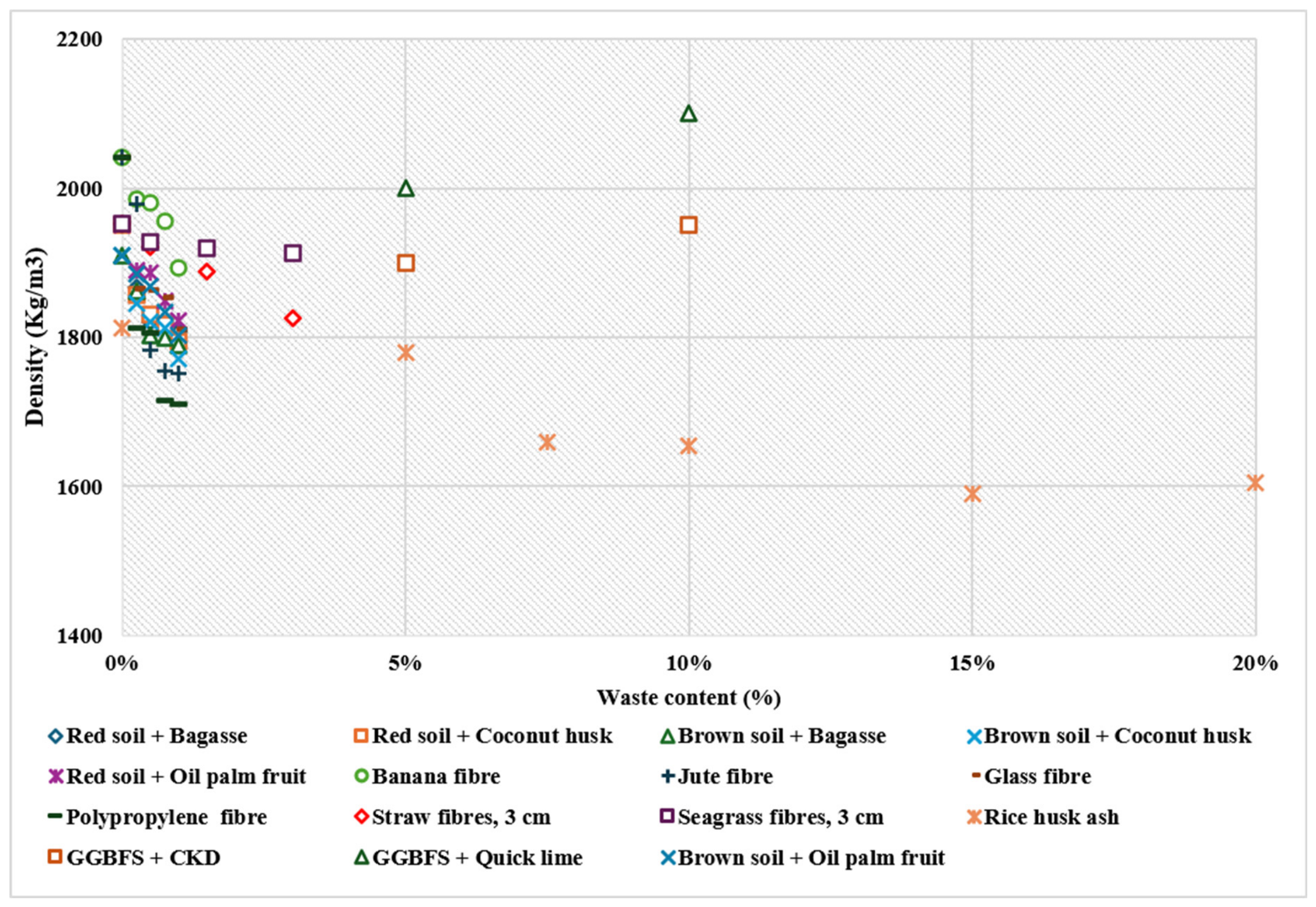


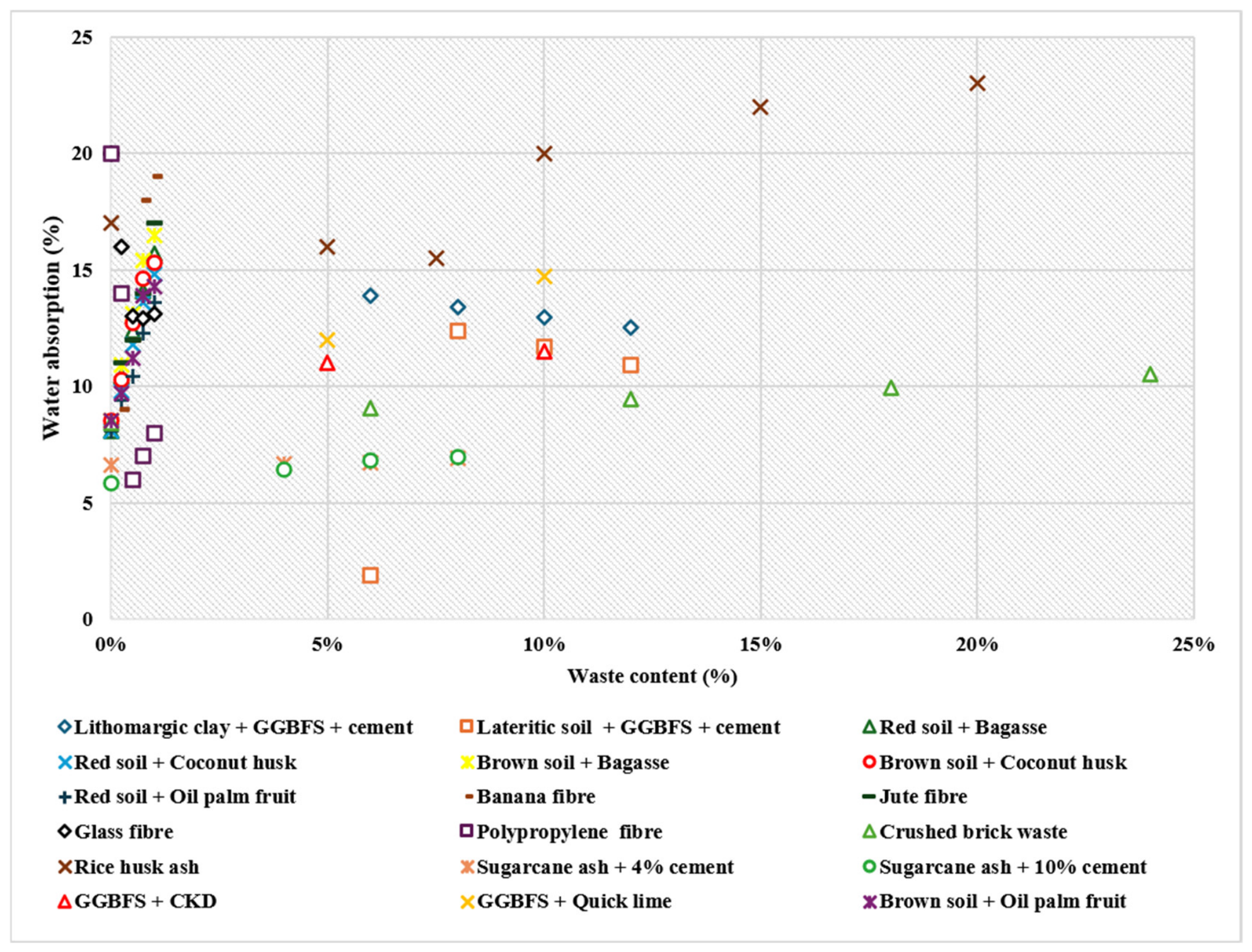


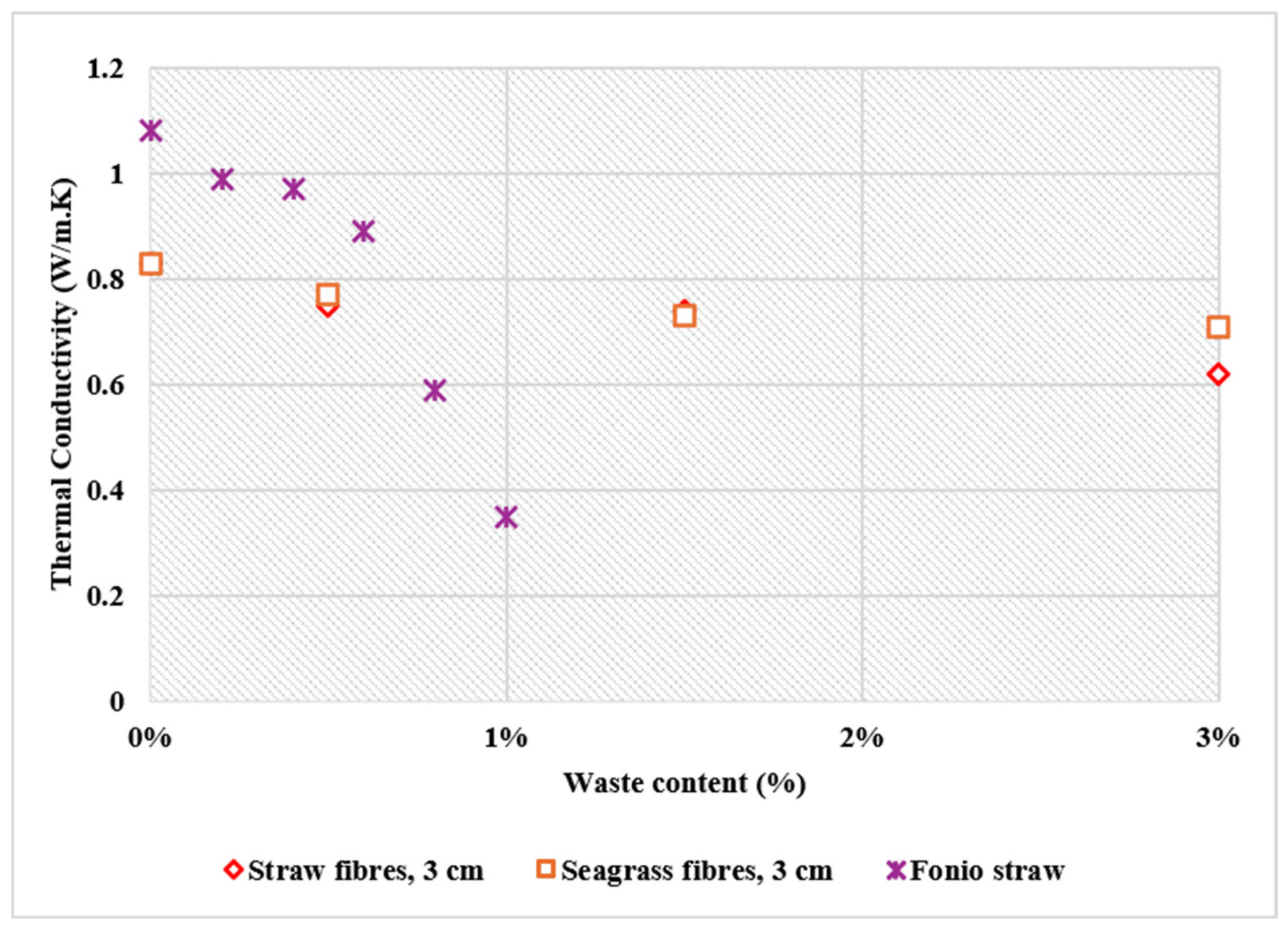


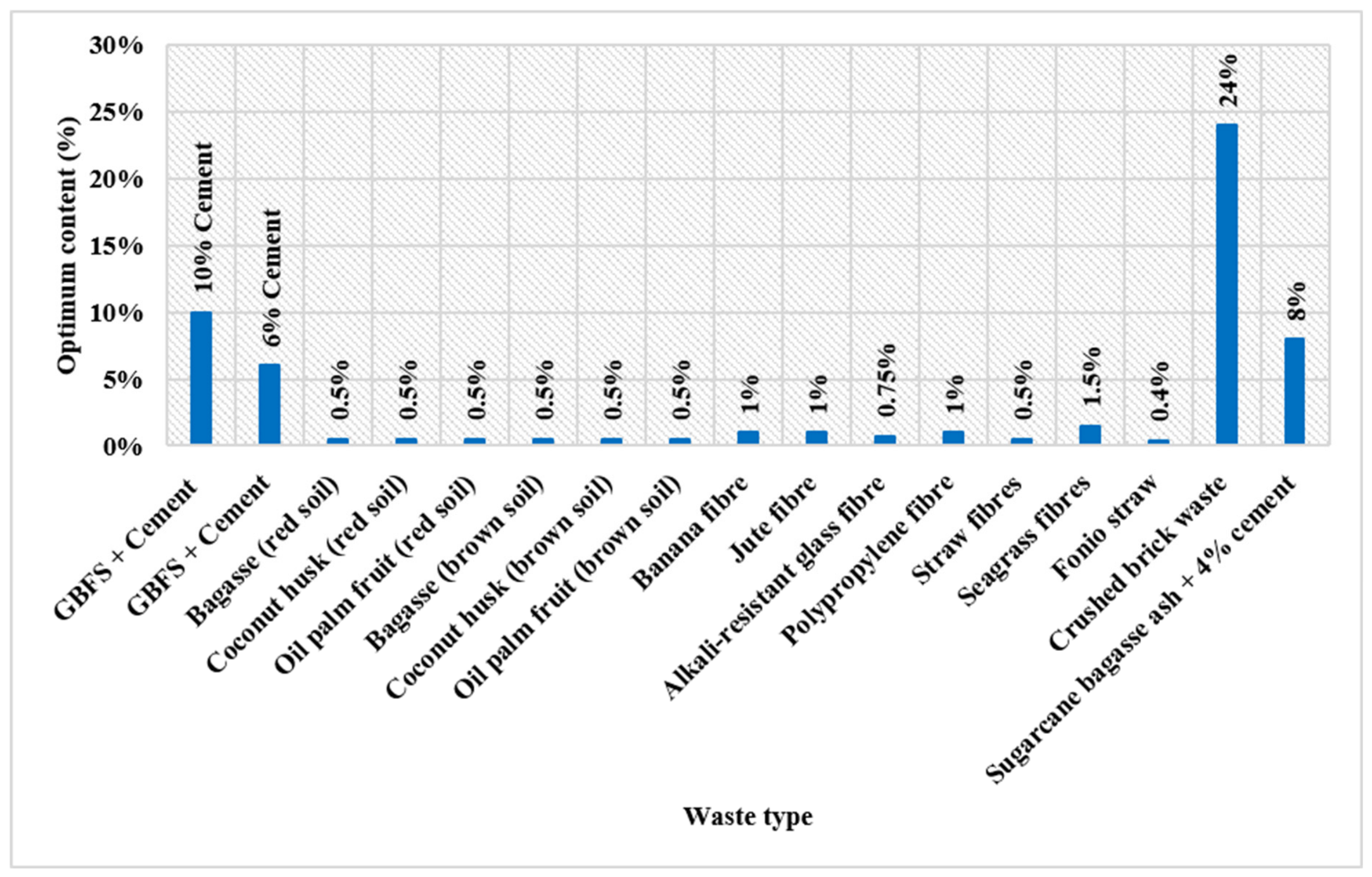


| Ref. | Type of Waste | Content of Waste (%) | Type of Soil | Content of Other Materials | Size of Brick (mm) | Mixing Method | Firing Temperature (°C) | Manufacturing Method | Tests (Standards) |
|---|---|---|---|---|---|---|---|---|---|
| [65] | Cigarette butts | (0, 2.5, 5, 7, 5, 10 wt.% of soil) and 1% wt.% of soil | Brown silty clayey Sand | Optimum moisture content | cube (100 × 100 × 100 mm), beam (225 × 110 × 75 mm), and brick (300 × 100 × 50 mm) | a Hobart mechanical mixer | Thermolyne furnace at 1050 °C | Mixes were mixed for 5- 15 min and compacted manually with predetermined masses for maximum density. The specimens were dried at 105 °C for 24 h, removed from moulds, and fired. | Compressive strength, Modulus of rupture, water absorption, and density (AS/NZS 4456.1:2003), thermal conductivity model, Leachate analyses, estimated total emissions, saving firing energy |
| [66] | Activated alumina sludge | (0–15% wt. Clay) | Clay | Water suitable to achieve the desired workability | 230 × 110 × 70 mm | Manual | A kiln at approximately 900 °C | The materials were mixed with water for 15 min, moulded under pressure, sun-dried for 3 days, and then fired for 21 days. | Structural, non-structural Properties, acid resistance, leachate test. |
| [67] | Rice husk or wood ash | Each 10–30 wt.% clay | Clay (30 wt.% red, 30 wt.% yellow and 40 wt.% black clay) | (7–10 wt.% Moisture) | 30 × 10 × 60 mm | Laboratory furnace at 900 Or 1000 °C | Water was added during the semi-dry compression moulding under 54.5 MPa of pressure. Samples were fired for 4 h, at a heating rate of 3 °C/min, then cooled to room temperature by natural convection inside the furnace. | Water absorption, Open porosity, Bulk density (ASTM C373), compressive strength (UNE-EN 772-1), Thermal conductivity, leachate test. | |
| [68] | Olive mill waste | 5%, 10% wt. Of soil | Clay | Sprayed water up to 15% wt. | Cylindrical pellets of 20 mm diameter | mechanical mixer | Electrical furnace at 850 °C, 950 °C, and 1050 °C | The mixture was compressed into cylindrical pellets and dried at 40 °C for 12 h and 110 °C for 24 h. It was then fired at 2.5 °C/min to 600 °C and heated at 10 °C/min for 2 h. | Apparent porosity, water absorption, bulk density (ASTM Standard C20), Compressive Strength (TS EN 771-1), Thermal Conductivity Analyser, |
| [69] | Rice husk ash | 0%, 2%, 4%, 6%, 8% and 10%, wt. Of brick | Clay | Water (until proper mixing was Reached) | 195 × 95 × 50 mm | handmade | Brick kiln (600 and 850 °C) | The clay and water were mixed, and then rice husk ash (RHA) was added with additional water. The bricks were dried at 35 °C with 60% humidity, fired for two days, and cooled for a week. | Atterberg limit (ASTM D4318), Sieve analysis (ASTM C136), X-ray fluorescence, water absorption and compressive strength (ASTM 67-07), Thermal performance, Acoustic performance |
| [70] | Waste fly ash | 0–25% wt. Of clay | Clay | Plasticity Water (20.8–18.7%) | 225 × 112 × 75 mm | General hand mixing and moulding technique | 800 °C. | Freshly prepared wet bricks were air-dried for 4–5 days, then fired for three days in the kiln. After 20 days, the burnt clay bricks were removed from the kiln. | Mechanical properties, water absorption, and efflorescence (ASTM C67) |
| [71] | Spent shea waste | 5, 10, 15 and 20 wt.% of the clay | Clay | 13.5 wt.% of plasticity water | 100 × 35 × 30 mm | thoroughly homogenised in a blender for 10 min | Electrical kiln at 900 °C to 1200 °C | The granulates were soaked for one hour, sun-dried for a week, fired at 2 °C per minute, and cooled by natural convection after two-hour soakings at each sintering temperature. | Densities, compressive strength (ASTM C67), apparent Porosity, and water absorption (ASTM C20), shrinkage |
| [72] | Paper mill sludge (DPMS) | Paper mill sludge (0–30% wt. Soil) | Alluvial soil | Water (0.22 wt. of soil, 0.60 wt. of waste) | 75 × 50 × 33 mm | Lump-free mixing for 30 min | Electrically operated muffle furnace (900 °C, 950 °C and 1000 °C) | The sludge and soil were oven-dried at 100 ± 2 °C for 2 h, mixed with water, air-dried for 24 h, and then oven-dried for another 24 h. The briquettes were fired at 2 °C/min, 4 °C/min, and 5 °C/min for 2 h, then cooled to room temperature in the furnace. | Water absorption (IS:3495), the efflorescence of specimens (IS 3495), the apparent porosity (ASTM C20), compressive strength (IS3495), thermal conductivity (ASTM 5334), firing shrinkage (IS:12979) |
| [73] | Pomegranate peel waste | 0%, 5%, 7.5%, 10%, and 15% | Clay | Water (20%) | 50 × 50 × 50 mm | Manual | 900 °C | The pastes were moulded, compressed to remove air bubbles, air-dried for 24 h, dried at 120 °C for 6 h, and fired for 4 h with a 10 °C/min heating rate. | Compressive strength (ISO 9652), water absorption and Apparent Porosity (ISO 5017), Thermal conductivity (ASTM D5334), and environmental impacts |
| [74] | Rice straw ash | 0, 2, 4, 6, 8 and 10% wt. Clay | Clay | Water to the right consistency | 229 × 114 × 76 mm with a frog of depth 10 mm | 1000 °C | Rice straw ash and clay were mixed with water, kneaded for 24 h, moulded, air-dried for 48 h, kiln-fired for 3–4 days, and cooled for 10 days before extraction. | Compressive Strength test, water absorption test, shape, size, soundness, and hardness |
| Ref. | Type of Brick | Type of Waste | Content of Waste (%) | Type of Soil | Content of Other Materials | Size of Bricks (mm) | Mixing Method | Manufacturing Method | Tests (Standards) |
|---|---|---|---|---|---|---|---|---|---|
| [75] | Compressed stabilised earth blocks | Granulated blast furnace slag | (20% and 25%) wt. Soil | Lithomargic Clay and Lateritic soil | Cement (6–12%)/(2–8%), water (as required) | 305 × 143 × 105 mm | Manual | Potable water was added to form a cohesive ball; the mix was sprayed and turned for uniform wetting, compacted in a mould using a compression machine, and all samples were cured for 28 days. | Effect of GBFS on properties of soil, compression testing, and Water absorption (Indian Standard) |
| [76] | Compressed soil blocks | Coconut Husk, bagasse and oil palm fruit | 0.25, 0.5, 0.75 and 1 wt.% fibre, with lengths of 50 mm, 80 mm, and 38 mm for the fibres respectively | Clay soil (Red and Brown) | Soil (100%), water (as required) | 290 × 140 × 100 mm | Manual | The soil was spread on a platform and mixed with fibre until consistent. Water was added, and the mixture was combined. Blocks were formed using a hydraulic machine at 100 bars of pressure and then sun-dried for 21 days at 27 °C and 72% humidity. | Density (BS EN 771-1), Water absorption (BS EN 772-11) Compressive test (BS EN 771-1), tensile splitting test (BS EN 12390-6), linear shrinkage, wearing and erosion |
| [77] | Reinforced soil blocks | Alkali-resistant glass, polypropylene, Banana and jute fibre | Each (0.25%, 0.5%, 0.75% and 1%) wt. Soil, with lengths of 12 mm, 12 mm, 60–70 mm and 60–70 mm for the fibres respectively | Sandy dark brown soil | Water (10%) | 215 × 105 × 65 mm | Manual | The soil and fibres were mixed by hand, spread in a mould, and pressed. The blocks were sunbaked for 21 days at 25 °C to 30 °C and covered with banana leaves or plastic sheets to maintain humidity. Before testing, the blocks were dusted to remove loose soil. | Density (BS EN 771-1), Water absorption (BS EN 772-11), compressive stress and indirect tensile stress (ASTM D559-0), modulus of rupture (ASTM C-67), linear shrinkage, wearing and erosion (ASTM D559-03, New Zealand Standard) |
| [78] | Adobe bricks | Straw or seagrass fibres | 0.5, 1.5, and 3 wt.% at 1, 3 cm and long | Clay, sand And gravel | 60 wt.% fine clay, 40 wt.% sand-gravel, and 20 wt.% Water | 40 × 40 × 160 mm | Manual | Samples were made by mixing materials with water to form a paste, poured into standardised moulds, removed once set, and left to dry in laboratory conditions (21–23 °C, 40–50% relative humidity) for about 28 days until achieving a constant weight. | Tensile strength and water absorption of fibres, Dry density, flexural and compressive strength (EN 196-1), thermal conductivity, linear shrinkage |
| [79] | Adobe bricks | Fonio straw | 0.2, 0.4, 0.6, 0.8 or 1%, with length of 1 cm | Reddish brown clayey soil | Water (24%) | 40 × 40 × 160 mm | Manual | The mixture was moulded in two layers with manual compaction (30 shocks). The samples were dried in the shade at 30 ± 5 °C for 24 h, then were demoulded and dried for an additional 21 days before testing. | Water absorption, compressive and flexural strengths (XP P13–901), thermal conductivity, apparent density, porosity, spray test |
| [80] | Compressed stabilised earth block | Crushed brick waste | 6%, 12%, 18% and 24% wt. of soil-sand (sand 20–100% + 30% soil) | Silty clay soil | Cement (10%) wt. Soil, water (10–12%) | 290 × 140 × 100 mm | Manual | A hand-operated press with a compaction ratio of 1.85 was used to produce bricks. The mixture was moulded, manually compressed, ejected, weighed, and cured for 28 days under wet gunny bags, followed by 7 days of air drying. | Compression test, three-point flexural (HB 195), Water absorption (IS 3495), sulphate resistance, wetting–drying (IS 1725) |
| [81] | Compressed earth blocks | Rice husk ash | 0–20% wt. Soil | Clay | Cement and soil at 1:15, resin adhesive (20 mL/kg cement) | 300 × 150 × 100 mm | The blocks were compacted at 1.37 × 10⁹ N/m2, sprinkled with water for 3 days, and cured under polyethylene covers for 25 days. Initial curing involved 24 h in a canopy before the extended curing process. | Dry and bulk densities, compressive strength (SLS standard 1382), water absorption, erosion and acid resistances | |
| [82] | Cement stabilised soil blocks | Sugarcane bagasse ash | 4%, 6%, And 8% wt. Soil | Locally available soil | Cement (4%, 10%), water (12%) | 190 × 90 × 90 mm | The mould was lubricated, filled with thoroughly mixed wet material, and compressed to form uniform-density blocks. After removal, the blocks were moisture-cured for 28 days by sprinkling water and covering with plastic gunny bags. | Compressive strength, Water absorption and efflorescence tests (BIS specifications) | |
| [83] | Earth bricks | Flax, hemp | Each (1%, 3%) | Cohesive soil | Gypsum (5%, 10%) and Cement (5%, 10%) | 160 × 40 × 40 mm | Mechanical Mixer | Materials were dry-weighed and mixed mechanically with water until a dough-like consistency was achieved, ensuring homogeneity. The mixture was then poured into formwork and evenly distributed. | Compressive strength (EN 1015), bending tensile test, density |
| [84] | Stabilised and compressed earth soil bricks | Ground granulated blast furnace slag, cement Kiln dust, and quick lime | Ground granulated blast furnace slag (20%, 25%), cement Kiln dust or quick lime (5, 10%) | Clay | Sand (15%), cement (5%), and quick lime (0, 5, 10%), water (10%) | Cylinders of 20 mm in diameter and 40 mm in height | Manual and a laboratory mixer | Ingredients, except cement, were manually shaken, mixed with water, and rested for three days. Cement was then added, and the mix was compacted at 10.0 MPa, demoulded, and cured at 23 °C and 80% RH for 7, 14, 28, and 60 days. | Water absorption, bulk density, and compressive strength (ASTM standards) |
| Ref. | Type of Block | Type of Waste | Content of Waste (%) | Content of Other Materials | Size of Blocks (mm) | Mixing Method | Manufacturing Method | Conducted Tests |
|---|---|---|---|---|---|---|---|---|
| [85] | Hollow non-structural type | Sugarcane bagasse and coffee husk | 2.5, 5.0, 7.5 and 10%, Partial replacement of crushed stone | Control mix in mass 20: 100: 170: 17.05 (cement: sand: crushed stone: water). | 390 × 190 × 140 mm | Mechanically mixed by three vertical blades with 40 RPM rotation | The materials were mixed in a conveyor-powered mixer for 8 min, vibro-pressed into blocks, and cured at room temperature for 28 days. | The water absorption, bulk density (NBR 9778, NBR 13280, ASTM C140, and ASTM C129), compressive strength (NBR 6136 and ASTM C129), and thermal transmission. |
| [86] | Low-strength concrete for Concrete masonry units | Sawdust, wood ash, Lime mud | Sawdust (5, 10, 20%) by volume of sand, Each wood ash, lime mud (5, 10, 15%) by volume of cement, | Plasticiser (SP) was 1% (by weight of cement) and the W/C ratio was 0.4 | 100 × 100 × 100 mm, 150 × 150 × 150 mm | Aggregates were mixed dry for 30 s, cement was added and mixed for another 30 s, followed by a gradual introduction of water and superplasticisers, with specimens cured in water at room temperature (20 °C). | Absorption after Immersion (EN 83980), Oven-dried density, Voids, Compressive strength (EN 12390–3), Thermal conductivity (EN ISO 22007) | |
| [29] | Lightweight hollow Block masonry | Expanded polystyrene wastes, Silica fume | Expanded polystyrene wastes (0%, 10%, 15%, 20%, and 26%) as a replacement for sand, Silica fume (9.8%) as a replacement for cement | Cement (455 kg/m3), Sand (1613–408 kg/m3), W/C (1.1–2.2%), High range water reducer (0–26.2 kg/m3), Welded steel wire mesh, Fibreglass mesh | blocks 200 × 200 × 400 mm with two cylindrical holes each of 125 mm in diameter | Planetary drum mixer | The mould and PVC pipes were secured; the mixer drum rotated for 3 to 5 min to create uniform mortar; EPS particles were added; the mould vibrated for 2 h; and the blocks were cured for 28 days, dried, and tested after 48 h. | Density and water absorption (ASTM C642), Compressive strength, and cyclic ponding. |
| [87] | Concrete masonry blocks | Rice husk ash, coconut fibre | Each (0–15%), as sand Replacement | Cement: Sand: Rice husk Ash (1:(10–8.5): (0–1.5)), Cement: Sand: coconut fibre (1: (10–8.5): (0–1.5)), | 400 mm × 200 mm × 100 mm | Mechanical | The batch formulation was mixed for eight minutes until homogeneous, transported to an elevated hopper, compacted in the moulding machine, and the blocks were moved to the drying area, with samples cured for 7, 14, and 21 days. | Compressive strength (ASTM C140) |
| [88] | Cement-based solid masonry blocks | Rice husk ash | 5, 10, 15% | Cement/sand (1:6) and W/C (0.45) | 300 × 150 × 113 mm | - | Rice husk ash was mixed with cement, sand, and 15% water, moulded by hand, covered with a tarpaulin in the shade and cured by sprinkling water twice daily for seven days after 24 h. | Thermal transmittance (BS EN ISO 9869 and BS EN ISO 8990), |
| [89] | Concrete masonry blocks | Palm oil fuel ash | 10%, 20%, 30%, Replacement of cement | Cement and sand (1:3), water/binder (0.5) | 215 × 105 × 65 mm | Manual | Masonry blocks were manually produced by mixing OPC, fine sand, and POFA with water for 15–20 min, followed by compaction in iron moulds. The blocks were demoulded after 24 h and cured in dry and wet conditions for 28 days. | Compressive strength (ASTM C55), water absorption (BS EN 772), and density. |
| [90] | Cement blocks | Coco pith | 4, 6 and 8% replacement of cement | Cement, river sand, water Aggregate to cement (1:6), | 200 × 100 × 60 mm, 100 × 100 × 100 mm | Manual | Mortar cubes and beams were cast by manually blending cement, sand, and coco pith, adding water, and compacting the mix in layers with a tamping rod. The specimens were cured for 28 days in ambient conditions. | Density and water absorption (ASTM-C140), Compressive strength (ASTM-C109), Flexural tensile strength (ASTM-C348), Sorptivity test, drying tests (CSN-EN-16322), Wetting and drying resistance (ASTM-C138/C138M), Durability against chemicals (ASTM-C289, C1152/C1152M), Environmental impacts |
| [91] | Hollow concrete blocks | Crumb rubber, high-density polyethylene (HDPE), low-density polyethylene (LDPE) | 20% of CR, 20% of HDPE, and 10% of LDPE as a replacement for coarse aggregates | W/C (0.495) | 400 × 200 × 200 mm | 400 × 200 × 200 mm | The aggregates were mixed with cement, water, and replacement materials, then compacted into blocks under 70 kPa pressure and cured for 28 days with water spraying and covers. | Compressive strength, density, and absorption (ASTM C140), Thermal conductivity (ASTM C518), Environmental impacts |
| [92] | Sustainable concrete blocks | Marble dust (MD), Silica fume (SF), Fine wood aggregates (FWA), fine Recycled Glass aggregates (FGA), Coarse concrete aggregate (CCA) | RW (5%), MD (15%), RG (20%), CCA (25%), FWA (5%), FGA (20%), CCA (25%), MD (20%), FWA (10%), FGA (25%), and CCA (30%), replacement of cement and aggregates | W/C ratio (0.38) | 250 × 130 × 65 mm | A B-20 mixer (220 V, 20-L capacity, 100–360 RPM) | A mixer was used to mix dry ingredients for 2 min, followed by 3 min of mixing with tap water at 22 °C. The concrete was cast into steel moulds and cured by immersing the specimens in water for 28 days. | Density (ASTM C90), water absorption (ASTM C90), Porosity (ASTM C642), compressive strength (ASTM C1634), Thermal properties (ASTM C518), Sustainability performance assessment |
| [93] | Solid masonry blocks | Recycled aggregate concrete, Fine recycled concrete aggregates | Cement-to-aggregate ratio (1:6 to 1:24), replacement of cement and natural aggregates | W/C = 0.5 | 400 × 200 × 200 mm | Drum mixer | Recycled aggregates were saturated for an hour to minimise water absorption effects before mixing with OPC, and the uniform mix was cast into moulds, compacted, and cured for 28 days under standard conditions. | Density, water absorption (IS 2185), compressive strength (ASTM C90), flexural strength (IS 4860), environmental analysis |
| Ref. | Type of Waste, Temp. (°C) | Density (kg/m3) | Porosity (%) | Water Absorption (%) | Compressive Strength (MPa) | Flexural Strength (MPa) | Thermal Conductivity (W/m·K) | Efflorescence |
|---|---|---|---|---|---|---|---|---|
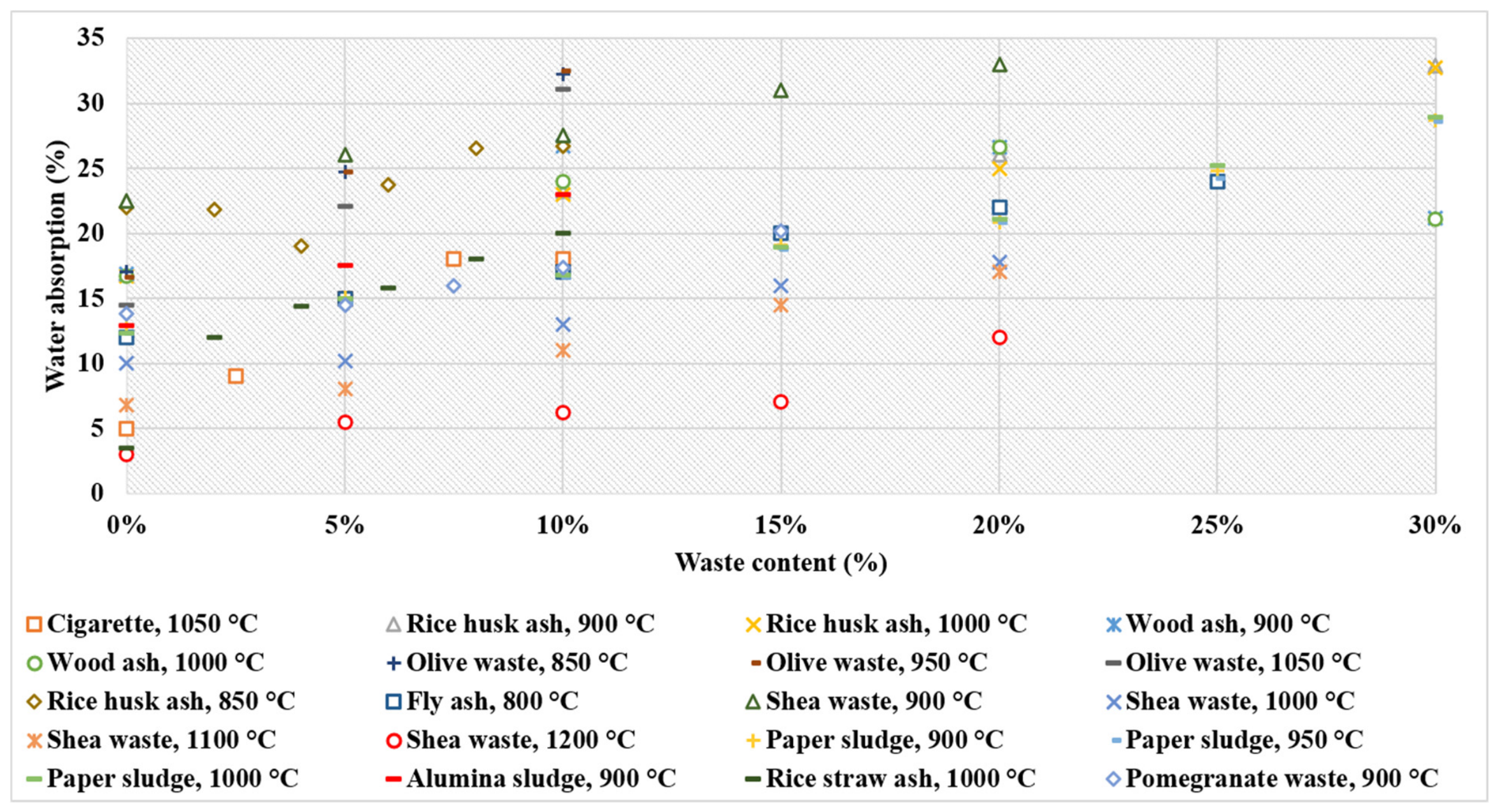
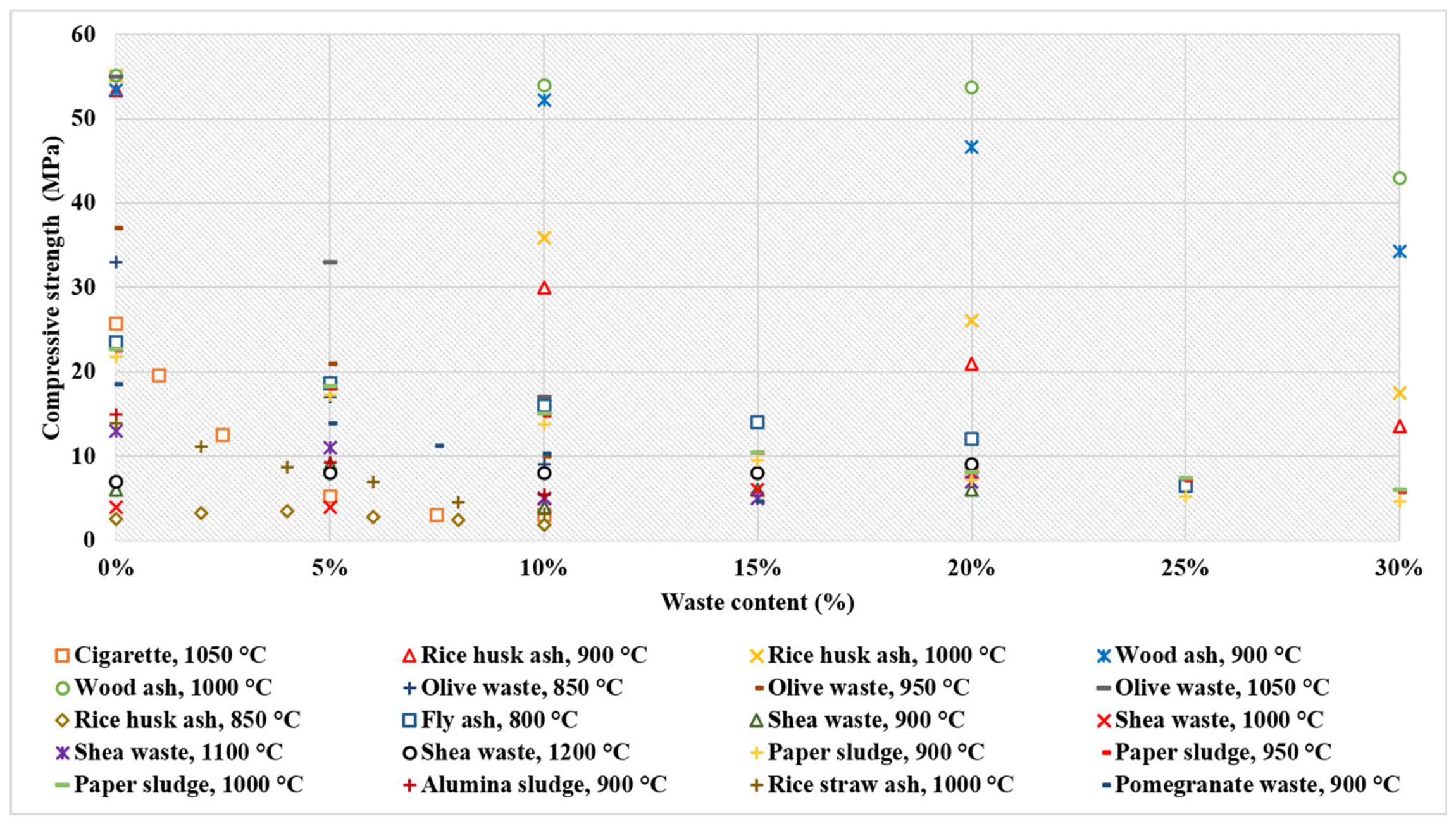
| [65] | Cigarette butts, 1050 °C | 2118–1482 | – | 5–18 | 25.65–3 | 2.79–1.24 | 1.08–0.45 | – |
| [66] | Activated alumina sludge, 900 °C | 1930–1690 | 31.9–40.6 | 12.92–23 | 18–5.4 | 3.2–1.5 | 0.26–0.19 | Nil |
| [67] | Rice husk ash, 900 °C | 1839–1394 | 31–45.5 | 16.9–32.9 | 53.4–13.5 | – | – | – |
| [67] | Rice husk ash, 1000 °C | 1865–1395 | 30–44.9 | 16.7–32.7 | 55.1–17.5 | – | 1.05–0.68 | – |
| [67] | Wood ash, 900 °C | 1839–1693 | 31–36.48 | 16.9–26.7–21.2 | 53.4–34.3 | – | – | – |
| [67] | Wood ash, 1000 °C | 1865–1708 | 30–34.5 | 16.7–26.6–21.1 | 55.1–43 | – | 1.05–0.753 | – |
| [68] | Olive mill waste, 850 °C | 1840–1450 | 31.4–46.7 | 17–32.2 | 33–9 | – | 0.595–0.462 | – |
| [68] | Olive mill waste, 950 °C | 1860–1450 | 30.8–47.0 | 16.6–32.5 | 37–10 | – | 0.638–0.436 | – |
| [68] | Olive mill waste, 1050 °C | 1920–1490 | 27.8–44.9 | 14.5–31.1 | 55–17 | – | 0.690–0.477 | – |
| [69] | Rice husk ash, 850 °C | 1421–1207 | – | 19–26.7 | 3.52–1.9 | – | – | – |
| [70] | Waste fly ash, 800 °C | – | – | 12–24 | 23.5–6.5 | 6–3 | – | Slight |
| [71] | Spent shea waste, 900 °C | 1610–1210 | 36–55 | 22.5–33 | 6–9/6 | – | – | – |
| [71] | Spent shea waste, 1000 °C | 1780–1590 | 19–51 | 10–17.8 | 4–8 | – | – | – |
| [71] | Spent shea waste, 1100 °C | 1770–1570 | 12–46 | 6.8–17 | 13–5/8 | – | – | – |
| [71] | Spent shea waste, 1200 °C | 2010–1652 | 10–41 | 3–12 | 7–9 | – | – | – |
| [72] | Paper mill sludge, 900 °C | 1771–1219 | 33.61–49.42 | 12.8–28.64 | 21.8–4.68 | – | 0.540–0.242 | Moderate |
| [72] | Paper mill sludge, 950 °C | 1821–1302 | 33.12–49.05 | 12.34–28.57 | 22.55–5.82 | – | 0.551–0.245 | Moderate |
| [72] | Paper mill sludge, 1000 °C | 1824–1309 | 32.84–48.28 | 12.36–28.92 | 22.7–6.07 | – | 0.555–0.245 | Moderate |
| [73] | Pomegranate peel waste, 900 °C | 1870–1348 | 13.5–19.8 | 13.8–20.2 | 18.5–4.6 | – | 0.72–0.25 | – |
| [74] | Rice straw ash, 1000 °C | – | – | 3.5–20 | 13.88–3.12 | – | – | – |
| Ref. | Type of Waste | Density (kg/m3) | Water Absorption (%) | Compressive Strength (MPa) | Tensile Strength (MPa) | Flexural Strength (MPa) or Modulus of Rupture (Pa) | Thermal Conductivity (W/m·K) | Efflorescence |
|---|---|---|---|---|---|---|---|---|
| [75] | Lithomargic Clay + GBFS + Cement | – | 13.9–12.51 | 1.61–5.55 | – | – | – | – |
| [75] | Lateritic soil + GBFS + Cement | – | 12.9–10.9 | 2.13–5.25 | – | – | – | – |
| [76] | Bagasse (red soil) | 1951–1808 | 8.1–15.7 | 2.15–2.7/1.52 | 0.26–0.30/0.275 | – | – | – |
| [76] | Coconut husk (red soil) | 1951–1795 | 8.1–14.8 | 2.15–3.0/1.6 | 0.26–0.32/0.27 | – | – | – |
| [76] | Oil palm fruit (red soil) | 1951–1823 | 8.1–13.6 | 2.15–3.1/1.6 | 0.26–0.35/0.31 | – | – | – |
| [76] | Bagasse (brown soil) | 1909–1790 | 8.5–16.5 | 1.65–2.1/1.15 | 0.24–0.28/0.255 | – | – | – |
| [76] | Coconut husk (brown soil) | 1909–1772 | 8.5–15.3 | 1.65–2.65/1.1 | 0.24–0.31/0.265 | – | – | – |
| [76] | Oil palm fruit (brown soil) | 1909–1802 | 8.5–14.3 | 1.65–2.55/1.15 | 0.24–0.34/0.27 | – | – | – |
| [77] | Banana fibre | 2041–1893 | 20–19 | 3.5–13.59 | 1.92–7.46 | 0.498–0.551 | – | – |
| [77] | Jute fibre | 2041–1751 | 20–17 | 3.5–18.04 | 1.92–9.89 | 0.498–0.611 | – | – |
| [77] | Alkali-resistant glass fibre | 2041–1811 | 20–12.9/13.1 | 3.5–6.87/4.86 | 1.92–3.99/3.01 | 0.498–0.626 | – | – |
| [77] | Polypropylene fibre | 2041–1710 | 20–6/8 | 3.5–9.91 | 1.92–5.44 | 0.498–0.678 | – | – |
| [78] | Straw fibres, 3 cm | 1952–1825 | – | 1.676–2.824/1.803 | – | 0.411–0.472/0.388 | 0.83–0.62 | – |
| [78] | Seagrass fibres, 3 cm | 1952–1913 | – | 1.676–2.64/2.496 | – | 0.411–0.502/0.363 | 0.83–0.71 | – |
| [79] | Fonio straw | – | – | 2.6–2.9/2.3 | – | 1.1–1.3/0.8 | 1.08–0.35 | – |
| [80] | Crushed brick waste | – | 8.41–10.52 | 8.2–9.57 | – | 2.19–2.65 | – | – |
| [81] | Rice husk ash | 1812–1560 | 16–15/23 | 3.3–4/2 | – | – | – | – |
| [82] | Sugarcane bagasse ash + 4% cement | – | 6.59–6.89 | 2.52–2.49/2.95 | – | – | – | Nil |
| [82] | Sugarcane bagasse ash + 10% cement | – | 5.84–6.95 | 5.42–5.85 | – | – | – | Nil |
| [83] | Flax | – | – | 4.4–4.5 | – | – | – | – |
| [83] | Hemp | – | – | 4.4–3.5/3.7 | – | – | – | – |
| [84] | GBFS + cement | 1880 | – | 7.36 | – | – | – | – |
| [84] | GBFS + Cement kiln dust + cement | 1900–1950 | 11–11.5 | 17.16–19.61 | – | – | – | – |
| [84] | GBFS + Quick lime + cement | 2000–2100 | 12–14.7 | 21.08–24.52 | – | – | – | – |
| Ref. | Type of Waste | Density (g/cm3) | Water Absorption (%) | Porosity | Compressive Strength (MPa) | Flexural Strength (MPa) | Thermal Conductivity (W/m·K) |
|---|---|---|---|---|---|---|---|
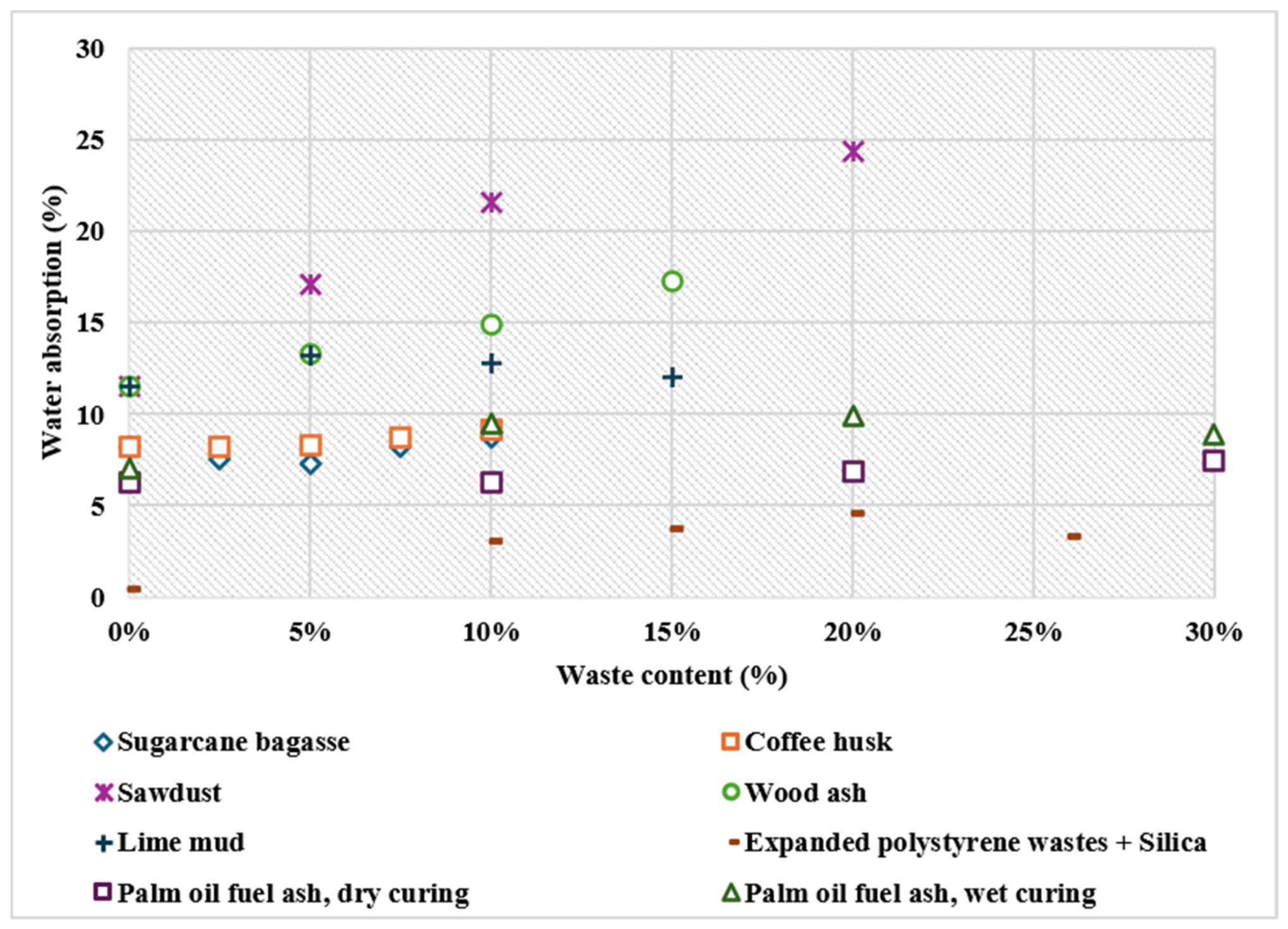
| [85] | Sugarcane bagasse | 2430–2110/2130 | 8.25–7.28/8.69 | – | 3.29–7.02/4.73 | – | 0.467–0.360/0.457 |
| [85] | Coffee husk | 2430–2020 | 8.25–9.18 | – | 3.29–5.92/4.88 | – | 0.467–0.434/0.489 |
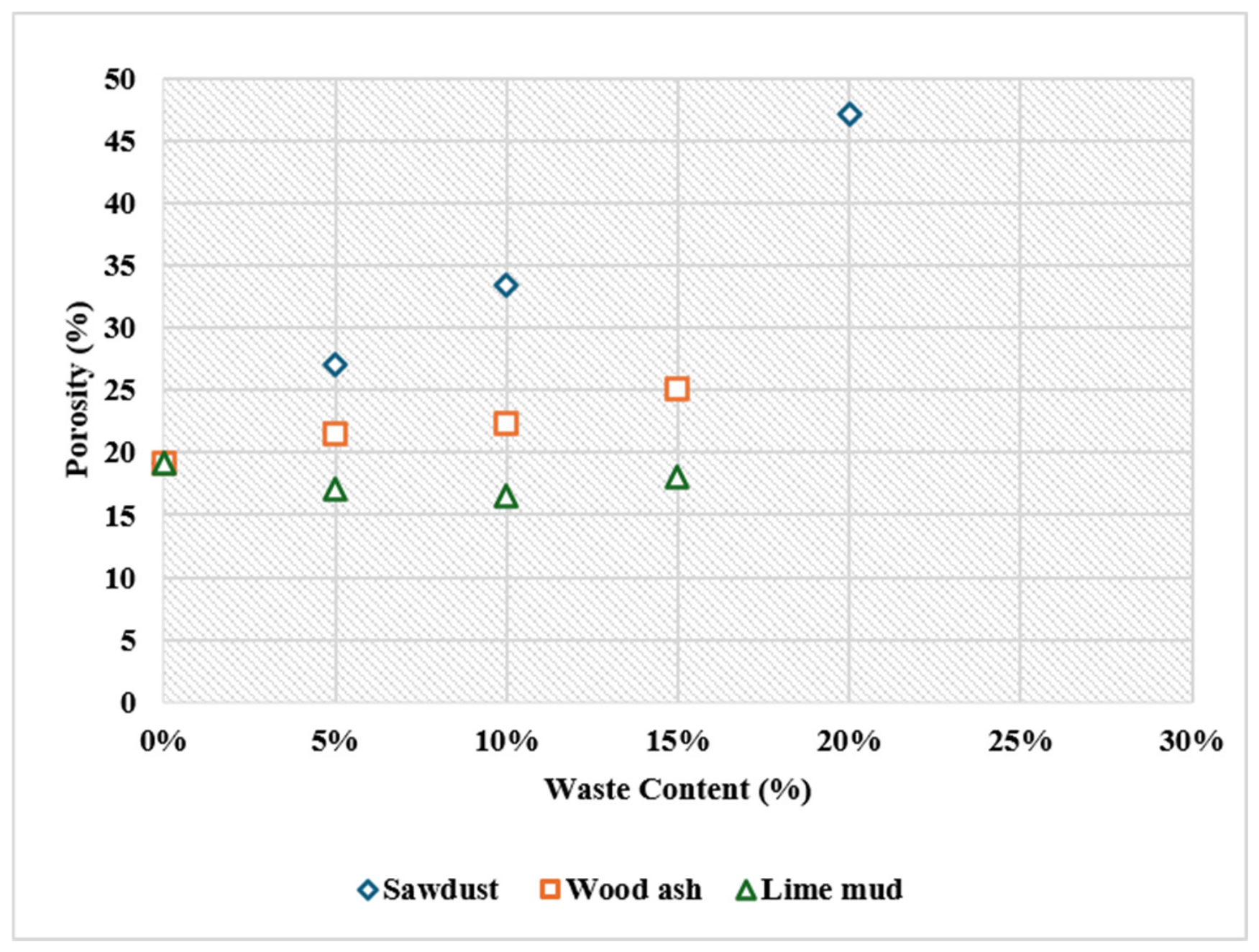
| [86] | Sawdust | 1960–1380 | 11.5–24.4 | 19.1–47.1 | 5.92–0.83 | – | 1.12–0.55 |
| [86] | Wood ash | 1960–1930 | 11.5–17.24 | 19.1–25.1 | 5.92–3.92/4.87 | – | 1.12–0.91 |
| [86] | Lime mud | 1960–2080/2010 | 11.5–13.2/12.02 | 19.1–16.5/18.1 | 5.92–7.56/7.29 | – | 1.12–1.13/1.12 |
| [29] | Expanded polystyrene wastes + silica fume | 2119–956 | 0.47–4.61/3.32 | – | 9.5–2.4 | – | – |
| [87] | Rice husk ash | – | – | – | 4.57–4.53/4.80 | – | – |
| [87] | Coconut fibre | – | – | – | 4.6–4.39/4.89 | – | – |
| [88] | Rice husk ash | 1799–1735/1784 | – | – | – | – | 0.55–0.46 |
| [89] | Palm oil fuel ash, dry curing | 1995–2043/2011 | 6.29–7.49 | – | 23.2–24.9/22.3 | – | – |
| [89] | Palm oil fuel ash, wet curing | 1981–2168/2129 | 6.04–9.91/8.85 | – | 24.9–28/24.8 | – | – |
| [90] | Coco pith | 2045–1895 | – | – | 3.9–4.2/2.9 | 1.55–2.21/1.81 | – |
| [91] | HDPE/LDPE/Crumb rubber | 2.091, 1.756, 1.912, 1.825 | 8.56, 7.73, 6.75, 8.12 | – | 6.33, 6.55, 4.99, 2.79 | – | 0.344, 0.342, –, 0.343 |
| [92] | 0, RW (5%), | 2186, 2069 | 6.54, 4.92 | – | 46.7, 29.97 | – | 1.655, 1.571 |
| MD (15%), | 2107 | 6.23 | – | 37.4 | – | 1.613 | |
| RG (20%), | 2125 | 3.84 | – | 41.82 | – | 1.477 | |
| CCA (25%), | 2071 | 9.16 | – | 30.45 | – | 1.352 | |
| FWA (5%), FGA (20%), CCA (25%), | 1733 | 12.91 | – | 32.7 | – | 0.793 | |
| MD (20%), FWA (10%), FGA (25%), AND CCA (30%) | 1654 | 13.78 | – | 21.35 | – | 0.723 | |
| MD (15%), FWA (5%), FGA (20%), CCA (25%) | 1756 | 10.18 | – | 13.75 | – | 1.001 | |
| MD (20%), FWA (10%), FGA (25%), and CCA (30%) | 1684 | 11.11 | – | 15.05 | – | 0.859 | |
| [93] | Recycled aggregate concrete + fine recycled concrete aggregates | 2215–1995 | 1.42–3.6 | – | 24.79–3.7 | 4.2–0.65 | – |
| Ref. | Waste Type | Waste Content/Condition | Key Leached Constituents (mg/L, Reported Range or Representative Value) | Regulatory Compliance/Trend |
|---|---|---|---|---|
| [65] | Cigarette butts | 0–10 wt.% in clay bricks | As: 0.007–0.123; Zn: 0.115–1.145; Cu: 0.155–0.295; Pb: 0.004–1.941; Ba: ~0.27–0.30; Cr: 0.003–0.008; Ni: 0.002–0.004 | All metals below typical TCLP limits; Pb, Zn show highest variability with CB content |
| [66] | Activated alumina sludge | 0%, 5%, 10% sludge in bricks | Al: 0.9–3.0; Fe: 0.4–0.8; Cu: ~0.20; Na: 773–1122; Ca: 18–70; SO42−: 22–169; F−: 0–1 | All measured values within standard limits; increasing sludge slightly increases sulphate, fluoride, and nitrate release |
| [67] | Rice husk ash & wood ash | Control vs. 30 wt.% | As: 0.022–0.153; Ba: 0.096–1.157; Cr: 0.115–0.554; Cu: 0.181–0.642; Ni: 0.007–0.088; Pb: 0.0001–0.0076; Zn: 0.004–0.058; Hg: ~0.00003–0.00007 | All elements comply with USEPA and Spanish limits; higher firing temperature improves immobilisation efficiency. |
| Ref. | Waste Type | Test Type | Key Quantitative Results | Main Observations/Interpretation |
|---|---|---|---|---|
| [76] | Oil palm, coconut, bagasse fibres | Wearing | Red Soil: 20–38% (wearing reduction); brown Soil: 47–50% | Coconut fibre showed highest performance; optimal at ~0.5 wt.% |
| Oil palm, coconut, bagasse fibres | Erosion (spray test) | Red Soil: 50–70%; brown Soil: 44–50% reduction | Strong improvement due to fibre network binding soil particles | |
| All fibres | Correlation analysis | r = 0.955–0.997 (wearing vs. erosion) | Very strong correlation → tests are interchangeable | |
| All fibres | Mechanical–durability correlation | Weak correlation | Strength/density not reliable durability predictors | |
| [77] | Jute fibre | Wearing (abrasion) | Up to ~95% reduction at 1% fibre | Best-performing natural fibre due to strong bonding |
| AR glass fibre | Wearing (abrasion) | ~39.2% reduction | Lowest abrasion resistance among fibres | |
| Jute fibre | Erosion resistance | ~50% reduction | High resistance to rainfall-induced degradation | |
| AR glass fibre | Erosion resistance | ~26% reduction | Limited erosion protection compared to natural fibres | |
| All fibres | General trend | Increasing fibre → decreasing wear/erosion | Performance improves with fibre dosage | |
| [79] | Fonio straw fibre | Spray erosion (2 bar, 10 min, 30° tilt) | High erosion (control) → low erosion (reinforced) | Fibre significantly improves water resistance |
| Fonio straw fibre | General durability trend | Weight loss decreases with fibre content | Improved cohesion reduces surface disintegration | |
| [80] | Crushed brick waste | Wet–dry cycles | Compressive strength: +37–47%; flexural: +1.13–1.42×; mass loss up to ~4.72% | Microstructural densification via hydration/pozzolanic reaction. Higher waste content increases shrinkage/swelling effects. |
| Crushed brick waste | Sulphate exposure (Na2SO4) | +29–35% strength increase | Ettringite/CSH formation improves durability | |
| [81] | Rice husk ash | Water spray erosion | 2.19–8.51 mm pitting depth | Within acceptable standards |
| Rice husk ash | Acid resistance (pH 3–5) | Severe damage at pH 3; mild at pH 5 | Acid attack on calcium phases causes cracking | |
| Rice husk ash | General trend | Higher RHA → reduced cracking | Pore filling improves resistance to acid damage |
| Ref. | Waste/System | Waste Content | Test Types | Key Numerical Results (Ranges) | Observations/Mechanism |
|---|---|---|---|---|---|
| [29] | EPS hollow blocks | 0–26% EPS | 5% H2SO4 cyclic ponding (4 cycles); sulphate/chloride ponding; salt precipitation; compressive strength loss | Water absorption: 0.47–4.61%; Acid cyclic weight loss: 0.28–47.43%; Salt solution absorption: 0.26–4.71%; Salt precipitation: 0.00–2.85%; Compressive strength loss: 6.1–47.4% | Increases porosity but improves chemical resistance by blocking transport pathways; however, strength becomes variable due to changes in pore structure. |
| [90] | Coco pith (cement-sand block) | 0–8% | Sorptivity, drying, wet–dry cycles, acid/salt/alkali exposure | Sorptivity: increases from baseline (good class ~0.77–1.94 mm/min½) to highest at 8%; Initial drying rate (D1): decreases at 4%, ~control at 6–8%; Second drying rate (D2): up to ~6.3% lower than control (8%); Drying index (Di): increases with content; Compressive strength loss (12 cycles): 25.5% (0%), 33.8–44.1% (4–8%); Acid strength loss (21 days): 6.4–13.1%; (42 days): 10.9–23.9% | Increases porosity and water uptake, reduces drying performance, and accelerates strength loss due to fibre–matrix debonding and acid-induced C–S–H degradation. |
| Ref. | Waste Material | Reported Optimum Material/Content | Optimum Property Achieved | Reason for Optimum Selection |
|---|---|---|---|---|
| [65] | Cigarette butt | 1% | 48 million tonnes of CBs could be recycled every year | Incorporating only 1% CB into bricks could recycle cigarette waste globally |
| [66] | Activated alumina sludge | 10% | Compressive strength 5.4 MPa; thermal conductivity 0.19 W/m·K; porosity 40.6%; density 1690 kg/m3 | Optimum because it achieved maximum sludge utilisation while maintaining sufficient strength for low-end structural applications and improving insulation performance. |
| [67] | Rice husk ash | 10 wt% at 1000 °C firing | Thermal conductivity 0.70 W/m·K; compressive strength 35.9 MPa | Selected because it achieved significant insulation improvement while maintaining acceptable mechanical properties; higher RHA levels increased porosity and reduced durability. |
| [67] | Wood ash | 20 wt% at 1000 °C firing | Compressive strength 53.7 MPa; thermal conductivity reduction ≈ 15% | Chosen as the best WA condition because it maintained mechanical strength close to conventional bricks while improving insulation and reducing clay consumption. |
| [68] | Olive mill waste | 10 wt% at 950 °C firing | Density 1450 kg/m3; thermal conductivity 0.436 W/m·K; compressive strength 10.26 MPa; porosity 47% | Optimum formulation because it provided the best balance between lightweight characteristics, thermal insulation, and sufficient structural strength. |
| [69] | Rice husk ash | 4 wt% | Compressive strength 3.55 MPa; water absorption 19%; temperature reduction ≈6 °C | Optimum due to improved silica-based bonding, maximum strength enhancement, acceptable durability, and improved thermal/acoustic performance. |
| [70] | Fly ash | 10% | Balanced compressive strength, durability, and weight reduction | Recommended as the practical optimum because it maintained construction suitability while reducing brick weight and improving sustainability. Higher FA levels reduced flexural strength and breaking load. |
| [72] | Paper mill sludge | 15% at 950 °C firing | Compressive strength 10.39 MPa; thermal conductivity 0.345 W/m·K; water absorption 18.77%; porosity 39.05% | Optimum because it achieved the required mechanical strength while providing significant thermal insulation, density reduction, and waste recycling benefits. |
| [74] | Rice straw ash | 2% | Compressive strength 11.10 MPa; brick weight 2.86 kg; water absorption < 15% | Optimum practical replacement because it maintained strength and durability close to conventional bricks while reducing weight and enabling agricultural waste recycling. |
| Ref. | Waste Material | Reported Optimum Material/Content | Optimum Property Achieved | Reason for Optimum Selection |
|---|---|---|---|---|
| [75] | Lithomargic clay + GBFS + cement blocks | 75% clay + 25% GBFS + 10% cement | 5.15 MPa dry strength, 3.63 MPa wet strength, 12.96% absorption | Provided the highest strength and acceptable water absorption through the combined effects of slag reaction and cement hydration, making it suitable for load-bearing masonry. |
| [75] | Lateritic soil + GBFS + cement blocks | 80% soil + 20% GBFS + 6% cement | 4.70 MPa dry strength, 3.61 MPa wet strength, 11.7% absorption | Achieved the required mechanical performance while reducing cement consumption owing to the favourable grading of lateritic soil. |
| [76] | Coconut, oil palm, bagasse | 0.5 wt.% | Maximum strength and durability improvement | Provided the greatest improvement in strength and durability while avoiding the increased porosity associated with higher fibre contents. |
| [77] | Jute fibre | 1% | Compressive strength 18.04 MPa; tensile strength 9.89 MPa; modulus of rupture 0.611 MPa | Delivered the greatest overall improvement in mechanical strength and durability through strong fibre–soil bonding and effective crack control. |
| [77] | Banana fibre | 1% | Compressive strength 13.59 MPa; tensile strength 7.46 MPa; modulus of rupture 0.551 MPa | Achieved substantial strength enhancement by improving fibre–soil interaction and limiting crack propagation. |
| [77] | Polypropylene fibre | 1% | Maximum energy absorption of 16.3 kNmm | Provided the highest energy absorption by improving ductility and post-failure crack bridging. |
| [77] | AR glass fibre | 0.75% | Optimum artificial fibre performance | Achieved the best reinforcement efficiency, whereas higher fibre contents caused fibre clustering and reduced performance. |
| [78] | Straw fibres | 0.5% | Compressive strength 2.824 MPa; thermal conductivity 0.755 W/m·K | Achieved the highest compressive strength by providing effective bonding and crack control without creating excessive voids. Produced the greatest thermal insulation by increasing internal porosity and reducing heat transfer. |
| [78] | Seagrass fibres | 1.5% | Compressive strength 2.672 MPa; thermal conductivity 0.73 W/m·K | Provided the best balance between mechanical strength and thermal insulation through improved fibre interlocking and stress transfer. |
| [79] | Fonio straw adobe (compressive performance) | 0.4 wt.% | Maximum compressive strength of 2.9 MPa | Produced the highest compressive strength by improving fibre dispersion, stress transfer, and matrix stability. |
| [80] | Crushed brick waste (CBW) stabilised CSEB | 24% | 9.57 MPa dry strength and 8.43 MPa wet strength | Provided the highest dry and wet strengths through pozzolanic reactions, improved particle packing, and filler effects. |
| [82] | Sugarcane bagasse ash (SBA) + cement soil blocks | 4% cement + 8% SBA | 2.95 MPa compressive strength; Class 30 requirement achieved | Achieved the required compressive strength while reducing cement content through the secondary cementitious reactions of SBA. |
| Ref. | Waste Material | Reported Optimum Material/Content | Optimum Property Achieved | Reason for Optimum Selection |
|---|---|---|---|---|
| [85] | Bagasse | 5% | Best balance of compressive strength, water absorption, density reduction, and thermal performance | 5% bagasse improved particle packing, crack bridging, matrix bonding, and insulation while avoiding excessive porosity and weak interfaces |
| [86] | Wood ash | 10% wood ash (structural)/10% (non-load bearing) 5% lime mud (strength) | Wood ash: acceptable load-bearing strength; Lime mud: maximum strength increase | Wood ash provided balance between strength and sustainability; lime mud improved hydration through CaCO3 and C-S-H formation. |
| [87] | Rice husk ash + coconut fibres | 15% | Highest strength: coconut fibre 4.99 MPa; rice husk 4.90 MPa | Optimum fibre content improved crack bridging, reinforcement efficiency, and pozzolanic contribution without excessive porosity |
| [88] | Rice husk ash | 15% | Lowest U-value (3.04 W/m2·K), conductivity (0.46 W/m·K), highest thermal resistance (0.33 m2·K/W) | Higher RHA increased pore volume and trapped insulating air, reducing heat transfer. |
| [89] | Palm oil fuel ash | 20% | Highest strength: 28 MPa soaked (+12.4%) | Optimum pozzolanic reaction improved hydration and matrix development; >20% caused poor packing. |
| [90] | Coco pith | 4% | Best strength, durability, cost, and environmental balance | Improved crack bridging (+8% compressive, +45% flexural strength) while limiting excessive absorption and porosity |
| [91] | HDPE, LDPE, rubber waste | 20% HDPE | Highest strength (6.55 MPa), lowest conductivity (0.322 W/m·K) | HDPE provided lightweight behaviour, good particle stability, and improved insulation while maintaining strength |
| [93] | Recycled concrete aggregate (RCA) | 1:21 C:A | Best sustainability: 55.36% CO2 reduction while meeting IS 2185 requirements | Provided maximum RCA replacement while maintaining acceptable load-bearing strength |
| Material System | Waste/Processing Category | Density (kg/m3) | Water Absorption (%) | Compressive Strength (MPa) | Thermal Conductivity (W/m.K) | Underlying Mechanism |
|---|---|---|---|---|---|---|
| Fired Brick | Agricultural waste incorporation (rice husk ash, sawdust, bagasse, fibres) | ↓ | ↑ | ↓ (optimum content may maintain strength) | ↓ | Organic components burn during firing, generating pores that reduce density and conductivity but weaken the ceramic matrix at high contents |
| Industrial waste incorporation (fly ash, sludge, ashes, brick waste) | ↔/↓ | Variable | Variable | ↓ | Mineral wastes influence packing, vitrification, and ceramic bonding; behaviour depends on chemical composition and firing conditions. | |
| Increased firing temperature | ↑ | ↓ | ↑ | ↔/slight ↑ | Higher temperature enhances sintering and densification, reducing pores and improving strength. | |
| Excessive waste replacement | ↓ | ↑ | ↓ | ↓ | Excessive pore formation disrupts matrix continuity and reduces mechanical performance. | |
| Unfired Brick | Agricultural fibres and residues | ↓ | ↑ | ↑ at optimum, ↓ at excessive content | ↓ | Fibres reduce density and improve crack resistance, but excessive additions increase voids and moisture sensitivity. |
| Industrial by-products (GBFS, CKD, slag, ashes) | ↔/↑ | ↓ | ↑ | Variable | Pozzolanic reactions and improved particle packing increase matrix strength | |
| Binder and stabiliser optimisation | ↑ | ↓ | ↑ | ↔ | Increased hydration and cementitious product formation improve densification. | |
| Compaction and curing optimisation | ↑ | ↓ | ↑ | ↔/↓ | Improved packing and hydration reduce pore connectivity. | |
| Concrete Blocks | Agricultural fibres and porous wastes | ↓ | ↑ | Variable (↑ at optimum, ↓ excessive) | ↓ | Low-density wastes improve insulation; fibre reinforcement may improve strength before porosity dominates |
| Industrial/mineral wastes | ↔/slight ↓ | Variable | Variable/↑ at optimum | ↓ | Reactive materials improve packing and secondary reactions, while inert wastes may increase defects. | |
| Recycled aggregates | ↓ | ↑ | ↓ at high replacement | ↓ | Weaker interfaces and increased porosity reduce mechanical performance. | |
| Processing optimisation | ↑ | ↓ | ↑ | ↔/↓ | Better curing and compaction improve matrix integrity. |
| Ref. | Type of Waste | Density (kg/m3) | Porosity (%) | Water Absorption (%) | Compressive Strength (MPa) | Flexural Strength (MPa) | Thermal Conductivity (W/m·K) | Shrinkage (%) | General Trend | Reasoning |
|---|---|---|---|---|---|---|---|---|---|---|
| [65] | Cigarette butts | ↓ | – | ↑ | ↓ | ↓ | ↓ | ↓Variable | Lightweighting and insulation improved, but strength decreased significantly at higher waste contents. | CB particles burn during firing, creating pores that reduce density and thermal conductivity but weaken the brick structure and increase water uptake. |
| [66] | Activated alumina sludge | ↓ | ↑ | ↑ | ↓ | ↓ | ↓ | – | Increased porosity and absorption with reduced mechanical performance. | Sludge decomposition constituents such as calcinate release gases and form internal pores; increased porosity lowers weight and conductivity but reduces mechanical strength. |
| [67] | Rice husk ash | ↓ | ↑ | ↑ | ↓ | – | ↓ | ↑ | Higher firing temperature improved strength retention, but porosity increased. | RHA initially improves bonding through reactive silica, but excessive addition creates pores and reduces strength; pores improve insulation. |
| [67] | Wood ash | ↓ | ↑ | ↑ | ↓ | – | ↓ | ↓ | Better shrinkage and mechanical stability than rice husk ash with moderate physical deterioration. | Ash particles promote pore formation and fluxing reactions; moderate levels maintain strength while decreasing insulation. |
| [68] | Olive mill waste | ↓ | ↑ | ↑ | ↓ | – | ↓ | – | Higher firing temperature improved overall performance and strength retention. | Organic waste burns out during firing, producing a porous lightweight structure with lower strength but improved thermal resistance. |
| [69] | Rice husk ash | ↓ | – | ↑ | ↓Variable | – | – | ↓ | Performance depended on replacement level; optimum behaviour observed at moderate content. | Fine RHA particles improve silica reactions at low contents, reducing pores and improving strength; excessive RHA increases porosity and absorption. |
| [70] | Waste fly ash | – | – | ↑ | ↓ | ↓ | – | – | Increased water absorption and reduced mechanical strength. | Lower-density ash replaces clay and increases pore formation; higher porosity reduces strength but improves insulation and reduces weight. |
| [71] | Spent shea waste | ↓ | ↑ | ↑ | ↑ Variable | – | – | ↑ | Strong dependence on firing temperature; properties improved at elevated temperatures while shrinkage increased. | Organic waste combustion creates voids, reducing density and improving insulation while weakening the ceramic matrix. |
| [72] | Paper mill sludge | ↓ | ↑ | ↑ | ↓ | – | ↓ | ↑ | Improved insulation but reduced strength with increased porosity and a small increase in shrinkage. | Organic sludge components burn away and generate pores, producing lighter bricks with improved insulation but lower strength. |
| [73] | Pomegranate peel waste | ↓ | ↑ | ↑ | ↓ | – | ↓ | – | Thermal insulation improvement with strength reduction. | PPW acts as a pore-forming agent during firing; increased pores lower density and conductivity but reduce mechanical performance. |
| [74] | Rice straw ash | – | – | ↑ | ↓ | – | – | – | Increased absorption and reduced compressive strength | Ash addition increases pore volume and reduces brick weight; excessive pores decrease strength and increase moisture absorption. |
| Ref. | Type of Waste | Density (Kg/m3) | Water Absorption (%) | Compressive Strength (MPa) | Tensile/Flexural Strength (MPa) | Thermal Conductivity (W/m·K) | Shrinkage (%) | General Trend | Reasoning |
|---|---|---|---|---|---|---|---|---|---|
| [75] | Lithomargic Clay + GBFS + Cement | – | ↓ | ↑ | – | – | – | Stabilisation reduced water absorption and improved compressive strength. | GBFS provided pozzolanic reaction and cement hydration products, increasing bonding and reducing pore connectivity. |
| [75] | Lateritic soil + GBFS + Cement | – | ↓ | ↑ | – | – | – | GBFS and cement addition improved bonding and reduced moisture uptake. | GBFS improved strength through particle bonding and pozzolanic reactions, while the naturally better-graded and sand-rich structure of lateritic soil provided higher initial strength and allowed effective stabilisation with lower cement demand. |
| [76] | Bagasse | ↓ | ↑ | ↑Variable | ↑ | – | ↓ | Fibre addition reduced density and increased absorption; improvement in compressive and tensile strength was observed. | Low-density fibres increased pore volume and water uptake, while fibre bridging improved strength. |
| [76] | Coconut husk | ↓ | ↑ | ↑Variable | ↑ | – | ↓ | Lightweight fibre increased pore volume but improved mechanical resistance at optimum content. | Porous fibres increased absorption, while rough fibre surfaces enhanced soil–fibre bonding. |
| [76] | Oil palm fruit | ↓ | ↑ | ↑Variable | ↑ | – | ↓ | Fibre incorporation reduced density while maintaining improved strength behaviour. | Fibre reinforcement reduced block density and improved crack resistance through bridging effects. But showed lower reinforcement efficiency than coconut and oil palm fibres because of weaker fibre–soil interaction and lower tensile contribution. |
| [77] | Banana fibre | ↓ | ↑ Variable | ↑ | ↑ | ↑ | ↓ | Fibre bridging improved compressive and tensile strength while increasing water absorption. | Natural fibre bridging restricted crack propagation and improved stress distribution. |
| [77] | Jute fibre | ↓ | ↑ Variable | ↑ | ↑ | ↑ | ↓ | Density reduction accompanied by mechanical improvement. | High tensile capacity and a rough surface provided strong fibre–soil bonding, crack resistance, and shrinkage resistance. |
| [77] | Alkali-resistant glass fibre | ↓ | ↓ Variable | ↑ Variable | ↑ Variable | ↑ | ↓ | Glass fibre reduced absorption and provided the lowest improved strength through reinforcement. | Non-porous fibres limited water penetration and showed limited strength improvement because fibre clumping reduced uniform distribution and weakened reinforcement efficiency. |
| [77] | Polypropylene fibre | ↓ | ↓ Variable | ↑ | ↑ | ↑ | ↓ | Strong reduction in density and absorption with improved mechanical performance. | Low-density fibres provided crack bridging and reduced pore water pathways and shrinkage. |
| [78] | Straw fibres, 3 cm | ↓ | – | ↑Variable | ↑Variable | ↓ | ↓ | Lightweight fibre improved flexural behaviour and reduced thermal conductivity. | Low-density fibres increased porosity, reducing heat transfer while controlling shrinkage cracks. |
| [78] | Seagrass fibres, 3 cm | ↓ | – | ↑Variable | ↑Variable | ↓ | ↓ | Slight density reduction with improved insulation and mechanical properties. | Flexible fibres improved interlocking and reduced thermal conductivity through increased internal pores. |
| [79] | Fonio straw | – | – | ↑Variable | ↑Variable | ↓ | – | Low fibre levels improved strength, while excessive addition reduced strength but enhanced insulation. | Optimum fibre dispersion enhanced bonding; excessive fibres caused clustering and increased porosity. |
| [80] | Crushed brick waste | – | ↑ | ↑ | ↑ | – | – | Waste aggregate improved strength through particle packing but slightly increased water absorption. | Brick particles improved packing and pozzolanic activity, while porous waste increased water uptake. |
| [81] | Rice husk ash | ↓ | ↑Variable | ↑Variable | – | – | – | Ash addition reduced density; moderate replacement improved strength before deterioration at higher content. | Silica-rich ash enhanced pozzolanic bonding, while high ash content increased porosity. |
| [82] | Sugarcane bagasse ash + 4% cement | – | ≈/↑ slight | ↑Variable | – | – | – | Limited strength change; absorption remained approximately stable or slightly increased. | Reactive silica from SBA improved secondary cementitious reactions and compensated for lower cement content. |
| [82] | Sugarcane bagasse ash + 10% cement | – | ≈/↑ slight | ↑Variable | – | – | – | Higher cement content enhanced strength through improved binder reaction. | Higher cement content reduced water absorption due to denser hydration products. Provided smaller strength benefits in 10% cement blocks because sufficient cement hydration products already controlled strength development |
| [83] | Flax | – | – | ↑ | – | – | – | Fibre addition slightly improved compressive strength. | Fibre reinforcement restricted deformation and delayed crack growth. |
| [83] | Hemp | – | – | ↓ | – | – | – | Strength depended on fibre content and interaction with the soil matrix. | Lower fibre strength and increased porosity reduced compression performance. |
| [84] | GBFS + Cement kiln dust + cement | ↑ | ≈/↑ slight | ↑ | – | – | – | Strong densification and high strength improvement due to combined hydraulic reactions. | CKD increased alkalinity, activating slag reactions and forming cementitious products. |
| [84] | GBFS + Quick lime + cement | ↑ | ↑ | ↑ | – | – | – | Highest density and compressive strength due to enhanced cementitious reactions, although water absorption increased. | Quicklime enhanced CSH/CASH formation, although excess calcium increased water absorption slightly. |
| Ref. | Type of Waste | Density (kg/m3) | Porosity (%) | Water Absorption (%) | Compressive Strength (MPa) | Flexural Strength (MPa) | Thermal Conductivity (W/m·K) | General Trend | Reasoning |
|---|---|---|---|---|---|---|---|---|---|
| [85] | Sugarcane bagasse | ↓ | ↓Variable | – | ↑Variable | – | ↓ | Lightweight addition reduced density and absorption while improving strength and thermal insulation at optimum content. | Low-density fibres reduce block weight; moderate addition improves packing, crack resistance and insulation, while excessive fibres increase pores, reduce hydration and weaken bonding. |
| [85] | Coffee husk | ↓ | ↑ | – | ↑ | – | ↓Variable | Density reduction and insulation improvement occurred, but excessive addition increased water uptake and reduced strength. | Higher extractive content inhibits cement hydration, increases void formation and weakens fibre–matrix interaction. Generally performed less effectively than sugarcane bagasse. |
| [86] | Sawdust | ↓ | ↑ | ↑ | ↓ | – | ↓ | Highly porous organic particles caused major density reduction, absorption increase, strength loss, and strong insulation improvement. | Porous wood particles replace sand, increasing air voids and reducing bonding; however, trapped air improves insulation. |
| [86] | Wood ash | ↓ | ↑ | ↑ | ↓ | – | ↓ | Ash addition slightly reduced density while increasing porosity and absorption with moderate strength reduction. | Ash particles have lower density and increase pores; excessive ash acts mainly as filler and reduces strength. |
| [86] | Lime mud | ↑Variable | ↑ | ↓ | ↑ | – | ≈ | Improved packing increased density and strength while maintaining stable thermal behaviour. | CaCO3 promotes hydration, C-S-H formation and pore refinement, improving strength and reducing permeability. Accelerating hydration reactions and producing additional cementitious compounds, resulting in a denser and stronger matrix |
| [29] | Expanded polystyrene wastes + silica fume | ↓ | ↑ | – | ↓ | – | – | EPS produced a major lightweight effect but reduced strength due to weak polymer–cement bonding. | EPS particles replace dense aggregates, reducing weight and conductivity but lowering stiffness and load capacity |
| [87] | Rice husk ash | – | – | – | ↑ slight | – | – | Pozzolanic activity slightly improved compressive strength. | Cellulose network and lignin improve crack bridging and bonding; excessive fibres increase moisture sensitivity and voids. |
| [87] | Coconut fibre | – | – | – | ↑ slight | – | – | Fibre reinforcement improved strength retention. | Fibres improve reinforcement and particle interaction; excessive replacement reduces aggregate stability. |
| [88] | Rice husk ash | ↓Variable | – | – | – | – | ↓ | Ash addition reduced density and improved thermal insulation. | Porous ash particles trap air and reduce heat transfer; increased pore volume improves insulation. |
| [89] | Palm oil fuel ash | ↑Variable | ↑Variable | – | ↑Variable | – | – | Moderate ash replacement improved strength, although water absorption increased. | Pozzolanic reaction improves strength at moderate replacement; excessive ash reduces particle packing and increases weak zones. Wet curing enhanced hydration and pozzolanic reactions, producing higher strength. |
| [90] | Coco pith | ↓ | – | – | ↑Variable | ↑Variable | – | Lightweight coco pith reduced density, while optimum addition improved compressive and flexural strength. | Moderate additions improved compressive and flexural strength through fibre crack-bridging and enhanced fibre–matrix interaction. In contrast, excessive contents increased porosity, fibre clustering, and weak bonding, resulting in lower strength and greater moisture sensitivity. |
| [91] | HDPE/LDPE/Crumb rubber | ↓ | ↓Variable | – | ↓ | – | ↓Slight | Rubber particles reduced density and improved insulation but weakened mechanical performance. | Plastic particles reduce water absorption but provide weaker mechanical interaction with cement. Hydrophobic rubber reduces cement adhesion, traps air and creates weak interfaces. |
| [92] | Mixed recycled construction wastes (silica fume, marble dust, fine glass, wood waste, and recycled aggregates) | ↓ | ↓ Or ↑ | – | ↓ | – | ↓ | Reduced density and provided variable behaviour on water absorption while lowering strength and conductivity. | Increasing waste content generally increased porosity and water absorption, which reduced compressive strength because of weaker particle–cement bonding and lower packing efficiency. Silica fume and fine glass helped offset these effects by refining the pore structure, improving matrix densification, and enhancing bonding, resulting in better mechanical performance and lower water absorption than other waste mixtures. |
| [93] | Recycled aggregate concrete + fine recycled concrete aggregates | ↓ | ↑ | – | ↓ | ↓ | – | Increasing recycled aggregate content significantly reduced compressive and flexural strength and increased water absorption. | High replacement of conventional materials reduces production cost and emissions but decreases mechanical performance due to lower cement content, weaker aggregate–cement bonding, and increased porosity. |
Disclaimer/Publisher’s Note: The statements, opinions and data contained in all publications are solely those of the individual author(s) and contributor(s) and not of MDPI and/or the editor(s). MDPI and/or the editor(s) disclaim responsibility for any injury to people or property resulting from any ideas, methods, instructions or products referred to in the content. |
© 2026 by the authors. Licensee MDPI, Basel, Switzerland. This article is an open access article distributed under the terms and conditions of the Creative Commons Attribution (CC BY) license.
Share and Cite
Jwaida, Z.; Sarno, L.D. Towards Eco-Friendly Construction: A Comprehensive Review of Agricultural and Industrial Waste in Sustainable Masonry Production. Buildings 2026, 16, 3331. https://doi.org/10.3390/buildings16163331
Jwaida Z, Sarno LD. Towards Eco-Friendly Construction: A Comprehensive Review of Agricultural and Industrial Waste in Sustainable Masonry Production. Buildings. 2026; 16(16):3331. https://doi.org/10.3390/buildings16163331
Chicago/Turabian StyleJwaida, Zahraa, and Luigi Di Sarno. 2026. "Towards Eco-Friendly Construction: A Comprehensive Review of Agricultural and Industrial Waste in Sustainable Masonry Production" Buildings 16, no. 16: 3331. https://doi.org/10.3390/buildings16163331
APA StyleJwaida, Z., & Sarno, L. D. (2026). Towards Eco-Friendly Construction: A Comprehensive Review of Agricultural and Industrial Waste in Sustainable Masonry Production. Buildings, 16(16), 3331. https://doi.org/10.3390/buildings16163331