Article

Developer–Homebuyer Priority Divergence in Low-Rise Terraced Housing: An Exploratory AHP Case Study of Changhua County, Taiwan

1
Graduate School of Engineering Science and Technology, National Yunlin University of Science and Technology, Douliu 640301, Taiwan
2
Department of Civil and Construction Engineering, National Yunlin University of Science and Technology, Douliu 640301, Taiwan
*
Author to whom correspondence should be addressed.
Buildings 2026, 16(14), 2769; https://doi.org/10.3390/buildings16142769

Submission received: 7 June 2026 / Revised: 9 July 2026 / Accepted: 10 July 2026 / Published: 12 July 2026
(This article belongs to the Section Architectural Design, Urban Science, and Real Estate)

Abstract

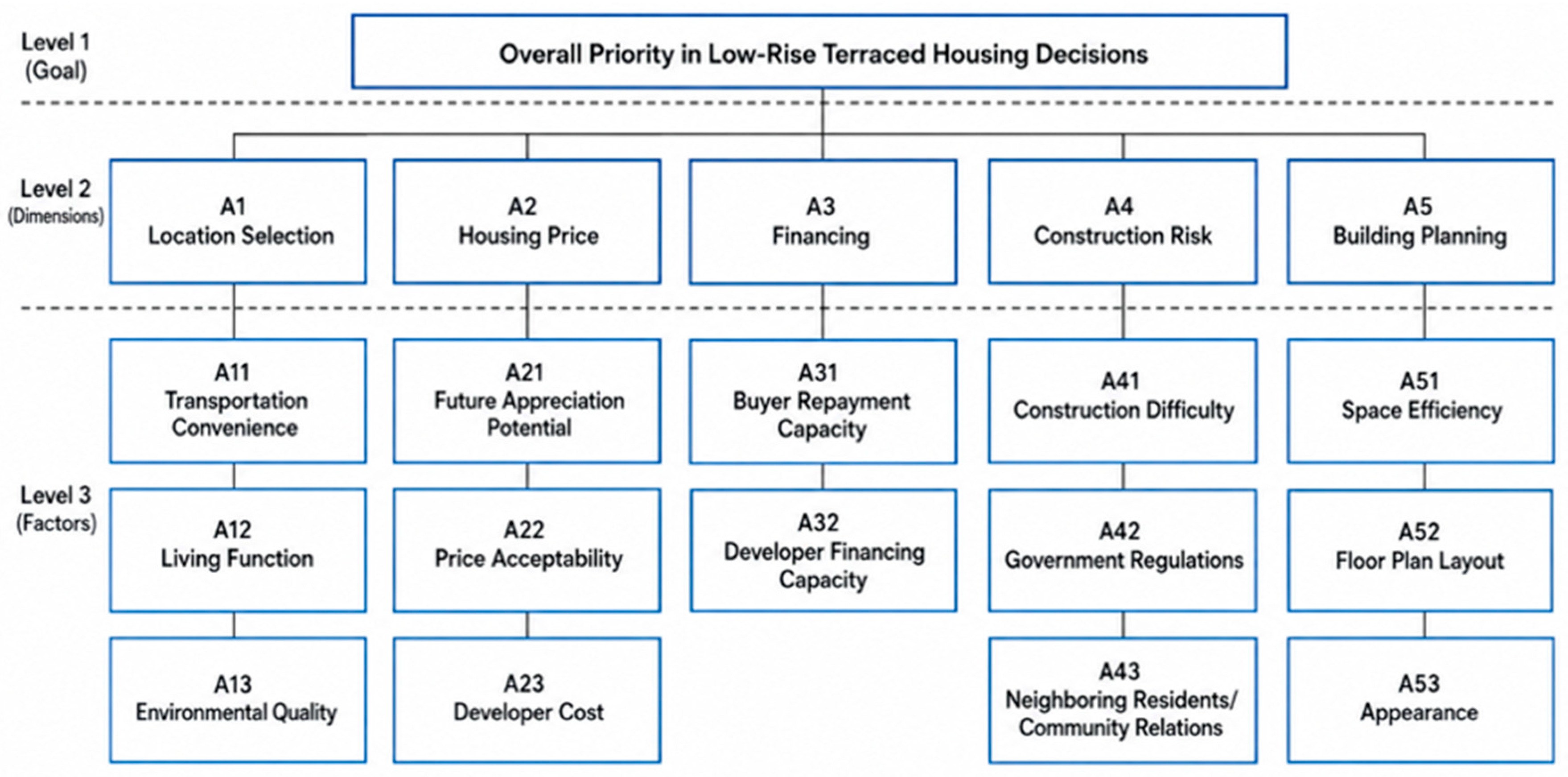
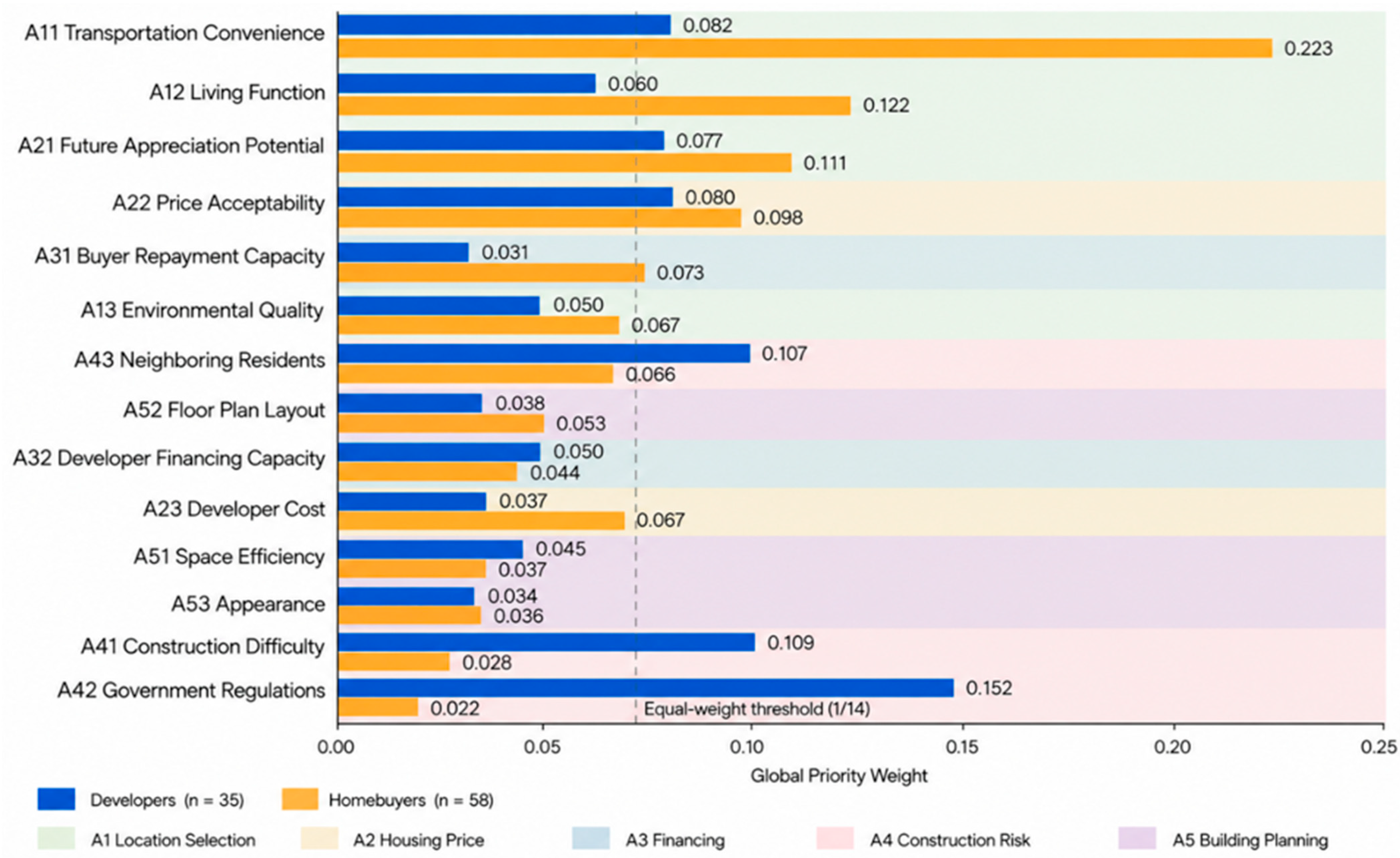
Low-rise terraced housing dominates residential construction in non-metropolitan Taiwan, yet empirical evidence on priority divergence between developers and homebuyers in such markets remains scarce. Using a case study of Changhua County, we applied the Analytic Hierarchy Process (AHP) to quantify priority structures of 35 construction managers and 58 homebuyers. Both groups evaluated an identical five-dimensional hierarchy encompassing fourteen directly surveyed factors across location selection, housing price, financing, construction risk, and building planning. Consistency ratios were 0.028 (developers) and 0.019 (homebuyers). The results indicate substantial differences in relative priorities. Developers prioritized Construction Risk (0.368), with Government Regulations (A42) ranking first globally (0.152). Homebuyers prioritized Location Selection (0.412), with Transportation Convenience (A11) ranking first (0.223). The Location Selection dimension gap (0.221 points) and Construction Risk gap (0.251 points) represent the largest divergences. Factor-level rank inversions are pronounced: Transportation Convenience ranks first for homebuyers but fifth for developers; Government Regulations ranks first for developers but fourteenth for homebuyers. The findings suggest that supply-side and demand-side stakeholders may place different emphasis on project feasibility and residential use, with implications for site selection, floor plan design, and buyer communication in regional markets.
Keywords: Analytic Hierarchy Process; low-rise terraced buildings; priority divergence; developer–homebuyer comparison; non-metropolitan housing; construction management; Taiwan Analytic Hierarchy Process; low-rise terraced buildings; priority divergence; developer–homebuyer comparison; non-metropolitan housing; construction management; Taiwan