1. Introduction
The construction of buildings and structures is increasingly shaped by digital technologies that are transforming how projects are designed, coordinated, monitored, and delivered. Building Information Modelling, digital twins, cyber–physical systems, robotics, IoT-based monitoring, artificial intelligence, and immersive simulation tools are now being promoted as pathways for improving productivity, safety, coordination, sustainability, and resilience in construction project delivery [
1]. However, the successful application of these technologies depends not only on their availability but also on the construction workforce’s readiness to use them effectively in real-world project environments. This creates a critical construction management problem. While digital tools are advancing rapidly, many construction workers, supervisors, technicians, and professionals, particularly in developing construction contexts, remain unevenly prepared for digitally enabled building and structure construction.
The transition from Industry 4.0 to Industry 5.0 has intensified this concern. Industry 4.0 largely emphasised automation, BIM-enabled coordination, cyber–physical systems, robotics, and real-time data analytics, whereas Industry 5.0 places stronger emphasis on human-centredness, resilience, sustainability, and collaborative intelligence [
2,
3]. In construction, this shift is especially important because the sector remains labour-intensive, fragmented, project-based, and exposed to persistent challenges in productivity, safety, coordination, and skills [
4,
5]. Industry 5.0 therefore presents an opportunity to rethink construction work by promoting productive interaction between skilled workers and intelligent technologies such as cobots, AI-supported decision tools, digital twins, IoT interfaces, and immersive simulation platforms [
4,
5]. Yet this opportunity can only be realised if the workforce is capable of interpreting digital information, operating within hybrid human–machine environments, applying contextual judgement, and developing the adaptive capabilities required for sustainable project delivery [
6,
7].
Despite growing interest in digital transformation in construction, the human capability dimension remains insufficiently addressed. Existing studies have focused mainly on technology adoption, digital systems, and construction automation, while giving less attention to how workers can be systematically trained, supported, and integrated into human-centred digital construction environments [
8,
9]. This gap is particularly important because the challenges affecting digital readiness are not limited to access to technology. They also include low digital literacy, limited BIM competence, weak data interpretation skills, fragmented training systems, skill mismatches, generational divides, resistance to digital tools, and inadequate organisational support [
10,
11]. These challenges make it difficult for construction organisations to translate digital investment into improved building project performance, especially where training systems and continuous professional development structures remain underdeveloped [
12].
The problem addressed in this article is therefore the mismatch between the growing digitalisation of building and structure construction and the limited readiness of the construction workforce to participate effectively in Construction 5.0. This problem falls within the scope of Buildings because it concerns construction management, digitalisation in construction, workforce capability, and the delivery of resilient and sustainable building projects. In practical terms, the article addresses how construction professionals and site-based workers can be prepared to function effectively in digitally transforming construction environments where human expertise must work alongside intelligent systems. This emphasis is consistent with the Industry 5.0 vision, which requires training strategies that integrate human wellbeing, cognitive augmentation, collaborative efficiency, and inclusive workforce development [
13,
14].
Anchored in human–technology interaction theory and the evolving Industry 4.0- Industry 5.0 continuum, this study examines workforce readiness for Construction 5.0 in the Sub-Saharan African construction context. Specifically, the study seeks to assess the current level of digital competence and readiness among construction professionals; identify the digital and organisational skill gaps that are limiting the Construction 5.0 transition; examine appropriate upskilling and reskilling strategies; and explore how human–machine collaboration can be integrated into construction workforce development. Based on these objectives, the study proposes a human-centred upskilling framework to support inclusive, resilient, and digitally enabled construction practice. The contribution of the article lies in shifting the discussion from technology adoption alone to the human capacity required to make digital transformation meaningful in building and structure construction.
The remainder of this paper is structured into four key sections. The first provides a comprehensive literature review that establishes the study’s theoretical and empirical underpinnings. The second details the research design and methodological approach, followed by the presentation and discussion of the findings. The third section highlights the study’s implications for policy, practice, and future research, while the final section presents the conclusions.
2. Literature Review
Preparing the construction workforce for Industry 5.0 demands a deeper understanding of how digital transformation is reshaping skills, work processes, and human–technology interactions. While earlier industrial shifts emphasised automation and productivity, Industry 5.0 places equal value on human creativity, decision-making, and collaboration with intelligent systems. This transformation introduces new expectations for digital literacy, adaptive learning, and multidisciplinary competence across all levels of the construction sector. However, persistent skill gaps, ageing labour profiles, and limited access to advanced training continue to challenge workforce readiness. Exploring these dynamics provides a foundation for identifying effective upskilling strategies in a rapidly evolving digital era.
Human–technology interaction theory provides a useful theoretical lens for explaining workforce readiness for Industry 5.0 in construction. The theory assumes that the relationship between users, systems, task demands, organisational context and perceived value shapes successful technology use. Technology acceptance and human–computer interaction studies argue that adoption depends not only on technical functionality, but also on usability, perceived usefulness, confidence, learning support and the fit between technology and work practices [
15]. Within Industry 5.0, this interaction becomes more important because intelligent technologies are expected to augment rather than replace human judgement, creativity, and contextual decision-making [
16]. In construction, BIM, digital twins, AI-supported tools, sensors, cobots, and immersive simulations require workers who can interpret digital information, collaborate with intelligent systems, and apply human judgement to site realities [
17]. Human–technology interaction theory can therefore be operationalised through four constructs: digital readiness, skill capability, human–machine collaboration, and organisational learning support. These constructs clarify why low digital literacy, limited BIM competence, fear of displacement and weak training systems constrain Construction 5.0 readiness. They also explain why practical, role-specific, and continuous professional development is necessary for upskilling. From this theoretical perspective, workforce transformation is not merely a process of introducing advanced technologies but a socio-technical process that requires competence, trust, inclusion, adaptability, and learning environments.
2.1. The Evolution from Industry 4.0 to Industry 5.0 in Construction
The transition from Industry 4.0 to Industry 5.0 marks a fundamental shift in how digital transformation is conceptualised within the construction sector [
2]. Industry 4.0 is widely framed as a technology-driven revolution anchored in cyber–physical systems, real-time data analytics, autonomous robotics, and interconnected production networks. Its primary aim is to enhance productivity, efficiency, and flexibility through automation and smart systems integration. As highlighted by [
2], Industry 4.0 embodies a technology-centric model in which intelligence and communication capabilities enable decentralised decision-making and optimised production flows. In construction, this paradigm underpinned advancements such as Building Information Modelling (BIM), sensor-enabled monitoring, robotic prefabrication, and AI-supported project management [
18].
Industry 5.0 extends this trajectory by re-centring the human within digital ecosystems [
2]. Defined as a value-driven, human-centric, sustainable, and resilient industrial paradigm, it aims to balance technological capabilities with societal well-being [
13]. Rather than pursuing automation for its own sake, Industry 5.0 emphasises human–machine collaboration, in which skilled workers interact symbiotically with advanced robotics, exoskeletons, cobots, and AI decision-support tools [
5]. Ref. [
2] notes that this shift reflects a broader recognition that technological transformation must align with social fairness, worker autonomy, and environmental limits. For construction, which historically faces safety risks, productivity constraints, and skill shortages, Industry 5.0 signals a more inclusive model in which human expertise is enhanced rather than displaced.
The combined influence of automation, robotics, and AI is reshaping construction by enabling precision, reducing hazardous tasks, and supporting real-time, adaptive operations. However, the hallmark of Industry 5.0 is its emphasis on cognitive augmentation and collaborative intelligence. Human workers remain decision-makers, while machines provide computational strength, situational awareness, and operational consistency [
3].
Policy directions increasingly reflect this integrated vision. Digital transformation strategies in the EU, UK, and Asia now embed human-centricity, lifelong learning, and sustainability as core pillars, encouraging construction industries to develop upskilling pathways, strengthen digital competencies, and adopt ethical AI practices [
19]. These policy shifts underscore that Industry 5.0 is not a replacement for Industry 4.0 but an evolution that aligns technological innovation with societal goals and is an imperative for preparing the construction workforce for a rapidly digitalising future.
2.2. Workforce Challenges and Skills Gaps in the Digital Era
The transition toward Industry 5.0 is intensifying debates about the critical workforce challenges emerging within the construction sector. Empirical studies consistently highlight widening shortages in digital, cognitive, and technical competencies essential for operating cyber–physical systems, BIM-integrated workflows, robotic equipment, and data-driven decision tools [
4,
9]. These shortages arise partly because traditional construction labour profiles were not historically trained for advanced ICT functions, real-time data analytics, or human–machine collaboration. Evidence from recent digital transformation studies further reveals weak digital literacy, limited exposure to automation tools, and fragmented upskilling pathways as major barriers to effective technology adoption [
8]. The persistence of these gaps has reinforced concerns that the construction sector remains among the least prepared for Industry 5.0, in which workers must blend technical proficiency with higher-order cognitive abilities such as complex problem-solving, systems thinking, creativity, and adaptive reasoning [
2]. Scholars also argue that the shift toward sustainable, resilient, and human-centric construction environments amplifies the need for hybrid skill sets in which digital fluency integrates with environmental literacy and collaborative intelligence [
7].
Compounding these skill shortages is the challenge posed by an ageing workforce and historically slow technology adoption. Several studies show that older construction workers often exhibit lower readiness to transition toward digital tools due to entrenched craft-based routines, discomfort with automation, or misperceptions that digital systems create additional workload burdens [
10,
20]. This demographic dynamic not only widens generational skill divides but also jeopardises knowledge transfer, as experienced workers retire before digital competencies are institutionalised. The consistently stressed Continuous Professional Development (CPD) is the most effective mitigation pathway [
12]. CPD structures that blend experiential learning, simulation-based training, micro-credentialing, and lifelong learning frameworks enable construction workers to continuously adapt their competencies to evolving technological demands [
21]. Furthermore, CPD is essential for cultivating digital mindsets, reducing resistance to change, and building organisational cultures that support sustained digital transformation [
22].
As Industry 5.0 emphasises human–technology symbiosis, personalised learning, and inclusive workforce development, strengthening CPD systems is central to preparing the construction workforce for a digitally intensive future in which continuous learning underpins productivity, safety, and innovation.
2.3. Strategies for Upskilling the Construction Workforce
Preparing the construction workforce for Industry 5.0 requires an integrated upskilling approach that strengthens digital competence, enhances collaborative training ecosystems, and aligns policy frameworks with human-centric technological transitions [
23]. Digital literacy programmes and blended learning models remain foundational, as construction processes increasingly rely on BIM, digital twins, IoT, AI-assisted tools, and integrated data platforms [
24]. In developing construction economies, this readiness gap is further shaped by the tension between technological leapfrogging and institutional voids, in which the availability of advanced digital tools does not always translate into effective use due to weak skills systems, fragmented industry–university–government collaboration, limited infrastructure, and inadequate institutional support. Research on digital transformation in developing countries shows that systematic digital capacity building significantly improves workers’ ability to interpret multidimensional data models and coordinate tasks across project life cycles [
11]. Similarly, blended learning that combines virtual simulations, on-site competency demonstrations, and problem-based modules supports the progressive acquisition of skills among workers with varying levels of digital readiness [
25].
University, industry, and government partnerships form a second crucial driver of workforce readiness [
26]. Strong tripartite collaborations address persistent skill gaps by aligning educational programmes with emerging industrial needs. Ref. [
6] emphasises that Industry 5.0 demands competencies that extend beyond technical know-how to include creativity, socio-technical adaptability, collaborative problem-solving, and ethical reasoning. Universities contribute research-led curricula, industry partners supply real-world technological applications, while governments establish enabling policies, accreditation standards, and incentives that expand access to digital upskilling opportunities [
27]. These partnerships are particularly critical in emerging economies where skills mismatches and structural constraints hinder technology adoption [
28].
Incorporating human–machine collaboration within training frameworks is also central to Industry 5.0. The paradigm shifts from automation-driven processes toward collaborative robotics (cobots), AI-supported decision systems, and immersive training platforms [
14]. Human–machine collaboration requires workers who can operate intelligent systems while applying human judgment, creativity, and contextual reasoning capabilities that machines cannot replicate [
29]. Ref. [
6] stresses that such hybrid environments demand enhanced soft skills, emotional intelligence, and technological literacy, enabling workers to function productively alongside intelligent systems. Training regimes incorporating AR/VR simulations, real-time sensor interfaces, and BIM-integrated safety training have been shown to improve cognitive engagement and operational confidence [
30].
Finally, sustainable workforce transition relies on supportive policy frameworks that incentivise digital adoption, subsidise continuous professional development, and reduce structural inequalities. Policy interventions are essential for SMEs that dominate many developing-country construction sectors, where costs, limited expertise, and infrastructure gaps constrain digital adoption. Ref. [
11] highlights that without coherent policy–industry alignment, digital transformation efforts risk widening workforce disparities and slowing national competitiveness. In Industry 5.0, policies must therefore foreground human-centric values, social stability, green transition goals, and long-term resilience to ensure inclusive and sustainable upskilling trajectories.
2.4. Technological Leapfrogging, Institutional Voids and Workforce Readiness in Developing Construction Economies
The developing-country context is important to this study because digital transformation in construction does not occur under the same institutional, technological, and organisational conditions across all economies. One useful theoretical lens for understanding this context is technological leapfrogging. Technological leapfrogging refers to the possibility that developing countries may bypass earlier stages of technological development by adopting newer, more advanced technologies already available in global markets [
31]. In construction, this suggests that firms in developing economies may not need to follow the same gradual digitalisation pathway as those in advanced economies [
32]. They may move directly from manual or semi-digital practices toward BIM-enabled coordination, mobile project reporting, drone-based monitoring, AI-supported planning, digital twins, and other Construction 5.0 technologies.
The concept applies to Construction 5.0 because many digital tools are now more accessible through cloud platforms, mobile devices, open-source systems, and commercially available software [
33]. This creates opportunities for developing construction economies to accelerate digital adoption, improve site coordination, reduce documentation errors, support safety monitoring, and enhance project delivery without necessarily passing through every previous stage of industrial digitalisation. However, leapfrogging should not be interpreted as a simple transfer of technology from advanced to developing economies. Its effectiveness depends on absorptive capacity, which includes the ability of firms, workers, and institutions to understand, adapt, use, maintain, and improve imported or externally developed technologies [
34,
35]. Without adequate skills, organisational learning, digital infrastructure, and supportive policies, leapfrogging may produce superficial technology adoption rather than meaningful transformation.
This limitation is particularly relevant to construction, where production is project-based, fragmented, labour-intensive, and dependent on temporary networks of contractors, consultants, suppliers, supervisors, and artisans. Even where digital technologies are available, their use may remain uneven because firms differ in financial capacity, workers differ in digital literacy, and project teams differ in exposure to formal digital systems [
36]. Therefore, the challenge in developing construction economies is not only the acquisition of Construction 5.0 technologies, but also the development of the human and institutional capabilities required to use them productively. This explains why workforce upskilling, continuous professional development, and role-specific training are central to Construction 5.0 readiness.
A second theoretical lens is the concept of institutional voids. Institutional voids refer to weak, absent, or inefficient market-supporting institutions that normally enable firms, universities, governments, and professionals to coordinate economic and technological activities [
37]. In developing economies, such voids may include weak regulatory enforcement, limited digital standards, inadequate technology transfer systems, low trust between academia and industry, poor access to finance, weak intellectual property systems, underdeveloped innovation intermediaries, limited capacity for research commercialisation, and discontinuous policy support [
38]. These institutional weaknesses make Industry–University–Research collaboration more difficult because the actors needed to support the Construction 5.0 transition often operate within fragmented, poorly coordinated systems.
In theory, Industry–University–Research collaboration, also understood through the Triple Helix logic of university–industry–government interaction, should support digital workforce development by aligning academic training, industry needs, applied research, professional certification, and public policy incentives [
39]. In practice, however, developing countries often face greater barriers to such collaboration, including limited university research funding, weak industry demand for applied research, low firm absorptive capacity, informal professional networks, limited access to laboratories and digital infrastructure, and a mismatch between academic curricula and industry practice [
40]. As a result, collaboration is often informal, short-term, and dependent on personal networks rather than institutionalised systems.
The relevance of institutional voids to this study lies in their explanation of why Construction 5.0 readiness cannot be achieved through firm-level training alone. It requires coordinated action among construction firms, universities, technical institutions, professional bodies, government agencies, and technology providers. In the absence of strong institutional support, technological leapfrogging may widen inequalities among digitally capable firms and less-resourced firms, among design professionals and site-based workers, and between younger, digitally exposed workers and older workers with limited access to digital training. Therefore, the developing-country context is not merely a geographical background in this study. It is a theoretical condition that shapes the possibility, pace, and inclusiveness of the Construction 5.0 transition.
3. Methodology
This study adopted a qualitative research approach to explore digital competence, workforce readiness, skill gaps, and upskilling strategies required for the transition towards Industry 5.0 in the construction sector. A qualitative approach was considered appropriate because the study sought to obtain an in-depth understanding of participants’ experiences, perceptions, and professional interpretations of digital transformation, organisational preparedness, and human–machine collaboration in construction practice. Since workforce transformation involves behavioural, institutional, technological, and practice-based realities, qualitative inquiry provided an appropriate means of capturing detailed meanings and context-specific perspectives that could not be adequately explained through numerical data alone.
Focus group discussions were used as the main data collection method. This method was selected because it allows participants with related professional backgrounds to interact, reflect collectively, and discuss shared issues in detail. Focus groups were particularly suitable for this study because the transition to Industry 5.0 in construction involves not only technology adoption but also skills development, worker confidence, organisational culture, training support, leadership commitment, and readiness for change. Through group interaction, participants discussed their current use of digital tools, perceived competence levels, barriers to adoption, professional training needs, and the support required for effective workforce development in a rapidly changing construction environment.
Participants were recruited using purposive and snowball sampling techniques. Purposive sampling was first used to identify construction professionals with relevant knowledge and practical experience in construction project delivery, site operations, design coordination, supervision, cost management, project management, and digital technology. The selection criteria required participants to be construction-related professionals, have practical experience in the construction industry, be familiar with at least one digital tool or technology used in construction practice, and be willing to participate in a group discussion. Professionals who had no direct experience in construction project activities or who could not provide informed views on digital readiness and workforce development were excluded. Snowball sampling was subsequently used to reach additional participants through referrals from the initial respondents. This combined approach enabled the study to engage information-rich participants who could provide detailed and relevant insights into digital readiness, skill gaps, upskilling needs, and Industry 5.0-related workforce issues.
The study involved 32 participants organised into six focus groups across Kumasi and Accra. These two cities were selected because they are major centres of construction activity in Ghana and provide access to construction professionals with different levels of exposure to contemporary construction technologies. The participants comprised construction professionals, including quantity surveyors, architects, civil engineers, construction managers, site supervisors, project managers, and building technologists. Their years of professional experience ranged from early-career to highly experienced practitioners, allowing the study to capture diverse views across different stages of professional development. This diversity was important because digital readiness and upskilling needs may vary by role, experience, job responsibilities, and exposure to technology-based construction practices.
The focus groups were coded as K1, K2, and K3 for Kumasi and A1, A2, and A3 for Accra. Each focus group consisted of five to six participants, which was considered manageable for effective moderation, balanced participation, and in-depth discussion. The sample included 22 males and 10 females. The age range was 25 to 51 years, enabling the study to capture both younger professionals, who may have greater exposure to emerging digital tools, and older professionals, who may have broader practical and managerial experience. Each focus group discussion lasted approximately 60 to 90 min, depending on the level of interaction and depth of responses. The composition of the focus groups is presented in
Table 1.
Data were collected using a semi-structured focus group discussion guide developed from the study objectives. The guide covered four major areas: digital competence and workforce readiness; skill gaps and barriers affecting the transition to Industry 5.0; training, reskilling, and continuous professional development needs; and workforce development in relation to human–machine collaboration. The semi-structured format allowed the researcher to maintain consistency across the focus groups while also creating room for probing, clarification, and deeper discussion of emerging issues. The researcher moderated each session and encouraged open participation, balanced contribution, and respectful interaction among participants.
Before each discussion, participants were informed of the study’s purpose, the voluntary nature of participation, and their right to withdraw at any stage. They were also assured that their identities would remain confidential and that the data would be used solely for academic research purposes. With participants’ consent, the discussions were audio-recorded, and field notes were taken to capture non-verbal cues, group dynamics, and key contextual observations that supported data interpretation.
The audio recordings were transcribed verbatim using Microsoft Word 2024 (Microsoft Corporation, Redmond, WA, USA) and analysed using thematic analysis. The analysis followed a systematic process involving familiarisation with the data, initial coding, categorisation of related codes, theme development, review of themes, and interpretation of findings. Codes were generated from recurring statements and patterns across the focus group transcripts. Similar codes were grouped into categories, and broader themes were developed in line with the study objectives. The final themes reflected the major issues emerging from the data, including digital competence and readiness, skill gaps affecting Industry 5.0 transition, upskilling and reskilling strategies, and human–machine collaboration in construction practice.
Data saturation was considered during data collection and analysis. Saturation was reached when additional focus group discussions no longer produced substantially new themes, insights, or categories relevant to the study objectives. By the fifth and sixth focus groups, recurring patterns emerged across participants’ responses, particularly uneven digital competence, limited practical training, organisational barriers, and the need for structured upskilling. This indicated that the data were sufficiently rich to support thematic interpretation.
Several procedures were adopted to enhance the trustworthiness and reliability of the qualitative findings. Credibility was strengthened through semi-structured questioning, probing, participant clarification during discussions, and cross-group comparison of responses. Dependability was supported by maintaining a clear record of the research process, including the interview guide, audio recordings, transcripts, field notes, and coding decisions. Confirmability was enhanced by grounding the findings in participants’ actual responses and by reducing researcher bias through systematic coding and repeated data review. Transferability was addressed by providing detailed information on the study context, participant composition, sampling procedures, and focus group organisation, enabling readers to judge the relevance of the findings to similar construction settings. These procedures are consistent with established qualitative research principles for ensuring rigour and trustworthiness.
Ethical principles were observed throughout the study. Participation was voluntary, informed consent was obtained, and participants’ anonymity and confidentiality were protected. No personal identifiers were disclosed in the presentation of findings. The data collected were used only for academic and research purposes.
3.1. Presentation of Results
The focus group discussions comprised 32 respondents drawn from six focus groups located in Kumasi and Accra. The groups were coded as K1, K2, K3 for Kumasi and A1, A2, A3 for Accra. Across the six groups, the sample included 22 males and 10 females, with an overall age range of 25 to 51 years. This demographic structure suggests that the study captured perspectives from younger, mid-career, and older construction professionals, thereby providing a useful basis for understanding differences in digital competence, technology exposure, and readiness for the Industry 5.0 transition.
3.1.1. Current Level of Digital Competence and Readiness
Participants across K1, K2, K3, A1, A2, and A3 generally described digital competence within the construction workforce as uneven, moderate, and strongly dependent on professional role. Respondents indicated that professionals working in design, planning, and project coordination were more likely to use digital applications such as AutoCAD (2025), Revit (2025), BIM-related platforms, project management tools, mobile reporting systems, and spreadsheet-based tracking methods. By contrast, site operatives, artisans, and some supervisory personnel were perceived as less digitally engaged.
This variation in competence was further associated with differences in work environment and generational exposure. Respondents explained that office-based personnel and younger professionals appeared more confident in using digital systems, whereas many site-based workers continued to rely on traditional, manual methods. For instance, a participant from K1 noted, “In the office, we use software for drawings, reporting, and communication, but on-site, many workers still depend on verbal instruction and manual methods.” Similarly, a respondent from A1 stated, “I would say digital competence is moderate because a few professionals are comfortable with the tools, but the larger workforce is still catching up.” Another participant from K3 observed, “The industry is moving toward digitalisation, but the workforce is not fully prepared for human–machine collaboration yet.” These views collectively indicate that while digitalisation is gaining visibility in construction practice, workforce preparedness remains incomplete and unevenly distributed.
Participants also emphasised that organisational exposure to digital systems remains inconsistent. While some firms actively provide opportunities for staff to interact with digital tools, others adopt such technologies only when clients require them or when undertaking high-profile projects. This suggests that digital readiness is influenced not only by individual capability but also by organisational priorities and investment patterns.
3.1.2. Key Skill Gaps Hindering Transition to Industry 5.0
Across the six focus groups, respondents identified several important skill gaps constraining the transition toward Industry 5.0. These included basic digital literacy, BIM proficiency, data interpretation, equipment interfacing, and confidence in using emerging technologies. Participants observed that although many workers can use smartphones for communication, they often struggle with structured digital platforms, real-time monitoring systems, digital documentation processes, and integrated project environments.
The findings further revealed that competence in more advanced technologies such as BIM, sensors, AI-supported tools, digital twins, and automation systems remains limited. Participants also highlighted a generational dimension to these challenges, particularly among older workers who may have had less prior exposure to digital systems and may therefore feel uncertain about adopting them. In this regard, a respondent from A2 remarked, “Many workers are not lacking willingness; they are lacking the foundational digital skills needed to use advanced tools.” A participant from K2 added, “BIM is still seen as something for specialists, not something the general project team understands well.” Likewise, a respondent from A3 explained, “Older workers sometimes resist new technologies because they feel the systems are replacing their experience or making their work look outdated.”
Beyond technical limitations, respondents linked resistance to change to broader organisational and structural barriers. These included weak communication regarding technological change, inadequate training, fear of redundancy, limited leadership support, poor internet connectivity, high software costs, lack of devices, and restricted access to continuous learning opportunities. Participants further noted that these digital skill gaps can contribute to workflow delays, poor coordination, documentation errors, communication breakdowns, safety risks, and lower productivity.
3.1.3. Strategies and Training Frameworks for Upskilling and Reskilling
Respondents across all groups agreed that training is central to workforce preparation for Industry 5.0. Although many participants had encountered some form of workshop, software orientation, professional short course, or on-the-job demonstration, they described existing training systems as irregular, overly theoretical, and often restricted to senior personnel.
Participants consistently favoured practical and hands-on forms of learning. These included on-site demonstrations, mentoring arrangements, peer learning, simulation-based activities, and short modular courses that reflect real construction tasks. They also stressed that training for older or less digitally literate workers should start with simpler tools and repeated practical support rather than highly technical instruction delivered all at once. For example, a participant from K3 stated, “People learn digital tools better when they can see them being used in real project situations, not only in classrooms.” A respondent from A1 similarly argued, “Short courses and mentoring are more effective than one-time workshops because skills improve with repetition.” Another participant from K1 emphasised, “Training must be tailored. You cannot teach a technician, manager, and artisan in the same way.”
Respondents further identified key emerging competencies needed for effective digital transition, including digital communication, BIM coordination, data awareness, adaptability, problem-solving, and the ethical use of intelligent systems. They also advocated stronger collaboration among construction firms, universities, government institutions, and professional bodies to strengthen workforce upskilling and reskilling structures.
3.1.4. Human–Machine Collaboration and Workforce Development Model
Participants across K1 to A3 expressed cautious optimism about human interaction with intelligent machines, automation systems, AI-supported tools, and AR/VR applications. Their responses suggest that the respondents do not reject technological advancement outright; rather, they emphasise that technology should complement human expertise, not displace it. Human-centred attributes such as communication, creativity, adaptability, teamwork, and ethical judgment were repeatedly viewed as essential for future construction work.
This position is clearly illustrated in the statements provided by participants. A respondent from A2 observed, “Machines can improve speed and accuracy, but human judgment is still necessary for site realities and decision-making.” A participant from K2 added, “The future workforce must be both technologically competent and human-centred.” In the same vein, a respondent from A3 argued, “A good workforce development model should combine training, leadership support, inclusion, safety, and gradual implementation.” These views indicate that respondents envision Industry 5.0 not simply as a technological shift, but as a balanced socio-technical transition requiring both technical competence and human-centred organisational development.
3.2. Development of the Human-Centred Upskilling Framework for Construction 5.0 Transition
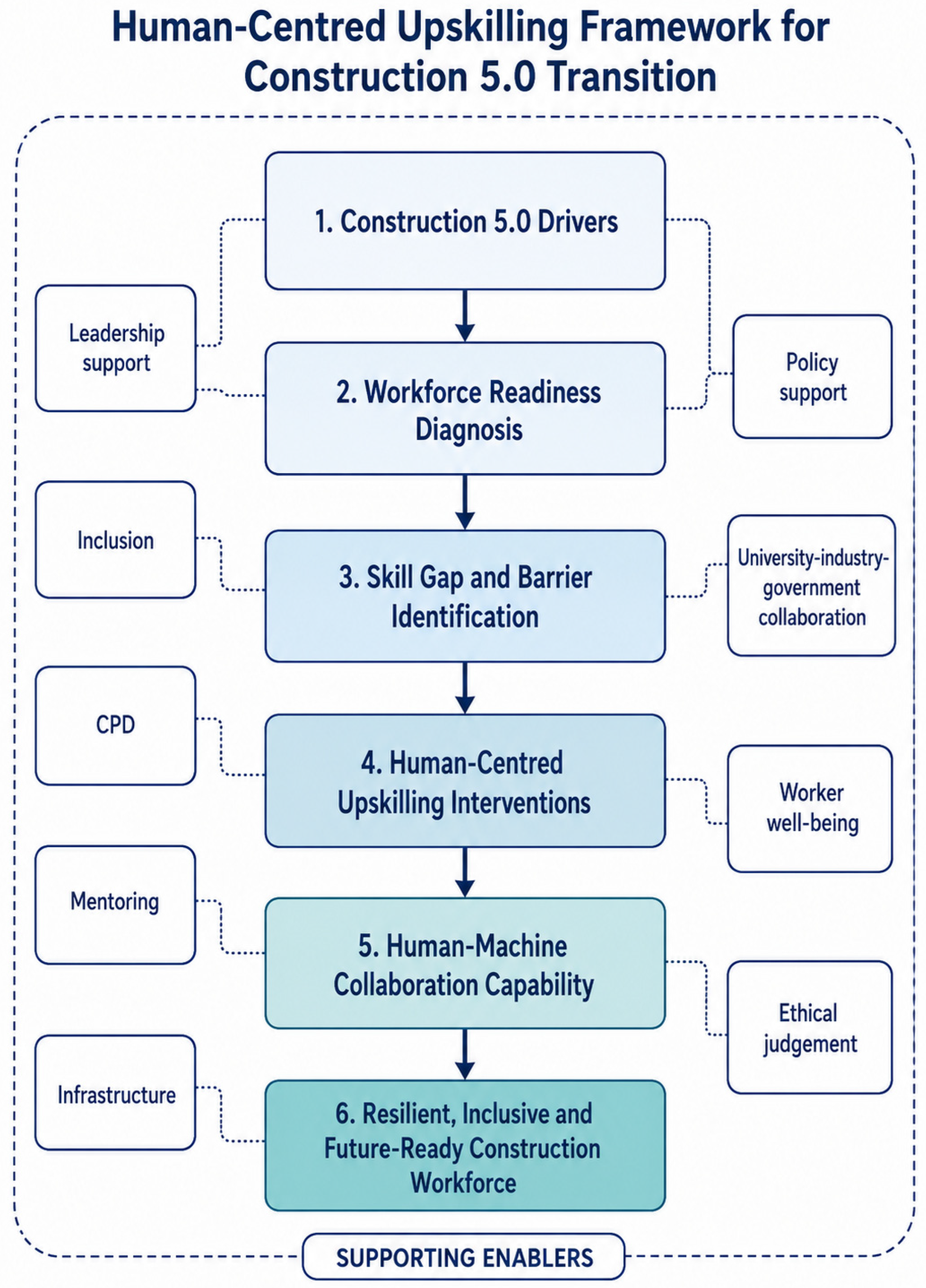
Building on the empirical findings, this study develops a Human-Centred Upskilling Framework for the Construction 5.0 transition. The framework addresses the need for a structured, inclusive, and practical model that links digital workforce readiness, skill-gap identification, upskilling interventions, human–machine collaboration, and resilient construction workforce outcomes, as shown in
Figure 1. Rather than treating digital transformation as a purely technological process, the framework positions workforce capability, confidence, inclusion and continuous learning as central to Construction 5.0 readiness.
The framework is derived from four major themes generated from the focus group discussions. These are current digital competence and readiness, key skill gaps hindering Industry 5.0 transition, strategies for upskilling and reskilling, and human–machine collaboration. The first component, the workforce readiness diagnosis, focuses on assessing the current levels of digital exposure, role-based competence, and organisational preparedness among construction workers. This is important because the findings showed that digital competence remains uneven across professional groups, with design and managerial professionals showing stronger readiness than many site-based workers, artisans and supervisors.
The second component, skill gap and barrier identification, captures the major limitations constraining the transition to Construction 5.0. These include low digital literacy, limited BIM knowledge, weak data interpretation skills, low confidence in using digital systems, poor infrastructure, limited leadership support, and resistance stemming from fear of exclusion or job displacement. This component enables construction firms and training institutions to identify the specific capability gaps that must be addressed before advanced digital technologies can be used effectively.
The third component, human-centred upskilling interventions, represents the practical training mechanisms required to close the identified gaps. The findings suggest that training should be role-specific, practical, modular and continuous. Therefore, the framework emphasises on-site demonstrations, mentoring, peer learning, simulation-based training, short professional courses, micro-credentials and continuous professional development. These interventions are designed to reflect the different needs of managers, technicians, supervisors, artisans and site-based workers.
The fourth component, human–machine collaboration capability, reflects the Construction 5.0 principle that technology should augment rather than replace human expertise. This component combines technical skills such as BIM coordination, digital communication, data awareness and equipment interfacing with human-centred competencies such as judgement, creativity, adaptability, teamwork, ethical awareness and contextual decision-making. It recognises that intelligent machines, AI-supported tools, sensors, digital twins and AR/VR applications can improve construction performance only when workers are trained and confident enough to interact with them meaningfully.
The final component, resilient and future-ready workforce outcomes, represents the framework’s expected result. These outcomes include improved digital confidence, stronger collaboration, reduced resistance to technology, better project coordination, safer work practices, inclusive participation and improved readiness for Construction 5.0. The framework is supported by enabling conditions such as leadership commitment, worker inclusion, infrastructure provision, organisational learning culture, policy support, professional body engagement and university–industry–government collaboration.
Overall, the Human-Centred Upskilling Framework provides a structured pathway for moving from fragmented digital readiness to a more inclusive, resilient and competence-based Construction 5.0 workforce. It demonstrates that successful transition depends not only on the availability of digital technologies but also on the systematic development of human capabilities, organisational support systems and collaborative learning ecosystems.
4. Discussion
The findings of this study show that Industry 5.0 readiness in construction is not simply a question of whether digital technologies are available, but whether the workforce has the competence, confidence, organisational support, and practical exposure needed to use those technologies within real construction project environments. This interpretation moves the results beyond a descriptive account of participants’ views and positions them within the wider knowledge base on digital transformation in building and construction practice. While the literature presents Industry 5.0 as a human-centred phase of industrial development that integrates automation, artificial intelligence, robotics, data systems, and human creativity [
2,
13,
16], evidence from this study indicates that such integration remains uneven within construction organisations. Digital competence was stronger among design professionals, project coordinators, and managerial staff, whereas many site-based workers and operational personnel remained at basic or moderate levels of readiness. This finding suggests that the construction sector’s transition to Industry 5.0 cannot be judged only by the introduction of BIM, automation, smart platforms, or digital twins. It must also be judged by the extent to which these technologies become usable, meaningful, and beneficial to the people who deliver building projects on site.
This result contributes directly to the body of knowledge on engineering construction projects by demonstrating that workforce readiness is a core condition for effective digital project delivery. In building projects, digital technologies are expected to improve coordination, productivity, quality control, safety monitoring, cost management, and decision-making. However, the findings indicate that these benefits may not be fully realised where workers cannot interpret digital information or connect digital outputs to practical construction tasks. This supports earlier studies that identify digital literacy, organisational readiness, and skills development as major determinants of successful technology adoption in construction [
8,
9,
11]. At the same time, the findings extend these studies by showing that the competence problem is not limited to the use of professional or technical software. It also concerns confidence, participation, communication, and workers’ ability to operate in hybrid human–machine environments. Therefore, the study advances construction theory by reframing Industry 5.0 readiness as a socio-technical capability issue rather than a purely technological adoption issue.
The unevenness in digital readiness also reflects deeper structural inequalities within construction practice. Younger and mid-career professionals appeared more familiar with software-based systems and data-driven tools, partly because of more recent exposure through education, professional development, or organisational training. In contrast, older and highly experienced workers appeared to depend more strongly on tacit knowledge, manual expertise, and established construction routines. This finding is consistent with previous research showing that slow technological uptake and ageing workforce structures continue to widen digital competence gaps in construction and related sectors [
10,
17]. However, the present study adds an important qualification. The lower readiness of older workers should not be interpreted as resistance caused by age alone. Rather, it reveals the consequences of unequal access to training, limited inclusion in digital transition processes, and weak organisational strategies for integrating experience-based knowledge with emerging technologies. This interpretation is important for construction practice because experienced workers often possess valuable site knowledge that digital systems cannot easily replace. Excluding them from the Industry 5.0 transition may weaken knowledge transfer, reduce team cohesion, and undermine project performance.
The findings also create a useful dialogue with the Industry 5.0 literature. Existing studies often argue that Industry 5.0 will enhance worker autonomy, improve human–machine collaboration, and create more inclusive and meaningful work environments [
2,
3,
5,
13]. The findings of this study partly support this view because participants recognised the importance of human judgement, communication, adaptability, ethics, and collaboration in future construction work. However, the findings also reveal a contradiction. While the literature presents Industry 5.0 as a pathway to greater worker participation and autonomy, many participants perceived the digital transition as imposed from above, with limited involvement of site-based workers in decision-making. This difference can be explained by the gap between the normative promise of Industry 5.0 and the practical conditions under which construction technologies are implemented. In theory, Industry 5.0 is human-centred; in practice, its implementation may still follow a top-down technological logic if workers are not consulted, trained, and supported. The contradiction, therefore, does not weaken the Industry 5.0 concept. Instead, it shows that human-centred digital transformation must be actively designed into construction organisations rather than assumed to occur automatically.
Resistance to digital adoption should therefore be interpreted as a rational response to uncertain and poorly supported change rather than as simple unwillingness to learn. Participants’ concerns about redundancy, job security, inadequate preparation, poor communication, and limited management support indicate that resistance is relational and organisational. This agrees with studies showing that digital transformation often fails when organisations neglect trust-building, behavioural adaptation, and supportive implementation cultures [
17,
19]. In the context of construction projects, this issue is particularly significant because work is project-based, time-constrained, fragmented, and dependent on coordination among multiple actors. When workers perceive technology as a threat rather than a support system, digital adoption may weaken rather than improve project collaboration. This finding has practical importance for building project delivery because successful Industry 5.0 implementation requires not only technical systems but also inclusive change management, transparent communication, and worker participation in digital decision-making.
Training emerged as the most important pathway for improving Industry 5.0 readiness, but the findings show that the form of training matters. Participants did not support abstract or generic training models. Instead, they preferred practical, role-specific, and task-based learning approaches, including mentoring, workshops, simulations, demonstrations, and short modular programmes. This confirms the literature identifying continuous professional development as a central mechanism for the digital transition in construction [
12]. It also aligns with studies showing that blended learning, simulation-based training, micro-credentialing, and problem-based instruction are more effective for workers with varied skill levels and job responsibilities [
18,
22]. The study extends this knowledge by showing that training must be linked to the actual structure of construction work. Artisans, technicians, supervisors, engineers, project managers, and design professionals do not interact with digital systems in the same way. Therefore, Industry 5.0 upskilling must be differentiated according to occupational role, level of digital exposure, literacy, and project responsibility. This makes a practical contribution to engineering construction practice by suggesting that workforce development should be embedded in project delivery systems rather than treated as a separate administrative activity.
A further contribution of the study is its confirmation of the continuing importance of human capabilities in technologically intensive construction environments. Participants’ emphasis on judgement, problem-solving, ethical awareness, communication, teamwork, and adaptability challenges the idea that the future construction workforce will merely operate machines or follow automated outputs. Instead, the findings suggest that Industry 5.0 construction workers must become interpretive actors who can combine digital information with contextual site knowledge. This is consistent with the theoretical position that Industry 5.0 involves cognitive augmentation and collaborative intelligence, where machines support analysis and efficiency. At the same time, humans retain responsibility for interpretation, ethical judgement, and situated decision-making [
3,
5,
26]. In building projects, this is especially relevant because construction conditions are often uncertain, site-specific, and affected by weather, material availability, design changes, labour coordination, and safety risks. Digital tools can improve decisions, but they cannot fully replace human judgement in complex project environments.
The study therefore adds to construction theory by proposing that Industry 5.0 readiness should be understood as the interaction between technological infrastructure, workforce competence, organisational culture, and human-centred governance. This interpretation broadens the discussion from simple technology adoption to the development of resilient construction project systems. It also clearly situates the findings within the scope of building and construction research by demonstrating how digital readiness affects project coordination, site productivity, worker inclusion, safety culture, and the practical implementation of emerging technologies in construction organisations. The evidence suggests that future construction theory should pay closer attention to the social conditions under which digital technologies are adopted, especially in contexts where workforce skills, access to training, and organisational support are uneven.
The findings also extend the theoretical relevance of technological leapfrogging and institutional voids in developing construction economies. Although digital technologies create opportunities for firms to bypass some earlier stages of construction digitalisation, the results show that such leapfrogging remains constrained by weak absorptive capacity, uneven digital literacy, poor infrastructure, and limited organisational support. This suggests that the Construction 5.0 transition cannot be understood simply as the adoption of advanced tools. It is also an institutional and workforce-development process. The institutional voids observed in the form of fragmented training systems, limited collaboration among firms and universities, weak policy incentives, and restricted access to digital infrastructure help explain why Industry–University–Research collaboration is more difficult in developing contexts. Therefore, a human-centred upskilling framework must address not only worker competence but also the institutional conditions that enable continuous learning, research-industry alignment, and inclusive digital transformation.
Overall, the findings indicate that preparing the construction workforce for Industry 5.0 requires a systemic and human-centred response. Construction firms must invest not only in BIM, automation, artificial intelligence, digital twins, and smart platforms but also in the human systems that enable these technologies to deliver value. Educational institutions must strengthen curricula around digital fluency, interdisciplinary problem-solving, construction informatics, and human-technology collaboration. Professional bodies should provide accessible continuous professional development programmes, while government agencies should create policy incentives and regulatory frameworks that reduce inequalities in digital access and training. This supports the literature’s emphasis on collaborative ecosystems involving universities, industry, professional institutions, and government as a foundation for sustainable workforce transition [
23,
24,
25]. The central implication is that Industry 5.0 in construction will only become meaningful when technological advancement is matched with inclusive workforce development, practical training, participatory implementation, and organisational cultures that treat workers as active contributors to digital transformation rather than passive users of new systems.
5. Study Implications for Research, Policy and Practice
The findings of this study demonstrate that the transition to Industry 5.0 in construction is not merely a technological issue but a workforce development challenge requiring inclusive, coordinated, and sustained action. Although digital tools are increasingly visible in construction, digital competence remains uneven across occupational groups, age categories, and organisational contexts. Design professionals, coordinators, and managers tend to show stronger readiness, while many site-based workers and supervisors still have limited digital confidence and capability. This suggests that successful digital transformation depends not only on acquiring advanced technologies but also on closing competence gaps through structured interventions. Workforce readiness should therefore be treated as a strategic priority within construction transformation agendas.
From a policy perspective, the study implies that governments, regulators, and professional bodies must establish enabling frameworks that support a human-centred digital transition. Public policy should go beyond broad digitalisation goals and develop targeted workforce development initiatives that fund continuous professional development, support digital training for small- and medium-sized firms, and improve equitable access to digital infrastructure. This is especially important where many firms lack the resources to invest in devices, software, connectivity, and staff training. Policy should also promote competence-based standards for digital construction roles, including basic digital literacy, BIM awareness, data interpretation, and human–machine collaboration skills. In practical terms, ministries responsible for works, labour, education, and digitalisation should collaborate with professional institutions and industry actors to develop national upskilling frameworks, certification systems, and incentives for firms investing in workforce readiness. Such interventions would help ensure that Industry 5.0 strengthens inclusion rather than worsening labour inequalities.
For practice, the study shows that construction firms must approach digital transformation as an organisational change process centred on people. Resistance to digital adoption often arises from poor preparation, weak communication, fear of redundancy, and low confidence rather than a refusal to change. Firms should therefore adopt practical internal measures such as leadership support, staged implementation, mentoring, and role-specific training. Digital skills audits should be conducted to assess the readiness of managers, supervisors, technicians, and artisans before introducing more complex technologies. Training should then be tailored to occupational roles and competence levels, using practical strategies such as on-site demonstrations, simulation exercises, peer learning, modular short courses, and supervised hands-on application. Digital learning should also be embedded into everyday work routines rather than treated as a one-time event. Importantly, experienced workers should be actively included in adaptation and knowledge-sharing processes so that digital transformation builds on existing practical expertise rather than undermining it.
The study further implies that universities, technical institutions, and professional bodies must strengthen the educational foundations of Industry 5.0 readiness. Curricula should reflect hybrid competencies that combine software skills and knowledge of digital systems with problem-solving, collaboration, adaptability, ethical awareness, and socio-technical understanding. Professional associations should expand accessible CPD programmes and micro-credential opportunities that align with real construction tasks and evolving technologies. Stronger collaboration among academia, industry, and government is therefore necessary to build a workforce pipeline suited to future sector demands.
For research, the study points to the need for broader empirical and comparative investigation into workforce preparedness for Industry 5.0 in construction. Future studies should examine different regions, project contexts, and professional groups to test whether similar readiness patterns persist. Quantitative research could develop measures of digital competence, training effectiveness, and readiness for human–machine collaboration, while longitudinal studies could track adaptation over time. More attention should also be given to site operatives, artisans, women, and older workers whose experiences are often underexplored. Overall, research must remain grounded in workforce realities and the human consequences of technological change.