Article

Predicting Repair Costs of Residential Facilities Using Deep Learning Algorithms

1
Department of Architectural Engineering, Mokpo National University, Mokpo 58554, Republic of Korea
2
Department of Civil Engineering, Kangwon National University, Gangneung 25457, Republic of Korea
3
College of Architecture, Myongji University, Yongin 17058, Republic of Korea
*
Authors to whom correspondence should be addressed.
Buildings 2026, 16(13), 2612; https://doi.org/10.3390/buildings16132612
Submission received: 13 May 2026 / Revised: 16 June 2026 / Accepted: 24 June 2026 / Published: 30 June 2026
(This article belongs to the Section Construction Management, and Computers & Digitization)

Abstract

This research focuses on developing a deep learning-based framework to forecast maintenance expenditures within the residential sector. To maintain building value, resident safety, and energy efficiency, consistent facility maintenance is indispensable. This necessity is especially heightened given the recent increase in the construction of supertall and high-performance buildings. However, estimating repair costs for residential facilities is challenging due to the diverse building types, ownership structures, and occupancy patterns compared to other property uses. Therefore, this research proposes a deep-learning model to establish a highly reliable and scientific method for estimating repair costs using empirical data gathered from actual residential facilities. Among the deep learning algorithms, Recurrent Neural Networks (RNNs), Long Short-Term Memory (LSTM), and Gated Recurrent Units (GRUs) were adopted to develop models and optimize them through a fixed split. The framework and results of this paper facilitate the prediction of maintenance costs for residential facilities, which can contribute to budget planning, long-term facility management, preventive maintenance, resource management, and advanced decision-making. Moreover, it will contribute to the advancement of facility management of residential facilities.

1. Introduction

In recent years, facility management has emerged as an important branch of the built environment field, increasing awareness across various sectors. Organizations around the world have begun to realize that effective facility management is vital to their overall success. This shift stems from several synergistic factors that have redefined industry standards and underscored the urgency of robust facilities management [1]. One of the chief reasons for the growing importance of facility management is the increasing complexity of modern organizations. Rapid technological advances, evolving regulatory requirements, and an emphasis on sustainability have all contributed to the growing demand for robust facility management strategies. Nowadays, organizations face the challenge of managing complex building systems, optimizing resource utilization, and ensuring operational efficiency while complying with stringent environmental standards. Facility management has become an important discipline that can address these challenges and provide organizations with a competitive advantage [2].
Advanced repair cost prediction plays a key role in today’s facility management. For example, precise repair cost estimation enables facility managers to evaluate and allocate budget resources for maintenance accurately. Organizations can effectively plan their financial resources and make informed decisions about investment priorities only by understanding the potential costs associated with repairs and replacements [3]. The ability to correctly calculate repair costs enables facility managers to implement a proactive maintenance strategy. By estimating repair expenses over time, facility managers can prioritize maintenance activities, identify critical areas that require immediate attention, and optimize resource allocation. This approach helps to avoid costly failures, prolongs the life of assets and reduces overall maintenance costs [4]. In addition, owing to it, facility managers can perform cost-effectiveness analysis as they evaluate various maintenance options. The managers can compare the cost of repairs, replacements, and upgrades to determine the most efficient and financially viable course of action. Advanced repair cost prediction aids organizations in optimizing their investments in facility maintenance and aligning them with strategic goals [5]. Finally, by understanding the expenses associated with repair and replacement, facilities managers can make informed decisions about the lifecycle of assets. This includes choosing to renew, retire or refurbish assets to ensure optimal utilization of resources and maximize the value of the assets the organization has built [6].
Therefore, accurate estimation of repair costs is pivotal for advanced facilities management as it enables organizations to budget effectively, implement preventive maintenance strategies, conduct cost-effectiveness analyses, and optimize asset management practices. By understanding the importance of calculating repair costs, facility managers can increase operational efficiencies, reduce costs, and improve the overall performance of their facilities. This study aims to propose the creation of a deep learning algorithm-based model for predicting repair costs by using actual repair cost data of residential buildings.

1.1. The Importance of Predicting Repair Costs of Residential Facilities

Facility management has gained considerable recognition in the commercial, industrial, and institutional building groups, but its importance often lags behind that of residential facilities. Specifically, the ownership structures of residential buildings tend to be more fragmented than those of other building classes. Residential facilities consist of a range of stakeholders, including private homeowners, condominium associations and property management companies [7]. This fragmentation can hinder the adoption of strong facility management practices due to the lack of centralized coordination and accountability. Additionally, the perception of urgency and return on investment in facility management are often lower in residential settings. Unlike commercial or institutional buildings, where facilities management has a clear impact on organizational productivity and revenue generation, the benefits of effective facility management in residential properties may be less visible to individual homeowners. Consequently, the incentives and investments in implementing comprehensive facility management practices may be limited [8]. Moreover, residential facilities often face financial and budgetary constraints. Owners and managers may prioritize immediate costs and maintenance needs, overlooking proactive property management’s long-term benefits and potential cost savings. Limited financial resources can hinder the application of advanced facility management systems and preventive maintenance programs in residential buildings [9].
However, accurate calculation of repair costs in facility management is very important, especially in the context of residential facilities. Repair cost estimates help facility managers and homeowners effectively plan and allocate resources for maintenance and repairs. By understanding the potential costs associated with various repairs and upgrades, facility managers can develop proactive maintenance strategies that enhance the life and value of residential properties [10]. Precise estimation also serves in residential budgeting and financial planning. The homeowners, condominium associations, and property management companies can allocate funds appropriately to have sufficient resources to address their maintenance and repair needs. Moreover, understanding repair costs will help facility managers evaluate the cost-effectiveness of different maintenance options and make informed decisions regarding repairs, replacements, or upgrades [11]. Repair cost calculation is also important in implementing advanced facilities management practices such as predictive maintenance and life cycle cost analysis. By accurately predicting repair costs over the lifecycle of a residential facility, facility managers can prioritize investments, identify cost-saving opportunities, and optimize maintenance strategies. This approach reduces unexpected costs and improves the overall efficiency and effectiveness of facility management in residential buildings [12]. In conclusion, facilities management’s growing importance depends on the complex challenges organizations face today. Nonetheless, residential properties stay behind other building groups in facility management due to fragmentation of ownership, reduced urgency, and financial constraints. Recognizing the relevance of repair cost calculation as a part of advanced facility management is essential for improving maintenance practices and optimizing resource allocation in residential facilities.

1.2. Challenges in Predicting Repair Costs of Residential Facilities

Despite the various advantages described above, research on predicting repair costs for residential facilities is insufficient. The incomplete or inconsistent data and lack of predictive models make it difficult to predict maintenance costs for residential facilities accurately. The reason is that in the case of residential facilities, it is tricky to develop a predictive model due to insufficient past data and incomplete or inconsistent data [10]. For example, records may miss detailed information about types of repairs or replacements, cost breakdowns, or frequency of maintenance activities compared to other building groups. Another challenge is the lack of standardized data collection methods in the residential facility management industry. Different building owners or managers may use a variety of systems or formats to record maintenance activities and costs. The inconsistency complicates collecting and analyzing data from multiple facilities, hindering the development of accurate predictive models [13]. Furthermore, the shortcomings of a residential-specific model may not capture all the factors that affect facility management costs in a residential facility. Developing comprehensive predictive models for residential properties requires a deep understanding of the unique characteristics and maintenance requirements of these properties. The absence of such a model can prevent accurate cost forecasting [14]. Addressing these challenges will require improving data collection practices, standardizing maintenance records, and developing predictive models specifically for residential facilities. The accuracy of forecasting maintenance costs will improve as more data becomes available and more sophisticated prediction techniques are developed.

1.3. Prediction of Building Repair Costs

Research on the prediction of repair-related costs has expanded significantly, yielding various predictive frameworks. For example, Bayzid et al. [15] used historical maintenance and repair data from a road construction company to develop a predictive model. Regression analysis was employed to identify the key factors affecting maintenance costs. The study found that aspects such as equipment age, usage intensity, and maintenance practices significantly influenced maintenance costs. Krstić et al. [16] developed a maintenance and repair costs model for university buildings based on a survey conducted among facility managers. The study analyzed various cost components, including labor, materials, energy, and maintenance activities. The size of the facility, complexity of the building systems, and the type of space (e.g., classrooms, laboratories) were identified as major cost drivers for university buildings. The developed model provided insight into cost allocation and helped facility managers effectively plan and budget for maintenance and operational activities. Ghodoosi et al. [17] proposed a framework for optimizing the maintenance and repair costs of bridge structures. It combined system reliability analysis, genetic algorithms, and cost estimation models to determine the optimal maintenance strategies. The research confirmed the framework’s efficacy when factors such as structural reliability, inspection intervals, and repair costs were taken into consideration. The study highlighted that implementing the optimal maintenance strategy could result in potential cost savings. Bouabdallaoui et al. [18] utilized a machine-learning approach to develop a predictive expense model for the maintenance and repairs of building facilities. Historical maintenance data, sensor data, and weather data were input. The research showed that the machine learning model could accurately predict maintenance needs and proactively identify potential problems in buildings. The approach helped optimize maintenance schedules, reduce downtime, and improve overall facility performance. Meshref et al. [19] developed a deep-learning predictive model for the life cycle costs of industrial buildings. Building information modeling (BIM) and construction and maintenance cost data were used to train the model. The results confirmed the capability of the deep-learning model to accurately forecast the life cycle costs of different building structure alternatives. The model provided valuable insight into the decision-making process in the design and construction phases, supporting the optimization of building performance and reducing life cycle costs. Au-Yong et al. [20] suggested a prediction cost maintenance and repair model for office buildings using a condition-based maintenance approach. The study collected data on maintenance activities, costs, and building condition parameters. Next, it developed a model that is able to estimate future maintenance costs and facilitate proactive maintenance planning based on the condition of office buildings.
As discussed above, studies have been conducted to develop prediction techniques and models using various techniques for predicting repair costs for various building groups. Nonetheless, studies on the development of specialized prediction models considering the characteristics of residential facilities are scarce. Therefore, extensive research is required to obtain objective results by collecting data on the repair costs of various residential facilities.

2. Research Objective and Methodology

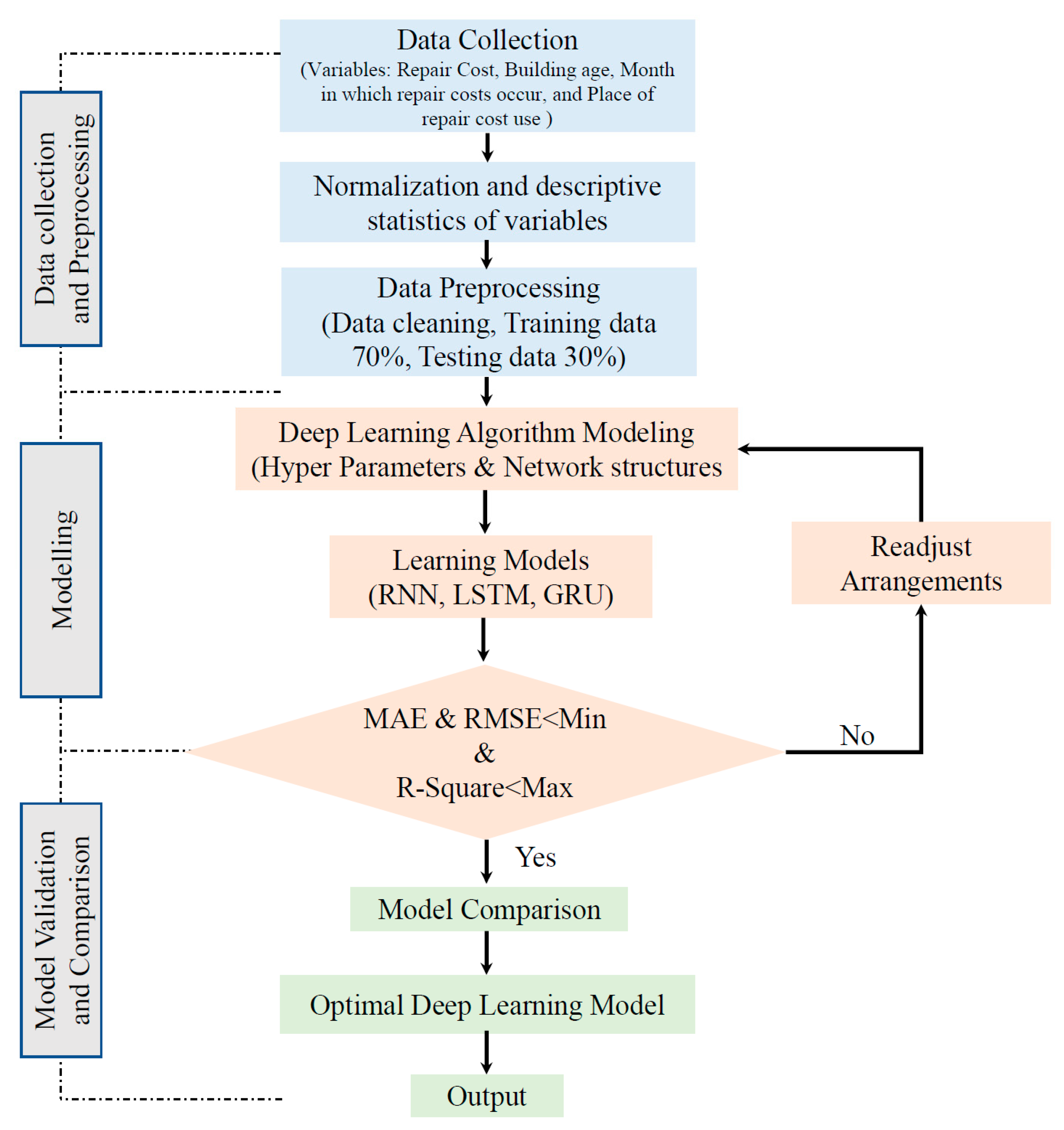
The aim of this study is to propose a repair cost prediction model based on a deep learning algorithm that uses the repair cost data generated in actual large-scale residential facilities. The primary purpose of this study is to collect data from actual residential facilities. After that, the model is developed through a deep learning algorithm by utilizing the collected data as input. Subsequently, the model is verified by comparing its results with other models. Recurrent Neural Networks (RNNs), Long Short-Term Memory (LSTM), and Gated Recurrent Units (GRUs) were adopted as deep learning algorithms. Finally, each model individually calculates mean absolute error (MAE), root mean square error (RMSE), and R-square values. The deep learning algorithm models were developed using Python 3.7. Figure 1 illustrates the comprehensive research framework utilized to develop a deep-learning-based model for predicting repair costs in residential facilities. The framework provides a detailed visual representation of the essential components and processes involved in the proposed predictive model. By utilizing advanced deep-learning techniques, the model aims to accurately estimate the costs associated with repairing various aspects of residential structures.

2.1. Data Collection and Classification

Repair cost data were collected from a large-scale apartment complex to develop a deep learning-based prediction model for residential facility repair costs. The apartment complex is located in Seongnam, South Korea, and was completed in 1994. It consists of 22 buildings ranging from 10 to 25 stories, with a total of 1774 households. Repair cost data were collected over approximately ten years, from 2013 to 2023, and include detailed records of individual repair cost transactions. This complex was selected as the study site because it is a representative large-scale residential complex constructed during the first-generation new town development period in the Seoul metropolitan area of South Korea. Furthermore, because more than 30 years have passed since its completion, the complex provides a comparatively long-term repair cost dataset that is well suited for time-series modeling.
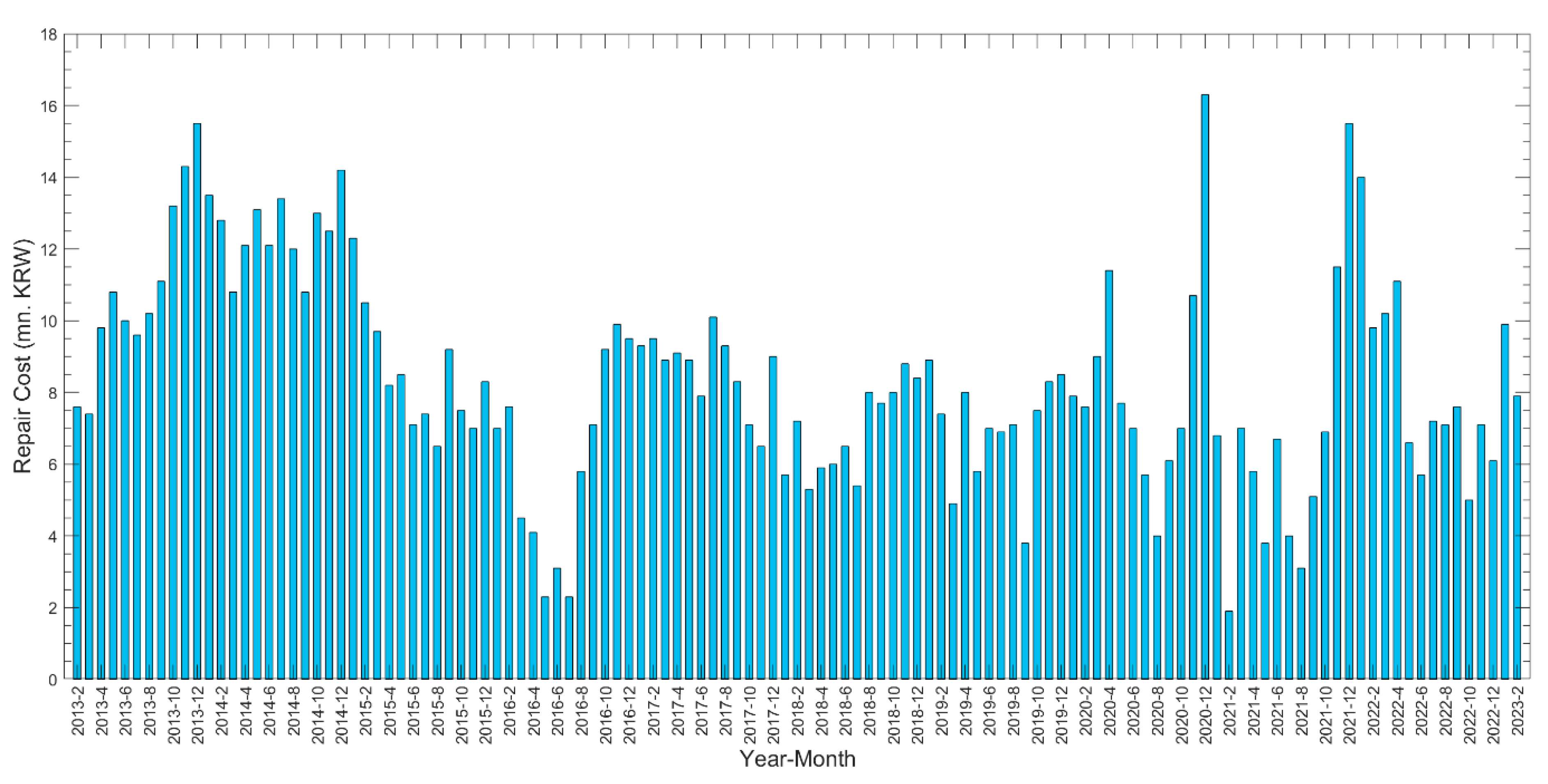
To clarify the fundamental structure of the dataset, the key analytical characteristics are defined as follows. The unit of observation is a repair cost record at the entire-complex level, corresponding to a specific repair category in a given month. Because the raw data were derived from complex-level facility management accounting records rather than individual building-level cost breakdowns, the aggregation level of the analysis is the entire complex rather than each individual building. The temporal resolution is monthly. In terms of the input-output structure, the output variable is the repair cost amount incurred for the corresponding month and repair category. The input variables consist of Building Age, Month, repair Category, and historical repair cost sequence information constructed using a 12-month rolling window within the same category. The monthly distribution of the collected repair cost data is presented in Figure 2.
Table 1 provides a comprehensive description of each variable used in this study, including its type and role. The output variable is the repair cost amount (KRW). Building Age, Month, and Category were used as input variables. Building Age is a continuous numeric variable representing the age of the apartment complex at the time of repair cost occurrence. Month and Category are categorical variables denoting the month in which the repair cost occurred (1–12) and the repair location or purpose classified into six groups (1–6), respectively. Since Month and Category have no inherent ordinal relationship, both variables were encoded using one-hot encoding prior to model training, ensuring that the model does not learn spurious magnitude or rank relationships between unordered classes.
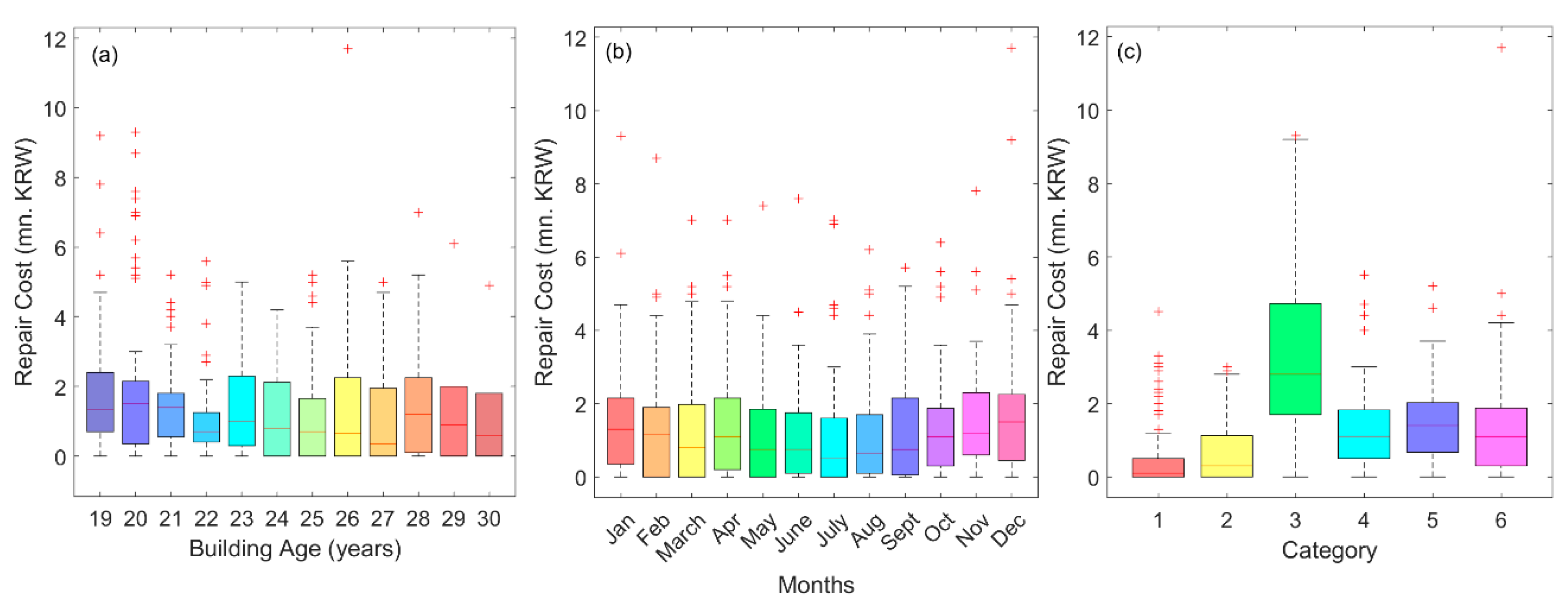
The descriptive statistics of each variable are depicted in Table 2. From 2013 to 2023, the average repair/maintenance cost for the residential facilities in the Seongnam complexes is reported to be 1.39 million KRW. The maximum repair/maintenance cost recorded during this period is 15.89 million KRW. Figure 3 presents the distribution of input variables using box plots, revealing notable insights into repair cost patterns. Analysis indicates that specific variables correlate with higher outliers, suggesting frequent repairs. For instance, residential buildings aged 19, 20, and 26 consistently exhibit higher repair needs (Figure 3a). Similarly, months like January, February and December showed higher outliers, indicating that a significant number of repair costs were involved during these periods (Figure 3b). This observation suggests that a substantial number of repair incidents or maintenance activities occurred during these months, potentially leading to higher repair cost figures. The reasons behind this concentration of repair costs during specific months could be attributed to various factors such as extreme weather conditions, increased usage or occupancy, seasonal maintenance requirements, or specific events or incidents that necessitated repairs. Additionally, the analysis revealed that certain residential facilities, such as electricity, fire extinguishing, elevator, intelligent home network, outdoor auxiliary, and outdoor welfare facilities, were consistently associated with higher outliers, indicating that the majority of repaired costs were related to these specific facilities (Figure 3c). Conversely, repairs for building interiors are less frequent, as evidenced by the absence of significant outliers. These findings offer valuable guidance for resource allocation and maintenance decisions in residential facilities.

2.2. Methodology

2.2.1. Developing Deep Learning Algorithm Models and Data Processing

The collected repair cost data of residential facilities was analyzed utilizing a potent combination of deep learning techniques, namely Recurrent Neural Networks (RNNs), Long Short-Term Memory (LSTM), and Gated Recurrent Units (GRUs). These models excel in handling sequential data and are particularly adept at time series prediction tasks. By harnessing the distinctive capabilities of RNNs, LSTM, and GRUs, we could effectively capture the inherent characteristics of the repair cost data. This approach facilitated a holistic comprehension and proficient modeling of the sequential structure of the data, leading to precise predictions and valuable insights for residential facility repairs. The repair cost data of residential facilities included in this study covers a 10-year period, and there are temporal patterns and trends that can affect future repair costs, and repair costs generally accrue over time. The costs are influenced by the sequence of maintenance or repair events, making the data sequential in nature. In addition, repair costs at a given time may differ from past repair costs, indicating that there are long-term dependencies in the data. Moreover, since the relationship between repair costs and future repair costs may not be linear, non-linear relationship modeling is needed in predictive models [21,22,23].
Recurrent Neural Networks (RNNs) are suitable for modeling sequential data and are extensively applied for tasks such as time series forecasting. It processes data sequences and maintains internal memory that can capture time dependencies [24]. Long Short-Term Memory (LSTM) is a type of RNN that solves the vanishing gradient problem. LSTMs introduce memory cells and gating mechanisms that enable information to be selectively remembered or forgotten over time. LSTM is excellent at capturing long-term data dependencies, making it effective in modeling the long-term repair cost sequences used in this study [25]. Gated Recurrent Units (GRUs) are another RNN variant that solves the vanishing gradient problem. GRUs have a simplified architecture compared to LSTMs, with fewer gating mechanisms. It provides a balance between complexity and efficiency when capturing time dependencies [25]. Therefore, the data was trained using RNNs, LSTM and GRUs, and Root Mean Square Error (RMSE), Mean Absolute Error (MAE), and R squared values were calculated through the learned results, respectively, and an optimization algorithm for this data was derived. RMSE, MAE, and R-squared are generally adopted as standard evaluation metrics for evaluating artificial neural network models [26,27]. MAE is the mean of the absolute differences between the actual and predicted values, and the higher the MAE value, the higher the prediction error. RMSE is an index that represents the residual between the actual value and the model’s predicted value as one measured value, with the larger the RMSE value, the larger the prediction error. The R-squared value represents the ratio of the variance of the dependent variable that the independent variable can explain as 0 to 1.
For the input data, the repair cost values were converted using a log(1 + x) transformation prior to normalization. This approach allows zero-value observations to be retained in the analysis without being discarded. Furthermore, as the repair cost data exhibit a right-skewed distribution due to occasional high-cost repair events, the log(1 + x) transformation is highly effective in mitigating the influence of extreme outliers and enhancing the stability of the model training process. Following this transformation, all input variables were standardized using the z-score normalization method.
To fully leverage the recurrent architectures of the RNN, LSTM, and GRU models, the records were not fed individually. Instead, the monthly repair cost records were grouped by repair category and arranged in strict chronological order within each group. A 12-month rolling window was then applied to construct the input sequences; specifically, the historical data (lagged variables) from the preceding 12 months within the same category were used as input features to predict the repair cost at time t. This explicitly structured sequential data justifies the application of recurrent deep learning models capable of capturing long-term temporal dependencies.
Finally, to prevent temporal data leakage and simulate a realistic forecasting scenario, the dataset was partitioned using a strict chronological split rather than random shuffling. The first 70% of the chronologically ordered data (representing the earlier segment of the timeline) was allocated for training, with 30% of this subset reserved for validation. The remaining 30% of the entire timeline (the most recent segment) was designated as test data.

2.2.2. Model Set, Comparison and Validation

To develop an optimal model using deep learning algorithms, it is crucial to employ simulation-based tuning through trial and error for the deep learning algorithms, optimal network structure scenarios and hyperparameters [28]. RNNs, LSTM, and GRUs are algorithms widely adopted in diverse domains, exhibiting remarkable performance in analyzing and predicting sequential data, such as time series data. However, the structure of these algorithms and the configuration of hyperparameters significantly influence the predictive models. Thus, it is imperative to find the optimal network structure and hyperparameters to enhance the predictive capabilities and improve the predictive model’s performance [29]. Network structure scenarios dictate the determination of nodes and layers. Hyperparameters include the optimizer, batch size, activation function, and epochs, and the determination of optimal components is achieved through various combinations [30]. In the process of constructing a deep learning predictive model, various combinations of these hyperparameters and network structures are experimented with, and their impact on the model’s performance is evaluated through simulation-based trial and error. This iterative process aims to achieve the most efficient and accurate predictive model that can effectively capture intricate patterns and dependencies in the data, leading to improved predictive capabilities and overall model performance. During the simulation process, different configurations of deep learning algorithms are tested, including changes to network architecture and hyperparameter settings, to assess their performance in handling various complexities and characteristics of the dataset. This simulation-based tuning approach helps in identifying the most suitable combination of network structures, such as the number of layers and nodes, and hyperparameters, like the choice of optimizer, batch size, activation function and epochs, which collectively contribute to the overall performance and generalization ability of the deep learning model. The aim of systematically exploring and testing diverse scenarios is to optimize the network architecture and hyperparameters to ensure that the deep learning model can effectively capture the underlying patterns and trends in the data, thereby enhancing its predictive power and robustness across different datasets and real-world applications.
An epoch indicates how many times the model repeats the training data, and one epoch refers to the process of feeding the model with the entire training data set at one time. The batch size determines the number of data samples used in each training step. Small batch sizes provide fast training but can make the learning process unstable [12]. In this study, the model was successfully trained on the data using 200 epochs and a batch size of 5. The Activation Function helps the model learn and express non-linear relationships. In this study, ReLU (Rectified Linear Unit) was adopted as the Activation Function. ReLU plays a role in compensating for the limitations of the sigmoid function, sending the input value as is if it is greater than 0 and outputting 0 if it is less than 0. This makes ReLU one of the Activation Functions actively used in various deep-learning models [31]. The optimizer is an algorithm that manages the learning rate and stability of the model and adjusts the weights to adjust the model to minimize the loss function. Therefore, choosing the appropriate optimizer is essential to improve the performance of deep learning models [32]. RMSprop, Adam, AdaGrad, and Adadelta each have their characteristics, and each of them has a different impact on the model’s learning process. For example, RMSprop adjusts the learning rate based on the second moment to uniformly regulate the update rate of each parameter [33]. Adam is an adaptive learning rate algorithm, so the learning rate can be adjusted for each parameter [34]. AdaGrad automatically adjusts the learning rate of each parameter based on its update history [35], while Adadelta stabilizes the optimization process by adjusting the learning rate using only information about recent updates [36]. Each of these optimizers has its strengths and weaknesses, so it is critical to choose an optimizer that meets the needs of your specific problem or model. Subsequently, in this study, to identify the most suitable optimizer, Adam, RMSprop, AdaGrad, and Adadelta optimization algorithms were simulated and assessed. Each optimizer was evaluated in terms of its performance and effectiveness within the context of the study. After that, the optimal optimizer was determined by comparing the results, i.e., MAE, RMSE, and R-square obtained from these simulations, providing valuable insights into selecting the most appropriate optimization algorithm for more accurately predicting repaired cost.
In addition to comparing the recurrent deep learning models, Linear Regression was included as a conventional baseline model to provide an objective reference for model performance. The baseline model was trained and evaluated under the same preprocessing and data partitioning conditions as the proposed deep learning models, including the 12-month rolling window, log(1 + x) transformation, one-hot encoding of categorical variables, z-score normalization, and chronological split. This comparison was conducted to examine whether the proposed recurrent deep learning models provide improved predictive performance compared with a simple linear model.

3. Results and Discussion

3.1. Results

In this study, a framework was proposed to develop a predictive model for the maintenance costs of residential facilities. Deep learning algorithms, including RNNs, LSTM, and GRUs, were utilized to build these models. The dataset used for model development consisted of repair costs and related residential facility properties and other factors (such as building age, month in which maintenance costs were incurred, and categories- location and purpose of the repair cost) collected over a span of approximately ten years, from 2013 to 2023, from an apartment complex in Seongnam. The study focused on predicting repair costs through RNNs, LSTM, and GRUs by considering these various factors as input and repair cost as output variables. Thereafter, four widely used optimization algorithms, namely Adam, RMSprop, AdaGrad, and Adadelta, were simulated and evaluated to optimize the performance of the predictive models. This assessment aimed to identify the most suitable optimizer among the four options.
Table 3 demonstrates each model’s learning result values (MAE, RMSE, R-square) according to the algorithm, optimizer and hidden layer. The model with the lowest MAE and RMSE and the highest R-square value was selected as the final model among the learning results. The learning results of each model are shown in Table 3. By comparing the performance and results obtained from the simulations, we select the optimal optimization algorithm that would yield the most accurate predictions of repair costs for residential facilities. In the RNN model, the best performance was achieved when the optimizer was RMSprop, with three hidden layers. The LSTM model also showed the best performance when the optimizer was RMSprop and there were three hidden layers. For the GRU model, the best performance was achieved when the optimizer was RMSprop, with two hidden layers. Among them, the LSTM model showed the lowest MAE and RMSE values when the optimizer was RMSprop, there were three hidden layers, and the R-square value was also the highest.
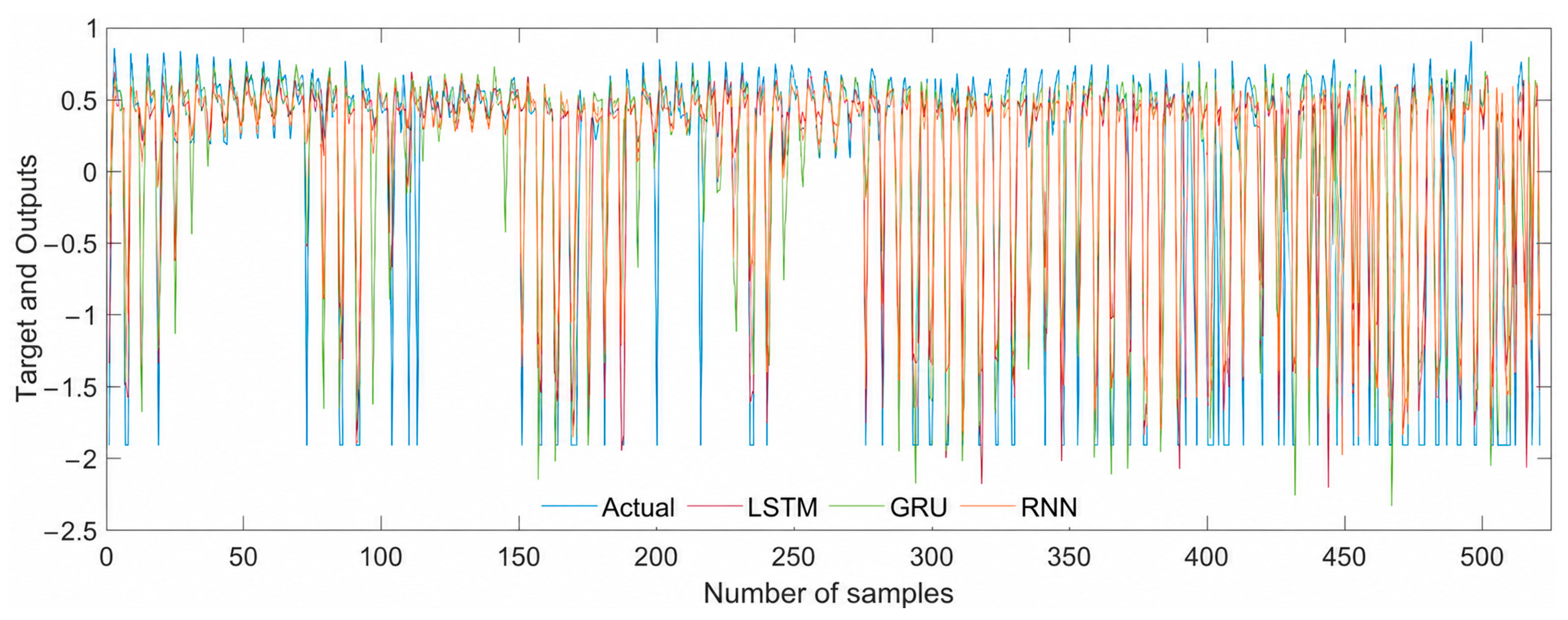
In order to validate each model, the predicted results under the best performance conditions of each algorithm were compared with the actual values. The comparison of the predicted and actual results under conditions representing the peak performance of each model is shown in Figure 4. By verifying this comparison, the reliability and accuracy of the model were confirmed so that it could be used for performance evaluation. As depicted in Figure 4, the predicted results of each algorithm’s model under best performance conditions closely resemble the actual values, indicating high reliability and accuracy in the model predictions. Among them, the LSTM model with the best performance was selected as the final model. The configuration of the final model is presented in Table 4.
To provide an objective evaluation of the proposed deep learning models, Linear Regression was included as a baseline model and evaluated under identical preprocessing and data partitioning conditions. The Linear Regression baseline yielded an MAE of 0.953, RMSE of 1.165, and R2 of 0.089 in the standardized log scale, substantially underperforming the final LSTM model (MAE: 0.183, RMSE: 0.379, R2: 0.895). This result indicates that the residential repair cost data encompasses temporal recurrence, category-specific variability, and non-linear aging-related patterns that cannot be adequately captured by a simple linear model.
Specifically, the predicted values on the standardized log scale z ^ i were first de-standardized and then exponentiated to revert to the original scale y ^ i , K R W using the mean μ t r a i n and standard deviation σ t r a i n of the training dataset, as defined in Equation (1):
y ^ i , K R W = e x p ( z ^ i × σ t r a i n + μ t r a i n ) 1
As summarized in Table 5, the LR baseline resulted in an MAEKRW of 1,290,148 KRW and an RMSEKRW of 2,180,262 KRW. Crucially, the final LSTM model substantially reduced these errors to an MAEKRW of 480,000 KRW and an RMSEKRW of 890,000 KRW. These results confirm that the proposed LSTM framework achieves superior predictive accuracy on both the mathematical and actual monetary scales, validating its utility for practical budget planning.
The model’s generalization ability was assessed by comparing the prediction results of the validation and test datasets, as demonstrated in Table 6. The validation dataset is used to evaluate the model’s performance during training and serves as a means to identify any potential overfitting issues. Overfitting occurs when a model overfits the training data, resulting in difficulty in generalizing to new data, ultimately compromising the model’s predictive performance and overall reliability. Table 5 presents the comparison of the results of the validation dataset and the test dataset. The validation dataset exhibits a MAE value of 0.206, indicating the average absolute difference between the predicted and actual values. Additionally, the Root Mean Squared Error (RMSE) value for the validation dataset is 0.464, representing the square root of the average squared differences between the predicted and actual values. On the other hand, the test dataset produces an MAE of 0.236, indicating a slightly higher average absolute difference compared to the validation dataset. Similarly, the RMSE for the test dataset is 0.523, reflecting a slightly higher average squared difference between the predicted and actual values compared to the validation dataset. These metrics provide valuable insights into the accuracy and performance of the predictive model on both the validation and test datasets. Consequently, the minimal discrepancy between the results of the validation and test datasets indicates the absence of significant overfitting issues, confirming the validity of the final model for application to new datasets.
Furthermore, to examine the stability of the final LSTM model and ensure that the results were not overly reliant on random initialization, the training process was repeated five times using different random seeds. Table 7 summarizes the performance metrics across these multiple runs. The results of these repeated experiments yielded a mean MAE of 0.185, a mean RMSE of 0.391, and a mean R-square of 0.857 on the test dataset. The standard deviations for each metric were consistently small, recorded at 0.005, 0.008, and 0.006, respectively. This demonstrates that the predictive performance of the final model is not heavily dependent on the initial weight setup and is remained stable across all five runs.
To examine the predictive characteristics of the final LSTM model in more detail, an error analysis was conducted by repair category and building age group. In the category-based analysis, errors were calculated based on the six repair categories. For the building age-based analysis, the ages were divided into four age bands: 19–21 years, 22–24 years, 25–27 years, and 28–30 years. This grouping strategy was employed to mitigate interpretational instability caused by differences in sample sizes for individual ages. As shown in Table 8, the category analysis revealed that Category 2 (Inside the building) and Category 4 (Water, gas, drainage and ventilation facilities) showed relatively low errors, demonstrating stable predictive performance. Conversely, Category 3 (Electricity, fire extinguishing, elevator and intelligent home network facilities) showed the highest RMSE. This is interpreted as being due to the inclusion of high-cost or irregular equipment maintenance items in this category.
Furthermore, in the analysis by building age band (Table 9), a clear increasing trend in prediction errors was observed across the age bands. The 19–21 year band showed the lowest errors (MAE: 0.168, RMSE: 0.356), while errors progressively increased through the 22–24 year band (MAE: 0.176, RMSE: 0.373) and the 25–27 year band (MAE: 0.188, RMSE: 0.394), reaching the highest values in the 28–30 year band (MAE: 0.219, RMSE: 0.456). This trend is likely attributable to the fact that as buildings age, the occurrence of repair costs becomes more irregular and the likelihood of large-scale repairs increases. Therefore, the error analysis by category and building age reveals predictive characteristics and limitations of the model that are difficult to identify from the overall MAE and RMSE alone, suggesting the need for category-specific or aging-stage-specific model improvements in future research.

3.2. Discussion

This research proposed a framework for developing a predictive model of the maintenance costs of a residential facility using deep learning algorithms (RNNs, LSTM, GRUs). Actual records of maintenance costs of a residential facility were utilized to collect data, while data on maintenance costs incurred in actual residential facilities were collected and classified into different variables. In order to develop optimal models for learning input and output variables for each algorithm model, simulations were conducted by varying network scenarios and hyperparameters, followed by a comparative analysis of the results. The study’s findings indicated that the LSTM model, specifically using RMSprop as the optimizer and three hidden layers, demonstrated notably superior performance compared to other models, ultimately leading to its selection as the final model. A validation process was conducted to confirm the reliability of the selected final model, which involved comparing and verifying the predicted results with the actual values of the learning dataset, which revealed a significantly high degree of similarity between them. Furthermore, comparing prediction results between validation data and test data was employed to check for any overfitting issues and thoroughly assess the model’s reliability and generalizability.
The proposed framework demonstrates practical applicability within the residential facility management domain. Based on the error analysis presented in Section 3.1, facility managers can develop more targeted and efficient maintenance strategies. By recognizing that the largest prediction errors occur in the Electricity, fire extinguishing, elevator and intelligent home network facilities category, which recorded the highest RMSE of 0.498, managers can acknowledge the high-cost variability inherent in this category and proactively allocate greater contingency reserves for the associated systems. Conversely, for categories in which the model demonstrates high predictive accuracy, such as Inside the building (RMSE: 0.322) and Water, gas, drainage and ventilation facilities (RMSE: 0.356), repair budgets can be planned with greater precision without the need for excessive buffer funds. Translating model performance analysis into operational decision-making in this manner clearly illustrates the practical value of the proposed model in optimizing resource allocation for residential facility management. The potential for broader application to other building types, such as commercial or public facilities, remains a direction for future research, contingent on the availability of comparable longitudinal repair cost datasets.
Several limitations of this study should be acknowledged. First, the proposed model was developed and validated using repair cost data from a single residential complex constructed in 1994. Although this complex represents a large-scale residential facility built during South Korea’s first-generation new town development period, the dataset reflects the characteristics of one specific complex, including its construction type, scale, age, management history, and regional context. Therefore, the generalizability of the proposed framework to other residential complexes cannot be assumed without further validation. Accordingly, this study should be regarded as a foundational proof-of-concept for applying recurrent deep learning models to repair cost prediction in aging residential facilities. Future research should collect multi-site data from different regions, construction periods, types of building group, and management conditions to externally validate and extend the proposed framework. Incorporating additional explanatory variables may also improve predictive accuracy and model interpretability.
Second, because the LSTM architecture is inherently a complex black-box model whose prediction results are derived from intricate internal interactions, the interpretability of its outputs remains limited. The integration of Explainable AI (XAI) techniques would address this limitation by providing users and stakeholders with transparent explanations of the underlying decision-making process [37]. For instance, XAI methods such as SHAP (SHapley Additive exPlanations) can systematically identify the input features with the greatest impact on predictions and clarify the specific sequence segments the model relies on most heavily. This transparency would not only enhance the reliability and accountability of the model but also facilitate its practical adoption in facility management contexts where regulatory compliance regarding algorithmic transparency is required.

4. Conclusions

This study proposed a deep learning-based framework for predicting repair costs of residential facilities using a 10-year empirical dataset collected from a large-scale apartment complex. Three recurrent deep learning architectures (RNNs, LSTM, and GRUs) were adopted and systematically evaluated across multiple optimizer and hidden layer configurations. Among these, the LSTM model with the RMSprop optimizer and three hidden layers achieved the best predictive performance, yielding a MAE of 0.183, a RMSE of 0.379, and an R2 of 0.895 on the standardized log scale. These metrics correspond to an inverse-transformed practical error of 480,000 KRW for MAE and 890,000 KRW for RMSE. Comparisons with a Linear Regression baseline confirmed that the recurrent deep learning approach effectively captures the temporal dependencies and non-linear cost patterns that simpler models cannot adequately represent.
The primary distinction of this research lies in bridging advanced deep learning algorithms with the residential facility management domain. While predictive maintenance has been extensively studied within large-scale civil infrastructure, this study presents a tailored, data-driven tool specifically designed to address the highly variable nature of residential repair expenditures. The proposed framework can assist facility managers in optimizing resource allocation, proactively planning contingency reserves, and enhancing the overall sustainability of residential environments.
The key contributions of this study are threefold. First, it provides an empirically grounded cost prediction framework developed specifically for residential facilities, an area that has received comparatively limited attention in the facility management literature. Second, the construction of category-specific temporal input sequences via a 12-month rolling window offers a transparent methodological approach to leveraging the recurrent structures of RNN, LSTM, and GRU networks for this specific forecasting task. Third, the detailed error analysis categorized by repair type and building age group reveals that prediction difficulty varies systematically, providing actionable, data-driven guidance for practical maintenance budget planning.
However, the findings must be interpreted in light of certain limitations. Because the model was trained and validated on data from a single residential complex with a specific construction type, scale, and regional context, its universal applicability to buildings with substantially different characteristics cannot be assumed without further empirical validation. Future research should prioritize expanding this framework using multi-center datasets collected from various complexes across different regions, construction periods, and building types. Furthermore, subsequent studies should explore the integration of additional explanatory variables and Explainable AI (XAI) techniques to further improve predictive accuracy and ensure algorithmic transparency.

Author Contributions

Conceptualization, J.-M.K. and S.-G.Y.; methodology, J.-M.K., M.-S.S. and S.-G.Y.; software, J.-M.K.; validation, J.-M.K., M.-S.S., Y.J. and S.-G.Y.; formal analysis, J.-M.K. and S.-G.Y.; investigation, J.-M.K. and M.-S.S.; resources, S.-G.Y.; data curation, J.-M.K. and M.-S.S.; writing—original draft preparation, J.-M.K.; writing—review and editing, M.-S.S., Y.J. and S.-G.Y.; visualization, J.-M.K.; supervision, S.-G.Y. and M.-S.S.; project administration, S.-G.Y.; funding acquisition, S.-G.Y. All authors have read and agreed to the published version of the manuscript.

Funding

This research was partially supported by the Korea Agency for Infrastructure Technology Advancement (KAIA) grant funded by the Ministry of Land, Infrastructure and Transport (RS-2025-02220317), and by the National Research Foundation of Korea (NRF) grant funded by the Korea government (MSIT) (RS-2026-25475490).

Data Availability Statement

The data presented in this study are available on request from the corresponding authors. The data are not publicly available due to privacy and ethical restrictions, as they include specific maintenance and cost records from a private residential facility in Seongnam, South Korea.

Conflicts of Interest

The authors declare no conflicts of interest. The funders had no role in the design of the study; in the collection, analyses, or interpretation of data; in the writing of the manuscript; or in the decision to publish the results.

References

  1. Araszkiewicz, K. Digital technologies in Facility Management—The state of practice and research challenges. Procedia Eng. 2017, 196, 1034–1042. [Google Scholar] [CrossRef]
  2. Kwangjin, L.; Youngsoo, J. Assessment of Facility Management Functions for Life-Cycle Information Sharing. J. Korean Soc. Constr. Manag. 2016, 17, 41. [Google Scholar] [CrossRef]
  3. Lavy, S. Facility management practices in higher education buildings: A case study. J. Facil. Manag. 2008, 6, 303–315. [Google Scholar] [CrossRef]
  4. Hodges, C.P. A facility manager’s approach to sustainability. J. Facil. Manag. 2005, 3, 312–324. [Google Scholar] [CrossRef]
  5. Mangano, G.; De Marco, A. The role of maintenance and facility management in logistics: A literature review. Facilities 2014, 32, 241–255. [Google Scholar] [CrossRef]
  6. Kim, J.; Yum, S.; Son, S.; Son, K.; Bae, J. Modeling deep neural networks to learn maintenance and repair costs of educational facilities. Buildings 2021, 11, 165. [Google Scholar] [CrossRef]
  7. Au-Yong, C.P.; Chua, S.J.L.; Ali, A.S.; Tucker, M. Optimising maintenance cost by prioritising maintenance of facilities services in residential buildings. Eng. Constr. Archit. Manag. 2019, 26, 1593–1607. [Google Scholar] [CrossRef]
  8. Lai, J.H.; Yik, F.W. An analytical method to evaluate facility management services for residential buildings. Build. Environ. 2011, 46, 165–175. [Google Scholar] [CrossRef]
  9. Ali, A.S.; Kamaruzzaman, S.N.; Sulaiman, R.; Cheong Peng, Y. Factors affecting housing maintenance cost in Malaysia. J. Facil. Manag. 2010, 8, 285–298. [Google Scholar] [CrossRef]
  10. Kwon, N.; Song, K.; Ahn, Y.; Park, M.; Jang, Y. Maintenance cost prediction for aging residential buildings based on case-based reasoning and genetic algorithm. J. Build. Eng. 2020, 28, 101006. [Google Scholar] [CrossRef]
  11. Tu, K.J.; Huang, Y.W. Predicting the operation and maintenance costs of condominium properties in the project planning phase: An artificial neural network approach. Int. J. Civ. Eng. 2013, 11, 242–250. Available online: https://ijce.iust.ac.ir/article-1-600-en.html (accessed on 23 June 2026).
  12. Kim, J.M.; Yum, S.G.; Park, H.; Bae, J. A deep learning algorithm-driven approach to predicting repair costs associated with natural disaster indicators: The case of accommodation facilities. J. Build. Eng. 2021, 42, 103098. [Google Scholar] [CrossRef]
  13. Kwon, N.; Song, K.; Park, M.; Jang, Y.; Yoon, I.; Ahn, Y. Preliminary service life estimation model for MEP components using case-based reasoning and genetic algorithm. Sustainability 2019, 11, 3074. [Google Scholar] [CrossRef]
  14. Lee, S.; Ahn, Y. Analyzing the long-term service life of MEP using the probabilistic approach in residential buildings. Sustainability 2018, 10, 3803. [Google Scholar] [CrossRef]
  15. Bayzid, S.M.; Mohamed, Y.; Al-Hussein, M. Prediction of maintenance cost for road construction equipment: A case study. Can. J. Civ. Eng. 2016, 43, 480–492. [Google Scholar] [CrossRef]
  16. Krstić, H.; Marenjak, S. Maintenance and operation costs model for university buildings. Teh. Vjesn. 2017, 24, 193–200. [Google Scholar] [CrossRef]
  17. Ghodoosi, F.; Abu-Samra, S.; Zeynalian, M.; Zayed, T. Maintenance cost optimization for bridge structures using system reliability analysis and genetic algorithms. J. Constr. Eng. Manag. 2018, 144, 04017116. [Google Scholar] [CrossRef]
  18. Bouabdallaoui, Y.; Lafhaj, Z.; Yim, P.; Ducoulombier, L.; Bennadji, B. Predictive maintenance in building facilities: A machine learning-based approach. Sensors 2021, 21, 1044. [Google Scholar] [CrossRef] [PubMed]
  19. Meshref, A.; El-Dash, K.; Basiouny, M.; El-Hadidi, O. Implementation of a Life Cycle Cost Deep Learning Prediction Model Based on Building Structure Alternatives for Industrial Buildings. Buildings 2022, 12, 502. [Google Scholar] [CrossRef]
  20. Au-Yong, C.P.; Ali, A.S.; AhmAd, F. Prediction cost maintenance model of office building based on condition-based maintenance. Eksploat. Niezawodn. Maint. Reliab. 2014, 16, 319–324. Available online: https://eprints.um.edu.my/id/eprint/11442 (accessed on 23 June 2026).
  21. Fan, C.; Wang, J.; Gang, W.; Li, S. Assessment of deep recurrent neural network-based strategies for short-term building energy predictions. Appl. Energy 2019, 236, 700–710. [Google Scholar] [CrossRef]
  22. Chitalia, G.; Pipattanasomporn, M.; Garg, V.; Rahman, S. Robust short-term electrical load forecasting framework for commercial buildings using deep recurrent neural networks. Appl. Energy 2020, 278, 115410. [Google Scholar] [CrossRef]
  23. Abumohsen, M.; Owda, A.Y.; Owda, M. Electrical load forecasting using LSTM, GRU, and RNN algorithms. Energies 2023, 16, 2283. [Google Scholar] [CrossRef]
  24. Fekri, M.N.; Patel, H.; Grolinger, K.; Sharma, V. Deep learning for load forecasting with smart meter data: Online Adaptive Recurrent Neural Network. Appl. Energy 2021, 282, 116177. [Google Scholar] [CrossRef]
  25. He, F.; Zhou, J.; Feng, Z.K.; Liu, G.; Yang, Y. A hybrid short-term load forecasting model based on variational mode decomposition and long short-term memory networks considering relevant factors with Bayesian optimization algorithm. Appl. Energy 2019, 237, 103–116. [Google Scholar] [CrossRef]
  26. Pham, T.Q.D.; Le-Hong, T.; Tran, X.V. Efficient estimation and optimization of building costs using machine learning. Int. J. Constr. Manag. 2023, 23, 909–921. [Google Scholar] [CrossRef]
  27. Somu, N.; MR, G.R.; Ramamritham, K. A hybrid model for building energy consumption forecasting using long short term memory networks. Appl. Energy 2020, 261, 114131. [Google Scholar] [CrossRef]
  28. Yang, C.; Trudel, E.; Liu, Y. Machine learning-based methods for analyzing grade crossing safety. Clust. Comput. 2017, 20, 1625–1635. [Google Scholar] [CrossRef]
  29. Xia, Y.; Wang, J.; Wei, D.; Zhang, Z. Combined framework based on data preprocessing and multi-objective optimizer for electricity load forecasting. Eng. Appl. Artif. Intell. 2023, 119, 105776. [Google Scholar] [CrossRef]
  30. Zhou, S.; Song, W. Deep learning-based roadway crack classification using laser-scanned range images: A comparative study on hyperparameter selection. Autom. Constr. 2020, 114, 103171. [Google Scholar] [CrossRef]
  31. Lim, K.K. Analysis of Railroad Accident Prediction using Zero-truncated Negative Binomial Regression and Artificial Neural Network Model: A Case Study of National Railroad in South Korea. KSCE J. Civ. Eng. 2023, 27, 333–344. [Google Scholar] [CrossRef]
  32. Krizhevsky, A.; Sutskever, I.; Hinton, G.E. ImageNet Classification with Deep Convolutional Neural Networks. Adv. Neural Inf. Process. Syst. 2012, 25, 1097–1105. [Google Scholar]
  33. Huk, M. Stochastic optimization of contextual neural networks with RMSprop. In Intelligent Information and Database Systems: 12th Asian Conference, ACIIDS 2020, Phuket, Thailand, 23–26 March 2020, Proceedings; Part II 12; Springer International Publishing: Cham, Switzerland, 2020; pp. 343–352. [Google Scholar] [CrossRef]
  34. Zheng, Z.; Lu, P.; Pan, D. Predicting highway–rail grade crossing collision risk by neural network systems. J. Transp. Eng. Part A Syst. 2019, 145, 04019033. [Google Scholar] [CrossRef]
  35. Qiao, R.; Wang, R.; Zou, Y. A brief analysis on damaged building classification: Optimizer and learning rate. In International Conference on Cloud Computing, Performance Computing, and Deep Learning (CCPCDL 2022); SPIE: Bellingham, WA, USA, 2022; Volume 12287, pp. 374–382. [Google Scholar] [CrossRef]
  36. Sester, M.; Feng, Y.; Thiemann, F. Building generalization using deep learning. ISPRS-Int. Arch. Photogramm. Remote Sens. Spat. Inf. Sci. 2018, XLII-4, 565–572. [Google Scholar] [CrossRef]
  37. El-Assady, M.; Jentner, W.; Kehlbeck, R.; Schlegel, U.; Sevastjanova, R.; Sperrle, F.; Spinner, T.; Keim, D. Towards XAI: Structuring the processes of explanations. In Proceedings of the ACM Workshop on Human-Centered Machine Learning, Glasgow, UK, 4 May 2019; ACM: New York, NY, USA, 2019; Volume 4. [Google Scholar]
Figure 1. The detailed research framework for deep-learning-based repair cost prediction model for residential facilities.
Buildings 16 02612 g001
Figure 2. The distribution of monthly repair costs over time.
Buildings 16 02612 g002
Figure 3. Box-plot for input variables: (a) Building age, (b) Month and (c) Category. The red plus signs represent outliers.
Buildings 16 02612 g003
Figure 4. Best learning results for each model.
Buildings 16 02612 g004
Table 1. A comprehensive description of the variables used in the study.
VariableDescriptionsType/UnitRole
AmountAmount of repair costKRWOutput
Building AgeAge of the apartment complex at the time of repair cost occurrenceNumeric/yearsInput
MonthMonth in which repair cost occurredCategorical/1–12Input
CategoryRepair location or purpose classified into six groups
  • Outside the building
  • Inside the building
  • Electricity, fire extinguishing, elevator and intelligent home network facilities
  • Water, gas, drainage and ventilation facilities
  • Heating and hot water facilities
  • Outdoor auxiliary facilities and outdoor welfare facilities
Categorical/1–6Input
Table 2. Summary of descriptive statistics for the variables analyzed in the study.
VariablesNMeanMinimumMaximumStd. Deviation
Amount25911,393,230.790.0011,659,000.001,589,298.78
Building Age259123.6419.0030.002.94
Month25916.461.0012.003.46
Category25913.491.006.001.71
Table 3. Learning results for each model with different optimizers and hidden layers.
AlgorithmOptimizerHidden LayerMAERMSER-Square
RNN 10.6051.0220.021
Adam20.6211.1020.046
30.5200.9510.079
10.3100.5250.700
RMSprop20.2090.4090.697
30.1740.4000.845
10.6260.8590.159
AdaGrad20.5530.8120.308
30.5800.8950.184
10.9951.2380.010
Adadelta20.7570.9850.034
30.7381.0530.057
LSTM 10.5090.8240.221
Adam20.6161.0630.087
30.6211.1010.020
10.3730.6200.597
RMSprop20.2310.4500.775
30.1830.3790.895
10.5700.8180.199
AdaGrad20.5750.8240.311
30.5750.8680.214
10.8451.1280.007
Adadelta20.7531.0660.062
30.6961.0170.073
GRU 10.5570.8480.260
Adam20.5270.9150.153
30.6221.1070.032
10.3460.5710.645
RMSprop20.2230.4350.837
30.2060.4150.780
10.5500.7750.324
AdaGrad20.5630.8330.302
30.5950.9160.028
10.7630.9870.071
Adadelta20.7981.1890.088
30.7111.0260.076
Table 4. Final model configuration.
ConfigurationDetails
AlgorithmLSTM
Network
structure
Node3
Layer48-64-80
Hyper ParameterOptimizerRMSprop
Activation FunctionRectified Linear Unit function
Batch Size5
Epoch200
Table 5. Performance comparison of baseline and deep learning models in standardized log scale and original KRW scale.
ModelMAERMSER2MAE
(KRW)
RMSE
(KRW)
Linear Regression0.9531.1650.0891,290,1482,180,262
Final LSTM model0.1830.3790.895480,000890,000
Table 6. Comparison of model performance on the validation and test datasets.
DatasetMAERMSE
Validation0.2060.464
Test0.2360.523
Table 7. Performance stability of the final LSTM model across multiple runs with different random seeds.
RunRandom SeedMAERMSER2
110.1810.3850.862
270.1860.3930.856
3210.1920.4020.850
4420.1780.3790.865
51000.1890.3980.853
Mean-0.1850.3910.857
Std. Dev.-0.0050.0080.006
Table 8. Error analysis of the final LSTM model by repair category.
CategoryMAERMSE
1.
Outside the building
0.1940.406
2.
Inside the building
0.1480.322
3.
Electricity, fire extinguishing, elevator and intelligent home network facilities
0.2370.498
4.
Water, gas, drainage and ventilation facilities
0.1630.356
5.
Heating and hot water facilities
0.1790.380
6.
Outdoor auxiliary facilities and outdoor welfare facilities
0.1970.418
Table 9. Error analysis of the final LSTM model by building age band.
Building Age BandMAERMSE
19–21 years0.1680.356
22–24 years0.1760.373
25–27 years0.1880.394
28–30 years0.2190.456
Disclaimer/Publisher’s Note: The statements, opinions and data contained in all publications are solely those of the individual author(s) and contributor(s) and not of MDPI and/or the editor(s). MDPI and/or the editor(s) disclaim responsibility for any injury to people or property resulting from any ideas, methods, instructions or products referred to in the content.