


Abstract
The construction industry remains high-risk, and in Saudi Arabia, these risks are amplified by a multinational workforce. This study examines the relationship between safety training (ST) and two facets of safety behavior: safety compliance (SC) and safety participation (SP). It investigates whether this effect operates through individual responsibility (IR) and varies by nationality. A questionnaire was administered to 252 construction workers across large projects. Data were analyzed in SPSS using descriptive statistics, reliability tests, correlations, multiple regression, and PROCESS with 5000 bootstraps. ST was positively associated with SC but not with SP. IR was positively related to SC. Mediation analysis revealed partial mediation of the ST to SC link via IR, suggesting that training enhances compliance both directly and by strengthening a personal sense of responsibility. Nationality did not significantly moderate the ST to IR path or the direct effects of ST on behavior, suggesting broadly similar training mechanisms across national groups. These findings support the integration of responsibility-building elements into safety training to enhance compliance, while separate organizational strategies (e.g., participatory programs, leadership engagement) may be necessary to foster discretionary participation. Limitations include reliance on self-report measures, a cross-sectional design, and limited subgroup sizes in moderation analyses. Future research should employ longitudinal designs, refine the measurement of responsibility, and test additional moderators (e.g., language proficiency, education, tenure).
1. Introduction
Construction remains among the most hazardous industries globally, with safety performance contingent on coordination among transient groups of workers operating under time pressure, variable site conditions, and complex subcontracting structures [1,2,3]. In Saudi Arabia and the broader Gulf region, construction relies on a multinational workforce whose members differ in language proficiency, formal education, and prior safety socialization [4,5,6]. These conditions complicate the design and delivery of safety training, posing a central question for research and practice: not only whether training improves safety outcomes, but also how it translates into day-to-day safe behavior among culturally diverse workers and under what conditions its effects are evident.
Safety behavior is commonly conceptualized along two pathways. Safety compliance concerns adherence to prescribed rules and the use of protective equipment. In contrast, safety participation encompasses discretionary actions such as speaking up about hazards, assisting co-workers, and contributing to joint problem-solving during safety meetings [7,8]. Meta-analytic evidence indicates that training generally improves safety outcomes [9,10]. Yet, effect sizes vary across settings and behavioral endpoints, suggesting that knowledge transmission alone is insufficient to ensure durable improvements, particularly in dynamic, high-hazard construction environments.
Grounded in Social Cognitive Theory [11], this study conceptualizes safety training (ST) as an environmental influence and individual responsibility (IR) as a personal determinant through which training may exert its effects. IR is defined as the internalized belief that maintaining safety is a core job responsibility, distinct from general safety motivation and self-efficacy. Building on social-cognitive and self-regulatory perspectives [12], the study advances the premise that training influences behavior through both informational and motivational channels. By strengthening IR, training can increase the likelihood that workers act safely even when direct supervision is limited or production pressures are high. Although person-level determinants such as responsibility and self-efficacy have been linked to safer behavior [13,14,15,16], IR has seldom been tested as the central mechanism connecting training to both compliance and participation in construction.
Cultural diversity may further condition training effectiveness [17]. The Saudi/Gulf construction sector employs large expatriate cohorts from South and Southeast Asia, North Africa, and the Middle East, characterized by distinct cultural patterns (e.g., power distance, collectivism, uncertainty avoidance) that can influence learning preferences, authority expectations, and risk communication [4]. Industry practice often presumes that nationality materially changes how training translates into behavior, thereby justifying nationality-specific content [18]. However, while tailoring content to accommodate language and pacing needs is well supported [5], empirical evidence remains limited on whether nationality moderates deeper psychological pathways, specifically, the relationship from training to individual responsibility or the direct relationships from training to safety behaviors. This gap motivates a test of whether nationality shapes mechanisms of transfer rather than merely engagement logistics. Establishing whether these mechanisms generalize across national groups has direct implications for training design, informing the balance between standardized foundational modules (for consistency and efficiency) and targeted cultural adaptations (for behavioral effectiveness [18]).
Recent reviews indicate that safety training generally improves safety outcomes; however, effect sizes vary heterogeneously across behaviors, settings, and delivery modes [9,10]. In construction specifically, training tends to increase compliance more reliably than participation [7,8,9], suggesting that knowledge transfer alone may not sustain discretionary, prosocial safety actions. Prior work has emphasized mediators such as safety knowledge, motivation, and self-efficacy [13,14,19]. Yet, the internalized sense of individual responsibility (IR), aligned with Social Cognitive Theory’s self-regulatory mechanisms, has rarely been tested as the central pathway from training to behavior in construction [13,15]. In parallel, although multinational Gulf worksites differ in language and cultural norms [3,5], evidence is limited on whether nationality alters either the relationship between training and IR or the direct relationships between training and behavior [20,21].
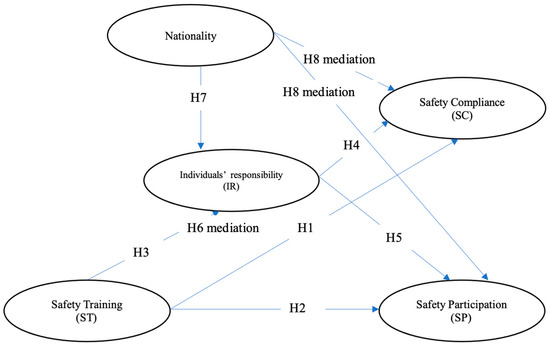
To address these gaps, Figure 1 presents a conceptual model positing that safety training (ST) directly and indirectly improves safety compliance (SC) and safety participation (SP) through individual responsibility (IR). Nationality is specified as a boundary condition that moderates both the relationship between ST and IR and the direct relationships between ST and each behavioral outcome. Consistent with this model, eight hypotheses are developed to examine the statistical relationships among safety training (ST), safety compliance (SC), safety participation (SP), and individual responsibility (IR). Guided by the proposed hypotheses, the following research questions (RQs) were developed to examine the interrelationships among these variables:
Figure 1.
Hypothesized model linking safety training (ST) to safety compliance (SC) and safety participation (SP) via individual responsibility (IR), with nationality as a moderator.
- RQ1. To what extent is safety training associated with higher levels of safety compliance and safety participation among construction workers in a multinational context?
- RQ2. Does individual responsibility for safety mediate the relationship between training and each behavioral outcome (compliance, participation)?
- RQ3. Does nationality moderate (a) the relationship from training to individual responsibility and/or (b) the direct relationships from training to safety behaviors?
The study contributes to the existing body of literature by (i) specifying and testing a mechanistic account that links training to behavior via individual responsibility, (ii) evaluating cultural boundary conditions relevant to multinational workforces, and (iii) providing context-specific evidence from large construction projects in Saudi Arabia. Clarifying which levers are universal and which require cultural tailoring can inform resource-allocation decisions, such as whether to expand training hours, redesign content to cultivate responsibility, or complement training with participatory programs that directly target safety participation.
2. Literature Review
Guiding this review is a theory-driven rationale grounded in Social Cognitive Theory. Safety training is conceptualized as an environmental influence that activates self-regulatory processes of individual responsibility (IR); IR is treated as the proximal cognitive–motivational mechanism through which training translates into behavior, shaping both safety compliance (SC) and safety participation (SP). Because multinational crews differ in language, power distance, and norms, nationality is viewed as a boundary condition that can strengthen or weaken the translation from training to responsibility and from training to behavioral outcomes. Accordingly, the literature is organized to evaluate four threads: (i) training and diversity in multinational crews, (ii) the two dimensions of safety behavior (compliance and participation), (iii) individual responsibility as a driver of behavior, and (iv) nationality and cultural diversity as contextual moderators.
2.1. Safety Training and Diversity
Safety training is widely recognized as a foundation for improving safety performance in the construction industry. When delivered effectively, it strengthens workers’ knowledge and motivation, which, in turn, improves safety compliance and participation. Research indicates that training content, particularly when it addresses both cognitive (knowledge-based) and motivational factors, can significantly influence behavior [22]. Basahel found that in the Saudi construction sector, motivation and knowledge mediated the effects of safety leadership and training on workers’ behavior, highlighting the role of internal psychological drivers [23].
However, standardized training approaches often fall short in culturally diverse environments. Visual training methods and simplified communication have shown better outcomes for multinational crews, particularly those with limited language skills or literacy [5]. Jung et al. also found that workers’ emotional conditions, such as anxiety and job stress, negatively affect safety motivation and learning retention, which in turn reduce safety behavior [24]. Additionally, factors such as felt responsibility and trust in supervisors influence how training translates into action [25]. These findings suggest that for training to be truly effective, it must account for workers’ cultural, psychological, and relational contexts, rather than deliver information.
2.2. Safety Behavior: Compliance and Participation
Construction research commonly distinguishes two dimensions of worker behavior: compliance and participation. Compliance is adherence to prescribed procedures (e.g., PPE use, following protocols). Participation comprises discretionary actions such as reporting hazards, assisting colleagues, and suggesting improvements [26]. Compliance secures baseline risk control, whereas participation helps build a proactive safety climate [27].
Different antecedents have been linked to these behavioral components. Safety knowledge has been identified as a key driver of safety participation, enabling the recognition of hazards and the taking of proactive action. In contrast, safety motivation, defined as the perceived value and obligation to engage in safe conduct, is more strongly associated with routine compliance [28]. Some models, such as Griffin and Neal’s framework, posit the existence of these dual pathways, though empirical results remain mixed. Curcuruto et al. reported stronger effects of proactive motivation on participation, whereas other studies found comparable or reversed patterns between the antecedents and the two behavior types [29].
In multinational construction crews, language heterogeneity, power distance, and nationality-based responsibility norms systematically shape both compliance and participation [30,31]. Organizational and leadership factors further influence these outcomes [31,32]. Transactional leadership, emphasizing structure and enforcement, is commonly associated with higher compliance, whereas transformational leadership, which fosters empowerment and shared goals, shows stronger links to voluntary participation [33]. Supervisor support and communication quality also affect behavior via risk perception and engagement [34]. In cross-national teams, culturally intelligent leadership and clear multilingual communication further strengthen participatory behaviors and adherence [35]. Additionally, studies in multicultural environments suggest that safety behavior varies across national cultures, individual values, and perceived responsibility for safety [36,37].
2.3. Individual Responsibility for Safety
Individual responsibility is increasingly recognized as a critical factor in construction safety performance, complementing formal training and organizational oversight. This concept reflects internalized accountability for personal and collective safety, often manifesting as proactive behavior even in the absence of supervision. In strong safety cultures, personal responsibility contributes to voluntary engagement, such as hazard reporting or peer support, aligning with constructs like safety citizenship behavior and safety initiative [29].
Studies have identified key psychological factors that drive such behaviors. Autonomous safety motivation, which is defined as the belief that one’s actions directly affect safety outcomes, has been linked to increased participation and initiative, particularly in multicultural or decentralized work settings [38]. Meta-analytic evidence indicates that work-related stressors (e.g., high demands, low control, limited support) increase injury risk, and Saudi-based findings further suggest that occupational stress undermines safe work practices in multinational crews [6]. Safety locus of control, defined as the extent to which individuals attribute safety outcomes to personal versus external factors, has also been shown to influence hazard response and rule adherence [39].
Organizational citizenship frameworks suggest that personal responsibility is strengthened through participative environments and supervisor support, particularly when workers perceive a high level of mutual trust and shared responsibility [40]. Despite this, the literature continues to underemphasize personal agency relative to structural and managerial factors. Limited empirical attention has been given to how safety training might directly or differentially enhance individual responsibility.
2.4. Nationality and Cultural Diversity (Hofstede’s Cultural Dimensions Theory)
Multinational construction workforces, particularly in the Gulf region, pose significant challenges for safety management due to diverse nationalities, languages, and cultural safety norms. In Gulf countries such as the UAE and Saudi Arabia, expatriates often constitute over 85% of the construction workforce, bringing distinct educational backgrounds, risk perceptions, and communication barriers [17]. Language differences, in particular, hinder clear dissemination of safety procedures and limit hazard reporting, especially when translation services are informal or inconsistent [41].
Cultural factors also influence safety behavior. Dimensions such as power distance and risk tolerance, rooted in national culture, shape responses to authority and safety rules. For example, high power-distance norms may discourage workers from challenging unsafe instructions, reducing safety participation. Conversely, strong collectivist cultures may foster peer-to-peer support, enhancing safety citizenship behaviors [1].
Despite the relevance of these cultural variables, regional safety research often prioritizes macro-level statistics over worker-level behavioral studies. Programs such as the UAE’s “Safety in the Heat” campaign demonstrate the importance of adapting training to linguistic and cultural needs through multilingual, pictorial content [41]. However, few studies have systematically examined how nationality moderates the effectiveness of safety interventions or how cultural differences interact with individual responsibility to influence safety compliance and participation.
2.5. Point of Departure
Although regulations, technologies, and managerial oversight provide the backbone of construction safety, worker behavior ultimately determines real-world outcomes. Prior research indicates that safety training (ST) strengthens workers’ understanding of hazards and their motivation to act safely, which can lead to improved compliance and participation [26]; however, training alone often fails to ensure consistent safe behavior unless it is internalized by workers as a personal responsibility [33]. In contexts such as Saudi Arabia and the wider Gulf region, where multinational construction teams are common, culturally shaped perceptions of authority, risk, and accountability complicate the relationship between training and behavior [18,36]. Consistent with Social Cognitive Theory, which views behavior as the product of dynamic interactions among personal factors (e.g., individual responsibility), behavior (e.g., compliance and participation), and environment (e.g., training) [42]. Based on this reasoning, the following hypotheses are proposed:
Hypothesis 1 (H1).
Safety training is positively associated with safety compliance.
Hypothesis 2 (H2).
Safety training is positively associated with safety participation.
On the other hand, safety training also influences workers’ internal conditions, including their sense of individual responsibility (IR) toward safety. Prior research notes that safety training can strengthen workers’ sense of personal responsibility and improve their ability to regulate their own behavior at work [43,44]. Accordingly, the study proposes the following hypothesis:
Hypothesis 3 (H3).
Safety training is positively associated with individual responsibility (IR).
Individual responsibility plays a crucial role in promoting safety behavior in construction settings. Workers who view safety as part of their personal duty are more likely to follow safety rules and avoid unnecessary risks, thereby improving compliance with safety procedures [25,35]. Furthermore, this sense of responsibility encourages proactive engagement, such as reporting hazards and assisting coworkers, which aligns with the concept of safety participation [26]. In diverse work environments, a strong sense of individual responsibility can help overcome cultural barriers, such as hesitation to raise safety concerns, making it an important factor in both safety compliance and participation. Based on this reasoning, the following hypotheses are proposed:
Hypothesis 4 (H4).
Individual responsibility (IR) is positively associated with safety compliance (SC).
Hypothesis 5 (H5).
Individual responsibility (IR) is positively associated with safety participation (SP).
Despite substantial interest in training effectiveness, three gaps persist in the regional and broader literature: (1) most studies examine either compliance or participation but rarely both outcomes in a single model, obscuring potentially different pathways [2,26]; (2) the mediating role of individual responsibility (IR) in translating training into behavior is discussed but seldom tested formally [23,25,35]; and (3) nationality/culture is frequently treated as a control rather than a boundary condition that could alter the reception and transfer of training [5,36]. These gaps are especially salient for multinational Gulf projects, where language diversity and power distance can hinder hazard reporting and participation, and where tailored, multilingual training has been shown to have advantages over standardized materials [5]. For example, workers from high-power distance cultures may rely more on supervisors for safety guidance, while others may internalize training messages more independently. On the other hand, Safety participation behaviors, such as reporting hazards or raising concerns, are also influenced by cultural norms. Some nationality groups may hesitate to speak up due to hierarchical structures or fear of negative consequences [5,36]. These factors suggest that nationality can affect how training influences both individual responsibility and safety participation. Based on this discussion, the following hypotheses are proposed:
Hypothesis 6 (H6).
Individual responsibility (IR) mediates the effect of safety training (ST) on safety compliance (SC).
Hypothesis 7 (H7).
Nationality moderates the relationship between safety training (ST) and individual responsibility (IR).
Hypothesis 8 (H8).
Nationality moderates the relationship between safety training (ST) and safety participation (SP).
By integrating these variables, the proposed framework advances theoretical understanding of construction safety behavior. It offers practical insights for designing culturally responsive training programs tailored to diverse workforces in the Gulf region.
3. Materials and Methods
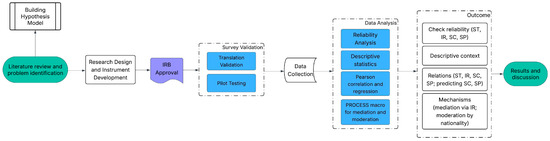
This study employed a comprehensive design to examine how safety training (ST) relates to safety compliance (SC) and safety participation (SP) among multinational construction workers in Saudi Arabia, with individual responsibility (IR) as a mediator and nationality as a moderator (Figure 2).
Figure 2.
Study design and analysis workflow.
3.1. Instrument Development
A structured questionnaire was used as the primary data-collection tool. The instrument comprised three sections. The first section captured demographic information (e.g., age, place of birth, job title). The second section assessed safety training (ST) and individual responsibility (IR). Perceived safety-training adequacy/quality was measured with three items (e.g., “Safety issues are given a high priority in training programs,” “Workplace health and safety training covers the types of situations that employees encounter in their job,” “Employees receive comprehensive training in workplace health and safety issues”), adapted from established safety climate/training measures in construction (e.g., [6,45,46,47]). Individual responsibility (felt responsibility) was measured with three items capturing internalized accountability (e.g., “I feel personally responsible for preventing injuries at this site,” “Ensuring safety is part of my job, even when it is not explicitly required,” “I take ownership for correcting unsafe conditions when I notice them”), conceptually aligned with prior work on felt safety responsibility and safety citizenship precursors [15,39].
The third section measured two facets of safety behavior: safety compliance (SC) and safety participation (SP). SC was assessed with two self-referent items (e.g., “I use all necessary safety equipment to do my job,” “I follow all required safety procedures for the tasks I perform”), adapted from widely used compliance indicators in the construction safety literature [48,49]. SP was assessed using two items that reflected discretionary, prosocial safety actions (e.g., “I voluntarily participate in safety activities,” “I speak up and report hazards”), consistent with established safety participation frameworks [48,49].
All items used a five-point Likert response format, ranging from 1 (strongly disagree) to 5 (strongly agree). Scale scores were computed as the mean of their respective items; higher scores indicate greater levels of the construct. The questionnaire was initially developed in English and translated into Arabic, Urdu, Indonesian, Bengali, and Filipino (Tagalog). Translation accuracy was ensured through professional forward translation followed by independent back-translation; discrepancies were reconciled to achieve semantic equivalence across languages. Ethical approval was obtained from the Institutional Review Board (IRB) at Jouf University before data collection.
3.2. Participants and Data Collection
Prior to full-scale data collection, a pilot study was conducted with a group of highly experienced construction workers representing different nationalities. These workers were invited to complete the survey and provide feedback on the clarity, readability, and relevance of the instrument items. They were also encouraged to suggest improvements if any questions appeared ambiguous or difficult to understand. The feedback process confirmed that the instrument was clear and comprehensible, as none of the participants reported concerns or recommended modifications. Consequently, no changes were made to the survey items following the pilot phase.
For the main study, data were collected from a sample of 300 male construction workers employed at large construction sites across Saudi Arabia. Participants represented six major expatriate groups commonly found in the Saudi construction sector: Egypt, India, Pakistan, Bangladesh, Yemen, and the Philippines. These nationalities were selected because they make up a significant proportion of the country’s construction workforce. The recruitment process used convenience sampling, allowing researchers to access participants who were readily available at the selected worksites. Participation in the study was entirely voluntary, and all workers were informed of the research objectives and their rights before completing the survey.
3.3. Data Analysis
This study targeted construction workers on large projects in Saudi Arabia, where workforces are predominantly multinational. To determine an appropriate minimum sample size, the single-proportion formula was applied [50]:
n0 = (z2 × p × (1 − p))/e2
In this formula, is the required sample size, is the z-score for the chosen confidence level, is the assumed response variability, and is the margin of error. A 95% confidence level was adopted () and maximum variability was assumed (). Consistent with construction-management guidance that permits 5–20% error margins depending on scope and resources [37,51,52], a 10% margin of error was selected for this field setting. Substituting these values yields n0 = 96.04, indicating a minimum of 97 participants. The achieved sample of exceeds this requirement and corresponds to an approximate 95% precision of 6.2%.
The analysis of the survey data was conducted in several stages to ensure both reliability and validity of the findings. The process began with data screening to identify missing values and inconsistencies, followed by descriptive statistics to summarize participants’ demographic characteristics. Once the data were prepared, statistical analyses were applied to examine the proposed relationships among safety training, individual responsibility, safety compliance, and safety participation. These analyses were conducted using IBM SPSS Statistics version 30, which facilitated hypothesis testing through correlation, regression, and moderation/mediation models, depending on the research question. First, a reliability test (i.e., Cronbach’s Alpha) was performed to determine whether the items in a questionnaire reliably measure the same underlying concept, as Cronbach’s Alpha is widely accepted as a reliable measure of internal consistency for survey instruments [53]. Second, descriptive statistics were performed to examine the data distributions. Provide a summary of the central tendency and variability of data [54]. Third, a Pearson correlation analysis was conducted to investigate the initial relationships among variables and identify which variables are significantly associated, providing an early indication of construct validity [55]. To test the direct hypothetical path as shown in Figure 1 (i.e., H1, H2, H3, H4, H5), a multiple linear regression was used. Multiple linear regressions were estimated to examine the direct relationships among the continuous composite variables of safety training (ST), individual responsibility (IR), safety compliance (SC), and safety participation (SP), with covariates included where appropriate [55]. Mediation (H6) and moderation (H7–H8) were assessed using the PROCESS macro (Model 4 for mediation; Model 1 for moderation) with 5000 bias-corrected bootstrap samples [56]. Continuous predictors were mean-centered, nationality was dummy-coded with [reference group] as the reference category, and 95% confidence intervals were reported for indirect effects. The PROCESS macro by Hayes is a versatile and robust tool for analyzing mediation, moderation, and conditional process models [56]. Unlike traditional statistical tests, which often require separate procedures for mediation and moderation, PROCESS allows researchers to examine complex relationships in a single, streamlined analysis. It employs a regression-based approach, making it computationally efficient and accessible, without requiring advanced modeling frameworks such as structural equation modeling. PROCESS is considered reliable because it employs bootstrapping techniques to generate confidence intervals for indirect effects, providing more accurate significance testing, particularly in small or non-normal samples [56].
4. Results
4.1. Demographic Profile of Respondents
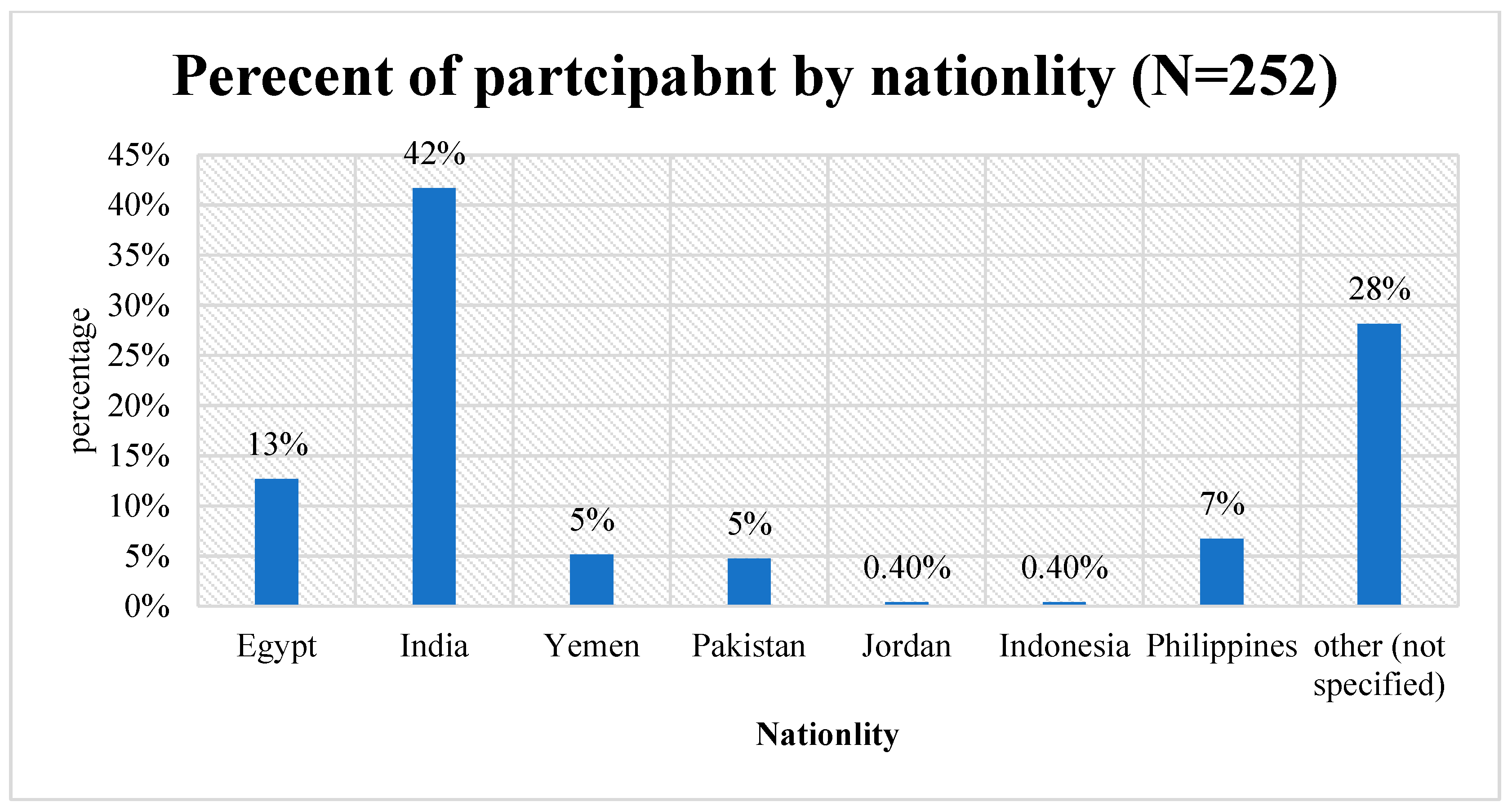
A total of 300 surveys were distributed across multiple construction sites in the Kingdom of Saudi Arabia. Of these, 252 valid responses were retained for analysis after excluding cases with missing data or patterned responses where participants selected the same rating for all items. Figure 3 presents the distribution of participants by nationality. Indian workers constituted the largest group (105 participants), followed by Egyptians (32), Filipinos (17), Yemenis (13), and Pakistanis (12). Additionally, one respondent each came from Indonesia and Jordan. Notably, 71 respondents did not disclose their nationality. All participants were male, with an average of 4 to 6 years of work experience in the Saudi construction industry.
Figure 3.
Participant nationality distribution.
4.2. Reliability of the Constructs
The internal consistency of the study measures was assessed using Cronbach’s alpha coefficients. Table 1 summarizes the reliability results for the four constructs included in the analysis. The obtained alpha values ranged from 0.698 to 0.833, suggesting that the scales demonstrated generally acceptable reliability.
Table 1.
Reliability results.
The safety training construct, measured by three items, yielded a Cronbach’s alpha of 0.744, which falls within the acceptable range and indicates that the items adequately reflect a single underlying dimension. Similarly, the three-item measure of individual responsibility had a Cronbach’s alpha of 0.833, indicating strong internal consistency and confirming that the items reliably capture the construct.
The two-item safety participation scale yielded a Cronbach’s alpha of 0.698. While this value is slightly below the conventional threshold of 0.70, it remains acceptable given the limited number of items, as shorter scales often produce lower coefficients [57]. Despite the modest alpha, the result still suggests that the items are sufficiently consistent to represent the construct. The safety compliance construct, measured by two items, yielded a Cronbach’s alpha of 0.764, indicating acceptable reliability and supporting the scale’s internal consistency. Overall, these findings suggest that the measurement instruments used in this study demonstrate satisfactory internal consistency.
4.3. Descriptive Analysis of Study Variables
Table 2 summarizes the descriptive statistics for the study variables. All constructs scored above the midpoint of the five-point Likert scale, indicating generally positive perceptions. Safety training had a mean of 4.39 ( = 0.63), and individual responsibility had a mean of 4.55 ( = 0.59), indicating strong agreement on the adequacy of training and personal accountability. Safety participation ( = 4.07, = 0.90) and safety compliance ( = 4.30, = 0.87) were also high, though participation showed more variability. Place of birth averaged 4.08 ( = 2.83), reflecting a diverse workforce. The final dataset included 252 valid responses. These results indicate that construction workers generally maintain positive safety attitudes and engage in safety practices, though participation and compliance vary among individuals, potentially due to factors such as nationality or site conditions.
Table 2.
Descriptive Statistics.
4.4. Hypothesis Testing
4.4.1. Direct Analysis
The correlation matrix presented in Table 3 reveals several significant relationships among the study variables. Safety training is positively related to both individual responsibility (r = 0.609, p < 0.001) and safety compliance (r = 0.456, p < 0.001). These results suggest that well-structured training programs not only strengthen workers’ sense of accountability but also enhance their compliance with safety rules and procedures. In contrast, the association between safety training and safety participation was negligible and statistically insignificant (r = 0.044, p = 0.485), suggesting that training alone may not be sufficient to promote voluntary participation in safety-related activities.
Table 3.
Pearson correlation coefficients for safety-related constructs.
Furthermore, individual responsibility was strongly correlated with safety compliance (r = 0.559, p < 0.001), underscoring its crucial role in promoting adherence to workplace safety standards. Its relationship with safety participation was weaker and only approached significance (r = 0.119, p = 0.060), suggesting that responsibility contributes less consistently to discretionary safety behaviors. Finally, a small but significant positive correlation was observed between safety participation and safety compliance (r = 0.175, p = 0.005), suggesting that workers who engage in proactive safety practices are somewhat more likely to also comply with formal safety requirements.
Taken together, these results highlight the central role of safety training and individual responsibility in driving compliance, while pointing to the need for additional organizational or motivational factors to encourage participation more effectively.
The results of the regression analyses, as shown in Table 4, provide empirical support for the proposed hypotheses. The regression analysis for hypothesis 1 revealed that safety training had a significant positive effect on safety compliance (β = 0.456, t = 8.108, p < 0.001). This suggests that workers who received more effective safety training were more likely to comply with established safety rules and procedures. The model explained about 21% of the variance (R2 = 0.208), indicating that training is a meaningful contributor to compliance behaviors on construction sites.
Table 4.
Summary of Hypotheses Testing (Regression, Mediation, and Moderation Analyses).
For hypothesis 2, the relationship between safety training and safety participation was not significant (r = 0.044, ns). This means that although training helps workers follow rules, it does not necessarily lead them to participate in voluntary safety activities, such as suggesting improvements or attending extra safety meetings. Hence, H2 was not supported.
The analysis for hypothesis 3 revealed a strong positive effect of safety training on individual responsibility (β = 0.609, t = 12.126, p < 0.001), with the model explaining 37% of the variance (R2 = 0.370). This indicates that training does more than build knowledge; it also strengthens workers’ personal sense of accountability for safety, which is critical for proactive safety cultures.
For hypothesis 4, individual responsibility was a strong predictor of safety compliance (β = 0.559, t = 10.662, p < 0.001), explaining 31% of the variance (R2 = 0.313). This suggests that when workers internalize safety as their own responsibility, they are significantly more likely to consistently follow safety standards.
By contrast, hypothesis 5 was not supported. Individual responsibility did not significantly predict safety participation (r = 0.119, p = ns). This finding suggests that a sense of responsibility alone is insufficient to encourage workers to go beyond compliance and engage in additional safety initiatives. Factors such as motivation, workplace culture, or leadership encouragement may be more influential in promoting participation.
4.4.2. Mediation Analysis
The mediation analysis for hypothesis 6 (PROCESS Model 4, 5000 bootstraps) demonstrated that individual responsibility partially mediated the relationship between safety training and safety compliance. Specifically, safety training indirectly influenced compliance through its effect on responsibility (β = 0.375, Boot 95% CI [0.204, 0.535]), while the direct impact of training on compliance remained significant (β = 0.254, p = 0.005). This partial mediation highlights that training works in two ways: it directly improves compliance and indirectly strengthens compliance by increasing workers’ sense of responsibility.
4.4.3. Moderation Analyses
The moderation test for hypothesis 7 showed that nationality did not significantly moderate the relationship between safety training and individual responsibility. This indicates that the positive effect of training on responsibility was consistent across different national groups, suggesting that the benefits of training are broadly applicable and not restricted by cultural or national backgrounds.
For hypothesis 8, nationality was tested as a moderator of the relationship between safety training and safety participation. The results across the five nationality groups (Egypt, India, Yemen, Pakistan, and the Philippines) were not significant, with β values ranging from −0.177 to 0.157, all at non-significant levels. This shows that nationality did not alter the effect of training on participation, reinforcing the idea that other contextual or organizational factors are more likely to explain why workers choose to engage (or not engage) in voluntary safety activities.
5. Discussion
This study aimed to examine how safety training (ST) influences safety behavior among a multinational construction workforce in Saudi Arabia, specifically through the mediating role of individual responsibility (IR) and the moderating role of nationality. The findings offer important insights into the mechanisms that underpin effective safety behavior in culturally diverse, high-risk work environments.
5.1. Safety Training and Behavioral Outcomes
The results confirm that safety training significantly improves safety compliance (SC), reinforcing the established view that training is a critical tool for enhancing rule adherence in hazardous industries [9,10,58]. Workers who received higher quality or more comprehensive safety training reported stronger compliance with formal safety protocols. This supports the notion that well-designed, effectively delivered training can directly influence behaviors that reduce on-site risk. However, the data showed that safety training did not significantly predict safety participation (SP), the discretionary dimension of safety behavior that encompasses voluntary engagement in activities such as hazard reporting and peer support. This divergence reveals a key gap in the relationship between training and behavior. Whereas compliance is often tied to extrinsic factors such as supervision and procedural enforcement, participation requires intrinsic motivation, organizational trust, and a sense of psychological safety; factors not typically targeted by conventional training programs. This echoes prior research that has found that knowledge-based instruction alone is insufficient for driving proactive, prosocial safety behaviors [8,49,59].
5.2. Mediating Role of Individual Responsibility
A central contribution of this study is the empirical validation of individual responsibility as a mediator between safety training and safety compliance. Workers who internalized safety as a personal duty, rather than simply a managerial requirement, were significantly more likely to comply with safety procedures. Safety training strengthened this internalization, suggesting that its influence is partly motivational rather than just informational.
These findings align closely with the tenets of Social Cognitive Theory [11], which conceptualizes behavior as a function of reciprocal interactions between environmental influences (e.g., training) and personal factors (e.g., self-regulation, perceived responsibility). The fact that individual responsibility partially mediated the training–compliance relationship suggests that interventions seeking sustained improvements in safety behavior must go beyond technical content and directly cultivate internal accountability.
However, individual responsibility did not significantly predict safety participation. This highlights a crucial distinction in behavioral drivers. Responsibility may be sufficient to drive compliance with expectations. Still, it may not catalyze discretionary effort unless supported by additional enabling conditions, such as leadership support, peer norms, or a participatory workplace culture. Prior studies have similarly indicated that safety participation is more strongly associated with relational and contextual factors [29,37], suggesting that a broader organizational focus is needed to cultivate citizenship behaviors.
5.3. Moderating Role of Nationality
Contrary to assumptions widely held in Gulf construction management, the study found no significant moderating effect of nationality on any of the core relationships. This suggests that workers’ national or cultural backgrounds do not meaningfully influence the psychological mechanisms through which safety training affects responsibility and behavior. In other words, the positive influence of training on compliance and responsibility appears robust across national groups, despite linguistic and cultural diversity.
This finding challenges conventional industry practices in the region, where safety training is often tailored to individual nationalities under the assumption that cultural norms significantly impact the effectiveness of training [17,20]. While such customization may aid engagement, especially for language or literacy accommodation, the deeper cognitive and motivational mechanisms appear to be broadly generalizable. Emphasizing personal accountability and internalized responsibility within a universally applicable training framework may therefore be both efficient and effective, reducing the need for extensive cultural segmentation without compromising behavioral outcomes.
Nevertheless, it remains essential to acknowledge that nationality. At the same time, a convenient proxy for culture may not fully capture the nuanced ways in which individual values, beliefs, and prior experiences shape behavior. More granular cultural variables, such as power distance, collectivism, or safety-specific norms, may still interact with training content in ways not captured by this analysis.
In summary, the findings reinforce the value of safety training that not only informs but also motivates and empowers workers. While training can significantly enhance compliance by cultivating individual responsibility, its impact on discretionary participation remains limited without broader organizational support. Additionally, the universality of training’s impact across nationalities suggests that core safety values, particularly responsibility, can transcend cultural differences when communicated and contextualized appropriately.
6. Limitation
One notable limitation of this study is the potential insufficiency of statistical power in detecting moderation effects due to the limited sample sizes within subgroups. While the total sample included 252 construction workers, the moderation analysis tested interactions between safety training and each nationality, many of which had relatively small group sizes (e.g., Pakistan n = 12, Philippines n = 17). Detecting interaction effects typically requires larger samples than detecting main effects, particularly when the moderator is categorical with multiple levels. As a result, the non-significant moderation findings, such as those involving workers from the Philippines and Pakistan, may be due to insufficient statistical power rather than a genuine absence of effect. Future studies should aim to include larger, more balanced samples across nationalities or consider aggregating nationalities into broader cultural or regional categories to enhance statistical reliability and interpretability. A second limitation is that nationality was used as an indicator of cultural background. Although this approach is common, nationality does not fully reflect deeper cultural values or attitudes related to risk and authority. Future studies should include more detailed cultural measures, such as Hofstede’s dimensions or direct assessments of workers’ safety attitudes, to capture cultural influences better. Finally, since all data were collected via self-reports at a single time point, there is a possibility that common-method bias influenced the results. This bias could increase the observed strength of the relationships, but it is unlikely to change their overall direction or statistical significance.
7. Conclusions
This study contributes to a deeper understanding of how safety training influences worker behavior in multinational construction environments, particularly within the high-risk context of Saudi Arabia’s construction sector. Grounded in Social Cognitive Theory, the research explored the mediating role of individual responsibility and the moderating role of nationality in shaping two distinct types of safety behavior: compliance and participation.
The findings offer several significant theoretical contributions. First, the study advances safety behavior research by identifying individual responsibility as a key psychological mechanism that links training to compliance. This underscores the importance of motivation and internalization in addition to knowledge transfer. Second, the study clarifies that the pathways from training to safety behavior are not uniform. While training strongly predicts compliance, it does not directly enhance participation, underscoring the need for differentiated theoretical models to account for distinct behavioral outcomes. Third, by demonstrating that nationality does not significantly moderate the relationships between training, responsibility, and safety behavior, the study challenges the widespread assumption that cultural variability in training effectiveness exists. This suggests that core motivational processes may be consistent across diverse national groups.
In terms of practical implications, the findings point to clear actions for construction stakeholders. For project owners and clients, contract specifications can prioritize responsibility-focused training outcomes (e.g., documented gains in individual responsibility and compliance) rather than hours delivered, enabling more efficient resource allocation. For contractors and safety managers, a standardized, multilingual core that explicitly cultivates individual responsibility should be adopted to strengthen compliance, supplemented by complementary practices to stimulate participation, such as supervisor-led safety huddles, peer-reporting channels, and protected time for voice. Training providers can redesign modules to focus on brief, scenario-based exercises and reflection prompts that internalize ‘safety as part of the job,’ thereby scaling across subcontractors and nationalities. Regulators and insurers can emphasize leading indicators, responsibility, and compliant behaviors in audits and incentive programs, aligning recognition or premiums with demonstrated behavioral change. For workers and frontline supervisors, clearer expectations and tools that support everyday safe choices reduce reliance on enforcement and build trust in safety communications within multicultural crews.
Author Contributions
Conceptualization, W.M.A.; methodology, W.M.A., O.A. and S.A.; data curation, W.M.A., M.N.H., S.A. and O.A.; formal analysis, W.M.A., S.A. and M.N.H.; validation, W.M.A., S.A., O.A. and M.N.H.; writing—original draft preparation, W.M.A. and M.N.H.; writing—review and editing, W.M.A., M.N.H., S.A. and O.A. All authors have read and agreed to the published version of the manuscript.
Funding
This research was funded by Jouf University under grant number DSR2020-06-3702.
Institutional Review Board Statement
The study was conducted in accordance with the Declaration of Helsinki, and approved by the Institutional Review Board of Jouf University (Approval code: HAPO-13-S-001, approved on 10 February 2021 and updated on 4 November 2025).
Informed Consent Statement
Informed consent was obtained from all subjects involved in the study.
Data Availability Statement
The original contributions presented in this study are included in the article; further inquiries can be directed to the corresponding author.
Acknowledgments
The authors extend their appreciation to the Deanship of Scientific Research at Jouf University for funding this work through research grant no. (DSR2020-06-3702).
Conflicts of Interest
The authors declare no conflicts of interest.
Abbreviations
The following abbreviations are used in this manuscript:
| IRB | Institutional Review Board |
| SPSS | Statistical Package for the Social Sciences |
| PPE | Personal protective equipment |
References
- Al-Asmakh, S.; Uadiale, O.; Elamer, A.A. Cultural dynamics and tenure trajectories: How auditor tenure and culture influence key audit matters in the GCC. J. Account. Lit. 2024. ahead of print. [Google Scholar] [CrossRef] [Scilit]
- Olimat, H.; Alwashah, Z.; Abudayyeh, O.; Liu, H. Data-Driven Analysis of Construction Safety Dynamics: Regulatory Frameworks, Evolutionary Patterns, and Technological Innovations. Buildings 2025, 15, 1680. [Google Scholar] [CrossRef] [Scilit]
- Hoque, M.N.; Onnesha, U.S.; Karim, M.T. Implementation Barriers and Success Factors of MRT Project in Dhaka: An NLP-Based Thematic Analysis. In Proceedings of the International Conference on Transportation and Development, Glendale, Arizona, 8–11 June 2025; pp. 300–310. [Google Scholar] [CrossRef] [Scilit]
- Mosly, I.; Makki, A.A. The effects of multiple sociodemographic characteristics of construction site personnel on perceptions of safety climate-influencing factors: The construction industry in Saudi Arabia. Int. J. Environ. Res. Public Health 2021, 18, 1674. [Google Scholar] [CrossRef] [Scilit]
- Oswald, D.; Smith, S.D.; Wade, F.; Sherratt, F. Communicating Health and Safety on a Multinational Construction Project: Challenges and Strategies. J. Constr. Eng. Manag. 2019, 145, 04019017. [Google Scholar] [CrossRef] [Scilit]
- Alruqi, W.; Alqahtani, B.; Salem, N.; Abudayyeh, O.; Liu, H.; Ahmed, S. Assessing the Impact of Occupational Stress on Safety Practices in the Construction Industry: Case Study of Saudi Arabia. Buildings 2025, 15, 2895. [Google Scholar] [CrossRef] [Scilit]
- Griffin, M.A.; Hu, X. How leaders differentially motivate safety compliance and safety participation: The role of monitoring, inspiring and learning. Saf. Sci. 2013, 60, 196–202. [Google Scholar] [CrossRef] [Scilit]
- Yang, X.; Zhang, H.; Karan, E.; Li, H. Exploring the relationships between safety compliance and safety participation: A two-wave study of construction workers. Int. J. Environ. Res. Public Health 2021, 18, 4767. [Google Scholar] [CrossRef] [Scilit]
- Lin, J.; Cai, Y.; Li, Q. Development of safety training in construction: Literature review, scientometric analysis, and meta-analysis. J. Manag. Eng. 2023, 39, 03123001. [Google Scholar] [CrossRef] [Scilit]
- Robson, L.S.; Stephenson, C.M.; Schulte, P.; Amick, B.C.; Irvin, E.L.; Eggerth, D.; Chan, S.; Bielecky, A.R.; Wang, A.M.; Heidotting, T.L.; et al. A systematic review of the effectiveness of occupational health and safety training. Scand. J. Work Environ. Health 2012, 38, 193–208. [Google Scholar] [CrossRef] [Scilit] [PubMed]
- Bandura, A. Social Foundations of Thought and Action: A Social Cognitive Theory; Prentice-Hall: Englewood Cliffs, NJ, USA, 1986. [Google Scholar]
- Usher, E.L.; Schunk, D.H. Social Cognitive Theoretical Perspective of Self-Regulation; Routledge: Oxfordshire, UK, 2017; pp. 19–35. [Google Scholar] [CrossRef] [Scilit]
- He, C.; Jia, G.; McCabe, B.; Chen, Y.; Sun, J. Impact of psychological capital on construction worker safety behavior: Communication competence as a mediator. J. Saf. Res. 2019, 71, 231–241. [Google Scholar] [CrossRef] [Scilit]
- Nahrgang, J.D.; Morgeson, F.P.; Hofmann, D.A. Safety at work: A meta-analytic investigation of the link between job demands, job resources, burnout, engagement, and safety outcomes. J. Appl. Psychol. 2011, 96, 71–94. [Google Scholar] [CrossRef] [Scilit]
- Wang, D.; Sheng, Z.; Wang, X.; Griffin, M.A.; Zhang, Y.; Wang, Z. How team safety stressors affect proactive and prosocial safety behaviors: Felt safety responsibility and affective commitment as mediators. Saf. Sci. 2022, 147, 105625. [Google Scholar] [CrossRef] [Scilit]
- Beus, J.M.; Dhanani, L.Y.; McCord, M.A. A meta-analysis of personality and workplace safety: Addressing unanswered questions. J. Appl. Psychol. 2015, 100, 481–498. [Google Scholar] [CrossRef] [Scilit]
- Elbanna, S. Policy and practical implications for workforce nationalization in the Gulf Cooperation Council (GCC) countries. Pers. Rev. 2021, 51, 1248–1261. [Google Scholar] [CrossRef] [Scilit]
- Gao, R.; Chan, A.P.C.; Utama, W.P.; Zahoor, H. Workers’ Perceptions of Safety Climate in International Construction Projects: Effects of Nationality, Religious Belief, and Employment Mode. J. Constr. Eng. Manag. 2016, 143, 04016117. [Google Scholar] [CrossRef] [Scilit]
- Christian, M.S.; Bradley, J.C.; Wallace, J.C.; Burke, M.J. Workplace safety: A meta-analysis of person and situation factors. J. Appl. Psychol. 2009, 94, 1103–1127. [Google Scholar] [CrossRef] [Scilit] [PubMed]
- Hussain, R.; Pedro, A.; Lee, D.Y.; Pham, H.C.; Park, C.S. Impact of safety training and interventions on training-transfer: Targeting migrant construction workers. Int. J. Occup. Saf. Ergon. 2018, 26, 272–284. [Google Scholar] [CrossRef] [Scilit]
- Tear, M.J.; Reader, T.W.; Shorrock, S.; Kirwan, B. Safety Culture and power: Interactions between Perceptions of Safety culture, Organisational hierarchy, and National Culture. Saf. Sci. 2020, 121, 550–561. [Google Scholar] [CrossRef] [Scilit]
- Bayram, M.; Arpat, B.; Ozkan, Y. Safety priority, safety rules, safety participation, and safety behaviour: The mediating role of safety training. Int. J. Occup. Saf. Ergon. 2022, 28, 2138–2148. [Google Scholar] [CrossRef] [Scilit]
- Basahel, A.M. Safety Leadership, Safety Attitudes, Safety Knowledge, and Motivation toward Safety-Related Behaviors in Electrical Substation Construction Projects. Int. J. Environ. Res. Public Health 2021, 18, 4196. [Google Scholar] [CrossRef] [Scilit] [PubMed]
- Jung, M.; Lim, S.; Chi, S. Impact of Work Environment and Occupational Stress on Safety Behavior of Individual Construction Workers. Int. J. Environ. Res. Public Health 2020, 17, 8304. [Google Scholar] [CrossRef] [Scilit] [PubMed]
- Wang, X.; Qiao, Y.; Sheng, Z.; Wang, D.; Newaz, M.T. Psychological Contract of Safety and Construction Worker Behavior: Felt Safety Responsibility and Safety-Specific Trust as Mediators. J. Constr. Eng. Manag. 2021, 147, 04021152. [Google Scholar] [CrossRef] [Scilit]
- Chen, W.T.; Merrett, H.C.; Lin, Y.-H.; Bria, T.A.; Huang, Y.-H. Exploring the Relationship between Safety Climate and Worker Safety Behavior on Building Construction Sites in Taiwan. Sustainability 2021, 13, 3326. [Google Scholar] [CrossRef] [Scilit]
- Al-Kasasbeh, M.; Mujalli, R.; Abudayyeh, O.; Liu, H.; Altalhoni, A. Bayesian Network Models for Evaluating the Impact of Workforce Safety Measures Compliance on Reducing Accidents in the Jordanian Construction Industry. Buildings 2022, 12, 1980. [Google Scholar] [CrossRef] [Scilit]
- Kao, K.-Y.; Spitzmueller, C.; Cigularov, K.; Thomas, C.L. Linking safety knowledge to safety behaviours: A moderated mediation of supervisor and worker safety attitudes. Eur. J. Work Organ. Psychol. 2019, 28, 206–220. [Google Scholar] [CrossRef] [Scilit]
- Curcuruto, M.; Parker, S.K.; Griffin, M.A. Proactivity towards workplace safety improvement: An investigation of its motivational drivers and organizational outcomes. Eur. J. Work Organ. Psychol. 2019, 28, 221–238. [Google Scholar] [CrossRef] [Scilit]
- Daramola, G.; Ajala, O.; Jacks, B.; Adewunmi, A. Navigating complexities: A review of communication barriers in multinational energy projects. Int. J. Appl. Res. Soc. Sci. 2024, 6, 685–697. [Google Scholar] [CrossRef] [Scilit]
- Rao, A.N.; Pearce, J.L. Should Management Practice Adapt to Cultural Values? The Evidence Against Power Distance Adaptation. Cross Cult. Strateg. Manag. 2016, 23. [Google Scholar] [CrossRef] [Scilit]
- Abudayyeh, O.; Fredericks, T.; Butt, S.; Shaar, A. An Investigation of Management Commitment to Construction Safety. Int. J. Proj. Manag. 2006, 24, 167–174. [Google Scholar] [CrossRef] [Scilit]
- Holt, K.L. The Social Psychology of Safety: Leadership, Compliance and Behavior in High Risk Workplaces. J. Arts Humanit. Soc. Sci. 2025, 2, 70–77. [Google Scholar] [CrossRef] [Scilit]
- Fang, D.; Wu, C.; Wu, H. Impact of the Supervisor on Worker Safety Behavior in Construction Projects. J. Manag. Eng. 2015, 31. [Google Scholar] [CrossRef] [Scilit]
- Nwankwo, E.; Oladapo, J.; Ogedengbe, D.; Okoye, C.; Soyombo, O. Cross-cultural leadership styles in multinational corporations: A comparative literature review. Int. J. Sci. Res. Arch. 2024, 11, 2041–2047. [Google Scholar] [CrossRef] [Scilit]
- Zahoor, H.; Chan, A.P.C.; Utama, W.P.; Gao, R.; Zafar, I. Modeling the Relationship between Safety Climate and Safety Performance in a Developing Construction Industry: A Cross-Cultural Validation Study. Int. J. Environ. Res. Public Health 2017, 14, 351. [Google Scholar] [CrossRef] [Scilit]
- Karim, M.T.; Ahmed, S.; Hoque, M.N.; Iorio, J.; Abudayyeh, O. Evaluating the Management’s Role in Addressing Gender and Racial Disparities to Promote DEI in the US Construction Industry: Exploratory Study. J. Constr. Eng. Manag. 2025, 151, 05025010. [Google Scholar] [CrossRef] [Scilit]
- Zhang, J.; Meng, X.; Zhou, L.; Zhai, H.; Wang, W. Influence of Social Safety Capital on Safety Citizenship Behavior: The Mediation of Autonomous Safety Motivation. Int. J. Environ. Res. Public Health 2020, 17, 866. [Google Scholar] [CrossRef] [Scilit] [PubMed]
- Meng, X.; Zhai, H.; Chan, A.H.S. Development of Scales to Measure and Analyse the Relationship of Safety Consciousness and Safety Citizenship Behaviour of Construction Workers: An Empirical Study in China. Int. J. Environ. Res. Public Health 2019, 16, 1411. [Google Scholar] [CrossRef] [Scilit]
- Jiang, L.; Li, F.; Li, Y.; Li, R. Leader-member exchange and safety citizenship behavior: The mediating role of coworker trust. Work 2017, 56, 387–395. [Google Scholar] [CrossRef] [Scilit] [PubMed]
- Shafiq, M.T.; Afzal, M. Potential of Virtual Design Construction Technologies to Improve Job-Site Safety in Gulf Corporation Council. Sustainability 2020, 12, 3826. [Google Scholar] [CrossRef] [Scilit]
- Chan, A.P.C.; Yang, Y.; Choi, T.N.Y.; Guan, J. Moderating Effects of Individual Learning Ability and Resilient Safety Culture on the Relationship between the Educational Level and Safety Performance of Construction Workers. Buildings 2023, 13, 3026. [Google Scholar] [CrossRef] [Scilit]
- Guo, Z.; Tao, H.; Yang, Y.; Lin, W. Evaluating the Effectiveness and Efficiency of a Training Program for Tunnel Construction Workers. Buildings 2024, 14, 3733. [Google Scholar] [CrossRef] [Scilit]
- Kim, G.Y.; Kwon, Y.B.; Ban, H.; Kim, H.K.; Park, J.Y. The Impact of Work Sequence-Based Safety Training on Workers’ Cognitive Effectiveness at Construction Sites. Buildings 2025, 15, 1409. [Google Scholar] [CrossRef] [Scilit]
- Mohamed, S. Safety Climate in Construction Site Environments. J. Constr. Eng. Manag. 2002, 128, 375–384. [Google Scholar] [CrossRef] [Scilit]
- Zohar, D. A group-level model of safety climate: Testing the effect of group climate on microaccidents in manufacturing jobs. J. Appl. Psychol. 2000, 85, 587–596. [Google Scholar] [CrossRef] [Scilit] [PubMed]
- Zhang, R.P.; Lingard, H.; Nevin, S. Development and validation of a multilevel safety climate measurement tool in the construction industry. Constr. Manag. Econ. 2015, 23, 818–839. [Google Scholar] [CrossRef] [Scilit]
- Griffin, M.A.; Neal, A. Perceptions of safety at work: A framework for linking safety climate to safety performance, knowledge, and motivation. J. Occup. Health Psychol. 2000, 5, 347. [Google Scholar] [CrossRef]
- Neal, A.; Griffin, M.A. A study of the lagged relationships among safety climate, safety motivation, safety behavior, and accidents at the individual and group levels. J. Appl. Psychol. 2006, 91, 946–953. [Google Scholar] [CrossRef] [Scilit]
- Lohr, S.L. Sampling: Design and Analysis; CRC Press: Boca Raton, FL, USA, 2021. [Google Scholar]
- Alotaibi, A.; Gambatese, J. Impact of Task Demand and Physical Energy on Mental Workload Experienced by Construction Workforce: Insights of Construction Professionals. Pract. Period. Struct. Des. Constr. 2024, 29. [Google Scholar] [CrossRef] [Scilit]
- Nnaji, C.; Gambatese, J.; Karakhan, A.; Eseonu, C. Influential safety technology adoption predictors in construction. Eng. Constr. Archit. Manag. 2019, 26, 2655–2681. [Google Scholar] [CrossRef] [Scilit]
- Streiner, D.L. Starting at the beginning: An introduction to coefficient alpha and internal consistency. J. Personal. Assess. 2003, 80, 99–103. [Google Scholar] [CrossRef] [Scilit]
- Field, A.P. Discovering Statistics Using IBM SPSS Statistics, 5th ed.; SAGE Publications: Thousand Oaks, CA, USA, 2018. [Google Scholar]
- Cohen, J.; Cohen, P.; West, S.G.; Aiken, L.S. Applied Multiple Regression/Correlation Analysis for the Behavioral Sciences, 3rd ed.; Lawrence Erlbaum Associates: Mahwah, NJ, USA, 2003. [Google Scholar]
- Hayes, A.F. Introduction to Mediation, Moderation, and Conditional Process Analysis: A Regression-Based Approach, 3rd ed.; Guilford Press: New York, NY, USA, 2022. [Google Scholar]
- Tavakol, M.; Dennick, R. Making sense of Cronbach’s alpha. Int. J. Med. Educ. 2011, 2, 53–55. [Google Scholar] [CrossRef] [Scilit]
- Al-Kasasbeh, M.; Abudayyeh, O.; Olimat, H.; Liu, H.; Al Mamlook, R.; Alfoul, B. A robust construction safety performance evaluation framework for workers’ compensation insurance: A proposed alternative to EMR. Buildings 2021, 11, 434. [Google Scholar] [CrossRef] [Scilit]
- Alqahtani, B.M.; Alruqi, W.; Bhandari, S.; Abudayyeh, O.; Liu, H. The Relationship between Work-Related Stressors and Construction Workers’ Self-Reported Injuries: A Meta-Analytic Review. CivilEng 2022, 3, 1091–1107. [Google Scholar] [CrossRef] [Scilit]

Disclaimer/Publisher’s Note: The statements, opinions and data contained in all publications are solely those of the individual author(s) and contributor(s) and not of MDPI and/or the editor(s). MDPI and/or the editor(s) disclaim responsibility for any injury to people or property resulting from any ideas, methods, instructions or products referred to in the content. |
© 2025 by the authors. Licensee MDPI, Basel, Switzerland. This article is an open access article distributed under the terms and conditions of the Creative Commons Attribution (CC BY) license.