Digital Maturity Assessment Tools for the Construction Industry: A PRISMA-ScR Scoping Review
 ,
,
Abstract
1. Introduction
2. Background
3. Methodology
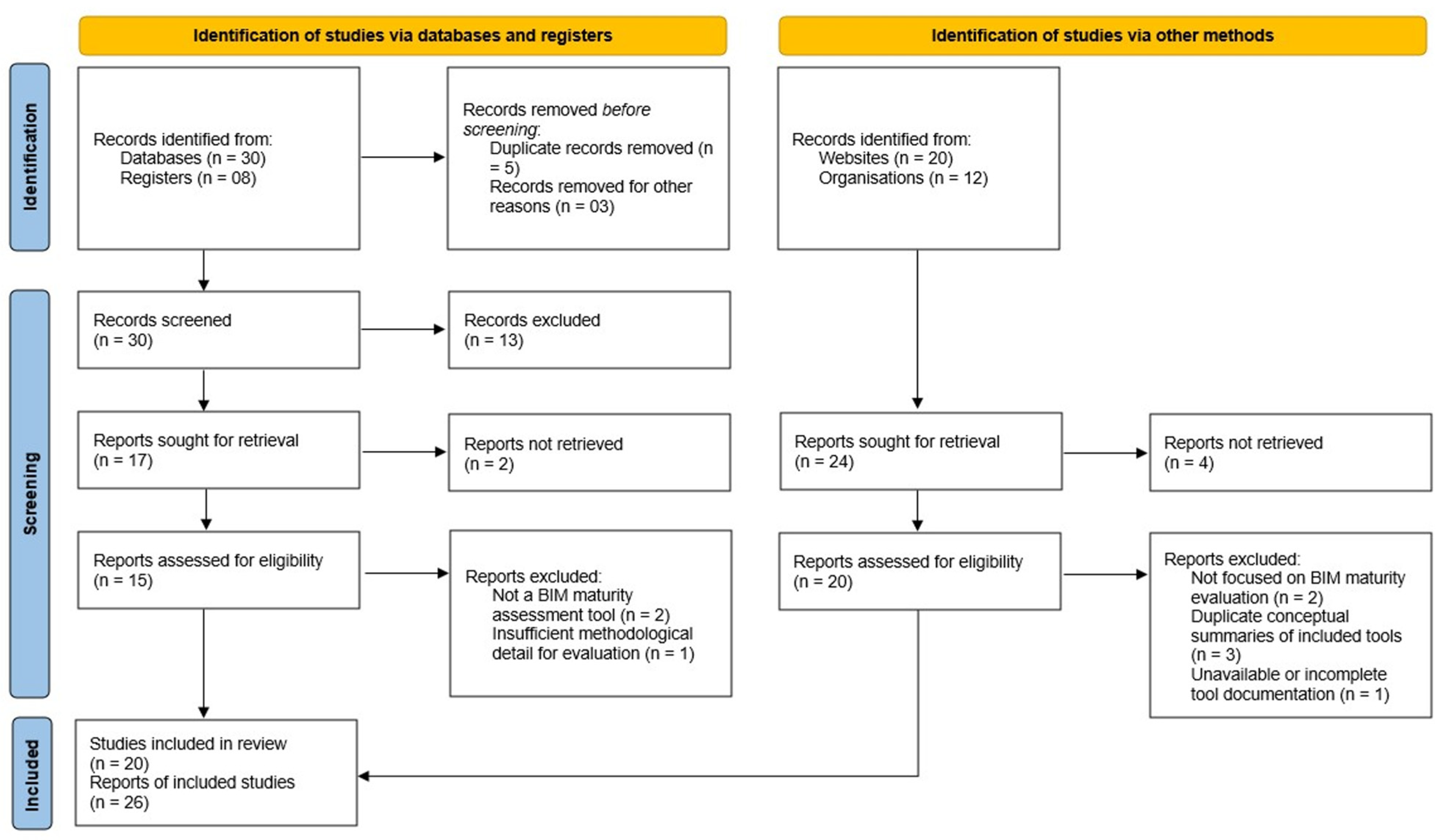
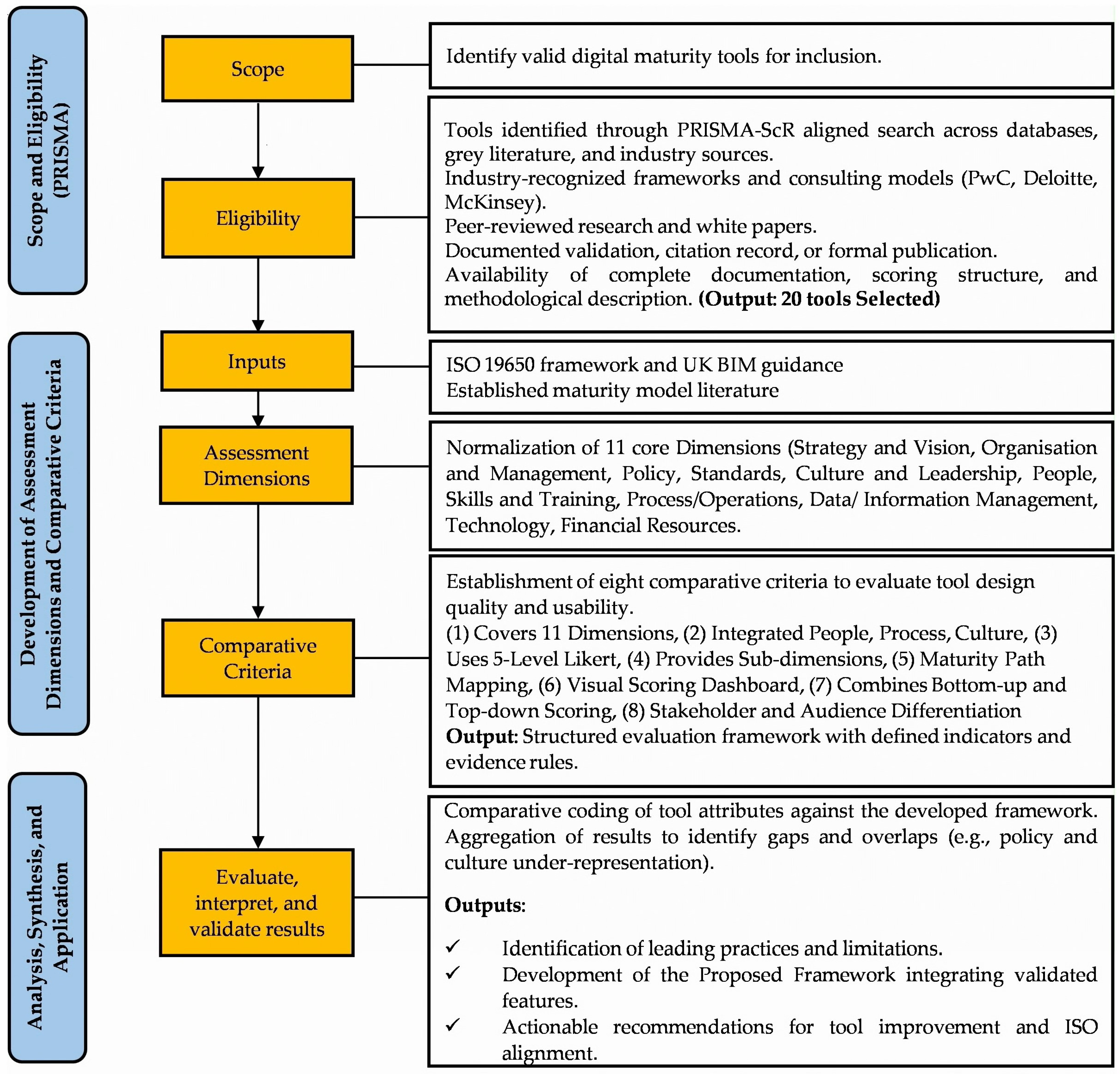
3.1. Methodology for Tools Selection
3.1.1. Information Sources and Search Dates
3.1.2. Search Strategy
3.1.3. Inclusion Exclusion (Eligibility) Criteria
Inclusion Criteria
- Industry Recognition: A tool qualified if at least one of the following held:
- Official release or sponsorship by a public authority/standards body (e.g., the European Commission’s Maturity Scan; NIBS’s NBIMS-CMM).
- Documented deployments/validation in practice (e.g., Stanford CIFE’s VDC BIM Scorecard used and validated on real projects; BIM Compass used for national benchmarking); or
- Commercial roll-out by a tier-1 consultancy with client deployments (e.g., BCG’s Digital Acceleration Index; McKinsey’s Digital Quotient).
- Availability of Detailed Literature: Each included tool had at least one primary source (peer-reviewed article, standards/technical document, or an official white paper/user guide) that discloses scope, structure, and scoring so methods are auditable (e.g., BIM-CAREM in Computers in Industry 2019/2023; BIM-MM in IGI Global 2010; BIM Cloud Score in ASCE J. Constr. Eng. Manage.; VDC BIM Scorecard in the CIFE technical report; TM Forum/Deloitte DMM in TMF documentation; BCG DAI and McKinsey DQ on official portals). Tools lacking primary source were excluded.
- Reputable Development and Support: Tools developed by universities, international consultants, or government bodies were selected to ensure legitimacy, methodological rigor, and continued maintenance.
- Distinctive Features: Tools had to demonstrate a unique approach such as multi-dimensional assessment, BIM integration, or benchmarking capability that justified their inclusion in a comparative review.
- Citation and Recognition: Preference was given to tools that had been cited in academic literature or professional reports, indicating impact and acceptance by the research and practitioner communities.
Exclusion Criteria
- Conceptual articles on digital transformation that did not provide a maturity tool or scoring method.
- Studies focused solely on technology adoption, predictive modelling or standard project performance metrics without a maturity construct.
- General digital readiness or IT governance models with no clear application to AEC or BIM.
- Marketing leaflets or webpages lacking methodological detail on dimensions, scales or scoring.
- Non-English sources or tools for which full documentation was unavailable or inaccessible.
3.1.4. Screening Reliability and Data Extraction
3.2. Methodology for Criteria Selection
3.2.1. Development of Assessment Dimensions
3.2.2. Coding Framework and Criteria for Identifying Maturity Dimensions
- Visible structural definition of the dimension, such as a named domain, an equivalent thematic cluster, or at least three distinct indicators that explicitly mapped to that domain; and
- Explicit measurement, demonstrated through scored questions, maturity level descriptors, structured rubrics or documented weighting schemes. Unscored mentions or general statements were treated as contextual background rather than evidence of assessment.
3.2.3. Development of Comparative Evaluation Criteria
- Eleven Dimensions: To ensure methodological consistency and representativeness, a detailed content analysis of existing BIM and digital maturity frameworks was undertaken prior to defining this criterion. The analysis compared recurrent constructs across international standards (ISO 19650) and benchmark models such as the Maturity Scan, BIM Maturity Matrix, BIM Quick Scan, and VDC Scorecard. Through iterative synthesis, overlapping themes were consolidated to avoid redundancy, resulting in a stable set of eleven key maturity dimensions. This number reflects a balanced and comprehensive structure that captures all critical socio-technical aspects spanning strategy, organisation, technology, people, process, and governance without unnecessary fragmentation. The inclusion of eleven dimensions aligns with findings from established maturity matrix research, which emphasizes complete yet manageable domain coverage to ensure meaningful benchmarking [39,40]. The complete list and criteria for selecting these dimensions are explained in Section 5.5.
- Integrated Assessment of People, Process and Culture: Inclusion of this triad acknowledges the centrality of behavioural and cultural transformation within digital adoption, emphasized by leadership-driven models [31].
- Uses five-level Likert Scale: A five-point Likert scale is widely used in maturity models for its statistical stability and interpretive consistency [44].
- Subdimensions: Explicit subdimensions allow transparent traceability between qualitative indicators and quantitative scores, ensuring the model’s auditability and internal validity.
- Maturity Path Mapping: The presence of a staged or roadmap-like structure that makes improvement trajectories explicit. The construction is consistent with staged capability models (e.g., CMMI) and BIM-specific maturity matrices that articulate levels and pathways [36,45]. Tools were credited only when stages/levels were explicitly defined and linked to progress guidance.
- Visual Scoring Dashboard: Availability of a results interface (e.g., scorecards, radar charts, dashboards) that communicates scores to different audiences. Justification derives from visual management research in construction showing dashboards improve transparency and decision-making [46] and recent reviews on visual dashboards for performance monitoring [47].
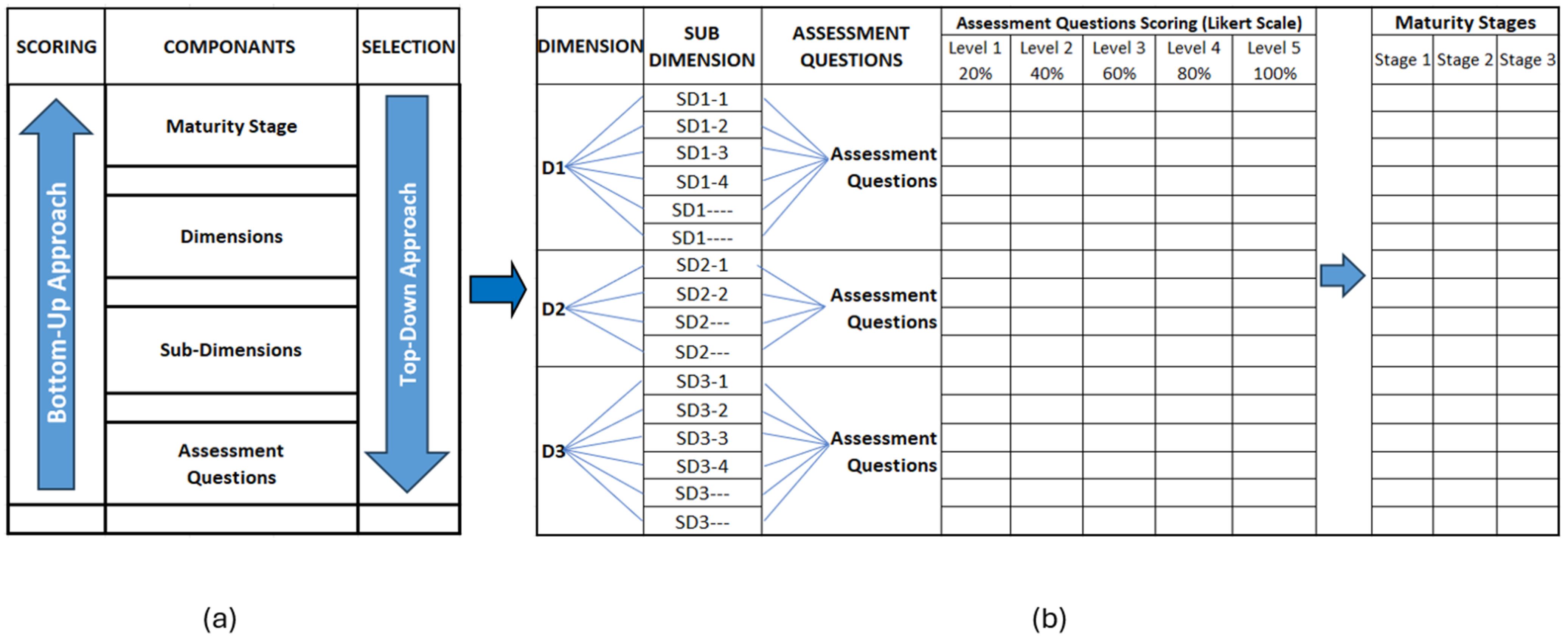
- Combines Bottom-up and Top-down Scoring: Evidence that granular indicator scores (bottom-up) are aggregated to higher-level dimensions or strategic objectives (top-down) using an explicit schema. The logic follows hierarchical evaluation in maturity and multi-criteria decision frameworks where local measures roll up to composite judgments [48] and staged/continuous capability representations [45].
4. Characteristics and Classification of Existing Digital Maturity Assessment Tools
5. Overall Analysis of the Selected Tools
5.1. Origins of Tools
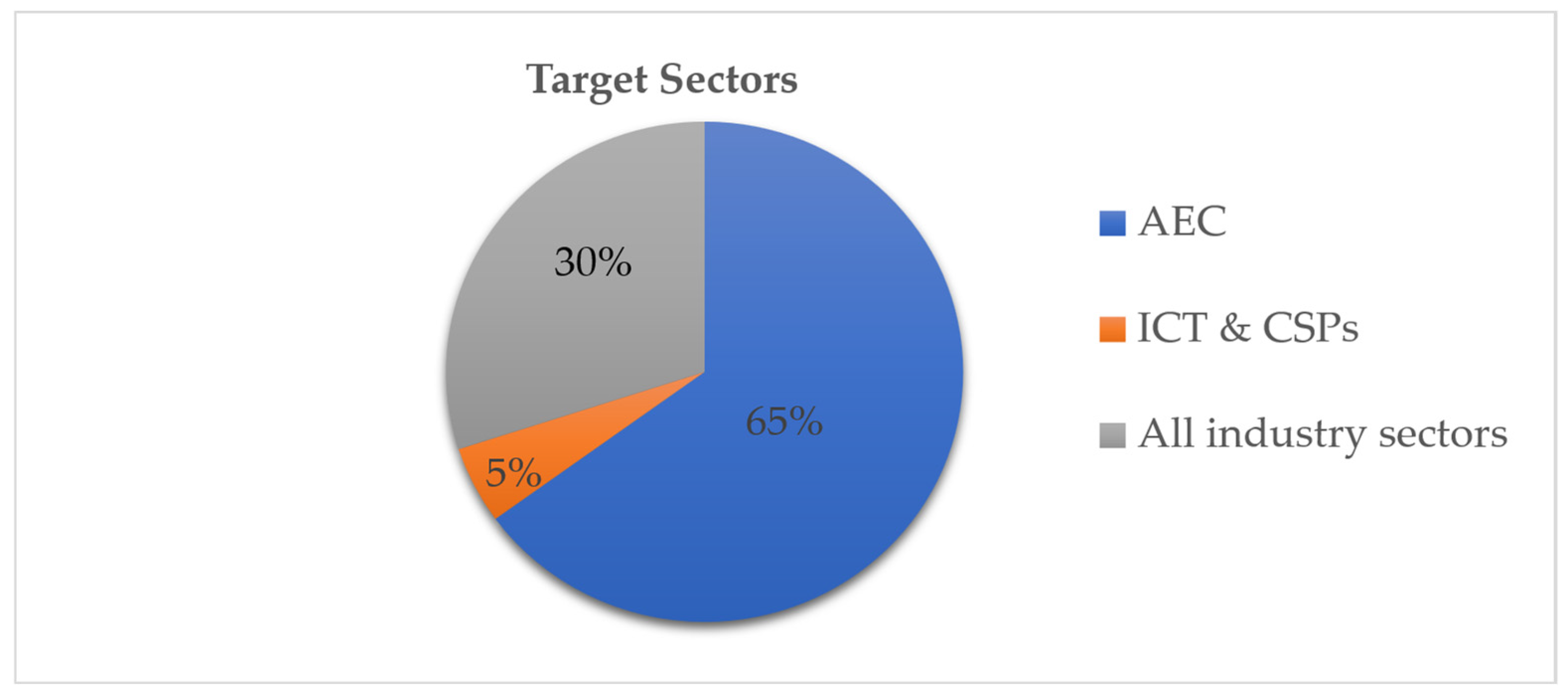
5.2. Target Sector
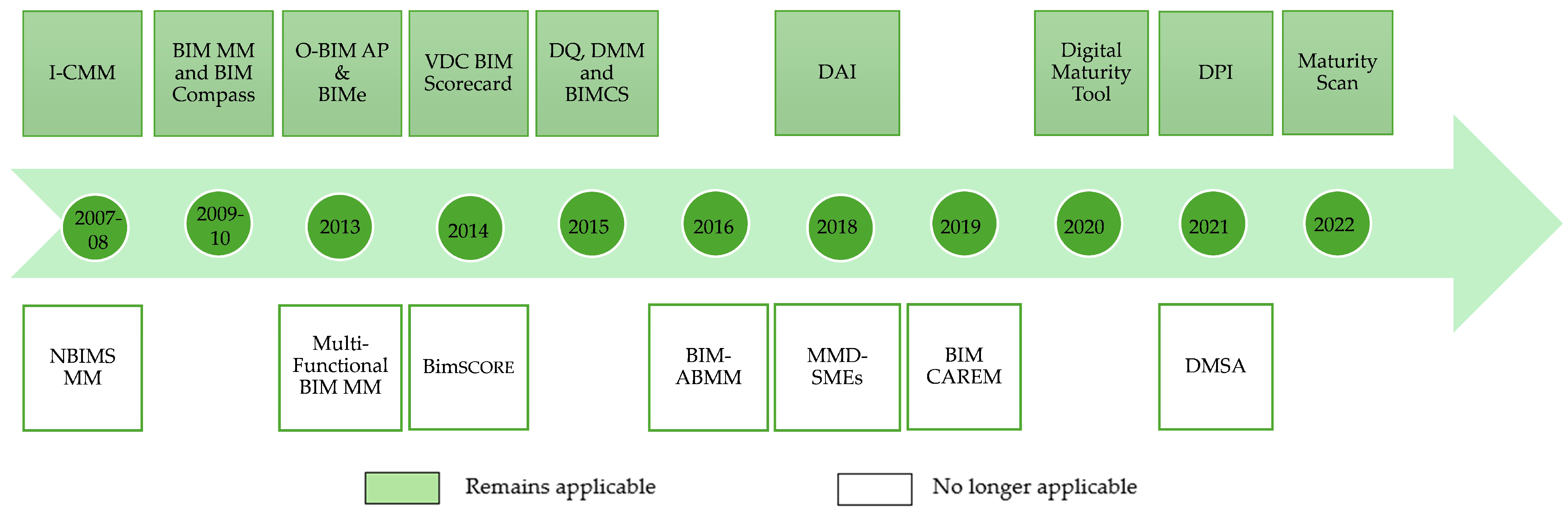
5.3. Evolution of the Tools (2007–2022)
5.4. Platform and Accessibility
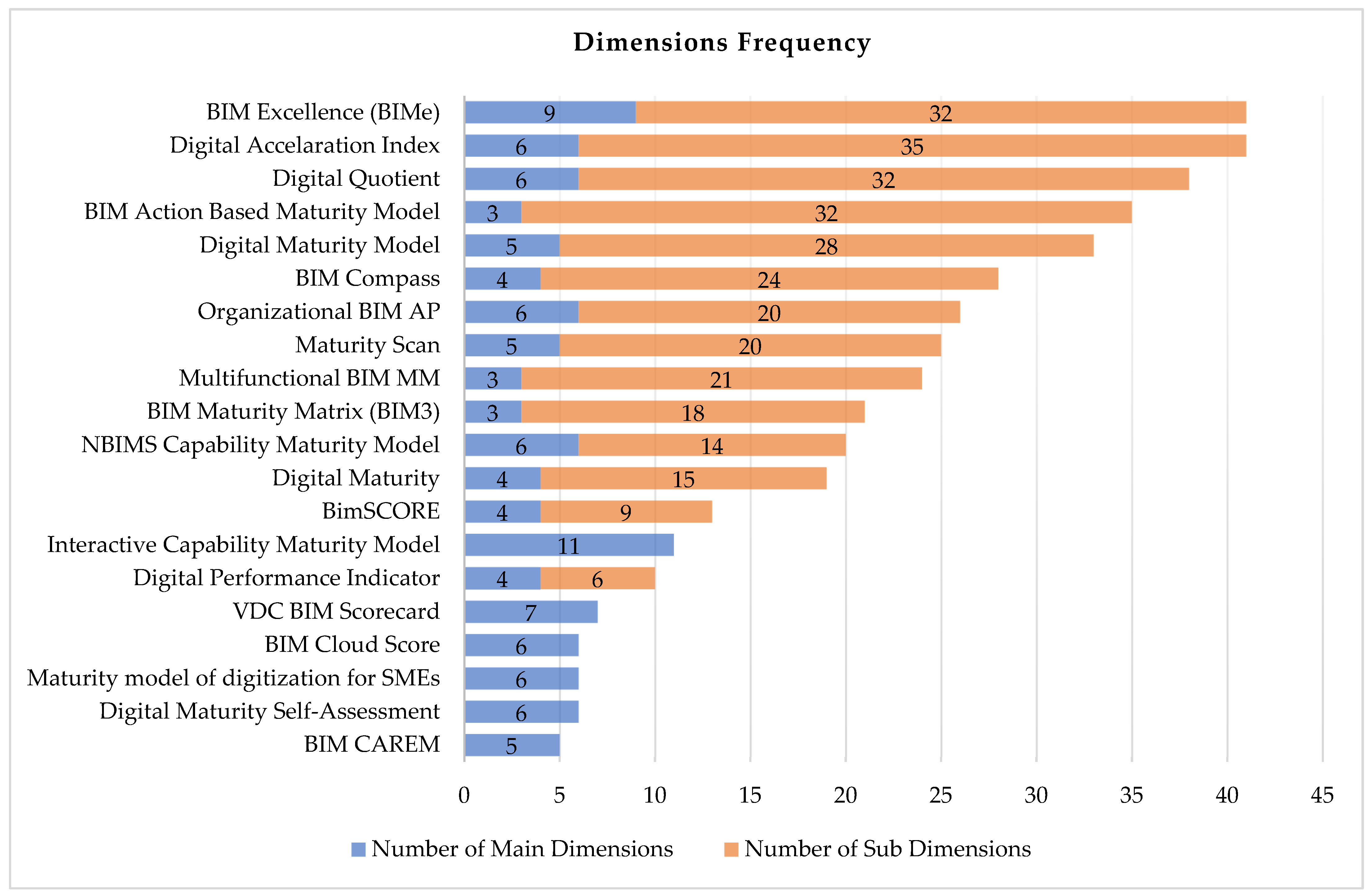
5.5. Dimensions
5.6. Evaluation Matrix
5.6.1. Assessment Matrix
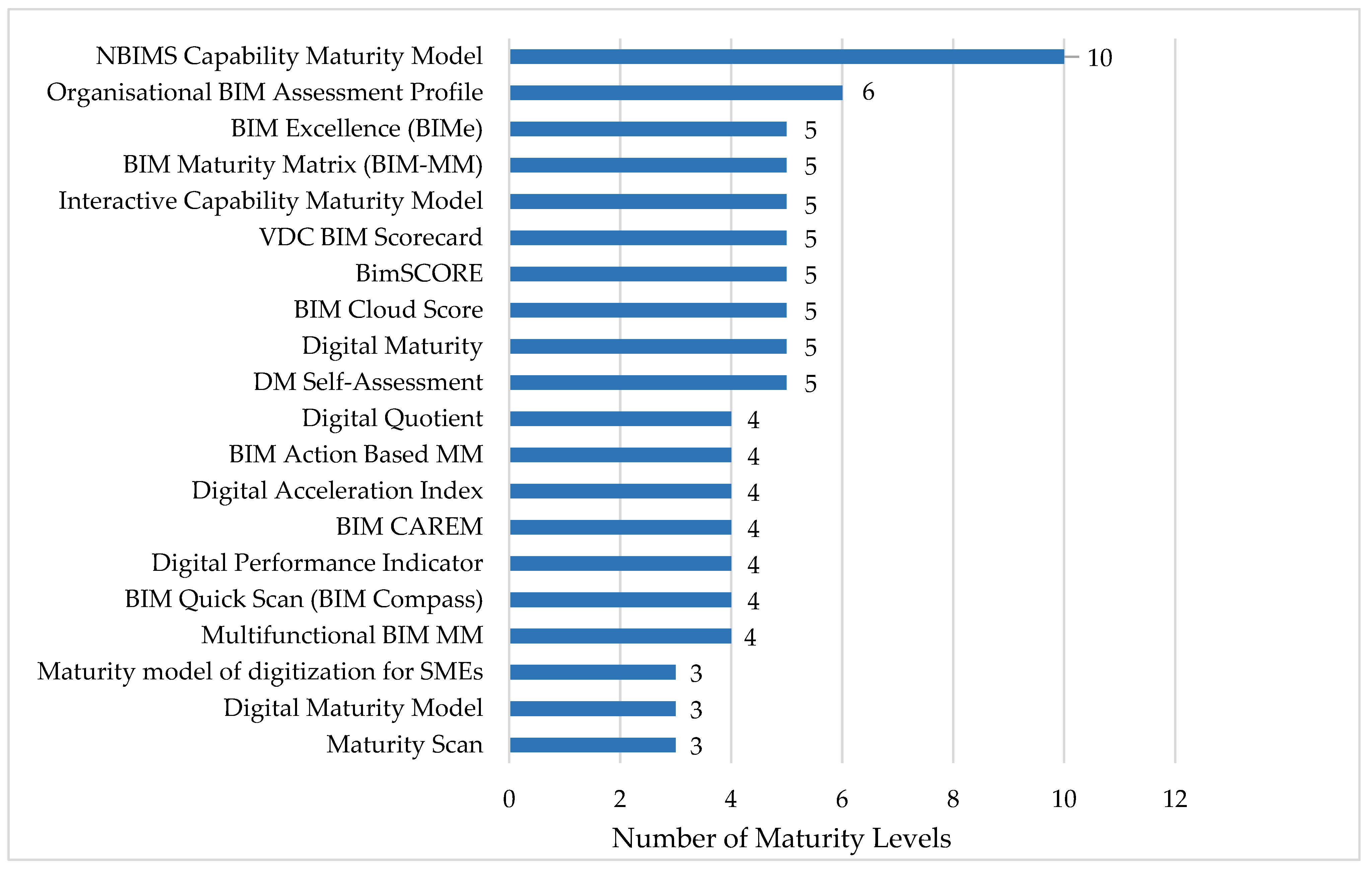
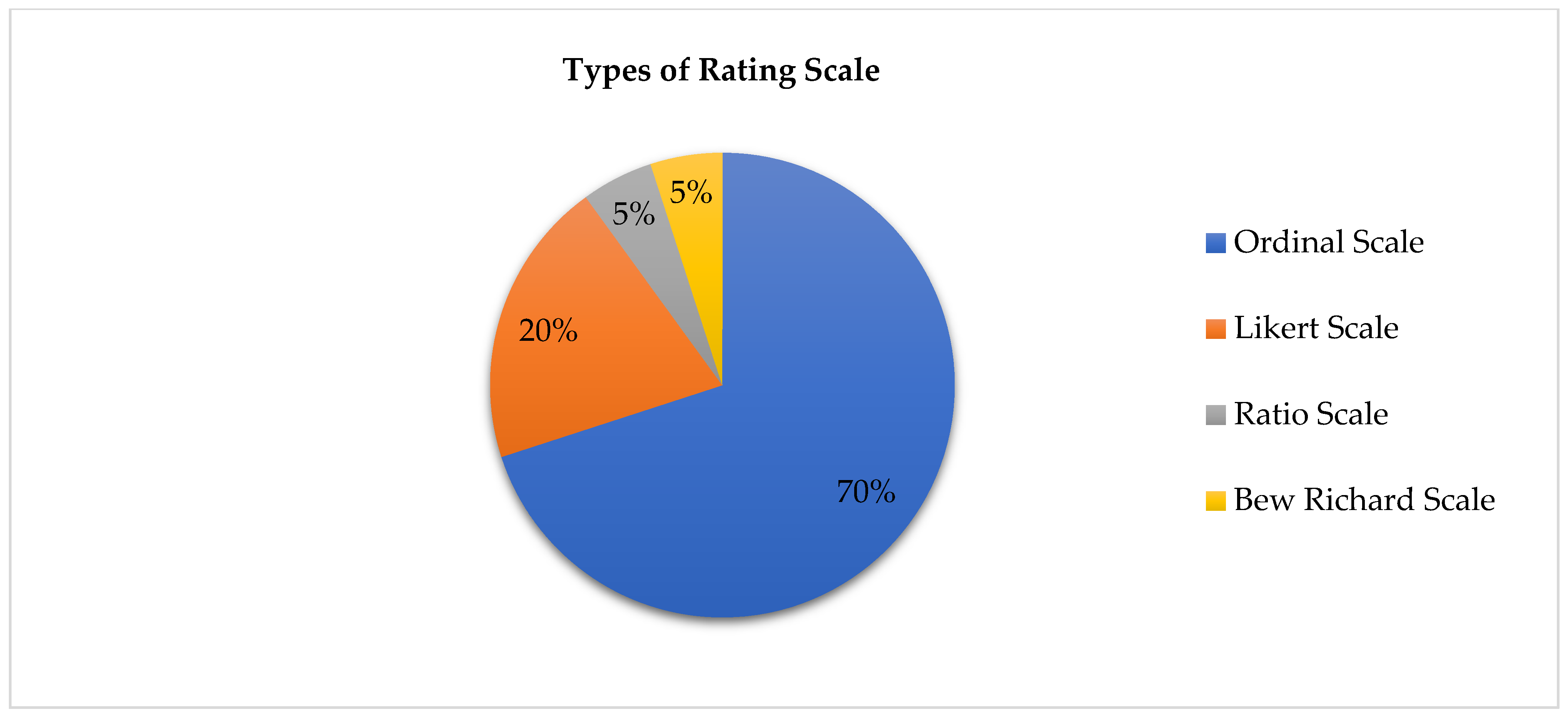
5.6.2. Measuring Scale and Maturity Levels
- Consistent progression patterns across different tools, despite variations in terminology
- Association with scoring systems (e.g., percentages or 0–4 or 1–5 ratings)
- Ability to assess various aspects of digital maturity within an organisation
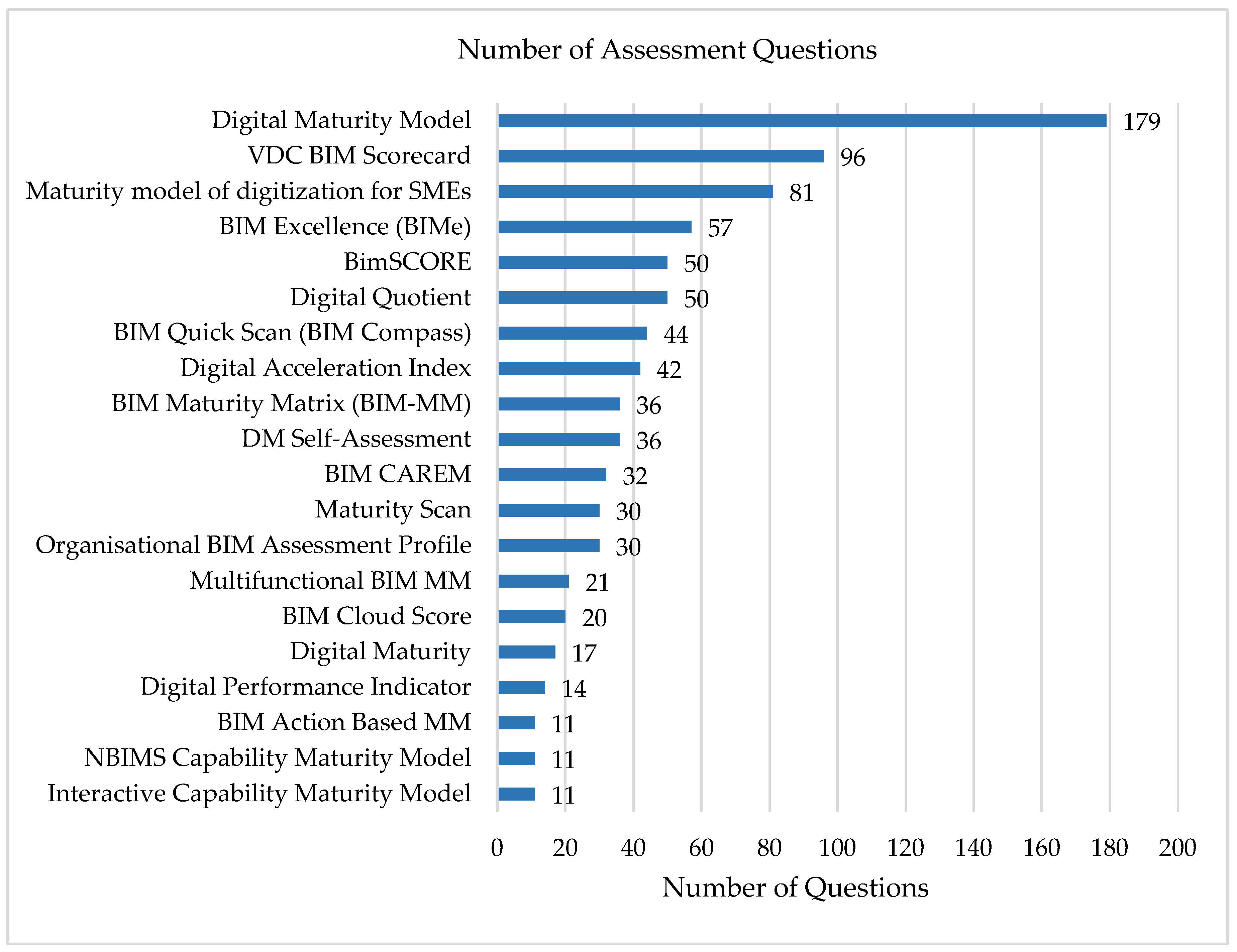
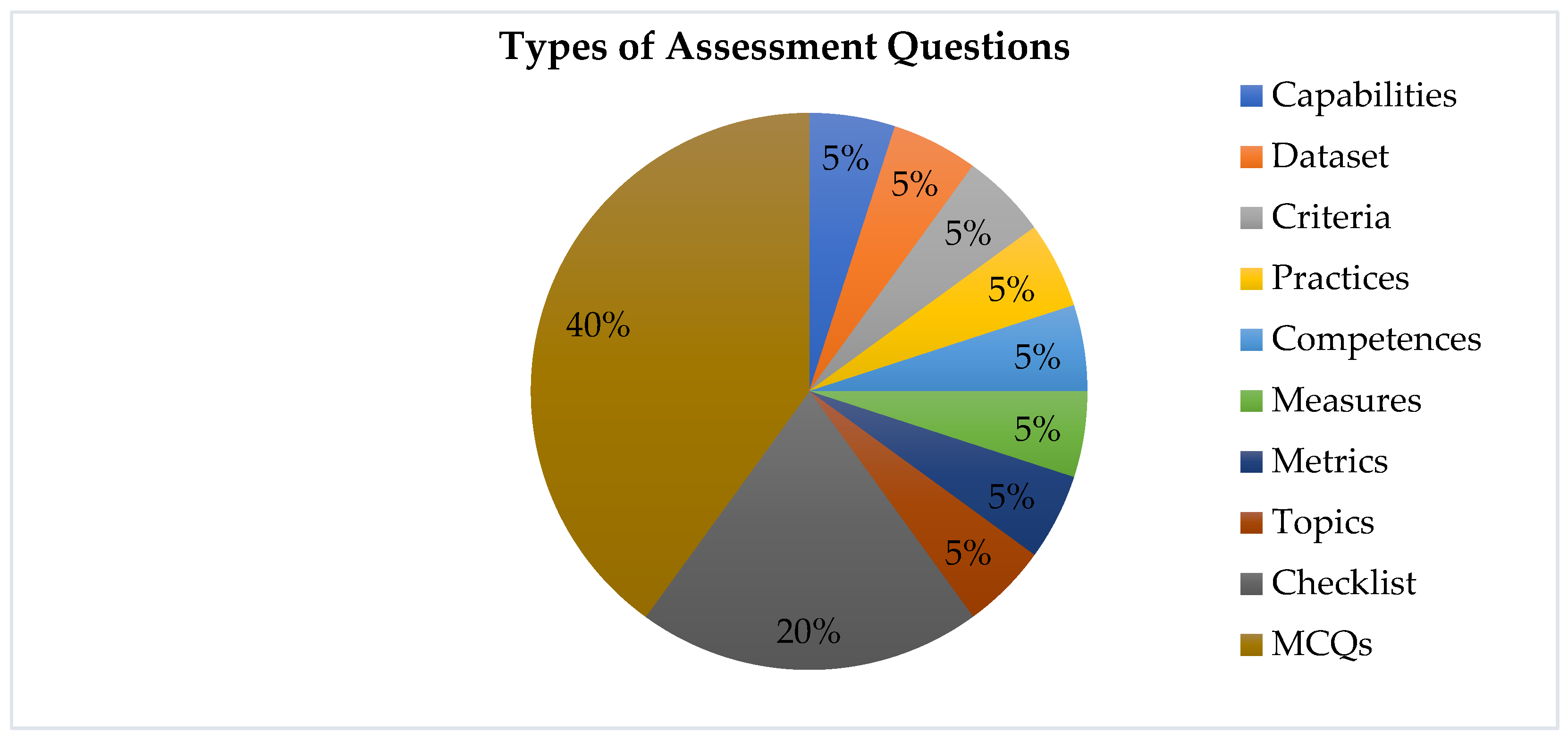
5.6.3. Number and Types of Assessment Questions
5.7. Comparative Analysis of Digital Maturity Assessment Tools
- A five-level maturity scale (ranging from initial/ad-hoc, planned, defined and managed to optimised) associated with a five-point Likert rating scale.
- Integrating key components such as maturity assessment levels, dimensions, sub dimensions, and a path to maturity.
- The tool should align with ISO 19650 maturity stages and clearly identify gaps in evaluating the organisation’s digital maturity.
5.8. Gaps in Current Tools and Future Recommendations
5.8.1. Gaps in Dimensions Assessment
Lack of Integrated Assessment Approach in Process, People and Culture
Lack of Technology Integration
Lack of Policy and Governance Alignment
Collective Assessment Approach
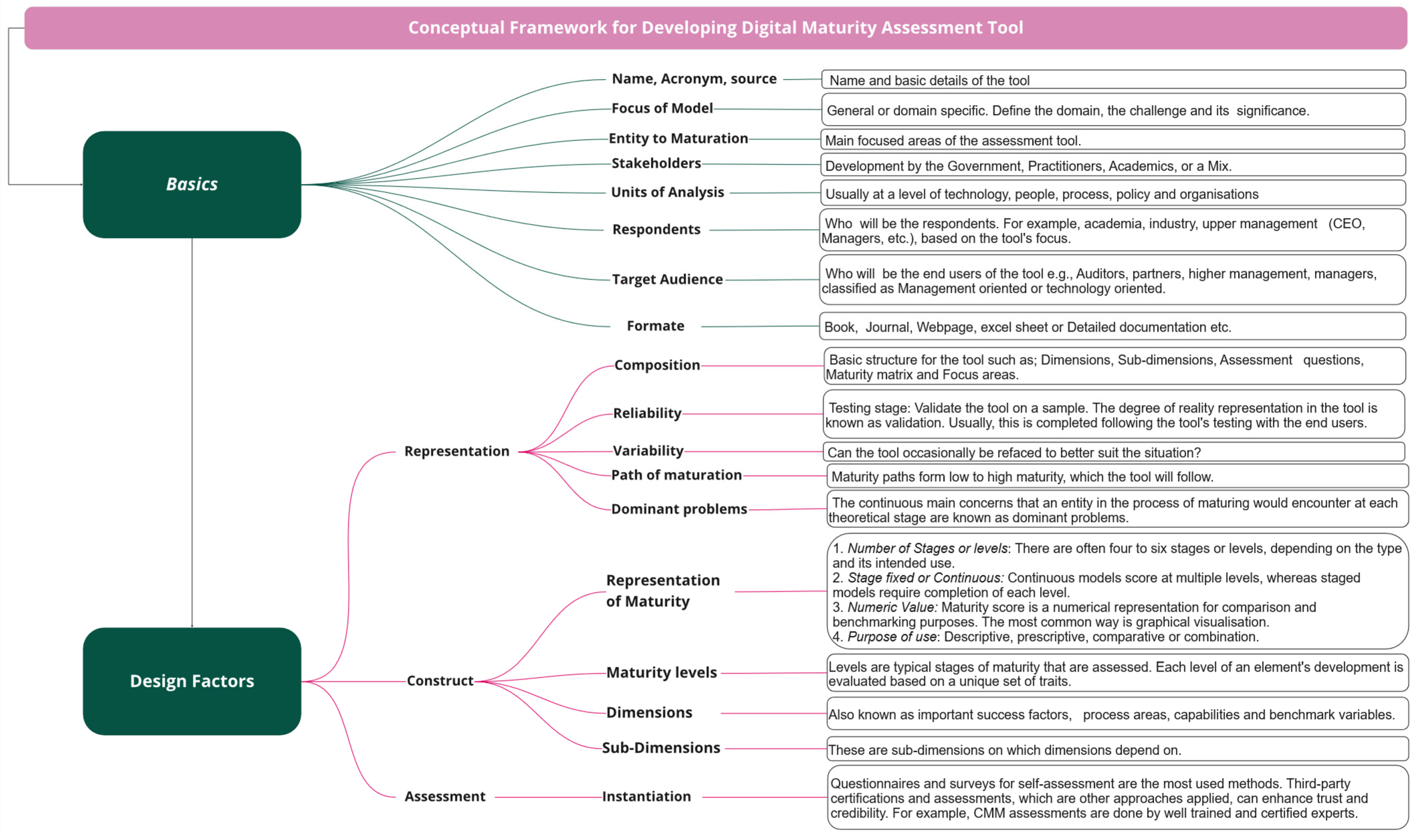
6. Proposed Digital Maturity Evaluation Framework
6.1. Framework Structure and Components
6.2. Framework Development Approach
6.3. Benchmarking Comparison with Existing Tools
6.4. Testing Regimes and Validation Pathways for Digital Maturity Tools
7. Conclusions
- A five-level maturity scale associated with a five-point Likert scale.
- An integrated assessment approach evaluating multiple critical dimensions simultaneously.
- A combined bottom-up approach for maturity scoring and top-down approach for selecting dimensions and subdimensions.
8. Limitations and Future Research
Supplementary Materials
Author Contributions
Funding
Data Availability Statement
Acknowledgments
Conflicts of Interest
Abbreviations
| AEC | Architecture, engineering and construction |
| DT | Digital transformation |
| ISO | International Organisation for Standardisation |
| VDC | Virtual design and construction |
| ICT | Information communication and technology |
| CSPs | Communication service providers |
| SBI | Strategic building innovation |
| CIC | Computer-integrated construction |
| NIBS | National Institute of Building Sciences |
| SEI | Software Engineering Institute |
| CMU | Carnegie Mellon University |
| CIFE | Centre for Integrated Facility Engineering |
| VTG | Viatel Technology Group |
Appendix A
Appendix A.1

| Maturity Assessment Tool | Owner | Country/Source | Year | Target Sector | Platform | Accessibility | Time Required to Complete Assessment | Evaluation Matrix | Reference |
|---|---|---|---|---|---|---|---|---|---|
| Maturity Scan | European Innovation Council | European Commission | 2021–22 | AEC sector | Web based | Free access | Quick Scan 5 min In-Depth Scan 15–20 min | Uses a two-tier scanning method with basic queries and advanced multiple-choice questions across 18 BIM subdimensions. SME digital maturity is measured and visualised, contrasting current performance with digital transformation goals, and categorising companies as late adopters, early adopters, or pioneers based on their digitalisation level. | [26] |
| Digital Performance Indicator (DPI) | Binder Dijker Otte (BDO) | United States | 2021 | All sectors | Web based | For assessment the BDO team should be contacted | 10–15 min | DPI assesses a company’s digital maturity across six dimensions, as outlined in BDO’s 2021 middle market DT survey, yielding a score from 0 to 100. This system evaluates digital maturity in sales, customers, employees, IT and processes, suitable for any industry or enterprise. | [23] |
| Digital Maturity Self-Assessment (DMSA) | Action Point | Ireland | 2021 | All sectors | Web based | For assessment the VTG team should be contacted | 15–20 min | The digital maturity of an organisation is assessed through a 36-item multiple-choice questionnaire, which covers six dimensions of business transformation. The results report includes scores, recommendations, strengths, and areas for improvement, and is applicable to organisations across all sectors. | [76] |
| Digital Maturity Tool (DMT) | Digital Leadership Ltd. | United Kingdom | 2020 | All sectors | Web based | Fee required for access | 10–15 min | Uses a five-level scale to generate the organisation’s digital maturity score through an online assessment. The overall digital maturity level is displayed via live graphs and percentages. | [56] |
| BIM Capability Assessment Reference Model | University of Cambridge | United Kingdom | 2019 | AEC/facility Mngt. | Excel based | For access research team should be contacted | Undefined | BIM-CAREM enables BIM capability assessments of AEC/FM processes throughout the facility’s life cycle phases over five main areas. | [54] |
| Digital Acceleration Index (DAI) | Boston Consulting Group | United States | 2018 | All sectors | Web based | Free Access | 10 min | Evaluates digital capability through readiness for new technologies, innovation, and comparison with peers and digital leaders. Uses 35 KPIs from a study of approximately 900 companies’ digital transformation programs to present predicted success rates and percentile scores graphically. | [60] |
| Maturity model of digitisation for SMEs (MMD-SMEs) | Franziska Blatz | Germany | 2018 | All sectors | Research based | For access to tool, research team should be contacted at franziska@familie-blatz.de | 30–60 min | The tool assesses the digital maturity of SMEs across six dimensions using a Likert scale and categorising them into three levels of maturity. Although the tool is comprehensive, research-based, and freely accessible, the tool lacks customisation capabilities and provides only generalised recommendations for enhancement. | [24] |
| BIM Action-Based Maturity Model (BIM-ABMM) | Joaquim Maria Pires | Brazil and Portugal | 2016 | AEC sector | Research based | For access, contact mail@tecnico.ulisboa.pt | Undefined | Integrates quantitative and qualitative assessments of both hard and soft aspects using 32 KPIs to assess current digital maturity, facilitating BIM implementation and digital transformation adoption. | [55] |
| Digital Maturity Model (DMM) | TM Forum and Deloitte | United States | 2015 | ICT and CSP industry | Web based | For assessment the TM Forum team should be contacted | Undefined | Evaluates an organisation’s digital maturity using 179 key performance indicators (KPIs) across 28 subdimensions, providing insights into strengths, weaknesses, and recommendations for improving digital maturity level. | [58,59] |
| Digital Quotient (DQ) | McKinsey’s Construction | United States | 2015 | All sectors | Web based | Free Access | 30 min | The DQ assesses digital maturity through five dimensions, 32 management practices and 50 questions, enabling consultants to evaluate organisations with aggregated metrics. It provides a broad assessment approach for organisations seeking to enhance digital maturity. | [27] |
| BIM Cloud Score (BIMCS) | University of Texas | United States | 2015 | AEC sector | Research based | For access to tool, contact at (eric.du@essie.ufl.edu) | 30–60 min | The system includes 6 dimensions and 20 subdimensions for assessing BIM maturity. BIMCS is a software as a system (SaaS)-based community cloud, which collects, consolidates, and displays benchmarking data, provides an interactive and autonomous view of industry BIM usage and a customisable tool for specific organisational needs. | [21] |
| BimSCORE | Dr. Calvin Kam | SBI-United States | 2014 | AEC sector | Web based | For access, the SBI team should be contacted | 1–3 h | This tool compares current projects with past ones and industry benchmarks, allowing stakeholders to assess BIM practice, progress, and maturity over time. Although it offers comprehensive and actionable improvement recommendations, it may face implementation challenges and limited vendor support. | [57] |
| Virtual Design Construction (VDC) BIM Scorecard | Stanford University | United States | 2014 | AEC sector | Research based | For access to tool, the CIFE team should be contacted at (ckam@stanfordalumni.org) | 1–4 h | Evaluates VDC implementation maturity across 4 main dimensions, 10 subdimensions and 56 key performance indicators through seven confidence factors. It prioritises certain areas over others through a weighted scorecard and thoroughly assesses an organisation’s BIM maturity, including leadership, governance, data, and analytics, and promotes objectives, standards and resources to meet business goals. | [50] |
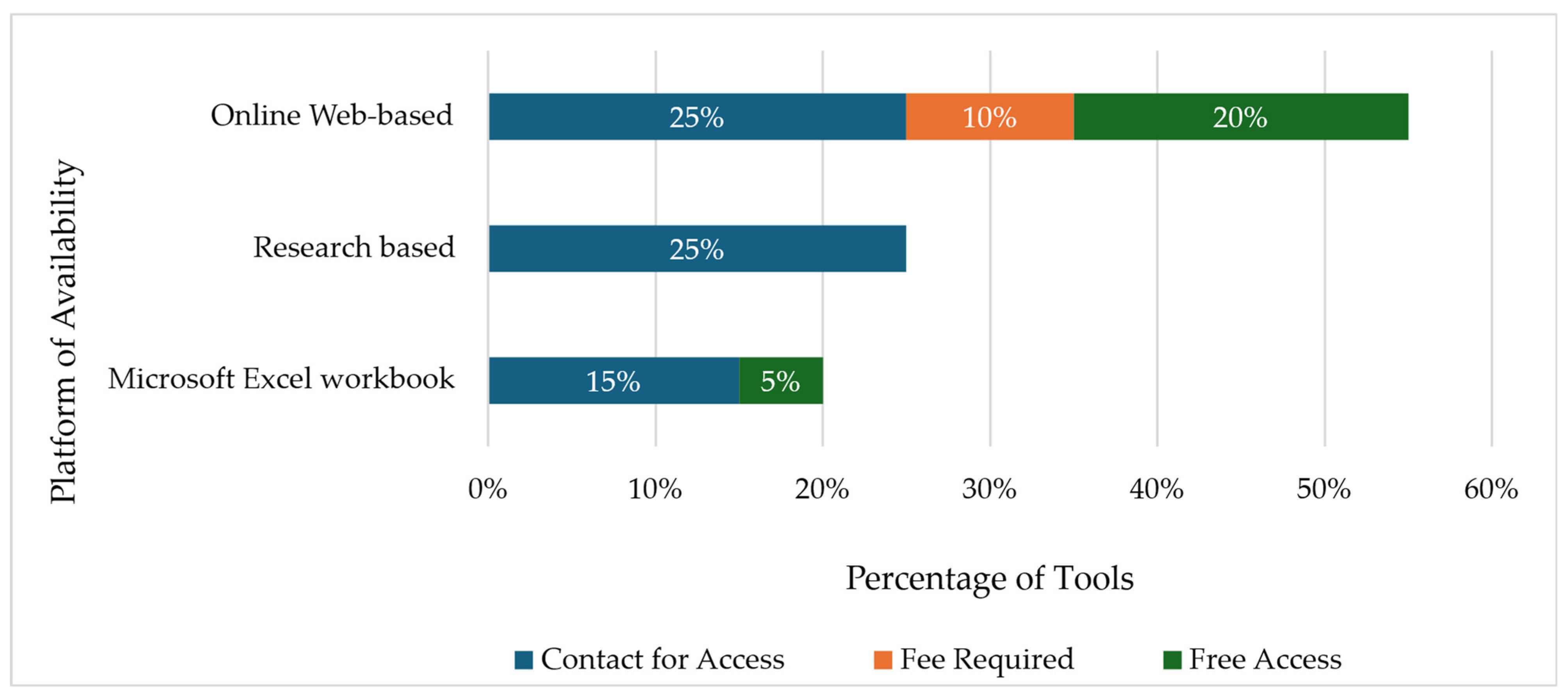
| Organisational BIM Assessment Profile (OBAP) | CIC- Penn State University | United States | 2013 | AEC sector | Microsoft Excel workbook | Free access | 30–60 min | The evaluation matrix assesses an organisation’s BIM proficiency across five areas using a five-point Likert scale over six maturity levels. Higher BIM maturity corresponds to higher scores. Additionally, the matrix can be tailored to the organisation’s specific goals and objectives. | [77] |
| Multifunctional BIM Maturity Model (M-BIM MM) | Dr Liang Cong | University of Hong Kong | 2013 | AEC sector | Research based | For access to tool, research team should be contacted at congliang@ln.edu.hk | 30–90 min | Evaluates BIM maturity in individual projects, organisations with multiple projects, or the AEC industry through 21 subdimensions within 5 main dimensions, assessed on an ordinal scale across four maturity levels. The tool offers actionable improvement suggestions and basic evaluations of an organisation’s BIM maturity. | [28] |
| BIM Excellence (BIMe) | ChangeAgents AEC | Australia | 2010–13 | AEC sector | Web based | For access to tool, the BIMe team should be contacted | 1–3 months | BIMe is a versatile tool for evaluating BIM implementation across individuals, organisations, projects, and teams. It provides free assessment with downloadable reports and consultation services. BIMe’s online platform assesses current abilities against requirements and benchmarks, covering leadership, governance, data, and analytics. | [78,79] |
| BIM Compass | BIM Loket | The Netherlands | 2009–10 | AEC sector | Web based | Free access | 40–50 min | It evaluates software, tools, system integration, hardware standards, data protocols, and soft aspects including collaboration, training, skills, culture, leadership, and contractual considerations of BIM. It provides insights into a company’s BIM performance and digital maturity, making it recommended for beginners in digital maturity assessment. | [22,38] |
| BIM Maturity Matrix (BIM MM) | ChangeAgents AEC | Australia | 2009–10 | AEC sector | Web based | Fee required for access | 30–60 min | BIM MM assesses individual competency, organisational capability, and project performance using five metrics, three capability levels, and five maturity levels. The result is a maturity score or level, indicating the organisation’s position on the BIM maturity scale, with recommendations for improvement and follow-up consultation on organisational performance. | [13,16,36] |
| Interactive Capability Maturity Model (I-CMM) | NBIS | United States | 2008 | AEC sector | Interactive Microsoft Excel workbook | For access to tool, the NBIMS team should be contacted | 30–60 min | I-CMM evaluates BIM implementation across 11 dimensions using a 10-level and 5-point Likert scale. The tool uses weighted summation, prioritizing criteria based on significance. Each criterion is scored from 0 to a maximum, with total scores from 0–100 reflecting maturity levels. I-CMM assesses BIM maturity, enables goal setting and provides improvement suggestions, but lacks customisation and reporting features. | [52] |
| NBIMS Capability Maturity Model (NBIMS-CMM) | SEI-CMU | United States | 2007 | AEC sector | Static tabular Excel workbook | For, the NBIMS team should be contacted | 30 min | Assesses BIM’s operational and organisational capabilities through an interactive Microsoft Excel maturity matrix which evaluates digital maturity across 11 dimensions on a 10-level scale. This method converts subjective evaluations into objective, broadly applicable findings, visually depicting BIM’s information management maturity with precise scores across 11 areas. | [52,80] |
Appendix A.2
| Maturity Assessment Tools | Year | Dimension | |||||||||||
|---|---|---|---|---|---|---|---|---|---|---|---|---|---|
| Strategy and Vision | Org. and Mgmt. | Policy | Standards | Culture and Leadership | People | Training and Skills | Process | Data/Info Mgmt. | Technology | Financial Resources | % of Assessed Dimensions | ||
| Maturity Scan | 2021–22 | ✓ | ✓ | ✓ | ✓ | ✓ | 45 | ||||||
| Digital Performance Indicator | 2021 | ✓ | ✓ | ✓ | ✓ | ✓ | ✓ | 55 | |||||
| Digital Maturity Self-Assessment | 2021 | ✓ | ✓ | ✓ | ✓ | ✓ | ✓ | 55 | |||||
| Digital Maturity | 2020 | ✓ | ✓ | ✓ | ✓ | ✓ | 45 | ||||||
| BIM Capability Assessment Reference Model | 2019 | ✓ | ✓ | ✓ | ✓ | 36 | |||||||
| Digital Acceleration Index | 2018 | ✓ | ✓ | ✓ | ✓ | ✓ | 45 | ||||||
| Maturity model of digitization for SMEs | 2018 | ✓ | ✓ | ✓ | ✓ | 36 | |||||||
| BIM Action Based Maturity Model | 2016 | ✓ | ✓ | ✓ | ✓ | ✓ | 45 | ||||||
| Digital Maturity Model | 2015 | ✓ | ✓ | ✓ | ✓ | ✓ | ✓ | 55 | |||||
| Digital Quotient | 2015 | ✓ | ✓ | ✓ | ✓ | ✓ | 45 | ||||||
| Building Information Modelling Cloud Score | 2015 | ✓ | ✓ | ✓ | ✓ | ✓ | ✓ | 55 | |||||
| Bim SCORE | 2014 | ✓ | ✓ | ✓ | 27 | ||||||||
| VDC BIM Scorecard | 2014 | ✓ | ✓ | ✓ | ✓ | ✓ | ✓ | 55 | |||||
| Organisational BIM Assessment Profile | 2013 | ✓ | ✓ | ✓ | ✓ | ✓ | 45 | ||||||
| Multifunctional BIM Maturity Model | 2013 | ✓ | ✓ | ✓ | ✓ | ✓ | 45 | ||||||
| BIM Excellence | 2010–13 | ✓ | ✓ | ✓ | ✓ | ✓ | ✓ | 55 | |||||
| BIM Compass | 2009–10 | ✓ | ✓ | ✓ | ✓ | ✓ | 45 | ||||||
| BIM Maturity Matrix | 2009–10 | ✓ | ✓ | ✓ | 27 | ||||||||
| NBIMS Maturity Model | 2007–08 | ✓ | ✓ | ✓ | ✓ | 36 | |||||||
| Interactive Capability Maturity Model | 2007–08 | ✓ | ✓ | ✓ | ✓ | ✓ | ✓ | 55 | |||||
| % of Tools Assessing Specific Dimension | 45 | 70 | 20 | 45 | 45 | 40 | 20 | 55 | 55 | 90 | 15 | ||
Appendix A.3
| Maturity Dimension | Brief Description | Relevant ISO 19650 Principles/Clauses * |
|---|---|---|
| Strategy and vision | Organisational digital strategy, information vision, alignment of BIM/information management with asset and project objectives. | ISO 19650-1:2018, Part 1—Concepts and principles (linking information management to organisational objectives and benefits); ISO 19650-2:2018, Clause 5—Information management process during the delivery phase (assessment of need and planning of information management). |
| Organisation and management | Governance structures, appointment model, roles and responsibilities for managing information across project participants. | ISO 19650-1:2018, sections on information management functions and responsibilities; ISO 19650-2:2018, Clause 5 (information management process) including allocation of responsibilities between appointing and appointed parties. |
| Policy | Internal and external policies, contractual and legal rules that govern information management, security and compliance. | ISO 19650-1:2018, principles for information management and legal/regulatory context; ISO 19650-2:2018, clauses on requirements, appointments and information protocols; supported by UK BIM Framework Guidance Part D—Developing information requirements. |
| Standards | Use of BIM/information standards, CDE protocols, naming conventions and classification to support structured information. | ISO 19650-1:2018, container-based information management concepts; ISO 19650-2:2018, clauses on information standard and information production methods (within the information management process). |
| Culture and leadership | Leadership commitment, collaborative culture, change management, support for digital ways of working. | ISO 19650-1:2018, concepts and principles emphasising collaborative production and sharing of information; general guidance on leadership and organisational buy-in in the UK BIM Framework documents. |
| People | Engagement of end-users, client representatives and project teams in defining, using and maintaining information. | ISO 19650-1:2018, information management functions and roles; ISO 19650-2:2018, information management process describing interactions between appointing and appointed parties and their teams. |
| Skills and training | Digital skills, BIM capability, training and competence of staff involved in information management. | ISO 19650-1:2018, principles around capability and capacity of organisations to fulfil information management functions; supported by UK BIM Framework guidance on competency for information management roles. |
| Process/operations | Defined workflows, procedures and process controls for planning, producing, sharing and checking information. | ISO 19650-1:2018, process principles for information management; ISO 19650-2:2018, Clause 5—Information management process during the delivery phase of assets (all stages from assessment of need to handover). |
| Data and information management | Requirements, structures and flows of project/asset information, including CDE use, metadata and information containers. | ISO 19650-1:2018, container-based information management concepts; ISO 19650-2:2018, clauses on information delivery milestones, common data environment and information exchange. |
| Technology | Digital tools, platforms and infrastructure support BIM and information management processes. | ISO 19650-1:2018, overarching principles for technology-neutral information management using BIM; ISO 19650-2:2018, information management process as implemented through CDEs and related technologies. |
| Financial resources | Investment, budgeting and resource allocation to support digital transformation and information management activities. | ISO 19650-1:2018, benefits of information management and business-case principles, which imply the need for appropriate resourcing; these are typically expanded in national/client guidance rather than in detailed clauses of ISO 19650-2. |
References
- Vial, G. Understanding Digital Transformation: A Review and a Research Agenda. In Managing Digital Transformation; Routledge: Milton Park, UK, 2021; ISBN 978-1-003-00863-7. [Google Scholar] [CrossRef]
- Remane, G.; Hanelt, A.; Wiesböck, F.; Kolbe, L. Digital Maturity in Traditional Industries—An Exploratory Analysis. 2017. Available online: https://aisel.aisnet.org/ecis2017_rp/10/ (accessed on 10 March 2025).
- Bharadwaj, A.; El Sawy, O.A.; Pavlou, P.A.; Venkatraman, N. Digital Business Strategy: Toward a next Generation of Insights. MIS Q. 2013, 37, 471–482. [Google Scholar] [CrossRef]
- Fitzgerald, M.; Kruschwitz, N.; Bonnet, D.; Welch, M. Embracing Digital Technology: A New Strategic Imperative. MIT Sloan Manag. Rev. 2014, 55, 1. [Google Scholar]
- Lee, M.; Yun, J.J.; Pyka, A.; Won, D.; Kodama, F.; Schiuma, G.; Park, H.; Jeon, J.; Park, K.; Jung, K. How to Respond to the Fourth Industrial Revolution, or the Second Information Technology Revolution? Dynamic New Combinations between Technology, Market, and Society through Open Innovation. J. Open Innov. Technol. Mark. Complex. 2018, 4, 21. [Google Scholar] [CrossRef]
- Oliveira, M.; Zancul, E.; Salerno, M.S. Capability Building for Digital Transformation through Design Thinking. Technol. Forecast. Soc. Change 2024, 198, 122947. [Google Scholar] [CrossRef]
- Yeow, A.; Soh, C.; Hansen, R. Aligning with New Digital Strategy: A Dynamic Capabilities Approach. J. Strateg. Inf. Syst. 2018, 27, 43–58. [Google Scholar] [CrossRef]
- Mittal, S.; Khan, M.A.; Romero, D.; Wuest, T. A Critical Review of Smart Manufacturing and Industry 4.0 Maturity Models: Implications for Small and Medium-Sized Enterprises (SMEs). J. Manuf. Syst. 2018, 49, 194–214. [Google Scholar] [CrossRef]
- Kannan, S.M.; Suri, K.; Cadavid, J.; Barosan, I.; Van Den Brand, M.; Alferez, M.; Gerard, S. Towards Industry 4.0: Gap Analysis between Current Automotive MES and Industry Standards Using Model-Based Requirement Engineering. In Proceedings of the 2017 IEEE International Conference on Software Architecture Workshops (ICSAW), Gothenburg, Sweden, 5–7 April 2017; IEEE: New York, NY, USA, 2017; pp. 29–35. [Google Scholar] [CrossRef]
- Akinsola, F. Digital Innovation: SMEs Need a Bridge to Cross the Digital Divide. Medium. 2018. Available online: https://medium.com/@FemiAkinsola/digital-innovation-smes-need-a-bridge-to-cross-the-digital-divide-d45b37d12047 (accessed on 10 May 2025).
- Zim, A.H.; Iqbal, A.; Hossain, L.; Arif, S.; Malik, A.; Rasool, I.; Kuribayashi, M.; Ahmad, F. Smart Manufacturing with Transfer Learning under Limited Data: Towards Data-Driven Intelligences. Mater. Today Commun. 2023, 37, 107357. [Google Scholar] [CrossRef]
- Eastman, C.; Lee, G.; Teicholz, P.M. BIM Handbook: A Guide to Building Information Modeling for Owners, Designers, Engineers, Contractors, and Facility Managers; John Wiley & Sons: Hoboken, NJ, USA, 2011. [Google Scholar] [CrossRef]
- Succar, B.; Sher, W.; Williams, A. An Integrated Approach to BIM Competency Assessment, Acquisition and Application. Autom Constr 2013, 35, 174–189. [Google Scholar] [CrossRef]
- Adekunle, S.A.; Aigbavboa, C.; Ejohwomu, O.; Ikuabe, M.; Ogunbayo, B. A Critical Review of Maturity Model Development in the Digitisation Era. Buildings 2022, 12, 858. [Google Scholar] [CrossRef]
- Alankarage, S.; Chileshe, N.; Samaraweera, A.; Rameezdeen, R.; Edwards, D.J. Organisational BIM Maturity Models and Their Applications: A Systematic Literature Review. Archit. Eng. Des. Manag. 2023, 19, 567–585. [Google Scholar] [CrossRef]
- Succar, B. Building Information Modelling Framework: A Research and Delivery Foundation for Industry Stakeholders. Autom. Constr. 2009, 18, 357–375. [Google Scholar] [CrossRef]
- Hajoary, P.K. Industry 4.0 Maturity and Readiness Models: A Systematic Literature Review and Future Framework. Int. J. Innov. Technol. Manag. 2020, 17, 2030005. [Google Scholar] [CrossRef]
- Osei-Kyei, R.; Chan, A.P.C. Review of Studies on the Critical Success Factors for Public–Private Partnership (PPP) Projects from 1990 to 2013. Int. J. Proj. Manag. 2015, 33, 1335–1346. [Google Scholar] [CrossRef]
- Sony, M.; Naik, S. Key Ingredients for Evaluating Industry 4.0 Readiness for Organisations: A Literature Review. Benchmarking: Int. J. 2020, 27, 2213–2232. [Google Scholar] [CrossRef]
- Giel, B.; Issa, R.R.A. Framework for Evaluating the BIM Competencies of Building Owners. In Proceedings of the Computing in Civil and Building Engineering (2014), Orlando, FL, USA, 17 June 2014; American Society of Civil Engineers: Reston, VA, USA, 2014; pp. 552–559. [Google Scholar] [CrossRef]
- Du, J.; Liu, R.; Issa, R.R.A. BIM Cloud Score: Benchmarking BIM Performance. J. Constr. Eng. Manage 2014, 140, 04014054. [Google Scholar] [CrossRef]
- Sebastian, R.; Van Berlo, L. Tool for Benchmarking BIM Performance of Design, Engineering and Construction Firms in The Netherlands. Archit. Eng. Des. Manag. 2010, 6, 254–263. [Google Scholar] [CrossRef]
- BDO, D. The 10-Minute Digital Performance Indicator. Available online: https://www.bdo.az/en-gb/insights/insights/10-minutes-to-gauge-your-digital-competitiveness-digital-performance-indicator (accessed on 15 May 2025).
- Blatz, F.; Bulander, R.; Dietel, M. Maturity Model of Digitization for SMEs. In Proceedings of the 2018 IEEE International Conference on Engineering, Technology and Innovation (ICE/ITMC), 17–20 June 2018; IEEE: New York, NY, USA, 2018; pp. 1–9. [Google Scholar] [CrossRef]
- Digital Maturity Framework|Digital Maturity. Available online: https://digitalmaturity.org/digital-maturity-framework/ (accessed on 3 May 2025).
- European Commission Maturity Scan|Digitalisation of Construction SMEs. Available online: https://digital-construction.ec.europa.eu/maturity-scan (accessed on 13 May 2025).
- McKinsey Raise Your Digital Quotient. Available online: https://www.mckinsey.com/featured-insights/digital-disruption/raise-your-digital-quotient (accessed on 30 May 2025).
- Liang, C.; Lu, W.; Rowlinson, S.; Zhang, X. Development of a Multifunctional BIM Maturity Model. J. Constr. Eng. Manag. 2016, 142, 06016003. [Google Scholar] [CrossRef]
- Perera, S.; Jin, X.; Das, P.; Gunasekara, K.; Samaratunga, M. A Strategic Framework for Digital Maturity of Design and Construction through a Systematic Review and Application. J. Ind. Inf. Integr. 2023, 31, 100413. [Google Scholar] [CrossRef]
- Suermann, P.C.; Issa, R.R.A. The US National Building Information Modeling Standard. In Handbook of Research on Building Information Modeling and Construction Informatics: Concepts and Technologies; IGI Global Scientific Publishing: Palmdale, PA, USA, 2010; pp. 138–154. ISBN 978-1-60566-928-1. [Google Scholar] [CrossRef]
- Strategy, Not Technology, Drives Digital Transformation. Available online: https://sloanreview.mit.edu/projects/strategy-drives-digital-transformation/ (accessed on 15 October 2025).
- Paulk, M.C.; Curtis, B.; Chrissis, M.B.; Weber, C.V. Capability Maturity Model, Version 1.1. IEEE Softw. 1993, 10, 18–27. [Google Scholar] [CrossRef]
- Proença, D.; Borbinha, J. Maturity Models for Information Systems—A State of the Art. Procedia Comput. Sci. 2016, 100, 1042–1049. [Google Scholar] [CrossRef]
- Teece, D.J. Explicating Dynamic Capabilities: The Nature and Microfoundations of (Sustainable) Enterprise Performance. Strateg. Manag. J. 2007, 28, 1319–1350. [Google Scholar] [CrossRef]
- Tubis, A.A. Digital Maturity Assessment Model for the Organisational and Process Dimensions. Sustainability 2023, 15, 15122. [Google Scholar] [CrossRef]
- Succar, B. Building Information Modelling Maturity Matrix. In Handbook of Research on Building Information Modeling and Construction Informatics: Concepts and Technologies; IGI Global: Palmdale, PA, USA, 2010; pp. 65–103. [Google Scholar] [CrossRef]
- Jäkel, J.-I.; Fischerkeller, F.; AG, E.Z.; Oberhoff, T. Development of a Maturity Model for the Digital Transformation of Companies in the Context of Construction Industry 4.0. J. Inf. Technol. Constr. 2024, 29, 778–809. [Google Scholar] [CrossRef]
- Van Berlo, L.; Dijkmans, T.; Hendriks, H.; Spekkink, D.; Pel, W. BIM QuickScan: Benchmark of BIM Performance in the Netherlands. In Proceedings of the CIB W78 2012: 29th International Conference, Beirut, Lebanon, 17–19 October 2012; Volume 78, p. 2012. [Google Scholar]
- Abanda, F.H.; Balu, B.; Adukpo, S.E.; Akintola, A. Decoding ISO 19650 Through Process Modelling for Information Management and Stakeholder Communication in BIM. Buildings 2025, 15, 431. [Google Scholar] [CrossRef]
- ISO 19650; Managing Information with Building Information Modelling (BIM). The British Standards Institution (BSI): London, UK, 2018.
- Hwang, B.-G.; Ngo, J.; Teo, J.Z.K. Challenges and Strategies for the Adoption of Smart Technologies in the Construction Industry: The Case of Singapore. J. Manag. Eng. 2022, 38, 05021014. [Google Scholar] [CrossRef]
- Merschbrock, C.; Munkvold, B.E. Effective Digital Collaboration in the Construction Industry—A Case Study of BIM Deployment in a Hospital Construction Project. Comput. Ind. 2015, 73, 1–7. [Google Scholar] [CrossRef]
- De Bruin, T.; Rosemann, M.; Freeze, R.; Kaulkarni, U. Understanding the Main Phases of Developing a Maturity Assessment Model. In Australasian Conference on Information Systems (ACIS); Bunker, D., Campbell, B., Underwood, J., Eds.; Australasian Chapter of the Association for Information Systems: Perth, Australia, 2005; pp. 8–19. ISBN 978-0-9758417-0-9. [Google Scholar]
- Whelan, E.; Teigland, R. Managing Information Overload: Examining the Role of the Human Filter. SSRN Electron. J 2010. [Google Scholar] [CrossRef][Green Version]
- SEI CMMI for Development, Version 1.2. Available online: https://cc.ee.ntu.edu.tw/~farn/courses/SE/CMMI_DEV_V12.pdf (accessed on 13 May 2025).
- Bascoul, A.M.; Tommelein, I.D.; Douthett, D. Visual Management of Daily Construction Site Space Use. Front. Built Environ. 2020, 6, 139. [Google Scholar] [CrossRef]
- Ghosh, S.; Mukherjee, N.; McCuen, T. Use of Visual Dashboards in Construction Projects. In EPiC Series in Built Environment, Proceedings of 60th Annual Associated Schools of Construction International Conference, Auburn, Alabama , 2–5 April 2024; University of Oklahoma: Norman, OK, USA, 2024; Volume 5, pp. 486–494. [Google Scholar]
- Saaty, T.L. Decision Making with the Analytic Hierarchy Process. Int. J. Serv. Sci. 2008, 1, 83. [Google Scholar] [CrossRef]
- Robin, R.O.; Yahya, M.Y. The Development of Building Information Modelling (BIM) Performance Model for the Malaysian Construction Industry. Int. J. Sustain. Constr. Eng. Technol. 2023, 14, 184–196. [Google Scholar] [CrossRef]
- Kam, C.; Senaratna, D.; McKinney, B.; Xiao, Y.; Song, M. VDC Scorecard: Formulation and Validation. J. Constr. Eng. Manag. 2013, 143, 04016100. [Google Scholar] [CrossRef]
- Alaghbandrad, A. BIM Maturity Assessment and Certification in Construction Project Team Selection. 2015. Available online: https://open.library.ubc.ca/soa/cIRcle/collections/52660/items/1.0076339 (accessed on 3 May 2025).
- NBIMS–US Version 3.5.2: Minimum BIM Requirements. National Institute of Building Sciences (NIBS), National BIM Standard–United States. Available online: https://nibs.org/wp-content/uploads/2025/04/NBIMS-US_V3_5.2_Minimum_BIM.pdf (accessed on 3 May 2025).
- Yilmaz, G.; Akcamete, A.; Demirors, O. BIM-CAREM: Assessing the BIM Capabilities of Design, Construction and Facilities Management Processes in the Construction Industry. Comput. Ind. 2023, 147, 103861. [Google Scholar] [CrossRef]
- Yilmaz, G.; Akcamete, A.; Demirors, O. A Reference Model for BIM Capability Assessments. Autom. Constr. 2019, 101, 245–263. [Google Scholar] [CrossRef]
- Pires, J.M. BIM Action Based Maturity Model. Available online: https://fenix.tecnico.ulisboa.pt/downloadFile/1689244997256751/E.A.BIMMaturityModelfortheNationalIndustry.pdf (accessed on 3 May 2025).
- Digital Leadership Ltd. Digital Maturity|An Invaluable Tool to Measure and Improve the Digital Maturity of Your Organisation. 2020. Available online: https://digitalmaturity.org/ (accessed on 15 November 2025).
- SBI. bimSCORE Overview-Strategic Building Innovation. Available online: https://sbi.international/ (accessed on 20 June 2024).
- Deloitte Future of Control|Control Automation: DMA (D.DMA). Available online: https://www2.deloitte.com/cn/en/pages/risk/articles/dma-digital-maturity-assessment.html (accessed on 3 May 2025).
- TM Forum Digital Maturity Model. Available online: https://www.tmforum.org/digital-maturity-model-metrics/?iframe=true (accessed on 5 May 2025).
- Boston Consulting Group: Digital Acceleration Index, The Leaders’ Path to Digital Value. Available online: https://www.bcg.com/publications/2021/digital-acceleration-index (accessed on 7 May 2025).
- Mettler, T.; Rohner, P.; Winter, R. Towards a Classification of Maturity Models in Information Systems. In Management of the Interconnected World; D’ Atri, A., De Marco, M., Braccini, A.M., Cabiddu, F., Eds.; Physica-Verlag HD: Heidelberg, Germany, 2010; pp. 333–340. ISBN 978-3-7908-2403-2. [Google Scholar]
- Solli-Sæther, H.; Gottschalk, P. The Modeling Process for Stage Models. J. Organ. Comput. Electron. Commer. 2010, 20, 279–293. [Google Scholar] [CrossRef]
- Calitz, S.; Wium, J.A. A Proposal to Facilitate BIM Implementation across the South African Construction Industry. J. S. Afr. Inst. Civ. Eng. 2022, 64, 29–37. [Google Scholar] [CrossRef]
- Damle, M.; Grover, B. Comparison of Select Digital Maturity Models for Digital Transformation Dynamics. Palarch’s J. Archaeol. Egypt/Egyptol 2020, 17, 4835–4856. [Google Scholar] [CrossRef]
- Jayanetti, J.; Perera, B.; Waidyasekara, K.; Siriwardena, M. Critical Analysis of Lean Construction Maturity Models: A Systematic Literature Review. Buildings 2023, 13, 1508. [Google Scholar] [CrossRef]
- Monla, Z.; Assila, A.; Beladjine, D.; Zghal, M. Maturity Evaluation Methods for BIM-Based AR/VR in Construction Industry: A Literature Review. IEEE Access 2023, 11, 101134–101154. [Google Scholar] [CrossRef]
- Lasrado, L.A.; Vatrapu, R.; Andersen, K. Maturity Models Development in IS Research: A Literature Review. Selected Papers of the IRIS, Issue Nr 6 (2015) 2015. Available online: https://www.researchgate.net/publication/281288783_MATURITY_MODELS_DEVELOPMENT_IN_IS_RESEARCH_A_LITERATURE_REVIEW?channel=doi&linkId=55e00e0e08aecb1a7cc1da2b&showFulltext=true (accessed on 7 May 2025).
- Siebelink, S.; Voordijk, J.T.; Adriaanse, A. Developing and Testing a Tool to Evaluate BIM Maturity: Sectoral Analysis in the Dutch Construction Industry. J. Constr. Eng. Manag. 2018, 144, 05018007. [Google Scholar] [CrossRef]
- Brooks, A.; Krebs, L.; Paulsen, B. Beta-Testing Requirements Analysis Tool. SIGSOFT Softw. Eng. Notes 2014, 39, 1–6. [Google Scholar] [CrossRef]
- de Bruin, T.; Freeze, R.; Kulkarni, U.; Rosemann, M. Understanding the Main Phases of Developing a Maturity Assessment Model. 2005. ACIS 2005 Proceedings. 109. Available online: https://aisel.aisnet.org/acis2005/109/ (accessed on 5 October 2025).
- Aras, A.; Büyüközkan, G. Digital Transformation Journey Guidance: A Holistic Digital Maturity Model Based on a Systematic Literature Review. Systems 2023, 11, 213. [Google Scholar] [CrossRef]
- Ustaoğlu, N. A Maturity Model for Digital Transformation, 2019. Available online: https://files.core.ac.uk/download/pdf/328813197.pdf (accessed on 10 October 2025).
- Gökalp, E.; Martinez, V. Digital transformation maturity assessment: Development of the digital transformation capability maturity model. Int. J. Prod. Res. 2022, 60, 6282–6302. [Google Scholar] [CrossRef]
- Voss, M.; Jaspert, D.; Ahlfeld, C.; Sucke, L. Developing a Digital Maturity Model for the Sales Processes of Industrial Projects. J. Pers. Sell. Sales Manag. 2024, 44, 7–28. [Google Scholar] [CrossRef]
- Babkin, A.V.; Shkarupeta, E.V.; Gileva, T.A.; Polozhentseva, Y.S.; Chen, L. Methodology for Assessing Digital Maturity Gaps in Industrial Enterprises. Mod. Innov. Res. 2022, 13, 443–458. [Google Scholar] [CrossRef]
- Action point Digital Maturity Score–What It Is and Why It Matters. Available online: https://action-point.com/digital-maturity-score-what-it-is-and-why-it-matters/ (accessed on 3 May 2025).
- Pennsylvania State University. Planning Guide for Facility Owners; Pennsylvania State University: University Park, PA, USA, 2020; Available online: https://bim.psu.edu/owners_guide/ (accessed on 10 June 2025).
- BIMe 301in BIM Maturity Matrix|BIMe Initiative 2010. Available online: https://bimexcellence.org/ (accessed on 14 July 2025).
- Kassem, M.; Li, J.; Kumar, B.; Malleson, A.; Gibbs, D.J.; Kelly, G.; Watson, R. Building Information Modelling: Evaluating Tools for Maturity and Benefits Measurement; Centre for Digital Built Britain: London, UK, 2020; Available online: https://www.cdbb.cam.ac.uk/files/bim_evaluating_tools_for_maturity_and_benefits_measurement_report.pdf (accessed on 30 September 2024).
- NBIMS-US Version 3.4.2: COBie Annex B-Capability Maturity Model. National Institute of Building Sciences (NIBS), Na-tional BIM Standard–United States. Available online: https://nibs.org/wp-content/uploads/2025/04/NBIMS-US_V3_4.2_COBie_Annex_B.pdf (accessed on 13 May 2025).







| Maturity Assessment Tools | Coverage Breadth (% of 11 Dimensions) | Strongest Areas | Key Gaps |
|---|---|---|---|
| Maturity Scan | 45 | Technology, data/information management, process/operations | Financial resources, skills and training |
| VDC BIM Scorecard | 55 | Technology, standards, culture and leadership, organisation and Management | Financial resources, strategy and vision |
| Interactive Capability Maturity Model | 55 | Technology, standards, data/information management, process/operations | Culture and leadership, skills and training |
| BIM Excellence | 55 | Technology, process/operations, standards | People, financial resources, policy |
| Digital Maturity Self-Assessment | 55 | Technology, organisation and management, data/information management, process/operations | Financial resources, policy |
| Maturity Assessment Tool | Questions Type | Measuring Scale | Points on the Scale |
|---|---|---|---|
| Maturity Scan | MCQs | Ordinal scale | 3 |
| Digital Performance Indicator | MCQs | Ordinal scale | 5 |
| DM Self-Assessment | MCQs | Ordinal scale | 5 |
| Digital Maturity Tool | Checklist | Likert scale | 5 |
| BIM CAREM | Checklist | Ordinal scale | 4 |
| Digital Acceleration Index | Topics | Ordinal scale | 10 |
| Maturity model of digitisation for SMEs | Data Set | Likert scale | 5 |
| BIM Action Based MM | Checklist | Ordinal scale | 10 |
| Digital Maturity Model | Criteria | Ordinal scale | 5 |
| Digital Quotient | Practices | Ordinal scale | 5 |
| BIM Cloud Score | Metrics | Likert scale | 5 |
| BimSCORE | Measures | Ordinal Scale | 5 |
| VDC BIM Scorecard | MCQs | Ratio Scale | 5 |
| Organisational BIM Assessment Profile | MCQs | Ordinal Scale | 6 |
| Multifunctional BIM MM | MCQs | Ordinal Scale | 4 |
| BIM Excellence (BIMe) | Competencies | Likert scale | 5 |
| BIM Quick Scan (BIM Compass) | MCQs | Bew–Richard | 4 |
| BIM Maturity Matrix (BIM-MM) | Questionnaire | Ordinal Scale | 5 |
| Interactive Capability Maturity Model | Capabilities | Ordinal Scale | 5 |
| NBIMS Capability Maturity Model | Checklist | Ordinal Scale | 10 |
| Maturity Assessment Tools | Criteria | |||||||
|---|---|---|---|---|---|---|---|---|
| Covers 11 Dimensions/Key Maturity Areas | Integrated Assessment of People, Process and Culture | Five-Point Likert Scale | Provides Subdimensions | Maturity Path Mapping | Visual Scoring Dashboard | Combines Bottom-Up and Top-Down Scoring | Stakeholder and Audience Differentiation | |
| Maturity Scan | ✓ | ✓ | ✓ | |||||
| Digital Performance Indicator | ✓ | ✓ | ||||||
| Digital Maturity Self-Assessment | ✓ | |||||||
| Digital Maturity | ✓ | ✓ | ✓ | |||||
| BIM Capability Assessment Reference Model | ✓ | ✓ | ||||||
| Digital Acceleration Index | ✓ | |||||||
| Maturity model of digitisation for SMEs | ✓ | ✓ | ||||||
| BIM Action Based Maturity Model | ✓ | |||||||
| Digital Maturity Model | ✓ | ✓ | ||||||
| Digital Quotient | ✓ | ✓ | ||||||
| Building Information Modeling Cloud Score | ✓ | ✓ | ✓ | |||||
| BimSCORE | ✓ | |||||||
| VDC BIM Scorecard | ✓ | ✓ | ✓ | |||||
| Organisational BIM Assessment Profile | ✓ | ✓ | ✓ | |||||
| Multifunctional BIM Maturity Model | ✓ | |||||||
| BIM Excellence | ✓ | ✓ | ✓ | |||||
| BIM Compass | ✓ | ✓ | ||||||
| BIM Maturity Matrix | ✓ | ✓ | ✓ | |||||
| NBIMS Maturity Model | ✓ | ✓ | ||||||
| Interactive Capability Maturity Model | ✓ | |||||||
| Proposed Framework | ✓ | ✓ | ✓ | ✓ | ✓ | ✓ | ✓ | ✓ |
Disclaimer/Publisher’s Note: The statements, opinions and data contained in all publications are solely those of the individual author(s) and contributor(s) and not of MDPI and/or the editor(s). MDPI and/or the editor(s) disclaim responsibility for any injury to people or property resulting from any ideas, methods, instructions or products referred to in the content. |
© 2026 by the authors. Licensee MDPI, Basel, Switzerland. This article is an open access article distributed under the terms and conditions of the Creative Commons Attribution (CC BY) license.
Share and Cite
Ullah, R.; Harrington, J.; Farea, A.; Otreba, M.; Carroll, S.; McKenna, T. Digital Maturity Assessment Tools for the Construction Industry: A PRISMA-ScR Scoping Review. Buildings 2026, 16, 239. https://doi.org/10.3390/buildings16010239
Ullah R, Harrington J, Farea A, Otreba M, Carroll S, McKenna T. Digital Maturity Assessment Tools for the Construction Industry: A PRISMA-ScR Scoping Review. Buildings. 2026; 16(1):239. https://doi.org/10.3390/buildings16010239
Chicago/Turabian StyleUllah, Rahat, Joe Harrington, Adhban Farea, Michal Otreba, Sean Carroll, and Ted McKenna. 2026. "Digital Maturity Assessment Tools for the Construction Industry: A PRISMA-ScR Scoping Review" Buildings 16, no. 1: 239. https://doi.org/10.3390/buildings16010239
APA StyleUllah, R., Harrington, J., Farea, A., Otreba, M., Carroll, S., & McKenna, T. (2026). Digital Maturity Assessment Tools for the Construction Industry: A PRISMA-ScR Scoping Review. Buildings, 16(1), 239. https://doi.org/10.3390/buildings16010239