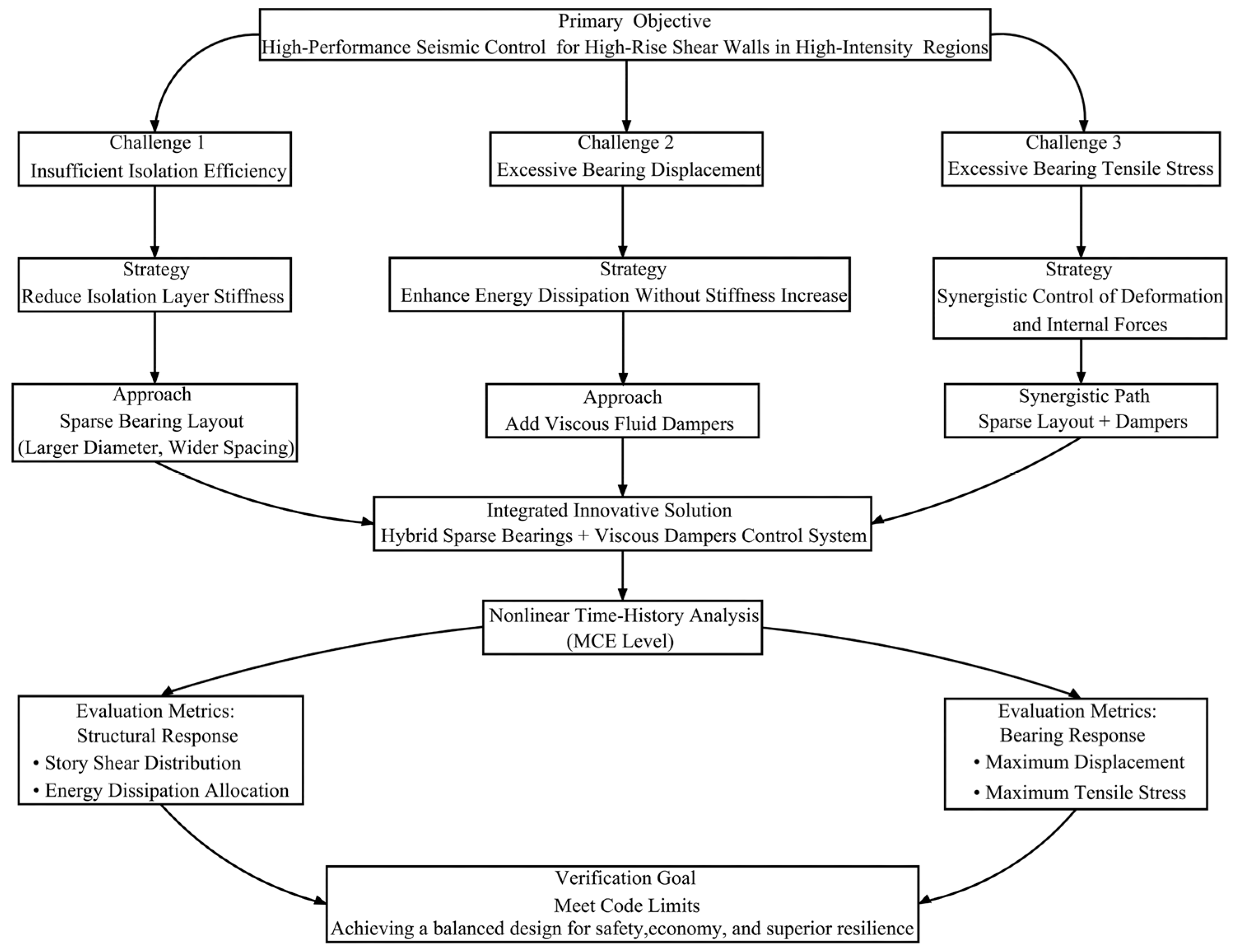
Seismic Performance of High-Rise Shear Walls with Hybrid Control: Sparse Isolation Bearings and Viscous Fluid Dampers


Abstract
1. Introduction
2. Project Overview
3. Seismic Isolation Design Scheme
3.1. Building 3 Apartment Overview
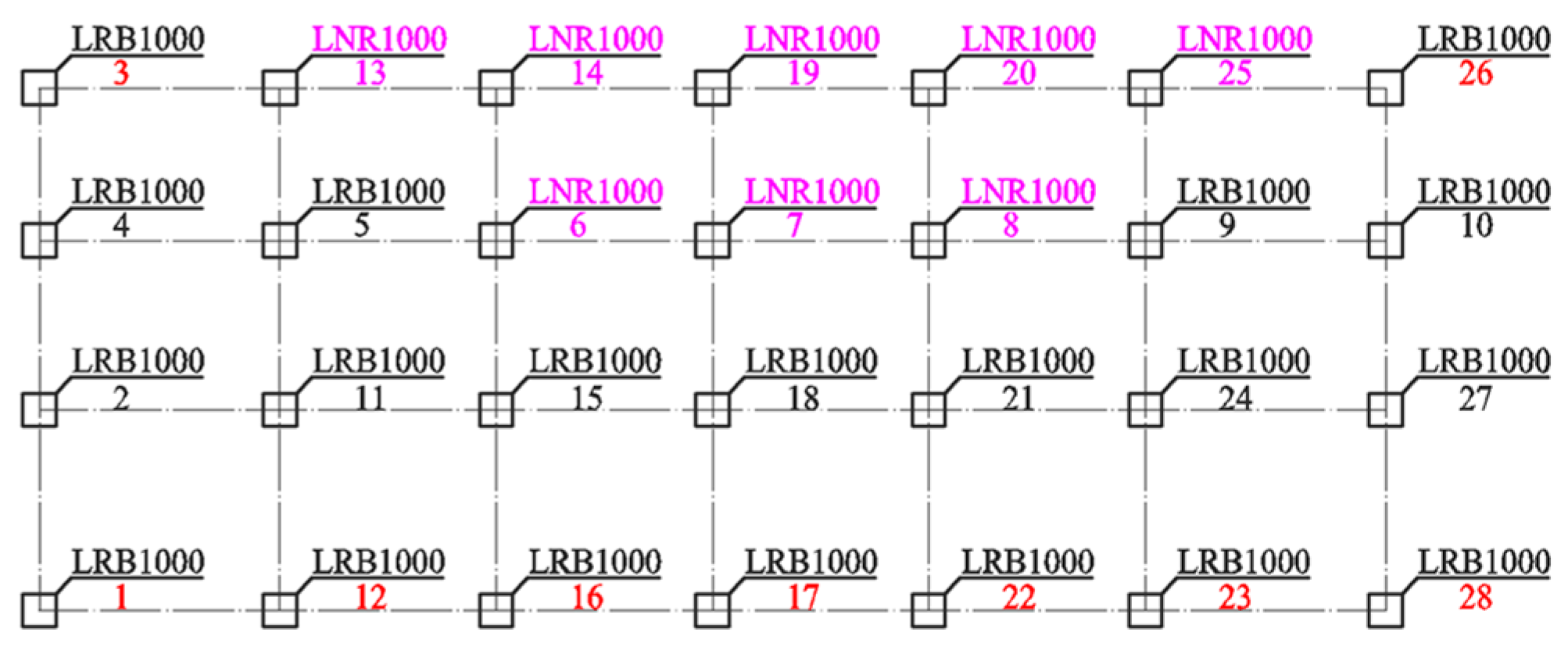
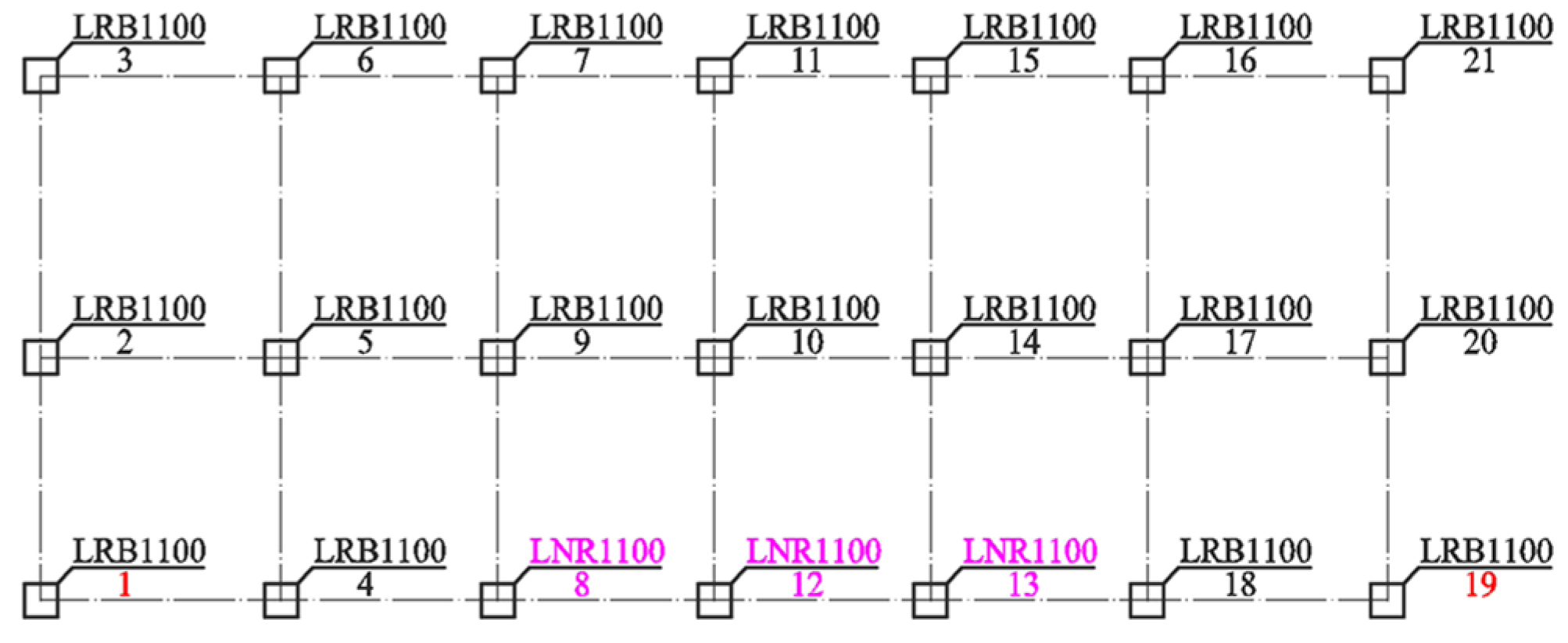
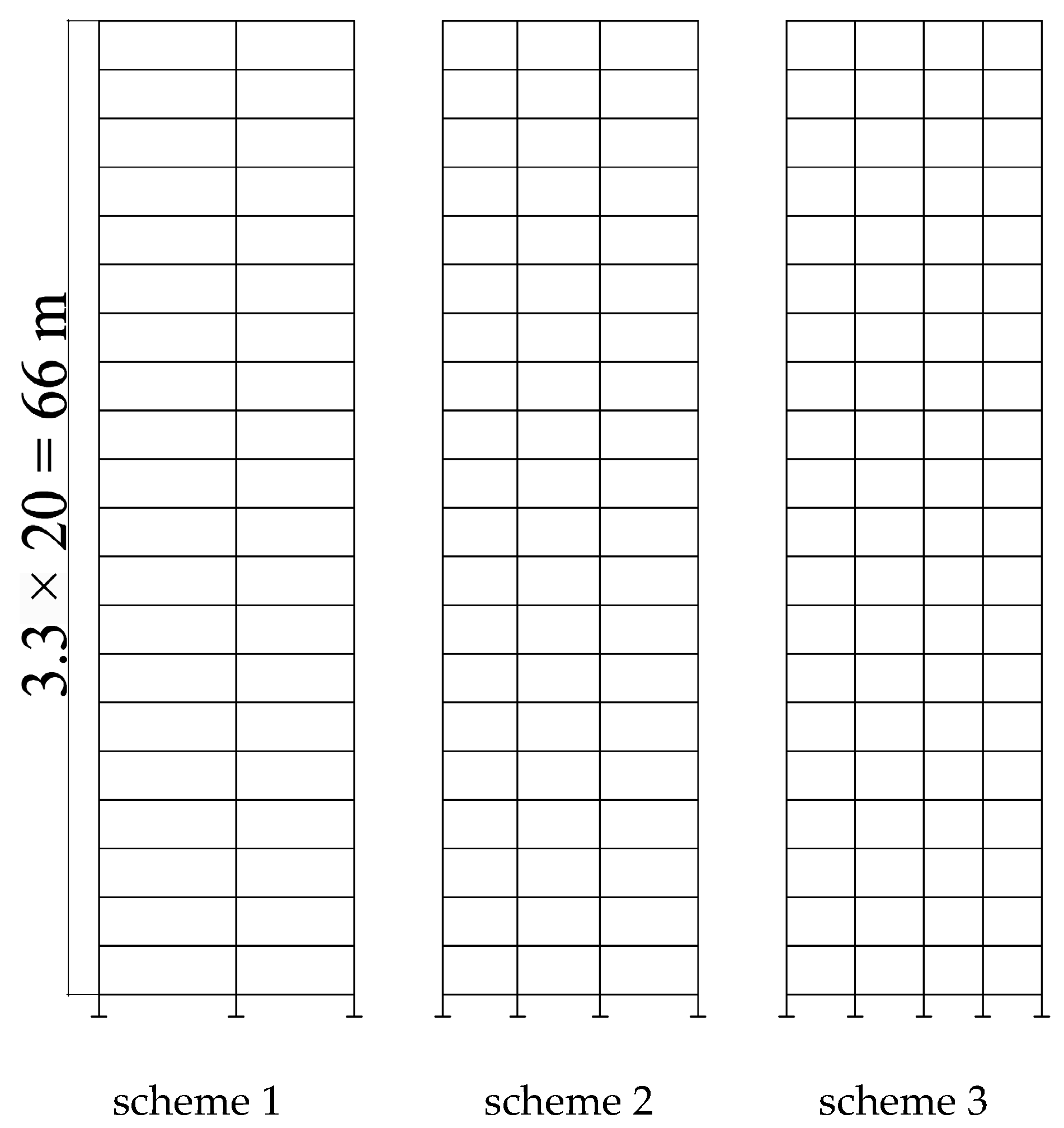
3.2. Comparative Analysis of Bearing Layout Schemes in Seismic Isolation Systems
3.3. Design and Verification of Critical Structural Components
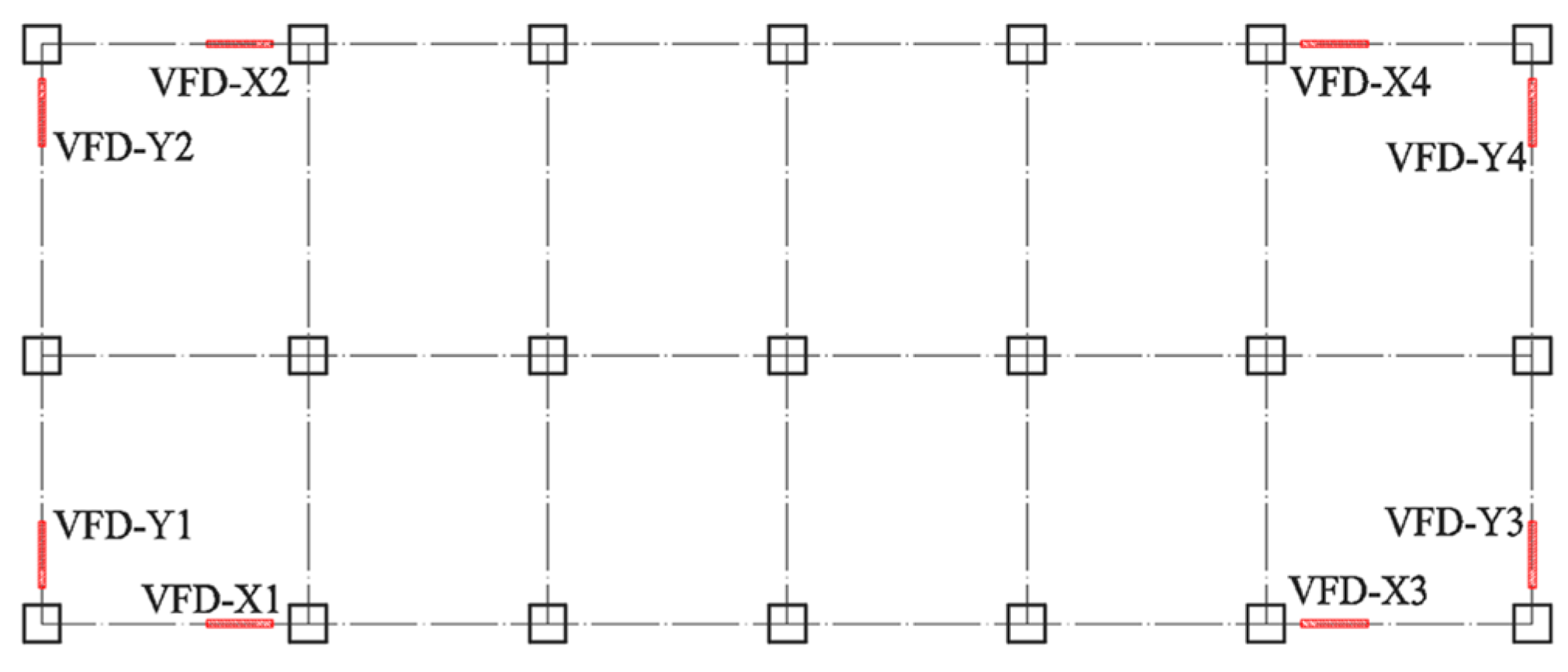
3.4. Hybrid Seismic Isolation System with Energy-Dissipating Devices
4. Response Analysis Under Maximum Considered Earthquake
4.1. Cross-Platform Model Fidelity Verification: From YJK to ETABS
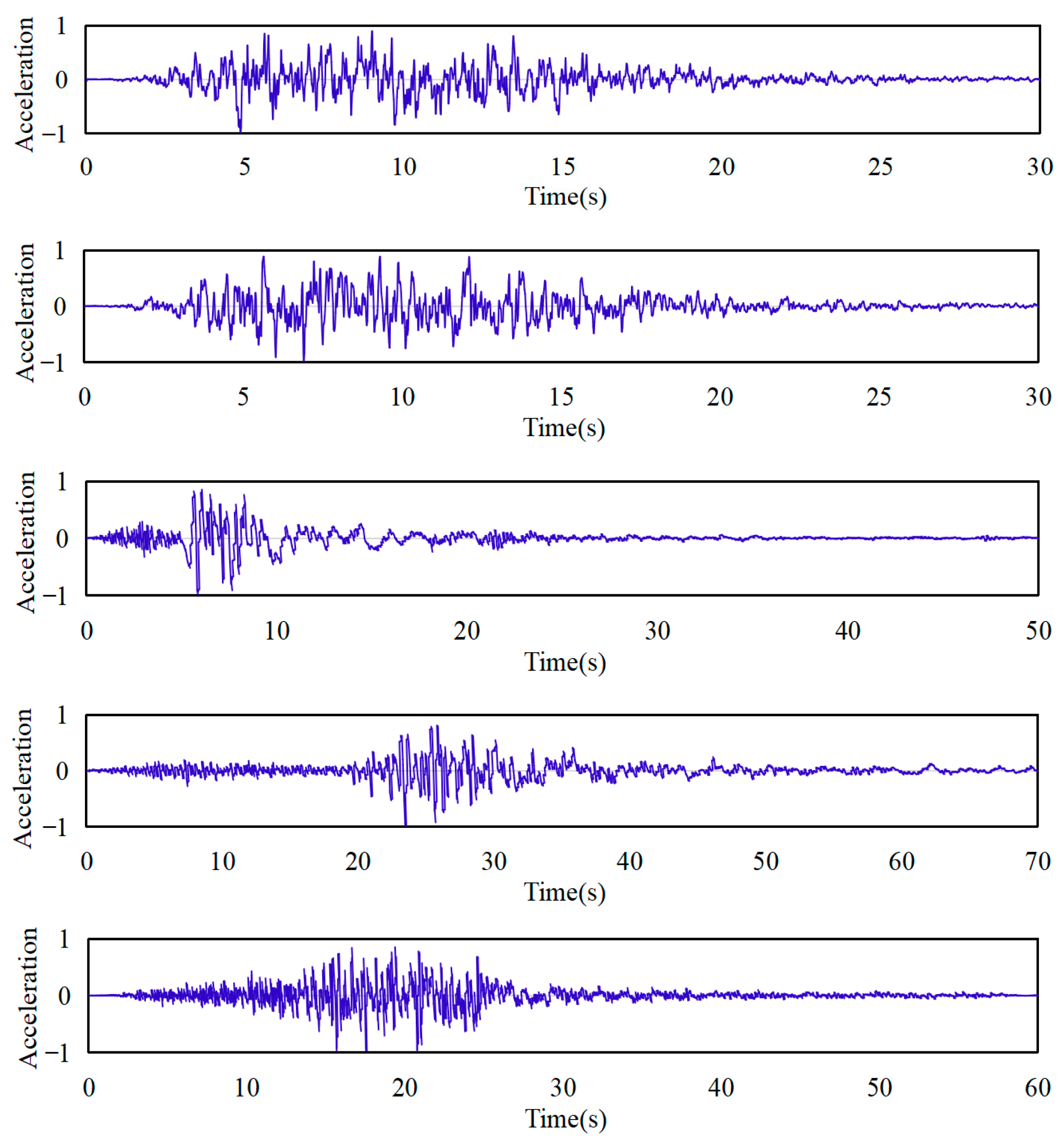
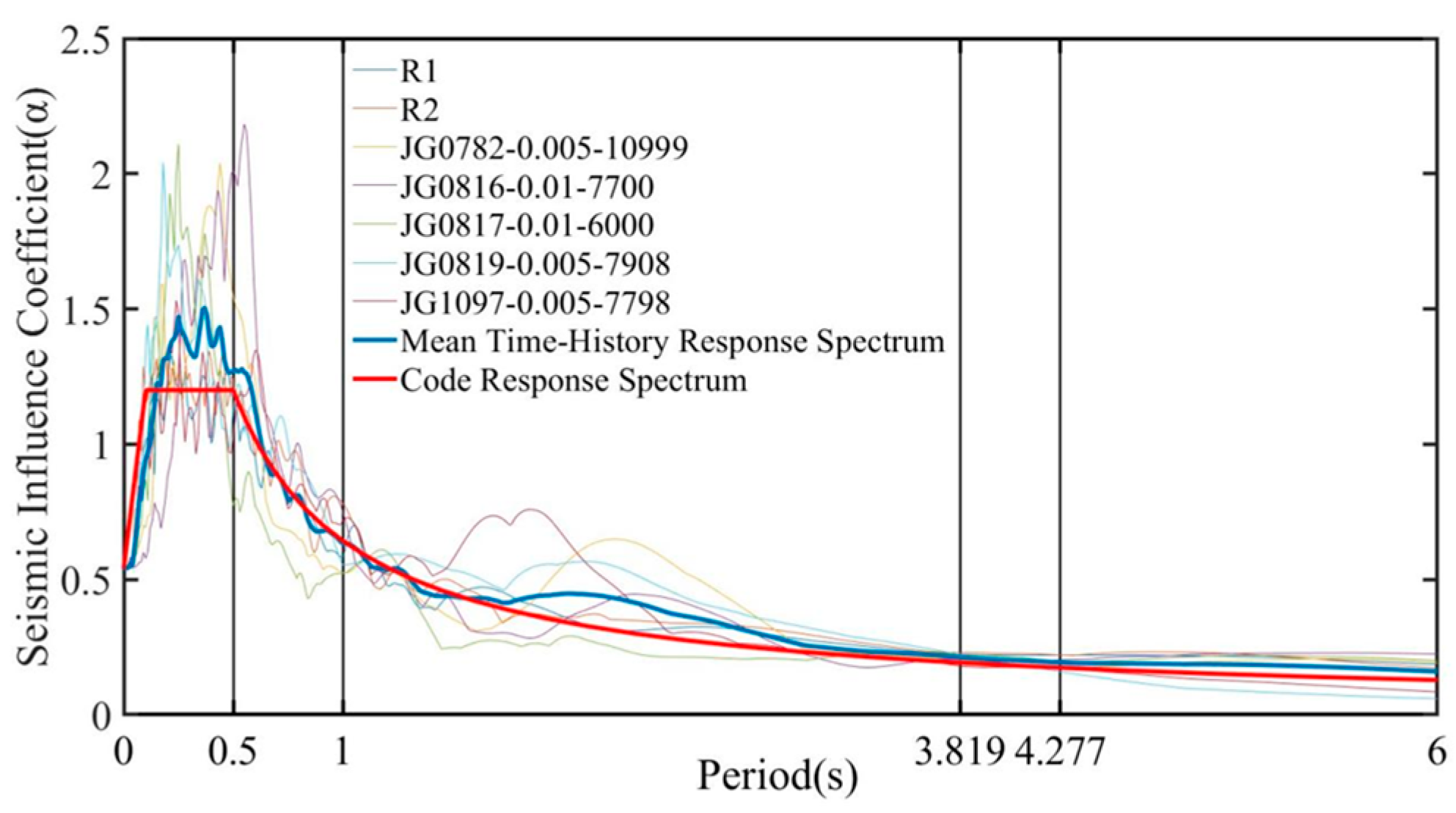
4.2. Selection of Ground Motion Time Histories for Maximum Considered Earthquakes
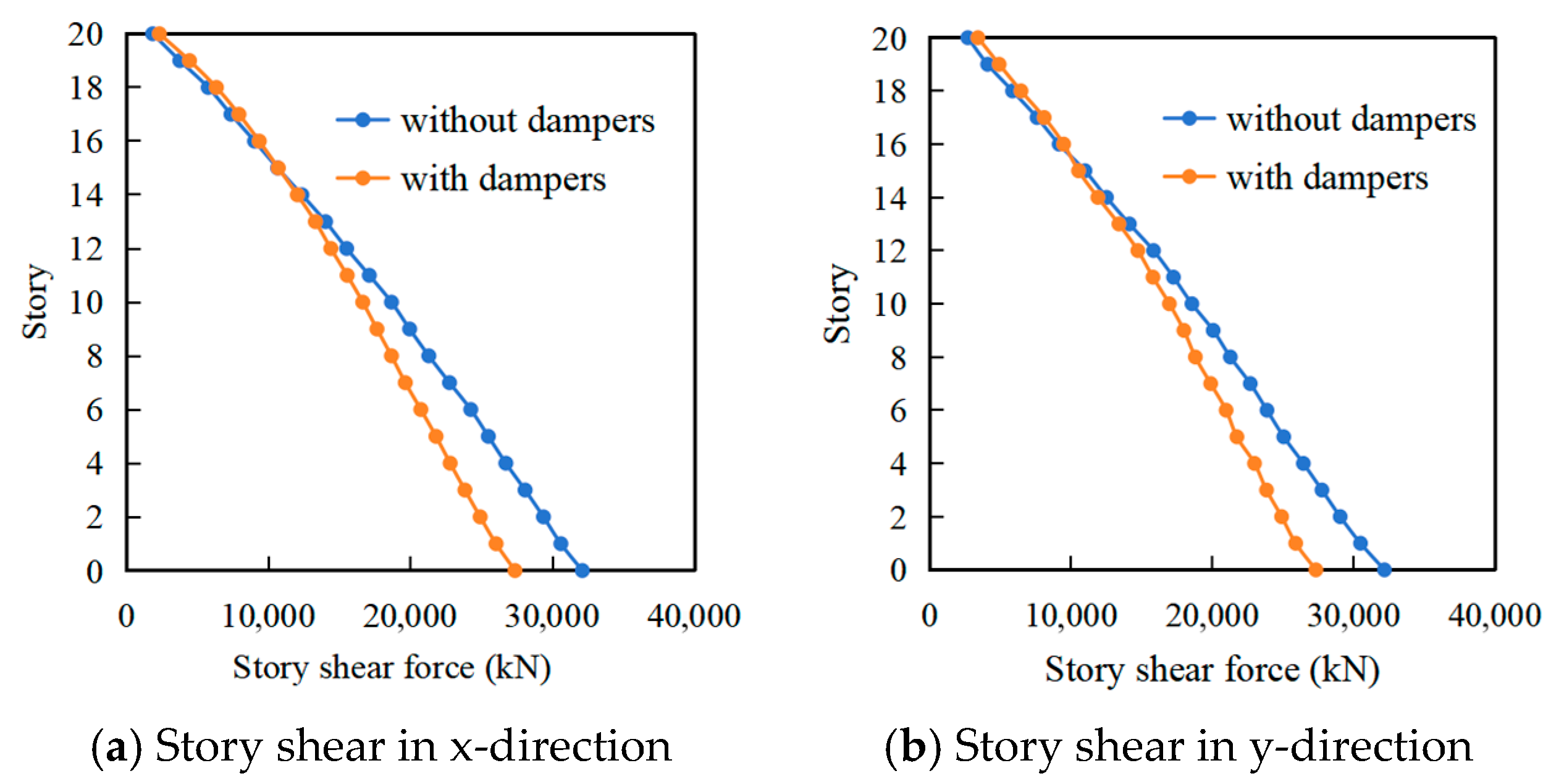
4.3. Story Shear Analysis
4.4. Superstructure Response: Comparison with Conventional Damage Mechanisms and Performance Verification
- Shear Wall Capacity Check
- Coupling Beam Capacity Check
4.5. Energy Response Analysis
4.6. Analysis of Displacement and Tensile Stress in Seismic Isolation Bearings
4.6.1. Maximum Displacement of Seismic Isolation Bearings
4.6.2. Maximum Tensile Stress of Seismic Isolation Bearings
4.6.3. Assessment of Record-to-Record Variability
5. Conclusions
- (1)
- Comparison of bearing layout schemes demonstrated that a sparse distribution strategy (increasing bearing diameter and spacing) offers superior performance in optimizing the bottom shear ratio and controlling key response indicators (displacement, tensile stress) under the MCE.
- (2)
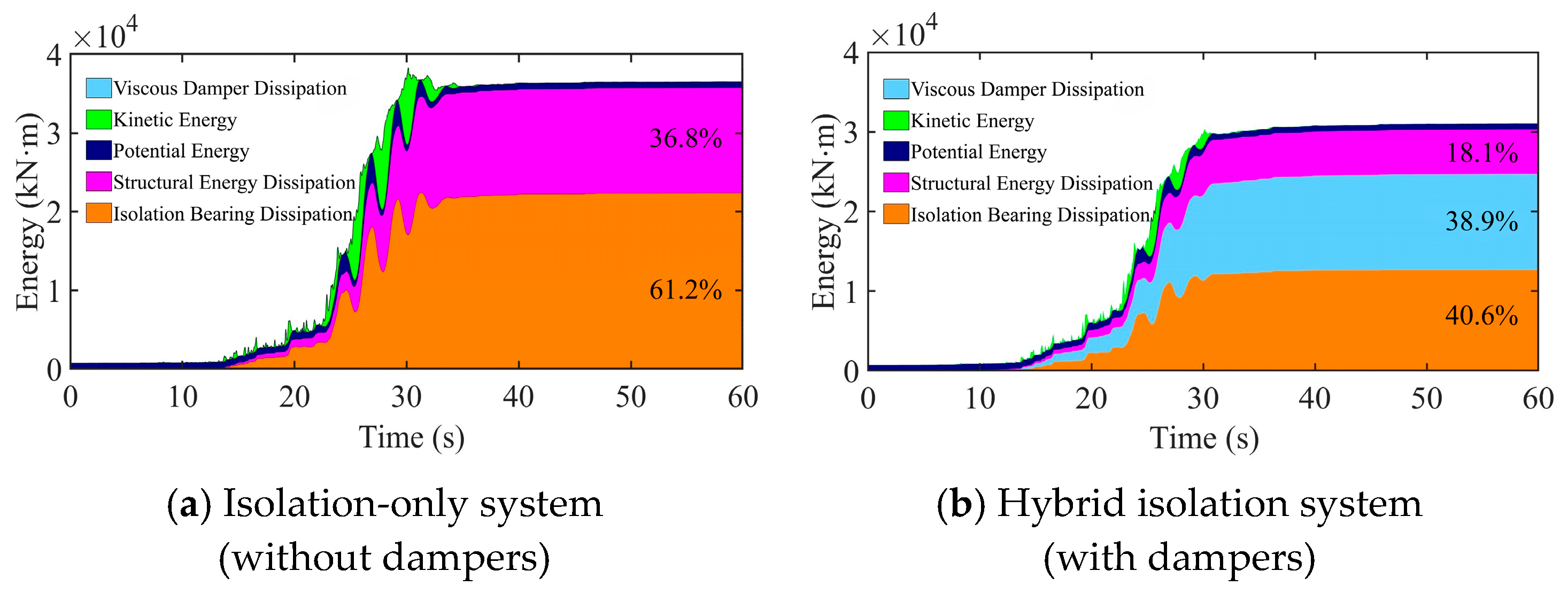
- Adding viscous dampers to the isolation layer significantly altered the distribution of structural dynamic responses. Story shear forces decreased variably across Floors 1–15 (with a peak reduction of ~17% at the isolation layer) but increased above Floor 15 due to higher-mode effects. Concurrently, the energy dissipation ratios of isolation bearings decreased from 61.2% to 40.6%, and those of the superstructure from 36.8% to 18.1%, which effectively mitigates cumulative plastic damage in both components.
- (3)
- The hybrid seismic isolation system effectively resolved the issues of excessive bearing displacement and tensile stress under the MCE. Installing dampers reduced bearing displacement from 644 mm to 485 mm and tensile stress from 1.17 MPa to 0.54 MPa, thus meeting the code-specified limit requirements.
Author Contributions
Funding
Data Availability Statement
Conflicts of Interest
References
- Xiang, N.L.; Li, J.Z. Experimental and numerical study on seismic sliding mechanism of laminated-rubber bearings. Eng. Struct. 2017, 141, 159–174. [Google Scholar] [CrossRef] [Scilit]
- Derham, C.J.; Kelly, J.M.; Thomas, A.G. Nonlinear natural rubber bearings for seismic isolation. Nucl. Eng. Des. 1985, 84, 417–428. [Google Scholar] [CrossRef] [Scilit]
- Naeim, F.; Kelly, J.M. Design of Seismic Isolated Structures: From Theory to Practice; John Wiley & Sons: Hoboken, NJ, USA, 1999. [Google Scholar]
- Xin, L.; Yang, Q.; Wang, H.Q.; Jing, G.; Zou, S. Base isolation design and analysis of high-rise frame-shear wall structure in a high intensity area. Build. Struct. 2021, 51, 8–13. (In Chinese) [Google Scholar] [CrossRef]
- Li, X.J. Adjustment of seismic ground motion parameters considering site effects in seismic zonation map. Chin. J. Geotech. Eng. 2013, 35, 21–29. (In Chinese) [Google Scholar]
- Guan, Q.S.; Song, T.S.; Zhang, L.F.; Wang, Y.; Alata. Seismic Isolation Design of Yu xi Public Rental Housing Structures. Prog. Steel Build. Struct. 2017, 19, 87–96. (In Chinese) [Google Scholar] [CrossRef]
- GB 50011-2010; Code for Seismic Design of Buildings. Ministry of Housing and Urban-Rural Development of China: Beijing, China, 2010.
- Federal Emergency Management Agency (FEMA). Seismic Performance Assessment of Buildings Volume 1—Methodology; Rep. No. FEMA P-58-1; Federal Emergency Management Agency: Washington, DC, USA, 2012.
- Zhou, J.J. Implementing the Regulations of Administration of Seismic Management of Construction Projects to Maintain Normal Functionality of Buildings. Stand. Eng. Constr. 2023, 44, 66–68. (In Chinese) [Google Scholar] [CrossRef]
- Zhai, C.H.; Song, Z.R.; Xie, L.L. A approach for seismic resilience design of buildings. Build. Struct. 2025, 46, 124–133. [Google Scholar] [CrossRef]
- Almufti, I.; Willford, M. REDi™ Rating System: Resilience-Based Earthquake Design Initiative for the Next Generation of Buildings; Arup Co.: London, UK, 2013. [Google Scholar]
- Wada, A.; Kani, N.; Hirano, S.; Kamikouchi, H.; Kimura, M. Seismic isolated structures applied to from detached houses to high-rise apartments in Japan. In Proceedings of the 5th International Conference on Urban Earthquake Engineering, Tokyo, Japan, 4–5 March 2008. [Google Scholar]
- Becker, T.C.; Yamamoto, S.; Hamaguchi, H.; Higashino, M.; Nakashima, M. Application of isolation to high-rise buildings: A Japanese design case study through a US design code lens. Earthq. Spectra 2015, 31, 1451–1470. [Google Scholar] [CrossRef] [Scilit]
- Takayama, M. Development and application of seismic isolation and response control of buildings in Japan. In Proceedings of the New Zealand Society for Earthquake Engineering Annual Conference, Wellington, New Zealand, 27–29 April 2017. [Google Scholar]
- ASCE/SEI 7-22; Minimum Design Loads and Associated Criteria for Buildings and Other Structures. American Society of Civil Engineers: Reston, VA, USA, 2022.
- Yenidogan, C. Earthquake-resilient design of seismically isolated buildings: A review of technology. Vibration 2021, 4, 602–647. [Google Scholar] [CrossRef] [Scilit]
- Avinash, G.C.; Lingeshwaran, N. Review on base and inter storey seismic isolation systems for high rise buildings. Res. Eng. Struct. Mater. 2024, 11, 231–276. [Google Scholar] [CrossRef] [Scilit]
- Losanno, D.; Sierra, I.E.M.; Spizzuoco, M.; Marulanda, J.; Thomson, P. Experimental assessment and analytical modeling of novel fiber-reinforced isolators in unbounded configuration. Compos. Struct. 2019, 212, 66–82. [Google Scholar] [CrossRef] [Scilit]
- IS 1893-6:2022; Criteria for Earthquake Resistant Design of Structures: Part 6 Base Isolated Buildings. Bureau of Indian Standards: New Delhi, India, 2022.
- Salunkhe, V.A.; Jangid, R.S.; Ranjan, R. Seismic Soil–Structure Interaction Analysis of Base Isolated Nuclear Building of Indian Pressurized Heavy Water Reactor Subjected to Coherent Ground Motion. Pract. Period. Struct. Des. Constr. 2024, 29, 04024054. [Google Scholar] [CrossRef] [Scilit]
- Sivasubramanian, P.; Manimaran, M.; Vijay, U.P. Implementation of base-isolation technique in the design of mega hospital building. In International Conference on Cement and Building Koncrete for a Sustainable and Resilient Infrastructure; Springer: Singapore, 2024; pp. 299–313. [Google Scholar]
- He, Y.M. Dynamic Field Test for A Base-Isolated High-Rise Steel Building Structure. Ph.D. Thesis, Institute of Engineering Mechanics, China Earthquake Administration, Harbin, China, 2013. [Google Scholar]
- Li, Y.S.; Xiao, C.Z.; Xue, Y.T.; Jin, L.F.; Zeng, D. Seismic isolation design of a high-rise shear-wall residential building. Build. Struct. 2014, 44, 26–31+25. (In Chinese) [Google Scholar] [CrossRef]
- Cardone, D.; Palermo, G.; Dolce, M. Direct displacement-based design of buildings with different seismic isolation systems. J. Earthq. Eng. 2010, 14, 163–191. [Google Scholar] [CrossRef] [Scilit]
- Deringöl, A.H.; Güneyisi, E.M. Effect of using high damping rubber bearings for seismic isolation of the buildings. Int. J. Steel Struct. 2021, 21, 1698–1722. [Google Scholar] [CrossRef] [Scilit]
- Nagarajaiah, S.; Reinhorn, A.M.; Constantinou, M.C. Experimental study of sliding isolated structures with uplift restraint. J. Struct. Eng. 1992, 118, 1666–1682. [Google Scholar] [CrossRef] [Scilit]
- Hu, K.; Zhou, Y.; Jiang, L.; Chen, P.; Qu, G. A mechanical tension-resistant device for lead rubber bearings. Eng. Struct. 2017, 152, 238–250. [Google Scholar] [CrossRef] [Scilit]
- Kelly, J.M. The role of damping in seismic isolation. Earthq. Eng. Struct. Dyn. 1999, 28, 3–20. [Google Scholar] [CrossRef]
- Liu, Y.; Wu, J.; Donà, M. Effectiveness of fluid-viscous dampers for improved seismic performance of inter-storey isolated buildings. Eng. Struct. 2018, 169, 276–292. [Google Scholar] [CrossRef] [Scilit]
- Avossa, A.M.; Pianese, G. Damping Effect on the Seismic Response of Base-Isolated Structures with LRB Devices. Ing. Sismica 2017, 34, 3–30. [Google Scholar]
- Mayes, R.L.; Jones, L.R.; Kelly, T.E. The economics of seismic isolation in buildings. Earthq. Spectra 1990, 6, 245–263. [Google Scholar] [CrossRef] [Scilit]
- GB/T 51408-2021; Standard for Seismic Isolation Design of Building. Ministry of Housing and Urban-Rural Development of China: Beijing, China, 2021.
- Bolisetti, C.; Coleman, J.L.; Hoffman, W.M.; Whittaker, A.; Parsi, S.S.; Redd, J.; Cohen, M.; Kramer, K.; Kirchman, P.; Bowers, H.; et al. Seismic Isolation of Major Advanced Reactor Systems for Economic Improvement and Safety Assurance; Idaho National Lab. (INL): Idaho Falls, ID, USA, 2020.
- Duan, B.Y.; Zhu, J. Integrated optimization of isolated structures throughout their lifetime. J. Shanghai Univ. (Nat. Sci. Ed.) 2023, 29, 1053–1067. [Google Scholar]
- Katsimpini, P.; Papagiannopoulos, G.; Hatzigeorgiou, G. A Thorough Examination of Innovative Supplementary Dampers Aimed at Enhancing the Seismic Behavior of Structural Systems. Appl. Sci. 2025, 15, 1226. [Google Scholar] [CrossRef] [Scilit]
- GB/T 20688.4-2023; Rubber Bearings—Part 4: Plain Rubber Bearings. China Standard Press: Beijing, China, 2023.
- Cheng, X.P.; Li, W.; Lai, Z.Y. Application of Isolation Bearings and Viscous Dampers in Shanxi Science and Technology Innovation City. In Proceedings of the 12th China-Japan Conference on Building Structures, Chongqing, China, 23 September 2017; pp. 1–12. [Google Scholar]
- Jafari, A.; Beheshti, M.; Shahmansouri, A.A.; Bengary, H.A. Plastic hinge length for coupled and hybrid-coupled shear walls. Steel Compos. Struct. 2022, 367–383. [Google Scholar]
- Jafari, A.; Beheshti, M.; Shahmansouri, A.A.; Bengary, H.A. Cyclic response and damage status of coupled and hybrid-coupled shear walls. Structures 2024, 61, 106010. [Google Scholar] [CrossRef] [Scilit]
- Zhang, R.; Li, A. Experimental study on the performance of damaged precast shear wall structures after base isolation. Eng. Struct. 2021, 228, 111553. [Google Scholar] [CrossRef] [Scilit]
- Ferraioli, M.; Mandara, A. Base isolation for seismic retrofitting of a multiple building structure: Evaluation of equivalent linearization method. Math. Probl. Eng. 2016, 2016, 8934196. [Google Scholar] [CrossRef] [Scilit]
- GB 50009-2012; Load Code for the Design of Building Structures. Ministry of Housing and Urban-Rural Development of China: Beijing, China, 2012.
- ISO 3010:2017; Basis for Design of Structures—Seismic Actions on Structures. International Organization for Standardization: Geneva, Switzerland, 2017.
- Amiri, G.G.; Namiranian, P.; Amiri, M.S. Seismic response of triple friction pendulum bearing under near-fault ground motions. Int. J. Struct. Stab. Dyn. 2016, 16, 1550021. [Google Scholar] [CrossRef] [Scilit]
- Yang, Z.Y.; Xiao, L.; Huang, J.; Tian, J. Relationship between seismic responses of building structures and displacement spectra of ground motions under rare earthquakes. Earthq. Eng. Eng. Dyn. 2010, 30, 29–36. [Google Scholar] [CrossRef]
- Feng, D.; Wang, J. Seismic control of a self-anchored suspension bridge using fluid viscous dampers. Int. J. Struct. Stab. Dyn. 2021, 21, 2150025. [Google Scholar] [CrossRef] [Scilit]
- Zhang, S.; Wu, Y.; Yang, K.; Wang, J. Multi-Stage Vibration Control Mechanism and Experimental Effectiveness of Viscous Damper with Overload Protector. J. Vis. Exp. JoVE 2025, 223. [Google Scholar] [CrossRef] [Scilit]





| Dimension | Conventional Seismic Design (Almufti, 2013) [11] | Basic Isolation Principle (Kelly, 1999) [28] | Conventional Dense Isolation Layout (Li, 2014; Takayama, 2017) [14,23] | Isolation with Dampers (Liu, 2018; Avossa & Pianese, 2017) [29,30] | This Study: Sparse Isolation + Dampers |
|---|---|---|---|---|---|
| Core Strategy | Resist forces via increased stiffness and strength. | Decouple structure via base isolation. Theoretical foundation. | Rule: Mandatory bearings under all wall members | Experimental proof of dampers for displacement control in inter-story isolation. | Synergistic System |
| Performance & Limitation | Basic life-safety objective; structural damage is expected. | Defines benefit but lacks solutions for high-rise specifics | Redundant stiffness lowers efficiency; passive, costly handling of tensile stress. | Effective for mid-rise; does not address tensile stress in high-rises. | Fulfill and exceed code requirements. |
| Addressing High-Rise Challenges | Damage inevitable, difficult to achieve higher performance objectives | Not covered in the context of large overturning moments. | Relies on non-standard tensile devices, increasing cost and complexity. | Scope limited to inter-story isolation; tensile challenge at the base is not relevant. | Systematically resolves the triad of challenges through mechanistic synergy between layout and damping. |
| Displacement Control | Limits drift via member stiffness, causing damage. | Through bearing hysteresis, increasing stiffness raises structural forces. | Stiffness–Efficiency Trade-Off: Controlling displacement compromises isolation. | Dampers are effective. | Synergistic control via damper energy dissipation. |
| Economy & Feasibility | High material cost in high-intensity zones. | Conceptual. | High bearing count + custom tension devices = high cost, low standardization. | Performance-focused. | Enhanced via component reduction and standardized detailing. |
| Scheme 1 | Scheme 2 | Scheme 3 | |
|---|---|---|---|
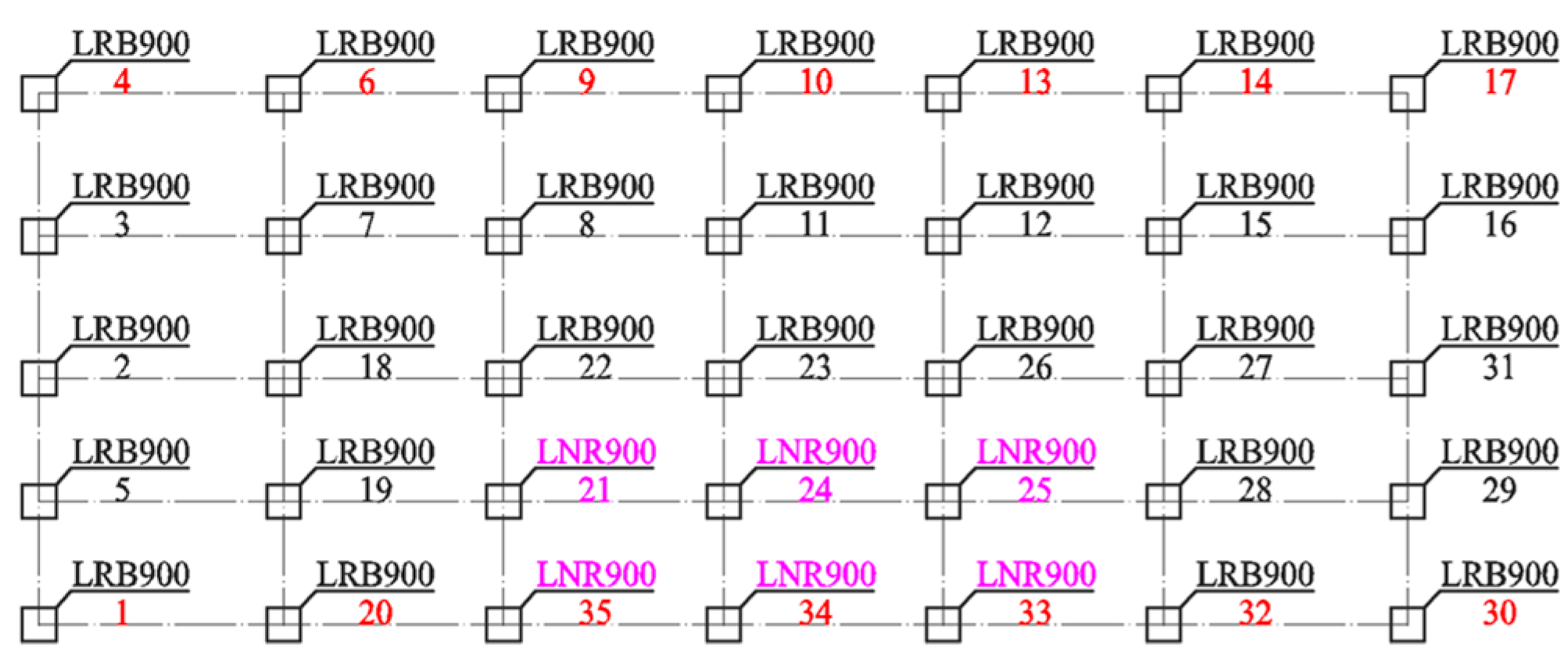
| Number of bearings | 35 | 28 | 21 |
| Bearing diameter (mm) | 900 | 1000 | 1100 |
| Bearing spacing (mm) | 4000 | 5600 | 8000 |
| Scheme 1 | Scheme 2 | Scheme 3 | |
|---|---|---|---|
| Fundamental periods (with seismic isolation) | 3.47, 3.44, 3.12 | 3.63, 3.58, 3.24 | 3.99, 3.98, 3.55 |
| Bottom shear ratio | 0.355 | 0.338 | 0.309 |
| Maximum bearing displacement (mm) | 556 | 602 | 641 |
| Percentage excess of bearing displacement limit | 12% | 9% | 6% |
| Mr/Mov | 1.4 | 1.47 | 1.65 |
| Maximum bearing tensile stress (MPa) | 3.10 | 2.73 | 1.17 |
| Number of bearings exceeding the tensile stress limit | 14 | 9 | 2 |
| YJK (t) | ETABS (t) | Difference (%) |
|---|---|---|
| 21,660 | 21,640 | 0.1 |
| Mode Shape Order | YJK (s) | ETABS (s) | Difference (%) |
|---|---|---|---|
| 1 | 3.991 | 3.885 | 2.7 |
| 2 | 3.975 | 3.881 | 2.4 |
| 3 | 3.550 | 3.469 | 2.3 |
| Record ID | Natural Record Name | Station Name | PGA (cm/s2) | PGV (cm/s) | Fault Distance (km) | Peak Acceleration for MCE (cm/s2) | Time Step | Number of Data Points |
|---|---|---|---|---|---|---|---|---|
| Artificial Wave 1 | / | / | / | / | / | 510 | 0.02 | 1501 |
| Artificial Wave 2 | / | / | / | / | / | 510 | 0.02 | 1501 |
| JG0782-0.005-10999 | Chi-Chi, Taiwan-03_NO_2457 | CHY024 | 276.2 | 32.7 | 9.3 | 510 | 0.005 | 10,999 |
| JG0816-0.01-7700 | Hector Mine_NO_1780 | Hector | 323.4 | 44.5 | 10.7 | 510 | 0.01 | 7700 |
| JG0817-0.01-6000 | Hector Mine_NO_1786 | Hector | 205.8 | 31.7 | 12.3 | 510 | 0.01 | 6000 |
| JG0819-0.005-7908 | Imperial Valley-06_NO_178 | El Centro Array #3 | 264.6 | 46 | 12.7 | 510 | 0.005 | 7908 |
| JG1097-0.005-7798 | Loma Prieta_NO_740 | Los Gatos Presentation Center | 548.8 | 94.8 | 8.5 | 510 | 0.005 | 7798 |
| Load Case | Response Spectrum | R1 | R2 | T1 | T2 | T3 | T4 | T5 | Mean Time History Response | |
|---|---|---|---|---|---|---|---|---|---|---|
| Base shear (kN) | X | 37,028 | 45,612 | 45,906 | 35,803 | 42,467 | 41,099 | 30,869 | 33,980 | 39,391 |
| Y | 37,065 | 45,507 | 45,840 | 35,810 | 42,387 | 41,089 | 30,838 | 34,051 | 39,360 | |
| percentage (%) | X | 100 | 123 | 124 | 97 | 115 | 111 | 83 | 92 | 106 |
| Y | 100 | 123 | 124 | 97 | 114 | 111 | 83 | 92 | 106 | |
| Time History Record | First Arrival Time at 10% of Peak Acceleration (s) | Last Occurrence Time at 10% of Peak Acceleration (s) | Effective Duration (s) | Fundamental Period (s) | Ratio |
|---|---|---|---|---|---|
| R1 | 2.43 | 24.88 | 22.45 | 4.277 | 5.25 |
| R2 | 2.09 | 25.05 | 22.95 | 4.277 | 5.37 |
| T1 | 1.21 | 24.31 | 23.09 | 4.277 | 5.40 |
| T2 | 3.08 | 62.26 | 59.18 | 4.277 | 13.84 |
| T3 | 4.15 | 37.82 | 33.67 | 4.277 | 7.87 |
| T4 | 5.42 | 29.28 | 23.86 | 4.277 | 5.58 |
| T5 | 1.48 | 25.77 | 24.29 | 4.277 | 5.68 |
| Mode Shape Order | Fundamental Period (s) | Seismic Influence Coefficient (α) | Difference (%) | |
|---|---|---|---|---|
| Time History Method | Code Spectrum Method | |||
| 1 | 4.277 | 0.193 | 0.174 | 10.7 |
| 2 | 4.277 | 0.193 | 0.174 | 10.7 |
| 3 | 3.819 | 0.212 | 0.193 | 10.2 |
| Time History Record | Isolation-Only System (mm) | Hybrid (Isolators + Viscous Dampers) System (mm) | Reduction Percentage | |||
|---|---|---|---|---|---|---|
| X | Y | X | Y | X | Y | |
| R1 | 754 | 747 | 585 | 578 | 22% | 23% |
| R2 | 806 | 807 | 654 | 661 | 19% | 18% |
| T1 | 588 | 591 | 496 | 499 | 16% | 15% |
| T2 | 682 | 675 | 489 | 487 | 28% | 28% |
| T3 | 687 | 687 | 447 | 446 | 35% | 35% |
| T4 | 523 | 512 | 426 | 420 | 19% | 18% |
| T5 | 468 | 468 | 300 | 298 | 36% | 36% |
| Mean Value | 644 | 641 | 485 | 484 | 25% | 24% |
| Standard Deviation | 114 | 114 | 105 | 107 | / | / |
| Coefficient of Variation | 0.18 | 0.18 | 0.22 | 0.22 | / | / |
| Bearing ID | Bearing Model | Isolation-Only System | Hybrid (Isolators + Viscous Dampers) System | Reduction Percentage | ||||
|---|---|---|---|---|---|---|---|---|
| Mean Value (MPa) | Standard Deviation (MPa) | Coefficient of Variation | Mean Value (MPa) | Standard Deviation (MPa) | Coefficient of Variation | |||
| 1 | LRB1100 | 1.17 | 0.91 | 0.78 | 0.54 | 0.65 | 1.20 | 54% |
| 3 | LRB1100 | 0.02 | 0.24 | 12.36 | −0.17 | 0.14 | −0.88 | / |
| 4 | LRB1100 | 0.82 | 0.83 | 1.02 | 0.25 | 0.56 | 2.26 | 70% |
| 8 | LNR1100 | 0.65 | 0.75 | 1.16 | 0.15 | 0.49 | 3.19 | 76% |
| 12 | LNR1100 | 0.62 | 0.75 | 1.20 | 0.14 | 0.48 | 3.54 | 78% |
| 13 | LNR1100 | 0.65 | 0.75 | 1.16 | 0.15 | 0.49 | 3.19 | 76% |
| 18 | LRB1100 | 0.82 | 0.83 | 1.02 | 0.25 | 0.56 | 2.26 | 70% |
| 19 | LRB1100 | 1.17 | 0.91 | 0.78 | 0.54 | 0.65 | 1.20 | 54% |
| 21 | LRB1100 | 0.02 | 0.24 | 12.36 | −0.17 | 0.14 | −0.88 | / |
Disclaimer/Publisher’s Note: The statements, opinions and data contained in all publications are solely those of the individual author(s) and contributor(s) and not of MDPI and/or the editor(s). MDPI and/or the editor(s) disclaim responsibility for any injury to people or property resulting from any ideas, methods, instructions or products referred to in the content. |
© 2026 by the authors. Licensee MDPI, Basel, Switzerland. This article is an open access article distributed under the terms and conditions of the Creative Commons Attribution (CC BY) license.
Share and Cite
Li, T.; Liu, R.; Sun, G.; Sun, W. Seismic Performance of High-Rise Shear Walls with Hybrid Control: Sparse Isolation Bearings and Viscous Fluid Dampers. Buildings 2026, 16, 208. https://doi.org/10.3390/buildings16010208
Li T, Liu R, Sun G, Sun W. Seismic Performance of High-Rise Shear Walls with Hybrid Control: Sparse Isolation Bearings and Viscous Fluid Dampers. Buildings. 2026; 16(1):208. https://doi.org/10.3390/buildings16010208
Chicago/Turabian StyleLi, Tianci, Ruiming Liu, Guangyu Sun, and Wujie Sun. 2026. "Seismic Performance of High-Rise Shear Walls with Hybrid Control: Sparse Isolation Bearings and Viscous Fluid Dampers" Buildings 16, no. 1: 208. https://doi.org/10.3390/buildings16010208
APA StyleLi, T., Liu, R., Sun, G., & Sun, W. (2026). Seismic Performance of High-Rise Shear Walls with Hybrid Control: Sparse Isolation Bearings and Viscous Fluid Dampers. Buildings, 16(1), 208. https://doi.org/10.3390/buildings16010208