
Article

Exploring Organizational and Individual Determinants of Construction Workers’ Safety Behavior: An Interpretable Machine Learning Approach


1
School of Transportation and Civil Engineering, Nantong University, Nantong 226019, China
2
School of Transportation, Southeast University, Nanjing 211189, China
3
Nantong Municipal Engineering Design Institute Co., Ltd., Nantong 226000, China
4
School of Automotive Engineering, Nantong Institute of Technology, Nantong 226002, China
5
Department of Traffic Engineering and Key Laboratory of Road and Traffic Engineering, Ministry of Education, Tongji University, Shanghai 201804, China
*
Author to whom correspondence should be addressed.
Buildings 2026, 16(1), 191; https://doi.org/10.3390/buildings16010191 (registering DOI)
Submission received: 19 November 2025 / Revised: 23 December 2025 / Accepted: 30 December 2025 / Published: 1 January 2026
(This article belongs to the Section Construction Management, and Computers & Digitization)

Abstract

Unsafe behaviors among construction workers remain a leading cause of accidents in the construction industry. Previous studies have primarily relied on structural equation modeling and causal inference approaches to investigate the determinants of workers’ safety behavior. However, these methods are often limited in their ability to address confounding bias inherent in observational data and tend to focus on isolated effects of individual variables, thereby overlooking the complex interactions between organizational and individual factors. To overcome these limitations, this study applies the Categorical Boosting (CatBoost) algorithm to examine the joint organizational and individual mechanisms underlying construction workers’ safety behavior. CatBoost is particularly suitable for small- to medium-sized datasets and is capable of automatically capturing complex, nonlinear relationships among variables. Leveraging the SHAP interpretability framework, both main-effect and interaction analyses are conducted to systematically identify the most influential determinants. The results demonstrate that CatBoost outperforms eXtreme Gradient Boosting (XGBoost) and Random Forest (RF) models in predicting safety-related outcomes. Prosociality (PSO) is identified as the most influential predictor, followed by personal proactivity (PAC). Interaction analyses further reveal that organizational attributes—such as prosociality, loyalty, and mutual assistance—play a critical role in cultivating a safety-oriented organizational climate, while an optimistic personal attitude further enhances safety performance on construction sites. Overall, these findings provide meaningful theoretical insights and practical implications for improving safety management in the construction sector.

1. Introduction

In contemporary complex work environments, occupational health and safety has emerged as a critical concern across industries. This issue is particularly pronounced in high-risk sectors such as construction, where safety hazards remain persistent and challenging. Globally, the construction industry reports some of the highest rates of occupational accidents and work-related injuries [1,2], leading to substantial fatalities, injuries, occupational diseases, and considerable economic losses. It is estimated that approximately one-third of all workplace accidents occur in the construction sector [3]. Moreover, the fatality rate in construction is nearly three times higher, and the injury rate is roughly twice as high as those observed in other industries [4]. In China, workplace accidents resulted in the deaths of 7275 construction workers between 2010 and 2019, corresponding to an average of nearly two fatalities per day [5]. Since 2015, both the frequency and severity of accidents in the housing and municipal construction sectors have exhibited a concerning upward trend [6]. A substantial body of research suggests that unsafe behaviors account for approximately 80–90% of occupational accidents and fatalities [7], and prior studies have consistently identified such behaviors as a primary cause of construction accidents [8,9,10]. For instance, Suraji et al. [11] reported that 88% of construction incidents were associated with unsafe practices, while Newaz et al. [4] estimated that human error contributes to nearly 90% of accidents. Collectively, these findings underscore the critical need for robust safety management strategies aimed at reducing unsafe behaviors and improving overall safety performance on construction sites.
Prior studies on unsafe behaviors in construction have largely relied on statistical and probabilistic approaches. Commonly used methods include Structural Equation Modeling (SEM) [12,13,14,15] and Bayesian Networks (BN) [16]. SEM is a theory-oriented approach that explains relationships between constructs through linear regression [17]. For instance, Mei et al. [13] combined the Social Exchange Theory (SET)and Theory of Planned Behavior (TPB) within an SEM framework to examine workers’ willingness to share safety knowledge, while Deng et al. [12] used SEM to analyze group cognitive characteristics influencing unsafe behavior. BN models, by contrast, capture probabilistic relationships between variables and can identify key safety factors in nonlinear contexts, partly overcoming SEM’s limitations [16,18]. However, both structural equation modeling (SEM) and Bayesian networks (BNs) are primarily designed for testing pre-specified hypotheses and conducting relational inference. These approaches typically rely on strong assumptions regarding the underlying data structure (e.g., linearity in SEM) and often have limited ability to capture complex non-linear relationships and high-order interactions present in empirical data, which may constrain their predictive performance. To address these limitations, several studies have adopted causal inference and simulation-based approaches. For instance, Zhang et al. [19] employed causal inference techniques to examine the effects of management measures on safety behavior, while Shin et al. [20] used system dynamics modeling to represent the psychological processes underlying safety attitudes and behaviors. Building on this line of research, Zhang et al. [21] further investigated safety behavior mechanisms using agent-based modeling. In parallel, a growing body of recent research has adopted machine learning (ML) techniques to address the limitations of traditional analytical approaches. Among these methods, artificial neural networks (ANNs) have been widely used to investigate safety-related behaviors. For instance, Ayhan et al. [22] combined latent class clustering analysis with ANN-based modeling to identify key attributes influencing accident occurrence. Deng et al. [23] developed a machine learning–based artificial cognitive system to predict unsafe behaviors among workers, while Farashaei et al. [24] employed hybrid neural network models to examine the interactions among individual adaptability, workplace dynamics, and construction workers’ safety behavior. Despite these methodological advances, the application of ML techniques—particularly more advanced algorithms such as Categorical Boosting (CatBoost)—to the analysis of construction workers’ safety behavior remains relatively limited.
ML techniques are increasingly applied in safety and risk analysis domains, including information security and traffic safety [25,26,27]. Compared with traditional statistical models, ML offers greater flexibility, requiring few assumptions about relationships between predictors and outcomes [28]. CatBoost is a gradient boosting algorithm developed for both classification and regression problems [29,30]. It employs symmetric decision trees as base learners and enhances predictive accuracy through iterative boosting. Compared with other leading ML models such as LightGBM, Random Forest (RF), and eXtreme Gradient Boosting (XGBoost), CatBoost offers distinct advantages—including automated handling of categorical variables, reduced gradient estimation errors, and mitigation of prediction shift [31,32,33]. However, the “black box” nature of complex ML models limits their interpretability, making it difficult to identify the underlying influence mechanisms.
To address this challenge, recent studies have combined CatBoost with SHapley Additive exPlanations (SHAP) to enhance model transparency [25,26,34]. SHAP quantifies the contribution of individual features to model predictions, thereby enabling a more explicit interpretation of the underlying decision-making process. This integrated approach not only improves model interpretability but also enhances the credibility and practical relevance of machine learning applications, particularly in contexts where detailed explanations of decision mechanisms are essential.
Against this backdrop, the present study applies CatBoost to predict and analyze construction workers’ safety behaviors, incorporating SHAP to interpret the model outputs. This study is distinguished by its integration of an advanced interpretable machine learning approach (CatBoost-SHAP) with a simultaneous analysis of organizational- and individual-level determinants, conducted within the specific context of the Chinese construction industry. Specifically, we examine how both organizational and individual dimensions affect safety performance. The integrated CatBoost-SHAP approach is designed to achieve high predictive accuracy while offering a transparent interpretation of the factors influencing unsafe behavior. The findings aim to provide a robust empirical basis for identifying key risk factors, thereby offering practical guidance for developing targeted safety management interventions in the construction sector.

2. Data

2.1. Variable Selection

Research on the determinants of unsafe behaviors has gained increasing attention in both domestic and international scholarship. Existing studies generally approach this issue from two perspectives: organizational and individual.
At the organizational level, the concept of safety climate (SCL) is a critical determinant, representing group members’ common understanding of workplace risks and safety management systems. A positive SCL has consistently been demonstrated to improve overall safety performance [35,36,37]. Interpersonal dynamics, such as peer-to-peer exchange (P) and leader–member exchange (L), also play significant roles. P captures interactions among peers, while L refers to the quality of relationships between leaders and team members [35,36]. Furthermore, prosociality (PSO)—the tendency of workers to act in ways that benefit others within a social group—has been found to substantially influence safety-related conduct [36].
At the individual level, work stress (WS) and work burnout (WB) are important emotional factors that directly affect safety behaviors [37]. WS occurs when job demands exceed personal resources or capabilities, whereas WB reflects a state of emotional and physical exhaustion. Psychological capital (PC), encompassing intrinsic positive psychological resources, has been shown to foster constructive safety behaviors by enhancing optimism and resilience, thereby reducing WS and WB [35,38]. Security attitude (ST), which reflects an individual’s commitment to safety rules and procedures, is another significant predictor [20,39]. Finally, proactivity (PAC)—a relatively stable personality trait characterized by self-initiated and future-oriented actions—has been linked to safer work practices [40,41].
In this study, four organizational-level variables (SCL, L, P, and PSO) and five individual-level variables (WS, WB, PC, ST, and PAC) are specified as independent predictors, with construction workers’ safety behavior serving as the dependent variable. These variables have been consistently shown in prior empirical research to exert significant influences on safety behavior in construction settings (Table 1). To enable a systematic analysis of interaction effects between organizational- and individual-level factors, the mean scores obtained from the safety behavior scale were categorized into three levels—unsafe, general, and safe—using threshold values defined by the observed minimum and maximum scale scores.

2.2. Scale Design

This study employs a three-part framework to evaluate construction workers’ safety behaviors. First, demographic data are collected as control variables to mitigate potential confounding effects in subsequent analyses. Second, the study investigates factors influencing safety behavior at both organizational and individual levels, utilizing validated measurement instruments from prior research to ensure reliability and validity. The survey comprises 38 items, each rated on a five-point Likert scale, to quantify respondents’ safety performance. To ensure data accuracy and consistency in scale direction, several items (WB3, WS3, ST1, and ST3) were designed for reverse scoring, such that higher raw scores indicated lower levels of the corresponding constructs. During data preprocessing, these items were systematically reverse-coded so that higher final scores consistently represent higher levels of the intended constructs across all measures. Table 2 summarizes the variables under investigation, encompassing multiple dimensions across organizational and individual contexts.

2.3. Data Collection

The survey was conducted in Jiangsu Province, China, through collaboration between academic institutions and local construction companies, which facilitated access to participants. A total of 700 anonymous questionnaires were distributed to construction workers. After rigorous data screening—excluding responses with inconsistent answer patterns or unrealistically short completion times—601 questionnaires were retained as valid, yielding an effective response rate of 85.9%. This sample size is sufficient to meet the requirements for subsequent statistical and machine learning analyses.
The study was based on an anonymous questionnaire survey administered to construction workers. The survey protocol was reviewed by the Ethics Committee for Research on People, Society and the Environment of Nantong University, which determined that formal ethical evaluation and approval were not required, as no personal or sensitive information was collected. Prior to participation, all respondents were informed of the study’s purpose, the voluntary nature of participation, and their right to withdraw at any time without consequences. Informed consent was obtained electronically before respondents accessed the questionnaire. All responses were recorded anonymously to ensure confidentiality. The study involved no interventions and posed minimal risk to participants.

3. Methodology

3.1. Analytical Procedure

This study adopts a six-step analytical procedure to systematically examine the determinants of construction workers’ safety behavior, as illustrated in Figure 1. First, relevant research variables are identified based on the proposed analytical framework. Second, a structured questionnaire is designed according to these variables and administered to collect primary data. Third, a CatBoost model is developed to capture the relationships between organizational and individual factors and safety behavior. In the fourth step, the dataset is randomly divided into training and testing subsets using an 8:2 ratio to train the model and assess its predictive performance. Fifth, the trained model is used to analyze and explain construction workers’ safety behavior. Finally, the SHAP framework is applied to interpret the model outputs, enabling both single-factor and interaction effect analyses.

3.2. CatBoost Algorithm

CatBoost is an ensemble learning algorithm based on gradient boosting decision trees, employing symmetric trees as base learners and optimizing predictive performance through loss function minimization. Compared with other boosting algorithms, CatBoost provides robust handling of categorical variables and requires relatively limited parameter tuning. It incorporates an ordered boosting strategy within an innovative training framework that sequentially partitions tree leaf nodes, thereby reducing gradient bias, mitigating prediction shift, and lowering the risk of overfitting [53,54]. In addition, CatBoost enhances model generalization through efficient estimation of leaf values, making it particularly suitable for heterogeneous datasets, including those of small to medium size [55]. Overall, CatBoost demonstrates strong performance on complex data structures while reducing overfitting risk and simplifying parameter tuning and training time, thereby offering substantial value for machine learning applications. The general formulation of CatBoost is presented as follows:
f x = b + t = 1 T α t h t x
where f x denotes the predicted value for sample x , b represents the model’s bias term, T stands for the total number of decision trees, α t signifies the weight assigned to the t, and h t x indicates the predicted value generated by the t.
In conventional gradient boosting algorithms, categorical features typically require preprocessing—such as one-hot encoding—to convert them into numerical form. Nevertheless, this procedure may impose additional burdens on users and create dimensionality issues. To address these issues, CatBoost incorporates an enhanced Greedy Tree Search (Greedy TS) method. This approach combines multiple categorical features by integrating prior distributions, thereby reducing the impact of noise and infrequent categories on the overall data distribution. The specific calculation formula is as follows:
X σ p , k = p 1 j = 1 X σ j , k = X σ p , k Y σ j + α × p p 1 j = 1 X σ j , k = X σ p , k + α
where α represents the weight coefficient of the prior term, which is typically greater than 0. Meanwhile, p denotes the added prior term itself.

3.3. SHapley Additive exPlanation (SHAP)

Machine learning models are regarded as “black box” algorithms, making their interpretability challenging in both research and practical contexts. To address the need for greater transparency in how features influence predictions, Lundberg and Lee [56] introduced the SHAP framework. Based on Shapley values from game theory, SHAP explains complex model outputs at the level of individual predictions. It quantifies each feature’s contribution by calculating its marginal effect on the prediction, referred to as the SHAP value. A higher SHAP value indicates a stronger positive influence on the prediction outcome, whereas a lower value reflects a negative influence. This approach not only enhances intuitive understanding of model behavior but also provides researchers with a powerful tool for model evaluation and optimization. The SHAP value of X i is computed as follows:
φ i X i = S N i S ! N S 1 ! N ! · f x S i f x S
where φ i X i represents the contribution of the i-th feature, N denotes the total number of input features, N i signifies the set excluding X i , and S does not contain any subset of feature i. S indicates the size of set S, while N refers to the total number of all features. f x S i and f x S denote the model’s prediction results with and without the feature i. Based the additive feature attribution method, SHAP interprets the model’s prediction value as the sum of the SHAP values of each input feature, expressed as:
y ^ = f 0 + i = 1 m f i
where y ^ represents the model’s predicted value, f 0 denotes the predicted mean across all training samples, and f i signifies the attribution value associated with each feature. For a specific sample, assuming k samples x k , where the j-th feature of the k-th sample is x k j , the model predicts y k as the value for this sample. The baseline for the entire model, denoted as y b a s e , is recorded as:
y k = y b a s e + f x k 1 + f x k 2 + + f x k m
where f x k m denotes the SHAP value of x k m , where f x k 1 signifies the contribution of the first feature in the k-th sample to the final prediction y k . f x k 1 > 0 indicates that the feature enhances the prediction value, playing a beneficial role. In contrast, a negative coefficient indicates that the feature reduces predictive performance, exerting an adverse influence.

3.4. Model Optimization and Parameter Selection

Hyperparameter tuning is essential in machine learning, as it significantly enhances model performance beyond default configurations [57]. Several optimization strategies have been developed, including the tree-structured Parzen Estimator (TPE) for independent parameter sampling [58], grid search for exhaustive evaluation of parameter combinations [59], and random search for reducing computational costs compared to grid search [60]. Among these, TPE is particularly noteworthy as a Bayesian optimization technique capable of systematically exploring complex relationships between hyperparameters and objective functions. By modeling the probability distribution of the objective function, TPE efficiently identifies hyperparameter configurations with a high likelihood of superior performance, thereby reducing the number of required trials [61].
Given CatBoost’s complex architecture and extensive hyperparameter space, traditional tuning methods such as manual search, grid search, and random search often prove inefficient. Bayesian optimization provides a more effective alternative by leveraging Bayes’ theorem and prior evaluation results to intelligently guide the search toward promising regions of the parameter space [62]. Typically, a Gaussian process is used as a surrogate model to approximate the objective function, and subsequent sampling points are chosen to maximize expected performance. The surrogate model is progressively refined with incoming observations, facilitating the discovery of optimal hyperparameter combinations across the search space.

3.5. Model Evaluation Indicators

This study evaluates model performance using accuracy, precision, recall, and the F1 score. Accuracy represents the proportion of correctly classified samples across the entire dataset, whereas precision indicates the proportion of instances predicted as positive that are indeed positive. Recall measures the model’s ability to correctly identify positive cases among all true positives. The F1 score, defined as the harmonic mean of precision and recall, provides a comprehensive metric that balances predictive accuracy and detection completeness.

4. Results

4.1. Data Description

Table 3 presents detailed demographic characteristics of the sample. Among valid respondents, 51.7% were male and 48.3% female; 47.6% were over 40 years old (N = 286); 56.1% held a college degree or higher (N = 337); 28.6% had fewer than 5 years of work experience (N = 172); and 73.7% reported working more than eight hours per day (N = 443).
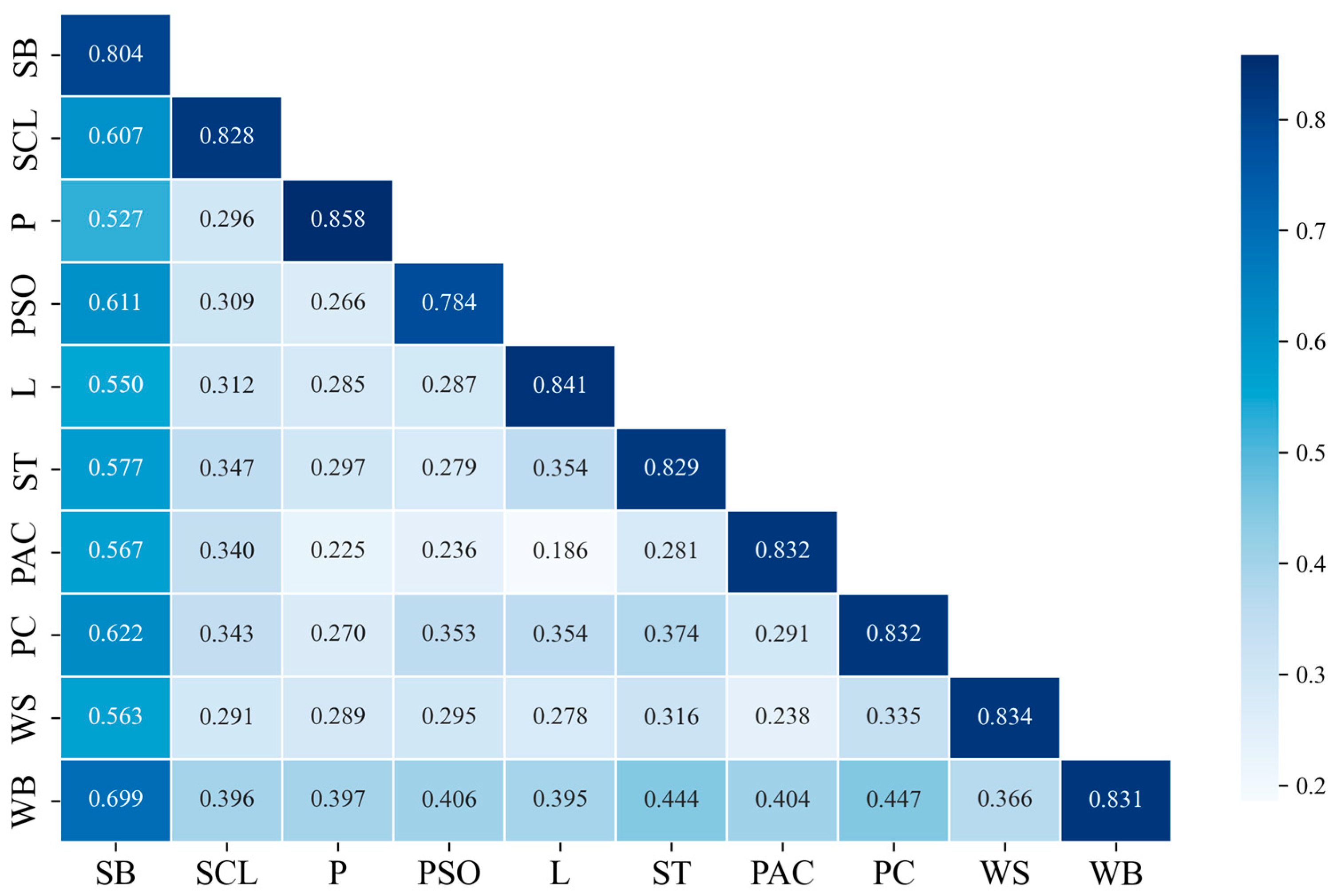
Data were analyzed in SmartPLS 4.0, with bootstrapping achieving convergence by the fifth iteration. Reliability analysis showed Cronbach’s α values ranging from 0.773 to 0.874 and composite reliability (CR) values from 0.773 to 0.875, confirming strong internal consistency. Convergent validity was supported by factor loadings above 0.7 for all observed variables (0.771–0.865) and average variance extracted (AVE) values above 0.6 for all latent constructs (0.614–0.735) (Table 4). Discriminant validity was verified using the Fornell–Larcker criterion, whereby the square root of AVE for each construct exceeded its correlations with other constructs (Figure 2).

4.2. Model Evaluation

Prior to modeling, the dataset was partitioned at random into 80% for training and 20% for testing in accordance with the random distribution principle, ensuring independent evaluation of model performance on unseen data. To optimize predictive accuracy, Bayesian optimization combined with five-fold cross-validation was applied to construct the optimal model. Hyperparameters for the Random Forest, XGBoost, and CatBoost algorithms were fine-tuned based on accuracy scores from the cross-validation results (Table 5). Specifically, Bayesian optimization was performed over 1000 iterations, using the MultiClass loss function to accommodate the multi-class classification task and Accuracy as the evaluation metric. The optimization process focused on key hyperparameters, including maximum tree depth, learning rate, l2_leaf_reg, and bagging_temperature. The resulting optimal parameter settings are reported in Table 5. The code for the model parameter settings can be found in the Appendix A.
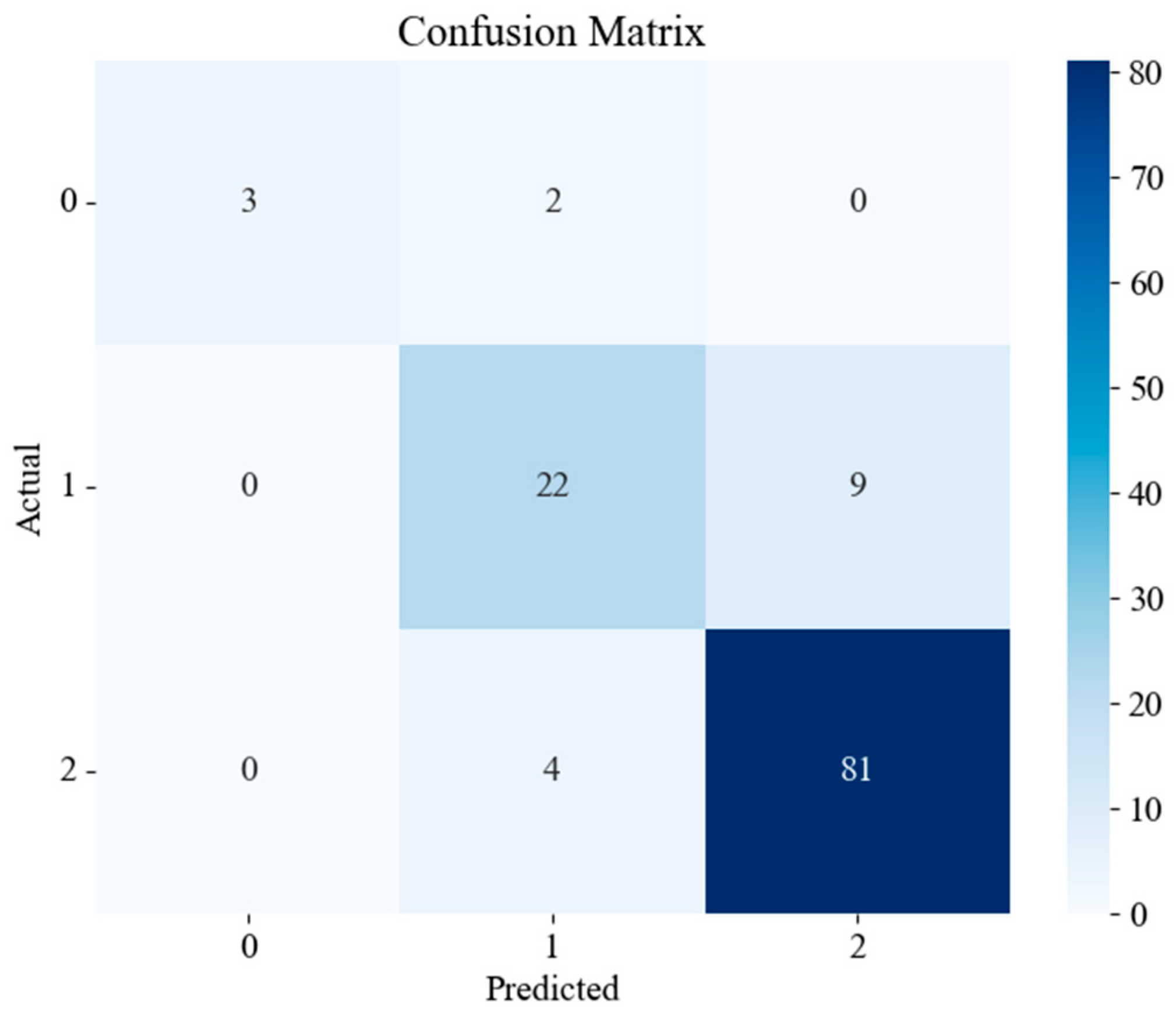
Model performance was then evaluated on the independent test set using accuracy, recall, precision, and F1-score as metrics. As shown in Table 6, CatBoost outperformed all other algorithms across all measures, achieving an accuracy of 90%, precision of 92%, recall of 79%, and F1-score of 84%, with both accuracy and precision exceeding the 0.90 threshold. The confusion matrix (Figure 3) further illustrates CatBoost’s strong predictive accuracy and generalization capability. These results highlight CatBoost’s exceptional performance in analyzing safety behaviors and suggest its considerable potential for future research in this domain.

4.3. Model Interpretation

4.3.1. Univariate Analysis

The SHAP method, widely recognized for its versatility in model interpretability, supports both global and local explanations and enables analysis of the effects of individual features and their interactions on safety behavior. In our work, SHAP is applied to interpret the CatBoost model, providing an accessible and intuitive understanding of the organizational and individual factors shaping construction workers’ safety behaviors. The SHAP force plot provides a local explanation for an individual prediction by visualizing feature contributions as additive forces. Each feature value exerts a positive or negative influence that either increases or decreases the predicted outcome relative to a baseline. The prediction originates from a baseline value, defined as the mean model output across all samples, and is subsequently adjusted by the cumulative contributions of individual features. Each feature is represented by an arrow whose direction and length indicate the sign and magnitude of its effect on the prediction. Figure 4 illustrates this local explanation under the SHAP framework, where arrows of varying colors and lengths reflect the directional influence of different factors on safety behavior. Features with negligible contributions are omitted for clarity. In this example, the final predicted safety behavior value reaches 4.97, exceeding the baseline value of 4.33, thereby classifying the individual as exhibiting safe behavior.
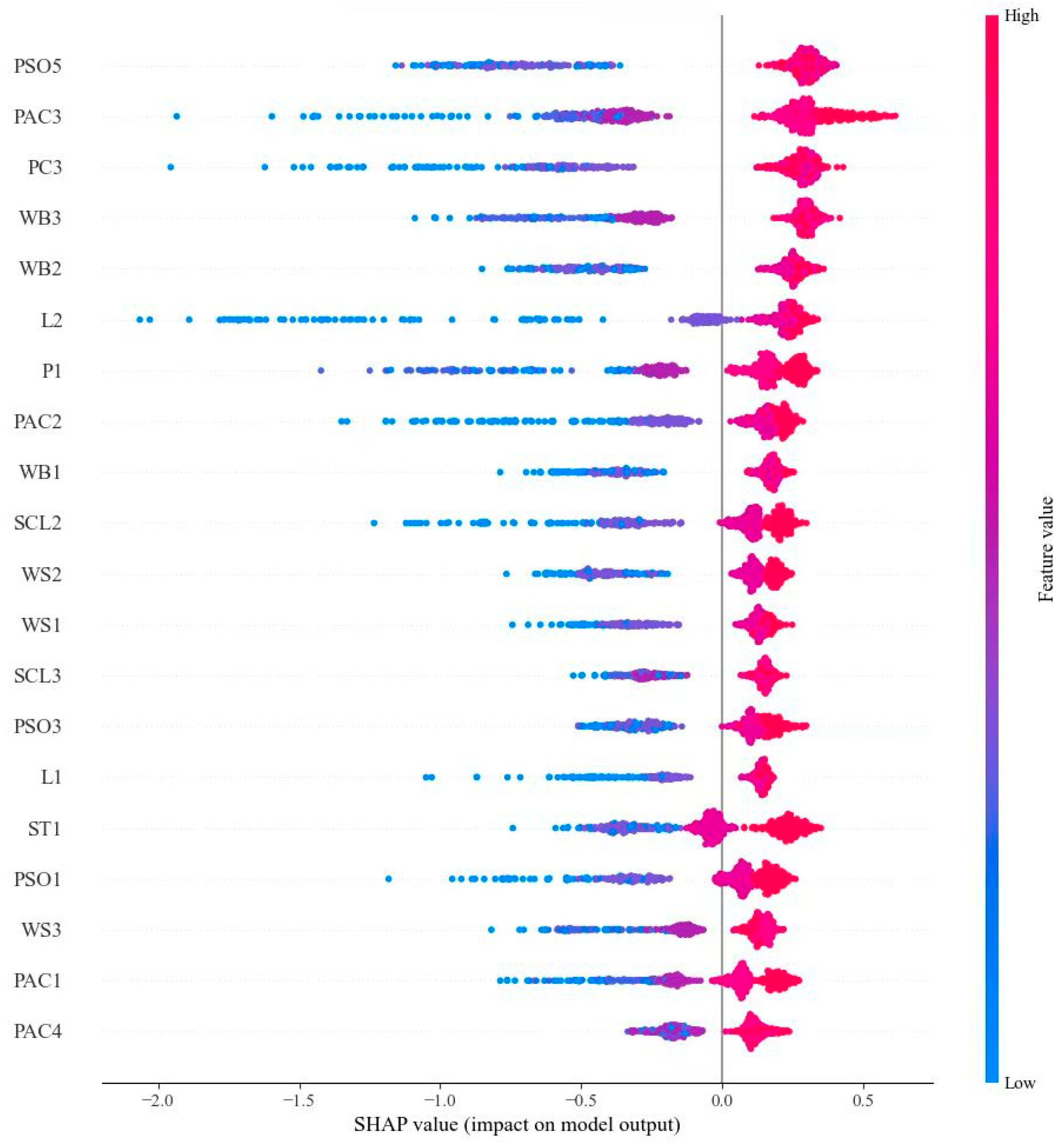
Based on the results presented in Figure 5, PSO5, L2, and P1 emerged as key organizational-level factors influencing construction workers’ safety behavior, each exerting distinct positive or negative effects. PSO5 reflects workers’ responsiveness to organizational requirements, thereby reinforcing safety compliance. L2 and P1 capture the supportive roles of leaders and co-workers, which enhance safety awareness and attentional focus during construction activities.
At the individual level, PAC3, PC3, and WB3 were identified as significant predictors of safety behavior. PAC3 represents relatively stable personality traits, with proactive individuals being more inclined to adopt positive safety behaviors that protect both themselves and their teams. PC3 highlights the role of optimism in promoting safety by enabling workers to remain calm and self-regulated under uncertain conditions, thereby reducing accident risk. Further analysis identified PSO5 and PAC3 as the primary drivers of safety behavior, with higher levels of these factors being associated with stronger safety compliance and more proactive safety practices. PC3 also exerted a positive influence by fostering optimism and adaptive coping strategies that support safe work performance.
Notably, this study diverges from some previous findings by identifying a positive association between WB3 and safety behavior. One plausible explanation is that workers operating in high-safety environments may exhibit stronger self-management and discipline, which in turn promotes greater attention to safe operations and regulatory compliance. Taken together, compliance, initiative, and optimism appear to enhance vigilance and risk assessment in unfamiliar or demanding tasks, thereby encouraging prudent safety actions and improving overall safety performance.

4.3.2. Interaction Analysis

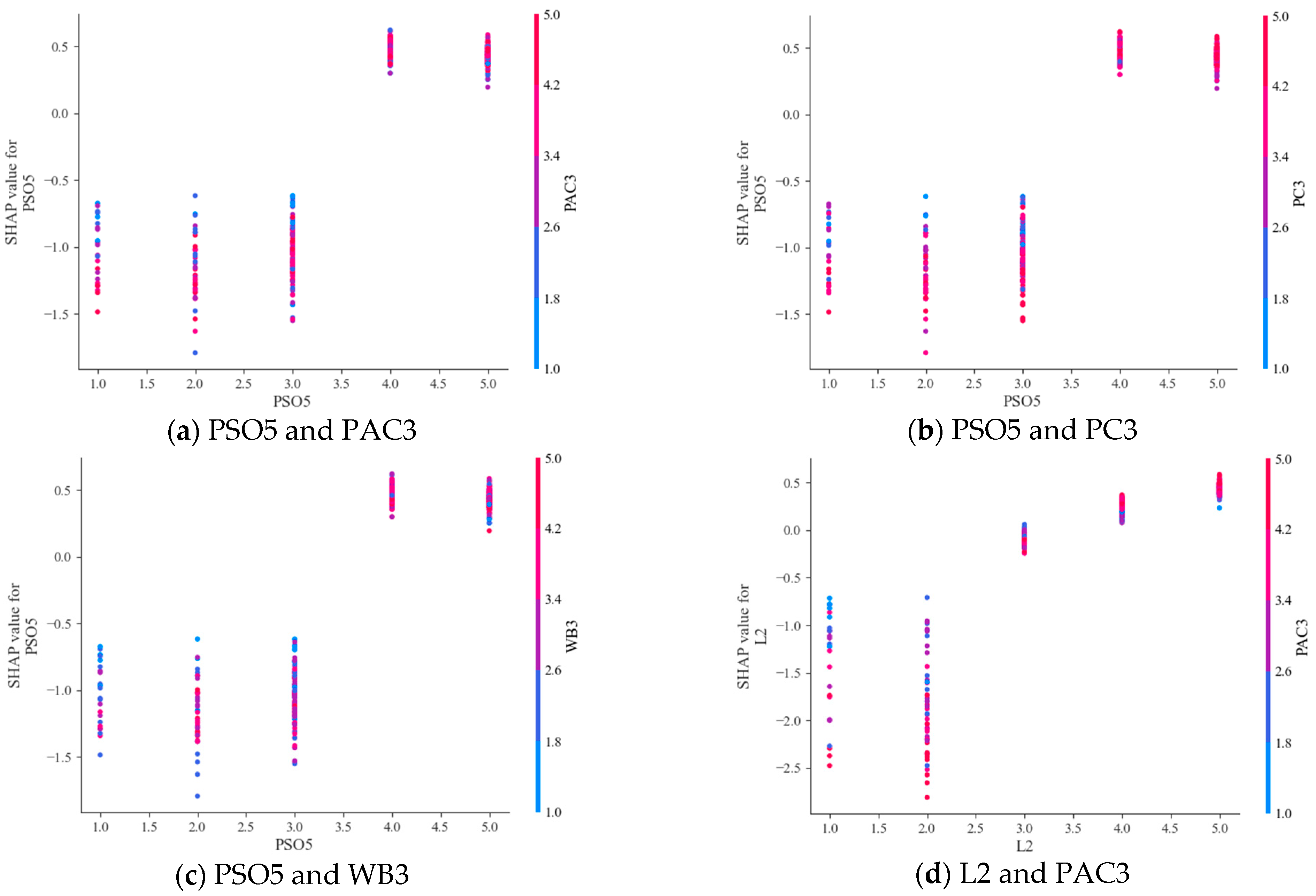
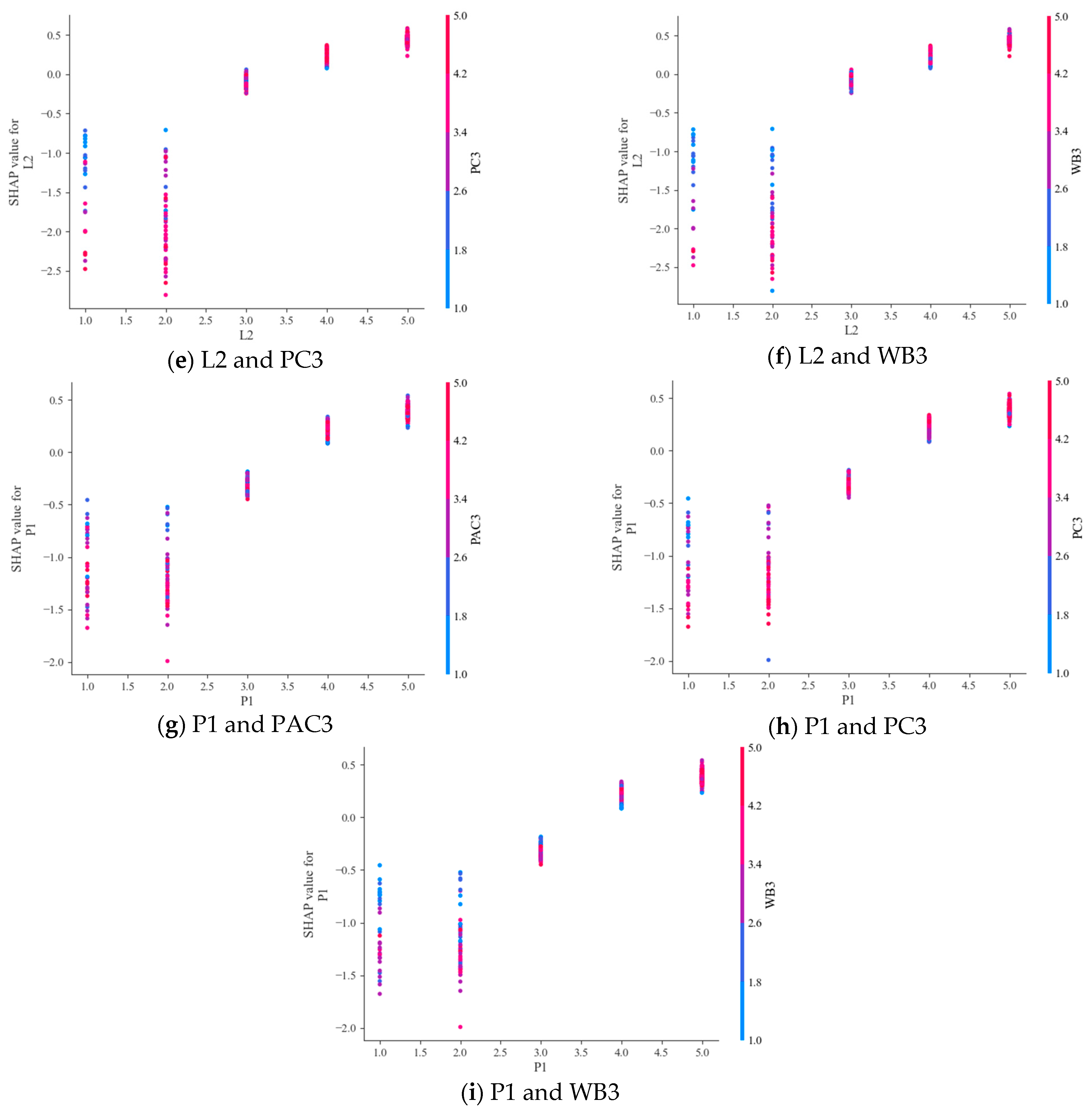
This study examined the influence patterns of six key factors on safety behavior and further explored how different factor combinations shape outcomes through two-factor interaction analyses. SHAP dependence plots were employed to visualize the interactions between organizational- and individual-level factors. In Figure 6a, the horizontal axis represents organizational-level factors, while color gradients indicate interactions with individual-level factors. The results indicate that, within high-compliance groups, PSO consistently exerts a positive effect on safety behavior, irrespective of workers’ levels of proactivity (PAC). Figure 6b further demonstrates that, among groups with comparable levels of compliance, workers’ optimism substantially enhances safety behavior. Figure 6c shows that even when professional efficacy is low, workers operating in high-compliance environments exhibit improved safety behavior, likely attributable to strong social orientation.
Additional analyses (Figure 6d–f) investigate interactions between leadership loyalty (L2) and individual-level factors. The findings suggest that in environments characterized by loyal and supportive leadership, workers display higher levels of proactivity, optimism, and sense of achievement, all of which significantly promote safety behavior.
The results presented in Figure 6g reveal a nuanced relationship between workers’ proactivity (PAC) and safety behavior in collaborative project settings. While higher PAC is associated with only modest improvements in safety behavior, lower PAC appears to be linked to greater safety gains. This pattern may reflect the tendency of highly proactive workers to assume additional tasks and responsibilities, which can increase role conflict and foster overconfidence when acting as perceived role models. Figure 6h indicates that mutual assistance among colleagues, combined with a positive and optimistic outlook, substantially enhances safety behavior in project-based environments. Furthermore, Figure 6i demonstrates that even when workers experience low professional efficacy, strong social support networks can buffer these effects and promote safer work practices.

5. Discussion

5.1. Theoretical Advantages

This study applies the CatBoost model to engineering safety analysis, integrating it with the SHAP framework to identify determinants of construction workers’ safety behavior. Compared with XGBoost and Random Forest, CatBoost demonstrates superior performance in handling complex, categorical data, achieving higher accuracy and precision while effectively managing data noise and specificity. The SHAP framework facilitates a detailed interpretation of how organizational and individual factors, as well as their interactions, shape safety behavior in construction settings. However, when applied to discrete survey data, the resulting influence patterns may be less pronounced, which limits the clarity of certain interpretive insights. Overall, this work presents a novel approach to safety management and risk prediction, underscoring the potential and practical value of CatBoost in engineering safety research.

5.2. Management Advantages

This study explores strategies to enhance construction workers’ safety behaviors through improved safety management. Findings identify PSO as the most influential organizational factor and PAC as the most important individual factor, aligning with established theories of organizational and individual characteristics. Neal et al. [52] classify safety behaviors into compliance and participation, emphasizing the latter’s critical role in sustaining organizational safety.
Our analysis identifies prosociality (PSO) as the most influential determinant of construction workers’ safety behavior, consistent with theoretical perspectives that emphasize the fundamentally social nature of safety culture [36,63,64,65]. In particular, workers’ willingness to provide timely assistance to others (PSO5) emerges as a strong predictor of safe behavior. This effect may be especially pronounced in the Chinese context, where collectivist values and interpersonal relationships are deeply embedded. In such settings, integrating into the group and supporting colleagues may exert a stronger influence on safety behavior than individual safety awareness alone [66]. These findings suggest that safety should be understood not merely as an individual responsibility, but as a collectively reinforced social practice. This interpretation is further supported by the interaction analysis: when both prosociality (PSO) and proactivity (PAC) are high, PSO exerts the dominant influence on safety behavior, while variations in PAC play a comparatively weaker role.
By contrast, proactivity—defined as an individual’s tendency to initiate change and improve their work environment—exerts a more complex influence on safety behavior. Prior studies suggest that proactive individuals are more likely to engage in safety training and adopt protective measures, thereby contributing to improved organizational safety performance [40,41,67,68]. However, our findings indicate that proactivity does not consistently exhibit a positive association with safety behavior, lending support to a “too-much-of-a-good-thing” effect. Excessive proactivity may disrupt established team routines, encourage uncoordinated initiatives that introduce new risks, or foster overconfidence, potentially leading individuals to bypass established safety protocols. This result highlights an important boundary condition for the beneficial effects of proactivity, suggesting that its impact is contingent on the surrounding organizational and social context.
From a managerial perspective, these findings imply that construction safety management should place greater emphasis on cultivating and reinforcing prosocial behaviors. Practical interventions may include structured team-building activities and shared project experiences aimed at enhancing workers’ well-being, self-efficacy, and self-esteem, thereby strengthening team cohesion [63]. Clear and open communication from leadership can help channel proactivity toward constructive safety engagement, while incentive mechanisms–such as recognition awards or additional leave for exemplary safety performance–may further enhance safety awareness and collaborative behavior [69,70,71]. Importantly, managers should avoid unconditionally encouraging all forms of proactive behavior. Instead, employee initiative should be guided through formalized channels, such as structured safety suggestion systems that reward ideas improving collective safety rather than endorsing individual, potentially risky, unilateral actions. This approach allows organizations to balance continuous improvement with the need for coordinated and controllable safety practices. Finally, it should be noted that this study does not examine potential heterogeneity in these determinants across demographic groups. Consequently, the effectiveness of the proposed management strategies may vary according to individual characteristics such as age, educational attainment, and work experience.
PC plays a significant role in shaping safety behavior by fostering positive workplace attitudes and enhancing safety performance [72]. Maintaining an optimistic outlook is particularly important in teams characterized by high levels of compliance, loyalty, and cooperation. In addition, organizational factors such as leadership (L) and peer support (P) exert a strong influence on safety outcomes, with higher levels of L and P being associated with improved safety performance among workers [73]. Accordingly, effective safety management strategies should emphasize strengthening mutual assistance among colleagues to enhance P, as well as cultivating supportive leadership and improving supervisory quality to reinforce L [74,75].
Unlike prior research, this study identifies a positive relationship between WB and safety behavior. This effect may be due to workers with strong safety orientations maintaining heightened vigilance and strict adherence to safety protocols under work pressure, even when experiencing reduced professional efficacy. Contrary to much of the existing literature that links work burnout primarily to adverse outcomes [37], our model reveals a positive association between a specific component of work burnout—WB3, which reflects professional efficacy—and safety behavior. One possible explanation is that, within the high-pressure environment of Chinese construction sites, workers who perceive themselves as competent and effective may develop a stronger sense of personal responsibility and perceived control. This, in turn, may motivate stricter adherence to safety regulations as a strategy for managing demanding work conditions. These findings challenge a monolithic conceptualization of burnout and suggest that its distinct dimensions may exert divergent effects on specific behavioral outcomes, such as safety compliance. Moreover, the interaction between organizational factors and WB appears critical: in high-safety cultures, negative impacts of diminished personal achievement can be mitigated, preserving overall safety performance.
Overall, the findings highlight that combining organizational and individual strategies can effectively strengthen construction workers’ safety behaviors, enhancing both efficiency and sustainability in worksite safety practices.

6. Conclusions

This study applies the CatBoost algorithm to investigate the determinants of construction workers’ safety behavior, incorporating both organizational- and individual-level factors. Model hyperparameters were optimized using Bayesian optimization, and predictive performance was benchmarked against Random Forest and XGBoost models. CatBoost achieved superior performance, with an accuracy of 90%, precision of 92%, recall of 79%, and an F1 score of 84%, clearly outperforming the comparison models. Interpretation based on the SHAP framework revealed strong positive associations between multiple characteristics and safety behavior. At the organizational level, prosociality (PSO), leader–member exchange (L), and peer-to-peer exchange (P) exerted substantial influence, while at the individual level, proactivity (PAC), psychological capital (PC), and work burnout (WB) played key roles. PSO emerged as the most influential determinant: in high-PSO contexts, PC further enhanced safety behavior, whereas the effects of PAC and WB were comparatively weaker. PAC ranked second overall, promoting safety behavior when coupled with strong leadership (L), but potentially attenuating safety performance in the presence of strong peer exchange (P). By integrating CatBoost with SHAP, this study not only identifies the key determinants of safety behavior but also elucidates the relative contributions and interaction mechanisms of individual features. These findings provide empirical support for the design of targeted organizational strategies and personalized interventions aimed at enhancing safety performance in the construction industry.
This study has several limitations that warrant further investigation. First, the analysis relies on self-reported, cross-sectional survey data collected from construction workers within a single national context, which may be subject to common-method bias and limits the generalizability of the findings to other institutional and cultural settings. In addition, data were collected through an online questionnaire, yielding 641 valid responses. Although the survey covered a relatively broad geographic area and data quality checks were applied, the self-reported nature of the measures may introduce subjectivity, potentially leading to discrepancies between reported behaviors and actual conditions. Future research could focus on more narrowly defined regions or provinces and incorporate objective measurements, such as physiological or behavioral monitoring instruments, to improve the representativeness and accuracy of the data. Furthermore, when applying the SHAP framework to analyze factors influencing construction safety behavior, the influence patterns derived from discrete survey data were not always clearly pronounced. Future studies may benefit from using objective and continuous data to further examine the determinants of safety behavior and from leveraging individual-level SHAP values to more precisely trace the pathways through which different factors affect safety outcomes. Finally, this study does not examine potential heterogeneity in the determinants of safety behavior across demographic groups. Individual characteristics such as age, educational attainment, and work experience may moderate the relationships identified here. Future research should therefore employ formal subgroup analyses to systematically explore these differences, thereby enabling more targeted and context-sensitive managerial implications.

Author Contributions

Conceptualization, T.T. and Z.L.; methodology, M.Y.; software, M.Y., X.L. and J.L.; validation, T.T., Z.L. and Y.G.; formal analysis, X.L., and J.L.; investigation, X.L. and J.L.; resources, X.L. and J.L.; data curation, M.Y.; writing—original draft preparation, Z.L. and M.Y.; writing—review and editing, Y.G.; visualization, X.L. and J.L.; supervision, T.T.; project administration, T.T. All authors have read and agreed to the published version of the manuscript.

Funding

This research was funded by the National Natural Science Foundation of China (52472360 and 72101128), the China Postdoctoral Science Foundation (2023M730560), and the Fundamental Research Funds for the Central Universities (2023-4-YB-04).

Data Availability Statement

The original contributions presented in this study are included in the article. Further inquiries can be directed to the corresponding author.

Conflicts of Interest

Author Zhaopeng Liu was employed by the company Nantong Municipal Engineering Design Institute Co., Ltd. The remaining authors declare that the research was conducted in the absence of any commercial or financial relationships that could be construed as a potential conflict of interest.

Appendix A

def catboost_cv(params):
  params = {
    ‘iterations’: 1000,
    ‘learning_rate’: params[‘learning_rate’],
    ‘depth’: int(params[‘depth’]),
    ‘l2_leaf_reg’: params[‘l2_leaf_reg’],
    ‘bagging_temperature’: params[‘bagging_temperature’],
    ‘eval_metric’: ‘Accuracy’,
    ‘loss_function’: ‘MultiClass’,
    ‘random_seed’: 42,
    ‘od_type’: ‘Iter’,
    ‘od_wait’: 100,
    ‘verbose’: False
  }
 
  cv_results = cv(train_pool, params=params, fold_count=5, plot=False, verbose=False)
return -cv_results[‘test-Accuracy-mean’].max()

References

  1. Dong, X.; Largay, J.A.; Wang, X.; Windau, J. Fatalities in the construction industry: Findings from a revision of the BLS Occupational Injury and Illness Classification System. Mon. Lab. Rev. 2014, 137, 1. [Google Scholar] [CrossRef]
  2. Fang, D.; Wu, H. Development of a Safety Culture Interaction (SCI) model for construction projects. Saf. Sci. 2013, 57, 138–149. [Google Scholar] [CrossRef]
  3. Yang, J.; Ye, G.; Xiang, Q.; Kim, M.; Liu, Q.; Yue, H. Insights into the mechanism of construction workers’ unsafe behaviors from an individual perspective. Saf. Sci. 2021, 133, 105004. [Google Scholar] [CrossRef]
  4. Newaz, M.T.; Davis, P.; Jefferies, M.; Pillay, M. Examining the Psychological Contract as Mediator between the Safety Behavior of Supervisors and Workers on Construction Sites. J. Constr. Eng. Manag. 2020, 146, 04019094. [Google Scholar] [CrossRef]
  5. Xu, Q.; Xu, K. Analysis of the Characteristics of Fatal Accidents in the Construction Industry in China Based on Statistical Data. Int. J. Environ. Res. Public Health 2021, 18, 2162. [Google Scholar] [CrossRef]
  6. Zhang, J.; Xiang, P.; Zhang, R.; Chen, D.; Ren, Y. Mediating Effect of Risk Propensity between Personality Traits and Unsafe Behavioral Intention of Construction Workers. J. Constr. Eng. Manag. 2020, 146, 04020023. [Google Scholar] [CrossRef]
  7. Nwagbala, D.C.; Park, J.Y. A Study of the Foremen’s Influence on the Safety Behavior of Construction Workers Based on Cognitive Theory. Buildings 2023, 13, 1792. [Google Scholar] [CrossRef]
  8. Li, P.; He, Y.; Li, Z. Study on Influencing Factors of Construction Workers’ Unsafe Behavior Based on Text Mining. Front. Psychol. 2022, 13, 886390. [Google Scholar] [CrossRef]
  9. Ni, G.; Lv, L.; Wang, S.; Miao, X.; Fang, Y.; Liu, Q. Formation Mechanism and Dynamic Evolution Laws About Unsafe Behavior of New Generation of Construction Workers Based on China’s Construction Industry: Application of Grounded Theory and System Dynamics. Front. Psychol. 2022, 13, 888060. [Google Scholar] [CrossRef]
  10. Peng, L.; Chan, A.H.S. Exerting Explanatory Accounts of Safety Behavior of Older Construction Workers within the Theory of Planned Behavior. Int. J. Environ. Res. Public Health 2019, 16, 3342. [Google Scholar] [CrossRef]
  11. Suraji, A.; Duff, A.R.; Peckitt, S.J. Development of Causal Model of Construction Accident Causation. J. Constr. Eng. Manag. 2001, 127, 337–344. [Google Scholar] [CrossRef]
  12. Deng, S.; Zhu, H.; Cai, Y.; Pan, Y. Group cognitive characteristics of construction Workers’ unsafe behaviors from personalized management. Saf. Sci. 2024, 175, 106492. [Google Scholar] [CrossRef]
  13. Mei, Y.; Huang, J.; Liu, J.; Jia, L. A Study of Factors Influencing Construction Workers’ Intention to Share Safety Knowledge. Buildings 2024, 14, 440. [Google Scholar] [CrossRef]
  14. Yang, J.; Ye, G.; Zhang, Z.; Liu, X.; Liu, Y. Linking construction noise to worker safety behavior: The role of negative emotion and regulatory focus. Saf. Sci. 2023, 162, 106093. [Google Scholar] [CrossRef]
  15. Zhang, Z.; Guo, H.; Gao, P.; Wang, Y.; Fang, Y. Impact of owners’ safety management behavior on construction workers’ unsafe behavior. Saf. Sci. 2023, 158, 105944. [Google Scholar] [CrossRef]
  16. Vithanage, S.C.; Sing, M.C.P.; Davis, P.; Newaz, M.T. Assessing the Off-Site Manufacturing Workers’ Influence on Safety Performance: A Bayesian Network Approach. J. Constr. Eng. Manag. 2022, 148, 04021185. [Google Scholar] [CrossRef]
  17. Liu, W.; Zhao, T.; Zhou, W.; Tang, J. Safety risk factors of metro tunnel construction in China: An integrated study with EFA and SEM. Saf. Sci. 2018, 105, 98–113. [Google Scholar] [CrossRef]
  18. Mohammadfam, I.; Ghasemi, F.; Kalatpour, O.; Moghimbeigi, A. Constructing a Bayesian network model for improving safety behavior of employees at workplaces. Appl. Ergon. 2017, 58, 35–47. [Google Scholar] [CrossRef]
  19. Zhang, Z.; Li, H.; Guo, H.; Wu, Y.; Luo, Z. Causal inference of construction safety management measures towards workers’ safety behaviors: A multidimensional perspective. Saf. Sci. 2024, 172, 106432. [Google Scholar] [CrossRef]
  20. Shin, M.; Lee, H.S.; Park, M.; Moon, M.; Han, S. A system dynamics approach for modeling construction workers’ safety attitudes and behaviors. Accid. Anal. Prev. 2014, 68, 95–105. [Google Scholar] [CrossRef]
  21. Zhang, P.; Li, N.; Jiang, Z.; Fang, D.; Anumba, C.J. An agent-based modeling approach for understanding the effect of worker-management interactions on construction workers’ safety-related behaviors. Autom. Constr. 2019, 97, 29–43. [Google Scholar] [CrossRef]
  22. Ayhan, B.U.; Tokdemir, O.B. Accident Analysis for Construction Safety Using Latent Class Clustering and Artificial Neural Networks. J. Constr. Eng. Manag. 2020, 146, 04019114. [Google Scholar] [CrossRef]
  23. Deng, S.; Ni, P.; Zhu, H.; Cai, Y.; Pan, Y. Artificial Cognition to Predict and Explain the Potential Unsafe Behaviors of Con-struction Workers. J. Constr. Eng. Manag. 2024, 150, 04024074. [Google Scholar] [CrossRef]
  24. Farashaei, D.; Honarbakhsh, A.; Movahedifar, S.M.; Shakeri, E. Individual flexibility and workplace conflict: Cloud-based data collection and fusion of neural networks. Wirel. Netw. 2022, 30, 4093–4108. [Google Scholar] [CrossRef]
  25. Kashifi, M.T. Investigating two-wheelers risk factors for severe crashes using an interpretable machine learning approach and SHAP analysis. Iatss Res. 2023, 47, 357–371. [Google Scholar] [CrossRef]
  26. Qi, H.; Yao, Y.; Zhao, X.; Guo, J.; Zhang, Y.; Bi, C. Applying an interpretable machine learning framework to the traffic safety order analysis of expressway exits based on aggregate driving behavior data. Physica A 2022, 597, 127277. [Google Scholar] [CrossRef]
  27. Shafiq, M.; Tian, Z.; Bashir, A.K.; Du, X.; Guizani, M. IoT malicious traffic identification using wrapper-based feature selection mechanisms. Comput. Secur. 2020, 94, 101863. [Google Scholar] [CrossRef]
  28. Wen, X.; Xie, Y.; Wu, L.; Jiang, L. Quantifying and comparing the effects of key risk factors on various types of roadway segment crashes with LightGBM and SHAP. Accid. Anal. Prev. 2021, 159, 106261. [Google Scholar] [CrossRef] [PubMed]
  29. Chehreh Chelgani, S.; Nasiri, H.; Tohry, A.; Heidari, H.R. Modeling industrial hydrocyclone operational variables by SHAP-CatBoost—A “conscious lab” approach. Powder Technol. 2023, 420, 118416. [Google Scholar] [CrossRef]
  30. Zhou, J.; Qiu, Y.; Armaghani, D.J.; Zhang, W.; Li, C.; Zhu, S.; Tarinejad, R. Predicting TBM penetration rate in hard rock condition: A comparative study among six XGB-based metaheuristic techniques. Geosci. Front. 2021, 12, 101091. [Google Scholar] [CrossRef]
  31. Chen, T.; Guestrin, C. Xgboost: A scalable tree boosting system. In Proceedings of the 22nd ACM Sigkdd International Conference on Knowledge Discovery and Data Mining, San Francisco, CA, USA, 13–17 August 2016; pp. 785–794. [Google Scholar]
  32. Demir, S.; Sahin, E.K. Predicting occurrence of liquefaction-induced lateral spreading using gradient boosting algorithms integrated with particle swarm optimization: PSO-XGBoost, PSO-LightGBM, and PSO-CatBoost. Acta Geotech. 2023, 18, 3403–3419. [Google Scholar] [CrossRef]
  33. Ke, G.; Meng, Q.; Finley, T.; Wang, T.; Chen, W.; Ma, W.; Ye, Q.; Liu, T.Y. LightGBM: A Highly Efficient Gradient Boosting Decision Tree. Adv. Neural Inf. Process. Syst. 2017, 30. [Google Scholar]
  34. Yu, J.; Chang, X.; Hu, S.; Yin, H.; Wu, J. Combining travel behavior in metro passenger flow prediction: A smart explainable Stacking-Catboost algorithm. Inform. Process. Manag. 2024, 61, 103733. [Google Scholar] [CrossRef]
  35. He, C.; McCabe, B.; Jia, G. Effect of leader-member exchange on construction worker safety behavior: Safety climate and psychological capital as the mediators. Saf. Sci. 2021, 142, 105401. [Google Scholar] [CrossRef]
  36. Meng, X.; Chan, A.H.S.; Lui, L.K.H.; Fang, Y. Effects of individual and organizational factors on safety consciousness and safety citizenship behavior of construction workers: A comparative study between Hong Kong and Mainland China. Saf. Sci. 2021, 135, 105116. [Google Scholar] [CrossRef]
  37. Seo, H.C.; Lee, Y.S.; Kim, J.J.; Jee, N.Y. Analyzing safety behaviors of temporary construction workers using structural equation modeling. Saf. Sci. 2015, 77, 160–168. [Google Scholar] [CrossRef]
  38. He, C.; Jia, G.; McCabe, B.; Chen, Y.; Sun, J. Impact of psychological capital on construction worker safety behavior: Communication competence as a mediator. J. Saf. Res. 2019, 71, 231–241. [Google Scholar] [CrossRef] [PubMed]
  39. Liang, Q.; Zhou, Z.; Ye, G.; Shen, L. Unveiling the mechanism of construction workers’ unsafe behaviors from an occupational stress perspective: A qualitative and quantitative examination of a stress–cognition–safety model. Saf. Sci. 2022, 145, 105486. [Google Scholar] [CrossRef]
  40. Saracino, A.; Curcuruto, M.; Antonioni, G.; Mariani, M.G.; Guglielmi, D.; Spadoni, G. Proactivity-and-consequence-based safety incentive (PCBSI) developed with a fuzzy approach to reduce occupational accidents. Saf. Sci. 2015, 79, 175–183. [Google Scholar] [CrossRef]
  41. Wang, Q.; Mei, Q.; Liu, S.; Zhou, Q.; Zhang, J. Demographic differences in safety proactivity behaviors and safety management in Chinese small–scale enterprises. Saf. Sci. 2019, 120, 179–184. [Google Scholar] [CrossRef]
  42. Söderfeldt, M.; Söderfeldt, B.; Warg, L.E.; Ohlson, C.G. The factor structure of the Maslach Burnout Inventory in two Swedish human service organizations. Scand. J. Psychol. 1996, 37, 437–443. [Google Scholar] [CrossRef]
  43. Kawada, T.; Otsuka, T. Relationship between job stress, occupational position and job satisfaction using a brief job stress questionnaire (BJSQ). Work 2011, 40, 393–399. [Google Scholar] [CrossRef] [PubMed]
  44. Luthans, F.; Avolio, B.J.; Avey, J.B.; Norman, S.M. Positive psychological capital: Measurement and relationship with performance and satisfaction. Pers. Psychol. 2007, 60, 541–572. [Google Scholar] [CrossRef]
  45. Seibert, S.E.; Grant, J.M.; Kraimer, M.L. Proactive personality and career success. J. Appl. Psychol. 1999, 84, 416. [Google Scholar] [CrossRef]
  46. Fugas, C.S.; Silva, S.A.; Meliá, J.L. Another look at safety climate and safety behavior: Deepening the cognitive and social mediator mechanisms. Accid. Anal. Prev. 2012, 45, 468–477. [Google Scholar] [CrossRef] [PubMed]
  47. Goh, Y.M.; Ubeynarayana, C.U.; Wong, K.L.X.; Guo, B.H.W. Factors influencing unsafe behaviors: A supervised learning approach. Accid. Anal. Prev. 2018, 118, 77–85. [Google Scholar] [CrossRef]
  48. Liden, R.C.; Maslyn, J.M. Multidimensionafity of Leader-Member Exchange: An Empirical Assessment through Scale Development. J. Manag. 1998, 24, 43–72. [Google Scholar] [CrossRef]
  49. Carlo, G.; Randall, B.A. The Development of a Measure of Prosocial Behaviors for Late Adolescents. J. Youth Adolesc. 2002, 31, 31–44. [Google Scholar] [CrossRef]
  50. Kubichka, M.M. The Influence of Perceived Same-Status Nurse-To-Nurse Coworker Exchange Relationships, Quality of Care Provided, Overall Nurse Job Satisfaction, and Organizational Commitment on Intent to Stay and Job Search Behavior of Nurses in the Acute Care Nurse Work Environment. Ph.D. thesis, The University of Wisconsin-Milwaukee, Milwaukee, WI, USA, 2016. [Google Scholar]
  51. Martínez-Córcoles, M.; Gracia, F.; Tomás, I.; Peiró, J.M. Leadership and employees’ perceived safety behaviours in a nuclear power plant: A structural equation model. Saf. Sci. 2011, 49, 1118–1129. [Google Scholar] [CrossRef]
  52. Neal, A.; Griffin, M.A. A study of the lagged relationships among safety climate, safety motivation, safety behavior, and accidents at the individual and group levels. J. Appl. Psychol. 2006, 91, 946–953. [Google Scholar] [CrossRef]
  53. Chehreh Chelgani, S.; Homafar, A.; Nasiri, H.; Rezaei Laksar, M. CatBoost-SHAP for modeling industrial operational flotation variables—A “conscious lab” approach. Miner. Eng. 2024, 213, 108754. [Google Scholar] [CrossRef]
  54. Jabeur, S.B.; Ballouk, H.; Mefteh-Wali, S.; Omri, A. Forecasting the macrolevel determinants of entrepreneurial opportunities using artificial intelligence models. Technol. Forecast. Soc. Change 2022, 175, 121353. [Google Scholar] [CrossRef]
  55. Jabeur, S.B.; Gharib, C.; Mefteh-Wali, S.; Arfi, W.B. CatBoost model and artificial intelligence techniques for corporate failure prediction. Technol. Forecast. Soc. Change 2021, 166, 120658. [Google Scholar] [CrossRef]
  56. Lundberg, S.M.; Lee, S.I. A Unified Approach to Interpreting Model Predictions. Neural Inf. Process. Syst. 2017, 30. [Google Scholar] [CrossRef]
  57. Imani, M.; Arabnia, H.R. Hyperparameter Optimization and Combined Data Sampling Techniques in Machine Learning for Customer Churn Prediction: A Comparative Analysis. Technologies 2023, 11, 167. [Google Scholar] [CrossRef]
  58. Bergstra, J.; Yamins, D.; Cox, D. Making a science of model search: Hyperparameter optimization in hundreds of dimensions for vision architectures. Int. Conf. Mach. Learn. 2013, 115–123. [Google Scholar] [CrossRef]
  59. Syarif, I.; Prugel-Bennett, A.; Wills, G. SVM parameter optimization using grid search and genetic algorithm to improve classification performance. TELKOMNIKA (Telecommun. Comput. Electron. Control) 2016, 14, 1502–1509. [Google Scholar] [CrossRef]
  60. Liashchynskyi, P.B.; Liashchynskyi, P. Grid Search, Random Search, Genetic Algorithm: A Big Comparison for NAS. arXiv 2019, arXiv:1912.06059. [Google Scholar] [CrossRef]
  61. Bergstra, J.; Bardenet, R.; Bengio, Y.; Kégl, B. Algorithms for hyper-parameter optimization. Adv. Neural Inf. Process. Syst. 2011, 24. Available online: https://proceedings.neurips.cc/paper_files/paper/2011/hash/86e8f7ab32cfd12577bc2619bc635690-Abstract.html (accessed on 15 November 2025).
  62. Dewancker, I.; McCourt, M.; Clark, S. Bayesian optimization for machine learning: A practical guidebook. arXiv 2016, arXiv:1612.04858. [Google Scholar] [CrossRef]
  63. Guo, Y. The Influence of Social Support on the Prosocial Behavior of College Students: The Mediating Effect based on Interpersonal Trust. Engl. Lang. Teach. 2017, 10, 158–163. [Google Scholar] [CrossRef]
  64. Ramarajan, L.; Berger, I.E.; Greenspan, I. Multiple Identity Configurations: The Benefits of Focused Enhancement for Prosocial Behavior. Organ. Sci. 2017, 28, 495–513. [Google Scholar] [CrossRef]
  65. Ünal, A.F.; Chen, C.C.; Xin, K.R. Justice Climates and Management Team Effectiveness: The Central Role of Group Harmony. Manag. Organ. Rev. 2017, 13, 821–849. [Google Scholar] [CrossRef]
  66. Yang, M.M.-H. Gifts, Favors, and Banquets: The Art of Social Relationships in China; Cornell University Press: Ithaca, NY, USA, 1994. [Google Scholar]
  67. Chiu, C.Y.C.; Owens, B.P.; Tesluk, P.E. Initiating and utilizing shared leadership in teams: The role of leader humility, team proactive personality, and team performance capability. J. Appl. Psychol. 2016, 101, 1705–1720. [Google Scholar] [CrossRef] [PubMed]
  68. Jiang, K.; Ling, F.; Feng, Z.; Wang, K.; Guo, L. Psychological predictors of mobile phone use while crossing the street among college students: An application of the theory of planned behavior. Traffic Inj. Prev. 2017, 18, 118–123. [Google Scholar] [CrossRef] [PubMed]
  69. Mohammad, H.; Yaman, S.K.; Hassan, F.; Ismail, Z. Determining the Technical Competencies of Construction Managers in the Malaysia’s Construction Industry. MATEC Web Conf. 2016, 47, 04021. [Google Scholar] [CrossRef]
  70. Ji, Z.; Pons, D.; Pearse, J. Why Do Workers Take Safety Risks?—A Conceptual Model for the Motivation Underpinning Perverse Agency. Safety 2018, 4, 24. [Google Scholar] [CrossRef]
  71. Meng, X.; Zhai, H.; Chan, A.H.S. Development of Scales to Measure and Analyse the Relationship of Safety Consciousness and Safety Citizenship Behaviour of Construction Workers: An Empirical Study in China. Int. J. Environ. Res. Public Health 2019, 16, 1411. [Google Scholar] [CrossRef] [PubMed]
  72. Nasir, S.; Nasir, N.; Khan, S.; Khan, W.; Akyürek, S.S. Exclusion or insult at the workplace: Responses to ostracism through employee’s efficacy and relational needs with psychological capital. J. Organ. Change Manag. 2023, 37, 659–682. [Google Scholar] [CrossRef]
  73. Trinchero, E.; Farr-Wharton, B.; Brunetto, Y. A social exchange perspective for achieving safety culture in healthcare organizations. Int. J. Public Sect. Manag. 2019, 32, 142–156. [Google Scholar] [CrossRef]
  74. Bronkhorst, B.; Tummers, L.; Steijn, B. Improving safety climate and behavior through a multifaceted intervention: Results from a field experiment. Saf. Sci. 2018, 103, 293–304. [Google Scholar] [CrossRef]
  75. LaMontagne, A.D.; Martin, A.; Page, K.M.; Reavley, N.J.; Noblet, A.J.; Milner, A.J.; Keegel, T.; Smith, P.M. Workplace mental health: Developing an integrated intervention approach. BMC Psychiatry 2014, 14, 131. [Google Scholar] [CrossRef] [PubMed]
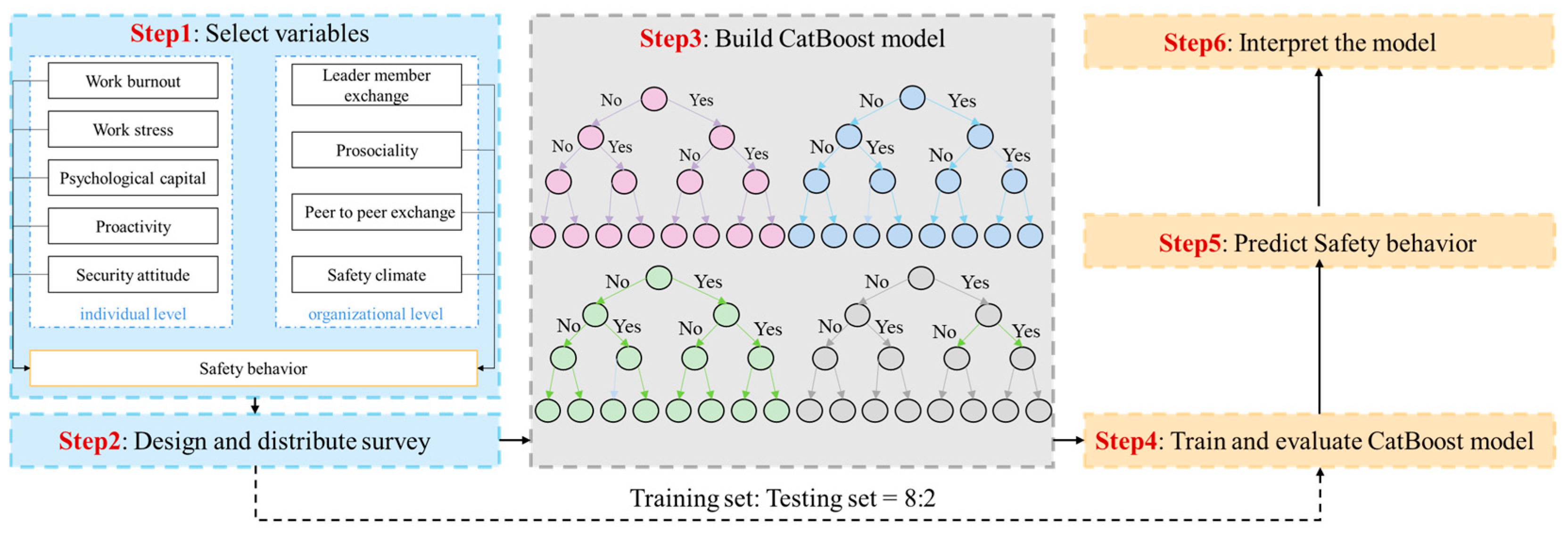
Figure 1. CatBoost-based safety behavior analytical procedure.
Buildings 16 00191 g001
Figure 2. The square root of the latent factor AVE value and the correlation coefficient between factors.
Buildings 16 00191 g002
Figure 3. CatBoost model confusion matrix diagram.
Buildings 16 00191 g003
Figure 4. Instance-level explanation for predicting a construction worker’s safety behavior.
Buildings 16 00191 g004
Figure 5. SHAP summary plot of features in the CatBoost.
Buildings 16 00191 g005
Figure 6. Interaction Analysis of Organizational and Individual Factors in CatBoost.
Buildings 16 00191 g006aBuildings 16 00191 g006b
Table 1. Summary of variable significance in previous studies.
ReferenceSCLLPPSOWBWSPCSTPAC
[37]**---**---
[38]------*--
[36]********-**--**
[35]****----***--
[39]-------***-
Note: * p < 0.05, ** p < 0.01, *** p < 0.001, “-” indicates the factor has no statistically significant impact on the behavioral intention.
Table 2. Summary of items.
VariableNo.ItemReferenceCronbach’s α
Work burnoutWB1I often feel exhausted as a result of construction work.[42]0.776
WB2Since beginning this job, my interest in the work has noticeably declined.
WB3I believe I am competent in performing construction tasks.
Work stressWS1Frequent overtime leaves me with insufficient rest.[43]0.781
WS2I am unable to work at a pace that feels comfortable to me.
WS3Opportunities for training are regularly available.
Psychological capitalPC1I was able to collaborate with other construction firms to resolve issues.[44]0.851
PC2I am generally able to overcome difficulties encountered at work.
PC3When facing uncertainty at work, I tend to expect favorable outcomes.
PC4I usually recover quickly from setbacks and continue with my work.
ProactivityPAC1I am skilled at reframing problems as opportunities for improvement.[45]0.851
PAC2When challenges arise in construction, I address them directly.
PAC3I consistently seek more effective ways of accomplishing tasks.
PAC4If I am confident in an idea, I pursue it despite obstacles.
Security attitudeST1I regard construction safety as the responsibility of the company and its leaders, rather than my personal duty.[46,47]0.773
ST2At work, I make a conscious effort to comply with safety regulations.
ST3During peak workloads, I sometimes view other tasks as taking precedence over safety.
Leader member exchangeL1I maintain a positive working relationship with my leader.[48]0.793
L2I believe my leader would defend me if I were criticized or confronted by others.
L3I am willing to put forth my best effort in support of my supervisor’s leadership.
ProsocialityPSO1I can help people better when there are people around to pay attention.[49]0.874
PSO2I think that helping others without them knowing is
the best type of situation.
PSO3I tend to help people who are in a real crisis or need.
PSO4I am most responsive to assisting others in emotionally charged situations.
PSO5I readily provide help whenever others request it.
PSO6I offer assistance without expecting anything in return.
Peer-to-peer exchangeP1My colleagues collaborate and support one another on projects.[50]0.820
P2Colleagues are generally open to sharing methods and experiences.
P3I maintain positive and cooperative relationships with colleagues.
Safety climateSCL1Management places strong emphasis on monitoring rule compliance.[51]0.845
SCL2In the event of an accident, management responds appropriately at the outset.
SCL3Substantial resources are invested in providing workers with safety training.
SCL4I currently work within a safe and supportive environment.
Safety behaviorSB1I consistently adhere to established work procedures.[52]0.818
SB2I make deliberate efforts to uphold the highest safety standards in my work.
SB3I actively propose suggestions aimed at improving construction safety.
SB4I will take the initiative to correct the wrong actions or ideas of my colleagues.
Table 3. Demographic summary of survey data.
CategoriesClassificationFrequencyPercentage
GenderMale31151.7%
Female29048.3%
Age≤3017228.6%
31–4014323.8%
41–5012220.3%
51–609215.3%
60 above7212%
EducationMiddle school and below12821.3%
High school and vocational school graduate13622.6%
Associate degree19131.8%
University and above14624.3%
Years of workingBelow 517228.6%
6–107913.1%
11–156410.7%
16–206410.7%
20 above22236.9%
Working hoursBelow 815826.3%
8–1030550.7%
10 above13823%
Table 4. Reliability, construct reliability, and convergent Validity.
VariablesItemsFactor LoadingAVECRCronbach’s α
WBWB10.8330.6910.7770.776
WB20.829
WB30.833
WSWS10.8330.6960.7820.781
WS20.836
WS30.833
PCPC10.8590.6920.8550.851
PC20.804
PC30.819
PC40.844
PACPAC10.8030.6920.8540.851
PAC20.852
PAC30.843
PAC40.828
STST10.8340.6880.7730.773
ST20.823
ST30.830
LL10.8370.7070.7950.793
L20.854
L30.832
PSOPSO10.8040.6140.8750.874
PSO20.784
PSO30.789
PSO40.771
PSO50.781
PSO60.772
PP10.8600.7350.8210.820
P20.865
P30.848
SCLSCL10.8510.6850.8480.845
SCL20.831
SCL30.802
SCL40.825
SBSB10.8010.6470.8190.818
SB20.791
SB30.827
SB40.799
Table 5. The hyperparameters of the model and the optimization results.
ParameterSearch RangeValue
1depth(4, 10)5
2learning_rate(0.01, 0.3)0.132
3bagging_temperature(0, 1)0.813
4l2_leaf_reg(1, 10)2
Table 6. Comparison of prediction accuracy of three models.
ModelsAccuracyPrecisionRecallF1-Score
Random Forest0.870.900.730.79
XGBoost0.880.900.760.82
CatBoost0.900.920.790.84
Disclaimer/Publisher’s Note: The statements, opinions and data contained in all publications are solely those of the individual author(s) and contributor(s) and not of MDPI and/or the editor(s). MDPI and/or the editor(s) disclaim responsibility for any injury to people or property resulting from any ideas, methods, instructions or products referred to in the content.