Performance-Driven Generative Design in Buildings: A Systematic Review


Abstract
1. Introduction
1.1. Background, Challenges, and Highlights
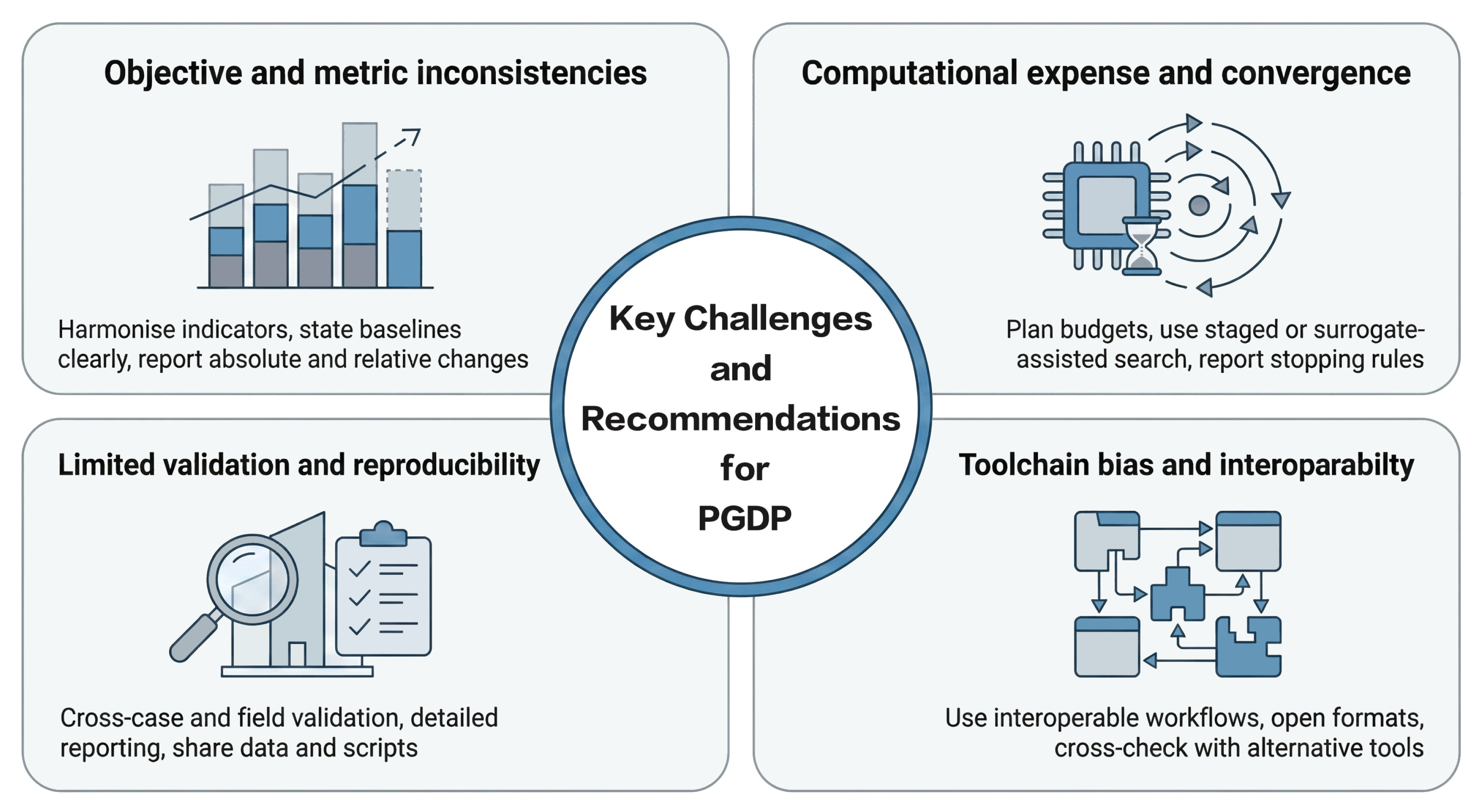
- Inconsistent metric systems and evaluation criteria across studies—e.g., Energy Use Intensity (EUI)/kWh, spatial Daylight Autonomy (sDA)/Useful Daylight Illuminance (UDI)/Annual Sunlight Exposure (ASE), Predicted Mean Vote (PMV)/Predicted Percentage of Dissatisfied (PPD) in various combinations—hamper lateral comparison and the accumulation of evidence [13,14].
- Coupled objectives with limited sensitivity/interpretability: insufficient emphasis on design-variable-centered explanations undermines decision support [15].
- Toolchain bias and limited interoperability: many PDGD workflows are tightly coupled to specific parametric and simulation platforms, which restricts the types of problems that can be addressed, makes replication on alternative toolchains difficult, and hampers integration with BIM and urban scale models [18].
- We provide a clear definition and scope of PDGD at the early design stage, distinguishing it from conventional performance-driven design and from operation-side optimization.
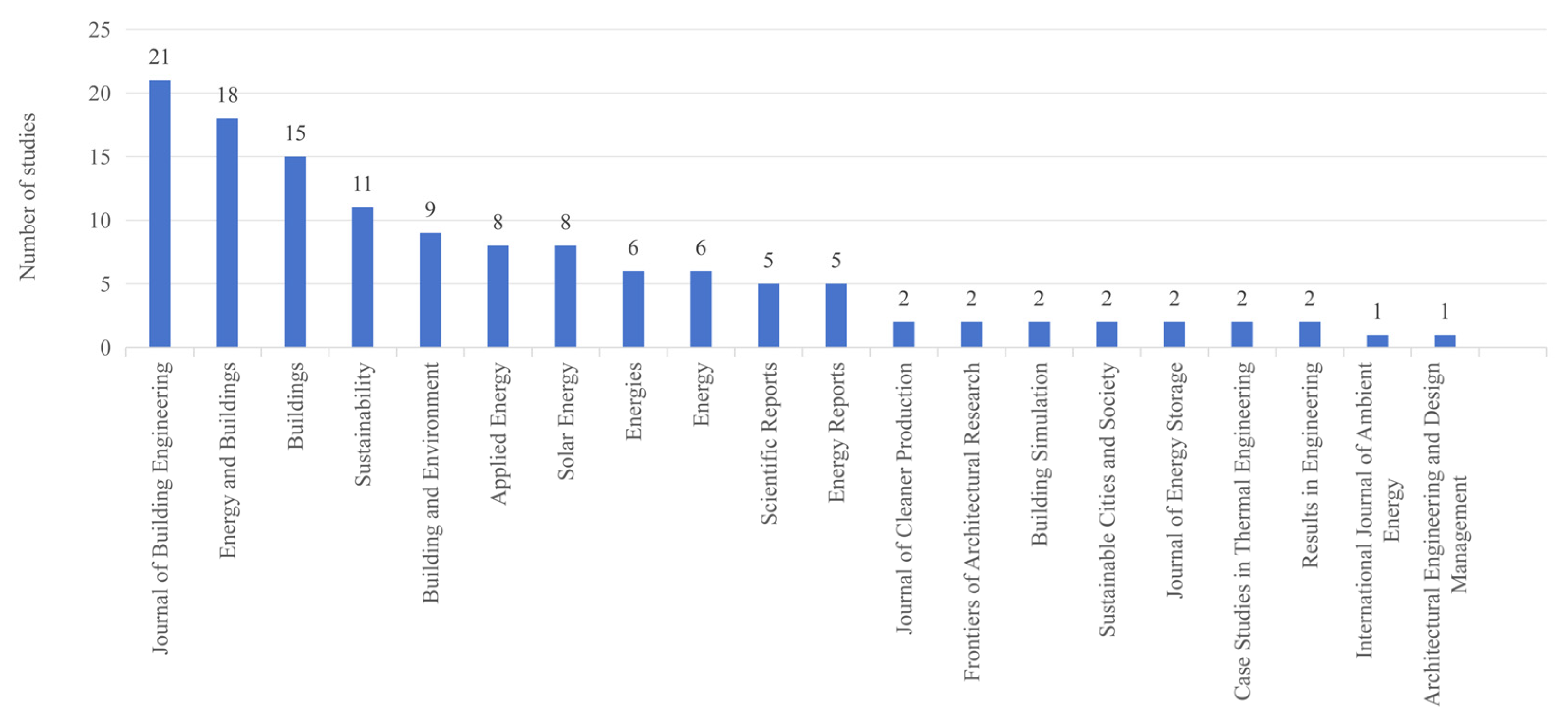
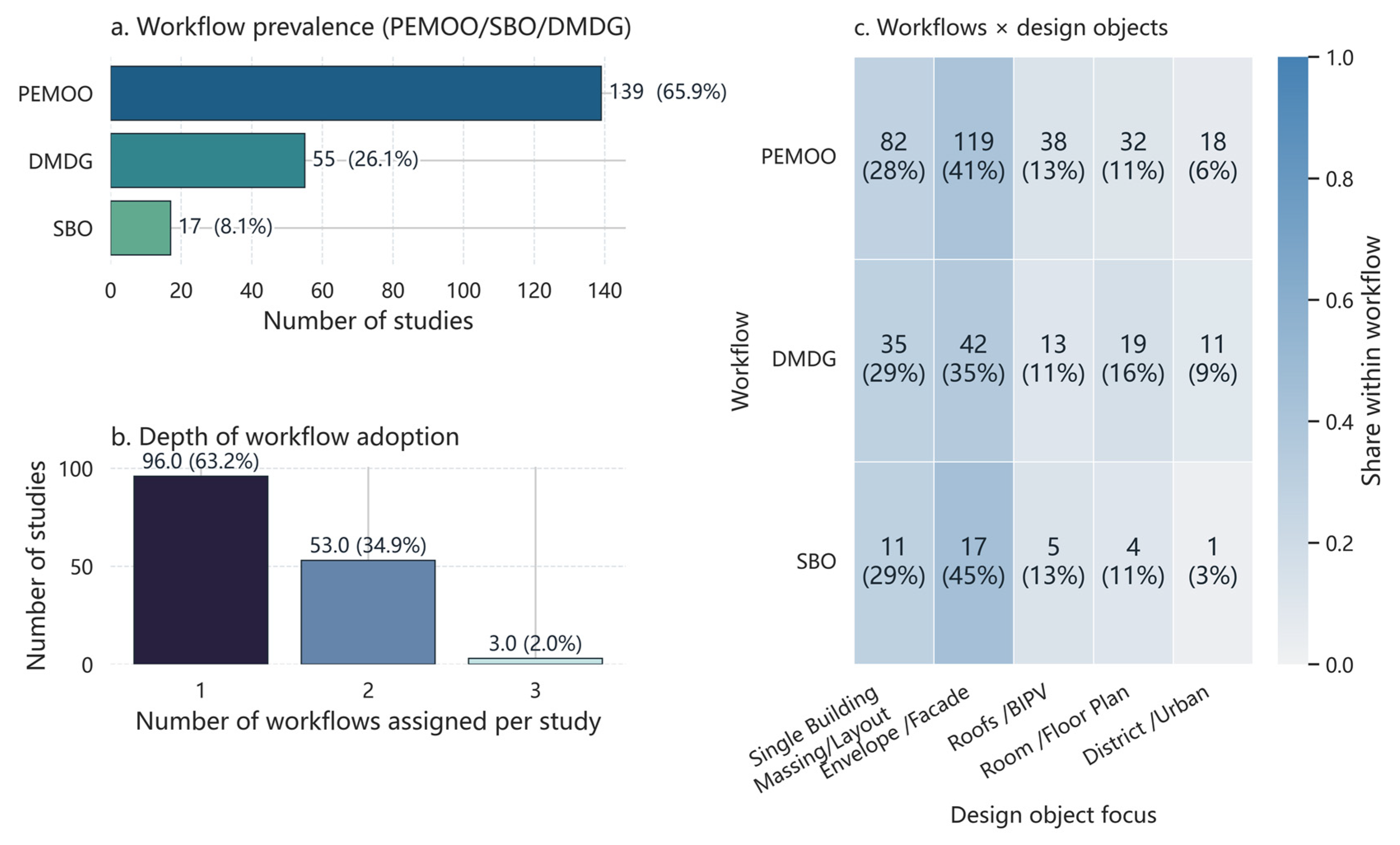
- We systematically map 153 recent studies onto a five-dimensional space—objects/scales, objectives/metrics, algorithms/tools, workflows, and data/validation—so that typical PDGD pipelines and their evidence base become visible and comparable.
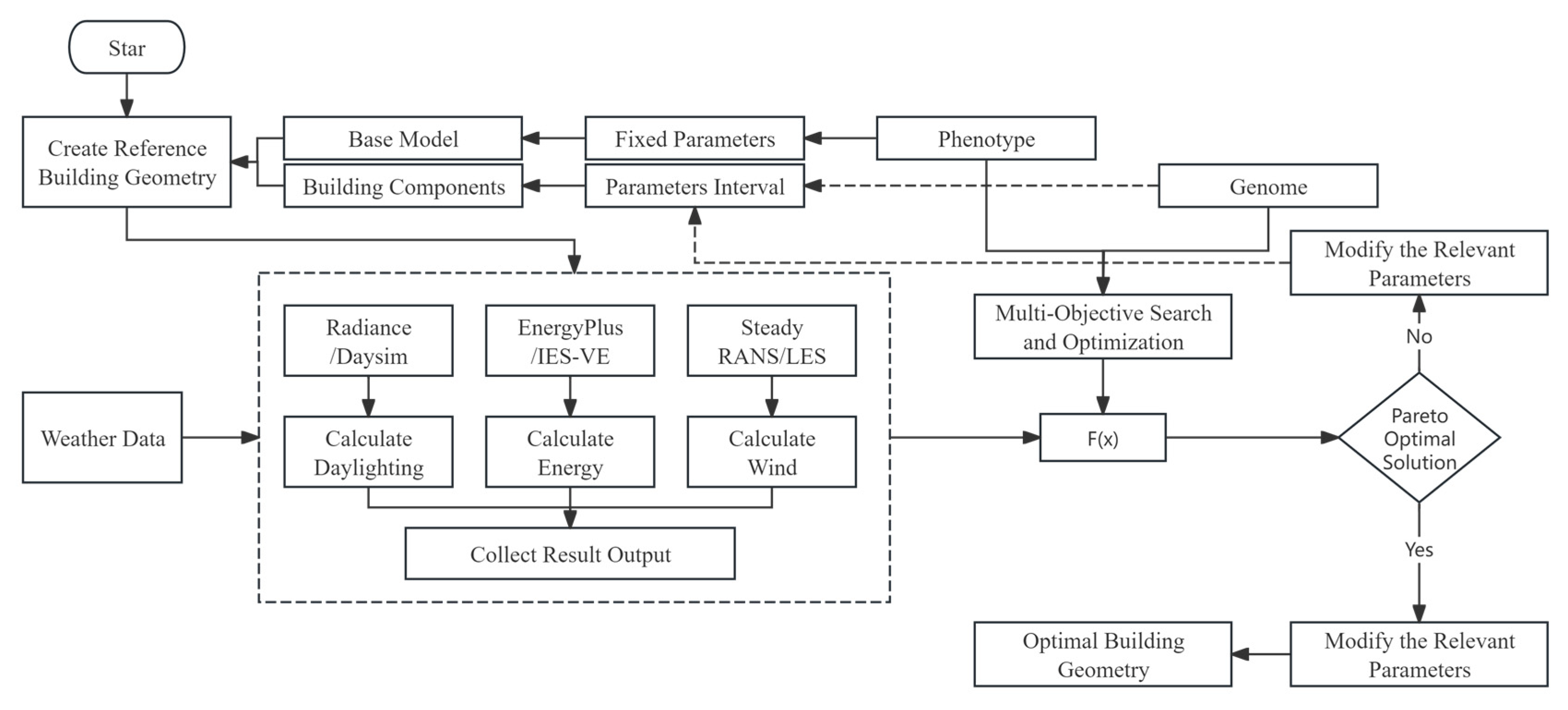
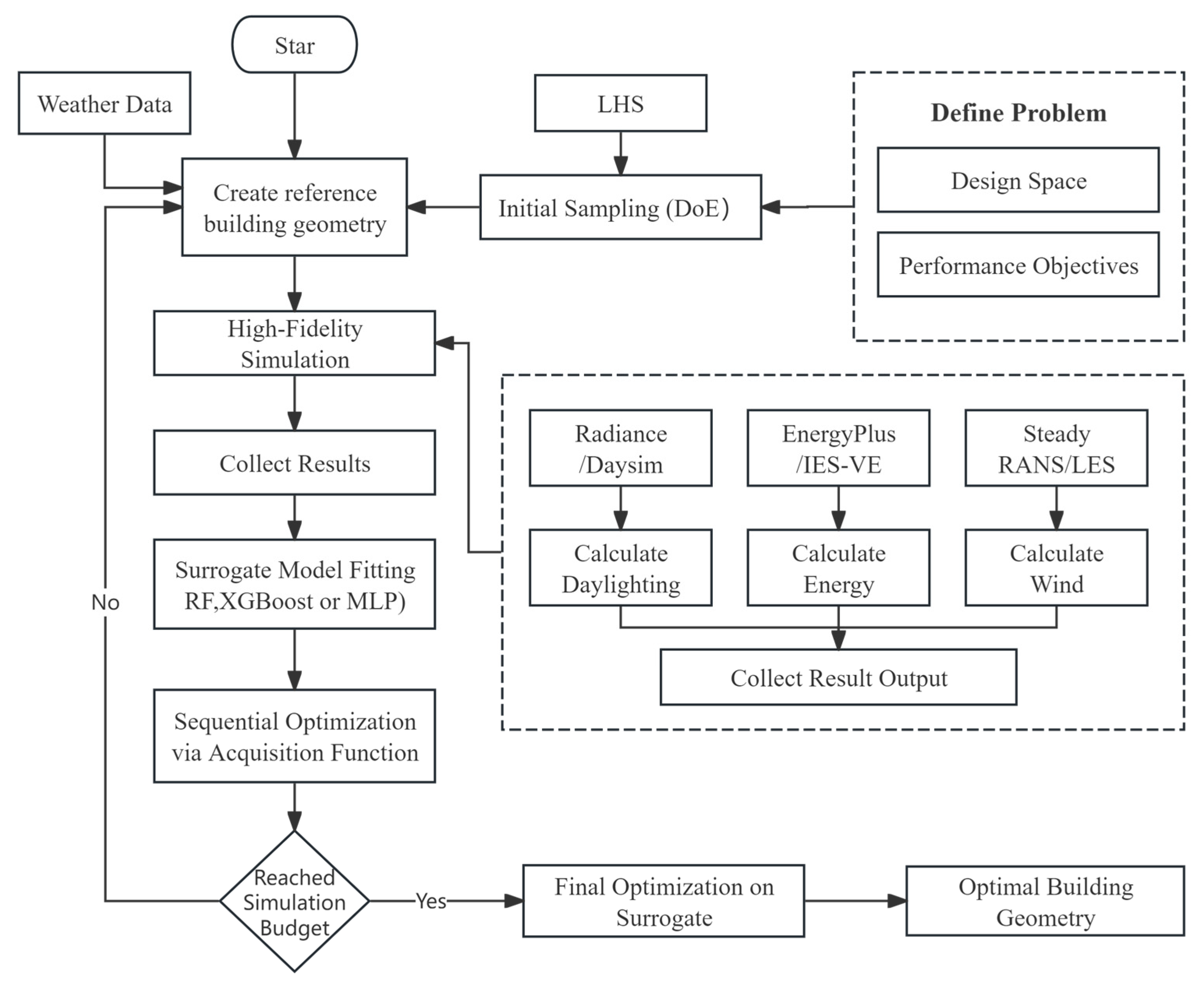
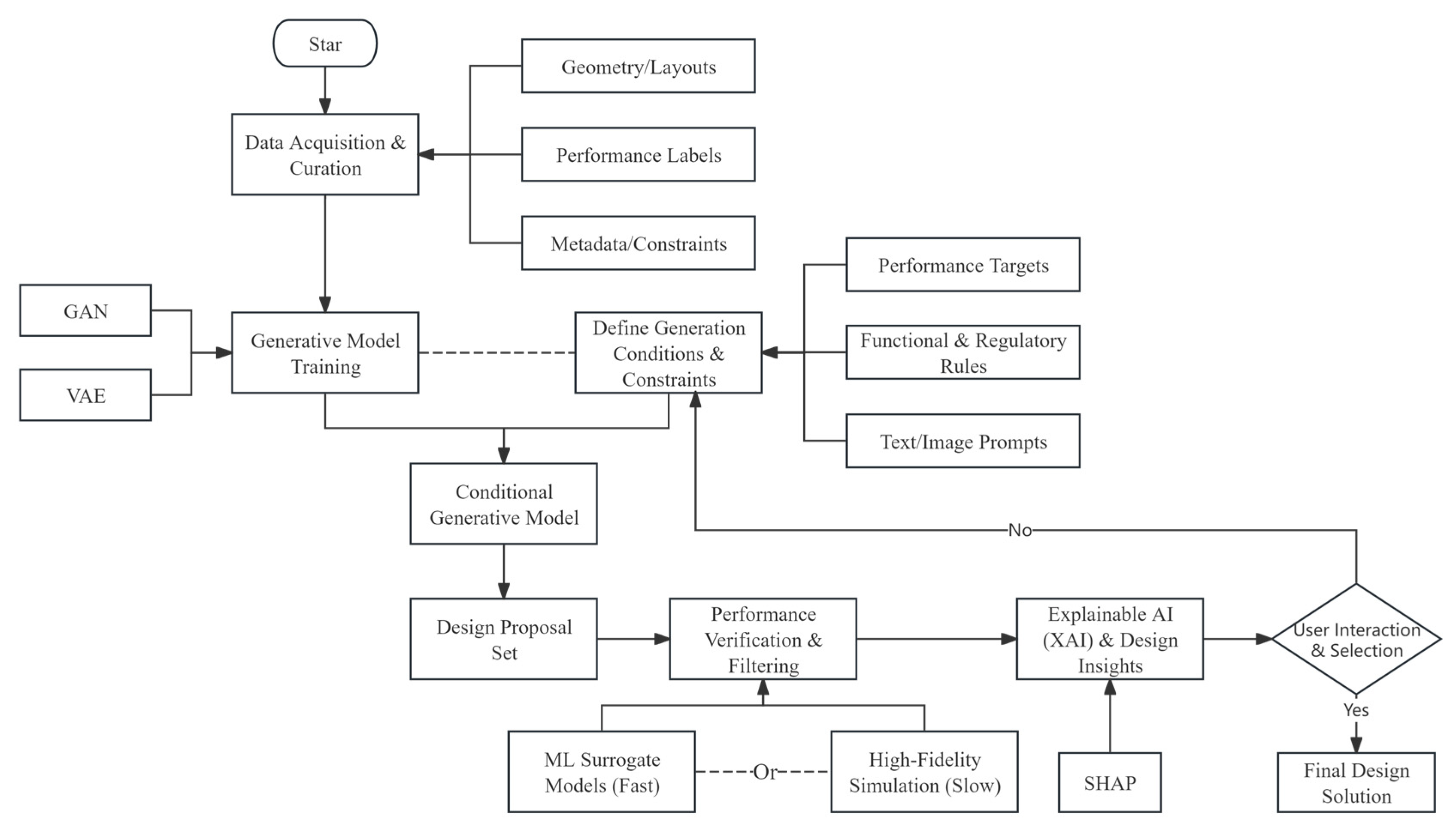
- We identify three dominant workflow archetypes for PDGD and discuss where each is most suitable in terms of the performance–cost–risk trade-off.
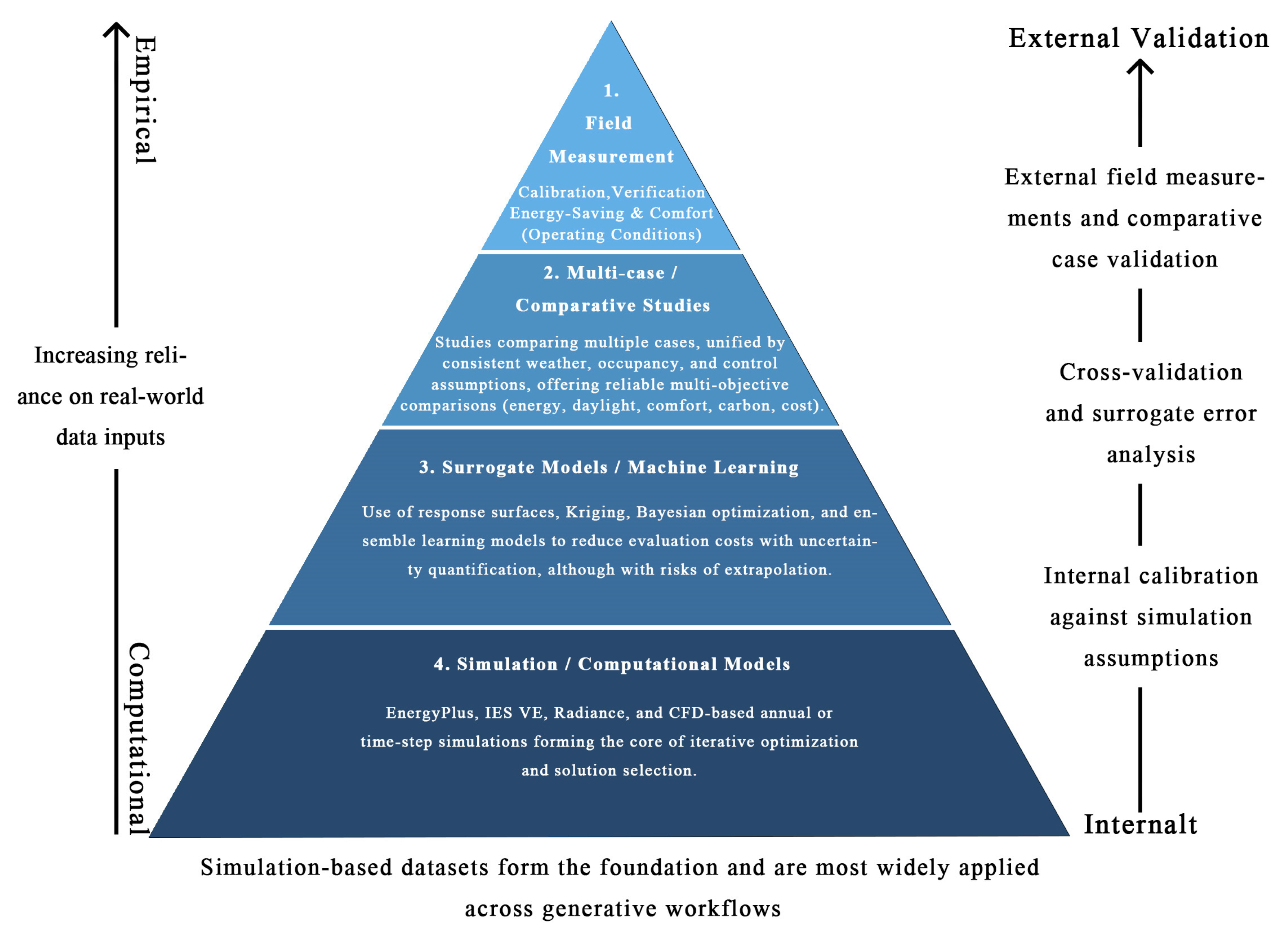
- We synthesize a working objective–metric system and an “evidence pyramid” and translate them into a reproducibility checklist and engineering oriented guidance that can support more consistent reporting and practical deployment of PDGD in real projects.
1.2. Scope and Definitions
- Operate at the concept or schematic design stage and use building-side geometric and envelope parameters as primary design variables, including façade and shading systems, massing, window-to-wall ratio, envelope systems, openings, and lightwells.
- Target one or more of the five core performance objectives, namely energy, daylighting, thermal comfort, carbon, and economics, and rely on explicit and quantitative metrics.
- Implement a closed loop that couples parametric modeling, building performance simulation, and algorithmic optimization or data/model-driven generation.
- Cover spatial scales from components and facades to single buildings and, where available, districts.
1.3. Related Reviews and Distinctiveness
2. Theoretical Background
2.1. Core Ideas of PDD
- From performance-response mapping to multi-objective trade-offs.
- 2.
- The simulation–surrogate computational loop and early-design first.
- 3.
- From design–operation to lifecycle consistency.
2.2. Technical Pathways of GD
- Physics-simulation-driven
- 2.
- Rule/structure-driven
- 3.
- Data/model-driven
3. Materials and Methods
3.1. Search of Publications
3.2. Paper Filtering and Selection
3.3. Analysis of Author Keywords
3.4. Bibliometric Analysis
4. Results
4.1. Overview of the Results
4.2. Object and Scale
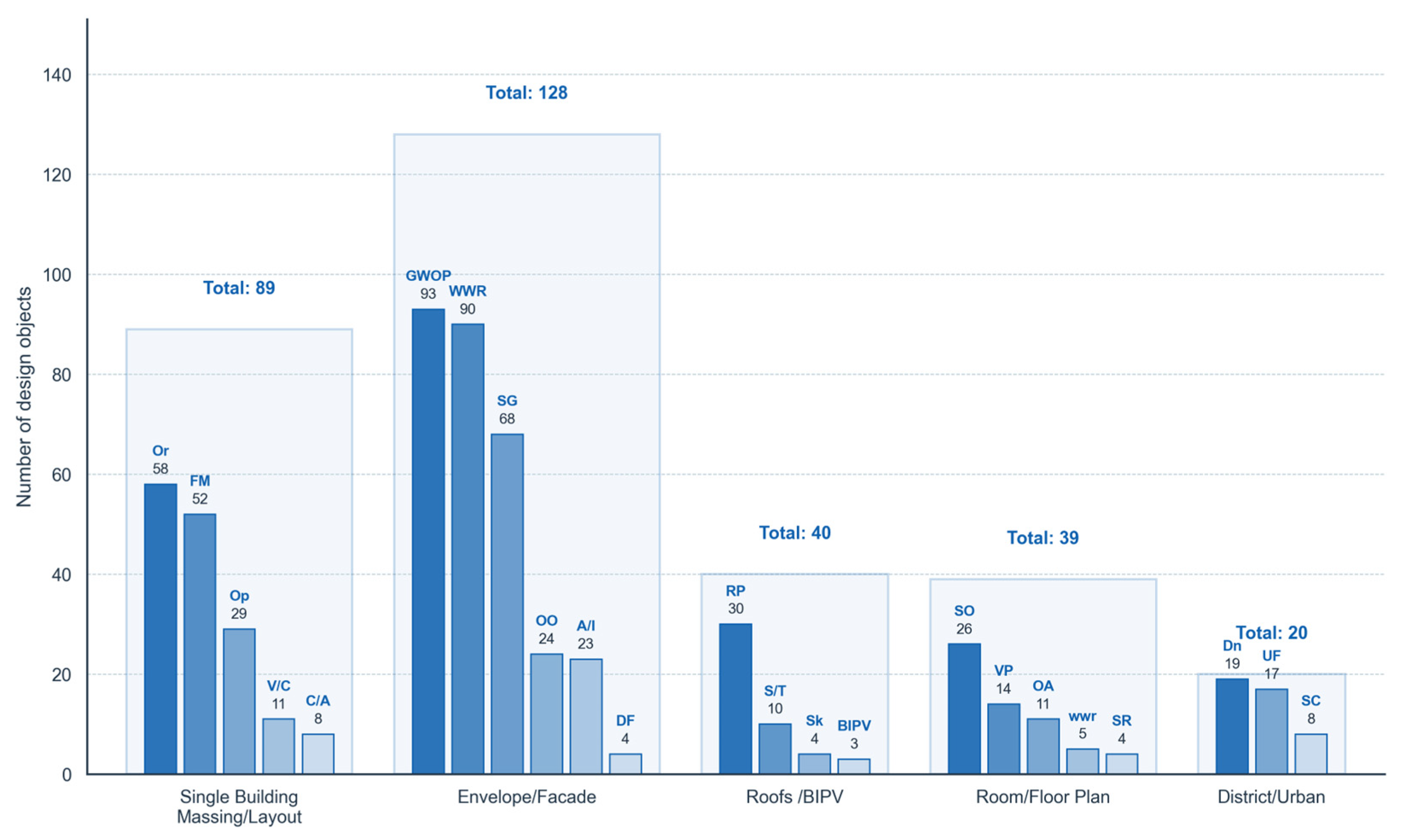
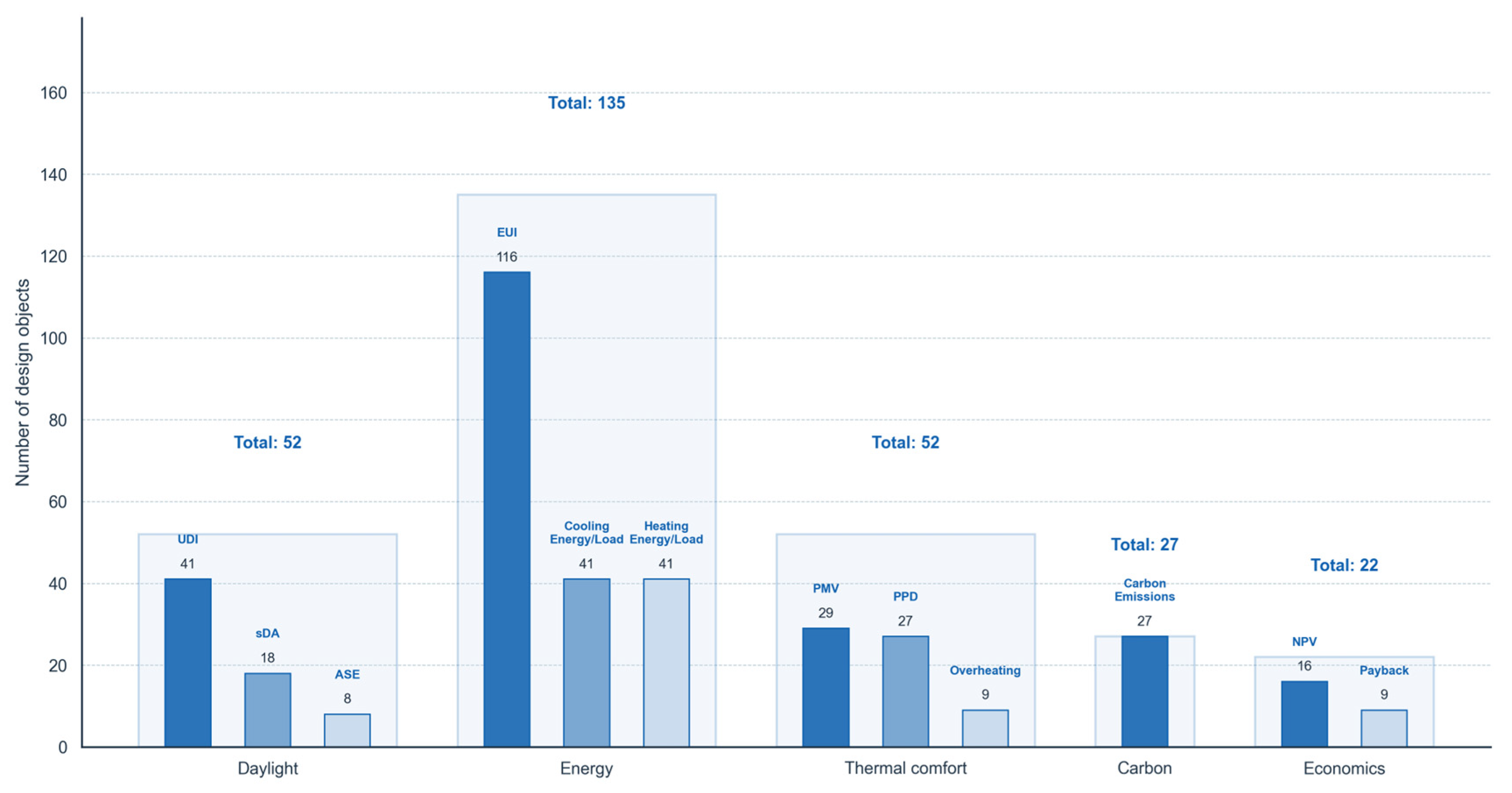
- At the building and facade scales, boundary conditions (envelope properties, set-points, typical meteorological years) can be standardized, and measurement conventions (e.g., sDA/ASE, UDI, annual energy) are widely reused, supporting comparability and transferability.
- The relatively lower attention to Roofs/BIPV reflects their stronger context-dependence on shading, structural capacity, and maintenance regimes;
- Room/floor-plan problems introduce topological and occupancy-driven discrete variables, producing threshold-like, non-smooth responses;
- At the district scale, the small sample size mirrors a high reliance on exogenous drivers (micro-climate, ventilation corridors, street-canyon effects), making conclusions more sensitive to input uncertainty.
4.2.1. Single-Building Massing/Layout
4.2.2. Envelope/Facade
4.2.3. Roofs/BIPV
4.2.4. Room/Floor Plan
4.2.5. District/Urban
4.3. Objectives and Metrics System
4.3.1. Energy
4.3.2. Daylighting
4.3.3. Thermal Comfort
4.3.4. Carbon
4.3.5. Economics
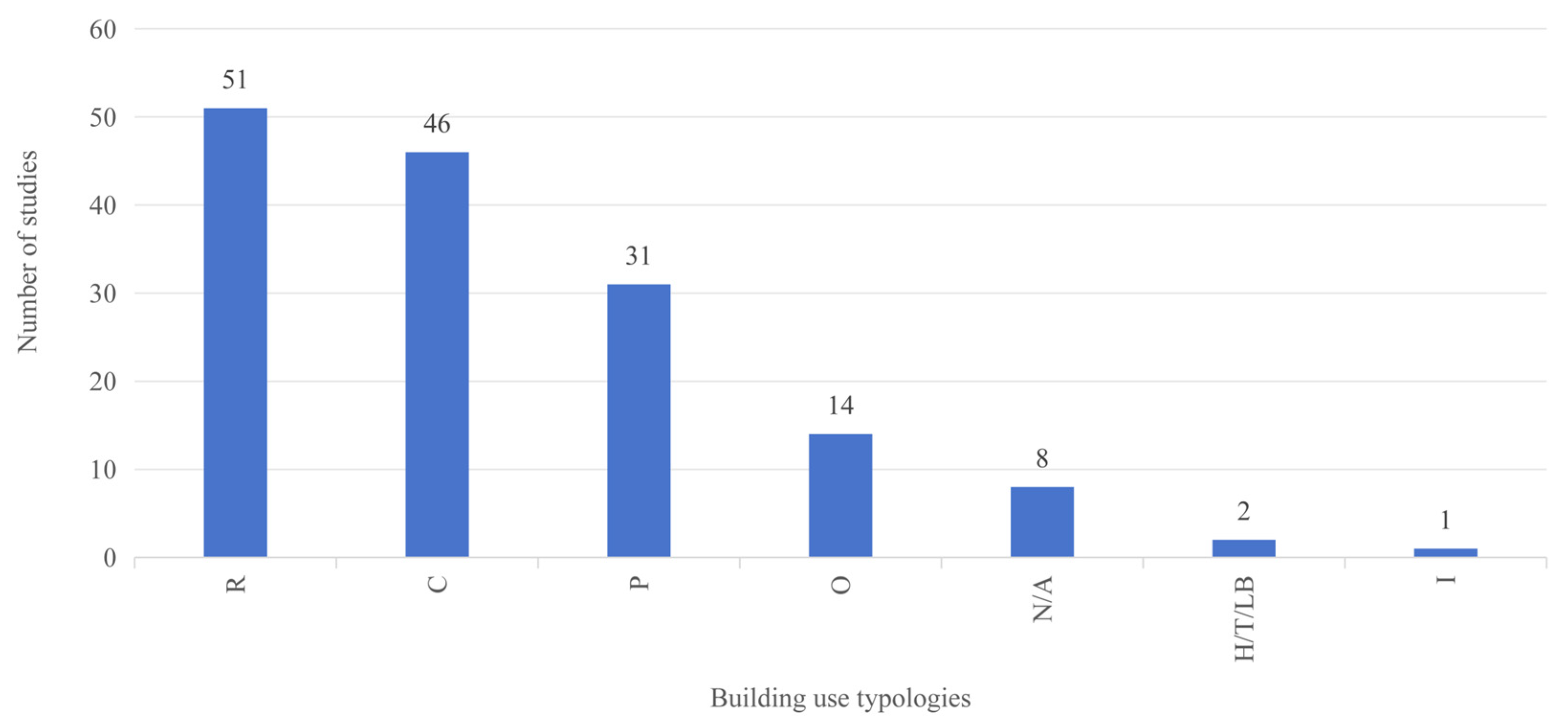
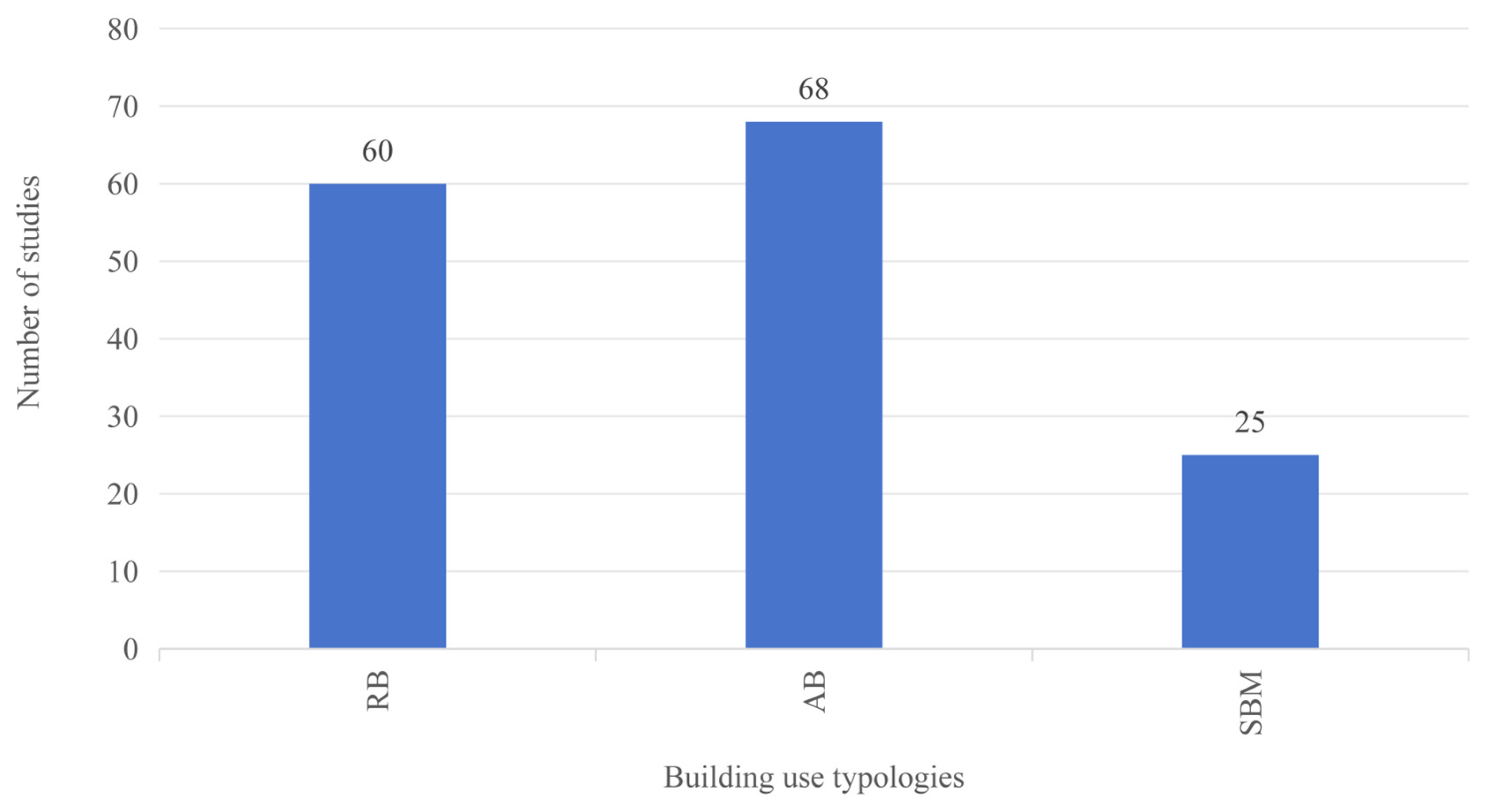
4.3.6. Variations in Objectives Across Building Typologies
- Daylight performance:
- 2.
- Energy:
- 3.
- Thermal comfort:
- 4.
- Carbon and economics:
4.4. Algorithms and Tools
4.4.1. Main Algorithms and Tool Clusters
4.4.2. Algorithm–Tool Ecosystem: Taxonomy and Roles
4.4.3. Task–Scale–Objective Alignment
4.4.4. Quality Control and Threats to Validity
4.5. Comparative Evaluation of Workflows
4.5.1. Parametric + Evolutionary Multi-Objective Optimization
4.5.2. Surrogate/Bayesian Optimization
4.5.3. Data/Model-Driven Generation
4.5.4. Hybrid and Engineering-Oriented
- Set physical fidelity and coupling depth by object/scale (e.g., EnergyPlus/Radiance loose coupling vs. EnergyPlus fine-step co-simulation).
- Under compute/time constraints, prioritize SBO for expensive segments (annual daylight, co-simulation) or use ML for rapid generation of design alternatives or partial substitution of high-fidelity simulations.
- Use parametric + evolutionary to provide an interpretable Pareto set and a structured variable space, serving as the front-end coarse search within hybrids.
4.6. Data and Validation
4.6.1. Calibration, Uncertainty, and Sensitivity
4.6.2. Reproducibility Checklist and Data Governance
- Version pinning and environment capture. Pin the exact versions of the BPS core and all plug-ins (EnergyPlus/OpenStudio/Radiance/Ladybug–Honeybee, plus OS and hardware) and publish them in both the manuscript and repository. Version drift is the most common cause of reproduction failure in GD–BPS studies; studies explicitly reporting tool versions and weather datasets enable clean re-runs and comparison baselines [133,176,177].
- Provenance of weather, geometry, schedules, and controls. For weather/climate inputs, state dataset type (TMY/AMY), source and version, and whether any morphing/UHI adjustments were applied; mixing years across options should be avoided unless justified [98]. For design variables, publish the parametric schema (bounds/units/constraints) so that surrogate training and evolutionary sampling can be reconstructed [105]. Report occupancy/lighting/HVAC control logic and setpoints, including setbacks and ventilation modes, since hidden GUI defaults frequently override intended assumptions [119].
- Learning, search, and evaluation protocols. For surrogates/ML, declare train/validation/test splits, cross-validation strategy, random seeds, feature lists and preprocessing, and guard against leakage across climates or typologies [45]. For SBO and evolutionary baselines, document acquisition/search policies (e.g., EI/UCB parameters, batch size), population/iterations, and stopping rules; non-repeatable policies should include random seeds and hypervolume/ε-progress criteria [74].
5. Discussion
Supplementary Materials
Author Contributions
Funding
Data Availability Statement
Acknowledgments
Conflicts of Interest
Abbreviations
| ACH | Air Changes Per Hour |
| AFN | Airflow Network |
| ASE | Annual Sunlight Exposure |
| BIM | Building Information Modeling |
| BIPV | Building-Integrated Photovoltaics |
| BMS | Building Management System |
| BPS | Building Performance Simulation |
| CFD | Computational Fluid Dynamics |
| CO2 | Carbon Dioxide |
| CV (RMSE) | Coefficient of Variation in Root-Mean-Square Error |
| DA | Daylight Autonomy |
| DCV | Demand-Controlled Ventilation |
| DL | Deep Learning |
| DMDG | Data/Model-driven Generation |
| DSS | Decision-Support System |
| ETL | Extract–Transform–Load |
| EUI | Energy Use Intensity |
| GAN | Generative Adversarial Network |
| GD | Generative Design |
| HVAC | Heating, Ventilation and Air-Conditioning |
| IAQ | Indoor Air Quality |
| IEQ | Indoor Environmental Quality |
| IQR | Interquartile Range |
| LCA | Life-Cycle Assessment |
| LCC | Life-Cycle Cost |
| ML | Machine Learning |
| MCDM | Multiple Criteria Decision Making |
| MOO | Multi-Objective Optimization |
| NMBE | Normalized Mean Bias Error |
| NSGA-II | Non-Dominated Sorting Genetic Algorithm II |
| PEMOO | Parametric + Evolutionary Multi-Objective Optimization |
| PDGD | Performance-Driven Generative Design |
| PMV | Predicted Mean Vote |
| PPD | Predicted Percentage of Dissatisfied |
| PSO | Particle Swarm Optimization |
| RL | Reinforcement Learning |
| SBO | Surrogate/Bayesian Optimization |
| sDA | spatial Daylight Autonomy |
| UDI | Useful Daylight Illuminance |
| UHI | Urban Heat Island |
| WWR | Window-to-Wall Ratio |
| XAI | eXplainable Artificial Intelligence |
References
- Bre, F.; Roman, N.; Fachinotti, V.D. An Efficient Metamodel-Based Method to Carry out Multi-Objective Building Performance Optimizations. Energy Build. 2020, 206, 109576. [Google Scholar] [CrossRef]
- Ma, Z.; Yan, Z.; He, M.; Zhao, H.; Song, J.; Ma, Z.; Yan, Z.; He, M.; Zhao, H.; Song, J. A Review of the Influencing Factors of Building Energy Consumption and the Prediction and Optimization of Energy Consumption. AIMS Energy 2025, 13, 35–85. [Google Scholar] [CrossRef]
- Li, R.; Shari, Z.; Kadir, M.Z.A.A. A Conceptual Framework for Multi-Objective Optimization of Building Performance: Integrating Intelligent Algorithms, Simulation Tools, and Climate Adaptation. Multidiscip. Rev. 2025, 8, 2025385. [Google Scholar] [CrossRef]
- Dadras, Y.; Mostafazadeh, F.; Kavgic, M.; Ghobadi, M. Enhancing Building Energy Optimization Efficiency: A Performance Analysis of Simplification Approaches. J. Build. Eng. 2025, 105, 112559. [Google Scholar] [CrossRef]
- Lyu, H.; Herring, D.; Chen, H.; Zhou, S.; Zhang, J.; Wang, L.; Zuo, Z.; Andrews, J.; Kǒcvara, M.; Spill, F. A Data-Driven Multi-Objective Optimisation Framework for Energy Efficiency and Thermal Comfort in Flexible Building Spaces. Energy Build. 2025, 346, 116100. [Google Scholar] [CrossRef]
- Gaber, B.; Zhan, C.; Han, X.; Omar, M.; Li, G. A Novel Decision Support System for Designing Fixed Shading Systems in the Early Design Stage: A Case Study in Egypt. J. Build. Eng. 2024, 96, 110453. [Google Scholar] [CrossRef]
- Yahaya, A.; Owolabi, A.B.; Suh, D. Enhancing Building Energy Performance Prediction: A Fusion of Deep Learning and First-Principles Simulation Methods. J. Build. Phys. 2025, 107, 112777. [Google Scholar] [CrossRef]
- Karimi, A.; Mohajerani, M.; Alinasab, N.; Akhlaghinezhad, F. Integrating Machine Learning and Genetic Algorithms to Optimize Building Energy and Thermal Efficiency Under Historical and Future Climate Scenarios. Sustainability 2024, 16, 9324. [Google Scholar] [CrossRef]
- Kang, Y.; Cui, Y.; Zhang, D.; Xu, W.; Pang, F.; Lu, S.; Wu, J.; Zhao, Y.; Mao, R. Comprehensive Photovoltaic System in Roofs, Opaque Walls, and Windows toward Zero-Energy Buildings Utilizing Multi-Objective Optimization. J. Build. Eng. 2025, 104, 112320. [Google Scholar] [CrossRef]
- Wang, Y.; Guo, J.; Jiang, Y.; Sun, C. Multi-Objective Optimization of Buildings in Urban Scale for Early Stage Planning and Parametric Design. Sustain. Cities Soc. 2024, 113, 105714. [Google Scholar] [CrossRef]
- Liu, J.; Li, Z.; Zhong, Q.; Wu, J.; Xie, L. Multi-Objective Optimization of Daylighting Performance and Energy Consumption of Educational Buildings in Different Climatic Zones of China. J. Build. Eng. 2024, 95, 110322. [Google Scholar] [CrossRef]
- Zhang, W.; Ma, Z.; Qiu, H.; Pan, Y.; Shi, Y.; Zhang, L. Machine Learning-Boosted Multi-Objective Optimization of Integrated Shading Systems: Enhancing Daylight Availability, Glare Protection, and Energy Savings. Build. Environ. 2025, 280, 113124. [Google Scholar] [CrossRef]
- Bahri, S.Y.; Forment, M.A.; Riera, A.S.; Moghaddam, F.B.; Guerrero, M.J.C.; Garcia, A.M.L. A Literature Review on Thermal Comfort Performance of Parametric Façades. Energy Rep. 2022, 8, 120–128. [Google Scholar] [CrossRef]
- Coğul, I.Ç.; Kazanasmaz, Z.T.; Ekici, B. A Literature Review on Sustainable Buildings and Neighborhoods in Terms of Daylight, Solar Energy and Human Factors. J. Build. Eng. 2025, 103, 111989. [Google Scholar] [CrossRef]
- Chen, Z.; Xing, T.; Wang, Y.; Zhuang, Y.; Zheng, M.; Zhao, Q.; Jia, Q.-S. Coupling Time-Scale Reinforcement Learning Methods for Building Operational Optimization with Waste Heat. Appl. Energy 2025, 391, 125851. [Google Scholar] [CrossRef]
- Ji, Q.; Cai, Y.; Sohaib, O. Sustainable Optimization Design of Architectural Space Based on Visual Perception and Multi-Objective Decision Making. Buildings 2025, 15, 2940. [Google Scholar] [CrossRef]
- Shirzadi, N.; Lau, D.; Stylianou, M. Surrogate Modeling for Building Design: Energy and Cost Prediction Compared to Simulation-Based Methods. Buildings 2025, 15, 2361. [Google Scholar] [CrossRef]
- Liu, Y.; Li, T.; Xu, W.; Wang, Q.; Huang, H.; He, B.-J. Building Information Modelling-Enabled Multi-Objective Optimization for Energy Consumption Parametric Analysis in Green Buildings Design Using Hybrid Machine Learning Algorithms. Energy Build. 2023, 300, 113665. [Google Scholar] [CrossRef]
- Lou, S.; Luo, X.; Chen, Z.; Gao, Z.; Wang, R.; Feng, L.; Zhang, G.; Zhang, Y.; Zhao, Y.; Li, B. Multi-Objective Optimization of Daylighting Performance and Solar Radiation for Building Geometry Using a Hybrid Evolutionary Algorithm. Sci. Rep. 2025, 15, 26644. [Google Scholar] [CrossRef]
- Yue, N.; Li, L.; Morandi, A.; Zhao, Y. A Metamodel-Based Multi-Objective Optimization Method to Balance Thermal Comfort and Energy Efficiency in a Campus Gymnasium. Energy Build. 2021, 253, 111513. [Google Scholar] [CrossRef]
- Hosamo, H.H.; Tingstveit, M.S.; Nielsen, H.K.; Svennevig, P.R.; Svidt, K. Multiobjective Optimization of Building Energy Consumption and Thermal Comfort Based on Integrated BIM Framework with Machine Learning-NSGA II. Energy Build. 2022, 277, 112479. [Google Scholar] [CrossRef]
- Ibrahim, A.; Alsukkar, M.; Dong, Y.; Hu, P. Investigations for the Daylighting Performance of Trapezoid Profile Shadings Using Multi-Objective Optimization. J. Build. Eng. 2025, 99, 111645. [Google Scholar] [CrossRef]
- Villano, F.; Mauro, G.M.; Pedace, A. A Review on Machine/Deep Learning Techniques Applied to Building Energy Simulation, Optimization and Management. Thermo 2024, 4, 100–139. [Google Scholar] [CrossRef]
- Al Mindeel, T.; Spentzou, E.; Eftekhari, M. Energy, thermal comfort, and indoor air quality: Multi-objective optimization review. Renew. Sustain. Energy Rev. 2024, 202, 114682. [Google Scholar] [CrossRef]
- Alexakis, K.; Benekis, V.; Kokkinakos, P.; Askounis, D. Genetic Algorithm-Based Multi-Objective Optimisation for Energy-Efficient Building Retrofitting: A Systematic Review. Energy Build. 2025, 328, 115216. [Google Scholar] [CrossRef]
- Li, R.; Shari, Z.; Kadir, M.Z.A.A. A Review on Multi-Objective Optimization of Building Performance—Insights from Bibliometric Analysis. Heliyon 2025, 11, e42480. [Google Scholar] [CrossRef]
- Wang, Y.; Hu, L.; Hou, L.; Cai, W.; Wang, L.; He, Y. Study on Energy Consumption, Thermal Comfort and Economy of Passive Buildings Based on Multi-Objective Optimization Algorithm for Existing Passive Buildings. J. Clean. Prod. 2023, 425, 138760. [Google Scholar] [CrossRef]
- Bienvenido-Huertas, D.; de la Hoz-Torres, M.L.; Aguilar, A.J.; Tejedor, B.; Sánchez-García, D. Holistic Overview of Natural Ventilation and Mixed Mode in Built Environment of Warm Climate Zones and Hot Seasons. Build. Environ. 2023, 245, 110942. [Google Scholar] [CrossRef]
- Xiang, Y.; Zhou, P.; Zhu, L.; Wu, S. Thermal Comfort Meets ESG Principle: A Systematic Review of Sustainable Strategies in Educational Buildings. Buildings 2025, 15, 2692. [Google Scholar] [CrossRef]
- Bhote, J.V.; Chauhan, T.R. A Review of Multi Objective Optimization in Sustainable Architecture: Enhancing Energy Efficiency through Dynamic Facades. Asian J. Civ. Eng. 2025, 26, 2319–2330. [Google Scholar] [CrossRef]
- Özlük, R.; Aydın, F.; Yıldız, Y. Artificial Intelligence Algorithms, Simulation Tools and Software for Optimization of Adaptive Facades: A Systematic Literature Review. J. Build. Eng. 2025, 106, 112566. [Google Scholar] [CrossRef]
- Lystbæk, M.S. Machine Learning-Driven Processes in Architectural Building Design. Autom. Constr. 2025, 178, 106379. [Google Scholar] [CrossRef]
- BuHamdan, S.; Alwisy, A.; Bouferguene, A. Generative Systems in the Architecture, Engineering and Construction Industry: A Systematic Review and Analysis. Int. J. Archit. Comput. 2021, 19, 226–249. [Google Scholar] [CrossRef]
- Khan, A.; Chang, S.; Chang, H. Generative AI approaches for architectural design automation. Autom. Constr. 2025, 180, 106506. [Google Scholar] [CrossRef]
- Zhuang, X.; Zhu, P.; Yang, A.; Caldas, L. Machine Learning for Generative Architectural Design: Advancements, Opportunities, and Challenges. Autom. Constr. 2025, 174, 106129. [Google Scholar] [CrossRef]
- Zhang, H.; Zhang, R. Generative artificial intelligence (AI) in built environment design and planning—A state-of-the-art review. Prog. Eng. Sci. 2025, 2, 100040. [Google Scholar] [CrossRef]
- Yan, S.; Wu, C.; Zhang, Y. Generative Design for Architectural Spatial Layouts: A Review of Technical Approaches. J. Asian Archit. Build. Eng. 2025, 1–21. [Google Scholar] [CrossRef]
- Kookalani, S.; Parn, E.; Brilakis, I.; Dirar, S.; Theofanous, M.; Faramarzi, A.; Mahdavipour, M.A.; Feng, Q. Trajectory of Building and Structural Design Automation from Generative Design towards the Integration of Deep Generative Models and Optimization: A Review. J. Build. Eng. 2024, 97, 110972. [Google Scholar] [CrossRef]
- Wu, A.N.; Stouffs, R.; Biljecki, F. Generative Adversarial Networks in the Built Environment: A Comprehensive Review of the Application of GANs across Data Types and Scales. Build. Environ. 2022, 223, 109477. [Google Scholar] [CrossRef]
- Abu-Shaikha, M.F. Comprehensive Literature Review: Advancing Sustainable Urban Environments through Machine Learning Usage in Digital Architecture. Archit. Eng. Des. Manag. 2025, 1–18. [Google Scholar] [CrossRef]
- Paravantis, J.A.; Malefaki, S.; Nikolakopoulos, P.; Romeos, A.; Giannadakis, A.; Giannakopoulos, E.; Mihalakakou, G.; Souliotis, M. Statistical and Machine Learning Approaches for Energy Efficient Buildings. Energy Build. 2025, 330, 115309. [Google Scholar] [CrossRef]
- Li, K.; Fukuda, H.; Zhang, L.; Zhou, R. Parametric Design and Multi-Objective Optimization of Daylight Performance in Gallery Skylight Systems: A Case Study on the High Museum Expansion. Energy Build. 2024, 311, 114136. [Google Scholar] [CrossRef]
- Zhan, J.; He, W.; Huang, J. Comfort, Carbon Emissions, and Cost of Building Envelope and Photovoltaic Arrangement Optimization through a Two-Stage Model. Appl. Energy 2024, 356, 122423. [Google Scholar] [CrossRef]
- Chegari, B.; Tabaa, M.; Simeu, E.; Moutaouakkil, F.; Medromi, H. An Optimal Surrogate-Model-Based Approach to Support Comfortable and Nearly Zero Energy Buildings Design. Energy 2022, 248, 123584. [Google Scholar] [CrossRef]
- Zhao, Z.; Li, H.; Wang, S. Surrogate-Assisted Coordinated Design Optimization of Building and Microclimate Considering Their Mutual Impacts. Appl. Energy 2025, 383, 125374. [Google Scholar] [CrossRef]
- Liu, Y.; Yang, H.; Liu, C.; Guan, Y.; Cheng, T. Surrogate-Based Approach of Predicting and Optimising Building Performance by Integrating Daylighting, Thermal Comfort, and Costs—A Case Study of Community Care Homes. J. Build. Eng. 2025, 99, 111534. [Google Scholar] [CrossRef]
- Liu, Q.; Lanfermann, F.; Rodemann, T.; Olhofer, M.; Jin, Y. Surrogate-Assisted Many-Objective Optimization of Building Energy Management. IEEE Comput. Intell. Mag. 2023, 18, 14–28. [Google Scholar] [CrossRef]
- Zhai, Z.J.; Xue, Y.; Chen, Q. Inverse Design Methods for Indoor Ventilation Systems Using CFD-Based Multi-Objective Genetic Algorithm. Build. Simul. 2014, 7, 661–669. [Google Scholar] [CrossRef]
- Wu, Y.; Zhan, Q.; Quan, S.J. Improving Local Pedestrian-Level Wind Environment Based on Probabilistic Assessment Using Gaussian Process Regression. Build. Environ. 2021, 205, 108172. [Google Scholar] [CrossRef]
- Westermann, P.; Evins, R. Using Bayesian Deep Learning Approaches for Uncertainty-Aware Building Energy Surrogate Models. Energy AI 2021, 3, 100039. [Google Scholar] [CrossRef]
- Aruta, G.; Ascione, F.; Bianco, N.; Iovane, T.; Mauro, G.M. ANN-Based Model Predictive Control for Optimizing Space Cooling Management. Energy 2025, 328, 136469. [Google Scholar] [CrossRef]
- de Vries, S.B.; Laan, C.M.; Bons, P.C.; Heller, R.M.B. Model-Predictive Space Heating Control for Energy Flexibility—A Case Study Using a Long Short-Term Memory Neural Network Surrogate Model and a Genetic Optimization Algorithm. J. Build. Perform. Simul. 2024, 1–20. [Google Scholar] [CrossRef]
- Mohammadi, S.; Mahlabani, Y.G.; Karimi, F.; MohammadHoseini, B. Generative Design and Ieq Performance Optimization of School Buildings Based on a Parametric Algorithm; Projeto Generativo e Otimização de Desempenho Ieq de Edifícios Escolares Com Base Em Um Algoritmo Paramétrico. Arquiteturarevista 2022, 18, 198–220. [Google Scholar] [CrossRef]
- Ji, Y.; Xu, M.; Zhang, T.; He, Y. Intelligent Parametric Optimization of Building Atrium Design: A Case Study for a Sustainable and Comfortable Environment. Sustainability 2023, 15, 4362. [Google Scholar] [CrossRef]
- Mo, H.; Zhou, Y.; Song, Y. Parametric Design and Spatial Optimization of East–West-Oriented Teaching Spaces in Shanghai. Buildings 2022, 12, 1333. [Google Scholar] [CrossRef]
- Huang, Y.; He, Z.; Qin, Y.; Lu, Y.; Chen, K. Optimizing Office Building Performance in the HSWW Region of China Using Simulation with Hyperopt CatBoost and SPEA2. Sci. Rep. 2025, 15, 8193. [Google Scholar] [CrossRef]
- Mady, A.; Elsagheer, S.; Asawa, T.; Mahmoud, H. A Generative Design Approach to Improving the Environmental Performance of Educational Buildings in Hot Arid Climates. (Assiut National University as a Case Study). Future Cities Environ. 2024, 10, 1–16. [Google Scholar] [CrossRef]
- Li, X.; Lu, W.; Peng, Z.; Zhang, Y.; Huang, J. Generative Design of Walkable Urban Cool Spots Using a Novel Heuristic GAN×GAN Approach. Build. Environ. 2024, 266, 112027. [Google Scholar] [CrossRef]
- Chen, L.; Zhang, Y.; Zheng, Y. A Performance-Based Generative Design Framework Based on a Design Grammar for High-Rise Office Towers during Early Design Stage. Front. Archit. Res. 2025, 14, 145–171. [Google Scholar] [CrossRef]
- Xu, Z.; Lu, W.; Peng, Z.; Huang, J.; Schuldenfrei, E. Exploring Floor Plan Design to Achieve Indoor Thermal Comfort in Public Housing: An Integrated Heat Graph and Machine Learning Approach. Build. Environ. 2025, 271, 112609. [Google Scholar] [CrossRef]
- Qu, K.; Zhang, H.; Zhou, X.; Zhao, L.; Sun, B. Comparison Analysis on Simplification Methods of Building Performance Optimization for Passive Building Design. Build. Environ. 2022, 216, 108990. [Google Scholar] [CrossRef]
- Magnier, L.; Haghighat, F. Multiobjective Optimization of Building Design Using TRNSYS Simulations, Genetic Algorithm, and Artificial Neural Network. Build. Environ. 2010, 45, 739–746. [Google Scholar] [CrossRef]
- Zhou, S.; Jia, W.; Diao, H.; Geng, X.; Wu, Y.; Wang, M.; Wang, Y.; Xu, H.; Lu, Y.; Wu, Z. A CycleGAN-Pix2pix Framework for Multi-Objective 3D Urban Morphology Optimization: Enhancing Thermal Performance in High-Density Areas. Sustain. Cities Soc. 2025, 126, 106400. [Google Scholar] [CrossRef]
- Ji, Y.; Wang, W.; He, Y.; Li, L.; Zhang, H.; Zhang, T. Performance in Generation: An Automatic Generalizable Generative-Design-Based Performance Optimization Framework for Sustainable Building Design. Energy Build. 2023, 298, 113512. [Google Scholar] [CrossRef]
- Naboni, E.; Natanian, J.; Brizzi, G.; Florio, P.; Chokhachian, A.; Galanos, T.; Rastogi, P. A Digital Workflow to Quantify Regenerative Urban Design in the Context of a Changing Climate. Renew. Sustain. Energy Rev. 2019, 113, 109255. [Google Scholar] [CrossRef]
- Brereton, P.; Kitchenham, B.A.; Budgen, D.; Turner, M.; Khalil, M. Lessons from Applying the Systematic Literature Review Process within the Software Engineering Domain. J. Syst. Softw. 2007, 80, 571–583. [Google Scholar] [CrossRef]
- Siddaway, A.P.; Wood, A.M.; Hedges, L.V. How to Do a Systematic Review: A Best Practice Guide for Conducting and Reporting Narrative Reviews, Meta-Analyses, and Meta-Syntheses. Annu. Rev. Psychol. 2019, 70, 747–770. [Google Scholar] [CrossRef]
- Moher, D.; Liberati, A.; Tetzlaff, J.; Altman, D.G. Preferred Reporting Items for Systematic Reviews and Meta-Analyses: The PRISMA Statement. BMJ 2009, 339, b2535. [Google Scholar] [CrossRef]
- Çıldır, A.S.; Köktürk, G.; Tokuç, A. Design Approaches for Retrofiting Offices to Reach Nearly Zero Energy: A Case Study in the Mediterranean Climate. Energy Sustain. Dev. 2020, 58, 167–181. [Google Scholar] [CrossRef]
- Alsharif, R.; Arashpour, M.; Golafshani, E.M.; Hosseini, M.R.; Chang, V.; Zhou, J. Machine Learning-Based Analysis of Occupant-Centric Aspects: Critical Elements in the Energy Consumption of Residential Buildings. J. Build. Eng. 2022, 46, 103846. [Google Scholar] [CrossRef]
- Marzouk, M.; ElSharkawy, M.; Mahmoud, A. Optimizing Daylight Utilization of Flat Skylights in Heritage Buildings. J. Adv. Res. 2022, 37, 133–145. [Google Scholar] [CrossRef]
- Chen, Z.; Cui, Y.; Cai, H.; Zheng, H.; Ning, Q.; Ding, X. Ding Multi-Objective Optimization of Photovoltaic Facades in Prefabricated Academic Buildings Using Transfer Learning and Genetic Algorithms. Energy 2025, 328, 136470. [Google Scholar] [CrossRef]
- Chaturvedi, S.; Rajasekar, E. Robust Multi-Objective Building Design Optimization Approach Using NSGA-II Algorithm Considering Weather and Occupant Uncertainties. Int. J. Ambient Energy 2024, 45, 2283817. [Google Scholar] [CrossRef]
- Xu, W.; Wu, X.; Xiong, S.; Li, T.; Liu, Y. Optimizing the Sustainable Performance of Public Buildings: A Hybrid Machine Learning Algorithm. Energy 2025, 320, 135283. [Google Scholar] [CrossRef]
- Liu, K.; Xu, X.; Zhang, R.; Kong, L.; Wang, X.; Lin, D. An Integrated Framework Utilizing Machine Learning to Accelerate the Optimization of Energy-Efficient Urban Block Forms. Build. Simul. 2024, 17, 2017–2042. [Google Scholar] [CrossRef]
- Naderi, E.; Sajadi, B.; Behabadi, M.A.; Naderi, E. Multi-Objective Simulation-Based Optimization of Controlled Blind Specifications to Reduce Energy Consumption, and Thermal and Visual Discomfort: Case Studies in Iran. Build. Environ. 2020, 169, 106570. [Google Scholar] [CrossRef]
- Gao, Y.; Zhao, S.; Huang, Y.; Pan, H. Multi-Objective Optimization of Daylighting–Thermal Performance in Cold-Region University Library Atriums: A Parametric Design Approach. Energies 2025, 18, 1184. [Google Scholar] [CrossRef]
- Li, L.; Zu, S.; Miraba, S.; Dehkordi, S.A.H.H.; Mehr, A.K.; Baghoolizadeh, M.; Baghaie, S.; Marzouki, R. Multi-Objective Optimization of Building Performance: Integrating Sensitivity Analysis for Energy Efficiency and Comfort. Int. Commun. Heat Mass Transf. 2025, 165, 109009. [Google Scholar] [CrossRef]
- Shao, T.; Zheng, W.; Cheng, Z. Passive Energy-Saving Optimal Design for Rural Residences of Hanzhong Region in Northwest China Based on Performance Simulation and Optimization Algorithm. Buildings 2021, 11, 421. [Google Scholar] [CrossRef]
- Chen, Z.; Cui, Y.; Zheng, H.; Ning, Q. Optimization and Prediction of Energy Consumption, Light and Thermal Comfort in Teaching Building Atriums Using NSGA-II and Machine Learning. J. Build. Eng. 2024, 86, 108687. [Google Scholar] [CrossRef]
- Sorooshnia, E.; Rashidi, M.; Rahnamayiezekavat, P.; Samali, B. Optimizing Window Configuration Counterbalancing Energy Saving and Indoor Visual Comfort for Sydney Dwellings. Buildings 2022, 12, 1823. [Google Scholar] [CrossRef]
- Mahdavinejad, M.; Bazazzadeh, H.; Mehrvarz, F.; Berardi, U.; Nasr, T.; Pourbagher, S.; Hoseinzadeh, S. The Impact of Facade Geometry on Visual Comfort and Energy Consumption in an Office Building in Different Climates. Energy Rep. 2024, 11, 1–17. [Google Scholar] [CrossRef]
- Nazari, S.; Mohammadi, P.K.M.; Ghaffarianhoseini, A.; Doan, D.T.; Almhafdy, A. Almhafdy Comparison of Shading Design between the Northern and Southern Hemispheres: Using the NSGA-II Algorithm to Reduce Building Energy Consumption and Improve Occupants’ Comfort. Smart Sustain. Built Environ. 2025, 14, 889–920. [Google Scholar] [CrossRef]
- Wang, R.; Lu, S.; Feng, W. A Three-Stage Optimization Methodology for Envelope Design of Passive House Considering Energy Demand, Thermal Comfort and Cost. Energy 2020, 192, 116723. [Google Scholar] [CrossRef]
- Rahif, R.; Kazemi, M.; Attia, S. Overheating Analysis of Optimized Nearly Zero-Energy Dwelling during Current and Future Heatwaves Coincided with Cooling System Outage. Energy Build. 2023, 287, 112998. [Google Scholar] [CrossRef]
- Bakmohammadi, P.; Noorzai, E. Optimization of the Design of the Primary School Classrooms in Terms of Energy and Daylight Performance Considering Occupantsts’ Thermal and Visual Comfort. Energy Rep. 2020, 6, 1590–1607. [Google Scholar] [CrossRef]
- Mirala, F.; Sajadi, B.; Behabadi, M.A.A.; Naderi, E. The Effect of Using Smart Shadings on the Thermal and Visual Performances of Buildings in Iran: A Numerical Simulation. Energy Equip. Syst. 2023, 11, 371–386. [Google Scholar] [CrossRef]
- Ge, B.; Fan, Z.; Liu, J. Two-Stage Multi-Objective Optimization of Solar Roof Design for Railway-Station Represented Large-Space Public Buildings Considering Thermal Efficiency, Carbon Emissions, and Daylighting. Build. Environ. 2025, 280, 113084. [Google Scholar] [CrossRef]
- Xu, Z.; Li, X.; Duan, C.; Li, X.; Jiang, N.; Sun, X.; Xie, F. Application of Machine Learning and Genetic Algorithms in Environmental Performance Assessment and Optimization of Traditional Huizhou Houses in China. Front. Archit. Res. 2025, 14, 1697–1726. [Google Scholar] [CrossRef]
- Bian, C.; Hu, P.; Li, C.Y.; Lee, C.C.; Chen, X. Balancing Solar Energy, Thermal Comfort, and Emissions: A Data-Driven Urban Morphology Optimization Approach. Energies 2025, 18, 3421. [Google Scholar] [CrossRef]
- Su, S.; Hu, Q.; Wang, W.; Li, X. Energy-Resilient Performance-Based Generative Design to Adapt to Future Climate Change Using Urban Building Energy Model: A Case Study of Residential Block Design. Sustain. Cities Soc. 2025, 131, 106769. [Google Scholar] [CrossRef]
- Du, L.; Wang, H.; Bian, C.; Chen, X. Chen Impact of Block Form on Building Energy Consumption, Urban Microclimate and Solar Potential: A Case Study of Wuhan, China. Energy Build. 2025, 328, 115224. [Google Scholar] [CrossRef]
- Fakhr, B.V.; Mahdavinejad, M.; Rahbar, M.; Dabaj, B. Design Optimization of the Skylight for Daylighting and Energy Performance Using NSGA-II. J. Daylight. 2023, 10, 72–86. [Google Scholar] [CrossRef]
- Sonta, A.; Dougherty, T.R.; Jain, R.K. Data-Driven Optimization of Building Layouts for Energy Efficiency. Energy Build. 2021, 238, 110815. [Google Scholar] [CrossRef]
- Nateghi, S.; Kaczmarczyk, J. Multi-Objective Optimization of Window Opening and Thermostat Control for Enhanced Indoor Environment Quality and Energy Efficiency in Contrasting Climates. J. Build. Eng. 2023, 78, 107617. [Google Scholar] [CrossRef]
- Zhang, Z.; Yao, J.; Zheng, R. Multi-Objective Optimization of Building Energy Saving Based on the Randomness of Energy-Related Occupant Behavior. Sustainability 2024, 16, 1935. [Google Scholar] [CrossRef]
- Bai, B.; Li, T.; Wang, S.; Yan, H.; Dong, J. Optimizing Urban Block Morphology for Photovoltaic Power and Thermal Comfort in Hot and Humid Regions. Eng. Appl. Artif. Intell. 2025, 158, 111377. [Google Scholar] [CrossRef]
- López-Guerrero, R.E.; Cruz, A.S.; Hong, T.; Carpio, M. Optimizing Urban Housing Design: Improving Thermo-Energy Performance and Mitigating Heat Emissions from Buildings—A Latin American Case Study. Urban Clim. 2024, 57, 102119. [Google Scholar] [CrossRef]
- Zhang, H.; You, L.; Yuan, H.; Guo, F. Morphological Optimization of Low-Density Commercial Streets: A Multi-Objective Study Based on Genetic Algorithm. Sustainability 2025, 17, 7541. [Google Scholar] [CrossRef]
- Yuan, Z.; Pan, J.; Chen, X.; Peng, Y. Research on the Optimization Design of High-Rise Office Building Performance Based on a Multi-Objective Genetic Algorithm. Buildings 2025, 15, 1636. [Google Scholar] [CrossRef]
- Murathan, E.K.; Manioğlu, G. Impact of Urban Form on Energy Performance, Outdoor Thermal Comfort, and Urban Heat Island: A Case Study in Istanbul. Energy Build. 2025, 345, 116109. [Google Scholar] [CrossRef]
- Hakimazari, M.; Baghoolizadeh, M.; Sajadi, S.M.; Kheiri, P.; Moghaddam, M.Y.; Rostamzadeh-Renani, M.; Rostamzadeh-Renani, R.; Hamooleh, M.B. Multi-Objective Optimization of Daylight Illuminance Indicators and Energy Usage Intensity for Office Space in Tehran by Genetic Algorithm. Energy Rep. 2024, 11, 3283–3306. [Google Scholar] [CrossRef]
- Chung, W. Review of Building Energy-Use Performance Benchmarking Methodologies. Appl. Energy 2011, 88, 1470–1479. [Google Scholar] [CrossRef]
- Wan, K.K.W.; Li, D.H.W.; Liu, D.; Lam, J.C. Future Trends of Building Heating and Cooling Loads and Energy Consumption in Different Climates. Build. Environ. 2011, 46, 223–234. [Google Scholar] [CrossRef]
- Dehghan, F.; Amores, C.P. Simulation-Based Multi-Objective Optimization for Building Retrofits in Iran: Addressing Energy Consumption, Emissions, Comfort, and Indoor Air Quality Considering Climate Change. Sustainability 2025, 17, 2056. [Google Scholar] [CrossRef]
- Hong, X.; Zheng, X.; Lin, J. Ideal Thermochromic Smart Window in a South-Facing Office Room of China Considering Daylighting and Energy Performance. Int. J. Green Energy 2024, 21, 1729–1742. [Google Scholar] [CrossRef]
- Alimohamadi, R.; Jahangir, M.H. Multi-Objective Optimization of Energy Consumption Pattern in Order to Provide Thermal Comfort and Reduce Costs in a Residential Building. Energy Convers. Manag. 2024, 305, 118214. [Google Scholar] [CrossRef]
- Nazari, S.; Keshavarz Mirza Mohammadi, P.; Sareh, P. A Multi-Objective Optimization Approach to Designing Window and Shading Systems Considering Building Energy Consumption and Occupant Comfort. Eng. Rep. 2023, 5, e12726. [Google Scholar] [CrossRef]
- Mardaljevic, J.; Heschong, L.; Lee, E. Daylight Metrics and Energy Savings. Light. Res. Technol. 2009, 41, 261–283. [Google Scholar] [CrossRef]
- Gong, Q.; Ding, W.; Liu, X.; Zeng, Y.; Adu, E.; Shao, H. Multi-Objective Optimization Framework for the Building Envelope of Public Rental Housing in China’s Cold Regions. J. Build. Eng. 2025, 104, 112261. [Google Scholar] [CrossRef]
- Gaber, B.; Zhan, C.; Han, X.; Omar, M.; Li, G. Enhancing Daylight and Energy Efficiency in Hot Climate Regions with a Perforated Shading System Using a Hybrid Approach Considering Different Case Studies. Buildings 2025, 15, 988. [Google Scholar] [CrossRef]
- Baba, F.M.; Ge, H.; Zmeureanu, R.; Wang, L. Optimizing Overheating, Lighting, and Heating Energy Performances in Canadian School for Climate Change Adaptation: Sensitivity Analysis and Multi-Objective Optimization Methodology. Build. Environ. 2023, 237, 110336. [Google Scholar] [CrossRef]
- Yuan, J.; Pang, H.; Yao, S.; Jiang, Z.; Zhu, P. An Integrated Design Process and Methods for Rural Residences Weighing the Daylighting against Thermal Performance in a Whole Year. Sol. Energy 2025, 287, 113231. [Google Scholar] [CrossRef]
- Hazbei, M.; Rafati, N.; Kharma, N.; Eicker, U. Optimizing Architectural Multi-Dimensional Forms; a Hybrid Approach Integrating Approximate Evolutionary Search, Clustering and Local Optimization. Energy Build. 2024, 318, 114460. [Google Scholar] [CrossRef]
- Wang, M.; Cao, S.; Chen, D.; Ji, G.; Ma, Q.; Ren, Y. Research on Design Framework of Middle School Teaching Building Based on Performance Optimization and Prediction in the Scheme Design Stage. Buildings 2022, 12, 1897. [Google Scholar] [CrossRef]
- Kangazian, A.; Pourghanbari, M. Many-Objective Optimization Approach to Design Office Building Façade Considering Energy-Daylight Balance Concept within Prevalent Climate Types of Iran. J. Build. Eng. 2024, 98, 111234. [Google Scholar] [CrossRef]
- Guo, F.; Miao, S.; Xu, S.; Luo, M.; Dong, J.; Zhang, H. Multi-Objective Optimization Design for Cold-Region Office Buildings Balancing Outdoor Thermal Comfort and Building Energy Consumption. Energies 2025, 18, 62. [Google Scholar] [CrossRef]
- Tapia-Calderón, A.; Boer, D.; Salinas-Lira, C.; Vasco, D.A. Optimized Thermal Envelope of Low-Income Dwellings in Santiago de Chile Incorporating Pinus Radiata Wood Impregnated with Phase Change Materials. J. Energy Storage 2023, 60, 106665. [Google Scholar] [CrossRef]
- Akraminejad, R.; Zhao, T.; Rezgui, Y.; Ghoroghi, A.; Razlighi, Y.S. Hybrid Metaheuristic Optimization of HVAC Energy Consumption and Thermal Comfort in an Office Building Using EnergyPlus. Buildings 2025, 15, 2568. [Google Scholar] [CrossRef]
- Chen, R.; Tsay, Y.-S.; Ni, S. An Integrated Framework for Multi-Objective Optimization of Building Performance: Carbon Emissions, Thermal Comfort, and Global Cost. J. Clean. Prod. 2022, 359, 131978. [Google Scholar] [CrossRef]
- Ouanes, S.; Sriti, L. Regression-Based Sensitivity Analysis and Multi-Objective Optimisation of Energy Performance and Thermal Comfort: Building Envelope Design in Hot Arid Urban Context. Build. Environ. 2024, 248, 111099. [Google Scholar] [CrossRef]
- Najafi, Q.; Gorji-Mahlabani, Y.; Goharian, A.; Mahdavinejad, M. A Novel Design-Based Optimization Method for Building by Sensitivity Analysis. J. Sol. Energy Res. 2023, 8, 1446–1458. [Google Scholar] [CrossRef]
- Alaa, H.; Yehia, M.; Ayoub, M. Ayoub Metaheuristic Optimization of Roof Designs to Enhance Energy Performance and Thermal Comfort Using Parametrization and Machine Learning. Sol. Energy 2025, 286, 113186. [Google Scholar] [CrossRef]
- Anand, C.K.; Amor, B. Recent Developments, Future Challenges and New Research Directions in LCA of Buildings: A Critical Review. Renew. Sustain. Energy Rev. 2017, 67, 408–416. [Google Scholar] [CrossRef]
- Talami, R.; Wright, J.; Howard, B. Evaluating the Effectiveness, Reliability and Efficiency of a Multi-Objective Sequential Optimization Approach for Building Performance Design. Energy Build. 2025, 329, 115242. [Google Scholar] [CrossRef]
- Zhao, L.; Zhang, W.; Wang, W. BIM-Based Multi-Objective Optimization of Low-Carbon and Energy-Saving Buildings. Sustainability 2022, 14, 13064. [Google Scholar] [CrossRef]
- Song, J.; Wang, W.; Ni, P.; Zheng, H.; Zhang, Z.; Zhou, Y. Framework on Low-Carbon Retrofit of Rural Residential Buildings in Arid Areas of Northwest China: A Case Study of Turpan Residential Buildings. Build. Simul. 2023, 16, 279–297. [Google Scholar] [CrossRef]
- Du, X.; Liu, X.; Gao, F.; Zhou, Z. Energy Saving and Low Carbon Oriented Renovation Framework for Educational Buildings with Tianjin University Case Study. Sci. Rep. 2025, 15, 28822. [Google Scholar] [CrossRef]
- Schwartz, Y.; Raslan, R.; Korolija, I.; Mumovic, D. A Decision Support Tool for Building Design: An Integrated Generative Design, Optimisation and Life Cycle Performance Approach. Int. J. Archit. Comput. 2021, 19, 401–430. [Google Scholar] [CrossRef]
- Naji, S.; Aye, L.; Noguchi, M. Multi-Objective Optimisations of Envelope Components for a Prefabricated House in Six Climate Zones. Appl. Energy 2021, 282, 116012. [Google Scholar] [CrossRef]
- Chu, Y.; Li, J.; Zhao, P. Multi-Objective Optimization of Envelope Structures for Rural Dwellings in Qianbei Region, China: Synergistic Enhancement of Energy Efficiency, Thermal Comfort, and Economic Viability. Buildings 2025, 15, 1367. [Google Scholar] [CrossRef]
- Zhang, H.; Wang, Y.; Liu, X.; Wan, F.; Zheng, W. Multi-Objective Optimization with Active–Passive Technology Synergy for Rural Residences in Northern China. Energies 2024, 17, 1539. [Google Scholar] [CrossRef]
- Li, C.; Zhang, W.; Liu, F.; Li, X.; Wang, J.; Li, C. Multi-Objective Optimization of Bifacial Photovoltaic Sunshade: Towards Better Optical, Electrical and Economical Performance. Sustainability 2024, 16, 5977. [Google Scholar] [CrossRef]
- Abdeen, A.; Mushtaha, E.; Hussien, A.; Ghenai, C.; Maksoud, A.; Belpoliti, V. Simulation-Based Multi-Objective Genetic Optimization for Promoting Energy Efficiency and Thermal Comfort in Existing Buildings of Hot Climate. Results Eng. 2024, 21, 101815. [Google Scholar] [CrossRef]
- Khabir, S.; Vakilinezhad, R.; Gocer, O. A Comparative Analysis of Façades with Cool Coatings and Living Green Walls in Hot-Dry Climates. Energy Build. 2025, 344, 116008. [Google Scholar] [CrossRef]
- Aeinfar, S.; Serteser, N. Parametric Study of Energy Optimization and Airflow Management in High-Rise Buildings with Double-Skin Façade Using a Genetic Algorithm and CFD. J. Build. Eng. 2025, 105, 112441. [Google Scholar] [CrossRef]
- Chen, T.; Tan, L. Multiobjective Optimization of External Shading for West Facing University Dormitories in Kunming Considering Solar Radiation and Daylighting. Sci. Rep. 2025, 15, 21876. [Google Scholar] [CrossRef]
- Shi, Y.; Yang, Z.; Zheng, S.; Gao, D.; Yang, X. Multi-Objective Optimization of Embodied Carbon Emission, Energy Consumption, and Daylighting Performance of Educational Building in the Schematic Design Stage. J. Build. Eng. 2025, 106, 112594. [Google Scholar] [CrossRef]
- Li, H.; Yuan, Y.; Wu, D.; Fan, Y.; Jiang, F. Optimizing of Architectural Geometry and Tubular Daylight Guidance System Based on Genetic Algorithm to Enhance Daylighting and Energy Performance in Underground Office Buildings. J. Build. Eng. 2024, 86, 108895. [Google Scholar] [CrossRef]
- Wang, A.; Xiao, Y.; Liu, C.; Zhao, Y.; Sun, S. Multi-Objective Optimization of Building Energy Consumption and Thermal Comfort Based on SVR-NSGA-II. Case Stud. Therm. Eng. 2024, 63, 105368. [Google Scholar] [CrossRef]
- Khan, A.M.; Tariq, M.A.; Rehman, S.K.U.; Saeed, T.; Alqahtani, F.K.; Sherif, M. BIM Integration with XAI Using LIME and MOO for Automated Green Building Energy Performance Analysis. Energies 2024, 17, 3295. [Google Scholar] [CrossRef]
- Kang, Y.; Zhang, D.; Cui, Y.; Xu, W.; Lu, S.; Wu, J.; Hu, Y. Integrated Passive Design Method Optimized for Carbon Emissions, Economics, and Thermal Comfort of Zero-Carbon Buildings. Energy 2024, 295, 131048. [Google Scholar] [CrossRef]
- He, P.; Ali, A.B.M.; Hussein, Z.A.; Singh, N.S.S.; Bains, P.S.; Saydaxmetova, S.; Baghoolizadeh, M.; Salahshour, S.; Alizadeh, A. Optimizing the Thermostat Setting Points of Residential and Insulated Buildings in the Direction of Economic Efficiency and Thermal Comfort through Advanced Multi-Purpose Techniques. Energy Build. 2025, 332, 115428. [Google Scholar] [CrossRef]
- Ratajczak, J.; Siegele, D.; Niederwieser, E. Maximizing Energy Efficiency and Daylight Performance in Office Buildings in BIM through RBFOpt Model-Based Optimization: The GENIUS Project. Buildings 2023, 13, 1790. [Google Scholar] [CrossRef]
- Cui, W.; Liu, G.; Wang, Y.; Li, K. Integrated Optimization of the Building Envelope and the HVAC System in Office Building Retrofitting. Case Stud. Therm. Eng. 2024, 62, 105185. [Google Scholar] [CrossRef]
- Dong, Y.; Sun, C.; Han, Y.; Liu, Q. Intelligent Optimization: A Novel Framework to Automatize Multi-Objective Optimization of Building Daylighting and Energy Performances. J. Build. Eng. 2021, 43, 102804. [Google Scholar] [CrossRef]
- Workflow for Applying Optimization-Based Design Exploration to Early-Stage Architectural Design—Case Study Based on EvoMass—Likai Wang, 2022. Available online: https://journals.sagepub.com/doi/10.1177/14780771221082254?utm_source=researchgate (accessed on 29 October 2025).
- Bahdad, A.A.S.; Fadzil, S.F.S.; Onubi, H.O.; BenLasod, S.A. Sensitivity Analysis Linked to Multi-Objective Optimization for Adjustments of Light-Shelves Design Parameters in Response to Visual Comfort and Thermal Energy Performance. J. Build. Eng. 2021, 44, 102996. [Google Scholar] [CrossRef]
- Ibrahim, A.; Alsukkar, M.; Dong, Y.; Hu, P. Improvements in Energy Savings and Daylighting Using Trapezoid Profile Louver Shading Devices. Energy Build. 2024, 321, 114649. [Google Scholar] [CrossRef]
- Sultana, S.; Rahman Joarder, M.A. Optimising Daylighting and Energy Performance in Deep-Plan Tropical Buildings: Uniform versus Staggered Lightwell Configurations for Multistory Apartments. J. Build. Eng. 2025, 112, 113753. [Google Scholar] [CrossRef]
- Zhao, J.; Du, Y. Multi-Objective Optimization Design for Windows and Shading Configuration Considering Energy Consumption and Thermal Comfort: A Case Study for Office Building in Different Climatic Regions of China. Sol. Energy 2020, 206, 997–1017. [Google Scholar] [CrossRef]
- Rajput, T.S.; Thomas, A. Optimizing Passive Design Strategies for Energy Efficient Buildings Using Hybrid Artificial Neural Network (ANN) and Multi-Objective Evolutionary Algorithm through a Case Study Approach. Int. J. Constr. Manag. 2023, 23, 2320–2332. [Google Scholar]
- Karimi, A.; Norouzi, M.; Javanroodi, K. Solar Chimney Combined with Active Cooling Systems for Enhanced Indoor Comfort and Energy Efficiency under Extreme Climates: A Data-Driven Optimization Approach. Sol. Energy 2025, 300, 113809. [Google Scholar] [CrossRef]
- Mehraban, M.H.; Sepasgozar, S.M.; Ghomimoghadam, A.; Zafari, B. AI-Enhanced Automation of Building Energy Optimization Using a Hybrid Stacked Model and Genetic Algorithms: Experiments with Seven Machine Learning Techniques and a Deep Neural Network. Results Eng. 2025, 26, 104994. [Google Scholar] [CrossRef]
- Chegari, B.; Tabaa, M.; Simeu, E.; Moutaouakkil, F.; Medromi, H. Multi-Objective Optimization of Building Energy Performance and Indoor Thermal Comfort by Combining Artificial Neural Networks and Metaheuristic Algorithms. Energy Build. 2021, 239, 110839. [Google Scholar] [CrossRef]
- Abdel-Mawla, M.A.; Hassan, M.A.; Khalil, A.; Araji, M.T. Optimizing the Characteristic Cooling Curves of PCM-Integrated Thermally Active Buildings: Experimental and Numerical Investigations. J. Energy Storage 2024, 89, 111748. [Google Scholar] [CrossRef]
- Yazdi Bahri, S.; Alier Forment, M.; Sanchez Riera, A.; Heiranipour, M.; Hosseini, S.N. Kinetic Facades as a Solution for Educational Buildings: A Multi-Objective Optimization Simulation-Based Study. Energy Rep. 2025, 13, 3915–3928. [Google Scholar] [CrossRef]
- Li, Y.; Zhang, H.; Shen, X.; Qu, K. Interpretable Machine Learning for Predicting and Optimizing Residential Building Performance in Cold Regions. Energy Build. 2025, 347, 116321. [Google Scholar] [CrossRef]
- Zhang, Y.; Teoh, B.K.; Zhang, L. Data-Driven Optimization for Mitigating Energy Consumption and GHG Emissions in Buildings. Environ. Impact Assess. Rev. 2024, 107, 107571. [Google Scholar] [CrossRef]
- Besbas, S.; Nocera, F.; Zemmouri, N.; Khadraoui, M.A.; Besbas, A. Parametric-Based Multi-Objective Optimization Workflow: Daylight and Energy Performance Study of Hospital Building in Algeria. Sustainability 2022, 14, 12652. [Google Scholar] [CrossRef]
- Aburabi’e, M.; Bataineh, K.; Al-Kabaha, Y. Multi Objective Design Optimization of Residential Buildings: Energy Consumption, Life Cycle Cost and Thermal Discomfort Based on NSGA-II. Innov. Infrastruct. Solut. 2025, 10, 354. [Google Scholar] [CrossRef]
- Wu, X.; Li, X.; Qin, Y.; Xu, W.; Liu, Y. Intelligent Multiobjective Optimization Design for NZEBs in China: Four Climatic Regions. Appl. Energy 2023, 339, 120934. [Google Scholar] [CrossRef]
- Ghaderian, M.; Veysi, F. Multi-Objective Optimization of Energy Efficiency and Thermal Comfort in an Existing Office Building Using NSGA-II with Fitness Approximation: A Case Study. J. Build. Eng. 2021, 41, 102440. [Google Scholar] [CrossRef]
- Lahmar, S.; Maalmi, M.; Idchabani, R. Multiobjective Building Design Optimization Using an Efficient Adaptive Kriging Metamodel. Simulation 2023, 101, 557–573. [Google Scholar] [CrossRef]
- Miao, Y.; Chen, Z.; Chen, Y.; Tao, Y. Sustainable Architecture for Future Climates: Optimizing a Library Building through Multi-Objective Design. Buildings 2024, 14, 1877. [Google Scholar] [CrossRef]
- Zhang, H.; Zhuang, Z. Multi-Objective Optimization Design Based on Prototype High-Rise Office Buildings: A Case Study in Shandong, China. Buildings 2025, 15, 3071. [Google Scholar] [CrossRef]
- Shi, Z.; Huang, C.; Wang, J.; Yu, Z.; Fu, J.; Yao, J. Enhancing Performance and Generalization in Dormitory Optimization Using Deep Reinforcement Learning with Embedded Surrogate Model. Build. Environ. 2025, 276, 112864. [Google Scholar] [CrossRef]
- Zhan, J.; He, W.; Huang, J. Dual-Objective Building Retrofit Optimization under Competing Priorities Using Artificial Neural Network. J. Build. Eng. 2023, 70, 106376. [Google Scholar] [CrossRef]
- Liu, R.; Fang, T.; Cui, Y.; Wang, Y. Controllable Cross-Building Multi-Objective Optimisation for NZEBs: A Framework Utilising Parametric Generation and Intelligent Algorithms. Appl. Energy 2024, 374, 124003. [Google Scholar] [CrossRef]
- Quang, T.V.; Doan, D.T. Online Transfer Learning (OTL) for Accelerating Deep Reinforcement Learning (DRL) for Building Energy Management. J. Build. Perform. Simul. 2025, 1–20. [Google Scholar] [CrossRef]
- Si, B.; Wang, J.; Yao, X.; Shi, X.; Jin, X.; Zhou, X. Multi-Objective Optimization Design of a Complex Building Based on an Artificial Neural Network and Performance Evaluation of Algorithms. Adv. Eng. Inform. 2019, 40, 93–109. [Google Scholar] [CrossRef]
- Baghoolizadeh, M.; Rostamzadeh-Renani, M.; Rostamzadeh-Renani, R.; Toghraie, D. Multi-Objective Optimization of Venetian Blinds in Office Buildings to Reduce Electricity Consumption and Improve Visual and Thermal Comfort by NSGA-II. Energy Build. 2023, 278, 112639. [Google Scholar] [CrossRef]
- Ascione, F.; De Masi, R.F.; Festa, V.; Mauro, G.M.; Vanoli, G.P. Optimizing Space Cooling of a Nearly Zero Energy Building via Model Predictive Control: Energy Cost vs. Comfort. Energy Build. 2023, 278, 112664. [Google Scholar] [CrossRef]
- Demarchi, M.C.; Gervaz Canessa, S.; Pena, G.; Albanesi, A.E.; Favre, F. Enhancing the Accuracy of Thermal Model Calibration: Integrating Zone Air and Surface Temperatures, Convection Coefficients, and Solar and Thermal Absorptivity. Energy Build. 2025, 336, 115617. [Google Scholar] [CrossRef]
- Zuhaib, S.; Hajdukiewicz, M.; Goggins, J. Application of a Staged Automated Calibration Methodology to a Partially-Retrofitted University Building Energy Model. J. Build. Eng. 2019, 26, 100866. [Google Scholar] [CrossRef]
- Wai, C.Y.; Tariq, M.A.U.R.; Chau, H.-W.; Muttil, N.; Jamei, E. A Simulation-Based Study on the Impact of Parametric Design on Outdoor Thermal Comfort and Urban Overheating. Land 2024, 13, 829. [Google Scholar] [CrossRef]
- Nutkiewicz, A.; Choi, B.; Jain, R.K. Exploring the Influence of Urban Context on Building Energy Retrofit Performance: A Hybrid Simulation and Data-Driven Approach. Adv. Appl. Energy 2021, 3, 100038. [Google Scholar] [CrossRef]
- Kangazian, A. Multi-Objective Optimization of Horizontal Louver Systems with Flat, Single-Curvature, and Double-Curvature Profiles to Enhance Daylighting, Glare Control, and Energy Consumption in Office Buildings. Sol. Energy 2025, 285, 113135. [Google Scholar] [CrossRef]
- Ji, W.; Sun, J.; Wang, H.; Yu, Q.; Liu, C. Research on the Design of Recessed Balconies in University Dormitories in Cold Regions Based on Multi-Objective Optimization. Buildings 2024, 14, 1446. [Google Scholar] [CrossRef]
- Zou, Y.; Lou, S.; Xia, D.; Lun, I.Y.F.; Yin, J. Multi-Objective Building Design Optimization Considering the Effects of Long-Term Climate Change. J. Build. Eng. 2021, 44, 102904. [Google Scholar] [CrossRef]
- Mardaljevic, J.; Andersen, M.; Roy, N.; Christoffersen, J. Daylighting Metrics for Residential Buildings. In Proceedings of the 27th Session of the CIE, Sun City, South Africa, 10–15 July 2011. [Google Scholar]
- Reinhart, C.F.; Mardaljevic, J.; Rogers, Z. Dynamic Daylight Performance Metrics for Sustainable Building Design. Leukos 2006, 3, 7–31. [Google Scholar] [CrossRef]
- Tien, P.W.; Wei, S.; Calautit, J.K.; Darkwa, J.; Wood, C. Real-Time Monitoring of Occupancy Activities and Window Opening within Buildings Using an Integrated Deep Learning-Based Approach for Reducing Energy Demand. Appl. Energy 2022, 308, 118336. [Google Scholar] [CrossRef]
- Donn, M. Simulation and the Building Performance Gap. Build. Cities 2025, 6, 713–728. [Google Scholar] [CrossRef]
- Shabunko, V.; Lim, C.M.; Mathew, S. EnergyPlus Models for the Benchmarking of Residential Buildings in Brunei Darussalam. Energy Build. 2018, 169, 507–516. [Google Scholar] [CrossRef]
- Magni, M.; Ochs, F.; De Vries, S.; Maccarini, A.; Sigg, F. Detailed Cross Comparison of Building Energy Simulation Tools Results Using a Reference Office Building as a Case Study. Energy Build. 2021, 250, 111260. [Google Scholar] [CrossRef]
- Zhan, S.; Chakrabarty, A.; Laughman, C.; Chong, A. A Virtual Testbed for Robust and Reproducible Calibration of Building Energy Simulation Models. In Proceedings of the 2023 Building Simulation Conference, Shanghai, China, 4–6 September 2023. [Google Scholar]
- Masson-Trottier, M.; Dao, T.T.; Narayanan, A.; Bollmann, S. Toward the Future of Scientific Publishing through Reproducible Research Artefacts Enabled by Neurodesk. Aperture Neuro 2025, 5, SI 3. [Google Scholar] [CrossRef]
- Belleri, A.; Lollini, R.; Dutton, S.M. Natural Ventilation Design: An Analysis of Predicted and Measured Performance. Build. Environ. 2014, 81, 123–138. [Google Scholar] [CrossRef]



| Survey (Year) | Scope (Topics Covered) | Objects/Scale (Design Level) | Validation Focus (Gaps or Evaluation Addressed) |
|---|---|---|---|
| Ma et al. (2025) [2] | Building energy use factors; prediction and optimization | Building scale (energy consumption of buildings) | Identifies key influencing factors; highlights need for better prediction accuracy; no generative aspect |
| Yazdi Bahri et al. (2022) [13] | Parametric facades and thermal comfort | Facade systems (building component); residential focus | Highlights comfort improvements; lacks discussion of cross-building validation |
| Cataroğlu Coğul et al. (2025) [14] | Daylighting, solar energy and human factors | Building and neighborhood scales | Finds focus mostly on building-scale passive measures; calls for neighborhood-scale and experimental studies |
| Villano et al. (2024) [23] | ML/DL for energy sim., optimization, management | Building energy systems (HVAC, retrofits) | Compares ML vs. DL accuracy; notes ML for efficiency vs. DL for control; little on experimental validation |
| Al Mindeel et al. (2024) [24] | MOO of energy, comfort, IAQ | Whole building performance (mostly offices/homes) | Finds most studies tackle all 3 objectives but overlook occupant behavior; encourages AI to transform methods |
| Alexakis et al. (2025) [25] | GA-based MOO for building retrofitting | Existing building retrofits (energy, cost, comfort objectives) | Finds NSGA-II most used; highlights long compute times, lack of occupant preference modeling; recommends tool accessibility improvements |
| Li et al. (2025) [26] | Building performance MOO | Building design optimization (various types) | Stresses need for systematic up-to-date reviews; does not address generative design or workflow explicitly |
| Wang et al. (2023) [27] | Passive House design optimization | Single building (passive house retrofit) | Demonstrates 25% energy and 21% discomfort reduction via MOO; provides design guidelines, but scope is one case (not general framework) |
| Bienvenido-Huertas et al. (2023) [28] | Natural ventilation and mixed-mode in warm climates | Building performance (ventilation, comfort) | Reveals very few prior reviews; cluster analysis shows disjoint research; advocates generative design integration into NV studies |
| Xiang et al. (2025) [29] | Thermal comfort strategies (with ESG focus) | Educational buildings (classrooms, schools) | Links comfort to ESG metrics; likely notes need to balance comfort vs. energy; lacks generative workflow perspective |
| Bhote and Chauhan (2025) [30] | MOO for dynamic facades (energy efficiency) | Building facades (focus on hotels, etc.) | Identifies trade-offs (energy vs. daylight vs. comfort) needing holistic optimization; notes lack of real-time adaptability |
| Özlük et al. (2025) [31] | Adaptive facades optimization (AI and tools) | Facade systems (envelope adaptivity) | Notes many tools available; points out slow computation and integration challenges; no unified framework given |
| Lystbæk (2025) [32] | ML-driven architectural design processes | Building design process (concept to design development) | Proposes extended ML-ABD workflow; notes focus on performance and emerging generative autonomy, but challenges in adoption remain |
| BuHamdan et al. (2021) [33] | Generative systems in AEC (parametric and rule-based) | Building design (all stages); some construction aspects | Notes disconnect between innovations and practice; no formal validation framework |
| Khan et al. (2025) [34] | Generative AI for architectural design automation | Building design automation (ADA); layouts, forms | Eight ADA categories table; finds fragmented workflows, 2D bias, lack of structural logic; urges unified metrics and integration |
| Zhuang et al. (2025) [35] | ML in generative architectural design | Building design (forms, layouts, etc.) | Discusses opportunities and challenges (likely notes lack of standard evaluation and limited adoption in practice) |
| Zhang and Zhang (2025) [36] | Generative AI in design and planning | Buildings and urban planning (built environment) | Broad perspective; likely emphasizes potential for planning but notes absence of validation methods for AI-generated designs |
| Yan et al. (2025) [37] | Generative design for spatial layouts | Building space planning (floor plans) | Catalogs techniques; notes challenges in 3D context and functional validity (implied need for better integration) |
| Kookalani et al. (2024) [38] | From generative design to deep generative models | Building and structural design automation | Trajectory analysis; highlights integration of deep models with optimization as future trend; lacks detailed metric or process guidance |
| Wu et al. (2022) [39] | GAN applications in built environment | Multi-scale (urban data to building layouts) | Identifies 26 application domains; stresses need for datasets; no real-world testing yet |
| Abu-Shaikha (2025) [40] | ML in sustainable urban architecture | Urban scale and building design integration | Emphasizes need for real-world piloting and interdisciplinary data; obstacles like data quality noted |
| Paravantis et al. (2025) [41] | Statistical and ML approaches for energy efficiency | Building energy performance (schools, offices, etc.) | Extensive comparative tables of models; emphasizes model accuracy (MAPE, etc.) and hybrid outperformance; little on design integration |
| Search Fields | Search String |
|---|---|
| PDD | “Building Performance” OR “Energy Use Intensity” OR “EUI” OR “Daylighting” OR “Natural Lighting” OR “Thermal Comfort” OR “Carbon Footprint” OR “Performance Simulation” OR “Energy Simulation” OR “Multi-objective Optimization” OR “Building Performance Simulation” OR “EnergyPlus” OR “Radiance” |
| GD | “Generative Design” OR “Algorithmic Design” OR “Parametric Design” OR “Evolutionary Algorithm*” OR “Genetic Algorithm” OR “NSGA-II” OR “Particle Swarm Optimization” OR “Generative Adversarial Network” OR “GAN” OR “Reinforcement Learning” OR “Deep Learning” OR “Form-finding” OR “Design Grammar” |
| Software | Engine/Role | Expertise | Optimization | Parametric | Energy | Daylighting | Airflow | LCC | Carbon | Interop |
|---|---|---|---|---|---|---|---|---|---|---|
| Rhino/Grasshopper | Parametric workbench | Medium | External (scripts/components) | Native | via EnergyPlus (Honeybee) | via Radiance/Daysim (Honeybee) | AFN via EnergyPlus | Custom/External | Operation (external plug-ins) | Native GH; exports via Honeybee/IFC |
| Honeybee/Ladybug | Bridging toolkit (GH) | Medium | External (GH/Python) | Native (GH components) | ✓ (EnergyPlus) | ✓ (Radiance/Daysim) | AFN via EnergyPlus | Custom | Operation (workflow add-ons) | GH components; Radiance/EnergyPlus bindings |
| EnergyPlus | Physics engine (thermal/energy) | Medium–High | External | Scripts (Param sets/OpenStudio Measures) | ✓ | via Radiance (preferred) | ✓ (AFN) | via add-ins/external | Operation | IDF/gbXML; via OpenStudio |
| Radiance | Physics engine (optical/daylighting) | High | External | Scripts | — | ✓ | — | — | — | File exchange |
| Daysim | Daylighting (Radiance-based) | Medium–High | External | Scripts | — | ✓ | — | — | — | File exchange |
| OpenStudio | Model mgmt and batch runs (EnergyPlus) | Medium | External | Measures | ✓ (via EnergyPlus) | via Radiance (measures) | ✓ (AFN via EP) | External | Operation | OSM/IDF; gbXML |
| DesignBuilder | GUI for EP/Radiance; QA/visualization | Low–Medium | Built-in (GA module) | Built-in | ✓ | ✓ | Limited | Module | Operation | IDF/gbXML |
| Revit/Dynamo | BIM and scripting | Medium | External | Built-in (Dynamo) | via Insight/EP plugins | via plugins/analysis add-ins | — | External | Operation (plugins) | IFC/gbXML |
| Python | Scripting/orchestration | Medium–High | External (BO/EA libs) | Scripts | via APIs | via APIs | via APIs | External | External | APIs/CLI (EP, Radiance, OS) |
| MATLAB | Scripting/numerical | Medium–High | External (toolboxes) | Scripts | via co-sim/APIs | via file exchange | via EP AFN | External | External | APIs/File I/O |
| Workflow | Data Requirement | Compute Cost | Explainability | Generalization | Implementation Complexity | Typical Toolchain |
|---|---|---|---|---|---|---|
| PEMOO | Low–Medium (simulation-only; explicit variables) | High (many simulations; sensitive to budget) | High (Pareto + variable sensitivity) | Medium (scenario-specific; robust within space) | Medium (plug-in chains; standard) | Rhino/Grasshopper + Honeybee/Ladybug + EnergyPlus/Radiance + NSGA-II/PSO |
| SBO | Medium–High (initial DoE + sequential sampling) | Medium (expensive sims → cheap surrogate) | Medium–High (feature effects, UQ) | Medium (valid near sampled design space) | Medium–High (fit, UQ, sampling policies) | OpenStudio/E+ or Radiance/CFD + DoE + Kriging/GP + EI/PI + Multi-objective BO |
| DMDG | High (curated labels/paired geometry–performance) | Low–Medium (fast inference; training may be high) | Medium–Low (needs XAI/constraints) | Low–Medium (depends on data domain) | High (data curation, pipelines, QA) | BIM/Parametric model + Feature eng. + ML/DL/RL + XAI + physics checks |
| Category | Minimum Fields to Report | Example Format | Storage/Artifact |
|---|---|---|---|
| Software stack and versions | Name; version; build; solver flags; GPU/CPU; OS; date. | EnergyPlus 24.1.0; OpenStudio 3.7.1; Radiance 5.4; Ladybug 1.8.0; Windows 11 23H2. | README.md + requirements.txt + environment.yml; Appendix ‘Versions’. |
| Weather and climate data | Dataset name; provider; version; URL/DOI; year span; morphing method. | TMYx (2007–2021) EPW, Melbourne Docklands; UHI morphing via UWG v5.4. | data/weather. |
| Geometry and parametric schema | Variable → bounds; unit; encoding; dependency notes. | WWR_N/S/E/W ∈ [0.2, 0.8]; overhang_d ∈ [0, 1.2] m; ‘if atrium = true then core_depth ≤ 14 m’. | schema.yaml/model.json; Appendix ‘Variables’. |
| Schedules and controls | Schedule source; setpoints; control type; ventilation; infiltration. | Cooling 26 °C with 1 °C deadband; CO2 control 900 ppm; night set-back 30 °C. | controls.yaml; BPS input snippets. |
| Simulation settings | Δt; solver tol; rad params (-ab -ad -ar -aa …); grid spacing; material reflectance. | EnergyPlus 10 min; Radiance -ab 5 -ad 4096 -ar 256 -aa 0.1; grid 0.5 m. | sim_settings.md; input templates in repo. |
| Data splits and cross-validation | Split ratios; k; stratification; seeds; scaler; feature list. | 80/20 holdout; 5-fold CV; seed = 42; features: WWR, SHGC, tilt… | ml/README.md; configs/.yaml. |
| Acquisition and search policy | Algorithm; population/iterations; EI/UCB params; early-stop rules. | NSGA-III, pop = 80, gen = 120; BO with EI, ξ = 0.01, batch = 4; stop if hypervolume < 0.1%. | experiments/logs/.csv. |
| Carbon and LCA factors | Grid EF (year, source); LCA DB/version; module scope; uncertainty range. | Grid EF 2022 CN North; OneClick vX.Y; A1–A3 + B4; ±15%. | lca/README.md; data/lca/.csv. |
Disclaimer/Publisher’s Note: The statements, opinions and data contained in all publications are solely those of the individual author(s) and contributor(s) and not of MDPI and/or the editor(s). MDPI and/or the editor(s) disclaim responsibility for any injury to people or property resulting from any ideas, methods, instructions or products referred to in the content. |
© 2025 by the authors. Licensee MDPI, Basel, Switzerland. This article is an open access article distributed under the terms and conditions of the Creative Commons Attribution (CC BY) license (https://creativecommons.org/licenses/by/4.0/).
Share and Cite
Huang, Y.; Zhang, Z.; Su, P.; Li, T.; Zhang, Y.; He, X.; Li, H. Performance-Driven Generative Design in Buildings: A Systematic Review. Buildings 2025, 15, 4556. https://doi.org/10.3390/buildings15244556
Huang Y, Zhang Z, Su P, Li T, Zhang Y, He X, Li H. Performance-Driven Generative Design in Buildings: A Systematic Review. Buildings. 2025; 15(24):4556. https://doi.org/10.3390/buildings15244556
Chicago/Turabian StyleHuang, Yiyang, Zhenhui Zhang, Ping Su, Tingting Li, Yucan Zhang, Xiaoxu He, and Huawei Li. 2025. "Performance-Driven Generative Design in Buildings: A Systematic Review" Buildings 15, no. 24: 4556. https://doi.org/10.3390/buildings15244556
APA StyleHuang, Y., Zhang, Z., Su, P., Li, T., Zhang, Y., He, X., & Li, H. (2025). Performance-Driven Generative Design in Buildings: A Systematic Review. Buildings, 15(24), 4556. https://doi.org/10.3390/buildings15244556