
Bridging Generations: Key Determinants of Intergenerational Knowledge Transfer from Older to Younger Employees in Green Building Projects


Abstract
1. Introduction
2. Literature Review
2.1. Intergenerational Knowledge Transfer in Organizations
2.2. Knowledge Transfer and Intergenerational Knowledge Transfer in Green Building Projects
2.3. Factors Affecting Intergenerational Knowledge Transfer in Green Building Projects
2.3.1. Subject Factors
2.3.2. Relationship Factors
2.3.3. Object Factors
2.3.4. Channel Factors
2.3.5. Context Factors
3. Methodology
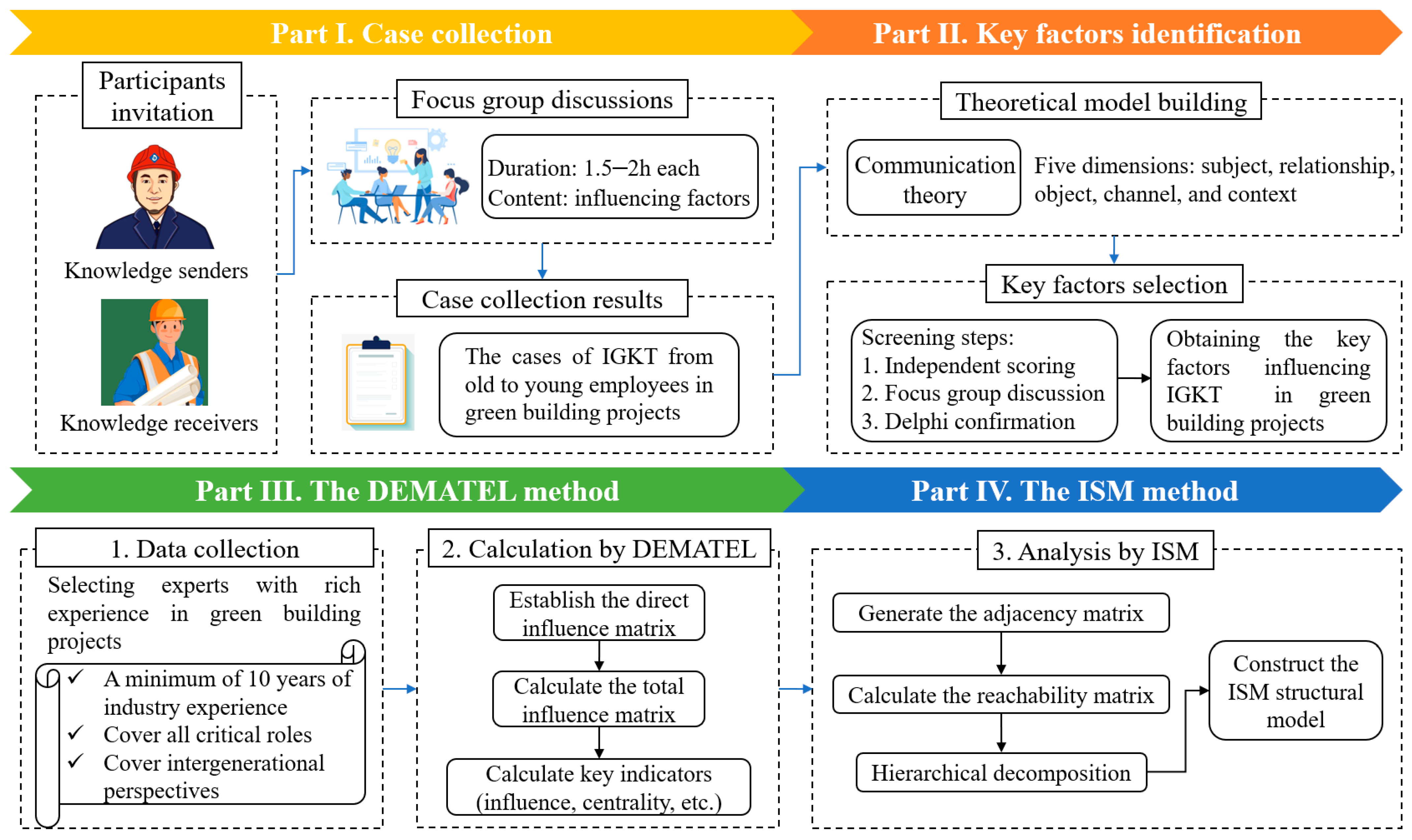
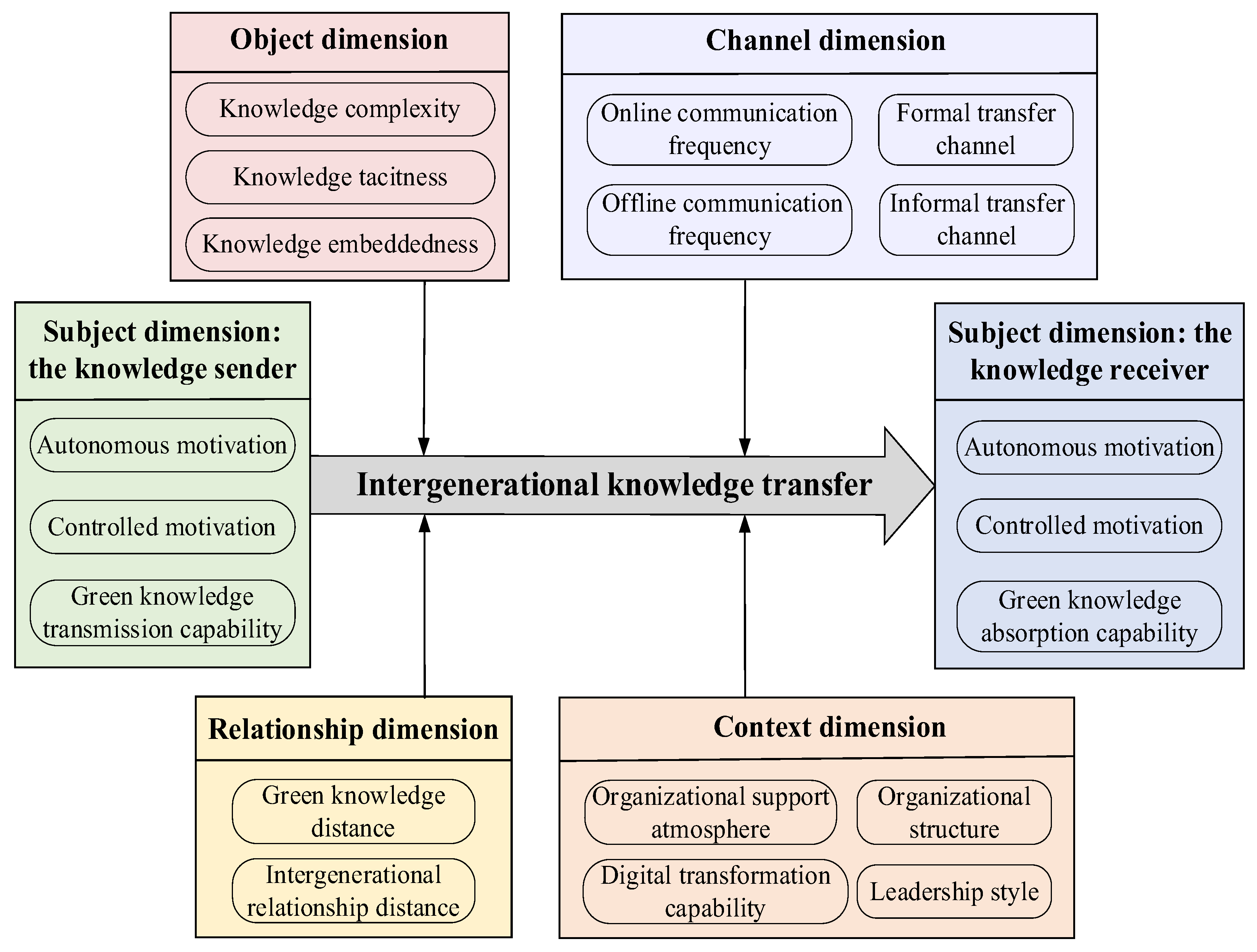
3.1. The Identification of Influencing Factors
3.2. The DEMATEL-ISM Model
- Step 1.
- Identify system factors and collect data
- Step 2.
- Normalize the direct impact matrix
- Step 3.
- Calculate the total influence matrix
- Step 4.
- Calculate key indicators (influence, centrality, etc.)
- Step 5.
- Generate the adjacency matrix
- Step 6.
- Calculate the reachability matrix
- Step 7.
- Hierarchical decomposition
- Step 8.
- Construct the ISM structural model
3.3. Data Collection Process
4. Data Analysis and Results
4.1. Result of Case Collection and Key Factors Identification
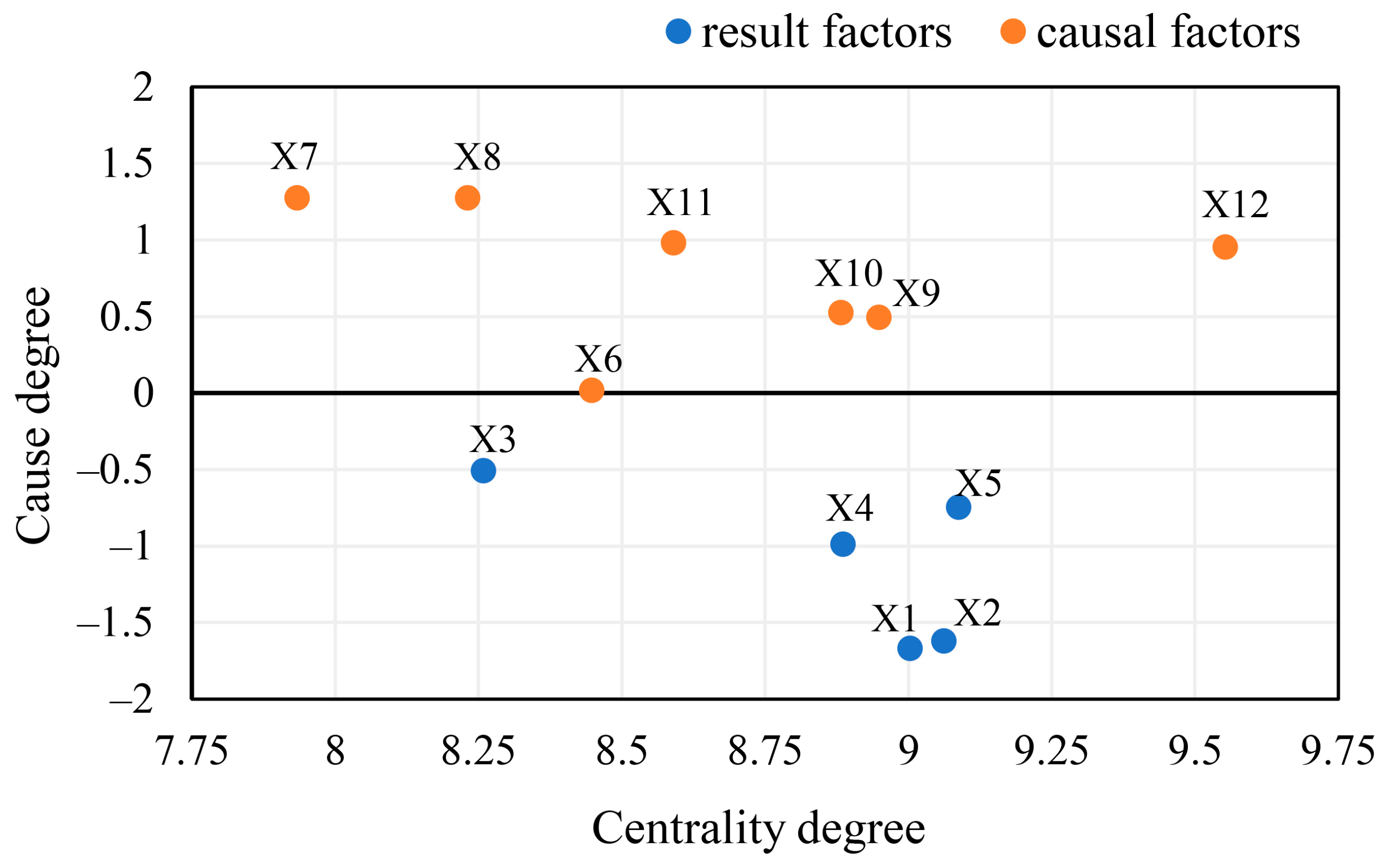
4.2. Result of the DEMATEL Model
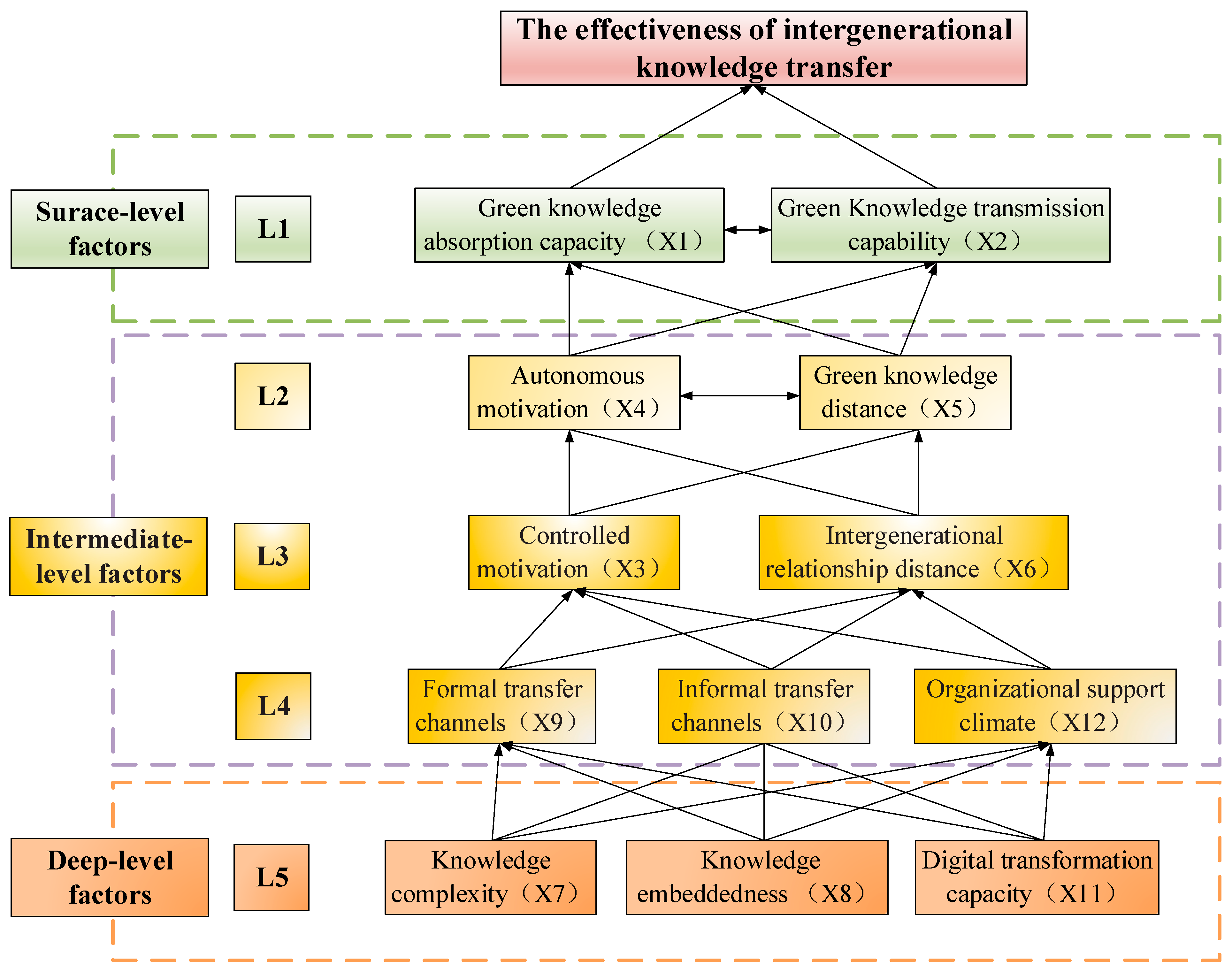
4.3. Result of the ISM Model
5. Discussion
5.1. In-Depth Analysis of the Key Influencing Factors
- (1)
- Analysis of surface-level influencing factors
- (2)
- Analysis of intermediate-level influencing factors
- (3)
- Analysis of deep-level influencing factors in green building projects
5.2. Theoretical Implications
5.3. Managerial Implications
6. Conclusions
- 12 key factors affecting IGKT were systematically identified from five dimensions: transfer subjects, inter-subject relationships, transfer objects, transfer channels, and transfer context. These include knowledge absorption capacity, knowledge transmission capability, controlled motivation, autonomous motivation, green knowledge distance, intergenerational relationship distance, knowledge complexity, knowledge embeddedness, formal transfer channels, informal transfer channels, digital transformation capacity, and organizational support climate.
- Organizational support climate ranks first in centrality and second in influence, confirming its role as the core systemic driver of IGKT. Digital transformation capacity ranks third in influence, indicating that although it is not the strongest driver, it remains a critical deep-level factor that substantially shapes transfer channels, reduces knowledge distance and enhances overall knowledge-flow efficiency. Together, these two factors form a complementary “environment–technology” foundation that underpins effective IGKT in green building projects.
- Hierarchically, surface-level factors (i.e., knowledge absorption and transmission capability) exhibited moderate centrality but high susceptibility to influence, suggesting their dependency on deeper-level drivers; intermediate-layer factors (e.g., autonomous motivation and knowledge distance) acted as bridges by mediating inter-subject interactions; deep-layer factors (e.g., knowledge complexity and embeddedness), despite low centrality, emerged as long-term constraints due to their inherent knowledge barriers. By integrating communication theory with hierarchical analysis, this study expands the dynamic framework of IGKT and validates the pivotal roles of the organizational environment and technological capabilities. Practically, it is recommended that green building teams prioritize fostering a supportive organizational culture, accelerate digital transformation, and leverage informal channels to complement formal mechanisms. Additionally, efforts should focus on stimulating senior employees’ autonomous motivation and optimizing knowledge distance to mitigate intergenerational transfer resistance.
Author Contributions
Funding
Institutional Review Board Statement
Informed Consent Statement
Data Availability Statement
Acknowledgments
Conflicts of Interest
References
- Zhou, Q.; Deng, X.; Hwang, B.; Ji, W. Integrated framework of horizontal and vertical cross-project knowledge transfer mechanism within project-based organizations. J. Manag. Eng. 2020, 36, 04020062. [Google Scholar] [CrossRef]
- Yepes, V.; López, S. Knowledge management in the construction industry: Current state of knowledge and future research. J. Civ. Eng. Manag. 2021, 27, 671–680. [Google Scholar] [CrossRef]
- Li, Y.; Song, H.; Sang, P.; Chen, P.H.; Liu, X. Review of Critical Success Factors (CSFs) for green building projects. Build. Environ. 2019, 158, 182–191. [Google Scholar] [CrossRef]
- Bai, X.P.; Qian, C. Factor validity and reliability performance analysis of human behavior in green architecture construction engineering. Ain Shams Eng. J. 2021, 12, 4291–4296. [Google Scholar] [CrossRef]
- Debrah, C.; Chan, A.P.C.; Darko, A. Green finance gap in green buildings: A scoping review and future research needs. Build. Environ. 2022, 207, 108443. [Google Scholar] [CrossRef]
- Malik, M.; Ali, M.; Latan, H.; Chiappetta Jabbour, C.J. Green project management practices, green knowledge acquisition and sustainable competitive advantage: Empirical evidence. J. Knowl. Manag. 2023, 27, 2350–2375. [Google Scholar] [CrossRef]
- Harvey, J.F. Managing organizational memory with intergenerational knowledge transfer. J. Knowl. Manag. 2012, 16, 400–417. [Google Scholar] [CrossRef]
- Rupčić, N. Intergenerational learning and knowledge transfer—challenges and opportunities. Learn. Organ. 2018, 25, 135–142. [Google Scholar] [CrossRef]
- Dzimińska, M.; Warwas, I. Intergenerational knowledge transfer through geographic and virtual mobility in the higher education context. J. Intergener. Relatsh. 2022, 20, 245–264. [Google Scholar] [CrossRef]
- Leon, R.D. Human resources practices for intergenerational learning: A systematic literature review. Knowl. Manag. Res. Pract. 2023, 21, 749–764. [Google Scholar] [CrossRef]
- Wang, C.; Dong, Y.; Ye, Z.; Feng, J. Linking online and offline intergenerational knowledge transfer to younger employees’ innovative work behaviors: Evidence from Chinese hospitals. J. Knowl. Manag. 2023, 27, 762–784. [Google Scholar] [CrossRef]
- Jayaram, N.; Bhatta, N.M.K. Tacit knowledge management in engineering industries: Systematic literature review and development of a conceptual model. J. Inf. Knowl. Manag. 2023, 22, 2350012. [Google Scholar] [CrossRef]
- Kamps, M.; van den Boomen, M.; van den Bogaard, J.; Hertogh, M. Intergenerational transfer of engineering expertise: Knowledge continuity management in storm surge barrier engineering. Built Environ. Proj. Asset Manag. 2024, 14, 874–891. [Google Scholar] [CrossRef]
- Lam, A.; Lambermont-Ford, J.P. Knowledge sharing in organisational contexts: A motivation-based perspective. J. Knowl. Manag. 2010, 14, 51–66. [Google Scholar] [CrossRef]
- Fasbender, U.; Gerpott, F.H.; Unger, D. Give and take? Knowledge exchange between older and younger employees as a function of generativity and development striving. J. Knowl. Manag. 2021, 25, 2420–2443. [Google Scholar] [CrossRef]
- Kang, J.; Rhee, M.; Kang, K.H. Revisiting knowledge transfer: Effects of knowledge characteristics on organizational effort for knowledge transfer. Expert Syst. Appl. 2010, 37, 8155–8160. [Google Scholar] [CrossRef]
- Anand, A.; Muskat, B.; Creed, A.; Zutshi, A.; Csepregi, A. Knowledge sharing, knowledge transfer and SMEs: Evolution, antecedents, outcomes and directions. Pers. Rev. 2021, 50, 1873–1893. [Google Scholar] [CrossRef]
- Tian, M.; Yao, J.; Xie, J.; Hu, C. Innovation performance feedback and inter-organization knowledge search in high-tech firms: The moderating role of technical knowledge complexity. J. Bus. Res. 2024, 182, 114800. [Google Scholar] [CrossRef]
- Solli-Sæther, H.; Karlsen, J.T.; van Oorschot, K. Strategic and cultural misalignment: Knowledge sharing barriers in project networks. Proj. Manag. J. 2015, 46, 49–60. [Google Scholar] [CrossRef]
- Liu, K.; Hwang, B.G.; Jia, J.; Man, Q.; Zhang, S. Shaping online and offline informal learning networks in off-site construction projects: A proximity perspective. Eng. Constr. Archit. Manag. 2025, 32, 939–966. [Google Scholar] [CrossRef]
- Wang, C.; Zuo, M.; An, X. Differential influences of perceived organizational factors on younger employees’ participation in offline and online intergenerational knowledge transfer. Int. J. Inf. Manag. 2017, 37, 650–663. [Google Scholar] [CrossRef]
- Tang, J.; Martins, J.T. Intergenerational workplace knowledge sharing: Challenges and new directions. J. Doc. 2021, 77, 722–742. [Google Scholar] [CrossRef]
- Rui, H.; Ju, H. How does rapport impact knowledge transfer from older to younger employees? The moderating role of supportive climate. Front. Psychol. 2022, 13, 1032143. [Google Scholar] [CrossRef]
- Berk, L.E. Development Through the Lifespan, 4th ed.; Pearson Education, Inc.: Boston, MA, USA, 2007. [Google Scholar]
- Hammarén, M.; Jarva, E.; Mikkonen, K.; Kääriäinen, M.; Kanste, O. Scoping review of intergenerational learning methods for developing digital competence and their outcomes. Finn. J. Ehealth Ewelfare 2022, 14, 364–379. [Google Scholar] [CrossRef]
- Kuyken, K.; Ebrahimi, M.; Saives, A.L. Towards a taxonomy of intergenerational knowledge transfer practices: Insights from an international comparison (Germany–Quebec). Learn. Organ. 2018, 25, 81–91. [Google Scholar] [CrossRef]
- Schmidt, X.; Muehlfeld, K. What’s so special about intergenerational knowledge transfer? Identifying challenges of intergenerational knowledge transfer. Manag. Rev. 2017, 28, 375–411. [Google Scholar] [CrossRef]
- Fasbender, U.; Gerpott, F.H. Knowledge transfer between younger and older employees: A temporal social comparison model. Work. Aging Retire. 2022, 8, 146–162. [Google Scholar] [CrossRef]
- Wu, W.W.; Lee, Y.T. Developing global managers’ competencies using the fuzzy DEMATEL method. Expert Syst. Appl. 2007, 32, 499–507. [Google Scholar] [CrossRef]
- Akbar, M.A.; Naseem, A.; Ahmad, Y.; uz Zaman, U.K. Production risk analysis and prioritization in manufacturing industry: A hybrid approach using Monte Carlo simulation and DEMATEL analysis. Ain Shams Eng. J. 2024, 15, 102756. [Google Scholar] [CrossRef]
- Attri, R.; Dev, N.; Sharma, V. Interpretive structural modelling (ISM) approach: An overview. Res. J. Manag. Sci. 2013, 2, 1171. [Google Scholar]
- Gu, T.; Xu, Q.; Song, X.; Hao, E.; Cui, P.; Xie, M. Analysis of influencing factors and their inner mechanism of the market participation in the smart community construction of China. Ain Shams Eng. J. 2024, 15, 102761. [Google Scholar] [CrossRef]
- Szulanski, G. Exploring internal stickiness: Impediments to the transfer of best practice within the firm. Strateg. Manag. J. 1996, 17 (Suppl. S2), 27–43. [Google Scholar] [CrossRef]
- Kalkan, V.D. Knowledge continuity management process in organizations. J. Bus. Econ. Res. 2006, 4. [Google Scholar] [CrossRef]
- Cumming, E.; Henry, W. Growing Old: The Process of Disengagement; Basic Books: New York, NY, USA, 1961. [Google Scholar]
- Beazley, H.; Boenisch, J.; Harden, D. Continuity Management—Preserving Corporate Knowledge and Productivity: When Employees Leave; John Wiley & Sons: Hoboken, NJ, USA, 2002; Volume 42, pp. 956–971. [Google Scholar]
- Kuyken, K.; Schropp, R. Rethinking intergenerational knowledge transmission in the era of industry 4.0. Manag. Int. 2023, 27, 44–56. [Google Scholar] [CrossRef]
- Ugolini, F.; Massetti, L.; Sanesi, G.; Pearlmutter, D. Knowledge transfer between stakeholders in the field of urban forestry and green infrastructure: Results of a European survey. Land Use Policy 2015, 49, 365–381. [Google Scholar] [CrossRef]
- Perkins, R.A.; Bennett, F.L. Sustainable construction in remote cold regions: Gathering and transferring practical knowledge. J. Cold Reg. Eng. 2018, 32, 04018007. [Google Scholar] [CrossRef]
- Zou, P.X.; Alam, M. Closing the building energy performance gap through component level analysis and stakeholder collaborations. Energy Build. 2020, 224, 110276. [Google Scholar] [CrossRef]
- Qiang, G.; Cao, D.; Wu, G.; Zhao, X.; Zuo, J. Dynamics of collaborative networks for green building projects: Case study of Shanghai. J. Manag. Eng. 2021, 37, 05021001. [Google Scholar] [CrossRef]
- Zhou, Q.; Deng, X.; Wang, Y. Exploring the antecedents of knowledge transfer among stakeholders in green building projects: From the configuration perspective. J. Build. Eng. 2024, 98, 111042. [Google Scholar] [CrossRef]
- Sanaei, M.; Javernick-Will, A.N.; Chinowsky, P. The influence of generation on knowledge sharing connections and methods in construction and engineering organizations headquartered in the US. Constr. Manag. Econ. 2013, 31, 991–1004. [Google Scholar] [CrossRef]
- Crespo Sánchez, E.; López Plazas, F.; Onecha Pérez, B.; Marmolejo-Duarte, C. Towards intergenerational transfer to raise awareness about the benefits and co-benefits of energy retrofits in residential buildings. Buildings 2023, 13, 2213. [Google Scholar] [CrossRef]
- Lasswell, H.D. The Structure and Function of Communication in Society. In The Communication of Ideas; Bryson, L., Ed.; Harper & Row: New York, NY, USA, 1948; pp. 37–51. [Google Scholar]
- Albino, V.; Garavelli, A.C.; Schiuma, G. Knowledge transfer and inter-firm relationships in industrial districts: The role of the leader firm. Technovation 1998, 19, 53–63. [Google Scholar] [CrossRef]
- Gupta, A.K.; Govindarajan, V. Knowledge flows within multinational corporations. Strateg. Manag. J. 2000, 21, 473–496. [Google Scholar] [CrossRef]
- Joshi, K.D.; Sarker, S.; Sarker, S. Knowledge Transfer among Face-to-Face Information Systems Development Team Members: Examining the Role of Knowledge, Source, and Relational Context. In Proceedings of the 37th Annual Hawaii International Conference on System Sciences, Big Island, Hawaii, 5–8 January 2004; IEEE: Piscataway, NJ, USA, 2004. [Google Scholar]
- Zhao, D.; Zuo, M.; Deng, X.N. Examining the factors influencing cross-project knowledge transfer: An empirical study of IT services firms in China. Int. J. Proj. Manag. 2015, 33, 325–340. [Google Scholar] [CrossRef]
- Zhou, Q.; Deng, X.; Wang, G.; Mahmoudi, A. Linking elements to outcomes of knowledge transfer in the project environment: Current review and future direction. Front. Eng. Manag. 2022, 9, 221–238. [Google Scholar] [CrossRef]
- Deci, E.L.; Ryan, R.M. Intrinsic Motivation and Self-Determination in Human Behavior; Plenum: New York, NY, USA, 1985. [Google Scholar]
- Osterloh, M.; Frey, B.S. Motivation, knowledge transfer, and organizational forms. Organ. Sci. 2000, 11, 538–550. [Google Scholar] [CrossRef]
- Koestner, R.; Otis, N.; Powers, T.A.; Pelletier, L.; Gagnon, H. Autonomous motivation, controlled motivation, and goal progress. J. Personal. 2008, 76, 1201–1230. [Google Scholar] [CrossRef]
- Gegenfurtner, A.; Festner, D.; Gallenberger, W.; Lehtinen, E.; Gruber, H. Predicting autonomous and controlled motivation to transfer training. Int. J. Train. Dev. 2009, 13, 124–138. [Google Scholar] [CrossRef]
- Reinholt, M.I.A.; Pedersen, T.; Foss, N.J. Why a central network position isn’t enough: The role of motivation and ability for knowledge sharing in employee networks. Acad. Manag. J. 2011, 54, 1277–1297. [Google Scholar] [CrossRef]
- Thomas, A.; Gupta, V. The role of motivation theories in knowledge sharing: An integrative theoretical review and future research agenda. Kybernetes 2022, 51, 116–140. [Google Scholar]
- Stenius, M.; Hankonen, N.; Ravaja, N.; Haukkala, A. Why share expertise? A closer look at the quality of motivation to share or withhold knowledge. J. Knowl. Manag. 2016, 20, 181–198. [Google Scholar] [CrossRef]
- Hon, A.H.; Fung, C.P.; Senbeto, D.L. Willingness to share or not to share? Understanding the motivation mechanism of knowledge sharing for hospitality workforce. J. Hosp. Mark. Manag. 2022, 31, 77–96. [Google Scholar] [CrossRef]
- Martin, X.; Salomon, R. Knowledge transfer capacity and its implications for the theory of the multinational corporation. J. Int. Bus. Stud. 2003, 34, 356–373. [Google Scholar] [CrossRef]
- Camisón, C.; Forés, B. Knowledge absorptive capacity: New insights for its conceptualization and measurement. J. Bus. Res. 2010, 63, 707–715. [Google Scholar] [CrossRef]
- Park, B.I. Knowledge transfer capacity of multinational enterprises and technology acquisition in international joint ventures. Int. Bus. Rev. 2011, 20, 75–87. [Google Scholar] [CrossRef]
- Rupčić, N. Intergenerational Learning and Knowledge Transfer. In Managing Learning Enterprises: Challenges, Controversies and Opportunities; Springer: Cham, Switzerland, 2024; pp. 201–211. [Google Scholar]
- Cummings, J.L.; Teng, B.S. Transferring R&D knowledge: The key factors affecting knowledge transfer success. J. Eng. Technol. Manag. 2003, 20, 39–68. [Google Scholar] [CrossRef]
- Duan, Y.; Nie, W.; Coakes, E. Identifying key factors affecting transnational knowledge transfer. Inf. Manag. 2010, 47, 356–363. [Google Scholar] [CrossRef]
- Kuyken, K. Knowledge communities: Towards a re-thinking of intergenerational knowledge transfer. Vine 2012, 42, 365–381. [Google Scholar] [CrossRef]
- Zhou, Q.; Deng, X.; Hwang, B.G.; Mahmoudi, A.; Liu, Y. Integrating the factors affecting knowledge transfer within international construction projects: Individual and team perspectives. J. Constr. Eng. Manag. 2023, 149, 04023117. [Google Scholar] [CrossRef]
- Ibert, O. Relational distance: Sociocultural and time–spatial tensions in innovation practices. Environ. Plan. A 2010, 42, 187–204. [Google Scholar] [CrossRef]
- Erskine, L. Defining relational distance for today’s leaders. Int. J. Leadersh. Stud. 2012, 7, 96–113. [Google Scholar]
- Liu, H.; Yu, Y.; Sun, Y.; Yan, X. A system dynamic approach for simulation of a knowledge transfer model of heterogeneous senders in mega project innovation. Eng. Constr. Archit. Manag. 2021, 28, 681–705. [Google Scholar] [CrossRef]
- Boamah, F.A.; Zhang, J.; Miah, M.H. The impact of tacit knowledge sharing on the success of construction companies operations. J. Eng. Des. Technol. 2023, 21, 1767–1784. [Google Scholar] [CrossRef]
- Chen, L.; Mohamed, S. The strategic importance of tacit knowledge management activities in construction. Constr. Innov. 2010, 10, 138–163. [Google Scholar] [CrossRef]
- Schillebeeckx, S.J.; Lin, Y.; George, G.; Alnuaimi, T. Knowledge recombination and inventor networks: The asymmetric effects of embeddedness on knowledge reuse and impact. J. Manag. 2021, 47, 838–866. [Google Scholar] [CrossRef]
- Chirwa, M.; Boikanyo, D.H. The role of effective communication in successful strategy implementation. Acta Commer. 2022, 22, 1–13. [Google Scholar] [CrossRef]
- Koch, T.; Denner, N. Informal communication in organizations: Work time wasted at the water-cooler or crucial exchange among co-workers? Corp. Commun. Int. J. 2022, 27, 494–508. [Google Scholar] [CrossRef]
- Lu, Y.; Cao, Y.; Wang, B.; Yang, S. A study on factors that affect users’ behavioral intention to transfer usage from the offline to the online channel. Comput. Hum. Behav. 2011, 27, 355–364. [Google Scholar] [CrossRef]
- Babnik, K.; Trunk Širca, N. Knowledge creation, transfer and retention: The case of intergenerational cooperation. Int. J. Innov. Learn. 2014, 15, 349–364. [Google Scholar] [CrossRef]
- Le, P.B.; Lei, H. The mediating role of trust in stimulating the relationship between transformational leadership and knowledge sharing processes. J. Knowl. Manag. 2018, 22, 521–537. [Google Scholar] [CrossRef]
- Deng, H.; Duan, S.X.; Wibowo, S. Digital technology driven knowledge sharing for job performance. J. Knowl. Manag. 2023, 27, 404–425. [Google Scholar] [CrossRef]
- Zhu, X.; Chen, H.; Xiang, E.; Qi, Y. Digital transformation and corporate green technology transfer: The moderating effect of executive green cognition. Financ. Res. Lett. 2025, 107, 107035. [Google Scholar] [CrossRef]
- Xu, J.; He, M.; Jiang, Y. A novel framework of knowledge transfer system for construction projects based on knowledge graph and transfer learning. Expert Syst. Appl. 2022, 199, 116964. [Google Scholar] [CrossRef]
- Morgan, D.L. Focus groups. Annu. Rev. Sociol. 1996, 22, 129–152. [Google Scholar] [CrossRef]
- Acocella, I. The focus groups in social research: Advantages and disadvantages. Qual. Quant. 2012, 46, 1125–1136. [Google Scholar] [CrossRef]
- Gerpott, F.; Lehmann-Willenbrock, N.; Voelpel, S.C. A phase model of intergenerational learning in organizations. Acad. Manag. Learn. Educ. 2017, 16, 193–216. [Google Scholar] [CrossRef]
- Lin, F.; Wu, P.; Xu, Y. Investigation of factors influencing the construction safety of high-speed railway stations based on DEMATEL and ISM. Adv. Civ. Eng. 2021, 2021, 9954018. [Google Scholar] [CrossRef]
- Yu, L.; Li, D.; Song, J.; Zhou, S.; Wang, W.; Feng, H. Intelligent pathways for driving wastewater treatment efficiency: An integrated analysis approach. Environ. Dev. Sustain. 2025. early access. [Google Scholar] [CrossRef]
- Huo, T.; Cong, X.; Cheng, C.; Cai, W.; Zuo, J. What is the driving mechanism for the carbon emissions in the building sector? An integrated DEMATEL-ISM method. Energy 2023, 274, 127399. [Google Scholar] [CrossRef]
- Yuan, H.; Du, W.; Zuo, J.; Ma, X. Paving a traceable green pathway towards sustainable construction: A fuzzy ISM-DEMATEL analysis of blockchain technology adoption barriers in construction waste management. Ain Shams Eng. J. 2024, 15, 102627. [Google Scholar] [CrossRef]
- Mousavizade, F.; Shakibazad, M. Identifying and ranking CSFs for KM implementation in urban water and sewage companies using ISM-DEMATEL technique. J. Knowl. Manag. 2019, 23, 200–218. [Google Scholar] [CrossRef]
- Hsu, Y.-L.; Lee, C.-H.; Kreng, V.B. The application of Fuzzy DEMATEL to develop a cause and effect model of the key factors for green supply chain management. J. Clean. Prod. 2013, 40, 22–31. [Google Scholar]
- Okoli, C.; Pawlowski, S.D. The Delphi method as a research tool: An example, design considerations and applications. Inf. Manag. 2004, 42, 15–29. [Google Scholar] [CrossRef]
- Morgan, D.L. Focus Groups as Qualitative Research; Sage: Thousand Oaks, CA, USA, 1997; Volume 16. [Google Scholar]
- Landeta, J. Current validity of the Delphi method in social sciences. Technol. Forecast. Soc. Change 2006, 73, 467–482. [Google Scholar] [CrossRef]
- Bryman, A. Social Research Methods; Oxford University Press: Oxford, UK, 2012. [Google Scholar]
- Tzeng, G.H.; Chiang, C.H.; Li, C.W. Evaluating intertwined effects in e-learning programs: A novel hybrid MCDM model based on factor analysis and DEMATEL. Expert Syst. Appl. 2007, 32, 1028–1044. [Google Scholar] [CrossRef]



| Category | Factor | Definition | Source References | Source Cases |
|---|---|---|---|---|
| Subject | Autonomous motivation | Intrinsic drive to engage in knowledge transfer voluntarily. | Osterloh and Frey [52]; Koestner et al. [53] | 1, 3, 6, 8, 9, 11, 15, 17, 20, 22, 26, 29, 30, 33, 35 |
| Controlled motivation | Extrinsic pressure or rewards driving knowledge transfer behavior. | Osterloh and Frey [52]; Koestner et al. [53] Lam and Lambermont-Ford [14] | 2, 5, 7, 9, 10, 13, 16, 19, 22, 23, 26, 29, 32, 34, 36 | |
| Green knowledge transmission capability | Ability to effectively share and communicate green knowledge. | Martin and Salomon [59]; Park [61]; Liu et al. [69] | 1, 2, 3, 5, 7, 9, 10, 12, 14, 15, 17, 20, 23, 24, 27, 31, 33, 36 | |
| Green knowledge absorption capability | Capacity to understand, integrate, and utilize green knowledge. | Park [61]; Liu et al. [69]; Wang et al. [11] | 1, 2, 4, 5, 7, 8, 10, 13, 15, 17, 20, 22, 25, 26, 29, 30, 34, 37 | |
| Relationship | Green knowledge distance | Gap between the knowledge levels of the sender and receiver. | Cummings and Teng [63]; Duan et al. [64] | 3, 4, 6, 10, 11, 14, 18, 21, 23, 26, 31, 35 |
| Intergenerational relationship distance | Emotional and social closeness between the sender and receiver. | Ibert [67]; Erskine [68]; Liu et al. [69] | 1, 3, 5, 8, 9, 12, 13, 15, 20, 21, 24, 25, 29, 31, 33, 36, 37 | |
| Object | Knowledge complexity | Degree of intricacy and difficulty in understanding the knowledge. | Cummings and Teng [63]; Kang et al. [16]; Liu et al. [69] | 4, 6, 7, 8, 10, 12, 14, 17, 20, 22, 24, 27, 30, 32, 34, 37 |
| Knowledge tacitness | Uncodified, experience-based knowledge difficult to articulate. | Cummings and Teng [63]; Kang et al. [16]; Liu et al. [69] | 1, 4, 7, 9, 11, 15, 16, 19, 21, 24, 26, 27, 31, 34, 36 | |
| Knowledge embeddedness | Knowledge deeply integrated into organizational routines and contexts. | Cummings and Teng [63]; Liu et al. [69] | 2, 4, 6, 7, 10, 12, 14, 15, 18, 20, 21, 24, 26, 30, 32, 35 | |
| Channel | Online communication frequency | Rate of digital interactions for knowledge transfer. | Lu et al. [75]; Wang et al. [21] | 1, 2, 5, 6, 9, 11, 12, 14, 18, 21, 23, 24, 27, 30, 33, 36 |
| Offline communication frequency | Rate of face-to-face interactions for knowledge transfer. | Lu et al. [75]; Wang et al. [21] | 2, 4, 6, 9, 11, 13, 14, 16, 19, 22, 23, 26, 28, 30, 31, 35 | |
| Formal transfer channel | Structured, official pathways for knowledge transfer. | Chirwa and Boikanyo [73]; Koch and Denner [74] | 1, 2, 5, 8, 10, 13, 15, 17, 18, 21, 24, 26, 28, 29, 30, 34, 36 | |
| Informal transfer channel | Unofficial, spontaneous methods of knowledge transfer. | Chirwa and Boikanyo [73]; Liu et al. [20] | 1, 3, 4, 7, 8, 9, 12, 13, 16, 20, 22, 24, 25, 29, 31, 33, 35, 37 | |
| Context | Digital transformation capability | Organizational ability to leverage digital tools for knowledge. | Yepes et al. [2]; Xu et al. [80]; Zhu et al. [79] | 2, 3, 7, 8, 11, 13, 14, 17, 20, 23, 28, 33, 34 |
| Organizational support atmosphere | Environment fostering encouragement and resources for knowledge transfer. | Harvey [7]; Wang et al. [21]; Rui and Ju [23] | 3, 4, 6, 9, 11, 13, 15, 18, 21, 23, 25, 26, 31, 34, 37 | |
| Organizational structure | Framework defining roles and hierarchies affecting knowledge transfer. | Babnik and Trunk Širca [76]; Rupčić [8] | 4, 6, 9, 12, 13, 15, 18, 21, 23, 24, 26, 28, 31, 33, 35, 36 | |
| Leadership style | Managerial approach influencing knowledge transfer culture and practices. | Gerpott et al. [83]; Wang et al. [21]; Le and Lei [77] | 2, 4, 7, 9, 10, 11, 14, 15, 17, 20, 22, 25, 28, 30, 32, 35, 37 |
| Category | Classification | Number |
|---|---|---|
| Gender | Female | 8 |
| Male | 12 | |
| Education level | Bachelor’s Degree | 3 |
| Master’s Degree | 12 | |
| Doctoral Degree | 5 | |
| Age (years) | 31–40 | 7 |
| 41–50 | 7 | |
| >50 | 6 | |
| Position | Enterprise-level managers | 4 |
| Project manager | 6 | |
| On-site execution managers | 5 | |
| Other (e.g., technical specialists) | 5 | |
| Experience in this field (years) | 10–15 | 6 |
| 16–20 | 7 | |
| >21 | 7 |
| Factor | Influencing Degree | Influenced Degree | Centrality Degree | Cause Degree | |||||
|---|---|---|---|---|---|---|---|---|---|
| Value | Rank | Value | Rank | Value | Rank | Value | Rank | ||
| X1 | Green knowledge absorption capacity | 3.668 | 12 | 5.335 | 2 | 9.003 | 4 | −1.667 | 12 |
| X2 | Green knowledge transmission capability | 3.721 | 11 | 5.341 | 1 | 9.062 | 3 | −1.621 | 11 |
| X3 | Controlled motivation | 3.876 | 9 | 4.383 | 3 | 8.259 | 10 | −0.507 | 8 |
| X4 | Autonomous motivation | 3.950 | 8 | 4.936 | 4 | 8.886 | 6 | −0.987 | 10 |
| X5 | Green knowledge distance | 4.171 | 10 | 4.917 | 5 | 9.087 | 2 | −0.746 | 9 |
| X6 | Intergenerational relationship distance | 4.233 | 7 | 4.215 | 8 | 8.448 | 9 | 0.018 | 7 |
| X7 | Knowledge complexity | 4.605 | 4 | 3.329 | 7 | 7.934 | 12 | 1.276 | 1 |
| X8 | Knowledge embeddedness | 4.754 | 5 | 3.478 | 9 | 8.231 | 11 | 1.276 | 2 |
| X9 | Formal transfer channels | 4.721 | 1 | 4.228 | 6 | 8.949 | 5 | 0.494 | 5 |
| X10 | Informal transfer channels | 4.705 | 6 | 4.178 | 12 | 8.883 | 7 | 0.527 | 6 |
| X11 | Digital transformation capacity | 4.786 | 3 | 3.804 | 11 | 8.590 | 8 | 0.982 | 3 |
| X12 | Organizational support climate | 5.255 | 2 | 4.299 | 10 | 9.553 | 1 | 0.956 | 4 |
| Factor | Reachable Set R | Antecedent Set S | Collective Set T | Layer |
|---|---|---|---|---|
| X1 | X1, X2 | X1, X2, X3, X4, X5, X6, X7, X8, X9, X10, X11, X12 | X1, X2 | L1 |
| X2 | X1, X2, X5 | X1, X2, X3, X4, X5, X6, X7, X8, X9, X10, X11, X12 | X1, X2, X5 | L1 |
| X3 | X1, X2, X3, X4, X5 | X3, X7, X8, X9, X10, X11, X12 | X3 | L3 |
| X4 | X1, X2, X4, X5 | X3, X4, X5, X6, X7, X8, X9, X10, X11, X12 | X4, X5 | L2 |
| X5 | X1, X2, X4, X5 | X2, X3, X4, X5, X6, X7, X8, X9, X10, X11, X12 | X2, X4, X5 | L2 |
| X6 | X1, X2, X4, X5, X6 | X6, X7, X8, X9, X10, X11, X12 | X6 | L3 |
| X7 | X1, X2, X3, X4, X5, X7, X9, X10, X12 | X7 | X7 | L5 |
| X8 | X1, X2, X3, X4, X5, X6, X8, X9, X10, X12 | X8 | X8 | L5 |
| X9 | X1, X2, X3, X4, X5, X6, X9, X10, X12 | X7, X8, X9, X10, X11, X12 | X9, X10, X12 | L4 |
| X10 | X1, X2, X3, X4, X5, X6, X9, X10, X12 | X7, X8, X9, X10, X11, X12 | X9, X10, X12 | L4 |
| X11 | X1, X2, X3, X4, X5, X6, X9, X10, X11, X12 | X11, X12 | X11, X12 | L5 |
| X12 | X1, X2, X3, X4, X5, X6, X9, X10, X11, X12 | X7, X8, X9, X10, X11, X12 | X9, X10, X11, X12 | L4 |
Disclaimer/Publisher’s Note: The statements, opinions and data contained in all publications are solely those of the individual author(s) and contributor(s) and not of MDPI and/or the editor(s). MDPI and/or the editor(s) disclaim responsibility for any injury to people or property resulting from any ideas, methods, instructions or products referred to in the content. |
© 2025 by the authors. Licensee MDPI, Basel, Switzerland. This article is an open access article distributed under the terms and conditions of the Creative Commons Attribution (CC BY) license (https://creativecommons.org/licenses/by/4.0/).
Share and Cite
Zhou, Q.; Xin, Z.; Xu, Y.; Fong, P.S.W. Bridging Generations: Key Determinants of Intergenerational Knowledge Transfer from Older to Younger Employees in Green Building Projects. Buildings 2025, 15, 4449. https://doi.org/10.3390/buildings15244449
Zhou Q, Xin Z, Xu Y, Fong PSW. Bridging Generations: Key Determinants of Intergenerational Knowledge Transfer from Older to Younger Employees in Green Building Projects. Buildings. 2025; 15(24):4449. https://doi.org/10.3390/buildings15244449
Chicago/Turabian StyleZhou, Qianwen, Ziting Xin, Yinuo Xu, and Patrick S. W. Fong. 2025. "Bridging Generations: Key Determinants of Intergenerational Knowledge Transfer from Older to Younger Employees in Green Building Projects" Buildings 15, no. 24: 4449. https://doi.org/10.3390/buildings15244449
APA StyleZhou, Q., Xin, Z., Xu, Y., & Fong, P. S. W. (2025). Bridging Generations: Key Determinants of Intergenerational Knowledge Transfer from Older to Younger Employees in Green Building Projects. Buildings, 15(24), 4449. https://doi.org/10.3390/buildings15244449