Article

Dynamic Properties of a Rectangular Cantilever Aqueduct with a Baffle Considering Soil–Structure Interaction

1
School of Transportation and Civil Engineering, Nantong University, Nantong 226019, China
2
College of Civil Engineering, Yancheng Institute of Technology, Yancheng 224051, China
3
College of Mechanical & Electrical Engineering, Hohai University, Changzhou 213022, China
*
Author to whom correspondence should be addressed.
Buildings 2025, 15(23), 4335; https://doi.org/10.3390/buildings15234335

Submission received: 29 October 2025 / Revised: 23 November 2025 / Accepted: 25 November 2025 / Published: 28 November 2025
(This article belongs to the Special Issue Low Carbon and Green Materials in Construction—3rd Edition)

Abstract

Rectangular aqueducts are critical building structures in large-scale water conveyance systems used worldwide. Liquid sloshing can produce hydrodynamic forces that threaten structural safety and long-term performance. This study analytically investigates the vibration characteristics of two-dimensional rectangular cantilever aqueduct systems while accounting for soil–structure interaction (SSI). To reduce sloshing and enhance the performance of the mechanical system, a bottom-mounted vertical baffle is proposed as a hydrodynamic damping solution. Through subdomain analysis, mathematical expressions for liquid potential fields are derived. The continuous liquid is represented through discrete mass–spring elements for dynamic analysis. Horizontal soil impedance is characterized by using Chebyshev orthogonal polynomial approximations with optimized least squares fitting techniques. A dynamic mechanical model for the soil–aqueduct–liquid–baffle coupling system is developed by using the substructure method. Convergence and comparative studies are conducted to validate the reliability of the proposed method. Between the current results and those reported previously, the variation in the first-order sloshing frequency is less than 1.10%. Parametric analyses evaluate how baffle size, baffle position, and soil properties influence sloshing behavior. The presentation of an equivalent analytical model is the novelty of this research. The results can provide the theoretical basis for optimizing anti-sloshing designs in hydraulic building structures, thereby supporting safer and more sustainable engineering practices.

1. Introduction

The sloshing in storage systems is a significantly important research topic in aerospace and nuclear and civil engineering. Liquid sloshing in partially filled storage systems, such as in aqueducts, can seriously affect the stability and safety of the storage structures. Therefore, in order to avoid increasing the thickness of the structure materials to withstand hydrodynamic pressures, an investigation of liquid sloshing properties in aqueduct structures is essential. Xu et al. [1] established a numerical model to study the failure modes of large underground water tanks under hydrodynamic loads considering fluid–structure interaction. Li and Chen [2] established a three-dimensional detailed model of the dynamic interaction between the nuclear island structure and the foundation using ABAQUS software. Brunesi and Nascimbene [3] evaluated the seismic resilience of liquid storage tanks after earthquakes by using the methods of numerical simulation and experimental comparison. By developing equivalent models for three isolated tank schemes, Jing et al. [4] assessed the effects of various isolation measures on the shock-absorption performance of concrete liquid-storage tanks. In another study, Zhang et al. [5] explored the sloshing response of a liquid cargo tank under simultaneous roll and surge excitations. Through shaking-table experiments, Wang et al. [6] derived the dominant frequencies and vibration patterns of an aqueduct and its contained fluid by considering liquid–structure interaction.
Structural vibration is always a matter of great concern in the engineering field. This is especially true for aqueducts partially filled with liquid. To prevent the damage caused by liquid sloshing, installing baffles is a common measure in construction projects. The position of the baffle is adjustable, offering ease of use and effective control over liquid sloshing. [7,8]. Numerical studies on the dynamics of sloshing of storage containers with the internal baffles were conducted in a series of previous works. Sanapala et al. [9] utilized OpenFOAM to simulate the liquid sloshing in a rectangular storage tank equipped with horizontal baffles. Zang et al. [10], utilizing non-uniform rational B-splines, developed an innovative isogeometric boundary element approach to study liquid behavior in axisymmetric tanks containing porous baffles. Biswal et al. [11,12,13] conducted systematic investigations through finite element analysis on sloshing patterns in water tanks with various annular baffle configurations. Gavrilyuk et al. [14] implemented a combined analytical framework that integrated multimodal techniques with the generalized Euler–Bernoulli beam theory and employed it to examine the interactive vibration modes between supporting structures and elevated tanks containing partially filled liquids. In addition, the dynamic behavior of a baffled liquid storage container could be determined through dedicated experimental investigations. [15]. Through systematic testing on a motion simulator, Xue et al. [16] quantitatively evaluated the sloshing suppression effectiveness of perforated baffles in the rectangular liquid storage structure. Complementing conventional seismic testing, Liu et al. [17] implemented an innovative optical measurement system to capture deformation patterns and damage mechanisms in liquid tanks during earthquake simulations. Vimal et al. [18] analyzed the dynamic behavior of seismically isolated elevated tanks using spectral analysis techniques. In the above studies, although numerical methods can achieve a refined model, their accuracy is limited by the numerical model used. The modeling process can be complicated when the grid is divided too finely. Moreover, the experimental method is restricted by factors such as the similarity of the model and the ultimate bearing capacity of the shaking table.
In practical construction projects, liquid containers such as aqueducts are often constructed on the foundation. Ignoring the influence of the foundation soil on the storage structure will lead to uncontrollable errors. Haroun and Abou-Izzeddine [19] studied the hydrodynamic pressure and overturning moment in the water tank under horizontal excitation by treating the soil as two sets of lumped parameter models consisting of single springs and single dampers in parallel. Livaoglu et al. [20,21,22] adopted a conical representation of the soil to investigate the seismic behavior of cantilever storage tanks supported by flexible foundations. The lumped parameter model (LPM) serves as an effective approach to characterize frequency-dependent soil impedance in the time domain. Wang et al. [23] introduced an expandable nested LPM employing Chebyshev polynomials to model the dynamic impedance. Building upon this work, Sun et al. [24,25] developed an analytical model for a coupled soil–tank–liquid–baffle system. According to the above literature, due to the complexity of the fluid–structure interactions, many issues still need to be further studied after considering the SSI effect. The current available results mainly employ numerical methods to investigate the sloshing of liquid in rectangular containers with baffles. However, analytical or semi-analytical methods are relatively rare. Therefore, establishing the dynamic interaction model between soil and foundation is the key to the substructure method for analyzing the integrated system of soil–foundation–aqueduct–liquid–baffle.
The researchers conducted investigations into the dynamic behavior and theoretical models governing liquid–structure interaction systems. Utilizing potential fluid theory, the famous Housner model [26,27], and the aqueduct model improved by Li et al. [28], spring–mass discrete elements were used to replace the continuous liquid in the storage tank, simplifying the liquid-structure interaction analysis of the storage system. However, the presence of the baffle in a storage structure results in a significant increase in the complexity of the liquid domain. Baghban et al. [29] developed a finite element model for an elevated tank equipped with an annular horizontal baffle. Wang et al. [30,31] introduced the liquid subdomain method to derive exact solutions for sloshing behavior in baffled container systems. Zhou et al. [32] extended this research by examining free-surface vibration in a partially filled container featuring a ring-shaped baffle. Building upon this, Cao et al. [33] explored how vertically installed baffle dimensions and operational frequencies affect liquid sloshing patterns through their innovative semi-analytical approach. Ying et al. [34] developed a simplified dynamic model analyzing two-dimensional water aqueduct sloshing with horizontal baffles while accounting for soil–structure interactions. Although the SSI mechanisms of storage tanks have been thoroughly investigated [35,36], analytical research on the dynamic characteristics of rectangular cantilever aqueducts with a vertical baffle on the exposed foundation is still rare.
Based on the previous studies mentioned above, for the dynamic analysis of the comprehensive aqueduct system, analytical methods are relatively scarce. In this paper, the dynamic characteristics of a two-dimensional rectangular cantilever aqueduct, taking into account the effects of SSI, are analytically investigated. The study combines the high precision of the analytical method and the wide applicability of the numerical method. By utilizing the liquid subdomain approach, the contained liquid is represented as a multi-degree-of-freedom spring–mass configuration. A nested LPM for soil behavior is developed through complex polynomial approximation of foundation impedance characteristics. The dynamic model and governing equations of the coupling soil–aqueduct–liquid–baffle system are formulated through substructure methods. Parametric investigations reveal how soil conditions and baffle configurations influence the vibrational behavior of the integrated structure system.

2. Soil–Aqueduct–Liquid–Baffle Coupling Model

2.1. Model Assumption

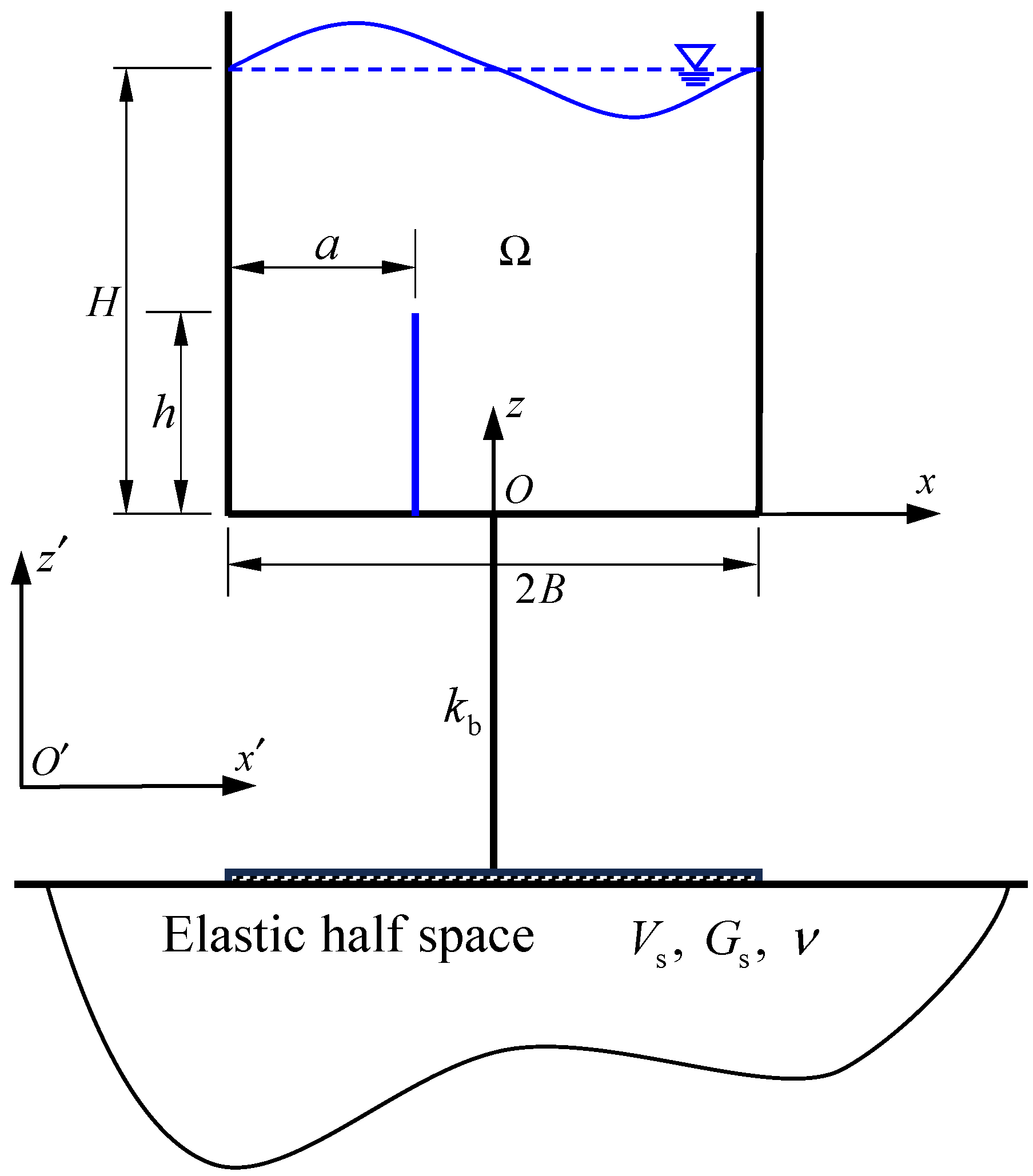
As a long-distance water conveyance structure, the fluid flow in the aqueduct has little influence on lateral sloshing. Therefore, a plane-strain model of liquid–aqueduct interaction, including the interaction between the soil and structure, can be established. Figure 1 depicts the plane-strain model of a rectangular cantilever aqueduct equipped with a vertical baffle and supported by a strip foundation. The Cartesian coordinate system O x z is defined with its origin positioned at the center of the aqueduct bottom. The structure features a bottom width dimension of 2 B and exhibits mass per unit length quantified as M a . For the liquid inside the container, the influence of viscosity and rotation is most pronounced near the solid interface. This influence diminishes rapidly with distance from the interface. In the interior region, the liquid can be approximated as inviscid and irrotational. The aqueduct contains a partially filled volume of incompressible, non-viscous, and irrotational fluid characterized by density ρ and depth H . Contact between the liquid and the solid boundary is ensured throughout the motion. The wall surface is treated as sufficiently smooth such that the liquid contributes only pressure forces. The free surface is assumed to undergo small-amplitude linear sloshing, which justifies the use of linear theory. Hydrodynamic damping is omitted from the analysis. Consequently, when the excitation frequency approaches the natural sloshing frequency, resonance may occur, potentially causing substantial discrepancies relative to the actual situation. The distance between the vertical baffle and the left wall of the aqueduct is a . The height of the baffle is h . Both the aqueduct and the baffle are modeled as rigid bodies with their thicknesses neglected. For investigations involving liquid–structure interaction, developing a mechanical model of the system is beneficial for understanding the behavior of its constituent components. The present analysis is confined to evaluating the dynamic effects of a rigid baffle in a rigid aqueduct resting on soft soil. This assumption narrows the scope to fluid–structure interaction and linear sloshing alone, with the baffle thickness neglected to streamline the analytical process. The bottom of the aqueduct is supported by an elastic cantilever beam with a lateral stiffness of k b . The support is approximated as a single-degree-of-freedom mass–spring system, whose first-order effective mass M e is incorporated into the aqueduct, resulting in a total structural mass M 0 = M a + M e . Suppose the foundation is a massless rigid strip-shaped thin plate. 2 B is the foundation width. M g is the unit length mass of the foundation. The soil is described as the homogenous elastic half space. V s , G s , and ν are, respectively, the shear wave velocity, shear modulus, and Poisson’s ratio of the soil.

2.2. Aqueduct–Liquid–Baffle Coupling Model

2.2.1. Subdomain Method for Liquid Sloshing

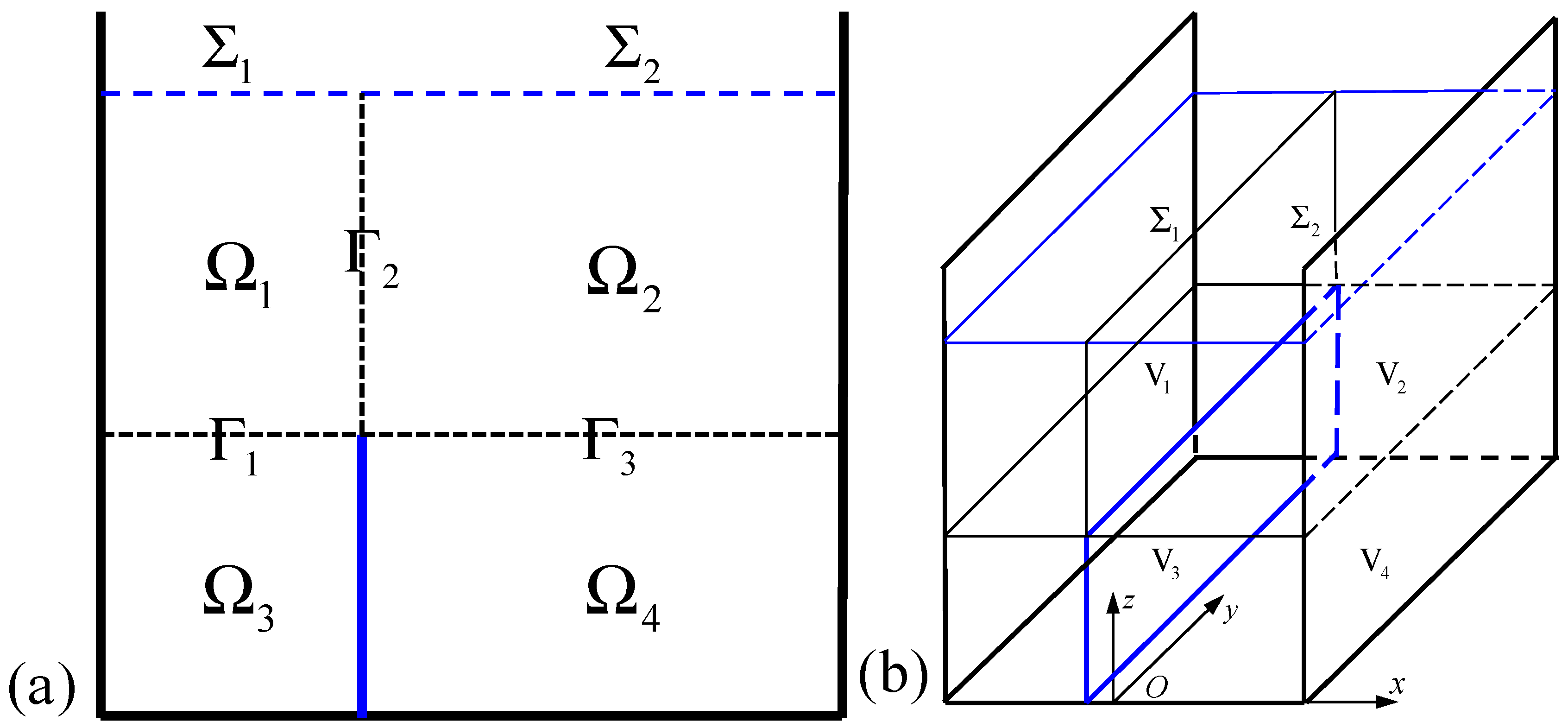
By integrating the liquid subdomain approach, the complex liquid domain Ω in Figure 1 is segmented into four subdomains Ω i (i = 1, 2, 3, 4) with simple boundaries from left to right and from top to bottom along the liquid surface where the baffle is located and the liquid surface is perpendicular to the free end of the baffle. At the same time, three interfaces between adjacent subdomains are artificially introduced. Among them, Γ 1 and Γ 3 are horizontal artificial interfaces and Γ 2 is a vertical artificial interface. Σ i (i = 1, 2) indicate the free surface of Ω i , as shown in Figure 2a. For three-dimensional analysis considering the unit length along the y-axis, these planar subdomains Ω i (i = 1, 2, 3, 4) extend into spatial liquid regions V i (i = 1, 2, 3, 4), as displayed in Figure 2b.
The velocity potential for the liquid is derived from linear sloshing theory as
φ ( x , z , t ) = φ i ( x , z , t ) , ( x , z ) Ω i , ( i = 1 , 2 , 3 , 4 )
in which t represents the time variable. φ i ( x , z , t ) represents the velocity potential of Ω i and should satisfy the following Laplace equation:
2 φ i = 0 , ( x , z ) Ω i , ( i = 1 , 2 , 3 , 4 )
Since there is no detachment or permeation between the liquid and the wet surface of the aqueduct, the velocity potential of the subdomain at the wall, bottom, and baffle of the aqueduct should satisfy the following impermeable boundary condition:
φ i n ¯ = u ˙ ( t ) , φ i n ˜ = 0
where n ¯ and n ˜ denote the external normal vectors of the wet surface of the structure in the vertical and horizontal directions, respectively. Considering the slight sloshing of the liquid surface, the free-surface boundary condition should be satisfied by the velocity potential in the subdomain:
φ i t z = H + g η i = 0 , ( i = 1 , 2 )
in which g denotes the gravitational acceleration. η i characterizes the free-surface sloshing height within liquid subdomain Ω i , and it can be expressed as
η i = 0 t φ i z z = H d t
Assuming that subdomains Ω i and Ω i (i < i’) are adjacent, with Γ k as their common interface. The relationship among them is formally defined by a set of ordered triples, denoted as (i, i’, k). From Figure 2a, the ordered triples (i, i’, k) belong to the set {(1, 3, 1), (1, 2, 2), (2, 4, 3)}. On the artificial interface Γ k , Ω i , and Ω i satisfy the continuity conditions of pressure and velocity:
φ i t = φ i t , φ i n k = φ i n k ,   on   Γ k
where n k denotes the normal vector of the interface Γ k . Meanwhile, to derive closed-form solutions for the velocity potential in each subdomain, φ i ( x , z , t ) should satisfy the initial conditions:
φ i t = 0 = φ 0 , φ ˙ i t = 0 = φ ˙ 0
in which φ 0 and φ ˙ 0 represent the initial values of the velocity potential of the subdomain at t = 0 and the first-order time derivative, respectively.
Horizontal excitation u ¨ ( t ) along the x-axis is applied to the aqueduct. From the impermeable condition of the rigid boundary and the sloshing of the free surface, it can be seen that the velocity potential of the subdomain is generated by the external excitation and deformation of the liquid surface. By utilizing mode superposition, the velocity potential of the subdomain φ i ( x , z , t ) is formulated as the sum of the convective velocity potential φ i C ( x , z , t ) and impulsive velocity potential φ i I ( x , z , t ) . The convective velocity potential φ i C ( x , z , t ) is generated by the convective mass of the liquid that moves relative to the aqueduct body. The impulsive velocity potential φ i I ( x , z , t ) is generated by the rigid mass of the liquid that moves synchronously with the aqueduct body. That is to say, φ i ( x , z , t ) = φ i C ( x , z , t ) + φ i I ( x , z , t ) . Therefore, Equations (2)–(6) can be given as
2 φ i I = 0 , 2 φ i C = 0 , ( x , z ) Ω i ,   ( i = 1 , 2 , 3 , 4 )
φ i I n ¯ = u ˙ ( t ) , φ i I n ˜ = 0 , φ i C n ¯ = 0 , φ i C n ˜ = 0
φ i C t z = H + g η i C = φ i I t z = H g η i I ,   ( i = 1 , 2 )
η i I = 0 t φ i I z z = H d t , η i C = 0 t φ i C z z = H d t
φ i I t = φ i I t , φ i I n k = φ i I n k , φ i C t = φ i C t , φ i C n k = φ i C n k ,   on   Γ k
in which η i I and η i C , respectively, represent the sloshing height functions associated with the impulsive and convective velocity potentials. By applying the governing Equations (8), (9), and (12), φ i I ( x , z , t ) can be given as
φ i I ( x , z , t ) = x u ˙ ( t ) , ( x , z ) Ω i ,   ( i = 1 , 2 , 3 , 4 )
Introducing Equations (11) and (13) into Equation (10), it can be observed that φ i C ( x , z , t ) satisfies the boundary condition of free surface:
φ i C t z = H + g η i C = x u ¨ ( t ) ,   ( i = 1 , 2 )

2.2.2. Orthogonality of Coupling Mode Shapes

The superposition method is an effective approach for solving linear problems. According to Equations (8) and (9), φ i C ( x , z , t ) is formulated as an expansion based on the free sloshing mode. Introducing the generalized coordinate q n ( t ) , φ i C ( x , z , t ) can be written as
φ i C ( x , z , t ) = n = 1 q ˙ n ( t ) Φ i n ( x , z ) , ( i = 1 , 2 , 3 , 4 )
where Φ i n denotes the nth sloshing mode of the subdomain Ω i and yields
2 Φ i n x 2 + 2 Φ i n z 2 = 0 , ( x , z ) Ω i , ( i = 1 , 2 , 3 , 4 )
Φ i n z z = 0 = Φ i n x x = a B = 0 ,   ( i = 3 , 4 )
Φ i n x x = B = 0 ,   ( i = 1 , 3 ) , Φ i n x x = B = 0 ,   ( i = 2 , 4 )
Φ i n z z = H ω n 2 g Φ i n z = H = 0 , ( i = 3 , 4 )
Φ i n = Φ i n , Φ i n n k = Φ i n n k , on   Γ k
where ω n denotes the natural frequency corresponding to the mode Φ i n . Supposing that ω m ( ω m ω n ) is another natural frequency corresponding to the mode Φ i m , according to the Green formula, one has
Ω i Φ i m Φ i n + Φ i m 2 Φ i n d Ω = L i Φ i m Φ i n n d S
where n represents the tangent vector of the boundary curve L i . For Ω i (i = 1, 2, 3, 4), adding both sides of Equation (21) gives
i = 1 4 Ω i Φ i m Φ i n + Φ i m 2 Φ i n d Ω = i = 1 4 L i Φ i m Φ i n n d S
According to Equations (16)–(18) and (20), Equation (22) has
i = 1 4 Ω i Φ i m Φ i n d Ω = i = 1 2 Σ i Φ i m Φ i n n d S
Similarly, one can also acquire
i = 1 4 Ω i Φ i n Φ i m d Ω = i = 1 2 Σ i Φ i n Φ i m n d S
Comparing the two sides of Equations (23) and (24) and considering the scalar form, one has
i = 1 2 Σ i Φ i m Φ i n z d S = i = 1 2 Σ i Φ i n Φ i m z d S
Substituting the free-surface sloshing condition into Equation (25), one has
ω m 2 ω n 2 i = 1 2 Σ i Φ i m Φ i n d S = 0
Due to ω m ω n , the orthogonality properties of modes can be obtained:
i = 1 2 Σ i Φ i m Φ i n d S = 0

2.2.3. Equivalent Dynamic Model for Liquid Sloshing

Introducing Equations (11) and (15) into Equation (14) yields
n = 1 q ¨ n ( t ) Φ i n ( x , z ) z = H + g n = 0 q n ( t ) Φ i n ( x , z ) z z = H = x u ¨ ( t ) ,   ( i = 1 , 2 )
To eliminate the spatial coordinate, we perform the integration of Equation (28) multiplied by Φ i m ( x , z ) z = H m = 1 , 2 , over the interval [1, 2]. Subsequently, applying the sloshing condition from Equation (19) and the mode orthogonality from Equation (27) yields the dynamic response equation about the generalized coordinate q n ( t ) :
M n q ¨ n ( t ) + K n q n ( t ) = u ¨ ( t )
where M n and K n represent the generalized modal mass and generalized modal stiffness of the nth sloshing mode, respectively, and are defined as
M n = i = 1 2 Σ i Φ i n ( x , z ) z = H 2 d S / i = 1 2 Σ i x Φ i n ( x , z ) z = H d S
K n = ω n 2 M n
where ω n represents the nth sloshing frequency of the liquid within the coupled aqueduct–liquid–baffle system.
According to the superposition of the velocity potential φ i ( x , z , t ) = φ i C ( x , z , t ) + φ i I ( x , z , t ) , the wave height at the free surface of the subdomains is given by
η i ( x , t ) = 1 g φ i t z = H = 1 g x u ¨ ( t ) + n = 1 q ¨ n ( t ) Φ i n ( x , z ) z = H , ( i = 1 , 2 )
Based on the Bernoulli equation, the hydrodynamic pressure in each subdomain is given by
P i ( x , z , t ) = ρ φ i t = ρ x u ¨ ( t ) + n = 1 q ¨ n ( t ) Φ i n ( x , z ) , ( i = 1 , 2 , 3 , 4 )
The hydrodynamic shear forces are derived through the integration of pressure differentials across structural surfaces:
F ( t ) = h H [ P 2 ( B , z , t ) P 1 ( B , z , t ) ] d z + 0 h [ P 3 ( a B , z , t ) P 3 ( B , z , t ) ] d z + 0 h [ P 4 ( B , z , t ) P 4 ( a B , z , t ) ] d z
The hydrodynamic overturning moment acting along the y-axis, generated by pressure variations across the rigid barrier surface, can be determined through computational analysis:
M y ( t ) = M wall ( t ) + M bottom ( t ) + M baffle ( t )
where M wall ( t ) , M bottom ( t ) , and M baffle ( t ) , respectively, quantify the hydrodynamic moments on three critical components: the rigid aqueduct wall, bottom, and vertical baffle. The expressions are given by
M wall ( t ) = h H P 2 ( B , z , t ) P 1 ( B , z , t ) z d z + 0 h P 4 ( B , z , t ) P 3 ( B , z , t ) z d z
M bottom ( t ) = B a B P 3 ( x , 0 , t ) x d x + a B B P 4 ( x , 0 , t ) x d x
M baffle ( t ) = 0 h P 3 ( a B , z , t ) P 4 ( a B , z , t ) z d z
Combined with the Equations (33)–(38), one can obtain
F ( t ) = n = 1 q ¨ n ( t ) A n 2 ρ B H u ¨ ( t )
M wall ( t ) = n = 1 q ¨ n ( t ) B n ρ B H 2 u ¨ ( t )
M bottom ( t ) = n = 1 q ¨ n ( t ) C n 2 3 ρ B 3 u ¨ ( t )
M baffle ( t ) = n = 1 q ¨ n ( t ) D n
in which
A n = ρ h H [ Φ 2 n ( B , z ) Φ 1 n ( B , z ) ] d z + ρ 0 h [ Φ 3 n ( a B , z ) Φ 3 n ( B , z ) ] d z + ρ 0 h [ Φ 4 n ( B , z ) Φ 4 n ( a B , z ) ] d z
B n = ρ h H Φ 2 n ( B , z ) Φ 1 n ( B , z ) z d z + ρ 0 h Φ 4 n ( B , z ) Φ 3 n ( B , z ) z d z
C n = ρ [ B a B Φ 3 n ( x , 0 ) x d x + a B B Φ 4 n ( x , 0 ) x d x ]
D n = ρ 0 h Φ 3 n ( a B , z ) Φ 4 n ( a B , z ) z d z
Introducing q ¨ n * ( t ) = M n q ¨ n ( t ) and q n * ( t ) = M n q n ( t ) into Equation (29) yields the dynamic response equation about the generalized coordinate q n * ( t ) :
A n * q ¨ n * ( t ) + k n * q n * ( t ) = A n * u ¨ ( t )
where A n * ( A n * = A n / M n ) characterizes the equivalent convective mass of sloshing in the model; k n * is the corresponding spring stiffness of sloshing in the mechanical model. q ¨ n * ( t ) denotes the relative acceleration of the nth convective mass relative to the aqueduct structure. According to q ¨ n ( t ) = q ¨ n * ( t ) / M n , truncating Equations (32) and (39)–(42) to the Nth term results in
η i ( x , t ) = 1 g x u ¨ ( t ) + n = 1 q ¨ n * ( t ) M n Φ i n ( x , z ) z = H , ( i = 1 , 2 )
F ( t ) = n = 1 N q ¨ n * + u ¨ ( t ) A n * 2 ρ B H n = 1 N A n * u ¨ ( t )
M wall ( t ) = n = 1 N q ¨ n * + u ¨ ( t ) B n * ρ B H 2 n = 1 N B n * u ¨ ( t )
M bottom ( t ) = n = 1 N q ¨ n * + u ¨ ( t ) C n * 2 3 ρ B 3 n = 1 N C n * u ¨ ( t )
M baffle ( t ) = n = 1 N q ¨ n * + u ¨ ( t ) D n * n = 1 N D n * u ¨ ( t )
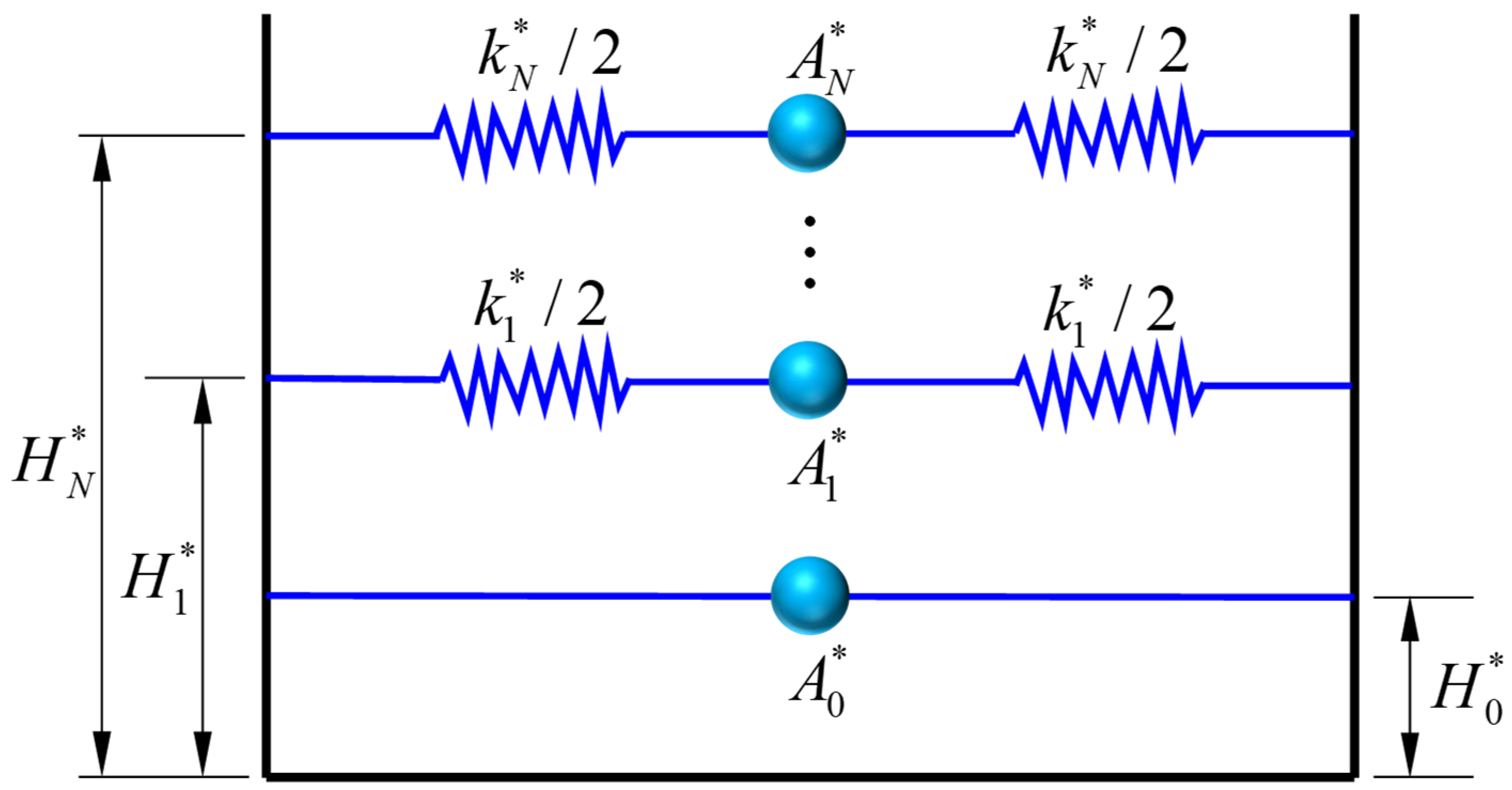
in which B n * = B n / M n , C n * = C n / M n , D n * = D n / M n . By ensuring the hydrodynamic shear and overturning moment match the exact solution values, Figure 3 demonstrates the derived analytical model for simulating liquid sloshing in the horizontally excited rectangular baffled aqueduct. This equivalent system, developed through Equations (48)–(52), enables convective sloshing characterization as a superposition of sequential sloshing modes from the first to Nth orders. A 0 * is the impulsive mass; H n * and H 0 * are the corresponding heights of each equivalent mass, respectively.
Based on the hydrodynamic moments acting on the wall, bottom, and baffle, the associated mechanical parameters of the model are summarized in Table 1. When only the hydrodynamic moment on the aqueduct wall is taken into account, the equivalent heights of the convective mass oscillators can be expressed as follows:
H n * = B n * / A n * , H 0 * = ρ B H 2 n = 1 N B n * / 2 ρ B H n = 1 N A n *
Given the hydrodynamic moments exerting on the aqueduct wall and the vertical baffle, one has
H n * = B n * + D n * / A n * , H 0 * = ρ B H 2 n = 1 N B n * n = 1 N D n * / 2 ρ B H n = 1 N A n *

2.3. Soil–Foundation Interaction Model

In many studies investigating dynamic interaction between the soil and the structure, the impedance function K ( ω ) serves to describe the correlation between excitation forces and vibrational displacement of the foundation. In this paper, the basis segmentation method based on Green’s function is utilized to obtain the vibration impedance of the strip foundation with frequency-dependent characteristics [37]. It is a complex-valued function depending on the excitation frequency ω :
R ( ω ) = K d ( a 0 ) K s = [ K ( a 0 ) + i a 0 C ( a 0 ) ] K s
in which a 0 is the dimensionless excitation frequency and a 0 = ω d ¯ / V s . d ¯ is the feature width of foundation. For exposed strip foundations, the feature width can be taken as half of the foundation width. For the horizontal impedance, the static stiffness K s = G s π . K d ( a 0 ) represents the dynamic stiffness coefficient. K ( a 0 ) and C ( a 0 ) denote the normalized stiffness and damping coefficients, respectively.
In the time-domain investigation, coupling the soil, foundation, and structure with the foundation impedance function directly presents significant challenges. To address this difficulty and facilitate coupling with the model of the superstructure, this research employs the Chebyshev nested LPM to approximate the dynamic impedance characteristics. The nested LPM exhibits no dependence on the external excitation frequency. Compared with ordinary polynomials, Chebyshev complex polynomials have good numerical stability. According to the research results of Wu and Lee [38], similar to the dynamic impedance function, the dynamic flexibility function F ( ω ) can also be normalized by the static flexibility F s :
F ( ω ) = F s F d ( a 0 )
where F d ( a 0 ) is the dynamic flexibility. Fitting F d ( a 0 ) by using Chebyshev complex polynomial fractions, one has
F d ( a 0 ) = F d ( χ ) Q ( χ ) P ( χ ) = 1 + q 1 χ + + q s χ s 1 + p 1 χ + + p s χ s + σ q s χ s + 1
in which χ = i a 0 , s represents the order of the complex polynomial fraction, σ denotes the damping coefficient when the excitation frequency approaches its maximum value, and p i and q i (i = 1, 2, …, s) are undetermined coefficients. Taking the reciprocal of Equation (57) we get
K d ( χ ) P ( 0 ) ( χ ) Q ( 0 ) ( χ ) = 1 + p 1 ( 0 ) χ + + p s ( 0 ) χ s + σ q s ( 0 ) χ s + 1 1 + q 1 ( 0 ) χ + + q s ( 0 ) χ s
Extracting the linear part in Equation (58):
P ( 0 ) ( χ ) Q ( 0 ) ( χ ) = 1 + σ χ + p 1 ( 1 ) χ + + p s ( 1 ) χ s 1 + q 1 ( 0 ) χ + + q s ( 0 ) χ s = 1 + σ χ + P ( 1 ) ( χ ) Q ( 0 ) ( χ )
Repeating the extraction operation of the linear part of the formula as described above to reduce the order of the polynomial fraction. Equation (58) can be transformed into
K d ( χ ) P ( 0 ) ( χ ) Q ( 0 ) ( χ ) = 1 + σ χ + 1 1 γ 1 + 1 δ 1 χ + 1 1 γ 2 + 1 δ 2 χ + 1 + 1 δ s 1 χ + 1 1 γ s + 1 δ s χ
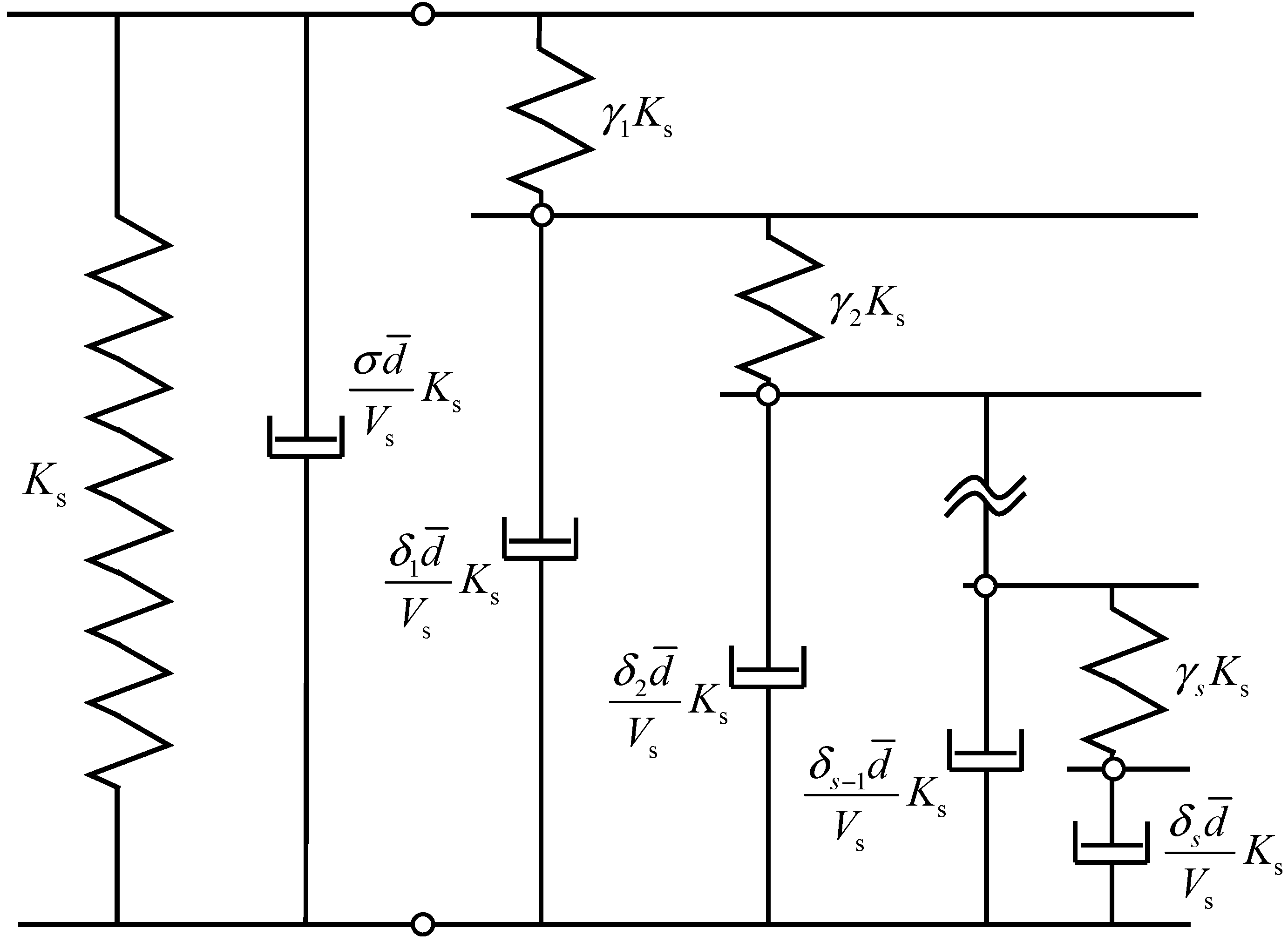
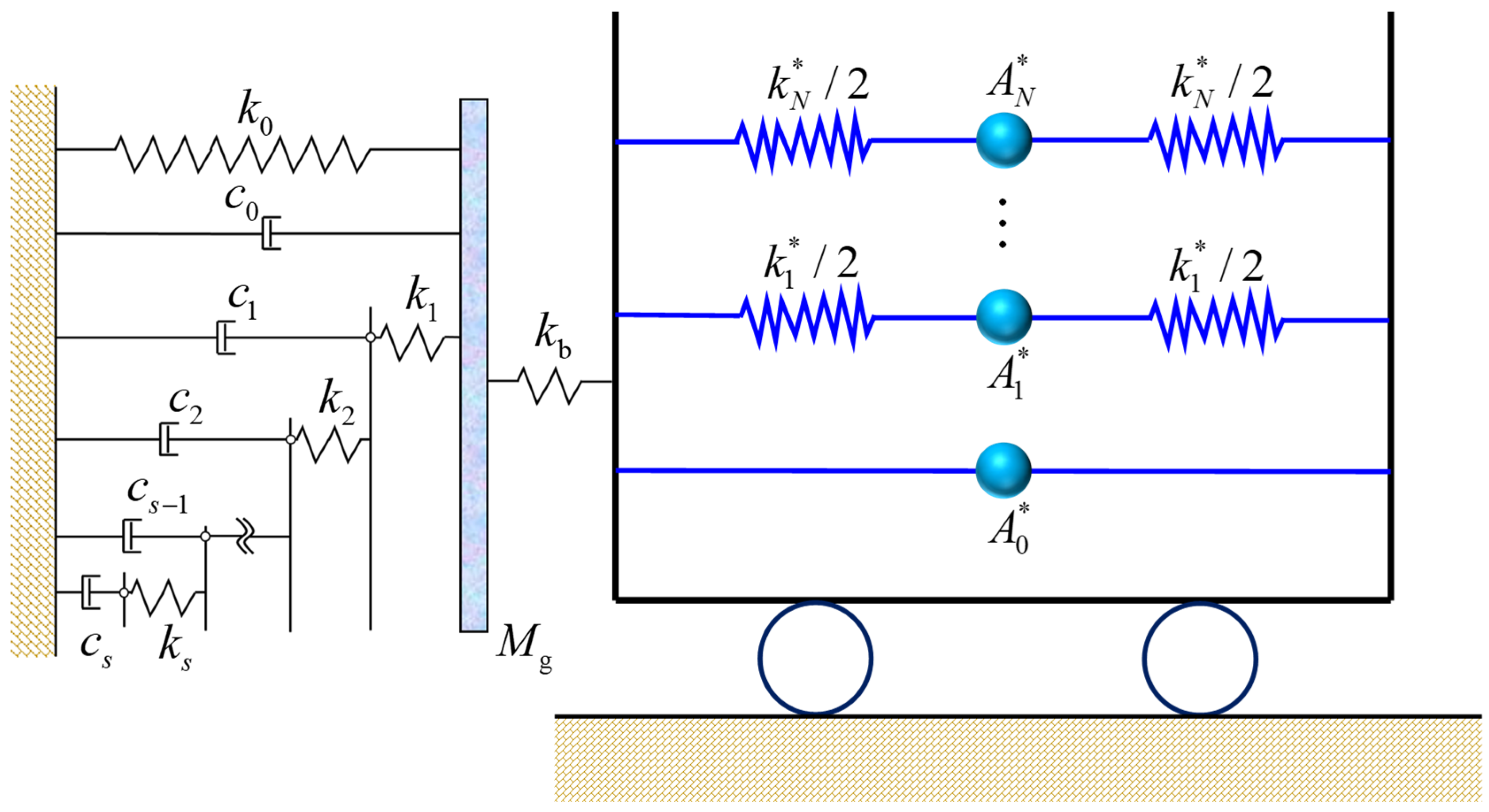
A Chebyshev nested LPM with spring–damper elements is established to describe the above dynamic stiffness function, as shown in Figure 4. γ i and δ i (i = 1, 2, …, s) correspond to the stiffness and damping coefficients of spring–damper elements, respectively, and they are expressed as
γ i = p s i + 1 ( i ) q s i + 1 ( i 1 ) ,   δ i = p s i + 1 ( i ) q s i ( i ) , ( i = 1 , 2 , , s )
in which q n ( i ) = q n ( i 1 ) q s i + 1 ( i 1 ) p s i + 1 ( i ) p n ( i ) , p n ( i + 1 ) = p n ( i ) p s i + 1 ( i ) q s i ( i ) q n 1 ( i ) (n = 1, 2, …, s-i).

2.4. Coupling Dynamic Model

The horizontal impedance characteristics of soil are modeled via a Chebyshev-optimized nested LPM with a fitting order of s, and the Nth-order convective mass is selected to characterize the dynamics of the free surface in the upper aqueduct–liquid–baffle coupling model. Based on the substructure method, a simplified dynamic equivalent model for the liquid–structure interaction system is established by enforcing displacement compatibility and force equilibrium at the soil–foundation interface, as shown in Figure 5. Combined with the D’ Alembert principle, the motion control equation can be obtained:
M { U ¨ } + C { U ˙ } + K { U } = 0
where M, C, and K are, respectively, the mass, damping, and stiffness matrices of the coupling model; {U} denotes the displacement vector. Their specific expressions are presented in Appendix A. The natural frequency of the soil–aqueduct–liquid–baffle coupling system can be determined by using the searching root approach.

3. Verification of the Analytical Model

A convergence analysis of the proposed method is performed by examining the first four dimensionless frequencies Λ n 2 versus the truncation number N, for 2 B = 1   m , H = 1   m , and k b = 10 20   N / m . For the shear wave velocity of single-phase soil, using a finite but very high value is a practical engineering approximation for the rigid condition, and it significantly simplifies the seismic analysis of the structure. In order to meet the convergence and verification conditions, V s = 5000   m / s . Table 2 and Table 3, respectively, present the calculation results of dimensionless frequencies Λ n 2 varying with the number of truncation terms N under different baffle positions β 1 = a / B = 0.6 ,   1.0 corresponding to different baffle heights β 2 = h / H = 0.5 ,   0.8 . It can be seen from the two tables that when the number of truncated terms N is 25, the calculation result can guarantee at least three significant digits. Therefore, in the analysis of this article, the number of truncated terms is taken as 25.
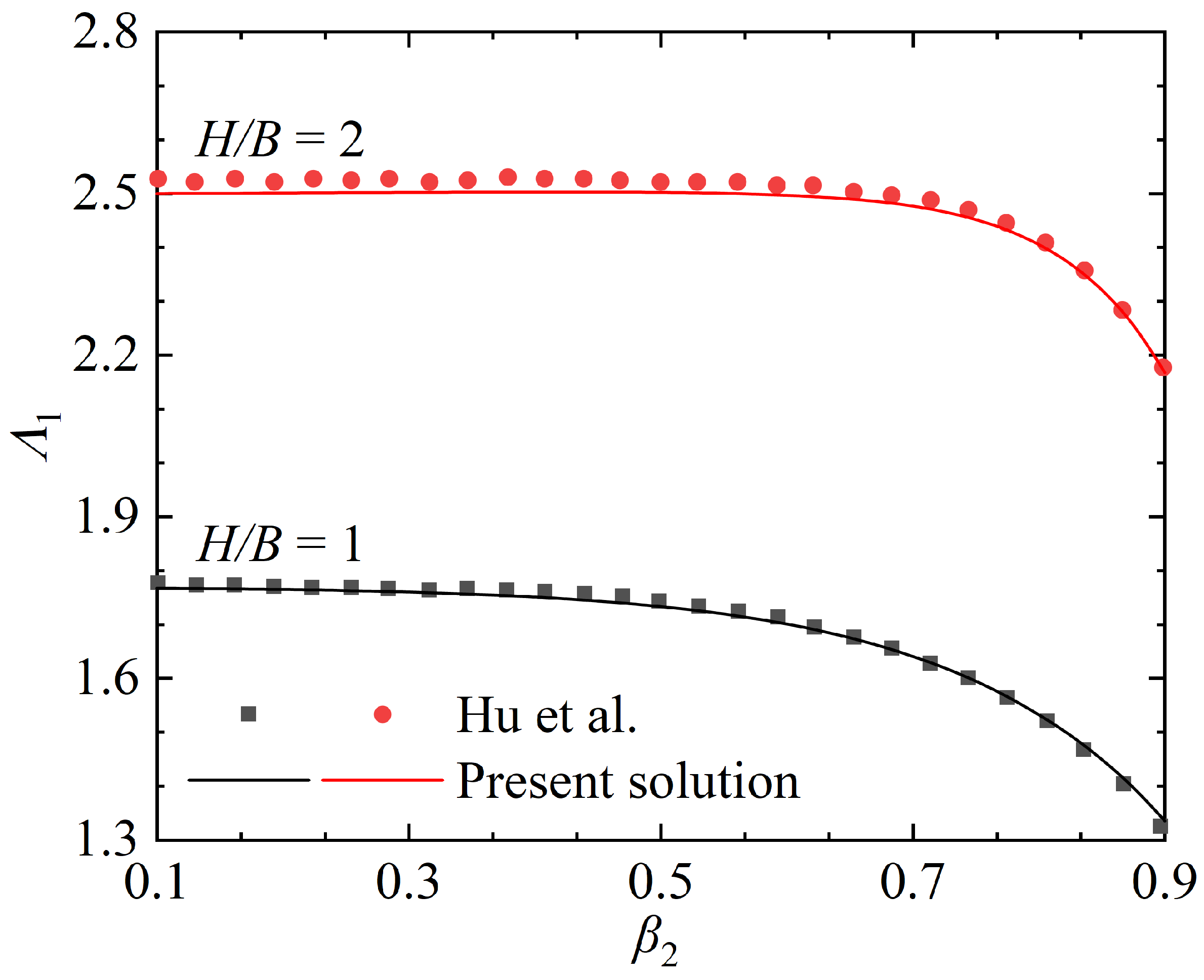
For H / B = 1.0 and 2.0, a comparative analysis of the first-order sloshing frequencies in the coupling system was conducted against the findings from Hu et al. [39]. As illustrated in Figure 6, the results obtained across different baffle heights are consistent with those reported in previous studies. The relative error of the first-order sloshing frequency between the present study and Hu’s study is at a maximum of −1.10%. In addition, the comparison with the experimental results of Ren et al. [40] is shown in Table 4. The analytical results show reasonable agreement with the experimental natural frequencies. This indicates that the equivalent dynamic model proposed in this paper has high accuracy in liquid sloshing analysis.
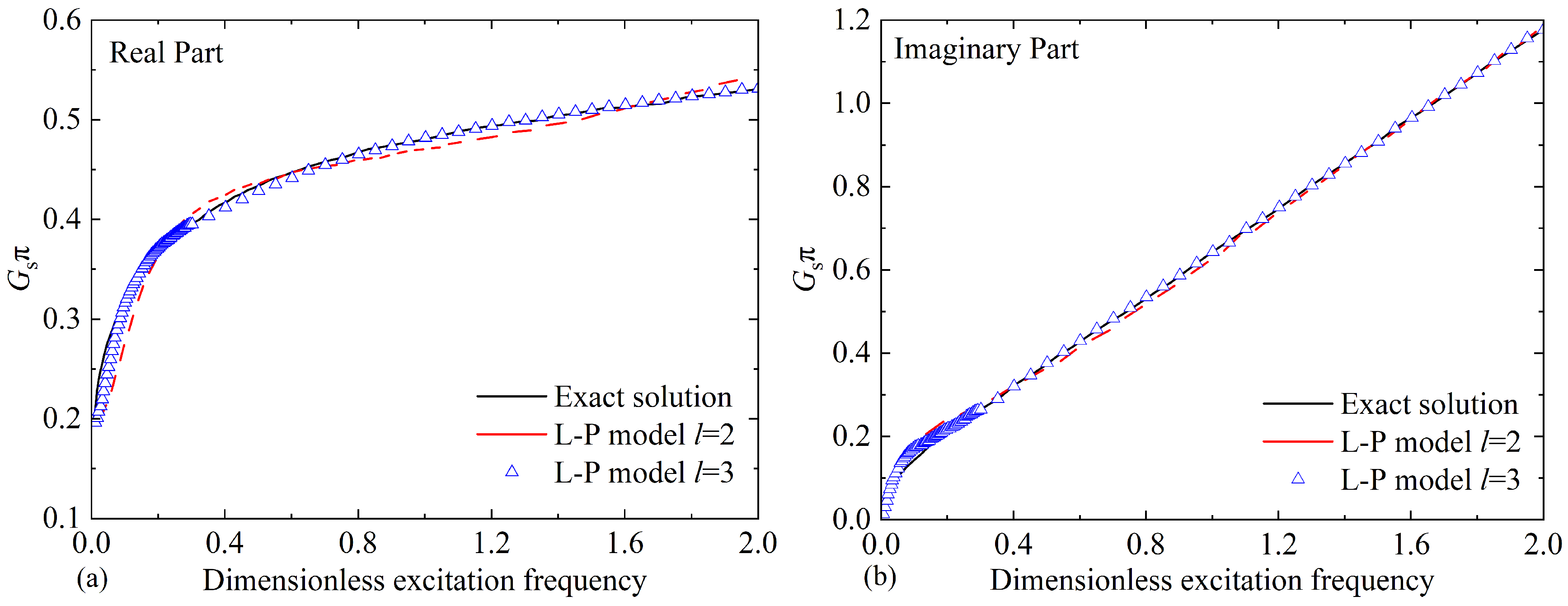
The impedance function obtained by the equivalent LPM is compared with the impedance function derived by the Green function method. This comparison verifies the correctness of the impedance at the lower part. The horizontal impedance function of the soil can also be expressed as R ( ω ) = G s π ( Re [ R ] + Im [ R ] ) , where R is the dimensionless impedance function. For ν = 0.25 , V s = 250   m / s , and ρ s = 2000   kg / m 3 , considering the actual situation of the aqueduct engineering, the dimensionless frequency range is taken as a 0 = 0 ~ 2 . As illustrated in Figure 7, when the fitting order of the complex polynomial fraction is taken l = 3, the horizontal impedance already has an excellent fitting accuracy. Therefore, in the subsequent analysis, the fitting order of the horizontal dynamic flexibility function is set to 3.

4. Parameter Analysis

4.1. The Influence of Shear Wave Velocity of Soil

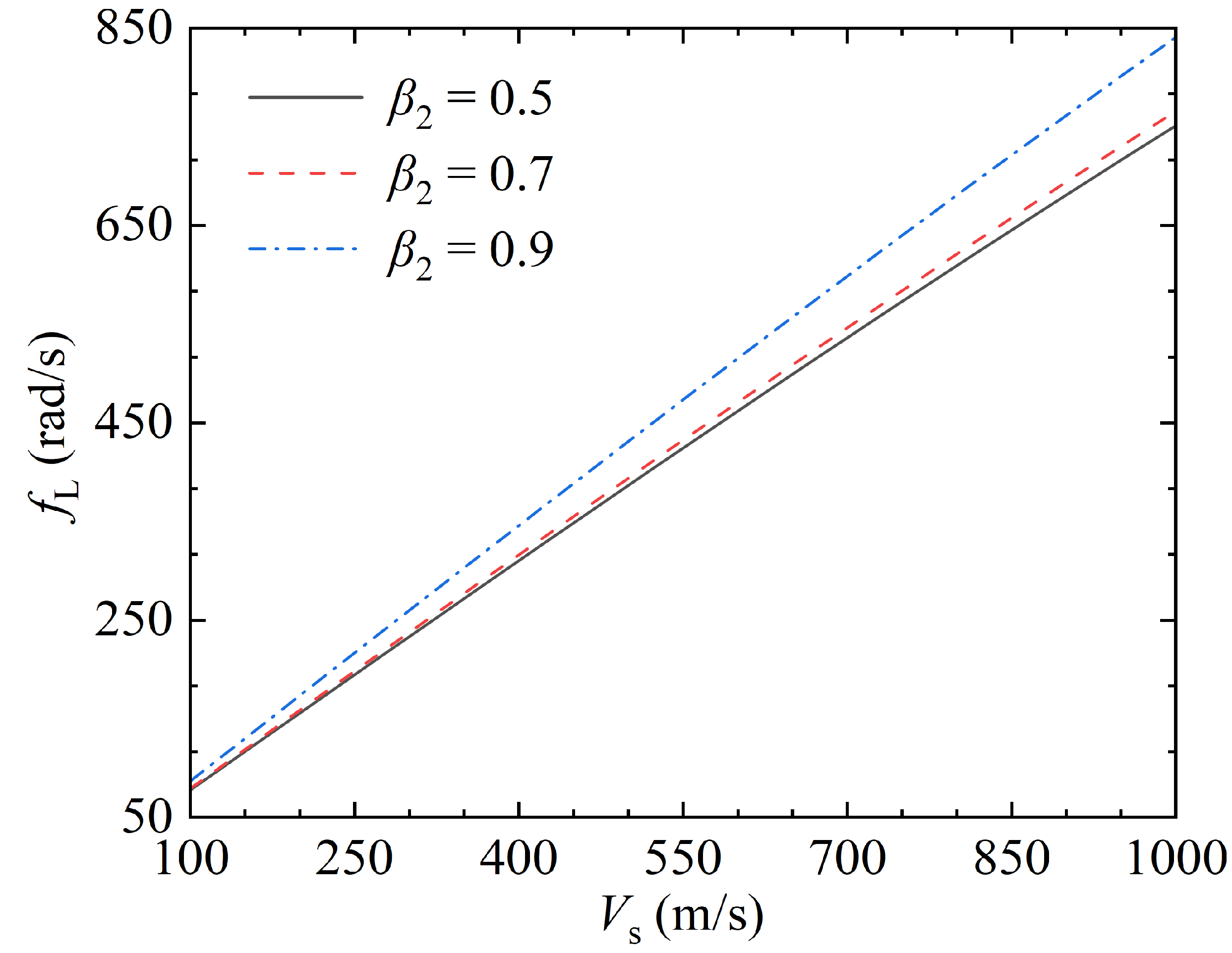
Considering the structural parameters of the rectangular aqueduct being 2 B = H = 1   m , β 1 = 1.0 , β 2 = 0.5 , and k b = 10 10   N / m , and for the soil the parameters being ν = 0.33 and ρ s = 1800   kg / m 3 , Table 5 illustrates the impact of V s on the natural frequency characteristics within the soil–foundation–aqueduct–liquid–baffle system. ω n ( n = 1, 2, 3) and f L denote the first three convective sloshing frequencies and the horizontal impulsive frequency, respectively. Analysis reveals that V s has little influence on the convective sloshing frequency. With the increase in V s , the convective characteristics of liquids on soft soil gradually approach those on rigid soil. The horizontal impulsive frequency f L shows a significant increasing trend with the increase in soil stiffness. Figure 8 demonstrates that f L maintains linear proportionality with the increase in V s .

4.2. The Influence of the Baffle Position and Height

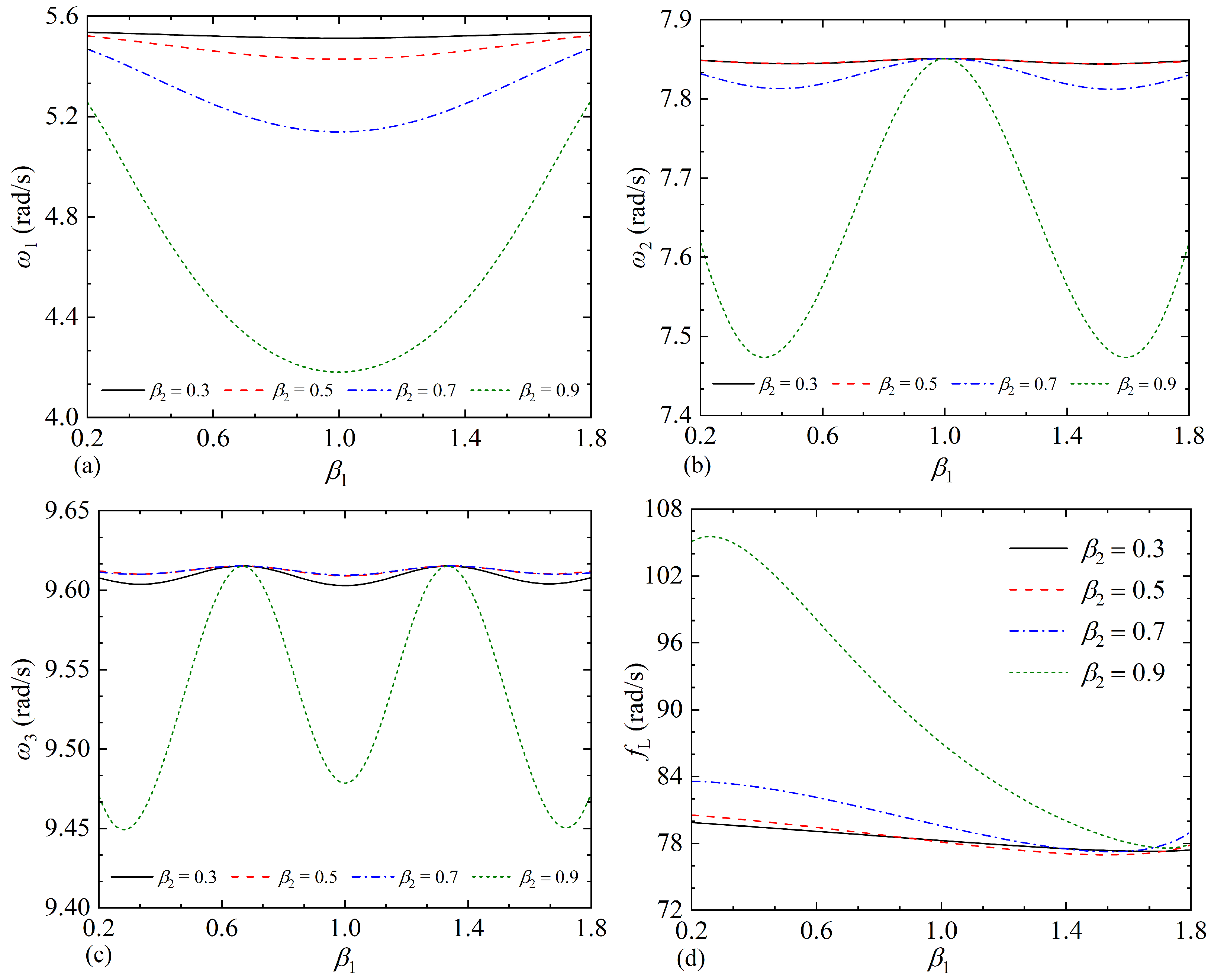
The influence of the position of the vertical baffle on the natural frequency of liquid sloshing and horizontal impulsive frequency of the aqueduct was studied. If not specified separately in this section, ν = 0.33 , ρ s = 1800   kg / m 3 , V s = 100   m / s , and 2 B = H = 1   m . Figure 9 depicts the first three natural frequencies and the horizontal impulsive frequencies versus different baffle positions β 1 , with β 2 = 0.3, 0.5, 0.7, and 0.9. It reveals that the first-order natural frequency ω 1 exhibits an initial steady decline until reaching its lowest point, after which it progressively rises as the distance between the baffle and the left wall increases. Meanwhile, the second-order natural frequency ω 2 shows a gradual reduction to its minimum level before ascending to peak values as baffle displacement increases, subsequently undergoing a slow decline followed by a consistent upward trend. The third-order natural frequency ω 3 has the same tendency as the second-order frequency twice, and two maximum points appear. The curves of the first three frequencies with respect to the position of the baffle are all symmetrical about the central axis β 1 = 1.0 . However, the horizontal impulsive frequency f L changes non-monotonically under different positions of the vertical baffle. Furthermore, an increase in β 2 resulted in a corresponding increase in the amplitude of the frequency variation.
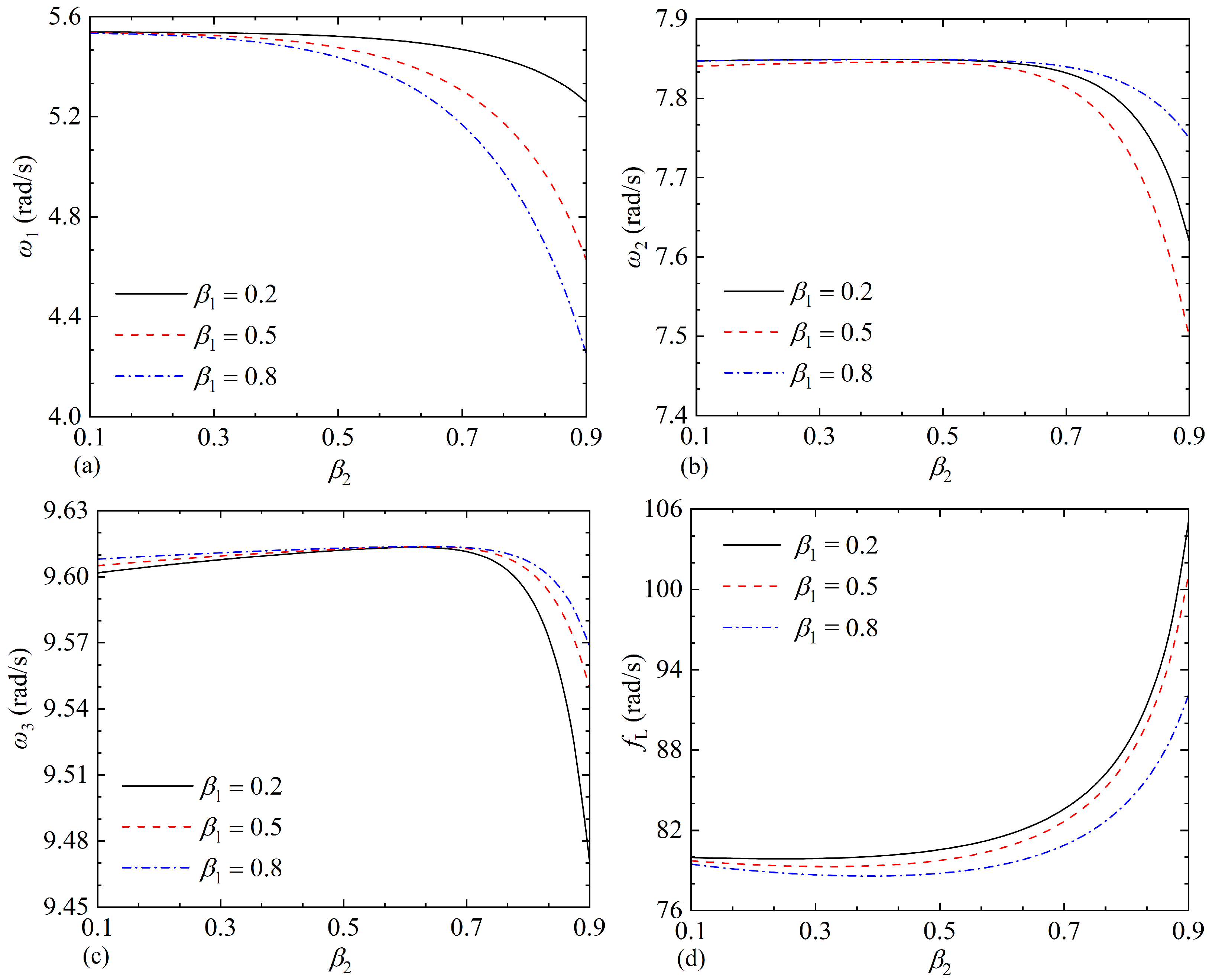
The influence of the height of the baffle on the natural frequency of liquid sloshing and the horizontal impulsive frequency was studied. Figure 10 depicts the first three natural frequencies and the horizontal impulsive frequencies versus different baffle heights β 2 , with β 1 = 0.2, 0.5, and 0.8. The fundamental frequency associated with first-order liquid sloshing ω 1 exhibits a progressive decline as baffle height elevates. For the second-order frequency ω 2 , with the growth of the height of the baffle, the natural frequency first increases slowly and then decreases rapidly. The third-order frequency ω 3 shows the same trend as the second order frequency, but the range of variation is relatively small. On the contrary, the horizontal impulsive frequency f L first decreases slowly as the height of the partition increases, and then increases rapidly. As can be surmised from Figure 10, the values of different curves in the same graph are the same as h approaches 0. Introducing a vertical baffle partitions the liquid region and alters the horizontal pressure distribution. This demonstrates the effectiveness of a vertical baffle for improving sloshing properties in hydraulic structures.

4.3. The Influence of Liquid Height

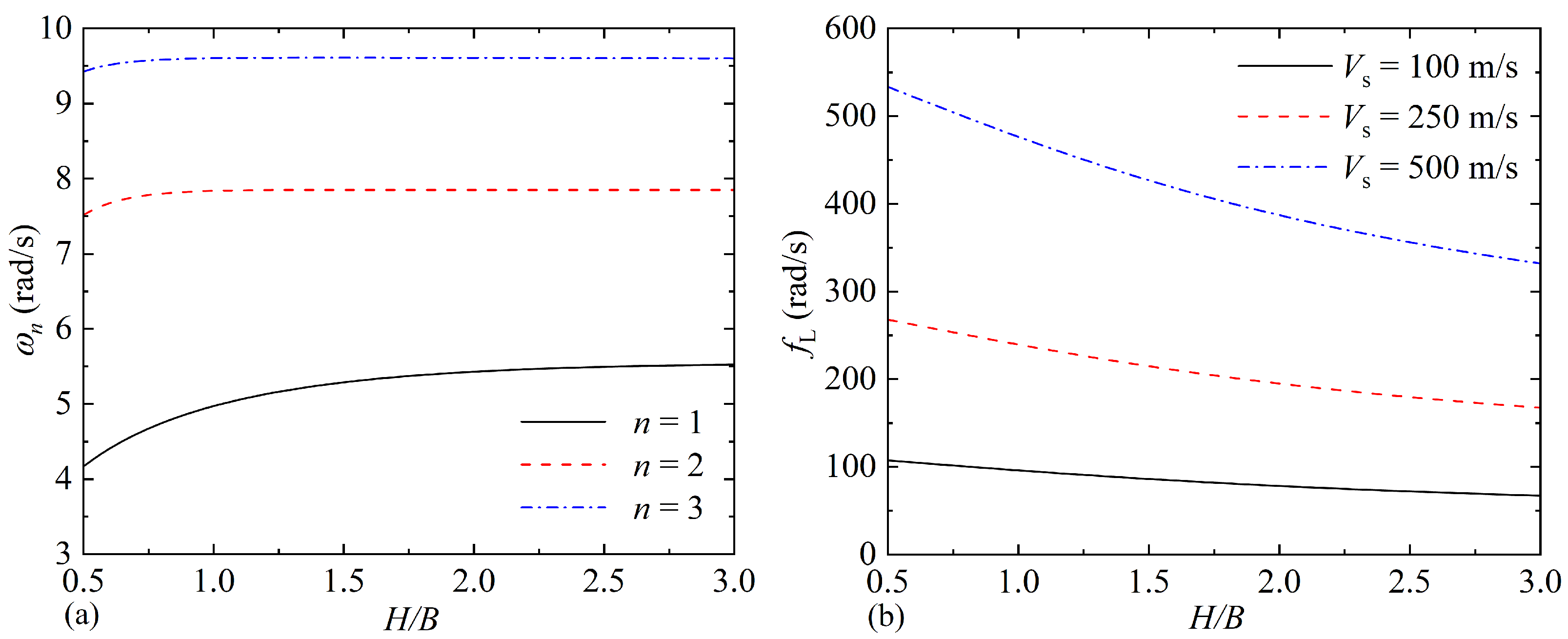
Parameters: ν = 0.33 , ρ s = 1800   kg / m 3 , V s = 100   m / s , 2 B = 1   m , β 1 = 1.0 , and β 2 = 0.5 . Figure 11 presents the first three natural frequencies and horizontal impulsive frequencies of liquid sloshing at different liquid heights H. The natural frequencies of the first three liquid sloshing conditions increase slowly with the increase in H, while the impulsive frequency declines slowly with the growth of H.

5. Conclusions

In this paper, an analytical coupling model is developed for a rectangular cantilever aqueduct structure with a vertical baffle and resting on a strip-shaped exposed foundation. The liquid sloshing equation is solved by using the subdomain method. Based on mechanical equivalence principles, an equivalent mechanical model is developed for the liquid dynamics in baffled aqueducts. The horizontal impedance function of soil is expressed by complex polynomial fractions. The soil–foundation interaction is simulated by using the nested LPM. A comprehensive soil–aqueduct–liquid–baffle coupling system is constructed by using the substructure method, enabling parametric investigation of coupling frequency variations across multiple factors. Based on this model, the variation of the coupling frequency under different soil parameters, baffle positions, baffle heights, and liquid heights are discussed. Analysis of the results leads to the following conclusions:
(1) The inclusion of SSI effects results in a reduction in the horizontal impulsive frequency, while exerting negligible influence on liquid convective sloshing frequencies. Notably, the horizontal impulsive frequency demonstrates a linear increase proportional to the growth of shear wave velocity. This strong dependency indicates that practical design should move beyond the assumption of a rigid foundation.
(2) Maximum suppression of the first-order convective frequency occurs when the vertical baffle is positioned at the middle of the aqueduct bottom. Increasing the height of the baffle further reduces the first-order convective sloshing frequency, indicating its effectiveness as a sloshing suppression design in hydraulic building structures.
(3) As the liquid height increases, the first three natural frequencies of liquid sloshing increase slowly. However, the horizontal impulsive frequency decreases slowly as the liquid height increases. These findings highlight the importance of incorporating sloshing suppression measures into the design of slender water-storage structures.
This paper presents a semi-analytical method and a corresponding equivalent model to investigate the dynamic characteristics of cantilever aqueducts with vertical baffles on exposed strip foundations. The findings provide theoretical support for structural engineering applications, especially in the design, construction, and seismic optimization of hydraulic and building infrastructures. Future research will focus on the seismic response and nonlinear sloshing of aqueduct systems to enhance their safety, resilience, and sustainability in modern construction engineering.

Author Contributions

Conceptualization, X.M.; Methodology, F.H., Y.S. and J.W.; Software, S.X.; Formal analysis, S.X. and Z.G.; Investigation, F.H.; Resources, Z.Z.; Data curation, S.X. and J.W.; Writing—original draft, F.H.; Writing—review & editing, Y.S. and Z.G.; Visualization, X.M., Z.Z. and J.W.; Supervision, Y.S. and Z.G.; Funding acquisition, Y.S., Z.G., X.M. and Z.Z. All authors have read and agreed to the published version of the manuscript.

Funding

The financial support from Basic Research Program of Jiangsu (Grant No. BK20240942), Natural Science Foundation of the Jiangsu Higher Education Institutions of China (Grant Nos. 24KJB130005, 25KJB130009, 24KJB560016), College Students’ Innovation and Entrepreneurship Training Program (Grant No. S202510304198), National Natural Science Foundation of China (Grant No. 51978336), General Program of Nantong Natural Science Foundation (Grant No. JC2024058), and school-level research projects of the Yancheng Institute of Technology (xjr2023016) are greatly appreciated.

Data Availability Statement

The datasets used and/or analyzed during the current study are available from the corresponding author upon reasonable request.

Conflicts of Interest

Authors declare that there are no conflicts of interest regarding the publication of the present paper.

Appendix A

The definitions of the matrices M, C, and K and the displacement vector {U} are given below:
M = M f 0 ,   M f = A 1 * A 1 * 0 A N * A N * 0 A 1 * A N * n = 1 N A n * + A 0 * + M 0 0 0 0 0 M g
C = 0 C L ,   C L = d i a g ( c 0 ,   c 1 ,   c 2 ,   ,   c s )
K = K f K L ,   K f = d i a g ( k 1 * ,   k 2 * ,   ,   k N * )
K L = k b k b 0 k b k b + k 0 + k 1 k 1 k 1 k 1 + k 2 k 2 k i 1 k i 1 + k i k i k s 1 k s 1 + k s k s 0 k s k s
U = q 1 * q 2 * q n * x 0 u 0 u s T
in which k 0 = G s π , c 0 = σ d ¯ k 0 V s , c i = δ i d ¯ k 0 V s , and k i = γ i k 0 . x 0 indicates the lateral movement of the impulsive mass in relation to the bedrock foundation. u 0 stands for the horizontal displacement measured at the foundation base with respect to bedrock coordinates. u i (i = 1, 2, …, s) characterizes the oscillatory displacement parameters for each independent mode within the nested LPM, quantified relative to bedrock reference points.

References

  1. Xu, F.; Xu, C.; El Naggar, M.H.; Du, X. Seismic Performance of Large Underground Water Tank Structures Considering Fluid-Structure Interaction. Buildings 2025, 15, 2643. [Google Scholar] [CrossRef]
  2. Li, F.; Chen, G. Nonlinear Seismic Response Characteristics of CAP1400 Nuclear Island Structure on Soft Rock Sites. Sci. Technol. Nucl. Install. 2020, 2020, 8867026. [Google Scholar] [CrossRef]
  3. Brunesi, E.; Nascimbene, R. Evaluating the Seismic Resilience of Above-Ground Liquid Storage Tanks. Buildings 2024, 14, 3212. [Google Scholar] [CrossRef]
  4. Jing, W.; Chen, P.; Song, Y. Shock absorption of concrete liquid storage tank with different kinds of isolation measures. Earthq. Struct. 2020, 18, 467–480. [Google Scholar] [CrossRef]
  5. Zhang, Q.; Shui, B.; Zhu, H.H. Study on Sloshing Characteristics in a Liquid Cargo Tank under Combination Excitation. J. Mar. Sci. Eng. 2022, 10, 1100. [Google Scholar] [CrossRef]
  6. Wang, H.B.; Li, C.L.; Zhao, L.J. Experimental Study on Dynamic Interaction between Large U-Shape Aqueduct and Water. KSCE J. Civ. Eng. 2022, 26, 1203–1213. [Google Scholar] [CrossRef]
  7. Meng, X.; Zhou, D.; Kim, M.K.; Lim, Y.M. Free vibration and dynamic response analysis of liquid in a rectangular rigid container with an elastic baffle. Ocean. Eng. 2020, 216, 108119. [Google Scholar] [CrossRef]
  8. Jin, X.; Zheng, H.; Liu, M.; Zhang, F.; Yang, Y.; Ren, L. Damping effects of dual vertical baffles on coupled surge-pitch sloshing in three-dimensional tanks: A numerical investigation. Ocean. Eng. 2022, 261, 112130. [Google Scholar] [CrossRef]
  9. Sanapala, V.S.; Rajkumar, M.; Velusamy, K.; Patnaik, B.S.V. Numerical simulation of parametric liquid sloshing in a horizontally baffled rectangular container. J. Fluids Struct. 2018, 76, 229–250. [Google Scholar] [CrossRef]
  10. Zang, Q.; Liu, J.; Lu, L.; Lin, G. A NURBS-based isogeometric boundary element method for analysis of liquid sloshing in axisymmetric tanks with various porous baffles. Eur. J. Mech. B Fluids 2020, 81, 129–150. [Google Scholar] [CrossRef]
  11. Biswal, K.C.; Bhattacharyya, S.K.; Sinha, P.K. Free-vibration analysis of liquid-filled tank with baffles. J. Sound Vib. 2003, 259, 177–192. [Google Scholar] [CrossRef]
  12. Biswal, K.C.; Bhattacharyya, S.K.; Sinha, P.K. Dynamic response analysis of a liquid-filled cylindrical tank with annular baffle. J. Sound Vib. 2004, 274, 13–37. [Google Scholar] [CrossRef]
  13. Biswal, K.C.; Bhattacharyya, S.K. Dynamic response of structure coupled with liquid sloshing in a laminated composite cylindrical tank with baffle. Finite Elem. Anal. Des. 2010, 46, 966–981. [Google Scholar] [CrossRef]
  14. Gavrilyuk, I.; Hermann, M.; Trotsenko, Y.; Timokha, A. Studying the coupled eigenoscillations of an axisymmetric tower-elevated tank system by the multimodal method. J. Fluids Struct. 2013, 42, 152–165. [Google Scholar] [CrossRef]
  15. Wang, Z.-H.; Jiang, S.-C.; Bai, W.; Li, J.-X. Liquid sloshing in a baffled rectangular tank under irregular excitations. Ocean. Eng. 2023, 278, 114472. [Google Scholar] [CrossRef]
  16. Xue, M.-A.; He, Y.; Yuan, X.; Cao, Z.; Odoom, J.K. Numerical and experimental study on sloshing damping effects of the porous baffle. Ocean. Eng. 2023, 285, 115363. [Google Scholar] [CrossRef]
  17. Liu, W.; Xiao, C.; Zhou, H.; Wang, C.Y. Experimental investigation of liquid-tank interaction effects on full containment LNG storage tanks through shaking table tests. Thin-Walled Struct. 2024, 196, 111527. [Google Scholar] [CrossRef]
  18. Vimal, P.P.A.; Regin, J.D.J.; Jinu, G.T.R.; Chettiar, C.G. Experimental investigation on elevated water tanks with base isolation—Response Spectrum Approach. J. Theor. Appl. Mech. 2020, 58, 885–899. [Google Scholar] [CrossRef]
  19. Haroun, M.A.; Abou-Izzeddine, W. Parametric study of seismic soil-tank interaction. I: Horizontal excitation. J. Struct. Eng. 1992, 118, 783–797. [Google Scholar] [CrossRef]
  20. Livaoglu, R.; Dogangun, A. Seismic evaluation of fluid-elevated tank-foundation/soil systems in frequency domain. Struct. Eng. Mech. 2005, 21, 101–119. [Google Scholar] [CrossRef]
  21. Livaoglu, R.; Dogangun, A. Effect of foundation embedment on seismic behavior of elevated tanks considering fluid-structure-soil interaction. Soil Dyn. Earthq. Eng. 2007, 27, 855–863. [Google Scholar] [CrossRef]
  22. Livaoglu, R. Soil interaction effects on sloshing response of the elevated tanks. Geomech. Eng. 2013, 5, 283–297. [Google Scholar] [CrossRef]
  23. Wang, J.; Zhou, D.; Liu, W.Q.; Wang, S.G. Nested Lumped-Parameter Model for Foundation with Strongly Frequency-dependent Impedance. J. Earthq. Eng. 2016, 20, 975–991. [Google Scholar] [CrossRef]
  24. Sun, Y.; Zhou, D.; Wang, J. An equivalent mechanical model for fluid sloshing in a rigid cylindrical tank equipped with a rigid annular baffle. Appl. Math. Model. 2019, 72, 569–587. [Google Scholar] [CrossRef]
  25. Sun, Y.; Zhou, D.; Amabili, M.; Wang, J.D.; Han, H.X. Liquid Sloshing in a Rigid Cylindrical Tank Equipped with a Rigid Annular Baffle and on Soil Foundation. Int. J. Struct. Stab. Dyn. 2020, 20, 2050030. [Google Scholar] [CrossRef]
  26. Housner, G.W. Dynamic pressures on accelerated fluid containers. Bull. Seismol. Soc. Am. 1957, 47, 15–35. [Google Scholar] [CrossRef]
  27. Housner, G.W. The dynamic behavior of water tanks. Bull. Seismol. Soc. Am. 1963, 53, 381–387. [Google Scholar] [CrossRef]
  28. Li, Y.; Di, Q.; Gong, Y. Equivalent mechanical models of sloshing fluid in arbitrary-section aqueducts. Earthq. Eng. Struct. Dyn. 2012, 41, 1069–1087. [Google Scholar] [CrossRef]
  29. Baghban, M.H.; Tosee, S.V.R.; Valerievich, K.A.; Najafi, L.; Faridmehr, I. Seismic Analysis of Baffle-Reinforced Elevated Storage Tank Using Finite Element Method. Buildings 2022, 12, 549. [Google Scholar] [CrossRef]
  30. Wang, J.D.; Zhou, D.; Liu, W.Q. Sloshing of liquid in rigid cylindrical container with a rigid annular baffle. Part I: Free vibration. Shock Vib. 2012, 19, 1185–1203. [Google Scholar] [CrossRef]
  31. Wang, J.D.; Zhou, D.; Liu, W.Q. Sloshing of liquid in rigid cylindrical container with a rigid annular baffle. Part II: Lateral excitation. Shock Vib. 2012, 19, 1205–1222. [Google Scholar] [CrossRef]
  32. Zhou, D.; Wang, J.D.; Liu, W.Q. Nonlinear sloshing of liquid in rigid cylindrical container with a rigid annular baffle: Free vibration. Nonlinear Dyn. 2014, 78, 2557–2576. [Google Scholar] [CrossRef]
  33. Cao, Z.; Xue, M.-A.; Yuan, X.; Zheng, J. A fast semi-analytic solution of liquid sloshing in a 2-D tank with dual elastic vertical baffles and walls. Ocean Eng. 2023, 273, 113951. [Google Scholar] [CrossRef]
  34. Ying, L.; Meng, X.; Zhou, D.; Xu, X.; Zhang, J.; Li, X. Sloshing of fluid in a baffled rectangular aqueduct considering soil-structure interaction. Soil Dyn. Earthq. Eng. 2019, 122, 132–147. [Google Scholar] [CrossRef]
  35. Jing, W.; Shen, J.; Cheng, X.; Yang, W. Seismic responses of a liquid storage tank considering structure-soil-structure interaction. Structures 2022, 45, 2137–2150. [Google Scholar] [CrossRef]
  36. Hashemi, S.; Kianoush, R.; Khoubani, M. A mechanical model for soil-rectangular tank interaction effects under seismic loading. Soil Dyn. Earthq. Eng. 2022, 153, 107092. [Google Scholar] [CrossRef]
  37. Wang, J.; Lo, S.H.; Zhou, D.; Xu, B.Q. Frequency-dependent impedance of a strip foundation group and its representation in time domain. Appl. Math. Model. 2015, 39, 2861–2881. [Google Scholar] [CrossRef]
  38. Wu, W.H.; Lee, W.H. Nested lumped-parameter models for foundation vibrations. Earthq. Eng. Struct. Dyn. 2004, 33, 1051–1058. [Google Scholar] [CrossRef]
  39. Hu, Z.; Zhang, X.; Li, X.; Li, Y. On natural frequencies of liquid sloshing in 2-D tanks using Boundary Element Method. Ocean. Eng. 2018, 153, 88–103. [Google Scholar] [CrossRef]
  40. Ren, Y.R.; Xue, M.A.; Lin, P.Z. Experimental study of sloshing characteristics in a rectangular tank with elastic baffles. J. Fluids Struct. 2023, 122, 103984. [Google Scholar] [CrossRef]
Figure 1. A vertically baffled two-dimensional rectangular cantilever aqueduct on elastic half space.
Buildings 15 04335 g001
Figure 2. (a) Plane model of liquid subdomains. (b) Spatial model of liquid subdomains.
Buildings 15 04335 g002
Figure 3. The equivalent mechanical model of liquid sloshing.
Buildings 15 04335 g003
Figure 4. The Chebyshev nested LPM for soil foundation.
Buildings 15 04335 g004
Figure 5. Equivalent model for the soil–aqueduct–liquid–baffle coupling system.
Buildings 15 04335 g005
Figure 6. The comparison of the first-order sloshing frequency in this paper with the research results of Hu et al. [39].
Buildings 15 04335 g006
Figure 7. Impedances of the soil foundation: (a) real part; (b) imaginary part.
Buildings 15 04335 g007
Figure 8. Effect of shear wave velocity V s on the horizontal impulsive frequency f L under different baffle heights β 2 .
Buildings 15 04335 g008
Figure 9. Effects of the baffle position on the natural frequency: (a) the first-order convective sloshing frequency; (b) the second-order convective sloshing frequency; (c) the third-order convective sloshing frequency; (d) the horizontal impulsive frequency.
Buildings 15 04335 g009
Figure 10. Effects of the baffle height on the natural frequency: (a) the first-order convective sloshing frequency; (b) the second-order convective sloshing frequency; (c) the third-order convective sloshing frequency; (d) the horizontal impulsive frequency.
Buildings 15 04335 g010
Figure 11. Effects of liquid height on the natural frequency: (a) the convective sloshing frequency; (b) the horizontal impulsive frequency.
Buildings 15 04335 g011
Table 1. The mechanical parameters of the equivalent mass–spring model.
ParametersDetailed Expressions
A n * A n / M n
A 0 * 2 ρ B H n = 1 N A n *
H n * B n * + C n * + D n * A n *
H 0 * ρ B H 2 n = 1 N B n * + 2 3 ρ B 3 n = 1 N C n * + n = 1 N D n * 2 ρ B H n = 1 N A n *
k n * ω n 2 A n *
Table 2. Convergence of Λ n 2 (n = 1, 2, 3, 4) with the growth of N for β 1 = 0.6 .
β 2 nN = 4N = 7N = 10N = 13N = 16N = 19N = 22N = 25N = 28
0.512.9993.0313.0363.0393.0413.0423.0423.0433.043
26.0796.2196.2506.2626.2686.2716.2736.2746.275
39.3699.4099.4189.4219.4229.4239.4239.4249.424
412.08212.44812.51612.53812.54912.55412.55712.56012.561
0.812.5092.5262.5302.5342.5362.5372.5382.5392.539
26.1116.1236.1246.1266.1266.1276.1276.1276.127
39.4199.4219.4209.4209.4209.4209.4209.4209.420
412.56112.56412.56412.56312.56312.56312.56212.56212.562
Table 3. Convergence of Λ n 2 (n = 1, 2, 3, 4) with the growth of N for β 1 = 1.0 .
β 2 nN = 4N = 7N = 10N = 13N = 16N = 19N = 22N = 25N = 28
0.512.9422.9882.9963.0013.0033.0043.0053.0063.006
26.2836.2836.2836.2836.2836.2836.2836.2836.283
38.8709.2579.3479.3819.3969.4059.4109.4139.416
412.56612.56612.56612.56612.56612.56612.56612.56612.566
0.812.3122.3332.3392.3442.3462.3482.3492.3502.350
26.2836.2836.2836.2836.2836.2836.2836.2836.283
39.3489.3749.3779.3789.3789.3799.3799.3799.379
412.56612.56612.56612.56612.56612.56612.56612.56612.566
Table 4. The comparison of the first-order sloshing frequency in this paper with the experimental results of Ren et al. [40].
H (m)B (m)Literature
Solution (Hz)
Present
Solution (Hz)
Relative
Error
0.201.00.640.6460.94%
0.251.00.5950.6011.01%
0.150.51.071.0750.44%
0.200.51.121.1321.05%
Table 5. The natural frequencies ω n and the horizontal impulsive frequencies f L under different shear wave velocities V s (unit: rad/s).
V s (m/s)1002002505001000Rigid
ω 1 5.42925.42975.42995.43005.43015.4301
ω 2 7.85107.85107.85107.85107.85107.8510
ω 3 9.60909.60949.60969.60969.60979.6097
f L 78.1315117.1222194.8805386.8789751.5735-
Disclaimer/Publisher’s Note: The statements, opinions and data contained in all publications are solely those of the individual author(s) and contributor(s) and not of MDPI and/or the editor(s). MDPI and/or the editor(s) disclaim responsibility for any injury to people or property resulting from any ideas, methods, instructions or products referred to in the content.