Article

The Impact of Composite Alkali Activator on the Mechanical Properties and Enhancement Mechanisms in Aeolian Sand Powder–Aeolian Sand Concrete

1
School of Transportation and Municipal Engineering, Inner Mongolia Technical University of Construction, Hohhot 010070, China
2
School of Civil Engineering, Inner Mongolia University of Technology, Hohhot 010051, China
*
Author to whom correspondence should be addressed.
Buildings 2025, 15(23), 4213; https://doi.org/10.3390/buildings15234213
Submission received: 14 August 2025 / Revised: 7 November 2025 / Accepted: 8 November 2025 / Published: 21 November 2025
(This article belongs to the Section Building Materials, and Repair & Renovation)

Abstract

Against the backdrop of China’s Western Development Strategy, numerous infrastructure projects are being constructed in desert regions. Utilizing local aeolian sand (AS) as a raw material for concrete production offers significant cost-saving potential but is hindered by challenges such as limited applicability and inadequate mechanical strength of the resulting concrete. To address these limitations, aeolian sand was ground into aeolian sand powder (ASP) and subjected to treatment with single alkali activators (NaOH, Na2SiO3) and a composite alkali activator (NaOH + Na2SiO3). The treated and untreated ASP was then used to replace 50% of cement by mass for the preparation of aeolian sand powder–aeolian sand concrete (ASPC). Mechanical performance tests and advanced characterization techniques (SEM, TG-DSC, XRD, FTIR, nanoindentation, and NMR) were employed to investigate the effects of different activators on the mechanical properties of ASPC and elucidate the underlying enhancement mechanisms. The results demonstrated that the composite activator outperformed its single-activator counterparts: ASPC-4-6 (incorporating 4% NaOH and 6% Na2SiO3) exhibited 16.3–23.1% higher compressive strength and 12.1–17.6% higher splitting tensile strength across all curing ages compared to plain ASPC. Under the influence of OH from the composite activator, ASP showed more pronounced reductions in potassium feldspar, montmorillonite, and SiO2 content, accompanied by the formation of C-S-H gel—replacing the amorphous, water-absorbent N-A-S-H generated by single activators. The presence of highly polymerized hydration products and more stable potassium A-type zeolites in ASPC-4-6 led to a reduction in macropore volume, optimization of pore structure, and refinement of the aggregate–mortar inter-facial transition zone. These micro-structural improvements collectively contributed to the significant enhancement of mechanical properties. This study provides novel insights into the large-scale and multi-dimensional utilization of aeolian sand in concrete.

1. Introduction

Aeolian sand, also referred to as desert sand, is a wind-deposited layer of sand [1]. In recent years, due to the development of the western region, numerous projects are inevitably constructed in desert areas. Therefore, the utilization of aeolian sand in concrete not only facilitates the sustainable development of desert resources and mitigates environmental issues associated with deserts but also substitutes local materials for river sand with aeolian sand, thereby alleviating the predicament of increasing scarcity of river sand. This approach reduces suspended particulate matter and sediment disturbance caused by river sand mining, which ultimately decreases river turbidity and enhances living conditions and water quality for aquatic organisms while reducing other environmental pollution problems [2]. By transforming aeolian sand into a valuable resource and applying it extensively in practice, this strategy can promote the advancement of the construction industry. Studies conducted by Li Yugen, Liu Qian, et al. [3,4] have shown that the strength of concrete decreases significantly when the admixture amount of aeolian sand (AS) exceeds 30%. After replacing river sand with aeolian sand at an equal mass ratio of 30%, the compressive strength and splitting tensile strength of aeolian sand concrete decrease by 7.3% to 11% and 2.2~4.1%, respectively. Similarly, Seif’s study [5] demonstrates a negative correlation between the content and compressive strength of aeolian sand; thus failing to meet engineering requirements for concrete usage. However, current investigations predominantly concentrate on evaluating the quality of aeolian sand as a substitute for river sand rather than exploring its multidirectional utilization.
Aeolian sand was ground into aeolian sand powder (ASP) by some researchers, and the ASP was used to replace cement in the preparation of concrete. They did this because the SiO2 and Al2O3 in the ASP can be converted into active sodium silicate and sodium meta-aluminate gels, respectively, which, to some extent, offset the loss of properties due to the reduction in the proportion of cement [6]. Li Yue et al. [7] found that by grinding the sand into the aeolian sand powder (ASP), which was used to replace 10–20% of the cement in the preparation of concrete, the SiO2 and Al2O3 in the ASP could react with Ca(OH)2 produced by the hydration of the cement to form more HDC-S-H gels, which can improve the pore structure of concrete and thus enhance the micro-mechanical properties of concrete at the interface transition zone (ITZ) [8,9,10,11]. The above conclusions were derived through a combination of characterization methods: scanning electron microscopy (SEM) was used to observe the micro-morphology of the ITZ and the filling state of pores; X-ray diffraction (XRD) was employed to identify the phase composition of hydration products such as HDC-S-H gels; a nanoindentation test was applied to measure the micro-hardness and elastic modulus of the ITZ, verifying the improvement of micro-mechanical properties; and nuclear magnetic resonance (NMR) was utilized to analyze the changes in concrete pore structure (e.g., pore size distribution and porosity). However, the mechanical properties of concrete decreased substantially when the admixture of fenestrated sand powder exceeded 20%, which occurred due to the low content of Ca2+ and Al3+ in the ASP [12,13], which greatly reduced the content of C-S-H and C-A-S-H gels in the system and increased the number of internal macropores and connectivity holes. This reduces the compactness of the concrete and greatly reduces its strength. Therefore, the use of large dosages of ASP alone to replace cement cannot fulfil the conditions for the preparation of concrete.
Research on enhancing material performance has revealed that cementitious materials exhibit heightened hydration activity in alkaline environments [14]. Alkali-activated cementitious materials possess exceptional properties such as rapid setting, high temperature resistance, and acid corrosion resistance. Specifically, NaOH activation yields optimal results for volcanic ash materials [15]. In their investigation of the influence of NaOH solubility on concrete strength, Wang Aiguo et al. [16] discovered that using a 4% sodium hydroxide (NaOH) dosage leads to the formation of a relatively large amount of high-density hydrate phase, namely C-A-S-H gel, inside the concrete mixed with kaolin. This, in turn, increases the concrete’s compactness, thereby enhancing its compressive strength and durability. Additionally, Bondar et al. [17] suggested that for low-calcium volcanic ash or uncalcined offretite-containing volcanic ash, the ideal dosage of sodium water glass (Na2SiO3) is 6%. This dosage results in the formation of hydrated calcium silica-aluminate (C-A-S-H) gel and other hydration products within concrete, significantly enhancing its mechanical and physical properties. Presently, several studies [18] have shown that OH from NaOH and Na2SiO3 lowers the alkali threshold in concrete systems, triggering an alkali–aggregate reaction (AAR). This reaction in turn impairs concrete’s mechanical properties. Notably, controlling OH content can mitigate the reaction’s expansion to a certain extent. Therefore, it is critical to investigate concrete’s alkali activation conditions while minimizing OH loss. Therefore, it is crucial to investigate alkali activation conditions in concrete while minimizing the decrease in OH content.
Although NaOH and Na2SiO3 exhibit a good alkali activator effect, the presence of OH ions easily reduces the alkali warning value in the concrete system, leading to water absorption and expansion of the amorphous hydrate phase (N-A-S-H), thereby affecting the mechanical properties of concrete [19,20]. Based on Wu R’s research [21], it has been found that the composite alkali activator consisting of NaOH and sodium water glass exhibits a superior alkali activator effect compared to single alkali activators. This can be attributed to an alkaline neutralization reaction between these two components, resulting in silicate generation and maintenance of appropriate levels of OH and SO42− ions within the concrete system. Consequently, this promotes structural development in cementitious materials as well as rapid formation of highly polymerized hydrated phases, ultimately enhancing the mechanical properties of concrete.
Therefore, in this paper, we choose to replace 50% of river sand with aeolian sand (AS) to prepare aeolian sand concrete, and then grind the aeolian sand to prepare aeolian sand powder, and finally use a single alkali activator (4% NaOH and 6% Na2SiO3) and a composite alkali activator (4% NaOH and 6% Na2SiO3) to alkali activator of sand powder (ASP), respectively. And the ASP before and after the alkali activator of the ASP and equal mass replacement of 50% of the cement to prepare aeolian sand powder—aeolian sand concrete (ASPC). The above parameters were all determined through the preliminary pre-experiment and by consulting relevant literature. The mechanical properties (compressive strength test, splitting tensile strength), microscopic properties (SEM-EDS test (Tescan-Mira-Lms microscope, Tescan Orsay Holding, Brno, Czech Republic), TG-DSC test (the United States TA-SDT-Q600 comprehensive simultaneous thermal analysis, TA Instruments (a subsidiary of Waters Corporation), New Castle, DE, USA), XRD test (Mini-Flex-600 X-ray diffractometer, Rigaku Corporation, Tokyo, Japan), FTIR test (Thermo-Scientific IS-10 FTIR spectrometer, Thermo Fisher Scientific, Waltham, MA, USA), nanoindentation test (Hysitron TI 950 UNHT, Hysitron, Inc. (a subsidiary of Bruker Corporation), Eden Prairie, MN, USA), and NMR test (OMR Neumark MES-23-060v-i spectrometer, OMR Neumark GmbH, Neumarkt in der Oberpfalz, Germany)) were compared to investigate the effect of the composite activator on the mechanical properties of the ASPC and the enhancement mechanism.

2. Materials and Methods

2.1. Materials

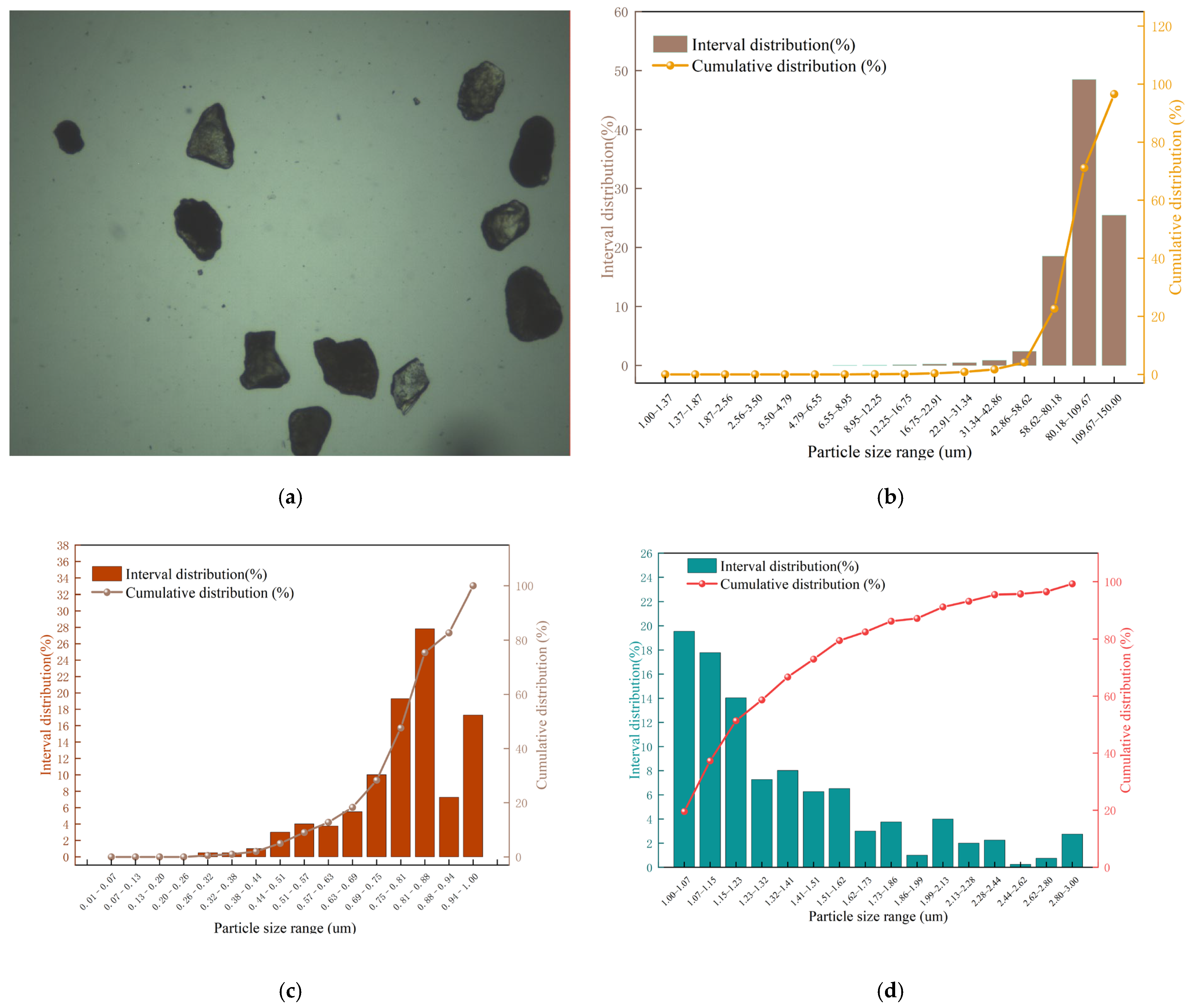
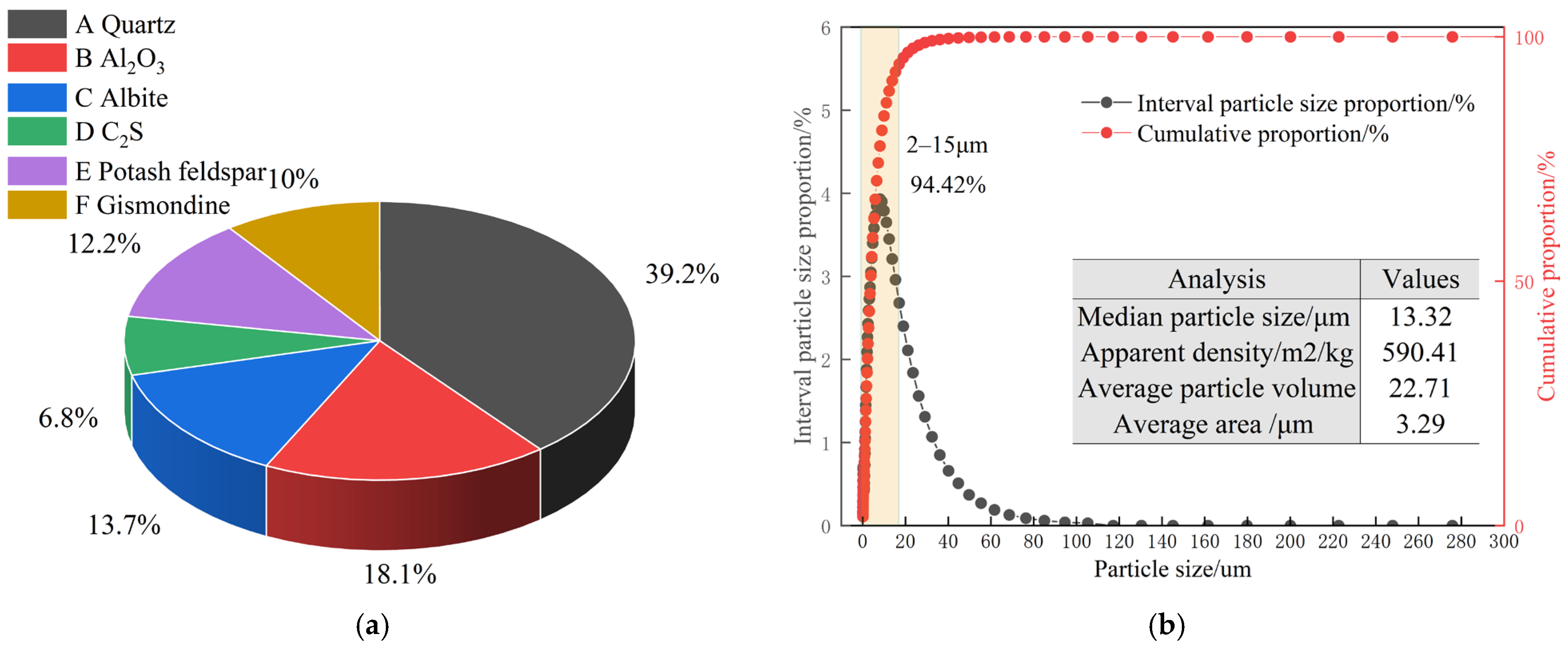
The cementitious material used in this study was Jidong PO42.5 Portland cement (Jidong Cement Co., Ltd., Tangshan, Hebei, China). Its chemical composition and physical–mechanical properties are shown in Table 1. For the mineral admixture, aeolian sand from the Ulan Buha Desert (Ulan Buha Desert, Inner Mongolia Autonomous Region, China) was ground into aeolian sand powder (ASP) using a WEM-10 ultra-fine grinding vibration mill (Wuxi Weite Mechanical Equipment Co., Ltd., Wuxi, China), presenting as a gray powder. Its microscopic morphology, particle size distribution, phase composition, and quantitative phase analysis are shown in Figure 1 and Figure 2. As indicated in Figure 1a,b, ASP consists of flocculent and irregular block-shaped particles, with its phase composition dominated by quartz, Al2O3, albite (Na(AlSi3O8)), potassium feldspar (K(AlSi3O8)), and a small amount of C2S—among which quartz exhibits the highest diffraction peak intensity. Combined with the quantitative analysis and particle size distribution diagram in Figure 2a,b, the quartz content in ASP is 39.2%, and the content of Al2O3 and other components accounts for 60.8%; the median particle size of ASP is 13.32 μm, specific surface area is 590.41 m2/kg, average volume diameter is 22.71 μm, average surface diameter is 3.29 μm, and the proportion of particles with a size of 2–15 μm is 94.42%. The chemical composition of the aeolian sand powder is given in Table 2. (Note: Aeolian sand is mainly composed of quartz and feldspar (as shown in Table 2, with SiO2 content of 43.5% and Al2O3 content of 9.0%). It differs from traditional pozzolans (such as fly ash, which contains a large amount of reactive SiO2 and Al2O3 and has a loose structure) in terms of mineralogical and chemical composition. Traditional pozzolans possess typical pozzolanic activity, while aeolian sand exhibits pozzolanic-like reaction characteristics under alkali activation, rather than a strictly defined pozzolanic effect).
Fine aggregates included ordinary river sand (RS) and aeolian sand (AS) from Ulan Buha (Ulan Buha, Inner Mongolia Autonomous Region, China). Table 3 gives the physical properties of AS and river sand. It can be seen that the fineness modulus of aeolian sand is 0.6, which is much lower than that of river sand, indicating that the particle size of aeolian sand particles is much smaller than that of river sand. The larger the surface area of the sand per unit weight, the greater the water demand, and under the same dosage of cementitious materials, there is a negative effect of reducing the strength of the concrete. At the same time, from the analysis of the particles of Figure 3a–d, it can be seen that the median particle size of the AS is 105.67 μm, the average roundness is 0.80, the average length to diameter ratio is 1.44, and it shows a more regular apparent morphology. The coarse aggregate was 5–25 mm crushed stone with continuous grading (Hohhot Quarry Co., Ltd., Hohhot, Inner Mongolia Autonomous Region, China), a bulk density of 1550 kg/m3, and an apparent density of 2680 kg/m3. The water used was ordinary tap water. The admixture was a polycarboxylate superplasticizer produced by Jiangsu Zhaojia Building Material Technology Co., Ltd. (Xuzhou, China). The polycarboxylate superplasticizer was a white powder, with a water reduction rate of 20% and a water content of 2.3%. (Note: The admixture is a material added during the concrete mixing process, and its quantity does not exceed 5% of the mass of cement, so as to change the properties of the mixture in the fresh and/or hardened state in accordance with EN 934-2 [22]). Activators included NaOH powder and sodium silicate solution (commercially known as water glass). The chemical composition of the sodium silicate solution is shown in Table 4.

2.2. Mix Ratio Design

According to the Standard of Test Methods for Properties of Ordinary Concrete Mixes (GB/T50080-2016) [24], C40 ordinary concrete (OC) was prepared. Firstly, 50% of the aeolian sand (AS) replaced the river sand to prepare the aeolian sand concrete (ASC), and then ASP was prepared by replacing the cement in ASC by 50% mass for preparation of aeolian sand powder–aeolian sand concrete (ASPC), and the ASPC group was named as ASPC, ASPC-A-B, where ASPC represents the aeolian sand powder–aeolian sand concrete, A represents the NaOH admixture in concrete, and B represents Na2SiO3. Details are shown in Table 5.

2.3. Evaluation of the Mechanical Properties and Microstructure of ASPC

2.3.1. Mechanical Properties of ASPC

To evaluate the mechanical performance of the ASPC specimens, their compressive strengths were measured on 100 mm × 100 mm × 100 mm specimens after 3, 7, 14, and 28 d of curing, according to the Chinese GB/T50081-2002 [25] standard. Three specimens per mixture were tested, and the mean result was reported. After 28 d of curing, a split tensile strength test was also carried out on three cubic specimens (10 cm per side) according to the Chinese GB/T50081-2002 standard.
The concrete specimens were wrapped in polyethene films and cured in a climatic chamber at T = 22 °C ± 1 °C and relative humidity > 95% for 28 d. Specimens were removed for testing after being cured for 3, 7, 14, and, finally, 28 d. The plastic films were removed, and the specimens were left at room temperature (i.e., T = 22 °C ± 1 °C) and relative humidity = 50% ± 5% before testing.

2.3.2. Microstructural Characterization of ASPC

Samples were taken from the specimens used for the mechanical testing and subjected to SEM–EDS analysis. A Tescan-Mira-Lms microscope (Tescan Orsay Holding, Brno, Czech Republic) was used to analyze the ASPC microstructure under the action of the composite activator, and an Xplore 30 Point EDS system was used to determine the elemental composition of the hydration products.
Subsequently, the phase transitions of the hydration products in the ASPC were analyzed by TG-DSC, XRD, and FTIR spectroscopy under the action of the composite activator, and the effect of the composite activator on the micromechanical properties of the mortar and aggregate bonding surface (ITZ) of the concrete system was analyzed by means of nanoindentation. Finally, the effect of the composite activator on the pore structure in ASPC was examined by NMR characterization methods. For the TG-DSC characterization method, a TA-SDT-Q600 comprehensive simultaneous thermal analyzer (TG-DSC) from the United States was used to derive the changes in the content of hydration products in concrete. The selected specimens were prepared into 200-mesh powder through slicing and grinding operations. The specific characterization method parameters are as follows: the temperature range is from room temperature 30 °C to 1000 °C, the heating rate is 10 °C/min, the crucible is an alumina crucible, and the blowing gas and protective gas are nitrogen.
The XRD analysis was performed using a Mini-Flex-600 X-ray diffractometer with a Cu target, a scanning rate of 2°/min, and a scanning range of 5–90° to determine the phase composition of ASPC before and after activation.
The characteristic spectral bands of the functional groups of ASPC before and after activation were determined via FTIR using a Thermo-Scientific IS-10 FTIR spectrometer at a scanning range of 4000–400 cm−1 with a resolution of 2 cm−1.
To measure the porosity ratio of concrete, NMR spectra were recorded using an OMR Neumark MES-23-060v-i spectrometer. Samples were prepared by placing 28-day specimens of ASPC before and after activation in a −0.8 MPa vacuum water saturation device for 24 h to achieve water saturation.
Nanoindentation characterization was performed using a Hysitron TI 950 UNHT from Austria, with a maximum load of 1000 mN, a load rate of 6 nN, a total stroke of the indenter of 1.5 mm, a maximum indentation depth of 320 μm, a displacement range of 80 μm, a precision of 0.04, a displacement resolution of <0.01 nm, a sample stage x-axis and y-axis resolution of 1.5 μm, and a data acquisition frequency of 100 kHz.
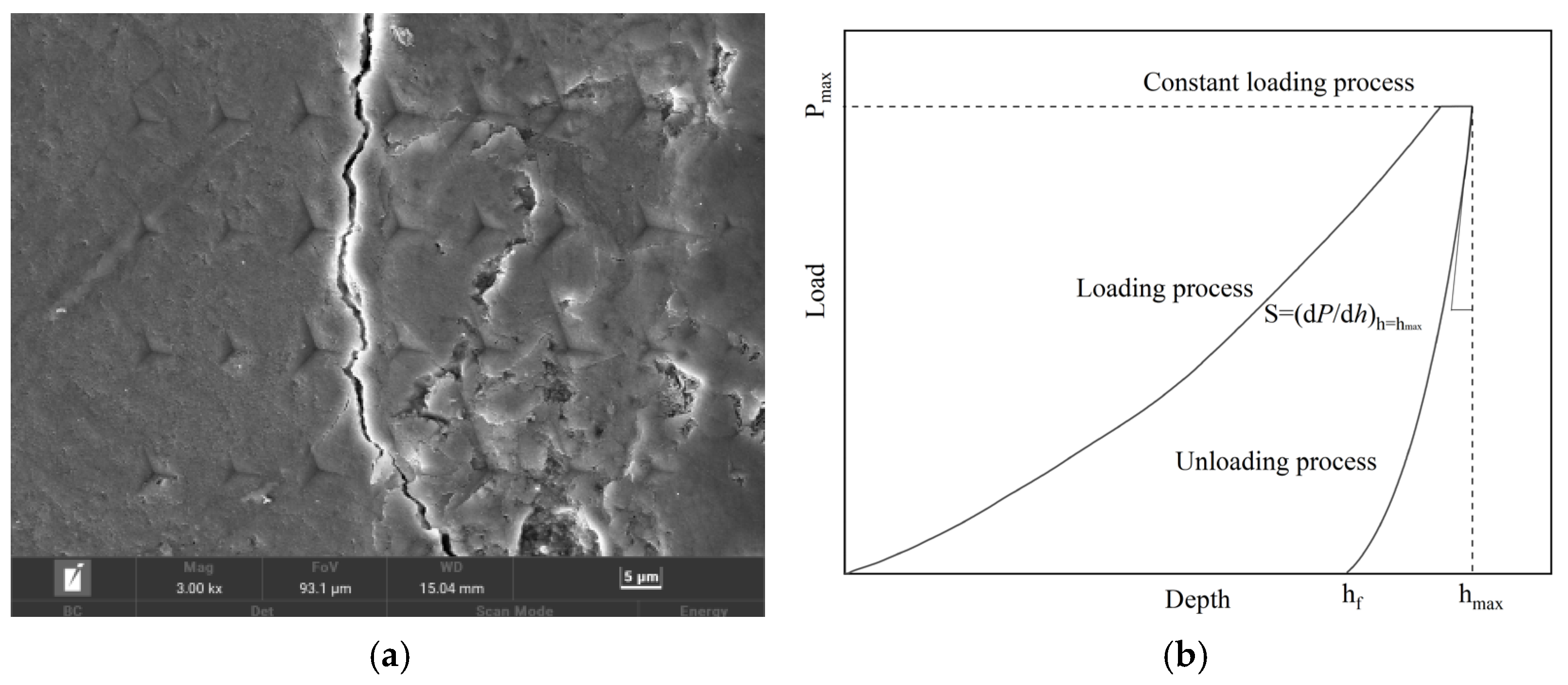
A suitable ITZ for each group of ASPC was determined using an optical microscope. By taking the aggregate as the base point 20 μm from the edge of the ITZ, matrix nanoindentation characterization was performed in two directions with horizontal and vertical intervals of 10 μm to obtain a 10 × 4 grid indentation matrix with an area of 90 μm × 30 μm. Three indentation matrices were selected from the ASPC surface to perform the nanoindentation characterization on the ITZ; the corresponding results are shown in Figure 4a. Subsequently, the load control mode was adopted, and the indenter was linearly loaded to 2 mN at a rate of 0.2 mNs−1. The load was then maintained for 10 s and linearly unloaded at a rate of 0.2 mNs−1. The load value and displacement of the characterized material were recorded during the characterization to obtain the load–displacement (p–h) curve (Figure 4b).
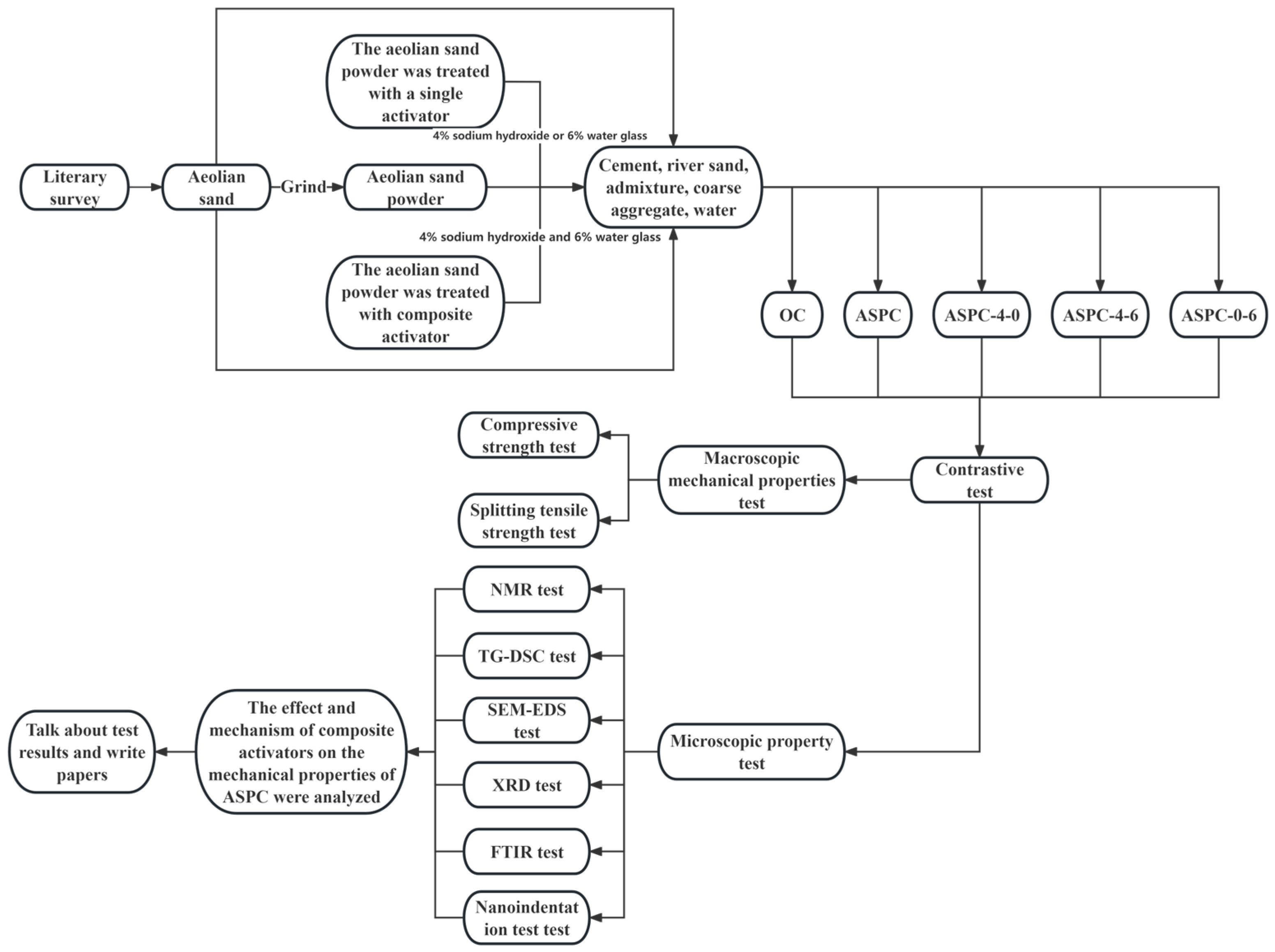
The main objectives of this paper are as follows: 1. Realize the multi-directional utilization of aeolian sand under large-dosage conditions, that is, replace river sand with aeolian sand and grind aeolian sand into fine powder to replace cement in equal mass for the preparation of ASPC. 2. Conduct comparative tests on APSC with single alkali activation and composite alkali activation using NaOH and Na2SiO3, and then derive the mechanism of composite alkali activation in the enhancement of the mechanical properties of ASPC. The specific technology roadmap is shown in Figure 5.

3. Results and Discussion

3.1. Effect of Complex Activator on the Mechanical Properties of ASPC

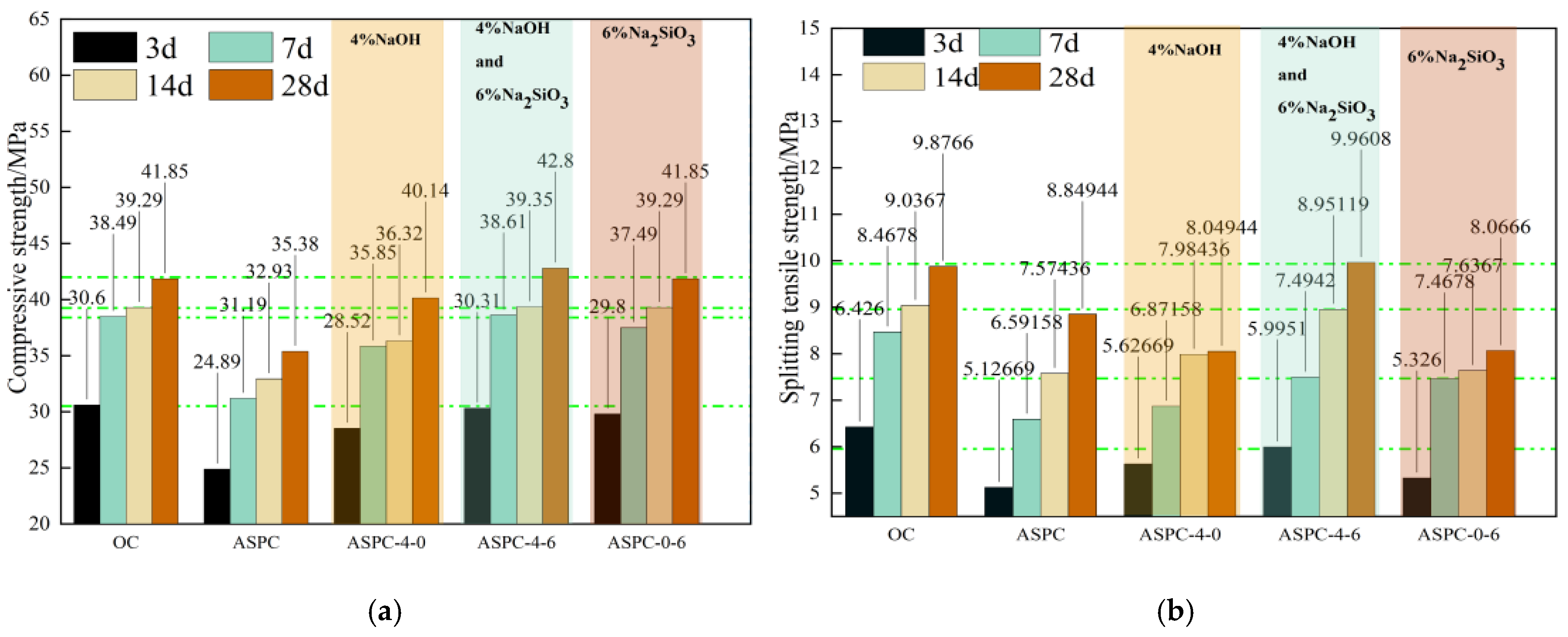
The compressive strength and splitting tensile strength of the ASPC group are observed to be lower than those of OC, as depicted in Figure 6a,b. This disparity can be attributed to the higher specific surface area of AS compared to river sand. When the substitution rate of river sand reaches 50%, it leads to an increase in water requirement for concrete, while the high dosage of ASP results in severe agglomeration during mixing. Consequently, this significantly reduces the cement hydration degree, thereby affecting mechanical properties [26,27,28,29,30,31]. Upon individual addition of NaOH or Na2SiO3, slight improvements are observed in the mechanical properties of ASPC-4-0 and ASPC-0-6 groups compared to the ASPC group. However, the mechanical properties of ASPC-4-0 and ASPC-0-6 are still lower than those of ordinary concrete. This discrepancy may arise due to partial decomposition of ASP caused by NaOH addition and promotion of cement hydration reaction. Nevertheless, since both NaOH and Na2SiO3 possess alkaline characteristics, they collectively decrease the alkali warning value within the concrete system leading to the generation of a water-absorbing and easily expandable N-A-S-H gel [32,33].
When NaOH and Na2SiO3 were used in combination, the mechanical properties of ASPC-4-6 were much closer to those of ordinary concrete (OC): its compressive strength at 3 d, 7 d, 14 d, and 28 d increased by 20.2%, 23.1%, 16.3%, and 11.2%, respectively, compared to ASPC, while its splitting tensile strength increased by 15.1%, 15.9%, 17.6%, and 12.1%, respectively. The improvement mechanism may be as follows: NaOH in the composite activator ionizes to release OH, and Na2SiO3 also releases OH through hydrolysis; these two types of OH collectively accelerate the decomposition of ASP, promoting the reaction of SiO2 and Al2O3 inside ASP to generate SiO43− and AlO43−. These ions then react with Ca(OH)2 produced by cement hydration to form highly polymerized gels such as C-A-S-H, which fill pores and improve the mechanical properties of concrete [34,35,36]. Subsequently the NaOH and Na2SiO3, which are not reacted with ASP, will undergo an alkali neutralization reaction to produce silicate and water; at this time, there is no excess OH in the concrete system, so it reduces the generation of alkali aggregate reaction. However, there is an excess of NaOH and Na2SiO3 in ASPC-4-0 and ASPC-0-6; after reacting with ASP, there is still a high amount of OH present, which will result in the generation of an alkali–aggregate reaction, which in turn will lead to the mechanical properties of ASPC-4-0 and ASPC-0-6 groups being not significantly improved compared to the ASPC group [37,38].
In order to further investigate the effect of the enhancement mechanism of compounding NaOH and Na2SiO3 composite on the mechanical properties of ASPC, 28-day microscopic analyses were conducted on ASPC, ASPC-4-0, ASPC-4-6, and ASPC-0-6.

3.1.1. SEM–EDS Analysis

From the above mechanical properties, it can be seen that the composite activator can improve the mechanical properties of ASPC compared to a single activator; so the apparent morphology of each group of concrete was analyzed using the SEM characterization methods first. The elemental classes of the hydride phases of the apparent morphology were subsequently analyzed using EDS characterization methods for subsequent microscopic characterization methods.
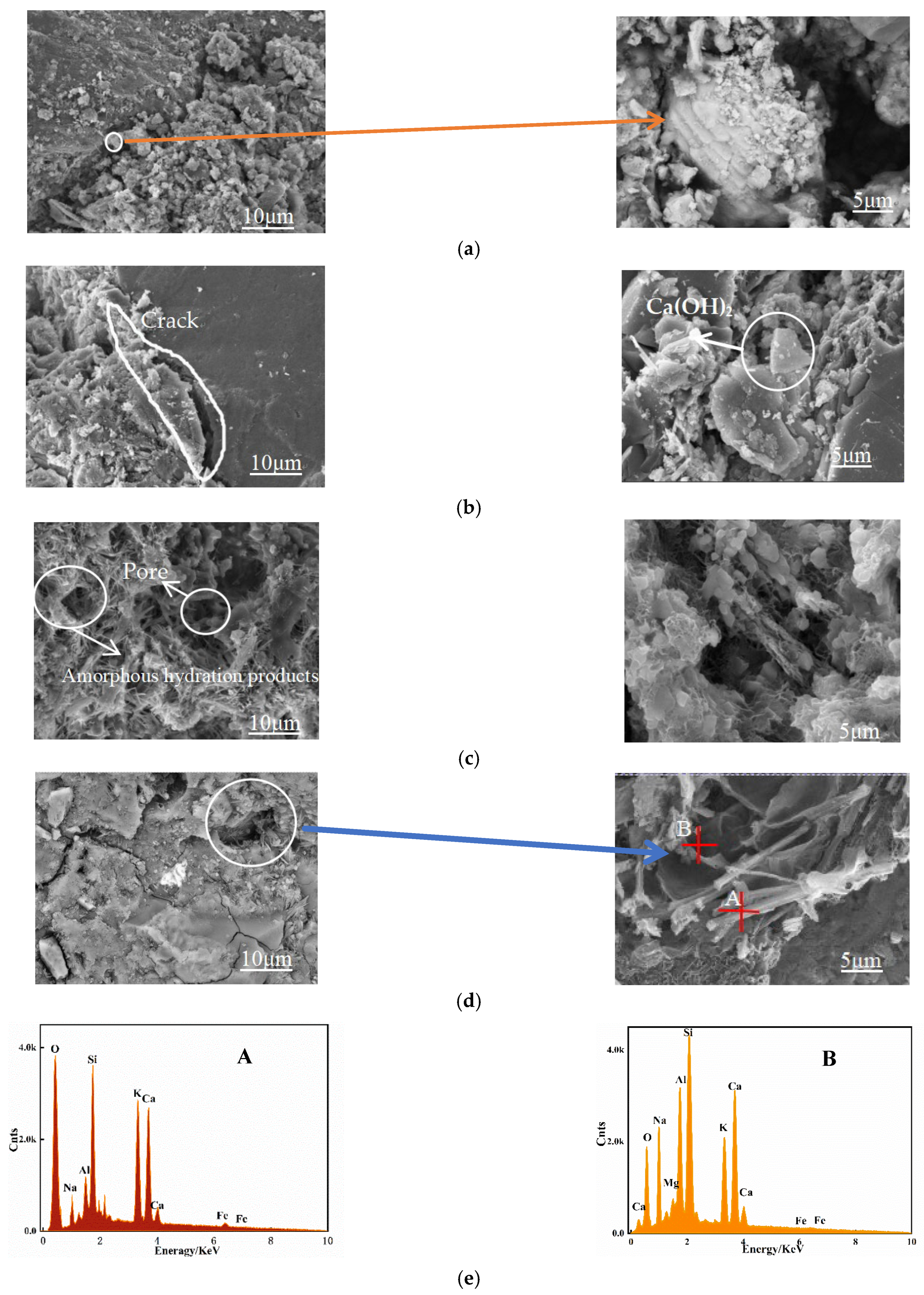
Figure 7 shows the SEM images of each group. As shown in Figure 7a–d, ASPC-4-0 and ASPC-0-6 have fewer flake-like hydration products and more amorphous and indistinctly outlined hydration products than ASPC, and according to Figure 7a–c, it can be seen that there are a large number of hydrated ASP particles in ASPC, and although there are no obvious un-hydrated cement particles in ASPC-4-0 and ASPC-0-6, there are obvious cracks, an amorphous hydride phase, and microscopic pores. However, as illustrated in Figure 7d, the internal pores of the ASPC-4-6 sample are filled with elongated prismatic hydration products that form in a dispersed and interlaced distribution. When alkali-activated aluminosilicates (geopolymers) undergo a polycondensation reaction, zeolites (crystalline aluminosilicates) may form as secondary phases under specific conditions. Potassium A-type zeolite crystals, which have higher strength and a filling function, may be generated inside concrete. Combined with the energy dispersive spectroscopy (EDS) analysis results presented in Figure 7e, the elemental detection of the elongated prismatic hydration products reveals that their main components include calcium, silicon, aluminum, potassium, oxygen, and a small amount of magnesium. This elemental composition is consistent with the characteristic elemental makeup of potassium A-type zeolite crystals.

3.1.2. TG-DSC

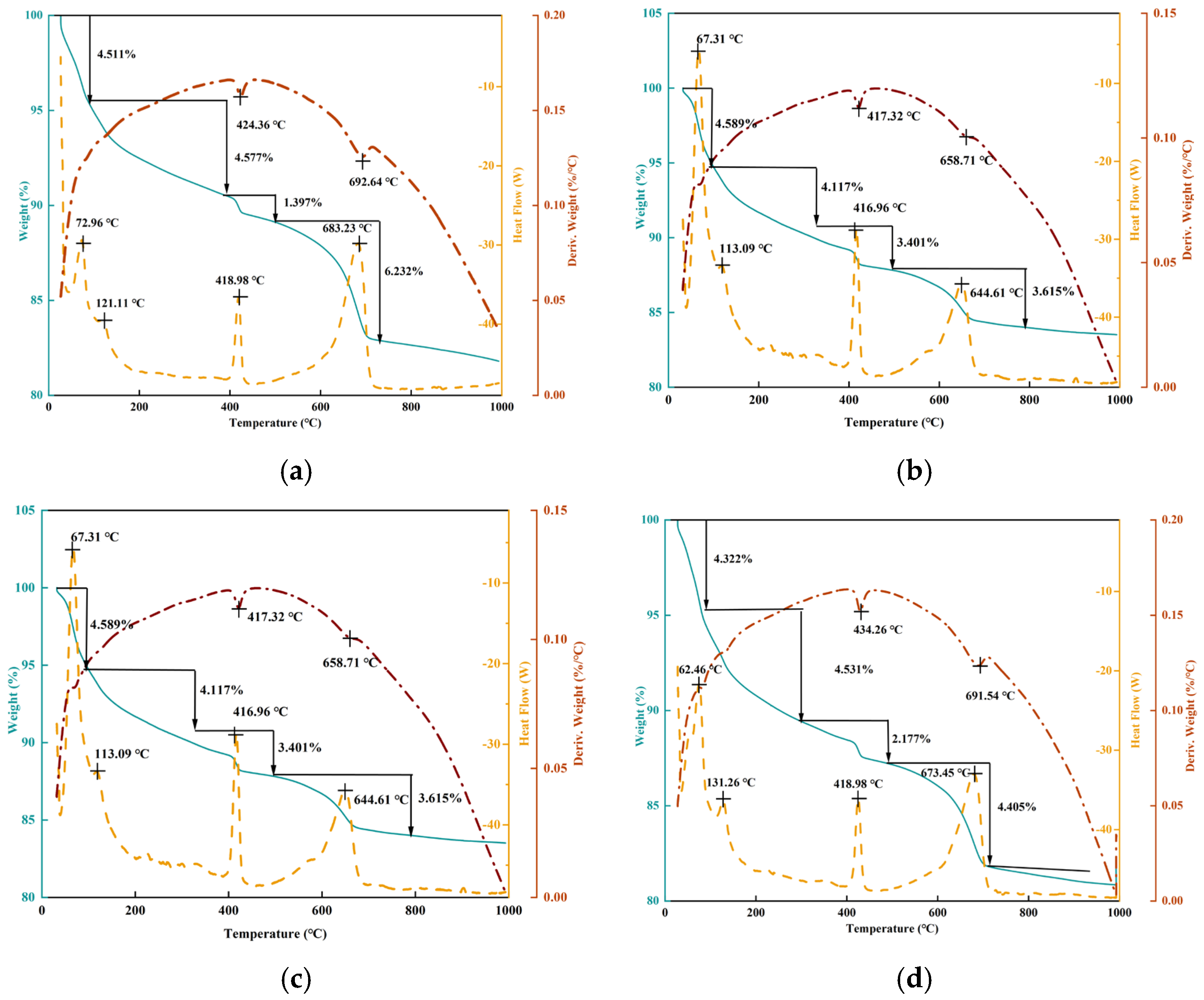
Based on the above scanning electron microscope test, it can be seen that compared with ASPC-4-0 and ASPC-0-6, ASPC-4-6 has fewer internal amorphous materials and un-hydrated cementitious material particles, and more prismatic hydration products are present, showing a pore-filling microscopic characteristic. Therefore, simultaneous thermal analyses of each group of concrete samples (28-day curing age) from the aspect of hydration products were carried out by using the TG-DSC characterization method. The samples were quenched to stop hydration before testing. The results of the TG-DSC characterization are shown in Figure 8. The temperature range and mass loss behavior were analyzed by examining the TG-DSC curves of the four groups of samples (ASPC, ASPC-4-0, ASPC-4-6, and ASPC-0-6). This allowed the thermal behavior to be divided into three key temperature ranges. The mass loss and thermal effects within each range correspond to the different changes in the hydration products.
The 25–220 °C range: This range mainly corresponds to the removal process of free water and weakly bound water [39]. The mass loss rate of ASPC-4-6 is the highest, reaching 6.23%, followed by ASPC-4-0 (5.60%) and ASPC-0-6 (5.28%), while the mass loss rate of pure ASPC is the lowest, at 4.511%. The difference in mass loss rates indicates that the composite alkali activator (used in ASPC-4-6) promotes the formation of more hydration products containing weakly bound water, such as C-S-H gels, etc. This is consistent with the “more thorough pore filling” phenomenon observed in the microscopic morphology. The higher water loss in the ASPC-4-6 system is mainly due to the presence of more hydration products containing bound water, rather than the higher water content in the added activator.
The 220–600 °C range: This range corresponds to the removal process of strongly bound water (such as the decomposition of chemically bound water in C-S-H gels). The mass loss rate of ASPC-4-6 in this range is 4.16%, significantly higher than the other groups (ASPC-4-0 at 3.23%, ASPC-0-6 at 3.06%, and pure ASPC at 2.97%). Judging from the peak intensity of the combined heat flow curve (dTG), this indicates that the composite activator increases the polymerization degree of the hydration products and the content of strongly bound water, making the gel structure more stable.
The 420–500 °C range: This range mainly represents the dehydration and decomposition process of Ca(OH)2 [40]. The mass loss rate of ASPC-4-6 in this range is 3.58%, lower than ASPC-4-0 (3.94%) and ASPC-0-6 (3.74%), similar to pure ASPC (3.17%). This indicates that the composite activator consumes more Ca(OH)2 to form C-S-H gels, reducing the content of free Ca(OH)2 in the system and optimizing the composition of the hydration products. The previous incorrect assignment of the Ca(OH)2 decomposition temperature range (600–800 °C) was a misanalysis; the correct decomposition temperature range for Ca(OH)2 is 420–500 °C.
The thermal effects and the evolution of hydration products can be further analyzed from the position and intensity of the endothermic peaks in the DSC curve, indicating the thermal stability of the hydration products. The endothermic peak intensity of ASPC-4-6 at 430.2 °C (corresponding to Ca(OH)2 decomposition) and 550–600 °C (corresponding to the removal of strongly bound water) is significantly higher than the other groups. The thermal effects corresponding to the removal of strongly bound water and the decomposition of Ca(OH)2 are more significant, indicating better crystallinity and stability of the hydration products. The endothermic peak of pure ASPC is weaker overall, suggesting a lower hydration degree and more unreacted cement particles and pores, which is consistent with the “lowest strength” result in the mechanical property test. The mechanism of the composite alkali activator is known from the TG-DSC results: The composite alkali activator (NaOH + sodium silicate solution) enhances the performance of concrete through the following ways: promoting the formation of more hydration products containing bound water (such as C-S-H gels), increasing the density of the system, and improving the polymerization degree and thermal stability of the hydration products, thereby enhancing the macroscopic mechanical properties of the concrete.

3.1.3. XRD and FTIR Phase Analysis

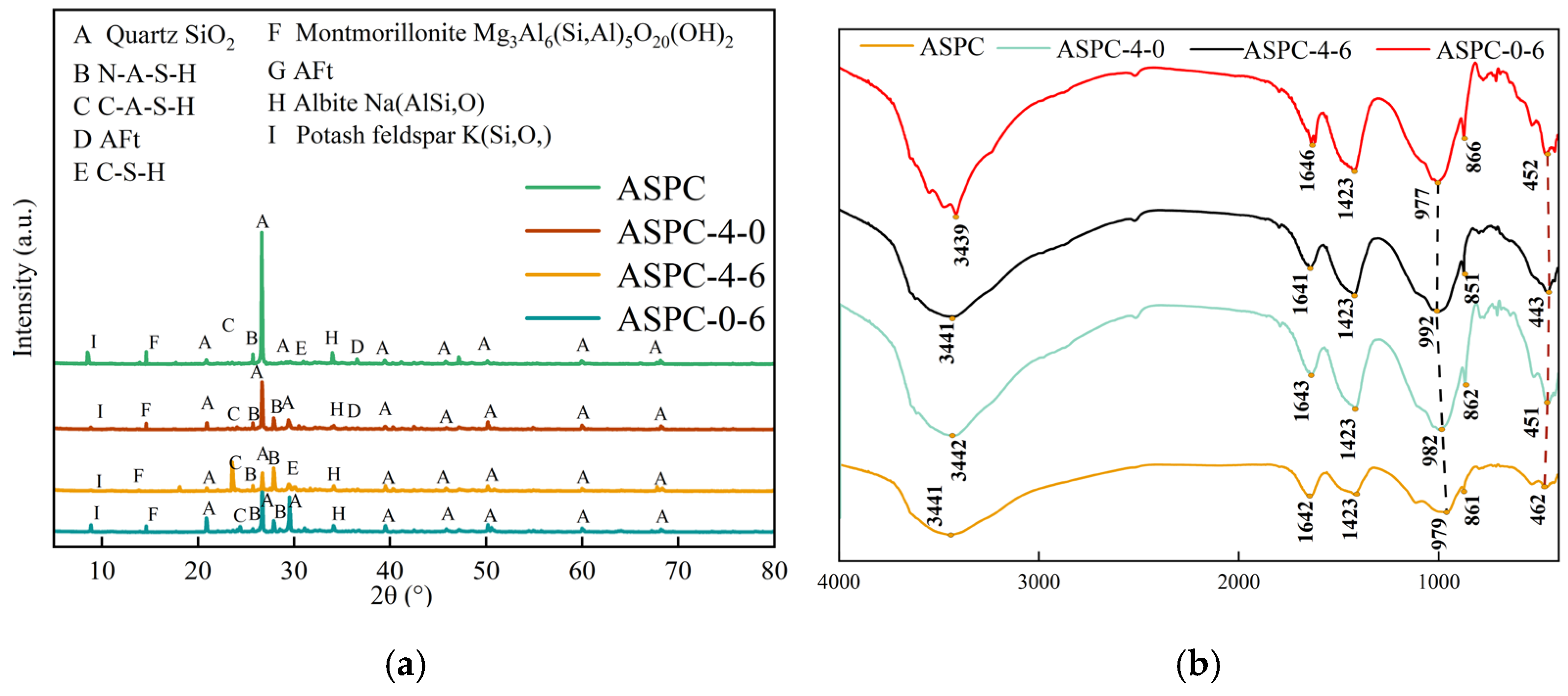
SEM and TG-DSC characterization revealed that compared with ASPC-4-0 and ASPC-0-6, ASPC-4-6 exhibited a micro-characteristic of pore filling and more stable hydration phases. To investigate the mechanism behind the enhancement of mechanical properties in ASPC by composite activators at both phase and molecular levels, XRD and FTIR measurements were conducted on gel products. The XRD spectra of ASPC showed distinct peaks of quartz, montmorillonite (swollen by water absorption), and C-A-S-H, as shown in Figure 9a. (Note: There is no dolomite in the XRD pattern, and the previous mention of dolomite was incorrect.) In contrast, the montmorillonite diffraction peaks disappeared while the diffraction peaks of other impurities weakened in the XRD patterns of ASPC-4-0, ASPC-4-6, and ASPC-0-6, with sharp characteristic diffraction peaks appearing in C-S-H and C-A-S-H gels. The diffraction peaks of N-A-S-H gel were observed in both ASPC-4-0 and ASPC-0-6. The high concentration of OH ions in the concrete system causes N-A-S-H gel to easily swell upon water absorption. Although it effectively reduces the diffraction peaks of crystals such as SiO2 at 2θ = 28°, potassium feldspar at 2θ = 9°, and montmorillonite at 2θ = 14°, which can enhance the mechanical properties of concrete to a certain extent, it may also result in a low alkali warning value and generate N-A-S-H gel that is not conducive to improving the mechanical properties of concrete. The characteristic peak of N-A-S-H gel at 2θ = 26° was attenuated, while the dispersion peak at 2θ = 23° became more intense and sharper, indicating a higher polymerization degree of C-A-S-H gels within ASPC-4-6. Moreover, Figure 9b illustrates FTIR spectra revealing that the structural characteristic bands of hydration products in all samples primarily resided within the range of 900–1300 cm−1 due to asymmetric vibration originating from Si-O-T (T: Si/Al) structures present in the gel.
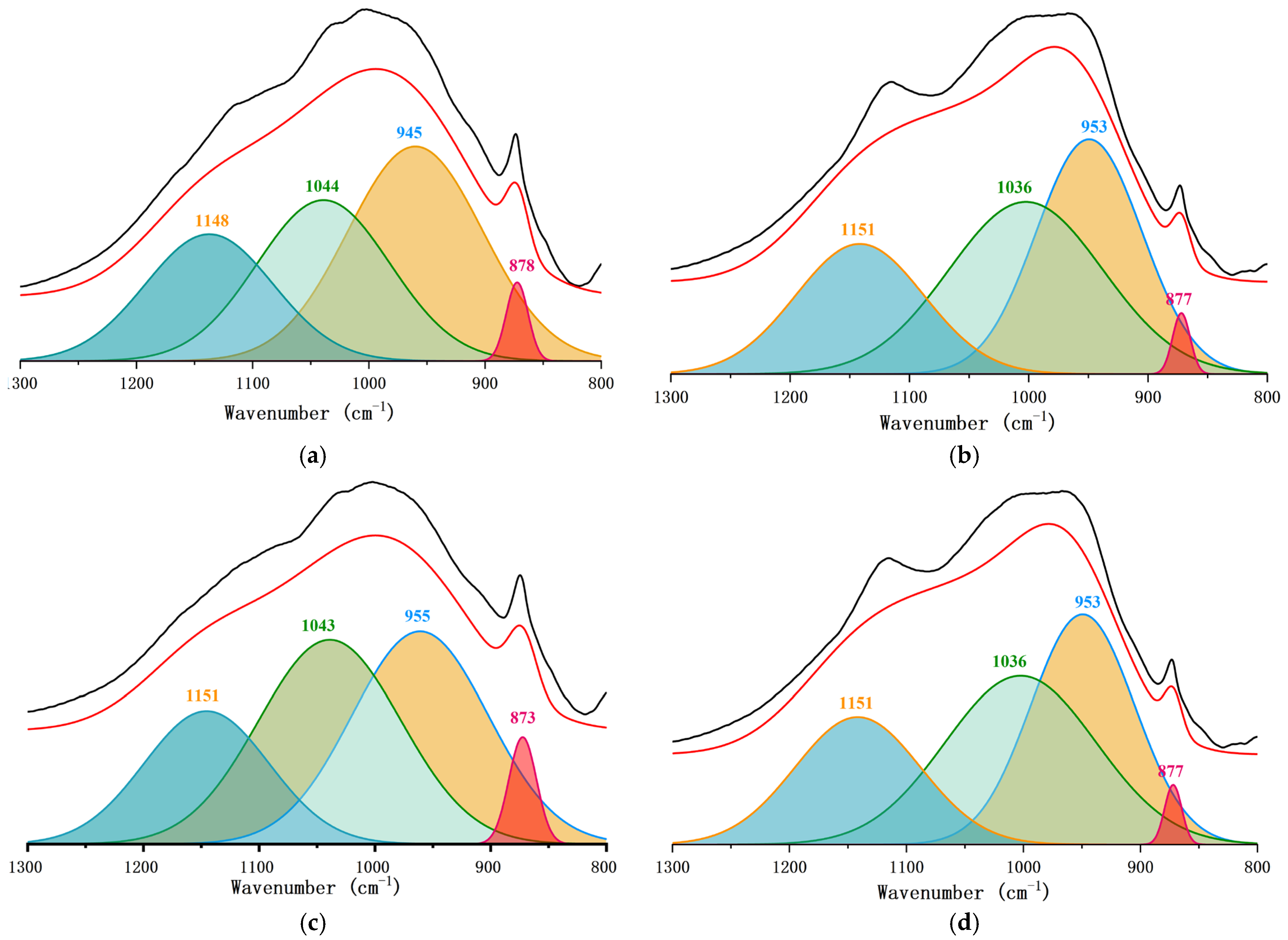
The ASPC-4-0, ASPC-4-6, ASPC-0-6, and ASPC groups exhibit IR absorption bands at 466, 458, 467, and 477 cm−1, respectively, corresponding to the Si–O bending vibration in the SiO4 group. This indicates that OH reduces the degree of polymerization of some SiO2 in ASPC, forming silicate and aluminosilicate gels [41]. Meanwhile, the peak wavenumber of the asymmetric vibration of Si–O–T bonds in the ASPC-4-0 and ASPC-0-6 groups is similar to that of ASPC. However, in ASPC-4-6, the peak wavenumber of the asymmetric vibration of Si–O–T bonds increases from 984 to 1006 cm−1, indicating the formation of aluminosilicate gel products with a higher degree of internal polymerization. Spectral analysis of the main absorption peaks distributed in the range of 800–1300 cm−1 reveals that in the ASPC-4-6 group, the deconvoluted peak area of non-polymerized silicate in the 800–900 cm−1 range considerably decreases, whereas the deconvoluted peak area of C-S-H in the 900–980 cm−1 range and hydrated aluminosilicate in the 980–1050 cm−1 wavenumber range markedly increases. At the same time, the relative concentration of Si-O-T in the 980–1050 cm−1 range increases from 32.67% to 42.76%, indicating the generation of new crystalline phase materials. The Gaussian fitting analysis was conducted on the four sets of FTIR curves, and the peak curves of the four sets of curves in the range of 800–1300 cm−1 were obtained. Further spectral analysis of ASPC-4-0, ASPC-4-6, and ASPC-0-6 reveals that in the ASPC-4-0 and ASPC-0-6 groups, as shown in Figure 10a–d, a strong absorption peak appeared at 980–1002 cm−1, while the relative area of the absorption peak at 1002–1050 cm−1 was relatively low, and there were more amorphous gel substances (N-A-S-H) inside ASPC-4-0 and ASPC-0-6, while the content of the high-polymerized C-A-S-H gel with three-dimensional network structure was lower. For ASPC-4-6, as shown in Figure 10c, a strong absorption peak at 1002–1050 cm−1 and a large increase in the relative area of the absorption peak at 980–1002 cm−1 indicate that a large number of highly polymerized C-A-S-H gels with an internal three-dimensional network structure have been generated, whereas the content of amorphous water-absorbing and easy-to-swell substances has been reduced relatively. Meanwhile, owing to the hydration of cement, a large amount of Ca2+ replaces Na+ in the C-A-S-H gel to form a high-polymerized C-A-S-H gel, which also increases the content of C-A-S-H gel in ASPC. These results show that compared with the ASPC group, the improvement of the mechanical properties of ASPC-4-6 is due to the formation of stronger A-type potassium zeolite crystals and the generation of higher polymerization of C-A-S-H gel [42]. The reduction in the amorphous water-absorbing and easy-to-expand hydration phase in ASPC-4-6 also indicates that compared with a single alkali activator, the composite alkali activator can effectively reduce the alkali–aggregate reaction in the concrete system caused by OH. The OH content in the system was determined by the combination of TG-DSC (consumption of Ca(OH)2) and FTIR (changes in Si-O-T bond polymerization degree) results. Although the ASPC-4-6 system has a higher alkali content, the OH is effectively consumed in the reaction to form hydration products; so there is no excess OH to cause an alkali–aggregate reaction, which is different from the ASPC-4-0 or ASPC-0-6 system where excess OH remains.
It should be noted that the previous experimental design had an inappropriate comparison: the composite alkali activator (with a higher alkali content) was compared with systems activated by single compounds with lower alkali content (such as NaOH or sodium silicate solution). This makes the results not directly comparable because the increased alkali concentration in the composite system significantly affects cement hydration. In future research, the alkali content in different activator systems should be unified to ensure the comparability of the results.

3.1.4. Analysis of Micromechanical Properties at the ITZ

Combined with the SEM, TG-DSC, XRD, and FTIR analyses, these results reveal that when the compound NaOH is combined with Na2SiO3, large pores in ASPC are filled with interwoven structures of C-S-H, C-A-S-H, and potassium A-type zeolite crystals. This indicates that the composite activator finally improves the pore structure and compactness of the concrete system. In order to further verify the mechanism of the improvement of the mechanical properties of the concrete system by the composite activator, the nanoindentation characterization methods are used to investigate the relevant properties of the interface transition zone between mortar and aggregate in each group of ASPC.
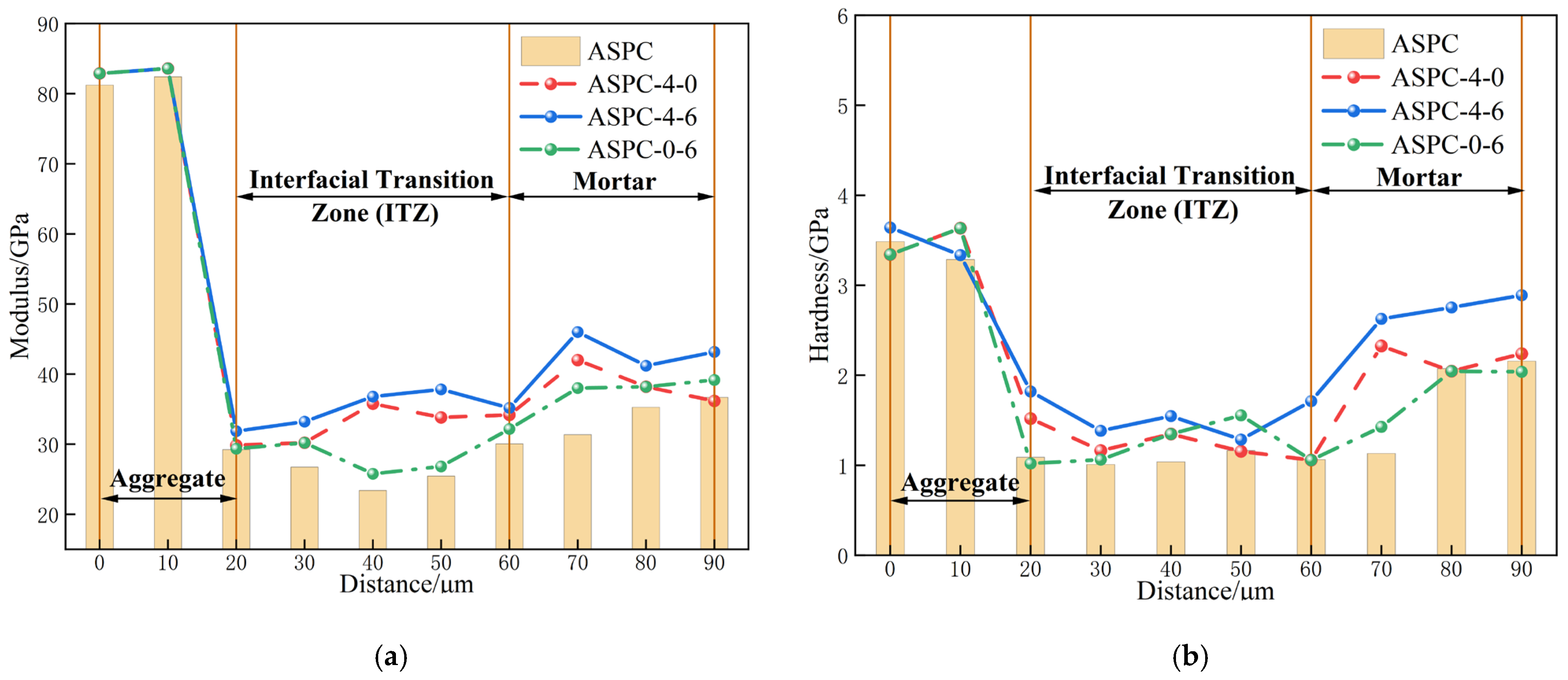
The ITZ is the interface between coarse aggregate and mortar, and its micromechanical properties considerably affect the macro-mechanical properties of ASPC [43]. The micromechanical properties of ITZ were analyzed effectively using nanoindentation characterization methods. The results effectively revealed the microstructural properties of concrete materials as well as the indentation modulus and hardness of the aggregate, ITZ, and mortar matrix [44,45]. The micromechanical properties of the ITZ of each group of concrete were also intuitively compared. Figure 11a,b shows the average distribution of the indentation modulus and hardness of ITZ in the three indentation areas selected for each group of ASPC [45]. Each group of ASPC showed the same distribution law of the ITZ indentation modulus and hardness. The indentation modulus and hardness of aggregate were the highest, followed by those of mortar and the ITZ. The ITZ of concrete was its weakest link.
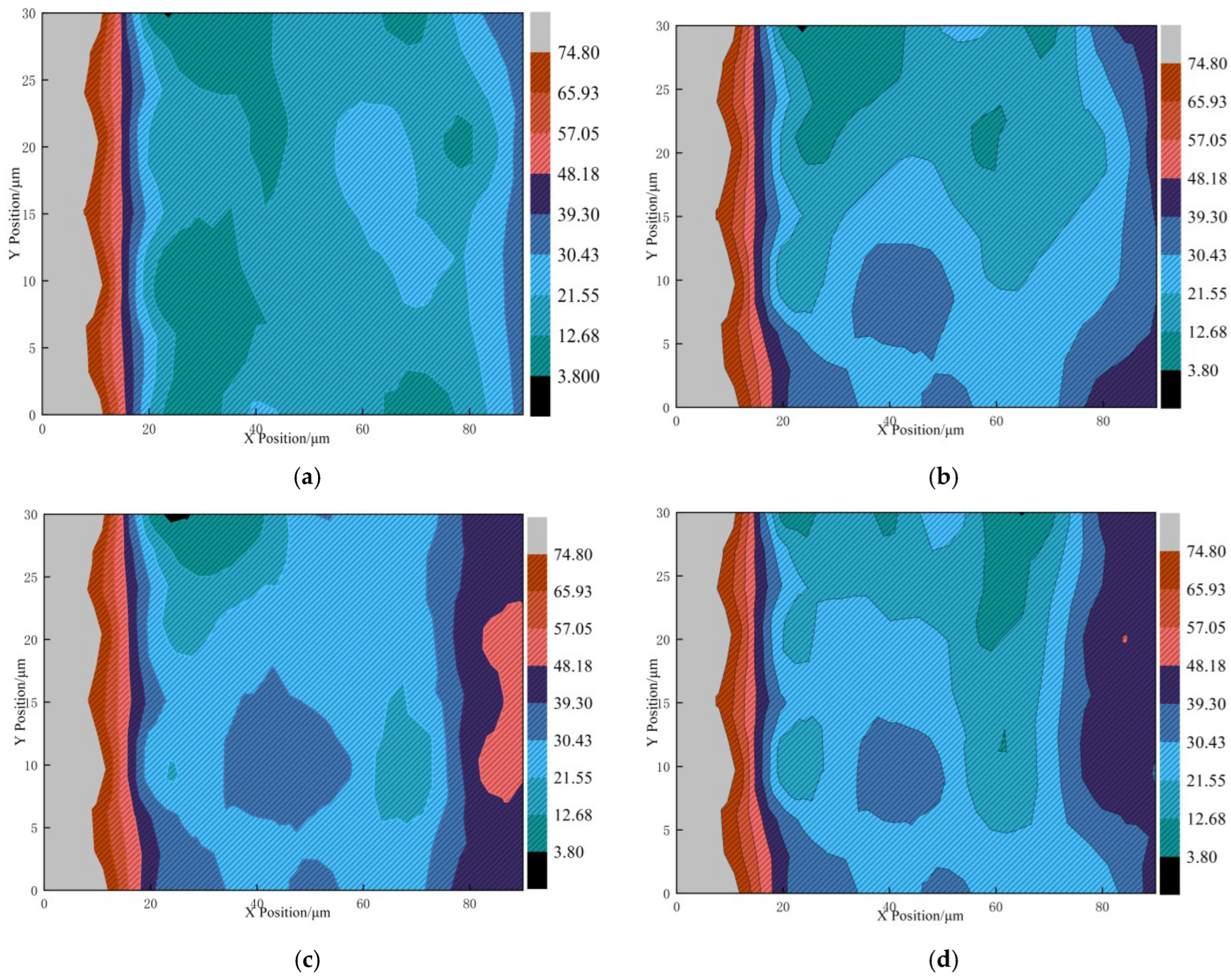
Figure 11 shows the hardness and modulus of the ITZ of each ASPC group after 28 days of curing. The hardness and modulus values of ASPC-4-0, ASPC-4-6, and ASPC-0-6 slightly improved and their ITZ thicknesses slightly decreased compared with ASPC. As shown in Table 6, the indentation modulus and hardness values of ASPC-4-0, ASPC-4-6, and ASPC-0-6 considerably improved upon adding NaOH and Na2SiO3 compared with those of ASPC. Moreover, the indentation modulus and hardness of the mortar and ITZ of ASPC-4-6 considerably improved compared with those of ASPC-4-0 and ASPC-0-6. Compared with those of ASPC, the indentation modulus and hardness values of ASPC-4-6 increased by 15.5% and 24.4%, respectively. Figure 12a–d show the elastic modulus cloud diagram. Upon adding NaOH and Na2SiO3, the coverage area of the high-strength hydrate phase in the ITZ of ASPC considerably increased compared with that of ASPC. Moreover, the ITZ area exhibited an obvious indentation phenomenon, which reduced its thickness from >80 to <80 μm. Compared with that of the ASPC groups, the coverage areas of the low-strength hydrate phase in the mortar matrix and ITZ of ASPC-4-6 were smaller; in contrast, the coverage area of the high-strength hydrate phase was the largest.
These findings indicated that the addition of NaOH and Na2SiO3 to ASPC considerably increased the coverage area of the high-density hydrate phase (C-A-S-H and potassium A-type zeolite crystals) at the ITZ. The high-density hydrate phase filled the pores, improved the micropore structure, and decreased the ITZ thickness; this consequently increased the indentation hardness and modulus of the ITZ.

3.1.5. NMR Spectroscopy Analysis

According to the above microscopic characterization, ASPC-4-6 produced more stable high polymeric hydride phase and potassium A-type zeolite in the hydration products, which promoted the mortar and aggregate at ITZ to bond more closely, and the micromechanical properties were greatly improved. Next, the pore structure of each concrete mix was analyzed via NMR spectroscopy.
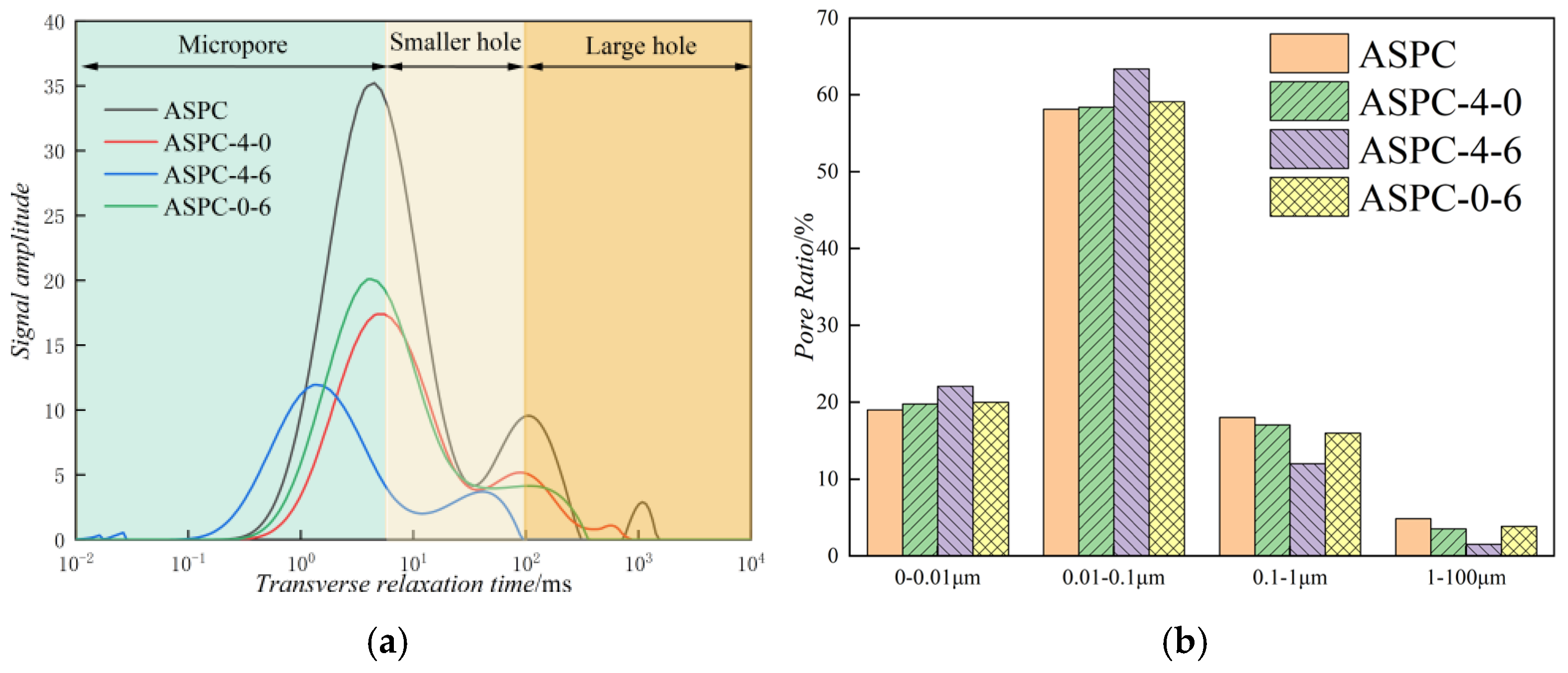
The NMR T2 spectrum is closely related to the pore distribution in concrete. Specifically, the magnitude of the T2 spectral area indicates the porosity of concrete [42]. The transverse relaxation time represents the pore size, with small transverse relaxation times indicating small pores [46]. As depicted in Figure 13a, after 28 days, the T2 spectra of all groups mainly comprised three spectral intervals, representing the relaxation of pore water in tiny, small, and large pores. The areas of the three spectral intervals of the T2 spectra for the ASPC-4-0, ASPC-4-6, and ASPC-0-6 groups considerably decrease compared with that of the ASPC group; however, only ASPC-4-6 exhibits a noticeable leftward shift in the T2 spectrum curve. This indicates a marked reduction in the number of large pores and optimization of the pore structure compared with ASPC-4-0 and ASPC-0-6. According to the relevant literature [47], concrete pores can be categorized as harmless pores (0–0.01 μm), less harmful pores (0.01–0.1 μm), harmful pores (0.1–1 μm), and highly harmful pores (1–100 μm). The proportion of small pores (harmless and less harmful pores) plays a decisive role in the mechanical properties of concrete. As shown in Figure 13b, the proportion of large pores (highly harmful and harmful pores) decreased by 0.10% and 0.12% in ASPC-4-0 and ASPC-0-6, respectively, compared with ASPC, whereas the proportion of small pores increased by 0.06% and 0.04%, respectively, resulting in an overall reduction in the porosity ratio by 0.03% and 0.08%, respectively. The ASPC-4-6 group exhibited a decrease in the proportion of large pores by 0.43% and an increase in the proportion of small pores by 0.21%, thereby decreasing the overall porosity ratio by 0.22% compared with ASPC. In ASPC-4-6, a decrease of 0.43% in the proportion of large pores compared with ASPC resulted in a conversion of 0.21% into small pores, whereas 0.22% of large pores were filled.
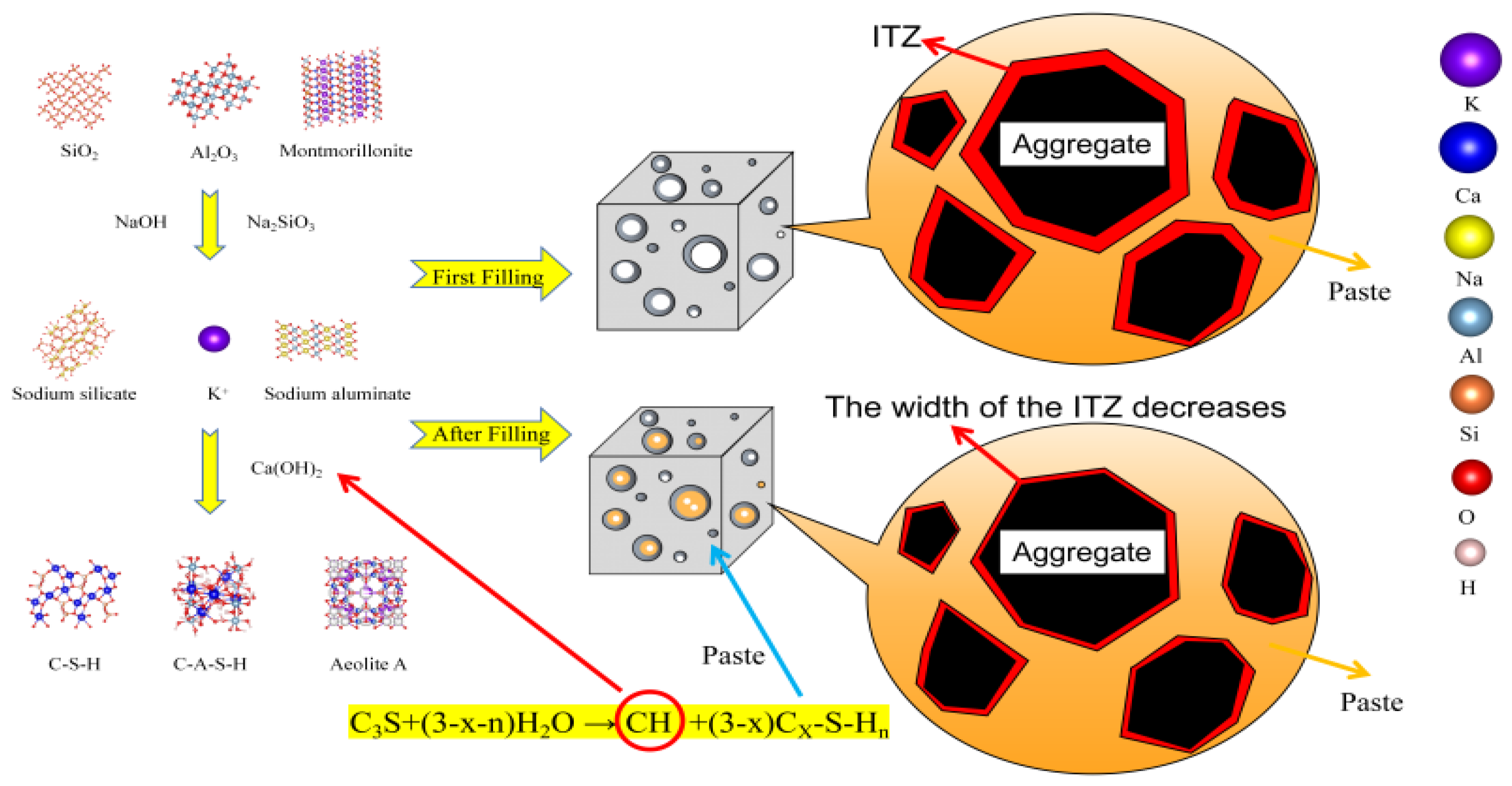
The combination of the above SEM characterization methods, TG-DSC, XRD characterization methods, FTIR characterization methods, nanoindentation characterization methods, and NMR characterization methods analyses shows that the composite alkali activators can better promote the mechanical properties of ASPC than single exciters. The enhancement mechanism lies in the fact that NaOH in the composite alkali activator will undergo an ionization reaction to produce OH, while Na2SiO3 will undergo a hydrolysis reaction to produce OH as well; the OH produced by both will react with SiO2 and Al2O3 in the ASP to form SiO43− and AlO43−, and with Ca(OH)2 produced by cement hydration to form highly polymerized hydrated phases such as C-A-S-H gels, as shown in Equations (1)–(5). Subsequently, NaOH and Na2SiO3, which are not involved in the reaction, undergo an alkali neutralization reaction to produce silicate and water, as shown in Equation (6). At this point, there is no excess OH in the concrete system, thus reducing the generation of N-A-S-H gel.
From the above analysis, it can be seen that the enhancement mechanism of ASPC mechanical properties by composite activators is shown in Figure 14. Accordingly, SiO2, Al2O3, montmorillonite, and other substances in composite cementitious materials form a tetrahedral and octahedral atomic group under the action of OH. These groups combine with elements such as Ca and Al produced during cement hydration to produce beneficial gels and strong potassium A-type zeolite crystals to fill the pores and improve the micromechanical properties of the interfacial transition zone, which in turn gives ASC-4-6 mechanical properties much higher than those of ASPC and close to those of OC. At 3 d, 7 d, and 14 d, the difference in compressive strength between ASPC-4-6 and OC is only 0.3 MPa, 2.2 MPa, and 0.53 MPa, while at 28 d, the compressive strength of ASPC is higher than that of OC by 0.28 MPa. For the split tensile strength, at 3 d, 7 d, and 14 d, the difference between ASPC and OC is only 0.4309 MPa, 0.9706 MPa, and 0.08551 MPa, and similarly at 28 d, the split tensile strength of ASCP is higher than that of OC by 0.0842 MPa.
NaOH = Na+ + OH
SiO32− + H2O = HSiO3 + OH
SiO2 + OH + H2O → [H3SiO4]
AlO2 + OH + H2O → [H3AlO4]
[H3SiO4] + [H3AlO4] + Ca2+ → C-A-S-H
Na2SiO3 + 2NaOH → Na4SiO4 + 2H2O

4. Conclusions

The innovation of this paper lies in the preparation of ASPC by grinding the aeolian sand finely and replacing 50% of cement and 50% of river sand with an equal mass of aeolian sand, respectively. ASPC-4-0, ASPC-0-6, and ASPC-4-6 group concretes were prepared using NaOH and Na2SiO3, single and composite activator treatments on the aeolian sand powder. Comparative characterization methods of ASPC, ASPC-4-0, ASPC-0-6, and ASPC-4-6 were carried out by mechanical property characterization methods (compressive strength characterization methods, splitting tensile strength characterization methods) to investigate the effect of the composite activator on the mechanical properties of ASPC. Subsequently, (SEM-EDS characterization methods, TG-DSC characterization methods, XRD characterization methods, FTIR characterization methods, nanoindentation characterization methods, and NMR characterization methods) were utilized to investigate the effect of the enhancement mechanism of composite exciters on the mechanical properties of ASPC. The conclusions reached are shown below:
(1)
The composite activator achieved the optimal enhancement of ASPC’s mechanical properties: the compressive strength of ASPC-4-6 (4% NaOH + 6% Na2SiO3) at 3 d, 7 d, 14 d, and 28 d increased by 20.2%, 23.1%, 16.3%, and 11.2%, respectively, compared to ASPC, while its splitting tensile strength increased by 15.1%, 15.9%, 17.6%, and 12.1%, respectively. Among all the groups, ASPC-4-6 exhibited mechanical properties closest to those of ordinary concrete (OC).
(2)
The SEM analysis revealed that ASPC-4-0 and ASPC-0-6 had reduced internal un-hydrated particles compared to ASPC, but both had significant crack and pore characterization. In contrast, the microscopic pores inside ASPC-4-6 showed significant filling, along with distinctive elongated prismatic hydration products that were not present in the other groups. EDS analysis showed that these prismatic hydration products consisted mainly of Ca, Si, Al, Na, K, O, and trace amounts of Mg.
(3)
The optimal alkali activator group (ASPC-4-6) produces more stable hydration products internally; ASPC-4-6 produced the greatest weight loss at 25~220 °C and 220~600 °C compared to a single activator, and it produced a 1.039% increase in weight loss at 25~220 °C compared to the ASPC group. The weight loss produced in the temperature range of 220~600 °C increased by 2.224%, according to TG-DSC characterization methods, and XRD and FTIR analyses indicated that compound NaOH with Na2SiO3 can improve the mechanical properties of ASPC. This is mainly due to the fact that the complex activators resulted in more highly polymerized stable hydration products and well-filled potassium A-type zeolite crystals in ASPC-4-6. At the same time, the complex stimulant also reduces the generation of amorphous N-A-S-H gels, which are prone to swelling when absorbing water, in the concrete system.
(4)
Upon adding NaOH and Na2SiO3, the micromechanical properties, i.e., indentation modulus and hardness, of ASC improved considerably. When complex activator was added, the average indentation modulus and hardness at the ITZ of ASPC increased by 15.5% and 24.4%, respectively. Moreover, the ITZ exhibited significant indentation, and its thickness decreased by ~10 μm.
(5)
The NMR analysis revealed a considerable decrease in the T2 spectral area for ASPC-4-6 compared with ASPC, ASPC-4-0, and ASPC-0-6. Furthermore, ASPC-4-6 exhibits a noticeable leftward shift in the T2 spectrum. Simultaneously, the overall porosity ratio of ASPC-4-6 decreased markedly compared with that of ASPC, with a reduction of 0.43% in the proportion of large pores and an increase of 0.21% in the proportion of small pores. This optimization of the pore structure contributes to the overall improvement in the mechanical properties of ASPC.
(6)
The comprehensive mechanical properties test and micro-mechanism test show that wind-accumulated sand powder and cement compared to its interior contain a large amount of SiO2 and Al2O3, potassium feldspar, montmorillonite, sodium feldspar and other substances. When NaOH is compounded with Na2SiO3, it will react with the substances in the aeolian sand powder due to OH to generate beneficial gels such as C-A-S-H gel with a high degree of polymerization and potassium A-type zeolite crystals with filler effect, which will lead to a rise in the mechanical properties of concrete.

Author Contributions

Writing—original draft preparation, H.L. and Y.W.; conceptualization, H.L.; writing—review and editing, H.L. and Y.W.; methodology, H.L.; funding acquisition, H.L. All authors have read and agreed to the published version of the manuscript.

Funding

The study was carried out with the National Natural Science Foundation of China (51868059) and a major Science and Technology Special Project of the Infiltration Path of Moral Education in the Teaching of Related professional Courses of Road and Bridge Engineering Technology (NZJGH2023201); Research on the Construction of Virtual Teaching and Research Office of Road and Bridge Engineering Technology against the background of “Intelligent+” (NZJGH2023).

Data Availability Statement

The data utilized in the present work can be obtained from this article.

Conflicts of Interest

The authors declare no conflicts of interest.

References

  1. Liu, Q.; Shen, X.; Wei, L.; Dong, R.; Xue, H. Grey model research based on the pore structure fractal and strength of NMR aeolian sand lightweight aggregate concrete. JOM 2020, 72, 536–543. [Google Scholar] [CrossRef]
  2. Elipe, M.G.M.; Lopez-Querol, S. Aeolian sands: Characterization, options of improvement and possible employment in construction—The state-of-the-art. Constr. Build. Mater. 2014, 73, 728–739. [Google Scholar] [CrossRef]
  3. Li, Y.G.; Zhang, H.M.; Liu, G.X.; Hu, D.W.; Ma, X.R. Basic mechanical properties and influence mechanisms of aeolian sand concrete. J. Build. Mater. 2020, 23, 1212–1221. (In Chinese) [Google Scholar]
  4. Liu, Q.; Shen, X.D.; Dong, R.X.; Wei, L.S.; Xue, H.J. Grey entropy analysis of influence of pore structure on compressive strength of aeolian sand concrete. Trans. Chin. Soc. Agric. Eng. 2019, 35, 108–114. (In Chinese) [Google Scholar]
  5. Seif, E.S.S.A. Assessing the engineering properties of concrete made with fine dune sands: An experimental study. Arab. J. Geosci. 2013, 6, 857–863. [Google Scholar] [CrossRef]
  6. Huang, N.; Zheng, X. A laboratory test of the electrification phenomenon in wind-blown sand flux. Sci. Bull. 2001, 46, 4. [Google Scholar] [CrossRef]
  7. Li, Y.; Wang, H.; Wei, L.; Guo, H.; Ma, K.; Yun, Z. Effect of aeolian sand powder on the micromechanical properties of aeolian sand concrete and analysis of its enhancement mechanism. Eng. Sci. Technol. 2025, 1, 1–14. (In Chinese) [Google Scholar]
  8. Shi, H.S.; Sun, D.D.; Wu, K. Research progress on the microstructure of the concrete interfacial transition zone and its numerical simulation methods. J. Chin. Ceram. Soc. 2016, 44, 678–685. (In Chinese) [Google Scholar]
  9. Golewski, G.L. An assessment of microcracks in the interfacial transition zone of durable concrete composites with fly ash additives. Compos. Struct. 2018, 200, 515–520. [Google Scholar] [CrossRef]
  10. Xu, J.; Wang, X.Z. Modification mechanism of nanosilica on the concrete interfacial transition zone and its multiscale model. J. Chin. Ceram. Soc. 2018, 46, 1053–1058. (In Chinese) [Google Scholar]
  11. Xu, Z.H.; Zhao, Q.X.; Zhang, J.R.; Tong, J.N. Influence of interfacial transition zone on the creep behavior of concrete. J. Chin. Ceram. Soc. 2021, 49, 347–356. (In Chinese) [Google Scholar]
  12. Li, G.F.; Shen, X.D.; Zou, Y.X.; Gao, B. Analysis of the improvement of concrete frost resistance with aeolian sand powder based on microstructural characteristics. Trans. CSAE 2018, 34, 109–116. (In Chinese) [Google Scholar]
  13. Ghorbanzadeh, S.; Chamack, M.; Mohammadi, A.M.; Zoghi, N. Evaluation of the performance of concrete by adding silica nanoparticles and zeolite: A method deviation tolerance study. Constr. Build. Mater. 2024, 413, 134962. [Google Scholar] [CrossRef]
  14. John, S.K.; Nadir, Y.; Girija, K. Effect of source materials, additives on the mechanical properties and durability of fly ash and fly ash-slag geopolymer mortar: A review. Constr. Build. Mater. 2025, 280, 122443. [Google Scholar] [CrossRef]
  15. Grutzeck, A.P.W. Alkali-activated fly ashes: A cement for the future. Cem. Concr. Res. 1999, 29, 8. [Google Scholar]
  16. Wang, A.G.; Sun, D.S.; Hu, P.H.; Ren, X.M. Experimental study on the preparation of soil geopolymer cement using alkali-activated metakaolin. J. Hefei Univ. Technol. 2008, 31, 617–621. (In Chinese) [Google Scholar]
  17. Bondar, D.; Lynsdale, C.J.; Milestone, N.B.; Hassani, N.; Ramezanianpour, A.A. Effect of type, form, and dosage of activators on strength of alkali-activated natural pozzolans. Cem. Concr. Compos. 2011, 33, 251–260. [Google Scholar] [CrossRef]
  18. Murthi, P.; Poongodi, K.; Saravanan, R.; Gobinath, R. Effect of ratio between Na2SiO3 and NaOH solutions and curing temperature on the early age properties of geopolymer mortar. IOP Conf. Ser. Mater. Sci. Eng. 2020, 981, 032060. [Google Scholar] [CrossRef]
  19. Alnahhal, M.F.; Hamdan, A.; Hajimohammadi, A.; Castel, A.; Kim, T. Hydrothermal synthesis of sodium silicate from rice husk ash: Effect of synthesis on silicate structure and transport properties of alkali-activated concrete. Cem. Concr. Res. 2024, 178, 107461. [Google Scholar] [CrossRef]
  20. Surehali, S.; Han, T.; Huang, J.; Kumar, A.; Neithalath, N. On the use of machine learning and data-transformation methods to predict hydration kinetics and strength of alkali-activated mine tailings-based binders. Constr. Build. Mater. 2024, 419, 135523. [Google Scholar] [CrossRef]
  21. Wu, R.; Gu, Q.; Gao, X.; Luo, Y.; Zhang, H.; Tian, S.; Ruan, Z.; Huang, J. Effect of basalt fibers and silica fume on the mechanical properties, stress-strain behavior, and durability of alkali-activated slag-fly ash concrete. Constr. Build. Mater. 2024, 418, 135440. [Google Scholar] [CrossRef]
  22. BS EN 934-2:2009+A1:2012; Admixtures for Concrete, Mortar and Grout—Concrete Admixtures. Definitions, Requirements, Conformity, Marking and Labelling. British Standards Institution (BSI): London, UK, 2012.
  23. GB/T 4209-2022; Sodium Silicate for Industrial Use. Standardization Administration of China (SAC): Beijing, China, 2022. (In Chinese)
  24. GB/T 6283-1986; Chemical Products--Determination of Water—Karl Fischer Method (General Method). National Technical Committee 63 on Chemistry: Tianjin, China, 1986. (In Chinese)
  25. Tang, X. Experiences in Implementing the GB/T50081-2002 Standard. Phys. Chem. Phys. Test. 2003, 39, 544–545. (In Chinese) [Google Scholar] [CrossRef]
  26. Zhu, L.; Zheng, M.; Zhang, W.; Jing, H.; Ou, Z. Multicomponent cementitious materials optimization, characteristics investigation, and reinforcement mechanism analysis of high-performance concrete with full aeolian sand. J. Build. Eng. 2024, 84, 108562. [Google Scholar] [CrossRef]
  27. Tang, R.L.; Zhao, B.C.; Xin, J.; Sun, J.P.; Xu, B.W.; Tian, C.; Ning, J.B.; Li, L.Q.; Shao, X.P.; Ren, W.A. Multisolid waste collaborative production of aeolian sand-red mud-fly ash cemented paste backfill. Case Stud. Constr. Mater. 2024, 20, e02843. [Google Scholar] [CrossRef]
  28. Dong, W.; Wang, J.; Hang, M.; Qu, S. Research on printing parameters and salt frost resistance of 3D printing concrete with ferrochrome slag and aeolian sand. J. Build. Eng. 2024, 84, 108508. [Google Scholar] [CrossRef]
  29. Niu, Z.; An, F.; Su, Y.; Li, J.; Liu, T. Effects of cropping patterns on the distribution, carbon contents, and nitrogen contents of aeolian sand soil aggregates in Northwest China. Sci. Rep. 2024, 14, 1498. [Google Scholar] [CrossRef] [PubMed]
  30. Yang, X.; Hu, Z.; Wang, Y. Aeolian sand stabilized by using fiber- and silt-reinforced cement: Mechanical properties, microstructure evolution, and reinforcement mechanism. Constr. Build. Mater. 2024, 411, 134750. [Google Scholar] [CrossRef]
  31. Li, G.; Gao, B.; Shen, X.; Zhu, C.; Fang, H. Study on microporosity, mechanics and service life prediction model of aeolian sand powder concrete. JOM 2023, 75, 837–847. [Google Scholar] [CrossRef]
  32. Su, Q. Study on the preparation and mechanical and fatigue properties of alkali excited recycled concrete. Eng. Res. Express 2024, 6, 015027. [Google Scholar] [CrossRef]
  33. Laguna Torres, C.A.; González-López, J.R.; Guerra-Cossío, M.Á.; Guerrero-Baca, L.F.; Chávez-Guerrero, L.; Figueroa-Torres, M.Z.; Zaldívar-Cadena, A.A. Effect of physical, chemical, and mineralogical properties for selection of soils stabilized by alkaline activation of a natural pozzolan for earth construction techniques such as compressed earth blocks. Constr. Build. Mater. 2024, 419, 135449. [Google Scholar] [CrossRef]
  34. Yan, S.; Pan, D.; Dan, J.M.; Wang, J.; Yu, Y. Calcium carbide residue and Glauber’s salt as composite activators for fly ash-based geopolymer. Cem. Concr. Compos. 2023, 140, 105081. [Google Scholar] [CrossRef]
  35. Yang, J.; Bai, H.; He, X.; Zeng, J.; Su, Y.; Wang, X.; Zhao, H.; Mao, C. Performances and microstructure of one-part fly ash geopolymer activated by calcium carbide slag and sodium metasilicate powder. Constr. Build. Mater. 2023, 367, 130303. [Google Scholar] [CrossRef]
  36. Du, Z.W.; Sheng, S.Q.; Guo, J.X. Effect of composite activators on mechanical properties, hydration activity, and microstructure of red mud-based geopolymer. J. Mater. Res. Technol. 2023, 24, 8077–8085. [Google Scholar] [CrossRef]
  37. Guo, W.; Zhang, Z.; Bai, Y.; Zhao, G.; Sang, Z.; Zhao, Q. Development and characterization of a new multi-strength level binder system using soda residue-carbide slag as composite activator. Constr. Build. Mater. 2025, 291, 123367. [Google Scholar] [CrossRef]
  38. Liu, B.; Shi, J.; Liang, H.; Jiang, J.; He, Z. Synergistic enhancement of mechanical property of the high replacement low-calcium ultrafine fly ash blended cement paste by multiple chemical activators. J. Build. Eng. 2020, 32, 101520. [Google Scholar] [CrossRef]
  39. Wang, J.G.; Zhou, H.L.; Ge, C.L.; Chen, Y. Effect of stone powder on the workability and mechanical properties of high-strength manufactured sand concrete. J. Irrig. Drain. Eng. 2021, 39, 804–810. (In Chinese) [Google Scholar]
  40. Mao, Z.H.; Zhang, J.C.; Li, Y.Q.; Du, G.F.; Yang, X. Performance degradation and microstructure of reactive powder concrete after high temperatures. J. Build. Mater. 2022, 1, 1–11. (In Chinese) [Google Scholar]
  41. Xue, H.J.; Zheng, J.T.; Zou, C.X.; Li, H. Effect of aeolian sand on the strength and pore structure of aerated concrete. J. Build. Struct. 2022, 52, 112–117. (In Chinese) [Google Scholar]
  42. Qiu, J.; Li, L.; Li, L.; Luan, X.; Guan, X.; Niu, G. Study on the deterioration characteristics and mechanisms of recycled brick-concrete aggregate concrete under load-freeze-thaw coupling. Constr. Build. Mater. 2024, 413, 134817. [Google Scholar] [CrossRef]
  43. Guo, Z.M.; Hu, X.; Zeng, W.S. Effect of nano-calcium carbonate on the performance of self-compacting recycled concrete. Ind. Constr. 2023, 53, 608–611. (In Chinese) [Google Scholar]
  44. Xiong, G.J.; Jiang, H.; Chen, L.Q.; Xie, H.C. Study on the improvement of microstructural interface transition zone between new and old concrete for repair. J. Am. Ceram. Soc. 2002, 30, 4. (In Chinese) [Google Scholar]
  45. Shi, X.; Zhang, C.; Wang, L.; Yao, Y. Numerical investigations on the influence of ITZ and its width on the carbonation depth of concrete with stress damage. Cem. Concr. Compos. 2022, 132, 104630. [Google Scholar] [CrossRef]
  46. Qiu, J.; Wang, J.; Feng, Z.; Xiao, Z.; Li, L. Study on the modification mechanism of recycled brick-concrete aggregate concrete based on water glass solution immersion method. J. Build. Eng. 2024, 82, 108303. [Google Scholar] [CrossRef]
  47. Fan, L.; Luo, D.; Niu, D. Durability evaluation of concrete structure under freeze-thaw environment based on pore evolution derived from deep learning. Constr. Build. Mater. 2025, 467, 140422. [Google Scholar] [CrossRef]
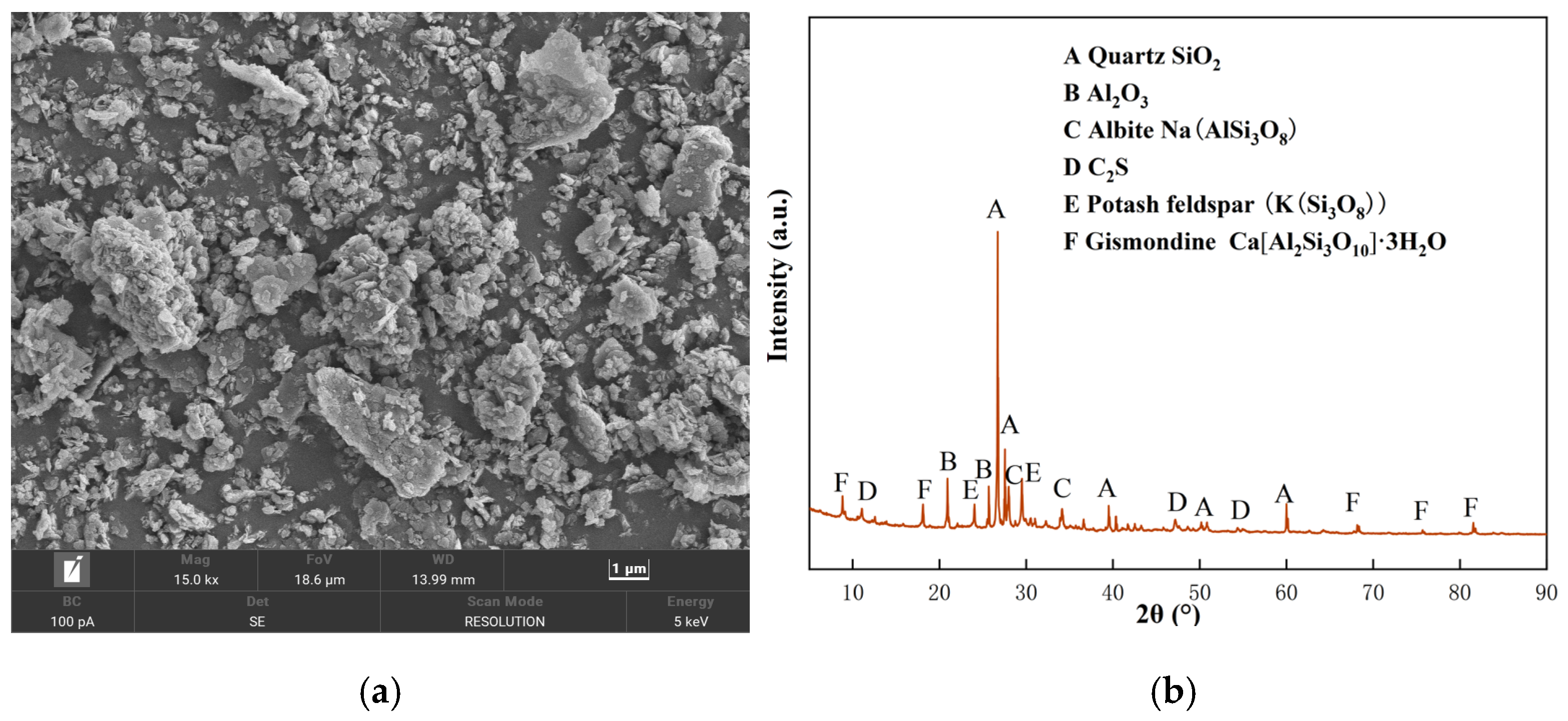
Figure 1. SEM image analysis and XRD pattern of aeolian sand powder. (a) SEM of ASP. (b) XRD of ASP.
Buildings 15 04213 g001
Figure 2. Particle size distribution and quantitative phase analysis of aeolian sand powder. (a) Quantitative phase of aeolian sand powder. (b) Particle size distribution phase of aeolian sand powder.
Buildings 15 04213 g002
Figure 3. Particle analysis of aeolian sand. (a) Aeolian sand morphology. (b) Particle size analysis. (c) Roundness of aeolian sand. (d) Aeolian sand aspect ratio.
Buildings 15 04213 g003
Figure 4. Indentation matrix and load–displacement curve of ASPC. (a) Indentation matrix. (b) Load–displacement curve.
Buildings 15 04213 g004
Figure 5. Mechanical performance curves of ASPC.
Buildings 15 04213 g005
Figure 6. Mechanical performance curves of ASPC. (a) Compressive strength of ASPC. (b) Splitting tensile strength of ASPC. (The green dotted line is a grid line used for better comparison).
Buildings 15 04213 g006
Figure 7. SEM–EDS analysis of each group. (a) ASPC. (b) ASPC-4-0. (c) ASPC-0-6. (d) ASPC-4-6. (e) EDS of ASPC-4-6 (A, B). (A and B stated that the two points tested by the EDS laboratory).
Buildings 15 04213 g007
Figure 8. TG-DSC diagrams of 28d concrete. (a) ASPC. (b) ASPC-4-0. (c) ASPC-4-6. (d) ASPC-0-6.
Buildings 15 04213 g008
Figure 9. (a) XRD patterns and (b) FTIR spectra of ASPC before and after activation.
Buildings 15 04213 g009
Figure 10. FTIR spectra and elemental analysis. (a) ASPC. (b) ASPC-4-0. (c) ASPC-4-6. (d) ASPC-0-6. (Note: Red indicates pores, yellow indicates C-S-H gel, green indicates C-A-S-H gel, and blue indicates Ca(OH)2).
Buildings 15 04213 g010
Figure 11. Indentation modulus and hardness of ASPC, ASPC-4-0, ASPC-4-6, and ASPC-0-6. (a) Modulus/GPa. (b) Hardness/GPa.
Buildings 15 04213 g011
Figure 12. Elastic modulus contour analysis of ASPC, ASPC-4-0, ASPC-4-6, and ASPC-0-6. (a) ASPC. (b) ASPC-4-0 (c) ASPC-4-6. (d) ASPC-0-6.
Buildings 15 04213 g012
Figure 13. (a) T2 spectra and (b) porosity ratio of ASPC, ASPC-4-0, ASPC-4-6, and ASPC-0-6.
Buildings 15 04213 g013
Figure 14. Mechanism of enhancement of mechanical properties of ASPC by composite alkali activator.
Buildings 15 04213 g014
Table 1. Cement characteristics.
Chemical Composition (%)Physical–Mechanical Properties
SiO2Al2O3CaOFe2O3MgOSO3OtherSetting Time (min)Compressive Strength (MPa)Flexural Strength (MPa)
InitialFinal3 d28 d3 d28 d
21.425.4363.643.042.822.171.6918039524.848.95.08.1
Table 2. The main chemical components of ASP.
Chemical ComponentsSiO2
(%)
Al2O3
(%)
CaO
(%)
Fe2O3
(%)
K2O
(%)
Na2O
(%)
C
(%)
MgO
(%)
Others
(%)
ASP43.59.04.03.11.92.01.81.22.8
Table 3. Physical properties of aeolian sand and river sand.
Physical PropertiesBulk Density
(Kg/m3)
Tight Density (Kg/m3)Apparent Density
(Kg/m3)
Void Rate
(%)
Water Content (%)Mud Content (%)Fineness Modulus
AS13701580261048--1.40.6
RS173017402620342.61.23.01
Table 4. The main chemical components of sodium silicate solution (water glass).
Chemical ComponentsNa2O (%)SiO2 (%)H2O (%)
Na2SiO33214.553.5
Note: The elemental contents in sodium silicate were determined in accordance with three methods: the “Method for Determination of Sodium Oxide Content” and the “Method for Determination of Silicon Dioxide Content” specified in GB/T 4209-2022 [23] Sodium Silicate for Industrial Use, as well as GB/T 6283-1986 [24] Chemical Products—Determination of Moisture Content—Karl Fischer Method (General Method).
Table 5. ASPC mixture ratio.
SampleCementAeolian Sand Powder (ASP)River SandAeolian SandCoarse AggregateWaterNaOH (The Optimal Dosage Is 4%)Sodium Silicate Solution (The Optimal Dosage Is 6%)Polycarboxylic Acid Water Reducer (Additives)
(kg/m3)(kg/m3)(kg/m3)(kg/m3)(kg/m3)(kg/m3)(kg/m3)(kg/m3)(kg/m3)
OC489.80.0761.901777.7210.6 3.3
ASPC244.9244.9380.95380.951777.7210.6 3.3
ASPC-4-0244.9244.9380.95380.951777.7210.69.80 3.3
ASPC-4-6244.9244.9380.95380.951777.7210.69.8014.693.3
ASPC-0-6244.9244.9380.95380.951777.7210.6 14.693.3
Note: ASPC refers to aeolian sand powder–aeolian sand concrete prepared by replacing river sand and cement with 50% aeolian sand (AS) and 50% aeolian sand powder (ASP), respectively, in equal mass. ASPC-A-B: A represents the dosage of NaOH, and B represents the dosage of Na2SiO3. The water/binder ratio is 0.43.
Table 6. Average nanoindentation modulus and hardness of samples.
SampleAggregateITZMortar
ModulusHardnessModulusHardnessModulusHardness
GPaGPaGPaGPaGPaGPa
OC82.35092.566135.25611.579843.24512.8712
ASPC83.44632.418924.21090.892335.23121.5045
ASPC-4-080.36812.657730.44571.013240.25361.8024
ASPC-4-682.24453.488134.96641.549643.05032.3562
ASPC-0-681.67432.923130.05610.992639.87031.7901
Disclaimer/Publisher’s Note: The statements, opinions and data contained in all publications are solely those of the individual author(s) and contributor(s) and not of MDPI and/or the editor(s). MDPI and/or the editor(s) disclaim responsibility for any injury to people or property resulting from any ideas, methods, instructions or products referred to in the content.