Article

Nonlinear Settlement Calculation of Composite Foundation Based on Tangent Modulus Method: Two Case Studies


1
School of Infrastructure Engineering, Nanchang University, Nanchang 330031, China
2
JiangXi Jiye Science and Technology Group Co., Ltd., Nanchang 330013, China
*
Author to whom correspondence should be addressed.
Buildings 2023, 13(4), 892; https://doi.org/10.3390/buildings13040892

Submission received: 19 January 2023 / Revised: 20 March 2023 / Accepted: 24 March 2023 / Published: 28 March 2023
(This article belongs to the Special Issue Advances in Soils and Foundations)

Abstract

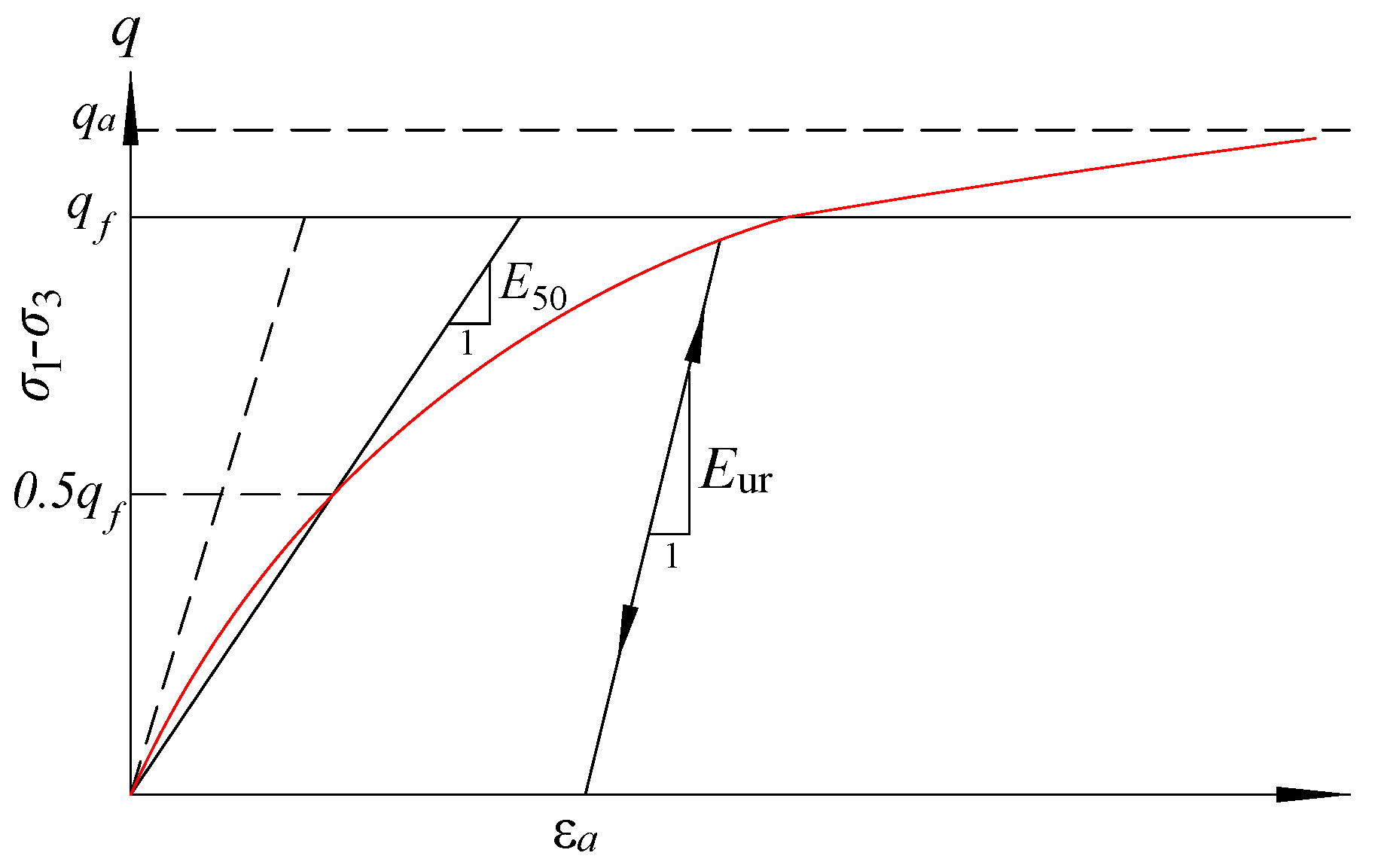
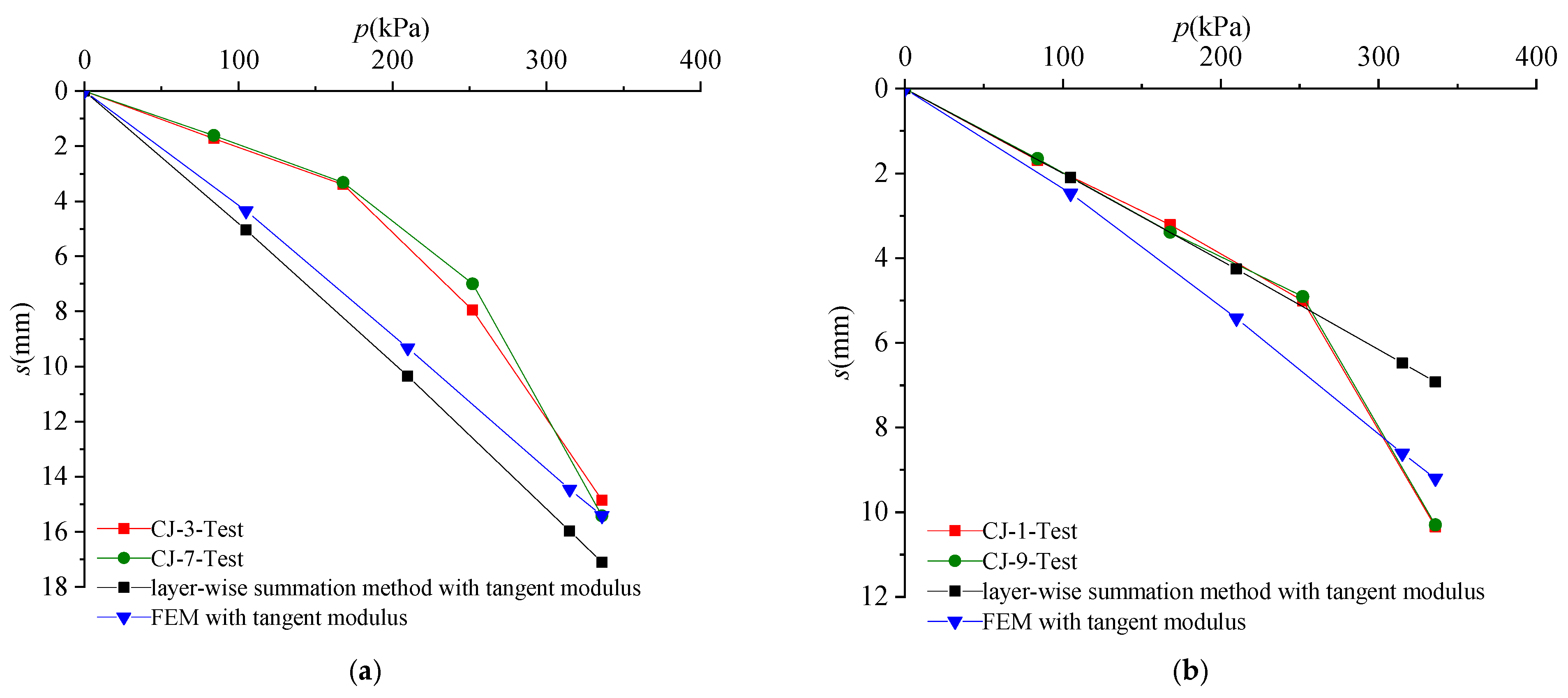
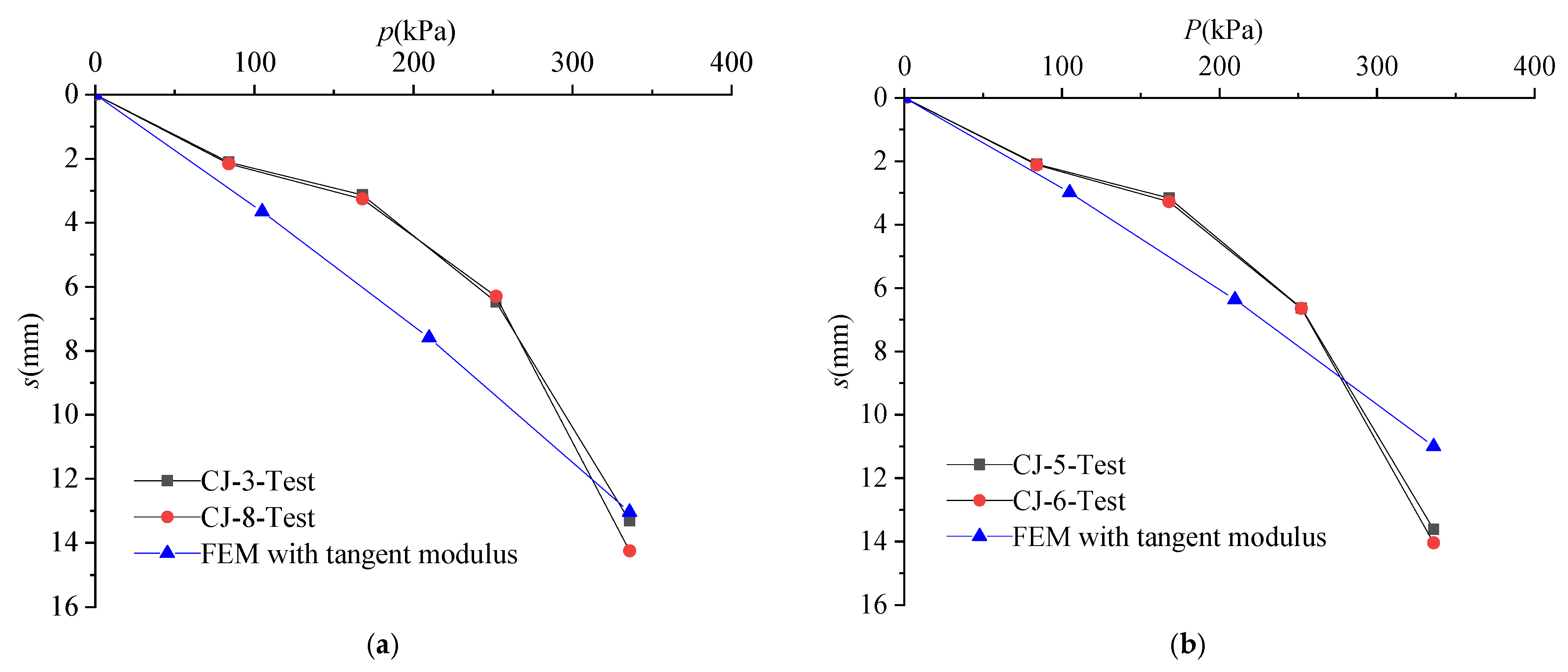
The tangent modulus method of undisturbed soil is a new method in settlement calculation, which is mainly applied to hard soil with a strong structure, such as silty clay, completely weathered rock, and granite residual soil with an SPT blow count greater than 8. The tangent modulus is mainly obtained from a field plate load test, which can consider the influence of the soil stress level and reflect the nonlinear characteristics of the foundation settlement. In a multi-layer soil foundation, since the deep plate loading test is difficult, a method was proposed to determine the tangent modulus of deep soil. It is assumed that the ratio of the initial tangent modulus to the deformation modulus is equal to the ratio of the unloading–reloading modulus Eurref to the secant modulus E50ref obtained by triaxial unloading–reloading test. Since there are corresponding empirical formulae for SPT counts and the deformation modulus of different types of soils in many regions, the initial tangent modulus can be derived by the above method. In two cases of a composite foundation, the compression modulus and tangent modulus were used to calculate the settlement of the foundation, which is then compared with the measured results. The results show that the proposed method for determining the tangent modulus of deep soil is feasible in theory, and the calculating accuracy of the tangent modulus is significantly higher than that of the traditional compression modulus.
Keywords: multi-layer soil foundation; nonlinear settlement; tangent modulus; deformation modulus multi-layer soil foundation; nonlinear settlement; tangent modulus; deformation modulus