Skip to Content
BuildingsBuildings
  • Article
  • Open Access

24 February 2022

Optimal Control of Chilled Water System Based on Improved Sparrow Search Algorithm
,
,
and
1
School of Mechanical Engineering, Suzhou University of Science and Technology, Suzhou 215009, China
2
Jiangsu Province Key Laboratory of Intelligent Building Energy Efficiency, Suzhou University of Science and Technology, Suzhou 215009, China
3
School of Environmental Science and Engineering, Suzhou University of Science and Technology, Suzhou 215009, China
4
School of Mechanical and Electronic Engineering, Jingdezhen Ceramic Institute, Jingdezhen 333001, China

Abstract

Chilled water systems have large time delays and large inertia, and the traditional PID controller has a poor control effect. In this paper, an improved sparrow search algorithm is proposed to optimize the control of chilled water systems. Firstly, the random walk strategy was used to randomly perturb the sparrows to improve the searching ability of the sparrows. Then, a Gauss mutation was added in the iteration process of sparrows to enhance the local search ability. Finally, the values of the PID parameters as obtained by the above methods were substituted into the controller for simulation. The simulation results show that the method proposed in this paper improves the search accuracy of the sparrow search algorithm and effectively solves the problems of large time delays and large inertia in the chilled water system. The method in this paper took the least amount of time for the system to reach the steady state at only 12.75 s. The control effect of the proposed method was also better than that of the improved ant colony optimization algorithm. The rise time was 2.713 s, and the adjustment time was 4.95 s.

1. Introduction

A chilled water system is the main part of an HVAC system. It consumes a significant amount of energy and has an important influence on the refrigeration effect [1]. The energy consumption of a chilled water system comprises about 30% of the energy consumption of air conditioning [2,3]. In a chilled water system, energy efficiency can be achieved by changing the equipment, control strategy, pipeline layout [4] or temperature control [5] or using other methods. A chilled water system is time-varying and has a time delay [6]. A chilled water system with a better control effect would be conducive to creating energy-saving air conditioning systems [7]. Z.J. Ma et al. proposed an online control scheme. Compared with the conventional control method, the energy consumption of the chilled water pump was reduced by 11.99–24.86% [8]. Using the traditional PID controller to control the system will lead to the system to overshoot, resulting in slow responses and other problems. It does not work very well.
Swarm optimization algorithm has been applied in various fields, including ant colony optimization (ACO) [9], particle swarm optimization (PSO) [10], grey wolf optimization (GWO) [11] and so on. The above group optimization algorithms have the problem that they are easy to fall into the local optimum. Many people have improved the optimization algorithm. Y. Wang et al. used the improved ant colony algorithm to find the global optimal solution [12]. F. Zhang et al. used Gauss mutation and self-adjusting pheromones to improve the ant colony algorithm to optimize the controller in a chilled water system and improved the searching ability and convergence ability of the algorithm [13]. A. Dixit et al. proposed a new differential evolution algorithm based on particle swarm optimization. The performance comparison showed that the algorithm could improve the convergence speed significantly and avoid premature closing [14]. J.C. Gu et al. added discrete heredity into the grey wolf optimization algorithm to further improve the search ability. The experimental data show that this algorithm was more effective than other algorithms [15]. J.K. Xue et al. proposed the Sparrow Search Algorithm (SSA) in 2020, which had good convergence speed and stability [16]. X.C. Li et al. used the SSA, which can quickly and accurately search the required parameters [17]. X.L. Sun et al. proposed an improved sparrow algorithm and applied it to load forecasting [18,19].
In order to achieve a better control effect, this paper used the sparrow search algorithm to find the optimal PID control parameters. However, like other algorithms, the sparrow search algorithm is also prone to fall into local optimum and population diversity decreases with the increase in iteration times. Based on the above description, in order to solve the disadvantages of the sparrow search algorithm, this paper proposes an improved sparrow search algorithm and used it to optimize the control of a chilled water system. Firstly, the random walk strategy was used to perturb the position of the sparrows to enhance the global search ability of the sparrow. Secondly, Gauss mutation was applied to change the sparrows’ position, so that individual sparrows could carry out a full search of their surroundings, and the local searching ability of the sparrow group was improved. Finally, the optimization algorithm was applied to a chilled water system and compared with the ant colony algorithm and particle swarm optimization algorithm. The simulation results show that the proposed method improved the search precision of the sparrow search algorithm and reduced the overshoot of the system. The control effect was also better than that of other optimization algorithms. The main contributions of the authors are as follows: (1) The sparrow search algorithm was improved using the random walk strategy and Gaussian variation in this paper. (2) The improved sparrow search algorithm was applied to a frozen water system.
The paper is divided into five sections including the introduction. Section 2 presents the related methods. Section 3 presents the main results of this paper. A discussion is given in Section 4. The conclusion is presented in Section 5.

3. Results

3.1. Establishment of Optimization Model

The simulation of this paper was carried out in MATLAB 2019a. The mathematical model of the chilled water system is very complicated and belongs to a high-order system. Thus, a second-order model with time delay was used instead. The mathematical model of the chilled water system is shown in Equation (14).
G ( s ) = K e τ s ( T 1 s + 1 ) ( T 2 s + 1 )
where T1 and T2 are the inertial time constants; K is the amplification factor; and τ is the lag time parameter of the chilled water system.
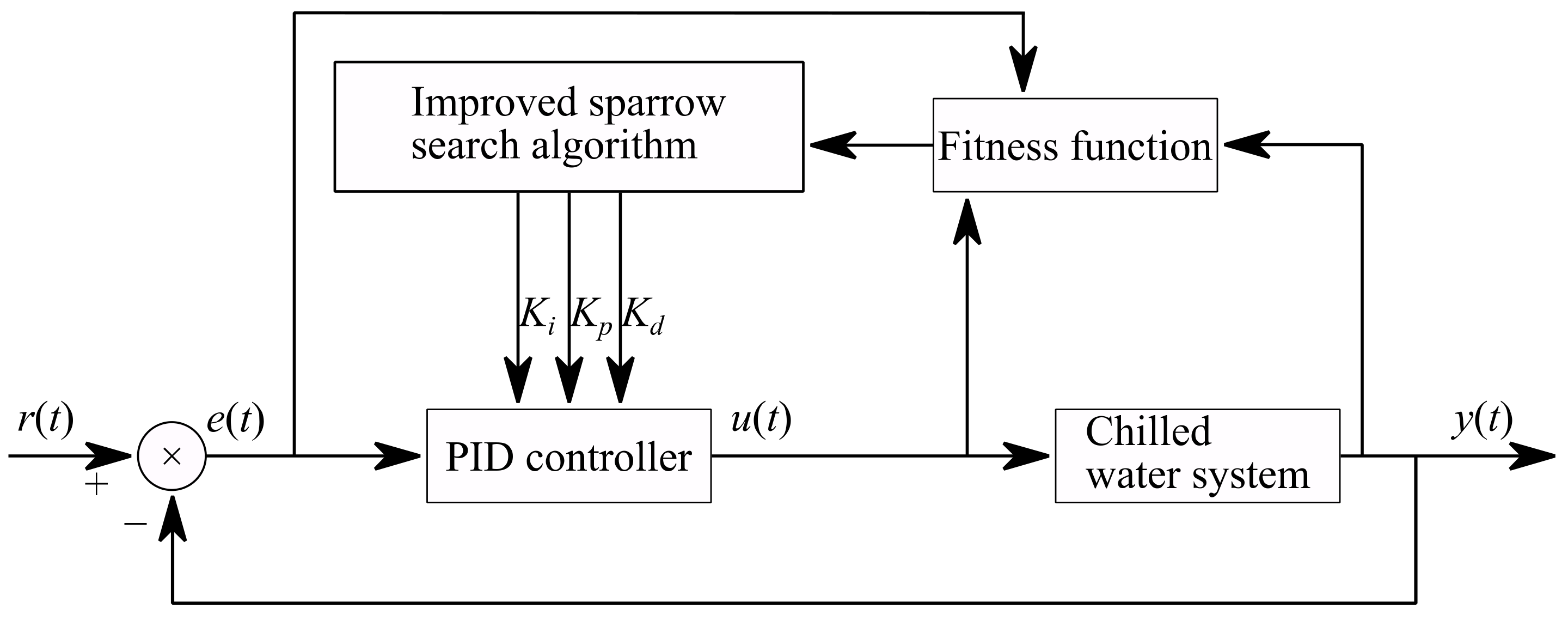
A block diagram of the optimized chilled water system based on the improved sparrow search algorithm is shown in Figure 1.
Figure 1. The block diagram of the chilled water system based on the algorithm.

3.2. Comparison of Simulation Effects

In order to verify the effectiveness of the proposed method, the proposed method was compared with the sparrow search algorithm, particle swarm optimization algorithm and ant colony optimization algorithm. The control method adopted was temperature difference control. The temperature difference between the supply and return water of the chilled water was set at 5 °C. The sampling time of the system was 0.5 s. The three parameters of the PID controller had an upper limit of 5 and a lower limit of 0. The group size of the swarm optimization algorithm in this paper was 50, and the maximum number of iterations was 100. Other parameters of the group algorithm were set as follows:
Particle swarm optimization algorithm: w = 0.7 (inertia factor) and c1 = 2, c2 = 2 (acceleration constant).
Ant colony optimization algorithm: Rho = 0.7 (Pheromone evaporation coefficient), Q = 1 (Pheromone intensity) and Lam = 0.2 (Crawling speed of ants).
The specific parameter values of the improved part and the sparrow search algorithm are detailed in Section 2.
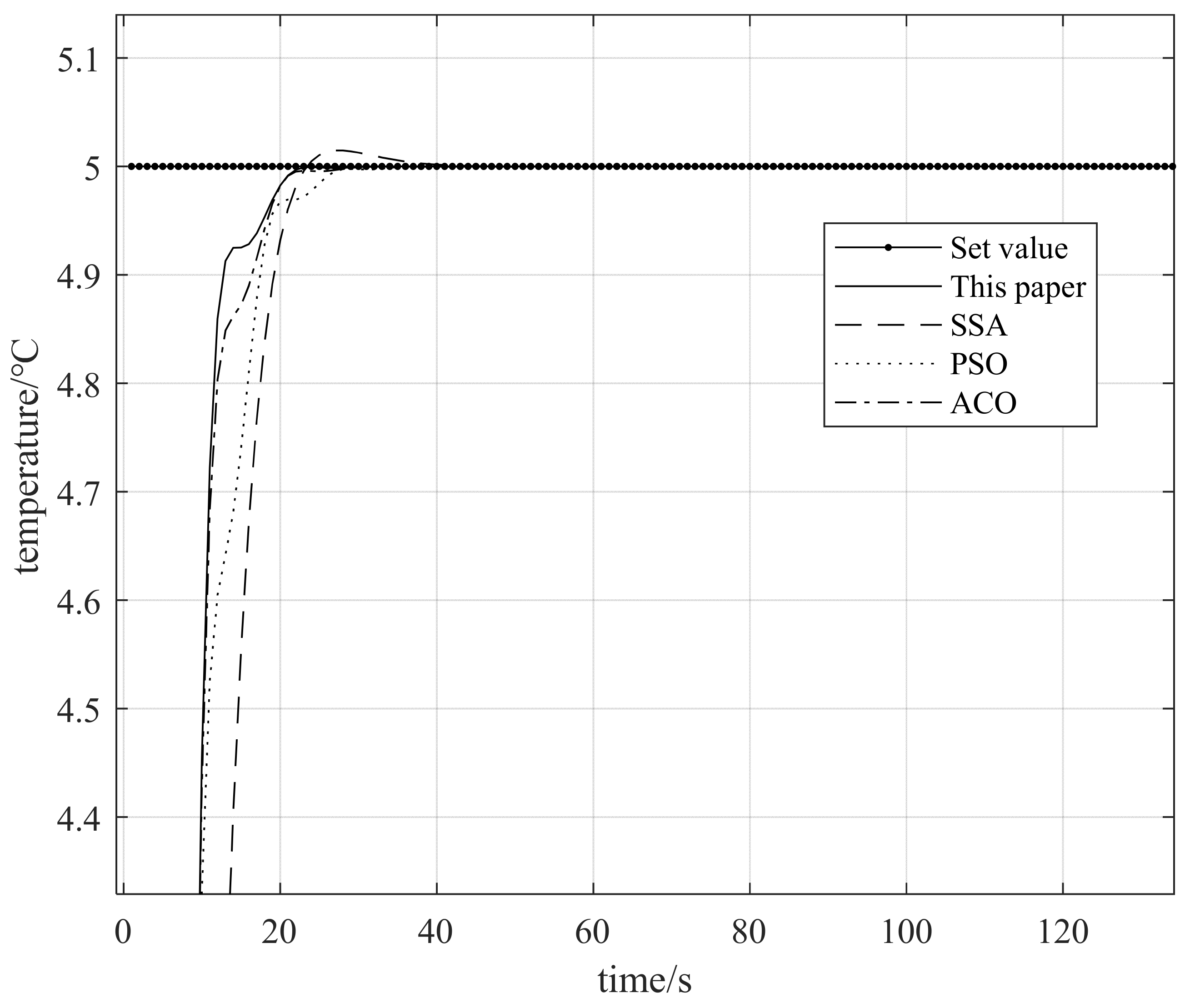
The control object model adopted in this paper is shown in Equation (15). The optimal PID parameter values found by each algorithm are shown in Table 1. The simulation diagram of the system is shown in Figure 2.
Table 1. The optimization results of each algorithm.
Figure 2. Simulation diagram of the system.
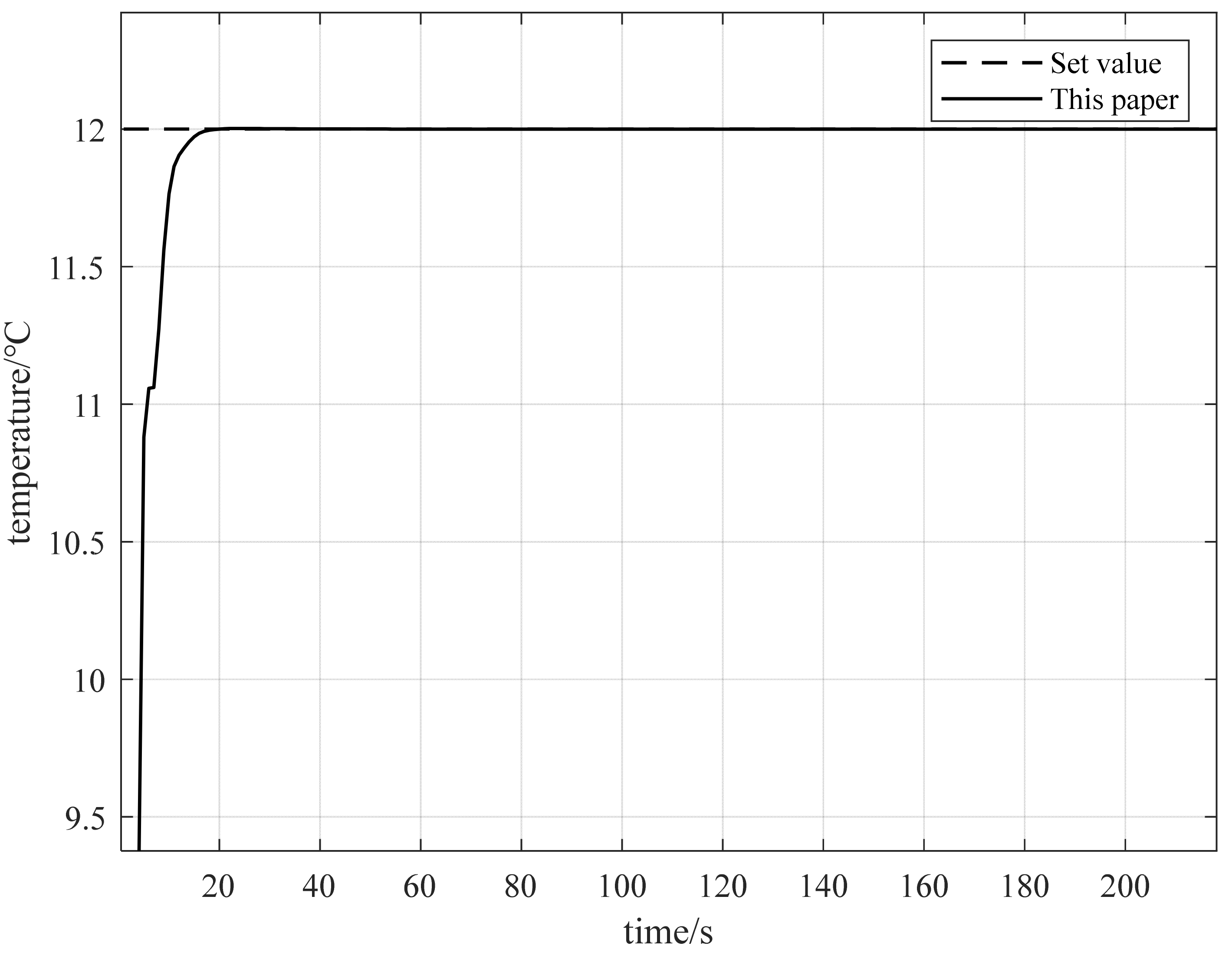
Since the application of the sparrow search algorithm in frozen water system has not been reported, in order to be more convincing, this paper also makes a comparison with literature. In Ref. [13], F. Zhang et al. used the improved ant colony algorithm to optimize the control of a chilled water system. In order to improve the searching ability and fast convergence, Gaussian variation and self-adjusting pheromones were introduced, and the sum of deviation squares was used as the objective function. The control method adopted was temperature difference control, which was controlled at 5 °C, and the outlet temperature of the chilled water was set at 7 °C. The purpose of the control was to keep the temperature of the return water at 12 °C. The model adopted by the control object is shown in Equation (15).
G ( s ) = 12 e 30 s ( 50 s + 1 ) ( s + 1 )
The sampling time of the system was 5 s, and the range of optimization parameters was Kp ∈ [0, 0.6], Ki ∈ [0, 0.5], Kd ∈ [0, 1]. The PID parameters optimized by the improved ant colony algorithm in [13] were 1.6561, 0.0325 and 0.8839. The PID parameters optimized by the method in this paper were 0.26399, 0.0052043 and 0.83927. The simulation results are shown in Figure 3. The control performances of the two methods are shown in Table 2.
Figure 3. Simulation diagram of improved sparrow search algorithm.
Table 2. Comparison of control performance.

4. Discussion

As can be seen from Figure 2, the simulation effect of the unimproved sparrow search algorithm was the worst, and even overshoot appeared. After the improvement in this paper, the overshoot was reduced. The method in this paper took the least amount of time for the system to reach the steady state at only 12.75 s. The time taken for the SSA, PSO and ACO to reach the steady state was 19.21 s, 17.45 s and 16.39 s, respectively. The proposed method has a better control effect than other methods.
From the perspective of control performance, the method proposed in this paper performed better than the control in [13] in both the rise time and adjustment time. The rise time was 2.713 s, and the adjustment time was 4.95 s. The control method proposed in this paper has a fast response speed, and its stability was improved accordingly. In view of the hysteresis of chilled water system, this method can improve the response speed of the controller.

5. Conclusions

In this paper, an improved sparrow search algorithm was proposed to optimize the control of chilled water systems. The random walk strategy was used to perturb the sparrows’ positions, and Gauss mutation was added to improve the sparrows’ search ability. Compared with the particle swarm optimization algorithm and ant colony optimization algorithm, the simulation results show that the improved method proposed in this paper not only improved the search ability of the sparrow search algorithm but also improved the control effect of the chilled water system. The method in this paper took the least amount of time for the system to reach the steady state at only 12.75 s. The control effect of the proposed method is also better than that of the improved ant colony optimization algorithm. The rise time was 2.713 s, and the adjustment time was 4.95 s. In future research, we will apply other methods to the swarm optimization algorithm to further improve the search ability of the swarm optimization algorithm.

Author Contributions

Methodology, Q.Z. and M.Z.; investigation, Q.Z.; writing—original draft preparation, M.Z.; writing—review and editing, Q.Z., M.Z. and H.L.; software, M.Z. and H.L.; validation, Q.Z. and H.L.; data curation, M.Z. and Y.Z.; supervision, Q.Z. and H.L. All authors have read and agreed to the published version of the manuscript.

Funding

This research was partially supported by the National Nature Science Foundation of China (Grant No.51875380 and 62063010).

Data Availability Statement

The data presented in this study are available on request from the corresponding author.

Acknowledgments

We acknowledge any support given which is not covered by the author contribution or funding sections.

Conflicts of Interest

We declare no conflict of interest.

References

  1. Deng, J.W.; He, S.; Wei, Q.P.; Liang, M.; Hao, Z.G.; Zhang, H. Research on systematic optimization methods for chilled water systems in a high-rise office building. Energy Build. 2020, 209, 109695. [Google Scholar] [CrossRef]
  2. Song, W.; Yang, J.M.; Ji, Y.B.; Zhang, C.X. Experimental study on characteristics of a dual temperature control valve in the chilled water system of an air-conditioning unit. Energy Build. 2019, 202, 109369. [Google Scholar] [CrossRef]
  3. Chang, C.; Jiang, Y.; Wei, Q.P. Evaluation of terminal coupling and its effect on the total delta-T of chilled water systems with fan coil units. Energy Build. 2014, 72, 390–397. [Google Scholar] [CrossRef]
  4. Gao, D.C.; Wang, S.W.; Sun, Y.J.; Xiao, F. Diagnosis of the low temperature difference syndrome in the chilled water system of a super high-rise building: A case study. Appl. Energy 2012, 98, 597–606. [Google Scholar] [CrossRef]
  5. Ma, X.W.; Gao, D.C.; Liang, D. Improved Control Strategy of Variable Speed Pumps in Complex Chilled Water Systems Involving Plate Heat Exchangers. Procedia Eng. 2017, 205, 2800–2806. [Google Scholar] [CrossRef]
  6. Li, J.W.; Ren, Q.C.; Long, H.; Feng, Z.X. Study on the Elman neural network operation control strategy of the central air conditioning chilled water system. World J. Eng. Technol. 2019, 7, 73–82. [Google Scholar] [CrossRef] [Green Version]
  7. Fang, X.; Jin, X.Q.; Du, Z.M.; Wang, Y.J.; Shi, W.T. Evaluation of the design of chilled water system based on the optimal operation performance of equipments. Appl. Therm. Eng. 2017, 113, 435–448. [Google Scholar] [CrossRef]
  8. Ma, Z.J.; Wang, S.W. An optimal control strategy for complex building central chilled water systems for practical and real-time applications. Build. Environ. 2009, 44, 1188–1198. [Google Scholar] [CrossRef]
  9. Wang, X.Q.; Li, H.Z.; Yang, J.; Yang, C.Y.; Gui, H.X. Optimal path selection for logistics transportation based on an improved ant colony algorithm. Int. J. Embed. Syst. 2020, 13, 200–208. [Google Scholar] [CrossRef]
  10. Fesharaki, J.J.; Madani, S.G.; Golabi, S. Best pattern for placement of piezoelectric actuators in classical plate to reduce stress concentration using PSO algorithm. Mech. Adv. Mater. Struct. 2018, 27, 141–151. [Google Scholar] [CrossRef]
  11. Natesan, G.; Chokkalingam, A. Task scheduling in heterogeneous cloud environment using mean grey wolf optimization algorithm. ICT Express 2019, 5, 110–114. [Google Scholar] [CrossRef]
  12. Wang, Y.; Yang, R.R.; Xu, Y.X.; Li, X.; Shi, J.L. Research on multi-agent task optimization and scheduling based on improved ant colony algorithm. In IOP Conference Series: Materials Science and Engineering; IOP Publishing: Bristol, UK, 2021. [Google Scholar] [CrossRef]
  13. Zhang, F.; Li, Z.J. Optimal control of central air-conditioning chilled water system by improved ant colony algorithm. Comput. Eng. Des. 2019, 40, 1311–1315. (In Chinese) [Google Scholar] [CrossRef]
  14. Dixit, A.; Mani, A.; Bansal, R. An adaptive mutation strategy for differential evolution algorithm based on particle swarm optimization. Evol. Intell. 2021, 4, 1–15. [Google Scholar] [CrossRef]
  15. Gu, J.C.; Jiang, T.H.; Zhu, H.Q.; Zhang, C. Low-Carbon Job Shop Scheduling Problem with Discrete Genetic-Grey Wolf Optimization Algorithm. J. Adv. Manuf. Syst. 2020, 19, 1–14. [Google Scholar] [CrossRef]
  16. Xue, J.K.; Shen, B. A novel swarm intelligence optimization approach: Sparrow search algorithm. Syst. Sci. Control Eng. 2020, 8, 22–34. [Google Scholar] [CrossRef]
  17. Li, X.C.; Ma, X.F.; Xiao, F.C.; Xiao, C.; Wang, F.; Zhang, S.C. Time-series production forecasting method based on the integration of Bidirectional Gated Recurrent Unit (Bi-GRU) network and Sparrow Search Algorithm (SSA). J. Pet. Sci. Eng. 2022, 208, 109309. [Google Scholar] [CrossRef]
  18. Sun, X.L.; Li, S.X.; Liu, Q.Q.; Wang, K. Improved Sparrow Algorithm Based on Good Point Set and Inertia Weight. Adv. Appl. Math. 2021, 10, 3225–3232. [Google Scholar] [CrossRef]
  19. Sun, X.L.; Li, S.X.; Liu, Q.Q.; Wang, K. Short Term Load Forecasting Based on Improved Sparrow Algorithm. Comput. Sci. Appl. 2021, 11, 2271–2279. [Google Scholar] [CrossRef]
Publisher’s Note: MDPI stays neutral with regard to jurisdictional claims in published maps and institutional affiliations.

Article Metrics

Citations

Article Access Statistics

Multiple requests from the same IP address are counted as one view.