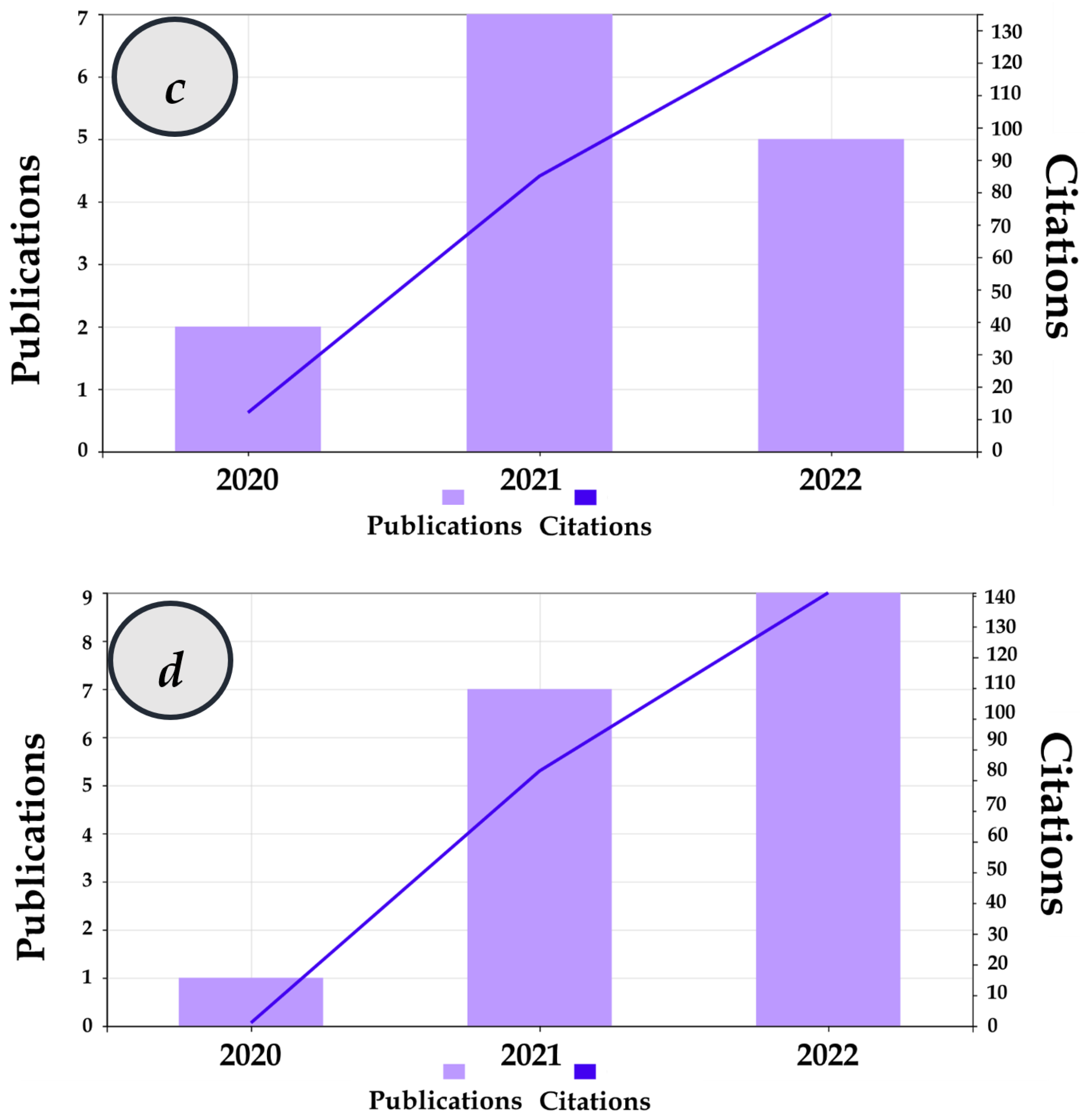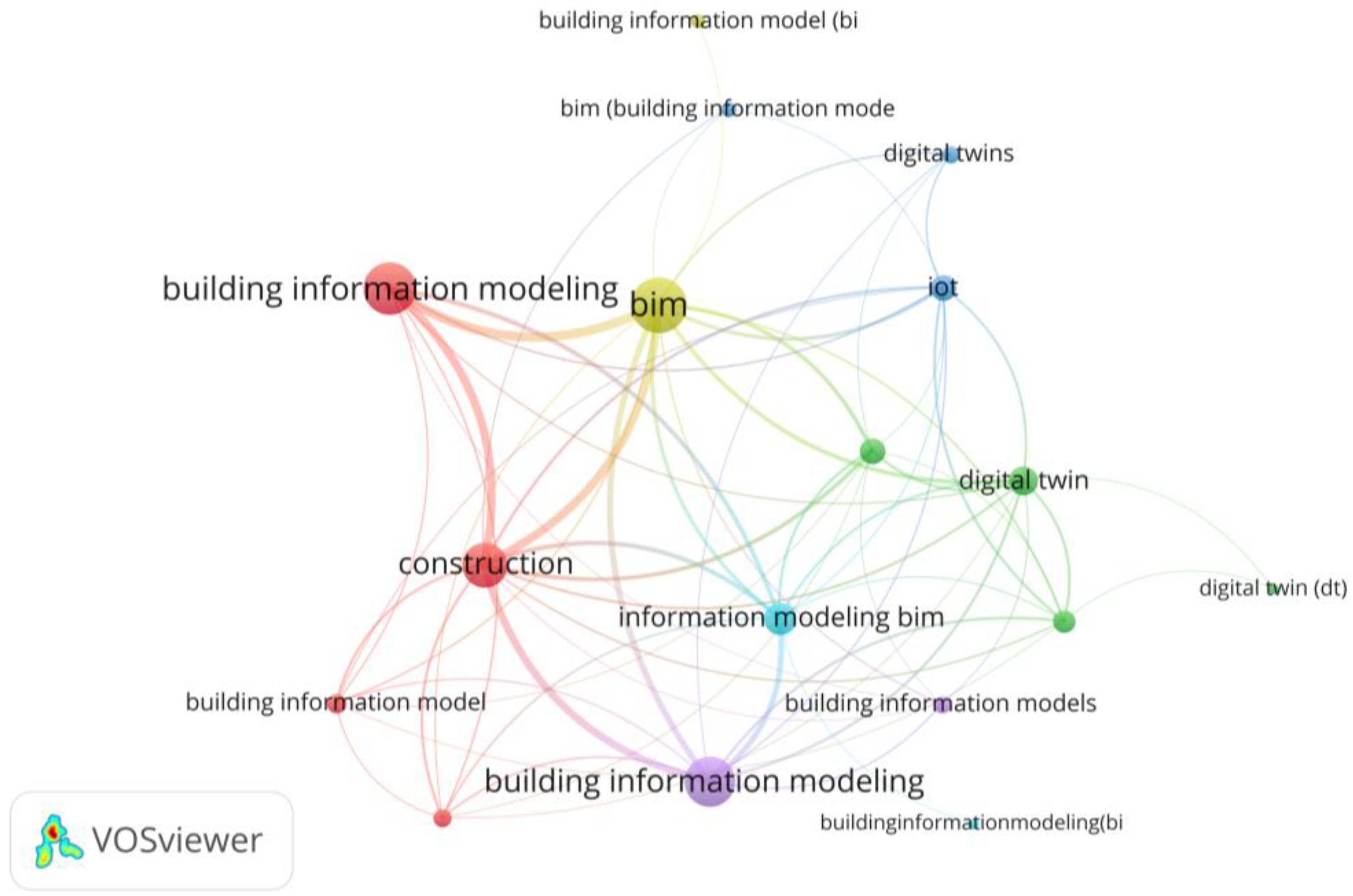


Internet of Things (IoT), Building Information Modeling (BIM), and Digital Twin (DT) in Construction Industry: A Review, Bibliometric, and Network Analysis

 ,
,  ,
,  ,
, 
Abstract
1. Introduction
1.1. Building Information Modeling (BIM)
1.2. Digital Twins (DT)
1.3. Internet of Things (IoT)
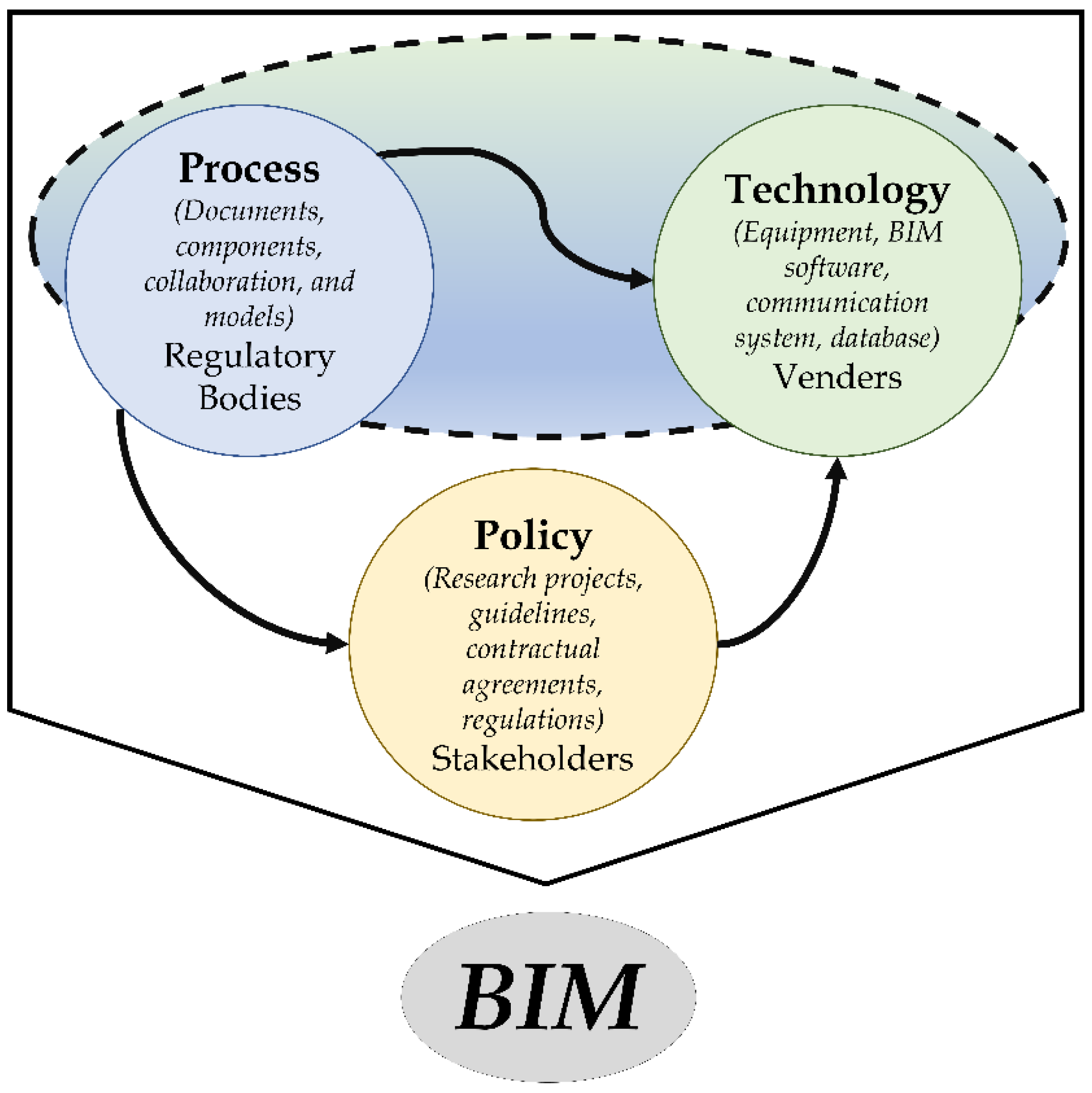
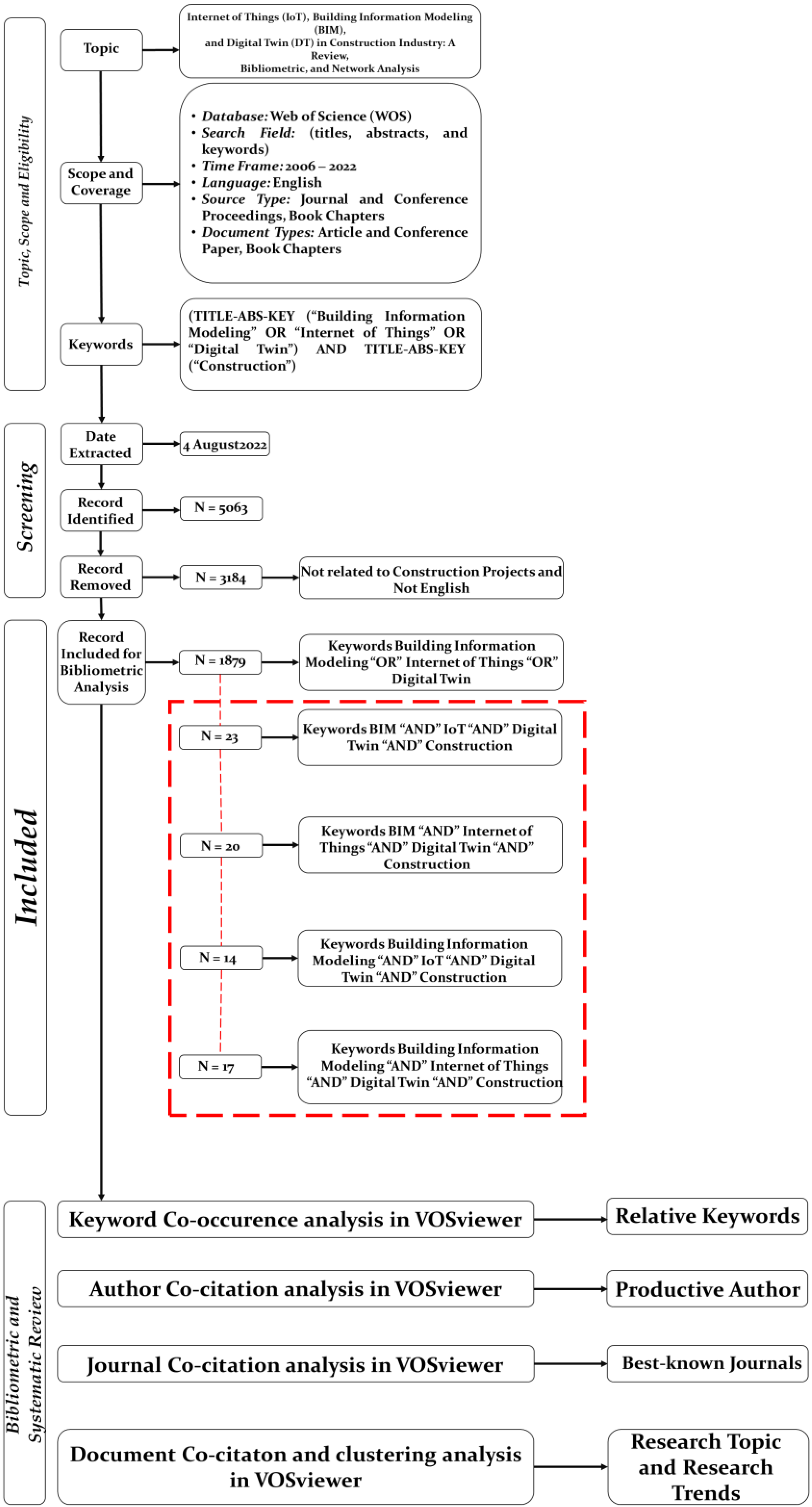
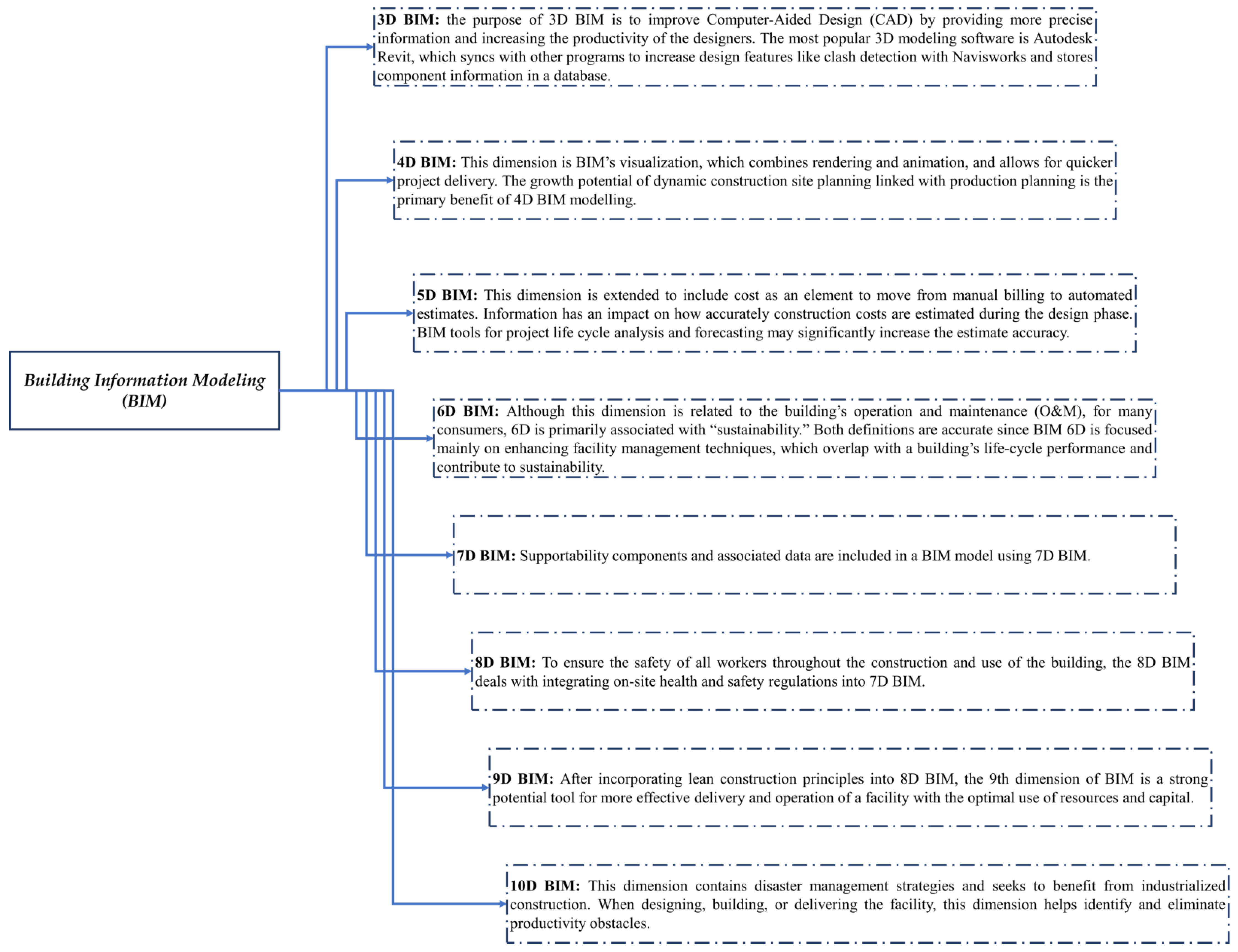
2. Research Method
2.1. Bibliometric Analysis
2.2. Systematic Literature Review Analysis
2.3. Tool for the Analyses
3. Data Collection and Analysis
3.1. Co-Authorship
3.1.1. Geographical Analysis of Publications
3.1.2. Organizations
3.1.3. Funding Agencies
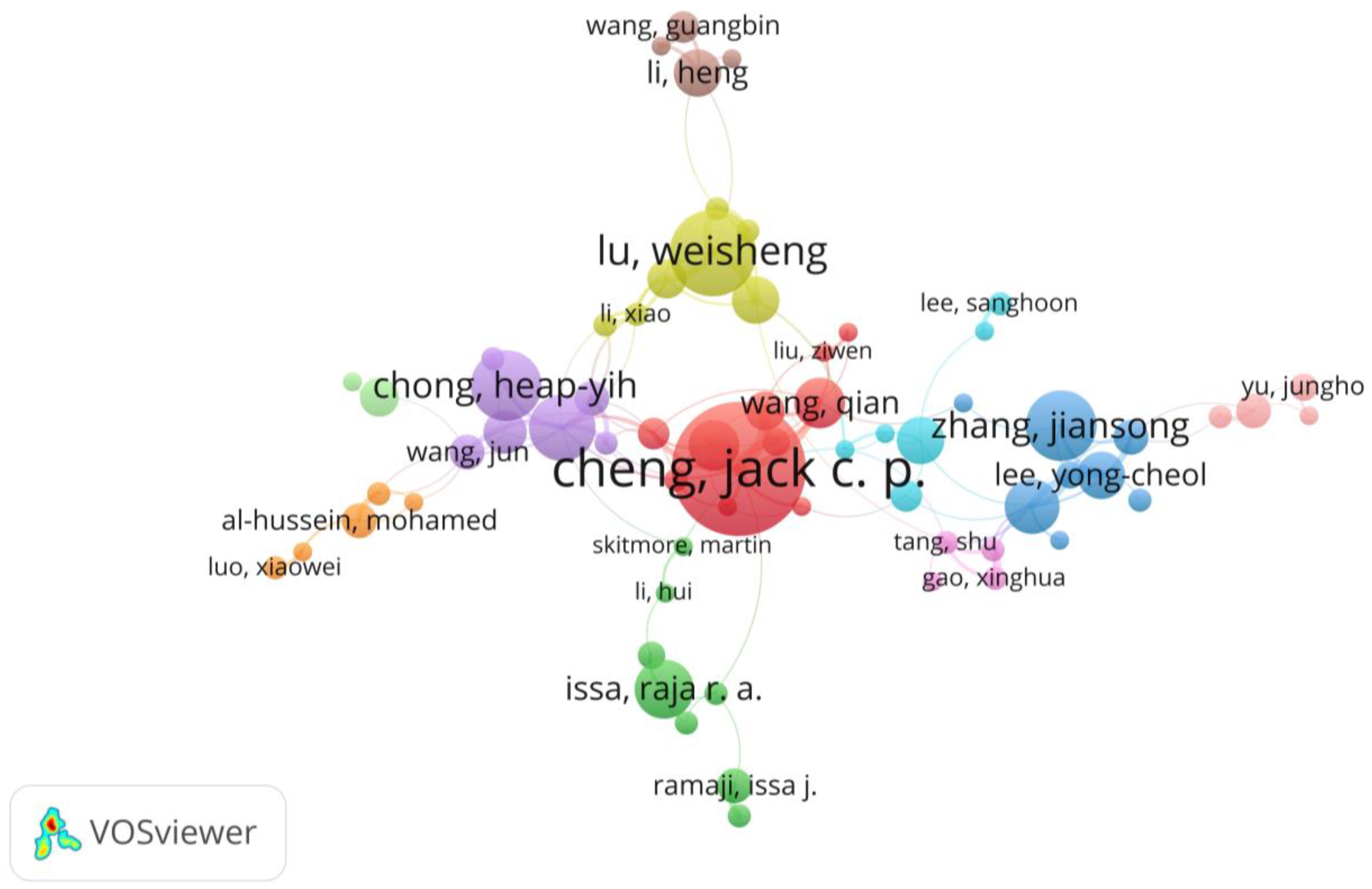
3.1.4. Author Productivity
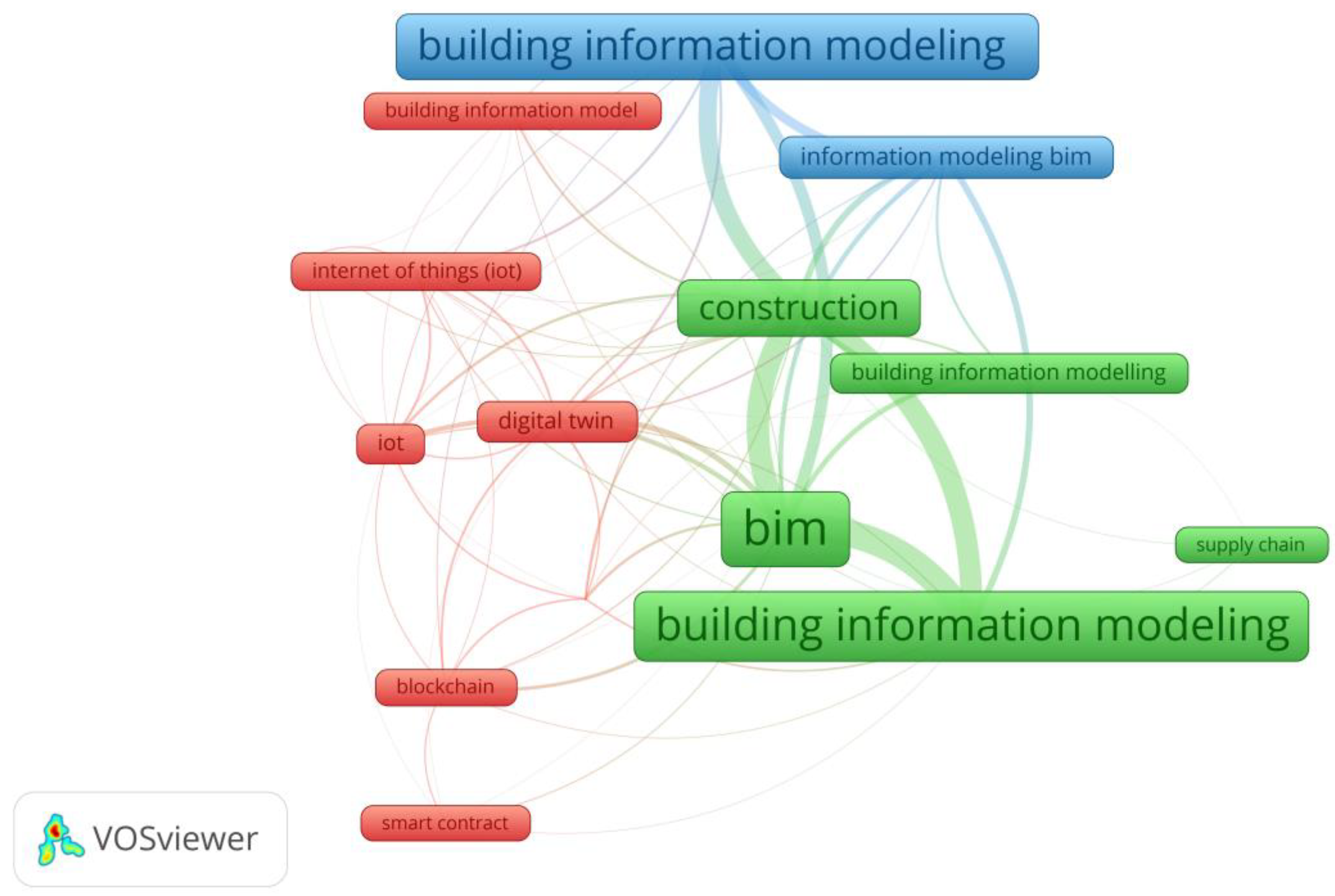
3.2. Keyword Co-Occurrence Analysis
3.3. Co-Citation Analysis
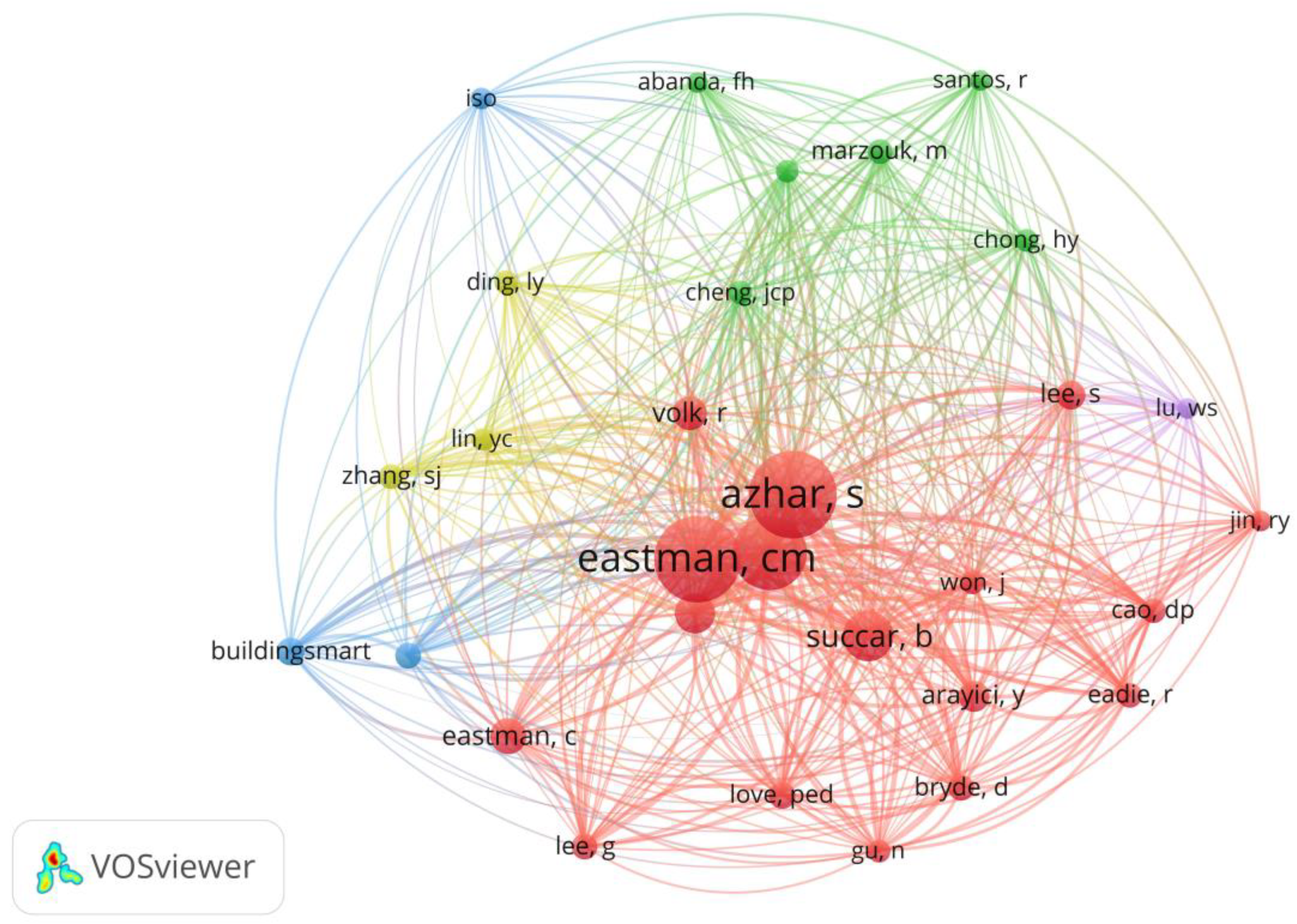
3.3.1. Author Co-Citation
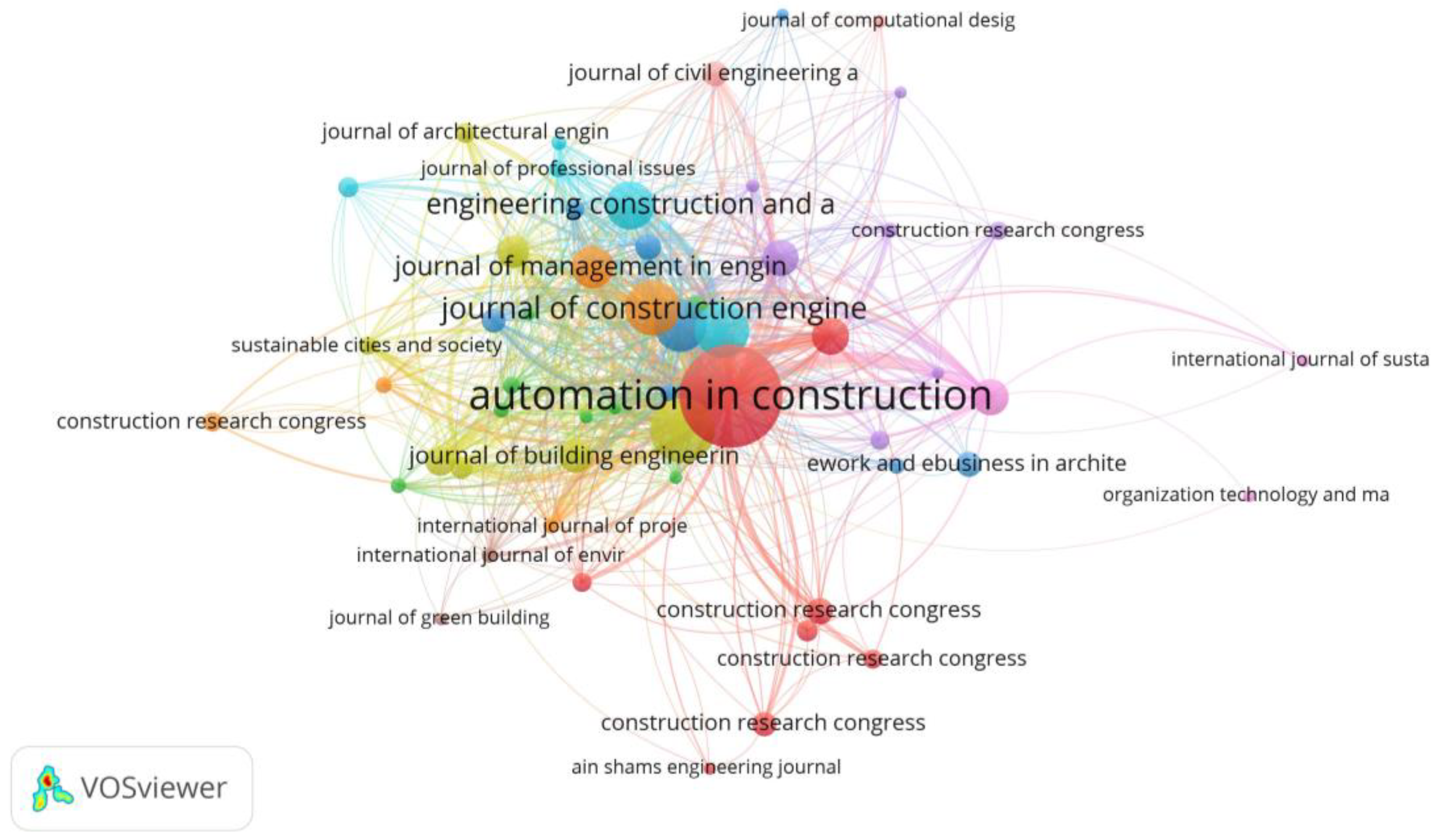
3.3.2. Journal Citation
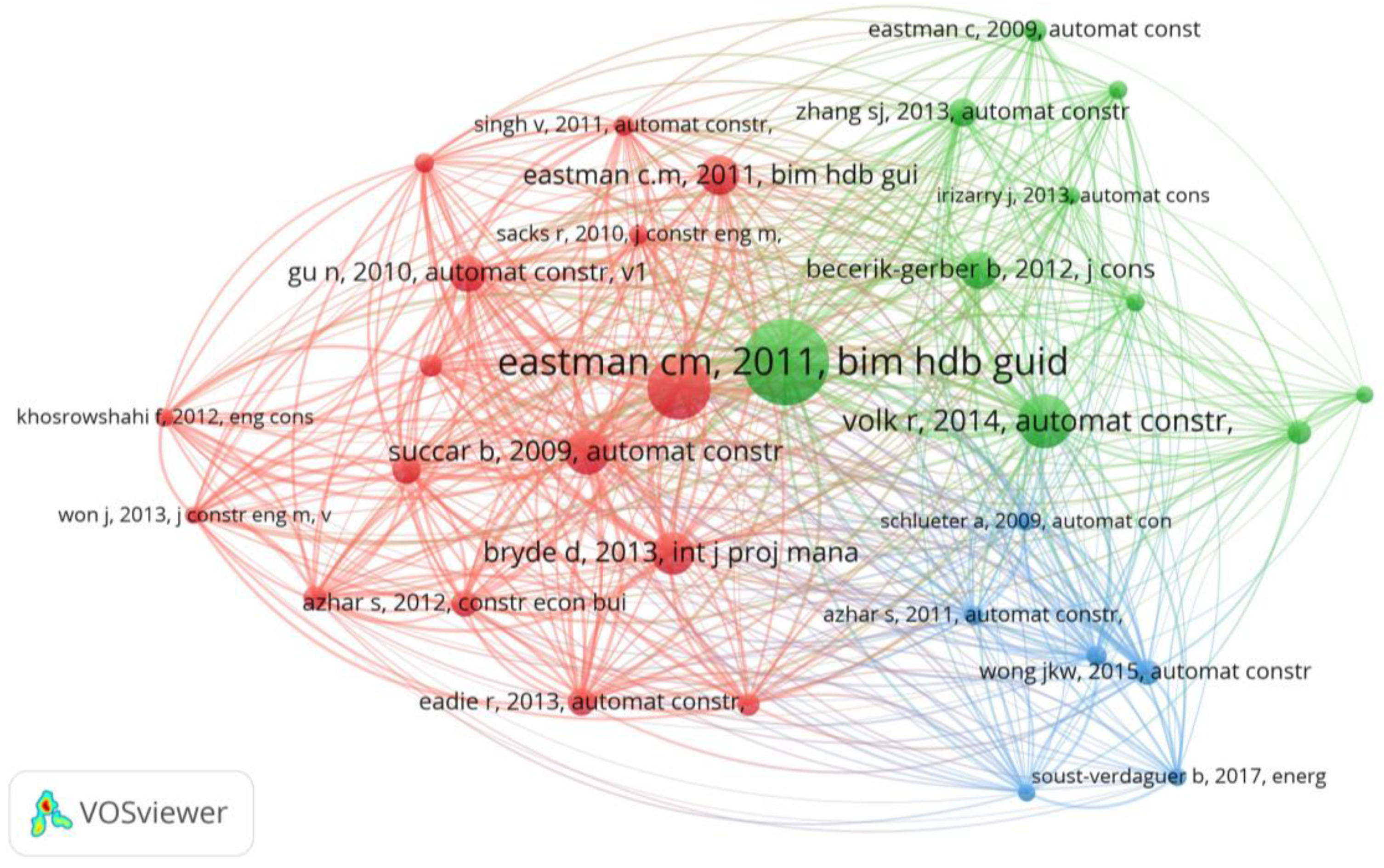
3.3.3. Document Co-Citation
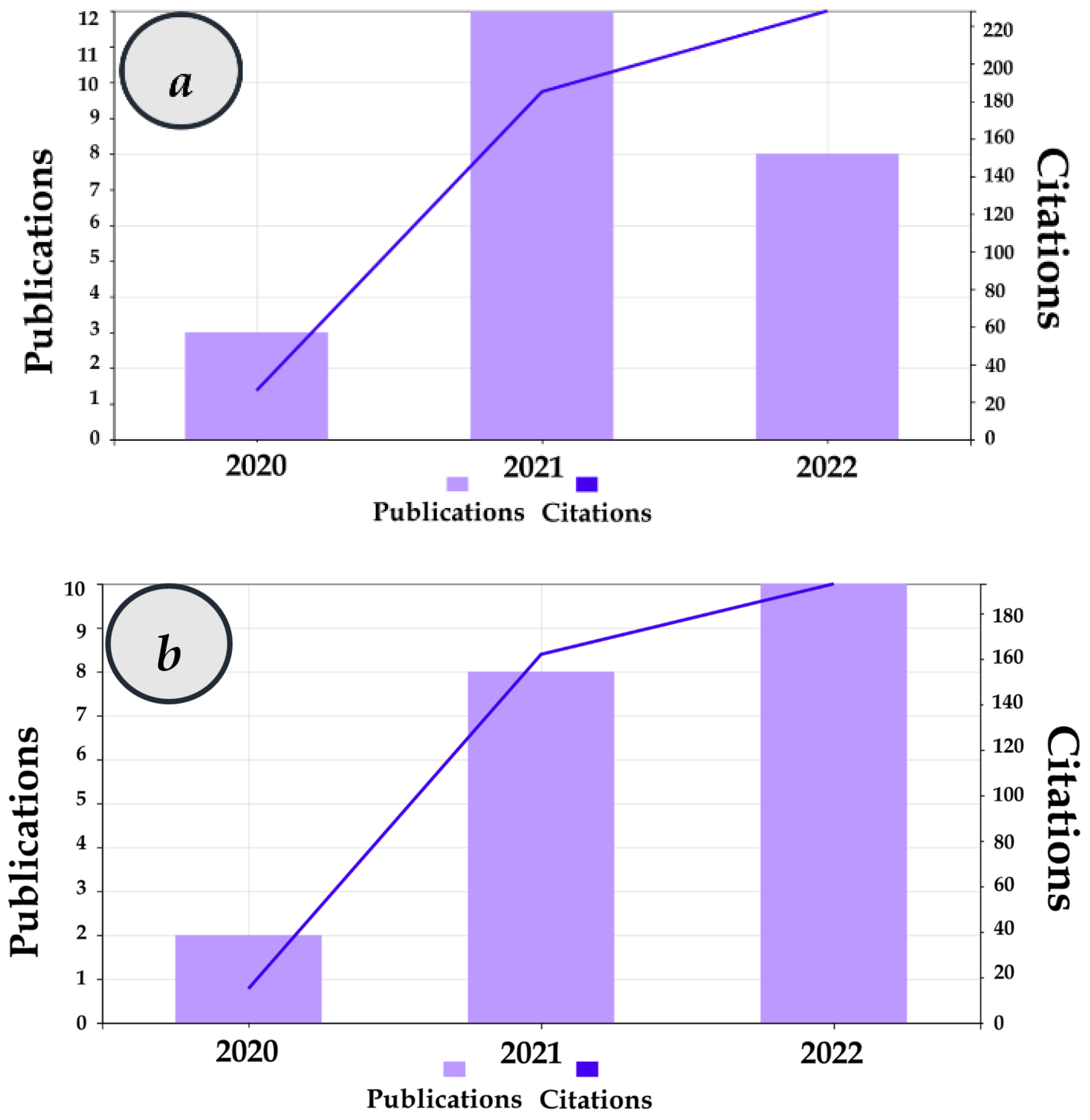
3.4. Summary
4. Key Areas in Construction
4.1. BIM, IoT, and DT
4.2. Heritage BIM (HBIM)
4.3. Smart Contract
4.4. BIM and Ontology
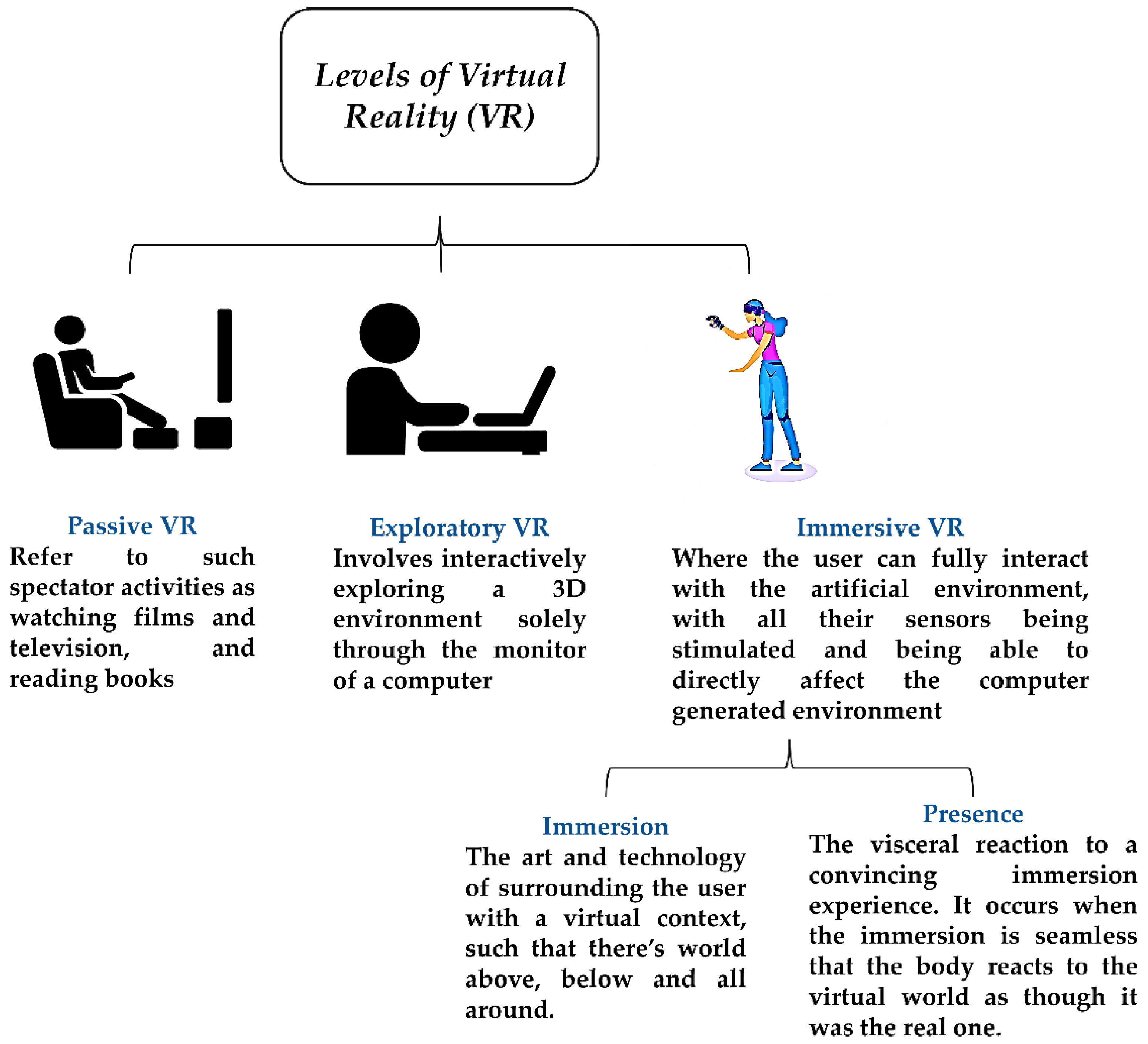
4.5. VR and AR in BIM and DT
5. Future Research Directions
- Metaverse technology in BIM and the construction industry;
- The combination of Artificial Intelligence (AI) with BIM and Digital Twin;
- Applications of different metaheuristic algorithms for optimization purposes in BIM;
- The application of the circular economy in the construction industry using BIM and IoT.
6. Conclusions
- The most applicable keywords in all mentioned fields are (i) Building Information Modeling; (ii) digital twin; and (iii) Internet of Things.
- The most prolific author is Jack C.P. Cheng.
- The most prominent journal is Automation in Construction.
- The most prolific nations are China and the USA.
- The most popular topics are BIM, IoT, and DT in construction, Heritage BIM (HBIM), Smart Contracts, BIM and Ontology, and VR and AR in BIM and DT.
- The future trends are BIM and Metaverse technology, BIM and Artificial Intelligence (AI), Metaheuristic algorithms for optimization purposes in BIM, and the circular economy with BIM and IoT.
Author Contributions
Funding
Institutional Review Board Statement
Informed Consent Statement
Data Availability Statement
Conflicts of Interest
References
- Wu, S.H.; Zhang, N.; Xiang, Y.J.; Wu, D.Z.; Qiao, D.P.; Luo, X.W.; Lu, W.Z. Automated Layout Design Approach of Floor Tiles: Based on Building Information Modeling (BIM) via Parametric Design (PD) Platform. Buildings 2022, 12, 250. [Google Scholar] [CrossRef]
- Santos, L.; Schleicher, S.; Caldas, L. Automation of CAD models to BEM models for performance based goal-oriented design methods. Build. Environ. 2017, 112, 144–158. [Google Scholar] [CrossRef]
- Safikhani, S.; Keller, S.; Schweiger, G.; Pirker, J. Immersive virtual reality for extending the potential of Building Information Modeling in architecture, engineering, and construction sector: Systematic review. Int. J. Digit. Earth 2022, 15, 503–526. [Google Scholar] [CrossRef]
- Shishehgarkhaneh, M.B.; Azizi, M.; Basiri, M.; Moehler, R.C. BIM-Based Resource Tradeoff in Project Scheduling Using Fire Hawk Optimizer (FHO). Buildings 2022, 12, 1472. [Google Scholar] [CrossRef]
- Avendano, J.I.; Zlatanova, S.; Domingo, A.; Perez, P.; Correa, C. Utilization of BIM in Steel Building Projects: A Systematic Literature Review. Buildings 2022, 12, 713. [Google Scholar] [CrossRef]
- Miettinen, R.; Paavola, S. Beyond the BIM utopia: Approaches to the development and implementation of Building Information Modeling. Autom. Constr. 2014, 43, 84–91. [Google Scholar] [CrossRef]
- Yang, L.; Cheng, J.C.; Wang, Q. Semi-automated generation of parametric BIM for steel structures based on terrestrial laser scanning data. Autom. Constr. 2020, 112, 103037. [Google Scholar] [CrossRef]
- Ghaffarianhoseini, A.; Tookey, J.; Ghaffarianhoseini, A.; Naismith, N.; Azhar, S.; Efimova, O.; Raahemifar, K. Building Information Modelling (BIM) uptake: Clear benefits, understanding its implementation, risks and challenges. Renew. Sustain. Energy Rev. 2017, 75, 1046–1053. [Google Scholar] [CrossRef]
- Mehrbod, S.; Staub-French, S.; Mahyar, N.; Tory, M. Characterizing interactions with BIM tools and artifacts in building design coordination meetings. Autom. Constr. 2019, 98, 195–213. [Google Scholar] [CrossRef]
- Lin, L.; Huang, M.; Li, J.; Song, X.; Sun, Y. The application and exploration of the TSTL in construction management based on BIM. J. Appl. Sci. Eng. 2017, 20, 309–317. [Google Scholar]
- Caldart, C.W.; Scheer, S. Construction site design planning using 4D BIM modeling. Gestão Produção 2022, 29. [Google Scholar] [CrossRef]
- Wu, K.Y.; Tang, S. BIM-Assisted Workflow Enhancement for Architecture Preliminary Design. Buildings 2022, 12, 601. [Google Scholar] [CrossRef]
- Charef, R.; Alaka, H.; Emmitt, S. Beyond the third dimension of BIM: A systematic review of literature and assessment of professional views. J. Build. Eng. 2018, 19, 242–257. [Google Scholar] [CrossRef]
- Ding, L.; Zhou, Y.; Akinci, B. Building Information Modeling (BIM) application framework: The process of expanding from 3D to computable nD. Autom. Constr. 2014, 46, 82–93. [Google Scholar] [CrossRef]
- Lu, Q.; Won, J.; Cheng, J.C.P. A financial decision making framework for construction projects based on 5D Building Information Modeling (BIM). Int. J. Proj. Manag. 2016, 34, 3–21. [Google Scholar] [CrossRef]
- Jin, Z.; Gambatese, J.; Liu, D.; Dharmapalan, V. Using 4D BIM to assess construction risks during the design phase. Eng. Constr. Archit. Manag. 2019, 26, 2637–2654. [Google Scholar] [CrossRef]
- Martins, S.S.; Evangelista, A.C.J.; Hammad, A.W.A.; Tam, V.W.Y.; Haddad, A. Evaluation of 4D BIM tools applicability in construction planning efficiency. Int. J. Constr. Manag. 2020, 1–14. [Google Scholar] [CrossRef]
- Nical, A.K.; Wodynski, W. Enhancing Facility Management through BIM 6D. In Proceedings of the 5th Creative Construction Conference (CCC 2016), Budapest, Hungary, 25–28 June 2016; pp. 299–306. [Google Scholar]
- Sivarajah, T. BIM Adaptation in Construction projects. J. Res. Technol. Eng. 2022, 3, 13–18. [Google Scholar]
- Kamardeen, I. 8D BIM modelling tool for accident prevention through design. In Proceedings of the 26th Annual ARCOM Conference, Leeds, UK, 6–8 September 2010; pp. 281–289. [Google Scholar]
- Ershadi, M.; Jefferies, M.; Davis, P.; Mojtahedi, M. Implementation of Building Information Modelling in infrastructure construction projects: A study of dimensions and strategies. Int. J. Inf. Syst. Proj. Manag. 2021, 9, 43–59. [Google Scholar] [CrossRef]
- Hyarat, E.; Hyarat, T.; Al Kuisi, M. Barriers to the Implementation of Building Information Modeling among Jordanian AEC Companies. Buildings 2022, 12, 150. [Google Scholar] [CrossRef]
- Zhang, L.H. Building Information Modelling in the Canadian Architecture, Engineering, and Construction Industries; University of Toronto: Toronto, ON, Canada, 2019. [Google Scholar]
- Baghalzadeh Shishehgarkhaneh, M.; Fard Moradinia, S. The role of Building Information Modeling (BIM) in reducing the number of project dispute resolution sessions. In Proceedings of the 8th National Conference on Civil Engineering, Architecture and Sustainable Urban Development of Iran, Tehran, Iran, 5 November 2020. [Google Scholar]
- Cheng, J.C.P.; Lu, Q.; Deng, Y. Analytical review and evaluation of civil information modeling. Autom. Constr. 2016, 67, 31–47. [Google Scholar] [CrossRef]
- Kim, C.; Kim, H.; Park, T.; Kim, M.K. Applicability of 4D CAD in civil engineering construction: Case study of a cable-stayed bridge project. J. Comput. Civ. Eng. 2011, 25, 98. [Google Scholar] [CrossRef]
- Yabuki, N.; Shitani, T. An IFC-based product model for RC or PC slab bridges. CIB Rep. 2003, 284, 463. [Google Scholar]
- Scianna, A.; Gaglio, G.F.; La Guardia, M. Structure Monitoring with BIM and IoT: The Case Study of a Bridge Beam Model. ISPRS Int. J. Geo Inform. 2022, 11, 173. [Google Scholar] [CrossRef]
- Deng, L.; Lai, S.; Ma, J.; Lei, L.; Zhong, M.; Liao, L.; Zhou, Z. Visualization and monitoring information management of bridge structure health and safety early warning based on BIM. J. Asian Archit. Build. Eng. 2022, 21, 427–438. [Google Scholar] [CrossRef]
- Vollmann, G.; Stepien, M.; Riepe, W.; König, M.; Lehan, A.; Thewes, M.; Wahl, H. Use of BIM for the optimized operation of road tunnels: Modelling approach, information requirements, and exemplary implementation. Geomech. Tunn. 2022, 15, 167–174. [Google Scholar] [CrossRef]
- Zhang, L.M.; Wu, X.G.; Ding, L.Y.; Skibniewski, M.J.; Lu, Y.J. Bim-Based Risk Identification System in Tunnel Construction. J. Civ. Eng. Manag. 2016, 22, 529–539. [Google Scholar] [CrossRef]
- Menozzi, A.; Danzi, A. I-BIM: Digital Twin for Tunnels and Underground Structures. Gallerie E Grandi Opere Sotterranee 2019, 130, 17–28. [Google Scholar]
- Li, S.; Zhang, Z.J.; Mei, G.; Lin, D.M.; Yu, J.; Qiu, R.K.; Su, X.J.; Lin, X.C.; Lou, C.H. Utilization of BIM in the Construction of a Submarine Tunnel: A Case Study in Xiamen City, China. J. Civ. Eng. Manag. 2021, 27, 14–26. [Google Scholar] [CrossRef]
- Baghalzadeh Shishehgarkhaneh, M.; Fard Moradinia, S.; Keivani, A. Time and Cost Management of Dam Construction Projects based on Building Information Modeling (BIM) (A Case Study in Kurdistan Province). In Proceedings of the 7th International Congress on Civil Engineering, Architecture and Urban Development, Haikou, China, 23–25 December 2022. [Google Scholar]
- Biancardo, S.A.; Viscione, N.; Oreto, C.; Veropalumbo, R.; Abbondati, F. BIM Approach for Modeling Airports Terminal Expansion. Infrastructure 2020, 5, 41. [Google Scholar] [CrossRef]
- Keskin, B.; Salman, B.; Koseoglu, O. Architecting a BIM-Based Digital Twin Platform for Airport Asset Management: A Model-Based System Engineering with SysML Approach. J. Constr. Eng. Manag. 2022, 148, 04022020. [Google Scholar] [CrossRef]
- Bensalah, M.; Elouadi, A.; Mharzi, H. Overview: The opportunity of BIM in railway. Smart Sustain. Built Environ. 2019, 8, 103–116. [Google Scholar] [CrossRef]
- Kurwi, S.; Demian, P.; Hassan, T. Integrating BIM and GIS in railway projects: A critical review. In Proceedings of the 33rd Annual ARCOM Conference, Cambridge, UK, 4–6 September 2017. [Google Scholar]
- Wu, S.; Zhang, X. Visualization of Railway Transportation Engineering Management Using BIM Technology under the Application of Internet of Things Edge Computing. Wirel. Commun. Mob. Comput. 2022, 2022, 4326437. [Google Scholar] [CrossRef]
- Chen, B.-Q.; Videiro, P.M.; Guedes Soares, C. Opportunities and Challenges to Develop Digital Twins for Subsea Pipelines. J. Mar. Sci. Eng. 2022, 10, 739. [Google Scholar] [CrossRef]
- Hosamo, H.H.; Imran, A.; Cardenas-Cartagena, J.; Svennevig, P.R.; Svidt, K.; Nielsen, H.K. A Review of the Digital Twin Technology in the AEC-FM Industry. Adv. Civ. Eng. 2022, 2022, 2185170. [Google Scholar] [CrossRef]
- Salem, T.; Dragomir, M. Options for and Challenges of Employing Digital Twins in Construction Management. Appl. Sci. 2022, 12, 2928. [Google Scholar] [CrossRef]
- Madubuike, O.C.; Anumba, C.J.; Khallaf, R. A review of digital twin applications in construction. J. Inf. Technol. Constr. ITcon 2022, 27, 145–172. [Google Scholar] [CrossRef]
- Deng, M.; Menassa, C.C.; Kamat, V.R. From Bim to Digital Twins: A Systematic Review of the Evolution of Intelligent Building Representations in the AEC-FM Industry. J. Inf. Technol. Constr. 2021, 26, 58–83. [Google Scholar] [CrossRef]
- Kor, M.; Yitmen, I.; Alizadehsalehi, S. An investigation for integration of deep learning and digital twins towards Construction 4.0. Smart Sustain. Built Environ. 2022. [Google Scholar] [CrossRef]
- Lin, Y.-C.; Cheung, W.-F. Internet of Things (IoT) and internet enabled physical devices for Construction 4.0. In Construction 4.0; Routledge: Oxfordshire, UK, 2020; pp. 350–369. [Google Scholar]
- Lee, D.; Lee, S. Digital Twin for Supply Chain Coordination in Modular Construction. Appl. Sci. 2021, 11, 5909. [Google Scholar] [CrossRef]
- Succar, B. Building information modelling framework: A research and delivery foundation for industry stakeholders. Autom. Constr. 2009, 18, 357–375. [Google Scholar] [CrossRef]
- Thomé, A.M.T.; Scavarda, L.F.; Scavarda, A.J. Conducting systematic literature review in operations management. Prod. Plan. Control 2016, 27, 408–420. [Google Scholar] [CrossRef]
- Reed, J. Doing research in business and management: An essential guide to planning your project. Action Learn. Res. Pract. 2012, 9, 191–194. [Google Scholar] [CrossRef]
- Ellegaard, O.; Wallin, J.A. The bibliometric analysis of scholarly production: How great is the impact? Scientometrics 2015, 105, 1809–1831. [Google Scholar] [CrossRef]
- Donthu, N.; Kumar, S.; Mukherjee, D.; Pandey, N.; Lim, W.M. How to conduct a bibliometric analysis: An overview and guidelines. J. Bus. Res. 2021, 133, 285–296. [Google Scholar] [CrossRef]
- Kraus, S.; Breier, M.; Dasí-Rodríguez, S. The art of crafting a systematic literature review in entrepreneurship research. Int. Entrep. Manag. J. 2020, 16, 1023–1042. [Google Scholar] [CrossRef]
- Koke, B.; Moehler, R.C. Earned Green Value management for project management: A systematic review. J. Clean. Prod. 2019, 230, 180–197. [Google Scholar] [CrossRef]
- Linnenluecke, M.K.; Marrone, M.; Singh, A.K. Conducting systematic literature reviews and bibliometric analyses. Aust. J. Manag. 2020, 45, 175–194. [Google Scholar] [CrossRef]
- Van Eck, N.; Waltman, L. Software survey: VOSviewer, a computer program for bibliometric mapping. Scientometrics 2010, 84, 523–538. [Google Scholar] [CrossRef] [PubMed]
- Ali, K.N.; Alhajlah, H.H.; Kassem, M.A. Collaboration and Risk in Building Information Modelling (BIM): A Systematic Literature Review. Buildings 2022, 12, 571. [Google Scholar] [CrossRef]
- Oraee, M.; Hosseini, M.R.; Papadonikolaki, E.; Palliyaguru, R.; Arashpour, M. Collaboration in BIM-based construction networks: A bibliometric-qualitative literature review. Int. J. Proj. Manag. 2017, 35, 1288–1301. [Google Scholar] [CrossRef]
- Acedo, F.J.; Barroso, C.; Galan, J.L. The resource-based theory: Dissemination and main trends. Strateg. Manag. J. 2006, 27, 621–636. [Google Scholar] [CrossRef]
- Calabretta, G.; Durisin, B.; Ogliengo, M. Uncovering the intellectual structure of research in business ethics: A journey through the history, the classics, and the pillars of Journal of Business Ethics. J. Bus. Ethics 2011, 104, 499–524. [Google Scholar] [CrossRef]
- Small, H. Co-citation in the scientific literature: A new measure of the relationship between two documents. J. Am. Soc. Inf. Sci. 1973, 24, 265–269. [Google Scholar] [CrossRef]
- Azhar, S.; Hein, M.; Sketo, B. Building Information Modeling (BIM): Benefits, risks and challenges. In Proceedings of the 44th ASC Annual Conference, Auburn, AL, USA, 2–5 April 2008; pp. 2–5. [Google Scholar]
- Eastman, C.M.; Eastman, C.; Teicholz, P.; Sacks, R.; Liston, K. BIM Handbook: A Guide to Building Information Modeling for Owners, Managers, Designers, Engineers and Contractors; John Wiley & Sons: Hoboken, NJ, USA, 2011. [Google Scholar]
- Sacks, R.; Pikas, E. Building Information Modeling education for construction engineering and management. I: Industry requirements, state of the art, and gap analysis. J. Constr. Eng. Manag. 2013, 139, 04013016. [Google Scholar] [CrossRef]
- Van Eck, N.J.; Waltman, L. VOSviewer Manual; Univeristeit Leiden: Leiden, The Netherlands, 2013; Volume 1, pp. 1–53. [Google Scholar]
- Azhar, S. Building Information Modeling (BIM): Trends, Benefits, Risks, and Challenges for the AEC Industry. Leadersh. Manag. Eng. 2011, 11, 241–252. [Google Scholar] [CrossRef]
- Volk, R.; Stengel, J.; Schultmann, F. Building Information Modeling (BIM) for existing buildings—Literature review and future needs. Autom. Constr. 2014, 38, 109–127. [Google Scholar] [CrossRef]
- Bryde, D.; Broquetas, M.; Volm, J.M. The project benefits of building information modelling (BIM). Int. J. Proj. Manag. 2013, 31, 971–980. [Google Scholar] [CrossRef]
- Becerik-Gerber, B.; Jazizadeh, F.; Li, N.; Calis, G. Application Areas and Data Requirements for BIM-Enabled Facilities Management. J. Constr. Eng. Manag. 2012, 138, 431–442. [Google Scholar] [CrossRef]
- Gu, N.; London, K. Understanding and facilitating BIM adoption in the AEC industry. Autom. Constr. 2010, 19, 988–999. [Google Scholar] [CrossRef]
- Barlish, K.; Sullivan, K. How to measure the benefits of BIM—A case study approach. Autom. Constr. 2012, 24, 149–159. [Google Scholar] [CrossRef]
- Zhang, S.; Teizer, J.; Lee, J.-K.; Eastman, C.M.; Venugopal, M. Building Information Modeling (BIM) and Safety: Automatic Safety Checking of Construction Models and Schedules. Autom. Constr. 2013, 29, 183–195. [Google Scholar] [CrossRef]
- Eadie, R.; Browne, M.; Odeyinka, H.; McKeown, C.; McNiff, S. BIM implementation throughout the UK construction project lifecycle: An analysis. Autom. Constr. 2013, 36, 145–151. [Google Scholar] [CrossRef]
- Azhar, S.; Khalfan, M.; Maqsood, T. Building Information Modeling (BIM): Now and beyond. Australas. J. Constr. Econ. Build. 2012, 12, 15–28. [Google Scholar]
- Alfadil, M.O.; Kassem, M.A.; Ali, K.N.; Alaghbari, W. Construction industry from perspective of force majeure and environmental risk compared to the CoViD-19 outbreak: A systematic literature review. Sustainability 2022, 14, 1135. [Google Scholar] [CrossRef]
- Liu, H.; Abudayyeh, O.; Liou, W. BIM-Based Smart Facility Management: A Review of Present Research Status, Challenges, and Future Needs; ASCE: Reston, VA, USA, 2020; pp. 1087–1095. [Google Scholar]
- Zhang, J.Y.; Cheng, J.C.P.; Chen, W.W.; Chen, K.Y. Digital Twins for Construction Sites: Concepts, LoD Definition, and Applications. J. Manag. Eng. 2022, 38, 04021094. [Google Scholar] [CrossRef]
- Li, X.; Lu, W.S.; Xue, F.; Wu, L.P.F.; Zhao, R.; Lou, J.F.; Xu, J.Y. Blockchain-Enabled IoT-BIM Platform for Supply Chain Management in Modular Construction. J. Manag. Eng. 2022, 148, 04021195. [Google Scholar] [CrossRef]
- Sun, H.; Liu, Z. Research on Intelligent Dispatching System Management Platform for Construction Projects Based on Digital Twin and BIM Technology. Adv. Civ. Eng. 2022, 2022, 8273451. [Google Scholar] [CrossRef]
- Almatared, M.; Liu, H.X.; Tang, S.X.; Sulaiman, M.; Lei, Z.; Li, H.X. Digital Twin in the Architecture, Engineering, and Construction Industry: A Bibliometric Review. In Proceedings of the Construction Research Congress 2022: Computer Applications, Automation, and Data Analytics, Arlington, Virginia, 9–12 March 2022; pp. 670–678. [Google Scholar]
- Teisserenc, B.; Sepasgozar, S. Adoption of Blockchain Technology through Digital Twins in the Construction Industry 4.0: A PESTELS Approach. Buildings 2021, 11, 670. [Google Scholar] [CrossRef]
- Villa, V.; Naticchia, B.; Bruno, G.; Aliev, K.; Piantanida, P.; Antonelli, D. IoT Open-Source Architecture for the Maintenance of Building Facilities. Appl. Sci. 2021, 11, 5374. [Google Scholar] [CrossRef]
- Sepasgozar, S.M.E. Differentiating Digital Twin from Digital Shadow: Elucidating a Paradigm Shift to Expedite a Smart, Sustainable Built Environment. Buildings 2021, 11, 151. [Google Scholar] [CrossRef]
- Pan, Y.; Zhang, L.M. A BIM-data mining integrated digital twin framework for advanced project management. Autom. Constr. 2021, 124, 103564. [Google Scholar] [CrossRef]
- Sepasgozar, S.M.E.; Hui, F.K.P.; Shirowzhan, S.; Foroozanfar, M.; Yang, L.M.; Aye, L. Lean Practices Using Building Information Modeling (BIM) and Digital Twinning for Sustainable Construction. Sustainability 2021, 13, 161. [Google Scholar] [CrossRef]
- Lin, Y.C.; Cheung, W.F. Developing WSN/BIM-Based Environmental Monitoring Management System for Parking Garages in Smart Cities. J. Manag. Eng. 2020, 36, 04020012. [Google Scholar] [CrossRef]
- Al-Saeed, Y.; Edwards, D.J.; Scaysbrook, S. Automating construction manufacturing procedures using BIM digital objects (BDOs) Case study of knowledge transfer partnership project in UK. Constr. Engl. 2020, 20, 345–377. [Google Scholar] [CrossRef]
- El Mokhtari, K.; Panushev, I.; McArthur, J.J. Development of a Cognitive Digital Twin for Building Management and Operations. Front. Built Environ. 2022, 8. [Google Scholar] [CrossRef]
- Wei, Y.X.; Lei, Z.; Altaf, S. An Off-Site Construction Digital Twin Assessment Framework Using Wood Panelized Construction as a Case Study. Buildings 2022, 12, 566. [Google Scholar] [CrossRef]
- Zhao, Y.H.; Cao, C.F.; Liu, Z.S. A Framework for Prefabricated Component Hoisting Management Systems Based on Digital Twin Technology. Buildings 2022, 12, 276. [Google Scholar] [CrossRef]
- Marocco, M.; Garofolo, I. Integrating disruptive technologies with facilities management: A literature review and future research directions. Autom. Constr. 2021, 131, 103917. [Google Scholar] [CrossRef]
- Mannino, A.; Dejaco, M.C.; Cecconi, F.R. Building Information Modelling and Internet of Things Integration for Facility Management-Literature Review and Future Needs. Appl. Sci. 2021, 11, 3062. [Google Scholar] [CrossRef]
- Hasan, S.M.; Lee, K.; Moon, D.; Kwon, S.; Jinwoo, S.; Lee, S. Augmented reality and digital twin system for interaction with construction machinery. J. Asian Archit. Build. Eng. 2022, 21, 564–575. [Google Scholar] [CrossRef]
- Turner, C.J.; Oyekan, O.; Stergioulas, L.; Griffin, D. Utilizing Industry 4.0 on the Construction Site: Challenges and Opportunities. IEEE Trans. Inform. 2021, 17, 746–756. [Google Scholar] [CrossRef]
- Alshammari, K.; Beach, T.; Rezgui, Y. Cybersecurity for Digital Twins in the Built Environment: Current Research and Future Directions. J. Inf. Technol. Constr. 2021, 26, 159–173. [Google Scholar] [CrossRef]
- Boje, C.; Guerriero, A.; Kubicki, S.; Rezgui, Y. Towards a semantic Construction Digital Twin: Directions for future research. Autom. Constr. 2020, 114, 103179. [Google Scholar] [CrossRef]
- Shahzad, M.; Shafiq, M.T.; Douglas, D.; Kassem, M. Digital Twins in Built Environments: An Investigation of the Characteristics, Applications, and Challenges. Buildings 2022, 12, 120. [Google Scholar] [CrossRef]
- Lee, D.; Lee, S.H.; Masoud, N.; Krishnan, M.; Li, V.C. Integrated digital twin and blockchain framework to support accountable information sharing in construction projects. Autom. Constr. 2021, 127, 103688. [Google Scholar] [CrossRef]
- Gigliarelli, E.; Calcerano, F.; Cessari, L. Heritage Bim, Numerical Simulation and Decision Support Systems: An Integrated Approach for Historical Buildings Retrofit. In Proceedings of the Climamed 2017—Mediterranean Conference of Hvac Historical Buildings Retrofit in the Mediterranean Area, Matera, Italy, 12–13 May 2017; pp. 135–144. [Google Scholar]
- Khalil, A.; Stravoravdis, S. H-BIM and the Domains of Data Investigations of Heritage Buildings Current State of the Art. In Proceedings of the 2nd International Conference of Geomatics and Restoration (GEORES 2019), Milano, Italy, 8–10 May 2019; pp. 661–667. [Google Scholar]
- Hull, J.; Ewart, I.J. Conservation data parameters for BIM-enabled heritage asset management. Autom. Constr. 2020, 119, 103333. [Google Scholar] [CrossRef]
- Intignano, M.; Biancardo, S.A.; Oreto, C.; Viscione, N.; Veropalumbo, R.; Russo, F.; Ausiello, G.; Dell’Acqua, G. A Scan-to-BIM Methodology Applied to Stone Pavements in Archaeological Sites. Heritage 2021, 4, 169. [Google Scholar] [CrossRef]
- Alshawabkeh, Y.; Baik, A.; Miky, Y. Integration of laser scanner and photogrammetry for heritage BIM enhancement. ISPRS Int. J. Geo Inf. 2021, 10, 316. [Google Scholar] [CrossRef]
- Szabo, N. Smart Contracts. 1994. Available online: https://www.fon.hum.uva.nl/rob/Courses/InformationInSpeech/CDROM/Literature/LOTwinterschool2006/szabo.best.vwh.net/smart.contracts.html (accessed on 5 September 2022).
- Ye, X.L.; Zeng, N.S.; Konig, M. Systematic literature review on smart contracts in the construction industry: Potentials, benefits, and challenges. Front. Eng. Manag. 2022, 9, 196–213. [Google Scholar] [CrossRef]
- Sigalov, K.; Ye, X.L.; Konig, M.; Hagedorn, P.; Blum, F.; Severin, B.; Hettmer, M.; Huckinghaus, P.; Wolkerling, J.; Gross, D. Automated Payment and Contract Management in the Construction Industry by Integrating Building Information Modeling and Blockchain-Based Smart Contracts. Appl. Sci. 2021, 11, 7653. [Google Scholar] [CrossRef]
- Nanayakkara, S.; Perera, S.; Senaratne, S.; Weerasuriya, G.T.; Bandara, H. Blockchain and Smart Contracts: A Solution for Payment Issues in Construction Supply Chains. Informatics 2021, 8, 36. [Google Scholar] [CrossRef]
- Tezel, A.; Papadonikolaki, E.; Yitmen, I.; Hilletofth, P. Preparing construction supply chains for blockchain technology: An investigation of its potential and future directions. Front. Eng. Manag. 2020, 7, 547–563. [Google Scholar] [CrossRef]
- Li, J.; Greenwood, D.; Kassem, M. Blockchain in the construction sector: A socio-technical systems framework for the construction industry. In Advances in Informatics and Computing in Civil and Construction Engineering; Springer: Berlin/Heidelberg, Germany, 2019; pp. 51–57. [Google Scholar]
- Gu, H.; Lv, H.; Gao, J.; Shi, J. Towards a general fuzzy ontology and its construction. In Proceedings of the International Conference on Intelligent Systems and Knowledge Engineering 2007, Chengdu, China, 26–28 November 2007; pp. 984–989. [Google Scholar]
- Zheng, Y.; Törmä, S.; Seppänen, O. A shared ontology suite for digital construction workflow. Autom. Constr. 2021, 132, 103930. [Google Scholar] [CrossRef]
- Ding, L.; Zhong, B.; Wu, S.; Luo, H. Construction risk knowledge management in BIM using ontology and semantic web technology. Saf. Sci. 2016, 87, 202–213. [Google Scholar] [CrossRef]
- Schiavi, B.; Havard, V.; Beddiar, K.; Baudry, D. BIM data flow architecture with AR/VR technologies: Use cases in architecture, engineering and construction. Autom. Constr. 2022, 134, 104054. [Google Scholar] [CrossRef]
- Lucas, J. Rapid Development of Virtual Reality Based Construction Sequence Simulations: A Case Study. J. Inf. Technol. Constr. 2020, 25, 72–86. [Google Scholar] [CrossRef]
- Nikolic, D.; Whyte, J. Visualizing a New Sustainable World: Toward the Next Generation of Virtual Reality in the Built Environment. Buildings 2021, 11, 546. [Google Scholar] [CrossRef]
- Azuma, R.; Baillot, Y.; Behringer, R.; Feiner, S.; Julier, S.; MacIntyre, B. Recent advances in augmented reality. IEEE Comput. Graph. Appl. 2001, 21, 34–47. [Google Scholar] [CrossRef]
- Azuma, R.T. A survey of augmented reality. Presence Teleoper. Virtual Environ. 1997, 6, 355–385. [Google Scholar] [CrossRef]
- Chen, C.A.; Lai, H.I. Application of augmented reality in museums—Factors influencing the learning motivation and effectiveness. Sci. Prog. 2021, 104, 00368504211059045. [Google Scholar] [CrossRef] [PubMed]

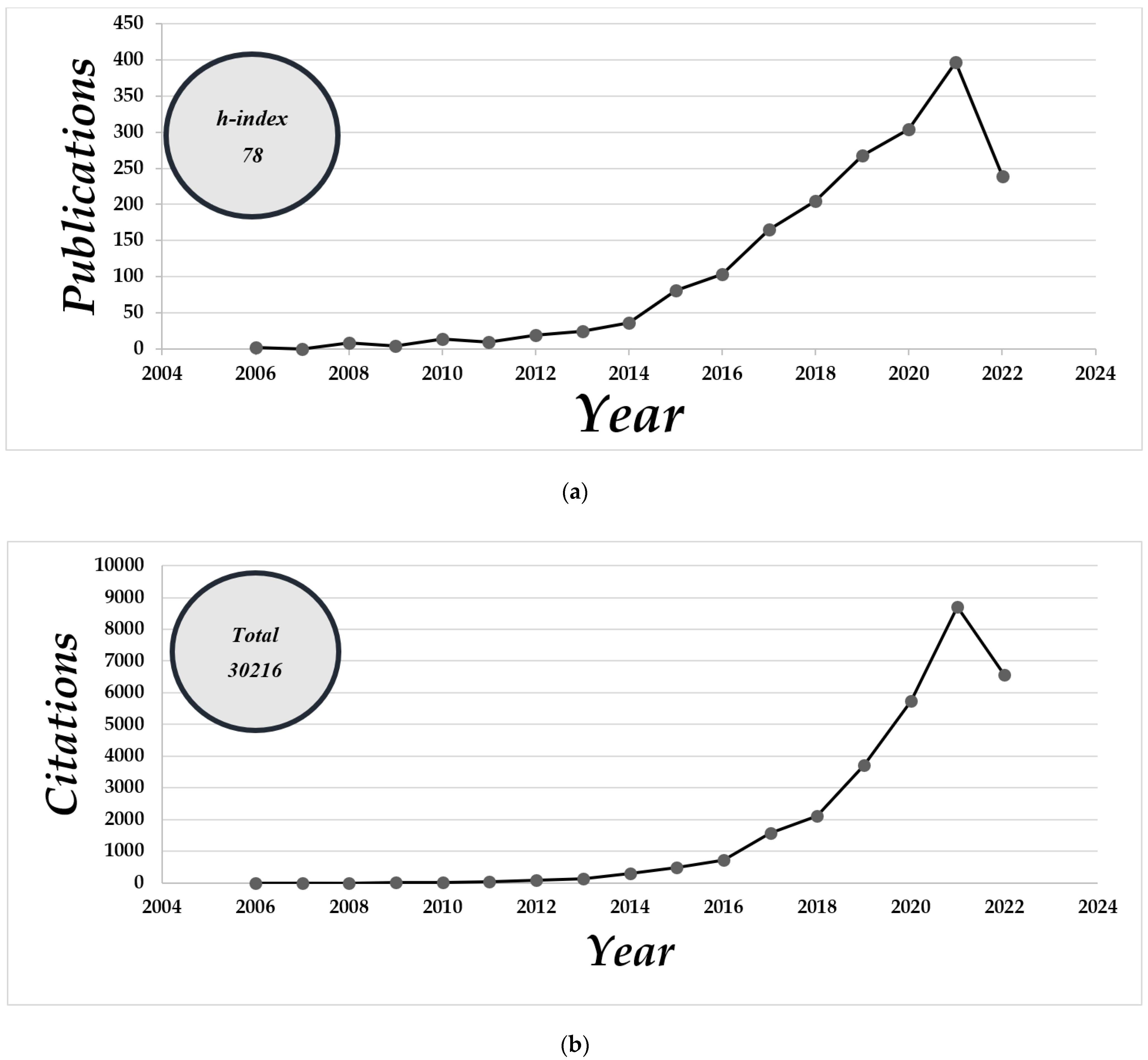
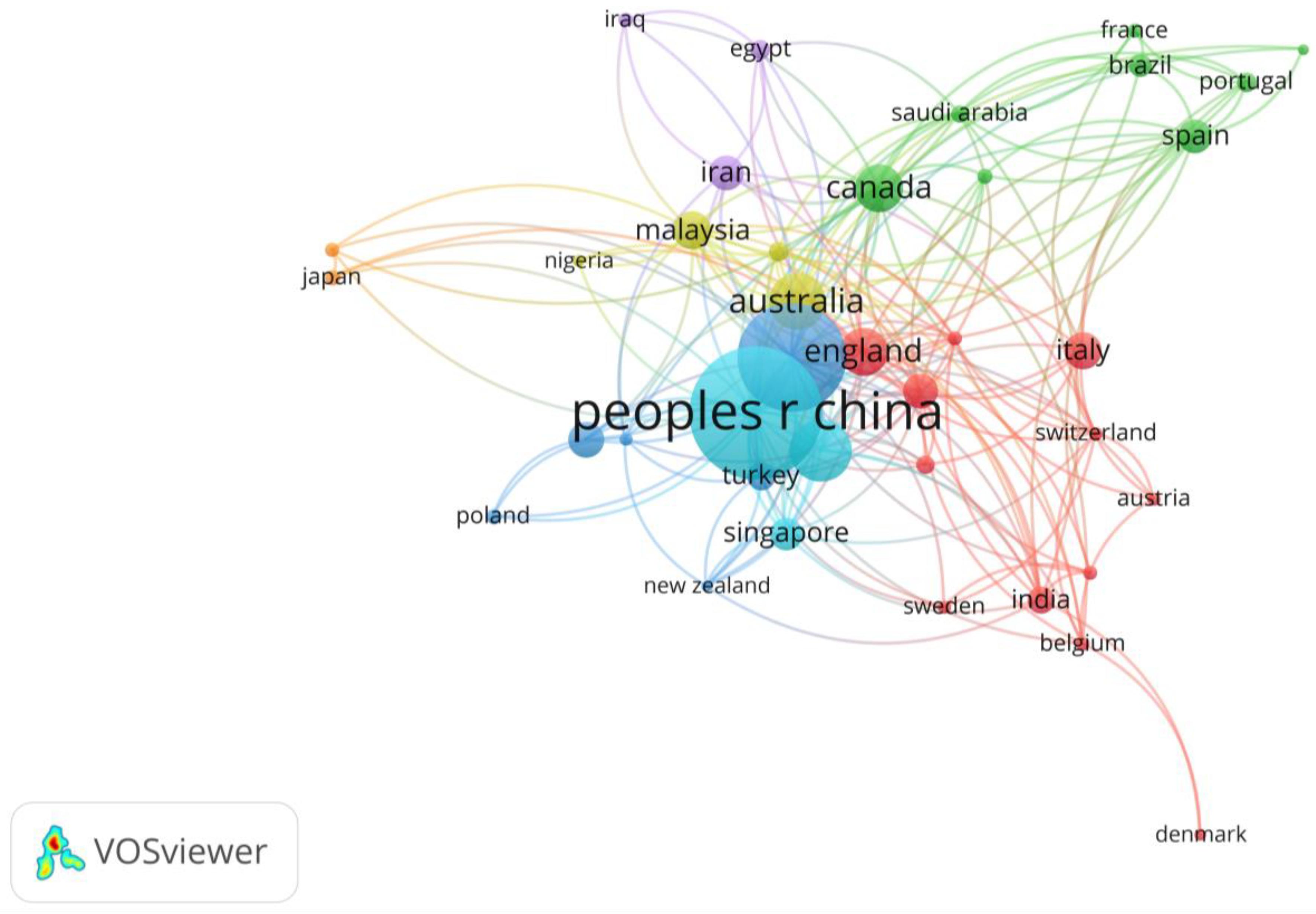
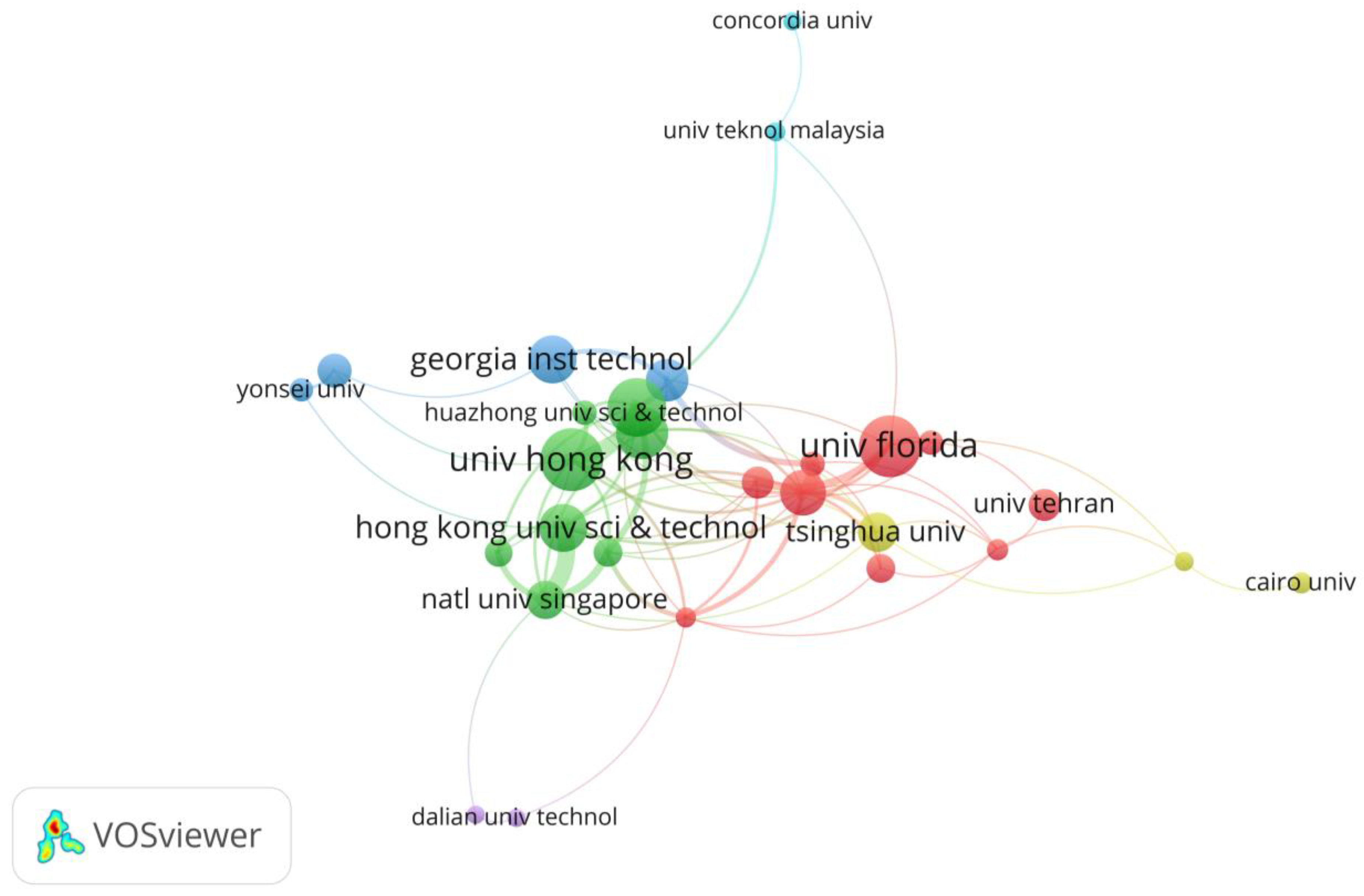

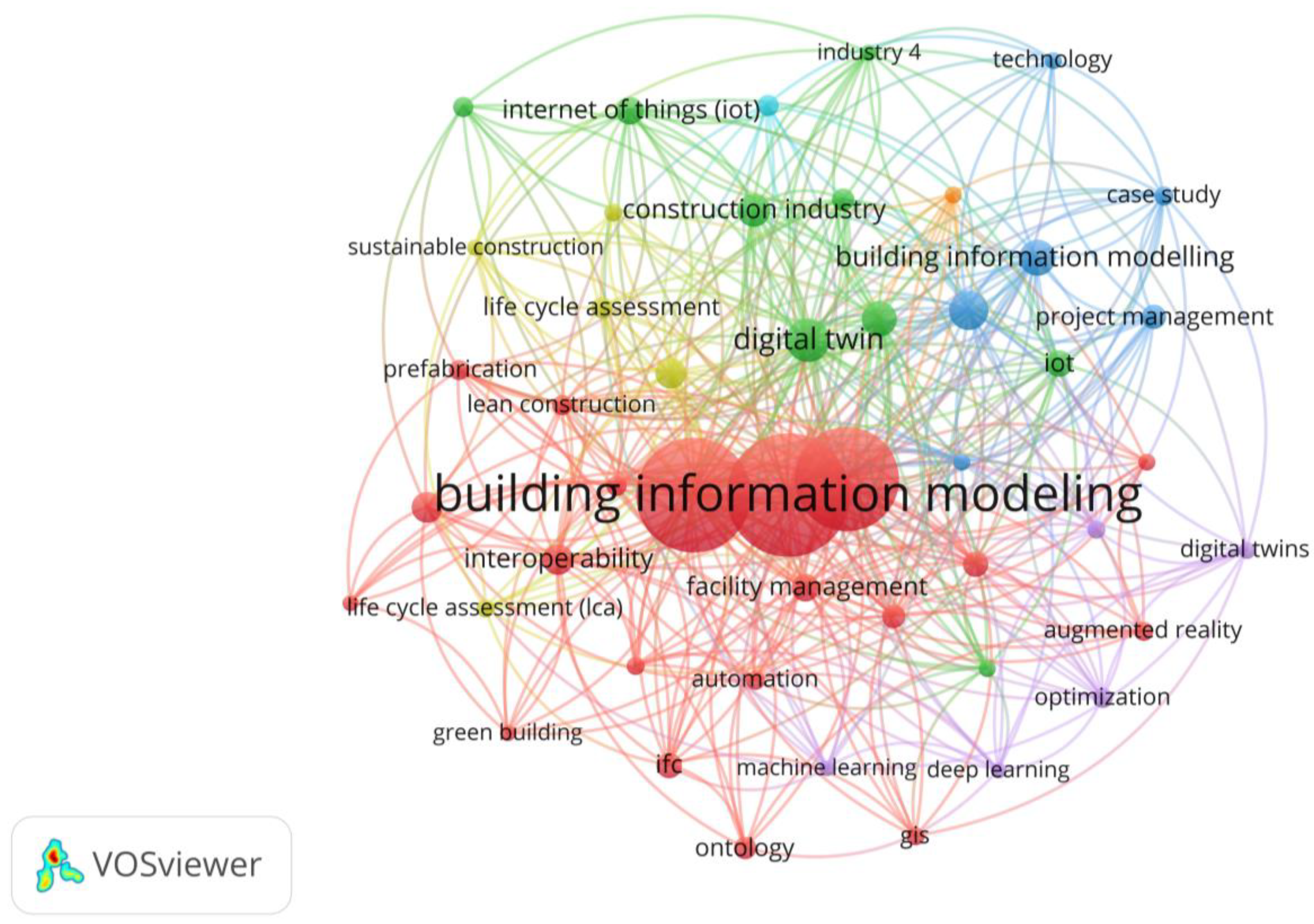



| No. | Country | Documents | Citations | Total Link Strength | Average Citation/Publication |
|---|---|---|---|---|---|
| 1 | China | 506 | 7392 | 214 | 14.60869565 |
| 2 | USA | 371 | 8599 | 150 | 23.17789757 |
| 3 | South Korea | 151 | 3330 | 71 | 22.05298013 |
| 4 | Australia | 131 | 2825 | 134 | 21.5648855 |
| 5 | England | 102 | 1933 | 80 | 18.95098039 |
| 6 | Canada | 100 | 1870 | 49 | 18.7 |
| 7 | Malaysia | 71 | 398 | 63 | 5.605633803 |
| 8 | Italy | 67 | 678 | 15 | 10.11940299 |
| 9 | Taiwan | 65 | 1136 | 17 | 17.47692308 |
| 10 | Iran | 62 | 499 | 46 | 8.048387097 |
| 11 | Germany | 61 | 1610 | 29 | 26.39344262 |
| 12 | Spain | 58 | 726 | 29 | 12.51724138 |
| 13 | Singapore | 56 | 1105 | 54 | 19.73214286 |
| 14 | Turkey | 45 | 611 | 20 | 13.57777778 |
| 15 | India | 41 | 287 | 18 | 7 |
| 16 | Brazil | 31 | 474 | 12 | 15.29032258 |
| 17 | Egypt | 26 | 396 | 8 | 15.23076923 |
| 18 | Pakistan | 26 | 349 | 25 | 13.42307692 |
| 19 | Portugal | 26 | 534 | 14 | 20.53846154 |
| 20 | Israel | 24 | 967 | 14 | 40.29166667 |
| No. | Organization | QS Ranking | Documents | Citations | Total Link Strength | Average Citation/Publication |
|---|---|---|---|---|---|---|
| 1 | The University of Hong Kong | 21 | 51 | 1478 | 22 | 28.98039 |
| 2 | University of Florida | 188 | 50 | 876 | 14 | 17.52 |
| 3 | Hong Kong Polytechnic University | 65 | 48 | 1435 | 31 | 29.89583 |
| 4 | Tongji University | 212 | 43 | 845 | 13 | 19.65116 |
| 5 | Georgia Institute of Technology | 88 | 39 | 2136 | 6 | 54.76923 |
| 6 | Hong Kong University of Science and Technology | 40 | 39 | 1019 | 23 | 26.12821 |
| 7 | Curtin University | 193 | 37 | 1185 | 32 | 32.02703 |
| 8 | Hanyang University | 157 | 35 | 968 | 11 | 27.65714 |
| 9 | Tsinghua University | 14 | 32 | 639 | 9 | 19.96875 |
| 10 | National University of Singapore | 11 | 31 | 718 | 27 | 23.16129 |
| 11 | Purdue University | 129 | 28 | 241 | 4 | 8.607143 |
| 12 | Penn State University | 15 | 26 | 524 | 10 | 20.15385 |
| 13 | University of Tehran | 501–510 | 26 | 166 | 2 | 6.384615 |
| 14 | National Taiwan University | 77 | 24 | 391 | 5 | 16.29167 |
| 15 | Shenzhen University | 581–591 | 24 | 642 | 17 | 26.75 |
| 16 | Southeast University | 461 | 23 | 135 | 9 | 5.869565 |
| 17 | Huazhong University of Science and Technology | 306 | 20 | 415 | 7 | 20.75 |
| 18 | Kyung Hee University | 270 | 20 | 898 | 15 | 44.9 |
| 19 | Politecnico di Milano | 139 | 20 | 308 | 2 | 15.4 |
| 20 | Yonsei University | 73 | 19 | 297 | 3 | 15.63158 |
| No. | Name of Agency | Number of Documents |
|---|---|---|
| 1 | National Natural Science Foundation of China (NSFC) | 154 |
| 2 | National Science Foundation (NSF) | 42 |
| 3 | National Research Foundation of Korea | 37 |
| 4 | European Commission | 32 |
| 5 | Fundamental Research Funds for the Central Universities | 30 |
| 6 | Natural Sciences and Engineering Research Council of Canada (NSERC) | 26 |
| 7 | National Key R&D Programmes | 21 |
| 8 | Ministry of Science and Technology (Taiwan) | 16 |
| 9 | Ministry of Land, Infrastructure, and Transport of the Korean Government | 13 |
| 10 | The Hong Kong Polytechnic University | 13 |
| No | Author | Documents | Citations | Total Link Strength | Average Citation/Publication |
|---|---|---|---|---|---|
| 1 | Jack C.P. Cheng | 34 | 936 | 28 | 27.52 |
| 2 | Wilson LU | 22 | 816 | 16 | 37.09 |
| 3 | Heap-Yih (John) Chong | 18 | 173 | 4 | 9.61 |
| 4 | Jiansong Zhang | 18 | 125 | 3 | 6.94 |
| 5 | Xiangyu Wang | 17 | 972 | 6 | 57.17 |
| 6 | Issa Ramaji | 15 | 379 | 0 | 25.26 |
| 7 | CM Eastman | 14 | 1103 | 7 | 78.78 |
| 8 | Vincent J.L. GAN | 13 | 283 | 13 | 21.76 |
| 9 | Qian Wang | 13 | 286 | 10 | 22 |
| 10 | Ke Chen | 12 | 396 | 11 | 33 |
| 11 | Yong-Cheol Lee | 12 | 196 | 9 | 16.33 |
| 12 | Heng Li | 12 | 239 | 1 | 19.91 |
| 13 | Mohamed Marzouk | 12 | 245 | 0 | 20.41 |
| 14 | Rafael Sacks | 12 | 746 | 1 | 62.16 |
| 15 | Shang-Hsien Hsieh | 11 | 210 | 2 | 19.09 |
| 16 | Fernanda Leite | 11 | 172 | 0 | 15.63 |
| 17 | Sheryl Staub-French | 11 | 300 | 0 | 27.27 |
| 18 | Keyu Chen | 10 | 227 | 13 | 22.70 |
| 19 | M. Reza Hosseini | 10 | 183 | 0 | 18.30 |
| 20 | Fan Xue | 10 | 764 | 8 | 76.40 |
| No. | Keyword | Occurrences | Total Link Strength |
|---|---|---|---|
| 1 | Building Information Modeling | 434 | 315 |
| 2 | Building Information Modeling (BIM) | 383 | 225 |
| 3 | BIM | 327 | 291 |
| 4 | digital twin | 77 | 104 |
| 5 | construction | 64 | 105 |
| 6 | building information modelling | 57 | 80 |
| 7 | Internet of Things | 54 | 70 |
| 8 | construction industry | 48 | 62 |
| 9 | industry foundation classes (ifc) | 44 | 58 |
| 10 | sustainability | 44 | 75 |
| 11 | interoperability | 43 | 78 |
| 12 | facility management | 37 | 62 |
| 13 | Internet of Things (IoT) | 37 | 43 |
| 14 | 4D BIM | 36 | 80 |
| 15 | IoT | 35 | 48 |
| 16 | ifc | 33 | 45 |
| 17 | construction management | 32 | 45 |
| 18 | project management | 30 | 49 |
| 19 | visualization | 28 | 47 |
| 20 | blockchain | 26 | 47 |
| 21 | ontology | 25 | 31 |
| 22 | 5D BIM | 8 | 26 |
| 23 | 6D BIM | 3 | 15 |
| No. | Journal | Publications | Citations | Total Link Strength | IF | AR (%) | Publisher | Total Publication (%) |
|---|---|---|---|---|---|---|---|---|
| 1 | Automation in Construction | 239 | 11,115 | 2158 | 10.517 | 26 | Elsevier | 12.71 |
| 2 | Sustainability | 101 | 946 | 685 | 3.889 | - | MDPI | 5.37 |
| 3 | Journal of Construction Engineering & Management | 77 | 1939 | 720 | 3.951 | - | ASCE | 4.09 |
| 4 | Applied Sciences | 75 | 549 | 443 | 2.838 | - | MDPI | 3.99 |
| 5 | Buildings | 70 | 459 | 493 | 3.324 | - | MDPI | 3.72 |
| 6 | Engineering, Construction and Architectural Management | 60 | 589 | 491 | 3.850 | - | Emerald | 3.19 |
| 7 | Journal of Management in Engineering | 47 | 1247 | 502 | 6.415 | - | ASCE | 2.50 |
| 8 | Advances in Civil Engineering | 42 | 191 | 253 | 1.843 | 42 | Hindawi | 2.23 |
| 9 | Journal of Computing in Civil Engineering | 38 | 835 | 249 | 5.802 | - | ASCE | 2.02 |
| 10 | Advanced Engineering Informatics | 35 | 955 | 342 | 7.862 | - | Elsevier | 1.86 |
| 11 | Journal of Information Technology in Construction (ITcon) | 35 | 282 | 201 | 1.942 | - | - | 1.86 |
| 12 | Journal of Building Engineering (JOBE) | 31 | 459 | 273 | 7.144 | 26 | Elsevier | 1.64 |
| 13 | Journal of Cleaner Production | 29 | 1001 | 346 | 11.072 | - | Elsevier | 1.54 |
| 14 | Building and Environment | 26 | 989 | 254 | 7.093 | 21 | Elsevier | 1.38 |
| 15 | International Journal of Construction Management | 20 | 259 | 142 | 3.097 | 12 | Taylor & Francis | 1.06 |
| No. | Conference | Publications | Citations | Total Link Strength | - | - | - | Total Publication (%) |
| 1 | Construction research congress 2020: computer applications | 19 | 17 | 45 | - | - | - | 1.01 |
| 2 | -E work and Ebusiness in architecture, engineering and construction | 18 | 32 | 14 | - | - | - | 0.95 |
| 3 | Construction research congress 2018: construction information technology | 17 | 60 | 31 | - | - | - | 0.90 |
| 4 | Computing in civil engineering 2019: visualization, information modeling, and simulation | 13 | 48 | 23 | - | - | - | 0.69 |
| 5 | Computing in civil engineering 2017: information modelling and data analytics | 11 | 55 | 26 | - | - | - | 0.58 |
| 6 | Construction research congress 2020: project management and controls, materials, and contracts | 11 | 7 | 17 | - | - | - | 0.58 |
| 7 | Construction research congress 2022: computer applications, automation, and data analytics | 11 | 0 | 26 | - | - | - | 0.58 |
| 8 | 0z Construction research congress 2016: old and new construction technologies converge in historic San Juan | 10 | 56 | 28 | - | - | - | 0.53 |
| 9 | Creative construction conference 2017 (ccc 2017) | 9 | 106 | 42 | - | - | - | 0.47 |
| 10 | 5th creative construction conference (ccc 2016) | 7 | 178 | 37 | - | - | - | 0.37 |
| No. | Cited Reference | Year | Citations | Total Link Strength |
|---|---|---|---|---|
| 1 | [63] | 2011 | 312 | 760 |
| 2 | [66] | 2011 | 218 | 762 |
| 3 | [67] | 2014 | 146 | 581 |
| 4 | [68] | 2013 | 141 | 570 |
| 5 | [69] | 2012 | 120 | 379 |
| 6 | [70] | 2010 | 116 | 521 |
| 7 | [71] | 2012 | 89 | 380 |
| 8 | [72] | 2013 | 89 | 239 |
| 9 | [73] | 2013 | 85 | 356 |
| 10 | [74] | 2012 | 81 | 310 |
| No. | Author | Year | Journal/Conference | Citations | Field | Purpose | Conclusion |
|---|---|---|---|---|---|---|---|
| 1 | Ali, Alhajlah and Kassem [57] | 2022 | BUILDINGS | 2 | BIM | The current status and future trends in BIM literature from the WOS. | Due to the subject’s significance, they discovered that only 88 publications specifically focused on collaboration and risks in BIM, while there is a clear trend toward increasing these research studies in recent years. |
| 2 | Zhang, et al. [77] | 2022 | JOURNAL OF MANAGEMENT IN ENGINEERING | 4 | BIM and DT | Putting out a framework for BIM employing Digital Twins and level of details (LoDs) for managing construction sites. | Improvements in quality, productivity, and worker safety result from using the suggested framework at construction sites. |
| 3 | Li, et al. [78] | 2022 | JOURNAL OF CONSTRUCTION ENGINEERING AND MANAGEMENT | 13 | BIM and IoT | Implementing Blockchain for data-information-knowledge (DIK)-driven modular construction supply chain management with IoT-enabled BIM platform (IBP). | BIBP not only provides an efficient system design with acceptable throughput and latency, but it also helps realize a single point of truth in BIM and prevent a single point of failure for IoT networks by taking privacy and security precautions. |
| 4 | Sun and Liu [79] | 2022 | ADVANCES IN CIVIL ENGINEERING | 2 | BIM and DT | Proposing a new hybrid model of Digital Twin-BIM. | Thanks to these hybrid technologies, there is a better degree of efficacy in the dispatch systems for building projects. |
| 5 | Almatared, et al. [80] | 2022 | CONSTRUCTION RESEARCH CONGRESS 2022: COMPUTER APPLICATIONS, AUTOMATION, AND DATA ANALYTICS | 25 | DT | Bibliometric analysis is used to summarize the state-of-the-art DT in the AEC sector to identify research trends, problems, and gaps. | By statistically revealing research trends and demands for DT in the AEC sector, the findings added to the body of knowledge. |
| 6 | Teisserenc and Sepasgozar [81] | 2021 | BUILDINGS | 7 | DT | There is currently a novel conceptual model for deploying blockchain technology (BCT) for Digital Twins (DT) in the BECOM industry 4.0, aiming to improve trust, cyber security, efficiency, information management, information management, information sharing, and sustainability. | With the use of BCT, the decentralized Digital Twin cycle (DDTC) can enhance the data value chain regarding data sharing, cybersecurity, data integrity, immutability, traceability, and transparency or privacy of information. |
| 7 | Lee and Lee [47] | 2021 | APPLIED SCIENCES | 16 | DT | Creating a Digital Twin architecture that can simulate real-time logistics and identify possible risks and module delivery times. | A Digital Twin can forecast potential logistical risks and accurately estimate arrival times based on a trustworthy simulation. |
| 8 | Villa, et al. [82] | 2021 | APPLIED SCIENCES | 5 | BIM and IoT | Integration of IoT alert systems with BIM models to track building facilities throughout their operating phase and digitally view their status. | Implementing a building structure’s preventative maintenance approach into an IoT and BIM dashboard’s architecture is practical and promising. |
| 9 | Sepasgozar [83] | 2021 | BUILDINGS | 27 | DT | Elucidation of the DT idea and its distinction from other cutting-edge information systems, digital shadows, and 3D modeling technologies. | Implementing the Sustainable Development Goals (SDGs) should be considered while developing the DT. |
| 10 | Pan and Zhang [84] | 2021 | AUTOMATION IN CONSTRUCTION | 52 | BIM, DT, and IoT | Proposing a closed-loop Digital Twin framework using methods from data mining (DM), BIM, and IoT. | Data exchange and exploration can be facilitated by a data-driven Digital Twin framework combining BIM, IoT, and DM for improved project management to better understand, forecast, and optimize the physical construction processes. |
| 11 | Menassa [44] | 2021 | JOURNAL OF INFORMATION TECHNOLOGY IN CONSTRUCTION | 26 | BIM and DT | Researching state of the art to determine whether new technologies are paving the way for the transition from BIM to Digital Twins in construction-related contexts. | The majority of early studies that have been done so far fall into the earlier ladder categories since they have not completely used or achieved the envisioned notion of the Digital Twin. |
| 12 | Sepasgozar, et al. [85] | 2021 | SUSTAINABILITY | 18 | BIM | Determining the most current initiatives to use BIM for lean goals over the past ten years. | There is an obvious gap in our knowledge of the synergistic connections between lean ideas and the use of BIM and the Internet of Things in construction, such as sustainable infrastructure projects. |
| 13 | Lin and Cheung [86] | 2020 | JOURNAL OF MANAGEMENT IN ENGINEERING | 29 | BIM and DT | Developing an advanced monitoring and control system for monitoring the environment in underground parking garages, adopting WSN and BIM technologies for the DT application of Industry 4.0, and providing a planning method for their integration. | The suggested method is an efficient visual monitoring solution for managing environmental monitoring. |
| 14 | Al-Saeed, et al. [87] | 2020 | CONSTRUCTION INNOVATION-ENGLAND | 31 | BIM and DT | Innovative proof-of-concept framework proposed for integrating BIM Digital Objects (BDO) into construction product manufacturers’ workflows to facilitate process automation and enhance lean manufacturing. | BDO can cut down on the number of manufacturing procedures, providing cost savings and lessening material waste, while successfully removing early model errors. |
| 15 | El Mokhtari, et al. [88] | 2022 | FRONTIERS IN BUILT ENVIRONMENT | 58 | DT | Presenting a case study of a Digital Twin (DT) in an academic facility that showcases many proof-of-concept applications of Cognitive Digital Twins (CDTs). | Cloud services provide the highest benefits for CDT scalability, availability, performance, and maintenance when coupled with EMs delivering reliable and secure data streaming. |
| 16 | Wei, et al. [89] | 2022 | BUILDINGS | 1 | DT | Proposing a model for an Off-site Construction Digital Twin. | The suggested approach could greatly decrease waste while increasing effectiveness. |
| 17 | Zhao, et al. [90] | 2022 | BUILDINGS | 2 | BIM, DT, and IoT | Putting out a system architecture integrating BIM and IoT to create a Digital Twin model (DTm) for hoisting control of prefabricated components. | The suggested framework can enhance the intelligent management of prefabricated building construction and introduces an innovative concept for intelligent building construction. |
| 18 | Marocco and Garofolo [91] | 2021 | AUTOMATION IN CONSTRUCTION | 5 | BIM, DT, and IoT | Presenting a thorough analysis of disruptive technology applications for FM, examining research trends, and highlighting research gaps and prospective future research areas. | The primary technology discussed in the publications under consideration was BIM. Creating Digital Twin platforms by fusing cloud computing, BIM, and IoT technologies is a good beginning point for enhancing FM. |
| 19 | Mannino, et al. [92] | 2021 | APPLIED SCIENCES | 13 | BIM and IoT | Presenting a literature review on the two primary pillars of digitalization in construction, BIM and IoT. | Studies on BIM and IoT are often built on closed ecosystems and proprietary files where information is not yet freely exchanged among stakeholders. Therefore, future research in the field of BIM-IoT integration should concentrate on open data and communication standards. |
| 20 | Hasan, et al. [93] | 2022 | JOURNAL OF ASIAN ARCHITECTURE AND BUILDING ENGINEERING | 12 | BIM and DT | Concentrating on using a Cyber-Physical System with AR and DT to track work and construction equipment operation. | Construction equipment that can be remotely controlled and tracked/monitored can speed up certain on-site tasks, such as 4D BIM and operations recording, while increasing accuracy and safety. |
| 21 | Turner, et al. [94] | 2021 | IEEE TRANSACTIONS ON INDUSTRIAL INFORMATICS | 29 | BIM, DT, and IoT | Examining the applicability of the main Industry 4.0 technologies of data analytics and AI, robots and automation, BIM, sensors and wearables, DT, and industrial networking to the construction industry. | Future building sites will incorporate Industry 4.0 technologies that do not operate independently of one another but rather collaborate to resemble a sophisticated cyber-physical system. Smaller device sizes, better communication technologies, greater battery power densities, and more powerful processing in IoT edge devices will continually change the component technologies. |
| 22 | Alshammari, et al. [95] | 2021 | JOURNAL OF INFORMATION TECHNOLOGY IN CONSTRUCTION | 9 | IoT | Analyzing existing practices while reviewing pertinent literature on the application of IoT in the built environment. | In order to promote cybersecurity and ensure that Digital Twin and city standards can be linked entirely with future secure smart cities, BIM requirements can be upgraded to become IoT-compatible. |
| 23 | Boje, et al. [96] | 2020 | AUTOMATION IN CONSTRUCTION | 136 | BIM and DT | Reviewing the many BIM programs that are used during the construction stage and emphasizing the constraints and needs that led to the idea of a construction DT | The BIM, which is the digital representation of the building, serves as the foundation for the DT and is enhanced by the inclusion of big data, the Internet of Things, and sensing capabilities from the construction site through building operation. |
| 24 | Salem and Dragomir [42] | 2022 | APPLIED SCIENCES | 40 | BIM and DT | Proposing a three-stage framework for evaluating and monitoring the creation of Digital Twins that includes the widely used BIM, the current monitoring and actuation DTs, and a third step that utilizes AI. | The suggested framework can offer information security to preserve the proper flow of data for analytics in the digital world and worker and site safety in the physical world. |
| 25 | Shahzad, et al. [97] | 2022 | BUILDINGS | 4 | DT | Examine Digital Twins’ benefits and applicability concerning already-existing digital technologies and highlight prospective applications and implementation issues. | DTs in built-environment projects can help design, construction, and operating processes. |
| 26 | Lee, et al. [98] | 2021 | AUTOMATION IN CONSTRUCTION | 37 | DT | Establishing and testing a blockchain and linked Digital Twin platform for traceable data exchange. | Data transmission that is traceable and unchangeable helps establish confidence for project-related data. The ensuing contract execution, payment, and even decision-making process could all be significantly accelerated by such accountable data, which ultimately promotes improved cooperation among the disparate project stakeholders. |
Publisher’s Note: MDPI stays neutral with regard to jurisdictional claims in published maps and institutional affiliations. |
© 2022 by the authors. Licensee MDPI, Basel, Switzerland. This article is an open access article distributed under the terms and conditions of the Creative Commons Attribution (CC BY) license (https://creativecommons.org/licenses/by/4.0/).
Share and Cite
Baghalzadeh Shishehgarkhaneh, M.; Keivani, A.; Moehler, R.C.; Jelodari, N.; Roshdi Laleh, S. Internet of Things (IoT), Building Information Modeling (BIM), and Digital Twin (DT) in Construction Industry: A Review, Bibliometric, and Network Analysis. Buildings 2022, 12, 1503. https://doi.org/10.3390/buildings12101503
Baghalzadeh Shishehgarkhaneh M, Keivani A, Moehler RC, Jelodari N, Roshdi Laleh S. Internet of Things (IoT), Building Information Modeling (BIM), and Digital Twin (DT) in Construction Industry: A Review, Bibliometric, and Network Analysis. Buildings. 2022; 12(10):1503. https://doi.org/10.3390/buildings12101503
Chicago/Turabian StyleBaghalzadeh Shishehgarkhaneh, Milad, Afram Keivani, Robert C. Moehler, Nasim Jelodari, and Sevda Roshdi Laleh. 2022. "Internet of Things (IoT), Building Information Modeling (BIM), and Digital Twin (DT) in Construction Industry: A Review, Bibliometric, and Network Analysis" Buildings 12, no. 10: 1503. https://doi.org/10.3390/buildings12101503
APA StyleBaghalzadeh Shishehgarkhaneh, M., Keivani, A., Moehler, R. C., Jelodari, N., & Roshdi Laleh, S. (2022). Internet of Things (IoT), Building Information Modeling (BIM), and Digital Twin (DT) in Construction Industry: A Review, Bibliometric, and Network Analysis. Buildings, 12(10), 1503. https://doi.org/10.3390/buildings12101503