BIM Approach in Construction Safety—A Case Study on Preventing Falls from Height



Abstract
1. Introduction
2. BIM Technologies for Construction Safety Management
2.1. BIM Methodology
2.2. BIM-Related Technologies and Safety
2.3. Research Summary and Research Objective
3. Methodology
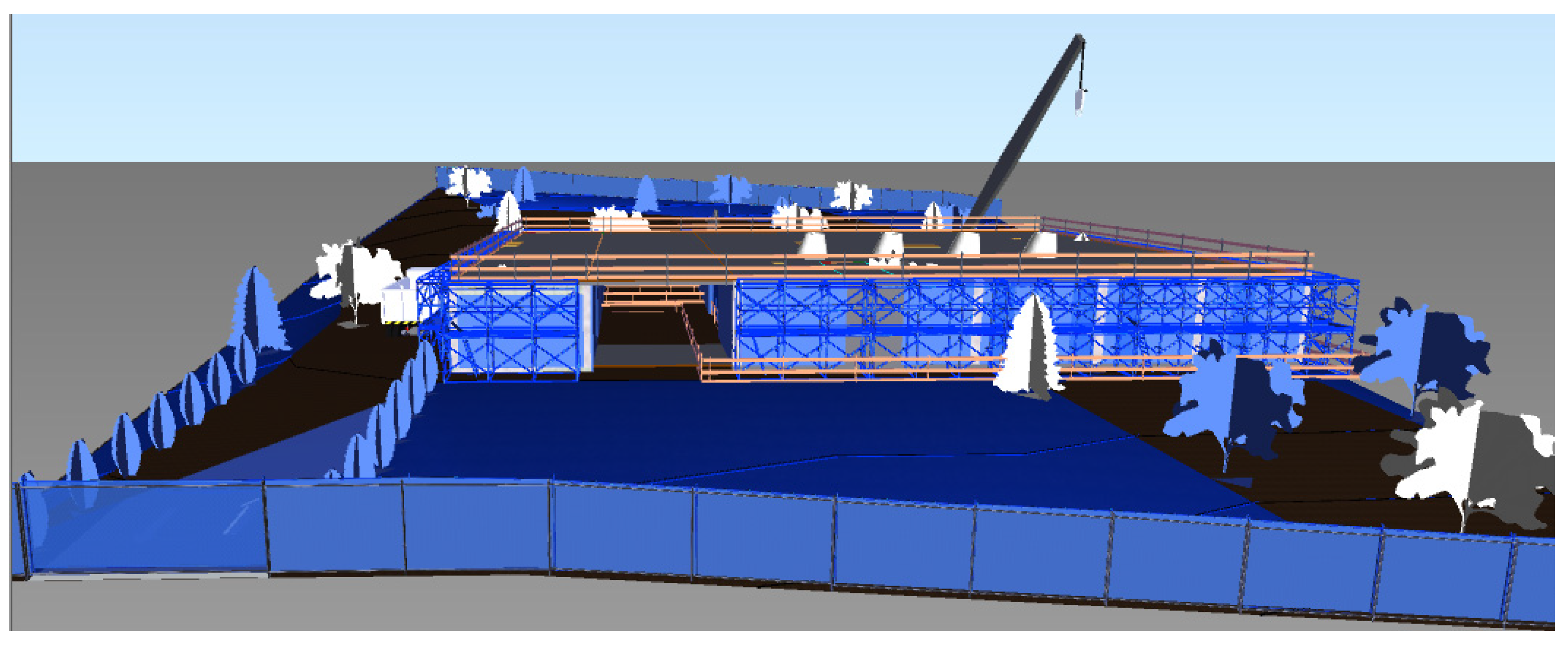
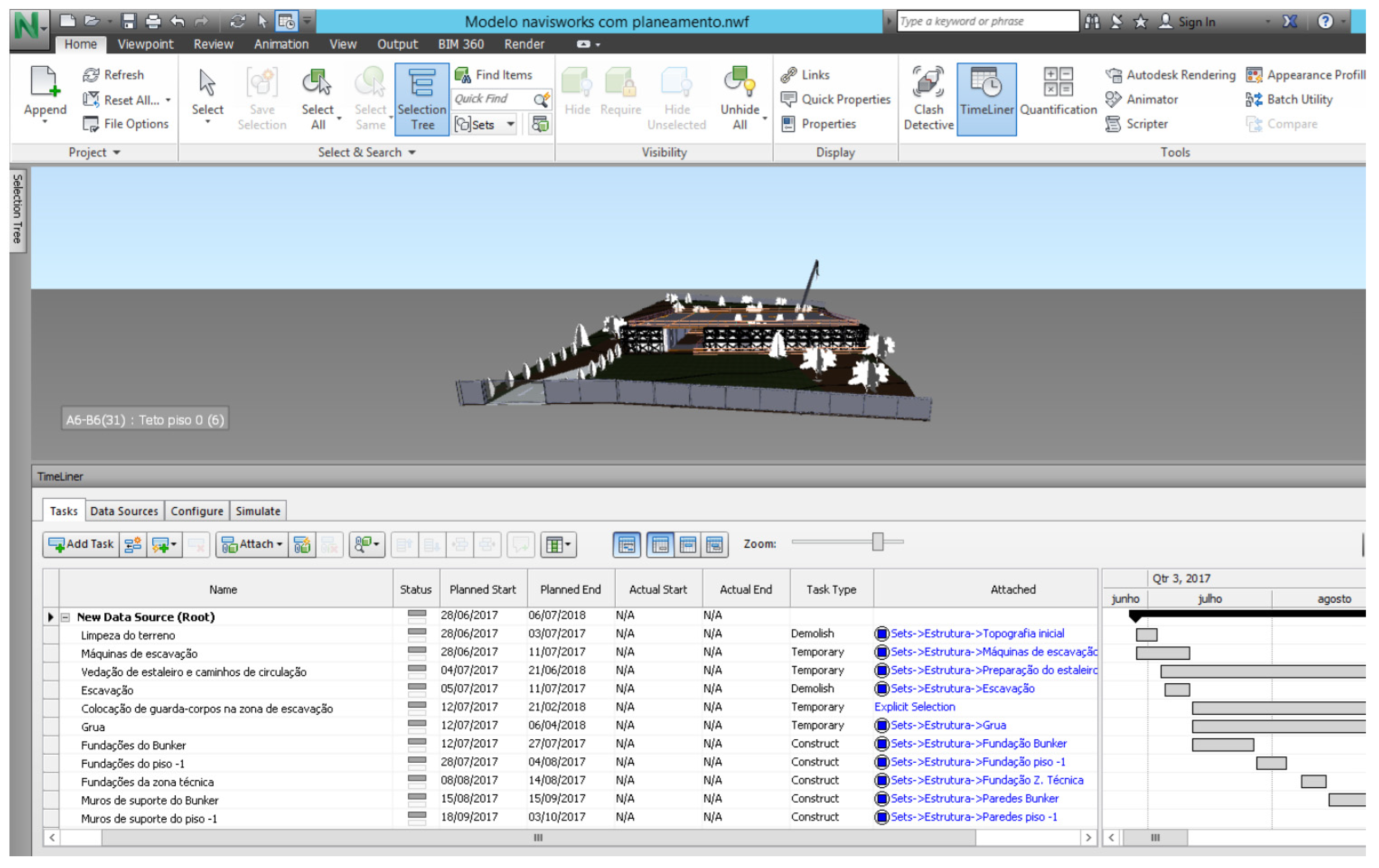
Case Study
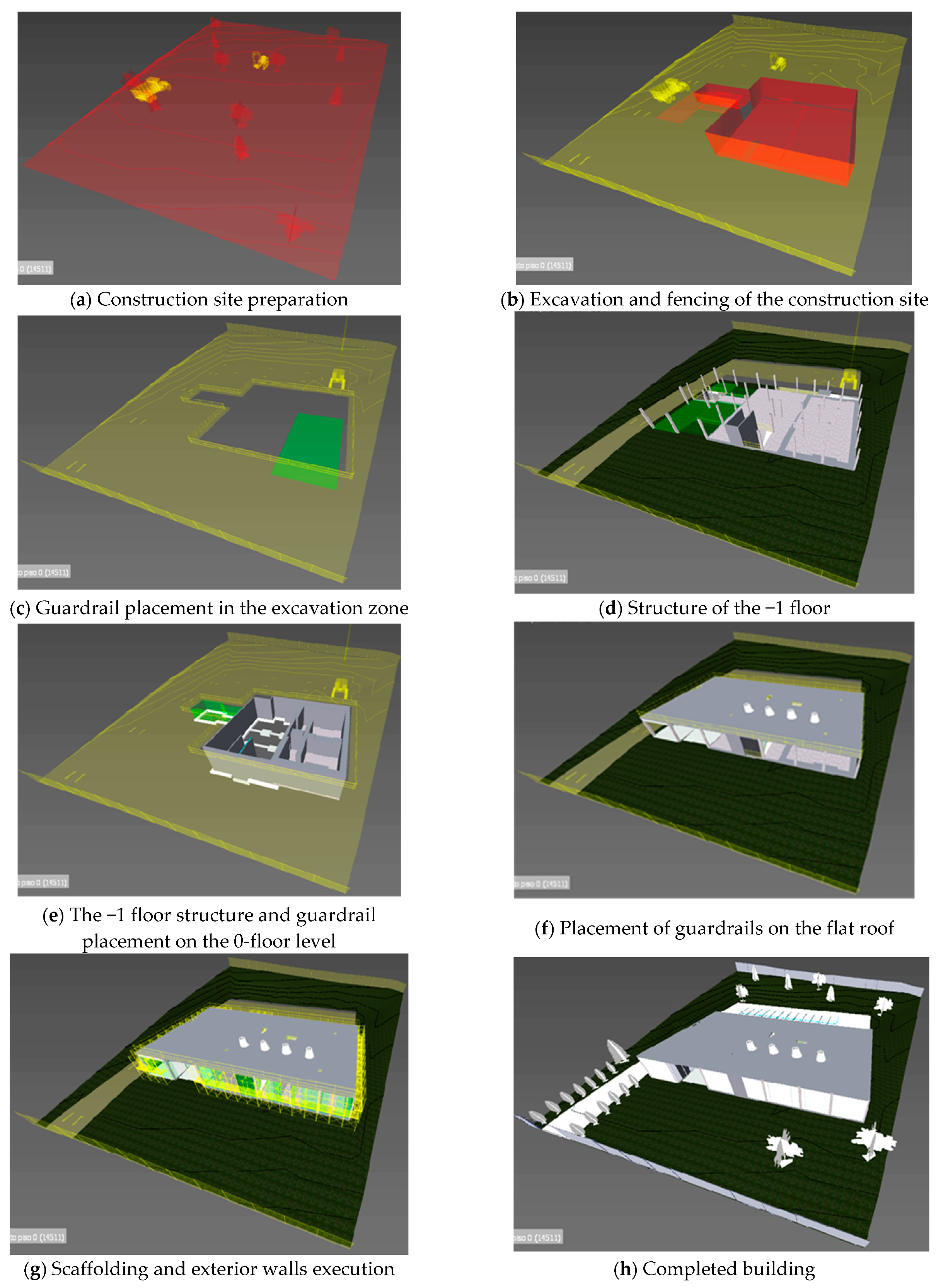
- Construction: when the task starts, the elements referring to the task are displayed in green and, upon completion, their colour turns to the colour of the Revit model.
- Demolish: at the task beginning, the elements to demolish are denoted with the colour red and disappear at the end.
- Temporary: the elements are coloured yellow for temporary structures and disappear on the defined date.
- (a)
- Construction site preparation phase. The soil is coloured red because of earth movement.
- (b)
- Excavation and fencing of the construction site. The topography appears in yellow because it changed during the construction process. The excavation zone is coloured red because of the soil extraction. The fence is a temporary structure, so it is coloured yellow.
- (c)
- Guardrail placement in the excavation zone. Because these elements are temporary structures, they are a yellow colour.
- (d)
- Structure of the −1 floor. The completed concrete structure, in that phase, has the final colour of the project (colour of the Revit model).
- (e)
- Waterproofing of the −1 floor and guardrails on floor 0. These temporary elements are represented in yellow.
- (f)
- Placement of guardrails on the flat roof. These temporary elements are represented in yellow.
- (g)
- Placement of scaffolding and execution of exterior walls. The scaffolding is coloured yellow, and the exterior walls during construction are green.
- (h)
- Completed building. All of the work has concluded, and the final elements correspond to the colours of the graphic model in Revit.
4. Results and Findings
4.1. Technologies
4.2. Design Phase
4.3. Planning Phase
4.4. Modelling
5. Discussion
6. Conclusions
Author Contributions
Funding
Data Availability Statement
Conflicts of Interest
References
- Pinto, D.; Rodrigues, F.; Baptista, J.S. The contribution of digital technologies to construction safety. In Proceedings of the Occupational Safety and Hygiene VI, Guimarães, Portugal, 26–27 March 2018; CRC Press: Boca Raton, FL, USA, 2018; pp. 115–119. [Google Scholar]
- Zhang, S.; Teizer, J.; Lee, J.-K.; Eastman, C.M.; Venugopal, M. Building Information Modeling (BIM) and Safety: Automatic Safety Checking of Construction Models and Schedules. Autom. Constr. 2013, 29, 183–195. [Google Scholar] [CrossRef] [Scilit]
- Guo, H.; Yu, Y.; Skitmore, M. Visualization technology-based construction safety management: A review. Autom. Constr. 2017, 73, 135–144. [Google Scholar] [CrossRef] [Scilit]
- Zhang, S.; Sulankivi, K.; Kiviniemi, M.; Romo, I.; Eastman, C.M.; Teizer, J. BIM-based fall hazard identification and prevention in construction safety planning. Saf. Sci. 2015, 72, 31–45. [Google Scholar] [CrossRef] [Scilit]
- Zhou, Z.; Irizarry, J.; Li, Q. Applying advanced technology to improve safety management in the construction industry: A literature review. Constr. Manag. Econ. 2013, 31, 606–622. [Google Scholar] [CrossRef] [Scilit]
- Parn, E.; Edwards, D. Conceptualising the FinDD API plug-in: A study of BIM-FM integration. Autom. Constr. 2017, 80, 11–21. [Google Scholar] [CrossRef] [Scilit]
- Sacks, R.; Eastman, C.; Lee, G.; Teicholz, P. BIM Handbook: A Guide to Building Information Modeling for Owners, Designers, Engineers, Contractors and Facility Managers; John Wiley and Sons: Hoboken, NJ, USA, 2018. [Google Scholar]
- Al-Ashmori, Y.Y.; Othman, I.; Rahmawati, Y.; Amran, Y.H.M.; Sabah, S.H.A.; Rafindadi, A.D.; Mikić, M. BIM benefits and its influence on the BIM implementation in Malaysia. Ain Shams Eng. J. 2020, 11, 1013–1019. [Google Scholar] [CrossRef] [Scilit]
- Jiang, M.; Cheng, Y.; Lei, T.; Liu, Z. “Intelligent Construction, Digital Modeling of the Future” Internet + BIM Service EPC Project—Take the Exhibition Center of National Cybersecurity Center for Education and Innovation Project as an Example. IOP Conf. Ser. Earth Environ. Sci. 2021, 719, 22043. [Google Scholar] [CrossRef] [Scilit]
- Li, Z. The Application of BIM Technology in the whole Life Cycle of Construction Project. IOP Conf. Ser. Earth Environ. Sci. 2020, 510, 62004. [Google Scholar] [CrossRef] [Scilit]
- Getuli, V.; Capone, P.; Bruttini, A.; Isaac, S. BIM-based immersive Virtual Reality for construction workspace planning: A safety-oriented approach. Autom. Constr. 2020, 114, 103160. [Google Scholar] [CrossRef] [Scilit]
- Dashti, M.S.; RezaZadeh, M.; Khanzadi, M.; Taghaddos, H. Integrated BIM-based simulation for automated time-space conflict management in construction projects. Autom. Constr. 2021, 132, 103957. [Google Scholar] [CrossRef] [Scilit]
- Enshassi, A.; Ayyash, A.; Choudhry, R.M. BIM for construction safety improvement in Gaza strip: Awareness, applications and barriers. Int. J. Constr. Manag. 2016, 16, 249–265. [Google Scholar] [CrossRef] [Scilit]
- Miao, D. Application of BIM Technology in the Informatization of Construction Management. In Proceedings of the International Conference on Cognitive based Information Processing and Applications (CIPA 2021), Beijing, China, 28 August–1 September 2021; Springer: Singapore, 2022; pp. 613–621. [Google Scholar]
- Yan, H.; Wang, L.; Jiang, X. Dynamic Control of Integrated Project Management System based on Engineering Projects. Comput. Des. Appl. 2021, 19 (Suppl. S4), 90–101. [Google Scholar] [CrossRef] [Scilit]
- Ganah, A.A.; John, G.A. BIM and project planning integration for onsite safety induction. J. Eng. Des. Technol. 2017, 15, 341–354. [Google Scholar] [CrossRef] [Scilit]
- Kim, K.; Cho, Y.; Zhang, S. Integrating work sequences and temporary structures into safety planning: Automated scaffolding-related safety hazard identification and prevention in BIM. Autom. Constr. 2016, 70, 128–142. [Google Scholar] [CrossRef] [Scilit]
- Takim, R.; Zulkifli, M.H.; Nawawi, A.H. Integration of Automated Safety Rule Checking (ASRC) System for Safety Planning BIM-Based Projects in Malaysia. Procedia-Soc. Behav. Sci. 2016, 222, 103–110. [Google Scholar] [CrossRef] [Scilit]
- Zadeh, P.A.; Wang, G.; Cavka, H.B.; Staub-French, S.; Pottinger, R. Information Quality Assessment for Facility Management. Adv. Eng. Inform. 2017, 33, 181–205. [Google Scholar] [CrossRef] [Scilit]
- Fadeyi, M.O. The role of building information modeling (BIM) in delivering the sustainable building value. Int. J. Sustain. Built Environ. 2017, 6, 711–722. [Google Scholar] [CrossRef] [Scilit]
- Getuli, V.; Ventura, S.M.; Capone, P.; Ciribini, A.L. BIM-based Code Checking for Construction Health and Safety. Procedia Eng. 2017, 196, 454–461. [Google Scholar] [CrossRef] [Scilit]
- Wetzel, E.M.; Thabet, W.Y. The use of a BIM-based framework to support safe facility management processes. Autom. Constr. 2015, 60, 12–24. [Google Scholar] [CrossRef] [Scilit]
- Choi, B.; Lee, H.-S.; Park, M.; Cho, Y.K.; Kim, H. Framework for Work-Space Planning Using Four-Dimensional BIM in Construction Projects. J. Constr. Eng. Manag. 2014, 140, 4014041. [Google Scholar] [CrossRef] [Scilit]
- Sawyer, T. Construction managers embrace 4D BIM for safety. ENR 2014, 272, 22. [Google Scholar]
- Chen, L.; Luo, H. A BIM-based construction quality management model and its applications. Autom. Constr. 2014, 46, 64–73. [Google Scholar] [CrossRef] [Scilit]
- Cheng, T.; Teizer, J. Real-time resource location data collection and visualization technology for construction safety and activity monitoring applications. Autom. Constr. 2013, 34, 3–15. [Google Scholar] [CrossRef] [Scilit]
- Zhou, W.; Whyte, J.; Sacks, R. Construction safety and digital design: A review. Autom. Constr. 2012, 22, 102–111. [Google Scholar] [CrossRef] [Scilit]
- Park, C.-S.; Kim, H.-J. A framework for construction safety management and visualization system. Autom. Constr. 2013, 33, 95–103. [Google Scholar] [CrossRef] [Scilit]
- Gambatese, J.A.; Behm, M.; Rajendran, S. Design’s role in construction accident causality and prevention: Perspectives from an expert panel. Saf. Sci. 2008, 46, 675–691. [Google Scholar] [CrossRef] [Scilit]
- Rodrigues, F.; Coutinho, A.; Cardoso, C. Correlation of causal factors that influence construction safety performance: A model. Work 2015, 51, 721–730. [Google Scholar] [CrossRef] [Scilit]
- Qi, J.; Issa, R.R.A.; Olbina, S.; Hinze, J. Use of Building Information Modeling in Design to Prevent Construction Worker Falls. J. Comput. Civ. Eng. 2014, 28, A4014008. [Google Scholar] [CrossRef] [Scilit]
- Zhang, S.; Boukamp, F.; Teizer, J. Ontology-based semantic modeling of construction safety knowledge: Towards automated safety planning for job hazard analysis (JHA). Autom. Constr. 2015, 52, 29–41. [Google Scholar] [CrossRef] [Scilit]
- Jin, Z.; Gambatese, J.; Liu, D.; Dharmapalan, V. Using 4D BIM to assess construction risks during the design phase. Eng. Constr. Arch. Manag. 2019, 26, 2637–2654. [Google Scholar] [CrossRef] [Scilit]
- Malekitabar, H.; Ardeshir, A.; Sebt, M.H.; Stouffs, R. Construction safety risk drivers: A BIM approach. Saf. Sci. 2016, 82, 445–455. [Google Scholar] [CrossRef] [Scilit]
- Hongling, G.; Yantao, Y.; Weisheng, Z.; Yan, L. BIM and Safety Rules Based Automated Identification of Unsafe Design Factors in Construction. Procedia Eng. 2016, 164, 467–472. [Google Scholar] [CrossRef] [Scilit]
- Hardin, B.; McCool, D. BIM and Construction Management: Proven Tools, Methods, and Workflows; Wiley: Indianopolis, IN, USA, 2015. [Google Scholar]
- Rodrigues, F.; Antunes, F.; Matos, R. Safety plugins for risks prevention through design resourcing BIM. Constr. Innov. 2021, 21, 244–258. [Google Scholar] [CrossRef] [Scilit]
- Hartmann, T.; van Meerveld, H.; Vossebeld, N.; Adriaanse, A. Aligning building information model tools and construction management methods. Autom. Constr. 2012, 22, 605–613. [Google Scholar] [CrossRef] [Scilit]
- Zou, Y.; Kiviniemi, A.; Jones, S.W. A review of risk management through BIM and BIM-related technologies. Saf. Sci. 2017, 97, 88–98. [Google Scholar] [CrossRef] [Scilit]
- Jin, R.; Zhong, B.; Ma, L.; Hashemi, A.; Ding, L. Integrating BIM with building performance analysis in project life-cycle. Autom. Constr. 2019, 106, 102861. [Google Scholar] [CrossRef] [Scilit]
- Bloch, T.; Sacks, R. Clustering Information Types for Semantic Enrichment of Building Information Models to Support Automated Code Compliance Checking. J. Comput. Civ. Eng. 2020, 34, 4020040. [Google Scholar] [CrossRef] [Scilit]
- Rodrigues, F.; Estrada, J.; Antunes, F.; Swuste, P. Safety through Design: A BIM-Based Framework; Springer: Singapore, 2018; pp. 112–123. [Google Scholar]
- Hallowell, M.R.; Hansen, D. Measuring and improving designer hazard recognition skill: Critical competency to enable prevention through design. Saf. Sci. 2016, 82, 254–263. [Google Scholar] [CrossRef] [Scilit]
- Abbasi, S.; Taghizade, K.; Noorzai, E. BIM-Based Combination of Takt Time and Discrete Event Simulation for Implementing Just in Time in Construction Scheduling under Constraints. J. Constr. Eng. Manag. 2020, 146, 4020143. [Google Scholar] [CrossRef] [Scilit]
- Sacks, R.; Dave, B.; Koskela, L.; Owen, R. Analysis framework for the interaction between lean construction and Building Information Modelling. In Proceedings of the 17th Annual Conference of the International Group for Lean Construction IGLC 17, Taipei, Taiwan, 15–17 July 2009; pp. 221–234. [Google Scholar]
- Sheikhkhoshkar, M.; Pour Rahimian, F.; Kaveh, M.H.; Hosseini, M.R.; Edwards, D.J. Automated planning of concrete joint layouts with 4D-BIM. Autom. Constr. 2019, 107, 102943. [Google Scholar] [CrossRef] [Scilit]
- Golizadeh, H.; Hon, C.K.; Drogemuller, R.; Hosseini, M.R. Digital engineering potential in addressing causes of construction accidents. Autom. Constr. 2018, 95, 284–295. [Google Scholar] [CrossRef] [Scilit]


| Safety Elements | Construction Phase | Remarks about the Model Application | Source |
|---|---|---|---|
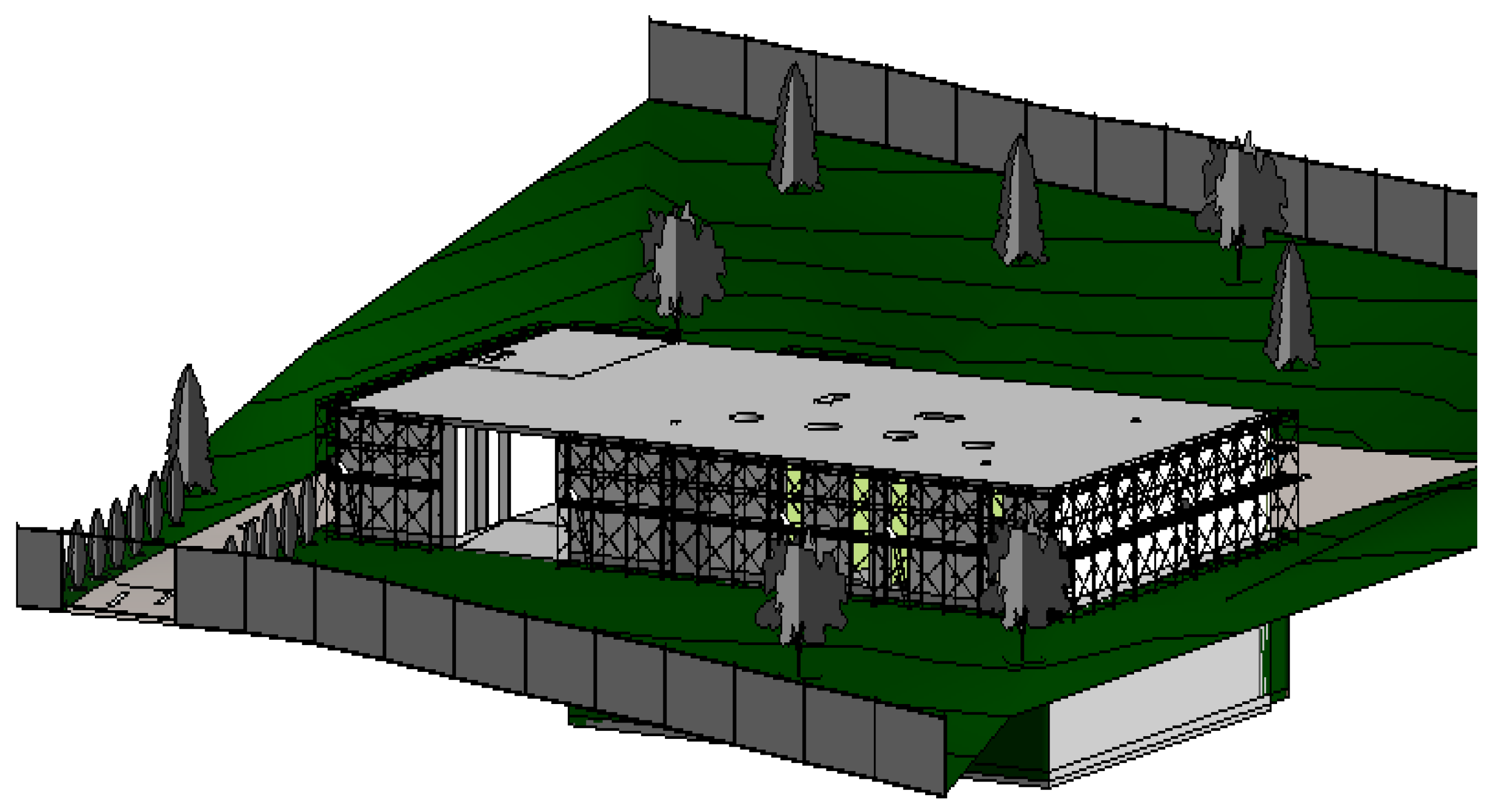
Scaffoldings | Execution of exterior facades, plastering and exterior finishing. | The family was changed to make it possible to be included in the model. | https://www.bimandco.com/en/groups/100/bimobjects/4649/downloadcenter, accessed on 9 January 2021 |
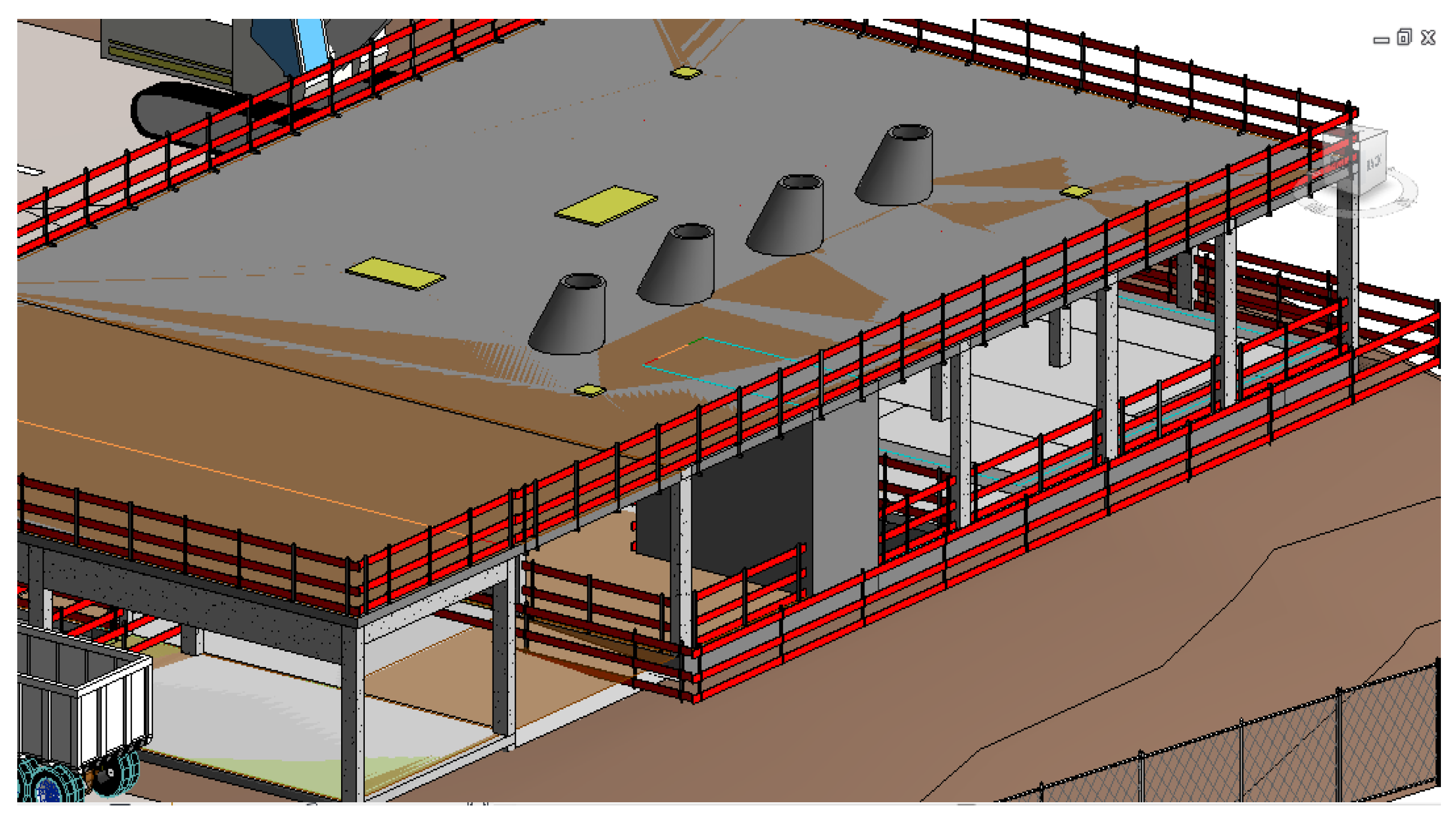
Guardrails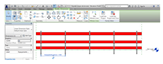 | Excavation zone protection. Guardrail assembly on the edges of slabs as long as the exterior walls have not been built up. Stairs and elevators protection. | Two guardrail models were developed according to the connection system to the structure.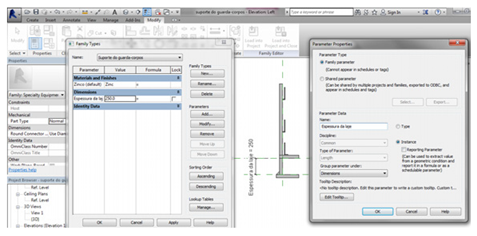 | Family modelled by the authors. |
Construction site fence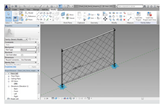 | Construction site fence lasts for all the construction period until the final fencing of the building is completed according to the design’s outside arrangements. | Construction site fence installed after the topographic definition of the construction site. A Revit “adaptative family” was used to follow the soil profile.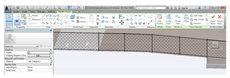 | https://www.revitcity.com/downloads.php?action=view&object_id=14492, accessed on 9 January 2021 |
Construction site routes/traffic directions | Definition of construction site routes is performed before the excavation works because this is the phase involving the greatest circulation of heavy machinery. | Use of the sub-region command to define the circulation path. Application of direction arrows. | Revit Library |
| Hole covers | Placement of hole covers in the roof slab until the HVAC system installation. Placement of hole covers in the exterior stairs openings. | Family modelled by the authors.  | Family modelled by the authors. |
| Type | Figure | Length (mm) | Bar Spacing (mm) | N.° of Bars | Slab Thickness (mm) |
|---|---|---|---|---|---|
| Guardrails with clamping system | 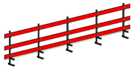 | 4197 | 1500 | 3 | 200 |
| Guardrails with spike system |  | 4260 | 2000 | 2 | --- |
| Level | Type | Figure | With (mm) | Length (mm) | Tab (mm) | Lower Thickness (mm) | Upper Thickness (mm) |
|---|---|---|---|---|---|---|---|
| Floor 0 | Cover 2400 × 1500 |  | 1700 | 2600 | 100 | 50 | 50 |
| Ceiling | Cover 300 × 300 | 500 | 500 | 100 | 50 | 50 | |
| Cover 1800 × 800 | 1000 | 2000 | 100 | 50 | 50 | ||
| Cover 2000 × 989 | 1189 | 2200 | 100 | 50 | 50 |
Publisher’s Note: MDPI stays neutral with regard to jurisdictional claims in published maps and institutional affiliations. |
© 2022 by the authors. Licensee MDPI, Basel, Switzerland. This article is an open access article distributed under the terms and conditions of the Creative Commons Attribution (CC BY) license (https://creativecommons.org/licenses/by/4.0/).
Share and Cite
Rodrigues, F.; Baptista, J.S.; Pinto, D. BIM Approach in Construction Safety—A Case Study on Preventing Falls from Height. Buildings 2022, 12, 73. https://doi.org/10.3390/buildings12010073
Rodrigues F, Baptista JS, Pinto D. BIM Approach in Construction Safety—A Case Study on Preventing Falls from Height. Buildings. 2022; 12(1):73. https://doi.org/10.3390/buildings12010073
Chicago/Turabian StyleRodrigues, Fernanda, João Santos Baptista, and Débora Pinto. 2022. "BIM Approach in Construction Safety—A Case Study on Preventing Falls from Height" Buildings 12, no. 1: 73. https://doi.org/10.3390/buildings12010073
APA StyleRodrigues, F., Baptista, J. S., & Pinto, D. (2022). BIM Approach in Construction Safety—A Case Study on Preventing Falls from Height. Buildings, 12(1), 73. https://doi.org/10.3390/buildings12010073