
Investigation of the Structural State of a Liquid Mg–Zn Magnesium Alloy from the Perspective of the Behavior of the Bjerrum–Guggenheim Osmotic Coefficient in the Melt

 and
and
Abstract
1. Introduction
2. Materials and Methods
3. Results
3.1. Mathematical Description of Monovariant Phase Equilibrium Lines in the Form of the Semi-Empirical Schröder–Le Chatelier Dependence
3.1.1. Mg–Zn Phase Diagram
3.1.2. MgZn2–Mg Crystallization Region
3.1.3. MgZn2–Zn Crystallization Region
3.2. Assessment of the Degree of Dissociation of the Congruent Compound MgZn2
3.3. Experimental Section
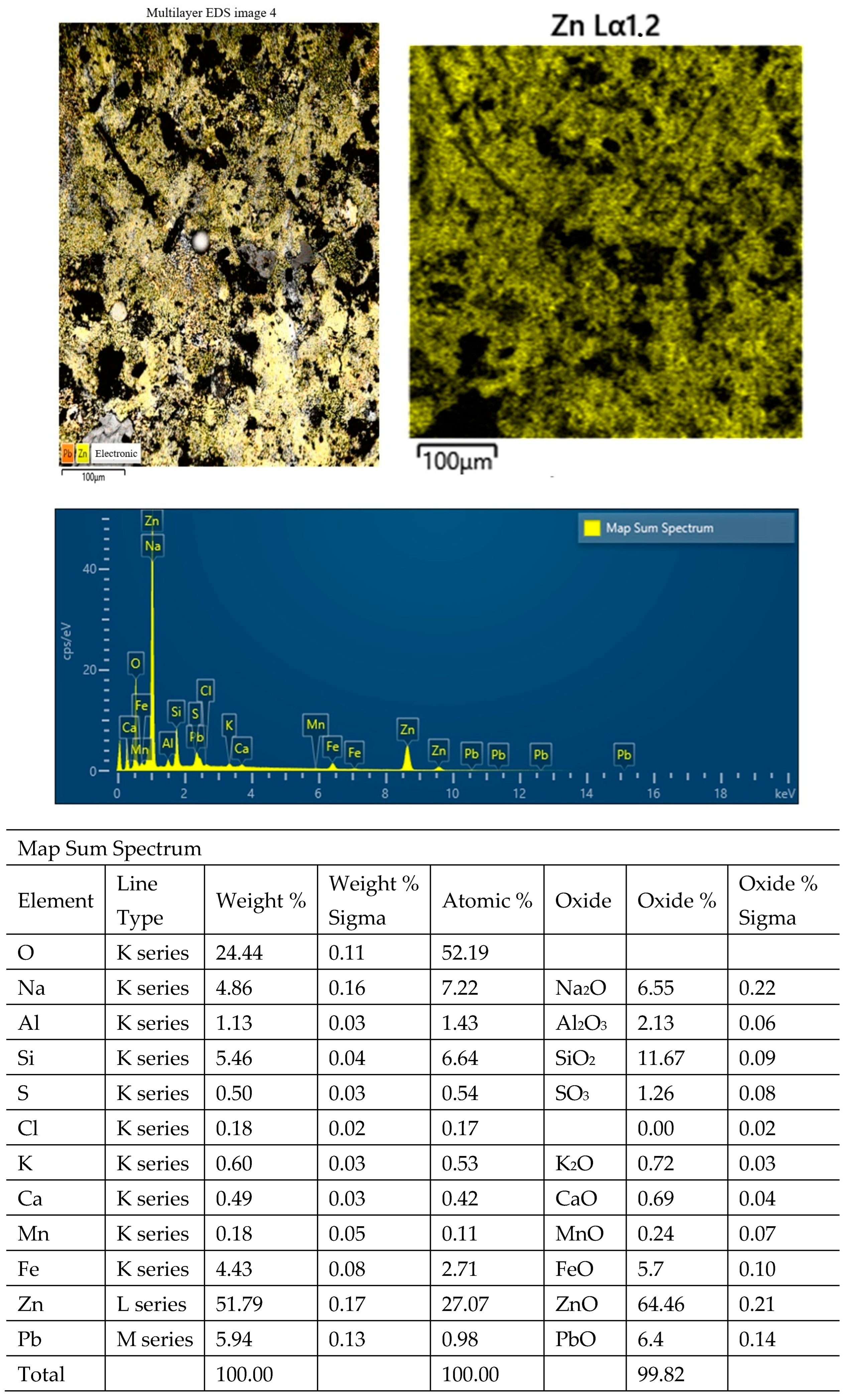
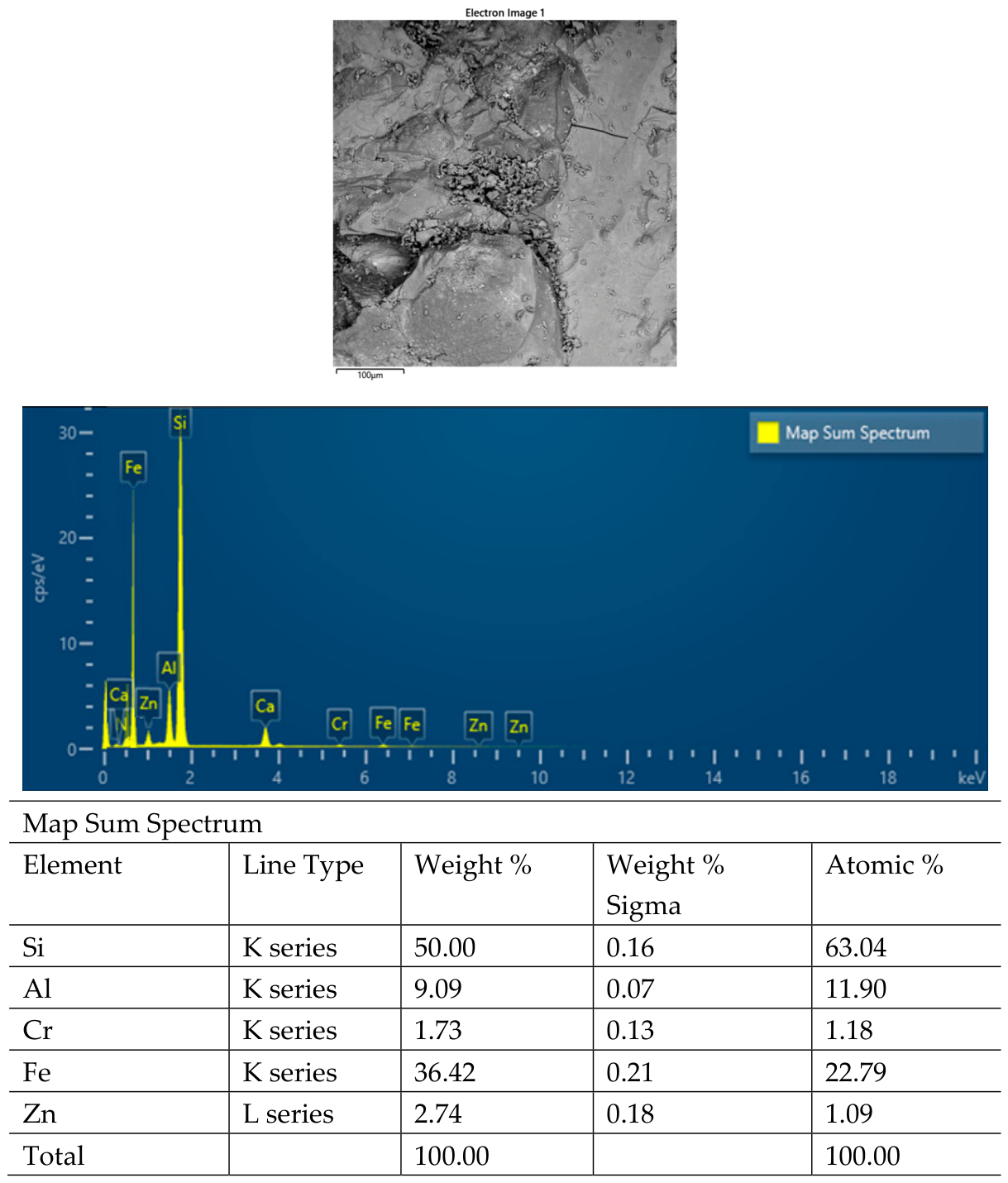
- The initial component composition of the slag is shown in Figure 4. As is known, in the slag phase, zinc is present in the form of oxide compounds.
- 2.
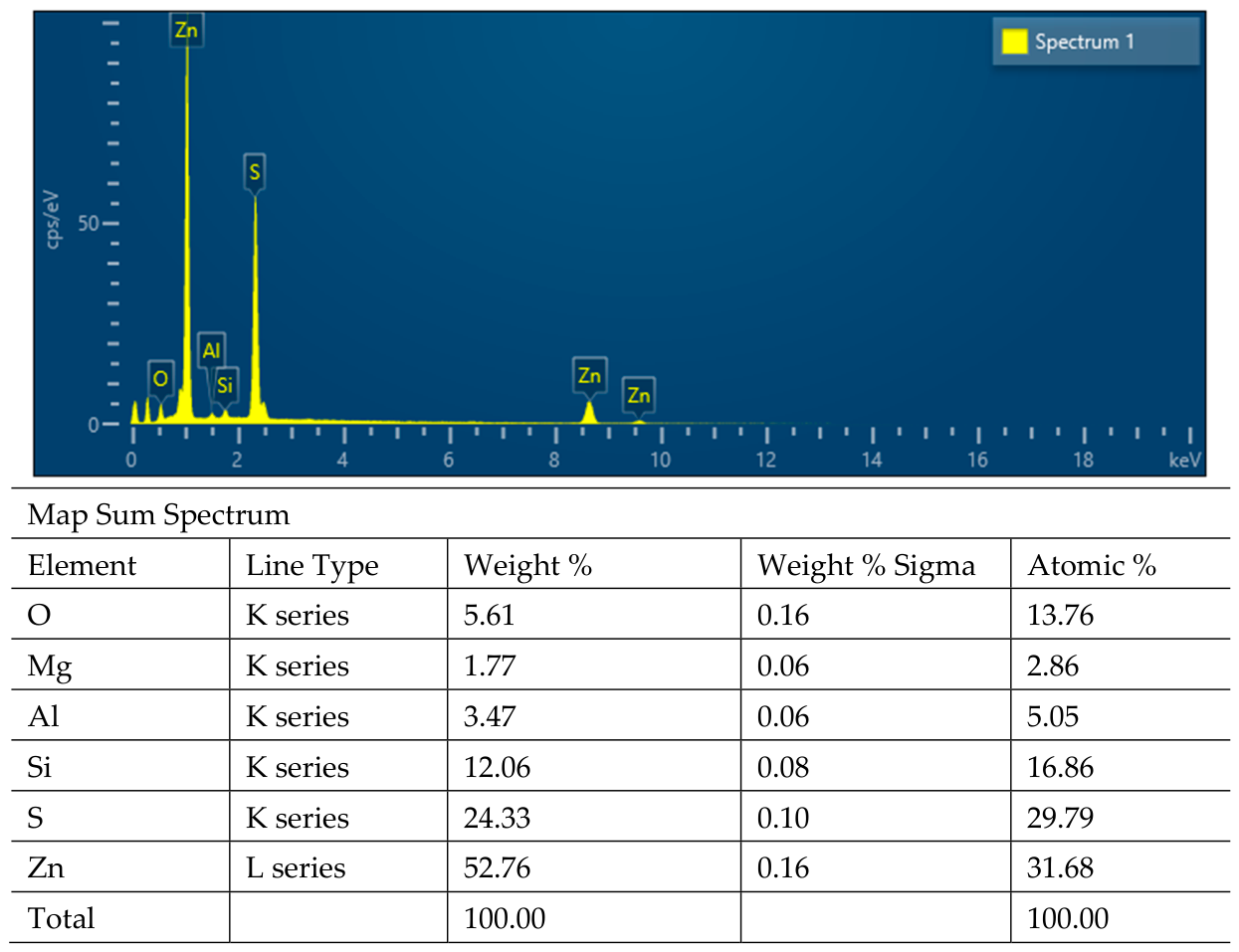
- In the metallic phase presented in Figure 5, morphological analysis showed that zinc is present as fine dispersed inclusions.
- 3.
4. Discussion
5. Conclusions
- (1)
- The estimation of the degree of dissociation (association) of the congruently melting compound MgZn2 through the Bjerrum–Guggenheim osmotic coefficient, using the Gibbs energy of the dissociation reaction and the reaction equilibrium constant, makes it possible to determine the extent to which congruently melting compounds dissociate during melting.
- (2)
- It was established that the degree of dissociation of the MgZn2 compound at the moment of melting reaches 79%.
- (3)
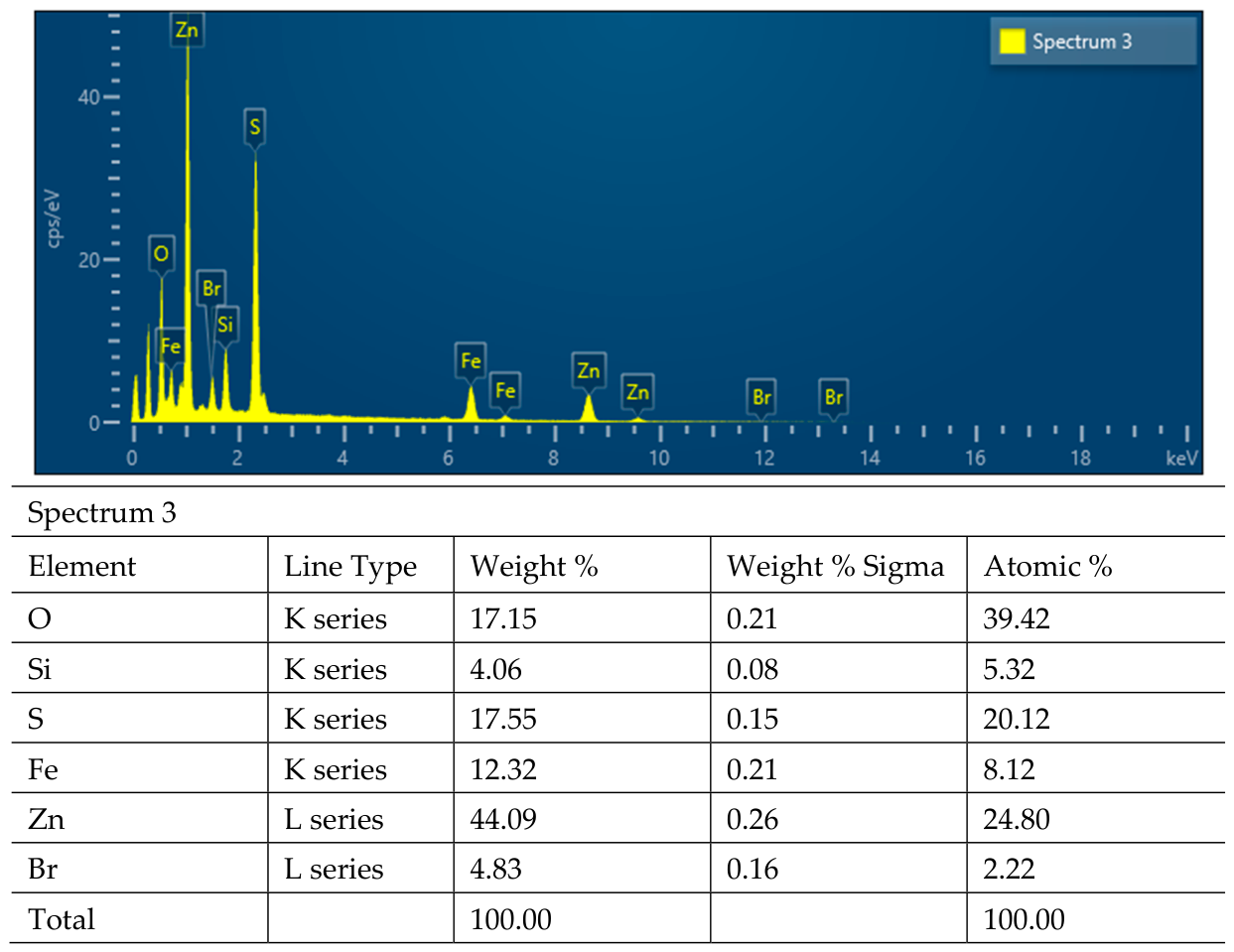
- Experimental data confirm the theoretically predicted substantial zinc sublimation under carbothermic processing conditions. The detection of zinc in the collected dust demonstrates its volatility, while its presence in the slag predominantly in oxide form (ZnO) indicates potential mechanisms of zinc loss. The theoretically predicted zinc volatility, based on the Bjerrum–Guggenheim concept, was validated experimentally.
- (4)
- The form of zinc distribution in various phases was established: in the initial slag, zinc is primarily present as oxide compounds (ZnO), confirmed by elemental analysis, with a content of up to 51.79 wt.%. In the metallic phase after smelting, zinc occurs as fine dispersed inclusions, indicating partial reduction and distribution within the metal. In the collected dust (flue ducts), particles enriched with zinc (up to 44.09 wt.% by local EDS analysis) were identified, providing direct evidence of sublimation followed by condensation from the gas phase.
- (5)
- Morphological analysis and the distribution of zinc-containing phases indicate that the main mechanism of zinc loss is volatilization and entrainment with the gas stream in the form of volatile compounds, with residual zinc remaining in the metal as dispersed inclusions.
- (6)
- The use of SEM/EDS allowed for effective visualization and quantitative assessment of zinc distribution across all investigated processing products (slag, metal, and dust), confirming the adequacy of the chosen methodology for the objectives of this study. Thus, the experimental data unequivocally confirm the high volatility of zinc in the studied process and identify the key zinc-concentrating phases, which is consistent with theoretical predictions and explains the mechanism of zinc behavior during high-temperature processing of zinc-containing slags.
Author Contributions
Funding
Data Availability Statement
Acknowledgments
Conflicts of Interest
References
- Podusovskaya, N.V.; Komolova, O.A.; Grigorovich, K.V.; Demin, K.Y.; Anisonyan, K.G. Analysis of Lead and Zinc Selective Extraction Process from EAF Dust during Carbothermic Reduction. Russ. Metall. 2025, 3, 14–31. [Google Scholar] [CrossRef] [Scilit]
- Wang, D.; Yang, S.; Liu, X.; Duh, J.G.; Wang, C. Experimental Investigation and Thermodynamic Calculation of Phase Equilibria in the Mg–Pb–Zn Ternary System. Mater. Chem. Phys. 2016, 171, 227–238. [Google Scholar] [CrossRef] [Scilit]
- Gu, M.; Zhong, Y.; Wang, L.; Guo, Z. Separation of Heavy Metals from Hazardous Lead Slag by Carbothermic Reduction and Thermal Volatilization: Effect of Phase Transformation on Sn, Pb, Zn Removal. Process. Saf. Environ. Prot. 2021, 156, 330–339. [Google Scholar] [CrossRef] [Scilit]
- Tolokonnikova, V.; Baisanov, S.; Yerekeyeva, G.; Narikbayeva, G.; Korsukova, I. Evaluation of the Degree of Dissociation of a Congruent Compound Fe2Ti across the Bjerrum–Guggenheim Coefficient. Metals 2022, 12, 2132. [Google Scholar] [CrossRef] [Scilit]
- Tolokonnikova, V.V.; Baisanov, S.O.; Saulebek, Z.K.; Orlov, A.S. Mathematical Description of the Lines of Monovariant Phase Equilibria on the MnO–SiO2 Phase Equilibrium Diagram. CIS Iron Steel Rev. 2023, 26, 105–110. [Google Scholar] [CrossRef] [Scilit]
- Glazov, V.M.; Pavlova, L.M. Chemical Thermodynamics and Phase Equilibria; Metallurgy: Moscow, Russia, 1988; 555p. [Google Scholar]
- Hume-Rothery, V.; Raynor, G. Structure of Metals and Their Alloys; Metallurgizdat: Moscow, Russia, 1958; 391p. [Google Scholar]
- Bannykh, O.A.; Budberg, P.B.; Alisova, S.P.; Guzey, L.S.; Drits, M.E.; Dobatkina, T.V.; Lysova, E.V.; Nikitina, N.I.; Padezhnova, E.M.; Rokhlin, L.L.; et al. Phase Diagrams of Binary and Multicomponent Iron-Based Systems; Metallurgy: Moscow, Russia, 1986. [Google Scholar]
- Glushko, V.P. Thermodynamic Properties of Individual Substances (Handbook); VINITI Institute of High Temperatures of the USSR Academy of Sciences: Moscow, Russia, 1982; Volume 4, 456p. [Google Scholar]
- Scientific Group Thermodata Europe. FACTSAGE Thermodynamic Database and Software, 2017. Available online: https://www.factsage.com/ (accessed on 10 March 2023).
- Tolokonnikova, V. Study of Thermal Stability of Congruently Melting Compounds for Model Systems Based on the Concept of the Bjerrum–Guggenheim Osmotic Coefficient; Sanat-Poligrafiya: Karaganda, Kazakhstan, 2022; 117p. [Google Scholar]
- Akberdin, A.A.; Kim, A.S.; Sultangaziev, R.B.; Orlov, A.S. The Method of Mathematical Description of the Phase Composition Diagrams. CIS Iron Steel Rev. 2023, 25, 79–83. [Google Scholar] [CrossRef] [Scilit]
- Tolokonnikova, V.; Baisanov, S.; Narikbayeva, G.; Narikbayeva, I. Assessment of Dissociation Rate of FeCr2O4 Using the Bjerrum–Guggenheim Coefficient. Metalurgija 2021, 60, 303–305. [Google Scholar]
- Ruzinov, L.P.; Gulyanitsky, V.S. Equilibrium Transformations of Metallurgical Reactions; Metallurgy: Moscow, Russia, 1975; 417p. [Google Scholar]
- Kurnakov, N.S. Selected Works; Publishing House of the Academy of Sciences of the USSR: Moscow, Russia, 1961; Volume 1, 635p. [Google Scholar]
- Horiuchi, T.; Ono, A.; Yoshioka, K.; Watanabe, T.; Ohkubo, K.; Mohri, T. Liquid–Solid Equilibrium and Intermediate Phase Formation during Solidification in Mg–1.3 at.% Zn–1.7 at.% Y Alloy. Mater. Trans. 2008, 49, 2247–2253. [Google Scholar]
- Erofeev, K.B. Computer Modeling of Thermodynamic Properties of Liquid Binary Magnesium Alloys with Elements of Groups II–V of the Periodic Table. Ph.D. Thesis, St. Petersburg State Polytechnic University, St. Petersburg, Russia, 2005; 27p. [Google Scholar]
- Bobryshev, B.L.; Moiseev, V.S.; Aleksandrova, Y.P.; Moiseev, K.V.; Bobryshev, D.B.; Bondarev, A.B. Improvement of Complex Processing of Magnesium Alloys during Melting. Tekhnologiya Legk. Splav. 2021, 3, 35–44. [Google Scholar]
- Pelton, A.D. Phase Diagrams and Thermodynamic Modeling of Solutions; Elsevier: Amsterdam, The Netherlands, 2019. [Google Scholar]
- Kerry, T.; Peters, A.; Georgakopoulos, E.; Dugulan, I.; Meijer, K.; Hage, J.; Offerman, E.; Yang, Y. Zinc Vaporization and Self-Reduction Behavior of Industrial Waste Residues for Recycling to the HIsarna Furnace. J. Sustain. Metall. 2022, 8, 658–672. [Google Scholar] [CrossRef] [Scilit]
- Liang, P.; Seifert, H.J.; Lukas, H.L.; Ghosh, G.; Effenberg, G.; Aldinger, F. Thermodynamic Modelling of the Cu–Mg–Zn Ternary System. Calphad 1998, 22, 527–544. [Google Scholar] [CrossRef] [Scilit]
- Leuchtenmueller, M.; Legerer, C.; Brandner, U.; Antrekowitsch, J. Carbothermic Reduction of Zinc-Containing Industrial Wastes: A Kinetic Model. Metall. Mater. Trans. B 2021, 52, 548–557. [Google Scholar] [CrossRef] [Scilit]
- Ghosh, G.; Olson, G.B. Critical Assessment and Thermodynamic Modeling of the Mg–Zn, Mg–Sn, Sn–Zn and Mg–Sn–Zn Systems. Calphad 2012, 36, 28–43. [Google Scholar] [CrossRef] [Scilit]
- Pauerová, K.; Dzurňák, R.; Trpčevská, J.; Liptai, P.; Vindt, T. An Experimental Study of Zinc Evaporation from Bottom Zinc Dross at Atmospheric Pressure and in Inert Atmosphere with Integrated CFD Modelling. Materials 2024, 17, 4627. [Google Scholar] [CrossRef] [Scilit] [PubMed]
- Ma, S.; Zhang, Z.; Xu, S.; Li, X.; Feng, L. Recovery of Zinc from Electric Arc Furnace Dust by Vacuum Carbothermal Reduction. Metall. Res. Technol. 2021, 118, 415. [Google Scholar] [CrossRef] [Scilit]
- Jha, M.K.; Kumar, V.; Singh, R.J. Review of Hydrometallurgical Recovery of Zinc from Industrial Wastes. Resour. Conserv. Recycl. 2001, 33, 1–22. [Google Scholar] [CrossRef] [Scilit]
- Nowińska, K.; Adamczyk, Z. Zinc and Lead Metallurgical Slags as a Potential Source of Metal Recovery: A Review. Materials 2023, 16, 7295. [Google Scholar] [CrossRef] [Scilit] [PubMed]
- Jeon, J.; Lindberg, D. Thermodynamic Optimization and Phase Equilibria Study of the MgO–ZnO, CaO–ZnO, and CaO–MgO–ZnO Systems. Ceram. Int. 2023, 49, 12736–12744. [Google Scholar] [CrossRef] [Scilit]
- Jak, E.; Hayes, P.C.; Pelton, A.D.; Decterov, S. Thermodynamic Modelling of the Al2O3–CaO–FeO–Fe2O3–PbO–SiO2–ZnO System with Addition of K and Na with Metallurgical Applications. In Proceedings of the VIII International Conference on Molten Slags, Fluxes and Salts (Molten 2009), Santiago, Chile, 18–21 January 2009; pp. 473–490. [Google Scholar]



| T, K | |||||||
|---|---|---|---|---|---|---|---|
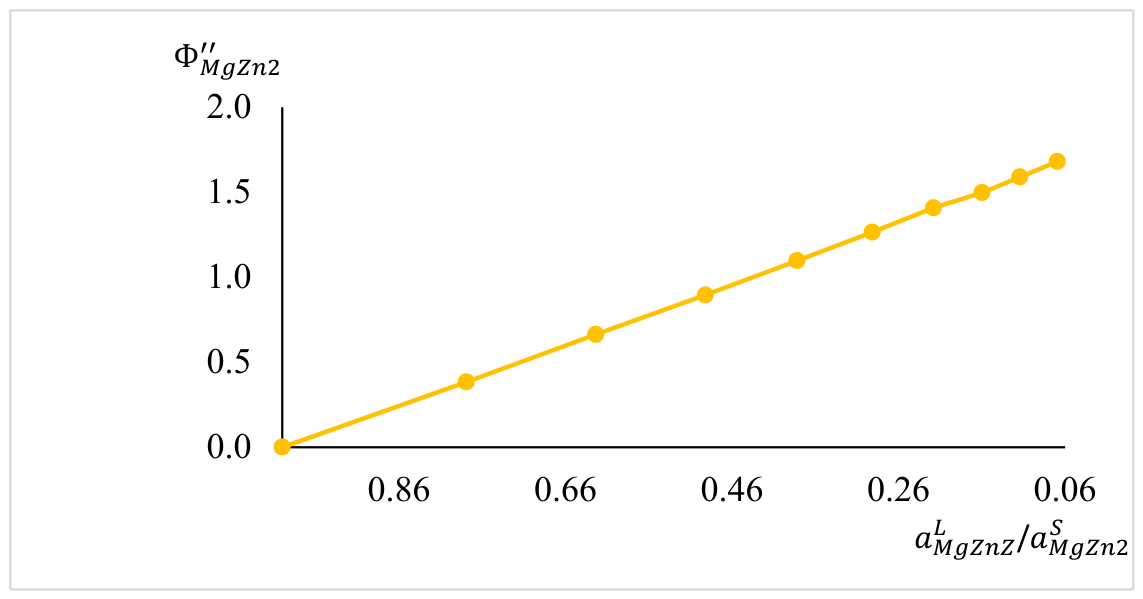
| 853 | 0.333 | 0.333 | 1.000 | 0.000 | 1.000 | 0.000 | 0.000 |
| 823 | 0.490 | 0.333 | 0.520 | −0.250 | 0.779 | −0.648 | 0.383 |
| 798 | 0.505 | 0.333 | 0.490 | −0.473 | 0.623 | −1.137 | 0.663 |
| 773 | 0.525 | 0.333 | 0.452 | −0.710 | 0.492 | −1.562 | 0.894 |
| 748 | 0.546 | 0.333 | 0.416 | −0.962 | 0.382 | −1.950 | 1.097 |
| 723 | 0.570 | 0.333 | 0.377 | −1.233 | 0.292 | −2.297 | 1.264 |
| 698 | 0.596 | 0.333 | 0.339 | −1.522 | 0.218 | −2.619 | 1.407 |
| 673 | 0.630 | 0.333 | 0.294 | −1.834 | 0.160 | −2.880 | 1.496 |
| 648 | 0.662 | 0.333 | 0.255 | −2.169 | 0.114 | −3.161 | 1.588 |
| 614 | 0.710 | 0.333 | 0.204 | −2.669 | 0.069 | −3.529 | 1.680 |
| T, K | ||||||
|---|---|---|---|---|---|---|
| 853 | 0.000 | −0.012 | 0.000 | 1.000 | 1.000 | 1.000 |
| 823 | 0.383 | 0.387 | −0.250 | 0.779 | 0.520 | 0.524 |
| 798 | 0.663 | 0.667 | −0.473 | 0.623 | 0.490 | 0.493 |
| 773 | 0.894 | 0.905 | −0.710 | 0.492 | 0.452 | 0.456 |
| 748 | 1.097 | 1.103 | −0.962 | 0.382 | 0.416 | 0.418 |
| 723 | 1.264 | 1.266 | −1.233 | 0.292 | 0.377 | 0.378 |
| 698 | 1.407 | 1.399 | −1.522 | 0.218 | 0.339 | 0.337 |
| 673 | 1.496 | 1.504 | −1.834 | 0.160 | 0.294 | 0.295 |
| 648 | 1.588 | 1.586 | −2.169 | 0.114 | 0.255 | 0.255 |
| 614 | 1.680 | 1.667 | −2.669 | 0.069 | 0.204 | 0.202 |
| T, K | |||||||
|---|---|---|---|---|---|---|---|
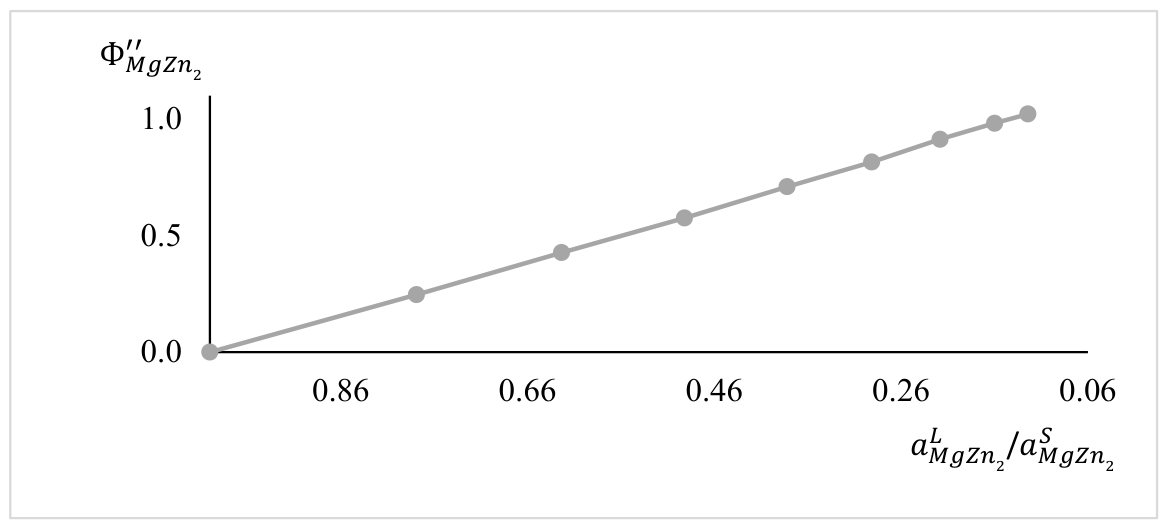
| 853 | 0.333 | 0.333 | 1.000 | 0.000 | 1.000 | 0 | 0.000 |
| 823 | 0.210 | 0.333 | 0.362 | −0.250 | 0.779 | 0.541 | 0.246 |
| 798 | 0.199 | 0.333 | 0.331 | −0.473 | 0.623 | 0.916 | 0.427 |
| 773 | 0.184 | 0.333 | 0.291 | −0.710 | 0.492 | 1.194 | 0.575 |
| 748 | 0.170 | 0.333 | 0.258 | −0.962 | 0.382 | 1.429 | 0.709 |
| 723 | 0.153 | 0.333 | 0.220 | −1.233 | 0.292 | 1.583 | 0.815 |
| 698 | 0.137 | 0.333 | 0.189 | −1.522 | 0.218 | 1.712 | 0.913 |
| 673 | 0.118 | 0.333 | 0.154 | −1.834 | 0.160 | 1.766 | 0.982 |
| 654 | 0.103 | 0.333 | 0.130 | −2.086 | 0.124 | 1.776 | 1.021 |
| 0.000 | −0.011 | 0.000 | 1.000 | 1.000 | 1.000 |
| 0.246 | 0.249 | −0.250 | 0.779 | 0.362 | 0.366 |
| 0.427 | 0.432 | −0.473 | 0.623 | 0.331 | 0.334 |
| 0.575 | 0.585 | −0.710 | 0.492 | 0.291 | 0.297 |
| 0.709 | 0.714 | −0.962 | 0.382 | 0.258 | 0.260 |
| 0.815 | 0.820 | −1.233 | 0.292 | 0.220 | 0.222 |
| 0.913 | 0.907 | −1.522 | 0.218 | 0.189 | 0.187 |
| 0.982 | 0.975 | −1.834 | 0.160 | 0.154 | 0.152 |
| 1.021 | 1.017 | −2.086 | 0.124 | 0.130 | 0.129 |
| T, K | ΔGr J/mol | ΔHr J/mol | ΔSr J/mol·K | Kr | Degree of Dissociation α |
|---|---|---|---|---|---|
| 853 | −2323.91 | 5631.92 | 9.33 | 1.39 | 0.76 |
| 823 | −2024.35 | 6731.61 | 10.64 | 1.34 | 0.35 |
| 798 | −1744.94 | 7599.70 | 11.71 | 1.31 | 0.32 |
| 773 | −1439.56 | 8424.54 | 12.76 | 1.25 | 0.28 |
| 748 | −1107.16 | 9204.83 | 13.79 | 1.19 | 0.24 |
| 723 | −749.92 | 9942.22 | 14.79 | 1.13 | 0.21 |
| 698 | −367.94 | 10,636.41 | 15.77 | 1.07 | 0.17 |
| 673 | −180.04 | 3277.94 | 5.14 | 1.03 | 0.16 |
| 648 | −57.77 | 2951.56 | 4.64 | 1.01 | 0.09 |
| 614 | 88.81 | 2532.78 | 3.98 | 0.98 | 0.05 |
| T, K | ΔGr J/mol | ΔHr J/mol | ΔSr J/mol · K | Kr | Degree of Dissociation α |
|---|---|---|---|---|---|
| 853 | −2323.91 | 5631.92 | 9.33 | 1.39 | 0.76 |
| 823 | −2024.35 | 6731.61 | 10.64 | 1.34 | 0.21 |
| 798 | −1744.94 | 7599.70 | 11.71 | 1.30 | 0.18 |
| 773 | −1439.02 | 8424.05 | 12.76 | 1.25 | 0.14 |
| 748 | −1107.16 | 9204.83 | 13.79 | 1.20 | 0.11 |
| 723 | −749.92 | 9942.22 | 14.79 | 1.13 | 0.07 |
| 698 | −367.94 | 10,636.41 | 15.77 | 1.06 | 0.04 |
| 673 | −180.04 | 3277.94 | 5.14 | 1.03 | 0.02 |
| 654 | −85.99 | 3028.46 | 4.76 | 1.01 | 0.01 |
Disclaimer/Publisher’s Note: The statements, opinions and data contained in all publications are solely those of the individual author(s) and contributor(s) and not of MDPI and/or the editor(s). MDPI and/or the editor(s) disclaim responsibility for any injury to people or property resulting from any ideas, methods, instructions or products referred to in the content. |
© 2026 by the authors. Licensee MDPI, Basel, Switzerland. This article is an open access article distributed under the terms and conditions of the Creative Commons Attribution (CC BY) license.
Share and Cite
Tolokonnikova, V.; Baisanov, S.; Ahmetov, A.; Makhambetov, Y.; Kenzhaliyev, O.; Orlov, A. Investigation of the Structural State of a Liquid Mg–Zn Magnesium Alloy from the Perspective of the Behavior of the Bjerrum–Guggenheim Osmotic Coefficient in the Melt. Metals 2026, 16, 929. https://doi.org/10.3390/met16080929
Tolokonnikova V, Baisanov S, Ahmetov A, Makhambetov Y, Kenzhaliyev O, Orlov A. Investigation of the Structural State of a Liquid Mg–Zn Magnesium Alloy from the Perspective of the Behavior of the Bjerrum–Guggenheim Osmotic Coefficient in the Melt. Metals. 2026; 16(8):929. https://doi.org/10.3390/met16080929
Chicago/Turabian StyleTolokonnikova, Vera, Sailaubai Baisanov, Amankeldy Ahmetov, Yerbolat Makhambetov, Olzhas Kenzhaliyev, and Alexey Orlov. 2026. "Investigation of the Structural State of a Liquid Mg–Zn Magnesium Alloy from the Perspective of the Behavior of the Bjerrum–Guggenheim Osmotic Coefficient in the Melt" Metals 16, no. 8: 929. https://doi.org/10.3390/met16080929
APA StyleTolokonnikova, V., Baisanov, S., Ahmetov, A., Makhambetov, Y., Kenzhaliyev, O., & Orlov, A. (2026). Investigation of the Structural State of a Liquid Mg–Zn Magnesium Alloy from the Perspective of the Behavior of the Bjerrum–Guggenheim Osmotic Coefficient in the Melt. Metals, 16(8), 929. https://doi.org/10.3390/met16080929