Article

Co-Pyrolysis of Waste Tennis Ball Rubber and Spent Lithium-Ion Batteries for Reductive Cathode Regeneration and Porous Carbon Production

1
College of Physical Education, China University of Mining and Technology, Xuzhou 221116, China
2
Department of Thermal Science and Energy Engineering, University of Science and Technology of China, Hefei 230027, China
3
School of Chemical Engineering and Technology, China University of Mining and Technology, Xuzhou 221116, China
*
Authors to whom correspondence should be addressed.
These authors contributed equally to this work.
Metals 2026, 16(8), 914; https://doi.org/10.3390/met16080914
Submission received: 21 July 2026 / Revised: 11 August 2026 / Accepted: 13 August 2026 / Published: 14 August 2026

Abstract

The rapid growth of tennis participation and the widespread use of lithium-ion batteries have led to increasing volumes of rubber waste and spent battery materials, underscoring the need for integrated recycling strategies. In this work, a thermochemical co-pyrolysis process is developed to convert waste tennis ball rubber particles (TBRPs) and spent lithium-ion battery (LIB) cathodes into valuable products. The decomposition of TBRPs generates reactive gaseous and liquid hydrocarbons that function as in situ reductants, enabling the breakdown of high-valence transition metal oxides in the cathode material. Subsequent magnetic separation and mild acid-washing yield nonmagnetic solids enriched in lithium compounds and carbonaceous residues. Structural and chemical analyses (SEM, XRD, TEM, EDS, and XPS) confirm extensive cathode reduction and the formation of Li2CO3 at optimized conditions (650 °C, 1 h, cathode-to-TBRPs mass ratio 1:0.65). The carbonized rubber evolves into a highly porous carbon material with a carbon purity of approximately 95.37 At%. This study demonstrates a low-energy, environmentally friendly pathway for the co-valorization of two challenging waste streams while simultaneously recovering lithium salts, reduced metal oxides, and functional porous carbon.

1. Introduction

Tennis enjoys global prevalence largely attributable to its documented physical and psychological benefits. This sustained popularity, attracting millions of participants annually, has catalyzed the rapid expansion of the global tennis industry. A consequential byproduct of this growth is a substantial increase in the disposal of used tennis balls into municipal solid waste streams [1]. Within the context of escalating global environmental concerns, the effective management and recycling of such waste materials have become imperative.
Current estimates indicate that the United States discards no fewer than 125 million tennis balls per year [2,3,4,5], the majority of which are consigned to landfills [6,7]. In China, while comprehensive national data on waste tennis ball generation is scarce [8], the continued promotion of the sport, rising participation rates [9], and the proliferation of both professional and amateur tournaments collectively indicate a significant and growing waste stream. For instance, large-scale domestic tournaments routinely generate thousands of used tennis balls per event, a volume compounded by the routine output from training facilities and club activities, leading to a considerable cumulative environmental burden [10].
Structurally, tennis balls exhibit a complex, multi-material design, comprising a rubber core enveloped by a wool nylon hybrid felt. This heterogeneous composition poses considerable challenges for recycling and disposal. The rubber core, being highly recalcitrant to natural degradation, poses a direct environmental threat [11]. When disposed of improperly, it can contribute to soil contamination [12] and elevate fire hazards [13]. Landfilling of this material not only consumes valuable land capacity but also promotes the leaching of hazardous leachates, which can disrupt soil structure, inhibit microbial activity, and subsequently impair plant growth [14]. Moreover, this disposal pathway constitutes a loss of natural rubber, a strategically important and finite material resource [15]. A further critical risk stems from the material’s flammability; the combustion of waste rubber can release significant quantities of toxic gases, including dioxins [16,17,18], thereby compromising air quality and presenting a serious threat to public health.
Consequently, the development of efficient waste rubber recycling protocols is critically important, offering a viable pathway to mitigate environmental burdens, promote resource circularity, and advance sustainable development objectives [19,20]. Current recycling methodologies for waste rubber are broadly categorized into physical [21], chemical [22], and thermal processes [23,24], alongside direct reuse.
Physical recycling typically involves the comminution of rubber into fine powder via mechanical crushing and grinding. This powder serves as a valuable feedstock in applications such as asphalt modification and the construction of sports surfaces [25,26]. In contrast, chemical recycling aims to valorize waste rubber by converting it into higher-value products through techniques like pyrolysis and solvent decomposition. Pyrolysis, for instance, can yield a range of outputs including pyrolysis oil, recovered carbon black, steel, and combustible gases [27]. The efficacy of this approach is demonstrated in studies on tire rubber, a material analogous to tennis ball cores. Miranda et al. [28] pyrolyzed waste tires composed of natural rubber (NR), styrene–butadiene rubber (SBR), and butadiene rubber (BR), with gas chromatography (GC) analysis revealing that the liquid products contained alkanes, alkenes, and aromatic compounds. Similarly, in a co-pyrolysis system of tire rubber and Fe2O3, Yu et al. [29] identified CH4, H2, and C2H4 as the predominant gaseous species.
Recent work has demonstrated that waste plastics and rubbers [30] can serve as reductants in the carbothermal conversion of lithium–cobaltate (LCO). Meng et al. [31] identified three sequential stages in the plastic-roasting process: (i) dehydrogenation–chlorination, (ii) organic pyrolysis, and (iii) dehydrogenation–decarbonization. During pyrolysis, polyvinyl chloride (PVC) releases small-molecule hydrocarbons, free-radical species, and substituted aromatics functional groups that act as powerful reducing agents. During PVC, LiCoO2 is fully reduced to Li2CO3, CoO, metallic Co, and chloride species under these conditions: LCO mass ratio of 1:1, and 450 °C for 90 min. Subsequent aqueous leaching recovers 92.5% of lithium and 94.9% of cobalt. Density-functional calculations reveal negative adsorption energies (−0.146 to −0.064 eV), with Li–Cl binding more strongly than Co–Cl, indicating preferential chlorine adsorption on lithium sites and facilitating selective reduction.
In a parallel study, Wei et al. [32] employed waste polymer film as a carbon source for LCO reduction. Thermodynamic analysis shows that C–C bond scission generates CO, while residual carbon reduces the cathode material. XRD, XPS, and SEM-EDS confirm the breakdown of high-valence transition metal oxides into NiO, CoO, MnO, metallic Ni/Co, and Li2CO3, accompanied by pore formation. Optimized conditions (600 °C, 120 min, 8% film by mass) achieve >99% extraction of Li, Ni, Co, and Mn. The process eliminates the need for expensive reductants, delivers high leaching efficiency, and valorizes plastic waste, offering a scalable, low-impact pathway for recovering critical metals from spent lithium-ion batteries.
To overcome these limitations, we propose an integrated recycling strategy that synergistically couples the pyrolysis of waste tennis ball rubber with the reduction of cathode materials from spent LIBs. In this novel system, the gaseous and liquid pyrolysis products [33,34] (pyrolysis gas and oil) generated from the rubber component function as the in situ reducing agents. These agents facilitate the reduction of the cathode materials, converting them into low-valence metal oxides, lithium carbonate, and other value-added compounds. Following this reduction step, magnetic separation isolates nonmagnetic components, which are subsequently subjected to a washing treatment with a mixed dilute acid (e.g., HF/HCl/HNO3) to yield porous carbon materials. This combined process enables the simultaneous production of precursor materials for LIBs re-synthesis, high purity porous carbon, and other valuable byproducts. Thereby, it achieves the co-valorization of waste TBRPs (via chemical recovery) and spent LIBs’ cathode materials (via resource reclamation). The proposed methodology offers a novel and efficient pathway for the green recycling of complex solid waste, presenting a paradigm shift from linear disposal to a circular economy model.

2. Materials and Methods

2.1. Materials and Reagents

The tennis balls used in this research were from Odear Passion TOUR (Zhejiang Odear sports Goods Co., Ltd., Dongyang, China). Before cryogenic grinding, the wool layer on the surface of the tennis balls was manually stripped and cut into 5 mm × 5 mm pieces. The spent NCM523 black powder used in the thermal decomposition experiments was obtained from spent lithium-ion batteries supplied by Guangdong Canrd New Energy Technology Co., Ltd (Guangdong Canrd New Energy Technology Co., Ltd, Dongguan, China). Prior to the experiments, the batteries were discharged in a 10 wt.% NaCl solution for 24 h as a pretreatment step. The cathode sheets were then calcined in a tube furnace at 400 °C for 30 min to remove the binder [35]. Particles smaller than 200 mesh were collected as the cathode active material for the experiments. Composition analysis revealed the following elemental mass distribution: Li, 6.47%; Ni, 28.67%; Co, 11.06%; and Mn, 14.90%. The acids used in the acid-washing process were UPS-grade HCl, HNO3 and HF produced by Crystal Clear Electronic Material Co., Ltd. (Crystal Clear Electronic Material Co., Ltd., Suzhou, China). The liquid nitrogen used in the cryogenic grinding process and the high purity nitrogen used in the pyrolysis reduction process were both from Xuzhou Luyou Gas Co., Ltd., (Xuzhou Luyou Gas Co., Ltd., Xuzhou, China).

2.2. Sample Preparation and Frozen Breaking Pretreatment

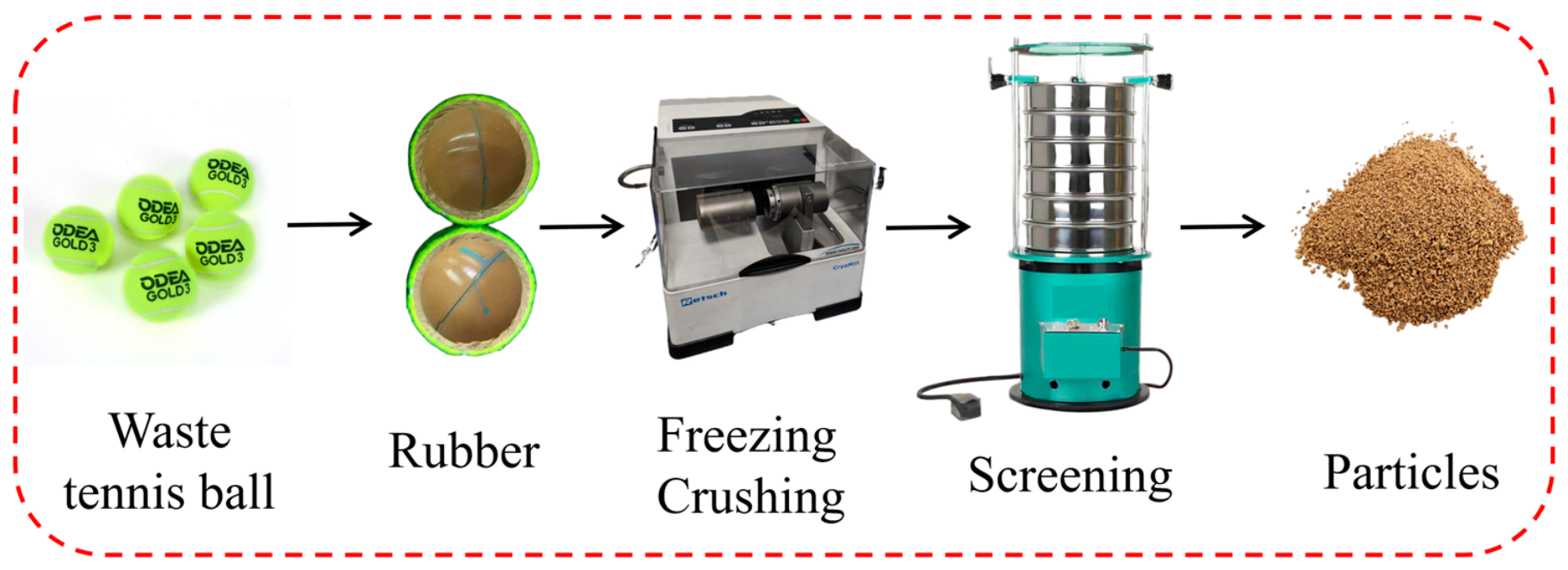
This study employed a liquid nitrogen cryo-mill (Retsch, Germany) to establish a controlled low-temperature environment of −196 °C within a sealed, continuous operation system. The inner rubber components of post-consumer tennis balls, pre-processed via this cryogenic technique, served as the primary feedstock for subsequent physicochemical characterization and co-pyrolysis experiments with LIBs cathode materials. The specific processing protocol was as follows (Figure 1):
The grinding chamber was purified by performing two sequential cleaning cycles with high purity SiO2 followed by virgin rubber particles to eliminate residual impurities and prevent cross contamination. Subsequently, the rubber samples were subjected to a brittleness treatment by immersion in the liquid nitrogen-cooled chamber for a predetermined pre-cooling interval. Key operational parameters, including grinding duration and vibrational frequency, were systematically calibrated. Then, we employed a single-factor experimental method to conduct comparative experiments on the pre-cooling time, different feed quantities, and grinding time. Finally, the particle size distribution of the milled products was characterized by sieve analysis using a standardized series of meshes (18, 35, 65, 120, and 200). The resultant distribution profile is provided in the Supplementary Information.
In this study, tennis rubber particles that underwent low-temperature crushing treatment were combined with spent LIBs cathode materials and placed in a tube furnace for a synergistic pyrolysis experiment. In this experiment, the pre-treated cathode material was thoroughly mixed with waste TBRP in mass ratios of m(NCM):m(TBRP) = 1:0.2, 0.35, 0.5, 0.65, and 0.8. For each trial, 1 g of NCM was uniformly blended with the corresponding amount of waste TBRPs and placed on an Al2O3 support inside a horizontal tube furnace. The gas inlet valve was closed, and the furnace was evacuated to a negative pressure of −0.09 MPa using a vacuum pump. Subsequently, the exhaust valve was closed and the inlet valve opened to introduce high-purity dry nitrogen until the pressure reached 0.00 MPa. This procedure was repeated three times, after which both the inlet and exhaust valves were kept open to maintain the furnace pressure at 0.00 MPa. High-purity nitrogen was continuously flowed into the system at a rate of v(N2) = 50 mL/min, while the temperature was raised at a rate of 10 °C/min to reach the target temperature for reduction calcination. After completion of the reduction calcination, nitrogen flow was continued to allow the system to cool down to room temperature. By adjusting the pyrolysis temperature and the amount of rubber particles added, the influence of these parameters on the synergistic pyrolysis reduction effect was systematically investigated. After the reaction, the synergistic pyrolysis products were magnetically separated. The nonmagnetic components obtained were subjected to acid-washing using 100 mL of mixed dilute acid (1 mol/L HCl +3 mol/L HNO3 + 10 mL 10%wt HF), and the acid-washed products were systematically analyzed using elemental analysis, morphology observation, and phase characterization methods.
To analyze the influence of temperature of co-pyrolysis on the thermal decomposition characteristics of waste TBRPs deeply, the sample with diameters ranging from −18 + 65 μm which is the largest proportion of the crushed products was selected for the subsequent thermal decomposition experiment. The crushed samples were placed in a tube furnace (MXG1200-800, Shanghai MICRO-X furnace Co., Ltd., shanghai, China) and subjected to thermal decomposition reactions under the atmosphere of high-purity nitrogen gas. The heating rate of the thermal decomposition was controlled at 10 °C/min, and the holding time was 60 min.

2.3. Characterization

The crystal structure of waste TBRPs was investigated using an X-ray diffractometer (XRD, D8 Advance, Bruker, Billerica, MA, USA). The measurements were conducted at room temperature. The scanning range was 4–70°, with a step size of 0.02°, a scanning speed of 12°/min, and a Cu target as the excitation source. Fourier transform-infrared spectroscopy (FT-IR, Vertex 80v, Bruker, Billerica, MA, USA) coupled with a micro-infrared system was employed to analyze and qualitatively identify the organic functional groups in the rubber. The scanning range was 500–4000 cm−1. Quantitative analysis of waste TBRPs was carried out using an X-ray fluorescence spectrometer (XRF, S8 Tiger, Bruker, Germany). The operating voltage and current were 60 kV and 10 mA, respectively, with a scanning time of 8 min. The elemental composition and surface morphology of the raw materials and purified products were characterized using a field-emission scanning electron microscope (FESEM, MIRA4, Tescan, Brno, Czech Republic) equipped with an energy-dispersive spectroscopy system (EDS, Quantax 200 XFlash 6|60, Bruker, Germany). The sulfur valence states were analyzed by X-ray photoelectron spectroscopy (XPS, Al Kα, Thermo Fisher Scientific, Waltham, MA, USA). The spot size was 500 μm; the pass energy was 20 eV; the energy step size was 0.05 eV, and each scan was repeated five times with a dwell time of 50 ms. The microscopic structure and morphology of the waste TBRPs were further characterized using a field-emission high-resolution transmission electron microscope (HRTEM, Tecnai G2 F20, FEI, Hillsboro, OR, USA) equipped with an EDS detector (Aztec Ultim Max, Oxford Instruments, Abingdon, United Kingdom). The HRTEM system employed a hot field-emission electron gun operated at an acceleration voltage of 200 kV and was equipped with a large-area windowless high-throughput Oxford energy spectrometer. The phase composition of gaseous products generated during pyrolysis was analyzed using a TG-GC/MS system (Netzsch STA449F5–Nicolet IS 20-Agilent 8890-5977B, (Netzsch, Selb, Germany; Nicolet, Waltham, MA, USA; Agilent, Santa Clara, CA, USA). The system was equipped with an HP-5MS capillary column (length: 30 m; inner diameter: 0.25 mm; film thickness: 0.25 μm; film thickness: 0.25 μm).

3. Results

3.1. Analysis of the Basic Characteristics of Rubber Particles

3.1.1. The Functional Group Composition and Elements Constitution of Waste TBRPs

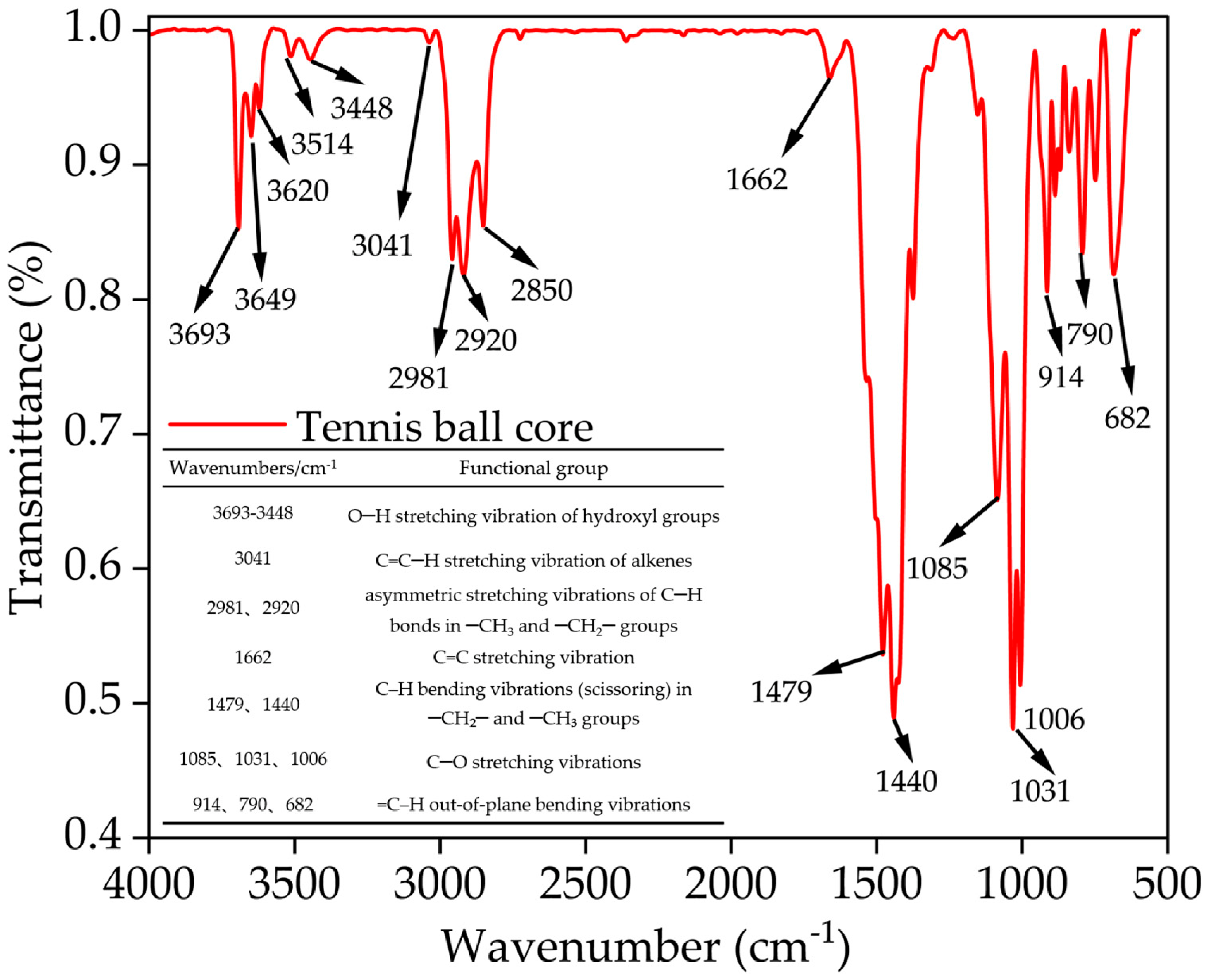
The effective co-pyrolysis of waste TBRPs and LIBs cathode materials necessitates a thorough characterization of the WTRPs’ physicochemical properties. The spectrum of the tennis ball’s inner liner is presented in Figure 2.
The characteristic absorption peaks and their functional groups [36] are as follows:
The signals in the area between 3693 and 3448 cm−1 may originate from polar groups within the natural rubber (NR) polymer, absorbed moisture, or surface-hydroxylated impurities. This signal, 3041 cm−1, confirms the presence of carbon—carbon double bonds (C=C) within the polyisoprene backbone of NR. These peaks, 2981 and 2920 cm−1, respectively, reflect the saturated alkane structure inherent to the polymer chain. The presence of a peak at 1662 cm−1 corresponding to the C=C stretching vibration provides further confirmation of the alkene functional groups in the polyisoprene structure. These absorptions, 1479 and 1440 cm−1, are consistent with C-H bending vibrations (scissoring) in –CH2– and –CH3 groups, aligning with the saturated hydrocarbon features. The cluster of peaks, 1085, 1031, and 1006 cm−1, in this region suggest the presence of cross-linked structures or oxidized compounds formed during the rubber’s service life or processing. The peaks exist at 914, 790, and 682 cm−1, offering additional evidence for the different chemical environments of the alkene bonds.
In summary, the FT-IR analysis confirms that the primary molecular structure of the tennis ball inner liner is consistent with natural rubber (cis-1,4-polyisoprene), as evidenced by the dominant signatures of C=C and C-H bonds. The additional presence of oxygen-containing functional groups (O–H, C–O) indicates a degree of oxidation or the presence of cross-linking agents and trace impurities. Subsequently, to quantify the elemental composition, waste TBRPs sieved to −200 mesh were subjected to elemental analysis (EA) and X-ray fluorescence (XRF) spectroscopy. The quantitative results are presented in Table 1.
Waste TBRPs with a particle size of −18 + 35 mesh were used. An ash content test was conducted using a muffle furnace (WS-G150, ChangSha YG-WillSun Technology Co., Ltd., Changsha, China) to determine the other elements present. The XRF results are shown in the following table.
Elemental data from XRF spectroscopy in Table 2 confirms the deliberate compounding of the waste TBRPs with high levels of reinforcing fillers, such as silica, metallic oxides and some inorganic salts. In elastomer design, these additives are essential for enhancing tensile strength, wear resistance, and gas barrier properties. This formulation is critical for the ball core’s performance, enabling it to retain its shape under stress and maintain internal pressure exceeding one atmosphere throughout the dynamics of a tennis match.

3.1.2. Thermal Decomposition Characteristics of Waste TBRPs and Analysis of Products

Specifically, thermogravimetric analysis (TGA) quantified the mass loss behavior, while inline thermogravimetry–gas chromatography–mass spectrometry (TG-GC/MS) identified the evolving gaseous products. This combined methodology provides a systematic understanding of the waste TBRPs’ decomposition characteristics and the nature of the reducing gases generated.
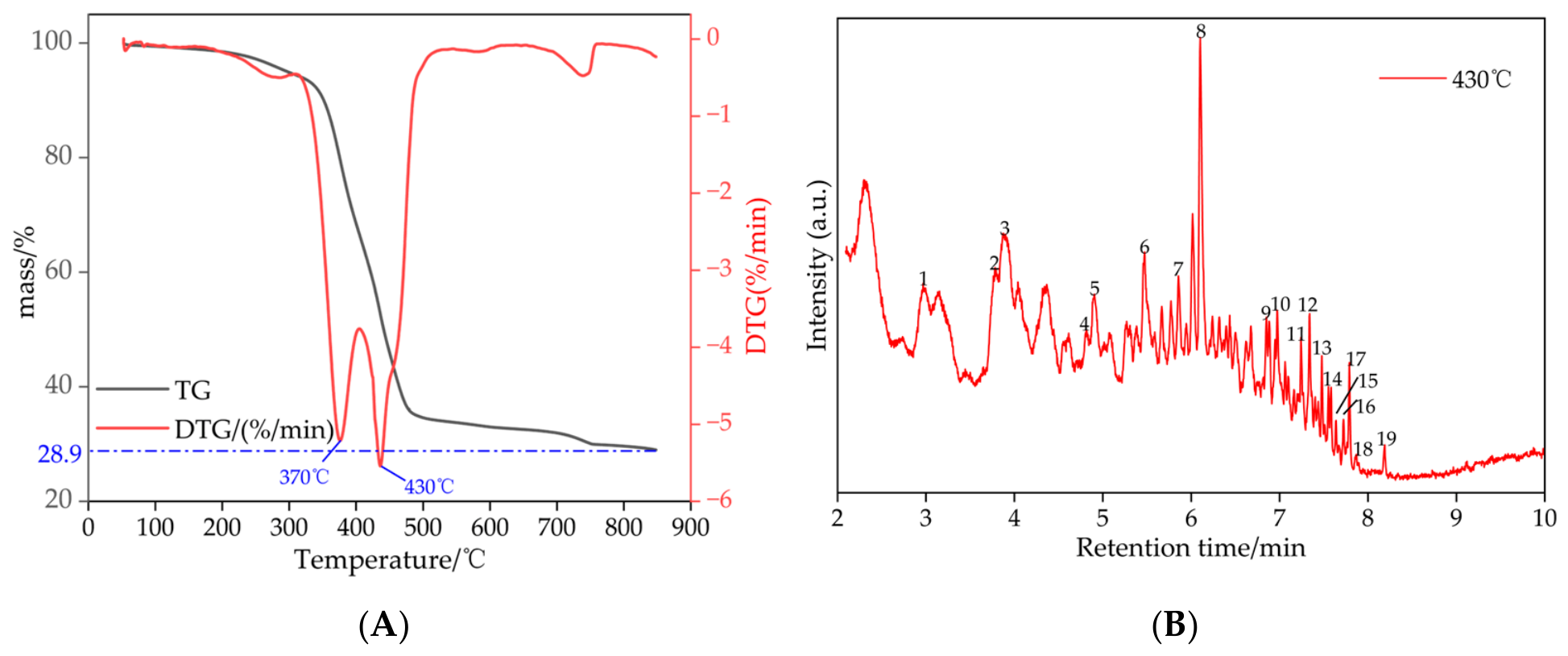
The thermal decomposition behavior of the blend comprising waste TBRPs and spent LIBs cathode materials was analyzed via thermogravimetric (TG) and derivative thermogravimetric (DTG) analysis (Figure 3A). The process can be delineated into three distinct stages:
Stage I (low-temperature region, 50~350 °C): Both the TG and DTG curves indicate minimal mass loss, with the sample retaining nearly 100% of its initial mass. This stage is primarily associated with the desorption of trace moisture and residual solvents. Due to effective pretreatment or the inherent nature of the samples, the content of these volatile components is negligible, resulting in no significant mass change.
Stage II (mid-temperature region, 350~500 °C): This region constitutes the primary mass loss step, with the sample mass decreasing rapidly from ~100% to approximately 35%. The corresponding DTG curve exhibits two prominent peaks, indicating the maximum rates of mass loss. This stage is dominated by the pyrolysis of the natural rubber (polyisoprene) component. Under an inert atmosphere, the polymer chains undergo scission, volatilizing into smaller hydrocarbon molecules such as isoprene monomers and oligomers. The bimodal nature of the DTG profile is likely attributed to the sequential or differential decomposition of distinct structural domains within the complex rubber compound.
Stage III (high-temperature region, 500~850 °C): The mass loss rate decelerates significantly, with the final residue stabilizing at approximately 30% of the initial mass. The absence of strong peaks in the DTG curve confirms the transition to a more stable regime. In this stage, the behavior is governed by the inorganic cathode material (e.g., NCM, NCA). The minor, gradual mass loss observed may be ascribed to the decomposition of reductive products (e.g., lithium carbonate) or slow solid-state reactions between the cathode material and residual carbon from the waste TBRPs decomposition. Overall, the system enters a thermal stability plateau dominated by inorganic phases.
To identify the specific reducing agents generated during pyrolysis, real-time analysis of the gaseous products was conducted using thermogravimetry coupled with gas chromatography—mass spectrometry (TG-GC/MS) at a mass ratio of 1:0.35. The total ion chromatogram at 430 °C under a nitrogen atmosphere is presented in Figure 3B, with key products quantified in Table S1 [37]. The pyrolysis gas is rich in aromatic compounds, including benzothiazole (C7H5NS), aniline (19.05%), 1-methyl-2-(2-propenyl)-benzene (9.37%), o-isopropenyltoluene (7.55%), and p-xylene (7.36%). Critically, these aromatic species contain abundant unsaturated bonds (C=C, C≡C), which can function as potent electron donors. Upon contact with high-valence transition metals (Ni3+, Co3+), these compounds facilitate reduction to lower-valence states [38,39].

3.2. Recycling and Comprehensive Utilization

3.2.1. Analysis of Co-Pyrolysis Reduction Products

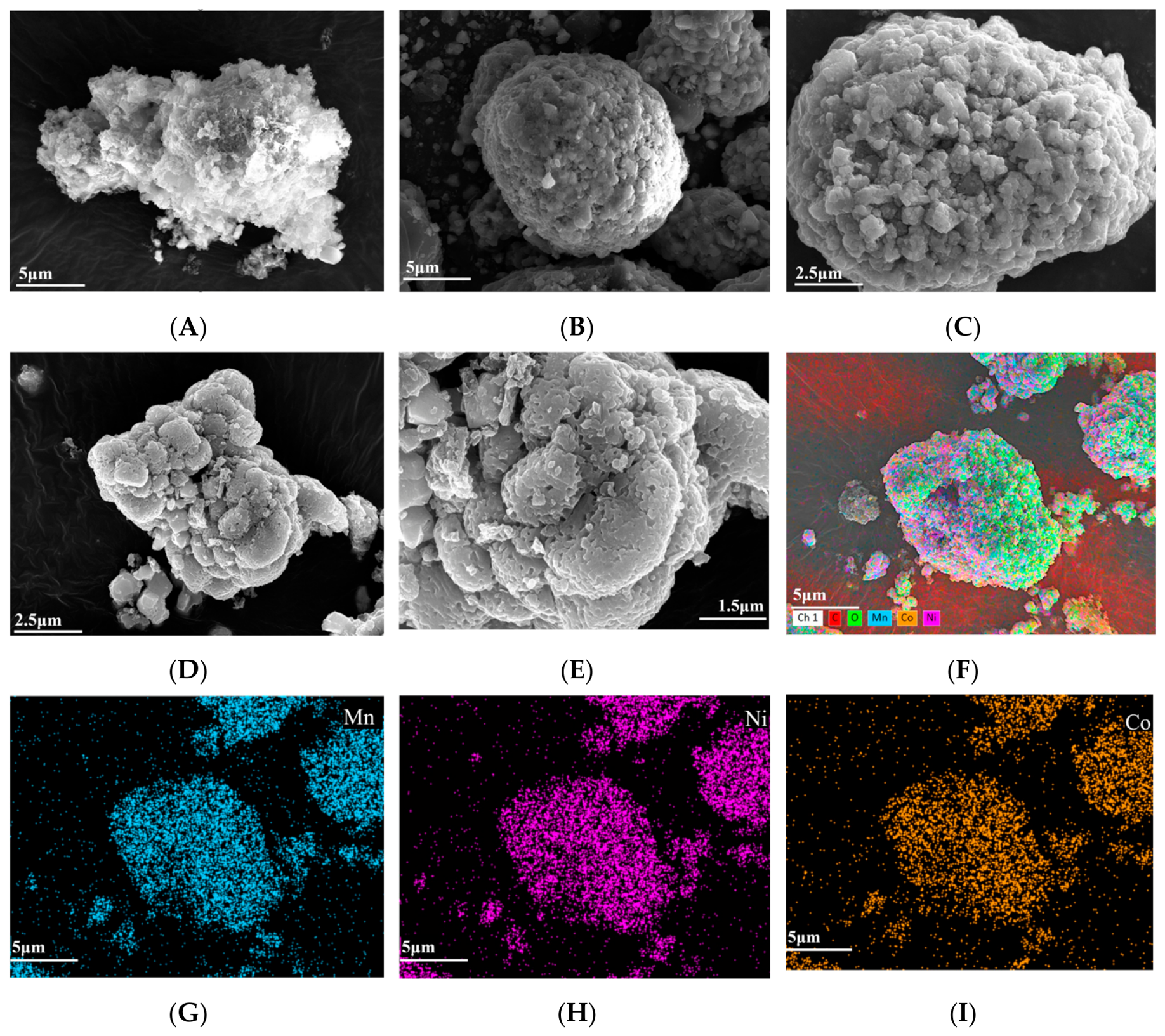
Figure 4 shows the influence of different temperatures on the reduction effect of the recycled cathode material and waste TBRPs (cis-1,4-polyisoprene) after reaction when the rubber addition amount is 1:0.35, the nitrogen flow rate is 50 milliliters/minute, and the reaction time is 1 h. When the reaction temperature is 350 °C (Figure 4A), the surface of the cathode material is covered with a thick layer of flocculent-branched substances, completely covering the original surface morphology. When the temperature further increases to 450 °C (Figure 4B), the above flocculent-branched structure basically disappears, but new coatings appear on the particle surface, accompanied by a large number of obvious pits-like defects. When the temperature further increases to 550 °C (Figure 4C), the surface coating disappears completely; the particle diameter significantly decreases; the shape becomes irregular; the surface roughness increases, and large pores are formed. When the cathode material is co-heated with the separator [32], the particle morphology of the positive electrode material still remains a relatively regular spherical shape and still maintains a relatively flat surface except for the surface depression area, which means that the influence of using different reducing agents to reduce the surface of the positive electrode material particles is quite different. When the temperature reaches 650 °C (Figure 4D,E), the particles continue to refine, and their surfaces become increasingly rough. In the 50,000× magnified images, it can be observed that among the small particles composing the larger ones, a minor portion still maintains smooth and flat surfaces, while many more particles exhibit numerous “defects” on their surfaces.
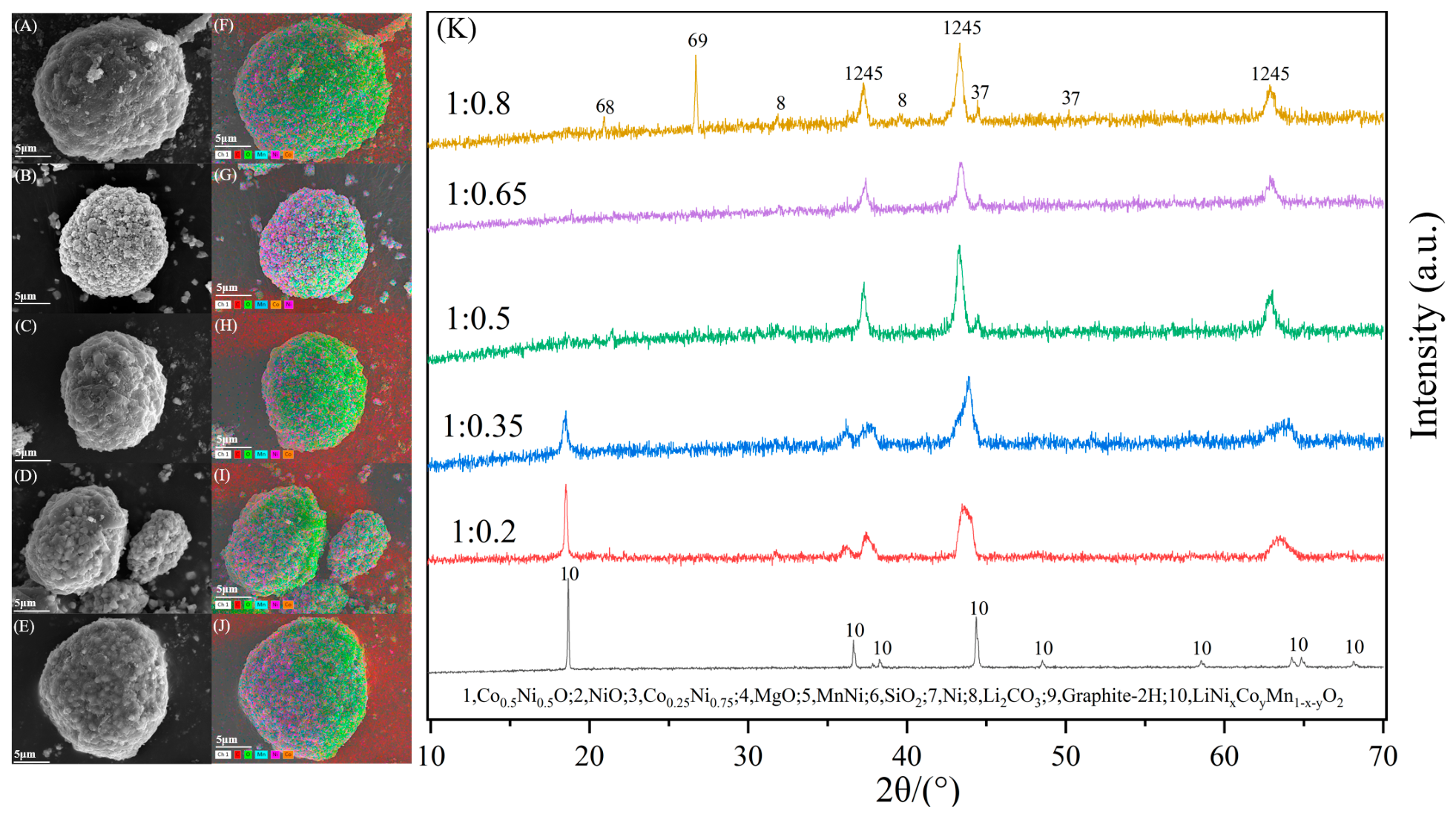
Figure 5 shows the influence of different waste TBRP addition amounts on the reduction effect of the cathode materials after a 1 h reaction at a nitrogen flow rate of 50 mL/min and a temperature of 650 °C. From Figure 5A–E, it can be seen that when the waste TBRP addition amount is 20%, the surface of the cathode materials is covered by a continuous film-like substance, and the diffraction peaks in the XRD spectrum become broader, indicating that the material is beginning to undergo phase transformation. When the waste TBRP addition amount is increased to 35%, the surface coating decreases significantly, and the phase structure is similar to that at 20% addition amount, but the particles decompose and produce more fine fragments. Further increase in the waste TBRP addition amount to 50% results in the disappearance of the film-like structure on the particle surface, and the decomposed fragments further increase. The diffraction peaks of LiNiXCoΥMn1−X−YO2 disappear, indicating that the cathode material is reduced to a low-valent binary lithium salt and binary oxide. When the waste TBRP addition amount reaches 65%, the XRD spectrum shows little change compared to that at 50%. However, the particle morphology indicates that the cathode material is reduced to a loose, multi-defect structure composed of regularly arranged particles of different sizes. When the addition amount is increased to 80%, the film-like structure on the particle surface melts and integrates due to excessive reduction. The XRD results (Figure 5K) indicate that the product is further reduced to monometallic oxides or even elemental metals, and the target product, Li2CO3, is detected. However, the SEM image shows that the particle surface forms a dense, monolithic layer which would be detrimental to the subsequent leaching process. In conclusion, the optimal waste TBRP addition amount is 65%, corresponding to a mass ratio of cathode material to waste TBRPs of 1:0.65. Based on the results from different pyrolysis times and TBRP addition amounts, it can be concluded that the cathode materials undergo significant reduction during the co-pyrolysis process. Furthermore, the reduction effect is enhanced as both the waste TBRP addition amount and the pyrolysis time increase.
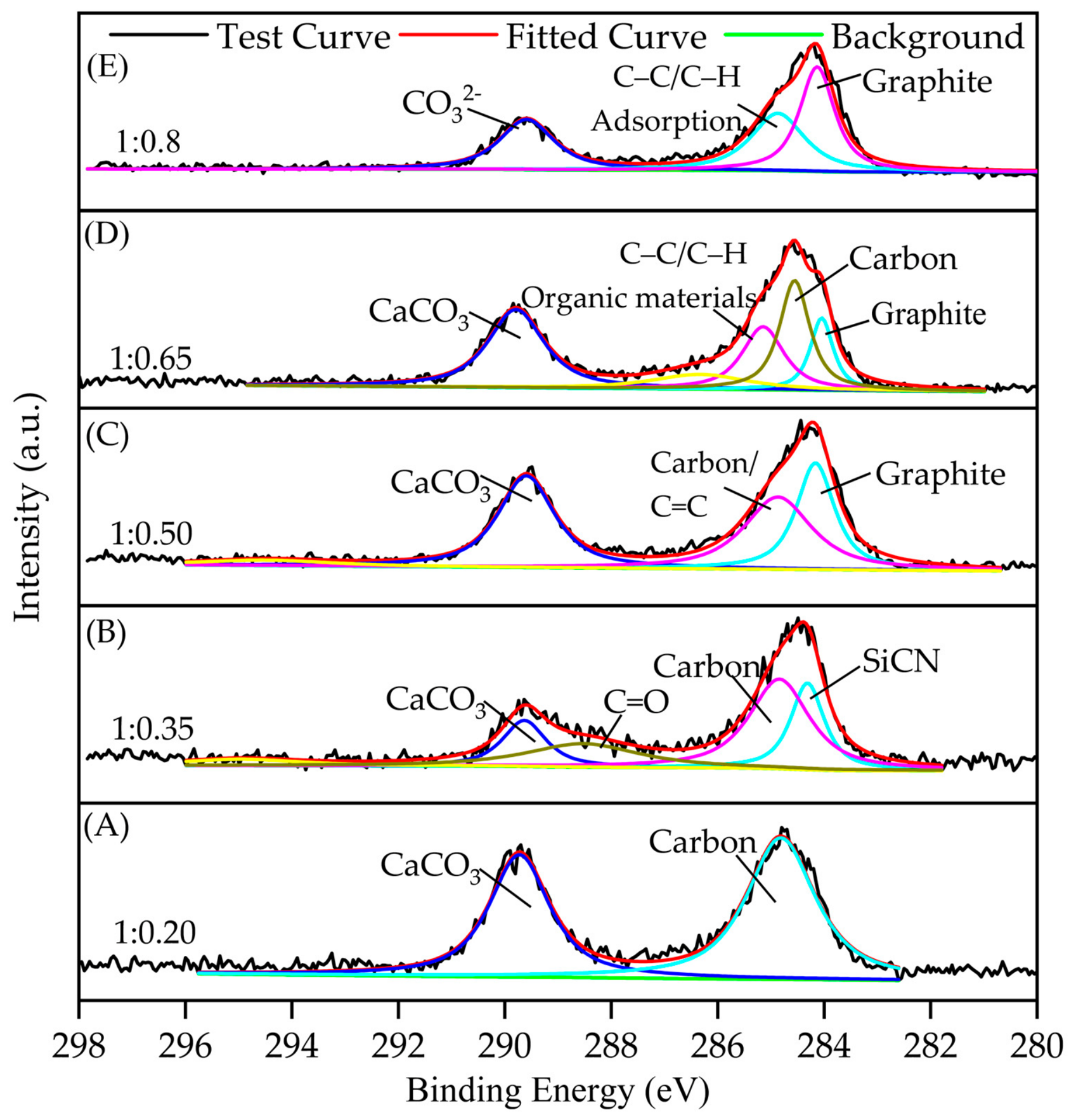
The analysis focused on how these carbon forms evolve during co-pyrolysis with cathode material in a nitrogen atmosphere under varying TBRP addition amounts. Figure 6 shows the XPS spectra of C 1s on the surface of the products corresponding to different waste TBRP addition amounts under a 650 °C pyrolysis condition. The results indicate that when the mass ratio is 1:0.2, the main form of carbonis CaCO3 which is the in herent fillers in the waste TBRPs has completely decomposed and participated in the reduction reaction of the cathode material as a reducing agent. When the mass ratio is increased to 1:0.35, signals of C=O and SiCN appear on the surface of the product, indicating the presence of incompletely pyrolyzed waste TBRPs and residual amorphous Si–C–N groups formed during the decomposition process with N2 and the inherent wear-resistant filler SiO2. This result is consistent with the observation in the high-resolution mode. As the mass ratio increases further to 1:0.5, the C=O bonds in amorphous carbon gradually disappear, likely due to oxygen recombining with reduced byproducts from the cathode material. Meanwhile, graphite phase begins to emerge in the product, which corresponds to the graphite-2H diffraction peak observed in XRD. When the mass ratio is further increased to 1:0.65, organic phase and organic substance signals of C–C/C–H are detected in the XPS spectrum, indicating that the waste TBRP addition amount is too high, causing it not to be completely decomposed. When the mass ratio reaches 1:0.8, the C–C/C–H from the organic substance form transforms into an adsorbed state (C–C/C–H adsorption), indicating that the oil-like components generated by the waste TBRP decomposition have not been promptly released and remain on the surface of the product.

3.2.2. The Influence of Pickling on the Morphology, Structure and Elemental Content of the Co-Pyrolysis Decomposition Products

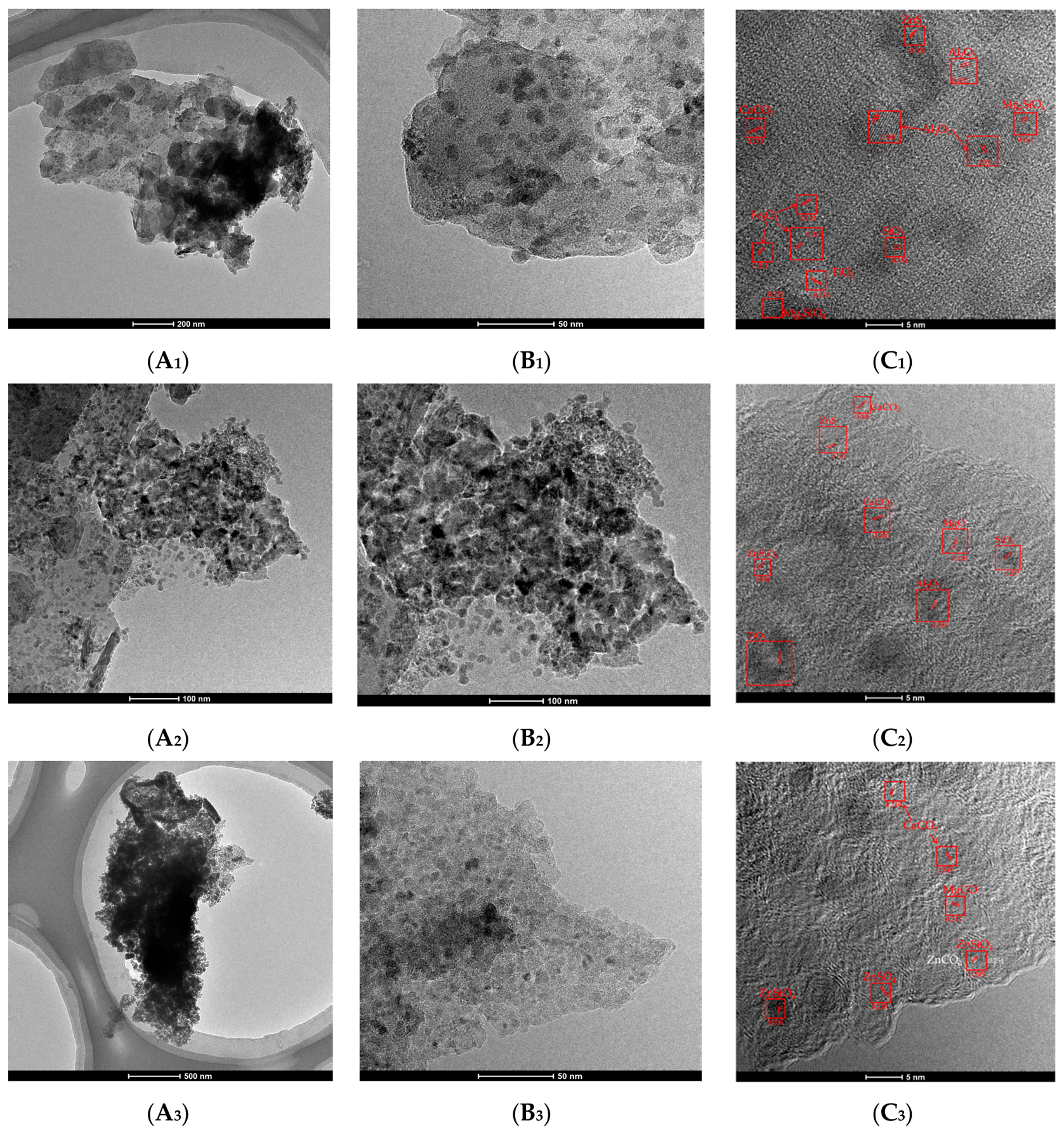
Figure 7 shows HRTEM images of the surface morphology of waste TBRPs after thermal decomposition at different temperatures. As shown in Figure 7, after thermal decomposition at 450 °C, the waste TBRPs (A1) have an appearance of a composite aggregate of thin sheets and irregular particles. At the same time, there are more fragmented small particles in the sheet structure. Through the combined analysis of the results obtained by using HRTEM in conjunction with TEM-EDS (Figure S4A–C), it can be concluded that these small particles may originate from exogenous dopants such as ZnS, Al2O3, SiO2, CaCO3, TiO2, Fe3O4, Mg2SiO4, etc. At this time, the exogenous dopants are distributed in the waste TBRPs in the amorphous carbon structure in the form of nanoparticles, and the dopants exhibit clear lattice stripes (A3). As the thermal decomposition temperature increases to 550 °C (B1), the aggregate morphology becomes more regular, and its thickness increases significantly compared to the product at 450 °C. Higher magnification imaging confirms that the exogenous dopants remain uniformly distributed within the waste TBRP matrix (B2). Subsequent HRTEM analysis reveals that lattice fringes begin to form around these dopants (B3). At a temperature of 650 °C (C1), the aggregates transform into large, sheet-like structures composed of fragmented small particles (C2). In HRTEM mode, the exogenous dopants are now encircled by distinct, multi-layered, circular graphite-like lattice fringes (C3). Concurrently, the lattice fringes of the dopants begin to lose clarity themselves.
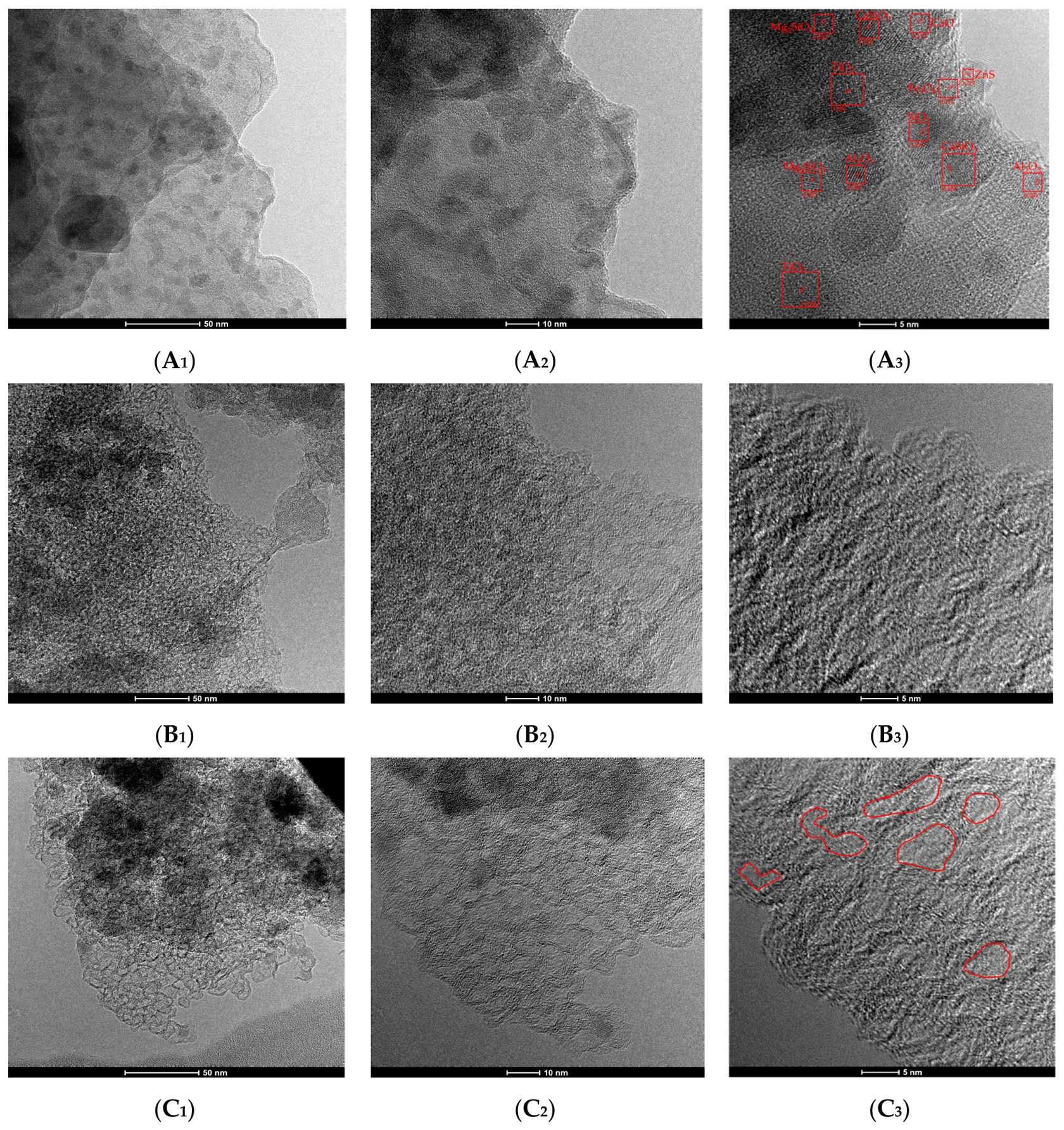
As shown in Figure 8, the waste TBRPs subjected to different temperature pyrolysis treatments were acid-washed with 100 mL of mixed dilute acid (1 mol/L HCl + 3 mol/L HNO3 + 10 mL 10%wt HF). Through TEM and HRTEM, it was found that the samples after 450 °C pyrolysis still presented a sheet-like aggregate with small particles after acid-washing (Figure 8(A1–A3)). Further magnification revealed that the exogenous additives were not completely eliminated (Figure 8(A3)), indicating that at this temperature, the waste TBRPs and the exogenous additives did not separate, and the exogenous additives were still wrapped by the waste TBRPs, preventing them from reacting with the dilute acid. Different from 450 °C, the samples after 550 °C pyrolysis were acid-washed, and more small pore structures appeared on the surface of the sheet-like structure, showing the characteristics of porous carbon (Figure 8(B1)). Further magnification revealed that the surface layer of the sheet-like structure presented a mesoporous carbon structure composed of short-range-ordered carbon microcrystals, but this mesoporous carbon structure was relatively rough and unclear (Figure 8(B2,B3)). When the pyrolysis temperature increased to 650 °C, the pore structures on the surface of the sheet-like structure became larger (Figure 8(C1)), clearer and more definite. The carbon microcrystals constituting the mesoporous structure changed from short-range-order to long-range-order (Figure 8(C2,C3)), and the mesoporous structure of the porous carbon changed to a mesoporous structure similar to onion carbon/floor foam carbon.
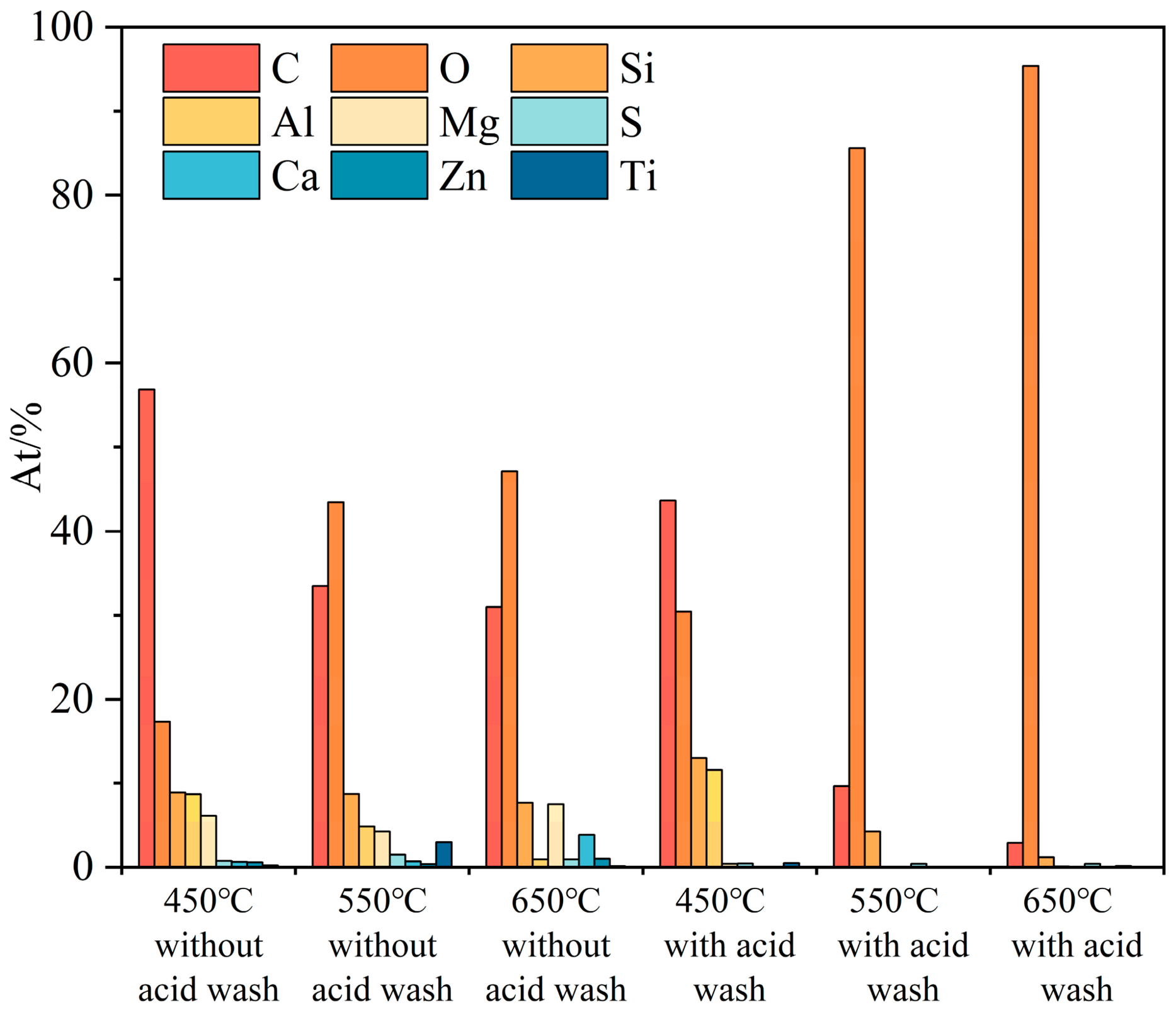
As shown in Figure 9, EDS analysis of products obtained at different pyrolysis temperatures (450 °C, 550 °C, 650 °C) before and after acid-washing reveals that in unwashed samples (Figure S4), the atomic percentages of oxygen and silicon gradually decrease with increasing temperature, while carbon content increases. Other elements (Al, Mg, S, Ca, Zn, Ti) exhibit fluctuating trends. At 650 °C, oxygen reaches its lowest level (30.97 At%), and carbon peaks at 47.15 At% (Table S2), indicating that co-pyrolysis with cathode material partially removes oxygen. After acid-washing (Figure S5), oxygen and silicon continue to decrease with temperature; carbon further increases, and most metallic elements (Mg, Ca, Zn, Ti) diminish or disappear, except Al and S. Following treatment at 650 °C and acid-washing, carbon content reaches 95.37 At%, suggesting the product consists mainly of carbon, residual silicon compounds, and traces of sulfur-containing species. The persistence of silicon may be attributed to incomplete acid reaction and insufficient HF addition leading to fluoride consumption by calcium ions, limiting desiliconization and leaving residual Si-O structures.
CaCO3(s) + 2HNO3(l) = Ca2+(aq) + 2NO3(aq) + CO2(g) + H2O(l)
CaCO3(s) + 2HCl(l) = Ca2+(aq) + 2Cl(aq) + CO2(g) + H2O(l)
CaCO3(s) + 2HF(l) = CaF2(s) + CO2(g) + H2O(l)
SiO2(s) + 4HF(l) = SiF4(g) + 2H2O(l)
In the research, the “porosity” index is generally used to measure porous carbon materials, and its calculation method is as follows:
V Total = V pore + 1 ρ true
ε = V pore V Total
Among them, Vpore represents the pore volume of TBRPs after acid-washing, and ρture represents the true density of TBRPs after acid-washing. Table 3 shows the specific surface area, true density and pore volume of TBRPs at different temperatures before and after acid washing.

3.3. Mechanism Discussion

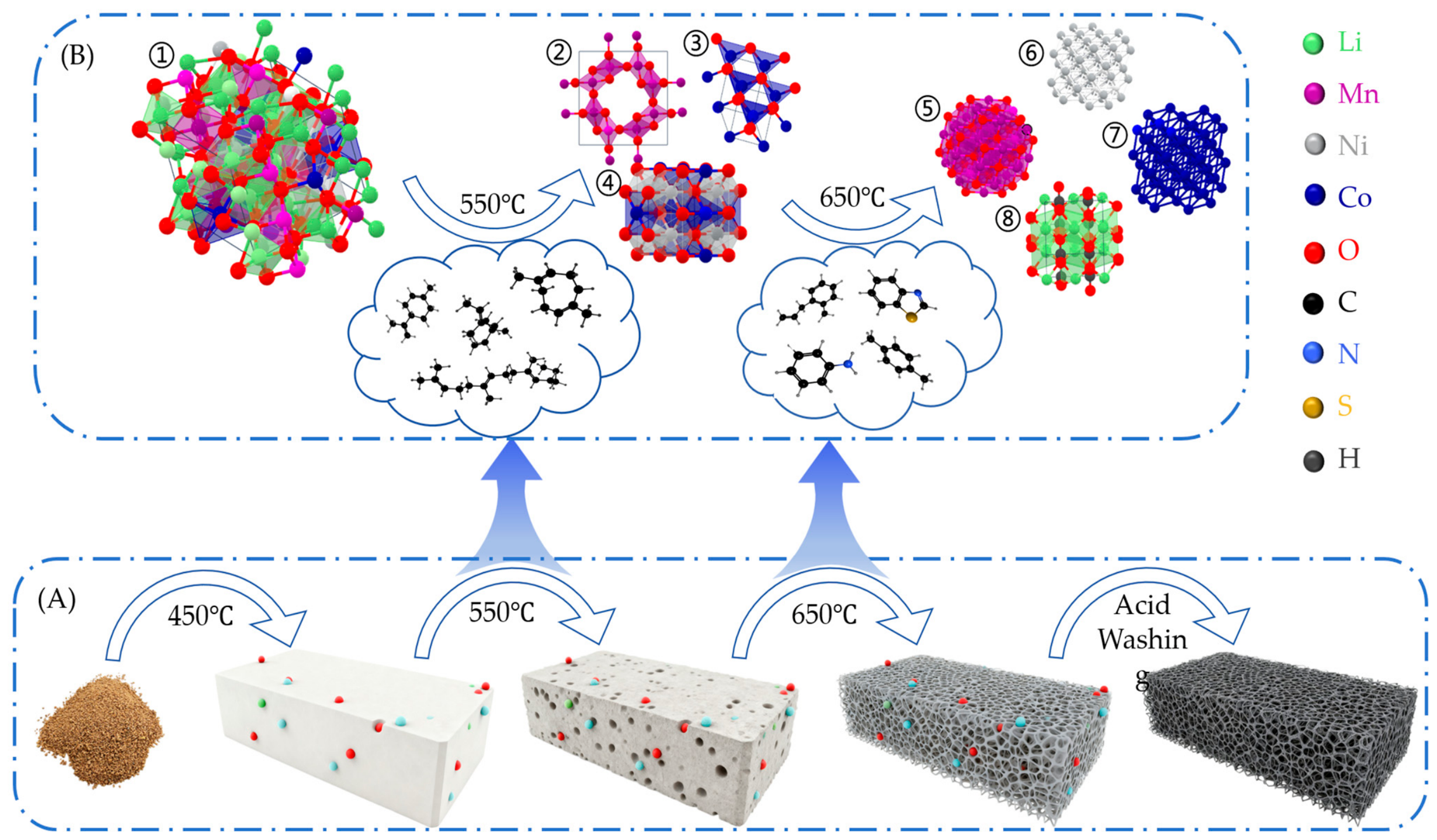
Based on the experimental observations and characterization results presented above, a plausible reaction mechanism is proposed and schematically illustrated in Figure 10. This framework is intended to rationalize the synergistic thermochemical conversion of waste TBRPs and spent NCM cathodes, rather than to assert conclusively proven reaction steps.
Regarding the pyrolysis of waste tennis ball rubber particles, the transformation depicted in Figure 10A shows that upon heating from ambient temperature to 450, 550, and 650 °C, the rubber particles undergo pronounced structural changes and ultimately convert into a loose, porous carbon matrix containing numerous spherical inclusions (as shown in Figure 7 and Figure 8). Within this temperature range, the polymeric rubber particles are considered to undergo violent cracking reactions, during which the long-chain, network-type polymer breaks down to yield a series of relatively low-molecular-weight pyrolysis oils (Figure 3 and Figure S5), gases, and solid carbon residues. After co-pyrolysis at 350 and 450 °C, the solid and liquid residues observed on the surface of the ternary material are believed to correspond to the pyrolysis oil and gas fragments generated from rubber cracking, which may directly participate in the subsequent reduction of the cathode material.
The reduction of the ternary cathode material by the high-temperature pyrolysis gases is proposed to proceed via two concurrent pathways. The primary pathway is gas-phase reduction, as illustrated in Figure 10B. The low-molecular-weight pyrolysis oils and gases produced from rubber cracking contain abundant unsaturated C=C bonds (Figure 2, Tables S1 and S2) and, at elevated temperatures, long-chain olefins and their derivatives become gaseous. Assisted by N2 flow, these olefinic species can diffuse to the surface of the cathode particles. It is hypothesized that the C=C double bonds, rich in π-electrons, adsorb onto active oxygen vacancies and metal ions on the cathode surface, which may prime the C-H and C=C bonds for activation [40]. Subsequently, on the metal oxide surface, these unsaturated species are likely activated by metal centers (Ni, Co, Mn) and surface oxygen atoms, potentially forming transient surface intermediates such as olefinic hydroxyl (-R-CH2O-) or aldehyde groups. However, it must be emphasized that direct in situ spectroscopic evidence or chemical trapping of these specific intermediates is not available in the present study; the proposed pathway is therefore inferred from the final product distribution and the known reactivity of olefins over transition metal oxide surfaces. Following this postulated activation, these intermediates may abstract surface O2− species, generating CO2/CO and H2O while concurrently creating oxygen vacancies at the metal sites. This process would facilitate electron transfer, resulting in the reduction of metal cations (e.g., Mn4+ → Mn3+ → Mn2+, Ni3+ → Ni2+, Co3+ → Co2+) and a corresponding decline in their oxidation states. The accompanying change in metal valence is expected to destabilize the layered structure, thereby leading to its collapse and the exposure of fresh cathode surfaces. Finally, the produced CO2 and H2O (or CO and H2) are desorbed from the surface; the oxygen vacancies may either be refilled or retained for subsequent reaction cycles.
The secondary pathway is proposed to involve solid–solid carbon thermal reduction. After the release of volatile gases and oils, residual amorphous carbon can come into intimate contact with cathode particles. At elevated temperatures, this carbon may act as an additional reductant, extracting lattice oxygen from the cathode material to form CO or CO2. In the present experiments, given the relatively low co-pyrolysis temperatures employed, this pathway is assumed to contribute only to a modest extent.
Collectively, the proposed dual-reduction framework offers a consistent explanation for the observed phase evolution of the cathode material—from an ordered layered structure to disordered rock-salt or spinel oxides, and even to metallic elemental products—as well as the subsequent formation of a porous carbon network after acid-washing. The carbonaceous residue obtained after pyrolysis, upon acid-washing to remove soluble impurities, yields a loosely packed, three-dimensional porous carbon structure composed predominantly of carbon, with low levels of Si, S, Al, Zn, and other contaminants. It should be noted that while the postulated surface intermediates await direct experimental confirmation (e.g., via in situ FTIR, Raman spectroscopy, or isotope labeling in future work), the proposed mechanism aligns well with all current experimental observations, including the identified phase transformations, the evolution of gaseous products, and the final porous carbon morphology.
Consequently, this technology not only addresses the challenge of recycling spent batteries but also offers a novel route for designing high-performance electrode materials. Lithium carbonate from processed samples can be directly purified owing to its aqueous solubility. Transition metals present as low-valent oxides or elemental species are recoverable via acid-leaching and stepwise purification. Porous carbon materials after acid-washing may also possess dual functions: they act as high-quality adsorbents and carbon framework supports, and can also be evaluated as anode materials. When paired with the recovered cathode materials to assemble half-cells for electrochemical characterization, this approach enables the development of a full-process industrial workflow.

4. Conclusions

This study adopts the strategy of “low-temperature crushing, co-pyrolysis decomposition and reduction, magnetic separation, and dilute acid-washing” to propose a simple and low-environmental-impact integrated treatment method. The co-pyrolysis process not only promotes the decomposition of waste TBRPs to generate high-value decomposition oil and porous carbon structure but also uses the decomposition gas to reduce the positive electrode materials of the cathode materials to low-grade oxides and lithium carbonate salts. By simply using magnetic separation and low-concentration dilute acid-washing, the effective separation of the co-pyrolysis decomposition products can be achieved, and the residual exogenous additives after waste TBRP decomposition can be removed.
Finally, relatively low-valence transition metal oxides, lithium salts, and porous carbon materials such as onion-like carbon/floating carbon can be obtained. The above results directly demonstrate the research value of the co-pyrolysis decomposition technology in the collaborative recovery of various solid wastes. This study provides a technical basis for the joint resource recovery of waste TBRPs and cathode materials of spent LIBs and shows significant potential for its future commercial application and the realization of the resource-recycling goal.

Supplementary Materials

The following supporting information can be downloaded at: https://www.mdpi.com/article/10.3390/met16080914/s1. Figure S1. The effect of different feed amounts on the particle size distribution of waste TBR after freezing crushing. Figure S2. Effects of different pre-cooling times on the particle size distribution of rubber after freezing crushing. Figure S3. The effect of different crushing times on the particle size distribution of rubber after freezing crushing. Figure S4. TEM and EDS images of waste TBRPs after co-pyrolysis at different temperatures before acid washing (A. 450 °C; B. 550 °C; C. 650 °C). Figure S5. TEM and EDS images of waste TBRPs after co-pyrolysis at different temperatures after acid washing (A. 450 °C; B. 550 °C; C.650 °C). Figure S6. Comparison of oil yield from the pyrolysis of 8g of waste TBRPs from 350 to 650 °C. Table S1. Main pyrolysis gas products of the waste membrane at 430 °C. Table S2. The atomic percentage content of elements before and after pickling at different co-pyrolysis temperatures.

Author Contributions

Conceptualization, Q.Z., J.M.M., S.N., H.W. and Y.Z.; methodology, J.L., S.N., H.W. and Y.Z.; validation, J.L., S.N., H.W. and Y.Z.; investigation, Q.Z. and J.M.M.; data curation, J.L.; writing—original draft preparation, J.L.; writing—review and editing, Q.Z., J.M.M., S.N., H.W. and Y.Z.; supervision, Q.Z. and Y.Z. All authors have read and agreed to the published version of the manuscript.

Funding

This work was supported by the Key Graduate Research and Practice Innovation Program of Jiangsu Province (KYCX25_2819), the 2025 Graduate Student Innovation Program of China University of Mining and Technology (2025WLKXJ070), the CUMT Open Sharing Fund for Large-scale Instruments and Equipment (no. 52350410452), and the National Natural Science Foundation of China (NSFC) (grant no. 52350410452).

Data Availability Statement

The original contributions presented in this study are included in the article/Supplementary Material. Further inquiries can be directed to the corresponding authors.

Acknowledgments

The authors thank the Advanced Analysis & Computation Center of China University of Mining and Technology for their help, and China University of Mining and Technology (CUMT) Open Sharing Fund for Large-scale Instruments and Equipment for their support.

Conflicts of Interest

The authors declare no conflicts of interest.

Abbreviations

The following abbreviations are used in this manuscript:
TBRPTennis ball rubber particles
LIBLithium-ion battery
SEMScanning electron microscope
XRDX-ray diffraction
TEMTransmission electron microscope
EDSEnergy dispersive spectrometer
XPSX-ray photoelectron spectroscopy

References

  1. Rodríguez Aybar, M.; Porras-Amores, C.; Moreno Fernández, E.; Pérez Raposo, Á. Physical-mechanical properties of new recycled materials with additions of padel-tennis ball waste. J. Clean. Prod. 2023, 413, 137392. [Google Scholar] [CrossRef] [Scilit]
  2. Press, A. Tennis Ball Wasteland? Game Grapples with a Fuzzy Yellow Recycling Problem. Available online: https://www.usnews.com/news/us/articles/2023-09-06/tennis-ball-wasteland-game-grapples-with-a-fuzzy-yellow-recycling-problem?src=usn_fl.%20(2023) (accessed on 10 July 2026).
  3. Victoria, T. Serving Sustainability: Tennis Ball Recycling. Available online: https://www.tennis.com.au/vic/news/2026/01/12/serving-sustainability--tennis-ball-recycling (accessed on 10 July 2026).
  4. Press, A. Ecological Impact of Tennis Balls Is Out of Bounds, Environmentalists Say. Available online: https://www.cbsnews.com/news/tennis-balls-ecological-impact-sustainability-problem/#:~:text=Because%20tennis%20balls%20are%20extremely%20hard%20to%20recycle,can%20take%20more%20than%20400%20years%20to%20decompose (accessed on 10 August 2026).
  5. Regional Information Centre for Western Europe. Giving Tennis Balls a Second Life: “Ecological Design Is Circularity”. Available online: https://unric.org/en/giving-tennis-balls-a-second-life-ecological-design-is-circularity/ (accessed on 10 August 2026).
  6. Katsamakas, A.A.; Chollet, M.; Eyyi, S.; Vassiliou, M.F. Feasibility Study on Re-Using Tennis Balls as Seismic Isolation Bearings. Front. Built Environ. 2021, 7, 768303. [Google Scholar] [CrossRef] [Scilit]
  7. Ji, J.; Wang, Y.; Cui, X.; Lv, J.; Su, W.; Liu, J.; Qian, G. Transitioning from Coincineration to Multipath Thermochemical Energy Conversion: Environmental and Economic Decision-Making for Recycling Screened Lightweight Oversized Waste from Aged Refuse. ACS Sustain. Chem. Eng. 2025, 13, 9490–9499. [Google Scholar] [CrossRef] [Scilit]
  8. General Administration of Sport of China. In 2024, Chinese Tennis Is So Exciting. Available online: https://www.sport.gov.cn/n20001280/n20067662/n20067613/c28400280/content.html (accessed on 10 July 2026).
  9. General Administration of Sport of China. Notice of the Tennis Center of the General Administration of Sports on Printing and Distributing the “Measures for the High-Quality Development and Reform of Tennis”. Available online: https://www.sport.gov.cn/wqzx/n5342/c28978602/part/28979572.pdf (accessed on 10 July 2026).
  10. General Administration of Sport of China. Regulations for the Thirteenth National Games Tennis Competition (Revised Edition). Available online: https://www.sport.gov.cn/n20001280/n20067662/n20067740/c20111901/part/20111912.pdf (accessed on 10 July 2026).
  11. Kobetičová, K.; Fořt, J.; Černý, R. Toxic and Biodegradation Potential of Waste Tires for Microorganisms Based on Two Experimental Designs. Appl. Sci. 2023, 13, 4871. [Google Scholar] [CrossRef] [Scilit]
  12. Fořt, J.; Kobetičová, K.; Böhm, M.; Podlesný, J.; Jelínková, V.; Vachtlová, M.; Bureš, F.; Černý, R. Environmental Consequences of Rubber Crumb Application: Soil and Water Pollution. Polymers 2022, 14, 1416. [Google Scholar] [CrossRef] [Scilit] [PubMed]
  13. Alhassan, M.M.; Struve, M.; Oleka, J.I.; Ujoh, F. Analysis of Dioxins Concentration in Domestic Waste and Burnt Tyre Residue at Gosa Dumpsite in Abuja, Nigeria. Rev. Environ. Earth Sci. 2015, 2, 11–29. [Google Scholar] [CrossRef] [Scilit]
  14. Mohajerani, A.; Burnett, L.; Smith, J.V.; Markovski, S.; Rodwell, G.; Rahman, M.T.; Kurmus, H.; Mirzababaei, M.; Arulrajah, A.; Horpibulsuk, S.; et al. Recycling waste rubber tyres in construction materials and associated environmental considerations: A review. Resour. Conserv. Recycl. 2020, 155, 104679. [Google Scholar] [CrossRef] [Scilit]
  15. Nanda, S.; Berruti, F. Municipal solid waste management and landfilling technologies: A review. Environ. Chem. Lett. 2021, 19, 1433–1456. [Google Scholar] [CrossRef] [Scilit]
  16. Cheng, J.; Wang, P.; Su, X.O. Recent Progress on the Detection of Dioxins Based on Surface-enhanced Raman Spectroscopy. Acta Chim. Sin. 2019, 77, 977–983. [Google Scholar] [CrossRef] [Scilit]
  17. Dan, Z.; Che, Y.; Wang, X.; Zhou, P.; Han, Z.; Bu, D.; Lu, X.; Ma, W.; Chen, G. Environmental, economic, and energy analysis of municipal solid waste incineration under anoxic environment in Tibet Plateau. Environ. Res. 2023, 216, 114681. [Google Scholar] [CrossRef] [Scilit] [PubMed]
  18. de Titto, E.; Savino, A. Environmental and health risks related to waste incineration. Waste Manag. Res. 2019, 37, 976–986. [Google Scholar] [CrossRef] [Scilit] [PubMed]
  19. Kenawy, S.H.; Khalil, A.M. Reclaiming Waste Rubber for a Green Environment. Biointerface Res. Appl. Chem. 2020, 1, 8413–8423. [Google Scholar] [CrossRef] [Scilit]
  20. Tejani, J.G. Innovative Approaches to Recycling Rubber Waste in the United States. ABC Res. Alert 2019, 7, 181–192. [Google Scholar] [CrossRef] [Scilit]
  21. Ramarad, S.; Khalid, M.; Ratnam, C.T.; Chuah, A.L.; Rashmi, W. Waste tire rubber in polymer blends: A review on the evolution, properties and future. Prog. Mater. Sci. 2015, 72, 100–140. [Google Scholar] [CrossRef] [Scilit]
  22. Sambyal, P.; Najmi, P.; Sharma, D.; Khoshbakhti, E.; Hosseini, H.; Milani, A.S.; Arjmand, M. Plastic recycling: Challenges and opportunities. Can. J. Chem. Eng. 2025, 103, 2462–2498. [Google Scholar] [CrossRef] [Scilit]
  23. Sienkiewicz, M.; Kucinska-Lipka, J.; Janik, H.; Balas, A. Progress in used tyres management in the European Union: A review. Waste Manag. 2012, 32, 1742–1751. [Google Scholar] [CrossRef] [Scilit] [PubMed]
  24. Banala, D.; Sabri, Y.; Choudhury, N.R.; Parthasarathy, R. Sustainable Valorisation of End-of-Life Tyres Through Pyrolysis-Derived Recovered Carbon Black in Polymer Composites. Polymers 2025, 17, 2771. [Google Scholar] [CrossRef] [Scilit] [PubMed]
  25. Karger-Kocsis, J.; Mészáros, L.; Bárány, T. Ground tyre rubber (GTR) in thermoplastics, thermosets, and rubbers. J. Mater. Sci. 2013, 48, 1–38. [Google Scholar] [CrossRef] [Scilit]
  26. Jiang, K.; Shi, J.; Ge, Y.; Zou, R.; Yao, P.; Li, X.; Zhang, L. Complete devulcanization of sulfur-cured butyl rubber by using supercritical carbon dioxide. J. Appl. Polym. Sci. 2013, 127, 2397–2406. [Google Scholar] [CrossRef] [Scilit]
  27. Wan, H.B.; Huang, Z. Pyrolysis and Oxidative Thermal Decomposition Investigations of Tennis Ball Rubber Wastes through Kinetic and Thermodynamic Evaluations. Materials 2023, 16, 2328. [Google Scholar] [CrossRef] [Scilit] [PubMed]
  28. Miranda, M.; Pinto, F.; Gulyurtlu, I.; Cabrita, I. Pyrolysis of rubber tyre wastes: A kinetic study. Fuel 2013, 103, 542–552. [Google Scholar] [CrossRef] [Scilit]
  29. Yu, S.; Yang, Q.; Li, Z.; Liu, T.; Tao, L.; Yao, E.; Zhang, Y. Mechanism analysis of gas products from catalytic pyrolysis of tire rubber based on reaction thermodynamics and kinetics. Fuel Process. Technol. 2022, 227, 107134. [Google Scholar] [CrossRef] [Scilit]
  30. Chen, W.L.; Alagarsamy, S.; Liao, Y.C. Sustainable recycling and reutilization of carbon-based materials: From waste to high-value applications. J. Taiwan Inst. Chem. Eng. 2026, 184, 106283. [Google Scholar] [CrossRef] [Scilit]
  31. Meng, Z.; Huang, W.; Gao, L.; Dai, J.; Lu, X.; Liu, J.; Huang, H.; Shih, K.; Tang, Y. Green and Energy-Saving Recycling of LiCoO2 by Synergetic Pyrolysis with Polyvinyl Chloride Plastics. ACS Sustain. Chem. Eng. 2022, 10, 12329–12341. [Google Scholar] [CrossRef] [Scilit]
  32. Wei, N.; He, Y.; Zhang, G.; Feng, Y.; Li, J.; Lu, Q.; Fu, Y. Recycling of valuable metals from spent lithium-ion batteries by self-supplied reductant roasting. J. Environ. Manag. 2023, 329, 117107. [Google Scholar] [CrossRef] [Scilit] [PubMed]
  33. Ratnaningsih, W.; Santosa, S.J.; Prasetya, A.; Yuliansyah, A.T. End-of-life tyre pyrolysis as a sustainable utilization for rubber waste management: A review. In IOP Conference Series: Earth and Environmental Science; IOP Publishing: Bristol, UK, 2025; Volume 1526. [Google Scholar]
  34. Kasmiarno, L.D.; Rizkiana, J.; Prakoso, T.; Istyami, A.N.; Pratiwi, M.; Bindar, Y. Pyrolysis depolymerization of fresh natural rubber into liquid medium-chain bio-hydrocarbon products: Investigation of volatile-state kinetics approach and mechanism reaction analysis. Biomass Bioenergy 2025, 197, 107840. [Google Scholar] [CrossRef] [Scilit]
  35. Hao, J.; Wang, J.; Zhang, H.; Wang, H.; Ge, Z.; Zhao, R.; Zhang, F.; Wang, S.; Xie, W.; He, Y. Reductive roasting of spent Li(NiCoMn)O2 cathode materials using biomass pyrolysis gas. Fuel 2027, 428, 140352. [Google Scholar] [CrossRef] [Scilit]
  36. Weng, S.; Xu, Y. Fourier Transform Infrared Spectroscopy Analysis. Ver.2; Chemical Industry Press: Beijing, China, 2016. [Google Scholar]
  37. Shui, Y.; Liu, H.; Shan, R.; Hao, M.; Li, C.; Zhang, J.; Yuan, H. Selective pyrolysis of waste tire rubber for limonene production. J. Energy Inst. 2025, 123, 102325. [Google Scholar] [CrossRef] [Scilit]
  38. Dang, L.; Shibl, M.F.; Yang, X.; Alak, A.; Harrison, D.J.; Fekl, U.; Brothers, E.N.; Hall, M.B. The Mechanism of Alkene Addition to a Nickel Bis(dithiolene) Complex: The Role of the Reduced Metal Complex. J. Am. Chem. Soc. 2012, 134, 4481–4484. [Google Scholar] [CrossRef] [Scilit] [PubMed]
  39. Nemirovich, T.; Kostal, V.; Copko, J.; Schewe, H.C.; Boháčová, S.; Martinek, T.; Slanina, T.; Jungwirth, P. Bridging Electrochemistry and Photoelectron Spectroscopy in the Context of Birch Reduction: Detachment Energies and Redox Potentials of Electron, Dielectron, and Benzene Radical Anion in Liquid Ammonia. J. Am. Chem. Soc. 2022, 144, 22093–22100. [Google Scholar] [CrossRef] [Scilit] [PubMed]
  40. Xue, S.; Zhu, K.; Yuan, H.; Jiang, S.; Zhu, Y.; Chen, L. Unveiling the Key Factors of Spatial and Chemical Structures to Pellet Strength of Tire Pyrolysis Carbon Black for Sustainable Rubber Recycling. ACS Sustain. Chem. Eng. 2026, 14, 3546–3554. [Google Scholar] [CrossRef] [Scilit]
Figure 1. Pretreatment and preparation of waste TBRPs.
Metals 16 00914 g001
Figure 2. Infrared spectrogram of the types of functional groups in waste tennis rubber particles.
Metals 16 00914 g002
Figure 3. (A) The TG and DTG images of waste TBRPs and (B) the total ion chromatogram of the pyrolysis products at 430 °C.
Metals 16 00914 g003
Figure 4. SEM-EDS images of the LIBs cathode materials after co-pyrolysis reduction reaction with waste TBRPs at different temperatures, (A) 350 °C, (B) 450 °C, (C) 550 °C, (D) 650 °C respectively; (EI) are the local magnified images and elemental distribution images of (D).
Metals 16 00914 g004
Figure 5. Comparison diagram of surface and phase changes in cathode materials under different waste TBRP addition amounts ((AE) are the morphology diagrams of the positive electrode material’s co-pyrolysis decomposition products under waste TBRP addition mass percentages of 1:0.8/0.65/0.5/0.35/0.2; (FJ) are the schematic diagrams of surface element distribution under corresponding conditions; (K) is the phase analysis diagram of the co-pyrolysis decomposition products at this time).
Metals 16 00914 g005
Figure 6. XPS spectra of C element after pyrolysis under different cathode material-to-waste TBRPs mass ratio (A) 1:0.2, (B) 1:0.35, (C) 1:0.5, (D) 1:0.65, (E) 1:0.8.
Metals 16 00914 g006
Figure 7. HRTEM images of the surface morphology of waste TBRPs after thermal decomposition at different temperatures ((A1A3) 450 °C; (B1B3) 550 °C; (C1C3) 650 °C).
Metals 16 00914 g007
Figure 8. Comparison of the surface morphology of waste TBRPs after thermal decomposition treatment and acid-washing at different temperatures ((A1A3), 450 °C; (B1B3), 550 °C; (C1C3), 650 °C).
Metals 16 00914 g008
Figure 9. Element contents in nonmagnetic pyrolysis products before and after washing.
Metals 16 00914 g009
Figure 10. Schematic diagram of pyrolysis and reduction processes. (A) The process of reducing the cathode materials by pyrolysis at 550 and 650 °C. ① LiNixCoyMn1–x–yO2, ② MnO2, ③ CoO, ④ NixCo1–xO, ⑤ MnO, ⑥ Ni, ⑦ Co, ⑧ Li2CO3. (B) The structural changes in waste TBRPs at temperatures of 450, 550 and 650 °C and with melting acid-washing process.
Metals 16 00914 g010
Table 1. Percentage Content of Organic Elements in waste TBRPs.
No.CHNS
149.896.620.382.373
249.676.710.392.434
Table 2. Analysis of residual elements after ash content test of waste TBRPs.
No.NameWeight/%Error/%
1SiO233.9420.20
2MgO28.8450.10
3ZnO14.1150.10
4CaO10.7260.09
5SO37.5920.08
6TiO21.9790.04
7Al2O31.4450.04
8K2O0.5380.02
9Fe2O30.3830.02
Table 3. The specific surface area and pore structure parameters of rubber pyrolysis carbon before and after acid-washing at different pyrolysis temperatures.
Temperature/°C450550650
Surface area before acid-wash/m2·g−16.89025.84647.9914
Surface area after acid-wash/m2·g−110.89168.84428.27
True density/g·cm−32.45292.39692.4411
Pore volume/cm3·g−10.04290.30060.9605
Porosity range/%9.5241.8870.10
Disclaimer/Publisher’s Note: The statements, opinions and data contained in all publications are solely those of the individual author(s) and contributor(s) and not of MDPI and/or the editor(s). MDPI and/or the editor(s) disclaim responsibility for any injury to people or property resulting from any ideas, methods, instructions or products referred to in the content.