Article

Effect of Annealing Temperature on Microstructure and Properties of Ti–Microalloyed High–Strength Steel for Photovoltaic Mounting Structures

1
Collaborative Innovation Center of Steel Technology, University of Science and Technology Beijing, Beijing 100083, China
2
Shanxi Jincheng Iron and Steel Holding Group Co., Ltd., Jincheng 048002, China
*
Authors to whom correspondence should be addressed.
Metals 2026, 16(7), 700; https://doi.org/10.3390/met16070700 (registering DOI)
Submission received: 22 May 2026 / Revised: 21 June 2026 / Accepted: 22 June 2026 / Published: 25 June 2026
(This article belongs to the Special Issue Recent Advances in High-Performance Steel (2nd Edition))

Abstract

Photovoltaic mounting structures operate in harsh environments, demanding high strength and elongation. However, a strength–graded product series within the same composition is lacking. Through Ti microalloying and heat treatment, we developed steels with strengths of 500–800 MPa and studied annealing effects at 640–740 °C. Scanning Electron Microscope (SEM) shows ferrite and cementite: with increasing temperature, ferrite changes from elongated to equiaxed via recovery and recrystallization, while cementite remains finely dispersed along grain boundaries. Transmission Electron Microscope (TEM) reveals TiC precipitates, which decrease in number but increase in size at higher temperatures. Grain refinement strengthening, dislocation strengthening, and precipitation strengthening are the primary strengthening mechanisms, contributing 91.2% and 94.4% to the yield strength after annealing at 640 °C and 720 °C, respectively. Within a wide annealing temperature range, the tensile strength fully covers the 550–650–750–800 MPa grades, with the corresponding elongation fluctuating between 12.4% and 25.3%, achieving a good strength–ductility balance. In summary, simply adding a single Ti element and adjusting the annealing temperature allows for the production of test steels with strengths ranging from 500 to 800 MPa and matched elongation. This approach not only reduces costs but also provides experimental evidence for the process development of a series of new steels for photovoltaic mounting brackets.

1. Introduction

As a critical component of photovoltaic power generation systems, photovoltaic mounting structures play a key role in ensuring the stable operation and long–term reliability of photovoltaic modules under various environmental conditions. With the continuous advancement of photovoltaic technology, research on steel for PV mounting structures increasingly focuses on lightweight design, high strength, and excellent corrosion resistance to better meet the stringent requirements of modern photovoltaic applications for structural performance and durability [1,2]. Hot–dip galvanizing technology bonds well with the steel substrate, effectively enhancing its strength and ductility. Therefore, the development of advanced microalloyed steel with zinc–aluminum–magnesium coatings to replace traditional steel is crucial for achieving lightweight and eco–friendly PV mounting systems. Currently, most zinc–aluminum–magnesium–coated steels for PV mounting systems on the market incorporate composite microalloying elements such as Ti and Nb. Although their strength ranges reach 300–800 MPa, this approach leads to relatively high alloying costs [3,4,5,6]. Consequently, there is an urgent need to address how to develop a series of high–strength products through single–element microalloying.
Microalloying technology offers a highly promising approach to achieving the aforementioned objectives and has been widely applied in fields such as automotive high–strength steel, structural steel, and heat–resistant steel [7,8]. The nanoscale carbides formed by the reaction of microalloying elements with carbon can enhance material strength by pinning dislocations and refining grain size. Compared to elements such as Nb and V, Ti offers better cost–effectiveness; increasing the Ti content appropriately to partially replace Nb or V can reduce production costs. Gan et al. [9] studied Nb–Ti microalloyed steels containing 0.04% and 0.08% Ti. The results show that the high–Ti samples have smaller carbide particle sizes and a higher volume fraction, resulting in a more pronounced precipitation hardening effect. Wang et al. [10] conduct a study by adding 0.04%, 0.07%, 0.102%, 0.13%, and 0.157% Ti, respectively, and find that as the Ti content increases, both the yield strength and tensile strength of the steel improve; however, the elongation first decreases and then increases, with the steel containing 0.102% Ti exhibiting the lowest elongation. Other researchers heat–treat test steels with four Ti contents (0.024%, 0.019%, 0.013%, and 0.020%) at 860 °C, 880 °C, 900 °C, and 920 °C. They find that for steels with higher Ti content, the carbide precipitation temperature corresponds to the optimal heat treatment temperature for Ti–microalloyed steels, at which point mechanical properties are optimal [11]. Additionally, during high–temperature treatment, the grain size remains relatively fine due to the grain–refining effect of the carbide [11]. It is evident, therefore, that titanium plays a significant role in strengthening the mechanical properties of microalloyed steels.
To this end, this study proposes the addition of a single microalloying element, Ti, to develop steel for photovoltaic mounting structures with a strength range of 500–800 MPa, achieving a favorable balance between strength and ductility to better meet increasingly diverse market demands. Based on actual production conditions in factory production lines, this study designed the chemical composition of the steel for photovoltaic mounting structures and conducted annealing process simulations using a continuous annealing simulation machine to develop steel for photovoltaic mounting structures in the 500–800 MPa range. By characterizing the microstructure and precipitation behavior of the microalloyed steel, optimized process parameters for the test steel were obtained. The results of this study can serve as a reference for the research and production of photovoltaic mounting steel with the same chemical composition but different strength grades.

2. Materials and Methods

Based on the microstructural and mechanical property requirements for photovoltaic mounting steel, the chemical composition of the steel was designed, as shown in Table 1. The core of the material composition design lies in the following: starting from a C–Mn steel base, the carbon and manganese contents were appropriately reduced, and a certain amount of titanium was added. By forming fine TiC second–phase particles, grain refinement strengthening and precipitation hardening are achieved to enhance the material’s performance. The steel used for testing was obtained from cold–rolled sheets at the production site, from which rectangular specimens measuring 50 mm (transverse) × 200 mm (longitudinal) are cut along the rolling direction. The effects of different annealing temperatures (640 °C, 660 °C, 680 °C, 700 °C, 720 °C, and 740 °C) on the microstructure and mechanical properties of the test steel are investigated using an annealing simulation machine (ULVAC, Chigasaki, Japan).
Tensile specimens with a gauge length of 25 mm were cut from each annealed sheet along the rolling direction. The mechanical properties of the specimens were tested at room temperature using an MTS E45.305 tensile testing machine ((MTS Systems (China) Co., Ltd. Shenzhen, China) at a strain rate of 1 mm/min, in accordance with the national standard GB/T 228.1–2021 [12]. A 10 mm × 8 mm (Rolling Direction × Transverse Direction) section is cut from the center of the annealed sheet and ground and polished according to the standard procedure for preparing metallographic specimens. The observation surface was then etched using a 4% nitric acid–alcohol solution. Scanning electron microscopy (SEM) (Carl Zeiss, Shanghai, China) analysis was performed using a ZEISS Gemini SEM 500 field–emission scanning electron microscope at an operating voltage of 10 kV and a working distance of approximately 12 mm. For electron backscatter diffraction (EBSD) testing, the sample surfaces were ground using silicon carbide sandpaper of varying grit sizes, followed by electrolytic polishing in a 10% perchloric acid–alcohol solution. During the electrolytic process, a voltage of 13 V and a current of 0.5–0.7 A were applied for 15–18 s. EBSD analysis was performed using a Symmetry S3 electron backscatter diffractometer (Carl Zeiss, Shanghai, China) with an operating voltage of 20 kV, a working distance of approximately 17.5 mm, a step size of 0.18 μm, a selected area of 80 × 60 μm, a sample tilt of 70°, and a data acquisition frequency of 105.65 Hz. The acquired EBSD data were processed using specialized Aztec Crystal software 3.3. For TEM specimens, 10 mm × 10 mm metal samples were cut along the RD × TD plane. After grinding and polishing the observation surface, the samples were etched using a 4% nitric acid–alcohol solution. Subsequently, the specimen surface was carbon–sprayed to form a uniform carbon coating. A 10% nitric acid–alcohol solution was then used to selectively dissolve the interface, enabling effective separation of the carbon coating from the substrate. Finally, the resulting carbon replica was transferred to a copper mesh carrier using high–precision tweezers to prepare the carbon replica extraction specimen.

3. Results and Discussion

3.1. Microstructural Characterization

3.1.1. SEM Characterization

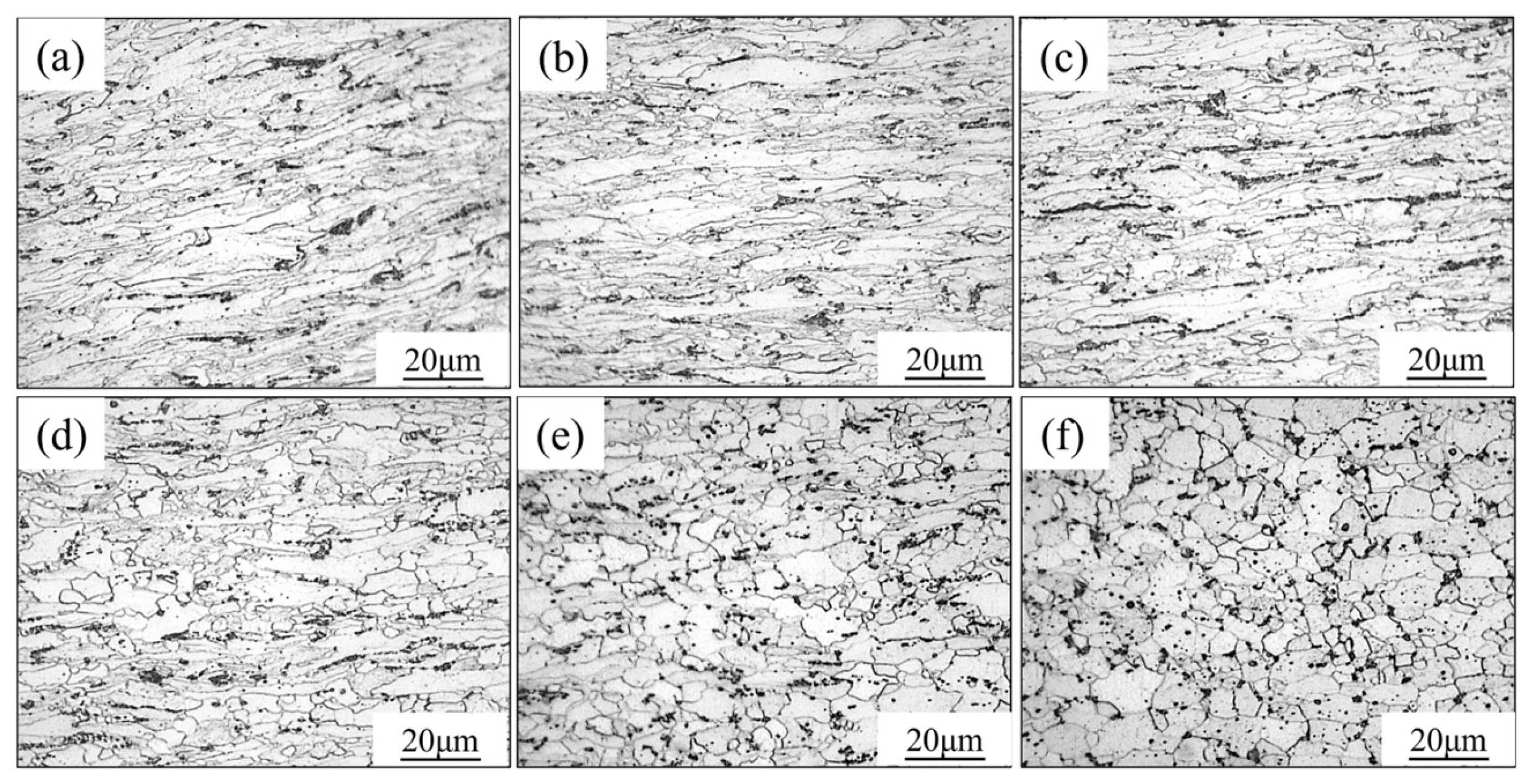
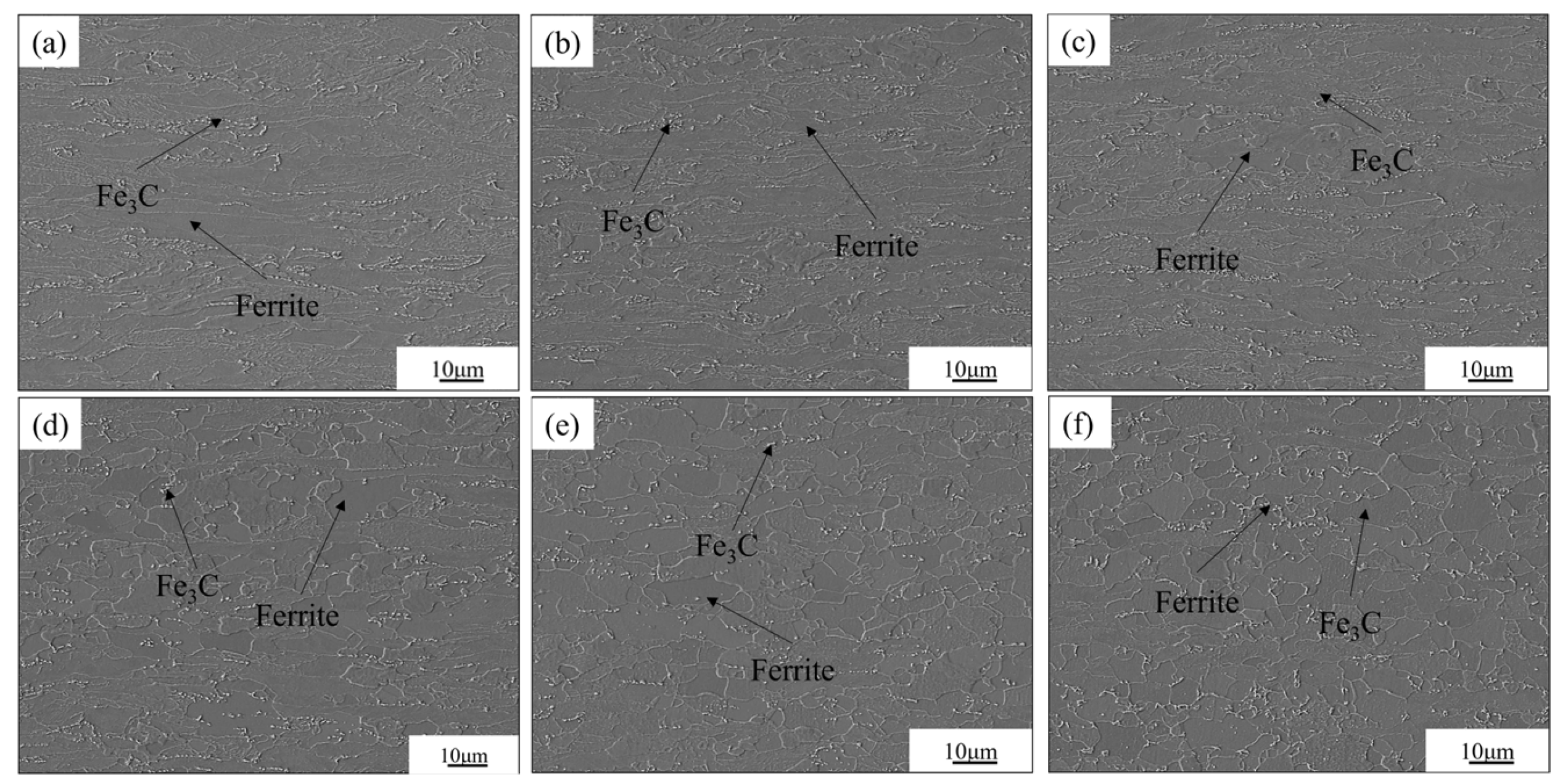
Figure 1 and Figure 2 show the microstructural images of specimens annealed at different temperatures. As can be seen from the figures, the microstructure of the test steel after annealing consists of ferrite and cementite, with the cementite distributed along the ferrite grain boundaries. At lower temperatures (640 °C), the grains of the material exhibit a distinct elongated shape, forming a typical fibrous structure. At this stage, the driving force for recrystallization is insufficient, and the material remains in the recovery phase, as shown in Figure 1a and Figure 2a. As the annealing temperature increases, microstructural evolution occurs within the material, including dislocation motion, grain growth, and polygonization (Figure 1b,c and Figure 2b,c). When the annealing temperature rises to 700 °C (Figure 1d and Figure 2d), some equiaxed ferrite has already appeared in the microstructure. This equiaxed ferrite is primarily located near distorted grains because the strain energy storage regions possess a high recrystallization driving force, making them preferred nucleation sites [13]. However, some elongated ferrite grains still remain in the material, and the grains retain a certain aspect ratio, indicating that the material has entered the recrystallization stage but has not yet fully recrystallized. As the annealing temperature is further increased to 720 °C and 740 °C (Figure 1e,f and Figure 2e,f), a large number of recrystallized grains nucleate and grow rapidly, becoming the dominant feature in the microstructure, indicating that the recrystallization process is essentially complete at this point. Thereafter, the grains exhibit a trend of continued growth. This is because the driving force for grain growth is the difference in interfacial energy between adjacent grains, causing grain boundaries to migrate toward the center of curvature to reduce the system’s interfacial energy, thereby leading to grain coalescence and growth [14].
Thanks to the addition of Ti, although the grain size of the test steel gradually increases with rising temperature during annealing, it remains at a relatively low level even at the high temperature of 740 °C. As a microalloying element capable of suppressing ferrite grain growth, Ti primarily forms carbides with C, which hinder the migration of ferrite grain boundaries, thereby achieving the goal of refining ferrite grains [15]. Currently, there are two explanations for this mechanism: the first is the second–phase pinning mechanism, wherein the second phase precipitated at defects effectively hinders grain boundary migration and dislocation motion. The Zener pinning model states that the pinning pressure is directly proportional to the volume fraction of the second–phase particles and inversely proportional to their radius; therefore, fine, uniformly distributed TiC particles can exert a significant pinning effect on grain boundaries and dislocations [16]. The second is the solute atom drag mechanism, whose core concept posits that heterogeneous solute atoms with slower diffusion rates segregate at the moving interface, generating a drag force that significantly affects the mobility of grain boundaries, thereby hindering recrystallization [17].

3.1.2. EBSD Characterization

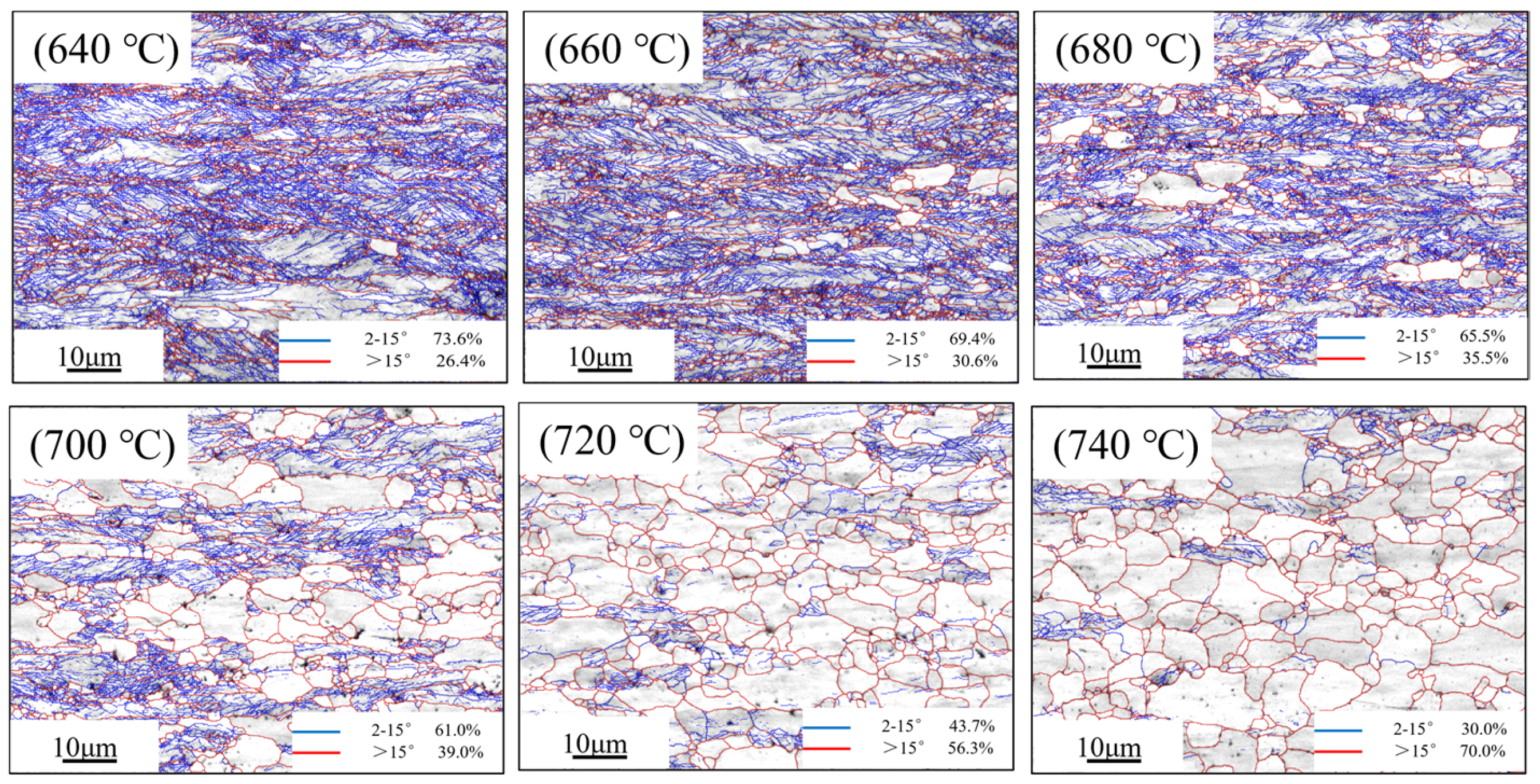
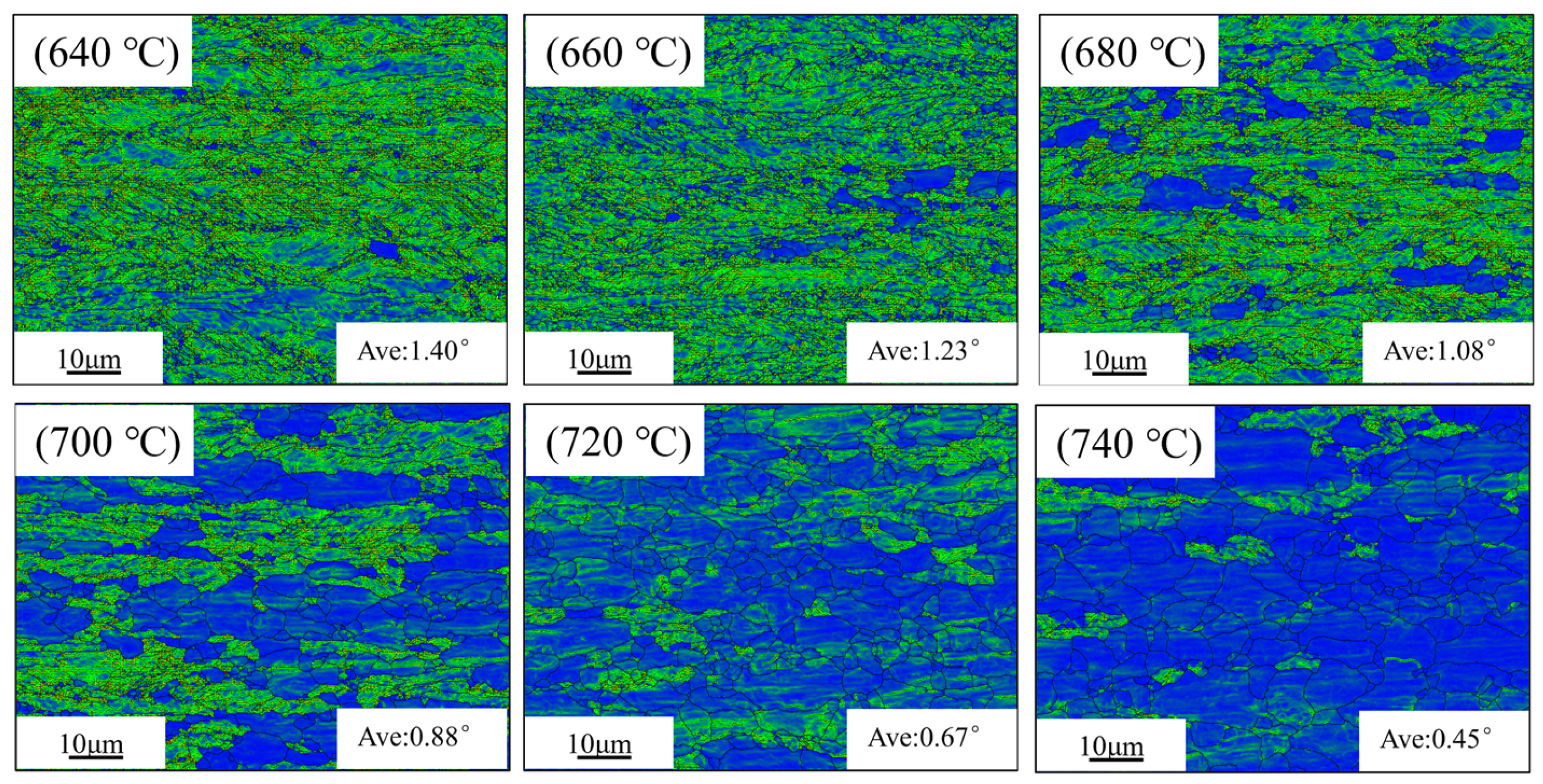
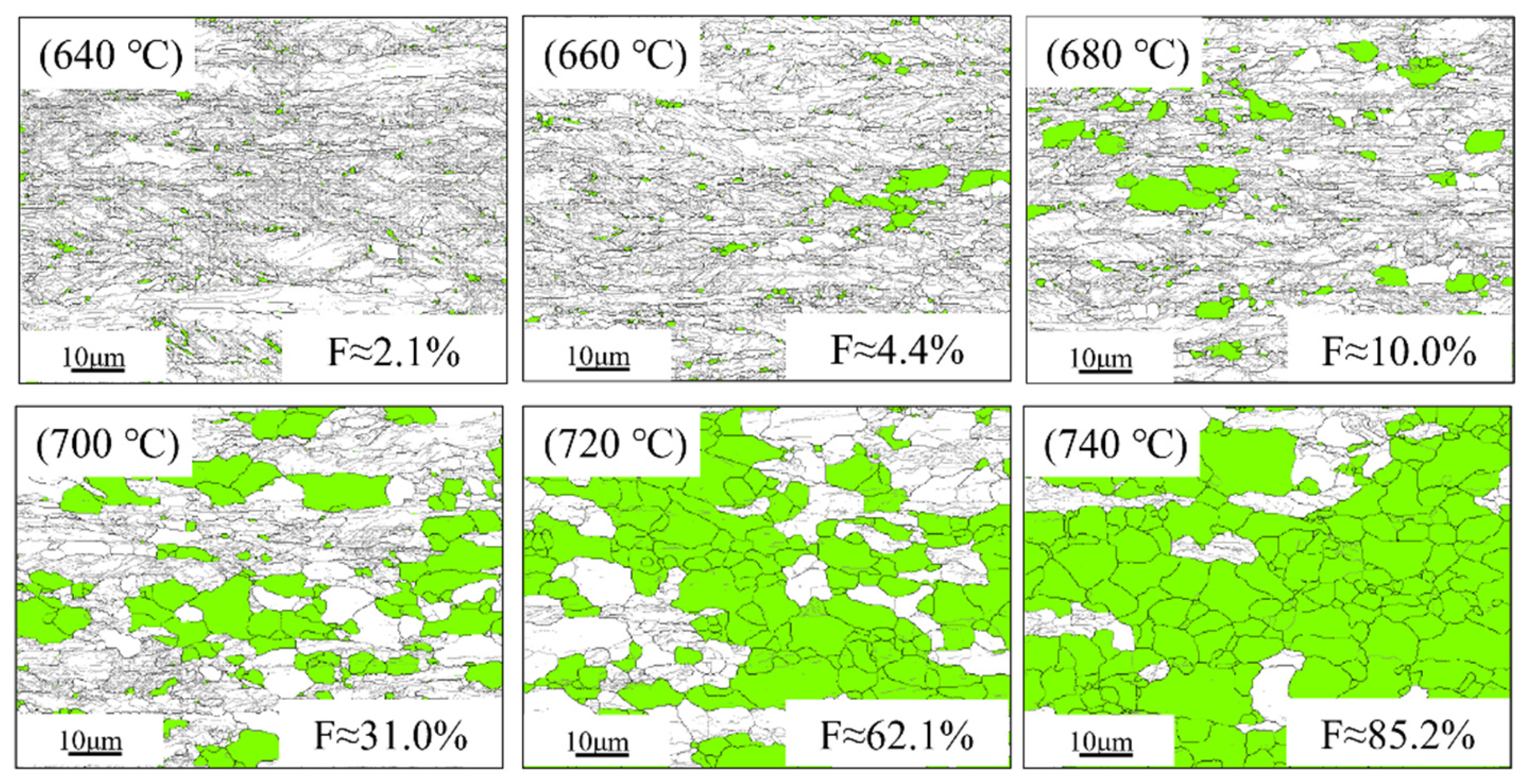
The microstructure of the test steel after annealing at 640–740 °C was further examined using EBSD, as shown in Figure 3, Figure 4 and Figure 5. The grain boundary diagram reveals that as the annealing temperature increases, the proportion of high–angle grain boundaries (>15°) rises, from 26.4% at 640 °C to 70.0% at 740 °C. The high–angle grain boundaries are concentrated at the grain boundaries, whereas the low–angle grain boundaries are primarily distributed within the grains. Compared to elongated ferrite, equiaxed ferrite is more prone to forming high–angle grain boundaries. Low–angle grain boundaries exhibit severe dislocation pile–ups, which hinder dislocation movement between grains, thereby limiting the material’s plastic deformation and consequently enhancing its strength [18]. The kernel average misorientation (KAM) value characterizes the degree of uniformity in residual stress and plastic deformation within the material. Combined with grain boundary analysis, regions with small–angle grain boundaries often exhibit higher stress concentrations [19]. At lower annealing temperatures of 640 and 660 °C, high KAM values indicate significant work hardening within the material, resulting in the storage of a large amount of strain energy. As the annealing temperature increases, the KAM value gradually decreases, indicating the release of strain energy and a reduction in dislocation density. The Grain Orientation Spread (GOS) diagram provides a visual representation of the distribution of recrystallized ferrite; regions with GOS values <2° are typically regarded as typical recrystallized ferrite. During annealing at 640 and 660 °C, the content of recrystallized ferrite is extremely low, indicating that only a recovery process occurs within the material. As the annealing temperature increases, it is observed that recrystallized ferrite preferentially nucleates at high–angle grain boundaries. This is because high–angle grain boundaries store higher distortion energy, providing a greater driving force for recrystallization nucleation. When the annealing temperature rises to 740 °C, the proportion of recrystallized ferrite reaches 85.2%, indicating that recrystallization is essentially complete and the grains return to their pre–deformation morphology.
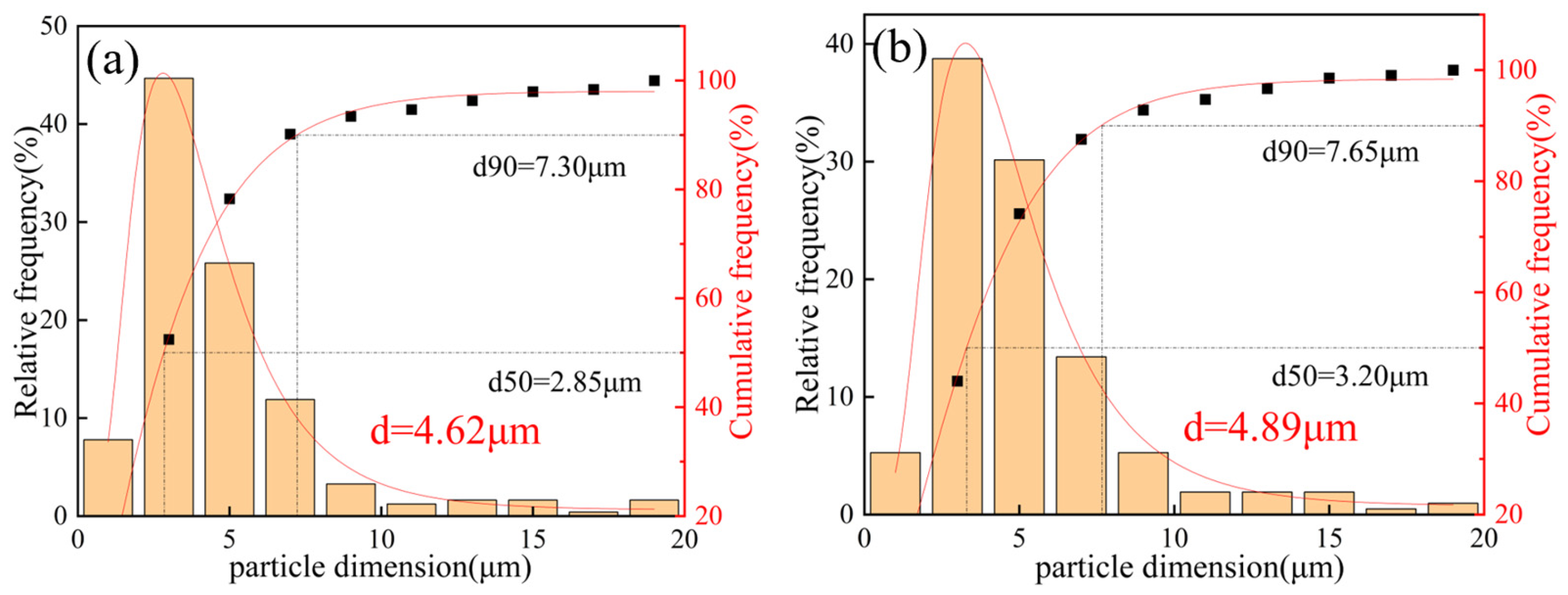
As the annealing temperature increases, grain growth becomes pronounced, and a continuous coarsening trend is observed. This is because the recrystallization temperature affects the rate of intergranular migration of atoms at grain boundaries; as the temperature rises, the migration rate increases, leading to faster grain growth and larger grain sizes [20]. However, the solute drag effect of titanium and the pinning action of its precipitates effectively limit grain growth [21]. The combined effects keep the grain size of the test steel at a relatively low level overall. Figure 6 shows the average grain size (equivalent circular diameter) of the test steel after recrystallization is essentially complete, as determined by Aztec Crystal statistical analysis 3.3.

3.1.3. TEM Characterization

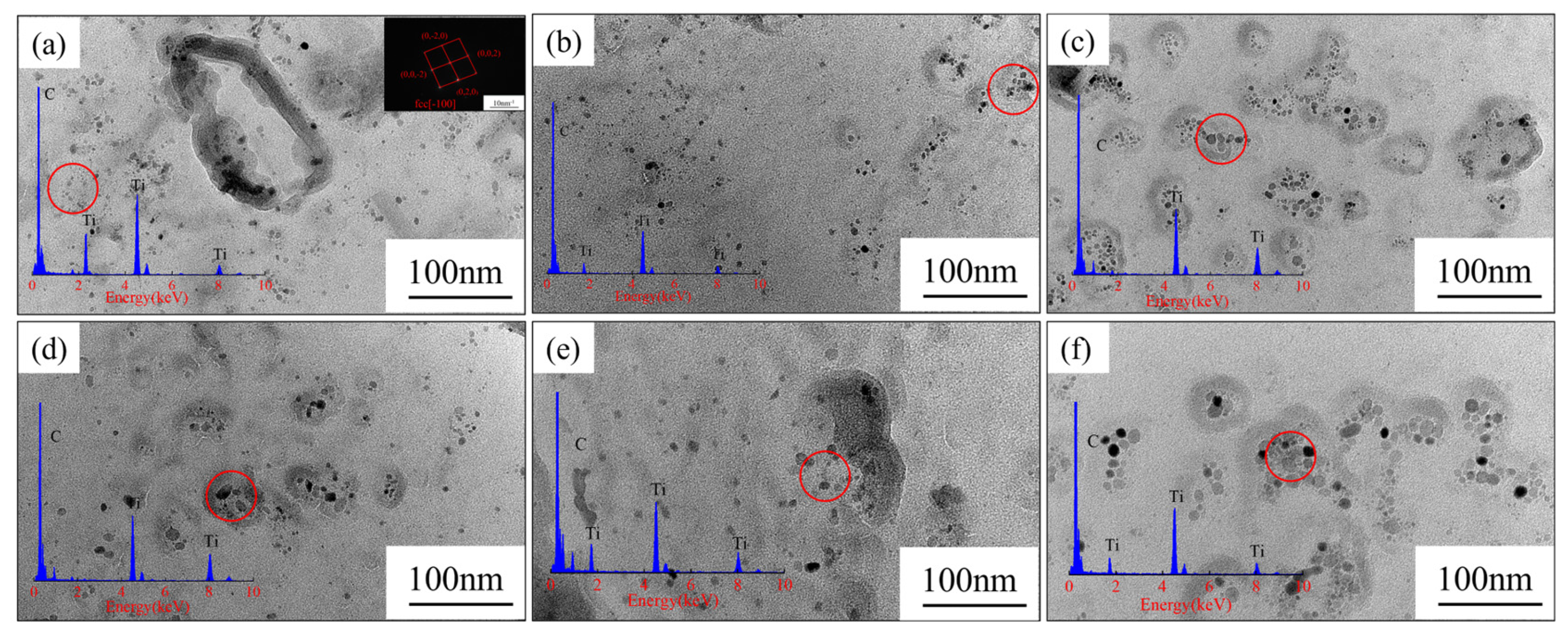
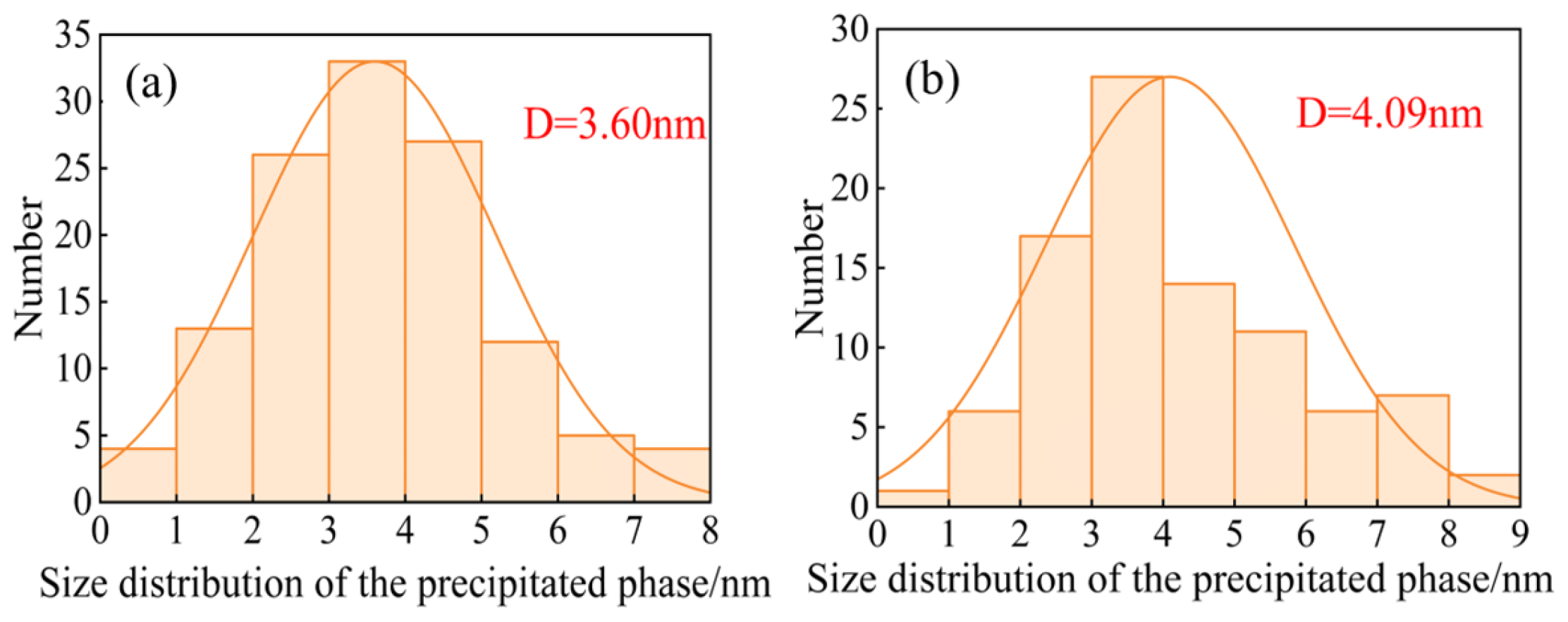
Figure 7 shows the typical morphology of the precipitated phase in Ti–microalloyed test steel after annealing at 680–740 °C, along with the results of energy–dispersive spectroscopy (EDS) analysis. Observation reveals that the precipitated phase predominantly exhibits an elliptical shape; diffraction spot analysis indicates that the precipitated phase has a face–centered cubic (fcc) crystal structure, and EDS results confirm that the precipitated phase is TiC. Statistical analysis of the precipitation phase size at 640 and 720 °C was performed using ImageJ software 1.51 K, with the results shown in Figure 8. Most TiC particles have diameters less than 10 nm. At lower annealing temperatures, the TiC precipitates are smaller in size and predominantly distributed in clusters. These fine TiC particles not only effectively refine the grain structure but also significantly enhance material strength by suppressing dislocation motion and grain boundary migration [22]. As the annealing temperature increases, the number of TiC particles tends to decrease. This may be because TiC particles of different sizes precipitate at different temperatures; as the temperature rises, particles precipitate from the matrix in order of increasing size, with higher temperatures more effectively suppressing the precipitation of smaller TiC particles [23,24]. Furthermore, since dislocations serve as effective nucleation sites for TiC, the lower dislocation density resulting from increased temperature also contributes to a reduction in the number of precipitates [25]. As the annealing temperature rises, energy is provided for atomic diffusion, causing some small particles to dissolve. This triggers the Ostwald ripening effect, and the diffusion of solutes toward larger particles leads to a trend of fewer precipitates with increased size [26]. According to the theory of Lifshitz and Slyozov, the cube of the average particle size during the aging process exhibits a linear relationship with time (i.e., a 1/3 power law), and the aging rate increases with an increase in the particle volume fraction [27,28]. The decrease in the number of TiC particles and the increase in their size weaken the grain refinement strengthening effect and the pinning effect on grain boundaries, resulting in a reduction in grain refinement strengthening and precipitation strengthening [29].

3.2. Mechanical Properties

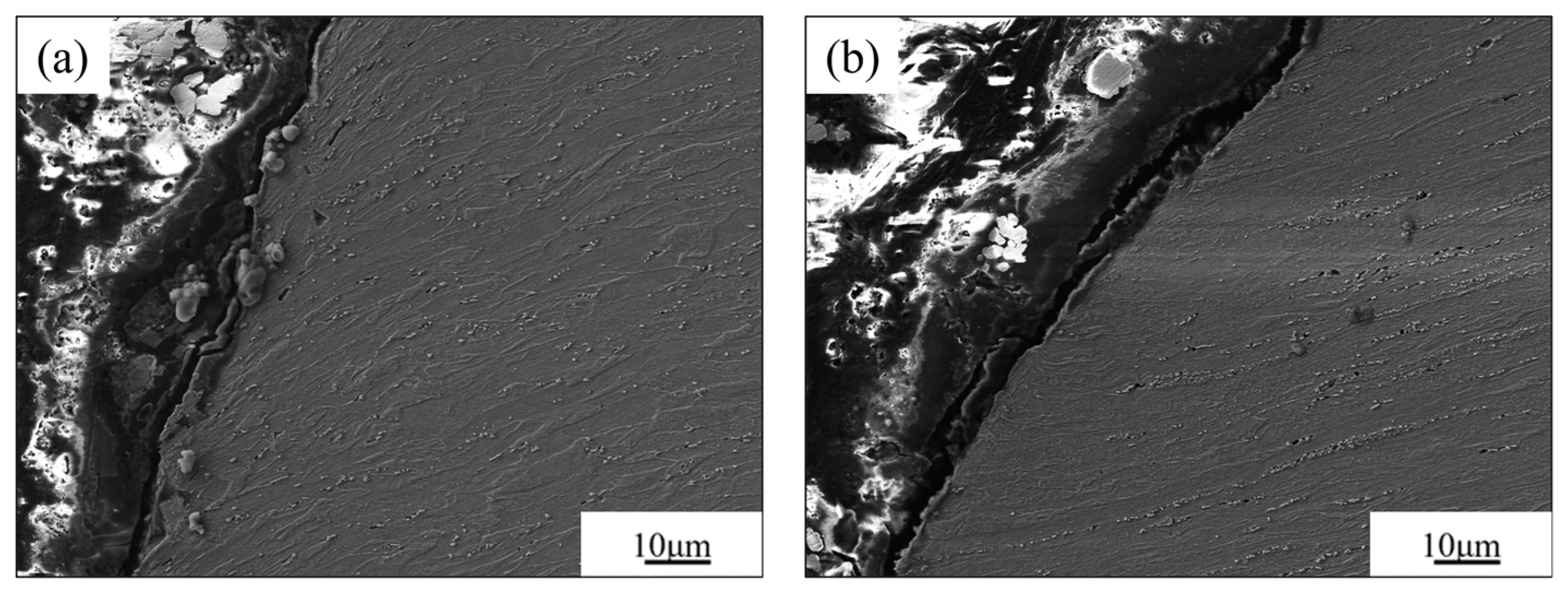
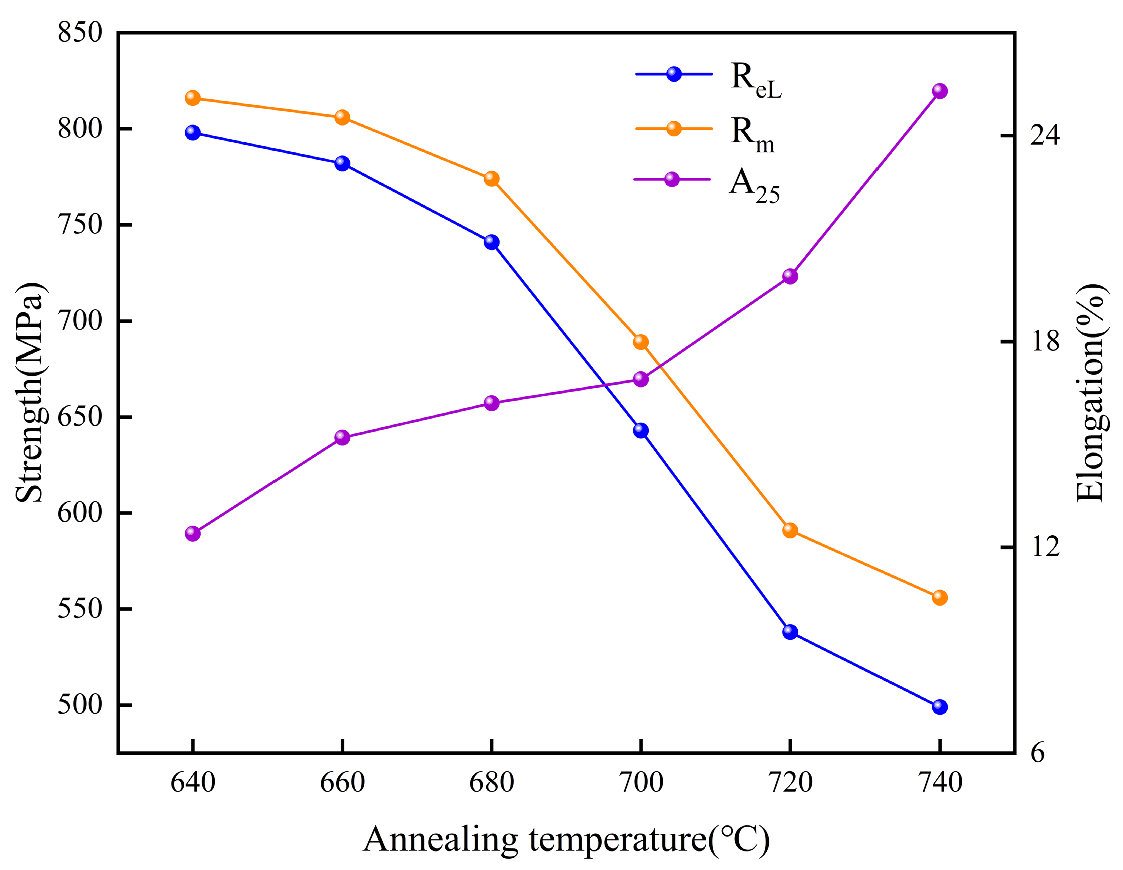
Figure 9 shows the tensile mechanical properties of Ti–microalloyed steel at room temperature. As the annealing temperature increases, the yield strength of the test steel decreases from 798 MPa to 499 MPa, and the tensile strength decreases from 816 MPa to 556 MPa. On the one hand, Ti combines with C in the steel to form TiC, introducing precipitation strengthening; on the other hand, through the solute drag effect, it hinders dislocation motion and grain boundary migration. Together, these mechanisms enhance the strength of the test steel [30]. Additionally, cementite distributed along grain boundaries can strengthen the boundaries, hinder dislocation motion, and contribute to grain refinement strengthening by pinning grain boundaries [10]. OM (Shenzhen Oumu Micro Technology Co., Ltd., Shenzhen, China) and SEM images show that the microstructure is dominated by elongated ferrite, indicating work hardening during the recovery stage. This implies that the strain energy stored within the material is relatively high, effectively hindering dislocation motion and enabling the material to maintain a high strength level at this stage, with a yield strength exceeding 800 MPa. However, upon entering the recrystallization stage, the rate of strength decline accelerates markedly. This is because the nucleation and growth of recrystallized ferrite are accompanied by a decrease in dislocation density, leading to matrix softening and a consequent weakening of the dislocation–strengthening effect; thus, the decline in strength is more pronounced than in the recovery stage [31]. EBSD analysis results indicate that as the annealing temperature increases, the proportion of high–angle grain boundaries significantly increases, while the KAM value decreases. This suggests a reduction in lattice distortion and a decrease in dislocation density, which weakens the resistance to grain boundary migration, thereby leading to a decrease in the strength and an increase in the elongation of the test steel [32]. Combined with TEM images, the number and size of precipitates also exert a certain influence on the strength and ductility of the test steel. When the annealing temperature rises to 740 °C, the number of TiC particles is minimal while their size is maximal, thereby weakening the grain refinement strengthening and precipitation strengthening effects. Simultaneously, as recrystallization is completed, the matrix softens further, causing the tensile strength of the test steel to drop to 556 MPa and the yield strength to 499 MPa, while the elongation increases to 25.3%. A systematic statistical analysis was conducted on the reduction in area of the tested steel at different annealing temperatures. The results show that as the annealing temperature increases from 640 °C to 740 °C, the reduction in area monotonically increases from 16.0% to 27.1% (with intermediate values of 19.1%, 19.5%, 22.6%, and 23.4% at the respective temperatures), which is consistent with the increasing trend of elongation. As shown in Figure 10, observation of the regions near the fracture surfaces of tensile specimens annealed at 640 °C and 740 °C revealed that the ferrite underwent obvious deformation, and cementite particles aggregated along the ferrite grain boundaries toward the fracture direction. Compared with the specimen annealed at 640 °C, the one annealed at 740 °C exhibited a greater number of fine microcracks, which were uniformly distributed and small in size. These microcracks were capable of absorbing part of the deformation energy during tensile loading, thereby delaying the fracture process. This feature, together with the synergistic effect of the overall microstructure, contributed to the maximum elongation observed at 740 °C. Considering the changes in mechanical properties across the six annealing temperatures, a clear trend emerges: as the annealing temperature increases, strength decreases due to the weakening of grain refinement strengthening and precipitation strengthening; conversely, the ductility of the test steel improves to some extent, as evidenced by the increase in elongation, which reaches a maximum of 25.3% at 740 °C. The strength range of the test steel fully covers the 550–650–750–800 MPa grades, and achieves an excellent strength–to–ductility ratio across all grades, making it suitable for various service environments.

3.3. Analysis of Strengthening Mechanisms

To clarify the differences in strengthening mechanisms—such as grain refinement strengthening and precipitation strengthening—as a function of annealing temperature, a quantitative analysis of the contributions of each mechanism is conducted. The strengthening mechanisms of steel primarily include solid solution strengthening, dislocation strengthening, grain refinement strengthening, and precipitation strengthening; among these, Ti–microalloyed steels are primarily characterized by grain refinement strengthening, dislocation strengthening, and precipitation strengthening [33,34]. Two annealing temperatures, 640 °C and 720 °C, are selected. While ensuring compliance with the required strength grade, the study investigates the influence of grain refinement strengthening, precipitation strengthening and dislocation strengthening on the yield strength of Ti–microalloyed steel at these two temperatures.

3.3.1. Grain Refinement Strengthening

Grain refinement strengthening primarily enhances strength by increasing the number of grain boundaries, thereby impeding dislocation motion. It is the only strengthening mechanism capable of simultaneously improving both strength and ductility. The effectiveness of grain refinement strengthening is directly related to the effective grain size of the material, and its contribution to yield strength can be described using the Hall–Petch equation, as shown in Equation (1) [35].
σ g = k y d 1 2
Here, σg represents the grain refinement strength; ky is a proportional coefficient, typically taken as 17.4 MPa·mm1/2 for low–carbon steel [7]; and d is the effective grain size, defined as the minimum grain size formed by the interfaces within the material that impede dislocation slip and cause dislocation pile–up. Since the matrix structure of the steel tested in this experiment is primarily ferritic, the average grain size of the ferrite is used as the effective grain size [36]. However, at 640 °C, the ferrite is predominantly in a lamellar form; Equation (2) [37] can first be used to convert the grain size of the lamellar ferrite to the equivalent equiaxed ferrite grain size. At 720 °C, the ferrite has largely transformed into an equiaxed form, and the grain size can be directly determined by EBSD (Figure 6).
d e f f = b l n 1 + s i n θ 1 1 s i n θ 1 + a l n 1 + c o s θ 1 1 c o s θ 1 π
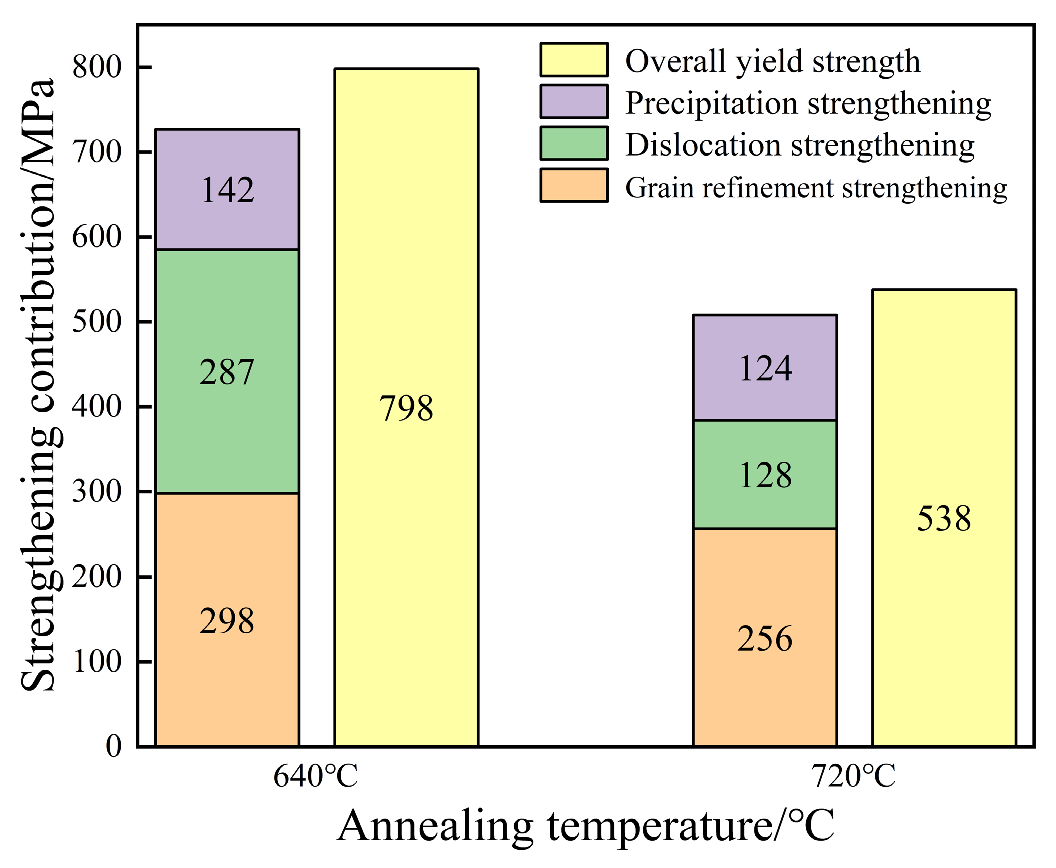
In the equation, a and b represent the average major and minor axes of the elongated ferrite, respectively, and θ1 is arctan(a/b). Using this, the average grain size of the test steel at an annealing temperature of 640 °C is determined to be 3.41 μm. Substituting 3.41 μm and the value of 4.62 μm from Figure 6 into Equation (1), the contributions of grain refinement strengthening at the two temperatures are calculated to be 298 MPa and 256 MPa, respectively. As shown in Table 2.

3.3.2. Precipitation Strengthening

The essence of precipitation hardening lies in the interaction between dislocations and precipitation phases; the primary mechanisms include the Orowan bypass mechanism and the dislocation shear mechanism. The precipitation strengthening effect of precipitation phase particles can be expressed using the modified Ashby–Orowan model, as shown in Equation (3) [38]. The effect of precipitation hardening is proportional to the square root of the volume fraction of the precipitation phase particles and inversely proportional to the average size of the precipitation phase particles.
σ p = 8.995 × 10 3 f 1 2 d ln 2.417 d
Here, σp is the precipitation strength; f is the volume fraction of the precipitate phase particles; and d is the average size of the precipitate phase particles, in nm. The volume fraction of the precipitate phase particles can be expressed by Equation (4) [39]:
f = 0.14 π 6 N d 2 A
Here, N represents the number of precipitate phases within the field of view; d represents the average size of the precipitate phase particles, in nm; and A represents the area of the field of view, in nm2. The volume fractions of precipitation particles after annealing at 640 and 720 °C are calculated to be 0.069% and 0.061%, respectively. Substituting these values into Equation (3) yields precipitation strengthening contributions of 142 MPa and 124 MPa at the two annealing temperatures, respectively. As shown in Table 3.

3.3.3. Dislocation Strengthening

Dislocation strengthening primarily arises from elastic interactions between dislocations, as well as the entanglement and packing effects generated during dislocation motion [40]. The calculation of its strengthening contribution, σd, can be expressed by Equation (5) [41]:
σ d = M α G b ρ 1 2
Here, M represents the Taylor factor, typically taken as 2.75; α is the scaling factor, which is approximately 0.382 for body–centered cubic crystals; G is the shear modulus, with a value of 8.0 × 10¹⁰ MPa; b is the Burgers vector, with a value of 0.246 nm; and ρ is the dislocation density, which can be expressed by Equation (6) [7]:
ρ = k ε 2 b 2
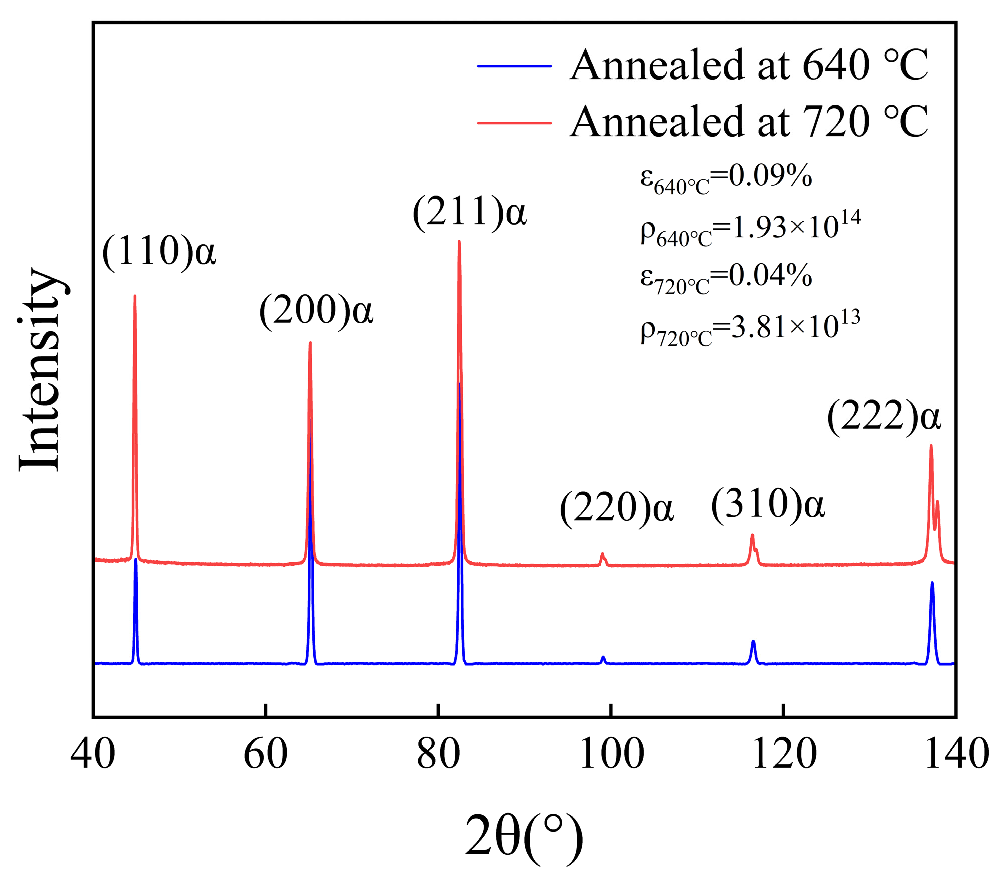
In the equation, k is the geometric constant, typically taken as 14.4 for body–centered cubic crystals; ε is the microstrain, which reflects the broadening of X–ray diffraction peaks caused by changes in interplanar spacing. The XRD patterns can be processed using Jade software 6 to determine the value of the microstrain [7]. Figure 11 shows the XRD patterns of the body–centered cubic crystals after annealing at 640 °C and 720 °C, along with the values of ε and the corresponding dislocation density ρ. The values of ε are 0.09% and 0.04%, respectively, corresponding to ρ values of 1.93 × 10¹⁴ m−2 and 3.81 × 10¹³ m−2. Consequently, the dislocation strengthening contributions are calculated to be 287 MPa and 128 MPa, respectively, with a difference of 159 MPa between the two. As shown in Table 4.

3.3.4. Summary of the Reinforcement Mechanism

Figure 12 compares the calculated and experimental values for each strengthening mechanism after annealing at 640 °C and 720 °C. As shown in the figure, the theoretical calculations for yield strength exhibit good agreement with the actual test results. Among these mechanisms, dislocation strengthening contributes most significantly to the increase in yield strength. This is also reflected in the KAM values shown in Figure 4; since the KAM value represents dislocation density to some extent, its significant decrease indicates a weakened hindrance of dislocations to grain boundary migration, meaning that the effect of dislocation strengthening is markedly reduced. At the same time, due to the fine grain size, grain refinement strengthening accounts for a large proportion of the total yield strength. Although precipitation strengthening yields a relatively low numerical value, it remains a hardening mechanism that cannot be ignored. In the two test steels, the combined contributions of grain refinement strengthening, dislocation strengthening, and precipitation strengthening to the yield strength account for 91.2% and 94.4% of the total yield strength, respectively, making them the primary factors influencing the yield strength of the test steels.

4. Conclusions

This paper proposes a chemical composition for photovoltaic mounting bracket steel with a strength range of 500–800 MPa and investigates the effect of annealing temperature on the microstructure and properties of Ti–microalloyed high–strength steel for photovoltaic mounting brackets, aiming to achieve a good balance between strength and ductility. The following conclusions are drawn:
(1)
After annealing at 640–740 °C, the microstructure of the test steel consists of a ferritic matrix and cementite particles. As the annealing temperature increases, the recrystallization process gradually completes, and the morphology of the ferrite grains undergoes significant changes, evolving from the initial elongated shape to an equiaxed form, with a tendency toward continued growth. The cementite particles are primarily distributed at the ferrite grain boundaries; they are fine in size, dispersed throughout the matrix, and insensitive to changes in annealing temperature.
(2)
EBSD further confirmed the changes in ferrite recrystallization; as recrystallization progresses, the average size of the ferrite grains increases. However, the inhibitory effect of Ti on grain boundary migration keeps the grains at a relatively fine size. TEM observations indicate that the precipitated phase consists primarily of TiC particles with an average particle size of less than 10 nm. As the annealing temperature increases, the number of precipitates decreases while their size increases, thereby weakening their strengthening effect on the overall mechanical properties.
(3)
Calculations of the contributions of grain refinement strengthening, precipitation strengthening, and dislocation strengthening to the yield strength of the test steel after annealing at 640 and 720 °C reveal that dislocation strengthening exhibits the greatest change, reaching 159 MPa. Although grain refinement strengthening and precipitation strengthening also change, the magnitude of these changes is smaller. Together, these three mechanisms account for 91.2% and 94.4% of the total yield strength, respectively, and are the primary strengthening mechanisms in Ti–microalloyed high–strength steel.
(4)
The test steel exhibits an excellent strength–ductility balance: as the annealing temperature is reduced from 720 °C to 640 °C, the tensile strength gradually increases from 591 MPa to 816 MPa, while the elongation decreases from 19.9% to 12.4%. Within this temperature range, the tensile strength of the test steel fully covers the 550–650–750–800 MPa strength grades. Furthermore, its strength grades (500–800 MPa) and corresponding elongation rates exhibit a good match, indicating that replacing Ti–Nb composite microalloying with Ti not only reduces production costs but also provides a theoretical basis for developing a series of new high–strength photovoltaic mounting brackets using a single microalloying element.

Author Contributions

Conceptualization, X.L.; methodology, X.L.; software, J.L.; validation, Y.W. and X.Z.; formal analysis, L.S.; investigation, Y.W. and X.Z.; resources, Y.W. and X.Z.; data curation, X.L.; writing—original draft preparation, X.L., Y.W., X.Z. and Z.Z.; writing—review and editing, X.L., J.L. and Z.Z.; visualization, X.L., L.S. and Z.Z.; supervision, Z.Z.; project administration, Z.Z.; funding acquisition, Z.Z. All authors have read and agreed to the published version of the manuscript.

Funding

This work was supported by the Fundamental Research Funds for the Central Universities (FRF-BD-25-001).

Data Availability Statement

The original contributions presented in the study are included in the article; further inquiries can be directed to the corresponding authors.

Conflicts of Interest

Authors Yundong Wang and Xiangting Zhang were employed by the company Shanxi Jincheng Iron and Steel Holding Group Co., Ltd. The remaining authors declare that the research was conducted in the absence of any commercial or financial relationships that could be construed as a potential conflict of interest.

References

  1. Chao, H.L.; Liu, Y.; Han, Y.C.; Guo, Y.J. Analysis of the Current Status and Development Trends of Steel Materials for PV Mounting Brackets. Sol. Energy 2025, 38–44. [Google Scholar] [CrossRef]
  2. Lu, J.H.; Guo, W.W.; Huang, H.; Song, Y.L.; Zhang, Y.Y.; Li, Y. The Application of Super Weathering Steel in Photovoltaic Mounting Systems. Sci. Technol. Innov. 2024, 179–181. [Google Scholar]
  3. Fan, C.L.; Liu, W.D. Development of hot dip galvanizing S390GD(S450GD)+Z product for photovoltaic stents in Hansteel. Steel Roll. 2021, 38, 93–97+103. [Google Scholar]
  4. Chen, H.Y.; Yang, P.; Wang, T. Development of 550 MPa Grade Hot–dip Galvanized High–strength Steel for Photovoltaic Supports. Angang Technol. 2024, 4, 39–42. [Google Scholar]
  5. Guo, C.; Cheng, S.W.; Liu, X.F.; Lin, R.M.; Jia, S.X.; Zhang, D.; Wang, Y.W.; Du, X.J. Development of 400 MPa Grade Ti–microallyed Steel for Photovoltaic Support. Shanxi Metall. 2024, 47, 21–22. [Google Scholar]
  6. Zhang, Y.L.; Cheng, H.C.; Yang, H.F.; Liu, N.; Liang, Y.D. Impact toughness influence law and weldability analysis of 800 MPa grade steel for photovoltaic brackets. Trans. China Weld. Inst. 2025, 46, 138–144. [Google Scholar]
  7. Zhou, F.; Liu, L.; Chu, X.; Zhao, Y.; Zhao, Z.Z. Strengthening mechanism and precipitation behavior of advanced ultrahigh–strength titanium microalloy weathering steels for photovoltaic support. Mater. Charact. 2024, 208, 113660. [Google Scholar]
  8. Zhang, Y.S. Research on the Microstructure and Properties of Titanium Niobium Microalloyed Steel for High–Speed Railway Bogies. Master’s Thesis, Wuhan University of Light Industry, Wuhan, China, 2025. [Google Scholar]
  9. Gan, X.L.; Yuan, Q.; Zhao, G.; Ma, H.W.; Liang, W.; Xue, Z.L.; Qiao, W.W.; Xu, G. Quantitative Analysis of Microstructures and Strength of Nb–Ti Microalloyed Steel with Different Ti Additions. Metall. Mater. Trans. 2020, 51, 2084–2096. [Google Scholar]
  10. Wang, Y.; Che, Z.C.; Chen, Y.F.; Yang, S.F.; Zhang, J.F.; Xue, Q.H. Strength and toughness mechanism of single Ti microalloyed steels. J. Iron Steel Res. Int. 2024, 32, 769–782. [Google Scholar] [CrossRef]
  11. Wang, J.J.; Wang, M.D.; Li, L.L.; Liu, J.; Jiang, X.H.; Teng, Y.X.; Fu, K.J.; Zhang, D.Z.; Guo, J. Microstructure Evolution Behavior of Titanium Microalloyed Steel during Heat Treatment. J. Mater. Eng. Perform. 2024, 34, 4066–4080. [Google Scholar] [CrossRef]
  12. GB/T 228.1-2021; Metallic Materials—Tensile Testing—Part 1: Method of Test at Room Temperature. Standards Press of China: Beijing, China, 2021.
  13. Liu, Y.; Huo, X.D.; Zhang, Q.F.; Li, J.H.; Li, L.J. Annealing recrystallization behavior and properties of Ti microalloyed cold–rolled steel. Trans. Mater. Heat Treat. 2025, 46, 172–182. [Google Scholar]
  14. Chui, P.F.; Cheng, Z.P.; Li, C.M.; Wang, J.; He, Y.Z.; Jing, R.; Li, J.H. Recrystallization behavior of as–rolled TiZrNbSn alloy. Trans. Mater. Heat Treat. 2024, 45, 204–212. [Google Scholar]
  15. Hang, Z.D.; Feng, Y.L. Research status and development trend of titanium microalloyed steel. Hot Work. Technol. 2021, 50, 22–25. [Google Scholar]
  16. Zheng, Y.X.; Wang, K.; Yang, Q.; Lin, Y.; Zhu, L.G.; Wu, X.Y.; Han, B.C.; Wang, B.; Zhang, D.; Feng, J.; et al. Research on the strengthening mechanism of Nb–Ti microalloyed ultra low carbon IF steel. J. Mater. Res. Technol. 2024, 30, 5785–5803. [Google Scholar] [CrossRef]
  17. Cai, Y.M.; Wei, R.; Jin, D.D.; Wang, H.H.; Wang, X.L.; Hu, C.Y.; Wu, K.M. Influence of Solute Drag Effect and Interphase Precipitation of Nb on Ferrite Transformation. Materials 2024, 17, 2440. [Google Scholar] [CrossRef] [PubMed]
  18. Chen, S.J.; Qian, Y. The role of low angle grain boundary in deformation of titanium and its size effect. Scr. Mater. 2018, 163, 148–151. [Google Scholar]
  19. Song, L.Y.; Wang, M.M.; Xing, J.F.; Gao, X.H.; Zhang, Z.X.; Wu, H.Y. Microstructure and properties of Ti microalloyed 700 MPa grade high–strength weathering steel. J. Iron Steel Res. 2022, 34, 1447–1456. [Google Scholar]
  20. Ji, X.M. Recrystallization grain growth behavior of cold–rolled Ti–3.5Al–5Mo–4V alloy sheet and its effect on aging behavior. Heat Treat. Met. 2024, 49, 63–69. [Google Scholar]
  21. Monschein, S.; Ragger, K.S.; Zügner, D.; Fasching, J.; Schnitzer, R. Influence of the Ti Content on the Grain Stability and the Recrystallization Behavior of Nb–Alloyed High–Strength Low–Alloyed Steels. Steel Res. Int. 2022, 93, 2200094. [Google Scholar]
  22. Shi, Y.S.; Yue, X.W.; Du, H.Y.; Hou, L.F.; Wang, Q.; Wei, H.; Liu, X.D.; Wang, W.F.; Wei, Y.H. Tailoring precipitation strengthening in Low–Alloy High–Strength Steel: The synergistic role of Ni, V, and Ti. Mater. Lett. 2025, 396, 138750. [Google Scholar]
  23. Zhang, J.C.; Cao, Y.; Jiang, G.W.; Di, H.S. Effect of Annealing Temperature on the Precipitation Behavior and Texture Evolution in a Warm–Rolled P–Containing Interstitial–Free High Strength Steel. Acta Metall. Sin. (Engl. Lett.) 2014, 27, 395–400. [Google Scholar]
  24. Liu, L.J.; Liang, X.K.; Sun, X.J. Solution and precipitating behaviors of TiC particles in high Ti low alloy steel. Heat Treat. Met. 2020, 45, 110–114. [Google Scholar]
  25. Fu, Z.X.; Yang, G.W.; Mao, X.P.; Han, R.Y.; Xu, Y.W.; Xu, D.M. Microstructure evolution and precipitation behavior of hot–rolled high–strength Ti–Mo–V micro–alloyed steel. J. Mater. Res. Technol. 2023, 27, 8132–8142. [Google Scholar]
  26. Qiao, D.G.; Luo, X.Y.; Hu, S.X.; Hou, Y.Y.; Zhang, Z.J.; Tang, X.C. Microstructure evolution of 280VK cold–rolled high–strength steel and precipitation mechanism during annealing process. Heat Treat. Met. 2022, 47, 220–226. [Google Scholar]
  27. Duan, X.G.; Cai, Q.W.; Wu, H.B.; Tang, D. Precipitation law of ultra fine carbides in ferrite matrix Ti–Mo micro–alloy steel. Int. J. Miner. Metall. Mater. 2012, 34, 644–650. [Google Scholar]
  28. Wang, F.; Hu, M.l.; Shi, Q.; Jiang, B.; Wang, Y.; Xu, H.Y.; Ji, Z.S. Population dynamics behaviors of TiC and their effect on grain refinement in Al–Ti–C refiners: Growth, agglomeration, nucleation and precipitation. J. Mater. Res. Technol. 2025, 36, 1758–1773. [Google Scholar]
  29. Wang, D.R.; Su, R.; Li, H.Z.; Wang, C.W.; Guo, J.Q.; Li, Z.R.; Zeng, H.; Chen, H. Effect of Ti content on the strengthening and fracture damage mechanism of mechanical properties of weathering steel. J. Mater. Res. Technol. 2024, 30, 3690–3704. [Google Scholar] [CrossRef]
  30. Wang, S.Z.; Gao, Z.J.; Wu, G.L.; Mao, X.P. Titanium microalloying of steel: A review of its effects on processing, microstructure and mechanical properties. Int. J. Miner. Metall. Mater. 2022, 29, 645–661. [Google Scholar] [CrossRef]
  31. Zhang, K.; Sun, X.J.; Yong, Q.L.; Li, Z.D.; Yang, G.W.; Li, Y.M. Effect of Tempering Time on Microstructure and Mechanical Properties of High Ti Microalloyed Quenched Martensitic Steel. Acta Metall. Sin. 2015, 51, 553–560. [Google Scholar]
  32. Yin, C.; Chen, Z.Y.; Feng, Y.; Zhu, W.T.; Zhao, Y.; Chen, L.Q. The mechanism of fire resistance of a low carbon high–strength multi–functional steel for building construction. J. Mater. Sci. 2022, 57, 7706–7718. [Google Scholar]
  33. Chen, S.J.; Li, L.J.; Peng, Z.W.; Huo, X.D.; Sun, H.B. On the correlation among continuous cooling transformations, interphase precipitation and strengthening mechanism in Ti–microalloyed steel. J. Mater. Res. Technol. 2021, 10, 580–593. [Google Scholar]
  34. Tang, X.C.; Kang, C.; Zhou, W.L.; Chen, K.X.; Huang, J.K.; Yv, X.Q.; Wang, C.L.; La, P.Q. Effect of annealing process on microstructure and electrical conductivity of cold–rolled Ti microalloyed conductive steel. Mater. Charact. 2023, 201, 112930. [Google Scholar]
  35. Zhu, Z.M.; Yu, H.; Wang, K.; Tian, Y.; Gao, J.Y. Quantitative analysis of precipitation and strengthening mechanisms of V and V–Ti hot–rolled microalloyed steels. J. Mater. Sci. 2022, 57, 4806–4819. [Google Scholar]
  36. Yang, Y.B.; Deng, S.; Fan, L.; Zhao, Z.Z.; Yuan, Q.P.; Luo, J. Microstructure, mechanical properties and strengthening mechanism of Ti microalloyed high strength steel. Iron Steel 2019, 54, 72–79. [Google Scholar]
  37. Zou, Y.M. Research on Strengthening Mechanism and Austenite Stability of Medium Mn Steels. Ph.D. Thesis, Northeastern University, Shenyang, China, 2023. [Google Scholar]
  38. Li, K.S.; Shao, J.; Yao, C.H.; Jia, P.; Xie, S.H.; Chen, D.S.; Xiao, M. Effect of Nb–Ti Microalloyed Steel Precipitation Behavior on Hot Rolling Strip Shape and FEM Simulation. Materials 2024, 17, 651. [Google Scholar]
  39. Ma, H.X.; Li, Y.G. Measurement of Size Distribution and Volume Fraction of Precipitates in Silicon Steel. J. Mater. Sci. Eng. 2002, 20, 328–330+389. [Google Scholar]
  40. Tanaka, Y.; Takaki, S.; Tsuchiyama, T.; Uemori, R. Effect of Grain Size on the Yield Stress of Cold Worked Iron. ISIJ Int. 2018, 58, 1927–1933. [Google Scholar] [CrossRef]
  41. Peng, Z.W.; Li, L.J.; Gao, J.X.; Huo, X.D. Precipitation strengthening of titanium microalloyed high–strength steel plates with isothermal treatment. Mater. Sci. Eng. A 2016, 657, 413–421. [Google Scholar]
Figure 1. Optical microscope pictures of Ti–microalloyed high–strength steel at different annealing temperatures: (a) 640 °C; (b) 660 °C; (c) 680 °C; (d) 700 °C; (e) 720 °C; (f) 740 °C.
Metals 16 00700 g001
Figure 2. Microstructure of Ti–microalloyed high–strength steel at different annealing temperatures: (a) 640 °C; (b) 660 °C; (c) 680 °C; (d) 700 °C; (e) 720 °C; (f) 740 °C.
Metals 16 00700 g002
Figure 3. Grain boundary maps of the Ti–microalloyed high–strength steel annealed at different temperatures.
Metals 16 00700 g003
Figure 4. KAM maps of the Ti–microalloyed high–strength steel annealed at different temperatures.
Metals 16 00700 g004
Figure 5. GOS maps of the Ti–microalloyed high–strength steel annealed at different temperatures.
Metals 16 00700 g005
Figure 6. Average grain size of Ti–microalloyed high–strength steel after essentially complete recrystallization: (a) 720 °C; (b) 740 °C.
Metals 16 00700 g006
Figure 7. Morphology and EDS analysis of precipitates in Ti–microalloyed high–strength steel: (a) Morphology and EDS of precipitates after annealing at 640 °C; (b) morphology and EDS of precipitates after annealing at 660 °C; (c) morphology and EDS of precipitates after annealing at 680 °C; (d) morphology and EDS of precipitates after annealing at 700 °C; (e) morphology and EDS of precipitates after annealing at 720 °C; (f) morphology and EDS of precipitates after annealing at 740 °C.
Metals 16 00700 g007
Figure 8. Precipitate size in Ti–microalloyed high–strength steel: (a) 640 °C; (b) 720 °C.
Metals 16 00700 g008
Figure 9. Mechanical properties of Ti–microalloyed high–strength steel at different annealing temperatures.
Metals 16 00700 g009
Figure 10. Micrographs of fracture morphologies of Ti–microalloyed high–strength steel at different annealing temperatures: (a) 640 °C, (b) 740 °C.
Metals 16 00700 g010
Figure 11. XRD patterns and the values of microstrain ε of Ti–microalloyed high–strength steel after annealing at 640 and 720 °C.
Metals 16 00700 g011
Figure 12. Strengthening contributions of Ti–microalloyed high–strength steel after annealing at 640 and 720 °C.
Metals 16 00700 g012
Table 1. Main chemical composition of Ti–microalloyed steel (wt.%).
ElementsCSiMnPSAlsTi
0.04–0.07≤0.080.25–0.65≤0.015≤0.0120.02–0.050.04–0.07
Table 2. Parameters of the grain refinement strengthening mechanism.
Annealing Temperature/°Cσg/MPa deff/μm
ky/MPa·mm1/2d/μmab
64017.463.416.7071.765
7204.62
Table 3. Parameters of the precipitation strengthening mechanism.
Annealing Temperature/°Cσp/MPaf
fd/nmNA/nm2d/nm
6400.061%3.60125171,4973.60
7200.069%4.09854.09
Table 4. Parameters of the dislocation strengthening mechanism.
Annealing
Temperature/°C
ρσd/MPa
kb/nmεMαG/MPab/nmρ/m−2
64014.40.2460.092.750.3828.0 × 10100.2461.93 × 1014
7200.043.81 × 1013
Annealing
Temperature/°C
σd/MPaρ
MαG/MPab/nmρ/m−2kb/nmε
6402.750.3828.0 × 10100.2461.93 × 101414.40.2460.09
7203.81 × 10130.04
Disclaimer/Publisher’s Note: The statements, opinions and data contained in all publications are solely those of the individual author(s) and contributor(s) and not of MDPI and/or the editor(s). MDPI and/or the editor(s) disclaim responsibility for any injury to people or property resulting from any ideas, methods, instructions or products referred to in the content.