Article

Effect of Hot Rolling Temperature on the Microstructure and Macro-Texture Evolution Laws of TC2 Titanium Alloy and Their Influence on Mechanical Properties

1
Faculty of Materials Science and Engineering, Kunming University of Science and Technology, Kunming 650093, China
2
School of Electronic and Information Engineering, Anshun University, Anshun 561000, China
3
Faculty of Civil Aviation and Aeronautics, Kunming University of Science and Technology, Kunming 650500, China
4
School of Physics and Electronic Science, Anshun University, Anshun 561000, China
5
Avic Guizhou Anda Aviation Forging Co., Ltd., Anshun 561000, China
*
Author to whom correspondence should be addressed.
These authors contributed equally to this work.
Metals 2026, 16(6), 651; https://doi.org/10.3390/met16060651 (registering DOI)
Submission received: 2 May 2026 / Revised: 10 June 2026 / Accepted: 11 June 2026 / Published: 13 June 2026
(This article belongs to the Special Issue Innovations in Heat Treatment of Metallic Materials)

Abstract

TC2 titanium alloy (Ti-4Al-1.5Mn, wt.%) is a near-α titanium alloy with promising aerospace and biomedical applications, but its limited room temperature ductility and strong texture sensitivity hinder the fabrication of high-performance sheets. In this study, the effects of hot rolling at 830 °C and 930 °C on the microstructure, macro-texture, mechanical properties, and fracture behavior of TC2 alloy were investigated. Compared with the 830 °C rolled sample, the 930 °C rolled sample exhibited finer primary α grains, a higher volume fraction of fine and dispersed secondary αs phase, and more uniform Mn distribution, while both samples retained an α + β phase constitution. Texture and ODF (orientation distribution function) analyses revealed that increasing the rolling temperature reduced the maximum intensity of the (0001) pole figure from 6.68 to 5.23 m.r.d. (multiples of a random distribution) and increased that of the (10-10) pole figure to 9.62 m.r.d., indicating weakened basal texture, enhanced prismatic texture, and more dispersed orientation distribution. Consequently, although the tensile strength slightly decreased to approximately 730 MPa, the elongation increased from approximately 24% to 28%. The finer and denser dimples observed after 930 °C rolling further confirmed improved plastic deformation coordination.

1. Introduction

Titanium alloys have gained widespread applications in aerospace, marine engineering, and biomedical fields due to their excellent specific strength, corrosion resistance, and good biocompatibility [1]. Among various titanium alloy systems, TC2 titanium alloy (nominal composition Ti-4Al-1.5Mn), as a typical medium-strength and high-plasticity near-α titanium alloy, has been widely used in aerospace engine casings and key load-bearing components in aircraft structures due to its favorable comprehensive mechanical properties and processability [2]. With the rapid development of aerospace equipment toward lightweight design, high reliability, and adaptation to extreme service environments, higher requirements have been placed on the strength and ductility control of TC2 titanium alloy [3], urgently necessitating precise regulation of its microstructure and properties through advanced processing technologies.
To enhance the mechanical properties of titanium alloys, researchers have developed various strategies such as microalloying [4] and hot processing [5]. Among these, hot rolling, as a simple, efficient, and easily scalable hot processing method, demonstrates significant advantages in controlling the microstructure, grain refinement, and texture evolution of titanium alloys [6]. For example, Cheng et al. [7] employed multi-pass accumulative hot rolling technology to significantly enhance the strength of TA19 titanium alloy by effectively regulating grain boundary characteristics and dislocation substructures. Ran et al. [8] demonstrated that the hot rolling process can simultaneously improve the strength and ductility of Ti-6Al-20Mo alloy. It is noteworthy that, during the hot rolling process, the formation and evolution of texture exert a decisive influence on the macroscopic mechanical properties of titanium alloys [9]. Li et al. [10] found that different texture orientations lead to significant differences in the yield strength of the alloy, thereby directly affecting the material anisotropy. Therefore, precisely controlling hot rolling process parameters to synergistically regulate microstructure and macro-texture has become a key research hotspot in the high-performance development of titanium alloys [11]. Among the hot rolling process parameters, rolling temperature is one of the most critical thermodynamic variables, which directly determines the phase composition, grain size, recrystallization degree, and texture type and intensity of the alloy [12]. During thermoplastic deformation, titanium alloys are typically accompanied by multiple microscopic mechanisms such as dynamic recovery (DRV), dynamic recrystallization (DRX), and dislocation slip [13], and the competition and synergy among these mechanisms collectively dominate the final microstructural characteristics. For near-α titanium alloys, the primary constituent phase—the α phase—possesses a hexagonal close-packed (HCP) crystal structure with a limited number of independent slip systems (only three basal slip systems) [14]; during deformation, grains are prone to preferred orientation, forming strong deformation or recrystallization textures, which in turn result in pronounced mechanical anisotropy of the material. This anisotropy not only restricts the subsequent formability of the sheets but also directly affects their service reliability and lifespan under complex loading conditions [10]. However, existing studies on the hot rolling of TC2 titanium alloy are mostly limited to the microstructural evolution laws under a specific single rolling temperature or focus on the optimization of mechanical properties through subsequent heat treatment [15], lacking systematic and quantitative investigations into the synergistic evolution laws of microstructure and macro-texture across different hot rolling temperature ranges. At the same time, the texture types, texture intensities, and their evolution paths of TC2 titanium alloy under different hot rolling temperatures remain unclear, and the formation mechanisms of texture and their intrinsic relationships with microstructural evolution have not been fully revealed.
Based on this, the present study takes TC2 titanium alloy as the research object and systematically investigates the microstructural evolution characteristics and texture evolution laws of the alloy under two hot rolling temperatures by analyzing the variations in microstructure morphology, phase composition, texture type and intensity with rolling temperature, with a focus on revealing the influence mechanism of the synergistic evolution of microstructure and macro-texture on room temperature tensile properties and their anisotropy. Based on the synergistic evolution of microstructure, macro-texture, and mechanical properties, this study clarifies the effect of hot rolling temperature on microstructural regulation and plasticity improvement of TC2 titanium alloy sheets, which can provide a reference for subsequent optimization of hot rolling processes and preparation of high-performance TC2 titanium alloy sheets.

2. Materials and Methods

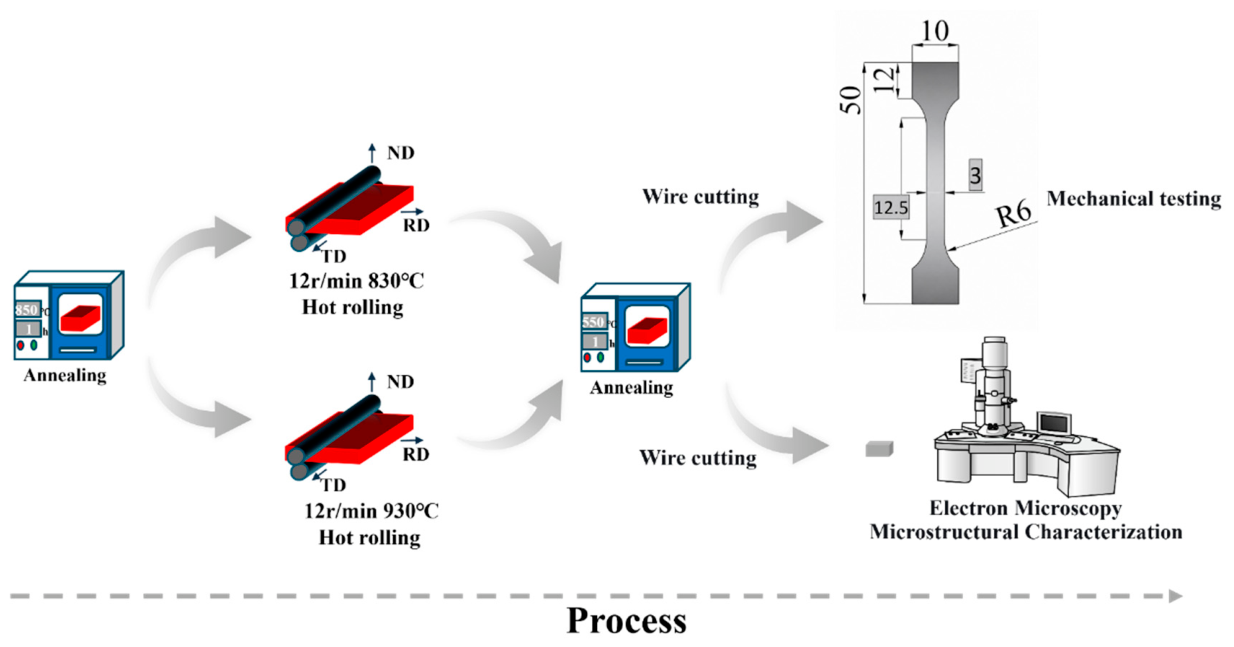
In this study, TC2 titanium alloy ingots were prepared using a vacuum arc melting furnace, with a nominal chemical composition of Ti-4Al-1.5Mn (wt.%). The Ti, Al, and Mn raw materials used for melting were provided by Baoji Titanium Industry Co., Ltd. (Baoji, China), with a purity of 99.99 wt.%. To improve chemical homogeneity, the ingots were remelted several times during the melting process. The ingots were then machined into rectangular specimens of 50 mm (length) × 25 mm (width) × 25 mm (thickness), followed by homogenization annealing in a box-type resistance furnace under an argon atmosphere at 850 °C for 1 h, and then air-cooled to room temperature. TC2 titanium alloy is a near-α titanium alloy with an α + β dual-phase constitution. The β-transus temperature of TC2 titanium alloy is approximately 968 °C [3]. The hot rolling temperatures used in this work, 830 °C and 930 °C, are both lower than the β transformation temperature. During hot rolling at 830 °C, the alloy is mainly composed of the α phase, with a relatively low fraction of the β phase. As the hot rolling temperature increases to 930 °C, the β phase fraction increases because the deformation temperature approaches the β-transus temperature. The higher β phase fraction generated during hot rolling at 930 °C offers additional potential nucleation sites for secondary αs phase precipitation during subsequent cooling, thus influencing the microstructural evolution of the alloy. The homogenization-annealed specimens were divided into two groups and preheated at 830 °C and 930 °C, respectively. The specimens were heated in a box-type resistance furnace and held for 60 min after the furnace temperature reached the target value to ensure sufficient temperature uniformity inside the specimens before hot rolling and to minimize the temperature difference between the surface and the core. The hot rolling process was performed using a two-high rolling mill with a roll speed of 12 r/min. The reduction in each pass was controlled to 5% of the initial thickness, and 16 passes were conducted to achieve a total deformation of 80% and a final sheet thickness of 5 mm. During multi-pass hot rolling, the surface temperature of the specimens was monitored using an infrared thermometer; after each rolling pass, the specimens were quickly returned to the furnace for short-time holding of 5–10 min to reduce the influence of inter-pass temperature drop on the subsequent rolling process. After completion of all 16 hot rolling passes, both groups of hot-rolled sheets were subjected to final stress relief annealing in a box-type resistance furnace under an argon atmosphere at 550 °C for 1 h, followed by air cooling to room temperature. The hot-rolled and annealed sheets were cut along the rolling direction into 10 mm × 10 mm × 5 mm block specimens for microstructural characterization: the surface oxide scale was first removed with 60# coarse sandpaper, followed by successive wet grinding with 600#, 1000#, 1500#, and 2000# metallographic sandpapers (rotating 90° when changing sandpaper each time), mechanical polishing to a scratch-free surface, and chemical etching with a mixed HF and HNO3 solution. SEM observation was performed based on the 10 mm × 10 mm surface area of each specimen. For each hot rolling temperature condition, multiple positions within this area were selected for observation, while regions with residual oxide scale, edge damage, or preparation defects were avoided. Representative fields of view were then selected for image presentation and microstructural feature analysis. The etched samples were observed using a field emission scanning electron microscope (Sigma 300, Carl Zeiss Microscopy GmbH, Jena, Germany), equipped with an energy-dispersive spectroscopy system using AZtecOne software, version 6.2 (Oxford Instruments, Abingdon, UK), to characterize the microstructural morphology and elemental distribution of TC2 titanium alloy under different hot rolling temperatures. The unetched parallel samples were used for phase analysis and macro-texture testing. Phase analysis and macro-texture testing were both performed using an X-ray diffractometer (D8 ADVANCE, Bruker AXS GmbH, Karlsruhe, Germany). Phase analysis was performed using a conventional θ–2θ scanning configuration with Cu Kα radiation, over a 2θ range of 30–90° and a step size of 0.02°. The macro-texture pole figures were measured by XRD using unetched polished samples. The α-phase pole figures measured in this study included (0001), (10-10), and (11-22), and the measurements were performed on the rolling plane. The rolling direction (RD) and transverse direction (TD) were defined according to the rolling geometry. The measured pole figure intensities were normalized as multiples of a random distribution (m.r.d.) to evaluate the evolution of basal, prismatic, and pyramidal texture components at different hot rolling temperatures. Because pole figures represent the projection of three-dimensional crystallographic orientation distributions onto a two-dimensional plane, the orientation information obtained from them has certain limitations. Therefore, the orientation distribution function (ODF) was further reconstructed based on the measured XRD pole figures to more comprehensively characterize the crystallographic orientation distribution and major texture components of the α phase in TC2 titanium alloy. Considering that α-Ti has a hexagonal close-packed structure, ODF analysis was performed in Euler space using Bunge Euler angle notation (φ1, Φ, φ2). Based on the hexagonal crystal structure and texture symmetry, the orientation space of 0° ≤ φ1 ≤ 90°, 0° ≤ Φ ≤ 90°, and 0° ≤ φ2 ≤ 60° was selected for representative analysis. By analyzing the orientation density distributions on different φ2 sections and combining them with the characteristic positions of the basal (0001), prismatic (10-10), and pyramidal (11-22) orientations in the hexagonal crystal system, the major texture components and their evolution at different hot rolling temperatures were identified and compared. The hot-rolled and annealed sheets were machined along the rolling direction into dog-bone-shaped tensile specimens, as shown in the Figure 1. The total length of the specimen was 50 mm, the grip-end width was 10 mm, the gauge length was 12.5 mm, the gauge width was 3 mm, the fillet radius was R6, and the specimen thickness was 1.5 mm. Room temperature tensile tests were performed using an electronic universal testing machine (Instron 5982, Instron, Norwood, MA, USA) according to GB/T 228.1-2021 [16]. For each hot rolling temperature condition, at least three replicate specimens were tested, and the yield strength, ultimate tensile strength, and fracture elongation were calculated as the mean values of repeated measurements. The tensile fracture morphology was observed and analyzed using the above-mentioned field emission scanning electron microscope. The above experimental procedure strictly controlled all heat treatment and rolling parameters to ensure good repeatability in the systematic comparative study of microstructural evolution and mechanical properties of hot-rolled TC2 titanium alloy at different temperatures.

3. Results and Discussions

3.1. Microstructure and Texture Analysis

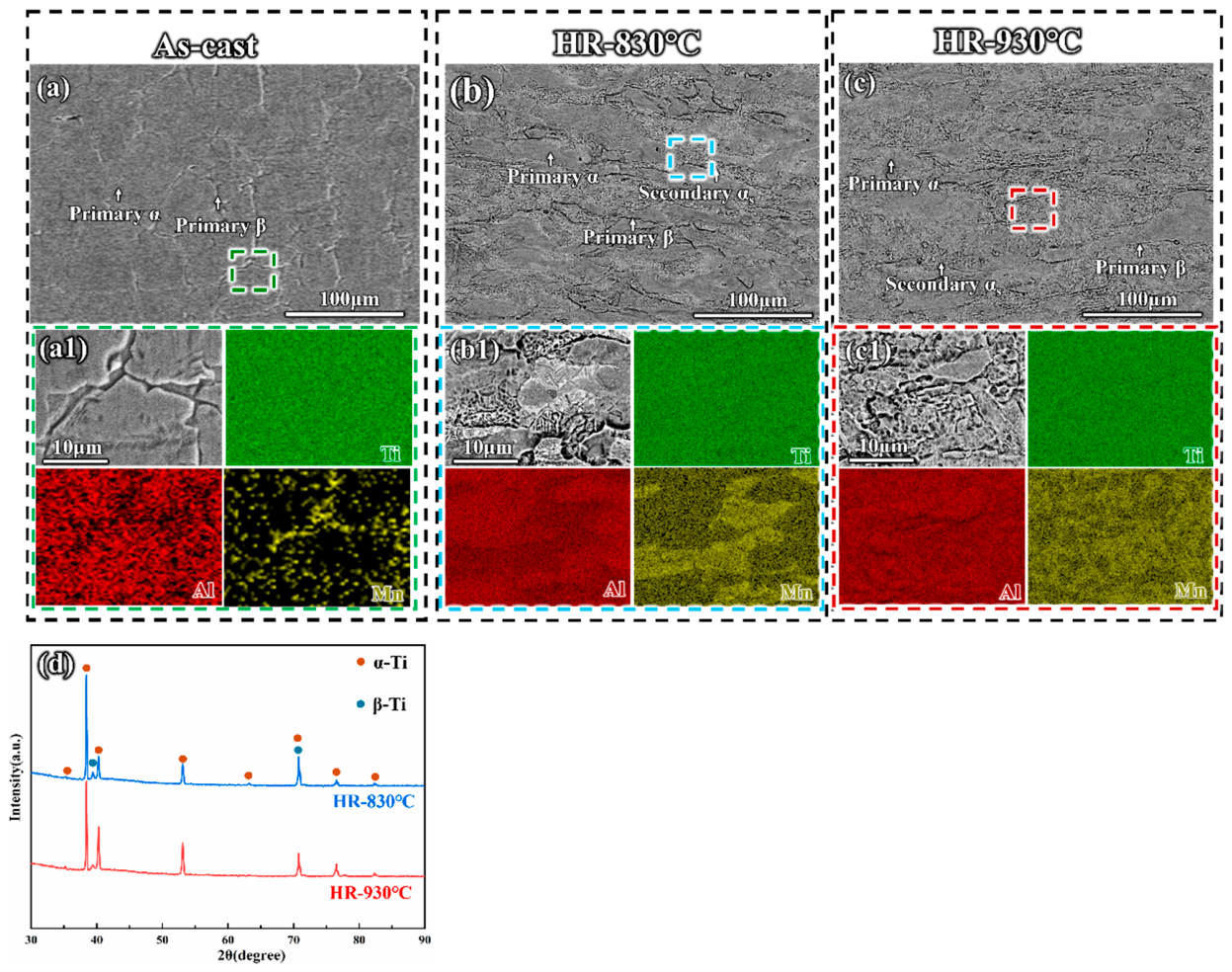
Figure 2 presents the microstructural morphology, elemental distribution, and phase constitution of TC2 titanium alloy in the as-cast state and after hot rolling at different temperatures. The microstructural differences among the samples under different conditions are mainly reflected in grain morphology, primary α phase morphology, secondary αs phase precipitation characteristics, residual β phase distribution, and Al/Mn elemental distribution. Therefore, the microstructural evolution induced by hot rolling temperature is analyzed below by combining SEM morphology, EDS mapping, and XRD results. Figure 2a displays the typical microstructure of as-cast TC2 titanium alloy, which is mainly composed of coarse primary α phase and primary β phase distributed at the α grain boundaries, with large grain size and obvious casting segregation features. Figure 2a1 further shows the local microstructural morphology and elemental distribution characteristics of the as-cast TC2 titanium alloy. It can be seen that Al and Mn exhibit a certain degree of regional distribution in the as-cast microstructure. Specifically, Al is mainly enriched in the primary α phase region, whereas Mn, as a β-stabilizing element, tends to be distributed in the β phase region near the grain boundaries. This is consistent with the distribution characteristics of the primary α phase and grain boundary β phase observed in Figure 2a. After hot rolling at 830 °C, as shown in Figure 2b, the primary α grains were significantly elongated along the rolling direction and obviously refined; after subsequent cooling, acicular secondary αs phase was observed both at grain boundaries and within grains. The formation of acicular secondary αs phase mainly occurred via the β → α transformation during post-rolling cooling [2]. Combined with the EDS mapping results in Figure 2b1, it can be seen that Al, as an α-stabilizing element, is mainly enriched in the primary α phase region, while Mn, as a β-stabilizing element, is mainly enriched in the secondary αs phase and residual β phase regions, indicating that partial β → α transformation occurred during the subsequent cooling process after hot rolling. When the hot rolling temperature was further increased to 930 °C, as shown in Figure 2c, the grain size of the alloy was further refined compared with the 830 °C hot-rolled sample, the volume fraction of secondary αs phase increased significantly, and the secondary αs phase became finer and more dispersed. Comparing the EDS area scan results of Figure 2b1,c1, the distribution of Mn element is more uniform and dispersed, confirming that hot rolling at 930 °C is more favorable for the massive precipitation and homogenization of secondary αs phase. In addition, the XRD analysis results shown in Figure 2d indicate that both HR-830 °C and HR-930 °C hot-rolled TC2 titanium alloys are mainly composed of hexagonal close-packed α phase and body-centered cubic β phase, with no other new phases observed. Compared with the secondary αs phase in the HR-830 °C condition, the secondary αs phase in the HR-930 °C condition is finer and present in greater quantity. This is mainly because the secondary αs phase tends to nucleate and precipitate at β phase interfaces [17], and 930 °C is closer to the α/β phase transformation temperature of TC2 titanium alloy (β transus approximately 950–980 °C) [18]; at this temperature, the volume fraction of β phase increases significantly, providing more favorable nucleation sites for secondary αs phase and resulting in a greater number and smaller size of needle-like αs phase during cooling.
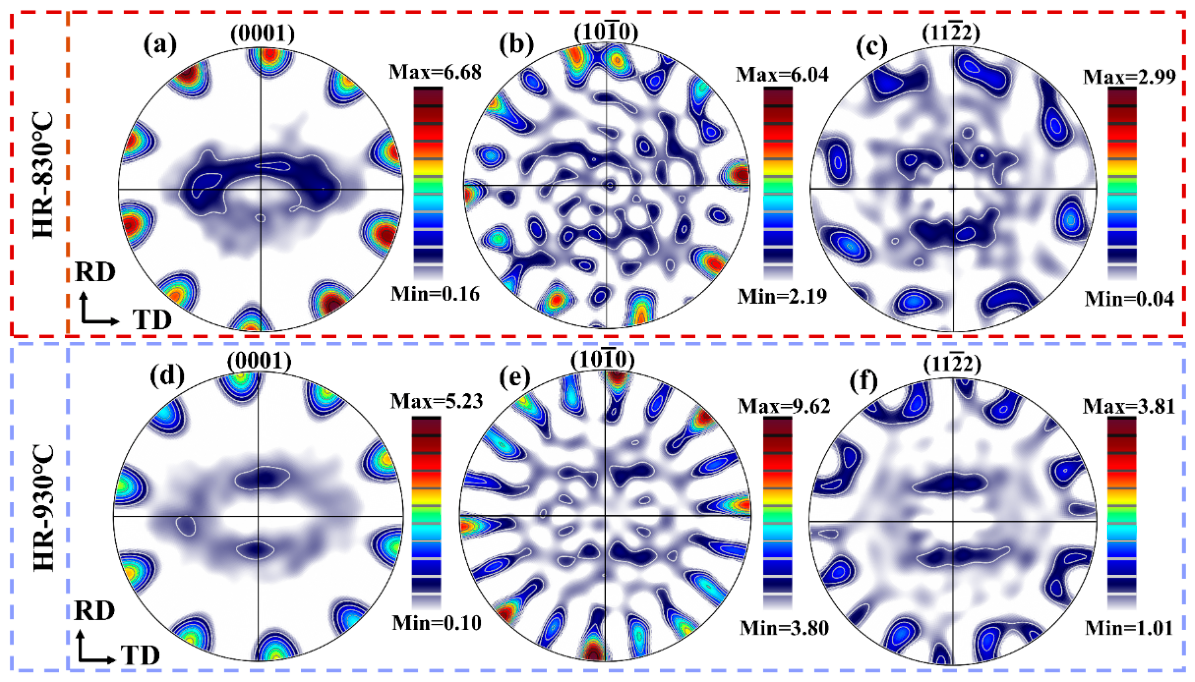
As shown in Figure 3, the XRD macro-texture pole figures ((0001), (10-10), and (11-22)) of TC2 titanium alloy after hot rolling at HR-830 °C and HR-930 °C are presented, where RD denotes the rolling direction and TD the transverse direction. For the HR-830 °C sample (Figure 3a–c), the maximum intensity of the (0001) pole figure reaches 6.68 m.r.d., exhibiting a pronounced transverse texture feature (c-axis tilted toward TD); the (10-10) pole figure shows a maximum intensity of 6.04 m.r.d., indicating a certain degree of <10-10>//RD prismatic texture, while the (11-22) pole figure intensity is relatively low (2.99 m.r.d.), suggesting that plastic deformation of the α phase during hot rolling is primarily accommodated by basal slip and twinning. Combined with the microstructure in Figure 2b, it can be seen that the primary α grains are significantly elongated and refined along the RD, with acicular secondary αs phase beginning to precipitate in small amounts at β-phase interfaces; Al is enriched in the α phase while Mn is mainly enriched in the secondary αs/β phase regions. The higher texture intensity is primarily attributed to the limited β-phase volume fraction at lower temperature, where deformation is dominated by α-phase dynamic recovery and partial dynamic recrystallization (DRX), resulting in more consistent grain orientations [19]. When the hot rolling temperature is increased to 930 °C (Figure 3d–f), the maximum intensity of the (0001) pole figure decreases to 5.23 m.r.d. with a more diffuse texture distribution; the (10-10) pole figure intensity significantly increases to 9.62 m.r.d., indicating more concentrated prismatic orientation; and the (11-22) pole figure intensity slightly increases to 3.81 m.r.d. This change is highly consistent with the microstructural features in Figure 2c, where grains are further refined, the volume fraction of secondary αs phase increases significantly, and its morphology becomes finer and more dispersed: 930 °C is closer to the α/β phase transformation temperature of TC2 titanium alloy (β transus approximately 950–980 °C), resulting in a markedly increased β-phase volume fraction that provides more nucleation sites for secondary αs phase during cooling (with more uniform and dispersed Mn distribution). According to the Burgers orientation relationship, the phase transformation variant selection under a higher β-phase volume fraction leads to dispersion of the α-phase c-axis orientation, thereby weakening the basal texture intensity while strengthening the prismatic texture [20].
To further analyze the texture evolution behavior in hot-rolled TC2 titanium alloy, this study employs ODF texture reconstruction figures to characterize the orientation distribution features of the alloy under different hot rolling temperatures and combines Equations (1) and (2) to determine the orientation types of the primary texture components [21,22,23].
h k i l = 3 2 1 2 0 0 1 0 3 2 1 2 0 0 0 c / a sin φ 2 sin Φ cos φ 2 sin Φ cos Φ
u v t w = 2 3 1 3 0 0 2 3 0 2 3 1 3 0 0 0 c / a × cos φ 1 cos φ 2 sin φ 1 sin φ 2 cos Φ cos φ 1 sin φ 2 sin φ 1 cos φ 2 cos Φ sin φ 1 sin Φ
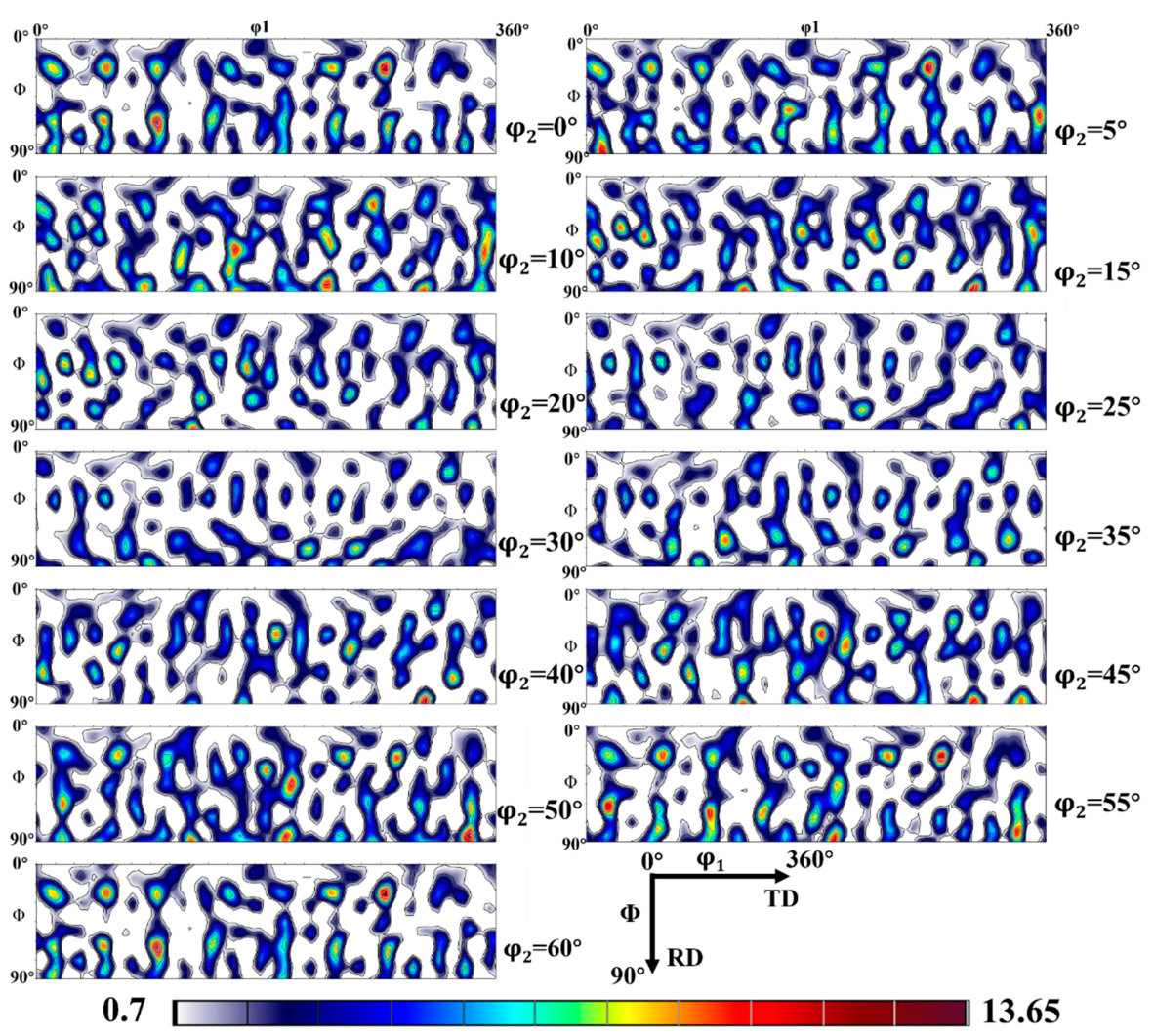
As shown in Figure 4, the ODF figure of TC2 titanium alloy under 830 °C hot rolling conditions is presented. Since α-Ti has a hexagonal close-packed structure, its crystal structure exhibits pronounced rotational symmetry. During rotation around the c-axis, each 60° rotation of the crystal orientation produces an equivalent coincidence; therefore, as φ2 rotates from 0° to 360°, six roughly similar orientation distribution regions appear in the ODF figure. In other words, the rotational symmetry period of the φ2 angle is 60°. Meanwhile, the Φ angle also exhibits certain symmetry in the orientation space, and its effective analysis range can be simplified to 0° ≤ Φ ≤ 90°. Therefore, in subsequent texture analysis, selecting the region of 0° ≤ φ2 ≤ 60° and 0° ≤ Φ ≤ 90° can more completely reflect the main orientation distribution characteristics of the alloy. As can be seen from Figure 4, a relatively obvious texture peak exists in the interval of φ1 ≈ 0–20° and Φ ≈ 30–60°, indicating that the grain orientations in this region exhibit a high degree of concentration. By combining Equations (1) and (2) to calculate and determine the crystal plane orientation, it can be confirmed that this peak mainly corresponds to the (0001) orientation, indicating that a strong basal texture formed in the alloy after hot rolling at 830 °C. This orientation exhibits a certain continuous distribution feature, indicating that it is not a single isolated orientation but is distributed along a specific orientation path, showing typical fiber texture characteristics. The formation of this strong (0001) basal texture is closely related to the plastic deformation mechanisms during the hot rolling process. For α-Ti with a hexagonal close-packed structure, basal slip is usually one of the more easily activated slip modes. During hot rolling at 830 °C, the combined action of rolling compressive stress and shear stress causes the grains to elongate along the rolling direction, while the grain orientations continuously rotate during deformation and gradually approach stable orientations. With the accumulation of deformation, the c-axis orientations of a large number of grains gradually develop preferred alignment, thereby significantly enhancing the texture intensity in the (0001) direction and forming a fiber texture dominated by basal orientation. In contrast, judging the (10-10) prismatic and (11-22) pyramidal orientations using Equations (1) and (2) reveals that the distribution of these two types of orientations in the ODF figure is relatively dispersed, without forming obvious peaks comparable to the (0001) orientation. This indicates that under 830 °C hot rolling conditions, the intensities of prismatic- and pyramidal-related texture components in TC2 titanium alloy are relatively weak, and grain orientations are mainly concentrated in the basal direction. The possible reason is that the activation degree of non-basal slip systems is limited at 830 °C, the contributions of prismatic slip and pyramidal slip to plastic deformation are relatively small, and material deformation mainly relies on basal slip and partial grain orientation rotation. Therefore, the (10-10) and (11-22) orientations fail to form strong preferred orientations and instead exhibit relatively diffuse texture distributions. In summary, after hot rolling at 830 °C, TC2 titanium alloy is dominated by (0001) basal texture, manifesting as obvious peak concentration and fiber texture characteristics in the ODF figure; in contrast, the (10-10) prismatic and (11-22) pyramidal orientations show relatively dispersed distributions with weaker intensities. This result is basically consistent with the pole figure analysis results in Figure 3a–c, further indicating that under 830 °C hot rolling conditions, the texture evolution of TC2 titanium alloy is mainly controlled by basal slip and grain orientation rotation.
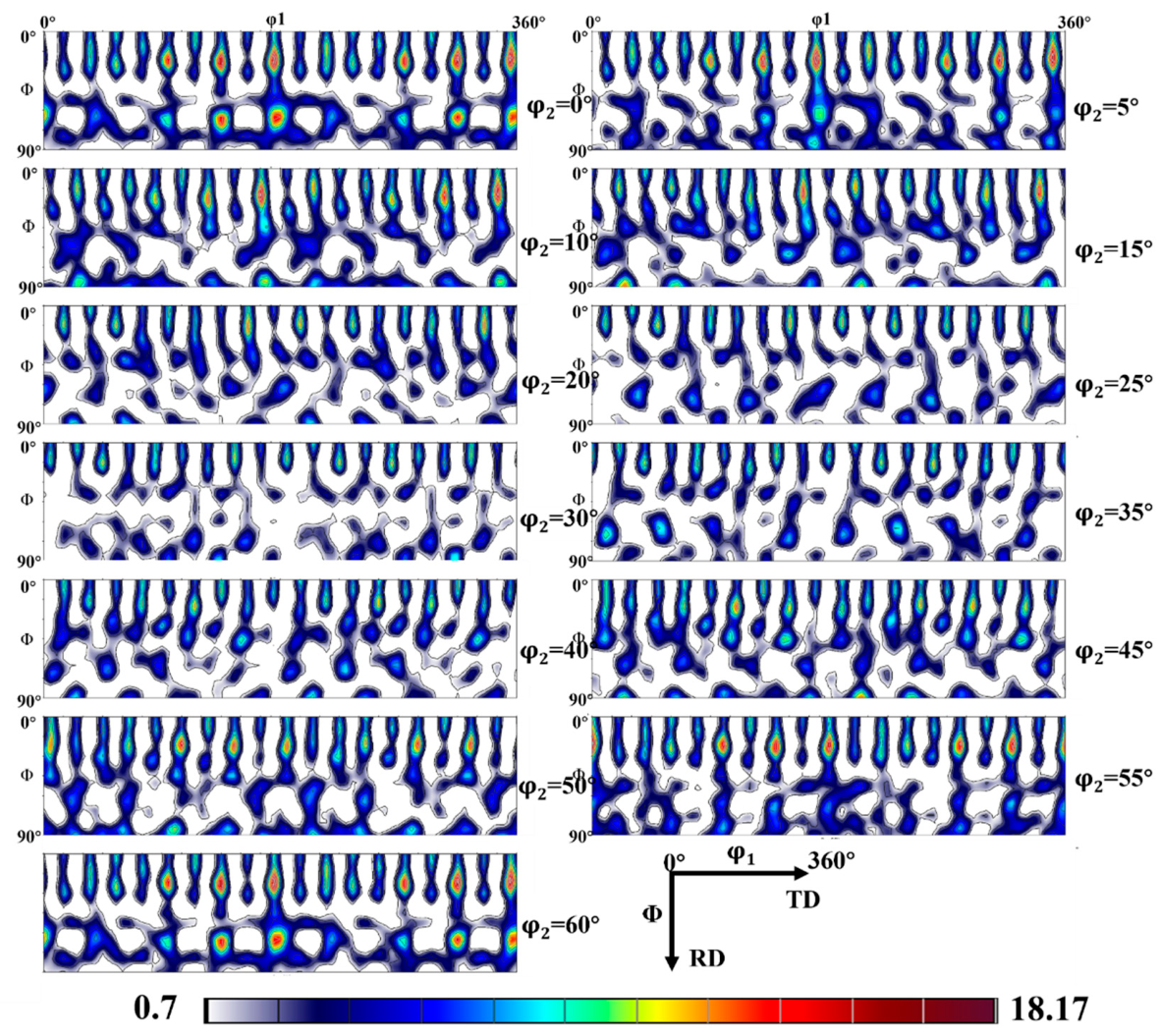
As shown in Figure 5, the ODF map of TC2 titanium alloy under 930 °C hot rolling conditions exhibits distinct texture evolution characteristics. By calculating the texture intensities of different crystal plane orientations using Equations (1) and (2), it can be found that, as the hot rolling temperature increases to 930 °C, the texture intensity along the (0001) orientation decreases significantly, while the intensities along the (10-10) and (11-22) orientations increase, indicating a substantial adjustment in the grain orientation inside the material. Under this temperature condition, the maximum texture intensity reaches 18.17, indicating that TC2 titanium alloy still maintains a certain degree of preferred orientation, but its texture concentration has changed. Compared with the HR-830 °C specimen, although the texture peak of the HR-930 °C specimen is higher, the peak distribution is more dispersed, indicating that grain orientations are no longer highly concentrated in a single specific orientation but extend toward multiple orientations. This phenomenon indicates that, at higher hot rolling temperatures, crystal orientation rotation inside TC2 titanium alloy becomes more sufficient, and the synergistic deformation capability of the slip systems is enhanced. Since titanium alloys possess a hexagonal close-packed structure, their plastic deformation is usually restricted by the limited number of operable slip systems [24]. At lower temperatures, deformation mainly relies on basal slip, thus readily forming strong basal texture, whereas when the hot rolling temperature increases to 930 °C, the thermal activation ability of atoms is enhanced and the critical resolved shear stress decreases, making prismatic slip and pyramidal slip easier to activate. Therefore, during 930 °C hot rolling, more non-basal slip systems participate in plastic deformation, leading to more complex orientation rotation of grains during deformation; as a result, the concentration of the (0001) basal orientation decreases and basal texture intensity weakens; meanwhile, the texture intensities of the (10-10) prismatic and (11-22) pyramidal orientations increase, indicating that prismatic and pyramidal slip contribute more to the overall plastic deformation. Overall, the increase in hot rolling temperature promotes diversified activation of slip systems inside TC2 titanium alloy, weakens the dominant role of single basal texture, and makes the texture distribution more dispersed. This texture evolution is beneficial for improving the deformation coordination of the material, reducing the anisotropy caused by strong basal texture, and thus exerting an important influence on the subsequent mechanical properties.

3.2. Mechanical Properties Analysis

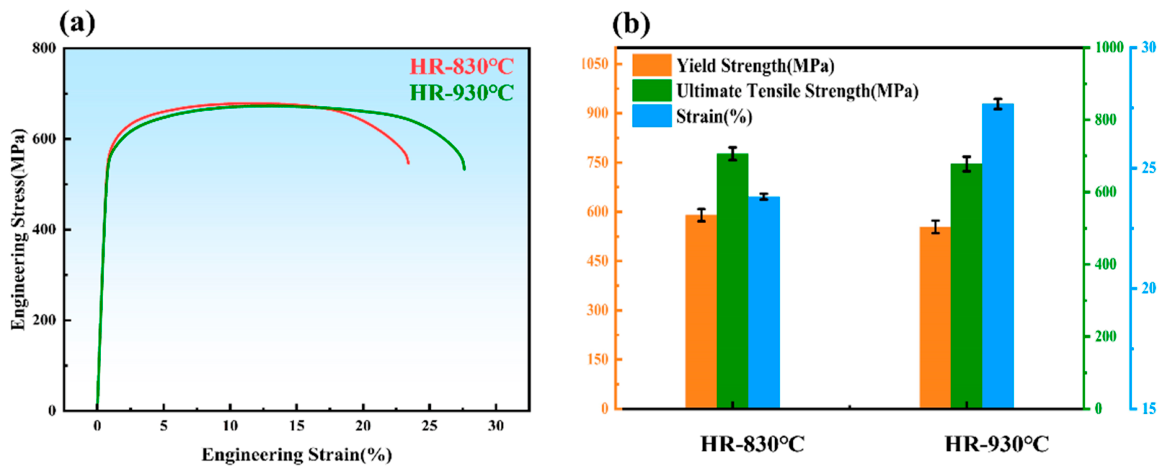
Figure 6 shows the engineering stress–strain curves (Figure 6a) and the statistical results of yield strength (YS), ultimate tensile strength (UTS), and elongation after fracture (Strain) (Figure 6b) for TC2 titanium alloy hot-rolled at HR-830 °C and HR-930 °C. As seen from Figure 6a, both groups of samples exhibit typical dual-phase deformation characteristics of α + β titanium alloys, with obvious work hardening occurring after the yield plateau. As shown in Figure 6 and Table 1, the YS and UTS values of the HR-830 °C and HR-930 °C samples are relatively close, whereas the average strain value of the HR-930 °C sample is higher than that of the HR-830 °C sample. This limited strength variation can be explained from two aspects. First, the tensile specimens used in this study had a relatively small gauge section, which was designed to avoid possible edge cracks, stress concentration regions, and preparation defects near the edges of the hot-rolled sheets. Therefore, the tested region could better represent the relatively uniform interior region of the rolled sheets, although the small specimen size may still introduce a certain degree of data dispersion. The repeated tensile results and standard deviations listed in Table 1 indicate that the overall variation trend of the mechanical properties is reliable. Second, the limited decrease in YS and UTS and the increase in strain are closely related to texture evolution. For the HR-930 °C sample, the weakened basal texture and more dispersed orientation distribution reduce the resistance to plastic deformation along the tensile direction, while the enhanced prismatic texture promotes deformation coordination, resulting in a limited decrease in strength but a more obvious improvement in ductility. This temperature dependence of the strength–ductility balance is closely related to the previously described microstructural (Figure 2) and macro-texture (Figure 3) evolution. Under 830 °C hot rolling conditions, the primary α phase is significantly elongated along the RD with limited grain refinement, the precipitation of secondary αs phase is relatively low, and the maximum intensity of the (0001) pole figure reaches 6.68 m.r.d. with a strong transverse texture feature, resulting in difficult activation of basal slip systems, deformation dominated by α-phase twinning and limited DRX, strong plastic anisotropy, and low elongation [25,26]. In contrast, hot rolling at 930 °C (closer to the α/β transus temperature) significantly increases the β-phase volume fraction; β-phase softening promotes sufficient DRX, leading to further grain refinement, a greater quantity of secondary αs phase with a finer and more dispersed morphology (more uniform Mn distribution), while the (0001) pole figure intensity decreases to 5.23 m.r.d., the (10-10) pole figure intensity increases, and the texture distribution becomes more diffuse. According to the Burgers orientation relationship, variant selection during phase transformation with higher β-phase participation effectively weakens the basal texture intensity, facilitating the simultaneous activation of more slip systems (such as prismatic slip) and thereby significantly enhancing ductility [25,27]. Combining ODF results reveals that the intense basal texture developed during 830 °C hot rolling limits slip activation and yields lower plasticity, while 930 °C hot rolling weakens the basal texture, enhances prismatic and pyramidal components, and activates multiple slip systems, leading to a significant rise in fracture elongation from ~24% to ~28%. And the above results are consistent with the texture intensity–mechanical property correlation observed by Dong et al. [28] in hot-rolled near-β titanium alloys: strong basal texture exacerbates differences in slip system activation, leading to reduced ductility. In contrast, high-temperature texture weakening can achieve synergistic optimization of strength and ductility [29]. Studies by Bache [30] and Li et al. [10] further confirm that reducing texture intensity in α + β titanium alloys can effectively alleviate anisotropy in the RD/TD directions and improve elongation after fracture, which is highly consistent with the ~16% increase in ductility observed in the HR-930 °C sample of this study.
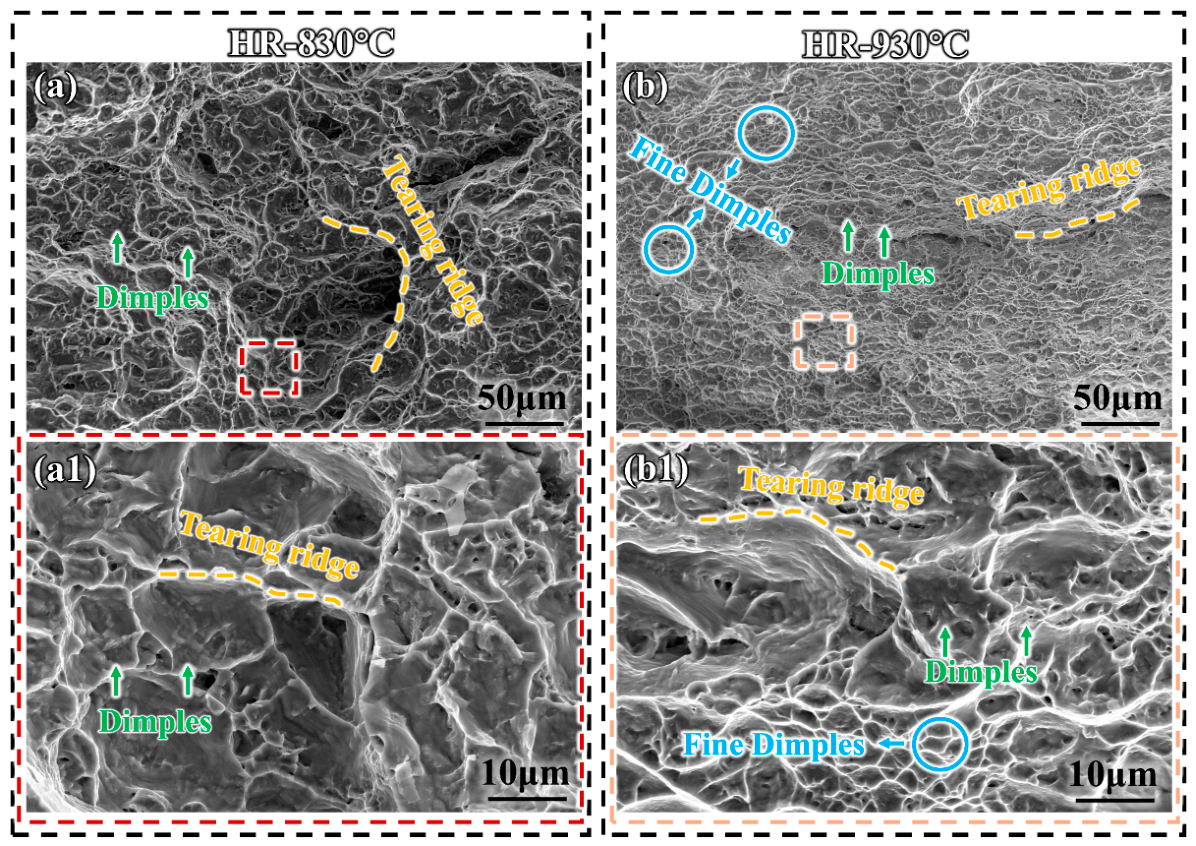
Figure 7 shows the SEM fracture morphologies of TC2 titanium alloy hot-rolled at HR-830 °C and HR-930 °C after tensile fracture and acetone–ethanol cleaning. Both groups of samples exhibit typical ductile fracture characteristics, dominated by dimples and tearing ridges, with no obvious brittle cleavage facets or intergranular fracture features observed, indicating that hot-rolled TC2 titanium alloy undergoes microvoid coalescence-type ductile fracture as the primary mechanism under room temperature tensile conditions. Figure 7a,a1 show the fracture morphology of the HR-830 °C sample, where deformation dominated by the primary α phase results in larger and unevenly distributed dimples, relatively coarse and continuous tearing ridges (marked by yellow dashed lines), and deeper dimple-like pits in some regions (marked by red dashed boxes). This is closely related to the significant elongation of primary α grains along the rolling direction, limited grain refinement, low precipitation of secondary αs phase (Figure 2b), and strong basal texture ((0001) pole figure maximum intensity of 6.68 m.r.d., Figure 3a) in the sample: the strong texture restricts the simultaneous activation of multiple slip systems, with deformation mainly relying on α-phase twinning and limited dynamic recrystallization (DRX), resulting in localized stress concentration, uneven void nucleation and growth, and ultimately lower ductility (elongation after fracture ≈24%, Figure 4) [31]. In sharp contrast, the fracture surface of the HR-930 °C sample (Figure 7b,b1) shows a large number of fine and densely distributed dimples (marked “Fine Dimples” by blue circles), with tearing ridges that, although still present, are gentler and thinner, and the overall morphology is more uniform and delicate. ODF findings of basal texture weakening, enhanced prismatic and pyramidal textures, and multi-slip activation correspond closely to the observed fine, dense dimple features on the fracture surface, demonstrating improved deformation compatibility during plastic flow. This feature is highly consistent with the further grain refinement, significantly increased volume fraction of secondary αs phase with finer and more dispersed morphology (more uniform Mn distribution, Figure 2c,c1), and markedly weakened macro-texture ((0001) pole figure intensity reduced to 5.23 m.r.d., (10-10) pole figure intensity increased to 9.62 m.r.d., Figure 3d–f) after hot rolling at 930 °C.At higher temperature, the increase in β-phase volume fraction promotes sufficient DRX and phase transformation variant selection (Burgers orientation relationship), providing more uniform nucleation sites for secondary αs phase during cooling; simultaneously, the weakened basal texture activates more prismatic slip systems, resulting in more coordinated plastic deformation, with voids nucleating uniformly and growing slowly at the fine secondary αs/β interfaces, thereby avoiding localized stress concentration and significantly enhancing elongation after fracture (≈28%, Figure 5) [32].

4. Conclusions

This study systematically compared the effects of hot rolling at 830 °C and 930 °C on the microstructure, macro-texture, mechanical properties, and fracture morphology of TC2 titanium alloy (Ti-4Al-1.5Mn, wt.%). The as-cast alloy is mainly composed of coarse primary α phase and primary β phase distributed at grain boundaries; after homogenization annealing and multi-pass hot rolling (total deformation of 80%), both groups of samples achieved significant grain refinement, but the 930 °C hot-rolled sample performed better: the primary α phase was further refined, the volume fraction of secondary αs phase increased significantly with a finer and more dispersed morphology (uniform Mn distribution), and XRD results showed enhanced α-phase diffraction peak intensity without the formation of new phases. Macro-texture analysis indicates that hot rolling at 930 °C reduced the maximum intensity of the (0001) pole figure from 6.68 m.r.d. to 5.23 m.r.d. with a more diffuse texture distribution, while the (10-10) pole figure intensity increased to 9.62 m.r.d., achieving weakening of the basal texture and strengthening of the prismatic texture. This change originates from the increase in β-phase volume fraction when the hot rolling temperature approaches the alloy’s β transus (approximately 950–980 °C), which promotes the precipitation of secondary αs phase and variant selection during phase transformation according to the Burgers orientation relationship. Further ODF analysis reveals that hot rolling at 830 °C generates an intense basal fiber texture, while 930 °C hot rolling yields a maximum texture intensity of 18.17 m.r.d. with pronounced dispersion and strengthened prismatic and pyramidal components; the enhanced thermal activation facilitates non-basal slip activation and intricate grain reorientation, leading to substantially improved deformation coordination and reduced anisotropy. Mechanical property test results show that the 930 °C hot-rolled sample achieves a significant increase in elongation after fracture (from approximately 24% to 28%) compared to the 830 °C sample, with only a slight decrease in ultimate tensile strength (approximately 730 MPa), thereby optimizing the strength–ductility balance. SEM fracture morphology further confirms this pattern: the 830 °C sample shows coarse and uneven dimples along with continuous tearing ridges, while the 930 °C sample fracture consists of numerous fine and dense dimples and thin tearing ridges, resulting in more coordinated plastic deformation. The above temperature-dependent microstructure–macro-texture–property coupling mechanism can be summarized as follows: higher hot-rolling temperature significantly improves the plastic deformation capability of the alloy through the synergistic effects of increased nucleation sites for secondary αs phase provided by β phase and the weakening of basal texture.

Author Contributions

Conceptualization, Z.L. and J.Y.; methodology, Q.Q. and Q.J.; software, Z.F.; validation, Z.L., J.Y. and Q.Q.; formal analysis, Y.L.; investigation, Z.C. and Z.F.; resources, Q.J.; data curation, Q.Q.; writing—original draft preparation, J.Y.; writing—review and editing, Z.L.; visualization, Y.L.; supervision, Z.L. and Q.J.; project administration, Z.C. and Z.F.; funding acquisition, Z.F. and Q.J. All authors have read and agreed to the published version of the manuscript.

Funding

This project was supported by Guizhou Provincial Department of Education Open Recruitment and Leadership Scientific and Technological Attack Project (Guizhou Education Technology [2024] No. 003), the Open Project of Yunnan Precious Metals Laboratory Co., Ltd. (No. YPML-20240502016), Doctoral Fund Project of Anshun University (No. asxybsjj202414), National Natural Science Foundation of China (No. 51864026).

Data Availability Statement

The original contributions presented in this study are included in the article. Further inquiries can be directed to the corresponding author.

Conflicts of Interest

Author Yanying Li was employed by Avic Guizhou Anda Aviation Forging Co., Ltd. The remaining authors declare that the research was conducted in the absence of any commercial or financial relationships that could be construed as a potential conflict of interest.

References

  1. Zhao, Q.; Sun, Q.; Xin, S.; Chen, Y.; Wu, C.; Wang, H.; Xu, J.; Wan, M.; Zeng, W.; Zhao, Y. High-strength titanium alloys for aerospace engineering applications: A review on melting-forging process. Mater. Sci. Eng. A 2022, 845, 143260. [Google Scholar] [CrossRef]
  2. Wang, Y.; Wang, H.; Shao, R.; Lu, W.; Yang, Y.; Feng, Z.; Li, Z.; Li, Y.; Chen, Z.; Yan, W. The competition behavior of strengthening and toughening and microstructure evolution of as-annealed Ti-4Al-1.5Mn alloy during multi-directional isothermal forging. Mater. Sci. Eng. A 2026, 964, 150195. [Google Scholar] [CrossRef]
  3. Wang, Y.; Wang, H.; Yang, Y.; Feng, Z.; Li, Z.; Li, Y.; Chen, Z.; Yan, W. The annealed induced phase regulation of as-cast Ti-4Al-1.5Mn alloy adjusts the fracture mechanism to improve plasticity. J. Alloys Compd. 2025, 1040, 183550. [Google Scholar] [CrossRef]
  4. Wang, Z.; Pei, Y.; Yu, H.; Liu, S.; Xiong, Z.; Jin, X.; Misra, R.D.K. Additive manufacturing of nickel-microalloyed titanium alloy: The significant impact of precipitation of Ti2Ni on mechanical properties. Mater. Sci. Eng. A 2025, 929, 148116. [Google Scholar] [CrossRef]
  5. Xiang, Y.; Luo, H.; Xiang, W.; Fu, Q.; Yuan, W. Influence of hot deformation process and annealing treatment on the microstructure of TC21 titanium alloy. J. Alloys Compd. 2025, 1022, 179939. [Google Scholar] [CrossRef]
  6. Zhu, X.; Fan, Q.; Liu, X.; Yu, H.; Wang, D. Microstructure evolution and mechanical properties of a hot-rolled Ti alloy. Prog. Nat. Sci. Mater. Int. 2021, 31, 105–112. [Google Scholar] [CrossRef]
  7. Cheng, J.-J.; Zheng, Z.-K.; Zhang, J.-L.; Li, M.-Y.; Zhang, M.; Mao, X.-Q.; Hou, Y.-T.; Zhang, P.-F.; Li, M.-J.; Xu, J.-J.; et al. Effect of accumulative hot rolling on the microstructure and mechanical properties of dual-phase titanium alloy consolidated via SPS sintering. Mater. Sci. Eng. A 2024, 896, 146294. [Google Scholar] [CrossRef]
  8. Ran, J.; Yihang, G.; Yuchi, L.; Wenyan, X.; Taotao, A.; Chaoqun, X.; Jianghua, L.; Yang, Z.; Pengfei, C. Microstructural evolution and mechanical properties of Ti–6Al–20Mo alloy after hot rolling deformation. J. Mater. Res. Technol. 2026, 42, 2150–2157. [Google Scholar] [CrossRef]
  9. Song, J.-H.; Hong, K.-J.; Ha, T.K.; Jeong, H.T. The effect of hot rolling condition on the anisotropy of mechanical properties in Ti–6Al–4V alloy. Mater. Sci. Eng. A 2007, 449–451, 144–148. [Google Scholar] [CrossRef]
  10. Li, B.; Fan, J.; Zhang, W.; Zhao, J.; Zhao, D.; Tao, H.; Hao, X.; Wang, F.; Jiang, P.; Kou, H.; et al. Texture evolution and anisotropy of TA18 titanium alloy strip under rolling and heat treatment conditions. J. Mater. Res. Technol. 2025, 34, 1582–1590. [Google Scholar] [CrossRef]
  11. Tian, Q.M.; Yang, Y.; Tan, Y.B.; Xiang, S.; Zhao, F.; Ji, X.M.; Huang, G.W. Synergistically enhancing the strength and ductility of TA15 titanium alloy through hot rolling and short-time annealing. J. Alloys Compd. 2025, 1038, 182796. [Google Scholar] [CrossRef]
  12. Zeng, X.; Daniel, C.S.; Asheshov, W.; Michalik, S.; Prangnell, P.; Quinta da Fonseca, J. Effect of Temperature, Strain and Microstructure on Texture Evolution of Ti-6Al-4V During Hot Rolling. Metall. Mater. Trans. A 2025, 56, 4620–4643. [Google Scholar] [CrossRef]
  13. Qin, J.; Huang, X.; Ji, H.; Jiao, L.; Lang, X.; Wang, B. Multi-scale investigation on dynamic softening mechanisms and establishment of constitutive model for Ti-5Al-5Mo-5V-1Cr-1Fe alloy during hot deformation. J. Alloys Compd. 2026, 1065, 188185. [Google Scholar] [CrossRef]
  14. Won, J.W.; Choi, S.-W.; Yeom, J.-T.; Hyun, Y.-T.; Lee, C.S.; Park, S.H. Anisotropic twinning and slip behaviors and their relative activities in rolled alpha-phase titanium. Mater. Sci. Eng. A 2017, 698, 54–62. [Google Scholar] [CrossRef]
  15. Tian, X.J.; Zhang, S.Q.; Wang, H.M. The influences of anneal temperature and cooling rate on microstructure and tensile properties of laser deposited Ti–4Al–1.5Mn titanium alloy. J. Alloys Compd. 2014, 608, 95–101. [Google Scholar] [CrossRef]
  16. GB/T 228.1-2021; Metallic Materials—Tensile Testing—Part 1: Method of Test at Room Temperature. Standards Press of China: Beijing, China, 2021.
  17. Xu, Y.; Xu, L.; Ding, L.; Zhang, S.; Zhang, B.; Pan, H.; Lu, X.; Jiang, P. Microstructure and microtexture evolution of hot-rolled Ti-6321 alloy at different post-annealing temperatures. J. Alloys Compd. 2022, 902, 163842. [Google Scholar] [CrossRef]
  18. Leo Prakash, D.G.; Honniball, P.; Rugg, D.; Withers, P.J.; Quinta da Fonseca, J.; Preuss, M. The effect of β phase on microstructure and texture evolution during thermomechanical processing of α + β Ti alloy. Acta Mater. 2013, 61, 3200–3213. [Google Scholar] [CrossRef]
  19. Sahoo, S.K.; Sabat, R.K.; Sahni, S.; Suwas, S. Texture and microstructure evolution of commercially pure titanium during hot rolling: Role of strain-paths. Mater. Des. 2016, 91, 58–71. [Google Scholar] [CrossRef]
  20. Fan, R.; Wu, Y.; Chen, M.; Deng, W.; Luo, B. Analysis of texture evolution and slip activity of a near-α titanium alloy sheet under different biaxial-tension strain paths. J. Mater. Res. Technol. 2022, 20, 2905–2920. [Google Scholar] [CrossRef]
  21. Hirsch, J.; Al-Samman, T. Superior light metals by texture engineering: Optimized aluminum and magnesium alloys for automotive applications. Acta Mater. 2013, 61, 818–843. [Google Scholar] [CrossRef]
  22. Rafailov, G.; Caspi, E.N.; Hielscher, R.; Tiferet, E.; Schneck, R.; Vogel, S.C. Visualization of texture components using MTEX. J. Appl. Crystallogr. 2020, 53, 540–548. [Google Scholar] [CrossRef]
  23. Wang, Y.N.; Huang, J.C. Texture analysis in hexagonal materials. Mater. Chem. Phys. 2003, 81, 11–26. [Google Scholar] [CrossRef]
  24. Yang, J.; Zhang, J.; Liu, G.; Sun, J. Sequentially-activated multiple deformation mechanisms enable a hierarchically duplex titanium alloy with high strength-ductility synergy. Acta Mater. 2025, 301, 121546. [Google Scholar] [CrossRef]
  25. Obasi, G.C.; Birosca, S.; Leo Prakash, D.G.; Quinta da Fonseca, J.; Preuss, M. The influence of rolling temperature on texture evolution and variant selection during α → β → α phase transformation in Ti–6Al–4V. Acta Mater. 2012, 60, 6013–6024. [Google Scholar] [CrossRef]
  26. Kou, H.; Chen, Y.; Tang, B.; Cui, Y.; Sun, F.; Li, J.; Xue, X. An experimental study on the mechanism of texture evolution during hot-rolling process in a β titanium alloy. J. Alloys Compd. 2014, 603, 23–27. [Google Scholar] [CrossRef]
  27. Zhang, H.; Yi, J.; Wang, J.; Xiao, H.; Wang, M.; Wang, W. Effect of Direct Rolling Process on Microstructure and Mechanical Properties of the Electron Beam Cold Hearth Melting Ti-6Al-4V Alloy. Metals 2022, 12, 2018. [Google Scholar] [CrossRef]
  28. Dong, R.; Zhang, X.; Li, C.; Zhao, Y.; Tian, J.; Wu, L.; Hou, H. Correlation between the mechanical properties and the 〈110〉 texture in a hot-rolled near β titanium alloy. J. Mater. Sci. Technol. 2022, 97, 165–168. [Google Scholar] [CrossRef]
  29. Li, K.; Liu, H.; Gu, N.; Xiao, X.; Dai, S.; Liu, J.; Yi, D. Improving strength and ductility of Ti-4Al-0.005B titanium alloy through tailoring equiaxed and lamellar microstructure during thermal mechanical process. J. Mater. Res. Technol. 2022, 20, 3158–3172. [Google Scholar] [CrossRef]
  30. Bache, M.R.; Evans, W.J. Impact of texture on mechanical properties in an advanced titanium alloy. Mater. Sci. Eng. A 2001, 319–321, 409–414. [Google Scholar] [CrossRef]
  31. Dong, S.; Song, Y.; Savvakin, D.; Ivasishin, O.; Cheng, T. Impact of hot rolling on the evolution of microstructure and mechanical properties of sintered commercially pure Ti compacts. J. Mater. Res. Technol. 2024, 31, 133–141. [Google Scholar] [CrossRef]
  32. Modina, I.M.; Dyakonov, G.S.; Polyakov, A.V.; Stotskiy, A.G.; Semenova, I.P. Effect of Texture on the Ductile–Brittle Transition Range and Fracture Mechanisms of the Ultrafine-Grained Two-Phase Ti-6Al-4V Titanium Alloy. Metals 2023, 14, 36. [Google Scholar] [CrossRef]
Figure 1. Schematic diagram of the experimental procedure for TC2 titanium alloy.
Metals 16 00651 g001
Figure 2. SEM micrographs, EDS elemental mapping, and XRD patterns of TC2 titanium alloy: (a,a1) as-cast TC2 titanium alloy, (b,b1) HR-830 °C hot-rolled TC2 titanium alloy, (c,c1) HR-930 °C hot-rolled TC2 titanium alloy, (d) XRD results of hot-rolled TC2 titanium alloy.
Metals 16 00651 g002
Figure 3. Macro-texture pole figures of TC2 titanium alloy at different hot rolling temperatures: (ac) HR-830 °C sample, (df) HR-930 °C sample; (a,d) (0001) pole figure, (b,e) (10-10) pole figure, (c,f) (11-22) pole figure.
Metals 16 00651 g003
Figure 4. Orientation distribution function (ODF) map of macro-texture for TC2 titanium alloy hot-rolled at 830 °C.
Metals 16 00651 g004
Figure 5. Orientation distribution function (ODF) map of macro-texture for TC2 titanium alloy hot-rolled at 930 °C.
Metals 16 00651 g005
Figure 6. Room temperature tensile mechanical properties of HR-830 °C and HR-930 °C hot-rolled TC2 titanium alloy: (a) engineering stress–strain curves; (b) statistical bar chart of yield strength (YS), ultimate tensile strength (UTS), and elongation after fracture (Strain).
Metals 16 00651 g006
Figure 7. SEM fractographs of room temperature tensile fracture surfaces of HR-830 °C and HR-930 °C hot-rolled TC2 titanium alloy: (a,a1) HR-830 °C sample; (b,b1) HR-930 °C sample.
Metals 16 00651 g007
Table 1. Tensile properties and data dispersion of TC2 titanium alloy hot-rolled at different temperatures.
Hot Rolling TemperatureYield Strength (MPa)Ultimate Tensile Strength (MPa)Strain (%)
HR-830 °C572.77690.1723.70
 609.81725.0223.94
 586.33702.9323.79
 589.64 ± 18.74706.04 ± 17.6323.81 ± 0.12
HR-930 °C536.9659.8527.47
 574.87699.5427.89
 550.8674.3827.62
 554.19 ± 19.21677.92 ± 20.0827.66 ± 0.21
Bold values represent the mean ± standard deviation of three repeated measurements.
Disclaimer/Publisher’s Note: The statements, opinions and data contained in all publications are solely those of the individual author(s) and contributor(s) and not of MDPI and/or the editor(s). MDPI and/or the editor(s) disclaim responsibility for any injury to people or property resulting from any ideas, methods, instructions or products referred to in the content.