Article

Effect of Casting Shakeout Temperature on Residual Stresses of Hypoeutectic High-Chromium Iron Alloys Using the Hole-Drilling Method


1
Faculty of Engineering and Built Environment, University of Johannesburg, P.O. Box 524, Auckland Park, Johannesburg 2006, South Africa
2
Mineral Processing and Technology Research Centre, University of Johannesburg, P.O. Box 17011, Doornfontein, Johannesburg 2028, South Africa
3
Advanced Materials Division, Mintek, Private Bag X3015, Randburg, Johannesburg 2125, South Africa
*
Author to whom correspondence should be addressed.
Metals 2026, 16(6), 610; https://doi.org/10.3390/met16060610
Submission received: 16 March 2026 / Revised: 5 May 2026 / Accepted: 7 May 2026 / Published: 3 June 2026
(This article belongs to the Section Metal Casting, Forming and Heat Treatment)

Abstract

In this investigation, optical emission spectrometers, a Brinell hardness tester, optical light and scanning microscopes, and X-ray diffraction were used for general metallurgical characterization of the experimental irons in as-cast states. The hole-drilling method was used to assess residual stress distributions under gross and net casting weight conditions. To create experimental irons using the casting process, raw materials were transformed from a solid to a liquid state using an industrial furnace and ladle to melt and cast, respectively. The casting shakeout temperatures for samples A and B were recorded at 60 °C and 180 °C, respectively, after a characteristic stress lattice casting component was allowed to cool for about 1645 min and 1295 min. Chemical analysis verified the experimental hypoeutectic irons of ASTM A532, Type A, Class III, 25%Cr, i.e., high chromium white cast iron alloys. Additionally, it was discovered that micrographs were made of an austenitic-martensitic matrix that contained eutectic M7C3 and secondary M23C6-type carbides. The residual stress distributions were found to be influenced by various carbide and metallic volume fraction proportions, casting section thickness, and casting shakeout duration and temperature. Optimal hardness values, however, were shown to be associated with higher residual stress distributions and an increase in major alloying elements in experimental irons. Consequently, different residual stress distributions are produced by casting shakeout temperatures at lower and higher values under gross and net casting weight conditions.

1. Introduction

1.1. Background

High chromium (Cr) alloys are known as high chromium white cast iron (HCWCI) alloys, which are extensively used as abrasion-wear materials (AWMs) in the comminution processes, such as crushing, grinding, and milling, as well as in the handling of abrasive materials, such as mineral ores, in both dry and wet environments. Because of its exceptional resistance to wear, HCWCI is a form of white cast iron (WCI) that can be used in a variety of applications where components are subjected to abrasive conditions. Grinding balls are commonly used during ore comminution. However, comminution itself is a critical process used during mineral processing and in power plants, cement production, and pharmaceutical industries [1,2,3]. In addition, HCWCIs are widely used in shot-blasting equipment, slurry pumps, brick molds, coal grinding mills, and hard-rock mining, quarrying, and milling parts due to their remarkable abrasion resistance. In certain applications, they must also be able to withstand significant impact loads [4]. Thus, high-performance materials are in high demand in harsh situations where corrosion and wear are common. Although their performance is frequently still insufficient, HCWCIs exhibit superior performance compared to many materials because they are sufficiently hard for wear protection and can be modified in chemical composition to enhance fracture toughness, hardness, and corrosion resistance [2].
Cast irons with a content of ≥1.8 wt% carbon (C) and ≥10 wt% Cr are known as HCWCIs. For a variety of reasons, alloying elements may also be added, and these include carbide formers and/or hardening alloying elements [1,2]. HCWCI alloys are formed by substantial Cr additions added as one of the general carbide formers to cast irons. Thus, numerous types of carbides are created, such as M3C/(Cr, Fe)3C, M7C3/(Cr, Fe)7C3, and M23C6/(Cr, Fe)23C6 [1,2,3,4,5,6,7], based on various Cr levels added into the liquid iron to improve fracture toughness, hardness, promote corrosion resistance, and establish MnCM/(Cr, Fe)nCm-type carbides and AWR [2,3,8]. This is because elevated Cr levels improve hardness and corrosion resistance and alter carbide morphology. Thus, the impact energy, i.e., the fracture toughness of the iron, depends on various aspects, such as the resulting retained austenite (γ-Fe) and C-content in the γ-Fe or martensite (α-Fe) phase, the destabilization heat treatment temperatures, etc. [1,2,3,5,6,7,8,9,10,11]. The mechanical properties of the high Cr irons are governed by both the metallic matrix structure and eutectic carbides, i.e., M7C3-type, also known as Cr-rich carbides [1,2,5,8,9,10,11]. Furthermore, during hypoeutectic and hypereutectic iron solidification and cooling of high Cr irons, γ-Fe and M7C3, respectively, are the primary phases to nucleate, as shown in Equation (1), followed by subsequent simultaneous nucleation of eutectic constituents, as shown in Equation (2), consisting of both γ-Fe and Cr-rich carbides, specifically M7C3-types.
Liron → γ-Fe/M7C3 + LRes.
LRes. → γ-Fe + M7C3
where Liron and LRes. refer to liquid iron and residual liquid iron, respectively.
In eutectic irons, both γ-Fe and M7C3 nucleate simultaneously during solidification and cooling [1,5,6,7,9,10,11]. Nonetheless, for casting components, normally hypereutectic irons are avoided due to the nucleation of primary carbides, such as M7C3-type, and a higher volume fraction of carbides, i.e., a carbide volume fraction (CVF), leading to a higher rejection or scrap rate due to tiny cracks usually observed after the casting shakeout or knockout process. On the other hand, hypoeutectic and eutectic irons of HCWCI are generally cast for engineering components as AWMs [1,5,8,9,10,11,12]. Due to the lessening of both C and Cr contents from the matrix, i.e., γ-Fe in hypoeutectic irons, residual Liron in Equation (2) is enriched in both C and Cr, reaching a eutectic reaction as shown in Equation (2), and the eutectic constituents nucleate simultaneously. The martensite start (Ms)-temperature of the iron is increased above ambient temperatures, i.e., ≤25 degrees Celsius (°C). Thus, α-Fe, at the periphery of eutectic M7C3-type carbides, is established with a minimum volume fraction as compared to the primary phase, i.e., primary/proeutectic γ-Fe in hypoeutectic irons [1,5,8,11,12]. On the other hand, in hypereutectic irons, the residual Liron shown in Equation (2) becomes deprived of both C and Cr content due to the primary nucleation of M7C3-type carbides, leading to a eutectic reaction taking place and resulting in the formation of eutectic constituents, as shown in Equation (2) [1,5,6,7,8,9,10,11,12,13].
Eutectic constituent precipitation stops before reaching minimum eutectic temperatures, i.e., the end of the eutectic reaction [8,12]. Hutchings and Shipway (2017) as referenced by Tupaj et al. [14], noted that resistance to abrasive wear is normally the main fundamental criterion for material selection for engineering parts and/or components. The exceptional resistance to abrasive wear is due to a higher volume fraction, i.e., CVF, of hard Cr-rich carbides, which is estimated from Equation (3) below. On the other hand, the metallic matrix (M), i.e., retained γ-Fe plus α-Fe of the iron, contributes to the material’s toughness [8,12,13,14,15], which can be estimated from Equation (4) below [13,14,15]. High nominal concentrations of Cr additions lead to higher Cr/C ratios, i.e., ≥6.5 in cast irons, and aid in avoiding and suppressing graphite and pearlitic nucleation while stabilizing higher volumes of γ-Fe and hard Cr-rich carbides [14]. In addition, hardening-alloying elements, such as copper (Cu), manganese (Mn), nickel (Ni), and molybdenum (Mo), are typically added to overcome the formation of pearlite during the solidification and cooling processes [2,3,4,6,7,8,9,10,11,15], while carbide-forming elements are added to increase AWR through precipitation of their own carbides and microstructural refinement to improve fracture toughness of the iron [9,10].
CVF (%) = 12.33%C + 0.55%Cr − 15.2 → std. dev. ± 2.11
M (%) = 100 − CVF
Islak et al. [5] noted that the impact properties of HCWCI alloys are supported upon a microstructural balance among the austenitic matrix, i.e., the volume fraction that will be altered to the martensitic matrix and carbides. It should be noted that increasing both C and Cr contents of the high Cr irons increases CVF while reducing interdendritic structure. However, reducing both the C and Cr contents of the alloy increases the metallic matrix volume fraction, thus increasing the interdendritic structure, which promotes carbide precipitation [1,2,3,5,6,7,8,9,10,11,12,13,14,15]. Recent studies have examined the incorporation of high entropy alloy (HEA) principles into HCWCI to manufacture high-entropy white cast iron (HEWCI).
HEWCI alloy links the benefits of HCWCI with the high entropy effect to offer finer microstructures and advanced wear characteristics. An additional investigation has exhibited that HCWCIs can be modified utilizing HEA principles to produce hybrid HEWCI [4]. The goal of numerous studies has been to enhance the HCWCI alloy’s mechanical characteristics through heat treatment processes and alloying additions. Hardness is the primary mechanical property that determines AWR. As a result, the HCWCI is usually heat treated to change its microstructure and enhance its wear and tribological characteristics. In addition, González et al. [16] investigated the influence of shot-peening treatment on erosion wear behavior of HCWCI alloys. The data analysis suggests that shot peening could be a beneficial treatment to optimize the erosion wear behavior of HCWCI components while lowering the production times and energy costs associated with drawn-out tempering processes. According to Xia et al. [17], numerous studies have been conducted to date on the in-depth examination of casting component failure brought on by primary carbides in the casting subsurface. Given that HCWCIs are employed in wear applications, it could be worthwhile to increase our understanding of how casting shakeout temperatures (CSTs) affect casting components and connect them to residual stress (RS) development to lessen hot tearing or cracking and distortion. Consequently, during material applications, the casting components’ lifespan is extended, and production outputs are enhanced.
Hence, the distribution of RS and the impact of CST in the as-cast state on gross casting weight (GCW) and net casting weight (NCW) conditions, respectively, following casting processes, as well as on the formation and growth of a multi-phase alloy like HCWCI alloys, are hardly discussed. The GCW denotes comprehensive casting before removal of casting appurtenances, i.e., pouring cup, sprue, risers/feeders, ingates, and vents to yield the NCW; NCW is the saleable or actual casting component after the removal of casting appurtenances from GCW conditions. The goal of this study is to investigate the effects of local internal RS distribution under various conditions, particularly in GCW and NCW circumstances, respectively, in the as-cast state at two different CSTs of approximately 60 °C and 180 °C of American Society for Testing and Materials (ASTM) A532 [18], Type A, Class III, 25% Cr-alloy casting components of HCWCI alloys. According to the research study findings, the local internal RS distributions are lower at a CST of approximately 60 °C than at a CST of 180 °C. As a result, extreme RS concentrations in the as-cast conditions at higher CSTs than at minimum CSTs, especially in the GCW state as opposed to the NCW state, can easily result in failure through casting surface cracking and distortion, which can result in scrapping and non-conformance reports (NCRs), respectively. Furthermore, severe deformation, distortion, and/or failure due to casting surface cracking brought on by high RS concentrations in the as-cast circumstances can easily be generated by greater CSTs and the concentration of internal local RSs. As a result, room temperature CST and adequate cooling of the casting during the cooling stage would undoubtedly salvage higher scrap and NCR rates, respectively. This will save operating costs and maximize income for the organization because of the resulting extended component life duration during material application.

1.2. Development of Residual Stress Within Cast Irons

Residual stresses are largely predictable during casting processes due to uneven cooling rates, phase transformation, volume expansion, and contraction and restriction of casting parts, especially when there is complex geometry involved due to cores and the mold’s restrictions [19,20,21,22]. The growing usage of high-temperature applications has sparked worries regarding flatness issues and the ensuing cutting distortion. According to Weisz-Patrault (2015) and Abdelkhalek (2011 & 2015) as reference by Wu et al. [23], the increasing use of high temperature applications has raised concerns about flatness problems and the resulting cutting distortion. The main reason for these problems is essentially an uneven distribution of RS within the metal components. Furthermore, concerns over flatness flaws or later cutting deformations of the metal components have been highlighted by the growing use of high temperature applications. The unequal distribution of RS inside the metal component is the primary cause of these flatness problems and resulting distortions, leading to fracture [20,23]. When materials fracture, atomic bonds are broken, causing cracks to spread. Cracks in materials can have a variety of causes, leading to significant concentrations of RS. The joining of microcracks that started at sub-boundaries can be explained by either dislocation activity or the transfer of many vacancies from nearby boundaries, such as a reaction to high stress fields [22,23]. The local stress, fracture length and depth, and material fragmentation all increase with the number of strikes.
The local RS field is the main determinant of material fracture. Phase mixtures make up most useful materials; some have ductile interfaces between phases or between grains of the same phase, while others have brittle interfaces [11]. In addition, RSs can also exist in the absence of any thermal gradients and/or external forces [20,24,25,26]. Thus, RSs can be described as stresses that remain in the interior of a body of a component and/or casting that are due to non-uniform temperatures, i.e., temperature gradients, and other interior cultivators that result from the manufacturing processes of cast components, especially metal components [15,27,28,29,30]. As a result, the origins of RSs can be categorized as chemical, thermal, or mechanical [31,32,33,34,35]. Since HCWCI alloys are manufactured through casting processes, this study only covers both mechanically and thermally induced RSs on macroscopic and microscopic levels. Thus, mechanically induced RSs, which are relevant to manufacturing processes, result in uneven plastic deformation [20,36,37,38]. Thermally induced RSs relate to non-homogeneous heating and/or solidification and cooling on an infinitesimal level because of diverse thermal expansion coefficients (TEC) amongst various constituents and microstructural phases [20,39,40,41,42]. Mohamed et al. [43] reported that several factors are well known for causing RSs, and these stresses are due to the establishment of distortion gradients in various casting parts because of variances in loading and/or solidification rates, phase changes, or modifications in the TEC of the phase presence in the iron.
During casting processes, casting components are normally exposed to internal and external manacles and/or constraints when solidifying and cooling, respectively, thus leading to irregular distribution of strains and, subsequently, RSs. Interior restrictions depend on variances in cooling rate through various casting components within an individual cast component, resulting in irregular contractions. Cooling after solidifying and solid-state transformation causes variances in shrinkage [44,45,46]. However, external constraints result from casting profiles and the amount of the material that contracts and restructures, whereas solidification and cooling relate to the sand-mold properties [20,47,48,49]. Furthermore, Lundberg and Elmquist [50], noted that entire thermal contractions are generally related to lessening temperatures and altering conditions of the iron’s microstructural constituent through thermal stress experienced during casting processes, while the thermal stresses encompass various significances, i.e., distortion, cracking, and RS [20,50,51,52,53,54,55,56]. The RSs from casting operations significantly impact the fatigue life of cast components, potentially reducing their service life. However, RS should be explored, reduced, and mitigated to improve the performance of cast components in practical applications, including in terms of fatigue life, corrosion resistance, and component distortion. Therefore, to improve the quality of cast components, it is crucial to anticipate and manage RSs brought on by casting procedures.

1.3. Hole-Drilling Measurement

One of the most popular experimental methods for RS analysis in the industrial sector is hole-drilling method (HDM) because of its affordability and simplicity of usage [57]. Oettel [58] noted that HDM is a well-known mechanical technique for measuring RS that is regarded as non-destructive for large structures. According to Yang [28], the hole drilling technique is a widely used semi-destructive measurement method that saves time and yields results that are dependable for high precision in industries. When determining RSs in components composed of coarse-grained alloys, HDM is the recommended technique. There is a dearth of information about HDM measurement uncertainty in the literature; there is no information available, particularly regarding the case’s uncertainty [59]. The assessment of RS measurement accuracy is limited by the lack of ideal reference standards for RS measurements [57,59,60]. Schajer and Whitehead (2013) as referenced by Olson et al. [60], provide a helpful background of the drilling theory, and ASTM E837 standardizes the procedure. HDM’s practical application is standardized by ASTM E837 for both uniform and non-uniform cases through thickness stress distributions. Thus, the ASTM E837 standardizes its use for both uniform and non-uniform RS distributions with thorough thickness. The examination of uniform stress, which is the subject of this work, generally yields result with a maximum bias of roughly 10%, in compliance with ASTM restrictions [57]. After bonding the strain gauge (SG) to the surface of the component, a hole is bored in the middle. Throughout drilling, strains are continuously measured.
Due to the narrow distance between SGs and the hole, considerable plastic deformation and heating must be avoided throughout the drilling process. For air abrasive particles, high-speed drilling machines with a rotational speed of approximately 300,000 revolutions per minute (rpm) are therefore employed. The technique is limited to homogeneous and isotropic materials, in theory. However, several papers demonstrate that the impact of the material’s roughness can be disregarded. Therefore, strains from inherent RSs are not entirely measured by HDM. The measured strains cannot be used to compute the stresses directly. Adjustment coefficients are required, and they are frequently found through experimentation or computation [58]. The quantitative in-depth RS-measuring techniques often accept the incremental hole-drilling (IHD) methodology. In essence, the HDM measures the surface strain relaxation brought on by the test material’s surface having a tiny hole machine into it [61]. The theory of elasticity is used to establish a correlation between the strain relaxation and the RSs that were present before hole drilling. To measure in-depth, non-uniform RSs, incremental drilling is required. This study used an integral method, which was established by ASTM E837 and is currently regarded as the most effective technique for assessing complex RS states as indicated by IHD [62]. To reduce the uncertainties related to the inverse problem that arises when solving the system of equations of the integral technique, the so-called Tikhonov regularization methodology is used for all calculations in this work [63].
By using a regularization parameter that is smoother and more accurate than controlling data, Tikhonov regularization aids in the detection of strain artifacts and numerical instabilities, such as localized stress magnitudes and stacking faults, that arise from increased hardness measurements of brittle and resistant carbides. Cr-rich carbides, such as M7C3/(Cr, Fe)7C3, have abrupt gradients in the stress-strain fields due to their high hardness and elastic modulus. Therefore, not all the method’s drawbacks will be covered by the writers in this study. However, a significant disadvantage could be the thermomechanical effects of the actual cutting operation [64]. However, for additional information on the methodology, the following papers are recommended [50,65,66,67,68]. Hence, Flaman [69] proposed using a compressed air turbine system and ultra-high-speed drilling, such as 400,000 rpm, to avoid these effects and apply hole-drilling technology to metals and their alloys without causing stress. Nowadays, all commercial equipment for the hole-drilling process uses Flaman’s drilling approach.

2. Material and Methods

2.1. Melting and Casting Processes

AWR foundry returns, such as charge material of HCWCI alloy, i.e., hypoeutectic compositions from ASTM A532, Type A, Class III, 25%Cr, were melted and cast using 4 tons (t) industrial induction furnace and ladle equipment, respectively. Melting (TM) and casting temperatures (TC) were measured at approximately 1480 °C for two heats with sample A (S/A) and B (S/B) cast at approximately 1384 °C and 1390 °C, respectively. Thus, Table 1 below shows casting limits, i.e., casting parameters during sample preparation, such as casting, solidification, and cooling processes, as well as CSTs and/or casting knockout time (CKT). Table 1 shows that there are only slight differences in casting yields, i.e., the NCW/GCW ratio between S/A and S/B cast components. As a result, the castings were allowed to solidify and cool for CKT of roughly 1645 and 1295 min (min) following the casting process, resulting in CSTs of roughly 60 °C and 180 °C on S/A and S/B, respectively. CKT is normally the interval between the actual casting process and the casting component’s release from the sand mold and was used to calculate and measure cooling times. After, the S/A and S/B casting components were free from the sand mold; therefore, a portable infrared thermometer on the actual casting component’s surface was used to quantify the CSTs. Thus, greater casting temperatures, such as CST, are seen in S/B than in S/A cast components due to the decreased CKTs of the cast component, and S/A has longer durations than S/B.
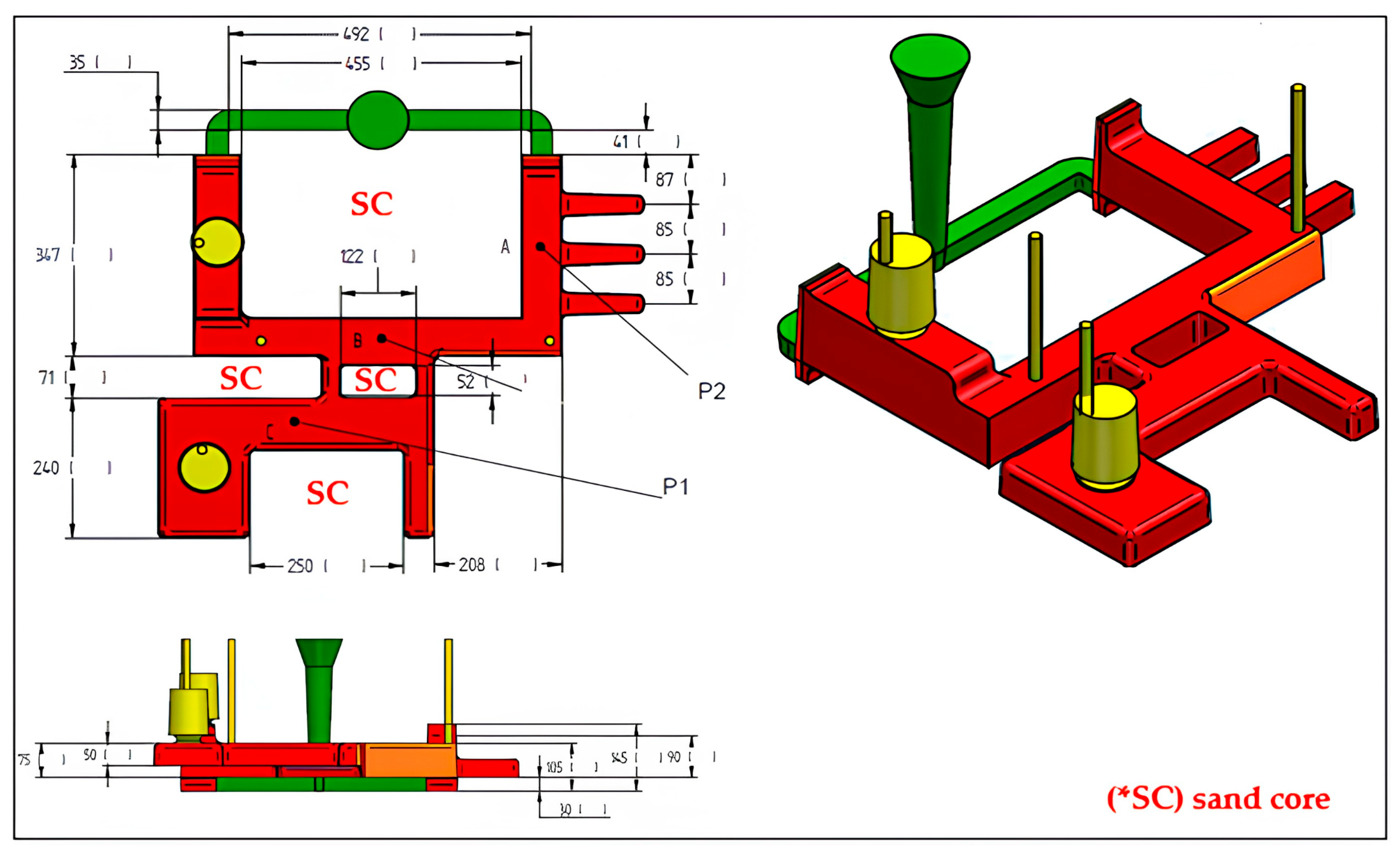
Furthermore, Figure 1 below shows the stress lattice casting geometry “pattern” in GCW conditions of the experimental and/or special casting component. The stress lattice casting component was designed for complete and sound-stressed casting of the HCWCI alloy for RS measurement purposes. As seen in the 3D casting design in Figure 1, the section thicknesses of the RS sections, particularly P1 and P2, are not uniform in volume due to varying casting section dimensions. As a result, the P2 stress region has a thick portion and the RS region at P1 has a lower volume of iron than the P2 stress region. Additionally, Figure 1 shows how the green-colored gating system mechanism keeps the casting from relaxing and limits its movement in as-cast conditions once the casting process is complete. It should be noted that ceramic materials were used in the gating system’s molding process, including ceramic filters for trapping casting inclusions during the casting process. The employment of feeders (yellow in color) at the P1 casting section close to the P1 RS point supports the conclusion that the P1 RS region is thinner than that of P2.
Exothermic sleeves and Foseco-12/15 BSA inserts (yellow necking area) were used throughout the molding process to make it easier to separate the feeding system from the casting component and to facilitate feeding during solidification. Since special casting design presents asymmetrical shapes, as shown in Figure 1, the cooling of special stress lattice castings is irregular. The determination of the design stress lattice shape is that of contraction of the interior and external sections of the cast component, which are highly restricted due to various sand core (SC) “known as core” sizes and sand mold through cooling processes, as shown in Figure 1. Additionally, irregular cooling of the stressed lattice casting leads to various temperature gradients due to various casting section thicknesses. The cores and mold further impose a higher degree of restraint towards the casting during solidification and cooling and thus casting components are released, i.e., the casting shakeout process from the sand mold with RS distribution. It should be mentioned that reclaimed silica (SiO2) sand was used in the chemical-bonded sand-molding technique. Thus, a better RS prediction and understanding from GCW to NCW conditions can lead to more accurate life assessments, better manufacturing process designs, and improved component reliability [70]. In addition, Figure 2 below illustrates the experimental castings, such as S/A and S/B stress lattice casting components during solidification and cooling processes.
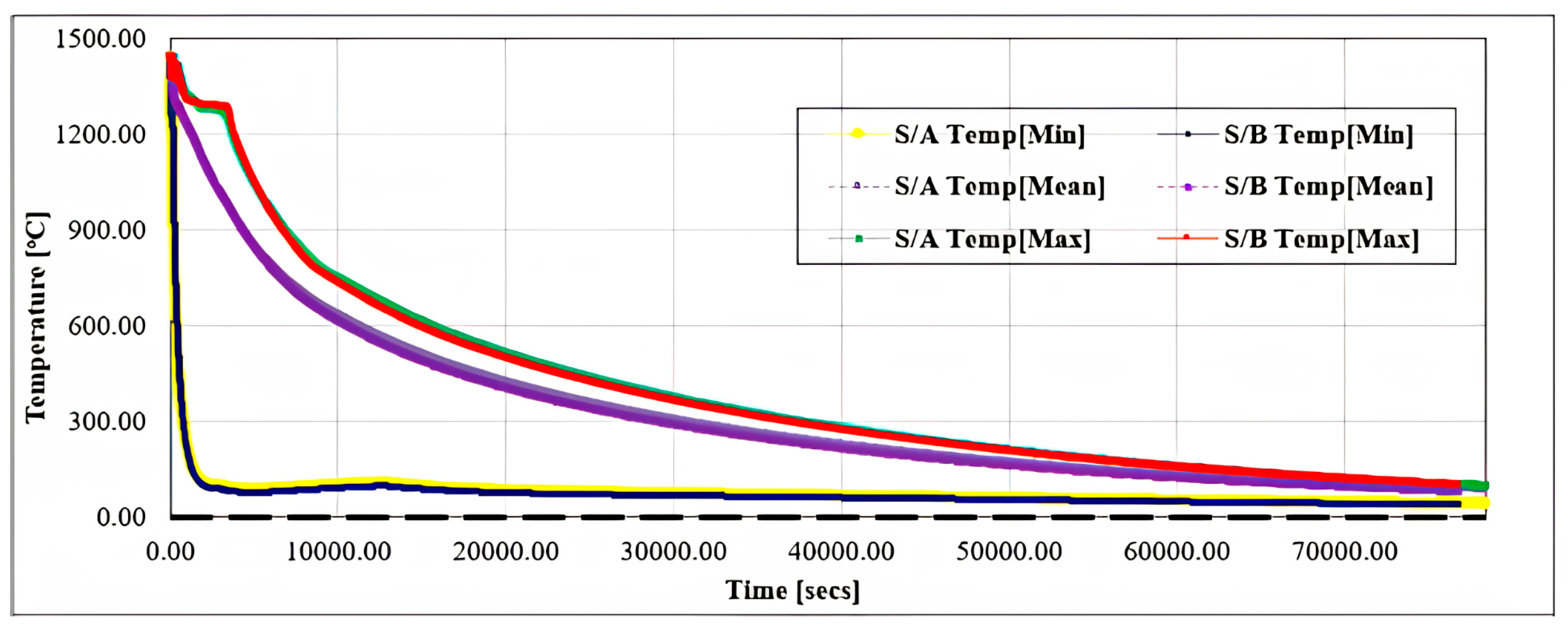
The simulation process was performed to calculate the casting process time and the solidification and cooling processes of experimental casting as shown in Figure 1. Magma 5.4.2 was used to model the temperature changes of stress-lattice castings during the casting process over time. The simulation includes the feeding and gating system and vents by simulating the solidification process before removing casting appurtenances. The stress-lattice casting temperature profiles presented in Figure 2 are presented in three variations: minimum (min), mean (mean), and maximum (max) temperatures, respectively. S/A stress-lattice casting temperature profiles for min, mean, and max are presented as yellow, turquoise, and green in color, respectively. The S/B stress-lattice casting component’s temperature profiles are presented as dark blue, purple, and red in color for the min, mean, and max temperatures, respectively. It is observable in Figure 2 that the S/B temperature profile shows lower solidification and cooling rates compared to S/A. Thus, Figure 2 reveals that the temperature gradient under GCW on S/B is lower than the temperature gradients of S/A stress-lattice casting. However, during the initial stages of solidification and cooling, S/B stress-lattice temperature gradients are much higher than the S/A stress-lattice casting component, while after the initial stages, S/B stress-lattice casting component temperature gradients become lower than S/A stress-lattice casting component in the GCW conditions.
It is further observed in Figure 2 that after the initial stages of the solidification and cooling processes, the temperature gradients of both stress-lattice casting components are similar, with slight variations. The thermophysical properties of this 25%Cr alloy were defined in Magma 5.4.2 based on the thermomechanical characteristics. These properties were first computed using mechanical and thermophysical software, such as Java-based Materials Properties (JMATPro, Version 11.0), and then measured using thermophysical property measuring devices. After that, they certified each alloy using forty-eight tensile test samples. Test bars were pulled at various temperatures and strain rates to get the required creep properties. Additionally, Ms-temperature is highly reliant on the quenching method, where martensite finish (Mf)-temperature values are comparable for the chosen chilling parameters, according to research by Tupaj et al. [14]. Nevertheless, the results of the research study on the impact of the quenching technique on Ms and Mf-temperatures are missing from the technical literature on the subject, despite the fact that this information is essential for producing thermal treatment schedules that ensure the transformation of supercooled γ-Fe into α-Fe is complete and does not result in excessive quenching RSs and hardening cracks. Using Trzaska’s [71] empirical formula, which is stated in Equation (5) below, the values of Ms-temperature were estimated in this study based on the chemical analysis displayed in Table 2.
Ms (°C) = 541 − 401%C − 36%Mn − 10.5%Si − 14%Cr − 18%Ni − 17%Mo
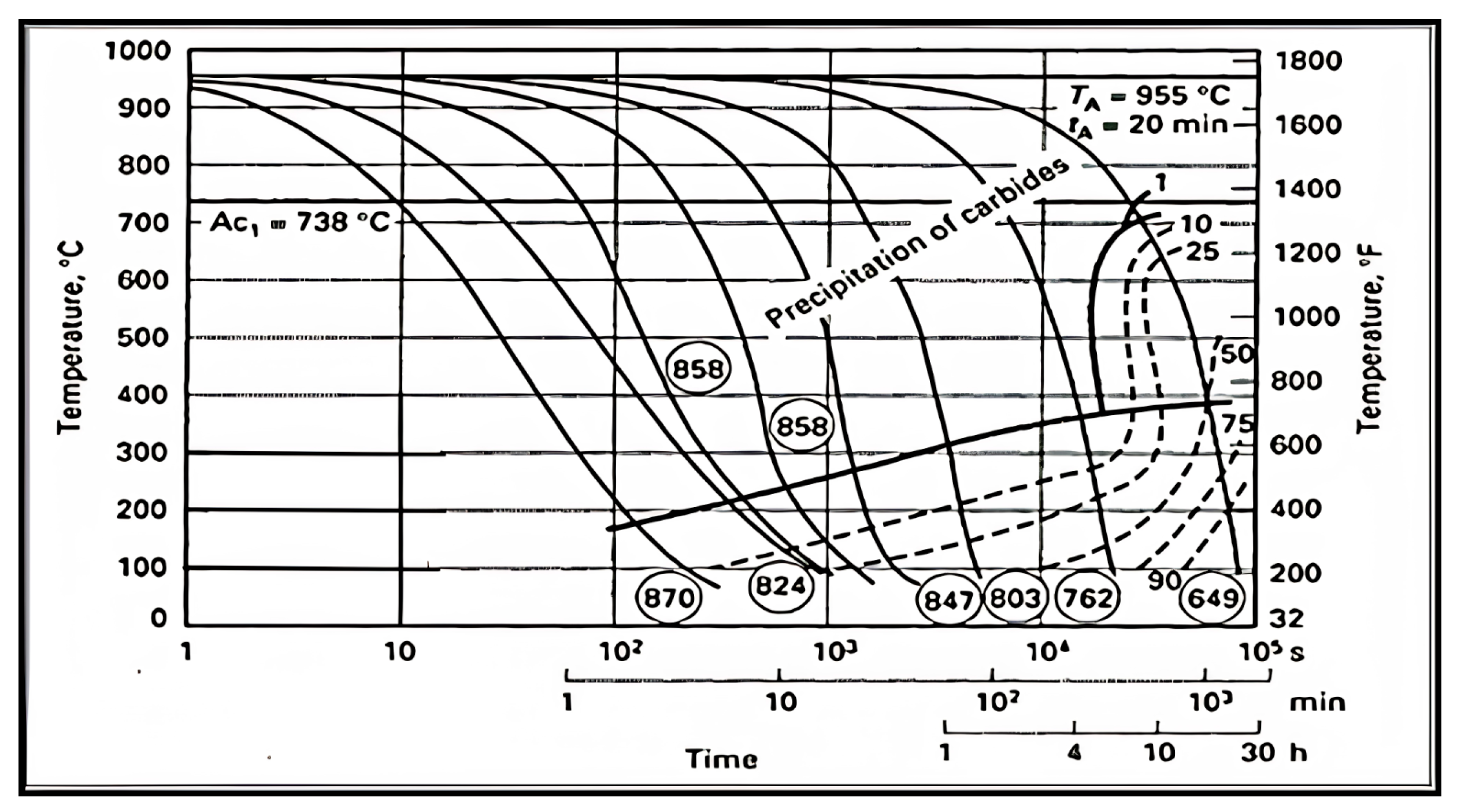
For experimental irons S/A and S/B, the Ms-temperature values were roughly 527 °C and 526 °C, respectively, suggesting that alloying elements (C and Cr) had a substantial impact. The continuous cooling temperature (CCT) diagram for an HCWCI alloy shown in Figure 3 below highlights the significance of cooling rates on microstructure by displaying several transformation curves throughout cooling. Achieving the appropriate mechanical characteristics requires optimizing alloy compositions and cooling techniques. However, because CST-related phase transformations take place below Ms-temperatures, there is little fluctuation in the RS distribution with respect to CCT and phase changes.
According to the CCT diagram shown in Figure 3 and the computed Ms-temperatures, CST at temperatures below 180 °C has a minor effect on the transformation of the metallic matrix to create RS distributions within the experimental casting components. This suggests that the final microstructure is mostly unaffected by the CCT diagram during the solidification and cooling conditions of the experimental castings, particularly in terms of RS distributions. Further research may be necessary to investigate other factors, such as different CSTs, that could impact on the mechanical properties, especially on the RS distributions of the finished product. There is no discernible consequence because both irons’ Ms-temperatures are below 527 °C, according to the CCT diagram.

2.2. Experimental Procedures

2.2.1. Chemical Evaluation

The chemical composition of the liquid iron during the melting process before casting was accomplished by means of chill-cast molds, such as a permanent mold. During the melting process, a sample from the liquid iron from the induction furnace was taken out and cast into a chill-cast mold, resulting in cast sample ingots, i.e., casting coupons. The sample preparation was performed using the general standard procedure for grinding casting coupons flat using 60-grit paper. The optical emission spectrometer (OES), a Specromaxx-type of spectrometer, was used to perform the chemical analysis. Before the actual chemical analysis of the casting coupons was analyzed, the OES was calibrated by running known HCWCI standard samples. Thus, chemical analysis of the liquid iron was validated through performing chemical analysis of the casting components after casting shakeout and knockout, respectively. Thus, more than three tests were performed, and an average was recorded.

2.2.2. Microstructural Evaluation

The removal of the HCWCI coupons from the experimental casting components shown in Figure 1 for microstructural examination was performed. The as-cast casting components were sectioned using an electric discharge machine (EDM), sometimes referred to as a wire-cut machine (WCM), for metallographic examination with an optical light microscope (OLM). This was accomplished to expose different metal phases in HCWCI alloys at lower and higher magnifications, such as 3, 6, and 9× magnification, while only higher-magnification images are shown in this report. Thus, two casting coupons were etched using 5% Nital, Murakami, and Groesberg etchants to reveal the metallic matrix and color eutectic and secondary carbides, such as M7C3 and M23C6-types, and then were rinsed with alcohol. The casting coupons were cold mounted with catalysts and resin before etching. The coupons were then polished and ground before being etched at room temperature. In addition, the scanning electron microscope (SEM) measurements were carried out using the Tescan Vega 3 LMH (TESCAN, Brno, Czech Republic) at an accelerating voltage of 20 Kilovolts (kV). However, after the final 0.5 mm (mm) polishing step, metallographic investigations utilizing electron backscattered diffraction (EBSD) were carried out using an oxide polishing solution (OPS) suspension at 1500× magnification. For electrolytic polishing, an electrolyte consisting of approximately 78 milliliters (ml) of perchloric acid and 90 mL of distilled water (H2O) was used. While improving surface smoothness for diffraction measurements such as an X-ray diffractometer (XRD), the coupons were polished for 30 s (sec) using a 5% perchloric acid alcohol solution at a voltage of 35 volts (V) direct current (DC). A Bruker D8 advance diffractometer equipped with a CoKα-ray source was used to perform XRD analysis, scanning from 40 to 100° 2-theta in Bragg-Brentano geometry at a 0.2–2 theta step size. Rietveld refinements were carried out in TOPAS utilizing ICSD database data, and measurements were made using a linear PSD detector (Bruker Lynxeye, Bruker AXS GmbH, Karlsruhe, Germany) at an angle of 3.7°.

2.2.3. Hardness Evaluation

Macrohardness, i.e., the bulk hardness measurement of the castings, was performed at ambient temperatures using a Brinell hardness tester machine. Random casting areas were selected for grinding before the hardness test measurement. A load of 750 kg was used, as was a Brinell hardness tester with a dwell time of 30 s; the average of the five indentation measurements made on each sample is shown in this study.

2.2.4. Residual Stress Measurements Evaluation

The HDM, i.e., the SINT Technology RESTAN MTS-3000 RS measuring device (SINT Technology, Calenzano, Italy), was used to measure RSs using the hole-drilling strain-gauge (HDSG) method of stress-reduction technique. The HDM uses ASTM standard E837, which depends on stress comparison when a hole is drilled at the midpoint of a rosette SG. Furthermore, the casting geometry for RS regions was provided in Figure 1, and the properties of iron and the RS measurement process are related to strain relaxation recorded at two dissimilar surfaces, P1 and P2, as shown in Figure 4 below. The elastic properties of HCWCIs used for RS calculation were approximately 216 GPa and 0.291 for Young’s modulus and Poisson’s coefficient, respectively. Thus, the HDM measures the direction and the magnitude of the principal stresses, i.e., maximum (σmax.) and minimum (σmin.), and the measurement was performed at ambient temperatures. The HDM procedure is simple and is summarized in seven uncomplicated steps. For more information on the HDM procedure preparation, the following publications are recommended [15,73,74,75,76,77,78,79]. Thus, RS measurement was computed by means of strain data and formulas cited in ASTM E837-08. Additionally, HDM is another name for the IHD process and produces tiny holes, specifically 1.8 mm in diameter and 2.0 mm in depth. Hence, it was favored for this study as a semi-destructive method for assessing RS because it is dependable, economical, and does little damage. In complicated field situations where non-destructive techniques might not be suitable, it enables rapid evaluations of component integrity.
When combined with well-established experimental procedures, HDM’s capacity to provide depth profiling of RS distribution within component thickness makes it a standardized option in the industry, balancing cost, speed, and acceptable damage while remaining less expensive and faster than more accurate non-destructive methods [28,30,36,37,50,57,58,59,61,63,69,73,74,78]. In addition, HDM is the most recommended measuring technique for coarse grain alloys, such as HCWCI alloys. The procedure consists of two primary steps: sample preparation, which includes installing an SG rosette, and drilling to release stresses for measurement. Furthermore, recovery is very likely after the removal of a modest amount of debris. As a result, the harm to the components that are being evaluated is typically well tolerated. The sign, value, and direction of RSs at P1 and P2 are provided along the drilling depth with this assessment technology. The directional results are only given on a 2D plane that is parallel to the glued SG rosette, even though RS is a spatial specification. 90° angles were employed in a standard SG rosette. The biaxial, or σxx, σyy, and τxy RS state, which denotes radial, hoop, and shear stresses, is reliably displayed due to the precise location and orientation of three linear SGs. The drilling tool’s diameter largely determines the maximum depth that is practical. This research study involves drilling a hole with a diameter of approximately 1.8 mm and reaching a depth of approximately 1.0 mm, with an increment of 0.02 mm. Thus, three procedures needed to be applied to the SG rosette and are as follows: surface preparation, SG bonding, and circuit connection.
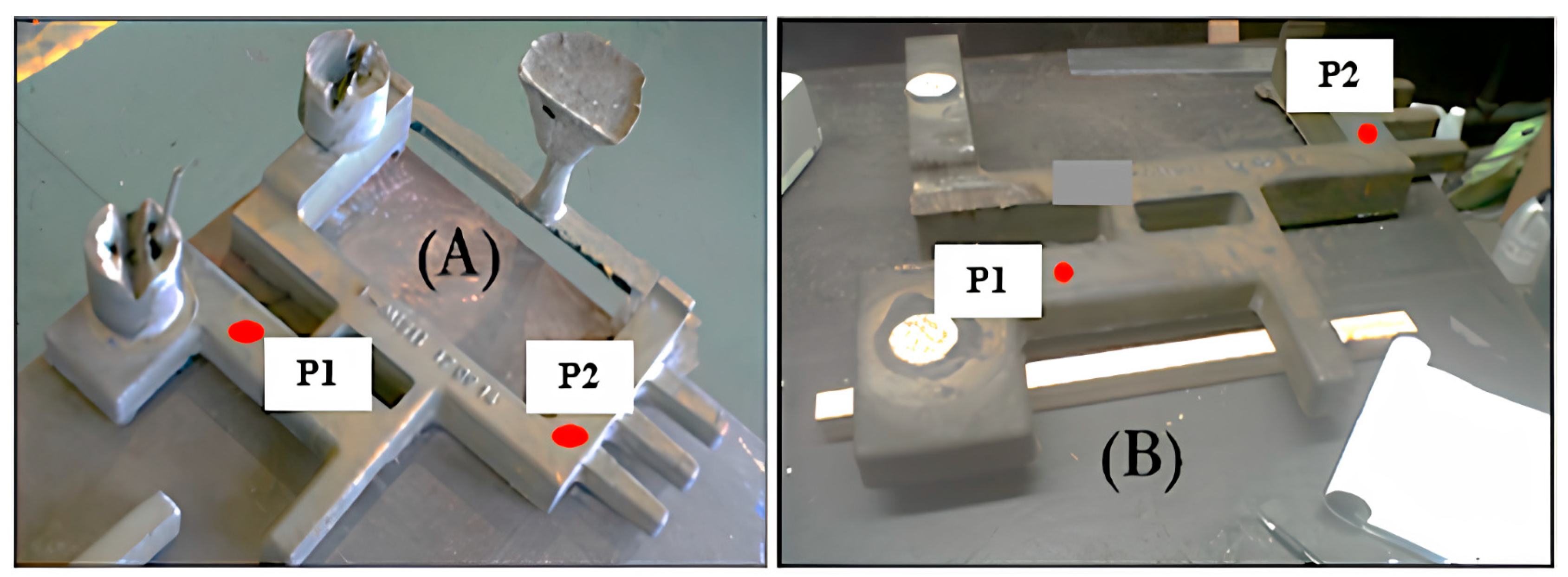
To eliminate any oxides and oils, surface preparation often entails reducing the surface debris at and around the measurement location, P1 and P2, as shown in Figure 1 and Figure 4, using a chlorinated hydrocarbon solvent. After that, an ammonia-based solution was used to neutralize the surface. Additionally, to provide more precise results, the casting surface skin at P1 and P2 was slightly polished. A smooth surface ensures tight contact with the SG, allowing for precise surface deformation detection even while mechanical polishing results in some prerelease of locked-in stresses. However, to retain as much stress as possible, it is always preferable to reduce the quantity of material polished away. For example, a plate-like sample is considered acceptable if its polished thickness is up to one-tenth. Furthermore, Figure 4 shows experimental special stress-lattice castings in GCW (Figure 4A) and NCW (Figure 4B), respectively, in the as-cast condition. Four RS measurements were performed on experimental irons: two RS measurements at P1 and P2 under GCW conditions, and another two RS measurements at P1 and P2 under NCW conditions in the as-cast state, as shown in Figure 4.
Drill-bit cutters coated at the tip and/or end mills with tungsten (W) carbide material, operated at a speed of approximately 300,000 rpm using an air turbine, were used to avoid generating any RSs due to the drilling technique applied to the iron. Thus, awareness of the extent and distribution of RSs is critically important to ensure the safety of operations during material application. The drawback of IHD is that it necessitates a reasonably level, horizontal, three-legged standing drilling configuration, good surface smoothness, and a maximum one-dimensional curvature for SG installation at the evaluation points, i.e., P1 and P2. It should be noted that the current standard for computing RS distributions is ASTM E837-20. The previous standard was ASTM E837-08. ASTM E837-08 was used since the RS stress laboratory was accredited at the time the research study was accomplished. The use of the outdated method to calculate RS distribution was further encouraged by earlier research study data and adherence to older software. Therefore, the current standard, ASTM E837-20, improves the HDSG method for computing RS distributions, beginning with an updated coefficient for intermediate thicknesses and non-uniform stress gradients. If the 2008 version of the ASTM E837-20 integral technique was used, the revised coefficients are typically not provided.

3. Results and Discussion

3.1. Chemical Analysis

OES was used to examine the chemical composition of prepared experimental alloys with high-Cr iron coupons of hypoeutectic composition in cross-sectional areas, and the results are reported in Table 2 below. It is shown in Table 2 that the actual chemical composition of the experimental alloys agrees with ASTM A532, Type A, Class III, 25%Cr. In addition, phosphorus (P) in the S/B iron is slightly out of specification, i.e., 0.01 wt% P compared to the recommended concentration in the ASTM A532, Type A, Class III material standard. However, 0.01 wt% P is a small amount and can be disregarded, since P is a trace element; thus, there will not be any effect due to this excess amount. Trace elements are normally those elements or elementary impurities that are detected within alloys but do not have any impact or effect on the iron.
The chemical composition of S/A and S/B irons substantiates that they are those of the hypoeutectic composition of the HCWCI alloy. As estimated from Equation (3), the computed CVF of the experimental castings, i.e., S/A and S/B irons, is approximately 28.87 and 32.20%CVF, respectively, of eutectic carbide type, i.e., M7C3 plus secondary carbides, such as the M23C6 carbide type [8,10,11,15,19]. Furthermore, the volume fraction of the matrix, i.e., γ-Fe plus α-Fe, is computed using Equation (4) and is approximately 71.13% and 67.81% in S/A and S/B irons of the HCWCI alloy, respectively. It should be noted that Cr/C ratios of S/A and S/B irons are computed as 9.64 and 9.50, respectively. According to Tupaj et al. [14], pearlite transformation is not possible since the Cr/C ratios of experimental alloys are greater than 6.5, as presented in Table 2, with computed values of approximately 9.64 and 9.50 for S/A and S/B irons, respectively. Thus, the resultant metallic matrix constitutes the maximum and minimum volume fractions of γ-Fe and α-Fe, respectively [80,81].

3.2. Microstructural Analysis

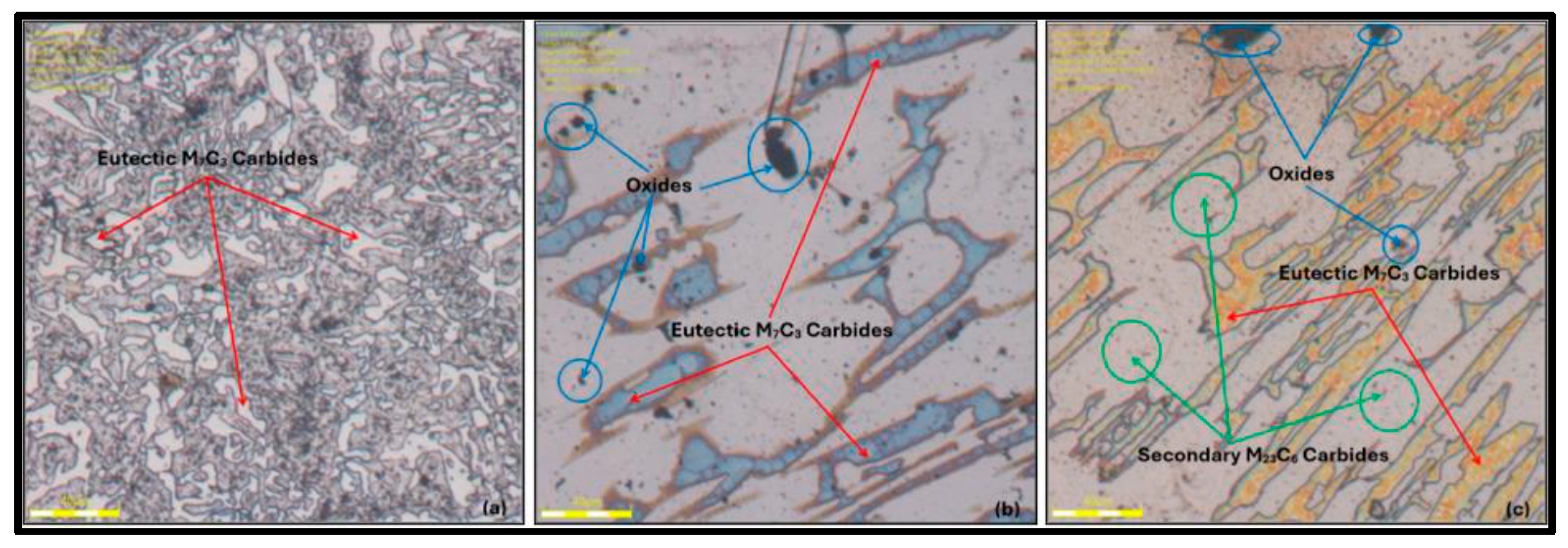
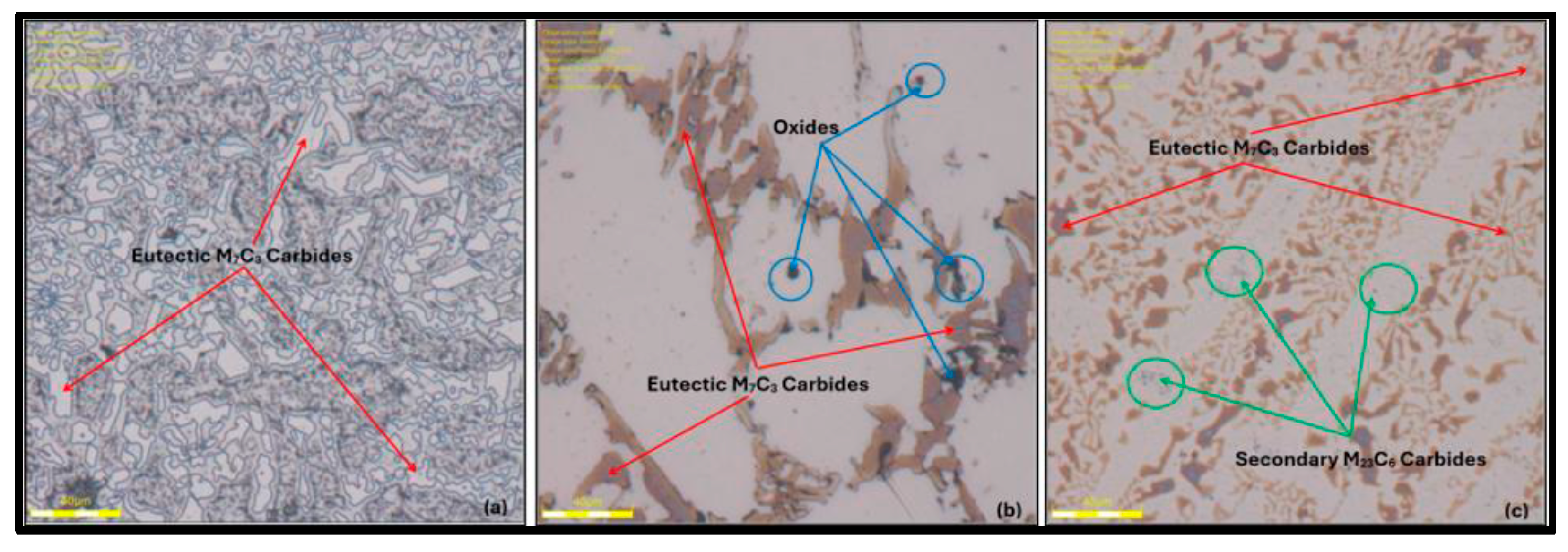
Etched samples of experimental high-Cr irons of S/A and S/B are presented in Figure 5 and Figure 6, respectively, below. The casting coupons were etched with 5% Nital, Murakami, and Groesberg etchants. Both Figure 5 and Figure 6 illustrate a fully austenitic matrix at 9× magnification, as shown in Figure 5a and Figure 6a, while eutectic M7C3-type examples (whitish and/or greyish in color and red arrows) are outlined [8,12,15,26]. In addition, the martensitic matrix is revealed as darkish outline “periphery” areas within the austenitic matrix. The martensitic matrix is situated within the eutectic carbide periphery. Hence, the martensitic matrix is revealed as an austenitic-martensitic matrix [8,10,13,15]. Eutectic carbides are revealed in Figure 5b,c and Figure 6b,c at 9× magnification. The eutectic M7C3 and secondary M23C6 carbides are shown in green and green circles in Figure 5b,c and Figure 6b,c, respectively, with casting samples etched with Murakami and Groesberg etchants, respectively. Secondary M23C6-type carbides are revealed as very tiny and/or fine precipitates within the matrix of γ-Fe. According to Li et al. [70], phase transition kinetics models, such as Jung’s critical transformation, have been improved in recent years by researchers, increasing the precision of microstructure field estimates. Thus, gradient RS fields are usually produced within the components by the combination of heat gradients and high volumetric expansion brought on by martensitic transformation. Furthermore, oxide inclusions, specifically metal and/or nonmetallic oxides, were established and are revealed clearly in Figure 5b,c and Figure 6b,c, respectively, where they are shown in blue circles within the microstructural images.
In HCWCI alloys, metal oxide inclusions are frequently inadvertent contaminants or flaws caused by oxidation during melting and casting. Because they can form bi-films—specifically, double oxide layers and/or complex non-metallic inclusions that can drastically lower the material’s toughness—these inclusions are crucial to regulate. Hence, ceramic filters were added to the runner system during the molding process to reduce oxide inclusions in the casting component. The oxidation of alloying elements in the liquid metal, such as Cr, silicon (Si), etc., results in the creation of oxides that can be forced into the crystallization front during the solidification and cooling processes, which is the main cause of these metallic oxide inclusions within the material [82]. Furthermore, a martensitic matrix is established due to the eutectic precipitation of eutectic constituents and the precipitation of eutectic carbides that lessen and increase the C and Cr content of the matrix, respectively. The lessening of C content within the matrix leads to the Ms-temperature moving above room temperature, resulting in the transformation of γ-Fe to α-Fe during solidification and cooling conditions [9,10,13,15].
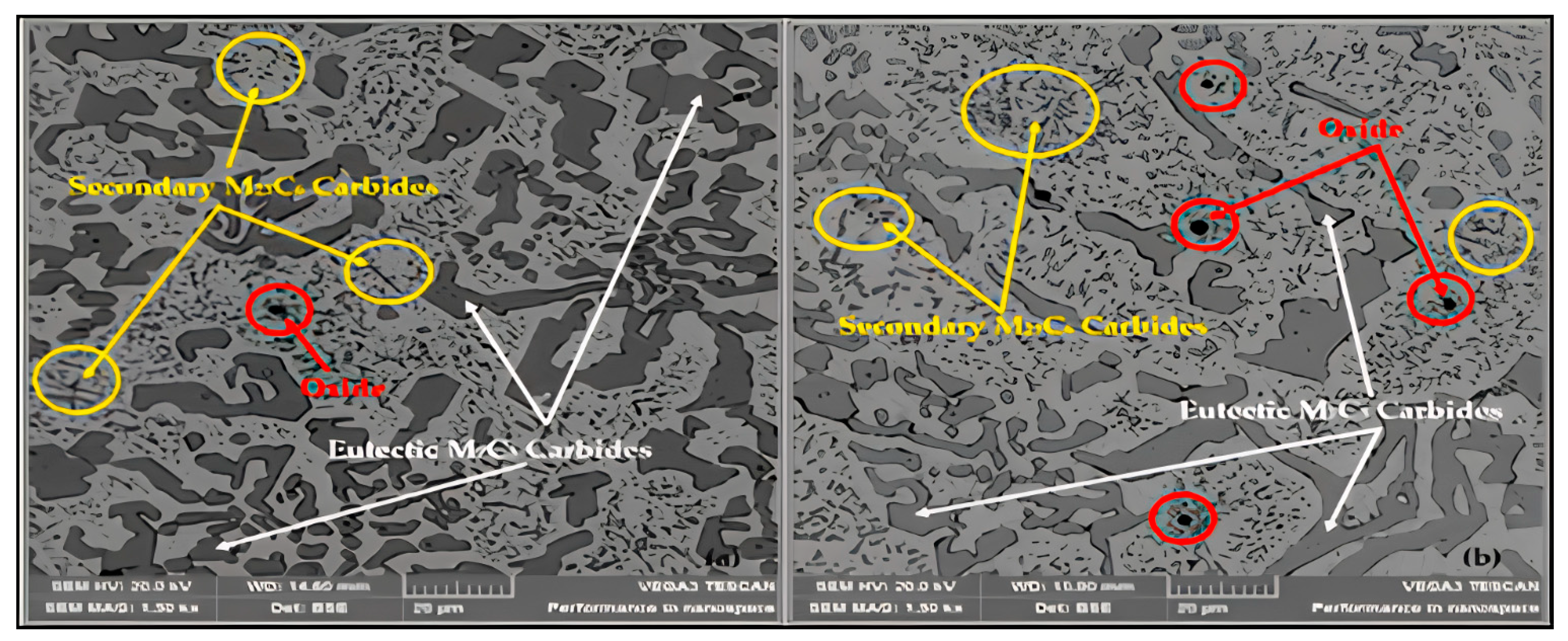
Thus, the resultant microstructural evaluation shows proeutectic γ-Fe and eutectic constituents, such as γ-Fe plus M7C3, including transformed α-Fe, in the as-cast condition, as illustrated in Figure 5 and Figure 6. Secondary M23C6-type carbide is further revealed in the experimental irons of HCWCI alloys, as shown in Figure 5c and Figure 6c, respectively. The Liron presented in Equation (2), with a higher Cr content and a lower C content, precipitates these fine forms of carbides, known as secondary M23C6-type carbide precipitates, within 25% Cr irons as contrasted to 12% Cr irons during the eutectic reaction [1,5,14,15]. Compared to the eutectic M7C3-type carbide, which often begins before the precipitation of secondary M23C6-type carbides, there is a lower content of secondary M23C6-type carbides in the as-cast condition as compared to eutectic M7C3-type carbides because the precipitation happens later in the cooling process. Hence, the observed microstructural constituents in the 25% Cr irons of the HCWCI alloys consist of proeutectic γ-Fe, transformed α-Fe, eutectic constituent—consisting of M7C3 plus γ-Fe—and secondary M23C6-type carbides in the experimental S/A and S/B irons. Additionally, Figure 7 and Figure 8 below show SEM micrographs and the XRD analysis, respectively. In Figure 7, oxide (black dots) inclusions are indicated by red circles, while eutectic M7C3 and secondary M23C6-type carbides are shown by white and yellow circles, respectively. Additionally, it is observed that eutectic M7C3-type carbides are long rods with a blade-like morphology that form as a continuous network inside a totally austenitic matrix, which is revealed as greyish in color in Figure 7, while secondary M23C6-type carbides are fine precipitates.
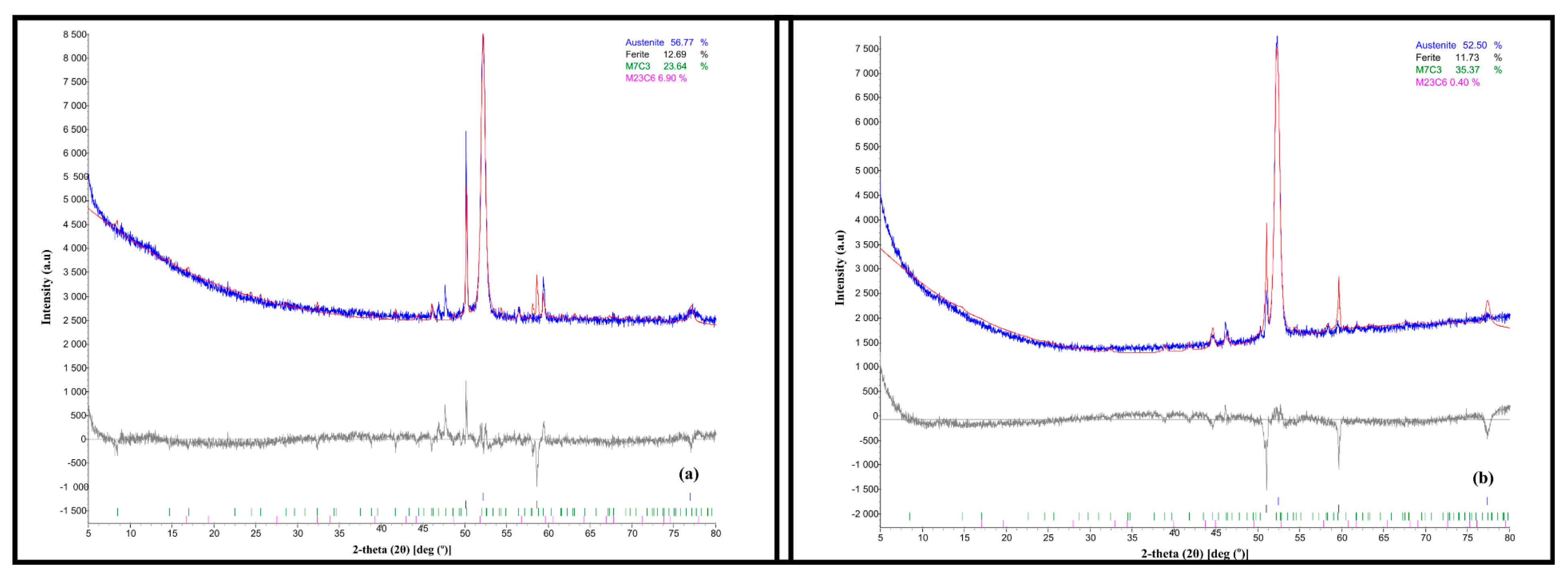
Figure 8 displays the XRD patterns of as-cast S/A and S/B irons. The γ-Fe, α-Fe “ferrite”, eutectic M7C3, and secondary M23C6-type carbides were the crystalline phases present. Compared to S/B iron (52.50%), γ-Fe peaks in S/A iron (56.76%) are the highest. However, S/A iron has lower eutectic M7C3-type carbide peaks (23.64%) than S/B iron (35.37%). S/A and S/B irons of the HCWCI casting specimens show γ-Fe and eutectic M7C3-type carbide peaks because of the hypoeutectic iron solidification path.
The small but not insignificant presence of ferrite “martensite” phases in S/A iron (12.69%) and S/B iron (11.73%) is confirmed by XRD analysis, as shown in Figure 8. Furthermore, secondary M23C6-type carbide peaks in the S/A and S/B irons were found to be 6.90% and 0.40%, respectively. It should be noted that α-Fe is read as ferrite by XRD analysis. Owing to the experimental irons’ greater Cr/C ratios, the S/A and S/B irons were calculated at roughly 9.64 and 9.50. Because of these increased Cr/C ratios in these experimental irons, no ferrite transition can be established. High Cr/C ratios, high Mo and Ni concentrations, and a quick rate of cooling during solidification typically favor an austenitic matrix. According to Nayak et al. [83] and Tupaj et al. [14], the bulk Mo composition and the Cr/C ratios are related to γ-Fe decomposition during the cooling of the HCWCI alloys alloyed with 0.4 wt% Mo, whereas the necessary Cr/C ratios should be approximately 6.5 to prevent γ-Fe decomposition. According to Ngqase & Pan [13], it is challenging to distinguish between phases like M3C, M6C, M23C6, etc., because of significant peak overlap. It should be noted that the same identification limits do not rule out the potential for α-Fe and/or γ-Fe occurrences. Residual γ-Fe from liquid iron can transition to α-Fe during eutectic because the iron’s Ms-temperature is above room temperature [1,2,5,6,7,14]. The XRD analysis agrees with phases found by OLM and SEM investigations.

3.3. Hardness Analysis

Hardness measurements of S/A and S/B irons of HCWCI alloys were found to be approximately 526 and 600 Brinell hardness number (BHN), respectively, compared to 450 BHN for ASTM A532, Type A, Class III material standard, i.e., 25% Cr irons [8,12,13,15,80,81]. The hardness values obtained are higher than the hardness values presented in ASTM A532, i.e., hardness requirements. The higher hardness values are due to 60 °C and 180 °C CSTs on S/A and S/B irons, respectively, coupled with higher values of %CVF, as was computed in Table 1 and shown in Figure 8. This has resulted in an increase in hardness, which is influenced by a computed higher CVF (28.87 to 32.20%) and measured XRD values of roughly 30.54% to 35.77% CVF of the total Cr-rich carbides, i.e., the M7C3/(Cr, Fe)7C3 and M23C6/(Cr, Fe)23C6-type carbides within the experimental irons’ structural composition [11,84,85]. It should be mentioned that the measured and computed CVF values differ: XRD analysis uses equipment to measure and estimate an overall CVF content, whereas the computed value assumes every carbide in the experimental iron. It should be noted that using Equations (3) and (4) for the calculated and measured CVF of the experimental irons of HCWCI alloys yields results consistent with the literature [1,2,3,5,6,8,12,15]. Furthermore, an increase in hardness values from S/A to S/B irons is noticeable in an increase in C and Cr content from 2.5 to 2.7 wt%, 24.09 to 25.65 wt% Cr, and 28.87 to 32.20%CVF, respectively. Seidu et al. [86] established that prolonging CSTs, i.e., knockout times, lessens hardness, thus raising the carbide grain size.
The metallic matrix is reduced from 71.13% (69.49%) to 67.80% (64.23%), as C and Cr content are increased from 2.5 to 2.7 wt% and 24.09 to 25.65 wt% Cr on S/A and S/B irons, respectively. The phase changes brought on by microstructural evolution during the cooling process, such as (1) the matrix depletion of both C and Cr contents, (2) an increase in localized α-Fe formation, and (3) the resulting structures, are the other causes of the hardness increases from S/A (526 BHN) to S/B (600 BHN) iron. Eutectic M7C3-type carbides are formed during solidification. In addition, Cr and C from the surrounding matrix are consumed by these eutectic M7C3-type carbides as they grow. These γ-Fe stabilizing elements are considerably reduced in the matrix in the zones just next to these carbides. The Ms-temperature rises as the γ-Fe transforms at the eutectic M7C3 carbide periphery because its C and Cr content is now lower. As a result, this locally deficient γ-Fe turns into α-Fe with further cooling, as shown in Figure 5, Figure 6, Figure 7 and Figure 8. Hard eutectic M7C3-type carbides, high-hardness α-Fe, and some metastable γ-Fe make up the final as-cast microstructure. The increase in hardness from 450 BHN to 526 and 600 BHN is caused by a larger percentage of the transformed martensitic phase, as was shown in Table 1 and Figure 8. Therefore, chemical composition, particularly the higher Cr/C ratio, contributes to the increase in hardness. First, more α-Fe can form during the casting’s air-cooling process since a greater Cr/C ratio typically increases hardenability. Second, partial precipitation of secondary M23C6 has occurred, further destabilizing the γ-Fe and raising the matrix hardness, i.e., hardenability depending on the cooling rate.
Third and finally, the inclusion of alloying elements such as Mo, Ni, and/or Cu can increase the hardenability and cause the matrix to change from soft pearlite to hard α-Fe. The hardness of S/A and S/B irons is shown to increase from 526 to 600 BHN in the as-cast circumstances, respectively. The localized and/or partial martensitic modification of the matrix through the casting and cooling developments is the other reason for the hardness increase. At the edge of the eutectic M7C3-type carbide particles, the matrix often changes from a soft, metastable austenitic matrix to a tougher, acicular martensitic matrix [1,2,5,6,7,9,10,12]. This specific increase suggests a self-quenching effect, where the alloy composition and cooling rate allow partial martensitic transformation to occur. This is because HCWCI alloys usually have a soft and ductile matrix in the as-cast state, with lower hardness values that harden only upon wear-induced transformation [1,5,6,7,14]. Additionally, higher CSTs, i.e., 60 °C and 180 °C (as summarized in Table 1), combined with reduced metallic matrix content, have contributed to higher hardness values. Fracture toughness and hardness are two characteristics that affect quality during casting. Comprehending the procedure facilitates improvement analysis. Thermal gradients from heat transfer to molds and the surroundings impact the mechanical characteristics of RSs in cast components.

3.4. Residual Stress Analysis

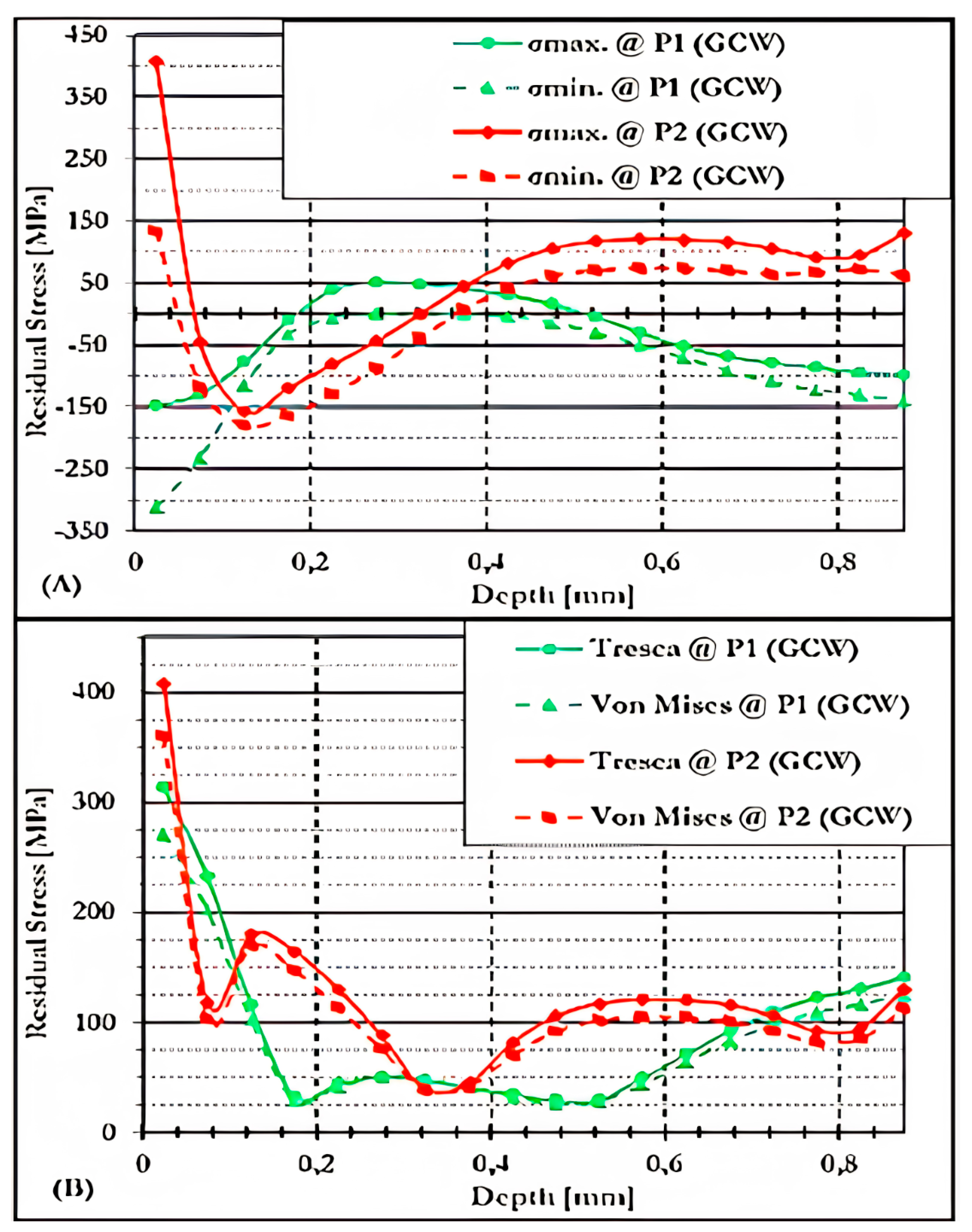
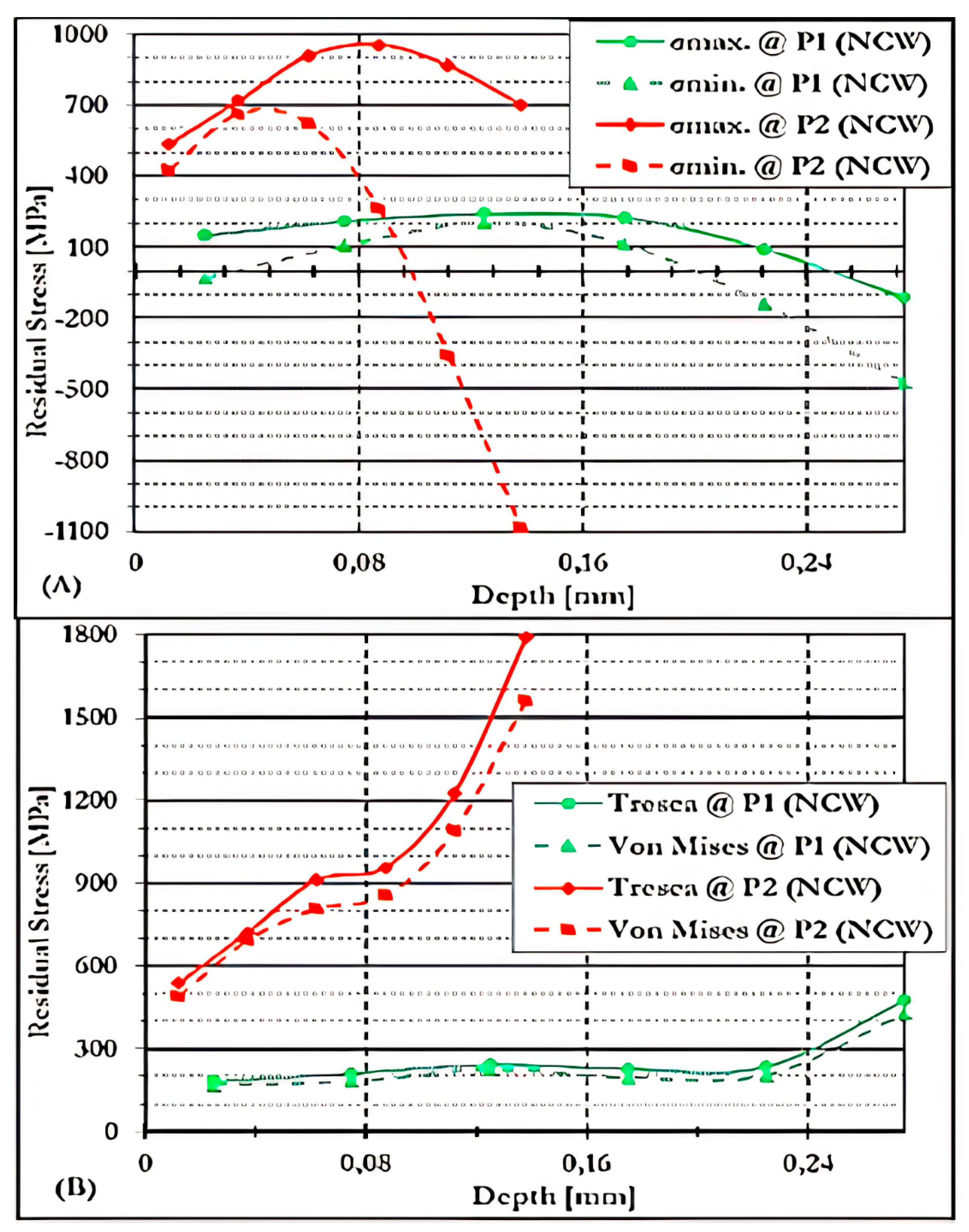
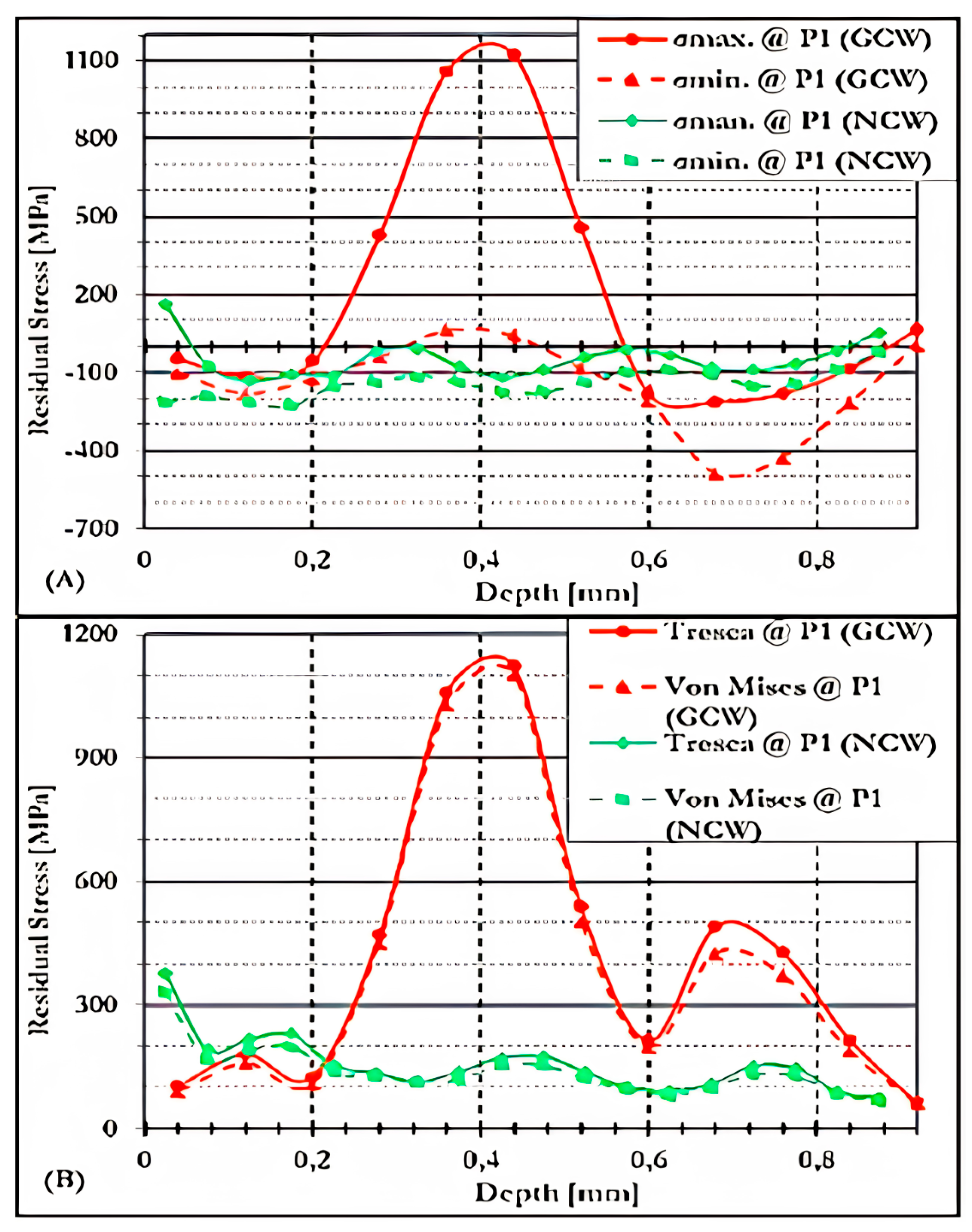
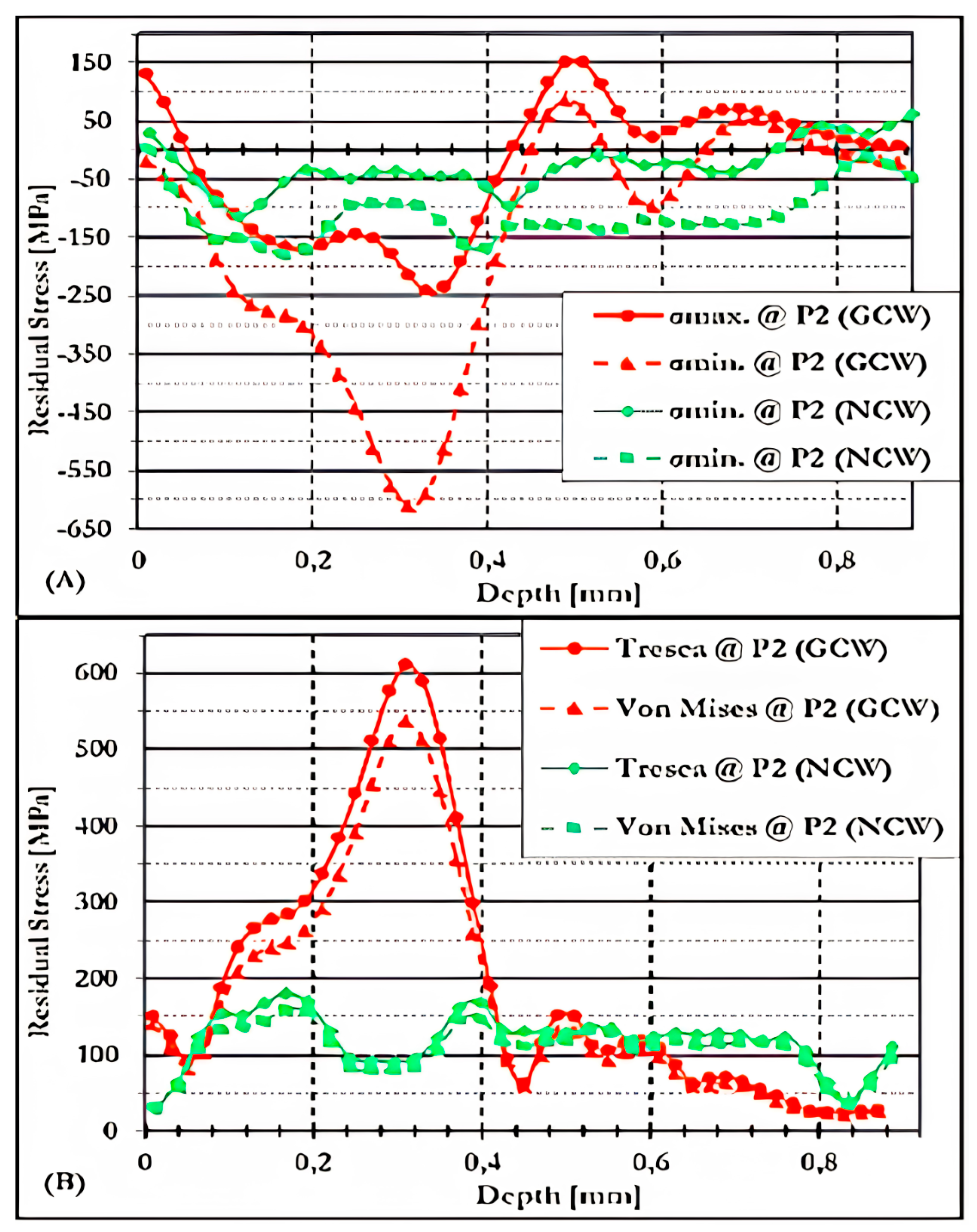
The RSs in cast components are greatly altered by the manufacturing process and by the removal of external loads, such as casting appurtenances from the NCW circumstances. The extent and distribution of these RSs throughout pouring and solidification, cooling, shakeout, and knockout operations have been assessed in laboratory investigations in the as-cast condition of HCWCI alloys. However, RS establishment at different casting temperatures can cause fissures that result in component failures during subsequent application or service. Minimal research has been done on this topic on HCWCI alloys. Furthermore, RS extent and distribution were assessed at various stress locations, i.e., P1 and P2, on experimental castings, as depicted in Figure 4, which shows GCW (Figure 4A) and NCW (Figure 4B) conditions, respectively, in the as-cast condition. As a result, RS values calculated from the HDM-RS measurements are shown in Figures 9–20. IHD entails tracking the strain relaxation caused by tiny holes placed at the casting surfaces of experimental castings made of the HCWCI alloy. These holes have a diameter of approximately 1.8 mm. Three SG rosettes and incremental depth measurements of about 0.02 mm are used in the procedure. Non-uniform through-thickness RS distributions were found using strain-depth relaxation curves, which often had larger magnitudes on the casting material’s surfaces and smaller magnitudes internally. To reduce uncertainty in the RS results, this evaluation used an integral method in conjunction with smoothing techniques, such as Tikhonov regularization. In the thickness direction, specifically the z-direction (σzz), these internal forces are perpendicular to the material’s surface [87].
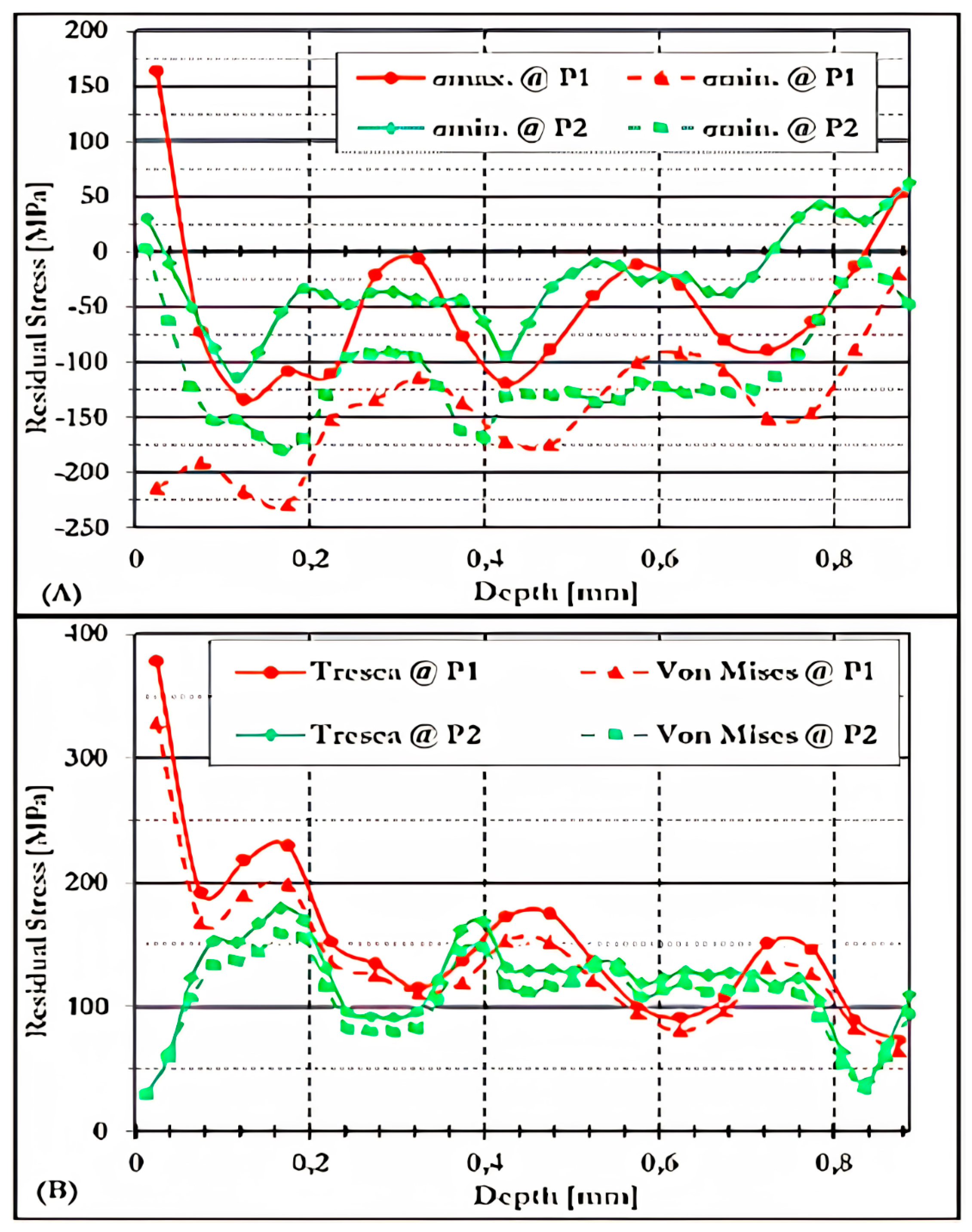
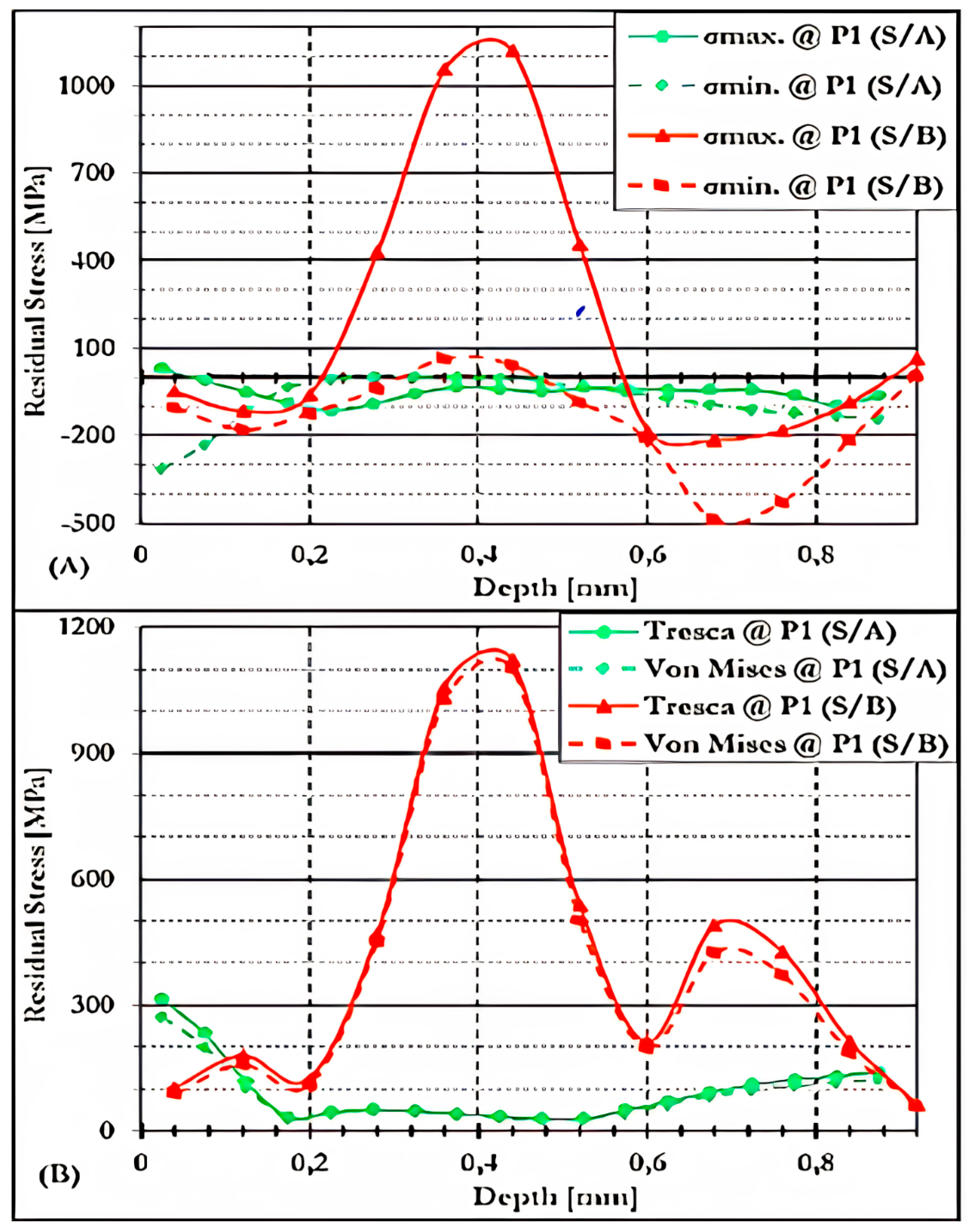
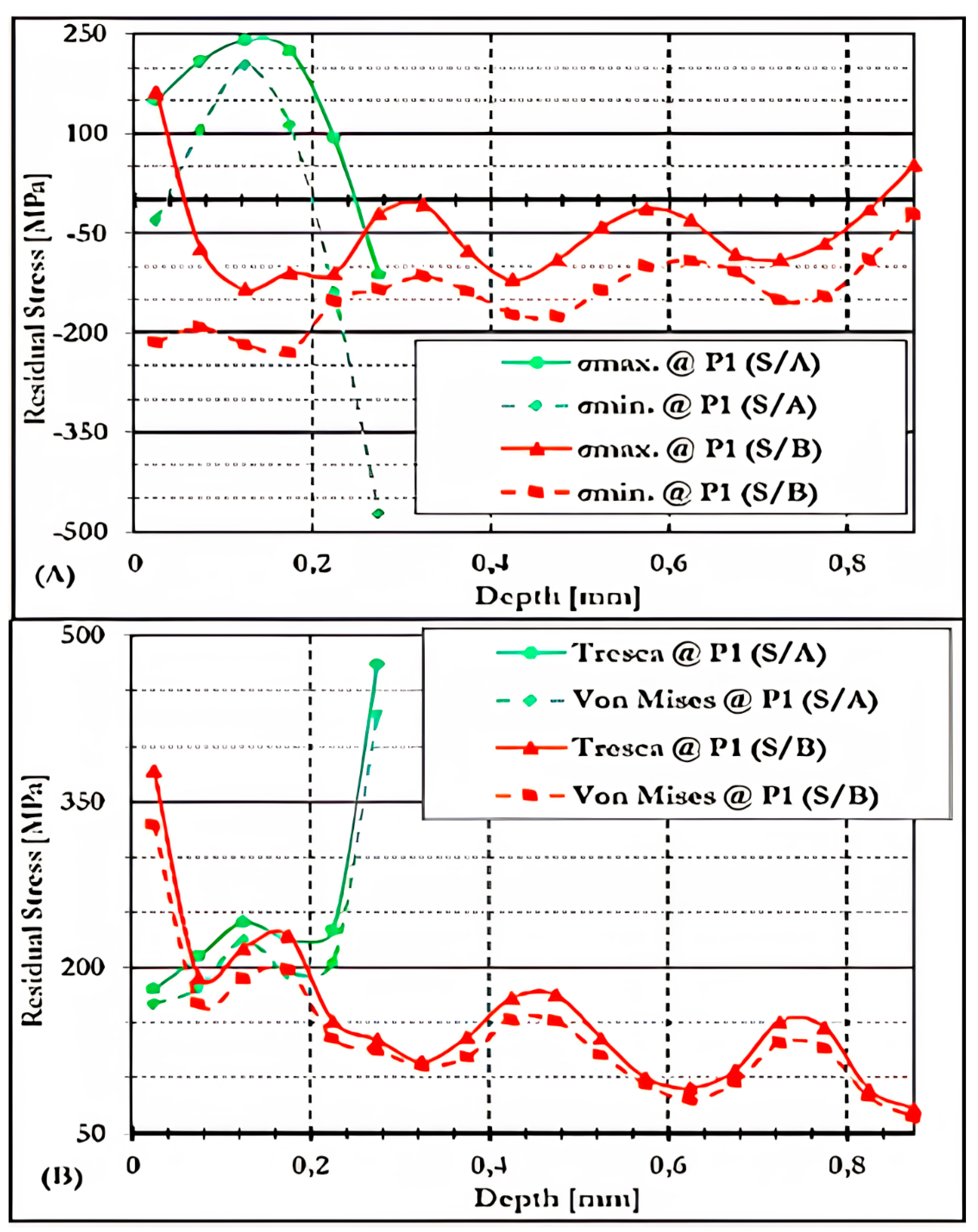
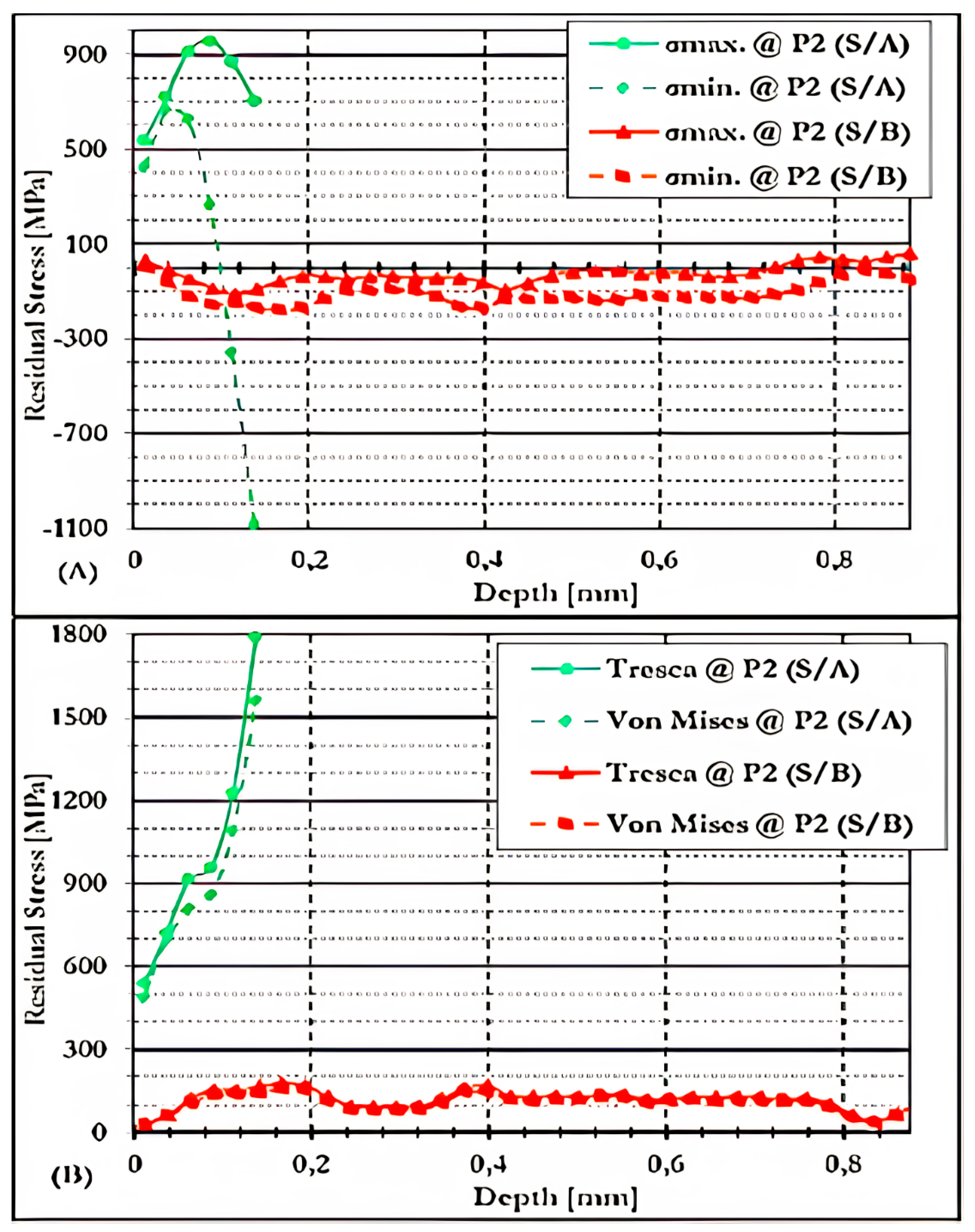
Thus, principal stresses are shown in Figures 9A–20A where the σmin. and σmax. are shown in green and red, respectively, while Tresca and Von Mises stress representations are shown as solid and dashed lines, respectively, in Figures 9B–20B. The viability of the in-situ establishment is confirmed by the evaluation of surface strain responses and corresponding RS in longitudinal and lateral directions relative to σmin. and σmax. principal stresses. This evaluation describes the relationship of principal stresses as a function of casting surface depth (CSD), i.e., z(mm), as shown in both Figures 9A,B–20A,B. It should be noted that the current standard for computing RS distributions is ASTM E837-20, while the previous standard was ASTM E837-08. The previous standard of ASTM E837-08 was used since the RS stress laboratory was accredited at the time the research study was performed. The use of the outdated method to calculate RS distribution was further encouraged by earlier research studies’ data and adherence to older software. Therefore, the current standard, ASTM E837-20, improves the HDSG method for computing RS distributions, beginning with an updated coefficient for intermediate thicknesses and non-uniform stress gradients. When the 2008 version of the ASTM E837-20 integral technique is used, the revised coefficients are typically not provided. Additionally, riser ablation has a major impact on RS reconfiguration in investigations of RS in cast components—typically HCWCI alloys—and often inherits the stress state achieved during the GCW stage [8,15,20,27]. The spreading of RSs in the cast component as a function of impact load indicates the presence of RSs at defect locations near eutectic M7C3-type carbides. Elmquist et al. [20] and Ngqase [15] claim that risers, especially the exothermic sleeves, function as an extra heat source that alters RSs in the vicinity of the risers and affects RSs beneath the risers more than it does in similar locations between risers.

3.4.1. Sample-A (S/A Alloy)

Residual Stresses at P1 Under GCW and NCW Conditions in S/A
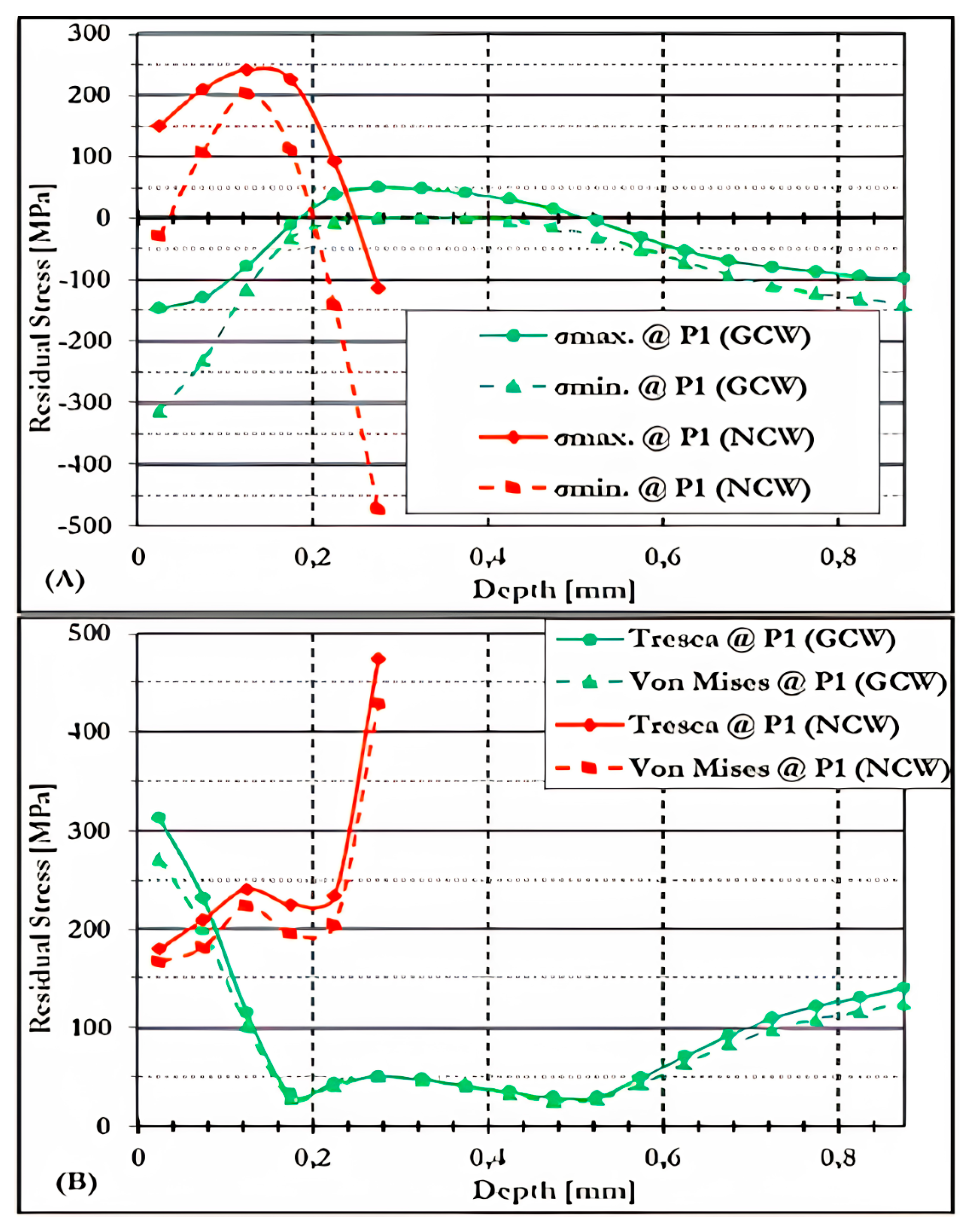
The measurement of RS distributions on S/A iron at P1 under GCW and NCW conditions is depicted in Figure 9, which illustrates the compressive and tensile RS states experienced under these circumstances, respectively. Measurements extended up to a CSD of approximately 0.275 and 0.875 mm on NCW and GCW states, respectively. At a CSD of about 0.04 mm, the principal stresses under GCW and NCW conditions were measured close to the surface, with σmin. and σmax. values of roughly −313 MPa and −147 MPa for GCW and −30 MPa and 150 MPa for NCW. Tensile stress rose linearly in NCW, reaching a maximum of roughly 241 MPa and 203 MPa for σmin. and σmax., respectively, at a CSD of roughly 0.125 mm. On the other hand, at a CSD of 0.24 mm, GCW compressive stress reached a maximum of around 0.4 MPa and 51 MPa for σmin. and σmax., respectively. Following their peaks at 0.24 mm for GCW and 0.15 mm for NCW, both states demonstrate a decline in magnitude, leading to a full transformation to a fully compressive stress state at roughly 0.875 and 0.275 mm, respectively.
For NCW and GCW, the computed stresses at maximum CSD were roughly −474 MPa and −113 MPa and −150 MPa and −100 MPa, respectively. When casting appurtenances were removed under NCW conditions, the relaxation of RSs revealed a notable change in the RS state and distribution, as shown in Figure 9A. Hence, in Figure 9A, it is shown that when casting appurtenances are removed from GCW, the RS state and distribution under NCW conditions are entirely different. Casting procedures under GCW circumstances have an impact on RS, especially because of solidification and cooling and at a CST of about 60 °C. The S/A iron in its NCW RS state revealed transformation from GCW fully compressive stress to tensile stresses of about 241 MPa and 203 MPa for σmin. and σmax., respectively, at a CSD of about 0.125 mm, and a highly compressive stress state in the internal/inner layers—referred to as the geometric center or thermal center of the casting—as seen in Figure 9A. The change from the GCW to the NCW state causes a linear increase in tensile RSs since the GCW state was an inverse of the NCW state. According to Ngqase et al. [8], Ngoc et al. [11], and Akhtar et al. [32], RSs are locked-in stresses that remain in a casting component after the external load has been removed. Even in the absence of external forces or temperature changes, these stresses exist. This situation suggests that when a load is applied, the different stresses will combine, and if the RSs are tensile, the maximum stress level that results may be higher than anticipated, possibly exceeding the maximum permitted level; as a result, RSs may result in distortion, warping, or cracking.
If the applied RSs are directed in the other direction, this scenario would not apply. As seen in Figure 9A, the RS state and distribution under NCW conditions undergo substantial changes. The figure “Figure 9” shows how S/A iron’s CST, which is caused by a significant initial temperature differential that decreases when thermal equilibrium is attained, affects component distortion during cooling from higher temperatures to lower temperature conditions [27]. GCW experiences fully internal compressive loads because of this gradient, while NCW experiences mild compressive stress on the surface. The temperature gradient at the solid–liquid interface, the degree of undercooling, the solute-diffusion kinetics, and the cooling rate are crucial processing parameters during solidification and cooling and have a significant impact on the dendritic morphology, carbide precipitation behavior, and matrix phase distribution in HCWCIs, as shown in Figure 5, Figure 7 and Figure 8. The strength, toughness, RS distributions, etc., of the alloy are ultimately determined by microstructural influences [9,10,27,36]. Furthermore, near casting surfaces, RS magnitudes are found to be higher for GCW conditions than for NCW, with Von Mises and Tresca RSs being respectively about 271 MPa and 313 MPa for GCW and 167 MPa and 180 MPa for NCW, as shown in Figure 9B. Equivalent stress rises in the NCW state and falls linearly in GCW conditions as CSD rises. At a CSD of 0.175 mm, GCW equivalent RSs decrease linearly to about 29 MPa (Von Mises) and 33 MPa (Tresca), but NCW exhibits larger RS magnitudes of about 224 MPa and 241 MPa at a CSD of 0.125 mm. Maximum RS magnitudes are approximately 125 MPa (Von Mises) and 141 MPa (Tresca) at a CSD of 0.875 mm under GCW conditions.
Figure 9B illustrates that under NCW conditions, the thermal center exhibits larger RS magnitudes close to surfaces compared to Von Mises and Tresca RSs derived from GCW conditions. Thermal strains lead to plastic deformation due to highly compressive stresses from cores and the mold, with the gating and feeding system influencing RS distributions from peak temperatures, as noted by Ammar and Shirinzadeh [37]. Once cooled, the casting component halts yielding, resulting in thermal strains appearing as elastic RSs. The findings suggest that solidification, cooling processes, and a CST at approximately 60 °C maintain higher compressive and minimal tensile RS states in surface layers, while thermal center have smaller RSs. Notably, GCW retains a considerable RS magnitude near casting surfaces, whereas NCW reveals higher RS state magnitudes in the thermal center, with elevated tensile stress states. Elastic strain is produced by any minimum applied stress relative to flow stresses, and plastic strains persist when casting appurtenances are removed, resulting in spring back to the initial stress state [29,88]. According to the referenced figures, RSs are found to be non-uniform and inhomogeneous through the thickness [8,10,29,89]. Due to variations in microstructural grain size, the RS distribution is unequal throughout the cross-sectional area and abruptly decreases with increasing CSD. This causes larger stresses and compressive stress distributions near the surfaces of HCWCI alloys than in the interior [8,10,87].
Residual Stresses at P2 Under GCW and NCW Conditions in S/A
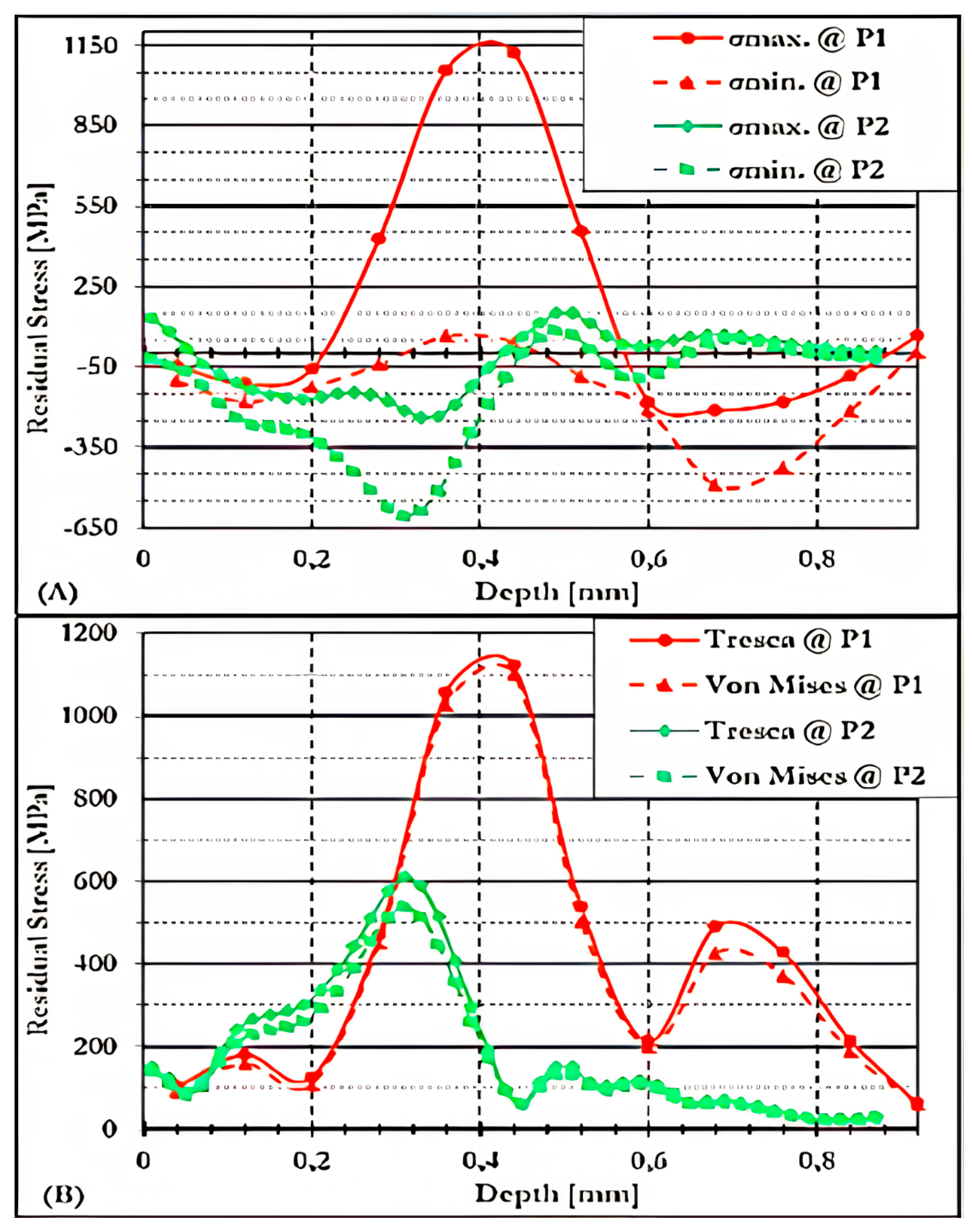
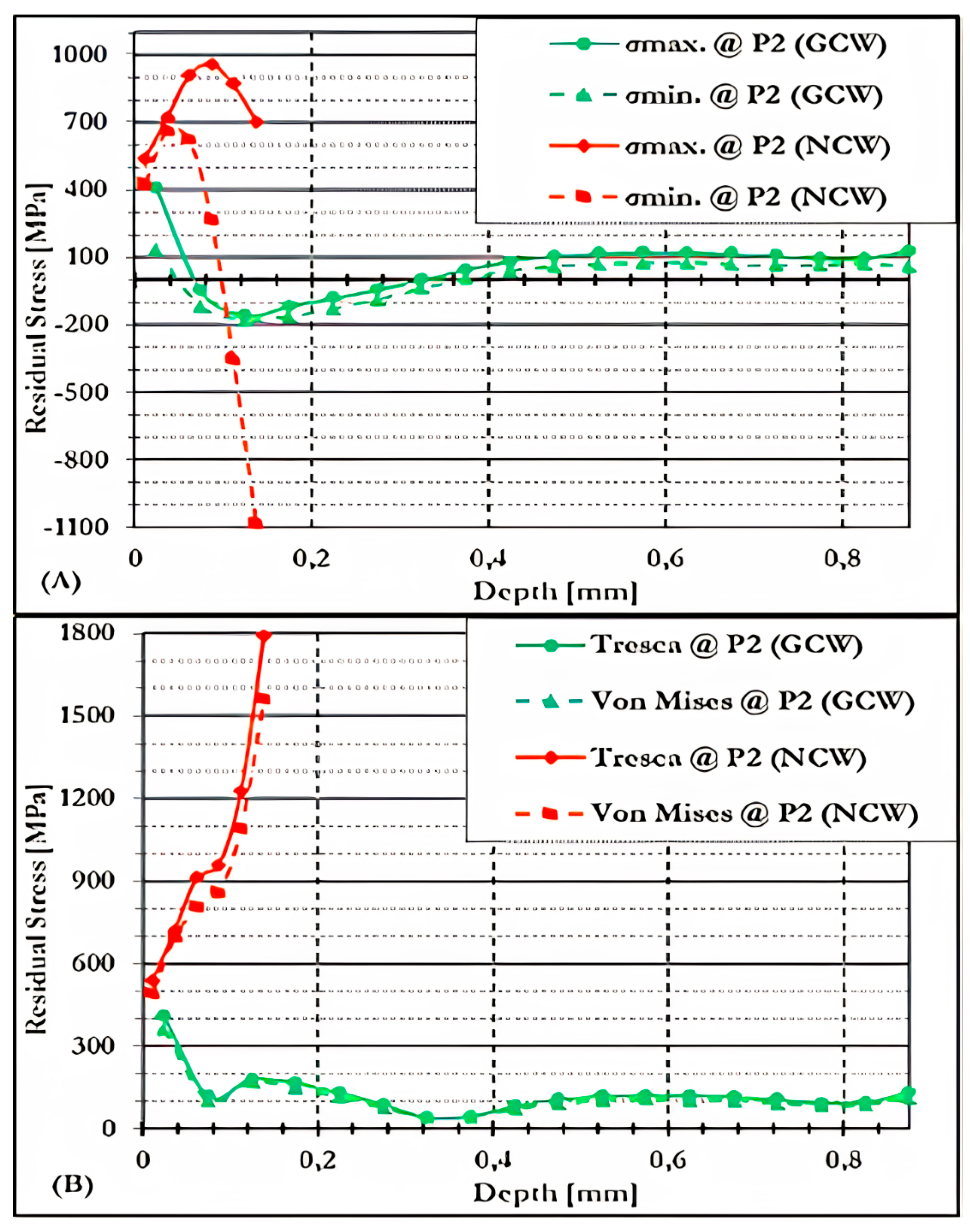
Different stress levels are revealed by comparing NCW and GCW situations at P2 under the as-cast condition, as presented in Figure 10. Figure 10A shows that the principal stresses close to the surface under both conditions are roughly 133 MPa (σmin.) and 407 MPa (σmax.) for GCW and 427 MPa (σmin.) and 538 MPa (σmax.) for NCW at CSDs of 0.025 and 0.012 mm, respectively, suggesting greater RS distributions under NCW conditions. Residual stresses maximize at roughly 624 MPa (σmin.) and 958 MPa (σmax.) for CSDs of 0.062 and 0.087 mm as surface depth increases under NCW. On the other hand, GCW attains compressive stresses of −180 MPa and −158 MPa at a CSD of 0.125 mm before tensile stress slightly increases and stabilizes at about 100 MPa, up to a maximum CSD of 0.875 mm. In general, S/A iron’s NCW RSs at P2 in the as-cast state are higher than GCW RSs. Microscopically, as shown in Figure 5, Figure 7 and Figure 8, respectively, high Cr irons are considered composite materials composed of Cr-rich carbides (M7C3 and M23C6) contained in a metallic matrix consisting of γ-Fe and α-Fe, or a combination of the two, in most technological applications. Local thermal RSs are caused by differences in the TECs between the metallic matrix and the Cr-rich carbides when the composites cool from the processing temperature to room temperature [20,39,40,41,42,85]. Thus, phase RSs results from changes in the specific volume of alloy components brought about by microstructural evolution, such as carbide precipitation in HCWCI alloys, which causes phase changes in the elastic range. These variations in volume, which are more noticeable in thicker casting sections, result in tensile stress near casting surfaces, i.e., outside of the casting, and compressive stress within the thermal center, i.e., inside. This is caused by structural changes and the buildup of thermal strains from different cooling rates between the middle and outer layers.
Von Mises and Tresca RSs are at a maximum under NCW, as shown in Figure 10B, which examines the RSs under GCW and NCW conditions. Under NCW, the calculated RSs approach 492 MPa for Von Mises and 538 MPa for Tresca near the casting surface at a CSD of 0.012 mm; under GCW, they are lower, at 359 MPa and 407 MPa at a CSD of 0.025 mm. It is shown that RSs reach full compressive and tensile stress under various circumstances, decreasing linearly with increasing CSD. Residual stresses peak at roughly 1563 MPa and 1790 MPa for NCW at a CSD of 0.138 mm, while GCW peaks at 170 MPa and 180 MPa at a CSD of 0.125 mm. As CSD rises, the GCW conditions maintain equivalent RSs at values ≤ 200 MPa, demonstrating the implications of the casting and solidification processes, particularly at certain casting locations like P1 and P2, which are impacted by lower cooling temperatures in S/A iron. The RS distributions of S/A iron under the as-cast condition show that greater RS distributions with significant tensile stress are found close to the casting surface, whereas the thermal center experiences high compressive stress, as shown in Figure 9 and Figure 10, respectively. Because casting appurtenances are removed, the GCW state shows higher stress than NCW at CSTs of 60 °C for HCWCI alloys. As a result, foundries experience higher scrap and rejection rates, which are frequently caused by tiny cracks that develop after shakeout, particularly when the casting mold is disturbed.
Residual Stresses Under GCW Conditions at P1 and P2 in S/A
To define RSs in casting processes, it is critical to comprehend the variations in stress–strain relationships regarding temperature [8,27,90]. Temperature gradients caused by variations in solidification and cooling rates lead to RSs in casting components, which are especially impacted by variations in section thickness, as the casting geometry presented in Figure 1 and Figure 4 illustrates. The analysis in Figure 11A reveals that under GCW conditions, P2 has higher principal stresses (σmin. and σmax.) than P1, with values near the surface of roughly 133 MPa and 407 MPa at P2, respectively, indicating a tension state; P1 displays compression states with values around −313 MPa and −147 MPa.
Figure 11A shows that P1 and P2 RSs under GCW conditions are completely different near the casting surface as the CSD increases; they remain completely different on the surface because they exhibit fluctuations between tensile and compressive states. Tensile stresses rise as the CSD grows because P1 RSs are in a compressive condition close to the casting surface. At a CSD of roughly 0.575 mm, the principal stresses of σmin. and σmax. are roughly 74 MPa and 121 MPa. In contrast, for P2 RSs, compressive stresses grow as the CSD (0.125 mm) increases, reaching a fully compressed condition of roughly −180 MPa and −158 MPa of σmin. and σmax. principal stresses, respectively. As the surface depth increases, RSs at P1 and P2 alter, reaching fully compressive and tension states, respectively, as shown in Figure 11A. Principal stresses at P1 were measured to be roughly −141 MPa and −98 MPa for σmin. and σmax. principal stresses, respectively, at a CSD of about 0.875 mm, which are fully compressive. At P2, the measured RSs were roughly 61 MPa and 130 MPa for σmin. and σmax. principal stresses, respectively. Because P1 is subject to tensile loads near the casting surface, P2 is completely in a compressive condition. In comparison to section P2, which is thicker and is situated at approximately a right angle, as shown in the casting geometry (Figure 1 and Figure 4), and has a completely compressive stress state that could be due to the gating system limiting movement through tightening of the casting structure during the casting processes, i.e., solidification and cooling. Hence, the P2 RS region experiences higher compressive stresses compared to P1; P1 is a thinner section and has a lower volume fraction of material, which results in a lesser casting modulus (volume-to-surface ratio), leading to faster cooling rates and to elevated tensile stresses near the casting surface at lower CSTs, such as 60 °C.
The RS distributions are impacted by GCW’s substantial effects on the cooling and solidification of cast components. These effects can be divided into three main categories: (1) Higher mass causes slower cooling rates during solidification and cooling, which raises thermal RS distributions relative to NCW. (2) The RS distributions are impacted by the timing of casting removal from the mold at shakeout temperatures; extended cooling increases internal compressive stresses and surface tensile stresses. (3) By partially relieving or redistributing internal locked-in RSs, the removal of casting appurtenances frequently modifies the stress state and results in larger compressive and/or tension RS distributions than GCW [8,91], as is shown in Figure 9 and Figure 10 above. Torres et al. [29] noted that thicker casting sections typically lead to increased tensile stress, which can cause bending and distortions. In addition, the Von Mises and Tresca RSs are optimally recorded near the casting surfaces at P2, measuring approximately 359 MPa and 407 MPa, while at P1, they are about 271 MPa and 313 MPa at a CSD of approximately 0.025 mm, as shown in Figure 11B. As CSD increases to 0.075 mm, these RSs decrease, with value dropping to 201 MPa and 232 MPa at P1 and P2, respectively. Meanwhile, RSs at P1 continue to decline at a CSD of 0.175 mm, reaching around 29 MPa and 33 MPa. Additionally, Von Mises and Tresca RSs are greatly lowered and exhibit levels of fluctuation at P2, resulting in computed Von Mises and Tresca RSs of roughly 39 MPa at a CSD of roughly 0.325 mm for both RSs and 112 MPa and 130 MPa at a CSD of roughly 0.875 mm.
Von Mises and Tresca’s computed RSs at P1 increase linearly with CSD, reaching 50 MPa and 51 MPa at roughly 0.275 mm CSD. Von Mises and Tresca RSs also somewhat decreased, reaching around 28 MPa and 30 MPa, respectively, at about 0.525 mm CSD. Conversely, equivalent RSs increase as CSD increases, reaching roughly 0.875 mm and Von Mises and Tresca RSs of roughly 125 MPa and 141 MPa, respectively. The cooling of some casting regions is frequently restricted by some casting regions that have cooled earlier and are therefore stronger, leading the weaker casting regions to plastically deform during the casting of extraordinary designs and/or stress-lattice casting, such as complicated shapes [8,29,92]. As seen in the images, this phenomenon in casting components causes different stress levels in various places. According to research by Akhtar [27] and Zhang et al. [85], stressed castings cool unevenly from the solidification state, producing tensile RS on the surface and compressive RS in the thermal center. Furthermore, complicated geometries have an impact on the final casting’s microstructural characteristics and its thermal RS [8,93]. The analysis of RSs shows that the cooling rates and limits imposed by mold walls and regions determine their magnitudes, emphasizing the impact of rapid cooling on casting sections [8,92].
Residual Stresses Under NCW Conditions at P1 and P2 in S/A
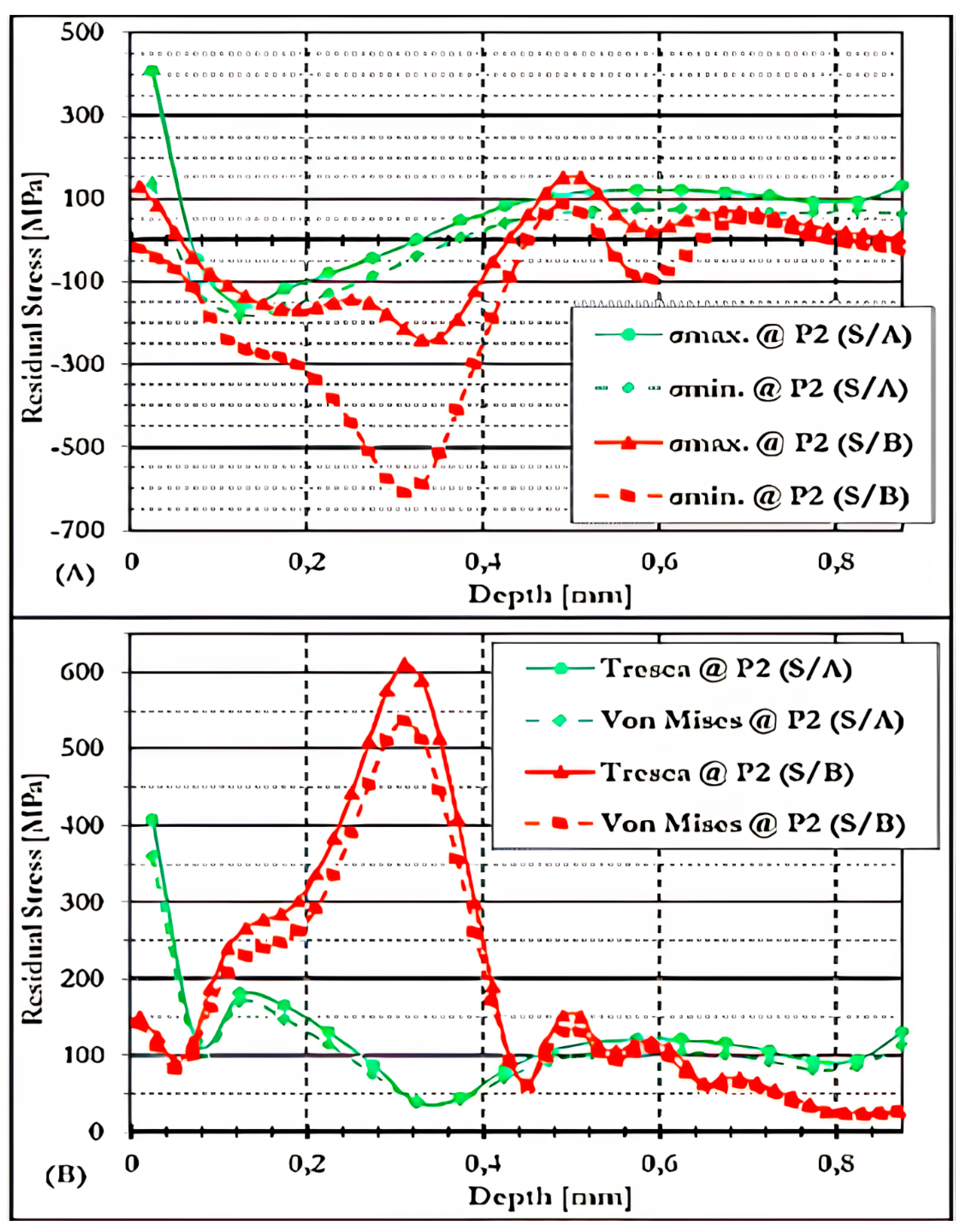
The RSs were compared under NCW conditions at P1 and P2 since it was seen that there are deflection and the material springs back when casting appurtenances are removed from NCW conditions. Figure 12A below shows that the σmax. principal stresses are displayed in the tensile area at P1 and P2 in the tension region. On the other hand, when the surface depth was increased, both P1 and P2 RS distributions transformed completely to compressive regions on σmin. principal stresses. As seen in Figure 12A, there is an increase in RS distribution as the CSD rises. Assessments at P2 revealed σmin. and σmax. principal stresses of roughly 427 MPa and 538 MPa at a CSD of roughly 0.120 mm, respectively. While RSs are observed to be in mildly compressive and tensile states near the casting surface at P1, with measured RSs of around −30 MPa and 150 MPa at a CSD of about 0.025 mm on σmin. and σmax. principal stresses, respectively. Moreover, P1 and P2 RS rise linearly with CSD, with P1 reaching maximal tensile stress levels of around 203 MPa and 241 MPa at a depth of 0.125 mm, and principal stresses at P2 are 665 MPa (σmin.) and 958 MPa (σmax.) at 0.037 mm. Residual stresses at P1 decrease to −474 MPa and −113 MPa at 0.275 mm as CSD increases, but P2 exhibits compressive and tensile states of −1085 MPa and 705 MPa. In comparison to P1’s 167 MPa and 180 MPa at 0.025 mm, computed Von Mises and Tresca RSs are significantly greater with P2, reaching 492 MPa and 538 MPa at a CSD of around 0.012 mm, as shown in Figure 12B. The calculated RSs, such as Von Mises and Tresca at P2, exhibit a linear increase with increasing CSD, reaching 1562 MPa and 1790 MPa, respectively, at a CSD of roughly 0.138 mm. These RSs rise to 204 MPa and 234 MPa at a CSD of around 0.225 mm at P1, reaching optimal RSs of 429 MPa and 474 MPa at a CSD of roughly 0.275 mm. RSs at P2 under GCW settings are better than those at P1, according to comparisons, while P2 RSs under NCW conditions similarly exhibit ideal values. Because of the differences in section thickness and cooling rates, uneven cooling causes distortions in cast components.
The casting modulus and thermal conductivity of the sand mold are examples of factors that affect heat-extraction paths and, consequently, the size of RSs, making them difficult to estimate [92]. In contrast to P1, which is a more stable stress region, as shown in Figure 1 and Figure 4, with a riser only near the stress region that shows minimal alteration of the RS distribution compared to P2, the P2 RS indicates that the casting section or region at P2 was constrained by the gating system. This is because the removal of the gating system results in relieved and relaxed RS distributions, revealing a higher tensile RS state as compared to the P1 RS state.

3.4.2. Sample-B (S/B Alloy)

Residual Stresses at P1 Under GCW and NCW Conditions in S/B
The RSs in the as-cast condition at P1 changed significantly from GCW to NCW conditions, as revealed in Figure 13 below. Furthermore, it is shown in Figure 13A that the GCW conditions exhibit much greater tensile stress than the compression stress state near the casting surfaces, particularly in the thermal center, such as at the CSDs of 0.2 to 0.6 mm. In contrast, under NCW conditions, the thermal center and the vicinity of the casting surface exhibit continuous and steady compressive RS-state magnitudes. When casting appurtenances are removed from the NCW conditions, the RSs are completely eased. As a result, compressive stress states replace tensile stress states, and the distribution of RSs is different from that under GCW conditions. The phenomenon known as RS is caused by rapid cooling in casting because of large temperature differences from the outer surface to the thermal center of the cast component. During the casting shakeout process, particularly at a CST of 180 °C, structural and compositional heterogeneity within individual casting sections influences this process [8,27,94]. When temperature variations occur during cooling, RSs are worsened by mold restrictions and phase changes.
RSs form as solidification moves past the eutectic reaction in alloys, but they do not form in the liquid state. Principal stresses close to the surface show a fully compressive state under GCW conditions, but they are surrounded by slightly tensile states under NCW conditions. Under GCW conditions, σmin. and σmax. principal stresses are observed near the casting surface at approximately −103 MPa and −48 MPa at a CSD of about 0.04 mm, respectively, as shown in Figure 13A. While compressive RSs exhibit a modest increase, reaching roughly −214 MPa and −86 MPa at a CSD of roughly 0.875 mm, respectively, GCW RSs are shown to decline linearly as the CSD increases, reaching RSs of roughly −490 MPa and −241 MPa at a CSD of roughly 0.68 mm. Figure 13B illustrates that under NCW conditions, Von Mises and Tresca RSs perform best at a CSD of up to a maximum of about 0.20 mm, in contrast to GCW conditions. At CSDs of roughly 0.025 and 0.04 mm, the Von Mises and Tresca RSs under NCW conditions are approximately 328 MPa and 89 MPa, respectively; under GCW conditions, they are approximately 378 MPa and 103 MPa. When CSD increases to roughly 0.875 mm under NCW conditions, both RSs fall below 200 MPa; however, under GCW conditions, RSs at a CSD of 0.44 mm reach 1101 MPa for Von Mises and 1122 MPa for Tresca. GCW RSs drop to around 199 MPa and 212 MPa at 0.60 mm, rise to 426 MPa and 490 MPa at 0.68 mm, and then drop again to roughly 61 MPa and 64 MPa at a CSD of 0.92 mm. Under GCW circumstances, shakeout processes at higher CSTs are observed to establish optimal tensile stress magnitudes within the casting cores at P1. As illustrated in Figure 13B, tensile stresses under GCW conditions are eased and entirely steady state inside, but compressive RSs of smaller magnitude are established under NCW conditions. Thus, these results on higher CSTs are consistent with Yang’s [28] discovery that a longer shakeout time reduces tensile stresses and increases compressive stresses in the surface layer, as is shown in Figure 13A. Strengthening the CKT could be crucial in particular circumstances to enhance material performance, as revealed in RS distributions at a CST of about 60 °C compared to 180 °C. The variables affecting the strength of materials used in engineering, mining, and construction applications with respect to RS distributions under the as-cast condition require more investigation.
Residual Stresses at P2 Under GCW and NCW Conditions in S/B
The RSs under GCW and NCW conditions at P2 are compared in Figure 14 below. It is shown in Figure 14A that under GCW conditions, RS distributions exhibit substantial magnitudes of compressive stress state in as-cast conditions [8,28]; nevertheless, NCW conditions indicate a drop in compressive RS state like GCW conditions. Under NCW conditions, however, RS distribution reveals steady and slightly fluctuating RSs with minor variations. The material returns to its initial state through elastic relaxation made possible by the removal of the casting appurtenances, i.e., the gating and feeding system, which were constraining the casting part. The GCW principal stresses, i.e., σmin. and σmax., are roughly −20 MPa and 130 MPa, respectively, whereas NCW stresses are 2 MPa and 30 MPa, respectively. Under GCW conditions, compression increases linearly with deeper casting depths. Under GCW conditions, points of variation appear as CSD increases, with principal stresses peaking between 0.59 and 0.87 mm, resulting in RS magnitudes of −22 MPa to −95 MPa for σmin. and 6 MPa to 23 MPa for σmax.. In compressive states, the RSs rise linearly and are constant below −180 MPa under NCW conditions. The optimal Von Mises and Tresca RSs, as shown in Figure 14B, are—in the thermal center of the casting component under GCW—roughly 140 MPa and 149 MPa at a CSD of 0.01 mm, while under NCW conditions they are 29 MPa and 30 MPa at the same CSD. Under GCW, Von Mises and Tresca RSs—as shown in Figure 14B—gradually increase linearly with increasing CSD, reaching about 536 MPa and 611 MPa at 0.31 mm, while under NCW conditions they slightly increase to about 159 MPa and 180 MPa at 0.167 mm. In addition, in GCW conditions, corresponding RSs diminish linearly with a larger casting surface, with Von Mises and Tresca stresses measured at approximately 170 MPa and 190 MPa at a 0.4 mm CSD.
In contrast, under NCW conditions, RSs stabilize beneath 69 MPa. As the casting surface increases in GCW conditions, RSs fluctuate, reaching 61 MPa at around 0.45 mm CSD, with subsequent rises to 25 MPa and 30 MPa and 132 MPa and 151 MPa at approximately 0.87 mm CSD. The removal of casting appurtenances in NCW fully relieves the RSs, as illustrated in Figure 14. Residual stress magnitudes observed within the S/B iron indicate consistently higher and stable results across various experiments. Furthermore, because heavy and/or larger castings require longer cooling times, which can result in uneven thermal contraction and complex RS distributions, the RS levels in cast components are highly correlated with their NCW and size. The following are important factors that affect RS within NCW: (1) higher mass causes slower cooling rates, resulting in significant temperature differences that heighten RS distributions; (2) a larger NCW leads to more material, especially in sections of varying thickness, contributing to increased RS; (3) tensile RS rises with higher CSD; and (4) the CSTs of GCW and NCW affect stress distributions upon mold removal, where higher temperatures for heavy castings reduce tensile stresses compared to full cooling in the sand mold, but may increase distortions [28,91]. It should be noted that, as shown in S/A in Figure 9 and Figure 10 and in S/B in Figure 13 and Figure 14, CSTs on the HCWCI alloy’s cast components at 60 °C and 180 °C display inverse RS distribution curves. The casting components of the HCWCI alloy display opposing RS distributions during solidification and cooling because the casting shape is comparable at different CSTs.
Residual Stresses Under GCW Conditions at P1 and P2 in S/B
The RS measurements at P1 and P2 under GCW conditions in as-cast states are shown in Figure 15. Due to variable casting thicknesses (Figure 1 and Figure 4), the solidification and cooling processes produce temperature gradients that result in varied contraction rates, especially in GCW settings, and RS distributions in the casting components. Variations in casting size and the liquid metal’s proximity to heads and gates are the causes of these temperature fluctuations [8,15]. Reducing these temperature differences might limit RS distributions inside cast components, particularly in HCWCI alloys, since they are the main cause of RS creation during solidification and cooling. Additionally, the high Cr iron’s restricted yield points and ductility cause strains to grow during the shakeout process of casting components from sand molds [8,15,29]. The experimental casting component’s RS distributions exhibit slight plastic strains, which are indicative of elastic and plastic deformation [8,15,25,28]. As shown in Figure 15A, the compressive stresses are found at P2 and tensile stresses are found at P1, with RSs close to casting surfaces being more advantageous at P1. The principal stresses at P1 close to the casting surface under GCW circumstances are roughly −103 MPa (σmin.) and −48 MPa (σmax.) at 0.04 mm.
The RSs under a compression state at P2 rise linearly with increasing CSD, reaching roughly −490 MPa and −241 MPa at a CSD of 0.68 mm. Compressive RSs, on the other hand, show a modest drop, registering −214 MPa and −86 MPa at a CSD of 0.875 mm. At P2, RS varies linearly with increasing CSD, but the RS distribution at P1 exhibits higher tensile stress, especially within the thermal center at CSDs of about 0.2 and 0.6 mm. In contrast, the computed RSs of Von Mises and Tresca stresses, shown in Figure 15B, exhibit maxima near the surfaces, peaking at 140 MPa and 149 MPa at a CSD of 0.01 mm, and reaching 1102 MPa and 1122 MPa at P1 at a CSD of about 0.44 mm. The predicted stresses in P2, according to Von Mises and Tresca, peak respectively at 511 MPa and 577 MPa at 0.29 mm CSD and decline linearly with increasing CSD to 199 MPa and 212 MPa at about 0.60 mm in P1, whereas P2 stabilizes at around 61 MPa at about 0.45 mm CSD. Von Mises and Tresca RSs are maximized near casting surfaces, reaching 140–149 MPa at a CSD of 0.01 mm. As CSD increases, stresses at point P1 rise to 1102 MPa and 1122 MPa at approximately 0.44 mm, while they decrease at P2 to 511 MPa and 577 MPa at a CSD of 0.29 mm. The RSs decline with higher CSD, settling at around 199 MPa and 212 MPa for P1 and 61 MPa for P2.
The peak RSs calculated are 426 MPa and 490 MPa at a CSD of about 0.68 mm, dropping to around 61 MPa and 64 MPa for P1 at 0.92 mm. P2 shows peaks of 25 MPa and 28 MPa at a CSD of approximately 0.87 mm. Findings indicate optimal RSs occur near the casting surface for P1, while P2 exhibits compressive stresses, suggesting that high Cr iron casting techniques yield better tensile stress at P1. Furthermore, certain casting factors affect RS, which increases as ductility decreases, and air cooling considerably raises RS. Akhtar [27] noted that air cooling introduces extensive added RS, while Sroka [94] argued that casting modules play a significant part in RS matter and that RS rises as ductility lessens.
Residual Stresses Under NCW Conditions at P1 and P2 in S/B
According to Alipooramirabad et al. [30], differences in casting section (P1 and P2) thickness have an impact on solidification and cooling speeds, which in turn modifies thermal gradients. For P1 and P2, the study displays calculated principal stresses under NCW circumstances between P1 and P2 in S/B iron of HCWCI. The minimum and maximum principal stresses (σmin. and σmax.) at P1, as shown in Figure 16A, are around −215 MPa and 163 MPa at a CSD of roughly 0.025 mm, whereas at P2, they are roughly 2 MPa and 3 MPa at a CSD of roughly 0.013 mm. Interestingly, both σmin. and σmax. decline linearly with increasing CSD, reaching roughly −180 MPa and −114 MPa at P2 for CSDs of 0.116 and 0.167 mm, respectively, and peaking at roughly −152 MPa and −134 MPa at CSDs of about 0.225 mm for P1. Principal stresses σmin. and σmax. at P1 and P2 exhibit different degrees of instability as the CSD rises. The σmin. and σmax. at P1 vary by roughly −175 MPa and −7 MPa at a CSD of 0.2 to 0.887 mm, whereas they range between −169 MPa and 42 MPa at P2. It is shown in Figure 16A that RS distributions in the as-cast state at P1 and P2 show greater compressive stresses in the thermal center; while near casting surfaces, RS distributions are slightly in tensile state. The alteration in RS stress state is due to higher CSTs (180 °C), which result from shorter cooling periods, and which result in the lessening and/or conversion of the stress state from the highly compressive/tensile state to a completely different stress or reduced RS distribution, either in compression or tensile states.
The effect of casting appurtenance’s elimination is the same for both P1 and P2 in as-cast and NCW states. Furthermore, the RS distribution analysis shows stability in the compressive region and suggests that RSs are relieved. Von Mises RSs at P1 and P2 are approximately 328 MPa and 29 MPa, respectively, close to the casting surface, with a CSD of roughly 0.025 and 0.013 mm. Residual stress at P1 decline linearly to around 199 MPa and 229 MPa as CSD increases, but at P2, they rise to 159 MPa and 180 MPa at about 0.167 mm. The Von Mises and Tresca RSs decline linearly with increasing CSD at P1, as seen in Figure 16B. However, at P1 and P2 they exhibit minor fluctuations before stabilizing and then decreasing. In contrast to 111 MPa to 123 MPa at P2, the calculated RSs peak at about 0.32 mm CSD at P1, ranging from 80 MPa to 172 MPa. This suggests that the release of RSs occurs after the removal of casting appurtenances under NCW circumstances, as RS relaxation is more pronounced at P1 than at P2.

3.4.3. Residual Stresses on S/A and S/B

The distribution of RS affects the mechanical and fatigue characteristics of hypoeutectic alloys of HCWCI. Numerous factors affect the RS states, especially the product quality in the foundry industry. These variables include manufacturing parameters, such as CSTs and/or knockout time and the molding material used, while chemical compositions influence the evolution of microstructural development, hardness, RS distributions, phase transformation, etc. These factors are dependent on casting practices, which rely on solidification and cooling conditions. Additionally, cores, mold, gating, and feeding systems restrict thermal contraction at varying CSTs, which can lead to tension or compression and/or relaxation in casting components, depending on the CSTs of the alloy. This study indicates that RS is established through solidification and cooling and that casting shakeout knockout conditions, that is, CST and/or knockout times, have an impact on RS distribution [8,30,95].
Thus, the following subsections compare the HCWCI alloy’s casting components, i.e., S/A and S/B irons with varying chemical compositions, mechanical properties (hardness), and CSTs, respectively. It was established that treating casting components at high CSTs results in increased hardness measurements, i.e., 526 BHN to 600 BHN on S/A and S/B, respectively. However, particularly in HCWCI alloys, a fine and coarse grain size is to be expected near the casting surface and in the thermal center, respectively, although this was not measured since it is not the scope of this study. Higher CSTs, therefore, result in increased hardness, along with RS dispersion, as reported above. However, as the study found, lower CSTs typically have slower cooling rates, which increases the potential for carbide precipitation, resulting in higher hardenability and a heterogeneous metallic matrix. Additionally, longer CSTs result in a time–temperature relationship that decreases hardness and increases carbide particle size. High CSTs can therefore cause uneven cooling, which can lead to warping and/or cracking, especially when complicated geometry is present.
Residual Stresses at P1 Under GCW Conditions on S/A and S/B
Figure 17 shows the RS states and distributions of S/A and S/B iron measured during RS evaluation using incremental HDM at CSTs of 60 °C and 180 °C at P1 in the as-cast condition. According to the results of the study, the RS states are in tensile (P2) and compressive (P1) stress states of σmin. and σmax. of roughly −313 MPa and 30 MPa for S/A iron and −103 MPa and −48 MPa for S/B iron, respectively, at CSDs of 0.025 and 0.04 mm. As the CSD increases, the RS states for both kinds of iron linearly diverge in the direction of the internal casting layers. At a CSD of 0.36 to 0.44 mm, higher principal stress magnitudes of −141 MPa and −65 MPa and 43 MPa and 63 MPa for σmin. and σmax. are observed. Both S/A and S/B irons display fully compressive RS states beyond a CSD of 0.6 mm, with S/A iron exhibiting smaller magnitudes than S/B iron. The S/B iron shows a greater magnitude of RS than the S/A iron because of faster cooling rates from CSTs of roughly 180 °C as opposed to 60 °C. Higher CSTs, particularly for the current investigation at 180 °C, can be compared to the quenching process, which usually results in more pronounced RSs, especially tensile stress on the casting surfaces and, hence, higher hardness and RS-distribution values.
Consequently, higher CSTs cause larger temperature gradients from the casting’s surface to its thermal center, in addition to solid contraction and volume change. Increased tensile RS near the casting component’s surface is caused by higher temperature gradients. These stresses decrease as compressive stresses appear in the casting component’s thermal center. Significant tensile stresses at the surface and steady RS at the thermal center result from the increased tensile stresses created during rapid cooling, which continue even at ambient temperatures. Because of regulated cooling, lower CSTs, such as 60 °C, encourage steady RSs. Higher RS magnitudes in casting components are lessened by the gradual elimination of temperature gradients during cooling in cores and molds, as opposed to standard air cooling. Significant variations in estimated RS distributions are shown by the plastic flow behavior in S/A and S/B irons. Whereas S/B iron only displays optimal magnitudes at internal surfaces, S/A iron displays optimal RSs close to the surfaces. Because it cools more slowly than the S/B iron, the S/A iron has lower RSs. Figure 17B presents the corresponding Von Mises and Tresca stress values, measured at about 271 MPa and 313 MPa for S/A iron and 89 MPa and 103 MPa for S/B iron. The calculated RSs of Von Mises and Tresca in S/A and S/B irons exhibit linear variations as the CSD rises. These stresses drop to 29 MPa and 33 MPa in S/A iron at a CSD of roughly 0.175 mm. In contrast, at a CSD of 0.2 mm, the RSs in S/B iron first increased to 109 MPa and 125 MPa. S/A iron’s RSs stabilizes with RS distribution between 30 MPa and 33 MPa for Von Mises and 125 MPa to 141 MPa for Tresca at a CSD of 0.875 mm.
Between CSDs of 0.36 and 0.44 mm, the RSs in S/B iron rise linearly to the ideal levels of 1101 MPa and 1058 MPa. However, after maximum raising, they fall linearly, reaching minimal values of around 199 MPa and 212 MPa at a CSD of 0.60 mm, and then fall even lower to 61 MPa and 64 MPa at a CSD of 0.90 mm. Optimal temperatures during casting shakeout cause creep in the casting. When casting shakeout happens at about 180 °C, shorter cooling times from air cooling increase tensile stress in the inner sections of S/B iron. On the other hand, lower temperatures result in steadier cooling rates because core and mold cooling cause RSs in S/A components to relax to lower RS distributions, as shown in Figure 17. Furthermore, temperature gradients from casting surfaces to interior surfaces affect solidification and cooling processes, leading to notable RSs, according to studies by Akhtar [27], Ngqase et al. [8], and Torres et al. [29]. In S/A and S/B cast products, maximum shakeout temperatures ultimately correspond with ideal RS magnitudes, resulting in compressive and tensile RSs under GCW circumstances. Consequently, it is further evident that RS distributions at P1 are lower in S/A, with a higher metallic matrix volume and lower CVF than in S/B, which has a lower metallic matrix volume percentage and higher CVF. In comparison to lower volume fractions that can only absorb a small amount of RS distributions, it can be stated that S/A, with a higher volume percentage of metallic matrix, has been able to improve and absorb RS distributions. Higher RS distributions are thus displayed in S/B at P1.
Residual Stresses at P1 of NCW Conditions on S/A and S/B
When NCW RSs in S/A and S/B irons are compared at P1, the casting surface, as shown in Figure 18A, shows that S/B remained in a compressive condition that decreased with increasing CSD, while S/A began in a state of tensile stress and transformed to a compressive stress state as the CSD progressively increased. The maximum principal stresses are compressive for S/B and tensile for S/A close to the casting surface. The principal stress magnitudes for S/A are roughly −30 MPa (σmin.) and 150 MPa (σmax.) at a CSD of 0.025 mm, whereas for S/B they are −215 MPa (σmin.) and 163 MPa (σmax.), as shown in Figure 18A. The RSs rise linearly with CSD, with S/A reaching 203 MPa and 241 MPa and S/B −218 MPa and −134 MPa at 0.125 mm. Overall, both materials exhibit different stress conditions, with S/B in compression at different depths and S/A mostly in tension. In contrast, S/A RSs shows a linear decrease in tensile stress state, reaching compressive stress states of −474 MPa and −113 MPa at a CSD of 0.275 mm, while S/B RSs shows some degree of compressive stress states of −135 MPa and −21 MPa of σmin. and σmax. principal stresses, respectively. Lastly, until it reaches its maximum CSD, S/B RSs on the casting component stay in a compressive stress state. The Von Mises and Tresca RSs for S/A and S/B irons under NCW conditions at P1 are displayed in Figure 18B.
Therefore, S/A at P1 reveals higher RS distributions as compared to S/B iron with stable RS distributions. In NCW circumstances, it was found that S/A at P1 has greater RS distributions than S/B iron, which exhibits comparatively consistent RS distributions. In the as-cast state, S/A at P1 also exceeds P1 in S/B under similar conditions. Furthermore, because of the constant chemical composition, locked-in energy/stored energy “RSs” in the GCW state are released from the metallic matrix at lower CSTs in HCWCIs under NCW conditions, only affecting the casting process in the GCW condition. Consequently, in NCW states, greater RS distributions are recognized at P1 in S/A under as-cast condition.
Residual Stresses at P2 of GCW Conditions on S/A and S/B
The RS state and distribution are similar for both alloys, specifically S/A and S/B irons, as shown in Figure 19. However, there are notable differences in RS magnitudes, especially close to the casting surfaces, according to measured RS distributions at P2 under GCW conditions for S/A and S/B irons in their as-cast state. Near the surface, tensile stress states are present, with S/A iron showing larger magnitudes compared to S/B iron. On the other hand, for both alloys, the RS state exhibits a transition between tension and compression at maximum surface depth and is in a compressive state within the thermal center of the casting surfaces. The RS measurements on S/A and S/B irons show that compressive stress rises as the CSD rises, reaching full compressive stress inside the thermal center. The S/A and S/B irons near the casting surface exhibit RS values of approximately 0.0255 and 0.01 mm CSD with magnitudes of 133 MPa and 407 MPa and principal stresses of −20 MPa and 130 MPa on σmin. and σmax., respectively. As CSD increases, S/A and S/B irons reach −180 MPa and −158 MPa (0.125 mm) and −611 MPa and −241 MPa (0.31 mm) on σmin. and σmax. principal stresses. Additionally, S/B iron displays variations at CSDs of 0.59 and 0.69, mm with RS values of roughly 70 MPa and 23 MPa and 51 MPa and −86 MPa on σmin. and σmax., respectively, whereas S/A iron displays a flattening stress condition at a CSD of about 0.875 mm with RS values of roughly 61 MPa and 130 MPa on σmin. and σmax..
Figure 19A shows measured RS values of −22 MPa and 6 MPa for the minimum and highest principal stresses, respectively, and how the RSs of S/B iron flatten to a CSD of around 0.870 mm. On the other hand, in Figure 19B, S/A iron shows greater RS values close to casting surfaces, reaching 140 MPa and 149 MPa on Von Mises and Tresca stress requirements at a CSD of roughly 0.025 mm. The S/A iron’s RS decreases to 103 MPa and 118 MPa at 0.075 mm when CSD rises, but S/B iron exhibits 82 MPa and 90 MPa at 0.050 mm. Interestingly, S/A iron RS increases once again to 170 MPa and 180 MPa at a CSD of 0.125 mm before declining and stabilizing at 112 MPa and 130 MPa at the ideal CSD of 0.875 mm. The Von Mises and Tresca RSs, which are computed RSs within S/B iron, rise linearly with increasing CSD, peaking at roughly 536 MPa and 611 MPa at a CSD of roughly 0.31 mm before falling to about 61 MPa. At a CSD of approximately 0.49 mm, RSs for S/B iron reach 132 MPa and 151 MPa. They then stabilize until reaching an ideal CSD of around 0.870 mm, with RSs of 23 MPa and 28 MPa, respectively.
The RSs in hypoeutectic irons have similar magnitudes under NCW circumstances; however, S/A iron has much lower RS magnitudes than S/B iron, which both have greater RS distributions following CST at roughly 60 °C and 180 °C, respectively. Figure 19 shows that RS distributions are higher at P2 in S/B than in S/A with greater compression stress states in as-cast and GCW states. This RS distribution within the identical RS distribution curve, i.e., at P2, may be caused by the influence of alloys contained within the irons, as both C and Cr contents vary, with S/A having less C and Cr than S/B. Furthermore, as seen in Figure 19, the RS distribution development on HCWCI alloys may be significantly impacted by variations in CVF, metallic matrix volume fraction, hardness (526 and 600 BHN), and various casting parameters, such as the casting section thickness of the individual cast components within the cast component. Therefore, the RS distribution increases with increased chemical composition, higher CVF, lower metallic matrix volume fraction, and differences in the volume of microstructural elements within the iron, as was revealed by XRD analysis, including variation in the CSTs.
Residual Stresses at P2 of NCW Conditions on S/A and S/B
The difference in RS distributions between S/A and S/B irons at P2 of HCWCI alloys under NCW conditions in their as-cast state is shown in Figure 20. Evaluations up to CSDs of roughly 0.138 mm and 0.870 mm, respectively, show that the S/A iron has greater tensile RS distributions near casting surfaces than the S/B iron, which shows a steady compressive RS distribution, as shown in Figure 20A. At a CSD of 0.012 mm, tensile stresses near the surface were approximately 427 MPa (σmin.) and 534 MPa (σmax.) for S/A iron. The tensile stresses of the S/A iron peak at 665 MPa and 958 MPa at about 0.037 mm CSD. S/A iron maintains increasing tensile stress magnitudes as CSD rises, reaching a maximum of roughly 705 MPa at the 0.138 mm CSD, whereas compressive stresses are recorded at ≤ −200 MPa for S/B iron. Varying degrees of plastic deformation impact the RS distributions and microstructure characteristics within metals after the removal of casting appurtenances [18]. Up to around 0.870 mm, the RS on S/B iron is in a compressive steady state, with major stresses varying between −180 MPa and 2 MPa. On the other hand, S/A iron has a higher RS distribution. In S/A iron, Von Mises and Tresca RSs are likewise higher, rising linearly with the CSD to attain ideal RS values between 492 MPa and 1970 MPa, respectively, as shown in Figure 20B. According to the Von Mises and Tresca criteria shown in Figure 20B, the RSs on S/B iron in the inner CSD were found to be small and stable at about 150 MPa; RSs in the as-cast state under NCW and GCW conditions are shown to be highly dependent on the CSTs and the cooling rate during the solidification and cooling stages.
The cooling rate developed during the corresponding periods has an impact on these temperatures. In hypoeutectic, high-Cr irons, where the production of RSs starts because of denser and more crystalline atomic arrangements driven by strong interatomic interactions compared to the liquid state, the casting process shows that liquid iron changes into a solid state throughout a temperature range instead of at a single point, i.e., temperature [92]. The results shown in Figure 20 illustrate how different CSTs, namely 60 °C for S/A and 180 °C for S/B, might impact the RS distribution between S/A and S/B in as-cast and NCW states. S/A has a higher RS distribution than S/B, which has a lower RS. In contrast to lower CSTs, which react adversely to higher temperatures—as shown in Figure 20, higher temperatures result in shorter and faster solidification and cooling durations, which lead to higher mechanical properties, including RS distributions and self-quenching in GCW circumstances. Established RS distributions due to higher CSTs are completely relieved when casting appurtenances are eliminated. Consequently, even though S/B has better casting characteristics, significant RS distributions are established at P2 in S/A as opposed to S/B.

4. Conclusions

Experimental casting components of HCWCI alloys, namely ASTM A532, Type A, Class III, 25% Cr, especially S/A and S/B, were cast and allowed to solidify and cool for roughly 1645 and 1295 min, respectively, in a groundbreaking study on CSTs. At different casting stages, the RS distribution measurements were performed in the as-cast state under GCW and NCW conditions, respectively. Next, utilizing the hole-drilling technique and the ASTM E837-08 standardization procedure, RS measurements were carried out. The microstructural components, including the chemical composition of the experimental irons in the as-cast condition, were studied using general metallurgical characterization. The following significant outcomes were attained:
Using general metallurgical characterization, it was found that the optimal C and Cr contents within experimental irons, such as S/A and S/B, are confirmed to be hypoeutectic iron compositions because the micrographs contain transformed α-Fe, proeutectic γ-Fe, and eutectic constituents consisting of γ-Fe plus M7C3/(Cr, Fe)7C3-type carbides, including secondary M23C6/(Cr, Fe)23C6-type carbides.
The hardness measurement of the experimental irons, S/A and S/B, is significantly affected by variations within major alloying elements, such as C and Cr contents. The hardness of the experimental iron was discovered to be associated with the alloy’s casting chemistry since it increases with the concentration of both C and Cr.
The CVF and metallic matrix volume fraction of the experimental iron have a significant impact on the hardness of the experimental casting. This is because lower CVF and a higher volume percentage of metallic matrix support lower hardness values and higher fracture toughness, while higher CVF and less metal favor higher hardness and reduced fracture toughness.
The difference in CSTs indicates that, in contrast to GCW conditions at lower CSTs, i.e., 60 °C, greater RS magnitudes are established under NCW settings. At higher CSTs, such as 180 °C, greater magnitudes are seen under GCW circumstances.
Because of variations in casting section thickness, the RS distributions of thicker casting sections are higher than those of thinner casting sections at lower CSTs (60 °C). When CSTs are at a higher temperature (180 °C), thinner casting sections exhibit higher RS dispersion than thicker casting parts.
Furthermore, significant compressive stress states are observed in the thermal core of the casting component, while higher tensile stress states are usually found near casting surfaces.
In contrast to lower C, Cr, and CVF and a higher volume of metallic matrix, higher RS distributions are preferred by greater C, Cr, and CVF and a lower volume of metallic matrix.
Conversely, hardness is elevated by greater RS distribution magnitudes in conjunction with higher percentages of the primary alloying elements.

5. Future Work

To progress the consideration of RSs on casting components of HCWCI alloys, i.e., hypoeutectic and eutectic irons before and after removal of casting appurtenances after casting knock-off processes, the study can be validated by measuring more than ten casting components; moreover, the modelling of RSs before and after removal of casting appurtenances can be investigated further. Lastly, various RS measurements on HCWCI alloys can be further investigated to improve manufacturing process design and reduce scrap rate, which are related to RSs and distortion casting defects. The present research study only focused on gross and net casting components, rather than on heat-treated and machined casting processes, while measuring RS before and after heat treatment and machining during casting design. Based on the initial results, the ultra-high-speed drilling method, which makes use of a compressed air turbine system and is commonly used in regular applications of IHD techniques, seems to be a good drilling method for HCWCI casting alloys. The depth distribution of the RSs in the HCWI casting sample was successfully determined. Additional experiments should be conducted to statistically corroborate the repeatability of the experimental results and the expected measurement errors.

Author Contributions

Conceptualization, M.N.; methodology, M.N., W.N. and M.P.; software, M.N. and M.P.; validation, M.N., W.N. and M.P.; formal Analysis, M.N., W.N. and M.P.; investigation, M.N. and M.P.; resources, M.N., W.N. and M.P.; data curation, M.N., W.N., M.P. and T.M.; writing—review and editing, M.N., W.N., M.P. and T.M.; visualization, M.N., W.N., M.P. and T.M.; supervision, W.N., M.P. and T.M.; project administration, M.N., W.N., M.P. and T.M.; funding acquisition, W.N. All authors have read and agreed to the published version of the manuscript.

Funding

This research received no external funding.

Data Availability Statement

The original contributions presented in the study are included in the article, further inquiries can be directed to the corresponding author.

Acknowledgments

The study was performed in South Africa (SA) at the University of Johannesburg (UJ) in the Department (Dep.) of Engineering Metallurgy. The author requests to show gratitude to the following organizations and institutions that made it possible for this study: South African government organizations, such as the National Research Foundation (NRF), the Department of Trade and Industry (DTI), the National Foundry Technology Network (NFTN), the Department of Science and Technology (DST), and Mintek. Private sector contributions that are acknowledged are Mitak Foundries (Pty) Ltd., Ametex (Pty) Ltd., and Scaw Metals SA for the research funding. In addition, Ametex (Pty) Ltd., Mintek, and Mitak Foundries (Pty) Ltd. are extremely cherished for allowing the use of their facility and equipment. For RS measurements, Wits University School of Mechanical, Industrial, and Aeronautical Engineering is highly treasured for allowing use of their facilities, i.e., the laboratory.

Conflicts of Interest

The authors declare no conflict of interest.

References

  1. Oh, J.-S.; Song, Y.-G.; Choi, B.-G.; Bhamornsut, C.; Nakkuntod, R.; Jo, C.-Y.; Lee, J.-H. Effect of Dendrite Fraction on the M23C6 Precipitation Behavior and the Mechanical Properties of High Cr White Irons. Metals 2021, 11, 1576. [Google Scholar] [CrossRef]
  2. Fashu, S.; Trabadelo, V. Development and Performance of High Chromium White Cast Irons (HCWCIs) for Wear-Corrosive Environments: A Critical Review. Metals 2023, 13, 1831. [Google Scholar] [CrossRef]
  3. Zhang, Y.; Shimizu, K.; Yaer, X.; Kusumoto, K.; Efremenko, V.G. Erosive Wear Performance of Heat Treated Multi-Component Cast Iron Containing Cr, V, Mn and Ni Eroded by Alumina Spheres at Elevated Temperatures. Wear 2017, 390, 135–145. [Google Scholar] [CrossRef]
  4. Pasini, W.M.; Polkowski, W.; Dudziak, T.; dos Santos, C.A.; de Barcellos, V.K. Microstructure Formation and Dry Reciprocating Sliding Wear Response of High-Entropy Hypereutectic White Cast Irons. Metals 2025, 15, 4. [Google Scholar] [CrossRef]
  5. Islak, S.; Ozorak, C.; Kir, D.; Kucuk, O.; Akkas, M.; Sezgin, C.T. The Effect of Different Carbon Content on the Microstructural Characterization of High Chromium White Cast Irons. In Proceedings of the 2nd International Iron and Steel Symposium, IISS’15; Karabuk University: Karabuk, Turkey, 2015; p. 4. [Google Scholar]
  6. Li, H.; Zhuang, M.; Li, C.; Wu, S.; Rong, S. Effect of Carbon Element Change on Microstructure and Properties of Fe-Cr-C Surfacing Alloy. IOP Conf. Ser. Earth Environ. Sci. 2018, 186, 012018. [Google Scholar] [CrossRef]
  7. Tian, Y.; Ju, J.; Fu, H.; Shengqiang, M.S.; Lin, J.; Lei, Y. Effect of Chromium Content on Microstructure, Hardness, and Wear Resistance of As-Cast Fe-Cr-B Alloy. J. Mater. Eng. Perform. 2019, 28, 6428–6437. [Google Scholar] [CrossRef]
  8. Ngqase, M.; Nheta, W.; Madzivhandila, T.; Phasha, M.; Pan, X. Exploring Residual Stress Analysis in the Machining of Hypoeutectic High Chromium White Cast Iron Alloys Through the Hole-Drilling Method. Eng. Res. Express 2024, 6, 045414. [Google Scholar] [CrossRef]
  9. Mabeba, A.D. Development of High Vanadium Grinding Media Materials for the Comminution of Gold Ore. Ph.D. Thesis, University of Pretoria, Pretoria, South Africa, 2021. [Google Scholar]
  10. Moema, J.S. The Role of Retained Austenite on the Performance of High Chromium White Cast Iron and Carbidic Austempered Nodular Iron for Grinding Ball Applications. Ph.D. Thesis, University of Pretoria, Pretoria, South Africa, 2018. [Google Scholar]
  11. Ngoc, Q.H.T.; Diem, N.T.V.; Hoang, V.N.; Hong, H.N.; Thu, H.L.; Duong, N.N. Effect of Residual Stress Distribution on the Formation, Growth and Coalescence of Voids of 27Cr White Cast Iron Under Impact Loading. Mater. Trans. 2022, 63, 170–175. [Google Scholar] [CrossRef]
  12. Motsumi, V.M. Investigation of the Micro- and Macroscopic Wear Properties of Cemented Tungsten Carbide for the Wear Lining Material Selection of Chutes. Master’s Thesis, University of the Witwatersrand, Johannesburg, South Africa, 2021. [Google Scholar]
  13. Ngqase, M.; Pan, X. Microstructural Investigation on Heat Treatment of Hypoeutectic High. J. Phys. Conf. Ser. 2019, 1495, 012024. [Google Scholar]
  14. Tupaj, M.; Orłowicz, A.W.; Trytek, A.; Mróz, M.; Wnuk, G.; Dolata, A.J. The Effect of Cooling Conditions on Martensite Transformation Temperature and Hardness of 15%Cr Chromium Cast Irons. Materials 2020, 13, 2760. [Google Scholar] [CrossRef]
  15. Ngqase, M. Validation of Physical Properties of HCWCI Alloys Towards Comprehensive Process Simulation Capabilities. Master’s Thesis, University of Johannesburg, Johannesburg, South Africa, 2018. [Google Scholar]
  16. González, J.; Peral, L.B.; Zafra, A.; Fernández-Pariente, I. Influence of Shot Peening Treatment in Erosion Wear Behavior of High Chromium White Cast Iron. Metals 2019, 9, 933. [Google Scholar] [CrossRef]
  17. Xia, T.; Cui, P.; Song, T.; Liu, X.; Liu, Y.; Zhu, J. An Investigation of Heat Treatment Residual Stress of Type I, II, III for 8Cr4Mo4V Steel Bearing Ring Using FEA-CPFEM-GPA Method. Metals 2025, 15, 548. [Google Scholar] [CrossRef]
  18. ASTM A532; Standard Specification for Abrasion-Resistant Cast Irons. ASTM: West Conshohocken, PA, USA, 2013.
  19. Baghani, A.; Davami, P.; Varahram, N.; Shabani, M.O. Investigation on the Effect of Mold Constraints and Cooling Rate on Residual Stress During the Sand-Casting Process of 1086 Steel by Employing a Thermomechanical Model. Metall. Mater. Trans. B 2014, 45, 1157–1169. [Google Scholar] [CrossRef]
  20. Elmquist, L.; Brehmer, A.; Schmidt, P.; Israelsson, B. Residual Stresses in Cast Iron Components-Simulated Results Verified by Experimental Measurements. Mater. Sci. Forum 2018, 925, 326–333. [Google Scholar] [CrossRef]
  21. Chaudry, U.M.; Tekumalla, S.; Gupta, M.; Jun, T.-S.; Hamad, K. Designing Highly Ductile Magnesium Alloys: Current Status and Future Challenges. Crit. Rev. Solid State Mater. Sci. 2022, 47, 194–281. [Google Scholar] [CrossRef]
  22. Egan, P.F. Design for Additive Manufacturing: Recent Innovations and Future Directions. Designs 2023, 7, 83. [Google Scholar] [CrossRef]
  23. Wu, H.; Sun, J.; Peng, W.; Yue, C.; Zhang, D. Coupled Analytical Model for Temperature-Phase Transition and Residual Stress in Hot-Rolled Coil Cooling Process. Int. J. Heat Mass Transf. 2025, 242, 126864. [Google Scholar] [CrossRef]
  24. Samuel, E.; Samuel, A.M.; Songmene, V.; Samuel, F.H. A Review on the Analysis of Thermal and Thermodynamic Aspects of Grain Refinement of Aluminum-Silicon-Based Alloys. Materials 2023, 16, 5639. [Google Scholar] [CrossRef]
  25. Nemyrovskyi, Y.; Shepelenko, I.; Storchak, M. Plasticity Resource of Cast Iron at Deforming Broaching. Metals 2023, 13, 551. [Google Scholar] [CrossRef]
  26. Gong, L.; Fu, H.; Zhi, X. Corrosion Wear of Hypereutectic High Chromium Cast Iron: A Review. Metals 2023, 13, 308. [Google Scholar] [CrossRef]
  27. Akhtar, R.A. A Study of Residual Stresses in Low Alloy Steel Theta Ring Casting; ProQuest: Sheffield, UK, 2017. [Google Scholar]
  28. Yang, Y. Development of a Method to Measure Residual Stresses in Cast Components with Complex Geometries; KTH: Stockholm, Sweden, 2020. [Google Scholar]
  29. Torres, I.N.; Gilles, G.; Tchuindjang, J.T.; Lecomte-Beckers, J.; Sinnaeve, M.; Habraken, A.M. Study of Residual Stresses in Bimetallic Work Rolls. Adv. Mater. Res. 2014, 996, 580–585. [Google Scholar] [CrossRef]
  30. Alipooramirabad, H.; Kianfar, S.; Paradowska, A.; Ghomashchi, R. Residual Stress Measurement in Engine Block—An Overview. Int. J. Adv. Manuf. Technol. 2024, 131, 1–27. [Google Scholar] [CrossRef]
  31. Tabatabaeian, A.; Ghasemi, A.R.; Shokrieh, M.M.; Marzbanrad, B.; Baraheni, M.; Fotouhi, M. Residual Stress in Engineering Materials: A Review. Adv. Eng. Mater. 2022, 24, 2100786. [Google Scholar] [CrossRef]
  32. Akhtar, W.; Lazoglu, I.; Liang, S.Y. Prediction and Control of Residual Stress-Based Distortions in the Machining of Aerospace Parts: A Review. J. Manuf. Process. 2022, 76, 106–122. [Google Scholar] [CrossRef]
  33. Qutaba, S.; Asmelash, M.; Saptaji, K.; Azhari, A. A Review on Peening Processes and its Effect on Surfaces. Int. J. Adv. Manuf. Technol. 2022, 120, 4233–4270. [Google Scholar] [CrossRef]
  34. Franceschi, A.; Stahl, J.; Kock, C.; Selbmann, R.; Ortmann-Ishkina, S.; Jobst, A.; Merklein, M.; Kuhfuß, B.; Bergmann, M.; Behrens, B.-A.; et al. Strategies for Residual Stress Adjustment in Bulk Metal Forming. Arch. Appl. Mech. 2021, 91, 3557–3577. [Google Scholar] [CrossRef]
  35. Hayama, M.; Kikuchi, S.; Tsukahara, M.; Misaka, Y.; Komotori, J. Estimation of Residual Stress Relaxation in Low Alloy Steel with Different Hardness during Fatigue by in Situ X-Ray Measurement. Int. J. Fatigue 2024, 178, 107989. [Google Scholar] [CrossRef]
  36. Bastola, N.; Jahan, M.P.; Rangasamy, N.; Rakurty, C.S. A Review of the Residual Stress Generation in Metal Additive Manufacturing: Analysis of Cause, Measurement, Effects, and Prevention. Micromachines 2023, 14, 1480. [Google Scholar] [CrossRef] [PubMed]
  37. Ammar, M.M.A.; Shirinzadeh, B. Evaluation of Robotic Fiber Placement Effect on Process-Induced Residual Stresses Using Incremental Hole-Drilling Method. Polym. Compos. 2022, 43, 4417–4436. [Google Scholar] [CrossRef]
  38. Yesudhas, S.; Levitas, V.I.; Lin, F.; Pandey, K.K.; Smith, J.S. Unusual Plastic Strain-Induced Phase Transformation Phenomena in Silicon. Nat. Commun. 2024, 15, 7054. [Google Scholar] [CrossRef]
  39. Nenchev, B. Modeling and Analysis of Solidification Shrinkage and Defect Prediction in Metals. Ph.D. Thesis, University of Leicester, Leicester, UK, 2020. [Google Scholar]
  40. Soar, P.; Kao, A.; Djambazov, G.; Shevchenko, N.; Eckert, S.; Pericleous, K. The Integration of Structural Mechanics into Microstructure Solidification Modelling. IOP Conf. Ser. Mater. Sci. Eng. 2020, 861, 012054. [Google Scholar] [CrossRef]
  41. Wang, G.-H.; Li, Y.-X. Thermal Conductivity of Cast Iron—A Review. China Foundry 2020, 17, 85–95. [Google Scholar] [CrossRef]
  42. Fang, Q.; Zhao, P.; Li, J.; Wu, H.; Peng, J. Unveiling Temperature Distribution and Residual Stress Evolution of Additively Manufactured Ti6Al4V Alloy: A Thermomechanical Finite Element Simulation. Metals 2025, 15, 83. [Google Scholar] [CrossRef]
  43. Mohamed, S.S.; Samuel, A.M.; Doty, H.W.; Valtierra, S.; Samuel, F.H. Development of Residual Stresses in Al–Si Engine Blocks Subjected to Different Metallurgical Parameters. Int. J. Met. 2018, 14, 25–36. [Google Scholar] [CrossRef]
  44. Malik, I.; Sani, A.A.; Medi, A. Study on Using Casting Simulation Software for Design and Analysis of Riser Shapes in a Solidifying Casting Component. J. Phys. Conf. Ser. 2020, 1500, 012036. [Google Scholar] [CrossRef]
  45. Prasath, M.K.; Vignesh, S. A Review of Advanced Casting Techniques. Res. J. Eng. Technol. 2017, 8, 440–446. [Google Scholar] [CrossRef]
  46. Donghong, W.; Yu, J.; Yang, C.; Hao, X.; Zhang, L.; Peng, Y. Dimensional Control of Ring-to-Ring Casting with a Data-Driven Approach During Investment Casting. Int. J. Adv. Manuf. Technol. 2022, 119, 691–704. [Google Scholar] [CrossRef]
  47. Prikhod’ko, O.G.; Deev, V.B.; Prusov, E.S.; Kutsenko, A.I. Influence of Thermophysical Characteristics of Alloy and Mold Material on Casting Solidification Rate. Steel Transl. 2020, 50, 296–302. [Google Scholar] [CrossRef]
  48. Gurusamy, P.; Bhattacharjee, B.; Dutta, H.; Bhowmik, A. Study of Microstructural, Machining and Tribological Behaviour of AA-6061/SiC MMC Fabricated Through the Squeeze Casting Method and Optimized the Machining Parameters by Using Standard Deviation-Promethee Technique. Silicon 2024, 16, 675–686. [Google Scholar] [CrossRef]
  49. Zhiguo, Z.; Chengkai, Y.; Peng, Z.; Wei, L. Microstructure and Wear Resistance of High Chromium Cast Iron Containing Niobium. Res. Dev. 2014, 11, 179–184. [Google Scholar]
  50. Lundberg, M.; Elmquist, L. Hole Drilling Residual Stress Evaluations in Cast Iron. In European Conference on Residual Stresses 2018; ECRS-10; Materials Research Forum LLC: Millersville, PA, USA, 2018; pp. 89–94. [Google Scholar]
  51. Venu, B.; Ramachandra, R. Simulation of Residual Stresses in Castings. Int. J. Sci. Res. Sci. Technol. 2017, 3, 875–890. [Google Scholar]
  52. Demirer, E.; Pourasiabi, H.; Gates, J.D. Effects of Particle Impingement and Coarse Particle Abrasion on Wear Performance of White Cast Irons in Sliding Bed Applications. Tribol. Trans. 2022, 65, 662–676. [Google Scholar] [CrossRef]
  53. Duflou, J.R.; Wegener, K.; Tekkaya, A.E.; Hauschild, M.; Bleicher, F.; Yan, J.; Hendrickx, B. Efficiently Preserving Material Resources in Manufacturing: Industrial Symbiosis Revisited. CIRP Ann. 2024, 73, 695–721. [Google Scholar] [CrossRef]
  54. Alsaihati, A.; Elkatatny, S. A New Method for Drill Cuttings Size Estimation Based on Machine Learning Technique. Arab. J. Sci. Eng. 2023, 28, 16739–16751. [Google Scholar] [CrossRef]
  55. Sivan, S.S.S.; Mrinal, B.D.J.; Natarajan, S.; Chauhan, N. Analysis of Residual Stresses, Thermal Stresses, Cutting Forces and other Output Responses of Face Milling Operations on ZE41 Magnesium Alloy. Int. J. Mod. Manuf. Technol. 2018, 10, 92–100. [Google Scholar]
  56. Schröder, J.; Evans, A.; Mishurova, T.; Ulbricht, A.; Sprengel, M.; Serrano-Munoz, I.; Fritsch, T.; Kromm, A.; Kannengießer, T.; Bruno, G. Diffraction-Based Residual Stress Characterization in Laser Additive Manufacturing of Metals. Metals 2021, 11, 1830. [Google Scholar] [CrossRef]
  57. Scafidi, M.; Valentini, E.; Zuccarello, B. Error and Uncertainty Analysis of the Residual Stresses Computed by Using the Hole Drilling Method. Strain 2011, 47, 301–312. [Google Scholar] [CrossRef]
  58. Oettel, R. The Determination of Uncertainties in Residual Stress Measurement (Using the Hole Drilling Technique); Standards Measurement & Testing Project: Dresden, Germany, 2000. [Google Scholar]
  59. Richter, R.; Muller, T. Measurement of Residual Stresses—Determination of Measurement Uncertainty of the Hole-Drilling Method used in Aluminium Alloys. Exp. Tech. 2017, 41, 79–85. [Google Scholar] [CrossRef]
  60. Olson, M.D.; DeWald, A.T.; Hill, M.R. Precision of Hole-Drilling Residual Stress Depth Profile Measurements and an Updated Uncertainty Estimator. Exp. Mech. 2021, 61, 549–564. [Google Scholar] [CrossRef]
  61. Lu, J. Handbook of Measurement of Residual Stresses; Fairmont Press: Atlanta, GA, USA, 1996. [Google Scholar]
  62. ASTM E837; Standard Test Method for Determining Residual Stresses by the Hole-Drilling Strain-Gage Method. ASTM International: West Conshohocken, PA, USA, 2013.
  63. Gore, B.; Nobre, J.P. Effects of Numerical Methods on Residual Stress Evaluation by the Incremental Hole-Drilling Technique Using the Integral Method. Mater. Res. Proc. 2017, 2, 587–592. [Google Scholar]
  64. Nobre, J.P.; Guimaraes, R.; Batista, A.C.; Marques, M.J.; Coelho, L.; Nau, A.; Scholtes, B. Evaluation of Residual Stresses Induced by Ultra-High-Speed Drilling in Aluminium Alloys. Mater. Sci. Forum 2014, 768–769, 128–135. [Google Scholar] [CrossRef]
  65. Fuhry, M.; Reichel, L. A New Tikhonov Regularization Method. Numer. Algorithms 2012, 59, 433–445. [Google Scholar] [CrossRef]
  66. Gerth, D. A New Interpretation of (Tikhonov) Regularization. Inverse Probl. 2021, 37, 064002. [Google Scholar] [CrossRef]
  67. Golub, G.H.; Hansen, O.C.; O’Leary, D.P. Tikhonov Regularization and Total Least Square. SIAM J. Matrix Anal. Appl. 1999, 21, 185–194. [Google Scholar] [CrossRef]
  68. Li, M.; Wang, L.; Luo, C.; Wu, H. A New Improved Fractional Tikhonov Regularization Method for Moving Force Identification. Structures 2024, 60, 105840. [Google Scholar] [CrossRef]
  69. Flaman, M.T. Investigation of Ultra-High-Speed Drilling for Residual Stress Measurements by the Centre Hole Method. Exp. Mech. 1982, 22, 26–30. [Google Scholar] [CrossRef]
  70. Li, J.; Xu, Y.; Wang, H.; Liu, Y.; Xu, Y. A Novel Model for Transformation-Induced Plasticity and Its Performance in Predicting Residual Stress in Quenched AISI 4140 Steel Cylinders. Metals 2025, 15, 450. [Google Scholar] [CrossRef]
  71. Trzaska, J. Calculation of Critical Temperatures by Empirical Formulae. Arch. Metall. Mater. 2016, 61, 981–986. [Google Scholar] [CrossRef]
  72. Abd El-Aziz, K.; El-Shennawy, M.; Omar, A.A. Microstructural Characteristics and Mechanical Properties of Heat Treated High-Cr White Cast Iron Alloys. Int. J. Appl. Eng. Res. 2017, 12, 4675–4686. [Google Scholar]
  73. Mohsen, S.; Behrooz, A. A Review in Machining-Induced Residual Stress. J. New Technol. Mater. 2022, 12, 64–83. [Google Scholar]
  74. Guo, J.; Fu, H.; Pan, B.; Kang, R. Recent Progress of Residual Stress Measurement Methods: A Review. Chin. J. Aeronaut. 2021, 34, 54–78. [Google Scholar] [CrossRef]
  75. Chiu, S.M.; Wu, C.Y.; Chuang, T.L.; Wang, K.K.; Ma, N.Y. The Microstructure and Residual Stress Analysis of Gray Casting by Ultrasonic Technique. In Proceedings of the14th IFToMM World Congress, Taipei, Taiwan, 25–30 October 2015; pp. 1–5. [Google Scholar]
  76. Mehr, F.F.; Cockcroft, S.; Maijer, D. A Fully-Coupled Thermal-Stress Model to Predict the Behavior of the Casting-Chill Interface in an Engine Block Sand Casting Process. Int. J. Heat Mass Transf. 2020, 152, 119490. [Google Scholar] [CrossRef]
  77. Andriollo, T.; Hellström, K.; Sonne, M.R.; Thorborg, J.; Tiedje, N.; Hattel, J. Uncovering the Local Inelastic Interactions during Manufacture of Ductile Cast Iron: How the Substructure of the Graphite Particles can Induce Residual Stress Concentrations in the Matrix. J. Mech. Phys. Solids 2018, 111, 333–357. [Google Scholar] [CrossRef]
  78. Smit, T.C.; Nobre, J.P.; Reid, R.G.; Wu, T.; Niendorf, T.; Marais, D.; Venter, A.M. Assessment and Validation of Incremental Hole-Drilling Calculation Methods for Residual Stress Determination in Fiber-Metal Laminates. Exp. Mech. 2022, 62, 1289–1304. [Google Scholar] [CrossRef]
  79. Barile, C.; Casavola, C.; Pappalettera, G.; Pappalettere, C. Remarks on Residual Stress Measurement by Hole-Drilling and Electronic Speckle Pattern Interferometry. Sci. World J. 2014, 2014, 487149. [Google Scholar] [CrossRef]
  80. Ngqase, M.; Pan, X. An Overview on Types of White Cast Irons and High Chromium White Cast Irons. J. Phys. Conf. Ser. 2020, 1495, 012023. [Google Scholar] [CrossRef]
  81. Ngqase, M.; Pan, X. XRD Investigation on Heat Treatment of High Chrome White Cast Irons. J. Phys. Conf. Ser. 2020, 1495, 012022. [Google Scholar] [CrossRef]
  82. Stawarz, M.; Dojka, M. Bifilm Inclusions in High Alloyed Cast Iron. Materials 2021, 14, 3067. [Google Scholar] [CrossRef]
  83. Nayak, S.; Rangabhashiyam, S.; Balasubramanian, P.; Kale, P. A Review of Chromite Mining in Sukinda Valley of India: Impact and Potential Remediation Measures. Int. J. Phytoremediat. 2020, 22, 804–818. [Google Scholar] [CrossRef] [PubMed]
  84. Borle, S.D. Microstructural Characterisation of Chromium Carbide Overlays and a Study of Alternative Welding Processes for Industrial Wear Applications. Ph.D. Thesis, University of Alberta, Admonton, AB, Canada, 2014. [Google Scholar]
  85. Zhang, Y.B.; Andriollo, T.; Fæster, S.; Liu, W.; Hattel, J.; Barabash, R.I. Three-Dimensional Local Residual Stress and Orientation Gradients Near Graphite Nodules in Ductile Cast Iron. Acta Mater. 2016, 121, 173–180. [Google Scholar] [CrossRef]
  86. Seidu, S.O.; Oloruntoba, D.T.; Otunniyi, I.O. Effect of Shakeout Time on Microstructure and Hardness Properties of Grey Cast Iron. J. Miner. Mater. Charact. Eng. 2014, 2, 346–350. [Google Scholar] [CrossRef][Green Version]
  87. Nobre, J.P.; Marques, M.J.; Batista, A.C. Stress Determination by IHD in Additively Manufactured Austenitic Steel Samples: A Validation Study. Metals 2025, 15, 485. [Google Scholar] [CrossRef]
  88. Milenin, A.; Kustra, P.; Kuziak, R.; Pietrzyk, M. Model of Residual Stresses in Hot-Rolled Sheets with Taking into Account Relaxation Process and Phase Transformation. Procedia Eng. 2014, 81, 108–113. [Google Scholar] [CrossRef]
  89. Song, J.; Huang, Y.; Gan, W.; Hort, N. Residual Stresses of the As-Cast Mg-xCa Alloys with Hot Sprues by Neutron Diffraction. Adv. Mater. Res. 2014, 996, 592–597. [Google Scholar] [CrossRef]
  90. Maj, M. The Formation of the Strength of Castings Including Stress and Strain Analysis. Materials 2024, 17, 2484. [Google Scholar] [CrossRef]
  91. Keste, A.A.; Gawande, H.S.; Sarkar, C. Design Optimization of Precision Casting for Residual Stress Reduction. J. Comput. Des. Eng. 2016, 3, 140–150. [Google Scholar] [CrossRef]
  92. Feng, Q.; Zeng, Y.; Li, J.; Wang, Y.; Tang, G.; Wang, Y. Effect of Carbides on Thermos-Plastic and Crack Initiation and Expansion of High-Carbon Chromium-Bearing Steel Castings. Metals 2024, 14, 335. [Google Scholar] [CrossRef]
  93. Sroka, J. Residual Stresses in Large Sizes Forgings. Ph.D. Thesis, The University of Sheffield, Sheffield, UK, 2021. [Google Scholar]
  94. Lundberg, M. Residual Stresses, Fatigue and Deformation in Cast Iron; LiU-Tryck: Linköping, Sweden, 2018. [Google Scholar]
  95. Zha, S.; Zhang, H.; Yang, J.; Zhang, Z.; Qi, X.; Zu, Q. Fatigue Threshold and Microstructure Characteristic of TC4 Titanium Alloy Processed by Laser Shock. Metals 2025, 15, 453. [Google Scholar] [CrossRef]
Figure 1. Experimental stress lattice casting component after the casting shakeout process under GCW conditions (*SC ≈ sand core).
Metals 16 00610 g001
Figure 2. Simulation analysis of experimental castings: S/A and S/B stress lattice casting’s temperature profiles during solidification and cooling processes under GCW conditions.
Metals 16 00610 g002
Figure 3. The CCT diagram for HCWCI alloys, adapted from Ref. [72].
Metals 16 00610 g003
Figure 4. Experimental stress-lattice casting components in both (A) GCW and (B) NCW conditions, respectively.
Metals 16 00610 g004
Figure 5. S/A microstructural analysis of HCWCI microstructural evaluation in the as-cast condition at higher magnification, specifically 9×, such as with (a) 5% Nital, (b) Murakami, and (c) Groesberg etching, respectively.
Metals 16 00610 g005
Figure 6. S/B microstructural analysis of HCWCI microstructural evaluation in the as-cast condition at higher magnification, specifically 9×, such as with (a) 5% Nital, (b) Murakami, and (c) Groesberg etching, respectively.
Metals 16 00610 g006
Figure 7. SEM micrographs of (a) S/A and (b) S/B in the as-cast state at 1500× magnification.
Metals 16 00610 g007
Figure 8. XRD analysis of (a) S/A and (b) S/B micrographs of the HCWCI alloys in the as-cast condition.
Metals 16 00610 g008
Figure 9. Equivalent RS on NCW versus (vs.) GCW conditions are evaluated in (A), and the related Von Mises vs. Tresca stresses at P1 are evaluated in (B).
Metals 16 00610 g009
Figure 10. Equivalent RS on NCW vs. GCW conditions are shown in (A) and the related Von Mises vs. Tresca stresses at P2 are shown in (B).
Metals 16 00610 g010
Figure 11. (A) Evaluation of RSs at P1 and P2, and (B) Tresca and Von Mises stresses under GCW conditions.
Metals 16 00610 g011
Figure 12. (A) Evaluation of RS at P1 and P2, and (B) Tresca and Von Mises stresses under NCW conditions.
Metals 16 00610 g012
Figure 13. Equivalent RS under NCW vs. GCW conditions are shown in (A) and the related Von Mises vs. Tresca stresses at P1 are shown in (B).
Metals 16 00610 g013
Figure 14. Equivalent RS on NCW vs. GCW conditions are shown in (A), and the related Von Mises vs. Tresca stresses at P2 are shown in (B).
Metals 16 00610 g014
Figure 15. (A) Evaluation of RS at P1 and P2, and (B) Tresca and Von Mises stresses under GCW conditions.
Metals 16 00610 g015
Figure 16. (A) Evaluation of RS at P1 and P2, and (B) Tresca and Von Mises stresses under NCW conditions.
Metals 16 00610 g016
Figure 17. Comparison of S/A and S/B casting components in stress-lattice cast products under GCW conditions at P1 such as (A) Evaluation of RS at P1, and (B) Tresca and Von Mises stresses under GCW conditions.
Metals 16 00610 g017
Figure 18. Comparison of S/A and S/B casting components in stress-lattice cast products under NCW conditions at P1 such as (A) Evaluation of RS at P1, and (B) Tresca and Von Mises stresses under NCW conditions.
Metals 16 00610 g018
Figure 19. Comparison of S/A and S/B casting components in stress-lattice cast products under GCW conditions at P2 such as (A) Evaluation of RS at P2, and (B) Tresca and Von Mises stresses under GCW conditions.
Metals 16 00610 g019
Figure 20. Comparison of S/A and S/B casting components in stress-lattice cast products under NCW conditions at P2 such as (A) Evaluation of RS at P2, and (B) Tresca and Von Mises stresses under NCW conditions.
Metals 16 00610 g020
Table 1. Casting and shakeout process parameters.
Casting ParametersCasting Identity Number (Cid)
S/AS/B
Melting Temperature (TM) in °C14801480
Casting Temperature (TC) in °C13841390
Casting Shakeout Temperature (CST) in °C60180
Knockout Time (CKT) in minutes (min)16451295
Pouring Time (PT) in seconds (s)2223
Gross Casting Weight in Kilograms (kg)114.28113.48
Net Casting Weight in Kilograms (kg)90.1688.25
Table 2. Cast chemical analysis of experimental heats of ASTM A532, Type A and Class III.
ElementComposition (wt%)Casting Identity Number (Cid)
S/AS/B
C2.0–3.32.502.70
Si≤1.500.600.73
Mn≤2.000.660.66
S≤0.1000.0540.075
P≤0.0600.0260.070
Cr23.0–30.024.0925.65
Mo≤3.000.190.17
Ni≤2.500.360.44
Cu≤1.200.200.12
Febal.71.0069.00
CVF (%)28.8732.20
Cr/C Ratio9.649.50
Disclaimer/Publisher’s Note: The statements, opinions and data contained in all publications are solely those of the individual author(s) and contributor(s) and not of MDPI and/or the editor(s). MDPI and/or the editor(s) disclaim responsibility for any injury to people or property resulting from any ideas, methods, instructions or products referred to in the content.