Article

Glass Forming Ability, Magnetic Properties and Magnetocaloric Effect of the Tb65Co25Ni10 Amorphous Tape


1
School of Mechano-Electronic Engineering, Suzhou Polytechnic University, Suzhou 215104, China
2
Department of General Education, Wuxi University, Wuxi 214105, China
*
Author to whom correspondence should be addressed.
Metals 2026, 16(5), 557; https://doi.org/10.3390/met16050557
Submission received: 21 April 2026 / Revised: 17 May 2026 / Accepted: 18 May 2026 / Published: 20 May 2026

Abstract

In this paper, a ternary Tb65Co25Ni10 amorphous tape was successfully prepared, and the glass forming ability (GFA), magnetic properties, and magnetocaloric characteristics of the amorphous tape were studied in detail. The values of the reduced glass transition temperature Trg, parameter γ and critical section thickness Zc indicate the good GFA of the Tb65Co25Ni10 amorphous tape. The Tb65Co25Ni10 amorphous tape exhibits spin-glass-like behavior, with a Curie temperature of 83 K and a spin-freezing temperature (Tf) of 73 K, and a large coercivity below Tf. The spin-glass-like behavior significantly deteriorates the magnetic entropy change (−∆Sm) of the Tb65Co25Ni10 amorphous tape at low temperatures, resulting in the deviation of magnetic entropy change behavior from the predicted results. However, the Tb65Co25Ni10 amorphous tape still shows an excellent magnetocaloric effect (the peak value of −∆Sm of 9.46 J kg−1 K−1 and the refrigeration capacity of 569.5 J kg−1 under 5 T, both of which are higher than those of most other heavy rare earth-based amorphous alloys), indicating the great application potential in the field of magnetic refrigeration for the amorphous tape.

1. Introduction

With escalating climate change and energy consumption issues, developing energy-efficient green refrigeration technologies has become increasingly critical. Magnetic refrigeration, utilizing the magnetocaloric effect (MCE) of materials for heat exchange, offers some advantages such as environmental friendliness, high efficiency, low noise, and compact design compared to traditional gas compression refrigeration using fluorocarbons [1,2,3,4]. Consequently, MCE materials have garnered significant research interest.
The MCE performance is usually characterized by two key parameters: magnetic entropy change (−∆Sm) and refrigeration capacity (RC). Therefore, MCE materials primarily fall into two categories: first-order magnetic transition (FOMT) materials (such as Gd-Si-Ge, La-Fe-Si-based and Mn-based compounds) [5,6,7,8,9,10,11], and second-order magnetic transition (SOMT) materials (such as pure Gd metals, some Gd-based crystalline materials, and amorphous alloys) [3,12,13,14,15,16]. These FOMT crystalline compounds exhibit an ultra-high −∆Sm peak (−∆Smpeak) but narrow full width at half maximum of the −∆Sm (∆TFWHM), resulting in limited RC. Additionally, irreversible −∆Sm and material fracture caused by their abrupt structural mutation during cooling/heating cycles pose reliability concerns. The inevitable magnetic/thermal hysteresis also limits the practical application of such materials. While SOMT materials show a lower −∆Smpeak than FOMT compounds, their broader operating temperature range (meaning larger ∆TFWHM) enables superior RC, often exceeding that of FOMT materials by two to three times. Notably, amorphous alloys feature a disordered structure with many benefits, including reduced eddy current losses, minimal hysteresis, enhanced corrosion resistance, and tunable Curie temperature (Tc) [17,18,19,20]. These attributes make them ideal candidates for magnetic refrigeration if their −∆Smpeak is high enough.
Rare earth (RE)-based and iron-based amorphous alloys are primary classes of amorphous MCE materials. Iron-based amorphous alloys typically exhibit a very low −∆Smpeak, unsuitable for refrigeration applications [3,13,14]. RE-based amorphous alloys, particularly Gd-based systems, show superior MCE performance due to their large magnetic moments [12,20,21,22]. For instance, Gd-Co-Al amorphous alloys achieve an average −∆Smpeak of 9.3 J kg−1 K−1 under 5 T, which is comparable to that of pure Gd [20]. The microalloying of different elements, including Mn, Fe, and Cu, brings about a −∆Smpeak of 8.0~8.94 J kg−1 K−1 under 5 T at a temperature ranging from 100 K to 118 K in the Gd55Co17.5Al24.5 metallic glass [21].
Recently, a high −∆Smpeak has also been observed in Tb-based amorphous systems with larger magnetic moments. The Tb65Ni35 amorphous alloy delivers the −∆Smpeak of 8.68 J kg−1 K−1 under 5 T at 64 K [23]. The Tb-Co binary systems show a continuously changing −∆Smpeak with composition and the maximum −∆Smpeak is up to 9.27 J kg−1 K−1 under 5 T in Tb62.5Co37.5 [24]. The high −∆Smpeak of Tb-based amorphous alloys indicate their enormous potential in the field of magnetic refrigeration. However, a large gap still exists between practical refrigeration requirements and the magnetocaloric properties of Tb-based amorphous alloys. Therefore, maximizing the −∆Smpeak of these Tb-based amorphous alloys is extremely important for their applications. Additionally, these Tb-based amorphous alloys usually exhibit spin-glass-like behavior, which is absent in Gd-based amorphous alloys. The exploration of the effects of this behavior on magnetic and magnetocaloric properties is still insufficient. In this study, a ternary Tb65Co25Ni10 amorphous alloy with a high −∆Smpeak and significant RC was fabricated with the form of tape, and the spin-glass-like behavior and associated MCE characteristics were elucidated.

2. Materials and Methods

The Tb65Co25Ni10 alloy was prepared via arc melting the mixture of high-purity Tb, Co and Ni elements (≥99.95 wt.%) under Ar atmosphere, followed by quenching onto a rotating Cu wheel (~30 m/s) after induction melting to form amorphous tapes. The non-crystalline feature of the selected 3 mm width and 40 μm thickness tape was verified via a Rigaku D/max-2550 X-ray diffractometer (XRD, Rigaku, Tokyo, Japan) with Cu Kα radiation. The thermal properties and corresponding glass forming ability (GFA) of the tape were assessed using a Netzsch 404C differential scanning calorimeter (DSC, Netzsch, Selb, Germany). The microstructure of the Tb65Co25Ni10 amorphous tape was observed using a JEOL JEM-2100 high-resolution transmission electron microscope (TEM, JEOL, Tokyo, Japan). The sample for TEM observation was prepared using a GATAN 691 precision ion-polishing system (PIPS, Ametek, Berwyn, PA, USA) under Ar atmosphere. Magnetic measurements, including magnetization–temperature (MT) curves, hysteresis loops, and isothermal–magnetization (MH) curves, were conducted using a vibrating sample magnetometer (VSM) in a Quantum Design 6000 physical performance measurement system (Quantum Design, San Diego, CA, USA). The measurement procedure of MH curves was set to first heat the sample to the temperature above 150 K and then lower the sample to the measurement temperature to avoid the influence of thermal history.

3. Results and Discussion

3.1. Glass Forming Ability of Tb65Co25Ni10 As-Spun Tape

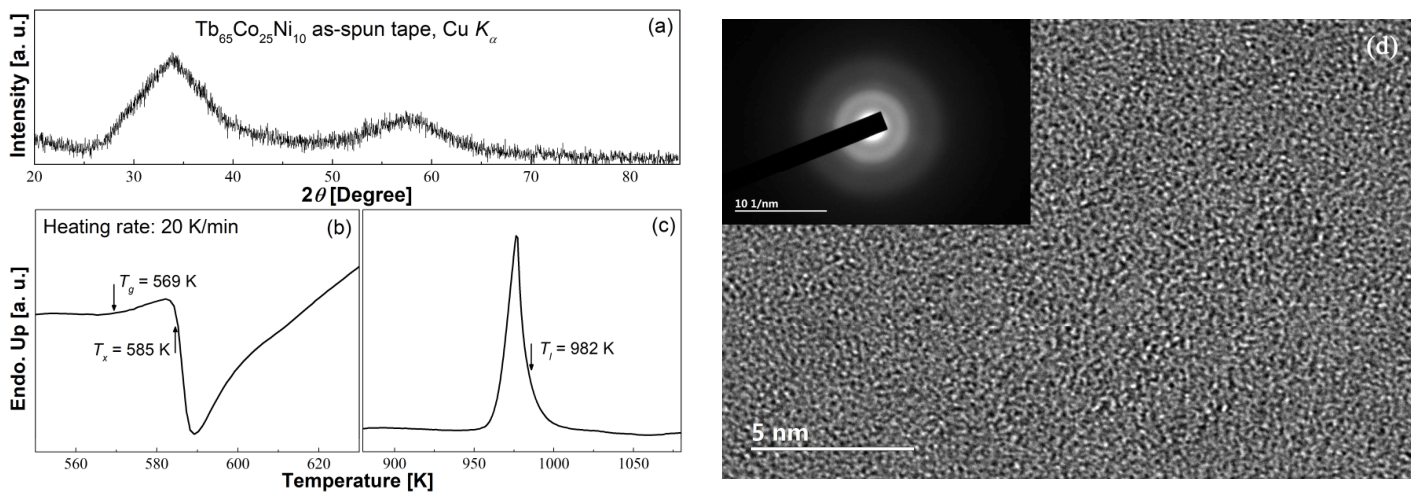
To elucidate the structural characteristics of the Tb65Co25Ni10 sample prepared in this work, the tape with a uniform thickness of 40 μm was subjected to XRD analysis. Due to the disordered arrangement of atoms in amorphous alloys, the diffraction pattern of amorphous alloys does not exhibit the sharp and strong diffraction peaks of crystalline alloys. Instead, several characteristic distances between atoms can cause scattering humps at multiple specific angles. As illustrated in Figure 1a, the XRD spectrum of the Tb65Co25Ni10 tape exhibits a pronounced broad diffraction peak within the range of 2θ = 30°~40°, accompanied by a subtle hump between 2θ = 55°~60°, corresponding to the average distance between nearest neighboring atoms and the average distance between second nearest neighboring atoms, respectively. According to the Bragg formula, the average distance between nearest neighboring atoms in the Tb65Co25Ni10 tape can be roughly calculated to be 3.23 Å, which is close to the experimental and simulation results of other amorphous alloys [25,26,27]. Additionally, the full width at half maximum (FWHM, inversely proportional to the particle size based on the Scherrer formula) value of the main peak of the Tb65Co25Ni10 tape was determined to be about 7.60°, which is also close to that of other fully amorphous alloys [28,29]. The average distance between nearest neighboring atoms and the FWHM value of the main peak imply the strong short-range order in the Tb65Co25Ni10 tape. More importantly, no sharp crystalline diffraction peaks are observed across the entire angular measurement range, further indicating that the Tb65Co25Ni10 tape is an amorphous alloy.
Given that the short-range-ordered structure of amorphous alloys represents a metastable state, another crucial feature of such materials is the occurrence of glass transition behavior prior to their crystallization reactions. The DSC curve of the Tb65Co25Ni10 tape, as depicted in Figure 1b, reveals a minor endothermic peak preceding a sharp exothermic crystallization peak. This endothermic peak corresponds to the glass transition phenomenon exhibited by the Tb65Co25Ni10 tape during heating, thereby providing further corroboration of its amorphous nature. Consequently, the glass transition temperature (Tg) and crystallization temperature (Tx) of the Tb65Co25Ni10 amorphous tape are determined to be 569 K and 585 K, respectively. From Figure 1c, the liquidus temperature (Tl) of the Tb65Co25Ni10 amorphous tape is determined to be 982 K. Based on the values of Tg, Tx, and Tl, two common criteria can be employed to describe the GFA of the Tb65Co25Ni10 amorphous tape; namely, the reduced glass transition temperature Trg (=Tg/Tl) [30], and the parameter γ (=Tx/(Tg + Tl) [31]. As such, the values of Trg and γ for the Tb65Co25Ni10 amorphous tape are determined to be 0.579 and 0.377, respectively. Although these values of the Tb65Co25Ni10 amorphous tape are not as high as those of Zr-based or Ti-based bulk metallic glasses, they are still significantly higher than the Trg and γ values of most Fe-based and RE-based amorphous tapes. Additionally, the critical section thickness Zc of the Tb65Co25Ni10 amorphous tape, based on the parameter γ, can be calculated as 1.882 mm using the formula Zc = 2.8 × 10⁻⁷exp(41.7γ) [31]. Taking into account the magnitudes of Trg, γ and Zc, the Tb65Co25Ni10 amorphous tape demonstrates a remarkable glass forming ability, which facilitates the facile preparation of Tb65Co25Ni10 alloy in the form of amorphous tapes. Additionally, in order to avoid the influence of possible nano-clusters or medium-range-ordered structures on the subsequent magnetic properties and magnetocaloric effect, we observed the microstructure of the Tb65Co25Ni10 amorphous alloy through high-resolution TEM technology. As shown in Figure 1d, there are almost no nano-clusters or medium-range-ordered structures embedded on the disordered amorphous matrix. The diffraction halo and the disordered atomic configuration further confirm the completely amorphous structure of the Tb65Co25Ni10 amorphous tape.

3.2. The Magnetic Properties of the Tb65Co25Ni10 Amorphous Tape

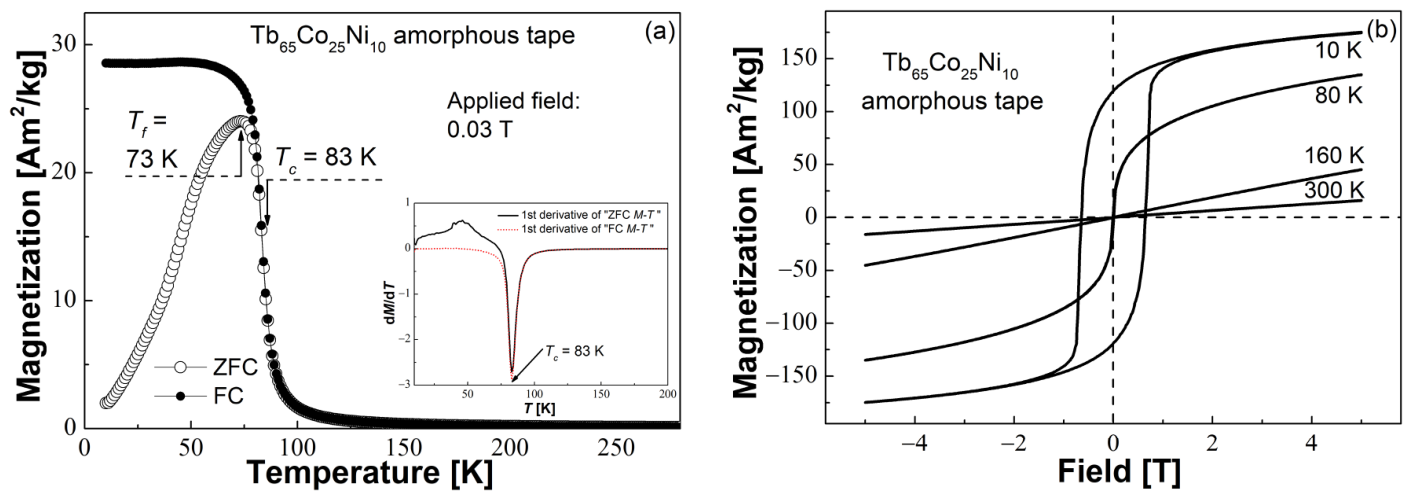
To investigate the magnetization behavior of the Tb65Co25Ni10 amorphous tape, we initially cooled the tape from room temperature to 10 K in the absence of an external magnetic field (zero-field cooling, ZFC), and measured its magnetization curve under a magnetic field of 0.03 T as the temperature increased from 10 K to 300 K. Subsequently, the tape was cooled again to 10 K under a magnetic field of 0.03 T (field cooling, FC), and its magnetization curve was then measured under the same magnetic field from 10 K to 300 K. Figure 2a presents the ZFC and FC MT curves under 0.03 T of the Tb65Co25Ni10 amorphous tape. It is evident from the figure that as the temperature decreases, the ZFC and FC MT curves initially nearly coincide, with their magnetization increasing slowly until a rapid rise below 100 K. However, after reaching an inflection point, the magnetization of the ZFC MT curve begins to gradually decline, while that of the FC MT curve continues to increase and eventually stabilizes. This characteristic “λ”-shaped MT curve has also been observed in other RE-based amorphous alloys, such as Tb-, Dy- and Nd-based amorphous alloys [22,23,24,32,33,34,35]. The magnetization behavior of amorphous alloys is reminiscent of traditional spin-glass systems, yet it differs fundamentally from the nature of spin-glasses and thus is referred to as “spin-glass-like behavior” [36]. The temperature at which the magnetization begins to decline in the ZFC MT curve is defined as the spin-freezing temperature, denoted as Tf = 73 K for the Tb65Co25Ni10 tape. Additionally, the temperature corresponding to the most rapid change in magnetization (i.e., the minimum value of the derivative of the MT curve, as shown in Figure 2a) is identified as the Curie temperature, Tc = 83 K for the Tb65Co25Ni10 tape.
Figure 2b displays the hysteresis loops of the Tb65Co25Ni10 amorphous tape at 10 K, 80 K, 160 K, and 300 K under a magnetic field of 5 T. At 160 K and 300 K, the relationship between magnetization and magnetic field closely follows the Curie-Weiss law, exhibiting distinct paramagnetic behavior. At 80 K, which lies between Tf and Tc, the hysteresis loop shows negligible hysteresis with almost imperceptible coercivity (~5.6 kA/m), indicating that the Tb65Co25Ni10 amorphous tape is an excellent soft magnetic alloy. Conversely, at 10 K, well below Tf, a pronounced hysteresis is observed in the hysteresis loop of the Tb65Co25Ni10 amorphous tape, accompanied by a significantly high coercivity of 512.2 kA/m, which is the typical characteristic of hard magnetism. As with other RE-based amorphous alloys displaying spin-glass-like behavior, the random magnetic anisotropy induced by the coupling of anisotropic 3d-4f interactions between RE and TM atoms accounts for the magnetic hysteresis and large coercivity observed in these amorphous alloys at low temperatures [23,33,34,35,37].
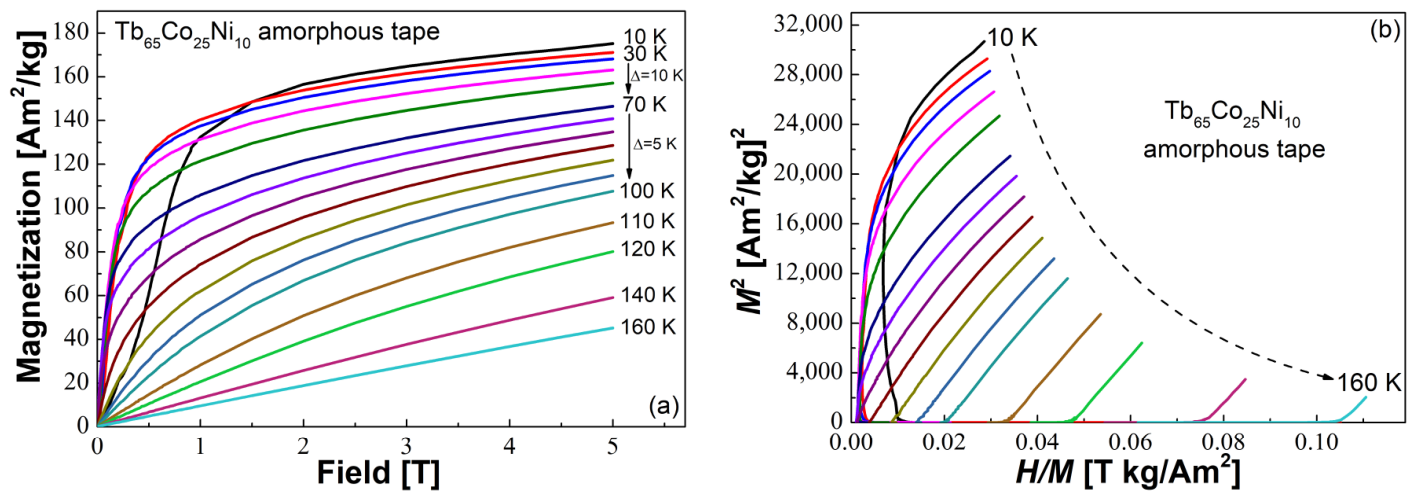
Simultaneously, the spin-glass-like behavior and significant coercivity of RE-based amorphous alloys at low temperatures impede magnetization, leading to anomalous magnetization characteristics. Figure 3a presents the MH curves of the Tb65Co25Ni10 amorphous tape at various temperatures ranging from 10 K to 160 K, with an applied magnetic field of 5 T. It is evident that the magnetization of the Tb65Co25Ni10 tape increases rapidly with the increase in magnetic field at temperatures below its Tc, exhibiting a very high initial permeability. As the temperature rises, the initial permeability decreases, and the magnetization also diminishes. Notably, at temperatures significantly above Tc, the relationship between magnetization and magnetic field even adheres to the linear relation described by the Curie-Weiss law. This variation pattern signifies the ferromagnetic-paramagnetic transition process in the Tb65Co25Ni10 amorphous tape. Furthermore, it can be observed that at temperatures above Tf, the magnetization exhibits a negative correlation with temperature across the entire magnetic field range, meaning that the magnetization decreases with increasing temperature. However, at temperatures below Tf, the relationship between magnetization and temperature is positively correlated under a very small magnetic field, particularly pronounced for the magnetization curve at 10 K, where the magnetization below 1.5 T is significantly lower than that at 30 K. This anomalous magnetization behavior is primarily attributed to the hindering effect of large coercivity on magnetization, further underscoring the spin-glass-like behavior of the Tb65Co25Ni10 amorphous tape.
For amorphous MCE materials, the ferromagnetic-paramagnetic transition is usually a second-order phase transition. However, whether the emergence of spin-glass-like behavior affects the type of phase transition warrants further investigation. Therefore, by analyzing the MH curves of the Tb65Co25Ni10 amorphous tape, we constructed the Arrott plots, which are graphs of H/M vs. M2. Banerjee proposed that if the Arrott plot exhibits a “C” or “S” shape characterized by a negative slope, the alloy undergoes a first-order phase transition, whereas a positive slope indicates a second-order phase transition [38]. Figure 3b displays the Arrott plots of the Tb65Co25Ni10 amorphous tape at various temperatures. It is evident that the slopes of the Arrott plots are positive and the curves at each temperature are nearly parallel above Tf, especially under the high field region of 1–5 T, indicative of typical SOMT behavior. However, the Arrott plots below Tf display a “C”-shaped feature under low field, particularly pronounced at 10 K, suggesting that the Tb65Co25Ni10 amorphous tape does not undergo SOMT under low field at temperatures below Tf. Unlike first-order phase transition induced by structural mutation, however, the phenomenon in the Tb65Co25Ni10 amorphous tape is more likely attributed to spin-glass-like behavior and nonuniform reversal, which leads to the deviation from mean-field Arrott behavior.

3.3. The Magnetocaloric Effect of the Tb65Co25Ni10 Amorphous Tape

Previous studies have indicated that the presence of spin-glass-like behavior and large coercivity at low temperatures in RE-based amorphous alloys can significantly influence their magnetocaloric properties [23,24,32,33,34,35]. Generally, the magnetocaloric effect of magnetic materials is primarily characterized by −∆Sm and refrigeration capacity. To this end, we can determine −∆Sm at various temperatures and magnetic fields using Maxwell’s equation [39], which is expressed as follows:
Δ S m T ,   H   =   S m T ,   H S m T ,   0   = 0 H M T H d H .
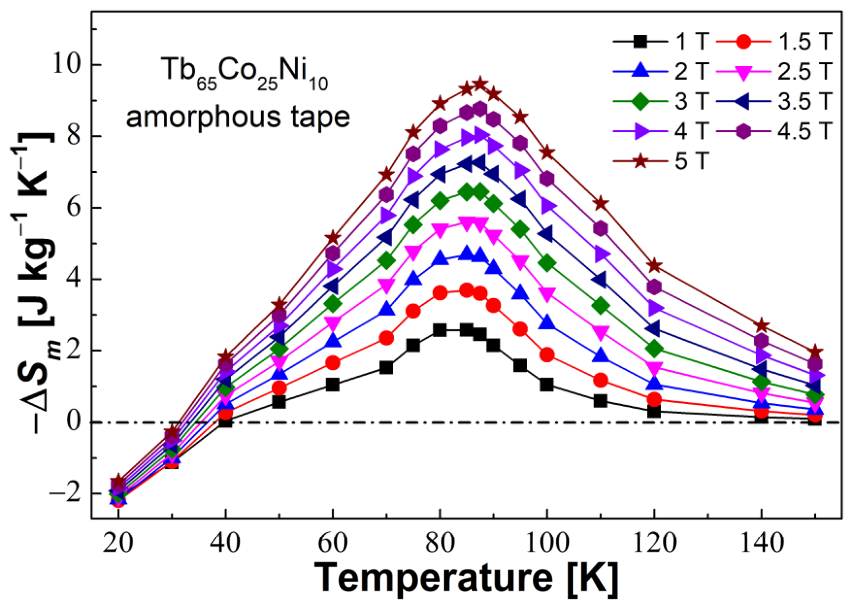
For amorphous alloys with SOMT or spin-glass-like behavior, the above equation can be well used in the reversible region. However, at temperatures below Tf where the system is in a nonequilibrium state, the direct application of the above equation should be performed in a special way due to the irreversible processes. Using the method in a reversible region as a reference, the entropy change, namely irreversible −∆Sm, was obtained by calculating the area between magnetic isotherms at adjacent temperatures and dividing it by the temperature difference [40,41]. The irreversible −∆Sm provides valuable information about the random magnetic anisotropy, and depends on the thermal history of the sample. Therefore, based on the MH curves of the Tb65Co25Ni10 amorphous tape, we obtained the temperature dependence of −∆Sm for the tape under different magnetic fields ranging from 1 to 5 T, i.e., the (−∆Sm)–T curves. As depicted in Figure 4, all (−∆Sm)–T curves exhibit a relatively broad temperature distribution, which is characteristic of SOMT materials. Under different magnetic fields, −∆Sm initially increases gradually with increasing temperature and reaches a maximum value near Tc, denoted as −∆Smpeak. With further elevation of temperature, −∆Sm decreases slowly and eventually approaches zero. Notably, the −∆Sm of the Tb65Co25Ni10 amorphous tape becomes negative below 40 K due to the influence of spin-glass-like behavior and large coercivity, which indicates that the random magnetic anisotropy dominates the magnetization behavior [41]. This phenomenon has also been observed in other Tb-, Nd- and Dy-based amorphous alloys [23,32,34,35]. Additionally, it is observed that as the magnetic field increases, the critical temperature for the sign change of −∆Sm in the Tb65Co25Ni10 amorphous tape gradually decreases to around 30 K, which is attributable to the fact that a stronger magnetic field more effectively overcomes the impediments to magnetization imposed by the spin-glass-like behavior and large coercivity. The above speculation can also be used to explain the difference in the peak shape of the (−∆Sm)–T curve under various fields. As the magnetic field decreases, the peak shape of the (−∆Sm)–T curve becomes more and more gentle due to the gradual weakening of the driving force that overcomes the magnetization hindrance caused by the spin-glass-like behavior and large coercivity.
Despite the spin-glass-like behavior and large coercivity causing the irreversible −∆Sm at low temperatures, the gentle −∆Sm distribution still endows the Tb65Co25Ni10 amorphous tape with a relatively wide ∆TFWHM. As listed in Table 1, the value of ∆TFWHM for the Tb65Co25Ni10 amorphous tape increases from 32.5 K under 1 T to 60.2 K under 5 T, which is larger than that of most FOMT materials, indicating that the Tb65Co25Ni10 amorphous tape holds great promise for operations as a magnetic refrigerant over a considerable temperature range. Furthermore, the −∆Smpeak values of the Tb65Co25Ni10 amorphous tape remain notably high, 3.69 J kg−1 K−1 under 1.5 T and 9.46 J kg−1 K−1 under 5 T, as presented in Table 1. Under a magnetic field of 5 T, the −∆Smpeak of the Tb65Co25Ni10 amorphous tape is 9% higher than that of the Tb65Ni35 amorphous alloy [23], 26% higher than that of the Tb55Co20Al25 amorphous alloy [42], and as much as 78% higher than that of the Tb45Co55 amorphous tape [24]. In fact, the −∆Smpeak of the Tb65Co25Ni10 amorphous tape is nearly the highest among the currently known Tb-based amorphous alloys. As shown in Table 2, it can also be observed that the −∆Smpeak of the Tb65Co25Ni10 amorphous tape is comparable to that of some other heavy RE-based amorphous alloys, and is only slightly lower than that of pure Gd metal [43,44,45,46].
The relatively wide ∆TFWHM and large −∆Smpeak endow the Tb65Co25Ni10 amorphous tape with a considerable refrigeration capacity. As another crucial parameter characterizing the magnetocaloric effect, the refrigeration capacity signifies the maximum cooling power that can be achieved over the broadest temperature interval by a magnetocaloric material. Two methods are usually adopted to calculate refrigeration capacity: the Wood-Potter method (RC = −ΔSmpeak × ΔTFWHM) [48] and the Gschneidner method (RC = T 2 T 1 Δ S m ( T ) d T , where T1 and T2 are the onset and end temperatures of ΔTFWHM, respectively) [49]. Based on the aforementioned two methods, we can calculate the refrigeration capacity of the Tb65Co25Ni10 amorphous tape under different magnetic fields. For convenience, the RC obtained by the Wood-Potter method is denoted as RC1, and that obtained by the Gschneidner method is denoted as RC2. As presented in Table 1, it is evident that the RC1 of the Tb65Co25Ni10 amorphous tape reaches 203.1 J kg−1 under 2 T, which is nearly comparable to that of pure Gd metal [41]. Under a magnetic field of 5 T, the RC1 and RC2 of the Tb65Co25Ni10 amorphous tape are 569.5 J kg−1 and 440.3 J kg−1, respectively, exceeding those of pure Gd metal and most other heavy RE-based amorphous alloys listed in Table 2 [23,24,42,43,44,45]. Furthermore, the RC1 and RC2 under 5 T of the Tb65Co25Ni10 amorphous tape are even 86.7% and 66.2% higher than those of the traditional giant MCE material Gd5Ge2Si2, respectively [47]. Therefore, considering its high −ΔSmpeak, wide ΔTFWHM, and considerable refrigeration capacity, the Tb65Co25Ni10 amorphous tape exhibits excellent magnetocaloric properties and holds significant potential for application as a magnetic refrigerant in the field of magnetic refrigeration.

3.4. The Magnetic Entropy Change Behavior of the Tb65Co25Ni10 Amorphous Tape

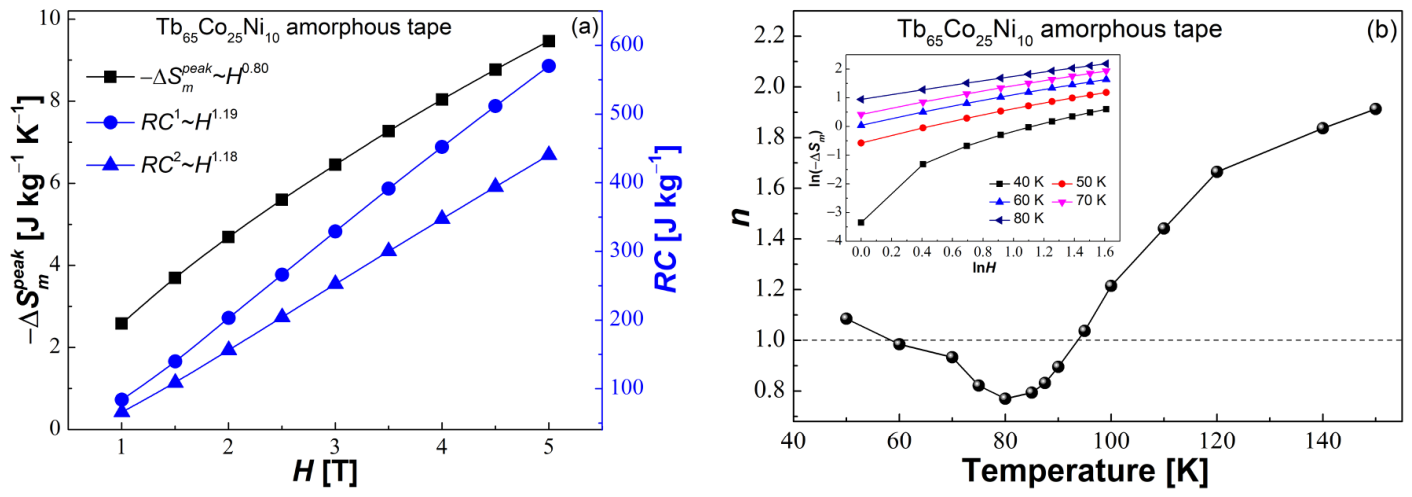
Oesterreicher et al. investigated the field dependence of the −ΔSmpeak in amorphous alloys based on mean-field theory and proposed a linear relationship: −∆SmpeakHn, where n = 2/3 [50]. Franco et al. suggested that the value of n at Tc for soft magnetic amorphous alloys should be close to 0.75 upon analyzing a large amount of experimental data, and this linear relationship for the field dependence of −ΔSm is also applicable at other temperatures, with n approaching 1 and 2 at temperatures well below and above Tc, respectively [51]. Thus, the consistency between the n value and the theoretical results mentioned above is one of the main criteria for determining whether the spin-glass-like behavior affects the magnetic entropy change behavior of amorphous alloys. Furthermore, similar to the field dependence of −ΔSmpeak, Law and Franco proposed that the field dependence of RC also follows a power-law relationship: RCHN [52]. For a given alloy system, the exponent N should have a relatively consistent value.
Based on the data in Table 1, we plotted the field dependences of −ΔSmpeak and RC for the Tb65Co25Ni10 amorphous tape, as shown in Figure 5a. By fitting these curves, the values of n and N for the Tb65Co25Ni10 amorphous tape can be approximately determined as n ≈ 0.80, N1 ≈ 1.19, and N2 ≈ 1.18 (where N1 and N2 correspond to RC1 and RC2, respectively). The N values for the Tb65Co25Ni10 amorphous tape in the two curves are quite similar, both of which are close to those in other Tb-, Dy- and Gd-based amorphous alloys and align well with the predicted results by Franco [22,53]. The n value at Tc of the Tb65Co25Ni10 amorphous tape is significantly higher than 2/3 predicted by mean-field theory. This discrepancy may arise because the short-range-ordered structure in amorphous alloys prepared via the rapid quenching method impede the magnetization of the alloy. Nevertheless, the n value at Tc remains slightly greater than 0.75, which is similar to the situation of other Tb- and Dy-based amorphous alloys exhibiting spin-glass-like behavior [23,24,32,35]. The above situation can be explained by the n value of the Tb65Co25Ni10 amorphous tape at temperatures below Tf. Figure 5b illustrates the n–T curve of the Tb65Co25Ni10 amorphous tape from 50 K to 150 K. The n value of the Tb65Co25Ni10 amorphous tape reaches 1.09 at 50 K, which is inconsistent with the prediction by Franco. This phenomenon should be attributed to the inhibitory effect of spin-glass-like behavior on −ΔSm. As the magnetic field decreases, this inhibitory effect becomes more pronounced, leading to a significant reduction in −ΔSm under low magnetic fields, which increases the slope of the linear fitting between ln(−ΔSm) and lnH. As shown in the inset of Figure 5b, the markedly deteriorated −ΔSm under low fields of the Tb65Co25Ni10 amorphous tape at 40 K makes the linear relationship between ln(−ΔSm) and lnH to no longer be satisfied. Even below 40 K, the Tb65Co25Ni10 amorphous tape exhibits irreversible −ΔSm, further deviating from the linear relationship. When the Tb65Co25Ni10 amorphous tape is in a paramagnetic state far above its Tc, the spin-glass-like state of the alloy is destroyed due to the elevated temperature, causing the n value to still tend towards 2. Therefore, the spin-glass-like behavior significantly affects the magnetic entropy change behavior of the Tb65Co25Ni10 amorphous tape at low temperatures, and this influence gradually diminishes as the temperature increases.
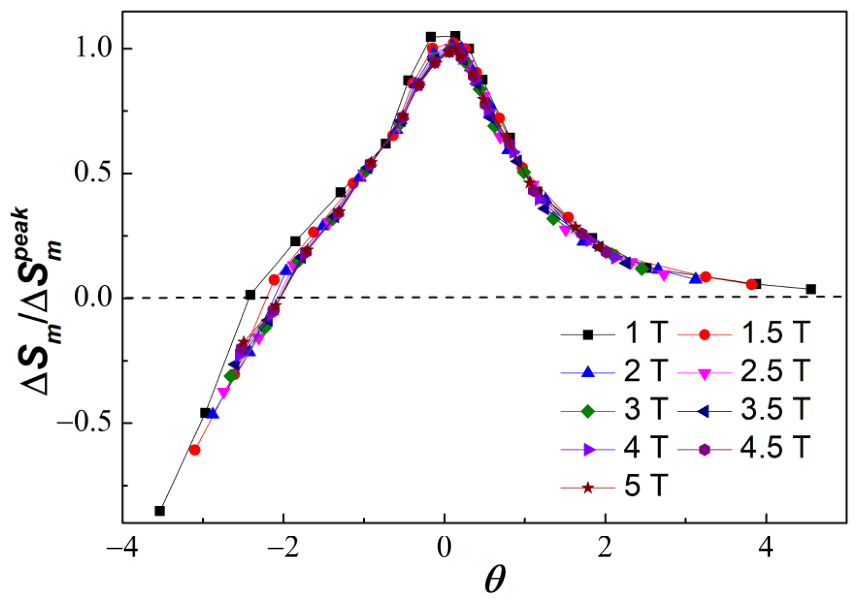
On the other hand, Franco et al. proposed that there is a universal behavior in the (−∆Sm)–T curves of amorphous alloys under different magnetic fields, meaning that all curves almost coincide after appropriate scaling [51,54]. The −∆Sm values at different temperatures are normalized using the following formula:
Δ S T ,   H max   =   Δ S m T ,   H max / Δ S m peak T ,   H max .
The temperature axis is divided into two parts by the critical temperature Tc, and each part is rescaled in a different way:
θ = T T c / T 1 T c ,   T     T c T T c / T 2 T c ,   T   >   T c ,
where T1 and T2 are the onset and end temperatures corresponding to ΔTFWHM of the (−∆Sm)–T curves under different magnetic fields, respectively. Figure 6 presents the normalized (−∆Sm)–T curves of the Tb65Co25Ni10 amorphous tape under various magnetic fields. As can be seen from the figure, all normalized (−∆Sm)–T curves exhibit similar characteristics, and the normalized curves under 1.5 T to 5 T almost completely coincide, indicating the universal behavior of the (−∆Sm)–T curves for the Tb65Co25Ni10 amorphous tape under different magnetic fields. However, the normalized (−∆Sm)–T curve under 1 T deviates slightly from those under other magnetic fields when θ < 0, which further demonstrates that the spin-glass-like behavior in the Tb65Co25Ni10 amorphous tape severely affects the −∆Sm below Tc. As the temperature increases, the spin-glass-like behavior disappears, and the normalized (−∆Sm)–T curve under 1 T basically coincides with those under other magnetic fields when θ > 0.

4. Conclusions

In conclusion, the GFA, magnetic properties, MCE performances and −∆Sm behavior of a ternary Tb65Co25Ni10 amorphous tape were studied in this work. The large values of Trg (~0.579), γ (~0.377) and Zc (~1.882 mm) demonstrate superior GFA of the Tb65Co25Ni10 tape compared to most Fe-based and RE-based amorphous systems, which means that the Tb65Co25Ni10 alloy is easier to prepare into continuous tapes under the same conditions. The ZFC and FC M-T curves reveal the distinct spin-glass-like behavior of the Tb65Co25Ni10 amorphous tape, with a Tc of 83 K and a Tf of 73 K. The amorphous tape exhibits hard magnetic characteristics, with coercivity as high as 512.2 kA/m at temperatures significantly below Tf, soft magnetic behavior at temperatures between Tc and Tf, and paramagnetic behavior at temperatures far exceeding Tc. The positive correlation between magnetization and temperature under low temperatures and low fields further confirms the presence of spin-glass-like behavior. The Arrott plots indicate that the Tb65Co25Ni10 amorphous tape exhibits non-SOMT characteristics at low temperatures, but gradually shifts toward SOMT behavior as the temperature increases. The spin-glass-like behavior induces the irreversible magnetocaloric effect below 40 K in the Tb65Co25Ni10 amorphous tape. However, the tape retains a rather large −∆Smpeak of 9.46 J kg−1 K−1 under 5 T, which exceeds the values reported for most heavy RE-based amorphous alloys, including Tb- and Gd-based systems. Notably, the refrigeration capacity of the Tb65Co25Ni10 amorphous tape significantly surpasses that of traditional crystalline magnetocaloric materials and pure Gd metal. The n value at Tc of the Tb65Co25Ni10 amorphous tape exceeds the predicted values from mean-field theory and Franco, aligning with the values observed in other amorphous alloys exhibiting the same spin-glass-like behavior. This discrepancy is attributed to the dual influence of local structure and spin-glass-like behavior in the alloy. Furthermore, the inhibitory effect of spin-glass-like behavior on −∆Sm in low field and low-temperature regions results in deviations from the −∆SmHn linear relationship below 50 K and the universally normalized (−∆Sm)–T curve under 1 T.

Author Contributions

Conceptualization, S.G. and Q.W.; methodology, Q.W.; investigation, S.G. and X.Z.; data curation, Q.W.; writing—original draft preparation, S.G. and X.Z.; writing—review and editing, Q.W.; funding acquisition, S.G. and Q.W. All authors have read and agreed to the published version of the manuscript.

Funding

This research was funded by the Natural Science Foundation of the Jiangsu Higher Education Institutions of China (grant number 22KJB150038), the Qing Lan Project of JiangSu Province (grant number 202305000008), and the Wuxi University Research Start-up Fund for Introduced Talents (grant number 2025r088).

Data Availability Statement

The original contributions presented in the study are included in the article, and further inquiries can be directed to the corresponding author.

Acknowledgments

This research was technically supported by the Center for Advanced Microanalysis of Shanghai University.

Conflicts of Interest

The authors declare no conflicts of interest.

References

  1. Franco, V.; Blázquez, J.S.; Ipus, J.J.; Law, J.Y.; Moreno-Ramírez, L.M.; Conde, A. Magnetocaloric effect: From materials research to refrigeration devices. Prog. Mater. Sci. 2018, 93, 112–232. [Google Scholar] [CrossRef]
  2. Bruck, E. Developments in magnetocaloric refrigeration. J. Phys. D Appl. Phys. 2005, 38, R381–R391. [Google Scholar] [CrossRef]
  3. Chaudhary, V.; Chen, X.; Ramanujan, R.V. Iron and manganese based magnetocaloric materials for near room temperature thermal management. Prog. Mater. Sci. 2019, 100, 64–98. [Google Scholar] [CrossRef]
  4. de Oliveira, N.A.; von Ranke, P.J. Theoretical aspects of the magnetocaloric effect. Phys. Rep. 2010, 489, 89–159. [Google Scholar] [CrossRef]
  5. Pasquale, M.; Sasso, C.P.; Lewis, L.H.; Giudici, L.; Lograsso, T.; Schlagel, D. Magnetostructural transition and magnetocaloric effect in Ni55Mn20Ga25 single crystals. Phys. Rev. B 2005, 72, 094435. [Google Scholar] [CrossRef]
  6. Gschneidner, K.A., Jr.; Pecharsky, V.K. Magnetocaloric Materials. Annu. Rev. Mater. Sci. 2000, 30, 387–429. [Google Scholar] [CrossRef]
  7. Hu, F.X.; Shen, B.G.; Sun, J.R.; Cheng, Z.H.; Rao, G.H.; Zhang, X.X. Influence of negative lattice expansion and metamagnetic transition on magnetic entropy change in the compound LaFe11.4Si1.6. Appl. Phys. Lett. 2001, 78, 3675–3677. [Google Scholar] [CrossRef]
  8. Abdulkadirova, N.Z.; Gamzatov, A.G.; Kamilov, K.I.; Kadirbardeev, A.T.; Aliev, A.M.; Popov, Y.F.; Vorobev, G.P.; Gebara, P. Magnetostriction and magnetocaloric properties of LaFe11.1Mn0.1Co0.7Si1.1 alloy: Direct and indirect measurements. J. Alloys Compd. 2022, 929, 167348. [Google Scholar] [CrossRef]
  9. Gebara, P.; Pawlik, P.; Michalski, B.; Wysłocki, J.J. Measurements of Magnetocaloric Effect in LaFe11.14Co0.66Si1.2-xAlx (x = 0.1, 0.2, 0.3) Alloys. Acta Phys. Pol. A 2015, 127, 576–578. [Google Scholar] [CrossRef]
  10. Kutynia, K.; Gebara, P. Tuning of the Structure and Magnetocaloric Effect of Mn1-xZrxCoGe Alloys (Where x = 0.03, 0.05, 0.07, and 0.1). Materials 2021, 14, 3129. [Google Scholar] [CrossRef]
  11. Kutynia, K.; Przybył, A.; Gebara, P. The Effect of Substitution of Mn by Pd on the Structure and Thermomagnetic Properties of the Mn1-xPdxCoGe Alloys (Where x = 0.03, 0.05, 0.07 and 0.1). Materials 2023, 16, 5394. [Google Scholar] [CrossRef] [PubMed]
  12. Luo, Q.; Wang, W.H. Magnetocaloric effect in rare earth-based bulk metallic glasses. J. Alloys Compd. 2010, 495, 209–216. [Google Scholar] [CrossRef]
  13. Wang, Q.; Ding, D.; Tang, B.Z.; Yu, P.; Chan, K.C.; Xia, L. Excellent magnetocaloric performance of a Fe88Zr4Pr4B4 amorphous alloy and its amorphous hybrids. Intermetallics 2023, 161, 107982. [Google Scholar] [CrossRef]
  14. Yu, P.; Zhang, J.Z.; Xia, L. Effect of boron on the magneto-caloric effect in Fe91-xZr9Bx (x = 3, 4, 5) amorphous alloys. J. Mater. Sci. 2017, 52, 13948–13955. [Google Scholar] [CrossRef]
  15. Gebara, P.; Hasiak, M.; Kovac, J.; Rajnak, M. Entalpy of Mixing, Microstructure, Structural, Thermomagnetic and Mechanical Properties of Binary Gd-Pb Alloys. Materials 2022, 15, 7213. [Google Scholar] [CrossRef]
  16. Gebara, P.; Díaz-García, Á.; Law, J.Y.; Franco, V. Magnetocaloric response of binary Gd-Pd and ternary Gd-(Mn, Pd) alloys. J. Magn. Magn. Mater. 2020, 500, 166175. [Google Scholar] [CrossRef]
  17. Li, H.X.; Lu, Z.C.; Wang, S.L.; Wu, Y.; Lu, Z.P. Fe-based bulk metallic glasses: Glass formation, fabrication, properties and applications. Prog. Mater. Sci. 2019, 103, 235–318. [Google Scholar] [CrossRef]
  18. Zhang, H.Y.; Li, R.; Zhang, L.L.; Zhang, T. Tunable magnetic and magnetocaloric properties in heavy rare-earth based metallic glasses through the substitution of similar elements. J. Appl. Phys. 2014, 115, 133903. [Google Scholar] [CrossRef]
  19. Wu, C.; Ding, D.; Xia, L.; Chan, K.C. Achieving tailorable magneto-caloric effect in the Gd-Co binary amorphous alloys. AIP Adv. 2016, 6, 035302. [Google Scholar] [CrossRef]
  20. Fu, H.; Zou, M. Magnetic and magnetocaloric properties of ternary Gd–Co–Al bulk metallic glasses. J. Alloys Compd. 2011, 509, 4613–4616. [Google Scholar] [CrossRef]
  21. Xue, L.; Shao, L.; Han, Z.; Luo, Q.; Wang, H.; Huo, J.; Li, Z.; Zhang, B.; Cheng, J.; Shen, B. Tunable magnetocaloric effect in Gd-based metallic glasses microalloying elements with different magnetism. J. Non-Cryst. Solids 2022, 576, 121222. [Google Scholar] [CrossRef]
  22. Huo, J.T.; Huo, L.S.; Li, J.W.; Men, H.; Wang, X.M.; Inoue, A.; Chang, C.T.; Wang, J.Q.; Li, R.W. High-entropy bulk metallic glasses as promising magnetic refrigerants. J. Appl. Phys. 2015, 117, 073902. [Google Scholar] [CrossRef]
  23. Pan, L.L.; Wang, Q.; Zhou, X.; Tang, B.Z.; Yu, P.; Ding, D.; Xia, L. Glass formability of the Tb–Ni binary alloys and the magnetic properties of the Tb65Ni35 metallic glass. Intermetallics 2022, 148, 107650. [Google Scholar] [CrossRef]
  24. Wang, X.; Ding, D.; Cui, L.; Xia, L. Compositional dependence of curie temperature and magnetic entropy change in the amorphous Tb–Co ribbons. Materials 2021, 14, 1002. [Google Scholar] [CrossRef]
  25. Stogne, O.V.; Zolotukhin, I.V.; Rapp, O. Spin-glass ordering in amorphous Tb–Cr alloys. Phys. Solid State 1999, 41, 1126–1129. [Google Scholar] [CrossRef]
  26. Lizarraga, R. Structural and magnetic properties of the Gd-based bulk metallic glasses GdFe2, GdCo2, andGdNi2 from first principles. Phys. Rev. B 2016, 94, 174201. [Google Scholar] [CrossRef]
  27. Li, Z.B.; Yuan, J.M.; Wang, Q.; Ding, D.; Xia, L. Achieving higher Curie temperature and magnetic entropy change by minor Co substitution for Fe in a Fe88Pr10Al2 amorphous alloy. Intermetallics 2026, 189, 109125. [Google Scholar] [CrossRef]
  28. Singh, D.; Singh, D.; Mandal, R.K.; Srivastava, O.N.; Tiwari, R.S. Effect of quenching rate on the microstructure and mechanical behavior of Ce75Al21Ga4 glassy alloy. Mater. Charact. 2017, 134, 18–24. [Google Scholar] [CrossRef]
  29. Wang, X.; Zhao, Y.F.; Zhu, T.T.; Cui, L.; Li, N. The effect of RE (RE=Pr, Ce) substitution on formability, magnetic and magnetocaloric properties of the Fe88Zr2Ti2Nd4B4 amorphous alloy. J. Non-Cryst. Solids 2024, 636, 122989. [Google Scholar] [CrossRef]
  30. Turnbull, D. Under what conditions can a glass be formed? Contemp. Phys. 1969, 10, 473–488. [Google Scholar] [CrossRef]
  31. Lu, Z.P.; Liu, C.T. A new glass-forming ability criterion for bulk metallic glasses. Acta Mater. 2002, 50, 3501–3512. [Google Scholar] [CrossRef]
  32. Ma, L.Y.; Tang, B.Z.; Chan, K.C.; Zhao, L.; Tang, M.B.; Ding, D.; Xia, L. Formability and magnetic properties of Dy-Co binary amorphous alloys. AIP Adv. 2018, 8, 075215. [Google Scholar] [CrossRef]
  33. Xia, L.; Chan, K.C.; Zhao, L.; Ding, D.; Tang, B.Z. Magnetic properties and magnetostriction of a binary Dy50Co50 amorphous alloy. J. Non-Cryst. Solids 2018, 493, 29–32. [Google Scholar] [CrossRef]
  34. Wang, Q.; Tang, B.Z.; Chan, K.C.; Tang, M.B.; Ding, D.; Xia, L. Magnetocaloric effect and magnetostriction of a binary Nd50Co50 metallic glass. J. Non-Cryst. Solids 2021, 571, 121076. [Google Scholar]
  35. Wang, Q.; Ding, D.; Xia, L. Formability and magnetic properties of the binary Nd-Co amorphous alloys. Metals 2021, 11, 1730. [Google Scholar] [CrossRef]
  36. Binder, K.; Young, A.P. Spin glasses: Experimental facts, theoretical concepts, and open questions. Rev. Mod. Phys. 1986, 58, 801–976. [Google Scholar] [CrossRef]
  37. Wang, Q.; Ding, D.; Xia, L. Origin of random magnetic anisotropy in a fully amorphous Tb55Co45 alloy. J. Alloys Compd. 2025, 1039, 183378. [Google Scholar] [CrossRef]
  38. Banerjee, S.K. On a generalized approach to first and second order magnetic transitions. Phys. Lett. 1964, 12, 16–17. [Google Scholar] [CrossRef]
  39. Hashimoto, T.; Numasawa, T.; Shino, M.; Okada, T. Magnetic refrigeration in the temperature range from 10 K to room temperature: The ferromagnetic refrigerants. Cryogenics 1981, 21, 647–653. [Google Scholar] [CrossRef]
  40. Luo, Q.; Schwarz, B.; Mattern, N.; Eckert, J. Irreversible and reversible magnetic entropy change in a Dy-based bulk metallic glass. Intermetallics 2012, 30, 76–79. [Google Scholar] [CrossRef]
  41. Luo, Q.; Schwarz, B.; Mattern, N.; Eckert, J. Giant irreversible positive to large reversible negative magnetic entropy change evolution in Tb-based bulk metallic glass. Phys. Rev. B 2010, 82, 024204. [Google Scholar] [CrossRef]
  42. Du, J.; Zheng, Q.; Brück, E.; Buschow, K.H.J.; Cui, W.B.; Feng, W.J.; Zhang, Z.D. Spin-glass behavior and magnetocaloric effect in Tb-based bulk metallic glass. J. Magn. Magn. Mater. 2009, 321, 413. [Google Scholar] [CrossRef]
  43. Liang, L.; Hui, X.; Zhang, C.M.; Chen, G.L. A Dy-based bulk metallic glass with high thermal stability and excellent magnetocaloric properties. J. Alloys Compd. 2008, 463, 30–33. [Google Scholar] [CrossRef]
  44. Du, J.; Zheng, Q.; Li, Y.B.; Zhang, Q.; Li, D.; Zhang, Z.D. Large magnetocaloric effect and enhanced magnetic refrigeration in ternary Gd-based bulk metallic glasses. J. Appl. Phys. 2008, 103, 023918. [Google Scholar] [CrossRef]
  45. Xue, L.; Shao, L.L.; Luo, Q.; Shen, B.L. Gd25RE25Co25Al25 (RE = Tb, Dy and Ho) high-entropy glassy alloys with distinct spin-glass behavior and good magnetocaloric effect. J. Alloys Compd. 2019, 790, 633–639. [Google Scholar] [CrossRef]
  46. Shen, J.; Wu, J.F.; Sun, J.R. Room-temperature large refrigerant capacity of Gd6Co2Si3. J. Appl. Phys. 2009, 106, 083902. [Google Scholar] [CrossRef]
  47. Provenzano, V.; Shapiro, A.J.; Shull, R.D. Reduction of hysteresis losses in the magnetic refrigerant Gd5Ge2Si2 by the addition of iron. Nature 2004, 429, 853. [Google Scholar] [CrossRef]
  48. Wood, M.E.; Potter, W.H. General analysis of magnetic refrigeration and its optimization using a new concept: Maximization of refrigerant capacity. Cryogenics 1985, 25, 667–683. [Google Scholar] [CrossRef]
  49. Gschneidner, K.A., Jr.; Pecharsky, V.K.; Pecharsky, A.O.; Zimm, C.B. Recent Developments in Magnetic Refrigeration. Mater. Sci. Forum. 1999, 315–317, 69–78. [Google Scholar] [CrossRef]
  50. Oesterreicher, H.; Parker, F.T. Magnetic cooling near Curie temperatures above 300 K. J. Appl. Phys. 1984, 55, 4334–4338. [Google Scholar] [CrossRef]
  51. Franco, V.; Blazquez, J.S.; Conde, A. Field dependence of the magnetocaloric effect in materials with a second order phase transition: A master curve for the magnetic entropy change. Appl. Phys. Lett. 2006, 89, 222512. [Google Scholar] [CrossRef]
  52. Law, J.Y.; Franco, V.; Ramanujan, R.V. Influence of La and Ce additions on the magnetocaloric effect of Fe–B–Cr-based amorphous alloys. Appl. Phys. Lett. 2011, 98, 192503. [Google Scholar] [CrossRef]
  53. Franco, V.; Conde, A. Scaling laws for the magnetocaloric effect in second order phase transitions: From physics to applications for the characterization of materials. Int. J. Refrig. 2010, 33, 465–473. [Google Scholar] [CrossRef]
  54. Díaz-García, Á.; Law, J.Y.; Gebara, P.; Franco, V. Phase Deconvolution of Multiphasic Materials by the Universal Scaling of the Magnetocaloric Effect. JOM 2020, 72, 2845–2852. [Google Scholar] [CrossRef]
Figure 1. (a) XRD pattern of the Tb65Co25Ni10 as-spun tape; (b) DSC curve and (c) melting curve of the Tb65Co25Ni10 amorphous tape; (d) high-resolution TEM image of the Tb65Co25Ni10 amorphous tape.
Metals 16 00557 g001
Figure 2. (a) ZFC and FC MT curves of the Tb65Co25Ni10 amorphous tape; (b) hysteresis loops of the Tb65Co25Ni10 amorphous tape at 10 K, 80 K, 160 K and 300 K.
Metals 16 00557 g002
Figure 3. (a) MH curves and (b) Arrott plots of the Tb65Co25Ni10 amorphous tape at different temperatures.
Metals 16 00557 g003
Figure 4. (−∆Sm)–T curves of the Tb65Co25Ni10 amorphous tape under different magnetic fields.
Metals 16 00557 g004
Figure 5. (a) The field dependence of −∆Smpeak and RC for the Tb65Co25Ni10 amorphous tape; (b) the n–T curve of the Tb65Co25Ni10 amorphous tape (the inset is ln(−∆Sm)–lnH curves at various temperatures).
Metals 16 00557 g005
Figure 6. The normalized (−∆Sm)–T curves of the Tb65Co25Ni10 amorphous tape.
Metals 16 00557 g006
Table 1. The characterization parameters of the MCE in the Tb65Co25Ni10 amorphous tapes.
MCE
Parameters
Applied Field (T)
11.522.533.544.55
TFWHM (K)32.537.943.347.551.053.856.258.360.2
−ΔSmpeak (J kg−1 K−1)2.583.694.695.606.457.278.048.779.46
RC1 (J kg−1) *83.8139.8203.1266.0329.0391.1451.8511.3569.5
RC2 (J kg−1) **65.9108.8156.2204.2252.6300.3347.5394.1440.3
* RC1 denotes the refrigeration capacity calculated by the Wood-Potter method. ** RC2 denotes the refrigeration capacity calculated by the Gschneidner method.
Table 2. The characterization parameters of the MCE in some heavy RE-based amorphous alloys, pure Gd metal, and some FOMT materials (A—amorphous alloy; C—crystalline compound).
CompositionsStructureTc (K)Applied Field (T)TFWHM (K)−ΔSmpeak (J kg−1 K−1)RC1 (J kg−1)RC2 (J kg−1)Refs.
Tb45Co55A1705835.31441 [24]
Tb50Co50A1305607.3438
Tb55Co45A1055638.84557
Tb60Co40A975629.18570
Tb62.5Co37.5A925629.27575
Tb65Ni35A64563.78.68553435.7[23]
Tb55Co20Al25A1055477.5375 [42]
Dy36Ho20Co20Al24A235449.49417326[43]
Gd55Co20Al25A103561.58.8541 [44]
Gd25Tb25Co25Al25A735658.88577 [45]
Gd6Co2Si3C2955806.3503430[46]
GdC2935579.7556378
2395.5214
Gd5Ge2Si2C276516.418.6305265[47]
Gd5Ge1.9Si2Fe0.1C276551.47360240
Disclaimer/Publisher’s Note: The statements, opinions and data contained in all publications are solely those of the individual author(s) and contributor(s) and not of MDPI and/or the editor(s). MDPI and/or the editor(s) disclaim responsibility for any injury to people or property resulting from any ideas, methods, instructions or products referred to in the content.