Review

Magnesium-Rich Compounds and LPSO Phases for Hydrogen Storage: A Review

Institut de Chimie de la Matière Condensée de Bordeaux, University of Bordeaux, CNRS, Bordeaux INP, UMR 5026, 33600 Pessac, France
*
Author to whom correspondence should be addressed.
Metals 2026, 16(5), 497; https://doi.org/10.3390/met16050497
Submission received: 2 February 2026 / Revised: 26 March 2026 / Accepted: 28 March 2026 / Published: 30 April 2026
(This article belongs to the Section Crystallography and Applications of Metallic Materials)

Abstract

This review provides an overview of magnesium-rich compounds and Long-Period Stacking Ordered (LPSO) phases for their hydrogen storage properties. Thanks to their high volumetric density, safety, and exceptional purity, metal hydrides are promising for hydrogen storage. Magnesium is a great candidate as it can form MgH2, which has a weight capacity of 7.6 wt.%. However, due to its high stability (at 283 °C, equilibrium pressure is 1 bar (i.e., atmospheric pressure)) and slow hydrogen sorption kinetics, Mg is alloyed with TMs (transition metals) and/or REs (rare earths) to overcome these problems. Some alloys that are synthesized with both TMs and REs (ternary system) form LPSO phases, which irreversibly decompose under hydrogenation. The LPSO phases discussed in this review are mostly the 14H- and 18R-type phases, although, rarely, other types of LPSO phases can still be observed as well. These discussed phases may lead to good hydrogen sorption properties depending on the REs and TMs used. This review focuses on the recent literature addressing Mg-rich binary Mg-TM and Mg-RE alloys and ternary (TMx-REy-Mgz) systems and their hydrogen storage properties with an emphasis on LPSO phases.

1. Introduction

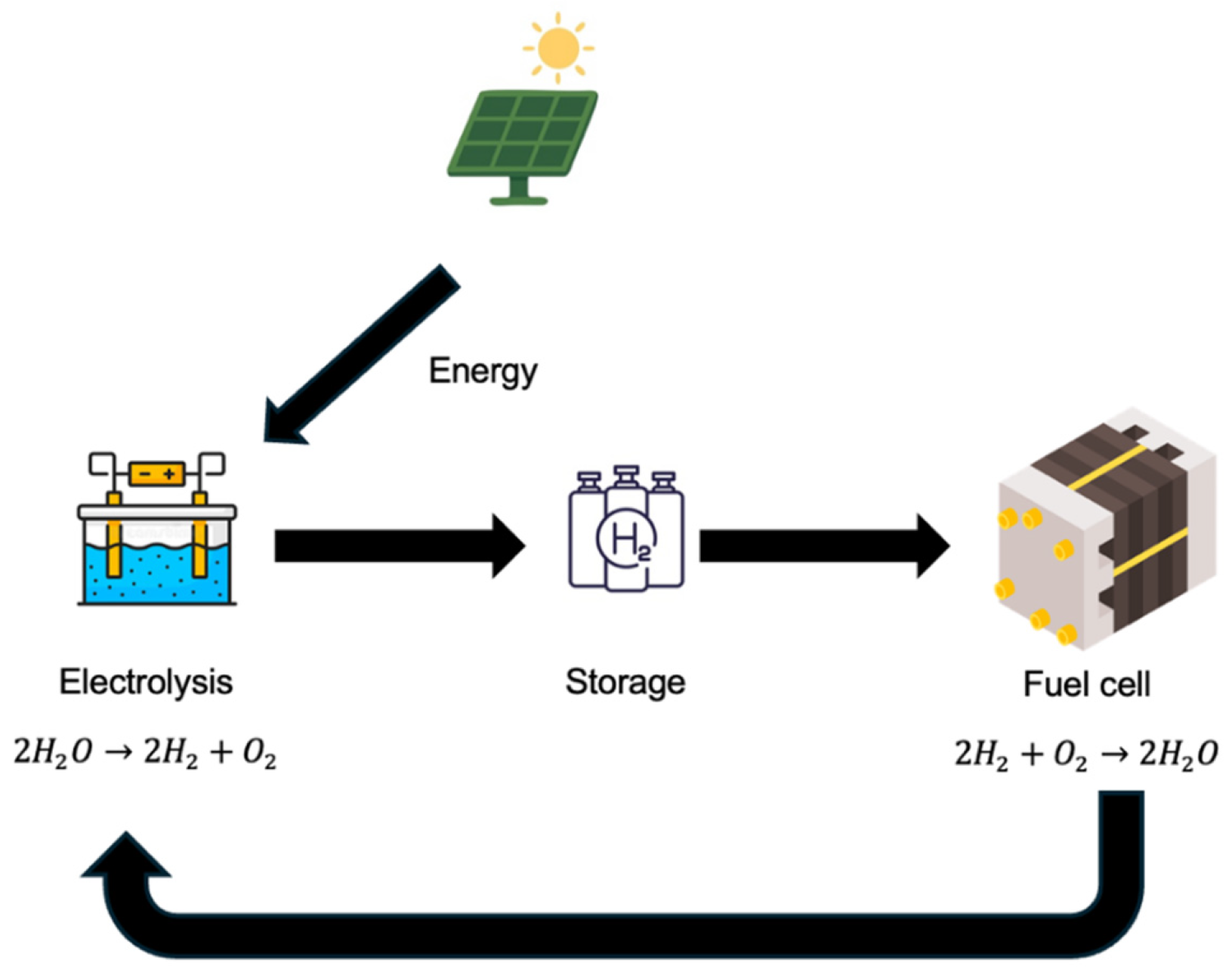
A considerable part of the current energy demand is answered by fossil fuels, which have a harmful impact that cannot be overlooked. The growth of this demand is constantly pushing research towards new energy sources and vectors that are greener and more sustainable, but also efficient. Among the different candidates, such as solar, wind, hydraulic, and many other energy sources, hydrogen stands out as a promising vector because of its high energy density (120 MJ/kg) [1]. Moreover, hydrogen is also abundant, available, renewable, and does not emit CO2. Only water is emitted during hydrogen combustion, as shown in Figure 1, which makes it a perfect candidate to be the energy carrier of the future.
Hydrogen is already used for different applications, including, for example, ammonia production or oil refining. The main challenge to extend the range of applications remains storage. For the moment, hydrogen storage methods can be classified into two categories, which are chemical (or materials type) and physical hydrogen storage. In physical hydrogen storage, hydrogen is stored as H2 molecules without changing its chemical nature. These storage techniques can be listed as follows: compressed hydrogen, cryogenic liquid hydrogen, and cryo-compressed hydrogen. High-pressure storage requires tanks with high mechanical strength and brings the risks (and safety conditions) of compressed gases. Cryogenic liquid hydrogen storage requires a lot of energy because the liquefaction temperature of hydrogen is very low, −253 °C [2]. Cyro-compressed hydrogen storage is liquid hydrogen storage at high pressure. This technology is a combination of the two previous technologies, which are compressed and liquid hydrogen. Combining these two technologies offers better volumetric density, as shown in Table 1. However, this system costs more since it consumes more power and requires materials with high mechanical strength at low temperature [3]. Regarding the materials for chemical hydrogen storage, hydrogen is stored in the structure of another material, and the release is done through a chemical reaction. Liquid Organic Hydrogen Carriers (LOHCs) are used in one of the chemical storage techniques. The LOHC method stands out thanks to its reversibility and compatibility with existing infrastructure (e.g., it is liquid), but it is limited by slow kinetics at low temperature (requiring high-cost catalysts) and impurities in the released hydrogen [4]. Another example of a chemical storage method is the use of adsorbents. Hydrogen is adsorbed on the surface of these materials, such as activated carbon, MOF, zeolites, etc. The higher the specific surface, the higher the capacity. Nevertheless, the temperature should be low (typically liquid nitrogen) to ensure the stability of the van der Waals bonds occurring between the adsorbents and H2 molecules. Complex hydrides include hydrides with light metals such as sodium, which is, for example, complexed with aluminum, like in NaAlH4. Even if its volumetric density is high, the kinetics of absorption and desorption are very slow, like for LOHCs. On the other hand, metal hydrides can provide high hydrogen purity, as impurities such as O2, CO2, and other gaseous species are strongly retained within the material and are not released during hydrogen desorption. They also offer enhanced safety: in the event of a leak, hydrogen desorption induces a temperature decrease due to the endothermic nature of the process, which, in turn, lowers the equilibrium (plateau) pressure and progressively limits further hydrogen release. Moreover, it has better volumetric density when compared with other methods, as shown in Table 1.
Magnesium is a promising material for the solid storage of hydrogen because it can give rise to the binary hydride MgH2 that has a weight capacity of 7.6 wt.%. The formation enthalpy of this compound is −74.5 kJ/mol, which corresponds to an equilibrium temperature of 283 °C at atmospheric pressure. This feature makes this compound unusable for applications at room temperature. In addition to this thermodynamic limitation, magnesium hydrides also have slow hydrogen absorption and desorption kinetics. Magnesium can be alloyed with catalytic elements such as transition metals or rare earth metals to improve their sorption kinetics. Furthermore, the combination of magnesium with a transition metal and a rare earth can also lead to the formation of (i) ternary compounds and (ii) Long-Period Stacking Ordered (LPSO) phases. These long-period stacking sequences are derived from the hexagonal close-packed (hcp) structure of Mg and involve chemical ordering of solute elements within close-packed atomic layers [5,6,7]. Although they are studied for structural applications, their role in hydrogen storage has attracted attention. These LPSO phases appear to have new atomic arrangements and properties that could influence hydrogen sorption behavior, affecting both the kinetics and thermodynamics of magnesium alloys containing these phases.
This manuscript aims to give a non-exhaustive overview of some common Mg-rich systems (Mg-TM, Mg-RE, and Mg-TM-RE), including their structures and hydrogenation properties, with a focus on LPSO to assess the importance of such phases for the future development of hydrogen storage in magnesium alloys.

2. Magnesium-Rich Compounds

2.1. Mg-Rich Binary Systems

Magnesium can form many binary systems with various metallic elements. In this section, Mg-rich binary systems with various transition metals (TMs) and rare earths (REs) are considered. The systems discussed here include TMs such as Ni, Fe, Ti, and Co, and REs such as Y, La, Nd, and Pr, which are interesting due to their structural and hydrogen storage properties.

2.1.1. Mg-TM

Alloying TMs with Mg is sought after to improve hydrogen absorption properties. In addition, other strategies like nano-crystallization, the creation of composites, or changing the synthesis route (thus influencing the microstructure) can also be employed to further improve not only the thermodynamics, but also the kinetics of hydrogenation. This will be discussed hereafter.
Mg-Fe system
Mg2FeH6 was first discovered in the 1970s and has the highest-known volumetric capacity (i.e., 150 kg/m3). Didisheim et al. [8] reported the synthesis of the compound via the sintering technique (500 °C and 2–12 MPa), resulting in a cubic structure (space group Fm 3 ¯ m) analogous to the K2PtCl6 structure. The Fe atoms are in octahedral environments surrounded by six hydrogen atoms, while Mg occupies the twelve-fold cuboctahedron sites. The synthesis conditions resulted in a high hydrogen storage capacity of 4.6 wt.%. The reversible reaction with hydrogen is as follows:
2Mg + Fe + 3H2 ⇄ Mg2FeH6
Considering the immiscibility between iron and magnesium, and to improve the hydrogen storage capacity, nano-structuring was sought after. Multiple studies [9,10,11,12] involving mechano-synthesis (reactive ball milling) reported achieving a capacity of up to 5.4 wt.%, approaching the theoretical value of 5.47 wt.%.
Mg-Co system
Mg2CoH5 [13,14] is one of the representative compounds for the Mg-Co system, with a hydrogen storage capacity of 4.5 wt.% obtained upon heating pure Mg and Co powders between 417 °C and 447 °C under H2 pressure. The reaction can be written as follows:
4Mg + 2Co + 5H2 ⇄ 2Mg2CoH5
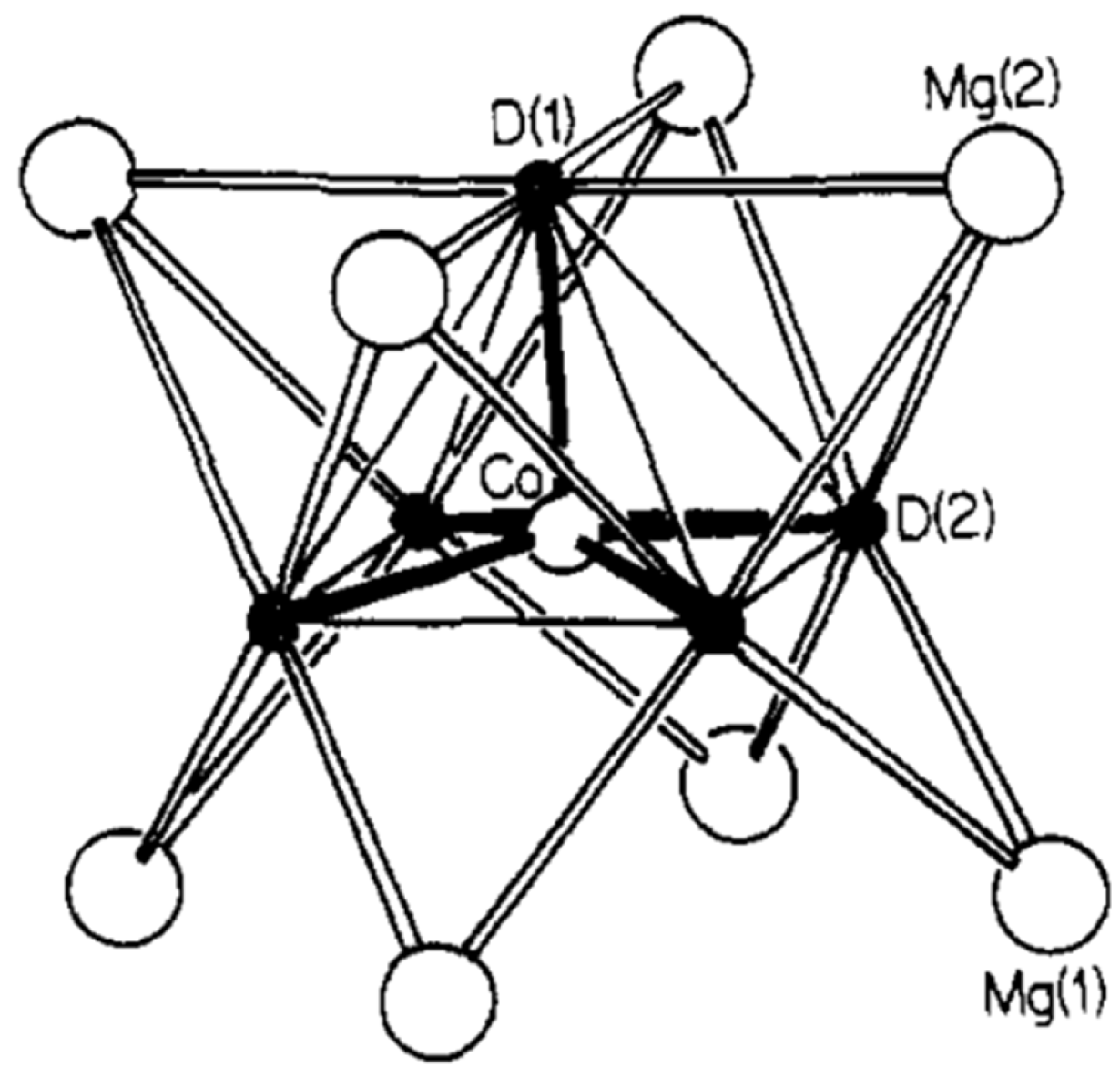
It is described as having a tetragonal structure (distorted cubic CaF2) at room temperature, belonging to the P4/nmm space group. Co is surrounded by five hydrogen atoms in a square pyramidal geometry occupying the 2c position, while Mg occupies the 2a and 2b Wyckoff positions as shown in Figure 2 (analysis done on the deuterides analog). At an elevated temperature (above 140 °C), the compound rearranges into a cubic lattice where the square pyramidal structure for the CoH5 unit becomes more asymmetrical (distorted).
Nano-structuring of the system reported by Chen et al. [15] did not improve the hydrogen uptake of the compound (4.4 wt.%), but there was a notable enhancement in the kinetics reaching the aforementioned capacity at a temperature of only 242 °C.
Hydrogenation at high temperatures represents another strategy for improving storage capacity. This happens by inducing a structural change in the starting binary compound, which creates more hydrogen host sites in the structure.
To illustrate this, Zhang et al. [16] reported the synthesis of a Mg-Co-H ternary hydride at 100 °C under 6 MPa of hydrogen pressure. Starting from Mg and Co resulted in the binary phase (Mg50Co50–H) with a BCC structure that remains after hydrogenation. The storage capacity was found to be 2.1 wt.%.
The same solid solution was heated up to 140 °C with a hydrogen pressure of 4 MPa, resulting in the cubic structure transitioning into a tetragonal one, corresponding to the formation of Mg2CoH5, along with the Co as the secondary phase, with the hydrogen content improved by 0.4 wt.% to reach 2.5 wt.%. It is important to note that this capacity refers to the entire alloy sample (mixture of Mg2CoH5 and Co) and not a separate phase of the Mg2CoH5, which has a capacity of 4.4 wt.% as mentioned earlier [13,14].
Mg-Ni system
Mg2NiH4 is a well-known compound, showing desorption at 267 °C under atmospheric pressure. The compound undergoes structural changes from the LT (low temperature) phase (up to 220 °C), described as a monoclinic structure with the C2/c space group, to the high temperature (HT) phase characterized by the CaF2 [17,18,19] structure type. From neutron diffraction analysis done on the deuteride analog, it was found that four hydrogen/Deuterium atoms surround Ni, forming a tetrahedral [NiH4]4−. The transition to the HT phase causes the distortion of this tetrahedral anion.
Multiple studies reported that the absorption for bulk Mg2NiH4 occurs at temperatures ranging from 250 to 300 °C [9]. It requires a thermal activation step around 350 °C, reaching a capacity of 2.5 wt.% in about 25 min, with the maximum capacity reported at 3.5 wt.%.
Mechanical alloying of Mg and Ni powders for an extended duration (200 h) results in the nano-crystalline Mg2Ni. Upon hydrogenation, the material shows fast sorption kinetics exceeding 2.5 wt.% capacity in less than 1000 s (17 min at 250 °C) [20].
However, a study claims that the synthesis of the ternary Mg2NiH4, starting from Mg and Ni nano particles at elevated pressure (PH2 = 4 MPa), requires a temperature of up to 455 °C. The author explains that this is due to multiple factors, such as the high scanning rate measurement via differential scanning calorimetry (DSC) shifting the temperature upwards. Moreover, hydrogenation involving multi-step reactions to reach the ternary hydride, as shown in the reactions from (3) to (6), is believed to induce kinetic and diffusion barriers [21].
Mg + H2 → MgH2
2Mg + Ni → Mg2Ni
Mg2Ni + 2H2 → Mg2NiH4
Mg2NiH4 → Mg2Ni + H2
Kataoka et al. [22] reported a binary system with a composition MgNi2H3.2. It has a body-centered tetragonal structure (space group I4/mmm), and the lattice parameters are reported as follows: a = 3.27 Å, c = 8.78 Å. The synthesis was carried out in a high-pressure cubic-anvil type of apparatus at pressures higher than 2 GPa.
Upon increasing the Ni content, the structure changes from a body-centered tetragonal structure to an orthorhombic P structure (e.g., Pmmm space group). Lattice parameters became a = 4.60 Å, b = 4.68 Å, and c = 8.83 Å. The compound showed no improvement in gravimetric capacity (e.g., 2.23 wt.%).
Mg-Cu system
A recent article by Koufi et al. [23] predicted the existence of the MgCuH3 hydride via theoretical calculations based on density functional theory (DFT). The compound was described as a perovskite structure with the Pm 3 ¯ m space group and the lattice parameter a = 3.4817 Å. The study also mentions that the valence and conduction bands overlap, showing metallic behavior that favors effective charge transfer during hydrogen sorption. In a similar theoretical study, Rehman et al. [24] estimated a formation enthalpy for the ternary hydride of −63.27 kJ/mol H2 while its storage capacity was evaluated at 3.32 wt.%. So far, no successful synthesis has been reported for Mg-Cu ternary hydride.
In another approach, the hydrogen sorption of the Mg2Cu can be reversible by nano-structuring of the alloy, giving rise to magnesium hydride along with another copper analog, MgCu2, as shown (Equation (7)) below [25]:
2Mg2Cu + 3H2 ⇄ 3MgH2 + MgCu2
Mg-Ti system
The hydrogen capacity of Magnesium–Titanium hydrides does not surpass that of the magnesium hydride, and the thermodynamic stability is considerably higher as the enthalpy of the formation of TiH2 is more negative than that of MgH2 (−140 kJ/mol H2 for TiH2 and −74.5 kJ/mol H2 for MgH2).
Phase homogeneity is another big problem due to the melting temperature difference between the two elements (e.g., 1668 °C for Ti and 650 °C for Mg, but with a boiling temperature of 1091 °C). Using mechanical alloying techniques coupled with high hydrogen pressure allows overcoming this challenge.
Asano et al. [26] were able to synthesize a single-phase Magnesium–Titanium hydride via ball milling. The composition of the resulting compound was reported to be Mg0.25Ti0.75H1.62, exhibiting a 3.9 wt.% storage capacity. The synthesis route resulted in extensive stacking faults, which reduced the crystallite size of the ternary hydride.
According to Calizzi et al. [27], at a low atomic percentage of titanium (from 9 to 15 at.%), the ternary hydride cycling leads to phase separation. Inert Gas Condensation (IGC) followed by cooling using nitrogen was used for the synthesis of Mg-Ti binary alloys. The latter contained a Mg0.78Ti0.22 phase with a BCC structure. Hydrogenation occurred at 150 °C and 0.0133 MPa H for 3 h, resulting in a metastable hydride described by an FCC lattice. At a lower Ti content, the hydrogenation gives rise to MgH2 and TiH2 phases.
In terms of hydrogen uptake, the starting materials and synthesis method also influence the storage capacity. Asano et al. [28] reported the ball milling of MgH2 and Ti and obtained Mg40Ti60H113 (a = 4.45 Å) and Mg29Ti71H57 (a = 4.45 Å), both crystallizing within the Fm 3 ¯ m space group. This resulted in a hydrogen uptake of 2.9 and 1.4 wt.% for the two compounds, respectively.
Starting from the binary Mg50Ti50 intermetallic, instead of a one-step ball milling process, the system was heated at 150 °C under 8 MPa H2 pressure, and Mg36Ti50H152 was obtained. It resulted in an increase in the capacity of up to 4.7 wt.% compared to the previous method [29].
Another MgTi-H system was synthesized [30] using a gigapascal high-pressure technique. From MgH2 and Ti powder at 80 GPa and 600 °C, ternary hydride Mg7Ti-Hx was obtained, described as the Ca7Ge-type structure belonging to the Fm 3 ¯ m space group. Around 5.5 wt.% hydrogen content was attained initially. However, dehydrogenation resulted in the splitting of the hydride into MgH2 and TiH1.92 at 332 °C, releasing 4.7 wt.% of the total hydrogen stored initially. The (de)hydrogenation reaction is described as follows:
7 Mg   +   TiH 1.9   +   ( x 1.9 ) 2 H     Mg 7 TiH x
Moser et al. [31] also reported the Mg7TiH16 compound, which was synthesized at 327 °C in a high-pressure anvil cell, at a pressure over 4 GPa, starting from Magnesium–Titanium hydride, as reported via reaction (9). The desorption occurs at temperatures ranging from 100 °C to 150 °C. The system presented a gravimetric capacity of 5.8 wt.%.
7Mg + TiH2 + 7H2 ⇄ Mg7TiH16

2.1.2. Mg-RE

Alloying with RE elements does not show substantial changes in destabilizing the thermodynamics of MgH2 formation. Multiple reports show disproportionation upon hydrogenation of Mg-RE binary alloys.
However, in cases where the ternary RE-Mg-H hydride forms, the kinetics of absorption are improved due to the rare earth elements’ large metallic radii (about 180 pm compared with 160 pm for Mg), which helps refine the microstructure and stabilizes the RE-Mg-H system. Within this part, we report on Mg binary systems with REs (REs = Y, La, Nd, and Pr) with a focus on the following compositions: RE2Mg17, Mg3RE, and MgRE2, although the last one is not Mg-rich.
Mg-Y system
A study by Goto et al. [32] reported a single-phase MgY2H2.82 synthesized using an anvil-type apparatus. Nevertheless, properties like structure, thermodynamics, and hydrogen storage capacity were uncovered.
The hydride was described as an FCC structure with a hydrogen capacity of about 1.4 wt.%. This value is estimated by heating the system at a temperature of 327 °C, corresponding to a smaller H/M ratio (≈0.94) as opposed to that of most hydrides (H/M ≈ 2). This temperature corresponds to the threshold beyond which the compound can partially dehydrogenate while keeping the FCC structure.
The desorption is achieved within minutes, but the reaction is only reversible at high temperature and pressure (800 °C, 5 GPa, and maintained for 2 h).
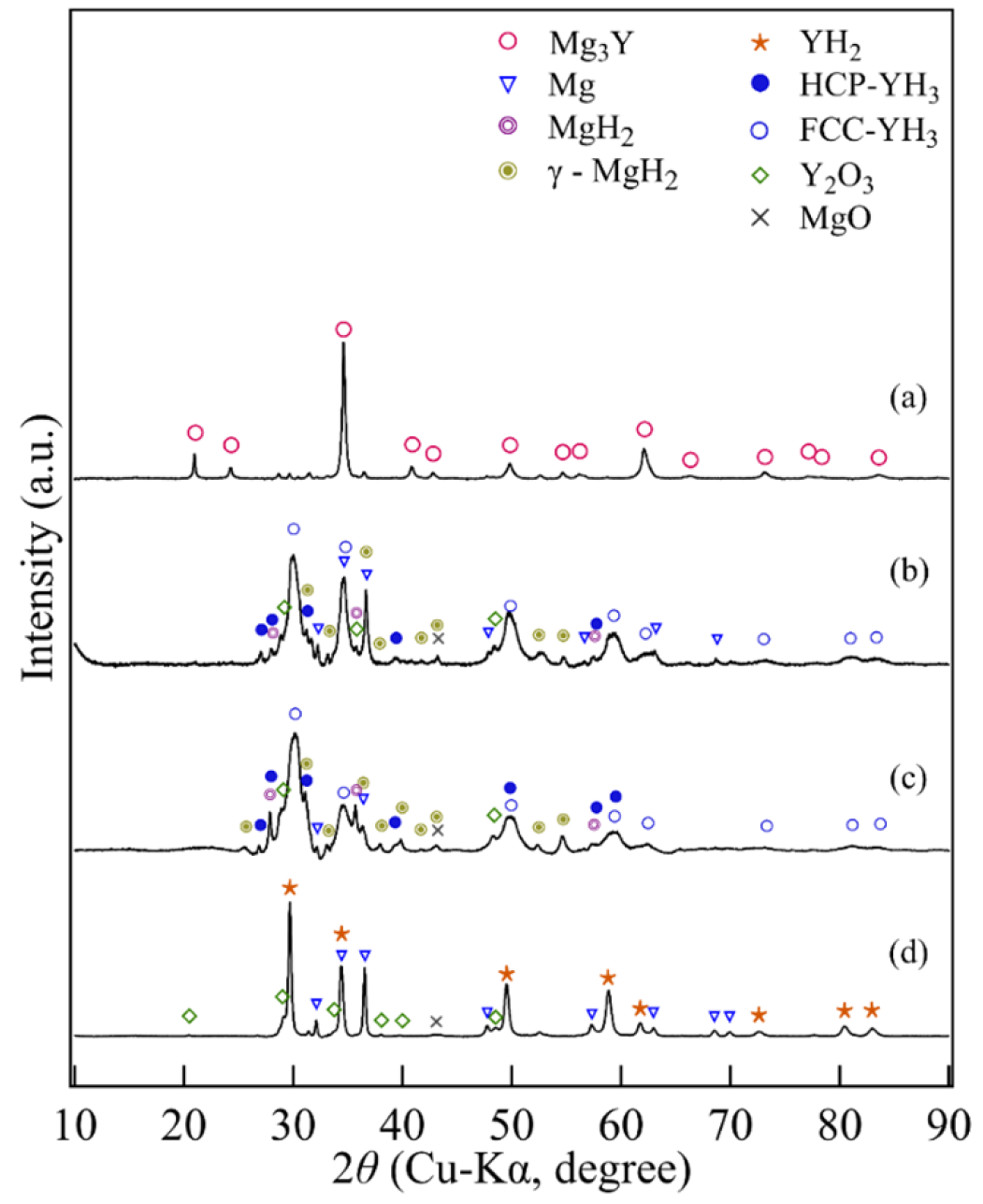
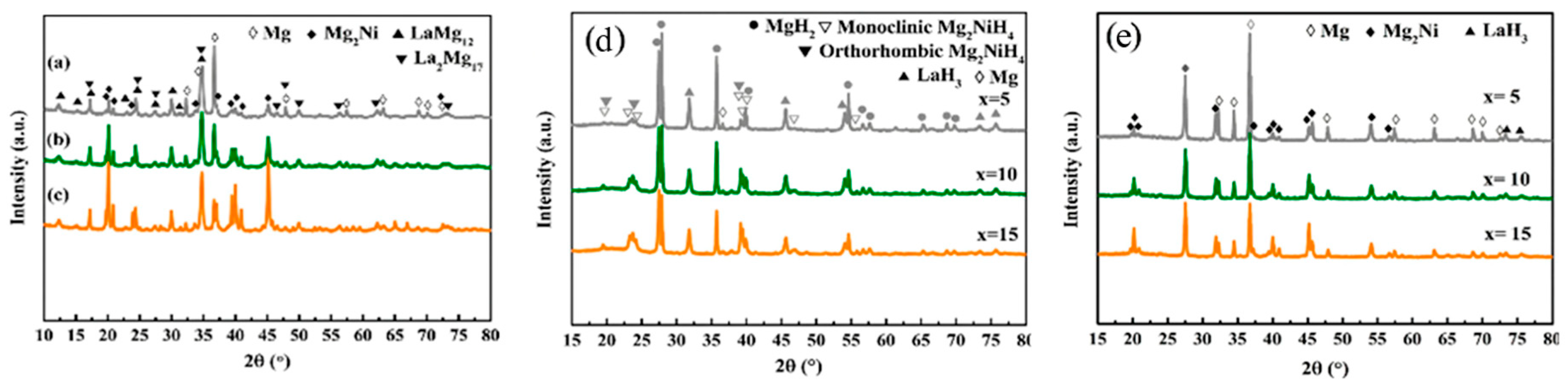
In contrast, hydrogenation of the Mg3Y alloy led to disproportionation into γ-MgH2 and β-MgH2, obtained at high pressure and ambient pressure, respectively, along with other phases, such as FCC and HCP YH3, as shown in the XRD pattern in Figure 3b,c.
This could be explained by the size of the interstitial site being too small for hydrogen insertion (size < 0.04 nm). Also, the YH2 phase formed upon the second cycle along with oxides, which are present due to contamination during sample preparation [33].
Mg-La system
Kamegawa et al. [34] prepared Mg-RE-H systems via high pressure (3–6 GPa) and a temperature of 800 °C. The three Mg3REH9 (REs = La, Ce, and Pr) systems crystallized in a tetragonal structure with hydrogen storage capacities for the three systems of 4.1, 3.7, and 3.9 in wt.% for the Mg–La, Ce, and Pr systems, respectively.
Similarly, Mg3La [35] was obtained following the same route as a starting binary material, crystallizing in the space group Fm 3 ¯ m (reported as D03 in the article). After hydrogenation, the FCC lattice remains, but the cell parameter “a” shifts from 5.607 Å to 7.498 Å, with a storage capacity of 2.89 wt.%. Nevertheless, the space group assignment for this system is not yet fully agreed upon in the literature. The XRD measurements proved that there is no disproportionation reaction occurring upon hydrogenation, but the hydride form Mg3LaH9 is only assumed from previous studies [34] done on a similar system. The author states that 90% of its storage capacity is reached in about 4 min.
The hydrogenation reaction could be written as follows:
Mg3La + 9/2H2 ⇌ Mg3LaH9
Also, Gingl et al. [36] reported a Mg2LaH7 composition with a space group, P422, with the following cell parameters: a = 6.4054 Å, c = 9.5994 Å. The same article discusses Mg2CeH7 having a similar structure and being synthesized following the same route. Both compounds showed a capacity of around 3.4 wt.% (116 g/L for the La analog and 118 g/L for the Ce analog) upon hydrogenation at temperatures of 100 °C and 200 °C. Despite these interesting capacities, the reversibility of hydrogenation is not feasible since the compounds start to decompose only above 300 °C (P = 1 bar), which is higher than their formation temperatures.
RE2Mg17 (REs = La, Ce) reported by Darriet et al. [37] was obtained by melting a mixture of stochiometric amounts of single elements in a stainless steel crucible. The resulting binary alloy is subject to a heat treatment at 630 °C for 70 h; afterwards, the crucible is retrieved and directly quenched to room temperature.
Its structure is described as the CaCu5-type (LaNi5) lattice, where La sites are replaced by two Mg atoms, giving rise to a magnesium-rich framework. Upon hydrogenation at 325 °C and 3 MPa of H2 pressure, the binary system disproportionates into rare earth hydride and MgH2 irreversibly, as shown in the reaction below:
RE2Mg17 + 20 H2 →  2REH3 + 17MgH2
These findings are in accordance with the reports from Sun et al. [38], where the authors emphasize that the disproportionation is a result of the large enthalpy difference between the starting binary alloy and the products.
Mg-Nd system
NdMg2H7, with the P41212 space group assignment and the following cell parameters, a = 6.30354 Å and c = 9.43018 Å, was obtained [39] starting from fine NdMg2 particles heated to 120 °C under a hydrogen pressure of 14 MPa, taking a total amount of 48 h for complete hydrogenation. The authors mention that the ternary hydrides NdMg2H7 and PrMg2H7 had a MgCu2-type structure, which is not the case for REs = La, Ce, and Sm. Despite an interesting gravimetric capacity for NdMg2H7 (about 3.5 wt.%), the compound is not suitable for hydrogen storage due to the high-pressure requirement to obtain it.
Mg-Pr system
Chen et al. [40] studied the hydrogenation of different Mg-RE elements, including Praseodymium, and the authors state that the hydrogenation of the Mg-RE systems synthesized via vacuum-induced smelting (RE5Mg41 and other secondary phases) resulted in binary RE-H hydride systems and MgH2 as the major phase. This correlates with the findings of Yang et al. [41,42], stating that MgRE alloy results in two separate phases during the first few hydrogenation cycles, as shown in the reaction below.
2PrMg12 + 27H2 → 24MgH2 + 2PrH3
On the one hand, alloying TMs with magnesium leads to the formation of ternary hydrides with significantly lower formation enthalpy, allowing for better stability and cyclability. The case of Mg2FeH6 is a perfect example, with a cycling stability of 600 cycles retaining up to 5.2 wt.% [11].
On the other hand, alloying with RE elements, which usually suffer from lower capacity, offers better kinetics, as showcased by Mg3La, which absorbs 90% of its theoretical capacity at room temperature in a period of 4 min [35], compared to Mg alone (about 750 s at 300 °C) [43].
Thus, in the following section, the focus is on reporting the ternary systems containing both TMs and REs, where their resulting properties are discussed.

2.2. Mg-Rich Ternary Systems (TMx-REy-Mgz)

When combined with Mg, TMs and REs make Mg-TM-RE alloys, which are mostly composed of binary intermetallics, Mg-RE or Mg-TM. However, for some compositions and systems, it can lead to ternary phase formation that changes the hydrogen sorption mechanisms. The following section focuses on investigating ternary compounds (excluding LPSO phases) resulting from Mg-TM-RE alloys and their potential hydrogenation characteristics.

2.2.1. RE = Gd

The ternary system of Mg, Gd, and transition metals is synthesized with transition metals, such as Ni and Cu. Introducing Ni as a transition metal in the ternary alloy of Mg-TM-RE systems is an innovative approach, both in terms of structure and kinetics. Bu et al. [44] conducted a study about different scenarios of Ni content in Gd20−xMg80Nix (x = 5%, 10%, and 15% at.%). The XRD patterns and SEM results of the alloys revealed that all the alloys have a main phase, GdMg5, and secondary phases are Mg2Ni, Mg, and GdMg3, with an increasing strengthening of the diffraction peak of Mg2Ni as the Ni content is raised in the alloys. It is also seen that after hydrogenation, these phases are converted to MgH2 as a main phase and GdH3 and Mg2NiH4 as secondary phases. Moreover, increasing Ni content in the alloys enhances the kinetics of hydrogenation and dehydrogenation but reduces the total weight capacity. On the other hand, Couillaud et al. [45] synthesized Gd13Ni9Mg78, which appeared as a new ternary phase. It has an FCC structure with a lattice parameter of a = 4.55 Å. It decomposed into MgH2, GdH2, and Mg2NiH4 after hydrogenation. Qiu et al. [46] investigated four different alloys, which are Mg90Ni2.2Gd7.8, Mg90Ni7.8Gd2.2, Mg90Gd10, and Mg90Ni10. XRD and SEM results show that cast alloys (containing Ni) have a α-Mg phase and a Mg2Ni phase, which proves that higher Ni content causes the formation of the Mg2Ni phase. Moreover, Mg90Ni2.2Gd7.8 exhibited an LPSO phase, which will be discussed in the last part of the article.
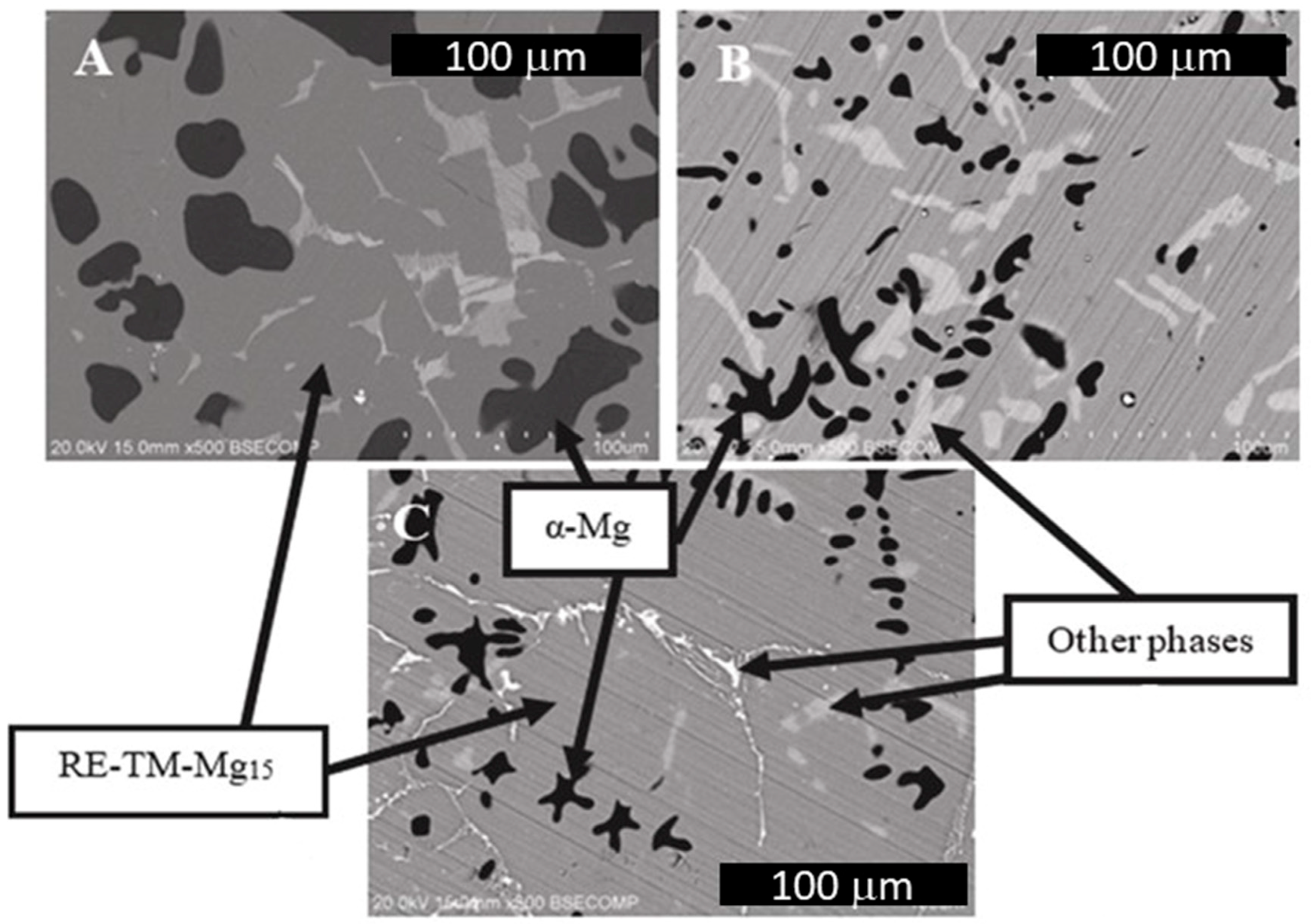
In addition, Legrée et al. [47] investigated alloying Cu with Mg and Gd instead of Ni. GdCuMg15, NdCuMg15, and NdNiMg15 alloys, which have the space group P4/nmm, were synthesized, and the SEM results show the successful phase formation of RETMMg15 in addition to the α-Mg phase, as shown in Figure 4. This may be because excess Mg remained outside and was not incorporated into the ternary phase during solidification. After hydrogenation, GdCuMg15 was decomposed into MgH2, GdH2+x, and Mg-Cu hydrides, like in Mg-Gd-Ni alloys.

2.2.2. RE = La

Research on Mg-Ni-La alloys is very promising since both La and Ni increase hydrogenation kinetics while Mg increases gravimetric hydrogen storage capacity. Alloys are composed of Mg, Mg2Ni, and La-Mg intermetallics [42,48,49]. During hydrogenation, these transformed into MgH2, Mg2NiHx, and LaHx, which transformed back to Mg, Mg2Ni, and LaHx after the dehydrogenation step. Mg and Mg-Ni intermetallics desorb hydrogen fully and return to their parent phases during the dehydrogenation step. However, LaHx shows partial desorption or no desorption of hydrogen [50,51,52,53]. For example, Ding et al. [54] synthesized Mg98Ni1.67La0.33. The alloy included Mg, La2Mg17, and eutectic Mg-Mg2Ni. After hydrogenation, while La2Mg17 intermetallics converted to LaH3 and MgH2, Mg and Mg2Ni transformed into MgH2 and Mg2NiH4. However, LaH3 transformed into LaH2.49 after dehydrogenation, which proves that LaH3 is only partially desorbed. Similar behavior was observed in the Mg10Ni10La alloy by Guo et al. [55]. The XRD result of the alloy shows that the alloy includes Mg2Ni, Mg, and Mg12La, which later transformed into MgH2, Mg2NiH4, LaH3, and Mg2NiH0.3 phases after hydrogenation, and then converted back to Mg, Mg2Ni, and LaH3 during dehydrogenation. Moreover, Lv et al. [56] investigated the Mg content effect in MgxNi3La (x = 5, 10, 15, and 20 at.%). The alloys exhibited similar microstructures, but it is worth noting that increasing the Mg content resulted in microstructural coarsening, which is the growth of Mg2Ni grains and enlargement of Mg2Ni-LaMgx-Mg eutectic regions. Increasing the Mg content from x = 5 to x = 20 led to a decrease in the weight capacity from 5.50 wt.% to 4.51 wt.%, as seen in Figure 5. Furthermore, some results showed that incomplete alloying leads to a residual Ni phase. Zou et al. [57] investigated the Mg85Ni10La5 alloy, and this alloy was found to have a residual Ni phase. This free Ni reacts with absorbed hydrogen and Mg to form Mg2NiH4 during hydrogenation. They also synthesized the Mg85Ti10La5 and Mg70Fe20La5 alloys. The XRD and TEM results showed that Ti dissolved into the Mg matrix fully, whereas in Mg70Fe20La5, isolated α-Fe was detected. This behavior is similar to the Mg85Ni10La5 alloy, in which Ni also remained as an isolated phase. Another interesting result was revealed in the study by Li et al. [58], who synthesized the Mg80Ni16La4, Mg70Ni24La6, and Mg60Ni32La8 alloys. The Mg80Ni16La4 alloy was found to have typical phases: the La2Mg17, LaMg12, Mg2Ni, and Mg phases. However, even if the Mg70Ni24La6 and Mg60Ni32La8 alloys also have typical intermetallics (La2Mg17 and Mg2Ni for Mg70Ni24La6, and Mg2Ni for Mg60Ni32La8), they include additional La-Mg-Ni intermetallics, which are LaMg2Ni (orthorhombic, Cmcm) and LaMgNi4 (cubic, F 4 ¯ 3m, derived from Laves phases).

2.2.3. RE = Nd

Most common Mg-rich ternary systems of Mg-Nd-TM can be prepared using Ni and Zn as transition metals. There has been more theoretical work done on Zn, whereas more experimental data can be found for Ni.
Earlier works done by Huang et al. [59] reveal that due to the low eutectic temperature of the binary Mg-Zn, it performs poorly at high temperatures. They mention the work done by Drits et al. [60], which claims that at 297 °C, only a few ternary Mg-rich compounds were identified (Mg6NdZn3, Mg4NdZn5) but not fully characterized. They also identified another ternary compound at 400 °C, namely, (Mg,Zn)3Nd, which exists in an FCC structure with a = 6.8 Å. On the other hand, (Mg,Zn)11.5Nd has an orthorhombic C-centered crystal structure. When the ratio of Mg/Zn varies, the lattice parameters vary accordingly (a = 9.65–9.84 Å, b = 11.18–11.35 Å, and c = 9.46–9.63 Å) within the same structure type.
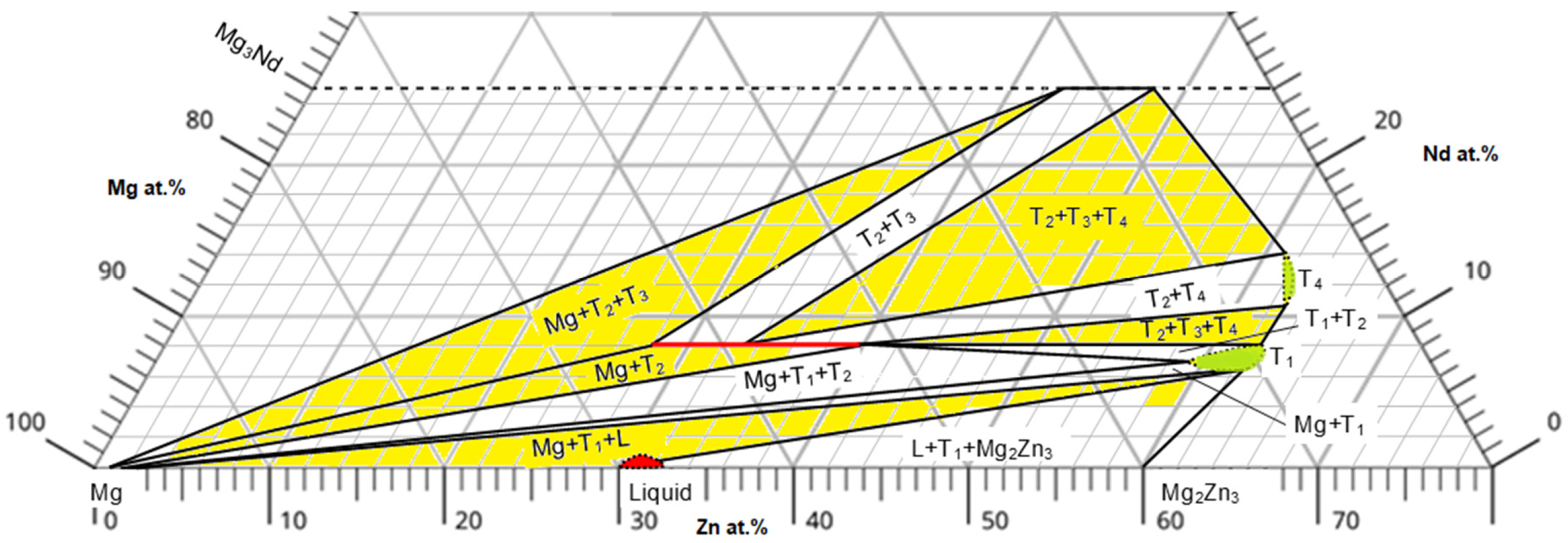
CALPHAD calculations were done for the Mg-Nd-Zn system. Qi et al. [61] denoted four new stable ternary compounds, Mg7Nd2Zn11, Mg7NdZn12, Mg6NdZn3, Mg6Nd3Zn11 none of which being Mg-rich (as shown in Figure 6).
Mg4ZnNd [62] was also reported without any structural data and with no data regarding the hydrogenation properties.
Work done by Al Asmar et al. [63] reveals the compound NdNiMg15 to have the P4/nmm space group with a = 10.0602 Å and c = 7.7612 Å, and with 3.2 wt.% hydrogen capacity obtained at 300 °C and 1 MPa, which is close to the theoretical value at 3.6 wt.%.
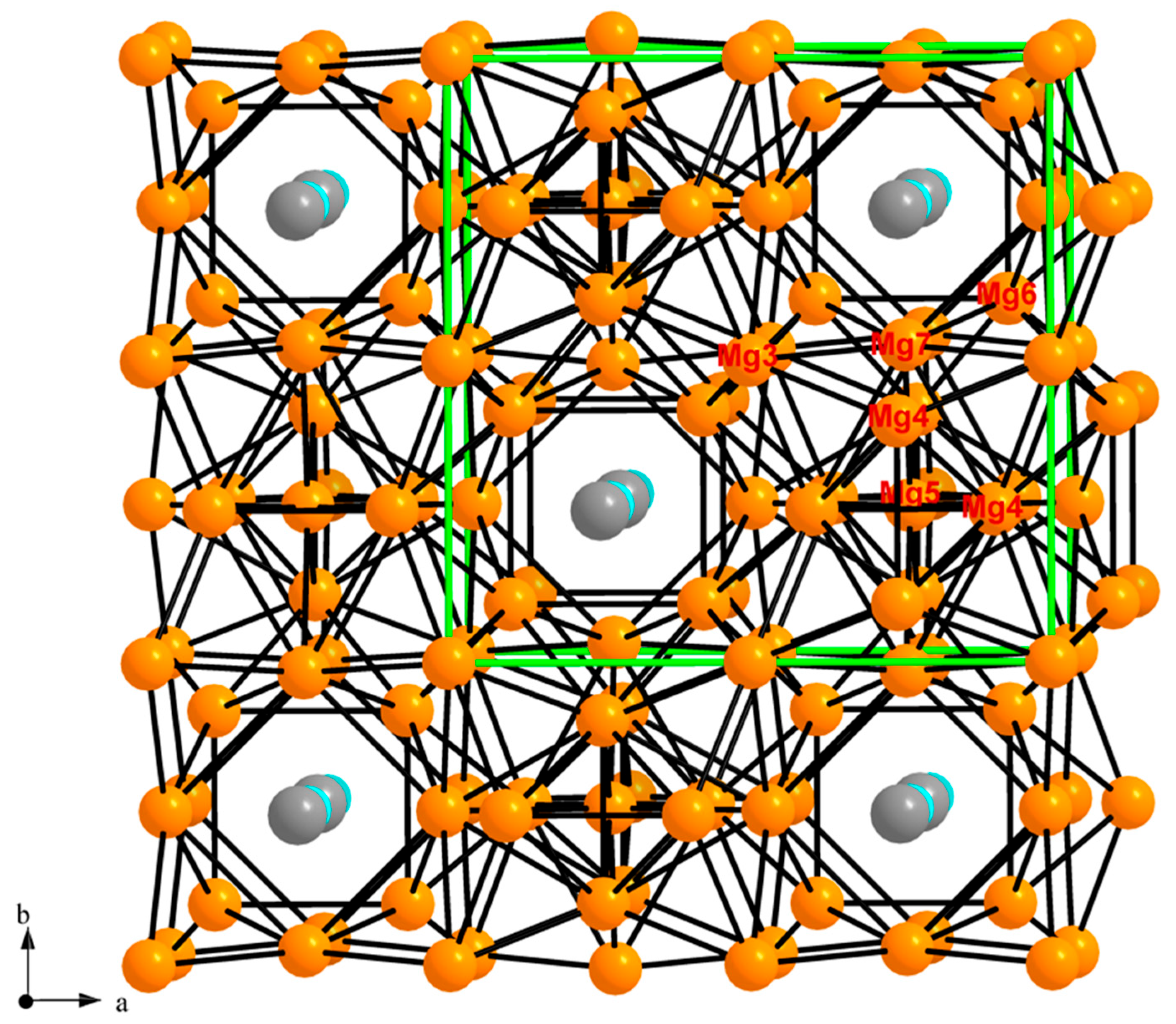
As shown later, most phases of the Mg-rich Mg-Nd-Ni ternary system yield either binary products or hydrogenated ternary products, like in the case of NdNiMg15. The crystal structure of the phase can be seen in Figure 7.
Luo et al. [64] mentioned that among the ternary phases of NdMg8Ni and NdMg5Ni2, the Nd4Ni8Mg80 phase had the best hydrogen capacity due to the increased amount of Mg. It is described as a tetragonal lattice (space group: I41/amd) with cell parameters a = 11.2743 Å and c = 15.9170 Å. Hydrogenation at 350 °C and 2 MPa H2 yielded a capacity of 3.74 wt.%, resulting once again in binary and hydride ternary products.
Nd16Ni12Mg96 was the only phase that at first gave rise to a ternary Mg-Nd-Ni product upon hydrogenation. Li et al. [65] reported this phase to be orthorhombic (space group: Cmc21) and has the cell parameters a = 15.34197 Å, b = 21.67494 Å, and c = 9.48686 Å. The hydrogenation of this compound happens in two steps at 350 °C. The first step (Equation (13)) yields the formation of the previously mentioned Nd4Ni8Mg80 as the ternary product. This is followed by the next reaction (Equation (14)), where Mg, Mg2Ni, and NdH2 were obtained. The hydrogen capacity was reported to be 3.9 wt.%.
Nd16Ni12Mg96 + 23H2 → 23/2NdH2 + 9/8Nd4Ni8Mg80 + 3Mg2Ni
Nd4Ni8Mg80 + 4H2 → 4NdH2 + 64Mg + 8Mg2Ni
Lin et al. [66], in the case of Mg95-xNi5Ndx (x = 0, 1, 3, and 5), and Liu et al. [67], in the case of Nd5Mg41Nix (x = 0–4), both observed that during the hydrogenation process, these structures decompose into binary compounds, particularly Nd2H5, which acts as a catalyst for the absorption/desorption reactions. Lin et al. [66] also stated that the enthalpy of the absorption did not change significantly when modifying stoichiometries.
In agreement, Xie et al. [68] reported that increased Ni content has a positive effect on hydrogen diffusion and kinetics. On another note, still within the Nd–Ni–Mg Gibbs triangle and focusing on the Mg-rich region, Ourane et al. [69] investigated the properties of the NdMg5Ni intermetallic compound. They reported that the absorption of this compound starts at 300 °C under 1 MPa. The reaction also yields one ternary and two binary hydrides (Equation (15)).
NdNiMg5 + 6.3H2 → NdH2.6 + Mg2NiH4 + 3MgH2
It was also reported in the same work that this material performed very closely to the best alloy commercially available at the time, considering microhardness and micro-indentation measurements.

2.2.4. RE = Pr

Mg-Rich Structures
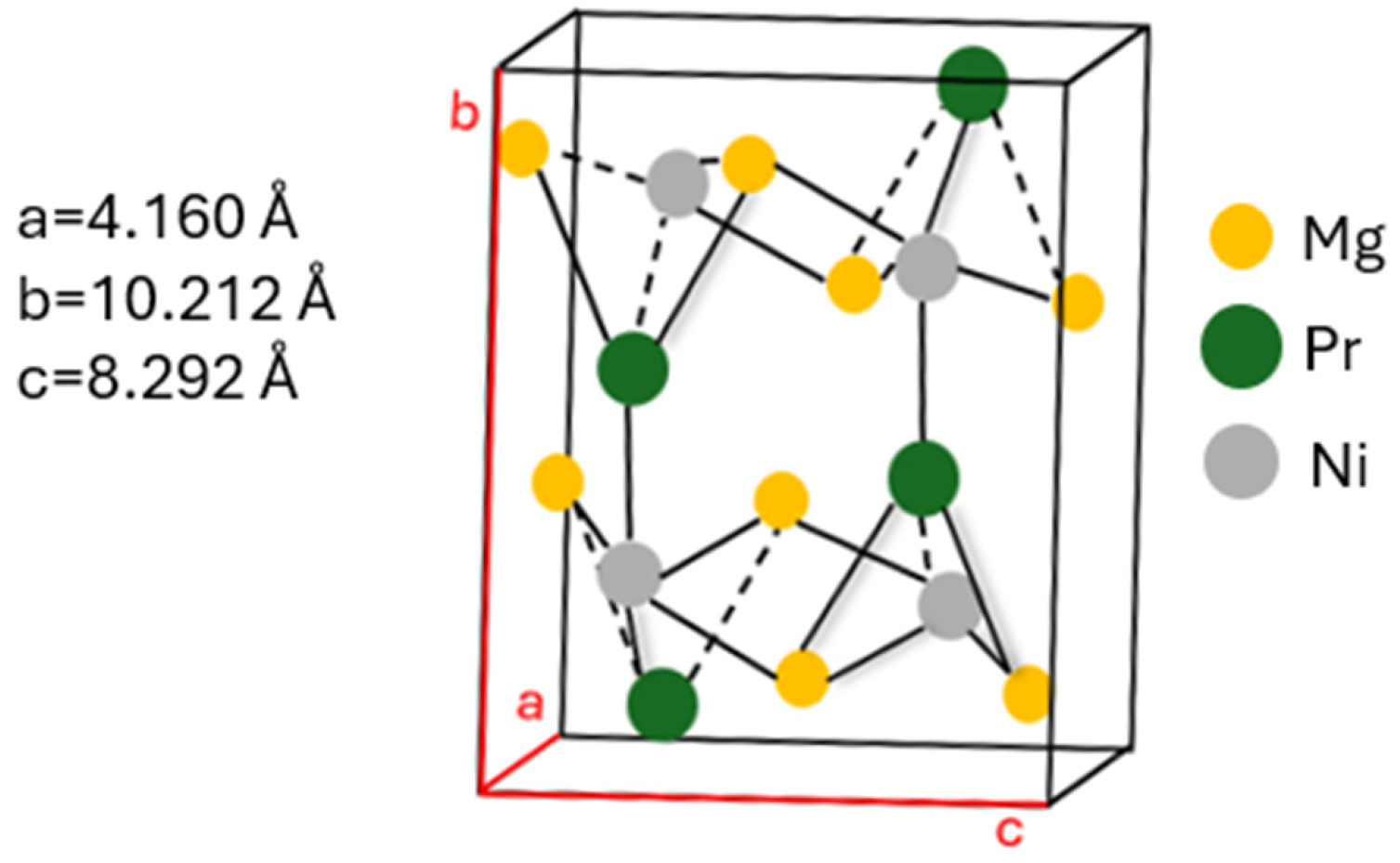
Few studies have expressed compounds regarding the Mg-rich Mg-Pr-Ni ternary system. Among the reported Pr5NixMg95−x (x = 5, 10, and 15) [70] and PrNiMg11 [71] structures, none of them ended in a stable ternary phase. Pei et al. [72] reported, in 2012, that PrMg2Ni has a single-phase structure. According to the OQMD (Open Quantum Material Database) [73], PrMg2Ni has the Cmcm space group. The structure is illustrated in Figure 8.
Mg-rich alloys within the Mg-Pr-Ni ternary systems are typically synthesized using the following methods: vacuum induction, induction melting under inert atmosphere, and a two-step ball milling–sintering method under inert atmosphere.
Multiple papers conclude that hydrogenation mostly yields the formation of binary or hydrogenated ternary products in a similar manner to other ternary systems mentioned previously. The pathway for the hydrogenation [70,71] process was established by the authors as follows:
PrMg12 + 27/2 H2 → 12 MgH2 + PrH~3
Mg2Ni + 2H2 → Mg2NiH4
The increased Ni amount in the system significantly affects the hysteresis cycle. Zhang et al. [71] stated that the kinetics of the absorption/desorption of hydrogen were notably improved in a compound (compared with the material without Ni) tested for hydrogen storage. Subsequently, it was discovered by Bu et al. [70] that the increased Ni content yields better hydrogen diffusion due to a higher presence of Mg2Ni and PrMg12 phases that create more grain boundaries and defects in the material. However, they also noted a significant decrease in the amount of hydrogen stored.
Similarly, Xia et al. [74] mentioned the effect of microstructure on the kinetics of the system in agreement with what was discussed before. They also showed that ball milling using different weight percentages of NbF5 can promote nano-crystallization (and even amorphous) and can improve kinetics and hydrogen storage properties.
Non-Mg-Rich System
This paper primarily focuses on Mg-rich systems; however, given the considerably limited research on specific combinations of Mg-rich systems in Mg-Pr-TM ternary systems (and their hydrogen storage properties), it was interesting to include a few noteworthy non-Mg-rich systems. In earlier works (2004), ternary Mg-Ni-Pr systems at 500 °C and 900 °C were reported [75]. The two non-Mg-rich ternary phases PrMg2Ni9 and PrMgNi4 were observed at 500 °C.
For the Ni-rich systems, the enthalpy of hydride formation for all compounds changed minimally from −37 to −42.4 kJ/mol H2 depending on the system [76,77].
Terashita et al. [76] reported a Ni-rich, Mg-Pr-Ni ternary system described by the following composition: Mg2−xPrxNi4, (0.6 x 1.4), derived from Laves phases, belonging to the space group F 4 ¯ 3m (cubic), where the lattice parameter is a = 7.0101 Å before hydrogenation. It was also reported that with an increased Pr stoichiometry, the lattice parameter can increase up to 7.1726 Å. On the other hand, after hydrogenation, lower Pr phases (x = 0.6, 0.8) keep the F 4 ¯ 3m structure, whereas higher Pr phases (x = 1.2, 1.4) become amorphous. The interesting point is that at x = 1, the phase will transform into orthorhombic MgPrNi4H~4.
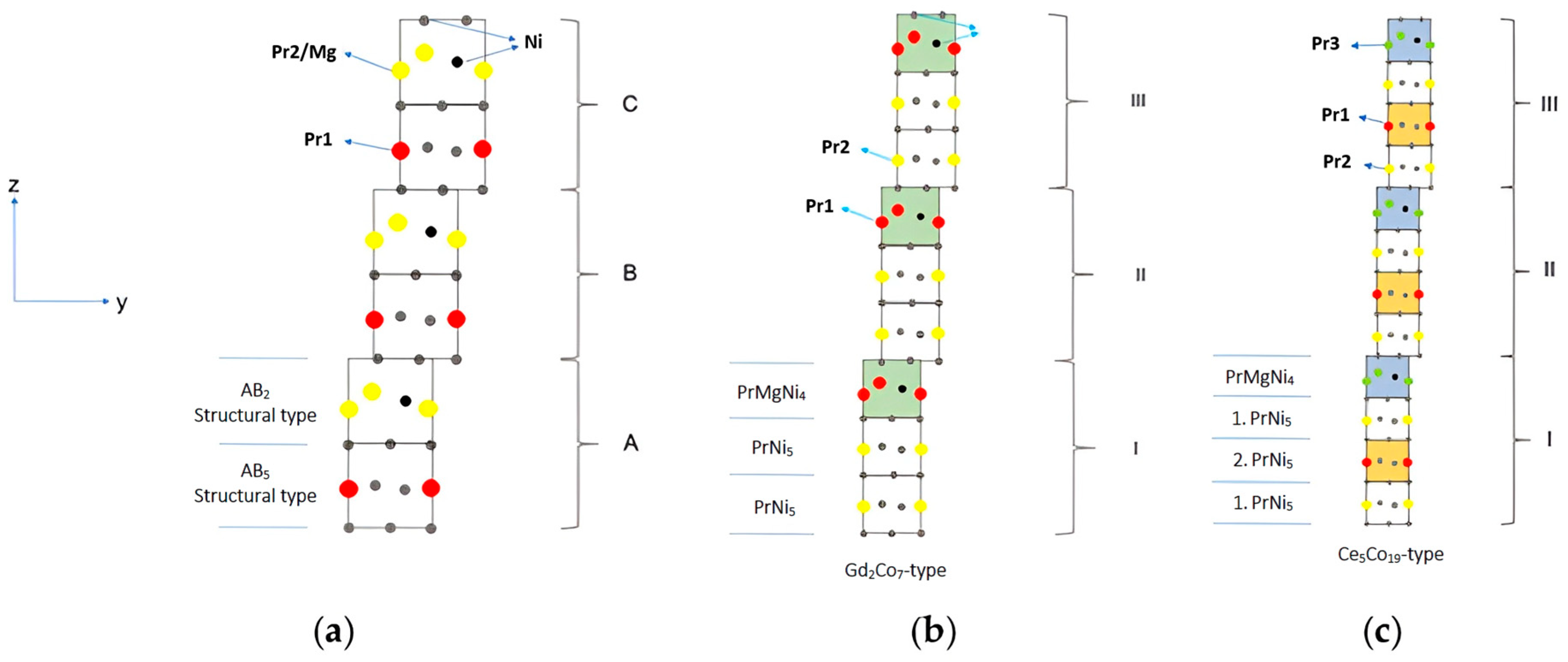
Another Ni-rich system was reported by Iwase et al. [77] with a single-phase Pr2MgNi9 having the space group R 3 ¯ m (PuNi3-type). The lattice parameters were found to be a = 4.9928 Å and c = 24.238 Å (see Figure 9a). The Pr2MgNi9-H2 system has one plateau for the absorption–desorption process, and the maximum hydrogen capacity was 1.04 H/M at 25 °C. Iwase et al. [78] also reported another Ni-rich system, Pr4MgNi19, which consisted of two phases: 52.9% Ce5Co19-type (space group, R 3 ¯ m, lattice parameters are not given) and 47.0% Gd2Co7-type (space group, R 3 ¯ m), with lattice parameters a = 4.979 Å and c = 48.09 Å (see Figure 9b). Performed at 25 °C and 2 MPa, the maximum hydrogen capacity is 1.14H/M (about 1.6 wt.%) in the first cycle.

2.2.5. RE = Y

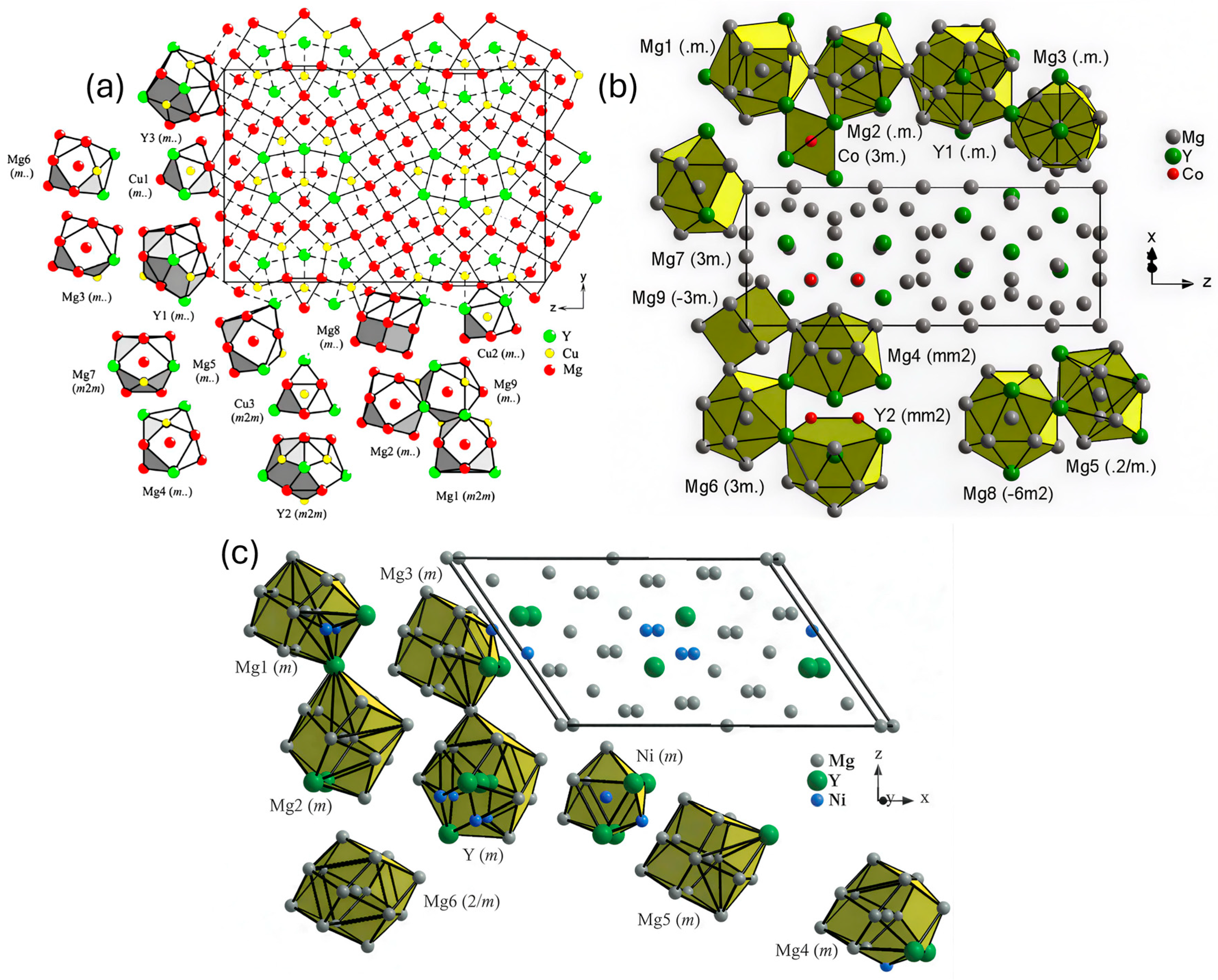
In the Y-TM-Mg system, the main elements considered as the transition metals are Al, Zn, Ni, Cu, and Co. Those five elements can lead to ternary compounds when associated with Mg and Y. It is remarkable that as the magnesium content increases, the presence of yttrium favors the formation of LPSO phases. Meanwhile, when the magnesium content falls to 75 at.%, we mostly get a mixture of binary compounds. Nevertheless, it is possible to obtain three defined, magnesium-rich, ternary compounds: Y5Cu5Mg16 (61.6 at.% Mg), Y9Co2Mg30 (73.2 at.% Mg), and Y2Ni2Mg11 (73.4 at.% Mg).
The Y5Cu5Mg16 compound crystallizes in an orthorhombic system, space group Cmcm, with the lattice parameters a = 4.143 Å, b = 19.24 Å, and c = 29.09 Å. This structure has 15 independent sites and 104 atoms in the unit cell, as shown in Figure 10a. Y atoms are enclosed in polarly and equatorially five-capped pentagonal prisms from adjacent atoms (Close Neighbors (CNs) = 17). Three equatorially tri-capped trigonal prisms enclose Cu atoms (CNs = 12). The characteristic polyhedra of Mg atoms in this structure are eight distorted cuboctahedrons (CNs = 12) and a distorted rhombic dodecahedron (CNs = 14) [79].
The Y9Co2Mg30 compound crystallizes in a hexagonal system, space group P63/mmc, with the lattice parameters a = 10.2 Å, c = 22.4 Å. It can be described as Co2Y9 clusters embedded in a Mg matrix (see Figure 10b). In the Co2Y9 cluster, the Y atoms form double octahedra connected by face-sharing, and each of the Y6 octahedra contains a Co atom at the center. The Mg is organized in Mg4 tetrahedra with Mg-Mg distances almost similar to those for pure metallic magnesium. The structure is very close to the 18R-type LPSO with the Co2Y9 clusters resembling the TM6RE8 clusters [80,81,82].
The Y2Ni2Mg11 compound crystallizes in a monoclinic system, space group C2/m, with the lattice parameters a = 18.969 Å, b = 3.6582 Å, and c = 11.845 Å, β = 125.07°. The atoms are located in eight independent sites (see Figure 10c). Y atoms are surrounded by 17 atoms forming a seven-capped pentagonal prism coordination polyhedron. A three-capped trigonal prism formed by nine atoms surrounds the Ni atoms. Every Mg atom is surrounded by 14 atoms, forming rhombic dodecahedrons [83].
Most of the work concerning hydrogenation on the Y-TM-Mg system is performed on alloys containing LPSO phases, as described in the following section.

3. LPSO Phases

Structural Description

Long-Period Stacking Ordered phases, also known as LPSO phases, have been widely investigated thanks to their considerably improved mechanical properties at both ambient and high temperatures. Mi and Jin [84] noted that it was believed that the LPSO phases might significantly aid the fractural strengthening in Mg-alloys. In LPSO structures, alternating sequences of Rhombohedral (R) and hexagonal (H) Bravais lattices appear alongside the hexagonal close-packed (hcp) Mg crystals [85].
Kim et al. [86] stated that LPSO phase formation can be explained by defects in basal planes within GP (Guinier–Preston) zones, which are enriched by TM and RE atoms. It is worth pointing out that in this case, the Guinier–Preston (GP) zones are nanoscale, solute-rich clusters that form within a solid solution during the early stages of precipitation. They are typically coherent with the host lattice and represent metastable precursor states before the formation of more stable precipitates. In the present context, defects within basal planes can promote the formation of such clusters, thereby influencing the microstructure and related properties. When these GP zones get rich enough, stacking layer faults occur, which then allows for the formation of LPSO phases.
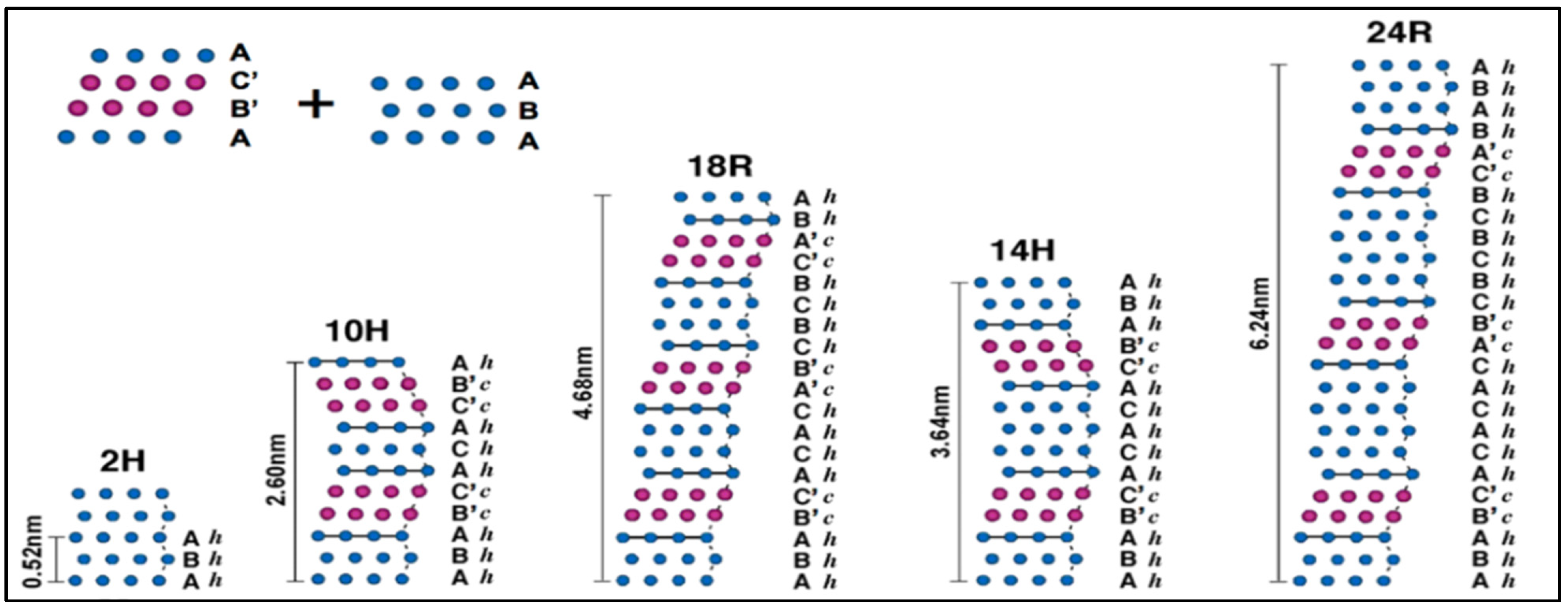
For the Mg-TM-RE systems, the commonly found LPSO phase types are as follows: 10H, 12R, 14H, 18R, and 24R, where the number before the letter refers to the number of layers in each repeating period [85,87]. Among all the mentioned phases, 10H, 14H, and 18R are particularly notable types for the Mg-rich Mg-TM-RE systems [84,87]. In 2010, Zhu et al. [88] reported that, with heat treatment, it was possible for the 18R-type phase to transform into the 14H-type.
Abe et al. [85] showed the sequence for the LPSO phases using letters A-B-C as variants (Figure 11). The stacking AB’C’A unit repeats continuously throughout the structure, where B’ and C’ are the Zn- and Y-rich layers, respectively. C here denotes the stacking fault layer.
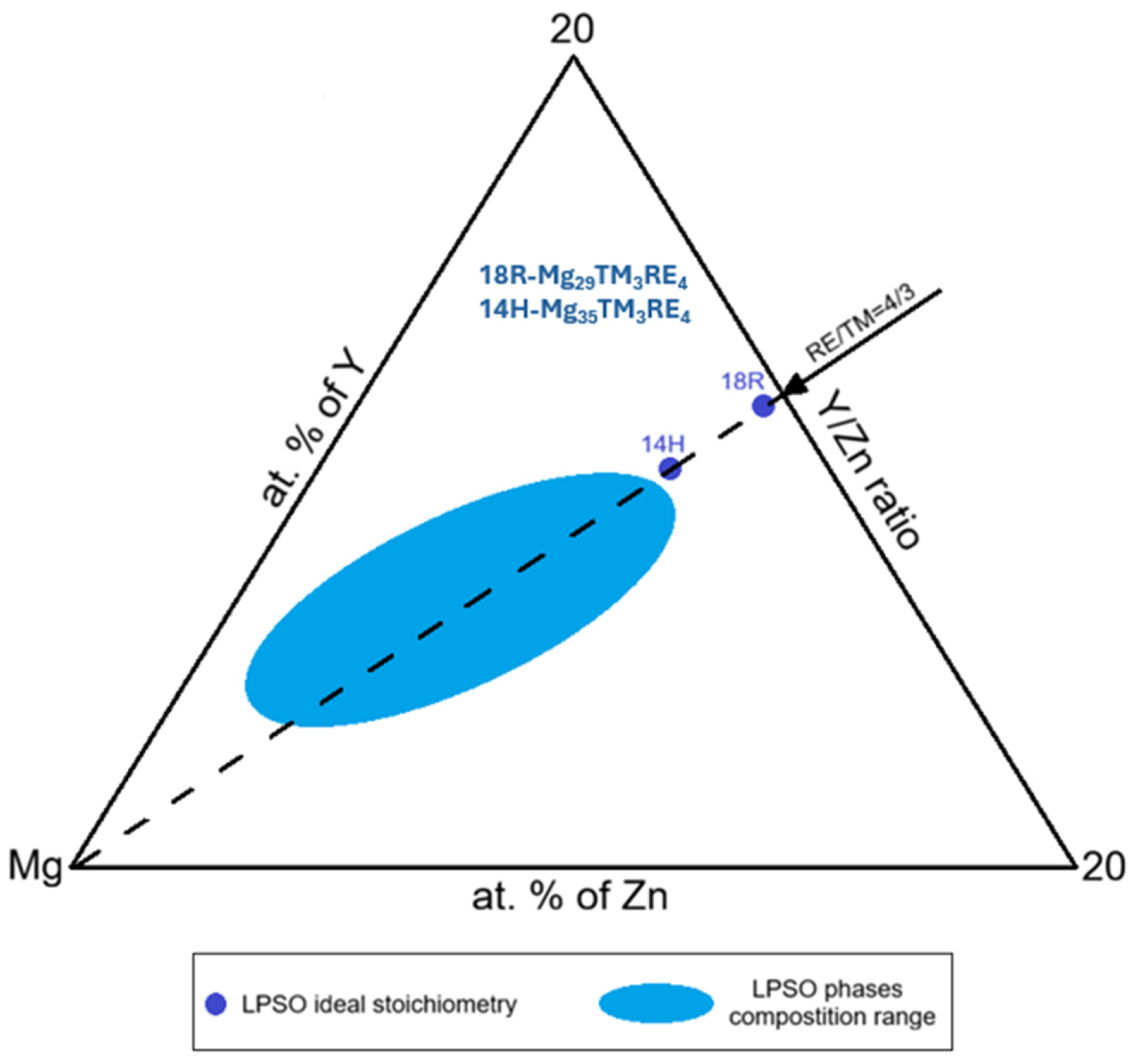
It is known that for LPSO phases, the stoichiometric ratio of TMs/REs is important. For a given MgxTMyREz alloy, the y/z ratio is expected to be 4/3, in order to stabilize the phases [89,90].
Figure 12 describes a schematic quasi-isothermal section of the Mg–Zn–Y ternary phase diagram. Compositions determined experimentally (i.e., Mg–Zn–Y LPSO phases [5,7,11,16,18,30]), with a potential annealing at temperatures ranging from 573 to 793 K, are plotted together with the ideal stoichiometry compositions of the present LPSO models (blue). Egusa and Abe [6] mentioned the underlying cause for the 4/3 ratio. Locally, FCC-type layers prefer to form clusters of TM6RE8, which creates building blocks of LPSO phases. In an ideal LPSO phase, this ratio allows for the density of the clusters to be maximized in the stacking layers. This phenomenon makes the phases bound to the 4/3 ratio region, as TM or RE insertion is not favored above this point. As can be seen in Figure 12, it is also possible to have LPSO phases that do not exactly obey the 4/3 rule. Xu et al. [91] mentioned that the LPSO phases can withstand disorder at TM and RE sites, and the order depends on the occupation conditions.
The thermodynamic stability of LPSO structures can be described using the parameter Hstab, which is defined as the energy of the LPSO phase relative to the convex hull. A structure is considered thermodynamically stable when Hstab is equal to or below zero. The formulation used here follows the approach reported by Saal and Wolverton [92].
The first mention of an LPSO phase was in 2001 by Kawamura et al. [93] in a study on the Mg97Y2Zn alloy, which demonstrated a remarkable yield strength of 610 MPa compared to 27.5 MPa [94] for pure Mg. Following their work, many other LPSOs were discovered, especially for Mg-TM-RE systems with TMs = Zn, Al, Co, Ni, and Cu, and REs = Y, Ce, La, Sm, Pr, Nd, Ho, Dy, Gd, Er, and Tm [95].
Thanks to the lamellar microstructure of the LPSO phases, the alloys containing LPSO phases (or having a single LPSO phase) are more corrosion-resistant, especially compared to Mg’s naturally low resistance [96].
Alloying RE and TM elements with Mg to form an LPSO phase can significantly improve the mechanical properties of the alloy. Following research on the underlying cause of the mechanical properties behind LPSO phases, it was found that the loading direction affects the deformation mode. Depending on the direction, different deformations, such as parallel to the basal plane or non-basal slip, can improve plasticity. It is also reported that Young’s modulus is rather high (but no values were given) compared to non-LPSO phases [7].

4. Chemical Systems

4.1. Mg-TM-Y System

The Mg-TM-Y system is the most studied system when it comes to LPSO phases. It displays many LPSO phases of different compositions. The 18R- and/or 14H-type LPSO phases have been identified with TMs = Cu, Co, Al, Ni, and Zn [85,,97,98,,99].
Yttrium is an important element when it comes to hydrogenation. The hydride YH2 is so stable that it is already often present in the pure yttrium precursor. It starts desorbing hydrogen at 650 °C to peak at 790 °C (the most stable out of the REH2 hydrides) [100]. Because of the desorption temperature range employed (typically between ~290 and 400 °C), the YH3 ↔ YH2 transformation occurs during each hydrogen sorption cycle. This in situ formation of nano-YH2/YH3 particles provides a large amount of active sites to enhance the hydrogen diffusion along abundant phase boundaries [101]. In addition, the YH3 YH2 transformation exerts lattice strain on the adjacent Mg/MgH2 grains. It provides the driving force to trigger the hydrogenation and dehydrogenation of Mg/MgH2 [102]. This catalytic effect permits the improvement in the hydrogen sorption kinetics, which is encouraged by the LPSO structure that periodically distributes REs and TMs along the phase.
Many works aim to improve hydrogen sorption kinetics by dispersing homogeneous catalytic agents, like YH2, or by reducing the grain size to create more grain boundaries that serve as diffusion channels.

4.1.1. Mg-Zn-Y

Many LPSO phases can be found in Mg-Zn-Y alloys. A lot of 14H- and 18R-type LPSO phases can be found at non-ideal stoichiometry, represented by the orange area in Figure 12.
Many synthesis methods have been reported, giving rise to LPSO phases in this system. Zhang et al. [103] synthesized a Mg96Y2Zn2 alloy displaying the 18R-type LPSO phase, Mg12YZn (=Mg86Y7Zn7). This was done by melting high-purity Mg, Y, and Zn in an electrical resistance furnace under the protection of Ar atmosphere. Zhang et al. [104,105] made a Mg98.5Y1Zn0.5 alloy containing the 18R-type LPSO phase by semi-continuous casting through melting pure Mg (99.9 wt.%), pure Zn (99.9 wt.%), and Mg-30 wt.%Y intermediate alloy under the protective gas of CO2 and SF6. Ishikawa et al. [106] prepared a Mg85Zn6Y9 alloy ingot holding the 18R-type LPSO phase by a high-frequency induction melting method using a graphite crucible under Ar atmosphere. In each of those cases, the LPSO phase is always accompanied by one or more secondary phases. The main one is the α-Mg phase formed with excess magnesium. The yttrium is either in YH2 form or leads to the binary phase Mg24Y5. Some magnesium-poor ternary phases, such as Mg3Y2Zn3 (BCC structure), can also rise in these alloys [103,104,105,106,107].
Concerning hydrogenation, the LPSO phase undergoes an irreversible decomposition. The first transformation corresponds to Mg12YZn, which turns into Mg and Mg3Y2Zn3 above 300 °C [108]. The overall hydrogen absorption reaction gets rid of these compounds to end up with one binary intermetallic and two binary hydrides. The temperature at which this transformation is observed depends on the transformation of Mg into MgH2 [104,106,109].
Mg12YZn + 13H2 → xMg(Zn) + YH2 + 12H2 → YH3 + 1/2MgZn2 + 23/2MgH2
It is worth pointing out that Mg(Zn) refers to a solid solution of Zn into Mg (the x value in Equation (18)). The zinc is not directly involved in the H2 storage by creating a hydride. The desorption occurs for MgH2 and YH3, while MgZn2 stays the same throughout the sorption cycles.
This system, and especially the Mg97Zn1Y2 (at.%) alloy, is very popular for its mechanical properties rather than for hydrogenation [91,110].

4.1.2. Mg-Ni-Y

Many LPSO phases have been reported in Mg-Ni-Y alloys. A lot of works show that this system easily gives rise to LPSO phases by simple melting of the different elements in an inert atmosphere at 700 °C [101,111,112,113,114]. The 14H-type LPSO phase has been confirmed to be stable in the Mg-Ni-Y system in a wide temperature range, having a thermodynamic equilibrium with the α-Mg phase. The equilibrium 14H phase contains Ni from 3.7 to 4.4 at.% and Y from 4.3 to 6.4 at.% in the temperature range from 300 °C to 500 °C. The 18R-type LPSO phase can be found in the as-cast Mg-Ni-Y alloys, but it has been proved to be thermodynamically metastable [97,112,114]. The microstructure of these alloys is generally rather similar to that of the Mg-Zn-Y system, with the LPSO phase surrounded by α-Mg and some binary intermetallics, like Mg2Ni, Mg24Y5, or NiY3. Some rare appearances of Mg-poor ternary phases, such as MgNi4Y, have been observed.
Hydrogenation has been widely discussed with the 14H-type LPSO Mg15NiY. Once again, the LPSO phase is irreversibly decomposed by following the steps of the reaction below [112,114]:
Mg15NiY + 28.3/2H2 → 13MgH2 + Mg2NiH0.3 + YH2 + 4.7/2H2 → 13MgH2 + Mg2NiH4 + YH3
Zhang et al. [115] observed a similar decomposition at 300 °C for the 18R-type LPSO with a grain size of 200 to 300 nm. Their Mg12NiY alloy, containing the 18R-type LPSO, showed a desorption of 4.6 wt.% within 6 min at 300 °C and 4.2 wt.% within 25 min at 250 °C.
This system presents the upside of making a ternary hydride, Mg2NiH4. This compound, which was discussed earlier in this paper, participates in every sorption cycle to help hydrogen storage. In the hydrogen desorption process, Mg2NiH4 first desorbs hydrogen to give Mg2NiH0.3 and undergoes a significant volume contraction, causing a contraction strain on the MgH2 around. It facilitates hydrogen desorption of MgH2 [111,114]. This is the catalyst effect of Mg2NiH4/Mg2Ni coupled with YH2 that makes this system interesting for hydrogen storage.

4.1.3. Mg-TM-Y (TMs = Co, Cu, and Al)

The three TMs of Co, Cu, and Al are not studied as much as Ni and Zn in the Mg-TM-Y system. Different investigations have proven the existence of the 18R-type LPSO phase Mg29Co3Y4 [80]. It has been demonstrated that the 18R-type LPSO phase also appears in the composition range of 10.75–12.01 at.% Y and 7.21–8.37 at.% Al [99]. The 14H-type LPSO structure has been confirmed to be stable as a strengthening phase in the α-Mg matrix in a very narrow temperature range in the Mg–Cu–Y system, with Cu content from 3.8 to 4.4 at.% and Y content from 3.8 to 5.8 at.% [98,116].
The LPSO phases decompose during hydrogen sorption. Al and Cu do not form any hydride. The hydrogen storage performances with Co, Cu, or Al as the TMs have not received much attention but have been reported as below those with Ni as the TM [101].

4.2. Lanthanides

4.2.1. Mg-TM-Dy

Mg-Zn-Dy is an interesting system studied for its biocompatibility [117] and mechanical properties [118], which makes it a good candidate for bone implants. Alloying with Zn specifically allows an increase in the volume fraction of the LPSO phase, as shown by Liu et al. [119].
Unlike the Mg-TM-Y systems, the Dy analog is relatively less discussed. Kawamura and Yamasaki [120] described the Mg97Zn1Dy2 alloy as having the 18R-type LPSO phase, which forms after solidification of the ingot. Soaking the ingot at 500 °C for 10 h changes the 18R-type phase to the 14H-type.
With the high melting point of Ni and its low solid solubility in the Mg matrix, LPSO precipitation is improved compared to alloying with other TM elements. An Mg86.9Dy12Ni1.1 [121] alloy was prepared by melting and casting, and then, to ensure the homogeneous distribution of the Dy and the Ni into the Mg matrix, the alloy was held at 480 °C for 12 h.
After an extrusion at the same temperature, the resulting material was subject to aging at 250 °C for 150 h.
The as-extruded alloy contained a long lamellar Mg12DyNi phase along the extrusion line, and the microstructural analysis showed the coexistence of the 18R-type LPSO phase and smaller amounts of the 14H-type. After aging, the latter grows its volume fraction and forms finer stripes (needle-like) regions, while the 18R-type transforms into smaller (measuring a few micrometers) blocky particles.
Yuan et al. [122] studied the effect of cooling and heat treatment on the morphology of the system with an Mg−2Dy−0.5Ni alloy (i.e., 97.5% Mg, 2.0% Dy, and 0.5% Ni expressed in atomic percentage), where the latter is altered at each stage of the experiment.
First, the as-cast alloy presenting an 18R-type LPSO phase Mg12DyNi was treated at 565 °C for 12 h resulting in two LPSO morphologies: dot shaped and block LPSO. Afterwards, further modification occurred via cooling. Continuous cooling promotes the formation of new lamellar 14H-type LPSO within the α-Mg matrix while the block LPSO coarsens. A slower cooling rate (using furnace cooling inertia) increases the volume fraction of that lamellar phase to 11% compared to 5% for air cooling (higher cooling rate). Optical and SEM images can be found in reference [122].
Discontinuous cooling, consisting of furnace cooling until 265 °C followed by air cooling, changed the dot-shaped 14H-type LPSOs into rod-shaped ones.

4.2.2. Mg-Ho-TM

The LPSO containing the Mg-Ho-Zn alloy [123] was prepared in a similar manner to Mg−2Dy−0.5Ni [122], and different Ho/Zn ratios were investigated. The Mg−7.68Ho−2.16Zn (labeled HZ82 in the article) alloy was the one with the highest Ho content. During the first solidification, the 18R-type LPSO (Mg12HoZn) was observed as the main phase along with the α-Mg matrix and Mg3Ho2Zn3 compound as secondary phases.
These secondary phases were predominant at lower Ho/Zn ratios, with no LPSO presence. According to the author, the alloying ratio must be at or close to 7.68Ho/2.16Zn (RE/TM ≈ 3.55) for Mg12HoZn to form in this system.
After homogenization at 400 °C for 12 h, the ingot was shaped into round bars of 90 mm to perform an extrusion, during which plastic deformation of the LPSO phase was revealed by the presence of kinking bands on the TEM image of Liu et al. [123].
The author of [124] reported a similar experiment but investigated only the Ho content effect on the formation of LPSO, while fixing the Zn content to 2. The results confirmed that the phase formation was triggered at a Ho content close to 8.
To the best of our knowledge, hydrogen absorption properties for this specific Mg-Ho-TM system were not investigated.
Guan et al. [125] reported a Mg-Ho-Cu-Zr quaternary alloy. It was prepared via melting in the electrical furnace, followed by casting in a protected atmosphere (SF6 and CO2). The alloy presented different LPSO phases depending on the composition, as shown in Table 2 below [125].
The author notes that short-range order clusters are one of the key parameters influencing LPSO formation, specifically Cu6Ho8 (labelled the LI1-type). This cluster acts as a fundamental building block that reduces the total Gibbs free energy, thereby increasing the stability of the LPSO phase. These clusters are formed with a RE/TM ratio close to 4/3 in the three variants (18R, 14H, and 24H).
The Solute Enriched Stacking Fault (SESF) chemical composition is nearly the same across the LPSO variants, having a 9M in-plane order.

4.2.3. Mg-Er-TM

Zhang et al. [126] investigated the presence of the LPSO phase in the Mg96Er3TM1 alloy (where TMs = Zn, Cu, and Ni) by alloying the element using conventional metallurgy.
The as-cast alloy showed the presence of the 18R-type LPSO phase when alloying with all three elements (Cu, Zn, and Ni), where alloying with each TM element influences the properties of that LPSO phase in a certain manner.
The Ni analogs show the highest LPSO phase volume fraction (28.7%) due to their low solubility in a Mg solution; the corresponding analog presented the highest thermal stability, with the LPSO phase melting at 594 °C.
This could be explained by the Ni analog having higher thermodynamic stability (−10.8 kJ/mol) compared to −7.5 kJ/mol and −8.3 kJ/mol for Cu and Zn, respectively [127].
The Mg96Er3Cu1 has the lowest LPSO phase volume fraction (12%); part of the initially used Cu is consumed by the formation of a secondary Mg2Cu phase [128].
This result explains why, although Cu is less soluble than Zn in a Mg solution, Zn shows a higher LPSO volume fraction (19.1%); it is also worth noting that the latter has the smallest grain size among all three analogs. The LPSO phase melting points are 551 °C and 477 °C for the Zn and Cu analogs, respectively.
When substituting Cu with Ni, the Mg2Cu phase is suppressed, which results in an increase in the volume fraction of the LPSO phase [128].
Also, Dai et al. [129] reported that alloying Er with Ni in a Mg solution allows the formation of the lamellar 14H-type LPSO found within the Mg grains, and the 18R-type that is located along the grains.
Increasing the Er and Ni content in the solution promotes a higher volume fraction of the 18R-type, which, in turn, decreases the stripe distance of the lamellar phase, going from 200 nm for Mg-7.0704Er-1.6839Ni (wt.%) to 40 nm for Mg-14.1691Er-4.1627Ni (expressed in wt.% with balanced Mg ~ 91.2 wt.%).
This synergy between the two phases helps to control the mechanical properties of the alloy. A greater presence of the 14H-type LPSO phase hinders the grain boundary migration (occurring during hot extrusion), which influences the tensile strength and yield strength.
Another strategy for promoting the formation of LPSO phases is the use of additives. Du et al. [130] reported the effect of adding traces of elements X (X = V, Zr, and Sr) to the Mg-Er-Cu system.
The author states that these exhibit a repulsive trend with Mg-Er-Cu alloy constituents; in other words, these elements (Mg, Er, and Cu) have a miscibility gap in a binary system with the additive element X. This condition helps clustering of the additive element and thus forms heterogeneities within the Mg lattice that, in turn, promote the nucleation of LPSO.

4.2.4. Mg-Tm-TM

Very few papers discuss the Mg-Tm-TM system. In their review, Kawamura & Yamazaki [120] gave an account of the Mg97Zn1Tm2 alloy forming the 18R-type LPSO during solidification (Type I). It was reported that it has a composition of TmMg12Zn, which was assumed from thermodynamic modelling [131] since no phase diagram nor detailed thermodynamic data are available for this system. The LPSO type is retained after soaking, which is unique for the Tm analog.

4.2.5. Mg-Zn-Gd

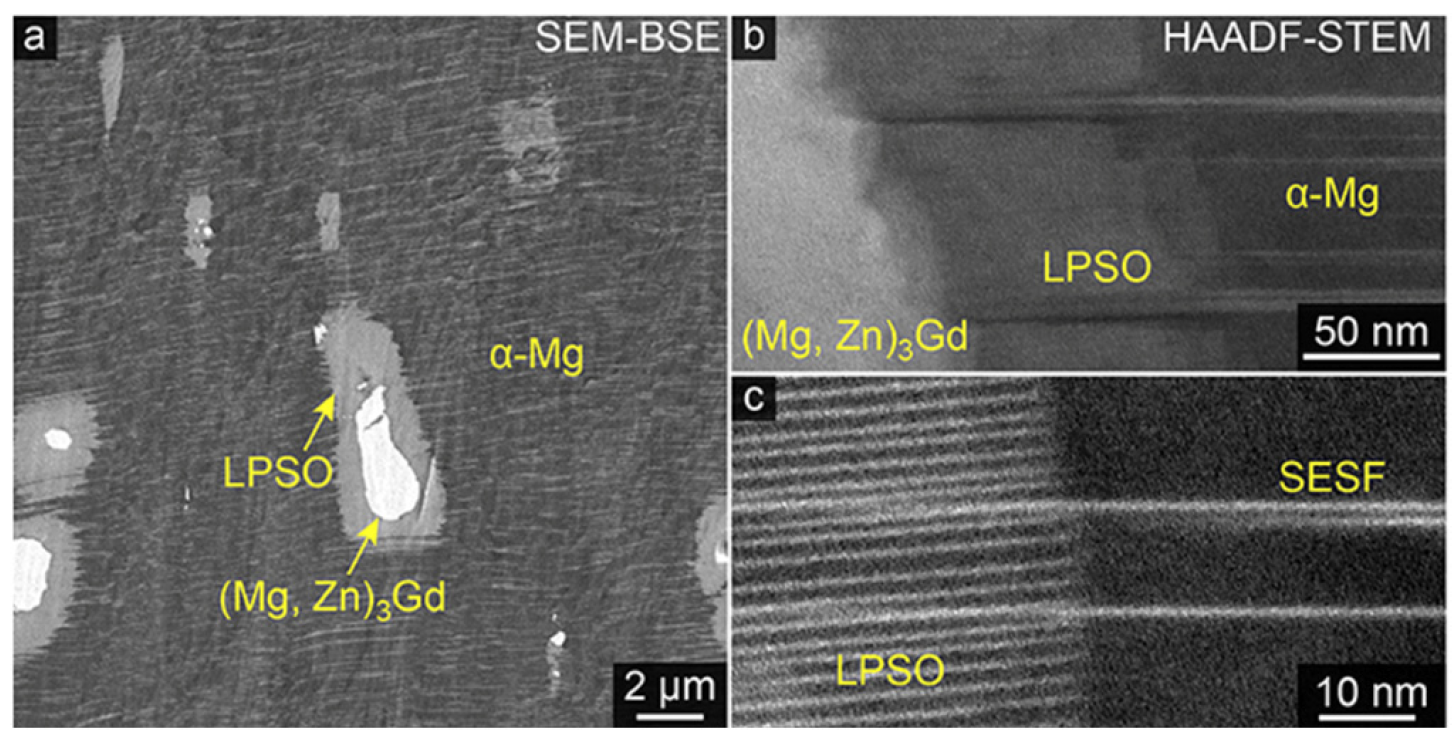
Zn is an important transition metal for forming LPSOs in Mg-Zn-Gd systems. It can help to form different types of LPSO phases. Egusa et al. [132] synthesized the Mg97Zn1Gd2 alloy. The 14H-type LPSO phase is formed in this alloy, and it is surrounded by the (Mg, Zn)3Gd compound, as can be clearly seen in Figure 13. It can be observed that the (Mg, Zn)3Gd compound is not fully dissolved, and the LPSO phase was formed from the Zn/Gd-rich compound. Another study in the same Mg97Zn1Gd2 alloy was done by Ninomiya et al. [133], who investigated the effects of aging time. It was seen that the alloy consists of α-Mg and Mg3Gd phases after the heat treatment; however, after 3 h of aging, Mg3Gd almost disappeared. On the other hand, the LPSO phase started to form after 1 h, thanks to aging. Dissolution of Mg3Gd leads to the formation of L12 clusters, which are later converted into the 14H-type LPSO phase with an increase in aging time.
In addition, Kawamura et al. [120] worked on Mg97Zn1Gd2 and Mg97Zn1Tb2. They classified the 14H-type LPSO phase. Moreover, these alloys were also classified as Type II in their study because LPSO phases do not exist in as-cast alloys, but they precipitate with soaking at 500 °C. Moreover, He et al. [134] synthesized Mg98.5Gd1Zn0.5. This compound has the 18R-type LPSO phase, which disappeared after hydrogenation. LPSO is decomposed into GdH2 and GdH3 nano-hydrides with other binary compounds. The hydrogen storage capacity of this alloy is 7.1 wt.%, which is very close to the capacity of pure Mg, as expected from the following reaction:
Mg98.5Gd1Zn0.5 + 98.5/2H2 → 98.5Mg98.5H2 + GdZn0.5
Gd + x/2H2 → GdHx(x = 2,3)
Mg-TM (Al, Ni)-Gd
Mg-Al-Gd alloys usually have the 18R-type LPSO phase. For example, Yokobayashi et al. [135] synthesized a Mg–3.5 at.% Al–5.0 at.% Gd alloy, which resulted in the 18R-type LPSO phase. On the other hand, Kishida et al. [136] synthesized the same alloy, but the 14H-type stacking sequence was observed as a small part in the peripheries of α-Mg and mainly the 18R-type stacking sequence on the HAASD-STEM image by Kishida et al. [136].
Yin et al. [137] synthesized Mg98−xGd2Nix (x = 0, 0.25, 0.5, and 1 at.%) alloys. Like Mg-Al-Gd alloys, these alloys also form the 18R-type LPSO phase. This LPSO phase undergoes a structural transformation from the 18R-type phase to the 14H-type after heat treatment because the 18R-type is not thermodynamically stable at 500 °C. The LPSO volume fraction is dependent on the fraction of Ni, and it increases with increasing Ni content from 0 to 40%. Moreover, as previously mentioned, Qiu et al. [46] synthesized Mg90Ni2.2Gd7.8, which exhibited an LPSO phase. Notably, the LPSO phase was lost not only after ball milling but also after hydrogenation. The LPSO phase decomposes into Mg, Mg2Ni, and GdH2 phases, which means the alloy does not contain stable or pure LPSO phases because of the decomposition.
Mg-Ni-Ce/Sm
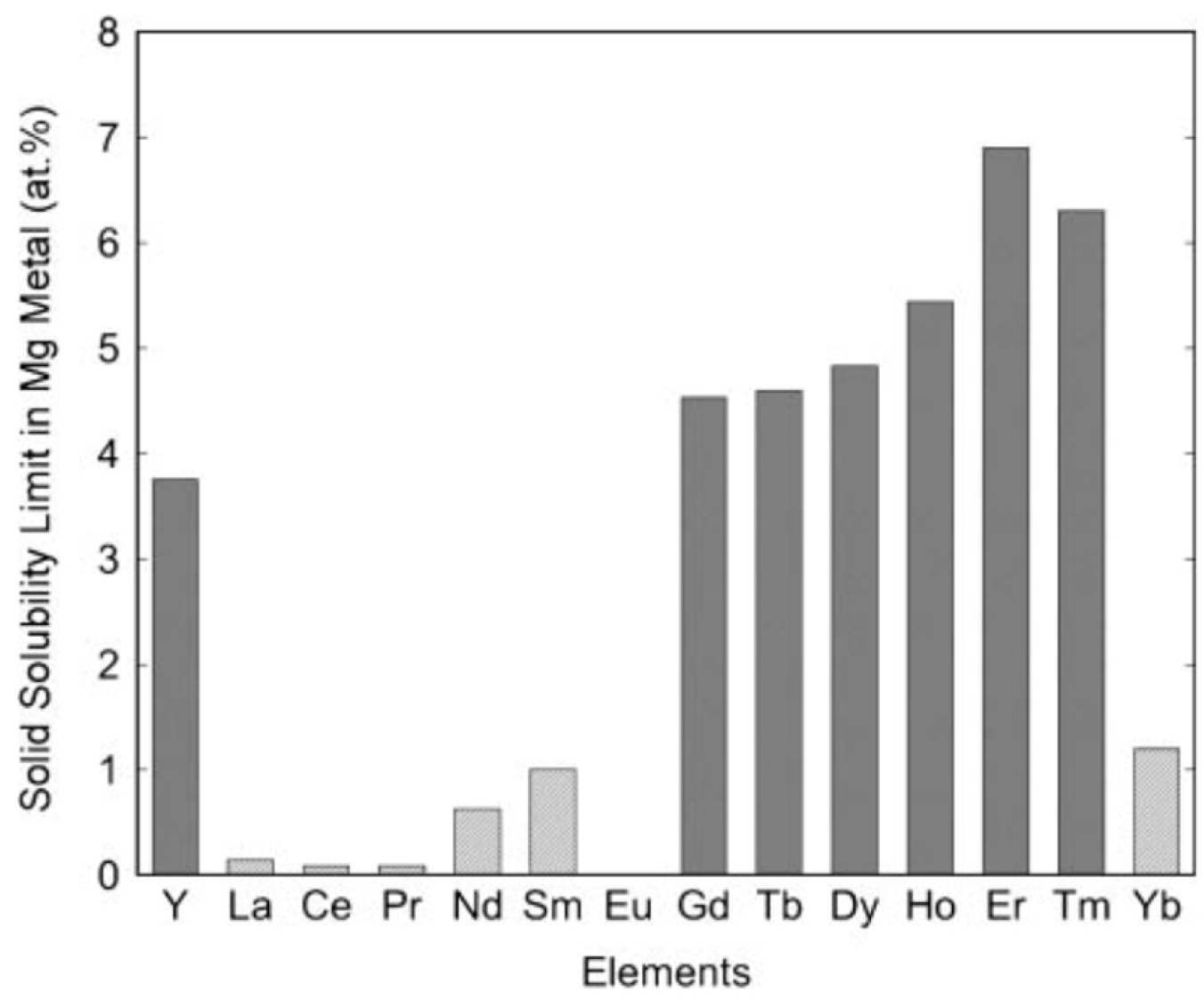
LPSO phases are not expected in the alloys with Ce and Sm since their solubility in magnesium is low. The one of Ce is almost 0, and it is around 1 at.% for Sm, as can be seen in Figure 14.
Nevertheless, several studies found LPSO phases in alloys prepared with those rare earths. The LPSO phases in Mg-Ni-Ce alloys are the 18R-type, and they are a variant of Mg12Ce. Xie et al. [138,139] prepared Mg80Ni10Ce10 and Mg80Ni5Ce15 alloys. Both alloys have the 18R-type LPSO phase, which is a variant of the Mg12Ce phase. However, LPSO phases disappeared after ball milling for 2 h. These mixtures absorb hydrogen up to 6 wt.%. Cao et al. [140] conducted a study about the Mg80Ni10Ce5 alloy, which also confirmed that it has the 18R-type LPSO phase, which is formed in the eutectic region of Mg12Ce. This phase decomposed irreversibly after hydrogenation. Decomposed LPSO phase results with the formation of MgH2, Mg2NiH4, Mg2NiH0.3, and CeH2.73. The maximum hydrogen absorption capacity of this alloy is 5.4 wt.%.
Chen et al. [141] discovered that the Mg91Ni4Sm5 alloy has an LPSO phase, which is a mixture of the 14H- and 24R-type phases. Sm is found to be more efficient than Y in the alloy synthesized, Mg91Ni4Y5, because it has stronger anisotropic stress. It promotes Ni distribution into magnesium bonding layers and stabilizes hybrid 14H- and 24R-type phases, which increases the hydrolysis yield.

5. Summary

As a lot of values are reported in this review, Table 3 below summarizes all the data. It is also worth pointing out that a lot of these data can be found in other recent reviews [90,142,143,144].

6. Conclusions

Magnesium-based alloys have drawn widespread attention in the context of hydrogen storage because of their storage capacity, good stability, and reversibility coupled with good cyclability.
This manuscript gave a non-exhaustive overview of some common Mg-rich systems (Mg-TM, Mg-RE, and Mg-TM-RE), including their structures and hydrogenation properties, with a focus on LPSO to assess the importance of such phases for the future development of hydrogen storage in magnesium alloys.
The main issue with MgH2 is that it is too stable thermodynamically, with an equilibrium temperature at 283 °C. Adding to that, the very slow absorption kinetics of Mg make its usage for hydrogen storage inconvenient. Alloying with TMs or REs could help to improve those properties. Mg-TM alloying improves the cycling stability capacity retention, which was illustrated by Mg2FeH6 retaining its capacity after 600 cycles versus only 100 for MgH2. On the other hand, Mg-RE offers better absorption kinetics, as shown by Mg3La, where 90% of its total capacity was absorbed in 4 min at RT, compared to 12 min at 300 °C for Mg.
To go even further, Mg can be alloyed with both REs and TMs, giving rise to a ternary Mg-TM-RE system. A few ternary structures have been identified in the different systems studied. Only a handful of them were investigated for hydrogenation. The ternary compounds decompose into binary or ternary hydrides. These compounds do not show specific properties due to their structure, but some contain elements that can improve hydrogenation kinetics, like Ni.
LPSO phases specifically appear in ternary compounds with unique structural and mechanical properties. The 18R- and 14H-type LPSO phases are the most reported and studied. Most of those phases rise at the non-ideal stoichiometric composition (the 4/3 ratio). The first thing to note is that LPSO phases irreversibly decompose during hydrogenation. Even though the structure is not kept throughout the sorption cycles, the right mix of elements can lead to interesting properties. Some catalyst effects, observed for Mg2Ni, YH2, or some other REH2, increase the sorption kinetics by applying a strain on the Mg lattice during hydrogen sorption. This effect is encouraged by the LPSO structure that periodically distributes REs and TMs along the phase.
In future studies, Tm-containing LPSO phases should be further explored since the element has a good solubility in Mg. For the other lanthanides with low solubility (La, Yb, Eu, Pr, and Nd), they may still show interesting properties, like in the case of Sm and Ce. Despite their poor solubility in Mg, both showed LPSO phases when alloyed with Ni in a Mg solution.
Another perspective that is already widely studied focuses on improving the different hydrogenation properties, like thermodynamics, kinetics, or cyclability, by adopting different strategies. Among those strategies are nano-structuring, catalysis, and various synthesis routes.

Author Contributions

S.A.: writing, investigation, data curation; E.G.U.: writing, investigation, data curation; Y.M.: writing, investigation, data curation; A.Y.R.M.: writing, investigation, data curation; J.-L.B.: conceptualization, review, supervision. All authors have read and agreed to the published version of the manuscript.

Funding

The authors thank the National Research Agency (ANR) for some financial support, reference number ANR-22-PEHY-0007. This work also benefited from State aid managed by the National Research Agency under the program "Investments for the Future", reference number ANR-20-SFRI-0001.

Data Availability Statement

No new data were created or analyzed in this study. Data sharing is not applicable to this article.

Conflicts of Interest

Please add the corresponding content of this part.

References

  1. Qazi, U.Y. Future of Hydrogen as an Alternative Fuel for Next-Generation Industrial Applications; Challenges and Expected Opportunities. Energies 2022, 15, 4741. [Google Scholar] [CrossRef]
  2. Zhang, T.; Uratani, J.; Huang, Y.; Xu, L.; Griffiths, S.; Ding, Y. Hydrogen Liquefaction and Storage: Recent Progress and Perspectives. Renew. Sustain. Energy Rev. 2023, 176, 113204. [Google Scholar] [CrossRef]
  3. Amirthan, T.; Perera, M.S.A. The Role of Storage Systems in Hydrogen Economy: A Review. J. Nat. Gas Sci. Eng. 2022, 108, 104843. [Google Scholar] [CrossRef]
  4. Bulgarin, A.; Jorschick, H.; Preuster, P.; Bösmann, A.; Wasserscheid, P. Purity of Hydrogen Released from the Liquid Organic Hydrogen Carrier Compound Perhydro Dibenzyltoluene by Catalytic Dehydrogenation. Int. J. Hydrogen Energy 2020, 45, 712–720. [Google Scholar] [CrossRef]
  5. Usman, M.R. Hydrogen Storage Methods: Review and Current Status. Renew. Sustain. Energy Rev. 2022, 167, 112743. [Google Scholar] [CrossRef]
  6. Egusa, D.; Abe, E. The Structure of Long Period Stacking/Order Mg–Zn–RE Phases with Extended Non-Stoichiometry Ranges. Acta Mater. 2012, 60, 166–178. [Google Scholar] [CrossRef]
  7. Chen, D.; Li, T.; Sun, Z.; Wang, Q.; Yuan, J.; Ma, M.; Peng, Y.; Zhang, K.; Li, Y. Effects of Bulk LPSO Phases on Mechanical Properties and Fracture Behavior of As-Extruded Mg-Gd-Y-Zn-Zr Alloys. Materials 2023, 16, 7258. [Google Scholar] [CrossRef]
  8. Didisheim, J.J.; Zolliker, P.; Yvon, K.; Fischer, P.; Schefer, J.; Gubelmann, M.; Williams, A.F. Dimagnesium Iron(II) Hydride, Mg2FeH6, Containing Octahedral FeH64- Anions. Inorg. Chem. 1984, 23, 1953–1957. [Google Scholar] [CrossRef]
  9. Baran, A.; Polański, M. Magnesium-Based Materials for Hydrogen Storage—A Scope Review. Materials 2020, 13, 3993. [Google Scholar] [CrossRef]
  10. Wang, Y.; Cheng, F.; Li, C.; Tao, Z.; Chen, J. Preparation and Characterization of Nanocrystalline Mg2FeH6. J. Alloys Compd. 2010, 508, 554–558. [Google Scholar] [CrossRef]
  11. Bogdanović, B.; Reiser, A.; Schlichte, K.; Spliethoff, B.; Tesche, B. Thermodynamics and Dynamics of the Mg–Fe–H System and Its Potential for Thermochemical Thermal Energy Storage. J. Alloys Compd. 2002, 345, 77–89. [Google Scholar] [CrossRef]
  12. Brutti, S.; Farina, L.; Trequattrini, F.; Palumbo, O.; Reale, P.; Silvestri, L.; Panero, S.; Paolone, A. Extremely Pure Mg2FeH6 as a Negative Electrode for Lithium Batteries. Energies 2018, 11, 1952. [Google Scholar] [CrossRef]
  13. Norek, M.; Nielsen, T.K.; Polanski, M.; Kunce, I.; Płociński, T.; Jaroszewicz, L.R.; Cerenius, Y.; Jensen, T.R.; Bystrzycki, J. Synthesis and Decomposition Mechanisms of Ternary Mg2CoH5 Studied Using in Situ Synchrotron X-ray Diffraction. Int. J. Hydrogen Energy 2011, 36, 10760–10770. [Google Scholar] [CrossRef]
  14. Zolliker, P.; Yvon, K.; Fischer, P.; Schefer, J. Dimagnesium Cobalt(I) Pentahydride, Mg2CoH5, Containing Square-Pyramidal Pentahydrocobaltate(4-) (CoH54-) Anions. Inorg. Chem. 1985, 24, 4177–4180. [Google Scholar] [CrossRef]
  15. Chen, J.; Takeshita, H.T.; Chartouni, D.; Kuriyama, N.; Sakai, T. Synthesis and Characterization of Nanocrystalline Mg2CoH5 Obtained by Mechanical Alloying. J. Mater. Sci. 2001, 36, 5829–5834. [Google Scholar] [CrossRef]
  16. Zhang, Y.; Tsushio, Y.; Enoki, H.; Akiba, E. The Study on Binary Mg–Co Hydrogen Storage Alloys with BCC Phase. J. Alloys Compd. 2005, 393, 147–153. [Google Scholar] [CrossRef]
  17. Martínez-Coronado, R.; Retuerto, M.; Alonso, J.A. Simplified Mechano-Synthesis Procedure of Mg2NiH4. Int. J. Hydrogen Energy 2012, 37, 4188–4193. [Google Scholar] [CrossRef]
  18. Reilly, J.J.; Wiswall, R.H. Reaction of Hydrogen with Alloys of Magnesium and Nickel and the Formation of Mg2NiH4. Inorg. Chem. 1968, 7, 2254–2256. [Google Scholar] [CrossRef]
  19. Zolliker, P.; Yvon, K.; Jorgensen, J.D.; Rotella, F.J. Structural Studies of the Hydrogen Storage Material Magnesium Nickel Hydride (Mg2NiH4). 2. Monoclinic Low-Temperature Structure. Inorg. Chem. 1986, 25, 3590–3593. [Google Scholar] [CrossRef]
  20. Gennari, F.C.; Esquivel, M.R. Structural Characterization and Hydrogen Sorption Properties of Nanocrystalline Mg2Ni. J. Alloys Compd. 2008, 459, 425–432. [Google Scholar] [CrossRef]
  21. Shao, H.; Xin, G.; Li, X.; Akiba, E. Thermodynamic Property Study of Nanostructured Mg-H, Mg-Ni-H, and Mg-Cu-H Systems by High Pressure DSC Method. J. Nanomater. 2013, 2013, 281841. [Google Scholar] [CrossRef]
  22. Kataoka, R.; Goto, Y.; Kamegawa, A.; Takamura, H.; Okada, M. High-Pressure Synthesis of Novel Hydride in Mg–Ni–H and Mg–Ni–Cu–H Systems. J. Alloys Compd. 2007, 446–447, 142–146. [Google Scholar] [CrossRef]
  23. Koufi, A.; Ziat, Y.; Belkhanchi, H.; Bouzaid, A. DFT and BoltzTrap Investigations on the Thermal and Structural Characteristics of the Perovskite MgCuH3 and MgCoH3. Comput. Condens. Matter 2025, 42, e01010. [Google Scholar] [CrossRef]
  24. Rehman, Z.U.; Rehman, M.A.; Rehman, B.; Sikiru, S.; Qureshi, S.; Ali, E.M.; Awais, M.; Amjad, M.; Iqbal, I.; Rafique, A.; et al. Ab Initio Insight into the Physical Properties of MgXH3 (X = Co, Cu, Ni) Lead-Free Perovskite for Hydrogen Storage Application. Environ. Sci. Pollut. Res. 2023, 30, 113889–113902. [Google Scholar] [CrossRef]
  25. Milanese, C.; Girella, A.; Bruni, G.; Berbenni, V.; Cofrancesco, P.; Marini, A.; Villa, M.; Matteazzi, P. Hydrogen Storage in Magnesium–Metal Mixtures: Reversibility, Kinetic Aspects and Phase Analysis. J. Alloys Compd. 2008, 465, 396–405. [Google Scholar] [CrossRef]
  26. Asano, K.; Kim, H.; Sakaki, K.; Page, K.; Hayashi, S.; Nakamura, Y.; Akiba, E. Synthesis and Structural Study of Ti-Rich Mg–Ti Hydrides. J. Alloys Compd. 2014, 593, 132–136. [Google Scholar] [CrossRef]
  27. Calizzi, M.; Venturi, F.; Ponthieu, M.; Cuevas, F.; Morandi, V.; Perkisas, T.; Bals, S.; Pasquini, L. Gas-Phase Synthesis of Mg–Ti Nanoparticles for Solid-State Hydrogen Storage. Phys. Chem. Chem. Phys. 2016, 18, 141–148. [Google Scholar] [CrossRef]
  28. Asano, K.; Akiba, E. Direct Synthesis of Mg–Ti–H FCC Hydrides from MgH2 and Ti by Means of Ball Milling. J. Alloys Compd. 2009, 481, L8–L11. [Google Scholar] [CrossRef]
  29. Asano, K.; Enoki, H.; Akiba, E. Synthesis of Mg–Ti FCC Hydrides from Mg–Ti BCC Alloys. J. Alloys Compd. 2009, 478, 117–120. [Google Scholar] [CrossRef]
  30. Kyoi, D.; Sato, T.; Rönnebro, E.; Kitamura, N.; Ueda, A.; Ito, M.; Katsuyama, S.; Hara, S.; Noréus, D.; Sakai, T. A New Ternary Magnesium–Titanium Hydride Mg7TiHx with Hydrogen Desorption Properties Better than Both Binary Magnesium and Titanium Hydrides. J. Alloys Compd. 2004, 372, 213–217. [Google Scholar] [CrossRef]
  31. Moser, D.; Bull, D.J.; Sato, T.; Noréus, D.; Kyoi, D.; Sakai, T.; Kitamura, N.; Yusa, H.; Taniguchi, T.; Kalisvaart, W.P.; et al. Structure and Stability of High Pressure Synthesized Mg–TM Hydrides (TM = Ti, Zr, Hf, V, Nb and Ta) as Possible New Hydrogen Rich Hydrides for Hydrogen Storage. J. Mater. Chem. 2009, 19, 8150–8161. [Google Scholar] [CrossRef]
  32. Goto, Y.; Kamegawa, A.; Takamura, H.; Okada, M. Synthesis of New Hydrides in Mg-Y Systems by Using High Pressure. Mater. Trans. 2002, 43, 2717–2720. [Google Scholar] [CrossRef][Green Version]
  33. Burapornpong, S. High-Pressure Synthesis of Novel Compounds in Mg-X Binary Systems and Their Hydrogenation Properties (X = Co, Zn and Y). Doctoral Dissertation, Muroran Institute of Technology, Muroran, Japan, 2020. [Google Scholar]
  34. Kamegawa, A.; Goto, Y.; Kakuta, H.; Takamura, H.; Okada, M. High-Pressure Synthesis of Novel Hydrides in Mg–RE–H Systems (RE = Y, La, Ce, Pr, Sm, Gd, Tb, Dy). J. Alloys Compd. 2006, 408–412, 284–287. [Google Scholar] [CrossRef]
  35. Ouyang, L.Z.; Qin, F.X.; Zhu, M. The Hydrogen Storage Behavior of Mg3La and Mg3LaNi0.1. Scr. Mater. 2006, 55, 1075–1078. [Google Scholar] [CrossRef]
  36. Gingl, F.; Yvon, K.; Vogt, T.; Hewat, A. Synthesis and Crystal Structure of Tetragonal LnMg2H7 (Ln=La, Ce), Two Laves Phase Hydride Derivatives Having Ordered Hydrogen Distribution. J. Alloys Compd. 1997, 253–254, 313–317. [Google Scholar] [CrossRef]
  37. Darriet, B.; Pezat, M.; Hbika, A.; Hagenmuller, P. Application of Magnesium Rich Rare-Earth Alloys to Hydrogen Storage. Int. J. Hydrogen Energy 1980, 5, 173–178. [Google Scholar] [CrossRef]
  38. Sun, D.; Gingl, F.; Nakamura, Y.; Enoki, H.; Bououdina, M.; Akiba, E. In Situ X-ray Diffraction Study of Hydrogen-Induced Phase Decomposition in LaMg12 and La2Mg17. J. Alloys Compd. 2002, 333, 103–108. [Google Scholar] [CrossRef]
  39. Werwein, A.; Maaß, F.; Dorsch, L.Y.; Janka, O.; Pöttgen, R.; Hansen, T.C.; Kimpton, J.; Kohlmann, H. Hydrogenation Properties of Laves Phases LnMg2 (Ln = La, Ce, Pr, Nd, Sm, Eu, Gd, Tb, Ho, Er, Tm, Yb). Inorg. Chem. 2017, 56, 15006–15014. [Google Scholar] [CrossRef]
  40. Chen, L.; Hu, C.; Liu, F. Microstructure and Hydrogen Storage Kinetics of Mg89RE11 (RE = Pr, Nd, Sm) Binary Alloys. RSC Adv. 2019, 9, 4445–4452. [Google Scholar] [CrossRef]
  41. Yang, T.; Yuan, Z.; Bu, W.; Jia, Z.; Qi, Y.; Zhang, Y. Evolution of the Phase Structure and Hydrogen Storage Thermodynamics and Kinetics of Mg88Y12 Binary Alloy. Int. J. Hydrogen Energy 2016, 41, 2689–2699. [Google Scholar] [CrossRef]
  42. Zhang, Y.; Li, B.; Ren, H.; Guo, S.; Wu, Z.; Wang, X. An Investigation on the Hydrogen Storage Characteristics of the Melt-Spun Nanocrystalline and Amorphous Mg20−xLaxNi10 (x = 0, 2) Hydrogen Storage Alloys. Mater. Chem. Phys. 2009, 115, 328–333. [Google Scholar] [CrossRef]
  43. Huot, J.; Liang, G.; Boily, S.; Van Neste, A.; Schulz, R. Structural Study and Hydrogen Sorption Kinetics of Ball-Milled Magnesium Hydride. J. Alloys Compd. 1999, 293–295, 495–500. [Google Scholar] [CrossRef]
  44. Bu, W.; Liu, Q.; Peng, W.; Zhang, T.; Dai, X. Hydrogen Storage Characteristics, Kinetics and Thermodynamics of Gd-Mg-Ni-Based Alloys. Int. J. Hydrogen Energy 2023, 48, 7048–7057. [Google Scholar] [CrossRef]
  45. Couillaud, S.; Gaudin, E.; Weill, F.; Gomez, S.; Stan, C.; Planté, D.; Miraglia, S.; Bobet, J.L. Structure of a New Ternary Compound with High Magnesium Content, so-Called Gd13Ni9Mg78. Acta Mater. 2012, 60, 4144–4151. [Google Scholar] [CrossRef][Green Version]
  46. Qiu, J.; Wan, H.; Ding, Z.; Chen, Y.; Pan, F. Tailoring Hydrogen Diffusion Pathways in Mg-Ni Alloys through Gd Addition: A Combined Experimental and Computational Study. Chem. Eng. J. 2024, 502, 157767. [Google Scholar] [CrossRef]
  47. Legrée, M.; Gaudin, E.; Huot, J.; Bobet, J.-L. Microstructure and Hydrogenation Properties of RETMMg15 (RE= Nd, Gd; TM= Cu, Ni) Alloys. Int. J. Hydrogen Energy 2024, 51, 695–701. [Google Scholar] [CrossRef]
  48. Zhang, B.; Lv, Y.; Yuan, J.; Wu, Y. Effects of Microstructure on the Hydrogen Storage Properties of the Melt-Spun Mg-5Ni-3La (at.%) Alloys. J. Alloys Compd. 2017, 702, 126–131. [Google Scholar] [CrossRef]
  49. Chen, H.; Wang, Z.; Zhou, H.; Ni, C.; Deng, J.; Yao, Q. Hydrogen Storage Properties and Thermal Stability of Amorphous Mg70(RE25Ni75)30 Alloys. J. Alloys Compd. 2013, 563, 1–5. [Google Scholar] [CrossRef]
  50. Chen, Y.; Yong, H.; Wang, S.; Zhang, X.; Zhang, W.; Feng, K.; Hu, J.; Zhang, Y. Hydrogen Storage in Mg–Ni-Type Alloys with La and Sm Incorporation. ACS Appl. Energy Mater. 2024, 7, 8858–8868. [Google Scholar] [CrossRef]
  51. Tian, H.; Wang, Q.; Li, X.; Luo, L.; Li, Y. Microstructure Characteristics and Hydrogen Storage Kinetics of Mg77+xNi20−xLa3 (x = 0, 5, 10, 15) Alloys. Materials 2023, 16, 4576. [Google Scholar] [CrossRef]
  52. Guo, F.; Zhang, T.; Shi, L.; Song, L. Precipitation of Nanocrystalline LaH3 and Mg2Ni and Its Effect on De-/Hydrogenation Thermodynamics of Mg-Rich Alloys. Int. J. Hydrogen Energy 2020, 45, 32221–32233. [Google Scholar] [CrossRef]
  53. Li, Q.; Pan, Y.; Leng, H.; Chou, K. Structures and Properties of Mg–La–Ni Ternary Hydrogen Storage Alloys by Microwave-Assisted Activation Synthesis. Int. J. Hydrogen Energy 2014, 39, 14247–14254. [Google Scholar] [CrossRef]
  54. Ding, X.; Chen, R.; Zhang, J.; Chen, X.; Su, Y.; Guo, J. Achieving Superior Hydrogen Storage Properties via in-Situ Formed Nanostructures: A High-Capacity Mg–Ni Alloy with La Microalloying. Int. J. Hydrogen Energy 2022, 47, 6755–6766. [Google Scholar] [CrossRef]
  55. Guo, F.; Zhang, T.; Shi, L.; Song, L. Composition Dependent Microstructure Evolution, Activation and de-/Hydrogenation Properties of Mg–Ni–La Alloys. Int. J. Hydrogen Energy 2019, 44, 16745–16756. [Google Scholar] [CrossRef]
  56. Lv, Y.; Zhang, B.; Wu, Y. Effect of Ni Content on Microstructural Evolution and Hydrogen Storage Properties of Mg–xNi–3La (x = 5, 10, 15, 20 at.%) Alloys. J. Alloys Compd. 2015, 641, 176–180. [Google Scholar] [CrossRef]
  57. Zou, J.; Guo, H.; Zeng, X.; Zhou, S.; Chen, X.; Ding, W. Hydrogen Storage Properties of Mg–TM–La (TM = Ti, Fe, Ni) Ternary Composite Powders Prepared through Arc Plasma Method. Int. J. Hydrogen Energy 2013, 38, 8852–8862. [Google Scholar] [CrossRef]
  58. Li, Y.M.; Liu, Z.C.; Dong, X.; Ji, Y.P.; Shi, C.J.; Zhang, G.F.; Li, Y.Z.; Kennedy, J.; Yang, F. Mechanisms of Grain Refinement and Improved Kinetic Property of Nanocrystalline Mg-Ni-La Hydrogen Storage Alloys Prepared by Nanocrystallization of Amorphous. J. Magnes. Alloys 2025, 13, 1364–1381. [Google Scholar] [CrossRef]
  59. Huang, M.L.; Li, H.X.; Ding, H.; Tang, Z.Y.; Mei, R.B.; Zhou, H.T.; Ren, R.P.; Hao, S.M. A Ternary Linear Compound T2 and Its Phase Equilibrium Relationships in Mg–Zn–Nd System at 400 °C. J. Alloys Compd. 2010, 489, 620–625. [Google Scholar] [CrossRef]
  60. Drits, M.; Padezhnova, E.; Miklina, N. Combined Solubility of Neodymium and Zinc in Solid Magnesium. Russ. Metall. 1974, 3, 143–146. [Google Scholar]
  61. Qi, H.Y.; Huang, G.X.; Bo, H.; Xu, G.L.; Liu, L.B.; Jin, Z.P. Thermodynamic Description of the Mg–Nd–Zn Ternary System. J. Alloys Compd. 2011, 509, 3274–3281. [Google Scholar] [CrossRef]
  62. Sanjari, M.; Farkoosh, A.R.; Amirkhiz, B.S.; He, Y.; Javaid, A.; Kabir, A.S.; Su, J.; Jung, I.-H.; Yue, S. The Role of the Zn/Nd Ratio in the Microstructural Evolution of the Mg-Zn-Nd System during Static Recrystallization: Grain Boundary Partitioning of Solutes. Scr. Mater. 2017, 134, 1–5. [Google Scholar] [CrossRef]
  63. Al Asmar, E.; Tencé, S.; Bobet, J.-L.; Ourane, B.; Nakhl, M.; Zakhour, M.; Gaudin, E. The Mg-Rich Phase NdNiMg15: Structural and Magnetic Properties. Inorg. Chem. 2018, 57, 14152–14158. [Google Scholar] [CrossRef]
  64. Luo, Q.; Gu, Q.-F.; Zhang, J.-Y.; Chen, S.-L.; Chou, K.-C.; Li, Q. Phase Equilibria, Crystal Structure and Hydriding/Dehydriding Mechanism of Nd4Mg80Ni8 Compound. Sci. Rep. 2015, 5, 15385. [Google Scholar] [CrossRef]
  65. Li, Q.; Luo, Q.; Gu, Q.-F. Insights into the Composition Exploration of Novel Hydrogen Storage Alloys: Evaluation of the Mg–Ni–Nd–H Phase Diagram. J. Mater. Chem. A 2017, 5, 3848–3864. [Google Scholar] [CrossRef]
  66. Lin, M.; Xu, Z.; Gao, P.; Luo, L.; Xie, X.; Xia, J.; Chen, P.; Zhang, Y.; Huang, Y.; Han, S. Hydrogen Storage Properties of Mg95-xNi5Ndx (X=0, 1, 3, 5) Alloys. Int. J. Hydrogen Energy 2025, 97, 11–24. [Google Scholar] [CrossRef]
  67. Liu, C.; Yuan, Z.; Li, X.; Sui, Y.; Han, Z.; Zhai, T. Effect of Ni Content on Hydrogen Storage Properties of Nd5Mg41 Alloy. J. Energy Storage 2024, 82, 110608. [Google Scholar] [CrossRef]
  68. Xie, L.; Ren, J.; Qin, Y.; Wang, X.; Chen, F.; Ba, Z. Microstructure and Modified Hydrogen Generation Performance via Hydrolysis of Mg-Nd-Ni Alloys. Int. J. Hydrogen Energy 2021, 46, 15288–15297. [Google Scholar] [CrossRef]
  69. Ourane, B.; Gaudin, E.; Lu, Y.F.; Zouari, R.; Salah, A.B.; Bobet, J.-L. The New Ternary Intermetallic NdNiMg5: Hydrogen Sorption Properties and More. Mater. Res. Bull. 2015, 61, 275–279. [Google Scholar] [CrossRef]
  70. Bu, W.; Peng, W.; Liu, Q.; Luo, J.; Dai, X. Hydrogen Storage Properties of Pr-Mg-Ni- Based Alloys Prepared by Vacuum Induction Melting. Vacuum 2022, 197, 110865. [Google Scholar] [CrossRef]
  71. Zhang, Y.; Li, Y.; Shang, H.; Yuan, Z.; Cai, Y.; Qi, Y.; Zhao, D. Hydrogen Storage Properties of Nanocrystalline and Amorphous Pr–Mg–Ni-Based Alloys Synthesized by Mechanical Milling. Int. J. Hydrogen Energy 2017, 42, 22379–22387. [Google Scholar] [CrossRef]
  72. Pei, L.; Han, S.; Wang, J.; Hu, L.; Zhao, X.; Liu, B. Hydrogen Storage Properties and Phase Structures of RMg2Ni (R=La, Ce, Pr, Nd) Alloys. Mater. Sci. Eng. B 2012, 177, 1589–1595. [Google Scholar] [CrossRef]
  73. Saal, J.E.; Kirklin, S.; Aykol, M.; Meredig, B.; Wolverton, C. Materials Design and Discovery with High-Throughput Density Functional Theory: The Open Quantum Materials Database (OQMD). JOM 2013, 65, 1501–1509. [Google Scholar] [CrossRef]
  74. Xia, T.; Hu, F.; Duan, Y.; Li, Y.; Zhao, X.; Zhu, J.; Li, R. Effect of NbF5 on Hydrogen Absorption and Desorption Properties of PrMg12/Ni Alloy. Int. J. Hydrogen Energy 2024, 89, 215–223. [Google Scholar] [CrossRef]
  75. Huaiying, Z.; Xin, X.; Gang, C.; Zhongmin, W.; Songli, Z. The 773 and 1123 K Isothermal Sections of the Phase Diagram of the Mg–Ni–Pr Ternary System. J. Alloys Compd. 2005, 386, 144–146. [Google Scholar] [CrossRef]
  76. Terashita, N.; Sakaki, K.; Tsunokake, S.; Nakamura, Y.; Akiba, E. Hydrogenation Properties of Ternary Intermetallic Compounds Mg2−xPrxNi4. Mater. Trans. 2012, 53, 513–517. [Google Scholar] [CrossRef][Green Version]
  77. Iwase, K.; Terashita, N.; Mori, K.; Tsunokake, S.; Ishigaki, T. Crystal Structure and Cyclic Properties of Hydrogen Absorption–Desorption in Pr2MgNi9. Int. J. Hydrogen Energy 2012, 37, 18095–18100. [Google Scholar] [CrossRef]
  78. Iwase, K.; Terashita, N.; Mori, K.; Yokota, H.; Suzuki, T. Crystal Structure and Cyclic Hydrogenation Property of Pr4MgNi19. Inorg. Chem. 2013, 52, 14270–14274. [Google Scholar] [CrossRef]
  79. Solokha, P.; De Negri, S.; Pavlyuk, V.; Saccone, A. Inhomogeneous 2D Linear Intergrowth Structures among Novel Y–Cu–Mg Ternary Compounds with Yttrium/Copper Equiatomic Ratio. Solid State Sci. 2009, 11, 801–811. [Google Scholar] [CrossRef]
  80. Egami, M.; Abe, E. Structure of a Novel Mg-Rich Complex Compound in Mg–Co–Y Ternary Alloys. Scr. Mater. 2015, 98, 64–67. [Google Scholar] [CrossRef]
  81. Shtender, V.V.; Pavlyuk, V.V.; Denys, R.V.; Crivello, J.-C.; Zelinska, O.Y.; Marciniak, B.; Zavaliy, I.Y. Y6Mg9Co2 and Y9Mg30Co2: Novel Magnesium-Rich Compounds Representing New Structure Types. J. Alloys Compd. 2018, 737, 613–622. [Google Scholar] [CrossRef]
  82. Jin, Q.-Q.; Mi, S.-B. Intermetallic Phases in Mg–Co–Y Alloys. J. Alloys Compd. 2014, 582, 130–134. [Google Scholar] [CrossRef]
  83. Shtender, V.V.; Pavlyuk, V.V.; Dmytriv, G.S.; Nitek, W.; Łasocha, W.; Cichowicz, G.; Cyrański, M.K.; Paul-Boncour, V.; Zavaliy, I.Y. Synthesis and Crystal Structure of New Compounds from the Y–Mg–Ni System. Z. Für Krist.—Cryst. Mater. 2019, 234, 19–32. [Google Scholar] [CrossRef]
  84. Mi, S.-B.; Jin, Q.-Q. New Polytypes of Long-Period Stacking Ordered Structures in Mg–Co–Y Alloys. Scr. Mater. 2013, 68, 635–638. [Google Scholar] [CrossRef]
  85. Abe, E.; Ono, A.; Itoi, T.; Yamasaki, M.; Kawamura, Y. Polytypes of Long-Period Stacking Structures Synchronized with Chemical Order in a Dilute Mg–Zn–Y Alloy. Philos. Mag. Lett. 2011, 91, 690–696. [Google Scholar] [CrossRef]
  86. Kim, J.-K.; Jin, L.; Sandlöbes, S.; Raabe, D. Diffusional-Displacive Transformation Enables Formation of Long-Period Stacking Order in Magnesium. Sci. Rep. 2017, 7, 4046. [Google Scholar] [CrossRef] [PubMed]
  87. Hu, J.; Wang, Q.; Han, F.; Zhang, Z.; Li, G. Formation of 12R Long-Period Stacking Ordered Structure Mediated by Structural Modulation in High-Purity Hafnium. Scr. Mater. 2025, 265, 116758. [Google Scholar] [CrossRef]
  88. Zhu, Y.M.; Morton, A.J.; Nie, J.F. The 18R and 14H Long-Period Stacking Ordered Structures in Mg–Y–Zn Alloys. Acta Mater. 2010, 58, 2936–2947. [Google Scholar] [CrossRef]
  89. Méndez-Durán, J.E.; Lara-Rodríguez, G.A.; Novelo-Peralta, O.; Figueroa, I.A.; Mendoza-Cruz, R. Microstructural Analysis and Mechanical Behavior of Mg–Zn–Y Alloys with LPSO Phases Processed by Cryo-Rolling. Metallogr. Microstruct. Anal. 2025, 14, 818–829. [Google Scholar] [CrossRef]
  90. Geshani, M.S.; Mahmoud Kalayeh, P.; Asadi, A.H.; Mirzadeh, H.; Malekan, M.; Emamy, M. A Review of Mg Alloys Containing Long-Period Stacking Ordered (LPSO) Structures with Insight into the Application of Friction Stir Processing. J. Mater. Res. Technol. 2023, 24, 4945–4966. [Google Scholar] [CrossRef]
  91. Xu, D.; Han, E.; Xu, Y. Effect of Long-Period Stacking Ordered Phase on Microstructure, Mechanical Property and Corrosion Resistance of Mg Alloys: A Review. Prog. Nat. Sci. Mater. Int. 2016, 26, 117–128. [Google Scholar] [CrossRef]
  92. Saal, J.E.; Wolverton, C. Thermodynamic Stability of Mg–Y–Zn Long-Period Stacking Ordered Structures. Scr. Mater. 2012, 67, 798–801. [Google Scholar] [CrossRef]
  93. Kawamura, Y.; Hayashi, K.; Inoue, A.; Masumoto, T. Rapidly Solidified Powder Metallurgy Mg97Zn1Y2 Alloys with Excellent Tensile Yield Strength above 600 MPa. Mater. Trans. 2001, 42, 1172–1176. [Google Scholar] [CrossRef]
  94. Jamel, M.M.; Lopez, H.; Schultz, B.; Otieno, W. The Effect of Solidification Rate on the Microstructure and Mechanical Properties of Pure Magnesium. Metals 2021, 11, 1264. [Google Scholar] [CrossRef]
  95. Xu, L.D.; Ding, S.J.; Cai, X.C.; Wu, Y.; Li, Z.J.; Wen, K.K.; Xin, S.W.; Sun, B.R.; Huang, M.X.; Shen, T.D. Unveiling Initial Oxidation Behavior of Mg-Y-Zn Long-Period Stacking Ordered (LPSO) Phase. Corros. Sci. 2022, 208, 110624. [Google Scholar] [CrossRef]
  96. Nie, Y.; Dai, J.; Li, X.; Zhang, X. Recent Developments on Corrosion Behaviors of Mg Alloys with Stacking Fault or Long Period Stacking Ordered Structures. J. Magnes. Alloys 2021, 9, 1123–1146. [Google Scholar] [CrossRef]
  97. Jiang, M.; Zhang, S.; Bi, Y.; Li, H.; Ren, Y.; Qin, G. Phase Equilibria of the Long-Period Stacking Ordered Phase in the Mg–Ni–Y System. Intermetallics 2015, 57, 127–132. [Google Scholar] [CrossRef]
  98. Jiang, M.; Su, X.; Li, H.; Ren, Y.; Qin, G. The Phase Equilibria and Thermal Stability of the Long-Period Stacking Ordered Phase in the Mg–Cu–Y System. J. Alloys Compd. 2014, 593, 141–147. [Google Scholar] [CrossRef]
  99. Chen, Y.; Li, Q.; Li, Y.; Zheng, W.; Wang, J.; Zeng, X. Phase Equilibria of Long-Period Stacking Ordered Phase in the Ternary Mg-Y-Al Alloys. J. Mater. Sci. Technol. 2022, 126, 80–92. [Google Scholar] [CrossRef]
  100. Yartys, V.A.; Gutfleisch, O.; Panasyuk, V.V.; Harris, I.R. Desorption Characteristics of Rare Earth (R) Hydrides (R=Y, Ce, Pr, Nd, Sm, Gd and Tb) in Relation to the HDDR Behaviour of R–Fe-Based-Compounds. J. Alloys Compd. 1997, 253–254, 128–133. [Google Scholar] [CrossRef]
  101. Yang, T.; Li, Q.; Liang, C.; Wang, X.; Xia, C.; Wang, H.; Yin, F.; Zhang, Y. Microstructure and Hydrogen Absorption/Desorption Properties of Mg24Y3M (M = Ni, Co, Cu, Al) Alloys. Int. J. Hydrogen Energy 2018, 43, 8877–8887. [Google Scholar] [CrossRef]
  102. Luo, F.P.; Wang, H.; Ouyang, L.Z.; Zeng, M.Q.; Liu, J.W.; Zhu, M. Enhanced Reversible Hydrogen Storage Properties of a Mg–In–Y Ternary Solid Solution. Int. J. Hydrogen Energy 2013, 38, 10912–10918. [Google Scholar] [CrossRef]
  103. Zhang, J.; Ding, X.; Chen, R.; Cao, W.; Su, Y.; Guo, J. Design of LPSO-Introduced Mg96Y2Zn2 Alloy and Its Improved Hydrogen Storage Properties Catalyzed by in-Situ Formed YH2. J. Alloys Compd. 2022, 910, 164832. [Google Scholar] [CrossRef]
  104. Zhang, J.; Jin, R.S.; Pang, X.T.; Zhou, X.J.; Lu, X.Z.; Yu, L.P.; Chen, X.M.; Yu, X.B. Effect and Mechanism of Graphite Addition on Microstructures and Hydrogen Storage Properties of Mg–Y–Zn Alloy. J. Phys. Chem. Solids 2024, 195, 112283. [Google Scholar] [CrossRef]
  105. Zhang, J.; Yao, Y.; He, L.; Zhou, X.J.; Yu, L.P.; Lu, X.Z.; Peng, P. Hydrogen Storage Properties and Mechanisms of As-Cast, Homogenized and ECAP Processed Mg98.5Y1Zn0.5 Alloys Containing LPSO Phase. Energy 2021, 217, 119315. [Google Scholar] [CrossRef]
  106. Ishikawa, K.; Kawasaki, T.; Yamada, Y. Hydrogenation Behavior of Mg85Zn6Y9 Crystalline Alloy with Long Period Stacking Ordered Structure. Int. J. Hydrogen Energy 2015, 40, 13014–13021. [Google Scholar] [CrossRef]
  107. Gröbner, J.; Kozlov, A.; Fang, X.Y.; Geng, J.; Nie, J.F.; Schmid-Fetzer, R. Phase Equilibria and Transformations in Ternary Mg-Rich Mg–Y–Zn Alloys. Acta Mater. 2012, 60, 5948–5962. [Google Scholar] [CrossRef]
  108. Sahlberg, M.; Andersson, Y. Hydrogen Absorption in Mg–Y–Zn Ternary Compounds. J. Alloys Compd. 2007, 446–447, 134–137. [Google Scholar] [CrossRef]
  109. Zhang, J.; Ding, X.; Chen, R.; Cao, W.; Zhang, Y. Precursor H-Induced Pyrolysis towards Hydrogen Storage Properties Enhancement of Mg–Y–Zn Alloys with Diverse Y Level. J. Power Sources 2023, 560, 232695. [Google Scholar] [CrossRef]
  110. Zhu, Y.M.; Morton, A.J.; Nie, J.F. Growth and Transformation Mechanisms of 18R and 14H in Mg–Y–Zn Alloys. Acta Mater. 2012, 60, 6562–6572. [Google Scholar] [CrossRef]
  111. Hu, S.; Ding, X.; Chen, R.; Ma, X.; Cao, W.; Shen, H.; Zhang, Y.; Guo, J. An Approach for Advancing the Hydrogen Storage Properties via H-Induced Precipitation of Even Nanocatalytsts in Rapid Solidified Mg–Ni–Y Alloy Fibers. Int. J. Hydrogen Energy 2024, 87, 100–106. [Google Scholar] [CrossRef]
  112. Song, W.; Ma, W.; Gou, Y.; Liu, Y.; Li, Y.; Zhao, X.; Jin, H.; Yang, G. Synergistic Catalytic Effect of LPSO Structure and Nano (Ni-TiO2)@C on Hydrogen Storage Properties of Mg-Ni-Y Alloy. Int. J. Hydrogen Energy 2024, 73, 826–838. [Google Scholar] [CrossRef]
  113. Sun, Y.; Wang, D.; Wang, J.; Liu, B.; Peng, Q. Hydrogen Storage Properties of Ultrahigh Pressure Mg12NiY Alloys with a Superfine LPSO Structure. Int. J. Hydrogen Energy 2019, 44, 23179–23187. [Google Scholar] [CrossRef]
  114. Pang, X.; Ran, L.; Chen, Y.; Luo, Y.; Pan, F. Enhancing Hydrogen Storage Performance via Optimizing Y and Ni Element in Magnesium Alloy. J. Magnes. Alloys 2022, 10, 821–835. [Google Scholar] [CrossRef]
  115. Zhang, Q.A.; Liu, D.D.; Wang, Q.Q.; Fang, F.; Sun, D.L.; Ouyang, L.Z.; Zhu, M. Superior Hydrogen Storage Kinetics of Mg12YNi Alloy with a Long-Period Stacking Ordered Phase. Scr. Mater. 2011, 65, 233–236. [Google Scholar] [CrossRef]
  116. Chen, R.; Ding, X.; Chen, X.; Li, X.; Su, Y.; Guo, J.; Ding, H.; Fu, H. In-Situ Hydrogen-Induced Evolution and de-/Hydrogenation Behaviors of the Mg93Cu7-Y Alloys with Equalized LPSO and Eutectic Structure. Int. J. Hydrogen Energy 2019, 44, 21999–22010. [Google Scholar] [CrossRef]
  117. Jiang, G.; Huang, Y.; Helmholz, H.; Scharnagl, N.; Song, C.; Yu, Z.; Zhang, Y.; Willumeit-Römer, R.; Hort, N. Degradation and Biocompatibility of Mg-Dy-Zn Alloys Containing the LPSO and Γʹ Phases under Physiological Conditions. J. Magnes. Alloys 2025, 13, 5897–5910. [Google Scholar] [CrossRef]
  118. Hort, N.; Huang, Y.; Fechner, D.; Störmer, M.; Blawert, C.; Witte, F.; Vogt, C.; Drücker, H.; Willumeit, R.; Kainer, K.U.; et al. Magnesium Alloys as Implant Materials—Principles of Property Design for Mg–RE Alloys. Acta Biomater. 2010, 6, 1714–1725. [Google Scholar] [CrossRef]
  119. Liu, K.; Zhang, J.; Tang, D.; Rokhlin, L.L.; Elkin, F.M.; Meng, J. Precipitates Formed in a Mg–7Y–4Gd–0.5Zn–0.4Zr Alloy during Isothermal Ageing at 250 °C. Mater. Chem. Phys. 2009, 117, 107–112. [Google Scholar] [CrossRef]
  120. Kawamura, Y.; Yamasaki, M. Formation and Mechanical Properties of Mg97Zn1RE2 Alloys with Long-Period Stacking Ordered Structure. Mater. Trans. 2007, 48, 2986–2992. [Google Scholar] [CrossRef]
  121. Bi, G.; Han, Y.; Jiang, J.; Li, Y.; Zhang, D.; Qiu, D.; Easton, M. Microstructure and Mechanical Properties of an Extruded Mg-Dy-Ni Alloy. Mater. Sci. Eng. A 2019, 760, 246–257. [Google Scholar] [CrossRef]
  122. Yuan, L.; Bi, G.; Li, Y.; Jiang, J.; Han, Y.; Fang, D.; Ma, Y. Effects of Solid Solution Treatment and Cooling on Morphology of LPSO Phase and Precipitation Hardening Behavior of Mg–Dy–Ni Alloy. Trans. Nonferrous Met. Soc. China 2017, 27, 2381–2389. [Google Scholar] [CrossRef]
  123. Liu, J.; Wang, J.; Yang, M.; Zhang, X.; Che, C.; Zhou, D.; Wang, Y. Microstructures and Mechanical Properties of Extruded Mg-Ho-Zn Alloys with Different Ho/Zn Ratios. JOM 2020, 72, 1552–1560. [Google Scholar] [CrossRef]
  124. Liu, J.; Yang, M.; Zhang, X.; Fang, D.; Che, C.; Zou, A. Effects of Ho Content on Microstructures and Mechanical Properties of Mg-Ho-Zn Alloys. Mater. Charact. 2019, 149, 198–205. [Google Scholar] [CrossRef]
  125. Guan, K.; Egusa, D.; Abe, E. Dilute Long Period Stacking/Order (LPSO)-Variant Phases along the Composition Gradient in a Mg-Ho-Cu Alloy. J. Magnes. Alloys 2022, 10, 1573–1580. [Google Scholar] [CrossRef]
  126. Zhang, L.; Zhang, S.; Ouyang, K.; Zhou, Y.; Huang, H.; Xu, P. Microstructure and Mechanical Properties of Mg–Er–Cu/Ni/Zn Alloys with Long Period Stacking Ordered Phases. Adv. Eng. Mater. 2021, 23, 2100368. [Google Scholar] [CrossRef]
  127. Saal, J.E.; Wolverton, C. Thermodynamic Stability of Mg-Based Ternary Long-Period Stacking Ordered Structures. Acta Mater. 2014, 68, 325–338. [Google Scholar] [CrossRef]
  128. Zhang, L.; Zhang, S.J.; Xu, P.; Huang, H. Effects of Substitution of Cu with Ni on Microstructure and Mechanical Properties of Mg-Er-Cu Alloy. J. Mater. Eng. Perform. 2022, 31, 552–559. [Google Scholar] [CrossRef]
  129. Dai, C.; Wang, J.; Pan, Y.; Ma, K.; Peng, Y.; Wang, Y.; Wang, D.; Ran, C.; Wang, J.; Ma, Y. Achieving Exceptionally High Strength and Rapid Degradation Rate of Mg-Er-Ni Alloy by Strengthening with Lamellar Γ′ and Bulk LPSO Phases. J. Mater. Sci. Technol. 2024, 168, 88–102. [Google Scholar] [CrossRef]
  130. Du, X.H.; Duan, G.S.; Hong, M.; Wang, D.P.; Wu, B.L.; Zhang, Y.D.; Esling, C. Effect of V on the Microstructure and Mechanical Properties of Mg–10Er–2Cu Alloy with a Long Period Stacking Ordered Structure. Mater. Lett. 2014, 122, 312–314. [Google Scholar] [CrossRef]
  131. Zhu, Z.; Pelton, A.D. Thermodynamic Modeling of the Y–Mg–Zn, Gd–Mg–Zn, Tb–Mg–Zn, Dy–Mg–Zn, Ho–Mg–Zn, Er–Mg–Zn, Tm–Mg–Zn and Lu–Mg-Zn Systems. J. Alloys Compd. 2015, 652, 426–443. [Google Scholar] [CrossRef]
  132. Egusa, D.; Kawaguchi, K.; Abe, E. Direct Observations of Precursor Short-Range Order Clusters of Solute Atoms in a LPSO-Forming Mg-Zn-Gd Ternary Alloy. Front. Mater. 2019, 6, 266. [Google Scholar] [CrossRef]
  133. Ninomiya, K.; Itamoto, K.; Setoyama, H.; Egusa, D.; Abe, E.; Yamasaki, M.; Nishibori, M. Chemical Interactions of Solute Atoms during L12 Cluster Formation in Mg–Zn–Gd Alloys with Long-Period Stacking Ordered Structure. J. Alloys Compd. 2022, 928, 167101. [Google Scholar] [CrossRef]
  134. He, J.H.; Zhang, J.; Zhou, X.J.; Chen, J.N.; Yu, L.P.; Jiang, L.K.; Lu, X.Z.; Chen, X.M.; Zhou, D.W. Hydrogen Storage Properties of Mg98.5Gd1Zn0.5 and Mg98.5Gd0.5Y0.5Zn0.5 Alloys Containing LPSO Phases. Int. J. Hydrogen Energy 2021, 46, 32949–32961. [Google Scholar] [CrossRef]
  135. Yokobayashi, H.; Kishida, K.; Inui, H.; Yamasaki, M.; Kawamura, Y. Enrichment of Gd and Al Atoms in the Quadruple Close Packed Planes and Their In-Plane Long-Range Ordering in the Long Period Stacking-Ordered Phase in the Mg–Al–Gd System. Acta Mater. 2011, 59, 7287–7299. [Google Scholar] [CrossRef]
  136. Kishida, K.; Yokobayashi, H.; Inui, H.; Yamasaki, M.; Kawamura, Y. The Crystal Structure of the LPSO Phase of the 14H-Type in the Mg–Al–Gd Alloy System. Intermetallics 2012, 31, 55–64. [Google Scholar] [CrossRef]
  137. Yin , J.; Lu, C.; Ma, X.; Dai, B.; Chen, H.L. Investigation of two-phase Mg-Gd-Ni alloys with highly stable long period stacking ordered phases. Intermetallics 2015, 68, 63–70. [Google Scholar] [CrossRef]
  138. Xie, L.; Xu, M. Improved Absorption and Desorption Kinetics of Mg–Ni–Ce Alloy Activated under Elevated Hydrogen Pressure. Materials Transactions 2020, 61, 534–539. [Google Scholar] [CrossRef]
  139. Xie, L.; Li, J.; Zhang, T.; Kou, H. De/hydrogenation kinetics against air exposure and microstructure evolution during hydrogen absorption/desorption of Mg-Ni-Ce alloys. Renew. Energy 2017, 113, 1399–1407. [Google Scholar] [CrossRef]
  140. Cao, X.; Heng , Z.; Li, K.; Li, J.; Jin, C.; Shen, J. Synergistic effects of Ce and Ni on hydrogen storage properties in Mg-based alloys. Materials Today Communications 2025, 46. [Google Scholar] [CrossRef]
  141. Chen, Y.; Legrée, M.; Bobet, J.L.; Kvit, A. Scanning transmission electron microscopy and atom probe tomography analysis of non-stoichiometry long-period-stacking-ordered structures in Mg-Ni-Y/Sm alloys. J. Magnes. Alloys 2024, 12, 954–965. [Google Scholar] [CrossRef]
  142. Lin, H.-J.; Lu, Y.-S.; Zhang, L.-T.; Liu, H.-Z.; Edalati, K.; Révész, Á. Recent Advances in Metastable Alloys for Hydrogen Storage: A Review. Rare Met. 2022, 41, 1797–1817. [Google Scholar] [CrossRef]
  143. Xu, Y.; Zhou, Y.; Li, Y.; Hao, Y.; Wu, P.; Ding, Z. Magnesium-Based Hydrogen Storage Alloys: Advances, Strategies, and Future Outlook for Clean Energy Applications. Molecules 2024, 29, 2525. [Google Scholar] [CrossRef]
  144. Chen, K.; Lau, M.Y.; Luo, X.; Huang, J.; Ouyang, L.; Yang, X.-S. Research Progress in Solid-State Hydrogen Storage Alloys: A Review. J. Mater. Sci. Technol. 2026, 246 , 256–289. [Google Scholar] [CrossRef]
Figure 1. Cycle of hydrogen.
Metals 16 00497 g001
Figure 2. Structural description of the Mg2CoD5 unit at room temperature with Co site symmetry: 4 mm Reprinted with permission from ref. [14].
Metals 16 00497 g002
Figure 3. XRD patterns of Mg3Y (a) before hydrogenation, (b) after hydrogenation at 200 °C and 6 MPa of H2, (c) after hydrogenation at 200 °C and 8 MPa of H2, and (d) hydrogenated in various conditions after dehydrogenation by TG analysis Reprinted from Ref. [33].
Metals 16 00497 g003
Figure 4. SEM results of (A) GdCuMg15, (B) NdCuMg15, and (C) NdNiMg15 Adapted from Ref. [47].
Metals 16 00497 g004
Figure 5. XRD results of MgxNi3La: (a) x = 5; (b) x = 10; (c) x = 15; (d) after hydrogenation; (e) after dehydrogenation. Adapted from Ref. [47].
Metals 16 00497 g005
Figure 6. Gibbs triangle of Mg-Nd-Zn ternary systems at 400 °C. The T2 phase refers to (Mg,Zn)11.5Nd.
Metals 16 00497 g006
Figure 7. NdNiMg15 crystal structure Adapted from ref. [63].
Metals 16 00497 g007
Figure 8. Illustration of the PrMg2Ni structure.
Metals 16 00497 g008
Figure 9. (a) Pr2MgNi9, (b,c) Pr4MgNi19.
Metals 16 00497 g009
Figure 10. (a) Unit cell projection of the Y5Cu5Mg16 structure on the z–y plane with the networks of three-, four-, and five-membered rings at x = 0 shown by a solid line, and at x = 1/2 by a dotted one. (b) Unit cell projection of the Y9Mg30Co2 structure on the x-z plane. (c) Unit cell projection of the Y2Ni2Mg11 structure on the z-x plane. Symmetries of the central atoms are indicated in parentheses.
Metals 16 00497 g010
Figure 11. Example of the LPSO 2H-, 10H-, 14H-, 18R-, and 24R-type phases in the Mg-Zn-Y system, where the blue dots represent Mg and the red dots represent Zn/Y occupied sites. Reprinted from Ref. [85].
Metals 16 00497 g011
Figure 12. Schematic quasi-isothermal section of the Mg–Zn–Y ternary phase diagram.
Metals 16 00497 g012
Figure 13. SEM results of Mg97Zn1Gd2 alloy, (a) BSE micrograph, (b) HAADF-STEM and (c) SAED pattern. Reprinted from Ref. [132].
Metals 16 00497 g013
Figure 14. Solubilities of RE elements in magnesium Reprinted from Ref. [120].
Metals 16 00497 g014
Table 1. Comparison of different hydrogen storage methods.
Storage MethodH2 Content (wt.%)Volumetric Density (g/L)Volumetric
Energy Density (MJ/L)
Cryo-compression
35 MPa, −253 °C100809.6
Compression
0.1 MPa, RT1000.0814 *0.01
35 MPa, RT10024.5 **2.94
70 MPa, RT10041.4 **4.97
70 MPa, RT (inc. Type IV tank) ****5.740.84.9
Liquid hydrogen
0.1 MPa, −253 °C10070.88.5
0.1 MPa, −253 °C (inc. tank) *****14516.12
Liquid hydrogen organic carriers
Methylcyclohexane/toluene6.247.35.08
Perhydro benzyltoluene/benzyltoluene6.256.06.72
Physical adsorbent
Activated carbon (−196 °C and 3–6 MPa)5.038.52.4
Zeolite (NaX) (−196 °C and 4 MPa) ***2.55202.4
MOF-210 (−196 °C and 8 MPa)7.925.83.1
Metal hydrides
MgH27.611013.2
FeTiH21.8911413.7
Complex hydrides
NaAlH47.5809.6
* The ideal gas law was used for the calculation. ** Calculated using the standard form of the Peng–Robinson equation. *** The same density of activated carbon was assumed. **** Fully composite pressure vessel (polymer liner + carbon-fiber overwrap) defined in standards such as ISO 19881 (aligned with IUPAC terminology for compressed gas storage systems). ***** Double-walled, vacuum-insulated cryogenic vessel described in standards such as ISO 21009 and NASA cryogenic storage guidelines.
Table 2. Experimental composition of different LPSO phases.
Region (LPSO)Cu (wt.%)Ho (wt.%)Zr (wt.%)Mg (wt.%)
18R4.14.90.1Balance
14H3.04.10.1Balance
24R2.73.70.1Balance
Table 3. List of all the existing systems and related chemical compositions reported in this review. Structural and hydrogen sorption (both maximum H uptake and reversible H content) properties are also shown.
System
Composition
Composition(s) (Hydrogenated Form)Crystallographic
Information
wt.% HReversible wt.% HReference
Binary system
Mg-FeMg2FeH6S.G. F m 3 ¯ m 5.5 wt.%5.4 wt.%
500 °C and 2–12 MPa
[9,10,11,12]
Mg-CoMg2CoH5S.G. P4/nmm4.5 wt.%3.5 wt.% 417 °C and 447 °C
4.4 wt.% at 242 with nano-structuring
[13,14]
Mg-NiMg2NiH4CaF2 monoclinic structure S.G. C2/c3.6 wt.%2.5–3.5 wt.% at 267 °C[17,18,19]
MgNi2H3.2Body-centered tetragonal structure
S.G. I4/mmm
N/A2.23 wt.%[22]
Mg90Ni10N/A5.1 wt.% at 350 °CN/A[46]
Mg-CuMgCuH3Body-centered tetragonal structure
S.G. I4/mmm
N/AN/A[23]
Mg-TiMg7TiHxS.G. F m 3 ¯ m .5.5 wt.%(Disproportionation)[30]
Mg7TiH16N/A5.8 wt.%≈3 wt.%[31]
Mg-YMgY2H2.82FCC structure3.7 wt.%1.4 wt.%
327 °C
[32]
Mg-LaMg3LaH9Cubic structure
F m 3 ¯ m
4.1 wt.%
2.89 wt.%.
N/A[34,35]
Mg2LaH7S.G. P4223.4 wt.%
N/A[36]
La2Mg17CaCu5-type≈6 wt.%(Disproportionation)[37]
Mg-CeMg3CeH9Tetragonal 3.7 wt.%N/A[34,35]
Mg2CeH7S.G. P4223.4 wt.%N/A[36]
Mg-PrMg3PrH9tetragonal3.9 wt.%N/A[34,35]
PrMg12S.G. I4/mmmN/A(Disproportionation)[40,42]
Mg-CeCe2Mg17CaCu5-type (hexagonal)N/A(Disproportionation)[37]
Mg-NdNdMg2H7S.G. P412123.5 wt.%
High pressure requirement
N/A[39]
Mg-GdMg90Gd10N/A6.3 wt.% at 350 °CN/A[46]
Ternary system
Mg-Gd-NiMg80Gd15Ni5N/A 6.16 wt.% at 360 °C N/A [44]
Mg80Gd10Ni10N/A 5.67 wt.% at 360 °C N/A 
Mg80Gd5Ni15N/A 5.24 wt.% at 360 °C N/A 
Mg78Gd13Ni9FCC 3 wt.% at 330 °C 3 wt.% at 330 °C [45]
Mg90Ni2.2Gd7.8LPSO 5.5 wt.% at 350 °C N/A [46]
Mg90Ni7.8Gd2.2N/A 5.4 wt.% at 350 °C N/A 
Mg97.75Gd2Ni0.2518R LPSO N/A N/A [90]
Mg97.50Gd2Ni0.5018R LPSO N/A N/A 
Mg96Gd2Ni18R LPSO N/A N/A 
Mg-Gd-CuMg15GdCuS.G. P4/nmm 3.9 wt.% at 350 °C 4.5 wt.% at 350 °C[47]
Mg-Gd-AlMg91.5Al3.5Gd518R LPSO N/A N/A [135]
Mg-Zn-GdMg97Zn1Gd14H LPSO N/A N/A [132]
Mg97Zn1Gd214H LPSO N/A N/A [120]
Mg98.5Gd1Zn0.518R LPSO 7.1 wt.% at 350 °C Decomposes [134]
Mg-La-NiMg98Ni1.67La0.33N/A7.19 wt.% at 325 °C N/A[54]
Mg10Ni10LaN/A 5.86 wt.% at 350 °C N/A [55]
Mg92Ni5La3N/A 5.50 wt.% at 300 °C N/A [56]
Mg87Ni10La3N/A 5.16 wt.% at 300 °C N/A 
Mg82Ni15La3N/A 4.60 wt.% at 300 °C N/A 
Mg77Ni20La3N/A 4.51 wt.% at 300 °C N/A 
Mg80Ni16La4N/A 4.1 wt.% at 300 °C N/A [58]
Mg70Ni24La6N/A 3.7 wt.% at 300 °C N/A 
Mg60Ni32La8N/A 2.5 wt.% at 300 °C N/A 
Mg85Ni10La5N/A 4.8 wt.% at 350 °C 4.8 wt.% at 350 °C [57]
Mg-La-TiMg85Ti10La5N/A 5.7 wt.% at 400 °C N/A 
Mg-La-FeMg70Fe20La5N/A 5.2 wt.% at 300 °C 4 wt.% at 250 °C 
Mg-Ce-NiMg80Ni10Ce1018R LPSO 6 wt.% at 350 °C Decomposes [142]
Mg80Ni5Ce1518R LPSO 6 wt.% at 350 °C Decomposes 
Mg85Ni10Ce518R LPSO 6 wt.% at 350 °C Decomposes [143]
Mg-Sm-NiMg91Ni4Sm14H + 24R LPSO N/A N/A [144]
Mg-Nd-Zn(Mg,Zn)3NdFCCN/A N/A [59]
(Mg,Zn)11.5NdOrthorhombic C-centered N/A N/A [59]
Mg6NdZn3N/A N/A N/A [60]
Mg4NdZn5N/A N/A N/A [60]
Mg7NdZn12N/A N/A N/A [61]
Mg6NdZn3N/A N/A N/A [61]
Mg6Nd3Zn11N/A N/A N/A [61]
Mg4ZnNdN/A N/A N/A [62]
Mg-Nd-NiNdNiMg15S.GG. P4/nmm space groupN/A N/A [63]
Nd4Ni8Mg80I41/amd
space group
3.74–4.9 wt.% at 350 °C N/A [64,65]
Nd16Ni12Mg96Cmc21 space group3.9 wt.% at 350 °C N/A [65]
Mg94Ni5NdN/A 5.87 wt.% at 360 °C N/A [66]
Mg92Ni5Nd3N/A 5.70 wt.% 360 °C N/A [66]
Mg90Ni5Nd5N/A 5.64 wt.% 360 °C N/A [66]
Nd5Mg41Ni1N/A 5.284 wt.% 280 °C 4.512 wt.% [67]
Nd5Mg41Ni2N/A 4.960 wt.% 280 °C 4.231 wt.% [67]
Nd5Mg41Ni3N/A 4.984 wt.% 280 °C 4.106 wt.% [67]
Nd5Mg41Ni4N/A 4.800 wt.% at 80 °C 3.984 wt.% [67]
NdMg5NiN/A 3.2 wt.% at 300 °C N/A [68]
Mg-Pr-NiPrMg2NiS.G. Cmcm1.84 wt.% at 300 °C N/A [72,73]
PrMg2Ni9N/A N/A N/A [75]
PrMgNi4N/A N/A N/A [75]
Mg1.4Pr0.6Ni4S.G. F 4 ¯ 3m1.12 wt.% at 20 °C N/A [76]
Mg1.2Pr0.8Ni4S.G. F 4 ¯ 3m1.13 wt.% at 50 °C N/A [76]
MgPrNi4Orthorhombic Low plateau 1.02 wt.% at 40 °C
High plateau 1.5% at 0 °C
N/A [76]
Mg0.8Pr1.2Ni4Amorphous N/A N/A [76]
Mg0.6Pr1.4Ni4Amorphous N/A N/A [76]
Pr2MgNi9S.G. R 3 ¯ m1.49 wt.% at 25 °C N/A [77]
Pr4MgNi1952.9% Ce5Co19-type (S.G., R 3 ¯ m, 47.0% Gd2Co7-type (S.G., R 3 ¯ m)1.6 wt.% at 25 °C N/A [78]
Mg-Dy-NiMg12DyNi18R LPSON/ADecomposes[121]
Mg-Ho-ZnMg12HoZn18R LPSON/ADecomposes[122]
Mg-Ho-Cu-Zr (in very small amounts)4.1 wt.% Cu
4.9 wt.% Ho
0.1 wt.% Zr
18R LPSON/ADecomposes[124]
3.0 wt.% Cu
4.1 wt.% Ho
0.1 wt.% Zr
14H LPSON/ADecomposes[124]
2.7 wt.% Cu
3.7 wt.% Ho
0.1 wt.% Zr
24R LPSON/ADecomposes[124]
Mg-Tm-ZnTmMg12Zn18R LPSON/AN/A[130]
Mg-Y-CuY5Cu5Mg16S.G. CmcmN/AN/A[79]
Cu content from 3.8 to 4.4 at.%
Y content from 3.8 to 5.8 at.%
14H LPSON/ADecomposes[98,116]
Mg-Y-CoY9Co2Mg30S.G. P63/mmcN/AN/A[80,81,82]
Mg29Co3Y418R LPSON/ADecomposes[80]
Mg-Y-NiY2Ni2Mg11S.G. C2/mN/AN/A[83]
Mg15NiY14H LPSON/ADecomposes[112,114]
Mg12NiY18R LPSO4.6 wt.% within 6 min at 300 °CDecomposes[115]
Mg-Y-ZnMg12YZn18R LPSON/ADecomposes[103,104,106,108,109]
Mg-Y-Al10.75–12.01 at.% Y
7.21–8.37 at.% Al
18R LPSON/ADecomposes[99]
Disclaimer/Publisher’s Note: The statements, opinions and data contained in all publications are solely those of the individual author(s) and contributor(s) and not of MDPI and/or the editor(s). MDPI and/or the editor(s) disclaim responsibility for any injury to people or property resulting from any ideas, methods, instructions or products referred to in the content.