Article

Effect of Silicon Content on the Performance of Nanostructured Al-Si Alloy Fuels Prepared by Electrical Explosion Method


State Key Laboratory of Explosion Science and Technology, Beijing Institute of Technology, Beijing 100081, China
*
Author to whom correspondence should be addressed.
Metals 2026, 16(5), 463; https://doi.org/10.3390/met16050463
Submission received: 10 February 2026 / Revised: 11 March 2026 / Accepted: 11 March 2026 / Published: 24 April 2026

Abstract

Nano Al-Si alloy fuels with Si contents of 4% and 16% (designated as nAl-4Si, nAl-12Si and nAl-16Si) were prepared by using the electrical explosion method and tested by relevant tests. Subsequently, nAl, nAl-4Si, nAl-12Si, and nAl-16Si were ultrasonically mixed with CuO at stoichiometric ratios to obtain the corresponding nano-thermite systems. The results indicated that the prepared nano Al-Si alloy fuel consisted of spherical particles with a core–shell structure, wherein the core was composed of aluminum and the shell was composed of silicon. Furthermore, the particle size of the alloy fuel wasn’t significantly affected by the silicon content. However, as the silicon content exceeded the eutectic point, accumulation of silicon and oxygen elements occurs on the surface of nAl-16Si. The actual combustion heat of the nAl-Si alloy fuel rose with the silicon content. The tested combustion heat of nAl-16Si reached 27.24 kJ/g, exceeding that of nAl by 8.43%. The combustion heat of the nAl-Si alloy fuels increased monotonically with the silicon content. TG-DSC tests showed that the ignition temperatures of nAl-4Si and nAl-12Si were lower than those of nAl-16Si and nAl. The onset and peak temperatures of thermal oxidation for the nAl-Si alloy experienced minimal variation with silicon content. However, the oxidation rate progressively decreased with higher silicon content and remained lower than that of pure nAl. Laser ignition tests showed that the peak pressure and pressure rise rate of nAl-4Si/CuO were increased by 8.11 kPa and 24% respectively, compared to nAl/CuO. Therefore, increasing the silicon content could enhance the combustion efficiency of nAl-Si alloy fuels. However, when the silicon content exceeded the eutectic point of Al-Si at 12.6%, the primary silicon formed on the particle surface led to the increase in the solid combustion by-products, thereby weakening the combustion performance.

1. Introduction

Currently, micron-sized aluminum powder is widely used in propellants and pyrotechnic compositions to enhance their energy density. However, particles of micron-sized exhibit longer ignition delays and slower energy release rates, leading to incomplete combustion [1,2]. Reducing the particle size of aluminum particles to nano scale could obviously increase their reaction rate. Nanosized aluminum powder, with higher specific surface area, could improve reactivity and lower the ignition temperature [3,4]. Although replacing μAl with nAl offers significant benefits to the combustion performance of energetic materials, the oxide layer on the surface of nA could cause ignition delay and lower purity [5,6].
The application of Al in energetic materials systems is limited by its inherent properties, indicating that single-component metal fuels can no longer meet the requirements in energetic materials. Therefore, combining different single-component fuels to leverage their unique characteristics and preparing composite fuels that exhibit a combination of excellent properties have become the main research directions, and significant progress has been made in this area. Current studies have shown that solid alloy fuels with different advantages from Al can improve the combustion and ignition properties, such as Al-Mg [7] and Al-Ni [8]. Silicon, with a calorific value comparable to that of aluminum, is considered a potential solid fuel [6,9]. The thickness of oxide layer on the surface of Si particles (SiO2) is significantly thinner (1–3 nm [10]) compared to that of Al particles [11], and it is less prone to be oxidized at room temperature, resulting in a higher content of active metal. Therefore, forming an Al-Si alloy with Al may produce an oxide layer that is less protective than pure Al2O3, thereby increasing the activity of the powder and promoting combustion and ignition.
Currently, there are various methods to prepare alloy nanopowders, such as plasma methods [12], electric wire explosion [13], and arc discharge [14]. As a low-cost process, electric wire explosion can produce spherical metal powders with high purity, narrow particle size distribution, and high yield [13]. Therefore, this method can be used to obtain nAl-Si alloy fuels with good distribution.
Through a literature review, it was found that there are currently few studies on the effect of silicon content on the properties of nano-aluminum–silicon alloy fuels. Therefore, building upon our previous research [15], we began to investigate how the properties would change when the silicon content is higher or lower than 12 wt%. The novelty of this study lies in its investigation of the effect of gradient changes in silicon content on the properties of nano-aluminum–silicon alloy fuels and their thermites. It discovered the advantages of low silicon content (4%) in combustion performance, as well as the process limits and performance degradation mechanisms associated with high silicon content (16%). The study revealed the dual influence mechanism of silicon content on the reaction performance of Al-Si/CuO thermites and explained the reasons for the differences in ignition temperatures caused by varying silicon content. This work provides certain experimental basis and theoretical guidance for the application of aluminum–silicon alloy fuels in the field of energetic materials.
The preparation of nano alloy particles via electric wire explosion requires alloy wires with a diameter ≤ 0.5 mm. The eutectic point of Al-Si alloy occurs at 577.6 °C and 12.6% silicon [14,16]. Therefore, during the casting of the alloy wire, primary silicon will appear in the Al-Si alloy when the silicon content exceeds 12.6%, which leads to the easier formation of needle-like and coarse silicon particles. Due to the greater tendency of coarse silicon particles to undergo brittle fracture in Al-Si alloy wires [17], the tensile strength of alloy wires with high silicon content cannot meet the process requirements. Based on the existing process conditions, a silicon content of 16% is the upper limit for Al-Si metal wires to meet the tensile strength requirements, which is also the upper limit for the silicon content in the preparation of nAl-Si alloy fuels. Therefore, this study prepared spherical nAl-Si alloy fuels with silicon contents of 4%, 12%, and 16% to investigate the effect of silicon content on the performance of nAl-Si alloy fuels prepared by electric wire explosion.
Additionally, due to the higher volumetric reaction heat and lower phase transition temperature of the Al/CuO system, it is a widely used nano-thermite system. Therefore, various nAl/CuO thermite compositions including nAl, nAl-4Si, nAl-12Si, and nAl-16Si based systems were prepared using an ultrasonic mixing method to investigate the effect of silicon content on their reaction characteristics.

2. Experiment

2.1. Reagents and Instruments

Raw materials and reagents: Nano Al powder, nano Si powder (80–100 nm), Beijing D&K Daozin Technology Co., Ltd. (Beijing, China); CuO (40 nm spherical, 99.5%), Shanghai Macklin Biochemical Co., Ltd. (Shanghai, China); Oxygen, Beijing Yongsheng Gas Technology Co., Ltd. (Beijing, China), 99.999%; Hexane, Macklin Reagent (Shanghai, China).

2.2. Sample Preparation

The particles size of Al-Si alloy fuels prepared by electric wire explosion is related to various factors, among which the diameter of the Al-Si alloy wire has the greatest influence. Al-Si alloy wires with a diameter of 0.35 mm were prepared to meet the requirements of electric wire explosion [18,19,20,21].
The electric circuit and preparation system was evacuated to less than 5 Pa, and then filled the cavity with 0.3 MPa argon. The high-purity Al–Si alloy wire (with Si mass contents of 4 wt.%, 12 wt.%, and 16 wt.%, respectively) were discharged and under the action of high voltage of 24 kV. After sent into the electric explosion box, a whole alloy wire was heated and fused by the discharge of electrode, which was controlled by an intelligent program, into short wires of the same length for electric explosion. The discharge capacitance was 4 μF and the discharge frequency was 50 to 60 min−1. The fine-grained nanoparticles could be sequentially obtained in three cyclone se arators. The obtained powders were packaged and heat-sealed in situ in inert atmospheres through three corresponding filler boxes. During this process, the aluminum on the particle surface was oxidized, forming a protective shell with silicon, which was almost unaffected by oxidation. Ultimately, nAl-Si alloy powders with Si mass contents of 4 wt.%, 12 wt.%, and 16 wt.% were produced respectively.
The metal/CuO thermites were made to test the combustion performance of nAl-Si alloy fuels. Based on Equations (1) and (2), nAl, nAl-Si, and CuO were mixed in a stoichiometric ratio, with the specific formulation shown in Table 1. The nAl/CuO and nAl-Si/CuO composites were mixed for 30 min via ultrasonic treatment. Then the thoroughly mixed composites were dried at 30 °C in a hood.
2 Al + 3 CuO     Al 2 O 3 + 3 ,   Δ H = 4091.2   J/g
Si + 2 CuO     2 Cu + SiO 2 ,   Δ H = 3118   J/g

2.3. Morphological and Structural Analysis

The morphology and elemental distribution of Al-Si particles were characterized by a field emission transmission electron microscope (TEM, FEI Talos F200X, Hillsboro, OR, USA) and an inductively coupled plasma optical emission spectrometer (ICP, Plasma 2000, NCS Testing Technology Co., Ltd., Beijing, China). The crystal morphology of nAl-Si powder was characterized by a X-ray diffractometer (XRD, Bruker D8 Advanced, Billerica, MA, USA).

2.4. Combustion Heat Test

The combustion heat release of nAl and nAl-Si alloy powders was measured in a calorimeter [22]. Typically, approximately 200 mg of the sample was placed in a crucible and sealed in the calorimeter, then pressurized with oxygen at 3 MPa. The powders was ignited by a nichrome wire. Each sample was measured three times and the average value was calculated.

2.5. Thermal Analysis

The thermal oxidation performance was tested by thermogravimetric analysis and differential scanning calorimetry (TG-DSC, HQT-4, Beijing Hengjiu Experimental Equipment Co., Ltd., Beijing, China). The experiments were conducted in air with a flow rate of 50 mL/min, from room temperature to 1200 °C. The heating rates were 10 K/min and the mass of sample was 3 mg for each test [15].

2.6. Combustion Performance Test

The combustion performance was measured by closed bomb test and laser ignition test [7]. Typically, 50 mg of the sample was placed in a 50 cm3 constant-volume crucible. The samples was ignited by using the nichrome bridgewire. The pressure was recorded and displayed on an oscilloscope. The nAl/CuO thermite was ignited by a CO2 laser ignition system with an output power of 20 W and a duration of 1000 ms [7]. And the sample mass was 50 mg. High-speed camera (Qianli Wolf X113, Hefei Fuhuang Junda High-Tech Information Technology Co., Ltd., Hefei, China) operating at 8000 fps with an exposure time of 60 ms was used in self-trigger mode to record the combustion process.
Based on Equations (3) and (4), the theoretical density and heat release of nAl-Si alloy powders were calculated.
ρ T = x i M / ρ i 1
Q T = x i M Q i
The ρ i , Q i and x i M represent the theoretical density, theoretical heat release, and mass ratio of Al and Si, respectively.
As shown in Table 2, the theoretical heat release of nAl-Si alloy powders increases monotonically with the corresponding increase in silicon content within the range of 4 wt.% to 16 wt.%.

3. Experimental Analysis

3.1. Morphology and Composition

The ICP results indicate that the actual silicon content of the prepared aluminum-silicon alloy powders is approximately 3.74, 11.48, and 15.63 wt%, respectively. The discrepancy between the measured and designed silicon content can be attributed to the preparation process, where the alloy wire was heated to the point of vaporization, forming a mixed vapor that rapidly condenses into nanoparticles. Since the boiling point of aluminum is lower than that of silicon during the nucleation process, silicon preferentially liquefies to form nucleation sites, adsorbing more aluminum vapor for condensation, resulting in a slightly lower silicon content than the theoretical value.
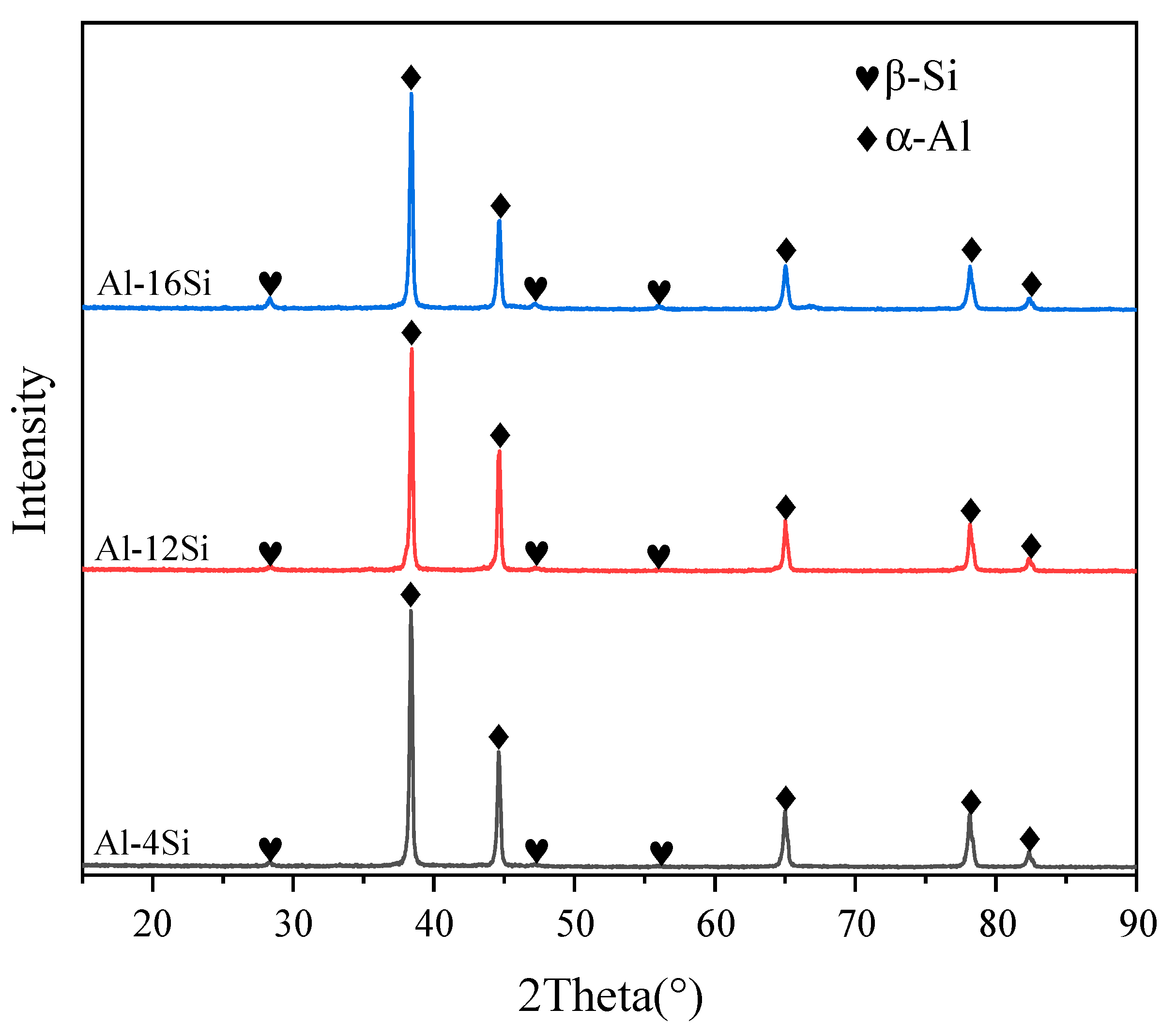
The XRD spectrum in Figure 1 shows that the main components of the nAl-Si alloy powders are αAl and βSi. Specifically, diffraction peaks for both αAl and βSi are present in all nAl-Si alloy powders. For nAl-16Si, due to its higher silicon content, the βSi diffraction peak intensity in the XRD is higher, while the βSi diffraction peak intensity is lower for nAl-4Si and nAl-12Si.
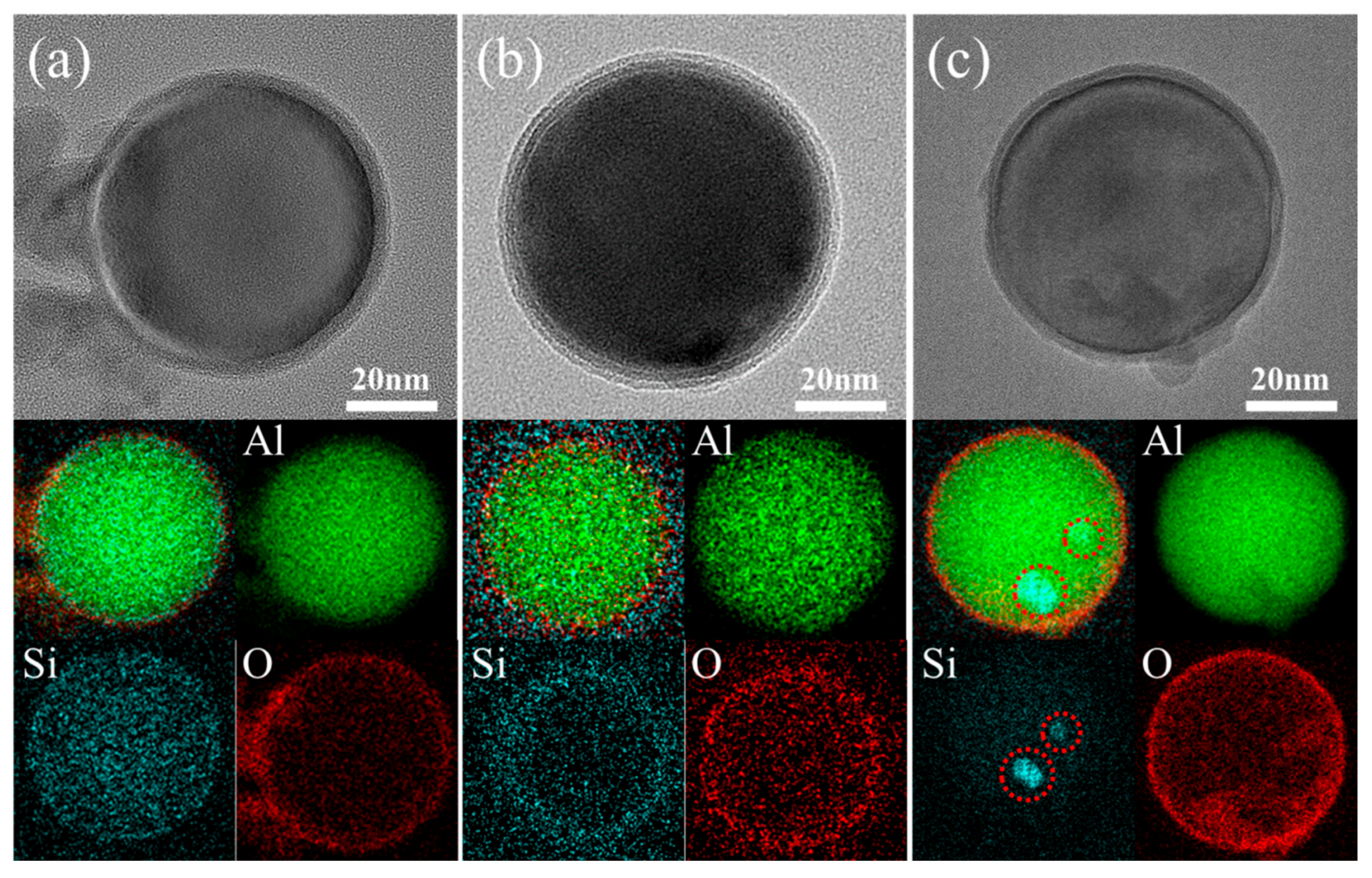
The surface morphology of three types of nAl-Si alloy fuels prepared by electric wire explosion is shown in Figure 2. It can be seen that all samples have good sphericity, with particle sizes around 100 nm, and exhibit distinct core–shell structures. From Figure 2a,b [8], it is observed that Al, Si, and O elements are uniformly distributed on the surfaces of nAl-4Si and nAl-12Si particles, suggesting that the alloy particles are uniformly covered with an oxide film consisted of Al2O3 and SiO2. Figure 2c shows that the Al, O, and Si elements are unevenly distributed on the surfaces nAl-16Si alloy particles, forming local agglomeration of Si and O elements. This is because during the preparation process, the alloy wire is heated to evaporate into a mixed vapor, which then rapidly condenses into nanoparticles upon collision. When the content of Si exceeds the eutectic point of Al-Si (12.6%) during the nucleation process, hypereutectic Al-Si alloy particles will be formed, leading to the agglomeration of Si and the formation of primary silicon. Then, the primary silicon on the surface will be oxidized to be SiO2, which manifests as the agglomeration of Si and O elements.

3.2. Thermal Oxidation Characteristics

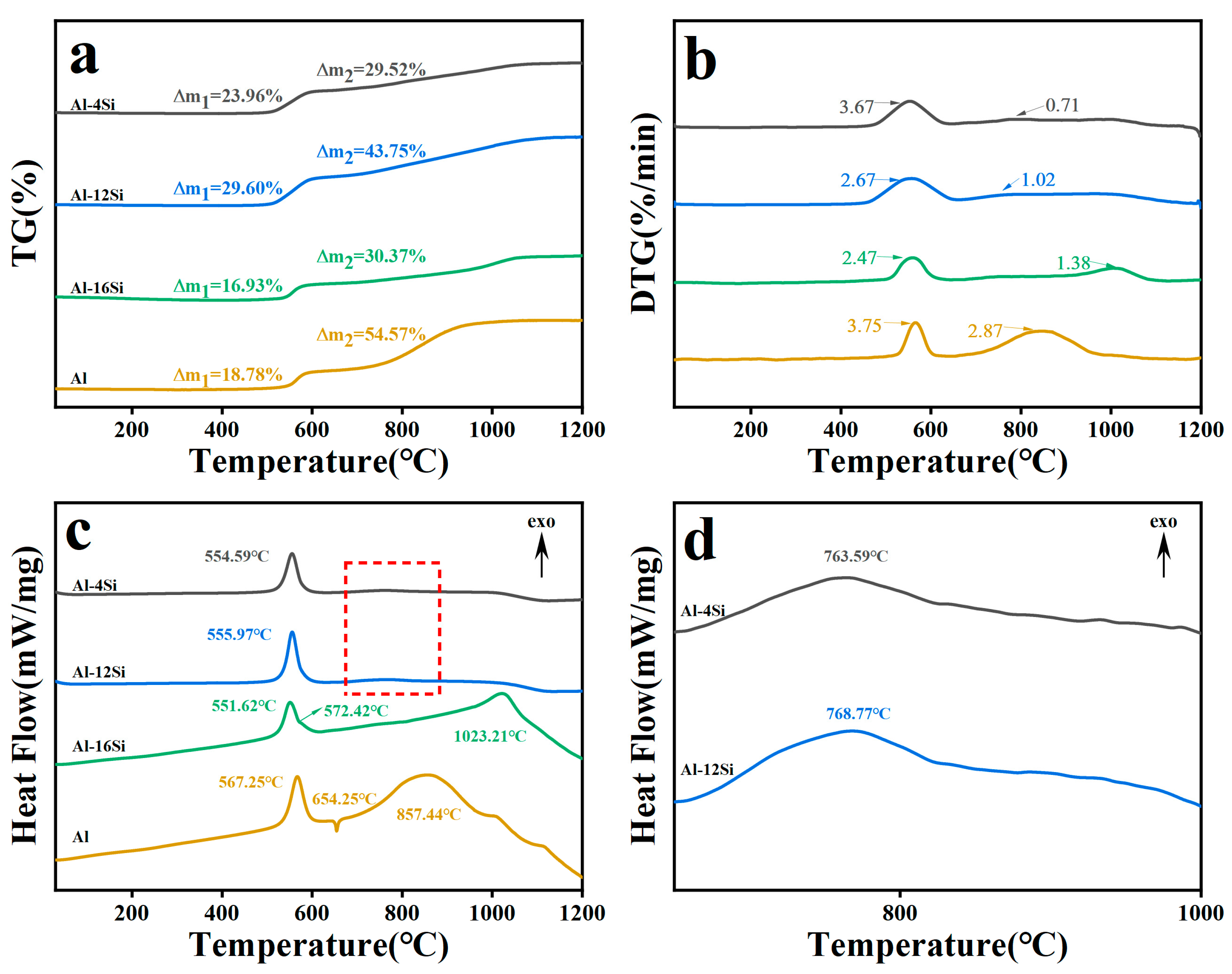
The oxidation of nAl-Si particles can be divided into three stages as shown in Figure 3a, located at 25~450 °C, 450~660 °C, and 660~1200 °C, respectively. As shown in Figure 3c,d, the DSC curves provide detailed analysis of the oxidation process in each stage. The first stage corresponds to the slow oxidation reaction of nAl-Si particles occurring from room temperature to 450 °C. The second stage is the oxidation stage of nAl, involving the first sharp exothermic peak (around 555 °C), corresponding to the heat release peak of nAl [9]. The initial exothermic reaction of nAl-Si occurs earlier than that of nAl due to the presence of Si in the nAl-Si alloy particles, which enhances ion mobility, promotes fuel and oxygen transport and strengthens the gas–solid phase oxidation. The exothermic reaction of nAl-16Si is significantly reduced to 551.62 °C, attributed to the greatly enhanced migration rate of surface silicon ions [10]. The melting point of nAl-16Si is significantly lower at 572.42 °C compared to that of pure nAl because Al-Si alloy is eutectic with a lower melting point, which is consistent with the expected behavior of Al-Si alloy phase diagram [11]. Oppositely, there are no obvious melting peaks for nAl-4Si and nAl-12Si, mainly due to the overlap of the melting peak and oxidation peak. The presence of corresponding melting peaks in an argon environment verifies this hypothesis. The third stage begins at 660 °C, where the second exothermic reaction of nAl-4Si and nAl-12Si occurs around 765 °C, earlier than that of nAl and nAl-16Si, due to their lower melting points. The early melting of the Al-Si alloy within the shell results in earlier pressure accumulation and more intense shell rupture during the second reaction, leading to earlier oxidation shell rupture and the second oxidation peak. The shell of nAl-16Si has a distribution of primary silicon, which forms defects on the oxidation layer surface, leading to slow oxidation along the edges of the primary silicon during heating. This process prevents the nAl-Si core from direct exposure to air, causing the second exothermic peak to lag behind that of aluminum. The DTG curve (Figure 3b) indicates that the oxidation rate of nAl-Si alloys in the first stage (2.47–3.67%/min) gradually decreases with increasing Si content, all lower than the oxidation rate of nAl (3.75%/min).
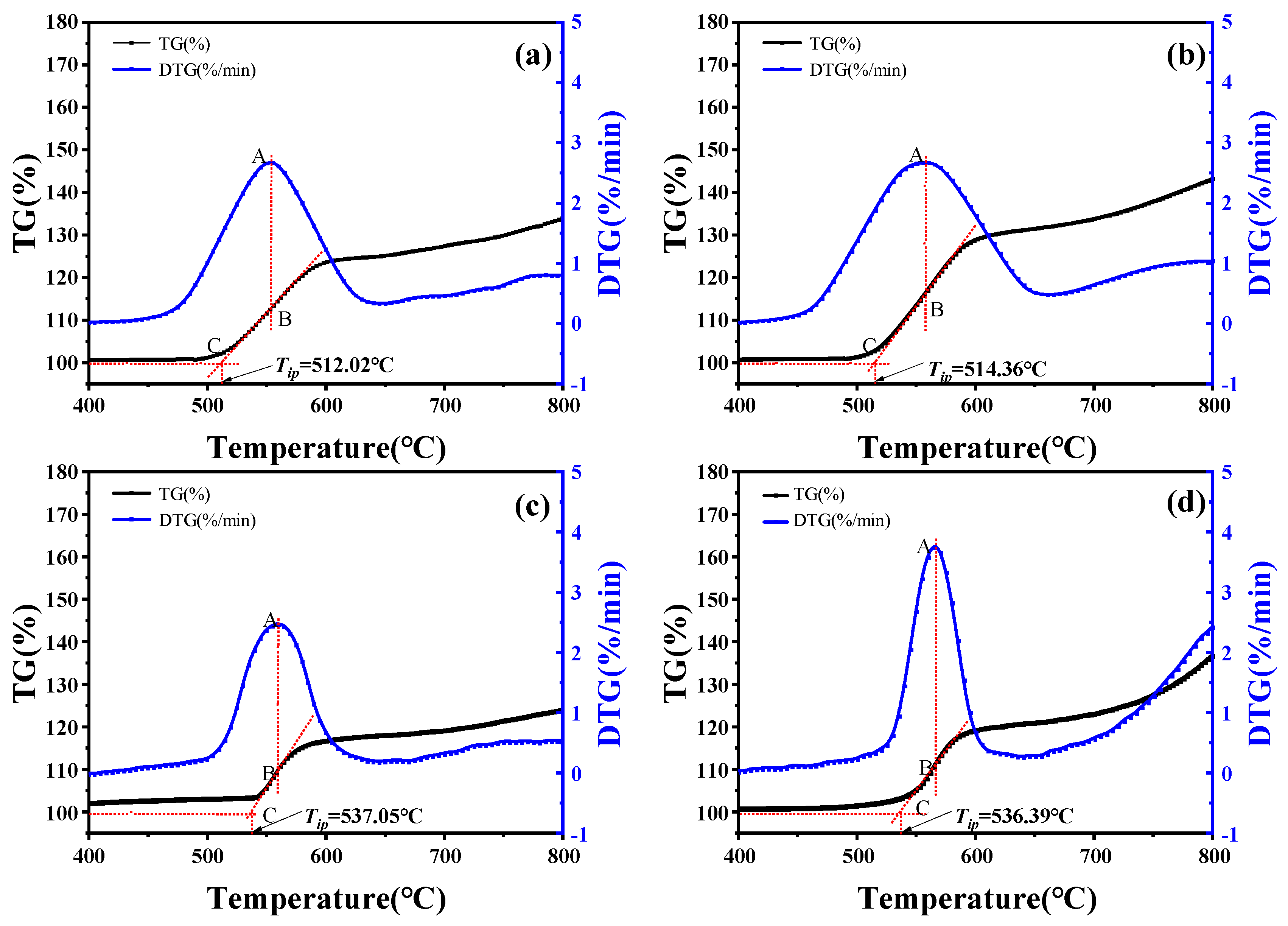
Ignition temperature is a critical indicator for exploring the ignition and combustion characteristics of samples during the oxidation process. It can be determined from the TG-DTG curve that the ignition temperature of the alloy fuel corresponds to the first peak point A on the DTG curve. By drawing a vertical line from point A to the X-axis, which intersects the TG curve at point B, and then drawing a tangent line to the TG curve at point B, which intersects the baseline of the TG curve at point C, the temperature corresponding to point C is the ignition temperature of the alloy fuel [1]. As shown in Figure 4, the ignition temperatures (Tip) of nAl-4Si and nAl-12Si are lower than those of nAl-16Si and nAl. This is due to the lower melting points of nAl-4Si and nAl-12Si, which result in earlier ignition temperatures, allowing the alloy fuel to ignite quickly and the reaction to proceed rapidly.

3.3. Calorific Value Measurement

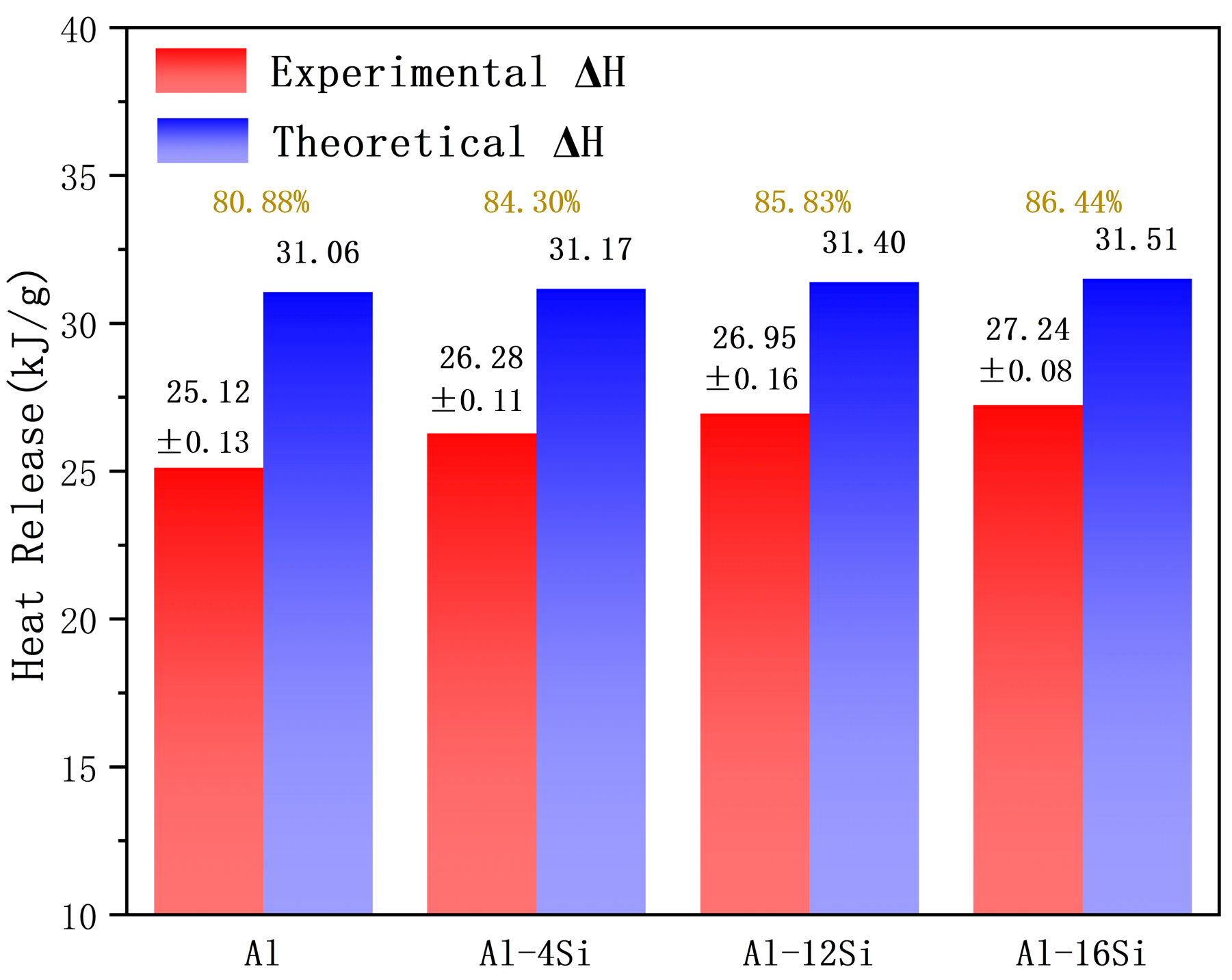
Figure 5 demonstrates that the addition of Si effectively enhances the heat release of the fuel. The theoretical heat release of the samples was calculated based on ICP results using the equation. The actual calorific value of nAl-Si was higher than that of nAl, and it increased monotonically with increasing Si content. The measured combustion heat ranged from 26.28 to 31.51 kJ/g, with combustion efficiency ranging from 84.88% to 86.44%, which is higher than that of nAl (approximately 80.88%). The results indicate that nAl-Si alloy powders react more completely compared to nAl.

3.4. Combustion Characteristics

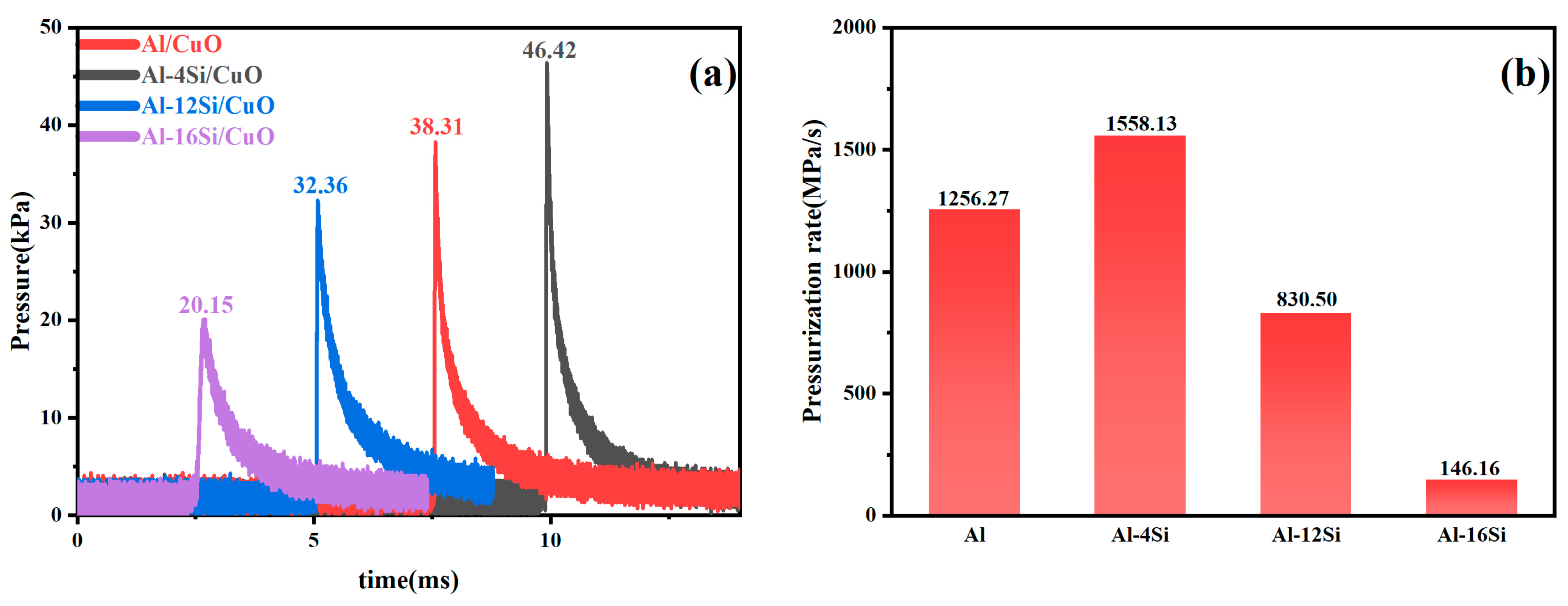
The propagation of flame is related to the amount of gas produced and the rate of gas reactions, which are important parameters for evaluating the combustion performance of thermite. The combustion test results in Figure 6 indicate that nAl-4Si/CuO exhibits a significant increase in peak pressure and rate of pressure increase compared to nAl/CuO, with increases of 8.11 kPa and 24%, respectively. This suggests that nAl-4Si/CuO produces a larger amount of gas and reacts rapidly in a short period. The peak pressure of nAl-Si/Cu composite thermite decreases gradually with increasing silicon content, as does the rate of pressure increase. This is because the reaction in silicon-based thermite involves a higher proportion of solid-phase products, leading to a slower reaction rate, resulting in a lower rate of pressure increase and peak pressure for nSi/CuO.
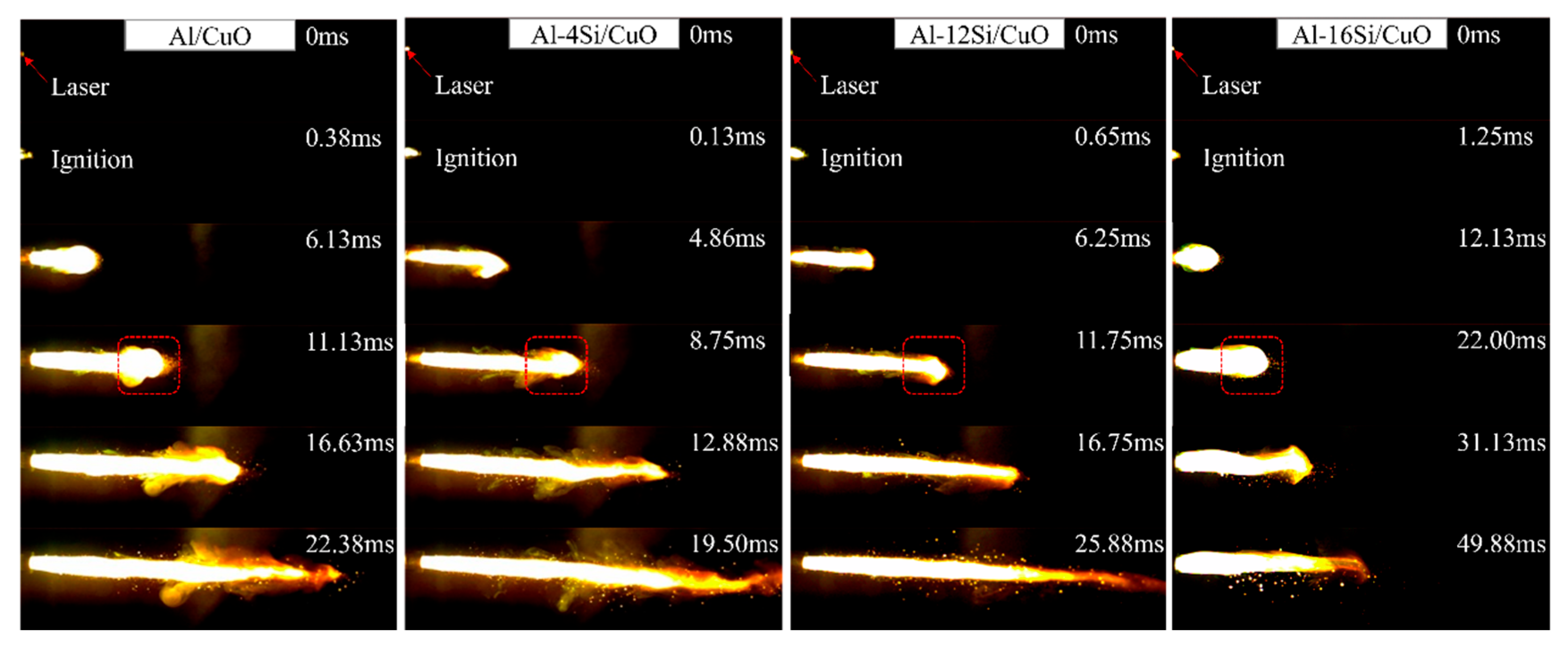
The ignition and combustion characteristics of the nAl/CuO and nAl-Si/CuO composite fuels in Figure 7 show that the nAl-4Si/CuO composite fuel has the shortest ignition delay time of 0.13 ms and a maximum flame length of 14.38 cm. In contrast, both nAl/CuO and nAl-12Si/CuO have ignition delay times of 0.25 ms, with their maximum flame lengths being 12.57 cm and 11.65 cm, respectively. The nAl-16Si/CuO composite fuel, however, has a maximum flame length of only 3.28 cm and an ignition delay time of 0.5 ms. This is due to the higher ignition temperature of nAl-16Si, which results in a slower ignition onset and a longer ignition delay. Additionally, the accumulation of primary silicon on the surface of nAl-16Si, with a higher silicon content, leads to a larger proportion of solid-phase products, causing slower and less stable combustion. Comparison of images at the maximum flame distance position reveals that the nAl-Si/CuO composite fuel produces a higher proportion of solid combustion products, with a significant number of bright particles. Furthermore, the bright particles increase with the increase in silicon content. This is attributed to the reduction in gaseous copper in the thermite reaction products of nAl-Si/CuO, which increases the proportion of total solid-phase products [10].
Figure 7 shows the flame speeds and combustion photographs of nAl/CuO and the three types of nAl-Si/CuO thermites. To quantitatively evaluate the flame propagation rates of the different samples, ten points were selected at equal time intervals between the laser trigger and the maximum flame length, and data on the evolution of the flame front position over time were extracted. By performing linear fitting on these discrete data points, the functional relationship between flame displacement and time was obtained. The slope of this fitted line is defined as the average flame propagation velocity of the sample (v = Δx/Δt). The flame speeds for nAl/CuO, nAl-4Si/CuO, nAl-12Si/CuO, and nAl-16Si/CuO were calculated accordingly and are listed in Table 3. The results indicate that nAl-4Si/CuO has the fastest burning rate, reaching 7.95 m/s, which is related to its lower ignition point temperature; a lower ignition temperature enables more rapid propagation and combustion.

4. Conclusions

Spherical nAl-Si alloy fuels with silicon contents of 4%, 12%, and 16% were prepared by electric wire explosion. The particle size of the nAl-Si alloy fuel was about 100 nm. According to the current technological conditions, 16% was the upper limit of silicon content for preparing nAl-Si alloy fuels by electric wire explosion. The nAl-Si alloy fuel consisted of spherical particles with a core–shell structure. The distribution of Al and Si elements was uniform in nAl-4Si and nAl-12Si, while there was agglomeration of silicon on the surface of nAl-16Si. The main components of the nAl-Si alloy fuels were αAl and βSi.
The nAl, nAl-4Si, nAl-12Si, and nAl-16Si were ultrasonically mixed with CuO at stoichiometric ratios to obtain the corresponding nano-thermite systems. The combustion heat of the nAl-Si alloy fuel rose with its silicon content. The ignition temperatures of nAl-4Si and nAl-12Si were lower than those of nAl-16Si and nAl. And the ignition delay time of nAl-4Si/CuO was 0.13 ms, which was the shortest, and the flame propagation distance of 14.38 cm was the longest. Therefore, increasing the silicon content could enhance the combustion efficiency of nAl-Si alloy fuels. However, when the silicon content exceeded the eutectic point of Al-Si at 12.6%, the formation of primary silicon on the surface led to an increase in solid combustion products, thereby weakening its combustion performance.

Author Contributions

Conceptualization, S.Y.; Methodology, S.Y.; Investigation, S.Y.; Resources, J.Y.; Data curation, H.L. and J.Y.; Writing—original draft, H.L.; Writing—review & editing, J.Y. and S.Y. All authors have read and agreed to the published version of the manuscript.

Funding

This research received no external funding.

Data Availability Statement

The original contributions presented in this study are included in the article. Further inquiries can be directed to the corresponding author.

Conflicts of Interest

The authors declare no conflict of interest.

References

  1. Chen, Y.; Guildenbecher, D.R.; Hoffmeister, K.N.G.; Cooper, M.A.; Stauffacher, H.L.; Oliver, M.S.; Washburn, E.B. Study of aluminum particle combustion in solid propellant plumes using digital in-line holography and imaging pyrometry. Combust. Flame 2017, 182, 225–237. [Google Scholar] [CrossRef]
  2. Feng, Y.; Xia, Z.; Huang, L.; Ma, L. Ignition and combustion of a single aluminum particle in hot gas flow. Combust. Flame 2018, 196, 35–44. [Google Scholar] [CrossRef]
  3. Dreizin, E.L. Metal-based reactive nanomaterials. Prog. Energy Combust. Sci. 2009, 35, 141–167. [Google Scholar] [CrossRef]
  4. Jayaraman, K.; Anand, K.V.; Bhatt, D.S.; Chakravarthy, S.R.; Sarathi, R. Production, characterization, and combustion of nanoaluminum in composite solid propellants. J. Propul. Power 2009, 25, 471–481. [Google Scholar] [CrossRef]
  5. Kong, C.; Yu, D.; Yao, Q.; Li, S. Morphological changes of nano-Al agglomerates during reaction and its effect on combustion. Combust. Flame 2016, 165, 11–20. [Google Scholar] [CrossRef]
  6. Zhao, W.; Ren, H.; Yan, T.; Ou, Y.; Jiao, Q.; Wang, H.; Kline, D.J.; Zachariah, M.R. Tailoring energy release of nano-Si based thermites via incorporation of Ti nanoparticles. Chem. Eng. J. 2020, 396, 124559. [Google Scholar] [CrossRef]
  7. Kumar, L.S.; Chakravarthy, S.R.; Verma, R.; Jayaganthan, R.; Sarathi, R.; Srinivasan, A. Synthesis of multiphase binary eutectic Al–Mg alloy-nanoparticles by electrical wire explosion technique for high-energy applications, its characterisation and size-dependent thermodynamic and kinetic study. J. Alloys Compd. 2020, 838, 155630. [Google Scholar] [CrossRef]
  8. Abraham, A.; Nie, H.; Schoenitz, M.; Vorozhtsov, A.B.; Lerner, M.; Pervikov, A.; Rodkevich, N.; Dreizin, E.L. Bimetal Al–Ni nano-powders for energetic formulations. Combust. Flame 2016, 173, 179–186. [Google Scholar] [CrossRef]
  9. Mason, B.A.; Groven, L.J.; Son, S.F.; Yetter, R.A. Combustion performance of several nanosilicon-based nanoenergetics. J. Propul. Power 2013, 29, 1435–1444. [Google Scholar] [CrossRef]
  10. Morita, M.; Ohmi, T.; Hasegawa, E.; Kawakami, M.; Ohwada, M. Growth of native oxide on a silicon surface. J. Appl. Phys. 1990, 68, 1272–1281. [Google Scholar] [CrossRef]
  11. Risha, G.; Son, S.; Yetter, R.; Yang, V.; Tappan, B. Combustion of nano-aluminum and liquid water. Prog. Combust. Inst. 2007, 31, 2029–2036. [Google Scholar] [CrossRef]
  12. Li, X.; Chiba, A.; Takahashi, S. Preparation and magnetic properties of ultrafine particles of Fe-Ni alloys. J. Magn. Magn. Mater. 1997, 170, 339–345. [Google Scholar] [CrossRef]
  13. Bac, L.H.; Kim, J.S.; Kim, J.C. Synthesis of Fe–Ni invar alloy nanopowder by the electrical explosion of wire in the liquid. Res. Chem. Intermed. 2010, 36, 795–800. [Google Scholar] [CrossRef]
  14. Yang, Z.Q.; You, C.Y.; He, L.L. Microstructures and magnetic properties of Co–Cu nanoparticles prepared by arc-discharge. J. Alloys Compd. 2006, 423, 128–131. [Google Scholar] [CrossRef]
  15. Pan, B.; Yan, S.; Yuan, Q.; Li, S.; Guo, X.; Nie, J.; Jiao, Q. Exploding wire preparation of core-shell aluminum-silicon nanoparticles and characterization as energetic material. J. Nanoparticle Res. 2021, 23, 258. [Google Scholar]
  16. Davis, J.R. (Ed.) Aluminum and Aluminum Alloys; ASM International: Novelty, OH, USA, 1993; p. 627. [Google Scholar]
  17. Qu, J.; Deng, J.; Luo, Z.-M.; Xiao, Y.; Shu, C.-M. Thermal reaction characteristics and microstructure evolution of aluminium nano-powder in various mixtures of oxygen and nitrogen atmosphere. Process Saf. Environ. Prot. 2023, 170, 45–53. [Google Scholar] [CrossRef]
  18. Yang, Y.; Chen, Y.; Zhang, J.; Gu, X.; Qin, P.; Dai, N.; Li, X.; Kruth, J.-P.; Zhang, L.-C. Improved corrosion behavior of ultrafine-grained eutectic Al-12Si alloy produced by selective laser melting. Mater. Des. 2018, 146, 239–248. [Google Scholar] [CrossRef]
  19. Farshidianfar, M.H.; Khajepour, A.; Gerlich, A.P. Effect of real-time cooling rate on microstructure in Laser Additive Manufacturing. J. Mater. Process. Technol. 2016, 231, 468–478. [Google Scholar] [CrossRef]
  20. Thampy, V.; Fong, A.Y.; Calta, N.P.; Wang, J.; Martin, A.A.; Depond, P.J.; Kiss, A.M.; Guss, G.; Xing, Q.; Ott, R.T.; et al. Subsurface Cooling Rates and Microstructural Response during Laser Based Metal Additive Manufacturing. Sci. Rep. 2020, 10, 1981. [Google Scholar] [CrossRef]
  21. Liu, M.; Zheng, R.; Xiao, W.; Li, J.; Li, G.; Peng, Q.; Ma, C. Bulk nanostructured Al-Si alloy with remarkable improvement in strength and ductility. Scr. Mater. 2021, 201, 113970. [Google Scholar] [CrossRef]
  22. Sun, Y.; Ren, H.; Du, F.; Yan, S.; Jiao, Q. Preparation and characterization of sintered B/MgB2 as heat release material. J. Alloys Compd. 2018, 759, 100–107. [Google Scholar] [CrossRef]
Figure 1. The XRD phase diagrams of three types of nAl-Si alloy powders.
Metals 16 00463 g001
Figure 2. TEM and EDS images of nAl-4Si (a), nAl-12Si (b), and nAl-16Si (c).
Metals 16 00463 g002
Figure 3. The TG, DTG, and DSC curves of Al powder and three nAl-Si alloy powders at a heating rate of 10 °C·min−1: (a) TG; (b) DTG; (c) DSC; (d) DSC curves at partial temperatures.
Metals 16 00463 g003
Figure 4. Ignition temperatures of nAl and nAl-Si alloy powders with different Si contents: (a) nAl-4Si; (b) nAl-12Si; (c) nAl-16Si; (d) nAl.
Metals 16 00463 g004
Figure 5. Theoretical and measured heat release and combustion efficiency of nAl and nAl-Si powders with different Si contents.
Metals 16 00463 g005
Figure 6. (a) Pressure curves of nAl-Si powders with different Si contents and peak pressures, (b) rate of pressure increase.
Metals 16 00463 g006
Figure 7. The flame speeds and combustion images of nAl/CuO and three types of nAl-Si/CuO thermite.
Metals 16 00463 g007
Table 1. Formulation of the thermite system.
FormulasFuels/wt.%CuO/wt.%
Al/CuO18.37%81.63%
Al-4Si/CuO17.84%82.16%
Al-12Si/CuO16.80%83.20%
Al-16Si/CuO16.34%83.66%
Table 2. Theoretical parameters of nAl-Si alloy powders with different silicon contents.
SamplesSi Content (wt.%)Theoretical Heat Release (kJ/g)Theoretical Density (g/cm3)
nAl-4Si431.172.68
nAl-12Si1231.402.65
nAl-16Si1631.512.63
Table 3. Flame combustion speed of nAl/CuO thermite with different Si content.
SamplesnAl/CuOnAl-4Si/CuOnAl-12Si/CuOnAl-16Si/CuO
Flame Speed (m/s)5.727.954.901.64
Disclaimer/Publisher’s Note: The statements, opinions and data contained in all publications are solely those of the individual author(s) and contributor(s) and not of MDPI and/or the editor(s). MDPI and/or the editor(s) disclaim responsibility for any injury to people or property resulting from any ideas, methods, instructions or products referred to in the content.