Article

Effect of Ca Contents on the Microstructure and Properties of Friction Stir Processed Mg-2.5Si-4Zn-xCa Alloys


School of Materials Science and Engineering, Shenyang Aerospace University, Shenyang 110136, China
*
Author to whom correspondence should be addressed.
Metals 2026, 16(4), 380; https://doi.org/10.3390/met16040380
Submission received: 1 March 2026 / Revised: 19 March 2026 / Accepted: 25 March 2026 / Published: 30 March 2026

Abstract

The study investigates the influence of Ca addition (0, 0.5, 0.7, and 1 wt.%) on the microstructure and mechanical properties of friction stir-processed (FSPed) Mg-2.5Si-4Zn-xCa alloys. The microstructures of the processed alloys were characterized using OM, SEM, EBSD, and TEM. The results indicated that Ca addition combined with FSP can synergistically refine and homogenize the Mg2Si phase, and with increasing Ca content, the size of both primary and eutectic Mg2Si phases first decreases and then increases, reaching an optimum refinement at 0.7 wt.% Ca. In this composition, the Mg2Si phases were uniformly dispersed, and the stir zone exhibited significantly refined recrystallized grains compared to its Ca-free counterpart. Under identical FSP conditions, the Mg2Si phases in the Ca-containing alloys underwent a higher degree of fragmentation. The addition of Ca promoted the formation of the CaMgSi phase by enriching Ca atoms at or near the Mg2Si phases during FSP, which further assisted in fragmenting the Mg2Si phases. Consequently, the alloy with 0.7 wt.% Ca demonstrated the best mechanical properties at both room and elevated temperatures, exhibiting tensile strength and elongation of 276.57 MPa and 11.60% at room temperature, 190.13 MPa and 12.17% at 150 °C, and 133.43 MPa and 15.96% at 200 °C, respectively.

1. Introduction

Carbon emissions pose a pressing global challenge to sustainable development. The transportation, industrial, and construction sectors collectively contribute to over 65% of global greenhouse gas emissions. Employing lightweight materials in these fields plays a pivotal role in reducing energy consumption and curbing CO2 emissions through weight saving. Magnesium alloy, the lightest engineering structural material available [1], stands out as a prime candidate for this purpose, owing to its excellent specific strength, thermal conductivity, and recyclability. Its application has expanded across aerospace, biomedicine, national defense, and military domains [2], and has been acclaimed as the “green metal structural material in the 21st century” within the international materials community [3]. However, the inherent limitations of magnesium alloys, particularly their insufficient high-temperature strength and creep resistance, pose significant barriers to wider engineering adoption. Consequently, improving their plastic formability, strength, and high-temperature performance through advanced processing technologies has become a central objective in materials research.
Among the many magnesium alloy systems, Mg-Si-Zn alloys have attracted attention because they can form the high-melting-point (1087 °C), low-density (1.99 g/cm3) and thermally stable intermetallic compound Mg2Si [4,5], which can significantly improve the high-temperature tensile and creep properties of alloys [6,7]. However, under conventional casting conditions, the Mg2Si phase exhibits coarse dendritic/Chinese-character-like morphologies that severely fracture the matrix, degrading the alloy’s room-temperature and high-temperature properties [8]. Therefore, controlling and improving the morphology, size, and distribution of the Mg2Si phase is key to enhancing its strengthening effect and is one of the effective ways to improve the alloy’s high-temperature performance [9,10,11].
Currently, researchers primarily employ modification treatment and hot extrusion techniques to refine the microstructure of silicon-containing magnesium alloys [12,13,14]. The addition of alloying elements such as Ca, Sr, Ba, and Er has been shown to modify the morphology and size of the Mg2Si phase. Yu et al. [15] demonstrated that adding Sr to a Mg-5Sn-1Si alloy refines the α-Mg grains and Mg2Si phase; at 0.9 wt.% Sr, the Mg2Si phase was optimally refined, the grain size decreased to 74 µm, and the tensile strength reached 123 MPa at room temperature. Cong et al. [16] investigated the influence of Ca content on the tensile properties of a Mg-6Zn-4Si alloy at room and elevated temperatures. Their results demonstrated that the alloy with 0.4 wt.% Ca addition exhibited the finest Mg2Si phase and optimal mechanical properties, achieving a room-temperature tensile strength of 170 MPa and a tensile strength of 127 MPa at 150 °C. Our previous work systematically investigated the effects of different modifiers on the Mg2Si phase in Mg-Si-Zn alloys. It was demonstrated that additions of Ba, Er, or Nd effectively refined the morphology and size of Mg2Si, leading to improved alloy ductility. Our previous systematic investigation on modifying the Mg2Si phase revealed that the addition of elements like Ba, Er, and Nd to high-silicon-content alloys effectively refined its morphology and size, which in turn improved the alloy’s plasticity [17,18]. To further enhance the morphology of the Mg2Si phase and improve the high-temperature performance of magnesium alloys, researchers have combined modification treatment with hot extrusion to leverage their synergistic effects. Omid Marjani et al. [19] investigated the influence of varying Ca contents on the mechanical properties of as-extruded Mg-4Si-4Ni-xCa alloys. The optimal size and morphology of the Mg2Si phase were achieved at a Ca content of 1 wt.%. The room-temperature tensile strength of the as-extruded alloy reached 252.4 MPa. However, the problem of non-uniform distribution of strip-like secondary phases persisted.
Friction stir processing (FSP) is an innovative materials processing method [20,21,22]. During FSP, a high-speed rotating stirring pin generates frictional heat and induces severe plastic deformation at high strain rates in the processing zone [23,24]. This process breaks down the initial coarse microstructure and promotes dynamic recrystallization (DRX), resulting in a refined grain structure that enhances the mechanical properties of the material [25,26]. FSP offers distinct advantages in magnesium alloy processing, particularly in terms of refining both second-phase particles and grains [27,28]. Deepika et al. [29] investigated the FSP of AZ31 magnesium alloy and found that the processed stir zone underwent DRX. This resulted in uniformly distributed fine equiaxed grains with a minimum average size of approximately 5.66 μm, accompanied by a significant increase in elongation compared to the base material. Raja et al. [30] conducted multi-pass FSP on as-cast AZ91 magnesium alloy. This process refined the α-Mg dendrites from approximately 100 μm to about 2 μm and simultaneously fragmented and uniformly distributed the β-Mg17Al12 phase. Consequently, the tensile strength and elongation were improved from 100 MPa and 0.8% to 327 MPa and 4.7%, respectively. Wang et al. [31] investigated the effects of single-pass and double-pass FSP on the microstructure and mechanical properties of AZ31 alloy; the results showed that FSP caused significant grain refinement and homogenization, and the ultimate tensile strengths of the single-pass and double-pass FSP specimens increased by 43 MPa and 82 MPa, respectively, while the elongations increased by 4.3% and 11.9%, respectively. Xiao et al. [32] reported that FSP of an as-cast Mg-10Gd-3Y-0.5Zr alloy effectively dissolved the continuous β-Mg5(Gd, Y) network and refined the grains to approximately 6 μm, leading to a simultaneous improvement in both strength and ductility. Nevertheless, current research predominantly focuses on conventional Mg alloy systems, with limited studies dedicated to the FSP of alloys containing brittle Mg2Si phases, such as the Mg-Si-Zn system.
In spite of that, the combination of Ca modification with hot extrusion apparently improves the mechanical properties of the Si-containing magnesium alloy; the banded distribution of Mg2Si phases in the microstructure results in poor microstructural homogeneity. In order to further improve the microstructural homogeneity as well as refine the microstructure, the present study proposes a method combining the alloy modification with FSP to improve the Mg-Si-Zn alloy. The Ca element is chosen and employed for the modification of Mg-Si-Zn alloys to enhance their plasticity and prepare for FSP because Ca serves as an effective modifier for both primary and eutectic Mg2Si, as illustrated above. Subsequently, FSP of the alloy will be conducted to achieve grain refinement, second-phase fragmentation, and improve microstructural uniformity. So, in this study, the effects of Ca modification and FSP on the microstructure, second phases and mechanical properties of Mg-Si-Zn alloy are studied to find a new way to increase the properties at ambient and elevated temperatures, and reveal the synergistic mechanism of Ca modification and FSP on the refining of Mg2Si phase and α-Mg grains.

2. Experimental Procedure

2.1. Alloy Preparation

In order to study the effects of the Ca element and FSP parameters on the microstructure and mechanical properties, this experiment is based on the Mg-2.5Si-4Zn alloy and first designs alloy compositions by adding different contents of Ca, shown in Table 1. Industrial pure magnesium (99.9 wt.%), pure zinc (99.9 wt.%), Mg-5Si master alloy, and Mg-20Ca master alloy were used as raw materials to melt and cast the alloy samples. The melting and casting experiments were carried out using an SG-7.5-12 atmospheric shaft-type resistance furnace (Xiangtan City Samsung Instrument Co., Ltd., Xiangtan, China) equipped with a self-made protective gas mixing device as described below.
Prior to melting, the crucible and raw materials were pre-dried in a drying oven. The resistance furnace was heated to 500 °C and held. Pure magnesium was then added to the crucible in the furnace under a CO2: SF6 (100:1) protective gas atmosphere, while the temperature was simultaneously raised to 750 °C and held.
After the pure magnesium in the crucible had completely melted and been held for 30 min, the temperature was increased to 770 °C. The Mg-5Si alloy was then added and vigorously stirred for 2–3 min. The melt was held at this temperature for 2 h and stirred every 40 min to ensure complete dissolution. After this holding period, the surface slag was removed. Pre-weighed zinc and the Mg-20Ca master alloy were introduced into the melt, followed by thorough stirring for 2 min. Subsequently, the temperature was reduced to 740 °C and the surface dross was skimmed off. Finally, the melt was poured into a graphite mold preheated to 200 °C to obtain a rectangular ingot measuring 80 mm × 60 mm × 30 mm.
Samples were cut from the ingot by wire cutting (DK7735 taper) (Taizhou Hailing Huazheng CNC Machine Tool Co., Ltd., Taizhou, China) into plates 80 mm × 60 mm × 4 mm thick. The alloy plates were then ground with sandpaper to remove surface oxide scale and contaminants for the FSP experiments.

2.2. Design and Analysis Testing Methods for Friction Stir Processing

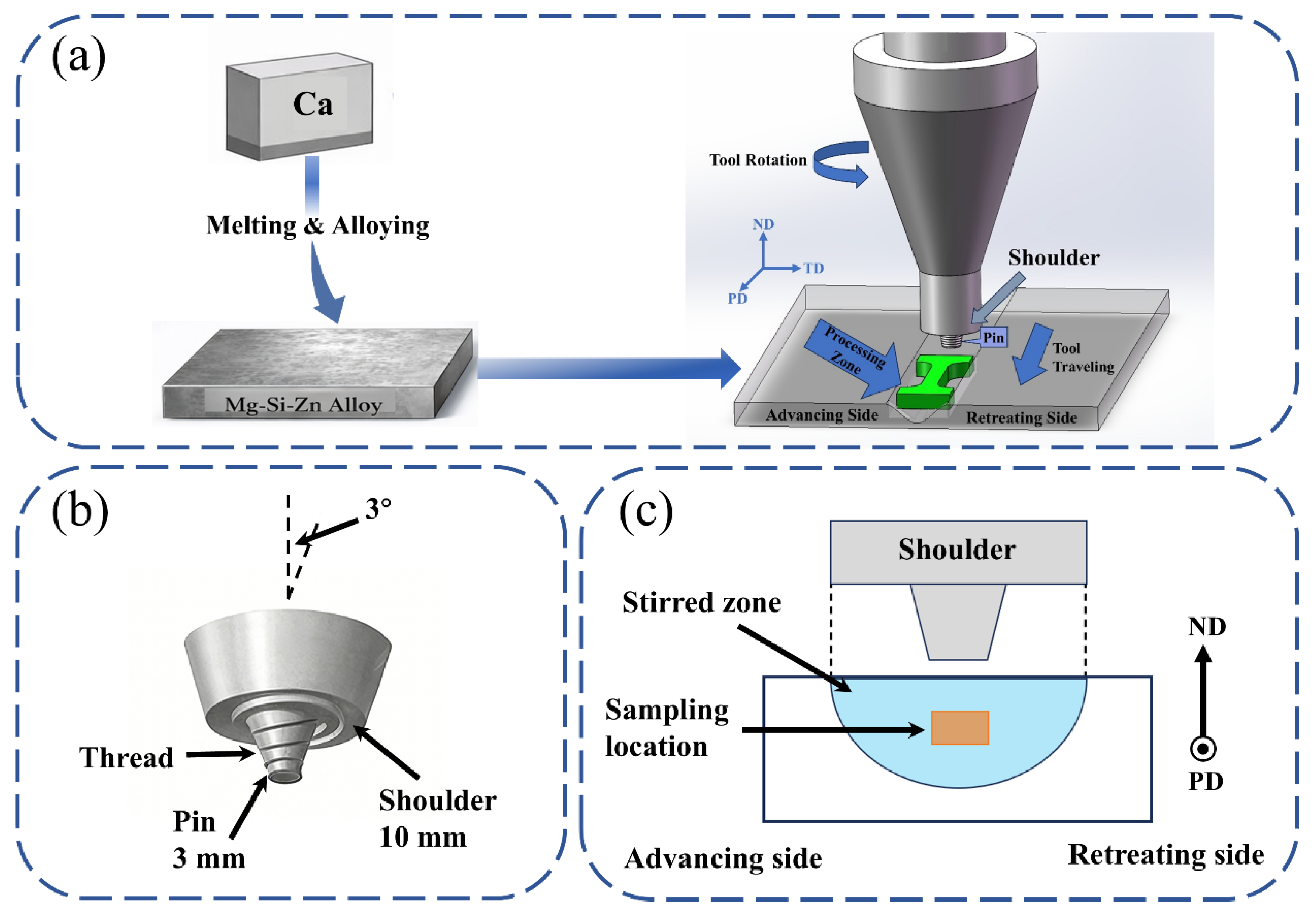
Friction stir processing (FSP) was conducted on 4 mm thick plates using a compact, wide-format FSW machine (Model: FSW-3LM-4012) (Beijing Saifusite Technology Co., Ltd., Beijing, China). The CNC-controlled equipment enabled precise regulation of the rotational and traverse speeds, as schematically illustrated in Figure 1a. A conical threaded tool made of H13 steel was employed during processing, as shown in Figure 1b. The tool featured a shoulder diameter of 10 mm and a pin length of 3 mm (chosen to match the plate thickness), with major and minor diameters of 4 mm and 3 mm, respectively. The processing parameters included a plunge depth of 0.2 mm, a tool tilt angle of 3°, and a preheating time of 10 s. FSP of the as-cast samples was carried out as a single-pass operation at a rotational speed of 1000 r/min and a traverse speed of 50 mm/min.
Metallographic specimens were sectioned perpendicular to the FSP direction, and the sampling location is shown in Figure 1c. For microstructural examination, samples were prepared by standard grinding and polishing procedures, followed by etching with 4 vol.% nitric acid in ethanol and cleaning with anhydrous ethanol. Microstructure was characterized using an Olympus GX71 optical microscope (Olympus Corporation, Shinjuku City, Japan) and a Zeiss Sigma field-emission scanning electron microscope (SEM) (Carl Zeiss Microscopy GmbH, Oberkochen, Germany). Further microstructural and nanoscale particle analysis was performed using a JEM-F200 field-emission transmission electron microscope (TEM) (JEOL Ltd., Akishima, Japan), with phase compositions verified by energy-dispersive X-ray spectroscopy (EDS). The average sizes of primary and eutectic Mg2Si phases were quantified using ImageJ software (Version 1.54f, National Institutes of Health, Bethesda, MD, USA). Vickers microhardness was measured under a 100 g load with a 10 s dwell time.
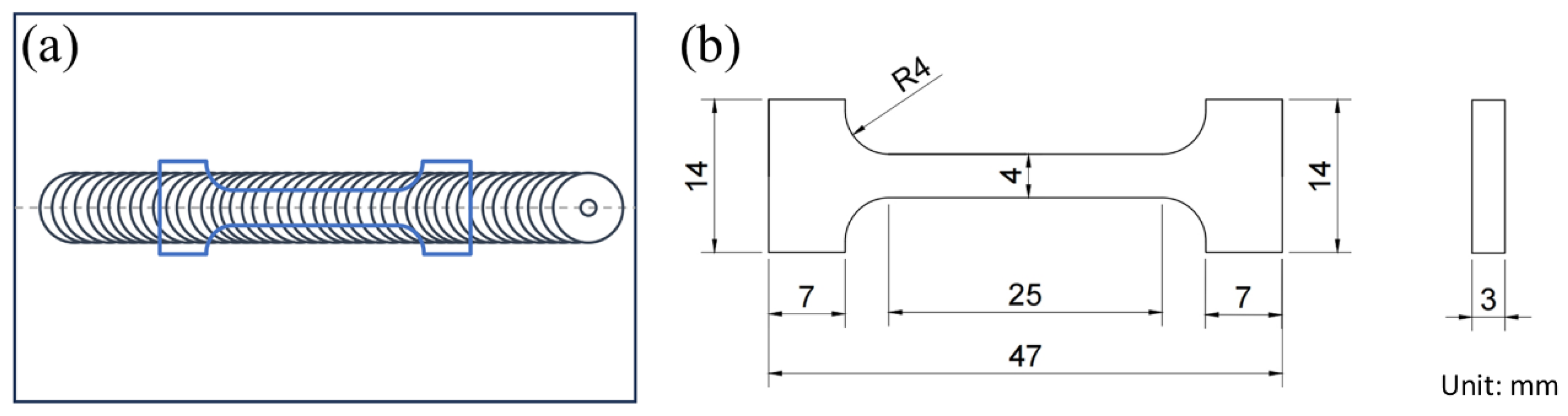
The tensile properties of the FSP-processed samples were evaluated using a SANS-CMT5105 computer-controlled electronic universal testing machine (Sansi Yongheng Technology (Zhejiang) Co., Ltd., Jiaxing, China). Tensile specimens were machined along the processing direction in the FSP region (shown in Figure 1), with their sampling location and dimensions detailed in Figure 2a and Figure 2b, respectively. Tests were conducted at temperatures of room temperature (RT), 150 °C, and 200 °C with a constant crosshead speed of 5 mm/min. Prior to testing, each specimen was held at the target temperature for 10 min to achieve thermal equilibrium. Fractographic analysis was subsequently performed on the fractured surfaces using scanning electron microscopy (SEM).

3. Results

3.1. Macroscopic Morphology and Microstructure

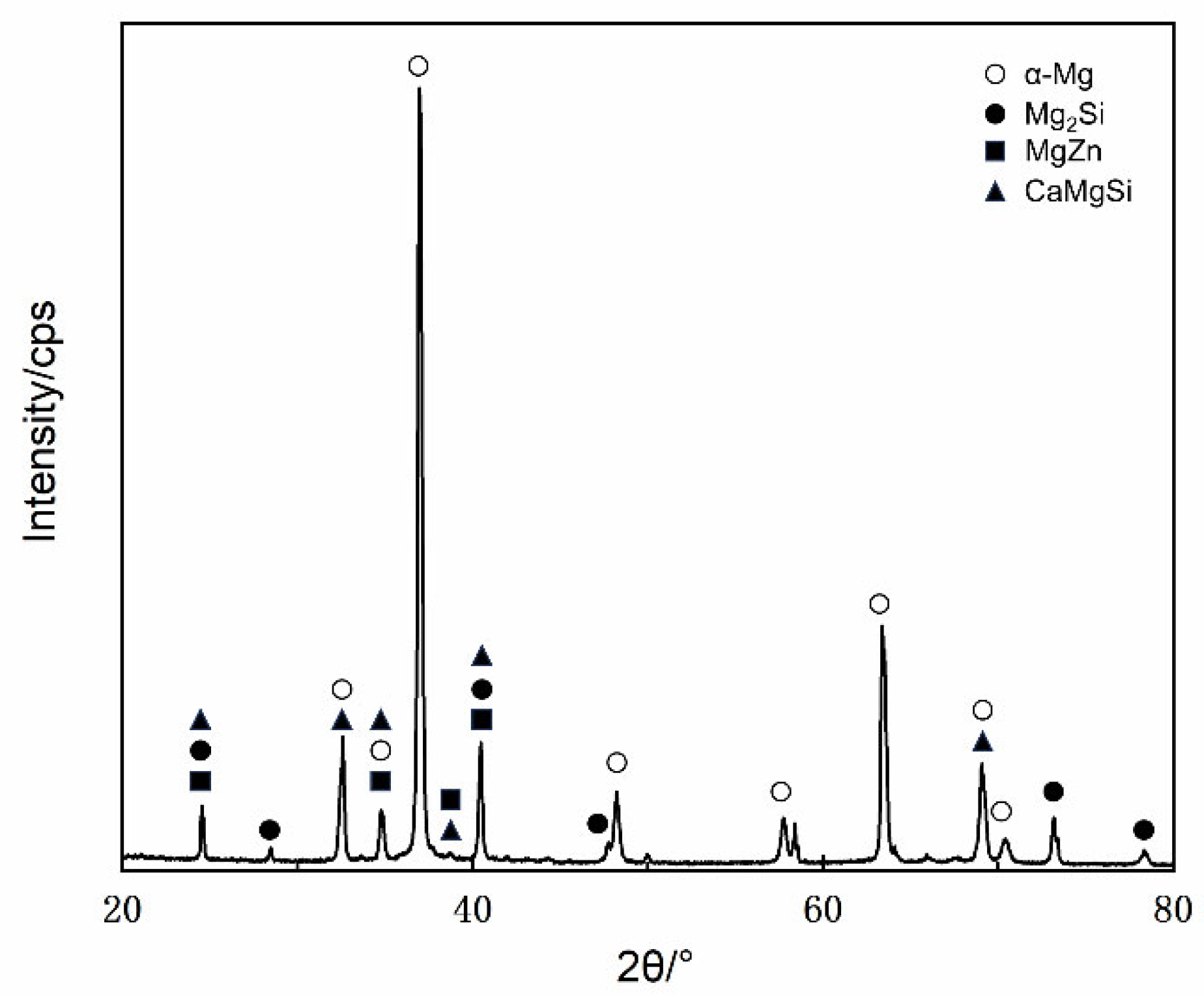
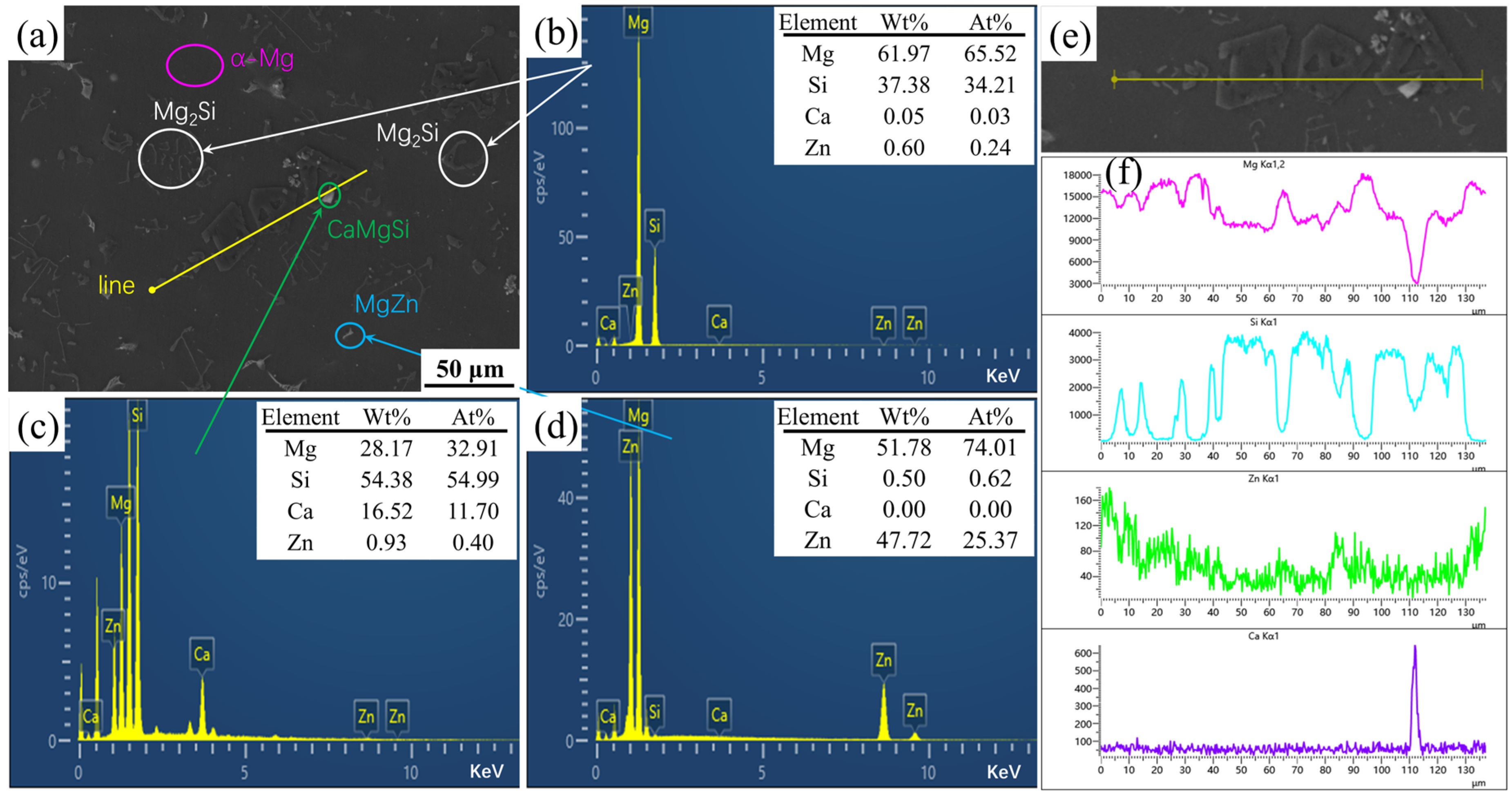
Before FSP, the microstructure and phase composition of the as-cast Mg-2.5Si-4Zn-0.7Ca alloy were investigated and are shown in Figure 3. As shown in Figure 3a, the alloy microstructure comprises an α-Mg matrix with multiple secondary phases. The EDS point spectra for specific phases are provided in Figure 3b–d, with scanning line and elemental distributions displayed in Figure 3e and Figure 3f, respectively. XRD analysis was performed on the as-cast Mg-2.5Si-4Zn-0.7Ca alloy, presented in Figure 4. The XRD pattern exhibits prominent characteristic diffraction peaks corresponding to α-Mg, along with peaks attributable to Mg2Si, MgZn, and CaMgSi phases. Combined with the EDS results, it can be concluded that the alloy is primarily composed of an α-Mg matrix, primary Mg2Si, eutectic Mg2Si, CaMgSi, and eutectic MgZn phases.
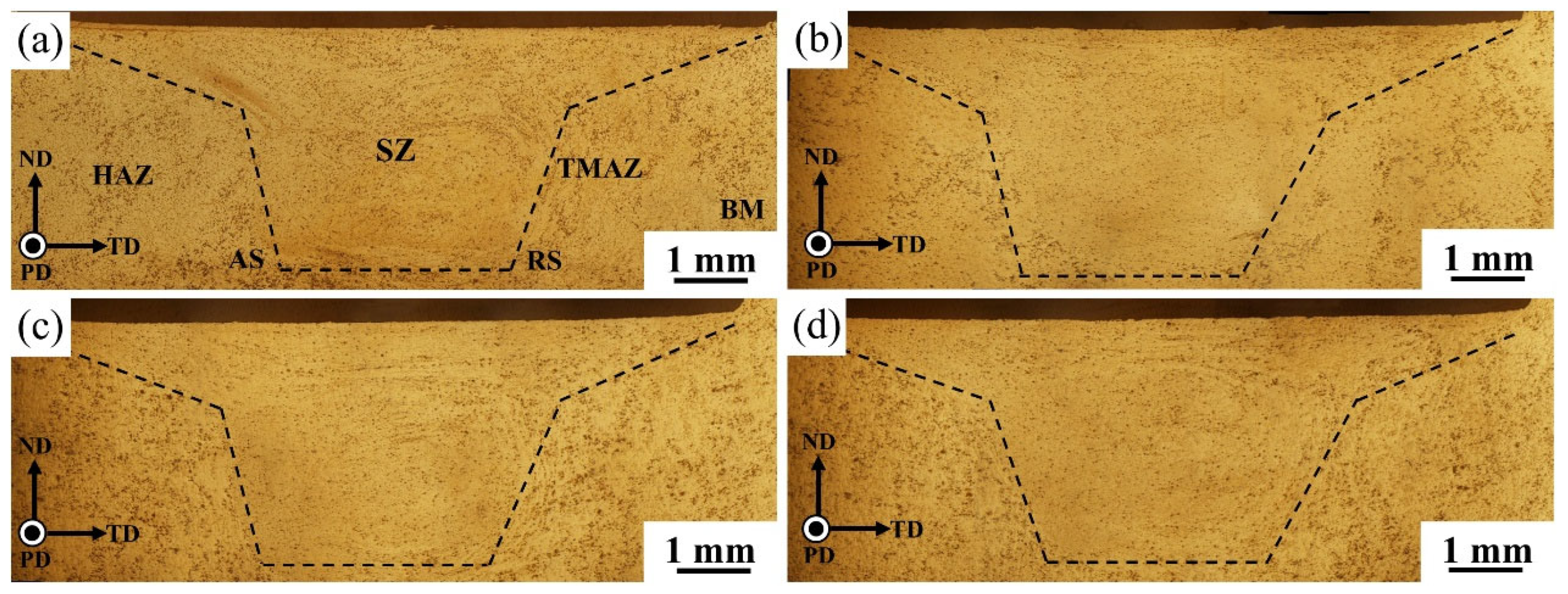
When the Ca content in the alloys is 0, 0.5, 0.7, and 1.0 wt.%, their cross-sectional macroscopic morphologies after FSP are presented in Figure 5. All cross-sections are well-defined and free from defects such as voids or tunnels. As indicated in Figure 5a, the stirred zone (SZ), thermo-mechanically affected zone (TMAZ), heat-affected zone (HAZ), base material (BM), advancing side (AS), and retreating side (RS) can be clearly identified.
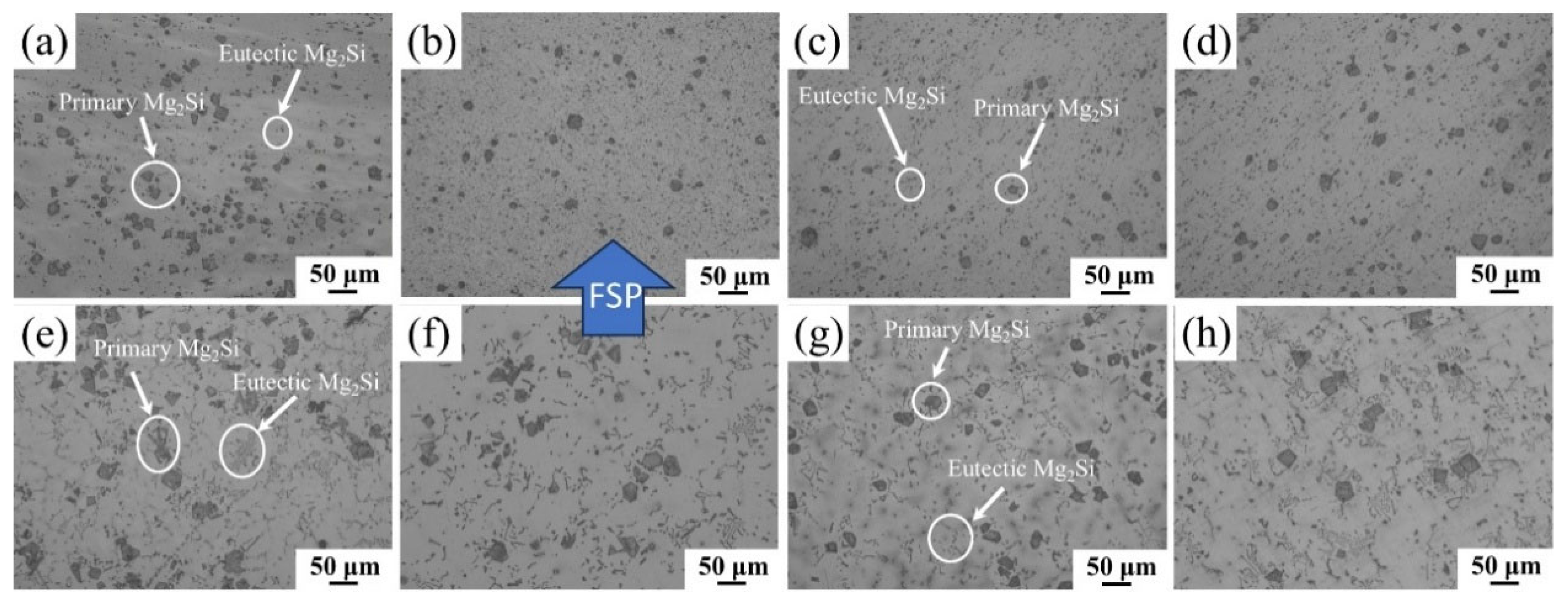
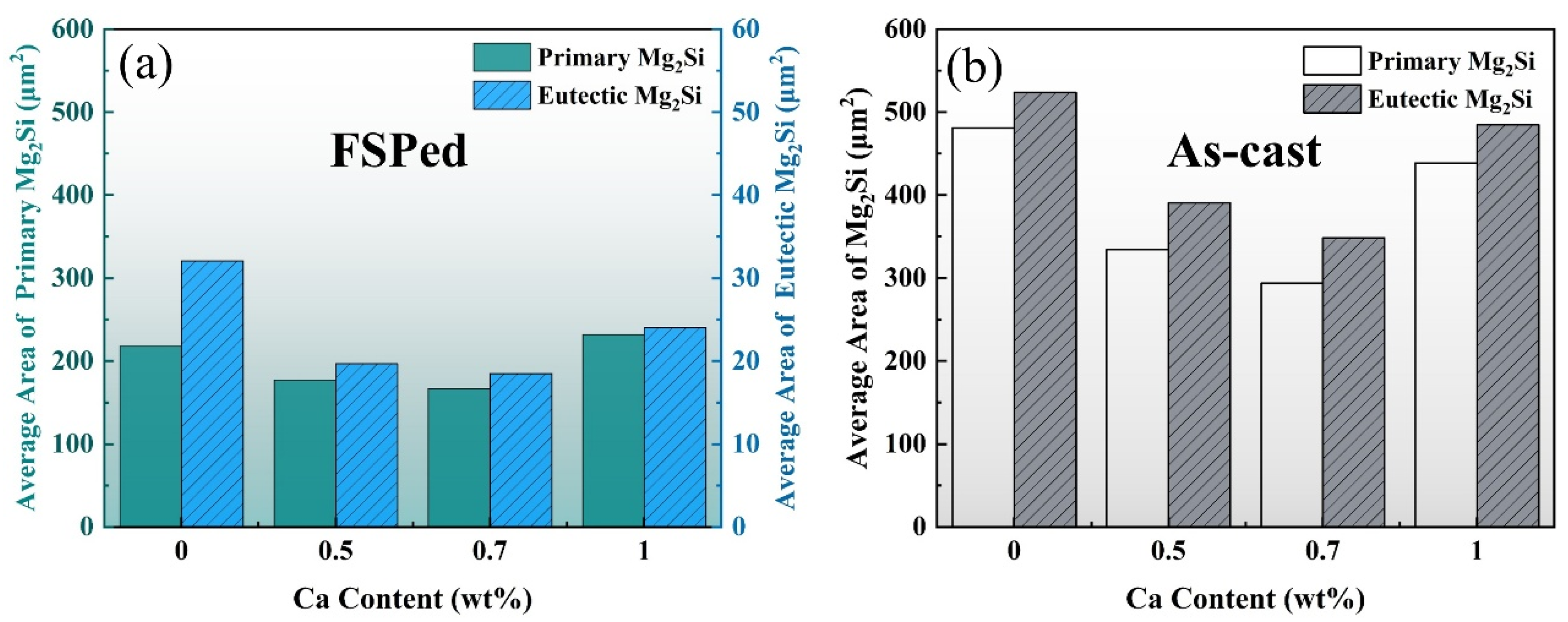
The microstructures of SZ in FSPed Mg-2.5Si-4Zn-xCa alloys with varying Ca content are presented as shown in Figure 6a–d; correspondingly, the original structures of as-cast alloys with the same Ca content are shown in Figure 6e–h. It is shown by comparing the FSPed alloy with the as-cast at the same Ca content that FSP effectively fragmented the Mg2Si phases; the coarse, blocky primary Mg2Si was significantly refined, and the Chinese-script eutectic Mg2Si was broken into fine granular particles, both becoming uniformly dispersed in the matrix. The size of the Mg2Si phases in the alloys after FSP first decreased and then increased with the Ca content increasing, reaching an optimum at 0.7 wt.% Ca. At 1.0 wt.% Ca, both primary and eutectic Mg2Si phases coarsened. FSPed alloys have a similar trend, changing with the as-cast alloys, as shown in Figure 7. Quantitative analysis in Figure 7a confirms that adding 0.7 wt.% Ca reduced the average area of primary Mg2Si from 220 μm2 without Ca element to 160 μm2 and that of eutectic Mg2Si from 32 μm2 to 18 μm2. Consequently, FSP can further refine the Mg2Si phases beyond the modification effect induced by Ca addition alone.
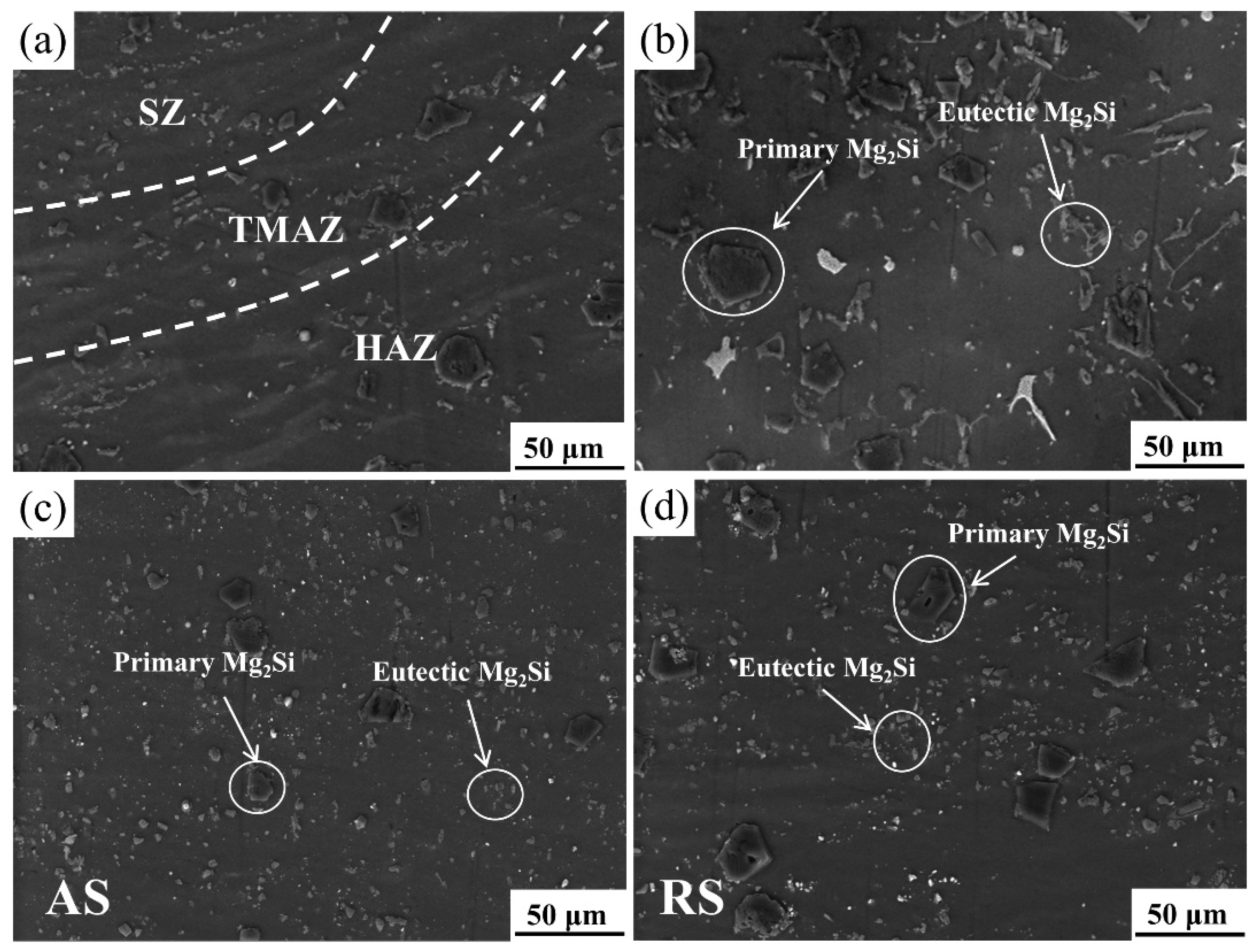
Figure 8 presents SEM images of the FSPed Mg-2.5Si-4Zn-0.7Ca alloy. As shown in Figure 8a, both the primary and eutectic Mg2Si phases are significantly refined and more homogeneously distributed within the SZ compared to those in the TMAZ. In the TMAZ, these phases are somewhat refined relative to the HAZ and align along the material flow lines. In contrast, the primary and eutectic Mg2Si phases in the BM and HAZ remain similar to the as-cast structure, exhibiting an inhomogeneous distribution. Furthermore, comparison between the AS and RS of the TMAZ (Figure 8c,d) reveals that the primary and eutectic Mg2Si phases are finer and more uniformly distributed on the AS than on the RS.

3.2. Evolution of the Second Phase During FSP

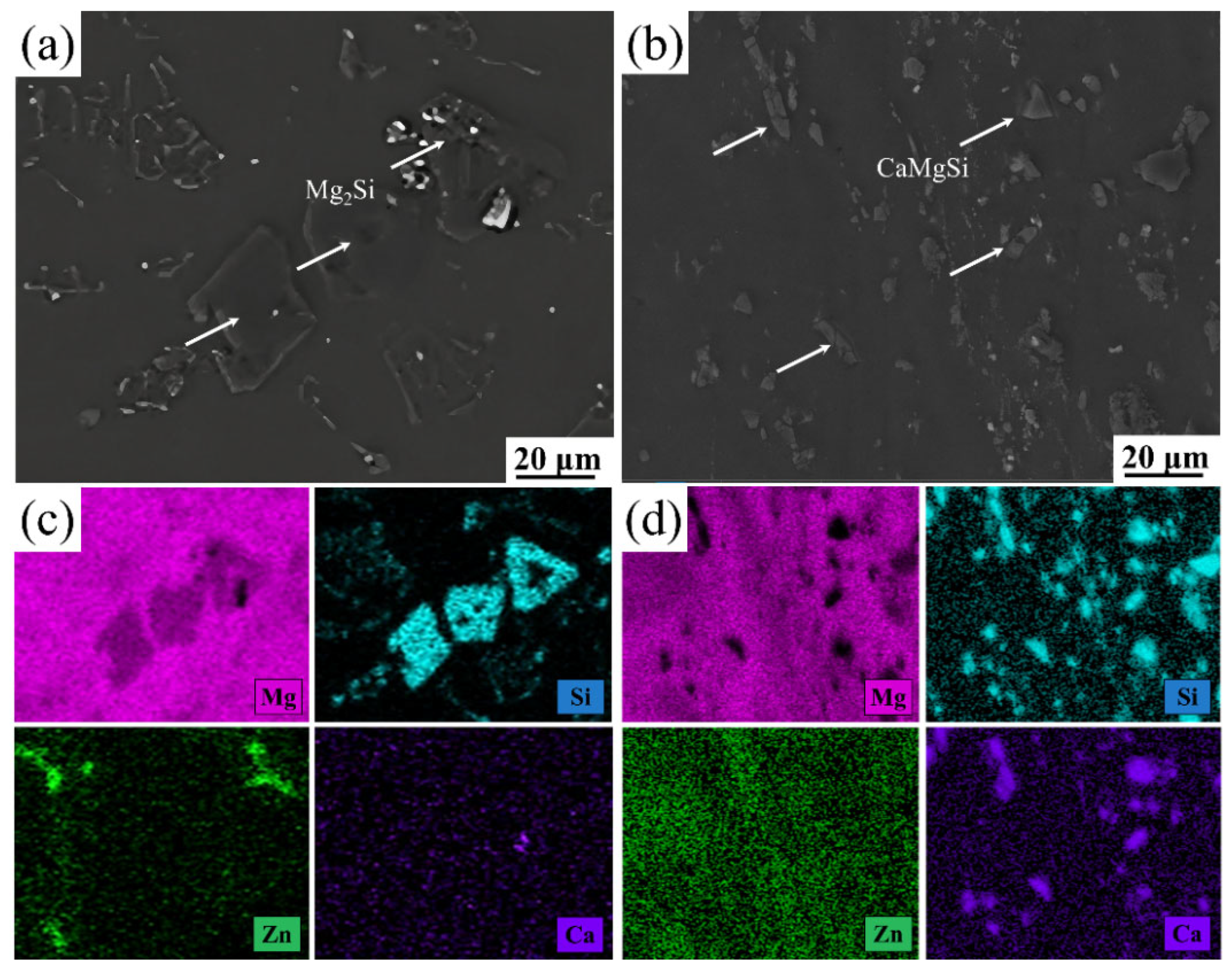
Figure 9 presents the EDS elemental mapping results of the as-cast and FSPed Mg-2.5Si-4Zn-0.7Ca alloy. As shown in Figure 9a,c, Ca in the as-cast alloy is mostly distributed within the α-Mg matrix, and with only minor localized segregation, shown in Figure 9c. In contrast, evident in Figure 9b,d, the segregation of Ca after FSP occurs almost consistently with that of Si, indicating that a large number of CaMgSi phases are generated during FSP. To quantify this further, the Ca-rich regions in EDS maps were subjected to threshold segmentation using ImageJ, with the area fraction approximating the relative volume fraction. The Ca-rich phase fraction increased markedly from ~1.4% in the as-cast condition to ~16.1% after FSP, confirming the significant precipitation of CaMgSi during processing. Moreover, the discretely distributed MgZn phase in the as-cast alloy will become a uniform distribution of Zn throughout the α-Mg matrix.
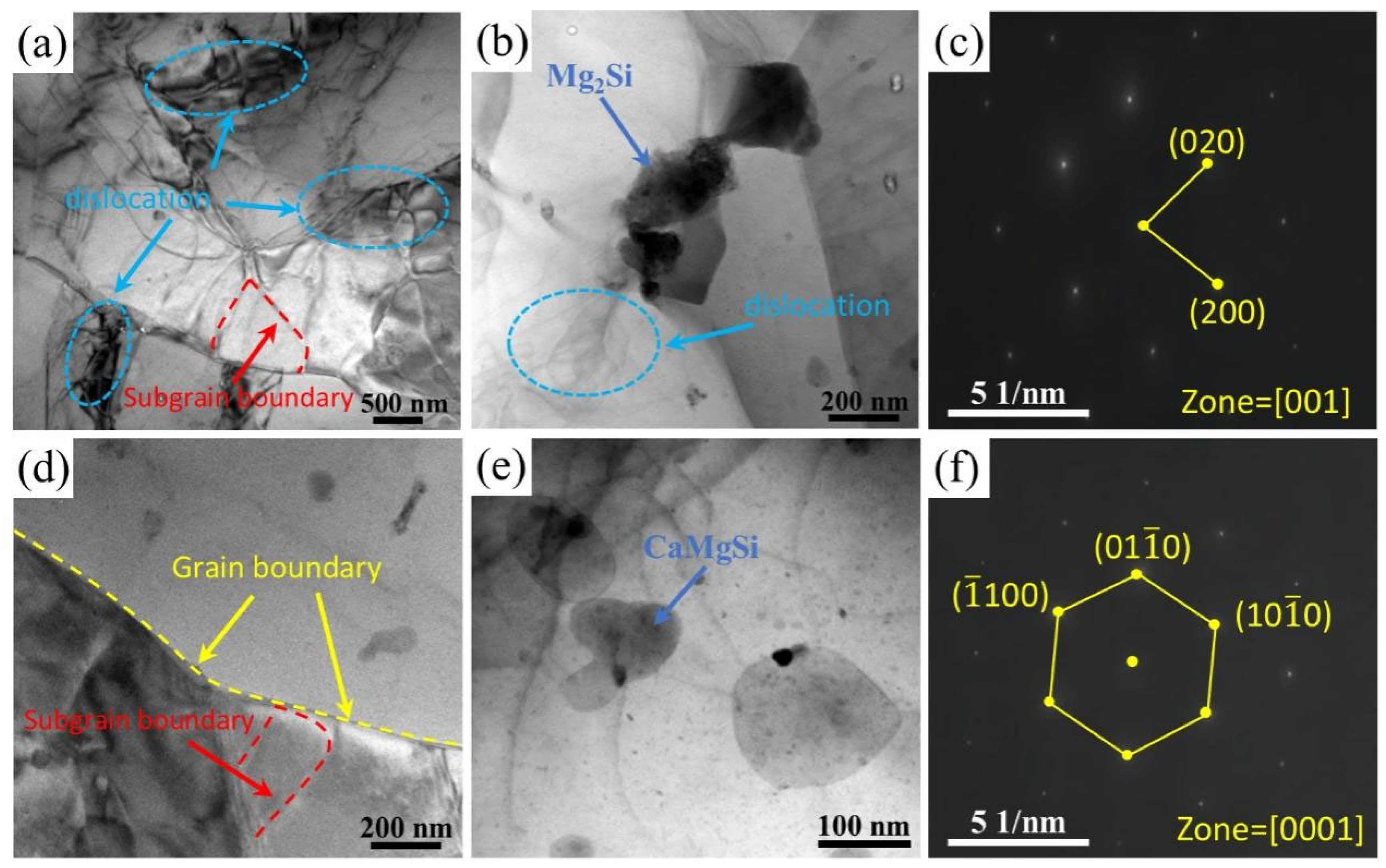
Figure 10 presents TEM images of the FSPed Mg-2.5Si-4Zn-0.7Ca alloy. Figure 10a reveals a high density of dislocations within the grains and distinct grain boundaries. Nano-sized particles are uniformly dispersed in the matrix. Based on the selected area electron diffraction (SAED) patterns in Figure 10c,f, these particles in Figure 10b,e are confirmed to be Mg2Si and CaMgSi, respectively. An interaction is observed between the dislocations and these dispersed particles. The dislocations bow between the particles, operating through the Orowan mechanism [33], which results in the formation of dislocation loops.

3.3. Effect of Ca Content on the Matrix Microstructure of FSPed Alloys

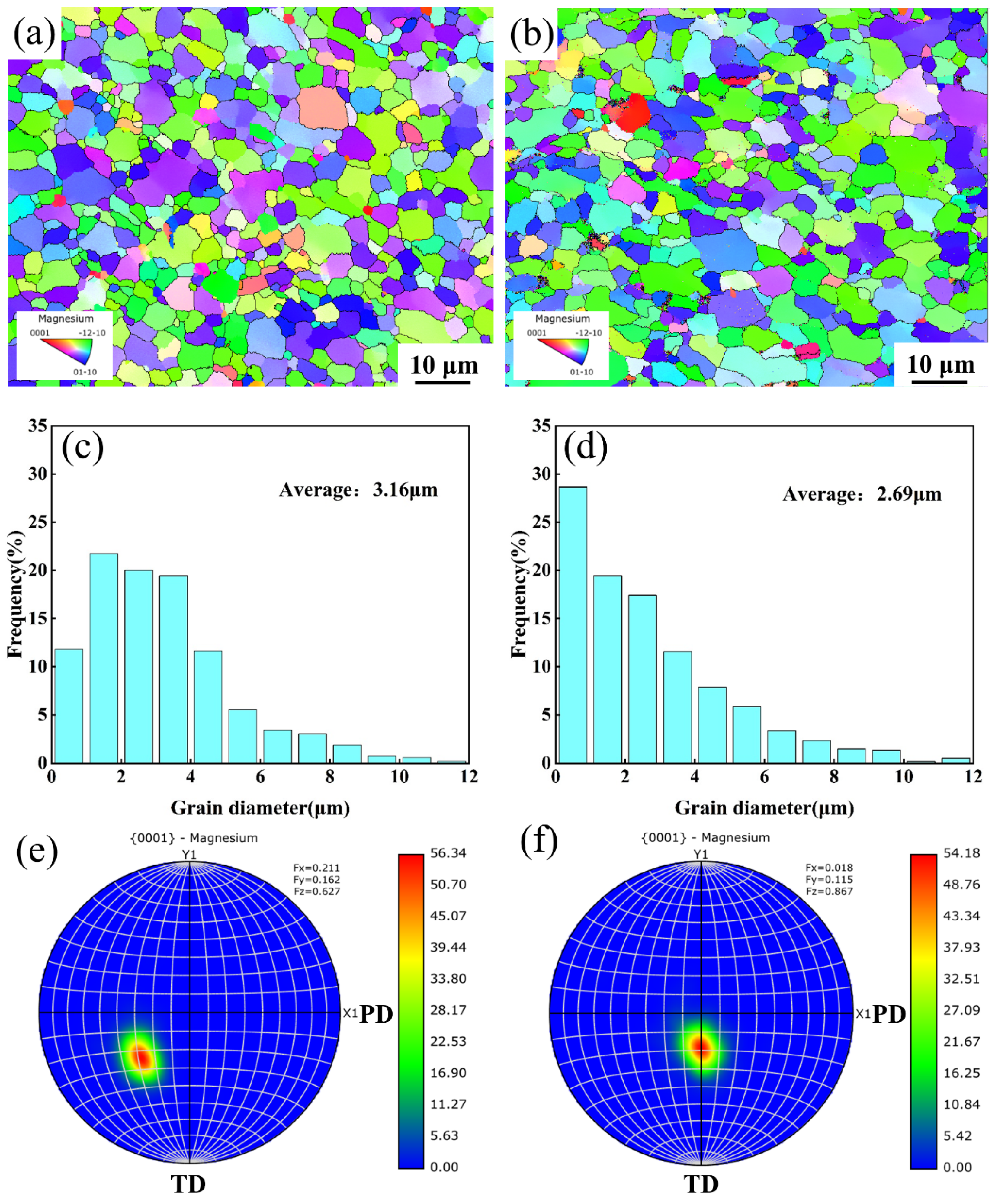
EBSD IPF maps of the SZ of FSPed Mg-2.5Si-4Zn-xCa alloys with 0 wt.% Ca and 0.7 wt.% Ca are shown in Figure 11a,b, where individual grains are color-coded by the color code triangle in the lower right according to their crystallographic orientation relative to the transverse direction (TD). Analysis shows that after FSP, the SZ of the alloys with both Ca contents consists of fine dynamically recrystallized grains, exhibiting a fine equiaxed grain structure.
Compared with the alloy without Ca modification, the grain size in the SZ of the alloy with 0.7 wt.% Ca is significantly refined. As seen in Figure 11c,d, the average grain size of the 0 wt.% Ca alloy is 3.16 μm, while that of the 0.7 wt.% Ca alloy is 2.69 μm. Further analysis indicates that with the addition of Ca, the number of ultrafine dynamically recrystallized grains (≤3 μm) increases significantly. Figure 11e,f show the {0001} basal pole figures of the SZ. After processing, the basal poles of all alloys are tilted toward the normal direction. As the Ca content increases from 0 to 0.7 wt.%, the basal texture intensity decreases from 56.34 to 54.18 mrd, indicating texture weakening and an increase in microstructural randomness.
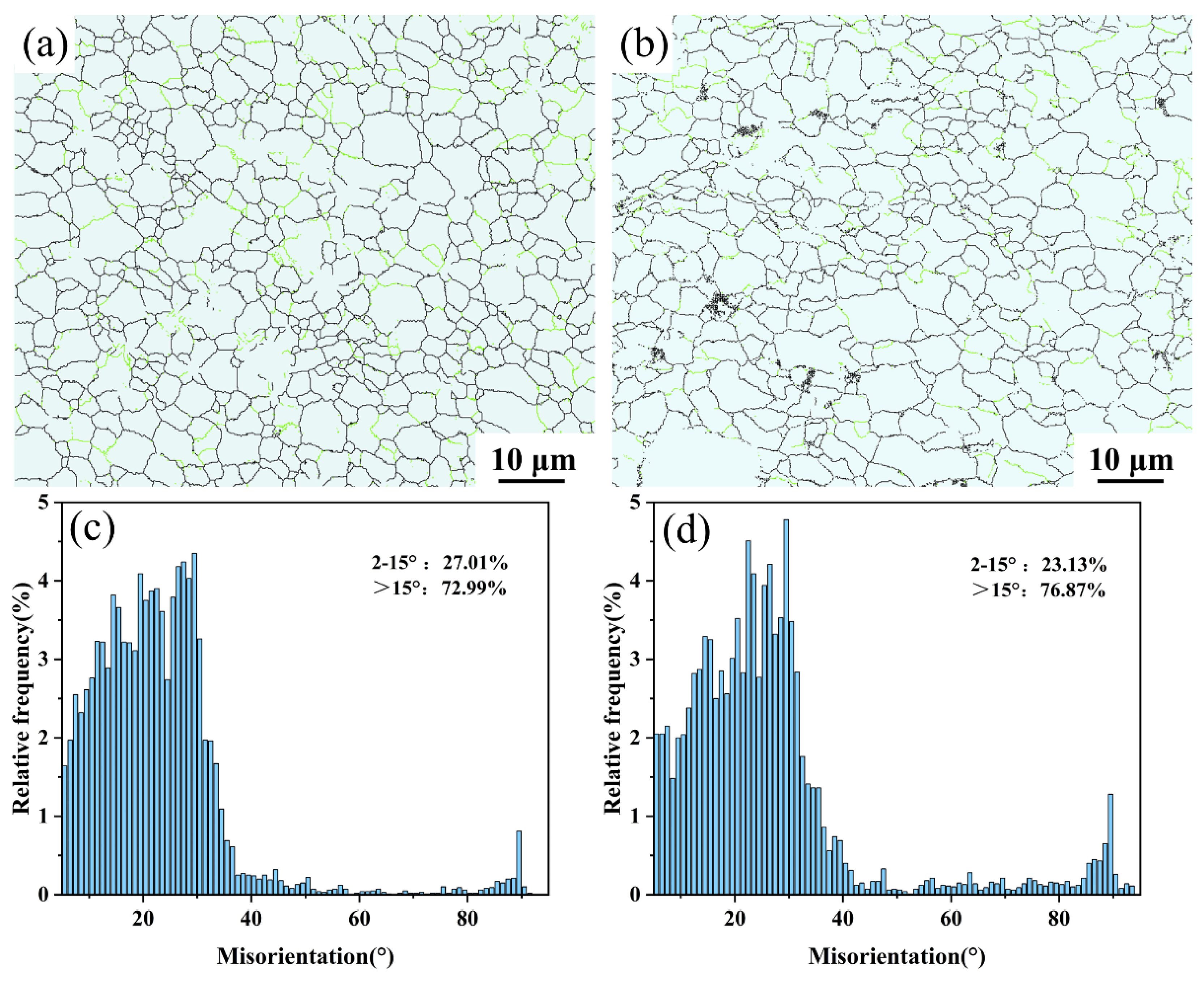
Figure 12 presents the grain boundary (GB) distribution maps and the corresponding misorientation statistics for the FSPed Mg-2.5Si-4Zn-xCa alloys with varying Ca content. In the maps, low-angle grain boundaries (LAGBs, 2–15°) and high-angle grain boundaries (HAGBs, >15°) are represented by thin green and thick black lines, respectively. As presented in Figure 12c,d, the processed microstructure is predominantly composed of HAGBs. These data show a significant decrease in the LAGBs fraction with Ca addition, from 27.01% to 23.13%.

3.4. Effect of Ca Content on the Mechanical Properties of FSPed Alloys

3.4.1. The Hardness of FSPed Alloys

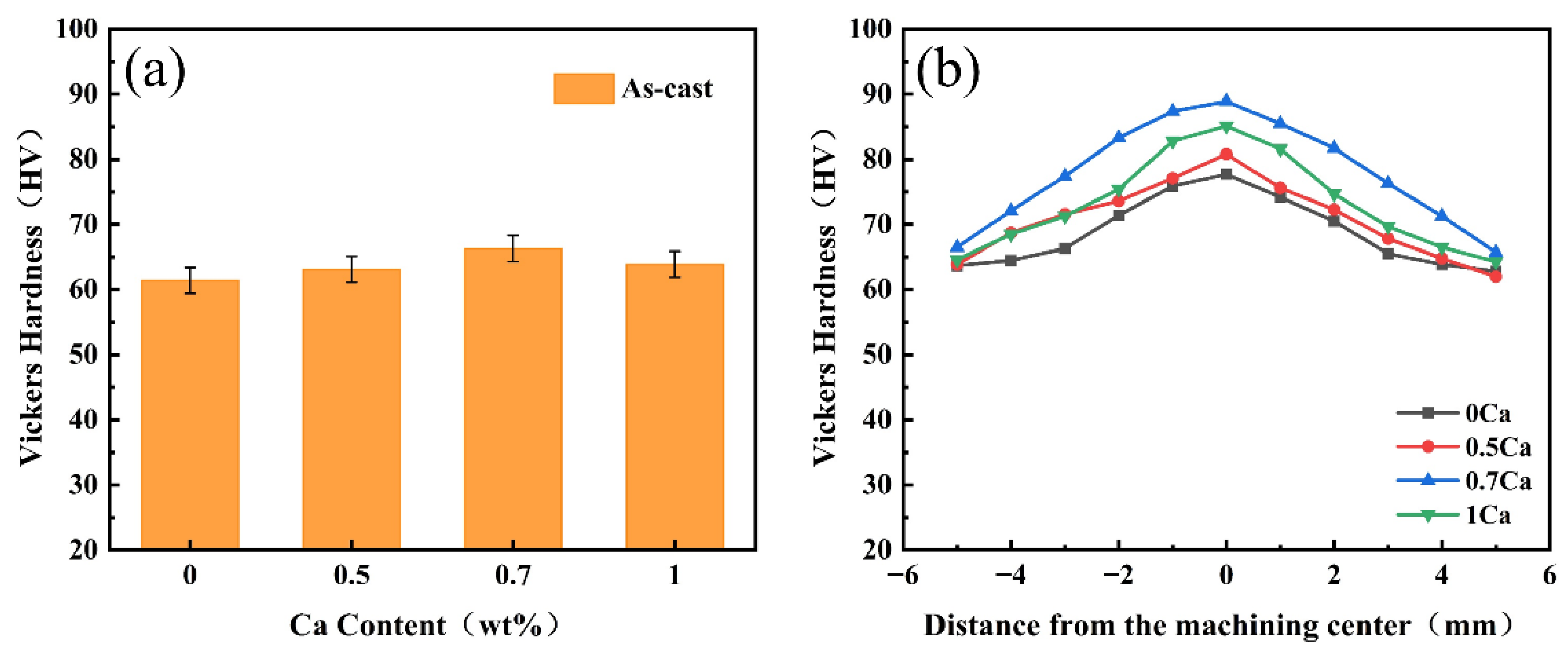
Figure 13 shows the Vickers hardness curves of the as-cast and FSPed alloys at different Ca contents. As can be seen, both the as-cast and the FSPed alloys reach peak hardness at a Ca content of 0.7 wt.%. The hardness of the alloys after FSP is higher than that of the corresponding as-cast alloys. As shown in Figure 13b, the maximum hardness in the processed region appears at the center of the stirred zone and decreases gradually from the center toward both sides, with the lowest hardness in the HAZ. In addition, because the second-phase particle size on the RS is slightly larger than on the AS, its hardness is also slightly lower than that of the AS.

3.4.2. The Tensile Properties of FSPed Alloys

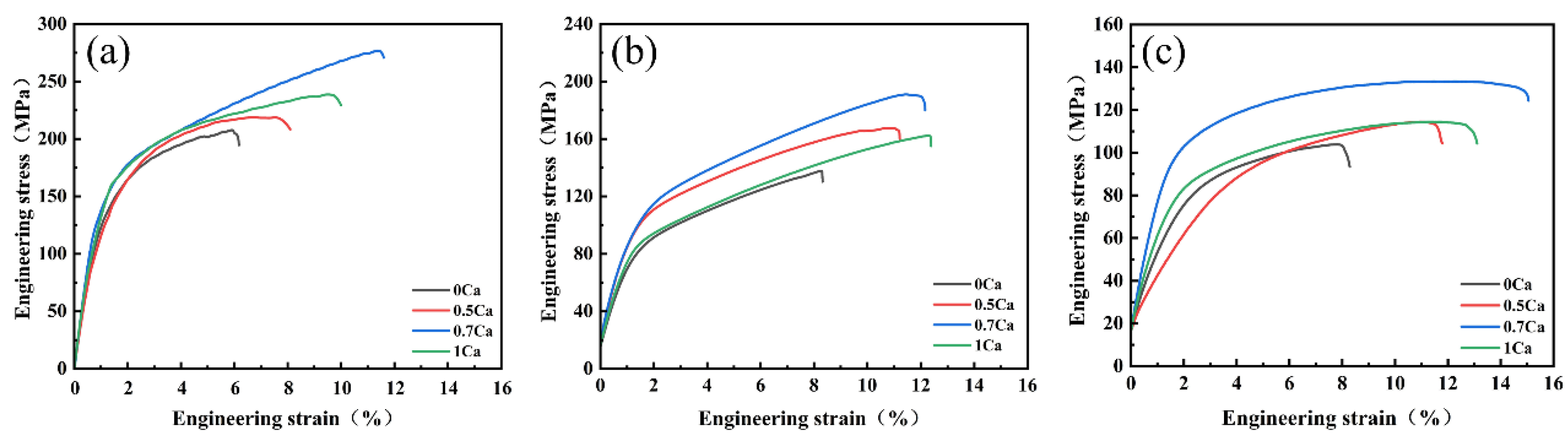
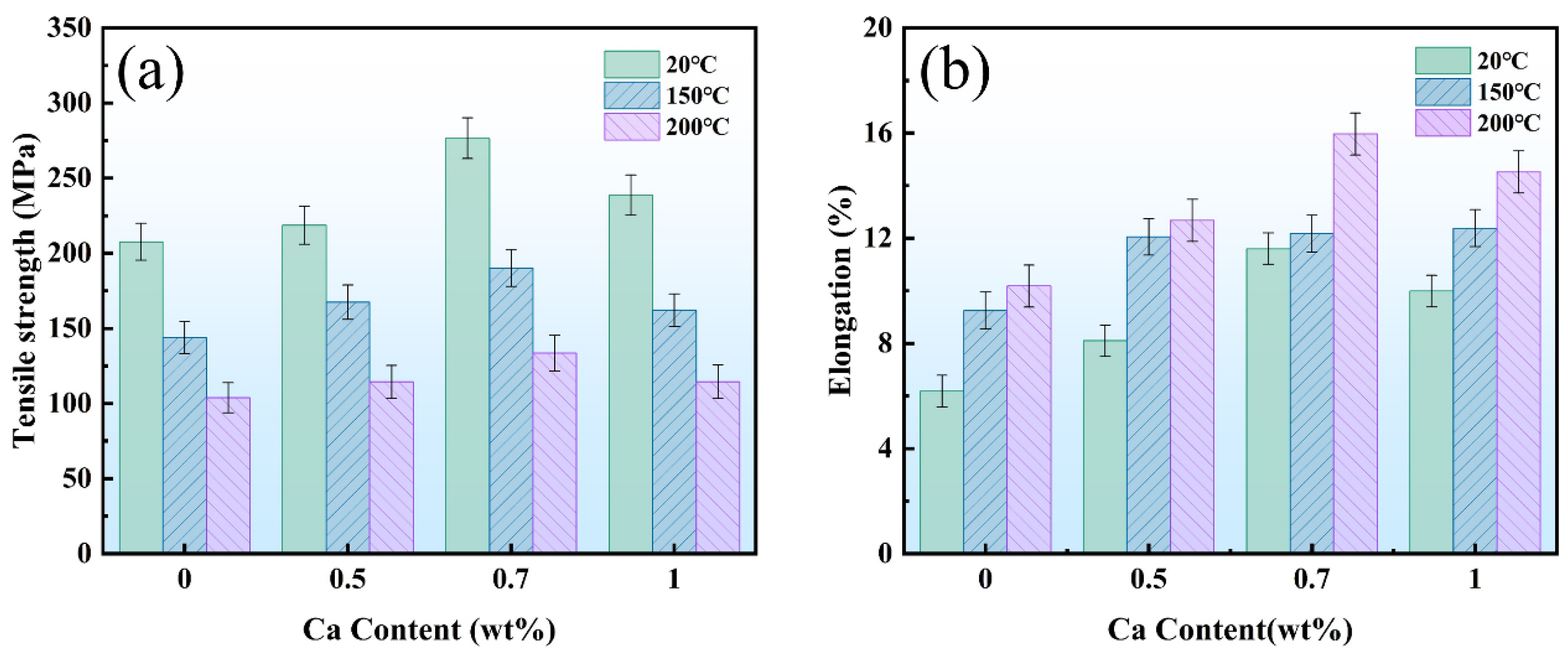
Figure 14 presents the engineering stress–strain curves of FSPed Mg-2.5Si-4Zn-xCa alloys with different Ca contents tested at room temperature, 150 °C, and 200 °C. Figure 15 summarizes the variation in tensile strength and elongation with Ca content and temperature. The results reveal that the tensile properties of the alloys at each test temperature initially increase and then decrease as the Ca content rises. When the Ca content is 0.7 wt.%, where the refinement effect on the Mg2Si phase is most pronounced, the alloy achieves the maximum tensile strength along with a marked increase in elongation, representing the optimal overall mechanical performance.
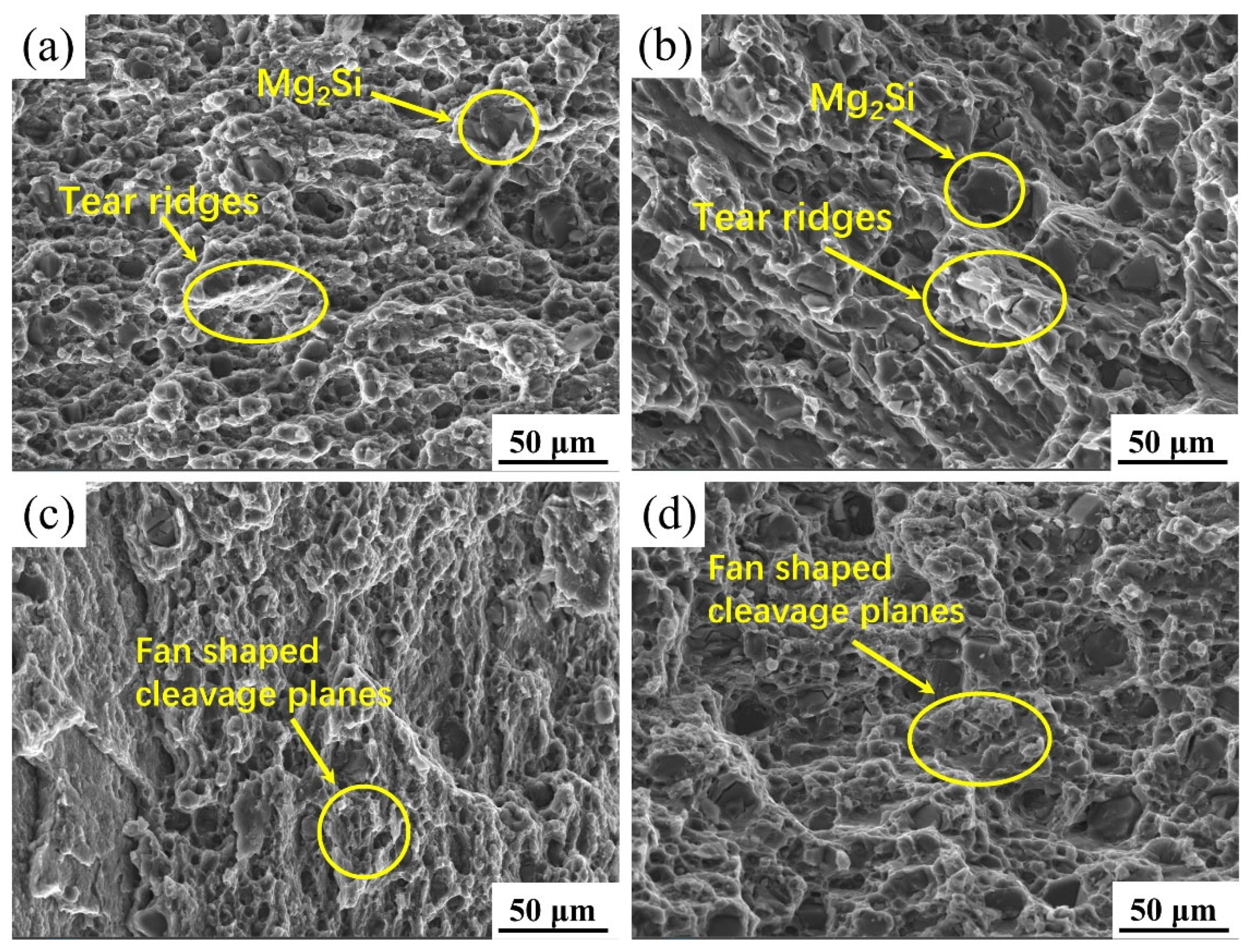
Figure 16 presents the fracture morphologies of tensile specimens for FSPed alloys with different Ca contents, tested at room temperature and 200 °C. On the fracture surfaces, the dark gray micro-voids correspond to the fracture features of the primary Mg2Si phase, while the lamellar bright regions formed by tearing reflect the fracture morphology of the α-Mg phase, indicating a mixed fracture mode of quasi-cleavage and intergranular fracture. As shown in Figure 16a,b, the fracture surface of the unmodified alloy tested at room temperature primarily exhibits “river pattern”-like tear ridges and shallow micro-voids, suggesting a dominant quasi-cleavage fracture mechanism. When 0.7 wt.% Ca is added to the Mg-Si-Zn magnesium alloy, the micro-voids on its fracture surface become deeper, show greater height variation, and exhibit a more uniform size distribution. Compared with the unmodified alloy, the Ca-modified tensile specimen tends to exhibit more ductile fracture characteristics.
As illustrated in Figure 16c,d, compared with the room temperature tensile fracture, the proportion of “river pattern” tear ridges in the fracture at 200 °C decreases significantly, replaced by smaller fan-shaped cleavage planes, along with a further increase in micro-void depth. This is attributed to the enhanced thermal activation at an elevated temperature, which promotes dislocation glide and reduces obstacles, causing the crack propagation path to preferentially traverse the Mg2Si phase itself and form smaller fan-shaped cleavage planes. Simultaneously, the brittleness of the Mg2Si phase decreases at an elevated temperature, allowing micro-voids to nucleate and coalesce more readily through plastic deformation, resulting in deeper micro-voids [34]. Further comparison of the high-temperature fracture morphologies before and after Ca addition shows that adding 0.7 wt.% Ca markedly reduces the size of fan-shaped cleavage planes related to the Mg2Si phase, while increasing both the number and depth of micro-voids. The strengthening role of the Mg2Si phase remains essential across temperatures. Importantly, refining and homogenizing its microstructure via Ca addition, especially at 0.7 wt.%, is key to improving the overall mechanical properties of the alloy.

4. Discussion

4.1. The Microstructure Evolution of Different Zones

The microstructural evolution of the Mg2Si phase varies distinctly across different regions of the FSPed alloys. As shown in Figure 8a,b, both the BM and the HAZ retain a microstructure similar to the as-cast condition, with primary and eutectic Mg2Si phases preserving their coarse morphology and heterogeneous distribution. This is due to the high melting point (~1087 °C) of Mg2Si [35]. Within the HAZ, the material undergoes only thermal cycling without intense mechanical stirring. So, the thermal input alone is insufficient to refine these coarse phases
As a transitional region toward the stir zone, the TMAZ experiences noticeable thermal cycling and plastic deformation. Nevertheless, even within the TMAZ, microstructural heterogeneity is evident. Figure 8c,d reveal that the Mg2Si phases on the AS are finer and more uniformly distributed than those on the RS. This difference originates from distinct material-flow patterns during FSP: on the AS, the flow direction coincides with the tool travel direction, generating stronger shear and more severe plastic deformation, which effectively fragments the Mg2Si phases. On the RS, the opposing flow results in weaker shear deformation, leading to a slightly lower hardness compared to the AS. In contrast, the SZ experiences the most intense tool stirring, rapid heating, and high-strain-rate plastic deformation. This combination effectively breaks up the Mg2Si phases, resulting in a much finer and more homogeneous distribution than in the TMAZ. Such a refined microstructure is directly responsible for the peak hardness observed at the center of the SZ, as shown in Figure 13b.
As shown in Figure 5, the FSPed alloy with 0.7 wt.% Ca displays the most distinct streamline morphology in the cross-section and the widest stir zone. At this Ca content, the refinement of Mg2Si phases reaches its optimum. The numerous fine and hard Mg2Si and CaMgSi phases served as effective markers during the processing. Carried by the plastically flowing matrix, they graphically delineated the trajectory of material flow, forming the most distinct flow patterns. Moreover, the refined microstructure exhibits lower flow stress and enhanced high-temperature plasticity, facilitating more extensive deformation under identical processing conditions. The fine second-phase particles additionally increase frictional and deformation heating, raising the overall heat input and further expanding the stir zone.

4.2. Mechanism of Influence of Ca on Mg2Si Phase in FSPed Alloys

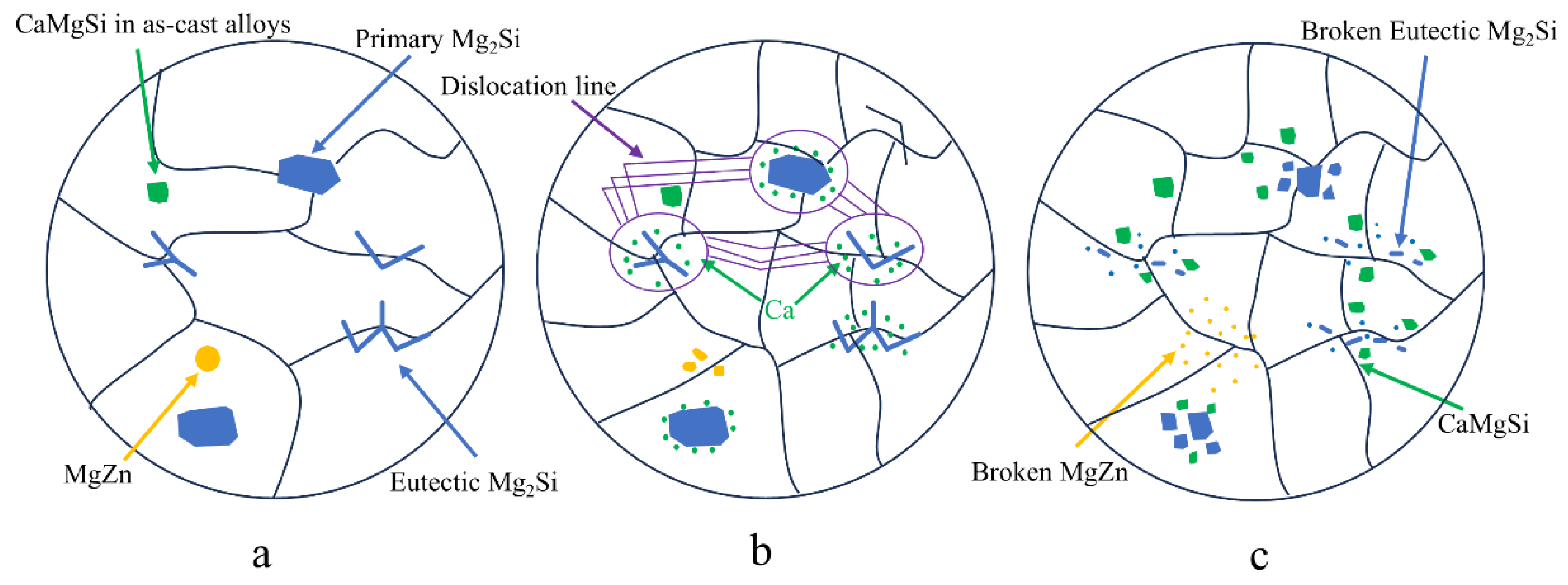
As shown in Figure 9a, Ca is uniformly distributed in the as-cast Mg-Si-Zn magnesium alloy, indicating Ca solid solution in the α-Mg matrix. Owing to the extremely low solubility of Ca in Mg, the alloy exists in a supersaturated solid-solution state. After FSP, Ca is significantly enriched around the Mg2Si phase and forms the CaMgSi phase (shown in Figure 9b).
The above evolution process is illustrated in Figure 17 and described as follows: during FSP, the combined effect of severe plastic deformation and elevated temperature enhances the diffusion activity of the originally supersaturated Ca atoms in the matrix. The severe plastic deformation can produce many dislocations inside the α-Mg grains. So, these Ca atoms, due to being the surface active element, migrate uphill along fast diffusion pathways such as dislocations and sub-grain boundaries to the periphery and interfaces of Mg2Si particles [36,37]. Meanwhile, possible Ca segregation at grain/subgrain boundaries may also exert a solute-drag effect, further restricting boundary migration during FSP [38]. In addition, at this stage, the primary role of FSP is the mechanical fragmentation and initial refinement of the coarse as-cast second phases. Building upon the preliminary mechanical refinement, the enriched Ca atoms around the Mg2Si phase exhibit stronger chemical affinity with Si, forming more stable Ca-Si bonds. This locally disrupts the Mg-Si bonding equilibrium at the interface, inducing a partial, inward decomposition of the Mg2Si phase. Concurrently, this interfacial weakening reduces the resistance of Mg2Si to shear deformation during FSP, facilitating its further fragmentation. The Si atoms released during decomposition react with the enriched Ca and surrounding Mg at energetically favorable sites, such as fractured interfaces, sub-grain boundaries, and dislocations, leading to the in situ precipitation of numerous fine and dispersed CaMgSi particles. Therefore, the overall process is more appropriately described as interfacial reaction-assisted fragmentation and partial transformation of Mg2Si, rather than complete chemical decomposition. With increasing Ca content, more Ca atoms are enriched at the Mg2Si interfaces, which promotes interfacial reaction and CaMgSi precipitation, thereby further enhancing microstructural refinement during FSP.
Furthermore, FSP has a significant influence on the distribution of the Zn element. As evidenced in Figure 9c,d, the processing results in the complete dissolution of the MgZn phase into the α-Mg matrix and forming the solid solution, distributing Zn uniformly. This phenomenon arises from the thermo-mechanical coupling during FSP. The frictional heat generated by the rotating FSP tool raises the local temperature to 350–450 °C, exceeding the Mg-Zn binary eutectic temperature (340 °C) [39], leading to the dissolution of the MgZn phases due to their thermodynamic instability. The interaction of the intense plastic deformation and dynamic recrystallization during FSP produces a high density of dislocations and subgrain boundaries that provide fast diffusion pathways for Zn atoms [40,41], achieving rapid homogenization of Zn in the α-Mg matrix. In addition, the high cooling rate inherent to the FSP process prevents Zn dissolved in the matrix from reprecipitating MgZn phases. So, this uniform solid-solution strengthening effect of Zn, together with grain-refinement strengthening, further enhances the material properties.

4.3. Effect of Ca Content on Texture Evolution and Grain Boundary Characteristics

Texture analysis in Figure 11 shows that the stirred zones of all FSPed alloys consist of fine equiaxed DRX grains, and the basal poles are tilted toward the normal direction (ND). The pole tilt is mainly attributed to intense shear plastic deformation caused by the tool shoulder and the threaded conical pin, which promotes preferential growth of dynamically recrystallized grains in the normal direction [42]. During FSP, the decomposition reaction of the Mg2Si phases with Ca makes them more susceptible to mechanical fragmentation, leading to the formation of fine, dispersed particles. These hard particles act as strong obstacles to dislocation motion, generating numerous dislocation loops and tangles around them, which in turn stimulate the occurrence of DRX by activating the particle-stimulated nucleation (PSN) mechanism under the thermo-mechanical conditions of FSP [43,44]. Although DRX occurs extensively, the texture is still retained after FSP. The texture intensity only slightly decreases from 56.34 mrd to 54.18 mrd as the Ca content increases to 0.7 wt.%, mainly due to PSN and grain boundary pinning increasing the fraction of randomly oriented grains [45]. This modest texture weakening suggests that its contribution to ductility improvement is limited, although it may slightly favor basal slip activation by increasing the Schmid factor of some grains. Therefore, the improved ductility is considered to arise mainly from particle refinement and microstructural homogenization rather than from texture weakening. Overall, the addition of Ca has only a minor effect on texture strength, while the severe plastic deformation of FSP remains the dominant factor controlling texture evolution.
As shown in Figure 12, the grain boundary analysis indicates a microstructure predominantly composed of HAGBs after FSP, with Ca addition lowering the LAGBs fraction from 27.01% to 23.13%. This reflects the profound influence of Mg2Si and CaMgSi particles on microstructure evolution: they promote DRX by providing abundant nucleation sites, directly increasing the number of HAGBs formed during recrystallization, while simultaneously inhibiting the migration of these HAGBs through Zener pinning. This dual effect results in a higher proportion of retained HAGBs and effectively restricts grain growth [46]. Based on the decrease in LAGB fraction, the increase in HAGB fraction, and the associated misorientation evolution, the DRX behavior is considered to be mainly associated with continuous dynamic recrystallization (CDRX), possibly assisted by particle-stimulated nucleation (PSN) during FSP. Due to its complex structure and higher energy characteristics, HAGBs significantly impede dislocation motion and grain slip, enhancing the material’s strength and hardness at room temperature. HAGBs are also a hallmark of a stable recrystallized microstructure. Compared to the LAGBs prevalent in deformed structures, the HAGBs-dominated boundary structure is not only intrinsically stable but also effectively suppresses grain growth at high temperatures due to its lower mobility, enhancing overall microstructural stability at elevated temperatures.

4.4. Analysis of the Mechanical Properties of FSPed Alloys with Different Ca Contents

As shown in Figure 15, the addition of Ca significantly improves both the tensile strength and elongation of the FSPed alloys at room and elevated temperatures, with an optimum at 0.7 wt.% Ca, which is attributed to the synergistic contribution of multiple strengthening mechanisms.
At room temperature, the enhancement in mechanical properties is primarily attributed to the exceptionally refined microstructure. Consistent with the Hall–Petch relationship, the reduction in average grain size from 3.16 μm to 2.69 μm due to Ca addition enhances strength, though its contribution remains limited [47]. More critically, the addition of Ca leads to a significant refinement of the Mg2Si phases. These refined phases eliminate the coarse particles that act as crack initiation sites, thereby avoiding stress concentration [48]. Furthermore, these fine Mg2Si particles, along with the thermally stable CaMgSi phase formed simultaneously, exert a strong pinning effect on both grain boundaries and dislocations, effectively hindering dislocation motion. Concurrently, the solid solution of Zn and the additional stress required for dislocations to bypass these nano-scale secondary phases (Orowan strengthening mechanism) contribute to supplementary solid-solution and precipitation strengthening effects. Therefore, particle strengthening is considered dominant, while solid-solution strengthening is secondary.
At elevated temperatures, the deformation mechanism gradually shifts from being dominated by dislocation slip to grain-boundary sliding and diffusion creep, and the performance of conventional fine-grained alloys typically deteriorates [49]. At 150 °C, plastic deformation was still mainly governed by dislocation glide, while dynamic recovery became more active and grain-boundary sliding began to contribute. At 200 °C, the contribution of grain-boundary sliding and diffusion-assisted deformation becomes more significant [50]. The addition of Ca leads to the formation of finer and more dispersed thermally stable second-phase particles, which collectively enhance the alloy’s excellent high-temperature stability, because the stable Mg2Si and CaMgSi phases effectively suppress grain boundary migration/sliding, impede dislocation motion, and significantly retard the diffusion creep process. Moreover, the slight texture weakening and the increased proportion of HAGBs notably hinder grain-boundary sliding while reducing local stress concentration, thereby further contributing to the improved high-temperature stability.
The above comprehensive analysis of the mechanical properties at both room and elevated temperatures reveals that the fine and thermally stable Mg2Si and CaMgSi phases contribute significant second-phase strengthening to the alloy. Consequently, despite the potential detrimental effect of grain refinement on high-temperature performance, Ca addition effectively enhances the overall mechanical performance of the FSPed alloys by modifying dynamic recrystallization behavior, increasing the fraction of HAGBs, and improving the thermal stability of the refined microstructure via second-phase pinning. Notably, the tensile strength of the present alloy at 150 °C is superior to that of several commonly reported Mg alloys processed under different conditions, such as AE42 (170 MPa), ZC63 (180 MPa), ZE41 (180 MPa), and AZ31 (140 MPa) [51,52,53], indicating that the developed alloy achieves a competitive balance between performance and cost-effectiveness.

5. Conclusions

(1)
Ca addition combined with FSP can synergistically refine and homogenize the Mg2Si phase. Both primary and eutectic Mg2Si are significantly refined and uniformly distributed in the matrix. The optimum refinement is achieved at 0.7 wt.% Ca, where the average area of primary Mg2Si decreases from 220 μm2 (0Ca) to 160 μm2, and that of eutectic Mg2Si from 32 μm2 to 18 μm2.
(2)
During FSP, Ca leads to the decomposition of Mg2Si particles by enriching at/near them, promoting their mechanical fragmentation, and the precipitation of fine CaMgSi particles.
(3)
FSP induces complete DRX and microstructural homogenization in the stir zone, the SZ, which consists of fine equiaxed DRX grains, and the MgZn phase dissolves completely into the α-Mg matrix. With increasing Ca content up to 0.7 wt.%, grain refinement is enhanced, with the average grain size going from 3.16 μm to 2.69 μm. Concurrently, basal texture intensity decreases slightly from 56.34 mrd to 54.18 mrd, and the fraction of high-angle grain boundaries increases, indicating improved microstructural stability.
(4)
The Mg-2.5Si-4Zn-0.7Ca alloy is found by adjusting the Ca content with the best properties at room and elevated temperatures. Its tensile strength and elongation at room temperature are 276.57 MPa and 11.60%, respectively; at 150 °C, they are 190.13 MPa and 12.17%; and at 200 °C, they are 133.43 MPa and 15.96%.

Author Contributions

Conceptualization, W.T.; methodology, Z.-A.Q.; software, Y.L. (Yunyi Liu); validation, Y.L. (Yunyi Liu), J.W. and X.W.; formal analysis, J.W. and X.W.; investigation, Z.-A.Q. and Y.L. (Yuxin Liu); resources, J.W. and Y.L. (Yuxin Liu); data curation, Z.-A.Q.; writing—original draft preparation, Z.-A.Q.; writing—review and editing, Y.L. (Yunyi Liu), X.W. and Y.L. (Yuxin Liu); visualization, Y.L. (Yunyi Liu); supervision, W.T.; project administration, W.T.; funding acquisition, W.T. All authors have read and agreed to the published version of the manuscript.

Funding

This work was supported by the Scientific Research Fund of Liaoning Provincial Education Department (CN) (JYT2020079) and the Fundamental Research Funds for the Universities of Liaoning Province (LJ232510143002).

Data Availability Statement

The original contributions presented in this study are included in the article. Further inquiries can be directed to the corresponding author.

Conflicts of Interest

The authors declare that they have no known competing financial interests or personal relationships that could have appeared to influence the work reported in this paper.

References

  1. Kulekci, M.K. Magnesium and its alloys applications in automotive industry. Int. J. Adv. Manuf. Technol. 2008, 39, 851–865. [Google Scholar] [CrossRef]
  2. Zhao, L.; Zha, M.; Gao, Y.P.; Guan, K.; Chen, P.; Zhang, M.N.; Hua, Z.M.; Jia, H.L.; Wang, H.Y. Twinning-mediated plasticity by a novel multistage twinning mode in an Mg-Al-Gd alloy. Mater. Res. Lett. 2023, 11, 933–941. [Google Scholar] [CrossRef]
  3. Sui, S.; Guo, S.; Ma, D.; Guo, C.; Wu, X.; Zhang, Z.; Xu, C.; Shechtman, D.; Remennik, S.; Safranchik, D.; et al. Additive manufacturing of magnesium and its alloys: Process-formability-microstructure-performance relationship and underlying mechanism. Int. J. Extrem. Manuf. 2023, 5, 251–295. [Google Scholar] [CrossRef]
  4. Chen, K.; Li, Z. Effect of co-modification by Ba and Sb on the microstructure of Mg2Si/Mg–Zn–Si composite and mechanism. J. Alloys Compd. 2014, 592, 196–201. [Google Scholar] [CrossRef]
  5. Chen, L.; Yang, W.; Cui, H.; Wang, Y.; Xu, Z. Morphology and properties of Mg2Si phase modified by Ge in Mg-Si alloys. J. Alloys Compd. 2024, 992, 174547. [Google Scholar] [CrossRef]
  6. Yu, H.; Cui, H.; Yang, Z.; Xu, Z. Effect of extrusion temperatures on the microstructure, texture, and mechanical properties of Mg–5Sn–1Si–0.6Ca alloy. J. Mater. Res. Technol. 2023, 26, 5294–5308. [Google Scholar] [CrossRef]
  7. Jamalpour, M.; Alizadeh, R. Experimental insights toward understanding how the morphology of Mg2Si particles affects degradation behavior of the biodegradable as-cast Mg–Si alloys. Intermetallics 2024, 165, 108133. [Google Scholar] [CrossRef]
  8. Chen, K.; Li, Z.; Liu, J.; Yang, J.; Sun, Y.; Bian, S. The effect of Ba addition on microstructure of in situ synthesized Mg2Si/Mg–Zn–Si composites. J. Alloys Compd. 2009, 487, 293–297. [Google Scholar] [CrossRef]
  9. Jiang, Q.; Wang, H.; Wang, Y.; Ma, B.; Wang, J. Modification of Mg2Si in Mg–Si alloys with yttrium. Mater. Sci. Eng. A 2005, 392, 130–135. [Google Scholar] [CrossRef]
  10. Du, J.; Iwai, K.; Li, W.-F.; Peng, J.-H. Effects of alternating current imposition and alkaline earth elements on modification of primary Mg2Si crystals in hypereutectic Mg-Si alloy. Trans. Nonferrous Met. Soc. China 2009, 19, 1051–1056. [Google Scholar] [CrossRef]
  11. Alizadeh, R.; Mahmudi, R. Effects of Sb addition on the modification of Mg2Si particles and high-temperature mechanical properties of cast Mg–4Zn–2Si alloy. J. Alloys Compd. 2011, 509, 9195–9199. [Google Scholar] [CrossRef]
  12. Cai, Z.; Chen, F.; Ma, F.; Guo, J. Dynamic recrystallization behavior and hot workability of AZ41M magnesium alloy during hot deformation. J. Alloys Compd. 2016, 670, 55–63. [Google Scholar] [CrossRef]
  13. Guo, Z.; Qiu, J.; Wan, H.; Hu, Y.; Yong, M.; Sun, S.; Ding, Z.; Chen, Y.; Pan, F. Catalytic phase engineering for enhanced hydrogen storage kinetics in Mg-Ni-Y-Si alloys via solid-solution and reprecipitation. J. Alloys Compd. 2025, 1030, 180903. [Google Scholar] [CrossRef]
  14. Huang, J.; Liu, S.; Liu, Z.; Che, X.; Friák, M.; Du, Y. Refinement of Mg2Si in Mg-Al-Si alloys through Ca and Y additions: A novel core-shell structure evolution mechanism and enhanced mechanical properties. J. Magnes. Alloys 2025. [Google Scholar] [CrossRef]
  15. Yu, H.-S.; Guo, X.-F.; Cui, H.-B. Microstructures and tensile properties of as-cast Mg-5Sn-1Si magnesium alloy modified with trace elements of Y, Bi, Sb and Sr. China Foundry 2021, 18, 9–17. [Google Scholar] [CrossRef]
  16. Cong, M.; Li, Z.; Liu, J.; Yan, M.; Chen, K.; Sun, Y.; Huang, M.; Wang, C.; Ding, B.; Wang, S. Effect of Ca on the microstructure and tensile properties of Mg–Zn–Si alloys at ambient and elevated temperature. J. Alloys Compd. 2012, 539, 168–173. [Google Scholar] [CrossRef]
  17. Wenhui, T.; Chenxi, Z.; Fangze, T.; Qian, C.; Bonan, H.; Jie, W.; Yunyi, L. Effect of Ba-Nd Composite Modification on Microstructure and Mechanical Properties of Mg-3Si-4Zn Cast Alloy. RARE Met. Mater. Eng. 2022, 51, 4410–4420. [Google Scholar] [CrossRef]
  18. Wenhui, T.; Bonan, H.; Bowei, S.; Jie, W.; Yufei, B. Effect of Er-Ba Composite Modification on Microstructure and Mechanical Properties of Mg-2.5 Si-4Zn Cast Alloy. RARE Met. Mater. Eng. 2023, 52, 2683–2692. [Google Scholar] [CrossRef]
  19. Marjani, O.; Emamy, M.; Mirzadeh, H. Mechanical Behavior of As-Cast and Extruded Mg-Si-Ni-Ca Magnesium Alloys. J. Mater. Eng. Perform. 2020, 29, 7728–7735. [Google Scholar] [CrossRef]
  20. Commin, L.; Dumont, M.; Masse, J.E.; Barrallier, L. Friction stir welding of AZ31 magnesium alloy rolled sheets: Influence of processing parameters. Acta Mater. 2009, 57, 326–334. [Google Scholar] [CrossRef]
  21. Han, J.; Chen, J.; Peng, L.; Tan, S.; Wu, Y.; Zheng, F.; Yi, H. Microstructure, texture and mechanical properties of friction stir processed Mg-14Gd alloys. Mater. Des. 2017, 130, 90–102. [Google Scholar] [CrossRef]
  22. Li, Y.; Hou, P.; Kamath, R.R.; Feng, Z.; An, K.; Choo, H. Real-time evolution of texture and temperature during friction stir processing of a magnesium alloy: An operando neutron diffraction study. Acta Mater. 2024, 270, 119842. [Google Scholar] [CrossRef]
  23. Mishra, R.S.; Ma, Z.Y. Friction stir welding and processing. Mater. Sci. Eng. R Rep. 2005, 50, 1–78. [Google Scholar] [CrossRef]
  24. Ma, Z. Friction stir processing technology: A review. Metall. Mater. Trans. A 2008, 39, 642–658. [Google Scholar] [CrossRef]
  25. Zykova, A.P.; Tarasov, S.Y.; Chumaevskiy, A.V.; Kolubaev, E.A. A review of friction stir processing of structural metallic materials: Process, properties, and methods. Metals 2020, 10, 772. [Google Scholar] [CrossRef]
  26. El-Sayed, M.M.; Shash, A.; Abd-Rabou, M.; ElSherbiny, M.G. Welding and processing of metallic materials by using friction stir technique: A review. J. Adv. Join. Process. 2021, 3, 100059. [Google Scholar] [CrossRef]
  27. Ding, Z.M.; Li, Z.W.; Li, H.J.; Chen, Y. Microstructure of Mg solid solution layer during multi-pass FSP of Mg/Al Composite Plates. Vacuum 2020, 172, 109078. [Google Scholar] [CrossRef]
  28. Liu, J.-M.; Jia, H.-L.; Wang, S.-Q.; Ma, P.-K.; Xu, J.; Zha, M.; Wang, H.-Y. Effects of Ca contents on microstructures and mechanical properties of friction stir processed Mg alloys. Mater. Sci. Eng. A 2024, 916, 147388. [Google Scholar] [CrossRef]
  29. Harwani, D.; Badheka, V.; Patel, V. High temperature tensile deformation in single-pass friction stirred AZ31 alloy. Int. J. Lightweight Mater. Manuf. 2023, 6, 140–148. [Google Scholar] [CrossRef]
  30. Raja, A.; Pancholi, V. Effect of friction stir processing on tensile and fracture behaviour of AZ91 alloy. J. Mater. Process. Technol. 2017, 248, 8–17. [Google Scholar] [CrossRef]
  31. Wen, W.; Kuaishe, W.; Qiang, G.; Nan, W. Effect of friction stir processing on microstructure and mechanical properties of cast AZ31 magnesium alloy. Rare Met. Mater. Eng. 2012, 41, 1522–1526. [Google Scholar] [CrossRef]
  32. Yang, W.; Yang, K.; Zhu, Q.; Yang, H.; Lin, X. Influence of friction stir processing and aging treatment on microstructure and mechanical properties of wire arc additive manufactured Mg-Gd-Y-Zr alloy. J. Alloys Compd. 2025, 1040, 183538. [Google Scholar] [CrossRef]
  33. Jiang, M.; Zhang, X.; Mei, H.; Xu, S.; Liu, L. The coupled effects of grain boundary strengthening and Orowan strengthening examined by dislocation dynamics simulations. Comput. Mater. Sci. 2024, 231, 112602. [Google Scholar] [CrossRef]
  34. Elyasi, M.; Razaghian, A.; Moharami, A.; Emamy, M. Effect of Zirconium micro-addition and multi-pass friction stir processing on microstructure and tensile properties of Mg–Zn–Si alloys. J. Mater. Res. Technol. 2022, 20, 4269–4282. [Google Scholar] [CrossRef]
  35. Qin, J.; Nagaumi, H.; Yu, C.; Liu, F.; Li, Y.; Wang, L. Coarsening behavior of Mg2Si precipitates during post homogenization cooling process in Al-Mg-Si alloy. J. Alloys Compd. 2022, 902, 162851. [Google Scholar] [CrossRef]
  36. Li, R.-D.; Li, J.-L.; Xiong, J.-T.; Zhang, F.-S.; Zhao, K.; Ji, C.-Z. Friction heat production and atom diffusion behaviors during Mg-Ti rotating friction welding process. Trans. Nonferrous Met. Soc. China 2012, 22, 2665–2671. [Google Scholar] [CrossRef]
  37. Jin, F.; Shi, J.; Wen, G.; Fu, B.; Shen, J.; Wang, S.; Wu, Y.; Xiong, J.; Li, J. Frictional heat induced morphological responses at the interface in rotary friction welding of austenitic alloys: Corona-bond and heat-pattern. J. Mater. Res. Technol. 2023, 23, 5972–5992. [Google Scholar] [CrossRef]
  38. Patel, M.S.; Gurmuley, R.R.; Jaiswal, M.; Shekhar, R.; Immanuel, R.J.; Jouiad, M.; Rahaman, A. Effect of 2 wt% calcium addition on the microstructure, mechanical performance, and fracture behaviour of AZ31 magnesium alloy. Discov. Mater. 2025, 5, 230. [Google Scholar] [CrossRef]
  39. Maeng, D.; Kim, T.; Lee, J.; Hong, S.; Seo, S.; Chun, B. Microstructure and strength of rapidly solidified and extruded Mg-Zn alloys. Scr. Mater. 2000, 43, 385–389. [Google Scholar] [CrossRef]
  40. Harwani, D.; Badheka, V.; Patel, V.; Li, W.; Andersson, J. Developing superplasticity in magnesium alloys with the help of friction stir processing and its variants—A review. J. Mater. Res. Technol. 2021, 12, 2055–2075. [Google Scholar] [CrossRef]
  41. Yue, S.; Huang, J.; Ni, Y.; Shen, L.; Huang, Y.; Fan, D.; Liu, J. Enhancing microstructural, mechanical, and tribological behavior of AZ31B magnesium alloy through friction stir processing. J. Mater. Res. Technol. 2024, 29, 1441–1452. [Google Scholar] [CrossRef]
  42. Sun, X.; Xie, Y.; Meng, X.; Zhang, Z.; Tian, H.; Dong, W.; Dong, J.; Ma, X.; Wang, N.; Huang, Y. Wire-based friction stir additive manufacturing of AZ31B magnesium alloy: Precipitate behavior and mechanical properties. J. Magnes. Alloys 2025, 15, 101759. [Google Scholar] [CrossRef]
  43. Robson, J.D.; Henry, D.T.; Davis, B. Particle effects on recrystallization in magnesium–manganese alloys: Particle pinning. Mater. Sci. Eng. A 2011, 528, 4239–4247. [Google Scholar] [CrossRef]
  44. Lotfpour, M.; Bahmani, A.; Mirzadeh, H.; Emamy, M.; Malekan, M.; Kim, W.J.; Taghizadeh, M.; Afsharnaderi, A. Effect of microalloying by Ca on the microstructure and mechanical properties of as-cast and wrought Mg–Mg2Si composites. Mater. Sci. Eng. A 2021, 820, 141574. [Google Scholar] [CrossRef]
  45. Bahmani, A.; Nayebi, B.; Bornay Zonoozi, S.; Wang, L.; Shokouhimehr, M. Mechanochemical characteristics of Ca-added Mg-based alloys: A multimodality approach. Mater. Charact. 2020, 167, 110475. [Google Scholar] [CrossRef]
  46. Heidarzadeh, A.; Pouraliakbar, H.; Mahdavi, S.; Jandaghi, M.R. Ceramic nanoparticles addition in pure copper plate: FSP approach, microstructure evolution and texture study using EBSD. Ceram. Int. 2018, 44, 3128–3133. [Google Scholar] [CrossRef]
  47. Guan, B.; Xin, Y.; Huang, X.; Wu, P.; Liu, Q. Quantitative prediction of texture effect on Hall–Petch slope for magnesium alloys. Acta Mater. 2019, 173, 142–152. [Google Scholar] [CrossRef]
  48. Lu, L.; Thong, K.; Gupta, M. Mg-based composite reinforced by Mg2Si. Compos. Sci. Technol. 2003, 63, 627–632. [Google Scholar] [CrossRef]
  49. Yin, D.; Li, S.; Sun, K.; Fu, R.; Zhang, Y.; Jiang, B.; Huang, Y.; Zeng, Y. Superior elevated-temperature strength of Mg–Y–Sn alloys with thermostable multi-scale precipitates and grain structure. Mater. Sci. Eng. A 2022, 852, 143643. [Google Scholar] [CrossRef]
  50. Ritzo, M.A.; Bhattacharyya, J.J.; Lebensohn, R.A.; Agnew, S.R. An investigation into the role of dislocation climb during intermediate temperature flow of Mg alloys. In Magnesium Technology 2020; Springer: Cham, Switzerland, 2020; pp. 115–122. [Google Scholar] [CrossRef]
  51. Mordike, B.L. Creep-resistant magnesium alloys. Mater. Sci. Eng. A 2002, 324, 103–112. [Google Scholar] [CrossRef]
  52. Jäger, A.; Lukáč, P.; Gärtnerová, V.; Bohlen, J.; Kainer, K.U. Tensile properties of hot rolled AZ31 Mg alloy sheets at elevated temperatures. J. Alloys Compd. 2004, 378, 184–187. [Google Scholar] [CrossRef]
  53. Suzuki, M.; Sato, H.; Maruyama, K.; Oikawa, H. Creep behavior and deformation microstructures of Mg–Y alloys at 550 K. Mater. Sci. Eng. A 1998, 252, 248–255. [Google Scholar] [CrossRef]
Figure 1. (a) Schematic diagram of the FSP procedure; (b) schematic diagram of the stirring tool dimensions; (c) schematic diagram of the sampling locations for microstructure characterization.
Metals 16 00380 g001
Figure 2. Tensile specimen: (a) sampling location; (b) dimensions.
Metals 16 00380 g002
Figure 3. SEM images of as-cast Mg-2.5Si-4Zn-0.7Ca alloy: (a) SEM image; (b) EDS results of Mg2Si phase; (c) EDS results of CaMgSi phase; (d) EDS results of MgZn phase; (e) scanning line; (f) compositional line distribution of Mg, Si, Zn, and Ca elements.
Metals 16 00380 g003
Figure 4. XRD pattern of the as-cast Mg-2.5Si-4Zn-0.7Ca alloy.
Metals 16 00380 g004
Figure 5. Cross-sectional morphologies of the FSPed alloys with various Ca additions: (a) 0 wt.% Ca, (b) 0.5 wt.% Ca, (c) 0.7 wt.% Ca, and (d) 1.0 wt.% Ca. The typical regions, including the stirred zone (SZ), thermo-mechanically affected zone (TMAZ), heat-affected zone (HAZ), base material (BM), advancing side (AS), and retreating side (RS), are indicated in (a).
Metals 16 00380 g005
Figure 6. Microstructure photographs of as-cast and FSPed alloys: (FSPed alloys: (a) 0 wt.% Ca, (b) 0.5 wt.% Ca, (c) 0.7 wt.% Ca, (d) 1.0 wt.% Ca; as-cast: (e) 0 wt.% Ca, (f) 0.5 wt.% Ca, (g) 0.7 wt.% Ca, and (h) 1.0 wt.% Ca).
Metals 16 00380 g006
Figure 7. Average area of Mg2Si phases before and after FSP with different Ca contents: (a) FSPed alloys; (b) as-cast alloys.
Metals 16 00380 g007
Figure 8. SEM images of the FSP Mg-2.5Si-4Zn-0.7Ca alloy: (a) SZ, TMAZ and HAZ, (b) BM, (c) AS, (d) RS.
Metals 16 00380 g008
Figure 9. EDS elemental mapping results of the alloys: (a,c) as-cast Mg-2.5Si-4Zn-0.7Ca alloy; (b,d) FSPed Mg-2.5Si-4Zn-0.7Ca alloy.
Metals 16 00380 g009
Figure 10. TEM images of the FSPed Mg-2.5Si-4Zn-0.7Ca alloy: (a,b,d,e) TEM images of the alloy, (c) diffraction spot of the Mg2Si phases, (f) diffraction spot of the CaMgSi phases.
Metals 16 00380 g010
Figure 11. EBSD IPF and PF maps of FSPed Mg-2.5Si-4Zn-xCa alloys: (a,b) IPF maps for alloys containing (a) 0 wt.% Ca and (b) 0.7 wt.% Ca; (c,d) corresponding grain size distribution histograms for (c) 0 wt.% Ca and (d) 0.7 wt.% Ca; (e,f) pole figures of the alloys with (e) 0 wt.% Ca and (f) 0.7 wt.% Ca.
Metals 16 00380 g011
Figure 12. Grain boundary distribution maps and boundary misorientation statistics of FSPed Mg-2.5Si-4Zn-xCa alloys with different Ca contents: (a,c) 0 wt.% Ca, (b,d) 0.7 wt.% Ca.
Metals 16 00380 g012
Figure 13. Vickers hardness curves of cast and FSPed alloys with different Ca contents: (a) as-cast alloys, (b) FSPed alloys.
Metals 16 00380 g013
Figure 14. Tensile engineering stress–strain curves of FSPed Mg-2.5Si-4Zn-xCa alloys at (a) 20 °C, (b) 150 °C, and (c) 200 °C.
Metals 16 00380 g014
Figure 15. Effect of Ca content and temperature on the mechanical properties of FSPed Mg-2.5Si-4Zn alloys: (a) tensile strength, (b) elongation. Each data point represents the average value of three independent tensile tests, and the error bars indicate the standard deviation.
Metals 16 00380 g015
Figure 16. Fracture morphologies of FSPed alloys with different Ca contents: (a,b) room temperature; (c,d) 200 °C; (a,c) 0 wt.% Ca; (b,d) 0.7 wt.% Ca.
Metals 16 00380 g016
Figure 17. Schematic diagram illustrating the evolution of secondary phases during FSP of the Mg-Si-Zn-Ca alloy: (a) as-cast condition, (b) during FSP, and (c) after FSP.
Metals 16 00380 g017
Table 1. Chemical composition of Mg-2.5Si-4Zn-xCa alloys (wt.%).
Alloy No.SiZnCaMg
12.540Bal.
22.540.5Bal.
32.540.7Bal.
42.541Bal.
Disclaimer/Publisher’s Note: The statements, opinions and data contained in all publications are solely those of the individual author(s) and contributor(s) and not of MDPI and/or the editor(s). MDPI and/or the editor(s) disclaim responsibility for any injury to people or property resulting from any ideas, methods, instructions or products referred to in the content.