Development of Machine Learning Model for Analysis of Total Manufacturing Cost in Medium Turning of C45E Steel



Abstract
1. Introduction
2. Overview of the Applied Approach
3. Total Manufacturing Cost Model
3.1. ANN Model Development
3.2. ANN Model Assessment
4. Results and Discussion
5. Case Study
6. Conclusions
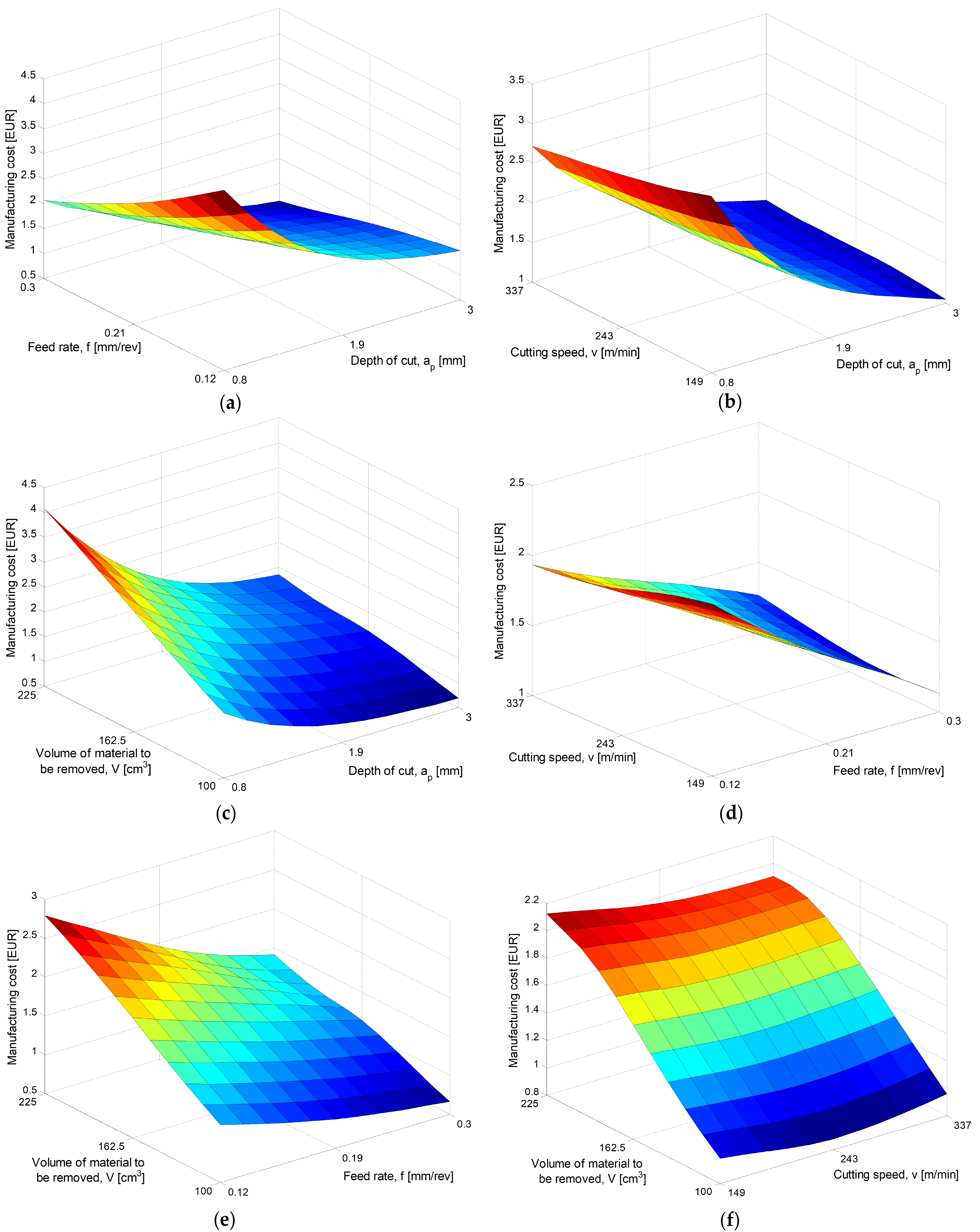
- Depth of cut, followed by feed rate and volume of material to be removed, has the maximum influence on the total manufacturing cost. The effect of cutting speed is least pronounced.
- An increase in depth of cut or feed rate decreases the total manufacturing cost for different combinations of inputs. The effect of cutting speed on the total manufacturing cost is variable and should be considered with the analysis of the interaction effects with other parameters.
- The derived conclusions may change depending on the chosen cutting insert, which has defined ranges of cutting parameter values.
- Due to the existence of interactions between cutting speed and other parameters, it is necessary to determine the optimal cutting regime for each specific operation. In other words, cutting regimes that minimize the total manufacturing cost in turning different volumes of C45E steel will differ. For practical implementation, it is also necessary to consider additional constraints, such as the one related to chip slenderness.
- The results showed that maximizing tool life increased the total manufacturing cost, because it required a decrease in the cutting parameter values.
- By optimizing cutting parameter values, the total manufacturing cost can be reduced by 62.82% compared to the cost for the recommended cutting regime for the cutting insert, even assuming that all imposed constraints are met. The results obtained are valid for cutting insert costs and specific labour and overhead costs for a given market.
Author Contributions
Funding
Data Availability Statement
Acknowledgments
Conflicts of Interest
Abbreviations
| ANN | Artificial Neural Network |
| CAPP | Computer-Aided Process Planning |
| CNC | Computer Numerical Control |
| CWA | Connection Weight Approach |
| GA | Genetic Algorithm |
| GQBA | Gaussian Quantum-behaved Bat Algorithm |
| LNOoW | Cryogenic-LN Oils-on-Water |
| MAPE | Mean Absolute Percentage Error |
| MLP | Multi-Layer Perceptron |
| MQC | Minimum Quantity Cooling |
| MQL | Minimum Quantity Lubrication |
| NSGA-II | Non-dominated Sorting Genetic Algorithm II |
| PCBN | Polycrystalline Cubic Boron Nitride |
| RSM | Response Surface Methodology |
| TOPSIS | Technique for Order of Preference by Similarity to Ideal Solution |
References
- Greitemann, J.; Stahl, B.; Michels, N.V.; Lohmann, B.; Reinhart, G. Quantitative Model of the Technology Lifecycle for Forecasting the Maturity of Manufacturing Technologies. In Proceedings of the 2014 IEEE International Conference on Management of Innovation and Technology, ICMIT 2014, Singapore, 23–25 September 2014. [Google Scholar] [CrossRef]
- Groover, M.P. Fundamentals of Modern Manufacturing: Materials, Processes, and Systems, 7th ed.; John Wiley & Sons: Hoboken, NJ, USA, 2020; p. 17. [Google Scholar]
- Klocke, F. Manufacturing Processes 1: Cutting; Springer: Berlin/Heidelberg, Germany, 2011; pp. 3, 342, 346. [Google Scholar]
- Radovanović, M. Multi-objective optimization of multi-pass turning AISI 1064 steel. Int. J. Adv. Manuf. Technol. 2019, 100, 87–100. [Google Scholar] [CrossRef]
- Xie, S.; He, Z.; Huang, X. Technique for multi-pass turning optimization based on gaussian quantum-behaved bat algorithm. Comput. Model. Eng. Sci. 2023, 136, 1575–1602. [Google Scholar] [CrossRef]
- Mulc, T.; Staroveški, T.; Ciglar, D. Enhanced automation strategy for 5-axis vertical machine tools. Teh. Vjesn. Tech. Gaz. 2025, 32, 785–793. [Google Scholar] [CrossRef]
- Vukelic, D.; Simunovic, K.; Ivanov, V.; Sokac, M.; Kocovic, V.; Santosi, Z.; Simunovic, G. Modelling of flank and crater wear during dry turning of AISI 316L stainless steel as a function of tool geometry using the response surface design. Teh. Vjesn. Tech. Gaz. 2024, 31, 1376–1384. [Google Scholar] [CrossRef]
- Tian, C.; Zhou, G.; Lu, Q.; Zhang, J.; Xiao, Z.; Wang, R. An integrated decision-making approach on cutting tools and cutting parameters for machining features considering carbon emissions. Int. J. Comput. Integr. Manuf. 2019, 32, 629–641. [Google Scholar] [CrossRef]
- Mir, M.J.; Wani, M.F. Performance evaluation of PCBN, coated carbide and mixed ceramic inserts in finish-turning of AISI D2 steel. J. Tribol. 2017, 14, 10–31. [Google Scholar]
- Tebaldo, V.; di Confiengo, G.G.; Faga, M.G. Sustainability in machining: “Eco-friendly” turning of Inconel 718. Surface characterisation and economic analysis. J. Clean. Prod. 2017, 140, 1567–1577. [Google Scholar] [CrossRef]
- Bagaber, S.A.; Yusoff, A.R. Sustainable optimization of dry turning of stainless steel based on energy consumption and machining cost. Procedia CIRP 2018, 77, 397–400. [Google Scholar] [CrossRef]
- Ranjan Das, S.; Panda, A.; Dhupal, D. Hard turning of AISI 4340 steel using coated carbide insert: Surface roughness, tool wear, chip morphology and cost estimation. Mater. Today Proc. 2018, 5, 6560–6569. [Google Scholar] [CrossRef]
- Kumar, R.; Sahoo, A.K.; Mishra, P.C.; Das, R.K.; Ukamanal, M. Experimental investigation on hard turning using mixed ceramic insert under accelerated cooling environment. Int. J. Ind. Eng. Comput. 2018, 9, 509–522. [Google Scholar] [CrossRef]
- Abbas, A.T.; Pimenov, D.Y.; Erdakov, I.N.; Taha, M.A.; Soliman, M.S.; El Rayes, M.M. ANN surface roughness optimization of AZ61 magnesium alloy finish turning: Minimum machining times at prime machining costs. Materials 2018, 11, 808. [Google Scholar] [CrossRef]
- Balogun, V.A.; Edem, I.F.; Gu, H.; Mativenga, P.T. Energy centric selection of machining conditions for minimum cost. Energy 2018, 164, 655–663. [Google Scholar] [CrossRef]
- Jamil, M.; Khan, A.M.; He, N.; Li, L.; Iqbal, A.; Mia, M. Evaluation of machinability and economic performance in cryogenic-assisted hard turning of α-β titanium: A step towards sustainable manufacturing. Mach. Sci. Technol. 2019, 23, 1022–1046. [Google Scholar] [CrossRef]
- Zubair, A.F.; Abu Mansor, M.S. Embedding firefly algorithm in optimization of CAPP turning machining parameters for cutting tool selections. Comput. Ind. Eng. 2019, 135, 317–325. [Google Scholar] [CrossRef]
- Abbas, A.T.; Benyahia, F.; El Rayes, M.M.; Pruncu, C.; Taha, M.A.; Hegab, H. Towards optimization of machining performance and sustainability aspects when turning AISI 1045 steel under different cooling and lubrication strategies. Materials 2019, 12, 3023. [Google Scholar] [CrossRef]
- Torres, A.F.; de Almeida, F.A.; de Paiva, A.P.; Ferreira, J.R.; Balestrassi, P.P.; da Silva Campos, P.H. Impact of stochastic industrial variables on the cost optimization of AISI 52100 hardened-steel turning process. Int. J. Adv. Manuf. Technol. 2019, 104, 4331–4340. [Google Scholar] [CrossRef]
- Trifunović, M.; Madić, M.; Radovanović, M. Pareto optimization of multi-pass turning of grey cast iron with practical constraints using a deterministic approach. Int. J. Adv. Manuf. Technol. 2020, 110, 1893–1909. [Google Scholar] [CrossRef]
- Uysal, A.; Caudill, J.R.; Schoop, J.; Jawahir, I.S. Minimising carbon emissions and machining costs with improved human health in sustainable machining of austenitic stainless steel through multi-objective optimisation. Int. J. Sustain. Manuf. 2020, 4, 281–299. [Google Scholar] [PubMed]
- Khan, A.M.; Liang, L.; Mia, M.; Gupta, M.K.; Wei, Z.; Jamil, M.; Ning, H. Development of process performance simulator (PPS) and parametric optimization for sustainable machining considering carbon emission, cost and energy aspects. Renew. Sustain. Energy Rev. 2021, 139, 110738. [Google Scholar] [CrossRef]
- Khan, M.A.; Jani, S.P.; Kumar, A.S.; Rajesh, S. Machining parameter optimization using Adam—Gene Algorithm while turning lightweight composite using ceramic cutting tools. Int. J. Lightweight Mater. Manuf. 2021, 4, 262–267. [Google Scholar] [CrossRef]
- Khan, A.M.; Anwar, S.; Alfaify, A.; Jamil, M.; Sharma, S.; Farooq, M.U.; Khaliq, W.; Iqbal, A. Comparison of machinability and economic aspects in turning of Haynes-25 alloy under novel hybrid cryogenic-LN oils-on-water approach. Int. J. Adv. Manuf. Technol. 2022, 120, 427–445. [Google Scholar] [CrossRef]
- Chung, C.; Wang, P.C.; Chinomona, B. Optimization of turning parameters based on tool wear and machining cost for various parts. Int. J. Adv. Manuf. Technol. 2022, 120, 5163–5174. [Google Scholar] [CrossRef]
- Cesén, M.; Vila, C.; Ayabaca, C.; Zambrano, I.; Valverde, J.; Fuentes, P. Cost optimization of the AISI-1018 turning process under sustainable manufacturing. Mater. Today Proc. 2022, 49, 58–63. [Google Scholar] [CrossRef]
- Saatçi, E.; Yapan, Y.F.; Uslu Uysal, M.; Uysal, A. Orthogonal turning of AISI 310S austenitic stainless steel under hybrid nanofluid-assisted MQL and a sustainability optimization using NSGA-II and TOPSIS. Sustain. Mater. Technol. 2023, 36, e00628. [Google Scholar] [CrossRef]
- Chen, M.C.; Tsai, D.M. A simulated annealing approach for optimization of multi-pass turning operations. Int. J. Prod. Res. 1996, 34, 2803–2825. [Google Scholar] [CrossRef]
- Huang, X.; He, Z.; Chen, Y.; Xie, S. A divide-and-conquer bat algorithm with direction of mean best position for optimization of cutting parameters in CNC turnings. Comput. Intell. Neurosci. 2022, 2022, 4719266. [Google Scholar] [CrossRef]
- Doan, T.K.; Nguyen, T.T.; Van, A.L. Multi-performance optimization of the rotary turning operation for environmental and quality indicators. Stroj. Vestn. J. Mech. Eng. 2024, 70, 42–54. [Google Scholar] [CrossRef]
- Buchmeister, B.; Palcic, I.; Ojstersek, R.; Kovic, K.; Javernik, A. Multicriteria Optimisation of Machining Operations Using a Spreadsheet Model. Teh. Glas. Tech. J. 2024, 18, 445–451. [Google Scholar] [CrossRef]
- Agarwal, G.; Khare, M.K. Multiobjective optimisation of cutting parameters in machining—A sustainable approach. Mater. Today Proc. 2021, 46, 5535–5543. [Google Scholar] [CrossRef]
- Pangestu, P.; Pujiyanto, E.; Rosyidi, C.N. Multi-objective cutting parameter optimization model of multi-pass turning in CNC machines for sustainable manufacturing. Heliyon 2021, 7, e06043. [Google Scholar] [CrossRef]
- Pujiyanto, E.; Rosyidi, C.N.; Hisjam, M.; Liquddanu, E. Sustainable multi-objective optimization of a machining parameter model for multi-pass turning processes. Cogent Eng. 2022, 9, 2108154. [Google Scholar] [CrossRef]
- Barać, M.; Vitković, N.; Stanković, Z.; Rajić, M.; Turudija, R. Description and utilization of an educational platform for clean production in mechanical engineering. Spectr. Mech. Eng. Oper. Res. 2024, 1, 145–158. [Google Scholar] [CrossRef]
- Nikolić, F.; Čanađija, M. Machine learning of structure-property relationships: An application to heat generation during plastic deformation. Facta Univ. Ser. Mech. Eng. 2025, 23, 687–707. [Google Scholar] [CrossRef]
- Gokulachandran, J.; Thenarasu, M.; Pothkanoori, B.; Narassima, M.S.; Tirkolaee, E.B. Reliability prediction and process parameter optimization of welded joints: Artificial neural network and fuzzy logic. Facta Univ. Ser. Mech. Eng. 2025, 23, 945–969. [Google Scholar] [CrossRef]
- Quiza Sardiñas, R.; Rivas Santana, M.; Alfonso Brindis, E. Genetic algorithm-based multi-objective optimization of cutting parameters in turning processes. Eng. Appl. Artif. Intell. 2006, 19, 127–133. [Google Scholar] [CrossRef]
- Tschätsch, H. Applied Machining Technology, 8th ed.; Springer: Berlin/Heidelberg, Germany, 2009; p. 86. [Google Scholar]
- Cybenko, G. Approximation by Superpositions of a Sigmoidal Function. Math. Control Signals Syst. 1989, 2, 303–314. [Google Scholar] [CrossRef]
- Hornik, K. Approximation Capabilities of Multilayer Feedforward Networks. Neural Netw. 1991, 4, 251–257. [Google Scholar] [CrossRef]
- Singh, A.K.; Singhal, D.; Kumar, R. Machining of aluminum 7075 alloy using EDM process: An ANN validation. Mater. Today Proc. 2020, 26, 2839–2844. [Google Scholar] [CrossRef]
- Predić, B.; Madić, M.; Roganović, M.; Karabašević, D.; Stanujkić, D. Implementation of computationally efficient Taguchi robust design procedure for development of ANN fuel consumption prediction models. Transport 2018, 33, 751–764. [Google Scholar] [CrossRef]
- Langbauer, R.; Nunner, G.; Zmek, T.; Klarner, J.; Prieler, R.; Hochenauer, C. Development of an artificial neural network (ANN) model to predict the temperature of hot-rolled steel pipes. Adv. Ind. Manuf. Eng. 2022, 5, 100090. [Google Scholar] [CrossRef]
- Sakamoto, H.; Matsumoto, K.; Kuwahara, A.; Hayami, Y. Acceleration and stabilization techniques for the Levenberg-Marquardt method. IEICE Trans. Fundam. Electron. Commun. Comput. Sci. 2005, 88, 1971–1978. [Google Scholar] [CrossRef]
- Huang, X.; Cao, H.; Jia, B. Optimization of Levenberg Marquardt Algorithm Applied to Nonlinear Systems. Processes 2023, 11, 1794. [Google Scholar] [CrossRef]
- Olden, J.D.; Joy, M.K.; Death, R.G. An accurate comparison of methods for quantifying variable importance in artificial neural networks using simulated data. Ecol. Model. 2004, 178, 389–397. [Google Scholar] [CrossRef]
- Karthikeyan, A.; Mirza, S.; Hur, B.; Pearlstein, G.; Ledbetter, R. Quantifying Variable Importance in Predicting Critical Span Length and Scour Depth for Failure of Onshore River Crossing Pipelines Using ANN. J. Mar. Sci. Eng. 2020, 8, 840. [Google Scholar] [CrossRef]
- Iqbal, J.; Saeed, A.; Khan, R.A. The relative importance of textual indexes in predicting the future performance of banks: A connection weight approach. Borsa Istanb. Rev. 2023, 23, 240–253. [Google Scholar] [CrossRef]
- Milosevic, A.; Simunovic, G.; Kanovic, Z.; Simunovic, K.; Santosi, Z.; Sokac, M.; Vukelic, D. Comprehensive evaluation of dimensional deviation, flank wear, surface roughness and material removal rate in dry turning of C45 steel. Facta Univ. Ser. Mech. Eng. 2024, 22, 547–566. [Google Scholar] [CrossRef]
- Trifunovic, M.; Madic, M.; Jankovic, P.; Radovanovic, M. Parameter screening in longitudinal turning of C45E steel for surface roughness analysis. J. Tech. Univ. Gabrovo 2023, 67, 57–61. [Google Scholar] [CrossRef]
- Dormer Pramet. Available online: https://www.dormerpramet.com/cee/en/ (accessed on 12 January 2026).
- Stanojković, J.; Madić, M.; Trifunović, M.; Janković, P.; Petković, D. A novel approach to predicting the cutting force in turning using dimensional analysis. Facta Univ. Ser. Mech. Eng. 2025, 1–21, Online First. [Google Scholar] [CrossRef]
- Kopač, J. Odrezavanje; Fakulteta za Strojništvo: Ljubljana, Slovenija, 1991. [Google Scholar]
- Fazlollahtabar, H. Genetic Algorithm-based optimization for the fuzzy capacitated location-routing problem with simultaneous pickup and delivery. J. Eng. Manag. Syst. Eng. 2025, 4, 50–66. [Google Scholar] [CrossRef]
- Milosevic, A.; Simunovic, G.; Kanovic, Z.; Simunovic, K.; Kocovic, V.; Vukelic, D. Modelling and optimization of surface quality and productivity in turning Inconel 825 alloy. Int. J. Simul. Model. 2025, 24, 565–576. [Google Scholar] [CrossRef]
- Wang, Q.; Liu, F.; Wang, X. Multi-objective optimization of machining parameters considering energy consumption. Int. J. Adv. Manuf. Technol. 2014, 71, 1133–1142. [Google Scholar] [CrossRef]
- Brutomizer. Available online: https://www.virtuode.com/index.php/products/brutomizer/ (accessed on 15 January 2026).
- Dormer Pramet. Dormer Pramet Turning Catalogue 2021–2022; Dormer Pramet: Sumperk, Czech Republic, 2021. [Google Scholar]
- Anurag; Kumar, R.; Sahoo, A.K.; Panda, A. Comparative Performance Analysis of Coated Carbide Insert in Turning of Ti-6Al-4V ELI Grade Alloy under Dry, Minimum Quantity Lubrication and Spray Impingement Cooling Environments. J. Mater. Eng. Perform. 2022, 31, 709–732. [Google Scholar] [CrossRef]



| Number of input/hidden/output neurons | 4/6/1 |
| Training algorithm | Levenberg–Marquardt |
| Maximum number of training epochs | 500 |
| Transfer function in hidden layer | Hyperbolic tangent sigmoid |
| Transfer function in output layer | Linear |
| Data scaling range | [−1, 1] |
| Prediction Model | R | MAPE (%) |
|---|---|---|
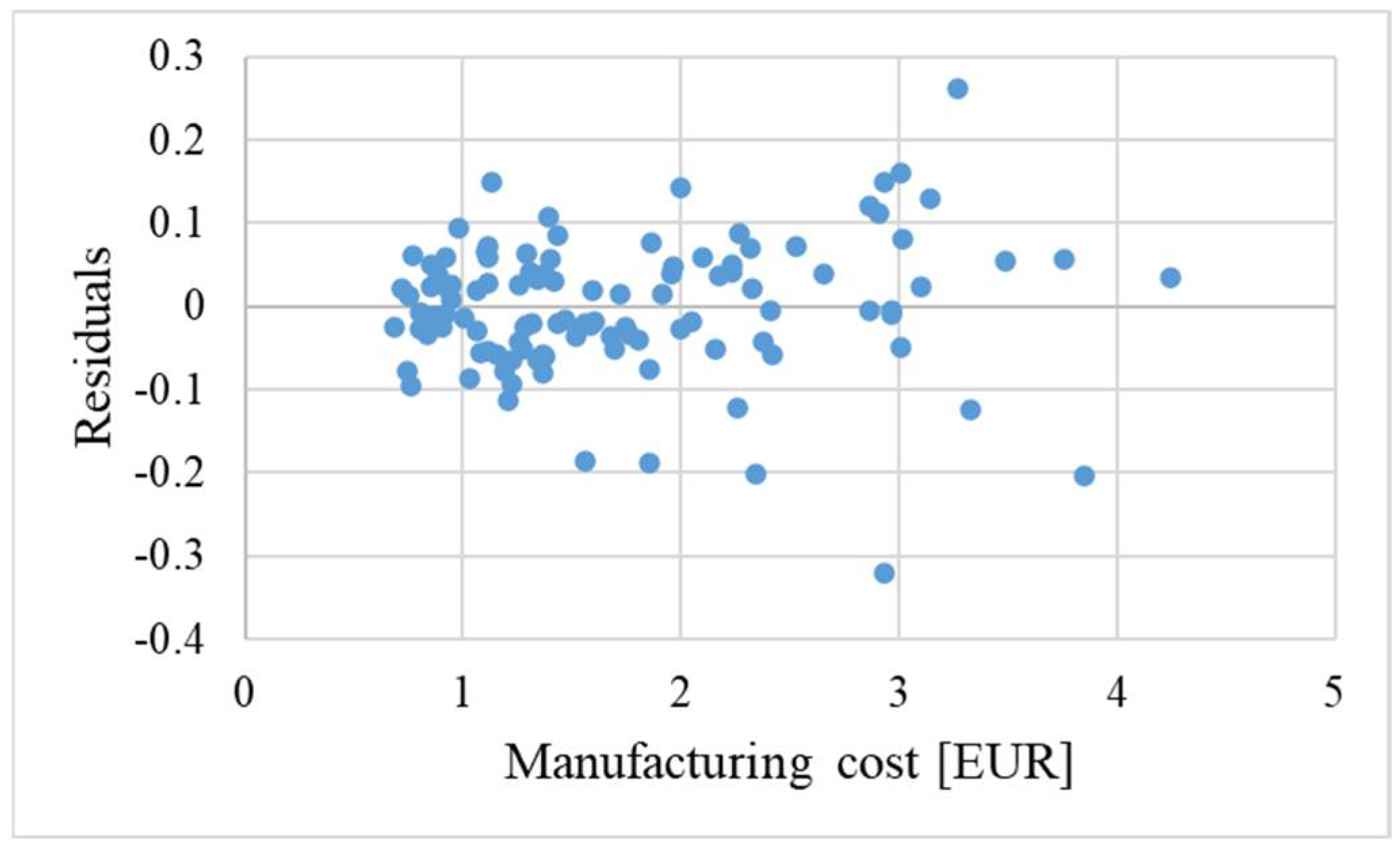
| ANN | 0.995 | 3.59 |
| IW1 | IW2 | b1 | b2 | |||
|---|---|---|---|---|---|---|
| 1.503 | 1.388 | −0.178 | 2.377 | −0.113 | −2.085 | 1.366 |
| 0.037 | 1.759 | −2.389 | 2.924 | 0.008 | 2.296 | |
| 2.146 | 2.974 | −1.463 | −0.559 | −0.009 | 0.038 | |
| 0.876 | 0.349 | 0.139 | −0.289 | −2.213 | 1.588 | |
| 0.932 | −0.447 | −1.377 | 0.068 | 0.074 | −0.769 | |
| −0.199 | −0.168 | 0.191 | 0.616 | 0.477 | 0.201 | |
| Process Input Parameter | Relative Importance | Rank |
|---|---|---|
| Depth of cut, ap | −2.155 | 1 |
| Feed rate, f | −1.056 | 2 |
| Cutting speed, v | −0.304 | 4 |
| Volume of material to be removed, V | 0.700 | 3 |
| Parameter | Value | Parameter | Value | Parameter | Value |
|---|---|---|---|---|---|
| apmin | 0.8 mm | fmin | 0.12 mm/rev | vmin | 149 m/min |
| apmax | 3 mm | fmax | 0.3 mm/rev | vmax | 337 m/min |
| ξmin | 6 | D0 | 70 mm | Pm | 7.5 kW |
| ξmax | 9 | D1 | 44 mm | η | 0.9 |
| Cins | 11.16 EUR | nce | 4 | Cslo | 30 EUR/h |
Disclaimer/Publisher’s Note: The statements, opinions and data contained in all publications are solely those of the individual author(s) and contributor(s) and not of MDPI and/or the editor(s). MDPI and/or the editor(s) disclaim responsibility for any injury to people or property resulting from any ideas, methods, instructions or products referred to in the content. |
© 2026 by the authors. Licensee MDPI, Basel, Switzerland. This article is an open access article distributed under the terms and conditions of the Creative Commons Attribution (CC BY) license.
Share and Cite
Madić, M.; Trifunović, M.; Rodić, D.; Marinković, D. Development of Machine Learning Model for Analysis of Total Manufacturing Cost in Medium Turning of C45E Steel. Metals 2026, 16, 373. https://doi.org/10.3390/met16040373
Madić M, Trifunović M, Rodić D, Marinković D. Development of Machine Learning Model for Analysis of Total Manufacturing Cost in Medium Turning of C45E Steel. Metals. 2026; 16(4):373. https://doi.org/10.3390/met16040373
Chicago/Turabian StyleMadić, Miloš, Milan Trifunović, Dragan Rodić, and Dragan Marinković. 2026. "Development of Machine Learning Model for Analysis of Total Manufacturing Cost in Medium Turning of C45E Steel" Metals 16, no. 4: 373. https://doi.org/10.3390/met16040373
APA StyleMadić, M., Trifunović, M., Rodić, D., & Marinković, D. (2026). Development of Machine Learning Model for Analysis of Total Manufacturing Cost in Medium Turning of C45E Steel. Metals, 16(4), 373. https://doi.org/10.3390/met16040373