Next Article in Journal
Thermodynamic and Kinetic Analysis of Lead Leaching from Pretreated Pb–Ag Jarosite Sludge by Chloride Solution
Next Article in Special Issue
Influence of the Final Annealing Temperature on Al-Fe-Si Alloy Foil Microstructure and Properties
Previous Article in Journal
The Effect of Mo Content on the Multi-Scale Martensitic Structure and Mechanical Properties of Ultra-High-Strength and -Toughness Oil Well Pipes
Previous Article in Special Issue
Microstructural Evolution in the Stir Zone of a Friction-Stir-Processed Microalloyed Al-Mn-Cu Alloy
 
 
Due to scheduled maintenance work on our servers, there may be short service disruptions on this website between 11:00 and 12:00 CEST on March 28th.
Article

Effect of Pre-Deformation on Microstructure and Mechanical Properties of a Mg-Rich High-Cu Al-Mg-Si-Cu Alloy


1
Key Laboratory for Light-Weight Materials, Nanjing Tech University, Nanjing 211816, China
2
School of Materials Science and Engineering, Nanjing Institute of Technology, Nanjing 211167, China
3
Institute of New Materials, Guangdong Academy of Sciences, Guangzhou 510650, China
*
Author to whom correspondence should be addressed.
Metals 2026, 16(4), 366; https://doi.org/10.3390/met16040366
Submission received: 23 February 2026 / Revised: 22 March 2026 / Accepted: 24 March 2026 / Published: 26 March 2026
(This article belongs to the Special Issue Processing, Microstructure and Properties of Aluminium Alloys)

Abstract

The influence of pre-deformation on the microstructure and mechanical properties of a Mg-rich high-Cu Al-Mg-Si-Cu alloy was systematically investigated by hardness measurement, tensile test, and atomic resolution high-angle annular dark-field scanning transmission electron microscopy (HAADF-STEM). With the increase in pre-deformation strain (0–10%), the hardness and strength of the alloy after PB hardening increased progressively, accompanied by a continuous reduction in tensile elongation. Notably, increasing pre-deformation strain from 2% to 10% did not bring a significant enhancement in bake hardening response, despite the gradual improvement in the strain hardening capability of the alloy. An optimal pre-deformation strain of 5% is identified, which enabled the alloy to achieve a superior and industrially feasible combination of strength and ductility, balancing practical forming demand (T4 temper) and service performance (PB state). Pre-deformation can significantly affect the morphology and atomic structure of precipitates for the alloy. Dislocations introduced by pre-deformation acted as heterogeneous nucleation sites, inducing the formation of elongated and string-like precipitates along dislocation lines. A distinct Cu segregation behavior was observed in the pre-deformed alloy with the majority of Cu atoms segregated at the precipitate/α-Al interface, which was in sharp contrast to their dominant distribution within the precipitate interior in the non-pre-deformed alloy. These findings provide new insights into deformation-assisted precipitation regulation in Mg-rich high-Cu Al-Mg-Si-Cu alloys and offer practical guidance for optimizing the strength–ductility synergy of such alloys for automotive lightweight manufacturing applications.

1. Introduction

Due to their high specific strength, good formability, and excellent corrosion resistance, Al-Mg-Si alloys are used as the key material for lightweight automobiles [1,2,3]. These alloys are strengthened primarily by a series of nano-sized precipitates during artificial aging. The precipitation sequence for this type of alloy is as follows: SSSS → Clusters → GP-zones → β″ → β′, U1, U2, B′ → β, Si [4,5,6,7]. The GP zones, which form at the early aging stage, are fully coherent with the α-Al matrix and act as nucleation points for the subsequent β″ phase [8,9,10,11]. The needle-like β″ phase is the main strengthening phase in the peak age condition, which has the composition Mg4Al3Si4 or Mg5Al2Si4. The β″ phase grows on the {100}α surface in the <100>α direction, with a space group of C2/m and lattice parameters of a = 1.516 nm, b = 0.405 nm, c = 0.674 nm, and β = 105.3° [12,13,14,15]. Rod-like β′, U1, U2, and B′ phases, which are semi-coherent to the α-Al matrix, are formed during the over-aging stage [16,17,18].
Cu added to Al-Mg-Si alloys has a positive effect on precipitation hardening and changes their precipitation sequence, which is reported as SSSS → Clusters → GP-zones → β″, QP1, QP2, C → Q′, QP2, C → Q [19,20,21]. Cu could suppress the formation of the β″ phase while facilitating the formation of Cu-containing precipitates [22,23,24,25]. The disordered Cu-containing QP1 and QP2 precipitates (containing the unit cells of the Q′ and C phases, respectively) are responsible for peak hardness [21]. The QP2 phase, originally termed the L phase by Marioara et al. [19], exhibits disordered atomic arrangements distinct from classical precipitates. The QP1 phase tends to evolve quickly into the Q’ phase, while the QP2 phase is thermally stable and retains its disordered structure throughout the whole aging stage [21,26]. The hexagonal Q′ phases (Al4Cu2Mg8Si7) have lath and rod morphologies, with a lattice constant of a = 1.032 nm and c = 0.405 nm. The rod-like Q′ phase exhibits a multiple orientation relationship (OR) with the α-Al matrix, while the lath-like Q′ phase has a constant (OR) of [1000]Q′//[001]α and (1120)Q′//(510)α [27,28,29]. The C phase has a monoclinic structure and its OR with α-Al matrix is measured as: [100]C//[100]α, [001]C//[001]α [28]. The equilibrium Q phase is reported to be presented in the over-aging stage [27]. All metastable precipitates in the Al-Mg-Si-Cu alloys are structurally connected through a common QP lattice [21] (which is also named as the Si-network by Marioara [19,22]) with a projected near-hexagonal symmetry of a = b ≈ 0.4 nm, c = n × 0.405 nm, with c being parallel to the needle/rod/lath direction. The hexagonal Cu network serves as the skeleton structure of the Q′ and Q phases. The morphology and structure of precipitates can significantly influence the mechanical properties of Al-Mg-Si(-Cu) alloys.
Pre-deformation is one of the most effective methods of enhancing the mechanical properties of Al-Mg-Si(-Cu) alloys, shortening the time to peak hardness and maintaining a high elongation [30,31,32,33]. Ding et al. [34] found that pre-deformation can inhibit natural aging (NA) and increase the bake hardening response for both low- and high-Cu-added Al-Mg-Si alloys, especially a pre-deformation of 2%. Yin et al. [30] found that combined pre-aging and pre-straining could significantly improve the strength–ductility balance in aged Al-Mg-Si alloy by the fine tailoring of dislocations and precipitates. Weng et al. [35] investigated the impact of pre-deformation on the atomic structure and formation mechanism of precipitates in an Al-Mg-Si-Cu alloy. It was revealed that elongated precipitates could form in dislocations independently, while string-like precipitates were formed directly along dislocations. According to the research by Birol et al. [36], the introduction of dislocations in Al-Mg-Si alloys can eliminate vacancies, which avoids cluster formation at room temperature (RT) and reduces the adverse effects of NA. Therefore, pre-deformation not only suppresses the NA of the Al-Mg-Si(-Cu) alloy but also promotes AA by introducing dislocations and changing the shape of precipitates. However, the negative effect of pre-deformation on the alloy’s mechanical properties, such as plasticity and formability of T4 temper (an alloy with natural aging after solution treatment and quenching), needs to be further considered.
Although the influence of pre-deformation for Al-Mg-Si(-Cu) alloys has been widely investigated, a lot of questions still need to be resolved. The effect of pre-deformation is highly dependent on the alloy composition, as the precipitation sequence is highly responsive to compositional alterations. Although several studies have investigated heavy deformation in high-Cu aluminum alloys [37,38], the interaction between dislocations and Cu-rich precipitates in Al-Mg-Si-Cu alloys remains inadequately explored. Specifically, the role of pre-deformation in modifying Cu segregation behavior at precipitate interfaces and its impact on strain hardening require further elucidation. In addition, the effect of dislocation on the structural evolution of precipitates has received less attention. In the present work, the impact of pre-deformation on the microstructure and mechanical properties of Al-Mg-Si-Cu alloys with Mg-rich and high-Cu composition was systematically investigated. Meanwhile, the optimum pre-deformation process and the influencing mechanism were explored.

2. Materials and Methods

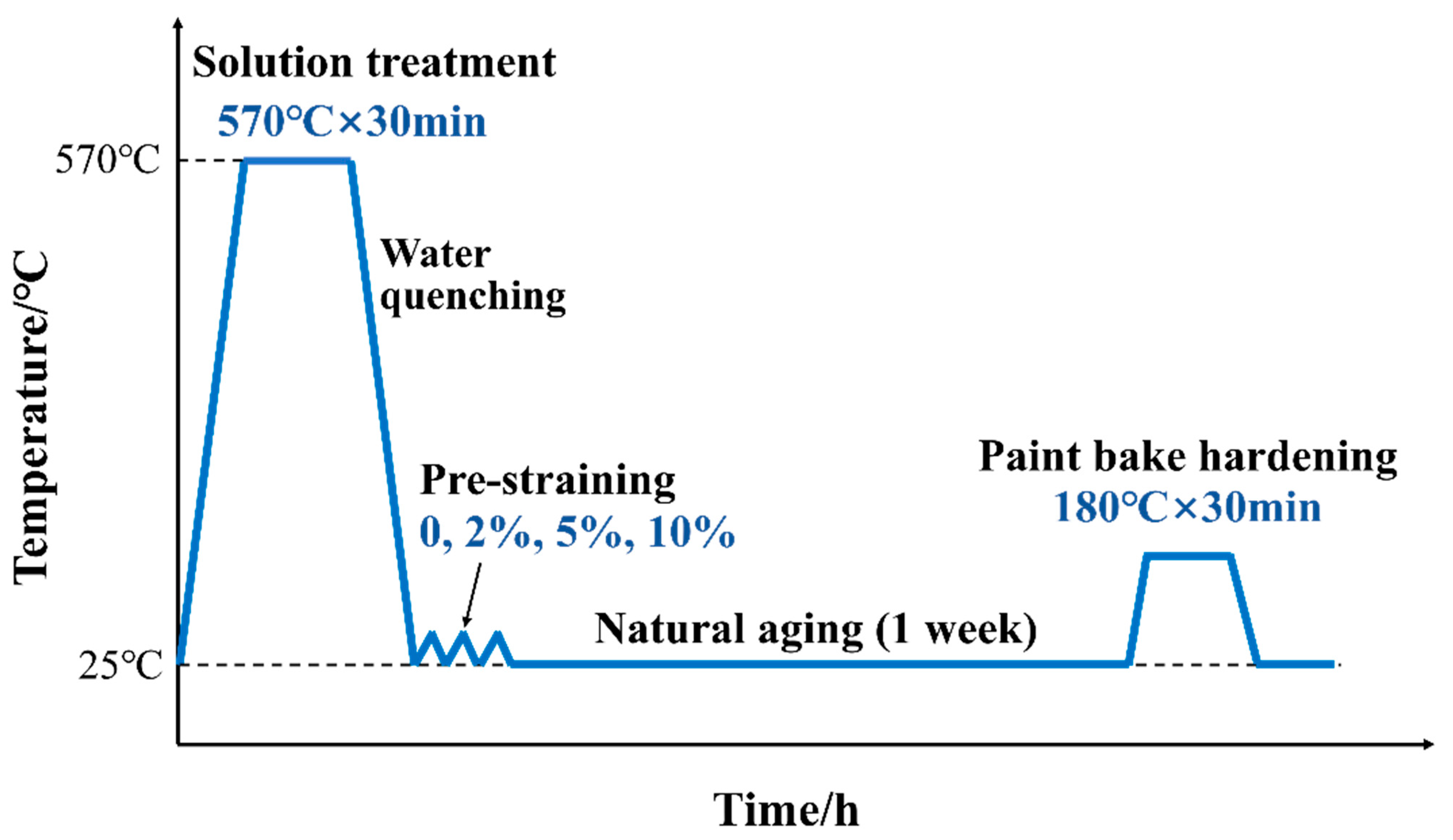
An alloy with a chemical composition of Al-1.11Mg-0.67Si-0.5Cu (wt.%) was used in this study. High purity aluminum (99.9%), high purity magnesium (99.9%), Al-10 wt.% Si, and Al-49.5 wt.% Cu master alloys were cast into slab ingots using induction furnaces. The chemical composition of the alloy was measured by optical emission spectroscopy. The cast ingot was homogenized at 560 °C for 6 h, then hot-rolled at 450 °C with a total reduction ratio of ~85% into a 10 mm sheet (air-cooled to room temperature) and subsequently cold-rolled at room temperature with a 90% reduction ratio into a 1 mm thick sheet. The sheet was solution heat-treated at 570 °C for 30 min in a muffle furnace before being water-quenched to RT. Then, the uniaxial tensile pre-deformation (0, 2%, 5%, and 10%) was immediately performed on a Zwick/RollZ030TH testing machine (ZwickRoell GmbH & Co. KG, Ulm, Germany) at room temperature with a strain rate of 1 mm/min along the rolling direction, with the strain precisely controlled by the equipment’s displacement system. All samples were subsequently left at RT for one week and paint bake (PB) hardening at 180 °C for 30 min. A schematic illustration of the heat treatment procedure is shown in Figure 1. The terms P0, P2, P5, and P10 alloys specifically designate the alloy (Al-1.11Mg-0.67Si-0.5Cu) subjected to 0%, 2%, 5%, and 10% pre-deformation treatments, respectively.
Vickers microhardness measurements were conducted using a MH-5 L microhardness tester (Shanghai Taiming Optical Instrument Co., Ltd., Shanghai, China) with a test load of 0.495 kg and a dwell time of 10 s. The average of ten random test points was adopted for each sample, with a hardness measurement error of ≤±3%. Uniaxial tensile tests and pre-deformation were performed on a Zwick/RollZ030TH electronic universal testing machine (ZwickRoell GmbH, Ulm, Germany) at a constant strain rate of 1 mm/min following the ISO 6892-1 standard [39], with 25 mm gauge length samples stretched along the rolling direction. Three parallel specimens were tested for each condition, with a stress variation of ≤5 MPa. Fracture profiles of investigated alloys were performed by scanning electron microscopy (SEM, FEI, Hillsboro, OR, USA) examination. The microstructure of precipitates was examined by an FEI Tecnai G2 F20 TEM (FEI, Hillsboro, OR, USA). High-angle annular dark-field scanning transmission electron microscopy (HAADF-STEM) characterization at the atomic resolution was performed using FEI Titan G2 60-300 ChemiSTEM (FEI, Hillsboro, OR, USA), with an aberration-corrected probe and a Schottky field emitter at 300 kV. All TEM images were obtained on the <100>α zone axis. At least five TEM bright-field images were taken for the statistics of precipitates. The thickness of specimens from which the TEM images were obtained was measured using the convergent beam electron diffraction (CBED) technique in order to calculate the volume fraction of precipitates [40]. Samples for the TEM were prepared using electropolishing with a Struers TenuPol-5 machine (Struers ApS, Ballerup, Denmark) at a temperature of −30 °C with an electrolyte of 1/3 HNO3 in methanol.

3. Results

3.1. Hardness Measurements

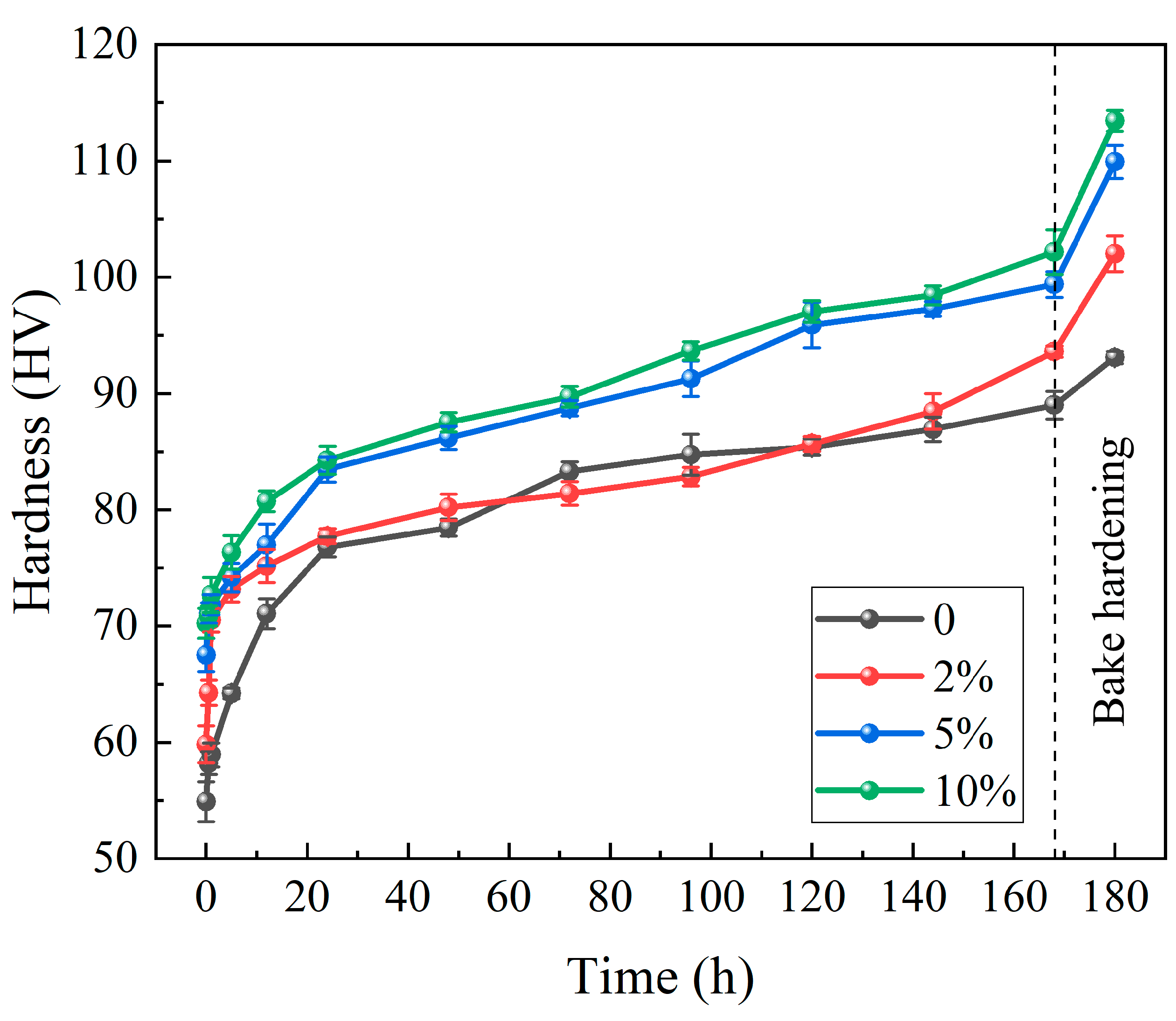
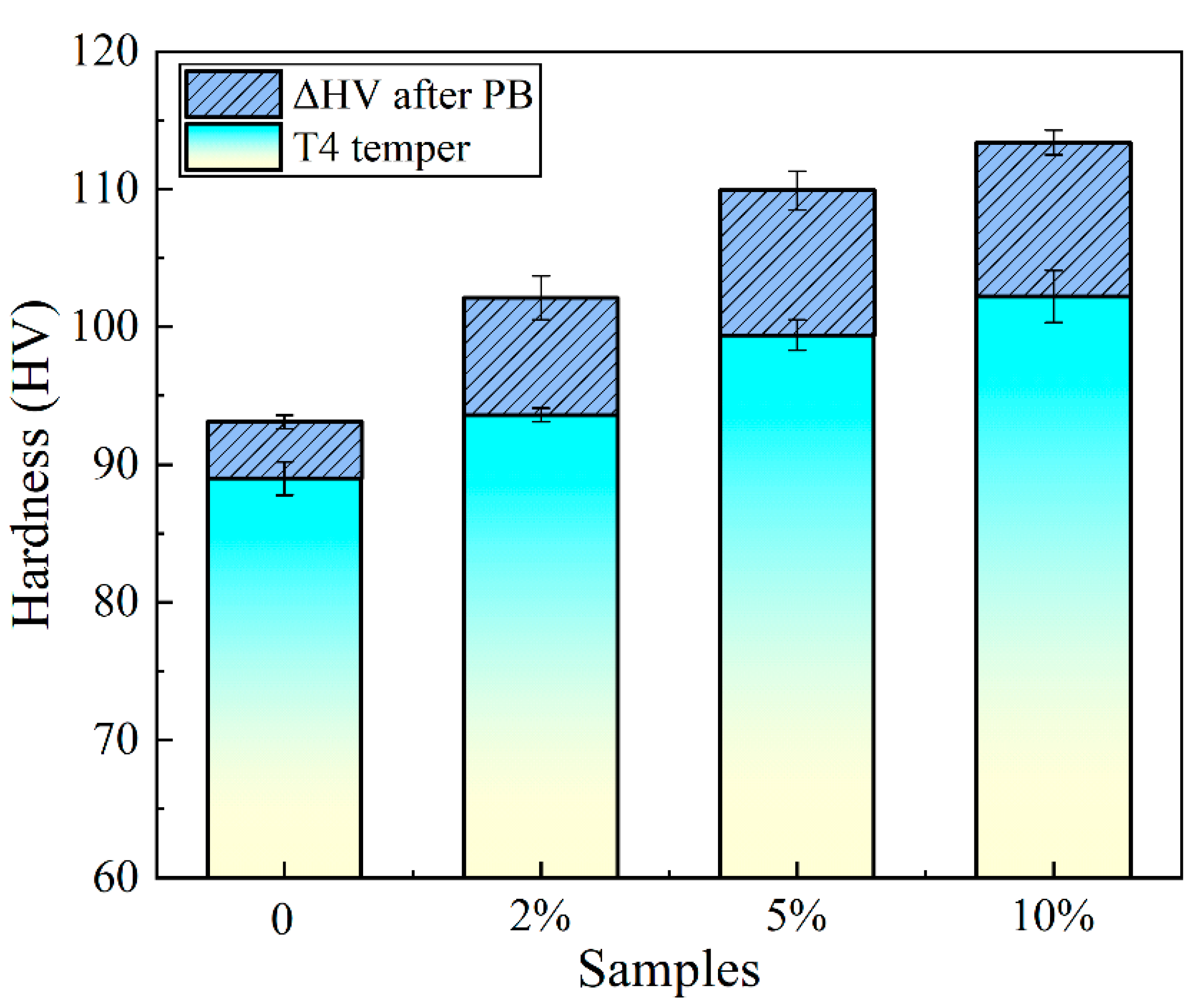
Figure 2 shows the hardness variation curves for these alloys with different pre-deformation during one week of RT storage and bake hardening treatment. All hardness curves show a similar trend: the alloys have a rapid increase in hardness during the first day, followed by a continuous slow speed of increase until one week. Then, the hardness is significantly increased after bake hardening. Compared with the alloy without pre-deformation (P0 alloy), the alloys with pre-deformation have a higher hardness response throughout the whole aging process, especially the P10 alloy. The hardness of the T4 temper for the P2, P5, and P10 alloys are measured as 94 HV, 99 HV, and 102 HV, respectively. The PB hardness of these alloys is achieved at 102 HV, 110 HV, and 113 HV, which are distinctively higher than that of the P0 alloy (93 HV). Figure 3 shows histograms of the incremental hardness for the four alloys bake-hardened after the T4 temper. The hardness increments after PB treatment were found to be 8 HV (P2), 11 HV (P5), and 11 HV (P10), compared to 4 HV for the P0 alloy. This result suggests that increasing the pre-formation level from 2% to 10% does not significantly increase the bake hardening response of the alloy. Although the P10 alloy exhibits the highest PB hardness, its elevated T4 temper hardness (102 HV) significantly impairs formability, where even a small hardness increase in the T4 state (the key forming stage for automotive alloy sheets) raises flow stress notably, reducing plastic deformation capacity and increasing stamping cracking risk, a critical criterion for industrial automotive body panel manufacturing. In contrast, the P5 alloy demonstrates optimal balance with 99 HV (T4) and 110 HV (PB), while maintaining adequate formability and a higher elongation (17.7%) than P10 (15.5%). Therefore, 5% pre-deformation can achieve the required mechanical properties and further reduce energy consumption simultaneously for the automobile industry.

3.2. Tensile Results

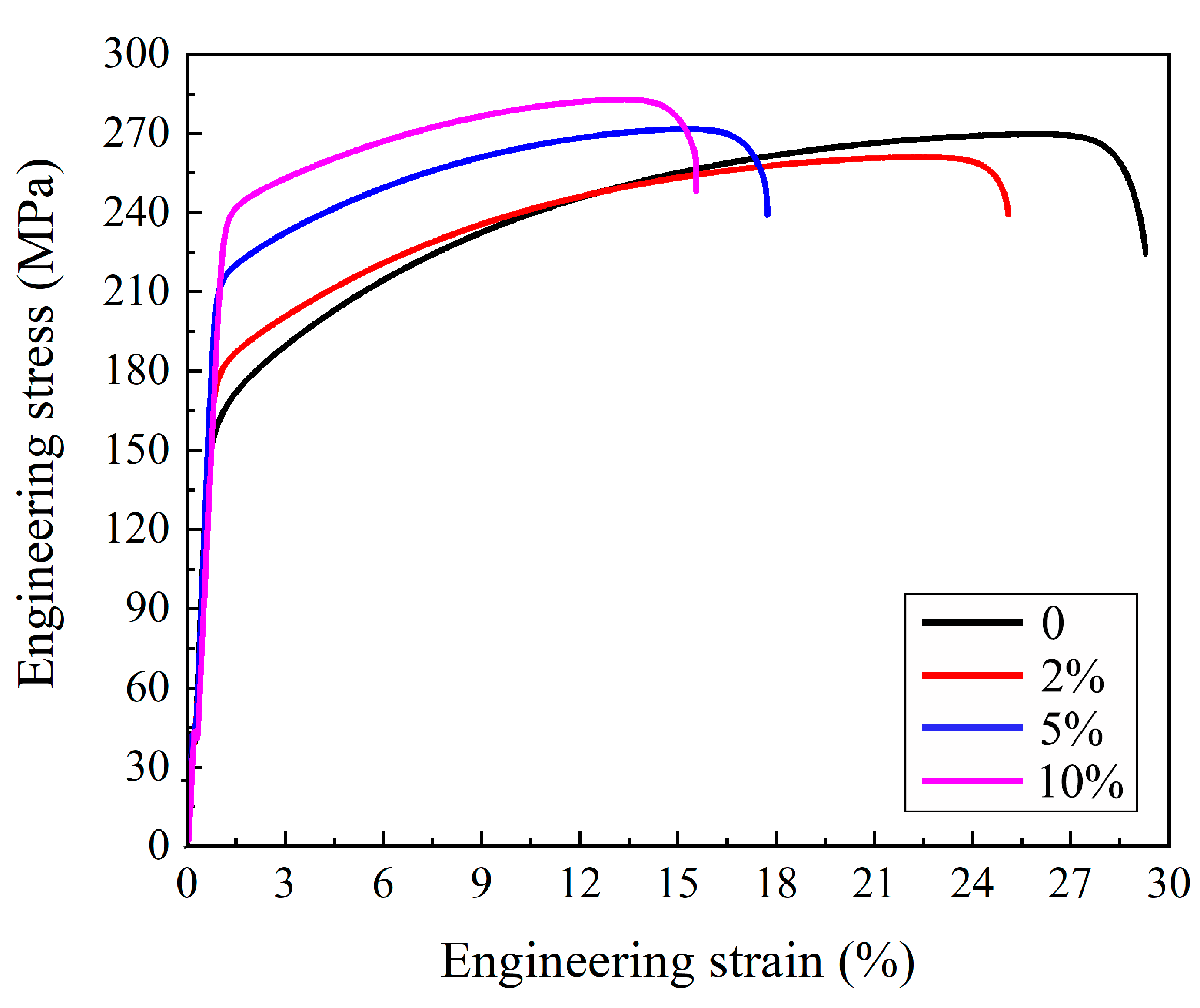
Tensile stress–strain curves of the alloys with different pre-deformation in the PB hardening condition are presented in Figure 4. The corresponding yield strength (YS), ultimate tensile strength (UTS) and elongation (E) are listed in Table 1. The P0 alloy has the YS and UTS of 146 MPa and 270 MPa, respectively, and reaches an elongation of 29.3%. P5 and P10 alloys show a significant increase in YS and UTS, while a continuous decrease in elongation with the increase in pre-deformation was observed. The P10 alloy has the highest YS (178 MPa) and UTS (283 MPa), which are 22% and 5% higher than that of the P0 alloy, respectively. While the elongation of the P10 alloy is only 15.5%, which is 47.1% lower than that of the P0 alloy and insufficient for practical automotive stamping processes (below the industrial minimum threshold) and raises the risk of cracking during complex plastic deformation. The YS and UTS of the P5 alloy are increased by 14.4% (167 MPa) and 0.7% (272 MPa) compared to that of the P0 alloy, respectively, and its elongation can reach 17.7%, a value sufficient to meet the industrial forming requirements (minimum 16–17% elongation) for automotive Al alloy body and structural parts. The P2 alloy has the highest elongation (25.1%), but lower YS and UTS (157 MPa and 262 MPa). Thus, the P5 alloy achieves an optimal and industrially feasible balance of strength and ductility for automotive lightweight applications.

3.3. SEM Characterization

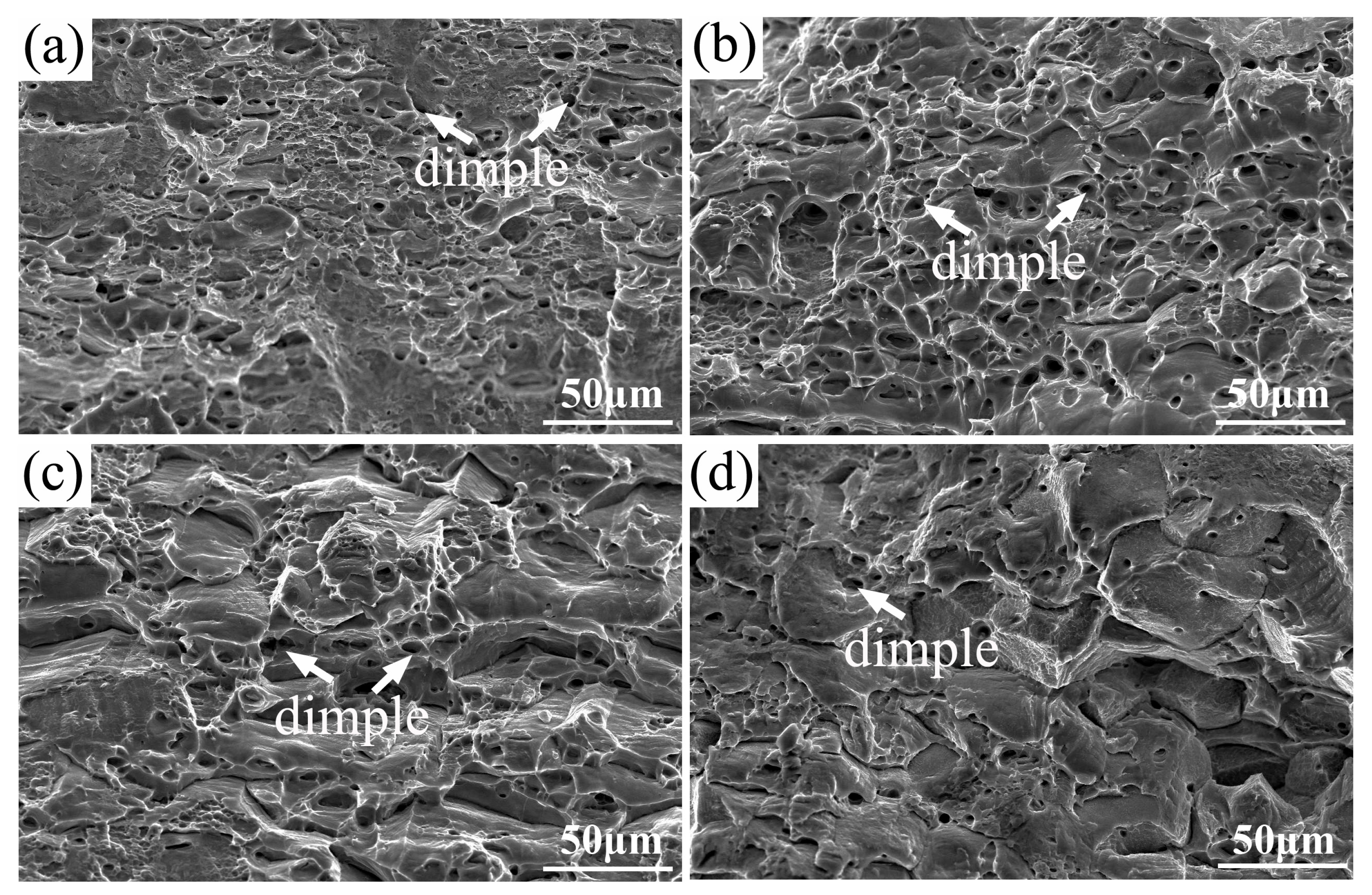
Figure 5 shows SEM images of the fracture surfaces for these alloys with different pre-deformation. A large number of dimples observed on these fracture surfaces confirm ductile fracture behavior, indicating good macroscopic ductility. The P0 alloy exhibits the highest dimple density compared to other alloys, with the most uniform size distribution, correlating with its optimal ductility (29.3% elongation). Among the three pre-deformed alloys, the P2 alloy has the most uniformly dense and deep dimples, indicating better ductility. However, its strength after PB is too low to meet the requirements of industrial production. The P10 alloy shows obvious intergranular fracture (marked with red arrows in Figure 5d) distributed on the fracture surface, indicating severely reduced ductility caused by mixed ductile–intergranular fracture behavior. In contrast, the P5 alloy maintains only the dense, deep dimples (pure ductile fracture) in Figure 5c without any intergranular fracture, and its elongation (17.7%) is significantly higher than that of the P10 alloy (15.5%). These results demonstrate that the P5 alloy achieves an optimal balance of properties, exhibiting pure ductile fracture and competitive strength relative to the P10 alloy.

3.4. TEM Characterization

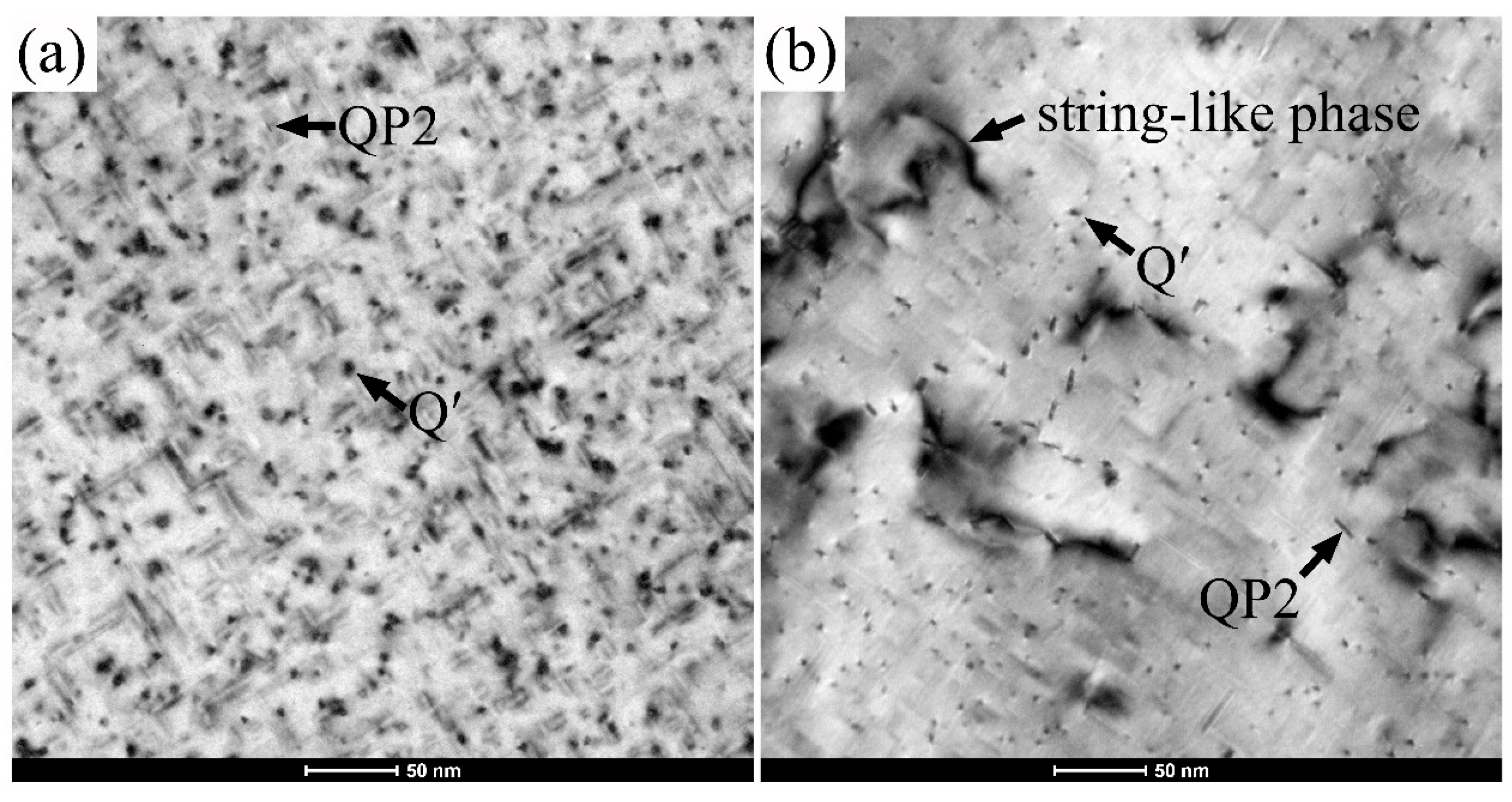
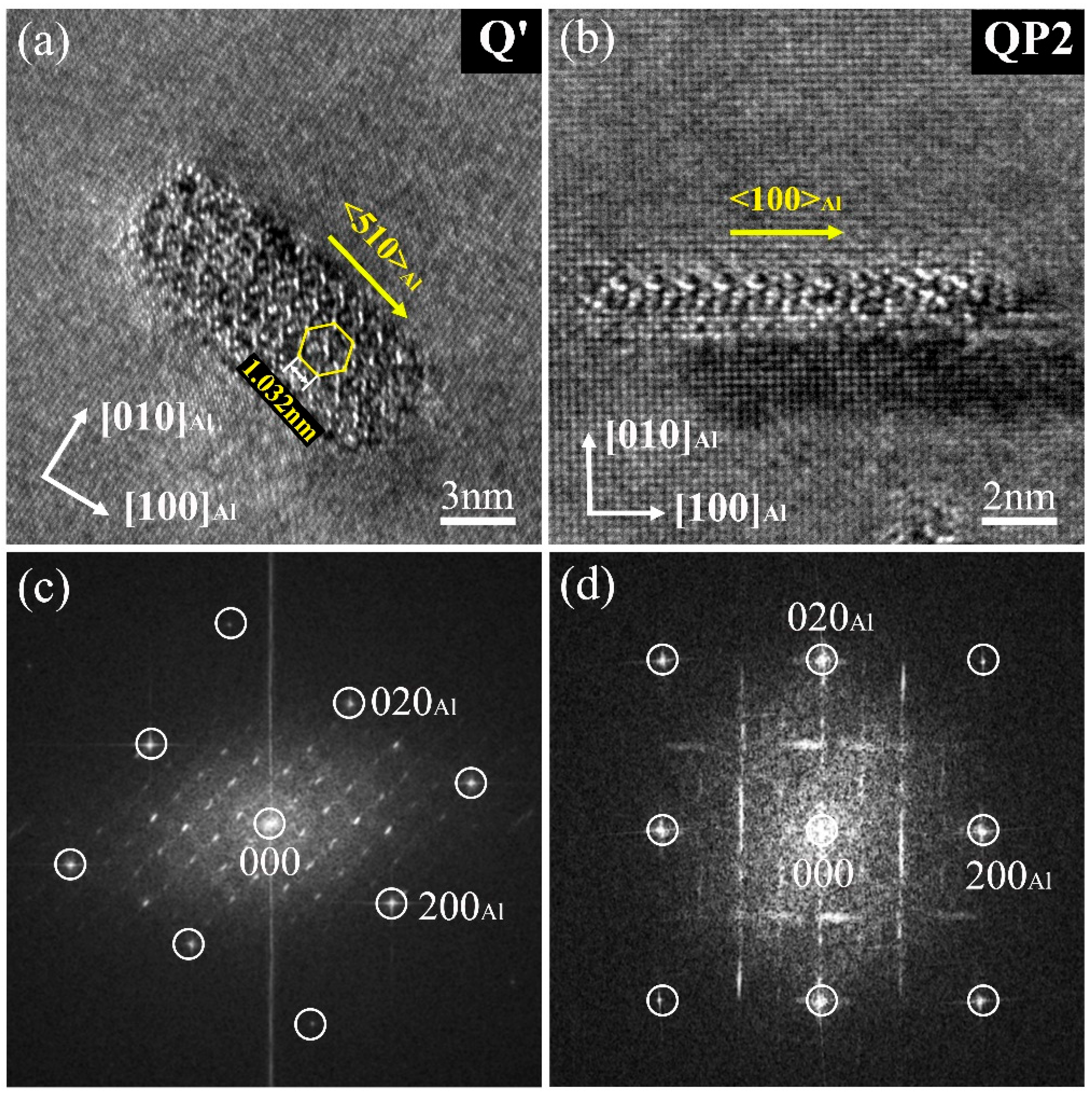
Microscopic characterization of the precipitates for the alloys after PB treatment under different pre-deformation (i.e., 0, 2, 5, 10%) was conducted, with representative TEM results for 0 and 10% pre-deformation shown in Figure 6 (selected for clear comparison of the pre-deformation-induced microstructural differences in precipitates). It can be observed that a large number of needle-like precipitates are uniformly distributed in the α-Al matrix. From the HRTEM images and the corresponding Fast Fourier Filtering transform (FFT) patterns shown in Figure 7, the lath-like precipitate with the cross-section elongated along <510>Al was identified as the Q’ phase. The lath-like precipitate with the cross-section elongated along <100>Al was the QP2 phase, a precursor of Q’ with a significant strengthening effect. Different from the P0 alloy, many dislocations exist in the matrix for the P10 alloy. These dislocations can act as heterogeneous nucleation points for the precipitates during the baking hardening. The string-like and elongated precipitates along the dislocations can be observed in the P10 alloy, and these precipitates have larger sizes than precipitates in the α-Al matrix, as shown in Figure 6b.
A quantification of only matrix needle-like precipitates of the alloys after PB treatment under different pre-deformation is given in Table 2 (dislocation-associated string-like/elongated precipitates are excluded due to conventional TEM statistical limitations). Compared with the P0 alloy, the P10 alloy has a higher number density and smaller cross-section of precipitates. Although the P10 alloy exhibits a lower volume fraction of matrix precipitates compared to the P0 alloy, this comparison does not reflect the full precipitate population in pre-deformed alloys.
Orowan–Ashby calculations for matrix precipitates (Equation (1)) confirm their negligible strengthening difference:
Δ σ = 0.41 M G b λ l n d 2 b
where M = 3.06 (Taylor factor for Al), G = 26.1 GPa (shear modulus of Al), b = 0.286 nm (Burgers vector), d is the equivalent precipitate diameter, and λ = 1/ N V (inter-precipitate spacing, N V = number density). For P0, d ≈ 7.2 nm, λ ≈ 438 nm, Δσ ≈ 42 MPa; for P10, d ≈ 6.8 nm, λ ≈ 404 nm, Δσ ≈ 46 MPa. A minor 4 MPa strengthening difference from matrix precipitates is calculated, consistent with the statistically similar matrix precipitate parameters in Table 2. The experimental results illustrate that the pre-deformation can significantly affect the shape and distribution of precipitates for the Al-Mg-Si-Cu alloy, and the unquantified dislocation-associated precipitates together with pre-deformation-induced dislocations are the core factors leading to the remarkable yield strength difference between P0 and P10 alloys, thereby changing the overall mechanical properties of this alloy.

3.5. HAADF-STEM Characterization

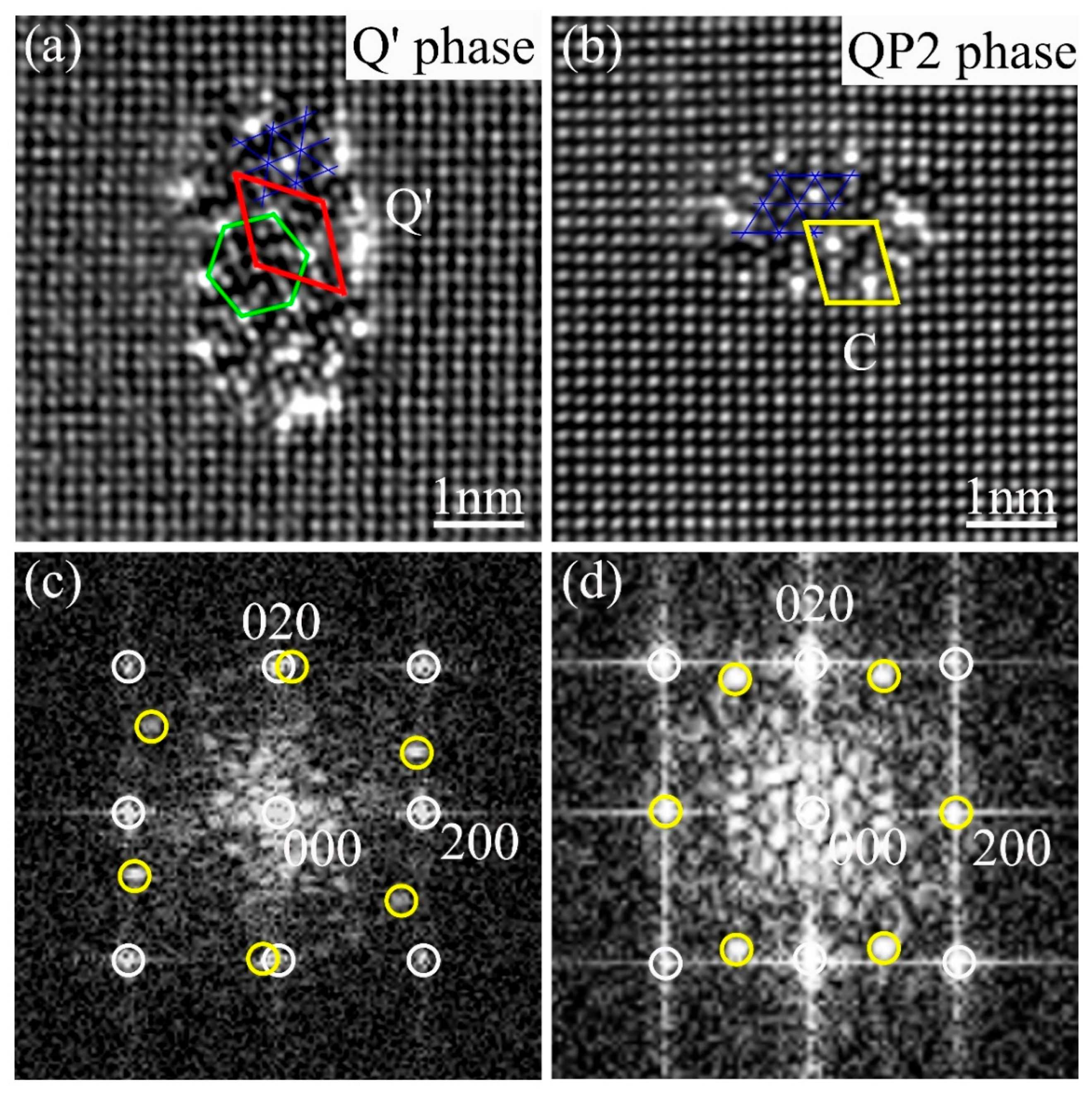
Figure 8 shows the HAADF-STEM images and corresponding FFT patterns of disordered Q’ and QP2 precipitates for the non-pre-deformed Al-Mg-Si-Cu alloy after PB treatment. Since the atomic column intensity of HAADF-STEM images is proportional to the atomic number of the element, Zn, with n ranging from 1.6 to 2 [41], the Cu column is easy to identify because of its strong atomic column intensity compared to other elements (Z = 29 for Cu, Z = 13 for Al, Z = 12 for Mg and Z = 14 for Si). Both of the two precipitates have a rod-like morphology and disordered atomic arrangement, but some short-ordered structures can be observed [30,35]. The Q′ unit cells and C unit cells are formed in the Q′ and QP2 phases, respectively. The skeleton structures of precipitates, QP lattice and Cu network, can be observed in these phases. The majority of Cu columns enter into the interior of precipitates, while a few parts of Cu columns segregate in the interface of precipitate/α-Al.
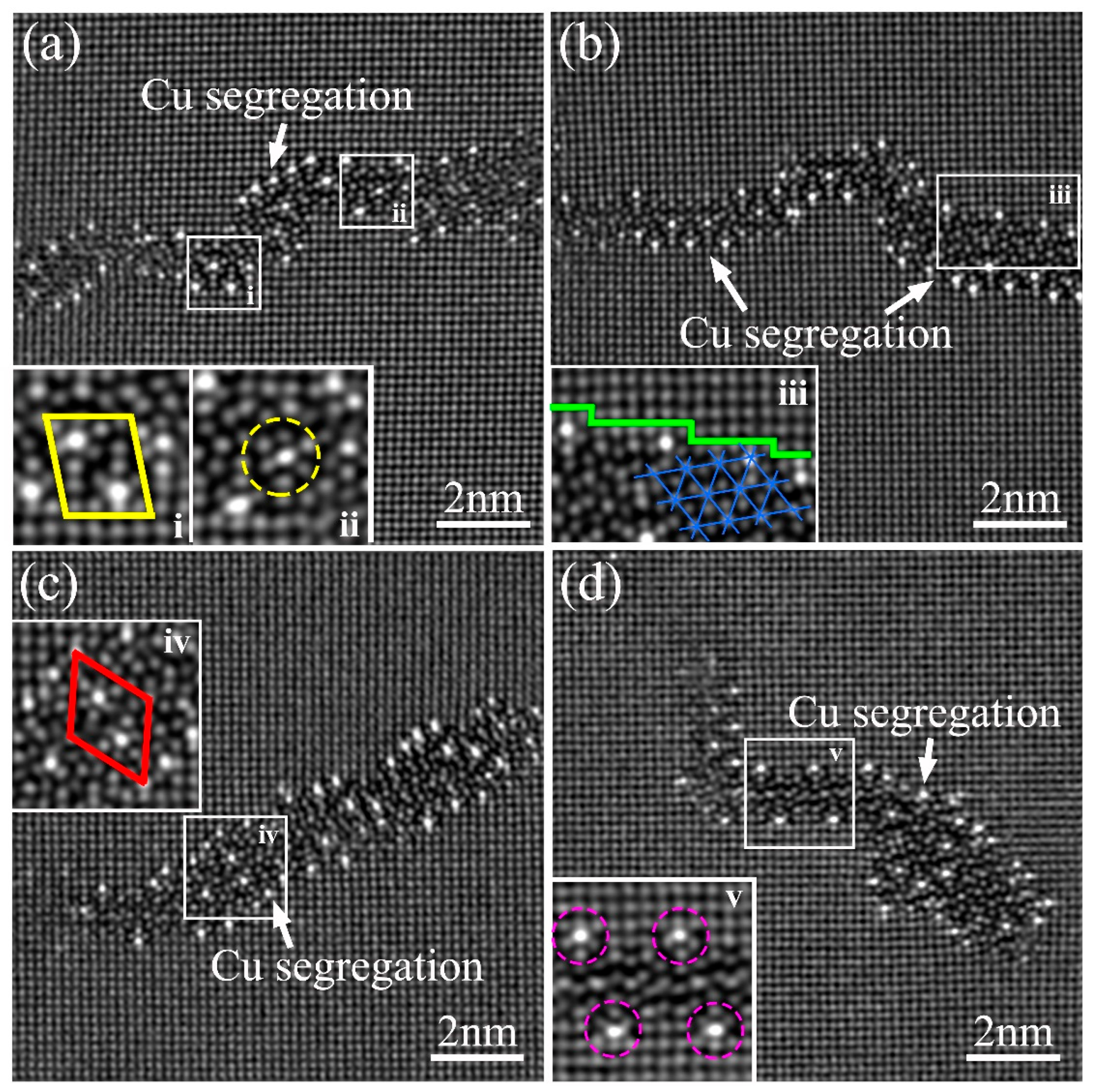
In order to study the influence of pre-deformation on the atomic structure of precipitates, the HAADF-STEM images of precipitates for the 10% pre-deformed Al-Mg-Si-Cu alloy are presented in Figure 9. Elongated and string-like precipitates are formed along the dislocations in this alloy. Similar to the precipitates formed in the non-pre-deformed alloy, the Cu sub-unit clusters (main structure of the Q′ phase [21]), QP lattice, Q’ unit cell and C unit cell can still be observed in these precipitates. These disordered string-like precipitates present different atomic arrangements, as demonstrated in Figure 9. QP lattice, Q’ and C unit cells can coexist in these precipitates for pre-deformed alloys. Contrasting with the precipitates formed in the non-pre-deformed alloy, the precipitate/α-Al interface in the pre-deformed alloy is filled with Cu atoms. Furthermore, the interior of precipitates has substantially lower concentrations of Cu atoms.

4. Discussion

Based on the above results, it was demonstrated that the pre-deformation significantly enhances the precipitation kinetics of Al-Mg-Si-Cu alloys. During natural aging, quenched vacancies are known to be crucial in controlling the kinetics of clustering [42]. The dislocations introduced by pre-deformation can act as sinks for quenched-in vacancies which hinders the formation of clusters, thus suppressing natural aging [43,44]. However, the work-hardening effect of pre-deformation will be more pronounced. Therefore, the negative consequences of pre-deformation in the T4 state, such as increased hardness and decreased ductility, cannot be disregarded.
For the paint bake, dislocations introduced by pre-deformation could promote atomic diffusion and provide heterogeneous nucleation sites for GP zones [45,46]. In the meantime, pre-deformation reduces the negative effects of NA on paint bake by suppressing the formation of clusters during NA [47,48,49], which is directly supported by the hardness evolution results in Figure 2 of this work and is in correlation with the reported mechanisms in the literature. Figure 2 shows that the pre-deformed alloys present a slower hardness increase rate during one week of room temperature NA compared with the P0 alloy, indicating a weakened natural aging response caused by the suppressed formation of solute clusters. This suppression effectively retains more solute atoms in the matrix for subsequent PB-induced precipitation, resulting in a significantly higher PB hardness increment for pre-deformed alloys than the P0 alloy. Therefore, pre-deformation greatly enhances precipitation strengthening during the paint bake due to the higher solute atomic concentration and more heterogeneous nucleation sites, which is consistent with the precipitation kinetics regulation mechanism reported in relevant studies [45,46]. Comparative analysis of Figure 2 and Figure 3 reveals that increasing pre-deformation from 0% to 5% results in a 14.4% increase in post-PB strength (from 146 to 167 MPa) and an 18.3% rise in hardness (from 93 to 110 HV). However, further increasing pre-deformation to 10% yields diminishing gains, with strength and hardness increments decreasing to 6.6% (167 to 178 MPa) and 2.7% (110 to 113 HV), respectively, relative to the 5% baseline. This attenuated enhancement suggests incipient saturation of precipitation strengthening at higher pre-deformation levels. Moreover, higher levels of pre-deformation can lead to reduced enhancement effects and increased hardness in T4 temper. Additionally, the ductility of the alloy decreases after undergoing paint bake.
The needle-like precipitates in the pre-deformed alloy are finer and denser than those of the non-pre-deformed alloy, as shown in Figure 6. The introduction of dislocations through pre-deformation provides heterogeneous nucleation sites of precipitates, thereby accelerating the precipitation kinetics of the Al-Mg-Si-Cu alloy during artificial aging. Additionally, the morphology and atomic structure of precipitates in the pre-deformed alloy are different from the precipitates in the non-pre-deformed alloy. Dislocations possess elevated free energy and reduced atomic coordination, which lowers diffusion barriers for solute atoms. This enables rapid pipe diffusion, facilitating solute aggregation and precipitate nucleation along dislocation lines [31,50]. Consequently, elongated and string-like precipitates form along dislocations in pre-strained alloys, contrasting with the isotropic precipitates in non-pre-strained samples [51]. Moreover, owing to the high free energy and diffusion rate of dislocations, the size of precipitates formed along with the dislocations is larger than those formed in the α-Al matrix. What is more interesting is that various types of unit cells for precipitates, such as Q’ and C, can coexist in elongated and string-like precipitates for pre-deformed alloys [52]. These disordered and hybrid precipitates can significantly enhance the properties of the alloy.
The apparent similarity of matrix precipitate size and volume fraction in Table 2 leads to a negligible Orowan strengthening difference (4 MPa) for P0 and P10 alloys, which cannot explain the experimental 32 MPa yield strength (YS) gap (178 MPa for P10 vs. 146 MPa for P0). The actual YS discrepancy originates from two synergistic strengthening effects exclusive to pre-deformed alloys: (1) additional Orowan strengthening (Δσ ≈ 18 MPa) from fine, dense, string-like/elongated precipitates along dislocations (λ ≈ 220 nm, d ≈ 9.5 nm), calculated via Equation (1). (2) Dislocation hardening (Δσ = αMGb ρ , α = 0.2) from pre-deformation-induced dislocations, with the dislocation density (ρ) of P10 increased by ~2.3× compared to P0, contributing an additional Δσ ≈ 17 MPa. The combined ~35 MPa strengthening from these two factors is consistent with the experimental YS difference, confirming that matrix precipitates only play a minor role in the strength gap, while dislocation-associated precipitates and pre-deformation-induced dislocations are the dominant strengthening mechanisms.
In the pre-deformed alloy, segregation of Cu atoms at the precipitate/α-Al interface can be observed, as depicted in Figure 9. While a majority of Cu columns penetrate into the interior of precipitates in non-pre-deformed alloys, the primary reason for this phenomenon is the alteration of the stress field surrounding the precipitates due to the introduction of dislocations [35]. Consequently, Cu atoms segregating at the precipitate interfaces can alleviate strain stress within the precipitates, leading to a decrease in Cu concentration inside them. While pipe diffusion along dislocations accelerates early-stage precipitate growth and leads to enlarged string-like phases, Cu segregation at the precipitate/α-Al interface inhibits subsequent coarsening in pre-deformed alloys [22,35]. Therefore, appropriate pre-deformation techniques can significantly enhance the mechanical properties following the bake hardening of Al-Mg-Si-Cu alloys.

5. Conclusions

The influence of pre-deformation on the microstructure and mechanical properties of an Al-Mg-Si-Cu alloy with Mg-rich and high-Cu composition was systematically investigated through mechanical property testing and microstructure characterization. The key findings are summarized as follows:
(1)
Pre-deformation significantly elevates the hardness and strength of the alloy after PB hardening, with elongation decreasing gradually as pre-deformation strain increases. 5% pre-deformation is the optimal strain, achieving an industrially feasible balance of strength and ductility for automotive lightweight applications.
(2)
Dislocations introduced by pre-deformation act as heterogeneous nucleation sites for precipitates, inducing the formation of elongated and string-like precipitates along dislocation lines, which is distinct from the isotropic needle-like precipitates in the non-pre-deformed alloy.
(3)
Pre-deformation modulates the Cu segregation behavior of the alloy. Cu atoms are predominantly segregated at the precipitate/α-Al interface in pre-deformed alloys, in sharp contrast to their main distribution within precipitate interiors in the non-pre-deformed alloy, which further optimizes the precipitation strengthening effect.

Author Contributions

Conceptualization, L.D. and Y.W.; methodology, Y.Z.; validation, H.H., T.Y. and Y.Y.; formal analysis, T.Y. and Y.W.; investigation, L.D. and T.Y.; data curation, Y.W. and Y.Y.; writing—original draft preparation, L.D.; writing—review and editing, L.D., Y.W. and Y.Y.; project administration, L.D.; funding acquisition, L.D. All authors have read and agreed to the published version of the manuscript.

Funding

This research was funded by the National Key Research and Development Program grant number [No. 2024YFB3715404], the National Natural Science Foundation of China (Grant No. 52471136 and No. 52101141), the National Natural Science Foundation of China (Grant No. U22A20187) and the Undergraduate Innovation and Entrepreneurship Project of Jiangsu Province (Project No. 202411276011Z).

Data Availability Statement

The data presented in this study are available on request from the corresponding author. The data are not publicly available due to privacy or ethics.

Conflicts of Interest

The authors declare no conflicts of interest.

References

  1. Zhu, S.; Shih, H.C.; Cui, X.; Yu, C.Y.; Ringer, S.P. Design of solute clustering during thermomechanical processing of AA6016 Al-Mg-Si alloy. Acta Mater. 2021, 203, 116455. [Google Scholar] [CrossRef]
  2. Ding, L.; Jia, Z.; Zhang, Z.; Sanders, R.E.; Liu, Q.; Yang, G. The natural aging and precipitation hardening behaviour of Al-Mg-Si-Cu alloys with different Mg/Si ratios and Cu additions. Mater. Sci. Eng. A 2015, 627, 119–126. [Google Scholar] [CrossRef]
  3. Yang, W.; Huang, L.; Zhang, R.; Wang, M.; Li, Z.; Jia, Y.; Lei, R.; Sheng, X. Electron microscopy studies of the age-hardening behaviors in 6005A alloy and microstructural characterizations of precipitates. J. Alloys Compd. 2012, 514, 220–233. [Google Scholar] [CrossRef]
  4. Chen, H.; Lu, J.; Kong, Y.; Li, K.; Yang, T.; Meingast, A.; Yang, M.; Lu, Q.; Du, Y. Atomic scale investigation of the crystal structure and interfaces of the B′ precipitate in Al-Mg-Si alloys. Acta Mater. 2020, 185, 193–203. [Google Scholar] [CrossRef]
  5. Saito, T.; Ehlers, F.J.H.; Lefebvre, W.; Hernandez-Maldonado, D.; Bjørge, R.; Marioara, C.D.; Andersen, S.J.; Holmestad, R. HAADF-STEM and DFT investigations of the Zn-containing β″ phase in Al-Mg-Si alloys. Acta Mater. 2014, 78, 245–253. [Google Scholar] [CrossRef]
  6. Edwards, G.A.; Stiller, K.; Dunlop, G.L.; Couper, M.J. The precipitation sequence in Al-Mg-Si alloys. Acta Mater. 1998, 46, 3893–3904. [Google Scholar] [CrossRef]
  7. Saito, G.; Sano, Y.; Mizuno, K.; Torigoe, S.; Takata, K.; Okajima, T.; Muto, S. Precipitation behavior during low-temperature aging in Al-Mg-Si alloy using STEM-EDS intensity correlograms. Mater. Sci. Eng. A 2025, 923, 147686. [Google Scholar] [CrossRef]
  8. Marioara, C.D.; Andersen, S.J.; Hell, C.; Frafjord, J.; Friis, J.; Bjørge, R.; Ringdalen, I.G.; Engler, O.; Holmestad, R. Atomic structure of clusters and GP-zones in an Al-Mg-Si alloy. Acta Mater. 2024, 269, 119811. [Google Scholar] [CrossRef]
  9. Marioara, C.D.; Andersen, S.J.; Jansen, J.; Zandbergen, H.W. Atomic model for GP-zones in a 6082 Al-Mg-Si system. Acta Mater. 2001, 49, 321–328. [Google Scholar] [CrossRef]
  10. Fallah, V.; Langelier, B.; Ofori-Opoku, N.; Raeisinia, B.; Provatas, N.; Esmaeili, S. Cluster evolution mechanisms during aging in Al-Mg-Si alloys. Acta Mater. 2016, 103, 290–300. [Google Scholar] [CrossRef]
  11. Li, C.; Marioara, C.D.; Hatzoglou, C.; Andersen, S.J.; Holmestad, R.; Li, Y. Accelerating precipitation hardening by natural aging in a 6082 Al-Mg-Si alloy. Acta Mater. 2024, 281, 120396. [Google Scholar] [CrossRef]
  12. Hasting, H.K.S.; Frøseth, A.G.; Andersen, S.J.; Vissers, R.; Walmsley, J.C.; Marioara, C.D.; Danoix, F.; Lefebvre, W.; Holmestad, R. Composition of β″ precipitates in Al-Mg-Si alloys by atom probe tomography and first-principles calculations. J. Appl. Phys. 2009, 106, 123527. [Google Scholar] [CrossRef]
  13. Ninive, P.H.; Strandlie, A.; Gulbrandsen-Dahl, S.; Lefebvre, W.; Marioara, C.D.; Andersen, S.J.; Friis, J.; Holmestad, R.; Løvvik, O.M. Detailed atomistic insight into the β″ phase in Al-Mg-Si alloys. Acta Mater. 2014, 69, 126–134. [Google Scholar] [CrossRef]
  14. Ninive, P.H.; Løvvik, O.M.; Strandlie, A. Density functional study of the β″ phase in Al-Mg-Si alloys. Metall. Mater. Trans. A 2014, 45, 2916–2924. [Google Scholar] [CrossRef]
  15. Andersen, S.J.; Zandbergen, H.W.; Jansen, J.; Træholt, C.; Tundal, U.; Reiso, O. The crystal structure of the β″ phase in Al-Mg-Si alloys. Acta Mater. 1998, 46, 3283–3298. [Google Scholar] [CrossRef]
  16. Teichmann, K.; Marioara, C.D.; Andersen, S.J.; Marthinsen, K. TEM study of β′ precipitate interaction mechanisms with dislocations and β′ interfaces with the aluminium matrix in Al-Mg-Si alloys. Mater. Charact. 2013, 75, 1–7. [Google Scholar] [CrossRef]
  17. Yang, W.; Wang, M.; Sheng, X.; Zhang, Q.; Huang, L. Precipitate characteristics and selected area diffraction patterns of the β′ and Q′ precipitates in Al-Mg-Si-Cu alloys. Philos. Mag. Lett. 2011, 91, 150–160. [Google Scholar] [CrossRef]
  18. Weng, Y.; Jia, Z.; Ding, L.; Muraishi, S.; Wu, X.; Liu, Q. The multiple orientation relationships and morphology of β′ phase in Al-Mg-Si-Cu alloy. J. Alloys Compd. 2018, 767, 81–89. [Google Scholar] [CrossRef]
  19. Marioara, C.D.; Andersen, S.J.; Stene, T.N.; Hasting, H.; Walmsley, J.; Van Helvoort, A.T.J.; Holmestad, R. The effect of Cu on precipitation in Al-Mg-Si alloys. Philos. Mag. 2007, 87, 3385–3413. [Google Scholar] [CrossRef]
  20. Chakrabarti, D.J.; Laughlin, D.E. Phase relations and precipitation in Al-Mg-Si alloys with Cu additions. Prog. Mater. Sci. 2004, 49, 389–410. [Google Scholar] [CrossRef]
  21. Ding, L.; Jia, Z.; Nie, J.F.; Weng, Y.; Cao, L.; Chen, H.; Wu, X.; Liu, Q. The structural and compositional evolution of precipitates in Al-Mg-Si-Cu alloy. Acta Mater. 2018, 145, 437–450. [Google Scholar] [CrossRef]
  22. Marioara, C.D.; Andersen, S.J.; Røyset, J.; Reiso, O.; Gulbrandsen-Dahl, S.; Nicolaisen, T.E.; Opheim, I.E.; Helgaker, J.F.; Holmestad, R. Improving thermal stability in Cu-containing Al-Mg-Si alloys by precipitate optimization. Metall. Mater. Trans. A 2014, 45, 2938–2949. [Google Scholar] [CrossRef]
  23. Li, K.; Béché, A.; Song, M.; Sha, G.; Lu, X.; Zhang, K.; Du, Y.; Ringer, S.P.; Schryvers, D. Atomistic structure of Cu-containing β″ precipitates in an Al-Mg-Si-Cu alloy. Scr. Mater. 2013, 75, 86–89. [Google Scholar] [CrossRef]
  24. Zandbergen, M.W.; Cerezo, A.; Smith, G.D.W. Study of precipitation in Al-Mg-Si alloys by atom probe tomography II: Influence of Cu additions. Acta Mater. 2015, 101, 149–158. [Google Scholar] [CrossRef]
  25. Qu, B.; Chen, X.; Chen, Q.; Zhang, Y.; Tao, Y.; Chen, B. Atomic-scale investigation of B′, Q′ and Q phases in Al-Mg-Si-(Cu) alloys: Structural, mechanical and electronic properties via HAADF-STEM and first-principles calculations. Vacuum 2025, 239, 114436. [Google Scholar] [CrossRef]
  26. Weng, Y.; Chen, J.; Cheng, X.; Ding, L.; Sun, Q.; Tao, S.; Liu, X.; Jia, Z. Interface structures and thickening mechanisms of the Q′ and QP2 phases for Al-Mg-Si-Cu alloys. Mater. Charact. 2022, 194, 112354. [Google Scholar] [CrossRef]
  27. Fiawoo, M.; Gao, X.; Bourgeois, L.; Parson, N.; Zhang, X.Q.; Couper, M.; Nie, J.F. Formation of multiple orientation relationships of Q precipitates in Al-Mg-Si-Cu alloys. Scr. Mater. 2014, 88, 53–56. [Google Scholar] [CrossRef]
  28. Torsæter, M.; Lefebvre, W.; Marioara, C.D.; Andersen, S.J.; Walmsley, J.C.; Holmestad, R. Study of intergrown L and Q′ precipitates in Al-Mg-Si-Cu alloys. Scr. Mater. 2011, 64, 817–820. [Google Scholar] [CrossRef]
  29. Ding, L.; Jia, Z.; Weng, Y.; Liu, Y.; Wu, S.; Liu, Q. The morphology and orientation relationship variations of Q′ phase in Al-Mg-Si-Cu alloy. Mater. Charact. 2016, 118, 279–283. [Google Scholar] [CrossRef]
  30. Yin, Z.; Liu, C.; Ma, P.; Yang, J. Enhancing strength–ductility synergy in age-hardened Al-Mg-Si alloy via combined pre-ageing and pre-straining. J. Alloys Compd. 2025, 1010, 178264. [Google Scholar] [CrossRef]
  31. Song, J.; Liu, S.; Huang, H.; Chen, J.; Ou, L.; Wei, X.; Jiang, H. Effect of pre-strain on microstructure, mechanical properties and damping capacity of Al-Mg-Si delayed-aging alloy. Mater. Sci. Eng. A 2025, 942, 148700. [Google Scholar] [CrossRef]
  32. Gao, G.; Yan, L.; Li, X. Effects of pre-strain on bake hardenability and precipitation behavior of Al-Mg-Si automotive body sheets. J. Mater. Sci. Chem. Eng. 2024, 12, 53–64. [Google Scholar] [CrossRef]
  33. Cui, M.; Kayani, S.H.; Kim, H.W.; Lee, J.H. The role of prestraining on mechanical properties and microstructure of preaged AA6016 Al-Mg-Si sheets. J. Alloys Compd. 2023, 960, 170681. [Google Scholar] [CrossRef]
  34. Ding, L.; Jia, Z.; Liu, Y.; Weng, Y.; Liu, Q. The influence of Cu addition and pre-straining on the natural aging and bake hardening response of Al-Mg-Si alloys. J. Alloys Compd. 2016, 688, 362–367. [Google Scholar] [CrossRef]
  35. Weng, Y.Y.; Jia, Z.H.; Ding, L.P.; Liao, J.; Zhang, P.P.; Xu, Y.Q.; Liu, Q. Effect of pre-straining on structure and formation mechanism of precipitates in Al-Mg-Si-Cu alloy. Trans. Nonferrous Met. Soc. China 2022, 32, 436–447. [Google Scholar] [CrossRef]
  36. Birol, Y. Pre-straining to improve the bake hardening response of a twin-roll cast Al-Mg-Si alloy. Scr. Mater. 2005, 52, 169–173. [Google Scholar] [CrossRef]
  37. Zheng, X.; He, M.; Huang, Q.; Mao, H.; Liu, Y.; Kong, Y.; Du, Y. Integrated microstructural simulations and mechanical property predictions for age-precipitated Al-Mg-Si alloys. J. Mater. Sci. 2024, 59, 5436–5449. [Google Scholar] [CrossRef]
  38. Aster, P.; Dumitraschkewitz, P.; Uggowitzer, P.J.; Schmid, F.; Falkinger, G.; Strobel, K.; Kutlesa, P.; Tkadletz, M.; Pogatscher, S. Strain-induced clustering in Al alloys. Materialia 2023, 32, 101964. [Google Scholar] [CrossRef]
  39. ISO 6892-1; Metallic Materials—Tensile Testing—Part 1: Method of Test at Room Temperature. International Organization for Standardization: Geneva, Switzerland, 2019.
  40. Marioara, C.D.; Andersen, S.J.; Zandbergen, H.W.; Holmestad, R. The influence of alloy composition on precipitates of the Al-Mg-Si system. Metall. Mater. Trans. A 2005, 36, 691–702. [Google Scholar]
  41. Hawkes, P.W.; Spence, J.C.H. Science of Microscopy; Springer: New York, NY, USA, 2008. [Google Scholar]
  42. Saito, T.; Marioara, C.D.; Andersen, S.J.; Lefebvre, W.; Holmestad, R. Aberration-corrected HAADF-STEM investigations of precipitate structures in Al-Mg-Si alloys with low Cu additions. Philos. Mag. 2013, 94, 520–531. [Google Scholar] [CrossRef]
  43. Lai, Y.X.; Fan, W.; Yin, M.J.; Wu, C.L.; Chen, J.H. Structures and formation mechanisms of dislocation-induced precipitates in relation to the age-hardening responses of Al-Mg-Si alloys. J. Mater. Sci. Technol. 2020, 41, 127–138. [Google Scholar] [CrossRef]
  44. Yin, D.; Xiao, Q.; Chen, Y.; Liu, H.; Yi, D.; Wang, B.; Pan, S. Effect of natural ageing and pre-straining on the hardening behaviour and microstructural response during artificial ageing of an Al-Mg-Si-Cu alloy. Mater. Des. 2016, 95, 329–339. [Google Scholar]
  45. Saito, T.; Marioara, C.D.; Røyset, J.; Marthinsen, K.; Holmestad, R. The effects of quench rate and pre-deformation on precipitation hardening in Al-Mg-Si alloys with different Cu amounts. Mater. Sci. Eng. A 2014, 609, 72–79. [Google Scholar] [CrossRef]
  46. Pogatscher, S.; Antrekowitsch, H.; Leitner, H.; Ebner, T.; Uggowitzer, P.J. Mechanisms controlling the artificial aging of Al-Mg-Si alloys. Acta Mater. 2011, 59, 3352–3363. [Google Scholar] [CrossRef]
  47. Teichmann, K.; Marioara, C.D.; Andersen, S.J.; Marthinsen, K. The effect of preaging deformation on the precipitation behavior of an Al-Mg-Si alloy. Metall. Mater. Trans. A 2012, 43, 4006–4014. [Google Scholar] [CrossRef]
  48. Teichmann, K.; Marioara, C.D.; Pedersen, K.O.; Marthinsen, K. The effect of simultaneous deformation and annealing on the precipitation behaviour and mechanical properties of an Al-Mg-Si alloy. Mater. Sci. Eng. A 2013, 565, 228–235. [Google Scholar] [CrossRef]
  49. Kolar, M.; Pedersen, K.O.; Gulbrandsen-Dahl, S.; Marthinsen, K. Combined effect of deformation and artificial aging on mechanical properties of Al-Mg-Si alloy. Trans. Nonferrous Met. Soc. China 2012, 22, 1824–1830. [Google Scholar] [CrossRef]
  50. Legros, M.; Dehm, G.; Arzt, E.; Balk, T.J. Observation of giant diffusivity along dislocation cores. Science 2008, 319, 1646–1649. [Google Scholar] [CrossRef]
  51. Saito, T.; Muraishi, S.; Marioara, C.D.; Andersen, S.J.; Røyset, J.; Holmestad, R. The effects of low Cu additions and predeformation on the precipitation in a 6060 Al-Mg-Si alloy. Metall. Mater. Trans. A 2013, 44, 4124–4135. [Google Scholar] [CrossRef]
  52. Sunde, J.K.; Marioara, C.D.; Holmestad, R. The effect of low Cu additions on precipitate crystal structures in overaged Al-Mg-Si(-Cu) alloys. Mater. Charact. 2020, 160, 110087. [Google Scholar]
Figure 1. Schematic representation of the heat treatment procedure.
Metals 16 00366 g001
Figure 2. Evolution of Vickers hardness for the investigated alloy with and without pre-deformation during one week of RT storage and bake hardening treatment.
Metals 16 00366 g002
Figure 3. The hardness increment (ΔHV) induced by PB treatment for the investigated alloy under different pre-deformation.
Metals 16 00366 g003
Figure 4. Tensile stress–strain curves of the investigated alloy with different pre-deformation.
Metals 16 00366 g004
Figure 5. SEM SE (secondary electron) micrographs of the investigated alloys in PB condition with different pre-deformation, (a) 0, (b) 2%, (c) 5%, (d) 10%.
Metals 16 00366 g005
Figure 6. TEM bright-field images of the alloys after PB treatment for 0% and 10% pre-deformations; (a) no pre-deformation (P0), (b) 10% pre-deformation (P10).
Metals 16 00366 g006
Figure 7. HRTEM images and corresponding FFT patterns of different particles. (a,c) Lath-like Q′ phase, (b,d) QP2 phase.
Metals 16 00366 g007
Figure 8. HAADF-STEM images and corresponding FFT patterns of disordered Q’ and QP2 precipitates for the non-pre-deformed Al-Mg-Si-Cu alloy after PB; (a,c) Q’ phase, (b,d) QP2 phase. The Cu-network, QP lattice, Q’ and C unit cells are marked by green, blue, red, and yellow lines, respectively. The diffraction of the Al matrix and Qp lattices are marked by while and yellow circles in (c,d).
Metals 16 00366 g008
Figure 9. HAADF-STEM images of string-like and elongated precipitates formed along dislocations for the P10 alloy (10% pre-deformation) after PB. (a,b) String-like precipitates, (c,d) elongated precipitates. (iv) Enlarged HAADF-STEM images of zones marked in (ad). The Q′, C unit cells, and QP lattice are marked by red, yellow, and blue lines, respectively. The Cu sub-unit clusters formed in precipitates and at the interfaces are marked by dashed yellow and purple lines, respectively.
Metals 16 00366 g009
Table 1. Tensile results of the investigated alloy in PB condition with different pre-deformation.
Pre-DeformationYS (MPa)UTS (MPa)E/%
 0 146 ± 2270 ± 429.3 ± 0.7
2%157 ± 2262 ± 325.1 ± 0.6
5%167 ± 3272 ± 317.7 ± 0.6
10%178 ± 3283 ± 415.5 ± 0.4
Table 2. Statistics of needle-like precipitates of the alloys after PB treatment under different pre-deformations shown in Figure 6.
Pre-DeformationCross-Section
(nm2)
Length
(nm)
Number DensityVolume Fraction
(%)
 0 32 ± 225 ± 3(5.2 ± 0.2) × 10−60.420 ± 0.003
10%29 ± 222 ± 3(6.3 ± 0.3) × 10−60.400 ± 0.002
Disclaimer/Publisher’s Note: The statements, opinions and data contained in all publications are solely those of the individual author(s) and contributor(s) and not of MDPI and/or the editor(s). MDPI and/or the editor(s) disclaim responsibility for any injury to people or property resulting from any ideas, methods, instructions or products referred to in the content.