
Article

Microstructure and Properties of a Four-Layer Aluminum Alloy Composite Sheet for Brazed Structural Applications


1
Faculty of Materials Science and Engineering, Kunming University of Science and Technology, Kunming 650093, China
2
School of Mechanical and Resource Engineering, Wuzhou University, Wuzhou 543002, China
3
ALG Aluminum Inc., Nanning 530031, China
4
School of Metallurgical and Energy Engineering, Kunming University of Science and Technology, Kunming 650093, China
*
Authors to whom correspondence should be addressed.
Metals 2026, 16(3), 344; https://doi.org/10.3390/met16030344
Submission received: 13 November 2025 / Revised: 6 March 2026 / Accepted: 10 March 2026 / Published: 19 March 2026

Abstract

Aluminum alloy composites are widely used in various high-end fields due to their ability to give full play to the advantages of each layer. However, the traditional three-layer aluminum alloy composite sheet cannot meet the current demand. In this study, composite rolling technology is adopted to combine three different alloys (4045, 3003, and 6061) for fabricating a 2.0 mm thick four-layer aluminum alloy composite sheet (4045/3003/6061/3003). The microstructure and properties of the composite sheet were analyzed by simulating the vacuum brazing process (595 °C/10 min) and artificial aging treatment (175 °C for 12 h), combined with characterization techniques including scanning electron microscopy (SEM), electron backscatter diffraction (EBSD) and transmission electron microscopy (TEM). The results show that the four-layer composite sheet exhibits lower Si diffusion after brazing, where the intermediate 3003 aluminum alloy layers effectively prevent the combination of magnesium (Mg) and the 4045 alloy. Compared with the brazed three-layer composite sheet the ultimate tensile strength and yield strength of the four-layer composite sheet after aging are increased by 139.7% and 326.6%, respectively, indicating significant improvement in its mechanical properties. This study provides a reference for the production of four-layer aluminum alloy composite sheet and contributes to the development of rail transit.

1. Introduction

With the accelerated advancement of technological progress and the growing severity of challenges such as resource scarcity and environmental degradation, the demand for lightweighting has become increasingly prominent [1]. Therefore, aluminum alloy composite sheets, in particular, are required to develop toward lightweight, miniaturized, and environmentally friendly directions [2]. Aluminum alloys have emerged as the preferred choice for lightweight applications due to their low density, excellent machinability, superior weldability, machining properties and thermal conductivity, as evidenced by their widespread use in railway, aerospace, and marine fields [3,4,5].
Laminated aluminum alloy composites have attracted significant attention in the field of structural components due to their ability to integrate the advantages of different alloy layers. Traditional three-layer aluminum alloy composite sheets (e.g., AA4045/3003/4045, AA4343/3003/4343, and AA7072/3003/4343) have been widely adopted as effective weight-reduction solutions [6,7,8]. However, these composites with 3xxx series aluminum alloys as the core layer face critical issues, including poor mechanical properties after brazing and severe element diffusion during brazing, which restrict their overall performance. This is because 3xxx series alloys are non-heat-treatable, and their strength mainly relies on work hardening [9]. Nevertheless, the conventional brazing temperature (≈600 °C) significantly undermines the work hardening effect and even causes material softening, resulting in a post-brazing tensile strength of only 45–120 MPa [10]—far below the expected target of practical engineering applications (250 MPa ultimate tensile strength, 200 MPa yield strength, and 5% elongation), even more stringent requirement for the final product state (after aging). Such low strength leads to easy deformation, collapse, or even leakage during service [11]. Additionally, the 4xxx series cladding layers (e.g., 4045, 4343) have a high silicon (Si) content. During high-temperature brazing, this causes interface instability and degraded brazing quality, further deteriorating the composite performance.
To solve these issues, researchers have explored various improvement strategies, yet significant limitations remain. Microalloying: Adding elements such as chromium (Cr), scandium (Sc), copper (Cu), or titanium (Ti) to 3xxx series matrices can only achieve limited strength improvements [9,11,12,13]. For instance, Qian et al. [14] increased the yield strength of 3003 alloy by 17 MPa via Cr addition, while Long et al. [15] improved the tensile strength of 3003 alloy by 50% (from 114 MPa to 171 MPa) using Sc and Cu. However, these improvements still fall far short of application requirements. Diffusion control: Limiting Si diffusion by reducing grain size or optimizing brazing parameters can enhance the high-temperature deformation resistance of three-layer composite sheet [16,17,18], but fails to fundamentally restrict the mutual diffusion of elements. Core material replacement: 6xxx series aluminum alloys (e.g., 6061, 6A02, and 6111) have been proposed as alternatives to 3xxx series core layer due to their high strength, excellent formability, good weldability, and heat-treatable strengthenability [19,20,21]. Compared with traditional 3xxx series alloys, 6xxx series alloys can significantly enhance material strength. However, these alloys contain relatively high contents of Mg and Si, leading to uncontrolled diffusion during brazing (e.g., Mg from the 6xxx core layer and Si from the 4xxx cladding layer). This not only fails to fully exploit the strengthening potential of heat-treatable alloys but also impairs post-brazing performance [22]. To address this challenge, researchers have developed a composite sheet structure by using a 6xxx series aluminum alloy as the core and 3xxx series aluminum alloys as intermediate layers, replacing the core of the traditional 4xxx/3xxx/4xxx configuration, thereby achieving the dual benefits of low element diffusion and high strength. For instance, Cao et al. [23] investigated a four-layer aluminum alloy (4045/3003MOD/6061MOD/3003MOD) and found that the 3003MOD intermediate layers effectively blocked Mg diffusion. After brazing and aging, the composite sheet exhibited a tensile strength of 287.1 MPa and a yield strength of 230.5 MPa, with significantly improved mechanical properties. However, current research on such composite sheets is relatively limited. Most existing studies focus on improving corrosion resistance and brazability, while research on microstructure evolution, element diffusion control, and mechanical property enhancement remains insufficient.
Therefore, to overcome these limitations, this study proposes a novel four-layer aluminum alloy composite sheet (4045/3003/6061/3003), where 6061 aluminum alloy (a heat-treatable alloy) serves as the core layer and 3003 aluminum alloy acts as the intermediate layer. The key design rationale is dual-fold: (1) The brazing process (simulated at 595 °C for 10 min) functions as a solution treatment to activate the strengthening potential of 6061 alloy, and improve the mechanical properties of the composite sheet; (2) The 3003 intermediate layer act as diffusion barriers to inhibit the mutual diffusion of Si (from 4045 cladding layer) and Mg (from 6061 core layer), avoiding the formation of harmful phases and preserving the mechanical properties of core layer. Moreover, this work systematically investigates the microstructure, element diffusion behavior, precipitate evolution, and mechanical properties of the four-layer composite sheet using optical microscopy (OM), SEM, EBSD, TEM and high-resolution TEM (HR-TEM). After brazing and artificial aging (175 °C for 12 h), the four-layer composite sheet exhibits a 137.8% increase in tensile strength and a 316.7% increase in yield strength compared to the three-layer counterpart. This study aims to reveal the underlying mechanism of performance improvement and provide a new design strategy for the production of aluminum alloy composite sheets, thereby promoting the development of rail transit.

2. Experimental Materials and Methods

2.1. Experimental Materials

In this test, self-made ingots (Specification: 400 mm × 1200 mm × 3000 mm) were selected. Specifically, 6061 aluminum alloy was employed as the core material, 3003 aluminum alloy was used for the inter-layer and the outer layer respectively, and 4045 aluminum alloy was utilized for the brazing cladding layer. The chemical compositions of each alloy are presented in Table 1.
First, the above three ingots were homogenized at 550 °C for 10 h and air-cooled. Then, the 6061, 3003 and 4045 aluminum alloys were sawed into 148 mm (thickness: T) × 530 mm (width: W) × 750 (length: L) mm, 16 mm (T) × 510 mm (W) × 720 mm (L) and 20 mm (T) × 500 mm (W) × 720 mm (L) for storage. Notably, slight variations in ingot sizes were considered due to the different thermal expansion coefficients of different materials and the different cladding ratios. Surfaces were milled and cleaned with ethanol for 10 min before the three ingots were welded together. Moreover, the cladding ratio (thickness of single alloy layers/total thickness of composite sheet ×100%) of the 3003 layer is set to 8% with an allowable deviation of ± 1.5%, and that of the 4045 layer is 10% with an allowable deviation of ±2%.
Subsequently, the composite ingots were preheated at 500 °C for 8 h. This was followed by hot rolling to a thickness of 4.5 mm (hot rolling process: rolling diameter: 1200 mm, rolling speed: 2.0 m s−1, total rolling passes: 15, reduction ratio per pass (excluding the first four and the last pass): 25–30%), then cold rolling to 2.3 mm for intermediate annealing (process parameters: 420 °C/6 h). The final product thickness was 2.0 mm, with the annealing temperature set at 370 °C and the annealing time of 4 h.
Finally, a four-layer aluminum alloy composite sheet (4045/3003/6061/3003) was prepared, as shown in Figure 1a. For comparison, a three-layer aluminum alloy composite sheet (4045/3003/4045) was fabricated via the same process route, as shown in Figure 1b.

2.2. Experimental Methods

All samples had dimensions of 2.0 mm (T) × 100 mm (W) × 200 mm (L) and were placed in a box furnace manufactured by Hefei Kejing Materials Technology Co., Ltd. (Hefei, China). A controlled atmosphere was formed by purging nitrogen into the furnace, and simulated brazing was performed at 595 °C at the heating rate of 30 °C/min to ensure complete melting of the 4045 (melting point approximately 575 °C) cladding layer, at the same time, it should be lower than the solidus line temperature (about 630 °C) of 3003 and 6061 alloy [23]. After holding the samples at this temperature for 10 min, they were subsequently air-cooled outside the furnace [13]. Following brazing, the 4045/3003/6061/3003 samples were transferred to an SX2-12-12 resistance furnace produced in Shanghai for aging treatment, which was conducted at 175 °C for 12 h.
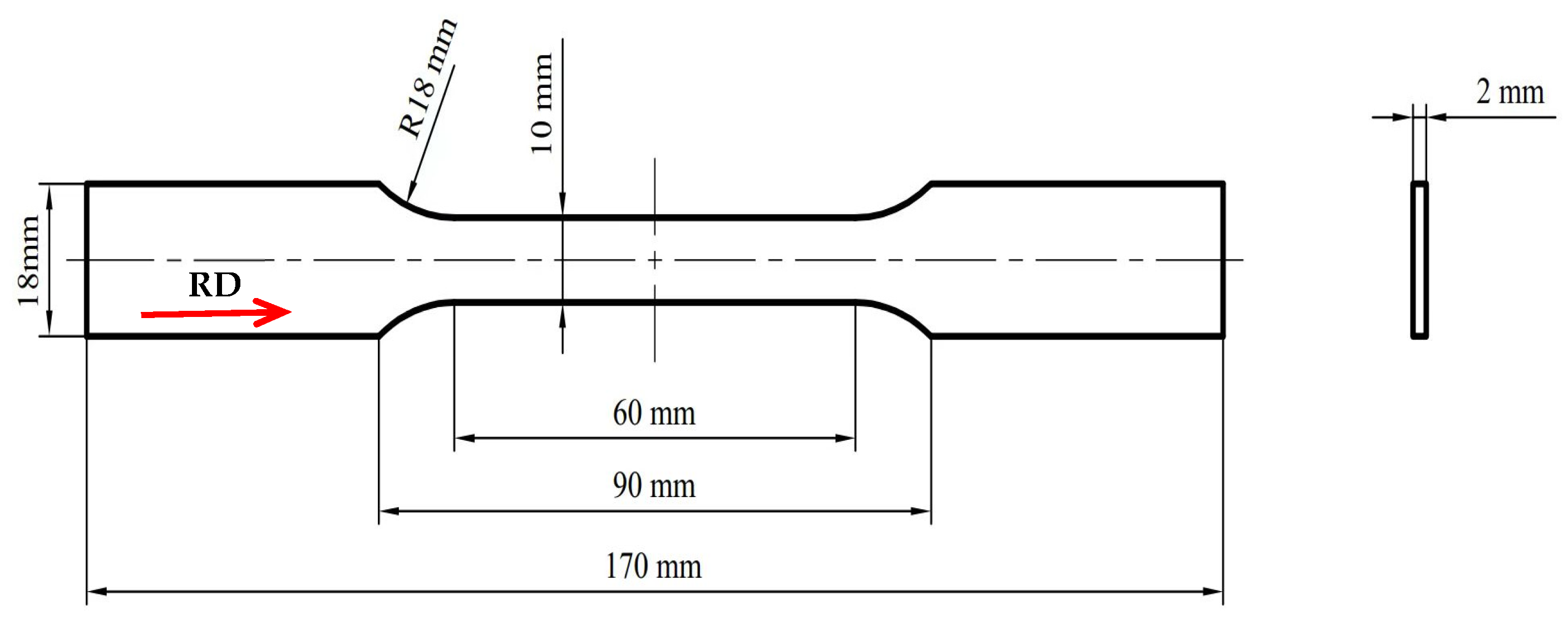
To evaluate the mechanical properties of the specimens, tensile specimens were prepared in accordance with GB/T 228.1-2021 Metallic Materials—Tensile Test—Part 1: Room Temperature Test Method [24]. The specimens were cut from the central region of the composite sheet, with the testing direction along the longitudinal direction of the multi-layer sheet. The specimen thickness (2 mm) included all layers. The dimensions of the specimens were illustrated in Figure 2. The mechanical property tests were conducted using a Zwick BT1 universal tensile testing machine (ZwickRoell, Ulm, Germany) at 25 °C, with a constant crosshead speed (tensile rate) of 2 mm/min and a maximum load of 20 kN. The gauge length was set to 50 mm. To ensure the reliability and accuracy of the test results, three specimens were tested for each group, and the average values were calculated.
Ultimately, the samples were processed to fabricate metallographic specimens. First, the specimens were successively polished using various grades of sandpaper, followed by a fine-polishing step with 0.3 µm diamond polish. Subsequently, the specimens were etched with Keller’s reagent to reveal the microstructural features. For the brazed samples, additional treatments of electropolishing were carried out.
The micro-structures, morphological characteristics, composition and the diffusion behavior of elements of the samples were analyzed via a ZEISS Axio vert OM and ZEISS EVO18 SEM (equipped with an EDS) in Carl Zeiss Microscopy GmbH (Jena, Germany).
After mechanical polishing, the samples were electrolytically polished in a solution consisting of 10 vol% HClO4 and 90 vol% C2H5OH at 12 V for 90 S. Subsequently, EBSD analysis was performed using a Sigma 360 SEM equipment (with an Oxford Xplore 30 EBSD detector) in Carl Zeiss Microscopy GmbH (Jena, Germany) to obtain the grain evolution of the materials. The EBSD data were acquired with a step size of 0.3 μm, a grain boundary misorientation threshold of 15°, 3 representative EBSD maps and more than 1000 grains. For TEM analysis, the samples were prepared by focused ion beam (FIB) using a TOF-SIMS dual-beam system (Thermo Fisher Scientific Inc., Waltham, MA, USA). Subsequently, the microstructure, lattice stripes, and diffraction spots of the samples were observed with a JEMF 200 HR-TEM (JEOL Ltd., Tokyo, Japan).

3. Results and Discussion

3.1. Microstructural Analysis

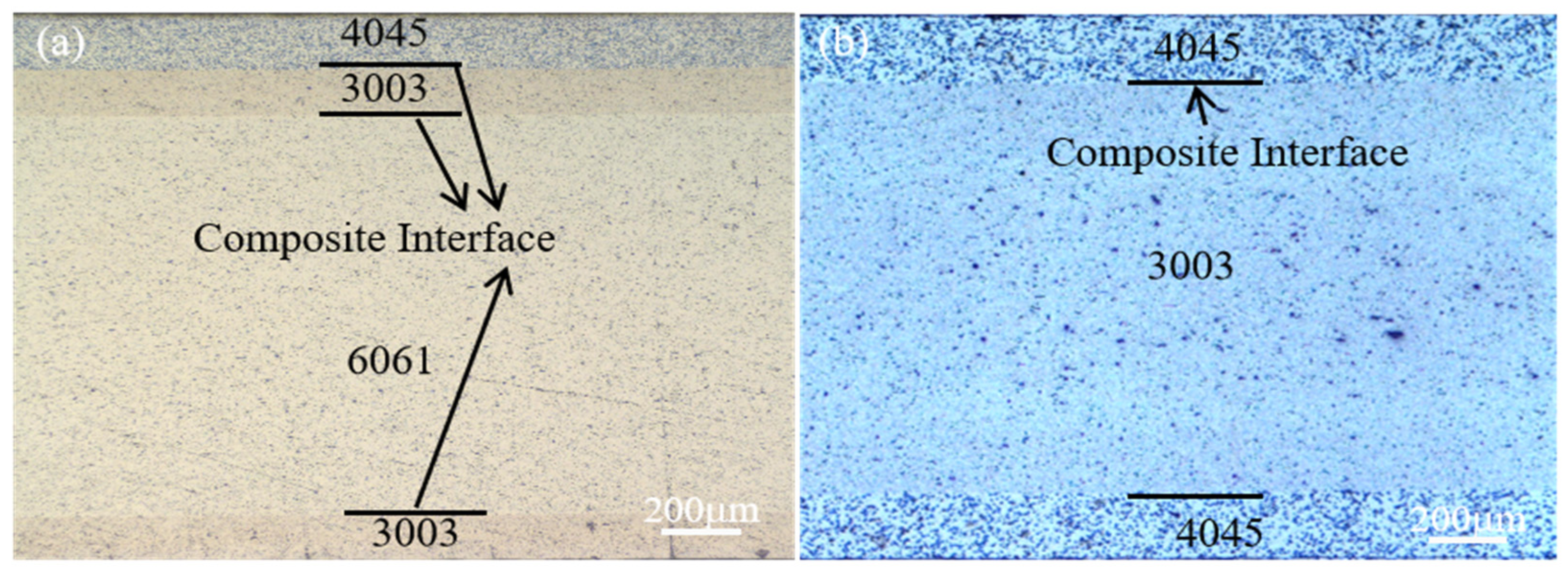
Figure 3 shows the metallographic microstructure images of the samples before brazing. It can be seen that the interface between the two composite layers is clear and straight, with no defects such as pores or inclusions observed. This phenomenon indicates that during the roll bonding process, the alloy layers achieved uniform deformation, and the gas between the interlayers was effectively exhausted. For multi-layer composite materials, the roll bonding technology is crucial. Due to differences in deformation degree, recrystallization temperature, and other aspects among different aluminum alloys, the characteristics of each alloy must be fully considered to achieve a firm bond between the different alloys. The tight and robust bonding between the aluminum alloy layers is mainly attributed to the mutual diffusion of alloying elements across the layers during the rolling process [25,26].
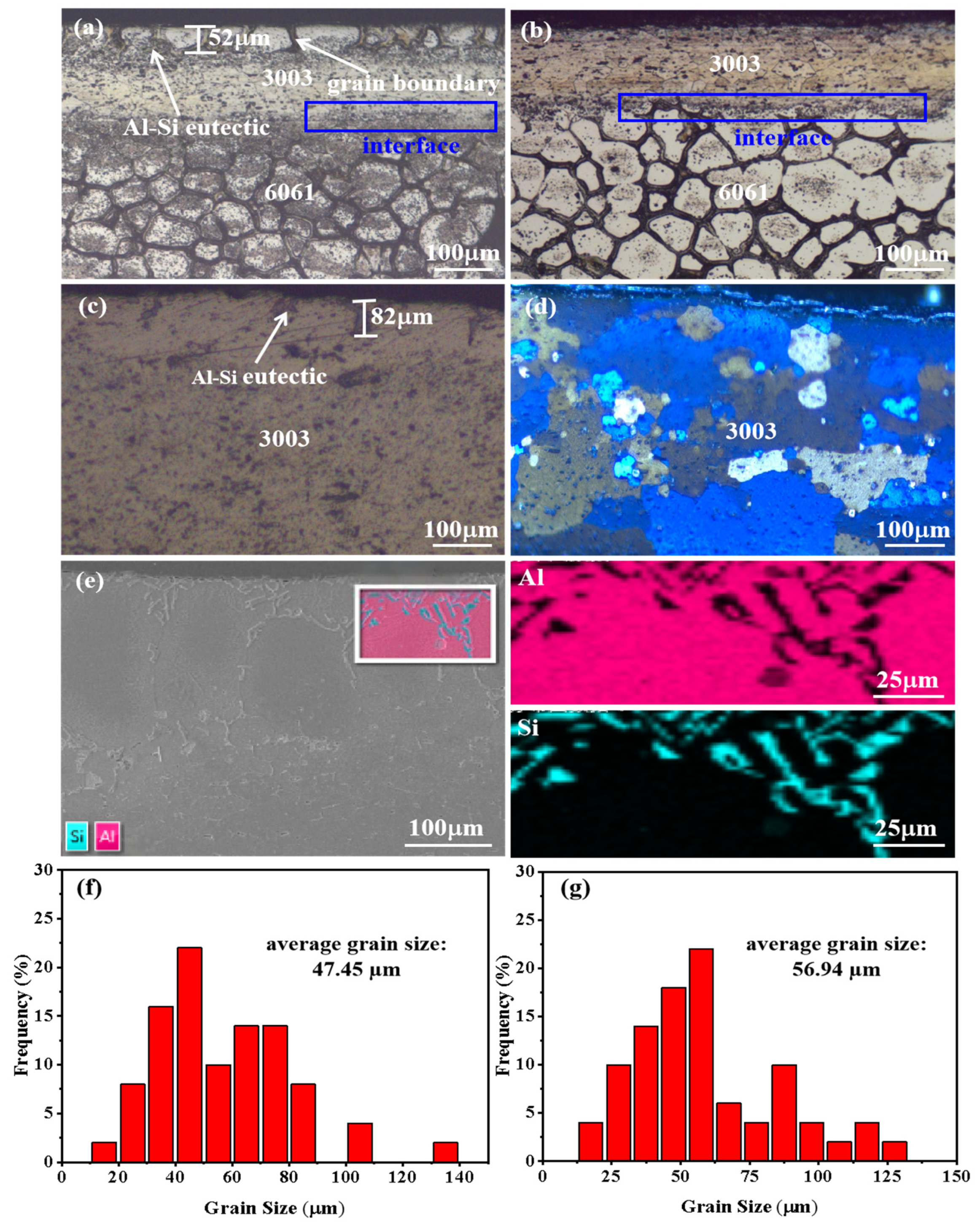
To further investigate the microstructure and grain size of the composite sheet after brazing, the OM and SEM analyses were conducted, as shown in Figure 4. The experimental results indicate that after brazing treatment, the interfaces of the two types of aluminum alloy composite sheet no longer maintain a linear morphology (Figure 4a,c), which reveals a more significant mutual diffusion of elements between different alloy layers at the interfaces (Figure 4b). In addition, the 4045 alloy was completely melted after brazing, and the molten liquid penetrated into the 3003 layer along the grain boundaries of the 3003 aluminum alloy, existing as an Al-Si eutectic [27]. The measured penetration depth of the molten 4045 layer in the four-layer aluminum alloy composite sheet is 52 µm (Figure 4a), while that of the three-layer aluminum alloy composite sheet is 82 µm (Figure 4c). Figure 4e confirms the presence of Al-Si eutectic at the grain boundaries of the 3003 aluminum alloy in the composite sheet after brazing via SEM and EDS.
In addition, the core alloy grains of both materials were transformed into equiaxed recrystallization grains after brazing (Figure 4b,d). This is mainly attributed to the fact that the brazing temperature is significantly higher than the recrystallization temperatures of 6061 (≈300–355 °C) and 3003 (≈280–330 °C) aluminum alloys, triggering the thermal activation effect of the core grains and promoting the growth of small grains into large ones through grain boundary migration—a fundamental mechanism of grain growth [28]. Their grain sizes were statistically analyzed: the average grain size of the 6061 aluminum alloy core layer is 47.45 µm (Figure 4f), while that of the 3003 aluminum alloy core layer is 56.94 µm (Figure 4g). Notably, the grain size of the 6061 core alloy is smaller than that of 3003. On the one hand, the combined effect of high-temperature brazing and heat preservation induces static recrystallization in the core layer. After the completion of recrystallization, the newly formed equiaxed grains continue to grow, as the thermal energy is sufficient to overcome the resistance to grain boundary migration [29].
On the other hand, differences in alloy composition also affect grain growth. During high-temperature brazing, the residual Mg2Si in the 6061 aluminum alloy can still pin grain boundaries and inhibit grain growth [26]. In contrast, the Al6Mn precipitates in the 3003 aluminum alloy exhibit poor stability and are unable to effectively inhibit grain boundary migration. In addition, the Al-Mn precipitates are dissolved at 595 °C, which leads to the decrease in the grain boundary pinning force and promotes the grain growth [15]. Thus, grain growth is more pronounced in the 3003 alloy compared to the 6061 alloy [30].
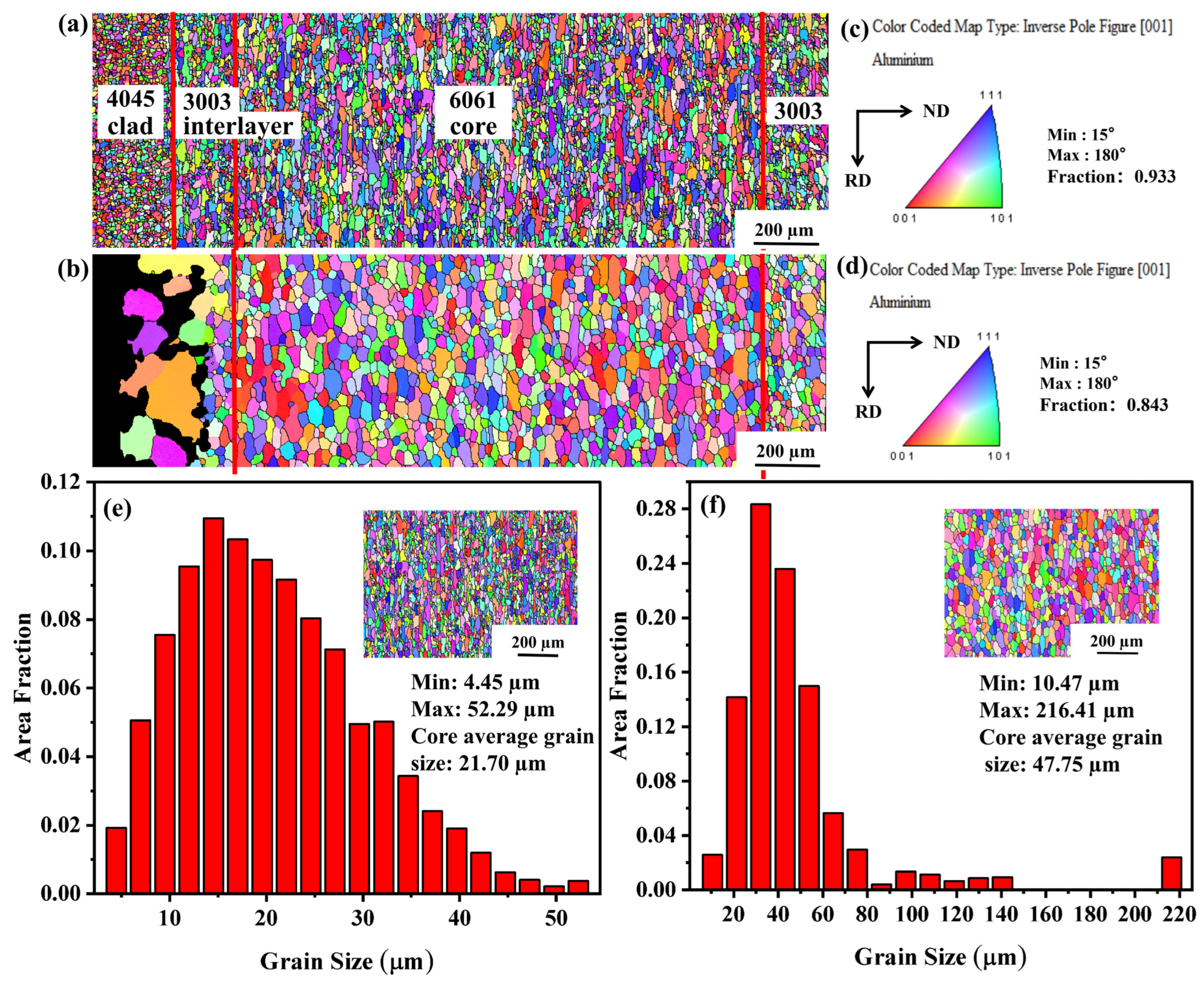
To further analyze the microstructure and grain size of the 4045/3003/6061/3003 composite sheet, EBSD tests were performed on the samples before and after brazing, as shown in Figure 5. It shows the grain size distribution and inverse pole Figure (IPF) of the before and brazing samples (Figure 5a–d). The EBSD microstructures of the 4045/3003/6061/3003 pre-brazing sample were observed, showing distinct layer boundaries (consistent with Figure 3), with elongated grains in a rolled state (Figure 5a). As shown in Figure 5b, the grains were enlarged in both the interlayer and core layers, with some grains exhibiting equiaxed morphology after brazing, indicating recrystallization. 4045 coating melted and diffused along the grain boundaries of the 3003 aluminum alloy interlayer. The grain at the interface differed from both sides due to the mutual diffusion of elements during brazing, consistent with the results shown in Figure 4. Figure 5e shows the grain size distribution of the core layer for 4045/3003/6061/3003 sample before brazing, indicating the average grain size of the 6061 core layer is 21.70 μm. Comparatively, the average grain size of the core layer after brazing is 47.75 μm (Figure 5f), consistent with the test results shown in Figure 4f, this is because the diffusion energy is provided during high temperature brazing, which accelerates the diffusion rate and makes the grain grow [31]. Notably, larger grains can reduce the melting and diffusion of Si element along the grain boundary, which is conducive to improving the mechanical properties of the material.
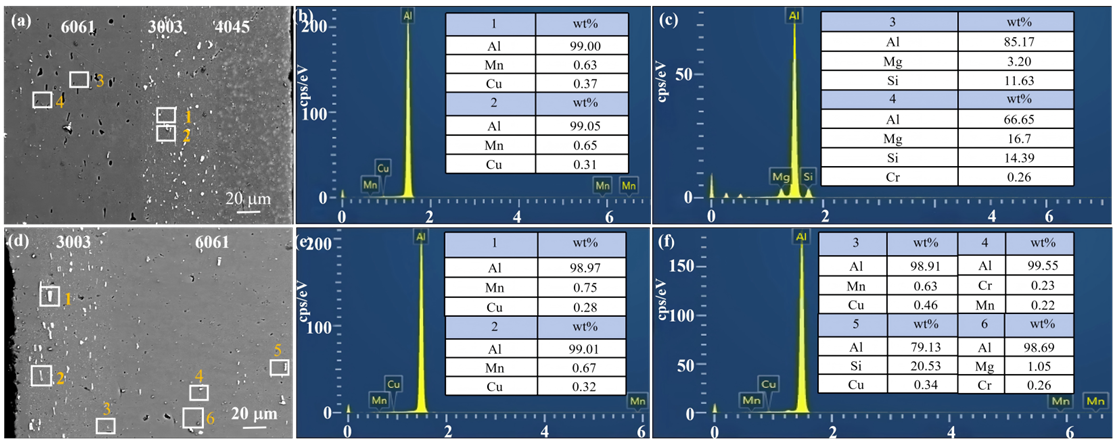
To further investigate the phase distribution characteristics of each layer in the 4045/3003/6061/3003 aluminum alloy composite sheet, SEM and EDS were employed to observe the microstructure of the composite sheet before and after brazing, with characterization performed via EDS analysis, as shown in Figure 6. It can be observed that the SEM and metallographic microstructure characteristics of the 4045/3003/6061/3003 four-layer aluminum alloy composite sheet are consistent before and after brazing. Prior to brazing, the interfaces between each layer of the composite sheet are distinct, as shown in Figure 6a. The 4045 aluminum alloy layer melts after brazing, resulting in the disappearance of distinct interface boundaries of the interfaces between the layers (Figure 6d). This phenomenon can be attributed to the melting of the 4045 aluminum alloy during high-temperature brazing, which corroded the grain boundaries of the intermediate 3003 aluminum alloy layer—consistent with the results presented in Figure 4a. Additionally, the gray regions represent the aluminum matrix, on which irregularly shaped second-phase particles with varying silicon contents are distributed [32].
Furthermore, significant changes in the phase distribution and composition of the composite sheet occurred before and after brazing. In the sandwich structure of the 3003 aluminum alloy, the content of the Al(Mn, Cu) phase is slightly higher prior to brazing than after (Figure 6b,e). In contrast, the phase change in the 6061 aluminum alloy is more pronounced. This phenomenon is attributed to the mutual diffusion of different elements in the composite sheet after brazing, leading to changes in phases or elemental compositions near the interfaces. Before brazing, the O-state of the 6061 aluminum alloy core layer was equivalent to low-temperature solution treatment. The small black and white spherical particles are Mg2Si phases, characterized by low silicon content and high quantity (Figure 6c,f). These observations are highly consistent with previous studies [33]. The 6061 aluminum alloy is a heat-treatable, strengthenable alloy. The brazing process equates to high-temperature solution treatment for it. At this temperature, most Mg2Si phases redissolve into the matrix except for coarse particles, making their distribution difficult to detect [34]. However, a significant amount of Al(Mn, Cr)Si second-phase is still detectable on the Al matrix surface. This is mainly due to the low solubility of these elements in the Al matrix and the difficulty of the second-phase redissolving during solution treatment.
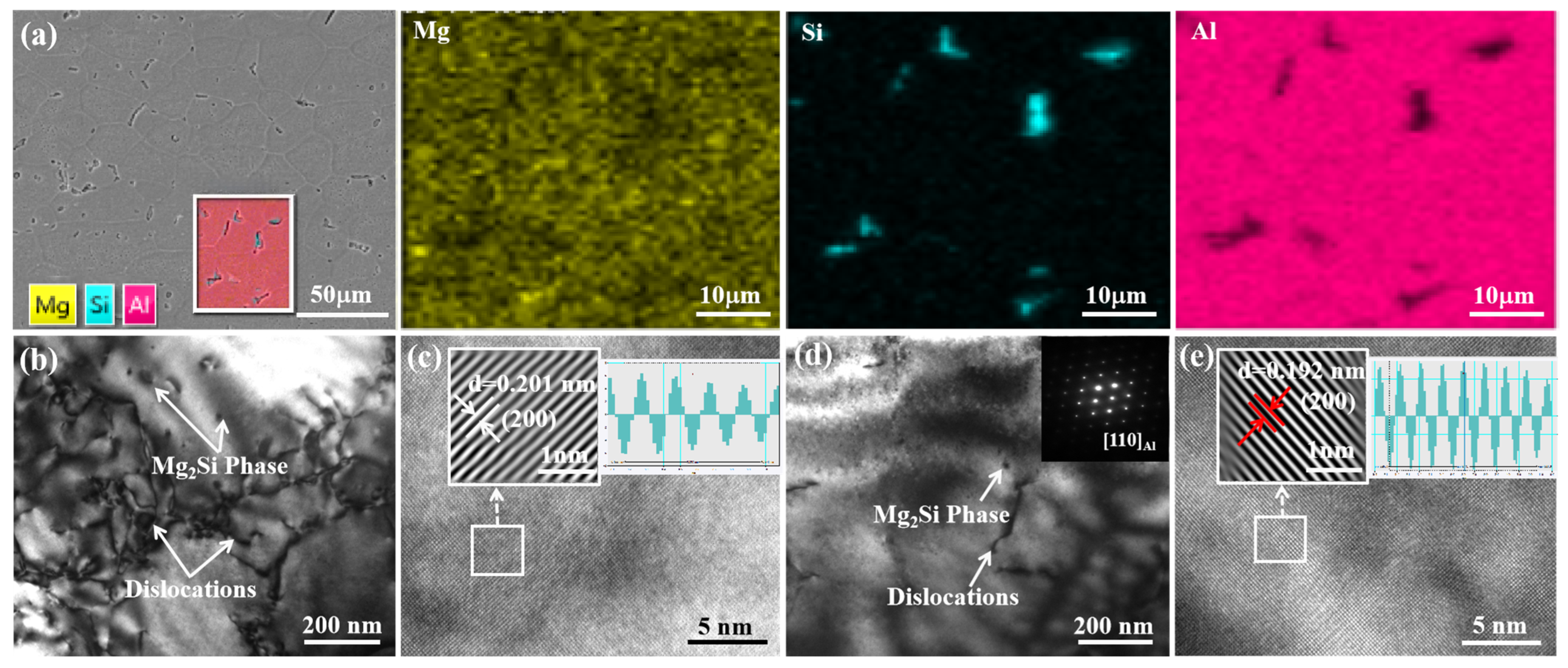
Moreover, to further verify the microstructure of 6061 aluminum alloy core layer after brazing, TEM images are shown in Figure 7, from which it can be observed that the enrichment of Mg and Si elements leads to the formation of Mg2Si second-phase particles (Figure 7a). Further magnification reveals that these particles are nanoscale acicular or block-like, with numerous dislocations distributed around them (Figure 7b,d). As a typical heat-treatable, strengthenable alloy, the improvement in mechanical properties of 6061 Al alloy mainly relies on the precipitation of Mg2Si phases during solution treatment. HRTEM and fast Fourier transform (FFT) analyses of distinct regions, as shown in Figure 7c,e, indicate an interplanar spacing of approximately 0.2 nm, corresponding to the (200) crystal plane of the Al matrix. Almost all Mg2Si phases dissolve completely during high-temperature solution treatment, laying the foundation for the precipitation of fine and uniform Mg2Si strengthening phases in subsequent aging. Furthermore, combined with Figure 6d–f, the mutual diffusion of elements at the interfaces forms Al-Cu, Al (Mn, Cr) Si, and Mg2Si phases can significantly enhance the overall strength of the 4045/3003/6061/3003 aluminum alloy composite sheet after brazing [23].

3.2. Diffusion of Elements in Composite Sheet Before and After Brazing

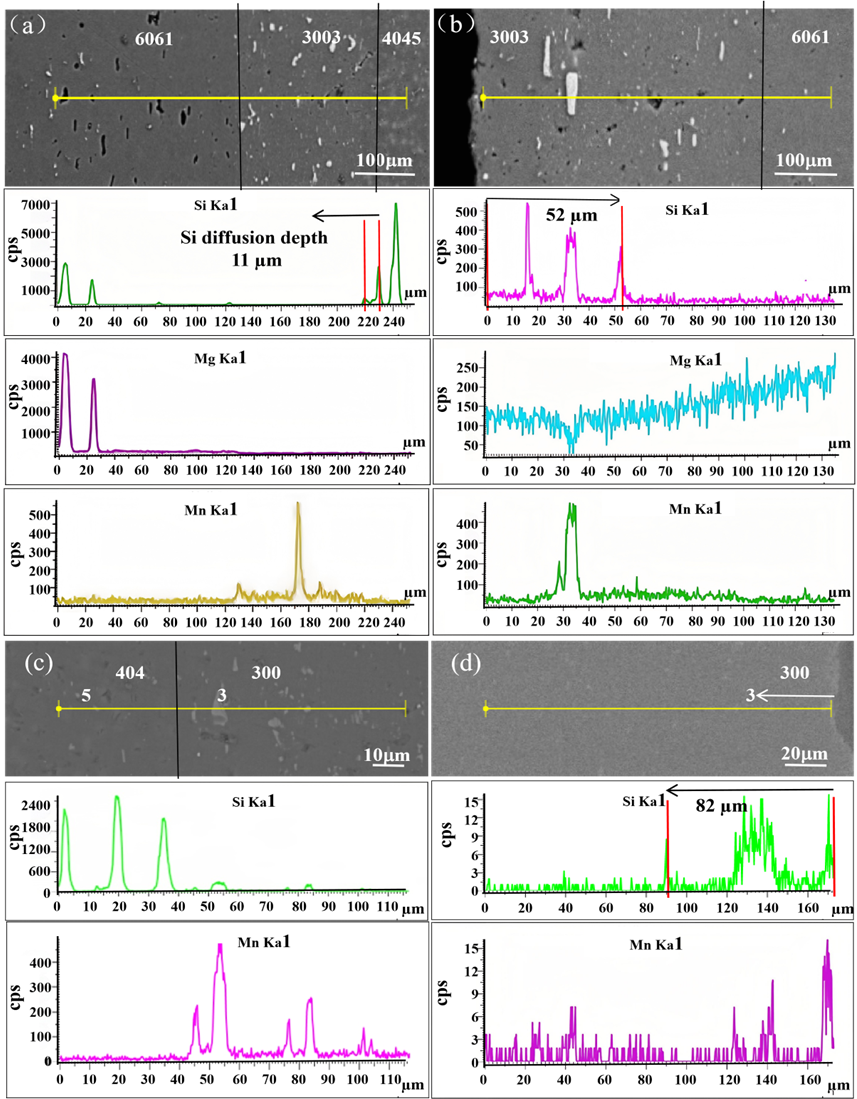
Figure 8 presents the SEM and EDS line scan images of the aluminum alloy composite sheets before and after brazing. It is found that the diffusion of Si, Mn, and Mg elements is significantly more pronounced after brazing than before. For the 4045/3003/6061/3003 composite sheet, the diffusion depth of Si reaches approximately 52 µm after brazing (compared to 11 µm before brazing). Notably, Si does not penetrate the 3003 layer to enter the 6061 aluminum alloy core. This finding is consistent with the test results shown in Figure 4a. Obviously, the 3003 aluminum alloy layer acts as a barrier, effectively preventing Si from infiltrating the 6061 aluminum alloy core, which exerts a positive effect on improving the mechanical properties of the four-layer aluminum alloy composite sheet [33]. After brazing, both Mg and Si in the 6061 aluminum alloy layer diffuse to the adjacent 3003 layers (Figure 8b), and the corresponding peak phenomenon of these two elements observed before brazing (Figure 8a) disappears, indicating the partial decomposition of the strengthening phase Mg2Si [35]. This observation also confirms that the brazing process is equivalent to a solution treatment [23]. However, for the 4045/3003/4045 three-layer aluminum alloy composite sheet, the diffusion of Si and Mn elements in the alloy is not obvious before brazing. After brazing, the diffusion depth of Si is about 82 µm, which is consistent with the test results in Figure 4c. Clearly, the Si diffusion degree of the four-layer composite sheet is lower, which is conducive to enhancing the mechanical properties of the composite sheet after brazing [21].

3.3. Mechanical Property

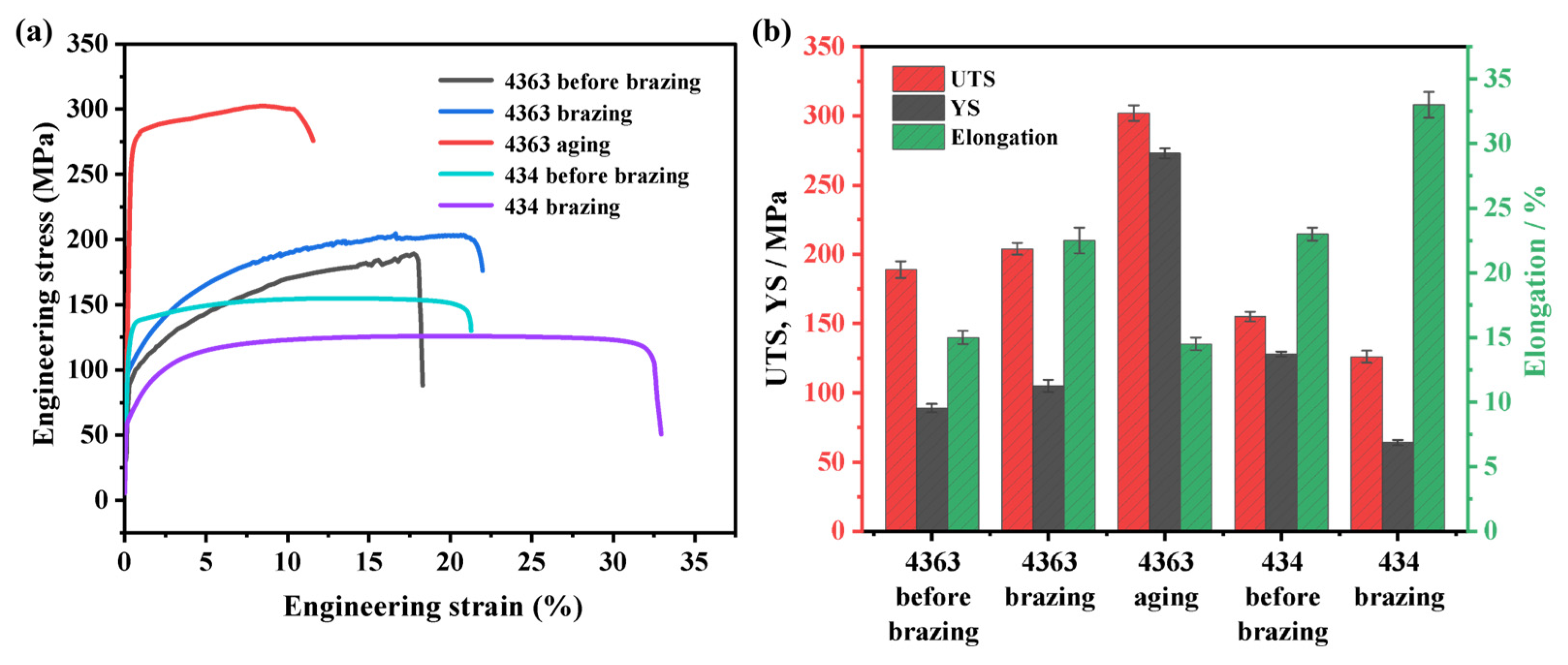
The tensile properties are shown in Table 2 and Figure 9. Analysis indicates that the mechanical properties of the 4045/3003/4045 three-layer composite sheet are significantly inferior to those of the 4045/3003/6061/3003 composite sheet. Specifically, the brazed ultimate tensile strength (UTS) of the three-layer composite sheet decreases from 155 MPa to 126 MPa, and the yield strength (YS) drops from 128 MPa to 64 MPa, representing a reduction of 18.7% and 50%, respectively. In contrast, the mechanical properties of the 4045/3003/6061/3003 aluminum alloy composite sheet undergo significant changes before and after brazing, with particularly prominent improvements in strength. After brazing, the UTS of the composite sheet increases from 189 MPa to 204 MPa, and the YS rises from 89 MPa to 105 MPa. Compared with 4045/3003/4045 three-layer composite sheet is improved by 61.9% and 64.1%, respectively. Following artificial aging treatment at 175 °C for 12 h, the UTS is remarkably enhanced from 189 MPa to 302 MPa, and the YS jumps from 89 MPa to 273 MPa. Compared with 4045/3003/4045 three-layer composite sheet after brazing state, the UTS and YS of the composite sheet are improved by 139.7% and 326.6% respectively. The remarkable improvement in mechanical properties of the 4045/3003/6061/3003 aluminum alloy composite sheet after brazing and aging is mainly attributed to three key factors. On one hand, the 6061 aluminum alloy core layer forms fine recrystallized grains after brazing, and the intermediate 3003 aluminum alloy layers effectively inhibit the diffusion of Si and Mg elements [36]. On the other hand, the 6061 aluminum alloy core is a heat-treatable, strengthenable alloy, and the brazing process is equivalent to a solution treatment, facilitating the formation of a large number of Mg2Si strengthening phases [35]. Furthermore, a certain density of dislocations is retained after brazing [37]. Collectively, these factors contribute to the excellent mechanical properties of the brazed 4045/3003/6061/3003 aluminum alloy composite sheet.
Moreover, the smooth and uniform stress–strain curves observed in Figure 9 are attributed to the excellent interfacial bonding and coordinated plastic deformation between the 6061 and 3003 alloy layers, which suppresses discontinuous yielding. Therefore, the multilayer composite exhibits a continuous and stable tensile response without obvious inflection points.
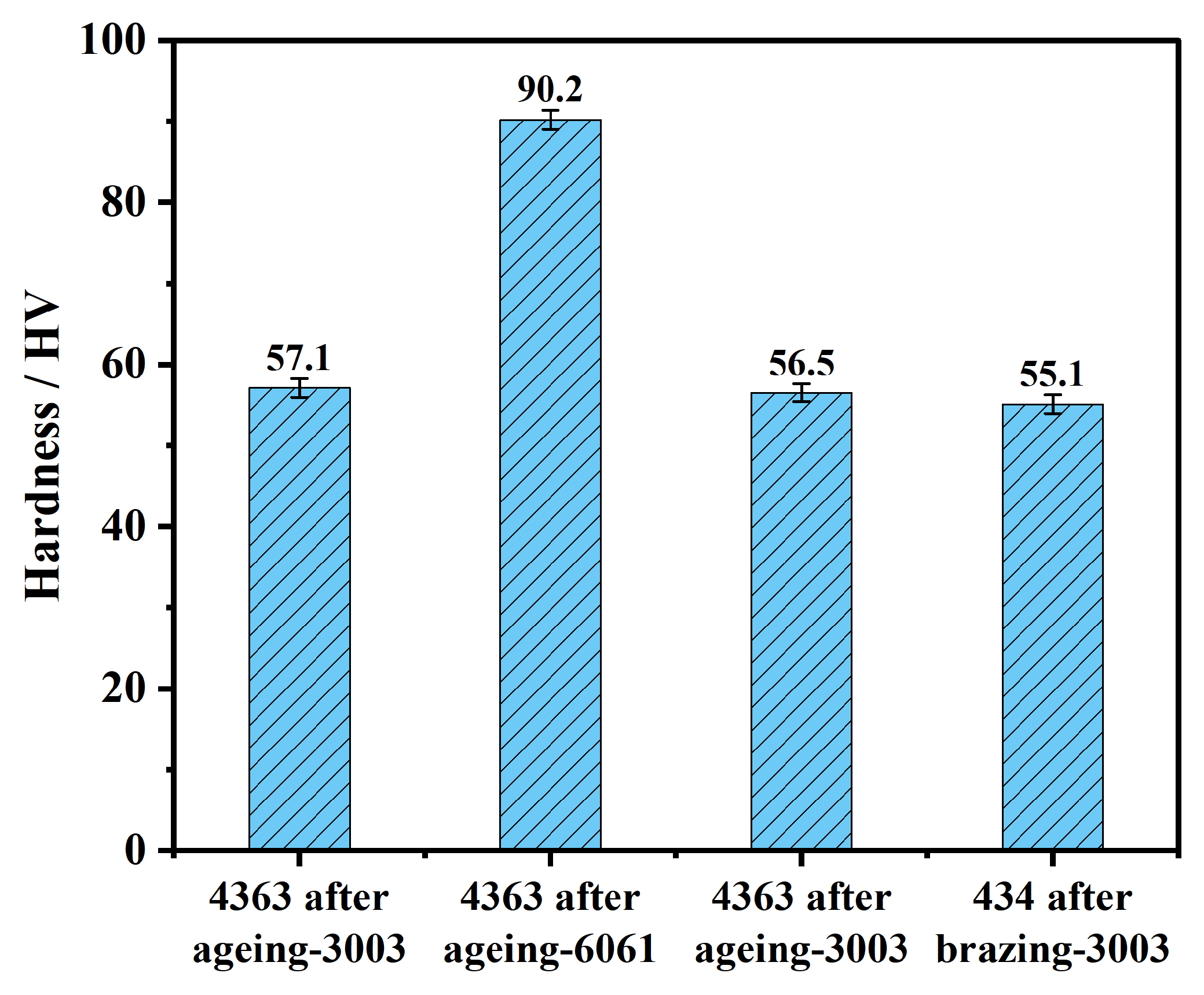
In addition, in order to further study the mechanical properties of the four-layer composite sheet after aging and the three-layer composite sheet after brazing (final state), the hardness test was carried out. The hardness of the two composite sheets is shown in Figure 10. It can be observed that the four-layer composite sheet exhibits significantly higher hardness compared to the three-layer sheet. This difference arises because the three-layer composite sheet softens after brazing and cannot undergo heat treatment for strengthening, whereas the four-layer composite sheet undergoes aging, resulting in the precipitation of uniformly distributed Mg2Si phases, which enhances hardness of the material through strengthening effects. This result is consistent with their tensile properties.

4. Conclusions

In this study, we investigated the 4045/3003/6061/3003 four-layer aluminum alloy composite sheet. The key findings are:
(1)
The composite sheet after brazing exhibits a distinct and straight interface with significant element diffusion. The 4045 brazing layer fully melts, and silicon diffuses into the 3003 layer, with a diffusion depth of 52 μm in the four-layer sheet.
(2)
The core layer alloy grains transform into fine equiaxed grains post-brazing, with the four-layer sheet showing smaller average grain size compared to the three-layer sheet.
(3)
The four-layer sheet shows measurable mechanical property improvements after brazing, with an ultimate tensile strength of 204 MPa and a yield strength of 105 MPa. These values are increased by 61.9% and 64.1%, respectively, relative to the three-layer sheet. After artificial aging, the four-layer sheet achieves an ultimate tensile strength of 302 MPa and a yield strength of 273 MPa, corresponding to increases of 139.7% and 326.6% compared with the brazed three-layer sheet. The heat-treatable characteristic of the core 6061 layer serves as a key attribute of the four-layer sheet, which contributes substantially to the enhancement of its mechanical properties. These performance features endow the four-layer sheet with favorable application potential for the transportation field, where enhanced strength and durability are key requirements.

Author Contributions

Conceptualization, Y.L., Z.Z. and Y.B.; data curation, Y.L.; formal analysis, Y.L., Z.M. and X.Y.; investigation, Y.L. and Y.C.; methodology, Y.L., Y.C. and X.Y.; project administration, Z.M.; writing—original draft, Y.L.; writing—review and editing, Z.Z., Y.B. and X.Y. All authors have read and agreed to the published version of the manuscript.

Funding

This work was supported by the Project for Enhancing the Basic Research Capability of Young and Middle-aged Teachers in Guangxi Universities (No. 2025KY0741, 2024KY0693), the Science and Technology Plan Project of Wuzhou City (No. 202402025) and Research on the Construction Plan of National Demonstration Zone for the Transfer and Transformation of Scientific and Technological Achievements in Guangxi (ZL22064009).

Institutional Review Board Statement

Not applicable.

Informed Consent Statement

Not applicable.

Data Availability Statement

The original contributions presented in this study are included in the article. Further inquiries can be directed to the corresponding authors.

Conflicts of Interest

Author Zhuoqiang Mo was employed by the company ALG Aluminum Inc. The remaining authors declare that the research was conducted in the absence of any commercial or financial relationships that could be construed as a potential conflict of interest.

References

  1. Sommer, A.K.; Türpe, M.; Füssel, U.; Grünenwald, B. Considerations on a new brazing concept for vacuum brazing of aluminium and copper. Weld. World 2020, 64, 1589–1596. [Google Scholar] [CrossRef]
  2. Wang, X.; Zhang, Y.; Jiang, B.; Liu, T.; Gao, Y.; Li, W. Microstructure and mechanical properties synergistically enhanced via heat treatment modification of the as-extruded Mg-1.5Al-0.5Zn-0.2Y-0.2Ca alloy. J. Mater. Sci. 2024, 59, 16721–16734. [Google Scholar] [CrossRef]
  3. Yuan, Z.; Tu, Y.; Yuan, T.; Huang, Y.; Zhang, Y. Gradient multilayer aluminium sheets used in automotive heat exchangers. J. Mater. Sci. 2021, 56, 5215–5232. [Google Scholar] [CrossRef]
  4. Li, P.; Yan, Z.; Yang, Y. Progress in automobile body processing technology: Multi-material and lightweight strategies for saving energy and reducing emissions. J. Braz. Soc. Mech. Sci. Eng. 2024, 46, 324. [Google Scholar] [CrossRef]
  5. Sahib, M.M.; Kovács, G. Elaboration of amulti-objective optimization method for high-Speed train floors using composite sandwich structures. Appl. Sci. 2023, 13, 3876. [Google Scholar] [CrossRef]
  6. Hudson, C.W.; Carruthers, J.J.; Robinson, A.M. Multiple objective optimisation of composite sandwich structures for rail vehicle floor panels. Compos. Struct. 2010, 92, 2077–2082. [Google Scholar] [CrossRef]
  7. Rajkumar, S. Strength and stiffness characteristics of A3003 aluminum honeycomb core sandwich panels. Mater. Today Proc. 2021, 37, 1140–1145. [Google Scholar] [CrossRef]
  8. Shen, Y.; Li, Y.; Li, X.; Hou, S.; Pei, Y.; Zhong, S.; Long, W. Fabrication of aluminum alloy honeycomb panels by vacuum brazing and heat treatment strengthening technology. Weld. World 2023, 67, 447–454. [Google Scholar] [CrossRef]
  9. Shin, J.; Kim, K.; Ko, S. Effects of Ti addition into core alloy on forming and brazing characteristics of 4343/3003/4343 aluminum alloy clad sheets. Mater. Trans. 2013, 54, 2131–2138. [Google Scholar] [CrossRef][Green Version]
  10. Niu, Z.; Huang, J.; Liu, K.; Xu, F.; Chen, S.; Zhao, X. Brazing of 6061 aluminum alloy with the novel Al-Si-Ge-Zn filler metal. Mater. Lett. 2016, 179, 47–51. [Google Scholar] [CrossRef]
  11. Yang, X.; Zheng, R.; Zhou, C.; Cui, H. Effect of rolling process on the microstructure and mechanical mroperties of TC4/6061/AZ31B/6061/TC4 symmetrical clad sheets. J. Mater. Eng. Perform. 2024, 33, 4435–4446. [Google Scholar] [CrossRef]
  12. Wang, Y.P.; Zhang, S.; Li, H.; Erika, H.; Li, Z.X.; Cong, B.Q. Microstructure and mechanical properties of 7075/5356 aluminum alloy laminated composite fabricated by wire arc additive manufacturing. Mater. Lett. 2024, 367, 136638. [Google Scholar] [CrossRef]
  13. Verkens, D.; Revilla, R.I.; Kosari, A.; Günyüz, M.; Işıksaçan, C.; Mol, J.M.C.; De Graeve, I.; Terryn, H. Effect of simulated brazing on the microstructure and corrosion behavior of twin roll cast AA3003. Mater. Corros. 2020, 71, 60–69. [Google Scholar] [CrossRef]
  14. Qian, F.; Jin, S.; Wan, D.; Li, W.; Cheng, X.; Sha, G.; Li, Y. Synergistic effects of Cd, Si and Cr additions on precipitation strengthening and thermal stability of dispersoids in AA3003 alloy. Mater. Sci. Eng. A 2022, 832, 142422. [Google Scholar] [CrossRef]
  15. Long, L.; Pan, Q.; Li, M.; Ye, J.; Sun, Y.; Wang, W.; Luo, Y.; Li, X.; Peng, Z.; Liu, S. Study on microstructure and mechanical properties of 3003 alloys with scandium and copper addition. Vacuum 2020, 173, 109112. [Google Scholar] [CrossRef]
  16. Hu, X.; Gao, K.; Xiong, X.; Ding, Y.; Zhang, X.; Wei, W.; Nie, Z.; Yang, Z.; Zhou, D. The influence of microstructure on corrosion mechanism for brazed sheet of AA4045/AA3003mod/AA4045 laminated composites at different depths. J. Mater. Res. Technol. 2023, 27, 1190–1199. [Google Scholar] [CrossRef]
  17. Samdane, G.; Guo, B.; Cui, H.; Kong, C.; Yu, H. Microstructure, mechanical, and corrosion performance of AA4343/AA3003/AA4343 laminated sheets subjected to cryorolling and annealing. Adv. Eng. Mater. 2024, 26, 2400839. [Google Scholar] [CrossRef]
  18. Kropf, B.; Cvahte, P.; Arzenšek, M.; Kraner, J. Cold Rolling Technology optimization for EN AW 4343/3003/4343 cladded aluminum alloys and influence of parameters on microstructure, mechanical properties and sustainable recyclability. Metals 2024, 14, 230. [Google Scholar] [CrossRef]
  19. Xia, Y.; Zhou, D.; Gao, Z.; Hu, W. Study on the structural transformation of 6xxx composite four-layer aluminum alloy sheet during brazing and artificial aging and its influence on strengthening and corrosion behavior. Corros. Sci. 2024, 229, 111886. [Google Scholar] [CrossRef]
  20. Zhou, D.; Xia, Y.; Gao, Z.; Hu, W. Effect of brazing and artificial aging on the corrosion and strengthening behavior of a quad-layer Al alloy composite. Anti-Corros. Methods Mater. 2024, 71, 340–347. [Google Scholar] [CrossRef]
  21. Xia, C.; Deng, S.; Ni, C.; Ji, Y.; Zheng, W.; Luo, J.; Xu, W.; Li, W.; Pang, Y. Study on laminar structure and process on high strength brazed aluminum alloy for heat exchangers. Vacuum 2023, 215, 112303. [Google Scholar] [CrossRef]
  22. Kang, M.; Zhou, L.; Deng, Y.; Lei, J. Effects of annealing and feformation on sagging resistance of a hot-rolled, Four-layered Al alloy clad sheet. Adv. Mater. Sci. Eng. 2021, 2021, 6625548. [Google Scholar] [CrossRef]
  23. Cao, Q.; Zhao, N.; Xia, C.; Zhang, Z.; Cheng, L.; Zhou, D. Effect of brazing and artificial aging on the microstructure and mechanical properties of a high-strength four-layer laminar aluminum alloy. Vacuum 2025, 239, 114388. [Google Scholar] [CrossRef]
  24. GB/T 228.1-2021; Metallic Materials Tensile Test Part 1: Room Temperature Test Method. China Standards Press: Beijing, China, 2021.
  25. Yu, Z.; Wang, T.; Liu, C.; Ma, Y.; Liu, W. Investigation on microstructure, mechanical properties and fracture mechanism of Mg/Al laminated composites. Mater. Sci. Eng. A 2022, 848, 143410. [Google Scholar] [CrossRef]
  26. Mo, T.; Chen, Z.; Zhou, Z.; Liu, J.; He, W.; Liu, Q. Enhancing of mechanical properties of rolled 1100/7075 Al alloys laminated metal composite by thermomechanical treatments. Mater. Sci. Eng. A 2021, 800, 140313. [Google Scholar] [CrossRef]
  27. Sun, H.Y.; Wang, Z.J.; Du, P.; Zhang, J.X.; Liu, W.C. Effect of rolling reduction and heat treatment on the microstructure and mechanical properties of Al1060/Al6061-0.5SiC/Al1060 laminates. Mater. Sci. Eng. A 2022, 830, 142328. [Google Scholar] [CrossRef]
  28. Kang, M.; Zhou, L.; Deng, Y.; Luo, Y.; He, M.; Zhang, N.; Huang, Z.; Dong, L. Microstructure and mechanical properties of 4343/3003/6111/3003 four-layer Al clad sheets subjected to different conditions. Metals 2022, 12, 777. [Google Scholar] [CrossRef]
  29. Mengfan, Y.; Yixin, D.; Dongyao, J. Simulation study of corrosion under thermal insulation based on focused emission array. In Proceedings of SPIE; SPIE: Washington, DC, USA, 2024; Volume 13159. [Google Scholar] [CrossRef]
  30. Windmann, M.; Röttger, A.; Kügler, H.; Theisen, W. Microstructure and mechanical properties of the heat-affected zone in laser-welded/brazed steel 22MnB5–AA6016 aluminum/AZ31 magnesium alloy. J. Mater. Process. Technol. 2017, 247, 11–18. [Google Scholar] [CrossRef]
  31. Li, Y.Y.; Zhang, W.W.; Fei, J.; Zhang, D.T.; Chen, W.P. Heat treatment of 2024/3003 gradient composite and diffusion behavior of the alloying elements. Mater. Sci. Eng. A 2005, 391, 124–130. [Google Scholar] [CrossRef]
  32. Gao, K.; Liu, G.; Hong, S.-T.; Basak, S. Effect of microstructural changes by friction ftir processing on the clad-to-core interfacial strength of thin aluminum-clad aluminum sheets. Met. Mater. Int. 2025, 31, 821–830. [Google Scholar] [CrossRef]
  33. Jia, J.; Xie, W.; Xu, B.; Chu, Z.; Wang, Q.; Xu, Y. Effect of solution treatment on microstructure, mechanical properties, and strengthening mechanisms of 6061 aluminum alloy. J. Mater. Eng. Perform. 2025, 34, 12920–12934. [Google Scholar] [CrossRef]
  34. Peng, J.; Zhang, J.; Li, Z.; Chen, X.; Cui, L. Grain structure evolution, textures, and mechanical properties of cryogenic-rolled AA6061 under high-temperature short-term annealing. Mater. Today Proc. 2024, 40, 109682. [Google Scholar] [CrossRef]
  35. Moema, J.; Siyasiya, C.; Morudu, V.; Hadebe, N.; Buthelezi, T. An investigation on SWAAT and electrochemical corrosion behaviour of roll-bonded and brazed aluminium alloy—AA4045/AA3003. In MATEC Web of Conferences; EDP Sciences: Les Ulis, France, 2023; Volume 388, p. 03002. [Google Scholar] [CrossRef]
  36. Shi, Q.; Liang, F.; Cheadle, B. Electrochemical behaviors of quad-layer aluminum brazing sheet composite for automotive applications. Corrosion 2004, 60, 492–500. [Google Scholar] [CrossRef]
  37. Han, X.; Shao, B.; Zuo, K.-S.; Jiang, L.; Zhang, H.-T.; He, L.-Z.; Qin, K.; Cui, J.-Z. Microstructure and properties at bonding interface of AA4045/AA3003 aluminum alloy cladding billet prepared by semi-continuous casting. Trans. Nonferrous Met. Soc. China 2016, 26, 658–664. [Google Scholar] [CrossRef]
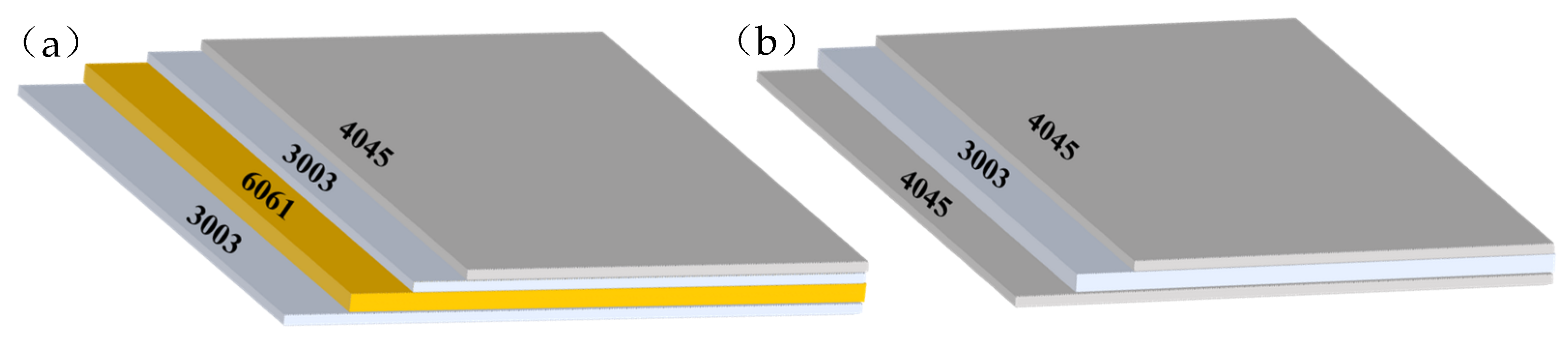
Figure 1. Aluminum composite sheets: (a) 4045/3003/6061/3003; (b) 4045/3003/4045.
Metals 16 00344 g001
Figure 2. Size of tensile specimen.
Metals 16 00344 g002
Figure 3. Metallographic microstructure before brazing of the sample: (a) 4045/3003/6061/3003; (b) 4045/3003/4045.
Metals 16 00344 g003
Figure 4. Microstructure after brazing of aluminum alloy composite sheets: (a) OM image of 4045/3003/6061/3003 and 6061 core layer (b); (c) OM image of 4045/3003/4045 and 3003 core layer (d); (e) SEM image and EDS of 4045/3003/6061/3003; (f) average grain of the 6061 core layer and 3003 core layer (g).
Metals 16 00344 g004
Figure 5. EBSD images, grain size before and after brazing of 4045/3003/6061/3003 aluminum alloy composite sheet: EBSD images of before (a,c) and after brazing (b,d); grain size before (e) and after brazing (f).
Metals 16 00344 g005
Figure 6. SEM and EDS of 4045/3003/6061/3003 aluminum alloy composite sheet before and after brazing: (a,d) SEM; (b,e) EDS of 3003 aluminum alloy; (c,f) EDS of 6061 aluminum alloy.
Metals 16 00344 g006
Figure 7. TEM images of 6061 aluminum alloy core layer after brazing: (a) HAADF and EDS maps; (b,d)TEM images and the diffraction pattern in distinct regions; (c,e) HRTEM image and FFT in distinct regions.
Metals 16 00344 g007
Figure 8. SEM and EDS line scanning images of the aluminum alloy composite sheets before and after brazing: (a,b) 4045/3003/6061/3003; (c,d) 4045/3003/4045.
Metals 16 00344 g008
Figure 9. Tensile property of the aluminum alloy composite sheets: (a) stress–strain curves; (b) UTS, YS and elongation.
Metals 16 00344 g009
Figure 10. Hardness of the three-layer and four-layer composite sheets.
Metals 16 00344 g010
Table 1. Chemical composition of the 6061, 3003 and 4045 aluminum alloy (mass fraction, %).
AlloySiFeMnCuMgCrZnTiZrSrAl
404510.100.230.0270.0150.01--0.035-0.025Bal.
30030.100.251.310.500.008--0.030.13-Bal.
60610.610.210.130.331.080.220.140.060.002-Bal.
30030.100.261.300.510.008--0.030.14-Bal.
Table 2. Mechanical properties of the aluminum alloy composite sheets.
AlloyStateUTS/MPaYS/MPaElongation/%
4045/3003/6061/3003
(4363)
Before brazing189 ± 689 ± 315.0 ± 0.5
After brazing204 ± 4.4105 ± 4.422.5 ± 1
After aging 302 ± 5.6273 ± 3.614.0 ± 0.5
4045/3003/4045
(434)
Before brazing155 ± 3.6128 ± 1.723.0 ± 0.5
After brazing126 ± 4.464 ± 233.0 ± 1
Disclaimer/Publisher’s Note: The statements, opinions and data contained in all publications are solely those of the individual author(s) and contributor(s) and not of MDPI and/or the editor(s). MDPI and/or the editor(s) disclaim responsibility for any injury to people or property resulting from any ideas, methods, instructions or products referred to in the content.