Article

Molecular Dynamics Study on the Effect of Twin Spacing on Mechanical Properties and Deformation Mechanisms of CoCrNi Medium-Entropy Alloys

School of Materials Science and Engineering, Hebei University of Science and Technology, Shijiazhuang 050018, China
*
Author to whom correspondence should be addressed.
Metals 2026, 16(3), 333; https://doi.org/10.3390/met16030333
Submission received: 3 February 2026 / Revised: 6 March 2026 / Accepted: 12 March 2026 / Published: 16 March 2026
(This article belongs to the Section Computation and Simulation on Metals)

Abstract

In this study, the continuous strengthening behavior of CoCrNi medium-entropy alloy at 1.2–4.2 nm twin spacings was revealed by molecular dynamics simulation. It was found that the yield strength increased linearly with the decrease in twin spacing, up to 12.526 GPa, and there was no softening inflection point. The strengthening mechanism is mainly due to the effective obstruction of coherent twin boundaries (TBs) to the dislocation slip, especially the stair-rod and Lomer–Cottrell lock structures generated by ISF and ESF stacking faults when crossing the interface. These structures significantly enhance the work-hardening capacity of the alloy by inducing dislocation stacking, although the very dense twin boundary will reduce the dislocation growth rate by limiting dislocation propagation. This precise interface control provides an important atomic-scale basis for the design of novel high-strength and high-work-hardening alloys.

1. Introduction

In the pursuit of high-performance structural materials, the CrCoNi medium-entropy alloy with low stacking fault energy has attracted worldwide attention due to its high tensile strength [1,2,3,4], fracture toughness [4,5,6,7], wear resistance, and corrosion resistance [8,9,10]. Compared with the traditional single crystal, the introduction of the nano-twin structure has proven to be an effective strategy to break the “strength–plasticity” trade-off relationship of materials [11,12,13]. The excellent mechanical properties of nano-twin metals can be attributed to the unique obstruction and accommodation mechanisms on the TBs for dislocation movement [14]. Therefore, exploring the effects of twin spacing on mechanical behavior and micro-deformation mechanisms in the CoCrNi medium-entropy alloy is of great theoretical significance for the design of high-performance alloys. For example, Lu et al. [15] observed in nano-twin copper that when the twin thickness was less than 15 nm, the strength began to decrease with the decrease in twin thickness. However, recent studies have found that not all metal materials soften at the very fine twin scale. Some experimental and simulation studies have reported the abnormal phenomenon of “continuous strengthening”. Even under very small twin spacing conditions, the material strength continues to increase with the decrease in the spacing, and there is no softening inflection point [16,17,18]. This continuous strengthening phenomenon is particularly interesting in high-entropy or medium-entropy alloys. Research shows that the CoCrNi alloy has very low stacking fault energy (SFE), which makes the interactions between dislocations and TBs more complex than that of pure metal [19,20,21,22,23]. The low stacking fault energy tends to promote the decomposition of dislocations and the formation of stacking faults, thus changing the energy barrier of dislocations passing through the twin boundary. At the micro-mechanism level, the interactions between dislocations and twin boundaries are the key factors to determine the strength of materials [24,25,26,27,28]. However, the current experimental methods are difficult to accurately control the twin spacing at the ultra-fine nanoscale (<5 nm) and eliminate the interference factors such as grain boundaries and compositional segregation, which leads to the lack of systematic atomic-scale interpretation of the strengthening limit of the very fine nano-twin CoCrNi at the limit size and its corresponding dislocation reaction mechanism.
In this study, the molecular dynamics (MD) simulation was used to construct a CoCrNi medium-entropy alloy model with twin spacing ranging from 4.2 nm to 1.2 nm, and the mechanical response and micro-deformation mechanism under uniaxial tensile load were systematically explored. It was found that the CoCrNi alloy exhibits a significant size-dependent continuous strengthening behavior in this nano-size range, and there is no inverse Hall–Petch effect. Through the detailed analysis of dislocation evolution, this study reveals the different behavior of intrinsic stacking fault (ISF) and extrinsic stacking fault (ESF) when crossing the TBs in the tensile process of CoCrNi medium-entropy alloys with different twins, and illustrates the decisive role of the formation of stair-rod dislocation and Lomer–Cottrell lock in inhibiting dislocation movement and maintaining a high work-hardening rate.

2. Research Method

In order to deeply explore the size effect of nano-twin thickness on the mechanical behavior and micro-deformation mechanism of a CoCrNi medium-entropy alloy, an all-atomic scale molecular dynamics simulation model was established. The models were divided into two groups for control experiments: one was the twin-free CoCrNi single crystal as a reference, and the other was the nano-twin model with different spacing TBs. All models are based on the FCC lattice. The model size is uniformly specified as 300 × 300 × 300 Å (approximately 30nm × 30nm × 30 nm). The twin spacings are set to 1.2 nm, 1.8 nm, 3 nm, and 4.2 nm, corresponding to 24, 16, 10, and 8 twins in the model, respectively. The total twin boundary area is approximately 900 nm2. The total number of atoms in the model is 2.7 × 10⁶. Periodic boundary conditions are imposed along the x, y, and z directions, and the TBs are perpendicular to the tensile direction. In order to apply uniaxial tensile load under a specific slip system and accurately capture the interaction between TBs and dislocations, the crystallographic orientation of the model is set as follows: the X axis is in the <112> direction, the Y axis is in the <111> direction, and the Z axis is in the <110> direction. For the benchmark single crystal model, a pseudo-random number generator was used to randomly distribute three atomic types of Co, Cr, and Ni on the preset lattice points, and strictly limit the atomic number ratio of the three elements to 1:1:1, so as to establish an ideal equiatomic solid solution structure with a uniform chemical composition, as shown in Figure 1a. For the nano-twin model with different spacing, the initial cell of pure Ni was built using ATOMSK modeling software (Version 0.13.1). Then, by introducing the mirror symmetry operation along the Y axis (i.e., (111) close-packed plane), the coherent TBs with different twin spacing are constructed through periodic arrangement. As shown in Figure 1b, in order to cover a wide range of sizes, four kinds of twin spacing are designed in this study: 1.2 nm, 1.8 nm, 3 nm, and 4.2 nm, respectively. After completing the construction of the geometric structure, the above random replacement algorithm is also applied to convert the pure Ni lattice into a chemically disordered CoCrNi random solid solution state, so as to eliminate the influence of chemical short-range order and focus on the geometric effect introduced by the twin boundary.
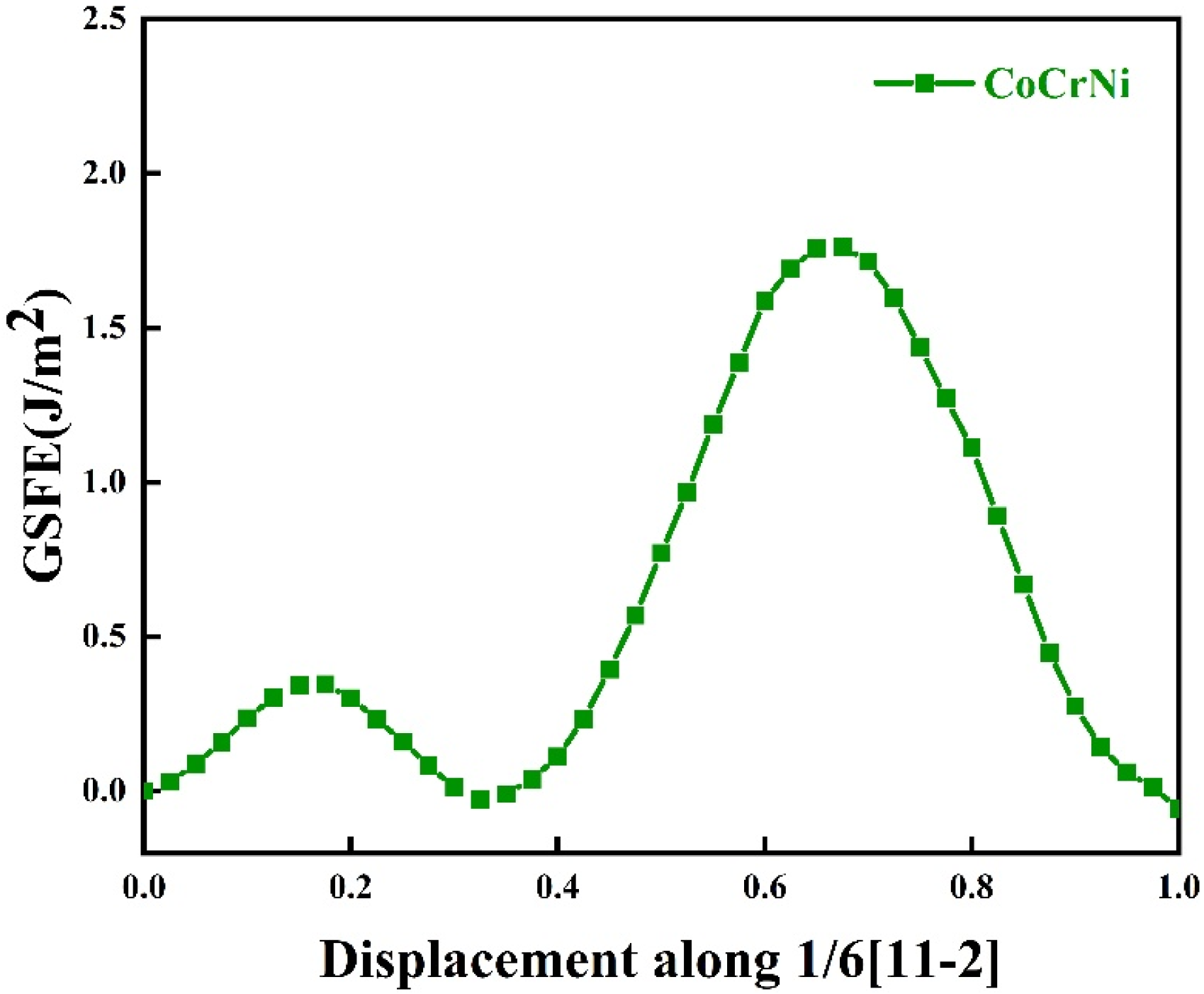
All atomic-scale simulation operations in this study are based on the open-source large-scale atomic/molecular parallel simulator (LAMMPS) [29]. In MD simulation of multicomponent alloys, the selection of potential functions is crucial to the reliability of simulation results. Therefore, the embedded atom method (EAM) potential function developed by Li et al. was selected to describe the interatomic interaction in the Co-Cr-Ni ternary system [30]. This potential function cannot only accurately predict the lattice constants and elastic moduli of the alloy, but has also been widely verified and recognized in research involving dislocation slip and twin deformation. In this work, an equiatomic CoCrNi random solid solution model is established. The crystal is oriented in the <111> direction along the z-axis, and the upper half of the crystal is displaced along the <112> direction with (111) as the slip plane. As shown in Figure 2, the present results are consistent with the trends of the generalized stacking fault energy (GSFE) and twin boundary energy calculated by Li et al. for the CoCrNi disordered solid solution using the EAM potential [30].
Prior to tensile deformation, in order to eliminate the local high-energy configuration and residual internal stress introduced in the process of model construction and atomic replacement, all samples were first fully thermodynamically relaxed under the NPT (isothermal-isobaric) ensemble. During the relaxation process, the temperature was set at 300 K, and the duration was 150 ps. During the relaxation process, the Nose–Hoover thermostat and pressure regulator were used to dynamically control the temperature and pressure of the system, ensuring that the normal stress components in the three orthogonal directions of X, Y, and Z strictly converge to zero, so as to obtain a stable equilibrium configuration. After the structural relaxation, uniaxial tensile loads were applied to all CoCrNi models along the crystallographic <111> direction (i.e., perpendicular to the Y-axis of the twin interface direction) at 300 K. The strain rate used in the simulation is 109 s−1. The time step of the equation of motion is fixed at 1 fs. The microstructure evolution and atomic displacement field during deformation are analyzed using OVITO (3.15.0) visualization software. In order to quantitatively characterize the plastic deformation mechanism, common neighbor analysis (CNA) was used to distinguish FCC matrix atoms, HCP stacking fault atoms, and disordered defect structures. At the same time, combined with the dislocation extraction algorithm (DXA), the density evolution of Shockley incomplete dislocations and total dislocations was quantitatively analyzed to reveal the microscopic mechanisms of dislocation proliferation, pile-up, and interaction with TBs under different twin spacing [31].

3. Results and Discussion

3.1. Effect of Nano-Twin Spacing on Mechanical Properties

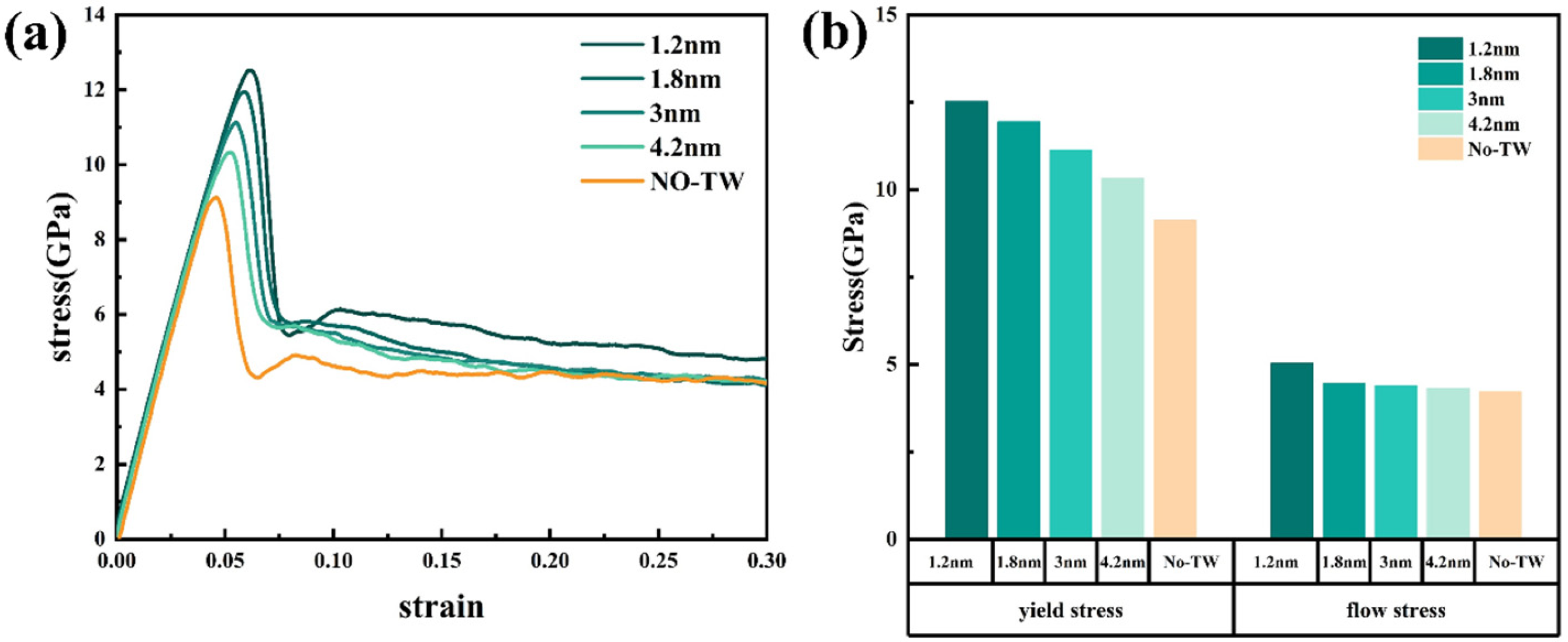
Figure 3a shows the stress–strain curves of CoCrNi nano-twin models and a twin-free (No-TW) single crystal with different twin spacings (1.2 nm, 1.8 nm, 3 nm, 4.2 nm) when stretched along the <111> crystal direction at 300 K. It can be seen from Figure 3 that all samples show almost coincident elastic curves at the elastic strain stage, indicating that TBs with different spacing had a negligible effect on the elastic modulus of the material before yielding. However, as the strain increases to the critical value, each model has an obvious stress peak (i.e., yield point) and then undergoes a sharp stress drop, entering the plastic flow stage.
In terms of yield strength, the introduction of high-density nano TBs has a very significant strengthening effect on the alloy, and this strengthening shows a strong size dependence. The quantitative data show that the twin-free model exhibited the lowest yield strength, which is 9.211 GPa. With the decrease in twin spacing, the peak stress shows an increasing trend: the rss-1.2 nm model with the smallest twin spacing exhibited the highest tensile yield strength, and its peak stress reached as high as 12.526 GPa, which is significantly higher than the rss-4.2 nm model with the largest twin spacing (10.325 GPa). It is worth noting that within the nano-size range selected by this simulation, there is an approximately linear inverse relationship between the peak stress and twin spacing. The calculation shows that the peak yield strength of the alloy increased by an average of ~7.1% for every 1 nm decrease in twin spacing. This result strongly proves that the coherent twin boundary, as an effective interface barrier, can hinder the dislocation movement, thus enhancing the yield strength of the alloy. Meanwhile, this study also discusses in detail the effect of different strain rates on the yield stress. Results show that yield stress is significantly affected by strain rate, while the trend that yield stress increases with decreasing twin spacing remains unchanged. Conversely, the strengthening effect of twin boundaries becomes more pronounced as the strain rate decreases. The quantitative evolution of yield strength at different strain rates (108~1010 s−1), the calculation of the strain rate sensitivity coefficient (m), and the intrinsic mechanism for the attenuation of twin spacing strengthening effect at ultra-high strain rates are elaborated in the Supplementary Materials (Figure S1, Table S1). [32,33,34]
After entering the rheological stage, as shown in Figure 3b, although the overall evolution trend of rheological stress still remained inversely correlated with twin spacing, its sensitivity to microscale size decreased significantly. Although the rss-1.2 nm model still maintains the highest flow stress (5.035 GPa), reflecting the continuous blocking effect of denser twin boundaries on dislocation glide, when the twin spacing exceeds 1.8 nm, the flow stress shows a consistent trend. In the range from 1.8 nm to no twins, the differences in flow stress among the models were negligible, and only fluctuated in a narrow range of 0.15 GPa. The yield strength increases linearly with the decrease in size, which represents the transformation of the plastic deformation mechanism; at the yield point, the initial microstructure (i.e., the preset twin spacing) plays a decisive role. In the rheological stage, with the frequent interaction between dislocation and twin boundary (such as crossing, detwinning, etc.), the original twin structure is destroyed or reorganized, resulting in a reduction in structural differences between different spacing models, which tends to make the rheological stress consistent.
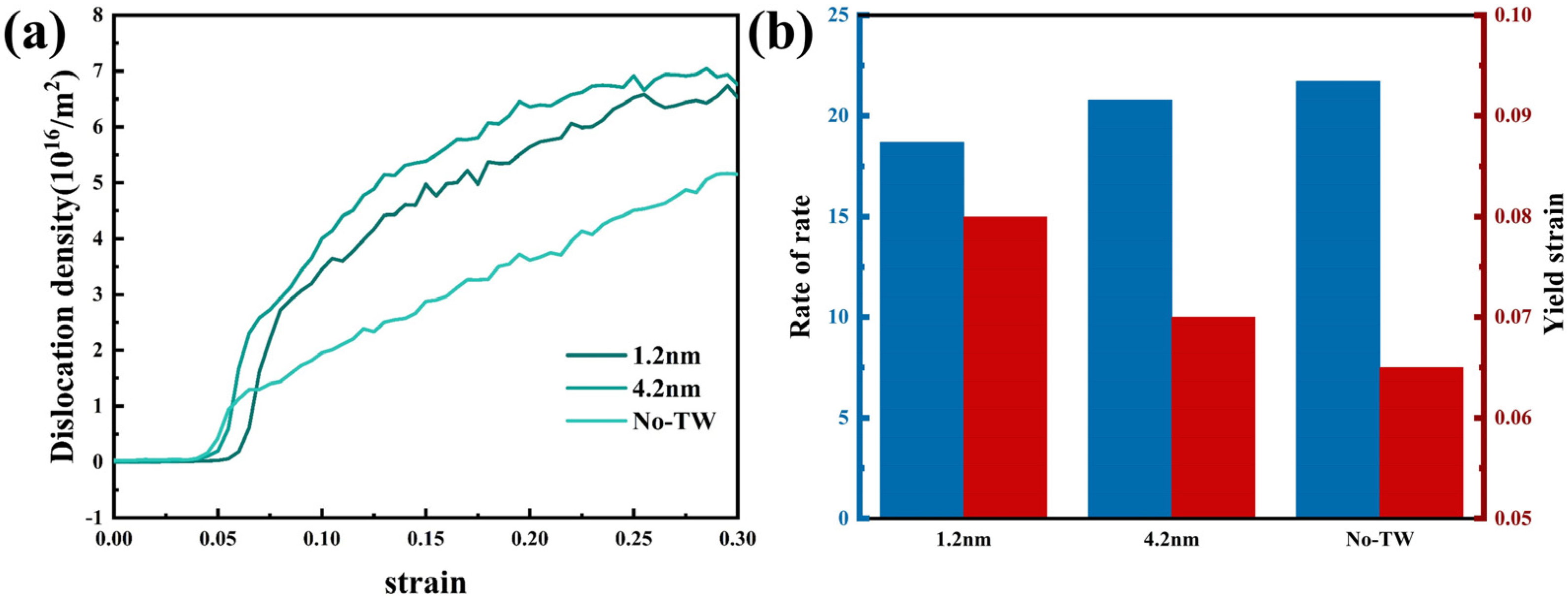
As demonstrated by the internal mechanism of the twin effect on the strength improvement of the CoCrNi alloy in detail, shown in Figure 4a, by comparing the dislocation density versus strain curves of the 1.2 nm and 4.2 nm twin models and the no-twin model, it can be seen that the dislocation density of the twin model is significantly higher than that of the no-twin model after adding the twin boundary, but with the increase in the twin density, it can be seen that the dislocation density of the 1.2 nm twin model is lower than that of the 4.2 nm twin model, because the denser twin boundary hinders the dislocation slip and is pinned, while the wider 4.2 nm twin boundary gives the dislocation line more space, which leads to the increase in dislocation density improve. In the twin-free model, the dislocation density is the lowest because the dislocation line can slip more smoothly without the obstacle of the twin boundary, and dislocation entanglement cannot occur as easily. As shown in Figure 4b, by calculating the dislocation increment rate from the yield strength point to 0.3 strain, it can be seen that the dislocation increment rate of disordered twins is the largest, with a value of 21.715, and the dislocation increment rate of the 1.2 nm twin model is the smallest, with a value of 18.684. At the same time, the yield strain increases with the decrease in twin spacing. The strain increases from 0.065 in the twin-free model to 0.08 in the 1.2 nm twin model.

3.2. Interaction Mechanism Between Stacking Faults and TBs

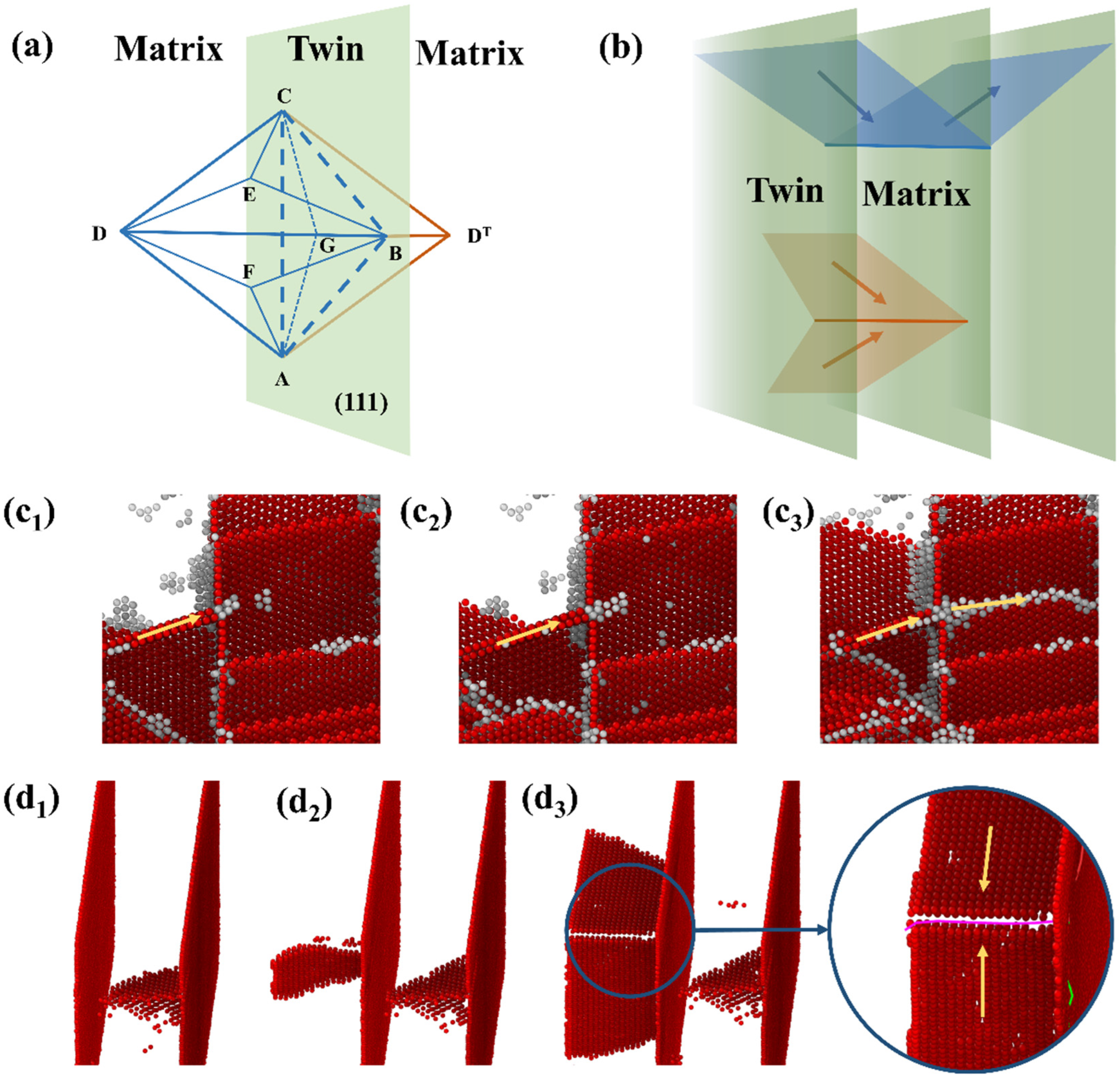
In order to explain the influence of twins on dislocation evolution in detail, a double Thompson tetrahedron model was established. The two tetrahedrons share the (111) close-packed plane (i.e., twin boundary) to explain the dislocation slip principle, as shown in Figure 5a. In most cases, due to the limitation of twin interface and the Burgers vector parallel to the interface, dislocations cannot glide directly across twin boundaries during slip, but slip between two TBs like a taut string and are geometrically constrained by adjacent TBs, as shown in Figure 5b. In the Thompson tetrahedron, these vectors correspond to the edges of the basal plane ABC, such as AB, BC, or CA. The slip surface is the other three surfaces (ACD, ABD, or BCD) inclined to the twin surface ABC in the tetrahedron. When the dislocation slides on the inclined plane and hits the twin boundary, if they cannot penetrate completely, a dissociation reaction occurs, and residual structures are formed at the interface. The dislocation usually slides on the BCD plane. When it reaches the ABC plane (twin boundary), the dislocation line will become parallel to the intersection line (such as BC). At the same time, when two dislocation lines encounter each other during glide between twin lamellae, Lomer–Cottrell (L-C) lock structures are formed.
The results of molecular dynamics simulations confirmed the existence of these two mechanisms. As shown in Figure 5(c1–c3), when a dislocation with a specific orientation (shown by the yellow arrow) moves on the slip plane and contacts the twin boundary, the stress concentration reaches the critical condition of the slip system in the twin, thus crossing the twin boundary and entering the twin lamella to continue gliding. When dislocations slip between confined twin lamellae, dislocations from different slip planes tend to encounter each other. As shown in Figure 5(d1–d3), these dislocations did not cross each other but instead underwent dislocation reactions, forming an L-C lock structure. The enlarged illustration of Figure 5(d3) clearly shows stair-rod dislocations generated by the reaction (usually 1/6<110>), which constitutes a typical L-C lock. These stair-rod dislocations left at the interface or in the matrix not only effectively hinder the movement of subsequent dislocations and induce dislocation pile-up, but also are the key factors for maintaining a high work-hardening rate and high strength of the alloy in the late deformation stage in the late stage of deformation.
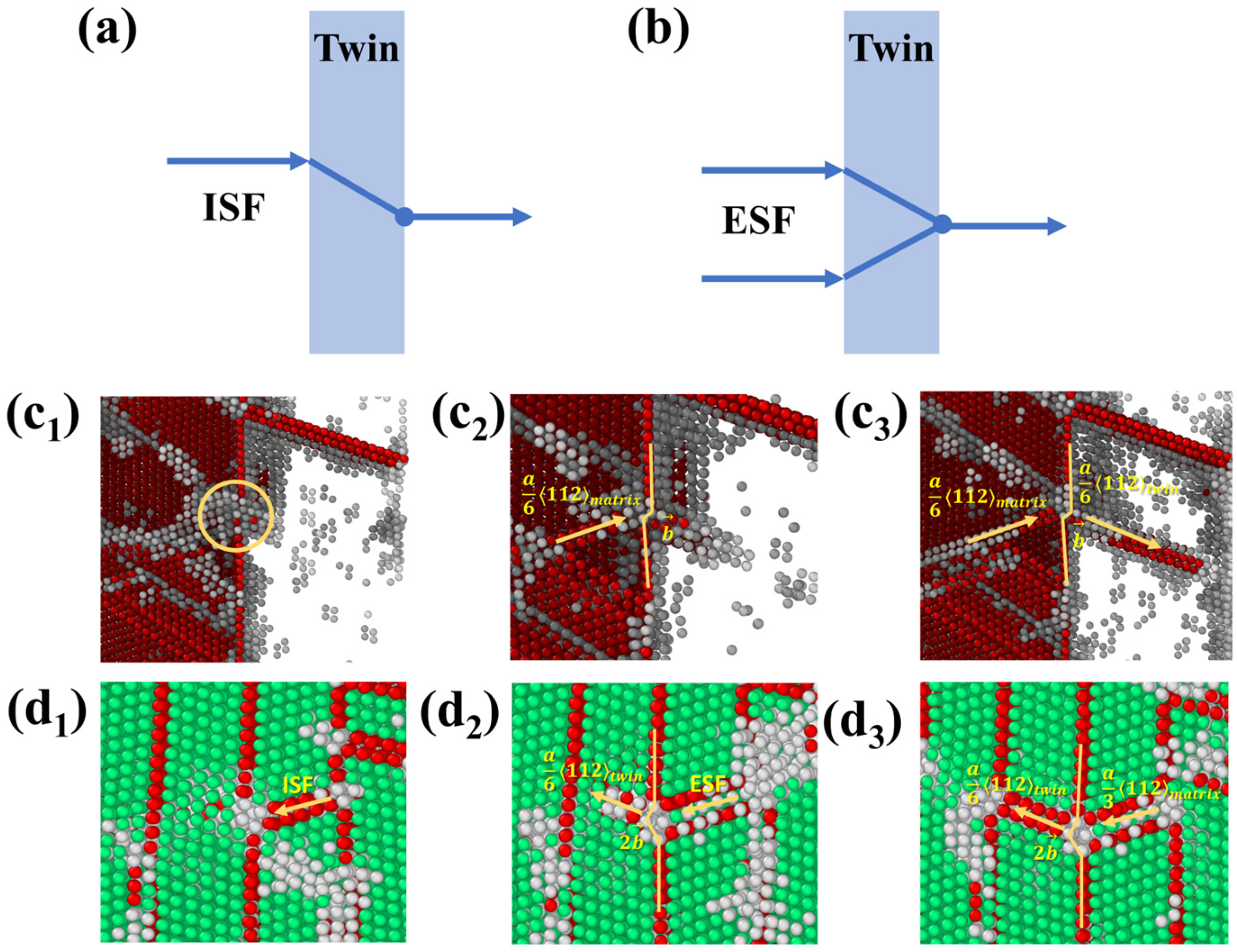
During the tensile deformation of the CoCrNi model, with increasing tensile strain, stacking faults can be categorized into intrinsic stacking faults (ISF) and extrinsic stacking faults (ESF). The interactions between these stacking faults and TBs also significantly influence the strength of the material. As shown in Figure 6a, when an ISF-associated partial dislocation encounters a TB, it dissociates or transforms at the interface: one partial dislocation is emitted into the twin lamella interior, leaving a residual dislocation (in most cases a stair-rod dislocation) on the twin boundary. Meanwhile, a new stacking fault is nucleated as the transmitted dislocation glides inside the twin. The reaction is expressed as follows [35]:
a 6 112 m a t r i x a 6 112 t w i n + b  
a 6 112 m a t r i x : incident Shockley partial dislocation in the matrix; a 6 112 t w i n : new Shockley partial dislocation that has propagated into the twin interior; b : residual dislocation left at the twin boundary, which impedes the motion of subsequent dislocations.
As shown in Figure 6b, when an extrinsic stacking fault (ESF) in the matrix, which is bounded by two partial dislocations, impinges on the twin boundary as a whole unit, due to the repulsive interaction between the two partial dislocations and the constraint imposed by the stacking fault energy, it is difficult for them to undergo the aforementioned dissociation reaction simultaneously at the same location. Typically, the first partial dislocation reacts first (forming an ISF), while the second is either pinned or rebounded. Since a perfect dislocation requires higher energy to penetrate the twin boundary, the defects left at the twin boundary are more severe. The reaction is expressed as follows:
a 3 112 m a t r i x a 6 112 t w i n + 2 b
where a 3 112 m a t r i x is two consecutive intrinsic stacking faults (ISF), i.e., one Shockley partial dislocation gliding on each adjacent atomic plane; 2 b   is a residual dislocation with higher strength; and a 6 112 t w i n is the new Shockley partial dislocation that propagates into the twin interior.
As shown in Figure 6(c1–c3), in the 4.2 nm twin model, with the increase in strain, when the ISF stacking fault in the matrix contacts the twin interface, it will rapidly dissociate into a transmitted partial dislocation entering the twin slip plane and a stair-rod dislocation pinned on the interface due to the limitation of lattice orientation. The transmitted partial dislocations continue to slip to form new ISF, which leads to the bending of the stacking fault path at the interface, while the residual stair-rod dislocations act as obstacles to the movement of subsequent dislocations. As shown in Figure 6(d1–d3), in the 1.2 nm twin model, ISF stacking faults transform into ESF stacking faults with the increase in strain. When the first partial dislocation first passes through the interface and leaves a pinning stair-rod dislocation, the subsequent partial dislocation must overcome the extremely high energy barrier and undergo a complex depinning reaction with the stair-rod dislocation to reassemble to form a complete ESF stacking fault. Since this synergistic mechanism is extremely difficult to initiate, ESF stacking faults generally cannot cross the twin boundary like ISF stacking faults, and subsequent dislocations are forced to cross-slip at the interface, resulting in dislocation entanglement at the TBs.

3.3. Microstructure Evolution During Strain

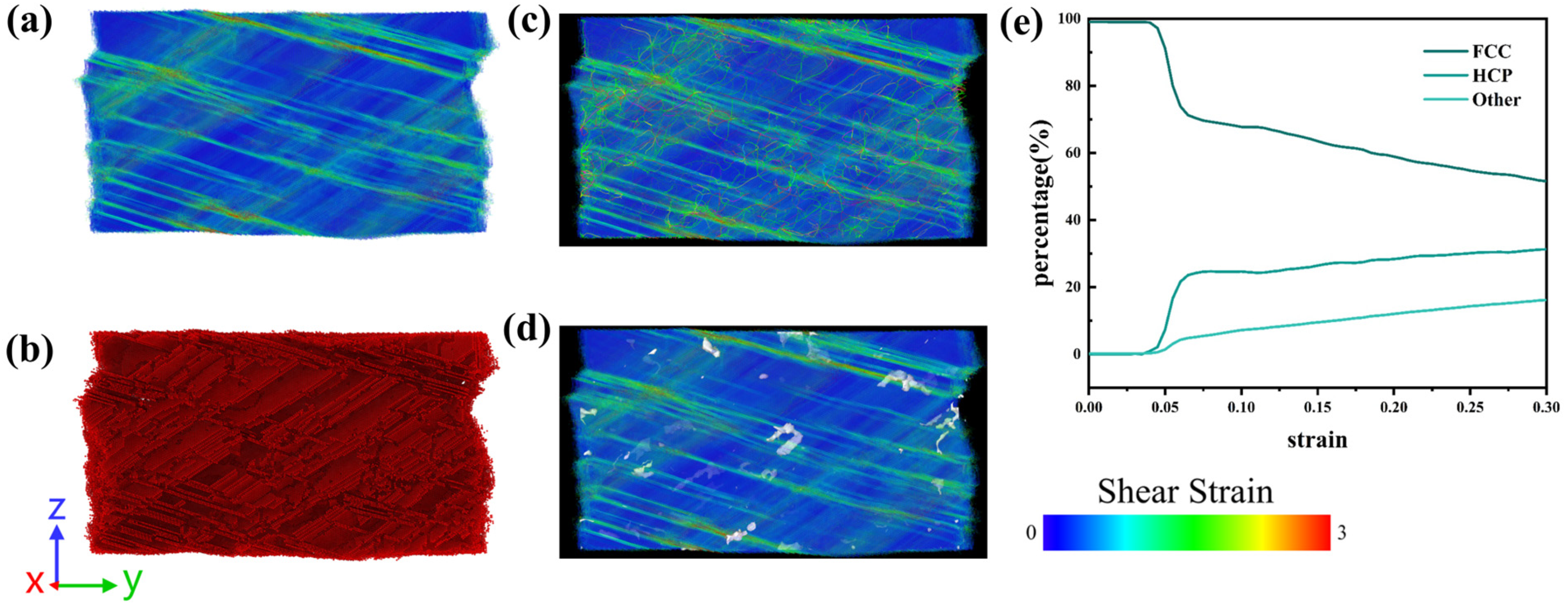
Figure 7a shows the strain distribution of the twin-free model at a strain of 0.3, from which it can be seen that the deformation is dominated by continuous, unobstructed slip bands, and dislocations can glide relatively unimpeded without the obstruction of TBs. Figure 7b shows the HCP structure distribution, and combined with Figure 7e, it shows that the HCP structure fraction reaches approximately 30% under 0.3 strain. Figure 7c and Figure 7d are, respectively, the dislocation line distribution and void distribution. The dislocation lines are relatively evenly distributed with no significant entanglement, and so are the voids.
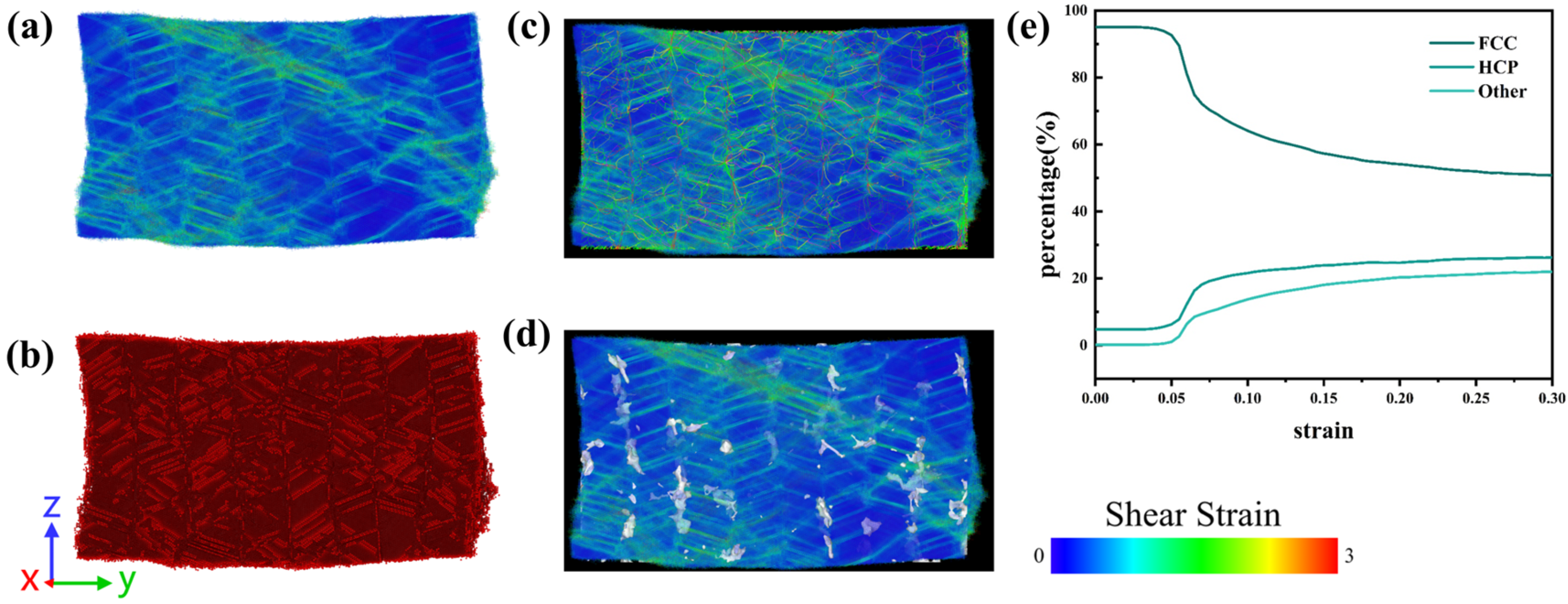
Figure 8a shows the strain of the 4.2 nm twin model under the 0.3 strain state. From the Figure, we can see obvious strain traces of stacking faults blocked by twin boundaries. As shown in Figure 8b, the HCP structure is uniformly distributed between TBs. Combined with the structure proportion diagram in Figure 8e, it can be seen that the HCP structure fraction stabilizes at approximately 25%, and the addition of TBs inhibits dislocation propagation. As shown in Figure 8c, dislocation lines are distributed along the TBs. It is obvious that the existence of a twin boundary severely inhibits the propagation of dislocation lines. Due to the pile-up of dislocation lines at TBs, which results in stress concentration, it can be seen from Figure 8d that voids are also distributed at the TBs.
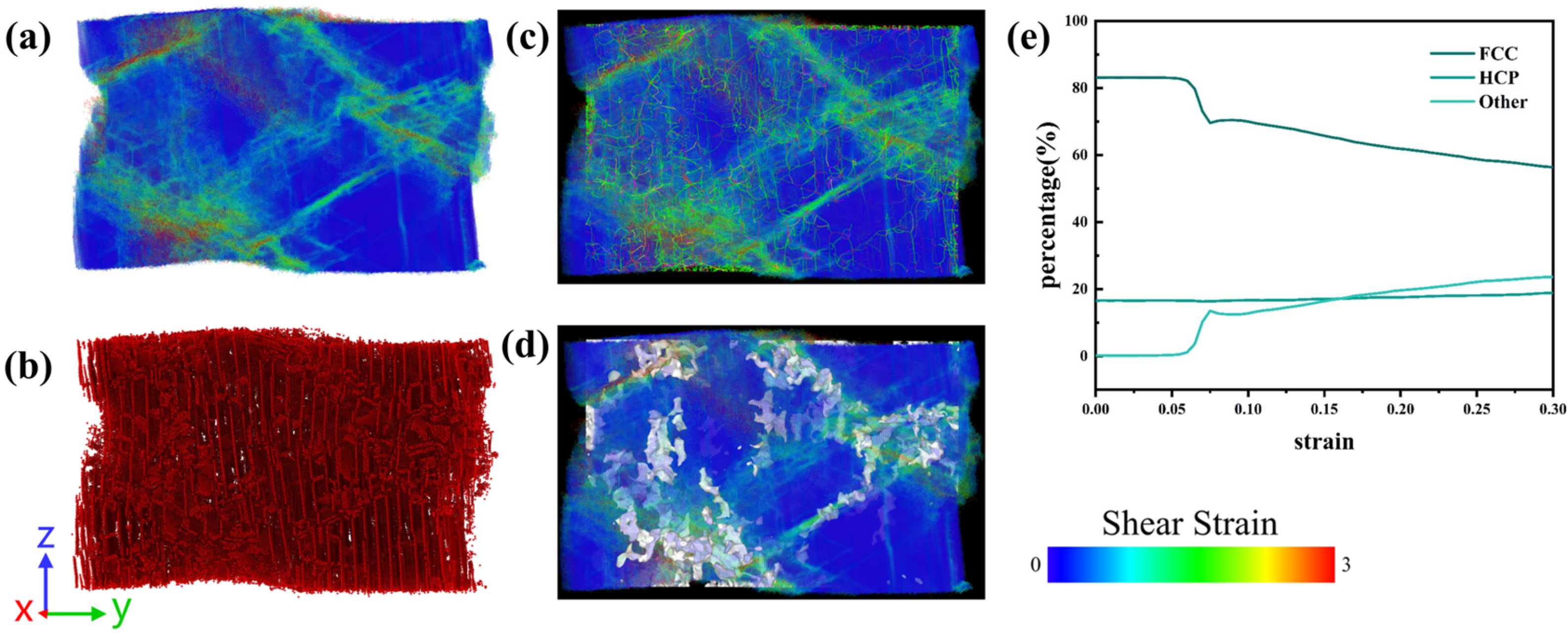
Figure 9a shows the strain of the 1.2 nm twin model under a 0.3 strain state, which differs from the strain distribution of the 4.2 nm nano-twin model. Obvious strain bands are observed across multiple TBs in the strain of the 1.2 nm twin model. It can be seen from Figure 9b that as the ultra-dense TB inhibits the propagation of dislocation lines, dislocation lines accumulate at TBs and proliferate with increasing strain, and excessive stress disrupts the twin structure, thus releasing dislocation lines that then continue to propagate. In this process, although dislocation lines disrupt the TBs, they also consume more energy, thus reducing the dislocation proliferation rate. This is the reason why the increment rate of dislocation line density of the 1.2 nm twin model in Figure 4b is the lowest. Figure 9e shows that the HCP structure accounts for about 20% under the strain of 0.3; this is also indirectly verified by the fact that the extremely dense twin boundary hinders the proliferation and expansion of dislocations, resulting in a lower HCP structure fraction. It can be seen from Figure 9c that dislocation lines are severely piled up in regions of high strain, and the voids in Figure 9d are also highly coincident with dislocation pile-up.

3.4. Discussion on Strengthening Behavior of TBs with Different Spacings

To systematically and quantitatively compare the effects of different twin spacings on the microstructural evolution of the CoCrNi alloy at a strain of 0.3, as shown in Table 1, this study statistically summarized the key structural parameters of each model. The results showed that as the twin spacing decreased from 4.2 nm to 1.2 nm, the fraction of HCP structures dropped significantly from 26.28% to 18.9%, and the peak dislocation density also decreased from 10.33 × 10¹⁶ m−2 to 7.14 × 10¹⁶ m−2. This strongly demonstrated the pronounced geometric inhibition effect of ultra-high-density TBs on dislocation proliferation and transformation propagation.
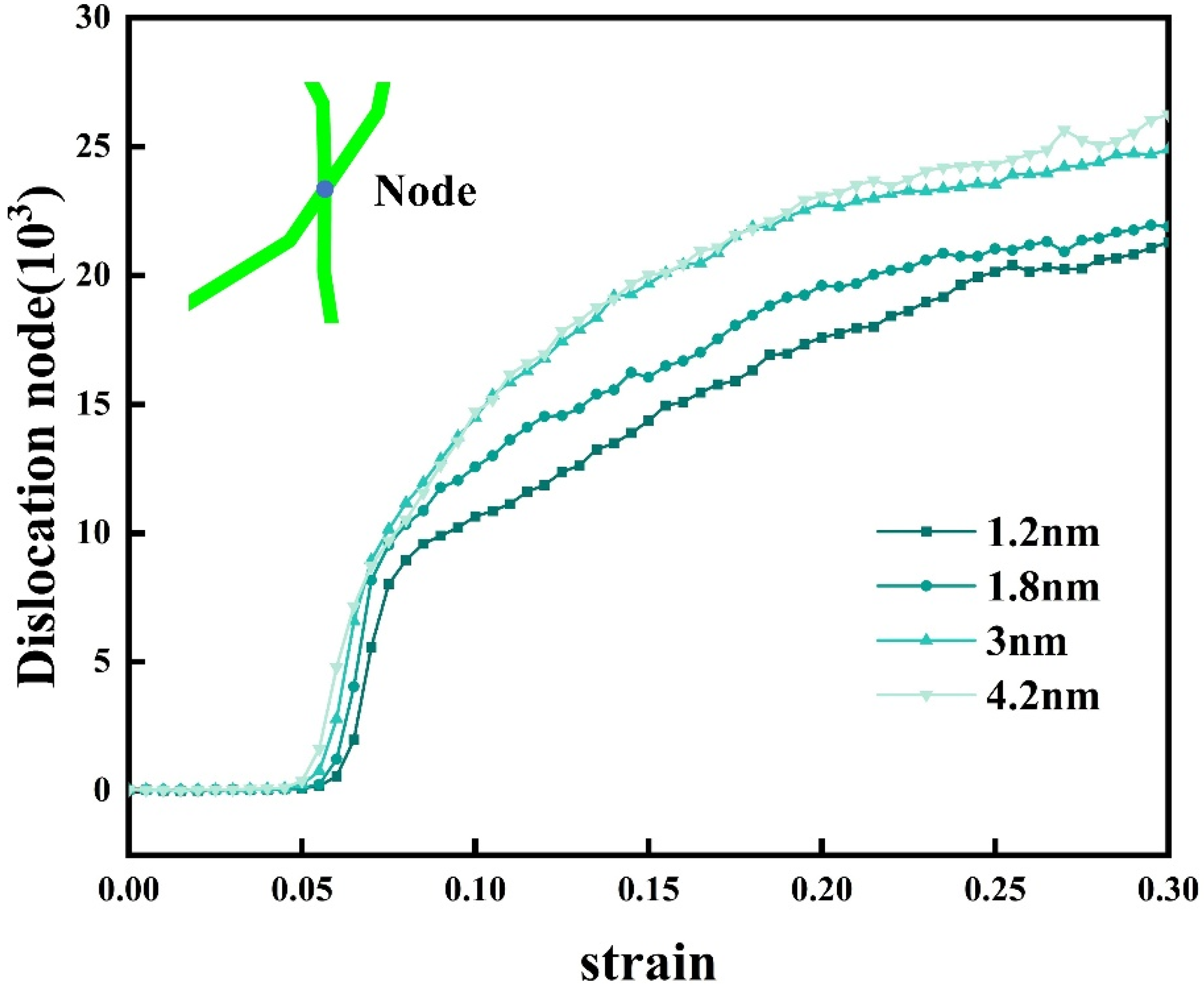
To quantify the pinning effect on dislocation lines caused by dislocation tangling, the degree of dislocation tangling is characterized by counting dislocation nodes, defined as the intersection points where two dislocation lines meet. As can be seen from Figure 10, the model with a 1.2 nm twin spacing exhibits the fewest dislocation nodes during deformation. This is because TBs effectively impede dislocation motion and trap dislocations during tension. In contrast, the model with a 4.2 nm twin spacing provides sufficient space for dislocation glide between twins, resulting in the highest number of dislocation nodes.
Considering that the models mainly form atomic-scale failure structures rather than macroscopic through-thickness voids during tension, the volume porosity is difficult to quantify accurately. Therefore, this study used the fraction of the other structures to more precisely characterize the overall defects. Within the twin spacing range of 1.2 nm to 3.0 nm, the fraction of other structures remains above 23.6%, indicating that frequent dislocation–boundary interactions at ultra-small spacings lead to severe stress concentration and local lattice instability. For the 4.2 nm twin-spacing model, the high fraction of HCP structures and dislocation density reveal that stacking faults glide more extensively between twins compared with other models, and atoms prefer planar slip over the formation of failure structures, resulting in a lower fraction of other structures.
From such quantitative comparisons, it can be concluded that the continuous strengthening of the CoCrNi alloy essentially arises from the reduced space for dislocation proliferation, with strength enhancement maintained by the barrier effect of ultra-high-density interfaces.
This study demonstrates that when the twin spacing λ ranges from 1.2 nm to 4.2 nm, the CoCrNi medium-entropy alloy exhibits a significant, size-dependent continuous strengthening phenomenon. As λ decreases, the dominant strengthening mechanism transitions from “dislocation glide distance-controlled” to “dislocation–twin boundary reaction-controlled” [36], leading to an approximately linear inverse relationship between the yield strength and the reciprocal twin boundary density 1/λ. The peak strength of 12.526 GPa is achieved at a twin spacing of 1.2 nm.
The absence of inverse Hall–Petch softening in this range is mainly attributed to two factors. Firstly, TBs act as structurally stable interfaces, effectively suppressing interfacial sliding that commonly occurs at extremely fine scales [16]. Secondly, the low stacking fault energy (SFE) of the CoCrNi alloy promotes the dissociation of perfect dislocations into Shockley partial dislocations [28]. The interactions between these partials and TBs form strong pinning structures such as stair-rod dislocations and Lomer–Cottrell (L-C) locks, whose barrier strength is 2–3 times that of conventional grain boundaries [35].
Molecular dynamics (MD) simulations confirm that dislocation–interface coordinated strengthening remains the dominant mechanism at this scale. As shown in Figure 5(d3) and 6(d3), stair-rod dislocations derived from intrinsic stacking fault (ISF) dissociation and L-C locks formed from extrinsic stacking faults (ESF) collectively construct dense slip barriers. With decreasing twin spacing and increasing twin density, these barriers support the linear strength enhancement at the atomic scale.

4. Conclusions

Using molecular dynamics (MD) simulations, this study systematically reveals the significant effects of nano-twin spacing on the mechanical behavior and deformation mechanisms of the CoCrNi medium-entropy alloy. In terms of mechanical properties, the alloy exhibits a strong size-dependent strengthening effect: as the twin spacing decreases from 4.2 nm to 1.2 nm, the yield strength increases linearly from 10.325 GPa to 12.526 GPa, representing a remarkable improvement over the 9.211 GPa of the twin-free model. Calculations indicate that each 1 nm reduction in twin spacing enhances the yield strength by approximately 7.1% on average. The core mechanism underlying this strengthening is that coherent TBs act as effective interfacial barriers, confining dislocations to glide between twin planes and promoting the formation of stair-rod dislocations via dislocation interactions at the interfaces. These events lead to dislocation pile-ups and stress concentrations, thereby significantly improving the strain hardening capability of the material.
At the level of microscale deformation mechanisms, coherent TBs serve as the dominant interfacial barriers governing the strengthening behavior. Upon interacting with TBs, intrinsic stacking faults (ISFs) dissociate into transmitted partial dislocations and stair-rod dislocations pinned at the interfaces, enabling uniform deformation. In contrast, extrinsic stacking faults (ESFs) struggle to overcome the interfacial energy barrier and are forced to undergo cross-slip and dislocation tangling. Although this reduces the dislocation proliferation rate, it substantially enhances strain hardening through the formation of Lomer–Cottrell (L-C) locks. Quantitative analysis demonstrates that as the twin spacing decreases, the HCP fraction drops from 26.28% to 18.9% and the peak dislocation density decreases from 10.33 × 10¹⁶ m−2 to 7.14 × 10¹⁶ m−2. These results confirm that ultra-dense TBs suppress dislocation multiplication and phase transformation propagation through geometric confinement, with strength enhancement instead sustained by interfacial barrier energy. This mechanism is closely associated with the low stacking fault energy characteristic of the CoCrNi alloy.
The core value of this study lies in revealing the mechanism of “twin spacing refinement→enhanced dislocation pinning→continuous strengthening” in the CoCrNi alloy through MD simulations. This mechanism is in good agreement with the experimentally observed nano-twin strengthening trend, providing a theoretical foundation for the optimization of experimental processing [36].
Advanced techniques such as electrodeposition and surface mechanical grinding have enabled the fabrication of ultra-fine nanotwins in the CoCrNi alloy [37,38]. This work further offers a theoretical basis for optimizing the performance of materials used under extreme conditions, including cryogenic structural components for aerospace and pressure-resistant components for deep-sea applications.

Supplementary Materials

The following supporting information can be downloaded at https://www.mdpi.com/article/10.3390/met16030333/s1. Figure S1. Yield strength at different strain rates. Table S1. Strain rate sensitivity table.

Author Contributions

Conceptualization, Y.Y., H.D. and J.K.; methodology, Y.Y., K.W. and J.K.; software, Y.Y., J.Z. and W.L.; validation, H.D. and H.H.; formal analysis, W.L. and H.H.; investigation, Y.Y., J.Z. and Y. D.; resources, Y.D. and J.K.; data curation, Y.Y., K.W. and Y.D.; writing—original draft preparation, Y.Y. and H.D.; writing—review and editing, Y.Y. and J.K.; visualization, J.Z. and W.L.; supervision, J.K. and H.D.; project administration, H.D. and J.K.; funding acquisition, J.K. All authors have read and agreed to the published version of the manuscript.

Funding

Backbone Talents Project in Hebei Province (Postdoctoral Platform, B2024005027).

Data Availability Statement

The data used to support the findings of this study are available from the corresponding author upon request.

Conflicts of Interest

The authors declare no conflicts of interest.

References

  1. Zhao, B.; Song, H.Y.; An, M.R. The dual role of short-range order: A critical temperature switch between strengthening and weakening in high-entropy alloys. J. Mater. Res. Technol. 2026, 41, 90–99. [Google Scholar] [CrossRef]
  2. Li, D.; Shi, H.; Liang, D.; Liang, Z.; Zhang, L.; Ding, W.; Su, X. Microstructural evolution and mechanical properties of CrCoFeMnNi high-entropy alloys under femtosecond laser ablation: A molecular dynamics approach. J. Mater. Res. Technol. 2025, 35, 6333–6340. [Google Scholar] [CrossRef]
  3. Ju, S.P.; Huang, P.X.; Chen, H.L.; Chen, H.T.; Chen, H.Y.; Wu, D.Y. Tailoring strength and ductility in dual-phase high-entropy alloys: Insights from deep learning molecular dynamics simulation on FCC/BCC thickness ratios. J. Mater. Res. Technol. 2024, 33, 6810–6819. [Google Scholar] [CrossRef]
  4. Diao, H.Y.; Feng, R.; Dahmen, K.A.; Liaw, P.K. Fundamental deformation behavior in high-entropy alloys: An overview. Curr. Opin. Solid State Mater. Sci. 2017, 21, 252–266. [Google Scholar] [CrossRef]
  5. Miracle, D.B.; Senkov, O.N. A critical review of high entropy alloys and related concepts. Acta Mater. 2017, 122, 448–511. [Google Scholar] [CrossRef]
  6. George, E.P.; Curtin, W.A.; Tasan, C.C. High entropy alloys: A focused review of mechanical properties and deformation mechanisms. Acta Mater. 2020, 188, 435–474. [Google Scholar] [CrossRef]
  7. Cantor, B. Multicomponent and high entropy alloys. Entropy 2014, 16, 4749. [Google Scholar] [CrossRef]
  8. Yeh, J.W. Recent progress in high-entropy alloys. Ann. Chim. Sci. Mater. 2006, 31, 633–648. [Google Scholar] [CrossRef]
  9. Tsai, M.H.; Yeh, J.W. High-entropy alloys: A critical review. Mater. Res. Lett. 2014, 2, 107–123. [Google Scholar] [CrossRef]
  10. Sohn, S.S.; da Silva, A.K.; Ikeda, Y.; Körmann, F.; Lu, W.; Choi, W.S.; Gault, B.; Ponge, D.; Neugebauer, J.; Raabe, D. Ultrastrong medium-entropy single-phase alloys designed via severe lattice distortion. Adv. Mater. 2019, 31, 1807142. [Google Scholar] [CrossRef]
  11. Lu, L.; Shen, Y.F.; Chen, X.H.; Qian, L.H.; Lu, K. Ultrahigh strength and high electrical conductivity in copper. Science 2004, 304, 422–426. [Google Scholar] [CrossRef] [PubMed]
  12. Li, X.; Dao, M.; Eberl, C.; Hodge, A.M.; Gao, H. Fracture, fatigue, and creep of nano-twinned metals. MRS Bull. 2016, 41, 298–304. [Google Scholar] [CrossRef]
  13. Lu, K. Stabilizing nanostructures in metals using grain and twin boundary architectures. Nat. Rev. Mater. 2016, 1, 16019. [Google Scholar] [CrossRef]
  14. Otto, F.; Dlouhy, A.; Somsen, C.; Bei, H.; Eggeler, G.; George, E.P. The influences of temperature and microstructure on the tensile properties of a CoCrFeMnNi high-entropy alloy. Acta Mater. 2013, 61, 5743–5755. [Google Scholar] [CrossRef]
  15. Lu, L.; Chen, X.; Huang, X.; Lu, K. Revealing the maximum strength in nanotwinned copper. Science 2009, 323, 607–610. [Google Scholar] [CrossRef] [PubMed]
  16. Duan, F.; Lin, Y.; Pan, J.; Zhao, L.; Guo, Q.; Zhang, D.; Li, Y. Ultrastrong nanotwinned pure nickel with extremely fine twin spacing. Sci. Adv. 2021, 7, 5113. [Google Scholar] [CrossRef]
  17. Xiao, J.; Deng, C. Continuous strengthening in nanotwinned high-entropy alloys enabled by martensite transformation. Phys. Rev. Mater. 2020, 4, 043602. [Google Scholar] [CrossRef]
  18. Mousavi, S.M.T.; Zhou, H.F.; Zou, G.J.; Gao, H.J. Transition from source- to stress- controlled plasticity in nanotwinned materials below a softening temperature. NPJ Comput. Mater. 2020, 5, 2. [Google Scholar] [CrossRef]
  19. Liu, S.F.; Wu, Y.; Wang, H.T.; He, J.Y.; Liu, J.B.; Chen, C.X.; Wang, H.; Liu, X.J.; Lu, Z.P. Stacking fault energy of face-centered-cubic high entropy alloys. Intermetallics 2018, 93, 269–273. [Google Scholar] [CrossRef]
  20. Liu, D.; Yu, Q.; Kabra, S.; Jiang, M.; Forna-Kreutzer, P.; Zhang, R.; Payne, M.; Walsh, F.; Gludovatz, B.; Asta, M.; et al. Exceptional fracture toughness of CrCoNi-based medium- and high-entropy alloys at 20 kelvin. Science 2022, 378, 978–983. [Google Scholar] [CrossRef]
  21. Oh, H.S.; Ma, D.; Leyson, G.P.; Grabowski, B.; Park, E.S.; Körmann, F.; Raabe, D. Lattice distortions in the FeCoNiCrMn high entropy alloy studied by theory and experiment. Entropy 2016, 18, 321. [Google Scholar] [CrossRef]
  22. Meyers, M.A.; Vöhringer, O.; Lubarda, V.A. The onset of twinning in metals: A constitutive description. Acta Mater. 2001, 49, 4025–4039. [Google Scholar] [CrossRef]
  23. Moura, I.A.B.; Ribamar, G.G.; Chuang, A.C.; Nunes, T.S.; Shen, J.; Zhang, W.; Rodrigues, P.F.; Pereira, A.B.; Pei, Y.; Zhang, F.; et al. Microstructural evolution and phase stability in Nb-containing interstitial Fe-Mn-Co-Cr-C high-entropy alloys: An in-situ synchrotron X-ray diffraction study during laser melting. Materialia 2025, 43, 102512. [Google Scholar] [CrossRef]
  24. Zhang, R.; Zhao, S.; Ding, J.; Chong, Y.; Jia, T.; Ophus, C.; Asta, M.; Ritchie, R.O.; Minor, A.M. Short-range order and its impact on the CrCoNi medium-entropy alloy. Nature 2020, 581, 283–287. [Google Scholar] [CrossRef]
  25. Gutierrez-Urrutia, I.; Raabe, D. Dislocation and twin substructure evolution during strain hardening of an Fe-22wt.% Mn-0.6wt.% C TWIP steel observed by electron channeling contrast imaging. Acta Mater. 2011, 59, 6449–6462. [Google Scholar] [CrossRef]
  26. Huang, D.; Zhuang, Y.X.; Wang, C.H. Advanced mechanical properties obtained via accurately tailoring stacking fault energy in Co-rich and Ni-depleted CoxCr33Ni67-x medium-entropy alloys. Scr. Mater. 2022, 207, 114269. [Google Scholar] [CrossRef]
  27. Chen, C.X.; Ge, Y.F.; Fang, W.; Zhang, X.; Liu, B.X.; Feng, J.H.; Yin, F.X. Multilayer maraging/CoCrNi composites with synergistic strengthening-toughening behavior. Front. Mater. 2021, 7, 619315. [Google Scholar] [CrossRef]
  28. Slone, C.E.; Chakraborty, S.; Miao, J.; George, E.; Mills, M.; Niezgoda, S. Influence of deformation induced nanoscale twinning and FCC-HCP transformation on hardening and texture development in medium-entropy CrCoNi alloy. Acta Mater. 2018, 158, 38–52. [Google Scholar] [CrossRef]
  29. Thompson, A.P.; Aktulga, H.M.; Berger, R.; Bolintineanu, D.S.; Brown, W.M.; Crozier, P.S.; Veld, P.J.I.; Kohlmeyer, A.; Moore, S.G.; Nguyen, T.D.; et al. LAMMPS—A flexible simulation tool for particle-based materials modeling at the atomic, meso, and continuum scales. Comput. Phys. Commun. 2022, 271, 108171. [Google Scholar] [CrossRef]
  30. Li, Q.J.; Sheng, H.; Ma, E. Strengthening in multi-principal element alloys with local-chemical-order roughened dislocation pathways. Nat. Commun. 2019, 10, 3563. [Google Scholar] [CrossRef]
  31. Wu, R.; Yin, Q.; Wang, J.; Mao, Q.; Zhang, X.; Wen, Z. Effect of Re on mechanical properties of single crystal Ni-based superalloys: Insights from first-principle and molecular dynamics. J. Alloys Compd. 2021, 862, 158643. [Google Scholar] [CrossRef]
  32. Dong, H.; Ning, T.; Wu, D.; Ma, H.; Wang, Q.; Feng, Z.; Su, R. TRIP-TWIP effect in deformation mechanisms of Co–Cr–Ni medium entropy via molecular dynamics simulations. J. Mater. Res. Technol. 2024, 28, 1303–1317. [Google Scholar] [CrossRef]
  33. Sun, H.; Tu, X.; Sun, X.; Zhai, W.; Ma, S.; Zhou, W.; Zhu, Z. Effect of temperature and strain rate on the mechanical properties and microstructure evolution of laser powder bed fusion additively manufactured CoCrNi medium entropy alloy. Mater. Sci. Eng. A 2025, 942, 148639. [Google Scholar] [CrossRef]
  34. Liu, Z.; Tian, N.; Tong, Y.; Hu, Y.; Deng, D.; Zhang, M.; Liu, J. Mechanical Performance and Deformation Behavior of CoCrNi Medium-Entropy Alloy at the Atomic Scale. Crystals 2022, 12, 753. [Google Scholar] [CrossRef]
  35. Jin, Z.H.; Gumbsch, P.; Albe, K.; Ma, E.; Lu, K.; Gleiter, H.; Hahn, H. Interactions between non-screw lattice dislocations and coherent twin boundaries in face-centered cubic metals. Acta Mater. 2008, 56, 1126–1135. [Google Scholar] [CrossRef]
  36. Zhang, T.W.; Jiao, Z.M.; Wang, Z.H.; Qiao, J.W. Dynamic deformation behaviors and constitutive relations of an AlCoCr1.5Fe1.5NiTi0.5 high-entropy alloy. Scr. Mater. 2017, 136, 15–19. [Google Scholar] [CrossRef]
  37. Wang, K.; Zou, X.; Jian, W.; Yuan, K.; Huang, G.; Qin, S.; Yuan, F.; Yao, X. Achieving optimal strength and ductility in medium-entropy alloys under high-strain-rate tension through gradient microstructure design. Mater. Sci. Eng. A 2026, 950, 149550. [Google Scholar] [CrossRef]
  38. Ma, P.; Wang, M.; Chen, A.; Gu, L.; Ding, Z.; Wang, X.; Gan, B. Nano-precipitation strengthening regulated by nanotwins in CoCrNi alloy with super-high strength. Mater. Charact. 2024, 207, 113471. [Google Scholar] [CrossRef]
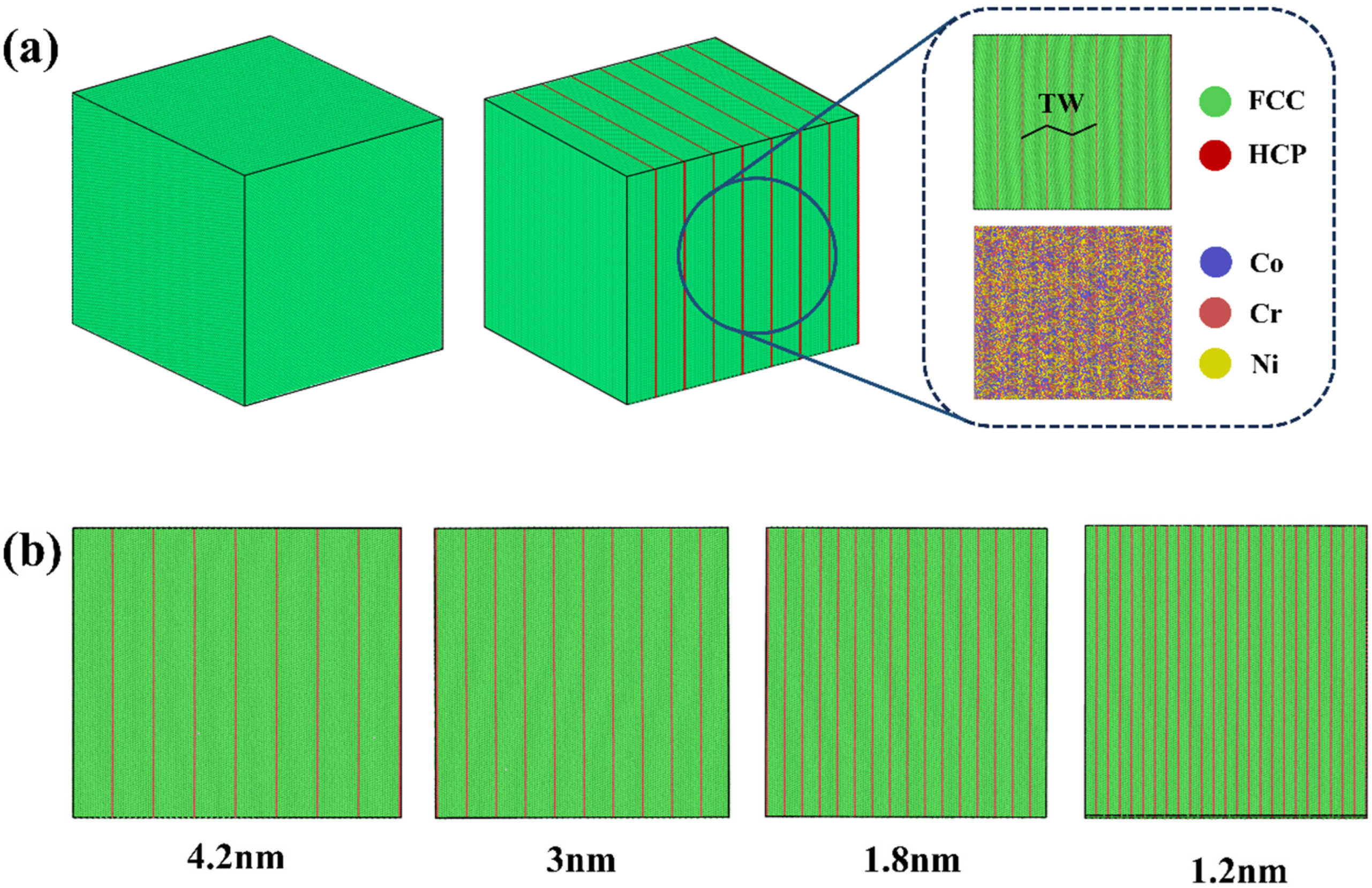
Figure 1. (a) Schematic diagram of twin-free model and twin model. (b) Schematic diagram of four twin spacing models.
Metals 16 00333 g001
Figure 2. GSFE curve of disordered CoCrNi.
Metals 16 00333 g002
Figure 3. (a) Stress–strain curves of four spacing twin models and twin-free models. (b) Yield strength and flow stress of four spacing twin models and twin-free models.
Metals 16 00333 g003
Figure 4. (a) Dislocation density curves of 1.2 nm twin model, 4.2 nm twin model, and no-twin model. (b) The dislocation density growth rate and yield strain of 1.2 nm twin model, 4.2 nm twin model, and no-twin model were calculated.
Metals 16 00333 g004
Figure 5. (a) Double Thompson tetrahedron model, points A to G are the vertices and midpoints of the tetrahedron model. (b) Two slip modes between stacking faults and TBs. (c1c3) Mechanism diagram of stacking faults crossing TBs, the yellow arrows represent the ISF. (d1d3) Slip mechanism diagram of L-C lock structure formed by stacking faults meeting between TBs, the yellow arrows represent the ISF.
Metals 16 00333 g005
Figure 6. (a) Schematic diagram of ISF stacking fault crossing twins. (b) Schematic diagram of ESF stacking fault crossing twins. (c1c3) Schematic diagram of ISF stacking fault crossing twins. (d1d3) Schematic diagram of ESF stacking fault crossing twins.
Metals 16 00333 g006
Figure 7. (a) Strain mechanism of twin-free model under 0.3 strain. (b) HCP structure. (c) Dislocation line and strain mechanism. (d) Gap diagram. (e) Structure proportion diagram of twin-free model.
Metals 16 00333 g007
Figure 8. (a) Strain mechanism of 4.2 nm twin model under 0.3 strain. (b) HCP structure. (c) Dislocation line and strain mechanism. (d) Gap diagram. (e) Structure proportion diagram of 4.2 nm twin model.
Metals 16 00333 g008
Figure 9. (a) Strain mechanism of 1.2 nm twin model under 0.3 strain. (b) HCP structure. (c) Dislocation line and strain mechanism. (d) Gap diagram. (e) Structure proportion diagram of 1.2 nm twin model.
Metals 16 00333 g009
Figure 10. Dislocation node statistics for four twin spacings.
Metals 16 00333 g010
Table 1. Atomic structure and dislocation density table.
Twin SpacingHCP Atomic Fraction (%)Other Atomic Fraction (%)Dislocation Density (×1016 m−2)
1.2 nm18.923.667.14
1.8 nm20.6824.147.85
3 nm25.1224.359.35
4.2 nm26.2821.9210.33
Disclaimer/Publisher’s Note: The statements, opinions and data contained in all publications are solely those of the individual author(s) and contributor(s) and not of MDPI and/or the editor(s). MDPI and/or the editor(s) disclaim responsibility for any injury to people or property resulting from any ideas, methods, instructions or products referred to in the content.