


Abstract
To give more insight into the microstructural evolution and deformation mechanisms governing the long-term service performance of additively manufactured TiAl-based composites at elevated temperatures, this study investigated the high-temperature compressive creep behavior of a laser powder bed-fused LaB6 reinforced high-Nb TiAl-based composite after hot isostatically pressing (HIP), with emphasis on the creep response and dynamic recrystallization (DRX) mechanisms under different applied stress levels. The results showed that, as the applied stress increased from 200 MPa to 450 MPa, the steady-state creep rate rose from 2.88 × 10⁻⁸ s−1 to 3.85 × 10⁻⁷ s−1. Stress exponent analysis indicated that creep deformation was predominantly controlled by dislocation climb, and no tertiary creep stage was observed within the investigated stress range. At 200 MPa and 300 MPa, a certain fraction of recrystallized grains formed during prolonged creep exposure. When the stress increased to 400 MPa, the recrystallization process was restricted due to the limited creep duration. In contrast, at 450 MPa, the accelerated accumulation of strain energy significantly promoted recrystallization. Both continuous dynamic recrystallization (CDRX) and discontinuous dynamic recrystallization (DDRX) were identified, jointly governing the microstructural evolution. Superior creep resistance can be attributed to multiple synergistic strengthening mechanisms, including the refined α2/γ lamellar structure induced by HIP treatment, the strong pinning effect of dispersed La2O3 nanoparticles on dislocation motion, and the suppression of diffusion-controlled dislocation climb by Nb addition. These combined effects enhance the high-temperature creep performance of the TiAl composite and provide important insights for the application of LPBF-fabricated TiAl-based composites under elevated-temperature service conditions.
1. Introduction
TiAl alloys are regarded as an ideal lightweight structural material for aerospace applications, as they possess low density (approximately 3.9–4.2 g·cm−3), high specific strength, high specific modulus, and excellent performance at medium and high temperatures. Compared to traditional nickel-based alloys, TiAl alloys can significantly reduce the weight of components within their service temperature range, which is of great significance for improving the thrust-to-weight ratio of aircraft engines and reducing fuel consumption. For instance, General Electric and Mitsubishi Motors have incorporated TiAl alloys into turbine blades of aircraft engines and turbochargers for passenger vehicles, respectively, achieving a substantial increase in fuel efficiency [1,2]. However, due to the low room-temperature plasticity [3] and high brittle–ductile transition temperature [4] of TiAl alloys, traditional manufacturing processes require multiple complex procedures and strict process control during the forming process. Not only does this make it difficult to control the microstructure, but it also has obvious limitations in the preparation of complex components. These issues can only be addressed through subsequent heat treatment and extensive machining methods, significantly increasing manufacturing costs and cycles and making it difficult to meet the requirements of aerospace applications with complex structures such as internal cavities and thin walls.
In recent years, additive manufacturing (AM) technology, with its significant advantages in the material–structure–property integrated forming of complex components and near-net-shape forming, has gradually entered the field of TiAl alloy research. Among them, powder bed fusion (PBF) technology, especially electron beam melting (EBM) and laser powder bed fusion (LPBF), has been widely used in the forming research of TiAl alloys. The EBM process, due to the presence of a vacuum environment, high substrate preheating, and the corresponding lower thermal gradient, has certain advantages in suppressing cracks. However, its vacuum system is costly, the equipment is complex, and the loss of aluminum elements is severe [5], which, therefore, poses many limitations in engineering application promotion. In contrast, LPBF technology has relatively lower equipment costs and higher forming accuracy, gradually becoming an important research direction in the AM technologies of TiAl alloys. However, the LPBF of TiAl alloys also face severe forming challenges: on the one hand, the brittle–ductile transition temperature makes the TiAl alloys prone to brittle fracture under rapid cooling conditions; on the other hand, the extremely high temperature gradient and cooling rate during LPBF will induce significant thermal stress concentration, resulting in the formation of micro-cracks, etc. To alleviate these problems, researchers have proposed various control strategies. Among them, ceramic particle reinforcement and hot isostatic pressing (HIP) treatment have gradually attracted attention. As for the former one, it has been reported that LaB6 particles have a significant heterogeneous nucleation effect in the laser melting deposition of TiAl alloys, which can effectively refine grains, control solidification microstructure, and to some extent alleviate crack sensitivity [6]. In our previous research [7], the introduction of LaB6 was also found to significantly reduce the grain size and crack density of TiAl alloys by 90.3% and 92.6%, respectively. Regarding the latter, HIP treatment not only can close cracks and pores but can also optimize microstructure uniformity, enhance isotropy, improve mechanical properties through diffusion and recrystallization behaviors under high-temperature and high-pressure conditions, and is an extremely effective post-treatment method for TiAl alloys.
As one of the important service performances of key components of aircraft engines, the high-temperature creep behavior directly determines the safety and reliability of TiAl alloys under long-term loading conditions at medium and high temperatures. Therefore, the high-temperature creep behavior of TiAl alloys has been extensively studied. R. W. Hayes [8] investigated the creep behavior of Ti-48Al-1Nb at temperatures ranging from 704 to 850 °C and found that the activation energy varied with stress, averaging approximately 326 kJ/mol, providing an early foundation for understanding the high-temperature creep of TiAl. A. Dlouh et al. [9] studied the long-term creep behavior of different TiAl alloys and found that even at very low creep rates, the dislocation mechanism still played a very important role. At the same time, high-Nb TiAl alloys also attracted the attention of researchers. Lin Song et al. [10] studied the influence of C strengthening on the creep performance and microstructure evolution of high-Nb TiAl alloys and found that the Ti-46Al-8Nb-0.7C alloy demonstrated extremely excellent creep performance. In addition, introducing ceramic particles to improve the creep performance of TiAl alloys has also achieved positive results. Yingfei Guo et al. [11,12] found that introducing Y2O3 particles into TiAl alloys could significantly increase the creep fracture life and reduce the steady-state creep rate. However, most of the creep studies have focused mainly on TiAl alloys produced by traditional processes and few researchers have studied the high-temperature creep of TiAl alloys prepared by LPBF.
On this basis, this study focused on the high-temperature compression creep behavior of the LaB6-reinforced TiAl-based composite prepared by LPBF and HIP post-treatment and mainly investigated the effects of applied stress levels on their microstructures and deformation behavior. By combining the compression creep curves and microstructure characterizations, the creep response characteristics, dynamic recovery/recrystallization behaviors, and the internal mechanisms of TiAl-based alloys under different applied stresses were explored. The corresponding findings can provide a theoretical basis for the microstructure stability and performance optimization of LPBF-fabricated TiAl alloys in high-temperature service environments.
2. Experimental
2.1. Raw Materials
The nearly spherical gas-atomized Ti-48Al-2Cr-2Nb (at. %) powder was purchased from Suzhou Juchun New Materials Technology Co., Ltd. (Suzhou, China). The powder particle size ranged from 15 to 53 μm. Nb nanoparticles with an average particle size of 50 ± 10 nm were added to the original TiAl powder to increase the atomic fraction of Nb to approximately 8 at.%. Subsequently, LaB6 submicron particles with an average particle size of about 200 nm and a mass fraction of 0.5 wt.% were further incorporated into the high Nb-content TiAl powder. The mixed powder was uniformly mixed using the Nanjing Nan Da Instrument QM-3SP4 horizontal planetary high-energy ball mill (Nanjing Chishun Science & Technology Co., Ltd., Nanjing, China). The ball milling speed was 200 rpm, the ball-to-material ratio was 2:1, the ball diameter was 6 mm, and the ball milling time was 2 h. During the ball milling process, the machine operated alternately in forward and reverse directions, with each run lasting 15 min, followed by a 5 min standstill and cooling. The nominal chemical composition of the resulting composite powder was Ti-47.7Al-1.99Cr-7.9Nb-0.1La-0.6B (at. %).
2.2. LPBF and HIP Treatment
The LPBF forming experiment was conducted using the iSLM160 equipment from Zhongrui Technology (Guangzhou, China), equipped with an ytterbium fiber laser with a wavelength of 1064 nm, with a maximum output power of 500 W, and a laser spot diameter of approximately 80 μm. During the forming process, a flexible scraper was used for unidirectional powder deposition, and the Ti-6Al-4V substrate was preheated by precise resistance wire heating, with the preheating temperature set at 200 °C. The printing process was carried out in a high-purity argon gas protection atmosphere to ensure that the oxygen content in the forming chamber was constantly controlled below 100 ppm. Based on our team’s previous research results, the optimal process parameters selected were laser power of 90 W, scanning speed of 900 mm/s, scanning interval of 60 μm, powder layer thickness of 30 μm, inter-layer rotation angle of 67°, and the scanning strategy adopted a linear scanning mode. The designed dimensions of the as-fabricated bulk sample were 8 × 8 × 4 mm3. After the forming process was completed, the samples were placed in a hot isostatic press furnace produced by American Isostatic Presses (American Isostatic Presses, Inc., Columbus, OH, USA) for post-treatment. The heating rate of the HIP process was 10 K/min, and the samples were held at 1300 °C and 180 MPa for 4 h. Throughout the process, argon gas was introduced to protect the samples from oxidation, and the furnace was cooled for approximately 2 h.
2.3. High-Temperature Creep Test
High-temperature compression creep experiments were conducted on the RWS-100 high-temperature mechanical testing machine (Sinotest Equipment Co., Ltd., Changchun, China). The experimental temperature was set at 750 °C. Before the creep tests, the high-temperature compressive tests at 750 °C were first conducted to determine the compressive yield strength (590 ± 30 MPa). Then, the constant stresses applied in the creep tests were set as 200, 300, 400 and 450 MPa, respectively. The sample was fixed in the loading unit using clamps at both ends, and a strain gauge was configured to accurately measure the compression deformation. To reduce the influence of environmental temperature fluctuations on the test results, insulation materials were wrapped around the specimen to maintain a stable high-temperature testing environment. Before the start of the experiment, the system was checked, then the test chamber was closed and the test software was started. The heating rate was set at 3 °C/min, and the stress loading rate was 2 MPa/min. When the specimen temperature reached 750 °C and the stress reached the predetermined value, a constant temperature and constant stress holding were maintained, and the evolution behavior of the compression creep deformation over time was recorded. After reaching the predetermined test time, the loading was stopped, and the sample was cooled to room temperature in the furnace.
2.4. Microstructure Characterization
After the creep tests, these samples were sectioned along the building direction (BD) using wire-cutting by electrical discharge machining to observe the microstructure features after compression deformation. The as-cut thin-walled specimens are then mechanically ground on a YMP-2 type grinding machine (Dili polishing Machine Co. Ltd., Shanghai, China), with the grit size gradually increasing from 400 mesh to 2500 mesh, followed by polishing. The polished samples are treated with Kroll reagent (1 mL HF, 6 mL HNO3, and 60 mL deionized water) for etching for 15 s. Then, the etched microstructure was observed using a field emission scanning electron microscope (FE-SEM, ZEISS Sigma 300, 10 kV (ZEISS, Oberkochen, Germany)), and chemical composition analysis was conducted in combination with its equipped energy dispersive spectrometer (EDS). As for the EBSD analysis, the samples were first embedded after being cut by a wire saw, then mechanically polished, followed by argon ion polishing on a Hitachi IM4000II (Hitachi High-Tech Corporation, Tokyo, Japan), and finally EBSD data collection and analysis were completed on a Thermo Scientific Apreo 2C field emission scanning electron microscope (Thermo Fisher Scientific, Waltham, MA, USA), in conjunction with an EDAX Velocity Super probe (EDAX Inc., Mahwah, NJ, USA). The EBSD scans were performed with a step size of 0.25 μm.
3. Results
3.1. High-Temperature Compression Creep Curve
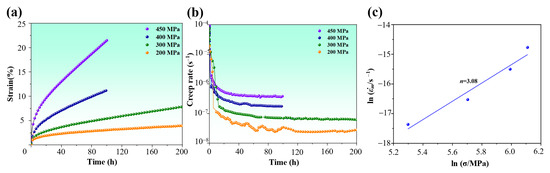
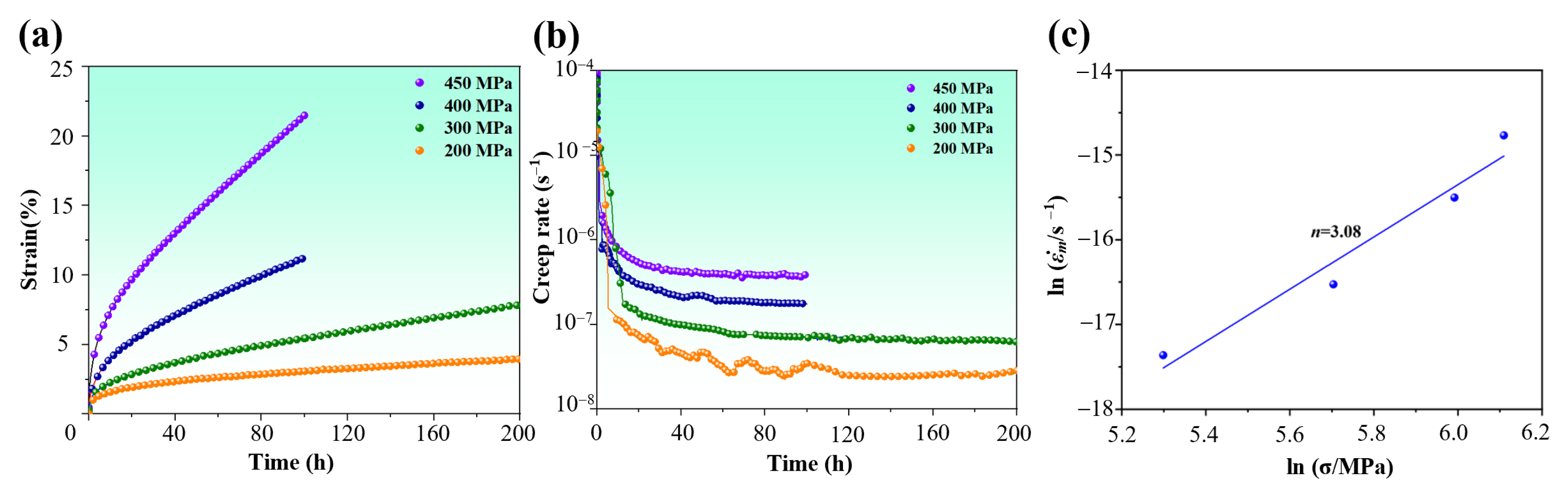
Figure 1a shows the high-temperature compressive creep strain–time curves of the TiAl-based composite samples under different applied stress levels of 200–450 MPa at 750 °C. For the tests at 400 and 450 MPa, the creep time was limited to 100 h to avoid potential fracture under such high stresses. From the creep curves, it was clearly seen that the creep strain continuously increased over time and significantly rose with the increase in applied stress. By derivation, the strain rate–time curves are presented in Figure 1b. According to the strain rate evolution features, it was found that these creep curves only exhibited two typical stages, namely the initial creep stage (transient stage) and the steady-state creep stage, indicating that this material had excellent high-temperature creep resistance stability under the testing conditions in this study. In addition, the transformation from the initial stage to the steady-state stage was rapid and the transformation time became shorter with increasing applied stress. Particularly, when the applied stress was set as 200 MPa, the sample experienced a relatively apparent fluctuation before reaching a steady stage. Through quantitative analysis of the steady-state strain rate, it was found that the steady-state creep rate of the TiAl-based composite sample significantly increased with increasing applied stress, from 2.88 × 10⁻⁸ s−1 at 200 MPa to 3.85 × 10⁻⁷ s−1 at 450 MPa. Notably, the steady-state creep rate is the key indicator of creep resistance performance, and its stress dependence can usually be described by the Norton–Bailey relationship:
where is the steady-state creep rate (s−1), A is a material constant, σ is the applied stress (MPa), n is the stress exponent, Q is the apparent activation energy for creep, R is the gas constant, and T is the absolute temperature (K). Under a constant temperature of 750 °C, a double-logarithmic relationship graph of the steady-state creep rate and the applied stress was plotted, as shown in Figure 1c. The results indicate that there is a nearly linear relationship between ln() and ln(σn). By the linear fitting, the corresponding stress exponent n is determined as 3.08. This value suggests that the creep deformation is dominated by dislocation creep involving mixed glide–climb processes [13]. Overall, the TiAl-based composite sample exhibits a lower steady-state creep rate and higher creep resistance stability at 750 °C, indicating its excellent structural stability and deformation resistance in high-temperature service environments.
Figure 1.
Compressive creep behavior of the TiAl-based composite at 750 °C: (a) creep strain–time curves; (b) creep strain rate–time curves and (c) double-logarithmic relationship between steady-state creep rate and applied stress.
3.2. Deformed Lamellar Structures
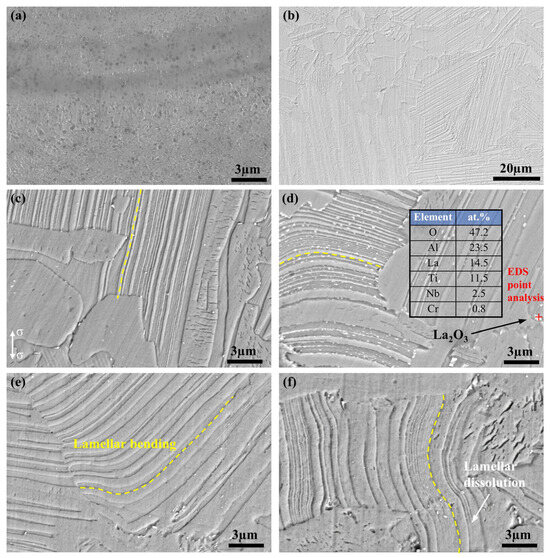
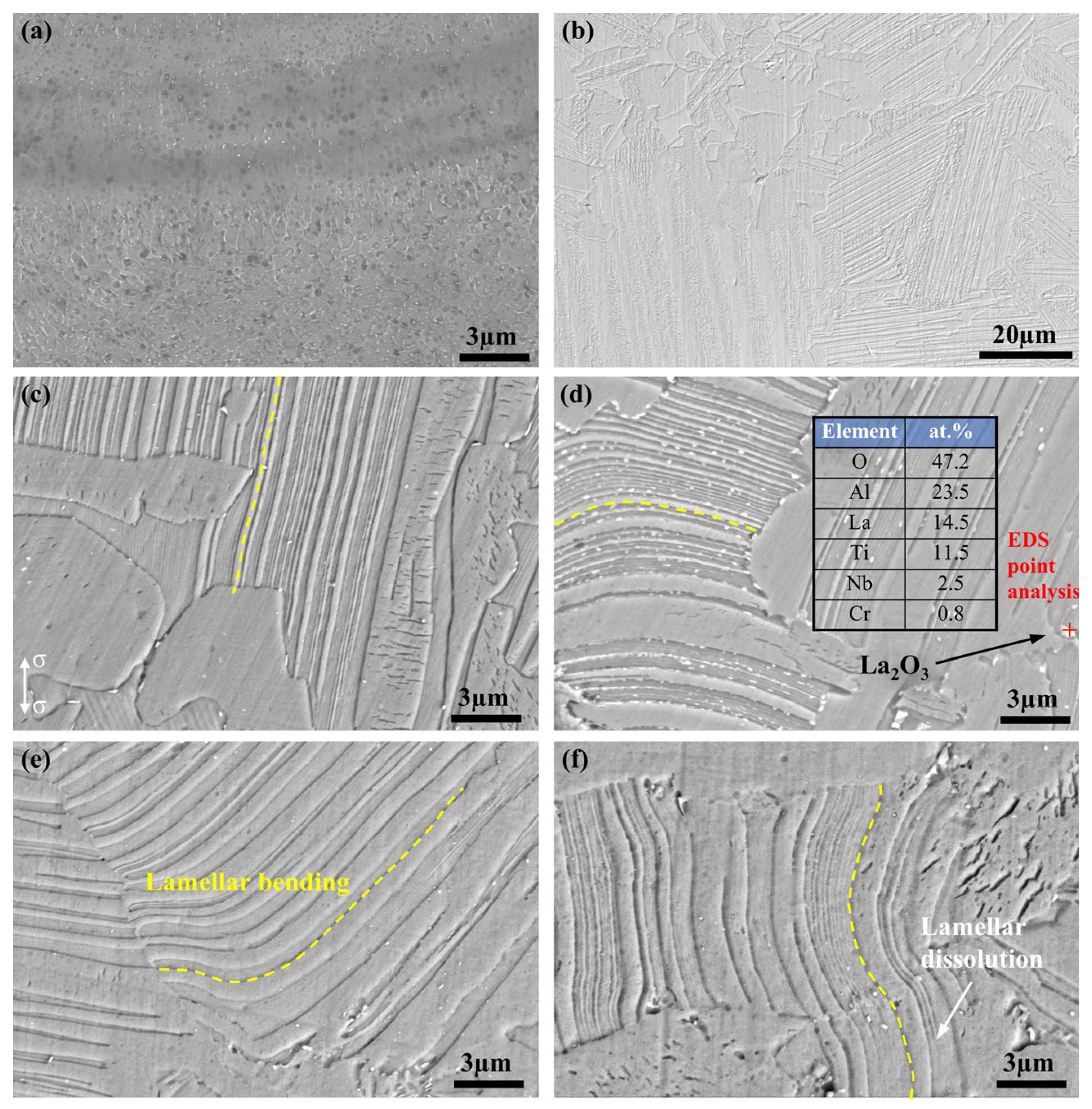
Figure 2 shows the microstructural evolution of the TiAl-based composite samples before HIP, after HIP, and following compressive creep under different stress conditions at 750 °C. Due to the ultra-high cooling rate during the LPBF, the as-fabricated microstructure was mainly featured as single α2 phase [14]. After HIP treatment, the microstructure of the composite was transformed into typical α2/γ lamellar structures mixed with some γ equiaxed grains (Figure 2b). It should be noted that the microstructures presented in Figure 2 are all taken from the middle part of each sample to ensure consistency in the comparison among different samples. Overall, as the applied stress level increased, the distortion degree of the α2/γ lamellar structure gradually became more significant. At a relatively lower stress condition (200 MPa), the lamellas in the lamellar structure basically kept a straight and flat morphology, only showing a slight deflection at local regions (Figure 2c). When the applied stress reached 300 MPa, it was observed that multiple adjacent lamellas experienced significant bending and exhibited continuous directional deflection over a large range (Figure 2d). When the applied stress was further increased to 400 MPa or 450 MPa, the bending angle or distortion degree of the α2/γ lamellar structure kept rising, although the creep time was shortened to 100 h in these two cases (Figure 2e,f). At the same time, a small number of lamellar structures under the condition of 450 MPa were observed to undergo partial dissolution (Figure 2f). Furthermore, plenty of fine white particles were further found dispersing within the α2/γ lamellar structure. Based on the EDS analysis (as shown in the inserted image in Figure 2) and TEM results in our previous work [14], these fine particles could be determined as La2O3.
Figure 2.
Deformation microstructures of the TiAl-based composite before and after compressive creep at 750 °C under different applied stresses: (a) as-fabricated; (b) HIPed; (c) 200 MPa; (d) 300 MPa; (e) 400 MPa; (f) 450 MPa.
3.3. Grain Orientation and Texture Evolution
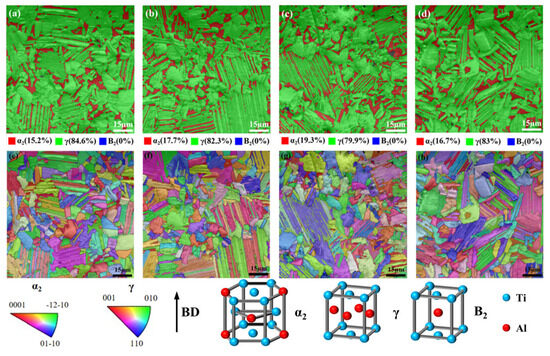
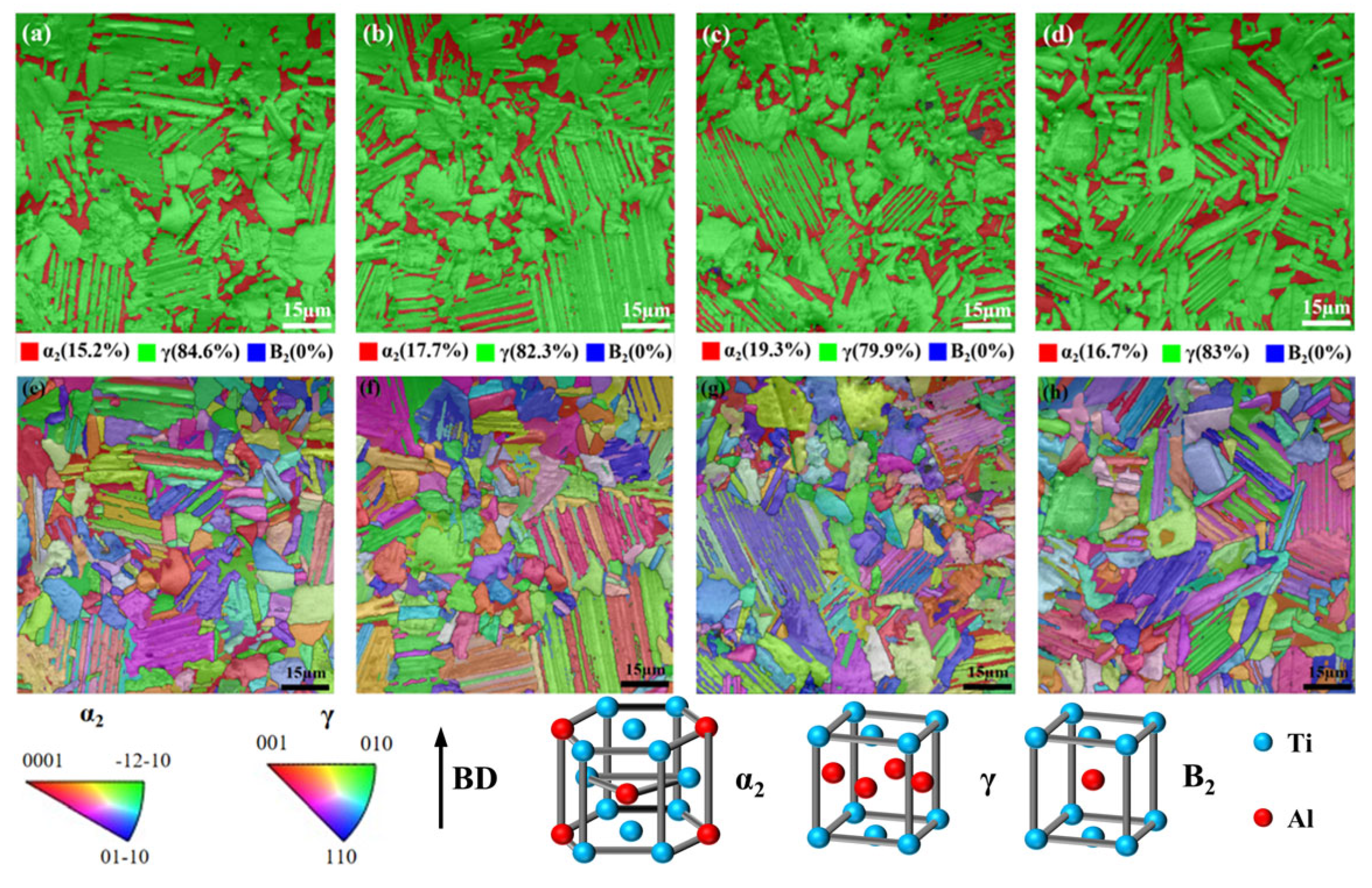
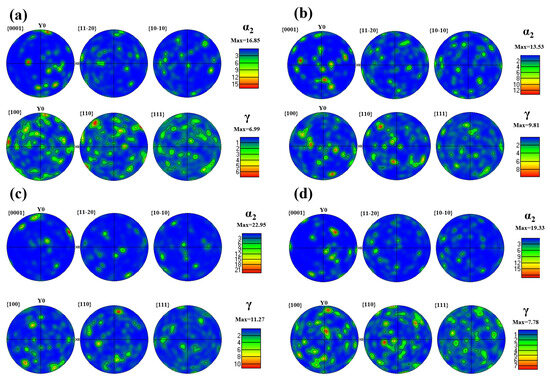
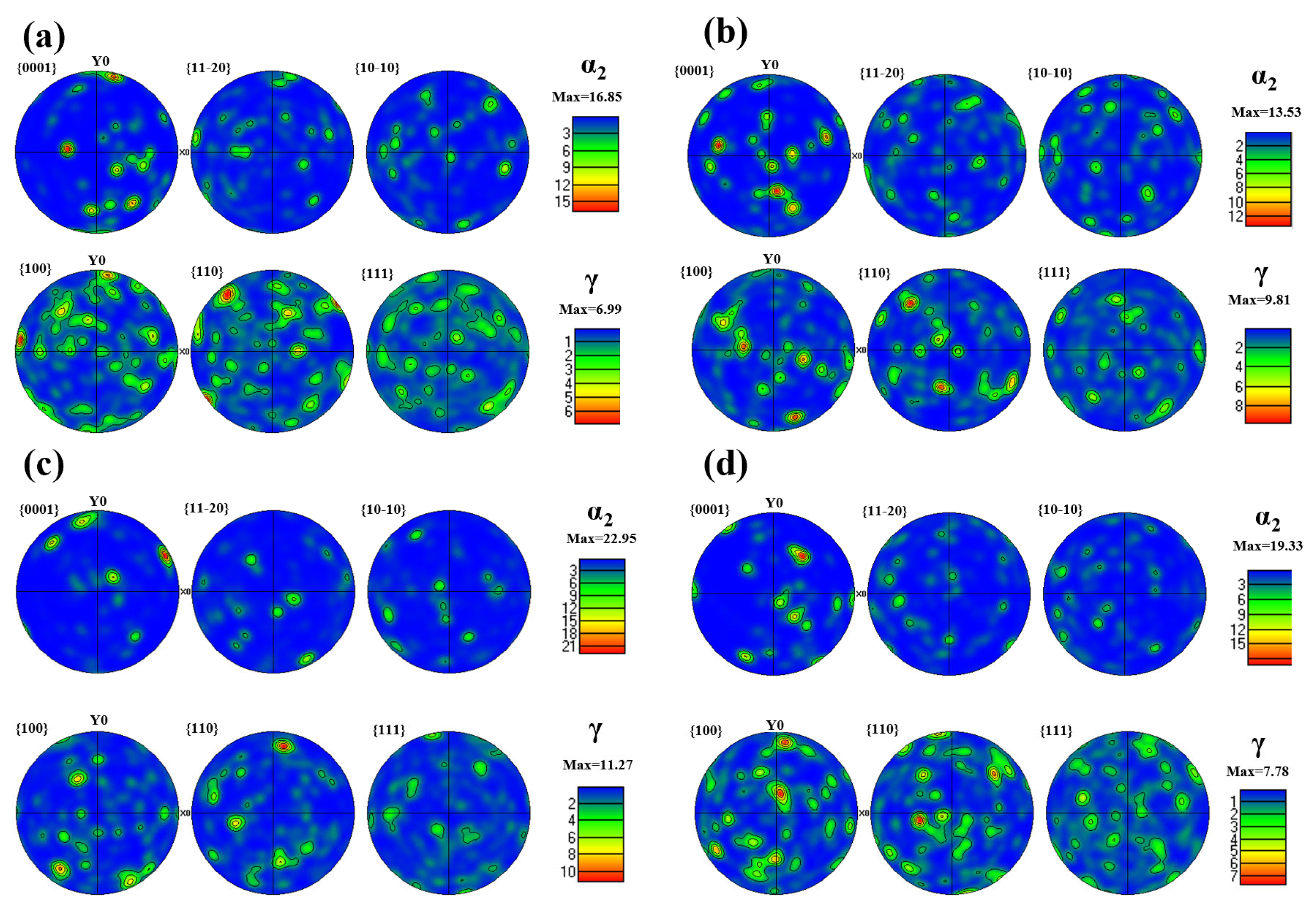
To give more insight into the deformed microstructure after the compression creep, EBSD tests were further performed to characterize the grain orientation and texture evolution at different applied stress levels, as shown in Figure 3 and Figure 4. First of all, from the phase distribution maps (Figure 3a–d), it was noted that the microstructure was mainly composed of α2/γ lamellar structures and γ equiaxed grains. In addition, γ phase dominated in the microstructure, occupying ~80%, while α2 phase took up most of the remaining space (reaching 15~19%). By calculation, the average grain sizes corresponding to four different cases were 3.21 µm, 3.03 µm, 2.65 µm, and 3.22 µm, respectively. Then, the orientation texture was further examined. For the low stress case (200 MPa, Figure 3e and Figure 4a), the {0001}α2 in α2 phase was preferentially oriented about 5° with BD, with a maximum texture strength of 16.85. Meanwhile, the γ phase shows a relatively strong {100}γ texture along the x0 direction, with a maximum texture strength of 6.99. When the applied stress was increased to 300 MPa, the preferential orientation of the {0001}α2 was shifted by 60° along the y0z0 plane and the maximum texture strength was slightly weakened to 13.53 (Figure 3f and Figure 4b) in comparison with the case of 200 MPa. In addition, the preferential orientation of the γ phase basically remained unchanged, but the maximum texture strength was increased to 9.81. As for the high-stress case (400 MPa, Figure 3g and Figure 4c), the α2 phase exhibited a strong {0001}α2 texture oriented about 60° with the BD and x0y0 plane, with a maximum texture strength of 22.95. Additionally, the γ phase showed a strong {110}γ texture along the BD, with a maximum texture strength of 11.27. Since the creep time at 400 MPa is 100 h, which is significantly shorter than 200 h for the case with 200 MPa or 300 MPa, dynamic recrystallization (DRX) did not fully occur under the shorter acting time, allowing the material to retain a strong original orientation concentration feature. Therefore, under high stress but short-term creep conditions, a remarkably higher texture strength was observed. When the applied stress rose to 450 MPa (Figure 3h and Figure 4d), the {0001}α2 texture in α2 phase was further shifted far away from BD and meanwhile, the maximum texture strength was decreased to 19.33, while the γ phase showed a {100}γ texture along the BD, with a maximum texture strength of 7.78. The weakening of texture strength may have resulted mainly from the frequent occurrence of DRX under high-stress conditions. The formation of DRX will cause new grains to present a more random orientation distribution, thereby effectively weakening the texture strength and significantly alleviating the anisotropy.
Figure 3.
EBSD phase distribution maps and inverse pole figures (IPFs) of the TiAl-based composite after compressive creep at 750 °C under different applied stresses: (a,e) 200 MPa; (b,f) 300 MPa; (c,g) 400 MPa; (d,h) 450 MPa.
Figure 4.
Pole figures (PFs) of the TiAl-based composite after compressive creep at 750 °C under different applied stresses: (a) 200 MPa; (b) 300 MPa; (c) 400 MPa; (d) 450 MPa.
3.4. GOS and KAM Analysis
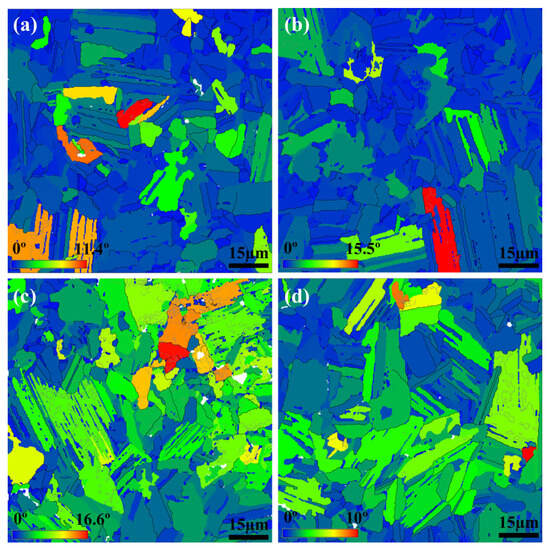
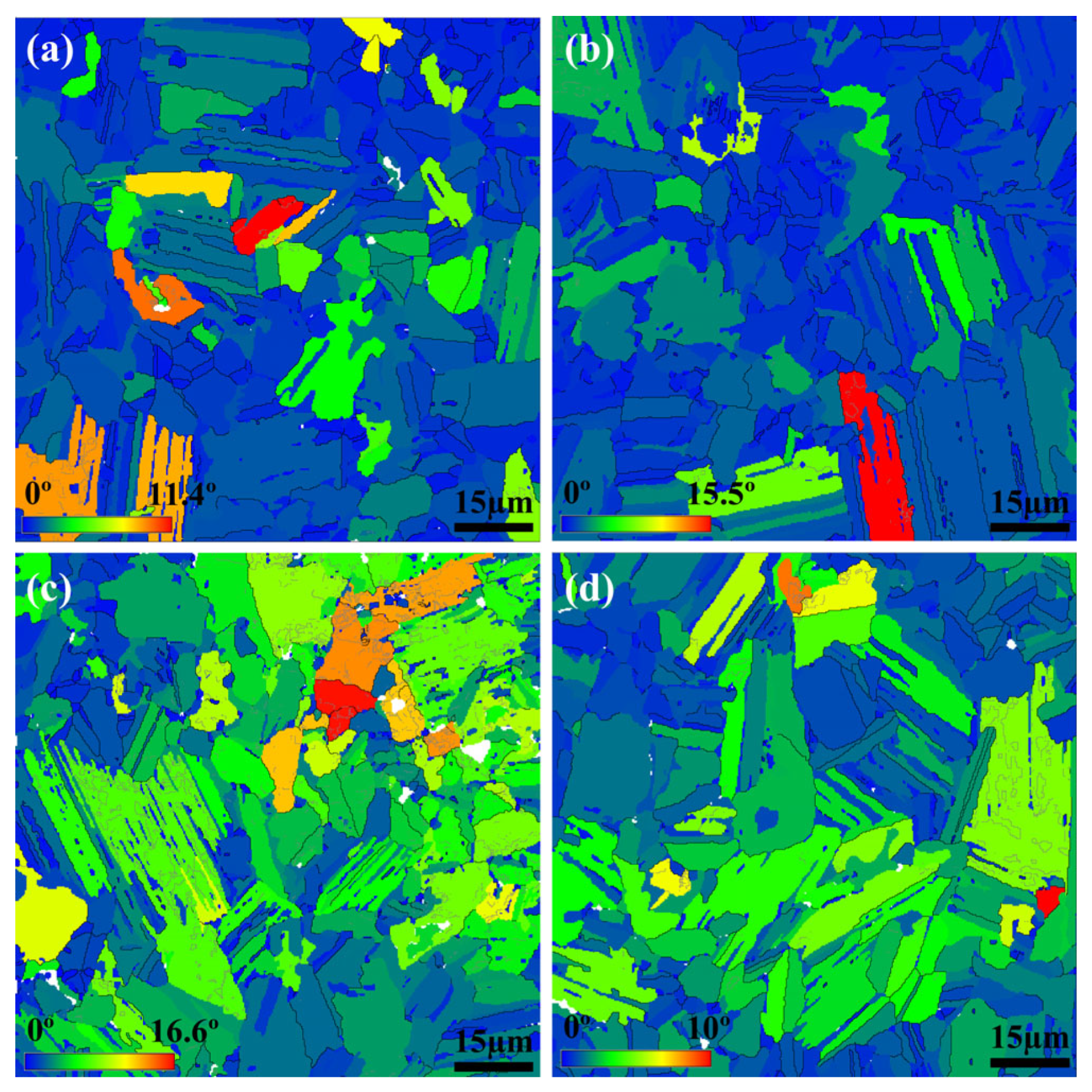
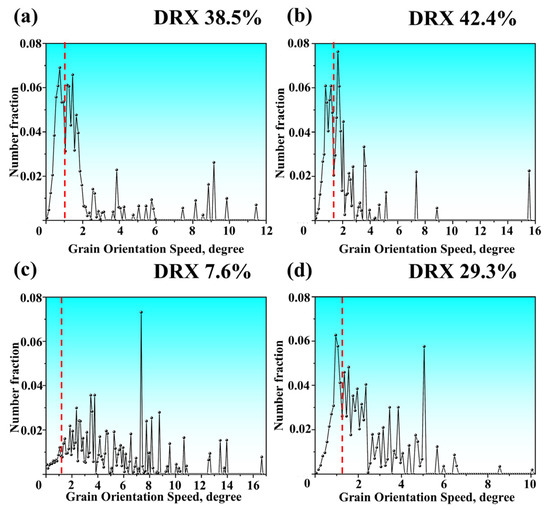
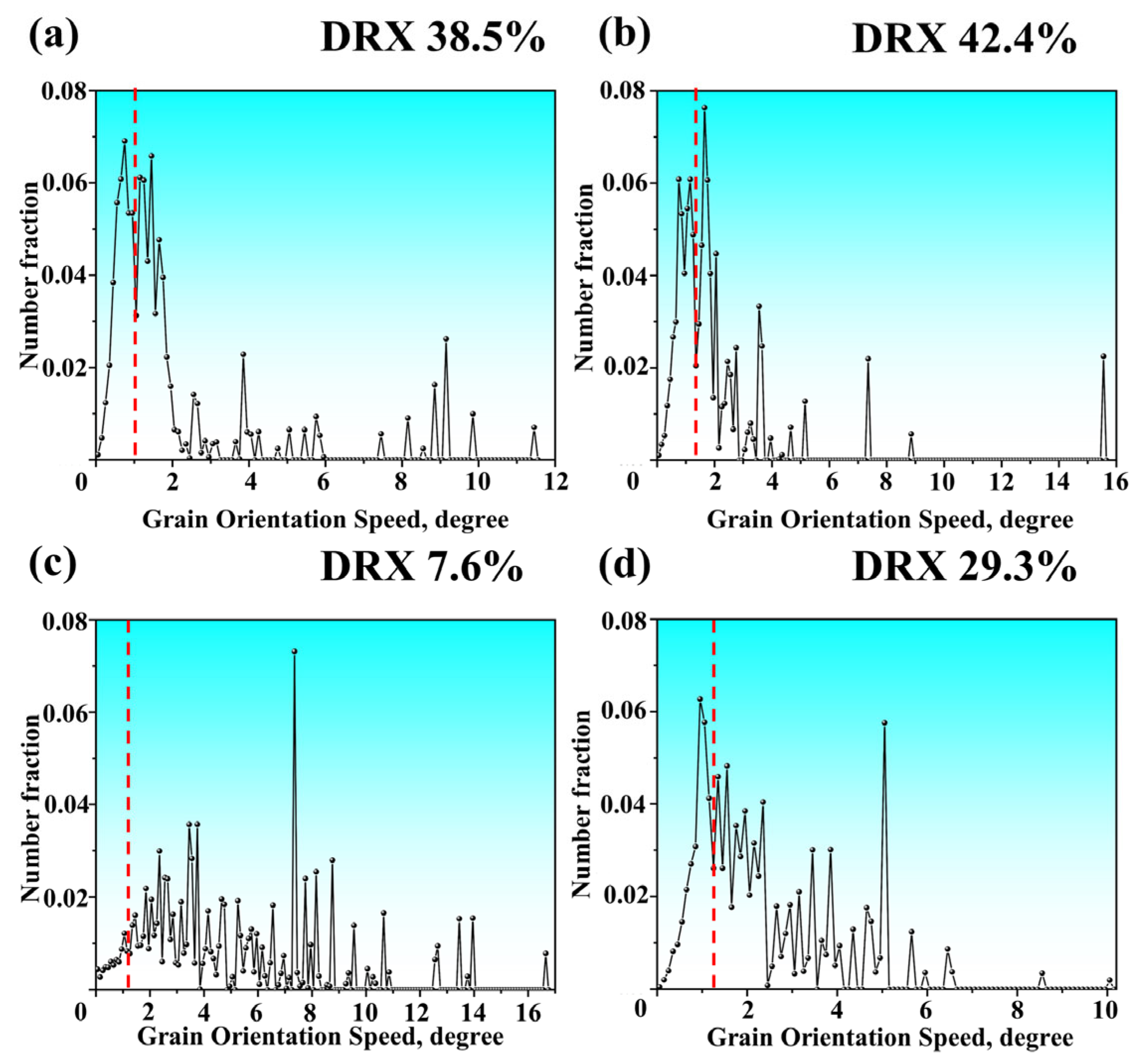
To quantitatively analyze the dynamic recrystallization behavior of the TiAl-based composite sample after compression creep, Figure 5 presents the Grain Orientation Spread (GOS) diagrams under different stress conditions. As shown in Figure 5, blue-colored grains exhibit low GOS values, indicating minimal internal orientation variation and are classified as fully dynamically recrystallized (DRX) grains. In contrast, green, yellow, and red regions represent higher GOS values and correspond to deformed grains. To further analyze the recrystallization behavior, Figure 6 presents the GOS statistical curves under different stress conditions. The GOS curve can be used to identify the boundary between recrystallized grains and deformed grains. Generally, when the GOS value of a certain grain is lower than the critical GOS, this grain can be regarded as a recrystallized grain. This basis comes from the characteristics of highly uniform internal orientation and extremely low defect content of the recrystallized grains, so its GOS must be concentrated in a smaller range. The critical GOS value can usually be determined from the GOS curve, that is, the position corresponding to the first significant peak of the GOS distribution [15], as shown in Figure 6. The low GOS peak is mainly composed of equiaxed grains that have undergone complete recrystallization, while the high GOS area corresponds to the deformed structure composed of α2/γ lamellar grains and γ axial grains remaining after HIP treatment. Under the same temperature conditions, higher applied stress can increase the driving force for dynamic recrystallization by introducing more deformation energy and enhancing dislocation accumulation, making recrystallization more likely to occur. However, since the nucleation and growth process of dynamic recrystallization requires sufficient time, a reduction in creep time will limit its actual development to a certain extent. The results are shown in Figure 6. The proportions of recrystallized regions under 200 MPa, 300 MPa, 400 MPa, and 450 MPa stress conditions were 38.5%, 42.4%, 7.6%, and 29.3%, respectively. It was seen that under all experimental conditions, the recrystallization proportion of the material was at a relatively low level. This indicates that during the compression creep at 750 °C, a large amount of α2/γ lamellar structure is retained in the TiAl-based composite, and the deformation mainly occurs through lamella bending and dislocation evolution rather than rapid transformation into a large number of equiaxed grains through recrystallization, demonstrating the excellent microstructure stability and outstanding creep resistance of this material. Although the recrystallization proportion shows a certain degree of increase in the case with 450 MPa, the overall recrystallization behavior remains constrained by the stability of the lamellar structure.
Figure 5.
GOS maps of the TiAl-based composite after compressive creep at 750 °C under different applied stresses: (a) 200 MPa; (b) 300 MPa; (c) 400 MPa; (d) 450 MPa.
Figure 6.
GOS distributions of the TiAl-based composite after compressive creep at 750 °C under different applied stresses: (a) 200 MPa; (b) 300 MPa; (c) 400 MPa; (d) 450 MPa. (The red dotted line corresponds to the ending point of the first more prominent peak).
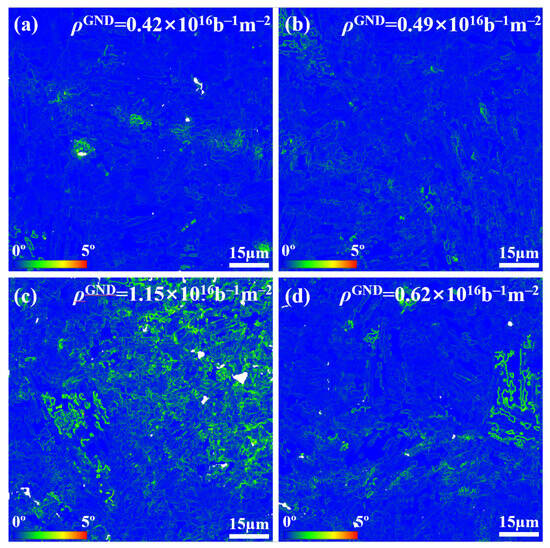
To further reveal the orientation gradients within the deformed grains and the local strain accumulation under different stress conditions, the Kernel Average Misorientation (KAM) analysis results are shown in Figure 7. Based on the local orientation deviations reflected by KAM, the geometric necessary dislocation (GND) density (ρGND) of the material during the creep deformation process can be quantitatively calculated. GND describes the number of dislocations that must exist due to the local orientation change in the crystal, and its magnitude can be derived from the orientation gradient corresponding to KAM, as shown in the following equation [16]:
where KAM(ave) is the average KAM value of the sample, μ = 0.25 μm is the step size, and b is the magnitude of the Burgers vector. As shown in Figure 7, when the stress increased from 200 MPa to 300 MPa, ρGND was slightly increased from 0.42 × 10¹⁶ b−1 m−2 to 0.49 × 10¹⁶ b−1 m−2. Although the recrystallization ratio at 300 MPa (42.4%) was higher than that at 200 MPa (38.5%), the ρGND calculated based on KAM was slightly increased. This phenomenon can be represented by the competitive relationship between dislocation generation and annihilation. Compared to 200 MPa, the applied stress at 300 MPa has increased by 50%, significantly promoting the generation and slip activity of dislocations, while the recrystallization fraction has only increased by approximately 3.9%, indicating a very limited enhancement in its ability to eliminate dislocations. Furthermore, under high-temperature creep conditions, recrystallized grains are not entirely dislocation-free. Newly formed grains may undergo further deformation under higher stress and accumulate geometrically necessary dislocations, resulting in a slight increase in ρGND as reflected in KAM statistics. When the applied stress came to 400 MPa, the corresponding ρGND value was increased significantly to 1.15 × 10¹⁶ b−1 m−2. Recrystallization and dislocation recovery are time-dependent kinetic processes. Normally, high stress can accelerate dislocation generation and provide greater driving force for recrystallization. But recrystallization involves two stages: nucleation and subsequent grain growth. The latter stage relies on a longer thermomechanical coupling time to achieve dislocation migration, annihilation, and grain boundary migration. For the sample tested at 400 MPa, the creep time was limited to 100 h. Although many dislocations were generated (leading to high stored energy), they have not yet undergone sufficient recovery or grain growth to reduce the dislocation density. As a result, the recrystallization fraction was only 7.6%, thus manifesting as a significantly increased ρGND. As for the maximum stress condition (450 MPa), ρGND was decreased to 0.62 × 10¹⁶ b−1 m−2. Higher stress significantly accelerates the generation and accumulation of dislocations, enabling the material to attain greater stored deformation energy within a relatively short period. This elevated stored energy promotes the occurrence of recrystallization nucleation and enhances the grain boundary driving force, leading to a more complete recrystallization process compared to that at 400 MPa. Therefore, under the condition of 450 MPa, more recrystallized grains with uniform orientation and relatively low internal dislocation density are formed, and their presence effectively reduces the ρGND of the material. In other words, although the test duration at 450 MPa was not extended, the significantly increased stress enhanced both the dislocation generation rate and the recrystallization nucleation rate, thereby partially compensating for the limitation imposed by insufficient time. This results in a higher degree of recrystallization at 450 MPa compared to that at 400 MPa under the same 100 h condition, which is consistent with the GOS maps and recrystallization fraction. During compressive creep, the occurrence of dynamic recrystallization can effectively reduce dislocation density, thereby softening the alloy.
Figure 7.
Kernel Average Misorientation maps of the TiAl-based composite after compressive creep at 750 °C under different applied stresses: (a) 200 MPa; (b) 300 MPa; (c) 400 MPa; (d) 450 MPa.
3.5. Grain Boundary Distribution
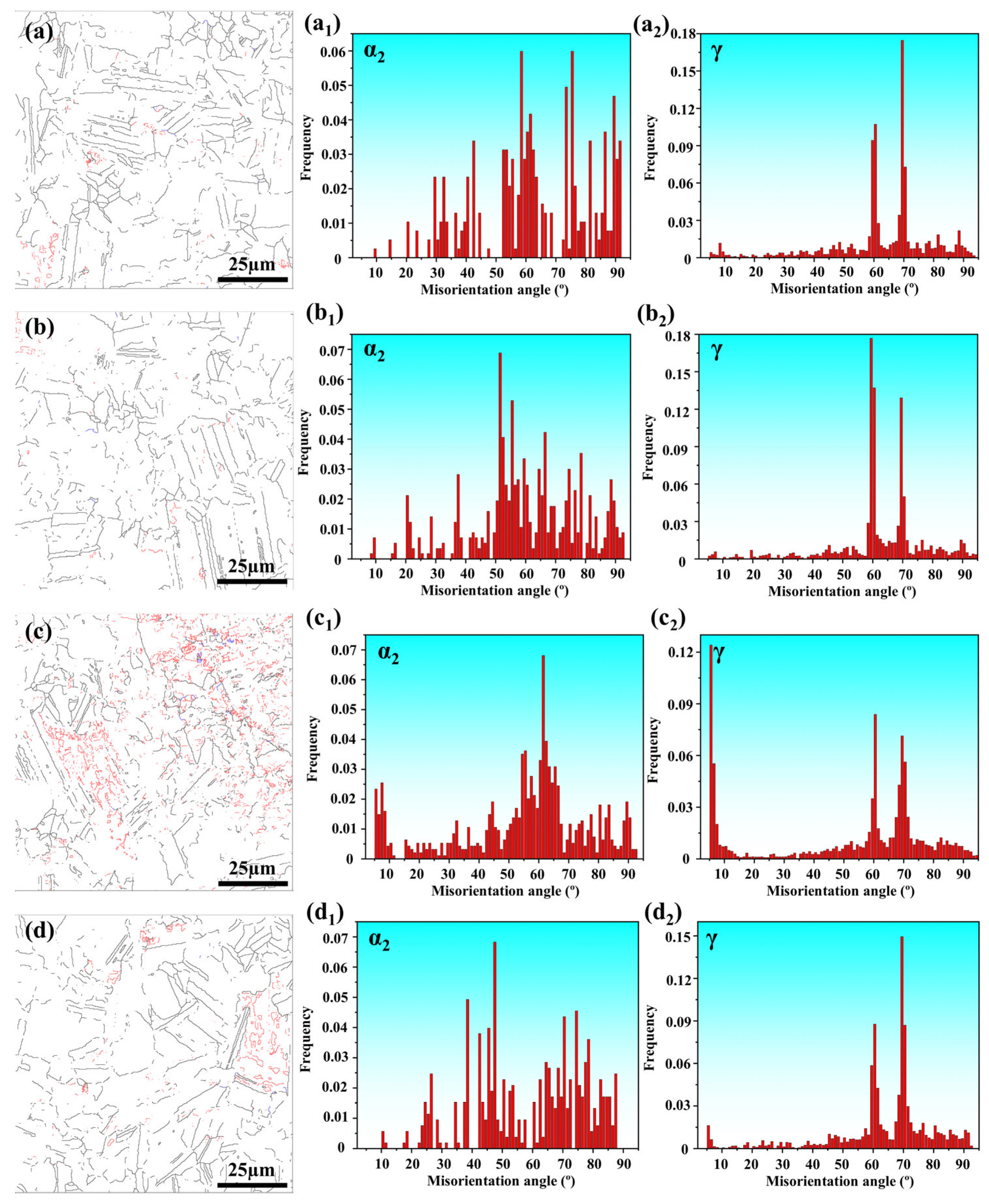
Figure 8a–d are the grain boundary distribution maps. Low-angle grain boundaries (2–10°, LAGBs), medium-angle grain boundaries (10–15°, MAGBs), and high-angle grain boundaries (>15°, HAGBs) are outlined in red, blue, and black lines, respectively. Meanwhile, HAGB can be further divided into random high-angle grain boundaries (RHAGBs), 60° <111> pseudo twin boundaries, and 70° <110> true twin boundaries [17]. Figure 8(a1–d1) presents the specific statistics of the grain boundary proportion distribution of the γ phase under the corresponding stress conditions. The statistics of the LAGB, MAGB, and HAGB of the γ phase corresponding to different stress conditions are shown in Table 1. During the compression creep of TiAl-based materials, recrystallization usually consists of continuous dynamic recrystallization (CDRX), discontinuous dynamic recrystallization (DDRX), and twin-induced dynamic recrystallization (TRDX). Among them, CDRX is derived from LAGB, which is related to dislocations and substructures and is prone to induce recrystallization nucleation during creep, forming MAGB. Therefore, MAGB is regarded as a sign of CDRX. In addition, the nucleation of DDRX mostly occurs at HAGB, which is closely related to grain boundary migration. The presence of RHAGB indicates that DDRX has occurred [18]. For TDRX, due to the high strain energy of the twin boundary, it can promote recrystallization nucleation, and its typical feature is the appearance of many equiaxed recrystallized grains around the twin. The type of twin boundary has a significant effect on creep behavior: true twin boundaries facilitate dislocation sliding and twin migration, thereby enhancing creep resistance in the medium-stress regime, whereas pseudo twin boundaries increase interfacial friction, which dominates creep behavior in the high-stress regime. According to the statistical results of the orientation difference distribution of γ phase grain boundaries of the TiAl-based composite samples under different stress conditions in Table 1, the proportions of LAGBs and MAGBs remained at low levels under all stress conditions. Except for the sample tested at 400 MPa, the LAGB content in the other samples was approximately 1–3%, while the MAGB content was less than 1%. In contrast, HAGBs occupied a dominant position under all stress conditions, with all their proportions exceeding 96%. A significant decrease in HAGB proportion (to 76.4%) was observed only at the highest stress of 400 MPa, which also coincides with the relatively low DRX fraction at 400 MPa, as shown in Figure 6. This phenomenon indicates that both CDRX and DDRX occurred simultaneously during the dynamic recrystallization process in all samples. The specific dynamic recrystallization mechanisms will be discussed in detail in Section 4.1.
Figure 8.
Grain boundary distribution diagrams of the TiAl-based composite after compressive creep at 750 °C under different stresses: (a–a2) 200 MPa; (b–b2) 300 MPa; (c–c2) 400 MPa; (d–d2) 450 MPa.
Table 1.
γ grain boundary misorientation distribution in TiAl composite under different stresses.
4. Discussion
4.1. Dynamic Recrystallization Mechanism
Based on the above microstructure and EBSD analysis results, it is found that under the compression creep condition at 750 °C, DRX does not occur extensively on the overall microstructure scale in the TiAl-based composite but rather exhibits obvious localized characteristics. The recrystallized grains are mostly distributed within the α2/γ lamellar layers or near the lamellar interfaces, while most areas still retain the complete original lamellar structure, indicating that the overall lamellar structure of the material under the current stress and temperature conditions has good stability. In the regions where dynamic recrystallization occurs, the original α2/γ lamellar structure is often accompanied by certain degrees of lamellar distortion or local degradation features. On the one hand, the local bending and degradation of the lamellar structure may reduce the interface constraint effect, thereby facilitating the accumulation of dislocations and the nucleation of recrystallization grains [19]; on the other hand, the recrystallization grains during nucleation and growth may also have an erosive effect on the original lamellar cluster structure, thereby promoting the further evolution of the lamellar structure [20]. It should be noted that although recrystallization behavior and evolution characteristics of the lamellar structure occurred in local areas, a considerable proportion of the α2/γ lamellar structures were retained after compression creep on the overall microstructure scale. Previous studies have shown that during the high-temperature creep process of TiAl alloys, the decomposition and spheroidization of the lamellar structure are often one of the important difficulties limiting their long-term service performance, and the large-scale decomposition of lamellae usually accompanies the acceleration stage of creep (third stage) and is closely related to the occurrence of large-scale DRX [21]. In contrast, the compression creep curves under all stress conditions in this study did not show obvious third-stage characteristics, which further indicates from the macroscopic creep behavior that no large-scale instability or rapid decomposition process of the lamellar structure occurs under the current experimental conditions. In addition, obvious local lamellar bending was observed during compression creep, and the bending degree increased with the increase in applied stress. Local lamellar bending can cause dislocations to accumulate significantly at the boundaries and interfaces of the lamellar clusters, thereby forming higher strain energy and orientation gradients in these areas, providing favorable conditions for the nucleation and growth of recrystallization grains. Similar phenomena of DRX induced by lamellar bending have also been reported in the study of thermal compression deformation of TiAl alloys [22], indicating that the geometric distortion of the lamellar structure has an important influence on the high-temperature plastic deformation and dynamic recrystallization process of TiAl alloys.
While CDRX is an evolution mechanism centered on dislocation evolution. Its prominent feature lies in the gradual adjustment and accumulation of the orientation within the crystal. During the high-temperature compression creep process of TiAl alloys, especially within the α2/γ lamellar structures, dislocation activities are particularly concentrated, providing conditions for the occurrence of CDRX. Under the continuous application of external stress, many dislocations move within the intracrystalline slip systems and constantly interact with each other. As the dislocation density gradually increases, dislocations inevitably undergo entanglement, forming dislocation-rich regions in local areas. Then, these dislocations undergo spontaneous rearrangement, gradually forming dislocation walls. With further deformation, the dislocation walls interact with newly generated or migrating dislocations, and the orientation difference gradually accumulates, eventually forming subgrain structures with small-angle orientation differences, corresponding to LAGB. This process essentially reflects the formation of subgrains and is the early stage of CDRX development. In the subsequent deformation process, under sustained applied stress and with sufficient deformation duration, these subgrains will continuously adjust their orientations under the conditions of continuous dislocation input and intracrystalline rotation. The orientation difference in LAGB gradually increases and further evolves into MAGB or HAGB. Combining the boundary statistics results in 3.5, it can be found that under the creep conditions of 400 MPa and 100 h, the proportion of LAGB in the sample is the largest, reaching 21.5%, which is significantly higher than the corresponding proportions under 200, 300, and 450 MPa conditions. At the same time, the proportion of MAGB (2.1%) under this stress condition is also significantly higher than that in other samples. The above results indicate that, under the combined influence of relatively high stress (400 MPa) and a relatively short deformation time, dislocations within the grains rapidly accumulate and extensively rearrange, promoting the formation of many LAGBs. However, their further evolution into MAGBs and HAGBs has not yet been fully accomplished. This intermediate characteristic is a typical manifestation of CDRX being in an active development stage but not yet reaching a “mature completion” state. In contrast, under the higher stress of 450 MPa, the proportions of LAGB and MAGB are significantly lower, only 2.51% and 0.57%, respectively. This indicates that under a higher stress level of 450 MPa, the intracrystalline orientation rotation and interface evolution process is significantly accelerated, and the formed LAGB can transform more quickly into higher-angle boundaries, thereby reducing the retention of intermediate-state boundaries. Therefore, it can be inferred that the evolution process of CDRX has been completed under the 450 MPa condition. Moreover, the formation of a high proportion of LAGB under 400 MPa also indicates that CDRX occupies a considerable proportion in the creep recrystallization process of the TiAl composite.
The formation of DDRX results from the interaction between work hardening and the recovery processes. When the formation of dislocations is faster than their annihilation, dislocations will gradually accumulate within the crystal. Once they reach a certain critical value, nucleation will occur, especially on the grain boundaries. Subsequently, new nuclei will sacrifice the original grains and grow through the grain boundaries. In contrast, the contribution of DDRX in this study is more intuitively reflected in the formation and spatial distribution characteristics of equiaxed recrystallized grains. As seen in Figure 3, it can be observed that most equiaxed recrystallized grains tend to nucleate at the boundaries of the α2/γ lamellae and the regions where different orientation lamellae intersect. These regions are prone to become sites for dislocation accumulation during compression creep, thus providing favorable conditions for the nucleation of DDRX. Once DDRX grains nucleate near these high-energy interfaces, their subsequent growth process may locally erode the original lamellar structure, but due to the high stability of the overall lamellar structure, this erosion effect is mainly limited to a local area and does not lead to the complete disintegration of the lamellar structure on a macroscopic scale. Since the formation of RHAGB is directly related to DDRX, further combined with the statistical results of γ phase grain boundary types under different stress conditions, the role of DDRX in high-temperature creep can be quantitatively analyzed. As shown in Table 1, at 200, 300, 400, and 450 MPa conditions, the proportion of RHAGB is 37.3%, 34.88%, 23.6%, and 39.8%, respectively. At 200 and 300 MPa conditions, RHAGB occupies a considerable proportion, and the content of RHAGB under these two stress conditions is relatively close, indicating that DDRX has occurred widely at low to medium stress levels. When the stress was raised to 400 MPa, the proportion of RHAGB dropped to 23.6%. Under this condition, the proportion of the corresponding grain boundaries of CDRX (LAGB 21.5% and MAGB 2.1% combined is 23.6%) is almost the same as the content of RHAGB. Therefore, it can be concluded that at 400 MPa, CDRX and DDRX jointly dominate the dynamic recrystallization process of TiAl-based composites. Further increasing the stress to 450 MPa, the proportion of RHAGB rises significantly to 39.8%. With higher stress conditions, subgrain boundaries are more likely to transform into HAGB, so LAGB and MAGB formed during the CDRX process further evolve into HAGB, resulting in a significant increase in the content of RHAGB.
4.2. Comparison of High-Temperature Creep Resistance
In this study, the LPBF-fabricated TiAl-based composite after HIP exhibits excellent creep resistance at 750 °C. Regardless of the long-term compression creep condition for 200 h or the high-stress conditions of 400 MPa and 450 MPa, no obvious third creep stage is observed in the samples, and the overall creep deformation process remains stable, demonstrating good microstructure stability and deformation resistance. According to the EBSD results, the DRX ratio of the specimens under different stress conditions is generally low. Especially at 400 MPa and 100 h, the proportion of the recrystallization area is only 7.6%, which is significantly lower than the typical level of TiAl alloys reported in the existing literature under the same temperature conditions.
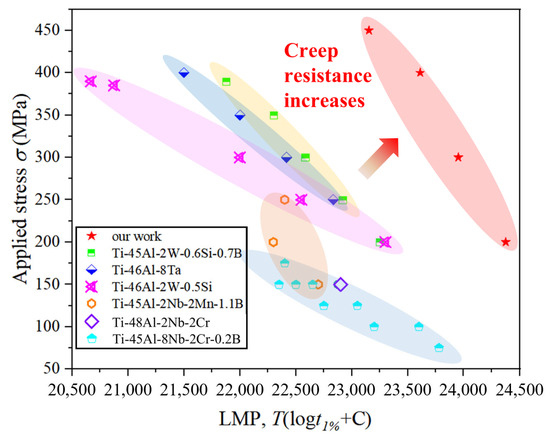
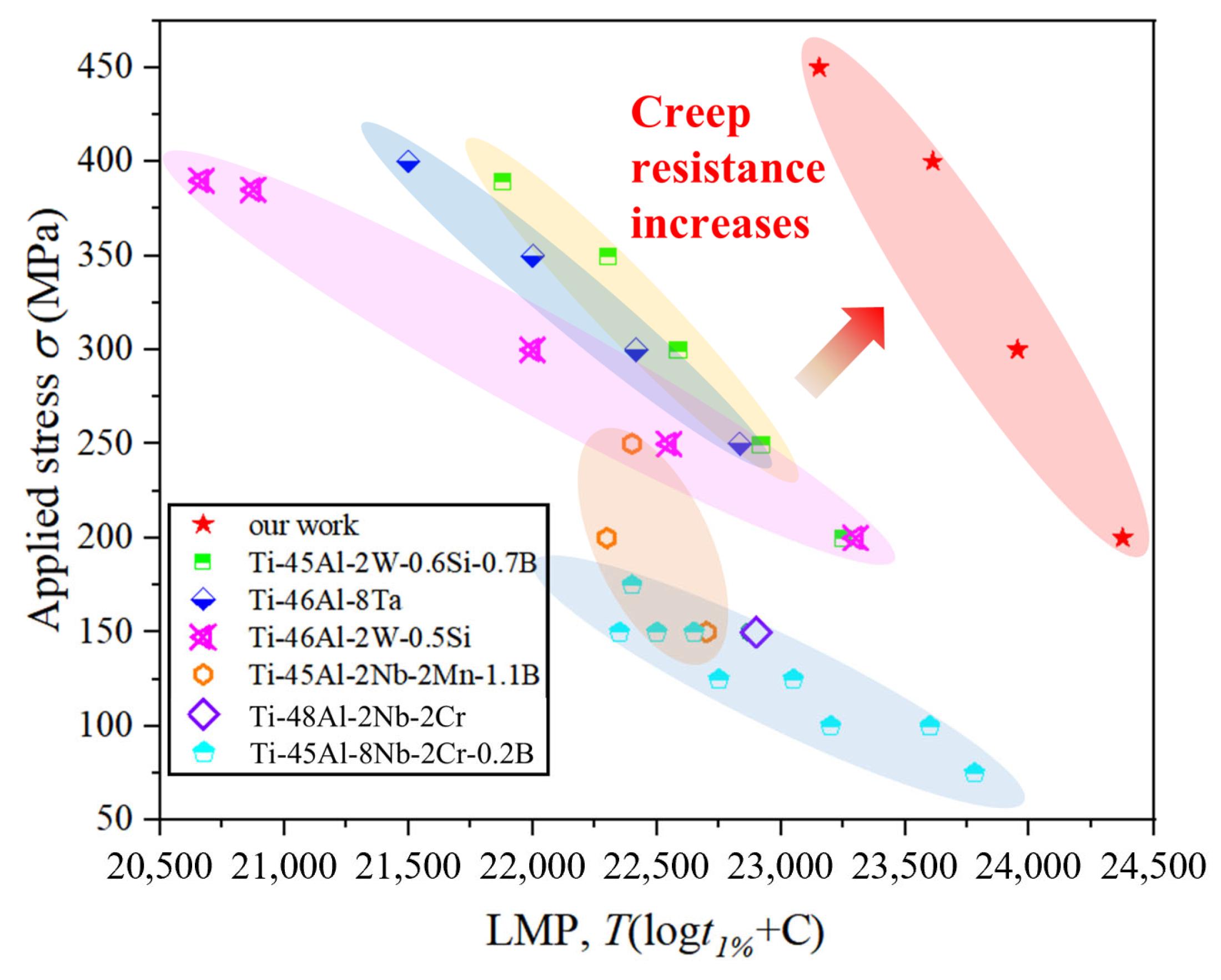
To further compare the creep performance of the TiAl-based composite in this study with that of the existing TiAl alloys under high-temperature conditions, the Larson–Miller Parameter (LMP) is used to uniformly characterize the creep durability performance under different stress conditions. The Larson–Miller parameter is a creep life assessment method that has been verified through long-term engineering applications and many experimental studies. For high-temperature service components such as gas turbine and aircraft engine turbine blades, the allowable creep strain is usually limited to less than 1%. Therefore, the time required to reach a 1% creep strain has been adopted as the life characterization index in many studies, and it has a high engineering recognition degree. Its expression is as follows:
where T is the absolute temperature (K), t1% is the time required to reach 1% creep strain under a given temperature and stress condition (h), and C is an empirical constant, typically taken as 20. The results are shown in Figure 9. At the same or at higher stress levels, the LMP values of the TiAl-based composite in this study are overall higher than those of several existing studies on TiAl alloys, indicating that they have more excellent creep durability performance under high-temperature conditions. This excellent creep resistance might stem mainly from two aspects: firstly, the fine lamellar spacing formed by HIP and the dispersion of La2O3 particles inhibiting dislocation slip; secondly, the introduction of Nb inhibiting the dislocation migration controlled by diffusion. The results show that the TiAl-based composite in this study exhibits greater compressive creep resistance under high-temperature compression creep conditions.
Figure 9.
Comparison of the high-temperature creep performance of the TiAl-based composite investigated in this study with previously reported TiAl alloys. Adapted from refs. [23,24].
4.3. Strengthening Mechanisms Governing the Creep Resistance of the TiAl-Based Composite
4.3.1. HIP on Creep Behavior and Microstructural Stability
The factors influencing the compressive creep behavior of TiAl alloys are rather complex. Besides external factors such as temperature and stress, the internal microstructure evolution and macroscopic damage of the material also play significant roles. The internal factors during high-temperature creep of the material mainly include the degradation of the microstructure and the formation of macroscopic damage such as voids and cracks. However, in this study, systematic microscopic observations were conducted on the samples that underwent different compressive creep stresses. SEM characterization was performed on the upper, lower, left, right, and middle regions of the samples, and no typical creep voids or macroscopic cracks induced by creep were found. This indicates that at 750 °C, the TiAl composite treated by HIP had good microstructure stability. Its compressive creep deformation is mainly achieved through the microstructure evolution mechanism rather than through the damage accumulation mechanism. It should be noted that a small number of cracks can still be observed in some areas, but these cracks mainly originate from the original defects that were not completely healed during the HIP process, rather than new damages generated during the creep process.
Due to the long holding time during the HIP process and the low cooling rate of the furnace, the TiAl composite eventually presents a dual-phase structure consisting of α2 + γ lamellar structure and equiaxed γ grains. For TiAl alloys, their high-temperature creep properties are closely related to microstructure characteristics, such as being significantly influenced by the size characteristics of the α2/γ lamellar structure. Numerous studies have shown that lamellar spacing is an important microscopic parameter affecting the high-temperature creep behavior of TiAl alloys. A smaller lamellar spacing can significantly enhance creep resistance. On one hand, the α2/γ lamellar interface has a significant hindering effect on the movement of dislocations during high-temperature deformation. When the lamellar spacing is small, the effective slip distance of dislocations is significantly shortened. Existing studies have observed many dislocations accumulating at the lamellar interface in the fully lamellar structure after creep deformation, which also confirms this [25]. In addition, the lamellar interface will also restrict the movement of dislocations along the lamellar direction, causing the dislocation segments to undergo bending deformation between adjacent interfaces. B.D. Worth et al. directly observed the bent dislocation structures spanning the lamellar and interacting with the interface in the creep-deformed material [25], further illustrating the significant pinning and constraining effect of the lamellar interface on dislocation movement [26]. On the other hand, fine lamellar spacing is conducive to dispersing stress concentration and delaying the microscopic degradation process of the lamellar structure boundary (such as the spheroidization of the lamellar interface), thereby improving the overall microstructure stability [27]. In this study, the average lamellar spacing of the TiAl-based composite is approximately 0.41 μm, which is smaller than the lamellar spacing scale reported in the literature [28]. Such fine and uniform lamellar spacing can effectively enhance the constraining effect on dislocation movement and improve the structural stability of lamellar organization during high-temperature compression creep [29,30].
4.3.2. Role of Nb and LaB6 Reinforcement
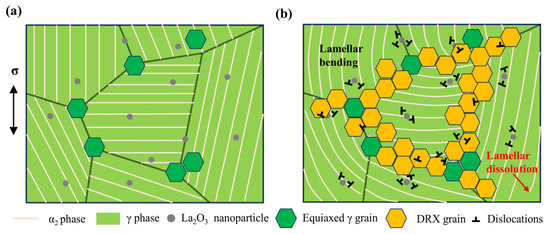
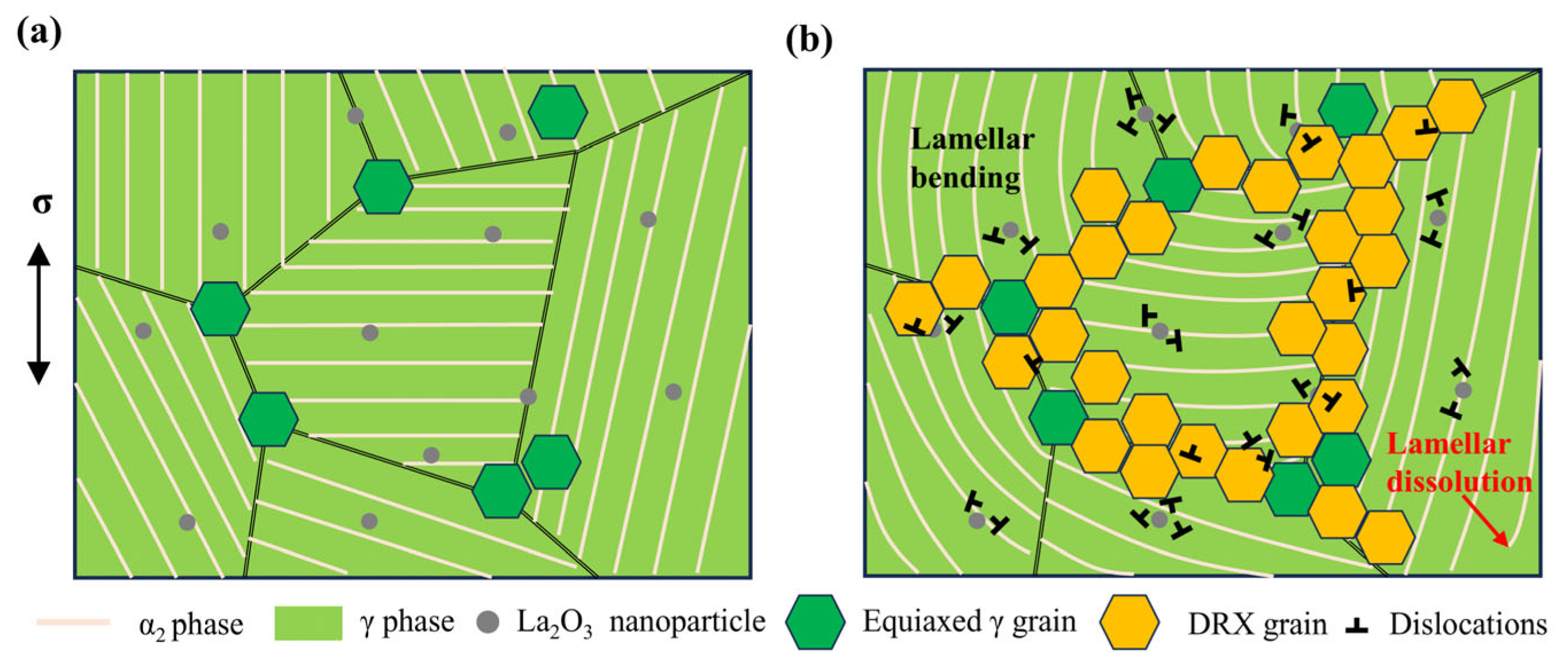
During the high-temperature deformation process of TiAl alloys, the deformation behavior during the creep steady-state stage is usually controlled by the diffusion process, and its characteristics can be described by the Norton–Bailey power–law relationship in Equation (1). Studies [31] have shown that the creep activation energy of Nb-rich γ-TiAl alloys can reach approximately 375 kJ/mol, while the self-diffusion activation energies of Ti and Al in TiAl alloys are 250–295 kJ/mol and 358 kJ/mol, respectively. This difference indicates that the introduction of Nb significantly increases the energy barrier for atomic diffusion in the γ-TiAl phase, thereby effectively suppressing the diffusion-controlled creep mechanism (such as dislocation migration). Due to the low diffusion coefficients of Nb in both α2 phase and γ phase, its presence significantly reduces the atomic migration ability at high temperatures, thereby reducing the steady-state creep rate and improving the creep resistance of the material. Moreover, based on the GOS statistical results in Figure 5 and Figure 6, it can be found that the recrystallization proportion in the material is low under all stress conditions, especially at 400 MPa and 100 h, where the recrystallization proportion is only 7.6%, indicating that dynamic recrystallization does not play a dominant role in the creep deformation process of this material. The in situ generated La2O3 nanoparticles are believed to play an important role in this process. The dispersed La2O3 nanoparticles strongly interact with dislocations, exerting significant pinning and hindrance effects on dislocation slips. During high-temperature compressive creep, dislocations are continuously generated and move under applied stress, but their long-range glide capability is restricted by obstruction from La2O3 particles. This leads to substantial dislocation accumulation within grains, thereby significantly increasing the material’s dislocation density and enhancing the work-hardening effect. In addition, similar studies have also shown that fine La2O3 particles can hinder recrystallization nucleation [32], as shown in Figure 10.
Figure 10.
Schematic illustration of the high-temperature creep mechanisms of the TiAl-based composite at 750 °C: (a) before creep; (b) after creep.
5. Conclusions
In this study, the high-temperature compressive creep behavior of the LPBF-fabricated LaB6/TiAl-based composite after HIP post-treatment was systematically investigated, with a focus on creep deformation characteristics, dynamic recrystallization behavior, and the underlying mechanisms under different applied stress conditions. The results demonstrate that this TiAl composite exhibits excellent microstructural stability and creep resistance at elevated temperatures. The main conclusions are summarized as follows:
- The steady-state creep rate of the TiAl composite increases significantly with increasing applied stress, rising from 2.88 × 10⁻⁸ s−1 at 200 MPa to 3.85 × 10⁻⁷ s−1 at 450 MPa. Stress exponent analysis indicates that the creep deformation at 750 °C is primarily controlled by dislocation climb. Notably, no pronounced tertiary creep stage is observed under any of the applied stress conditions, highlighting the material’s remarkable deformation stability during high-temperature compressive creep.
- DRX behavior generally shows an increasing trend with the increase in applied stress. Under the conditions of 200 MPa and 300 MPa, the samples form a certain proportion of recrystallized grains under the action of a longer creep time; while under the condition of 400 MPa, due to a decrease in the creep time, the recrystallization process is significantly restricted, and the recrystallization proportion is only 7.6%. When the stress is further increased to 450 MPa, the higher stress level significantly accelerates the accumulation rate of deformation energy, thereby promoting the occurrence of dynamic recrystallization. During the recrystallization process, both the CDRX and DDRX mechanisms are present.
- The excellent creep resistance of the composite at 750 °C is attributed to multiple synergistic strengthening mechanisms: the fine α2/γ lamellar spacing produced by HIP, the strong pinning effect of dispersed La2O3 nanoparticles on dislocation motion, and the suppression of diffusion-controlled dislocation climb by Nb addition. These mechanisms collectively retard creep deformation and dynamic softening, enabling the material to maintain low steady-state creep rates and a stable microstructure even under prolonged exposure to high stress.
Author Contributions
G.W.: writing—original draft, validation, investigation, formal analysis; X.X.: writing—original draft, methodology, investigation, formal analysis, data curation; D.Z.: writing—review and editing, supervision, investigation, conceptualization; C.M.: writing—review and editing, supervision, investigation, funding acquisition. All authors have read and agreed to the published version of the manuscript.
Funding
This research was funded by Jiangsu Province Youth Talent Support Program (JSTJ-2024-450).
Data Availability Statement
The original contributions presented in this study are included in the article. Further inquiries can be directed to the corresponding authors.
Conflicts of Interest
The authors declare no conflicts of interest.
References
- Bewlay, B.P.; Nag, S.; Suzuki, A.; Weimer, M.J. TiAl alloys in commercial aircraft engines. Mater. High Temp. 2016, 33, 549–559. [Google Scholar] [CrossRef] [Scilit]
- Tetsui, T. Application of TiAl in a turbocharger for passenger vehicles. Adv. Eng. Mater. 2001, 3, 307–310. [Google Scholar] [CrossRef]
- Shi, X.; Wang, H.; Feng, W.; Zhang, W.; Ma, S.; Wei, J. The crack and pore formation mechanism of Ti–47Al–2Cr–2Nb alloy fabricated by selective laser melting. Int. J. Refract. Met. Hard Mater. 2020, 91, 105247. [Google Scholar] [CrossRef] [Scilit]
- Wang, Q.; Chen, R.; Chen, D.; Su, Y.; Ding, H.; Guo, J.; Fu, H. The characteristics and mechanisms of creep brittle-ductile transition in TiAl alloys. Mater. Sci. Eng. A 2019, 767, 138393. [Google Scholar] [CrossRef] [Scilit]
- Liu, J.; Wang, Z.; Li, P.; Zhang, Z.; Zhao, C.; Zhao, Y.; Zhang, Y.; Liang, Y.; Lin, J. Fabrication of high strength TiAl alloy with nano-lamellar and ultra-fine-grained microstructure by selective electron beam melting. J. Mater. Res. Technol. JMRT 2025, 35, 7156–7166. [Google Scholar] [CrossRef] [Scilit]
- Huang, D.; Tan, Q.; Zhou, Y.; Yin, Y.; Wang, F.; Wu, T.; Yang, X.; Fan, Z.; Liu, Y.; Zhang, J.; et al. The significant impact of grain refiner on γ-TiAl intermetallic fabricated by laser-based additive manufacturing. Addit. Manuf. 2021, 46, 102172. [Google Scholar] [CrossRef] [Scilit]
- Zhuo, Z.; Fang, Z.; Ma, C.; Xie, Z.; Peng, X.; Wang, Q.; Miao, X.; Wu, M. Influence of LaB6 inoculant on the thermodynamics within the molten pool and subsequent microstructure development and cracking behavior of laser powder bed fused TiAl-based alloys. J. Mater. Res. Technol. JMRT 2023, 27, 2363–2381. [Google Scholar] [CrossRef] [Scilit]
- Hayes, R.W.; London, B. On the creep deformation of a cast near gamma TiAl alloy Ti-48Al-1Nb. Acta Metall. Mater. 1992, 40, 2167–2175. [Google Scholar] [CrossRef] [Scilit]
- Dlouhý, A.; Kuchařová, K.; Orlová, A. Long-term creep and creep rupture characteristics of TiAl-base intermetallics. Mater. Sci. Eng. A Struct. Mater. Prop. Microstruct. Process. 2009, 510, 350–355. [Google Scholar] [CrossRef] [Scilit]
- Song, L.; Hu, X.; Wang, L.; Stark, A.; Lazurenko, D.; Lorenz, U.; Lin, J.; Pyczak, F.; Zhang, T. Microstructure evolution and enhanced creep property of a high Nb containing TiAl alloy with carbon addition. J. Alloys Compd. 2019, 807, 151649. [Google Scholar] [CrossRef] [Scilit]
- Guo, Y.; Tian, J.; Xiao, S.; Xu, L.; Chen, Y. Enhanced creep properties of Y2O3-bearing Ti-48Al-2Cr-2Nb alloys. Mater. Sci. Eng. A Struct. Mater. Prop. Microstruct. 2021, 809, 140952. [Google Scholar] [CrossRef] [Scilit]
- Guo, Y.; Xiao, S.; Tian, J.; Xu, L.; Chen, Y. Creep deformation and rupture behavior of a high Nb containing TiAl alloy reinforced with Y2O3 particles. Mater. Charact. 2021, 179, 111355. [Google Scholar] [CrossRef] [Scilit]
- Liang, Z.; Xiao, S.; Cai, Y.; Yue, H.; Zheng, Y.; Xu, L.; Xue, X.; Tian, J.; Chen, Y. Compressive creep behavior of selective electron beam melted high Nb containing TiAl alloy. Vacuum 2024, 219, 112731. [Google Scholar] [CrossRef] [Scilit]
- Xu, X.; Ma, C.; Xie, Z.; Wang, Q.; Zhang, C.; Wu, M. Hot isostatic pressure treatment and high-temperature oxidation behavior of a LaB6/TiAl-based composite fabricated by laser powder bed fusion. J. Alloys Compd. 2025, 1029, 180841. [Google Scholar] [CrossRef] [Scilit]
- Wen, D.; Shan, D.; Wang, S.; Zong, Y. Investigation of hydrogen influencing γ-phase true and pseudo twinning in a TiAl based alloy during high-temperature plane strain compression. Mater. Sci. Eng. A Struct. Mater. Prop. Microstruct. 2018, 710, 374–384. [Google Scholar] [CrossRef] [Scilit]
- Calcagnotto, M.; Ponge, D.; Demir, E.; Raabe, D. Orientation gradients and geometrically necessary dislocations in ultrafine grained dual-phase steels studied by 2D and 3D EBSD. Mater. Sci. Eng. A Struct. Mater. Prop. Microstruct. 2010, 527, 2738–2746. [Google Scholar] [CrossRef] [Scilit]
- Ding, J.; Liang, Y.; Xu, X.; Yu, H.; Dong, C.; Lin, J. Cyclic deformation and microstructure evolution of high Nb containing TiAl alloy during high temperature low cycle fatigue. Int. J. Fatigue 2017, 99, 68–77. [Google Scholar] [CrossRef] [Scilit]
- Liu, G.H.; Li, T.R.; Wang, X.Q.; Guo, R.Q.; Misra, R.D.K.; Wang, Z.D.; Wang, G.D. Effect of alloying additions on work hardening, dynamic recrystallization, and mechanical properties of Ti–44Al–5Nb–1Mo alloys during direct hot-pack rolling. Mater. Sci. Eng. A Struct. Mater. Prop. Microstruct. 2020, 773, 138838. [Google Scholar] [CrossRef] [Scilit]
- Zong, Y.; Wen, D.; Liu, Z.; Shan, D. Effect of hydrogen on the microstructural evolution of a γ-TiAl based alloy. Mater. Lett. 2015, 142, 23–26. [Google Scholar] [CrossRef] [Scilit]
- Xiang, L.; Tang, B.; Xue, X.; Kou, H.; Li, J. Microstructural characteristics and dynamic recrystallization behavior of β-γ TiAl based alloy during high temperature deformation. Intermetallics 2018, 97, 52–57. [Google Scholar] [CrossRef] [Scilit]
- Wang, Y.; Xue, X.; Kou, H.; Yu, Y.; Jia, M.; Qiang, F.; Li, J. Quasi-in-situ investigation on microstructure degradation of a fully lamellar TiAl alloy during creep. J. Mater. Res. Technol. JMRT 2022, 18, 4980–4989. [Google Scholar] [CrossRef] [Scilit]
- Tian, S.; Jiang, H.; Guo, W.; Zhang, G.; Zeng, S. Hot deformation and dynamic recrystallization behavior of TiAl-based alloy. Intermetallics 2019, 112, 106521. [Google Scholar] [CrossRef] [Scilit]
- Singh, V.; Mondal, C.; Sarkar, R.; Bhattacharjee, P.; Ghosal, P. Compressive creep behavior of a γ-TiAl based Ti–45Al–8Nb–2Cr-0.2 B alloy: The role of β (B2)-phase and concurrent phase transformations. Mater. Sci. Eng. A Struct. Mater. Prop. Microstruct. Process. 2020, 774, 138891. [Google Scholar] [CrossRef] [Scilit]
- Lapin, J.; Pelachová, T.; Dománková, M. Creep behaviour of a new air-hardenable intermetallic Ti–46Al–8Ta alloy. Intermetallics 2011, 19, 814–819. [Google Scholar] [CrossRef] [Scilit]
- Worth, B.D.; Jones, J.W.; Allison, J.E. Creep deformation in near-γ TiAl: Part 1. the influence of microstructure on creep deformation in Ti-49Al-1V. Metall. Mater. Trans. A Phys. Metall. Mater. Sci. 1995, 26, 2947–2959. [Google Scholar] [CrossRef] [Scilit]
- Chen, W.R.; Triantafillou, J.; Beddoes, J.; Zhao, L. Effect of fully lamellar morphology on creep of a near γ-TiAl intermetallic. Intermetallics 1999, 7, 171–178. [Google Scholar] [CrossRef] [Scilit]
- Wang, Q.; Chen, R.; Yang, Y.; Wu, S.; Guo, J.; Ding, H.; Su, Y.; Fu, H. Effects of lamellar spacing on microstructural stability and creep properties in β-solidifying γ-TiAl alloy by directional solidification. Mater. Sci. Eng. A Struct. Mater. Prop. Microstruct. 2018, 711, 508–514. [Google Scholar] [CrossRef] [Scilit]
- Maruyama, K.; Yamamoto, R.; Nakakuki, H.; Fujitsuna, H. Effects of lamellar spacing, volume fraction and grain size on creep strength of fully lamellar TiAl alloys. Mater. Sci. Eng. A Struct. Mater. Prop. Microstruct. 1997, 239, 419–428. [Google Scholar] [CrossRef] [Scilit]
- Singh, V.; Mondal, C.; Sarkar, R.; Roy, S.; Omprakash, C.; Ghosal, P. Characterization of Microstructure of Crept Nb and Ta-Rich γ-TiAl Alloys by Automated Crystal Orientation Mapping and Electron Back Scatter Diffraction. Symmetry 2022, 14, 399. [Google Scholar] [CrossRef] [Scilit]
- Hansen, N.; Bay, B. The effect of particle content, particle distribution and cold deformation on the recrystallization of low oxide Al-Al2O3 products. J. Mater. Sci. 1972, 7, 1351–1362. [Google Scholar] [CrossRef] [Scilit]
- Malti, A.; Rashidfar, P.; Kardani, A.; Montazeri, A. Microstructural evolution and phase transitions in porous Ta/Cu alloys under high strain rates. Sci. Rep. 2025, 15, 19291. [Google Scholar] [CrossRef] [Scilit]
- Zhu, Y.Q.; Yi, M.; Zhang, Z.H.; Guo, W.L. Role of true and pseudo twin boundary in high-temperature creep of γ-TiAl alloy: Atomistic mechanism and mesoscale model. Acta Mater. 2025, 299, 121418. [Google Scholar] [CrossRef] [Scilit]

Disclaimer/Publisher’s Note: The statements, opinions and data contained in all publications are solely those of the individual author(s) and contributor(s) and not of MDPI and/or the editor(s). MDPI and/or the editor(s) disclaim responsibility for any injury to people or property resulting from any ideas, methods, instructions or products referred to in the content. |
© 2026 by the authors. Licensee MDPI, Basel, Switzerland. This article is an open access article distributed under the terms and conditions of the Creative Commons Attribution (CC BY) license.