Article

Influence of Ni and Co Additions on Microstructure and Mechanical Properties of (CoCrCuTi)100−xFex High-Entropy Alloys


1
Materials Science and Engineering Program, Department of Electrical and Computer Engineering, University of California, Riverside, CA 92521, USA
2
Materials Science and Engineering Program, Department of Mechanical Engineering, University of California, Riverside, CA 92521, USA
*
Author to whom correspondence should be addressed.
Metals 2026, 16(3), 321; https://doi.org/10.3390/met16030321
Submission received: 11 February 2026 / Revised: 10 March 2026 / Accepted: 11 March 2026 / Published: 13 March 2026

Abstract

The influence of Ni and Co additions on microstructure and mechanical properties of (CoCrCuTi)100−xFex high-entropy alloys (HEAs) containing 10 or 15 at. % Fe was investigated. The base HEA consisted of dendritic C14 Laves phases with interdendritic Cu-rich FCC regions. When Ni in the range of 2.5 to 10 at. % was added, a reduction in the Cu-rich phase was observed. Conversely, Co additions in the same range initially increased the Cu-rich phase but eventually led to liquid-phase separation (LPS), forming distinct Cu-lean L1 liquid and Cu-rich L2 globular regions. The average Vickers hardness values of (CoCrCuTi)90Fe10 and (CoCrCuTi)85Fe15 HEAs were measured at 790 ± 33 HV and 760 ± 20 HV, respectively. The additions of Ni and Co decreased overall hardness values. However, while Ni additions caused greater microstructural refinement, Co additions eventually led to heterogeneity due to LPS. For instance, the Vickers hardness of (CoCrCuTi)90Fe10 with 2.5 at. % Ni reached a maximum of 706 ± 95 HV, decreasing in hardness and scatter to 646 ± 19 HV when Ni increased to 10 at. %. In contrast, Co additions led to a marked reduction in hardness, from 574 ± 114 HV at 2.5 at. % Co to 442 ± 246 HV at 10 at. % Co. The fracture toughness (KIC), determined using Vickers indentation testing, indicated that Ni additions reduce fracture toughness, while Co additions increase it.

1. Introduction

High-entropy alloys (HEAs) incorporate several primary elements in near-equiatomic proportions, resulting in distinct material characteristics [1,2,3,4,5,6,7,8]. These alloys commonly adopt single-phase crystal structures (body-centered cubic (BCC), face-centered cubic (FCC), or hexagonal close-packed (HCP) phases), though competing complex intermetallic compound formation is also possible [9]. A noteworthy additional phenomenon influencing the microstructural evolution of HEAs is liquid-phase separation (LPS), which can significantly affect mechanical properties [4,10,11].
A recent investigation by present authors examined the influence of composition and cooling rate on the microstructural development of (CoCrCuTi)100−xFex (x = 0, 5, 10, 12.5, 15) produced by arc-melting, EM levitation melting, and solidification [1]. It was shown that samples without Fe addition contained Cu-lean BCC1 + BCC2 phases and an interdendritic FCC Cu-rich phase, whereas adding 5 to 10% Fe caused the formation of a Cu-lean C14 Laves phase along with the interdendritic Cu-rich FCC phase. The cooling rate was also shown to strongly influence the microstructure and mechanical properties. At 10 at. % Fe, lower cooling rates (1–75 K/s) induced LPS into Cu-lean L1 and Cu-rich L2 liquid phases. Increasing the cooling rate (~400–700 K/s), on the other hand, produced coarse Cu-lean dendrites with secondary arm spacing (DAS) of ~0.6–0.8 μm and an interdendritic Cu-rich phase. Further increasing the cooling rate (~1000–1600 K/s) was shown to refine the dendrites to arm spacings of ~0.4–0.5 μm. In contrast, for alloys with 12.5 to 15 at. % Fe, LPS occurred at all cooling rates, though higher rates produced more uniformly distributed L2 globules. As for mechanical properties, Vickers hardness increased with Fe additions, partly due to the presence of the hexagonal Laves C14 phase, while incorporating 15 at. % Fe was shown to increase hardness from 444 to 891 HV. Rapid cooling generally enhances hardness through microstructural refinement, but decreases fracture toughness. The peak Vickers hardness of 891 ± 66 HV and fracture toughness of 5.5 ± 0.4 KIC were found in the 15 at. % Fe samples cooled slowly (25–75 K/s).
Other investigations on the comparable CoCrCuFeNi HEA system by Yan et al. [12] have demonstrated that increasing the undercooling induced a notable enhancement in both mechanical strength and magnetic response, with microhardness and saturated magnetization improving by over 23% and 17%, respectively. Concurrently, the material’s electrical resistivity was found to decrease by nearly 30%, which was attributed to effects such as metastable phase separation and refined grain structures. Furthermore, Zhao et al. [13] observed that mechanical alloying and ball milling can control microstructural development that enhances hardness and toughness. Laser cladding technology has also been shown to improve surface properties, producing alloys with high-hardness, high-wear-resistant coatings and enhanced overall corrosion resistance. Additionally, heat treatment processes were shown to play a critical role in microstructural and mechanical property refinement of CoCrCuNi-based HEAs [14].
An additional approach for tailoring microstructures is to manipulate the cooling rate. Derimow et al. reported that rapid cooling affects miscibility [5]. According to these authors, when liquid cools to a critical temperature, alloys with positive mixing enthalpy undergo phase separation [4,5]. It has also been demonstrated by Wang et al. that positive mixing enthalpy could drive phase separation, particularly in systems with limited miscibility [15]. Small compositional changes to a base alloy have been shown to influence phase morphologies, microstructures, and mechanical properties [1,4,5,16].
However, phase separation has been found to develop and intensify if positive enthalpy of mixing is not sufficiently counterbalanced by configurational entropy. Deri-mow et al. noted that Ni additions could stabilize dendritic solidification, thereby reducing LPS in systems such as CoCrCuNi and CoCrCuFeNi [11]. Munitz et al. observed that the introduction of Ni into CoCrCu alloys, including CoCrCuNi, CoCrCuFeNi, and CoCrCuMnNi, decreases the miscibility gap temperature [4,11]. In compositions containing elevated concentrations of Co, Cr, Fe, and Ni, phase separation is manifested by the formation of spherical Cu-rich droplets [4]. Therefore, controlling composition with strategic Ni additions, along with thermodynamic factors such as mixing enthalpy, provides an effective strategy for tailoring HEA microstructures [17].
Several studies have explored the impact of Ni additions on the suppression of LPS, which further enhances mechanical properties. Previous studies have demonstrated that Ni additions influence LPS behavior in Cu–Co systems. For instance, Sun et al. showed that Ni reduced the solidification of unwanted phases in Cu–Co alloys and partly reduced LPS between the Cu-rich and Co-rich phases, which further enhanced mechanical properties [18]. Their results also showed that Ni preferentially partitions into the Co-rich phase, although Ni remains present in both Co-rich and Cu-rich regions, contributing to a more uniform microstructure and reduced phase segregation. However, while these studies demonstrate the influence of Ni additions on phase separation behavior in CoCrCu-based systems, relatively few investigations have compared the contrasting effects of Ni and Co additions within the same base alloy system. Similarly, Wei et al. reported that Ni additions suppressed LPS in Cu-Cr alloys, promoting miscibility [19]. On the other hand, Rios et al. found that increasing Ni within AlCrFeCoNi alloys led to more pronounced interdendritic regions, accompanied by the dissolution of precipitates into a Ni-rich matrix [20].
Considering the previously mentioned analyses, this study investigates the effects that varying Ni and Co content (x = 2.5, 5, 7.5, 10) have on microstructural and mechanical properties of (CoCrCuTi)100−xFex HEAs, with a particular focus on suppressing LPS and refining the microstructure.

2. Materials and Methods

Alloys with the nominal composition ((CoCrCuTi)100−xFex)100−yNiy (x = 10–15 at. %, y = 2.5–10 at. %) were synthesized using high-purity elemental constituents (≥99.9%, Alfa Aesar, Ward Hill, MA, USA). To promote chemical homogeneity, the arc melting, conducted under a titanium-gettered argon atmosphere, involved five remelts per sample, with the ingots inverted between each cycle. For microstructural analysis, arc-melted specimens were longitudinally cross-sectioned relative to the orientation of the Cu hearth, as shown in Figure 1a. Specimens for metallographic analysis were mounted and polished following standard procedures. Surface etching was performed using 5% nital (nitric acid solution) for 10 to 20 s. Microstructural observations were made with the Nikon Eclipse LV 100D-U optical microscope (Nikon Instruments, Melville, NY, USA) using Canon EOS Utility software (version 3.18.11). Vickers microhardness testing was conducted using the Phase II microhardness machine (Upper Saddle River, NJ, USA), with a 1 kg load for 15 s. Ten hardness measurements were conducted for each sample to obtain average values.

3. Results and Discussion

3.1. Microstructural Analysis of (CoCrCuTi)100−xFex

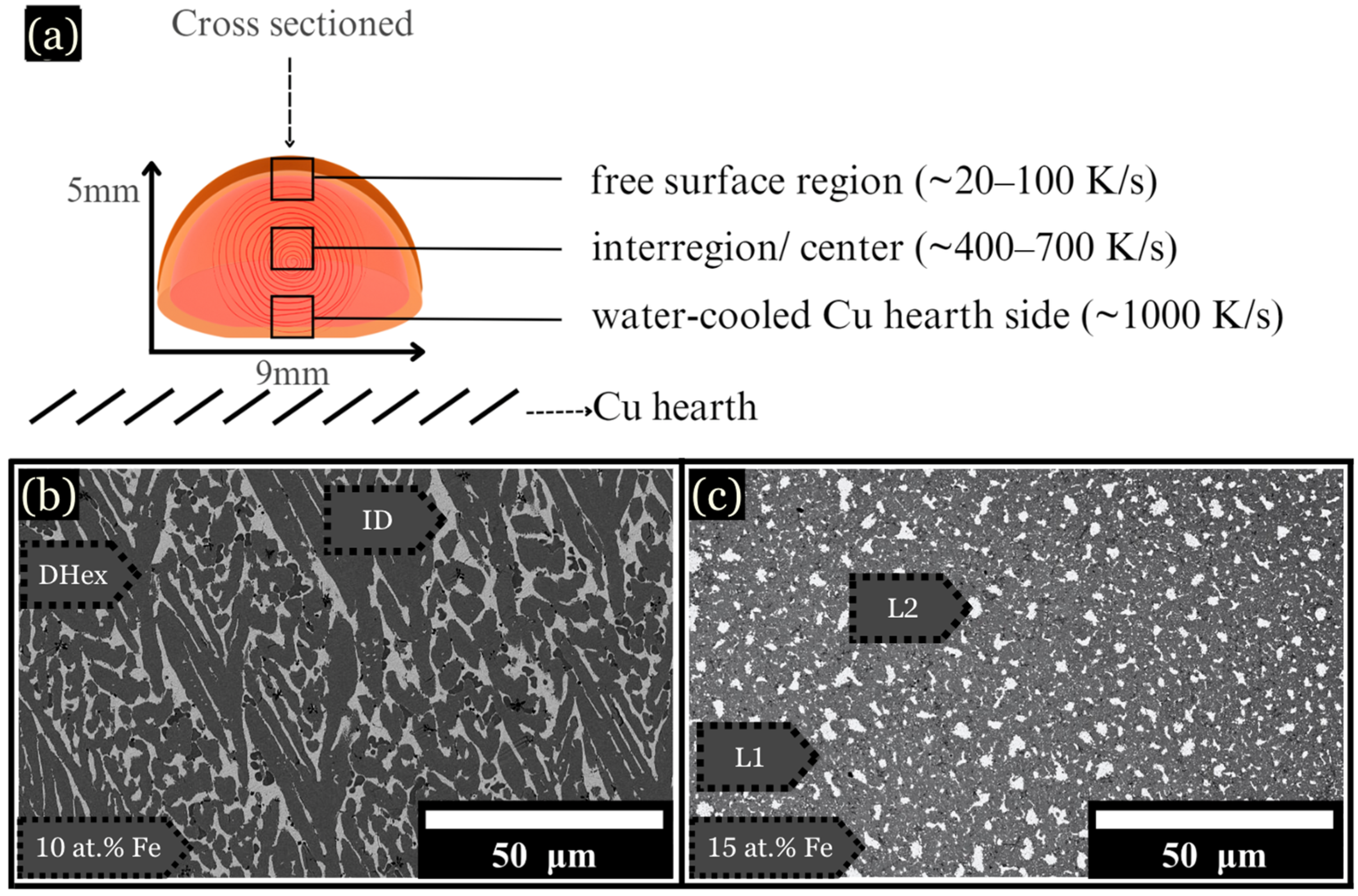
As illustrated in Figure 1, the microstructures of arc-melted (CoCrCuTi)100−xFex alloys were found to vary drastically with the addition of Fe. In addition, cooling rates were found to strongly influence microstructural morphology, as schematically shown in Figure 1a. In the chill zone, approximately 75 μm adjacent to the Cu substrate, the estimated cooling rate was calculated at approximately 1000 K/s. This cooling rate was determined using a methodology confirmed by Derimow et al. [2], based on measurements of the secondary dendrite arm spacing (SDAS). As shown in Figure 1b, Cu-lean dendritic with Cu-rich interdendritic phases formed at 10 at. % Fe, resulting in fine dendritic C14 Laves structures. In this rapidly solidified region, the dendritic arms are inclined at 60° relative to the primary dendrite growth direction. Furthermore, dispersed secondary phases enriched in elements such as Ti or Cr were also observed throughout the Cu-lean dendritic matrix.
At 15 at. % Fe, a significant shift in microstructural features was observed with the onset of LPS, shown in Figure 1c. The LPS effect becomes more pronounced as Fe content increases, with larger L2 globules forming at slower cooling rates, while finer separation is observed near the rapidly solidified chill zone. These observations were similar to those reported in our earlier study [1].

3.2. The Influence of Ni and Co Additions to (CoCrCuTi)100−xFex Samples

3.2.1. (CoCrCuTi)90Fe10 with Ni Additions

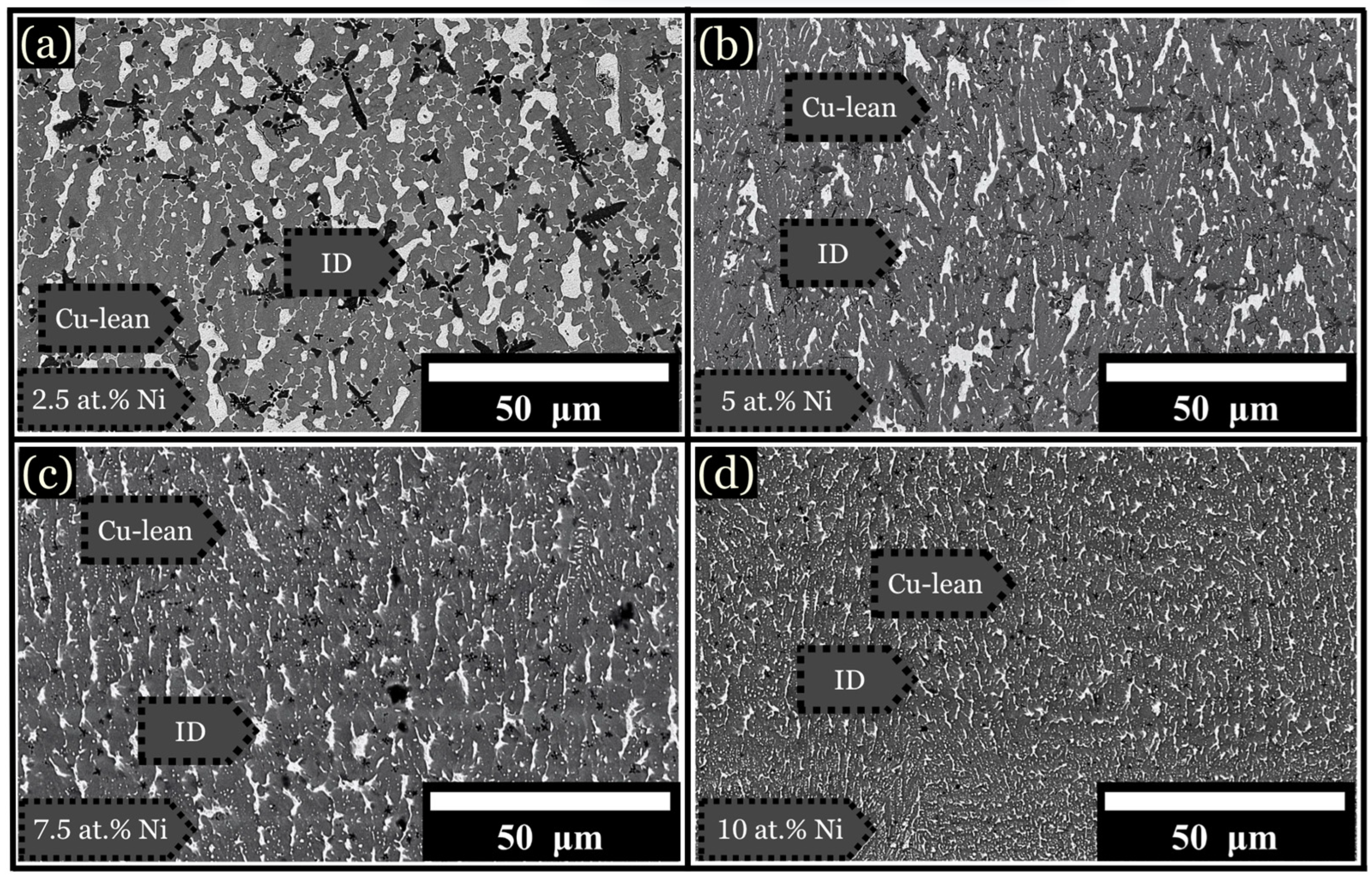
As shown in Figure 2a–d, the addition of Ni from 2.5 to 10 at. % to the base HEA resulted in progressive microstructural refinement, characterized by reduced Cu-lean dendrite size and narrowing of the Cu-rich interdendritic regions. Phase fraction analysis was performed using ImageJ Color Summarizer software(version 1.54m). For each composition, three representative micrographs were analyzed across different regions of the sample. Phase segmentation was performed to distinguish Cu-rich interdendritic regions from the Cu-lean dendritic matrix. The reported values represent the average phase fraction obtained from these measurements. The measured Cu-rich phase fraction decreased from ~20.4 ± 2.1% to ≤10.9 ± 1.3% with increasing Ni content.
At 2.5 at. % Ni, the Cu-lean dendritic phase consisted of 30.4 at. % Co, 22.6 at. % Cr, 3.6 at. % Cu, and 27.8 at. % Ti, while the Cu-rich ID phase contained 92.9 at. % Cu, 2.0 at. % Co, and 1.3 at. % Cr, as shown in Table 1. In comparison, with the addition of 7.5 at. % Ni, the Cu-lean dendritic phase contained 31.6 at. % Co, 19.7 at. % Cr, 3.3 at. % Cu, and 26.3 at. % Ti, the composition of the interdendritic phase shifted to 92.1 at. % Cu, 1.0 at. % Co, and 3.6 at. % Ti. At 10 at. % Ni, the Cu-lean dendrites became more uniform (Figure 2d), with the dendritic Cu-lean phase having 29.7 at. % Co, 18.1 at. % Cr, and 2.39 at. % Cu. The Cu-rich interdendritic phase contained 91.9 at. % Cu and 2.9 at. % Ni, while the volume fraction of the interdendrite substantially reduced. This reduction in the Cu-rich phase fraction corresponds with the observed decrease in microstructural heterogeneity, along with a reduction in scatter in hardness measurements at higher Ni contents. The small dark dendrites seen in the figures were identified as Ti-rich or Cr-rich. They were interdispersed throughout the samples, indicating that they formed prior to the formation of the major dendrites.

3.2.2. (CoCrCuTi)90Fe10 with Co Additions

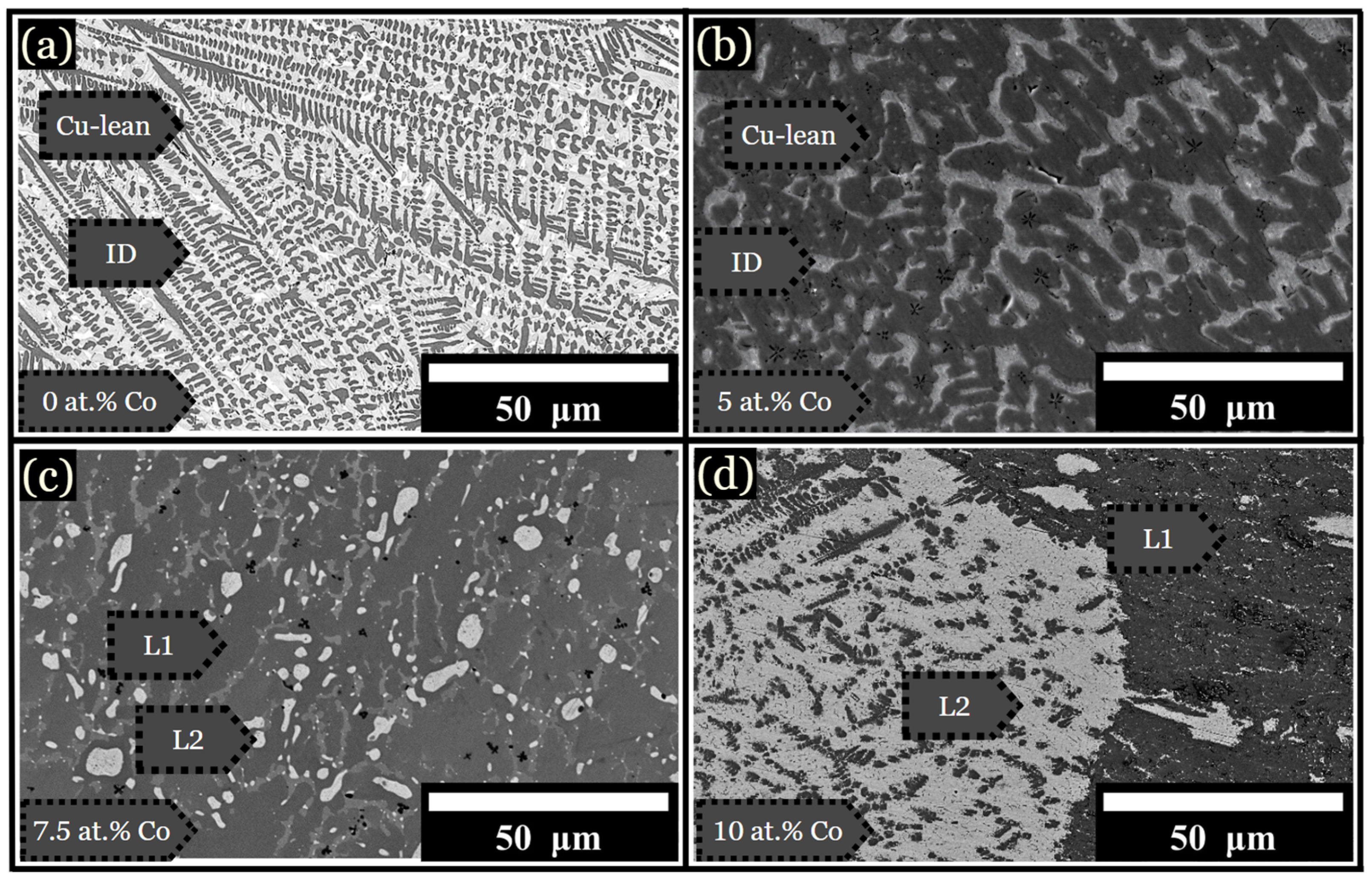
In comparison with Ni additions, the incorporation of Co into the CoCrCuTi90Fe10 HEA promoted the development of LPS, which became increasingly pronounced as Co content increased from 0 to 10 at. %. Representative microstructures for Co additions are shown in Figure 3a–d, with corresponding EDS phase compositions summarized in Table 2. At 0 at. % Co, large Cr-rich dendrites were observed, along with Cu-Ti dendrites and a Cu-rich interdendritic phase throughout the sample. The addition of up to 5 at. % Co to the base HEA (making the total Co content 23.9 at. %) led to the disruption of the dendritic structure, causing dendrites to lose their well-defined morphology and develop irregular phase distributions. At 7.5 at. % Co, LPS became prominent, with the Cu-rich globular phase containing 93.2 at. % Cu, 3.4 at. % Co, and 1.2 at. % Ti. A similar but more pronounced LPS occurred at 10 at. % Co, where distinct Cu-lean L1 and globular Cu-rich L2 phases formed. The L1 phase had a composition of 33.4 at. % Co, 22.8 at. % Cr, 5.8 at. % Cu, and 27.9 at. % Ti, while the L2 phase was predominantly Cu-rich, containing 93.5 at. % Cu, 3.4 at. % Co, and 1.0 at. % Ti. These Cu-rich regions introduced significant microstructural heterogeneity, producing variations in mechanical properties due to the dispersion of globular Cu-rich phases throughout the Cu-lean matrix. This behavior suggests that beyond a nominal Co concentration of approximately 22.5 at. %, a thermodynamic tendency toward immiscibility develops.
These behaviors are consistent with thermodynamic interactions observed within relevant binary systems. The Co–Cu binary system exhibits a positive enthalpy of mixing, which indicates energetically unfavorable interactions between Co and Cu [21]. When alloyed, these elements are characterized by their limited mutual solubility, producing a broad miscibility gap. This behavior supports the experimental observation that increasing Co content promotes LPS, along with the formation of Cu-rich regions within this alloy system.

3.2.3. Ni Addition to (CoCrCuTi)85Fe15

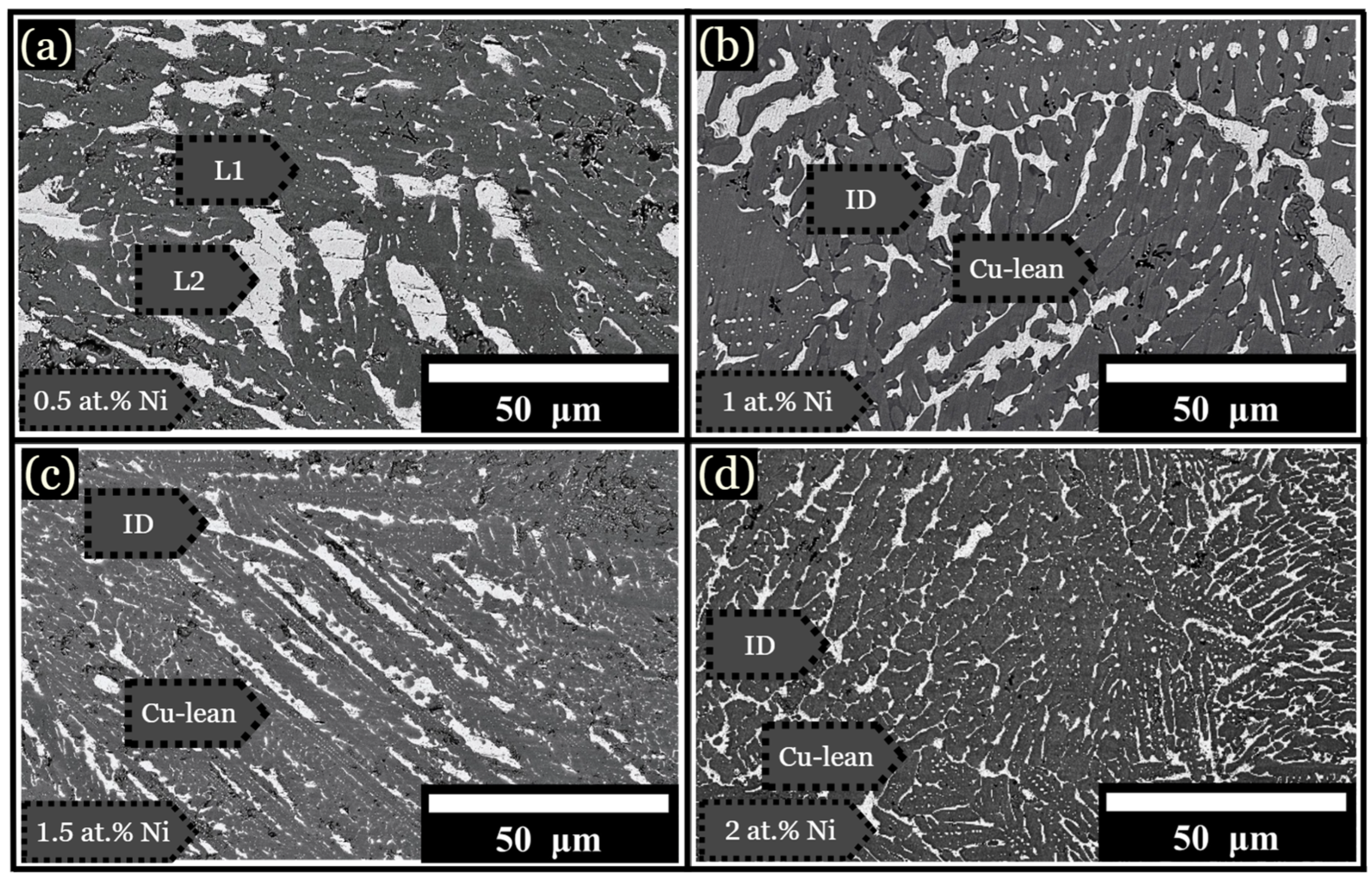
Figure 4a–d illustrate the evolution of (CoCrCuTi)85Fe15 microstructures as Ni content increases from 0.5 to 2.0 at. % Ni. At 0.5 at. % Ni, the microstructure retains the characteristic L1 + L2 phase-separated morphologies of the base (CoCrCuTi)85Fe15 alloy. These phases consist of Cu-rich L2 globules distributed throughout the Cu-lean matrix. EDS analysis reveals that the Cu-lean dendrites contained 36.1 at. % Co, 15.9 at. % Cr, 3.6 at. % Cu, and 28.8 at. % Ti at 0.5 at. % Ni (Table 3). At 1.0 at. % Ni, Cu-lean dendritic features become more pronounced. EDS analysis shows that these Cu-lean dendrites contained 34.1 at. % Co, 15.6 at. % Cr, 2.9 at. % Cu, and 34.1 at. % Ti, while the Cu-rich ID phase contained 94.9 at. % Cu.
Table 3. EDS analysis of (CoCrCuTi)85Fe15 samples with additions of Ni from 0.5 to 2 at. %.
PhaseCoCrCuTiFeNi
((CoCrCuTi)85Fe15)99.5Ni0.521.1421.1421.1421.1414.930.5
L136.115.93.628.814.90.8
L23.120.693.41.40.90.7
DTi16.73.41.973.34.10.7
DCr11.072.11.33.310.51.8
((CoCrCuTi)85Fe15)99Ni121.0421.0421.0421.0414.851
L134.115.62.934.114.61.2
L21.60.794.91.60.90.5
DTi11.73.112.367.84.30.8
((CoCrCuTi)85Fe15)98.5Ni1.520.9320.9320.9320.9314.781.5
L136.715.53.829.213.31.5
L23.40.593.31.50.80.6
((CoCrCuTi)85Fe15)98Ni220.8320.8320.8320.8314.72
L135.516.74.228.213.61.8
ID/LPS2.20.892.82.61.00.7
When increasing Ni content to 1.5 at. %, the volume fraction of the Cu-rich phase throughout the matrix decreased, making Cu-rich globules far less pronounced (Figure 4c). At this composition, the Cu-lean dendrites comprised 36.7 at. % Co, 15.5 at. % Cr, 3.8 at. % Cu, and 29.2 at. % Ti, while the Cu-rich L2 phase retained a high Cu concentration of 93.3 at. %. At 2 at. % Ni, the microstructure is seen to transition toward a more uniform two-phase morphology, dominated by Cu-lean dendrites, along with Cu-rich interdendritic regions. The Cu-lean dendritic phase contains 35.5 at. % Co, 16.7 at. % Cr, 4.2 at. % Cu, and 28.2 at. % Ti, while the L2 interdendritic phase is primarily Cu-rich with 92.8 at. % Cu. Across this compositional range, Ni was found to promote a more homogeneous distribution of Cu-lean and Cu-rich regions by reducing the extent of LPS in the as-cast microstructure.
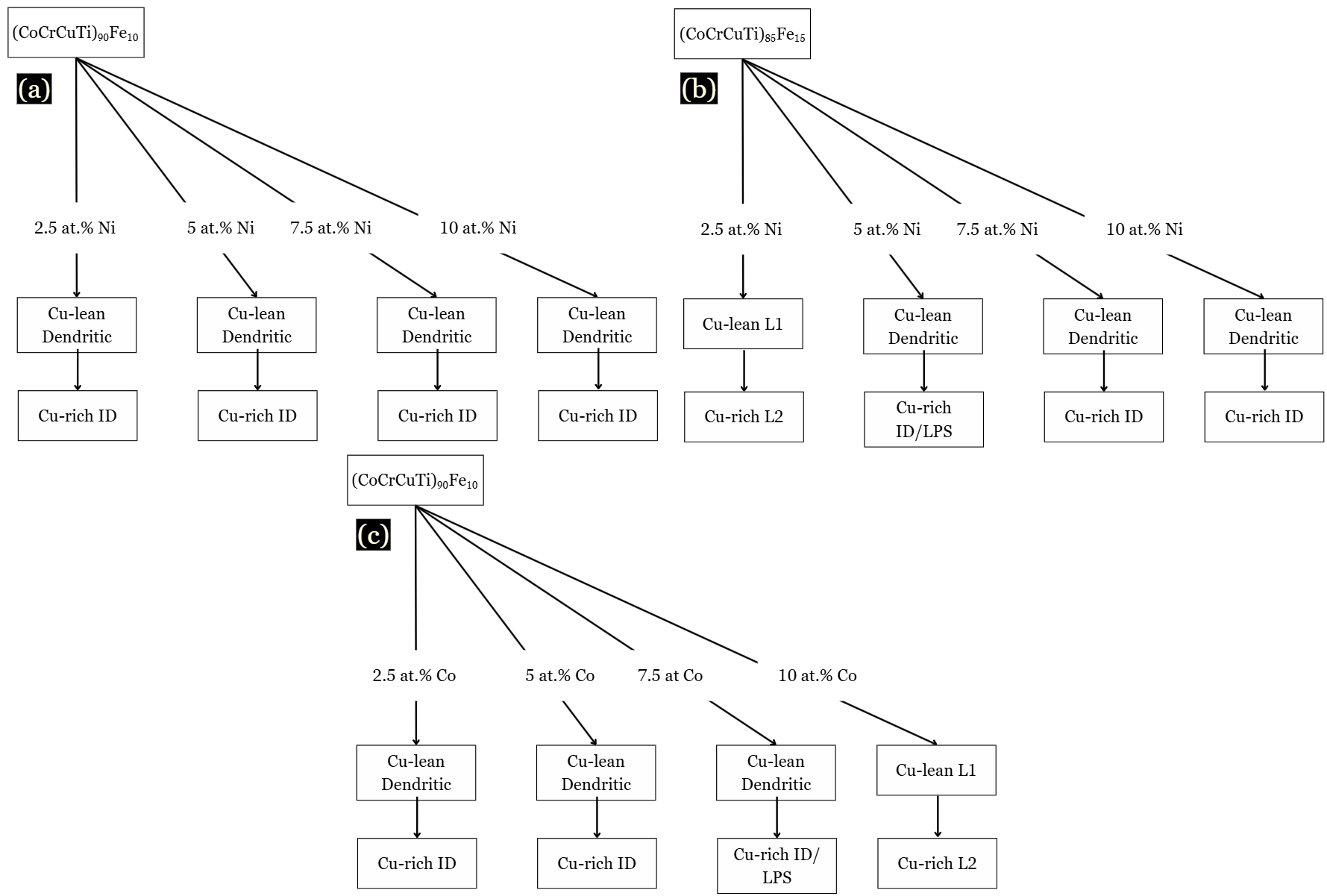
Vickers hardness data reveal that Ni and Co additions have distinct roles in modulating the microstructure of (CoCrCuTi)100−xFex alloys. As observed in Figure 2a–d, the microstructures become less heterogeneous as Ni content is added. However, alloys shown in Figure 3a–d with Co additions to have increased phase separation of the primary Cu-rich regions into large globular phases, increasing heterogeneity. The differences in microstructure as Ni and Co are added to base alloys are schematically shown in Figure 5.

4. Mechanical Properties of (CoCrCuTi)100−xFex Samples

4.1. Vickers Hardness (HV)

The Vickers hardness trends in the (CoCrCuTi)90Fe10 and (CoCrCuTi)85Fe15 alloys, with varying Ni and Co contents, are closely linked to the evolution of their microstructures, particularly phase separation and compositional uniformity. Ni addition caused hardness to decrease while also reducing scatter. On the other hand, Co addition promoted LPS, in which the volume fraction of softer Cu-rich globular phases increased, resulting in lower overall hardness with a greater measurement of scatter. The increased scatter is attributed to the microstructural heterogeneity caused by the distribution of Cu-rich phases within the Cu-lean matrix.
For the (CoCrCuTi)90Fe10 alloy, the addition of Ni generally reduced Vickers hardness while also decreasing measurement scatter, consistent with the observed reduction in microstructural heterogeneity. For example, in the (CoCrCuTi)90Fe10 alloy with 2.5 at. % Ni (denoted as (CoCrCuTi)90Fe10)97.5Ni2.5), the hardness was 706 ± 95 HV. As Ni content increased to 5 at. % Ni, the hardness dropped to 638 ± 65 HV (Table 4). Upon increasing Ni to 7.5 at. %, the hardness slightly increased to 675 ± 21 HV, suggesting a reduction in phase separation and a more homogeneous phase distribution. Further, the hardness decreased to 646 ± 19 HV at 10 at. % Ni.
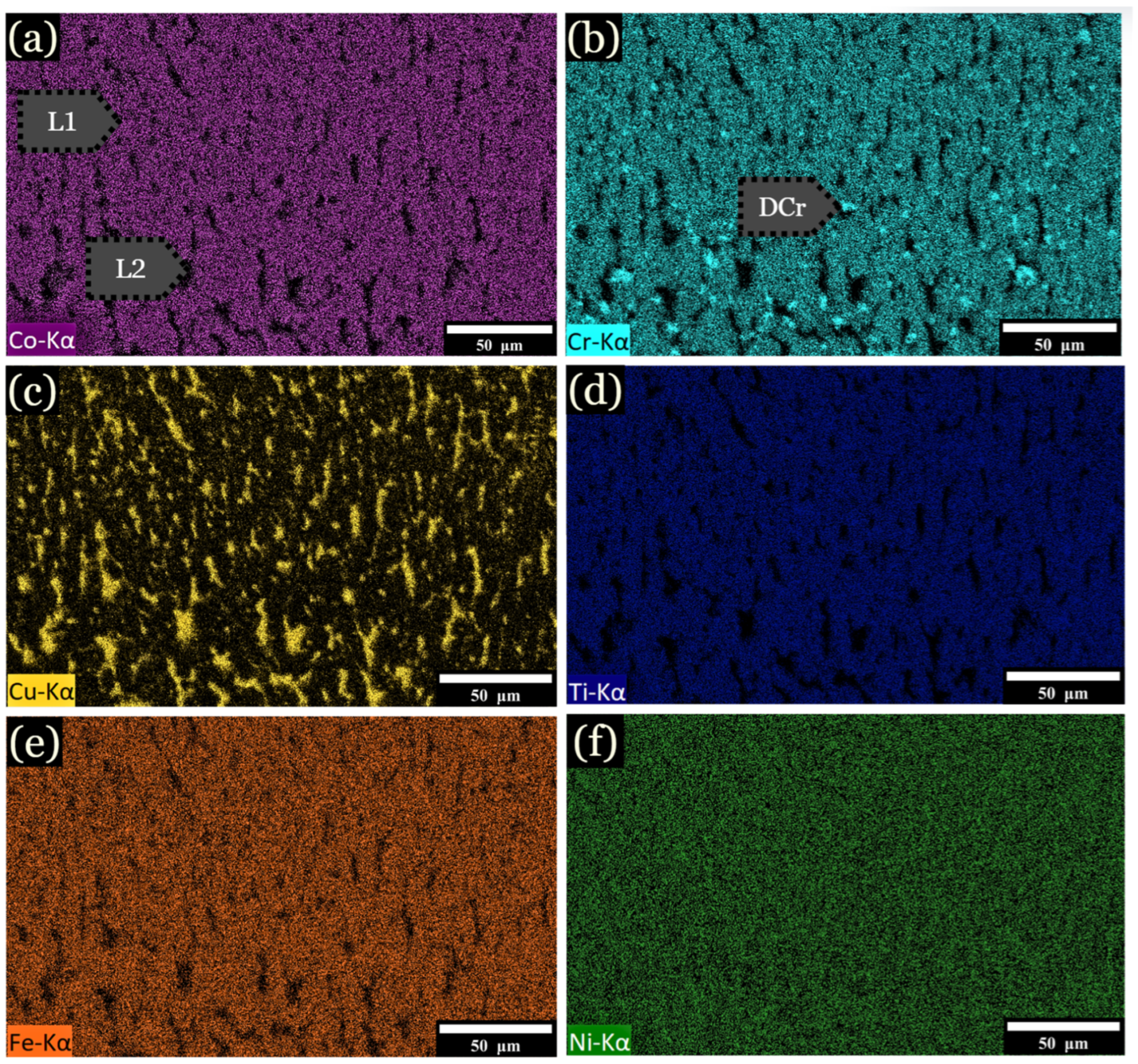
In the (CoCrCuTi)85Fe15 alloy containing 0.5 at. % Ni (denoted as ((CoCrCuTi)85Fe15)99.5Ni0.5), the Vickers hardness reached 639 ± 184 HV due to a notably heterogeneous microstructure marked by soft, Cu-rich globular regions dispersed throughout a hard Cu-lean matrix. As Ni content rises to 1.0 at. % and 1.5 at. %, the hardness rises to 663 ± 146 HV and then drops to 594 ± 29 HV, respectively, accompanied by a reduction in scatter. This trend suggests that hardness decreases as a more uniform microstructure forms. At 2.0 at. % Ni, the hardness further decreases to 578 ± 36 HV, reflecting a stabilized microstructure with Ni being evenly distributed across the Cu-lean and Cu-rich phases, as illustrated in Figure 6a–f. This even distribution of Ni can be attributed to the Cu–Ni binary system, which forms an almost continuous FCC solid solution with near-ideal mixing behavior [22]. Similar thermodynamic trends have been reported in the Cu–Fe–Ni system, where Cu–Ni and Fe–Ni interactions can stabilize systems dominated by unfavorable Cu interactions.
Others, such as Nascimento et al., studying VCrMnFeCoNi and CrFeMnCoNi alloys, have also reported that increasing Ni content decreased hardness by forming continuous solid solutions as Ni dissolved into the matrix [23]. Kuo et al. observed a similar trend in AlCrFeCoNi alloys, where increasing Ni content promoted solid-solution formation and enhanced ductility, noting similar reductions in hardness, along with grain refinement [24].
In contrast, the addition of Co to the (CoCrCuTi)90Fe10 alloy led to a reduction in Vickers hardness. The reduction in hardness is primarily ascribed to the initiation of LPS, resulting in increased microstructural heterogeneity. At 2.5 at. % Co, the hardness is 574 ± 114 HV, slightly increasing to 580 ± 122 HV at 5 at. % Co. However, as the Co content increased to 7.5 at. % and 10 at. %, scatter increased significantly, accompanied by a decrease in overall hardness, reaching 552 ± 238 HV and 442 ± 246 HV, respectively.
Table 4. Effect of Ni and Co additions on Vickers hardness and fracture toughness.
CompositionVickers Hardness (HV)Fracture Toughness (KIC)
((CoCrCuTi)90Fe10)97.5Ni2.5706 ± 953.8 ± 0.5
((CoCrCuTi)90Fe10)95Ni5638 ± 654.2 ± 0.4
((CoCrCuTi)90Fe10)92.5Ni7.5675 ± 213.6 ± 0.1
((CoCrCuTi)90Fe10)90Ni10646 ± 193.5 ± 0.1
((CoCrCuTi)90Fe10)97.5Co2.5574 ± 1143.5 ± 0.7
((CoCrCuTi)90Fe10)95Co5580 ± 1223.8 ± 1.2
((CoCrCuTi)90Fe10)92.5Co7.5552 ± 2384.1 ± 1.4
((CoCrCuTi)90Fe10)90Co10442 ± 2464.3 ± 1.6
((CoCrCuTi)85Fe15)99.5Ni0.5639 ± 1843.7 ± 1.1
((CoCrCuTi)85Fe15)99Ni1.0663 ± 1463.5 ± 0.7
((CoCrCuTi)85Fe15)98.5Ni1.5594 ± 293.3 ± 0.2
((CoCrCuTi)85Fe15)98Ni2.0578 ± 363.2 ± 0.1

4.2. Fracture Toughness

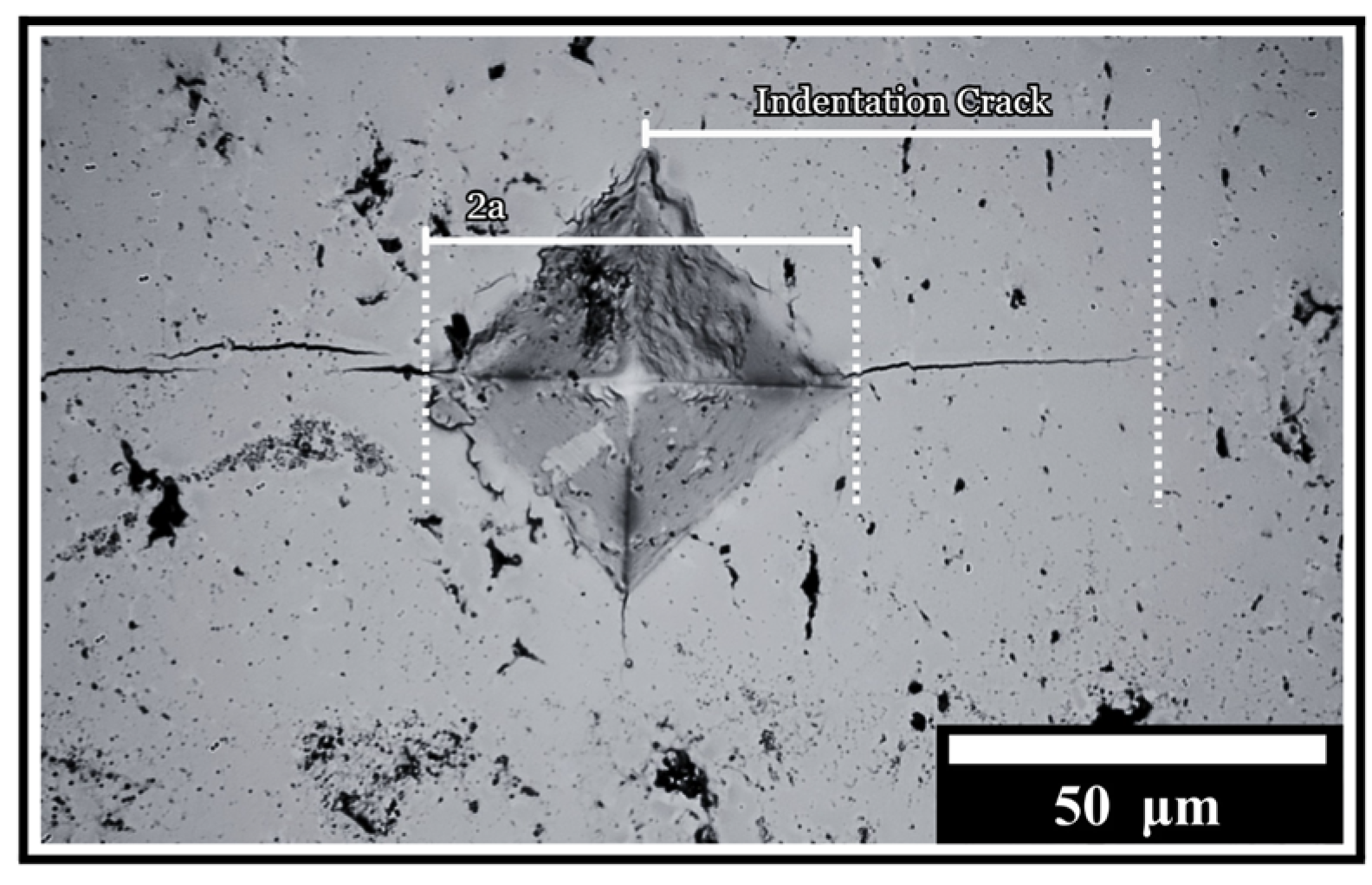
Fracture toughness (KIC) was determined by measuring the crack length of 10 indentations, as observed in Figure 7, and utilizing the following equation (Equation (1)) [1,10]:
K I C = 0.16 H a ( c ) 3 2 ,
where c represents the average crack length measured from indentation corners, a is half of the average diagonal length of the Vickers indent, and H is the Vickers hardness in MPa. Radial–median crack morphology was confirmed for the Vickers indents, which enabled the estimation of fracture toughness through the relationship between crack length and hardness.
For the (CoCrCuTi)90Fe10 alloy with Ni additions, the fracture toughness changes from 3.8 ± 0.5 MPa·m½ at 2.5 at. % Ni to 4.2 ± 0.4 MPa·m½ at 5 at. % Ni. As Ni content increased to 7.5 at. %, the fracture toughness decreased to 3.6 ± 0.1 MPa·m½ and further to 3.5 ± 0.1 MPa·m½ at 10 at. % Ni. This reduction may be attributed to the more homogeneous and refined microstructure observed at higher Ni concentrations, where fewer microstructural barriers to crack propagation exist due to the reduced Cu-rich phase.
The contrasting effects of Ni and Co additions on hardness and fracture toughness can be understood in terms of their resulting microstructural features. Ni additions reduce the volume fraction of Cu-rich regions, leading to a more homogeneous microstructure with a dominant Cu-lean matrix. Consequently, both hardness and fracture toughness decrease as the microstructure becomes more uniform. In contrast, Co additions promote LPS, increasing the fraction of Cu-rich regions dispersed within the harder Cu-lean matrix. These Cu-rich phases can accommodate local plastic deformation and absorb strain energy during crack propagation. Additionally, the interfaces between Cu-rich and Cu-lean phases can function as barriers that disrupt or blunt cracks during propagation, which contribute to the observed increase in toughness, along with the reduction in hardness.
For the (CoCrCuTi)85Fe15 alloys with Ni additions, alloys containing 0.5 at. % Ni exhibit a fracture toughness of 3.7 ± 1.1 MPa·m½, which decreased to 3.5 ± 0.7 MPa·m½ at 1.0 at. % Ni, 3.3 ± 0.2 MPa·m½ at 1.5 at. % Ni, and 3.2 ± 0.1 MPa·m½ at 2.0 at. % Ni. Higher Ni content leads to reduced fracture toughness, along with increased microstructural homogeneity. In contrast, Co additions to the (CoCrCuTi)90Fe10 alloy resulted in a progressive increase in fracture toughness; for 2.5 at. % Co, the toughness was 3.5 ± 0.7 MPa·m½, increasing to 4.3 ± 1.6 MPa·m½ at 10 at. % Co.

5. Summary

  • The additions of (0–10 at. %) Ni or Co were found to significantly influence the microstructure and mechanical properties of (CoCrCuTi)100−xFex HEAs, with x being 10 or 15 at. %. Without these additions, the base alloys containing 10 at. % Fe solidified into a C14 Laves + Cu-rich FCC phases. As Fe content increased to 15 at. %, Cu, liquid-phase separations into L1 and L2 liquids was observed, and segregation became more pronounced, forming Cu-lean and Cu-rich liquids.
  • Ni additions from 2.5 to 10 at. % promoted a progressive reduction in the Cu-rich phase in both (CoCrCuTi)90Fe10 and (CoCrCuTi)85Fe15 alloys, resulting in a more homogeneous Cu-lean microstructure due to reduced rejection of Cu into interdendritic or Cu-rich L2 regions.
  • Co additions, in contrast, promoted Cu segregation and liquid-phase separation, with Cu-rich globular L2 phases forming within a Cu-lean L1 matrix. Increasing Co content led to more pronounced phase separation and increased microstructural heterogeneity. An increase in scatter was also observed at higher Co concentrations, being attributed to the microstructural heterogeneity induced by the presence of Cu-rich phases.
  • Trends in mechanical properties followed the observed microstructural evolution. Increasing Ni content resulted in decreased hardness and fracture toughness while reducing measurement scatter. The peak hardness was measured at 706 ± 95 HV for ((CoCrCuTi)90Fe10)97.5Ni2.5. The addition of Co also led to a reduction in hardness but increased fracture toughness. The toughness was 3.5 ± 0.1 MPa·m½ for ((CoCrCuTi)90Fe10)90Ni10 compared with 4.3 ± 1.6 MPa·m½ for ((CoCrCuTi)90Fe10)90Co10.

Author Contributions

Conceptualization, B.T. and R.A.; Investigation, B.T. and R.A.; Writing—original draft, B.T.; Writing—review & editing, B.T. and R.A. All authors have read and agreed to the published version of the manuscript.

Funding

This research was supported by the National Science Foundation Graduate Research Fellowship Program under Grant No. 2019278110, the Graduate Assistance in Areas of National Need (GAANN) Fellowship Program under Grant No. P200A210028, and it was partially supported by The Koerner Family Fellowship and the Winston Chung Global Energy Center.

Data Availability Statement

The original contributions presented in this study are included in the article. Further inquiries can be directed to the corresponding author.

Conflicts of Interest

The authors declare no conflicts of interest. The funders had no role in the design of the study; in the collection, analyses, or interpretation of data; in the writing of the manuscript; or in the decision to publish the results.

References

  1. Terry, B.; Abbaschian, R. Cooling Rate and Compositional Effects on Microstructural Evolution and Mechanical Properties of (CoCrCuTi)100−xFex High-Entropy Alloys. Entropy 2024, 26, 826. [Google Scholar] [CrossRef]
  2. Derimow, N.; Clark, T.; Abbaschian, R. Solidification processing and cooling rate effects on hexagonal Co22Cr18Cu20Mn16Ti24 high-entropy alloys. Mater. Chem. Phys. 2019, 240, 122188. [Google Scholar] [CrossRef]
  3. Derimow, N.; MacDonald, B.E.; Lavernia, E.J.; Abbaschian, R. Duplex phase hexagonal-cubic multi-principal element alloys with high hardness. Mater. Today Commun. 2019, 21, 100658. [Google Scholar] [CrossRef]
  4. Munitz, A.; Kaufman, M.J.; Abbaschian, R. Liquid phase separation in transition element high entropy alloys. Intermetallics 2017, 86, 59–72. [Google Scholar] [CrossRef]
  5. Munitz, A.; Kaufman, M.J.; Nahmany, M.; Derimow, N.; Abbaschian, R. Microstructure and mechanical properties of heat treated Al 1.25 CoCrCuFeNi high entropy alloys. Mater. Sci. Eng. A 2018, 714, 146–159. [Google Scholar] [CrossRef]
  6. Sonal, S.; Lee, J. Recent Advances in Additive Manufacturing of High Entropy Alloys and Their Nuclear and Wear-Resistant Applications. Metals 2021, 11, 1980. [Google Scholar] [CrossRef]
  7. Li, R.X.; Qiao, J.W.; Liaw, P.K.; Zhang, Y. Preternatural Hexagonal High-Entropy Alloys: A Review. Acta Metall. Sin. (Engl. Lett.) 2020, 33, 1033–1045. [Google Scholar] [CrossRef]
  8. Yeh, J. Recent progress in high-entropy alloys. Ann. Chim. Sci. Matériaux 2006, 31, 633–648. [Google Scholar] [CrossRef]
  9. Gupta, A.K.; Choudhari, A.; Rane, A.; Tiwari, A.; Sharma, P.; Gupta, A.; Sapale, P.; Tirumala, R.T.A.; Muthaiah, R.; Kumar, A. Advances in Nickel-Containing High-Entropy Alloys: From Fundamentals to Additive Manufacturing. Materials 2024, 17, 3826. [Google Scholar] [CrossRef] [PubMed] [PubMed Central]
  10. Derimow, N.; Jaime, R.F.; Le, B.; Abbaschian, R. Hexagonal (CoCrCuTi)100-Fe multi-principal element alloys. Mater. Chem. Phys. 2021, 261, 124190. [Google Scholar] [CrossRef]
  11. Derimow, N.; Abbaschian, R. Liquid Phase Separation in High-Entropy Alloys—A Review. Entropy 2018, 20, 890. [Google Scholar] [CrossRef]
  12. Yan, P.X.; Chang, J.; Wang, W.L.; Zhu, X.N.; Lin, M.J.; Wei, B. Metastable phase separation and crystalline orientation feature of electromagnetic levitation processed CoCrCuFeNi high entropy alloy. Acta Mater. 2024, 269, 119778. [Google Scholar] [CrossRef]
  13. Zhao, F.; Zhao, X.; Jiang, T.; Zhao, R.; Wu, F. Comprehensive Study of CoCrCuNi High-Entropy Alloys: Effects of Preparation, Heat Treatment, Computational Simulation, and Alloying Elements. Metals 2024, 14, 1240. [Google Scholar] [CrossRef]
  14. Stepanov, N.D.; Shaysultanov, D.G.; Chernichenko, R.S.; Ikornikov, D.M.; Sanin, V.N.; Zherebtsov, S.V. Mechanical properties of a new high entropy alloy with a duplex ultra-fine grained structure. Mater. Sci. Eng. A 2018, 728, 54–62. [Google Scholar] [CrossRef]
  15. Wang, C.; Li, T.-H.; Liao, Y.-C.; Li, C.-L.; Jang, S.C.; Hsueh, C.-H. Hardness and strength enhancements of CoCrFeMnNi high-entropy alloy with Nd doping. Mater. Sci. Eng. A 2019, 760, 138192. [Google Scholar] [CrossRef]
  16. Yeh, J.W.; Chen, Y.L.; Lin, S.J.; Chen, S.K. High-Entropy Alloys—A New Era of Exploitation. Materials Science Forum. Mater. Sci. Forum 2007, 560, 1–9. [Google Scholar] [CrossRef]
  17. Senkov, O.N.; Miracle, D.B.; Chaput, K.J.; Couzinie, J.P. Development and exploration of refractory high entropy alloys—A review. J. Mater. Res. 2015, 30, 2600–2619. [Google Scholar] [CrossRef]
  18. Sun, Z.; Song, X.; Hu, Z.; Liang, G.; Saeed, A.; Cochrane, R.F. Effects of Ni addition on liquid phase separation of Cu–Co alloys. J. Alloys Compd. 2001, 319, 276–279. [Google Scholar] [CrossRef]
  19. Wei, X.; Yu, D.; Sun, Z.; Yang, Z.; Song, X.; Ding, B. Effect of Ni addition on the dielectric strength and liquid phase separation of Cu-Cr alloys during the vacuum breakdown. Vacuum 2014, 109, 162–165. [Google Scholar] [CrossRef]
  20. López Ríos, M.; Socorro Perdomo, P.P.; Voiculescu, I.; Geanta, V.; Crăciun, V.; Boerasu, I.; Mirza Rosca, J.C. Effects of nickel content on the microstructure, microhardness and corrosion behavior of high-entropy AlCoCrFeNix alloys. Sci. Rep. 2020, 10, 21119. [Google Scholar] [CrossRef]
  21. Li, C.; Levämäki, H.; Xie, R.; Tian, L.; Dong, Z.; Li, W.; Lu, S.; Chen, Q.; Ågren, J.; Vitos, L. Critical assessment of Co-Cu phase diagram from first-principles calculations. Phys. Rev. B 2020, 102, 184428. [Google Scholar] [CrossRef]
  22. Dreval, L.A.; Turchanin, M.A.; Agraval, P.G. Thermodynamic assessment of the Cu–Fe–Ni system. J. Alloys Compd. 2014, 25, 79–95. [Google Scholar] [CrossRef]
  23. Nascimento, C.B.; Donatus, U.; Ríos, C.T.; Oliveira, M.C.L.D.; Antunes, R.A. A review on Corrosion of High Entropy Alloys: Exploring the Interplay Between Corrosion Properties, Alloy Composition, Passive Film Stability and Materials Selection. Mater. Res. 2022, 25, e20210442. [Google Scholar] [CrossRef]
  24. Kuo, P.C.; Chen, S.Y.; Yu, W.; Okumura, R.; Iikubo, S.; Laksono, A.D.; Yen, Y.W.; Pasana, A.S. The Effect of Increasing Nickel Content on the Microstructure, Hardness, and Corrosion Resistance of the CuFeTiZrNix High-Entropy Alloys. Materials 2022, 15, 3098. [Google Scholar] [CrossRef]
Figure 1. BSE images depict changes in microstructural development as iron content increases from 10 to 15 at. % Fe. (a) A schematic representation of a cross-sectioned sample showing cooling rate calculations along with its position relative to the copper substrate. (b) Hexagonal dendrites formed with a composition of (CoCrCuTi)90Fe10. (c) LPS presented in a composition of (CoCrCuTi)85Fe15.
Metals 16 00321 g001
Figure 2. Arc-melted samples of the (CoCrCuTi)90Fe10 HEA with Ni additions. (a) ((CoCrCuTi)90Fe10)97.5Ni25. (b) ((CoCrCuTi)90Fe10)95Ni5. (c) ((CoCrCuTi)90Fe10)92.5Ni7.5. (d) ((CoCrCuTi)90Fe10)90Ni10.
Metals 16 00321 g002
Figure 3. Arc-melted samples of the (CoCrCuTi)90Fe10 HEA with changes in concentrations of Co. (a) (CrCuTi)90Fe10. (b) ((CoCrCuTi)90Fe10)95Co5. (c) ((CoCrCuTi)90Fe10)92.5Co7.5. (d) ((CoCrCuTi)90Fe10)90Co10.
Metals 16 00321 g003
Figure 4. BSE images of (CoCrCuTi)85Fe15 arc-melted samples with additions of Ni. (a) ((CoCrCuTi)85Fe15)99.5Ni0.5, evident of phase separation. (b) ((CoCrCuTi)85Fe15)99Ni1, with dendrites forming. (c) ((CoCrCuTi)85Fe15)98.5Ni1.5. (d) ((CoCrCuTi)85Fe15)98Ni2.
Metals 16 00321 g004
Figure 5. Schematic showing microstructural evolution with additions of Ni and Co.
Metals 16 00321 g005
Figure 6. EDS images of (CoCrCuTi)90Fe10 alloys with 7.5 at. % Ni. (a) Concentration of Co; (b) Concentration of Cr; (c) Concentration of Cu; (d) Concentration of Ti; (e) Concentration of Fe; (f) Concentration of Ni, showing how Ni is miscible with all phases.
Metals 16 00321 g006
Figure 7. Cracks emanating from corners of indentation in an arc-melted (CoCrCuTi)90Fe10 sample.
Metals 16 00321 g007
Table 1. EDS analysis of (CoCrCuTi)90Fe10 samples with additions of Ni from 2.5 to 10 at. %.
PhaseCoCrCuTiFeNi
((CoCrCuTi)90Fe10)97.5Ni2.521.921.921.921.99.82.5
D30.422.63.627.813.52.1
ID2.01.392.91.80.71.3
DCr8.774.02.05.39.30.6
DTi17.212.213.947.56.03.1
((CoCrCuTi)90Fe10)95Ni521.421.421.421.49.55
D24.619.06.933.910.15.49
ID1.71.391.91.60.82.9
DCr11.367.72.35.09.93.8
((CoCrCuTi)90Fe10)92.5Ni7.520.820.820.820.89.257.5
D31.619.73.326.311.17.9
ID1.00.992.13.60.32.1
DCr10.671.02.14.010.22.1
((CoCrCuTi)90Fe10)90Ni1020.320.320.320.3910
D29.718.12.3926.312.39.5
ID1.71.391.91.60.82.9
DCr11.072.11.33.310.51.8
Table 2. EDS analysis of (CoCrCuTi)90Fe10 samples with additions of Co from 0 to 10 at. %.
PhaseCoCrCuTiFe
(CrCuTi)90Fe10-30.030.030.010.0
L1-6.748.736.87.9
L2-2.685.510.41.4
DCr-43.63.933.619.0
DTi-2.821.172.23.9
((CoCrCuTi)90Fe10)95Co526.421.421.421.49.5
L137.321.32.826.711.8
L20.60.696.22.40.2
SL130.621.49.127.711.2
((CoCrCuTi)90Fe10)92.5Co7.528.920.820.820.89.3
L138.119.12.827.512.6
L23.41.493.21.20.8
DTi28.013.84.845.28.3
((CoCrCuTi)90Fe10)90Co1031.420.320.320.39.0
L133.422.85.827.910.3
L23.41.393.51.00.8
DTi30.512.48.740.97.6
Disclaimer/Publisher’s Note: The statements, opinions and data contained in all publications are solely those of the individual author(s) and contributor(s) and not of MDPI and/or the editor(s). MDPI and/or the editor(s) disclaim responsibility for any injury to people or property resulting from any ideas, methods, instructions or products referred to in the content.