Article

Advances in Modelling of Irradiation Creep Using Rate Theory

by
Malcolm Griffiths
1,* and
Juan Eduardo Ramos Nervi
2
1
Department of Mechanical and Materials Engineering, Queen’s University, Kingston, ON K7L 3N6, Canada
2
División de Materiales y Micromecánica, Gerencia de Ingeniería, Nucleoeléctrica Argentina S.A., Francisco N. Laprida 3163, Villa Martelli B1603AAA, Argentina
*
Author to whom correspondence should be addressed.
Metals 2026, 16(3), 312; https://doi.org/10.3390/met16030312
Submission received: 16 January 2026 / Revised: 28 February 2026 / Accepted: 3 March 2026 / Published: 11 March 2026
(This article belongs to the Special Issue Advances in Research on Radiation Effects in Metals)

Abstract

Irradiation creep of engineering alloys in nuclear reactor cores differs from the creep that is observed outside of the irradiation environment. It exhibits characteristics like high temperature thermal creep because it occurs in an environment of elevated vacancy point defect concentrations, but one must also consider the effect of interstitial point defects and the effect of both vacancy and interstitial concentrations, which are greater than the thermal equilibrium values, on an evolving microstructure. Irradiation creep is dependent on the point defect flux to different sinks and can be modelled using conventional rate theory. The net interstitial or vacancy point defect flux to different sinks determines the strain rate in a direction that can be considered perpendicular to the plane of the sink, which is the extra half plane of an edge dislocation or the plane of a grain boundary. There has been increasing evidence that, for complex alloys such as Zr-2.5Nb pressure tubing in CANDU reactors, the irradiation creep is largely dependent on the grain structure (size and shape). While the maximum amount of thermal creep by dislocation slip will be proportional to the distance a dislocation travels, i.e., proportional to the grain dimension in the direction of slip, observations indicate that the magnitude of irradiation creep is inversely proportional to the grain dimensions, indicating a creep mechanism dependent on diffusional mass transport. Mechanistic modelling of irradiation creep based on rate theory is described and used to account for high diametral creep rates observed for pressure tubes with unusual microstructures fabricated by non-standard fabrication routes.

1. Introduction

1.1. Historical Overview

Historically, there have been two main approaches to the modelling of irradiation creep in Zr-alloys [1]. One is based on the stress-induced climb and glide (SICG) concept in which the strain step involves the glide of dislocations activated by irradiation-enhanced climb of glissile dislocations over barriers to slip, which may be small precipitates or point defect clusters. The second approach involves the stress-induced preferred absorption (SIPA) of point defects at dislocation sinks. The preferred absorption can contribute to the strain directly or promote activation of specific dislocations that are aligned relative to the applied stress, resulting in preferential glide that enhances the creep strain in response to the stress. Franklin et al. [1] also describe an additional, but less likely, contribution to creep, like SIPA, due to the stress-induced preferential nucleation (SIPN) of either interstitial or vacancy dislocation loops. Vacancy loops forming perpendicular to a compressive stress contribute to shrinkage, and interstitial loops forming perpendicular to a tensile stress contribute to expansion in the direction of the stress. Once the strain has been created by loop formation, any subsequent shear of the loop can redistribute the strain within the loop’s glide cylinder, but the macroscopic uniaxial strain in the direction of the Burgers vector of the loop remains constant.
SICG, SIPA, SIPN, and other model concepts have been described in various reviews of irradiation creep [1,2,3,4]. In the review by Franklin et al. [1], the main contribution to the creep strain involved either the climb or glide of dislocations. In Franklin’s case, grain boundaries were never treated as biased sinks and only played a role as neutral sinks for vacancy point defects. However, in many alloys, the grain boundary spacing is similar to that of dislocations, and there has been increasing evidence that they should be considered as important sinks for point defects that are biased according to the orientation of the grain boundary relative to the crystal orientation and the axes of principal stress [4,5,6]. The inclusion of grain boundaries as sinks for point defects has proven to be a necessary inclusion in irradiation creep models applied to Zr-2.5Nb pressure tubing.

1.2. Irradiation Creep of Zr-2.5Nb Pressure Tubing

The irradiation creep of Zr-2.5Nb pressure tubing has been of particular importance for the RBMK (Reaktor Bolshoy Moshchnosti Kanalnyy) and CANDU (Canadian Deuterium Uranium) fuel channel reactors because, in those cases, the pressure boundary resides within the reactor core. The most extensive studies of irradiation creep of Zr-2.5Nb alloys were conducted at Chalk River Nuclear Laboratories (CRNL), culminating in semi-empirical creep models [7,8,9]. The most recent review of such models by Holt [9] involved the assumption that there were three contributions to the in-reactor dimensional changes: (i) thermal creep, (ii) irradiation creep, and (iii) irradiation growth. The efficacy of this approach has been questioned and discussed in the various reviews on creep pertinent to Zr-2.5Nb pressure tubing [1,2,3,4]. Apart from the mechanistic objections to having three separate (and independent) terms to describe in-reactor deformation, the irradiation creep components of the models for Zr-2.5Nb pressure tubing [7,8,9] deserve particular scrutiny.
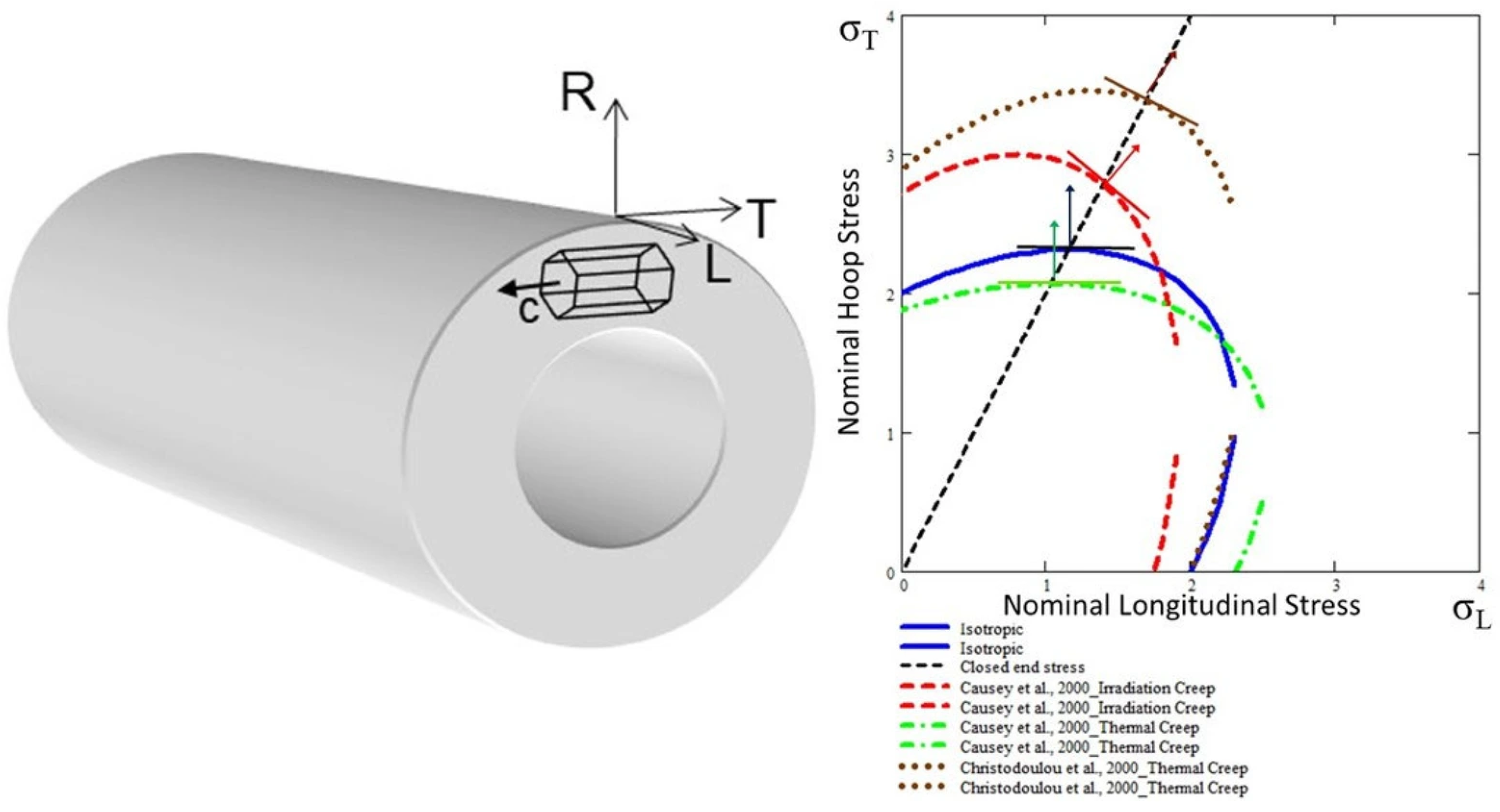
It has been established that there is creep suppression at low atomic displacement damage rates and creep enhancement at high atomic displacement damage rates [4]. One important effect of irradiation is on the creep anisotropy of Zr-2.5Nb pressure tubing. Christodoulou et al. [10] have deduced that the thermal creep anisotropy of Zr-2.5Nb pressure tubing at the point of yielding is similar to that of the irradiation creep reported by Causey et al. [11] and, at the same time, is different from the thermal creep anisotropy also reported by Causey et al. [11]; see Figure 1. The stress locus for a closed-end internal pressurization intersects the surfaces at the locations shown. The size of each surface will depend on a creep compliance scaling factor, which will be different for each plot.
The isotropic nature of thermal creep reported by Causey et al. [11] is not consistent with the thermal creep anisotropy deduced from creep capsules and reported by Li and Holt [12]. In the latter case, for a range of textures typical of pressure tubes, the ratio of axial to diametral creep for internally pressurized tubes is < 0.1, significantly lower than the values of between 0.4 and 1 that have been reported for irradiation creep over the same texture range [9,13]. These inconsistencies can be reconciled by assuming that yielding has a different response surface than that which applies at stresses below the yield point, and the thermal creep anisotropy varies accordingly, being approximately isotropic for the stresses and temperatures below the yield condition that are typical of power reactor operation. An effect of stress and temperature on the thermal creep anisotropy may be expected as the creep mechanism shifts to one dominated by yielding at high stresses and temperatures [12]. For power reactor conditions (<320 °C and <150 MPa), the irradiation creep is linear with stress and can be attributed to the dominance of diffusional mass transport [14] that is elevated by high concentrations of vacancy and interstitial point defects during irradiation [4].

1.3. Mechanistic Understanding of Irradiation Creep for Zr-2.5Nb Pressure Tubing

An important aspect of the effect of irradiation, which is not adequately addressed in historic irradiation creep models for Zr-2.5Nb pressure tubing, is the assumption that dislocation slip is the dominant strain-producing mechanism and is enabled by dislocation climb during irradiation. Irradiation results in a climb of not only a-type dislocations but also c+a dislocations. In the latter case, irradiation creates immobile stacking faults, either from splitting of the edge dislocations or helical climb of the screw dislocations during irradiation [2,15,16,17,18]. Irradiation then suppresses creep, both because of: (i) climb on existing dislocations that creates non-glissile dislocation segments and (ii) by creating barriers to slip in terms of point defect clusters (dislocation loops). In fact, only glide of perfect dislocations can conceivably be enhanced during irradiation, and because of this limitation, it is difficult to imagine how irradiation can result in enhanced creep rates due to dislocation slip unless the temperature and stress are sufficiently high that thermal creep conditions predominate. Even for perfect edge dislocations, the effect of enhancing climb has to more than compensate for the suppressing effect of the creation of point defect clusters that impede their glide. While climb during thermal creep is in one direction and involves vacancy absorption only, climb during irradiation is caused by the absorption of interstitial and vacancy point defects that shift the half plane in opposite directions. The net effect of elevating both vacancy and interstitial point defect concentrations is not clear. These limitations motivate alternative constitutive descriptions in which irradiation creep is treated as a stress-modified growth process arising from defect absorption kinetics and diffusion anisotropy, rather than from enhanced dislocation slip [19].
Apart from the logical fallacy of a slip-based mechanism, the inability of slip to account for the irradiation creep anisotropy in Zr-2.5Nb pressure tubing is borne out by the fact that the creep anisotropy in models applied to pressure tubes cannot be explained by dislocation slip. A correction factor (known as K4(x)) has been applied in the creep models reported by Christodoulou et al. [8,20] because irradiation creep anisotropy factors, which are based on dislocation slip, are inadequate in accounting for the observed behavior. The irradiation creep models are essentially empirical and are derived from an axially dependent adjustment to the creep rate applied after first including the calculated anisotropy coefficients due to slip [8,9,11]. As stated by Christodoulou et al. [8] and Holt [6], the empirical correction is added because of the effect of other factors, besides dislocation slip, that affect irradiation creep. The net effect is that the creep anisotropy parameters based on slip derived from self-consistent modelling are redundant in practice [8]. Other approaches eliminate the need for empirical correction factors by embedding the anisotropy directly into the constitutive structure through defect kinetics and homogenization [19].
While tube-to-tube texture variations can account for a small amount (e.g., 10%) of the variability in diametral creep [8,20], the main explanation for the variation in diametral creep along the length of pressure tubes has been attributed to the grain structure [5]. Tube-to-tube variability has been shown to be dependent on variations in both texture and grain structure [5,6,21].
Because the irradiation creep anisotropy cannot be adequately described by slip-based models, a new approach has been adopted where the creep can be modelled based on rate theory [2,4]. The creep anisotropy then arises from the distribution of sinks that are biased for point defect absorption because of the intrinsic diffusional anisotropy of the Zr crystal lattice [22] and the additional effect of the stress state on the diffusion anisotropy [23].
Pressure tube microstructures are complex and variable, both within a given tube and from tube-to-tube. The deformation arising from diffusional mass transport must consider the orientation anisotropy of the sink distribution and the biased flow of point defects, which is both intrinsic to the crystal and subject to external influences such as the applied stress. For Zr-2.5Nb pressure tubing, the point defect sinks include dislocations, dislocation loops, and grain boundaries. While the network dislocation structure is a function of mechanical working during fabrication and can be assumed independent of the location along the pressure tube, the dislocation loop structure is a function of the operating conditions (neutron flux and temperature), and this, together with variations in texture and grain structure, has a direct effect on the axial variation in creep rate. The relative creep behavior from one pressure tube to another can be largely attributed to variations in the grain boundary structure. Pressure tubes where the grains are smaller and more equiaxed when viewed in projection down the longitudinal axis of the tube tend to exhibit the highest diametral creep rates [6]. Rate theory modelling uses average values for the microstructure parameters (sink strengths) to describe the observed behavior.
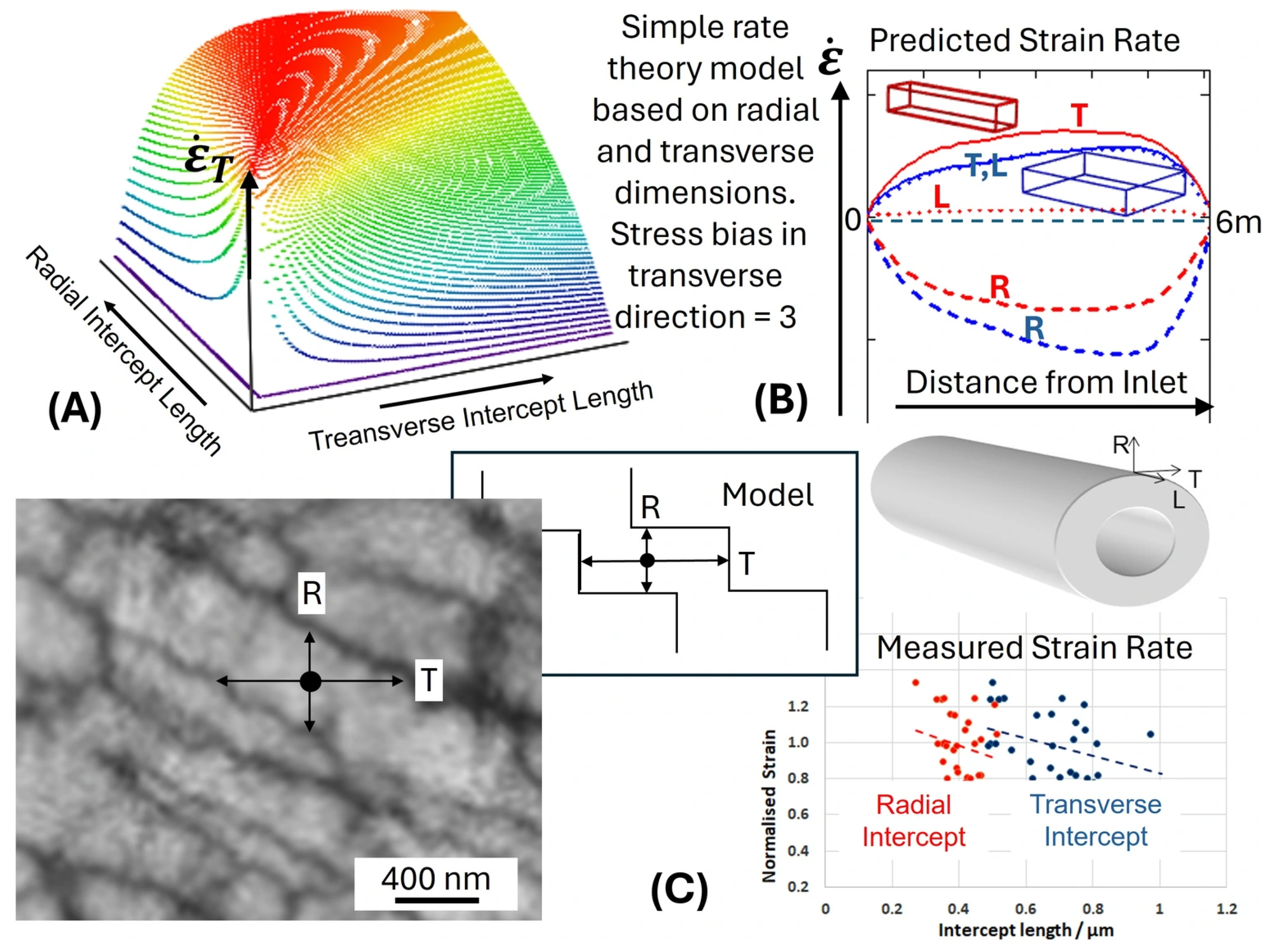
The microstructure and creep behavior of many pressure tubes have been well characterized for the majority of pressure tubes installed in CANDU reactors fabricated since the 1960s [5,24]. To a large extent, the relative creep behavior can be deduced by comparing the grain intercept lengths in either the radial or transverse directions, creep being larger when the grain dimensions (intercept lengths) are small [6]; see Figure 2. Considering grain boundary sinks alone, in the absence of all other sinks, rate theory shows that the peak strain occurs for a given ratio of sink densities dictated by the diffusional bias (Figure 2A). The net effect for Zr-2.5Nb pressure tubes is that the diametral creep rate tends to be higher when the grains are more equiaxed rather than platelet-shaped when viewed down the tube (Figure 2B). The measured irradiation creep is related to the grain boundary intercept lengths, as shown in Figure 2C.
In an early study, incorporating grain dimensions as well as other microstructure variables [5], minor axis grain dimensions were found to be the most robust explanatory variable for relative diametral creep at the back-ends of pressure tubes where the creep rate was a maximum. It was later found that when the grain dimensions were larger (for front-ends, for example), the correlation with minor axis grain dimension weakened, and other measures, like grain aspect ratio, became important [6].
There have been instances where tubes have been deliberately fabricated with significantly different microstructures [25]. The different microstructures (grain dimensions in particular) resulted in different rates of diametral creep and axial elongation. Data on grain thickness, aspect ratio, and crystallographic orientation, used in an earlier statistical study [6], have been used to validate a rate theory model for irradiation creep [4]. It was found that, while most tubes in the dataset had similar grain shape and size distributions, one set of tubes known as Task Group Three Route 1 (TG3 RT1) from [25] was fabricated with smaller-than-normal grain sizes. It turned out that the TG3 RT1 tubes exhibited unusually high diametral creep rates (50% higher than most other tubes in the same reactor) and low elongation rates. Empirical and mechanistic modelling indicated that it was the smaller grain size of the TG3 RT1 tubes, above all else, that was responsible [6,21,26]. It is this same effect that accounts for the higher diametral creep observed for the back-ends compared with front-ends of many standard CANDU reactor pressure tubes [5].
This paper is comprised of two parts. We will start with a description of the methodologies that have been applied in rate theory treatments of irradiation creep in Zr-2.5 Nb pressure tubing. We will then show how the different approaches to rate theory modelling can be used in predicting the diametral creep behavior of pressure tubing having different microstructures in different operating environments. Several CANDU-6 reactors (600 MWe design) have been refurbished over the past 10–15 years, and we wish to explore how new tubes will behave in these refurbished units, given that there is a range of possible microstructures for which there is operating experience over extended periods (longer than the design life) in the 900 MWe design. Having established that a particular creep model (based on a bimodal grain structure) has worked well in predicting the irradiation creep for one reactor type (the 900 MWe design), we will apply the same modelling approach to predict the creep in a different reactor type (600 MWe design) after refurbishment.

2. Methodology

Rate theory models of irradiation creep depend largely on the distribution of sinks for point defects that consist primarily of dislocations and grain boundaries. Given that the cold-working of pressure tubing (about 25%) is more-or-less constant along the lengths of the tube, the main variables that affect the creep are the texture and grain structure. While texture variations exist along the lengths of pressure tubes and from tube-to-tube, they are not sufficient to account for the variability in irradiation creep that is observed, and grain structure must be invoked to better account for the observed creep behavior.

2.1. Rate Theory Model Based on Radial and Transverse Grain Boundary Intercept Lengths

There is a correlation between the intercept lengths and the relative diametral strain rate, as illustrated in Figure 2. Rate theory modelling shows that, if one considers grain boundaries as the only sinks, the diametral creep is a function of the relative grain boundary densities intersecting the radial and transverse directions.
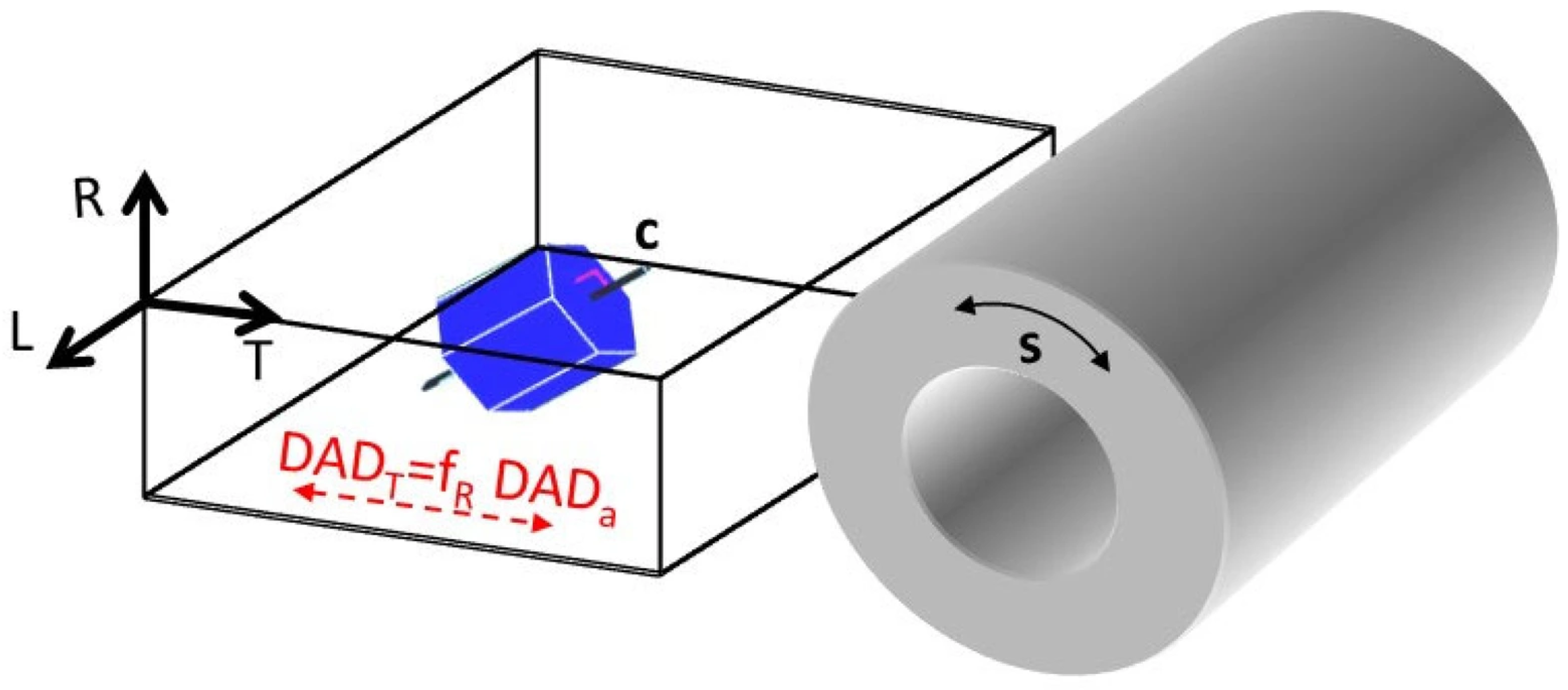
Statistical analyses have shown that the distribution of grain boundary sink densities (sink strengths) as a function of orientation in the pressure tubes has a strong effect on the creep during irradiation [5,6,26]. Early rate theory modelling used the mean intercept lengths between grain boundaries in each of the principal directions in the pressure tubes to derive sink strengths and thus model relative creep strains [26]. The model results were qualitatively in agreement with the observed correlation between grain intercept lengths and irradiation creep (Figure 2C), but they assumed that the grain structure could be represented as a collection of grains with the same dimensions based on the average intercept lengths. For a grain structure that was largely platelet-like, the relative intercept lengths were a function of the orientation of the platelets, and the average lengths could be used to represent the grain structure as a collection of identical platelets of a particular crystallographic orientation (given by the Kearns’ f-factor) and dimensions aligned with the radial and transverse directions of the tube; see Figure 3. The diffusional anisotropy difference (DAD) bias parameter in the transverse direction is given by DADT = fR * DADa, where DADa is the interstitial diffusion anisotropy difference bias parameter for the a-direction (given as the bias parameter p in the model). The intrinsic bias based on crystal orientation is modified by a stress-induced interstitial diffusion bias (s) that is proportional to the hoop stress (S).
To illustrate and help understand how point defects migrate to different sinks, thus producing strain, one can construct a simple set of balance equations. It is assumed that the sink orientation is biased for interstitial absorption following the diffusional anisotropy difference (DAD) mechanism according to the bias parameter (p), indicating preferential diffusion in the basal plane, [22]. The effect of stress can be incorporated as a bias parameter resulting from elasto-diffusion [23], if necessary. The model then becomes one for irradiation growth by setting the stress bias to zero.
For the model previously published [26], the sink strengths are determined by the density and orientation of the different sinks relative to the intrinsic bias (p) based on DAD and the orientation of the crystal based on Kearns’ texture parameter (f) for the orientation of interest. There is also a stress-induced bias (s) dependent on the applicable stress state. The combined effect of the crystal orientation distribution on the diffusional bias and the bias due to stress is included in the terms (f, p, and s). The model subsumes intercept data into a single representative grain with dimensions equal to the average of the intercept length. The crystallographic orientation of the average grain is given by assuming a single grain with a c-axis oriented to match the Kearn’s f-parameters. In this case, the only parameter needed to define the crystal orientation is fR because fL is assumed to be zero. The DAD bias parameter is then modified by f to give the interstitial diffusional bias in the transverse and radial directions, as illustrated in Figure 3.
The creep is dictated by the probability of interaction of point defects with all sinks, including dislocations and grain boundaries. The interstitial point defects tend to migrate in a given direction based on the crystal orientation and the orientation relative to the stress tensor applicable to each grain. Also, in the case of dislocations, the elastic interaction between the strain field around the sink and the point defects is also included. As one is dealing with balance equations, it is only necessary to be able to compute the relative strengths of the different sinks, and these can be incorporated into the model as bias factors that account for the probability that a given sink has a propensity for absorbing interstitial, as opposed to vacancy, point defects. This enables the building of a simple model to explore the interplay between various sinks and point defect properties. For example, one can represent the net flux to sinks resulting in strain in the radial ®, transverse (T), and longitudinal (L) directions of a pressure tube by the following expressions:
J R = [ ( 1 + ( 1 f R ) . p ) · D i C i   D v C v ] · ( G B R + ρ R )
J T = [ ( 1 + f R · p + 2 s ) · D i C i D v C v ] · ( G B T + ρ T )
J L = [ ( 1 + p + s ) ·   D i C i D v C v ]   · ( G B L + ρ L )
D i C i = ϕ ( 1 + ( 1 f R ) · p ) · ( G B R + ρ R ) + ( 1 + f R · p + 2 s ) · ( G B T + ρ T ) + ( 1 + p + s ) · ( G B L + ρ L )  
D v C v = ϕ ( G B R + ρ R ) + ( G B T + ρ T ) + ( G B L + ρ L )  
The grain boundary and dislocation sink densities corresponding with each direction R, T and L are given by GBm and ρm, where the orientation, m = R, T and L. The interstitial bias factor, p, is assumed to be a function of sink orientation and determined by interstitial diffusional anisotropy. The bias parameter is therefore modified by the basal pole orientation parameter, fR, which resolves basal pole tensor properties onto a direction of interest, to capture the effect of the diffusional anisotropy difference of interstitial point defects along the a and c- axes. The bias factor due to stress, s, is applied to interstitial diffusion only [23]. The sink densities, Game and ρm, can be separated with appropriate changes of bias factors to account for strain-field interactions if necessary. When the damage rate (ϕ) is expressed as a fraction of the atom fraction displacement rate (displacements per atom per second), i.e., a freely migrating point defect flux 4, the atom fractional fluxes, JR, JT, and JL diffusing and annihilating at sinks perpendicular to each of three orthogonal directions, R, T, and L are the plastic strain rates in each direction. It is easy to see that: J R +   J T +   J L = 0   .
This model has never been quantitatively validated and has been used only qualitatively to assess the relative creep rates of pressure tubes with different grain structures. From a qualitative viewpoint, it provides a reasonable representation of the results shown in Figure 2C.

2.2. Rate Theory Model Based on a Bimodal Grain Structure

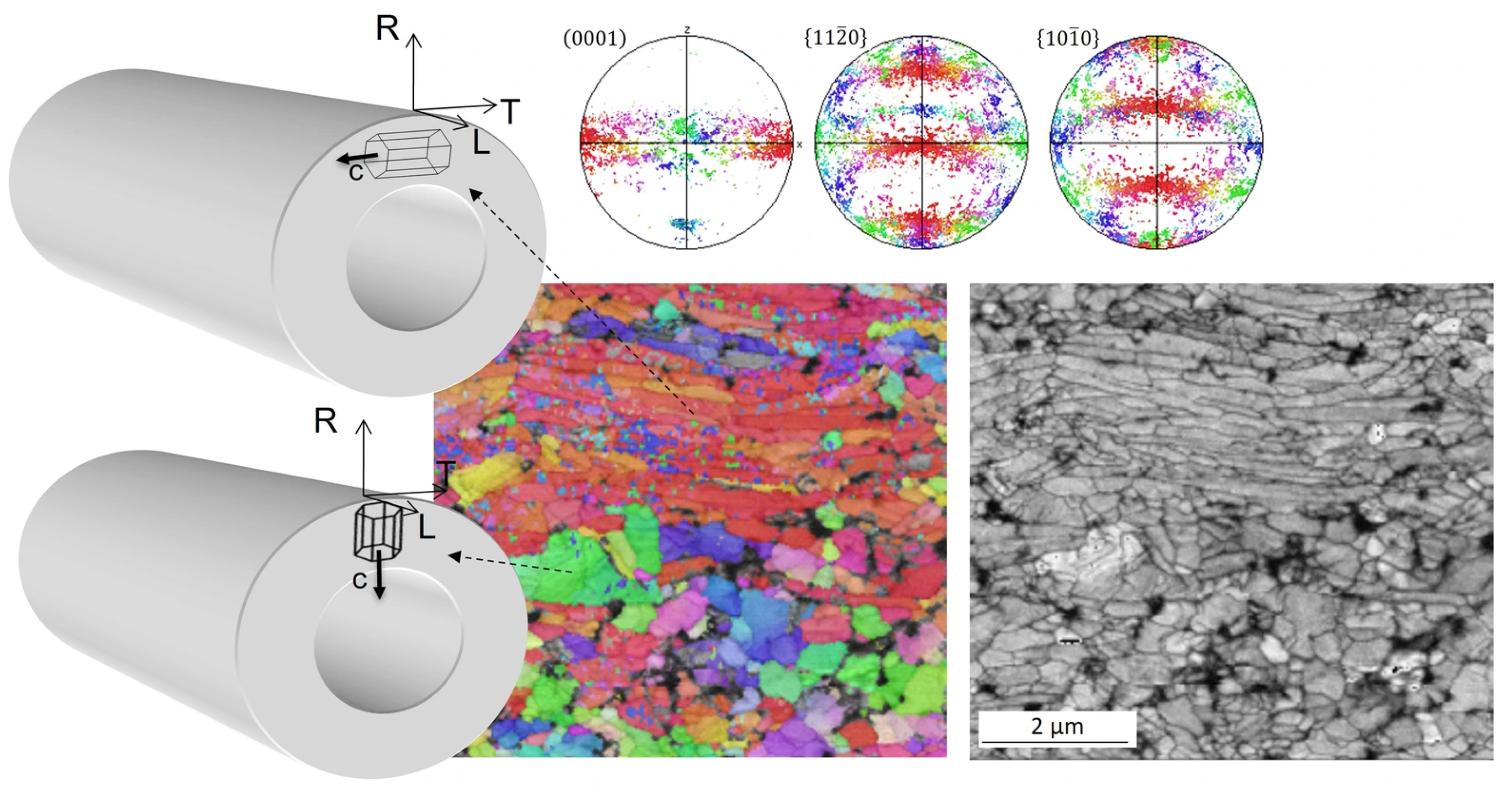
For rate theory models of Zr-2.5Nb pressure tubing, the creep can be assessed where the grain shape is linked to its crystallographic orientation [2,4] as illustrated in Figure 4. In an idealized case, the grains that tend to be oriented with their c-axes close to the radial direction are equiaxed, and those that tend to be oriented with their c-axis grains close to the transverse direction are flattened platelets.
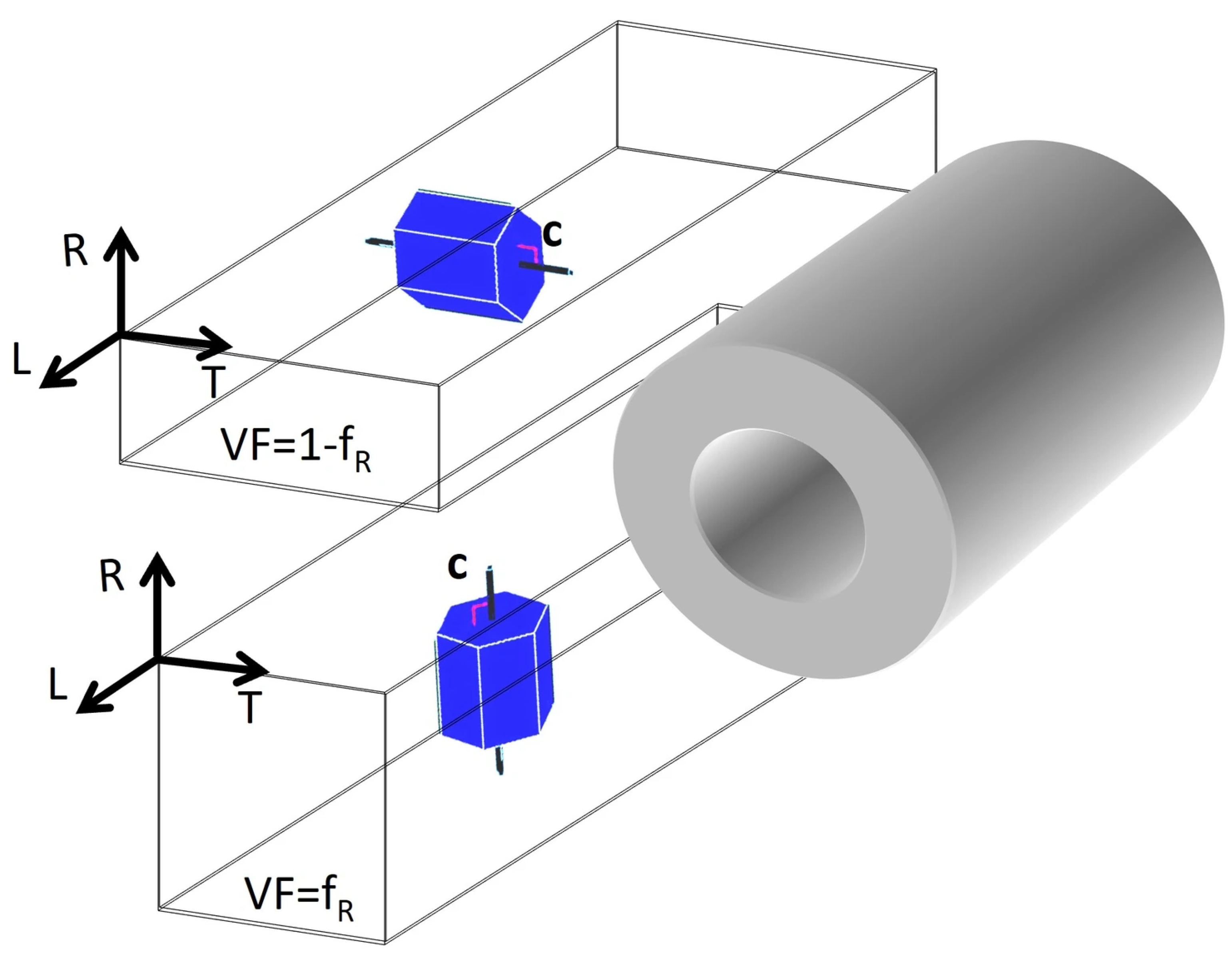
For large-grained materials, the effect of the grain boundaries as sinks for point defects is small, and the irradiation creep is dominated by the dislocation structure, both in the as-fabricated state and as it develops during irradiation. When the grain dimensions are small, and the distance a point defect travels before encountering a dislocation becomes comparable with the distance it travels before encountering a grain boundary, the effect of grain structure becomes important. The relative contributions from each idealized combination of grain shape and orientation can be incorporated into the model based on Kearns’ texture parameters fR, fT, and fL. The configuration for the two types of grains being considered is shown in Figure 5.
By treating grain boundaries as sinks for point defects, one can develop a diffusion-based rate theory model for irradiation creep. Such a model has been shown to predict the diametral creep and elongation of Zr-2.5Nb pressure tubes in CANDU reactors when detailed microstructure information was available [4]. In that case, a simplified approach involved assuming an average grain with an aspect ratio of 1:AR:10, where AR was the average ratio of the transverse to radial dimensions when viewed down the long axis of the tube. The radial grains were assumed to have an aspect ratio of AR:AR:10 as illustrated in Figure 5. A model constructed like this was able to demonstrate why TG3 RT1 tubes [25] exhibited high diametral creep compared to other tubes in the same reactor. While the ARs for non-standard TG3 RT1 and standard tubes were similar [4], the distinguishing feature of the TG3 RT1 tubes was that they had thinner grains (small minor axis dimensions).
In the model [4], the dislocation bias for interstitials is denoted by the parameter, b, based on the elastic size-effect interaction between dislocations and point defects [28]. The dislocation bias will also be modified by the DAD bias due to the line orientation [22], but for the sake of this treatment, it is assumed that any additional effects due to anisotropic diffusion and line orientation are subsumed into the dislocation bias term (b). If one is operating in a temperature regime where recombination and vacancy emission are insignificant, one can represent the net flux of interstitials and vacancies to sinks, resulting in strain in the radial (R), transverse (T), and longitudinal (L) directions of a given grain of dimensions dR,T,L, by the following expressions:
J R = R k i 2   . D i C i   R k v 2 . D v C v
J T = T k i 2   . D i C i T k v 2 . D v C v
J L = L k i 2   . D i C i L k v 2 . D v C v
D i C i = ϕ L k i 2 + T k i 2 + R k i 2 D v C v = ϕ L k v 2 + T k v 2 + R k v 2  
where ϕ is the production rate of freely migrating point defects (FMDs), D i and D v are the interstitial and vacancy diffusion coefficients, and C i and C v are the interstitial and vacancy steady state concentrations. If the sink strengths internal to the grains are given by k i , v 2 then the sink strength for grain boundaries perpendicular to the directions R, T, and L are given by [29],
( k i , v g b ) 2 = k i , v d R , T , L
The sink strengths of the a- and c-type network dislocations are determined from the dislocation densities, ρa and ρc. The sink strength of the dislocation loops is given by ρN (assumed neutral). The total internal sink strength dictates the grain boundary sink strength. For a grain that has the c-axis parallel with the transverse direction, the sink strengths used to compute the strains in the radial (R), transverse (T), and longitudinal (L) directions are, respectively:
Radial :   k i 2 = ( 1 + p ) ( k i g b ) 2 + ( 1 + b ) ρ a 2 + ρ N 3 ; k v 2   =   ( k v g b ) 2 + ρ a 2 + ρ N 3
Transverse :   k i 2 = ( 1 + 2 s ) ( k i g b ) 2 + ( 1 + 2 s ) ρ c + ρ N 3 ; k v 2 = ( k v g b ) 2 + ρ c l + ρ N 3
Long :   k i 2 = ( 1 + p + s ) ( k i g b ) 2 + ( 1 + b + s ) ρ a 2 + ρ N 3 ;   k v 2 = ( k v g b ) 2 + ρ a 2 + ρ N 3
where ρ c l = ρ c ( 1 + c · d p a ) represents the c-dislocations, including a c-component dislocation loop structure evolving by helical climb [16,30]. For cold-worked Zr-2.5 Nb pressure tubing, an approximate estimate for c is 0.04/fmd, which is about 0.004/primary dpa, based on line broadening of cold-worked Zircaloy-2 pressure tube material [31]. The effect of allowing the c-component vacancy loop sink strength to evolve by helical climb for a Zr-2.5Nb texture is a decreasing rate of diametral creep [2,4].
For a grain that has the c-axis parallel with the radial direction, the sink strengths used to compute the strains in the radial (R), transverse (T), and longitudinal (L) directions are, respectively:
R :   k i 2 = ( k i g b ) 2 + ρ c + ρ N 3 ;   k v 2   =   ( k v g b ) 2 + ρ c l + ρ N 3
T :   k i 2 = ( 1 + p + 2 s ) · ( k i g b ) 2 + ( 1 + b + 2 s ) · ρ a 2 + ρ N 3 ;   k v 2 = ( k v g b ) 2 + ρ a 2 + ρ N 3
L :   k i 2 = ( 1 + p + s ) · ( k i g b ) 2 + ( 1 + b + s ) · ρ a 2 + ρ N 3 ;   k v 2 = ( k v g b ) 2 + ρ a 2 + ρ N 3
The grain boundary sink strengths are assumed to be determined from the internal sink structure without the biases based on diffusion anisotropy, i.e., independent of intrinsic bias (p) and the stress-induced bias (s) because these biases are also applied to the boundaries in the balance equations:
Radial : ( k i g b ) 2 = ( k v g b ) 2 =   2 · ( 1 + b ) ·   ρ a + ρ c l + ρ N d R
Transverse :     ( k i g b ) 2 = ( k v g b ) 2 = 2 · ( 1 + b ) ·   ρ a + ρ c l + ρ N d T
Longitudinal :     ( k i g b ) 2 = ( k v g b ) 2 = 2 · ( 1 + b ) ·   ρ a + ρ c l + ρ N d L
The main value of developing a mechanistic model of this type is to give some insight into the possible mechanisms that apply to irradiation creep. Rate theory has proven to be important in explaining the swelling-dependent part of the irradiation creep of austenitic alloys, and it could equally apply to the swelling-independent creep of Zr-alloys. In the latter case, irradiation creep can be envisioned as a shift from dislocation slip dominating the irradiation creep behavior at low doses before the dislocation loop structure has fully evolved (thus inhibiting dislocation slip) to something else, in this case, mass transport.
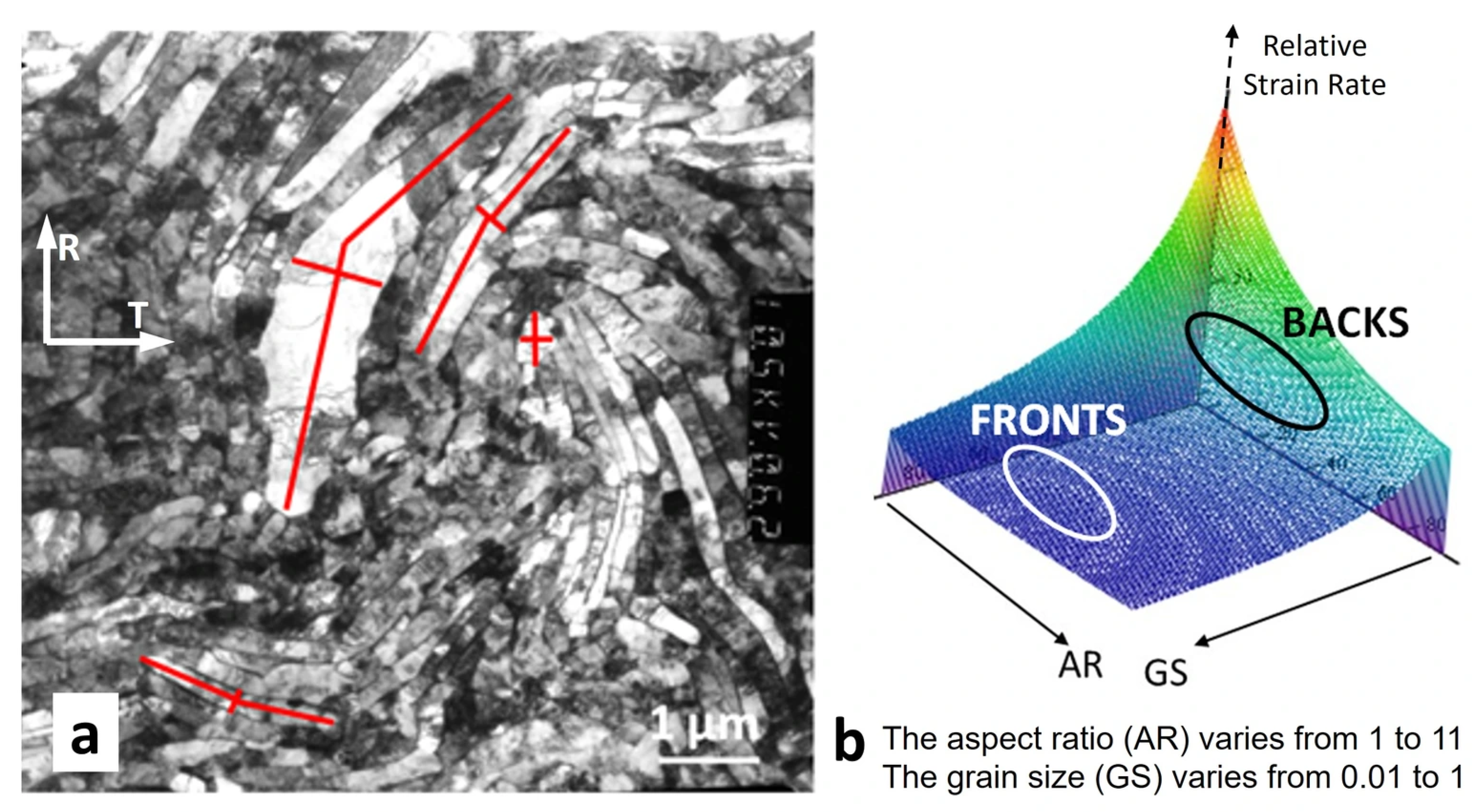
While grain thickness and texture have been sufficient to account for differences in irradiation creep behavior, it is known that other factors, grain shape in particular, have a large effect (see Figure 2A,B). The grain aspect ratios are based on the long and short dimensions of grains when viewed down the longitudinal axis of the tube (see micrograph in Figure 6a). When one includes these dimensions in the model described in this section, the irradiation creep rate increases when the grain dimensions are reduced and when the aspect ratio is also reduced, i.e., when the grains are small and more equiaxed in the radial-transverse plane (Figure 6b). The aspect ratios one measures for individual grains are not the same values one would obtain from the ratio of the transverse and radial intercept lengths that have been called aspect ratios in some studies [32].
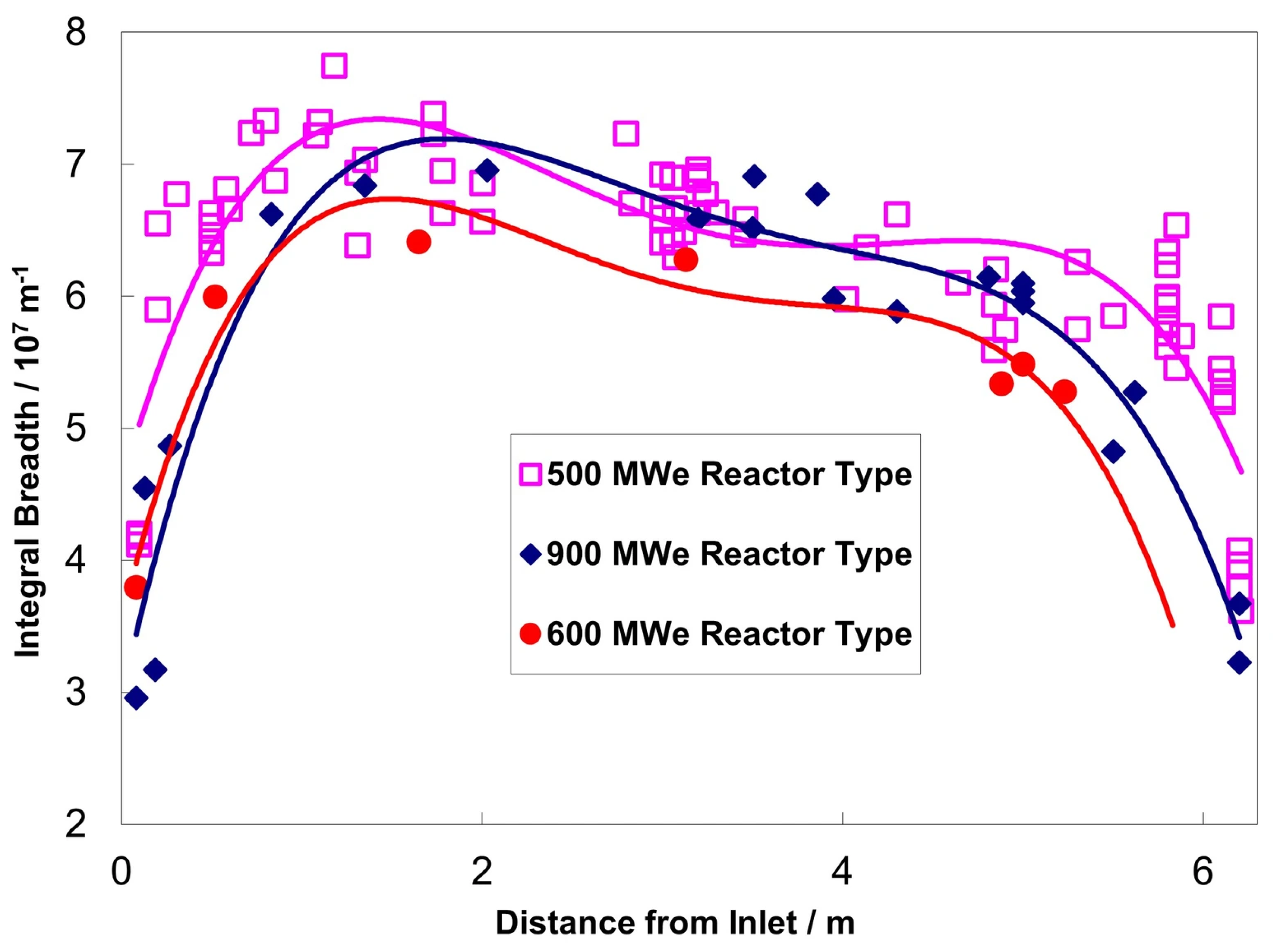
An important microstructural variable to be applied in modelling is the network dislocation density (from cold-working) and dislocation loop density (from radiation damage). It is assumed that the cold-worked dislocation network consists of a-type and c-type dislocations with densities of 4 and 1 × 10¹⁴ m−2, respectively. The same model applied previously to illustrate the factors responsible for the high diametral creep of TG3 RT1 tubes in a 900 MWe CANDU reactor is to be used in the current work by applying the parameters shown in Table 1 to a 600 MWe reactor design that has a different range of operating temperatures and neutron fluxes. Apart from fabrication differences, the radiation damage density along the tubes is different for reactors of the 900 MWe design compared to the 600 MWe design, as shown in Figure 7 [33]. The high values at the inlet and outlet for the 500 MWe design are the result of lower inlet and outlet temperatures. The outlet temperatures are highest for the 600 MWe design, and the radiation damage density is low towards the outlet as a result.
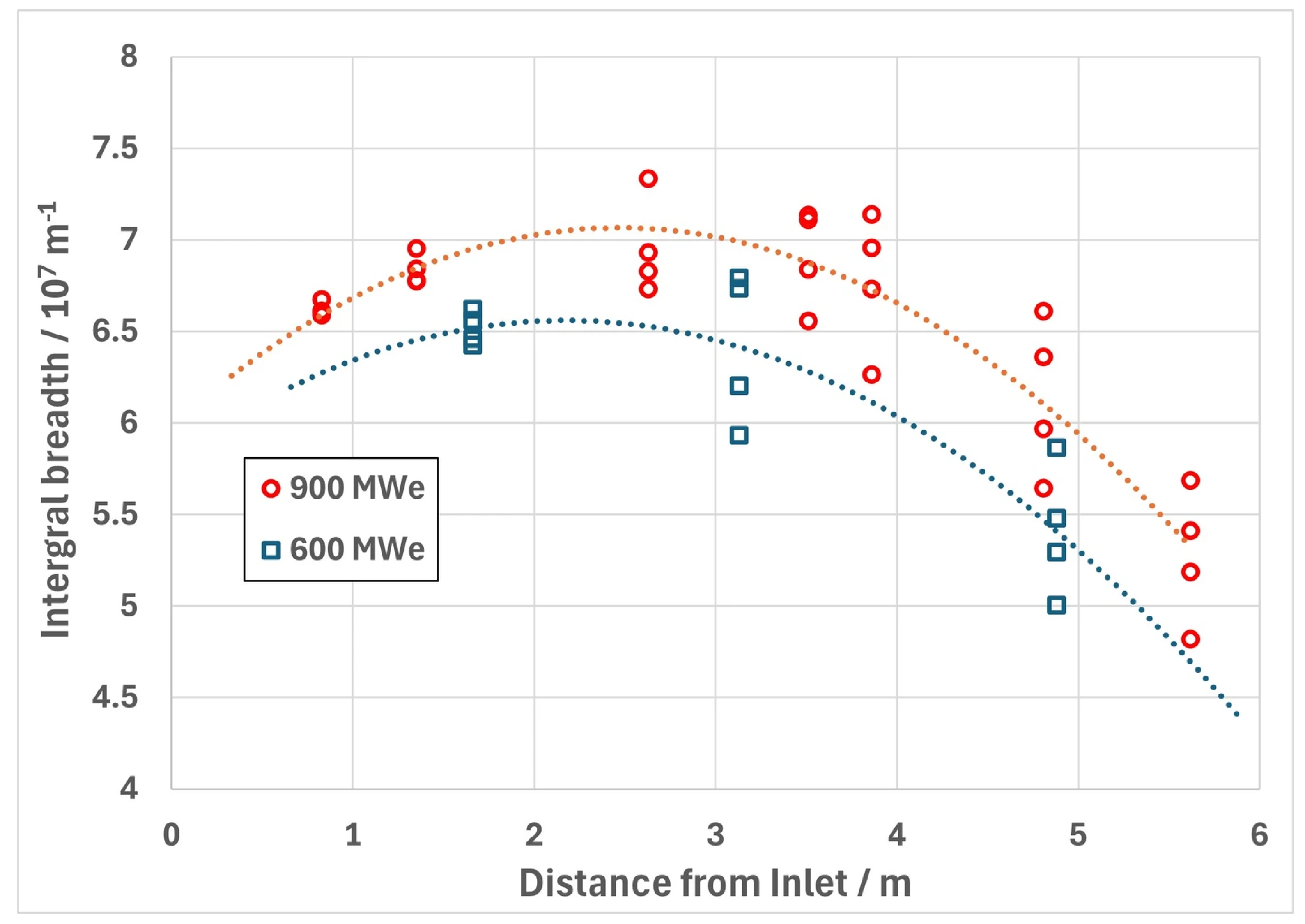
The data shown in Figure 7 are from various samples from many different tubes. The trend for a 900 MWe design was applied previously in assessing the relative behavior of the TG3 RT1 compared with standard pressure tubes [4]. In the current work, the applicable trend is that for the 600 MWe design. Data for individual channels in the two reactor types are shown in Figure 8. Note that the spread of data points at each axial location arises from the fact that the tubes were sampled at four clock positions (12, 3, 6, and 9), with 12 o’clock being the highest value and 6 o’clock being the lowest value for each set.
The most important feature of the rate theory modelling is the inclusion of dislocation loop density as a microstructural input. Line profile analysis [34] has shown that the dislocation densities of Zr-2.5Nb pressure tubing can be elevated to values of the order of 1015 m−2 in service, and the densities decrease from the inlet to the outlet. This difference is because of the effect of temperature on dislocation loop density from inlet to outlet, given a symmetric neutron flux profile. The same explanation applies to the circumferential variation in dislocation density around the tube. Flow by-pass in an expanded channel results in a cooler temperature at the top (12 o’clock) and a hotter temperature at the bottom (6 o’clock) where the fuel bundle sits. This leads to high dislocation densities at 12 o’clock, especially at the locations along the tube where the diametral creep is highest. The variation in dislocation density as a function of axial location and clock position is related to the irradiation temperature as indicated by X-ray diffraction line broadening, with lower temperature corresponding with higher line broadening, representing dislocation loop densities [33].
The average sink density (in units of 1014 m−2) for dislocations and dislocation loops at an axial location relative to the inlet (x) is represented by the following phenomenological equation:
ρ N = P H I ( x ) · ( R N 6 · x ) · 0.13 + ρ a
P H I ( x ) is the fast neutron flux in units of 1017 n·m−2·s−1 (E > 1 MeV), RN is a scaling factor and ρ a is the a-type network dislocation density. For the 900 MWe design, the value of RN is 50. For the 600 MWe design, the value of RN is 30. Note that in a previous publication [4] the equation (34) was mis-typed and should be replaced with Equation (1), with RN = 50, shown here. The error was typographical only and did not affect the calculations in that publication [4]. For the current study (applied to the 600 MWe design), the dislocation sink density is assumed to be 60% of the 900 MWe design, consistent with the lower line broadening for the 600 MWe design [4].
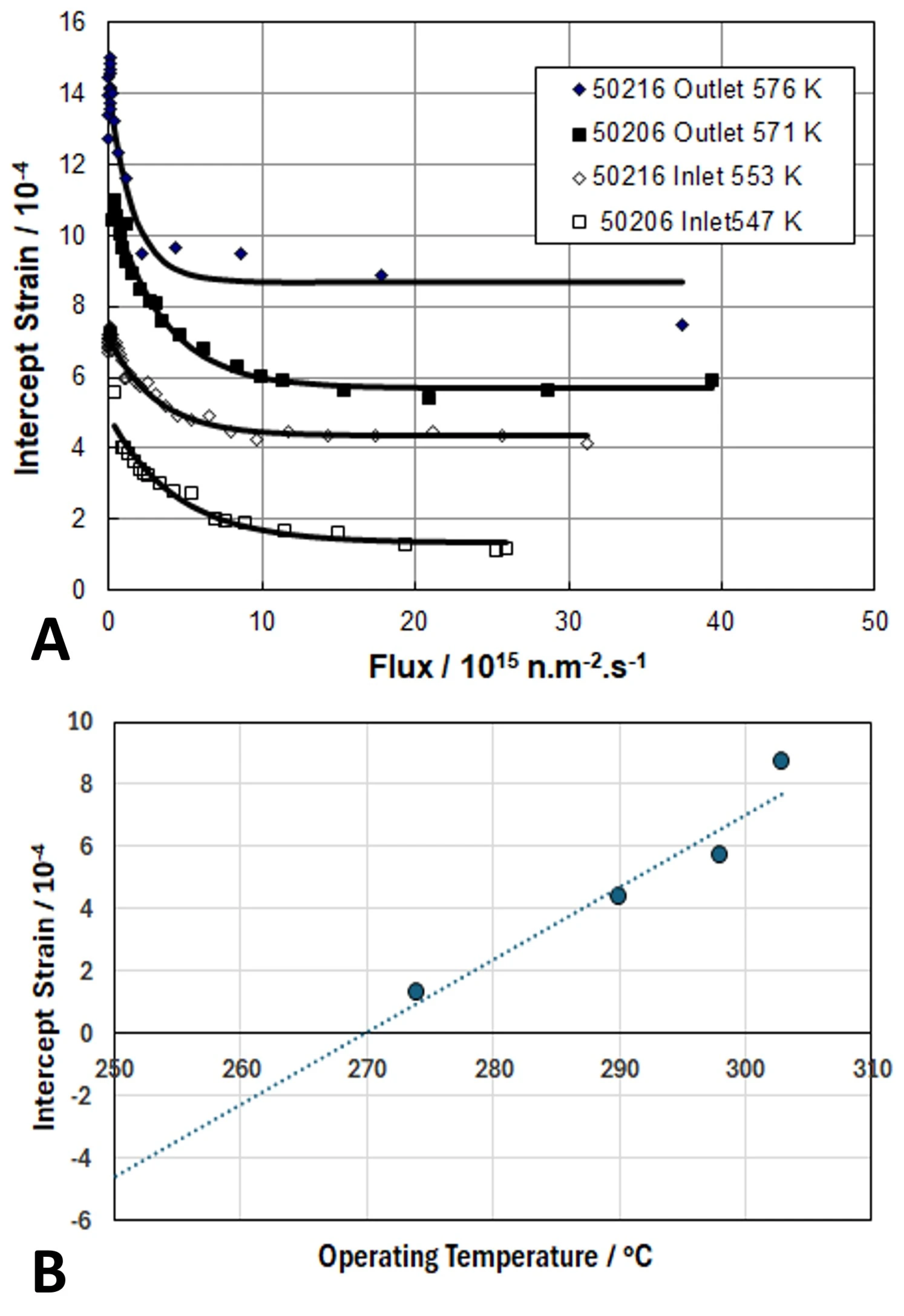
To compare the diametral strain at the same operating time from strain rate calculations, the initial primary creep must be estimated. Assuming the strain rate is constant after an initial transient, one can estimate the strain at a given operating time by first considering the initial primary creep transient. Results from previous studies show that the transient is dependent on the temperature [35]. To calculate the primary strain after a given operating period, a simple linear fit has been applied to the zero-time intercept data corresponding to the main body of the pressure tubes and neutron fluxes > 2.5 × 10¹⁶ n·m−2·s−1 (E > 1 MeV), see Figure 9. Once the primary strain is known, one can estimate the total strain at a given time based on the calculated strain rate.
Having described two models, we now intend to: (a) compare the different model outputs when compared to the measured diametral strain of a selected tube that had been operating in a 600 MWe reactor; (b) compare model predictions for a high-straining, non-standard tube in 900 MWe and 600 MWe reactors. As this is a modelling exercise, we only need to compare the model outputs for one tube (in this case, the tube identified as RT1A in a previous study [4]) operating in the two reactor types. The main difference between the two reactor types is a difference in microstructure that arises because of a difference in operating temperature (see Figure 7 and Figure 8).

3. Results

Having identified two different approaches to calculating irradiation creep, one based on the measurement of grain intercept lengths and the other based on relating the dimensions of the grains to their crystallographic orientation, we wish to predict the creep of Zr-2.5Nb pressure tubes after 42 thousand effective full power hours (42 kEFPH) of service life. The two models are compared by examining their outputs for an average tube in a high-power channel in a 600 MWe CANDU reactor.
Microstructure parameters have previously been compiled for the intercept lengths and grain dimensions of tubes operating in 600 MWe CANDU reactors [5,6]. The mean grain dimensions and textures from a subset of 21 tubes operating in 600 MWe CANDU reactors are given in Table 1. There is limited information on aspect ratios because of the difficulty in both defining and measuring these parameters, but an attempt has been made to measure the aspect ratio of one tube (deemed representative), and it will be assumed to apply to the average. The intercept lengths for the same set of tubes used to generate the parameters in Table 1 are listed in Table 2.
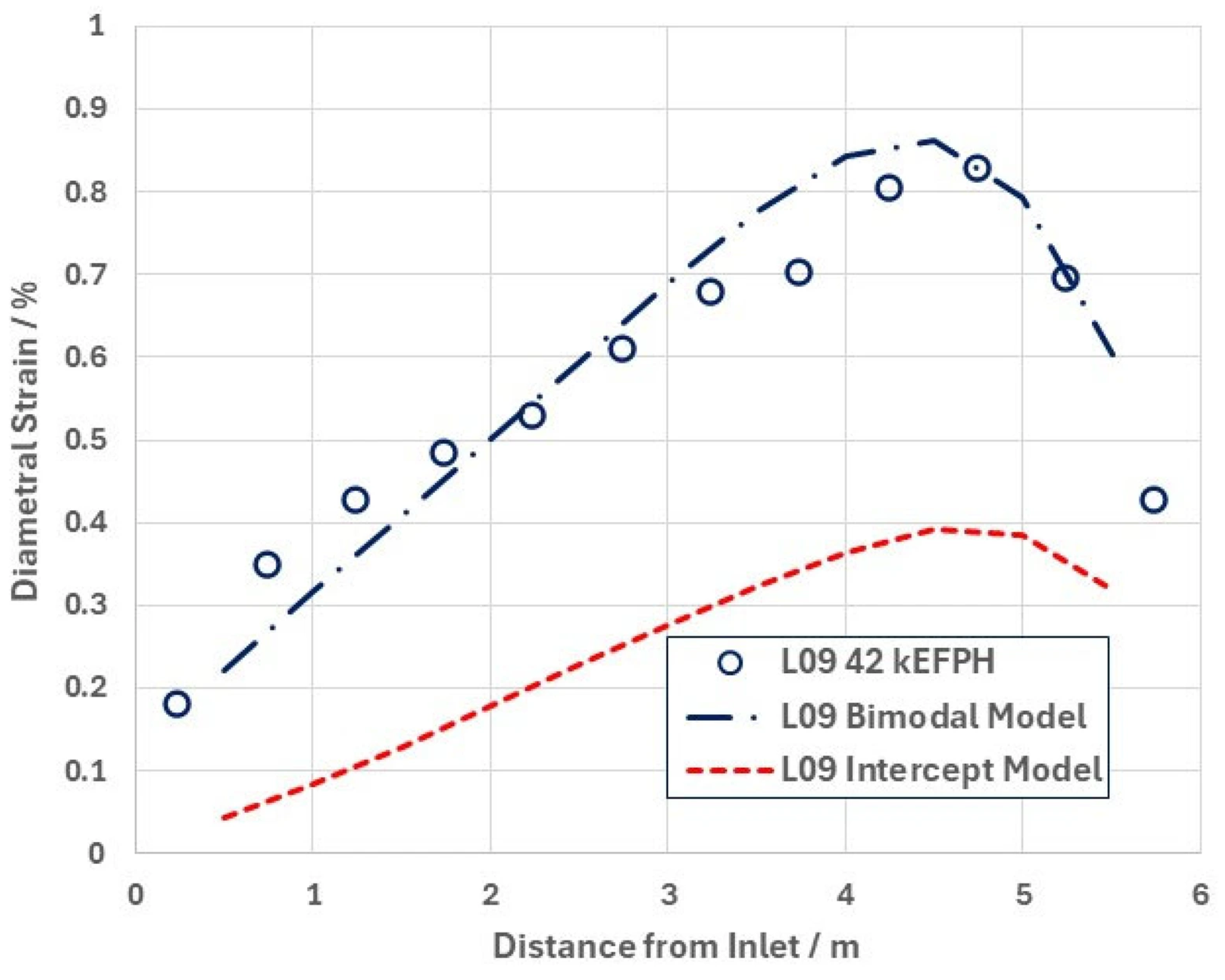
The result of applying the operating conditions and microstructure data in Table 1 and Table 2 for a high-power channel (L09) is shown in Figure 10. Also shown are measurement data for the B-series tube in L09. The bimodal model gives good agreement with the measured strain after 42 kEFPH. While the intercept model has been shown to be a reasonable tool for predicting relative behavior based on grain dimensions [6,,26], it is not as good as the bimodal model in absolute terms and is therefore not recommended for quantitative analysis.
The bimodal model, developed to account for the diametral strains in a 900 MWe reactor, provides good predictive capability for a high-power channel (L09) in a 600 MWe reactor. One can therefore have confidence that this model will be adequate when applied to diametral creep in both reactor types.
In an earlier study, the unusually high diametral creep of a set of tubes fabricated by a non-standard manufacturing process, known as TG3 RT1, was compared with other (G-series) tubes operating in the same 900 MWe reactor. The G-series tubes were fabricated by a standardized manufacturing process [25]. By applying the microstructure information from individual tubes, the bimodal creep model successfully predicted the effects of the differences in microstructure on the measured strains for three TG3 RT1 and three G-series tube types [4].
One goal of modelling involving microstructure variables is to predict the strains for different tube microstructures in different reactors. We are particularly interested in TG3 RT1 tubes that have non-standard manufacturing routes and high diametral creep rates as demonstrated for the 900 MWe case [4]. The material parameters for one of these high-strain tubes are given in Table 3.
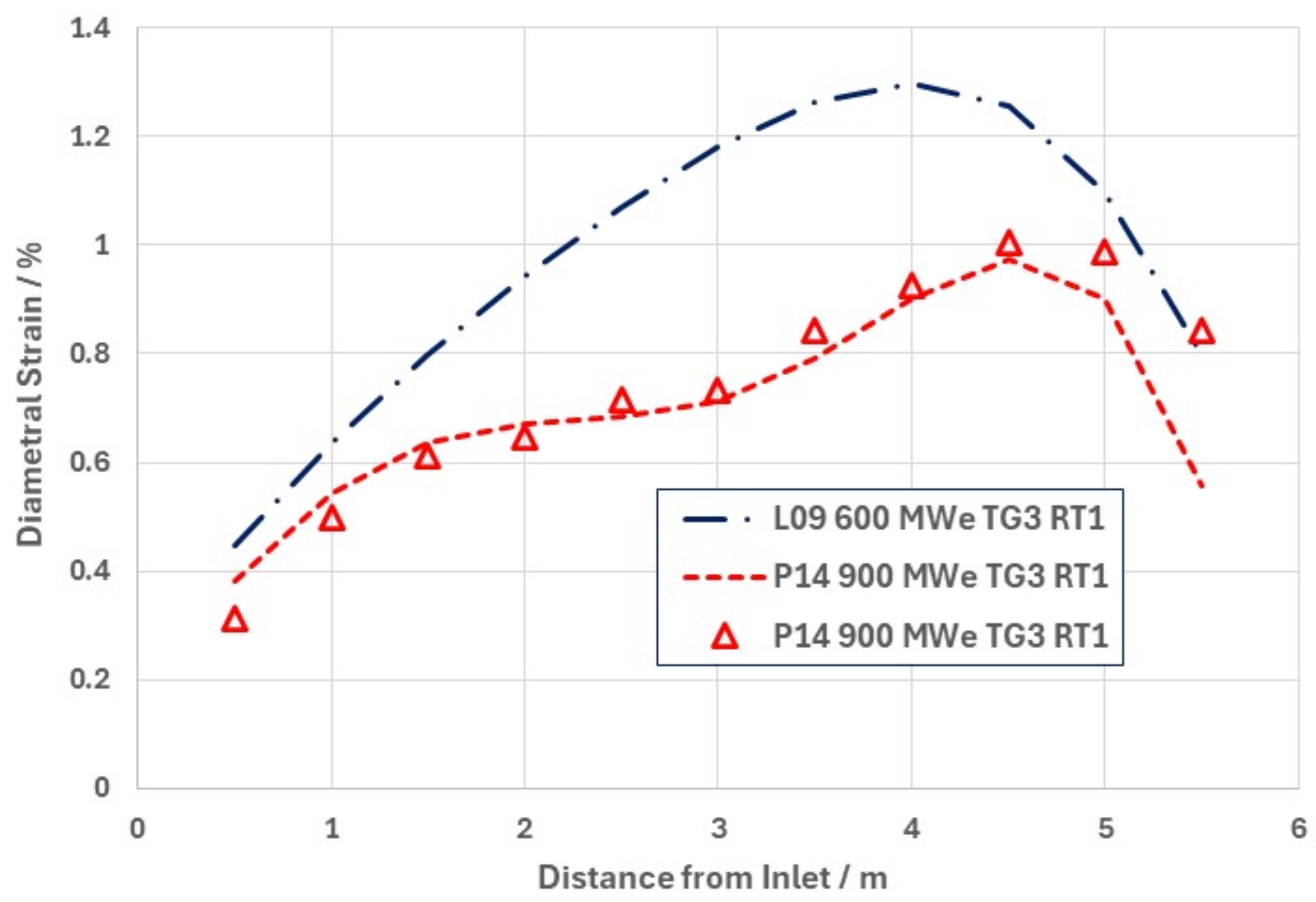
The calculated effect of operation in the two reactor types is illustrated for the tube RT1 at 42 kEFPH in Figure 11. The measurement data from the 900 MWe reactor are also shown. The prediction for the tube RT1 in the 600 MWe case corresponds to the same channel conditions that apply in Figure 10 for consistency. The diametral strain prediction for a high-power channel in the 600 MWe reactor is about 20–30% larger when compared to that expected for the same tube in a similar high-power channel in a 900 MWe reactor. This can be attributed to the existence of a lower dislocation loop sink strength in the 600 MWe case (see Equation (18)). Because the dislocation loops are treated as neutral sinks, the predicted diametral strain increases when the loop density decreases. At the same time, any contribution to the creep from dislocation slip would also increase when the loop density decreases because there are fewer barriers to slip.

4. Discussion

Two different types of models have been developed previously to account for the effect of microstructure variations in Zr-2.5Nb pressure tubes on the irradiation creep behavior. One model was based on grain intercept lengths, based on a correlation with relative diametral strain (see Figure 2), but had not been validated against data except qualitatively [6,26]. While the intercept model was useful to show how creep varies for different microstructures, the results shown here (Figure 10) indicate that it is not a good model for quantitative use. A practical adjustment is always a possibility, but that reduces the model to being empirical in nature.
A mechanistic irradiation creep model that is based on a bimodal grain structure appears to work well in predicting creep strains for both 600 MWe reactors (Figure 10) and 900 MWe reactors (Figure 11). The model had been previously validated against diametral creep rate data from six well-characterized pressure tubes with a large range of microstructure variability operating in a 900 MWe CANDU reactor [4].
The microstructure data for the six tubes in the previous study [4] had been used to develop empirical models for relative creep behavior based on microstructure [6,21]. Those creep models were initially based on minor axis grain dimensions and radial basal texture [21], and later they were based on minor axis grain dimensions, radial basal texture, and grain aspect ratios (shape) when viewed down the longitudinal axis of the tube [6]. The empirical models illustrated what microstructure variables were important for controlling irradiation creep for a given set of operating conditions. The mechanistic model based on a bimodal grain structure described in this paper gives the same qualitative result but also gives good quantitative agreement with measurements for a given set of operating conditions.
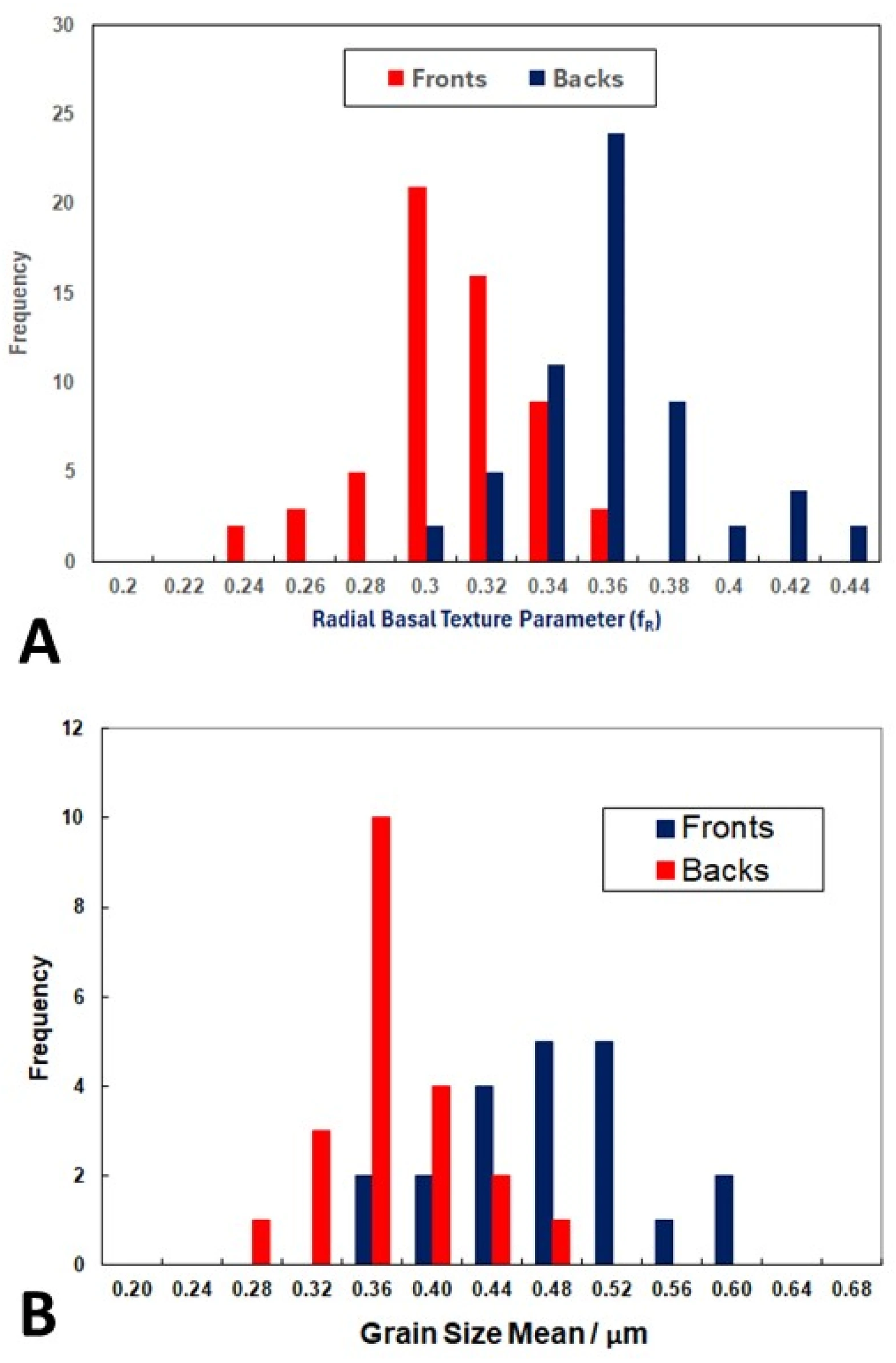
The highest diametral creep is exhibited by tubes where the grains are small and have a small aspect ratio (see Figure 6). Crystallographic texture is also important but is not as strong an explanatory variable as grain size, given the observed variability in creep rates [5,6]. The texture (represented by the Kearns’ basal pole texture parameter for the radial direction (fR) varies, together with grain size, from one end of a Zr-2.5Nb pressure tube to another, see Figure 12.
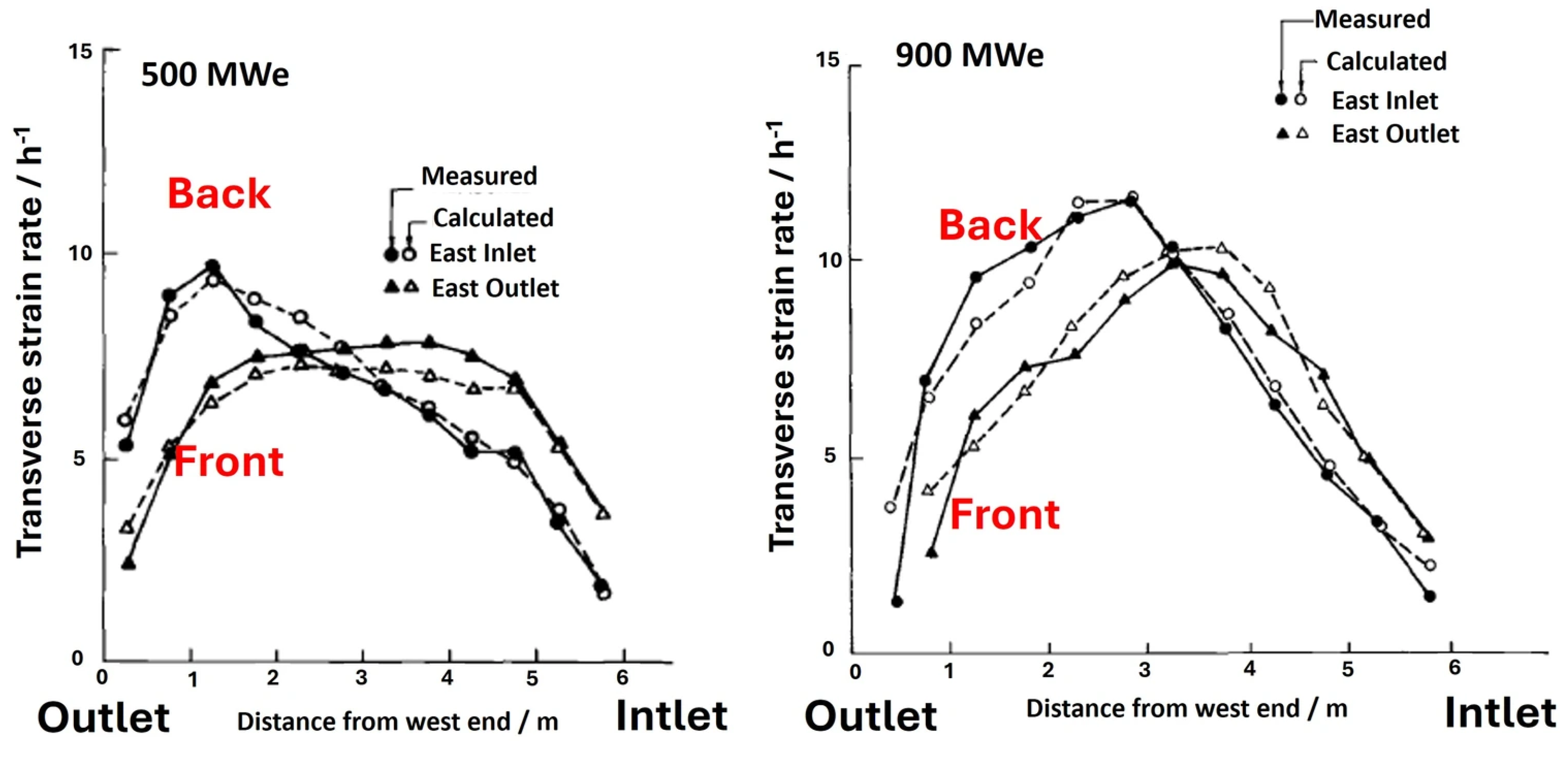
It has long been known that the irradiation creep rate for pressure tubes at the back-end of the extrusion is higher than the front-end and this has been shown to account for the peak in strain for tubes installed with their back-ends at the outlet and a more uniform diametral strain distribution for tubes installed with their back-ends at the inlet, see Figure 13.
While this balancing of the strain distribution by installing tubes with their back-ends at the inlet has been observed for tubes of the 500 MWe design and some of the earlier 900 MWe design, the shape of the strain distribution is primarily dependent on the variation in the grain structure along the tube for a given neutron flux and temperature distribution. Tubes of the 600 MWe design still exhibit a peak towards the outlet because the outlet temperature is high compared to other CANDU reactor designs.
The higher outlet temperature in the 600 MWe design in rate theory models is not manifested as a direct temperature effect at CANDU reactor operating temperatures [2]. Rather, the temperature affects the microstructure, specifically the dislocation loop density [33], and this affects the irradiation creep. By treating the loop structure as a neutral sink, the effect is to increase the creep rate when the loop density decreases. One can consider the loops as neutral once they have evolved to a steady-state condition, which occurs in the first 6 months of reactor operation. Because the loop density is constant (even if there was a mixture of loops with interstitial or vacancy character) they must collectively be absorbing equal numbers of both vacancy and interstitial point defects, which amounts to effective recombination. When the loop density is high, there are more interstitial and vacancy point defects that are captured, and thus fewer point defects contribute to the creep by migrating to oriented biased sinks such as network dislocations and grain boundaries.
The highest diametral creep occurs towards the outlet because of a lower dislocation loop density. At the same time, a higher diametral creep is observed for 600 MWe reactors compared with 900 MWe reactors for the same reason. The highest creep is observed when there is a combination of small grain size, high radial basal texture, and low dislocation loop density. This occurs when the back-ends of pressure tubes are installed at the outlet, provided there is an intrinsic microstructure variability as shown in Figure 12. Naturally, if the axial variation in microstructure changes from that illustrated in Figure 12, then the balancing effect of installing back-ends at the outlet, which is observed for similar tubes in the 500 MWe or 900 MWe designs, will not be the same. If, at the same time, the operating conditions vary such that the effect of temperature on the dislocation loop density dominates the creep (as it does towards the outlet in the 600 MWe design) one may still observe a peak in the diametral strain at the outlet irrespective of which end of the tube is installed at the outlet.

5. Conclusions

  • A rate theory model using grain structure (crystal orientation, size, and shape) has previously been applied to predict the diametral creep for pressure tubes in a 900 MWe CANDU reactor. The results show that the highest diametral creep is exhibited by non-standard TG3 RT1 tubes and can be attributed to the smaller grain size (thickness) for these tubes compared with other pressure tubes fabricated by a standard route [5,24,36].
  • Application of the model to pressure tubes fabricated in the 1970’s and installed in a 600 MWe CANDU reactor shows that there is good agreement between prediction and measurement.
  • Application of the same model to non-standard TG3 RT1 pressure tubes indicates that such tubes would exhibit higher creep than for the 900 MWe design if installed in a 600 MWe design CANDU reactor. The small grains of the TG3 RT1 tubes constitute the worst possible case for diametral creep that can only be alleviated (to some extent) by reversing the installation of the tubes so that the ends with the smallest grains (normally the back-ends) are installed at the inlet.
  • Apart from characterization of the grain structure and crystallographic texture, accurate characterization of the axial variation in dislocation loop density (from XRD line broadening measurements) during service will provide further data that is a required input to any rate theory model.

Supplementary Materials

The following supporting information can be downloaded at: https://www.mdpi.com/article/10.3390/met16030312/s1, Table S1: Minor axis grain dimensions (μm) for 21 pressure tubes measured from carbon replicas and used for the analysis in [5]. Reproduced with permission from CNL; Table S2: Kearns’ radial basal texture parameters (fR) for various pressure tubes and used for the analysis in [5]. Reproduced with permission from CNL; Table S3: Radial basal texture parameters (fR), minor axis grain dimensions (μm) and major/minor axis aspect ratios (when viewed down the longitudinal axis) for TG3 RT1 pressure tubes installed in a 900 MWE reactor [4]; Table S4: Average transverse and radial grain intercept dimensions (μm) for various pressure tubes measured from SEM micrographs and used for the analysis in [6]. Reproduced with permission from CNL; Table S5: integral breadths (units of 107 m−1) for a pressure tube in a 900 MWe reactor at different azimuthal (clock) and axial locations and used for the analysis in [33]. Reproduced with permission from CNL; Table S6: integral breadths (units of 107 m−1) for a pressure tube in a 900 MWe reactor at different azimuthal (clock) and axial locations and used for the analysis in [33]. Reproduced with permission from CNL; Table S7: integral breadths (units of 107 m−1) for a pressure tube in a 600 MWe reactor at different azimuthal (clock) and axial locations and used for the analysis in [33]. Reproduced with permission from CNL.

Author Contributions

Conceptualization, M.G. and J.E.R.N.; methodology, M.G.; software, M.G.; validation, J.E.R.N.; investigation, M.G. and J.E.R.N.; data curation, M.G. and J.E.R.N.; writing—original draft preparation, M.G.; writing—review and editing, J.E.R.N. All authors have read and agreed to the published version of the manuscript.

Funding

This research received no external funding.

Data Availability Statement

The raw data supporting the conclusions of this article will be made available by the authors on request.

Acknowledgments

The authors would like to thank Canadian Nuclear Laboratories (CNL) for permission to use previously unpublished and published data. The authors would also like to thank NA-SA and Conexus Nuclear for permission to use gauging data.

Conflicts of Interest

Author Juan Eduardo Ramos Nervi was employed by the company Nucleoeléctrica Argentina S.A. The remaining authors declare that the research was conducted in the absence of any commercial or financial relationships that could be construed as a potential conflict of interest.

References

  1. Franklin, D.G.; Lucas, G.E.; Bement, A.L. Creep of Zirconium Alloys in Nuclear Reactors; ASTM International: West Conshohocken, PA, USA, 1983. [Google Scholar]
  2. Adamson, R.B.; Coleman, C.E.; Griffiths, M. Irradiation creep and growth of zirconium alloys. J. Nucl. Mater. 2019, 521, 167–244. [Google Scholar] [CrossRef]
  3. Onimus, F.; Jourdan, T.; Xu, C.; Campbell, A.A.; Griffiths, M. Irradiation Creep in Materials. In Comprehensive Nuclear Materials; Elsevier: Amsterdam, The Netherlands, 2020; pp. 310–366. [Google Scholar] [CrossRef]
  4. Griffiths, M. Microstructural Effects on Irradiation Creep of Reactor Core Materials. Materials 2023, 16, 2287. [Google Scholar] [CrossRef] [PubMed]
  5. Griffiths, M.; Davies, W.G.; Moan, G.D.; Causey, A.R.; Holt, R.A.; Aldridge, S.A. Variability of In-reactor Diametral Deformation for Zr-2.5Nb Pressure Tubing. In Thirteenth International Symposium on Zirconium in the Nuclear Industry; ASTM International: West Conshohocken, PA, USA, 2002; Volume ASTM STP 1423, pp. 507–523. [Google Scholar]
  6. Griffiths, M.; Bickel, G.A.; DeAbreu, R.; Li, W. Irradiation Creep of Zr-Alloys. In Mechanical and Creep Behavior of Advanced Materials; Charit, I., Zhu, Y., Maloy, S., Liaw, P., Eds.; The Minerals, Metals & Materials Series; Springer: Cham, Switzerland, 2017. [Google Scholar] [CrossRef]
  7. Causey, A.R.; Fidleris, V.; MacEwen, S.R.; Schulte, C.W. In-Reactor Deformation of Zr-2.5Nb Pressure Tubes. In Proceedings of the 1987 Annual Reactor Simulation Symposium; ASTM Spec.: West Conshohocken, PA, USA; ASTM International: West Conshohocken, PA, USA, 1988; pp. 54–68. [Google Scholar] [CrossRef]
  8. Christodoulou, N.; Causey, A.R.; Holt, R.A.; Tomé, C.N.; Badie, N.; Klassen, R.J.; Sauvé, R.; Woo, C.H. Modelling in-reactor deformation of Zr-2.5Nb pressure tubes in CANDU power reactors. In Zirconium in the N[uclear Industry: Eleventh International Symposium; Bradely, E.R., Sabol, G.P., Eds.; American Society for Testing and Materials: West Conshohocken, PA, USA, 1996; Volume ASTM 1295, pp. 518–537. [Google Scholar]
  9. Holt, R.A. In-reactor deformation of cold-worked Zr–2.5Nb pressure tubes. J. Nucl. Mater. 2008, 372, 182–214. [Google Scholar] [CrossRef]
  10. Christodoulou, N.; Levi, M.R.; Turner, P.A.; Ho, E.T.C.; Chow, C.K. Anisotropy of yielding in a Zr-2.5Nb pressure tube material. Metall. Mater. Trans. A 2000, 31, 409–420. [Google Scholar] [CrossRef]
  11. Causey, A.R.; Holt, R.A.; Christodoulou, N.; Ho, E.T.C. Irradiation-enhanced deformation of Zr-2.5Nb tubes at high neutron fluences. In Zirconium in the Nuclear Industry: Twelfth International Symposium; ASTM: West Conshohocken, PA, USA, 2000; Volume ASTM STP 1354, pp. 74–85. [Google Scholar]
  12. Li, W.; Holt, R.A. Anisotropic thermal creep of internally pressurized Zr–2.5Nb tubes. J. Nucl. Mater. 2010, 401, 25–37. [Google Scholar] [CrossRef]
  13. Causey, A.R.; Elder, J.E.; Holt, R.A.; Fleck, R.G. On the Anisotropy of in-reactor creep of Zr-2.5Nb tubes. In Proceedings of the 10th International Symposium on Zirconium in the Nuclear Industry; ASTM: West Conshohocken, PA, USA, 1994; Volume ASTM STP 1245, pp. 202–220. [Google Scholar]
  14. Frost, H.J.; Ashby, M.F. Deformation-Mechanism Maps: The Plasticity and Creep of Metals and Ceramics; Pergamon Press: Oxford, UK, 1982. [Google Scholar]
  15. Griffiths, M. A review of microstructure evolution in zirconium alloys during irradiation. J. Nucl. Mater. 1988, 159, 190–218. [Google Scholar] [CrossRef]
  16. ASTM STP 1295; Zirconium in the Nuclear Industry: Eleventh International Symposium. ASTM: West Conshohocken, PA, USA, 1995; pp. 580–602.
  17. Hosbons, R.R.; Davies, P.H.; Griffiths, M.; Sagat, S.; Coleman, C.E. Effect of Long-Term Irradiation on the Fracture Properties of Zr-2.5Nb Pressure Tubes. In Zirconium in the Nuclear Industry: Twelfth International Symposium; ASTM: West Conshohocken, PA, USA, 2000; pp. 122–138. [Google Scholar]
  18. Holt, R.A.; Causey, A.R.; Griffiths, M.; Ho, E.T.C. High Fluence Irradiation Growth of Cold-worked Zr-2.5Nb. In Zirconium in the Nuclear Industry; Twelfth International Symposium; ASTM: West Conshohocken, PA, USA, 2000; Volume ASTM STP 1354, pp. 86–104. [Google Scholar]
  19. Ramos Nervi, J.E.; Signorelli, J.W.; Idiart, M.I. A constitutive framework for steady-state creep in coarse-grained zirconium alloys under irradiation. Philos. Mag. 2022, 102, 589–617. [Google Scholar] [CrossRef]
  20. Christodoulou, N.; Causey, A.R.; Woo, C.H.; Tome, C.N.; Klassen, R.J.; Holt, R.A. Modelling the Effect of Texture and Dislocation Structure on Irradiation Creep of Zirconium alloys. In Effects of Radiation on Materials: 16th International Symposium; Kumar, A.S., Gelles, D.S., Nanstad, R.K., Little, E.A., Eds.; ASTM STP 1175; ASTM: West Conshohocken, PA, USA, 1993; pp. 1111–1128. [Google Scholar]
  21. Bickel, G.A.; Griffiths, M.; Douchant, A.; Douglas, S.; Woo, O.T.; Buyers, A. Improved Zr-2.5Nb Pressure Tubes for Reduced Diametral Strain in Advanced CANDU Reactors. J. ASTM Int. 2011, 8, 103521. [Google Scholar] [CrossRef]
  22. Woo, C.H. Theory of Irradiation Deformation in Non-Cubic Metals: Effects of Anisotropic Diffusion. J. Nucl. Mater. 1988, 159, 237–256. [Google Scholar] [CrossRef]
  23. Woo, C.H. Irradiation creep due to elastodiffusion. J. Nucl. Mater. 1984, 120, 55–64. [Google Scholar] [CrossRef]
  24. Bickel, G.A.; Griffiths, M. Manufacturing variability and deformation for Zr-2.5Nb pressure tubes. J. Nucl. Mater. 2008, 383, 9–13. [Google Scholar] [CrossRef]
  25. Fleck, R.G.; Price, E.G.; Cheadle, B.A. Pressure Tube Development for CANDU Reactors. In Zirconium in the Nuclear Industry: Sixth International Symposium; Franklin, D.G., Adamson, R.B., Eds.; American Society for Testing and Materials: West Conshohocken, PA, USA, 1984; pp. 88–105. [Google Scholar]
  26. Walters, L.; Bickel, G.A.; Griffiths, M. The effects of microstructure and operating conditions on irradiation creep of Zr-2.5Nb pressure tubing. In Zirconium in the Nuclear Industry: 17th International Symposium; Comstock, R.J., Barberis, P., Eds.; ASTM International: West Conshohocken, PA, USA, 2015; pp. 693–725. [Google Scholar]
  27. Bickel, G.A. Status and Plans for Work on Pressure Tube Creep at AECL. In Proceedings of the Research Coordination Meeting for CRP on: Prediction of Axial and Radial Creep in HWR Pressure Tubes, Vienna, Austria, 2–4 July 2013. [Google Scholar]
  28. Heald, P.T.; Speight, M.V. Point Defect Behaviour in Irradiated Materials. Acta Metall. 1975, 23, 1389. [Google Scholar] [CrossRef]
  29. Heald, P.T.; Harbottle, J.E. Irradiation Creep due to dislocation Climb and Glide. J. Nucl. Mater. 1977, 67, 229–233. [Google Scholar] [CrossRef]
  30. Griffiths, M.; Davies, P.H.; Davies, W.G.; Sagat, S. Predicting the in-reactor mechanical behaviour of Zr–2.5Nb pressure tubes from post-irradiation microstructural examination data. In Zirconium in the Nuclear Industry: Thirteenth International Symposium; Moan, G.D., Rudling, P., Eds.; ASTM STP 1423; ASTM International: West Conshohocken, PA, USA, 2001; pp. 507–523. [Google Scholar]
  31. Griffiths, M.; Holt, R.A.; Rogerson, A. Microstructural aspects of accelerated deformation of Zircaloy nuclear reactor components during service. J. Nucl. Mater. 1995, 225, 245–258. [Google Scholar] [CrossRef]
  32. Ahn, D.-H.; Lee, G.-G.; Chun, Y.-B.; Jung, J.Y. Prediction of the in-reactor deformation of Zr-2.5wt%Nb pressure tubes using the crystal plasticity finite element method framework. J. Nucl. Mater. 2022, 570, 153947. [Google Scholar] [CrossRef]
  33. Griffiths, M. X-Ray Diffraction Line Broadening of Irradiated Zr-2.5Nb Alloys. Metals 2024, 14, 1446. [Google Scholar] [CrossRef]
  34. Griffiths, M. X-ray diffraction line broadening and radiation damage. Materialia 2023, 27, 101704. [Google Scholar] [CrossRef]
  35. Griffiths, M.; Christodoulou, N.; Donohue, S. Damage Dependence of Irradiation Deformation of Zr-2.5Nb Pressure Tubes. J. ASTM Int. 2005, 2, 1–21. [Google Scholar] [CrossRef]
  36. Bickel, G.A.; Griffiths, M. Manufacturing Variability, Microstructure and deformation of Zr-2.5Nb Pressure Tubes. In Fifteenth International Symposium on Zirconium in the Nuclear Industry; STP 1505; ASTM: West Conshohocken, PA, USA, 2009; Volume 4, pp. 529–540. [Google Scholar]
Figure 1. Composite showing preferred orientation for a pressure tube and the corresponding creep compliance tensor quadric for planar stress in the longitudinal (L) and transverse (T) plane that is perpendicular to the radial (R) direction. Derived from anisotropy factors reporetd in [10,11].
Metals 16 00312 g001
Figure 2. Effect of grain structure on diametral creep of Zr-2.5Nb pressure tubing: (A) model output showing relationship between transverse strain rate and grain dimensions; (B) model output showing strains in different directions in a pressure tube for two idealized grain structures; (C) micrograph illustrating intercept dimension measurements and data showing relationship between these dimensions and the relative transverse (diametral) strain rate. Modified from [6]. Micrograph and data reproduced courtesy of CNL.
Metals 16 00312 g002
Figure 3. Schematic diagram showing the microstructure illustrated in Figure 2C as a single grain with a crystallographic orientation relative to the pressure tubes axes as shown.
Metals 16 00312 g003
Figure 4. Schematic diagram showing the possible combinations of grain shapes and crystallographic orientations in a cold-worked Zr-2.5Nb pressure tube. Modified from [2,4,27]. Micrographs and data released at the courtesy of CNL.
Metals 16 00312 g004
Figure 5. Schematic diagram showing the microstructure illustrated in Figure 4 as two sets of grains having minor and major axis dimensions corresponding with mean values and oriented with their c-axes in the radial and transverse directions with relative volume fractions given by (1 − fR) for the transverse c-axis grains and fR for the radial c-axis grains.
Metals 16 00312 g005
Figure 6. Effect of grain structure on diametral creep of Zr-2.5Nb pressure tubing: (a) Micrograph illustrating measured major and minor axis grain dimensions viewed in the radial-transverse plane of the pressure tube; (b) rate theory model output showing relative creep rate as a function of mean grain minor axis dimension (thickness) and mean of the major/minor axis dimensions. The major/minor aspect ratio (AR) varies from 1 to 11. The minor axis grain size (GS) varies from 0.01 to 1 μm. Micrograph courtesy of CNL.
Metals 16 00312 g006
Figure 7. Variation in prism I integral breadth representing dislocation densities for different reactor types. Reproduced from Griffiths [33] (Supplementary Materials) with permission from CNL.
Metals 16 00312 g007
Figure 8. Variation in prism I integral breadth representing dislocation densities for single channels in a 600 MWe and 900 MWe. Modified from [33] and reproduced with permission from CNL.
Metals 16 00312 g008
Figure 9. Variation in intercept strains as a function of fast neutron flux and temperature: (A) plot of intercept strains against neutron flux at different temperatures. Modified from [35] with permission from CNL; (B) plot of intercept strains at a fast neutron flux of 2.5 × 10¹⁶ n·m−2·s−1 (E > 1 MeV) against temperature.
Metals 16 00312 g009
Figure 10. Measured (after scaling) and predicted diametral strain after 42 kEFPH as a function of distance from the inlet for the tube operating in channel L09 in a 600 MWe reactor with back-end outlet configuration. The predictions are from a bimodal grain structure model (blue dash-dot line) and an intercept model (red dashed line) using the parameters shown in Table 1 and Table 2, respectively.
Metals 16 00312 g010
Figure 11. Measured (after scaling) and predicted diametral strain (red points and lines) after 42 kEFPH as a function of distance from the inlet for channel P14 in a 900 MWe reactors with a back-end outlet configuration. The predictions (dashed lines) are from a bimodal grain structure model using the parameters shown in Table 3. The blue dash-dot lines represent the predicted strain for the same tube installed in channel L09 in a 600 MWe reactor.
Metals 16 00312 g011
Figure 12. Distribution of (A) radial basal texture parameters and (B) mean grain thickness, for pressure tubes installed in 600 MWe design CANDU reactors. Data reproduced courtesy of CNL.
Metals 16 00312 g012
Figure 13. Diametral creep profiles for pressure tubes installed with either the front or the back-ends at the outlet for two different CANDU reactor designs (Pickering 500 MWe) and Bruce (900 MWe). Modified from [7] with permission from CNL.
Metals 16 00312 g013
Table 1. Mean radial basal texture parameter (fR), minor axis grain dimension (d), and aspect ratios measured from 21 Zr-2.5Nb pressure tubes previously operating in 600 MWe CANDU reactors.
Tube ID FrontBack
fRdARfRdAR
Mean of 21 tubes from 600 MWe reactors 0 .2950.4554.13 *0.3450.3534.13 *
* Based on 18 measurements from the back end of one tube.
Table 2. Mean radial and transverse intercept lengths from a subset of 21 tubes corresponding with the back-end grain boundary intercept data shown in Figure 2C. The front-end parameters are derived from the back-end data by scaling using the mean minor axis dimensions shown in Table 1. The ratio of the transverse/radial intercept lengths is assumed constant along the tube.
Tube TypeFront InterceptBack Intercept
RadialTransverseRadialTransverse
Mean of 21 tubes from 600 MWe reactors0.4000.6970.5160.900
Table 3. Radial basal texture parameter (fR), minor axis grain dimension (d), and aspect ratios for a TG3 RT1 pressure tube previously labelled RT1A in an earlier study [4].
Tube FrontBack
fRdARfRdAR
RT1A0.3960.1794.940.3800.2363.32
Disclaimer/Publisher’s Note: The statements, opinions and data contained in all publications are solely those of the individual author(s) and contributor(s) and not of MDPI and/or the editor(s). MDPI and/or the editor(s) disclaim responsibility for any injury to people or property resulting from any ideas, methods, instructions or products referred to in the content.