Article

Effect of Base Metal Microstructure on Softening Behavior of the Heat-Affected Zone of X80 GMAW Girth Weld


by
Xueda Li
1,2,*,
Zhangyi She
1,
Xunyun Lv
1,
Zeyang Zhang
1,
Liying Li
1 and
Bin Han
1
1
School of Materials Science and Engineering, China University of Petroleum (East China), Qingdao 266580, China
2
Shandong Key Laboratory of Oil & Gas Storage and Transportation Safety, China University of Petroleum (East China), Qingdao 266580, China
*
Author to whom correspondence should be addressed.
Metals 2026, 16(3), 247; https://doi.org/10.3390/met16030247
Submission received: 30 January 2026 / Revised: 15 February 2026 / Accepted: 20 February 2026 / Published: 25 February 2026

Abstract

Softening in the heat-affected zone (HAZ) of high-strength pipeline welds compromises its service safety but the corresponding softening mechanism is not well-understood. Softening behavior in the HAZ of two X80 pipeline girth welds with different base metal microstructures, i.e., acicular ferrite (AF)-dominated (X80-AF) and granular bainite (GB)-dominated (X80-GB), were investigated through microhardness tests and detailed microstructure characterization. The results showed that softening in the HAZ of two girth welds primarily occurred in the fine-grained (FG) HAZ, while hardening was found in the coarse-grained (CG) HAZ. X80-AF showed higher softening resistance than X80-GB, with softening ratios of 3.44% vs. 12.46%, and softened zone widths of 2.1 mm vs. 3.9 mm, respectively. Due to its high dislocation density and refined interlocking structure, AF could effectively inhibit phase transformation and grain coarsening during reheating, which resulted in smaller grains and a lower fraction of polygonal ferrite (PF) in the FGHAZ (28%). In contrast, coarse GB was more prone to grain coarsening and hence engendered higher PF proportion (68%). Therefore, for the microstructural design of high-strength pipeline steels, increasing the proportion of refined AF is beneficial to the softening resistance and thereby elevates the service safety of pipelines.

1. Introduction

With the continuous growth of global energy demand, the scale and technology of oil and gas pipeline construction are developing rapidly [1,2]. As the most economical and efficient method for transporting oil and gas resources, long-term operation safety and reliability of pipeline transportation are of paramount importance [3,4,5]. X80-grade high-strength, high-toughness pipeline steel, renowned for its superior mechanical properties and excellent weldability, has been extensively adopted in various long-distance pipeline projects [6,7,8]. However, as the strength of high-grade pipeline steel significantly increases, softening in the weld heat-affected zone (HAZ) has become increasingly prominent, emerging as a critical issue that constrains the overall performance and service safety of pipelines.
Basically, softening in the HAZ stems from the alteration of the base material’s original microstructure induced by welding thermal cycles. Microstructures formed during controlled rolling and subsequent cooling, which provide significant dislocation and/or precipitation strengthening effects, undergo recovery, recrystallization, and phase transformation under different welding thermal histories, which weakens or even eliminates these strengthening mechanisms [9,10,11]. Particularly when peak temperatures fall within the intercritical range (e.g., 800 °C to 1000 °C) or the fine-grained range (e.g., 1000 °C to 1200 °C), the original fine, uniform microstructure may partially or fully transform into soft ferrite phase which engenders loss of strengthening effects. This results in a significant reduction in hardness within this region, which is named the softening zone [12,13,14,15,16]. The softening zone not only degrades the mechanical properties of the HAZ but also may engender a stress concentration zone, compromising the pipeline’s overall integrity under complex loading conditions such as internal pressure, geological hazards, or third-party impacts during long-term service of pipelines [17,18,19].
The effect of welding heat cycles on the microstructure and properties of the HAZ is complex. Based on peak temperature, the HAZ can be subdivided into coarse-grained (CG) HAZ, fine-grained (FG) HAZ, intercritically reheated (IC) HAZ, and subcritically reheated (SC) HAZ. Currently, there is no consistent standpoint regarding the specific location where the softening zone appears in the HAZ of high-strength low-alloy steels. Significant variations in softening zones observed within weld joints of similar steel grades have been reported, and the softening zones are primarily associated with the CGHAZ, FGHAZ, and ICHAZ. These discrepancies are believed to be closely related to the original microstructure of the base metal. On one hand, previous research showed that softening predominantly occurs in the CGHAZ. For instance, Jing et al. [20] noted in their study of X70 pipeline steel that the lowest hardness in the HAZ occurred within the CGHAZ. They attributed this to the base metal’s predominant granular bainite (GB) structure, where the uniformly distributed M-A constituents completely dissolved during high-temperature austenitization in the CGHAZ. During cooling, these constituents failed to effectively precipitate again, leading to significant grain coarsening and a lack of secondary phase strengthening, thereby causing severe softening. Similar results were also observed by Zhang et al. [21] in GB-dominated X80 steel welds. The transformation of coarse austenite grains into coarse ferrite and pearlite resulted in substantial strength reduction. In contrast, some other studies indicated that softening zones tend to occur more frequently in FGHAZ or ICHAZ rather than CGHAZ. Zhang et al. [22] found the lowest hardness in the FGHAZ of a Nb-Ti microalloyed X80 steel weld, for which the parent microstructure predominantly consists of acicular ferrite (AF). Hu et al. [23] further confirmed that in optimized X80 steel produced via controlled rolling and controlled cooling, when the base metals predominantly consist of AF, the softening zone shifts significantly toward the FGHAZ, exhibiting a markedly lower softening rate compared to GB matrix steels. These divergent findings indicate that the location of the softening zone is not only determined by chemical composition but also dependent on the initial microstructural of base metal, such as GB, AF, and their mixed structures, which may exhibit significant differences in microstructural evolution and final mechanical property while undergoing similar cycles. Therefore, investigating the mechanism on how the microstructural characteristics of base metal influence the softening behavior in the HAZ is crucial for optimizing the welding process of X80 pipeline steel with the aim to control softening levels and elevate the safety of girth welds.
The present study investigated the relationship between base metal microstructure and the softening behavior in the HAZ of X80 gas metal arc welding (GMAW) girth welds. Two X80 pipeline steels with GB-dominated and AF-dominated microstructure were used to fabricate the girth weld, and the micro-Vickers hardness test was conducted from the base metal to the weld zone. Transmission electron microscopy (TEM) was used to characterize the microstructure evolution of the base metal and softening zones. Electron backscattered diffraction (EBSD) was used to analyze grain structure and estimate dislocation density in the base metal and the HAZ. The results could provide insights into a new metallurgical strategy with the aim to mitigate softening in the HAZ through tailored base metal processing prior to welding.

2. Materials and Methods

2.1. Experimental Materials

Two types of X80 pipeline steel with wall thicknesses of 18.4 mm from the same manufacturer and milled through similar rolling processes were selected in the present study. Both materials shared similar base alloy compositions (as shown in Table 1), and only differed in microstructure. One exhibited a microstructure predominantly composed of AF and minor amounts of GB and was designated as X80-AF. The other steel featured a microstructure primarily consisting of GB and minor amounts of AF and was designated as X80-GB.
Based on the welding parameters according to the China–Russia Eastern Route welding procedure specification, which are listed in Table 2, the weld consisted of 6 layers and 8 passes. The root pass was performed using Gas Tungsten Arc Welding (GTAW) with an ER70S-G filler wire (Tianjin Bridge Welding Materials Group Co., Ltd., Tianjin, China). The filling and cap passes employed gas-shielded flux-cored arc welding (FCAW-G) using an E91T1-K2M wire (Tianjin Bridge Welding Materials Group Co., Ltd., Tianjin, China). Current and heat input were progressively adjusted to ensure good weld bead formation with sufficient penetration and toughness. All passes employed direct current reverse polarity (DCEP) with shielding gas flow stabilized at 20–35 L/min. Figure 1 displays a macro photograph of the girth weld joint cross-section.

2.2. Experimental Method

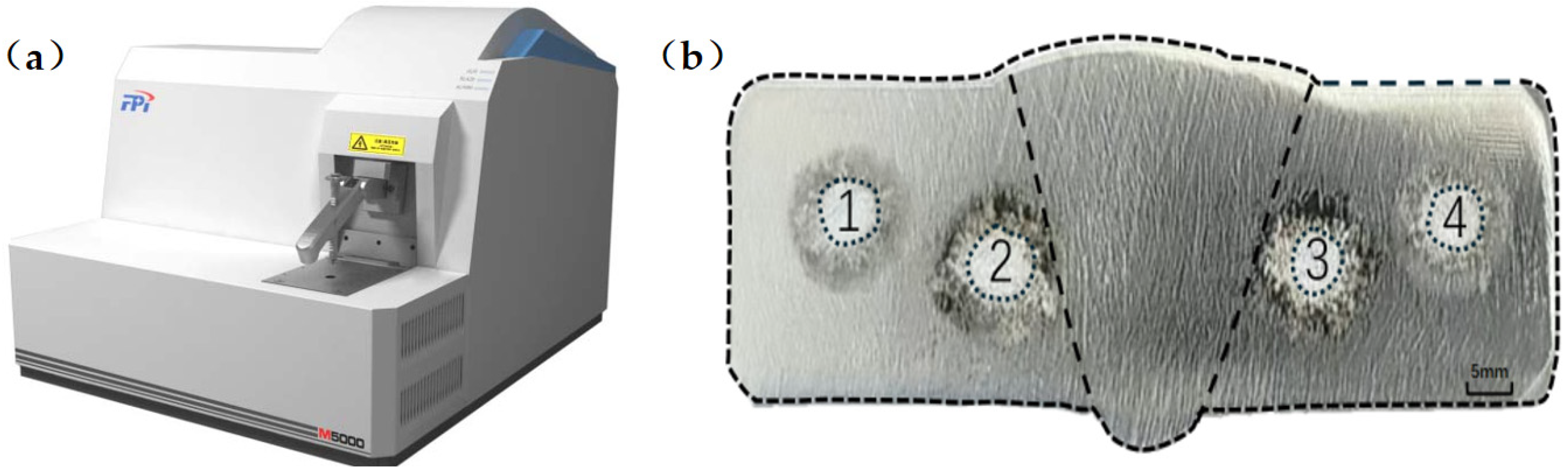
The composition of the base metal was measured using an optical emission spectrometer (DM5000) (Precision Products Inc., Shanghai, China) as presented in Figure 2a, with measurement points shown in Figure 2b. To ensure accuracy, four testing positions were selected for each weld joint, and the measured results were averaged.
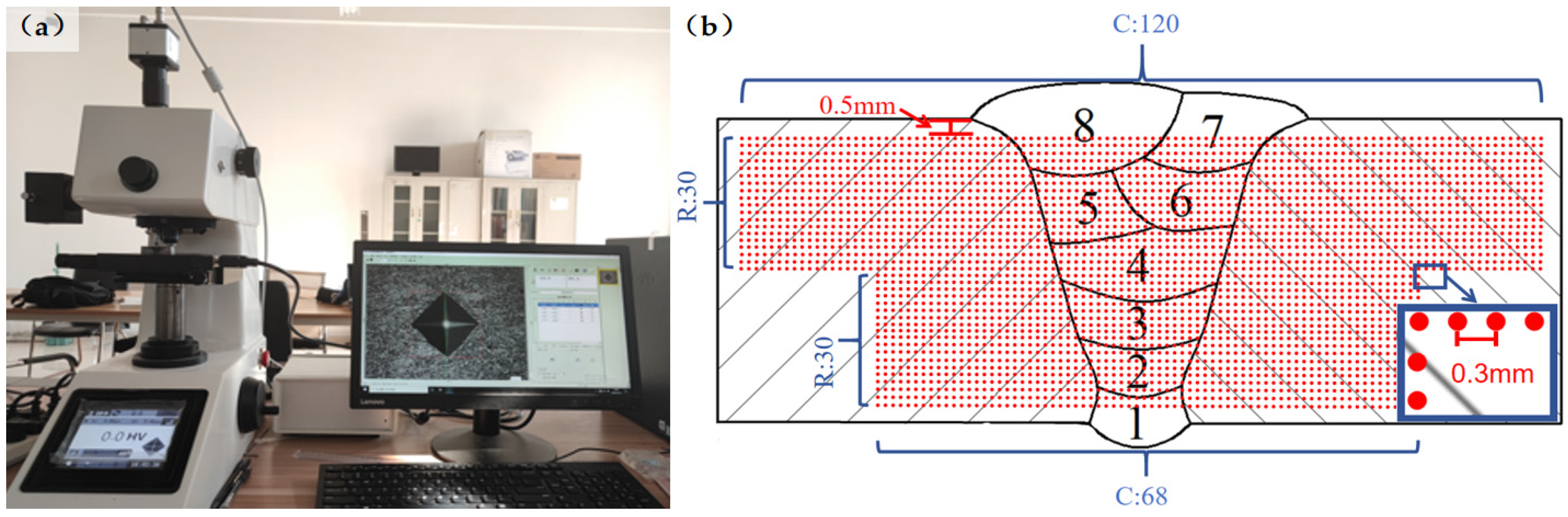
The girth welds were ground and polished. Micro-Vickers hardness testing was performed using a TIME6610M semi-automatic microhardness tester (Time Group Co., Ltd., Beijing, China) (Figure 3a) after etching the microstructure with a 4% nitric acid–alcohol solution. The test force was 1000 g, with a load holding time of 15 s. Indentation points were taken starting from 0.5 mm below the surface, arranged in 30 rows of 68 points, with 0.3 mm spacing between rows and 0.3 mm spacing between adjacent hardness points. The measurement area covered the weld, HAZ, and base metal, as illustrated in Figure 3b.
Microstructures were observed using a JSM-7200F scanning electron microscope (SEM) (JEOL Ltd., Tokyo, Japan). Specimens were sequentially ground with sandpaper, followed by mechanical polishing, and finally etched in a 4% nitric acid–alcohol solution for 15–20 s. Further microstructure characterization was performed using transmission electron microscope (TEM, TALOS-F200X) (Thermo Fisher Scientific, Brno, Czech Republic). using thin films. First, the sample was mechanically thinned to 80 μm thickness using a Gatan 695 precision microtome (Gatan, Inc., Pleasanton, CA, USA). Subsequently, double-sided ion beam polishing was performed with a Gatan PIPS II 695 argon ion polisher (Gatan, Inc., Pleasanton, CA, USA) at an incidence angle of 4° and an acceleration voltage of 5 kV, ultimately yielding an electron-transparent region < 100 nm thick. TEM images were acquired at an acceleration voltage of 200 kV.
Additionally, to obtain crystallographic information such as grain boundaries and grain orientation, EBSD technology was used. The EBSD specimen was ground with 5000-grit sandpaper, followed by mechanical polishing using diamond polishing compounds of 2.5 μm, 1.5 μm, and 0.5 μm grit sizes. It was then electrolytically polished in 10% perchloric acid ethanol solution at 30 V for approximately 16 s. EBSD testing was conducted at an operating voltage of 20 kV and a current of 108.4 μA. The scanning step size ranged from 0.08 to 0.15 μm, determined by the test location and purpose. Following testing, data extraction and analysis were performed using HKL CHANNEL5 software (version 5.11, Oxford Instruments, Abingdon, UK).

3. Results

3.1. Hardness Distribution of Girth Weld Joints

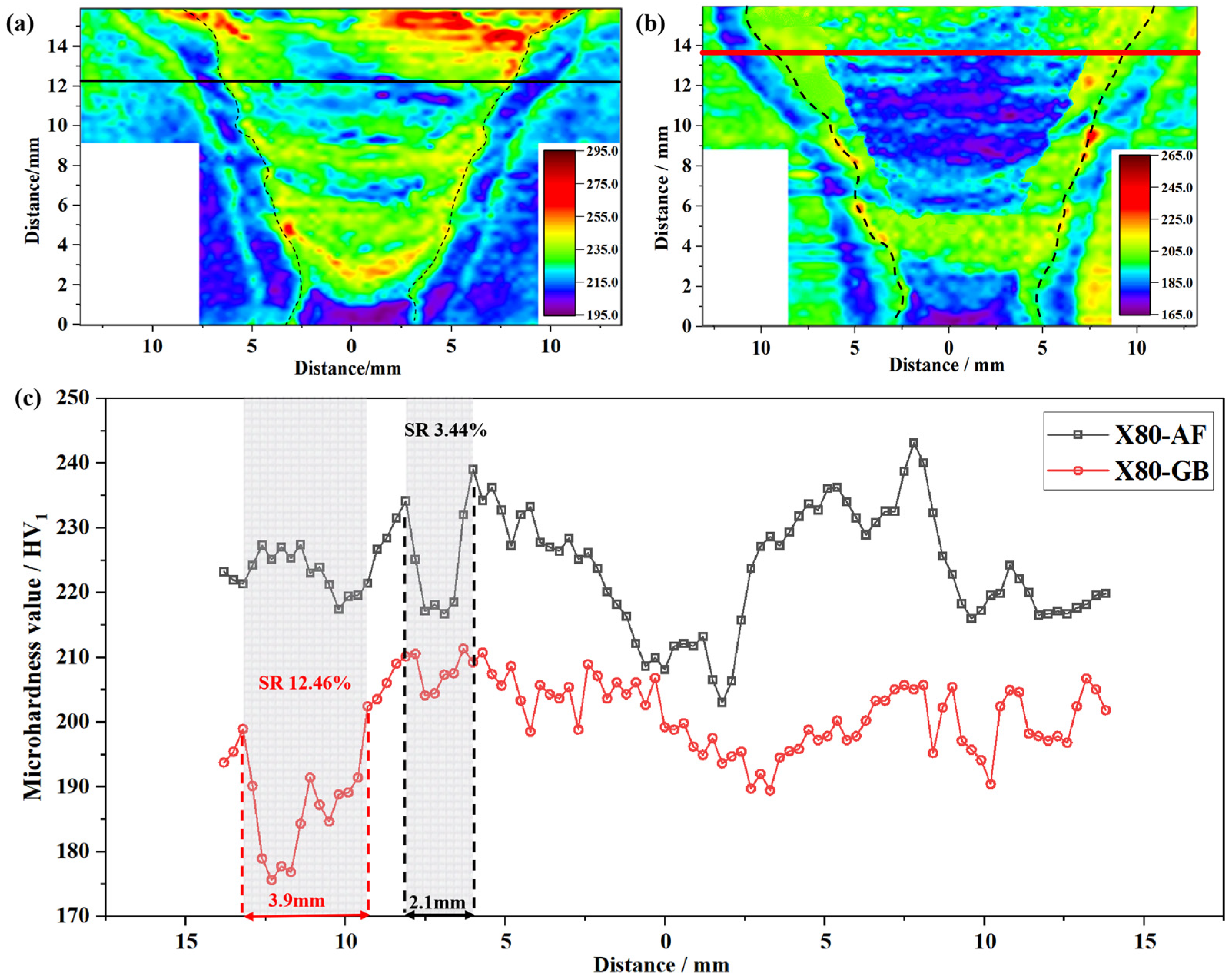
The hardness contour maps of the two girth welds are shown in Figure 4. In this study, the softened regions within the HAZ are defined as areas where the hardness is lower than the average hardness of the base metal (BM). Specifically, the average Vickers hardness of the BM region (HvBM) is first calculated, and all locations in the HAZ with hardness values HvHAZ < HBM are identified as softened zones. In the hardness distribution maps, these regions typically appear in blue or purple hues (as shown in Figure 4a,b). Figure 4c shows the hardness variation curves along horizontal lines passing through the lowest hardness points in the contour map, as indicated in Figure 4a,b.
The softening ratio (SR) is calculated using the following equation:
S R ( % ) = H B M H H A Z , m i n H B M × 100 %
HBM is the average hardness of the BM, and HHAZ,min is the minimum hardness measured within the HAZ.
From the hardness contour maps, the hardness of the base metal was determined by averaging the measured values in the region unaffected by welding thermal cycles. The lowest hardness point in the HAZ is selected as the minimum hardness of the HAZ. Calculations reveal that X80-AF base metal has an average hardness of 224.1 HV1 and a minimum HAZ hardness of 216.4 HV1, with a softening rate of 3.44%. In contrast, X80-GB base metal has an average hardness of 200.6 HV1 and a minimum HAZ hardness of 175.6 HV1, with a softening rate of 12.46%. Also, the overall hardness of X80-AF is higher than X80-GB, either in the softened zone (FGHAZ) or in other regions, i.e., CGHAZ, ICHAZ and BM.

3.2. Base Metal Microstructure Analysis

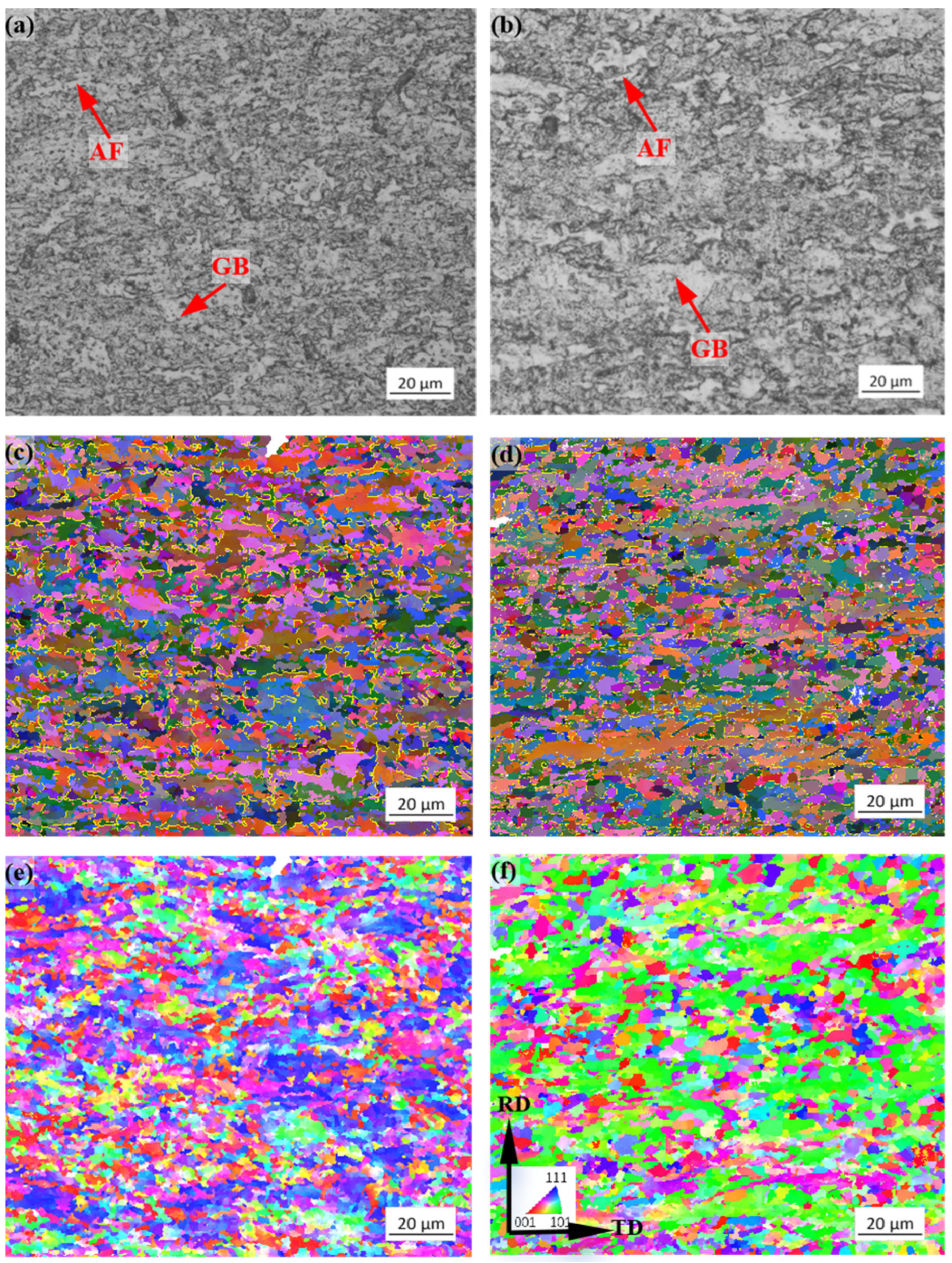
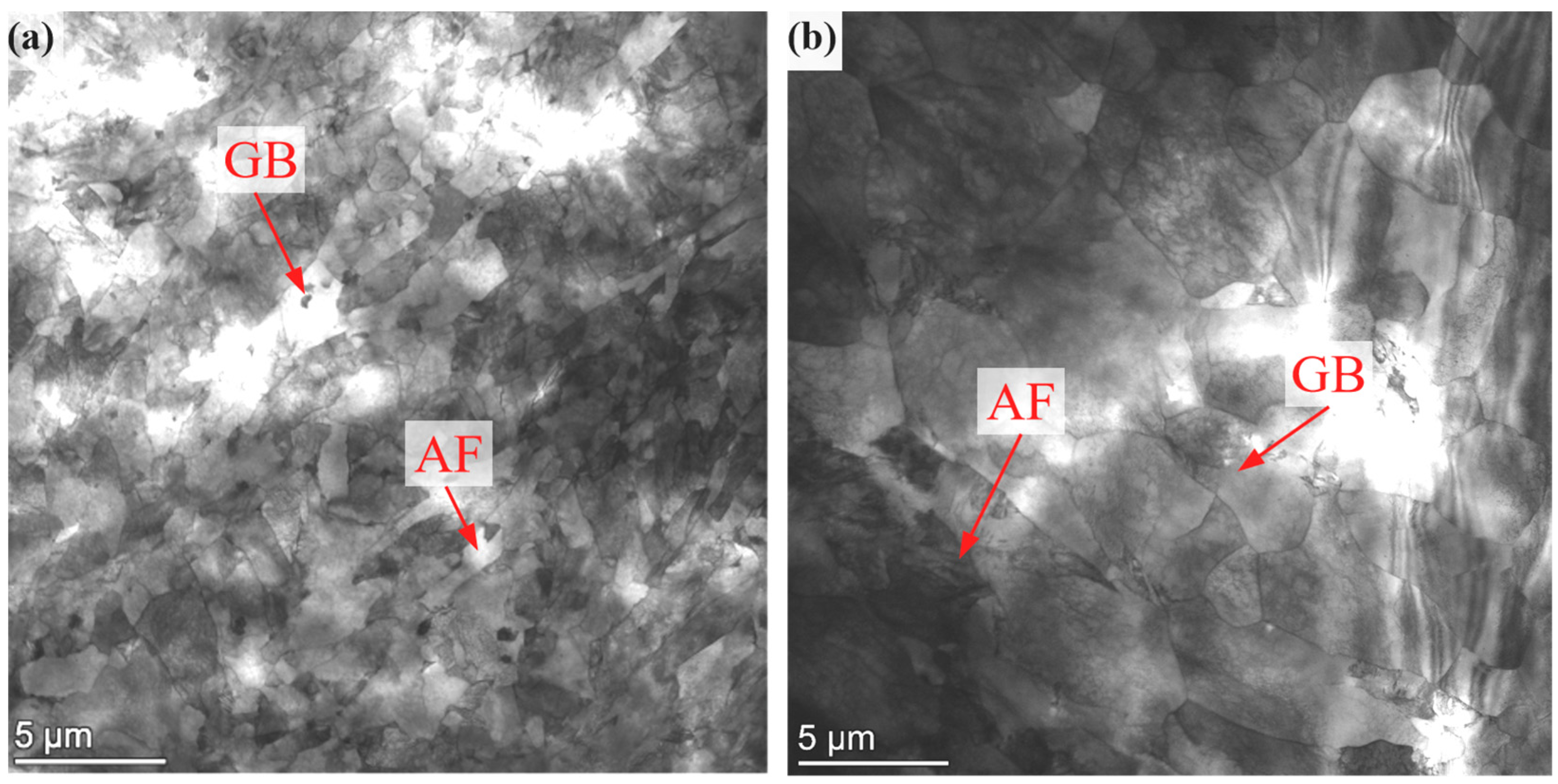
The base metal microstructures of the two X80 steels are shown in Figure 5a,b. X80-AF consisted predominantly of AF, characterized by a fine, interlocking morphology. In contrast, X80-GB was primarily composed of GB, with blocky features. Quantitative analysis reveals that the X80-AF base metal consists of 76.5 ± 2.8% AF and 23.5 ± 2.8% GB. Conversely, the X80-GB base metal comprises 71.3 ± 3.4% GB and 28.7 ± 3.4% AF. EBSD analysis (Figure 5c–f) yielded average effective grain sizes of 4.31 μm for X80-AF and 5.15 μm for X80-GB, as listed in Table 3. TEM observations in Figure 6 confirmed the needle-like substructure in X80-AF and the coarser, equiaxed morphology in X80-GB.

3.3. Microstructural Analysis of the Softening Zone

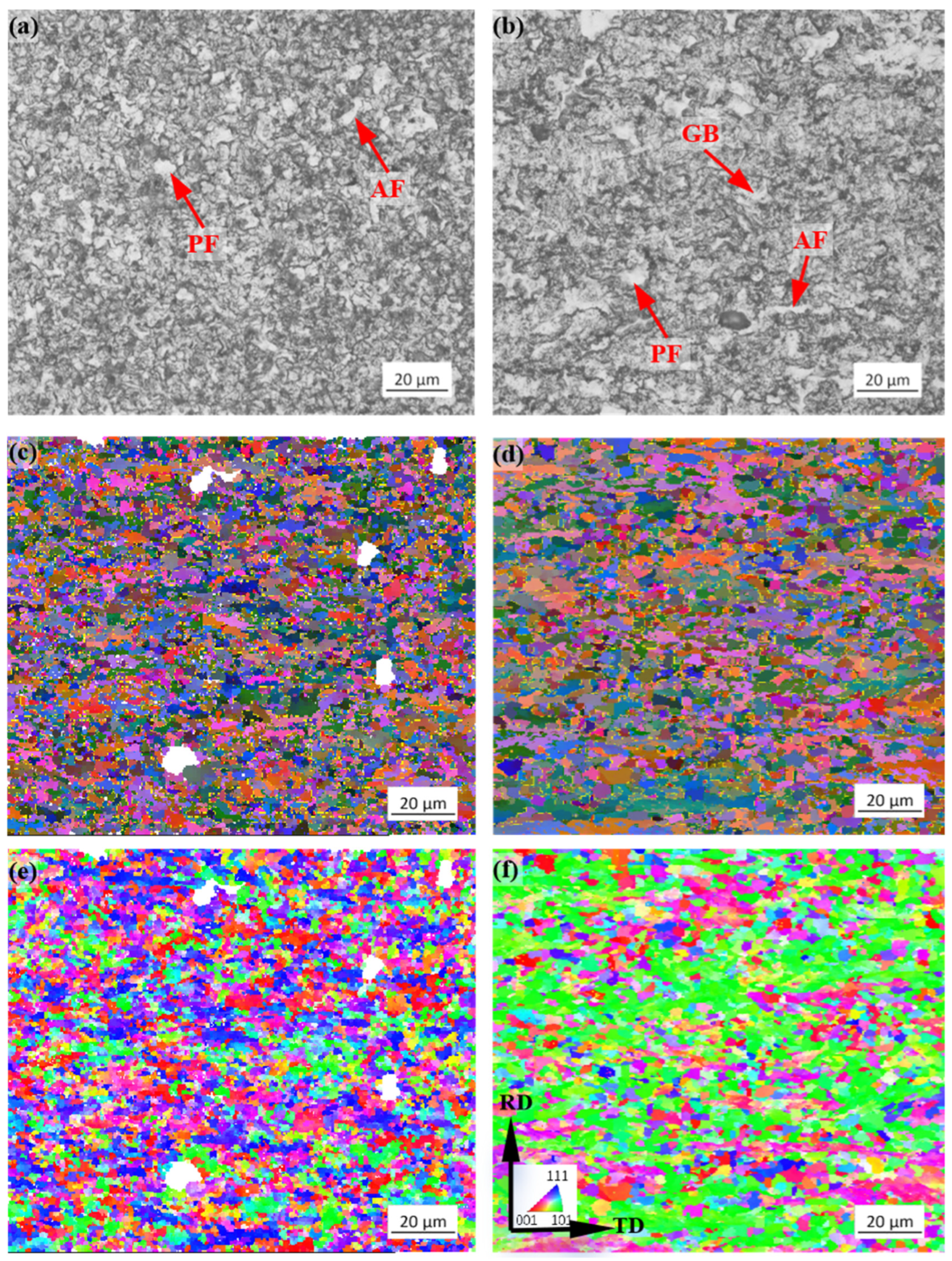
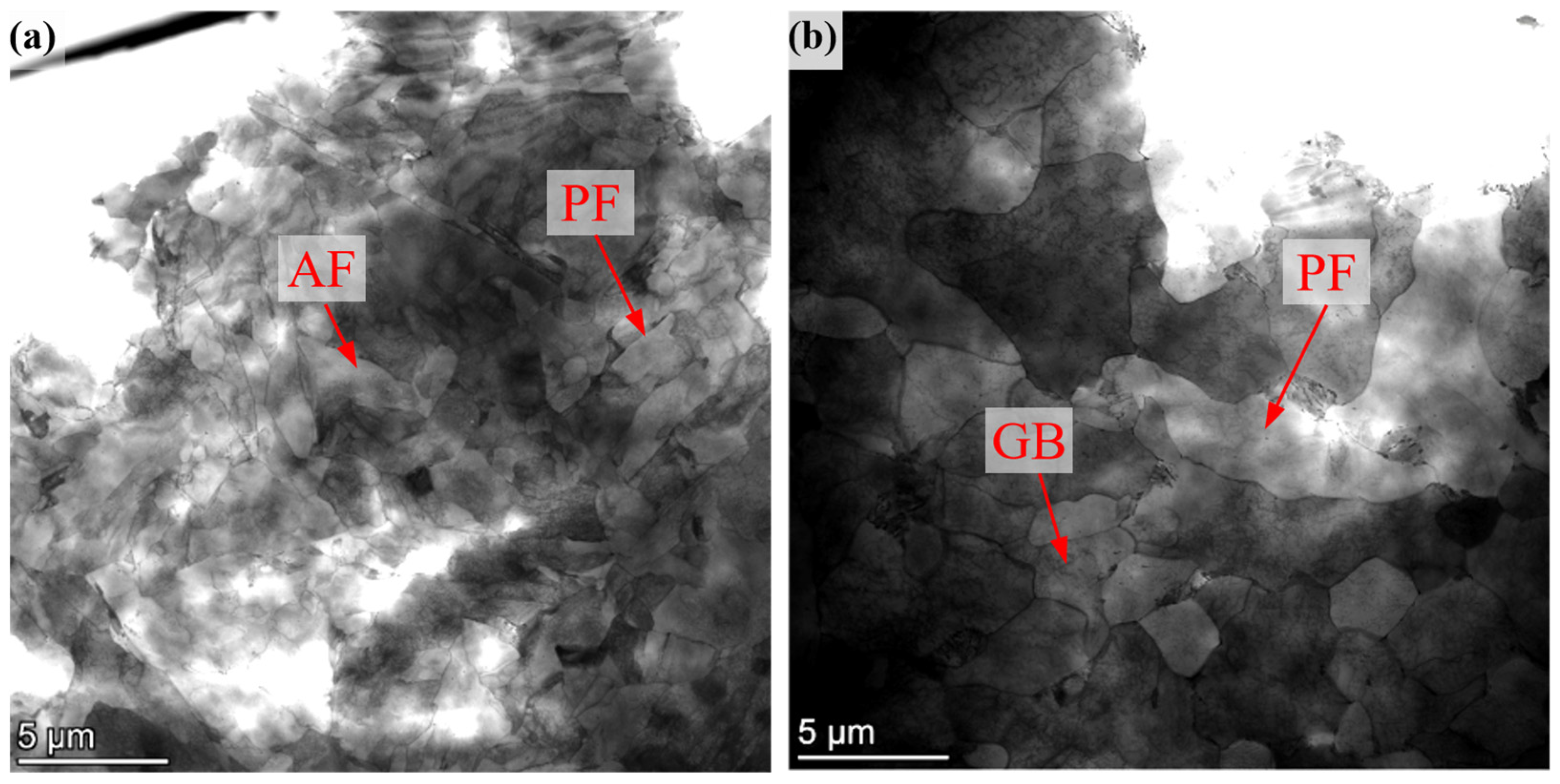
In the FGHAZ, the average effective grain size decreased to 3.72 μm for X80-AF and 4.92 μm for X80-GB (Table 4). SEM and EBSD images (Figure 7) revealed that the X80-AF FGHAZ contained a mixture of polygonal ferrite (PF) and retained AF, whereas the X80-GB FGHAZ was dominated by PF. Statistical analysis showed that the softened FGHAZ region of X80-AF contained 45.2 ± 3.6% retained AF, 37.8 ± 3.1% PF, and 17.0 ± 2.3% GB. In contrast, the X80-GB FGHAZ consisted of 65.4 ± 4.7% PF, 19.3 ± 3.2% GB, and only 15.3 ± 2.8% retained AF. The critical PF fraction difference (65.4% vs. 37.8%) directly correlates with the observed softening magnitude difference (12.46% vs. 3.44%). TEM analysis (Figure 8) showed a high dislocation density in the X80-AF FGHAZ, while the X80-GB FGHAZ exhibited significantly lower dislocation density.

3.4. Dislocation Density Distribution

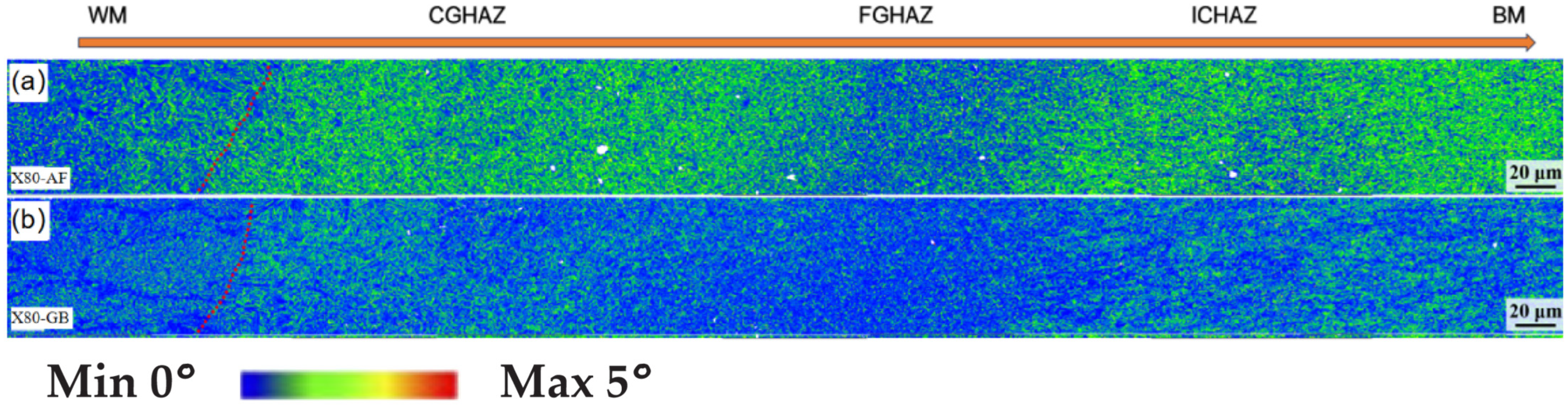
Kernel Average Misorientation (KAM) maps are widely employed to assess local strain distributions under various conditions, as they correlate with the geometrically necessary dislocation density (GND density). The EBSD KAM maps of the two girth weld joints covering the region from the base metal to the HAZ and weld metal are presented in Figure 9. The KAM values in Figure 9 are presented within a range of 0–5°, which corresponds to the typical misorientation distribution observed in low-carbon high-strength pipeline steels subjected to welding thermal cycles. This range was selected based on statistical analysis of EBSD data across multiple scanning areas. Over 95% of all measured KAM values fall below 5°, and values beyond this threshold are sporadic and often associated with measurement noise or local defects (e.g., scratches, residual deformation from polishing). Limiting the color scale to 0–5° enhances the contrast and facilitates meaningful comparison of GND density variations between the base metal and HAZ subzones.
KAM maps obtained from EBSD (Figure 9) could be correlated to the local lattice distortion. The results showed that not only in the FGHAZ but also in other regions (CGHAZ, ICHAZ and BM), the X80-AF KAM map displayed notably higher KAM values which are predominantly in the range of 2–4°, indicating high dislocation densities. In contrast, the X80-GB FGHAZ showed KAM values mostly below 1°, consistent with extensive dislocation annihilation. The results are found to be in accordance with the hardness contour maps presented in Figure 4a,b.

4. Discussions

4.1. Microstructural and Dislocation-Based Analysis for Softening Mechanism

The hardness distribution curves of both samples were consistent, with softening zones localized in the FGHAZ and hardened zones primarily appearing in the CGHAZ. The X80-AF weld joint showed a higher overall hardness level, with both softened and hardened zones exhibiting higher specific hardness values than that of X80-GB. Meanwhile, the softening zone of X80-AF showed a smaller hardness reduction and more restricted distribution, while the HAZ of X80-GB exhibited pronounced softening, significant hardness fluctuations, and a broader softening zone.
The significantly smaller hardness reduction (3.44% vs. 12.46%) and more restricted softening distribution in X80-AF can be primarily attributed to the superior thermal stability and dislocation retention capability of the AF-dominated base metal microstructure. Differences in softening behavior between the two steels arise from variations in phase transformation characteristics and microstructural stability during welding thermal cycles. Thermal expansion analyses by Li [24] and Duan [25] revealed that AF exhibits a gentle slope and weak hysteresis in its thermal expansion curve, indicating high resistance to thermal disturbance, whereas GB shows a significantly steeper expansion slope in the 500–700 °C range due to grain boundary sliding, migration, and recovery processes. Its thermal expansion curve exhibits a gentle slope and weak phase transformation hysteresis, indicating excellent stability under thermal disturbance [26]. In contrast, GB typically precipitates along prior austenite grain boundaries, forming continuous or semi-continuous network-like distributions. It features coarse grains, low dislocation density and a more regular microstructural morphology [27]. The AF microstructure, characterized by fine interlocked lamellae, high-angle boundaries, and high dislocation density, effectively impedes atomic diffusion and grain boundary motion during heating, resulting in excellent structural stability. By contrast, GB features coarse grains, low dislocation density, and a regular morphology, making it prone to grain coarsening and microstructural degradation under thermal loading [28]. This difference is directly reflected in the KAM maps: the FGHAZ of X80-AF maintains uniformly elevated KAM values (2–4°), confirming the preservation of high GND density after thermal exposure, while X80-GB exhibits a sharp drop in KAM (<1.5°) in the FGHAZ, indicative of extensive dislocation annihilation. Consequently, under identical welding conditions, the AF-dominated microstructure experiences minimal hardness loss due to its inherent thermal and dislocation stability, whereas the GB-rich structure suffers pronounced softening, owing to grain boundary weakening and dislocation depletion.

4.2. Contribution of Grain Refinement and Microstructural Complexity

Combined with the data presented in Table 4, the average effective grain size in the FGHAZ of X80-AF is 3.72 μm, smaller than 4.92 μm in the FGHAZ of X80-GB. Although the difference in average FGHAZ grain size between X80-AF (3.72 μm) and X80-GB (4.92 μm) may appear modest, it nonetheless provides a measurable contribution to softening resistance through grain boundary strengthening. Applying the Hall–Petch relationship:
Δ σ HP   =   k HP ( d GB 1 2 d AF 1 2 )
where kHP is the Hall–Petch coefficient (typically 0.5 MPa·m1/2 for low-carbon bainitic/ferritic pipeline steels), and d is the effective grain diameter.
Substituting dAF = 3.72 μm and dGB = 4.92 μm yields an estimated strength increase of approximately 17 MPa (equivalent to about 6 HV) for X80-AF relative to X80-GB. While this increment is smaller than the total observed hardness difference of 40.8 HV between the two softened zones, it actively mitigates softening by enhancing resistance to dislocation motion through increased grain boundary density. More importantly, the microstructure of the X80-AF softening zone consists of a complex coexistence of polygonal ferrite (PF) and retained AF, where the AF phase retains elongated acicular structures with diverse orientations and interlaced arrangements, creating tortuous boundaries that effectively impede dislocation glide. In contrast, the X80-GB softening zone is dominated by coarse, equiaxed PF with regular shapes and straight boundaries, resulting in a relatively simple and uniform microstructure that offers minimal resistance to dislocation movement and thus facilitates pronounced softening.

4.3. Discussion on Softening Location Differences with Prior Studies

While some studies reported softening in the CGHAZ or ICHAZ of X80 steel, the present observation of softening localized in the FGHAZ is attributed to the specific welding heat input (Δt8/5 ≈ 12 s) and base metal composition used in this study. The moderate heat input limits excessive grain coarsening in the CGHAZ, thereby suppressing CGHAZ-dominated softening [29]. Meanwhile, the low carbon equivalent (CE ≈ 0.38) and Nb-Ti microalloying promote a microstructure primarily consisting of fine ferrite and bainite. In this steel, softening during welding is governed by dislocation recovery rather than precipitate dissolution or tempering of pre-existing hard phases—mechanisms typically responsible for ICHAZ softening in higher-carbon or precipitation strengthened steels [30]. Consequently, under the applied thermal cycle, the FGHAZ emerged as the most susceptible region due to partial austenitization and subsequent dislocation annihilation. This finding aligns with behavior reported for modern low-CE, TMCP-processed X80 pipeline steel [31].

5. Conclusions

  • For the two girth weld joints with different base metal microstructures, similar chemical compositions and identical welding parameters, their softening behavior is likewise observed in the FGHAZ. The AF-dominated microstructure exhibits superior resistance to softening (SR = 3.44%), while GB-dominated steel exhibits notably higher softening rates (SR = 12.46%) in the FGHAZ.
  • Higher softening rates for GB-dominated pipeline steel is due to the larger fraction of coarse PF within the FGHAZ, while more AF with smaller size is obtained in the FGHAZ of AF-dominated pipeline steel, which is attributed to its higher dislocation density and interlocked structure. During welding, AF is less susceptible to transform into GB or PF and hence undergoes less pronounced grain coarsening.
  • The anti-softening mechanism for AF-dominated steel is attributed to its higher dislocation density and smaller grain size, which engenders higher thermal stability than that of GB-dominated steel. Therefore, for the anti-softening design of high-strength pipeline steels, AF is the more preferred microstructure.
  • Limitations and Future Perspectives: This study focused on representative microstructures under controlled welding conditions. However, wide applications of pipeline steels produced by different steel mills involve greater microstructural diversity and variable thermal cycles during field construction. While hardness mapping effectively identifies softening zones, comprehensive mechanical assessment remains essential. Future work should extend the experimental scope to practical welding scenarios, and correlate softening effects with service safety of pipelines. These efforts will strengthen predictive capability and support safer pipeline weld design.

Author Contributions

Conceptualization, X.L. (Xueda Li) and X.L. (Xunyun Lv); Methodology, X.L. (Xueda Li), Z.Z. and B.H.; Software, Z.S. and X.L. (Xunyun Lv); Validation, Z.S.; Formal analysis, X.L. (Xunyun Lv); Investigation, Z.S. and X.L. (Xunyun Lv); Resources, X.L. (Xueda Li), Z.Z., L.L. and B.H.; Data curation, Z.S. and X.L. (Xunyun Lv); Writing—original draft, Z.S.; Writing—review & editing, X.L. (Xueda Li) and Z.S.; Visualization, Z.S. and Z.Z.; Supervision, X.L. (Xueda Li), L.L. and B.H.; Project administration, X.L. (Xueda Li), L.L. and B.H.; Funding acquisition, X.L. (Xueda Li). All authors have read and agreed to the published version of the manuscript.

Funding

This research received no external funding.

Data Availability Statement

The original contributions presented in this study are included in the article. Further inquiries can be directed to the corresponding author.

Conflicts of Interest

The authors declare no conflict of interest.

Abbreviations

The following abbreviations are used in this manuscript:
AFAcicular Ferrite
CGHAZCoarse-Grained Heat-Affected Zone
FGHAZFine-Grained Heat-Affected Zone
GBGranular Bainite
HAZHeat-Affected Zone
ICHAZIntercritical Heat-Affected Zone
PFPolygonal Ferrite
SCHAZSubcritical Heat-Affected Zone

References

  1. Yan, L.; Zhao, Y.; Sun, P.; Liu, M.; Wang, Q. The distribution status and development trend of global oil & gas pipelines. Oil Gas Storage Transp. 2017, 36, 481–486. [Google Scholar]
  2. Wang, G.; Cheng, Q.; Zhao, W.; Liao, Q.; Zhang, H. Review on the transport capacity management of oil and gas pipeline network: Challenges and opportunities of future pipeline transport. Energy Strategy Rev. 2022, 43, 100933. [Google Scholar] [CrossRef]
  3. Xu, B.; Duan, L.; Xue, X.; Lan, H.; Chen, K. Research on Connection and Function Reliability of the Oil&Gas Pipeline System. MATEC Web Conf. 2017, 139, 00116. [Google Scholar] [CrossRef][Green Version]
  4. Fan, Y.; Feng, X. Research on integrity Management of long distance pipeline. E3S Web Conf. 2023, 385, 03011. [Google Scholar] [CrossRef]
  5. Alamri, A.H. Localized corrosion and mitigation approach of steel materials used in oil and gas pipelines—An overview. Eng. Fail. Anal. 2020, 116, 104735. [Google Scholar] [CrossRef]
  6. Zhang, W.; Li, H.; Chi, Q.; Zhao, X.; Huo, C.; Qi, L.; Li, Y.; Yang, K. Technical specifications for X80 OD 1422 mm line pipes and corresponding products. Nat. Gas Ind. B 2016, 3, 485–492. [Google Scholar] [CrossRef]
  7. Li, Y.; Martín, D.S.; Wang, J.; Wang, C.; Xu, W. A review of the thermal stability of metastable austenite in steels:Martensite formation. J. Mater. Sci. Technol. 2021, 91, 200–214. [Google Scholar] [CrossRef]
  8. Li, F.P.; Zhang, Z.W.; Zhang, B. Application Feasibility Study of High Strength Pipeline Steel to Rig Derrick and Substructure. Mater. Sci. Forum 2020, 993, 616–621. [Google Scholar] [CrossRef]
  9. Kashiwar, A.; Arseenko, M.; Simar, A.; Idrissi, H. On the role of microstructural defects on precipitation, damage, and healing behavior in a novel Al-0. 5Mg2Si alloy. Mater. Des. 2024, 239, 112765. [Google Scholar] [CrossRef]
  10. Song, K.; Wang, K.; Zhao, L.; Xu, L.; Ma, N.; Han, Y.; Hao, K.; Zhang, L.; Gao, Y. A physically-based constitutive model for a novel heat resistant martensitic steel under different cyclic loading modes: Microstructural strengthening mechanisms. Int. J. Plast. 2023, 165, 103611. [Google Scholar] [CrossRef]
  11. Lomozik, M. A study of structural changes in construction steels under the conditions of welding thermal cycles in the new measurement station at the Welding Institute. Weld. Int. 2013, 28, 941–946. [Google Scholar] [CrossRef]
  12. Zong, Y.; Liu, C.M. Microstructure and Properties of HAZ in Low-Carbon Bainite E550 Steel during Double-Pass Welding Thermal Cycle. Mater. Sci. Forum 2018, 913, 317–323. [Google Scholar] [CrossRef]
  13. Jiang, J.; Ma, Q.; Chen, L.; Luo, R.; Li, H.; Gao, Q. Mechanism of Interfacial Microstructure Evolution of G115 Steel in Simulated Heat Affected Zone. J. Mater. Eng. 2024, 52, 91–106. [Google Scholar]
  14. Hu, L.; Li, X.; Luo, W.; Li, S.; Deng, D. Residual stress and deformation in UHS quenched steel butt-welded joint. Int. J. Mech. Sci. 2023, 245, 108099. [Google Scholar] [CrossRef]
  15. Yang, C.G.; Zhen, Q.; Huang, Z.J.; Xu, W.P. Softening Mechanism in Heat Affected Zone of 2519 High Strength Al-Cu Alloy. Mater. Sci. Forum 2013, 749, 387–391. [Google Scholar] [CrossRef]
  16. Cao, R.; Yang, Z.; Li, J.; Liang, X.; Lei, W.; Zhang, J.; Chen, J. Effect of Peak Temperature on Microstructure and Mechanical Properties of Thermally Simulated Welding Heat-Affected Zones for 09MnNiDR Steel. J. Mater. Eng. Perform. 2020, 29, 7063–7072. [Google Scholar] [CrossRef]
  17. Zhang, W.; Fu, X.; Hu, M.; Xu, K.; Dai, K.; Shi, J.; Ji, Y.; Dong, C. Effects of external corrosion defect growth on wall pipeline under internal pressure and various defect sizes with mechano-electrochemical interaction. Mater. Corros. 2024, 75, 1348–1358. [Google Scholar] [CrossRef]
  18. Shen, C.; Wang, C.; Wei, X.; Li, Y.; van der Zwaag, S.; Xu, W. Physical metallurgy-guided machine learning and artificial intelligent design of ultrahigh-strength stainless steel. Acta Mater. 2019, 179, 201–214. [Google Scholar] [CrossRef]
  19. Hu, W.; Gong, B.; Chang, Q.; Zhao, Z.; Dai, L.; Liu, Y. Strain fracture behaviors and crack equivalence of X80 welded joints with non-sharp notches at weld root. Int. J. Press. Vessel. Pip. 2025, 214, 105414. [Google Scholar] [CrossRef]
  20. Niu, J.; Chen, H.; Liu, J.; Jin, R.; Zhang, X. Study on Softening in HAZ and Its Influence on Welded Joints of X70 Pipeline Steel. Hot Work. Technol. 2016, 45, 176–179. [Google Scholar]
  21. Zhang, T.; Roy, S.; Patra, S.; Poole, W.J.; Militzer, M. Intercritical Austenite Formation and Decomposition in the Coarse Grain Heat-Affected Zone of an X80 Line Pipe Steel. Metall. Mater. Trans. A 2022, 53, 3239–3244. [Google Scholar] [CrossRef]
  22. Zhang, J.; Sun, Q.; Bi, Z.; Niu, H. Research on Microstructure and Performance in Welding HAZ of X100 SAWH Pipe. Han Guan. 2012, 35, 5–10. [Google Scholar]
  23. Hu, M.J.; Wang, P.; Lin, W.P.; Wang, X.Y.; Ji, L.K. SH-CCT of High-Strain Pipeline Steel X80. Adv. Mater. Res. 2012, 472, 1179–1182. [Google Scholar] [CrossRef]
  24. Li, B. Research on Transformation Law of X80 Pipeline Steel. Wide Heavy Plate 2015, 21, 17–19. [Google Scholar]
  25. Duan, H. Microstructure Control and Strengthening-Toughening Mechanisms of High-Strength Pipeline Steel for Low-Temperature Service. Ph.D. Dissertation, University of Science and Technology of China, Hefei, China, 2022. [Google Scholar]
  26. Zhao, H.; Gao, J.; Wu, G.; Wu, H.; Zhang, C.; Huang, Y.; Luo, Y.; Yang, X.; Wang, S. Crystallographic characteristics of acicular ferrite nucleated on inclusions in a HSLA steel. J. Mater. Res. Technol. 2024, 28, 1957–1966. [Google Scholar] [CrossRef]
  27. Hu, B.; Shi, G.; Wang, Q.; Zhao, L.; Fan, H.; Tang, Y.; Wang, W.; Wang, Q.; Liu, R. Elucidating the heat input on CGHAZ microstructure and its irregular effect on impact toughness for a novel V–N microalloying weathering steel. J. Mater. Res. Technol. 2023, 25, 5888–5906. [Google Scholar] [CrossRef]
  28. Duan, Q.; Pan, H.; Fu, B.; Yan, J. An Investigation on the Strengthening Mechanism Based on Grain-Boundary Misorientation of High-Strength Pipeline Steel. Steel Res. Int. 2019, 90, 1900317. [Google Scholar] [CrossRef]
  29. Dai, X.; Wu, S.; Cheng, Y.; Zheng, W. Effect of Welding Heat Input on Microstructure and Properties of CGHAZ of 12MnNiCrMoV Steel Sheets Welded Joint. Mater. For Mech. Eng. 2016, 40, 63–66. [Google Scholar]
  30. Zhang, J.; Xin, W.; Ge, Z.; Luo, G.; Peng, J. Effect of high heat input welding on the microstructures, precipitates and mechanical properties in the simulated coarse grained heat affected zone of a low carbon Nb-V-Ti-N microalloyed steel. Mater. Charact. 2023, 199, 112849. [Google Scholar] [CrossRef]
  31. Xiao, B.; Xu, Y.; Wang, G. Technological Process and Mechanical Properties of Low-Cost X80 Pipeline Steel. J. Northeast. Univ. 2009, 30, 829. [Google Scholar]
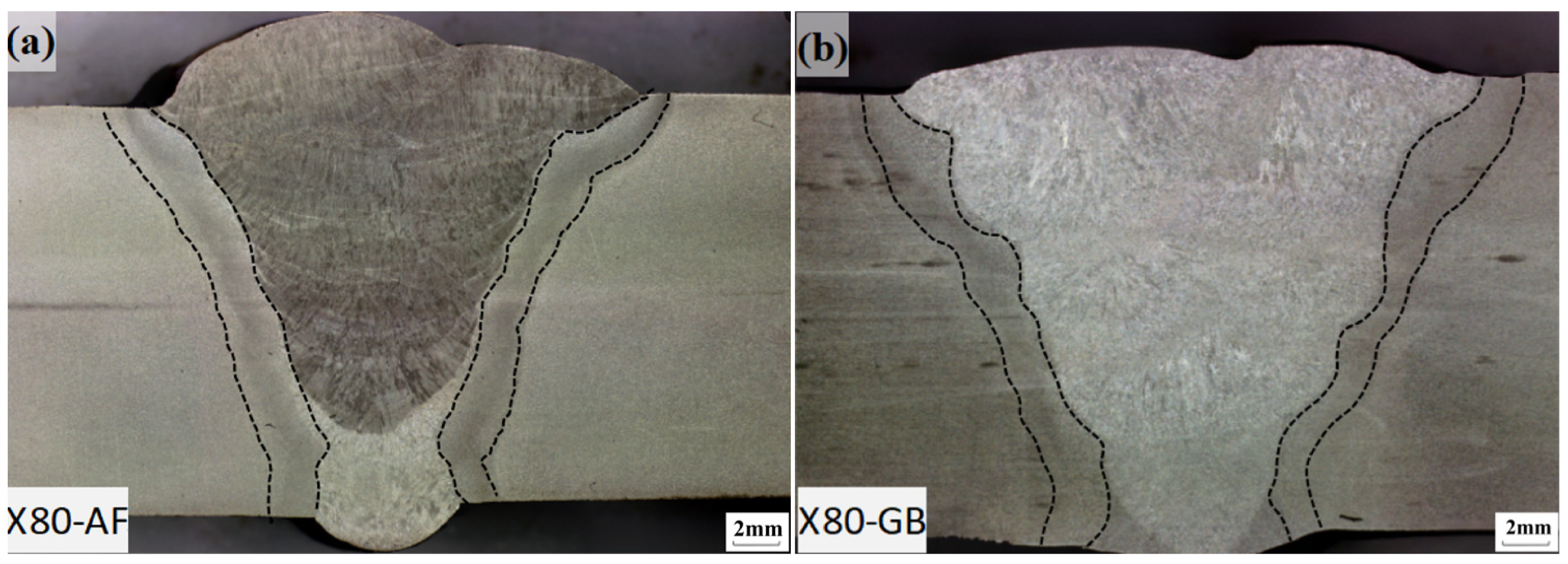
Figure 1. Macrographs of X80 pipeline steel girth weld joints. (a) X80-AF; (b) X80-GB.
Metals 16 00247 g001
Figure 2. Optical emission spectrometer (DM5000) (a) and composition test locations for X80 pipeline steel girth weld (b).
Metals 16 00247 g002
Figure 3. TIME6610M semi-automatic microhardness tester (a) and schematic of hardness indentation layout for X80 girth weld joints (b).
Metals 16 00247 g003
Figure 4. Hardness test results for girth welds. (a) X80-AF hardness contour map; (b) X80-GB hardness contour map; (c) hardness variation curves along horizontal lines passing through the lowest hardness points, as indicated in (a,b).
Metals 16 00247 g004
Figure 5. Metallographs around hardness indentation of BM (a,b) and corresponding EBSD characterization (cf). (a,c,e) X80-AF; (b,d,f) X80-GB; (c,d) all-Euler maps; (e,f) IPF maps.
Metals 16 00247 g005
Figure 6. TEM micrographs of base metal. (a) X80-AF; (b) X80-GB.
Metals 16 00247 g006
Figure 7. Metallographs around hardness indentation of FGHAZ (a,b) and corresponding EBSD characterization (cf). (a) FGHAZ of X80-AF; (b) FGHAZ of X80-G; (c) all-Euler map of X80-AF FGHAZ; (d) all-Euler map of X80-GB FGHAZ; (e) IPF map of X80-AF FGHAZ; (f) IPF map of X80-GB FGHAZ.
Metals 16 00247 g007
Figure 8. TEM micrographs of FGHAZ. (a) X80-AF; (b) X80-GB.
Metals 16 00247 g008
Figure 9. KAM maps across the region from WM to BM in the girth weld joint. (a) X80-AF; (b) X80-GB.
Metals 16 00247 g009
Table 1. Chemical composition of X80 pipeline steel base material (mass fraction, %).
No.CMnCrNiMoVTiNbPcm
X80-AF0.0561.830.1950.1200.0900.0040.0140.0540.160
X80-GB0.0601.740.2060.1140.0780.0030.0120.0610.164
Table 2. Welding parameters for the X80 girth weld.
Welding PassWelding MethodFiller MetalPolarityCurrent
(A)
Voltage
(V)
Shielding Gas Flow Rate
(L/min)
Travel Speed
(cm/min)
Heat Input
(kJ/mm)
Root weldGTAWER70S-6DCEP100–16010–1615–206–120.81–1.43
Hot passFCAW-GE91T1-K2MDCEP160–26020–2620–3512–241.26–1.97
Filling passesFCAW-GE91T1-K2MDCEP140–26020–2620–3512–241.42–2.05
Cap passesFCAW-GE91T1-K2MDCEP140–24020–2620–358–181.38–1.90
Table 3. Effective grain size (equivalent circle diameter) of base metal.
LocationNo.Grain Size (μm)
MinimumMaximumAverage
Base metalX80-AF2.6819.34.31
X80-GB2.6523.35.15
Table 4. FGHAZ effective grain size (equivalent circle diameter).
LocationNo.Grain Size (μm)
MinimumMaximumAverage
FGHAZX80-AF2.6314. 233.72
X80-GB2.6217.654.92
Disclaimer/Publisher’s Note: The statements, opinions and data contained in all publications are solely those of the individual author(s) and contributor(s) and not of MDPI and/or the editor(s). MDPI and/or the editor(s) disclaim responsibility for any injury to people or property resulting from any ideas, methods, instructions or products referred to in the content.