Article

Experimental Determination and Model Prediction of the Surface Tension of CaO-SiO2-MgO-Al2O3-CaF2 Slag

1
School of Metallurgy, Northeastern University, Shenyang 110819, China
2
School of Aeronautical Manufacture Engineering, Xi’an Aeronautical Polytechnic Institute, Xi’an 710089, China
3
School of Aviation Maintenance Engineering, Xi’an Aeronautical Polytechnic Institute, Xi’an 710089, China
*
Author to whom correspondence should be addressed.
Metals 2026, 16(2), 227; https://doi.org/10.3390/met16020227
Submission received: 6 January 2026 / Revised: 8 February 2026 / Accepted: 12 February 2026 / Published: 16 February 2026

Abstract

In this study, the surface tension of molten slag was measured using the hanging ring method. Based on the ion and molecular coexistence theory (IMCT), an activity prediction model for the CaO-SiO2-MgO-Al2O3-CaF2 slag system was established, and a corresponding surface tension model was subsequently derived. The investigation explores the effects of basicity R = (w(CaO)/w(SiO2)), the mass ratio w(MgO)/w(Al2O3), and the Al2O3 mass fraction (w, mass fraction of the corresponding oxide). Results show that the surface tension increases with higher values of R, w(MgO)/w(Al2O3), and w(Al2O3) content. The proposed model exhibits high predictive accuracy and provides a reliable tool for evaluating the surface tension of multicomponent blast furnace slags.

1. Introduction

The surface properties of slag mainly include slag surface tension and the interfacial tension between slag and molten iron. In metallurgical processes, slag surface tension is of great importance [1,2,3]. This is because both slag surface tension and slag–metal interfacial tension play key roles in gas–slag–metal interfacial reactions.
Many studies have focused on the surface tension of slag systems. Mukai [4] investigated the surface tension of CaO–SiO2–Al2O3 ternary blast furnace slag using the sessile drop method. The results showed that the surface tension increased with increasing w(Al2O3). Sukenaga [5] examined the effect of w(CaO)/w(SiO2) on the surface tension of CaO–SiO2–Al2O3–MgO slag at 1723–1823 K, where w(i) denotes the mass fraction (wt.%) of component i. As w(CaO)/w(SiO2) increased from 1.1 to 1.7, the surface tension of the system increased gradually. This increase was attributed to the formation of a large amount of unsaturated non-bridging oxygen on the melt surface. Vadász [6] reported that SiO2 acts as a surface-active component in slag due to its strong Si–O covalent bonds, which weaken the influence of the CaO–FeO–Fe2O system on slag surface tension. Dong [7] found that the surface tension of CaF2–Al2O3 and CaF2–CaO–Al2O3 slags decreased as the SiO2 content increased from 2 wt.% to 8 wt.%. The addition of SiO2 promoted the formation of larger structural units, reduced the interaction between ionic groups and modified oxygen ions, and lowered the system energy, thereby decreasing the surface tension. Although extensive research has been conducted on the surface tension of blast furnace slag [8,9], studies on high-alumina blast furnace slag remain limited.
Therefore, this study took the high-alumina blast furnace slag system as the research object and carried out the experimental determination and model prediction of the surface tension of the slag. Based on the theory of molecular–ion coexistence, the activity prediction model of the CaO-SiO2-MgO-Al2O3-CaF2 blast furnace slag system was established, and the prediction model of the slag surface tension was deduced.

2. Experiments

2.1. Experimental Principle

The metal ring is placed horizontally on the liquid surface; then, the force required to pull it off the liquid surface is measured. In the process of the metal ring being pulled up, due to the effect of the surface tension, it also carries some of the liquid. When the weight of the pulled liquid is balanced with the surface tension, the measured force reaches the maximum value. The metal ring is further pulled up, the liquid falls off at the moment when the tension exceeds the surface tension, and the metal ring is detached from the liquid. The shape of the liquid pulled up by the ring is a function of r1/r2, and when r1 and r2 are constant, it can be considered a constant; thus, the calculation formula of surface tension is as follows:
σ = M max g 4 π r 1 f   ( r 1 3 V , r 1 r 2 ) =     M max g 4 π r 1 C
where σ is the surface tension of the melt, N·m−1; r2 is the radius of the loop, m; g is the acceleration of gravity, 9.81 m·s−2; V is the volume of the pulling liquid, m3; r1 is the average radius of the ring, m; Mmax is the maximum mass of pulling up the liquid surface, kg; and C is a constant.
By measuring the maximum mass of the liquid pulled up by the metal ring, the surface tension of the slag can be calculated according to Formula (1). The value of the constant C can be obtained by using the surface tension calibration of the known liquid:
C   =   σ 4 π r 1 M max g
Here, σ is the surface tension of the known calibration liquid, N·m−1. In the experiment, pure water was used as the standard liquid to calibrate the pulling constant C.

2.2. Experimental Procedure

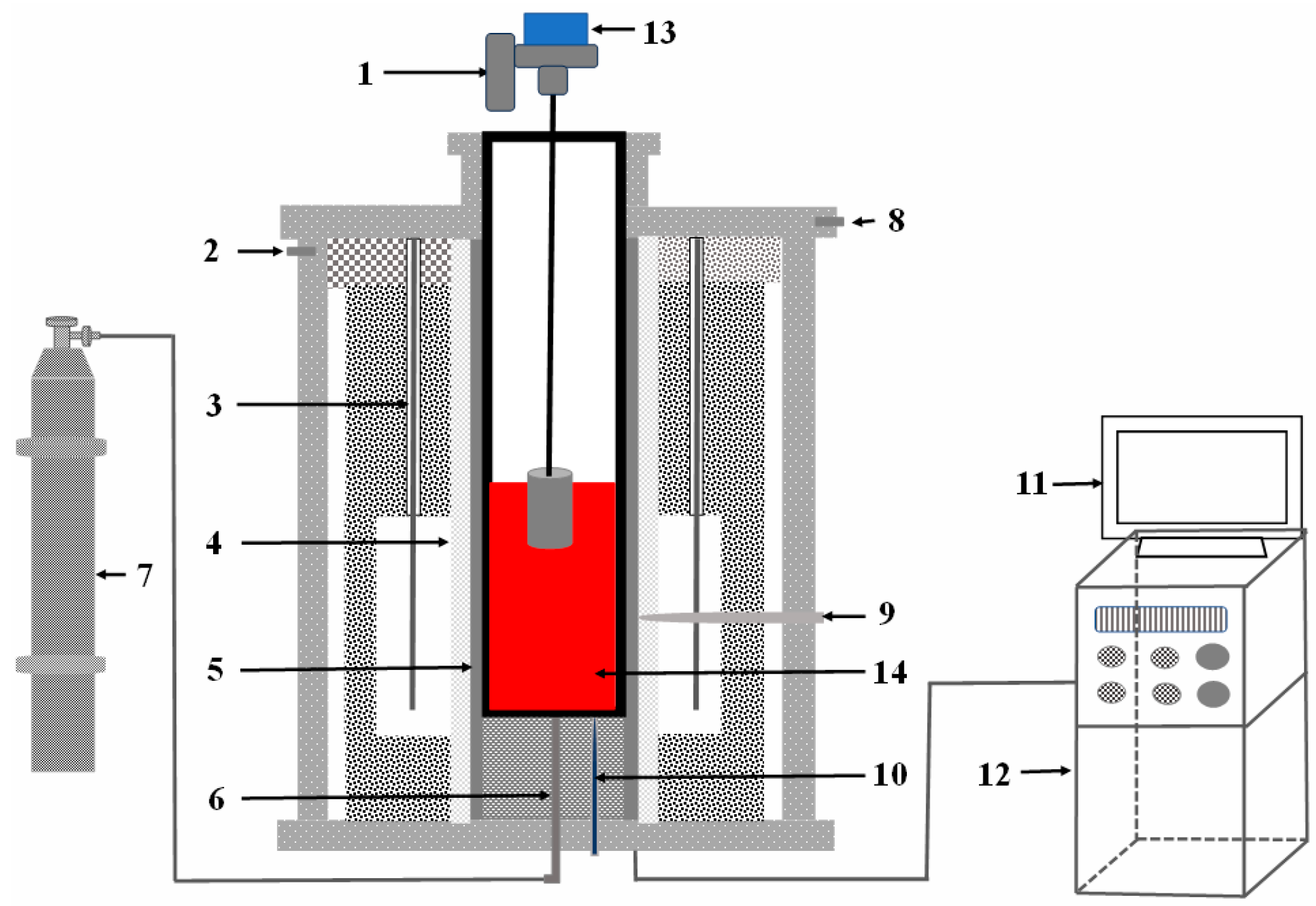
In this experiment, CaO, SiO2, MgO, Al2O3, and CaF2 were used as analytical-grade chemical reagents. First, the reagent powders were dried in an oven at 393 K for 1 h. Then, 250 g of synthetic slag was accurately prepared according to the composition listed in Table 1. After thorough mixing, the mixture was loaded into a molybdenum crucible. Under an argon atmosphere, the crucible was placed in a high-temperature tube furnace and heated to 1773 K for 1 h. During the holding period, the melt was stirred using a molybdenum wire. At the end of the holding time, the sample was rapidly removed from the furnace and quenched in water. The experimental equipment is shown in Figure 1.
To measure the surface tension, 50 g of pre-melted slag was weighed and placed in a molybdenum crucible with an outer diameter of 42 mm, an inner diameter of 40 mm, and a height of 65 mm. The crucible was then placed in the furnace. The slag sample was melted under programmed temperature control. When the furnace temperature reached 773 K, argon was introduced from the lower part of the furnace tube at a flow rate of 200 mL min−1 to protect the molybdenum crucible. After the temperature increased to 1773 K, it was maintained for 1 h, and the slag was stirred using a molybdenum wire.
After stabilization, the test puller was installed, and the electronic balance was turned on. The initial weight of the puller was recorded after the reading became stable. The furnace body was then raised until the pulling cylinder contacted the liquid surface. After standing for 2 min, the pulling cylinder was slowly lowered until the liquid surface ruptured. The maximum tensile force was obtained, and the slag surface tension was calculated according to Equation (1). Each slag sample was held at 1773 K for 30 min before measurement. Measurements were repeated three times at each temperature point, and the average value was reported.
After the surface tension measurement, the electric furnace was lowered, the temperature was reduced to 473 K, and the water and gas supplies were shut off, marking the end of the experiment. All experiments were conducted in a high-temperature tube furnace. The temperature was controlled using a PID controller, and a Pt-6% Rh/Pt-30% Rh double platinum–rhodium thermocouple was employed. The temperature error was maintained within ±2 K, and argon gas was introduced from the lower part of the furnace to keep the pressure at 1 atm.

3. Prediction Model

3.1. Basic Assumptions

Based on the ion and molecular coexistence theory and the activity prediction model for the CaO–SiO2–MgO–Al2O3–CaF2 slag system, a surface tension prediction model for this slag system was developed using the Butler equation. The main assumptions of the model are summarized as follows. All slag compositions reported in wt.% were converted into molar quantities based on the molar masses of each component prior to the calculation of mass action concentrations and activities.
(1) The slag consists of simple ions (Ca2+, Mg2+, and O2−), simple molecules (SiO2 and Al2O3), and complex molecules (silicates and aluminates).
(2) Both the surface phase and the bulk phase of the slag follow the ion and molecular coexistence theory of slag structure.
(3) The coexistence of molecules and ions is continuous over the entire composition range.
( C a 2 + + O 2 ) + A l 2 O 3 = CaO · A l 2 O 3
(4) The chemical reaction inside the slag obeys the law of mass action.
K CaO · A l 2 O 3 θ = N CaO · A l 2 O 3 Surf N CaO Surf · N A l 2 O 3 Surf
Here, N CaO · A l 2 O 3 Surf is the mass action concentration (activity) of CaO·Al2O3 in the surface phase; N CaO Surf is the mass action concentration of CaO in the surface phase; and N A l 2 O 3 Surf is the mass action concentration of Al2O3 in the surface phase.
(5) The mass action concentrations of the components in both the bulk phase and the surface phase of the slag, as well as the slag surface tension, follow the Butler equation.
σ = σ i Pure + R g T A i In N i Surf N i Bulk
Here, N i Surf can be calculated using the theoretical model of molecular–ion coexistence (Formula (8)~(11)).

3.2. Calculation Model of the Mass Action Concentration of the Structural Unit in the CaO-SiO2-MgO-Al2O3-CaF2 Slag Melt

Based on the ion and molecular coexistence theory and a simplified phase diagram, a total of 25 structural units were identified for the CaO–SiO2–MgO–Al2O3–CaF2 slag system, as listed in Table 2.
The mole number of the abovementioned four components, such as CaO, SiO2, MgO, Al2O3, and CaF2, of the CaO-SiO2-MgO-Al2O3-CaF2 slags is assigned as b 1 = n CaO , b 2 = n MgO , b 3 = n CaF 2 , a 1 = n A l 2 O 3 , and a 2 = n SiO 2 , presenting the chemical composition of the slags.
  b 1 =   x 1 + x 6 + x 8 + 3 x 10 + 2 x 12 + 11 x 13 + x 14 + 3 x 15 + 12 x 16 + x 17 + x 18 + 3 x 20 + x 21 + 2 x 22 + 3 x 23 + x 24 + 2 x 25 = X ( 0.5 N 1 + N 6 + N 8 + 3 N 10 + 2 N 12 + 11 N 13 + N 14 + 3 N 15 + 12 N 16 + N 17 + N 18 + 3 N 20 + N 21 + 2 N 22 + 3 N 23 + N 24 + 2 N 25 )
                        b 2 =   x 2 + x 7 + x 9 + 2 x 12 + x 14 + x 21 + x 22 + x 23 = X ( 0.5 N 2 + N 7 + N 9 + 2 N 12 + N 14 + N 21 + N 22 + N 23 )
b 3 =   x 2 + x 10 + x 13 = X ( 1 / 3 N 3 + N 10 + N 13 )
a 1 = x 4 + x 8 + x 9 + 3 x 10 + 7 x 13 + x 15 + 7 x 16 + 2 x 17 + 6 x 18 + 3 x 19 + x 24 + 2 x 25 = X ( N 4 + N 8 + N 9 + 3 N 10 + 7 N 13 + N 15 + 7 N 16 + 2 N 17 + 6 N 18 + 3 N 19 + N 24 + 2 N 25 )
a 2 =   x 2 + x 7 + x 8 + x 9 + x 10 + x 11 + x 17 + 2 x 18 + 2 x 19 + x 20 + 2 x 21 + 2 x 22 + 2 x 23 = X ( N 5 + N 6 + N 7 + N 11 + N 12 + N 14 + 2 N 19 + N 20 + 2 N 21 + 2 N 22 + 2 N 23 + 2 N 24 + N 25 )
The sum of the concentrations of all structural units in the slag is constrained to unity.
N 1 + N 2 + N 3 + N 4 + N 5 + N 6 + N 7 + N 8 + N 9 + N 10 + N 11 + N 12 + N 13 + N 14 + N 15 + N 16 + N 17 + N 18 + N 19 + N 20 + N 21 + N 22 + N 23 + N 24 + N 25 = 1
  b 1 ( 1 / 3 N 3 + N 10 + N 13 ) b 3 ( 0.5 N 1 + N 6 + N 8 + 3 N 10 + 2 N 12 ) = X ( 0.5 N 1 + N 6 + N 8 + 3 N 10 + 2 N 12 + 11 N 13 + N 14 + 3 N 15 + 12 N 16 + N 17 + N 18 + 3 N 20 + N 21 + 2 N 22 + 3 N 23 + N 24 + 2 N 25 )
  b 2 ( 1 / 3 N 3 + N 10 + N 13 ) b 3 ( 0 . 5 N 2 + N 7 + N 9 + 2 N 12 + N 14 + N 21 + N 22 + N 23 ) = 0
  a 1 ( 1 / 3 N 3 + N 10 + N 13 ) b 3 ( N 4 + N 8 + N 9 + 3 N 10 + 7 N 13 + N 15 + 7 N 16 + 2 N 17 + 6 N 18 + 3 N 19 + N 24 + 2 N 25 ) = 0
  a 2 ( 1 / 3 N 3 + N 10 + N 13 ) b 3 ( N 5 + N 6 + N 7 + N 11 + N 12 + N 14 + 2 N 19 + N 20 + 2 N 21 + 2 N 22 + 2 N 23 + 2 N 24 + N 25 ) = 0
By combining Equations (11)–(15), the following four equations are obtained:
N 1 + N 2 + N 3 + N 4 + N 5 + K 1 N 1 N 5 + K 2 N 2 N 5 + K 3 N 1 N 4 + K 4 N 2 N 4 + K 5 N 1 3 N 4 4 N 4 + K 6 N 1 2 N 5 + K 7 N 2 N 5 2 + K 8 N 1 11 N 4 6 N 4 + K 9 N 1 N 2 N 5 + K 10 N 1 3 N 4 + K 11 N 1 12 N 4 7 + K 12 N 1 N 4 2 + K 13 N 1 N 4 6 + K 14 N 4 2 N 5 3 + K 15 N 1 3 N 5 + K 16 N 1 N 2 N 3 + K 17 N 1 2 N 2 2 N 5 2 + K 18 N 1 3 N 2 N 5 2 + K 19 N 1 N 4 N 5 2 + K 20 N 1 2 N 4 N 5 = 1
  b 1 ( 1 / 3 N 3 + K 5 N 1 3 N 4 4 N 4 + K 8 N 1 11 N 4 6 N 4 ) b 3 ( 0.5 N 1 + K 1 N 1 N 5 + K 3 N 1 N 4 + 3 K 5 N 1 3 N 4 4 N 4 + 2 K 7 N 2 N 5 2 + 11 K 8 N 1 11 N 4 6 N 4 + K 9 N 1 N 2 N 5 + 3 K 10 N 1 3 N 4 + 12 K 11 N 1 12 N 4 7 + K 12 N 1 N 4 2 + K 13 N 1 N 4 6 + 3 K 15 N 1 3 N 5 + K 16 N 1 N 2 N 3 + 2 K 17 N 1 2 N 2 2 N 5 2 + 3 K 18 N 1 3 N 2 N 5 2 + K 19 N 1 N 4 N 5 2 + 2 K 20 N 1 2 N 4 N 5 ) = 0
  b 2 ( 1 / 3 N 3 + K 5 N 1 3 N 4 4 N 4 + K 8 N 1 11 N 4 6 N 4 ) b 3 ( 0 . 5 N 2 + K 2 N 2 N 5 + K 4 N 2 N 4 + 2 K 7 N 2 N 5 2 + K 9 N 1 N 2 N 5 + K 16 N 1 N 2 N 3 + K 17 N 1 2 N 2 2 N 5 2 + K 18 N 1 3 N 2 N 5 2 ) = 0
  a 1 ( 1 / 3 N 3 + K 5 N 1 3 N 4 4 N 4 + K 8 N 1 11 N 4 6 N 4 ) b 3 ( N 4 + K 3 N 1 N 4 + K 4 N 2 N 4 + K 5 N 1 3 N 4 4 N 4 + 7 K 8 N 1 11 N 4 6 N 4 + K 10 N 1 3 N 4 + 7 K 11 N 1 12 N 4 7 + 2 K 12 N 1 N 4 2 + 6 K 13 N 1 N 4 6 + 3 K 14 N 4 2 N 5 3 + K 19 N 1 N 4 N 5 2 + 2 K 20 N 1 2 N 4 N 5 ) = 0
  a 2 ( 1 / 3 N 3 + K 5 N 1 3 N 4 4 N 4 + K 8 N 1 11 N 4 6 N 4 ) b 3 ( N 5 + K 1 N 1 N 5 + K 2 N 2 N 5 + K 6 N 1 2 N 5 + K 7 N 2 N 5 2 + K 9 N 1 N 2 N 5 + 2 K 14 N 4 2 N 5 3 + K 15 N 1 3 N 5 + 2 K 16 N 1 N 2 N 3 + 2 K 17 N 1 2 N 2 2 N 5 2 + 2 K 18 N 1 3 N 2 N 5 2 + 2 K 19 N 1 N 4 N 5 2 + K 20 N 1 2 N 4 N 5 ) = 0
The activity of each component in the CaO–SiO2–MgO–Al2O3–CaF2 slag system can be calculated using Equations (16)–(20).

3.3. Prediction Model of the Surface Tension of the CaO-SiO2-MgO-Al2O3-CaF2 Slag System

It is assumed that the components in the surface phase are in thermodynamic equilibrium with those in the bulk phase. Based on this assumption, the relationship between surface tension and thermodynamic properties can be derived. The improved Butler formula for calculating the surface tension of slag can be expressed as [12,13]
σ   =   σ i Pure + R g T A i ln a i Surf a i Bulk
where σ is the surface tension of the slag, mN·m−1; σ i Pure is the surface tension of i pure substance, mN·m−1; R g is the molar gas constant, J · mol 1 · K 1 ; A i is the molar surface area of component i, m2/mol; a i Surf is the activity of component i in the surface phase; and a i Bulk is the activity of component i in bulk. Among them, A i is calculated as follows:
A i   =   L · N 0   1 3 · V i   2 3
Here, L is the correction factor, usually set to 1.091 for the mixture of slag and ionic oxide; N 0 is the Avogadro constant, N 0 = 6.02 × 10²³ mol−1; and V i is component i in molar volume, m3/mol.
Many studies [14,15,16,17,18,19,20,21,22] have investigated the surface tension of common oxides in slag, and the corresponding results are summarized in Table 3 and Table 4.
The CaO–SiO2–MgO–Al2O3–CaF2 slag system is described as follows:
σ   =   σ CaO Pure   +   R g T A CaO In N CaO Surf N CaO Bulk
A CaO = L · N 0 1 3 · V CaO 2 3
σ   = σ SiO 2 Pure + R g T A SiO 2 In N SiO 2 Surf N SiO 2 Bulk
A SiO 2 = L · N 0 1 3 · V SiO 2 2 3
σ   = σ MgO Pure + R g T A MgO In N MgO Surf N MgO Bulk
A MgO = L · N 0 1 3 · V MgO 2 3
σ   = σ Al 2 O 3 Pure + R g T A Al 2 O 3 In N Al 2 O 3 Surf N Al 2 O 3 Bulk
A Al 2 O 3 = L · N 0 1 3 · V Al 2 O 3 2 3
σ   = σ CaF 2 Pure + R g R T A CaF 2 In N CaF 2 Surf N CaF 2 Bulk
A CaF 2 = L · N 0 1 3 · V CaF 2 2 3
Equations (16)–(20) and Equations (23)–(32) are based on the ion and molecular coexistence theory. On this basis, the surface tension prediction model of the CaO–SiO2–MgO–Al2O3–CaF2 slag system is derived by combining the established activity prediction model with the Butler formula.

4. Discussion

4.1. Validation of the Prediction Model for Surface Tension of Slag

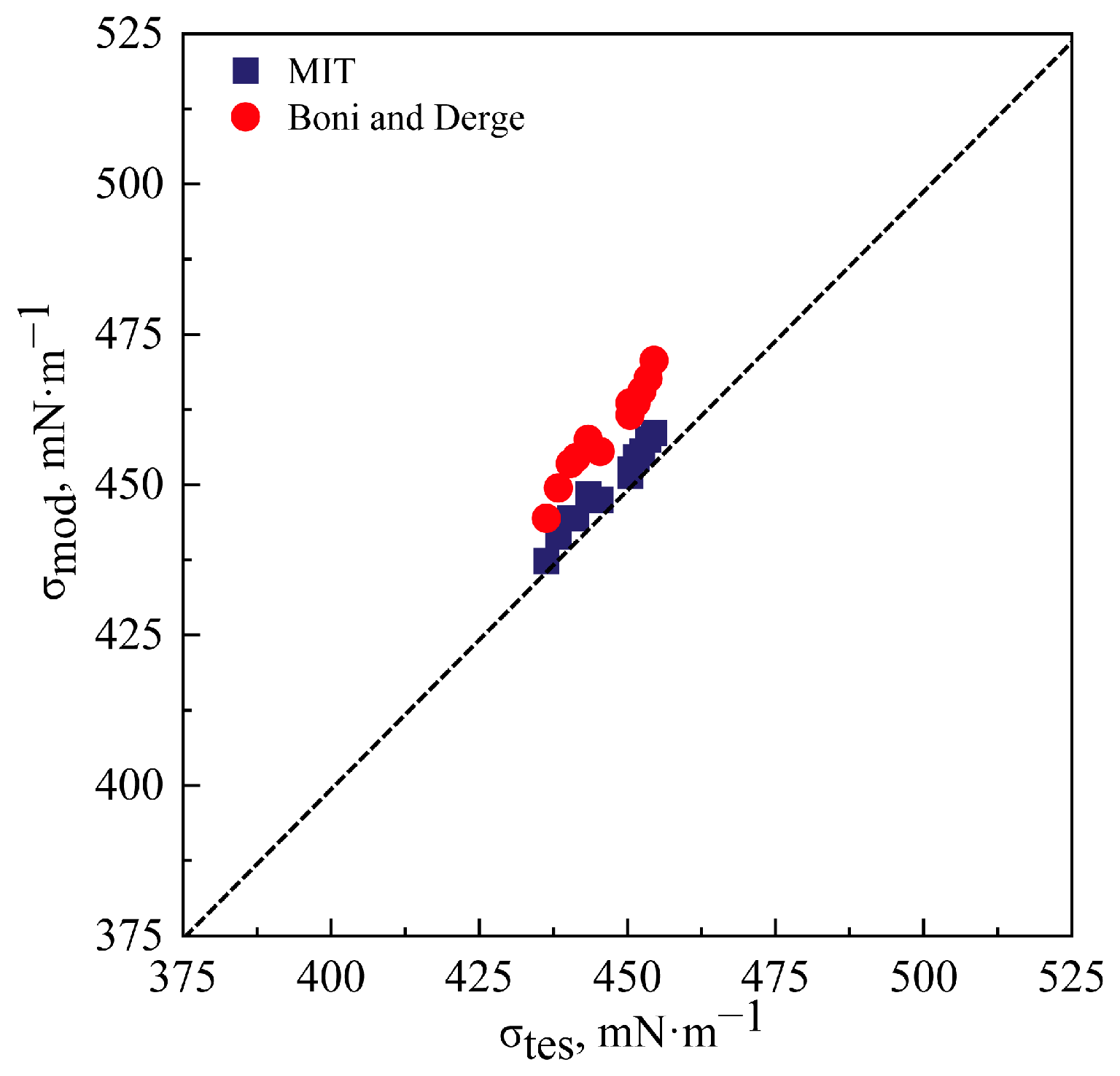
Table 5 shows that the chemical composition of the blast furnace slag before and after the test is basically unchanged. The experimental results and model prediction results are shown in Table 6. Figure 2 shows that the experimental results and the model prediction results have the same change trend. The calculation results of the relative error (Formula (33)) of the model show that the relative error is only 3% between the surface tension (σmod) predicted by the prediction model based on the CaO-SiO2-MgO-Al2O3-CaF2 slag system and the surface tension (σtes) measured experimentally.
The relative error between the calculated surface tension (σmod), obtained using the addition method proposed by Boni and Derge, and the experimentally measured surface tension (σtes) is 12%. Therefore, based on the ion and molecular coexistence theory and the activity prediction model of the CaO–SiO2–MgO–Al2O3–CaF2 slag system, and combined with the Butler formula, the proposed surface tension prediction model shows high accuracy and can be applied to calculate the surface tension of slag.
= 1 n × i = 1 n | σ tes σ mod σ tes | × 100 %   ( i : 1 ~ n )

4.2. Effect of R on the Surface Tension of Slag

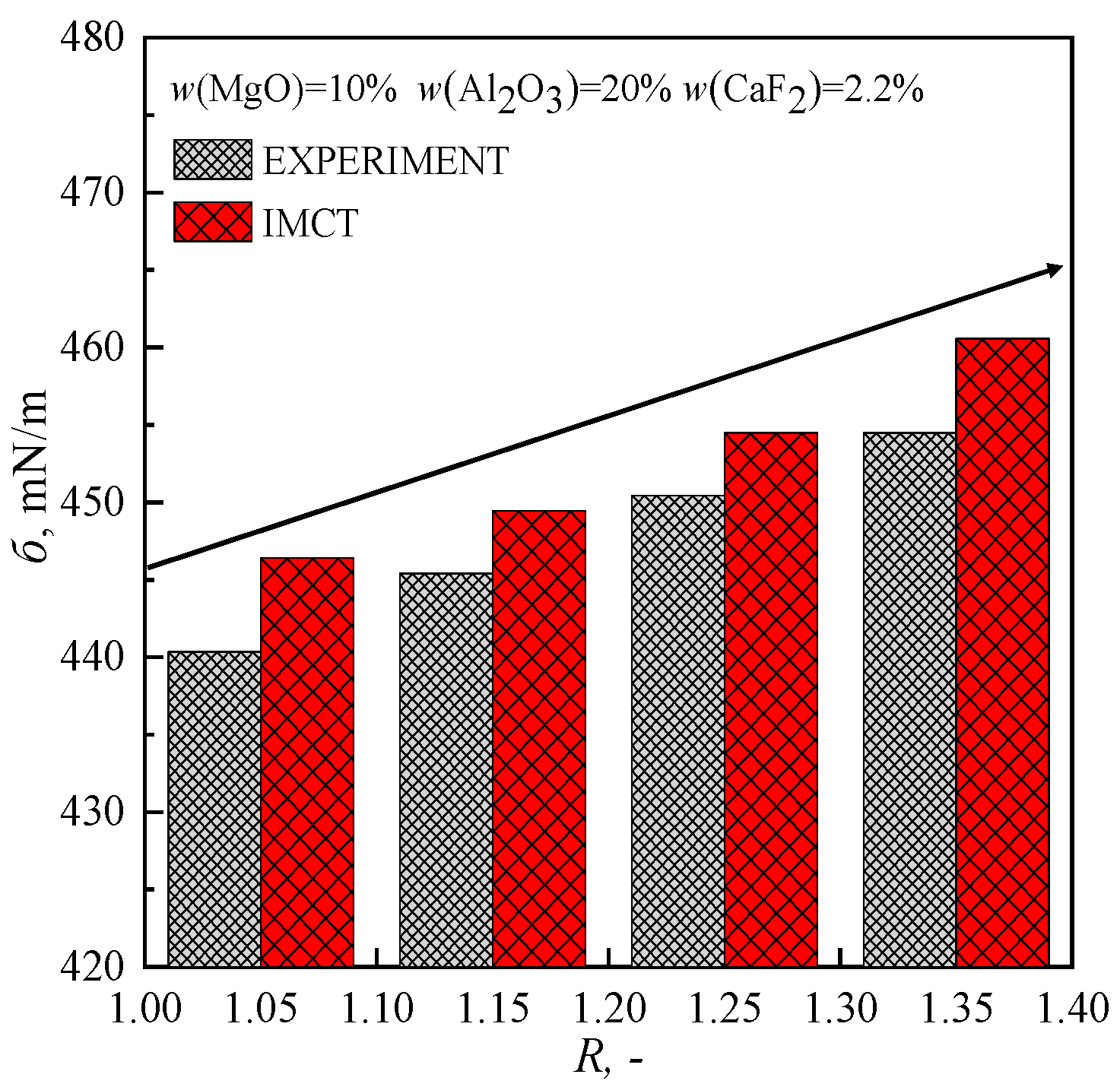
Further analysis of the composition changes shows that under this parameter setting, with the increase in R, the content of CaO in the slag increases accordingly, and the content of SiO2 decreases, while the content of MgO and Al2O3 remains constant. For the silicate slag system, the silicon–oxygen complex anion is the main type of complex anion inside. The degree of polymerization of the slag is closely related to the content of SiO2. When the content of SiO2 increases, the degree of polymerization of the slag will increase, and the composite anion formed by polymerization will have a larger ionic radius, which will affect the surface behavior of the slag. Combined with the change trend of the surface tension with R shown in Figure 3, it can be inferred that the decrease in the degree of polymerization and the ionic half is caused by the decrease in the SiO2 content. At the same time, the electrostatic force between the complex anion and the metal cation decreases as the ion radius increases. From the perspective of system energy minimization, the complex anions with a larger radius will be compressed on the melt surface. Due to the conservation of charge, the total charge number of anions remains unchanged, but the increase in the ion radius leads to an increase in the distance between charges, and the electrostatic force is further reduced, which ultimately reduces the surface tension of the slag. Combined with the previous composition change rule, the content of SiO2 decreases with the increase in R. At this time, the charge distance between small-radius ions is shortened, the electrostatic force is enhanced, and the surface tension of the slag is increased. Figure 3 shows the effect of basicity R on the surface tension of slag at w(MgO)/w(Al2O3) = 0.50 and w(Al2O3) = 20%. At 1773 K, the surface tension of slag increases as R increases from 1.05 to 1.35 under these conditions. Further analysis of the compositional variation indicates that, with increasing R, the CaO content in the slag increases, whereas the SiO2 content decreases. Meanwhile, the contents of MgO and Al2O3 remain unchanged. In silicate slag systems, silicon–oxygen complex anions are the dominant structural units, and the degree of polymerization of slag is closely related to the SiO2 content. An increase in SiO2 content enhances slag polymerization, resulting in the formation of larger complex anions with a greater ionic radius, which significantly influences the surface behavior of slag. Under the present experimental conditions, the increase in R leads to a decrease in SiO2 content, which reduces the degree of polymerization and the ionic radius of complex anions. As a result, the distance between opposite charges is shortened, and the electrostatic interaction between complex anions and metal cations is enhanced. In contrast, complex anions with a larger ionic radius tend to segregate to the melt surface from the perspective of system energy minimization. This segregation increases the distance between charges and weakens electrostatic interactions, thereby reducing the surface tension of slag. Therefore, when the SiO2 content decreases with increasing R, smaller ionic species dominate in the melt, electrostatic forces are strengthened, and the surface tension of slag increases accordingly.

4.3. Effect of w(MgO)/w(Al2O3) on Surface Tension of Slag

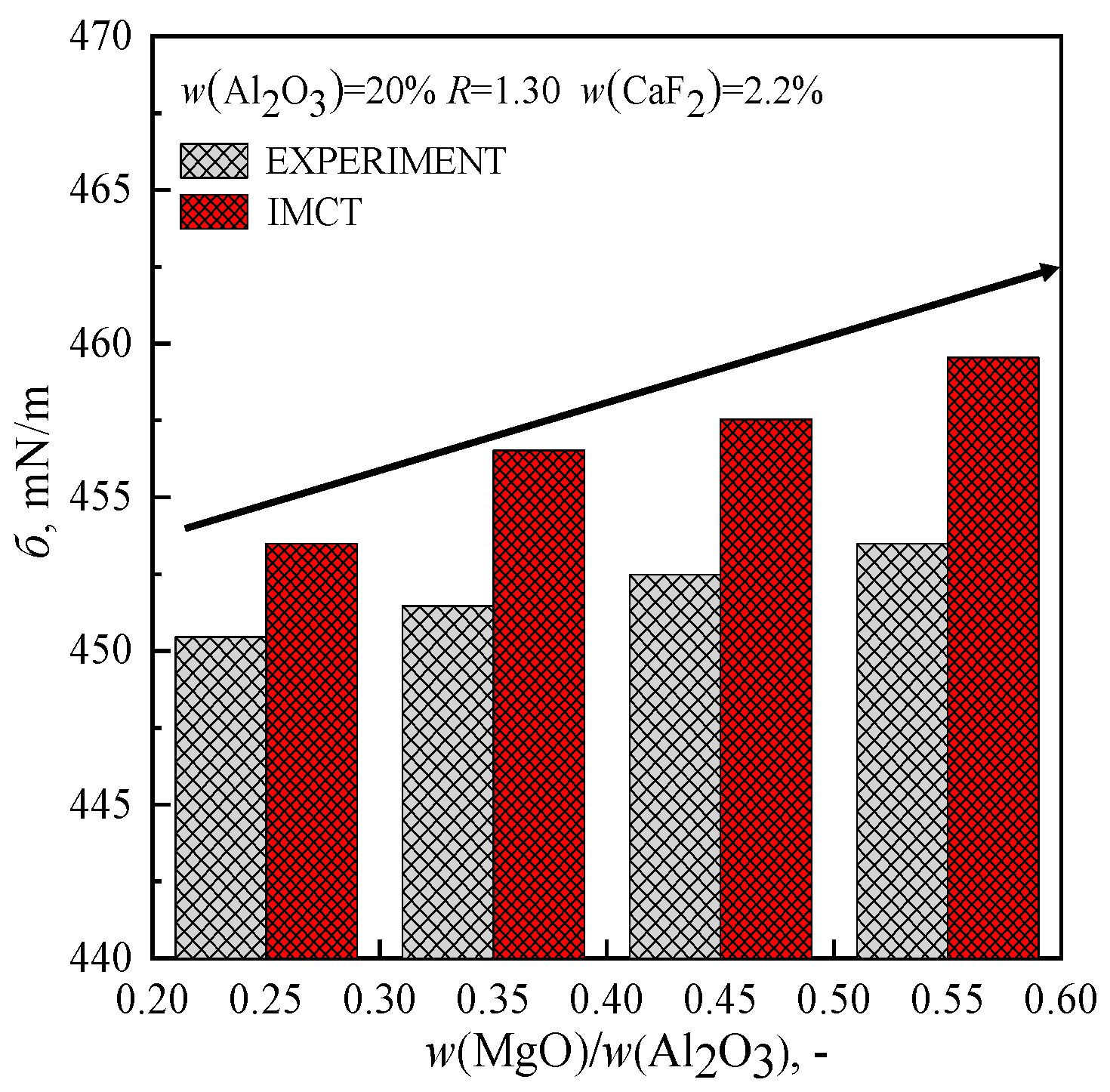
Figure 4 illustrates the effect of w(MgO)/w(Al2O3) on the surface tension of the slag at w(Al2O3) = 20% and R = 1.30. At 1773 K, when w(Al2O3) = 20% and R = 1.30, the surface tension of the slag increases as w(MgO)/w(Al2O3) rises from 0.25 to 0.55. Under these conditions, an increase in w(MgO)/w(Al2O3) leads to a gradual increase in the MgO content of the slag, which in turn results in a progressive increase in the concentration of free oxygen ions (O2−). In the slag system, specific interactions occur between free oxygen ions (O2−) and bridging oxygen (O0) in silicates, promoting the gradual depolymerization of complex Si–O–Si bonds. The depolymerization of Si–O–Si bonds directly reduces the number of complex [SiO4] tetrahedral units in the system. The [SiO4] tetrahedron is the fundamental structural unit forming the network structure of silicate slags; therefore, a decrease in its number indicates the breakdown of the slag network structure. Meanwhile, according to the principle of charge conservation, the total anionic charge in the slag system remains constant. As the number of [SiO4] tetrahedra decreases, the anion distribution changes, leading to a reduction in the average distance between charges. According to electrostatic theory, a decrease in charge spacing significantly enhances the electrostatic force within the system. Since the surface tension of slag is closely related to the system’s electrostatic force, the enhancement of electrostatic interactions ultimately results in an increase in surface tension. Therefore, at w(Al2O3) = 20% and a fixed R, the surface tension of the slag increases markedly with increasing w(MgO)/w(Al2O3).

4.4. Effect of w(Al2O3) on the Surface Tension of the Slag

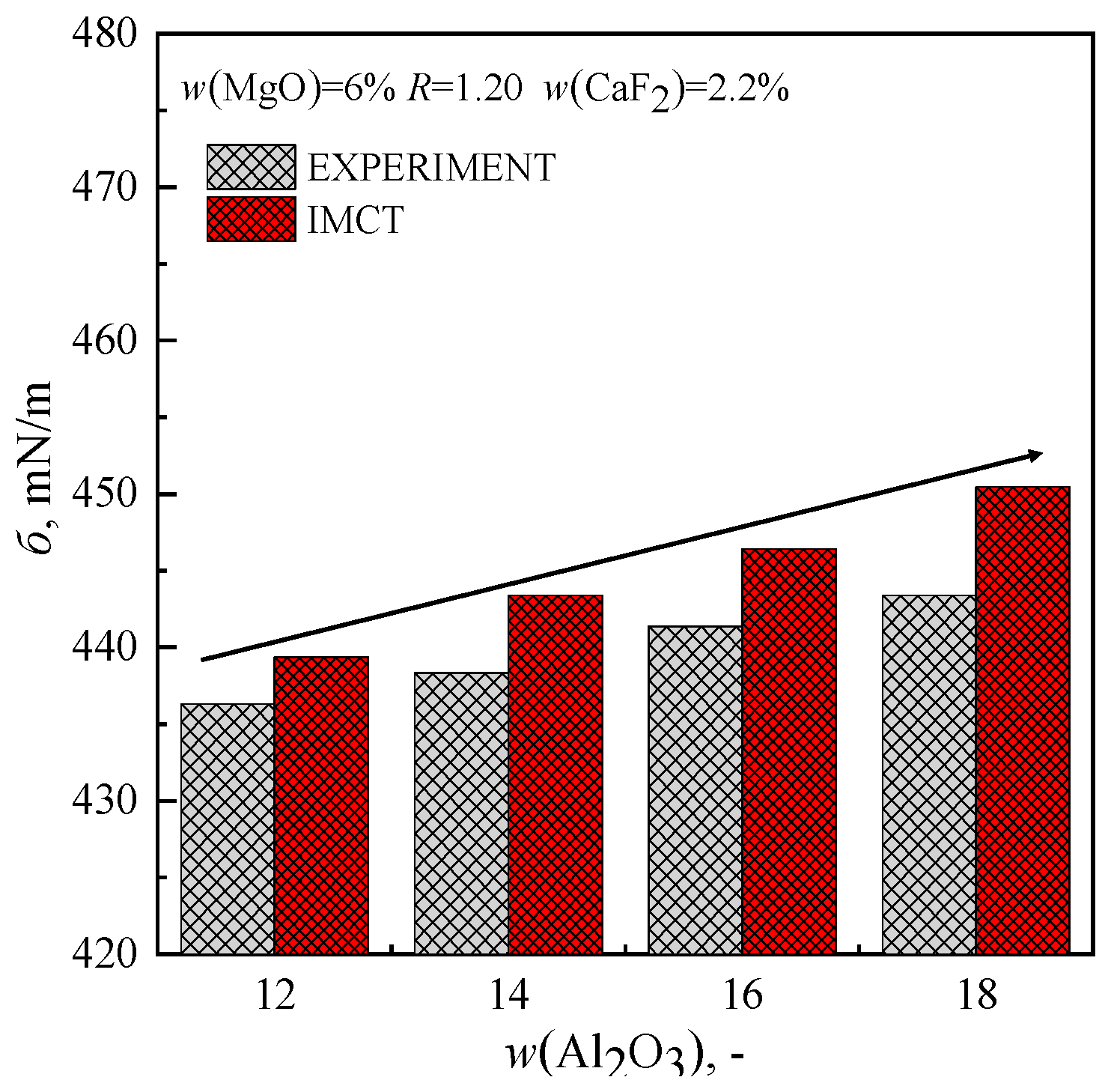
Figure 5 illustrates the effect of Al2O3 content on the surface tension of the slag at w(MgO) = 6.0 wt.% and R = 1.20. Under these conditions, the surface tension increases with increasing w(Al2O3). In silicate slag systems, silicon–oxygen complex anions are the dominant structural units. An increase in SiO2 content enhances the degree of polymerization of the slag, leading to the formation of larger polymerized anionic units. These large-radius anions exhibit weaker electrostatic interactions with metal cations. From the perspective of system energy minimization, polymerized anions with larger structural size tend to migrate toward and enrich at the melt surface, where they effectively reduce the overall surface energy. According to the principle of charge conservation, although the total anionic charge in the slag remains constant, the accumulation of large-radius anions at the surface increases the average distance between charges, thereby weakening electrostatic interactions in the surface layer. Since the surface tension of slag is closely related to the electrostatic force within the surface layer, the reduction in electrostatic interaction results in a lower surface tension. With increasing Al2O3 content, [AlO4] tetrahedra progressively replace [SiO4] tetrahedra to form new composite anionic structures. Due to the charge compensation requirement of [AlO4] tetrahedra, additional metal cations are incorporated into these anionic units, which strengthens local electrostatic interactions. The enhanced electrostatic force increases the surface tension of the slag. As a result, the overall surface tension increases with increasing w(Al2O3).

5. Conclusions

With an increase in R, w(MgO)/w(Al2O3), and w(Al2O3) content, the surface tension of the slag increases. Based on the molecular and ion coexistence theory and the activity prediction model of the CaO-SiO2-MgO-Al2O3-CaF2 slag system, combined with the Butler formula, the surface tension prediction model of the CaO-SiO2-MgO-Al2O3-CaF2 slag system can be applied to calculate the surface tension of the slag.

Author Contributions

Conceptualization, Y.G. and Z.D.; methodology, Y.G. and Z.D.; software, M.L.; writing—original draft preparation, Z.D.; writing—review and editing, Z.D. and Y.G.; visualization, M.L.; supervision, Y.G. All authors replied to reviewers’ comments and revised the final version. All authors have read and agreed to the published version of the manuscript.

Funding

This study was funded by the Scientific Research Program funded by the Natural Science Basic Research Program of Shaanxi Provincial Science and Technology Department (Program No.2025JC-YBQN-774); Shaanxi Provincial Department of Education Research Project (Program No.24JK0506); and Xi’an Natural Science Foundation Project (Program No.2025JH-ZRKX-0497). This research was financially supported by the Xi’an Aeronautical Polytechnic Institute (22XHZK-05 and 115020121/76/2023XHQDJ02;11525378/80/23XHZK-22).

Data Availability Statement

This article has no associated data generated.

Acknowledgments

The authors wish to acknowledge the contributions of associates and colleagues in Northeastern University of China and Xi’an Aeronautical Polytechnic Institute.

Conflicts of Interest

The authors declare no conflicts of interest.

References

  1. Hanao, M.; Tanaka, T.; Kawamoto, M. Evaluation of Surface Tension of Molten Slag in Multi-component Systems. ISIJ Int. 2007, 47, 935–939. [Google Scholar] [CrossRef]
  2. Shankar, A.; Rnerup, G.; Lahiri, A.K. Experimental investigation of the viscosities in CaO-SiO2-MgO-Al2O3 and CaO-SiO2-MgO-Al2O3 slags. Metall. Mater. Trans. B 2007, 38, 911–915. [Google Scholar] [CrossRef]
  3. Bellman, R.; Pennington, R.H. Effects of surface tension and viscosity on Taylor instability. Q. Appl. Math. 1953, 12, 151–162. [Google Scholar] [CrossRef]
  4. Mukai, K.; Ishikawa, T. Surface tension measurements on liquid slags in CaO-SiO2, CaO-Al2O3 and CaO-Al2O3-SiO2 system by a pendant drop method. J. Jpn. Inst. Met. 1981, 45, 147–154. [Google Scholar] [CrossRef]
  5. Sukenaga, S.; Higo, T.; Shibata, H. Effect of CaO/SiO2 ratio on surface tension of CaO-SiO2-Al2O3-MgO melts. ISIJ Int. 2015, 55, 1299–1304. [Google Scholar] [CrossRef]
  6. Vadász, P.; Havlík, M.; Daněk, V. Density and surface tension of the systems CaO-FeO-Fe2O3-MgO, CaO-FeO- Fe2O3-ZnO and CaO-Fe2O3-Cu2O. Cent. Eur. J. Chem. 2006, 4, 174–193. [Google Scholar] [CrossRef][Green Version]
  7. Dong, Y.W.; Jiang, Z.H.; Cao, Y.L. Effect of MgO and SiO2, on surface tension of fluoride containing slag. J. Cent. South Univ. 2014, 21, 4104–4108. [Google Scholar] [CrossRef]
  8. Yang, M.; Jiao, J.S.; Ding, R.C. A thermodynamic model for calculating sulphur distribution ratio between CaO-SiO2-Al2O3-MgO ironmaking slags and carbon saturated hot metal based on the ion and molecule coexistence theory. ISIJ Int. 2009, 49, 1828–1837. [Google Scholar] [CrossRef]
  9. Shi, C.B.; Yang, X.M.; Jiao, J.S. A sulphide capacity prediction model of CaO-SiO2-Al2O3-MgO ironmaking slags based on the ion and molecule coexistence theory. ISIJ Int. 2010, 50, 1362–1372. [Google Scholar] [CrossRef]
  10. Zhang, J. Computational Thermodynamics of Metallurgical Melts and Solutions; Metallurgical Industry Press: Beijing, China, 2007; pp. 245+19–20. [Google Scholar]
  11. Allibert, M.; Gaye, H. Slag Atlas, 2nd ed.; Verlag Stahleisen GmbH: Düsseldorf, Germany, 1995; pp. 28–134. [Google Scholar]
  12. Wu, C.C.; Chen, G.G.; Ma, Q.Q. Surface tension calculation model of CaF2-CaO-Al2O3-MgO-SiO2 slag system. Shanghai Metal. 2014, 3, 33–41. [Google Scholar]
  13. Boni, R.E.; Derge, G. Surface tensions of silicates. JOM 1956, 1, 53–59. [Google Scholar] [CrossRef]
  14. Mills, K. The estimation of slag properties. South. Afr. Pyrometall. 2011, 7, 35–42. [Google Scholar]
  15. Nakamoto, M.; Kiyose, A.; Tanaka, T. Evaluation of the surface tension of ternary silicate melts containing Al2O3, CaO, FeO, MgO or MnO. ISIJ Int. 2007, 47, 38–43. [Google Scholar] [CrossRef]
  16. Choi, J.; Lee, H. Thermodynamic evaluation of the surface tension of molten CaO-SiO2-Al2O3 ternary slag. ISIJ Int. 2002, 42, 221–228. [Google Scholar] [CrossRef]
  17. Tanaka, T.; Kitamura, T. Evaluation of surface tension of molten ionic mixture. ISIJ Int. 2006, 3, 400–406. [Google Scholar] [CrossRef]
  18. Kaptay, G. Improved derivation of the Butler equations for surface tension of solutions. Langmuir 2019, 35, 10987–10992. [Google Scholar] [CrossRef] [PubMed]
  19. Korozs, J.; Kaptay, G. Derivation of the Butler equation from the requirement of the minimum Gibbs energy of a solution phase, taking into account its surface area. Colloids Surf. A 2017, 533, 296–301. [Google Scholar] [CrossRef]
  20. Staronka, A.; Piekarska, M. The structure of liquid silicic acid slags and their density and surface tension. Arch. Metall. Mater. 1978, 23, 119–125. [Google Scholar]
  21. Koshida, T.; Ogasawara, T.; Kishidaka, H. Viscosity, surface tension, and density of blast furnace slag and synthetic slags at manufacturing condition of hard granulated slag. Tetsu-to-Hagane 1981, 67, 1491–1497. [Google Scholar] [CrossRef] [PubMed][Green Version]
  22. Peng, B.; Tang, X.L.; Gou, L.Z.; Hu, Y.W.; Guo, M.; Zhang, M. Surface tension investigation and model forecasting of SiO2-Al2O3-CaO-MgO quaternary mineral wool slag. J. Univ. Sci. Technol. Beijing 2014, 36, 1335–1340. [Google Scholar]
Figure 1. Schematic of experimental apparatus: 1: torque sensor; 2: water intake; 3: heating unit of MoSi2; 4: Al2O3 tube; 5: graphite crucible; 6: gas inlet; 7: carbon monoxide; 8: water outlet; 9: 30%Rh/Pt-60%Rh; 10: 30%Rh/Pt-60%Rh; 11: computer; 12: temperature control system; 13: electronic balance; 14: slag.
Metals 16 00227 g001
Figure 2. Comparison of the surface tension for the CaO-SiO2-MgO-Al2O3-CaF2 slag system.
Metals 16 00227 g002
Figure 3. Effect of R content on the surface tension.
Metals 16 00227 g003
Figure 4. Effect of w(MgO)/w(Al2O3) content on the surface tension.
Metals 16 00227 g004
Figure 5. Effect of w(Al2O3) content on the surface tension.
Metals 16 00227 g005
Table 1. Chemical compositions of the measured slag (%).
No.w(CaO)w(SiO2)w(MgO)w(Al2O3)w(CaF2)Rw(MgO)/w(Al2O3)
1#34.7333.0710.0202.201.050.50
2#36.2731.5310.0202.201.150.50
3#37.6730.1310.0202.201.250.50
4#38.9528.8510.0202.201.350.50
5#41.1531.655.0202.201.300.25
6#40.0230.787.0202.201.300.35
7#38.8929.919.0202.201.300.45
8#37.7629.0411.0202.201.300.55
9#43.53 36.27 6.0122.201.200.50
10#42.44 35.36 6.0142.201.200.43
11#41.35 34.45 6.0162.201.200.38
12#40.25 33.55 6.0182.201.200.33
Table 2. Definitions of the parameters in the prediction model.
No.ReactionΔGθ (J/mol) [8,9,10,11] N i x i
1# C a 2 + + O 2 = CaO N 1 = N C a 2 + + N O 2 = 2 x 1 / ∑X 2 x 1 = N 1 X
2#Mg2+ + O 2 = MgO   N 2 = N Mg 2 + + N O 2 = 2 x 2 / ∑X 2 x 2 = N 2 X
3# C a 2 + + F = CaF 2   N 3 = N C a 2 + + N F = 2 x 3 / ∑X 2 x 3 = N 3 X
4#Al2O3 N 4 = x 4 / ∑X x 4 = N 4 X
5#SiO2 N 5 = x 5 / ∑X x 5 = N 5 X
6#(Ca2+ + O 2 ) + SiO2 = CaSiO3−92,500 − 2.5T N 6 = K 1 N 1 N 5 x 6 = N 6 X
7# ( M g 2 + + O 2 ) + SiO 2 = MgSiO 3 −41,100 + 6.1T N 7 = K 2 N 2 N 5 x 7 = N 7 X
8# ( C a 2 + + O 2 ) + A l 2 O 3 = CaO · A l 2 O 3 −18,000 − 18.83T N 8 = K 3 N 1 N 4 x 8 = N 8 X
9# ( M g 2 + + O 2 ) + A l 2 O 3 = MgO · A l 2 O 3 −35,600 − 2.09T N 9 = K 4 N 2 N 4 x 9 = N 9 X
10# 3 ( C a 2 + + O 2 ) + 3 A l 2 O 3 + CaF 2 = 3 CaO · 3 A l 2 O 3 · CaF 2 −44,492 − 73.15T N 10 = K 5 N 1 3 N 4 4 N 4 x 10 = N 10 X
11# 2 ( C a 2 + + O 2 ) + SiO 2 = C a 2 SiO 4 −118,800 − 11.3T N 11 = K 6 N 1 2 N 5 x 11 = N 11 X
12# 2 ( M g 2 + + O 2 ) + SiO 2 = M g 2 SiO 4 −67,200 + 4.31T N 12 = K 7 N 2 N 5 2 x 12 = N 12 X
13# 11 ( C a 2 + + O 2 ) + 6 A l 2 O 3 + CaF 2 = 11 CaO · 6 A l 2 O 3 · CaF 2 −228,760 − 155.8T N 13 = K 8 N 1 11 N 4 6 N 4 x 13 = N 13 X
14# ( C a 2 + + O 2 )   +   ( M g 2 + + O 2 ) + SiO 2 = CaO · MgO · SiO 2 −124,766.6 + 3.768T N 14 = K 9 N 1 N 2 N 5 x 14 = N 14 X
15# 3 ( C a 2 + + O 2 ) + A l 2 O 3 = 3 CaO · A l 2 O 3 −12,600 − 24.69T N 15 = K 10 N 1 3 N 4 x 15 = N 15 X
16# 12 ( C a 2 + + O 2 ) + 7 A l 2 O 3 = 12 CaO · 7 A l 2 O 3 −86,100 − 205.1T N 16 = K 11 N 1 12 N 4 7 x 16 = N 16 X
17# ( C a 2 + + O 2 ) + 2 A l 2 O 3 = CaO · 2 A l 2 O 3 −16,700 − 25.52T N 17 = K 12 N 1 N 4 2 x 17 = N 17 X
18# ( C a 2 + + O 2 ) + 6 A l 2 O 3 = CaO · 6 A l 2 O 3 −16,380 − 37.58T N 18 = K 13 N 1 N 4 6 x 18 = N 18 X
19# 3 A l 2 O 3 + 2 SiO 2 = 3 A l 2 O 3 · 2 SiO 2 −8600 − 17.41T N 19 = K 14 N 4 2 N 5 3 x 19 = N 19 X
20# 3 ( C a 2 + + O 2 ) + SiO 2 = C a 3 SiO 5 −118,800 − 6.7T N 20 = K 15 N 1 3 N 5 x 20 = N 20 X
21# ( C a 2 + + O 2 )   +   ( M g 2 + + O 2 ) + 2 SiO 2 = CaO · MgO · SiO 2 −80,387 − 51.916T N 21 = K 16 N 1 N 2 N 3 x 21 = N 21 X
22# 2 ( C a 2 + + O 2 )   +   ( M g 2 + + O 2 ) + 2 SiO 2 = 2 CaO · MgO · 2 SiO 2 −73,688 − 63.639T N 22 = K 17 N 1 2 N 2 2 N 5 2 x 22 = N 22 X
23# 3 ( C a 2 + + O 2 )   +   ( M g 2 + + O 2 ) + 2 SiO 2 = 3 CaO · MgO · 2 SiO 2 −315,469 + 24.786T N 23 = K 18 N 1 3 N 2 N 5 2 x 23 = N 23 X
24# ( C a 2 + + O 2 ) + A l 2 O 3 + 2 SiO 2 = CaO · A l 2 O 3 · 2 SiO 2 −13,816.44 − 55.266T N 24 = K 19 N 1 N 4 N 5 2 x 24 = N 24 X
25# 2 ( C a 2 + + O 2 ) + A l 2 O 3 + SiO 2 = 2 CaO · A l 2 O 3 · SiO 2 −61,964.64 − 60.29T N 25 = K 20 N 1 2 N 4 N 5 x 25 = N 25 X
N i : The mass action concentration of component i; x i : the mole numbers of component i; X : the total equilibrium mole numbers of all structural units.
Table 3. The relationship between the surface tension of the pure components and temperature.
Pure ComponentsSurface Tension (mN·m−1) Formula [14,15,16,17,18]
CaO791 − 0.0935T
CaF21604.6 − 0.72T
SiO2243.2 + 0.031T
MgO1770 − 0.636T
Al2O31024 − 0.177T
Table 4. The relationship between the molar volume of the pure components and temperature.
Pure ComponentsMolar Volume (m3·mol−1) Formula [14,15,16,17,18]
CaO20.7·[1 + 1·10−4·(T − 1773)]·10−6
CaF231.3·[1 + 1·10−4·(T − 1773)]·10−6
SiO227.561·[1 + 1·10−4·(T − 1773)]·10−6
MgO16.1·[1 + 1·10−4·(T − 1773)]·10−6
Al2O328.3·[1 + 1·10−4·(T − 1773)]·10−6
Table 5. Change in the slag composition during the experiment.
No.Slag Composition Before Experiment, %Slag Composition After Experiment, %
w(CaO)w(SiO2)w(MgO)w(Al2O3)w(CaF2)w(CaO)w(SiO2)w(MgO)w(Al2O3)w(CaF2)
1#34.7333.0710.0202.2034.5632.989.9119.662.07
2#36.2731.5310.0202.2036.0130.139.8919.692.11
3#37.6730.1310.0202.2037.0329.149.7619.692.13
4#38.9528.8510.0202.2038.7728.659.6319.862.09
Table 6. Chemical compositions of the measured slag.
No.Rw(MgO)/w(Al2O3)w(Al2O3)σtesσmod-MICTσmod-Boni and Derge
1#1.050.5020440.36446.42453.49
2#1.150.5020445.41449.45455.51
3#1.250.5020450.46454.50463.59
4#1.350.5020454.50460.56470.66
5#1.300.2520450.46453.49461.57
6#1.300.3520451.47456.52463.59
7#1.300.4520452.48457.53465.61
8#1.300.5520453.49459.55467.63
9#1.200.5012436.32439.35444.40
10#1.200.4314438.34443.39449.45
11#1.200.3816441.37446.42454.50
12#1.200.3318443.39450.46457.53
Disclaimer/Publisher’s Note: The statements, opinions and data contained in all publications are solely those of the individual author(s) and contributor(s) and not of MDPI and/or the editor(s). MDPI and/or the editor(s) disclaim responsibility for any injury to people or property resulting from any ideas, methods, instructions or products referred to in the content.