Article

Experimental Investigations of Oxidation Formation During Pulsed Laser Surface Structuring on Stainless Steel AISI 304


Manufacturing and Automation Research Laboratory, Department of Industrial & Systems Engineering, Rutgers University—New Brunswick, Piscataway, NJ 08854, USA
*
Author to whom correspondence should be addressed.
Metals 2026, 16(2), 224; https://doi.org/10.3390/met16020224
Submission received: 19 January 2026 / Revised: 13 February 2026 / Accepted: 13 February 2026 / Published: 15 February 2026
(This article belongs to the Special Issue Surface Treatments and Coating of Metallic Materials (2nd Edition))

Abstract

Laser surface texturing (LST) structures or laser-induced periodic surface structures (LIPSS) are typically created using laser pulses with durations ranging from femtoseconds to nanoseconds. However, nanosecond pulsed lasers, as cost-effective and more productive alternatives, can also be used to generate LST structures on stainless steel (SS) surfaces, making these structures more suitable for industrial applications. In this study, pulsed laser processing is employed to create LST structures on SS (AISI 304), with varying pulse and accumulated fluences, effective pulse counts, and scan parameters, such as pulse-to-pulse distance (pitch) and hatch spacing between scanning lines. A methodology for calculating oxidation density on processed AISI 304 surfaces is presented. Oxidation density, defined as the ratio of the oxidized area to the total processed area, is determined as a function of accumulated fluence, laser power, pulse-to-pulse distance, and hatch spacing. Optical images of the surfaces are analyzed, and oxidation regions are identified using machine learning techniques. The images are converted to grayscale, and machine learning algorithms are applied to classify the images into oxidation and non-oxidation regions based on pixel intensity values. This approach identifies the optimal threshold for separating the two regions by maximizing inter-class variance. Experimental modeling using response surface methodology is applied to experimentally generated data. Optimization algorithms are then employed to determine the process parameters that maximize pulsed laser irradiation performance while minimizing surface oxidation and processing time. This paper also presents a novel method for characterizing oxidation density using image segmentation and machine learning. The results provide a comprehensive understanding of the process and offer optimized models, contributing valuable insights for practical applications.

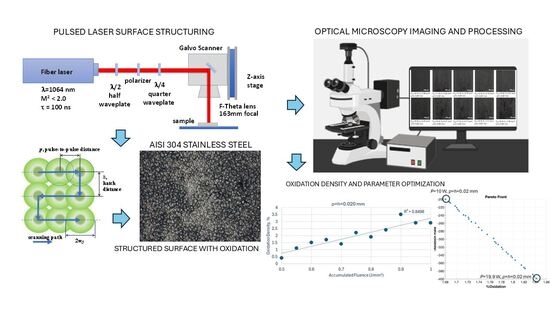
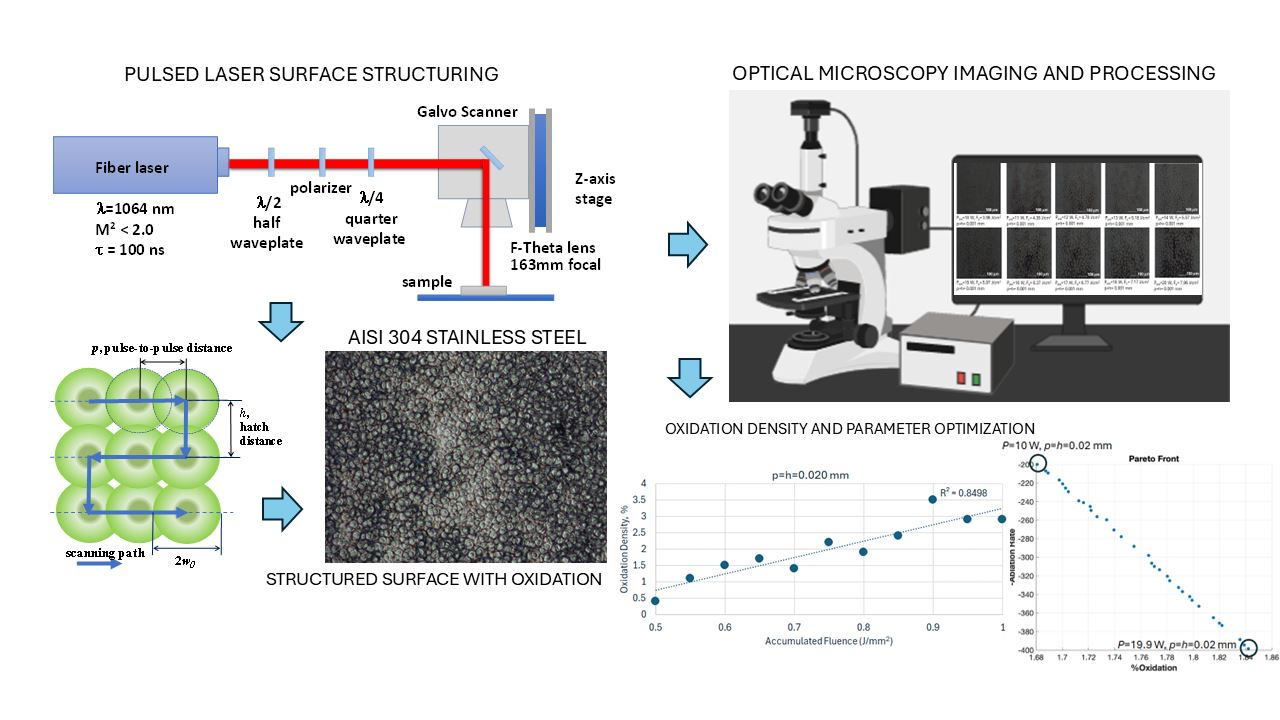
Graphical Abstract

1. Introduction

Surface functionalization can be described as adding functionality, generally determined by chemical and topographical properties, to a solid surface [1]. Customized surface structures can be achieved through pulse laser processing at micro- and nanoscales [2]. These are found to be effective on metallic surfaces in reducing friction [3], controlling wettability [4], improving tribological performance [5] and responding to microbes and bacteria [6]. Laser processing is applied on various materials, as reviewed in [7], using consecutive laser pulses with nanosecond (ns), picosecond (ps), or femtosecond (fs) duration. By using laser pulses with linearly polarized light on solids, periodic groove-like surface patterns known as LIPSS can be formed upon irradiation [8]. LIPSS are classified by the spatial period of their periodic structure as follows [8]: low-spatial frequency LIPSS (LSFL), regular ripples, high-spatial frequency LIPSS (HSFL), fine ripples, and grooves. Studies have been conducted to understand the formation mechanisms of LIPSS on metallic surfaces [9]. At very low fluences below the ablation threshold, metallic-surface oxidation is the main modification [10]. Near the ablation threshold, LIPSS are formed [8]. At very high fluences, ablation leads to the formation of small three-dimensional microstructures with high aspect ratios [11], where light polarization significantly influences energy absorption [12]. Ultrashort laser pulses can produce fine nano-scale ripples and HSFL where the lattice undergoes transient expansion upon absorption [13]. This is transient, and the lattice returns to its original state once the thermal energy dissipates [14]. Understanding lattice expansion is crucial for successful surface structuring of metallic materials. The slower lattice expansion in ns pulses leads to different LIPSS formation mechanisms compared to ultrashort pulses [15] where other mechanisms are involved, such as ablation [16], melt ejection and solidification [17], phase explosion [18], stresses and cracking [19], self-organization and nanostructuring [20], and surface chemical changes [21], albeit depending on the material being processed [22]. When a high intensity ns laser pulse interacts with a material, it can vaporize or melt the surface [23] and cause surface removal through ablation [24], resulting in pits, craters, or trenches [16]. In metals, intense ns laser pulses induce rapid surface heating and melting. Upon cooling, the molten material resolidifies into periodic patterns, such as ripples, grooves, or nanostructures, depending on the cooling rate and material properties [25]. At very high fluences, ns lasers induce phase explosion [18], rapidly vaporizing material directly to plasma [23] and generating shock waves that eject material and form surface microstructures [26]. Rapid heating–cooling cycles induce thermal stress, causing cracking or stress relief patterns in brittle materials [19]. Ns pulses can also create self-organized nanostructure arrays via interference or phase separation [2]. Additionally, ns lasers induce chemical modifications, such as oxidation, nitridation, or carbonization based on ambient conditions, with metallic surfaces in air exhibiting oxidation and coloring [27]. The ripples typically develop on stainless steel surfaces between melting and ablation thresholds [28]. The single-pulse ablation threshold (Fth) for SS depends on wavelength and pulse duration. For ps lasers (τ = 1–10 ps, λ = 1030 nm or 515 nm), Fth ranges from 0.15 to 0.25 J/cm2 [29], while for ns lasers (τ = 5–100 ns, λ = 1064 nm), Fth is around 2 J/cm2 [30]. For austenitic SS AISI 304 specifically, the threshold becomes Fth = 0.27 ± 0.02 J/cm2 (τ = 525 fs, λ = 1056 nm) [29], Fth = 0.29 J/cm2 (τ = 300 fs, λ = 1030 nm) [31], and Fth = 0.33 J/cm2 (τ = 6.7 ps, λ = 1030 nm) [32]. Two recent studies explored LIPSS formation on stainless steel using different characterization approaches. Simões et al. [33] used an ns laser (λ = 532 nm, τ = 100 ns, f = 5 kHz, 2w0 = 0.6 mm) on AISI 304 with 50–98% spot overlap and 1–8 passes over surfaces with varying roughness (Sa = 5–56 nm). They showed that uniform LIPSS required favorable initial roughness and pulse-to-pulse overlap, and they developed a white-light diffraction technique to measure blue light intensity (IBL), correlating it with pulse fluence (Fp) and scan number (N). Karkantonis et al. [34] used a Yb-fiber laser (λ = 515 nm, τ = 1.5 ns, f = 1000 kHz, 2w0 = 0.04 mm) on AISI 316, varying scan speeds (300–2000 mm/s), pulse spacing (p = 0.001–0.003 mm), and effective pulses (Neff). Using SEM, optical microscopy, and diffracted light intensity (IDL), they classified results as no LIPSS, low quality (IDL < 160), good quality (IDL > 160), or oxidized surfaces, supplemented by AFM and XPS analysis. All these studies are summarized in Table 1.
Studies on laser-induced surface texturing of stainless steel demonstrate that laser parameters, initial surface conditions, and post-processing effects critically influence surface morphology and functional performance. Dong et al. [37] showed that nanosecond pulsed laser ablation can effectively tailor surface roughness and wettability of stainless steel through controlled micro/nanostructure formation. Similarly, Al-Mahdy et al. [38] reported that the initial surface roughness of 316L stainless steel strongly affects texture uniformity and feature development during nanosecond laser processing. Femtosecond LIPSS were investigated by Lubig et al. [39], who demonstrated that surface chemistry and wettability evolve over time due to aging effects, influencing long-term stability. Engoor et al. [40] further revealed that laser polarization-controlled structuring of 316L stainless steel enhances biocompatibility and antibacterial properties by modifying surface topography and surface energy. Collectively, these studies highlight the importance of laser–material interactions and surface evolution in designing functional stainless steel surfaces for industrial and biomedical applications.
Despite extensive research, LST faces significant barriers to industrial adoption. The process lacks sufficient controllability and predictability, and lengthy processing times reduce throughput and increase costs, making it unsuitable for rapid manufacturing environments. This paper aims to investigate the effects of laser irradiation on surface modification and to improve laser surface texturing efficiency in terms of energy utilization and structural quality. By analyzing and controlling key process parameters, the study seeks to optimize surface characteristics, uniformity, and functional properties, including oxidation-related chemical changes. The laser-processed AISI 304 stainless steel surfaces investigated in this study are particularly relevant for applications requiring tailored functional properties, including enhanced tribological performance, controlled optical response, improved wettability, and increased surface durability.
In LST, oxidation results from thermal laser-material interaction. Energy absorption causes localized melting and vaporization, forming oxide layers. Oxidation extent depends on laser fluence, pulse overlap, and scan number, with higher values increasing oxidation that can aid or hinder LIPSS formation. Simões et al. [33] found that optimal initial roughness (~49 nm) and balanced fluence (3–4 J/cm2) with appropriate overlap (~83%) control oxidation, improving LIPSS uniformity, while excessive fluence causes uncontrolled oxidation without periodic structures. However, Simões et al. [33] assessed oxidation qualitatively through roughness, visual inspection, and light diffraction rather than quantitative chemical analysis. Li et al. [10] used OM, SEM, and TOF-SIMS for oxide depth measurement. Amara et al. [36] combined qualitative methods (OM and SEM) with quantitative techniques (EDS for oxygen content and XRD for oxide phases) on AISI 316. Karkantonis et al. [34] used OM, blue light diffraction, and SEM qualitatively, plus XPS for oxygen-to-metal ratios (O/Fe, O/Cr) quantitatively and employed ImageJ to process diffraction images and quantify oxidation effects. The OM method offers a low-cost oxidation assessment method, especially when combined with open-source machine learning for quantifying oxidation density relative to LST parameters. These studies show that oxidation affects light absorption and threshold energy for subsequent interactions. While moderate oxide layers enhance absorption and facilitate LIPSS, excessive oxidation distorts periodicity and reduces effectiveness. Understanding oxidation parameter relationships is essential for optimization. Careful tuning of fluence, scan speed, and pulse overlap controls oxidation, improving surface texturing and SS functional properties. Predictive models provide controllable methods for enhancing high-throughput manufacturing. Although ultrashort pulsed lasers minimize HAZ and offer high precision, their low average power results in lengthy processing times unsuitable for industry. Implementing predictive models may enable industrial LST/LIPSS transfer. This study investigated LST formation using ns pulsed lasers across various parameters. Surface structures were characterized and classified using image algorithms based on defect density and oxidation levels. Predictive models were developed via second-order regression, and multi-objective optimization identified conditions balancing processing time and structure quality.

2. Materials and Methods

2.1. Experimental Work

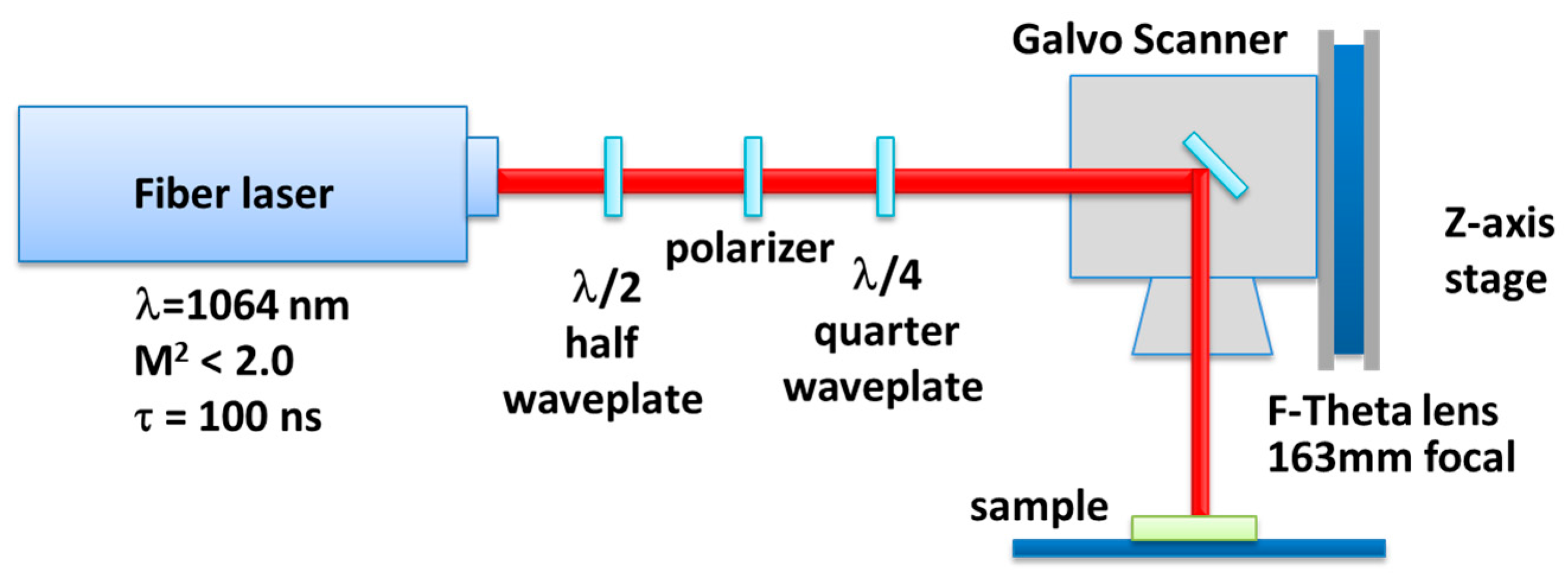
In this study, an ytterbium ns pulsed fiber laser (IPG Photonics type YLP-V2-1-100-50-50, Marlborough, MA, USA) with a wavelength of λ = 1064 nm, a beam quality of M2 < 2, a pulse duration of τ = 100 ns and a nominal PRR of f = 50 kHZ, and a pulse energy of up to 1 mJ was used. A galvo scanner (IPG Photonics, Marlborough, MA, USA) with a f-theta focal lens provided a focused laser spot size on the target surface that was around 0.040 mm in diameter, as illustrated in Figure 1. The working distance between the focusing lens and the target was adjusted to be 190 mm. In all experiments, constant beam waist radii (measured at 1/e2 intensity level) of w0 = 0.020 ± 0.005 mm were targeted. Laser parameters are given in Table 2.
SS AISI 304 plates, as obtained from McMaster-Carr Inc. (Elmhurst, Illinois, IL, USA), that have 0.762 mm thickness and surfaces polished with an arithmetic mean surface roughness of Ra = 0.1 µm were utilized in the experiments. Austenitic SS AISI 304 has a standardized chemical composition and follows ASTM A240 [41] specifications of 72 wt.% Fe, 18 wt.% Cr, 8–10.5 wt.% Ni, ≤0.08 wt.% C, ≤2.0 wt.% Mn, ≤1.0 wt.% Si, ≤0.045 wt.% P, and ≤0.030 wt.% S [6,10]. The surface structure of laser treated SS was determined by OM.
The pulse fluence was determined by the following equation as functions of half the spot size ( w 0 ), pulse repetition rate ( f ), and average laser power ( P ):
F p   =   P π w 0 2 f
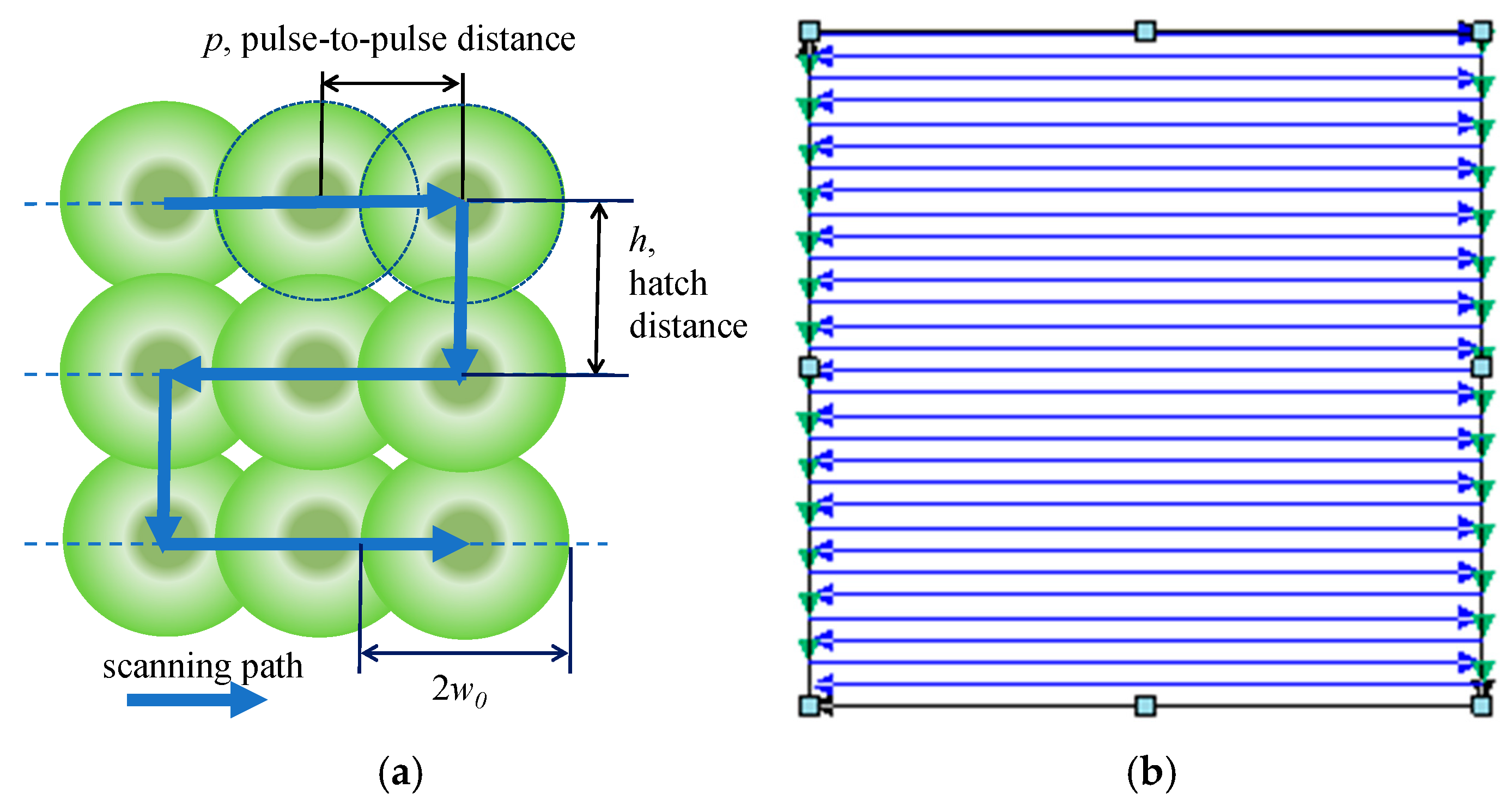
A scanning strategy following a bi-directional scanning path with predefined pulse-to-pulse distance and hatch distance, as shown in Figure 2, was employed. Therefore, the accumulated fluence during the scanning of one line was determined by the following expression as functions of the hatch distance between consecutive laser scanning lines ( h ), pulse-to-pulse or pitch distance ( p   =   v / f ), pulse repetition rate ( f ), and average laser power ( P ):
F a c c   =   N e f f F p   =   π w 0 2 p h P π w 0 2 f   =   P p h f
Furthermore, pulse-to-pulse percentage spot overlapping, the degree of overlap between successive laser pulses during a laser processing operation, can be defined as:
ϕ = 100 1 v 2 w 0 f   =   100 1 p 2 w 0
In this experimental study, the effects of basic process parameters, such as laser fluence, pulse overlapping (through pulse-to-pulse distance) and hatch distance i.e., the distance between parallel tracks and number of successive scans on the surface morphology, surface finish, and the efficacy of pulsed laser generated surface structures, were investigated.

2.2. Image Segmentation

In previous studies, it has been shown that ns pulsed laser processing of AISI 304 surface induces oxidation on the processed area, which has been shown experimentally via the Fe2O3 peaks on the EDS spectra demonstrated by Amara et al. [36]. In this section, the methodology to calculate the level of oxidation density on the processed AISI 304 surfaces is described. The oxidation density as a percentage of the ratio between the area of surface oxidation and the total processed area was obtained as a function of accumulated fluence by increasing the laser power at various pulse-to-pulse distance (p) and hatch distance (h) values. Optical images were analyzed, and regions of oxidation were observed. For image segmentation, optical images were converted to grayscale, and Otsu’s method [42] was applied for automatic thresholding to separate oxidation and no-oxidation regions based on pixel intensity. Otsu’s method uses the grayscale histogram to find the threshold value that maximizes inter-class variance through the following steps:
Step 1: Computing the histogram: The grayscale histogram H i of an image I with an intensity level of i is defined in Equation (4)
H i = x = 1 M y = 1 N I x , y = i
where M and N represent the width and height of the image, respectively, and I x , y   =   i is a function that returns one (1) if the pixel at position (x, y) has an intensity value of i, and zero (0) otherwise.
Step 2: Computing the cumulative distribution function (CDF): The CDF represents the probability that a pixel has intensity less or equal to a particular level, computed by summing histogram values as in Equation (5):
C i   =   j   =   0 i H ( j ) M × N
Step 3: Computing the mean intensity: The mean grayscale intensity μ averages all pixel values and is used to compute between-class variance, as in Equation (6):
μ   =   1 M × N x   =   1 M y   =   1 N I x , y
Step 4: Computing between-class variance: This measures separation between regions for threshold value T, as given in Equation (7), where P0 and P1 are probabilities of no-oxidation and oxidation regions with mean intensities m 0 T and m 1 T as formulated in Equation (8) and as can be computed with Equations (9) and (10):
v a r T   =   P 0 ( T ) · P 1 ( T ) · m 0 T m 1 ( T ) 2
P 0 T = C T   and   P 1 T = 1 C T
m 0 T = i = 0 T 1 i · H ( i ) P 0 ( T ) · M N
m 1 T = i = T 255 i · H ( i ) P 1 ( T ) · M N
Step 5: Finding optimal threshold: The optimal threshold value, T o p t , maximizes between-class variance as given in Equation (11):
T o p t   =   a r g m a x T v a r ( T )
This method was utilized in determining oxidation density in this study and can also detect defects or anomalies in manufactured surface images.

2.3. Modeling and Optimization

In this section, the experimental modeling method is described. The experimentally generated data are used in obtaining second-order regression models. The general form of the second-order model can be given as
y = β 0 + i = 1 k β i x i + i < j = 2 k β i j x i x j + i = 1 k β i i x i 2 + ϵ
where y is the output variable, β i ’s are the estimated parameters in the response, xi’s are the process variables, and the last term ( ϵ ) is the residual error. The experimental models obtained are implemented in a multi-objective genetics algorithm (MOGA) to conduct optimization studies between different competing objectives [43].
In the experiments, three levels of pulse-to-pulse overlap distance (p) and hatch distance (h) values and 10 different levels of laser power (P) were considered, resulting in a total of 40 observations. In this model, y is the output variable, such as oxidation density in a percentage, β i ’s are the estimated parameters in the response, and xi’s are the process variables, such as accumulated fluence (as a combination of laser power, pulse-to-pulse distance and hatch distance values, and pulse repetition).

3. Results

3.1. Analysis of Experimental Results

Several sets of experiments were performed. The initial experiments were restricted to an area of 0.5 × 0.5 mm2 on the AISI 304 surface to assess the formation of laser-induced surface textures by varying average laser power as Pave = 5, 8, 10, 15, 20 W and at pulse-to-pulse overlap distances (p) and hatch distances (h) of 0.001 mm, 0.010 mm, and 0.100 mm. In addition, a wide range of laser power was considered for understanding the transitions of regimes on the surface of the processed material. The surface morphology investigations revealed that the increased pulse-to-pulse overlap distance and hatch distance provided a low fluence processing with ineffective surface structures. As expected, the values of pulse-to-pulse distance and distance between scanning lines that were greater than spot size did not produce effective surface processing and structuring. It was understood that these values should be kept low, lower than spot size. In addition, some mild coloration due to the oxidation was observed at pulse fluence levels higher than F p = 4 J/cm2 and an accumulated fluence level greater than F a c c = 0.01 J/cm2.
The generation of oxides and their amounts during laser irradiation can make significant contributions to the properties and characteristics of the treated surface. Certain oxides formed during laser irradiation can act as protective layers against corrosion. Oxide formation can influence the surface topography and roughness characteristics of generated surface surfaces. The presence of oxides can contribute to the formation of micro- and nanostructures during laser ablation or melting processes, affecting surface texture and functionality. The amount and nature of oxides generated during laser irradiation can be controlled by adjusting laser parameters, such as fluence, pulse duration, scanning speed, and atmosphere. This control allows for fine-tuning of surface properties and ensures consistent quality across laser irradiated and treated surfaces.
It should be noted that ns pulsed laser processing can induce thermal effects on metallic surfaces. However, as previous studies have indicated [44], the fluence levels used in this study were below the threshold for thermal cracking or excessive recast formation, and may instead induce phase changes that can alter mechanical properties, such as hardness and yield strength.

3.2. Effects of Pulse Fluence and Number of Scans

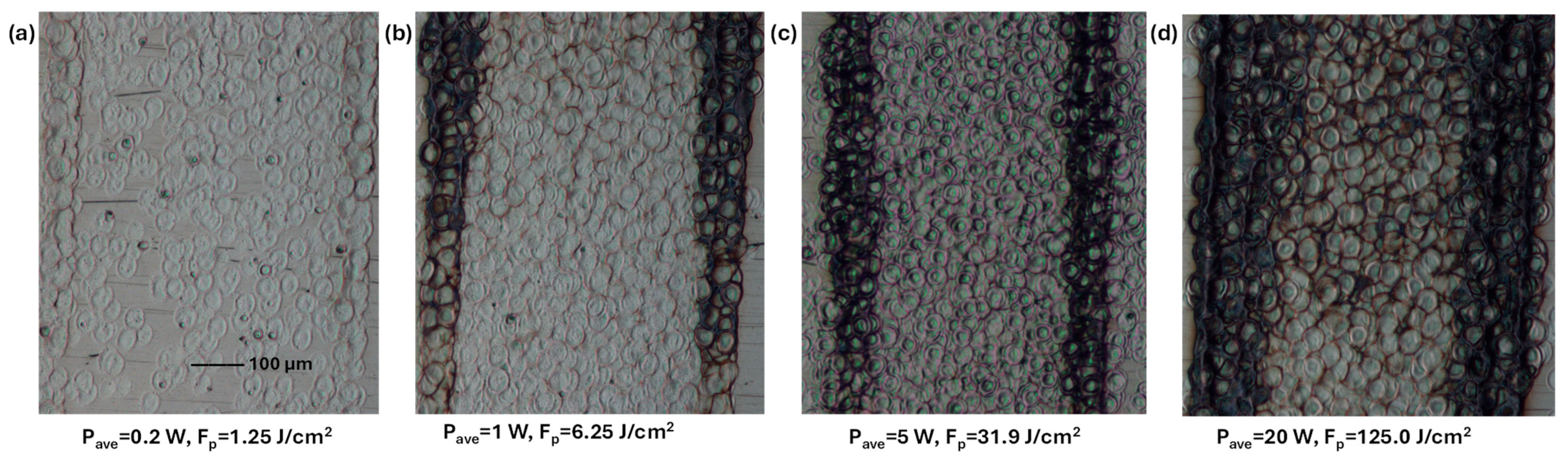
The effect of pulse fluence and number of scans were investigated by using the experimental design in Table 3, whereby the number of scans was set to N = 100 and the scanning velocity was v = 200 mm/s. The pulse-to-pulse distance, the pitch distance, (p) and the distance between scanning lines, the hatch distance, (h) were kept the same and constant as p = h = 0.040 mm. The effect of varying laser power at N = 100 scans is shown in Figure 3. It was observed that increasing laser power with N = 100 scans is effective for obtaining laser surface structures; however, excessive processing leads to surface oxidation and carburization, as seen in Figure 3b–d and more clearly in Figure 3d. This is typical especially in materials prone to oxidation reactions under elevated temperatures and in the presence of oxygen or other oxidizing atmospheres. It was also clear that a pulse fluence around Fp = 6.25 J/cm2 should be further investigated. The darker regions at the sample edges result from accelerations and decelerations of the scan head during directional changes. The scanner must decelerate to zero velocity to make right-angle turns at the end of each scan line, causing the actual pulse pitch and hatch distances to deviate from the programmed values in these regions. This creates higher pulse overlap and accumulated fluence at the edges compared to the central scanning area.
On the other hand, the oxidation mechanism in fs pulsed laser processing is associated with very low energy density regimes and typically involves interactions between the laser beam, the material surface, and atmospheric oxygen [45]. The heating effect on the material surface may not be intense enough to cause immediate vaporization or melting. Instead, the material’s surface temperature rises moderately, leading to thermal oxidation.
Balancing the need for effective laser processing with the potential risks of surface oxidation and carburization requires careful consideration of processing parameters and environmental conditions. Carburization can happen under conditions of high temperature and prolonged exposure to the laser beam. Carburization alters the material’s surface chemistry, leading to changes in hardness, wear resistance, and other mechanical properties.

3.3. Effects of Pulse Fluence and Accumulated Fluence

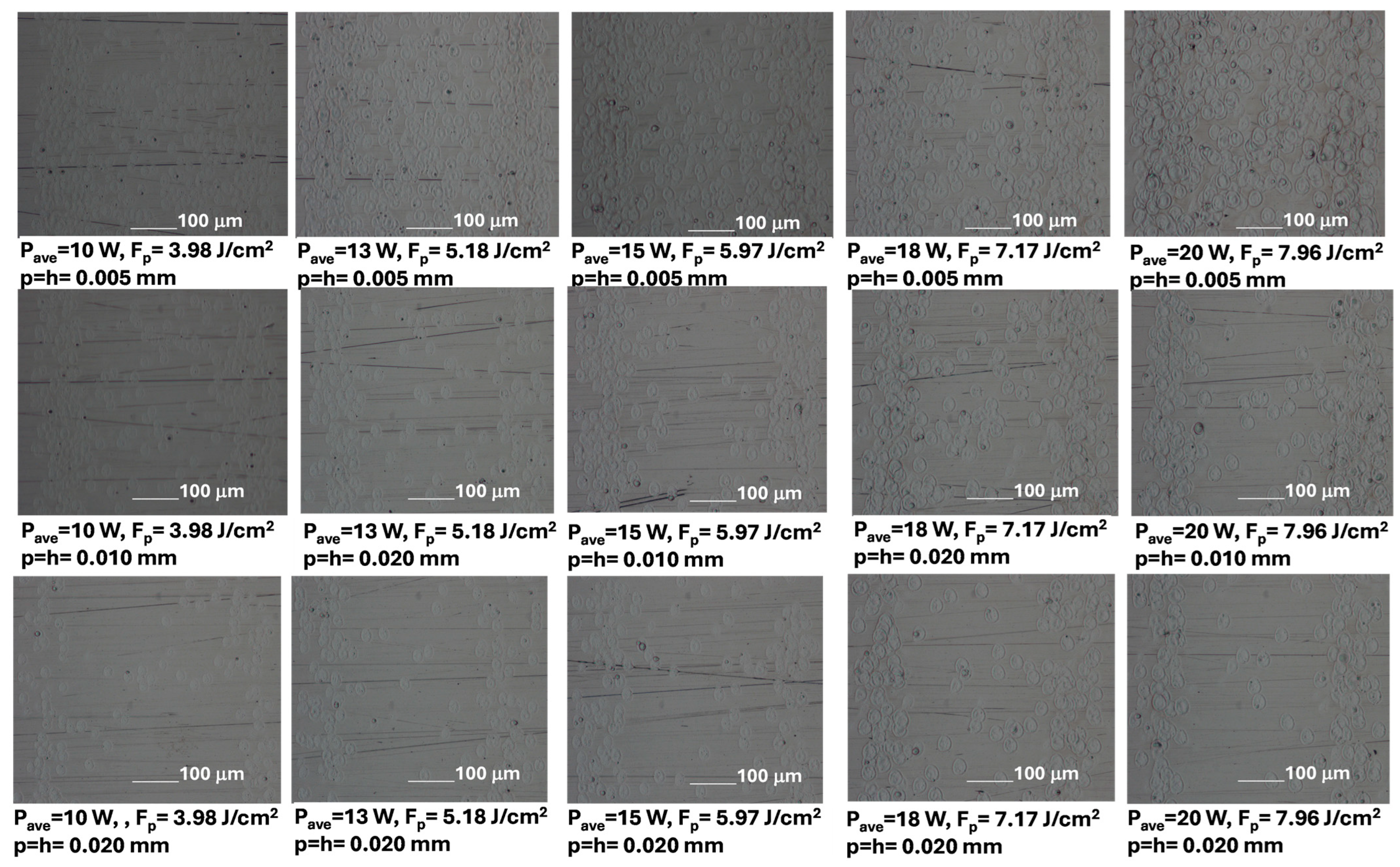
The effects of pulse fluence, and the pitch and the hatch distances on the surface morphology were investigated with an experimental design, as shown in Table 4. In this experiment, an area of 0.3 × 0.3 mm2 was scanned with a bi-directional scan path in each condition. Each scan area with a different hatch/pitch combination was replicated once for the sake of repeatability. A constant PRR was used as f = 50,000 1/s. Pulse fluence was varied between F p   =   3.981 J/cm2 and 7.962 J/cm2 at all levels of pitch and hatch distances of 0.001, 0.005, 0.01, and 0.02 mm, resulting in accumulated fluence ranges of F a c c   =   2.0 J/cm2 and 4.00 J/cm2, F a c c   =   0.08 J/cm2 and 0.16 J/cm2, and F a c c   =   20 mJ/cm2 and 40 mJ/cm2, respectively. Resultant surface structures are shown in Figure 4.
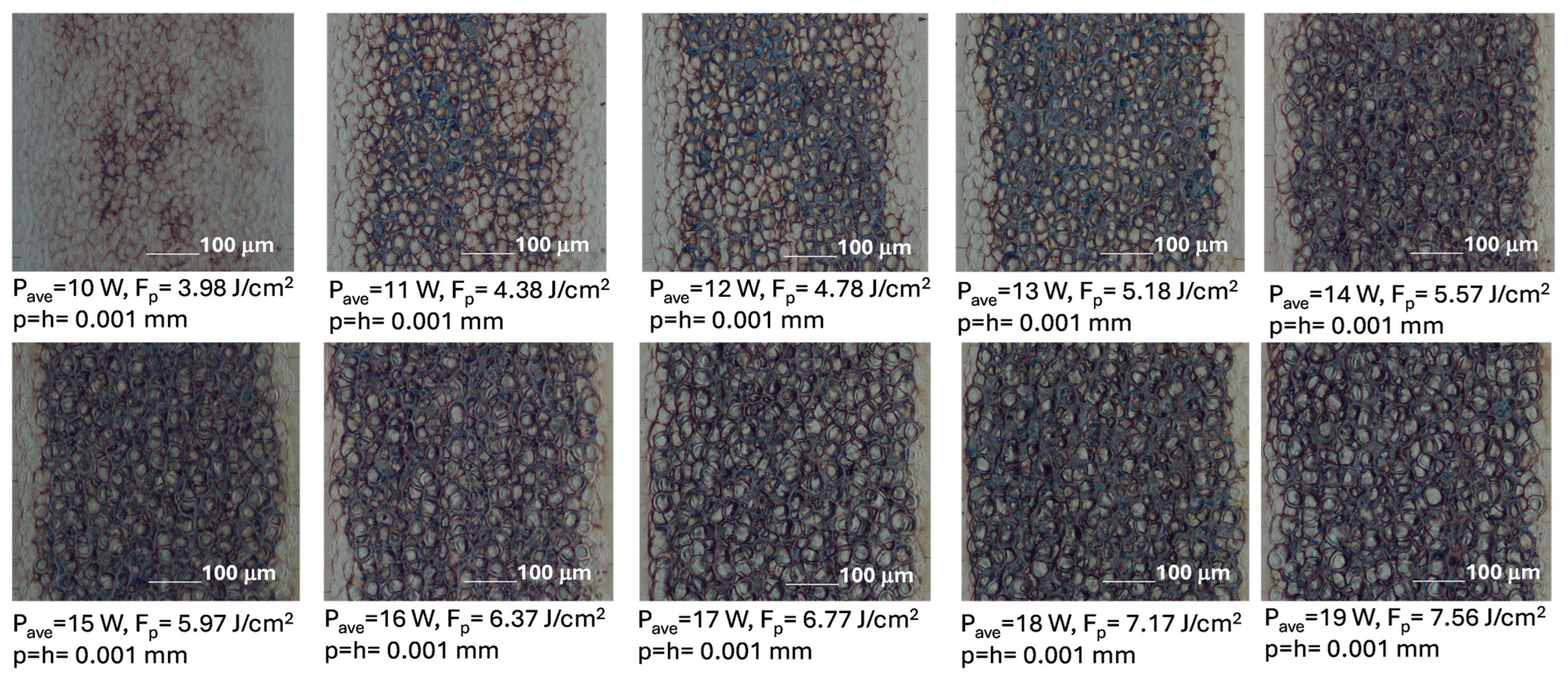
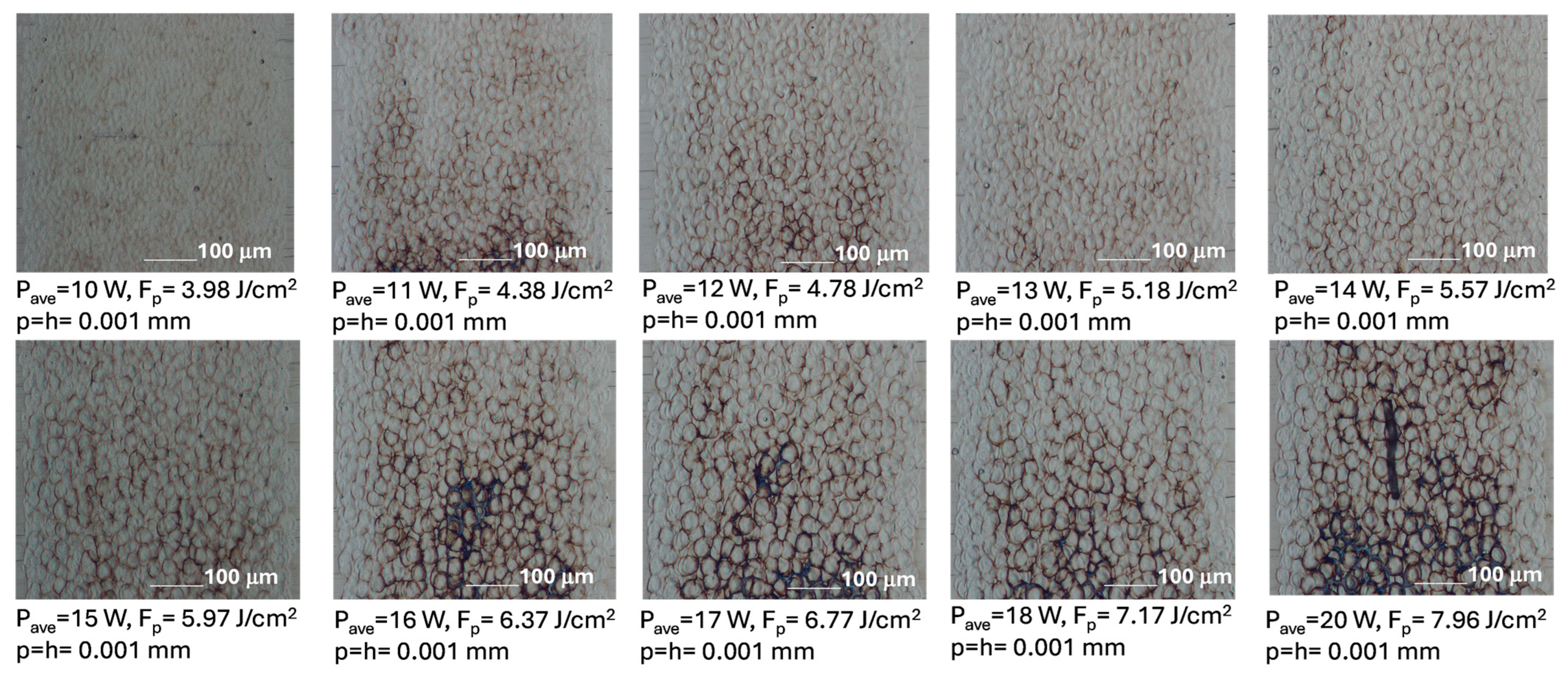
The resultant surfaces processed were investigated with OM. Surfaces of SS AISI 304 samples were fully processed with laser irradiation due to low pitch and hatch distances of 0.001 mm, as shown in Figure 5 for heavy oxidation and Figure 6 for mild oxidation. The results show that surfaces exhibit oxidation, with darker regions at the boundaries resulting from enhanced oxidation due to deceleration and acceleration.
It should be noted that in laser surface structuring processes, surface wettability or contact angle—the measure of a liquid’s ability to spread on a surface—is influenced by both surface geometry and surface chemistry [46]. While surface geometry refers to the physical structure and topography created by laser irradiation (such as microstructures, nanostructures, or roughness patterns), surface chemistry pertains to the composition and chemical state of the surface, including the presence of oxides, functional groups, or contaminants [47].

3.4. Optimization Results for Surface Oxidation Density and Ablation Rate Process Models

The experimental investigation presented in the previous section was utilized by following the experimental design given in Table 4 with two factors representing crucial process parameters, i.e., laser pulse fluence (Fp) and pulse-to-pulse and hatch distance values (p and h) kept as equal values to each other.
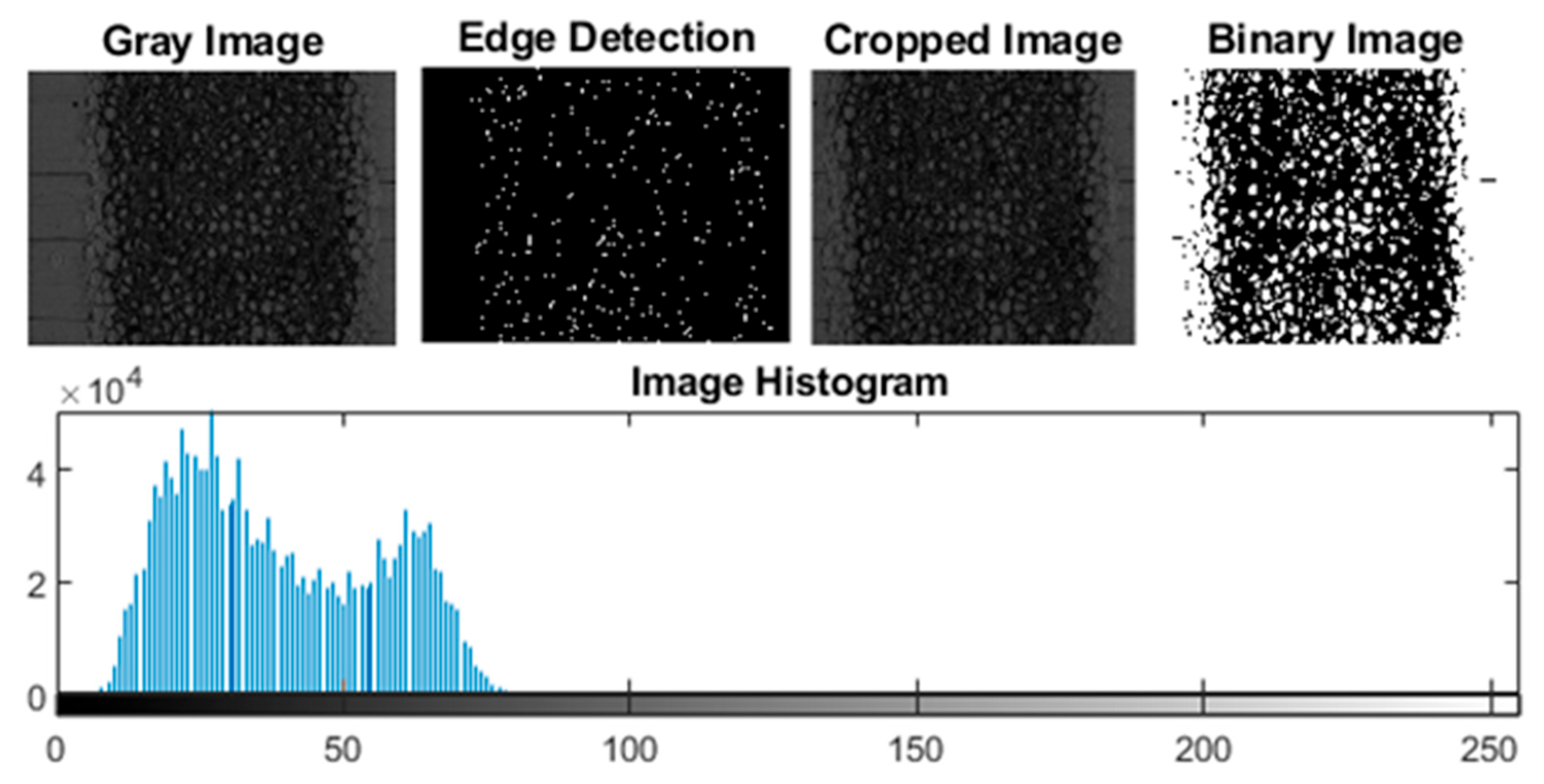
The images were converted to grayscale images first, then the Canny edge detection method was used to crop the images for removing areas outside of the laser processed sections by using both a MATLAB (R2024b) script with the “otsuthresh” function and a Phyton (v3.10) script with the “Open CV” library. The bounding boxes of the detected edges were identified to complete the cropping of the images using the bounding boxes. Lastly, images were binarized by using the computed Otsu’s threshold value. An example of these processing steps is given in Figure 7, where the grayscale image, the image after edge detection, the cropped image, and the binarized image along with its image histogram that was used by Otsu’s method are shown.
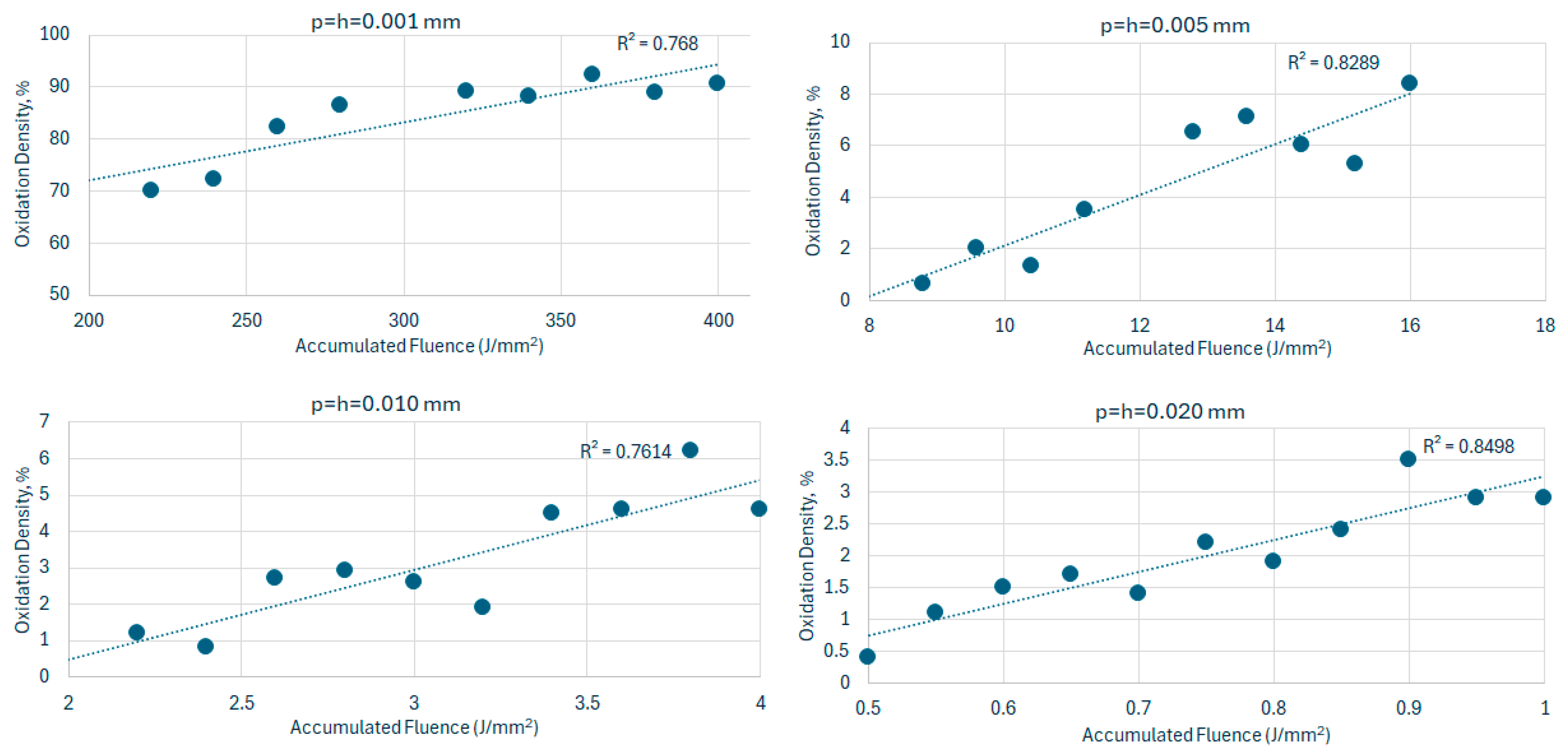
Computed oxidation densities are given in Figure 8. It should be noted that the oxidation density is positively correlated with accumulated fluence, so that if the user desires to keep the surface oxidation at a particular limit, the accumulated fluence as a function of the laser processing parameters can be adjusted accordingly. Using these computed oxidation densities, the regression equation in Equation (12) was solved with a MATLAB script, and the second-order response models as well as response surfaces were obtained by using this regression method. The quadratic experimental model (R2 = 0.859, adjusted R2 = 0.851, RMS = 13.5, p-value = 4.96 × 10¹⁶) for oxidation density (Od) in accordance with Facc can be seen below:
O d   =   1.5192 + 0.32342   F a c c 0.0002625   F a c c 2
On the other hand, another function for the ablation rate can be defined. Denkena et al. [48] defined the achieved ablation, Qw, (mm3/s), in their ns laser processing experiments as a combination of scanning velocity (v), the hatch distance between parallel scanning lines (h), and the ablation depth (Δ) achieved, as given below:
Q w   =   v × h × Δ
The ablation depth (Δ) in ns pulsed laser processing is known to be linearly correlated with the accumulated fluence and specific to the materials, so that the ablation rate can be re-written as the following expression
Q w = K a × v × h × F a c c = K a × v × P f p
where Ka can be defined as the material ablation behavior constant (cm3/J) for accumulated fluence on the irradiated material surface and can be obtained from studies reported for SS materials [49].
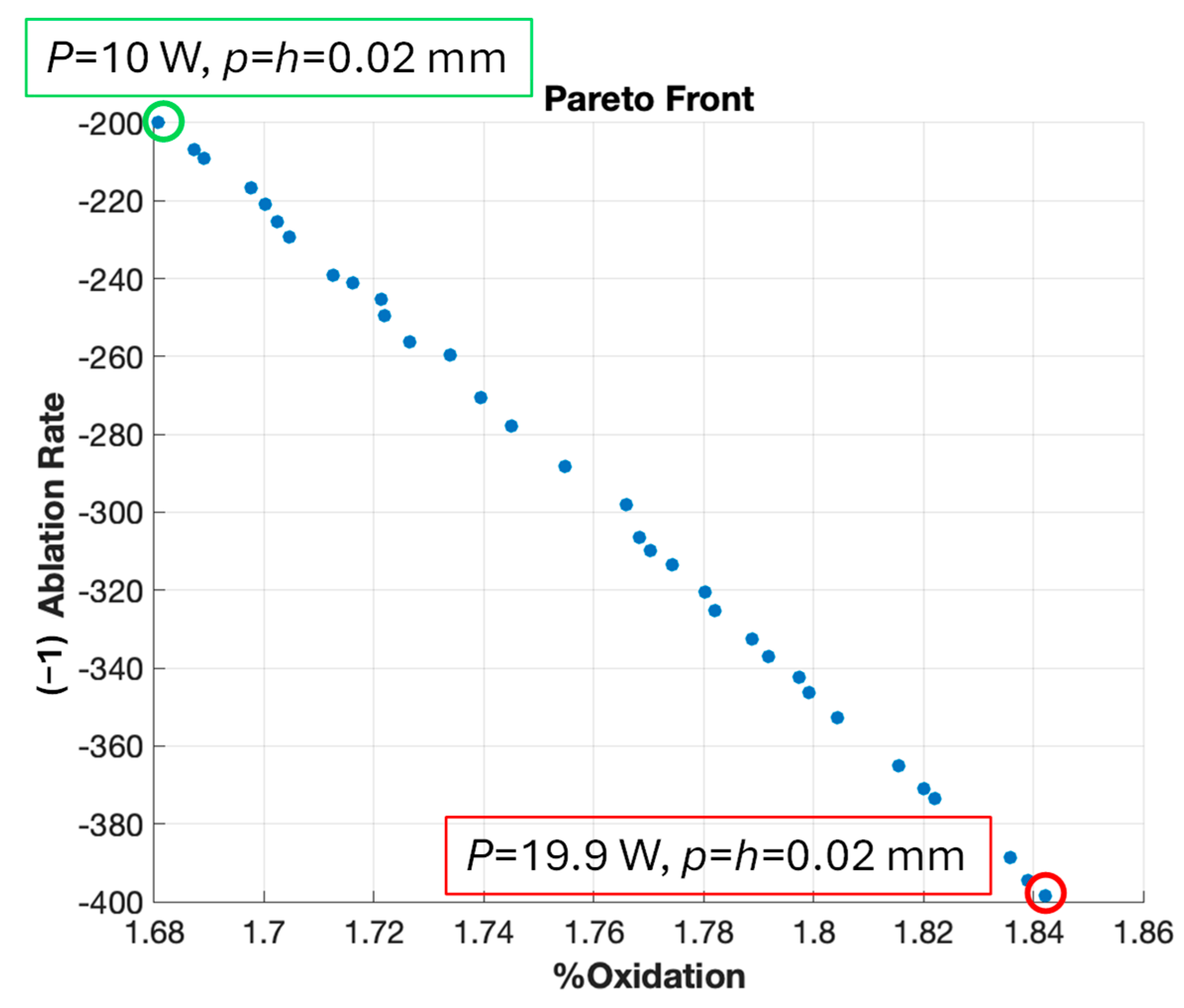
Therefore, there exist two competing objectives i.e., minimizing oxidation and maximizing ablation rate in laser processing, since an increase in laser power would increase the ablation rate but also oxidation, which require a multi-objective optimization formulation to be considered for determining the optimum selection of laser process parameters for a successful surface processing in SS materials.
This optimization framework can be revised to include oxidation density, surface uniformity, and defect level as primary objectives, with the ablation rate retained as a process efficiency metric, thus better serving the needs of surface coloration applications.
For the optimization solution, a MATLAB script was used, and the second-order regression function given in Equation (13) was employed for minimizing oxidation density, whereas maximizing the ablation rate was performed by using Equation (15) as functions of laser power (P) and pulse-to-pulse distance (p). The multi-objective genetic algorithm function “gamultiobj” in MATLAB was used to solve these problems with the following formulation:
min x X ( O d Q w ) s . t .     10   W P 20   W 0.001   m m p 0.020   m m
where x X represents the feasible solution space X for decision variable vector x .
The result of the optimization is given in Figure 9, where the Pareto front of the non-dominated solutions for the decision variables show that for minimizing oxidation (green circle in Figure 9), the decision variables are Pave = 10 W and p = h = 0.02 mm, whereas for maximizing the ablation rate (red circle in Figure 9), the decision variables are Pave = 19.9 W and p = h = 0.02 mm. As expected, the solution favors the optimal values on the boundaries of the feasible solution space that was defined with the experimental design.

4. Discussions

This section provides a discussion of ns pulsed laser processing of AISI 304 SS surfaces. In ns pulsed laser processing, the lattice expansion phenomenon is not as pronounced or rapid compared to ultrafast (femtosecond or picosecond) pulsed lasers. Ns pulsed lasers have the capability to induce various chemical changes on the surface of materials in addition to physical structuring. These chemical modifications can significantly alter the surface properties of the material and are influenced by the laser parameters and the ambient conditions during processing. While the current analysis relies on optical characterization and image processing to assess oxidation density, techniques such as EDX, XPS, XRD, or REM combined with ion milling would provide quantitative chemical evidence to validate these observations. Further chemical characterization remains as essential future work.
In order to understand the surface modifications due to chemical changes, oxidation densities on SS as influenced by different laser pulse fluence and accumulated fluence were investigated. Initially, wide ranges of pulse fluence and accumulated fluence of Fp = 1.25–125 J/cm2, and Facc = 0.25–25 J/cm2, respectively, were considered,. Then, ranges of pulse fluence and accumulated fluence of Fp = 1.99–7.96 J/cm2, Facc = 1.0–4.0 J/cm2 (p = h = 0.001 mm), and Facc = 0.1–0.4 J/cm2 (p = h = 0.010 mm) were considered and tested. The results indicate that pulsed laser processing with large pitch and hatch distances is ineffective for surface structuring, regardless of the applied fluence and laser power. In particular, for p = h = 0.100 mm, the accumulated fluence values corresponding to various laser power levels did not lead to meaningful surface modification. At the final stage, a range of pulse fluence of Fp = 3.98–7.96 J/cm2 and accumulated fluence of Facc = 2.0–4.0 J/cm2 (p = h = 0.001 mm), Facc = 0.8–1.6 J/cm2 (p = h = 0.005 mm), Facc = 0.02–0.04 J/cm2 (p = h = 0.010 mm), and Facc = 0.005–0.01 J/cm2 (p = h = 0.020 mm) were considered and tested. The experimental study was extended to investigate oxidation density on the surfaces of the ns pulsed laser irradiated SS AISI 304. Significant oxidation (Od > 70%) was observed at accumulated fluence values above Facc = 200 J/mm2, and mild oxidation was observed at accumulated fluence values below Facc = 20 J/mm2.
From the modeling and optimization results, minimizing oxidation density, which increases with increasing laser power, and accumulated fluence for wide area surface processing with decreasing values of the pulse-to-pulse distance and the hatch distance between parallel scanning lines maximizing the ablation rate are competing objectives. Hence the optimal processing parameters are subject to the solution that satisfies both objectives, which can be obtained with a Pareto front that is found in the experimental modeling study presented in this paper.
It should be noted that the present study focused on establishing the correlation between accumulated fluence and oxidation density using optical and image-based analysis, while a detailed investigation of oxide morphology, thickness, phase composition, and their direct impact on surface functional properties is beyond the scope of this work and will be addressed in future studies.

5. Conclusions

This study delivered an in-depth investigation and analysis of ns pulsed laser processing of AISI 304 at varying laser power, pulse-to-pulse distance, scanning line distance, and number of pulses employed. The hypothesis of stress confinement through increased electron–phonon interaction time by increasing pulse duration in ultrashort pulsed laser processing and laser ablation for AISI 304 is considered not directly applicable to ns pulsed laser processing and laser ablation; however, based on surface morphology observations and transient thermal considerations, surface morphology investigations revealed that stress-related confinement effects are present, since the pulse duration is 100 ns, much higher than in fs–ps processing, and transient thermodynamics assure the confinement of photomechanical stresses during pulse-to-pulse processing of AISI 304.
This study integrated experimental data with quadratic regression modeling and multi-objective optimization to identify process parameters affecting laser-induced surface oxidation on stainless steel. The developed framework demonstrates how image-based oxidation assessment can be combined with statistical modeling to guide parameter selection for surface structuring applications.
The results provide preliminary insights into the relationships between laser processing parameters and surface oxidation patterns. The methodology presented here offers a foundation for process optimization in laser surface treatment, while recognizing that direct investigation of ultrafast electron–phonon dynamics requires complementary diagnostic techniques, though chemical characterization remains essential for complete process understanding and industrial implementation.

Author Contributions

Conceptualization, T.Ö. and F.D.I.; methodology, F.D.I.; software, F.D.I.; validation, F.D.I. and T.Ö.; formal analysis, F.D.I.; investigation, T.Ö. and F.D.I.; resources, T.Ö. and F.D.I.; data curation, T.Ö. and F.D.I.; writing-original draft preparation, T.Ö. and F.D.I.; writing-review and editing, T.Ö. and F.D.I.; visualization, F.D.I.; supervision, T.Ö. All authors have read and agreed to the published version of the manuscript.

Funding

This research was originally supported by the Taiho Kogyo Tribology Research Foundation (Grant No. 19A09), which also inspired aspects of this study. Faik Derya Ince was supported as a teaching assistant by the Department of Industrial and Systems Engineering at Rutgers University.

Data Availability Statement

The original contributions presented in this study are included in the article. Further inquiries can be directed to the corresponding author. During the preparation of this work, the authors used with caution AI-assisted technologies in order to improve language and readability. After using this tool, the author reviewed and edited the content as needed and takes full responsibility for the content of the publication.

Conflicts of Interest

The authors declare no conflicts of interests.

References

  1. Reif, J. Surface Functionalization by Laser-Induced Structuring. In Advances in the Application of Lasers in Materials Science; Ossi, P.M., Ed.; Springer: Berlin/Heidelberg, Germany, 2018; pp. 63–88. [Google Scholar]
  2. Nakhoul, A.; Colombier, J.P. Beyond the Microscale: Advances in Surface Nanopatterning by Laser-Driven Self-Organization. Laser Photonics Rev. 2024, 18, 2300991. [Google Scholar] [CrossRef]
  3. Dunn, A.; Carstensen, J.V.; Wlodarczyk, K.L.; Hansen, E.B.; Gabzdyl, J.; Harrison, P.M.; Shephard, J.D.; Hand, D.P. Nanosecond laser texturing for high friction applications. Opt. Lasers Eng. 2014, 62, 9–16. [Google Scholar] [CrossRef]
  4. Liu, Z.; Niu, T.; Lei, Y.; Luo, Y. Metal surface wettability modification by nanosecond laser surface texturing: A review. Biosurface Biotribology 2022, 8, 95–120. [Google Scholar] [CrossRef]
  5. Bonse, J.; Kirner, S.V.; Griepentrog, M.; Spaltmann, D.; Krüger, J. Femtosecond laser texturing of surfaces for tribological applications. Materials 2018, 11, 801. [Google Scholar] [CrossRef]
  6. Gupta, R.K.; Anandkumar, B.; Choubey, A.; George, R.P.; Ganesh, P.; Upadhyaya, B.N.; Philip, J.; Bindra, K.S.; Kaul, R. Antibacterial and corrosion studies on nanosecond pulse laser textured 304 L stainless steel surfaces. Lasers Manuf. Mater. Process. 2019, 6, 332–343. [Google Scholar] [CrossRef]
  7. Ince, F.D.; Özel, T. Laser surface texturing of materials for surface functionalization: A holistic review. Surf. Coat. Technol. 2025, 498, 131818. [Google Scholar] [CrossRef]
  8. Bonse, J.; Höhm, S.; Kirner, S.V.; Rosenfeld, A.; Krüger, J. Laser-induced periodic surface structures—A scientific evergreen. IEEE J. Sel. Top. Quantum Electron. 2016, 23, 9000615. [Google Scholar] [CrossRef]
  9. Bonse, J.; Gräf, S. Maxwell meets marangoni—A review of theories on laser-induced periodic surface structures. Laser Photonics Rev. 2020, 14, 2000215. [Google Scholar] [CrossRef]
  10. Li, Z.L.; Zheng, H.Y.; Teh, K.M.; Liu, Y.C.; Lim, G.C.; Seng, H.L.; Yakovlev, N.L. Analysis of oxide formation induced by UV laser coloration of stainless steel. Appl. Surf. Sci. 2009, 256, 1582–1588. [Google Scholar] [CrossRef]
  11. Šugár, P.; Šugárová, J.; Frnčík, M. Laser surface texturing of tool steel: Textured surfaces quality evaluation. Open Eng. 2016, 6, 90–97. [Google Scholar] [CrossRef]
  12. Meier, M.; Romano, V.; Feurer, T. Material processing with pulsed radially and azimuthally polarized laser radiation. Appl. Phys. A 2007, 86, 329–334. [Google Scholar] [CrossRef]
  13. Gamaly, E.G.; Rode, A.V. Physics of ultra-short laser interaction with matter: From phonon excitation to ultimate transformations. Prog. Quantum Electron. 2013, 37, 215–323. [Google Scholar] [CrossRef]
  14. Sokolowski-Tinten, K.; Von Der Linde, D. Ultrafast phase transitions and lattice dynamics probed using laser-produced x-ray pulses. J. Phys. Condens. Matter 2004, 16, R1517. [Google Scholar] [CrossRef]
  15. Hendow, S.T.; Shakir, S.A. Structuring materials with nanosecond laser pulses. Opt. Express 2010, 18, 10188–10199. [Google Scholar] [CrossRef]
  16. Bäuerle, D. Nanosecond-laser ablation. In Laser Processing and Chemistry; Bäuerle, D., Ed.; Springer: Berlin/Heidelberg, Germany, 2011; pp. 237–278. [Google Scholar]
  17. Yang, L.; Deng, Z.; He, B.; Özel, T. An experimental investigation on laser surface texturing of AISI D2 tool steel using nanosecond fiber laser. Lasers Manuf. Mater. Process. 2021, 8, 140–156. [Google Scholar] [CrossRef]
  18. Porneala, C.; Willis, D.A. Observation of nanosecond laser-induced phase explosion in aluminum. Appl. Phys. Lett. 2006, 89, 211121. [Google Scholar] [CrossRef]
  19. Lu, G.; Sokol, D.W.; Zhang, Y.; Dulaney, J.L. Nanosecond pulsed laser-generated stress effect inducing macro-micro-nano structures and surface topography evolution. Appl. Mater. Today 2019, 15, 171–184. [Google Scholar] [CrossRef]
  20. Wang, Q.; Samanta, A.; Shaw, S.K.; Hu, H.; Ding, H. Nanosecond laser-based high-throughput surface nanostructuring (nHSN). Appl. Surf. Sci. 2020, 507, 145136. [Google Scholar] [CrossRef]
  21. Samanta, A.; Wang, Q.; Shaw, S.K.; Ding, H. Roles of chemistry modification for laser textured metal alloys to achieve extreme surface wetting behaviors. Mater. Des. 2020, 192, 108744. [Google Scholar] [CrossRef]
  22. Ta, D.V.; Dunn, A.; Wasley, T.J.; Kay, R.W.; Stringer, J.; Smith, P.J.; Connaughton, C.; Shephard, J.D. Nanosecond laser textured superhydrophobic metallic surfaces and their chemical sensing applications. Appl. Surf. Sci. 2015, 357, 248–254. [Google Scholar] [CrossRef]
  23. Bulgakova, N.M.; Bulgakov, A.V. Pulsed laser ablation of solids: Transition from normal vaporization to phase explosion. Appl. Phys. A 2001, 73, 199–208. [Google Scholar] [CrossRef]
  24. Lu, Q. Thermodynamic evolution of phase explosion during high-power nanosecond laser ablation. Phys. Rev. E 2003, 67, 016410. [Google Scholar] [CrossRef] [PubMed]
  25. Bonse, J.; Gräf, S. Ten open questions about laser-induced periodic surface structures. Nanomaterials 2021, 11, 3326. [Google Scholar] [CrossRef] [PubMed]
  26. Devaux, D.; Fabbro, R.; Tollier, L.; Bartnicki, E. Generation of shock waves by laser-induced plasma in confined geometry. J. Appl. Phys. 1993, 74, 2268–2273. [Google Scholar] [CrossRef]
  27. Veiko, V.; Odintsova, G.; Ageev, E.; Karlagina, Y.; Loginov, A.; Skuratova, A.; Gorbunova, E. Controlled oxide films formation by nanosecond laser pulses for color marking. Opt. Express 2014, 22, 24342–24347. [Google Scholar] [CrossRef]
  28. Sun, Z.; Lenzner, M.; Rudolph, W. Generic incubation law for laser damage and ablation thresholds. J. Appl. Phys. 2015, 117, 073102. [Google Scholar] [CrossRef]
  29. Winter, J.; Spellauge, M.; Hermann, J.; Eulenkamp, C.; Huber, H.P.; Schmidt, M. Ultrashort single-pulse laser ablation of stainless steel, aluminium, copper and its dependence on the pulse duration. Opt. Express 2021, 29, 14561–14581. [Google Scholar] [CrossRef]
  30. Lickschat, P.; Metzner, D.; Weißmantel, S. Fundamental investigations of ultrashort pulsed laser ablation on stainless steel and cemented tungsten carbide. Int. J. Adv. Manuf. Technol. 2020, 109, 1167–1175. [Google Scholar] [CrossRef]
  31. Saltuganov, P.N.; Ionin, A.A.; Kudryashov, S.I.; Rukhadze, A.A.; Gavrilov, A.I.; Makarov, S.V.; Rudenko, A.A.; Zayarny, D.A. Fabrication of superhydrophobic coating on stainless steel surface by femtosecond laser texturing and chemisorption of an hydrophobic agent. J. Russ. Laser Res. 2015, 36, 81–85. [Google Scholar] [CrossRef]
  32. Oboňa, J.V.; Ocelík, V.; De Hosson, J.T.M.; Skolski, J.Z.P.; Mitko, V.S.; Römer, G.R.B.E.; Huis, A.J. Surface melting of copper by ultrashort laser pulses. WIT Trans. Eng. Sci. 2011, 71, 171–179. [Google Scholar]
  33. Simões, J.G.A.B.; Riva, R.; Miyakawa, W. High-speed Laser-Induced Periodic Surface Structures (LIPSS) generation on stainless steel surface using a nanosecond pulsed laser. Surf. Coat. Technol. 2018, 344, 423–432. [Google Scholar] [CrossRef]
  34. Karkantonis, T.; Gaddam, A.; Tao, X.; See, T.L.; Dimov, S. The influence of processing environment on laser-induced periodic surface structures generated with green nanosecond laser. Surf. Interfaces 2022, 31, 102096. [Google Scholar] [CrossRef]
  35. Antończak, A.J.; Kocoń, D.; Nowak, M.; Kozioł, P.; Abramski, K.M. Laser-induced colour marking—Sensitivity scaling for a stainless steel. Appl. Surf. Sci. 2013, 264, 229–236. [Google Scholar] [CrossRef]
  36. Amara, E.H.; Haïd, F.; Noukaz, A. Experimental investigations on fiber laser color marking of steels. Appl. Surf. Sci. 2015, 351, 1–12. [Google Scholar] [CrossRef]
  37. Dong, J.; Liu, Y.; Pacella, M. Surface texturing and wettability modification by nanosecond pulse laser ablation of stainless steels. Coatings 2024, 14, 467. [Google Scholar] [CrossRef]
  38. Al-Mahdy, A.; Kotadia, H.R.; Sharp, M.C.; Opoz, T.T.; Mullett, J.; Ahuir-Torres, J.I. Effect of surface roughness on the surface texturing of 316 l stainless steel by nanosecond pulsed laser. Lasers Manuf. Mater. Process. 2023, 10, 141–164. [Google Scholar] [CrossRef]
  39. Lubig, K.; Wonneberger, R.; Picker, J.; Undisz, A.; Turchanin, A.; Müller, F.A.; Gräf, S. Ageing of commercial austenitic, martensitic and duplex stainless steel surfaces after formation of laser-induced periodic surface structures by fs-laser irradiation. Appl. Surf. Sci. 2025, 679, 161156. [Google Scholar] [CrossRef]
  40. Engoor, G.G.; Selvaraj, S.; Acharya, N.; Muthuvijayan, V.; Krishnan, S.; Unni, S.N.; Vasa, N.J. Laser Polarization Induced Surface Structuring of 316L Stainless Steel and Influence on Biocompatibility and Antibacterial Performance. Results Surf. Interfaces 2025, 19, 100547. [Google Scholar] [CrossRef]
  41. ASTM A240/A240M-25a; Standard Specification for Chromium and Chromium-Nickel Stainless Steel Plate, Sheet, and Strip for Pressure Vessels and for General Applications. ASTM International: West Conshohocken, PA, USA, 2025.
  42. Ostu, N. A threshold selection method from gray-level histograms. IEEE Trans SMC 1979, 9, 62. [Google Scholar]
  43. Sharma, S.; Kumar, V. A comprehensive review on multi-objective optimization techniques: Past, present and future. Arch. Comput. Methods Eng. 2022, 29, 5605–5633. [Google Scholar] [CrossRef]
  44. Rezayat, M.; Moradi, M.; Mateo, A. Nanosecond pulsed laser surface processing of AISI 301LN steel: Effect on surface topography and mechanical properties. Int. J. Adv. Manuf. Technol. 2023, 128, 3025–3040. [Google Scholar] [CrossRef]
  45. Bonse, J.; Krüger, J.; Höhm, S.; Rosenfeld, A. Femtosecond laser-induced periodic surface structures. J. Laser Appl. 2012, 24, 042006. [Google Scholar] [CrossRef]
  46. Pou, P.; Del Val, J.; Riveiro, A.; Comesaña, R.; Arias-González, F.; Lusquiños, F.; Bountinguiza, M.; Quintero, F.; Pou, J. Laser texturing of stainless steel under different processing atmospheres: From superhydrophilic to superhydrophobic surfaces. Appl. Surf. Sci. 2019, 475, 896–905. [Google Scholar] [CrossRef]
  47. Rung, S.; Schwarz, S.; Götzendorfer, B.; Esen, C.; Hellmann, R. Time dependence of wetting behavior upon applying hierarchic nano-micro periodic surface structures on brass using ultra short laser pulses. Appl. Sci. 2018, 8, 700. [Google Scholar] [CrossRef]
  48. Denkena, B.; Krödel, A.; Grove, T. On the pulsed laser ablation of polycrystalline cubic boron nitride—Influence of pulse duration and material properties on ablation characteristics. J. Laser Appl. 2019, 31, 022004. [Google Scholar] [CrossRef]
  49. Zhang, J.J.; Zhao, L.; Rosenkranz, A.; Song, C.W.; Yan, Y.D.; Sun, T. Nanosecond pulsed laser ablation on stainless steel− combining finite element modeling and experimental work. Adv. Eng. Mater. 2019, 21, 1900193. [Google Scholar] [CrossRef]
Figure 1. Experimental set-up for ns pulsed laser processing of SS AISI 304 samples.
Metals 16 00224 g001
Figure 2. Scanning strategy (a) and bi-directional scan path (b) used in laser processing.
Metals 16 00224 g002
Figure 3. Optical microscopy images of AISI 304 samples processes with f = 50 kHz and v = 200 mm/s and varying laser powers; (a) Pave = 0.2 W, (b) Pave = 1 W, (c) Pave = 5 W and (d) Pave = 20 W with a constant distance between successive scanning lines (p = 0.040 mm and h = 0.040 mm).
Metals 16 00224 g003
Figure 4. Optical microscopy images of AISI 304 samples when processed with f = 50 kHz and v = 100 mm/s, 500 mm/s and 1000 mm/s and varying laser powers (between Pave = 10 and 20 W) and varying distance between successive scanning lines (d = 0.005 mm and h = 0.005 mm, p = 0.01 mm and h = 0.01 mm, and p = 0.02 mm and h = 0.02 mm).
Metals 16 00224 g004
Figure 5. Optical microscopy images of AISI 304 samples showing heavy oxidation when processed with f = 50 kHz and v = 50 mm/s and varying laser powers (between Pave = 10 and 20 W) and distance between successive scanning lines (p = 0.001 mm and h = 0.001 mm).
Metals 16 00224 g005
Figure 6. Optical microscopy images of AISI 304 samples showing mild oxidation processed with f = 50 kHz and v = 50 mm/s and varying laser powers (between Pave = 10 and 20 W) and distance between successive scanning lines (p = 0.001 mm and h = 0.001 mm).
Metals 16 00224 g006
Figure 7. Image segmentation performed using Otsu’s method on an AISI 304 sample (f = 50 kHz, v = 50 mm/s, Pave = 13 W, p = 0.001 mm, h = 0.001 mm).
Metals 16 00224 g007
Figure 8. Computed oxidation density trends with respect to accumulated fluence.
Metals 16 00224 g008
Figure 9. Pareto front from MOGA algorithm showing the optimum parameters for the maximum ablation rate, Qw value as well as for the minimum oxidation density, Od.
Metals 16 00224 g009
Table 1. Summary of ns laser surface processing on stainless steel.
MaterialLaser TypeParameters (λ: Wavelength; τ: Pulse Width; f: Repetition Rate; v: Scanning Speed; h: Hatch or Line Spacing)EffectsReference
AISI 304Yb: glass fiber1062 nm; 100 ns; 20–100 kHz; 50–225 mm/s; 0.01–0.05 mmSurface coloration[35]
AISI 304Nd: YVO4355 nm; 25 ns; 40 kHz; 400–500 mm/s; 0.03 mmSurface oxidation[10]
AISI 304Yb: pulsed fiber laser1060 nm; 100 ns; 20–99 kHz; 1–250 mm/s; -Surface oxidation[27]
AISI 316Yb: pulsed fiber laser1064 nm; 100 ns; 20–100 kHz; 10–500 mm/s; -Surface oxidation[36]
AISI 304Nd: YAG, linearly polarized532 nm; 100 ns, 5 kHz; 50–1500 mm/s; -initial roughness effects on LIPSS[33]
AISI 316Yb-doped fiber laser, s-polarized515 nm; 1.5 ns, 1000 kHz; 300–2000 mm/s; 0.001–0.003 mmLIPSS quality and surface oxidation[34]
Table 2. Laser parameters.
LaserYtterbium Nanosecond Pulse Fiber Lasers
Wavelength, nm 1064
Maximum average power, W50
Pulse energy, mJ 1
Pulse duration, ns 100
Nominal repetition rate, Hz50,000
Table 3. Experimental design for pulse fluence and number of scans effects (f = 50 kHz).
Power, Pave, W F p , J/cm2 F a c c , J/cm2p, mmh, mmN
0.21.250.250.040.04100
1.06.251.250.040.04100
5.131.886.380.040.04100
20125.025.00.040.04100
Table 4. Experimental design (N = 1, f = 50 kHz).
Power,
Pave, W
F p , J/cm2 F a c c , J/cm2
p = h = 0.001 mm
F a c c , J/cm2
p = h = 0.005 mm
F a c c , J/cm2
p = h = 0.01 mm
F a c c , J/cm2
p = h = 0.02 mm
p = h, mm
10.03.9812.000.0800.020.0050.001; 0.005; 0.01; 0.02
11.04.3792.200.0880.020.00550.001; 0.005; 0.01; 0.02
12.04.7772.400.0960.020.0060.001; 0.005; 0.01; 0.02
13.05.1752.600.1040.030.00650.001; 0.005; 0.01; 0.02
14.05.5732.800.1120.030.0070.001; 0.005; 0.01; 0.02
15.05.9713.000.1200.030.00750.001; 0.005; 0.01; 0.02
16.06.3693.200.1280.030.0080.001; 0.005; 0.01; 0.02
17.06.7683.400.1360.030.00850.001; 0.005; 0.01; 0.02
18.07.1663.600.1440.040.0090.001; 0.005; 0.01; 0.02
19.07.5643.800.1520.040.00950.001; 0.005; 0.01; 0.02
20.07.9624.000.1600.040.010.001; 0.005; 0.01; 0.02
Disclaimer/Publisher’s Note: The statements, opinions and data contained in all publications are solely those of the individual author(s) and contributor(s) and not of MDPI and/or the editor(s). MDPI and/or the editor(s) disclaim responsibility for any injury to people or property resulting from any ideas, methods, instructions or products referred to in the content.