Article

Corrosion Behavior of AISI 904L Austenitic Stainless Steel in High-Temperature and High-Pressure Water Environment

1
Metrology and Inspection Center, Suzhou Nuclear Power Research Institute, Suzhou 215004, China
2
National Engineering Research Center for Nuclear Power Plant Safety & Reliability, Suzhou 215004, China
*
Author to whom correspondence should be addressed.
Metals 2026, 16(2), 222; https://doi.org/10.3390/met16020222
Submission received: 8 January 2026 / Revised: 10 February 2026 / Accepted: 12 February 2026 / Published: 14 February 2026

Abstract

AISI 904L stainless steel (904L SS) is a promising material for nuclear power plant primary circuits due to its superior corrosion resistance, but its corrosion behavior under simulated high-temperature and high-pressure water environments with different microstructures remains poorly understood. In order to systematically investigate and clarify the electrochemical behavior and corrosion behavior under stress of 904L SS with three different microstructures (as-received, sensitized, and solution-treated) in a simulated primary circuit water environment of a nuclear power plant, experiments are conducted using dynamic polarization, electrochemical impedance spectroscopy (EIS), and U-bend immersion methods. The results show that temperature has a significant effect on corrosion resistance. As the temperature increases, the impedance of all microstructures decreases significantly, the passivation zone narrows, and the corrosion current density increases. Under high-temperature and high-pressure conditions, the corrosion resistance of the sensitized samples is the worst, while the samples treated with solution have the best overall performance. That is, microstructural optimization through solution treatment can effectively enhance the high-temperature and high-stress corrosion resistance of 904LSS in the primary circuit water environment.

1. Introduction

Austenitic stainless steels are extensively utilized in the primary loop piping systems of nuclear power plants, as well as in the petroleum and chemical industries, due to their superior comprehensive properties [1,2,3,4]. These components often serve in harsh environments involving high temperatures, high pressures, and corrosive media over prolonged periods, which imposes stringent requirements on the materials’ corrosion resistance and long-term structural integrity [5]. Conventional austenitic stainless steels, such as the 304 and 316 series, have been widely studied and applied [6,7,8,9]. However, in demanding service conditions, they can be susceptible to localized corrosion phenomena, including stress corrosion cracking (SCC), intergranular corrosion, and pitting [10,11,12]. This has driven the development and application of more advanced alloys with enhanced performance.
The 904L austenitic stainless steel (904 LSS) represents such an advanced material. Its key characteristic lies in its optimized chemical composition: a low carbon content combined with high concentrations of nickel, chromium, molybdenum, and copper [13,14,15]. This alloy design endows 904 LSS with exceptional resistance to uniform and localized corrosion, making it significantly superior to conventional grades for many aggressive applications [16,17,18,19]. Consequently, it is considered a crucial material for key equipment in severe service environments.
Despite its advantages, the application of 904L stainless steel is not without limitations and technical issues. Similarly to other austenitic stainless steels, its microstructure and corrosion resistance are sensitive to thermal history. Sensitization heat treatments, which may occur during welding or in-service exposure to specific temperature ranges, can lead to the precipitation of carbides at grain boundaries. This process depletes chromium in adjacent areas, potentially increasing susceptibility to intergranular corrosion and SCC [15,20]. Furthermore, while significant research exists on common structural materials like 304/316 stainless steels and Ni-based alloys in high-temperature water [21,22,23,24,25,26], there remains a relative scarcity of systematic studies focused on the corrosion and SCC behavior of 904 LSS, particularly in simulated nuclear primary water environments. A detailed understanding of how its different microstructural states (as-received, sensitized, and solution-treated) respond to such conditions is essential for its safe and reliable application.
In order to address the aforementioned research gaps and technical issues, and to support the applicability of AISI 904L stainless steel as a material for the primary circuit of nuclear power plants, electrochemical methods, including potentiodynamic polarization and electrochemical impedance spectroscopy (EIS), alongside U-bend immersion tests, are used to investigate the electrochemical and corrosion behavior under stress of 904 LSS with three distinct microstructures in a simulated high-temperature, high-pressure primary water environment. The research aims to elucidate the effects of microstructure and temperature on its corrosion mechanisms, providing fundamental data and theoretical guidance for the material’s performance assessment and optimization in nuclear power applications.

2. Materials and Experimental Procedures

2.1. Testing Material

The test material AISI 904 LSS (DIN 1.4539) was obtained from a nuclear power plant pipeline. The chemical composition of AISI 904 LSS was studied using a full-spectrum direct reading plasma spectrometer (OPTIMA 2100DV, PerkinElmer, Waltham, MA, USA), and a high-frequency infrared carbon and sulfur analyzer (Beijing Wanliandaxinke Instrument Co., Ltd. CS-902G, Beijing, China). The chemical composition of AISI 904 LSS was determined to be as follows (mass fraction, %): C 0.015, Si 0.36, Mn 1.58, P 0.032, S 0.01, Cr 19.28, Ni 23.48, Mo 4.35, Cu 1.57, and the balance of Fe, which was complied with the specifications for the composition of AISI 904L stainless steel in ASTM A240/A240M-2020a [27], and the content of each element is shown in Table 1. This study focused on three different microstructural states: as-received, sensitized, and solid solution. To obtain the sensitized structure, the specimen was heated at 720 °C for 3 h and then cooled in air. For solid solution structures, the specimen was heated at 1050 °C for 1 h and then quenched with water.

2.2. Experimental Methods

The microstructures of AISI 904 LSS were examined using an optical microscope (OM, Leica DMI500M, Wetzlar, Germany) to confirm the effects of sensitization and solution treatment on grain size and grain boundary properties, and the phase composition was determined with an XRD-7000 (Shimadzu Instruments (Suzhou) Co., Ltd., Suzhou, China) X-ray diffractometer utilizing Cu-Kα radiation (λ = 1.5418 Å) to analyze the effects of the aforementioned three heat treatment processes on the phases of AISI 904L stainless steel. Diffraction patterns were acquired within a 2θ range of 20~90° at a scanning speed of 4°/min. The XRD data were subsequently analyzed with MDI Jade 6.5 software.
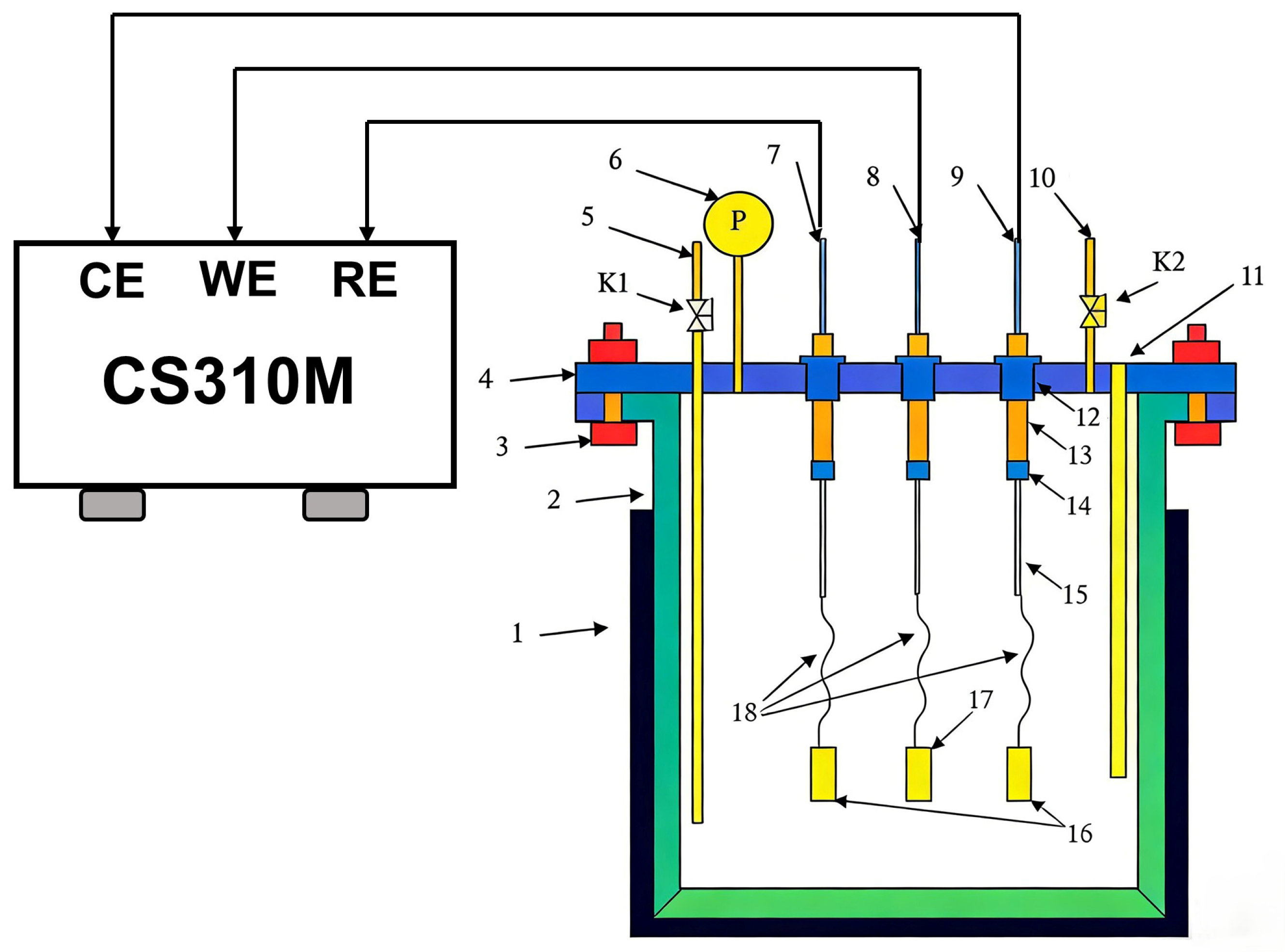
Electrochemical tests were conducted on AISI 904L stainless steel in the as-received, sensitized, and solution-treated states to evaluate their corrosion behavior and corrosion resistance in a simulated primary loop environment of the nuclear power plant. Electrochemical specimens with dimensions of 10 mm × 10 mm × 3 mm were extracted from three different microstructural materials along the rolling direction. Copper wires were subsequently welded to the rear of the specimens and encapsulated with epoxy resin, leaving a 1 cm2 working surface exposed. Prior to the initiation of electrochemical testing, the specimens were polished to a 3000# finish using water abrasive paper, followed by cleaning with deionized water and absolute ethanol, and subsequent drying. The electrochemical experiments were conducted using a CS310M electrochemical workstation (Wuhan Corrtest Instruments Corp., Ltd., Wuhan, China) equipped with a conventional three-electrode system. The working electrode (WE) comprised the sample under examination, the counter electrode (CE) was a platinum sheet, and the reference electrode (RE) was an Ag/AgCl high-temperature electrode. The schematic diagram of the high-temperature and high-pressure electrochemical testing apparatus was shown in Figure 1. These tests were performed at various temperatures (25, 150, 250, and 325 °C) and a constant pressure of 15.5 MPa, utilizing a high-temperature, high-pressure autoclave for heating and pressurization purposes. The electrochemical test solution consisted of a mixture of 1200 mg/L H3BO3 and 2.2 mg/L LiOH, both of analytical grade, prepared with ultra-pure water. Once the open-circuit potential had stabilized, electrochemical impedance spectroscopy (EIS) tests were conducted with an excitation potential of 10 mV and a frequency range from 105 to 102 Hz. EIS data were analyzed using ZSimpWin 3.60 software. To evaluate the corrosion behavior under the specified test conditions, potentiodynamic polarization curve tests were carried out on the three different microstructural AISI 904 LSS. The test voltage range was set between ±1.5 and ±2 V (vs. OCP), with scanning rates of 0.5 and 50 mV/s, and the end of the potentiodynamic polarization experiment indicates the completion of a single electrochemical test. To ensure the reliability and accuracy of the experimental data, all tests were replicated three times under identical experimental conditions.
The U-bend immersion test was conducted to investigate the SCC susceptibility or differences in corrosion behavior under stress conditions of AISI 904 LSS with three different microstructural conditions in a simulated primary environment. The test was conducted in accordance with the standard ASTM G30-22 [28]. The thickness of the U-bend specimen was 2 mm, and the bending radius was 8 mm. the strain ε of the U-bend specimen can be estimated by the formula:
ε = r + c / r + t / 2 1
where t is the specimen thickness and r is the bending radius, and c is the neutral layer offset distance and calculated by the following formula:
c = t / 1 + 1 / 1 + t / r
The calculation yields ε ≈ 9.1%. Therefore, the strain value is relatively high compared to the actual strain values in the service state of nuclear power pipelines (0.1–0.2%), which means it is a laboratory accelerated test to quickly evaluate the corrosion sensitivity of AISI 904 LSS to high stress and strain in a specific environment.
Testing was performed at 325 °C and 15.5 MPa, utilizing a corrosion medium composed of 1200 mg/L H3BO3 and 2.2 mg/L LiOH solution. A high-temperature, high-pressure autoclave was used to replicate the conditions of the nuclear primary loop. To deoxygenate the solution, high-purity nitrogen was bubbled through it for 2 h prior to the test and continuously during the test duration. Immersion periods were 1500 h, with six parallel samples for each period to ensure experimental accuracy. After immersion, the autoclave was allowed to cool, and the samples were removed and dried with cold air. The corrosion morphology of the U-bend specimens after soaking for 1500 h in a high-temperature and high-pressure water environment was observed using an XL30-FEG ESEM scanning electron microscope (SEM, Philips, Eindhoven, Netherlands) to analyze the corrosion behavior of AISI 904L stainless steel in the as-received, sensitized, and solution-treated states under stress.

3. Results and Discussion

3.1. Material Characterization

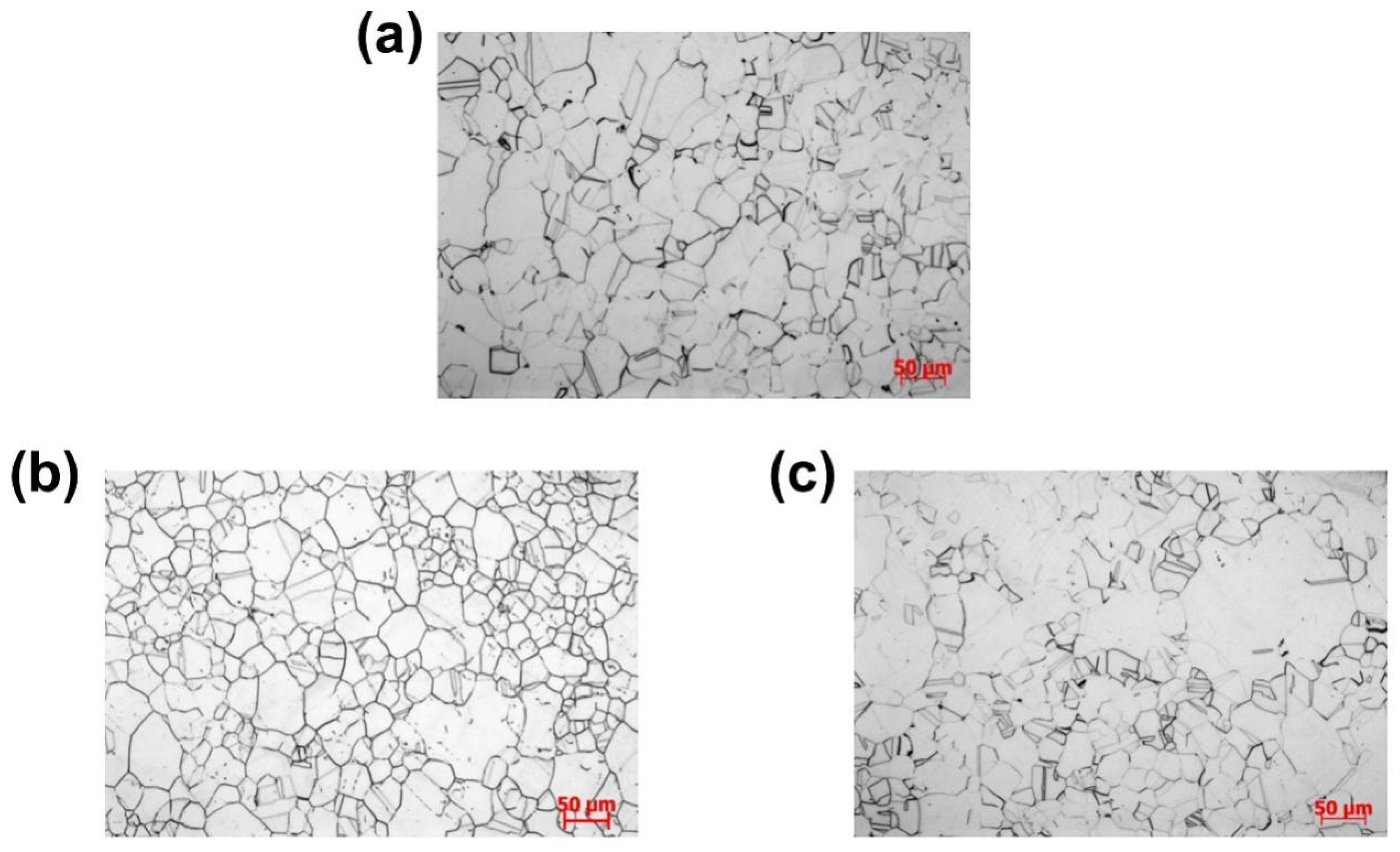
Figure 2 delineates the metallographic structures of AISI 904 LSS following different heat treatments. The figure clearly indicates that the phase composition of AISI 904 LSS remains unaltered after heat treatment, maintaining a single-phase austenitic structure with a negligible incidence of twins. Nevertheless, the grain size of the specimens as-received has undergone modification, with the sensitized state exhibiting smaller grains and the solid solution state displaying the largest grains. Additionally, as depicted in Figure 2b, grain boundaries are more prone to corrosion following sensitization treatment, which may suggest the formation of precipitation phases at the grain boundaries that enhance intergranular corrosion susceptibility [26]. The grain size after heat treatment follows the pattern of “largest in the solution-treated state, intermediate in the as-received state, and smallest or with little change in the sensitized state.” The core reason lies in the differences in the driving force for grain boundary migration provided by temperature and time in different heat treatment processes. Solution treatment at high temperatures provides a strong driving force for atomic diffusion and grain boundary movement, promoting significant grain growth. In contrast, sensitization treatment occurs at intermediate temperatures, primarily aimed at precipitating carbides. The energy provided by this temperature is insufficient to drive large-scale grain boundary migration, resulting in smaller grain sizes. As for the increased sensitivity of grain boundaries to corrosion after sensitization treatment, the mechanism is speculated to be due to detrimental compositional changes in the grain boundary regions. During the dwell at sensitization temperature, carbon atoms combine with chromium atoms at the grain boundaries to form chromium carbides, which deplete the chromium element near the grain boundaries, creating “chromium-depleted zones.” These zones act as anodes and undergo preferential dissolution in corrosive environments, leading to classic “intergranular corrosion” that severely compromises material integrity. It should be noted that the subsequent analysis of the sensitized state in this paper is based on the conclusion of the sensitized state judged from the sensitized samples obtained by sensitization heat treatment process and the microstructure.
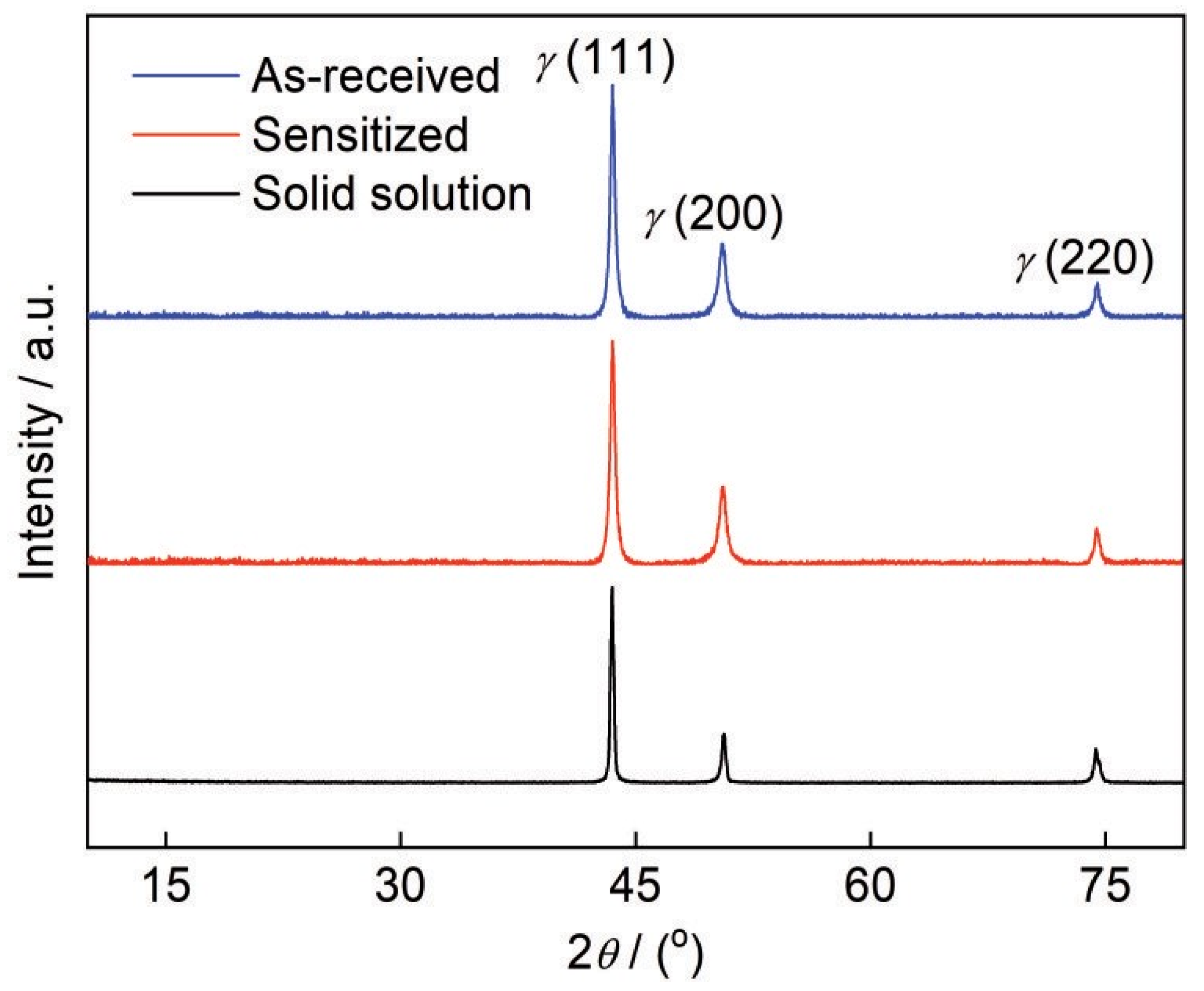
XRD analysis was performed to examine the phase composition of the three different microstructures of AISI 904 LSS, and the findings are presented in Figure 3. The analysis reveals that the microstructures of all three samples predominantly comprise the austenitic phase. This is attributed to the high concentration of nickel, an austenite-stabilizing element, in AISI 904 LSS, which stabilizes the austenitic phase and suppresses the formation of ferrite [29,30]. This observation aligns with the results illustrated in Figure 3. Moreover, no second phases such as chromium carbides were detected in the XRD result of the sensitized state, which may be due to the low content or small size of the precipitated phases, beyond the detection range of XRD, resulting in no diffraction peaks of the second phases or very low diffraction peak intensities.

3.2. Potentiodynamic Polarization Curves

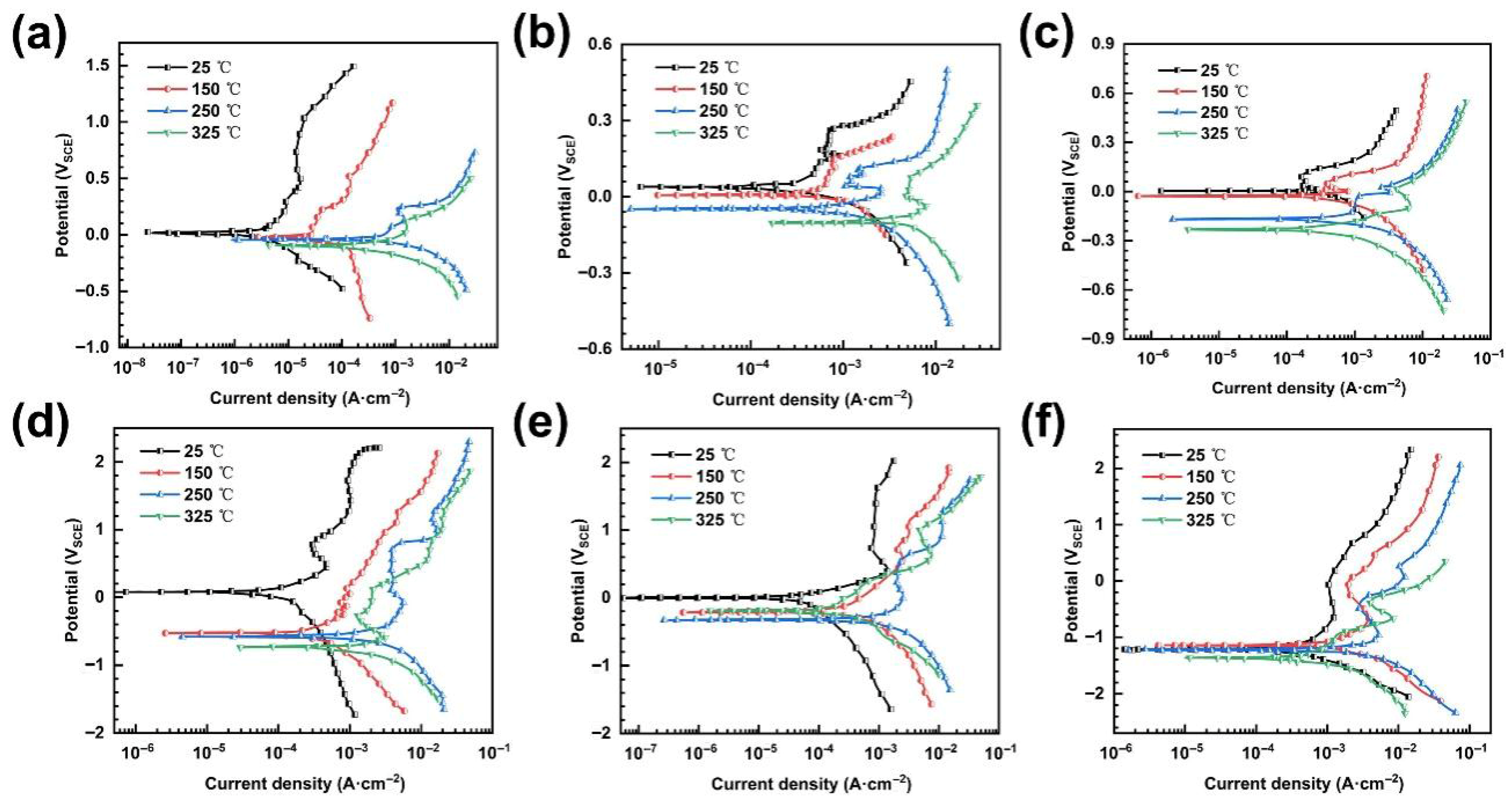
The potentiodynamic polarization curves of AISI 904 LSS with three different microstructural states in H3BO3 and LiOH solutions at various temperatures are shown in Figure 4. In order to make the local features more distinct and clearer, we select a portion of the potential range for the slow-scan dynamic polarization data when plotting the graphs. The curves indicate that the electrochemical mechanisms of the AISI 904 LSS samples, despite their differing microstructures, are largely similar in high-temperature, high-pressure water environments. Due to the rapid scanning rate, it is inferred that the sample surfaces remained as fresh metal without protective corrosion product films throughout the experiment, hypothesizing and analogizing the characteristics of stress corrosion cracking crack tips from the perspective of electrochemical properties. at the stress corrosion crack tips. The results suggest that the electrochemical corrosion rate at the crack tips of AISI 904 LSS is not significantly related to the microstructural state of the samples. The zero-current potential E0 is significantly lower than that of the slow scanning curves, indicating a higher electrochemical activity at the crack tips compared to the metal surfaces with films (or corrosion products). The slow scanning conditions represent the steady-state electrochemical characteristics of the stress corrosion crack walls. The anodic polarization curves for AISI 904 LSS with three microstructural states at varying temperatures include four regions: active, transpassive, passive, and overpassive [31]. As temperature increases, the polarization curves shift downward and to the right, with the passive region’s potential range gradually narrowing. Comparing the three microstructural states of AISI 904 LSS, the solid solution treated state exhibits the widest passive region at 25 °C, whereas the sensitized state exhibits the narrowest. At 150 °C, the passive region narrows, and the curves shift slightly downwards with minimal variation. At higher temperatures of 250 and 325 °C, the polarization curves of all three microstructural states shift downwards more significantly, with the passive region continuing to decrease but not disappearing, indicating good corrosion resistance of AISI 904 LSS in high-temperature, high-pressure primary loop water environments.
Table 2 summarizes the electrochemical results fitted from the potentiodynamic polarization curves. The corrosion current density Icorr is used to characterize the material’s corrosion resistance in the medium, with lower values indicating stronger corrosion resistance [32]. Although the corrosion potential Ecorr does not definitively predict the direction and extent of the corrosion process, it can be used to assess the relative corrosion tendency of the material in a given medium, with higher values suggesting stronger corrosion resistance. The AISI 904 LSS exhibits lower Icorr and higher Ecorr, indicating strong corrosion resistance. Higher overpassive potentials Etp suggest better stability of the passive film, and the three microstructural states of AISI 904 LSS all exhibit high Etp, indicating strong corrosion resistance. With increasing temperature, the corrosion potential of the AISI 904 LSS decreases, and the corrosion current density increases, indicating reduced corrosion resistance. Above 250 °C, the solid solution treated state exhibits the highest corrosion potential and the lowest corrosion current density, with a wider passive region, while the sensitized state has the lowest corrosion potential and the highest corrosion current density, with a narrower passive region. This suggests that the solid solution treated state of AISI 904 LSS has the best corrosion resistance in high-temperature, high-pressure environments, while the sensitized state has poorer corrosion resistance.
To quantitatively evaluate the differences in corrosion resistance from the perspective of reaction kinetics, the activation energy (Ea) for the corrosion reaction of AISI 904L stainless steel in three different heat-treated states was calculated and analyzed based on electrochemical test data. The results are shown in Table 3. The relationship between the rate of the corrosion reaction (characterized by the corrosion current density, (Icorr) and temperature (T) follows the Arrhenius equation:
I corr = A exp E a RT
where A is the pre-exponential factor, R is the universal gas constant (8.314 J mol−1 K−1), and T is the thermodynamic temperature (K). Taking the natural logarithm of Equation (1) yields the linear form:
ln I corr = ln A E a RT
Thus, by measuring Icorr at different temperatures and plotting ln (Icorr) versus 1/T and performing a linear fit, the slope k of the resulting straight line satisfies:
k = E a R
and the activation energy can be calculated as:
E a = KR
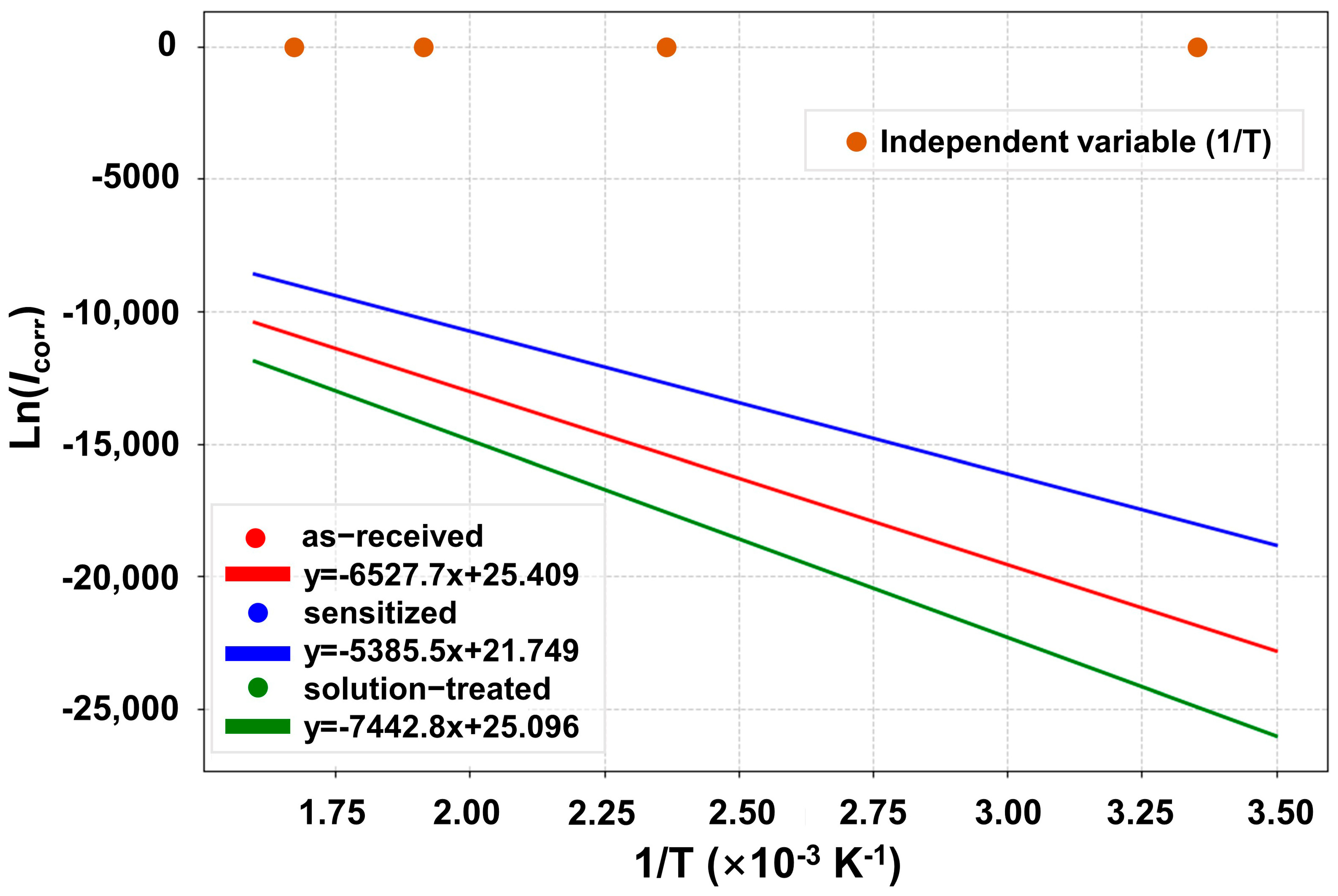
The linear least-squares fitting was performed on the three sets of data in Table 3, and the fitted straight lines are shown in Figure 5. The correlation coefficients (R2) of all the fits are greater than 0.99, indicating that the controlling mechanism of the corrosion process did not change within the temperature range of 25–325 °C. The data conform to the Arrhenius relationship, and the calculation results are reliable. The equations of the fitted straight lines, the slopes, and the calculated activation energies are also listed in Table 3.
The activation energies for corrosion reactions of the solution-treated, sensitized, and as-received states are 61.88 kJ·mol−1, 44.78 kJ·mol−1, and 54.26 kJ·mol−1, respectively. The highest activation energy of the solution-treated state kinetically confirms its best corrosion resistance. The lowest activation energy of the sensitized state quantitatively reveals the significant increase in corrosion sensitivity due to chromium depletion at grain boundaries. These calculation results are consistent with the differences in microstructures and macroscopic corrosion performance evaluations in different states.
In high-temperature, high-pressure water environments, the corrosion mechanism of AISI 904L stainless steel is governed by electrochemical reactions coupled with oxidation by trace dissolved oxygen [33]. These reactions are critical for interpreting the polarization curves in Figure 4, as they describe the formation and stability of passive films. Based on prior research [25,31,33], the anodic reactions during potentiodynamic scanning in simulated primary water (oxygen-depleted conditions) include oxidation of key alloying elements. For instance, chromium oxidation forms a protective chromia layer, while iron and nickel contribute to oxide film growth:
2 Cr 6 e + 6 OH 2 Cr 2 O 3 + 3 H 2 O
Fe 2 e + 2 OH Fe OH 2
3 Fe OH 2 2 e + 2 OH Fe 3 O 4 + 4 H 2 O
2 Fe OH 2 2 e + 2 OH Fe 2 O 3 + 3 H 2 O
Ni 2 e + 2 OH NiO + H 2 O
Mn 2 e Mn 2 +
Mo 6 e + 8 OH MoO 4 2 + 4 H 2 O
These reactions align with the observed passive behavior in Figure 4, where the widening passivation zone at higher potentials corresponds to Cr2O3 formation. The cathodic reaction (Equation (14)) dominates in deaerated conditions:
2 H 2 O + 2 e 2 OH + H 2
Overall, these equations provide a mechanistic basis for the electrochemical data, but their relevance is limited to ideal conditions; actual film composition may vary due to microstructure [33]. Typically, in the primary loop water environment, the chemical compositions stabilized by Cr, Fe, and Ni are Cr2O3, Fe3O4, and NiO, respectively. As depicted in Figure 4, the polarization curve shows that with the increase in electrode potential, the anodic region gradually exhibits a distinct anodic activation peak and a passivation region. The appearance of the passivation zone is due to the dissolution of Cr and the formation of Cr2O3, which also serves as the main component for corrosion resistance. As the polarization potential further increases, Fe3O4 is oxidized to Fe2O3, leading to a new activation-dissolution peak in the anodic region. With the continuous increase in electrode potential, the formation of a more stable Fe2O3 passivation film results in a new passivation region, and eventually, after the passivation film breaks down, the anodic current density rapidly increases. Electrochemical analysis indicates that during the SCC process, localized anodic dissolution of AISI 904 LSS occurs in the simulated primary loop high-temperature, high-pressure water environment, which is attributed to the harsh service conditions and the microstructural characteristics of the AISI 904L stainless steel. Inclusions and precipitates along the austenitic grain boundaries of the AISI 904L stainless steel (Figure 4) create potential differences with the matrix, initiating localized galvanic corrosion [34,35].

3.3. Electrochemical Impedance Spectroscopy

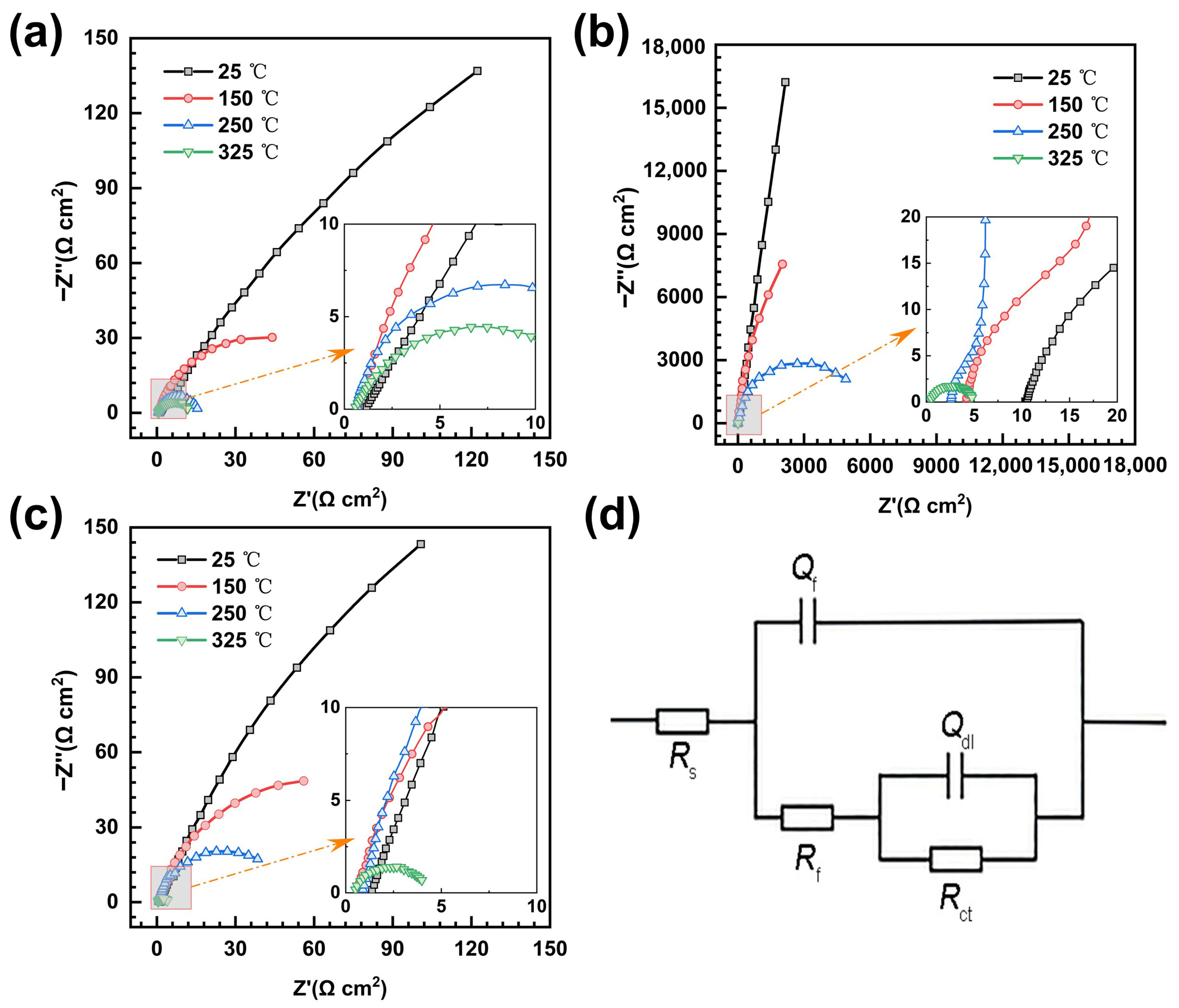
Figure 6 depicts the electrochemical impedance spectra of AISI 904 LSS with three distinct microstructures in H3BO3 and LiOH solutions at varying temperatures. The spectra reveal that for all three microstructures across the four temperature conditions, the electrochemical impedance spectra exhibit a single capacitive loop without any evident Warburg impedance. This indicates that under open-circuit potential conditions, the corrosion process of AISI 904 LSS with different microstructures is entirely controlled by electrochemical reactions. The size of the capacitive loop radius is indicative of the resistance to the corrosion process, with a larger radius suggesting stronger corrosion resistance [36,37]. The electrochemical impedance results were further analyzed using ZsimpWin software, and the equivalent circuit used is shown in Figure 6d. In this circuit, RS represents the solution resistance between the working and reference electrodes. Rf is the passive film resistance. Rct is the charge transfer resistance. The Qdl and Qf denote the double layer capacitance and corrosion products film layer capacitance, respectively, determined by the constant phase factor Y0 and the dispersion factor n (0 < n < 1), with n indicating the degree of dispersion effect.
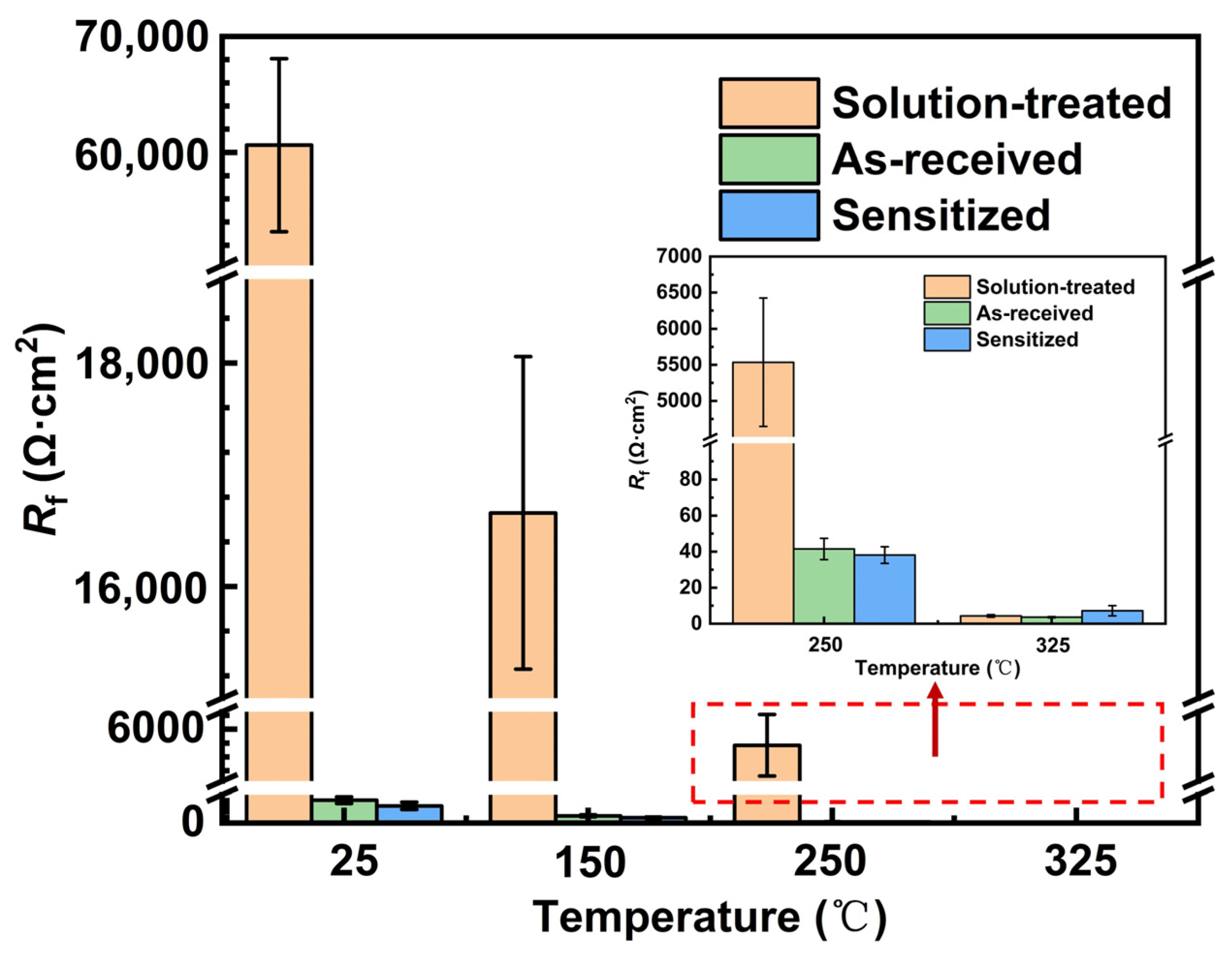
Figure 7 shows the temperature-dependent evolution of Rf for the solution-treated, as-received, and sensitized samples in the test solution, and the specific values are listed in Table 4. At a solution temperature of 25 °C, the Rct values for the AISI 904 LSS samples with the three different microstructures are all relatively high, suggesting significant resistance to charge transfer across the electrolyte and electrode interfaces, and thus, good corrosion resistance of AISI 904 LSS at ambient temperature, which is primarily due to the high Cr content in the steel. At a solution temperature of 150 °C, the charge transfer resistance decreases by an order of magnitude, accompanied by a reduction in passive film resistance, indicating decreased corrosion resistance. At temperatures of 250 and 325 °C, the polarization resistance (the sum of Rct and Rf) for the AISI 904L stainless steel with the three different microstructures drastically decreases, suggesting poorer corrosion resistance compared to ambient temperature. A comparative analysis of the corrosion behavior of the three different microstructure samples at the same temperature reveals that the polarization resistance of the solution-treated microstructure is several orders of magnitude higher than that of the as-received and sensitized microstructures, indicating the superior high-temperature corrosion resistance of the solution-treated AISI 904 LSS, which is consistent with the polarization curve results. Moreover, the n value directly reflects the degree of interface inhomogeneity or dispersion effect. In this study, n1 and n2 represent the dispersion degrees of the double-layer capacitance and the film-layer capacitance, respectively. For the film-layer capacitance, n is related to the density of the oxide film. When n ≈ 1, it represents an ideal capacitor. In this study, n2 is basically between 0.6 and 0.8, and it shows a trend that the larger the Rf, the larger the n2. This indicates that the larger the impedance of the sample, the better the density of the surface oxide film. For the double-layer capacitance n1, its value close to 1 indicates that the interface is close to an ideal double layer, and also suggests that the interface is in a quasi-steady state without capacitive frequency dispersion caused by surface inhomogeneity.

3.4. U-Bend Immersion Test

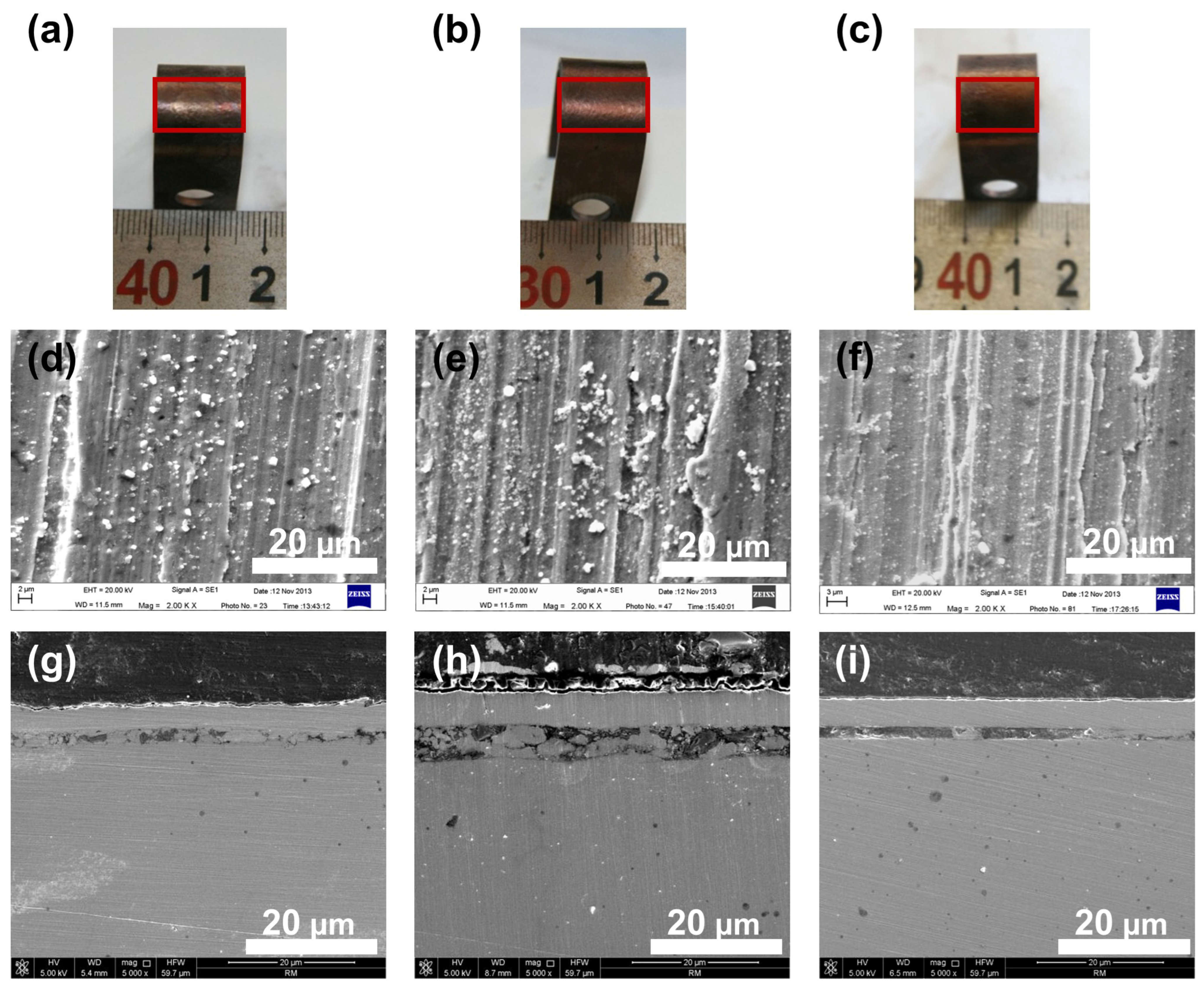
To investigate the corrosion behavior under stress of AISI 904 LSS with different microstructures in high-temperature, high-pressure primary loop water of nuclear power plants, U-bend samples of various microstructures were subjected to immersion tests. Figure 8a–c presents the macroscopic images of U-bend samples in the as-received, sensitized, and solution-treated conditions after 1500 h of immersion in the simulated primary circuit environment. The images reveal that the sample surfaces remained intact without any evident cracks, although all surfaces exhibited dark brown corrosion products, indicating a moderate level of corrosion. Further SEM examination of the samples (Figure 8d–f) revealed a similar surface condition across the three microstructures, with a thin, uniform black corrosion product layer on the inner surface and larger white granular corrosion products on the outer layer. In contrast, the solution-treated specimen has smaller and more densely distributed oxide particles, which can effectively prevent direct interaction between the material surface and the environment, thereby potentially delaying the initiation and propagation of stress corrosion cracking. After nickel plating and embedding in epoxy resin, followed by sequential grinding and polishing, the samples were observed under SEM to determine the oxide film thickness (Figure 8g–i). The results show that the corrosion product film of the sensitized microstructure is the thickest but very porous, while the corrosion product film of the solution-treated microstructure is the thinnest but denser. This indicates that in the primary circuit environment, the sensitized microstructure is more susceptible to corrosion, while the solution-treated microstructure exhibits superior corrosion resistance.
SCC in high-temperature, high-pressure water is influenced by material factors, environmental factors, and stress factors [38,39]. The microstructure of AISI 904 LSS evolves after different heat treatments, leading to variations in corrosion behavior in high-temperature, high-pressure water. Results from Figure 4 and Figure 6 indicate that at 325 °C, the sensitized microstructure of AISI 904 LSS exhibits the poorest corrosion resistance, with a corrosion current density significantly higher than that of the solution-treated state and a film resistance lower than the solution-treated microstructure. Compared to the as-received AISI 904 LSS microstructure, the sensitized microstructure features may have precipitation phases at the grain boundaries, similar to σ phases, leading to the formation of chromium-depleted regions. These regions create micro-galvanic couples within the material, increasing the corrosion current density and intergranular sensitivity, thereby destroying the integrity of the passive film and reducing the resistance to the corrosion of material under stress condition. The characteristics of the corrosion product film on the specimen surface presented in Figure 8h also confirm the results of the electrochemical tests, that is, the loose oxide film of the sensitized specimen results in a lower film resistance and a higher corrosion current density. The dense oxide film of the solution-treated specimen presented in Figure 8i results in a higher film resistance and a lower corrosion current density. Therefore, the results from both the high-temperature and high-pressure electrochemical tests and the characterization of the oxide films after corrosion immersion tests under stress conditions demonstrate that AISI 904L stainless steel exhibits superior corrosion resistance after solution treatment.
Moreover, temperature significantly affects the corrosion behavior of AISI 904L stainless steel in a mixed solution of boric acid and lithium hydroxide, potentially altering the material’s stress corrosion resistance by influencing crack initiation, crack propagation activation energy, and corrosion rate. The results in Figure 4 and Figure 6 show that increasing temperature significantly reduces the passivation zone in the dynamic polarization curves, lowers the open-circuit potential, and increases the corrosion current density by two orders of magnitude. Meanwhile, the film resistance decreases significantly with increasing temperature, indicating a marked decline in the corrosion resistance of AISI 904L stainless steel. It is theorized that the activation energy for oxide film growth varies significantly across different temperature ranges, with the growth of oxide films in high- and low-temperature aqueous solutions controlled by different kinetic processes. After local breakdown of the surface oxide film, the repair process may be more difficult in a high-temperature environment, leading to poorer corrosion resistance from the electrochemical perspective [40]. On this point, AISI 904L stainless steel shows the same trend as 304 and 316/316L stainless steels, that is, its service life may be severely shortened when serving in high-temperature and high-pressure water environments. However, according to the results of dynamic polarization tests, etc., AISI 904L stainless steel still has a lower corrosion rate compared to these stainless steels. The research results of Wang et al. also show that for the behavior of 904L in the simulated nuclear power plant primary circuit boric acid and lithium environment, it is found that although the increase in temperature also leads to a decrease in its electrochemical polarization resistance and a narrower passivation zone, the solution-treated 904L maintains relatively high corrosion resistance [15], which is also consistent with the results in Figure 4a and Table 2 showing that the solution-treated samples have smaller Icorr and higher Etp. At the same time, even at high temperatures, the solution-treated specimen still exhibits superior corrosion resistance compared to the as-received and sensitized states (one order of magnitude lower corrosion current density). Meanwhile, the Arrhenius fitting straight-line graph (Figure 5) of the corrosion reaction rates obtained from specimens in three heat treatment states at four temperatures and the activation energy calculations indicate that the solution-treated specimen has the highest activation energy, which kinetically confirms its best corrosion resistance. The lowest activation energy of the sensitized state quantitatively reveals the significant increase in corrosion sensitivity due to chromium depletion at grain boundaries. These calculations also validate the rationality of the aforementioned electrochemical test results and the morphology characterization of the corrosion product films from a kinetic standpoint. Based on the above analysis, AISI 904L stainless steel shows superior corrosion resistance, but it should undergo solution treatment before use in the high-temperature and high-pressure primary circuit of a nuclear power plant to avoid potential sensitization effects.

4. Conclusions

Based on electrochemical tests of AISI 904L stainless steel in high-temperature and high-pressure water environments, characterization of oxide films after U-bend corrosion immersion, and kinetic calculations based on electrochemistry, this paper provides a detailed analysis of the effects of temperature and heat treatment state (solution-treated, sensitized, and as-received) on the corrosion resistance of AISI 904L stainless steel and provides data support for its service in nuclear power plant primary circuit piping. The following conclusions can be drawn:
(1)
All three states of AISI 904L stainless steel samples exhibited superior corrosion resistance under stress, with almost no cracking observed in the surface corrosion product films.
(2)
Based on electrochemical test results, temperature significantly affects the corrosion rate of AISI 904L stainless steel, with corrosion resistance decreasing markedly at high temperatures for all three states.
(3)
Solution-treated AISI 904L stainless steel exhibited a lower corrosion rate, wider passivation zone, and higher corrosion reaction activation energy, and remained serviceable at high temperatures.

Author Contributions

Conceptualization, K.F.; Methodology, K.F.; Software, J.L.; Validation, Y.L., K.L. and J.S.; Formal analysis, K.L., J.S., J.L. and E.L.; Investigation, Y.L., K.L., J.L. and E.L.; Data curation, Y.L., J.S. and E.L.; Writing—original draft, K.F.; Writing—review and editing, K.F. All authors have read and agreed to the published version of the manuscript.

Funding

This research received no external funding.

Data Availability Statement

The original contributions presented in this study are included in the article. Further inquiries can be directed to the corresponding author.

Conflicts of Interest

Kewei Fang, Yan Liu, Kunjie Luo, Jian Shen, Jundong Lu and Erwei Liu were employed by the Metrology and Inspection Center, Suzhou Nuclear Power Research Institute, Suzhou 215004, China. The remaining authors declare that the research was conducted in the absence of any commercial or financial relationships that could be construed as a potential conflict of interest.

References

  1. Almuaili, F.A.; McDonald, S.A.; Withers, P.J. Strain-induced reactivation of corrosion pits in austenitic stainless steel. Corros. Sci. 2017, 125, 12–19. [Google Scholar] [CrossRef]
  2. Leng, S.; Liu, X.A.; Chen, H.Y. In-situ study on the coordinated deformation mechanism of austenitic stainless steel with mixed crystal degree. J. Mater. Res. Technol. 2023, 27, 5791–5804. [Google Scholar] [CrossRef]
  3. Lindgren, K.; Bjurman, M.; Efsing, P. Integrated effect of thermal ageing and low flux irradiation on microstructural evolution of the ferrite of welded austenitic stainless steels. J. Nucl. Mater. 2021, 551, 152967. [Google Scholar] [CrossRef]
  4. Lindqvist, S.; Que, Z.Q.; Nevasmaa, P. The effect of thermal aging on fracture properties of a narrow-gap Alloy 52 dissimilar metal weld. Eng. Fract. Mech. 2023, 281, 109056. [Google Scholar] [CrossRef]
  5. Zhang, Z.W.; Pan, G.G.; Jiang, Y. Microstructure and Pitting Corrosion of Austenite Stainless Steel after Crack Arrest. Materials 2019, 12, 4025. [Google Scholar] [CrossRef]
  6. Deng, P.; Han, E.H.; Peng, Q.J. Corrosion Behavior and Mechanism of Irradiated 304 Nuclear Grade Stainless Steel in High-Temperature Water. Acta Metall. Sin. (Engl. Lett.) 2021, 34, 174–186. [Google Scholar] [CrossRef]
  7. Deng, P.; Peng, Q.J.; Han, E.H. Effect of irradiation on corrosion of 304 nuclear grade stainless steel in simulated PWR primary water. Corros. Sci. 2017, 127, 91–100. [Google Scholar] [CrossRef]
  8. Mukahiwa, K.; Scenini, F.; Burke, M.G. Corrosion fatigue and microstructural characterisation of Type 316 austenitic stainless steels tested in PWR primary water. Corros. Sci. 2018, 131, 57–70. [Google Scholar] [CrossRef]
  9. Tan, J.B.; Zhang, Z.Y.; Zheng, H. Corrosion fatigue model of austenitic stainless steels used in pressurized water reactor nuclear power plants. J. Nucl. Mater. 2020, 541, 152407. [Google Scholar] [CrossRef]
  10. Han, M.S.; Jang, S.K.; Kim, S.J. Investigation on SCC and HE of STS 304 austenitic stainless steel for offshore structures. Rare Met. 2011, 30, 633–638. [Google Scholar] [CrossRef]
  11. Li, L.; Qiao, Y.X.; Zhang, L.M. Effect of surface damage induced by cavitation erosion on pitting and passive behaviors of 304L stainless steel. Int. J. Miner. Metall. Mater. 2023, 30, 1338–1352. [Google Scholar] [CrossRef]
  12. Mou, L.M.; Bian, T.T.; Zhang, S.H. New sights on intergranular corrosion resistance mechanism of type 304 austenitic stainless steel by adjusting carbon contents. J. Mater. Res. Technol. 2023, 26, 666–680. [Google Scholar] [CrossRef]
  13. Jiang, R.Y.; Zou, G.B.; Shi, W. Corrosion Behavior of Plasma-Nitrided 904L Austenitic Stainless Steel in Hydrofluoric Acid. J. Mater. Eng. Perform. 2019, 28, 1863–1872. [Google Scholar] [CrossRef]
  14. Sanni, O.; Adeleke, O.; Ukoba, K. Application of machine learning models to investigate the performance of stainless steel type 904 with agricultural waste. J. Mater. Res. Technol. 2022, 20, 4487–4499. [Google Scholar] [CrossRef]
  15. Wang, J.X.; Shi, W.; Xiang, S. Study of the corrosion behaviour of sensitized AISI 904L austenitic stainless steel in Cl-solution. Corros. Sci. 2021, 181, 109234. [Google Scholar] [CrossRef]
  16. Çetin, M.; Günen, A.; Kalkandelen, M. Microstructural, wear and corrosion characteristics of boronized AISI 904L superaustenitic stainless steel. Vacuum 2021, 187, 110145. [Google Scholar] [CrossRef]
  17. Sathiya, P.; Jaleel, M.Y.A. Measurement of the bead profile and microstructural characterization of a CO2 laser welded AISI 904 L super austenitic stainless steel. Opt. Laser Technol. 2010, 42, 960–968. [Google Scholar] [CrossRef]
  18. Wang, Q.Y.; Liu, X.A.; Feng, Y.X. Study on the grain evolution of austenitic steel for nuclear power during hot working based on large area EBSD mapping. J. Mater. Res. Technol. 2024, 30, 2551–2562. [Google Scholar] [CrossRef]
  19. Wang, X.Y.; He, P.; Zhou, Q.Y. Effects of laser welding on the microstructure evolution and corrosion resistance of a novel nitrogen-containing austenitic stainless steel QN2109. J. Mater. Res. Technol. 2023, 24, 303–317. [Google Scholar] [CrossRef]
  20. Xing, Q.; Wu, X.; Zang, J. Effect of Er on Microstructure and Corrosion Behavior of Al–Zn–Mg–Cu–Sc–Zr Aluminum Alloys. Materials 2022, 15, 1040. [Google Scholar] [CrossRef]
  21. Kang, L.; Lu, Y.; Shi, Z. Influence of dissolved hydrogen on the fretting corrosion of zirconium alloy under different fretting regimes in high temperature pressurised water environment. Corros. Sci. 2026, 260, 113549. [Google Scholar] [CrossRef]
  22. Wang, Z.H.; Xu, J.; Li, J. The synergy of corrosion and fretting wear process on Inconel 690 in the high temperature high pressure water environment. J. Nucl. Mater. 2018, 502, 255–262. [Google Scholar] [CrossRef]
  23. Xu, X.H.; Pan, D.; Li, E.T. Assessing the influence of welding-induced mechanics on oxidation and stress corrosion cracking in an Alloy 600-Alloy 152 M weldment under simulated PWR primary water. J. Nucl. Mater. 2024, 601, 155349. [Google Scholar] [CrossRef]
  24. Jawwad, A.K.A.; Mahdi, M.; Alshabatat, N. The role of service-induced residual stresses in initiating and propagating stress corrosion cracking (SCC) in a 316 stainless steel pressure-relief-valve nozzle set. Eng. Fail. Anal. 2019, 105, 1229–1251. [Google Scholar] [CrossRef]
  25. Zhang, W.Q.; Wang, X.L.; Wang, S.Y. Combined effects of machining-induced residual stress and external load on SCC initiation and early propagation of 316 stainless steel in high temperature high pressure water. Corros. Sci. 2021, 190, 109644. [Google Scholar] [CrossRef]
  26. Wang, Z.H.; Takeda, Y. Mechanistic understanding of the roles of hydrogen in modification of oxide film of alloy 600 in high temperature high pressure water environment. Corros. Sci. 2020, 170, 108656. [Google Scholar] [CrossRef]
  27. ASTM A240/A240M-2020a; Standard Specification for Chromium and Chromium-Nickel Stainless Steel Plate, Sheet, and Strip for Pressure Vessels and for General Applications. American Society for Testing Materials: West Conshohocken, PA, USA, 2020.
  28. ASTM G30-22; Standard Practice for Making and Using U-Bend Stress-Corrosion Test Specimens. American Society for Testing Materials: West Conshohocken, PA, USA, 2022.
  29. Amiri, V.; Naffakh, M.H. Wire arc additive manufacturing of functionally graded carbon steel—Stainless steel 316L—Inconel 625, Microstructural characterization and mechanical behavior. J. Adv. Join. Process. 2024, 9, 100194. [Google Scholar] [CrossRef]
  30. Kucerova, L.; Burdova, K.; Markova, V. Using the design of experiments methodology to evaluate the heat treatment of additively manufactured maraging steel. J. Mater. Res. Technol. 2023, 26, 8688–8703. [Google Scholar] [CrossRef]
  31. Swayne, M.; Perumal, G.; Padmanaban, D.B. Exploring the impact of laser surface oxidation parameters on surface chemistry and corrosion behaviour of AISI 316L stainless steel. Appl. Surf. Sci. Adv. 2024, 22, 100622. [Google Scholar] [CrossRef]
  32. Khatun, H.; Rahman, M.; Mahmud, S. Synthesis and characterization of biocompatible hybrid coating on WE54 Mg alloy for implant applications. Results Eng. 2024, 21, 101784. [Google Scholar] [CrossRef]
  33. Han, E.H.; Wang, J.Q.; Wu, X.Q. Corrosion Mechanisms of Stainless Steel and Nickel Base Alloys In High Temperature High Pressure Water. Acta Met. Sin. 2010, 46, 1379–1390. [Google Scholar] [CrossRef]
  34. Chen, X.; Gussev, M.; Balonis, M. Emergence of micro-galvanic corrosion in plastically deformed austenitic stainless steels. Mater. Des. 2021, 203, 109614. [Google Scholar] [CrossRef]
  35. Örnek, C.; Engelberg, D.L. SKPFM measured Volta potential correlated with strain localisation in microstructure to understand corrosion susceptibility of cold-rolled grade 2205 duplex stainless steel. Corros. Sci. 2015, 99, 164–171. [Google Scholar] [CrossRef]
  36. Milosev, I.; Kosec, T.; Strehblow, H.H. XPS and EIS study of the passive film formed on orthopaedic Ti-6Al-7Nb alloy in Hank’s physiological solution. Electrochim. Acta 2008, 53, 3547–3558. [Google Scholar] [CrossRef]
  37. Osório, W.R.; Cremasco, A.; Andrade, P.N. Electrochemical behavior of centrifuged cast and heat treated Ti-Cu alloys for medical applications. Electrochim. Acta 2010, 55, 759–770. [Google Scholar] [CrossRef]
  38. Jiao, Y.; Zhang, S.H.; Tan, Y. Research Progress on Stress Corrosion Cracking of Stainless Steel for Nuclear Power Plant in High-temperature and High-pressure Water. J. Chin. Soc. Corros. Prot. 2021, 41, 417–428. [Google Scholar]
  39. Zhao, L.Y.; Shi, Z.R.; Wang, Z. An Investigation of a New Parameter Based on the Plastic Strain Gradient to Characterize Composite Constraint around the Crack Front at a Low Temperature. Materials 2022, 15, 881. [Google Scholar] [CrossRef]
  40. Zhu, W.B.; Deng, Y.L.; Zhang, Z. Effect of tensile stress response for oxide films on the fatigue failure behavior of anodized AA6082 alloys. Mater. Sci. Eng. A 2022, 850, 143552. [Google Scholar] [CrossRef]
Figure 1. Schematic diagram of high-temperature and high-pressure electrochemical testing apparatus. 1. Autoclave heating jacket, 2. Autoclave body, 3. Fastening bolts, 4. Autoclave end cap, 5. Inlet port, 6. Pressure gauge, 7. Reference electrode, 8. Working electrode, 9. Auxiliary electrode, 10. Exhaust port, 11. Thermocouple insertion port, 12. Electrode outer screw sleeve, 13. Electrode glass tube, 14. Electrode lower end cap, 15. Wire post, 16. Platinum sheet and Ag/AgCl high-temperature electrode, 17. Test electrode sheet, 18. Wire filament.
Metals 16 00222 g001
Figure 2. The Metallographic images of AISI 904L stainless steel: (a) as-received, (b) sensitized, (c) solution-treated.
Metals 16 00222 g002
Figure 3. XRD patterns of AISI 904 L stainless steel in different treatment states.
Metals 16 00222 g003
Figure 4. The slow-scan (0.5 mV/s) polarization curves of (a) solid solution treated samples, (b) as-received state samples and (c) sensitized samples, and the fast-scan (50 mV/s) polarization curves of (d) solid solution treated samples, (e) as-received state samples and (f) sensitized samples in the test solution at four different temperatures.
Metals 16 00222 g004
Figure 5. Arrhenius fitting straight-line graph of corrosion rates (Icorr) for specimens in three different heat treatment states.
Metals 16 00222 g005
Figure 6. EIS results and Equivalent circuit of (a) sensitized, (b) solid solution treated, (c) as-received and (d) equivalent circuit of AISI 904L stainless steel in the test solution at four different temperatures.
Metals 16 00222 g006
Figure 7. Evolution of Rf of solid solution treated, as-received and sensitized specimens of AISI 904L stainless steel in the test solution with temperatures.
Metals 16 00222 g007
Figure 8. Macroscopic morphologies of U-bend specimens of (a) as-received, (b) sensitized and (c) solution-treated, and microscopic surface morphologies of specimens of (d) as-received, (e) sensitized and (f) solution-treated, and microscopic cross-sectional morphologies of specimens of (g) as-received, (h) sensitized and (i) solution-treated of AISI 904L stainless steel after immersion in the test solution for 1500 h.
Metals 16 00222 g008
Table 1. The chemical composition (wt.%) of AISI 904L stainless steel.
CSiMnSPCrNiCuMoFe
0.0150.361.580.010.03219.2823.481.574.35balance
Table 2. Fitting parameters of slow-scan (0.5 mV/s) polarization curves of as-received, sensitized and solid solution treated AISI 904 LSS in the test solution at four different temperatures.
T/°CAs-ReceivedSensitizedSolution-Treated
Ecorr
mV
Icorr
μA·cm2
Etp
mV
Ecorr
mV
Icorr
μA·cm2
Etp
mV
Ecorr
mV
Icorr
μA·cm2
Etp
mV
2535.532.982638.0840.2311816.60.681020
1506.53808.3155−24.5824.3102−10.526.16225
250−50.62415115−168263615.2−30.2140.8126.3
325−101578875.2−2289938106−88.7341.2117.7
Table 3. Summary of Arrhenius and Activation Energy Fitting Results.
T
(°C)
T
(K)
1/T
(×10−3 K−1)
Icorr
(μA·cm−2)
ln (Icorr)y = ln (Icorr),
x = 1/T
Ea
(kJ·mol−1)
As-received25298.153.35432.983.496y = −6527.7x + 25.40954.26
150423.152.363808.36.695
250523.151.91224157.790
325598.151.67257888.664
Sensitized25298.153.35440.233.695y = −5385.5x + 21.74944.78
150423.152.363824.36.715
250523.151.91226367.877
325598.151.67299389.204
Solution-treated25298.153.3540.68−0.386y = −7442.8x + 25.09661.88
150423.152.36326.163.264
250523.151.912140.84.947
325598.151.672341.25.833
Table 4. Fitting parameters of EIS results of as-received, sensitized and solution-treated AISI 904 LSS in the test solution at four different temperatures.
Sample StateT/°CRs
Ω·cm2
Qdl
Y0−1·cm−2·sn
n1Rct
Ω·cm2
Qf
Y0−1·cm−2·sn
n2Rf
Ω·cm2
χ2
As-received2518.5 ± 2.49.5 ± 0.6 × 10−50.85 ± 0.0378.4 ± 15.57.2 ± 0.7 × 10−40.63 ± 0.03812.0 ± 119.89.0 × 10−4
1500.6 ± 0.21.2 ± 0.2 × 10−60.95 ± 0.0144.2 ± 6.22.5 ± 0.2 × 10−30.67 ± 0.03256.6 ± 34.43.2 × 10−4
2500.8 ± 0.21.8 ± 0.4 × 10−60.94 ± 0.0215.4 ± 2.32.0 ± 0.3 × 10−30.61 ± 0.0241.5 ± 5.94.4 × 10−4
3250.5 ± 0.11.7 ± 0.2 × 10−60.98 ± 0.010.6 ± 0.11.4 ± 0.3 × 10−30.62 ± 0.023.6 ± 0.34.8 × 10−4
Sensitized257.1 ± 1.21.2 ± 0.1 × 10−50.86 ± 0.04106.2 ± 16.33.6 ± 0.6 × 10−40.68 ± 0.02610.5 ± 128.81.2 × 10−3
1500.7 ± 0.27.8 ± 0.3 × 10−60.96 ± 0.0112.8 ± 1.52.3 ± 0.5 × 10−30.63 ± 0.02188.3 ± 24.46.0 × 10−4
2500.2 ± 0.11.4 ± 0.3 × 10−60.98 ± 0.0110.7 ± 0.85.0 ± 0.6 × 10−30.61 ± 0.0138.1 ± 4.65.6 × 10−4
3250.6 ± 0.11.6 ± 0.6 × 10−60.98 ± 0.010.5 ± 0.19.3 ± 0.4 × 10−30.61 ± 0.017.2 ± 2.85.1 × 10−4
Solution-treated2510.3 ± 0.72.2 ± 0.3 × 10−40.82 ± 0.0315,470.2 ± 1446.61.5 ± 0.3 × 10−30.87 ± 0.0360,622.3 ± 7454.48.5 × 10−4
1504.2 ± 0.47.3 ± 0.2 × 10−40.93 ± 0.023460.8 ± 422.91.1 ± 0.3 × 10−30.75 ± 0.0216,659.2 ± 1398.76.1 × 10−4
2502.6 ± 0.35.2 ± 0.2 × 10−40.98 ± 0.01890.5 ± 134.46.3 ± 0.5 × 10−40.72 ± 0.025534.8 ± 889.54.3 × 10−4
3250.3 ± 0.17.3 ± 0.3 × 10−50.98 ± 0.010.2 ± 0.13.2 ± 0.3 × 10−40.59 ± 0.014.3 ± 0.74.9 × 10−4
Disclaimer/Publisher’s Note: The statements, opinions and data contained in all publications are solely those of the individual author(s) and contributor(s) and not of MDPI and/or the editor(s). MDPI and/or the editor(s) disclaim responsibility for any injury to people or property resulting from any ideas, methods, instructions or products referred to in the content.